Muskogee Cimeter
Saturday, December 30, 1916
Muskogee, Oklahoma
Page text (machine-generated)
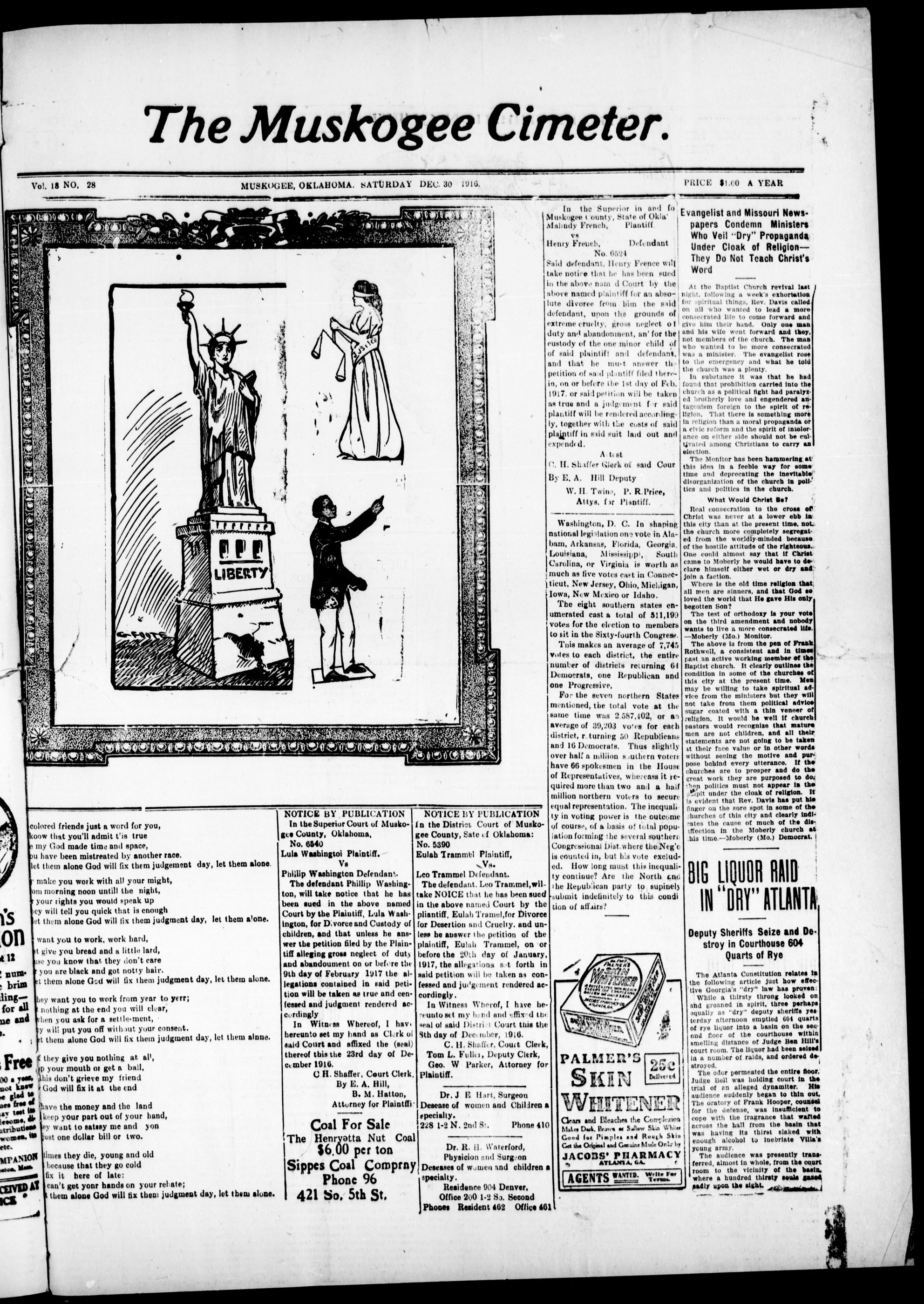
LIBERTY
Vol. 18 NO. 28
colored friends just a word for you, know that you'll admit t'is true, see my God made time and space, you have been mistreated by another ruler them alone God will fix them judge, make you work with all your might from morning noon until the night, for your rights you would speak up they will tell you quick that is enough, let them alone God will fix them judge, want you to work, work hard, give you bread and a little lard, use you know that they don't care for you are black and got notty hair, let them alone God will fix them judge, want you to work from year to year nothing at the end you will clear, when you ask for a settle-ment, they will put you off without your consent, let them alone God will fix them judge
colored friends just a word for you,
know that you'll admit t'is true
me my God made time and space,
you have been mistreated by another race.
let them alone God will fix them judgement day, let them alone.
my make you work with all your might,
from morning noon until the night,
for your rights you would speak up
they will tell you quick that is enough
let them alone God will fix them judgement day, let them alone.
I want you to work, work hard,
let give you bread and a little lard,
use you know that they don't care
for you are black and got notty hair.
let them alone God will fix them judgement day, let them alone.
they want you to work from year to yerr;
at nothing at the end you will clear,
when you ask for a settlement,
they will put you off without your consent.
let them alone God will fix them judgement day, let them alone.
if they give you nothing at all,
keep your mouth or get a ball,
this don't grieve my friend
God will fix it at the end
have the money and the land keep your part out of your hand, they want to satessy me and yon just one dollar bill or two. times they die, young and old because that they go cold fix it here of late: can't get your hands on your reli them alone God will fix them ju
times they die, young and old
because that they go cold
fix it here of late:
can't get your hands on your rebate;
them alone God will fix them judgment day, let them alone.
The Muskogee Cimeter.
MUSKOGEE, OKLAHOMA. SATURDAY DEC. 30 1916.
NOTICE BY PUBLICATION In the Superior Court of Muskogee County, Oklahoma.
The defendant Phillip Washington, will take notice that he has been sued in the above named Court by the Plaintiff, Lula Washington, for Divorce and Custody of children, and that unless he answer the petition filed by the Plaintiff alleging gross neglect of duty and abandonment on or before the 9th day of February 1917 the allegations contained in said petition will be taken as true and confessed and judgment rendered accordingly
In Witness Whereof, I have hereunto set my hand as Clerk of said Court and affixed the (seal) thereof this the 23rd day of December 1916.
C H. Shaffer, Court Clerk,
By E. A. Hill,
B. M. Hatton,
Attorney for Plaintiff
Coal For Sale
The Henryetta Nut Coal
$6.00 per ton
Sippes Coal Comprny
Phone 96
421 So. 5th St.
NOTICE BY PUBLICATION
In the District Court of Muskogee County, Sate of Oklahoma:
No. 5390
Eulah Trammel Plaintiff,
The defendant, Leo Trammel, wiltake NOICE that he has been sued in the above named Court by the plaintiff, Eulah Trammel, for Divorce for Desertion and Cruelty, and unless he answer the petition of the plaintiff, Eulah Trammel, on or before the 20th day of January, 1917, the allegations set forth in said petition will be taken as confessed and judgement rendered accordingly.
In Witness Wherof, I have hereunto set my hand and affixed the seal of said District Court this the 8th day of December, 1916.
C. H. Shaffer, Court Clerk, Tom L. Fuller, Deputy Clerk, Geo. W Parker, Attorney for Plaintiff.
Dr. J E Hart, Surgeon Dessease of women and Children a specialty.
228 1-2 N. 2nd St. Phone 410
Dr. R. H. Waterford,
Physician and Surgeon
Deseases of women and children a
specialty.
Residence 904 Denver,
Office 200 1-2 So. Second
Phones Resident 462 Office 461
In the Superior in and for Muskogee County, State of Okla' Malindy French, Plantiff.
Said defendant, Henry France wilt take notice that he has been sued in the above named Court by the above named plaintiff for an absolute divorce from him the said defendant, upon the grounds of extreme cruelty, gross neglect of duty and abandonment, an' for the custody of the one minor child of of said plaintiff and defendant, and that he must answer the petition of said plantiff filed therein, on or before the 1st day of Feb. 1917. or said petition will be taken as true and a judgement for said plantiff will be rendered accordingly, together with the costs of said plaintiff in said suit laid out and expended.
A t st
C. H. Shaffer Glerk of said Cour By E. A. Hill Deputy
W. H. Twine, P. R. Price,
Attys, for Plantiff.
Washington, D. C. In shaping national legislation one vote in Alabama, Arkansas, Florida, Georgia, Louisiana, Mississippi, South Carolina, or Virginia is worth as much as five votes cast in Connecticut, New Jersey, Ohio, Michigan, Iowa, New Mexico or Idaho.
The eight southern states enumerated cast a total of 511,190 votes for the election to members to sit in the Sixty-fourth Congress.
This makes an average of 7,745 votes to each district, the entire number of districts returning 64 Democrats, one Republican and one Progressive.
For the seven northern States mentioned, the total vote at the same time was 2,587,402, or an average of 39,203 votes for each district, returning 50 Republicans and 16 Democrats. Thus slightly over half a million southern voters have 66 spokesmen in the House of Representatives, whereas it required more than two and a half million northern voters to secure equal representation. The inequality in voting power is the outcome of course, of a basis of total population forming the several southern Congressional Dist. where the Neg'c is counted in, but his vote excluded. How long must this inequality continue? Are the North and the Republican party to supinely submit indefinitely to this condition of affairs?
NO. 101
P.O. BOX 101
WASH WHITENER
A BAKERY STREET MARKET
CENTER FOR THE HOLIDAY
SALON OF CHINA SAINT
MARCUS PHARMACY CO.
ATLANTA, GA.
WHITENER
Clears and Bleaches the Complexion
Makes Dark, Brown or Sallow Skin Whiter
Good for Pimples and Rough Skin
Get the Original and Genuine Made Only by
JACOBS' PHARMACY
ATLANTA, GA.
PRICE $1.00 A YEAR
Evangelist and Missouri Newspapers Condemn Ministers Who Veil "Dry" Propaganda Under Cloak of Religion—They Do Not Teach Christ's Word
At the Baptist Church revival last night, following a week's exhortation for spiritual things, Rev. Davis called on all who wanted to lead a more consecrated life to come forward and give him their hand. Only one man and his wife went forward and they, not members of the church. The man who wanted to be more consecrated was a minister. The evangelist rose to the emergency and what he told the church was a plenty.
In substance it was that he had found that prohibition carried into the church as a political fight had paralyzed brotherly love and engendered antagonism foreign to the spirit of religion. That there is something more in religion than a moral propaganda or a civic reform and the spirit of intolerance on either side should not be cultivated among Christians to carry an election.
The Monitor has been hammering at this idea in a feeble way for sometime and deprecating the inevitable disorganization of the church in politics and politics in the church.
What Would Christ Be?
Real consecration to the cross of Christ was never at a lower ebb in this city than at the present time, not the church more completely segregated from the worldly-minded because of the hostile attitude of the righteous. One could almost say that if Christ came to Moberly he would have to declare himself either wet or dry and join a faction.
Where is the old time religion that all men are sinners, and that God so loved the world that He gave His only begotten Son?
The test of orthodoxy is your vote on the third amendment and nobody wants to live a more consecrated life.—Moberly (Mo.) Monitor.
The above is from the pen of Frank Rothwell, a consistent and in times past an active working member of the Baptist church. It clearly outlines the condition in some of the churches of this city at the present time. Men may be willing to take spiritual advice from the ministers but they will not take from them political advice sugar coated with a thin veneer of religion. It would be well if church pastors would recognize that mature men are not children, and all their statements are not going to be taken at their face value or in other words without seeing the motive and purpose behind every utterance. If the churches are to prosper and do the great work they are purposed to do, then politics must not appear in the pulpit under the cloak of religion. It is evident that Rev. Davis has put his finger on the sore spot in some of the churches of this city and clearly indicates the cause of much of the disaffection in the Moberly church at this time.—Moberly (Mo.) Democrat.
BIG LIQUOR RAID IN "DRY" ATLANTA
Deputy Sheriffs Seize and Destroy in Courthouse 604 Quarts of Rye
The Atlanta Constitution relates in the following article just how effective Georgia's "dry" law has proven: While a thirsty throng looked on and groaned in spirit, three perhaps equally as "dry" deputy sheriffs yesterday afternoon emptied 604 quarts of rye liquor into a basin on the second floor of the courthouse within smelling distance of Judge Ben Hill's court room. The liquor had been seized in a number of raids, and ordered destroyed.
The odor permeated the entire floor. Judge Boll was holding court in the trial of an alleged dynamiter. His audience suddenly began to thin out. The oratory of Frank Hooper, counsel for the defense, was insufficient to cope with the fragrance that wafed across the hall from the basin that was having its thirst slaked with enough alcohol to inebriate Villa's young army.
The audience was presently transferred, almost in whole, from the court room to the vicinity of the basin, where a hundred thirsty souls gazed sadly upon the sight.
TER MUSKOGER CIMEBER.
+ BE Price -Amociate Fditor
). Nickens Associate Editor
1H. Twine, Jr. Manager
BH. Twine COlWCLOF
THEN, AL COW.
MEMBER
MATIONAL NEGRO PRESS
ASSOCIATION
The Cimotr is the only Republican
BRE ths Sy of Muskogee. ‘The
¥ Phoenix is sometimes Republi
Eh ted sometimes Indepontont but at
e present time it claims to be inde
Pendent, nich 9 changing is not worth
@ whoops in h———1 to any political
party and yet Hixby, its editor, got
GEM the Repubtican pie seunter
t base ingratitude.
Evangelist and Missouri News-
papers Condemn Ministers
Who Veil “Dry” Propaganda
Under Cloak of Religion—
They Do Not Teach Christ's
Word
At tho Baptist Church revival last
Aight, following a weok'y exhortation
for spiritual things, Rev, Davis called
on all who wanted to leat a more
consecraied Ifo to como forward and
givo him thelr hand. Only one man
@nd his wife went forward and they,
fot members of the church, The man
who wanted to be more consecrated
was a minister. ‘Tho ovangelist rose
to the omergoney and what he told
the church was a pleniy.
In substance it was that ho had
found that prohibition carried into the
church as « political fight had paralys
4: brotherly love and engendered an
agoninm foreign to the spirit of re-
Mgion, ‘That there is something more
fa religion than a moral propaganda or
@ civi¢ reform and tho spirit of intoler-
enco.on ci(her side should not be eul-
tivated among Christians to carry an
election,
‘The Monitor has been hammeriny: at
this den in a feeble way for some
time and deprecating the fevitable
lsorgaulzation ef tho church in poll:
tes and politics in tho eiureh,
What Would Chrict Be?
Real convscration to the cross of
Christ. was never at a lower ebb in
this elty than at the present time, not
tho church more compiotely regregat
Qt from the worldlyminded because
Of the hostile attitude of tho righteous,
Ono could almost oay that Hf Christ
‘camo fo Moberly he would have to de-
claro himself cither wet or dey and
Join a faction,
Whero i# the okt time religion that
all men are sinuers, and that Cod no
loved the world that He gave His only
Dogotten Son?
"Tho tost of orthodoxy is your vote
on tho third amendment aud nobody
wants {o livo a more consecrated Mie
—Moborly (Mlo.) Monitor
Tho above {s from the pon of Frank
Rothwell, a consistent and in times
past mn activo working member of the
Daptist charek. I clearly onttines the
condition in some of the churches of
this elty at the present tine, Men
may bo willing to twke spirftual ad
vico from the ministers but thoy wilt
Bot (ako irom them potitteal advice
sugar coated with a thin ve ot
religion, it would bo well If church
pastors would recognize that mature
men aro:not chiidren, and all tholr
statements are not going to be taken
at their £ too or In other word
without sooiny the motive and pur
pose Twhind every utterance, If the
churches are to prosper and do the
great work they are purposed to do,
thon polities must not appear in the
peipit under die cloak of religion, It
fe evident that Rev. Davis has put his
finger on the sore spot in some of the
churches of this etty and ly ind
cates the « of much of the dis
affection {a overly church at
this tlme.—Moveriy (Mo.) Democrat
BIG UiQUGR RAIS
ion: “
IN DRY" ATLANTA
Depuly sheti'ts Seize aid De-
_ Stroy in Courthouse 604
Quarts of Rye
The Atianta Constitution relates in
the following article Just how etfee-
tive Goorgia’s "dry" law has proven
While a thirsty throng looked on
end. groaned 1, three perhaps
equal dry" deputy sheriffs yes
ferday aitervoon emptied God quarts
of yo li ya Lasin on the sec
fond tor of the courthouse within
amelliag ¢ cf Judvo Ben Hitt's
court room, The liquor had boen selzod
{a a number ot raids, aud ordered de-
atroyed.
The odor pormeaicd the entire floor,
Judge Vell was holding court in the
trial of on niloged dynzamiter, His
audience suddenly began to thin out,
‘The oratory of Frank Hooper, counsel
for the defense, was insufficient to
cope with the iragrance that wafted
@eross the hall from the basin tha
was having its thirst slaked with
enough slechol to inebriate Villa's
young army.
‘The audience was presently trans
ferred, almost in whole, from the court
room 10. the vietnity of the basin
THE PROHIBITION QUESTION .- , .
f —Y,, °
ro Wwe 48 pcsestt
> 7 WZiZ77/ 2) | é ®
fig” = Oo. (am
ve ty yj ae N ics
“fe YW p> yy We, A rea a
| STF
i aN
26) ee — ce
L, WS < Te N .
Loa XY So" NG SN =
fosssyh | —Basseeee
ce AalKs I, i s f
pe “h \ pi —< cea
Mee oF : MM} Gj H
ee I UI. Ali!
NTS f= ao ae Y Va, i
, - \ \ f yy atk ey
“INWM\\WNY ©: Sl oe
SE SNe
fs { im’ C4 ‘
- owe
} Aa WA, i a:
Z i, j-- 0
Gam oo to ; ( Ze” i \
AAA :
\\ Ate a
. ont , NG 5
& @ CROOKS 7 : ig eS
~ Sees ;
THO: [SIGHTING FRENCH ,
=) a tk 7
a b A
| Ae eal
Se Gp. | \
\ / th ca ke, egy ¢
see / Kieth Wy 1 | a Gh
| ae Meare, LO x P
aA Ps &
FSF op a TRS nV Rae RE eee
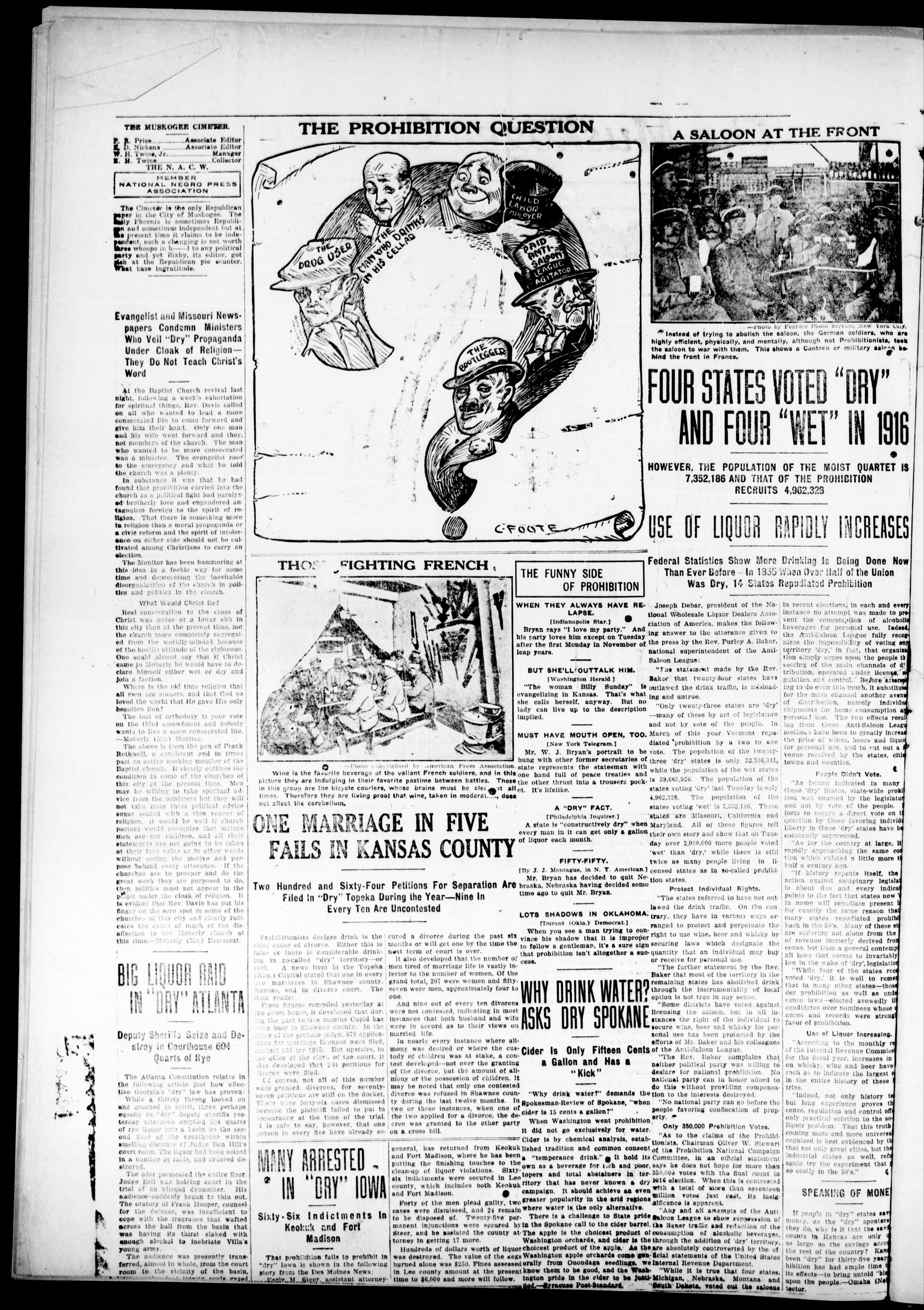
Wine is the favorite beverage of the valiant French soldiers, and in this
picture they are Indulging in their favorite pastime between battles, Those
in this greup are the bicycle couriers, whose brains must be cler@it al
times. Therefore they are living proof that wine, taken in moderat.on, does
ONE MARRIAGE IN FIVE
FAILS IN KANSAS COUNTY
Two Hundred and Sixty-Four Petitions For Separation Are
Filed In “Dry” Topeka During the Year—Nine In
Every Ten Are Uncontested es
Probibitionists declare drink is the
chins cause of divorce. Bither this is
false or there is considerable drink:
ing fn gocalled “dry” territory—or
oth, A news item fn the Topeka
Kou.) Capital stated that one in every
© mariiaces In Shawnee’ county,
Sansas, end i divorces court. The
tem reads:
Fsom figures compiled yesterday at
ho court house, ft developed that dur.
fg the past twelve months Cupid has
4 busy in Shawnee county. In the
2 cf the pretate judge, $79 applica
3 for marriage Neonses were filed
net O31 fer 1915, But upstairs, ty
se office of the clor of tae court, I
iso Ceveloped thet 244 petitions for
ivores were fled.
CE course, mot all of this number
wore graned diverees, for seventy
soven petitions are still on the docket
Tove wore forty-six cases disminse
rene the plainttt failed to put tr
‘ppearance at the time of the trial
{is safe to say, however, that on
soraon in every five have already se
|
WAMY ARRESTED .
Met | .
"IN “ORY” 1OWA
Sixty-Six Indictments In
Keokuk and Fort
Madison
‘That prohibition fails to prohtbit tn
“dry” Iowa is shown in the following
story from the Des Moines News
. Banlv. M. Steer, assistant attorney:
cured a divorce during the past stx
months or will get one by the time the
hext term of court is over.
It also developed that the number of
men tired of marriage life is vastly in:
ferior to the number of women, Of the
grand total, 207 were women and fifty.
seven were men, approximately four to
one
And nine out of every ten divorces
wore not contesied, indicating in most
insiances that both husband and wife
were in accord as to their views on
married life.
In nearly every instance where alt
mony was desired or where the cus
tody of children was at stake, a con
test developed~-not over the granting
|of the divorce, but the amount of all
mony of the possession of children, I
may be noted that only one conteste:
| divorce was refused in Shawnee coun
‘ty during the last twelve months, I
two or three instances, when one o
the two applied for a divorce, the de
“creo was granted to the other part
‘on & cross bill.
general, bas returned from Keokuk
and Fort Madison, where he has beer
‘putting the finishing touches to the
‘cleanup of Hquor violations. Sixty
‘ix indictments were secured tn Le
county, which includes poth Keokuh
‘and Fort Madison, e
Forty of the men plead guilty, tw
cases were dismissed, and 24 remat
to be disposed of. Twenty-five per
manent injunctions were secured b}
Steer, and he assisted the county at
tomey tn getting 17 more.
Hundreds of dollars worth of quo
was destroyed, The value of the xex
burned alone was $250. Fines assesses
jin Lee county amount at the presen
time to $6,000 and more will follow.
THE FUNNY SIDE
OF PROHIBITION
WHEN THEY ALWAYS HAVE RE-
LAPSE.
indianapolis star) @
Bryan rays “I love my party.” And
his party loves him except on Tuesday
after the first Monday in November ot
leap years.
BUT SHE'LL/OUTTALK HIM.
Wesidiaiiie steak?
“The woman Billy Sunday” {s
evangelizing in Kansas, That's what
she calls herself, anyway. But no
lady can live up to the description
implied.
MUST HAVE MOUTH OPEN, TOO.
[New York Telegram.
Mr, W. J. Bryan's portrait to be
hung with other former secretaries of
state represents the statesman with
Fone hand full of peace treaties and
‘the other thrust into a trousers pock-
lat. It's lifelike,
aces
A “DRY” FACT.
{Philadetphla Inquirer.]
A state is “constructively dry” when
every man in it can get only @ gallon
of liquor each month.
FIFTY-FIFTY.
[By J. J. Montague, in N. ¥, Amertean.)
Mr. Bryan has decided to quit Ne
) braska, Nebraska having decided som
time ago to quit Mr. Bryan.
LoTS SHADOWS IN OKLAHOMA
{Durant (Okla.) Democrat.)
When you see a man trying to con-
vince his shadow that it is improper
to follow a gentleman, it’s a sure sign
that prohibition isn’t altogether a suc-
cess,
WHY DRINK WATER?
Cider Is Only Fifteen Cents
a Gallon and Has a
“Kick”
“Why drink water?” demands the
Spokesman-Review of Spokane, “when
clder {s 15 cents gallon?” ‘
Whon Washington went prohibition
it did not go exclusively for water
Cider is by chemical analysis, estab
lished tradition and common consent
a “temperance drink.” @ Tt hold ite
own as a beverage for 1.ch and poor
topers and total abstainers in ter
ritory that has never known a dr)
campaign, It should achieve an ever
greater popularity in the arid regions
where water is the only alternative.
‘There {s a challenge to State pride
in the Spokane call to the cider barrel
‘The apple ts the choicest product o
Washington orchards, and cider is the
choicest product of the apple, As the
Washington apple orchards come gen
erally from Onondaga seedlings, wé
know them to be good, and the Wash
ington pride in the cider to be justi
ded.—@yracuse Post-Standard, —
A SALOON AT THE FRONT
oo = < ii ip
Vane es Pose... eens imam’
qe A ete eR
neta oes) APO sa
3 $ pe dt Sy, a
ad be hs
| ae mie ae NDT, A aS
rok % ea ¥ x ican Nad a |
ie rk ob pee Pa Se OS RS!
ee by ok
Pets gsikete i (ey |
oe a ek Ramah PS tga x
4% map elie ot eka
ee at
a Jy Ngee sal 5 he. as
Ce aS § tue Abe bo
Ne a ite: eli se Ne
Pdi: 1 ol
@ Instead of trying to dhelish tha paivan, shee Gorman solsiors, “whe are
highly effictent, physically, and mentally, although not Prohibitionlets, teek
the saloon to war with them. This shows a Canteen or military salcan be
hind the front in France. e
FOUR STATES VOTED “CRY”
AND FOUR “WEI” W 96
F LIQUOR RAPIDLY TNCREASES
USE OF LQUCH RAPIDLY I
Federal Statistics Show More Drinking 1s Being Done Now
Than Ever Before - In 1855 Waen Over talf of the Union
Was Dry, 14 Siatos Repudiatod Prohibition
Joseph Debar, president of the Na-
tonal Wholesale Liquor Dealers Asso:
ciation of America, makes the foliow-
ing answer to the utterance given lo
the press by the Rev. Purley A. Baker,
Rational superintendent of the Ant:
Saloon League:
“Tue statement made by the Rev.
Baker that twoxty-four states have
outlawed tho drink trafic, is sdslead:
ing and untrue.
“Only twenty-three states are ‘dry’
many of these by act of legistature
and not by vote of the people, In
March of this year Vermont repu-
diated “prohibition by a two to ene
vote, The population of the twenty
‘three ‘dry’ states is only $2,306,011,
while the population of the wet states
Is 59,665,926. The population of th
states voting ‘dry’ last T) day {s onl,
4,962,328, ‘The population of the
states voting ‘wet! {5 7,252,186, Those
‘Mates are “Missouri,. California. end
Maryland. All of these figures tell
their own story and show tiat on Tuas:
day over 2,000,000 more people voted
‘wet’ than ‘dry,’ while there is still
twice as many people living in Ii
}censed states as in so-called prohtbi
‘tion states,
Protect Individual Rights.
“The states referred lo have not out
lawed the drink traffic, On the con
‘trary, they have in various ways ur
range to protect and perpetuate the
right to uso wine, beer and whloky by
:securing laws which designate the
rquantity that an individual may buy
or receive for personal use.
“The further statement by the Rev
Baker that most of the territory in the
remaining states has abolished drink
through the instrumentality of loca
option Is not true in any setiso.
, “Some districts have voted agains
Meensing the saloon, but in all in
stances the right of the individual t
@gocure wine, beer and whisky for per
sonal use has been protected by the
efforts of Mr. Baker and lis colleagues
Bot the Anti-satoon Loague,
“The Rev. Baker complains tha
helther politieal party was willlng t
deglare for national prohibiiion, Nx
Bational party can in honor aiford
do this without providing compensa
®tion to the interests destroyed.
pn “No national party can go before th
people favoriug confiscation of prop
erty. *
= Only 350,000 Prohibition Votes,
. “AS to the claims of the Prolib!
toniste, Chairman Oliver W. Stewar
ot the Prohibition National Campaiei
sCommittee, in an ofitclal siatomen
Says he does not hope for more tha:
860,009 votea with tho final count i
y W16 election. When this !s contrasta,
a With @ total of wore than soventeu
{Billion votes Just cast, its Inslg
*alficance is apparent,
“Any and aH attempts of the Ant!
© Maloon’ League 0 sow syrweesion o
l. the Manor tragic amd retxciion of th
feonsumption of alcoholic beverages
@ through the addition of ‘dry’ territory
@are absolutely controverted by the ot
a-cial statements of the United State:
@lmternal Revenue Department,
“While it is true that four states
+ Michigan, Nebraska, Montana an
“Mouth Dakota, voted ous the saloon:
in recent elections, in each and every
instance no attempt was made to pre
vent the consumption of alcohol
Leverayes for persamal use. ee
the Antivaloon League fully re
nizos the fmpoasibility of veting
territory ‘dry,’ in fact, that organ!
ton simply urges upon the people th
ciosing of the main channels of a!
tribution, operated inder Hcenge,“
gulation ané control.” Before at
ing to do even this much, ft substit
for the moiy ebannel another avem
of distribulton, namely individ
nonts jor Home comsamption
persons! use, ‘Phe two effects res
Ing from t AntiSaloon Lea
motiioes have beon to greatly incre
the price of wines, beers aad Mau
for personal ure, and to rat out a
venue recived by the states, elt
towns aud counties, %
Poopls Didn't Vote.
As te indicated in many
these ‘dry’ Siatos, statewlde prob
on Was enacied by the legislatu
and not by yoto ef the people.
forts to 4 direct vote on tl
question by those favoring individ
Liberty in these ‘dry’ states have
cor iy suppressed,
‘As for (ie country at large, tt
rapidly approaching the same
fon Wife existed 9 little mare
half a century avo.
If history repeats Iteelf, the
‘action againet swaptuary legisla
fs about due and every indie
“points to the fact thet states now
in mame will repudiate present
for exactly the same reason th
niany states repodiated prob!
back In tho 50's. Many of these
are svilering not alone from the
of revenue formerly derived fr
cense, but from a general contem|
‘all laws that seems to invartably
| low in the wake of ‘dry’ logislatiot
| "While four of the states re
| voted ‘dry,’ It is well to rem
[that in niony other states—tho
der prohibition as well as um
conve laws—elected avowedly
candidates over nominees whose
ances and records were stro
favor of prohibition,
| Uso of Liquor Increasing.
| “According to the monthly
| of the Internal Revenue Commis
| for the fiscal year, increases in
jon whisky, wine and beer have
ich as to indicate the largest
[in the entise history of there
trios
[ tnaeedi use only history t
|but long experience proves #
| cense, regulation and control off
Jenty practical solution to the
Hquor proiem. ‘That this truth
coming more and more univers
cognized I best evidenced by t
| that not only great etties, but th
| industrial states as well, ret
jaKaln try the exporiment that
ie costly tn the 50's.” ‘
SPEAKING OF MONE
If peopte in “ary” etates sa
money, as the “dry” spouter
they do, why Is It Usat the sav!
counts in Kansas are only
As large as the savings accof
the rest of the country? Kal
been “dry” for thirty-five y¢
hibition has had ample time
{ts effects—to bring untold “bl
upon the people —Omaba (N¢
testes,
Midland Valley R. R.
Special Round Trip Fares
For The
Christmas and New Year Holidays
to Points On
The Midland Valley Railroad
For Full Information
Phone PBX 4260 or 495 Muskogee, Okla.
The Old Standard Grove's Tasteless chill Tonic is Equally Valuable as a General Tonic because it Acts on the Liver, Drives Out Malaria, Enriches the Blood and Builds up the Whole System. For Grown People and Children.
You know what you are taking when you take Grove's Tasteless chill Tonic as the formula is printed on every label showing that it contains the well known tonic properties of QUININE and IRON. It is as strong as the strongest bitter tonic and is in Tasteless Form. It has no equal for Malaria, Chills and Fever Weakness, general debility and loss of appetite. Gives life and vigor to Nursing Mothers and Pale, Sickly Children. Removes Billionousness without purging Believes nervous depression and low spirits. Arouses the liver to action and purifies the blood. A True Tonic and Sure Appetizer. A Complete Strengthener. You family should be without it. Guarantees by your Druggist. We mean it. 500.
332 N. nd2St
HUGHES ON REUNITED PARTY.
"I come to you as the spokesman of a reunited party. We have said that it was reunited; we have believed it was reunited; we have devoutly hoped it was reunited. Now, Maine proves that it is reunited. I am glad to speak for the reunited Republican party because it is a great liberal party. It started as a liberal party; its best traditions are those of a liberal party. And today it faces the future with a truly national outlook and a progressive spirit."—Charles E. Hughes in a Speech Delivered at Plattsburg, N. Y.
The least that may be said of President Wilson is that he has been right half the time, for he has been on both sides of almost all important questions.
It's not to be wondered that Thomas A. Edison favors Wilson's re-election. The electrical wizard naturally likes anything that switches on and
SOMETHING WRONG
There is something wrong in prohibition Iowa when drinking men can obtain booze with regularity. Somebody is to blame for dispensing it and peddling it, and while most people know its source but few can prove Charles City (Ia.) Press.
Editorial Comment
Bryan butts, Wilson tuts.
Watchful waiting maketh wooful wanting.
Candidate Hughes doesn't talk like a tut-tutter.
Rughes is hammering and the Democrats are yammering.
The Wilson Administration stands
for taxes, and more taxes.
The Hughes trail will be cold by
the time the Democrats strike it.
As a party leader, would it be fair
to refer to J. Ham Lewis as J. "Pork"
Lewis?
Bryan says Mr. Hughes' talks aren't
judicial. No. The people can under-
stand 'em perfectly.
Midland V
Special Round
For
Christmas and New
DRY CITY IS MURDER MAD
EIGHTEEN HOMICIDE CASES
CALLED FOR TRIAL
IN MONTH
AT CHATTANOOGA
Twelve Convictions Out of 14 Cases Already Heard—All Records For ProhibitionTennessee Are Smashed
A favorite prohibition argument is that prohibition reduces crime to a minimum. But does it? The answer is furnished by this article from the Chattanooga (Tenn.) Times: The October term of the criminal court which has just ended established a record in the trial of murder cases that will doubtless stand for some time to come. During the month just ended, Judge McReynolds called eleven homeicide cases, and of that number final disposition was made of all except four, which were continued. Out of the fourteen actually tried by juries, there were twelve convictions and but two verdicts of not guilty. That within itself was a record. Of the twelve verdicts of guilty, four were for murder in the first degree, which is another record.
Law Sayes Four.
But for the anti-capital punishment law, four men would have doubtless been sentenced to death, as in each of the cases the evidence was conclusive. There were six verdicts of murder in the second degree, which under the law carries a sentence from ten to twenty years each. In three of these cases, in the event Judge McReynolds does not grant new trials, he will doubtless recommend the maximum punishment of twenty years. In one case the jury recommended the maximum punishment.
Valley R. R. and Trip Fares The
PROHIBITION CONFISCATION
ASKS JUSTICE FOR LIQUOR MEN AS WELL AS FOR LAND-OWNERS
"INNATE HONESTY"
Of the People Fails to Manifest Itself When They Are Voting Upon the "Dry" Question, Declares President of National Liquor Dealers' Association
The following letter on the injustice of confiscating the liquor dealer's property signed by Joseph Debar, president of the National Wholesale Liquor Dealers' Association, appeared in the Cincinnati Times-Star:
In your issue of December 6, you print an editorial under the caption of "Too Much for California," calling attention to the refusal of the people of California to vote for a single land tax amendment which you state was "confiscation pure and simple."
As an American citizen having pride of country, I would like to think you were right when you say "at the back of the popular mind there is an innate honesty and respect for the rights of individuals which, when a question of confiscation is put squarely up to the voters can be counted on to produce a large negative majority at the polls". This high estimate of the American voter seems not to be borne out by recent results in Michigan and other States where millions of dollars' worth of brewery and other property has been voted to the scrap heap.
Destruction and Confiscation.
Mr. Bryan, at a dinner given to him by alleged political admirers in Washington on December 6, is reported as advocating that this destruction and confiscation be carried out on national lines.
The moral distinction between confiscating property by an unfjust land tax or by a vote for prohibition is not apparent to those who view the question without prejudice. The land in California which the voters refused to confiscate and for which refusal you give them just praise, never paid a penny to the Federal Government for any purpose.
Breweries and distilleries of the United States built up under the fostering care of the Government and protected by a multiplicity of its laws have for more than a lifetime paid to the Federal Government in the shape of taxes more than one-third of its total revenue.
Why then should not the "innate honesty" of our people manifest itself at the polls when voting on prohibition?
Some voters announce their objection to the saloon as a reason for voting dry.
Mr. Bryan, with his usual capacity for distortion of facts, makes his plea for prohibition on the ground of exterminating the saloons.
"Not Honest."
That is not an honest presentation of the question. Mr. Bryan knows that what he is urging is not the destruction of the saloon alone but of the whole industry—a destruction of breweries, distilleries and of all distributing plants where liquors are sold.
Why should not your plea for fairness and your commendation of justice in California apply to and be urged upon the voters of other states when asked to vote incidentally for the elimination of saloons, but in fact for the destruction of millions of dollars' worth of brewery and distillery property?
What you would deem wrong in California was no less wrong in Nebraska or Michigan.
If the breweries and distilleries of these States as well as the saloons, were, as claimed, voted out for the public good, then why should not the public, by compensation to the owners of these plants, pay for the cost of this debatable experiment?
Is this not especially true when all the people of these States have shared in the benefits of low rates of direct taxation which these revenues from liquors have for years made possible?
Now is the time for your Xmas shopping and this store is an ideal place to make your selection A few suggestions Keep this list it will paoxe useful.
Manture Sets.
Ash Trays
Picture Frames
Traveling Sets
Leather Purses
Leather Folders
Thermos Bottles
Music Rolls
Brief Cases
Hand Bags
Suit Cases
Trunks
Wardrobe Trunks
Necklaces
La Valliers
Fit-All Traveling Sets
Hat Pins
Waldeman Knives
Lodge Emblems
Ear Screws
Locket
Vanity Cases
Crosses
Baby Sets
Desk Clocks
Leather Writing Sets
Leather Handkerchief Boxes
Leather Collar Boxes
Silver Match Boxes
Silver Baby Rattles
Smoking Sets
Tobacco Jars
Walking Canes
Barr Pins
Silverwear
Bracelet Watches
DIAM
T. N
AMOND
. Miller
DIAMONDS T. Millers
112 N. Second St.
& G. CHANGE
Sunday, October
leaves for Henryetta at 8:00 a
etta at 9,55 a. m.
ANGE TIME
tober 8th.
a at 8:00 a.m. instead of 9:30 a.m.
M. O. & G. CHANGE TIME Sunday, October 8th.
Train No. 5 leaves for Henryetta at 8;00 a.m. instead of 9;30 a.m. arriving at Henryetta at 9;55 a.m.
Train No. 1 new train for Dewar, Henryetta and Denison, leaves at 12;45 p.m., arriving at Dewar, the first stop, at 2;10 p.m.; Henryetta, 2;20 p.m.; Denison, 8;00 p.m.
Train No. 2 will arrive from Denison at 2:05 p.m., and depart for Joplin at 2;15 p.m. instead of 2.45 p.m. arriving Joplin, 7;00 p.m. 45 minutes earlier.
Train No. 6 from Henryetta and Dustin will arrive at 6;00 p.m. instead of s;50 p.m.
Note that toains 1 and 2 operate to and from Denison, instead of trains 5 and 6, and do not stop between Muskogee and Dewer, Passengers for intermediate points will use train No. 5, leaving Muskogee at 8;00 a.m. and No. 6 arrive 6;00 p.m.
Oklahoma City traib leave at 8 a.m. aed 9;30 p.m.
CALL 519 or P.B. X. 4201 for Information.
Service!
In every respect the M. K. and T. Ry. tries to live up to this motto:
"GIVE THE PUBLIC THE VERY BEST SERVICE WE CAN".
This is only one of the many reasons why you should travel by the KATY to or from
St. Louis Kansas City San Antonio Galveston
Sedalia Oklahoma City Ft.Worth Dallas
Parsons Junction City Houston West
Hannibal Muskogee Shreveport Denison Gutnrio
Tulsa Wichita Falls Austin 81
Men's Watches
Watch Chains
Cigaret Cases
Cigar Cases
Cameo Pins
Cameo Rings
Diamond Rings
Set Rings
Cloaks
Scarf Pins
Sewing Sets
Mocasins
Poker Sets
Whist Sets
Umbrellas
Jewel Boxes
Shaving Sets
Cuff Links
Bracelets
Photo Frames
Cuff Link Sets
Card Cases
Gold and Silver Thimbles.
Souvenir Spoons
Chests of Silver
Toilet Sets
Ivory Toilet Sets
Ebony Toilet Sets
Cologne Bottles
Cameo Brooches
Dog Collars
Silver Salt and Pepper Sets
Gladstone Bags
Ladies' Leather Purses
A small deposit will hold any article until Christmas.
ONDS
illers
The Y
Comp
52 Times a
Three W
```markdown
```
S
S
```markdown
```
The Youth's Companion
52 Times a Year—Not 12
IT is more than 52 numbers filled to the brim with delightful reading—it is an influence for all that is best in home and American life.
Three Weeks Free
The Compunion is $2.00 a year, but to those who do not know the paper we shall be glad to send three current issues free of charge, so that they may test its quality, read its wholesome, diverting fiction, its contributions by famous men and women, its various departments, etc.
THE YOUTH'S COMPANION
114 Berkeley Street, Boston, Mass.
SUBSCRIPTIONS RECEIVED AT
THIS OFFICE
1
TRYING TO "SAVE" OHIO
ANTI-SALOON LEAGUE FLOODS
GREAT STATE WITH PAID
REFORMERS
Buckeye Editor Roasts Small, Hobson and Patterson, Telling Them To Help Lift Up Georgia, Alabama and Tennessee Which Really Need the Light
After two previous unsuccessful attempts the Anti-Saloon League, with a paid gang of reformers, is trying to make Ohio "dry." Here is what the Ohio Valley Times, of Steubenville, Ohio, thinks of the scheme:
The national organization of the Anti-Saleon League is sending into the state of Ohio the Rev. Small of Georgia, the Hon. Richard P. Hobson, of Alabama, and Ex-Governor Patterson, of Tennessee, to tell the people here how to manage the affairs of this great state. Georgia, Alabama, Tennessee!
Look at the map! Study the tables of illiteracy and human depravity. Make comparisons of these states with the state of Ohio on any question involving any matter of American civilization or American welfare and determine for yourself whether these gentlemen, Rev. Sam Small of Georgia, Hon. Richmond P. Hobson of Alabama, and Ex-Governor Patterson of Tennessee might not employ their talents, such as they have, to the anilization of conditions in the states from which they come.
Ohio is an enlightened community. Ohio places the man above every other consideration.
Ohio Represents America.
Georgia, Alabama, Tennessee do not represent the spirit of America. They all live in an age that is dead. They are decadent communities. The things that Rev. Small, Mr. Hobson and Mr. Patterson are contending for may be all very well for Georgia, Alabama, Tennessee and Russia, but Ohio is American at its best. Autocratic government for Russia, Georgia, Alabama and Tennessee is the only form applicable to communities where the population has been kept in the darkness of Cathay, but this is Ohio—Ohio self-reliant, Ohio intelligent, Ohio awake to the light and the life of the twentieth century.
Ohio does not vote the Democratic ticket nor the Republican ticket at the behest of the bosses. Ohio has more independent voters than any state in the union. Ohio thinks for herself.
Ohio is able to take care of herself.
We say unto you, Richard P. Hobson, go back to Alabama, and take those poor half-starved children out of the factories, where the grind is destroying the future citizens of America. You sank the Merrimae in the straits of Sanlargo, but we warn you not to sink the Alabama.
To Sam Small of Georgia we say unto you, put Georgia on the map as a civilized community and then come to Ohio and tell us how you did it.
Anti-Saloon League Politics. $ ^{3} $
To Ex-Governor Patterson of Tennessee, we want to know how you came by that "EX" in front of your name. Did the fact that you helped to destroy civil liberty and local self-government in Tennessee have anything to do with it. You have a court appointed mayor in Memphis, put there by a tuxedo court, and in defence of the expressed will of the people. You have in Tennessee what you are pleased to call prohibition, but you have not local self-government; neither have you a judiciary that dares to lift its head. The Anti-Saloon mob has indicted your courts and the state has taken property without due process. Human slavery has been abolished within your borders, but not by you nor your fathers, but in spite of you and the race from which you spring.
You cannot foist upon Ohio either human slavery nor any of those substitutes which you bring under another gudge. Ohio demands clean hands and a pure heart. Show your hands and reveal to us the true inwardness of your hearts. We do not believe in your sincerity, neither do we trust to your judgments. "Fool, first cast the beam out of thine own eye; then cannot thou see clearily the mote that is in thy brother's eye."
Michigan has gone dry—voted to go dry after April 1, 1918. The hotels and barrooms have been swamped with the query, What are you going to do? To silence further interrogation the following sign has been posted in all Detroit hotels and cafes:
"Don't ask what we are going to do.
What are you going to do?"—Philadelphia Public Ledger.
THE SOLDIER'S CAFE
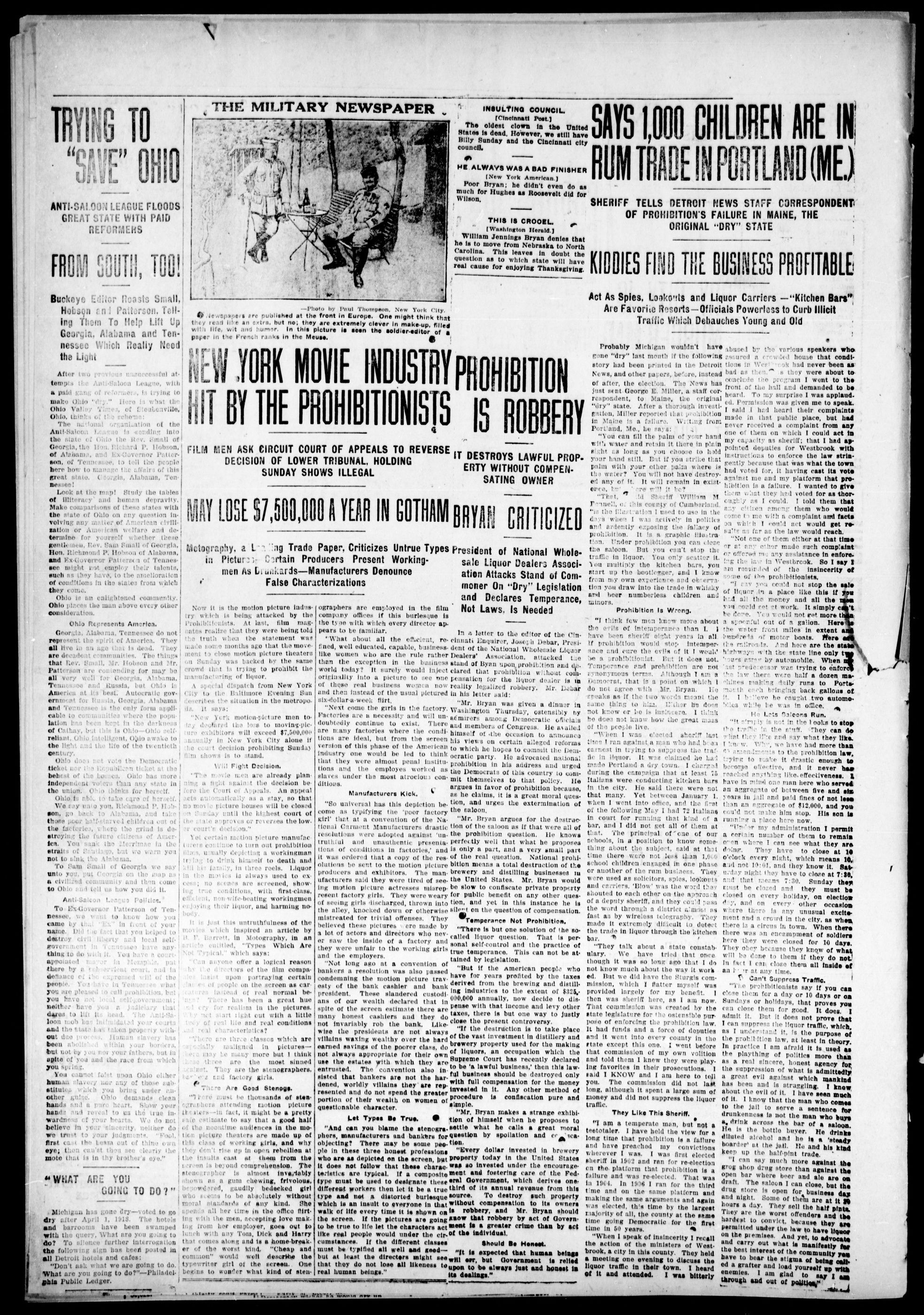
Newspapers are published at the front in Europe. One might think that they read like an extra, but no; they are extremely clever in make-up, filled with life, wit and humor. In this picture is seen the soldier-editor of a paper in the French ranks in the Meuse.
NEW YORK MOVIE INDUSTRY PROHIBITION HIT BY THE PROHIBITIONISTS IS ROBBERY
FILM MEN ASK CIRCUIT COURT OF APPEALS TO REVERSE DECISION OF LOWER TRIBUNAL, HOLDING SUNDAY SHOWS ILLEGAL
MAY LOSE $7,500,000 A YEAR IN GOTHAM BRYAN CRITICIZED Metography, a Leading Trade Paper, Criticizes Untrue Types President of National Wholesale Liquor Dealers Association Attacks Stand of Commerer On "Dry" Legislation in Pictures Certain Producers Present Working men As Drunkards—Manufacturers Denounce False Characterizations
I think some people would agree that this would be up.
Now it is the motion picture industry which is being attacked by the Prohibitionists. At last, film magnates realize that they were being told the truth when the statement was made some months ago that the movement to close motion picture theaters on Sunday was backed by the same crowd that is trying to prohibit the manufacturing of liquor.
A special dispatch from New York City to the Baltimore Evening Sun describes the situation in the metropolis. It says:
"New York motion-picture men today declared the loss to moving-picture exhibitors will exceed $7,500,000 annually in New York City alone if the court decision prohibiting Sunday film shows is to stand.
WILL FIGHT DECISION.
"The movie men are already planning a fight against the decision before the Court of Appeals. An appeal acts automatically as a stay, so that no movie picture houses will be closed on Sunday until the highest court of the state approves or reverses the lower court's decision."
Yet certain motion picture manufacturers continue to turn out prohibition films, usually depicting a workingman trying to drink himself to death and kill his family, in three reels. Liquor in the movies is always used to excess; no scenes are screened, showing true conditions, with first-class, efficient, non-wife-beating workingmen enjoying their liquor, and harming nobody.
It is just this untruthfulness of the movies which inspired an article by B. P. Barrett, in Motography, in an article entitled, "Types Which Are Not Typical," which says:
"Can anyone offer a logical reason why the directors of the film companies insist upon portraying certain classes of people on the screen as car features instead of real normal beings? There has been a great hue and cry for realism in the pictures. Why not start right out with a little story of real life and real conditions and real characteristics?"
"There are three classes which are especially maligned in pictures—there may be many more but I think those three are the most sinned outcast. They are the stenographers, believers and factory girls."
There Are Good Stenogr.
"There must be thousands of stenographers attending motion picture theaters—in fact, it might be a pretty safe estimate to say that a good half of the nocturne audiences in the motion picture theaters are made up of this class of working girls, and why they don't rise up in open rebellion at the insults cast at them from the screen is beyond comprehension. The stenographer is almost invariably shown as a gum chewing, frivolous, beowooded, gaudily bedecked girl who seems to be absolutely without moral standards of any kind. She spends all her time in the office flirting with the men, accepting love making from her employer, goes out to lunch with any Tom, Dick and Harry that comes along and is a home-breaker of the worst kind. "Cheap and common" would well describe the typewriter girl of the screen. One begins to wonder what kind of sten-
must be typified all well and good— "it is expected that human beings but at least the directors might see will err, but Government is rolled that they do not lose all likeness to upon to be always just and honest in real human beings." its dealings."
ographers are employed in the film company offices if this burlesque is the type with which every director appears to be familiar.
"What about all the efficient, refined, well educated, capable, business-like women who are the rule rather than the exception in the business world today? It surely would inject originality into a picture to see one of those real business women now and then instead of the usual pictured six-dollar-a-week flirt.
"Next come the girls in the factory. Factories are a necessity and will undoubtedly continue to exist. There are many factories where the conditions are ideal, but from the screen version of this phase of the American industry one would be led to think that they were almost penal institutions and the employees worked as slaves under the most atrocious conditions.
Manufacturers Kick.
"So universal has this depiction become as typifying the 'poor factory girl' that at a convention of the National Carment Manufacturers drastic resolutions were adopted against 'untruthful and unauthentic presentations of conditions in factories,' and it was ordered that a copy of the resolutions be sent to the motion picture producers and exhibitors. The manufacturers said they were tired of seeing motion picture actresses misrepresent factory girls. They were weary of seeing girls discharged, thrown into the alley, knocked down or otherwise mistreated for trivial offenses. They believed these pictures were made by a lot of actors and directors who never saw the inside of a factory and they were unfair to the working girls and the employers.
"Not long ago at a convention of bankers a resolution was also passed condemning the motion picture tray- vesty of the bank cashier and bank president. These slandered custodians of our wealth declared that in spite of the screen estimate there are many honest cashiers and they do not invariably rob the bank. Likewise the presidents are not always villains waxing wealthy over the hard earned savings of the poorer class, do not always appropriate for their own use the estates with which they are entrusted. The convention also insisted that bankers are not the hard- dened, worldly villains they are represented and do not spend the greater portion of their wealth on women of questionable character.
Let Types Be True.
"And can you blame the stenographers, manufacturers and bankers for objecting? There may be some people in these three honest professions who are as depicted on the screen, but it does not follow that these characteristics are typical. If a composite type must be used to designate these different workers then let it be a true type and not a distorted burlesque which is an insult to everyone in that walk of life every time it is shown on the screen. If the pictures are going to be true to life let the characters act like real people would under the circumstances. If the different classes
The oldest clown in the United States is dead. However, we still have Billy Sunday and the Cincinnati city council.
HE ALWAYS WAS A BAD FINISHER
[New York American.]
Poor Bryan; he didn't even do as much for Hughes as Roosevelt did for Wilson.
William Jennings Bryan denies that he is to move from Nebraska to North Carolina. This leaves in doubt the question as to which state will have real cause for enjoying Thanksgiving.
PROHIBITION IS ROBBERY
IT DESTROYS LAWFUL PROPERTY WITHOUT COMPENSATING OWNER
BRYAN CRITICIZED
President of National Wholesale Liquor Dealers Association Attacks Stand of Commoner On "Dry" Legislation and Declares Temperance, Not Laws. Is Needed
In a letter to the editor of the Cincinnati Enquirer, Joseph Debar, President of the National Wholesale Liquor Dealers' Association, attacked the stand of Bryan upon prohibition and declared that prohibition without compensation for the liquor dealer is reality legalized robbery. Mr. Debar in his letter said:
"Mr. Bryan was given a dinner in Washington Thursday, ostensibly by admirers among Democratic officials and members of Congress. He availed himself of the occasion to announce his views on certain alleged reforms to which he hopes to commit the Democratic party. He advocated national prohibition in his address and urged the Democrats of this country to commit themselves to that policy. He argues in favor of prohibition because, as he claims, it is a great moral question, and urges the extermination of the saloon.
"Mr. Bryan argues for the destruction of the saloon as if that were all of the prohibition question. He knows perfectly well that what he proposes is only a part, and a very small part of the real question. National prohibition means a total destruction of the brewery and distilling businesses in the United States. Mr. Bryan would be slow to confiscate private property for public benefit on any other question, and yet in this instance he is silent on the question of compensation.
Temperance Not Prohibition.
"There is but one solution of the so-called liquor question. That is personal self-control and the practice of true temperance. This can not be attained by legislation.
"But if the American people who have for years profited by the taxes derived from the brewing and distilling industries to the extent of $325,000,000 annually, now decide to dispense with that income and levy other taxes, there is but one way to justly close the present controversy.
"If the destruction is to take place of the vast investment in distillery and brewery property used for the making of liquors, an occupation which the Supreme Court has recently declared to be a 'lawful business,' then this lawful business should be destroyed only with full compensation for the money invested in it. Any other method of procedure is confiscation pure and simple.
"Mr. Bryan makes a strange exhibition of himself when he proposes to settle what he calls a great moral question by spoilation and co-scation.
"Every dollar invested in brewery property today in the United States was so invested under the encouragement and fostering care of the Federal Government, which derives one-third of its annual revenue from this source. To destroy such property without compensation to its owners is robbery, and Mr. Bryan should know that robbery by act of Government is a greater crime than by act of the individual.
Should Be Honest.
"It is expected that human beings will err, but Government is relied upon to be always just and honest in its dealings."
SAYS 1,000 CHILDREN ARE IN RUM TRADE IN PORTLAND (ME.)
SHERIFF TELLS DETROIT NEWS STAFF CORRESPONDENT OF PROHIBITION'S FAILURE IN MAINE, THE ORIGINAL "DRY" STATE
KIDDIES FIND THE BUSINESS PROFITABLE
Act As Spies, Lookouts and Liquor Carriers — "Kitchen Bars" Are Favorite Resorts—Officials Powerless to Curb Illicit Traffic Which Debauches Young and Old
Probably Michigan wouldn't have gone "dry" last month if the following story had been printed in the Detroit News, and other papers, before, instead of after, the election. The News has just sent George E. Miller, a staff correspondent, to Maine, the original "dry" state. After a thorough investigation, Miller reported that prohibition in Maine is a failure. Writing from Portland, Me., he says:
"You can fill the palm of your hand with water and retain it there in plain sight as long as you choose to hold your hand still. But if you strike that palm with your other palm where is the water? You will not have destroyed any of it. It will remain in existence, but there will it be."
"Thet, old Sheriff William M. Pennell, of this county of Cumberland "is the illustration I used to use in the days when I was actively in politics and ardently exposing the fallacy of prohibition. It is a graphic illustration. Under prohibition you can close the saloon. But you can't stop the traffic in liquor. You only scatter it. You multiply the kitchen bars, you start up the bootlegger, and I know from my own experience and observation you draw into the trade in whisky and beer numberless children and minors.
Prohibition Is Wrong.
"I think few men know more about the evils of intemperance than I. I have been sheriff eight years in all, if prohibition would stop, intemperance and cure the evils of it I would be a prohibitionist. But it does not. Temperance and prohibition are not synonymous terms. Although I am a Democrat, that is a point on which I do not agree with Mr. Bryan. He speaks as if the two words meant the same thing to him. Either he does not know or he is insincere. I think he does not know how the great mass of the people live.
"When I was elected sheriff last time I ran against a man who had been earnest in trying to suppress the traffic in liquor. It was claimed he had made Portland a dry town. I charged during the campaign that at least 75 Italians were conducting kitchen bars in the city. He said there were not that many. Yet between January 11 when I went into office, and the first of the following May I had 72 Italians in court for running that kind of a bar, and I did not get all of them at that. The principal of one of our schools, in a position to know something about the subject, said at that time there were not less than 1,000 school children engaged in one phase or another of the rum business. They were used as solicitors, spies, lookouts and carriers. 'Blow' was the word they shouted to each other on the approach of a deputy sheriff, and they could pass the word through a district almost as fast as by wireless telegraphy. They made it extremely difficult to detect the trade in liquor through the kitchen bar.
"They talk about a state constabulary. We have tried that once though it was so long ago that I do not know much about the way it worked. But we did have the Sturgis commission, which I flatter myself was provided largely for my benefit. I then was sheriff here, as I am now. That commission was created by the state legislature for the ostensible purpose of enforcing the prohibition law. It had funds and a force of deputies and it went into every county in the state except this one. I went before that commission of my own volition and told them I knew they were playing favorites in their prosecutions. I said I KNOW and I am here to tell you. The commission did not last long, although it spent a large sum of money and did not suppress the liquor traffic.
They Like This Sheriff.
"I am a temperate man, but not a teetotaler. I have held the view for a long time that prohibition is a failure and have preached my convictions wherever I was. I was first elected sheriff in 1902 and ran for re-election on the platform that prohibition is a failure and was re-elected. That was in 1904. In 1906 I ran for the third time and on the same platform and making the same arguments and again was elected, this time by the largest majority of all, the county at the same time going Democratic for the first time in 50 years.
"When I speak of insincerity I recall the action of the ministers of Westbrook, a city in this county. They held a meeting one evening to discuss the liquor traffic in their town. I heard of it and attended. I was bitterly
abused by the various speakers who assured a crowded house that conditions in Westbrook had never been as bad as them. As they were about to conclude the program I went to the front of the hall and demanded to be heard. To my surprise I was applauded. Permission was given me to speak. I said I had heard their complaints made in that public place, but had never received a complaint from any one of them on which I could act in my capacity as sheriff, that I had appointed deputies for Westbrook with instructions to enforce the law stringently because that was what the town had voted for, it having cast its vote against me and my platform that prohibition is a failure. I wanted to give them what they had voted for as thoroughly as I could. I told them that any citizen among them who would come to me with a complaint and facts on which I could act would get results as for the law would reach.
"Not one of them either at that time or at any other made such complaint or offered me any assistance in enforcing the law in Westbrook. So I say I am reminded of the insincerity of some of the prohibitionists.
"I say you could not stop the sale of liquor in a place like this if you had all the money and all the men you could get at work. It simply can't be done. You would not get more than a spoonful out of a gallon. Here is the water front miles in extent and hundreds of motor boats. Here are the railroads. And here are the state highways with the state line only two hours away by automobile. When my last predecessor was trying to enforce the law there were half a dozen machines making daily runs to Portsmouth each bringing back gallons of it. I believe he caught two automobiles while he was in office.
He Lets Galcons Run.
"It simply is not in the books to stop the trollie in the stuff. They can do what they like and say what they like. I know. Why, we have had more than 60 amendments to the prohibition law, trying to make it drastic enough to become effective, and it never has reached anything like effectiveness. I have in mind one man here who served an aggregate of between five and six years in jail and paid fines of not less than an aggregate of $12,000, and you couldn't make him stop. His son is running a place here now.
"Under my administration I permit a certain number of them to remain even where I can see what they are doing. They have to close at 10 o'clock every night, which means 10, and not 10:01, and they know it. Saturday night they have to close at 7:30, and that means 7:30. Sunday they must be closed and they must be closed on every holiday, on election day, and on every other occasion where there is any unusual excitement and a crowd in the city, as when there is a circus in town. When there there was an encampment of soldiers here they were closed for 10 days. They obey because they know of what will be done to them if they do not. In fact I can close them all inside of an hour at any time.
Can't Suppress Traffic.
Court suppress traffic.
"The prohibitionists say if you can close them for a day or 10 days or on Sundays or holidays, that proves you can close them for good. It does. I admit it. But it does not prove that I can suppress the liquor traffic, which, as I understand it, is the purpose of the prohibition law, at least in theory. In practice I am afraid it is used as the plaything of politics more than as a real sincere, honest agency for the suppression of what is admittedly a great evil against which mankind has been and is struggling. I know about the evil of it. I have seen much of it. I know that the man who comes to the jail to serve a sentence for drunkenness is not the man who buys a drink across the bar of a saloon. He is the bottle buyer. He drinks diluted alcohol and he is a 'steady boarder' at the jail. He and his kind keep up the half-pint trade.
"I can say much more against the grog shop drug store than against the open bar where beer and ale are on draft. The saloon I can close, but the drug store is open for business day and night. Some of them are at it 20 hours a day. They sell the half pinta. They are the worst offenders and the hardest to convict, because they are permitted under the law to have liquor on the premises. And yet, to advocate and carry out what is manifestly for the best interest of the community you have to bear the stigma of being called a grafter and load yourself up with enemies. I am glad to say I am through and out of politics."