Muskogee Cimeter
Saturday, January 5, 1918
Muskogee, Oklahoma
Page text (machine-generated)
No 25 Vol. 8
PRAISE FOR OLD "VETS"
COMMANDANT OF MONTANA SOLDIERS' HOME DEFENDS HEROES
Col. Reiche Wonders if "Dry" Writer Who Criticized Sherman's Men, "Is an American" Describes Good Done by ArmyCanteen During Famous "March to the Sea"
To the Editor of the Anaconda,
(Mont.) Standard:
It is an astonishing thing that, in
this ostensibly civilized day and
Christianized generation, such balder-
dash should be quasl-authoritatively
written by the Christian Herald:
"We know of the booze practice
during the war of 1861-65, when Uncle
Sam filled canteens instead of furnishing
food, while many soldiers survived
the war were ever after habitual
drunkards. An elder brother of the
writer, who was in the Sherman
march, sold: 'For three days during
this time our canteens were filled with
whisky; so hardtack or food of any
kind, while along the road lay many
dead from sheer starvation and ex-
haustion.' Distressingly cruel to pour
liquor into an army of men poorly fed,
and drain the last drop of blood unto
death."
A canteen lined with pins and any one who thinks the commissary officer dished out government whisky in such liberal doses, has another and better guess coming his way. When the grand review was in progress in Washington after the war, one of the prominent men on the reviewing stand said, as the war-worn veterans marched past: "Those men could whip the world." And when Sherman's 'bummers' swung along in serrated ranks from curb to curb, and in perfect alignment, he exclaimed: "Those men could whip the devil!"
"A Malicious Lie."
Sherman's men had ample provision, and when it did get a little chy on the magnificent "March to the Sea," the deficiency was supplied by foraging on the surrounding country. As to the sentence "along the road lay many dead from sheer exhaustion," that is a malignant and malicious lie.
Had the editor of the Christian Herald (God gave us from such heralds, that blow caught but false notes), desired, he could have found many veterans of the wonderful march who would have authentically refuted the detractive asperation; but too many people nowadays seem to think that it elevates themselves to detract from the patriotic and capable work performed by those "stones in the wall of manhood" that made an impregnable barrier to the dissolution of these glorious United States.
Were the falsehood true, one would imagine that all the more credit was due to men who were in such distressing condition for putting up the stalwart fight that they did, and made that unparalleled march with empty stomachs and with "the last drop of blood" oozing "unto death." I but utter this protest because I, who was with those boys, know the virulence of the falsehoods and cannot sit idly by and see such patrols and splendid soldiers aspersed. As to the historic fact, high upon the pinnacle of fame, and enshrined in the grateful hearts of our united nation, are the deeds of Sherman's "bummers;" in our present military exigency may our nation have thousands of such "poorly fed" and "blood-running-out-of-their-shoe-tops" heroes. And she will have. Thank God the race is not extinct, nor is the ardent love of our glorious country dead in the hearts of Americans. I wonder if the man that wrote that screed of balderdash is an American? G. I. REICHE. Colonel and Commandant of the Montana Soldiers' Home. Columbia, Falls, Mont., Dec. 5. 1917.
Pictures of Booker Washington
Sell like hot cakes; our special scheme of giving
bake with picture sells everybody; we have the big
bush, both sell for $1.25; we pay express; all agents
should write us; anybody can sell; two contact
sales. AUSTIN JENKINS CO., 7th St.
Washington, D.C.
The Muskogee Cimeter.
MUSKOGEE, OKLAHOMA. SATURDAY JAN. 5. 1918
THE NATION'S SOLDIER HEROES.
On this day of race sorrow and depression over the drastic punishment meted out to the colored Twenty-fourth Infantry soldiers we repeat for the benefit of the nation at large and white especially what we said on the occasion of the death at Carrizal of members of the Fighting Tenth Cavalry:
A Nation's Heroes.
A Nation's Heroes.
The Tenth U. S. Cavalry are in but a small and narrow sense the heroes of their race. The first and foremost for a generation of their country's defenders they are, indeed and in truth, the heroes of the nation. At Carrizal on last Wednesday, facing death with a smile and dying like rats caught in a trop to avenge the honor of the Stars and Stripes, the yadded imperishable fame to thei ralready gon glory. They paid the sacrifice. Though somebody blundered, their death was not in vain. We can but repeat what we have recently said before.
THE BLACK SOLDIERS
EXECUTION.
The colored citizens of the country are shocked and surprised at the summary execution of thirteen members of the Twenty-fourth Infantry for complicity in the riot and mutiny at Houston, Texas, on August 23. American soldiers, even in times of war, have the right of appeal to the Commander in Chief of the Army. This right was evidently denied to them. An unofficial statement from Washington declares that the country was not inforced of the sentence of the court martial in order to save the President from being deluged with appeals on the part of the colored citizens and their friends for clemency. Another authitative statement declares the execution
was unknown to practically all officials of the War Department. The sentence and the plans for the execution were known, however, it continues, to a few high officials. The President and Secretary of War Baker are freed from part and lot in this grave national misfortune. If that be so then the army department commander and the military tribune are guilty of lynching these soldiers of the regiment that is known as the bravest in valor and best in discipline in the Army of Uncle Sam. That these soldiers were denied the right of appeal to the President is nothing short of an outrage against their constitutional rights, and as such an outrage against the twelve millions of their race in the country. The President now owes it to them to see that the army commanders guilty be court martilled. Despite the continued burnings, lynchings, Jim-crowism and color-phobia, the colored citizens have given the pick and flower of their ace to their country's cause. That during this peril and crisis within and the impending menace from without this thing should happen is most understanding by them. Whether it is so or not the colored citizens of the country to a men believe that the wholesale executions and drastic punishment of the forty-five others was the court martial's pender to the inhuman race prejudice of the South—which goaded the men of the Twenty-fourth at Houston to desperation. That these thirteen sergeants, corporals and privates went "with fortitude singing a psalm" to their deaths, shows not only what sort of soldiers they were but that they felt they were dying in the right. The Negro-baiting South can take but small mead of comfort out of their deaths. Whether colored citizens are misaken or not as to whether or not their soldiers have been hanged, at a time like, this, however much it can be explained that the same number of guilty Gentile or Jew soldiers would have been strung up at such a time as this for anything short of treason, twelve million patriotic progressive citizens do not think so. Their not thinking so constitutes in itself a serious national situation. The colored citizen will continue loyal to the flag. Let nobody question that. But there will now be an exodus from Texas and the South that will put the price of the race-hating South's satisfaction high indeed. The execution of the thirteen members of the Twenty-fourth will not only be unlucky for Texas, but a modern Gaucho's ghost that will rise up to plague ixie for all time to come.—New York News.
NOTICE OF SALE OF REAL ESTATET.
In the County Court of Muskogee County, State of Oklahoma. In Re Estate of Millie Brewer, a Minor; J. J. Bruce, Guardian
Probate No. 2184 State.
Notice is hereby given that in pursuance of an order of the County Court of Muskogee County, State of Oklahoma, made on the 20th day of December, 1917, the undersigned Guardian of the estate of Millie Brewer, a minor, will sell at private sale to the highest bidder at Court Room of County Court, of Muskogee County, Oklahoma, on the 22d day of January, 1918, at 10 o'clock A. M., subject to the confirmation of sald Court, all the right, title and interest of said Millie Brewer, a minor in and to the following described real estate, situate in Muskogee, Delaware and Séquoyah Counties, State of Oklahoma, to-wit:
North Half of South West
Quarter of North West
Quarter; and South East
Quarter of South West
Quarter of North West
Quarter; and North East
Quarter of North West
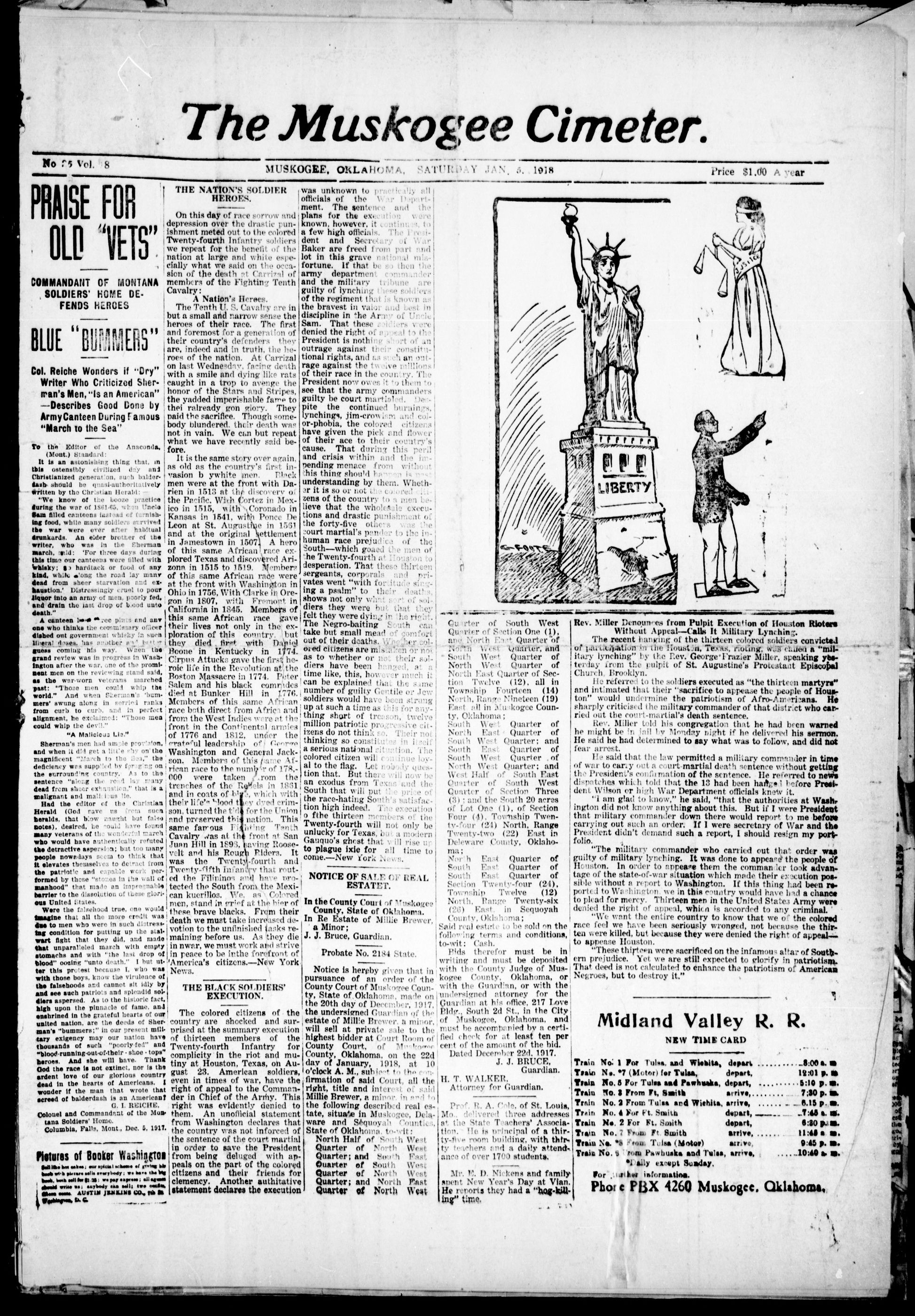
LIBERTY
Quarter of South West
Quarter of Section One (1),
and North East Quarter of
North West Quarter, and
South West Quarter of
North West Quarter of
North East Quarter of Section
Twelve (12), all in
Township Fourteen (14)
North, Range Nineteen (19)
East all in Muskogee County.
Oklahoma:
County, Oklahoma;
Said real estate to be sold on the following terms and conditions,
to-wit: Cash.
Bids therefor must be in writing and must be deposited with the County Judge of Muskogee County, Oklahoma, or with the Guardian, or with the undersigned attorney for the Guardian at his office. 217 Love Bldg., South 2d St., in the City of Muskogee, Oklahoma, and must be accompanied by a certified check for at least ten per cent of the amount of the bid.
Dated December 22d. 1917.
J. J. BRUCE.
J. J. BRUCE.
Prof. R. A. Cole, of St. Louis, Mo., delivered three addresses at the State Teachers' Association. He is principal of a thirty-five room building, with thirty teachers and a daily attendance of over 1700 students. Mr. E. D. Nickens and family spent New Year's Day at Vlan. He reports they had a "hog-killing" time.
Price $1.00 A year
Rev. Miller Denounces from Pulpit Execution of Houston Rioters Without Appeal—Calls It Military Lynching.
The recent hanging of the thirteen colored soldiers convicted of participation in the Houston, Texas, rioting, was called a "military lynching" by the Rev. George Frazier Miller, speaking yesterday from the pulpit of St. Augustine's Protestant Episcopal Church, Brooklyn.
He referred to the soldiers executed as "the thirteen martyrs" and intimated that their "sacrifice to appease the people of Houston" would undermine the patriotism of Afro-Americans. He sharply criticised the military commander of that district who carried out the court-martial's death sentence.
Rev. Miller told his congregation that he had been warned he might be in jail by Monday night if he delivered his sermon. He said he had determined to say what was to follow, and did not fear arrest.
He said that the law permitted a military commander in time of war to carry out a court-martial death sentence without getting the President's confirmation of the sentence. He referred to news dispatches which told that the 13 had been hanged before President Wilson or high War Department officials knew it.
"I am glad to know," he said, "that the authorities at Washington did not know anything about this. But if I were President that military commander down there would report to me before carrying out such an order. If I were secretary of War and the President didn't demand such a report, I should resign my portfolio.
"The military commander who carried out that order was guilty of military lynching. It was done to appease the people of Houston. In order to appease them the commander took advantage of the state-of-war situation which made their execution possible without a report to Washington. If this thing had been reported to Washington we in this country would have had a chance to plead for mercy. Thirteen men in the United States Army were denied the right of appeal, which is accorded to any criminal.
"We want the entire country to know that we of the colored race feel we have been seriously wronged, not because the thirteen were killed, but because they were denied the right of appeal—to appease Houston.
"These thirteen were sacrificed on the infamous altar of Southern prejudice. Yet we are still expected to glorify in patriotism. That deed is not calculated to enhance the patriotism of American Negroes, but to destroy it."
Midland Valley R. R.
Train No. 1 For Tulsa, and Wichita, depart ..... 8:00 a.
Train No. 7 (Motor) for Tulsa, depart, ..... 12:01 p.
Train No. 5 For Tulsa and Pawhuska, depart, ..... 5:10 p.
Train No. 3 From Ft. Smith arrive, ..... 7:30 p.
Train No. 2 From Tulsa and Wichita, arrive, ..... 6:15 p.
Train No. 4 For Ft. Smith depart, ..... 7:45 a.
Train No. 2 For Ft. Smith depart, ..... 6:20 p.
Train No. 7 From Ft. Smith arrive, ..... 11:45 a.
Train No. 8 From Tulsa (Motor) arrive, ..... 9:45 p.
Train No. 9 From Pawhuska and Tulsa, arrive, ..... 10:40 a.
*Daily except Sunday.
For further information.
Phone PBX 4260 Muskogee, Oklahoma.
be gainsaid by the cant of self-appointed saints. By what authority has this representative of the minority of the voters of Ohio been commissioned to sit in judgment upon the majority? Or to determine which are the better citizens—the Wets or the Dryes?
"I notice in reading the subscription list that some of the very largest purchases of Liberty Bonds and donations to the Red Cross were made by Cincinnati distillers and liquor dealers. This after James A. White, Superintendent of the Ohio Anti-Saloon League, had refused to call off the 1917 campaign and give its campaign funds to the Red Cross, as suggested by Col. Galbraith of the First Regiment, a patriotic proposal that the wets had already agreed to. Instead of cheering for the Stars and Stripes, Mr. White and Rev. Probst, of Dayton, Ohio, Cincinnati Superintendent of the Anti-Saloon League are wasting their energy jeering at election officials because of the discovery of an accidental mistake in the count which takes the reported victory from the drys, the final official count indicates a wet victory of over 1800.
"While I believe implicit in food conservation," he added, "it seems to me that too much stress is being laid upon the cutting down of necessities and not enough credit is given to the efforts of our soldiers in the fields.
"I have heard some of our soldiers say that they are not dolls or puppets and they consider that their efforts in the field are going to win the war, which can be won only by hard fighting and not by wild theories of people who take good care to stay at home. I agree with them. This war wilt be won by the prowess of the flower of the youth of our country who go over there to fight for the principles of justice and right against the overlordship of a military despotism."
BOOTLEGGERS BUSY IN DRY TERRITORY
Officials Say Large Quantities of Whiskey Are Being Shipped Into the South
That bootlegging is now one of the most profitable businesses in the dry sections of the country was the statement of several persons who have been arrested in connection with the traffic. The business has reached such proportions that the agents of the Department of Justice, who are handling the cases, have begun a round-up, in order to get the persons who are both shipping and receiving the wet goods.
Clyde C. Payne, 40 years old, of Newport News, Va., was arrested yesterday afternoon at one of the local wharves by agents of the Department of Justice for violating the Interstate Commerce law by shipping whisky to a dry territory. His trunk was seized and it was found that he had three cases of whisky in it. It is said that thousands of quarts of whisky are being shipped out of Baltimore each day to Norfolk, Richmond and points South.
Payne will be arraigned before United States Commissioner Supplee today. He refused to make any statement. He became despondent after being locked up, and owing to remarks he made to the effect that his arrest would disgrace him close watch was kept over him at the Central Police Station, where he was locked up, for fear he would do himself harm. It is said that the demand for whiskey in the dry sections is on the increase and that bootleggers are receiving as high as $10 a quart for liquor that is sold in Baltimore at $1.25 a quart. It is also said that a number of automobiles are engaged in the traffic—Baltimore Sun.
DRY LAW COSTS $500,000
IN TAXES TO THE DISTRICT
Nearly half a million dollars in taxes is lost to the District by the advent of prohibition in Washington. Two hundred and sixty-nine retail saloons, paying an annual license of $1,500 each, and $8 wholesale establishments, paying annually $800 each, are closed today.
Pictures of Booker Washington
Sell like hot cakes our耐心; scheme of giving bake book with picture galleries; we have the big book, bake sell for $100; we pay express; all guests should wear white; any body can call; two children, three children. AUKTIN JENELMS CO.
FALL RIVER
PROHIBITION
HAVERHILL
FITCHBURG
LICENSE
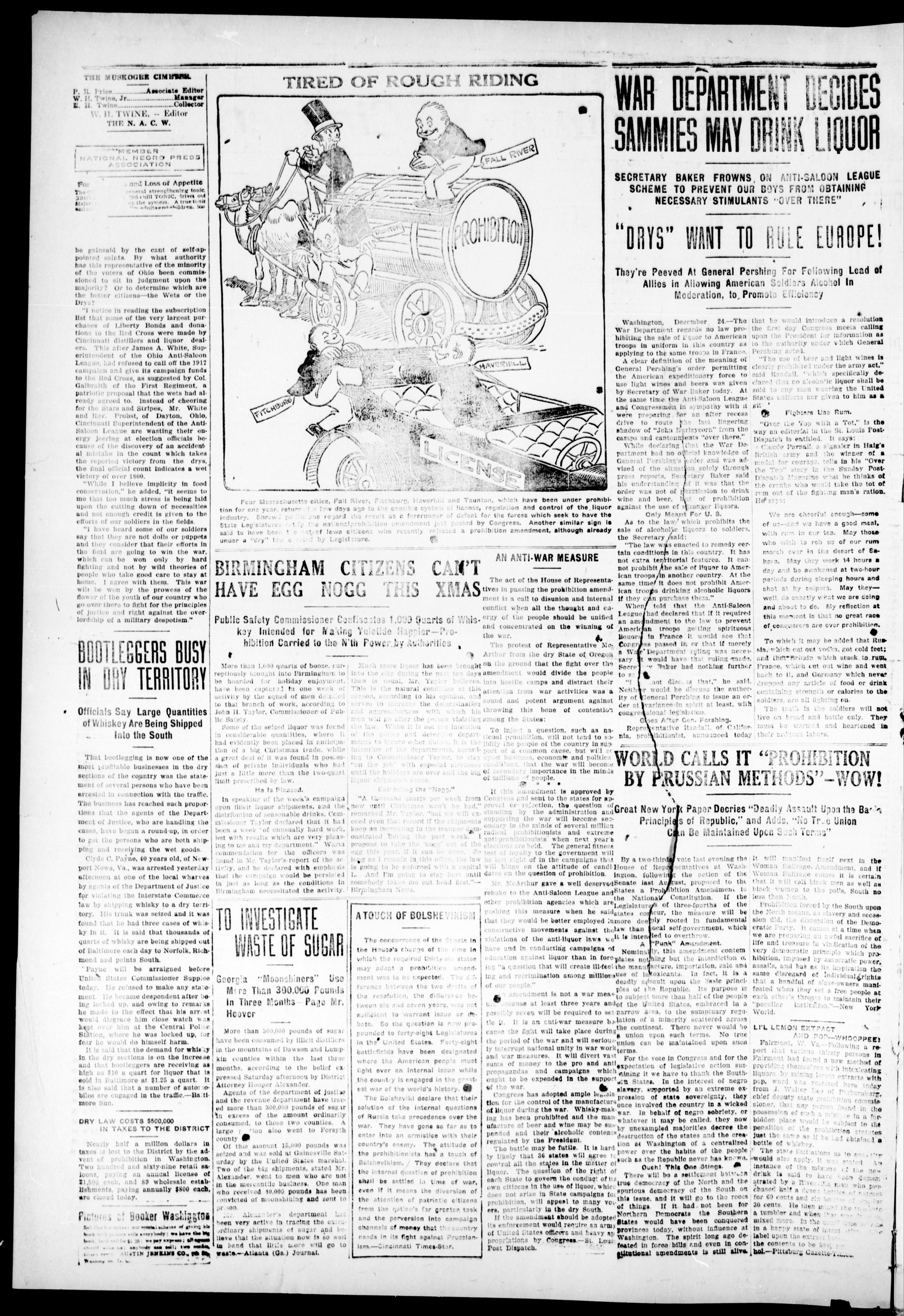
Four Massachusetts cities, Fall River, Fitchburg, Haverhill and Taunton, which have been under prohibition for one year, returned a few days ago to the possible system of license, regulation and control of the liquor industry. Shrewd politician regard the result as a forerunner of defent for the forces which seek to have the State Legislatures utterly the national prohibition amendment just passed by Congress. Another similar sign is said to have been the ratification of Iowa citizens who recently rejected a prohibition amendment, although already under a "dry" law directed by Legislature.
BIRMINGHAM CITIZENS CAN'T HAVE EGG NOGG THIS XMAS
Public Safety Commissioner Confiscates 1,000 Quarts of Whis key Intended for Waking Yulelide Happier—Prohibition Carried to the N'th Power by Authorities
---
More than 1,000 quarts of booze, surreptitiously brought into Birmingham to be hoarded for holiday enjoyment, have been captured in one week of activity by the squad of men denied to that branch of work, according to John H. Taylor, Commissioner of Public Safety.
Some of the seized liquor was found in considerable quantities, where it had evidently been placed in anticipation of a big Christmas trade, while a great deal of it was found in possession of private individuals who had just a little more than the two-quart limit prescribed by law.
Ha la Pleasod.
In speaking of the week's campaign upon illicit liquor shipments, and the distribution of seasonable drinks, Commissioner Taylor declared that it had been a week "of unusually hard work, but with results which are very pleasing to me and my department." Warna commendation for the officers was found in Mr. Taylor's report of the activity, and he declared with emphasis that the campaign would be persisted in just as long as the conditions in Birmingham necessitated the activity.
TO INVESTIGATE WASTE OF SUGAR
Georgia "Moonshiners" Use More Than 300,000 Pounds In Three Months—Page Mr. Hoover
More than 300,000 pounds of sugar have been consumed by illicit distillers in the mountains of Dawson and Lumpkin counties within the last three months, according to the belief expressed Saturday afternoon by District Attorney Hooper Alexander.
Agents of the department of justice and the revenue department have traced more than 300,000 pounds of sugar in excess of the amount ordinarily consumed, to those two counties. A large station also went to Forsyth county
Of this amount 15,000 pounds was seized and was sold at Gainesville Saturday by the United States marshal. Two of the big shipments, stated Mr. Alexander, went to men who are not in the mercantile business. One man who received 40,000 pounds has been convicted of moonshining and sent to prison. Mr. Alexander's department has been very active in tracing the extra ordinary shipments of sugar and believe that the situation now is so well in hand that little more will go to waste--Atlanta (Ga.) Journal.
Much more liquor has been brought into the city during the past ten days than is usual. Mr. Taylor believes. This is the natural condition at this session, according to his opinion, and serves to increase the deterination and aggressiveness with which his men will go after the person violating the law. While it is not the intention of the police and detective departments to impose other duties, it is the intention of the departments, according to Commissioner Taylor, to stay "on the job" with especial alertness until the holidays are over and the big liquor贮槽s cease.
Extracting the "None."
"A thousand quarts per week from now until Christmas won't be bad," remarked Mr. Taylor, "but we will exceed even that record If the shipments keep on increasing in the manner demonstrated during the past week. I propose to take the 'nogg' out of the egg this year, if it can be done. So long as I remain in this office, the law is going to be enforced with a capital L. And I'm going to stay here until somebody takes me out head first."—Birmingham News.
ATOUCH OF BOLSHEVIRISM
The concurrence of the Senate in the House's change of the time in which the required thirty-six states may adopt a prohibition amendment was to be expected. The difference between the two drafts of the resolution, the difference between six and seven years, was not sufficient to warrant issue or debate. So the question is now proounded to forty-eight Legislatures in the United States. Forty-eight battlefields have been designated where the American people must fight over an internal issue while the country is engaged in the greatest war of the world's history.
The Bolshevskii declare that their solution of the internal questions of Russia take precedence over the war. They have gone so far as to enter into an armistice with their country's enemy. The attitude of the prohibitionists has a touch of Bolshevskiiism. They declare that the internal question of prohibition shall be settled in time of war, even if it means the diversion of the attention of patriotic citizens from the nation's far greater task and the perversion into campaign channels of money that the country needs in its fight against Prussianism.—Cincinnati Times-Star.
Mr. McArthur gave a well deserved Senate last August, proposed to the rebuke to the Anti-Saloon League and States a Prohibition Amendment, to other prohibition agencies which are Legislatures of three-fourths of the pushing this measure when he said states concur, the measure will be that they would be better employed inmore deeply rooted in fundamental constructive movements against the law than local self-government, which violations of the anti-illegal laws it is intended to overthrow.
AN ANTI-WAR MEASURE
The act of the House of Representatives in passing the prohibition amendment is a call to disunion and internal conflict when all the thought and energy of the people should be unified and concentrated on the winning of the war.
The protest of Representative McArthur from the dry State of Oregon on the ground that the fight over the amendment would divide the people into hostile camps and distract their attention from war activities was a sound and potent argument against throwing this bone of contention among the States:
To inject a question, such as national prohibition, will not tend to solidify the people of the country in support of a common cause, but will reap business, economic and political conditions, that the war will become of secondary importance in the minds of millions of people.
If this amendment is approved by Congress and sent to the states for approval or rejection, the question of standing by the administration and supporting the war will become secondary in the minds of several million radical prohibitionists and extreme anti-prohibitionists when next year's elections are held. The general fitness test of loyalty to the government will be lost eight of in the campaigns that will hinge on the attitude of candidates on the question of prohibition.
have and in conducting campaigns of education against liquor than in forcing "a question that will create ill-feeling and recrimination among millions of our people." The amendment is not a war measure, because at least three years and possibly seven will be required to set it. It is an anti-war measure because the fight will take place during the period of the war and will seriously interrupt national unity in war work and war measures. It will divert sums of money to the pro and ant propagandas and campaigns which ought to be expended in the support of the war.
Congress has adopted ample legislation for the control of the manufacture of liquor during the war. Whisky-making has been prohibited and the manufacture of beer and wine may be suspended and their alcoholic contents regulated by the President.
The battle may be futile. It is hard likely that 36 states will agree to control all the states in the matter of liquor. The question of the right of each State to govern the conduct of its own citizens in the use of liquor, which does not arise in State campaigns for prohibition, will appeal to many voters, particularly in the dry South.
If the amendment should be adopted its enforcement would require an army of United States officers and heavy arm preparations by Congress—St. Louis Post Dispatch.
WAR DEPARTMENT DECIDES SAMMIES MAY DRINK LIQUOR
SECRETARY BAKER FROWNS, ON ANTI-SALOON LEAGUE SCHEME TO PREVENT OUR BOYS FROM OBTAINING NECESSARY STIMULANTS "OVER THERE"
They're Peeved At General Pershing For Following Lead of Allies in Allowing American Soldiers Alcohol In Moderation, to Promote Efficiency
WORLD CALLS IT "PROHIBITION BY PRUSSIAN METHODS"-WOW!
Great New York Paper Decries "Deadly Assault Upon the Bar Principles of Republic," and Adds, "No True Union Can Be Maintained Upon Such Terms"
Washington, December 24.—The War Department regards no law prohibiting the sale of Equal to American troops in uniform in this country as applying to the same troops in France. A clear definition of the meaning of General Pershing's order permitting the American expeditionary force to use light wines and beers was given by Secretary of War Baker today. At the same time the Anti-Saloon League and Congressmen in sympathy with it were preparing for an after recess drive to route the last lingering shadow of "John Barrycoon" from the camps and cantonments "over there."
While declaring that the War Department had no official knowledge of General Pershing's order and was advised of the situation solely through press reports, Secretary Baker said his understanding of it was that the order was not of permission to drink wine and beer, but of prohibition against the use of stranger liquors.
Only Meant For U. S.
As to the law/ which prohibits the sale of alcoholic liquors to soldiers, the Secretary said:
"The law was enacted to remedy certain conditions in this country. It has not extra territorial features. It cannot prohibit the sale of liquor to American troops in another country. At the same time/ it does not prohibit American troops drinking alcoholic liquors if they can purchase them."
When told that the Anti-Saloon League had declared that if it required an amendment to the law to prevent American troops getting spiritualistic liquors in France it would see that Congress passed it or that if merely a War Department ruling was necessary it would have that ruling made. Secretly Baker had nothing further to say. "I don't discuss that," he said. Neither would he discuss the authority of General Pershing to issue an order at variance in spirit at least, with congressional legislation.
Goes After Gen. Pershing.
Representative Randall, of California, prohibitionist, announced today
WORLD CALLS IT BY PRUSSIAN M
Great New York Paper Decries "Principles of Republic," a Can Be Maintained
By a two-third vote last evening the House of Representatives at Washington following the action of the
Senate last August, proposed to the States a Prohibition Amendment to the National Constitution. If the Legislatures of three-fourths of the States concur, the measure will be more deeply rooted in fundamental law than local self-government, which it is intended to overthrow.
A "Punk" Amendment.
Nominally, this amendment contemplates nothing but the interdiction o. the manufacture, importation, sale and use of intoxicants. In fact, it is a deadly assault upon the basic principles of the Republic. Its purpose is to subject more than half of the people of the United States, embraced in a narrow area, to the sumptuary regulation of a minority scattered across the continent. There never would be a union upon such terms. No true union can be maintained upon such terms.
For the vote in Congress and for the expectation of legislative action sustaining it we have to thank the Southern States. In the interest of negro slavery, supported by an extreme expression of state sovereignty, they once involved the country in a wicked war. In behalf of negro sobriety, or whatever it may be called, they now by unexamplied majorities decree the destruction of the states and the creation at Washington of a centralized power over the habits of the people such as the Republic never has known.
Ouch! This One Stings.
There will be a settlement between true democracy of the North and the spurious democracy of the South on this issue, and it will go to the roots of things. If it had not been for Northern Democrats the Southern States would have been conquered provinces today, without influence at Washington. The spirit long ago defeated in force bills and even in constitutional amendments is still alive.
that he would introduce a resolution the first day Congress meets calling upon the President for information as to the authority under which General Pershing acted.
"The use of beer and light wines is clearly prohibited under the army act," said Randall, "which specifically declared that no alcoholic liquor shall be sold to any man wearing the United States uniform nor given to him as a
Fighters Use Rum.
Over the Top with a Tet. is the way an editorial in the St. Louis Post-Dispatch is entitled. It says:
Claude Parail, a signaler in Halg's British army and the winner of a medal for courage, tells in his "Over the Top" story in the Sunday Post-Dispatch Magazine what he thinks of the crumbs who would take the tot of rum out of the fighting man's ration. He says:
We are cheerful enough—some of us—and we have a good meal, with rum in our tea. May those who wish to rob us of our rum march over in the desert of Sahara. May they work 14 hours a day and be awakened at two-hour periods during sleeping hours and shot at by enipers. May they—well, do exactly what we are doing and about to do. My reflection at this moment is that no great race of conquerors are ever prohibition.
To which it may be added that Russia, which cut out vodka, got cold feet; and that Britain which stuck to rum, France, which cut out wine and went back to it, and Germany which never dropped any article of food or drink containing strength or calories to the soldiers, are all fighting on.
The truth is the soldiers will not live on bread and battle only. They must be warmed and heartened in their ancient labors.
"PROHIBITION METHODS"-WOW!
"Deadly Assault Upon the Bar and Adds, "No True Union Upon Such Terms"
It will manifest itself next in the Woman Suffrage, Amendment, and if Woman Suffrage comes it is certain that it will call black men as well as black women to the polls. South no less than North.
Prohibition forced by the South upon the North means, as slavery and secession did, the disruption of the Democratic Party. It comes at a time when we are preparing an awful sacrifice of life and treasure in vindication of the very democratic principle which prohibition, imposed by automatic power, assails, and has as its inspiration the same disregard of individual rights that a handful of slave-owners manifested when they set a free people at each other's threats to maintain their "peculiar institution."—New York World.
LIL LEMON EXTRACT
AND POP—WHIOPPEEI
Fairmont, W. Va.—Following a report that various thirsty persons in Fairmont had found a new method of providing themselves with intolerable liquor by mixing lemon extracts with pop, word was received here today from J. Walter Lee of Pembrokeshire, chief deputy state prohibition commissioner, that any person found in the possession of such a mixture in a forbidden place would be subject to the penalties of the prohibition gestures just the same as if he had obtained a bottle of whiskey.
The state limitations as to quantity would also apply. It was stated. An instance of the mixture of the new drink is said to have been demonstrated by a Rives. The man who purchased half a dozen bottles of extract for 60 cents and also a bottle of for 30 cents. He then mixed the two into a tumbler and when that was mixed more. In the usual time in a happy state of health, the label upon the extract bottle the contents to be 504 g. hol.—Pittsburg Gazette-Times.
J. WALTER FREIDERG POINTS OUT IMPORTANCE OF INDUSTRY
$500,000,000 A YEAR
This Vast Sum Is Paid In Taxes
To Federal Government—
$800,000,000 Invested in
Business—Output of England's Distilleries Greater
Now Than Ever Before
In an address at the 22nd Annual Convention of the National Wholesale Liquor Dealers Association at the Hotel Sinton, J. Walter Freiberg, of Cincinnati, a member of the Executive Committee of the organization, pointed out the importance of the taxes derived by the United States Government from the liquor industry.
"The liquor industry is the fifth largest industry in the nation, paying more than one-half a billion of dollars in taxes annually, which amount is over one-third of the total income of the United States Government. These same taxes pay the bulk of the pensions resulting from the Civil War; the same taxes helped build the Panama Canal; helped build our army and navy and are instrumental in all the vast workings of the national government.
"When the United States went to war with Germany, the liquor interests were contributing to the Federal Government $247,000,000 a year in Internal Revenue taxes, or about one-third of the national normal income. Under the war taxes the liquor interests will give Uncle Sam more than $500,000 a year to help win the war and make the world safe for democracy. One-half billion of dollars would pay 4 per cent interest on $12,500,000,000 worth of Liberty Bonds, which is over $7,000,000,000 more than the Government has thus far planned to issue.
"The importance of the Liquor industry as an ally and a means for raising necessary revenue has been recognized by Congress and the anti-Saloon League finds itself in a quandary. The action of Congress in going to the Liquor interests for more money is regarded by thinking people as an indication that the national legislators do not want this great business to morib.
"None of the warring nations of Europe consider it necessary to enforce prohibition during the war. In fact, the output of England's distilleries is now greater than ever before.
"It is estimated that approximately $800,000,000 of capital is invested in the liquor industry. National prohibition would condicate these investments and in no way compensate the owner.
"National prohibition in the United States would only mean the shifting of the burden of taxation from the shoulders of the liquor man to those of the public in general. If you take away the revenue derived from the liquor industry the taxpayers must of necessity assume the additional burden of taxation. It must come from the farmers whose main property is in land; from the home; from the merchants and stockholders in all utilities; from the banks and corporations, and from the wage earners."
USE OIL STOVE FOR
MAKING BAD LIQUOR
Illinois Distillery Cut Up Near New Bern
Presents Some New Features.
New Bern—United States Deputy
Marshal George B. Waters and Police-
man A. A. Ipock located and destroyed
an illicit whiskey distillery near Bac-
chelor's crack bridge on the Neuse road
yesterday morning. It was located in
a tobacco barn on the farm of Major
Jackson, colored, but no arrests were
made. The officers, accompanied by
Chief of Police L. Cupton, went back
to the negro's home last night but he
was not there.
Deputy Waters received information that a still was in operation in the vicinity of the Bachelor creek bridge and yesterday morning he went in search of it. The woods in that section were closely searched without result. In passing a tobacco barn Deputy Waters noticed that the door was fastened with a pad lock. This aroused his suspicion and he pried off the lock, opened the door, and found, as he expressed it, "one of the cutest little cullis I ever saw."
The furnace was a two-burner oil stove and the boilers were two large stans with a capacity of about fifteen gallons each. A small quantity of beer and half a barrel of molasses and the equipment was destroyed.
After destroying the plant the officers went to the home of the negro, which was only about two hundred yards from the barn, but he was not at home—Raleigh, N. C., News and Observer.
DISTILLERS PLEDGE PLANTS TO WIN WORLD CONFLICT
MEMBERS OF NATIONAL WHOLESALE LIQUOR DEALERS ASSOCIATION, IN ANNUAL CONVENTION, OFFER THEIR BUSINESS TO CAUSE OF DEMOCRACY
Since Alcohol Is Important Ingredient of Smokeless Powder Distilleries Are at Uncle Sam's Disposal—Delegates Were Among Heaviest Subscribers to Liberty Loan and Red Cross
WILL THE ANTI-SALOON LEAGUE DO AS MUC1?
Without a dissenting vote, members of the National Wholesale Liquor Dealers' Association at the 22nd Annual Convention at the Hotel Sinton, Cincinnati, Ohio, adopted a resolution offered by Morris F. Westheimer, of Cincinnati, offering their distilleries, financial resources, and even the lives of themselves and the men and women employed in this business, to the American nation. The resolution follows:
"Be it resolved by the distillers and wholesale dealers representing the distilled spirit business of the United States, in meeting assembled at Cincinnati, Ohio.
"That this industry viewing with selenn thought the great demand and saffrones imposed upon the American nation by the impending war, for the preservation of American standards of human freedom, the institutions of free government in America and American notions of the rights of life, liberty and the pursuit of happiness, does pledge its support to the government of the United States in the conduct of this war, to that victorious conclusion which alone is compatible with our origin as a nation, with our history as a free people and with the consecrated devotion of this generation to surrender our free country and its institutions only to our posterity.
"To this end this trade stands ready to aid the government with its resources in munition plants, its financial resources in taxes, loans and subscriptions, and the manhood and wemanhood of the thousands of American families which it represents."
The dominant note of the big meeting participated in by 700 men from every corner of the Union was 100 per cent patriotism. At the opening of the convention by President Joseph Debar, of Cincinnati, the delegates, with one accord, sang the Star Spandl Banner. Flags of the allied nasas were grouped back of the speaking stage and a border of American flags adorned the entire hall. Speakers representing the industry that has been one of the heaviest purchasers of Liberty Bonds and donors to the Red Cross, attacked the Anti-Saloon League for its alleged "snacking". In his annual address, President Debar severely criticized the Anti-Saloon League, charging that its members have placed prohibition above patriotism.
"At a time when the whole nation was clamoring for the conservation of food," he declared, "these paid agitators, to further their own interests, saw fit to block the most important piece of legislation then under consideration and even went so far as to threaten the President of the United States for the sole purpose of advancing their propaganda.
"The Lever food control bill, prepared by the greatest experts in the government service, was approved by the Ideal Wilson, by introducing without necessity the liquor section and thus prolonging debate, the Anti-Saloon League deliberately and wilfully betrayed the people of the United States in the interests of the food speculators and boarders.
"The long delay in the passage of the bill enabled the food sharks to corner the greater part of the year's harvest, and is the reason why we are today having such high prices for the very necessities of life.
"The entrance of the United States into the world war showed the prohibitionist in his true colors as a man of one idea. All party lines and factional divisions in Congress were wiped out with the sole exception of the prohibition party. In a national crisis, when the very safety of the country depends upon a creation of the army in the shortest possible time, the Anti-Saloon league told Congress that we shall not have an army at all unless prohibition would be enacted.
"When Col. F. W. Gabraith, commanding the First Regiment, Ohio National Guard, asked the Ohio Anti-Saloon League to call off the campaign for the prohibition amendment in the Buckeye State and give the Red Cross the money which the drys had planned to spend for the election in November, the liberal forces readily agreed to donate $250,000 to the Red Cross campaign. The drys promptly turned down the proposition.
"The reason for the drys' refusal is best explained by the words of Rev. Hovey Mathews, of Montclair, N. J., who when asked to consider the war and the interests of the nation as of first importance while the life of the country was at stake, said: We are foisting hell and the devil and have no time for your puff little wars."
Among the speakers were Samuel M. Woolner, Jr. Peoria, former president of the Association; E. M. Babbitt, Louisville; Ed. Hull, Peoria; Herbert L. Felton, Boston; Hugo Nathan, Pittsburgh; Chas. Rosenthal, Cincinnati.
Geo. F. Dieterle, Cincinnati; J. Walter Freiberg, Cincinnati.
Besides President Debar, other officers are: Jos. A. Strasner, New York City, first vice president; E. M. Pabst, Louisville, second vice president; M. V. Dougherty, Philadelphia, treasurer; Levi Cooke, Washington, D. C. general counsel. Executive Committee: Geo. F. Dieterle Cincinnati, chairman; A. J. Sunstein, Pittsburg; W. E. Hull, Pearl; Samuel Woolner, Jr. Peoria; Geo. C. Dempsey, Boston, R. E. Wathen, Louisville.
Mr. Dempsey enjoys the unique distinction of being both a distiller and a brewer.
THE TRUTH ABOUT
OHIO'S ELECTION.
"The strange thing about the prohibition craze is the inability of the American electorate to show any consideration for the rights of the minority," declared George F. Diochelle of Cincinnati, chairman of the Executive Committee. He continued: "Men ordinarily same and fair in business dealing go to the polls and vote dry without giving any thought to the consequences of their act.
"This is due to the fact that the issue is always clouded by political complication and prejudices.
"The returns, for instance, in Ohio, do not indicate the true sentiment of the people of your own state on the liquor question.
"Many disgruntled Republicans voted dry because the state went for Wilson instead of for Hughes in the last Presidential election. Some Democrats in Republican county strong holds voted dry because they were to call out of power.
"On a fair, square vote, involving only the naked issue of prohibition, the state of Ohio is anti-prohibition by over a hundred thousand majority. The same is true of many other states which have been pushed into the dry column.
"There will be an awakening to the true merits of this question and there will be a proper adjustment, but only when the political tricksters and the Anti-Saloon League agitators are brushed aside and statesmanship takes hold of the powers of government.
"Some years ago a venerable prelate of the Protestant Episcopal Church, discussing this question remarked:
"We are yet in our infancy in matters of government and are therefore, the victims of experimenters and charlatans."
"His were words of wisdom, but I have an abiding faith in the ultimate wisdom of the American people."
GREAT BIG SILVER LINING
Attorney Levi Cookie of Washington,
D. C., Counsel for the Association
asserted:
"I can see only encouragement for
the future of the liquor trade.
"Iowa, old Virginia and Ohio have
spoken and their verdict has been
against Anti-Saloon League domination.
"Several of the southern states and
I believe Mame are weary of the
house of abstraction.
EUROPE PROFIETORIST COSMETICS
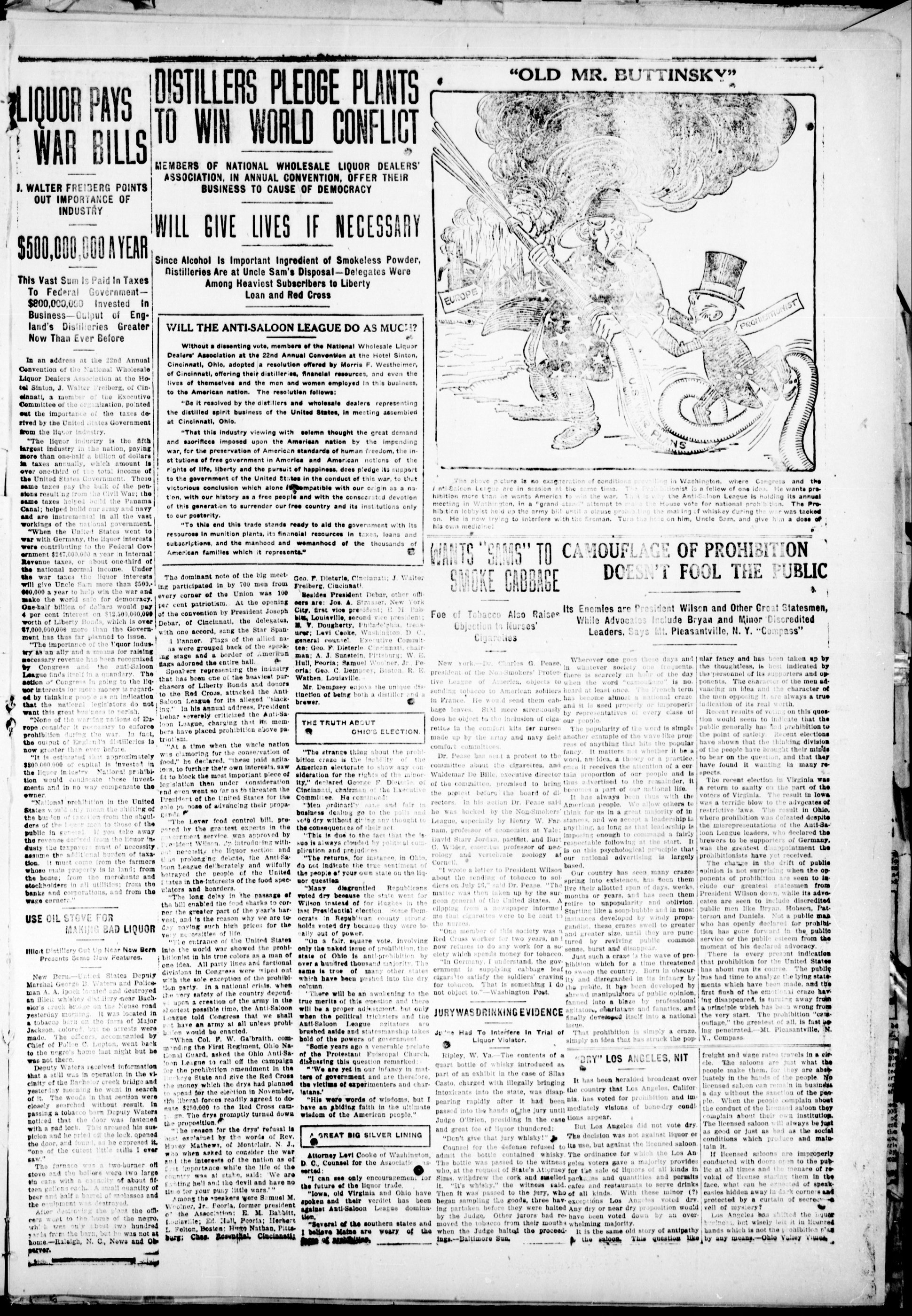
The above picture is no exaggeration of conditions prevailing in Washington, where Congress and the Anti-Saloon League are in session at the same time. The Prohibitionist is a fellow of one idea. He wants prohibition more than we wants America to win the war. That is why the Anti-Saloon League is holding its annual meeting in Washington, in a "grand stand" attempt to make the House vote for national prohibition. The Prohibition lobbyist held up the army bill until a clause prohibiting the mailing of whiskey during the war was tacked on. He is now trying to interfere with the fireman. Turn the horse on him, Uncle Sam, and give him a dose of his own medicine!
WANTS "SAMS" TO CAMOUFLAGE OF PROHIBITION SMOKE CABBAGE DOESN'T FOOL THE PUBLIC
Foe of Tobacco Also Raises Objection to Nurses' Cigarettes
New york.—Dr. Charles G. Pease president of the Non-Smokers' Protective League of America, objects to sending tobacco to American soldiers in France. He would send them cabbage leaves. Still more stronely does he object to the inclusion of cigarette in the comfort kits ter nurses made up by the array and navy field comfort committees.
Dr. Pease has sent a protest to the committee about the cigarettes, and Waldemar De Bille, executive director of the committee, promised to bring the protest before the board of directors. In his action Dr. Pease said he was backed by the Non-Smokers' League, especially by Henry W. Farnam, professor of economics at Yale; David Starr Jordan, pacifist, and Burt C. Wilder, emeritus professor of neurology and vertebrate zoology at Cornell.
"I wrote a letter to President Wilson about the sending of tobacco to soldiers on July 26," said Dr. Pease. "The matter was then taken up by the surgeon general of the United States. A clipping from a newspaper informed me that cigarettes were to be sent to the nurses.
"One member of this society was a Red Cross worker for two years, and now refuses to do any work for a society which spends money for tobacco.
"In Germany, I understand, the government is supplying cabbage leaf cigars to satisfy the soldiers' craving for tobacco. That is something I do not object to."—Washington Post.
JURYWASDRINKINGEVIDENCE
Justine Had To Interfere in Trial of Liquor Violator.
Ripley, W. Va.—The contents of a quart bottle of whisky introduced as part of an exhibit in the case of Sillas Casto, charged with illegally bringing intoxicants into the state, was disap pearing rapidly after it had been passed into the hands of the jury until Judge O'Brien, presiding in the case and great foe of liquor thundered:
"Don't give that jury whisky!"
Counsel for the defense refused to admit the bottle contained whisky. The bottle was passed to the witness who, at the request of State's Attorney Sims, withdrew the cork and smelled it. "It's whisky," the witness said. Then it was passed to the jury, who began sampling the goods, three having partaken before they were halted by the Judge. Other jurors had removed the tobacco from their mouths when the Judge halted the proceeding.—Baltimore Sun.
Its Enemies are President Wilson and Other Great Statesmen, While Advocates Include Bryan and Minor Discredited Leaders. Says Mt. Pleasantville, N. Y. "Compass"
Wherever one goes these days and in whatever society one frequents, there is scarcely an hour of the day when the word "camouflage" is no heard at least once. The French term has become almost a national craze and it is used properly or improperly by representatives of every class or our people.
The popularity of the word is simply another example of the wave-like progress of anything that hits the popular fancy. It matters not whether it be a word, an idea, a theory or a practice, once it receives the attention of a certain proportion of our people and is thus advertised to the remainder, it becomes a part of our national life.
It has always been Dus with the American people. We allow others to think for us in a great majority of in stances, and we accept a leadership in anything, as long as that leadership is imposing enough to command a fairly respectable following at the start. It is on this psychological principle that our national advertising is largely based.
Our country has seen many crazes spring into existence, has seen them live their allotted span of days, weeks, months or years, and has seen them retire to unpopularity and oblivion. Starting like a soap-bubble and in most instances developed by windy propagandist, these crazes swell to greater and greater size, until they are punctured by reviving public common sense, burst and disappear.
Just such a craze (a the wave of prohibition which for a time threatened to sweep the country. Born in obscurity and disregarded in its infancy by the public, it has been developed by shrew manipulators of public opinion, fanned into a blaze by professional agitators, charitans and fanatics, and finally developed itself into a national issue.
That prohibition is simply a craze simply an idea that has struck the pop
"DRY" LOS ANGELES, NIT
It has been heralded broadcast over the country that Los Angeles, California, has voted for prohibition and immediately visions of bone-dry conditions appear.
But Los Angeles did not vote dry. The decision was not against liquor or its use, but against the licensed saloon. The ordinance for which the Los Angeles voters gave a majority provides for the sale of liquors of all kinds in packages and quantities and permits cafes and restaurants to serve drinks of all kinds. With these minor (?) exceptions Los Angeles voted dry. Any dry or near dry proposition would have been voted down by an overwhelming majority.
It is the same old story of antipathy to the saloon. This question like
ular fancy and has been taken up by the thoughtless, is best indicated by the personnel of its supporters and opponents. The character of the men advancing an idea and the character of the men opposing it are always a true indication of its real worth. Recent results of voting on this question would seem to indicate that the public generally has fed prohibition to the point of satisfaction. Recent elections have shown that the thinking division of the people have brought their minds to bear on the question, and that they have found it wanting in many respects.
The recent election in Virginia was a return to sanity on the part of the voters of Virginia. The result in Iowa was a terrific blow to the advocates of restrictive laws. The result in Ohio, where prohibition was defeated despite the misrepresentations of the Anti-Saloon League leaders, who declared the brewers to be supporters of Germany, was the greatest disappointment the prohibitionists have yet received.
The change in the drift of public opinion is not surprising when the opponents of prohibition are seen to include our greatest statesmen from President Wilson down, while its advocates are seen to include discredited public men like Bryan, Hobson, Patterson and Daniels. Not a public man who has openly declared for prohibition has gone forward in the public service or the public esteem from the moment of his declared advocacy.
There is every present indication that prohibition for the United States has about run its course. The public has had time to analyze the lying statements which have been made, and the first flush of the emotional craze having disappeared, is turning away from a principle which has been wrong from the very start. The prohibition "censorship," the greatest of all, is fast being penetrated.-Mt. Pleasantville, N.Y. Compass.
freight and wage rates travels in a circle. The saloons are just what the people make them, for they are absolutely in the hands of the people. No licensed saloon can remain in business a day without the sanction of the people. When the people complain about the conduct of the licensed saloon they complain about their own institution. The licensed saloon will always be just as good or just as bad as the social conditions which produce and maintain it. If licensed saloons are improperly conducted with doors open to the public at all times and the menace of revokal of license staring them in the face, what can be expected of speak-easy hidden away in dark corners and protected by a curtain of secrecy well of mystery?
Los Angeles has shifted the liquor
business, but wisely left it in licensed
hands which is not the prohibition plan
by any means. - Ohio Valley Times
EEE SOESOOQNSS: 6,
REID & AMBROSE
Investments
Real Estate and Farm Loans
arms $15.00 per acre up.
Homes $500.00 to $5000.00
We will buy. ten good farms, also
Oil and Gas Leases.
Notary Public In Office
115 Court St. Phone 1463
ae KS AND JONES CONFECTIONERY
CIENT
( ' fh CITY
“ HONE OL
NOTICE.
To the Policy Holders of the Bx
change Insurance Association
You are hereby notified not te
pay any weekly or monthly due:
to the seid Rev. M. Kirby of Tul-
ga, Okla. Money paid him will
be at your own risk,
He is no longer connected
with the above Association. All
minisigrs will please read this
Motive to their congregations,
and oblige.
H. 8. BOULWARRB,
President und Manager of the
Exchange insurance Assn,
Wanted a first-class. printe
at once, it 218 Bigin Avi
The fantera. H. 8. Boulware
Eititor.
A in the Exchange Ty
s fon will care for
you in sickness and bury yoi
when you die.
For quick servive and up-to-da
lunches, stop at the
MOBILE CAFE
82S, 2nd s Phone 433
J. W. White, Prop.
Fee ee te oe ae ae
Messenger + e and Shining
Parlor
The oldest stand in the city; Es
tablished since 1899; better than
ever; meal* and short orders at
all hours; first-class rooms,
L. A. KELLEY, Prop.
Muskogee, Okla,
220 N. 2nd St. Phone 1977
WILSON PHARMACY
218 North s d St.
The distance (o your phone is the
dista to our atore.
Preseriptions Our Specialty
Phone 2208
5 W.'T. THOMAS
he ‘failor
Suits made oll the latest ane
Up-to dele siylee--cleaning and
pressing
Room 9, Convention Hall
ALSO
EVERY BODIES CAFR
Bigirest orders and the best place
to en f. 12 Con. Hal
W. T. Thomas, Prop.
Phone 8808
Prer sicknesa ané
death ling a poliey in the
Exch rance Associa
tion, with headquartera at Mus.
kog 0 {. S. Boulware
Pres General Manager.
‘Agents 1)
This ) Certify, ‘That mp
dang Clark, carried &
Pp vehonge Inaur
ence nN «died ané
the s paid aptly by
the: U.S, Botiware.
WAL. CLARK (Father),
‘Tulsa, Okla
When you go to buy take this
paper with you or tell them you
saw it in the Lantern,
Merchants and others who
want colored peoples’ trade will
advertise for it, Look over our
advertising page and see what
merchants want your trade and
go there and spend your money,
When you want a coffin,
casket or robe, go to Delaney &
Son, and save money.
The only place where good in
tentions make good paving is on
the high road to hell,
W Pharmacy keeps a
une ol drugs and medi-
iv ' Have your
de with vves that ad-
ertise inthe Lantern. hey be-
e in Negro enterprise.
Tet no guilty war benefit
rafter escape.
Mrs, Catt says women will use
he vote to purify American pol-
ties. ‘The Flovida Times Union
uggests that they use The Pitch-
ov for their emblem. 1 say
the y veonn purify the pol
ties of this country turn it over
them at once, for itis a stench
1 the nose of other nations so
ur as democracy is concerned
to the pitchfork f th tb
m, fam opposed to Uh The
tehte 1s Ben Wilman’s
eapon and Chere are Lote o” peo-
le who will swear things went
rom bad to worse in South Car-
lina when he was in his prime
nd wielding it.
War Department, Washington,
December 12, 1917.
tev. H. S. Boulware, Editor The
Lantern, 218 Elgin Ave.,
Muskogee, Okla,
ly Dear Sir
lo me it is a source of very
reat pleasure and satisfaction
o make note of the splendid sup-
ort you have been yood enough
o accord me in connection with
he recent appointment as Spe-
ial Assistant to the Secretary of
War.
T cannot tell you how much I
alue and appreciate the whole-
ouled support given by your val-
ed newspaper and by the mem-
vers of the Negro press gener-
lly. All that I can say is that
shall seek to be of the greatest
ervice possible to Secretary Ba-
er, to the Negro people, and te
yur country
May I not count upon you for
vequent counsel and sugges:
ions? | am serving merely in ¢
epreseotative capacity and |
ant you and all other loyal anc
satriotic Americans to know tha
earnestly desire your closes
ossible co-operation,
With thanks and best wishes,
Sincerely yours,
EMMETT J. SCOTT,
Special Assistant
As Editor of The Lantern, wi
say to you that the Negroes o
Muskogee are at your back and |
‘ou need them to the front, ca
them.
sa nandits ole
SAA oh cahees
SK ARING /SRERLO SS
aN picv®
aa
Yieled her Per the
‘Trait evey S{ heenag of
month.” pa] the mations
Revie Revas
Bible and bg dirsient
On Card beard linia umhes
Ready fir hanging
Great help te Pible stuay,
WS reupe and gb bake named
Sent post paid forse cued
Five fer one deller
Ad Percent allowed 0 agense
AT Ayers. court pares,
Muskoges Okla
RED BIRD.
OKLAHOMA
Negroes from all parts of the
Union,
Good place to locate
Bx re bk hex, i :
wees Oe a rhe
Ke ga Ss
ar i Gri ;
——_ ak onl |
am a |
i
BPS M
=e Ge (fy
‘N BE TT
Pag Ny ee
sy iy
aN | Wiitime | Box
AW PHOS Be
i hed
au baie
\ | >t
i _ pw Cie ~_
—_ SS eer
a RL
es. Se cas CL ae
A iain ian i Se
fo aoe a MeL
Si Ai Kit A
eA rma Eo, F cia” 4
a a eo 4
a, y ha ” = Pe Buy
If you’re going @ S
to market— yr
a ticket reading via The Naty a i
is the*best kind of a start. -
You can reach Kansas City, St. Louis or Chicago
in better time—with greater comfort by using
TheNaty Jimited or The Naty Bier
For fares, berths or any travel information a
ash nearest railroad Agent, or write,
Geo, R. Hecker, District Passenger Agent, Oklahoma City.
To the Many Readers of the
| Laiitern:
| Some time ago the Reporter
at Red Bird promised to write
an article, not alone on Red Bird,
‘out on Eastern Oklahoma, that
jour read who do not realize
the true w h of Oklahoma,
may know a few things about the
splendid state, that they other-
wise would overlook on account
of being indisposed. He asked
the editor ( i ‘ to
gay a few words for him. After
inquiry of a doven or more par-
ties on a few subjects, 1 am*on-
vinced of the fac! that Oklahoma
is one of the best and riches
[states in the Union, and for the
colored man. If any one can
show a state that is richer in nat
ural resources—oil, gas, coal,
lead, zine and many other min-
erals—let Liom do so, and as to
tich agricultural land, we do not
take our bets off (o any state in
the Union, especially in the val-
leys aloug toe Arkansas river.
Red bird is located in that val-
ley with several coal mines, oil
and gas wells. Red Bird is a
Negro town and has many ad-
vantoges for the colored man.
The soil in that vieinity is rich
and ‘evule and will grow any-
thing. You will find Negroes
from all y s of the Union lo-
cated in thi. rowing little city,
Red Bird. 1 would advise every
Negro (hat wanis to make mon-
ey to ¢ to the state of Okla-
homa aid cost your lot in the
ea f the state. Com-
mon 3 from $2.00 to
3.00 per day. Farm labor from
Se h. Car-
) per
1 $4.00 to
isu ' Smou'd you de-
ide € Ok-
' touch with Red
Bird.
Editor.
Sh a
( mn Hl ag :
ee Wf
ful metropotis, which it is today, spurred him on to master the suc
cessful business which he enjoys at present.
During his darkest hours and saddest longings for his home
state, he received valuable encouragement from the leading citi-
zens of his race in Muskogee, amongst whom are mentioned Mr,
T. J. Elliott, the leading clothing merchant of this state; Mr. R. A,
Evans, a successful horse trader and extensive property owner of
this city; the Rev. Norris, whose realty holdings in this vicinity
amounts to many thousdnds ot doliars; and the well known law
firm of Stewart & Brown, and Dr. R. H. Waterford.
Thees men seeing in Mr. Dudley the good business qualities,
the intellect and straightforwardness of bis sivon¢ character,
which he had not quite discovered himself up to that timo, used
their best influence and strong persuasive powers (os iiduce him to
make Muskogee his permanent home, which he is proud of today,
Like many other successful graduates of this noted institu.
tion, Mr. Dudley was not content with mastering the harness buei-
ness. He was far-sighted enough as a siudent to discover that
some 3,500,000 automobiles are in use in the United States today,
and that a broad field existed for the man yw ho could perfect a pol-
ish at a reasonable price, for autos, carriages, buygies, pianos, fure
niture and office fixtures of all kinds. He devoted his spare time
to the stuciy of compounding chemistry wit! the result vbat he per-
fected one of the best polishes, both in liquid and paisie form, in the
market. ‘This paste 1s in use in many of the iargest auto, piane
and furp ture factories in the country today, at a price within the
reach of the rieh ¢ poor, ranging from 25 cenis # half pint te
$8.60 a gallon, which is absolutely the cheapest and best in the
market. {iis ar on is to build the largest Polish Factory in the
Southwest in Muskowee in the near future. Liberal inducements
are being oilered lo live-wire agents, with exclusive territory, by
this successful, honorable business man.
DUDLEY’S AUTO BODY POLISH.
Cheapest and Best in the Market
Makes Old Varnish Look New.
Used by Leading Auto, Furniture and Piano Factori
try
Rriliancy of New Given to OM OMe Fis
PRICE: Half Pint, 25 Cents to $2.90 per ¢
Used by Leading Auto, Furniture and Piano Factories of the Coun-
try
Rriliancy of New Given to OM Ofte Fixtures
PRIOD: Polf Pint, 25 Cents to $2.90 por Gallon
Also Harness, Leather and Shoe Polishes
Liberai lnducement fo Agents. Write Quick for Territory.
Quick Seller and Coad Money Ceiter
SATISP ACTION GUARANTEED.
8. L. DUDLEY, 116 S. Main St., Muskogee, Okla
Some Testimon! ds.
Muskogee, Okla., June 1a, 1917.
Tam using Yudly’s Auto Body Polish on my car and find it to
work hie in ev. y way. Bvery one snould use us high-grade
polish.— yr, A. 'T, Waring.
Muskogee, Oxla., June 12, 1917.
W ehave a large amount of Dudly’s Auto Body Poiish in our
store and fin dthat every customer is well pleased with the high-
class gioss 1t ieaves on all grades of furniture. It should be im
every horme—Warren Trading Co.
Tam using Dudly’s Auto Body Polish on my Moon Bros, Bug-
gies and every customer is weil plessed—D. J Danihy Harneae
Saddle sand Buggies, Muskogee, Okla.
T have tried the famous Dudly’s Auto Polish, and must say it
does high-class work. I recommend it to every oue.—W. H. ‘Twine,
Lawyer, Muskogee, Okla.
|__ This is to certify that Dudly’s Auto Polish is the best we have
ever used and if you try it you will be eonvinced.—J. F. Addingt™,
397 Knight St., Providence, R. I.
| Muskogee, Okla., June 15, 1917,
Gernuel Lewis Dudley
torn in Benton, Alabams, es
10, 1888. He received his
cation at the famous instituMon
known as the Tuskegee Institute,
which was founded by the late
lamented Booker T. Washingtea.
Mr. Dudley learned the Harness
Making trade at the above insti-
tution. Shortly after graduat-
ing and perfecting his trade, he
engaged in the harness business
at Montgomery, Alabama, com-
ing to Muskogee in July, 1907,
where he has been engaged in
the harness business ever since,
Everything did not run smooth
from the start in business in
Muskogee, with Mr. Dudley. He
experienced business reverses
and dull seasons at times suffi-
cient to discourage the average
man, which caused him to often
long for his old Alabama home
Yet his perseverance and cnet,
coupled with his unalterable
faith in the future of Muskogee
becoming the great and beautl-
spurred him on to master the sue