Muskogee Cimeter
Saturday, February 2, 1918
Muskogee, Oklahoma
Page text (machine-generated)
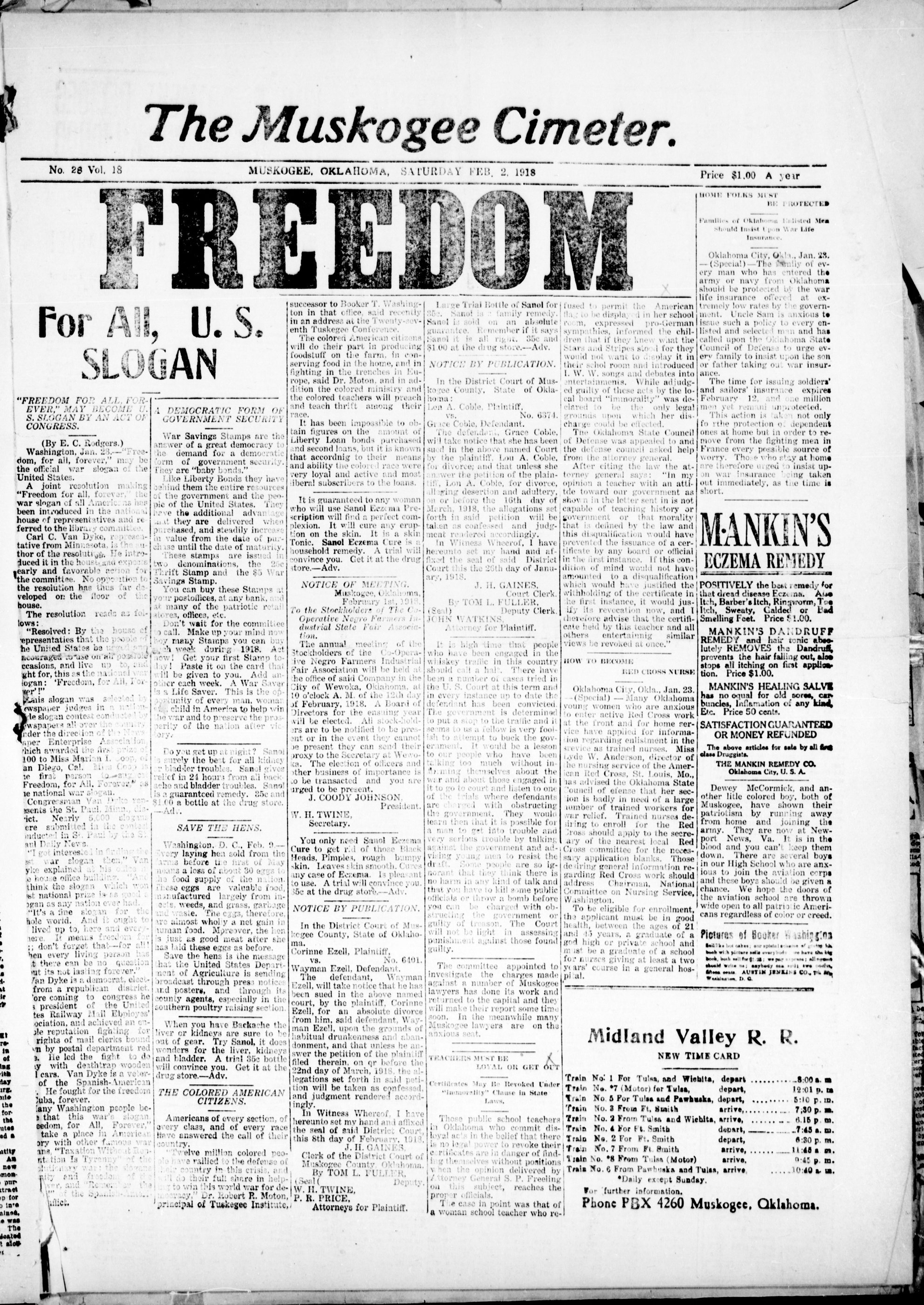
FREEDOM
For All, U. S. SLOGAN
No. 28 Vol. 18
For All
SLOG
"FREEDOM FOR ALL, FOR- EVER," MAY BECOME U. S. SLOGAN BY AN ACT OF CONGRESS.
(By E. C. Rodgers.)
Washington, Jan. 28.—"Freedom, for all, forever," may be the official war slogan of the United States.
A joint resolution making "Freedom for all, forever," the war slogan of all Americans has been introduced in the national house of representatives and referred to the library committee.
Carl C. Van Dyke, representative from Minnesota, is the author of the resolution. He introduced it in the house and exposes early and favorable action for the committee. No opposition to the resolution has thus far developed on the floor of the house.
The resolution reads as follows:
"Resolved: By the house of representatives that the people of the United States be urged and encouraged to use on all possible occasions, and live up to, and right for, this as the national war slogan: 'Freedom, for All, Forever.'"
Luis slogan was selected by newspaper judges in a nationwide slogan contest conducted by newspapers all over the country under the direction of the News Paper Enterprise Association, which awarded the first prize of 100 to Miss Marilyn I. Coop, of an Diego, Cal. Miss Coop is the first person to sue an Freedom, for All, Forever" as the national war slogan. Congressman Van Duke vansents the St. Paul, Minn., district. Nearly 5,000 slogans were submitted in the contest conducted in St. Paul by the St. Paul Daily News.
"I got interested in finding the first war slogan then," Van Dyke explained at his office in a house office building. "And think the slogan which won the national prize is so good a slogan as any nation ever had. "It's a fine slogan for the whole world. And it ought to lived up to, here and everywhere. It means freedom for; don't forget that—for all! when every living person has it there can be no question but its not lasting forever." Van Dyke is a democrat, elect from a republican district,ore coming to congress he a president of the United States Railway Mail Employees' association, and achieved an enclue reputation fighting for rights of mail clerks bound on by postal department red. He led the fight to do duty with deathtrap wooden cars. Van Dyke is a vener of the Spanish-American He fought for the freedom India forever.
lany Washington people be- that this war's slogan, freedom, for All, Forever," take a place in American history with other famous warans "Taxation Without Reputation Is Tyranny" of the stationary war; the slovene city and freedom of its war, and "Remember the day" of the Spanish-American conflict.
The Muskogee Cimeter.
MUSKOGEE, OKLAHOMA, SATURDAY FEB. 2. 1918
A DEMOCRATIC FORM OF GOVERNMENT SECURITY
War Savings Stamps are the answer of a great democracy to the demand for a democratic form of government security. They are "baby bonds." Like Liberty Bonds they have behind them the entire resources of the government and the people of the United States. They have the additional advantage that they are delivered when purchased, and steadily increase in value from the date of purchase until the date of maturity. These stamps are issued in two denominations, the 25c Thrift Stamp and the $5 War Savings Stamp.
You can buy these Stamps at your post offices, at any bank, and at many of the patriotic retail stores, offices, etc.
Don't wait for the committee to call. Make up your mind now boy many Stamps you can buy each week during 1918. Act now! Get your first Stamp today! Paste it on the card that will be given to you. Add another each week. A War Saver is a Life Saver. This is the opportunity of every man, woman, child in America to help win the war and to preserve the prosperity of the nation after victory.
Do you get up at night? Sanofi is surely the best for all kidney or bladder troubles. Sanofi gives relief in 24 hours from all backache and bladder troubles. Sanofi is a guaranteed remedy. 35c and $1.00 a bottle at the drug store.—Adj.
SAVE THE HENS.
Washington. D. C., Feb. 9. Every laying hen sold from the farms before the first of May means a loss of about 30 eggs to the food supply of the nation. These eggs are valuable food, manufactured largely from insects, weeds, and grass, garbage and waste. The eggs, therefore, are almost wholly a net gain in human food. Moreover, the hen is just as good meat after she has laid these eggs as before. Save the hens is the message that the United States Department of Agriculture is sending broadcast through press notices and posters, and through its county agents, especially in the southern poultry raising section.
When you have Backache the liver or kidneys are sure to be out of gear. Try Sanol, it does wonders for the liver, kidneys and bladder. A trial 35c bottle will convince you. Get it at the drug store.—Adv.
THE COLORED AMERICAN CITIZENS.
Americans of every section, of every class, and of every race have answered the call of their country. "Twelve million colored people have rallied to the defense of their country in this crisis, and will do their full share in helping to win this world war for democracy," Dr. Robert P. Moton, principal of Tuskegee Institute.
successor to Booker T. Washington in that office, said recently in an address at the Twenty-seventh Tuskegee Conference.
The colored American citizens will do their part in producing foodstuff on the farm, in conserving food in the home, and in fighting in the trenches in Europe, said Dr. Moton, and in addition the colored ministry and the colored teachers will preach and teach thrift among their race.
It has been impossible to obtain figures on the amount of Liberty Loan bonds purchased and second loans, but it is known that accordnig to their means and ability the colored race were very loyal and active and most liberal subscribers to the loans.
It is guaranteed to any woman who will use Sanol Eczema Prescription will find a perfect complexion. It will cure any eruption on the skin. It is a skin Tonic. Sanol Eczema Cure is a household remedy. A trial will convince you. Get it at the drug store.—Adv.
To the Stockholders of The Co-Operative Negro Farmers Industrial State Fair Association.
The annual meeting of the Stockholders of the Co-Operative Negro Farmers Industrial Fair Association will be held at the office of said Company in the City of Wewoka, Oklahoma, at 10 o'clock A.M. of the 12th day of February, 1918. A Board of Directors for the ensuing year will be elected. All stock-holders are to be notified to be present or in the event they cannot be present they can send their proxy to the Secretary at Wewoka. The election of officers and other business of importance is to be transacted and you are urged to be present.
J. COODY JOHNSON,
President.
W. H. TWINE,
You only need Sanol Eczema
Cure to get rid of those Black
Heads, Pimples, rough bumpy
skin. Leaves skin smooth. Cures
any case of Eczema. Is pleasant
to use. A trial will convince you.
35c at the drug store. - Adv.
NOTICE BY PUBLICATION.
In the District Court of Muskegee County, State of Oklahoma.
Corinne Ezell, Plaintiff,
vs. No. 6401.
Wayman Ezell, Defendant.
The defendant, Wayman Ezell, will take notice that he has been sued in the above named court, by the plaintiff, Corinne Ezell, for an absolute divorce from him, said defendant, Wayman Ezell, upon the grounds of habitual drunkenness and abandonment, and that unless he answer the petition of the plaintiff filed therein, on or before the 22nd day of March, 1918, the allegations set forth in said petition will be taken as confessed, and judgment rendered accordingly.
In Witness Whereof, I have hereunto set my hand and affixed the seal of said District Court, this 8th day of February, 1918.
J. H. GAINES.
Clerk of the District Court of Muskogee County, Oklahoma.
BY TOM L. EULER
By TOM L. FULLER,
(Seal) Deputy
W. H. TWINE,
P. R. PRICE,
Attorneys for Plaintiff.
Large Trial Bottle of Sanol for 352. Sanol is a family remedy. Sanol is sold on an absolute guarantee. Remember if it says Sanol it is all right. 35c and $1.00 at the drug store.—Adv.
NOTICE BY PUBLICATION.
In the District Court of Muskogee County, State of Oklahoma:
Len A. Coble, Plaintiff,
vs. No. 6374.
Grace Coble, Defendant.
Grace Coble, Defendant.
The defendant, Grace Coble, will take notice that she has been sued in the above named Court by the plaintiff, Lou A. Coble, for divorce; and that unless she answer the petition of the plaintiff, Lou A. Coble, for divorce, alleging desertion and adultery, on or before the 16th day of March, 1918, the allegations set forth in said petition will be taken as confessed and judgment rendered accordingly.
In Witness Wheerof, I have hereunto set my hand and affixed the seal of said District Court this the 26th day of January, 1918.
By TOM L. FULLER.
(Seal) Deputy Clerk.
JOHN WATKINS.
It is high time that people who have been engaged in the whiskey traffic in this country should call a halt. There have been a number of cases tried in the U. S. Court at this term and in every instance up to date the defendant has been convicted. The government is determined to put a stop to the traffic and it seems to us a fellow is very foolish to attempt to buck the government. It would be a lesson to our people who have been talking too much without informing themselves about the war and about those engaged in it to go to court and listen to one of the trials where defendants are charged with obstructing the government. They would learn then that it is possible for a man to get into trouble and very serious trouble by talking against the government and advising young men to resist the draft. Some people are so ignorant that they think there is no harm in any kind of talk and that you have to kill some public officials or throw a bomb before you can be charged with obstructing the government or guilty of treason. The Court will not be light in assessing punishment against those found guilty.
The committee appointed to investigate the charges made against a number of Muskogee lawyers has done its work and returned to the capital and they will make their report some time soon. In the meanwhile many Muskogee lawyers are on the anxious seat.
TEACHERS MUST BE LOYAL OR GET OUT
Certificates May Be Revoked Under "Immorality" Clause in State Laws.
Those public school teachers in Oklahoma who commit disloyal acts in the belief that there is no legal power to revoke their certificates are in danger of finding themselves without positions when the opinion delivered by Attorney General S. P. Freeling on this subject, reaches the proper officials.
The case in point was that of a woman school teacher who re-
fused to permit the American flag to be displayed in her school room, expressed pro-German sympathies, informed the children that if they knew what the Stars and Stripes stood for they would not want to display it in their school room and introduced I. W. W. songs and debates into entertainments. While adjudged guilty of these acts by the local board "immorality" was declared to be the only legal grounds upon which her discharge could be effected. The Oklahoma State Council of Defense was appealed to and the defense council asked help from the attorney general.
After citing the law the attorney general says: "In my opinion a teacher with an attitude toward our government as shown in the letter sent in is not capable of teaching history or government or that morality that is defined by the law and this disqualification would have prevented the issuance of a certificate by any board or official in the first instance. If this condition of mind would not have amounted to a disqualification which would have justified the withholding of the certificate in the first instance, it would justify its revocation now, and I therefore advise that the certificate held by this teacher and all others entertaining similar views be revoked at once."
HOW TO BECOME
RED CROSS NURSE
Oklahoma City, Okla., Jan. 23. (Special) Many Oklahoma young women who are anxious to enter active Red Cross work at the front and for home service have applied for information regarding enlistment in the service as trained nurses. Miss Lyde W. Anderson, director of the nursing service of the American Red Cross, St. Louis, Mo., has advised the Oklahoma State Council of defense that her section is badly in need of a large number of trained workers for war relief. Trained nurses desiring to enroll for the Red Cross should apply to the secretary of the nearest local Red Cross committee for the necessary application blanks. Those desiring general information regarding Red Cross work should address Chairman, National Committee on Nursing Service, Washington.
To be eligible for enrollment, the applicant must be in good health, between the ages of 21 and 45 years, a graduate of a god high or private school and must be a graduate of a school for nurses giving at least a two years' course in a general hospital.
Midland Valley R. R.
NEW TIME CARD
Train No. 1 For Tulsa, and Wichita, depart ... 8:00 a. m
Train No. *7 (Motor) for Tulsa, depart, 12:01 p. m
Train No. 5 For Tulsa and Pawhuska, depart, 5:10 p. m
Train No. 3 From Ft. Smith arrive, 7:30 p. m
Train No. 2 From Tulsa and Wichita, arrive, 6:15 p. m
Train No. 4 For Ft. Smith depart, 7:45 a. m
Train No. 2 For Ft. Smith depart, 6:30 p. m
Train No. 7 From Ft. Smith arrive, 11:45 a. m
Train No. *8 From Tulsa (Motor) arrive, 9:45 p. m
Train No. 6 From Pawhuska and Tulsa, arrive, 10:40 a. m.
*Daily except Sunday.
For further information.
Phone PBX 4260 Muskogee, Oklahoma.
Price $1.00 A year
Families of Oklahoma Unlisted Men Should Insist Upon War Life Insurance.
Oklahoma City, Okla., Jan. 23. — (Special) — The family of every man who has entered the army or navy from Oklahoma should be protected by the war life insurance offered at extremely low rates by the government. Uncle Sam is anxious to issue such a policy to every enlisted and selected man and has called upon the Oklahoma State Council of Defense to urge every family to insist upon the son or father taking out war insurance.
The time for issuing soldiers' and sailors' insurance expires February 12, and one million men yet remain unprotected.
This action is taken not only for rife protection of dependent ones at home but in order to remove from the fighting men in France every possible source of worry. Those who stay at home are therefore urged to insist upon war insurance being taken out immediately, as the time is short.
M·ANKIN'S ECZEMA REMEDY
POSITIVELY the best remedy for that dread disease Eczema. Also Itch, Barber's Itch, Ringworm, Too Itch, Sweaty, Calded or Bad Smelling Feet. Price $1.00.
MANKIN'S DANDRUFF REMEDY and hair tonic absolutely REMOVES the Dandruff provents the hair falling out, also stops all itching on first application. Price $1.00.
MANKIN'S HEALING SALVE has no equal for old sore, car buncles, Inflaction of any kind. Etc. Price 50 cents.
SATISFACTION GUARANTEED OR MONEY REFUNDED
THE MANKIN REMEDY CO.
Oklahoma City, U. S. A.
Dewey McCormick, and another little colored boy, both of Muskogee, have shown their patriotism by running away from home and joining the army. They are now at Newport News, Va. It is in the blood and you can't keep them down. There are several boys in our High School who are anxious to join the aviation corps and these boys should be given a chance. We hope the doors of the aviation school are thrown wide open to all patriotic Americans regardless of color or creed.
Pictures of Booker Washington
Bellhill hot cakes, our special essence of grating broth with picture salt every body, we have the big book, book sell for $1; we pay expenses all except should write us; anybody can sell two books, fifteen cents. AUSTIN JENKINS CO., The Mankin Washington, D. G.
Hulley R. R.
ME CARD
hibita, depart ... 8:00 a. m.
depart, ... 12:01 p. m.
aska, depart, ... 5:10 p. m.
arrive, ... 7:30 p. m.
hibita, arrive, ... 6:15 p. m.
depart, ... 7:45 a. m.
depart, ... 6:30 p. m.
arrive, ... 11:45 a. m.
arrive, ... 9:45 p. m.
Tulsa, arrive ... 10:40 a. m.
ay.
Pictures of Booker Washington
Sell like hot cake; our spetial scheme of giving bigh
book with picture sells everybody; we have the big
book, both sell for £8.25; we pay express; all agents
should write us; anybody can sell; two orders
affectees AUSTIN JENEINS CO., 9th St.
Washington, D. C.
MAY HURT OWN CAUSE
BALTIMORE SUN FEARS AMENDMENT WILL INJURE "DRYS")
A BAD MISTAKE
National Prohibition Law Expected to Be Boomerang For Fanatical "Holler Than Thou" Folks—Blow to True Temperance in Attack On Personal Liberty
If it were as easy to abolish inter-
perance by legislative fiat as it is to
influence Congressmen, we should join
the antislavery people in declaring
Monday, December 17, 1817, the great-
est and most blessed day in the history
of the country. The object of the
long campaign for a national prohibition amendment is, as we understand
it, the protection of men and women
from the evils that are produced by
alcoholic excesses. That twenty-seven
states report extraordinary results in
this direction through the influence of
local prohibition does not prove that
the same things would be accomplished
in the country at large, if it should
be forced through compliant state
legislatures on twelve commonwealth
banks to it. There is no unanimity
of opinion as to results in the states
which have already promised to be
good. So far as the miraculous effect
attained for prohibition on individual
thrift and general prosperity is con-
sidered, Congressmen Coady made a
very significant point in the debate in
the House when he called attention to
the fact that the report of the Treasury
Department on the collection of income and excess profit taxes shows
that an overwhelming proportion of
such taxes come from nonprohibition
states, while those that have prohib-
tion show surprisingly small returns.
Charged With Bringing Liquor Into State.
Bentonville.—J. P. McGlon, a Catholic priest of Fayetteville, pleaded guilty here Wednesday before Justice Whitley Kern, and was fined $100 for bringing whiskey into dry territory. The driver of the car in which McGlon was on route from Joplin to Fayetteville, was discharged. They were arrested Saturday night in a Bentonville garage, where they had gone to have the trouble adjusted.—Arkansas Gazette.
For Loss of Appetite and Loss of Appetite
The Oral general strengthening tonic
GROWS chill TONIC, drives out
Malaria stop the system. A true tonic
and aid adults and children. See
PALMER'S
SKIN
WHITENER
25¢
Delivered
Cleans and Bleaches the Complexion
Makes Dark Brown or Sallow Skin White
Good for Pimples and Rough Skin
Can the Original and Gentle Made Only by
JACOBS' PHARMACY
ATLANTA, GA.
AGENTS WANTED. Write New York.
THE FIELD OF THE FORTRESS
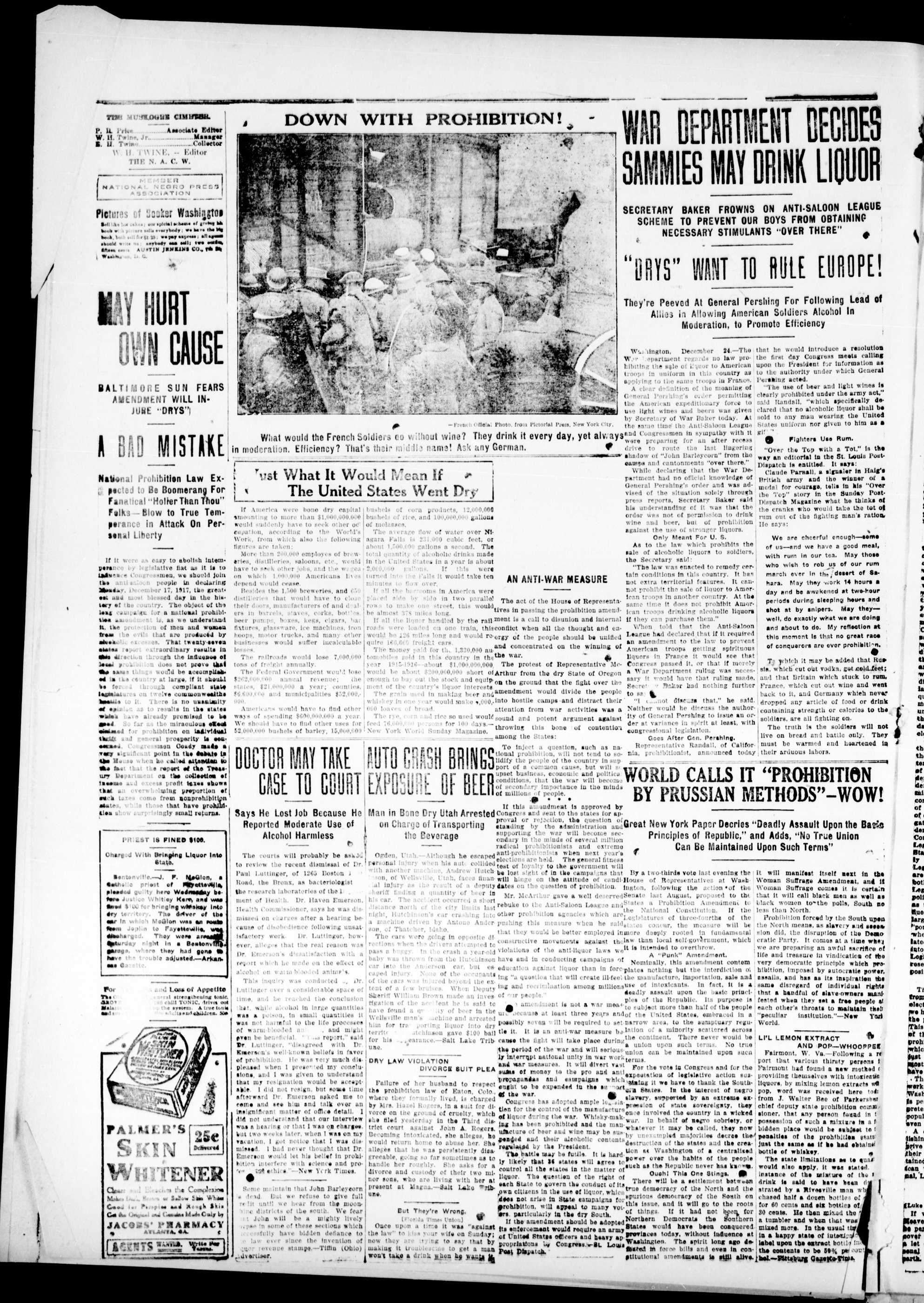
What would the French Soldiers do without wine? They drink it every day, yet always in moderation. Efficiency? That's their middle name! Ask any German.
Just What It Would Mean If The United States Went Dry
If America were bone dry capital amounting to more than $1,000,000,000 would suddenly have to seek other occupation, according to the World's Work, from which also the following figures are taken:
More than 200,000 employees of breweries, distilleries, saloons, etc., would have to seek other jobs, and the wages on which 1,000,000 Americans lives depend would cease.
Besides the 1,500 breweries, and 650 distilleries that would have to close their doors, manufacturers of and dealers in barrels, staves, corks, bottles, beer pumps, boxes, kegs, cigars, bar fixtures, glassware, ice machines, froon hoops, motor trucks, and many other businesses would suffer incalculable losses.
The railroads would lose 7,000,000 tons of freight annually.
The Federal Government would lose $262,000,000 annual revenue; the states, $21,000,000 a year; counties, $6,000,000 and municipalities $52,000,000. Americans would have to find other ways of spending $600,000,000 a year. We should have to find other uses for 52,000,000 bushels of barley. 15,000,000
DOCTOR MAY TAKE CASE TO COURT
Says He Lost Job Because He Reported Moderate Use of Alcohol Harmless
The courts will probably be asked to review the recent dismissal of Dr. Paul Luttinger, of 1265 Boston Road, the Bronx, as bacteriologist the research laboratories of the Department of Health. Dr. Haven Emerson, Health Commissioner, says he was dismissed on charges after a hearing because of disobedience following unsatisfactory work. Dr. Luttinger, however, alleges that the real reason was Dr. Emerson's dissatisfaction with a report which he made on the effect of alcohol on warmblood animals'.
This inquiry was conducted by Dr. Luttinger over a considerable space of time, and he reached the conclusion that, while alcohol in large quantities was a poison, in small quantities it was not harmful to the life processes of warm-blooded animals, and might even be beneficial. "This report," said Dr. Luttinger, "disagreed with Dr. Emerson's well-known beliefs in favor of prohibition. He was very much displeased when I presented my conclusions, and I was given to understand that my resignation would be acceptable. I did not resign, but some time afterward Dr. Emerson asked me to come and see him and talk over an insignificant matter of office detail. I did not understand that our interview was a hearing or that I was on charges, but two weeks later, when I was on my vacation, I got notice that I was dismissed. I had never thought that Dr. Emerson would let his belief in prohibition interfere with science and protec- tious ethics"—New York Times.
Some maintain that John Barleyeorn a dead. But we refuse to give full credit until we hear from the moonline districts of the south. We fear that John will be a mighty lively opus in some of these sections which successfully have hidden defiance to the law ever since the invention of sugar revenue stamps.—Tiffin (Ohio) advertiser.
bushels of corn products, 12,000,000 bushels of rice, and 100,000,000 gallons of molasses. The average flow of water over Niagara Falls is 231,000 cubic feet, or about 1,500,000 gallons a second. The total quantity of alcoholic drinks made in the United States in a year is about 2,000,000 gallons. If this were turned into the Falls it would take ten minutes to flow over. If all the barrooms in America were placed side by side in two parallel rows to make one street, this would be almost 378 miles long. If all the liquor handled by the railways were loaded on one train, this would be 126 miles long and would require 165,000 freight cars. The money paid for the, 1,330,000 automobiles sold in this country in the year 1915-1916—about $1,000,000,000 would be about $200,000,000 short of enough to buy out the stock and equipment of the country's liquor interests
The grain used in making beer and whiskey in one year would make $,000,000 leaves of broad. The rye, corn and rice so used would feed 75,000,000 persons for 100 days.—New York World Sunday Magazine.
AUTO CRASH BRINGS EXPOSURE OF BEER
Man in Bone Dry Utah Arrested on Charge of Transporting the Beverage
---
cal injury as the result of a deputy sheriff finding a quantity of beer in his car. The accident occurred a short distance north of the city limits last night, Hutchinson's car crashing into a machine driven by Antone Anderson, of Thatcher, Idaho.
The cars were going in opposite directions when the drivers attempted to pass a buggy. In the crash a year-old baby was thrown from the Hutchinson car into the Anderson car, but escaped injury. None of the occupants of the cars was injured beyond the extent of a few bruises. When Deputy Sheriff William Brown made an investigation of the accident he is said to have found a quantity of beer in the Wellsville man's machine and arrested him for trapping liquor into dry terrife. Hutchinson gave $100 bail for his appearance.—Salt Lake Tribune.
DRY LAW VIOLATION
DIVORCE SUIT PLEA
Failure of her husband to respect the prohibition law of Eaton, Colo., where they formally lived, is charged by Mrs. Hazel Rogers, in a suit for divorce on the ground of cruelty, which she fled yesterday in the Third district court against John A. Rogers. Becoming intoxicated, she alleges, he would return home to abuse her. She alleges that he was persistently disgreeable, going so far sometimes as to handle her roughly. She asks for a divorce and custody of their two minor sons, who are living with her at present at Magna.—Salt Lake Tribune.
Once upon a time it was "against the law" to kiss your wife on Sunday; now they are trying to say that by making it troublesome to get a man won't take a drink when he wants it.
be lost sight of in the campaigns that. By a two-thirds vote last evening the w hinge on the attitude of candidate House of Representatives at Wash- dates on the question of prohibition. I ngton, following the action of the Mr. McArthur gave a well deserved Senate last August, proposed to the rebuke to the Anti-Saloon League and States a Prohibition Amendment to other prohibition agencies which are Legislatures of three-fourths of the pushing this measure when he said states concur, the measure will be that they would be better employed in more deeply rooted in fundamental constructive movements against the law than local self-government, which violations of the anti-liquor laws welt is intended to overthrow. have and in conducting campaigns of Nominally, this amendment contem- education against liquor than in force plates nothing but the interdiction of "a question that will create ill-feel the manufacture, importation, sale and ing and recrimination among millions use of intoxicants. In fact, it is a deadly assault upon the basic princ- of our people."
AN ANTI-WAR MEASURE
The act of the House of Representatives in passing the prohibition amendment is a call to disunion and internal conflict when all the thought and energy of the people should be unified and concentrated on the winning of the war.
---
The protest of Representative McArthur from the dry State of Oregon on the ground that the fight over the amendment would divide the people into hostile camps and distract their attention from war activities was a sound and potent argument against throwing this bone of contention among the States:
To inject a question, such as national prohibition, will not tend to solidify the people of the country in support of a common cause, but will superset business, economic and political conditions, that the war will become of secondary importance in the minds of millions of people.
If this amendment is approved by Congress and sent to the states for approval or rejection, the question of standing by the administration and supporting the war will become secondary in the minds of several million radical prohibitionists and extreme anti-prohibitionists when next year's elections are held. The general fitness test of loyalty to the government will
be lost sight of in the campaigns that will hinge on the attitude of candidates on the question of prohibition.
Mr. McArthur gave a well deserved rebuke to the Anti-Saloon League and other prohibition agencies which are pushing this measure when he said that they would be better employed in constructive movements against the violations of the anti-liquor laws we have and in conducting campaigns of education against liquor than in forcing "a question that will create ill-feeling and recrimination among millions of our people."
No amendment is not a war measure because at least three years and possibly seven will be required to settle it. It is an anti-war measure because the fight will take place during the period of the war and will seriously interrupt national unity in war work and war measures. It will divert vast sums of money to the pro and anti propagandas and campaigns which ought to be expended in the support of the war.
Congress has adopted ample legislation for the control of the manufacture of liquor during the war. Whisky-making has been prohibited and the manufacture of beer and wine may be suspended and their alcoholic contents regulated by the President.
The battle may be futile. It is hard
likely that 36 states will agree to
control all the states in the matter of
liquor. The question of the right of
each State to govern the conduct of its
own citizens in the use of liquor, which
does not arise in State campaigns for
prohibition, will appeal to many vot
ers, particularly in the dry South.
If the amendment should be adopted
its enforcement would require an army
of United States officers and heavy ap
propriations by Congress. St. Louis
Post Dispatch.
WAR DEPARTMENT DECIDES SAMMIES MAY DRINK LIQUOR
SECRETARY BAKER FROWNS ON ANTI-SALOON LEAGUE SCHEME TO PREVENT OUR BOYS FROM OBTAINING NECESSARY STIMULANTS "OVER THERE"
"DRYS" WANT TO RULE EUROPE!
They're Peeved At General Pershing For Following Lead of Allies in Allowing American Soldiers Alcohol In Moderation, to Promote Efficiency
WORLD CALLS IT "PROHIBITION BY PRUSSIAN METHODS"-WOW!
Great New York Paper Decries "Deadly Assault Upon the Basic Principles of Republic," and Adds, "No True Union Can Be Maintained Upon Such Terms"
Washington, December 24.—The War Department regards no law prohibiting the sale of liquor to American troops in uniform in this country as applying to the same troops in France. A clear definition of the meaning of General Porching's order permitting the American expeditionary force to use light wines and beers was given by Secretary of War Baker today. At the same time the Anti-Saboon League and Congressmen in sympathy with it were preparing for an after recess drive to route the last lingering shadow of "John Barleycorn" from the camps and cantonments "over there."
While declaring that the War Department had no official knowledge of General Pershing's order and was advised of the situation solely through press reports, Secretary Baker said his understanding of it was that the order was not of permission to drink wine and beer, but of prohibition against the use of stronger liquors.
Only Meant For U. S.
As to the law which prohibits the sale of alcoholic liquors to soldiers, the Secretary said:
"The law was enacted to remedy certain conditions in this country. It has not extra territorial features. It cannot prohibit the sale of liquor to American troops in another country. At the same time it does not prohibit American troops drinking alcoholic liquors if they can purchase them."
When told that the Anti-Saloon League had declared that if it required an amendment to the law to prevent American troops getting spiritualis liquers in France it would see that Congress passed it, or that if merely a War Department ruling was necessary it would have that ruling made, Secretly Baker had nothing further to say: "I cannot discuss that," he said. Neither would he discuss the authority of General Pershing to issue an order at variance in spirit at least, with congressional legislation. Goes After Gen. Pershing.
Goes After Gen. Perching.
Representative Randall, of California, prohibitionist, announced today
WORLD CALLS IT BY PRUSSIAN M
Great New York Paper Decries "Principles of Republic," a Can Be Maintained
By a two-thirds vote last evening the House of Representatives at Washington, following the action of the Senate last August, proposed to the States a Prohibition Amendment to the National Constitution. If the Legislatures of three-fourths of the states concur, the measure will be more deeply rooted in fundamental law than local self-government, which it is intended to overthrow.
A "Punk" Amendment. Nominally, this amendment contemplates nothing but the interdiction of the manufacture, importation, sale and use of intoxicants. In fact, it is a deadly assault upon the basic princ-
pages of the Republic. Its purpose is to subject more than half of the people of the United States, embraced in a narrow area, to the sumptuary regulation of a minority scattered across the continent. There never would be a union upon such terms. No true union can be maintained upon such terms.
For the vote in Congress and for the expectation of legislative action sustaining it we have to thank the Southern States. In the interest of negro slavery, supported by an extreme expression of state sovereignty, they once involved the country in a wicked war. In behalf of negro sobriety, or whatever it may be called, they now by unexamined majorities decree the destruction of the states and the creation as Washington of a centralized
Ouch! This One Stings.
There will be a settlement between true democracy of the North and the spurious democracy of the South on this issue, and it will go to the roots of things. If it had not been for Northern Democrats the Southern States would have been conquered provinces today, without influence at Washington. The spirit long ago defiled in force bills and even in constitutional amendments is still alive.
that he would introduce a resolution the first day Congress meets calling upon the President for information as to the authority under which General Pershing acted.
"The use of beer and light wines is clearly prohibited under the army act," said Randall. "which specifically declared that no alcoholic liquor shall be sold to any man wearing the United States uniform nor given to him as a gift."
Fighters Use Rum.
"Over the Top with a Tot," is the way an editorial in the St. Louis Post-Dispatch is entitled. It says: Claude Parnall, a signaler in Haig's British army and the winner of a medal for courage, tells in his "Over the Top" story in the Sunday Post-Dispatch Magazine what he thinks of the cranks who would take the tot of rum out of the fighting man's ration. He says:
We are cheerful enough—some of us—and we have a good meal, with rum in our tea. May those who wish to rob us of our rum march ever in the desert of Sahara. May they work 14 hours a day and be awakened at two-hour periods during sleeping hours and shot at by sniper. May they—well, do exactly what we are doing and about to do. My reflection at this moment is that no great race of conquerors are ever prohibition.
T. which it may be added that Russia, which cut out vodka, got cold feet; and that Britain which stuck to rum, France, which cut out wine and went back to it, and Germany which never dropped any article of food or drink containing strength or calories to the soldiers, are all fighting on.
```markdown
```
The truth is the soldiers will not live on bread and battle only. They must be warmed and heartened in their arduous labors.
"PROHIBITION METHODS"—WOW!
"Deadly Assault Upon the Basis and Adds, "No True Union Upon Such Terms"
It will manifest itself next in the Woman Suffrage Amendment, and if Woman Suffrage comes it is certain that it will call black men as well as black women to the polls, South no less than North.
Prohibition forced by the South upon the North means, as slavery and session did, the disruption of the Democratic Party. It comes at a time when we are preparing an awful sacrifice of life and treasure in vindication of the very democratic principle which prohibition, imposed by autocratic power, assails, and has as its inspiration the same disregard of individual rights that a handful of slave-owners manifested when they set a free people at each other's throats to maintain their "peculiar institution."—New York World.
LI'L LEMON EXTRACT
AND POP—WHOOPPEE Fairmont, W. Va.-Following a report that various thirsty persons I Fairmont had found a new method of providing themselves with intolerant liquors, by mixing lemon extracts with pop, word was received here to from J. Walter Bee of Parkersburch chief deputy state prohibition commissioner, that any person found in the possession of such a mixture in a hidden place would be subject to penalties of the prohibition state just the same as if he had obtained bottle of whiskey.
The state limitations as to guaj would also apply. it was stated, instance of the mixture of the t drink is said to have been distrated by a Rivesville man who chased half a dozen bottles of for 60 cents and six bottles of 30 cents. He then mixed the t tumbler and when that was mixed more. In the usual time in a happy state of intoxication label upon the extract bottle into the contents to be 50% per cent hol. -Hittsburg Gazette Times.
Your Country--and Mine
YOUR country's interests and YOUR interests are bound together—inseparable. YOUR duty is to YOUR country FIRST—yourself second. You can combine your country's interests and your own through the purchase of United States War Saving Stamps and United States Thrift Stamps.
Your country borrows your money—the money that you save, that would ordinarily be spent for little things—things really of no value—this "saved" money, the quarters, the half dollars, the dollars, you lend to your country, and you not only know that you are saving your money, but that you will get it back and get more with it. Your country pays you good interest on every dollar you lend her.
If you can't buy the War Saving Stamps, buy the Thrift Stamps, at 25c each, and when you have 16 Thrift Stamps, exchange them with 12 cents in cash at your postoffice or your bank for the War Savings Stamp.
The United States War Savings Stamp pays you 4 per cent interest compounded every three months. Where can you find a better, a safer investment for your spare change?
DO YOUR PART—DO IT NOW—BUY THESE STAMPS AND ENROLL YOURSELF IN AMERICA'S GREAT ARMY AT HOME—THE ARMY THAT IS BACKING THE BOYS "OVER THERE."
OPINION OF HENRY WATTERSON, IN LOUISVILLE COURIER-JOURNAL
Also Whacks State Legislators, Charging Most Are Politicians, Without Power to Elect U. S. Senators, But With Power to Amend Federal Constitution
Under the heading "Democratic Tyranny," the Louisville Courier Journal descants thus:
Congress has voted to submit to the Legislatures of the States a constitutional amendment for national prohibition. If three-fourths of the Legislatures vote to ratify the amendment then it becomes a part of our organic law and one year thereafter no man in this country will have the right to make, sell, transport, export or import intoxicating liquors.
In other words, three-fourths of the State Legislatures will have denied the other states the right to legislate for themselves and will have denied millions of citizens of all the states the personal liberty to make a drink or take a drink if they choose.
No Majority Rule.
Advocates of this proceeding affirm that it is in accordance with the rule of the majority in our system of democracy. But it is not in accordance with the rule of the majority; though even if it were it would be inconsistent with the spirit of real democracy, which never intrenches, except in extraordinary emergency like war, beyond certain lines on the personal liberty of the individual. If this amendment be ratified as required by the Constitution it will not have been sanctioned by a majority of the people, who will not have voted on it at all directly. In the case of Kentucky if the present Legislature ratifies the amendment the people of Kentucky will never have voted on it even indirectly, and in the cases of the Legislatures which are to be elected the question of the approval of this amendment will not be popularly voted on unconfused with other questions and the personal equities of the candidates, always largely influential in the election of a Legislature.
Our experience in following our own theory of democracy has proved that the founders of our system, to the extent to which they mounted the functions of our Legislatures to be a medium of democracy rather than a check on democracy, made a mistake. This mistake has been acknowledged and corrected in the method of our choice of United States Senators. The evils of delegating to Legislatures the prerogatives of the people were so clearly demonstrated that we changed the Constitution, took away from the Legislatures the power to elect United States Senators and imposed it directly on the people. An election by a Legislature and one by popular vote are notoriously very different things, both in methods and results. The Legislature, composed in the main of politicians, is so small, comparatively, as to admit of manfluations and influences difficult or impossible in the larger field; and the "logrolling" the "pork" trading, the wheels within wheels and the many indirect, unrelated and sinister factors which enter into the final result of a vote by the Legislature are often not only representative of the popular will, but positively misrepresentative of it.
Rapa State Legislatures.
That is why we have taken away from the Legislatures the power to elect our United States Senators. But we have not yet taken away from them the power to amend our Constitution. This plays peculiarly into the hands of those who subordinate all else to prohibition; for the devious ways by which Legislatures are worked are just the ways the prohibitionists like most to employ and with which they have been most successful. The manner in which they have worked our National Legislature at Washington to submit this amendment is pertinent to this point; for nobody pretends that Congress has reflected popular sentiment in this matter or even reflected its own sentiment.
A constitutional amendment establishing national prohibition will deprive millions of American citizens of their rights without even the ascertained approval of a majority of American voters. From The Courier-Journal, Louisville, Ky.
LBST 'EM GO TO—
[Luke McLuke, in Cincinnati Enquirer.]
If we shall know each other in Heaven, a lot of Probibilists will be perfectly misdruble when they discover that they have to associate with a lot of people who believed in Personal Liberty when they were on earth.
WILL THE ANTI-SALOON LEAGUE DO AS MUCH?
Without a dissenting vote, members of the National Wholesale Liquor Dealers' Association at the 22nd Annual Convention at the Hotel Sinton, Cincinnati, Ohio, adopted a resolution offered by Morris F. Westheimer, of Cincinnati, offering their distilleries, financial resources, and even the lives of themselves and the men and women employed in this business, to the American nation. The resolution follows:
"Be it resolved by the distillers and wholesale dealers representing the distilled spirit business of the United States, in meeting assembled at Cincinnati, Ohio.
"That this industry viewing with solemn thought the great demand and sacrifices imposed upon the American nation by the impending war, for the preservation of American standards of human freedom, the institutions of free government in America and American notions of the rights of life, liberty and the pursuit of happiness, does pledge its support to the government of the United States in the conduct of this war, to that victorious conclusion which alone is compatible with our origin as a nation, with our history as a free people and with the consecrated devotion of this generation to surrender our free country and its institutions only to our posterity.
"To this end this trade stands ready to aid the government with its resources in munition plants, its financial resources in taxes, loans and subscriptions, and the manhood and womanhood of the thousands of American families which it represents."
Your
YOUR country's interest in country FIRST—your purchase of United States
Your country borrows things really of no your country, and you get more with it. You
If you can't buy the W Stamps, exchange them
The United States War Where can you find a
DO YOUR PART—D GREAT ARMY
Your Country
It's Your
YOUR country's interests and YOUR interests are
country FIRST—yourself second. You can comb
purchase of United States War Saving Stamps and
Your country borrows your money—the money that
—things really of no value—this "saved" money,
your country, and you not only know that you are
get more with it. Your country pays you good, int
YOU CAN BUY UNITED ST
AND UNITED STATES THE
OFFICE. YOUR BANK OR A
OUT THE STATE.
THE UNITED STATES WAR
$4.12, THE UNITED STATES
25c—and IN FIVE YEARS
GOVERNMENT PAYS YOU
WAR SAVING STAMP YOU
DOUBLE DUTY—YOU HED
IN HER TIME OF NEED A
SAVE MONEY FOR YOURSELF
If you can't buy the War Saving Stamps, buy the T
Stamps, exchange them with 12 cents in cash at y
Save your nickles, your dimes,
you generally spend wastefully
money, buy War Savings Stamp
years hence you'll get a good
besides will have learned the
to save.
The United States War Savings Stamp pays you 4
Where can you find a better, a safer investment
W.S.S.
WAR SAVINGS STAMPS
ISSUED BY THE
UNITED STATES
GOVERNMENT
---
---
Country--and
It's Yours---It's Mine
AND YOUR interests are bound together—inseparable second. You can combine your country's interest in War Saving Stamps and United States Thrift Stamps money—the money that you save, that would ordinarily know that you are saving your money, but the country pays you good, interest on every dollar you buy.
AN BUY UNITED STATES WAR SAVING STAMP
UNITED STATES THRIFT STAMPS AT YOUR BANK OR AT MANY STORES THRIFT THE STATE.
UNITED STATES WAR SAVING STAMP COSTS
THE UNITED STATES THRIFT STAMP COSTS AND IN FIVE YEARS HENCE THE UNITED STATES SAVING STAMP YOU HAVE. YOU ACCOMPLISH THE DUTY—YOU HELP FINANCE YOUR COURSE TIME OF NEED AND YOU EARN MONEY MONEY FOR YOURSELF.
Saving Stamps, buy the Thrift Stamps, at 25c each, for 12 cents in cash at your postoffice or your bank. Your nickles, your dimes, your quarters, all the more generally spend wastefully and extravagantly—save. Buy War Savings Stamps and Thrift Stamps and hence you'll get a goodly sum from your government. You will have learned the most valuable lesson of life.
Sings Stamp pays you 4 per cent interest compounded, a safer investment for your spare change?
YOU CAN BUY UNITED STATES WAR SAVING STAMPS AND UNITED STATES THRIFT STAMPS AT YOUR POST-OFFICE. YOUR BANK OR AT MANY STORES THROUGHOUT THE STATE. THE UNITED STATES WAR SAVING STAMP COSTS YOU $4.12, THE UNITED STATES THRIFT STAMP COSTS YOU 25c—and IN FIVE YEARS HENCE THE UNITED STATES GOVERNMENT PAYS YOU FIVE DOLLARS FOR EVERY WAR SAVING STAMP YOU HAVE. YOU ACCOMPLISH A DOUBLE DUTY—YOU HELP FINANCE YOUR COUNTRY IN HER TIME OF NEED AND YOU EARN MONEY AND SAVE MONEY FOR YOURSELF.
Save your nickles, your dimes, your quarters, all the money that you generally spend wastefully and extravagantly—save all this money, buy War Savings Stamps and Thrift Stamps and in five years hence you'll get a goodly sum from your government, and besides will have learned the most valuable lesson of life—how to save.
Backed by your country, United States War Saving Stamps are truly gilt edged investments. NOW—BUY THESE STAMPS AND ENROLL HOME—THE ARMY THAT IS BACKING THE NATIONAL WAR COMMIT
NATIONAL WAR SAVINGS COMMITTEE
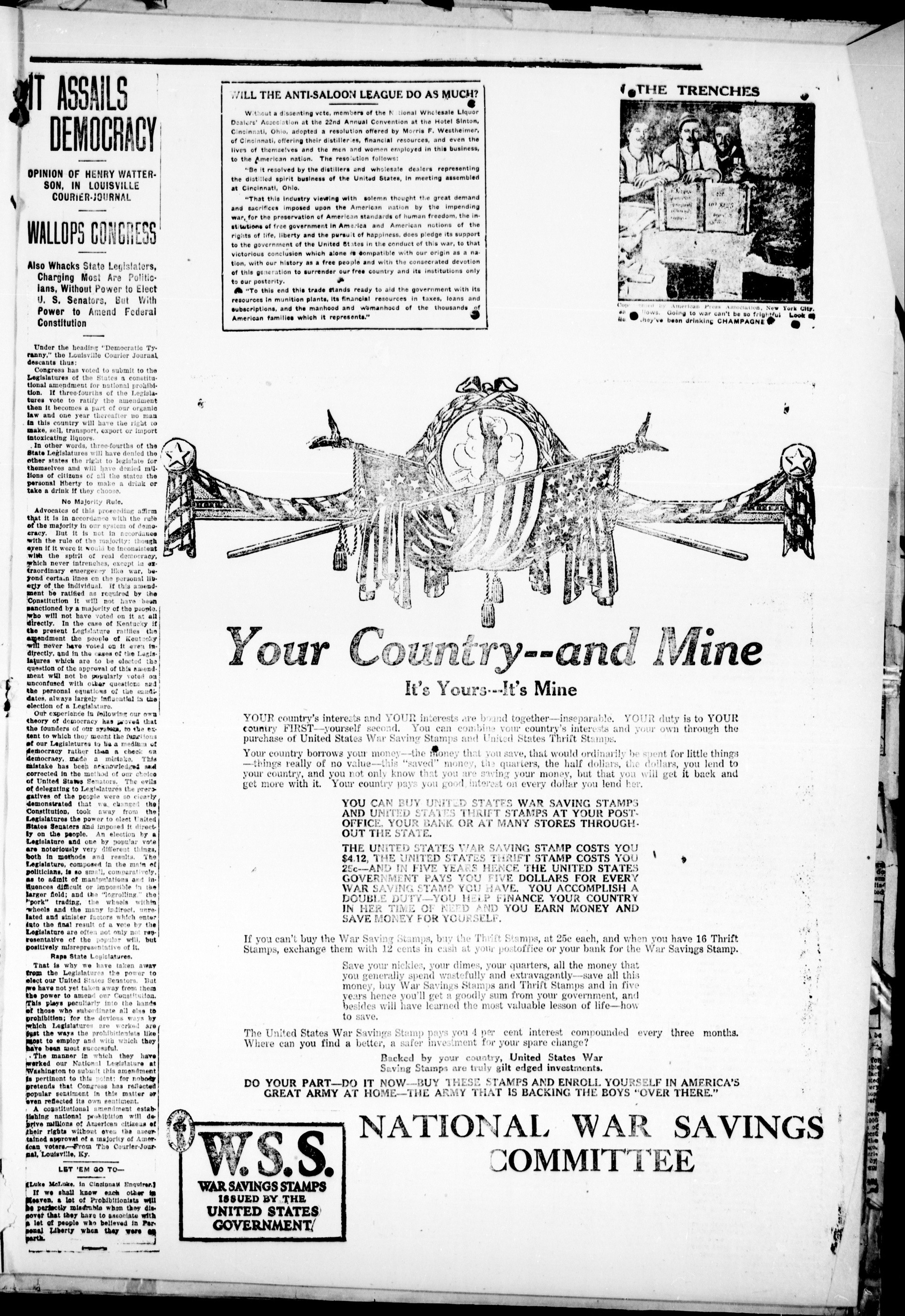
Coprised by American Press Association, New York City, se flows. Going to war can't be so frightful. Look if they've been drinking CHAMPAGNE
WASHINGTON CUTS LOOSE
CAPITAL OF NATION NON CHALANTLY BREAKS DRY LAW
37"JAGS"ARRESTED
All Nabbed in One Day—Police Activity Equals That of Ante-Desert Times—Demand for Corkscrews Greater Than Supply; Hotels Can't Buy 'Em
An opportunity to study the workings of prohibition at first hand will be afforded Congress in Washington this month. On December 1, the "dry" law became effective in Washington, D. C. But the Washington Herald, a prohibition paper says:
After a trifle over two weeks' good behavior, Washington has exhibited a little of the old-time wickedness. From Saturday afternoon until early Sunday the police was just as busy as before Washington went dry.
Arrests for intoxication numbered thirty-seven. Of those nineteen for fistled $280 in collateral. The other eighteen paid fines or went to Oceoquan for thirty days each.
More than $1,100 in fines and forfeited collateral was in the hands of Financial Clerk Adkins, of Police Court, yesterday afternoon.
any Offenses Charged.
Arrests were made for permitting gambling, importing liquor into the District in violation of the Sheppard law, intoxication, selling liquor, driving while drunk, disorderly conduct and assaults, in addition to the usual traffic law violations.
John Gant, James Mundro and James W. McKenner were the first men to be arrested on charges of importing liquor into the District to be sold or given away. Sergeant C. J. P. Wober arrested the trio Saturday, and they are still locked up awaiting trial. The police allow that they brought a suitcase full of liquor from Baltimore to be sold or given away.
William Roy forfeited $25 collateral on a charge of permitting gaming at his residence. Jack L. Bond, 110 Q street northwest, plended guilty to a similar charge and paid a fine of $50. Jennie Lewis, colored, 1110 Half street court northwest, confessed to permitting gaming and running a speakeasy. She was fined $300 and sentenced to serve forty-five days in jail.
William J. Collins is out on $1,000 bond and must answer a charge of selling liquor. His case will come up later. A charge of driving while drunk was placed against Andrew J. Beckett, who is at liberty on $100 collateral. His case also will come up later.
Corkscrews All Gone.
And the Washington Post remarks: The Capital of the United States is suffering from a corkscrew famine. It is not the result of war conditions, but of the dry wave which engulfed Washington on November 1.
Two residents of New York who registered at one of the leading hotels yesterday sent for a corkscrew. The bellboy who brought it was told to leave it in the room.
"Can't do it, boss," he said. "Corkscrews are mighty scarce in Washington just now."
Upon inquiry it was discovered that the hotel had tried in vain to purchase corkscrews from Washington merchants. The demand has been so great since the dry law became effective that that stock of local dealers has become exhausted and they have been unable to obtain more to meet the demand.
"THE MEMPHIS BLUES"
Memphis, Tenn.—Harry B. Litty, who began his career as an engineer on a switch engine at Columbia, Tenn., and who recently was appointed Mayor of Memphis, following the ousting of T. C. Aschcraft, has entered on a career of strenuous enforcement. Blue laws to end all forms of amusement, including baseball, will go into effect next Sunday. In the sweeping regulations to "close up the town," issued to the police today by Mayer Litty, police activities are extended, not only against honor selling, gambling and aggregated vice, but also demand a rigid enforcement of the laws pertaining to the operation of theaters and poolrooms on Sundays, the sale of cigarettes, reckless automobile driving and the closing of greceries on Sundays after 10 a. m.
```markdown
```
Acting on the Mayer's determination police already have notified theatrical men and billiard hall proprietors that the placelads must remain closed every Sabbath, under any circumstance.—Gibbonnet Encourages.
The image provided is too blurry to accurately recognize any text or details. It appears to be a grayscale photograph of a group of people in a crowded space, possibly during a protest or public gathering. The faces of the individuals are not clearly visible due to the blurry quality of the image.
What would the French Soldiers do without wine? They drink it every day, yet always in moderation. Efficiency? That's their middle name! Ask any German.
Just What It Would Mean If The United States Went Dry
If America were bone dry capital amounting to more than $1,000,000,000 would suddenly have to seek other occupation, according to the World's Work, from which also the following figures are taken:
More than 200,000 employes of broweries, distilleries, saloons, etc., would have to seek other jobs, and the wages on which 1,000,000 Americans lives depend would cease.
Besides the 1,500 broweries, and 650 distilleries that would have to close their doors, manufacturers of and dealers in barrels, staves, corks, bottles, beer pumps, boxes, kegs, cigars, bar fixtures, glassware, ice machines, iron hoops, motor trucks, and many other businesses would suffer incalculable losses.
The railroads would lose 7,000,000 tons of freight annually.
The Federal Government would lose $252,000,000 annual revenue; the states, $21,000,000 a year; counties, $6,600,000 and muncipalities $52,000,000.
Americans would have to find other ways of spending $600,000,000 a year. We should have to find other uses for 52,000,000 bushels of barley, 15,000,000
DOCTOR MAY TAKE CASE TO COURT
Says He Lost Job Because He Reported Moderate Use of Alcohol Harmless
The courts will probably be asked to review the recent dismissal of Dr. Paul Luttinger, of 1265 Boston Road, the Bronx, as bacteriologist the research laboratories of the D ment of Health. Dr. Haven Emerson, Health Commissioner, says he was dismissed on charges after a hearing because of disobedience following unsatisfactory work. Dr. Luttinger, however, alleges that the real reason was Dr. Emerson's dissatisfaction with a report which he made on the effect of alcohol on warm-blooded animals.
This inquiry was conducted by Dr. Luttinger over a considerable space of time, and he reached the conclusion that, while alcohol in large quantities was a poison, in small quantities it was not harmful to the life processes of warm-blooded animals, and might even be beneficial. "This report," said Dr. Luttinger, "disagreed with Dr. Emerson's well-known beliefs in favor of prohibition. He was very much displeased when I presented my conclusions, and I was given to understand that my resignation would be acceptable. I did not resign, but some time afterward Dr. Emerson asked me to come and see him and talk over an insignificant matter of office detail. I did not understand that our interview was a hearing or that I was on charges, but two weeks later, when I was on my vacation, I got notice that I was dismissed. I had never thought that Dr. Emerson would let his belief in prohibition interfere with science and pro-
Some madultain that John Barleycorn is dead. But we refuse to give full credit until we hear from the moonline districts of the south. We fear that John will be a mighty lively orpse in some of these sections which successfully have bidden defiance to the law ever since the invention of quor revenue stamps.—Tifflin (Ohio) advertiser.
bushels of cera products, 12,000,000 bushels of rice, and 100,000,000 gallons of molasses.
The average flow of water over Nbagara Falls is 231,000 cubic feet, or about 1,500,000 gallons a second. The total quantity of alcoholic drinks made in the United States in a year is about 2,000,000 gallons. If this were turned into the Falls it would take ten minutes to flow over.
If all the barrooms in America were placed side by side in two parallel rows to make one street, this would be almost 378 miles long.
If all the liquor handled by the railroads were loaded on one train, this would be 128 miles long and would require 106,600 freight cars.
The money paid for the 1,330,000 automobiles sold in this country in the year 1915-1918—about $1,000,000,000 would be about $200,000,000 short of enough to buy out the stock and equipment of the country's Bigger interests.
The grain used in making beer and whiskey in one year would make $4,000,000 leaves of bread.
The rye, corn and rice so used would feed 76,000,000 persons for 100 days.—New York World Sunday Magazine.
AUTO CRASH BRINGS EXPOSURE OF BEER
Man in Bone Dry Utah Arrested on Charge of Transporting the Beverage
Ogden, Utah.—Although he escaped personal injury when his aut collided with another machine, Andrew Hutchison, of Wellsville, Utah, faces financial injury as the result of a deputy sheriff finding a quantity of beer in his car. The accident occurred a short distance north of the city Limits last night, Hutchinson's car crashing into a machine driven by Antone Anderson, of Thatcher, Idaho.
The cars were going in opposite directions when the drivers attempted to pass a buggy. In the crash a year-old baby was thrown from the Hutchinson car into the Anderson car, but escaped injury. None of the occupants of the cars was injured beyond the extent of a few bruises. When Denny Sheriff William Brown made an investigation of the accident he is said to have found a quality of beer in the Wellsville man's machine and arrested him for transporting liquor into dry territre. Hutchinson gave $100贝 for his appearance.—Salt Lake Tribune.
DRY LAW VIOLATION
DIVORCE SUIT PLEA
Failure of her husband to respect the prohibition law of Eaton, Colo., where they formally lived, is charged by Mrs. Hazel Rogers, in a suit for divorce on the ground of cruelty, which she filed yesterday in the Talisid district court against John A. Rogers. Becoming intoxicated, she alleges, he would return home to abuse her. She alleges that he was persistently disgreeable, going so far sometimes as to handle her roughly. She asks for a divorce and custody of their two minor sons, who are living with her at present at Magna.—Salt Lake tribune.
Once upon a time it was "against the law" to kiss your wife on Sunday; now they are trying to say that by making it troublesome to get a man won't take a drink when he wants it
AN ANTI-WAR MEASURE
The act of the House of Representatives in passing the prohibition amendment is a call to disunion and internal conflict when all the thought and energy of the people should be unified and concentrated on the winning of the war.
The protest of Representative McArthur from the dry State of Oregon on the ground that the fight over the amendment would divide the people into hostile camps and distract their attention from war activities was a sound and potent argument against throwing this bone of contention among the States:
To infect a question, such as national prohibition, will not tend to solidify the people of the country in support of a common cause, but will upset business, economic and political conditions, that the war will become of secondary importance in the minds of millions of people.
If this amendment is approved by Congress and sent to the states for approval or rejection, the question of standing by the administration and supporting the war will become secondary in the minds of several million radical prohibitionists and extreme
anti-prohibitionists when next year, elections are held. The general littermate test of loyalty to the government will be lost sight of in the campaigns that will hinge on the attitude of candidates on the question of prohibition.
Mr. McArthur gave a well deserved rebuke to the Anti-Saloon League and other prohibition agencies which are pushing this measure when he said that they would be better employed in constructive movements against the violations of the anti-liquor laws we have and in conducting campaigns of education against liquor than in forcing "a question that will create ill-feeling and recrimination among millions of our people."
A amendment is not a war measure because at least three years and possibly seven will be required to set the it. It is an anti-war measure because the fight will take place during the period of the war and will seriously interrupt national unity in war work and war measures. It will divert vast sums of money to the pro and anti propagandas and campaigns which ought to be expended in the interest of the war.
Congress has adopted ample legislation for the control of the manufacture of liquor during the war. Whisky-making has been prohibited and the manufacture of beer and wine may be suspended and their alcoholic contents regulated by the PressMant.
The battle may be futile. It is hardly likely that 36 states will agree to control all the states in the matter of liquor. The question of the right of each State to govern the conduct of its own citizens in the use of liquor, which does not arise in State campaigns for prohibition, will appeal to many voters, particularly in the dry South.
If the amendment should be adopted its enforcement would require an army of United States officers and heavy appropriations by Congress.—St. Louis Post Dispatch.
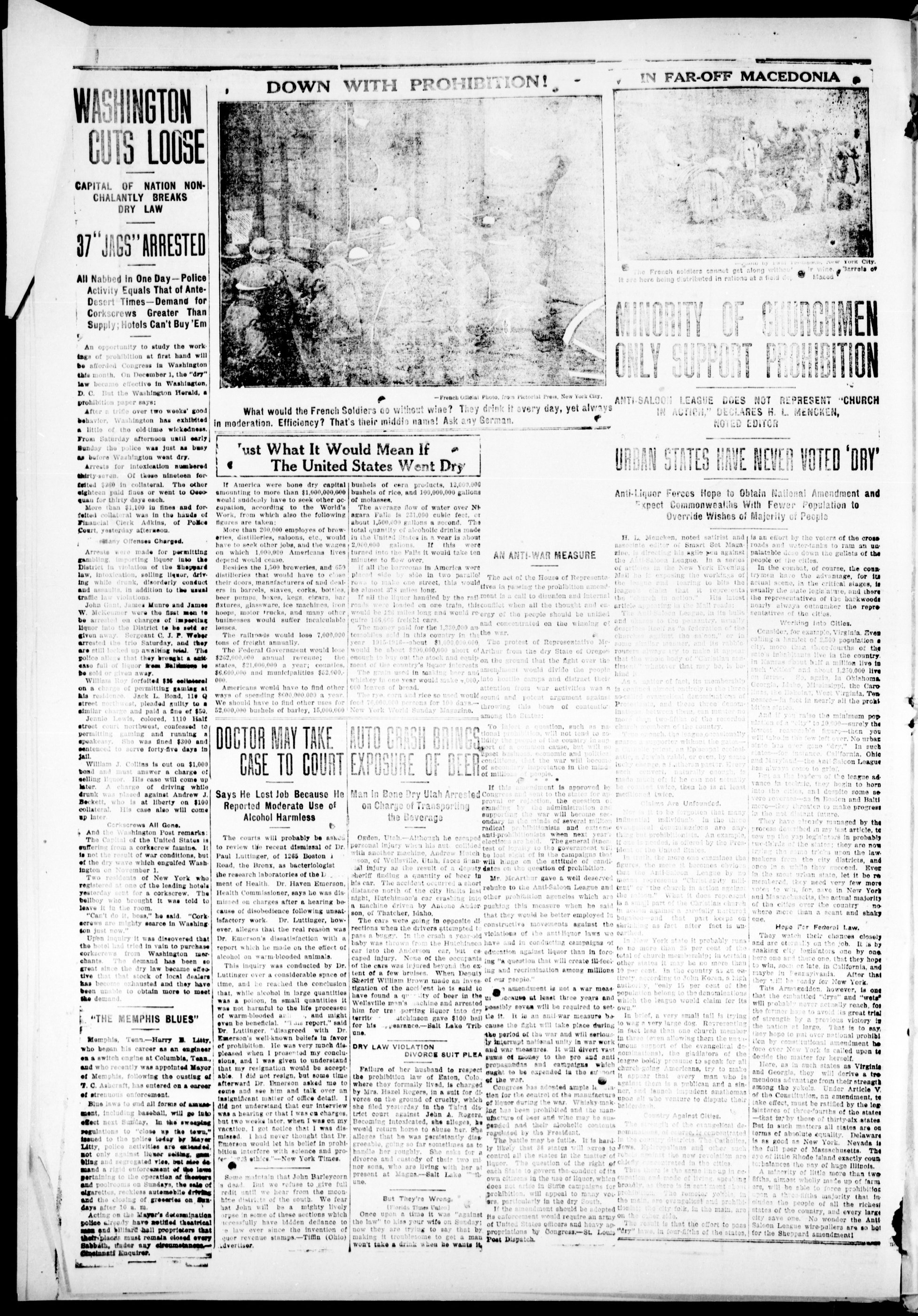
The French soldiers cannot get along without wine. Barrels of it are here being distributed in rations at a field day.
ANTI-SALOON LEAGUE DOES NOT REPRESENT "CHURCH IN ACTION," DECLARES H. L. MENCKEN, NOTED EDITOR
URBAN STATES HAVE NEVER VOTED 'DRY'
Anti-Liquor Forces Hope to Obtain National Amendment and Expect Commonwealth With Fewer Population to Override Wishes of Majority of People
H. L. Mencken, noted satirist and associate editor of Smart Set Magazine, is directing his agile pen against the Anti-Saloon League. In a series of articles in the New York Evening Mail he is exposing the workings of the league and towing to bits the league's claim that it represents the "church in motion." His latest article appearing in the Mail reads:
The Anti-Saloon League, in its buildup and phases to the present, usually describes itself as "a federation of the churches against the saloon," or in some similar manner, and its rabbit rousers always try to make it appear that the whole body of "Christian sentiment" whatever that may be, is behind it.
As a matter of fact, its membership is confined almost entirely to the three so-called evangelical denominations of Protestants, and these three denominations between them can number no more than two-fifths of the recorded church members of the country.
Is an effort by the voters of the cross roads and water-tanks to ram an unpalatable dose down the gallets of the people of the cities.
In the combat, of course, the countrymen have the advantage, for its actual scene, in the critical stages, is usually the state legislature, and there the representatives of the backwoods nearly always outnumber the representatives of the cities.
Working into Cities.
Consider, for example, Virginia. Even calling a haunt of 2,500 population a city, more than three-fourths of the cities inhabitants live in the country. In Kansas about half a million live in such "cities," and about 1,250,000 live on farms. So, again, in Oklahoma, Georgia, Illinois, Mississippi, the Carolinas, the Dakota, West Virginia, Tennessee, in fact in nearly all the probit fifteen states.
And if you raise the minimum population of a city" to 10,000" surely the
True enough, the league occasionally snatches a supporter without the gates—a charitable priest, an Episcopal ecclesiastic, a Jewish rabbi, or even, by some lucky chance, a fathom in pastor. Every such convert, naturally enough, is made much of. If he can not actually be condoned twice, then he is at least mobilized twice.
Claims Are Unfounded.
Now is it to be forgotten that many influential individuals. In the three evangelical denominators are anything but prohibitionists. An example, if one is needed, is offered by the President of the United States. In truth, the more one examines the figures, the more it becomes obylicious that the AntiBacon League by no means represents "Christianity milient" or "the church in action against the raoon." What it does represent is a small part of the Christian church in action against a carefully nurtured bagooo—and that part keeps on shrinking as fact after fact is unearthed.
In New York state it probably runs to no more than 25 per cent of the total of church membership; in certain other states it may be no more than 19 per cent. In the country as an entirety, according to John Kozen, a high authority, "only 15 per cent of the population belong to the denominations which the league would claim for its own."
In brief, a very small tail is trying to wag a very large dog. Representing in fact less than one church member in three (even allowing them the unimaginous support of the evangelical denominations), the gladiators of the league boldly presume to speak for all church-going Americans, man who is against there is a publican and a sinner, and launch impudent anathemas upon all who venture to dispute their helderdain.
Country Against Cities.
The strengths of the evangelical denominations, of course, is concentrated in the country districts. The Catholics, Jews, Episcopalians and other suchRobins against the new revolution are chiefly concentrated in the cities.
Thus there is the same line up in occupation and mode of living, speaking broadly, as there is in sentiment about prohibition. The remoter youths in the main, are evangelical and prohibition; the city folk, in the main, are on the other side.
The result is that the effort to pass "dry" laws, in four-fifths of the states,
is an effort by the voters of the crossroads and water tanks to ram an unpalatable dose down the galleries of the people of the cities.
In the combat, of course, the countrymen have the advantage, for its actual scene, in the critical stages, is usually the state legislature, and there the representatives of the backwoods nearly always outnumber the representatives of the cities.
Working Into Cities.
Consider, for example, Virginia. Even calling a hamlet of 2,500 population a city, more than three fourths of the state's inhabitants live in the country. In Kansas about half a million live in such "citizens" and about 1,270,000 live on farms. So, again, in Oklahoma, Georgia, Idaho, Mississippi, the Caro hinaus, the Dakota, West Virginia, Tennessee—in fact in nearly all the problem states.
And if you raise the minimum population of a "city" to 10,000—surely the lowest reasonable figure—then you will take in the few left over. No urban state has ever over "dry". In such states—for instance, California, Ohio and Maryland—the Anti Salmon League has always come to grief.
But as the leaders of the league advance in technic, they begin to horn into the cities, and despite some severe reverses—as in Boston and Balti more—they threaten to make progress in the most distant future.
They have already managed by the process described in my last article, to sow up the yap legislators in probably two-thirds of the state; they are now trying the same triumph on the lawmakers from the city districts, and once in a while they succeed. Even in the most urban state, let it be remembered, they need very few more votes to win, for save in New York and Massachusetts, the actual majority of the cities over the country now where more than a scant and shaky one.
Hope For Federal Law.
They watch their chances closely, and are eternally on the job. It is by snaking city legislators one by one here one and there one, that they hope to win, soon or late, in California, and maybe in Pennsylvania. After that they will be ready for New York. This Armageldon, however, is one that the embattled "drys" and "wets" will probably never actually reach, for the former hope to avoid its great trial of strength by a previous victory in the nation at large. That is to say, they hope to put over national prohibition by constitutional amendment he fove over New York is called upon to decide the matter for herself. Here, as in such states as Virginia and Georgia, they will derive a tremendous advantage from their strength among the yokels. Under Article V. of the Constitution, an amendment, to take effect, must be ratified by the legi stitures of three-fourths of the states—that is, by those of thirty-six states. But in such matters all states are on terms of absolute equality. Delaware is as good as New York. Nevada is the full peer of Massachusetts. The age of little Rhode Island exactly coun to balances the way of huge Illinois.
A minority of little more than two fifths, almost wholly made up of farmers, will be able to force prohibition upon a thirteenth majority that in cludes the people of all the richest states of the country, and every large city save one. No wonder the Antti Salonen League wire-pullers are so hot for the Sheppard amendment!