Muskogee Cimeter
Saturday, November 8, 1919
Muskogee, Oklahoma
Page text (machine-generated)
Watch this space
Your Choice $25.
In Gold or Gold Watch and Chain or Diamond Ring
For the one that names the
New Colored Grocery Store
That will open in the Reid Bldg
December 1st 1919
Send all names in scaled to
TERMINAL CONFLICTION LY 115 Court St.
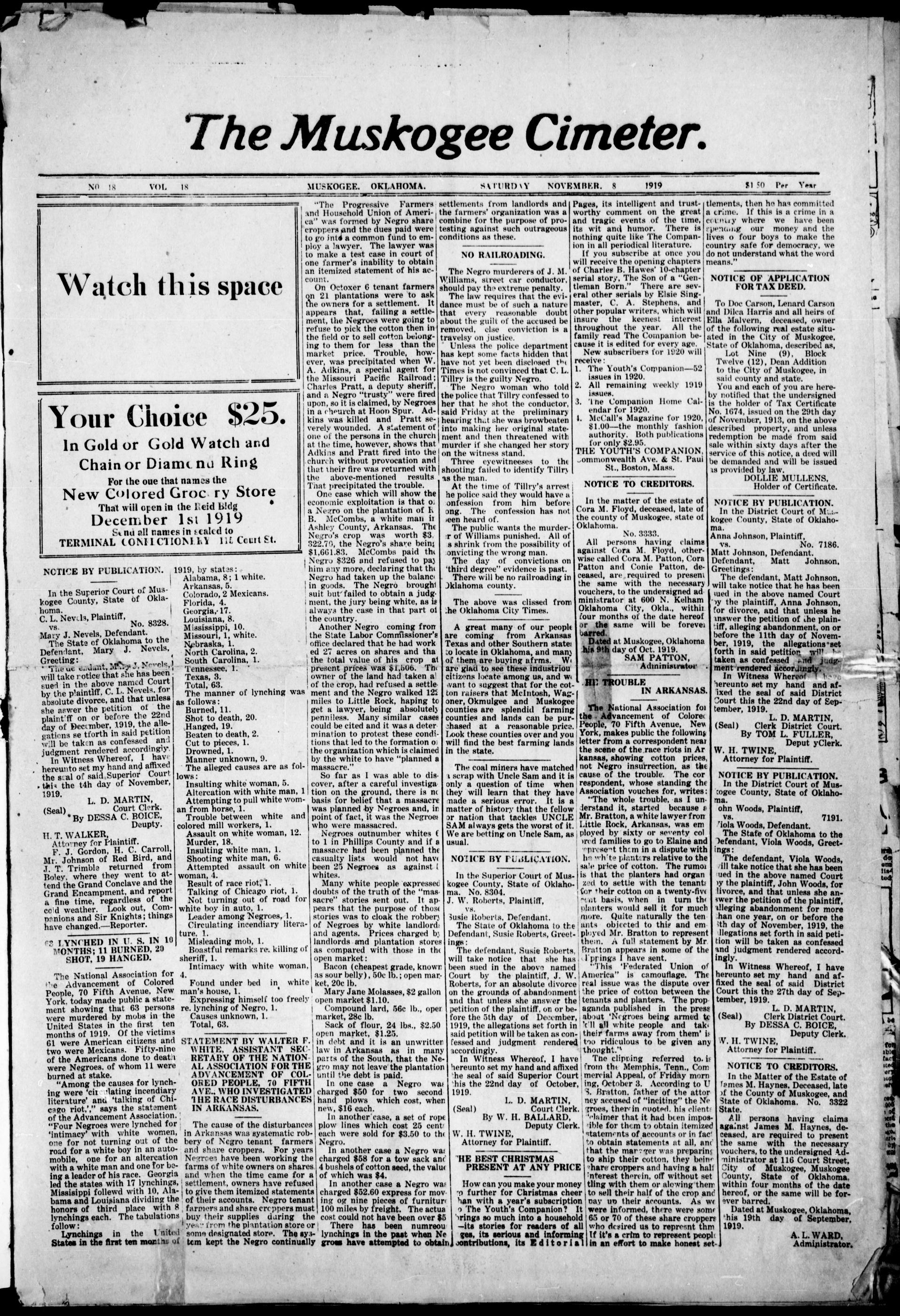
NCTICE BY PUBLICATION.
In the Superior Court of Muskogee County, State of Oklahoma.
C. L. Nevels, Plaintiff,
vs.
No. 8328.
Mow L. Nevels, Defendant.
Mary J. Nevels, Derekah
The State of Oklahoma to the
Defendant, Mary J. Nevels,
Greeting:
The de endant, Mary J. Novels, will take notice that she has been sued in the above named Court by the plaintiff, C. L. Nevels, for absolute divorce, and that unless she answer the petition of the plaintiff on or before the 22nd day of December, 1919, the allegations se thirst in said petition will be taken as confessed and judgment rendered accordingly. In Witness Whereof, I have hereunto set my hand and affixed the seal of said, Superior Court this the 14th day of November, 1919.
L. D. MARTIN,
Court Clerk.
(Seal)
By DESSA C. BOICE,
Deupty.
Attorney for Flannery
F. J. Gordon, H. C. Carroll,
Mr. Johnson of Red Bird, and
J. T. Trimble returned from
Boley, where they went to
attend the Grand Conclave and the
Grand Encampment, and report
a fine time, regardless of the
cold weather. Look out, Companions and Sir Knights; things have changed.—Reporter.
62 LYNCHED IN U. S. IN 10
MONTHS; 11 BURNED, 20
SHOT, 19 HANGED.
The National Association for the Advancement of Colored People, 70 Fifth Avenue, New York, today made public a statement showing that 63 persons were murdered by mobs in the United States in the first ten months of 1919. Of the victims 61 were American citizens and two were Mexicans. Fifty-nine of the Americans done to death were Negroes, of whom 11 were burned at stake.
"Among the causes for lynching were 'circulating incendiary literature' and 'talking of Chicago riot,'" says the statement of the Advancement Association.
"Four Negroes were lynched for 'intimacy' with white women, one for not turning out of the road for a white boy in an automobile, one for an altercation with a white man and one for being a leader of his race. Georgia led the states with 17 lynchings, Mississippi followed with 10, Alabama and Louisiana dividing the honors of third place with 8 lynchings each. The tabulations follow:
Lynchings in the United States in the first ten months of
The Muskogee Cimeter.
The alleged causes are as follows:
Insulting white woman, 5.
Altercation with white man, 1
Attempting to pull white woman from horse, 1.
Trouble between white and colored mill workers, 1.
Assault on white woman, 12.
Murder, 18.
Attempted assault on white woman, 4.
Result of race riot, 1.
Talking of Chicago riot, 1.
Not turning out of road for white boy in auto, 1.
Leader among Negroes, 1.
Circulating incendiary literature, 1.
Misleading mob, 1.
Boastful remarks re. killing of sheriff, 1.
Intimacy with white woman, 4.
Found under bed in white man's house.1.
Expressing himself too freely re. lynching of Negro, 1.
STATEMENT BY WALTER F. WHITE, ASSISTANT SECRETARY OF THE NATIONAL ASSOCIATION FOR THE ADVANCEMENT OF COLLORED PEOPLE, 70 FIFTH AVE., WHO INVESTIGATED THE RACE DISTURBANCES IN ARKANSAS.
The cause of the disturbances in Arkansas was systematic robbery of Negro tenant farmers and share croppers. For years Negroes have been working the farms of white owners on shares and when the time came for a settlement, owners have refused to give them itemized statements of their accounts. Negro tenant farmers and share croppers must buy their supplies during the year from the plantation store or some designated store. The system kept the Negro continually
"The Progressive Farmers and Household Union of America" was formed by Negro share croppers and the dues paid were to go into a common fund to employ a lawyer. The lawyer was to make a test case in court of one farmer's inability to obtain an itemized statement of his account.
On Octoxer 6 tenant farmers on 21 plantations were to ask the owners for a settlement. It appears that, failing a settlement, the Negroes were going to refuse to pick the cotton then in the field or to sell cotton belonging to them for less than the market price. Trouble, however, was precipitated when W. A. Adkins, a special agent for the Missouri Pacific Railroad; Charles Pratt, a deputy sheriff, and a Negro "trusty" were fired upon, so it is claimed, by Negroes in a church at Hoop Spur. Adkins was killed and Pratt severely wounded. A statement of one of the persons in the church at the time, however, shows that Adkins and Pratt fired into the church without provocation and that their fire was returned with the above-mentioned results. That precipitated the trouble.
One case which will show the economic exploitation is that of a Negro on the plantation of R B. McCombs, a white man in Ashley County, Arkansas. The Negro's crop was worth $3, 322.76, the Negro's share being $1,661.83. McCombs paid the Negro $326 and refused to pay him any more, declaring that the Negro had taken up the balance in goods. The Negro brought suit but failed to obtain a judgment, the jury being white, as is always the case in that part of the country.
Another Negro coming from the State Labor Commissioner's office declared that he had worked 27 acres on shares and that the total value of his crop at present prices was $1,506. The owner of the land had taken all of the crop, had refused a settlement and the Negro walked 122 miles to Little Rock, haping to get a lawyer, being absolutely penniless. Many similar cases could be cited and it was a determination to protest these conditions that led to the formation of the organization which is claimed by the white to have "planned a massacre."
So far as I was able to discover, after a careful investigation on the ground, there is no basis for belief that a massacre was planned by Negroes and, in point of fact, it was the Negroes who were massacred.
Negroes outnumber whites 6 to 1 in Phillips County and if a massacre had been planned the casualty lists would not have been 25 Negroes as against 8 whites.
Many white people expressed doubts of the truth of the "massacre" stories sent out. It appears that the purpose of those stories was to cloak the robbery of Negroes by white landlords and agents. Prices charged by landlords and plantation stores as compared with those in the open market:
Bacon (cheapest grade, known as sour belly), 50c lb.; open market, 20c lb.
Mary Jane Molasses, $2 gallon open market $1.10.
Compound lard, 56c lb., oper market, 28c lb.
Sack of flour, 24 lbs., $2.50 open market, $1.25.
in debt and it is an unwritten law in Arkansas as in many parts of the South, that the Negro may not leave the plantation until the debt is paid.
In one case a Negro was charged $50 for two second hand plows which cost, when new, $16 each.
In another case, a set of rope plow lines which cost 25 cent each were sold for $3.50 to the Negro.
In another case a Negro was charged $58 for a tow sack and 4 bushels of cotton seed, the value of which was $4.
In another case a Negro was charged $52.60 express for moving og nine pieces of furniture 100 miles by freight. The actual cost could not have been over $5
There has been numreou lynchings in the past when Negro have attempted to obtain
SATURDAY NOVEMB settlements from landlords and the farmers' organization was a combine for the purpose of protesting against such outrageous conditions as these.
NO RAILROADING.
The Negro murderers of J. M. Williams, street car conductor, should pay the extreme penalty. The law requires that the evidence must be of such a nature that every reasonable doubt about the guilt of the accused be removed, else conviction is a travelsy on justice. Unless the police department has kept some facts hidden that have not yet been disclosed the Times is not convinced that C. L. Tillry is the guilty Negro. The Negro woman who told the police that Tillry confessed to her that he shot the conductor, said Friday at the preliminary hearing that she was browbeaten into making her original statement and then threatened with murder if she changed her story on the witness stand. Three eyewitnesses to the shooting failed to identify Tillry as the man. At the time of Tillry's arrest he police said they would have a confession from him before ong. The confession has not been heard of.
The public wants the murderer of Williams punished. All of its shrink from the possibility of convicting the wrong man. The day of convictions on "third degree" evidence is past. There will be no railroading in Oklahoma county.
The above was clissed from the Oklahoma City Times.
A great many of our people are coming from Arkansas Texas and other Southern states to locate in Oklahoma, and many of them are buying afrms. We are glad to see these industrious citizens locate among us, and we want to suggest that for the cotton raisers that McIntosh, Wagoner, Okmulgee and Muskogee counties are splendid farming counties and lands can be purchased at a reasonable price. Look these counties over and you will find the best farming lands in the state.
The coal miners have matched a scrap with Uncle Sam and it is only a question of time when they will learn that they have made a serious error. It is a matter of history that the fellow or nation that tackles UNCLE SAM always gets the worst of it. We are betting on Uncle Sam, as usual.
NOTICE BY PUBLICATION.
In the Superior Court of Muskogee County, State of Oklahoma. No. 8304.
J. W. Roberts, Plaintiff,
vs.
Susie Roberts, Defendant.
The State of Oklahoma to the
Defendant, Susie Roberts, Greetings:
The defendant, Susie Roberts,
will take notice that she has
been sued in the above named
Court by the plaintiff, J. W.
Roberts, for an absolute divorce
on the grounds of abandonment
and that unless she answer the
petition of the plaintiff, on or
before the 5th day of December,
1919, the allegations set forth in
said petition will be taken as
confessed and judgment rendered
accordingly.
In Witness Whereof, I have
hereunto set my hand and affixed
the seal of said Superior Court
this the 22nd day of October,
1919.
THE BEST CHRISTMAS PRESENT AT ANY PRICE
How can you make your money go further for Christmas cheer than with a year's subscription to The Youth's Companion? It brings so much into a household—its stories for readers of all ages, its serious and informing contributions, its Editorial
Pages, its intelligent and trustworthy comment on the great and tragic events of the time, its wit and humor. There is nothing quite like The Companion in all periodical literature. If you subscribe at once you will receive the opening chapters of Charles B. Hawes' 10-chapter serial story, The Son of a "Gentleman Born." There are several other serials by Elsie Singmaster, C. A. Stephens, and other popular writers, which will insure the keenest interest throughout the year. All the family read The Companion because it is edited for every age. New subscribers for 1920 will receive: 1. The Youth's Companion—52 issues in 1920. 2. All remaining weekly 1919 issues.
3. The Companion Home Calendar for 1920.
4. McCall's Magazine for 1920, $1.00—the monthly fashion authority. Both publications for only $2.95.
THE YOUTH'S COMPANION, Commonwealth Ave. & St. Paul St., Boston, Mass.
NOTICE TO CREDITORS.
In the matter of the estate of Cora M. Floyd, deceased, late of the county of Muskogee, state of Oklahoma.
No. 3333.
All persons having claims against Cora M. Floyd, otherwise called Cora M. Patton, Cora Patton and Conie Patton, deceased, are required to present the same with the necessary vouchers, to the undersigned administrator at 600 N. Kelham Oklahoma City, Okla., within four months of the date hereof or the same will be forever barred.
Dated at Muskogee, Oklahoma this 9th day of Oct. 1919.
SAM PATTON,
Administrator
HE TROUBLE
The National Association for the Advancement of Colored People, 70 Fifth Avenue, New York, makes public the following letter from a correspondent near the scene of the race riots in Arkansas, showing cotton prices, not Negro insurrection, as the cause of the trouble. The correspondent, whose standing the Association vouches for, writes: "The whole trouble, as I understand it, started because a Mr. Bratton, a white lawyer from Little Rock, Arkansas, was employed by sixty or seventy colored families to go to Elaine and represent them in a dispute with the white planters relative to the sale price of cotton. The rumor is that the planters had organized to settle with the tenants for their cotton on a twenty-five cent basis, when in turn the planters would sell it for much more. Quite naturally the tenants objected to this and employed Mr. Bratton to represent them. A full statement by Mr. Bratton appears in some of the springs I have sent.
"This 'Federated Union of America" is camouflage. The real issue was the dispute over the price of cotton between the tenants and planters. The propaganda published in the press about 'Negroes being armed to kill all white people and take their farms away from them' is too ridiculous to be given any thought."
The clipping referred to is from the Memphis, Tenn., Commercial Appeal, of Friday morning, October 3. According to U.S. Bratton, father of the attorney accused of "inciting" the Negroes, their in quoted, his client "chimer that it had been impossible for them to obtain itemized statements of accounts or in fact to obtain statements at all, and that the manager was preparing to ship their cotton, they being share croppers and having a half interest therein, off without settling with them or allowing them to sell their half of the crop and pay up their accounts. As we were informed, there were some 65 or 70 of these share croppers who desired us to represent them. If it's a crim to represent people in an effort to make honest set
٢٠٧٦
$1.50 Per Year
tlements, then he has committed a crime. If this is a crime in a country where we have been spending our money and the lives o four boys to make the country safe for democracy, we do not understand what the word means."
NOTICE OF APPLICATION FOR TAX DEED.
To Doc Carson, Lenard Carson and Dilca Harris and all heirs of Ella Malvern, deceased, owner of the following real estate situated in the City of Muskogee, State of Oklahoma, described as, Lot Nine (9), Block Twelve (12), Dean Addition to the City of Muskogee, in said county and state. You and each of you are hereby notified that the undersigned is the holder of Tax Certificate No. 1674, issued on the 29th day of November, 1913, on the above described property, and unless redemption be made from said sale within sixty days after the service of this notice, a deed will be demanded and will be issued as provided by law. DOLLIE MULLENS, Holder of Certificate.
NOTICE BY PUBLICATION.
INCIDED PUBLICATION
In the District Court of Mukogee County, State of Oklahoma.
Anna Johnson, Plaintiff,
vs. No. 7186.
Matt Johnson, Defendant.
Matt Johnson, Defendant.
Defendant, Matt Johnson.
Greetings:
The defendant, Matt Johnson, will take notice that he has been used in the above named Court by the plaintiff, Anna Johnson, for divorce, and that unless he answer the petition of the plaintiff, alleging abandonment, on or before the 11th day of November, 1919, the allegations set forth in said petition will be taken as confessed and judgment rendered accordingly.
In Witness Whereof I have hereunto set my hand and affixed the seal of said District Court this the 22nd day of September, 1919.
L. D. MARTIN,
(Seal) Clerk District Court.
By TOM L. FULLER,
Deput yClerk.
W. H. TWINE
NOTICE BY PUBLICATION. In the District Court of Muskogee County, State of Oklahoma.
ohn Woods, Plaintiff,
vs.
/iola Woods, Defendant.
The State of Oklahoma to the Defendant, Viola Woods, Greetings:
The defendant, Viola Woods, will take notice that she has been sued in the above named Court by the plaintiff, John Woods, for divorce, and that unless she answer the petition of the plaintiff, alleging abandonment for more than one year, on or before the 4th day of November, 1919, the allegations set forth in said petition will be taken as confessed and judgment rendered accordingly.
In Witness Whereof, I have hereunto set my hand and affixed the seal of said District Court this the 27th day of September, 1919.
L. D. MARTIN,
(Seal) Clerk District Court.
By DESSA C. BOICE,
Deputy Clerk.
W. H. TWINE,
Attorney for Plaintiff.
NOTICE TO CREDITORS.
In the Matter of the Estate of James M. Haynes. Deceased, late of the County of Muskogee, and State of Oklahoma. No. 3322 State. All persons having claims against James M. Haynes, deceased, are required to present the same with the necessary vouchers, to the undersigned Administrator at 116 Court Street, City of Muskogee, Muskogee County, State of Oklahoma, within four months of the date hereof, or the same will be forever barred.
Dated at Muskogee, Oklahoma, this 19th day of September, 1919.
A. L. WARD,
Administrator.
en aus Of
f MUSKOGEE CIMETER
shed Weekly at Muskogee,
Oklahoma.
of Issue is Saturday of
Each Week.
werption, $1.00 Per Year.
itered as second-class mat
it the Post Office at Musko-
Okla., under the Act of Oc-
r 8rd, 1917.
4. Twine Editor
}. Price and W. H. Twine, Jr.
Associate Editors.
‘, Trimble Business Mgr.
ig Twine and E. H. Twine,
Collectors and Reporters
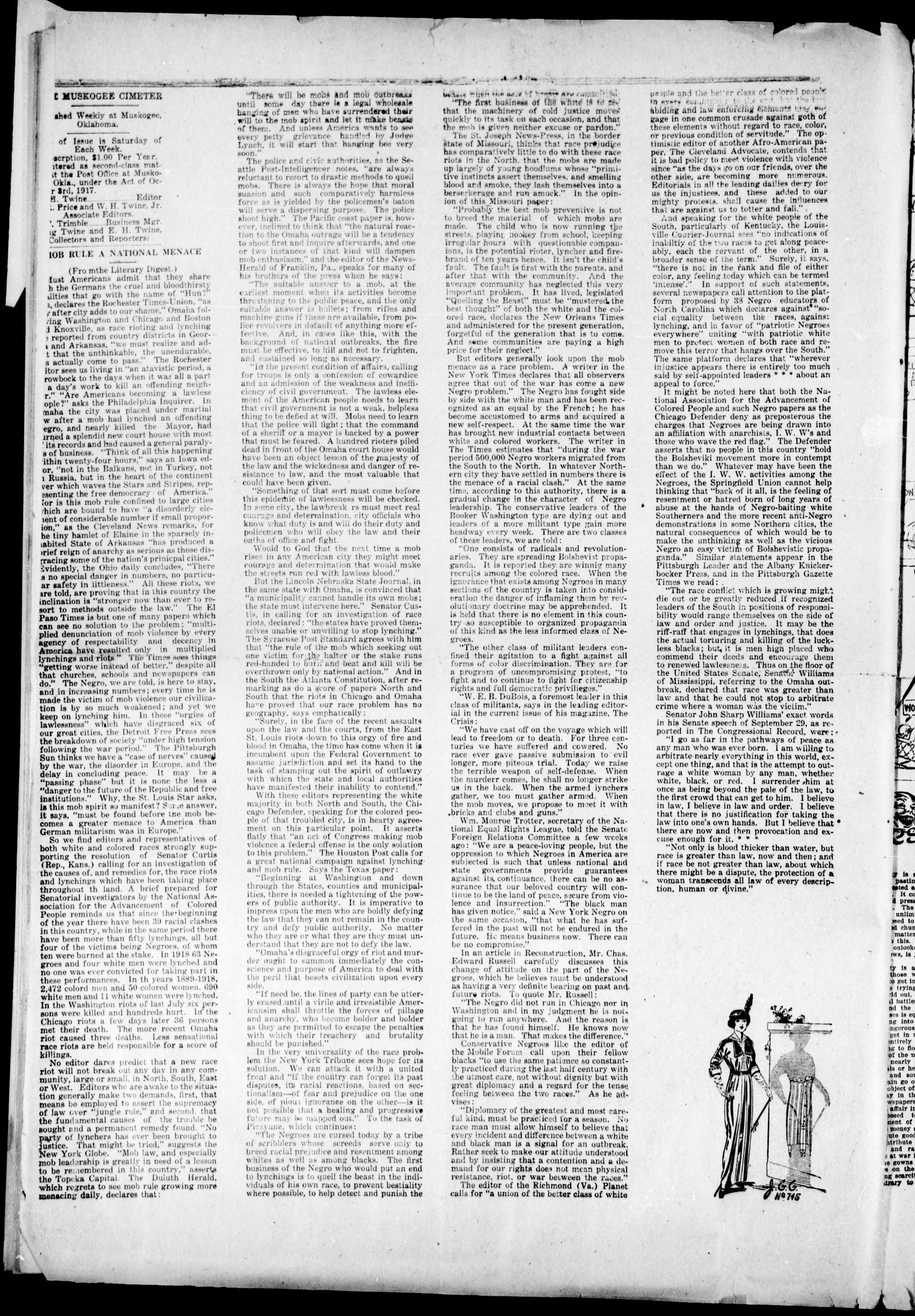
10B RULE A NATIONAL MENACE
(Fro mthe Literary Digest.)
fust Americans admit that they share
h the Germans the cruel and bloodthirsty
dities that go with the name of “Hun?”
3, declares the Rochester Times-Union, “as
y after city adds to our shame,” Omaha fol-
ving Washington and Chicago and Boston
4 Knoxville, as race rioting and lynching
» reported from country districts in Geor-
vand Arkansas, “we must realize and ad-
t that the unthinkable, the unendurable,
s actually come to pass." The Rochester
itor sees us living in “an atavistic period, a
rowbock to the days when it was all a part
a day’s work to kil! an offending neigh-
r.” “Are Americans becoming a lawless
ople?” asks the Philadelphia Inquirer. In
maha the city was placed under martial
w after a mob had lynched an offending
egro, and nearly killed the Mayor, had
arned a splendid new court house with most
‘its records and had caused a general paraly-
‘sof business. “Think of all this happening
thin twenty-four hours,” says an Iowa ed-
or, “not in the Balkans, not in Turkey, not
1 Russia, but in the heart of the continent
ver which waves the Stars and Stripes, rep-
asenting the free democracy of America.”
lor is this mob rule confined to large cities
mich are bound to have “a disorderly ele-
rent of considerable number if small propor-
ion,” as the Cleveland News remarks, for
he tiny hamlet of Elaine in the sparsely in-
tabited. State of Arkansas “has produced a
srief reign of anarchy as serious as those dis-
rracing some of the nation’s prinicpal cities.”
Svidently, the Ohio daily concludes, “There
sno Apecit danger in numbers, no particu-
ar safety in littleness.” All these riots, we
are told, are proving that in this country the
inclination is “stronger now than ever to re-
sort to methods outside the law.” The El
Paso Times is but one of many papers which
can see no solution to the problem; “multi-
plied denunciation of mob violence by every
agency of respectability and decency in
fArariea have tea only in multiplied
aes and riots” Tlie ‘Times sees things
ing worse instead of better,” despite all
that churches, schools and newspapers can
do.” The Negro, we are told, is here to stay,
and in increasing numbers; every time he is
made the victim of mob violence our civiliza-
tion is by so much weakened; and yet we
we ‘on lynching him. In these “orgies of
lawlessness” which have disgraced six of
our great cities, the Detroit Free Press sees
the breakdown of society “under high tension
following the war period.” The Pittsburgh
Sun thinks we have a “case of nerves” causeg
by the war, the disorder in Europe, and the
delay in concluding peace. It may be a
“passing phase” but it is none the less a
“danger to the future of the Republic and free
institutions.” Why, the St. Louis Star asks,
is this mob spirit 80 manifest? Sor.e answer,
it says, “must be found before ine mob be-
comes a greater menace to America than
German militarism was in Europe.”
‘So we find editors and representatives of
both white and colored races strongly sup-
porting the resolution of Senator Curtis
(Rep., Kans.) calling for an investigation of
the causes of, and remedies for, the race riots
and lynchings which have been taking place
throughout th land. A brief prepared tor
Senatorial investigators by the National As-
sociation for the Advancement of Colored
People reminds us that since ther beginning
of the year there have been 39 racial clashes
in this country, while in the same period there
have been more than fifty lynchings, all but
four of the victims being Negroes, of whom
ten were burned at the stake, In 1918 63 Ne-
groes and four white men were lynched and
no one was ever convicted for taking part in
these performances. In th years 1889-1918,
2,472 colord men and 50 colored women, 690
white men and 11 white women were lynched.
In the Washington riots of last July six per-
sons were killed and hundreds hurt. ir the
Chicago riots « few days later 36 persons
met their death. The more recent Omaha
riot caused three deaths, Less sensational
race riots are held responsible for a score of
Killings.
No editor dares predict that a new race
riot will not break oul any day in any com-
munity, large or sma!l, in North, South, Hast
or West. Editors who are awake to the situa-
tion generally make two demands, first, that
means be employed to avsert the supremacy
of Jaw over “jungle rule,” and second, that
the fundamental causes of the trouble be
sought end a permanent remedy found. “No
ty of lynchers has ever been brought to
lustice, That might be tried,” suggests the
few York Globe. “Mob law, and especially
mob leadership is greatly in need of a lesson
to be re:iembered in this country,” asserts
the Topeka Capital. The Duluth Herald,
which regrets to see mol rule growing more
_ Wil] to the mob spirit and let it mitke beasis
of them. And unless America wants to see
every petty grievance handled by Judge
Lynch, it will start that hanging bee very
soon.” 5
The police and civic authorities, as the Se-
attle Post-Intelligencer notes, “are always
reluctant to resort to drastic methods to queil
mobs. There is always the hope that moral
suasion and such comparatively harmless
force as is yielded by the policemen’s baton
will serve a dispersing purpose. The police
shoot high.” The Pacific coast paper is, how-
ever, inclined to think that “the natural reac-
tion to the Omaha outrage will be a tendency
to shoot first and inquire afterwards, and one
or two instances of that kind will dampen
mob enthusiasm,” and the editor of the News-
Herald of Franklin, Pa., speaks for many of
his brothers of the press when he says:
“The suitable answer to a mob, at the
earliest moment whe its activities become
threatening to the public peace, and the only
suitable answer is bullets; from rifles and
machine guns if these are available, from po-
lice revolvers in dofault of anything more ef-
fective. And, in cases like this, with the
background of national outbreaks, the fire
must be effective, to kill and not to frighten,
and sustained so long as necessary.
“| the present condition of affairs, calling
for troops is only a confession of cowardice
and an admission of the weakness and inetti-
ciency of civil government. The lawless ele-
ment of the American people needs to learn
that civil government is not a weak, helpless
thing to be defied at will. Mobs need to learn
that the police will fight; that the command
of a sheriff or a mayor is backed by a power
that must be feared. A hundred rioters piled
dead in front of the Omaha court house would
have been an object lesson of the majesty of
the law and the wickedness and danger of re-
sistance to law, and the most valuable that
* could have been given.
“Something of that sort must come before
this epidemic of lawlessness will be checked.
In some city, the lawbreak rs must meet real
courage and determination, city officials who
know vehat duty is and will do their duty and
policemen who will obey the law and their
oaths of office and fight
Would to God that the next time a mob
rises in any American city they might meet
courage and determination that would make
the streets run red with lawless blood.”
But the Lincoln Nebraska State Journal, in
the same state with Omaha, is convinced that
“a municipality cannot handle its own mobs;
the state must intervene here.” Senator Cus-
tis, in calling for an investigation of race
riots, declared : “the states have proved them-
selves unable or unwilling to stop lynching.”
‘The Syracuse Post Standard agrees with him
that “the rule of the mob which seeking out
one victim for the halter or the stake runs
red-handed to burs! and beat and kill will be
overthrown only by national action.” And in
the South the Atlanta Constitution, after re-
marking as do a score of papers North and
South that the riots in Chicago and Omaha
have proved that our race problem has no
geography, says emphatically:
“Surely, in the face of the recent assaults
upon the law and the courts, from the East
St. Louis riots down to this orgy of fire and
blood in Omaha, the time has come when it is
incumbent upon the Federal Government to
assume jurisdiction and set its hand to the
task of stamping out the spirit of outlawry
with whien the state and local authorities
have manifested their inability to contend.”
With these editors representing the white
majority in both North and South, the Chi-
cago Defender, speaking for the colored peo-
ple of that troubled city, is in hearty agree-
ment on this particular point. It asserts
flatly that “an act of Congress making mob
violence a federal offense is the only solution
to this problem.” The Houston Post calls for
a great national campaign against lynching
and mob rule, Says the Texas paper:
“Beginning at Washington and down
through the States, counties and municipal-
ities, there is needed a tightening of the pow-
ers of public authority. It is imperative to
impress upon the men Who are boldly defying
the law that they can not remain in the coun-
try and defy public authority. No matter
who they ave or what they are they must un-
derstand that they are not to defy the law.
“Omaha's disgraceful orgy of riot and mur-
der ought to sammon immediately the con-
science and purpose of America to deal with
the peril that besets civilization upon every
side,
“If need be, the lines of party ean be utter-
ly erased until a virile and irresistible Amer-
icansim shall throttle the forces of pillage
and anarchy, who become bolder and bolder
as they are permitted to escape the penalties
with which their treachery and brutality
should be punished.”
In the very universality of the race probs
lem the New York Tribune sees hope for its
solution, We can attack it with a united
front and “if the country can forget its past
disputes, ity racial reactions, based on see-
tionalism-—of fear and prejudice on the one
quickly to its task on each occasion, and that
the mob is given neither excuse or pardon.”
The St. Joseph News-Press, in the border
Btate of Missouri, thinks that race Roc
has comparatively little to do with these race
riots in the North, that the mobs are made
up largely of young hoodlums whose “primi-
tive instincts assert themselves, and smelling
blood and smoke, they lash themselves into a
berserkerage and run amuck.” In the opin-
ion of this Missouri paper:
“Probably the best mob preventive is not
to breed the material of which mobs are
made. The child who is now running the
streets, playing nookey from school, keeping
irregular houra with questionable compan-
ions, is the potential rioter, lyncher and fire-
brand of ten years hence. It isn’t the child's
fault. The fault is first with the parents, and
after that with the community. And the
average community has neglected this very
important problem. It has lived, legislated
“Quelling the Beast” must be “mustered, the
best thought” of both the white and the col-
ored race, declares the New Orleans Times
and administered for the present generation,
forgetful of the generation that is to come.
And seme communities are paying a high
price for their neglect.”
But editors generally look upon the mob
menace as a race problem. A writer in the
New York Times declares that all observers
agree that out of the war has come a new
Negro problem.” The Negro has fought side
by side with the white man and has been rec-
ognized as an equal by the French; he has
become accustomed to arms and acquired a
new self-respect. At the same time the war
has brought new industrial contacts between
white and colored workers. ‘The writer in
The Times estimates that “during the war
period 500,000 Negro workers migrated from
the South to the North. In whatever North-
ern city they have settled in numbers there is
the menace of a racial clash.” At the same
time, according to this authority, there is a
gradual change in the character of Negro
leadership. The conservative leaders of the
Booker Washington type are dying out and
leaders of a more militant type gain more
headway every week. There are two classes
of these leaders, we are told:
“One consists of radicals and revolution-
aries. They are spreading Bolshevist propa-
ganda. It is reported they are winnig many
recruits among the colored race. When the
ignorance that exists among Negroes in many
sections of the country is taken into consid-
eration the danger of inflaming them by rev-
olutionary doctrine may be apprehended. It
is held that there is no element in this coun-
try so susceptible to organized propaganda
of this kind as the less informed class of Ne-
groes.
“The other class of militant leaders con-
fined their agitation to a fight against all
forms of color discrimination. They are for
a program of uncompromising protest, “to
fight and to continue to fight for citizenship
rights and full democratic privilieges.”
“W. E. B. DuBois, a foremost leader in this
class of militants, says in the leading editor-
ial in the current issue of his magazine, The
Crisis:
“We have cast off on the voyage which will
lead to freedom or to death. For three cen-
turies we have suffered and cowered. No
race ever gave passive submission to evil
longer, more piteous trial. Today we raise
the terrible weapon of self-defense. When
the murderr comes, he shall no longer strike
us in the back. When the armed lynchers
gather, we too must gather armed. When
the mob moves, we propose to moet it with
ebricks and clubs and guns.”
Wm. Monroe Trotter, secretary of the Na-
tional Equal Rights League, told the Senate
Foreign Relations Committee a few weeks
ago: “We are a peace-loving people, but the
oppression to which Negroes in America are
subjected is such that unless national and
state governments provide guarantees
against its continuance, there can be no as-
surance that our beloved country will con-
tinue to be the land of peace, sacure from vio-
lence and insurrection.” “The black man
has given notice,” said a New York Negro on
the same occasion, “that what he has suf-
fered in the past will not be endured in the
future. He means business now. There can
be no compromise.”
In an article in Reconstruction, Mr. Chas,
Edward Russell carefully discusses this
change of attitude on the part of the Ne-
groes, which he believes must be understood
as having a very definite bearing on past and.
future riots. ‘To quote Mr, Russell ;
“The Negro did not ran in Chicago nor in
Washington and in my judgment he is nots
going to run anywhere. And the reason ia
that he has found himself. He knows now
that he isa man, That makes the difference.”
Conservative Negroes like the editor of
the Mobile Forum call upon their fellow
blacks “to use the same patience so constant-
ly practiced during the last half century with
the ulmost care, not without dignity but with
great diplomacy and a regard for the tense
feeling between the two races.” As he ads
peaplo and the beter class of estored pean'#
in every fold t io 6S tha }
abiding and iaw enforcllig @leincats brag, ee
gage in one common crusade against goth of
these elements without regard to race, color,
or previous condition of servitude.” The op-
timistic editor of another Afro-American Re
per, The Cleveland Advocate, contends that
it is bad policy to meet violence with violence
since “as the days zo on our friends, over the
other side, are becoming more numerous.
Editorials in al! the leading dailies decry for
us the injustices, and these added to our
mighty protests, she!l cause the influences
that are against us to totter and fall.” ,
And speaking for the white people of the
South, particularly of Kentucky, the Louis-
ville Courier-Journal sees “no indications of
inabiltiy of the two races to get along peace-
ably, each the cervant of the other, in a
broader sense of the term.” Surely, it says,
“there is not in the tank and file of either
color, any feeling today which can be termed
‘intense’.” In support of such statements,
several newspapers call attention to the plat-
form proposed by 33 Negro educators of
North Carolina which deciares against’ “‘so-
cial equality between the races, against
lynching, and in favor of “patriotic Negroes
everywhere” uniting “with patriotic white
men to protect women of both race and re-
move this terror that hangs over the South.”
The same platform declares that “wherever
injustice appears there is entirely too much
said by self-appointed leaders * * * about an
appeal to force.”
It might be noted here that both the Na-
tional Association for the Advancement of
Colored People and such Negro papers as the
Chicago Defender deny as preposterous the
charges that Negroes are being drawn into
an affiliation with anarchisis, I. W. W's and
those who wave the red flag.” The Defender
asserts that no people in this country “hold
the Bolsheviki movement more in contempt
than we do.” Whatever may have been the
effect of the I. W. W. activities among the
Negroes, the Springfield Union cannot help
thinking that “back of it all, is the feeling of
resentment or hatred born of long years of
abuse at the hands of Negro-baiting white
Southerners and the more recent anti-Negro
demonstrations in some Northern cities, the
natural consequences of which would be to
make the unthinking as well as the vicious
Negro an easy victifn of Bolahevistic propa-
ganda.” Similar statements appear in the
Pittsburgh Leader and the Albany Knicker-
bocker Press, and in the Pittsburgh Gazette
Times we read: .
“The race conflict which is growing migt*
die out or be greatly reduced if recognized
leaders of the South in positions of responsi-
bility would range themselves on the side of
jaw and order and justice. It may be the
riff-raff that engages in lynchings, that does
the actual torturing and killing of the luck-
less blacks; but, it is men high placed who
commend their deeds and encourage them
to renewed lawlessness. Thus on the floor of
the United States Scnate, Senati* Williams
of Mississippi, referring to the Omaha out-
break, deciared that race was greater than
law and that he could not stop to arbitrate
crime where a woman was the victim.”
Senator John Sharp Williams’ exact words
in his Senate speech of September 29, as re-
ported in The Congressional Record, were;
“I go as far in the pathways of peace aa
any man who was ever born. I am willing to
arbitrate-nearly everything in this world, ex-
cept one thing, and that is the attempt to out-
rage a white woman by any man, whether
white, black, or red. I surrender shim at
once as being beyond the pale of the law, to
the first crowd that can get to him. I believe
in law, I believe in law and order. I believe
that there is no justification for taking the
law into one’s own hands. But I believe that
there are now and then provocation and ex-
cuse enough for it. * * *
“Not only is blood thicker than water, but
race is greater than law, now and then; and
if race be not greater than law, about which
there might be a dispute, the protection of a
woman transcends all law of every descrip-
tion, human or divine.”
=
Je
g io
pastin
ted «
{It co
@ pros
+ Tho
unlim
jeed to
Xa chur
matter
> this,
onlook
ws, 18
gs
on V
20 got in
@ trying
‘ld out.
a1 battle
mi the
ses is eg
ng into
ngerous
get in}
mtirely
aK to flo
of the n
nearly
is oF he
and 601
xin Ro
abject of
y in th
wspapers
affair ir
jose ti
nent of
money |
ute Koo!
tribute
and ra
at war |
) gowns
on the
g scare
rary to
OS TAS
| Nt’
\ fr f
| oe
AY pees
7 Ouens
CUST LOVE MY DREAM.
HIS LEFT AT DOGS HUGGY
TO CHEER OUR LONELY
LIVES!
HAVE MORE EXPENSE!
WANT YOU DO IT
FOR MY SAVE!
HAVE NO MEANS TO
MOVE BANKS TO
HOMECOLONY!
NO! THAT'S NO HOME-
FOR A SAVINGS BANK!
WHERE SHALL
WE TRY NEXT
RAGS?
TO IN FAYOR
OF A BUTCHER
SHOP.
I'll TRY ANOTHER
ONE TOMORROW!
HI-HO!
KING PORRIN BONCAULIE BOO
WAS A BONE-EATING AFRKAM
DOG.
HIS SIGN WAS A HULLA BALLOO
HIS BARK WAS HULLABALLOO
DWIG.
OH BILLY! PLEASE DON'T TALK SO LOUD! AN HEAD IS SIMPLY SPLITTING! GIVE HIM SOME MILK AND A CODRIE
OH BILLY! COME ANSWER THE PHONE DEAR!
ALL RIGHT, PET LIE STILL —
IT'S MRS. ALLINGTON — SHE SAYS SHE HAS AN EXTRA MATHEE TICKET AND WANTS YOU TO GO WITH HER — SHALL I TELL HER YOU'RE ILL?
NO! NO — TELL HER PILL GO — I THINK IT WILL DO ME GOOD, TO GET OUT, DONT YOU DEAR?
NO! THAT'S NO HOME! THAT'S A BLUFF!
WHERE DO YOU RECKON, IS A GOOD HOME, SIR?
I DIDN'T TAKEN RECKOMING
WOW!
Best Pocket Essays BY GEORGE FITCH Author of "At Good Old Biwasa"
SOCIETY.
y is a mysterious and depastime, in which everyone existed and of which very few it consists of clothes, man and press notices in equal pro-
The mixing of these three unlimited amount of money used to produce happiness in thick chunks. matter of fact, it does not this. But it produces env onlookers, which, as every-ows, is just as good as happl-ty is a continual battle be those who are out and are to get in and those who are in a trying to keep the rest of old out. More money is spent battles that is spent in real and the effect on the men in seas is equally distressing.
ing into society is a difficult
nigerous performance. Some
get in up to their necks and
mitrely over their heads.
ing to float on the social wave
of the most difficult arts. The
nearly always has to throw
its or her heart to lighten the
and sometimes the stomach
ain go overboard, too.
object of society is to be merry
ay in the society columns of
wspapers. Society is a co-op-
afair in which every member
posed to contribute to the
ment of the rest. Some com-
money and food, while others
ute good looks, and still oth-
attribute ancestors. Fine new
and rare old ancestors are
at war in society, and at pres-
gowns seem to have the an-
s on the run, owing to the
ng scarcity of the latter.
slon, brains can also be contributed to society with good results. Some people are so interesting that they can get into society without money or ancestors. But they usually prefer to go to Congress or build railroads. In England, social stations are fixed by law, but this is a free coun-
I'M A GONER
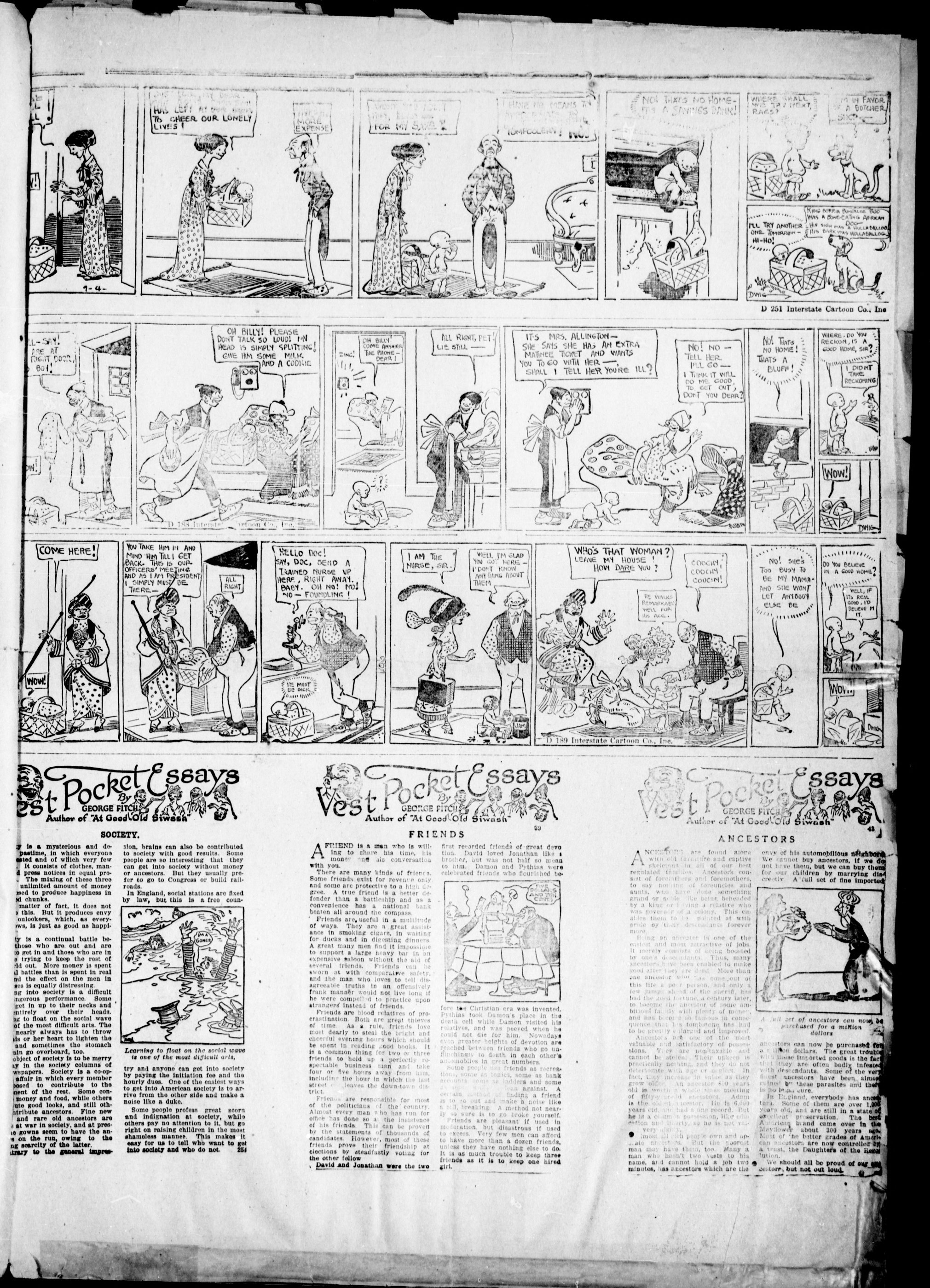
Learning to float on the social wave is one of the most difficult arts.
try and anyone can get into society by paying the initiation fee and the hourly dues. One of the easiest ways to get into American society is to arrive from the other side and make a noise like a duke.
Some people profess great scorn and indignation at society, while others pay no attention to it, but go right on raising children in the most shameless manner. This makes it easy for us to tell who want to get into society and who do not. 254
Vest Pocket Essays BY GEORGE PITCH Author of "At Good Old Siwash"
AFRIEND is a man who is willing to share his time, his money and his conversation with you. There are many kinds of friends. Some friends exist for revenue only and some are protective to a high degree. A true friend is a better defender than a battleship and as a convenience has a national bank benten all around the compass. Friends are, useful in a multitude of ways. They are a great assistance in smoking cigars, in waiting for ducks and in digesting dinners. A great many men find it impossible to support a large heavy bar in an expensive saloon without the aid of several friends. Friends can be sworn at with comparative safety, and the man who loves to tell disagreeable truths in an offensively frank manner would not live long if he were compelled to practice upon strangers instead of friends.
Friends are blood relatives of procrastination. Both are great thieves of time. As a rule, friends love most dearly to steal the bright and cheerful evening hours which should be spent in reading good books. It is a common thing for two or three friends to hold up for a perfectly respectable business man and take four or five hours away from him, including the hour in which the last street leaves the down-town district.
Friends are responsible for most of the politicians of the country. Almost every man who has run for office has done so at the insistence of his friends. This can be proven by the statements of thousands of candidates. However, most of these friends prove their friendship at elections by steadfastly voting for the other fellow
David and Jonathan were the two
FRIENDS
first recorded friends of great devotion. David loved Jonathan like a brother, but was not half so mean to him. Damon and Pythins were celebrated friends who flourished be-
FIVE DOLLARS AND TWO CENTS
fore the Christian era was invented, Eythias took Damon's place in the death cell while Damon visited his relatives, and was peeved when he could not die for him. Nowadays even greater heights of devotion are reached between friends who go uninchingly to death in each other's automobiles in great numbers. Some people use friends as recreations, some as tonics, some as bank accounts, some as jadders and some as stooges against. A certain method of finding a friend is to so out and make a noise like a bill, breaking. A method not nearly so sure is to go broke yourself. Friends are pleasant if used in moderation, but disastrous if used to excess. Very few men can afford to have more than a dozen friends, unless they have nothing else to do. It is as much trouble to keep three friends as it is to keep one hired girl.
ANCESTORS
ANCESTORS are found ators with old curature and captive skeletons in all of our best regulated families. Ancestors consist of forefathers and foremothers, to say nothing of foreuncles and aunts, who have done something grand or noble, like being, beheaded by a king or having a relative who was governor of a colony. This enables them to be polished at with pride by their descendants forever more.
envy of his automobilious neighbor. We cannot buy ancestors, if we do not have them, but we can buy them for our children by marrying discreetly. A full set of fine imported
Being an ancestor is one of the easiest and most attractive of jobs. It merely consists of being boosted by one one's descendants. Thus, many ancestors have been enabled to make good after they are dead. More than one ancestor will has come, out of this life a poor person, and only a few jumps ahead of the sheriff, has bad the good fortune, a century later, to become the ancestor of some ambitious family with plenty of money, and has become so famous in consequence that his tombstone has had to be greatly enlarged and improved.
Ancestors are one of the most valuable and satisfactory of possessions. They are nontaxable and cannot be stolen. Their upkeep is practically nothing, and they do not deteriorate with age or neglect. In fact, they increase in value as they grow older. An ancestor 800 years old is worth a whole tonne meeting of fifty years old ancestors. Adam is the oldest ancestor. He is 6,000 years old, one had a one record. But he is a common possession, like collection and liberty, so he is not vali-
very much with people and on occasion minors. But the most recent man may have them, too. Many a man who hasn't two vests to his name, and cannot hold a job two minutes, has ancestors which are the
envy of his automobilious neighbors.
We cannot buy ancestors, if we do not have them, but we can buy them for our children by marrying discreetly. A full set of fine imported
A full set of ancestors can now be purchased for a million dollars
ancestors can now be purchased for a million dollars. The great trouble with these imported goods is the fact that they are often badly infested with descendants. Some of the very finest ancestors have been almost ruined by these parasites and they is no less, cure.
In England, everybody has ancestors. Some of them are over 1,000 years old, and are still in a state of excellent preservation. The best American brand came over in the Mayflower about 300 years ago. Most of the bitter grades of American ancestors are now controlled by a trust, the Daughters of the lineation.
We should all be proud of our ancestors, but not out loud.
first of all
SERVICE
PREJUDICE PROVES PROVIDENTIAL.
Interurban Train Upon Which Colored Passengers Were Not Permitted to Ride, to Escape Galveston Flood, is Swept From Causeway Into Bay and Hundreds Perish. Looks Like Solemn Warning.
(Exchange)
HOUSTON, Texas, Sept. 22.—What looks like a solemn warning against race prejudice which would place color before humanity even in the face of a common cause, took place at flood swept Galveston last week. Whether this be so or not, it is certainly one case in which apparently from a race point of view prejudice proved providential.
That your readers may understand the situation it is well to state that Galveston, which is located on an island a mile and a half from the mainland, from which it is separated by the waters of the Galveston bay has been almost totally destroyed twice by storm and floods, once in 1900 and again in 1915. Naturally, then when storm signals are raised over the customs house, there is always anxiety about the safety of the people on the island and preparations are begun to take the inhabitants from the danger zone to Houston, which is fifty miles distant, and adjacent territory. That was the case last week When the news was heralded that a storm was sweeping up from Yucatan bringing death and destruction to Brownsville and Corpus Christi and was headed for Galveston, relief trains were immediately assembled to convey endangered residents of Galveston to Houston over the interurban. Despite the fact that the colored population of Galveston number one-third of the whole, the inteurban trains refused to allow any colored passengers to board any of the first trains out of the threatened city. The rule was white people first. When the rescue train, loadd only with whites had reached a point half a mile distant from Galveston the storm swept it from the causeway into the angry waters of Galveston bay and hundreds perished.
Statement by Walter F. White, Assistant Secretary of the National Association for the Advancement of Colored People, 70 Fifth Avenue, Who Investigated the Race Disturbances Which Occurred Recently in Arkansas.
(Exchange)
NEW YORK, Oct. 20.—The cause of the disturbances in Arkansas was systematic robery of Negro tenant farmers and share croppers. For years Negroes have been working the farms of white owners on shares and when the time came for a settlement, owners have refused to give them itemized statements of their accounts. Negro tenant farmers and share croppers must buy their supplies during the year from the plantation store or some designated store. The system kept the Negro continually in debt and it is an unwritten law in Arkansas as in many parts of the South that the Negro may not leave the plantation until the debt is paid.
"The Progressive Farmers and Household Union of America" was formed by Negro share croppers and the dues paid were to go into a common fund to employ a lawyer. The lawyer was to make a test case in court of one tenant farmer's inability to obtain an itemized statement of his account.
It was a most distressing tragedy which brought sorrow to hundreds of homes. It strikes your correspondent as being a most significant occurrence which should teach a solemn lesson to those who would discriminate against any class of citizens in a time or common danger. It may be only an unexplainable coincident, but it makes one think.
On October 6 tenant farmers on 21 plantations were to ask the owners for a settlement. It appears that, failing a settlement, the Negroes were going to refuse to pick the cotton then in the field or to sell cotton belonging to them for less than market price. Trouble, however, was precipitated when W. A. Adkins, a special agent for the Missouri Pacific Railroad; Charles Pratt, a deputy sheriff, and a Negro "trusty" were fired upon, so it is claimed, by Negroes in a church at Hot Spur. Adkins was killed and Pratt severely wounded. A statement of one of the persons in the church at the time, however, shows that Adkins and Pratt fired into the church without provocation and that their fire was returned with the above mentioned results. That precipitated the trouble.
THE EVERLASTING PERSECUTION OF
OUR RACE THE SHAME OF AMERICA.
Japan, Germany and Mexico are making fun of America because Americans, led by their great President-Ambassador, is plaving the hypocrit in showing up that superior "humanity side" for weak peoples that she has promised to her weaker or the weaker nations—when right at the White House door members of the weaker race cannot have protection from the mobbers. There is no denying the truth, we are up against torturous wrongs and deeds of injustice. America is sowing to the winds, and will surely reap the whirlwind, for God is not dead. The breach between capital and labor is widening. Catachysmic outbursts of the physical forces are increasing in number and severity. No city or town is free from violence. America is turned upside down. The Southern white man in particular is determined not to recognize the fact that the Negro is a MAN FOR AH THAT! That he is not a coward or pooltoon or a monkey and that now after the shedding of his precious blood for "democracy and freedom that he is going to be driven into slavery, naver! They had better take Dr. Stoves' advice and everybody else's advice and commence right now and grant this newly made Negro citizen his equal opportunity and equal rights minus the bug-bear of social equality, which he himself forced upon us. Not charity but justice is the cry of this age. "Not in the sense in which justice is a thing of law to secure the maintenance of contracts and the right of property, no sir; not that, but the old sense of a divine principle by which each human being born into the world is to be secured the opportunity of being born and nourished in health and properly educated and given honorable work and an adequate share of the proceeds of his work and equality if not faculty or position, of opportunity to make the best of that faculty he has." Now, this idea of justice is being more and more recognized since Dr. Stoves' sermon in Nashville and several prominent northern ministers hereabouts. It is no longer a hazy dream of idealism, but is a part of the common thinking of the times. It is due to the promptings of the Holy Spirit of God, which is constantly taking of the things of Christ and revealing them to his people. "I have many things to say unto you but you cannot bear them now," said Jesus, "but when the Spirit of TRUTH is come He shall lead you into all TRUTH." The Christian sense of justice is all that we want, we ask for nothing more, and will be satisfied with nothing less. Down with the traitors within our race, that one who instigated the outrage upon our Rev. Dr. Sims ought to be sent for and banished on the island reserved for men afflicted with the leprosy for all such are lepers, an incubus on the race. Yes, brother, the fight is on for our manhood rights and we must not falter nor fail to stand up like men everywhere and at any time if we die, we must die like men."
One case which will show the economic exploitation is that of a Negro on the plantation of R. B. McCombs, a white man in Ashley County, Arkansas. The Negro's crop was worth $3,322.75, the Negro's share being $1,661.38. McCombs paid the Negro $326 and refused to pay him any more, declaring that the Negro had taken up the balance in goods. The Negro brought suit but failed to obtain a judgment, the jury being white, as is always the case in that part of the country.
Another Negro coming from the State Labor Commissioner's office declared that he had worked twenty-seven acres on shares and that the total value of his crop at present prices was $1,506. The owner of the land had taken all of the crop, had refused a settlement and the Negro had walked 122 miles to Little Rock hoping to get a lawyer, being absolutely penniless. Many similar cases could be cited and it was a determination to protest these conditions that led to the formation of the organization which is claimed by the whites to have "planned a massacre."
So far as I was able to discover, after a careful investigation on the ground, there is on basis for belief that a massacre was planned by Negroes and, in point of fact, it was the Negroes who were massacred.
Negroes outnumber white 6 to 1 in Phillips County and if a massacre had been planned the casualty lists would not have been 25 Negroes as against 5 whites.
Many white people expressed doubts of the truth of the "massacre" stories sent out. It appears that the purpose of those stories was to cloak the robbery of Negroes by white landlords and agents. Prices charged by landlords and plantation stores as compared with those in the open market:
Bacon (cheapest grade, known as sow belly).....$0.50 lb. $0.20
Mary Jane Molasses.....2.00 gal. 1.10
Compound Lard.....56 lb. .28
Sack of Flour, 24 lb. 2.50 1.25
In one case a Negro was charged $50 for two second-hand plows which cost, when new, $16 cach.
In another case, a cet of rope plow lines which cost 25 cents each were sold for $3.50 to the Negro.
In another case a Negro was charged $58 for a tow sack and 4 bushels of cotton seed, the value of which was $4.00.
In another case a Negro was charged $52.60 express for moving of nine pieces of furniture 100 miles by freight. The actual cost could not have been over $5.
There have been numerous lynchings in the past when Negroes have attempted to obtain settlements from landlords and the farmers' organisation was a combine for the purpose of protesting against such outrageous conditions as these.
Fleecy lock and black complexion,
Does not alter nature's claim;
Skins may differ in affection
Dwells in white and black the same
NOTICE BY PUBLICATION.
In the Superior Court of Muskogee County, State of Oklahoma.
Cora Vann, Plaintiff.
vs. No. 8265.
Zeb Vann, Defendant.
The State of Oklahoma to the
Defendant. Zeb Vann. Greetings:
The defendant, Zeb Vann, will take notice that he has been sued in the above named Court by the plaintiff, Cora Vann, for divorce on the grounds of desertion, and that unless he answer the petition of the plaintiff, Cora Vann, on or before the 21st day of November, 1919, the allegations set forth in said petition will be taken as confessed and judgment rendered accordingly. In Witness Whereof, I have hereunto set my hand and affixed the seal of said Superior Court this the 9th day of October, 1919.
L. D. MARTIN,
(Seal)
Court Clerk.
By DESSA C. BOICE,
NOTICE TO TAKE DEPOSITIONS.
State of Oklahoma, Muskogee County, ss.
In the District Court in and for Muskogee County, Oklahoma.
Hattie M. Jackson, Plaintiff.
vs. No. 7139.
R. L. Jackson Defendant
The said R. L. Jackson will take notice that on the 16th day of October, 1919, the plaintiff above named will take the deposition of sundry witnesses, to be used as evidence in the trial of the above cause at the office of J. A. Anderson, 1506 Seventh Street, in Oakland, California, between the hours of eight o'clock A. M. and five o'clock P. M. of said day, and that the taking of the same will be adjourned and continued from day to day at the same place and between the same hours until they are completed. (Signed) I. T. WYSONG, Attorney for Plaintiff.
STEWART THE TAILOR
Stands for everything the word
implies. He has the finest equip-
ed establishment in the state.
QUALITY AND SERVICE
Is causing him to rise above any
in his line. There are three de-
partments to his business:
Gents Furnishings—Tailoring—
Cleaning, Alterations and
Repairing
228 N. 2nd St. Phone 866
HAWKINS AND YOUNG
For Fancy Groceries and
Meats of all kinds. All Fresh
Staples, Fresh Barbecue every
day. Call at 426 Fondulac and
talk with us or phone 550.
NOTICE!
NOTICE!
JOYCE DRUG STORE
Free Delivery --- Phone 777
Court House Building
227-29 North Second St.
YATES HOTEL
A Real First Class Hotel, At 111 1-2 South Second Street. Over T. J. Elliott's Clothing Store. Mrs. Y. K. Yates, Proprietor. Phone 3506 Muskogee, Okla.
STAFFORD CAFE.
When in Haskell and you are hungry, go to "The Best Place on Earth" for a Square Meal, prepared by a pastmaster cook. Go to Stafford's Cafe. Lunches to order. We have all kinds of soft drinks and all kinds of tobacco and cigars. C. STAFFORD, Proprietor U. S. Government Will Provide Positions for All Honorably Discharged from the Army, Regardless of Race or Color, and Will Pay $65 Each Month to Applicant While Learning.
National Committeeman
Jake L. Hamon is a candidate for Republican National Committeeman from Oklahoma. Mr. Hamon is one of the very best men in Oklahoma, and a successful one. He is and has been a loyal worker for Republican success. He is well known all over the state, and is an active and resourceful organizer. A man with his ability as National Committeeman will safeguard the interest of Oklahoma and aid materially in placing Oklahoma in the Republican column.
J. T. TRIMBLE, Reporter.
J. R. COFFEY
Attorney-at-Law
206-7 Love Building
Muskogee, Okla.
Vest Pocket Essays BY GEORGE FITCH Author of "At Good Old Siwash"
We finish Kedak Pictures and enlarge your kodak films. See us for quick work.
DAY AND NIGHT STUDIO
305 So. 2nd. Street.
FOR SALE.
Lots 15, 16, 17, in block 39,
Tullahassee, Okla. Also lots 1,
2, 3, 4, 5, in block 47 Mason and
White Addition to Tullahassee,
Okla.
Ninety acres in Sections 4 and
9, Twp. 6 South. Range 11 East.
Nearly all in cultivation. A bargain.
For Sale Cheap—Lot 37, block
9, Addition Six, to the Town of
Gilbert, better known as Sawyer.
See or write J. T. Trimble.
Box 1500, Muskogee, Okla.
Do you want to buy a farm in the best county in Oklahoma? If you do then write to Lawyer J. D. Epps at Eufaula, Okla. He can locate you on any size farm you wish and give you the best of terms.
FOR SALE.
Do you want a farm? If so then come and see me. I have TWO THOUSAND ACRES of Verdigris bottom land in Wagoner County, Oklahoma, for sale to colored people. A splendid place to raise corn, cotton, and stock. This land is all in a body, will sell all in a body if desired. I will furnish perfect title. Write to C. J. NATION, Inola, Okla.
Trinity Lodge No. 84, A. F. & A. M. meets the First and Fourth Thursday nights in each month at the Masonic Temple. All visiting Brothers are cordially invited to attend.
D. Richardson, W. M.
S. L. Berry, Sec.
New Prospect Lodge No. 47,
A. F. & A. M., meets the first and second Tuesday night in each month at the Masonic Temple in Tullahassee, Okla. All visiting brothers are cordially invited to attend.
J. H. SELLS, W. M.
A. L. BARNETT, Secretary.
Ft. Gibson Lodge No. 133, A.
F. and A. M. meets the first and
second Thursday in each month
at the Masonic Hall. All visiting
brothers are cordially invited to
attend.
M. H. JONES, W. M.
ANDREW TALLEY, Secy.
Ft. Gibson, Okla.
Vest Pock
GEORGE
Author of "At Go
PREAC
A PREACHER is a man who talks to a congregation for two hours each Sunday and spends the week days heartening up his clock for the next installment.
Preachers are supposed to be exceedingly holy men who set a pattern of righteousness for the world to follow. There is a very general belief that if our preachers are good enough it doesn't make much difference what the rest of us do. It is really amazing to see how interested the world is in the goodness of a minister and how nobly it stands back and refrains from competing with him in this field. Thousands of men who are perfectly satisfied with escaping the gallows themselves will worry for hours at a time over the imperfections of the preachers and will even refuse a drink while absorbed in making suggestions for their improvement. In fact, our ambition for the goodness of preachers is boundless. If only we can have perfect preachers, we will cheerfully wallow in wrong-doing ourselves. The world records no more startling unselfishness.
Preachers go to divinity schools while quite young, and there learn all about the world and mankind up to 1,900 years ago. Armed with this knowledge, they are given a congregation which knows all about the world from yesterday to to-morrow. The result is usually a draw in 1,111 rounds. The duties of the average preacher are to preach twice a week, to attend half a dozen miscellaneous meetings, to drum up attendance, to visit all his parishioners an equal number of times during the year, to kiss fifty brides of various ages per annum, to illuminate sick rooms, to beat the undertaker to the house of death and run a tie race with him at each funeral, to support a wife and a black frock coat, to say
Hiram Lodge No. 47, A. F. & A. M., meets on the first Monday and the third Tuesday night in each month at the Masonic Hall, at 7:30 o'clock sharp. All visiting brothers are cordially invited to attend.
S. ROSS, W. M.
CALVIN EVANS, Secretary,
Muskogee, Okla.
St. James Lodge No. 67, A. F. & A. M., meets on Tuesday night on or before the full moon in each month, at 8 o'clock sharp. All visiting brothers are cordially invited to attend.
S. WASTON, W. M.
CALVIN COLLINS, Secretary,
Wybark, Okla.
Lewisville Lodge No. 141, A. F. & A. M., meets the 1st and 3rd Tuesday night in each month in Masonic Hall at Kinta, Okla. All visiting brothers are cordially invited to attend. W. L. WILLIAMS, W. M. R. A. HALL, Secretary.
THE COLORED BOYS WHO FOLLOWWED THE FLAG WILL ORGANIZE A POST OF THE AMERICAN LEGION, LOOK FOR THE CALL IN OUR NEXT ISSUE.
Would you marry if suited, or would you like to correspond with refined and desirable people among the race, of the opposite sex? If so send 15 cents for registration and membership card. Niagara Correspondence Club, P. O. Box 807, Buffalo, N. Y.
Trinity Lodge No. 84, A. F. & A. M. elected the following officers for the year 1919-20::
D. Richardson, W. M.
L. P. Nelson, S. W.
Ira Merritt, J. W.
S. L. Berry, Secretary.
E. N. Guilloy, Treasurer.
Lee Williams, Tyler.
A. C. Roker, Chaplain.
W. H. Twine, Geo. Benton, F.
J, Gordon, Trustees.
Gilbert Bank, J. D.
D. N. McDonald, S. D.
T. Williams, S. St.
Louis Robin, J. R. S.
Muskogee Chapter No. 1 of the Royal Arch Masons, met on May 29th, 1919, at 8 o'clock p.m., and proceeded to elect its officers for the ensuing year, as follows:
J. T. Trimble, H. P.
H. C. Karrrell, K.
D. Richardson, S.
Geo. Petters, C. of H.
G. G. Benton, P. S. J.
S. Bonds, R. A. C.
S. L. Berry, Secretary.
R. L. Wilson, Treasurer.
I. S. Warrar, G. M. 1st V.
C. B. Bates, G. M. 2nd V.
Curtis Reed, G. M. 3rd V.
Ira Merritt, Tyler.
set Essays
By
FITCH
good Old Siwash"
11
CHERS
nothing of several children, and to give liberally to all foreign and domestic missions and to do all this on Faith, Hope and Charity, along with as much of a salary of $600 a year as he can collect himself. A great
S.
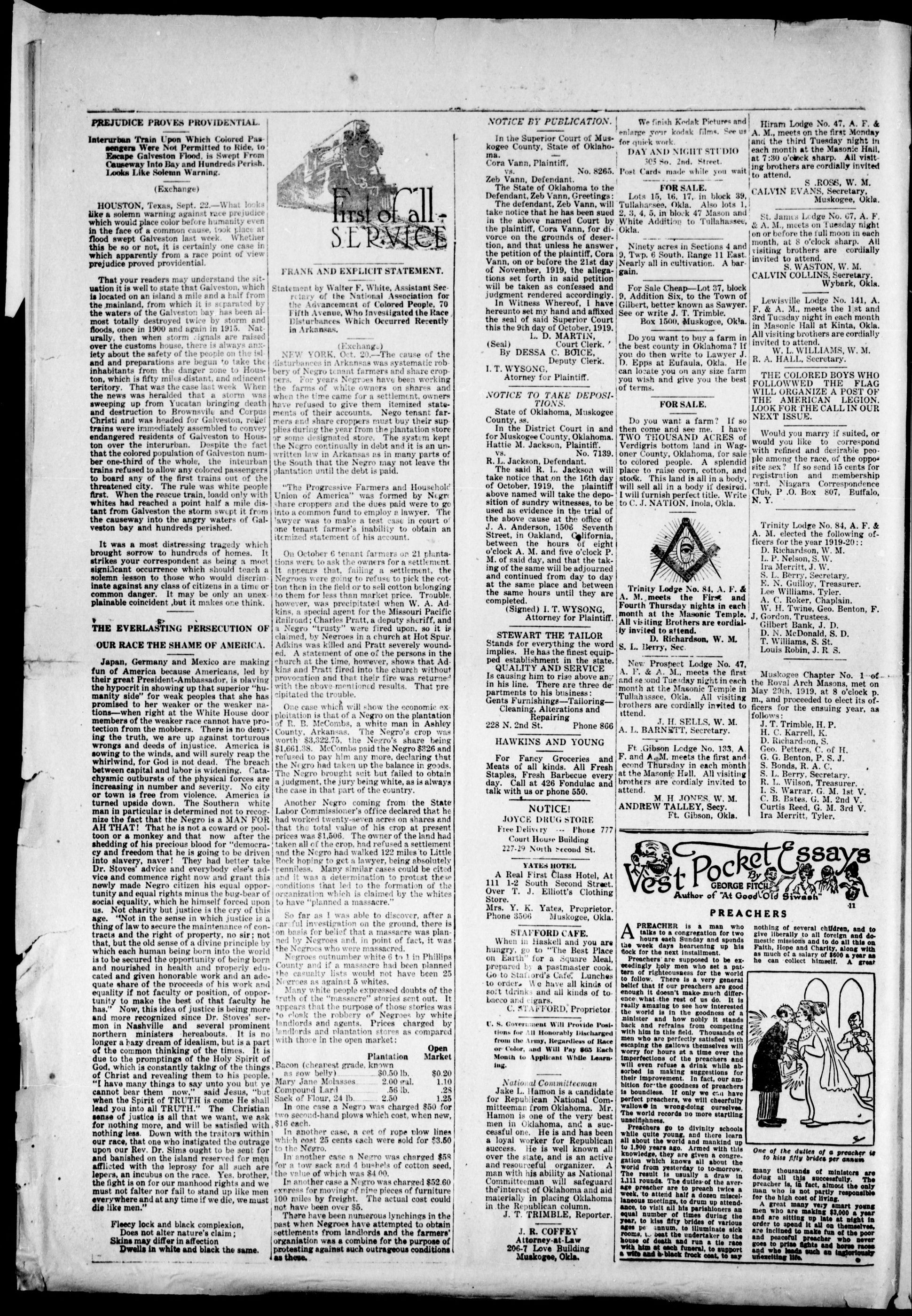
One of the duties of a preacher is to kiss fifty brides per annum
many thousands of ministers are doing all this successfully. The preacher is, in fact, almost the only man who is not partly responsible for the high cost of living.
A great many very smart young men who are making $3,000 a year and are sitting up late at night in order to spend it all on themselves, are inclined to make fun of the poor and peaceful preacher who never goes to prize lights and horse races and who leads such an ingrioniously unexciting life.