The National Forum
Saturday, October 1, 1910
Washington, D.C.
Page text (machine-generated)
THE NATIONAL FORUM
Library of Congress City.
VOL. I—No. 23
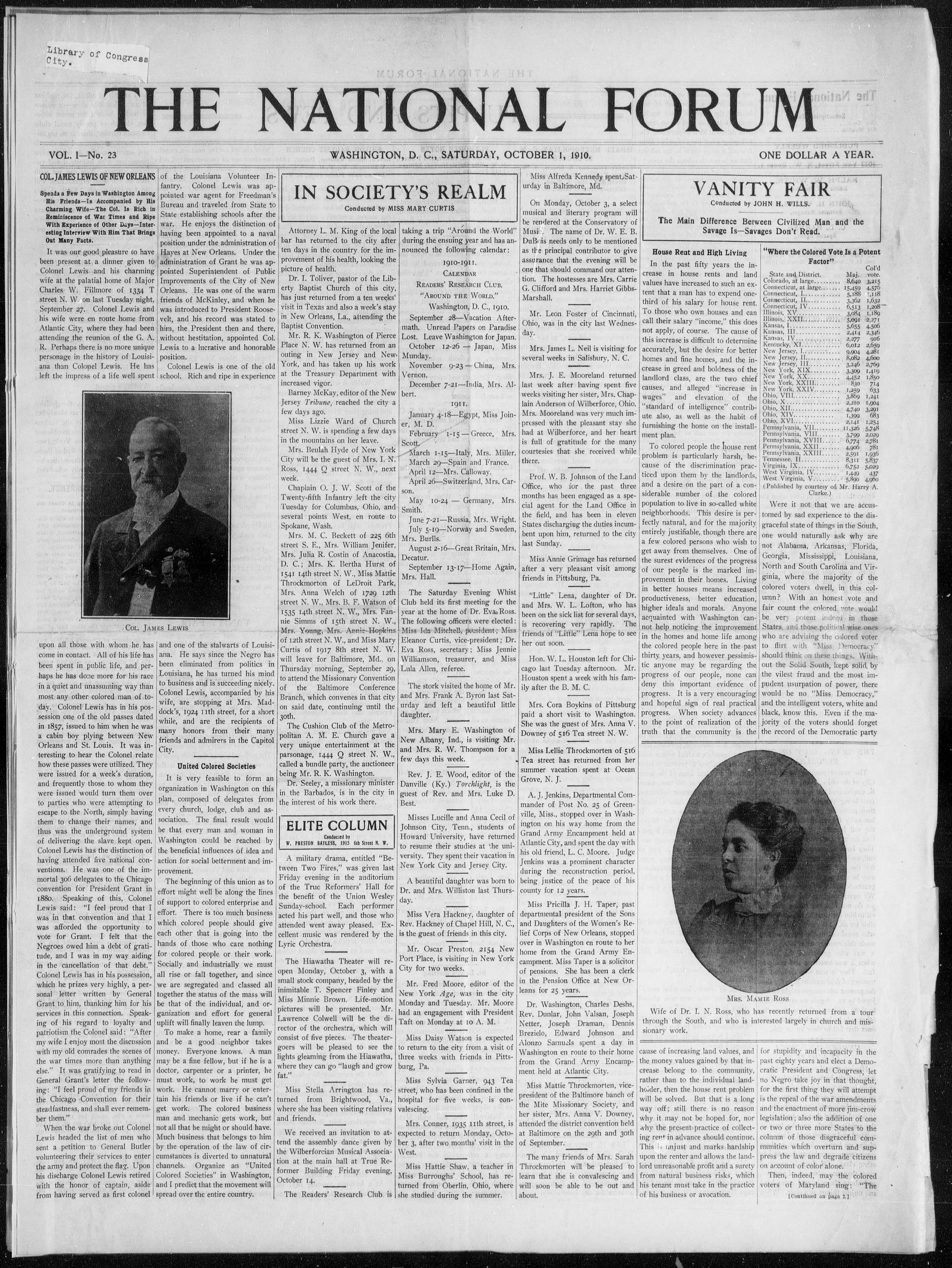
COL. JAMES LEWIS OF NEW ORLEANS
Spenda a Few Days in Washington Among His Friends—Is Accompanied by His Charming Wife—The Col. Is Rich in Reminiscence of War Times and Ripe With Experience of Other Days—Interesting Interview With Him That Brings Out Many Facts.
It was our good pleasure to have been present at a dinner given to Colonel Lewis and his charming wife at the palatial home of Major Charles W. Fillmore of 1334 T street N. W. on last Tuesday night, September 27. Colonel Lewis and his wife were en route home from Atlantic City, where they had been attending the reunion of the G. A. R. Perhaps there is no more unique personage in the history of Louisiana than Colonel Lewis. He has left the impress of a life well spent
THE LORD OF THE ISLES
COL. JAMES LEWIS
upon all those with whom he has come in contact. All of his life has been spent in public life, and perhaps he has done more for his race in a quiet and unassuming way than most any other colored man of today. Colonel Lewis has in his possession one of the old passes dated in 1857, issued to him when he was a cabin boy plying between New Orleans and St. Louis. It was interesting to hear the Colonel relate how these passes were utilized. They were issued for a week's duration, and frequently those to whom they were issued would turn them over to parties who were attempting to escape to the North, simply having them to change their names, and thus was the underground system of delivering the slave kept open. Colonel Lewis has the distinction of having attended five national conventions. He was one of the immortal 306 delegates to the Chicago convention for President Grant in 1880. Speaking of this, Colonel Lewis said: "I feel proud that I was in that convention and that I was afforded the opportunity to vote for Grant. I felt that the Negroes owed him a debt of gratitude, and I was in my way aiding in the cancellation of that debt." Colonel Lewis has in his possession, which he prizes very highly, a personal letter written by General Grant to him, thanking him for his services in this connection. Speaking of his regard to loyalty and patriotism the Colonel said: "After my wife I enjoy most the discussion with my old comrades the scenes of the war times more than anything else." It was gratifying to read in General Grant's letter the following: "I feel proud of my friends in the Chicago Convention for their steadfastness, and shall ever remember them."
When the war broke out Colonel Lewis headed the list of men who sent a petition to General Butler volunteering their services to enter the army and protect the flag. Upon his discharge Colonel Lewis retired with the honor of captain, aside from having served as first colonel
BENCHY.
of the Louisiana Volunteer Infantry. Colonel Lewis was appointed war agent for Freedman's Bureau and traveled from State to State establishing schools after the war. He enjoys the distinction of having been appointed to a naval position under the administration of Hayes at New Orleans. Under the administration of Grant he was appointed Superintendent of Public Improvements of the City of New Orleans. He was one of the warm friends of McKinley, and when he was introduced to President Roosevelt, and his record was stated to him, the President then and there, without hesitation, appointed Col. Lewis to a lucrative and honorable position.
Colonel Lewis is one of the old school. Rich and ripe in experience
and one of the stalwarts of Louisiana. He says since the Negro has been eliminated from politics in Louisiana, he has turned his mind to business and is succeeding nicely. Colonel Lewis, accompanied by his wife, are stopping at Mrs. Maddock's, 1924 11th street, for a short while, and are the recipients of many honors from their many friends and admirers in the Capitol City.
United Colored Societies
It is very feasible to form an organization in Washington on this plan, composed of delegates from every church, lodge, club and association. The final result would be that every man and woman in Washington could be reached by the beneficial influences of idea and action for social betterment and improvement.
The beginning of this union as to effort might well be along the lines of support to colored enterprise and effort. There is too much business which colored people should give each other that is going into the hands of those who care nothing for colored people or their work. Socially and industrially we must all rise or fall together, and since we are segregated and classed all together the status of the mass will be that of the individual, and organization and effort for general uplift will finally leaven the lump.
To make a home, rear a family and be a good neighbor takes money. Everyone knows. A man may be a fine fellow, but if he is a doctor, carpenter or a printer, he must work, to work he must get work. He cannot marry or entertain his friends or live if he can't get work. The colored business man and mechanic gets work, but not all that he might or should have. Much business that belongs to him by the operation of the law of circumstances is diverted to unnatural channels. Organize an "United Colored Societies" in Washington, and I predict that the movement will spread over the entire country.
WASHINGTON, D. C., SATURDAY, OCTOBER 1, 1910.
IN SOCIETY'S REALM
Attorney L. M. King of the local bar has returned to the city after ten days in the country for the improvement of his health, looking the picture of health.
Dr. I. Toliver, pastor of the Liberty Baptist Church of this city, has just returned from a ten weeks' visit in Texas and also a week's stay in New Orleans, La., attending the Baptist Convention.
Mr. R. K. Washington of Pierce Place N. W. has returned from an outing in New Jersey and New York, and has taken up his work at the Treasury Department with increased vigor.
Barney McKay, editor of the New Jersey Tribune, reached the city a few days ago.
Miss Lizzie Ward of Church street N. W. is spending a few days in the mountains on her leave.
Mrs. Beulah Hyde of New York City will be the guest of Mrs. I. N. Ross, 1444 Q street N. W., next week.
Chaplain O. J. W. Scott of the Twenty-fifth Infantry left the city Tuesday for Columbus, Ohio, and several points West, en route to Spokane, Wash.
Mrs. M. C. Beckett of 225 6th street S. E., Mrs. William Jenifer, Mrs. Julia R. Costin of Anacostia, D. C.; Mrs. K. Bertha Hurst of 1541 14th street N. W., Miss Mattie Throckmorton of LeDroit Park, Mrs. Anna Welch of 1729 12th street N. W., Mrs. B. F. Watson of 1535 14th street N. W., Mrs. Fannie Simms of 15th street N. W., Mrs. Young, Mrs. Annie-Hopkins of 12th street N. W., and Miss Mary Curtis of 1917 8th street N. W. will leave for Baltimore, Md. on Thursday morning, September 29, to attend the Missionary Convention of the Baltimore Conference Branch, which convenes in that city on said date, continuing until the 30th.
The Cushion Club of the Metropolitan A. M. E. Church gave a very unique entertainment at the parsonage, 1444 Q street N. W. called a bundle party, the auctioneer being Mr. R. K. Washington. Dr. Seeley, a missionary minister in the Barbados, is in the city in the interest of his work there.
ELITE COLUMN
Conducted by
W. PRESTON BAYLESS, 1915 6th Street N. W.
A military drama, entitled "Between Two Fires," was given last Friday evening in the auditorium of the True Reformers' Hall for the benefit of the Union Wesley Sunday-school. Each performer acted his part well, and those who attended went away pleased. Excellent music was rendered by the Lyric Orchestra.
The Hiawatha Theater will reopen Monday, October 3, with a small stock company, headed by the inimitable T. Spencer Finley and Miss Minnie Brown. Life-motion pictures will be presented. Mr. Lawrence Colwell will be the director of the orchestra, which will consist of five pieces. The theater-goers will be pleased to see the lights gleaming from the Hiawatha, where they can go "laugh and grow fat."
Miss Stella Arrington has returned from Brightwood, Va., where she has been visiting relatives and friends.
We received an invitation to attend the assembly dance given by the Wilberforcian Musical Association at the main hall at True Reformer Building Friday evening, October 14. The Readers' Research Club is
MUROF THE NATIONAL TAN
taking a trip "Around the World" during the ensuing year and has announced the following calendar:
READERS' RESEARCH CLUB.
"AROUND THE WORLD."
Washington, D. C., 1910.
September 28—Vacation After-
math. Unread Papers on Paradise
Lost. Leave Washington for Japan.
October 12-26 — Japan, Miss
Munday.
November 9-23 — China, Mrs.
Vernon.
December 7-21 — India, Mrs. Al-
bert.
1911.
January 4-18—Egypt, Miss Join-
er, M. D.
February 1-15—Greece, Mrs.
Scott.
March 1-15—Italy, Mrs. Miller
March 29—Spain and France.
April 12—Mrs. Calloway.
April 26—Switzerland, Mrs. Carson.
May 10-24 — Germany, Mrs
Smith.
June 7-21—Russia, Mrs. Wright
July 5-19—Norway and Sweden
Mrs. Burlls.
August 2-16—Great Britain, Mrs
Decatur.
September 13-17—Home Again
Mrs. Hall.
The Saturday Evening Whist Club held its first meeting for the year at the home of Dr. Eva Ross. The following officers were elected: Miss Ida Mitchell, president; Miss Eleanor Curtis, vice-president; Dr. Eva Ross, secretary; Miss Jennie Williamson, treasurer, and Miss Lula Allen, referee.
The stork visited the home of Mr. and Mrs. Frank A. Byron last Saturday and left a beautiful little daughter.
Mrs. Mary E. Washington of New Albany, Ind., is visiting Mr. and Mrs. R. W. Thompson for a few days this week.
Rev. J. E. Wood, editor of the Danville (Ky.) Torchlight, is the guest of Rev. and Mrs. Luke D. Best.
Misses Lucille and Anna Cecil of Johnson City, Tenn., students of Howard University, have returned to resume their studies at the university. They spent their vacation in New York City and Jersey City.
A beautiful daughter was born to Dr. and Mrs. Williston last Thursday.
Miss Vera Hackney, daughter of Rev. Hackney of Chapel Hill, N. C., is the guest of friends in this city.
Mr. Oscar Preston. 2154 New Port Place, is visiting in New York City for two weeks.
Mr. Fred Moore, editor of the New York Age, was in the city Monday and Tuesday. Mr. Moore had an engagement with President Taft on Monday at 10 A. M.
Miss Daisy Watson is expected to return to the city from a visit of three weeks with friends in Pittsburg, Pa.
Miss Sylvia Garner, 943 Tea street, who has been confined in the hospital for five weeks, is convalescing.
Mrs. Conner, 1935 11th street, is expected to return Monday, October 3, after two months' visit in the West.
Miss Hattie Shaw, a teacher in Miss Burroughs' School, has returned from Oberlin, Ohio, where she studied during the summer.
Miss Alfreda Kennedy spent Saturday in Baltimore, Md.
On Monday, October 3, a select musical and literary program will be rendered at the Conservatory of Music. The name of Dr. W. E. B. DuBois needs only to be mentioned as the principal contributor to give assurance that the evening will be one that should command our attention. The hostesses are Mrs. Carrie G. Clifford and Mrs. Harriet Gibbs-Marshall.
Mr. Leon Foster of Cincinnati, Ohio, was in the city last Wednesday.
Mrs. James L. Neil is visiting for several weeks in Salisbury, N. C.
Mrs. J. E. Mooreland returned last week after having spent five weeks visiting her sister, Mrs. Chapplain Anderson of Wilberforce, Ohio. Mrs. Mooreland was very much impressed with the pleasant stay she had at Wilberforce, and her heart is full of gratitude for the many courtesies that she received while there.
Prof. W. B. Johnson of the Land Office, who for the past three months has been engaged as a special agent for the Land Office in the field, and has been in eleven States discharging the duties incumbent upon him, returned to the city last Sunday.
Miss Annie Grimage has returned after a very pleasant visit among friends in Pittsburg, Pa.
"Little" Lena, daughter of Dr. and Mrs. W. L. Lofton, who has been on the sick list for several days, is recovering very rapidly. The friends of "Little" Lena hope to see her out soon.
Hon. W. L. Houston left for Chicago last Tuesday afternoon. Mr. Houston spent a week with his family after the B. M. C.
Mrs. Cora Boykins of Pittsburg paid a short visit to Washington. She was the guest of Mrs. Anna V. Downey of 516 Tea street N. W.
Miss Lellie Throckmorten of 516 Tea street has returned from her summer vacation spent at Ocean Grove, N. J.
A. J. Jenkins, Departmental Commander of Post No. 25 of Greenville, Miss., stopped over in Washington on his way home from the Grand Army Encampment held at Atlantic City, and spent the day with his old friend, L. C. Moore. Judge Jenkins was a prominent character during the reconstruction period, being justice of the peace of his county for 12 years.
Miss Pricilla J. H. Taper, past departmental president of the Sons and Daughters of the Women's Relief Corps of New Orleans, stopped over in Washington en route to her home from the Grand Army Encampment. Miss Taper is a solicitor of pensions. She has been a clerk in the Pension Office at New Orleans for 25 years.
Dr. Washington, Charles Deshs, Rev. Dunlar, John Valsan, Joseph Netter, Joseph Draman, Dennis Brezielo, Edward Johnson and Alonzo Samuels spent a day in Washington en route to their home from the Grand Army Encampment held at Atlantic City.
Miss Mattie Throckmorten, vicepresident of the Baltimore branch of the Mite Missionary Society, and her sister, Mrs. Anna V. Downey, attended the district convention held at Baltimore on the 29th and 30th of September.
The many friends of Mrs. Sarah Throckmorten will be pleased to learn that she is convalescing and will soon be able to be out and about.
VANITY FAIR
Conducted by J
The Main Difference Between
Savage Is—Sav
The Main Difference Between Civilized Man and the Savage Is—Savages Don't Read.
House Rent and High Living
In the past fifty years the increase in house rents and land values have increased to such an extent that a man has to expend one-third of his salary for house rent. To those who own houses and can call their salary "income," this does not apply, of course. The cause of this increase is difficult to determine accurately, but the desire for better homes and fine homes, and the increase in greed and boldness of the landlord class, are the two chief causes, and alleged "increase in wages" and elevation of the "standard of intelligence" contribute also, as well as the habit of furnishing the home on the installment plan.
To colored people the house rent problem is particularly harsh, because of the discrimination practiced upon them by the landlords, and a desire on the part of a considerable number of the colored population to live in so-called white neighborhoods. This desire is perfectly natural, and for the majority entirely justifiable, though there are a few colored persons who wish to get away from themselves. One of the surest evidences of the progress of our people is the marked improvement in their homes. Living in better houses means increased productiveness, better education, higher ideals and morals. Anyone acquainted with Washington cannot help noticing the improvement in the homes and home life among the colored people here in the past thirty years, and however pessimistic anyone may be regarding the progress of our people, none can deny this important evidence of progress. It is a very encouraging and hopeful sign of real practical progress. When society advances to the point of realization of the truth that the community is the
MRS. MA
Wife of Dr. I. N. Ross, who h
through the South, and who is in
sionary work.
MRS. MAMIE ROSS
MRS. MAMIE ROSS Wife of Dr. I. N. Ross, who has recently returned from a tour through the South, and who is interested largely in church and missionary work.
cause of increasing land values, and the money values gained by that increase belong to the community, rather than to the individual landholder, then the house rent problem will be solved. But that is a long way off; still there is no reason why it may not be hoped for, nor why the present practice of collecting rent in advance should continue. This is unjust and marks hardship upon the renter and allows the landlord unreasonable profit and a surety from natural business risks, which his tenant must take in the practice of his business or avocation.
---
ONE DOLLAR A YEAR.
JOHN H. WILLS.
even Civilized Man and the
ages Don't Read.
"Where the Colored Vote Is a Potent Factor"
State and District. Maj. Col d vote.
Colorado, at large. 8,640 3,215
Connecticut, at large. 15,450 4,576
Connecticut, I. 5,188 1,118
Connecticut, II. 3,362 1,632
Connecticut, IV. 6,513 1,208
Illinois, XV. 3,084 1,189
Illinois, XXII. 5,091 2,271
Kansas, I. 5,655 4,506
Kansas, III. 2,414 2,346
Kansas, IV. 2,277 916
Kentucky, XI. 6,012 2,059
New Jersey, I. 9,904 4,281
New Jersey, II. 8,082 4,000
New Jersey, III. 3,246 2,709
New York, XIX. 3,309 1,419
New York, XX. 4,452 1,850
New York, XXII. 830 714
New York, XXIV. 1,259 633
Ohio, VIII. 3,869 1,241
Ohio, X. 2,210 1,904
Ohio, XII. 4,740 3,201
Ohio, XIV. 1,399 683
Ohio, XVI. 2,141 1,254
Pennsylvania, VII. 11,326 5,748
Pennsylvania, VIII. 3,799 2,029
Pennsylvania, XVIII. 6,774 2,781
Pennsylvania, XXII. 4,906 781
Pennsylvania, XXIII. 2,591 1,936
Tennessee, II. 8,311 5,837
Virginia, IX. 6,752 5,029
West Virginia, IV. 1,449 437
West Virginia, V. 5,890 4,960
(Published by courtesy of Mr. Harry A. Clarke.)
Were it not that we are accustomed by sad experience to the disgraceful state of things in the South, one would naturally ask why are not Alabama, Arkansas, Florida, Georgia, Mississippi, Louisiana, North and South Carolina and Virginia, where the majority of the colored voters dwell, in this column? With an honest vote and fair count the colored vote would be very potent indeed in those States, and those political wise ones who are advising the colored voter to flirt with "Miss Democracy" should think on these things. Without the Solid South, kept solid by the vilest fraud and the most impudent usurpation of power, there would be no "Miss Democracy," and the intelligent voters, white and black, know this. Even if the majority of the voters should forget the record of the Democratic party
MIE ROSS
has recently returned from a tour
interested largely in church and mis-
for stupidity and incapacity in the past eighty years and elect a Democratic President and Congress, let no Negro take joy in that thought, for the first thing they will attempt is the repeal of the war amendments and the enactment of more jim-crow legislation; also the addition of one or two or three more States to the column of those disgraceful communities which overturn and suppress the law and degrade citizens on account of color alone. Then, indeed, may the colored voters of Maryland sing: "The [Continued on page 2]
---
The National Forums
Subscription Rates:
One Year.....$1.00
Six Months.....50
RALPH W. WHITE,
Editor and Proprietor.
JOHN H. WILLS,
Business Manager.
C. L. BARNES,
Special Agent.
Entered as second-class matter, May
27, 1910, at the Postoffice at Wash-
ington, D. C., under Act of March 3, 1879.
Address all communications, checks
and money orders to
R. W. WHITE,
1022 You Street, N. W.,
Washington, D. C.
WASHINGTON, OCTOBER 1, 1910
EDITORIALS
Colonel Roosevelt has demonstrated that he is the "It" with a big "I." Some time ago we called attention to the fact that when all was said and done the Colonel would be in the saddle, and it now appears that our prediction was not without foundation of truth. There is no use to attempt to discredit him. He is one of that class of men who believe in fighting for what they get, and before that, believes in fighting whether he gets it or not. Just what effect this is going to have upon the "Old Guards" is a thing to be determined, but it is safe to say that if Colonel Roosevelt can carry this convention in the face of the odds that seemed to loom up, he can come close to controlling the State in the next election. Much has been made of the statement given out by Wm. R. Hearst that if Mr. Roosevelt stood for anything like what he (Hearst) stood for, he (Hearst) would support him. There is not much to this seemingly more than a grandstand play on the part of Mr. Hearst. If Mr. Hearst desires to come over to the Republican party, so well and good. This is a time of revival, and all the converts are welcome who will join us. The doors of the Republican Church are wide open, and whosoever will, may come. They are welcome as long as they join with the knowledge that they must abide by the discipline of the church.
THE GRAND ARMY OF THE REPUBLIC.
The recent meeting at Atlantic City of the old veterans of the G. A. R. emphasized the fact that they are fast being thinned out, and that their ranks are growing beautifully but sadly fewer. Each year, when the roll is called, there are scores that do not answer to their names. They have answered their last roll call, and "Taps" have been sounded for the last time. Whatever else may be said, we owe them a debt of gratitude which we can never repay. We never meet an old soldier that we do not feel like taking our hat off to him for what he has made possible for us. They were the pioneers who stood out in the forefront and made this country what it is. They it was who preserved the Union when it was tottering and ready to fail. They it was who endured all manner of deprivations in order that the present advantages might be enjoyed by us. Again we say, all Hail to them, and may the march on the other side be less turbulent than the ones that fell to their lot on this.
UNDERPAID SCHOOL TEACHERS.
Having served our time, much of it in both the high school and college as an instructor, we are in a position to sympathize with the corps which teaches the young idea how to shoot. It is truly a fact that the teachers of the public schools are the hardest worked and poorest paid of any employees we know. And yet, to them comes more complaints than to any other class. Of them is expected more than any other set of persons, and about them is said more hard and unjust things as a class. When
one comes to think it over, and consider it from a viewpoint of real fai nness, the salary of every teacher in the District, as well as out, ought to be raised at least 20 per cent. The following from the Columbus State Journal is so germane to the subject that we herewith submit the same:
With all our present-day tendencies to reform it seems to me we are entirely overlooking the most important source of our troubles. It is incompetence in our schoolrooms. To the public schools is entrusted the greater part of the task of making the youth of the country into efficient, law-abiding citizens—by all odds the most important task to be performed in such a society as ours. With a naive short-sightedness, instead of securing for this task the biggest and best men and women of the country, we take the most practicable way possible to secure the weakest. We offer for this truly soul-searching and body-racking task a recompense that is simply an insult to anyone capable of carrying it out.
This course makes of the profession of teaching a catch-all for the weaklings and incompetent who could not make good anywhere else. At least 75 percent of the educating of this country is done by teachers who get literally less a year than section hands. And what is the result? No stream can rise higher than its source. It is true that we get much more than we pay for, but anyone who has had direct dealings with the alleged education with which the great majority of the children are equipped realizes acutely that the underpaid, overworked teacher does not alone bear the penalty for our lack of foresight. According to Professor Munsterberg, who is probably the best-equipped man in America to make the comparison, the American boy comes out from our schools at least two years behind the German student simply because the latter has had better teachers all through. During the formative period practically all that the average boy knows of law and order and of citizenship is his school life. And the contempt he has for it is no secret to anyone who has had dealings with him in connection with this life.
The remedy is obvious. We can have the choice of the big, strong men and women to fill our teaching positions any time we are ready to make it possible for such to stay in the profession without the spiritual suicide of living starved lives. When we have a generation of men and women who have been well trained in personal honesty and efficiency we shall have less need of a Roosevelt to teach these qualities. If we must economize, let it be in something which we can more easily afford than in the training of our children.
Compulsory Vaccination
A number of highly intelligent parents, white and colored, are keeping their children away from the public schools of this city because of the law compelling vaccination before admitting pupils. While the authorities have a right to take steps toward prevention of disease, it is nonsense, pure and simple. to inoculate a child with a mild form of smallpox to prevent it from catching a violent form of the same disease, especially at this time, when there is not the remotest indication of an epidemic. The value of vaccination is by no means certain. It frequently is attended by blood-poison, convulsions, lockjaw, is generally painful and annoying, and leaves an ugly scar. It is just as reasonable to compel every man, woman and child to be inoculated not only for smallpox, but for all infectious diseases, including a cold in the head.
Almost All Gone
A white man of inquiring turn of mind, while conversing with a colored man I know quite well, said: "What nationality are you, Mr. Blifkins?" "I am an American," replied Blifkins. "Yes, of course, but what race?" "I belong to a race now almost extinct in this country," said B. "Oh, I see," replied the inquisitor. "You belong to the Indian race."
"No, I belong to the race of gentlemen, I hope."
Mr. William Johnson and wife of Wilkes-Barre spent a week in Washington visiting their daughter. They had an enjoyable time sightseeing. Mr. Johnson is one of Wilkes-Barre's leading colored citizens. He fills the position of clerk to the president of the Lehigh Coal Co., a position he has held for quite a number of years.
Mr. Le Count Cook will leave soon for Chicago, where he will resume his studies in medicine at Chicago University.
ISRAEL METROPOLITAN C. M.
E. CHURCH
Corner First and B Streets, S. W., Rev. R, Kent Harris, Pastor, 41 D Street, S. E.; Miss A. Woods, Church Editress, 1106 O Street, N. W.
CHURCH SERVICES.
Sunday-school, 9.30 to 10.55 A. M. Mr. John Boston, Superintendent; Miss B. Clifford, Assistant Superintendent. Preaching, 11 A. M. Night Services, 7.45 P. M.
Practical Christianity in all of its bearings was given such a brilliant illumination last Sunday at Israel C. M. E. Church when Rev. Harris, selecting his text from the second chapter of the Second Ephesians, verse 1, which reads thus, "And you hath he quickened, who were dead in trespasses and sins," as to remind each auditor that at no time of the world's growth has the worth of ideas been so thoroughly investigated as at the present day. The wise teacher or preacher is the one who is able to show the people how to live and realize the glorious doctrine, the Fatherhood of God and the Brotherhood of man, and no previous exposition of the gospel more evidently betrayed the fact that our pastor himself, a loving example of the highest moral excellence, has uppermost in his thoughts and prayers the supremehope of self-sacrifice and self-denial, to the end of practically teaching the world's hordes that there is essence and validity in the efforts of our Savior, who so tragically closed His career on historic Calvary. It was shown with axiomatic clearness that if Christianity should ever attain the ideal of its founder, men and women must in each act of their every-day lives live by their precepts. The congregation, listening intently as each thought grandly and strenuously insisted upon by the clear voice that had no tone of hypocrisy in its whole scale, and looking upon the serene and thoughtful countenance of our pastor, felt that here was a man whose steadfast ways were all expressive of that repose and integrity of soul which lifts a man above the common level and wins for him the silent honor and respect of all.
Many of our pastor's profession might take a lesson from him in the art of usefulness if they would drop into the church any night of the week to note the improvements being wrought in the church by the brethren there, for aside from the credit of having started the work of renovation, etc., which is progressing rapidly, the thought will cling to your memories that with his own hands Rev. Harris is helping to paint the church. Israel Church is a grand old edifice, spacious and beautiful, located at the foot of the nation's Capitol, bearing a record to be proud of in the history of colored churches, and now that its interior beauty shall be refreshened and its outside walls painted, together with the increased lighting power, and last, but not least, its gowned choir, it is the hope of the members and friends of the church to bring the congregation up to its former large attendance.
Worshipping with us last Sabbath were Messrs. Felipe E. Unansee, Antero Aguino and M. A. Alvarado, three foreigners, only one of which spoke English.
The officers and members of Israel C. M. E. Sunday-school learned with regret that Miss Julia Taylor, one of our most efficient teachers, who has been away more than four months, will not return until November 1, 1910. Before returning she will stop for a brief while in New York city, Newark, N. J., and Mt. Clair, N. J. The younger members of the Sunday-school will be especially glad of her return.
John H. Berry of Washington, D.C., left for Richmond, Va., Monday, September 26. Owing to previous arrangements, which have not been announced, Mr. Berry may remain in the city indefinitely.
PULPITS AND PEWS
THE NATIONAL FORUM
PLYMOUTH NOTES
PLYMOUTH NOTES
Dr. A. C. Garner, Pastor, 493 T Street,
N. W.; Miss Gussie Harrod, Editress,
1145 Fifthteen Street.
CHURCH SERVICES.
Sunday-school, 9.30 to 10.50 A. M., H. A. Adams, Superintendent; J. S. Neal, Assistant Superintendent. Preaching, 11 A. M. Vesper Services, 6.30 P. M.
The congregation at Plymouth enjoyed a most excellent sermon last Sunday morning, delivered by Dr. Garner on the subject "Undefiled Garments" (Rev. 3:4). The discourse was so full of deep uplifting thoughts and was delivered so enthusiastically that it seemed impossible for any of his listeners to leave without feeling spiritually renewed.
The number of visitors at our morning service is increasing every Sunday, and both spiritual and financial insight seems more promising. Let each and every one of us put a foot to the plow, and success will surely be ours.
At vesper service the Y. P. S. C. E. held a delightful union meeting. We greatly desired to have all the societies join us and take some part in the meeting.
Societies represented were Shiloh Baptist, Vermont Avenue Baptist, 19th Street Baptist, Metropolitan Baptist and Lincoln Temple.
General topic: What is our denomination doing for our country. Discussed by President J. Neill. Recitation by Miss Hattie Akers of Vermont Avenue. Short address by the secretary of Vermont Avenue C. E. An octette of ladies from 19th Street Baptist sang, under the direction of Mr. L. Alexander. Shiloh was represented by Mrs. Dismond, one of its mission workers, who gave an excellent talk. The president of Lincoln C. E., Miss Blanch Adams, gave us a store of information concerning congregationalism.
On last Thursday night our prayer meeting was conducted by the deacons. Mr. Ira Bailey read the Scripture lesson; Mr. John Lacey conducted the testimonial service; then Mr. Furring took charge of the meeting, which was very enjoyable to all present. Next Thursday night the deaconesses will have charge of the prayer meeting, and it is hoped that all who possibly can will attend.
Sister Henrietta Harris has left her friend, Mrs. Sylvia Woodards of Jefferson, O., and is now visiting Mrs. Lucy Handsome Webster at Chicago, Ill.
Miss Anna V. Nelson of Chicago, Ill., was the guest of Miss Catherine Smith at 1217 T street N. W. for several days last week.
Mr. and Mrs. Le Roy Johnson of New York city are spending this week in the city with Mrs. H. E. Harrod, 1142 15th street N. W.
Mrs. Isabel Bell of 1018 U street N. W. is on our sick list this week.
It is desired that all notes be in to me not later than Tuesday noon. Please write on one side of the paper.
St. Luke's Meeting
There was an interesting meeting of the degree chiefs of the 37 Councils of the I. O. of St. Lukes of the District held Monday evening at the St. Luke's Home, corner 13th and U streets N. W. All information as to what was done will appear in the next issue of the FORUM.
The members are planning for a reception to be given on October 21 at their newly-purchased home, No. 1924 13th street N. W. The St. Lukes of Washington are wideawake along business lines, as well as fraternal ones, and with Mrs. Bessie Anderson and Dr. Garner as their leaders are accomplishing results. Very soon the St. Lukes will occupy a column in the FORUM, through which all the news can be had by all of its members weekly. Watch the FORUM, for it will give you the news of the St. Lukes.
SHILOH BAPTIST CHURCH
Rev. J. Milton Waldron, Pastor, 1334
V Street, N. W.; W. H. Scott, Church
Editor, 1503 Pierce Place, N. W.
The sermon of Rev. Dixon last
Sunday morning was the best of the
number which he has delivered
during almost a month's stay with us,
while in charge of the church. Each
has been an improvement on the
other. For an hour we were held
spellbound while he pressed home
the truths of the gospel.
At the evening service Rev. William Walker delivered a most excellent sermon from 1st Corinthians, 13th verse: "Watch ye, stand fast in the faith, quit you like men, be strong." Having spoken for us on other occasions, he said he had nothing new to present. But he did, for his sermon was so practical and his illustrations so fitting that all who heard him were deeply impressed.
Dr. Waldron will be present next Sunday, October 1, and will deliver a special sermon to parents. Come and bring your friends.
At the afternoon service at 3.30 P. M. the Lord's Supper will be observed. Special arrangements have been made to have the aged members brought to church and provided with a dinner, so that they may remain to the service.
We are pleased to have with us again Sisters Pattie M. Jackson, Sarah Mallory and Brother Charles Preston, who have been away for the summer.
Brother Isaac C. Reddie of the choir has returned to Baltimore for a stay of 10 days. When he returns he will bring his wife, who has greatly improved since her recent illness.
IN MEMORIAM
In sad but loving remembrance of my dear son, Everett Dismond, who departed this life two years ago today, September 29, 1908. My own, my all, so good and true; So young, so kind and noble, too; So full of precious life's best bloom His death has filled my heart with gloom. Friends may think I'll soon forget him. And my wounded heart be healed, But they little know the sorrow That within my heart's concealed. By his mother.
MARY C. DISMOND
Last Sunday was "Rally Day" in Shiloh Baptist Sunday-school. The lecture-room was well filled with an appreciative audience. Many of the former pupils responded to invitations that had been sent to them, and a number of the parents of the children witnessed the exercises, which were entirely new and uplifting. The service was entitled the "King's Banquet." The superintendent had asked the children to each bring something to put on the banquet table; the result was a well-laden table with autumn fruits, vegetables and other articles of food. These were used to teach an object-lesson of "how God prepares a table before his children," as set forth in the 23d Psalm. The school then voted to send the supplies to the poor saints of the church.
Among the distinguished visitors were Professor Brawley, a member of the faculty of Howard University; Mr. Silas James, superintendent of the Third Baptist Church Sunday-school, and Mr. C. H. Barnett of Columbus, O.
After the exercises the school was photographed in front of the church. With smiling faces, light hearts and waving banners the school presented a not-soon-to-be-forgotten spectacle. The superintendent, Brother Miles, desires through the courtesy of the NATIONAL FORUM to thank all who in any way helped to make the day a grand success.
At a business meeting held on September 23 the following persons
were elected for the next six months as chairmen of committees: Look-Out, Mr. James R. Moss; Prayer Meeting, Mr. John S. Browder; Missionary, Mrs. Mary C. Dismond; Calling, Mrs. Mary A. Dixon; Flower Social, Miss Emma Donoho; Acting Secretary, Mr. William Smith. The office of secretary had not expired, but was made vacant because our very efficient and faithful secretary, Miss Edna Smith, has been called away from the city to accept a position as school teacher in the State of Maryland. Sister Smith is held in very high esteem by all of her colaborers, and we will bid her adieu with much real deep sorrow, and praying earnestly for her success in her new field of labor. Mrs. Mary P. Jackson was unanimously elected as Junior superintendent, Sister Alice Early having resigned. After the meeting the Endeavorers held a social hour, and refreshments were abundantly served.
Our last Sunday prayer meeting was full of interest throughout. Each Sunday brings an increase in numbers, and many visitors from other churches were made welcome and expressed their determination to come again. Among some of our visitors was Professor Brawley of Howard University, and Miss Prowd, daughter of Rev. Dr. Prowd of South America. Professor Brawley expressed himself as being highly pleased with our young people's work.
Our topic for Sunday, October 2: Self-centered, or Christ-centered? Phil. 1:21; 3:7; 4:11-13. Consecration meeting. Quiet hour service from 6.30 to 6.45. Brother John A. Miles will lead the meeting.
VANITY FAIR.
(Continued from Page 1.) tyrant's heel is on thy shore, Maryland, my Maryland."
Organize! Organize!! Organize!!!
Any person who has noticed the progress made by the foreign element in the United States will naturally be curious as to the real cause thereof. The industrial success of the Hebrews, Germans, Italians in this country is phenomenal. The political power the Irish possess is wonderful. Organization is the first cause. Each one of these nationalities are closely allied into societies, clubs and organizations, formed primarily for social and economical improvement, and secondarily for political advancement.
Traveling from Richmond, Va., through Maryland, Delaware, Pennsylvania, New Jersey, New York, Connecticut, Massachusetts, New Hampshire and Vermont I observed that all the laborers mending roads and doing the rougher class of labor were Italians. The prevalence of this class of labor in so many States aroused my curiosity, and investigation followed. I found that these laborers were all members of an organization whose object it is to control this class of labor, and it is claimed by some that this society has agents in Italy gathering recruits to send to this country, and that the steamship companies of Italy and the United Italian Societies are behind the movement. The humble Jew peddler of collar-buttons and phony jewelry is a member of a powerful organization and can stock up his tray, with or without money. A German entirely innocent of English arrives in New York, and the cooks and waiters' club takes charge of him and he gets a job as a scullion. This will do as a starter. Some say that "Uncle Heinrich" wrote Louie that he could get a job if he came to this country, and kept quiet and be sure not let the inspectors know anything about it. I don't know whether this is true or not, so I leave it to you.
Now, the Negro occupies the position of an alien in this country, and
hard as it is to admit, the position of an undesirable alien—or citizen or both. Aside from secret societies, church or purely social clubs of small number, there is no organization among them, and the church and secret societies do not concern themselves with industrial and political matters. You can see with half an eye what organization will do for this people. Look at this city, with its 100,000 colored people dwelling in about seven square miles of territory, the benefits gained by organization are too numerous to mention.
Among the Sports
The sporting editor of Leslie's Weekly has two things to say that may interest you:
Walter Johnson, the Washington's speedy flinger, is hot after Rube Waddell's season's record for strike-outs, 301, made in 1903. At this writing Walter has 247 strike-outs to his credit. In a recent encounter with the Tigers Johnson fanned 12 of the Royal Bengals, which is just about five better than he will have to average to surpass Waddell's record.
Just as I told you, the Jeffries Johnson fight pictures are slowly but surely being shown in the various cities, and are causing no trouble nor "race riots." Like New York, Denver and St. Louis approved of them, and they were kept in these cities beyond the time originally scheduled.
MUTILATED CURRENCY.
Often Used In Attempts to Cheat the Treasury Department.
Many efforts are made to cheat Uncle Sam through the redemption division of the treasury department, which division has to do with redeeming partly destroyed government currency.
Once a man in a western state sent in half of a ten dollar bill, accompanied by an affidavit to the effect that while on a spree he had used the other half to light a cigar. The half he forwarded was nicely charred along the inner edge, and the story would have been accepted by treasury officials had it not been that within twenty-four hours there was received from a bank in the same state the other half of the note.
The theory of treasury officials was that while more or less intoxicated the man had struggled for possession of the bill with some one who had wrested half of it from him; that the despoiler had turned the half into the bank and received five dollars for it; that the intoxicated man, recovering his senses, had found the other half in his pocket and, not wishing to lose his money, had conceived the plan of singing the edge of the note and claiming that the other half had been destroyed. So he committed perjury in an attempt to rob the government of $5.
A man in Cleveland sent an affidavit to the treasury department, accompanying the singed half of two twenty-dollar bills and one ten-dollar bill. This affidavit was typewritten and in perfect form. It set forth that the deponent was a commercial traveler; that after returning from a journey he had been cleaning out his travelling bag when inadventently he had thrown into the fire an envelope containing $50 in bills; that in accordance with section so and so he would like to have the money restored to him, etc.
The clerk who brought this document to the officials commented on its lucidity and completeness, but to one of these the story seemed unnatural, and he ordered that the claim be held up for a while.
Twenty-four hours later a big shipment of mutilated currency came from a subtreasury in the west. The official who had ordered the claim held up asked whether there were any half notes in this shipment. In four or five minutes a clerk brought him the missing halves of the bills the Cleveland man had sent in.
The attempt to defraud was plain. The matter was at once put into the hands of the secret service division, and a man was sent west to investigate. The man who had made the adfavit confessed at once. He had cut the bills in halves and for one-half of them obtained $25. The other half he singed and attached to his adfavit. The gross profit of the swindle could not have been more than $25, and for that triding sum the man forfeited his liberty for a year and a half.—Washington Star.
The Barefoot Burglar
"Have you seen the barefoot burglar?" we ask. The Florida Times-Union. We have. We caught her in the act yesterday morning, the three-year-old miscreant, as she stole up to our bed, stole a kiss, shook her touled head and said, "If you don't get up, dad, you won't get any brefes!" — Δllentown (Pa.) Democrat.
Unselfish.
Mrs. Backbay-Why are you leaving us, Bridget? Boston Cook-Me reasons are philanthropic, I want to give some wan else a chancet at the joys of living with yez-Harper's Bazar.
APACHES OF PARIS
Night Prowlers Whose Trade Is Murder and Robbery.
THE TERROR OF THE POLICE.
These Desparados Rarely Use a Gun, but Work With the Knife, the Bludgeon or by "Tolling"—They Have a Short and Bloody Career.
There are very few nights in the year when Paris policemen on their rounds do not stumble upon a body lying in a gory pool. Sometimes the handle of a long, slender knife protrudes between the shoulder blades; sometimes an ugly gash bleeds from ear to ear; not seldom blood oozes from mouth, nose and ears, as though the dead had not sustained any apparent wound, or three little starlike bruises may dot the temple, or a bluish line an inch wide may mar the back of the neck, just above the collar line. "Les Apaches," the "cops" whisper to each other (for Parisian police officers always go to two by two), and they call for an ambulance, much relieved not to have witnessed the incident.
The steel blade, the blackjack, the brass knuckles, will serve the purpose of the Apache, according to his victim's size and presumable strength. For a prey of small stature, however, the Apache reserves what in his slung he calls "trolling." A sharp blow dazes the victim and throws him down; the Apache's knees bore themselves into the chest, while his hands seize the ears, lift the head and slam it a couple of times on the pavement until a duller tud tells of a fractured skull.
Until an Apache is an adept at "sticking" his man in very much the same way in which a Spanish toro dispatches a bull, with a single thrust between the shoulders, or at cracking a skull bone at one slam, he is held in little esteem and never allowed to tackle "big jobs" in a dangerous neighborhood, for Paris is a well policed city. The night hawk must strike like lightning, empty the dead man's pockets in a wink and slink away into the dark. Therefore Apaches very seldom carry guns; the knife is silent. Tolling, too, is safe—so many people are known to have slipped and fractured their skulls! Unless the victim is especially well dressed there is not much of an inquiry. When it is all over the gang, which scatters like a flock of frightened sparrows, meets again at some wishing shop where no one is welcome who is not "in the business."
Apaches never try to conceal their social status. Their very clothes are a sort of warning to the public. They even affect a peculiar walk, the body bent from the loins, shoulders hunched and hands plunging deep into the trousers pockets. But who would dare to molest them?
The Apache is a marked man. He joins a gang at three or four and twenty, and by thirty or thirty-five he has gone. The maws of a jail hold him for the balance of his earthly existence. He knows that. He expects it. Therefore while his freedom lasts there is no desperate chance he will not take to get at the gold that alone could save him.
Apaches are not born; they are made—made by the peculiar laws of France. Every citizen of the republic, without distinction of rank or class, must serve under his country's flag for two years. Only the physically unfit escape that servitude. At the end of his term in the ranks every Frenchman seeking employment must present as means of identification his certificate of honorable discharge. Then it is that tragedy looms up for some unfortunate. Woe to the one whose certificate mentions the "African battalions!"
The African battalions, garrisoned at the edge of the Sahara desert, are made up of all the boys who had the misfortune of being arrested before they reached the age of twenty-one. Trivial as their offenses may have been, whether they were due or not to the indiscreet exuberance of youth or to some absurd entanglement, they are sent to the desert outposts, kept on convict fare, sleeping mostly in trenches which they dig, watched over by sentries that shoot to kill.
Under the broiling sun that lays them down fast with fever and cholera they build ronds, crept over the next day by the sand. They are "the front!" whenever Arabs or Moroccanes threaten to shake off the French yoke. When they fall by the wayside they are died to a horse's tail. When they protest spurs cause the horse to rear.
And when the creepy water of sand wells, bullets from the seurries or from the nomads and the hoofs of vicious horses have spared them they return to their native city with hatred in their hearts, with the loathsome memories left by association with the depraved and the morally diseased.
They return to their native city to find doors and hearts locked to them. Their military book, which they must produce, proclaims them jailbirds. Who wants to employ an ex-convict? During their two years in the African inferno they have atoned for their errors of the eighteenth or nineteenth year. For the second time they have settled their account with society. And now society refuses them a chance to show that they have (for some of them have shed the old hide, to prove that a new heart is beating to their breasts.
Hard is the plight of an ex-critic in France.—Andre Fridon in New York Tribune.
ANCIENT LUXURIES.
Silver Lined Cooking Utensils Used
Twenty Centuries Ago.
While the housewife of today may reasonably pride herself on the convenience which her kitchen affords, she need not smile too superciliously at the thought of the makeshifts of days long gone by. She would certainly not do so were she to spend a little time inspecting the kitchen and other household utensils that were in use 2,000 years ago, as exhibited in the national museum at Naples. Saucepans lined with silver, pails richly inlaid with arabesques in silver and shovels handsomely carved figure among the household goods of those times.
An egg frame that would cook twenty eggs at once and pastry molds shaped like shells suggest luxuries of the kitchen of 2,000 years ago. Grill irons and frying pans, tart dishes and cheese graters were in use then as now.
The Roman lady's toilet table was well supplied. Ivory combs, bottles of perfume, pots of cosmetics, buttons, hairpins and even a hair net of gold wire figure in the museum.
Bronze thimbles and spindles are to be seen among the relics. The Roman lady even had her safety pin, for there is a specimen of this little convenience which, before the one in the Naples museum was found, was believed to be a strictly modern invention.
The Roman lady, however, apparently lacked one essential. She had no hairbrush. Neither had she a glass mirror. All the mirrors in the museum, with one exception, are of silver or some other white metal. The exception is a dark purple piece of glass let into the wall of a bedroom at the house Speecho in Pompeii.
In surgical instruments the ancient world was rich. Those found at Pompei deprive modern science of the credit of more than one invention. Needles, probes and forceps resemble closely those in use at the present day.—Harper's Weekly.
THE CZAR'S LEAVINGS.
A Doubtful Honor That Was Rejected by a Polish Girl.
In Russia royalty is so revered that to the loyal subject it seems a great honor to follow the czar. The government is eminently patrilarchal—in theory, at least—and the emperor must supervise as well as patronize the schools. At the Easter festival the pupils are treated with especial favor. Young girls of the upper classes of the Imperial Girls' school are driven in a long procession through the streets in the imperial carriages. The pleasure for them is only that of being allowed to take a drive in a stylish court carriage, with coachman and footman in the imperial livery. There is nothing special to be seen.
The theory of this is that the czar stands in a sort of higher parental relation to all these children. When he once a year visits one of these schools—to which only the children of the nobility are admitted—it is a custom that as a sign of his favor he drops his pocket handkerchief, and the girls all scramble for it, tearing it in pieces, so that each one can get a fragment.
He takes the most brilliant girl to the table and tastes of the food of the institution. It is valued as the highest distinction when he gives one of the girls his plate with what is left upon it. It is the custom and usage for he to eat it with delight shown in all her features. Great was the astonishment of Alexander II. when a young girl, a Pole, whom the czar had taken to the table as being the most distinguished scholar of the institute and to whom he had passed what was left of his meat and potatoes, nodded to a servant and calmly gave him the czar's plate to take away.
An Unfair Attack
Pietro was working with a gang at railroad construction. He had been told to beware of rattlesnakes, but assured that they would always give the warning rattle before striking.
One hot day he was eating his noon luncheon on a pine log when he saw a big rattler coiled a few feet in front of him. He eyed the serpent and be gan to lift his legs over the log. He had barely got them out of the way when the snake's fangs hit the bark beneath him.
"Son of a gun!" yelled Pietro.
"Why you no ringa da bell?"—Everybody's.
The health of the body as well as of the mind depends upon forgetting. To let the memory of a wrong, of angry words, of petty meanness, linger and rankle in your memory will not only dissipate your mental energy, but it will react upon the body. The secretions will be diminished, digestion impaired, sleep disturbed and the general health suffer in consequence. Forgetting is a splendid mental callisthenic and a good medicine for the body.
First and Foremost
"Nonsense! Your wife was never married before."
"I know it. That's what makes her reflections so painful." - Puck.
"I say, my man, is that dog of yours a mongrel?!"
"No, sah; ain't no class to 'im: Jes' common dog, sah."—Baltimore American.
The great mass of people have eyes and ears, but not much more, especially little power of judgment, and even memory—Schopenhauer.
THE NATIONAL FORUM
CAPITAL PENALTY
CAPITAL PENALTY
Some Curious Methods of Executing Criminals.
MOROCCO USES THE LASH.
Flogging to Death Is Still In Vogue Among the Moors—Strangulation Is Employed In Austria, and Spain Clings to the Garrote.
There are many curious methods of inflicting capital punishment in the various countries of the old world, some of them tinged with the cruelty of the dark ages.
Morocco is perhaps the most mediaeval country in existence. Flogging to death is still in vogue. It is not so very long ago that Mulai Haifid had the Sheeree Kittain executed in this horrible fashion.
The ameer of Afghanistan has peculiar methods of making the punishment fit the crime. A baker, for selling short weight, was roasted in his own oven, and a man who had started a scare that the Russians were advancing on Kabul was placed on a stool fastened on top of a tall pole and kept there on sentry go till he died of sleeplessness and exhaustion. Political crimes are not uncommon in Persia and the revolutionists, when caught, are dealt with summarily. Four conspirators who were recently caught in the act of throwing a bomb in the crowded bazar at Teheran were hanged and quartered in the same fashion that prevailed in England up to the seventeenth century. The remains of the wretched men were hung at the city gates as a horrible warning.
An Austrian officer convicted of poisoning his superior officers in the attempt to win promotion was sentenced to be strangled.
Austria is the only country which employs this particular method of execution, but Spain's garrote is very similar. The original method of garroting was, in fact, nothing but strangling. The criminal was seated on a chair fixed to a post, a loop of rope was placed encircling his neck and the post, and by means of a stick or cudgel (Spanish "garrote") inserted between the post and the condemned man's neck the cord was tightened until strangulation ensued.
The modern garrone consists of a brass collar containing a sharp pointed screw. The executioner turns the screw, and its point penetrates the spinal marrow, causing instant death. Every civilized country does its best nowadays to make the dreadful task of execution as rapid and painless as possible. Hanging as at present performed is a very different matter from what it used to be in England. Till nearly the end of the eighteenth century the condemned man was made to stand in a cart with a rope around his neck, and the cart was then driven away from under him. In 1753 parliament abolished this practice as being too barbarous, and a platform was substituted for the cart. In 1874 this method was improved by proportioning the length of the drop to the weight of the body.
The state of New York inaugurated the electric chair many years ago, but its only advantage over hanging is that the man who switches on the current is out of sight of the death chamber and so escapes the grewsome title of public executioner. Formerly all criminals in England died by the ax, and undoubtedly the ax in the hands of a skillful headman was as merciful an instrument of death as any which exist today. In Prussia decapitation by the ax is still the recognized method of execution, but the rest of Germany follows the example of France and uses the guillotine.
Execution had almost become obsolete in France until public sentiment was so aroused by the ever increasing number of brutal murders that in January, 1909, "the widow," as the French term the instrument, was dragged out of its retirement and four miscreants were publicly executed at Bethune, in the north of France.
The guillotine was invented by a doctor named Guillotin more than a century ago, but it is not true that the inventor fell a victim to his own device. He died quietly in his bed. The guillotine consists of two upright posts grooved on the inside. An immensely heavy and sharp steel blade is fixed to slide in these grooves, and the executioner has nothing to do but pull a rope, when the blade drops and decapitates the victim instantly.
There are a few countries where capital punishment has been abolished, notably Switzerland. In Italy also there have been no executions for civil offences for many years past. -St. Louis Post-Dispatch
The First Gentleman
Who was the first "gentleman?" The Prince of Darkness has been pronounced one, but only mortals can fairly count. According to John Bull's rime, there was no gentleman when Adam delved and Eve spun. The first of them soon arrived, however, for, according to Dame Julia Berners, writing upon coat armor in 1486, "Cain became a churl from the curse of God and Seth a gentleman through his father's and mother's blessing." That is to say, Seth was the first man who could boast of "family." Cain having been cast out of the pate, while Abel presumably perished too young—London Chronicle.
The apparel oft proclaims the man—to be what he is not.
Points
For
Mothers
The use of "soothing sirpus" is much more general than is supposed. Ignorant mothers are the worst offenders, especially those who must go out to work and who resort to these deadening drugs to quiet the children during their long absences. While it is pitiful enough to hear the wails of a neglected child, it is even more pitiful to see the stupefied child sleeping off a drug debauch provided by its own mother. The children of the rich often suffer through the practices of their nurses, who wish to secure exemption from their care and so put them into an unnatural sleep. Once found out, instant discharge should follow without a recommendation.
No offence can be more contemptible in the eyes of the law or of society than making drug inebriates of little children. It is simply a process of slow poisoning, which at the same time establishes a habit, affects the mentality and injures the baby. A child brought up on "soothing sirup" is dull and lethargic. Many a mother who complains her child doesn't "get on" in school is herself responsible in that she fed him on these compounds to keep him quiet when she worked, a dear bought freedom. Under the food and drug act the United States courts are making it evident that a label accurately stating the contents of a "medicine" does not imply liberty to advertise it as not injurious and recommend it as remedy for ills it cannot cure. A man recently was fined $100 for selling a "toothing sirup" containing morphine and chloroform, though the label indicated these drugs and the amount. Dr. Wiley declared the stuff mislabeled because the label declared no bad effects would follow its use and that it was "a sure remedy for all alimentes incident to babies from one day old to two or three years." The federal court sustained the chemist, and the proprietor will have to take his "sure cure" off the market or continue to pay fines.
It will not hurt the baby half as much to cry as it will to dose it with "soothing sirups." Crying is lung exercise. Opium is deadening and deadly.
Mother's Value.
This happened years ago, but it is worth repeating. In a certain home was the overindulgent mother of three daughters. You can just imagine what the week's washing was with dresses for all of those girls, each with three or four petticocks, besides many other articles. This mother did the washing, ironing, cooking, baking and about everything imaginable, and the daughters—well, they were "cultured" and did not do very much of anything except eat the good meals and wear the clean clothes. One day the father called the mother aside. The two had a long talk, and he admitted he was not able to hire a domestic. The next day the usual complaint was made by the girls about the poor dinner, and the mother quietly got up, went to her room, dressed and came downstairs. She carried a heavy suit case and stopped long enough to tell the children that she hoped they would have a better meal the next day. Their father took her to the station, and she was away from home one month. Every one of those girls learned to cook, bake, scrub and look after the house, although they admitted that for a week they lived on baker's bread, lemonade, quince preserves and either salmon or sardines. It was a hard lesson for them to learn, but they knew the value of their mother.
Postures of Children.
In a recent lecture to mothers and teachers on incorrect postures of children the speaker spoke of inturing feet and the means of correcting them. But turned toes and feet, she said, are the result of training, and if the mother finds a tendency on the part of her child to turn the toes in she must resort to training to remedy it. This consists in developing the outer muscles by proper exercise.
Of the physical training of the child from birth the lecturer said that, excessive crying being accepted as harmful, the average mother therefore assumes that all crying is harmful and should be suppressed. This is faulty reasoning. The natural crying of a baby is really a means of development, as by crying the lungs are expanded and the relations between circulation and respiration are thus established and strengthened.
For Baby's Comfort.
The baby's basket and the bassinet are things a young mother loves to have of the daintest. The new basket, with movable parts on the order of drawers, is one of the most convenient styles. A plate warmer with metal bottom and porcelain top is useful for keeping the baby's dinner hot. Other convenient accessories of a baby's outfit are tiny clothes racks and trees, ribbon covered coat hangers, miniature washstand sets and swinging hammocks for outdoor nats.
PRANKS OF CUPID.
Celebrated Man Who Married Their
Domestic Servants.
Many celebrated men have married their domestic servants. Sir Henry Parkes, premier of New South Wales, is an example. One night when dining at a friend's house he was struck by the appearance of a servant girl who waited upon the table and persuaded his host to allow her to enter his employ. She she did and for a short time held the position of cook in Sir Henry's household. Then he made her Lady Parkes.
But more illustrious than this is the case of Peter the Great. One day he was dining at the house of Prince Manshikoff. He noticed one of the servant maids particularly, and, though she was not handsome, she caught his fancy. Her name, the prince told the czar, was Martha. She had been a servant in the house of a Lutheran minister of Marlenburg, and when that city was captured by the troops of Russia she had been taken prisoner by General Bauer, who had passed her over to the prince, whose servant she was. The count politely made a present of her to the czar, who eventually married her.
William Cobbett, the great writer, when he was only twenty-one years of age, one morning chanced to see a box on servant girl busily engaged in washing the family linen. The girl was pretty, so Cobbett spoke to her learned her name and the same evening called upon her parents and said he would like to marry their daughter. The parents of the girl informed the young man that they had no objectives to him as their son-in-law, but that he would have to wait until their daughter was of a marriageable age. Five years later Cobbett, true to his early love, married her.
A. WEIRD INCIDENT.
Chopin's Funeral March Was Inspired by a Skeleton.
Late one summer's afternoon, said Ziem, Chopin and I sat talking in my studio. In one corner of the room stood a piano and in another the complete skeleton of a man with a large white cloth thrown, ghostlike, about it. I noticed that now and again Chopin's gaze would wander, and from my knowledge of the man I knew that his thoughts were far away from me and his surroundings. More than that, I knew that he was composing.
Presently he rose from his seat without a word, walked over to the skeleton and removed the cloth. He then carried it to the piano and, seating himself, took the hideous object upon his knees—a strange picture of life and death.
Then, drawing the white cloth round himself and the skeleton, he laid the latter's fingers over his own and began to play. There was no hesitation in the slow, measured flow of sound which he and the skeleton conjured up. As the music swelled in a louder strain I closed my eyes, for there was something weird in that picture of man and skeleton seated at the piano, with the shadows of evening deepening around them and the ever swelling and ever softening music filling the air with mystery. And I knew I was listening to a composition which would live forever.
The music ceased, and when I looked up the piano chair was empty, and on the floor lay Chopin's unconscious form, and beside him, smashed all to pieces, was the skeleton I prized so much. The great composer had swooned, but his march was found.
An Empire Sold at Auction.
An Empire Sold at Auction.
The Roman empire was once sold to the highest bidder. On the death of Pertinax in 193 the Fraetorian guards put up the empire for sale by auction, and after an animated competition between Sulpician and Julian it was knocked down to the latter for 6,250 drachmas. The Romans held auctions of various kinds, the proceedings being much the same in all cases. The aucto sub hasta, which was a sale of plunder, was held under a spear stuck in the ground. The magister auctions, or auctioneer, was chosen from among the argentaril, or money changers, and his assistants were the cashiers.
Those Little Dishes
Tommy ate his first meal at a country hotel when he was nine years old, and the experience was an event. He was especially interested in the collection of small, thick dishes containing side orders scattered about his place. When he went home he gave a graphic description of the meal, "And what do you think, mamma," he concluded, "we ate most of the things out of birds' bathbubs."—Woman's Home Companion.
Clearing Houses.
The function of a clearing house is to enable bankers to exchange drafts, bills and securities, thereby saving much labor and trouble and at the same time curtailing the amount of floating cash that would otherwise be required. By means of the transfer system made possible by the clearing house transactions to the amount of millions are settled easily and expeditiously.
Speech and Writing
"Many people talk much more agreeably than they write," said the literary person.
"Yes," replied Mr. Owington. "My tailor does that." Exchange.
An Example.
"The evil than men do lives after them." Even when the amateur comet plays dies be leaves the fatal instrument behind.—London Tit-Bits.
BROOKLYN
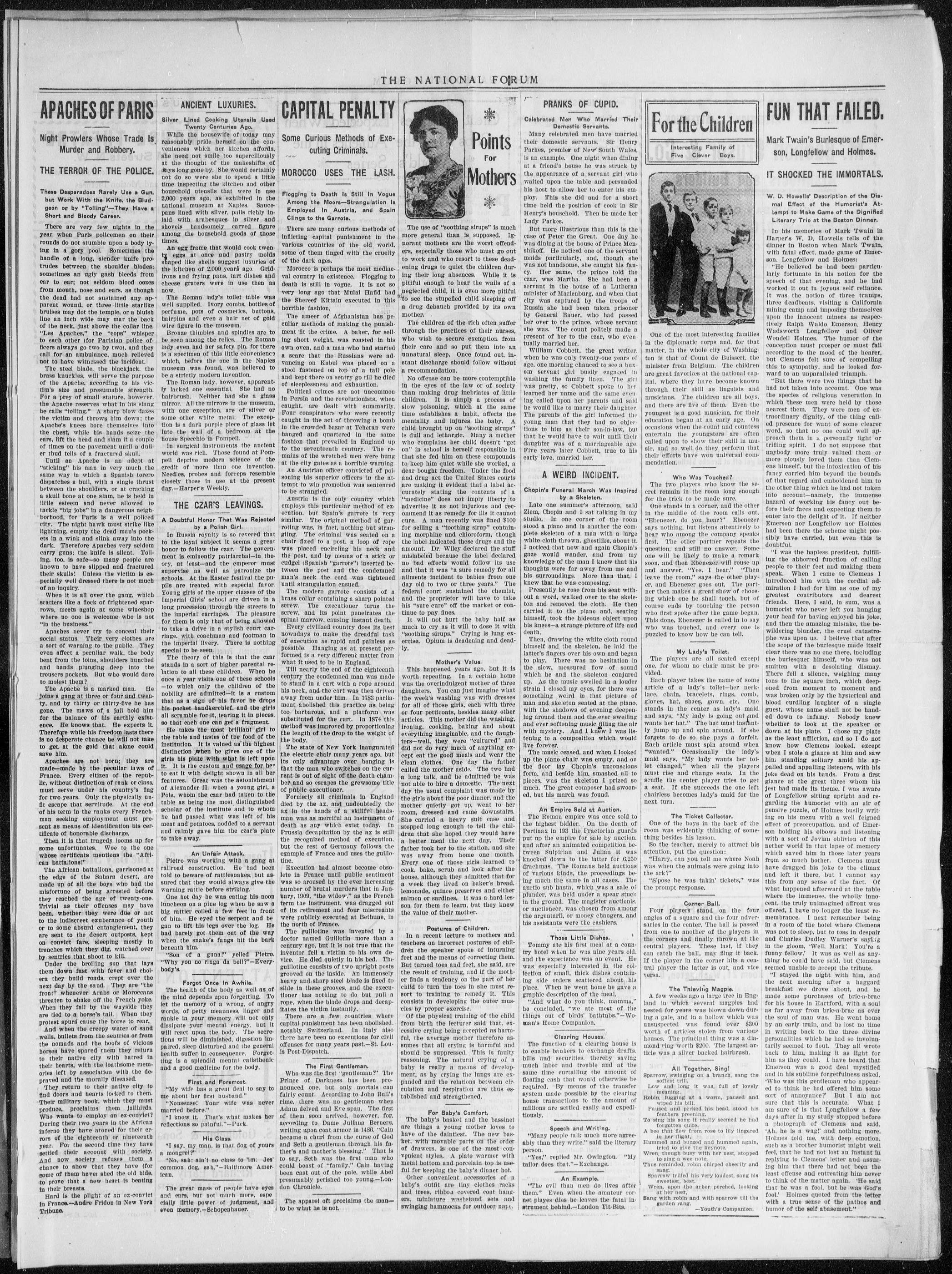
One of the most interesting families in the diplomatic corps and, for that matter, in the whole city of Washington is that of Count de Buissert, the minister from Belgium. The children are great favorites at the national capital, where they have become known through their skill as linguists and musicians. The children are all boys, and there are five of them. Even the youngest is a good musician, for their education began at an early age. On occasions when the count and countess entertain the youngsters are often called upon to show their skill in music, and so well do they perform that their efforts have won universal commendation.
Who Was Touched?
The two players who know the secret remain in the room long enough for the trick to be made sure.
One stands in a corner, and the other in the middle of the room calls out, "Ebenezer, do you hear?" Ebenezer says nothing, but listens attentively to hear who among the company speaks first. The other partner repeats the question, and still no answer. Some one will be likely to make a remark soon, and then Ebenezer will rouse up and answer, "Yes, I hear," "Then leave the room," says the other player, and Ebenezer goes out. The partner then makes a great show of choosing which one he shall touch, but of course ends by touching the person who first spoke after the game began. This done, Ebenezer is called in to say who was touched, and every one is puzzled to know how he can tell.
My Lady's Toilet.
The players are all seated except one, for whom no chair must be provided.
Each player takes the name of some article of a lady's toilet—her necklace, chain, bracelets, rings, comb, gloves, hat, shoes, gown, etc. One stands in the center as lady's maid and says, "My lady is going out and wants her hat." The hat must instantly jump up and spin around. If she forgets to do so she pays a forfeit. Each article must spin around when "wanted." Occasionally the lady's maid says, "My lady wants her toilet changed," when all the players must rise and change seats. In the scuffle the center player tries to get a seat. If she succeeds the one left chairless becomes lady's maid for the next turn.
The Ticket Collector.
One of the boys in the back of the room was evidently thinking of something besides his lesson.
So the teacher, merely to attract his attention, put the question:
"Harry, can you tell me where Noah was when the animals were going into the ark?"
"S'pose he was takin' tickets," was the prompt response.
Corner Ball.
Four players stand on the four angles of a square and the four adversaries in the center. The ball is passed from one to another of the players in the corners and finally thrown at the central players. These last, if they can catch the ball, may fling it back. If the player in the corner hits a central player the latter is out, and vice versa.
The Thieving Magpie.
A few weeks ago a large tree in England in which several nappies had nested for years was blown down during a gale, and in a hollow which was unsuspected was found over $300 worth of articles stolen from various houses. The principal thing was a diamond ring worth $200. The largest article was a silver backed hairbrush.
All Together, Sing!
Sparrow, swinging on a branch, sang the soffet trill.
Low and long it was, full of lovely meaning.
Robin, tugging at a worm, paused and wiped his bilt.
Paused his bilt, stood his feathers preening.
To sing his song it really seemed he had forgotten quite.
A bee that flew from rose to lily lingered in her flight.
Hummed and buzzed and hummed again, tried to give the keynote.
Wren, though busy with her nest, stopped to sing a wee note.
Thus reminded, robin chirped cheerily and sang.
Sparrow trilled his very loudest, sang his sweetest, best.
Wren, upon the arbor perched, looking at her nest.
Sang with robin and with sparrow till the garden rang.
—Youth's Companion.
FUN THAT FAILED.
Mark Twain's Burlesque of Emerson, Longfellow and Holmes.
IT SHOCKED THE IMMORTALS.
W. D. Howella' Description of the Dismal Effect of the Humorist's Attempt to Make Game of the Dignified Literary Trio at the Boston Dinner.
In his memories of Mark Twain in Harper's W. D. Howells tells of the dinner in Boston when Mark Twain, with fatal effect, made game of Emerson, Longfellow and Holmes:
"He believed he had been particularly fortunate in his notion for the speech of that evening, and he had worked it out in joyous self reliance. It was the notion of three tramps, three deadbells, visiting a California mining camp and imposing themselves upon the innocent miners as respectively Ralph Waldo Emerson, Henry Wadsworth Longfellow and Oliver Wendell Holmes. The humor of the conception must prosper or must fall according to the mood of the hearer, but Clemens felt sure of compelling this to sympathy, and he looked forward to an unparalleled triumph.
"But there were two things that he had not taken into account. One was the species of religious veneration in which these men were held by those nearest them. They were men of extraordinary dignity, of the thing called presence for want of some clearer word, so that no one could well approach them in a personally light or trifling spirit. I do not suppose that anybody more truly valued them or more plausely loved them than Clemens himself, but the intoxication of his fancy carried him beyond the bounds of that regard and emboldened him to the other thing which he had not taken into account—namely, the immense hazard of working his fancy out before their faces and expecting them to enter into the delight of it. If neither Emerson nor longfellow nor Holmes had been there the scheme might possibly have carried, but even this is doubtful.
"I was the hapless president, fulfilling the abhorred function of calling people to their feet and making them speak. When I came to Clemens I introduced him with the cordial admiration I had for him as one of my greatest contributors and dearest friends. Here, I said, in sum, was a humorist who never left you hanging your head for having enjoyed his joke and then the amazing mistake, the be wildering blunder, the cruel catastrophe she was upon us. I believe that after the scope of the burlesque made itself clear there was no one there, including the burlesquer himself, who was not smitten with a desolating dismay. There fell a silence, weighing many tons to the square inch, which deepened from moment to moment and was broken only by the hysterical and blood curdling laughter of a single guest, whose name shall not be handled down to infamy. Nobody knew whether to look at the speaker or down at his plate. I chose my plate as the least affliction, and so I do not know how Clemens looked, except when I stole a glance at him and saw him, standing solitary amid his appalled and appalling listeners, with his joke dead on his hands. From a first glance at the great three whom his jest had made its theme. I was aware of Longfellow sitting upright and regarding the humorist with an air of pensive puzzle, of Holmes busily writing on his menu with a well feigned effect of preoccupation, and of Emerson holding his elbows and listening with a sort of Jovian oblivion of this nether world in that lapse of memory which saved him in those later years from so much bother. Clemens must have dragged his joke to the climax and left it there, but I cannot say this from any sense of the fact. Of what happened afterward at the table where the immense, the wholly innocent, the truly unimagined affront was offered, I have no longer the least remembrance. I next remember being in a room of the hotel where Clemens was not to sleep, but to toss in despair and Charles Dudley Warner's saying in the gloom. 'Well, Mark.' You're a funny fellow! 'It was as well as anything he could have said, but Clemens seemed unable to accept the tribute.
"I stayed the night with him, and the next morning after a haggard breakfast we drove about, and he made some purchases of bric-a-brac for his house in Hartford, with a soul as far away from bric-a-brac as ever the soul of man was. He went home by an early train, and he lost no time in writing back to the three divine personalities which he had so involuntarily seemed to flout. They all wrote back to him, making it as light for him as they could. I have heard that Emerson was a good deal mystified and in his sublime forgetfulness asked, 'Who was this gentleman who appeared to think he had offered him some sort of annoyance?' But I am not sure that this is accurate. What I am sure of is that Longfellow a few days after in my study stopped before a photograph of Clemens and said, 'Ah, he is a wag!' and nothing more. Holmes told me, with deep emotion, such as a brother humorist might well feel, that he had not lost an instant in replying to Clemens' letter and assuring him that there had not been the least offense and entreating him never to think of the matter again. 'He said that he was a fool, but he was God's fool.' Holmes quoted from the letter with a true sense of the pathos and humor of the self abasement."
---
Bashon Crusor &
Architects and Builders
SUBURBAN OFFICE
Deanwood, D. C., R. F. D. No. 5
CITY OFFICE
You Street, N. W., Washington
have the most desirable location in the city, makers. Plenty of room, a cultured community of fresh air and pure water, away from land and noise. All home sites on the Electric Lake Junction. We build houses to suit the natural plans free. Sites secured in any of the lots. Stop paying rent and apply that the best people in the city among our purpose. We are able to offer you the advantage of departments, Mail and Police Service. On to any part of city.
DEAL LOCATIONS TO BE HAVENY,
Deanwood, East Deanwood, Linwood, Burdock, Bloomsburg Park, Dennings, Kenilworth, Fair Heights and all Maryland Suburbs.
Bashon Office Take "District Car Line" at 11 H Streets N. W., and get off at Brooks St.
FOR INFORMATION SEE
Crusor, at Suburban or City Office, or Attorney for the Company, at the C
M. Bashon Crusor & Co. Architects and Builders
East Deanwood, D. C., R.F. D. No. 3, Box 44 CITY OFFICE 1022 You Street, N. W., Washington, D. C.
We have the most desirable location in the city for colored home seekers. Plenty of room, a cultured community, fine scenery, plenty of fresh air and pure water, away from the city's din, dust and noise. All home sites on the Electric car line to Chesapeake Junction. We build houses to suit the purchaser. Architectural plans free. Sites secured in any of the suburban subdivisions. Stop paying rent and apply that to your own home. Best people in the city among our purchasers and neighbors. We are able to offer you the advantage of Schools, Fire Departments, Mail and Police Service. One fare and transfers to any part of city.
IDEAL LOCATIONS TO BE HAD
In Beverly, Deanwood, East Deanwood, Linwood, Burville, Grant Park, Bloomsburg Park, Dennings, Kenilworth, Fairmont Heights and all Maryland Suburbs.
For Suburban Office Take "District Car Line" at Fifteenth and H Streets N. W., and get off at Brooks Station.
FOR INFORMATION SEE
Bashon Crusor, at Suburban or City Office, or Consult
R. White, Attorney for the Company, at the City Office.
CARTER B. BRAXTON, Chief Mechanic.
Howard University
WASHINGTON, D. C.
Wilbur P. Thirkleid, LL. D., Pres.
Howard University
WASHINGTON, D. C.
Vibur P. Thirkield, LL. D., Pro
Howard University WASHINGTON, D. C.
Located in Capital of the Nation. Campus of over twenty acres. Advantages unsurpassed. Modern scientific and general equipment. New Carnegie Library. New Science Hall. Faculty of over one hundred. 1252 students from 35 States and 11 other countries. Unusual opportunities for self-support. No young man or woman of energy or capacity need be deprived of its advantages.
THE COLLEGE OF ARTS AND SCIENCES.
Devoted to liberal studies. Courses in English, Mathematics, Latin, Greek, French, German, Physics, Chemistry, Biology, History, Philosophy and the Social Sciences, such as are given in the best approved colleges. 16 professors. Kelly Miller, A.M. Dean.
tion combined. George W. Dean.
SCHOOL OF MANUAL APPLIED SCIENCE.
Furnishes through course structors. Offers two-year life in Mechanical and Civil Eng.
PROFESSIONAL SCIENCE.
THE SCHOOL OF THE Interdenominational. Fifth and thorough courses of connection with university. Students' Aid. L Isaac Clark, D.D., Dean.
THE TEACHERS COLLEGE.
Special opportunities for teachers.
Regular college courses in Psychology,
Pedagogy, Education, etc., with degree
of A.B.; Pedagogical courses leading to
Ph.B. degree. High-grade courses in
Normal Training, Music, Manual Arts
and Domestic Sciences. Graduates helped
to positions. Lewis B. Moore, A.M.
Ph.D. Dean.
THE ACADEMY
Faculty of 13. Three courses of four
years each. High-grade preparatory
school. George J. Cummings, A.M.,
Dean.
THE COMMERCIAL COLLEGE.
Courses in Bookkeeping, Stenography,
Commercial Law, History, Civics, etc.
Business and English high-school educa-
THE CHASE A
MAKE
High Grade Portraits and Pillow
CHASE ART COMP
MAKERS OF
Portraits and Pillow Tops, Novelties a
THE CHASE ART COMPANY MAKERS OF
All Goods Made and Sold by Us are Guaranteed
539 F Street Northwest, N
Best Work and Workma
ONE-THIRD DEPOSIT RE
West Northwest, Room 21, Washing
West Work and Workmanship at Lowest Prices
THIRD DEPOSIT REQUIRED ON ALL OR
Best Work and Workmanship at Lowest Prices. ONE-THIRD DEPOSIT REQUIRED ON ALL ORDERS.
WHERE TO DINE
EATS EATS EATS
BIG DIME LUNCH
$1.15 Meal Tickets for $1.00
$2.30 Tickets for $2.00
$3.45 Tickets for $3.00
Full Breakfast or Dinner for
FIFTEEN CENTS
We make a Specialty of our Sunday Dinners
We Cater Especially to Students
Prompt and Polite Service
Mrs. C. E. Johnson, Proprietor
603 C Street N. W.
GOOD THINCS TO EAT
ELLIS CAFE
WELCOME TO THE ELKS
OUR FOOD IS OF THE BEST
Polite and Prompt Service Our Motto
Prices Reasonable
No. 129 4th Street N. W.
---
---
ATTENTION.
Crusor & Co.
and Builders
AN OFFICE
C., R.F. D. No. 3, Box 44
OFFICE
W., Washington, D. C.
Single location in the city for colored
房屋, a cultured community, fine
pure water, away from the city's
site sites on the Electric car line to
build houses to suit the purchaser.
Is secured in any of the suburban
vent and apply that to your own
city among our purchasers and
after you the advantage of Schools,
Police Service. One fare and
ONS TO BE HAD
Branwood, Linwood, Burville, Grant
Cinnings, Kenilworth, Fairmont
Maryland Suburbs.
"District Car Line" at Fifteenth
and get off at Brooks Station.
FORMATION SEE
Man or City Office, or Consult
Company, at the City Office.
University
BITON, D. C.
field, L.L. D., Pres.
tion combined. George W. Cook, A.M.
Dean.
SCHOOL OF MANUAL ARTS AND
APPLIED SCIENCES.
Furnishes through courses. Six in-
structors. Offers two-year limited courses
in Mechanical and Civil Engineering.
PROFESSIONAL SCHOOLS.
Interdenominational. Five professors Broad and thorough courses. Advantages of connection with a great University. Students' Aid. Low expenses. Isaac Clark, D.D., Dean.
THE SCHOOL OF MEDICINE.
Medical, Dental and Pharmaceutical Colleges.
Forty-nine professors. Modern laboratories and equipment. Connected with new Freedmen's Hospital, costing half million dollars. Clinical facilities not surpassed in America. Post-graduate School and Polytechnic. Edward A. Balloch, M.D., Dean, 5th and W streets N. W. W. C. McNeill, M.D., Secretary, 901 R Street N. W.
THE SCHOOL OF LAW
Faculty of eight. Courses of three years, giving a thorough knowledge of theory and practice of law. Occupies own building opposite the courthouse. Benjamin F. Leighton, LL.B., Dean, 420 5th Street N. W. For catalog and special information address Dean of Department.
ART COMPANY
MARKS OF
Tops, Novelties and Chemicals
Room 21, Washington, D. C.
Lonship at Lowest Prices.
QUIRED ON ALL ORDERS.
Open All Night
JOSHUA N. ANDERSON, Prop'r.
SEE UNCLE JOSH AT THE
TUSKEEGEE
Quick Lunch Room
626 North Capitol Street N. W.
West Side Union Station, Half Block Away
WASHINGTON, D. C.
Best Meals at Low Prices
Excellent Service
A CLEAN PLACE TO EAT OPEN DAY AND NIGHT
THE WALDORF CAFE
Frank T. Wendel, Prop.
15c. and 25c. Meals at All Hours
FIRST-CLASS DAIRY, LUNCH SERVICE
643 Florida Ave. N. W. Washington, D. C.
---
ATTENTION.
THE NATIONAL FORUM
AMBASSADORS.
They Enjoy Some Curious Privileges at European Courts.
In the popular mind—the American mind at least—there is very little difference between an ambassador and a minister, but the former is entitled to very many privileges abroad that are denied to a mere envoy.
For instance, one curious privilege of an ambassador is that he, and he alone, when dismissed, may turn his back to the sovereign to whose court he is accredited. The mode of procedure, generally speaking, is as follows:
When the audience is at an end the ambassador waits to be dismissed by the sovereign. When dismissed the ambassador bows, retires three spaces, bows again, retires three spaces, bows a third time, turns on his heels and walks to the folding doors. But when the reigning sovereign is a woman, still politer methods obtain. To turn his back would be discourteous; to walk backward would be to resign a privilege; therefore the ambassador retires sideways like a crab. He keeps one eye on the sovereign and with the other he endeavors to find the door. By this unique means he contrives to evince all politeness to the sovereign and at the same time retain one of his privileges.
Another privilege of ambassadors is the right of being ushered into the royal presence through folding doors, both of which must be fung wide for him. No one save an ambassador can claim this privilege, the most any non-ambassadorial individual can expect is that one of the doors shall be opened to him.
One privilege appertaining to the ambassador, one capable of causing great inconvenience to the ruler, is the right of demanding admission to the sovereign at any hour of day or night. This was one of the reasons why Abdul Hamid, when sultan of Turkey, opposed the raising of our mission at Constantinople to an embassy. It was decidedly inconvenient at times to see the American representative at all.
To the European the most important feature of the ambassador's makeup is his sword. There the blade of the sword is a rapiper blade with the point blunted. It has facetiously observed abroad that the use the sword is put to in addition to its trick of tripping up its weaker is usually the harmless one of poking fires. One diplomatist was said to file his bills on his sword when it was not otherwise engaged, and for a long while it was a standing witticism of the corps diplomatique in Europe that the Russian ambassadors used their swords to file broken treaties, a circumstance that was held to account for the inordinate length of their weapons.—Harper's Weekly.
Emmet's Presence of Mind.
Emmet's Presence of Mind.
A story is told of Robert Emmet which proves his secretive power and resolution. He was fond of studying chemistry, and one night late, after the family had gone to bed, he swallowed a large quantity of corrosive sublimate in mistake for some acid cooling powder. He immediately discovered his mistake and knew that death must shortly ensue unless he instantly swallowed the only antidote, chalk. Timid men would have torn at the bell, roused all the family and sent for a stomach pump. Emmet called no one, made no noise, but, stealing down stairs and unlocking the front door, went into the stable, scraped some chalk which he knew to be there and took sufficient doses of it to neutralize the poison.
Queen Elizabeth's Amulet.
Queen Elizabeth during her last illness wore around her neck a charm made of gold which had been bequeathed to her by an old woman in Wales, who declared that so long as the queen wore it she would never be ill. The amulet, as was generally the case, proved of no avail, and Elizabeth, notwithstanding her faith in the charm, not only sickened, but died. During the plague in London people wore amulets to keep off the dread destroyer. Amulets of arsenic were worn near the heart. Quills of quicksilver were hung around the neck and also the powder of toads.
No Swelling at All
"I see not one ripple on the water. All is calmness," said the little German lady, looking out dreamily over the quiet sea. "I haf crossed the ocean when it was calm like this all the way over." "Do you mean that there was no swell even in midocean?" asked her companion, who had never crossed at all. "No, no swelling at all," was the reply.—New York Press.
Wherein They Differ.
Jack—Widows are wiser than matls in one respect at least. Tom—What's the answer? Jack—They never let a good chance go by, thinking that a better one will come their way—Chicago News.
In Mitigation.
in mitigation.
Judge—Hoss thief, you're found guilty by th' jury. Have y' anything to say as to why I shouldn't soak y' th' limit? Prisoner—Well, judge, it wasn't your boss I stole—Cleveland Leader.
Well Qualified.
"Why do you apply for a position as boss of this gang? Have you ever had any experience?"
"Bossed my son after he grew up."—Buffalo Express.
Procrastination is one of the most expensive forms of happiness.—Life.
Great Struggles Cubs Meet the World's
By TOMMY CLARK.
RACTICALLY every manager,
player, writer—in fact, every
man who knows or imagines
he knows anything about the
PRACTICALLY every manager, player, writer—in fact, every man who knows or imagines he knows anything about the national game—has picked a winner in the world's series, which is to be played with the Philadelphia and Chicago teams as the contenders for the title. Every one has his reasons for thinking either the National league or American league champions will win. The majority of the National league fans naturally name the Cubs, while
COLLINS
COOMBS
American leaguers, man to man, will advertise the Athletics as the one best bet.
Baseball is such an uncertain game that it is always hard to dope out a winner. And a short series—the world series will be ended when one team wins four games—is practically the same as one game. By that I mean that the manager uses the best judgment in the selection of his pitchers and who has the best break of what is known as "baseball luck" may upset all the dope which the experts have so industriously ground out.
Strong Points of Cubs and the Athletics.
Each club has its strong points. The game and aggressive Chicagoans are the greatest baseball machine in the game's history. In baseball brains the team has no superiors. The catching staff is the best in the country. Then the Cubs have the courage born of confidence. They have been winners in the world's series and feel like winners. This habit of thought will be a powerful factor in their favor. In the estimate of baseball men Conn Mack has a peerless pitching staff, and he has just the right combination of veterans and new bloods to make his machine dangerous.
In tackling the Athletics the Cuba will meet an evenly balanced team, speedy runners, strong in fielding and batting and with one of the best pitching staffs that has ever landed a pennant for a club in either league. In the Cubs the Athletics will face a team that has been credited with being the brainsiest set of players ever seen together on one team, a club that has always been among the topmost in batting, fielding and base running and the strongest defensive combination in either league.
Cubs Have Strongest Catching Department.
Behind the bat the Cubs loom up considerably more prominently than the American leaguers. Kling and Archen are rated as the best pair of catchers in the game. Mack's young backstop Lapp has come up fast, but he has yet to prove that he has the generalship and ability to execute that Kling has demonstrated himself the owner of. Kling is an expert in every particular, keen, cool and calculating, quick to discover the weakness of an opponent and to act accordingly. If Lapp, Thomas or Livingston proves a surprise by holding up his end with the National leaguers' backstops he will prove the man of the hour and increase the Athletics' chances immensely.
Philadelphia Has the Greater Pitching Staff.
Coombs, Bender, Plank and Morgan have pitched more consistently than any four twirlers the Cubs can show, and if pitching is to tell the tale the Athletics will take the field well equipped. With their experience, steadiness.
physiques and "stuff on the ball," the Athletics' staff has done better work day in and day out than the Cubs' staff.
Chance's probable gunners will be Brown, Pfelster, Cole and Reulbach. Brown isn't as good as he once was and has been hammered freely several times this year. The edge in pitching is with the Philadelphia.
Infields of Two Clubs Are of Stonewall Variety.
Both have crack infelds. Chance, Evers, Tinker and Steinfeldt form a tried and reliable quartet that was good enough to pilot Chicago to two world's championships and four pennants. In fielding, batting and generalship the four men are superb. The Athletics' infeld is not as old as Chicago, but the four men have been associated with each other long enough to work together with precision and harmony. It is a wonderful infeld in every way, the very best in the American league.
Now let's look 'em over. Chance is a better fielder than Davis, but at that there are few that have anything on the Philadelphia first baseman. At second both teams have stars, Evers and Collins being the twinklers. The latter will outhit the Trojan, or at least ought to do so, and probably will field just as well as the boot and shoe merchant from Troy. At short the Cubs have the advantage. Tinker is Barry's superior as a fielder and as a long hitter, but the Holy Cross boy is a clever performer nevertheless and in a short series might play every bit as well as 'Evers' side partner. Baker of the Athletics is Steinfeld's superior both in batting and fielding. The Maryland is much younger than his Chicago rival, and youth must be served. Baker is not the finished fielder that Steinfeld is, but turns more sensationally plays. Baker is a terribly hard hitter and is more likely to break up a game than is the Texan.
Cubs' Outfield Superior to the Athletics'.
The Chicago outfield is superior to the Philadelphia suburban trio. Lord isn't as scientific a bitter as Sheckard, doesn't cover as much ground and isn't so good a thrower. Hofman in the best center fielder in the game today. He is a splendid thrower, and his speed and certainty on fly balls make him a treasure at cutting off long hits. He is a better all around fielder than Olding, but the latter
KLING
EVERS
is no slouch in any respect and will come nearer to the Hofman standard than Lord will to the Sheckard standard. Schulte grades right up with Hofman and Sheckard, is a faster and more finished outer picket than Murphy, but no more dangerous with the bat. The Chicago trio are the better base runners. In leadership of the two teams there is no apparent advantage one way or the other. Mack possesses quite as much acumen as Chance.
The only one big advantage the Athletics have over the Cubs is in the pitching department. The Chicago team has the better backstops, their infield has a shade on the Philadelphia quartet, and the Cubs' suburban trio outclass the Mack men. The Chicago twirlling staff is not weak by any means, and no doubt Manager Chance will have his pitchers in fine fettle by the time the series starts so they will be able to twirl first class ball. Considering that the Cubs have these three great advantages over the Athletics, also figuring, too that they have been so long to待 that in harmony of effort and mutual understanding they are the smoothest working baseball machine in the country, they should win the series from Philadelphia.
BLUE MOUSE THEATRE
Largest, Handsomest and Coolest Theatre in Town Good Vaudeville and Motion Pictures
MACEO, THEATRE
Devoted to Up-to-Date, Clean and Clear Motion Pictures. Presenting 1,000 feet of Films nightly. Dramatic, Comic and Western Life Motion Plays. Plenty of Fans to keep you cool. Refined Vaudeville and Illustrated Song, all for 5 cents. An Hour Show. Bring the Children.
Imcompmt Recital for Pupils and Public, by Mr. Carl Dillon, who calls for Europe Oct. 1st
For first-class Flano Tuning we recommend Mr. Harper Fortune. Leave orders at Conservatory
Boggerson's Union Literary Musical League
Now open for New Members. Any person of good moral character can become a member of our group. We are open to all students who offer special rates to all ladies who can make themselves useful and interesting in a Musical Leisure. Secure our special class rates to advanced pupils who find it difficult in reading music. The object of their study is the instruction of the instructions should be, that members can play from a printed score instead of by ear.
Music Furnished for All Sacred Occasions, Concerts and Recitals
For Terms apply — JAS, H. BOGGERSON, Gen. Mgr. and Dir., — 1249 Maryland Ave. N. E.
FORD DABNEY'S THEATER
Visit Them for a Pleasant Hour's Amusement
Corner 9 and Your Streets N. W.
Seventh Year
OPEN
The Washington Co.
AND SCHOOL
(Incort)
902 T STREET N. W.
Depart
Piano, Voice and Violin
Harmony, Co.
Piano Tuning
Vocal Express
Theory, Analysis
OPENING
Imprompt Recital for Pupils and Public, by
For first-class Piano Tuning we recommend Mr.
Boggerson's Union Literary Mus
Now open for New Members. Any person of
this organization by taking private lessons upon
special rates to all ladies who can make themselves
Secure our special class rates to advanced pupil
object of the class is: that the result of the is
from a printed record instead of by ear.
Music furnished for All Sacred
For Terms Apply to — JAS. H. BOGGERSON, G.
SHOPPERS' GUIDE
PALACE
Shoe Shining Parlor
For Ladies and Gentlemen
Newspapers, Periodicals and Magazines
Imported and Domestic Cigars
810 Florida Avenue N. W.
THE FORUM
And all Leading Colored Papers for Sale
Could You Do Better
Than wear a nice tailored, slightly used
suit at $3.00 to $15.00, and think
of the money you save. Savey?
ONE PRICE
Justh's Old Stand, 619 D St. N.W.
Cleaning, Dyeing and Repairing
We removed gowns to equal to new at reasonable prices. Men's Suits pressed 35 tts.; Suits Pressed and Cleaned 50 and 75 tcs.
1848 74 St. N. W., Washington, D. C.
ALL TASLE, Prop. All work guaranteed
Tennyson & Ellis Co.
Fine Paperhangers
and Decorators
Painting, Plastering, Kalsomining
Window Shades to Order
PROMPT ATTENTION
ALL WORK GUARANTEED
1400 Pierce Place Northwest
Phone North 4045
ATTENTION
For a few days we will make
to your order a
Two-Piece
SUIT
FOR ONLY
$16.50
from woolens that regularly
sell at $20 and $22.50
Choice of 75 patterns.
S. Goldheim & Sons
403-405 Seventh St.
Richard Early
HOUSE CLEANER
Washing Windows Especially
53 Pierce Street N. W.
Send me a card and I will call
Palace Pool Parlor
CHAS. (Boody) ANDERSON
PROPRIETOR
1448 P Street N. W.
WENING
Sept. 24, 1910
Conservatory of Music
OF EXPRESSION
(operated)
Branch School in Anacostia and Alexandria, Va.
Ornaments
Counterpoint, Fugue
Session
History of Music
I RECITAL
Mr. Carl Diton, who sails for Europe Oct. 1st
Harper Fortune. Leave orders at Conservatory
Musical League AND FEMALE SACRED
ORCHESTRA SCHOOL
A good moral character can become a member of
On Brass, String or Reed Instruments. We offer
leave useful and interesting in a Musical League
als who find it difficult in reading music. The
instructions should be, that members can play
Occasions, Concerts and Recitals
Gen. Mgr. and Dir., — 1249 Maryland Ave. N. E.
Subject: THE CUCUMBER—Rev. L. C. Moore
The National Sunday-School Mission Worker and
Counsellor, Ex-Member of the Missionist) Legisla-
ture, Ex-Town Marshal, Ex-Deputy Sheriff, Ex-
U.S. Navy Member, Ex-Constable, Ex-U. S. Wat-
chenman, Ex-UK Member, Ex-Queen, Orator and
Poet, will give a Grand Lecture and Postal Eent-
tainment at Mt. Carmel Baptist Church, Fourth
and L. N. W., N. W., to hear their friend.
REV. W. P. GIBBONS. Pastor.
SWEEDISH MASSAGE
INSTRUCTIONS GIVEN BY
MISS LA POINT ROBBINS
Late of New York
MORNING AND EVENING AT
1113 13th Street N. W.
GIVE HER A CALL. IT'S WORTH THE TRIAL
Subscribe to
The National Forum
$1.00 a Year
ATLANTIC CITY
The Bay State Hotel
HARDY & OTTERY, Props.
334 N. TENNESSEE AVENUE
Atlantic City, N. J.
EUROPEAN PLAN
Concert Garden
Special Rates to Parties Taking
Apartments
PROFESSIONAL
THOMAS BECKETT
Attorney and Counsellor-at-Law
494 Louisiana Avenue
Room 15, Lewis Building, Washington, D.C.
Joseph H. Stewart
ATTORNEY AND
COUNSELLOR-AT-LAW
609 F St. N. W. Room 203
Sylvester L. McLaurin
ATTORNEY AND
COUNSELLOR-AT-LAW
609 F St. N. W. First Floor
L. C. MOORE
COUNSELLOR
and ADVISOR
Room 9. 802 F St. N. W.
---