The New Age (Butte)
Saturday, September 27, 1902
Butte, Montana
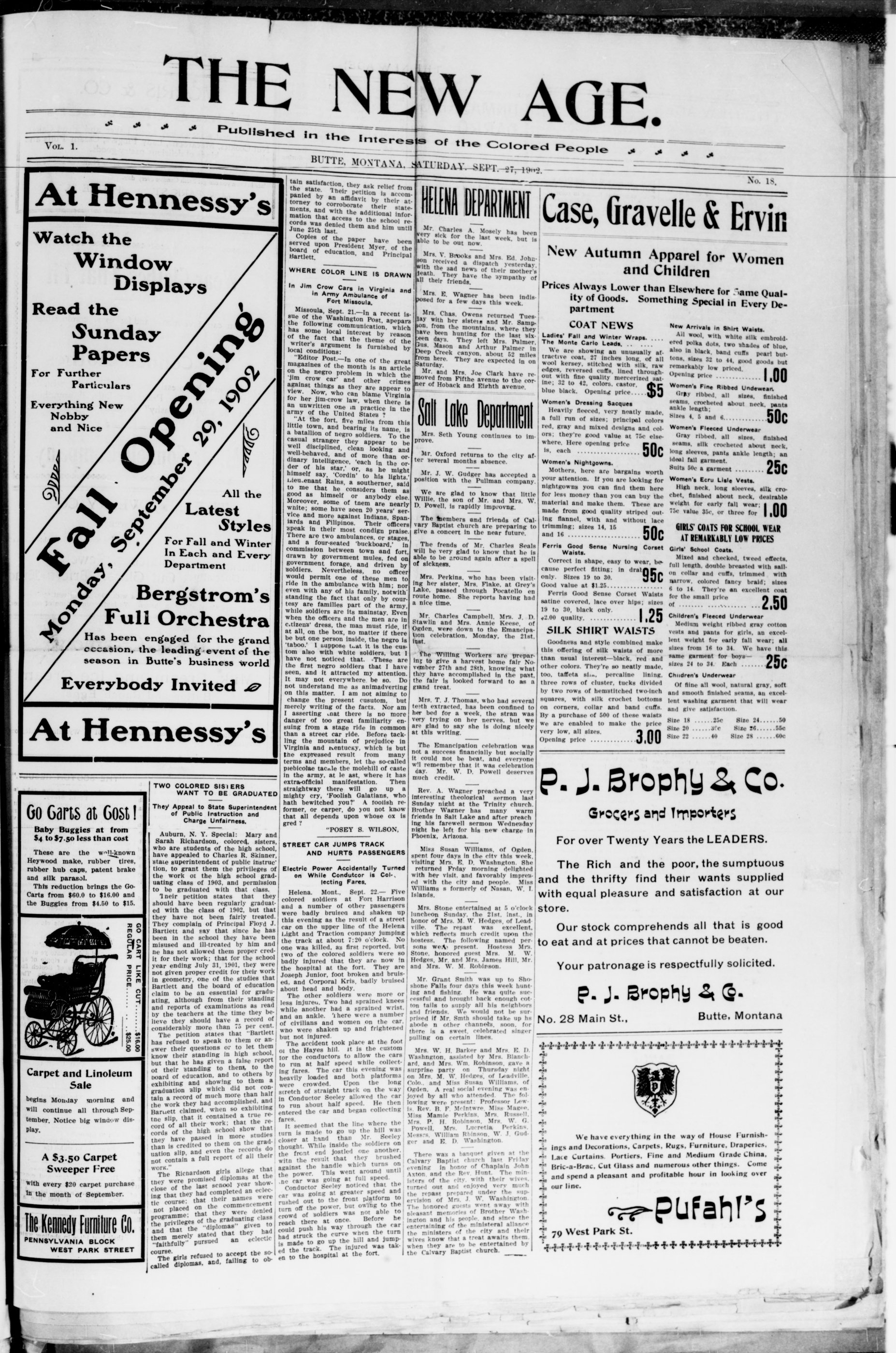
Page text (machine-generated)
At Hennessy's
Watch the
Window
Displays
Read the
Sunday
Papers
For Further
Particulars
Everything New
Nobby
and Nice
Fall Opening
Monday, September 29, 1902
All the
Latest
Styles
For Fall and Winter
In Each and Every
Department
Bergstrom's
Full Orchestra
Has been engaged for the grand
occasion, the leading event of the
season in Butte's business world
Everybody Invited
At Hennessy's
Vol. 1.
Baby Buggies at from $4 to $7.50 less than cost
These are the well-known Heywood make, rubber tires, rubber hub caps, patent brake and silk parasol.
This reduction brings the Go-Carts from $60.0 to $16.00 and the Buggies from $4.50 to $15.
GO CART LIKE CUT.....$16.00
REGULAR PRICE.....$25.00
Carpet and Linoleum Sale
begins Monday morning and will continue all through September. Notice big window display.
A $3.50 Carpet
Sweeper Free
with every $20 carpet purchase
In the month of September.
The Kennedy Furniture Co.
PENNSYLVANIA BLOCK
WEST PARK STREET
THE NEW AGE.
TWO COLORED SISTERS
WANT TO BE GRADUATED
They Appeal to State Superintendent
of Public Instruction and
Charge Unfairness.
Auburn, N. Y. Special: Mary and
Sarah Richardson, colored, sisters,
who are students of the high school,
have appealed to Charles R. Skinner,
state superintendent of public instruction,
to grant them the privileges of
the work or the high school graduating class of 1903, and permission
to be graduated with that class.
Their petition states that they should have been regularly graduated with the class of 1902, but that they have not been fairly treated. They complain of Principal Floyd J. Bartlett and say that since he has been in the school they have been misused and ill-treated by him and he has not allowed them proper credit for their work; that for the school year ending July 31, 1901, they were not given proper credit for their work in geometry, one of the studies that Bartlett and the board of education claim to be an essential for graduating, although from their standing and reports of examinations as read by the teachers at the time they believe they should have a record of considerably more than 75 per cent.
The petition states that "Bartlett has refused to speak to them or answer their questions or to let them know their standing in high school, but that he has given a false report of their standing to them, to the board of education, and to others by exhibiting and showing to them a graduation slip which did not contain a record of much more than half the work they had accomplished, and Barucci claimed, when so exhibiting the slip, that it contained a true record of all their work; that the records of the high school show that they have passed in more studies than is credited to them on the graduation slip, and even the records do not contain a full report of all their mores."
THE Ricardson girls allege that they were promised diplomas at the close of the last school year showing that they had completed an eclectic course; that their names were not placed on the commencement programme; that they were denied the privileges of the graduating class and that the "diplomas" given to them merely stated that they had "faithfully" pursued an eclectic course. The girls refused to accept the so-called diplomas, and, failing to ob-
tain satisfaction, they ask relief from the state. Their petition is accompanied by an affidavit by their attorney to corroborate their statements, and with the additional information that access to the school records was denied them and him until June 25th last.
Copies of the paper have been served upon President Myer, of the board of education, and Principal Bartlett.
WHERE COLOR LINE IS DRAWN
In Jim Crow Cars in Virginia and in Army Ambulance of Fort Missoula
Missoula, Sept. 21.—In a recent issue of the Washington Post, apeara the following communication, which has some local interest by reason of the fact that the theme of the writer's argument is furnished by local conditions:
"Editor Post—In one of the great magazines of the month is an article on the negro problem in which the 'jim crow car' and other crimes against things as they are appear to view. Now, who can blame Virginia for her jim-crow law, when there is an unwritten one in practice in the army of the United States?
"At the fort, five miles from this little town, and bearing its name, is a battalion of negro soldiers. To the casual stranger they appear to be well disciplined, clean looking and well-behaved, and of more than ordinary intelligence, 'each in the order of his star,' or, as he might himself say, 'Cordin' to his lights. Lieu-enant Rains, a southerner, said to me that he considers them as good as himself or anybody more. Moreover, some of them are early white; some have seen 20 years' service and more against Indians, Spaniards and Filipinos. Their officers speak in their most conglend praise. There are two ambulances, and a four-seated 'buckboard,' commission between town and fort, drawn by government mules, fed on government forage, and driven by soldiers. Nevertheless, no officer would permit one of these men to ride in the ambulance with him; nor with any of his family, notwithstanding the fact that only by courtesy are families part of the army, while soldiers are its mainstay. Even when the officers and the men are in citizens' dress, the man must ride, if at all, the box, no matter if there be but one person inside, the negro is 'taboo.' I suppose that it is the custom also with white soldiers, but I have not noticed that. These are the first negro soldiers that I have seen, and it attracted my attention. It may not everywhere be so. Do not understand me as animadvertising on this matter. I am not aiming to change the present cusutum, but merely writing of the facts. Nor am I asserting that there is no more danger of too great familiarity ensuing from a stage ride in common than a street car ride. Before tackling the mountain of prejudice in Virginia and Kentucky, which is but the expressed result from many terms and members, let the so-called piebicolae tacale the molehill of caste in the army, at le ast, where it has extra-official manifestation. Then straightway there will go up a mighty cry, 'Foolish Galatians, who hath bewitched you?' A foolish reformer, or carer, do you not know that all depend upon whose ox is grazed?
"POSEY S. WILSON.
STREET CAR JUMPS TRACK
AND HURTS PASSEGERS
Electric Power Accidentally Turned on While Conductor is Collected Fares.
Helena. Mont., Sept. 22. Five colored soldiers at Fort Harrison and a number of other passengers were badly bruised and shaken up this evening as the result of a street car on the upper line of the Helena Light and Traction company jumping the track at about 7:20 o'clock. No one was killed, as first reported, but two of the colored soldiers were so badly injured that they are now in the hospital at the fort. They are Joseph Junior, foot broken and bruised, and Corporal Kris, badly bruised about head and body.
The other soldiers were more or less injured. Two had sprained knees while another had a sprained wrist, and an ankle. 'There were a number of civilians and women on the car, who were shaken up and frightened but not injured.
The accident took place at the foot of the Hayes hill. it is the custom for the conductors to allow the cars to run at half speed while collecting fares. The car this evening was heavily loaded and both platforms were crowded. Upon the long stretch of straight track on the way in Conductor Seeley allowed the car to run about half speed. He then entered the car and began collecting fares.
It seemed that the line where the turn is made to go up the hill was closer at hand than Mr. Seeley thought. While inside the soldiers on the front end lostied one another, with the result that they brushed against the handle which turns on the power. This went around until the car was going at full speed.
Conductor Seeley noticed that the car was going at greater speed and rushed out to the front platform to turn off the power, but owing to the crowd of soldiers was not able to reach there at once. Before he could push his way through the car had struck the curve when the turn is made to go up the hill and jumped the track. The injured was taken to the hospital at the fort.
Mr. Charles A. Moseley has been very sick for the last week, but is able to be out now.
Mrs. V. Brooks and Mrs. Ed. Johnson received a dispatch yesterday, with the sad news of their mother's death. They have the sympathy of all their friends.
Mrs. E. Wagner has been indisposed for a few days this week.
Mrs. Chas. Owens returned Tuesday with her sisters and Mr. Sampson, from the mountains, where they have been hunting for the last sixteen days. The left Mrs. Palmer, Gus. Mason and ether Palmer in Deep Creek canyon, about 52 miles from here. They are expected in on Saturday.
Mr. and Mrs. Joe Clark have removed from Fifthe avenue to the corner of Hoback and Eighth avenue.
Salt Lake Department
Mrs. Seth Young continues to improve.
Mr. Oxford returns to the city after several months absence.
Mr. J. W. Gudger has accepted a position with the Pullman company.
We are glad to know that little Willie, the son of Mr. and Mrs. W. D. Powell, is rapidly improving.
The members and friends of Calvary Baptist church are preparing to give a concert in the near future.
The friends of Mr. Charles Seals will be very glad to know that he is able to be around again after a spell of sickness.
Mrs. Perkins, who has been visiting her sister, Mrs. Flake, at Grey's Lake, passed through Pocatello en route home. She reports having had a nice time.
Mr. Charles Campbell, Mrs. J. D. Stawlin and Mrs. Annie Keese, of Ogden, were down to the Emancipation celebration, Monday, the 21st, just.
The Willing Workers are preparing to give a harvest home fair November 27th and 28th, knowing what they have accomplished in the past, the fair is looked forward to as a grand treat.
Mrs. T. J. Thomas, who had several teeth extracted, has been confined to her bed for a week, the stran was very trying on her nerves, but we are glad to say she is doing nicely at this writing.
The Emancipation celebration was not a success financially but socially it could not be beat, and everyone will remember that it was celebration day. Mr. W. D. Powell deserves much credit.
Rev. A. Wagner preached a very interesting theological sermon last Sunday night at the Trinity church. Brother Wagner has many warm friends in Salt Lake and after preaching his farewell sermon Wednesday night he left for his new charge in Phoenix, Arizona.
Miss Susan Williams, of Ogden, spent four days in the city this week, visiting Mrs. E. D. Washington. She returned Friday morning delighted with her visit, and favorably impressed with the city and people. Miss Williams s formerly of Nasan, W. I. Islands.
Mrs. Stone entertained at 5 o'clock luncheon Sunday, the 21st, 'inst., in honor of Mrs. M. W. Hedges, of Leadville. The repast was excellent, which reflects much credit upon the hostess. The following named persons were present. Hostess Mrs. Stone, honored guest Mrs. M. W. Hedges, Mr. and Mrs. James Hill, Mr. and Mrs. W. M. Robinson.
Mr. Grant Smith was up to Shoshone Falls four days this week hunting and fishing. He was quite successful and brought back enough cotton tails to supply all his neighbors and friends. We would not be surprised if Mr. Smith should take up his abode in other channels, soon, for there is a sweet, celebrated singer pulling on certain lines.
Mrs. W. H. Barker and Mrs. E. D. Washington, assisted by Mrs. Blanchard, and Mrs. W. Robinson, gave a surprise party on Thursday night on Mrs. M. W. Hedges, of Leadville, Colo., and Miss Susan Williams, of Ogden. A real social evening was enjoyed by all who attended. The following were present: Professor Lewis, Rev. B. F. McIntwre, Miss Magee, Miss Mamie Perkins, Mrs. Russell, Mrs. P. H. Robinson, Mrs. W. G. Powell, Mrs. Lucretia, Perkins, Messrs. William Ribbon, W. J. Gudger and E. D. Washington.
There was a banquet given at the Calvary Baptist church last Friday evening in honor of Chaplain John Axton, and the Rev. Hunt. The ministers of the city, with their wives, turned out and enjoyed very much the repast prepared under the supervision of Mrs. J. W. Washington. The honored guests went away with pleasant memories of Brother Washington and his people, and since the entertaining of the ministeral alliance the ministers of the city and their wives know that a treat awaits them when they are to be entertained by the Calvary Baptist church.
Case, Gravelle & Ervin
New Autumn Apparel for Women and Children
Prices Always Lower than Elsewhere for Same Quality of Goods. Something Special in Every Department
P. J. Brophy & Co.
For over Twenty Years the LEADERS.
The Rich and the poor, the sumptuous and the thrifty find their wants supplied with equal pleasure and satisfaction at our store.
Our stock comprehends all that is good to eat and at prices that cannot be beaten.
Your patronage is respectfully solicited.
P. J. Brophy & Co.
We have everything in the way of House Furnishings and Decorations, Carpets, Rugs, Furniture, Draperies, Lace Curtains. Portiers, Fine and Medium Grade China, Bric-a-Brac, Cut Glass and numerous other things. Come and spend a pleasant and profitable hour in looking over our line.
Pufahl's
79 West Park St.
Ladies' Fall and Winter Wraps. The Monte Carlo Leads.
We are showing an unusually attractive coat, 27 inches long, of all wool kersey, stitched with silk, raw edges, reversed cuffs, lined throughout with fine quality mercerized satine; 32 to 42, colors, castor, blue black. Opening price...$5
Women's Dressing Sacques
Heavily fleeced, very nearly made,
a full run of sizes; principal colors
red, gray and mixed designs and colors;
they're good value at 75c else-
where. Here opening price
is, each 50c
Women's Nightgowns.
Mothers, here are bargains worth your attention. If you are looking for nightgowns you can find them here for less money than you can buy the material and make them. These are made from good quality striped outing flannel, with and without lace trimming; sizes 14, 15 50c and 16.
trimming; sizes 14, 15
and 16 ..... 50c
Ferris Good Sense Nursing Corset
Waists.
Correct in shape, easy to wear, because perfect fitting; in drat only. Sizes 19 to 30.
Good value at $1.25.
Ferris Good Sense Corset Waists
satine covered, lace over hips; sizes 19 to 30, black only.
2.00 quality.
SILK SHIRT WAISTS
Goodness and style combined make this offering of silk waists of more than usual interest—black, red and other colors. They're so neatly made, too, taffeta silk, percale lining, three rows of cluster, tucks divided by two rows of hemstitched two-inch squares, with silk crochet bottoms on corners, collar and band cuffs. By a purchase of 500 of these waists we are enabled to make the price very low, all sizes. 3.00 Opening price .....
P. J. Broph
Grocers and I
For over Twenty Year
The Rich and the p
and the thrifty find the
with equal pleasure and
store.
Our stock comprehend
to eat and at prices that c
Your patronage is resp
P. J. Broph
No.28 Main St.,
We have everything in the
ings and Decorations, Carpets, Rug
Lace Curtains. Portiers, Fine and
Bric-a-Brac, Cut Glass and numere
and spend a pleasant and profitabl
our line.
70 West Park St.
No.18.
New Arrivals in Shirt Waists.
All wool, with white silk embroidered polka dots, two shades of blue, also in black, band cuffs pearl buttons, sizes 32 to 44, good goods but remarkably low priced.
Opening price ..... 1.00
**Women's Fine Ribbed Undewear.**
Gray ribbed, all sizes, finished seams, crocheted about neck, pants ankle length;
Sizes 4, 5 and 6 ..... 50c
**Women's Fleeced Underwear**
Gray ribbed, all sizes, finished seams, silk crochet about neck, long sleeves, pants ankle length; an ideal fall garment.
Suits 50c a garment ..... 25c
**Women's Ecru Lile Vests.**
High neck, long sleeves, silk crochet, finished about neck, desirable weight for early fall wear;
75c value 35c, or three for ..... 1.00
GIRLS' COATS FOR SCHOOL WEAR AT REMARKABLY LOW PRICES
Girl's School Coats.
Mixed and checked, tweed effects,
full length, double breasted with sailon
collar and cuffs, trimmed with
narrow, colored fancy braid; sizes
6 to 14. They're an excellent coat
for the small price
of ..... 2.50
Children's Fleeced Underwear
Medium weight ribbed gray cotton
vests and pants for girls, an excellent
weight for early fall wear; all
sizes from 16 to 34. We have this
same garment for boys—
sizes 24 to 34. Each ..... 25c
**Children's Underwear**
Of fine all wool, natural gray, soft
and smooth finished seams, an excellent
washing garment that will wear
and give satisfaction.
Size 18 ..... 25c Size 24..... 50
Size 20 ..... 30c Size 26..... 55c
Size 22 ..... 40 Size 28 ..... 60c
phy & Co.
Importers
ears the LEADERS.
poor, the sumptuous
their wants supplied
and satisfaction at our
ends all that is good
cannot be beaten.
respectfully solicited.
phy & Co.
Butte, Montana
2
THE NEW AGE
published weekly by the New Ag
Publishing Company, office, 220 South
Idaho street.
Subscription price, $2.00 a year. Six
months $1.10. Three months, 6
cents, invariably in advance. Tele
phone 862-B.
Application made for entry at the
postoffice at Butte as second-class
matter.
SAURDAY, SEPTEMBER 27, 1902
The New Age, a neat six-column folio, published at Butte, Montana, is the "political organ of the colored people of the state." From a letter from Nora E. Hulings Siegel, of Denver, I learn that it is edited and printed by negroes. It is certainly a credit to them. It would be a credit to people of any color. It is edited with more than ordinary ability and shows energy and push in gathering news. it is clean, respectable and high-tone in every particular. Mrs. Siegel, who is a staff
contributor to the Reasoner, and who has a big heart for humanity in all its varied expressions, is taking an especial interest in this enterprise of the colored people, and is contributing some articles to its columns relative to the history of the African race in general and to its social and economic position in the United States in particular. These articles are calculated to allay prejudices and cultivate a better feeling inbounds towards each other. The Reasoner extends the right hand of brotherhood to its colored kinsmen in Montana, and hopes that they may seek the mysteries of the Second Degree—the Reasoner.
The New Age contains in this issue in our Great Falls department an appeal to the colored voter of this state. This goes to show that the policy of an organization which the Age has advocated from the very start, has met with the approbation of the entire colored population of Great Falls. We are also pleased to note that several of our number have been made delegates to the state convention. We still urge and continue to impress the vital importance of a combined force and labor to one great end. Cement our vote and carry our strength in one solid body and thereby reap some benefit from many state and county positions that are to be filled. It is a source of great pleasure to receive such favorable reports as that of the organization started among our brothers in Great Falls and other cities throughout the state. One of the New Age staff will start on a tour of the state to work in this capacity. Just think of the treatment that our colored brother receives at the hands of the southern white man. They are not even permitted to sit in their convention, among a body of men supposed to be congregated to select men to govern the machinery of the state. They will accept the negro taxes, forced to do as other citizens who enjoys the rights and privileges of free speech, to contribute towards the support and maintenance of a state government. This, to some extent, has been brought on by the negro failing to stand united and work for their own interests. Many see their mistake just now and to their sad dismay may be compelled to go away back and sit down. Whilst their voices are hushed in politics we doubt not that they will make the necessary amendments by accumulating property, secure education and thereby stimulating thrift and industry. The same may be applied to many of the western states, where the spirit of perseverance seems to be on the wane. Awake to the sense of your duty! United we stand, divided we fall.
The Citizens' Coal company, dealers in Kemmerer, Rock Springs, Rocky Fork and Trail Creek coal; also good dry pine and fir wood. We give 2,000 pounds to the ton. No. 4 East Broadway. Telephone 538.
At the Grand.
The Grand Opera house will commence a season of continuous attractions next Sunday, October 5th, opening with the new melodramatic success, "A broken Heart!". This play will open, the run of Stair & Havlin, popuar-priced attraction that will visit the mouse this season. "A Broken Heart! is one of the strongest melodramas on the road. It is interpreted by a thoroughly uptoate company, and in the course of the play many novel specialties are introduced.
Following "A Broken Heart" comes Bob Fitzsimmons, in his successful play, "The Honest Blacksmith." He is accompanied by Mrs. Fitzsimmons, herself a finished actress, and Bob Jr.
by. J. Lost in New York," and that personal favorite, "Yon Yonson," entirely new and up-to-date, with a new company, come in for the week following. "A Foxy Tramp," one of the newest musical comedy successes, follows. This attraction is unique and emphasizes the tendency of the modern stage toward musical comedies, interspersed with specialties and vaudeville acts.
Eleven Bells at the Broadway on Friday, Saturday and Sunday.
NOTICE.
The New Age, the political organ of the colored people of this state. If you are candidates for political nominations and desire to reach the colored vote of the countw or state, the New Age, the official organ of the colored people, extends its columns for your use. We make a specialty of cuts and political cards.
Sensitive Gems.
The discoloration of precious stones when they have been exposed to the air for a long time is considered one of the most frequent maladies. Emeralds rubies and sapphires are those which remain intact best. Nevertheless, they are not exempt from changes. Two rubies of the same size and shade were kept for two years—one in a showcase and the other away from all light. At the end of this term a comparison revealed that the first had become somewhat lighter in color.
The influence of light makes itself felt more plainly on topazes and garnets. The garnet turns much paler in a short time, while the topaz assumes a darker shade and even loses the brilliance possessed by it when freshly cut.
The most sensitive stone in this respect is the opal. This stone draws its marvelous rainbow reflections from numerous little clefts, which allow the light to pass, and reflect it in different directions. Often the opal stands the manipulations of cutting and polishing well, and all of a sudden it splits. Pearsier dulcisely very easily. In the fire they are transformed into a piece of lime. Placed in contact with an acid they behave as lime or marble would under the same conditions.
Diamonds are less sensitive; still, if it not prudent to take them too near the fire.-Philadelphia Inquirer.
Thex Hang Out a Pincushion.
In some of the cities of Holland, such as Haarlem, the birth of a child is announced to the neighbors and all who chance to pass by the curious custom of hanging a pincushion outside the door. If you walk past a house and see a white pincushion edged with lace and looking very dainty, you may understand that the number of inhabitants has been increased by one, and that one a girl.
When the happy couple are blessed with a boy, the color of the pincushion is red.
In Japan the people do something similar, yet more extensive. Outside the houses of a town you will see one or more paper fishes dangling and blowing in the wind. On making inquiry you are informed that the paper fishes represent the boys of the household. Every new boy means another fish. These imitations of the koi are decorated with colored silk and are thought a great deal of.
The fish which the Japanese call koi is noted for its courage and tenacity, and is therefore regarded as a fitting representation of the coming man.
A Purse For the Bride.
Some brides may be inclined to regret that the old marriage custom of the dow purse has fallen into disuse. It was the custom of the bridegroom to fill a purse with a goodly sum of money and present it to the bride on the wedding day as the price of the purchase of her person. It sounds like slavery, like the buying of goods and chattels, yet the bride had a nice little sum of money for her own use.
Some of the oldest inhabitants of Cumberland may remember a similar custom in that county. The bridegroom provided himself with a number of gold and silver pieces, and at the words "with all my worldly goods I thee endow" he handed the clergyman his fee and poured the other coins into a handkerchief held out for that purpose by the bride.
In other places, again, the bride had the right to ask her husband for a gift of money or property on the day after the wedding, and he was bound in honor to grant the request.—London Answers.
Manufacturing "Old Masters."
How such things can be was recently learned in a rather amusing way by an American girl.
Adjoining her studio while she was in Paris was one occupied by a quiet man, little known to the artists of the neighborhood, but supposed to be one of their craft.
He was a diligent workman. From early morning until dark he was in his studio, and yet no models ever came, nor did he go on sketching tours.
One day the usual quiet of his studio was broken by an alteration which those in the next room could not help hearing, as the voices grew louder. The uncommunicative and diligent worker was heard to say, "I want my money."
Evidently the cash was not forthcoming, for the artist shouted in louder and angrier tones: "I must have some money. I have painted for you three Millets, four Rousseaus and thirteen Corots, and you have not paid me a cent since you ordered them, three weeks ago."
When Snow Is Smoke.
When Professor James Dewar inserted a small jet of flaming hydrogen into a vessel of liquid oxygen, the hydrogen continued to burn, giving off snow instead of smoke. The snow was formed by the instantaneous freezing of the water created by the combination of the burning hydrogen with the oxygen enclosing it. When he cooled liquid air until it became semisolid, he found he could draw the oxygen out of the mass with a magnet, leaving a jelly of pure nitrogen.
Touching
"Are you a married man?" inquired the inquisitive stranger.
"No, sir," replied the other sadly.
"Oh," said the first. "I trust you will pardon me for referring to your be-reavement. I should not have opened such a touching subject."
"Touching describes it beautifully," murmured the other. "It is hard to pay $15 a week alimony."—Ohio State Journal.
THE NEW AGE
UNMASKING DARRO
By Ewan Macpherson
When Buxton, the English correspondent, called that evening on Miss Blanche Kershaw, for the fifth tie in four days, he found Darro sitting with her.
The two men were introduced, and almost the first thing Buxton said as, "I suppose you spell your name like the Dereus at home—'the dauness Derreus,' they're called in my coury—D-e-r-e-u."
It was dark, and the three were gathered on the porch of the Kershaw residence, where no artificial light served to reveal the breadth of the sailed with which Miss Kershaw greeted his remark. Darro was a rather undersized man, with eyeglasses, extensive college antecedents and decided literary tastes, so far as his conversation might indicate.
"I certainly do not," he said in his habitual weary drawl. "Life is too short. I spell my name just as I is pronounced—D-a-r-r-o—and I am far from dauntless." "By Jove, how odd!" said Buxon. "I was rather in hopes you might turn out to be a cousin of the Derreus of Dereuely Manor. I was born in that neighborhood myself; name's pronounced exactly like yours. And there'am old rhyme dating from goodness knows when:
"Brand nor halbert, lance nor arrow Checketh charge of dauntless Derreu"
"Then I'm quite sure I can't be of kil." Darro persisted. "I'm afraid of everything, from Mausers to mice."
The hostess laughed.
"At least you ought to be ashamed to make such a confession to a Brisher, Mr. Darro. Think of our national reputation."
repetition.
"I do. I think it brutal. Physical courage, if it ever was a desirable quality, lost all its recommendations centuries ago."
"By Jove!" Buxton exclaimed. "You must pardon me if I see a little unprepared for all this. You know I was a correspondent with your army at Santiago."
"That was where you met our forceful friend Wickley," said Darro.
"To whom I owe the delightful privilege of Miss Kershaw's acquaintance."
"You have every reason to be grateful to Wickley; but, for all that, I consider him an American of an objectional type."
All of this Miss Kershaw seemed to be enjoying in a quiet way. Then they talked of other things till Darro left them.
"That's a most interesting double enigma," said Buxton. "an American and a Darro, you know."
"I hope you'll stay with us until you find a solution of him. Mr. Darro's ambition to be thought timid is notorious here."
"In't it a very singular ambition?"
"Very. That may be the solution of the enigma."
A pause, and then Buxton mustered up courage to ask, "Miss Kershaw, you couldn't—ah—feel interested in a man like that?"
"I don't know. Brave men are so common with us, and, you know, I rather like exoties."
Buxton hardly enjoyed the suspicion that this girl found him interesting as a rarity and that she valued the timid Darro proportionately higher as he was the rarer. Then, again, he felt ebilied at the thought that she could possibly entertain a degenerate taste for cowards.
Buxton's sojourn in the place was uncertain. A wire from his chief in London might any day send him on to San Francisco or back to New York, so he made up his mind to ask Wickley about it that very night.
This was easy enough, for they occupied rooms in the same hotel, but hard on Wickley, who had just fallen asleep when the Englishman's knock caused him to dream that the place was on fire. The interview was unsatisfactory to both parties. Buxton only obtaining the assurance that Darro was a crank, with a forecible recommendation to go for further information either to the man himself or to the father of all lies, while Wickley fell asleep again with the vague idea that the correspondent was preparing an article on "The American Coward." So it came about that Darro, on his way to his uncle's law office, was hallied by Wickley.
"Say, Darro, you want to let up on that timidity poppycock of yours. All very well to give home folks that old song, but don't try it on an English newspaper correspondent."
"I suppose you mean Buxton. Has he already told you of our conversation last night?"
"Told me! He may have told it to all the English newspapers by this time. He woke me up at midnight to ask me if it were true."
For a moment Darro looked pale enough for his favorite part.
"Did he tell you where we met?"
"Did he tell you what?
"I suppose it was at Blanche Kershaw's. He seems smitten in that quarter. He and I know he was going there last night."
Darro managed to recover his meek pose. "You know, Wickley, I don't think much of physical courage"
"All right, then. I only hope Buxton will mention your name in his story. We don't want the whole city to get that sort of reputation."
Darro was disturbed. His uncle no-
ficed it when he entered the office and demanded the cause.
"There's an Englishman here"—Before he could finish the door of the outer office opened, and Buxton, fresh and cheerful, entered. Darro was with him in a moment, showing a most abnormal eagerness for the meeting.
"Oh, here you are!" said Buxton.
"You'll pardon my coming here during business hours, won't you? I've got to start for California this evening—wire from London just reached me—but before I go I want you to tell me (we English newspaper men like to be accurate and full) where you were during the Spanish war."
"I was in the law school of a western university when the war began," said Darro.
"Michigan, eb? Thanks. Enlisted in the Michigan volunteers under the name of Dobbs. Remember the day you sneaked out from under cover and brought in that wounded boy when the sharpshooters were swarming in the mango trees?" Judge Mason was by this time an attentive listener to the conversation. The office boy also listened and gaped. "My name is Darro, Mr. Buxton," said the pattern of peacefulness, struggling with himself.
"But it used to be Dobbs in 1898, just for a few weeks. It will make an awfully pretty story for my paper. Odd I didn't begin to think of the resemblance until"— "You're not going to put my name in the paper?"
"Story won't be any good without it. Brand nor halbert"— "Before the Englishman could repeat any more of the ancient rhyme Darro had him by the throat. It might have ended in strangulation had not the others interfered.
"Oh, the whole thing is clear now beyond the shadow of a doubt," said Buxton when he was saying goodbye to Blanche Kershaw that afternoon. "First I began to think of the likeness last night lying awake. When I saw him this morning, it was palpable. Then when he flew at my throat—doesn't weigh as much as I by thirty pounds—why that settled it."
"For you, I dare say," said Blanche.
"For me there was nothing to settle."
"You never believed all that talk of his?"
"Of course not. Still I, all of us, ought to be very grateful to you for unmasking him."
"And what do I get?" the Englishman asked.
"My sincere thanks. Sorry I have nothing better to offer."
"The exposed impostor gets the higher reward? Is that justice?" "Don't know. Bob voyage!"
Scott Enjoyed Being Lionized.
Scott Enjoyed Being Lionized.
Sir Walter Scott is an example of a great man who, so far as we can judge, enjoyed paying the penalties of his greatness even in his hour of death. He was great enough, but then he was that kind of a man, and the circumstances among which he lived were favorable. That was before the day of the penny post, of the electric telegraph, of railways and of the interviewer, and in his prime he lived at Abbotsford, which is equivalent nowadays to saying that he lived at Joppa. He seems to have been singularly free from the penalties of greatness, which have enormously increased since the Wizard of the North went home, and such of them as came in his way he seems to have heartily enjoyed.
He appears now and then to have relished being turned into a rare show and to being pointed at wherever he went as Walter Scott. Indeed this being pointed at seems to have been relished by many men whose greatness was undoubted. Thackeryne seems sometimes almost to have resented not being pointed at.—All the Year Round.
The Strawberry.
Though history and story are alike silent as to the cultivation of the strawberry in early times, we know that the fruit was well known in England in the fifteenth century. Shakespeare has three allusions to strawberries. In "Henry V," the Bishop of Ely, in illustration of the good qualities which the young king possessed, in spite of his wild habits and objectionable companions, says:
The strawberry grows underneath the nettle
And wholesome berries thrive and ripen best
Neighbored by fruit of baser quality. The reference here is obviously to the wild berry. But in the play of "Richard III." strawberries are spoken of as growing in the bishop of Ely's garden at Holborn, and this seems to show that the berry was cultivated with considerable care as early as the latter part of the fifteenth century, though Haydn's "Dictionary of Dates" asserts that the common strawberry was brought to England from Flanders in 1330.
The hedgehog figures frequently in sylvan repasts, though he is hardly big enough to be sent to table as a piece de resistance. The primitive manner of cooking it supersedes the most costly refinements of elaborate batteries de cuisine. The elephant's foot, or rather, the slice below the pastern, which is a famous dainty in eastern hunting camps, is treated on precisely similar principles, which shows that the simplest cookery of all nations has much in common, like their folklore.
Shakespeare's British hedgegip, like its cousin, the porcupine, is shrouded in a plastic tenement of clay. Then he is laid to temporary rest in a bed of smoldering cinders. When supposed to be done to a turn, the dwarf pig is dug up, and then the prickly skin is detached with the splitting of the case of clay. All the generous juices, with their bouquet, have been confined and transfused.—London Saturday Review.
The Strawberry.
Queer Food
The best place to buy Loaf, Layer and Fruit Cakes, Nut Cookies, Macaroons, Lady Fingers, Cream Puffs and all the other kinds of delicious pastry goods. Our Ice Cream Factory is the largest and best in the Northwest and we make the kind of Cream you like. Our Ice Cream Sodas are simply grand. The only place in town you can get Fresh Candies every day.
CLOTHES THAT
money and feel more
searing clothes that fit
Connell Clos
expressly for us. The
well. Prices are little
“trashy” wholesale
Connell Co
TITLE JEWELRY
Wear Clothes That Fit
A man can save money and feel more comfortable by wearing clothes that fit.
The Connell Clothes
are all made expressly for us. They fit well, look well and wear well. Prices are little, if any, higher than you pay for "trashy" wholesale clothing.
TUTTLE JEWELRY CO.
NORTH MAIN STREET
New House of Our Day and Time, with the Diamonds a Watcher Gut Glue Specialty Manufacturing and Repair Departments Men of exceptional ability in charge. Cresent C Milk, Cream and Butter and Rais Wholesale and Uptown Store: 61 West Broadway. De Telephone 65. 5
and Time, with the only New
Watches, 3
Gut Glass,
air Departments with 1900
quality in charge. We invite
resent Cream
ream and Ice
er and Ranch
Wholesale and Retail.
West Broadway. Depot: 40
548.
A New House of Our Day and Time, with the only New and Desirable Lines of Diamonds a Watches, Jewelry Specialty Gut Glass, Bric=a=Brac Manufacturing and Repair Departments with 1902 Equipment. Men of exceptional ability in charge. We invite comparison of our prices.
Uptown Store: 61 West Broadway. Depot: 401 S. Wyoming. Telephone
Telephone 65. 548.
Lord Kelvin's Dream a Reality.
"I hope to live to see the day when a dream I have had will come true," said Lord Kelvin, the eminent British electrician, to the students of Columbia university in New York the other day.
"I fervently hope to see the day when we shall have the transmission of electrical power over 300 miles with a voltage of 40,000. When I first talked of that fifteen years ago, I was laughed at, but with the wonderful transmission of power at Niagara Falls my dream looks to be near fulfillment in the close future."
Lord Kelvin's dream is nearer fulfillment in this country than has been demonstrated at Niagara. Long distance transmission of electrical power has reached a higher development on the Pacific coast than in the east. The Bay Counties company in California is now supplying current for power purposes at 40,000 volts at a distance of 224 miles from the generator. The Snoqualmie Falls Power company is now transmitting current for power purposes fifty miles at a voltage of 30,000 and expects within a year to be supplying the territory from Portland to Vancouver, over 300 miles, at 60,000 volts. The latter plant is near Seattle and now supplies current to Seattle and Tacoma and intermediate points. Apparently while Lord Kelvin has been dreaming American electrical engineers have been hustling.
Society men in Paris have formed an antipingpong league. They found that wherever they went they were expected to play the game, and it became necessary to organize for self protection. The members of the league wear a button notifying the curious that they refuse to be parties to such a "foolish, unmanly and English pastime." The adjectives are arranged according to the French ideas of climax. Foolishness to the Parisian is a venial fault; unmanliness is pretty bad, provided the Gallic definition of unmanliness obtains in the discussion, and anything English is extreme. The instinctive antipathy between English and French is ancient and enduring as rock.
```markdown
```
---
'PHONE 75.
That Fit
feel more comfortable by
s that fit.
Clothes
us. They fit well, look
are little, if any, higher
molesale clothing.
Company
VELRY CO.
the only New and Desirable Lines of
Jewels, Jewelry
Glass, Bric-a=Brac
with 1902 Equipment.
We invite comparison of our prices.
Creamery
and Ice Cream
Branch Eggs.
and Retail.
Depot: 401 S. Wyoming. Telephone
548.
"THE SCOTCH RESULT."
seeing the Point of the Joke in Plain Story.
William Inglis was a visitor at Scotch yach club on the Clyde during a regatta week, and one night he was called on for a story. Knowing he says, from books and experience the density of Scotchmen to American jokes, he told the broadest, most pointed story he could think of. It was the old chestnut of the fhebrated Irishman who met a policeman and asked him the time.
the time.
"Three o'clock," said the policeman.
"Ol didn't hear," said the Irishman.
"Three o'clock" the cop jelled.
"Shure, Ol didn't hear that, either.
The cop then hit him three times on the head with his club. "Did you hear that?" he asked.
bear that he said Pat. "Ol heard that and Ol do be fur thinkin' it's gin' ol am that Ol didn't mate ye at twelve. There was not a ripple of apprehension on the rows of Scotch force he fore him, said Mr. Inglis. He and all, were blank, and slowly esc Scotchman drained his whisky by the fact.
the fact.
"Suddenly," said Mr. Inglis, "I am an old Scotchman in the far corner break into a smile. Slowly he removes his pipe from his mouth and blurs a cloud of smoke. 'Hoot, man,' he said 'but ye canna blame the policemen a' that. It do be a wee lit hard than asked the same question three times. I call the Scotchman."
"That is what I can
sult," Mr. Inglis concluded—New
Tribune.
The Reason.
"Then, when you have finished
lecture," said the professor of elec-
tion and deportment to young Dau-
bow gracefully and leave the pro-
form on tithe."
form on tiptoe.
"Why on tiptoe?" queried Duille.
"So as not to wake the audience."
piled the professor.
A Child's Phrase.
He was only four and convalesced
from the grip. Leaning his little b
on his mother's arm, he said we
"Oh, mamma, I feel like a wee
toy!"—Boston Herald.
People who fish for compliments
not need long lines. They will
their best bites in shallow water.
```markdown
```
Jobbing, Cabinet and Office Fixtures a Specialty. 216 WEST BROADWAY
Overland
Rye
THE
Troy Laundry Go.
Will call for and Deliver that Laundry.
...Ring Up
Rem
TROY I
'Phone 2. 23
Butte F
The Leading
Florists
Cut Flower
Decorations and
Ring Up 'Phone 2...
Remember
ATTROY LAUNDRY
No. 2. 232 South Main S
utte Floral
The Leading Decorators and
Florists of Montana
Cut Flowers and Plants
Operations and Designs a Special
...Ring Up 'Phone 2...
'Phone 2. 232 South Main Street
The Leading Decorators and Florists of Montana Cut Flowers and Plants Decorations and Designs a Specialty Salesroom, 107 West Broadway.
Green Houses at Gregson Sp
A large supply of beautiful
flowers are always carried. A
For a real suit of clothes,
rate prices, call
Dan K
The Fashi
305 North Maid
City Steam
101 W. Granite
Ladies' and Gents' C
Pressed and Rep
Roses at Gregson Springs. Tele-
mobile supply of beautiful carnations and roses is always carried. All orders receive prompt.
A real swell, up-to-
clothes, at very m
ces, call on
Jan Kowsk
The Fashionable Tailor
North Main St., -
Steam Dye W
11 W. Granite St., Cor. Alask
and Gents' Garments Clea-
sed and Repaired, Equal to
A large supply of beautiful carnations and roses and other flowers are always carried. All orders receive prompt attention.
For a real swell, up-to-date suit of clothes, at very moderate prices, call on
The Fashionable Tailor 305 North Main St., - Butte
City Steam Dye Works
101 W. Granite St., Cor. Alaska
Ladies' and Gents' Garments Cleaned, Dyed
Pressed and Repaired, Equal to New
Goods Called for and Delivered.
Telephone 826M.
ALBERT BARCLAY.
Proprietor
Now that the warm days are here,
Drink only Butte Brewing Co.'s
now that the warm days are hink only Butte Brewing Co.
Drink only Butte Brewing Co.'s
Beer
PHONE... IF YOU WANT A COOL
...252 INVIGORATING STIMUMA
252 IF YOU WANT A COOL INVIGORATING STIMUL
PHONE... IF YOU WANT A COOL
...252 INVIGORATING STIMUMANT
one 2...
er
NDRY
North Main Street
al Co.
ators and
Montana
Plants
has a Specialty
roadway.
Telephone 213
ems and roses and other
receive prompt attention.
up-to-date
very moder-
wske
Tailor
,- Butte
ge Works
or. Alaska
its Cleaned, Dyed
Equal to New
ALBERT BARCLAY.
Proprietor.
days are here,
wing Co.'s
THE NIW AGE.
HONEST STRATEGY
By VENE KENNEDY
Please, Mrs. Karl, come and play tennis," said Cleva Culoh appalled. "It's too hot," said Mrs. Karl lazily "I'm too old to frisk in such weather. "Hear! Hear!" cried Roy Kendall. "What an honest woman." "From compulsion, Roy. I was born here." "In the year of our Lord"—Cleva added. "Eighteen hundred and sixty," completed Mrs. Karl easily. "I am thirty eight, you see." "Thirty-eight!" repeated Roy. "can't be you are ten years older than I am." "Yes," she answered smilingly. Slender, graceful, charming, she looked scarcity thirty and knew it. With a pout Cleva started for the tennis court, followed by Roy Kendal and Madison Harding. And it was hot! Soon Harding began to breathe heavily. As they finished the game he held out his racket as panted:
"Here, Brady, I'll leave you and Mi Temple to whitewash Kendall and Cleva."
"Are you warm?" said Mrs. Karl I he joined her on the veranda.
"Am I warm? Well!" reaching eager for the ice water on the table besie her.
"No," she commanded. "Go change your clothes. Not a cold plunge, member—just a rub and dry linen."
He laughed, but obeyed.
When he returned, she handed him a glass of water, then a nicely peel beach.
"Uh!" he grunted. "This beats nuns."
"I think so," she said.
They chatted for some time. They he asked suddenly:
"Why haven't you married again?"
"The usual reason," she answered.
"A beautiful woman, with twenty thousand a year, ought to find Mr. Right surely."
"Madison," she said softly, "I ever loved Robert. Now—well, I must be sure of myself and him."
"Robert was a good man," besaid gravely.
"Yes," she repeated. "Yet I hated him at times because I could not love him."
"But you married him."
"Yes, and I deserved to be more unhappy than I was. He was pretty-eight. I twenty-two; he rich, I door; be ready to settle down. I ready to have a fling with life. Somehow Madison, I think he ought to have known better than to have asked me. He ought to have known I couldn't be blim."
"Why not?" His voice was constrained.
"Youth loves youth. Much as Robt
loved me, I think the first few years
were equally disappointing to both. I
was ready for my fling and had it. I
know now how bored he was with it
all. It's glorious to do stunts who
one is a colt, but afterward"— She
laughed merrily and handed him the
peach she had been paring.
"But afterward?" he repeated.
"One wants to jog along," she c
continued. "The normal woman pst
thirty-five can say what she may, but
the excitement and strength taki
amusements that she revealed in durig
her teens and twenties—ah, they're ot
worth the price."
His answering smile quickly disappeared as she went into the house. He was forty-five, Cleva Culloh twenty-two; he rich, she poor; he had bad his fling, she just ready for hers. he had accepted Lorene Karl's invitation to spend the month of August at her country home because Cleva was to there. He had determined the later should be his promised wife before the left, but—
He slept little that night. A picture of Robert Karl, wearied and surfeit'd dancing attendance on the gray, unriling Lorene, rose before him. "To go along" had a soothing sound, but a vision of Cleva's laughing, girlish a made his jaws set determinedly.
It rained during the night. Next day
was cool and clear
was cool and clear.
"Oh me. Oh my." said Mrs. Katr.
"Why am I not a seer? If I had known it was to be such a charming day I would have had our dance tonight. If Friday it will probably be as hot as blazes."
"What's the odds?" said Cleva. "I can dance if it registers a hundred."
"So can I," said Roy—with you.
"Then I shall give you the first aid last dance and two in between," she said, with a gay laugh, glancing from under her long lashes at Harding.
"I'll take the rest," he replied promptly, "if it registers two hundred."
Friday night simply bled forth heat, but Cleva and a crowd of young folks danced as merrily as though Jack Frost were in the air.
Harding noted a wondrous sparkle in Cleva's eyes as she and Roy swung around the room, and he looked sadly disgruntled as he joined Lorene Kad.
"This is our dance," he said matter.
"Go change your collar," was the answer.
"and put some talcum on your neck. Then we will sit under the trees—sit, not walk."
When he returned, he asked ariously:
"Where did you learn so much "is-
dow?"
dorn.
"I was married ten years," she alld carelessly.
She gazed at him contemplatively as he tilted back against a tree and silently smoked a cigar. The bright
"I think so." she said.
"But you married him."
moonlight fell full upon him. Tall, broad, handsome, he yet looked his age.
"You have saved my life," he said laughingly as they sauntered back.
"And my own. This is one of the things that's not worth the price."
As he came for their next waltz she shook her head and laughed.
"Come," said he. "We'll risk one turn."
He put his arm around her and made a move to start, then stood suddenly still and stared down at the shapey brown head, his own giddy with the thrill that held him.
He drew her closer. As the music stopped he released her with a reluctance he could scarcely define.
"I enjoyed that dance," she said.
"It was worth the price, then?" banteringly.
"Fully," she uttered softly.
Until daybreak he sat on the veranda smoking and thinking. He tried to adjust the Lorene Karl he had known for eleven years with the woman he had discovered during the past week. He had condemned her for marrying for money. Though gay, even audacious, she had never coquetted. As he danced with Cleva his mind had been alert to her beauty, to her bubbling spirits, her glorious youth, but as he held Lorene Karl there bad come a sudden content, blissfully human and spiritually tender in one. In the weeks that followed he found himself in a tumult of thought that made him abstracted and erratic. Now he lounged beside Mrs. Karl, and again panting and perspiring, he followed where Cleva led. The dar before they were to leave the entire party went for a row down the bay. Mrs. Karl, smiling and picturesque, stood under the trees and waved them goodby.
"Mrs. Karl is a dear," said Cleva complacently, "but I hope I'll never get so fogy. She has an awfully stupid time. If she would only exert herself a little, she could have as much fun as any one."
A couple of hours later Mrs. Karl saw Harding jump from a rickety buggy and come coolly toward her.
"Where are the others?" she cried, affrighted.
"On Rogers Point, dancing," he answered, seating himself.
The disgusted tone of his voice made her laugh.
"Well," she asked, as he did not explain, "what brought you back?"
"You," he answered, putting his hand on hers.
Her eyes still questioned.
"For the last week I couldn't find a minute to talk to you, Lorene, and to day I got desperate. Only in the past month have I discovered that I'm the biggest ass in the country and you the dearest woman in existence. You opened my eyes, then my heart. Now I intend to make you love me."
"But if you cannot?" she said in a low tone.
"I must!" impetuously. "I must 'jog along' with you, dear, or else—no there can be no else!" he cried, taking hold of her and kissing her determinedly.
"I will make you love me!"
"It's all done," she murmured. "I've loved you for eleven years." A laugh, a daring something in her eyes, made him suddenly understand. "You plotter!" he cried. "You—you?" "Yes," she whispered, joining in his happy laugh. "I did!"
Drinking From the Loving Cup. Every prosperous club has its loving cup, but how many of the guests who see it gracing the banquet know its origin or the graceful ceremonial which should be observed in drinking from it? The cup should have two handles and a cover and is handed to the principal guest as the toasts begin. The guest takes it by both handles and, standing, turns to the person nearest, who also stands, and both bow. Then, while the second guest removes the lid, the first one drinks and with another bow passes the cup to his neighbor, who replaces the lid and presents it in turn to the next guest, and so the ceremony is repeated.
In the old days of chivalry and of treachery, as a man while drinking from the two handled cup was practically defenseless, his companion was required to remove the cover with his sword hand that he might not take advantage of the other. It is a very pretty ceremony when gracefully performed.
What He Might Do.
Slimkus was a a creature who wore trousers. He was rich and respectable. He didn't have to earn his own living. He was a butterfly of fashion. That's why trousers looked queer on him. He went to teas. He never led a german. He didn't the capacity for that. He did have the capacity, though, for falling in love. As usual in such cases, he fell in love with a superior girl. Dreams and dudes by contraries. So did the girl. She wouldn't have it a little bit.
"What shall I do, what shall I do?" he moaned.
"You might commit suicide heroically, supported coldly."
"But that would be murder," he exclaimed, horrified. "I think not," she said assuringly. "Any jury in the country would call it justifiable homicide without leaving the box."—Exchange.
The Pottery Tree of Brazil.
The Pottery tree. found in Brazil, is curious and useful. One would scorely expect to find pots and jars and pitchers growing in if not on a tree, but the material for them certainly grows in this tree. It is found in the form of silien, chiefly in the bark, although the very hard wood of the tree also yields it. To make this curious pottery the bark is burned, and what remains is ground to powder and mixed with clay.
What He Might Do.
WE DESIRE TO CALL ATTENTION TO OUR STOCK OF
CARPETS, LACE CURTAINS and DRAPERIES
ALSO OUR SILK AND DRESS GOODS COUNTER. AND
LADIES' READY-TO-WEAR DEPARTMENT
PACKAGE EXPRESS
MESSENGER SERVICE
HONE 200
Mendelsohn & Bailey, Props.
Wholesale and Retail Dealers in
Family Groceries,
Fruits and Vegetables
BUTTER AND EGGS.
Dried and Smoked Meats, Fish and
Game In Season.
Phone 682-M. 46 W. Park St.
HELENA PACKING
AND
PROVISION CO.
M. M. HENNIGER
HELENA . . . . MONTANA
THE
...
MAIN STREET
WORLD PAC
MES
TELEPHO
Goodkind Bros.
WHOLESALE
LIQUOR, TOBACCO AND
CIGAR DEALERS
WE ARE THE LEADERS IN
FINE LIQUORS
AND CIGARS
Helena, Mont.
PRETTY DISTRUSTFUL.
A Case Where Suspicion Might Be
Carried Too Far.
"I told the postmaster of a town at the foot of the Cumberland mountains that I proposed a two weeks' trip among the sights and scenes of the big hills," said a Detroiter who roams all over the country, "and asked him if he couldn't give me a writing of some sort that would be a safe conduct in case I met with moonshiners.
"Yes; I could write something, but I afeared it would do no good," he replied. "They might read the letter and know I wrote it, but they'd still be unsurious."
"Suspicious of what?
"Suspicious that you was a spy.
They'd be so suspicious that they'd probably draw you up to a limb with a rope around your neck and let you bang for a minit."
"Then they'd let me down and be lieve I was all right, wouldn't they?
"I'm afeared not. I'm afeared they'd still be suspicious of you."
"Suspicious of what?"
"Suspicious that you was a reveno man. Then they'd draw you up again, and it might be two minits befo' they let you down this time. Two minits is a purty long time to be kickin' and chokin'."
"But they would finally let me down? I asked.
"'Yes; I reckon so.'
"And be convinced that I was no revenge man?"
"Yes; they might, but that wouldn't end it. They'd still be suspicious."
"Of what?"
"That you was a blamed fule for beln' up that at all, and this time they'd pull you up and leave you hang in' for the best part of a week."—Dettroft Free Press.
A Rainy Day In Japan.
In the houses, the streets and the gardens, the places of public resort, everywhere in Japan, is to be found the all pervailing element of art and beauty. A rainy day in Japan is not as in London a day of gloom and horror, but a day of absolute fascination. What a joy is the spectacle of all those lovely yellow paper umbrellas unfurling themselves beneath a shower like flowers before the sun'. The Japanese have given the nation not only the house beautiful, but the street beautiful.—Japan; a Record In Color," by Mortimer Menpes.
```markdown
```
Oxford Market
Wholesale Oysters, Fish and Poultry
Gate - City - Club
CLARK STREET Pocatello, Ida.
Wm. HAMMONS ..... President
CHAS. HILL ..... Vice-President
L. N. OWLEY ..... Secretary
CHAS. THOMPSON ..... Treasurer
L. N. OWLEY ..... Gen. Manager
DIRECTORS
WM' HAMMONS CHAS. HILL
L. N. OWSLEY CHAS. WAGNER
CHAS. THOMPSON
Crowing In Lent.
"During the season of Lent," says the London Chronicle, "it was anciently the custom of the watchmen to crow the hour of the night instead of shouting it, the intention being doubtless to remind sleeless sinners of the effect the third crowing of the cock had on St. Peter. This custom, too, was observed at the royal court, an officer known as 'the king's cock cower' performing the duty within the precincts of the palace.
of the first Ash Wednesday after the accession of the house of Hanover, as the then Prince of Wales, afterward George II. was at supper, this officer entered and crowed 'past 10 o'clock.' The astonished prince mistook the crow for in insult and rose to resent it, but was made to understand with some difficulty that the custom was in accordance with court etiquette. The custom was from that time discounted."
4
ELLIS PAINT GO
17 East Quartz
Wall Paper, Paint and Glass
Contracting Painters and Paperhangers
PHOTOGRAPHS AND KODAK WORK
FLASH LIGHT WORK AND PHOTO BUTTONS.
221 South Arizona Street.
PHONE 845-B
BUTTE.....MONTANA
LOCAL NOTES
Mrs. H. C. Parsons was on the sck list this week.
Mrs. Settlers returned last week from a several week's trip to Ana-conda.
Mr. George Alexander, of Helena, was visiting in the city a few days this week.
Mr. and Mrs. Lee Philipps entertained Mr. and Mrs. Joseph Vass at dinner Sunday.
Mrs. J. A. Washington has been indisposed for several days. We wish her a speedy recovery.
Mrs. Slocum entertained Mr. and Mrs. Lee and Mr. and Mrs. Osbern Fenter at luncheon Sunday.
Mrs. James Brice was seriously ill this week. Her condition has changed and she is gradually improving.
Mr. Barney Cook, who has been vis
itting in the city for a few weeks,
returned to his home in Salt Lake.
Rev. C. C. Laws has moved from
12 North Idaho street, to 620 West
Mercury street, at the residence of
Mr. and Mrs. Rowan.
We will pay five cents a copy for
issues of the New Age of June 13th.
We want six copies for our file.
Read the New Age and keep posted
as to what the colored people are
doing in the way of affecting a poli
tical organization.
Mrs. Ennis Bell entertained Mrs.
Watson, Mrs. Napper and Mrs. Hooper,
all of Helena, at a good old-
fashioned New England dinner on
Thursday afternoon.
The New Age can be had at the residence of their correspondent, Mr. C. H. Wagner. Subscriptions taken for three months, six months or a year.
Mr. James Collins made a flying trip to Helena and Great Falls Saturday and Sunday. He returned early Monday morning and left the same evening for Bozeman.
Hon. C. F. Jones, the mining expert' was elected as delegate to the state republican convention to be held at Great Falls Saturday. Mr. Thomas E. Amos was chosen as alternate.
Our next issue will contain an article entitled "Dreams," by Nora E. Hulings Siegel, who is a staff contributor to this paper. It is a well written article, as are all of her manuscript.
Mrs. Hunley, who recently came here from Sheridan, Wyoming, and went from this place to Sheridan, Montana, returned to Butte this week and is stopping at Mrs. E. Davies, in South Arizona street.
Mrs. George E. Willis was in line with the celebrated chicken supper, which is in order every Thursday evening at the A. M. E. church. Quite a large crowd was present and a good time was in evidence.
Among the new comers to our ranks may be mentioned Miss Reid, and Miss Berger, of Denver. Colorado, who arrived in the city last Tuesday afternoon, with a view of locating. They are at present stopping with Mr. and Mrs. J. W. Wilson, on West Mercury street.
( )
We wish to correct an article which appeared in our last issue concerning the paper social. We stated that Mrs. Frisby had charace of the entertainment. Mrs. Frisby was one of the committee, however, but Mrs. S. Reeves was the principal promoter of the social.
Among the colored aggregation that attended the recent convention at Bozeman may be mentioned, Messrs. D. W. Walton, H. C. Fletcher, Morris O'Brien, John Allen, Chris Dorsey and James Collins all returned Wednesday evening, after having put the enemy to flight.
Mr. and Mrs. Lee Bell entertained a few friends Monday evening at their elegant quarters in the Owesley block. Among those who enjoyed their hospitality were Mrs. H. Jackson Mrs. L. Slocan, Mr. John D. Gainey and J. W. Duncan. Card playing was the feature of the entertainment.
There was things doing at the republican county convention at the Auditorium last Thursday afternoon. Many good speeches were made by eminent republicans and the order of
business was gone through without a hitch. The delegates to the state convention left Friday morning for Great Falls, where the state convention will be held Saturday.
A number of Heiena society ladies are in the city this week. Among those that came as delegates to the Woman's Christian Temperance union convention, which was held on September 23, 24 and 25, at the Presbyterian church, was Mrs. Watson and Mrs. Napper. Mrs. Hooper and Miss Haines also came over and are visiting Mr. and Mrs. Sam Jones. Mrs. Napper is stopping with Mr. and Mrs. H. C. Parsons and Mrs. Watson is dividing her tme among friends.
Rev. C. C. X. Laws, pastor of Bethel Baptist church; residence, 620 West Mercury street, will preach on Sunday at 11 a. m., subject, "Jesus Christ Maketh Thee Whole." Those who are expecting to go to heaven should come out and be saved. Sunday is quarterly review for Sunday school. All scholars should be present. Young People's meeting at 7 p. m., leader, J. W. Wilson. All are invited to attend. At 8 p. m., Rev. Frank Wilson, of Kansas City, Mo. will preach. All are invited to attend. You are cordially invited to be present. All ladies interested in the Bethel Baptist church will please meet at Mrs. E. Bell's, 209 rear Broadway. Monday at 4 p. m., to organize Ladies' Missionary society. The Mule Leaf Literary society will meet Thursday at 8:30 p. m. Subject for discussion, "The Political Issue."
Great Falls Department
Great Falls, Mont., Sept. 26, 1902 Office of the New Age, 113 1-2 First Avenue, South.
Now that the campaign is on in full blast it is worthy of note that each party, and there are parties enough for all, will contain many workers who have been absent from the scenes of political activity during the past two years, owing to grievances, which have been happily adjusted, but who have not, however, been lying dormant during the time, but have been waiting to reappear as stars of the first magnitude. One of the great parties have met during the week and have placed before the electors of this great commonwealth men who are above reproach to lead their forces during the campaign, while today in our beautiful city the delegates of the other great party are deliberating wisely and cautiously to select men to head their ticket, whom they expect and are confident will lead them on to victory. In reviewing the history of these two great parties in this state we are forced to ask the question, which have done more for their brothers in black? To which does the negro voter of this commonwealth owe their allegiance? On the other hand, have we, as voters
Although numerically a few, still holding the balance of power in some of our cities, which will shatter the hopes or place in power the candidate to whom they give their support. Have we ever gone to either one of these parties and demanded representation in municipal or state offices. The campaign this year is to determine whether the judiciary of this state is to be prostituted or whether it is to remain chaste and pure, where all, regardless of race, color or previous condition, will receive a fair and impartial trial of their cases, whether a man worth millions of dollars is in dispute, or the rights of the humblest laborer is the bone of contention. Hence, this election is one of vital importance to the necro. We should not let personal feelings for some of the candidates deter us from doing our duty. We should and must be guided solely by principle. Let us awake from our legarthy to the importance of this coming fight. Let us organize all over the state an let us administer by that God-given right, the ballot, to our enemies next November, such a rebuke that they will ever remember that the negro is a factor in politics, in this beautiful state of ours.
The members of the A. M. E. church are about to send out tracers to locate their minister, who attended conference in Colorado some weeks ago, and who was reappointed to this charge for another year, but up to the present has failed to return or let his members know his whereabouts.
Mr. John T. Dowell, our genial tonal artist, who has been confined to his bed for several weeks, again on duty, smiling saving. U. R. Next. Mrs. Dowell, however, is still enjoying a visit of her old enemy, the rheumatism.
Mrs. M. M. Griffin departed during the week to take up her residence in the prosperous mining camp of Kendall.
THE NEW AGE.
Leading race journal of Montana, Utah, Idaho and the Northwest. The official organ of the colored people of Montana.
TO THE BUSINESS MEN
Advertise in the New Age. The colored people will transact their business with you and extend to those their patronage who patronize their race paper.
The Knights of the Temple will give a grand ball at the Auditorium Wednesday evening, October 1. Admission, 75 cents a couple.
TH NEW AGE.
HIS HEART'S DESIRE
The chimes were still ringing as I'm Hastings sat down in the half darkness of the little church. He had stread in hoping for temporary release from his bitter thoughts, but the quiet of the place only seemed to rouse is brain to greater activity. Yet he ced not think of his story, the story already due at the publisher's. Instead he saw only a girl's face, now swat and gracious as it had been before a quarrel, now cold and repellent as he past two weeks had shown it.
A strain of music broke the silence. The choir was filing in. Hastis glanced carelessly at the white roid procession. The face of the first ly caught his attention for a moment, virtuous, spiritual, framed in an aureolef golden hair, an ideal face for a chr boy.
But again his thoughts ran back in the old channels to the quarrel and s
5
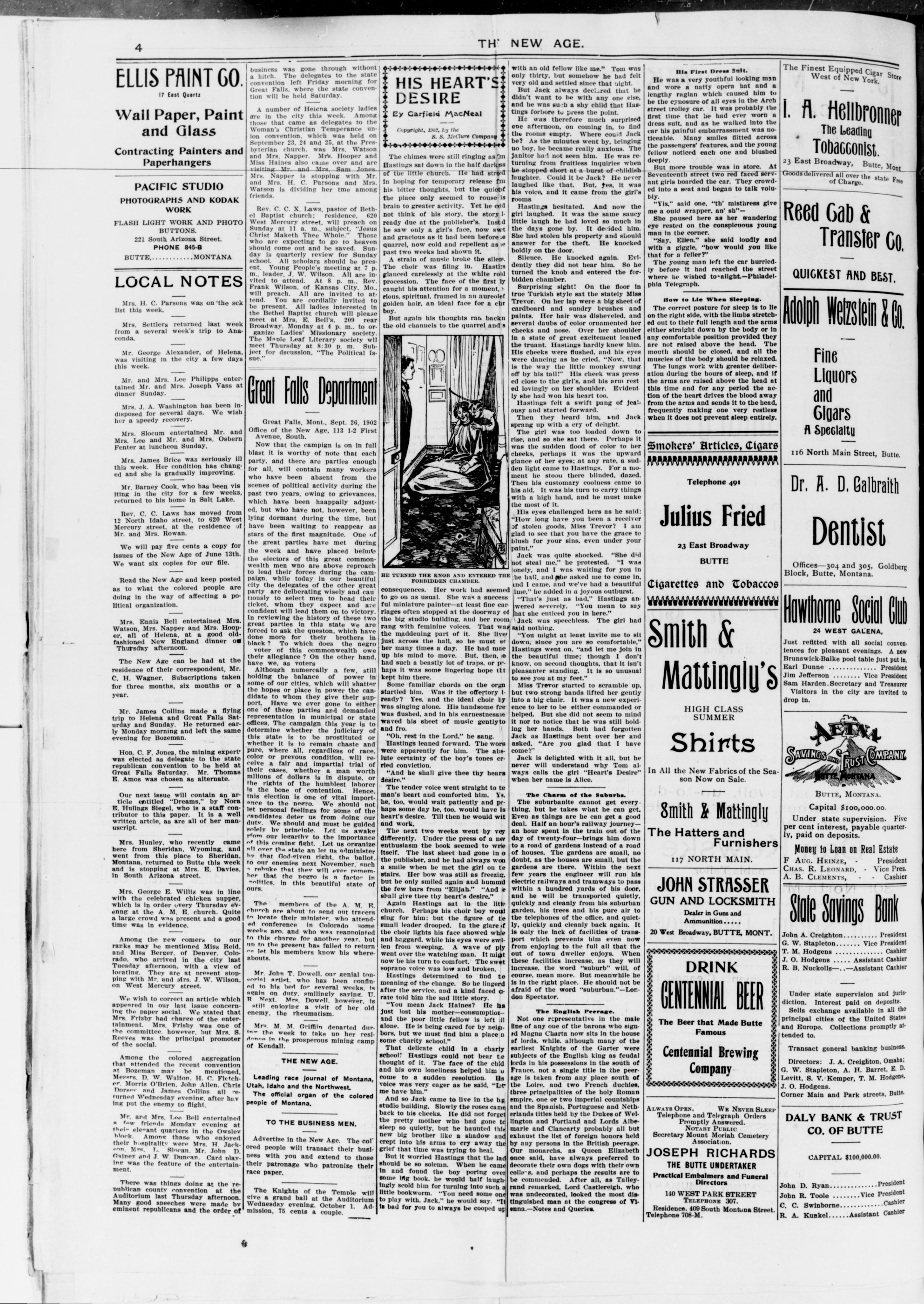
HE TURNED THE KNOB AND ENTERED THE FORBIDDEN CHAMBER.
HE TURNED THE KNOB AND ENTERED THE FORBIDDEN CHAMBER.
consequences. Her work had seemed to go on as usual. She was a success ful miniature painter—at least fine carriages often stopped at the doorway of the big studio building, and her room rang with feminine voices. That was the maddening part of it. She live just across the hall, so he must sit her many times a day. He had mae up his mind to move. But, then, he had such a beastly lot of traps, or perhaps it was some lingering hope ttt kept him there.
Some familiar chords on the orgn started him. Was it the offertory ready? Yes, and the ideal choir by was singing alone. His handsome fee was fushed, and in his earnestness waved his sheet of music gently to and fro.
"Oh, rest in the Lord," he sang.
Hastings leaned forward. The wors were apparently for him. The absolute certainty of the boy's tones eried conviction.
"And he shall give thee thy hears desire."
The tender voice went straight to man's heart and comforted him. Ys, he, too, would wait patiently and perhaps some day he, too, would have is heart's desire. Till then he would wilt and work.
The next two weeks went by very differently. Under the press of a new enthusiasm the book seemed to wriet itself. The last sheet had gone in o the publisher, and he had always won a smile when he met the girl on te stairs. Her bow was still as freezing, but only he smiled again and hummed the few bars from "Elijah." "And e shall give thee thy heart's desire."
Again Hastings sat in the little church. Perhaps his choir boy would sing for him; but the figure of the small leader drooped. In the glare of the choir lights his face showed while and haggard, while his eyes were swollen from weeping. A wave of ploy went over the watching man. It might now be his turn to comfort. The sweet soprano voice was low and broken. Hastings determined to find te meaning of the change. So he lingered after the service, and a kind faced qrate told him the sad little story.
"You mean Jack Halnes? He his just lost his mother—consumption—and the poor little fellow is left all alone. He is being cared for by neighbors, but we must find him a place n some charity school."
That delicate child in a charly school! Hastings could not bear te thought of it. The face of the child and his own loneliness helped him o come to a sudden resolution. His voice was very eager as he said. "Lt me have him."
And so Jack came to live in the big studio building. Slowly the roses came back to his cheeks. He did not forget the pretty mother who had gone to sleep so quietly, but he haunted this new big brother like a shadow and crept into his arms to cry away the grief that time was trying to heal.
But it worried Hastings that the lad should be so solemn. When he came in and found the boy poring over some big book, he would half laughingly scold him for turning into such a little bookworm. "You need some one to play with, Jack," he would say. "It is bad for you to always be cooped up
Ey Garfield MacNeal
with an old fellow like me." Tom was only thirty, but somehow he had felt very old and settled since that night. But Jack always declared that he didn't want to be with any one else, and he was such a shy child that Hastings forbore to press the point. He was therefore much surprised one afternoon, on coming in, to find the rooms empty. Where could Jack be? As the minutes went by, bringing no boy, he became really anxious. The janitor had not seen him. He was returning from fruitless inquiries when he stopped short at a burst of childish laughter. Could it be Jack? He never laughed like that. But, yes, it was his voice, and it came from the girl's rooms.
Hastings hesitated. And now the girl laughed. It was the same saucy little laugh he had loved so much in the days gone by. It decided him. She had stolen his property and should answer for the theft. He knocked boldly on the door. Silence. He knocked again. Evidently they did not hear him. So he turned the knob and entered the forbidden chamber.
Surprising sight! On the floor in true Turkish style sat the stately Miss Trevor. On her lap were a big sheet of cardboard and sunny brushes and paints. Her hair was disheveled, and several daubs of color ornamented her cheeks and nose. Over her shoulder in a state of great excitement leaned the trunt. Hastings hardly knew him. His cheeks were flushed, and his eyes were dancing as he cried. "Now, that is the way the little monkey swung off by his tail!" His cheek was pressed close to the girl's, and his arm rested lovingly on her shoulder. Evidently she had won his heart too. Hastings felt a swift pang of jealousy and started forward.
Then they heard him, and Jack sprang up with a cry of delight.
The girl was too loaded down to rise, and so she sat there. Perhaps it was the sudden flood of color to her cheeks, perhaps it was the upward glance of her eyes; at any rate, a sudden light came to Hastings. For a moment he stood there blinded, dazed. Then his customary coolness came to his aid. It was his turn to carry things with a high hand, and he must make the most of it.
His eyes challenged hers as he said: "How long have you been a receiver of stolen goods, Miss Trevor? I am glad to see that you have the grace to blush for your sins, even under your paint."
Jack was quite shocked. "She did not steal me," he protested. "I was onely, and I was waiting for you in the hall, and she asked me to come in, and I came, and we've had a beautiful time." he added in a joyous outburst. "That's just as bad," Hastings answered severely. "You mean to say that she enticed you in here."
Jack was speechless. The girl had said nothing.
"You might at least invite me to sit down, since you are so comfortable," Hastings went on, "and let me join in the beautiful time; though I don't know, on second thoughts, that it isn't pleasanter standing. It is so unusual to see you at my feet."
Miss Trevor started to scramble up, but two strong hands lifted her gently into a big chair. It was a new experience to her to be either commanded or helped. But she did not seem to mind it nor to notice that he was still holding her hands. Both had forgotten Jack as Hastings bent over her and asked, "Are you glad that I have come?" Jack is delighted with it all, but he never will understand why Tom always calls the girl "Heart's Desire" when her name is Alice.
The Charm of the Suburbs.
The Charm of the Suburbs.
The suburbanite cannot get everything, but he takes what he can get. Even as things are he can get a good deal. Half an hour's railway journey—an hour spent in the train out of the day of twenty-four—brings him down to a road of gardens instead of a road of houses. The gardens are small, no doubt, as the houses are small, but the gardens are there. Within the next few years the engineer will run his electric railways and tramways to pass within a hundred yards of his door, and he will be transported quietly, quickly and cleanly from his suburban garden, his trees and his pure air to the telephones of the office, and quietly, quickly and cleanly back again. It is only the lack of facilities of transport which prevents him even now from enjoying to the full all that the out of town dweller enjoys. When these facilities increase, as they will increase, the word "suburb" will, of course, mean more. But meanwhile he is in the right place. He should not be afraid of the word "suburban."—London Spectator.
The English Peerage.
Not one representative in the male line of any one of the barons who signed Magna Charta now sits in the house of lords, while, although many of the earliest Knights of the Garter were subjects of the English king as feudal lords in his possessions in the south of France, not a single title in the peerage is taken from any place south of the Loire, and two French duchies, three principalities of the holy Roman empire, one or two imperial countships and the Spanish, Portuguese and Netherlands titles held by the Dukes of Wellington and Portland and Lords Albermarle and Clancarty probably all but exhaust the list of foreign honors held by any persons in the British peerage. Our monarchs, as Queen Elizabeth once said, have always preferred to decorate their own dogs with their own collars, and perhaps the results are to be commended. After all, as Talleyrand remarked, Lord Castlereigle, who was undecorated, looked the most distinguished man at the congress of Vienna.-Notes and Queries.
He was a very youthful looking man and wore a natty opera hat and a lengthy raglan which caused him to be the cynosure of all eyes in the Archb street trolley car. It was probably the first time that he had ever worn a dress suit, and as he walked into the car his painful embarrassment was noticeable. Many smiles fitted across the passengers' features, and the young fellow noticed each one and blushed deeply.
But more trouble was in store. At Seventeenth street two red faced servant girls boarded the car. They crowded into a seat and began to talk volubly.
"Yis," said one, "th' mistrust give me a ould wrapper, an' sh"—
She paused here as her wandering eye rested on the conspicuous young man in the corner.
"Say, Ellen." she said loudly and with a giggle, "how would you like that for a feller?"
The young man left the car hurried before it had reached the street where he wished to alight.—Philadelphia Telegraph.
How to Lie When Sleeping.
The correct posture for sleep is to lie on the right side, with the limbs stretched out to their full length and the arms either straight down by the body or in any comfortable position provided they are not raised above the head. The mouth should be closed, and all the muscles of the body should be relaxed. The lungs work with greater deliberation during the hours of sleep, and if the arms are raised above the head at this time and for any period the action of the heart drives the blood away from the arms and sends it to the head, frequently making one very restless when it does not prevent sleep entirely.
Smokers' Articles, Cigars
Telephone 491
Julius Fried
23 East Broadway
BUTTE
Cigarettes and Tobaccos
Smith & Mattingly's
HIGH CLASS
SUMMER
Shirts
In All the New Fabrics of the Seas-
son Now on Sale.
Smith & Mattingly
The Hatters and
Furnishers
117 NORTH MAIN.
JOHN STRASSER
GUN AND LOCKSMITH
Dealer in Guns and
Ammunition.....
20 West Broadway, BUTTE, MONT.
DRINK
CENTENNIAL BEER
The Beer that Made Butte
Famous
Centennial Brewing
Company
ALWAYS OPEN. WE NEVER SLEEP
Telephone and Telegraph Orders
Promptly Answered.
NOTARY PUBLIC
Secretary Mount Moriah Cemetery
Association.
Practical Embalmers and Funeral Directors
140 WEST PARK STREET
TELEPHONE 307.
Residence. 409 South Montana Street.
Telephone 708-M.
The Finest Equipped Cigar Store
West of New York.
I. A. Hellbronner
The Leading
Tobacconist.
23 East Broadway, Butte, Mont
Goods delivered all over the state Free
of Charge.
Reed Gab & Transfer Co.
QUICKEST AND BEST.
Adolph Wetzstein & Co.
Fine
Liquors
and
Gigars
A Specialty
116 North Main Street, Butte
Dr. A. D. Galbraith
Dentist
Offices—304 and 305, Goldberg Block, Butte, Montana.
Hawthorne Social Club
24 WEST GALENA,
Just refitted with all social conveniences for pleasant evenings. A new Brunswick-Balke pool table just put in.
Earl Dunne ..... President
Jim Jefferson ..... Vice President
Sam Harden. Secretary and Treasurer
Visitors in the city are invited to drop in.
AETNA
SAVINGS AND TRUST COMPANY
UNITED HORTANA
Under state supervision. Five
per cent interest, payable quarter-
ly, paid on deposits.
Money to Loan on Real Estate
F AUG. HEINZE, - President
CHAS. R. LEONARD, - Vice Pres.
A. B. CLEMENTS, - Cashier
State Savings Bank
John A. Creighton..... President
G. W. Stapleton..... Vice President
T. M. Hodgens..... Cashier
J. O. Hodgens..... Assistant Cashier
R. B. Nuckolls..... Assistant Cashier
Under state supervision and jurisdiction. Interest paid on deposits. Sells exchange available in all the principal cities of the United States and Europe. Collections promptly attended to.
Transact general banking business.
Directors: J. A. Creighton, Omaha;
G. W. Stapleton, A. H. Barret, E. D. Levitt, S. V. Kemper, T. M. Hodgens,
J. O. Hodgens.
Corner Main and Park streets, Butte
DALY BANK & TRUST CO. OF BUTTE
CAPITAL $100,000.00.
John D. Ryan.....President
John R. Toole .....Vice President
C. C. Swinborne.....Cashier
R. A. Kunkel.....Assistant Cashier