The Monitor
Saturday, August 21, 1915
Omaha, Nebraska
Page text (machine-generated)
THE MONITOR
A Weekly Newspaper Devoted to the Interests of the Eight Thousand Colored People in Omaha and Vicinity, and to the Good of the Community
```markdown
```
$1.00 a Year. 5c a Copy.
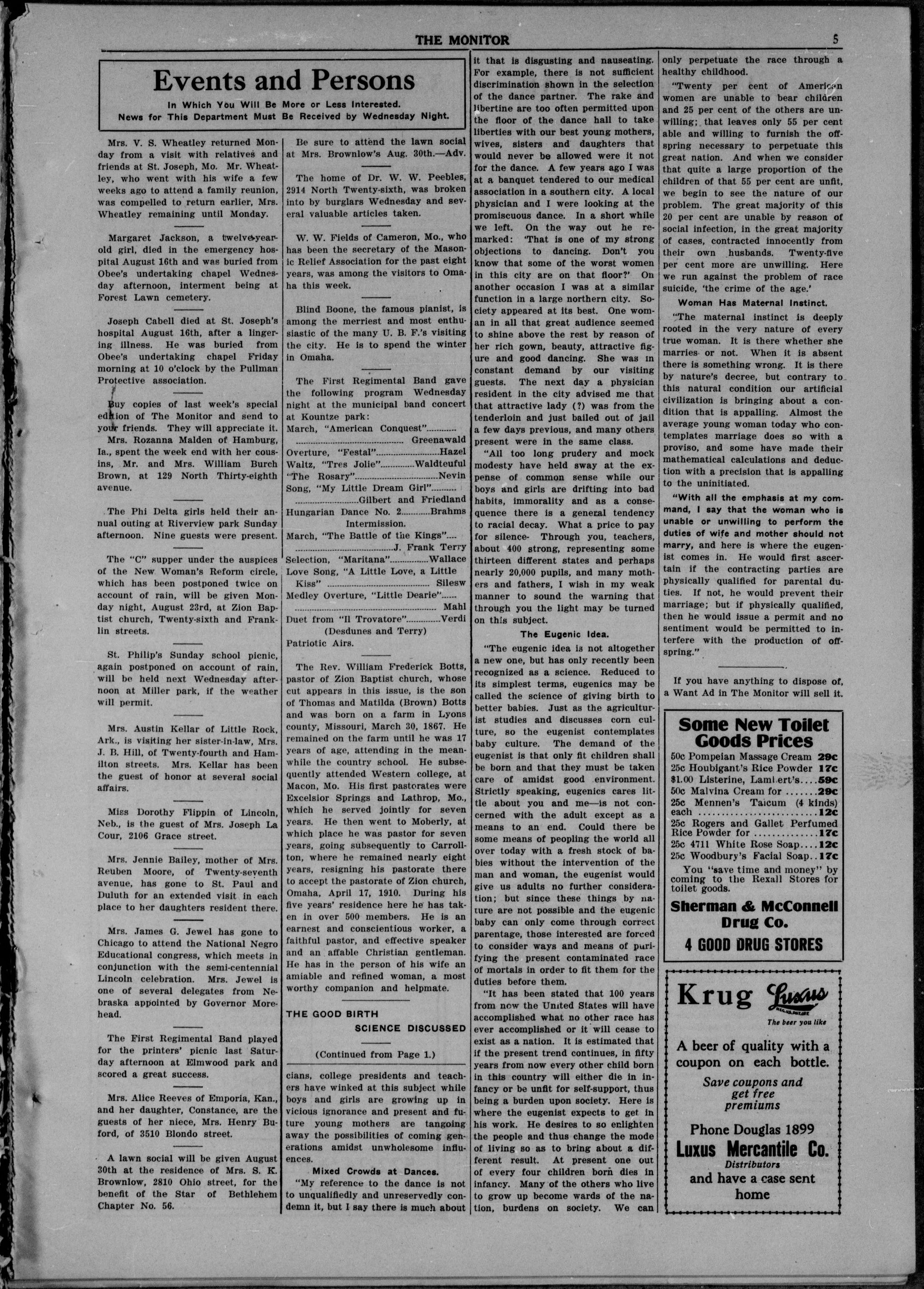
United Brothers of Friendship Pleased
Forty-Fifth Annual Session of the Grand Lodge Held Here Most Successful in Its History.
WARMLY WELCOMED BY MAYOR
A Well Arranged Program Carefully Carried Out—Interest Centered in Election of Officers.
"This city excels all places in which our Grand Lodge has ever met in the accommodations provided for us in this magnificent building, in the completeness of arrangements, in courteous attention and warm hospitality and your mayor made the best welcoming speech I have ever heard, and I've heard a great many, and what pleases me more is the fact that I believe his words come from his heart and are backed up by his actions," said Captain C. H. Tandy of St. Louis, Mo., the oldest member of the order, when asked by The Monitor for an expression of opinion on the convention now being held in Omaha. He added: "You have a beautiful city; and this court house is magnificent. I'm not covetous, but I wish we had one like it in St. Louis."
Equally enthusiastic were the words of Dr. Caston, the distinguished grand master of the order, also a resident of St. Louis, who said:
"This is one of the mose excellent meetings we have ever had; in fact, in my judgment, it goes beyond anything we have ever had, as to meeting place, hospitality and uniform courtesy from black and white alike. Our reception in this city city speaks volumes for your citizenship. it proclaims the type of leadership you have here. In visiting the average northern or western city, I don't have to enter a single Negro home to tell the character of colored people of that place. The manner in which I am treated in the stores and business houses tells me the kind of Negroes who live in that town. Omaha has a fine type of citizenship. You have a city to be proud of and the members of our order will never forget Omaha." The Hon. Nelson Crews of Kansas City, Mo., said he could not find words to express his sentiments. He said:
"There may be other cities in the United States that would do it, but I don't know where they are, that would light the city's welcome arch in honor of a Negro organization as Omaha has done. That act alone manifests a liberal spirit that moves me deeply and makes me thank God and take courage. Such a spirit as that will make Omaha great, as she richly deserves to be."
These expressions voice the unanimous sentiment of hundreds of delegates and visitors attending the forty-fifth annual session of the grand lodge of the United Brothers of Friendship and the thirty-second annual grand
The Rev. JOHN ALBERT WILLIAMS, Editor
Omaha, Nebraska, August 21, 1915
Think on These Things
If any little love of mine
May make a life the sweeter,
If any little care of mine
May make a friend's the fleeter,
If any lift of mine may ease
The burden of another,
God give me love and care and strength
To help a toiling brother.
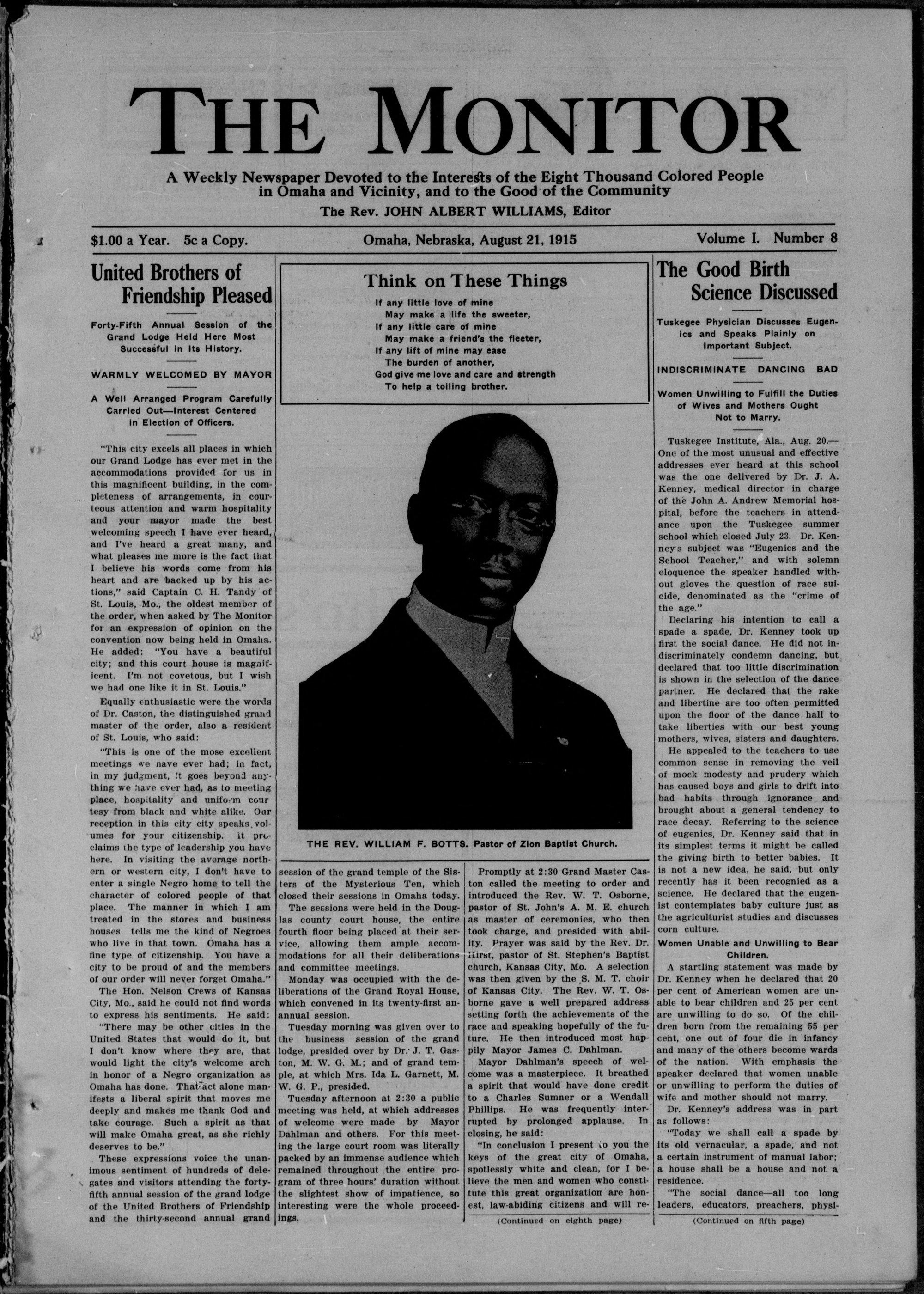
THE REV. WILLIAM F. BOTT
WILLIAM F. BOTTS. Pastor of Zion Baptist
THE REV. WILLIAM F. BOTTS. Pastor of Zion Baptist Church.
session of the grand temple of the Sisters of the Mysterious Ten, which closed their sessions in Omaha today. The sessions were held in the Douglas county court house, the entire fourth floor being placed at their service, allowing them ample accommodations for all their deliberations and committee meetings. Monday was occupied with the deliberations of the Grand Royal House, which convened in its twenty-first annual session. Tuesday morning was given over to the business session of the grand lodge, presided over by Dr. J. T. Gaston, M. W. G. M.; and of grand temple, at which Mrs. Ida L. Garnett, M. W. G. P., presided.
Tuesday afternoon at 2:30 a public meeting was held, at which addresses of welcome were made by Mayor Dahlman and others. For this meeting the large court room was literally packed by an immense audience which remained throughout the entire program of three hours' duration without the slightest show of impatience, so interesting were the whole proceedings.
---
Pastor of Zion Baptist Church.
Promptly at 2:30 Grand Master Caston called the meeting to order and introduced the Rev. W. T. Osborne, pastor of St. John's A. M. E. church as master of ceremonies, who then took charge, and presided with ability. Prayer was said by the Rev. Dr. Hirst, pastor of St. Stephen's Baptist church, Kansas City, Mo. A selection was then given by the S. M. T. choir of Kansas City. The Rev. W. T. Osborne gave a well prepared address setting forth the achievements of the race and speaking hopefully of the future. He then introduced most happily Mayor James C. Dahlman. Mayor Dahlman's speech of welcome was a masterpiece. It breathed a spirit that would have done credit to a Charles Sumner or a Wendall Phillips. He was frequently interrupted by prolonged applause. In closing, he said:
"In conclusion I present to you the keys of the great city of Omaha, spotlessly white and clean, for I believe the men and women who constitute this great organization are honest, law-abiding citizens and will re-
(Continued on eighth page)
Volume I. Number 8
The Good Birth Science Discussed
Tuskegee Physician Discusses Eugenics and Speaks Plainly on Important Subject.
INDISCRIMINATE DANCING BAD
Women Unwilling to Fulfill the Duties of Wives and Mothers Ought Not to Marry.
Tuskegee Institute, Ala., Aug. 20. One of the most unusual and effective addresses ever heard at this school was the one delivered by Dr. J. A. Kenney, medical director in charge of the John A. Andrew Memorial hospital, before the teachers in attendance upon the Tuskegee summer school which closed July 23. Dr. Kenney's subject was "Eugenics and the School Teacher," and with solemn eloquence the speaker handled without gloves the question of race suicide, denominated as the "crime of the age."
Declaring his intention to call a spade a spade, Dr. Kenney took up first the social dance. He did not indiscriminately condemn dancing, but declared that too little discrimination is shown in the selection of the dance partner. He declared that the rake and libertine are too often permitted upon the floor of the dance hall to take liberties with our best young mothers, wives, sisters and daughters.
He appealed to the teachers to use common sense in removing the veil of mock modesty and prudery which has caused boys and girls to drift into bad habits through ignorance and brought about a general tendency to race decay. Referring to the science of eugenics, Dr. Kenney said that in its simplest terms it might be called the giving birth to better babies. It is not a new idea, he said, but only recently has it been recognised as a science. He declared that the eugenist contemplates baby culture just as the agriculturist studies and discusses corn culture.
Women Unable and Unwilling to Bear Children.
A startling statement was made by Dr. Kenney when he declared that 20 per cent of American women are unable to bear children and 25 per cent are unwilling to do so. Of the children born from the remaining 55 per cent, one out of four die in infancy and many of the others become wards of the nation. With emphasis the speaker declared that women unable or unwilling to perform the duties of wife and mother should not marry.
Dr. Kenney's address was in part as follows:
"Today we shall call a spade by its old vernacular, a spade, and not a certain instrument of manual labor; a house shall be a house and not a residence.
"The social dance—all too long leaders, educators, preachers, physi-
General Race News
2
Lawrenceville, Va.—The eleventh annual session of the St. Paul Farmers' Conference at the St. Paul Normal and Iudustrial school was full of interest. The conference is an organization of 2,000 Negro farmers and workers of Brunswick county, organized and fostered by the school for the purpose of social, material, moral and religious uplift.
The conference gives attention to such practical and helpful things as better methods of farming, better homes, increasing the length of the school term by local self-taxation, buying land, and maintaining helpful relations between the races. The county is divided into conference communities corresponding to the schools and representatives from these are asked to report upon community conditions. There are fourteen questions asked embracing such subjects as the school, the home, neighborhood morals, amount of money raised by extending school terms, number of acres of land bought, number of newly built houses, or remodeled, repaired, painted or whitewashed; whether frame or log, number of rooms and upon the crop increase, or decrease of acreage, soil improvement, giving of crop liens, growing corn, raising hogs, chickens, stock, production of milk, butter, etc.
Negroes Own Property Worth $600 000
Replies show that thirty-five new houses had been built at a cost of from $400 to $1,200 and others remodeled, repaired and painted. Over 1,000 acres of land purchased since last conference, two new schoolhouses built by co-operative effort, $500 raised to extend the school term one month, $1,600 raised by subscription or paid in cash for prospective new schools or for various school improvements such as new desks, industrial material, etc. In the matter of food supplies the questions brought out that more farmers were attempting to raise food for themselves and stock, more hogs being raised and the acreage in corn practically doubled. As to the money crops, tobacco, cotton and peanuts still hold first place, but more farmers are getting away from the strictly money crops and are diversifying their farming.
The president's address showed that the Negroes of the county, according to the auditor's report, owned a fraction less than 60,000 acres of land, valued with the houses thereon at nearly $600,000, and that their real and personal property was assessed with taxes amounting to a little over $6,000.
The women's conference took place on the second day. This is an organization of the mothers, farmers' wives and daughters of the county which meets with the conference, giving attention to matters of the home, the garden, vegetables, sanitation and making farm life conditions more tolerable. Their work through the various mothers' clubs of the country has done much to improve the status of women and elevate the sanctity of the home.
MEN OF 25TH INFANTRY
Schofield Barrack, Honolulu, H. T. The soldiers of the Twenty-fifth in-
THE MONITOR C. P. Wesin Grocery Co.
C. H. MARQUARDT CASH MARKET
W. C. Bullard Paul Hoagland D. P. Benedic
BRAMBLETT ENGRAVING CO Acid blast
Who's
fantry, United States army, stationed at this point, will not stand for the presentation of any play or picture film in the barracks' amusement hall which reflects upon the Negro race. This was shown on the night of June 8, when a picture play called "James Kirby" was put upon the screen.
Advertised as one of the best pictures ever on the island, the play drew a large audience of officers and enlisted men. But with the flashing of the first scene trouble began. The film was staged in the South and the theme harked back to slavery days. It showed the young Negro girls being handled by the slave owners and traders, and when the soldiers saw that the house was thrown into an uproar. From every section came the cry. "Cut it out-"
Film Causes Outbreak of Men.
There are several officers in the regiment who do not share in the southerner's prejudice against the Negro, and they showed their objections to the photoplay by leaving the hall as soon as the character of the picture was discovered. Their leaving was taken as a cue and half of the audience filed out, also.
As soon as the men reached the outside the rocks began to fly. The roof of the hall was bombarded to such an extent that officers had to order the stopping of the play. This is the third incident of the kind in the past six months.
Recently a local show came out to the barracks from Honolulu and put on a play called "Down in Dixie." Only the most strenuous efforts on the part of the officers prevented a riot and the mobbing of the players. The actors were glad to get back to Honolulu.
The men have let it be known on a number of occasions that while amusements are desired, nothing will be tolerated that reflects in the slightest degree on the Negro race. Some of the officers claim that the trouble is caused by some of the recruits, but this is not borne out by the facts. Every member of the Twenty-fifth infantry resents such pictures and plays.
NATIONAL TRAINING
SCHOOL WANTS GIRLS
Washington, D. C.-The National Training School for Women and Girls, Miss Nannie H. Burroughs, president, Lincoln Heights, Washington, D. C., is offering special inducements to 100 exceptional girls who want to become proficient in some profession or trade. Good positions are gotten for girls completing satisfactorily the commercial course, printing, social service and domestic science and arts.
Courses offered at the school are domestic science and arts, literary training, fourth grade through normal, commercial, printing, social service, dressmaking, basketry, public speaking, gardening, poultry raising, millinery, music, hairdressing, manicuring, massaging, laundering and housekeeping.
Miss Burroughs, in her announcement, asks that healthy, promising girls, with faith in themselves and a desire to be molded into great and good women, be sent to her. Girls not wanted are those who have been misfits and failures in other schools, or who have been sent to a new school every year.
Who's Your Cleaner?
We have oft times been asked, "who's your doctor" or "who's your grocer"—now have you ever been asked, "who's your cleaner." No doubt you have. An exchange of confidence has oft times revealed that a garment mistaken for new has simply been cleaned by us. We guarantee satisfaction.
Telephone Douglas 1521---Ask for Service Dept.
J. L. PETTEYS, Mgr.
Fruits and Vegetables
2005 Cuming St. Tel. D. 1098
Retail Dealer in Fresh and Salt Meats,
Poultry, Oysters, etc.
2003 Cuming St. Doug. 3834
Home Rendered Lard. We Smoke
and Cure our own Hams and Bacon
Bullard, Hoagland & Benedict
LUMBER
Office, 20th and Izard Sts.
Phone Doug. 478 Omaha, Neb.
Have your shoes shined right at The Daisy Boot Black Parlor 309 So. 15th Street (Opposite Beaton Drug Co ) Open Wednesday, August 11th
1311 Howard St. Omaha, Neb.
Phone Douglas 1521
ORRIE S. HULSE
Harney 6257
C. H. T. RIEPEN
Harney 5564
HULSE & RIEPEN
Funeral Directors
Doug. 1226
701 So. 16th St.
F. J. THOMPSON'S BOOT BLACK PARLOR
We also save you 30 per cent on laundry. After August 1st, manufacturers and jobbers of boot black supplies and everything pertaining to the trade. Wholesale and retail. Free employment agency for barber shop porters. Special attention to all kinds of ladies' shoes. Give us a trial.
GETTEN IT AT GETTEN'S
Saves You Money All the Time
35c Cas'oria.....21c
50c Laxative Fig Syrup.....29c
25c Sloan's Liniment.....17c
250 Packers Tar Soap.....16c
350 Daggert & Ransdell's Cold Cream.....24c
25c Palmer's Skin Success.....19c
50c Getten's Bitter Monic.....39c
We serve and deliver double whipped cream ice cream and we are Getten famous on account of this famous delicacy.
GETTEN
Cut Price
Drug Store
16th and Howard Phone D. 846
Free Delivery
Is Your
er?
has been asked,
tor" or "who's
now have you
, "who's your
boubt you have.
confidence has
ed that a gar-
n for new has
ned by us. We
ction.
he "Twin"
--Ask for Service Dept.
Dye &
Works Co.
407 So.
15th St.
Opposite the
Orpheum
HED 1889
News of the Churches and Religious Topics
```markdown
```
Directory.
Baptist—
Mt. Moriah—Twenty-sixth and Seward streets. The Rev. W. B. M. Scott, pastor. Services: Sunday School, 9:30 a. m.; preaching, 11 a. m. and 8 p. m.; B. Y. P. U. at 6 p. m.
Zion—Twenty-sixth and Franklin (temporary location). The Rev. W. F. Botts, pastor; residence, 2522 Grant street. Telephone Webster 5838. Services: Devotional hour, 10:30 a. m.; preaching, 11 a. m.; Sunday School, 1 to 2 p. m.; pastor's Bible class, 2 to 3 p. m.; B. Y. P. U., 6:30 p. m.; choir devotion, 7:30 p. m.; preaching 8 p. m.
Episcopal—
Church of St. Philip the Deacon Twenty-first near Paul street. The Rev. John Albert Williams, rector. Residence, 1119 North Twenty-first street. Telephone Webster 4243. Services daily at 7 a. m. and 9 a. m. Fridays at 8 p. m. Sundays at 7:30 a. m., 11 a. m. and 7:30 p. m. Sunday School at 12:45 p. m.
Methodist
St. John's A. M. E.—Eighteenth and
Opinions of Readers On Effect of the Lynching of Frank
The Monitor submitted the following question to several of our readers: "WHAT EFFECT, IF ANY, IN YOUR OPINION, WILL THE LYNCHING OF LEO FRANK HAVE UPON THE SUPPRESSION OF MOB VIOLENCE AGAINST NEGROES?" Here are the replies received:
Will Increase Sentiment Against.
To the Editor of the Monitor: The question is asked as to what effect the lynching of Leo Frank will have upon the public?
I am of the opinion that it will have a decided effect in the future, for many defenseless men and women of the Negro race have been taken from their homes on a slight pretense or a mere suspicion by mobs and hanged or burned at the stake and scarcely a word has been said against it, while the lynching of Frank, having aroused public opinion as never before, will create an adverse public sentiment which is the only remedy to prohibit lynching.
The newspapers all over the country are writing editorials condemning mob law. The Omaha Bee has written a strong editorial on the cowardly lynching of Frank by the Georgia mob and it states that it is one of the most flagrant outrages ever perpetrated by the incitement of passion and prejudice, causing a shudder in the breast of every right minded person. I think the only way in which it can be stopped is by public sentiment.
No race of people has suffered more at the hands of the lawless element than the Negro and I believe the day is not far distant when the more intelligent people of this country will take it up and put a stop to such lawlessness, for as law-abiding citizens we should stand by the decision of the courts.
Respectfully,
M. F. SINGLETON.
1428 No. Twenty-second Street.
THE MONITOR
Webster streets. The Rev. W. T. Osborne, pastor. Residence, 613 North Eighteenth street. Telephone Douglas 5914. Services: Sunday, 11 a. m. and 8 p. m., preaching; 12 noon, class; 1:15 p. m., Sunday School; 7 p. m., Endeavor; Wednesday, 8 p. m., prayer and class meetings. Everybody made welcome at all of these meetings.
Bethel—Twenty-ninth and T streets South Omaha. The Rev. J. C. Brown, pastor, residence 467 South Thirty-first street. Services, Morning, 11; evening, 7:30; Sunday School 1 p. m.; B. Y. P. B., 6:30 p. m.; praise service,
Grove M. E.—Twenty-second and Seward streets. The Rev. G. G. Logan, pastor. Residence, 1628 North Twenty-second street.
Allen Chapel, A. M. E., 181 South Twenty-fifth street, South Omaha. The Rev. Harry Shepherd, pastor. Residence, 181 South Twenty-fifth street. Services: Preaching, 11 a. m.; Sunday School, 1:30 p. m.
Should Pray for Rright-Minded Men. To the Editor of the Monitor: The people of the South have sown lawlessness and it is bearing fruit. Women and children have witnessed with evident delight the awful sight of lynching Negroes. Such things have gone on from time to time and the country has given little heed while one class has been bearing most of the suffering. This evil is now spreading to others and we cannot tell where it is going to stop; but we as a race must not and will not exult over the fact that it is spreading to others. We should be filled with pity and sorrow and earnestly pray for right-thinking men to lead our country into higher paths.
Editor of The Monitor: "What effect, if any, will the lynching of Leo Frank have upon the supression of lynch law in the South?"
In my opinion that is a question which only time can answer.
No doubt the entire world believes Frank guilty of that vicious crime. But, though he be guilty, is murder legal, or otherwise, even justifiable in the sight of the Divine Creator, who has commanded, "Thou shalt not kill"?
As I was once a resident of Georgia, and was teaching in one of the universities of Atlanta during the year in which the most brutal race riot this country has ever experienced transpired, I know by experience and observation what a spirit of brutality a frenzied Georgia mob can cultivate.
I argued to myself before reading the remarks made by the mayor of Atlanta before the California state assessors, that there might eventually be some hope for absolute abandonment of lynch law in Georgia, and finally some of the other southern states; but after reading the speech made by the chief executive of the city of Atlanta, the man chosen by the people to represent their local commonwealth, I have decided that it is a question of much conjecture.
Baptist—
MARY L. GOODCHILD.
3640 Prairie Avenue,
Chicago, Ill.
The Effect Doubtful.
But as the white people of the great city of Atlanta have manifested by the lynching of Frank that lynch law is not for the Negro alone accused of the unmentionable crime, I am at times inclined to view it optimistically and feel that eventually the law may some time in the far distant future be abolished.
Yet Frank was a Jew. Would the peaceable, law-abiding citizens of Atlanta have applied the same law to an Anglo-American?
Let us be thankful that the crime was not entirely put upon the Negro implicated.
Mayor Woodward of Atlanta is quoted as saying: "Georgia is the leading state of the South. Its people cannot be classed with tramps, hoodlums, bandits and law breakers."
If the chief executive of the city of Atlanta does not view the members of a mob as bandits and law breakers, and if he expresses the opinions of the best citizens of the entire South, then only divine interference can destroy and eradicate the lynch law which seems to be the most popular law of the entire South.
J. ALICE STEWART.
Mr. Editor: You have asked me what effect in my opinion will the lynching of Leo M. Frank have on the future acts of mobs. In answer I will say it will be stimulating unless every member of that mob is apprehended and the dignity of the law vindicated by their open trial, conviction and punishment by the constituted authority of the state of Georgia.
Now, sir, it must be understood that it is not the courts that will furnish the remedy, it must be the healthy education of public opinion.
JOS. CARR.
The murder or lynching of Leo M. Frank August 17, 1915, adds another dark page of history to the proud state of Georgia. Not only is it a disgrace to the state of Georgia, but it is a blot on the history of the United States, and a crime against civilization.
Notwithstanding the great amount of publicity given this atrocious crime, it is no more heinous than the murder of any other man. When a Negro is lynched it brings the same amount of disgrace upon the community or commonwealth as when a white man is dealt with in the same manner. The color of the skin does not make any difference, it is a life sacrificed to the savage propensities of a supposed civilized people.
If the law is enforced and the murderers of Leo M. Frank are dealt with as they should be, it will have a tendency to lessen the desire for law violation in the south land. The Negro especially will be more safe and secure, because if a number of lynchers or murderers are dealt with according to law, it will break up the mob spirit. The reason why this disgraceful practice has been allowed to flourish is because heretofore the participants have been immune from punishment; but if justice is once dealt out to the guilty ones, it will strike a death blow to the hydra-headed monster lynch law, from which it will never recover.
AMOS P. SCRUGGS,
Attorney.
Editor Monitor:
A great blot, this time so large and conspicuous from its blackness to be seen by the world, has been spattered upon the state of Georgia in the lynching of Leo M. Frank. (Continued on fourth page)
3
Stand Phone, Doug. 3724 Call Doug. 1491
Res. Phone, Doug. 2378 From 1 a. m. to 5 a. m.
For service and safety call
BOB ROBINSON
and his 7-passenger Abbott car
Stand
Jack's Buffet
111 So. 14th St.
A. CHISLEY & CO.
Hot and Cold Baths Cigars and Tobacco 1320 North 24th Street
HOTEL CUMING
Diamond R Billiard Hall and Barber Shop in Connection
1916-18 Cuming St.
D. G. RUSSELL, Prop.
J. D. LEWIS
Auto for Hire
Special attention to private parties
Special prices
PHONES:
7 p. m. to 11:55, Williamson, Terrill Drug Co., Web. 4443
12:05 p. m. to 5 a. m., Midway Doug. 1481-3459
5 a. m. to 7 p. m. Residence Web. 7681
Have your voice trained by a singer
MR. J. A. HILL
Teacher
Studio
2606 Seward St.
Phone
Webster 4490
Res. Phone Web. 4831 Office Doug. 4287 AMOS P. SCRUGGS Attorney-at-Law 220 South 13th Street (Over Pope's Drug Store) Omaha, Neb.
ASK FOR
Metz
OMAHA'S FAVORITE
BEER
THE BEER OF QUALITY
Let the Monitor Do Your Job Printing
Your search for Good Shoe Repairing has ended when you try
H. LAZARUS
Work done while you wait or will call for
and deliver without extra charge.
Red 2395 2019 Cumings
Phone South 701 Phone Webster 4829
Floral Designs for All Occasions
F. H. SWANSON
FLORIST
Cut Flowers and Potted Plants
Office, 532 N. 24th St. Greenhouse, 1418 N. 18th St.
South Omaha Omaha
Phone Douglas 1652
W. J. CATTIN CO.
PLUMBING AND
STEAM FITTING
910 No. 24th St. Omaha, Neb.
---
ee
A. Weekly Newspaper devoted to the civic, social and religious
interests of the Colored People of Omaha and vicinity, with the desire
to contribute something to the general good and upbuilding of the
community.
Published Every Saturday.
sche anni eS
Entered as Second-Class Mail Matter July 2, 1915, at the Post-
office at Omaha, Neb., under the act of March 3, 1879.
‘eticbuialiaineaaeeilotpaiamretirnenielcliiihetaenapninrnennsini ischiaiidineasaletedatiiatls
THE REV. JOHN ALBERT WILLIAMS, Editor and Publisher.
Lucille Skaggs Edwards, William Garnett Haynes and Ellsworth W.
Pryor, Associate Editors.
Joseph LaCour, Jr., Advertising and Circulation Manager.
SUBSCRIPTION RATES, $1.00 per year.
Advertising rates, 25 cents an inch per issue.
Address, The Monitor, 1119 North Twenty-first street, Omaha.
4
THE LYNCHING OF FRANK.
The lynching of Frank has riveted
the eyes of the world again not only
upon Georgia, but upon the United
States of America. Georgia is notor-
ious for her lawlessness. Others of
the southern sisterhood of states
share with Georgia her unenviable
reputation. But the reproach of lynch
law, the shameful disgrace of wan-
ton, wilful murder by mobs cannot
rest alone* upon any one section of
our common country but upon the
whole nation. If the union be one
and inseparable, as we hold in theory,
if not in practice, it is one body hav-
ing many members and if one mem-
ber suffer all the members suffer with
it. In Georgia’s disgrace Nebraska
is disgraced because she, too, is one
of Columbia’s children. For weal or
for woe, for better, for worse, the
family tie binds the several states of
the American commonwealth togeth-
er. Lawlessness in any part of the
United States should be felt as a re-
proach to all and each one should do
all in his power to create such a
righteous public sentiment that no
place shall be left among us for vic-
jousness of life either individual or
corporate.
What has happened in Georgia has
happened and can happen anywhere
else in this country. Pennsylvania
not many years ago witnessed a sim-
ilar scene. A younded man, sick nigh
unto death, was burned at the stake;
but he was only an insignificant black
youth, charged with a crime, not giv-
en a chance for a hearing. Who has
forgotten the ghoulish glee with
which Alexander was given to the
flames in Leavenworth, Kas., a few
years ago? Who can forget the hor-
rors of Springfield, Il, or of Spring-
field, Ohio; to say nothing of Atlanta,
and Paris, and Temple, Texas, and the
thousands of victims throughout the
South—men, women and children,
who, without trial, have been sent un-
shriven out of this world by blood-
thirsty mobs of “the superior race?”
But the victims were black. It mat-
tered little. The attitude of the coun-
try has been acquiescent, apathetic or
indifferent. Few condemned; many
condoned and excused. National in-
difference to lynching of Negroes is
directly responsible for the lynching
of Leo Frank, which the press of the
country condemns. Had the press and
pulpit of this country been uncompro-
mising in its denunciation of mob vio-
lence for the past twenty-five years,
instead of so apathetic and apologetic,
a sentiment would have been created
that would have made such a crime as
this almost impossible even in the
South. :
Race hatred is deep upon the part
of many Caucasians against the dark-
er races or races other than their
own. It is constantly coming to the
fore. It is frequently manifested. It
THE MONITOR
is the one dead fly in the ointment of
the apothecary. Whether he was in-
nocent or guilty, no one can deny that
race prejudice was strong against Leo
Frank, because he was a Jew.
Belonging, as we do, to a race that
suffers from the same unreasoning,
blighting prejudice, we can but hope
that Americans of all classes may be
so aroused by the lynching of Frank
that they will earnestly endeavor to
cultivate that charity and good will
towards all men- that America may
become a synonym for kindly, just und
sympathetne brotherhood. We hope
that it may show the country the vol-
canic danger of race prejudice and
raise us all above its soul-destroying
manhood-blighting degradation.
eakiclilia aati
THE IMPRESSION MADE BY THE
U. B. OF F. AND S. OF M. T.
No one who attended the public ses-
sions of the Grand Lodge of the U. B.
of F. and the S. of M. T. could not but
be impressed with the dignity, intelli-
gence and dispatch with which their
work was marked and with the cali-
bre and character of the men and the
women who constitute the member-
ship of that strong and influential or-
ganization. In the wonderful growth
and efficiency of the order one must
admire the wisdom in which it was
conceived and acknowledge the race’s
ability for successful and efficient or-
ganization which it attests. It is a
race organization pure and simple,
conceived and brought into being by
colored men and brought to its high
plane of excellence and efficiency by
colored men and women. With a na-
tional membership of 1,000,000, with
a well-filled treasury paying annually
thousands of dollars in insurance and
sick benefits, insisting upon temper-
ance and good character in its mem-
bers, boldly maintaining that its mem-
bers must be men and women of Chris-
tian character, one can conceive what
an immense power for good and racial
uplift this organization is. We are
glad this organization has met in Om-
aha for it has brought a message of
hope and inspiration and given us a
wider vision and broader sympathies.
We are glad to know that as our
guests they carry away most kindly
thoughts and pleasant memories of
their sojourn in Omaha, the gateway
to the golden west. Omaha has never
entertained a more worthy body of
earnest, purposeful men and women
than the Grand Lodge of U. B. of F.
and 8. of M. T. of Missouri and its
jurisdiction. Come again, a cordial
welcome awaits you.
The projected government railway
for Alaska, which is to run from Se-
ward to Fairbanks, a distance of 412
miles, will be a great factor in simpli-
fying and developing our missionary
work there, It will open up also the
resources of the country and greatly
mitigate some of its difficult condi-
tions,
Science Notes
BY WILLIAM G. HAYNES.
In the current Scientific American
there appears an article of much in-
terest concerning a mechanical eye,
technically known as the phonopticon.
The purpose of the apparatus is to
enable the blind to read books, pa-
pers, magazines and other literature
that is not open to them for reasons
that are obvious.
‘The basis of the mechanism is the
rare element, selenium, and a brief
description of this substance is nec-
essary for a clear understanding of
the phonopticon. Selenium is a sub-
‘stance that occurs with and some-
what resembles sulphur in its prop-
erties. Its most curious and impor-
tant property is its ability to allow
the passage of an electric current
through it in proportion to the amount
of light that falls upon the selenium.
In that respect it acts as a connecting
link between light and electricity.
It is this characteristic that is used
to advantage in the phonopticon. The
mechanical eye is a box-like arrange-
ment having a small opening on the
under side. In operation, this open-
ing passes over the printed -letters
on the page of a book, for instance,
and in such a manner that one let-
ter is exposed at a time. A small
beam of light is made to fall upon
the letter as the “eye” passes over
it, and the reflections from the dif-
ferent portions of the letter, in pass-
ing, in turn affect the crystals of
selenium placed within the box.
Now let’s go to the operator a
minute, During this time, the blind
person has a receiver at his ear, this
receiver being practically the same
as a telephone receiver. Before the
“eye” reaches a letter the operator
can hear only a musical sound of a
certain pitch, but as soon as the “eye”
reaches part of a letter the pitch
changes and continues to vary until
the letter passes the small hole in
the bottom of the box. The change
of pitch is due to the change in the
quantity of electric current, and the
change in the current is directly due
to the amount of light acting upon
the selenium crystals.
Each different letter therefore has
a characteristic change of pitch and
enables the blind to “read with their
ears.”
The phonopticon was devised by
Dr. F. C. Brown of the State Univer-
sity of Iowa, and was exhibited at
San Francisco. It is estimated that
in two months’ time a blind person
of average ability can learn to read
with this instrument.
COLOR OF OUTER GARMENTS.
The amount of heat which a fab-
ric will absorb when in the sun is
influenced by the color and not by
the material or the weave—that is,
assuming that the cloth is dry.
Laveran noticed that a thermometer
wrapped in white cloth and exposed
to the sun’s rays rose to 89 3-5. One
wrapped in black cloth and exposed
near by under other conditions ex-
actly the same rose to 107 3-5. Har-
vard records the following observa-
tions: A thermometer wrapped in
olive drab cloth went from 93, the
temperature of the air, to 126. In
another observation a thermometer
wrapped in olive drab recorded 108.3,
one in khaki 105.6, and one in white
95.4. -
In these experiments the thermom-
eters were exposed to the same condi-
tions as to draits of air and moisture
in the cloth. The effort was to de-
termine which color had the most
power to absorb heat from the sun’s
rays. The conclusion was that any
cloth exposed to the sun’s rays ab-
sorbed some heat. White absorbed
least, and the amount absorbed in-
creased from white through light yel-
low, dark yellow, light green, dark
red, dyrk green, light blue, to black.
What color should the outside cloth-
ing be if one must be exposed to the
direct rays of the sun in hot weather?
The answer is: White is best, black
is worst, and other colors lie be-
tween.
When one is in the shade con-
stantly different conditions apply.
Black radiates heat better than does
any other color. The same quality
which makes black the most efficient
color when it is a question of heat
passing inward from the sun’s rays
makes it the most efficient when it
is a question of heat passing out from
the body. White is the poorest radi-
ator. For indoor clothing in hot
weather black will be the best color,
other things being equal. \
In the main the best studies, of
these questions have been those 7.
by authorities. But we are not to
follow their examples blindly, since
the chief quality of efficiency with
them is not one of comfort. When
the soldier wears khaki or gray in
summer or white in winter it is be-
cause his government has decided
that the color chosen blends best with
the ground, the vegetation, or the
snow of the district in which the war
is being fought.
While the question of color in the
main applies to outer clothing, it has
some relation to «nderclothes.—Dr.
W. A. Evans in the Chicago Daily
Tribune.
OPINIONS OF READERS ON EF-
FECT OF LYNCHING OF FRANK
(Continued from Page 3.)
The prisoner was never actually
proven guilty, but from traditional
prejudice and bitterness toward the
Jew he was convicted. Even with a
most fertile imagination, can you pic-
ture a prejudice stronger toward the
Jew than toward the Negro since this
is the first case of a Jew being so out-
raged in the state of Georgia? While
the history of this proud old state,
that the American youth may read as
he runs, will be replete with facts of
the Negro’s being strung up by the
score,
If Georgia will go so far as to bru-
tally murder a prisoner, not proven
guilty, who has enjoyed the right of
a citizen, and the protection of a
most clannish people, what then will
they do to the poor, defenseless Negro
who has ever been denied the right
to work out unmolested his own des-
tiny, as a human being?
KATE WILSON.
Reaping What Yod Sow.
Editor Monitor:
The country had an ocular demon-
stration of the principle that those
who sow to the winds shall reap the
whirlwind, when the body of Leo M,
Frank was found dangling from an
oak tree at the end of a rope on
Thursday morning, August 17, 1915, in
Cobb county, Georgia.
The lynching of Leo M. Frank shows
clearly that the spirit of lawlessness
has already begun to react on the
white man and the South is yet to
reap the whirlwinds at the bar of
“Judge Lynch.”
J. H. GARNETT,
President Western College.
Macon, Ga.
Events and Persons
In Which You Will Be More or Less Interested. News for This Department Must Be Received by Wednesday Night.
Mrs. V. S. Wheatley returned Monday from a visit with relatives and friends at St. Joseph, Mo. Mr. Wheatley, who went with his wife a few weeks ago to attend a family reunion, was compelled to return earlier, Mrs. Wheatley remaining until Monday.
Margaret Jackson, a twelve year-old girl, died in the emergency hospital August 16th and was buried from Obee's undertaking chapel Wednesday afternoon, interment being at Forest Lawn cemetery.
Joseph Cabell died at St. Joseph's hospital August 16th, after a lingering illness. He was buried from Obee's undertaking chapel Friday morning at 10 o'clock by the Pullman Protective association.
Buy copies of last week's special edition of The Monitor and send to your friends. They will appreciate it.
Mrs. Rozanna Malden of Hamburg, Ia., spent the week end with her cousins, Mr. and Mrs. William Burch Brown, at 129 North Thirty-eighth avenue.
The Phi Delta girls held their annual outing at Riverview park Sunday afternoon. Nine guests were present.
The "C" supper under the auspices of the New Woman's Reform circle, which has been postponed twice on account of rain, will be given Monday night, August 23rd, at Zion Baptist church, Twenty-sixth and Franklin streets.
St. Philip's Sunday school picnic, again postponed on account of rain, will be held next Wednesday afternoon at Miller park, if the weather will permit.
Mrs. Austin Kellar of Little Rock, Ark., is visiting her sister-in-law, Mrs. J. B. Hill, of Twenty-fourth and Hamilton streets. Mrs. Kellar has been the guest of honor at several social affairs.
Miss Dorothy Flippin of Lincoln, Neb., is the guest of Mrs. Joseph La Cour, 2106 Grace street.
Mrs. Jennie Bailey, mother of Mrs. Reuben Moore, of Twenty-seventh avenue, has gone to St. Paul and Duluth for an extended visit in each place to her daughters resident there.
Mrs. James G. Jewel has gone to Chicago to attend the National Negro Educational congress, which meets in conjunction with the semi-centennial Lincoln celebration. Mrs. Jewel is one of several delegates from Nebraska appointed by Governor Morehead.
The First Regimental Band played for the printers' picnic last Saturday afternoon at Elmwood park and scored a great success.
Mrs. Alice Reeves of Emporia, Kan., and her daughter, Constance, are the guests of her niece, Mrs. Henry Buford, of 3510 Blondo street.
A lawn social will be given August 30th at the residence of Mrs. S. K. Brownlow, 2810 Ohio street, for the benefit of the Star of Bethlehem Chapter No. 56.
---
THE MONITOR
Be sure to attend the lawn social at Mrs. Brownlow's Aug. 30th.—Adv.
The home of Dr. W. W. Peebles, 2914 North Twenty-sixth, was broken into by burglars Wednesday and several valuable articles taken.
W. W. Fields of Cameron, Mo., who has been the secretary of the Masonic Relief Association for the past eight years, was among the visitors to Omaha this week.
Blind Boone, the famous pianist, is among the merriest and most enthusiastic of the many U. B. F.'s visiting the city. He is to spend the winter in Omaha.
The First Regimental Band gave the following program Wednesday night at the municipal band concert at Kountze park:
March, "American Conquest"..... Greenawald
Overture, "Festal".....Hazel
Waltz, "Tres Jolie".....Waldteuful
"The Rosary".....Nevin
Song, "My Little Dream Girl"..... Gilbert and Friedland
Hungarian Dance No. 2.....Brahms
Intermission.
March, "The Battle of the Kings"..... J. Frank Terry
Selection, "Maritana".....Wallace
Love Song, "A Little Love, a Little
Kiss"..... Silesw
Medley Overture, "Little Dearie"..... Mahl
Duet from "Il Trovatore".....Verdi
(Desdunes and Terry)
Patriotic Airs.
The Rev. William Frederick Botts, pastor of Zion Baptist church, whose cut appears in this issue, is the son of Thomas and Matilda (Brown) Botts and was born on a farm in Lyons county, Missouri, March 30, 1867. He remained on the farm until he was 17 years of age, attending in the meanwhile the country school. He subsequently attended Western college, at Macon, Mo. His first pastorates were Excelsior Springs and Lathrop, Mo., which he served jointly for seven years. He then went to Moberly, at which place he was pastor for seven years, going subsequently to Carrollton, where he remained nearly eight years, resigning his pastorate there to accept the pastorate of Zion church, Omaha, April 17, 1910. During his five years' residence here he has taken in over 500 members. He is an earnest and conscientious worker, a faithful pastor, and effective speaker and an affable Christian gentleman. He has in the person of his wife an amiable and refined woman, a most worthy companion and helpmate.
(Continued from Page 1.)
cians, college presidents and teachers have winked at this subject while boys and girls are growing up in vicious ignorance and present and future young mothers are tangoing away the possibilities of coming generations amidst unwholesome influences.
Mixed Crowds at Dances.
"My reference to the dance is not to unqualifiedly and unreservedly condemn it, but I say there is much about
THE GOOD BIRTH
it that is disgusting and nauseating. For example, there is not sufficient discrimination shown in the selection of the dance partner. The rake and libertine are too often permitted upon the floor of the dance hall to take liberties with our best young mothers, wives, sisters and daughters that would never be allowed were it not for the dance. A few years ago I was at a banquet tendered to our medical association in a southern city. A local physician and I were looking at the promiscuous dance. In a short while we left. On the way out he remarked: 'That is one of my strong objections to dancing. Don't you know that some of the worst women in this city are on that floor?' On another occasion I was at a similar function in a large northern city. Society appeared at its best. One woman in all that great audience seemed to shine above the rest by reason of her rich gown, beauty, attractive figure and good dancing. She was in constant demand by our visiting guests. The next day a physician resident in the city advised me that that attractive lady (?) was from the tenderloin and just bailed out of jail a few days previous, and many others present were in the same class.
"All too long prudery and mock modesty have held sway at the expense of common sense while our boys and girls are drifting into bad habits, immorality and as a consequence there is a general tendency to racial decay. What a price to pay for silence- Through you, teachers, about 400 strong, representing some thirteen different states and perhaps nearly 20,000 pupils, and many mothers and fathers, I wish in my weak manner to sound the warning that through you the light may be turned on this subject.
"The eugenic idea is not altogether a new one, but has only recently been recognized as a science. Reduced to its simplest terms, eugenics may be called the science of giving birth to better babies. Just as the agriculturist studies and discusses corn culture, so the eugenist contemplates baby culture. The demand of the eugenist is that only fit children shall be born and that they must be taken care of amidst good environment. Strictly speaking, eugenics cares little about you and me—is not concerned with the adult except as a means to an end. Could there be some means of peopling the world all over today with a fresh stock of babies without the intervention of the man and woman, the eugenist would give us adults no further consideration; but since these things by nature are not possible and the eugenic baby can only come through correct parentage, those interested are forced to consider ways and means of purifying the present contaminated race of mortals in order to fit them for the duties before them.
"It has been stated that 100 years from new the United States will have accomplished what no other race has ever accomplished or it will cease to exist as a nation. It is estimated that if the present trend continues, in fifty years from now every other child born in this country will either die in infancy or be unfit for self-support, thus being a burden upon society. Here is where the eugenist expects to get in his work. He desires to so enlighten the people and thus change the mode of living so as to bring about a different result. At present one out of every four children born dies in infancy. Many of the others who live to grow up become wards of the nation, burdens on society. We can
The Eugenic Idea.
5 only perpetuate the race through a healthy childhood.
"Twenty per cent of American women are unable to bear children and 25 per cent of the others are unwilling; that leaves only 55 per cent able and willing to furnish the offspring necessary to perpetuate this great nation. And when we consider that quite a large proportion of the children of that 55 per cent are unfit, we begin to see the nature of our problem. The great majority of this 20 per cent are unable by reason of social infection, in the great majority of cases, contracted innocently from their own husbands. Twenty-five per cent more are unwilling. Here we run against the problem of race suicide, 'the crime of the age.'
Woman Has Maternal Instinct.
"The maternal instinct is deeply rooted in the very nature of every true woman. It is there whether she marries or not. When it is absent there is something wrong. It is there by nature's decree, but contrary to this natural condition our artificial civilization is bringing about a condition that is appalling. Almost the average young woman today who contemplates marriage does so with a proviso, and some have made their mathematical calculations and deduction with a precision that is appalling to the uninitiated.
"With all the emphasis at my command, I say that the woman who is unable or unwilling to perform the duties of wife and mother should not marry, and here is where the eugenist comes in. He would first ascertain if the contracting parties are physically qualified for parental duties. If not, he would prevent their marriage; but if physically qualified, then he would issue a permit and no sentiment would be permitted to interfere with the production of offspring."
If you have anything to dispose of, a Want Ad in The Monitor will sell it.
Some New Toilet Goods Prices
50c Pompeian Massage Cream **29c**
25c Houbigant's Rice Powder **17c**
$1.00 Listerine, Lambert's.....59c
50c Malvina Cream for .....29c
25c Mennen's Taicum (4 kinds)
each .....12c
25c Rogers and Gallet Perfumed
Rice Powder for .....17c
25c 4711 White Rose Soap.....12c
25c Woodbury's Facial Soap..17c
You "save time and money" by
coming to the Rexall Stores for
toilet goods.
Krug Luxus RECURS. PASTE
The beer you like
A beer of quality with a coupon on each bottle.
Save coupons and
get free
premiums
Phone Douglas 1899
Luxus Mercantile Co.
Distributors
and have a case sent
home
Our Women and Children
Conducted by Lucille Skaggs Edwards.
Vacation is almost at its close and our boys and girls in the high schools and universities will soon be selecting their courses. Parents often leave this very important task to the judgment of the child. While their wishes should be considered, the parent should guard against any inclination to choose the "easy way" to a diploma. Only a small percentage of the pupils who enter high school complete the work. So very much depends upon the choice of a course and their "sticking to it." True and trite is the saying, "Start right, end right."
The system of electives, while possessing some favorable points, has done much to enervate pupils and has encouraged the seeking of a diploma in an easy way with little regard for an education that will fit them for some definite work in life.
The subjects having been carefully chosen, parents should see to it that children "get busy." Boys and girls cannot frequent places of amusement in the evenings and do efficient work in the classroom next day. Success depends upon earnest and diligent study. Failure must follow neglect and indiscretion, and failure is a thing not to be acquiesced in but to be repaired at the earliest moment, for if yielded to it weakens the resolution and destroys the sense of shame.
Change of plan on account of repulse easily becomes a habit, and so we find many changing from one thing to another, beginning a great many things and accomplishing nothing. Children should not be allowed to abandon any right undertaking that is within the legitimate sphere of their powers.
Proper application will master the subjects chosen. The accomplishment of each task should be the signal for the undertaking of something more difficult. Those who are possessed of this spirit shall neither fail not be discouraged. L. S. E.
HOME LIFE THE IDEAL.
Home life is the ideal existence. The American home is the center from which radiates all that is good in our social and our commercial intercourse. If the home is destroyed then our American civilization will deteriorate, for that home is the innermost sanctum of the heart. The coo of the baby, the prattle of the children, the songs of the older boys and girls, the smiles of the mother, the complete happiness of the father—these are to be found in the ideal American home. Home is the breeding place of love—its name is synonymous with peace. It breathes the benediction of the Infinite on this mortal world of ours. It is the refuge from the storms of business, the stress of commercialism, the calm harbor where the bark of human happiness may rest gently, where the roar of the angry waves outside sounds as a lullaby to soothe us to our nightly rest. It says to the angry passions of the day, "Thus far shalt thou go and no farther." It epitomizes the saying of the Master, the command of the Nazarene to the tossing waters of the sea, "Peace, be still."—George B. Caldwell.
SUBSCRIBE FOR THE MONITOR.
6
(From the Detroit Free Press.)
Only a dad, with a tired face,
Coming home from the daily race,
Bringing little of gold or fame
To show how well he has played the game,
But glad in his heart that his own rejoice
To see him come and to hear his voice.
Only a dad of a brood of four,
One of ten million men or more
Plodding along in the daily strife,
Bearing the whips and scorns of life
With never a whimper of pain or hate
For the sake of those who at home
await.
Only a dad, neither rich nor proud,
Merely one of the surging crowd,
Toiling, striving, from day to day,
Facing whatever may come his way;
Silent, whenever the harsh condemn,
And bearing it all for the love of
them.
Only a dad, but he gives his all
To smooth the way for his children
small;
Doing, with courage stern and grim,
The deeds that his father did for him.
This is the line that for him I pen:
Only a dad, but the best of men.
A Texas paper stands sponsor for this beautiful petition:
Teach me that sixty minutes make one hour, sixteen ounces one pound, and one hundred cents one dollar.
Help me to live so that I can lie down at night with a clear conscience, unhaunted by the faces of those to whom I have brought pain. Teach me to earn my meal ticket on the square and in doing so that I may not stick the gaff where it does not belong.
Deafen me to the jingle of tainted money. Blind me to the faults of others, and reveal to me my own.
Keep me young enough to laugh with my children and to lose myself in their play. And then, when comes the smell of flowers and the tread of soft steps and the crushing of one hearse's wheels in the gravel in front of my place, make the ceremony short and the epitaph simple: "Here Lies a Man."
OMAHA
PRINTING COMPANY
THE
OFFICE
SUPPLY
HOUSE
THE MONITOR
Henri H. Claiborne
Notary Public
Justice of the Peace
Tel. Red 7401
Res. Doug. 6188 512-13 Paxton Block
Start Saving Now
One Dollar will open an account in the
Savings Department
of the
United States Nat'l Bank
16th and Farnam Streets
Fall Goods
Fall Goods Ready
THOMPSON,
```markdown
```
To Be Safe You Must Be Careful
OMAHA & COUNCIL BLUFFS STREET RAILWAY CO.
Goods Ready
Coming in every day to every
section of the store
PSON, BELDEN &
Howard and Sixteenth Sts.
e Safe
Must Be Careful
e appeal to street car patrons to
are in boarding and alighting from
and when crossing streets on which
operated. Carelessness in this re-
nently results in accidents accom-
panying injury.
Us In Preventing Accidents
HA & COUNCIL BRE
STEET RAILWAY
e Print
Monitor
We appeal to street car patrons to exercise care in boarding and alighting from the cars, and when crossing streets on which cars are operated. Carelessness in this respect frequently results in accidents accompanied by serious injury.
Assist Us In Preventing Accidents
We Print the Monitor
24 South Thirteent
Telephone Douglas 2190
522-24 South Thirteenth St.
Telephone Douglas 2190
NORTHRUP
LETTER DUPLICATING COMPANY
"LETTEROLOGISTS"
TYPEWRITTEN CIRCULAR LETTERS
Phone: Doug. 5685
Res. Web. 4292
Office:
506 Paxton Block
Sam Abrams
Furnace Work and General
Tin Work of all Kinds
1606 No. 24tb St. Omaha, Neb.
C. J. CARLSON Dealer in Shoes and Gents Furnishings 1514 North 24th St. Omaha, Neb.
ELDEN & CO.
```markdown
```
WATERS
BARNHART
PRINTING CO.
ОМАНА
The HOME BEAUTIFUL
Flowers and Shrubbery
Their Care and Cultivation
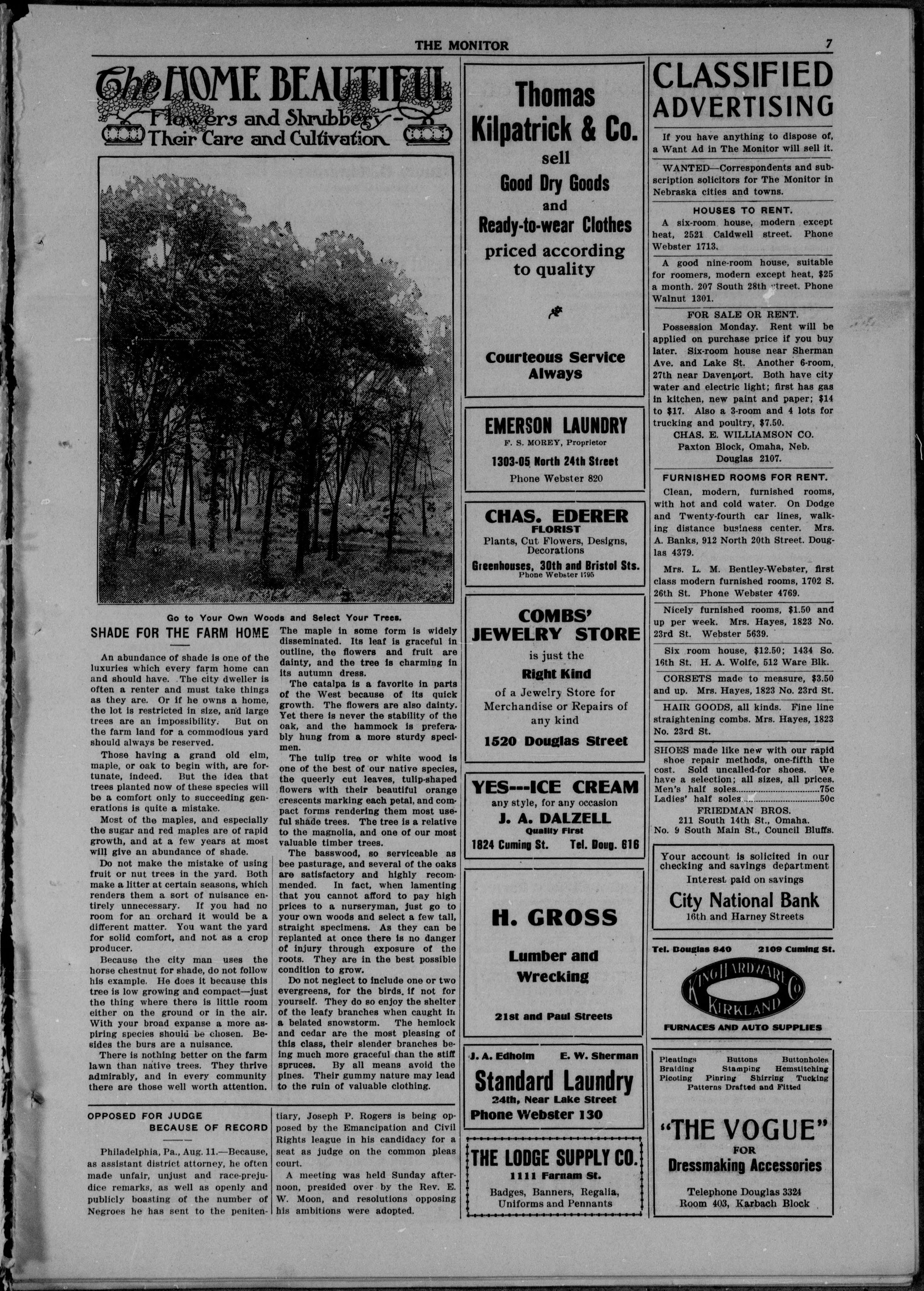
Go to Your Own Woods and Select Your Trees.
An abundance of shade is one of the luxuries which every farm home can and should have. The city dweller is often a renter and must take things as they are. Or if he owns a home, the lot is restricted in size, and large trees are an impossibility. But on the farm land for a commodious yard should always be reserved.
Those having a grand old elm, maple, or oak to begin with, are fortunate, indeed. But the idea that trees planted now of these species will be a comfort only to succeeding generations is quite a mistake.
Most of the maples, and especially the sugar and red maples are of rapid growth, and at a few years at most will give an abundance of shade.
Do not make the mistake of using fruit or nut trees in the yard. Both make a litter at certain seasons, which renders them a sort of nuisance entirely unnecessary. If you had no room for an orchard it would be a different matter. You want the yard for solid comfort, and not as a crop producer.
Because the city man uses the horse chestnut for shade, do not follow his example. He does it because this tree is low growing and compact—just the thing where there is little room either on the ground or in the air. With your broad expanse a more aspiring species should be chosen. Besides the burs are a nuisance. There is nothing better on the farm lawn than native trees. They thrive admirably, and in every community there are those well worth attention.
OPPOSED FOR JUDGE
BECAUSE OF RECORD
Philadelphia, Pa., Aug. 11.—Because, as assistant district attorney, he often made unfair, unjust and race-prejudice remarks, as well as openly and publicly boasting of the number of Negroes he has sent to the peniten-
THE MONITOR
The maple in some form is widely disseminated. Its leaf is graceful in outline, the flowers and fruit are dainty, and the tree is charming in its autumn dress.
The catalpa is a favorite in parts of the West because of its quick growth. The flowers are also dainty. Yet there is never the stability of the oak, and the hammock is preferably hung from a more sturdy specimen.
The tulip tree or white wood is one of the best of our native species, the queerly cut leaves, tulip-shaped flowers with their beautiful orange crescents marking each petal, and compact forms rendering them most useful shade trees. The tree is a relative to the magnolia, and one of our most valuable timber trees.
The basswood, so serviceable as bee pasturage, and several of the oaks are satisfactory and highly recommended. In fact, when lamenting that you cannot afford to pay high prices to a nurseryman, just go to your own woods and select a few tall, straight specimens. As they can be replanted at once there is no danger of injury through exposure of the roots. They are in the best possible condition to grow.
Do not neglect to include one or two evergreens, for the birds, if not for yourself. They do so enjoy the shelter of the leafy branches when caught in a belated snowstorm. The hemlock and cedar are the most pleasing of this class, their slender branches being much more graceful than the stiff spruces. By all means avoid the pines. Their gummy nature may lead to the ruin of valuable clothing.
tiary, Joseph P. Rogers is being opposed by the Emancipation and Civil Rights league in his candidacy for a seat as judge on the common pleas court.
A meeting was held Sunday afternoon, presided over by the Rev. E. W. Moon, and resolutions opposing his ambitions were adopted.
Good Dry Goods and Ready-to-wear Clothes priced according to quality
Courteous Service Always
EMERSON LAUNDRY
F. S. MOREY, Proprietor
1303-05 North 24th Street
Phone Webster 820
CHAS. EDERER
FLORIST
Plants, Cut Flowers, Designs,
Decorations
Greenhouses, 30th and Bristol Sts.
Phone Webster 1795
COMBS'
JEWELRY STORE
is just the
Right Kind of a Jewelry Store for Merchandise or Repairs of any kind 1520 Douglas Street
YES---ICE CREAM
any style, for any occasion
J. A. DALZELL
Quality First
1824 Cuming St. Tel. Doug. 616
H. GROSS
J. A. Edholm E. W. Sherman
Standard Laundry
24th, Near Lake Street
Phone Webster 130
THE LODGE SUPPLY CO.
1111 Farnam St.
Badges, Banners, Regalia,
Uniforms and Pennants
Lumber and Wrecking
21st and Paul Streets
7
CLASSIFIED ADVERTISING
If you have anything to dispose of, a Want Ad in The Monitor will sell it.
WANTED—Correspondents and subscription solicitors for The Monitor in Nebraska cities and towns.
HOUSES TO RENT.
A six-room house, modern except heat, 2521 Caldwell street. Phone Webster 1713.
A good nine-room house, suitable for roomers, modern except heat, $25 a month. 207 South 28th street. Phone Walnut 1301.
Possession Monday. Rent will be applied on purchase price if you buy later. Six-room house near Sherman Ave. and Lake St. Another 6-room, 27th near Davenport. Both have city water and electric light; first has gas in kitchen, new paint and paper; $14 to $17. Also a 3-room and 4 lots for trucking and poultry, $7.50.
CHAS. E. WILLIAMSON CO.
Paxton Block, Omaha, Neb.
Douglas 2107.
Clean, modern, furnished rooms, with hot and cold water. On Dodge and Twenty-fourth car lines, walking distance business center. Mrs. A. Banks, 912 North 20th Street. Douglas 4379.
Mrs. L. M. Bentley-Webster, first class modern furnished rooms, 1702 S. 26th St. Phone Webster 4769.
Nicely furnished rooms, $1.50 and up per week. Mrs. Hayes, 1823 No. 23rd St. Webster 5639.
Six room house, $12.50; 1434 So.
16th St. H. A. Wolfe, 512 Ware Blk.
CORSETS made to measure, $3.50
and up. Mrs. Hayes, 1823 No. 23rd St.
HAIR GOODS, all kinds. Fine line
straightening combs. Mrs. Hayes, 1823
No. 23rd St.
SHOES made like new with our rapid
shoe repair methods, one-fifth the
cost. Sold uncalled-for shoes. We
have a selection; all sizes, all prices.
Men's half soles.....75c
Ladies' half soles.....50c
211 South 14th St., Omaha.
No. 9 South Main St., Council Bluffs.
Your account is solicited in our checking and savings department
Interest paid on savings
City National Bank
16th and Harney Streets
Tel. Douglas 840 2109 Cuming St.
KING HARDWARE CO
KIRKLAND
Pleatings Buttons Buttonholes
Braiding Stamping Hemstitching
Picoting Pinring Shirring Tucking
Patterns Drafted and Fitted
"THE VOGUE"
FOR
Dressmaking Accessories
Telephone Douglas 3324
Room 403, Karbach Block
---