The Monitor
Friday, September 3, 1926
Omaha, Nebraska
Page text (machine-generated)
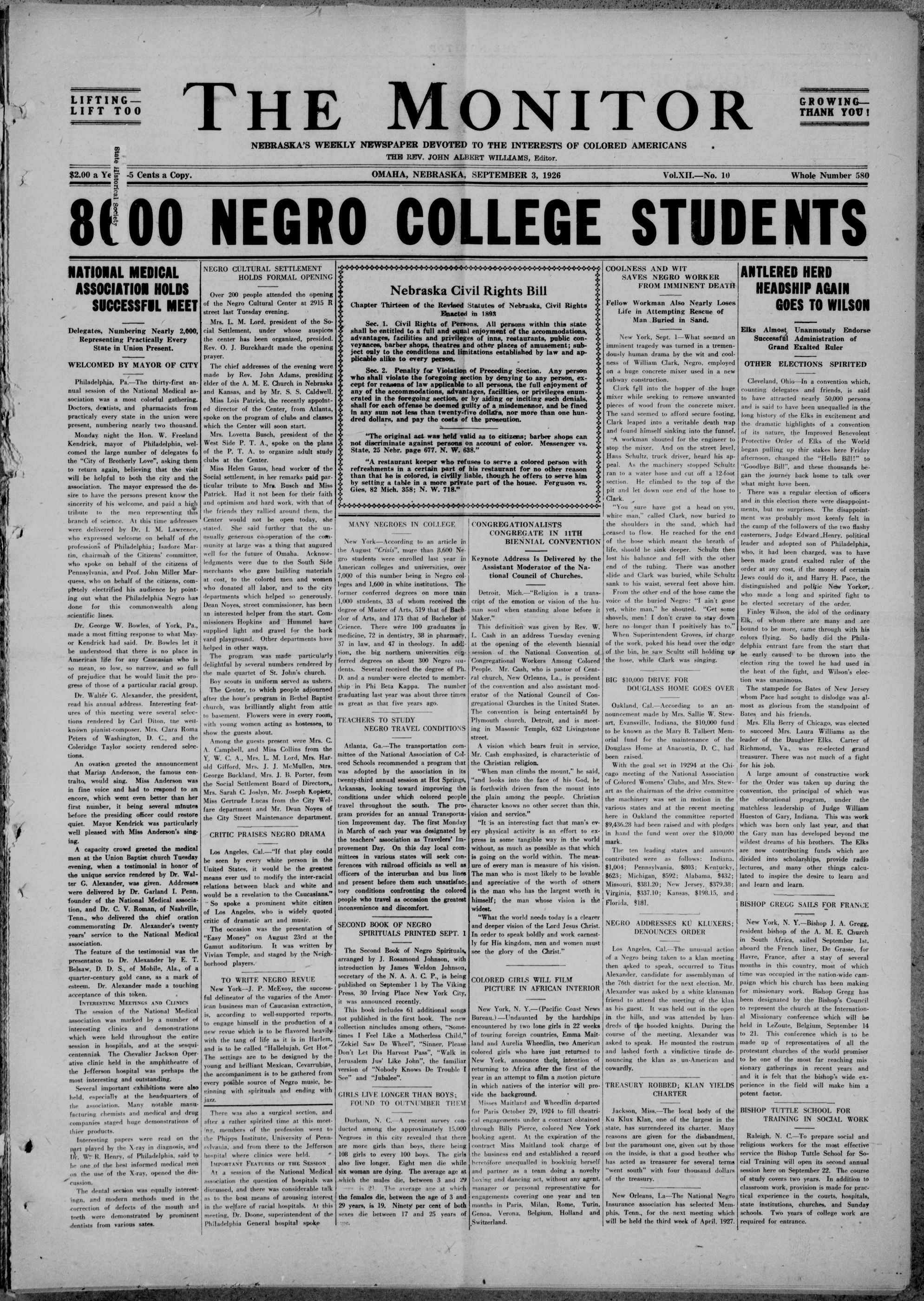
8000 NEGRO COLLEGE STUDENTS
LIFTING
LIFT TOO
$2.00 a Year
-5 Cents a Copy.
8000
NATIONAL MEDICAL ASSOCIATION HOLDS SUCCESSFUL MEET
Delegates, Numbering Nearly 2,000, Representing Practically Every State in Union Present.
WELCOMED BY MAYOR OF CITY
Philadelphia, Pa.—The thirty-first annual session of the National Medical association was a most colorful gathering. Doctors, dentists, and pharmacists from practically every state in the union were present, numbering nearly two thousand.
Monday night the Hon. W. Freeland Kendrick, mayor of Philadelphia, welcomed the large number of delegates to the "City of Brotherly Love", asking them to return again, believing that the visit will be helpful to both the city and the association. The mayor expressed the desire to have the persons present know the sincerity of his welcome, and paid a high tribute to the men representing this branch of science. At this time addresses were delivered by Dr. I. M. Lawrence, who expressed welcome on behalf of the professions of Philadelphia; Isadore Martin, chairman of the Citizens' committee, who spoke on behalf of the citizens of Pennsylvania, and Prof. John Miller Marquess, who on behalf of the citizens, completely electrified his audience by pointing out what the Philadelphia Negro has done for this commonwealth along scientific lines.
Dr. George W. Bowles, of York, Pa., made a most fitting response to what Mayor Kendrick had said. Dr. Bowles let it be understood that there is no place in American life for any Caucasian who is so mean, so low, so narrow, and so full of prejudice that he would limit the progress of those of a particular racial group.
Dr. Walter G. Alexander, the president, read his annual address. Interesting features of this meeting were several selections rendered by Carl Diton, the well-known pianist-composer. Mrs. Clara Roma Peters of Washington, D. C., and the Coleridge Taylor society rendered selections.
An ovation greeted the announcement that Mariap Anderson, the famous contralto, would sing. Miss Anderson was in fine voice and had to respond to an encore, which went even better than her first number, it being several minutes before the presiding officer could restore quiet. Mayor Kendrick was particularly well pleased with Miss Anderson's singing.
A capacity crowd greeted the medical men at the Union Baptist church Tuesday evening, when a testimonial in honor of the unique service rendered by Dr. Walter G. Alexander, was given. Addresses were delivered by Dr. Garland I. Penn, founder of the National Medical association, and Dr. C. V. Roman, of Nashville, Tenn., who delivered the chief oration commemorating Dr. Alexander's twenty years' service to the National Medical association.
The feature of the testimonial was the presentation to Dr. Alexander by E. T. Belsaw, D. D. S., of Mobile, Ala., of a quarter-century gold cane, as a mark of esteem. Dr. Alexander made a touching acceptance of this token.
INTERESTING MEETINGS AND CLINICS
The session of the National Medical association was marked by a number of interesting clinics and demonstrations which were held throughout the entire session in hospitals, and at the sesquicentennial. The Chevalier Jackson Operative clinic held in the amphitheatre of the Jefferson hospital was perhaps the most interesting and outstanding.
Several important exhibitions were also held, especially at the headquarters of the association. Many notable manufacturing chemists and medical and drug companies staged huge demonstrations of their products.
Interesting papers were read on the part played by the X-ray in diagnosis, and Dr. W. R. Henry, of Philadelphia, said to be one of the best informed medical men on the use of the X-ray, opened the discussion.
The dental section was equally interest- ing, and modern methods used in the correction of defects of the mouth and teeth were demonstrated by prominent dentists from various sates.
THE MONITOR
NEGRO CULTURAL SETTLEMENT HOLDS FORMAL OPENING
Over 200 people attended the opening of the Negro Cultural Center at 2915 R street last Tuesday evening.
Mrs. L. M. Lord, president of the Social Settlement, under whose auspices the center has been organized, presided. Rev. O. J. Burckhardt made the opening prayer.
The chief addresses of the evening were made by Rev. John Adams, presiding elder of the A. M. E. Church in Nebraska and Kansas, and by Mr. S. S. Caldwell.
Miss Lois Patrick, the recently appointed director of the Center, from Atlanta, spoke on the program of clubs and classes which the Center will soon start.
Mrs. Lovetta Busch, president of the West Side P. T. A., spoke on the plans of the P. T. A. to organize adult study clubs at the Center.
Miss Helen Gauss, head worker of the Social settlement, in her remarks paid particular tribute to Mrs. Busch and Miss Patrick. Had it not been for their faith and optimism and hard work, with that of the friends they rallied around them, the Center would not be open today, she stated. She said further that the unusually generous co-operation of the community at large was a thing that augured well for the future of Omaha. Acknowledgments were due to the South Side merchants who gave building materials at cost, to the colored men and women who donated all labor, and to the city departments which helped so generously Dean Noyes, street commissioner, has been an interested helper from the start. Commissioners Hopkins and Hummel have supplied light and gravel for the back yard playground. Other departments have helped in other ways.
The program was made particularly delightful by several numbers rendered by the male quartet of St. John's church.
Boy scouts in uniform served as ushers.
The Center, to which people adjourned after the hour's program in Bethel Baptist church, was brilliantly alight from attic to basement. Flowers were in every room, with young women acting as hostesses, to show the guests about.
Among the guests present were Mrs. C. A. Campbell, and Miss Collins from the Y. W. C. A., Mrs. L. M. Lord, Mrs. Harold Gifford, Mrs. J. J. McMullen, Mrs. George Buckland, Mrs. J. B. Porter, from the Social Settlement Board of Directors, Mrs. Sarah C. Joslyn, Mr. Joseph Kopietz, Miss Gertrude Lucas from the City Welfare department and Mr. Dean Noyes of the City Street Maintenance department.
CRITIC PRAISES NEGRO DRAMA
Los Angeles, Cal. "If that play could be seen by every white person in the United States, it would be the greatest means ever usd to modify the inter-racial relations between black and white and would be a revelation to the Caucasians." So spoke a prominent white citizen of Los Angeles, who is widely quoted critic of dramatic art and music. The occasion was the presentation of "Easy Money" on August 23rd at the Camut auditorium. It was written by Vivian Temple, and staged by the Neighborhood players.
TO WRITE NEGRO REVUE
New York—J. P. McEovy, the successful delineator of the vagaries of the American business man of Caucasian extraction, is, according to well-supported reports, to engage himself in the production of a new revue which is to be flavored heavily with the tang of life as it is in Harlem, and is to be called "Hallelujah, Get Hot." The settings are to be designed by the young and brilliant Mexican, Cevarrubias, the accompaniment is to be gathered from every possible source of Negro music, beginning with spirituals and ending with jazz.
There was also a surgical section, and after a rather spirited time at this meeting, members of the profession went to the Phipps Institute, University of Pennsylvania, and from there to the Jefferson hospital where clinics were held.
IMPORTANT FEATURES OF THE SESSION
At a session of the National Medical association the question of hospitals was discussed, and there was considerable talk as to the best means of arousing interest in the welfare of racial hospitals. At this meeting, Dr. Doone, superintendent of the Philadelphia General hospital spoke
OMAHA, NEBRASKA, SEPTEMBER 3. 1926
---
Nebraska Civil Rights Bill
Chapter Thirteen of the Revised Enacted
Sec. 1. Civil Rights of Person shall be entitled to a full and equal advantages, facilities and privileges, veyances, barber shops, theatres and object only to the conditions and limpplicable alike to every person.
Sec. 2. Penalty for Violation who shall violate the foregoing secept for reasons of law applicable to any of the accommodations, advanced in the foregoing section, or shall for each offense be deemed guilty in any sum not less than twenty-fifred dollars, and pay the costs of
"The original act was held vain not discriminate against persons of State, 25 Nebr. page 677. N. W. 678.
"A restaurant keeper who refreshments in a certain part of than that he is colored, is civilly lby setting a table in a more private Gies, 82 Mich. 358; N. W. 718."
Chapter Thirteen of the Revised Statutes of Nebraska, Civil Rights Exacted in 1893
Sec. 1. Civil Rights of Persons. All persons within this state shall be entitled to a full and equal enjoyment of the accommodations, advantages, facilities and privileges of inns, restaurants, public conveyances, barber shops, theatres and other places of amusement; subject only to the conditions and limitations established by law and applicable alike to every person.
Sec. 2. Penalty for Violation of Preceding Section. Any person who shall violate the foregoing section by denying to any person, except for reasons of law applicable to all persons, the full enjoyment of any of the accommodations, advantages, facilities, or privileges enumerated in the foregoing section, or by aiding or inciting such denials, shall for each offense be deemed guilty of a misdemeanor, and be fined in any sum not less than twenty-five dollars, nor more than one hundred dollars, and pay the costs of the prosecution.
"The original act was held valid as to citizens; barber shops can not discriminate against persons on account of color. Messenger vs. State, 25 Nebr. page 677. N. W. 638."
"A restaurant keeper who refuses to serve a colored person with refreshments in a certain part of his restaurant for no other reason than that he is colored, is civilly liable, though he offers to serve him by setting a table in a more private part of the house. Ferguson vs. Gies, 82 Mich. 358; N. W. 718."
MANY NEGROES IN COLLEGE
New York—According to an article in the August "Crisis", more than 3,600 Negro students were enrolled last year in American colleges and universities, over 7,000 of this number being in Negro colleges and 1,600 in white institutions. The former conferred degrees on more than 1,000 students, 33 of whom received the degree of Master of Arts, 519 that of Bachelor of Arts, and 173 that of Bachelor of Science. There were 100 graduates in medicine, 72 in dentistry, 38 in pharmacy, 37 in law, and 47 in theology. In addition, the big northern universities conferred degrees on about 300 Negro students. Several received the degree of Ph.D. and a number were elected to membership in Phi Beta Kappa. The number graduating last year was about three times as great as that five years ago.
TEACHERS TO STUDY
NEGRO TRAVEL CONDITIONS
Atlanta, Ga.-The transportation committee of the National Association of Colored Schools recommended a program that was adopted by the association in its twenty-third annual session at Hot Springs, Arkansas, looking toward improving the conditions under which colored people travel throughout the south. The program provides for an annual Transportation Improvement day. The first Monday in March of each year was designated by the teachers' association as Travelers' Improvement Day. On this day local committees in various states will seek conferences with railroad officials as well as officers of the interurban and bus lines and present before them such unsatisfactory conditions confronting the colored people who travel as occasion the greatest inconvenience and discomfort.
SECOND BOOK OF NEGRO
SPIRITUALS PRINTED SEPT. 1
The Second Book of Negro Spirituals, arranged by J. Rosamond Johnson, with introduction by James Weldon Johnson, secretary of the N. A. A. C. P., is being published on September 1 by The Viking Press, 30 Irving Place New York City, it was announced recently.
This book includes 61 additional songs not published in the first book. The new collection nincludes among others, "Sometimes I Feel Like a Motherless Child," "Zekiel Saw Dew Wheel," "Sinner, Please Don't Let Dis Harvest Pass," "Walk in Jerusalem Jus' Like John", the familiar version of "Nobody Knows De Trouble I See" and "Jubalee."
GIRLS LIVE LONGER THAN BOYS;
FOUND TO OUTNUMBER THEM
Durham, N. C.—A recent survey conducted among the approximately 15,000 Negroes in this city revealed that there are more girls than boys, there being 108 girls to every 100 boys. The girls also live longer. Eight men die while six woman are dying. The average age at which the males die, between 3 and 29 years is 21. The average age at which the females die, between the age of 3 and 29 years, is 19. Ninety per cent of both sexes die between 17 and 25 years of age.
Statutes of Nebraska, Civil Rights in 1893
Persons. All persons within this state enjoyment of the accommodations, uses of inns, restaurants, public con- and other places of amusement; sub-stitutions established by law and ap-
of Preceding Section. Any person section by denying to any person, ex-
to all persons, the full enjoyment of images, facilities, or privileges enum-
by aiding or inciting such denials, utility of a misdemeanor, and be fined five dollars, nor more than one hun-
the prosecution.
aid as to citizens; barber shops can in account of color. Messenger vs. 188."
uses to serve a colored person with this restaurant for no other reason able, though he offers to serve him the part of the house. Ferguson vs.
CONGREGATIONALISTS
CONGREGATE IN 11TH
BIENNIAL CONVENTION
Keynote Address Is Delivered by the Assistant Moderator of the National Council of Churches.
Detroit, Mich.—"Religion is a transcript of the emotion or vision of the human soul when standing alone before it Maker."
This definition was given by Rev. W. L. Cash in an address Tuesday evening at the opening of the eleventh biennial session of the National Convention of Congregational Workers Among Colored People. Mr. Cash, who is pastor of Central church, New Orleans, La., is president of the convention and also assistant moderator of the National Council of Congregational Churches in the United States. The convention is being entertained by Plymouth church, Detroit, and is meeting in Masonic Temple, 632 Livingstone street.
A vision which bears fruit in service, Mr. Cash emphasized, is characteristic of the Christian religion.
"When man climbs the mount," he said, "and looks into the face of his God, he is forthwith driven from the mount into the plain among the people. Christian character knows no other secret than this, vision and service."
"It is an interesting fact that man's every physical activity is an effort to express in some tangible way in the world without, as much as possible as that which is going on the world within. The measure of every man is measure of his vision. The man who is most likely to be lovable and appreciative of the worth of others is the man who has the largest worth in himself; the man whose vision is the widest.
"What the world needs today is a clearer and deeper vision of the Lord Jesus Christ. In order to speak boldly and work earnestly for His kingdom, men and women must see the glory of the Christ."
COLORED GIRLS WILL FILM
PICTURE IN AFRICAN INTERIOR
New York, N. Y.—(Pacific Coast News Bureau.)—Undaunted by the hardships encountered by two lone girls in 22 weeks of touring foreign countries, Emma Maitland and Aurelia Wheedlin, two American colored girls who have just returned to New York, announce their intention of returning to Africa after the first of the year in an attempt to film a motion picture in which natives of the interior will provide the background.
Misses Maitland and Wheedlin departed for Paris October 29, 1924 to fill theatrical engagements under a contract obtained through Billy Pierce, colored New York booking agent. At the expiration of the contract Miss Maitland took charge of the business end and established a record bereftofore unequalled in booking herself and partner as a team doing a novelty boxing and dancing act, without any agent, manager or personal representative for engagements covering one year and ten months in Paris, Milan, Rome, Turin, Genoa, Verona, Belgium, Holland and Switzerland.
---
Vol.XII.—No.10 STUD COOLNESS AND WIT
SAVES NEGRO WORKER
FROM IMMINENT DEATH
Fellow Workman Also Nearly Loses Life in Attempting Rescue of Man Buried in Sand.
New York, Sept. 1—What seemed an imminent tragedy was turned in a tremendously human drama by the wit and coolness of William Clark, Negro, employed on a huge concrete mixer used in a new subway construction.
Clark fell into the hopper of the huge mixer while seeking to remove unwanted pieces of wood from the concrete mixer. The sand seemed to afford secure footing. Clark leaped into a veritable death trap and found himself sinking into the funnel. A workman shouted for the engineer to stop the mixer. And on the street level, Hans Schultz, truck driver, heard his appeal. As the machinery stopped Schultz ran to a water hose and cut off a 12-foot section. He climbed to the top of the pit and let down one end of the hose to Clark.
"You sure have got a head on you, white man." called Clark, now buried to the shoulders in the sand, which had ceased to flow. He reached for the end of the hose which meant the breath of life, should he sink deeper. Schultz then lost his balance and fell with the other end of the tubing. There was another slide and Clark was buried, while Schultz sank to his waist, several feet above him.
From the other end of the hose came the voice of the buried Negro: "I ain't gone yet, white man," he shouted. "Get some shovels, men! I don't crave to stay down here no longer than I positively has to." When Superintendent Groves, in charge of the work, poked his head over the edge of the bin, he saw Scultz still holding up the hose, while Clark was singing.
BIG $10,000 DRIVE FOR
DOUGLASS HOME GOES OVER
Oakland, Cal.—According to an announcement made by Mrs. Sallie W. Stewart, Evansville, Indiana, the $10,000 fund to be known as the Mary B. Talbert Memorial fund for the maintenance of the Douglass Home at Anacostia, D. C., had been raised.
With the goal set in 19294 at the Chicago meeting of the National Association of Colored Womens' Clubs, and Mrs. Stewart as the chairman of the drive committee the machinery was set in motion in the various states and at the recent meeting here in Oakland the committee reported $9,436.28 had been raised and with pledges in hand the fund went over the $10,000 mark.
The ten leading states and amounts contributed were as follows: Indiana, $1,004; Pennsylvania, $803; Kentucky, $623; Michigan, $592; Alabama, $432; Missouri, $381.20; New Jersey, $379.38; Virginia, $337.10; Kansas, $198.15, and Florida, $181.
NEGRO ADDRESSES KU KLUXERS;
DENOUNCES ORDER
Los Angeles, Cal.—The unusual action of a Negro being taken to a klan meeting then asked to speak, occurred to Titus Alexander, candidate for assemblyman of the 76th district for the next election. Mr. Alexander was asked by a white klansman friend to attend the meeting of the klan as his guest. It was held out in the open in the hills, and was attended by hundreds of the hooded knights. During the course of the meeting, Alexander was asked to speak. He mounted the rostrum and lashed forth a vindictive tirade denouncing the klan as un-American and cowardly.
TREASURY ROBBED; KLAN YIELDS
CHARTER
Jackson, Miss.—The local body of the Ku Klux Klan, one of the largest in the state, has surrendered its charter. Many reasons are given for the disbandment, but the paramount one, given out by those on the inside, is that a good brother who has acted as treasurer for several terms "went south" with four thousand dollars of the treasury.
New Orleans, La—The National Negro Insurance association has selected Memphis, Tenn., for the next meeting which will be held the third week of April, 1927.
GROWING
THANK YOU!
Whole Number 580
ENTS
ANTLERED HERD HEADSHIP AGAIN GOES TO WILSON
Elks Almost Unanmously Endorse Successful Administration of Grand Exalted Ruler
OTHER ELECTIONS SPIRITED
Cleveland, Ohio—In a convention which, counting delegates and friends, is said to have attracted nearly 50,000 persons and is said to have been unequalled in the long history of the Elks in excitement and the dramatic highlights of a convention of its nature, the Improved Benevolent Protective Order of Elks of the World began pulling up thistakes here Friday afternoon, changed the "Hello Bill!" to "Goodbye Bill", and these thousands began the journey back home to talk over what might have been.
There was a regular election of officers and in this election there were disappointments, but no surprises. The disappointment was probably most keenly felt in the camp of the followers of the two flashy easterners, Judge Edward Henry, political leader and adopted son of Philadelphia, who, it had been charged, was to have been made grand exalted ruler of the order at any cost, if the money of certain Jews could do it, and Harry H. Pace, the distinguished and pollicic New Yorker, who made a long and spirited fight to be elected secretary of the order.
Finley Wilson, the idol of the ordinary Elk, of whom there are many and are bound to be more, came through with his colors flying. So badly did the Philadelphia entrant fare from the start that he early caused to be thrown into the election ring the towel he had used in the heat of the fight, and Wilson's election was unanimous.
The stamped for Bates of New Jersey whom Pace had sought to dislodge was almost as glorious from the standpoint of Bates and his friends.
Mrs. Ella Berry of Chicago, was elected to succeed Mrs. Laura Williams as the leader of the Daughter Elks. Carter of Richmond, Va., was re-elected grand treasurer. There was not much of a fight for his job.
A large amount of constructive work for the Order was taken up during the convention, the principal of which was the educational program, under the matchless leadership of Judge William Hueston of Gary, Indiana. This was work which was born only last year, and that the Gary man has developed beyond the wildest dreams of his brothers. The Elks are now contributing funds which are divided into scholarships, provide radio lectures, and many other things calculated to inspire the desire to learn and learn and learn.
BISHOP GREGG SAILS FOR FRANCE
New York, N. Y.—Bishop J. A. Gregg, resident bishop of the A. M. E. Church in South Africa, sailed September 1st, aboard the French liner, De Grasse, for Havre, France, after a stay of several months in this country, most of which time was occupied in the nation-wide campaign which his church has been making for missionary work. Bishop Gregg has been designated by the Bishop's Council to represent the church at the International Missionary conference which will be held in LeZoute, Belgium, September 14 to 21. This conference which is to be made up of representatives of all the protestant churches of the world promise to be one of the most far reaching missionary gatherings in recent years and it is felt that the bishop's wide experience in the field will make him a potent factor.
BISHOP TUTTLE SCHOOL FOR
TRAINING IN SOCIAL WORK
Raleigh, N. C.—To prepare social and religious workers for the most effective service the Bishop Tuttle School for Social Training will open its second annual session here on September 22. The course of study covers two years. In addition to classroom work, provision is made for practical experience in the courts, hospitals, state institutions, churches, and Sunday schools. Two years of college work are required for entrance.
A WEEKLY NEWSPAPER DEVOTED PRIMARY TO THE INTERESTS OF COLORED AMERICANS
PUBLISHED EVERY FRIDAY AT OMAHA, NEBRASKA, BY THE MONITOR PUBLISHING COMPANY
Entered as Second-Class Mail Matter July 2, 1915, at the Postoffice at Omaha, Nebraska, under the Act of March 3, 1879.
SUBSCRIPTION RATES, $2.00 A YEAR; $1.25 6 MONTHS; 75c 3 MONTHS
Advertising Rates Furnished Upon Application
Address, The Monitor, Postoffice Box 1204, Omaha, Neb.
Telephone WEbster 4243
ARTICLE XIV, CONSTITUTION OF THE UNITED STATES
1. All persons born or naturalized in the United States, and subject to the jurisdiction thereof, are citizens of the United States and of the State wherein they reside. No state shall make or enforce any law which shall abridge the privileges or immunities of citizens of the United States; nor shall any state deprive any person of life, liberty, or property without due process of law, nor deny to any person within its jurisdiction the equal protection of the laws.
AN IMPORTANT WORD TO SUBSCRIBERS.
The postal regulations require that for newspapers to be sent through the mails subscriptions must be paid in advance. A reasonable time, thirty days, is allowed for renewals. At the expiration of this period, where subscriptions are not renewed, the paper must be stopped. If this is not done, postal privileges are denied the publication. Those, therefore, who desire to continue receiving The Monitor must see to it that their subscriptions are paid, as the law requires, in advance. Statements are being sent to all those who owe, or our collector will call—and unless your subscription is paid we will be compelled to cut off your paper which, of course, we do not want to do.
We, as publishers, MUST comply with the law or pay the penalty.
PAGE TWO
A WEEKLY NEWSPAPER DEVOTED OF COLOREDEN
PUBLISHED EVERY FRIDAY A MONITOR PUBLISH
Entered as Second-Class Mall Mattte Omaha, Nebraska, under
THE REV. JOHN ALBERT WILLIAM W. W. MOSELY, Lincoln, Neb.
LUCINDA W. WILLIAMS
SUBSCRIPTION RATES, $.00 A YEAR Advertising Rates Furnished
Address, The Monitor, Post Office
ARTICLE XIV, CONSTITUTION
Citizenship Rights
1. All persons born or naked and subject to the jurisdiction United States and of the State shall make or enforce any privileges or immunities of citation any state deprive any property without due process of law within its jurisdiction the equiv
Our Choice for President in 1928 is WALTER W. HEAD of Nebraska An Astute, Able, Clear-headed Business Man
THE RISING TIDE
As schools, colleges and universities are reopening, it is gratifying to note that, according to reliable data collected by "The Crisis," an excellent magazine that should be in every Negro home in the land and the homes of white people who would be intelligently informed concerning the thought and progress of our people, more than 8,600 Negro students were enrolled last year in American colleges and universities. Of this number 7,000 were in race institutions and 1,600 in white. Negro colleges conferred degrees on more than 1,000 students and large northern universities on over 300, several receiving Ph.D. and M. A. degrees and being elected to membership in Phi Beta Kappa, an enviable distinction granted only for advanced scholarship.
Steadily the stream of our intellectual life is flowing ever onward. What this presages requires no seer to foretell. Those ambitious for intellectual training have, in the main, caught the vision of service, service to their race, and service to humanity. Unless this be the vision and the motive back of our advancing intellectual life our trained minds and hands will prove a bane and not a blessing.
We are convinced that the majority of our youth who are struggling for higher education are willing to pay the price because they have measured the goal of their laudable ambition in terms of service.
The rising tide of our intellectual life as indicated by the figures quoted and which will be surpassed this year means ultimately the submergence of baneful American color and racial prejudice which cannot stem this rising tide.
A FORECAST
Unless signs fail there is going to be need for a great deal of charitable and welfare work this winter which will tax the ability of the Associated Charities and similar organizations. The reason for this opinion is the fact that so many have been out of employment during the summer months when, as a rule, work is quite plentiful. Unless, therefore, there is a decided improve
AN IMPORTANT WORK
The postal regulations re be sent through the mails s advance. A reasonable time renewals. At the expiration scriptions are not renewed. If this is not done, postal pr cation. Those, therefore, wh The Monitor must see to it paid, as the law requires, in ing sent to all those who ow and unless your subscription to cut off your paper which to do.
ment in the matter of work in the autumn and early winter months there will be much want and suffering.
Our people will share in this suffering. Those who have jobs should do their best to retain them by giving satisfaction. The more fortunate must do all in their power to help the less fortunate.
This forecast may seem rather gloomy, but it is well to consider facts.
WHITE CHICKEN THIEVES!
Papillion, county seat of Sarpy county, Nebraska, is having considerable excitement these days over the trial of several white men charged with chicken stealing. It is charged that the stealing was by the wholesale.
The fiction that chicken stealing is a monopoly of Negroes is rapidly disappearing in the face of facts like this. White chicken thieves! Just think of it! Page the paragraphers!
THIS WEEK'S EDITORIAL
Lynching History
(From The News, Cleveland, Ohio)
Between 1889 and 1925, inclusive, there was in the United States a total of 3,559 lynchings. Of these victims, 724 were white and 2,835 were colored. The only states with a clean record are New Hampshire, Rhode Island, Connecticut and Utah. Georgia has the worst report, with 448, and Mississippi follows.
The lynching toll has dropped rapidly in recent years, thanks primarily to postwar migrations, and secondly, to the aggressive investigation work by the National Association for the Advancement of Colored People, an organization composed of members of both races and headed by Moorfield Storey of Boston, a former president of the American Bar association.
An interesting theory has been advanced for the prevalence of lynching in America, aside from the clash of races. It is held that America was settled by the more aggressive of the old inhabitants. The stay-at-homes lacked the ambition to move. With the emigrant's good qualities were his bad ones. These included a fondness for combat and a tendency to violence, and our high murder rate, aside from the lynching, is offered as additional proof of this theory. We hold life cheaply.
With pioneer days over and a uniform civilization being established everywhere, the sacredness of human life is preached more effectively. But there are long strides which remain to be made before we can with rhetorical truth "point with pride" to the superiority of the western civilization.
Mrs. Fanny G. Rogers of Wichita, Kans., who has been the guest of Mr. and Mrs. B. B. Cowan. 2724 North Thirtieth street, left for her home Saturday well pleased with her visit.
THE MONITOR PORO SUBSTATION AND BEAUTY She leaves SHOP HAS FORMAL OPENING sisters, two
Mrs. Malone, Founder of Poro College, Here for Occasion.
The beautifully appointed Poro substation and beauty shop, at 2041 North Twenty-fourth street, had its formal opening Thursday from 1 until 10 p. m. Hundreds of visitors availed themselves of the opportunity of visiting this real acquisition to Omaha's business enterprises, and of meeting not only the ladies in charge, Mrs. Birdie J. Hawkins of St. Louis, Mo., and Miss Alda Williams, but the rarer privilege of meeting the gracious and charming founder of Poro college, Mrs. Anna E. Malone, and two of her capable assistants, Mrs. Ella Lewis, demonstrator, and Miss Clara Tyson, cashier. The beautiful rooms were decorated with palms and flowers. A model of Poro college attracted much attention and favorable comment. Souvenirs were given to all visitors. These consisted of note books, letter cases and powder puffs.
Monday night a large audience attended the first graduating class in St. John's A. M. E. Church when diplomas were given Mrs. Charles Garrett, Mrs. Jenrie Thompson and Miss Eva Williams. An interesting program was given, consisting or musical numbers, and addresses by Mrs. Malone, who presented the diplomas, and Mrs. Minnie Hurley of Detroit, Mich.
The Omaha branch is one of the 12 substations established by Poro college in various cities of the country.
AN EVENING WITH DUNBAR
A delightful program, entitled "An Evening With Dunbar", given under the auspices of the Church School of St. Philip the Deacon, was enjoyed Tuesday night by an appreciative audience in St. Philip's Guild room. The program had been prepared by and was under the direction of Mrs. Herbert Wiggins, who unfortunately was unable to be present because of serious illness. Dr. W. D. Fountain made a good chairman and announced the program. It consisted of an admirable address on "The Life Career and Works of Paul Laurence Dunbar" by the Rev. Russel Taylor; recitation from his poems by several members of the school and musical numbers. Sylvia Adams recited admirably the "Bugoo Man", accompanied by Miss Elaine Smith at the piano; Thierkield Garrett, delighted the audience with his rendition of "Little Brown Baby"; Miss Melva McCaw, who always sings well, sang "By the Waters of Minnetonka", with Catherine Williams at the piano. Catherine Williams won hearty applause for her realistic recitation of "The Party". Miss Elaine Smith's rendition of "A Coquette Conquered" could not be improved upon. Albert Johnson sang sweetly, "Pal of My Cradle Days", with Rev. Russel Taylor at the piano. Miss Jean Dorsey convulsed the audience with her recitation of "In the Morning". Mrs. Venus Parker, who has an excellent voice, sang "A Song of Spring" and graciously responded to the ovation given her by "Deep River". Mrs. Webb was her accompanist. The closing number was a recitation, "When Malindy Sings", by Rev. John Albert Williams, with Miss Catherine Williams at the piano. Albert Johnson was awarded the prize for the sale of the largest number of tickets. So pleased was the audience with the program that it was suggested that a similar entertainment be given each month, which suggestion will probably be carried out.
N. A. A. C. P. MEETS SUNDAY
The regular monthly meeting of the Omaha branch of the National Association for the Advancement of Colored People, will meet Sunday afternoon at 4 o'clock at the north side branch of the W. Y. C. A., at Twenty-second and Grant St.
TO GIVE AWAY 100 ACRES
Los Angeles—George W. Bright, a retired city fireman, and one of the oldest colored firemen of the department, has been in the possession of one hundred acres of land for some time which he obtained some years ago as government land. He is to give it all many shorty in one-acre tracts to ex-soldiers.
Mrs. Nellie Maston is confined to her bed with illness. Her mother, Mrs. Geo. Kellis of Keokuk, Iowa, is here caring for her.
Mrs. Virginia Lewis, Mrs. Lillian Kenney, Mrs. Jennie Johnson, Mrs. Alice Grant and Rev. H. W. Botts returned from Atchison, Kansas, Saturday, after attending annual and lodge, Daughters of Bethel.
Mrs. Elizabeth Wright, who underwent a serious surgical operation about a week ago, passed away at 9 p. m. Monday at the hospital. She was the widow of the late J. L. Wright, who died three years ago.
She leaves as survivors a daughter, two sisters, two brothers and other relatives. The body is at Brown's Undertaking Parlors awaiting arrangements.
Next Sunday, September 5th, will be the opening of the newly remodeled Quinn chapel A. M. E. church. Bishop A. J. Carey of Chicago will be present. Special services will be held during the day.
Mr. Trago T. McWilliams returned home Sunday from Cleveland, Ohio, where he represented Cornhusker lodge No. 579 at the annual convention of Elks. He reports a large attendance and fine success of the convention.
The supper given by aides of Quinn chapel last Thursday night was a success.
Rev. H. W. Botts, Mrs. E. J. Griffin and others are in attendance at New Era association board at Omaha this week.
Mrs. Ollie Ray is visiting relatives at Wichita, Kansas.
DR. PHILLIPS, OPTICIAN
Dr. Phillips, the old-time optician, having returned to Omaha, will be glad to fit your glasses at your home at his usual reasonable prices. Phone Harney 3083 for an appointment.—Adv.
Lincoln Market
The Talk of 24th Street
EPISCOPAL
Church of St. Philip the Deacon
21st near Paul
Rev. John Albert Williams, Rector
SUNDAY SERVICES
7:30 a. m. Holy Communion
10 a. m. Sunday School
11 a. m. Sung Eucharist With Sermon
8 p. m. Service and Sermon
The Church With a Welcome
and a Message, Come
Reid-Duffy
PHARMACY
FREE DELIVERY
Phone Web. 0609
24th and Lake Streets
OMAHA, NEB.
Office, WEbster 4030——PHONES——Res., WEbster 0949
JOSEPH D. LEWIS
UNDERTAKER AND FUNERAL DIRECTOR
Service and Prices Guaranteed. When in
Need of Such Service Give Us a Trial.
2018 North 24th Street Omaha, Nebraska
PERSONALS
Ed. F. Morearty, Lawyer, 700 Peters Trust Building, JAckson 3841 or HArney 2156.
FOR RENT—Funished and unfurnished rooms in modern home. 2310 North 22nd street. WE. 4162. tf
A. P. SCRUGGS, Lawyer. Large experience. Handles all law cases. 2310 North Twenty-second street. WEBster 4162.
FOR RENT—Rooms, strictly modern. Gentlemen only. 2516 Patrick avenue. Web. 2180. 4t-8-27-26.
FOR RENT—Room with kitchenette, 1515 North Seventeenth St. Web. 1588.
Well equipped barber shop for sale. 2519 Q street.
Miss Frances D. Gordon leaves Sunday afternoon for Okmulgee, Okla., where she will teach in the high school.
Miss Ceilla Stewart of Red Oak, Iowa, is the guest of her cousin, Miss Gladys E. Brown, 2883 Miami street.
Messrs. Lovejoy Crawford and Robert Burns Allen, employees of the United States National bank, will spend the week end visiting relatives in Chicago.
Mrs. William G. Haynes and little son, William P., returned Saturday night from a six weeks' visit with relatives and friends in Pittsburgh, Pa., and Washington, D. C.
Messrs. Henry Smith, Saybert Hanger, John G. Pegg and Harold Henderson will leave Saturday in Henry Smith's Nash sedan for a trip to Topeka, Kansas, where they will remain over Labor Day.
Mrs. Jasper E. Brown, who was preciously ill, is able to be up and around the house.
Miss Marguerite Horne, who has been visiting Omaha relatives, left for her home in Duluth, Minn., Sunday evening.
Mrs. B. B. Cowan left Sunday morning for Denver, Colo., for an indefinite visit with relatives and friends.
Miss Frances D. Gordon entertained at a dinner party at her home, 2418 Binney street, Sunday afternoon. Covers were laid for eight.
Mrs. Otis Shipman and daughters, Thelma and Madeline, left Monday morning for Plankington, S. D.
Mrs. William C. Ricks, 120 South Twenty-eighth street, has as her guests, her daughter, Mrs. John W. Bundrant of Beckley, W. Va., and Miss Mani Stewart of Chicago, Ill.
Mrs. E. A. Williamson, 2508 Burdette street, who underwent an operation at the University hospital, early this week, is getting on nicely.
Mrs. Hattie Brewer, 2404 Caldwell street, entertained twelve guests at luncheon last Thursday complimentary to Mrs. Jennie Buckner of Hannibal, Mo., and Mrs. Molly Anderson of Montgomery City, Mo.
Mrs. J. H. Smith, 2211 Ohio street, left Monday night for New York City and other points east.
Mr. and Mrs. Walter Hibbs have returned from a two weeks' motor trip to Chicago, Cleveland, Buffalo and points in Canada.
Mrs. James Shelton and Mrs. Henry Pepper of Chicago, sisters of Mrs. Charles Solomon, who have been the guests of Mr. and Mrs. Solomon will leave for home Saturday accompanied by Weldon Solomon who will drive Mrs. Shelton's Paige car.
Mrs. S. Cummings was guest of several of the Kansas City drill team girls during the U. B. F. and S. M.T.'s grand session.
Mrs. May Jackson, assisted by Miss Amy Henderson and Miss Daisy Curtwright gave a delightful surprise party Monday in honor of Mrs. W. D. Taylor's birthday. Mrs. Taylor was the recipient of many beautiful gifts.
Mrs. Nellie Gates of Salisbury, Mo., who was a delegate to the U. B. F. and S. M. T. grand lodge, stayed over for a few days to visit her sister, Mrs. W. D. Taylor, 2117 North Twenty-eighth street.
Mr. U. S. Gardner of Warrensburg, Mo., motored up and spent a very pleasant week with his sister, Mrs. George W. Macklin.
Master Woodrow Macklin, the "Charleston Kid", returned home Sunday after filling a three-day engagement in Watson, Mo., Woody left Tuesday for Auburn, Neb., where he has a four-day engagement. He says the Charleston goes big yet in small towns.
---
BUFFALOES HOME AGAIN; PLAY 5-GAME SERIES WITH DENVER
Barney Burch's struggling Buffalooes will try for a comeback in the series with Denver Saturday, Sunday and Monday; provided old Jupiter Pluvius lets up for a spell.
This series is vital to the Herd, for they must break better than even to wind up in first division.
There will be a double dish for the fans Sunday and Labor day. Then the Burch Rods go on the road for four days, and come for six final games at home.
Mrs. Sadie Cummings of North Twenty-sixth street, gave one of the prettiest parties of the season in honor of her niece Miss Marguerite House of Duluth, Minn. The house was beautifully decorated with garden flowers, about 20 of the younger set enjoyed a pleasant evening, the Honey Boy quartet rendering several selections.
Mrs. Gaynell Griffith is visiting Mrs. Izora Flowers of Chicago. She also announces her engagement to Mr. J. L. Sullivan. The date for the marriage has nont been set, but it will be some time this fall.
Mrs. Hattie Ewing, of Richmond, Mo., after spending a week visiting Mr. and Mrs. W. P. Wade, returned home Sunday.
Rev. W. C. Williams, former pastor of St. John's A. M. E. church was an Omaha visitor Tuesday
Harry Franklin, son of Mr. and Mrs. Harry Schwein, has returned home from St. Catherine's hospital where he underwent an operation.
Mr. and Mrs. W. P. Wade had as their guests for dinner Thursday Mrs. Ella Stern. Mrs. Mollie Lyes and Mrs. Hattie Ewing, of Richmond, Mo., delegates to the U. B. F. and S. M. T. convention.
OMAHA THIEF IS HELD AT COUNCIL BLUFFS
Lester Maines, Omaha, who confessed to Police Chief E. N. Catterlin of Council Bluffs that he robbed the home of Mrs. Minnie Parish, 2910 West Broadway, when confronted by the chief at the Omaha police station following his arrest in Omaha, has been lodged in the Council Bluffs jail and will face a burglary charge, authorities said.
Police detectives who obtained the name of an Omaha merchant to whom Maines is alleged to have sold a quantity of clothing stolen here, recovered a pair of trousers Thursday at the Omaha store. Other loot, it was said, has been disposed of.
Chief Catterlin in questioning Maines identified him as a man ordered out of the railroad yards at Burlington Junction, Mo., when the chief was in railroad service. The man admitted the incident when it was recalled by Catterlin.
BELLEVUE BALL TOURNEY
TO OPEN THIS WEEK
The Bellevue baseball tournament opened today. The games between the Julien Chevrolets and Sunblad Insurance teams, and the Bellevue Athletic Club and Omaha Printing Co. were postponed on account of rain. Saturday's game will be played between the Schneider Electric and the Corn State Serums; the Cudahy Rex of the Colored league and the Baker Ice Machine team of Omaha.
THREE ARE INJURED IN
AUTOMOBILE ACCIDENT
Three people were injured, one seriously, in an automobile accident at Twentieth and Grace streets at 4:30 Thursday afternoon.
The injured are Mrs. Verda Churchill, who suffered a fractured left arm; her 3-year-old son, Robert, whose face was lacerated and Mrs. H. D. Winscot, whose forehead was cut.
All three live at 3314 Sahlor street.
Mrs. Churchill was driving east on Grace street, and another car driven by Andrew Dodd, $406\frac{1}{2}$ North Sixteenth street, was approaching the intersection on Twentieth street. The cars met at the insection.
Passing motorists took those injured to the Swedish Mission hospital, where their wounds were attended. They were later removed to their home. No arrests were made.
YOUTH STABBED IN ROW
OVER RIGHT TO BED
In an altercation as to which would use the only bed in the room, Arthur Duffy, 608 North Seventeenth street, won over G. Lewis, his roommate. Lewis cut a severe gash in Duffy abdomen with a knife, and police surgeons who arrived at the house in answer to a call, gave Duffy first call to the bed until he recovers. The roommates are under 20 years of age.
THE MONITOR
FOR RENT—Five-room bungalow.
Modern except heat. Newly decorated. 1529 North 21st street. $25 a month. Apply J. B. Robinson.
AT. 5206 or HA. 6998 Evenings.
NATIONAL BAPTISTS CONVENE
Hat Springs, Ark.—Announcement has just been made by the Hon. John L Webb, president of the laymen movement of the National Baptist convention that elaborate preparations are being made for the forthcoming meeting of the National Laymen movement in connection with the National Baptist convention which convenes at Fort Worth, Texas, September 8 to 13.
LABOR DAY BALL AT DREAMLAND
The annual Labor Day Ball will be held Monday evening, September 6th, at Dreamland Hall with Hunter's Serenaders playing. Dance until 2 a. m.
ST. BENEDICT'S SCHOOL
St. Benedict's school, 2423 Grant street, will reopen Tuesday, September 7. Registration on Thursday and Friday, September 2 and 3. Children up to and including seventh grade will be received. Sister Beatrice. superintendent.—Adv.
EMANCIPATION DANCE
AT KRUG PARK
A grand Emancipation Day Ball will be given Wednesday evening. Sept. 8th, at Krug Park in connection with the seventh annual emancipation celebration. Hunter's Serenaders will play the music. Admission 50 cents.
DO YOU WANT A HOME?
For sale or for rent—an 11-room modern, newly repaired, papered and painted house, with double garage and large corner lot, 2638 Franklin street. For particulars phone Webster 4243.
Beautiful New
LAKE
THEATRE
Saturday, September 4
Dolores Costello, in
"THE BRIDE OF THE
STORM"
Bar C Mystery No. 2
Comedy
Sunday-Mon., Sept. 5-6
GILDA GRAY
in
Alamo of the
South Seas
Comedy - News - Fables
Tues.-Wed., Sept. 7-8
'FASCINATING YOUTH'
With the Junior
Stars of 1926
A Good Comedy
Thurs.-Fri., Sept. 9-10
Bebe Daniels, in
"LOVERS IN
QUARANTINE"
"Fighting Hearts"
Comedy
HOME SEEKERS!
Here is your opportunity! I have just listed a few good homes as low as $5.00 cash, balance like rent. Service first, last and always.
For further information call
A. J. DAVIS & CO.,
Office: WE. 2900.
Evenings: WE. 0839.
Office at 2420 N-24th St.
PLAYER PIANOS FOR RENT $2.00 a Week
Have Music in Your Home
At a Small Cost
SCHMOLLER & MUELLER
PIANO COMPANY
1514-16-18 Dodge St. AT.1856
LAYMEN TO MEET WHEN
The word "carat" is derived from the name of the seeds of the Abyssinian coral tree, which being very small and almost equal in size were used to weigh gold and precious stones.
Ed F. Morearty, Attorney
NOTICE OF SERVICE BY
PUBLICATION
TO FRANK P. SNOWDEN, Non-Resident Defendant:
You are hereby notified that plaintiff, Katherpn Snowden, your wife, filed her petition in the District Court of Douglas County, Nebraska, on April 27, 1926, to obtain a divorce from you on the grounds of extreme cruelty and non-support.
You are required to answer said petition on or before September 28, 1926. KATHERYN SNOWDEN. 4t-8-27-26.
H. J. Pinkett, Attorney
NOTICE OF PROBATE OF WILL
In the County Court of Douglas
County, Nebraska.
IN THE MATTER OF THE ESTATE OF ROSIE McMILLAN, Deceased:
All persons interested in said estate are hereby notified that a petition has been filed in said court, praying for the probate of a certain instrument now on file in said court, purporting to be the last will and testament of said deceased and
Lovers of Music,
Attention!
Rent a Phonograph and
Enjoy Your Favorite
Music
SCHMOLLER & MUELLER
PIANO COMPANY
1514-16-18 Dodge St. AT.1856
We handle a complete line of FLOWER, VEGETABLE, GRASS AND FIELD
SEEDS
BULBS—For Spring and Fall Planting
When in need of CUT FLOWERS don't forget our Floral Department, as we have a complet seasonable assortment.
STEWART'S SEED AND FLOWER SHOP
109 North 16th Street
(Opposite Post Office)
JAckson 3285
Edhelm & Sherman
(Formerly Standard
Laundry)
24th Near Lake Street
PHONE WE. 6055
Dry Cleaning of Ladies and Gents' Wearing Apparel and Household Furnishings
Wet Wash
Thrifty Wash
Dry Wash
Rough Dry
Family Finish
Linen
Curtains
Blankets, Etc
"Dependable Family Service"
SOFT WATER LAUNDERING
that a hearing will be had on said petition before said Court on the 5th day of September, 1926, and that if they fail to appear at said Court on the said 5th day of September, 1926, at 9 o'clock to contest the probate of said will, the court may allow and probate said will and grant administration of said estate to Dr. D. W. Gooden or some other suitable person, enter a decree of heirship, and proceed to a settlement thereof.
BRYCE CRAWFORD,
3t-8-13-26
County Judge.
H. J. Pinkett, Attorney
NOTICE OF ADMINISTRATION
In the County Court of Douglas County, Nebraska.
In the Matter of the Estate of J. ALICE STEWART, deceased
All persons interested n said estate are hereby notified that a petition has been filed in said court alleging that said deceased died leaving no last will] and praying for administration upon her estate, and that a hearing will be had on said petition before said court on the 18th day of September, 1926, and that if they fail to appear at said court on the said 18th day of September, 1926, at 9 o'clock A. M. to contest said petition, the court may grant the same and grant administration of said estate to William T. Stewart or some other suitable person and proceed to a settlement thereof.
BRYCE CRAWFORD,
3t-8-27-26
County Judge.
THE STORE OF
Thomas Kline
ON DOWNS STRAIGHT
Autum Bed
Now in
36-inch Pepperell R
Muslin, yd.....17½¢
42 and 48
and Pepper,
yard,
36-in. Lonsdale Muslin, yard.....19¢
42x45 in
Tubing
COTTON BED BLANKETS
Tan, grey and white, with colored borders.
54x72. pair.....$1.59
66x80, pair.....2.45
70x80, pair.....2.95
Tum Bedding Sale
Now in Progress
Pepperell R
yd...17½¢
42 and 45-in Aurora
and Pepperell Tub-
ing, yard...29¢
36-in. Victoria Cot-
ton Challie, per
yard...17½¢
Salee Mus-
d...19¢
42x45 inch Pequot
Tubing, yard...39¢
36-in. Best Silkoline,
Patterned. yd...25¢
IN BED BLANKETS
y and white, with col-
lars.
air...$1.59
air...2.45
air...2.95
DOUBLE BED SIZE SHEETS
At Some Worth-While Savings
Pullaway Sheets...$1.19
Draper Sheets...1.39
Wear Well Sheets...1.49
THE STORE OF
Thomas Neesalmatt Co
ON DOUGLAS STRING FOR EIGHT YEARS
Autum Bedding Sale Now in Progress
BED SPREADS
In Rayon, cotton, din
spreads—at our S
KRINKLE SPREADS
86x105 ..... $2.95
In Rose, Blue, Gold and Orchid.
RAYON SPREADS
85x108 ..... $5.95
In Several Colors
LET US PAY YOU 6
—We Treat
STATE SAVINGS &
N. W. Corner 19th and Dougl
View of
JONES & CO
ayon, cotton, dimity, satin and Krinkle
spreads—at our Sale's special prices
KRINKLE SPREADS
$2.95
Blue, Gold and Orchid.
COTTON BED SPREADS
72x108
90x108
4.75
With Colored Stripes
YON SPREADS
$5.95
Several Colors.
ONE BIG LOT
BED SPREADS
$7.25
One and Two of a Kind
From Our Better Spreads
IS PAY YOU 6% ON SAVINGS
—We Treat You Right—
STATE SAVINGS & LOAN ASSOCIATION
Owner 19th and Douglas. Bankers Reserve Bldg.
View of Parlor of
IES & CO., Undertakers
In Rayon, cotton, dimity, satin and Krinkle spreads-at our Sale's special prices
LET US PAY YOU 6% ON SAVINGS
—We Treat You Right—
STATE SAVINGS & LOAN ASSOCIATION
N. W. Corner 19th and Douglas. Bankers Reserve Bldg.
1234567890
JONES & CO., Undertakers
Modern, scientifically arranged, specially built, fully equipped FUNERAL HOME.
Over Twelve Years of Co
Satisfactory Serv
Established C
Twenty-Fourth a
WE. 1100.
"SATISFACTORY S
PATRONIZE MONI
For Twelve Years of Courteous, Considerate and Satisfactory Service in Omaha Has Established Our Reputation.
Twenty-Fourth and Grant Streets.
1100. Lady Attendant.
"SATISFACTORY SERVICE ALWAYS."
MONIZE MONITOR ADVERTISERS
Over Twelve Years of Courteous, Considerate and Satisfactory Service in Omaha Has Established Our Reputation.
PAGE THREE
The Nile river in Africa is reported to be the longest in the world. Its length is 3,760 miles.
$3
$3 A Month Will Rent a Nice Upright
Rental will be credited on purchase price if you wish to buy later. We tune, repair, refinish, store and move pianos at lowest prices.
SCHMOLLER & MUELLER
PIANO COMPANY
1514-16-18 Dodge St. AT 1856
HOTEL CUMING
1916 Cuming Street
Rooms by day — 50c, 75c, $1.00
By the week — $2.00 to $4.00
UNDER NEW MANAGEMENT
Mrs. Mayme Mason
D. G. Russell, Prop. — Omaha
Phone JA. 2466
The DOOM
by ARTHUR
A canoe on the river.
The DOOM TRAIL by ARTHUR D. HOWDEN SMITH
AUTHOR of PORTO BELLO GOLD ETC.
Had there been so such things as beaver hats, popular especially in England, the politics of Europe throughout about two centuries would have been less turbulent, several wars might have been prevented and there would have been less occasion for military triumphs, and singular clauses involving French, English and Indians; but the exciting development of the American continent would have been delayed. Other furs figured in the matter, but it was because the industrious and smart little beaver had a coat that was just the funest thing in the world for men's clothing that most of the trouble occurred.
That rock-ribbed and keen-brained governor, Governor Burnet of New York, saw that control of the fur trade would strengthen immensely the military, as well as economic, position of the nation that won it. To secure the control he set about winning the friendship of the Iroquois and other tribes and commenced that series of vigorous measures that have made his name a resounding one in the early history of America. It was his foresight and forceful actions, so well described in the wrilling call made possible the achievements of General Washington afterward, of George Washington. Unconscious as he may have been of the fact, Burnet was in reality laying one of the corner stones of our republic.
In this story which combines a romance with historical facts are many fascinating things. There is the light and atmosphere of other times. There is young blood eager to pioneer and adventure. There is the love of man and woman achieved through danger and hardship and statistics. There are thrilling combats and brave deeds. The mystic lore of the Indian pervades its pages and the reader sits in fancy almost consistently within the flickering gleams of the council fire. Great figures among those great redmen who disputed the early advance of the white race are produced daily, although they were in the flesh. There is the charm of the picturesque, the stirring and the romantic.
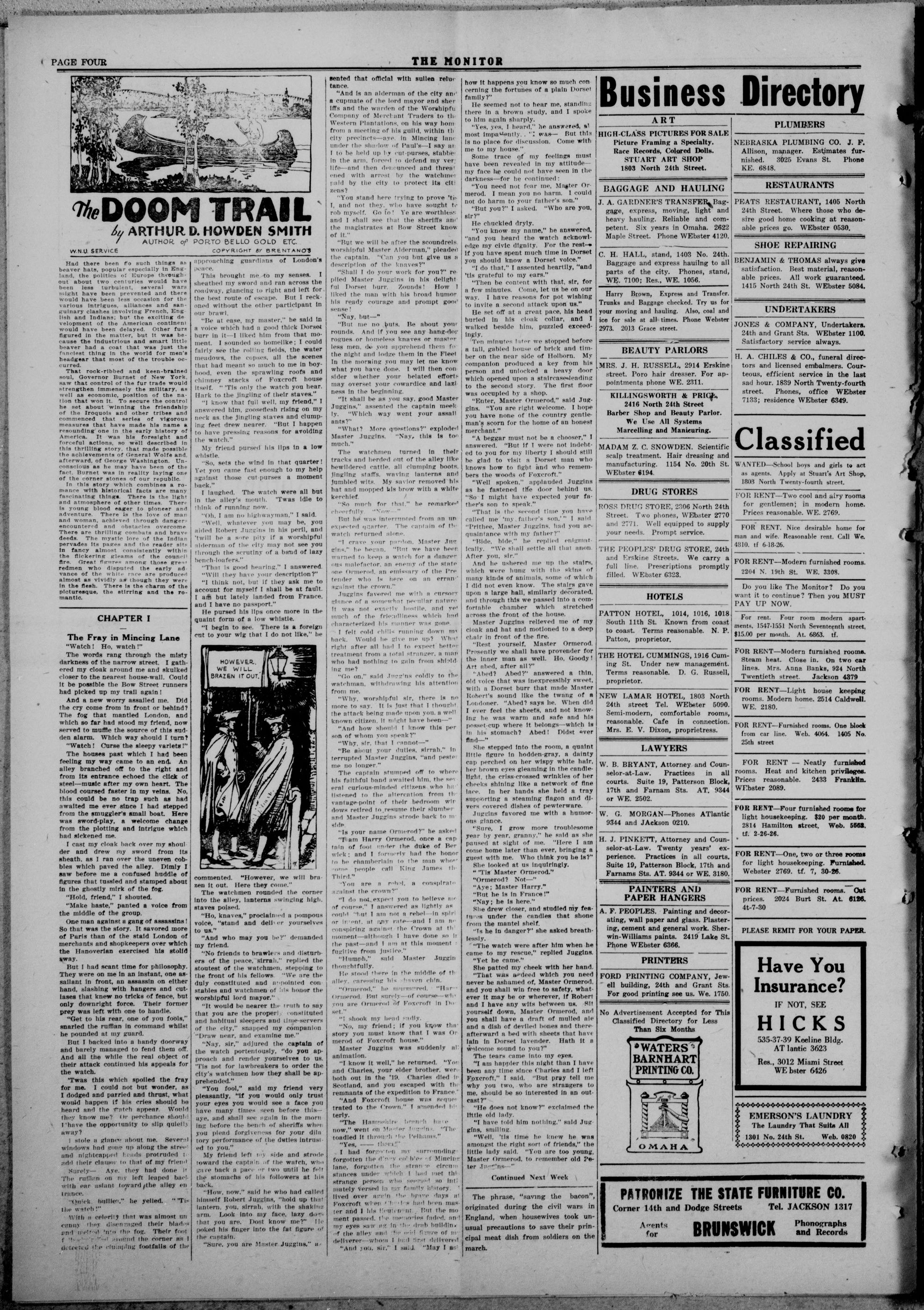
The Fray in Mincing Lane
"Watch! Ho, watch!"
The words rang through the misty darkness of the narrow street. I gathered my cloak around me and skulked closer to the nearest house-wall. Could it be possible the Bow Street runners had picked up my trail again!
And a new worry assailed me. Did the cry come from in front or behind? The fog that mantled London, and which so far had stood my friend, now served to muffle the source of this sudden alarm. Which way should I turn?
"Watch! Curse the sleepy varlets!" The houses past which I had been feeling my way came to an end. An alley branched off to the right and from its entrance echoed the click of steel—music after my own heart. The blood coursed faster in my veins. No, this could be no trap such as had awaited me ever since I had stepped from the smugglier's small boat. Here was sword-play, a welcome change from the plotting and intrigue which had sickened me. I cast my cloak back over my shoulder and drew my sword from its sheath, as I ran over the uneven cobbles which paved the alley. Dimly I saw before me a confused huddle of figures that tussled and stamped about in the ghostly mirk of the fog. "Hold, friend," I shouted. "Make haste," panted a voice from the middle of the group.
One man against a gang of assassins! So that was the story. It savored more of Paris than of the staid London of merchants and shopkeepers over which the Hanoverian exercised his stolid sway.
But I had scant time for philosophy. They were on me in an instant, one assailant in front, an assassin on either hand, slashing with hangers and cut-lases that knew no tricks of fence, but only downright force. Their former prey was left with one to handle.
"Get to his rear, one of you fools," snarled the ruffian in command whilst he pounded at my guard.
But I backed into a handy doorway and barely managed to fend them off. And all the while the real object of their attack continued his appeals for the watch.
Twas this which spilled the fray for me. I could not but wonder, as I dodged and parried and thrust, what would happen if his cries should be heard and the watch appear. Would they know me? Or perchance should I have the opportunity to slip quietly away?
I stole a glance about me. Several windows had gone up along the street and nightcapped heads protruded to add their clamor to that of my friend
"Quick, bullies," he yelled. "Tis the watch!"
With a celerity that was almost uncanny they disengaged their blades and meted into the fog. Their foot if they rolled around the corner as I detected the clumping footfalls of the
PAGE FOUR
W.N.U. SERVICE
CHAPTER I
"Hold, friend." I shouted.
approaching guardians of London's peace.
This brought me to my senses. I sheathed my sword and ran across the roadway, glancing to right and left for the best route of escape. But I reckoned without the other participant in our brawl.
"Be at ease, my master," he said in a voice which had a good thick Dorset burr in it—I liked him from that moment. I sounded so homelike; I could fairly see the rolling fields, the water mendows, the copses, all the scenes that had meant so much to me in boyhood, even the sprawling roofs and chimney stacks of Foxcroft house itself. "Tis only the watch you hear. Hark to the fingling of their staves."
"I know that full well, my friend," I answered him, gooseelfles rising on my neck as the jingling staves and clumping feet drew nearer. "But I happen to have pressing reasons for avoiding the watch."
My friend pursed his lips in a low whistle.
"So, sets the wind in that quarter! Yet you came fast enough to my help against those cut-purses a moment back."
I laughed. The watch were all but in the alley's mouth. "Twas idle to think of running now.
"Oh, I am no highwayman." I said.
"Well, whatever you may be, you aided Robert Juggins in his peril, and 'twill be a sore pity if a worshipful alderman of the city may not see you through the scrutiny of a band of lazy bench-loafers."
"That is good hearing," I answered.
"Will they have your description?"
"I think not, but if they ask me to account for myself I shall be at fault. I am but lately landed from France, and I have no passport."
He pursed his lips once more in the quaint form of a low whistle.
"I begin to see. There is a foreign cut to your wig that I do not like," he
HOWEVER,
WE WILL
BRAZEN IT OUT.
commented. "However, we will brazen it out. Here they come."
The watchmen rounded the corner into the alley, lanterns swinging high, staves polished.
"Ho, knaves," proclaimed a pompous voice, "stand and deliver yourselves to us."
"And who may you be?" demanded my friend.
"No friends to brawlers and disturbers of the peace, sirrah," replied the stoutest of the watchmen, stepping to the front of his fellows. "We are the duly constituted and appointed constables and watchmen of his honor the worshipful lord mayor."
"It would be nearer the truth to say that you are the properly constituted and habitual sleepers and time-servers of the city," snapped my companion. "Draw near, and examine me."
"Nay, sir," adjured the captain of the watch portentously, "do you approach and render yourselves to us. 'Tis not for lawbreakers to order the city's watchmen how they shall be apprehended."
"You fool," said my friend very pleasantly, "if you would only trust your eyes you would see a face you have many times seen before this—aye, and shall see again in the morning before the bench of sheriffs when you plead forgiveness for your diliary performance of the duties intrusted to you."
My friend left my side and strode toward the captain of the watch, who gave back a pace or two until he felt the stomachs of his followers at his back.
"How, now," said he who had called himself Robert Juggins, "hold up that lantern, you, sirrah, with the shaking arm. Look into my face, lazy does that you are. Dost know me?" He poked his finger into the fat figure of the captain.
"Sure, you are Master Juggins," a
THE MONITOR
sented that official with sullen reluctance.
"And is an alderman of the city and a cupmate of the lord mayor and sheriffs and the warden of the Worshipful Company of Merchant Traders to the Western Plantations, on his way home from a meeting of his guild, within the city precincts—aye, in Mining land under the shadow of Paul's—I say an I to be held up by cut-purses, stabbed in the arm, forced to defend my very life—and then denounced and threatened with arrest by the watchmen paid by the city to protect its citizens?
"You stand here trying to prove 'tis I, and not they, who have sought to rob myself. Go fo! Ye are worthless and I shall see that the sheriffs and the magistrates at Bow Street know of it."
"But we will be after the scoundrels, worshipful Master Alderman," pleaded the captain. "Can you but give us a description of the knaves?" "Shall I do your work for you?" replied Master Juggins in his delightful Dorset burr. Zounds! How I liked the man with his broad humor, his ready courage and prompt good sense!
"Nay, but—"
"But me no puts. Be about your rounds. And if you see any hang-door rogues or homeless knaves or master less men, do you apprehend them for the night and lodge them in the Fleet In the morning you may let me know what you have done. I will then consider whether your belated efforts may overset your cowardice and laziness in the beginning.
"It shall be as you say, good Master Juggins," assented the captain meekly. "Which way went your assailants?"
"What? More questions?" exploded Master Juggins. "Nay, this is too much."
The watchmen turned in their tracks and herded out of the alley like bewildered cattle, all clumping boots, fingling staffs, waving lanterns and jumbled wits. My savior removed his hat and mopped his brow with a white kerchief.
"So much for that," he remarked cheerfully. "Now—"
But he was interrupted from an unexpected quarter. The captain of the watch returned alone.
"I crave your pardon, Master Juggins," he began. "But we have been warned to keep a watch for a dangerous malefactor, an enemy of the state one Ormerod, an emissary of the Pretender who is here on an errand against the crown."
Juggins favored me with a cursory glance of a somewhat peculiar nature. It was not exactly hostile, and yet much of the friendliness which had characterized his manner was gone.
I felt cold chills running down my back. Would he give me up? What right after all had I to expect better treatment from a total stranger, a man who had nothing to gain from shielding me?
"Go on," said Juggins coldly to the watchman, withdrawing his attention from me.
"Why, worshipful sir, there is no more to say. It is just that I thought the attack being made upon you, a well known citizen, it might have been—"
"And how should I know this person of whom you speak?"
"Why, sir, that I cannot—"
"Be about your duties, sirrah," interrupted Master Juggins, "and pester me no longer."
The captain stumped off to where bls faithful band awaited him, the sevel curious-minded citizens who hlistened to the alteration from the vantage-point of their bedroom windows retired to resume their slumber and Master Juggins strode back to inside.
"Is your name Ormerod?" he asked
"Iam Harry Ormerod, once a captain of foot under the duke of Berwick; and I formerly had the honor to be chamberlain to the man where some people call King James the Third."
"You are a rebel, a conspirate against the crown?"
"I do not expect you to believe me of course." I answered as lightly as could "but I am not a rebel—in spirit or intent, at gry rate—and I am no conspiring against the Crown at the moment—although I have done so in the past—and I am at this moment a fugitive from justice."
"Humph," said Master Juggins thoughtfully.
He stood there in the middle of the alley, caressing his shaven chin.
"Ormerod," he murmured. "Harry Ormerod. But surely—of course—who you are Ormerod of Foxcroft in Doe set."
"I shook my head sadly."
"No, my friend; if you know that story you must know that I was Ormerod of Foxcroft house."
Master Juggins was suddenly all animation.
"I know it well," he returned. "You and Charles, your elder brother, were both out in the '19. Charles died in Scotland, and you escaped with the remnants of the expedition to France." "And Foxcroft house was sequestrated to the Crown." I amended bitterly. "The Hampshire branch have now," went on Master Joggin. "The toadled it through the Pelham."
18s. I had forgotten my surrounding-
forgotten the dirty cobbles of Minelis-
lane, forgotten the strange circum-
stances under which I had met the
strange person who seemed so inti-
mately versed in my family history.
lived over again the brave days in
Foxeroft when Charles had been mas-
ter and I his treatment. But the mo-
ment passed, the memories faded, and
my eyes saw ag in the dub buildi-
ness of the alley and the old figure of my
deliverer—when I had first delivered
"And you, sir," I said. "May I asl
"Nay, but—"
"I shook my head sadly.
"Yes. — then!"
how it happens you know so much concerning the fortunes of a plain Dorset family?"
He seemed not to hear me, standing there in a brown study, and I spoke to him again sharply.
"Yes, yes, I heard," he answered, at most impatiently. "I was— But this is no place for discussion. Come with me to my house."
Some trace of my feelings must have been revealed in my attitude—my face he could not have seen in the darkness—for he continued:
"You need not fear me, Master Ormerod. I mean you no harm. I could not do harm to your father's son."
"But you? I asked. "Who are you, str?"
He chuckled dryly.
"You know my name," he answered, "and you heard the acknowledge my civic dignity. For the rest—if you have spent much time in Dorset you should know a Dorset voice." "I do that," I assented heartily, "and 'tis grateful to my ears."
"Then be content with that, sir, for a few minutes. Come, let us be on our way. I have reasons for pot wishing to invite a second attack upon us." He set off at a great pace, his head buried in his cloak collar, and I walked beside him, puzzled exceedingly.
Ten minutes later we stopped before a tall, gabled house of brick and timber on the near side of Holborn. My companion produced a key from his person and unlocked a heavy door which opened upon a staircaseleading to the second story. The first floor was occupied by a shop.
"Enter, Master Ormerod," said Juggins. "You are right welcome. I hope you have none of the country gentleman's scorn for the home of an honest merchant."
"A beggar must not be a chooser," I answered. "But if I were not indebted to you for my liberty I should still be glad to visit a Dorset man who knows how to fight and who remembers the woods of Foxcroft."
"Well spoken," applauded Juggins as he fastened the door behind us. "So I might have expected your father's son to speak."
"That is the second time you have called me 'my father's son,'" I said. "Pritthe, Master Juggins, had you acquaintance with my father?"
"Bide, bide," he replied enigmatically. "We shall settle all that anon. After you, sir."
And he ushered me up the stairs, which were hung with the skins of many kinds of animals, some of which I did not even know. The stairs gave upon a large hall, similarly decorated, and through this we passed into a comfortable chamber which stretched across the front of the house.
Master Juggins relieved me of my cloak and hat and motioned to a deep chair in front of the fire.
"Rest yourself, Master Ormerod. Presently we shall have provender for the inner man as well. Ho, Goody! Art abed, after all?"
"Abed? Abed?" answered a thin, old voice that was inexpressibly sweet, with a Dorset burr that made Master Robert's sound like the twang of a Londoner. "Abed? says he. When did I ever feel the sheets, and not knowing he was warm and safe and his possesset杯 where it belongs—which is in his stomach? Abed! Didst ever find—"
She stepped into the room, a quaint little figure in hodden-gray, a dainty cap perched on her wispy white hair, her brown eyes gleaming in the candle-light, the criss-crossed wrinkles of her cheeks shining like a network of fine lace. In her hands she held a tray supporting a steaming flagon and divers covered dishes of pewterware. Juggins favored me with a humorous glance.
"Sure, I grow more troublesome year by year, granny." he said as she paused at sight of me. "Here I am come home later than ever, bringing a guest with me. Who think you he is?"
She looked at us inquiringly "Tis' Master Ormerod."
"Ormerod? Not—"
"Aye; Master Harry."
"But he is in France!"
"Nay; he is here."
She drew closer, and studied my features under the candles that shone from the mantel shelf.
"Is he in danger?" she asked breathlessly.
"The watch were after him when he came to my rescue," replied Juggins.
"Yet he came."
She patted my cheek with her hand.
"That was a deed which you need never be ashamed of, Master Ormerod, and you shall win free to safety, whatever it may be or wherever, if Robert and I have any wits between us. Sit yourself down, Master Ormerod, and you shall have a draft of mulled ale and a dish of deviled bones and thereafter a bed with sheets that have lain in Dorset lavender. Hath it a welcome sound to you?"
"I am happier this night than I have been any time since Charles and I left Foxcroft," I said. "But pray tell me why you two, who are strangers to me, should be so interested in an outcast."
"He does not know?" exclaimed the little old lady.
"I have told him nothing," said Juggins, smiling.
"Well, 'its time he knew he was amongst the right sort of friends,' the little lady said. "You are too young, Master Ormerod, to remember old Peter Juggins-"
The phrase, "saving the bacon", originated during the civil wars in England, when housewives took unusual precautions to save their principal meat dish from soldiers on the march.
Continued Next Week
Business Directory
PATRONIZE THE STATE FURNITURE CO.
Corner 14th and Dodge Streets Tel. JACKSON 1317
Agents
for BRUNSWICK Phonographs
and Records
ART
HIGH-CLASS PICTURES FOR SALE
Picture Framing a Specialty.
Race Records, Colored Dolls.
STUART ART SHOP
1803 North 24th Street.
BAGGAGE AND HAULING
J. A. GARDNER'S TRANSFER. Baggage, express, moving, light and heavy hauling. Reliable and competent. Six years in Omaha. 2622 Maple Street. Phone WEbster 4120.
C. H. HALL, stand, 1403 No. 24th. Baggage and express hauling to all parts of the city. Phones, stand, WE. 7100; Res., WE. 1056.
Harry Brown, Express and Transfer. Trunks and Baggage checked. Try us for your moving and hauling. Also, coal and ice for sale at all times. Phone Webster 2973. 2013 Grace street.
BEAUTY PARLORS
MRS. J. H. RUSSELL, 2914 Erskine street. Poro hair dresser. For appointments phone WE. 2311.
KILLINGSWORTH & PRICE.
2416 North 24th Street
Barber Shop and Beauty Parlor.
We Use All Systems
Marcelling and Manicuring.
MADAM Z. C. SNOWDEN. Scientific scalp treatment. Hair dressing and manufacturing. 1154 No. 20th St.
WEbster 6194.
DRUG STORES
ROSS DRUG STORE, 2306 North 24th Street. Two phones, WEBster 2770 and 2771. Well equipped to supply your needs. Prompt service.
THE PEOPLES' DRUG STORE, 24th and Erskine Streets. We carry a full line. Prescriptions promptly filled. WEBster 6323.
HOTELS
PATTON HOTEL, 1014, 1016, 1018
South 11th St. Known from coast
to coast. Terms reasonable. N. P.
Patton, proprietor.
THE HOTEL CUMMINGS, 1916 Cuming
St. Under new management.
Terms reasonable. D. G. Russell,
proprietor.
NEW LAMAR HOTEL, 1803 North
24th street Tel. WEbster 5090.
Semi-modern, comfortable rooms,
reasonable. Cafe in connection.
Mrs. E. V. Dixon, proprietress.
LAWYERS
W. B. BRYANT, Attorney and Counselor-at-Law. Practices in all courts. Suite 19, Patterson Block, 17th and Farnam Sts. AT. 9344 or WE. 2502.
W. G. MORGAN—Phones ATlantic 9344 and JAckson 0210.
H. J. PINKETT, Attorney and Counselor-at-Law. Twenty years' experience. Practices in all courts. Suite 19, Patterson Block, 17th and Farnams Sts. AT. 9344 or WE. 3180.
PAINTERS AND PAPER HANGERS
A. F. PEOPLES. Painting and decorating, wall paper and glass. Plastering, cement and general work. Sherwin-Williams paints. 2419 Lake St Phone Webster 6366.
PRINTERS
FORD PRINTING COMPANY, Jewell building, 24th and Grant Sts. For good printing see us. We. 1750.
No Advertisement Accepted for This Classified Directory for Less Than Six Months
WATERS BARNHART PRINTING CO.
OMAHA
PATRONIZE THE ST
Corner 14th and Dodge Street
Agents
for BRUN
PLUMBERS
NEBRASKA PLUMBING CO. J. F.
Allison, manager. Estimates furnished. 3025 Evans St. Phone KE. 6848.
RESTAURANTS
PEATS RESTAURANT, 1405 North 24th Street. Where those who desire good home cooking at reasonable prices go. WEbster 0530.
SHOE REPAIRING
BENJAMIN & THOMAS always give satisfaction. Best material, reasonable prices. All work guaranteed. 1415 North 24th St. WEbster 5084.
UNDERTAKERS
JONES & COMPANY, Undertakers. 24th and Grant Sts. WEbster 1100. Satisfactory service always.
H. A. CHILES & CO., funeral directors and licensed embalmers. Courteous, efficient service in the last sad hour. 1839 North Twenty-fourth street. Phones, office WEbster 7133; residence WEbster 6349.
Classified
WANTED—School boys and girls to act as agents. Apply at Stuart's Art Shop, 1803 North Twenty-fourth street.
FOR RENT—Two cool and airy rooms for gentlemen; in modern home. Prices reasonable. WE. 2769.
FOR RENT. Nice desirable home for man and wife. Reasonable rent. Call We. 4310. tf 6-18-26.
FOR RENT—Modern furnished rooms. 2204 N. 19th St. WE. 3308.
Do you like The Monitor? Do you want it to continue? Then you MUST PAY UP NOW.
For rent. Four room modern apartments, 1547-1551 North Seventeenth street, $15.00 per month. At. 6863. tf.
FOR RENT—Modern furnished rooms.
Steam heat. Close in. On two car
lines. Mrs. Anna Banks, 924 North
Twentieth street. Jackson 4379
FOR RENT—Light house keeping
rooms. Modern home. 2514 Caldwell.
WE. 2180.
FOR RENT—Furnished rooms. One block
from car line. Web. 4064. 1405 No.
25th street
FOR RENT — Neatly furnished
rooms. Heat and kitchen privileges.
Prices reasonable. 2433 Franklin.
WEbster 2089.
FOR RENT—Four furnished rooms for
light housekeeping. $20 per month.
2814 Hamilton street. Web. 5562.
tf. 2-26-26.
FOR RENT—One, two or three rooms
for light housekeeping. Furnished.
Webster 2769. tf. 7, 30-26.
FOR RENT—Furnished rooms. Out
prices. 2024 Burt St. At. 6126.
4t-7-30
PLEASE REMIT FOR YOUR PAPER.
Have You Insurance?
IF NOT, SEE
HICKS
535-37-39 Keeline Bldg.
AT lantic 3623
Res., 3012 Miami Street
WE bster 6426
EMERSON'S LAUNDRY
The Laundry That Suits All
1301 No. 24th St. Web. 0820
ATE FURNITURE CO.
sets Tel. JACKSON 1317
SWICK Phonographs
and Records