The Monitor
Friday, December 31, 1926
Omaha, Nebraska
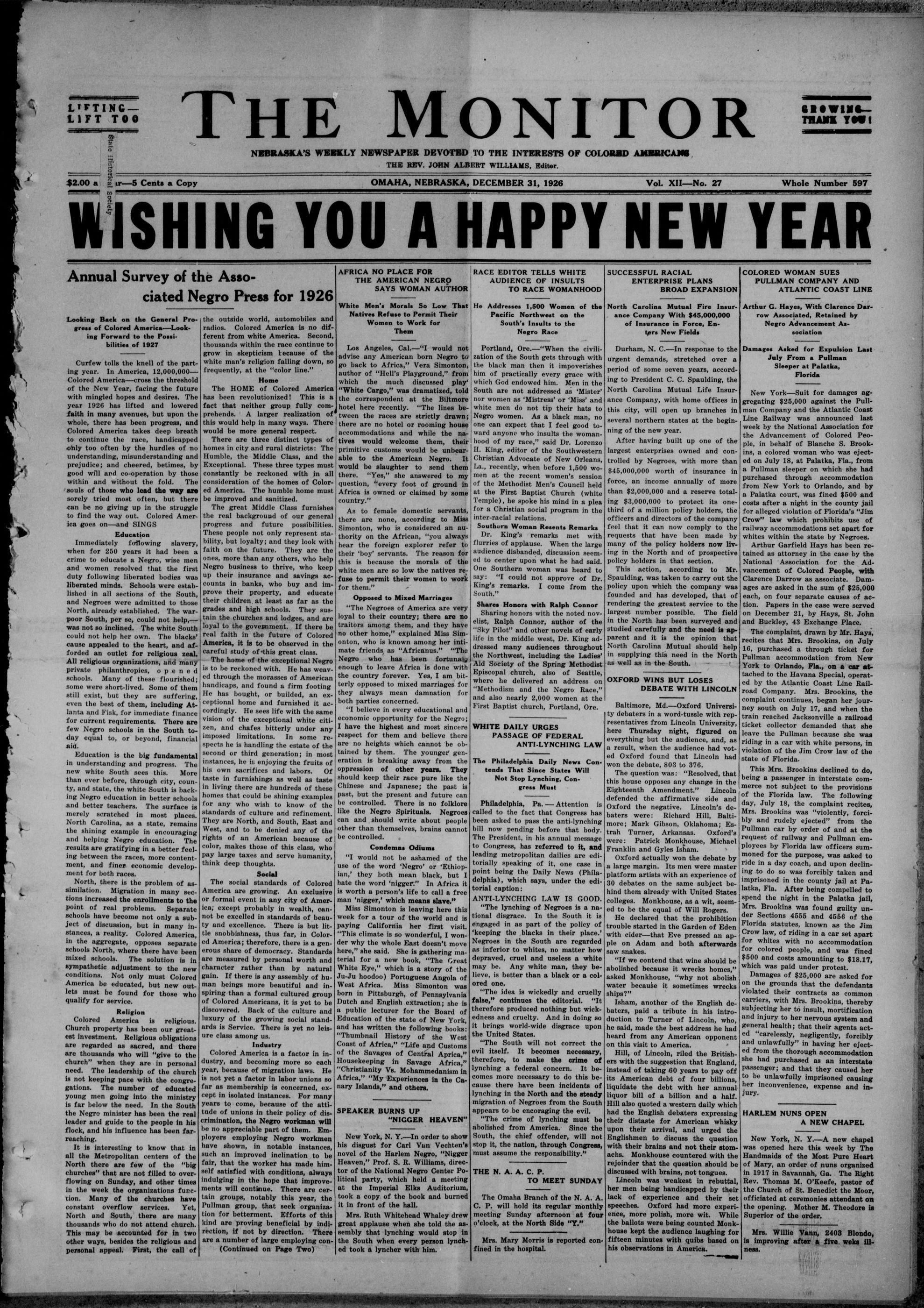
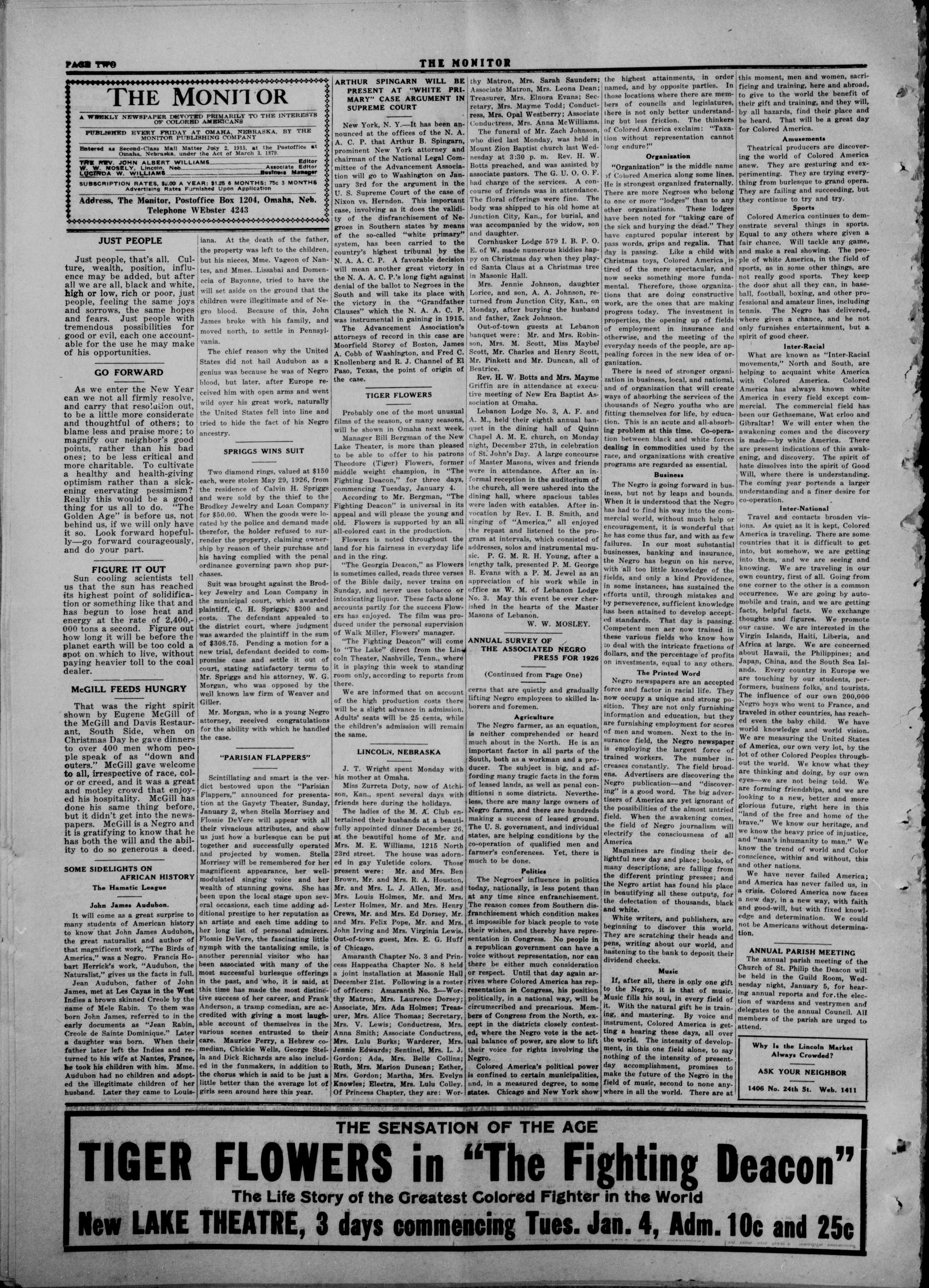
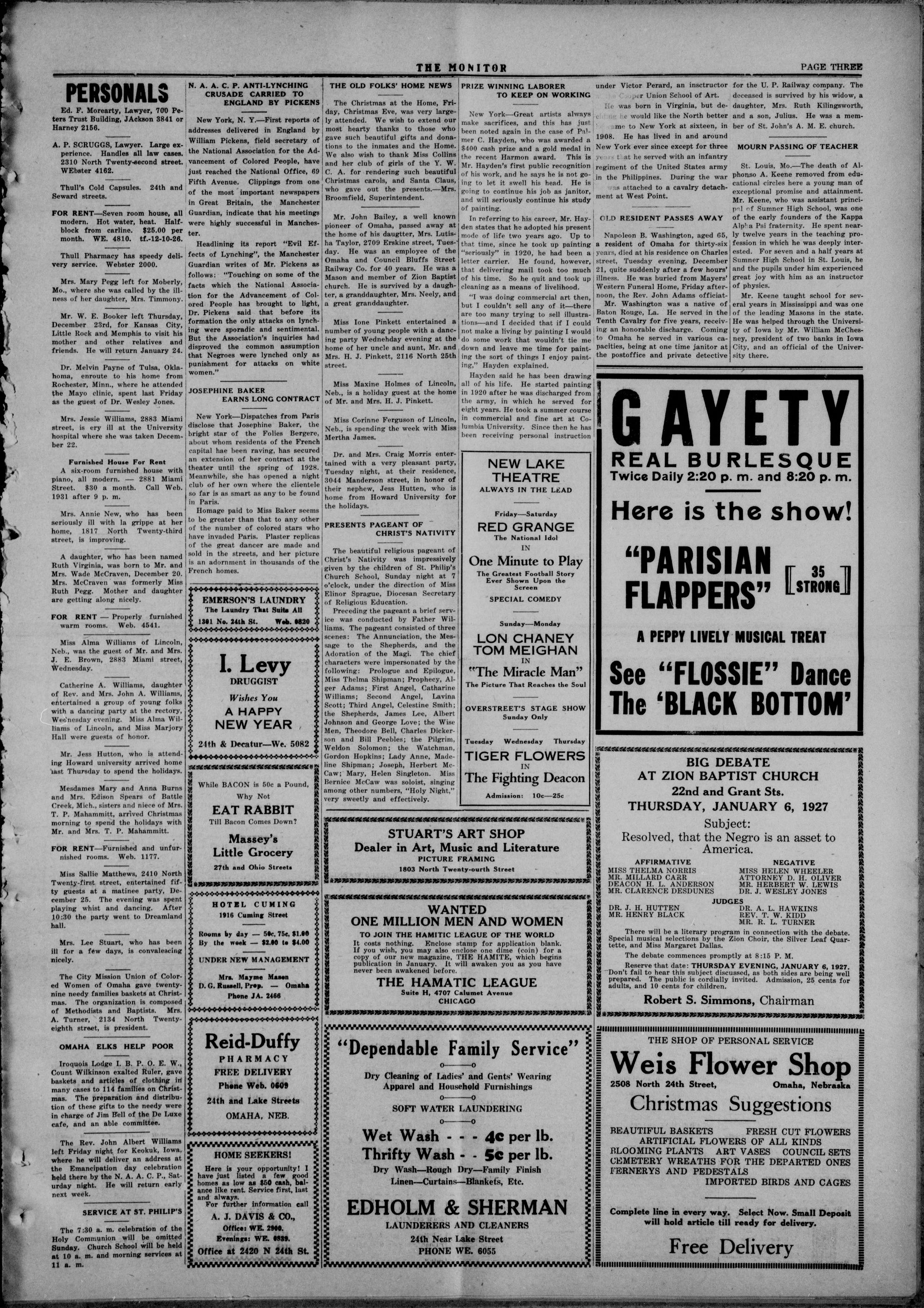
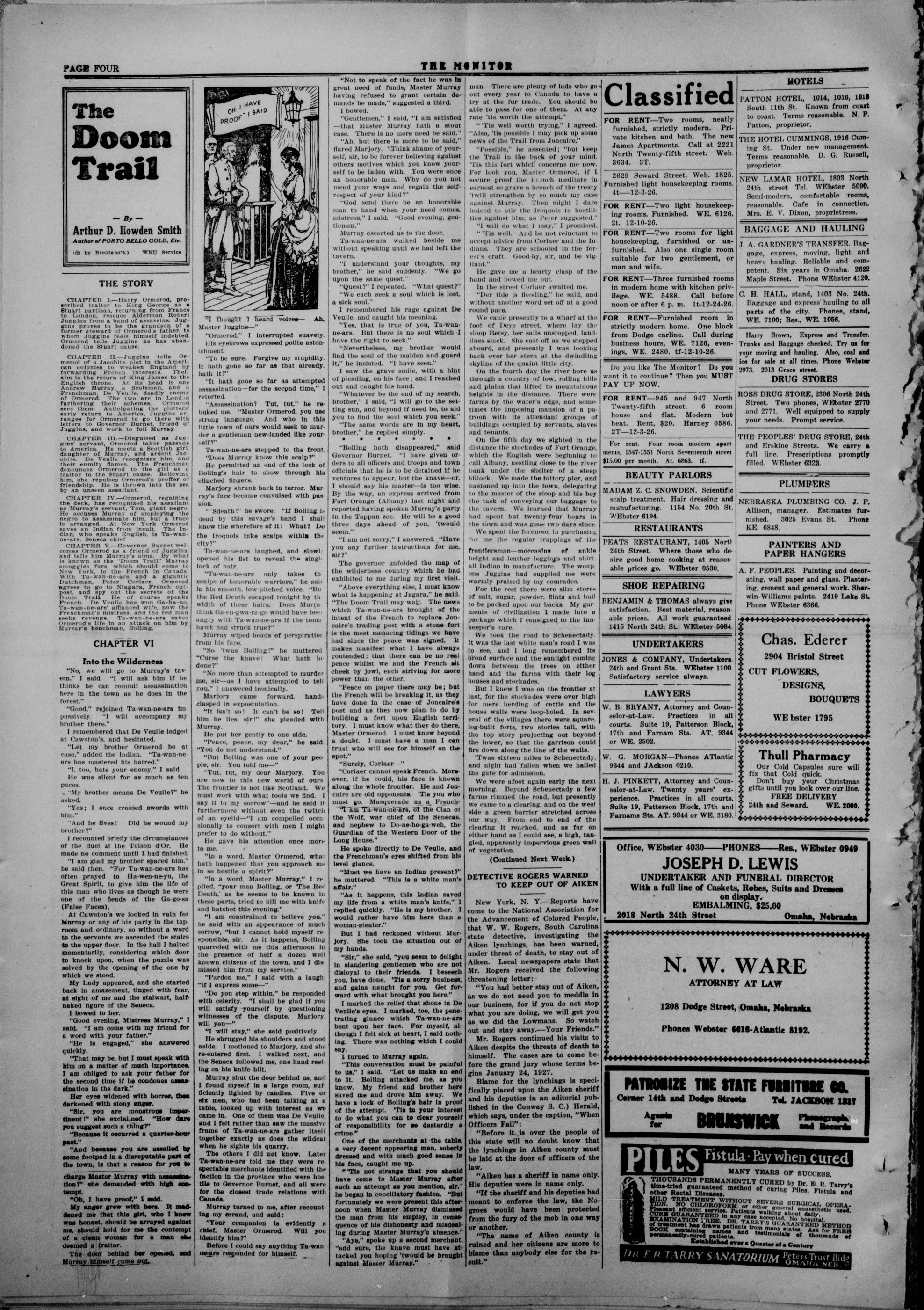
Page text (machine-generated)
WISHING YOU A HAPPY NEW YEAR
Annual Survey of the Associated Negro Press for 1926
LIFTING
LIFT TOO
$2.00 a year—5 Cents a Copy
WISHI
Annual Survey of the
ciated N
Looking Back on the General Pro-
gress of Colored America—Look-
ing Forward to the Possi-
bilities of 1927
Curfew tolls the knell of the parting year. In America, 12,000,000—Colored America—cross the threshold of the New Year, facing the future with mingled hopes and desires. The year 1926 has lifted and lowered faith in many avenues, but upon the whole, there has been progress, and Colored America takes deep breath to continue the race, handicapped only too often by the hurdles of no understanding, misunderstanding and prejudice; and cheered, betimes, by good will and co-operation by those within and without the fold. The souls of those who lead the way are sorely tried most often, but there can be no giving up in the struggle to find the way out. Colored America goes on—and SINGS
Education
Immediately following slavery, when for 250 years it had been a crime to educate a Negro, wise men and women resolved that the first duty following liberated bodies was liberated minds. Schools were established in all sections of the South, and Negroes were admitted to those North, already established. The warpoor South, per se, could not help—was not so inclined. The white South could not help her own. The blacks' cause appealed to the heart, and afforded an outlet for religious zeal. All religious organizations, and many private philanthropies, o p e n d schools. Many of these flourished; some were short-lived. Some of them still exist, but they are suffering, even the best of them, including Atlanta and Fisk, for immediate finance for current requirements. There are few Negro schools in the South today equal to, or beyond, financial aid.
Education is the big fundamental in understanding and progress. The new white South sees this. More than ever before, through city, county, and state, the white South is backing Negro education in better schools and better teachers. The surface is merely scratched in most places. North Carolina, as a state, remains the shining example in encouraging and helping Negro education. The results are gratifying in a better feeling between the races, more contentment, and finer economic development for both races. North, there is the problem of assimilation. Migration in many sections increased the enrollments to the point of real problems. Separate schools have become not only a subject of discussion, but in many instances, a reality. Colored America, in the aggregate, opposes separate schools North, where there have been mixed schools. The solution is in sympathetic adjustment to the new conditions. Not only must Colored America be educated, but new outlets must be found for those who qualify for service.
Religion
Colored America is religious. Church property has been our greatest investment. Religious obligations are regarded as sacred, and there are thousands who will "give to the church" when they are in personal need. The leadership of the church is not keeping pace with the congregations. The number of educated young men going into the ministry is far below the need. In the South the Negro minister has been the real leader and guide to the people in his flock, and his influence has been farreaching.
It is interesting to know that in all the Metropolitan centers of the North there are few of the "big churches" that are not filled to overflowing on Sunday, and other times in the week the organizations function. Many of the churches have constant overflow services. Yet, North and South, there are many thousands who do not attend church. This may be accounted for in two other ways, besides the religious and personal appeal. First, the call of
---
THE MONITOR
the outside world, automobiles and radios. Colored America is no different from white America. Second, thousands within the race continue to grow in skepticism because of the white man's religion falling down, so frequently, at the "color line."
Home
The HOME of Colored America has been revolutionized! This is a fact that neither group fully comprehends. A larger realization of this would help in many ways. There would be more general respect.
There are three distinct types of homes in city and rural districts: The Humble, the Middle Class, and the Exceptional. These three types must constantly be reckoned with in all consideration of the homes of Colored America. The humble home must be improved and sanitized.
The great Middle Class furnishes the real background of our general progress and future possibilities. These people not only represent stability, but loyalty; and they look with faith on the future. They are the ones, more than any others, who help Negro business to thrive, who keep up their insurance and savings accounts in banks, who buy and improve their property, and educate their children at least as far as the grades and high schools. They sustain the churches and lodges, and are loyal to the government. If there be real faith in the future of Colored America, it is to be observed in the careful study of this great class.
The home of the exceptional Negro is to be reckoned with. He has weaved through the morasses of American handicaps, and found a firm footing. He has bought, or builted, an exceptional home and furnished it accordingly. He sees life with the same vision of the exceptional white citizen, and chafes bitterly under any imposed limitations. In some respects he is handling the estate of the second or third generation; in most instances, he is enjoying the fruits of his own sacrifices and labors. Of taste in furnishings as well as taste in living there are hundreds of these homes that could be shining examples for any who wish to know of the standards of culture and refinement. They are North, and South, East and West, and to be denied any of the rights of an American because of color, makes those of this class, who pay large taxes and serve humanity, think deep thoughts.
Social
The social standards of Colored America are growing. An exclusive or formal event in any city of America; except probably in wealth, cannot be excelled in standards of beauty and excellence. There is but little snobbishness, thus far, in Colored America; therefore, there is a generous share of democracy. Standards are measured by personal worth and character rather than by natural gain. If there is any assembly of human beings more beautiful and inspiring than a formal cultured group of Colored Americans, it is yet to be discovered. Back of the culture and luxury of the growing social standards is Service. There is yet no leisure class among us.
Industry
Colored America is a factor in industry, and becoming more so each year, because of migration laws. He is not yet a factor in labor unions so far as membership is concerned, except in isolated instances. For many years to come, because of the attitude of unions in their policy of discrimination, the Negro workman will be no appreciable part of them. Employers employing Negro workmen have shown, in notable instances, such an improved inclination to be fair, that the worker has made himself satisfied with conditions, always indulging in the hope that improvements will continue. There are certain groups, notably this year, the Pullman group, that seek organization for betterment. Efforts of this kind are proving beneficial by indirection, if not by direction. There are a number of large employing con- (Continued on Page Two)
OMAHA, NEBRASKA, DECEMBER 31, 1926
AFRICA NO PLACE FOR
THE AMERICAN NEGRO
SAYS WOMAN AUTHOR
White Men's Morals So Low That Natives Refuse to Permit Their Women to Work for Them
Los Angeles, Cal.—"I would not advise any American born Negro to go back to Africa," Vera Simonton, author of "Hell's Playground," from which the much discussed play "White Cargo," was dramatized, told the correspondent at the Biltmore hotel here recently. "The lines between the races are strictly drawn; there are no hotel or rooming house accommodations and while the natives would welcome them, their primitive customs would be unbearable to the American Negro. It would be slaughter to send them there. "Yes," she answered to my question, "every foot of ground in Africa is owned or claimed by some country."
As to female domestic servants, there are none, according to Miss Simonton, who is considered an authority on the African, "you always hear the foreign explorer refer to their 'boy' servants. The reason for this is because the morals of the white men are so low the natives refuse to permit their women to work for them."
Opposed to Mixed Marriages
"The Negroes of America are very loyal to their country; there are no traitors among them, and they have no other home," explained Miss Simonton, who is known among her intimate friends as "Africanus." "The Negro who has been fortunate enough to leave Africa is done with the country forever. Yes, I am bitterly opposed to mixed marriages for they always mean damnation for both parties concerned.
"I believe in every educational and economic opportunity for the Negro; I have the highest and most sincere respect for them and believe there are no heights which cannot be obtained by them. The younger generation is breaking away from the oppression of other years. They should keep their race pure like the Chinese and Japanese; the past is past, but the present and future can be controlled. There is no folklore like the Negro Spirituals. Negroes can and should write about people other than themselves, brains cannot be controlled.
Condemns Odiums
"I would not be ashamed of the use of the word 'Negro' or 'Ethiopian,' they both mean black, but I hate the word 'nigger." In Africa it is worth a person's life to call a free man 'nigger,' which means slave." Miss Simonton is leaving here this week for a tour of the world and is paying California her first visit. "This climate is so wonderful, I wonder why the whole East doesn't move here," she said. She is gathering material for a new book, "The Great White Eye," which is a story of the Ju-Ju hoodoo) Portuguese Angola of West Africa. Miss Simonton was born in Pittsburgh, of Pennsylvania Dutch and English extraction; she is a public lecturer for the Board of Education of the state of New York, and has written the following books: "Thumbnail History of the West Coast of Africa," "Life and Customs of the Savages of Central Aprica," Housekeeping in Savage Africa," "Christianity Vs. Mohammedanism in Africa," "My Experiences in the Canary Islands," and others.
SPEAKER BURNS UP
"NIGGER HEAVEN"
New York, N. Y.—In order to show his disgust for Carl Van Vechten's novel of the Harlem Negro, "Nigger Heaven," Prof. S. R. Williams, director of the National Negro Center Political party, which held a meeting at the Imperial Elks Auditorium, took a copy of the book and burned it in front of the hall.
Mrs. Ruth Whitehead Whaley drew great applause when she told the assembly that lynching would stop in the South when every person lynched took a lyncher with him.
RACE EDITOR TELLS WHITE AUDIENCE OF INSULTS TO RACE WOMANHOOD
He Addresses 1,500 Women of the Pacific Northwest on the South's Insults to the Negro Race
Portland, Ore.—"When the civilization of the South gets through with the black man then it impoverishes him of practically every grace with which God endowed him. Men in the South are not addressed as 'Mister' nor women as 'Mistress' or 'Miss' and white men do not tip their hats to Negro women. As a black man, no one can expect that I feel good toward anyone who insults the womanhood of my race," said Dr. Lorenzo H. King, editor of the Southwestern Christian Advocate of New Orleans, La., recently, when before 1,500 women at the recent women's session of the Methodist Men's Council held at the First Baptist Church (white Temple), he spoke his mind in a plea for a Christian social program in the inter-racial relations.
Southern Woman Resents Remarks Dr. King's remarks met with flurries of applause. When the large audience disbanded, discussion seemed to center upon what he had said. One Southern woman was heard to say: "I could not approve of Dr. King's remarks. I come from the South."
Shares Honors with Walph Connor Sharing honors with the noted novelist, Ralph Connor, author of the "Sky Pilot" and other novels of early life in the middle west, Dr. King addressed many audiences throughout the Northwest, including the Ladies' Aid Society of the Spring Methodist Episcopal church, also of Seattle, where he delivered an address on "Methodism and the Negro Race," and also nearly 2,000 women at the First Baptist church, Portland, Ore.
WHITE DAILY URGES
PASSAGE OF FEDERAL
ANTI-LYNCHING LAW
The Philadelphia Daily News Contends That Since States Will
gress Must
Philadelphia, Pa. — Attention is called to the fact that Congress has been asked to pass the anti-lynching bill now pending before that body. The President, in his annual message to Congress, has referred to it, and leading metropolitan dailies are editorially speaking of it, one case in point being the Daily News (Philadelphia), which says, under the editorial caption:
ANTI-LYNCHING LAW IS GOOD.
"The lynching of Negroes is a national disgrace. In the South it is engaged in as part of the policy of 'keeping the blacks in their place.' Negroes in the South are regarded as inferior to whites, no matter how depraved, cruel and useless a white may be. Any white man, they believe, is better than a black or a colored one.
"The idea is wickedly and cruelly false," continues the editorial. "It therefore produced nothing but wickedness and cruelty. And in doing so it brings world-wide disgrace upon the United States.
"The South will not correct the evil itself. It becomes necessary, therefore, to make the crime of lynching a federal concern. It becomes more necessary to do this because there have been incidents of lynching in the North and the steady migration of Negroes from the South appears to be encouraging the evil.
"The crime of lynching must be abolished from America. Since the South, the chief offender, will not stop it, the nation, through Congress, must assume the responsibility."
The Omaha Branch of the N. A. A. C. P. will hold its regular monthly meeting Sunday afternoon at four o'clock, at the North Side "Y."
Mrs. Mary Morris is reported confined in the hospital.
Vol. XII—No. 27
SUCCESSFUL RACIAL ENTERPRISE PLANS BROAD EXPANSION
North Carolina Mutual Fire Insurance Company With $45,000,000 of Insurance in Force, Enters New Fields
Durham, N. C.—In response to the urgent demands, stretched over a period of some seven years, according to President C. C. Spaulding, the North Carolina Mutual Life Insurance Company, with home offices in this city, will open up branches in several northern states at the beginning of the new year.
After having built up one of the largest enterprises owned and controlled by Negroes, with more than $45,000,000 worth of insurance in force, an income annually of more than $2,000,000 and a reserve totaling $3,000,000 to protect its one-third of a million policy holders, the officers and directors of the company feel that it can now comply to the requests that have been made by many of the policy holders now living in the North and of prospective policy holders in that section. This action, according to Mr. Spaulding, was taken to carry out the policy upon which the company was founded and has developed, that of rendering the greatest service to the largest number possible. The field in the North has been surveyed and studied carefully and the need is apparent and it is the opinion that North Carolina Mutual should help in supplying this need in the North as well as in the South.
OXFORD WINS BUT LOSES DEBATE WITH LINCOLN
Baltimore, Md.—Oxford University debaters in a word-tussle with representatives from Lincoln University, here Thursday night, figured on everything but the audience, and, as a result, when the audience had voted Oxford found that Lincoln had won the debate, 803 to 376.
The question was: "Resolved, that this house opposes any change in the Eighteenth Amendment." Lincoln defended the affirmative side and Oxford the negative. Lincoln's debaters were: Richard Hill, Baltimore; Mark Gibson, Oklahoma; Estrah Turner, Arkansas. Oxford's were: Patrick Monkhouse, Michael Franklin and Gyles Isham.
Oxford actually won the debate by a large margin. Its men were master platform artists with an experience of 30 debates on the same subject behind them already with United States colleges. Monkhouse, as a wit, seemed to be the equal of Will Rogers.
He declared that the prohibition trouble started in the Garden of Eden with cider—that Eve pressed an apple on Adam and both afterwards saw snakes.
"If we contend that wine should be abolished because it wrecks homes," asked Monkhouse, "why not abolish water because it sometimes wrecks ships?"
Isham, another of the English debaters, paid a tribute in his introduction to Turner of Lincoln, who, he said, made the best address he had heard from any American opponent on this visit to America.
Hill, of Lincoln, riled the Britishers with the suggestion that England, instead of taking 60 years to pay off its American debt of four billions, liquidate the debt with her annual liquor bill of a billion and a half. Hill also quoted a western daily which had the English debaters expressing their distaste for American whisky upon their arrival, and urged the Englishmen to discuss the question with their brains and not their stomachs. Monkhouse countered with the rejoinder that the question should be discussed with brains, not tongues.
Lincoln was weakest in rebuttal, her men being handicapped by their lack of experience and their set speeches. Oxford had more experience, more polish, more wit. While the ballots were being counted Monkhouse kept the audience laughing for fifteen minutes with quibs based on his observations in America.
GROWING
THANK YOU!
Whole Number 597
YEAR
COLORED WOMAN SUES
PULLMAN COMPANY AND
ATLANTIC COAST LINE
Arthur G. Hayes, With Clarence Darrow Associated, Retained by Negro Advancement Association
Damages Asked for Expulsion Last
July From a Pullman
Sleeper at Palatka,
Florida
New York—Suit for damages aggregating $25,000 against the Pullman Company and the Atlantic Coast Line Railway was announced last week by the National Association for the Advancement of Colored People, in behalf of Blanche S. Brookins, a colored woman who was ejected on July 18, at Palatka, Fla., from a Pullman sleeper on which she had purchased through accommodation from New York to Orlando, and by a Palatka court, was fined $500 and costs after a night in the county jail for alleged violation of Florida's "Jim Crow" law which prohibits use of railway accommodations set apart for whites within the state by Negroes. Arthur Garfield Hays has been retained as attorney in the case by the National Association for the Advancement of Colored People, with Clarence Darrow as associate. Damages are asked in the sum of $25,000 each, on four separate causes of action. Papers in the case were served on December 21, by Hays, St. John and Buckley, 43 Exchange Place.
The complaint, drawn by Mr. Hays recites that Mrs. Brookins, on July 16, purchased a through ticket for Pullman accommodation from New York to Orlando, Fla., on a car attached to the Havana Special, operated by the Atlantic Coast Line Railroad Company. Mrs. Brookins, the complaint continues, began her journey south on July 17, and when the train reached Jacksonville a railroad ticket collector demanded that she leave the Pullman because she was riding in a car with white persons, in violation of the Jim Crow law of the state of Florida.
This Mrs. Brookins declined to do, being a passenger in interstate commerce not subject to the provisions of the Florida law. The following day, July 18, the complaint recites, Mrs. Brookins was "violently, forcibly and rudely ejected" from the Pullman car by order of and at the request of railway and Pullman employees by Florida law officers summoned for the purpose, was asked to ride in a day coach, and upon declining to do so was forcibly taken and imprisoned in the county jail at Palatka, Fla. After being compelled to spend the night in the Palatka jail, Mrs. Brookins was found guilty under Sections 4555 and 4556 of the Florida statutes, known as the Jim Crow law, of riding in a car set apart for whites with no accommodation for colored people, and was fined $500 and costs amounting to $18.17, which was paid under protest.
Damages of $25,000 are asked for on the grounds that the defendants violated their contracts as common carriers, with Mrs. Brookins, thereby subjecting her to insult, mortification and injury to her nervous system and general health; that their agents acted "carelessly, negligently, forcibly and unlawfully" in having her ejected from the thorough accommodation she had purchased as an interstate passenger; and that they caused her to be unlawfully imprisoned causing her inconvenience, expense and injury.
HARLEM NUNS OPEN
A NEW CHAPEL
New York, N. Y.—A new chapel was opened here this week by The Handmaids of the Most Pure Heart of Mary, an order of nuns organized in 1917 in Savannah, Ga. The Right Rev. Thomas M. O'Keefe, pastor of the Church of St. Benedict the Moor, officiated at ceremonies attendant on the opening. Mother M. Theodore is Superior of the order.
Mrs. Willie Vann, 2403 Blondo, is improving after a five weks illness.
THE SENSATION OF THE AGE
TIGER FLOWERS in “The Fighting Deacon”
The Life Story of the Greatest Colored Fighter in the World
New LAKE THEATRE, 3 days commencing Tues. Jan. 4, Adm. 10c and 25¢
FOSS SSO 00000000008 t tote ooo oor e errr
2 WOEKLY NEWSPAPER DEVOTED PRIMARILY TO THe INTERESTS
‘OF COLORBD AMBRICANS
PUBLICHED EVERY FRIDAY AT OMAHA, NEBRASKA, BY THE
MONITOR PUBLISHING COMPANY
Bntered as Second-Ciass Mall Matter Juiy 2, 1915, at, the Postoffice at
“* Omaha, Nebraska, under the Act of March 3. 1879
ym ey, JONN ALBERT WILLIAMS. Eater
1 W. MOSELY, Lincoln. Neb. Associate Editor
AW. WILLIAMS. eernees_ Manager
SUBSCRIPTION RATES, $200 A YEAR: $1.25 6 MONTHS: 7c 3 MONTHS
Advertising Rates Furnished Upon Application
Address, The Monitor, Postoffice Box 1204, Omaha, Neb.
Telephone WEbster 4243
drtrtetatrtrtpieteiivinintviniiikiiinikee tl hhh hh KT
Page TWO
eae
A WEEKLY NEWSPAPER DEVOT!
OF COLORS
PUBLICHED EVERY FRIDAY A
MONTTOR PUBL
Bntered as Second-Class Mal! Mat
| SS Goreea. Nebraska, unde
rm FEV. JOMN ALBERT WILL!
RaW. MOSELY. Lincoln, "Neb.
Egetnoa’w.-witiame.“ 9
SUBSCRIPTION RATES, 8200 A YE
Advertising Rates Fu
Address, The Monitor, Poste
Telephone \
POO errrrerercraececretrctrcradecrtreteeetrete
——
JUST PEOPLE
Just people, that’s all. Cul-
ture, wealth, position, influ-
ence may be added, but after
all we are all, black and white,
high or low, rich or poor, just
people, feeling the same joys
and sorrows, the same hopes
and fears. Just people with
tremendous possibilities for
good or evil, each one account-
able for the use he may make
of his opportunities.
GO FORWARD
As we enter the New Year
can we not all firmly resolve,
and carry that resolution out,
to be a little more considerate
and thoughtful of others; to
blame less and praise more; to
magnify our neighbor’s good
points, rather than his bad
ones; to be less critical and
more charitable. To cultivate
a healthy and health-giving
optimism rather than a sick-
ening enervating pessimism?
Really this would be a good
thing for us all to do. “The
Golden Age” is before us, not
behind us, if we will only have
it so. Look forward hopeful-
ly—go forward courageously,
and do your part.
FIGURE IT OUT
Sun cooling scientists tell
us that the sun has reached
its highest point of solidifica-
tion or something like that and
has begun to lose heat and
energy at the rate of 2,400,-
000 tons a second. Figure out
how long it will be before the
planet earth will be too cold a
spot on.which to live, without
paying heavier toll to the coal
dealer.
McGILL FEEDS HUNGRY
That was the right spirit
shown by Eugene McGill of
the McGill and Davis Restaur-
ant, South Side, when on
Christmas Day he gave dinners
to over 400 men whom peo-
ple speak of as “down and
outers.” McGill gave welcome
to all, irrespective of race, col-
or or creed, and it was a great
and motley crowd that enjoy-
ed his hospitality. McGill has
done his same thing before,
but it didn’t get into the news-
papers. McGill is a Negro and
it is gratifying to know that he
has both the will and the abil-
ity to do so generous a deed.
SOME SIDELIGHTS ON
AFRICAN HISTORY
The Hamatic League
John James Audubon.
It will come as a great surprise to
many students of American history
to know that John James Audubon,
the great naturalist and author of
that magnificent work, “The Birds of
America,” was a Negro. Francis Ho-
bart Herrick’s work, “Audubon, the
Naturalist,” gives us the facts in full.
Jean Audubon, father of John
James, met at Les Cayas in the West
Indies a brown skinned Creole by the
name of Mele Rabin. To them was
born John James, referred to in the
early documents as “Jean Rabin,
Creole de Sainte Dominique.” Later
a daughter was born. When their
father later left the Indies and re-
turned to his wife at Nantes, France,
he took his children with him. Mme.
Audubon had no children and adopt-
ed the illegitimate children of her
husband. Later they came to Louis-
jana, At the death of the father,
‘the property was left to the children,
‘but his nieces, Mme, Vageon of Nan-
tes, and Mmes. Lissabai and Domen-
ecia of Bayonne, tried to have the
‘will set aside on the ground that the
children were illegitimate and of Ne-
gro blood. Because of this, John
James broke with his family, and
moved north, to settle in Pennsyl-
vania.
The chief reason why the United
States did not hail Audubon as a
genius was because he was of Negro
blood, but later, after Europe re-
ceived him with open arms and went
wild oyer his great work, naturally
the United States fell into line and
tried to hide the fact of his Negro
ancestry.
SPRIGGS WINS SUIT
‘Two diamond rings, valued at $150
each, were stolen May 29, 1926, from
the residence of Calvin H. Spriggs
and were sold by the thief to the
Brodkey Jewelry and Loan Company
for $50.00. When the goods were lo-
cated by the police and demand made
therefor, the holder refused to sur-
render the property, claiming owner-
ship by reason of their purchase and
his having complied with the penal
ordinance governing pawn shop pur-
chases.
Suit was brought against the Brod-
key Jewelry and Loan Company in
the municipal court, which awarded
plaintiff, C. H. Spriggs; $300 and
costs, The defendant appealed to
the district court, where judgment
was awarded the plaintiff in the sum
of $308.75. Pending a motion for a
new trial, defendant decided to com-
promise case and settle it out of
court, stating satisfactory terms to
Mr. Spriggs and his attorney, W. G.
Morgan, who was opposed by the
well known law firm of Weaver and
Giller.
Mr. Morgan, who is a young Negro
‘attorney, received congratulations
for the ability with which he handle¢
the case.
“PARISIAN FLAPPERS”
Seintillating and smart is the ver.
diet bestowed upon the “Parisian
Flappers,” announced for presenta
tion at the Gayety Theater, Sunday,
January 2, when Stella Morrisey and
Flossie DeVere will appear with all
their vivacious attributes, and show
us just how a burlesque can be put
together and successfully operated
and projected by women. Stella
Morrisey will be remembered for her
magnificent appearance, her well-
modulated singing voice and her
wealth of stunning gowns. She has
}been upon the local stage upon sev-
eral occasions, each time adding ad-
ditional prestige to her reputation as
an artiste and each time adding to
her long list of personal admirers.
Flossie DeVere, the fascinating little
nymph with the tantalizing smile, is
another perennial visitor who has
been associated with many of the
most successful burlesque offerings
in the past, and ‘who, it is said, at
this time has made the most distine-
tive success of her career, and Frank
Anderson, a tramp comedian, are ac-
credited with giving a most laugh-
able account of themselves in the
various scenes entrusted to their
ie Maurice Perry, a Hebrew co-
median, Chickie Wells, George Stel-
la and Dick Richards are also inelud-
ed in the funmakers, in addition to
the chorus which is said to be just a
little better than the average lot of
girls seen around here this year. ~
THE MONITOR
S$
ARTHUR SPINGARN WILL BE|thy Matron,
PRESENT AT “WHITE PRI-| Associate M:
MARY” CASE ARGUMENT IN |Treasurer, 3
SUPREME COURT retary, Mrs.
New York, N. Y.—It has been an-
nounced at the offices of the N. A.
A. C. P. that Arthur B. Spingarn,
prominent New York attorney and
chairman of the National Legal Com-
mittee of the Advancement Associa-
tion will go to Washington on Jan-
uary 8rd for the argument in the
U. 8. Supreme Court of the case of
Nixon vs. Herndon. This important
jease, involving as it does the validi-
ty of the disfranchisement of Ne-
groes in Southern states by means
of the so-called “white primary”
system, has been carried to the
country’s highest tribunal by the
N. A. A.C. P. A favorable decision
will mean another great victory in
the N. A. A. C. P.’s long fight against
denial of the ballot to Negroes in the
South and will take its place with
the victory in the “Grandfather
Clauses” which the N. A. A. C. P.
was instrumental in gaining in 1915.
The Advancement Association's
attorneys of record in this case are
Moorfield Storey of Boston, James
‘A. Cobb of Washington, and Fred C.
Knollenberg and R. J. Channel of El
Paso, Texas, the point of origin of
the case.
Probably one of the most unusual
films of the season, or many seasons,
will be shown in Omaha next week.
Manager Bill Bergman of the New
Lake Theater, is more than pleased
to be able to offer to his patrons
Theodore (Tiger) Flowers, former
middle weight champion, in “The
Fighting Deacon,” for three days,
commencing Tuesday, January 4.
According to Mr. Bergman, “The
Fighting Deacon” is universal in its
appeal and will please the young and
old. Flowers is supported by an all
all-colored cast in the production.
Flowers is noted throughout the
land for his fairness in everyday life
and in the ring.
“The Georgia Deacon,” as Flowers
is sometimes called, reads three verses
of the Bible daily, never trains on
Sunday, and never uses tobacco or
intoxicating liquor, These facts alone
accounts partly for the success Flow-
ers has enjoyed. The film was pro-
duced under the personal supervision
of Walk Miller, Flowers’ manager.
“The Fighting Deacon” will come
to “The Lake” direct from the Ling
coln Theater, Nashville, Tenn., where
it is playing this week to standing
room only, according to reports from
there.
We are informed that on account
of the high production costs there
wi be a slight advance in admission.
Adults’ seats will be 25 cents, while
the children’s admission will remain
ee
LINCOLN, NEBRASKA
J. T. Wright spent Monday with
his mother at Omaha.
Miss Zurreta Doty, now of Atchi-
son, Kan., spent several days with
friends here during the holidays.
The ladies of the M. A. Club en-
tertained their husbands at a beauti-
fully appointed dinner December 26,
at the beautiful home of Mr. and
Mrs. M. E. Williams, 1215 North
23rd street. ‘The house was adorn-
ed in gay Yuletide colors. Those
Present were: Mr. and Mrs. Ben
Brown, Mr. and Mrs. R. A. Houston,
Mr. and Mrs. L. J. Allen, Mr. and
Mrs, Louis Holmes, Mr. and Mrs.
Lester Holmes, Mr. and Mrs. Henry
Crews, Mr. and Mrs. Ed Dorsey, Mr.
and Mrs. Felix Pope, Mr. and Mrs,
John Irving and Mrs. Virginia Lewis.
Out-of-town guest, Mrs. E. G. Huff
of Chicago.
Amaranth Chapter No. 3 and Prin-
cess Happeatha Chapter No. 8 held
a joint installation at Masonic Hall
December 21st. Following is a roster
of officers: Amaranth No, 3—Wor-
thy Matron, Mrs. Laurence Dorsey;
Associate, Mrs. Ada Holmes; Treas-
urer, Mrs. Alice Thomas; Secretary,
Mrs. V. Lewis; Conductress, Mrs.
Anna Smith; Associate Conductress,
Mrs. Lulu Burks; Warderer, Mrs.
Jennie Edwards; Sentinel, Mrs. L. J.
Gordon; Ada, Mrs. Belle Collins;
Ruth, Mrs. Marion Duncan; Esther,
Mrs. Gordon; Martha, Mrs. Evelyn
Knowles; Electra, Mrs. Lulu Colley.
Of Princess Chapter, they are: Wor-
TIGER FLOWERS
thy Matron, Mrs, Sarah Saunders;
Associate Matron, Mrs. Leona Dean;
Treasurer, Mrs. Elnora Evans; Sec-
retary, Mrs. Mayme Todd; Conduct-
ress, Mrs, Opal Westberry; Associate
Conductress, Mrs. Anna Me Williams.
| The funeral of Mr. Zach Johnson,
who died last Monday, was held in
‘Mount Zion Baptist church last Wed-
‘nesday at 3:30 p. m. Rev. H. W.
Botts preached, and was assisted by
associate pastors. The G. U. 0. 0. F.
‘had charge of the services. A con-
course of friends was in attendance.
‘The floral offerings were fine. The
body was shipped to his old home at
Junction City, Kan., for burial, and
‘was accompanied by the widow, son
‘and daughter.
Cornhusker Lodge 579 I. B. P. 0.
E. of W. made numerous kiddies hap-
‘py on Christmas day when they play-
ed Santa Claus at a Christmas tree
in Masonic Hall.
Mrs. Jennie Johnson, daughter
Lorice, and son, A. A, Johnson, re-
turned from Junction City, Kan., on
Monday, after burying the husband
and father, Zack Johnson.
Out-of-town guests at Lebanon
banquet were: Mr. and Mrs. Robin-
son, Mrs. M. Scott, Miss Maybel
Scott, Mr. Charles and Henry Scott,
Mr. Pinkett and Mr. Duncan, all of
Beatrice,
Rev. H. W, Botts and Mrs, Mayme
Griffin are in attendance at execu-
tive meeting of New Era Baptist As-
sociation at Omaha,
Lebanon Lodge No. 3, A. F. and
A. M., held their eighth annual ban-
quet in the dining hall of Quinn
Chapel A. M. E, church, on Monday
night, December 27th, in celebration
of St. John’s Day. A large concourse
of Master Masons, wives and friends
were in attendance. After an in-
formal reception in the auditorium of
the church, all were ushered into the
dining hall, where spacious tables
were laden with eatables. After in-
vocation by Rev. I. B. Smith, and
singing of “America,” all enjoyed
the repast and listened to the pro-
gram at intervals, which consisted of
addresses, solos and instrumental mu-
sic. P. G. M. R. H. Young, after a
lengthy talk, presented P. M. George
B. Evans with a P. M. Jewel as an
appreciation of his work while in
office as W. M, of Lebanon Lodge
No. 3. May this event be ever cher-
ished in the hearts of the Master
Masons of Lebanon,
W. W. MOSLEY.
ANNUAL SURVEY OF
THE ASSOCIATED NEGRO
PRESS FOR 1926
(Continued from Page One)
Se ee ee 5 ee ee ee
‘lifting Negro employees to skilled la-
borers and foremen.
Agriculture
‘The Negro farmer, as an equation,
is neither comprehended or heard
much about in the North. He is an
important factor in all parts of the
South, beth as a workman and a pro-
ducer. The subject is big, and af-
fording many tragic facts in the form
of leased lands, as well as penal con-
ditionsi n some districts. Neverthe-
less, there are many large owners of
Negro farms, and there are hundreds
making a success of leased ground.
‘The U. S. government, and individual
states, are helping conditions by the
co-operation of qualified men and
farmer’s conferences. Yet, there is
much to be done,
Polities
The Negroes’ influence in politics
today, nationally, is less potent than
at any time since enfranchisement,
‘The reason comes from Southern dis-
franchisement which condition makes
tt impossible for black people to vote
their wishes, and thereby have repre-
sentation in Congress. No people in
a republican government can have a
voice without representation, nor can
there be either much consideration
‘or respect. Until that day again ar-
rives where Colored America has rep-
resentation in Congress, his position
Politically, in a national way, will be
circumscribed and precarious. Mem-
bers of Congress from the North, ex-
‘cept in the districts closely contest-
ed, where the Negro vote is the act-
‘ual balance of power, are slow to lift
their voice for rights involving the
Negro.
Colored America’s political power
is confined to certain municipalities,
und, in a measured degree, to some
states. Chicago and New York show
eae
the highest attainments, in order
named, and by opposite parties. In
those locations where there are mem-
hers of councils and legislatures,
there is not only better understand-
ing but less friction. The thinkers
| of Colored America exclaim: “Taxa-
|tion without representation cannot
Jong endure!”
Organization
“Organization” is the middle name
of Colored America along some lines.
| He is strongest organized fraternally.
‘There are more Negroes who belong
to one or more “lodges” than to any
other organizations. These lodges
have been noted for “taking care of
the sick and burying the dead.” They
have captured popular interest by
pass words, grips and regalia. That
day is passing. Like a child with
Christmas toys, Colored America, is
|tired of the mere spectacular, and
now seeks something more funda-
mental. Therefore, those organiza-
tions that are doing constructive
work, are the ones that are making
progress today. ‘The investment in
properties, the opening up of fields
of employment in insurance and
otherwise, and the meeting of the
everyday needs of the people, are ap-
pealing forces in the new idea of or-
ganization,
There is need of stronger organi-
zation in business, local, and national,
and of organization that will create
ways of absorbing the services of the
thousands of Negro youths who are
fitting themselves for life, by educa-
tion. This is an acute and all-absorb-
ing problem at this time. Co-opera-
tion between black and white forces
|dealing in commodities used by the
race, and organizations with creative
Programs are regarded as essential.
Business
| ‘The Negro is going forward in bus-
|iness, but not by leaps and bounds.
| When it is understood that the Negro
few had to find his way into the com-
mercial world, without much help or
| encouragement, it is wonderful that
jhe has come thus far, and with as few
|failures. In our most substantial
|businesses, banking and insurance,
|the Negro has begun on his nerve,
j with ‘all too little knowledge of the
|fields, and only a kind Providence,
in some instances, has sustained the
efforts until, through mistakes and
hy perseverence, sufficient knowledge
has been attained to develop accept-
ed standards. That day is passing.
Competent men aer now trained in
these various fields who know how
to deal with the intricate fractions of
dollars, and the percentage of profits
on investments, equal to any others.
The Printed Word
Negro newspapers are an accepted
force and factor in racial life. They
now occupy a unique and strong po-
sition, They are not only furnishing
information and education, but they
are furnishing employment for scores
of men and women. Next to the in-
surance field, the Negro newspaper
is employing the largest force of
trained workers. The number in-
creases constantly. The field broad-
ens. Advertisers are discovering the
Negro publication—and “discover-
ing” is a good word. The big adver-
tisers of America are yet ignorant of
the possibilities of the almost untried
field. When the awakening comes,
the field of Negro journalism will
electrify the consciousness of all
America
Magazines are finding their de-
lightful new day and place; books, of
many descriptions; are falling from
the different printing presses; and
the Negro artist has found his place
in beautifying all these outputs, for
the delectation of thousands, black
and white.
White writers, and publishers, are
beginning to discover this world,
They are scratching their heads and
pens, writing about our world, and
hastening to the bank to deposit their
dividend checks,
Music
If, after all, there is only one gift
to the Negro, it is that of music.
if, after all, there is only one gift
to the Negro, it is that of music.
Music fills his soui, in every field of
it, With the natural gift he is train-
ing, and mastering. By voice and
instrument, Colored America is get-
ting a hearing these days, all over
the world. The intensity of develop-
ment, in this one field alone, to say
nothing of the intensity of present-
day accomplishment, promises to
make the future of the Negro in the
field of music, second to none any-
where in all the world. There are at
EEE
this moment, men and women, sacri-
ficing and training, here and abroad,
to give to the world the benefit of
their gift and training, and they will,
by all hazards, find their place and
be heard. That will be a great day
for Colored America.
Amusements
Theatrical producers are discover-
ing the world of Colored America
anew. They are gesturing and ex-
perimenting. They are trying every-
thing from burlesque to grand opera.
‘They are failing and succeeding, but
they continue to try and try.
Sports
Colored America continues to dem-
onstrate several things in sports.
Equal to any others where given a
fair chance. Will tackle any game,
and make a real showing. The peo-
ple of white America, in the field of
sports, as in some other things, are
not really good sports. They keep
the door shut all they can, in base-
ball, football, boxing, and other pro-
fessional and amateur lines, including
tennis, The Negro has delivered,
where given a chance, and he not
only furnishes entertainment, but a
spirit of good cheer.
Inter-Racial
What are known as “Inter-Racial
movements,” North and South, are
helping to acquaint white America
with Colored America, Colored
‘America has always known white
America in every field except com-
mercial. The commercial field has
‘been our Gethsemane, Wat erloo and
Gibraltar! We will enter when the
awakening comes and the discovery
is made—by white America, There
‘are present indications of this awak-
‘ening, and discovery. The spirit of
hate dissolves into the spirit of Good
Will, where there is understanding.
‘The coming year portends a larger
understanding and a finer desire for
co-operation, s
. Inter-National
Travel and contacts broaden vis-
ions. As quiet as it is kept, Colored
America is traveling. There are some
countries that it is difficult to get
into, but somehow, we are getting
into them, and we are seeing and
knowing. We are traveling in our
own country, first of all. Going from
one corner to the other is a common
occurrence. We are going by auto-
mobile and train, and we are getting
facts, helpful facts. We exchange
thoughts and figures. We promote
our cause, We are interested in the
Virgin Islands, Haiti, Liberia, and
Africa at large. We are concerned
about Hawaii, the Philippines; and
Japan, China, and the South Sea Isl-
ands. Every country in Europe we
are touching by our students, per-
formers, business folks, and tourists.
The influence of our own 200,000
Negro boys who went to France, and
traveled in other countries, has reach-
ed even the baby child. We have
world knowledge and world vision.
We are measuring the United States
of America, our own very lot, by the
lot of other Colored Peoples through-
out the world. We know what they
are thinking and doing, by our own
eyes—we are not being told. We
are forming friendships, and we are
looking to a new, better and more
glorious future, right here in this
“land of the free and home of the
brave.” We know our heritage, and
we know the heavy price of injustice,
and “man's inhumanity to man.” We
know the trend of world and Color
conscience, within and without, this
and other nations,
We have never failed America;
and America has never failed us, in
a crisis. Colored America now faces
“ new day, in a new way, with faith
and good-will, but with fixed knowl-
edge and determination. We could
is be Americans without determina-
tion,
_ ANNUAL PARISH MEETING
The annual parish meeting of the
Church of St. Philip the Deacon will
be held in the Guild Room, Wed-
nesday night, January 5, for hear-
ing annual reports and for.the elec-
tion of wardens and vestrymen and
delegates to the annual Council. All
members of the parish are urged to
attend.
Why Is the Lincoln Market
Always Crowded?
ASK YOUR NEIGHBOR
1406 No. 24th St. Web. 1411
PERSONALS
Ed. F. Morearty, Lawyer, 700 Peters Trust Building, JAckson 3841 or Harney 2156.
A. P. SCRUGGS, Lawyer. Large experience. Handles all law cases. 2310 North Twenty-second street. WEBster 4162.
Thull's Cold Capsules. 24th and Seward streets.
FOR RENT—Seven room house, all modern. Hot water, heat. Half-block from carline. $25.00 per month. WE. 4810. tf.-12-10-26.
Thull Pharmacy has speedy delivery service. Webster 2000.
Mrs. Mary Pegg left for Moberly, Mo., where she was called by the illness of her daughter, Mrs. Timmony.
Mr. W. E. Booker left Thursday, December 23rd, for Kansas City, Little Rock and Memphis to visit his mother and other relatives and friends. He will return January 24.
Dr. Melvin Payne of Tulsa, Oklahoma, enroute to his home from Rochester, Minn., where he attended the Mayo clinic, spent last Friday as the guest of Dr. Wesley Jones.
Mrs. Jessie Williams, 2883 Miami street, is ery ill at the University hospital where she was taken December 22.
Furnished House For Rent
A six-room furnished house with piano, all modern. — 2881 Miami Street. $30 a month. Call Web. 1931 after 9 p. m.
Mrs. Annie New, who has been seriously ill with la grippe at her home, 1817 North Twenty-third street, is improving.
A daughter, who has been named Ruth Virginia, was born to Mr. and Mrs. Wade McCraven, December 20. Mrs. McCraven was formerly Miss Ruth Pegg. Mother and daughter are getting along nicely.
FOR RENT — Properly furnished warm rooms. Web. 4541.
Miss Alma Williams of Lincoln, Neb., was the guest of Mr. and Mrs. J. E. Brown, 2883 Miami street, Wednesday.
Catherine A. Williams, daughter of Rev. and Mrs. John A. Williams, entertained a group of young folks with a dancing party at the rectory, Weednesday evening. Miss Alma Williams of Lincoln, and Miss Marjory Hall were guests of honor.
Mr. Jess Hutton, who is attending Howard university arrived home last Thursday to spend the holidays.
Mesdames Mary and Anna Burns and Mrs. Edison Spears of Battle Creek, Mich., sisters and niece of Mrs. T. P. Mahammitt, arrived Christmas morning to spend the holidays with Mr. and Mrs. T. P. Mahammitt.
FOR RENT—Furnished and unfurnished rooms. Web. 1177.
Miss Sallie Matthews, 2410 North Twenty-first street, entertained fifty guests at a matinee party, December 25. The evening was spent playing whist and dancing. After 10:30 the party went to Dreamland hall.
Mrs. Lee Stuart, who has been ill for a few days, is convalescing nicely.
The City Mission Union of Colored Women of Omaha gave twenty nine needy families baskets at Christmas. The organization is composed of Methodists and Baptists. Mrs. A. Turner, 2134 North Twenty-eighth street, is president.
OMAHA ELKS HELP POOR
Iroquois Lodge I. B. P. O. E. W., Count Wilkinson exalted Ruler, gave baskets and articles of clothing in many cases to 114 families on Christmas. The preparation and distribution of these gifts to the needy were in charge of Jim Bell of the De Luxe cafe, and an able committee.
The Rev. John Albert Williams left Friday night for Keokuk, Iowa, where he will deliver an address at the Emancipation day celebration held there by the N. A. A. C. P., Saturday night. He will return early next week.
The 7:30 a. m. celebration of the Holy Communion will be omitted Sunday. Church School will be held at 10 a. m. and morning services at 11 a. m.
N. A. A. C. P. ANTI-LYNCHING
CRUSADE CARRIED TO
New York, N. Y.—First reports of addresses delivered in England by William Pickens, field secretary of the National Association for the Advancement of Colored People, have just reached the National Office, 69 Fifth Avenue. Clippings from one of the most important newspapers in Great Britain, the Manchester Guardian, indicate that his meetings were highly successful in Manchester.
Headlining its report "Evil Effects of Lynching", the Manchester Guardian writes of Mr. Pickens as follows: "Touching on some of the facts which the National Association for the Advancement of Colored People has brought to light, Dr. Pickens said that before its formation the only attacks on lynching were sporadic and sentimental. But the Association's inquiries had disproved the common assumption that Negroes were lynched only as punishment for attacks on white women."
JOSEPHINE BAKER
EARNS LONG CONTRACT
New York—Dispatches from Paris disclose that Josephine Baker, the bright star of the Follies Bergere, about whom residents of the French capital hae been raving, has secured an extension of her contract at the theater until the spring of 1928. Meanwhile, she has opened a night club of her own where the clientele so far is as smart as any to be found in Paris.
Homage paid to Miss Baker seems to be greater than that to any other of the number of colored stars who have invaded Paris. Plaster replicas of the great dancer are made and sold in the streets, and her picture is an adornment in thousands of the French homes.
EMERSON'S LAUNDRY
The Laundry That Suits All
1301 No. 24th St. Web. 0820
I. Levy
DRUGGIST
Wishes You
A HAPPY
NEW YEAR
24th & Decatur—We. 5082
While BACON is 50c a Pound,
Why Not
EAT RABBIT
Till Bacon Comes Down?
Massey's
Little Grocery
27th and Ohio Streets
HOTEL CUMING
1916 Cuming Street
Rooms by day — 50c, 75c, $1.00
By the week — $2.00 to $4.00
UNDER NEW MANAGEMENT
Mrs. Mayme Mason
D.G. Russell, Prop. — Omaha
Phone JA. 2466
Reid-Duffy
PHARMACY
FREE DELIVERY
Phone Web. 0609
24th and Lake Streets
OMAHA, NEB.
HOME SEEKERS!
Here is your opportunity! I have just listed a few good homes as low as $50 cash, balance like rent. Service first, last and always.
For further information call
A. J. DAVIS & CO.,
Office: WE. 2900.
Evenings: WE. 0839.
Office at 2420 N 24th St.
THE MONITOR
THE OLD FOLKS' HOME NEWS
The Christmas at the Home, Friday, Christmas Eve, was very largely attended. We wish to extend our most hearty thanks to those who gave such beautiful gifts and donations to the inmates and the Home. We also wish to thank Miss Collins and her club of girls of the Y. W. C. A. for rendering such beautiful Christmas carols, and Santa Claus, who gave out the presents.—Mrs. Broomfield, Superintendent.
Mr. John Bailey, a well known pioneer of Omaha, passed away at the home of his daughter, Mrs. Lutisha Taylor, 2709 Erskine street, Tuesday. He was an employee of the Omaha and Council Bluffs Street Railway Co. for 40 years. He was a Mason and member of Zion Baptist church. He is survived by a daughter, a granddaughter, Mrs. Neely, and a great granddaughter.
Miss Ione Pinkett entertained a number of young people with a dancing party Wednehday evening at the home of her uncle and aunt, Mr. and Mrs. H. J. Pinkett, 2116 North 25th street.
Miss Maxine Holmes of Lincoln,
Neb., is a holiday guest at the home
of Mr. and Mrs. H. J. Pinkett.
Miss Corinne Ferguson of Lincoln,
Neb., is spending the week with Miss
Mertha James.
Dr. and Mrs. Craig Morris entertained
with a very pleasant party,
Tuesday night, at their residence,
3044 Manderson street, in honor of
their nephew, Jess Hutten, who is
home from Howard University for
the holidays.
PRESENTS PAGEANT OF
CHRIST'S NATIVITY
The beautiful religious pageant of Christ's Nativity was impressively given by the children of St. Philip's Church School, Sunday night at 7 o'clock, under the direction of Miss Elinor Sprague, Diocesan Secretary of Religious Education.
Preceding the pageant a brief service was conducted by Father Williams. The pageant consisted of three scenes: The Annunciation, the Message to the Shepherds, and the Adoration of the Magi. The chief characters were impersonated by the following: Prologue and Epilogue, Miss Thelma Shipman; Prophecy, Alger Adams; First Angel, Catharine Williams; Second Angel, Lavina Scott; Third Angel, Celestine Smith; the Shepherds, James Lee, Albert Johnson and George Love; the Wise Men, Theodore Bell, Charles Dickerson and Bill Peebles; the Pilgrim, Weldon Solomon; the Watchman, Gordon Hopkins; Lady Anne, Madeline Shipman; Joseph, Herbert McCaw; Mary, Helen Singleton. Miss Bernice McCaw was soloist, singing among other numbers, "Holy Night," very sweetly and effectively.
STUART'S
Dealer in Art, Music
PICTURE
1803 North Twelf
WANT
ONE MILLION MILL
TO JOIN THE HAMITIC DE
It costs nothing. Enclose
If you wish, you may also en-
copy of our new magazine, e-
publication in January. It w
never been awakened before.
THE HAMAT
Suite H, 4707 C
CHICAGO
"Dependable F
Dry Cleaning of Ladies
Apparel and Houses
WANTED
TO JOIN THE HAMITIC LEAGUE OF THE WORLD
It costs nothing. Enclose stamp for application blank.
If you wish, you may also enclose one dime (coin) for a
copy of our new magazine, THE HAMITE, which begins
publication in January. It will awaken you as you have
never been awakened before.
Dry Cleaning of Ladies' and Gents' Wearing Apparel and Household Furnishings
SOFT WATER LAUNDERING
Wet Wash -
Thrifty Wash
Dry Wash—Rough
Linen—Curtain
EDHOLM &
LAUNDERERS A
24th Near
PHONE
EDHOLM & SHERMAN
PRIZE WINNING LABORER
TO KEEP ON WORKING
New York—Great artists always make sacrifices, and this has just been noted again in the case of Palmer C. Hayden, who was awarded a $400 cash prize and a gold medal in the recent Harmon award. This is Mr. Hayden's first public recognition of his work, and he says he is not going to let it swell his head. He is going to continue his job as janitor, and will seriously continue his study of painting.
In referring to his career, Mr. Hayden states that he adopted his present mode of life two years ago. Up to that time, since he took up painting "seriously" in 1920, he had been a letter carrier. He found, however, that delivering mail took too much of his time. So he quit and took up cleaning as a means of livelihood.
"I was doing commercial art then, but I couldn't sell any of it—there are too many trying to sell illustrations—and I decided that if I could not make a living by painting I would do some work that wouldn't tie me down and leave me time for painting the sort of things I enjoy painting," Hayden explained.
Hayden said he has been drawing all of his life. He started painting in 1920 after he was discharged from the army, in which he served for eight years. He took a summer course in commercial and fine art at Columbia University. Since then he has been receiving personal instruction
NEW LAKE
THEATRE
ALWAYS IN THE LEAD
Friday—Saturday
RED GRANGE
The National Idol
IN
One Minute to Play
The Greatest Football Story
Ever Shown Upon the Screen
SPECIAL COMEDY
Sunday—Monday
LON CHANEY
TOM MEIGHAN
IN
"The Miracle Man"
The Picture That Reaches the Soul
OVERSTREET'S STAGE SHOW
Sunday Only
Tuesday Wednesday Thursday
TIGER FLOWERS
IN
The Fighting Deacon
Admission: 10c—25c
ART SHOP
Music and Literature
FRAMING
City-oorth Street
TED
FEN AND WOMEN
LEAGUE OF THE WORLD
stamp for application blank.
close one dime (coin) for a
THE HAMITE, which begins
will awaken you as you have
TIC LEAGUE
Salumet Avenue
AGO
family Service"
s' and Gents' Wearing
ehold Furnishings
- - 4c per lb.
- - 5c per lb.
Dry—Family Finish
—Blankets, Etc.
SHERMAN
AND CLEANERS
Lake Street
VE. 6055
under Victor Perard, an instrutor in the Cooper Union School of Art.
He was born in Virginia, but deciding he would like the North better became to New York at sixteen, in 1908. He has lived in and around New York ever since except for three years that he served with an infantry regiment of the United States army in the Philippines. During the war was attached to a cavalry detachment at West Point.
OLD RESIDENT PASSES AWAY
Napoleon B. Washington, aged 65, a resident of Omaha for thirty-six years, died at his residence on Charles street, Tuesday evening, December 21, quite suddenly after a few hours' illness. He was buried from Mayers' Western Funeral Home, Friday afternoon, the Rev. John Adams officiatMr. Washington was a native of Baton Rouge, La. He served in the Tenth Cavalry for five years, receiving an honorable discharge. Coming to Omaha he served in various capacities, being at one time janitor at the postoffice and private detective
GAY
REAL BUILD
Twice Daily 2:20 p
Here is t
“PARISI
FLAPPEI
A PEPPY LIVELY
See “FLOS
The ‘BLAC
BIG D
AT ZION BAPT
22nd and
THURSDAY, JA
Subj
Resolved, that the N
Ame
GAYET
REAL BURLESS
twice Daily 2:20 p. m. and 8
Here is the sh
“PARISIAN
FLAPPERS”
A PEPPY LIVELY MUSICAL T
ee “FLOSSIE” in
the ‘BLACK BOT
BIG DEBATE
AT ZION BAPTIST CHUR
22nd and Grant Sts.
THURSDAY, JANUARY 6,
Subject:
Resolved, that the Negro is an
America.
BIG DEBATE
AT ZION BAPTIST CHURCH
22nd and Grant Sts.
THURSDAY, JANUARY 6, 1927
Subject:
Resolved, that the Negro is an asset to America.
AFFIRMATIVE
MISS THELMA NORRIS
MR. MILLARD CARR
DEACON H. L. ANDERSON
MR. CLARENCE DESDUNES
NEGATIVE
MISS HELEN WHEELER
ATTORNEY D. H. OLIVE
MR. HERBERT W. LEWIS
DR. J. WESLEY JONES
JUD
DR. J. H. HUTTEN
MR. HENRY BLACK
There will be a literary program
Special musical selections by the
tette, and Miss Margaret Dallas.
There will be a literary program in connection with the debate. Special musical selections by the Zion Choir, the Silver Leaf Quartette, and Miss Margaret Dallas.
The debate commences promptly at 8:15 P. M.
Reserve that date: THURSDAY EVENING, JANUARY 6, 1927. Don't fail to hear this subject discussed, as both sides are being well prepared. The public is cordially invited. Admission, 25 cents for adults, and 10 cents for children.
Robert S. Simmons, Chairman
THE SHOP OF PERSONAL SERVICE
Weis Flower Shop
2508 North 24th Street, Omaha, Nebraska
Reserve that date: THURSDAY EVENING, JANUARY
It fail to hear this subject discussed, as both sides
paired. The public is cordially invited. Admissi-
tions, and 10 cents for children.
Robert S. Simmons, Chair
THE SHOP OF PERSONAL SERVI
Weis Flower S
08 North 24th Street, Omaha
Christmas Suggest
BEAUTIFUL BASKETS FRESH CU
ARTIFICIAL FLOWERS OF ALL K
BOOMING PLANTS ART VASES CO
METERY WREATHS FOR THE DEPA
RNERYS AND PEDESTALS
Reserve that date: THURSDAY EVENING, JANUARY 6, 1927. Don't fail to hear this subject discussed, as both sides are being well prepared. The public is cordially invited. Admission, 25 cents for adults, and 10 cents for children.
Robert S. Simmons, Chairman
BEAUTIFUL BASKETS FRESH CUT FLOWERS ARTIFICIAL FLOWERS OF ALL KINDS BLOOMING PLANTS ART VASES COUNCIL SETS CEMETERY WREATHS FOR THE DEPARTED ONES FERNERYS AND PEDESTALS IMPORTED BIRDS AND CAGES
Complete line in every way. Select Now. Small Deposit will hold article till ready for delivery.
Free Delivery
Complete line in every way. Select Now. Small Deposit will hold article till ready for delivery.
for the U. P. Railway company. The deceased is survived by his widow, a daughter, Mrs. Ruth Kilingsworth, and a son, Julius. He was a member of St. John's A. M. E. church.
MOURN PASSING OF TEACHER
St. Louis, Mo.-The death of Alphonso A. Keene removed from educational circles here a young man of exceptional promise and attainment. Mr. Keene, who was assistant principal of Sumner High School, was one of the early founders of the Kappa Alpha Psi fraternity. He spent nearly twelve years in the teaching profession in which he was deeply interested. For seven and a half years at Sumner High School in St. Louis, he and the pupils under him experienced great joy with him as an instructor of physics.
Mr. Keene taught school for several years in Mississippi and was one of the leading Masons in the state. He was helped through the University of Iowa by Mr. William McChesney, president of two banks in Iowa City, and an official of the University there.
YETY
BURLESQUE
20 p. m. and 8:20 p. m.
is the show!
PUSIAN
PERS" [35
STRONG]
LAVELY MUSICAL TREAT
"OSSIE" Dance
BACK BOTTOM'
G DEBATE
BAPTIST CHURCH
and Grant Sts.
JANUARY 6, 1927
Subject:
the Negro is an asset to
America.
NEGATIVE
MISS HELEN WHEELER
ATTORNEY D. H. OLIVER
MR. HERBERT W. LEWIS
DR. J. WESLEY JONES
ES.
DR. A. L. HAWKINS
REV. T. W. KIDD
MR. R. L. TURNER
PURSDAY EVENING, JANUARY 6, 1927. Direct discussed, as both sides are being well cordially invited. Admission, 25 cents for children.
Simmons, Chairman
OF PERSONAL SERVICE
Flower Shop
reet, Omaha, Nebraska
as Suggestions
ITS FRESH CUT FLOWERS
FLOWERS OF ALL KINDS
ART VASES COUNCIL SETS
HS FOR THE DEPARTED ONES
DESTALS
my way. Select Now. Small Deposit cycle till ready for delivery.
PAGE THREE
PAGE FOUR
The
Doom
Trail
— By —
Arthur D. Howden Smith
Author of PORTO BELLO GOLD, Etc.
(© by Brentano's.) WNU Service
THE STORY
CHAPTER I.—Harry Ormerod, proscribed traitor to King George as a Stuart partisan, returning from France to Juggins from a band of assassins. Juggins proves to be the grandson of a former steward of Ormerod's father, to whom Juggins feels himself indebted. Juggins from a band of assassins has abandoned the Stuart cause.
CHAPTER II.—Juggins tells Ormerod of a Jacobite plot in the American colonies to weaken England by forwarding French interests. Their return of King James English through the Atlantic is one Andrew Murray, a Scotsman, and a Frenchman. De Veule, deadly enemy Ormerod to John Lennon, furthers their schemes to seize them. Anticipating the plotters' early return to America, Juggins arranges for Ormerod to go there with them, and works to foil Murray.
CHAPTER III.—Disgused as Juggins' servant, Ormerod takes passage to America. He meets a Scottish girl, naughty and violent and violent labo-ble. De Veu recognizes him, and their enmity flames. The Frenchman denounces Ormerod to the girl as a traitor to Suisse. He is repulsed by the repulpe of Ormerod's proffer of friendship. He is thrown into the sea by an unseen assailant.
CHAPTER IV.—Ormerod, regaining the deck, has recognized his assailant as Murray's servant, Tom, giant negro. He is assigned to assassinate him, but a truce is arranged. At New York Ormerod saves an Indian from insult. The In-
CHAPTER V.—Governor Burnet welcomes Ormerod as a friend of Jugglins, and tells him Murray's alms. By what is known as the "Boom Trail" Murray travels to New York, to the French in Canada With Ta-wan-ne-ars and a gigantic Dutchman, Peter Corlaer, Ormerod agrees to go to Niagara, French outward. He goes to Doom Trail. He of course speaks French. De Veulieu has won Ga-ha-no, Ta-wan-ne-ars' afflianced wife, now the Frenchman's mistress, and the red man seeks revenge. Ta-wan-ne-ars saves himself in on him by Murray's henchman, Bolling.
CHAPTER VI
Into the Wilderness
"No, we will go to Murray's tavern." I said. "I will ask him if he thinks he can commit assassination here in the town as he does in the forest."
"Good," rejoined Ta-wan-ne-ars im passively. "I will accompany my brother there."
I remembered that De Veille lodged at Cawston's, and hesitated.
"Let my brother Ormerod be at ease," added the Indian. "Ta-wan-ne-ars has mastered his hatred."
"I too hate your enemy." I said.
I, too, hate your enemy, I said.
He was silent for as much as ten paces.
"My brother means De Veulle?" he asked.
"Yes; I once crossed swords with him."
"And he lives! Did he wound my brother?"
I recounted briefly the circumstances of the duel at the Tolson d'Or. He made no comment until I had finished.
"I am glad my brother spared him," he said then. "For Ta-wan-ne-ars has often prayed to Ha-wen-ne-yu, the Great Spirit, to give him the life of this man who lives as though he were one of the fiends of the Ga-go-sa (False Faces)."
At Cawston's we looked in vain for Murray or any of his party in the taproom and ordinary, so without a word to the servants we ascended the stairs to the upper floor. In the hall I halted momentarily, considering which door to knock upon, when the puzzle was solved by the opening of the one by which we stood.
My Lady appeared, and she started back in amazement, tinged with fear, at sight of me and the stalwart, half-naked figure of the Seneca.
I bowed to her.
"Good evening, Mistress Murray," I said. "I am come with my friend for a word with your father."
"He is engaged," she answered quickly.
"That may be, but I must speak with him on a matter of much importance. I am obliged to ask your father for the second time if he condones assassination in the dark."
Her eyes widened with horror, then darkened with stony anger.
"Sir, you are monstrous impertinent!" she exclaimed. "How dare you suggest such a thing?"
"Because it occurred a quarter-hour past."
"And because you are assailed by some footpad in a disreputable part of the town, is that a reason for you to charge Master Murray with assassination?" she demanded with high contempt.
"Oh I have proof." I said.
"On, I have proof," I said.
My anger grew with hers. It maddened me that this girl, who I knew was honest, should be arrayed against me, should hold for me the contempt of a clean woman for a man she deemed a traitor.
The door behind her opened, and Murray himself came out.
OH, I HAVE
PROOF-" I SAID
"I thought I heard voices—Ah, Master Juggins—"
"Ormerod," I interrupted suavely. His eyebrows expressed polite astonishment.
"To be sure. Forgive my stupidity. It hath gone so far as that already, hath it?"
"It hath gone so far as attempted assassination—for the second time," I retorted.
"Assassination? Tut, tut," he rebuked me. "Master Ormerod, you use strong language. And who in this little town of ours would seek to murder a gentleman new-landed like yourself?"
Ta-wan-ne-ars stepped to the front. "Does Murray know this scalp?"
He permitted an end of the lock of Bolling's hair to show through his clinched fingers.
Marjory shrunk back in terror. Murray's face became convulsed with passion.
"Sdeath!" he swore. "If Bolling is dead by this savage's hand I shall know the wherefore of it! What? Do the Iroquois take scalps within the city?"
Ta-wan-ne-ars laughed, and slowly opened his fist to reveal the single lock of hair.
"Ta-wan-ne-ars only takes the scalps of honorable warriors," he said in his smooth, low-pitched voice. "But the Red Death escaped tonight by the width of these hairs. Does Murray think Gaen-gwa-ra-go would have been angry with Ta-wan-ne-ars if the toma hawk had struck true?"
Murray wiped beads of perspiration from his face.
"So 'twas Bolling!" he muttered "Curse the knave! What hath he done?"
"No more than attempted to murder me, sir—as I have attempted to tell you," I answered ironically.
Marjory came forward, hands-clasped in expostulation.
"It isn't so! It can't be so! Tell him he lies, sir!" she pleaded with Murray.
He put her gently to one side.
"Peace, peace, my dear," he said.
"You do not understand."
"But Bolling was one of our people, sir. You told me—"
"Tut, tut, my dear Marjory. You are new to this new world of ours. The frontier is not like Scotland. We must work with what tools we find. I say it to my sorrow"—and he said it furthermore without even the twitch of an eyelid—"I am compelled occasionally to consort with men I might prefer to do without."
He gave his attention once more to me.
"In a word, Master Ormerod, what hath happened that you approach me in so hostile a spirit?"
"In a word, Master Murray," I replied, "your man Bolling, or The Red Death, as he seems to be known in these parts, tried to kill me with knife and hatchet this evening."
"I am constrained to believe you," he said with an appearance of much sorrow, "but I cannot hold myself responsible, sir. As it happens, Bolling quarreled with me this afternoon in the presence of half a dozen well known citizens of the town, and I dismissed him from my service."
"Pardon me," I said with a laugh. "If I express some—"
"Do you step within," he responded with celerity. "I shall be glad if you will satisfy yourself by questioning witnesses of the dispute. Marjory, will you—"
He shrugged his shoulders and stood aside. I motioned to Marjory, and she re-entered first. I walked next, and the Seneca followed me, one hand resting on his knife hilt.
Murray shut the door behind us, and I found myself in a large room, sufficiently lighted by candles. Five or six men, who had been talking at a table, looked up with interest as we came in. One of them was De Veuille, and I felt rather than saw the massive frame of Ta-wan-ne-ars gather itself together exactly as does the wildcat when he sights his quarry.
The others I did not know. Later Ta-wan-ne-ars told me they were respectable merchants identified with the faction in the province who were hostile to Governor Burnet, and all were for the closest trade relations with Canada.
Murray turned to me, and recounting my errand, and said:
"Your companion is evidently a chief. Master Ormerod. Will you identify him?" Before I could say anything Ta-wan nears responded for himself.
THE MONITOR
"Not to speak of the fact he was in great need of funds, Master Murray having refused to grant certain demands he made," suggested a third. I bowed. "Gentlemen," I said. "I am satisfied—that Master Murray hath a stout case. There is no more need be said." "Ah, but there is more to be said," flared Marjory. "Think shame of yourself, sir, to be forever believing against others motives which you know yourself to be laden with. You were once an honorable man. Why do you not mend your ways and regain the self-respect of your kind?" "God send there be an honorable man to hand when your need comes, mistress," I said. "Good evening, gentlemen." Murray escorted us to the door. Ta-wan-ne-ars walked beside me without speaking until we had left the tavern.
"I understand your thoughts, my brother," he said suddenly. "We go upon the same quest."
"Quest?" I repeated. "What quest?"
"We each seek a soul which is lost, a sick soul."
"I remembered his rage against De Veulle, and caught his meaning.
"Yes, that is true of you, Ta-wanne-ars. But there is no soul which I have the right to seek."
"Nevertheless, my brother would find the soul of the maiden and guard it," he insisted. "I have seen."
I saw the grave smile, with a hint of pleading, on his face; and I reached out and caught his hand.
"Whatever be the end of my search, brother," I said, "I will go to the setting sun, and beyond if need be, to aid you to find the soul which you seek."
"The same words are in my heart,
"Bolling hath disappeared," said Governor Burnet. "I have given orders to all officers and troops and town officials that he is to be detained if he ventures to appear, but the knave—or, I should say his master—is too wise. By the way, an express arrived from Fort Orange (Albany) last night and reported having spoken Murray's party in the Tappan zee. He will be a good three days ahead of you, 'twould seem."
"I am not sorry," I answered. "Have you any further instructions for me, sir?"
The governor unfolded the map of the wilderness country which he had exhibited to me during my first visit.
"Above everything else, I must know what is happening at Jagara," he said. "The Doom Trail may wait. The news which Ta-wan-ne-ars brought of the intent of the French to replace Joncaire's trading post with a stone fort is the most menacing tidings we have had since the peace was signed. It makes manifest what I have always contended; that there can be no real peace whilst we and the French sit cheek by jowl, each striving for more power than the other.
"Peace on paper there may be; but the French will be breaking it, as they have done in the case of Joncaire's post and as they now plan to do by building a fort upon English territory. I must know what they do there, Master Ormerod. I must know beyond a doubt. I must have a man I can trust who will see for himself on the spot."
"Corkerla cannot speak French. Moreover, if he could, his face is known along the whole frontier. He and Joncaire are old opponents. "Tis you who must go. Masquerade as a French." "I am Ta-wan-nears, of the Clan of the Wolf, war chief of the Senecas, and nephew to Do-ne-ho-ga-weh, the Guardian of the Western Door of the Long House."
He spoke directly to De Veille, and the Frenchman's eyes shifted from his level glance.
"Must we have an Indian present?" he muttered. "This is a white man's affair."
"As it happens, this Indian saved my life from a white man's knife," I replied quickly. "He is my brother. I would rather have him here than a woman-stealer."
But I had reckoned without Marjory. She took the situation out of my hands.
"Sir," she said, "you seem to delight in slandering gentlemen who are not disloyal to their friends. I beseech you, have done. "Tis a sorry business, and gains naught for you. Get forward with what brought you here."
I marked the relief that shone in De Venille's eyes. I marked, too, the penetrating glance which Ta-wan-ne-ars bent upon her face. For myself, although I felt sick at heart, I said nothing. There was nothing which I could say.
I turned to Murray again.
"This conversation must be painful to us." I said. "Let us make an end to it. Bolling attacked me, as you know. My friend and brother here saved me and drove him away. We have a lock of Bolling's hair in proof of the attempt. "Tis in your interest to do what you can to clear yourself of responsibility for so dastardly a crime."
One of the merchants at the table, a very decent appearing man, soberly dressed and with much good sense in his face, caught me up.
"Its not strange that you should have come to Master Murray after such an attempt as you mention, sir," he began in conciliatory fashion. "But fortunately we were present this afternoon when Master Murray dismissed the man from his employ, in consequence of his dishonesty and misdealing during Master Murray's absence."
"Aye," spoke up a second merchant, "and sure, the knave must have attacked you hoping 'twould be brought against Master Murray."
"Surely. Corlaer—"
I turned to Murray again.
man. There are plenty of lads who go out every year to Canada to have a try at the for trade. You should be able to pass for one of them. At any rate 'tis worth the attempt."
"Tis well worth trying," I agreed.
"Also, 'tis possible I may pick up some news of the Trail from Joncaire."
"Possible," he assented; "but keep the Trail in the back of your mind. 'Tis this fort which concerns me now. For look you, Master Ormered, if I secure proof the French meditate in earnest so grave a breach of the treaty 'twill strengthen by so much my case against Murray. Then might I dare indeed to stir the Iroquois to hostilities against him, as Peter suggested."
"I will do what I may," I promised.
"Tis well. And be not reluctant to accept advice from Corlaer and the Indians. They are schooled in the forest's craft. Good-by, sir, and be vigilant."
He gave me a hearty clasp of the hand and bowed me out.
In the street Corlaer awaited me.
"Der tide is flooding" be said, and without another word set off at a good round pace.
We canie presently to a wharf at the foot of Deye street, where lay the slop Betsy, her sails unstopped, landlines slack. She cast off as we stepped aboard, and presently I was looking back over her stern at the dwindling skyline of the quaint little city.
On the fourth day the river bore us through a country of low, rolling hills and plains that lifted to mountainous heights in the distance. There were farms by the water's edge, and sometimes the imposing mansion of a patroon with its attendant groups of buildings occupied by servants, slaves and tenants.
On the fifth day we sighted in the distance the stockades of Fort Orange, which the English were beginning to call Albany, nestling close to the river bank under the shelter of a steep hillock. We made the tottery pler, and hastened np into the town, delegating to the master of the sloop and his boy the task of conveying our baggage to the tavern. We learned that Murray had spent but twenty-four hours in the town and was gone two days since. We spent the forenoon in purchasing for me the regular trappings of the frontiersman—moccasins of ankle height and leather leggings and shirt, all Indian in manufacture. The weapons Juggins had supplied me were warmly praised by my comrades.
For the rest there were slim stores of salt, sugar, powder, flints and bail to be packed upon our backs. My garments of civilization I made into a package which I consigned to the innkeeper's care.
We took the road to Schenectady. It was the last white man's road I was to see, and I long remembered its broad surface and the sunlight coming down between the trees on either hand and the farms with their log houses and stockades.
But I knew I was on the frontier at last, for the stockades were over high for mere herding of cattle and the house walls were loop-holed. In several of the villages there were square, log-built forts, two stories tall, with the top story projecting out beyond the lower, so that the garrison could fire down along the line of the walls.
Twas sixteen miles to Schenectady, and night had fallen when we hailed the gate for admission.
We were afoot again early the next morning. Beyond Schenectady a few farms rimmed the road, but presently we came to a clearing, and on the west side a green barrier stretched across our way. From end to end of the clearing it reached, and as far on either hand as I could see, a high, tangled, apparently impervious green wall of vegetation.
(Continued Next Week.)
DETECTIVE ROGERS WARNED
TO KEEP OUT OF AIKEN
New York, N. Y.—Reports have come to the National Association for the Advancement of Colored People, that W. W. Rogers, South Carolina state detective, investigating the Aiken lynchings, has been warned, under threat of death, to stay out of Aiken. Local newspapers state that Mr. Rogers received the following threatening letter:
"You had better stay out of Aiken, as we do not need you to medle in our business, for if you do not stop what you are doing, we will get you as we did the Lowmans. So watch out and stay away.—Your Friends."
Mr. Rogers continued his visits to Aiken despite the threats of death to himself. The cases are to come before the grand jury whose terms begins January 24, 1927.
Blame for the lynchings is specifically placed upon the Aiken sheriff and his deputies in an editorial published in the Conway S. C.) Herald, which says, under the caption, "When Officers Fall":
"Before it is over the people of this state will no doubt know that the lynchings in Aiken county must be laid at the door of officers of the law.
"Aiken has a sheriff in name only. His deputies were in name only.
"If the sheriff and his deputies had meant to enforce the law, the Negroes would have been protected from the fury of the mob in one way or another."
"The name of Aiken county is ruined and her citizens are more to blame than anybody else for the result."
FOR RENT—Two rooms, neatly furnished, strictly modern. Private kitchen and bath. The new James Apartments. Call at 2221 North Twenty-fifth street. Web. 3634. 3T.
2629 Seward Street. Web. 1825. Furnished light housekeeping rooms. 4t—12-3-26.
FOR RENT—Two light housekeeping rooms. Furnished. WE. 6126. 2t. 12-10-26.
FOR RENT—Two rooms for light housekeeping, furnished or unfurnished. Also one single room suitable for two gentlement, or man and wife.
FOR RENT-Three furnished rooms in modern home with kitchen privilege. WE. 5488. Call before noon or after 6 p. m. 1t-12-24-26.
FOR RENT-Furnished room in strictly modern home. One block from Dodge carline. Call during business hours, WE. 7126, evenings, WE. 2480. tf-12-10-26.
Do you like The Monitor? Do you want it to continue? Then you MUST PAY UP NOW.
FOR RENT-945 and 947 North Twenty-fifth street. 6 room house and flat. Modern but heat. Rent, $20. Harney 0586. 2T-12-3-26.
For rent. Four room modern apartments, 1547-1551 North Seventeenth street $15.00 per month. At. 6863. tf.
BEAUTY PARLORS
MADAM Z. C. SNOWDEN. Scientific scalp treatment. Hair dressing and manufacturing. 1154 No. 20th St. WEbster 6194.
RESTAURANTS
PEATS RESTAURANT, 1405 North 24th Street. Where those who desire good home cooking at reasonable prices go. WEbster 0530.
SHOE REPAIRING
BENJAMIN & THOMAS always give satisfaction. Best material, reasonable prices. All work guaranteed 1415 North 24th St. WEbster 5084
UNDERTAKERS
JONES & COMPANY, Undertakers 24th and Grant Sts. WEbster 1100 Satisfactory service always.
LAWYERS
W. B. BRYANT, Attorney and Counselor-at-Law. Practices in all courts. Suite 19, Patterson Block, 17th and Farnam Sts. AT. 9344 or WE. 2502.
W. G. MORGAN—Phones ATlantic 9344 and JAckson 0210.
H. J. PINKETT, Attorney and Counselor-at-Law. Twenty years' experience. Practices in all courts. Suite 19, Patterson Block, 17th and Farnams Sts. AT. 9344 or WE. 3180.
Office, WEbster 4030——PH
JOSEPH L
UNDERTAKER AND
With a full line of Caskets
on o
EMBALM
2018 North 24th Street
N. W.
ATTORNEY
Ebster 4030—PHONES—Res., WI
JOSEPH D. LEWIS
DERTAKER AND FUNERAL DIRECT
full line of Caskets, Robes, Suits and
on display.
EMBALMING, $25.00
24th Street Omaha
N. W. WARE
ATTORNEY AT LAW
PHONES—Res., WEbster 0949
RPH D. LEWIS
OR AND FUNERAL DIRECTOR
Caskets, Robes, Suits and Dresses
on display.
IBALMING, $25.00
reet Omaha, Nebraska
W. WARE
ATTORNEY AT LAW
Office, WEbster 4030——PHONES——Res., WEbster 0949 JOSEPH D. LEWIS UNDERTAKER AND FUNERAL DIRECTOR With a full line of Caskets, Robes, Suits and Dresses on display. EMBALMING, $25.00 2018 North 24th Street Omaha, Nebraska
1208 Dodge Street, Omaha, Nebraska
Phones Webster 6616-Atlantic 8192.
PATRONIZE THE STATE FURNITURE
Corner 14th and Dodge Streets Tel. JACK
Agents for BRUNSWICK Ph
PILES Fistula·Pay when
ORIGIZE THE STATE FURNITURE
th and Dodge Streets Tel. JACK
BRUISWICK Phone
THE STATE FURNITURE CO.
age Streets Tel. JACKSON 1317
BRUNSWICK
Photographs
and Records
PATRONIZE THE STATE FURNITURE CO.
Corner 14th and Dodge Streets
Tel. JACKSON 1317
Agents for BRUNSWICK Phonographs and Records
Fistula - Pay when cured
MANY YEARS OF SUCH
HOUSANDS PERMANENTLY CURED by Dr. TARRY SANATORIUM PETERS OMAHA.
The-tried guaranteed method of curing Piles, other Rectal Diseases.
TREATMENT WITHOUT SEVERE SURGICION. NO CHIROPODOM or other general anaesthetic service. Patients walking about day before guaranteed in any case accepted. By hospitalization FREE. DR. TARRY'S GUARANTEED treatment has known patients from many states. AOK containing names and testimonials of the permanently-cured patients.
Established over a Quarter of a Century.
DR TARRY SANATORIUM PETERS OMAHA.
MANY YEARS OF SUCCESS.
PERMANENTLY CURED by Dr. E. R. Tarry's united method of curing Piles, Fistula and lesions.
UNT WITHOUT SEVERE SURGICAL OERASMOTOR, or other general anaesthetic used. Service. Patients walking about daily. FEED in any case accepted. No hospital FREE. DR. TARRY'S GUARANTEED METHOD draws patients from many states. Ask for FREE names, and testimonials of thousands of patients.
published over a Quarter of a Century
SANATORIUM Peters Trust Bldg OMAHA NEB.
THOUSANDS PERMANENTLY CURED by Dr. E. R. Tarry's time-tried guaranteed method of curing Piles, Fistula and other Rectal Diseases. MILD TREATMENT WITHOUT SEVERE SURGICAL OPERATION. NO CHLOROFORM or other general anaesthetic used. Please efficient service. Patients walking about daily. CURSE GUARANTEED IN any case accepted. No hospital. EXAMINATION FREE. DR. RARRY'S GUARANTEED METHOD OF treatment has drawn patients from many states. Ask for FREE BOOK containing names and testimonials of thousands of permanently-cured patients. Established over a Quarter of a Century
DR E R TARRY SANATORIUM Peters Trust Bldg OMAHA NER
# 1000
PATTON HOTEL, 1014, 1016, 1018
South 11th St. Known from coast
to coast. Terms reasonable. N. P.
Patton, proprietor.
THE HOTEL CUMMINGS, 1916 Cum-
ing St. Under new management.
Terms reasonable. D. G. Russell,
proprietor.
NEW LAMAR HOTEL, 1803 North
24th street Tel. WEbster 5090.
Semi-modern, comfortable rooms,
reasonable. Cafe in connection.
Mrs. E. V. Dixon, proprietress.
J. A. GARDNER'S TRANSFER. Baggage, express, moving, light and heavy hauling. Reliable and competent. Six years in Omaha. 2622 Maple Street. Phone WEbster 4120.
C. H. HALL, stand, 1403 No. 24th. Baggage and express hauling to all parts of the city. Phones, stand, WE. 7100; Res., WE. 1056.
Harry Brown, Express and Transfer. Trunks and Baggage checked. Try us for your moving and hauling. Also, coal and ice for sale at all times. Phone Webster 2973. 2013 Grace street.
DRUG STORES
ROSS DRUG STORE, 2306 North 24th Street. Two phones, WEbster 2770 and 2771. Well equipped to supply your needs. Prompt service.
THE PEOPLES' DRUG STORE, 24th and Erskine Streets. We carry a full line. Prescriptions promptly filled. WEBsther 6323.
PLUMBERS
NEBRASKA PLUMBING CO. J. F. Allison, manager. Estimates furnished. 3025 Evans St. Phone KE. 6848.
PAINTERS AND PAPER HANGERS
A. F. PEOPLES. Painting and decorating, wall paper and glass. Plastering, cement and general work. Sherwin-Williams paints. 2419 Lake St. Phone Webster 6366.
Chas. Ederer
2904 Bristol Street
CUT FLOWERS,
DESIGNS,
BOUQUETS
WE bster 1795
Thull Pharmacy
Our Cold Capsules sure will
fix that Cold quick.
Don't buy your Christmas
gifts until you look over our line.
FREE DELIVERY
24th and Seward. WE. 2000.