The Monitor
Friday, January 28, 1927
Omaha, Nebraska
Page text (machine-generated)
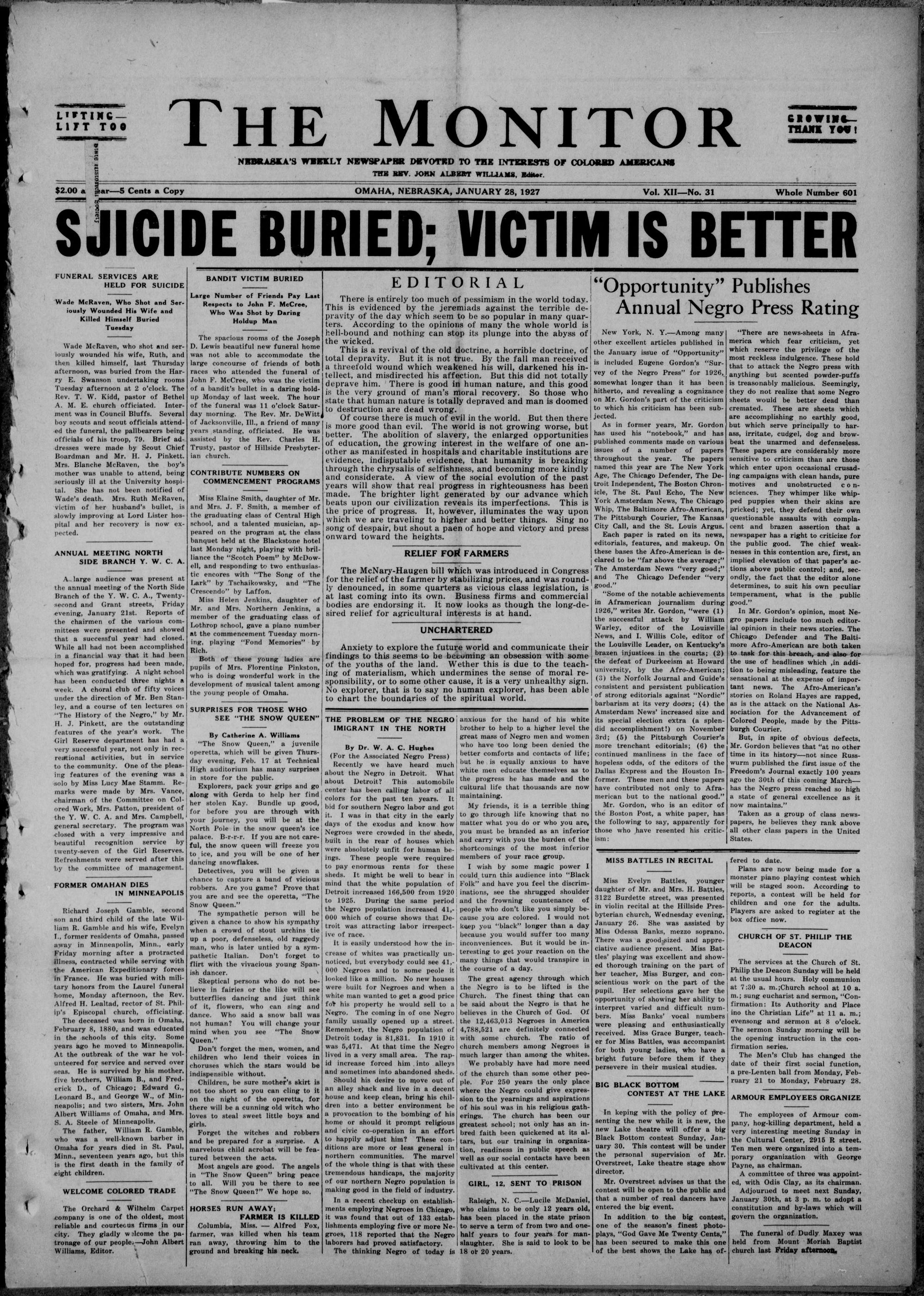
SJICIDE BURIED; VICTIM IS BETTER
LIFTING
LIFT TOO
$2.00 a car—5 Cents a Copy
SJICI
FUNERAL SERVICES ARE
HELD FOR SUICIDE
Wade McRaven, Who Shot and Seri-
ously Wounded His Wife and
Killed Himself Buried
Tuesday
Wade McRaven, who shot and seriously wounded his wife, Ruth, and then killed himself, last Thursday afternoon, was buried from the Harry E. Swanson undertaking rooms Tuesday afternoon at 2 o'clock. The Rev. T. W. Kidd, pastor of Bethel A. M. E. church officiated. Interment was in Council Bluffs. Several boy scouts and scout officials attended the funeral, the pallbearers being officials of his troop, 79. Brief addresses were made by Scout Chief Boardman and Mr. H. J. Pinkett. Mrs. Blanche McRaven, the boy's mother was unable to attend, being seriously ill at the University hospital. She has not been notified of Wade's death. Mrs. Ruth McRaven, victim of her husband's bullet, is slowly improving at Lord Lister hospital and her recovery is now expected.
ANNUAL MEETING NORTH
SIDE BRANCH W. W. C. A.
A large audience was present at the annual meeting of the North Side Branch of the Y. W. C. A., Twenty-second and Grant streets, Friday evening, January 21st. Reports of the chairmen of the various committees were presented and showed that a successful year had closed. While all had not been accomplished in a financial way that it had been hoped for, progress had been made, which was gratifying. A night school has been conducted three nights a week. A choral club of fifty voices under the direction of Mr. Ben Stanley, and a course of ten lectures on "The History of the Negro," by Mr. H. J. Pinkett, are the outstanding features of the year's work. The Girl Reserve department has had a very successful year, not only in recreational activities, but in service to the community. One of the pleasing features of the evening was a solo by Miss Lucy Mae Stamm. Remarks were made by Mrs. Vance, chairman of the Committee on Colored Work, Mrs. Patton, president of the Y. W. C. A. and Mrs. Campbell, general secretary. The program was closed with a very impressive and beautiful recognition service by twenty-seven of the Girl Reserves. Refreshments were served after this by the committee of management.
FORMER OMAHAN DIES
IN MINNEAPOLIS
Richard Joseph Gamble, second son and third child of the late William R. Gamble and his wife, Evelyn I., former residents of Omaha, passed away in Minneapolis, Minn., early Friday morning after a protracted illness, contracted while serving with the American Expeditionary forces in France. He was buried with military honors from the Laurel funeral home, Monday afternoon, the Rev. Alfred H. Lealtad, rector of St. Philip's Episcopal church, officiating.
The deceased was born in Omaha, February 8, 1880, and was educated in the schools of this city. Some years ago he moved to Minneapolis. At the outbreak of the war he volunteered for service and served over seas. He is survived by his mother, five brothers, William B., and Frederick D., of Chicago; Edward G., Leonard B., and George W., of Minneapolis; and two sisters, Mrs. John Albert Williams of Omaha, and Mrs. S. A. Steele of Minneapolis.
The father, William R. Gamble, who was a well-known barber in Omaha for years died in St. Paul, Minn., seventeen years ago, but this is the first death in the family of eight children.
WELCOME COLORED TRADE
The Orchard & Wilhelm Carpet company is one of the oldest, most reliable and courteous firms in our city. They gladly welcome the patronage of our people.—John Albert Williams, Editor.
THE MONITOR
BANDIT VICTIM BURIED
Large Number of Friends Pay Last Respects to John F. McCree, Who Was Shot by Daring Holdup Man
The spacious rooms of the Joseph D. Lewis beautiful new funeral home was not able to accommodate the large concourse of friends of both races who attended the funeral of John F. McCree, who was the victim of a bandit's bullet in a daring hold-up Monday of last week. The hour of the funeral was 11 o'clock Saturday morning. The Rev. Mr. DeWitt of Jacksonville, Ill., a friend of many years standing, officiated. He was assisted by the Rev. Charles H. Trusty, pastor of Hillside Presbyterian church.
CONTRIBUTE NUMBERS ON
COMMENCEMENT PROGRAMS
Miss Elaine Smith, daughter of Mr. and Mrs. J. F. Smith, a member of the graduating class of Central High school, and a talented musician, appeared on the program at the class banquet held at the Blackstone hotel last Monday night, playing with brilliance the "Scotch Poem" by McDowell, and responding to two enthusiastic encores with "The Song of the Lark" by Tschaikowsky, and "The Crescendo" by Laffon.
Miss Helen Jenkins, daughter of Mr. and Mrs. Northern Jenkins, a member of the graduating class of Lothrop school, gave a piano number at the commencement Tuesday morning, playing "Fond Memories" by Rich.
Both of these young ladies are pupils of Mrs. Florentine Pinkston, who is doing wonderful work in the development of musical talent among the young people of Omaha.
SURPRISES FOR THOSE WHO
SEE "THE SNOW QUEEN"
"The Snow Queen," a juvenile operetta, which will be given Thursday evening, Feb. 17 at Technical High auditorium has many surprises in store for the public.
Explorers, pack your grips and go along with Gerda to help her find her stolen Kay. Bundle up good, for before you are through with your journey, you will be at the North Pole in the snow queen's ice palace. B-r-r-r. If you are not careful, the snow queen will freeze you to ice, and you will be one of her dancing snowflakes.
Detectives, you will be given a chance to capture a band of vicious robbers. Are you game? Prove that you are and see the operetta, "The Snow Queen."
The sympathetic person will be given a chance to show his sympathy when a crowd of stout urchins tie up a poor, defenseless, old raggedy man, who is later untied by a sympathetic Italian. Don't forget to flirt with the vivacious young Spanish dancer.
Skeptical persons who do not believe in fairies or the like will see butterflies dancing and just think of it, flowers, who can sing and dance. Who said a snow ball was not human? You will change your mind when you see "The Snow Queen."
Don't forget the men, women, and children who lend their voices in choruses which the stars would be indispensible without.
Children, be sure mother's skirt is not too short so you can cling to it on the night of the operetta, for there will be a cunning old witch who loves to steal sweet little boys and girls.
Forget the witches and robbers and be prepared for a surprise. A marvelous child acrobat will be featured between the acts.
Most angels are good. The angels in "The Snow Queen" bring peace to all. Will you be there to see "The Snow Queen?" We hope so.
HORSES RUN AWAY;
FARMER IS KILLED Columbia, Miss. — Alfred Fox, farmer, was killed when his team ran away, throwing him to the ground and breaking his neck.
OMAHA, NEBRASKA, JANUARY 28, 1927
EDITORIAL
There is entirely too much of This is evidenced by the jersey gravity of the day which seemers. According to the opinion hell-bound and nothing can stu the wicked.
This is a revival of the old total depravity. But it is not to a threefold wound which weak telllect, and misdirected his affep deprave him. There is good it is the very ground of man's n state that human nature is total to destruction are dead wrong.
Of course there is much of e is more good than evil. The w better. The abolition of slave of education, the growing into other as manifested in hospital evidence, indisputable evidence through the chrysalis of selfish and considerate. A view of the years will show that real prog made. The brighter light beats upon our civilization rev the price of progress. It, how which we are traveling to high song of despair, but shout a pace onward toward the heights.
There is entirely too much of pessimism in the world today. This is evidenced by the jeremiads against the terrible depravity of the day which seem to be so popular in many quarters. According to the opinions of many the whole world is hell-bound and nothing can stop its plunge into the abyss of the wicked.
This is a revival of the old doctrine, a horrible doctrine, of total depravity. But it is not true. By the fall man received a threefold wound which weakened his will, darkened his intellect, and misdirected his affection. But this did not totally deprave him. There is good in human nature, and this good is the very ground of man's moral recovery. So those who state that human nature is totally depraved and man is doomed to destruction are dead wrong.
Of course there is much of evil in the world. But then there is more good than evil. The world is not growing worse, but better. The abolition of slavery, the enlarged opportunities of education, the growing interest in the welfare of one another as manifested in hospitals and charitable institutions are evidence, indisputable evidence, that humanity is breaking through the chrysalis of selfishness, and becoming more kindly and considerate. A view of the social evolution of the past years will show that real progress in righteousness has been made. The brighter light generated by our advance which beats upon our civilization reveals its imperfections. This is the price of progress. It, however, illuminates the way upon which we are traveling to higher and better things. Sing no song of despair, but shout a paen of hope and victory and press onward toward the heights.
RELIEF FOR FARMERS
The McNary-Haugen bill was for the relief of the farmer by simply denounced, in some quarter at last coming into its own. bodies are endorsing it. It no sired relief for agricultural int
UNCHA
Anxiety to explore the future findings to this seems to be best of the youths of the land. Wing of materialism, which und sponsibility, or to some other ca No explorer, that is to say no to chart the boundaries of the
The McNary-Haugen bill which was introduced in Congress for the relief of the farmer by stabilizing prices, and was roundly denounced, in some quarters as vicious class legislation, is at last coming into its own. Business firms and commercial bodies are endorsing it. It now looks as though the long-desired relief for agricultural interests is at hand.
UNCHARTERED
Anxiety to explore the future world and communicate their findings to this seems to be becoming an obsession with some of the youths of the land. Wether this is due to the teaching of materialism, which undermines the sense of moral responsibility, or to some other cause, it is a very unhealthy sign. No explorer, that is to say no human explorer, has been able to chart the boundaries of the spiritual world.
THE PROBLEM OF THE NEGRO
IMIGRANT IN THE NORTH
(For the Associated Negro Press) Recently we have heard much about the Negro in Detroit. What about Detroit? This automobile center has been calling labor of all colors for the past ten years. It bid for southern Negro labor and got it. I was in that city in the early days of the exodus and know how Negroes were crowded in the sheds, built in the rear of houses which were absolutely unfit for human beings. These people were required to pay enormous rents for these sheds. It might be well to bear in mind that the white population of Detroit increased 166,500 from 1920 to 1925. During the same period the Negro population increased 41,000 which of course shows that Detroit was attracting labor irrespective of race.
It is easily understood how the increase of whites was practically unnoticed, but everybody could see 41,000 Negroes and to some peole it looked like a million. No new houses were built for Negroes and when a white man wanted to get a good price for his property he would sell to a Negro. The coming in of one Negro family usually opened up a street. Remember, the Negro population of Detroit today is 81,831. In 1910 it was 5,471. At that time the Negro lived in a very small area. The rapid increase forced him into alleys and sometimes into abandoned sheds. Should his desire to move out of an alley shack and live in a decent house and keep clean, bring his children into a better environment be a provocation to the bombing of his home or should it prompt religious and civic co-operation in an effort to happily adjust him? These conditions are more or less general in northern communities. The marvel of the whole thing is that with these tremendous handicaps, the majority of our northern Negro population is making good in the field of industry.
In a recent checkup on establishments employing Negroes in Chicago, it was found that out of 133 establishments employing five or more Negroes, 118 reported that the Negro laborers had proved satisfactory. The thinking Negro of today is
of pessimism in the world today. amiads against the terrible deto be so popular in many quar- as of many the whole world is up its plunge into the abyss of doctrine, a horrible doctrine, of true. By the fall man received cened his will, darkened his injection. But this did not totally in human nature, and this good moral recovery. So those who loyly depraved and man is doomed civil in the world. But then there world is not growing worse, but ery, the enlarged opportunities rest in the welfare of one ans and charitable institutions are, that humanity is breakingness, and becoming more kindly the social evolution of the past press in righteousness has been derated by our advance which deals its imperfections. This is never, illuminates the way upon her and better things. Sing no on of hope and victory and press
which was introduced in Congress stabilizing prices, and was rounds as vicious class legislation, is Business firms and commercial looks as though the long-deerests is at hand.
RTERED
we world and communicate their coming an obsession with some other this is due to the teachermines the sense of moral reuse, it is a very unhealthy sign. human explorer, has been able spiritual world.
anxious for the hand of his white brother to help to a higher level the great mass of Negro men and women who have too long been denied the better comforts and contacts of life; but he is equally anxious to have white men educate themselves as to the progress he has made and the cultural life that thousands are now maintaining.
My friends, it is a terrible thing to go through life knowing that no matter what you do or who you are, you must be branded as an inferior and carry with you the burden of the shortcomings of the most inferior members of your race group.
I wish by some magic power I could turn this audience into "Black Folk" and have you feel the discriminations, see the shrugged shoulder and the frowning countenance of people who don't like you simply because you are colored. I would not keep you "black" longer than a day because you would suffer too many inconveniences. But it would be interesting to get your reaction on the many things that would transpire in the course of a day.
The great agency through which the Negro is to be lifted is the Church. The finest thing that can be said about the Negro is that he believes in the Church of God. Of the 12,463,013 Negroes in America 4,788,521 are definitely connected with some church. The ratio of church members among Negroes is much larger than among the whites.
We probably have had more need of the church than some other people. For 250 years the only place where the Negro could give expression to the yearnings and aspirations of his soul was in his religious gatherings. The church has been our greatest school; not only has an inbred faith been quickened at its altars, but our training in organization, readiness in public speech as well as our social contacts have been cultivated at this center.
GIRL. 12. SENT TO PRISON
Raleigh, N. C.—Lucile McDaniel, who claims to be only 12 years old, has been placed in the state prison to serve a term of from two and one half years to four years for manslaughter. She is said to look to be 18 of 20 years.
"Opportunity" Publishes Annual Negro Press Rating
Vol. XII—No. 31
"Opportunity"
Annual Neg
New York, N. Y.—Among many other excellent articles published in the January issue of "Opportunity" is included Eugene Gordon's "Survey of the Negro Press" for 1926, somewhat longer than it has been hitherto, and revealing a cognizance on Mr. Gordon's part of the criticism to which his criticism has been subjected.
As in former years, Mr. Gordon has used his "notebook," and has published comments made on various issues of a number of papers throughout the year. The papers named this year are The New York Age, The Chicago Defender, The Detroit Independent, The Boston Chronicle, The St. Paul Echo, The New York Amsterdam News, The Chicago Whip, The Baltimore Afro-American, The Pittsburgh Courier, The Kansas City Call, and the St. Louis Argus. Each paper is rated on its news, editorials, features, and makeup. On these bases the Afro-American is declared to be "far above the average;" The Amsterdam News "very good;" and The Chicago Defender "very good."
"Some of the notable achievements in Aframerican journalism during 1926," writes Mr. Gordon, "were (1) the successful attack by William Warley, editor of the Louisville News, and I. Willis Cole, editor of the Louisville Leader, on Kentucky's brazen injustices in the courts; (2) the defeat of Durkeeism at Howard university, by the Afro-American; (3) the Norfolk Journal and Guide's consistent and persistent publication of strong editorials against "Nordic" barbarism at its very doors; (4) the Amsterdam News' increased size and its special election extra (a splendid accomplishment!) on November 3rd; (5) the Pittsburgh Courier's more trenchant editorials; (6) the continued manliness in the face of hopeless odds, of the editors of the Dallas Express and the Houston Informer. These men and these papers have contributed not only to Aframerican but to the national good." Mr. Gordon, who is an editor of the Boston Post, a white paper, has the following to say, apparently for those who have resented his criticism:
MISS BATTLES IN RECITAL
Miss Evelyn Battles, younger daughter of Mr. and Mrs. H. Battles, 3122 Burdette street, was presented in violin recital at the Hillside Presbyterian church, Wednesday evening, January 26. She was assisted by Miss Odessa Banks, mezzo soprano. There was a good sized and appreciative audience present. Miss Battles' playing was excellent and showed thorough training on the part of her teacher, Miss Burger, and conscientious work on the part of the pupil. Her selections gave her the opportunity of showing her ability to interpret varied and difficult numbers. Miss Banks' vocal numbers were pleasing and enthusiastically received. Miss Grace Burger, teacher for Miss Battles, was accompanist for both young ladies, who have a bright future before them if they persevere in their musical studies.
BIG BLACK BOTTOM
CONTEST AT THE LAKE
In keeping with the policy of presenting the new while it is new, the new Lake theatre will offer a big Black Bottom contest Sunday, January 30. This contest will be under the personal supervision of Mr. Overstreet, Lake theatre stage show director.
Mr. Overstreet advises us that the contest will be open to the public and that a number of real dancers have entered the big event.
In addition to the big contest, one of the season's finest photoplays, "God Gave Me Twenty Cents," has been secured to make this one of the best shows the Lake has of-
GROWING
THANK YOU!
Whole Number 601
ETTER
Publishes
ro Press Rating
"There are news-sheets in Aframerica which fear criticism, yet which reserve the privilege of the most reckless indulgence. These hold that to attack the Negro press with anything but scented powder-puffs isreasonably malicious. Seemingly, they do not realize that some Negro sheets would be better dead than cremated. These are sheets which are accomplishing no earthly good, but which serve principally to harass, irritate, cudgel, dog and browbeat the unarmed and defenseless. These papers are considerably more sensitive to criticism than are those which enter upon occasional crusading campaigns with clean hands, pure motives and unobstructed consciences. They whimper like whipped puppies when their skins are pricked; yet, they defend their own questionable assaults with complacent and brazen assertion that a newspaper has a right to criticize for the public good. The chief weaknesses in this contention are, first, an implied elevation of that paper's actions above public control; and, secondly, the fact that the editor alone determines, to suit his own peculiar temperament, what is the public good."
In Mr. Gordon's opinion, most Negro papers include too much editorial opinion in their news stories. The Chicago Defender and The Baltimore Afro-American are both taken to task for this breach, and also for the use of headlines which, in addition to being misleading, feature the sensational at the expense of important news. The Afro-American's stories on Roland Hayes are rapped, as is the attack on the National Association for the Advancement of Colored People, made by the Pittsburgh Courier.
But, in spite of obvious defects, Mr. Gordon believes that "at no other time in its history—not since Russwurm published the first issue of the Freedom's Journal exactly 100 years ago the 30th of this coming March—has the Negro press reached so high a state of general excellence as it now maintains."
Taken as a group of class newspapers, he believes they rank above all other class papers in the United States.
Plans are now being made for a monster piano playing contest which will be staged soon. According to reports, a contest will be held for children and one for the adults. Players are asked to register at the box office now.
CHURCH OF ST. PHILIP THE DEACON
The services at the Church of St. Philip the Deacon Sunday will be held at the usual hours. Holy communion at 7:30 a. m.;Church school at 10 a. m.; sung eucharist and sermon, "Confirmation: Its Authority and Place into the Christian Life" at 11 a. m.; evensong and sermon at 8 o'clock. The sermon Sunday morning will be the opening instruction in the confirmation series.
The Men's Club has changed the date of their first social function, a pre-Lenten ball from Monday, February 21 to Monday, February 28.
ARMOUR EMPLOYEES ORGANIZE
The employees of Armour company, hog-killing department, held a very interesting meeting Sunday in the Cultural Center, 2915 R street. Ten men were organized into a temporary organization with George Payne, as chairman.
A committee of three was appointed, with Odis Clay, as its chairman. Adjourned to meet next Sunday, January 30th, at 3 p. m. to adopt a constitution and by-laws which will govern the organization.
The funeral of Dudly Maxey was held from Mount Moriah Baptist church last Friday afternoon.
THE MONITOR
A WEEKLY NEWSPAPER DEVOTED PRIMARY TO THE INTERESTS
OF COLORED AMERICANS
PUBLISHED EVERY FRIDAY AT OMAHA, NEBRASKA, BY THE
MONITOR PUBLISHING COMPANY
Entered as Second-Class Mail Matter July 2, 1915, at the Postoffice at
Omaha, Nebraska, under the Act of March 3, 1879.
THE REV. JOHN ALBERT WILLIAMS. Editor
W. W. MOSELY, Lincoln, Neb. Associate Editor
LUCINDA W. WILLIAMS Business Manager
SUBSCRIPTION RATES, $2.00 A YEAR; $1.25 6 MONTHS; 75c 3 MONTHS
Advertising Rates Furnished Upon Application
Address, The Monitor, Postoffice Box 1204, Omaha, Neb.
Telephone WEbster 4243
AN IMPORTANT WORD TO SUBSCRIBERS.
The postal regulations require that for newspapers to be sent through the mails subscriptions must be paid in advance. A reasonable time, thirty days, is allowed for renewals. At the expiration of this period, where subscriptions are not renewed, the paper must be stopped. If this is not done, postal privileges are denied the publication. Those, therefore, who desire to continue receiving The Monitor must see to it that their subscriptions are paid, as the law requires, in advance. Statements are being sent to all those who owe, or our collector will call—and unless your subscription is paid we will be compelled to cut off your paper which, of course, we do not want to do.
We, as publishers, MUST comply with the law or pay the penalty.
PAGE TWO
THE MO
A WEEKLY NEWSPAPER DEVOTED OF COLORADO
PUBLISHED EVERY FRIDAY AT MONITOR PUBLIES
Entered as Second-Class Mail Matters
Omaha, Nebraska, under
THE REV. JOHN ALBERT WILLIAMS
W. W. MOSELY, Lincoln, Neb.
LUCINDA W. WILLIAMS.
SUBSCRIPTION RATES. $2.00 A YEAR.
Advertising Rates Furnish.
Address, The Monitor, Postoffice
Telephone W.
AN IMPORTANT WORD
The postal regulations re-
be sent through the mails su-
advance. A reasonable time,
renewals. At the expiration
scriptions are not renewed,
If this is not done, postal pri-
cation. Those, therefore, who
The Monitor must see to it
paid, as the law requires, in a
ing sent to all those who owe
and unless your subscription
to cut off your paper which,
to do.
We, as publishers, MUST
pay the penalty.
A NEW DEPOT
Omaha, the gateway to the West, has many things of which to be proud. There are also many faults. Few cities are perfect. If they were, there would be no need for schools, colleges and universities where thousands of young students filled with ambitions and ideas are impatient to practice their ideas in their cities. How many times has a salesman lost a sale, a student miss-
LETTERS FROM OUR READERS
Editor Monitor: Not long ago there was a bill before the Nebraska Legislature proposing that representatives be elected from the districts which they represent. This caused quite a discussion in the legislature because the outstate representatives were for it and the Douglas county ones were against it. Their argument was that sometimes there would be a Negro in the legislature.
Well, it happened this time, only doubly, and the Negroes of Douglas county are at last represented as they should have been long ago. Now there is a bill before the legislature proposing that the county commissioners be elected in the same manner as legislators. I hope this bill passes for if it does there is a chance of a Negro holding the position now held by Mr. Kubat. I expect the same old fight against it as was made against the other bill by the Douglas county men. However, I hope they lose as before, they deserve to. They claim to be the Negro's friend until something like this comes up and then they show their hand.
I hope Representatives Barnett and Singleton work for the measure for if they do there is a chance of later on getting a bill through on the senators and other officers.
G. R.
LINCOLN-DOUGLASS
NATIONAL OBSERVANCE
Prize Literary Contest
Announced for National Lincoln-Douglass Observances and Race Conference at Washington, Feb.
12-14—Congress and President to Be Petitioned.
Boston, Mass., Jan. 28—As one of the first steps in the Post-Sesqui-Centennial Race Crusade, for rights with which the colored Americans are urged to signalize the beginning of the nation's fourth half century, the National Equal Rights league announces a race patriotic literary prize contest in honor of Abraham Lincoln, the emancipator, and Frederick Douglass, the fugitive slave abolitionist, whose birthdays, February 12 and 14 are to be celebrated by the race everywhere, separately or jointly.
There are to be three contests to consist of race petitions to Congress, also to the President, in the spirit and memory of Lincoln and of Douglass, for redress of the race's just grievances, and one for the best equality quotations from Lincoln and Douglass contestants to select two quotations from Lincoln and two from Douglass.
Papers in Before February 11
All members of the race are invited to contest. Manuscripts must be in the hands of the recording secretary of the league, James L. Neill, Esc. 906 T street, Northwest, Wash-
ed an education because he missed a train? How many minutes of your life have you wasted in going from one station to another to make a train connection. How many hours of labor would it save the baggage man if he did not have to risk all the time to get the baggage to another station? This is one of Omaha's faults. Omaha needs a new Union station and needs it badly. Loyal citizens of Omaha will recognize this need and use their influence to secure it.
ington, D. C., on or before February 11, 1927, for examination by a board of judges from several national race bodies, the board to meet at Washington on February 12 in connection with a national Lincoln-Douglass three-days observance and race conference February 12 to 14. The race is asked to arrange to send delegates from every place to this race assembly from Lincoln-Douglass sub-committees of existing race bodies or from Lincoln-Douglass or Equal Rights leagues or citizens' committees formed for the purpose, which also arrange local observances and remain permanent.
On February 14 delegations from the race conference will present petitions to both branches of congress and to President Coolidge in memory of Lincoln and Douglass, based on the prize winning petitions. Prizes will be awarded at the night meeting.
Urge 1927 Get-Together
Racial Uniting for Common Cause Post-Sesqui Crusade by Renewed Organization and Concert of Organizations Recommended for Start of America's Fourth Half Century
Lincoln-Douglass Day for Launching Movement
Boston, Mass., Jan 28—(Special)
—From its national headquarters here the National Equal Rights league has issued a 1927 appeal for united racial action against color discrimination. The league calls attention to this country's passing its 150th year in 1926 and urges the race to a special renewal of contention for the rights upon which the new nation was based as its fourth half century begins, a post Sesqui-Centennial crusade for rights based upon a plan.
The Plan
In this plan the specified rights which the entire membership of the race is asked to agree to are:
1. Full and identical judicial rights, to stop lynching and court injustice.
2. Identical political rights, to stop denial or intimidation in freedom to vote in primaries and elections.
3. Identical civil rights, to prevent exclusion from or segregation in public conveyances, educational institutions, public places of amusement, of lodgings, of refreshment and eating, recreation and others of public accommodation and resort, or in residence, and in governmental buildings or in connection with governmental work.
Methods and Means
The methods of the crusade as put forth are:
1. Daily prayer to Almighty God for deliverance from race.hatred and the persecutions and proscriptions, with special public prayer annually
THE MONITOR
in connection with Thanksgiving Day services.
2. Publication in every race paper, posting in every meeting room and assembly hall or edifice, social, MONITOR—Five civic, fraternal, or religious, of the preamble of the Declaration of Independence.
3. Emancipation from slavery to political parties and voting as free persons for men and for measures to ensure the crusade's objects, also full registration.
4. Renewed racial organization for rights and to further the crusade as by branches of the National Equal Rights league, etc., and membership of everybody with some civil rights organization.
5. Racial union, by co-operation and united action of all civil rights organizations and by bringing together all political, fraternal, civic, social and business bodies for combined political and civic force and finance against injustice and for equality. For this earnest effort to mobilize the total power of the proscribed, the race press is asked to publish this explanation of the crusade. The league urges immediate appeal to congress to press the anti-lynching bill and repeal the Segregation Beach statute and to the president to abolish departmental segregation.
Launch Movement February 12-14
Public inauguration of the crusade on a nation-wide scale is suggested at Douglass or Lincoln-Douglass Day observances at which the arrangement committees will initiate permanent organization for the crusade by Lincoln-Douglass or Equal Rights leagues, citizens' committees, or subcommittees of some organization, with a national observance race conference and petitions.
Historic leaflets on Douglass will be sent for the postage (4 cents) by the league, 9 Cornhill, with the Post-Sesqui-Centennial declaration and plan of crusade.
DEPARTMENT OF RESEARCH IN NEGRO HISTORY
WONDERFUL ETHIOPIANS OF
FAMOUS CUSHITE EMPIRI
II. Foreword—The Origin of Civilization, from the Black Race of Antiquity
In this series of "Wonderful Ethiopians" in three volumes, we study the races of Western Europe and we learn to understand the hatreds of Europe that underlaid the World War. We learn that when Celt and Teuton call the Ethiopians of the New World "Uncle" and "Auntie," that they are using titles that are scientifically true. Our story passes on to another remnant of the ancient Cushite empire, that baffling race, the Iberians, now represented by the unique Basques of Europe, then on to the Berbers of North Africa, another heroic branch of the Cushite race. Some scientists have called them the descendants of the people of "Atlantis."
Next succeed the singular facts about the life of the mysterious Etruscans of old Italy, who were the civilizers of the Romans; then we follow the life and tragedy of the fleeting Pelasgians, who were the fountain out of which the later Greek culture welled. They were the people of the flashing pictures of the legends of Greek mythology. It is almost impossible to find anything but scanty fragments in the world's literature about any of these people of pre-historic days; but our text has compiled these fragments, so many of them, as to form fascinating chapters. Today all these subjects remain unexplained mysteries in the average book.
We linger a while to gaze upon the marvels revealed of the lost civilization of the Agean and stop to study the enchanting Greece of Homer and the subtle meaning of the Greek legends. All having direct relation to the ancient Cushites. Historic Greece in all her Glory, but viewed from new angles, passes before us with the older and superior civilization of Asia Minor, which has been almost entirely overlooked in modern literature. Next we come to the fact that the Phoenicians called themselves Ethiopians and that the Hebrew writers gave them the same name; then we reflect upon the strange relationship of the family of Cushite tongues to the so-called Indo-European group of languages.
Our trail of the Cushites leads us high up where we get a breathless view of the astounding Ethiopian of today. Next follows the chapter on the "Wonderful Ethiopians," who produced fadeless colors that have held their hues for thousands of years, who drilled through solid rock and were masters of many other lost arts; and who many scientists believe must have understood electricity, who made metal figures that could move and speak and may have invented flying machines; for the "flying horse, Pegasus" and the
"Ram of the golden fleece" of the legends may not have been mere fairy tales; but may have pictured fact.
Next out of the forgotten wastes of the dark continent rise before us in volume three, lost ancient African empires, representing other missing civilizations of the time of the Cretan age. Then across the screen comes flashing the "Ancient Cushite Commerce," who before the dawn of history had blazed out the ocean trails that the Phoenicians later followed. The ancient Cushite ships appear on the sculptures of all ancient ruins, they were larger than the later Phoenician ships. We find irrefutable evidence of their presence as daring conquerors in the religion, legends, customs of primitive America. (To be Continued. By Permission of the Universal Press. Oklahoma City, Oklahoma.)
President Beckley of Delta Sigma
Theta Sorority Speaks Over
Station WBFE
FANS HEAR GREAT PROGRAM
Cincinnati, Ohio—Among the outstanding features of the recent eighth annual grand chapter conclave of Delta Sigma Theta sorority which met in Cincinnati, Ohio, December 27-30, 1926, was the splendid dradio program given on December 28th at 8:15 p. m. from Garfield hotel, over station WBFE.
Dorothy Pelham Beckley, Washington, D. C., national president, spoke on the ideals of Delta as embodied in high scholarship, noble womanhood and worthwhile achievement. Listeners-in praised her pleasing voice and the effectiveness with which the message was gotten over, and complimented as well the high artistry of the following musical program rendered:
1. Piano—"Rigoletto" Transcript, Verdi, Liset—Miss Eloise Lowe, supervisor of music, public schools of Nashville, Tenn.
2. Voice (basso)—"Thy Sentinel Am I," Watson; "Cato's Advice"—N. W. Ryder.
3. Quartette Delta Sigma Theta Sorority—"Oh Lovely Night," (a capella), Kremser—First soprano, Miss Marguerite Isby; second soprano, Miss Ruth Alston; first alto, Mrs. Lillian Drayton, and second alto, Mrs. Mable L. Smith. Mrs. Anna Howard Matthews, Cosmopolitan School of Music, accompanist.
4. Three-minute talk—Miss Dorothy Beckley, Washington, D. C., national president, Delta Sigma sorority.
5. Voice — "Exhortation," Will Marion Cooke, "Deep River; arranged by Burleigh—N. W. Ryder.
6. Piano—"Ballade in G Minor".
Subscribe for
THE MONITOR
Omaha’s Reliable
Race Weekly
$2.00 a Year
Chopin—Miss Eloise Lowe.
7. Quartette—Delta Sigma Theta Sorority — "Bridal Chorus" from "Rose Maiden", Cowen—Mrs. Anna Howard Matthews, accompanist.
Mayor Seasongood Welcomes
The public, program and reception given at Mount Zion M. E. Church Monday, December 27th was well attended. Mayor Seasongood gave a splendid speech of welcome complimenting the sorority on its constructive program and urging that it stress the full participation in civic affairs by all women. "In this way only," said Mayor Seasongood, "can civic affairs be properly administered to the end that we all may reach a higher place of living and enjoy to the full our inalienable rights of life, liberty and the pursuit of happiness."
An appropriation was made by the grand chapter in response to the acil sent out by the Association for the Study of Negro Life and History whose purpose itis to inculcate a higher appreciation of the Negro's contribution to civilization and to secure him the recognition belonging to all men:
1. By collecting, publishing, and popularizing the materials of Negro life and history.
2. By producing a series of historical stories, as textbooks, and pictures depicting the civilization of the Negro in Africa and America.
3. By inducing boards of education to adopt these works as optional texts and supplementary works in public schools, and
4. By having libraries provide an adequate number of reference books presenting the various aspects of Negro life and history.
In order to co-operate with the Circle for Peace and Foreign Relations a resolution was passed whereby the sorority voted to appoint two representatives to serve on the American committee, to make an appropriation and to endorse their program for holding the Fourth Pan-African Conference in New York next August.
A resolution was passed endorsing the recent book published by an honorary member of the sorority, Hallie Q. Brown, and the book was placed on the study calendar for the year. The book bears the title "Homespun Heroines and Other Women of Distinction."
Officers for 1927
One hundred delegates and visiting members were present at the eighth annual convention of Delta Sigma Theta sorority. Cincinnati was most hospitable, the local committee's arrangements perfect and the social affairs brilliant. This convention represents the end of the Grand Chapter's most constructive year. Dorothy Pelham Beckley, Washington, D. C., grand chapter president for three years refused reelection. The following grand chapter officers were elected for the ensuing year: President, Ethel Cali-
mese, Cincinnati, Ohio; first vicepresident, Annie J. Thompson, Washington, D. C.; second vicepresident, Vivian O. Marsh, Berkley, California; secretary, L. Beatrice Morton, Cincinnati, Ohio; treasurer, Annie M. Dingle, New York City; journalist, Madree Penn White, St. Louis, Mo. Washington, D. C., was unanimously chosen as the next place of meeting.
BANKERS' FIRE DECLARES
DIVIDENDS
Durham, N. C.—The board of directors of the Bankers' Fire Insurance company, the only Negro fire insurance company in the country, in their annual report of the affairs of the organization, closing the year as of December 31, 1926, made public here recently, showed that the company has a most successful year. The board declared a divident of $5 per share on its outstanding stock.
Mrs. S. Wilford is reported quite sick at this time.
Robert Henry Hucless Consistory No. 32 elected officers for the ensuing year Sunday.
PERSONALS
Ed. F. Morearty, Lawyer, 700 Peters Trust Building, JAckson 3841 or Harney 2156.
The Woman's Auxiliary of St. Philip's church held a very pleasant social meeting at the residence of Mrs. J. F. Smith, 3027 Manderson street, Thursday, January 20. The regular weekly meeting was held Thursday, January 27, with Mrs. C. H. Singleton, Twenty-fourth and Lake.
The funeral of Mrs. W. M. Anderson of 2863 Caldwell street, who passed away Sunday morning, was held Thursday afternoon from Pleasant Green Baptist Church ow which the deceased was a faithful member. The Rev. Z. C. McGee officiated.
A. P. SCRUGGS, Lawyer. Large experience. Handles all law cases. 2310 North Twenty-second street. WEbster 4162.
Mr. Elmer Cawthorne, who has been very ill, is improving.
Mrs. M. C. Sands will give a dinner Saturday evening, January 29, for the benefit of Friendship Temtle. All are cordially invited.
The Misses Inez and Evelyn Pottles left Thursday morning for Lincoln, Nebr., where they will enter the University of Nebraska.
FOR RENT—Seven room house, all modern. Hot water, heat. Half-block from carline. $25.00 per month. WE. 4810. tf.-12-10-26.
Mrs. John Albert Williams returned from Minneapolis, Minn., Wednesday morning, where she had been called by the death of her brother, Richard Joseph Gamble.
Mrs. M. C. Sands entertained at a six o'clock dinner Sunday evening in honor of Mrs. G. B. Lennox. Mrs. Lennox is the mother of Dr. Lennox. Dr. Lennox and Mr. Sands were boyhood friends and a very pleasant evening was spent talking over "old times" and boyhood days.
FOR RENT—Nearly furnished room for man. Nice home for nice man. 1712 North 25th street. Webster 2243.
Mrs. Wade McRaven is improving nicely at the Lord Lister hospital.
Mrs. Alexander Tillery arrived in Omaha last Saturday morning from Chicago, to be with her sister, Mrs. Mary Pegg, whose daughter, Ruth, was shot last Thursday.
Mrs. Mary Pegg was called from Moberly, Mo., where she has been with her daughter, Mrs. Clifford Timmony, for the past month on account of serious illness, to be with her younger daughter, Ruth, who was seriously wounded last Thursday afternoon. She arrived Saturday morning.
Among recent visitors to the city was Mr. Charles P. Allen of Philadelphia, who enroute home from San Francisco, stopped over for a few hours to visit Mr. and Mrs. Charles T. Smith of 2916 North Twenty-eighth street, who formerly resided in the east.
Mr. Charles Green, trombonist, of 1817 North Twenty-third street, left for New York, Monday, to fill an engagement for an indefinite period with the Fletcher-Henderson orchestra.
Mr. and Mrs. A. H. Henderson of 2530 Miami street, gave a dinner last Thursday evening complimentary to their niece, Miss Alice Crum, who has recently returned from Pittsburgh, Pa.
Mrs. Mary E. Glover, of Forty-fifth and Burt streets, fell last Friday and broke her wrist. The fracture was reduced by Dr. Price Terrell.
Mrs. Amanda Ervin, 2216 North Twenty-seventh street, who has been seriously ill for several weeks is improving.
Mr. J. M. Carlisle, of 2526 North Twenty-fifth street, a Spanish war veteran, died Sunday morning at St. Joseph's hospital, from injuries received from a fall some weeks ago. The funeral was held Wednesday afternoon from Myers Western funeral home.
St. Benedict's band will broadcast from radio station WOW, Saturday evening, January 29, from 7:30 to 8:30.
Piano lessons at St. Benedict's,
2423 Grant street. Telephone Webster
6685, call Mr. Lewis.
Mae Frances Curry, 14, daughter of Mr. and Mrs. C. C. Curry of 2021 Charles street, and a student in Central High, died at Boulder, Colo., January 12. The funeral was held from the Joseph D. Lewis funeral home Monday afternoon, the Rev. Jesse Young of Bethel Baptist church officiating.
FOR RENT—Two unfurnished rooms with heat. Webster 7089.
Mrs. Blanche McRaven, mother of the late Wade McRaven, is seriously ill at University hospital. Her recovery is considered doubtful. She has not been told of her son's tragic death.
The Misses Inez and Evelyn Battles, daughters of Mr. and Mrs. Battles, 3122 Burdette street, left Thursday morning for Lincoln, Nebr., where they will enter the University of Nebraska on scholarships provided by the Elks.
Miss Helen Adams and Mr. A. Johns were married at St. Benedict church, Tuesday afternoon, January 25. A public reception followed.
The Eureka Art club will celebrate Douglass Day with a program Wednesday afternoon, February 12, at the residence of Mrs. Allen Jones, 2427 Ohio street. There will be a bazaar in connection with the program. Visitors are welcome.
Mrs. Percival Rountree entertained the Jolly Five Hundred club Monday afternoon, at her home, 1125 North Nineteenth street.
"LAND OF JOY"
Novelty and laughter with a lot of melody and action thrown in, are said to be the leading attributes disclosed in the performance of the "Land of Joy" scheduled for presentation at the Gayetty theatre all next week with Sammy Spears, announced as the featured comedian of the organization. Sammy Spears, will be remembered for his life-like protraiture of the sad-faced Ghetto Jew, who was first introduced to the stage by Warfield as the "old hat man"—and whom Spears has presented upon the vaudeville and burlesque stage for over five years. In the "Land of Joy" it is said that he has elaborated this characterization until it has become as indelibly imprinted as the outstanding element in the production. Millie Kennedy, who is entrusted with the leading soubrette role, is said to be a very stunning looking girl who can act, sing and dance and wear becoming gowns. Dona Lee, is another soubrette, who in association with Tom Donnelly, does a singing and dancing specialty that has been referred to as par excellence. This is her first year over this circuit and she is said to have created a most favorable impression everywhere. Dollie Lewis, a dimpled dashing soubrette, just over from England, is said to have caused a regular furore by her magnetic personality and bewitching dancing. Dick Hulse and Jack McSorley, are two comedians who are said to be exceptionally clever singers and dancers. The chorus is composed of pretty, vivacious and shapely girls who work like beavers to make their part of the show conspicuously attractive.
N. W. C. A. NOTES
The N. W. C. A. will hold its regular monthly meeting, February 2. All members are requested to be present. Election of officers will be held at that time.
Sunday services on January 16 were conducted by the Rev. Mr. Stell. On January 23 by the Rev. Mr. Ovill, pastor of Grove M. E. Church. The Rev. H. DeWitt of Jacksonville, Ill., was a visitor at the home Sunday.
Donations to the home during December were: Mrs. Gaston, one bag of fruit and candy; Mrs. Whiteside, a bag of candy and nuts, two glasses of jelly; Mrs. McQuator, six glasses of jelly, two jars of fruit, and the Northwest Needle club, $2.50.
CARD OF THANKS
WE WISH to thank our many kind friends who so kindly assisted and co-operated with us during our great sorrow in the death of Dollie Flemings, and especially Rev. Mr. Mitchell, for his impressive remarks; Eureka art class; Haven of Rest Circle; Cherokee Temple No. 223 and other friends for the many floral offerings. MRS. ELLA BENTLEY, Mother MRS. ELIZABETH DONALDSON, Sister
CARD OF THANKS
We, the undersigned, wish to thank our many friends for kindness and assistance rendered during the sickness and death of our mother who
THE MONITOR
departed this life Sunday morning
January 23.
Respectfully yours,
WILLIAM ANDERSON,
Husband
MRS. LEALAR AVERETTE
MISS SARAH BRADLEY
MR. JOHN ANDERSON
MR. ARTHUR ANDERSON
MR. JESSE ANDERSON
MR. W. F. ANDERSON
MR. H. B. ANDERSON
MRS. FLOSSIE FAGIN
MRS. LUCY BENBOW
MRS. FLEXIE RANDOLPH
Children.
Omaha, Neb., Jan. 23, 1927
THE HEART-TO-HEART CLUB
The Heart-to-Heart club met at the home of Mrs. W. M. Downing, 2412 Seward street, Wednesday, January 26. A delightful luncheon was served by the hostess. The next meeting will be at the home of Mrs. Cannon, 2622 Caldwell street, February 2nd. Visitors are welcome.
WE WISH to thank all those who so kindly assisted and comforted us during our great sorrow at the death of our beloved daughter, niece and cousin. Especially Mr. and Mrs. C. B. Wilks. Also for the beautiful floral offerings.
MRS. JOSSIE IRVIN
MRS. CALLIE NELSON
MR. and Mrs. C. C. FOSTER
Mrs. Nellie Maston returned home last week from Keokuk, Iowa, where she went to recuperate while visiting her parents. She underwent a surgical operation for tumor, which proved successful, and is now improving in her health. Mrs. Ada Holmes accompanied her home.
The infant daughter of Mr. and Mrs. B. K. Mosby died at their home, 1030 Rose street at 8:45 Sunday night. The funeral was held Tuesday afternoon from the home.
A group of young boys met at the home of Mr. Trago McWilliams, jr., January 19th and organized a
New LAKE
THEATRE
24th AND LAKE STS.
Always in the Lead
Another Week of Big Attractions
Sunday, Monday,
January 30-31—
GOD GAVE
ME 20 CENTS"
A PARANORMAL PICTURE
Lois Moran, Lya de Putti,
Jack Mulhall
ADDED ATTRACTION
Black Bottom
CONTEST
and Orchestra
Tuesday, February 1—
GEORGE O'BRIEN
and
ANITA STEWART
in
"RUSTLING FOR
CUPID"
Wednesday, Thursday,
February 2-3—
You'll Be Amazed!
ERICH VON STROHEIM'S
The MERRY
WIDOW
CARD OF THANKS
LINCOLN, NEB
club. The name chosen was "Salon—Our motto is while we live let us live." The colors are gold and black. Officers are President Trago McWilliams, Vice president, Lester Edwards, Treasurer, Harold Saunders, and Secretary, John Adams. A constitution was adopted. Charter members present are Trago McWilliams, Lester Edwards, Harold Saunders, John Adams, Robert White, Lonnie Thomas, Paul Hightower and Joe White. After the business meeting a light luncheon was served and the balance of the evening was spent in fun and music.
Services were held in all churches as usual Sunday. The pastors delivered fine sermons to their congregations which were well attended. The young people of the aid societies are putting forth efforts to gain more knowledge in their gatherings.
The Progressive club will give a literary program in Mount Zion Baptist church Tuesday night, February 1st.
A. L. Wilson is able to be out after a siege of sickness.
W. B. Bryant, Attorney
PROBATE NOTICE
In the matter of the estate of Alonzo Jackson, deceased.
Notice is hereby given: That the creditors will meet the executrix of said estate, before me, County Judge of Douglas County, Nebraska, at the County Court Room, in said County on the 17th day of March, 1927, and on the 17th day of May, 1927, at 9 o'clock A. M., each day, for the purpose of presenting their claims, from the 14th day of February, 1927.
BRYCE CRAWFORD,
County Judge.
BUSINESS IS GOOD
THANK YOU
at the
LINCOLN MARKET
1406 No. 24th We. 1411
EMERSON'S LAUNDRY
The Laundry That Suits All
1801 No. 24th St. Web. 0220
PRESCRIPTIONS
Our
SPECIALTY
24th & Decatur—We. 5082
While BACON is 50c a Pound,
Why Not
EAT RABBIT
Till Bacon Comes Down?
Massey's
Little Grocery
27th and Ohio Streets
HOTEL CUMING
1916 Cuming Street
Rooms by day — 50c, 75c, $1.00
By the week — $2.00 to $4.00
UNDER NEW MANAGEMENT
Mrs. Mayme Mason
D. G. Russell, Prop. — Omaha
Phone JA. 2466
Reid-Duffy
PHARMACY
FREE DELIVERY
Phone Web. 0009
24th and Lake Streets
OMAHA, NEB.
WATERS
BARNHART
PRINTING CO.
OMAHA
I. Levy
DRUGGIST
GAYETY
OMAHA'S MOST POPULAR THEATRE REAL BURLESQUE Twice Daily 2:20 p.m. and 8:20 p.m.
One of the Liveliest, Peppiest, Jazz and Ginger Shows You Ever Did See. Full of Dancing----
HERE IS ONE SHOW YOU REALLY SHOULD SEE
ONE MILLION MEN AND WOMEN
TO JOIN THE HAMITIC LEAGUE OF THE WORLD
It costs nothing. Enclose stamp for application blank.
If you wish, you may also enclose one dime (coin) for a
copy of our new magazine, THE HAMITE, which begins
publication in January. It will awaken you as you have
never been awakened before.
FEBRUARY SALE
STARTS MONDAY, JANUARY 31st
Start from the Fifth Floor and Work Down.
STUART'S ART SHOP ART, MUSIC AND LITERATURE Picture Framing and Enlarging 1803 North Twenty-ourth Street
"Dependable Family Service"
Wet Wash - - - 4c per lb.
Thrifty Wash - - 5c per lb.
Dry Wash—Rough Dry—Family Finish
Linen—Curtains—Blankets, Etc.
EDHOLM & SHERMAN
THE HAMITIC LEAGUE
Suite H, 4707 Calumet Avenue
CHICAGO
hard & Wilhelm
FEBRUARY
SALE
E-X-T-R-A-O-R-D-I-N-A-R-Y
of Furniture, Rugs, Carpets, Linoleums and Housewares
STUART'S MONDAY, JANUARY 31
Art from the Fifth Floor and Work Dome
STUART'S ART SHOP
ART, MUSIC AND LITERATURE
Picture Framing and Enlarging
1803 North Twenty-ourth Street
Endtable Family Service
Cleaning of Ladies' and Gents' Wea-
Apparel and Household Furnishings
SOFT WATER LAUNDERING
Jet Wash - - - 4¢ per
Brifty Wash - - 5¢ per
Dry Wash—Rough Dry—Family Finish
Linen—Curtains—Blankets, Etc.
HOLM & SHERM
LAUNDERERS AND CLEANERS
24th Near Lake Street
PHONE WE. 6055
NIZE MONITOR ADVERT
PAGE THREE
PAGE FOUR
The
Doom
Trail
— By —
Arthur D. Howden Smith
Author of PORTO BELLO GOLD, Etc.
(@ by Brentano's) WNU Service
THE STORY
CHAPTER I.—Harry Ormerod, prescribed traitor to King George as a Stuart partisan, returning from Ireland. Roberto Juggins from a band of assassins. Juggins proves to be the grandson of a former steward of Ormerod's father, to be the steward of himself indole. Ormerod tells Juggins he has abandoned the Stuart cause.
CHAPTER II.—Juggins tells Ormerod of a Jacobite plot in the American colonies to weaken England by forwarding French interests. Their return of Jacobus to England throne. At its head is one Andrew Murray, a Scotsman, and a Frenchman. Do Veille, deadly enemy Ormerod. For George to further pursue their schemes Ormerod sees them. Anticipating the plotter's early return to America, Juggins arranges for Ormerod to return to George's murmet, friend of Juggins, and work to foil Murmet.
CHAPTER III.—Disgusted as Juggins' servant, Ormerod takes passage to America. He meets a Scottish girl, who meets a Marian of Ireland and acquires obeite. De Veu recognizes him, and their enmity flames. The Frenchman denounces Ormerod to the girl as a slave, and the girl, his repulses Ormerod's proffer of friendship. He is thrown into the sea by an unseen assailant.
CHAPTER IV.—Ormerod,怒损 the deck, has recognized his assailant as Murray's servant. Tom, giant negro, has been sent to Ormerod, negro to assassinate him, but a truce is arranged. At New York Ormerod saves an Indian from insult. The Inman-nears, Seneca chief
CHAPTER V.—Governor Burnet welcomes Ormerod as a friend of Juggins, and tells him Murray's aims. By what means does he want to smuggle furs, which should come to New York, to the French in Canada. With Ta-wan-ne-ars and a gigantic Dutchman, Peter Corlaer. Ormerod agrees to go to Niagara, out and spy the secrets of the Doom Trail. He of course speaks French. De Veuille has won Ga-ha-no, Ta-wan-ne-ars' afflienced wife, now the Frenchman's mistress, and the red man who has been the warden of Murderod's life in an attack on him by Murray's henchman, Bolling.
CHAPTER VI.—Accusing Murray, without avail, of inviting Bolling, Ormerod learns the girl's name is Marjory. With his two companions he begins the journey.
CHAPTER VII.—The three men wipe out a party of Cahnugas trailing them, evidently sent by Murray. At the Seneca village they are welcomed by Do-neo-ga-weh, head chief, Ta-wan-ne-ars and Leaving Corlaer. Ta-wan-ne-ars and Ormerod take their way to Niagara.
CHAPTER VIII.—At Niagara, Or-
wolf forest runner, learns the French
plans from Joncaire, the commandant
and he and Ta-wan-ne-ars are soldier
CHAPTER IX
La Vierge du Bois
A dash of water awakened me. One of the Cahnugagas was leaning down, his hideous face close to mine, his fingers wrestling with the knots in the rawhide bonds.
"You cannot lie idle, my distinguished guest," called De Veille from his place at the stern. "You must keep us dry."
As the rawhide strips were unwound I was able to sit up and look over the frail bark side. We were out of sight of land, and a moderate breeze was raising a slight swell, the crest of which occasionally broke over our bow. In the other canoe Ta-wan-ne-ars already was at work with a bark scoop.
All of that day we were isolated on the restless surface of the huge inland sea. Just before dusk of the second day we sighted a rocky coast, and sheered away from it. On the sixth day we passed out of the lake into the narrow channel of the great river, and landed in the evening at a pall-saded post on the southern bank.
So far I had been treated fairly well. My captors had shared with me their meager fare of parched corn and jerked meat; and if I had been compelled to bale out the canoe incessantly, it was equally true that they had labored at the paddles night and day. But now everything was changed. My legs were left unbound, but with uncanny skill the savages lashed back my arms until well-night every bit of circulation was stopped in them and each movement I was forced to make became an act of torture. The one recompense for my sufferings was that for the first time since our capture I had the company of Ta-wan-ne-ars, and I was able to profit by his stolical demeanor in resisting the impulse to vent my anger against De Venille.
"Say nothing, brother," he counseled me when I panted my hate, "for every word you say will afford him satisfaction."
"I wish I had staved in the canoe in the middle of the lake," I exclaimed bitterly. "What is this place? Where are we?"
Ta-wan-ne-ars looked around the landscape, rapidly dimming in the twilight.
"This place Ta-wan-ne-ars does not know," he replied. "Yet it is on the river St. Lawrence, for there is no other stream of this size. I think, brother, that De Veille is taking us to Le Vierge du Bois."
"It matters little where he takes us." I returned l-naturedly. "Our end is like to be the same in any case. Joncaire told me all I sought to know of Jagara—but he told it to a deed man." Not yet deed, brather. "We are."
"Not yet dead, brother, 'Ta-wan-ners corrected me gently. 'We have
"THIS PLACE
TA-WAN-NE-ARS
DOES NOT KNOW"
still a long way to go—and we have our search."
"Which is like to lead us into the hands of—" I said rudely.
But De Veulle and three strange Frenchmen walked up at that moment, and Ta-wan-ne-ars was spared the necessity of an answer.
"Tis well," De Veulle was saying.
"We will rest the night, then. I'll lodge my prisoners in the stockade."
"And there is naught else?" asked one of the others.
"The letter to Pere Hyacinthe—don't forget that."
Whereat they all laughed with a kind of sinister mystery and cast glances of amusement at us.
The Cahnuagas drove us from the bank with kicks and blows of their paddle-blades, and the white men followed leisurely, laughing now and then as we dodged some particularly violent attack upon our heads and faces. As it was, when we were flung into a bare log-wailed room within the palladie we were covered with brushes "Twas the real beginning of our torment.
In the morning our arms were untied and we were given a mess of half-cooked Indian meal. Then the rawhides were rebound, and we set forth upon a trail that led from the river southeastward into the forest A Cahnuaga walked behind each of us, tomahawk in hand. De Veulhlimself brought up the rear, his musket always ready. If we hesitated in our pace or staggered, the savage nearest to us used the flat of his tomahawk or his musket-butt.
On the third day, shortly after noon,
I was astonished to hear faintly, but
very distinctly, a bell ringing in the
forest.
"La Vlerge du Bols welcomes you,"
hailed De Veule from behind us.
"The bell rings you in. Ah, there will
be bright eyes and flushed cheeks at
sight of you."
He laughed in a pleasant, melodious
way.
"White cheeks to flush for you. Ormerod, and red cheeks to grow duskler
for our friend the chief here! What
a fluttering of hearts there will be!"
Could I have wrenched my hands
free I would have snatched a tomahawk from the Cahuanaq before me.
But I did what Ta-wan-ne-ars did—
held my head straight and walked as
if I had not heard. Something told
me the Seneca suffered as much as I
We did not hear the bell again; but in mid-afternoon the forest ended upon the banks of a little river, and in the distance a wooden tower showed through the trees. As we drew nearer other buildings appeared, arranged in irregular fashion about a clearing. One of pretentious size stood by itself inside the palisade.
Cahnuagas, including women and children, swarmed along the trail with guttural cries. A big, red-headed man stepped from a building which was evidently a storehouse. "Twas Bolling, and with a yell of delight he snatched a block of wood from the ground and hurled it at my head.
"Curse me, 'tis the renegade and his red shadow!" he shouted. "We are in great luck! Do but wait until Tom knows you are here, my friend. The stake awaits you!"
He walked beside us, rubbing his hands together in high glee, and discursing with seemingly expert knowledge on the precise character of the various kinds of torment we should undergo.
His attentions drew a considerable crowd; and so when we entered the single rude street of the settlement 'Iwas to find the whole population awaiting us. The gate in the stockade around the big house was open, and with a thrill I realized that a swirl of color there meant Marjory. Murray's stately figure I identified at a distance.
I think she did not know me at first. There was no reason why she should. My leather garments were rent and torn, my hair was tangled and matted with briers and thorns from the underbrush, my face was scratched and bleeding. I was thin and gaunt, and I might not walk upright, although I tried, for the rawhide thongs bowed by shoulders.
But Murray knew me instantly, and a flare of exultation lighted his face. De Veille halted us directly in front of the gate.
"An old acquaintance has consented to visit us," he said. And with a shock of grief I saw
THE MONITOR
comprehension dawn in Marjory's face. But she did not flush crimson as De Veille had prophesied. She blenched white. I knew by that she had been long enough at La Vierge du Bois to appreciate the temper of its inhabitants.
"I seem to recollect the tall Indian beside our friend, likewise," observed Murray.
"Tis his companion of the interview at Cawston's in New York," rejoined De Veille. "What, Mistress Marjory, you have not forgotten the rash youth who was always threatening or badgering us?" Her lips moved mechanically, but 'twas a minute before she could force her voice to obey.
"I remember," she said.
Murray took snuff precisely and addressed himself to me.
"You are a dangerous youth, Master Ormerod. You had opportunity to win free of your past misdemeanors, you will allow, yet you would hear none of my advice. No, you must mix in affairs which did not concern you. And as I warned you, it hath been to your sore prejudice. Much as I—"
Marjory fung out her arms in a gesture of appeal.
"Why do you talk so much, sir? she cried. "What have you in mind? This man is an Englishman! Is he to be given up to the savages?"
Murray surveyed her gravely.
"Tut, tut, my dear! Is this the way to conduct in public? /Given up to the savages, forsooth! The young man is a traitor, a renegade—and a sorry fool into the bargain. He hath medied in matters beyond his comprehension or ability. We must reckon up the harm he hath done, and assess his punishment in proportion."
"Just what do you mean by that, sir?" she demanded coldly.
"Frankly, my dear lass, I cannot tell you as yet."
"I think you mock me," she asserted.
"And I may tell you, sir, I will be party to no such crime to humanity. You talk of traitors. I am wondering if there is more than one meaning to the word."
She turned with a flutter of garments and sped into the house. De Veulle eyed Murray rather quizzically, but the arch-conspirator gave no evidence of uneasiness.
"You shall tell me about it," he said, as if nothing had happened. "Meantime I suppose they may be lodged with the Keepers."
"Yes," agreed De Veulle; "but I desire to give some particular instructions for their entertainment."
"Do so; do so, by all means," answered Murray equably. "But wait; here comes Pere Hyacinthe."
The Indians surrounding us huddled back, cringing against the stockade, their eyes glued upon a tall, thin figure in a threadbare black cassock of the Jesuit order. He walked with a peculiar hailing gait. His face was emaciated, the skin stretched taut over prominent bones. His eyes blazed out of twin caverns.
Parts of his ears were gone, and as he drew nearer I saw that his face was criss-crossed by innumerable tiny scars. When he raised his hand in blessing the Indians I realized that two fingers were missing, and those which were left were twisted and gnarled as by fire.
"Whom have we here?" he called in a loud, harsh voice.
"Two prisoners, reverend sir," replied Murray. "English spies caught at Jagara by the vigilance of Monsieur de Veuille."
"Are they heretics?" demanded the priest.
"I fear I have never conversed with Master Ormerod concerning his religious beliefs," said Murray whimsically.
The priest peered closely at me.
"Well, sir," he asked bruskly, "are you a son of the true faith?"
"Not the one you refer to, sir," I said.
"And this savage here?"
"He believes, quite devoutly, I should say, in the gods of his race."
The Jesuit locked and unlocked his fingers nervously.
"I fear, monsieur, that you will suffer torment at the hands of my poor children here," he said. "Will you not repent before it is too late?"
"But will you stand by and see your children torture an Englishman in time of peace?" I asked.
"Peace?" he rasped. "There is no peace—there can be no peace—between England, the harlot nation, and holy France. France follows her destiny, and her destiny is to rule America on behalf of the Church."
"Yet peace there is." I insisted.
"Yet peace there is," I insisted.
"I refuse to admit it. We know no peace here. We are at war, endless war, physically, spiritually, mentally, with England. If you come amongst us, you do so at your bodily peril. But"—and the challenge left his voice and was replaced by a note of pleading, soft and compelling—"it may be monsieur, that in your bodily peril you have achieved the salvation of your soul. Repent. I urge you, and though your body perish your soul shall live." Murray and De Veille stirred restlessly during this harangue, but the savages were so silent you could hear the birds in the trees. I was interested in this man, in his fanatic sincerity, his queer conception of life."
"But if I repented, as you say," I suggested, "would not you save my body?"
His eyes burned with contempt.
"Would you drive a bargain with God?" he cried. "For shame! Some may tolerate that, but I never will! What matters your miserable body! It has transgressed the rights of France. Let it die! But your soul is immortal; save that, I conjure you! Death? What is death? And what matters the manner of death? Look at me, monsieur."
He fixed my gaze on each of his infirmities.
"I remember." she said.
"And this savage here?"
"Tam but the wreck of a man. These poor, ignorant children of the wilderness have worked their will with me, and because it was best for me God permitted it. Torture never hurt any man. It is excellent for the spirit. It will benefit you. If you must die—" His voice trailed into nothingness. De Veule interposed. "Reverend father," he said, "I have a letter for you from Jacques Pourier. The rivermen would like you to give them a mass Sunday. "Tis a long—" "Give me the letter," he cried eagerly "Ah, that is good reading! Sometimes I despair for my sons—aye, more than for the miserable children of the wilderness. But now I know that a seed grows in the hearts of some that I have doubted. I shall go glady." De Veule winced at Murray as the
De Veuille winked at Murray as the priest limped away.
"I must send Jacques a barrel of brandy for this," he remarked; "but our Cahnuagas would be in the sulks if they could not celebrate the Moon feast, and they stand in such fear of the worthy Hyndthet that they would never risk his wrath."
"The Moon feast!" exclaimed Murray.
"True, I had forgotten. Well, 'twill be an excellent introduction to the customs of the savages for our friend the intruder."
"Twill make a great impression upon him." launched De Veuille. "In fact, upon both of them I have a surprise for our franks cursive as well. The Mistress of the False Face awaits them."
He murmured some orders to our guards, kicked me out of his path and sauntered through the gateway beside Murray.
With Bolling in active supervision and Tom hanging greedily on the flanks of the crowd, we were hustled through the clearing, past the chapel and an intervening belt of woodland into a natural amphitheater on the far side of the village, where a back ground of dark pines walled in a wide surface of hard-heaten, grassless ground. Two stakes stood ready, side by side, in the center, and our captors tore off our tattered clothes and inshed us to these with whoops of joy. So we stood, naked and bound ankle, knee, thigh, chest and armpit, whilst the sun, setting behind the village, flooded the inferno with mellow light and an army of flends, men, women and children, pranced around us. For myself, I was dazed and fearful, but Ta-wan-ne-ars again showed me the better road.
"The Keepers scream like women," he shouted, in order to make himself heard. "Have you never taken captives before? You are women. We scorn you. Do you know what has become of the seven warriors Murray sent to pursue us on the Great Trail?" Silence prevailed.
"Yes, there were seven of them," gibed Ta-wan-ne-ars. "And there were three of us. And where are they? I will tell you, Cahnnuaga dogs, Sha wendadie dogs, Huron dogs, Crawl closer on your bellies while I tell you." Their scals hang in the lodge of Ta-wan-ne-ars—seven scals of the Keepers who could not fight against real men. The scals of seven who called themselves warriors and who were so rash that they tried to fight three."
A howl of anger answered him.
"Begin the torment," yelled Bolling. Tom drew a wicked knife and ran toward us, his yellow eyes aflame. But a squat Cahnuaga chief pushed him back.
"They are to be held for the Moon feast," he proclaimed. "See, the Mistress comes. Stand back, brothers."
The sound of a monotonous walling filled the air, joining itself with the evening breeze that sighed in the branches of the pines behind us. The crowd of savages drew away from us in sudden awe.
"Ga-go-sa Ho-nun-as-tase ta," they muttered to each other.
"What do they say?" I asked Ta-wan-ne-ars.
"The Mistress of the False Faces is coming," he replied curtly.
"And who is she?"
"The priestess of their devilish brotherhood."
Out from the long bark building wound a curious serpentine procession of men in fantastic head-masks, who danced along with a halting step. As they danced they sang in the weird monotone we had first heard. And behind them all walked slowly one without a mask, a young girl of upright figure, her long black hair cascading about her bare shoulders. Her arms were folded across her breast. She wore only the short ga-ka-ah, or kilt, with moccasins on her feet.
The breath whistled in Ta-wan-nears' nostrils as his chest held against its bonds, and I turned my head in amazement. The expression on his face was compounded of such demoniac ferocity as I had seen there once before—that, and incredulous affection.
"What is it?" I cried.
He did not heed me. He did not even hear me. His whole being was focused upon the girl whose ruddy bronze skin gleamed through the masses of her hair, whose shapely limbs ignored the beat of the music which governed the motions of her attendants.
(Continued Next Week.)
Why Is the Lincoln Market Always Crowded?
FOR RENT—Neatly furnished room
Modern home. With kitchen privi
lege. Call Web. 6498. —tf.
Classified
FOR RENT—Furnished room in strictly modern home. One block from Dodge carline. Call during business hours, WE. 7126, evenings, WE. 2480. tf-12-10-26.
Do you like The Monitor? Do you want it to continue? Then you MUST PAY UP NOW.
BEAUTY PARLORS
MADAM Z. C. SNOWDEN. Scientific scalp treatment. Hair dressing and manufacturing. 1154 No. 20th St. WEbster 6194
RESTAURANTS
PEATS RESTAURANT. 1405 North 24th Street. Where those who de sire good home cooking at reason able prices go. WEbster 0530.
SHOE REPAIRING
BENJAMIN & THOMAS always give satisfaction. Best material, reason able prices. All work guaranteed 1415 North 24th St. WEbster 5064
UNDERTAKERS
JONES & COMPANY, Undertakers
24th and Grant Sts. WEbster 1100
Satisfactory service always.
LAWYERS
W. B. BRYANT, Attorney and Counselor-at-Law. Practices in all courts. Suite 19, Patterson Block, 17th and Farnam Sts. AT. 9344 or Ken. 4072.
W. G. MORGAN—Phones ATlantic 9344 and JAckson 0210.
H. J. PINKETT, Attorney and Counselor-at-Law. Twenty years' experience. Practices in all courts. Suite 19, Patterson Block, 17th and Farnams Sts. AT. 9344 or WE. 3180.
HOTELS
PATTON HOTEL, 1014, 1016, 1018 South 11th St. Known from coast to coast. Terms reasonable. N. P. Patton, proprietor.
THE HOTEL CUMMINGS, 1916 Cuming St. Under new management. Terms reasonable. D. G. Russell, proprietor.
NEW LAMAR HOTEL, 1803 North 24th street Tel. WEbster 5090. Semi-modern, comfortable rooms, reasonable. Cafe in connection. Mrs. E. V. Dixon, proprietress.
BAGGAGE AND HAULING
J. A. GARDNER'S TRANSFER. Baggage, express, moving, light and heavy hauling. Reliable and competent. Six years in Omaha. 2622 Maple Street. Phone WEbster 4120.
C. H. HALL, stand, 1403 No. 24th. Baggage and express hauling to all parts of the city. Phones, stand, WE. 7100; Res., WE. 1056.
Office, WEbster 4030——PH
JOSEPH D
UNDERTAKER AND
With a full line of Caskets
on o
EMBALM
2018 North 24th Street
N. W.
ATTORNEY
Office, WEbster 4030——PHONES——Res., WEbster 0949 JOSEPH D. LEWIS UNDERTAKER AND FUNERAL DIRECTOR With a full line of Caskets, Robes, Suits and Dresses on display. EMBALMING, $25.00 2018 North 24th Street Omaha, Nebraska
1208 Dodge Street, Omaha, Nebraska
Phones Webster 6618-Atlantic 8192.
PATRONIZE THE STATE FURNITURE
Corner 14th and Dodge Streets Tel. JACK
for BRUNSWICK Pho
and
PILES Fistula·Pay when
MANY YEARS OF SUCK
PATRONIZE THE STATE FURNITURE CO.
Corner 14th and Dodge Streets Tel. JACKSON 1317
for BRUNSWICK Phonographs and Records
THOUSANDS PERMANENTLY CURED by Dr. E. R. Tarry's time-tried guaranteed method of curing Piles, Fistula and other Rectal Diseases.
MILD TREATMENT WITHOUT SEVERE SURGICAL OPERATION. NO CHLOROPORM or other general anaesthetic used. Pleasant efficient service. Patients walking about daily.
CURE GUARANTEED in any case accepted. No hospital.
EXAMINATION FREE. DR. TARRY'S GUARANTEED METHOD OF treatment drawn patients from many states. Ask for FREE BOOK, consultation, and testimonials of thousands of permanently-cured patients.
Established over a Quarter of a Century
PETERS TRUST BIDGE
OMAHA NES
HOTELS
Harry Brown, Express and Transfer
Trunks and Baggage checked. Try us for
your moving and hauling. Also, coal and
ice for sale at all times. Phone Webster
2973. 2013 Grace street.
DRUG STORES
ROSS DRUG STORE, 2306 North 24th Street. Two phones, WEBster 2770 and 2771. Well equipped to supply your needs. Prompt service.
THE PEOPLES' DRUG STORE, 24th and Erskine Streets. We carry a full line. Prescriptions promptly filled. WEBster 6323.
PLUMBERS
NEBRASKA PLUMBING CO. J. F.
Allison, manager. Estimates furnished. 3025 Evans St. Phone
KE. 6848.
PAINTERS AND PAPER HANGERS
A. F. PEOPLES. Painting and decorating, wall paper and glass. Plastering, cement and general work. Sherwin-Williams paints. 2419 Lake St. Phone WEBster 6366.
FOR RENT—Front bedroom for rent in private family, with kitchen privileges. Couple preferred. Call Web. 6179. —2t.
FOR RENT— Seven room house, modern except heat, to desirable tenants, white or colored. Rent reasonable. Phone Webster 1823. 4t.
H. J. Pinkett, Attorney
PROBATE NOTICE
In the matter of the estate of Frances E. Mortimer, deceased.
Notice is hereby given: That the creditors of said deceased will meet the administrator of said estate, before me, County Judge of Douglas County, Nebraska, at the County Court Room, in said County, on the 23rd day of March, 1927, and on the 23rd day of May, 1927, at 9 o'clock A. M., each day, for the purpose of presenting their claims for examination, adjustment and allowance. Three months are allowed for the creditors to present their claims, from the 19th day of February, 1927.
Ed. F. Morearty, Attorney NOTICE TO NON-RESIDENT DEFENDANT
To Marian Ward, non-resident defendant:
You are hereby notified that James A. Ward, your husband, the plaintiff, filed his petition in the District Court of Douglas County, Nebraska, on the 16th day of October, 1926, to obtain an absolute divorce from you on the grounds of cruelty and desertion. You are required to answer said petition on or before the 21st day of February, 1927.
JAMES A. WARD.
4t—1-21-27.
D. LEWIS
FUNERAL DIRECTOR
, Robes, Suits and Dresses
display.
ING, $25.00
Omaha, Nebraska
ATE FURNITURE CO.
sets Tel. JACKSON 1317
SWICK Phonographs
and Records
a·Pay when cured
ANY YEARS OF SUCCESS.