The Monitor
Friday, November 16, 1928
Omaha, Nebraska
Page text (machine-generated)
LIFTING
LIFT TO
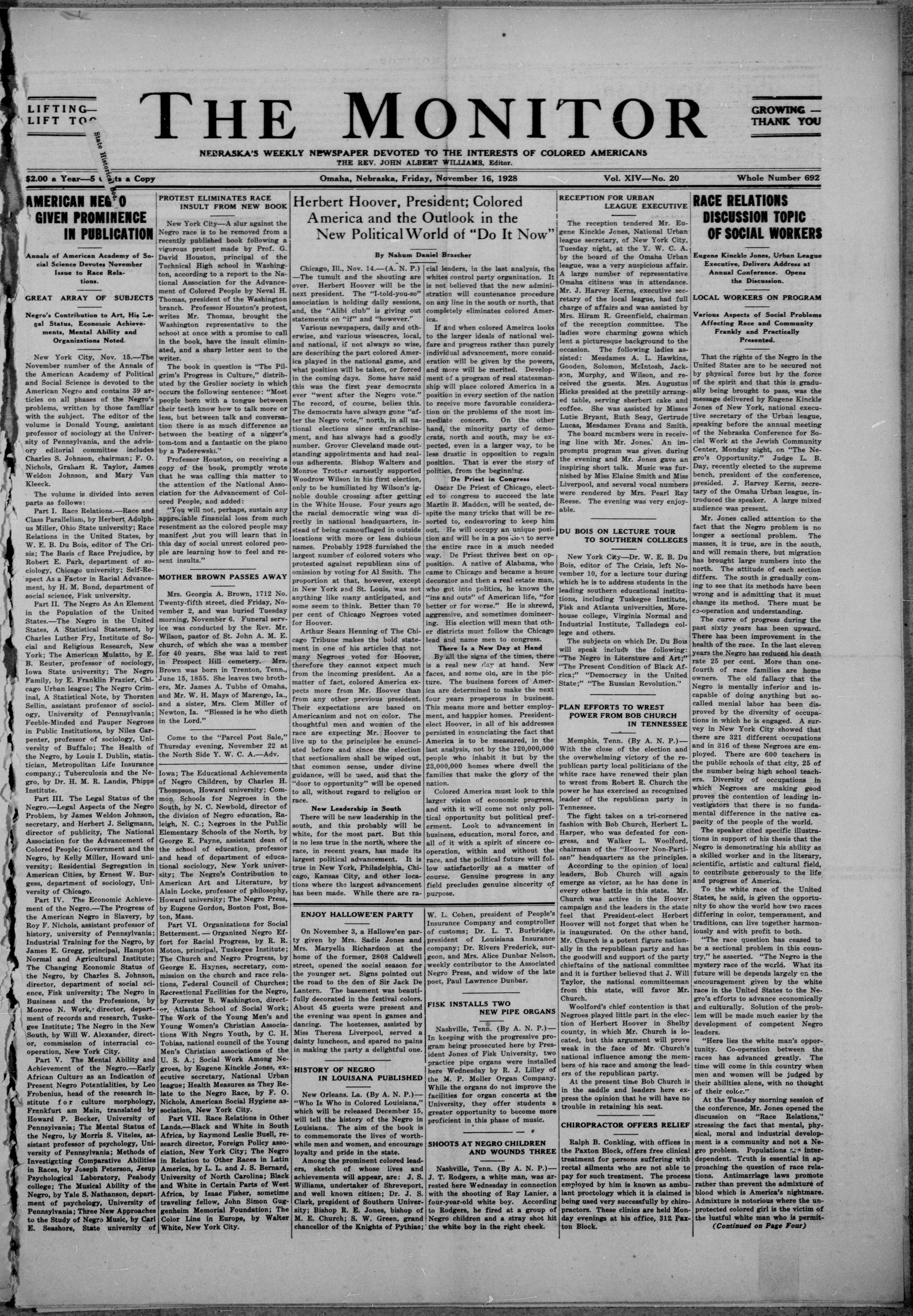
AMERICAN NEGO GIVEN PROMINENCE IN PUBLICATION
Annals of American Academy of Social Science Devotes November Issue to Race Relations.
GREAT ARRAY OF SUBJECTS
Negro's Contribution to Art, His Legal Status, Economic Achievements, Mental Ability and Organizations Noted.
New York City, Nov. 15.—The November number of the Annals of the American Academy of Political and Social Science is devoted to the American Negro and contains 39 articles on all phases of the Negro's problems, written by those familiar with the subject. The editor of the volume is Donald Young, assistant professor of sociology at the University of Pennsylvania, and the advisory editorial committee includes Charles S. Johnson, chairman; F. O. Nichols, Graham R. Taylor, James Weldon Johnson, and Mary Van Kleeck.
The volume is divided into seven parts as follows:
Part I. Race Relations.—Race and Class Parallelism, by Herbert Adolphus Miller, Ohio State university; Race Relations in the United States, by W. E. B. Du Bois, editor of The Crisis; The Basis of Race Prejudice, by Robert E. Park, department of sociology, Chicago university; Self-Respect as a Factor in Racial Advancement, by H. M. Bond, department of social science, Fisk university.
Part II. The Negro As An Element in the Population of the United States.—The Negro in the United States, A Statistical Statement, by Charles Luther Fry, Institute of Social and Religious Research, New York; The American Mulatto, by E. B. Reuter, professor of sociology, Iowa State university; The Negro Family, by E. Franklin Frazier, Chicago Urban league; The Negro Criminal, A Statistical Note, by Thorsten Sellin, assistant professor of sociology, University of Pennsylvania; Feeble-Minded and Pauper Negroes in Public Institutions, by Niles Carpenter, professor of sociology, University of Buffalo; The Health of the Negro, by Louis I. Dublin, statistician, Metropolitan Life Insurance company.; Tuberculosis and the Negro, by Dr. H. M. R. Landis, Phipps Institute.
Part III. The Legal Status of the Negro.—Legal Aspects of the Negro Problem, by James Weldon Johnson, secretary, and Herbert J. Seligmann, director of publicity, The National Association for the Advancement of Colored People; Government and the Negro, by Kelly Miller, Howard university; Residential Segregation in American Cities, by Ernest W. Burgess, department of sociology, University of Chicago.
Part IV. The Economic Achievement of the Negro.—The Progress of the American Negro in Slavery, by Roy F. Nichols, assistant professor of history, university of Pennsylvania; Industrial Training for the Negro, by James E. Gregg, principal, Hampton Normal and Agricultural Institute; The Changing Economic Status of the Negro, by Charles S. Johnson, director, department of social science, Fisk university; The Negro in Business and the Professions, by Monroe N. Work, director, department of records and research, Tuskegee Institute; The Negro in the New South, by Will W. Alexander, director, commission of interracial cooperation, New York City.
Part V. The Mental Ability and Achievement of the Negro.—Early African Culture as an Indication of Present Negro Potentialities, by Leo Frobenius, head of the research institute for culture morphology, Frankfurt am Main, translated by Howard P. Becker, University of Pennsylvania; The Mental Status of the Negro, by Morris S. Viteles, assistant professor of psychology, University of Pennsylvania; Methods of Investigating Comparative Abilities in Races, by Joseph Peterson, Jesup Psychological Laboratory, Peabody college; The Musical Ability of the Negro, by Yale S. Nathanson, department of psychology, University of Pennsylvania; Three New Approaches to the Study of Negro Music, by Carl E. Seashore, State university of
THE MONITOR
PROTEST ELIMINATES RACE
INSULT FROM NEW BOOK
New York City—A slur against the Negro race is to be removed from a recently published book following a vigorous protest made by Prof. G. David Houston, principal of the Technical High school in Washington, according to a report to the National Association for the Advancement of Colored People by Neval H. Thomas, president of the Washington branch. Professor Houston's protest, writes Mr. Thomas, brought the Washington representative to the school at once with a promise to call in the book, have the insult eliminated, and a sharp letter sent to the writer.
The book in question is "The Pilgrim's Progress in Culture," distributed by the Grolier society in which occurs the following sentence: "Most people born with a tongue between their teeth know how to talk more or less, but between talk and conversation as is much difference as between the beating of a nigger's tom-tom and a fantastic on the piano by a Paderewski."
Professor Houston, on receiving a copy of the book, promptly wrote that he was calling this matter to the attention of the National Association for the Advancement of Colored People, and added:
"You will not, perhaps, sustain any appreciable financial loss from such resentment as the colored people may manifest, but you will learn that in this day of social unrest colored people are learning how to feel and resent insults."
MOTHER BROWN PASSES AWAY
Mrs. Georgia A. Brown, 1712 No. Twenty-fifth street, died Friday, November 2, and was buried Tuesday morning, November 6. Funeral service was conducted by the Rev. Mr. Wilson, pastor of St. John A. M. E. church, of which she was a member for 40 years. She was laid to rest in Prospect Hill cemetery. Mrs. Brown was born in Trenton, Tenn., June 15, 1855. She leaves two brothers, Mr. James A. Tubbs of Omaha, and Mr. W. H. Mays of Marengo, Ia, and a sister, Mrs. Clem Miller of Newton, Ia. "Blessed is he who dieth in the Lord."
Come to the "Parcel Post Sale," Thursday evening, November 22 at the North Side Y. W. C. A.—Adv.
Iowa; The Educational Achievements of Negro Children, by Charles H. Thompson, Howard university; Common Schools for Negroes in the South, by N. C. Newbold, director of the division of Negro education, Raleigh, N. C.; Negroes in the Public Elementary Schools of the North, by George E. Payne, assistant dean of the school of education, professor and head of department of educational sociology, New York university; The Negro's Contribution to American Art and Literature, by Alain Locke, professor of philosophy, Howard university; The Negro Press, by Eugene Gordon, Boston Post, Boston, Mass.
Part VI. Organizations for Social Betterment. — Organized Negro Effort for Racial Progress, by R. R. Moton, principal, Tuskegee Institute; The Church and Negro Progress, by George E. Haynes, secretary, commission on the church and race relations, Federal Council of Churches; Recreational Facilities for the Negro, by Forrester B. Washington, director, Atlanta School of Social Work; The Work of the Young Men's and Young Women's Christian Associations With Negro Youth, by C. H. Tobias, national council of the Young Men's Christian associations of the U. S. A.; Social Work Among Negroes, by Eugene Kinckle Jones, executive secretary, National Urban league; Health Measures as They Relate to the Negro Race, by F. O. Nichols, American Social Hygiene association, New York City.
Part VII. Race Relations in Other Lands.—Black and White in South Africa, by Raymond Leslie Buell, research director, Foreign Policy association, New York City; The Negro in Relation to Other Races in Latin America, by L. L. and J. S. Bernard, University of North Carolina; Black and White in Certain Parts of West Africa, by Isaac Fisher, sometime traveling fellow, John Simon Guggenheim Memorial Foundation; The Color Line in Europe, by Walter White, New York City.
Omaha, Nebraska, Friday, November 16, 1928
Herbert Hoover, President; Colored America and the Outlook in the New Political World of "Do It Now"
By Nahum Daniel Brascher
Chicago, Ill., Nov. 14.—(A. N. P.)—The tumult and the shouting are over. Herbert Hoover will be the next president. The "I-told-you-so" association is holding daily sessions, and the "Alibi club" is giving out statements on "if" and "however."
Various newspapers, daily and otherwise, and various wiseacres, local, and national, if not always so wise, are describing the part colored America played in the national game, and what position will be taken, or forced in the coming days. Some have said this was the first year democrats ever "went after the Negro vote." The record, of course, belies this. The democrats have always gone "after the Negro vote," north, in all national elections since enfranchisement, and has always had a goodly number. Grover Cleveland made outstanding appointments and had zealous adherents. Bishop Walters and Monroe Trotter earnestly supported Woodrow Wilson in his first election, only to be humiliated by Wilson's ignoble double crossing after getting in the White House. Four years ago the racial democratic wing was directly in national headquarters, instead of being camouflaged in outside locations with more or less dubious names. Probably 1928 furnished the largest number of colored voters who protested against republican sins of omission by voting for Al Smith. The proportion at that, however, except in New York and St. Louis, was not anything like many anticipated, and some seem to think. Better than 70 per cent of Chicago Negroes voted for Hoover.
Arthur Sears Henning of The Chicago Tribune makes the bold statement in one of his articles that not many Negroes voted for Hoover, therefore they cannot expect much from the incoming president. As a matter of fact, colored America expects more from Mr. Hoover than from any other previous president. Their expectations are based on Americanism and not on color. The thoughtful men and women of the race are expecting Mr. Hoover to live up to the principles he enunciated before and since the election that sectionalism shall be wiped out, that common sense, under divine guidance, will be used, and that the "door to opportunity" will be opened to all, without regard to religion or race.
New Leadership in South
There will be new leadership in the south, and this probably will be white, for the most part. But this is no less true in the north, where the race, in recent years, has made its largest political advancement. It is true in New York, Philadelphia, Chicago, Kansas City, and other locations where the largest advancement has been made. While there are ra-
ENJOY HALLOWE'EN PARTY
On November 3, a Hallowe'en party given by Mrs. Sadie Jones and Mrs. Maryella Richardson at the home of the former, 2808 Caldwell street, opened the social season for the younger set. Signs pointed out the road to the den of Sir Jack De Lantern. The basement was beautifully decorated in the festival colors. About 45 guests were present and the evening was spent in games and dancing. The hostesses, assisted by Miss Theresa Liverpool, served a dainty luncheon, and spared no pains in making the party a delightful one.
HISTORY OF NEGRO
IN LOUISANA PUBLISHED
New Orleans. La. (By A. N. P.)—"Who Is Who in Colored Louisiana," which will be released December 15, will tell the history of the Negro in Louisiana. The aim of the book is to commemorate the lives of worthwhile men and women, and encourage loyalty and pride in the state. Among the prominent colored leaders, sketch of whose lives and achievements will appear, are: J. S. Williams, undertaker of Shreveport, and well known citizen; Dr. J. S. Clark, president of Southern University; Bishop R. E. Jones, bishop of M. E. Church; S. W. Green, grand chancellor of the Knights of Pythias;
cial leaders, in the last analysis, the whites control party organization. It is not believed that the new administration will countenance procedure on any line in the south or north, that completely eliminates colored America. If and when colored Ameirca looks to the larger ideals of national welfare and progress rather than purely individual advancement, more consideration will be given by the powers, and more will be merited. Development of a program of real statesmanship will place colored America in a position in every section of the nation to receive more favorable consideration on the problems of the most immediate concern. On the other hand, the minority party of democrats, north and south, may be expected, even in a larger way, to be less drastic in opposition to regain position. That is ever the story of politics, from the beginning.
De Priest in Congress
De Priest in Congress
Oscar D Priest of Chicago, elected to congress to succeed the late Martin B. Madden, will be seated, despite the many tricks that will be resorted to, endeavoring to keep him out. He will occupy an unique position and will be in a position to serve the entire race in a much needed way. De Priest thrives best on opposition. A native of Alabama, who came to Chicago and became a house decorator and then a real estate man, who got into politics, he knows the "ins and outs" of American life, "for better or for worse." He is shrewd, aggressive, and sometimes domineering. His election will mean that other districts must follow the Chicago lead and name men to congress.
There Is a New Day at Hand
By all the signs of the times, there is a real new day at hand. New faces, and some old, are in the picture. The business forces of America are determined to make the next four years prosperous in business. This means more and better employment, and happier homes. President-elect Hoover, in all of his addresses persisted in enunciating the fact that America is to be measured, in the last analysis, not by the 120,000,000 people who inhabit it but by the 23,000,000 homes where dwell the families that make the glory of the nation.
Colored America must look to this larger vision of economic progress, and with it will come not only political opportunity but political preferment. Look to advancement in business, education, moral force, and all of it with a spirit of sincere cooperation, within and without the race, and the political future will follow satisfactorily as a matter of course. Genuine progress in any field precludes genuine sincerity of purpose.
W. L. Cohen, president of People's Insurance Company and comptroller of customs; Dr. L. L. T. Burbridge, president of Louisiana Insurance company; Dr. Rivers Frederick, surgeon, and Mrs. Alice Dunbar Nelson, weekly contributor to the Associated Negro Press, and widow of the late poet, Paul Lawrence Dunbar.
FISK INSTALLS TWO
NEW PIPE ORGANS
Nashville, Tenn. (By A. N. P.)—In keeping with the progressive program being prosecuted here by President Jones of Fisk University, two practice pipe organs were installed here Wednesday by R. J. Lilley of the M. P. Moller Organ Company. While the organs do not improve the facilities for organ concerts at the University, they offer students a greater opportunity to become more proficient in this phase of music.
SHOOTS AT NEGRO CHILDREN
AND WOUNDS THREE
Nashville, Tenn. (By A. N. P.)—J. T. Rodgers, a white man, was arrested here Wednesday in connection with the shooting of Ray Lanier, a four-year-old white boy. According to Rodgers, he fired at a group of Negro children and a stray shot hit the white boy in the right cheek.
Vol. XIV—No. 20
RECEPTION FOR URBAN
LEAGUE EXECUTIVE
The reception tendered Mr. Eugene Kinckle Jones, National Urban league secretary, of New York City, Tuesday night, at the Y. W. C. A. by the board of the Omaha Urban league, was a very auspicious affair. A large number of representative Omaha citizens was in attendance. Mr. J. Harvey Kerns, executive secretary of the local league, had full charge of affairs and was assisted by Mrs. Hiram R. Greenfield, chairman of the reception committee. The ladies wore charming gowns which lent a picturesque background to the occasion. The following ladies assisted: Mesdames A. L. Hawkins, Gooden, Solomon, McIntosh, Jackson, Murphy, and Wilson, and received the guests. Mrs. Augustus Hicks presided at the prettily arranged table, serving sherbert cake and coffee. She was assisted by Misses Lutie Bryant, Ruth Seay, Gertrude Lucas, Mesdames Evans and Smith. The board members were in receiving line with Mr. Jones'. An impromptu program was given during the evening and Mr. Jones gave an inspiring short talk. Music was furnished by Miss Elaine Smith and Miss Liverpool, and several vocal numbers were rendered by Mrs. Pearl Ray Reease. The evening was very enjoyable.
DU BOIS ON LECTURE TOUR
TO SOUTHERN COLLEGES
New York City—Dr. W. E. B. Du Bois, editor of The Crisis, left November 10, for a lecture tour during which he is to address students in the leading southern educational institutions, including Tuskegee Institute, Fisk and Atlanta universities, Morehouse college, Virginia Normal and Industrial Institute, Talladega college and others.
The subjects on which Dr. Du Bois will speak include the following: "The Negro in Literature and Art;" "The Present Condition of Black Africa;" "Democracy in the United State;" "The Russian Revolution."
PLAN EFFORTS TO WREST
POWER FROM BOB CHURCH
IN TENNESSEE
Memphis, Tenn. (By A. N. P.)—With the close of the election and the overwhelming victory of the republican party local politicians of the white race have renewed their plan to wrest from Robert R. Church the power he has exercised as recognized leader of the republican party in Tennessee.
The fight takes on a tri-cornered fashion with Bob Church, Herbert L. Harper, who was defeated for congress, and Walker L. Woolford, chairman of the "Hoover Non-Partisan" headquarters as the principles. According to the opinion of local leaders, Bob Church will again emerge as victor, as he has done in every other battle in this state. Mr. Church was active in the Hoover campaign and the leaders in the state feel that President-elect Herbert Hoover will not forget that when he is inaugurated. On the other hand, Mr. Church is a potent figure nationally in the republican party and has the goodwill and support of the party chieftains of the national committee and it is further believed that J. Will Taylor, the national committeeman from this state, will favor Mr. Church.
Woolford's chief contention is that Negroes played little part in the election of Herbert Hoover in Shelby county, in which Mr. Church is located, but this argument will prove weak in the face of Mr. Church's national influence among the members of his race and among the leaders of the republican party. At the present time Bob Church is in the saddle and leaders here express the opinion that he will have no trouble in retaining his seat.
CHIROPRACTOR OFFERS RELIEF
Ralph B. Conkling, with offices in the Paxton Block, offers free clinical treatment for persons suffering with rectal ailments who are not able to pay for such treatment. The process employed by him is known as ambulant proctology which it is claimed is being used very successfully by chiropractors. These clinics are held Monday evenings at his office, 312 Paxton Block.
GROWING
THANK YOU
Whole Number 692
RACE RELATIONS DISCUSSION TOPIC OF SOCIAL WORKERS
Eugene Kinckle Jones, Urban League Executive, Delivers Address at Annual Conference. Opens the Discussion.
LOCAL WORKERS ON PROGRAM
Various Aspects of Social Problems Affecting Race and Community Frankly and Practically
That the rights of the Negro in the United States are to be secured not by physical force but by the force of the spirit and that this is gradually being brought to pass, was the message delivered by Eugene Knickle Jones of New York, national executive secretary of the Urban league, speaking before the annual meeting of the Nebraska Conference for Social Work at the Jewish Community Center, Monday night, on "The Negro's Opportunity." Judge L. B. Day, recently elected to the supreme bench, president of the conference, presided. J. Harvey Kerns, secretary of the Omaha Urban league, introduced the speaker. A large mixed audience was present.
Mr. Jones called attention to the fact that the Negro problem is no longer a sectional problem. The masses, it is true, are in the south, and will remain there, but migration has brought large numbers into the north. The attitude of each section differs. The south is gradually coming to see that its methods have been wrong and is admitting that it must change its method. There must be co-operation and understanding.
The curve of progress during the past sixty years has been upward. There has been improvement in the health of the race. In the last eleven years the Negro has reduced his death rate 25 per cent. More than one-fourth of race families are home owners. The old fallacy that the Negro is mentally inferior and incapable of doing anything but so-called menial labor has been disproved by the diversity of occupations in which he is engaged. A survey in New York City showed that there are 321 different occupations and in 316 of these Negroes are employed. There are 600 teachers in the public schools of that city, 25 of the number being high school teachers. Diversity of occupations in which Negroes are making good proves the contention of leading investigators that there is no fundamental difference in the native capacity of the people of the world. The speaker cited specific illustrations in support of his thesis that the Negro is demonstrating his ability as a skilled worker and in the literary, scientific, artistic and cultural field, to contribute generously to the life and progress of America.
To the white race of the United States, he said, is given the opportunity to show the world how two races differing in color, temperament, and traditions, can live together harmoniously and with profit to both.
"The race question has ceased to be a sectional problem in this country," he asserted. "The Negro is the mystery race of the world. What its future will be depends largely on the encouragement given by the white race in the United States to the Negro's efforts to advance economically and culturally. Solution of the problem will be made much easier by the development of competent Negro leaders.
"Here lies the white man's opportunity. Co-operation between the races has advanced greatly. The time will come in this country when men and women will be judged by their abilities alone, with no thought of their color."
At the Tuesday morning session of the conference, Mr. Jones opened the discussion on "Race Relations," stressing the fact that mental, physical, moral and industrial development is a community and not a Negro problem. Populations are interdependent. Truth is essential in approaching the question of race relations. Antimarriage laws promote rather than prevent the admixture of blood which is America's nightmare. Admixture is notorious where the unprotected colored girl is the victim of the lustful white man who is permit-
(Continued on Page Four)
PAGE TWO
———
a weextr
Pusu
Betered a Se
Tam Rey. 301
ww. moms
toca W.
susscarnio
Address, 1
000000006
2 WeExtt Gawerarem DEVOTED PRIMARY TO TRE DVTERESTS
PUMAEED EVERY VaIDsy £7 OuAms. MEsasscs, BY THE
Sotered ws Gocond-Cines Mall Matter, July 2, 1916 at the Fostoffice st Omaha,
Webrnekas under the Act of March 8. 2878.
ge ———“fesecistn Bane
A
SUBSCRIPTION RATES, $200 PER YEAR, $i.as © MONTHS; 75: 3 MONTHS
Kovertitag Rates Fursisted’ Upon Appication.
Address, The Monitor, Postoffice Box 1204, Omaha, Neb.
Telephone WEbster 4243
AN IMPORTANT WORD 1
The postal regulations requir
be sent through the mails subs
advance. A reasonable time,
‘renewals. At the expiration
pscriptions are not renewed, ti
d. If this is not done, postal pr
blication. Those, therefore, w
-eiving The Monitor must see t
ns are paid, as the law requir
nts are being sent to all those
tor will calli—and unless you
, will be compelled to cut off
arse, we do not want to do.
We, as publishers, MUST co
y the penalty.
treet reteset artoletrtrtetrthtrtr ot
EINE eeneee
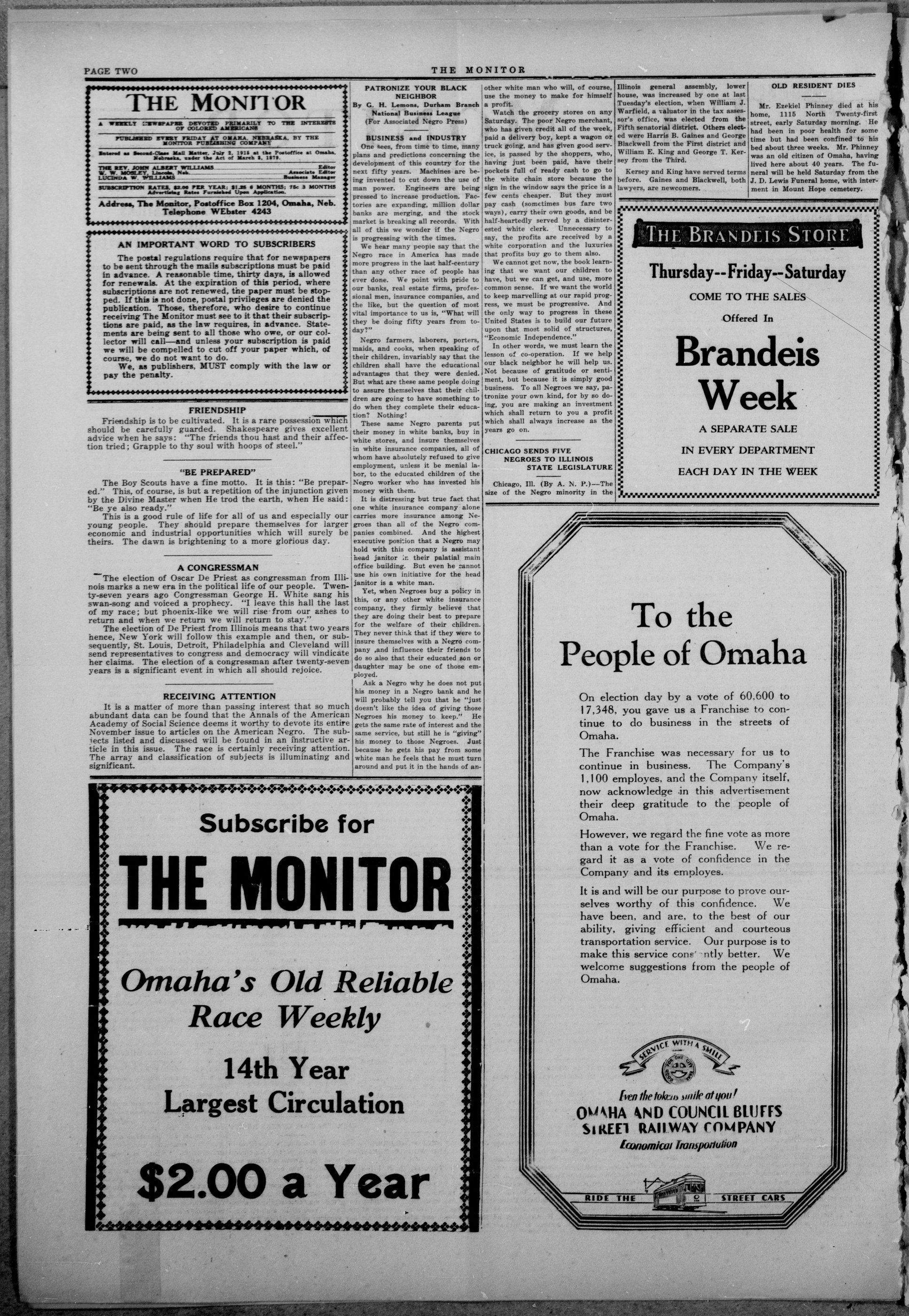
The postal regulations require that for newspapers
to be sent through the mails subscriptions must be paid
in advance. A reasonable time, thirty days, is allowed
for renewals. At the expiration of this period, where
subscriptions are not renewed, the paper must be stop-
ped. If this is not done, postal privileges are denied the
publication. Those, therefore, who desire to continue
receiving The Monitor must see to it that their subscrip-
tions are paid, as the law requires, in advance. State-
ments are being sent to all those who owe, or our co!-
lector will calli—and unless your subscription is paid
we will be compelled to cut off your paper which, of
course, we do not want to do.
We, as publishers, MUST comply with the law or
pay the penalty.
Friendship is to be cultivated. It is a rare possession which
should be carefully guarded. Shakespeare gives excellent
advice when he says: “The friends thou hast and their affec-
tion tried; Grapple to thy soul with hoops of steel.”
The Boy Scouts have a fine motto. It is this: “Be prepar-
ed.” This, of course, is but a repetition of the injunction given
by the Divine Master when He trod the earth, when He said:
“Be ye also ready.”
This is a good rule of life for all of us and especially our
young people. They should prepare themselves for larger
economic and industrial opportunities which will surely be
theirs. The dawn is brightening to a more glofious day.
__ The election of Oscar De Priest as congressman from IlIli-
nois marks a new era in the political life of our people. Twen-
ty-seven years ago Congressman George H. White sang his
swan-song and voiced a prophecy. “I leave this hall the last
of my race; but phoenix-like we will rise-from our ashes to
return and when we return we will return to stay.”
The election of De Priest from Illinois means that two years
hence, New York will follow this example and then, or sub-
sequently, St. Louis, Detroit, Philadelphia and Cleveland will
send representatives to congress and democracy will vindicate
her claims. The election of a congressman after twenty-seven
years is a significant event in which all should rejoice.
It is a matter of more than passing interest that so much
abundant data can be found that the Annals of the American
Academy of Social Science deems it worthy to devote its entire
November issue to articles on the American Negro. The sub-
iects listed and discussed will be found in an instructive ar-
ticle in this issue. The race is certainly receiving attention.
The array and classification of subjects is illuminating and
significant.
Subscribe for
Omaha’s Old Reliable
Race Weekly
14th Year
Largest Circulation
$2.00 a Year
THE MONITOR
Sa
PATRONIZE YOUR BLACK |other white |
NEIGHBOR juse the mon
By G. H. Lemons, Durham Branch a profit.
National Business League |_ Watch thé
(For Associated Negro Press) cer T
— who has give
BUSINESS and INDUSTRY | paid a delive
‘One sees, from time to time, many
plans and predictions concerning the
development of this country for the
next fifty years. Machines are be-
ing invented to cut down the use of
man power. Engineers are being
pressed to increase production. Fac-
tories are expanding, million dollar
banks are merging, and the stock
market is breaking all records. With
all of this we wonder if the Negro
is progressing with the times.
We hear many peopie say that the
Negro race in America has made
more progress in the last half-century
than any other race of people has
ever done. We point with pride to
our banks, real estate firms, profes-
sional men, insurance companies, and
the like, but the question of most
vital importance to us is, “What will
they be doing fifty years from to-
day?”
Negro farmers, laborers, porters,
maids, and cooks, when speaking of
their children, invariably say that the
children shall have the educational
advantages that they were denied.
But what are these same people doing
to assure themselves that their chil-
dren are going to have something to
do when they complete their educa-
tion? Nothing!
These same Negro parents put
their money in white banks, buy ir
white stores, and insure themselves
in white insurance companies, all of
whom have absolutely refused to give
employment, unless it be menial la
bor, to the educated children of the
Negro worker who has invested his
|money with them.
It is distressing but true fact that
one white insurance company alone
carries more insurance among Ne
groes than all of the Negro com
panies combined. And the highest
executive position that a Negro maj
hold with this company is assistant
head janitor ix their palatial maix
[otfice building. But even he canno
use his own initiative for the hea¢
janitor is a white man.
Yet, when Negroes buy a policy ir
this, or any other white insuranc
company, they firmly believe that
they are doing their best to preparé
for the welfare of their children
They never think that if they were t¢
insure themselves with a Negro com
pany ,and influence their friends tc
do so also that their educated son o1
daughter may be one of those em
ployed.
Ask a Negro why he does not pu
his money in a Negro bank and h
will probably tell you that he “jus
doesn't like the idea of giving thos
Negroes his money to keep.” H
gets the same rate of interest and th
same service, but still he is “giving’
his money to those Negroes. Jus
because he gets his pay from som
white man he feels that he must tun
‘around and put it in the hands of an
other white man who will, of course,
we the money to make for himself
a profit.
‘Watch the grocery stores on any
Saturday. The poor Negro merchant,
who has given credit all of the week,
paid a delivery boy, kept a wagon or
truck going, and has given good serv-
‘ice, is passed by the shoppers, who,
having just been paid, have their
pockets full of ready cash to go to
the white chain store because the
‘sign in the window says the price is a
few cents cheaper. But they must
pay cash (sometimes bus fare two
ways), carry their own goods, and be
half-heartedly served by a disinter-
ested white clerk. Unnecessary to
say, the profits are received by a
white corporation and the luxuries
that profits buy go to them also.
We cannot get now, the book learn-
ing that we want our children to
have, but we can get, and use, more
common sense. If we want the world
to keep marvelling at our rapid prog-
ress, we must be progressive. And
the only way to progress in these
United States is to build our future
upon that most solid of structures,
“Economic Independence.”
In other words, we must learn the
lesson of co-operation. If we help
our black neighbor he will help us.
Not because of gratitude or senti-
ment, but because it is simply good
business. To all Negroes we say, pa-
tronize your own kind, for by so do-
ing, you are making an investment
which shall return to you a profit
which shall always increase as the
years go on.
CHICAGO SENDS FIVE
NEGROES TO ILLINOIS
STATE LEGISLATURE
Chicago, Ill. (By A. N. P.)——The
size of the Negro minority in the
(SPIELE SELECT TLE L ELS ELSES TET
————————————— see
ae ;
Uy X&
“iy .
|
People of Omaha |
On election day by a vote of 60,600 to
17,348, you gave us a Franchise to con-
tinue to do business in the streets of
Omaha.
The Franchise was necessary for us to
continue in business. The Company's
1,100 employes, and the Company itself,
now acknowledge in this advertisement
| their deep gratitude to the people of
Omaha.
However, we regard the fine vote as more
than a vote for the Franchise. We re-
gard it as a vote of confidence in the
Company and its employes.
It is and will be our purpose to prove our-
selves worthy of this confidence. We
have been, and are, to the best of our
ability, giving efficient and courteous
transportation service. Our purpose is to
make this service cons’ ~ntly better. We
welcome suggestions from the people of
Omaha.
f WITH
fren the tokew smile atyou! }
OMAHA AND COUNCIL BLUFFS
SiREET RAILWAY COMPANY
£eonomicat Transportution
Re y
QA 4 —— Y
SX Vegan UY
D ie | TREET CARS 7
YK 21 4
SSS — Y
Thursday--Friday--Saturday
COME TO THE SALES
Offered In
e
Brandeis
Week
A SEPARATE SALE
IN EVERY DEPARTMENT
EACH DAY IN THE WEEK
Illinois general assembly, lower
house, was increased by one at last
Tuesday’s election, when William J.
Warfield, a valuator in the tax asses-
sor’s office, was elected from the
Fifth senatorial district. Others elect.
ed were Harris B. Gaines and George
Blackwell from the First district and
William E. King and George T. Ker-
sey from the Third.
Kersey and King have served terms
before. Gaines and Blackwell, both
lawyers, are newcomers.
OLD RESIDENT DIES
Mr. Ezekiel Phinney died at his
home, 1115 North Twenty-first
street, early Saturday morning. He
had been in poor health for some
time but had been confined to his
bed about three weeks. Mr. Phinney
was an old citizen of Omaha, having
lived here about 40 years. The fu-
neral will be held Saturday from the
J. D. Lewis Funeral home, with inter-
ment in Mount Hope cemetery.
Ed. F. Morearty, Lawyer, 700 Peters Trust Building, Jackson 3841 or HArney 2156.
Mrs. Belle Pulpress of Pittsburg, Pa., arrived Sunday night and is the house guest of her daughter, Mrs. William G. Haynes and family.
Mrs. Joseph L. Cour returned Sunday night from a pleasant visit with her daughter Margaret, in New York City.
The sermon topic at the church of St. Philip the Deacon Sunday morning at 11 o'clock will be, "Man, The Image of God."
Mrs. R. Hartley, 2638 Caldwell street, has returned home after a delightful four weeks' visit in Evergreen, Ala., with some relatives and friends. En route home she spent four days in Montgomery, Ala., as the house guest of Mr. and Mrs. Marion Davis, who made it very pleasant for her while there. She visited the state fair in Montgomery and found our group well represented there.
The Intercollegiate club will give a Japanese musicale tea at the North Side branch, Y. W. C. A., on Sunday afternoon, November 18, from 4 to 7 o'clock. Everybody invited. A silver offering will be taken.
"The Gypsy Rover," a romantic operetta comedy in three acts will be given by St. John's A. M. E. church choir, at the church, Twenty-second and Willis avenue, Friday night, November 23. Admission 25 cents.—Adv.
Mrs. Millard Wood, nee Lancaster, left Wednesday to join her husband, Mr. Millard Wood in Temple, Texas, where he is teaching.
Remember the date of the "Parcel Post Sale" at the North Side Y. W. C. A. Thursday evening, November 22. Miss Jennie Robinson, chairman.
The Hard Time Masquerade Dance given at Dreamland hall by the "Ready to Go" group of St. Philip's church, of which Mrs. A. Hicks is captain, was a decidedly social and financial success. It was largely attended. Many of the costumes were very unique. The prizes for the best costumes were awarded to Mrs. H. J. Crawford and Mr. W. L. Meyers.
The Sunshine committee of St. Philip's church, with Mrs. Alice Smith as captain and her team will hold a rummage sale, Monday, November 19 at 2016 North Twenty-fourth street, between Blondo and Patrick avenue. Many useful things will be offered for sale. Come one, come all—Adv.
Mr. Eugene Kinckle Jones was the house guest of Mr. and Mrs. J. H. Smith, 2211 Ohio street, while in the city.
Some of Omaha's best talent will be heard in the Gypsy Rovers, November 23rd, at St. John's A. M. E. church.—Adv.
Auxiliary Whist Party
The woman's auxiliary of Captain Allen Allensworth camp No. 25, of the Spanish War Veterans, held a whist party, Wednesday evening, October 24th, at St. Benedict's, which was a social and financial success, and for which we thank the public. The hall was decorated with American flags and Hallowe'en novelties. Prizes were won by Mrs. J. E. Dorsey, first; Mrs. Thomas Robinson, second. Men's prizes, Burns Scott, first; Mr. Randall, second. The booby prize was given to Miss Leona Williams. Refreshments were served at a late hour, with Mrs. Lizzie Buford and her delicious coffee, which was enjoyed by all.
You will miss a real treat if you fail to see "The Gypsy Rover," Friday night, November 23rd, at St, John's A. M. E. church.—Adv.
Dr. A. L. Hawkins announces the change of his telephone number from Webster 6580 to Webster 3289.—Adv.
Entertain at Surprise Party
A pleasant surprise party was given Mrs. Ardena Watson, 2718 North
The Store
That Appreciates
Your Patronage
Web. 5802
I. LEVY, Druggist
24th and Decatur Sts.
Misses' 7 to 14
Sports and Dress
COATS
Heavy Tweeds, Broadcloths,
Velours with good heavy
linings and interlined—
Large collars of beaverette,
fox-mandels and Coney—
some with Fur Cuffs
$9.45 and $12.75
The Floor Below
N. W. WARE
ATTORNEY-AT-LAW
1201 So. 13th—Omaha, Nebraska
Phones Webster 6613—Atlantic 8192.
Twenty eighth avenue, Saturday evening, November 10. Mrs. Watson has been president of the Carter Charity and Benevolent club for the past seven years. November 11th was Mrs. Watson's birthday anniversary and in appreciation of her faithful service 27 members of the club gathered at her home to help her celebrate that event. A dainty luncheon was served and beautiful gifts were presented to Mrs. Watson. A very pleasant evening was spent after which the guests departed, wishing their president many happy returns of the day.
EUREKA ART CLUB MEETS
The Eureka Art club met on November 7th at the home of Mrs. Bessie Kirby, Mrs. M. F. Jackson, the president, presiding. The meeting opened with prayer by Mrs. A. M. Harrold. The roll was called and each member was found to be present and responded with miscellaneous quotations. After the regular routine of business, Mrs. McCalester of Atchison, Kansas, was introduced and gave some very helpful remarks. A delicious luncheon was served by the hostess. The club adjourned to meet with Mrs. Pearl Young, 2305 North Twenty-seventh street, Wednesday afternoon, November 21st.
Y. W. C. A. NOTES
The radio dinner, Tuesday, November 6, sponsored by the finance committee, under the chairmanship of Mrs. Leonora Gray, was very successful. The election returns were broadcast over the new radio installed by the radio committee.
The apron social given by the service committee, Thursday, November 8, with Mrs. Gertrude Ashby as chairman, was also very successful.
The Adult Guidance Council held at the Central Y. W. C. A., November 9 and 10, was attended by Mrs. Hiram Greenfield, Mrs. A. O. McGee, Miss Margie L. Danley and Miss Alice E. Hunter, representing North Side Branch. Some wonderful ideas and plans were received from the Council.
Girl Reserve Department
The Girl Reserve Department is making plans for a beautiful holiday season with participation by the Girl Reserve clubs.
Class Announcements
The Opportunity School enrollment is still growing. There is still room for those who wish to further their education. The Art Class has a few more vacancies. There is an opportunity to learn how to make your Christmas gifts at a very small cost.
Vesper News
The Vespers last Sunday at the North Side Y. W. C. A. were a great success. An immense crowd of more than 200 persons were in attendance to enjoy the masterful address by Rabbi Frederick Cohn, "The Unity of Man." He held his hearers' rapt attention for an hour with logic, reason and hope. The foreign groups in native costume from Omaha Social Settlement blended admirably with the "World Fellowship" program which Miss Margie L. Danley, executive secretary, so ably gave the true meaning in her address, "World Friend-
THE MONITOR
ship." Pilgrim Baptist choir, under the direction of Mrs. Minnie L. Dixon, was excellent in their selections, especially their fine interpretation of Negro spirituals. The religious and general education committee are highly appreciative of the co-operation of the public in making the Vespers excel all previous efforts. The Spirit of Y. W. C. A. in Candlelight by a Girl Reserve was very effective.
This week is being observed as week of prayer and world fellowship at North Side Branch, in charge of the religious and general education committee, with Mrs. Hiram Greenfield presiding. Each day at noon (12 to 1 o'clock) friends are invited to this quiet hour. Rev. Wilson, Rev. Martin, Rev. Hamlett, Father Williams, Rev. Higgs and Rev. Burkhardt bring the message each day, respectively. Much benefit is being realized.
The next Vespers will be November 28th, brimful of interest. Program next week, with particulars.
Chairman Entertains Committee
Mrs. Hiram R. Greenfield entertained at a prettily appointed two o'clock luncheon, at the Branch, last Friday, complimentary to the religious and general education committee of the North Side Branch, Y. W. C. A., of which she is chairman, also honoring Mrs. I. S. Wilson, a recent arrival from Denver, and Mrs. J. Harvey Kearns, a recent arrival from Milwaukee, Wis. These distinguished women are the wives of Rev. I. S. Wilson, pastor of St. John's A. M. E. church, and Mr. J. Harvey Kearns, executive secretary of the Omaha Urban League, and are a wonderful asset to the religious and civic and social life of Omaha.
The hostess chose yellow for her color scheme. The table was laid with yellow linen cover and sparkling cut glass and silver and china. The glass centerpiece held a profusion of yellow pom poms, with yellow lighted candles, adding beauty and charm to the setting. The four course luncheon was palatable and delicious to the last taste, prepared by Mrs. William Murphy, noted for her extraordinary natural abilities in her profession. The beautiful table setting was also the work of Mrs. Murphy. Mrs. Greenfield is a charming hostess and all enjoyed the afternoon immensely. Mrs. J. C. Brewer, a member of the committee, left Saturday, November 10, with her husband to permanently reside in St. Louis Mo., and this served as a farewell token of love. Covers were laid for fourteen. Those present, besides the hostess, were Mesdames John Albert Williams, J. D. Thornton, Frank Cole, J. C. Brewer, Alice Smith, Jennie Williams, W. Buffkins, Louisa Scott, R. K. Laurie, Stoval, I. S. Wilson, J Harvey Kearns and Miss Margie L. Danley.
New York, Nov. 15.—An appropriation of $1,000 has been made by the Julius Rosenwald fund for the
MARMON 5-passenger brougham, 1926 model, at less than $1/4 of its original cost, which was $3,840. In perfect condition, new 6-ply India tires; will trade and give terms. 2112 Harney St. JA. 6732.
News
legal defense fund of the National Association for the Advancement of Colored People, $500 to be paid shortly and the second $500 on February 1, 1929. Edwin R. Embree, president of the fund, writes: "We all take much pleasure in being associated in the important work of the National Association for the Advancement of Colored People for its legal defense fund."
LINCOLN NEWS NOTES
Rev. J. W. Carter, pastor of the Original Baptist church of Chicago, Ill., left for the east last Tuesday.
Mrs. Anna Tolles has returned to the city from her home in Natchez, Miss., and will live with her daughter, Mrs. Evelyn Johnson of South Ninth street.
Mrs. Pinkie Boswell is reported as being very ill at her daughter's home, Mrs. Alma Wiley, 1911 K street.
Rev. C. M. Simmons arrived in the city from Omaha, Sunday, and is engaged in a revival for Rev. H. W. Botts at Mount Zion Baptist church.
Mr. N. B. Ashford returned Saturday from a six weeks' fishing trip in the northwest.
Regular services were held at all churches Sunday. The pastors delivered wholesome sermons.
Mr. J. C. Collins has regained improvement in health, so as to be out again.
Subscribe for The Monitor. Do not forget you owe it.
HUDSON COACH, 1928 model, fully equipped, in A-1 condition throughout. Trunk, tires A-1. Driven about 6,000 miles. Will sell or trade for smaller car. WE. 1693.
HEY—
SATURDAY
Just a Few Examples
10 lbs. Sugar 58c
24 lbs. Flour 79c
Trade the RITE-WAY and BANK the DIFFERENCE!
"Dependable Family Service"
Dry Cleaning of Ladies' and Gents Wearing Apparel and Household Furnishings—Soft Water Laundering
WET WASH, 4c per lb. THRIFTY WASH, 6c per lb.
Dry Wash, Rough Dry, Family Finish, Linen, Curtains, Blankets
Tires and Batteries to Suit Your Pocketbook
We always have a tire and battery to suit your pocketbook. We have been on one corner for fourteen years and we have had customers trade with us exclusively all that time.
We offer SERVICE on any tire or battery and we guarantee complete satisfaction.
An Exclusive Goodyear Tire Dealer
GOOD YEAR Service Station
Hermann Nachschoen
NATIONAL TIRE SHOP and BATTERY STATION
Atlantic 6497 Corner 17th and Capitol Ave
CARD OF THANKS
Mr. and Mrs. James A. Tubbs wish to express their appreciation and thanks for the many kindnesses and the beautiful floral offerings tendered them in their sadness in the death of their mother and mother-in-law, Mrs. Georgia Brown. Especially do we wish to thank—
Amelia Level
Dr. J. E. Britt
Mrs. Emma Benson
Mrs. Anna Murphy
Mr. and Mrs. Brooks
Mrs. Georgia T. Johnson
Mrs. L. H. Williams
Mr. and Mrs. Ed Fletcher
Mrs. Georgia Allen
Mr. and Mrs. Walter Carter
Unity Class, Poro Substation.
W. B. BRYANT, Attorney and Counsellor-at-Law. 320 Neville Block. Office, At. 9344; Res., Web. 5859. Omaha, Neb.
PARSONS AUTO TOP AND BODY CO.
Jackson 5820
Tops and Bodies Built
and Repaired
PAGE FIVE
Venus Parker and O. C. Winn are playing the leading roles in "The Gypsy Rover."—Adv.
WEBSTER 0580
Say Painters Do You Eat at Peat's Snutty Cafe
Yes, it is in the best place I know for good eating!
H. PEAT, Prop.
1801 No. 24th St.
Omaha, Nebraska
HARRY LELAND'S REAL ESTATE CO.
Good Homes Reasonable
A Small Down Payment and the Balance Like Rent
GIVE ME A TRIAL
320 Neville Block
SIXTEENTH AND HARNEY
AT. 9344
East India Hair Grower
MME. S.D. LYONS
Will Promote a Full Growth of Hair. Will Also Restore the Strength, Vitality and Beauty of the Hair.
EAST INDIA HAIR GROWER
If you are bothered with Falling Hair, Dandruff, Iching Scallp, or any Hair Trouble, we want you to try a jar of East India Hair Grower. The remedy contains medical properties that go to the roots of the hair, Hair Grower it also stimulates the skin making it to deter work. Leaves the hair soft and silky. Perfumed with a balm of a thousand flowers. The best known remedy for Heavy and Beautiful Black Eyebrows, also restores Gray Hair to its original shape. It can be used with Hot Iron for straightening.
Price, Sent by Mail, 50c¹ Postage 10c¹
AGENT'S OUTFIT
1 Hair Grower, 1 Temple Oil, 1 Shampoo, 1 Pressing Oil, 1 Face Cream, and Directions for Selling, $2.00.
25c Extra for Postage
S. D. LYONS
316 North Central Avenue
Oklahoma City, Okla.
LEE VON HOTEL
2212 Seward Street
Strictly modern and up-to-date.
First-class service. Rooms by
day or week. Remodelled and
under new management. Phone
Webster 3016
WATERS
BARNHART
PRINTING CO.
OMAHA
---
Reid-Duffy
PHARMACY
FREE DELIVERY
Phone Web. 0609
24th and Lake Streets
and 24th and Cuming
OMAHA, NEB.
EMERSON'S
LAUNDRY
The
Laundry That Suits All
Web. 0820
1301 North 24th Street
---
PAGE EIGHT
(Continued from Page One) ted to escape parental responsibility. The Ku Klux Klan's effort to have antimarriage laws enacted in several states have been defeated because legislators looking up the records discovered that wherever such laws existed conditions were much worse than where they were not. He discussed the mitigation of prejudice in the industrial and other fields, noting helpful contacts and understanding. A promising field is that of education, where students in southern universities, are getting a wider outlook.
Other speakers at this session were J. H. Kerns, who spoke on the program of teh Urban league; Mrs. M. L. Rhone, in charge of the Cultural Center on the South Side, who gave an illuminating paper on "Problems in a Packing House Neighborhood;" Mrs. Louvetta Busch, whose topic was "Group Development on the South Side;" Miss Margie L. Danley, secretary of the North Side Y. W. C. A., who spoke on the work of that organization; Mr. Trago McWilliams of Lincoln; and Charles Stanton, industrial secretary of the Y. M. C. A., who called attention to the fact that migration brought whites as well as colored folks to the north seeking better economic conditions.
Mrs. Carrie Ada Campbell, secretary of the Central branch Y. W. C. A., and vice-president of the conference, presided.
THE NEGRO IN THE WORLD'S LITERATURE
By Thomas O. X. G. Oxley
(For Associated Negro Press)
WILLIAM E. BURGHART DU BOIS
Author, Editor, Sociologist
(1868—?)
William E. Burghart Du Bois was born February 23, 1868, at Great Barrington, Mass. In 1888 he received the degree of bachelor of arts at Fisk university in Nashville, Tenn., and his master of arts at Harvard in 1891. From the University of Berlin he received his doctor of philosophy degree.
Du Bois taught for a short period at Wilberforce university and was also for a time an assistant and fellow in sociology at the University of Pennsylvania, producing in 1898 his dissertation, "The Philadelphia Negro." He held from 1896 to 1910 the professorship of history and economics at Atlanta university.
In 1910 Dr. Du Bois became the director of publicity and research for the National Association for the Advancement of Colored People. He has ever since edited The Crisis, a monthly periodical of great interest and good reading, but the opinion of one man and of one group. He has also contributed many sociological articles to leading magazines. The essays that were published in 1903 in The Atlantic Monthly and The World's Work were brought together in a volume entitled "The Souls of Black Folk."
In 1909 was published "John Brown," and the next year "The Quest of the Silver Fleece." His other works are "The Dawn of Freedom," "Mr. Booker T. Washington and Others," "The Meaning of Progress," "The Training of Black Men," "The Coming of John," "The Passing of the First Born," and "Dark Water."
Du Bois writes with a style intensely original and beautiful. And of such an interesting personality is this man, who understands the passions of the Negro. He feels their heartbeats. And his pleasure in these souls, black souls, is his pleasure in life—a paradoxical, ironical, mystical intoxication. Du Bois' style is cultured. He writes with much care and harmony. His words are sweetly blended, although his sentiments are sometimes vague. His style is original, but pleasing withal. He reveals at times too much in details; it is his only artistic fault. He forgets himself in the presence of any object of artistic delight, and lingers elaborately over every incidental feature. But it is not as a story-teller that Du Bois is known. His papers on sociology have brought him into prominence. He seems well-versed in his subjects and is not afraid to speak out loud of what he thinks.
Du Bois cannot be judged by ordinary literary standards. His scornful trampling upon all subjects, his freedom in treating of matters usually passed in silence, makes him a man whose writings have won the appreciation of many great minds. Du Bois has a keen eye for the social distinctions in American life. His special province is manners rather than character, or character as depicted through manners. He is a miniature painter, but a master in an art which requires the greatest delicacy of completeness. He holds the mirror up to nature, but his mirror is a small one, and only a part of nature is reflected.
Balloon Well Stored
Food supplies and equipment carried on the first attempted Atlantic flight were not so meager as those of today. Washington H. Donaldson, George Ashoton Lunt and Alfred Ford, in loading up their balloon that took off from Brooklyn for Europe October 6, 1873, stowed away six 10-gallon breakers of water, one barrel of hard bread, two boxes of roast beef and mutton ready cooked, one box of champagne and another of salted provisions, box of prepared hominy, and a large number of small packages containing butter, salt, lemons and brandy. They also carried ten carrier pigeons in a wicker basket, a large box of candy, a keg of molasses, several jars of honey, pickles, a hair brush, a jar of preserved plums, a large tin can filled with roast fowls, a packet of toothpicks, several reams of paper, a ham, two cases of eau de cologne, a box of pomade, a pair of shoes, a paper of tacks, a claw hammer, a newly invented flying machine, a bottle of soothing sirup, a paper of chewing tobacco, Donaldson's hat, a case of "S. T.—1800—X." some crackers and a can of preserved oysters, tomatoes and sardines, a patent steam plowing machine, a paper of hairpins and Lunt's boots.
For some reason the balloon came down before it reached its destination. -Detroit News.
"Statue of Freedom"
The bronze statue surmounting the dome of the national capitol at Washington is the figure of a woman and symbolizes liberty. This statue is often erroneously supposed to represent an American Indian, owing to the fact that from a distance the helmet of the figure resembles the bonnet of an Indian war chief. In fact the eagle's head and the arrangement of the feathers on the helmet were suggested by costumes of certain Indian tribes. The figure, which weighs 14,955 pounds and is 19% feet high, was modeled at Rome, Italy, by Thomas Crawford in 1855, from plans adopted in 1850 by Senator Jefferson Davis of Mississippi, who was then chairman of committee on public buildings. Crawford named the statue "Armed Liberty," but ever since it arrived at the capital it has been officially known use the "Statue of Freedom." The statue was set in place on the dome of the capitol December 2, 1863, and stands on a globe bearing our national motto—"The Fluribus Unum."
Talent Wasted
Dorothea McNagle wanted to get into the movies. She wasn't exactly stage struck but she wanted to get into the movies. She was a pretty girl and reasonably talented, and her parents didn't have any really serious objections so Dorothea set forth to get into the movies.
As you can imagine, it wasn't an easy job. There were lots and lots of girls who wanted to get into the movies as badly as she did, and some of them were even prettier than she was at least, it seemed so to Dorothea. But she waited and waited, and smiled here, and dimpled there, and blushed a little, and waited a lot more—and finally Dorothea did get into the movies.
And then a horrid old usher made her stand up inside the tape!
Profitable Salvaging
/ Bright new tin buckets, cups and other articles are being manufactured from old metal roofing, empty powder and carbide containers and other junk salvaged by the railroads, says Popular Mechanics Magazine. Old broom handles are made into staffs for signal flags, old canvas is transformed into curtains for the locomotive cabs and aprons. Thrift practices such as these save the carriers hundreds of thousands of dollars annually, according to the American Railway association.
Peculiar Musical Notes
Buckwheat notes were a style of notation used in the Middle West singing schools before the Civil war. The notes were round, square or triangular, black or white, according to the place in the scale they occupied. By the shape of the notes you could tell the scale location. The buckwheat note idea was said to be the work of Dr. Samuel Wakefield, about 1825, and that same doctor of divinity was great-grandfather of Charles Wakefield Cadman.
Who Is on Trial?
There is an incident that is said to have occurred in one of the Continental picture galleries. A party of tourists were looking at one of the old masters of incomprehensible value and beauty, and one of them, bestowing but a casual glance at the picture, said, "Oh, I do not think much of that." The custodian of the pictures quietly replied, "Sir, it is not the pictures which are on trial here; it is the visitors." What a man sees is a judgment upon him.
Mystery in Diamonds
The bulk of fine diamonds is obtained from the hard blush-green serpentine rock known as "blue ground" which is found in funnels or craters deep within the earth. The actual origin of the precious stone is mysterious. Chemically, it is similar to charcoal, to which it can be reduced by combustion, but its physical properties are entirely different. Volcanic changes are presumed to be associated with its formation.
THE MONITOR
Gardener Lucky When
If a family of toads take up their residence in the garden it is time to feel that good luck has smilingly descended upon the place. The toad is an asset. As a worker he does not believe in short hours, but is constantly on hand throughout the 24-hour day. He asks for nothing, only that he be left alone. And his presence means better vegetables and lovlier flowers and richer grass. One joy in life is his—that of eating. He is at it so continuously it might be regarded as almost a religion. The biggest eater among the field hands is a novice compared to him. In 25 hours the toad will consume insect food of a volume fourfold the capacity of his stomach.
Variety is his long suit, and the majority of the things the toad loves are in their state pests of every man who puts seed into the ground. With few exceptions, everything in the shape of an insect goes where all insects should go—to a stomach oblivion. With the toad if it can go into the mouth it is edible.
Life on Earth Before
A picture of life as it existed on the earth 600,000,000 years ago has been drawn by Prof. Sir Edgeworth David, Australian scientist.
He has found fossils of animal life in Australia dating back to before the Cambrian period in geology.
Sir Elgwir, almost by accident, discovered in the rocks of Mount Lofty and in the Flinders ranges of South Australia beautifully colored fossils which, from the strata in which they were found, show that a marine fauna in the early days of the earth's formation had covered a million square miles of what is now Australia.
The fossil life thus represented must have crossed the Pacific ocean. Some of it consists of sandworms and of forms related to crayfish and shrimps. Their limbs and shells were formed of a horny substance, and the colors were those of the rainbow.
"I could kick myself that I should have overlooked this obvious discovery for so long," said the professor in announcing it—London Tit-Bits.
Bolshevik Cruelty
The animals in the Russian zoo were singled out by youthful and mischievous bolshevik for practical bolshevist jokes. They buried razor blades in loaves of bread and pitched them into the cage of a $15,000 elephant. The poor creature died in agony the same day. An orstrich dying mysteriously was found to have swallowed a leather glove. Some one reported having seen a youth throw a rubber fish to a sea lion. The animal died and the rubber fish was found in its stomach. Such diabolical tricks stirred up a hot public resentment and the guards around the zoo were doubled.
Whale Was Monster
The enormous skeleton of a 5,000-year-old Greenland whale has been found at Kistinge, near Halstad, Sweden, by workmen digging a ditch near the seashore. A monstrous jawbone, measuring about thirteen feet in length, has already been unearthed. On account of its size it was first taken by the workmen to be a part of the hull of an ancient vessel. The bone has been examined by archeologists, who estimate the whale to have lived at the end of the Ice age, about 5,000 years ago.—Kansas City Star.
East Indian View
The stricter code of morality applied to women is really a compliment to them, for it accepts the natural superiority of women. But the modern women, if I may say so, is losing her self-respect. She does not respect her own individuality and uniqueness, but is paying an unconscious tribute to man in trying to imitate him. She is fast becoming masculine and mechanical. Adventurous pursuits are leading her into conflict with her own inner nature.—S. Radhakrishnan in "The Hindu View of Life."
Bread From Peanuts
"If the general public were educated to the great value of peanuts as a food for human beings, the farmer in the South could grow more with profit," an expert of the Department of Agriculture declares. "A bread made of a mixture of 25 parts peanut flour and 75 parts wheat flour is a very nutritious and palatable food. In experimental feeding of rats, the bureau found that the rate of growth of animals fed on peanut bread was much greater than that of animals on a diet of whole wheat bread."
Business Men in Pulpit
A practical way of solving the problem of a shortage of clergy in London is believed to have been found by recruiting from business and professional men. The authorities of Spitalfields parish church started classes last year for business and professional men who wished to become clergymen. Three hundred candidates applied for the course. Sixty were enrolled and will shortly be ordained by the bishop of London.
Sympathy Invaluable
Sympathy speaks not only consoling words but takes the trembling hand and sends to the heart of the sorrowing the electric spark of courage fight life's battles alone. -Grit.
Most Troubles Fade
Anticipation makes trifles loom gigantic. The thing that frowns, in threatening and terrific gulse, often ceases to terrify when we draw closer to it. I saw a picture some time ago which represented a rising storm. Seen at some little distance it appeared as though dark, black threatening cloud-battalions were speedily covering the entire sky and blotting out all the patches of light and hope. But when I went a little nearer to the picture I found that the artist had subtly fashioned his clouds out of angel faces, and all these black battalions wore the winsome aspect of genial friends. I have had that experience more than once away from the realm of picture and fiction, in the hard ways of practical life. The clouds I feared and worried about, and concerning which I wasted so much precious strength, lost their frown and revealed themselves as my friends. Other clouds never arrived—they were purely imaginary, or they melted away before they reached my threshold. "Be not anxious for tomorrow." Live in the immediate moment. Practice the art of omission. Leave out some things and concentrate upon the rest. The best preparation for tomorrow is quiet attention today.—J. H. Jowett.
Constant Shifts of
How the mountains of the eastern United States seem to have been in the habit, millions of years ago, of shutting up and opening out again, periodically, like an accordion—a procedure which they may not entirely have given up, was described by Charles Butts, of the United States geological survey, in a communication to the Washington Academy of Sciences.
Studies of rocks formed in different parts of what are now the Appalachian mountains several hundred million years ago, during what geologists call the Paleozoic age, have proved. Mr. Butts reported, that parts of these mountains were alternately under the ocean and exposed to the air.
These record, he said, "a constantly and gently oscillating crust or exterior shell of the earth which caused a continual shifting of the areas of land and sea."
There is no sign of sudden changes, lifting new mountains or engulfing former lands. The hand of nature worked so slowly that had men been there to see it the process might have passed unobserved.—Baltimore Sun.
Can't Do Away With Kiss
Men have gone to prison for stealing a kiss. The women of Athens once stopped a war by withholding their kisses until their husbands agreed to stop fighting. History was changed when Antony wasted a world for Cleopatra's kisses. And despite the fact that modern medical science invigilates against the kiss, that anti-kissing leagues have been formed and that in Russia the Soviet commissioner of health has forbidden kissing on the ground that it is unhygienic and a bourgeoisse practice, mistletoe continues to be bought in large quantities at Christmas, and lovers all over the world seem to be following the Biblical example of Jacob when he met Rachel at the well—Exchange.
"Sea Serpent" Myth
The comparative safety and comfort of the modern ocean vessel may be blamed for the disappearance of the sea serpent, in the opinion of Austin H. Clark of the Smithsonian institution. The tales of marvelous and fearful sea monsters all belong to the days when sailing the seas was highly dangerous and the large fish could come uncomfortably close to the ship's passengers. A man on the dry, secure deck of the modern vessel lacks the stimulus to his imagination that would make him see queer creatures in the sea, although occasionally even now tales are told in all sincerity of sea serpents being seen—Exchange.
Cross-examiner (to murderess on stand)—And after you had poisoned the coffee and your husband sat at the breakfast table partaking of the fatal potion, didn't you feel the slightest pity for him? Didn't the fact that he was about to die and was wholly unconscious of it excite your sympathy? As he sat there, didn't you feel for him at all?
Widow—Yes, there was just one moment when I sort of felt sorry for him.
"What moment was that?"
"When he asked for a second cup."
—Judge.
An Indianapolis family was moving to a new location and the father in describing the house he had rented, among other things, said it had "hardwood floors throughout."
Five-year-old Paul repeated the description to a neighbor, but ended by saying: "I guess we will have to wait till we move there to see what kind of floors we will have because dad says they had all the hardwood floors 'threw out.'" — Indianapolis News.
"Oh, he demonstrates what the well-dressed young man will wear this season."—Louisville Courier-Journal.
Pity
Throughout
Doing Well. Too
It is as great a mistake to expect too little of life as to expect too much. No one is immune from trouble and no one has a monopoly of it, even if self-pity—a most insidious form of mental indulgence—sometimes appears to suggest it.
So many of the sweetest things of life come almost unnoticed. We look forward, says the London Chronicle, all the year to our holidays, but often despise the hours of leisure which, perhaps, are really more important to our well-being.
Retrospection will sometimes make clear how much quiet pleasure a single day has brought—a letter by the morning's post, a word of encouragement which has formed an undertone of harmony to the melody of toll, a child's gratitude for some trifle, even the welcome of our dog "with the soul in the shining eyes of him."
There are, of course, days when duties pall, when friends seem to fall us, when we grow weary of ourselves. There are times of disappointment and bitter sorrow. Yet, on the whole, it is a glad truth that—
In small measures life may perfect be
Officer's Dignity Cut
No Figure With Pat
A young man who had spent three years at different C. M. T. C.'s was reminiscing. He told several of his experiences in the camps and wound up by relating the following:
"We were all scared to death of an officer that first day in camp, but not so with 'Pat,' whose name, by the way, was Abraham Levinski. The general rode up on his horse to observe the procedure of our being mobilized into service. On his appearance officers snapped to attention and we remained motionless until the general gave the customary 'At Ease.'
"'Pat' stepped out of line with a camera in his hand and took the general's horse by the bridle and turned it around. The horse shiled back and 'Pat' turned it around again. Then he stepped off about ten paces, and with much deliberation focused the camera on the puzzled officer.
"Now, smile. 'Pat soothingly requested, while the company broke in to a rear, joined by the general on the horse."
The fact that two American naturalists are now on a collecting tour in Slam brings to mind the fact that of late years really remarkable progress has been made in the study of the fauna of this country. But there still remains a good deal that can be done in this field, which is a very much larger one than most people would suppose, for we are really sort of junction between three roads, the Indian, the Chinese and what has been termed the "Malaysian." It seems rather a pity that no effort is made to popularize the study of the birds, beasts and fishes. A natural history museum should not only prove of scientific use, but would doubtless aid a good deal in dispelling the rather woeful ignorance that seems generally to exist regarding the magnificent fauna of a land that is extremely fortunate situated as the meeting place of species and of types.—Slam Observer.
Notice by Publication on Petition for Settlement of Final Administration Account.
IN THE COUNTY COURT OF DOUGLAS COUNTY, NEB.
IN THE MATTER OF THE ESTATE
OF JOHN O. GREER. Deceased
Persons interested in said matter are hereby notified that on the 15th day of November, 1928, Rufus C. Long filed a petition in said county court, praying that his final administration account filed herein be settled and allowed, and that he be discharged from his trust as administrator and that a hearing will be had on said petition before said Court on the 3rd day of December, 1928, and that if you fail to appear before said court on the said 3rd day of December, 1928, at 9 o'clock, A. M., and contest said petition, the court may grant the prayer of said petition, enter a decree of heirship, and make such other and further orders, allowances and decrees, as to this court may seem proper, to the end that all matters pertaining to said estate may be finally settled and determined.
BRYCE CRAWFORD,
2T County Judge.
H. J. Pinkett, Attorney PROBATE NOTICE
IN THE MATTER OF THE ESTATE
OF MILFORD HALL. Deceased.
Notice is hereby given: That the creditors of said deceased will meet the administrator of said estate, before me, county judge of Douglas county, Nebraska, at the county court room, in said county, on the 11th day of January, 1929, and on the 11th day of March, 1929, at 9 o'clock, A. M., each day, for the purpose of presenting their claims for examination, adjustment and allowance. Three months are allowed for the creditors to present their claims from the 8th day of December, 1928. BRYCE CRAWFORD, 4t-11-9-28 County Judge.
FOR RENT—Neatly furnished room. Modern home. With kitchen privilege. Call Web. 6498. —tf.
NICELY furnished rooms. All modern. WE. 3960.
FOR RENT—One three-room apartment. Neatly furnished. Webster 6018. 2514 N. 31st street.
FOR RENT—Three and six room apartments at 1201 So. Eleventh street. Call Webster 6613. N. W. Ware.
FOR RENT—Five room house, 30th and Pinkney streets; modern except furnace; newly decorated throughout; $20. Web. 5172.
FOR RENT—Two light housekeeping rooms, furnished or unfurnished. 2215 N. 27th Ave.
FOR RENT—Furnished rooms in modern home. 2302 N. 29th St. Web. 2608. 2t
FOR RENT—Two modern houses, one five and on seven rooms, in good condition. 947 and 949 No. 27th St. tf
FOR RENT—Modern room for man and wife. Web. 2180. 2516 Patrick Ave.
FOR RENT—Furnished rooms. Web. 2089. 2510 Lake St. Mrs. Phelps.
FOR RENT—Modern, nicely furnished rooms. Twenty-second and Grant. Phone Webster 3945. Call evenings after 6 o'clock.
FOR RENT—Two furnished light housekeeping rooms. Married couple preferred. Reasonable rent. Webster 1825. Call after 5:00 p. m. 2t
SHOE REPAIRING
BENJAMIN & THOMAS always give satisfaction. Best material, reasonable prices. All work guaranteed. 1415 North 24th St., Webster 5666.
C. H. HALL, stand, 1403 No. 24th. Baggage and express hauling to all parts of the city. Phones, stand, WE. 7100; Res., WE. 1056.
BEAUTY PARLORS
MADAM Z. C. SNOWDEN. Scientific scalp treatment. Hair dressing and manufacturing. 1154 No. 20th St. WEbster 6194.
UNDERTAKERS
JONES & COMPANY, Undertakers 24th and Grant Sts. WEbster 1100 Satisfactory service always.
DRUG STORES
ROSS DRUG STORE, 2306 North 24th Street. Two phones, Webster 2770 and 2771. Well equipped to supply your needs. Prompt service.
PATTON HOTEL. 1014, 1016, 1018
South 11th St. Known from coast
to coast. Terms reasonable. N. P
Patton, proprietor.
The only authorized advertising
solicitors for The Monitor are
DUDLEY WRIGHT
and
GEORGE H. W. BULLOCK
Free Proctological Clinic FOR
Piles and Rectal Ailments
Treatment painless and does
not interfere with work.
Monday Evenings
Phone for Engagements
Jackson 1085
312 Paxton Block
Have You INSURANCE?
If Not, See HICKS
434-37-39 Keeline Building
ATlantic 3623
Res. 3012 Miami Street
WEBster 6426
C. P. WESIN
Grocery Company
Now one of the
Red and White
Chain Stores
Same Prompt and
Courteous Service
Better Prices.
2001 Cuming Ja. 1248
Sam and Joe Say, Iy You Like
Our Store Say "Lincoln."
Lincoln Market
1406 No. 24th We. 1411
---