Phoenix Tribune
Saturday, February 11, 1922
Phoenix, Arizona
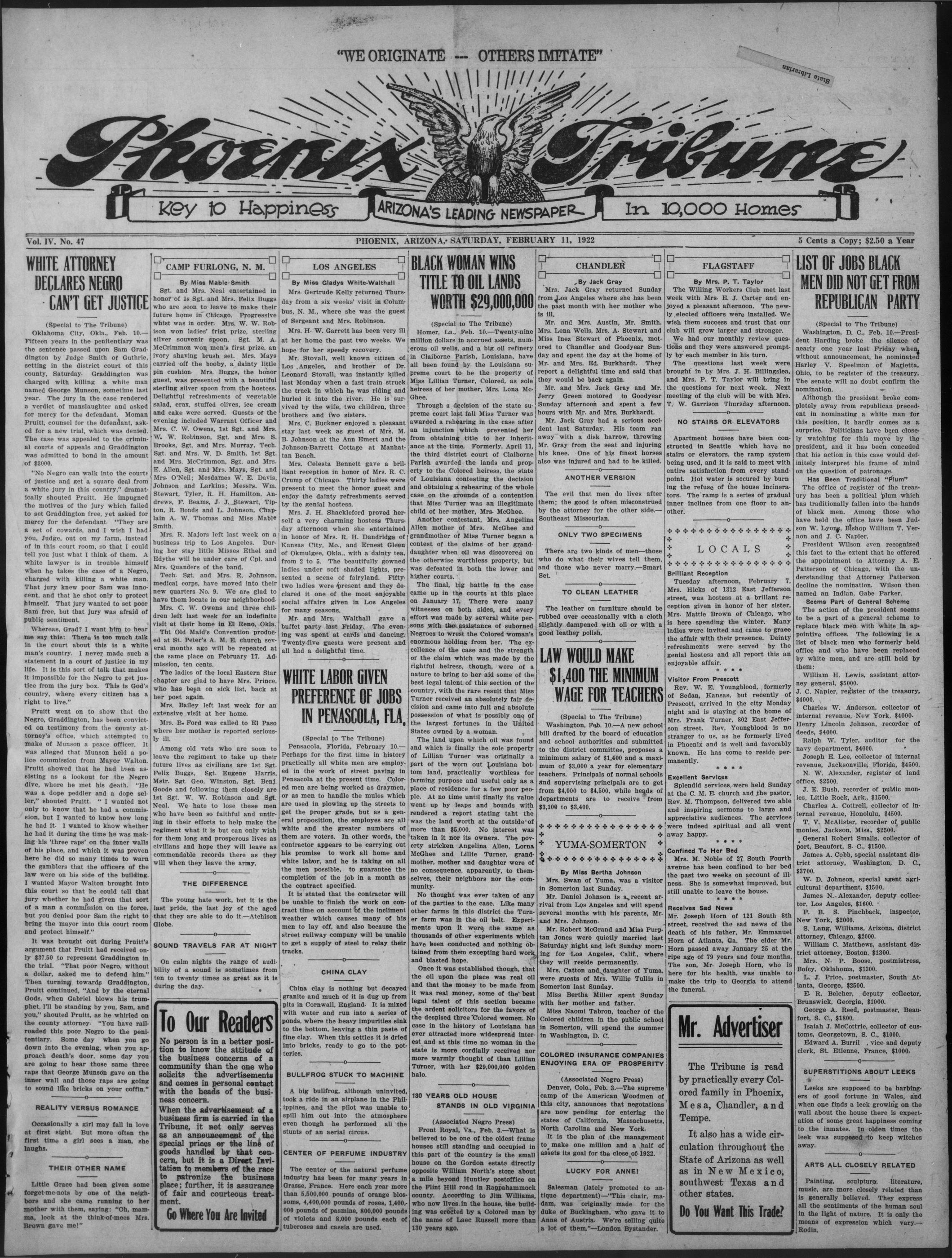
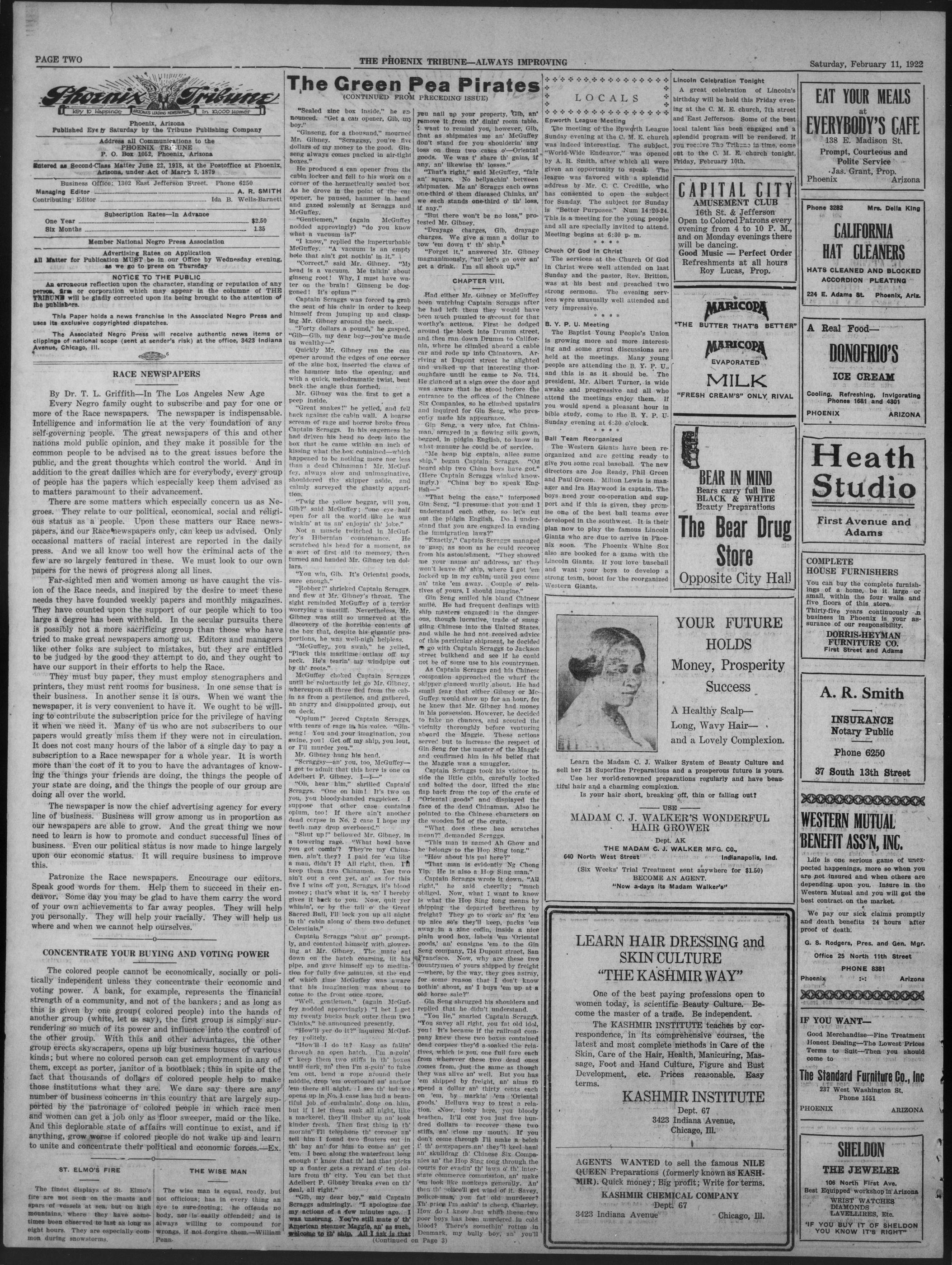
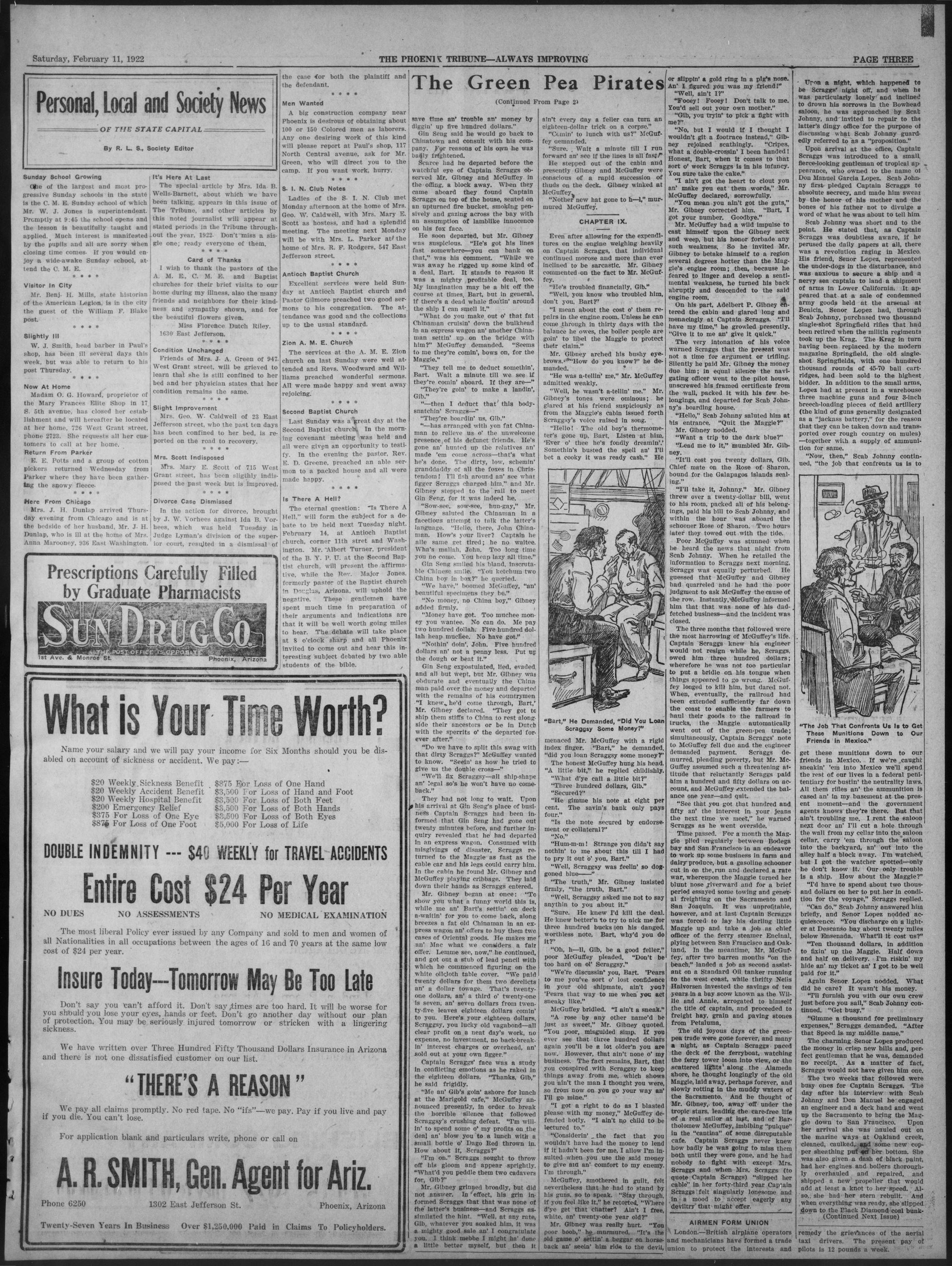
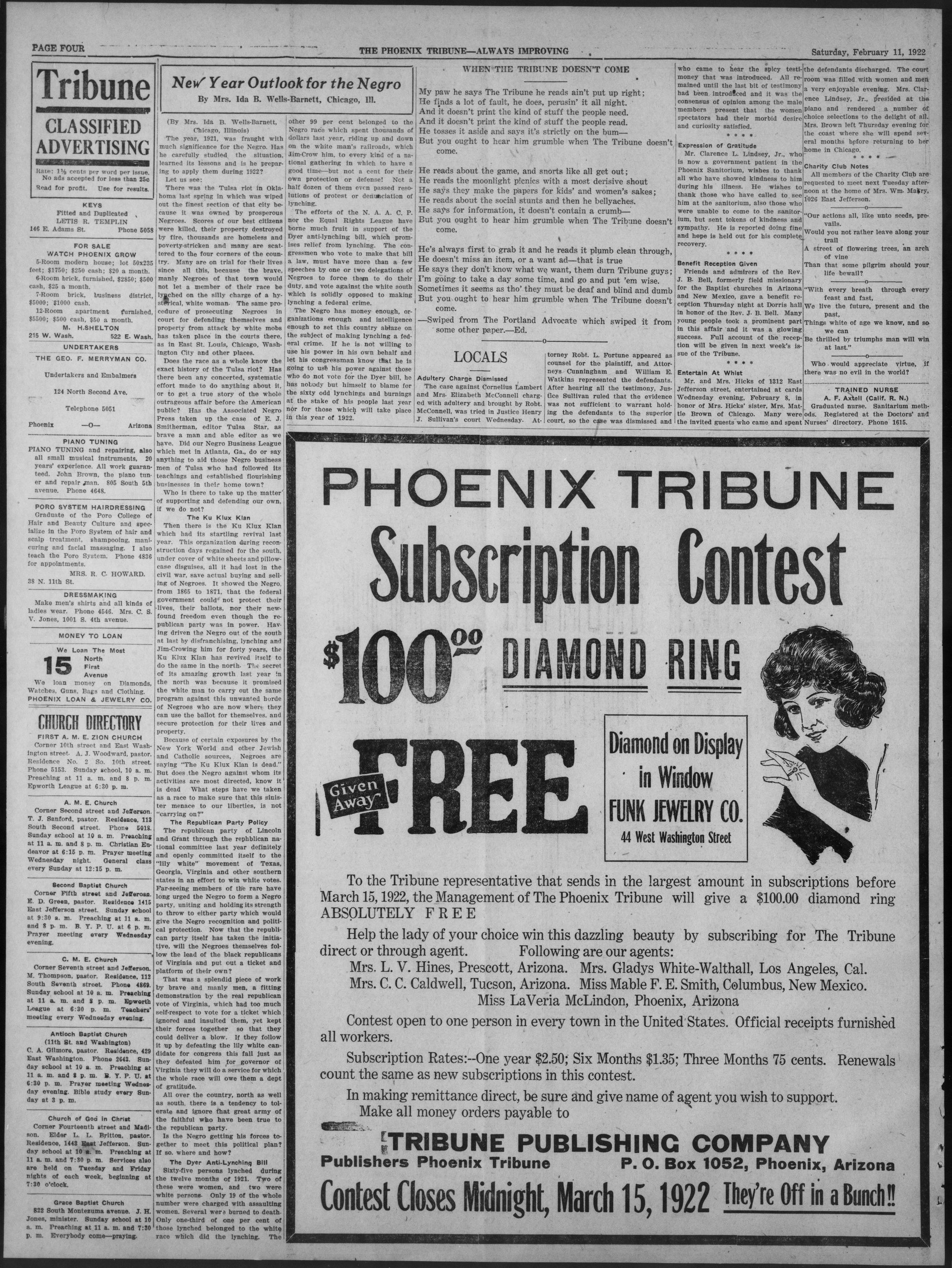
Page text (machine-generated)
"WE ORIGINATE --- OTHERS IMITATE"
Phoenix Tribune
key to Happiness ARIZONA'S LEADING NEWSPAPER In 10,000 Homes
WHITE ATTORNEY
DECLARES NEGRO
CAN'T GET JUSTICE
(Special to The Tribune)
Oklahoma City, Okla., Feb. 10.—Fifteen years in the penitentiary was the sentence passed upon Sam Graddington by Judge Smith of Guthrie, setting in the district court of this county, Saturday. Graddington was charged with killing a white man named George Munson, sometime last year. The jury in the case rendered a verdict of manslaughter and asked for mercy for the defendant. Moman Pruitt, counsel for the defendant, asked for a new trial, which was denied. The case was appealed to the criminal courts of appeals and Graddington was admitted to bond in the amount of $2000.
"No Negro can walk into the courts of justice and get a square deal from a white jury in this country," dramatically shouted Pruitt. He impugned the motives of the jury which failed to set Graddington free, yet asked for mercy for the defendant. "They are a set of cowards, and I wish I had you, Judge, out on my farm, instead of in this court room, so that I could tell you just what I think of them. A white lawyer is in trouble himself when he takes the case of a Negro charged with killing a white man. That jury knew poor Sam was innocent, and that he shot only to protect himself. That jury wanted to set poor Sam free, but that jury was afraid of public sentiment.
Whereas, Grad? I want him to hear me say this: There is too much talk in the court about this is a white man's country. I never made such a statement in a court of justice in my life. It is this sort of talk that makes it impossible for the Negro to get justice from the jury box. This is God's country, where every citizen has a right to live."
Pruitt went on to show that the Negro, Graddington, has been convicted on testimony from the county attorney's office, which attempted to make of Munson a peace officer. It was alleged that Munson held a police commission from Mayor Walton. Pruitt showed that he had been assisting as a lookout for the Negro dive, where he met his death. "He was a dope peddler and a dope seller," shouted Pruitt. "I wanted not only to know that he had a commission, but I wanted to know how long he had it. I wanted to know whether he had it during the time he was making his 'three raps' on the inner walls of his place, and which it was proven he did so many times to warn the gamblers that the officers of the law were on his side of the building. I wanted Mayor Walton brought into this court so that he could tell that jury whether he had given that sort of a man a commission on the force, but you denied poor Sam the right to bring the mayor into this court room and protect himself."
It was brought out during Pruitt's argument that Pruitt had received only $37.50 to represent Graddington in the trial. "That poor Negro, without a dollar, asked me to defend him." Then turning towards Graddington, Pruitt continued, "And by the eternal Gods, when Gabriel blows his trumpet, I'll be standing by you, Sam, and you," shouted Pruitt, as he whirled on the county attorney. "You have railroaded this poor Negro to the penitentiary. Some day when you go down into the evening, when you approach death's door, some day you are going to hear those same three raps that George Munson gave on the inner wall and those raps are going to sound like bricks on your coffin."
REALITY VERSUS ROMANCE
Occasionally a girl may fall in love at first sight. But more often the first time a girl sees a man, she laughs.
THEIR OTHER NAME
Little Grace had been given some forget-me-nots by one of the neighbors and she came running to her mother with them, saying: "Oh, mamma, look at the think-of-mees Mrs. Brown gave me!"
Sgt. and Mrs. Neal entertained in honor of Is Sgt. and Mrs. Felix Bugs who are soon to leave to make their future home in Chicago. Progressive whist was in order. Mrs. W. W. Robison won ladies' first prize, sterling silver souvenir spoon. Sgt. M. A. McCrimmon won men's first prize, an ivory shaving brush set. Mrs. Mays carried off the booby, a dainty little pushion. Mrs. Buggs, the honor guest, was presented with a beautiful sterling silver spoon from the hostess. Delightful refreshments of vegetable salad, crax, stuffed olives, ice cream and cake were served. Guests of the evening included Warrant Officer and Mrs. C. W. Owens, 1st Sgt. and Mrs. W. W. Robinson, Sgt. and Mrs. S. Brooks, Sgt. and Mrs. Murray, Tech Sgt. and Mrs. W. D. Smith, 1st Sgt. and Mrs. McCrimmon, Sgt. and Mrs. E. Allen, Sgt. and Mrs. Mays, Sgt. and Mrs. O'Nell; Mesdames W. E. Davis Johnson and Larkins; Messrs. Wm. Stewart, Tyler, R. H. Hamilton, Andrews, F. Beams, J. J. Stewart, Tipton, R. Bonds and L. Johnson, Chapain A. W. Thomas and Miss Mable Smith.
Mrs. R. Majors left last week on a business trip to Los Angeles. During her stay little Misses Ethel and Edythe will be under care of Cpl. and Mrs. Quanders of the band.
Tech. Sgt. and Mrs. R. Johnson, medical corps, have moved into their new quarters No. 9. We are glad to have them locate in our neighborhood.
Mrs. C. W. Owens and three children last week for an indefinite visit at their home in El Reno, Okla.
The Old Maid's Convention produced at St. Peter's A. M. E. church several months ago will be repeated at the same place on February 17. Admission, ten cents.
The ladies of the local Eastern Star chapter are glad to have Mrs. Prince, who has begun on sick list, back at her post again.
Mrs. Bailey left last week for an extensive visit at her home.
Mrs. B. Ford was called to El Paso where her mother is reported seriously ill.
Among old vets who are soon to leave the regiment to take up their future lives as civilians are 1st Sgt Felix Buggs, Sgt. Eugene Harris, Mstr. Sgt. Geo. Winston, Sgt. Benj Goode and following them closely are 1st Sgt. W. W. Robinson and Sgt. Neal. We hate to lose these men who have been so faithful and untiring in their efforts to help make the regiment what it is but can only wish for them long and prosperous lives as civilians and hope they will leave as commendable records there as they will when they leave the army.
THE DIFFERENCE
The young hate work, but it is the last pride, the last joy of the aged that they are able to do it.—Atchison Globe.
SOUND TRAVELS FAR AT NIGHT
On calm nights the range of audibility of a sound is sometimes from ten to twenty times as great as it is during the day.
To Our Readers
No person is in a better position to know the attitude of the business concerns of a community than the one who solicits the advertisements and comes in personal contact with the heads of the business concern.
When the advertisement of a business firm is carried in the Tribune, it not only serves as an announcement of the special prices or the line of goods handled by that concern, but it is a Direct Invitation to members of the race to patronize the business place; further, it is assurance of fair and courteous treatment.
Go Where You Are Invited
PHOENIX, ARIZONA: SATURDAY, FEBRUARY 11, 1922
By Miss Gladys White-Walthall
Mrs. Gertrude Kelly returned Thursday from a six weeks' visit in Columbus, N. M., where she was the guest of Sergeant and Mrs. Robinson.
Mrs. H. W. Garrett has been very ill at her home the past two weeks. We hope for her speedy recovery.
Mr. Stovall, well known citizen of Los Angeles, and brother of Dr. Leonard Stovall, was instantly killed last Monday when a fast train struck the truck in which he was riding and hurled it into the river. He is survived by the wife, two children, three brothers and two sisters.
Mrs. C. Buckner enjoyed a pleasant stay last week as guest of Mrs. M. B. Johnson at the Ann Emert and the Johnson-Barrett Cottage at Manhattan Beach.
Mrs. Celesta Bennett gave a brilliant reception in honor of Mrs. R. C. Crump of Chicago. Thirty ladies were present to meet the honor guest and enjoy the dainty refreshments served by the genial hostess.
Mrs. J. H. Shackleford proved herself a very charming hostess Thursday afternoon when she entertained in honor of Mrs. R. H. Dandridge of Kansas City, Mo., and Ernest Gleen of Okmulgue, Okla., with a dainty tea, from 2 to 5. The beautifully gowned ladies under soft shaded lights, presented a scene of fairyland. Fifty-two ladies were present and they declared it one of the most enjoyable social affairs given in Los Angeles for many seasons.
Mr. and Mrs. Walthall gave a buffet party last Friday. The evening was spent at cards and dancing. Twenty-five guests were present and all had a delightful time.
WHITE LABOR GIVEN PREFERENCE OF JOBS IN PENASCOLA, FLA
WHITE LABOR GIVEN PREFERENCE OF JOBS IN PENASCOLA, FLA
Pensacola, Florida, February 10.—Perhaps for the first time in history practically all white men are employed in the work of street paving in Pensacola at the present time. Colored men are being worked as draymen, or as men to handle the mules which are used in plowing up the streets to get the proper grade, but as a general proposition, the employes are all white and the greater numbers of them are voters. In other words, the contractor appears to be carrying out his promise to work all home and white labor, and he is taking on all the men possible, to guarantee the completion of the job in a month as the contract specified.
It is stated that the contractor will be unable to finish the work on contract time on account of the incliment weather which causes many of his men to lay off, and also because the street railway company will be unable to get a supply of steel to relay their tracks.
CHINA CLAY
China clay is nothing but decayed granite and much of it is dug up from pits in Cornwall, England. It is mixed with water and run into a series of ponds, where the heavy impurities sink to the bottom, leaving a thin paste of fine clay. When this settles it is dried into bricks, ready to go to the potteries.
BULLFROG STUCK TO MACHINE
A big bullfrog, although uninvited, took a ride in an airplane in the Philippines, and the pilot was unable to spill him out into the atmosphere even though he performed all the stunts of an aerial circus.
CENTER OF PERFUME INDUSTRY
The center of the natural perfume industry has been for many years in Grasse, France. Here each year more than 5,500,000 pounds of orange blossoms, 4,400,000 pounds of roses, 1,400,000 pounds of pasmine, 800,000 pounds of violets and 8,000 pounds each of tuberoses and cassia are used.
BLACK WOMAN WINS TITLE TO OIL LANDS WORTH $29,000,000
BLACK WOMAN WINS TITLE TO OIL LANDS WORTH $29,000,000
(Special to The Tribune)
Homer, La., Feb. 10.—Twenty-nine million dollars in accrued assets, numerous oil wells, and a big oil refinery in Claiborne Parish, Louisiana, have all been found by the Louisiana supreme court to be the property of Miss Lillian Turner, Colored, as sole heiress of her mother, Mrs. Lona McGhee.
Through a decision of the state supreme court last fall Miss Turner was awarded a rehearing in the case after an injunction which prevented her from obtaining title to her inheritance at the time. Formerly, April 11, the third district court of Claiborne Parish awarded the lands and property to the Colored heiress, the state of Louisiana contesting the decision and obtaining a rehearing of the whole case on the grounds of a contention that Miss Turner was an illegitimate child of her mother, Mrs. McGhee.
Another contestant, Mrs. Angelina Allen mother of Mrs. McGhee and grandmother of Miss Turner began a contest of the claims of her grand-daughter when oil was discovered on the otherwise worthless property, but was defeated in both the lower and higher courts.
The final, big battle in the case came up in the courts at this place on January 17. There were many witnesses on both sides, and every effort was made by several white persons with the assistance of suborned Negroes to wrest the Colored woman's enormous holding from her. The excellence of the case and the strength or the claim which was made by the rightful heiress, though, were of a nature to bring to her aid some of the best legal talent of this section of the country, with the rare result that Miss Turner received an absolutely fair decision and came into full and absolute possession of what is possibly one of the largest fortunes in the United States owned by a woman.
The land upon which oil was found and which is finally the sole property of Lillian Turner was originally a part of the worn out Louisiana bottom land, practically worthless for farming purpose and useful only as a place of residence for a few poor people. At no time until finally its value went up by leaps and bounds with rendered a report stating tah the was the land worth at the outside of more than $5,000. No interest was taken in it nor its owners. The poverty stricken Angelina Allen, Lorna McGhee and Lillie Turner, grandmother, mother and daughter were of no consequence, apparently, to themselves, their neighbors nor the community.
No thought was ever taken of any of the parties to the case. Like many other farms in this district the Turner farm was in the oil belt. Experiments upon it were the same as thousands of other experiments which have been conducted and nothing obtained from them excepting hard work and blasted hope.
Once it was established though, that the oil upon the place was real oil and that the money to be made from it was real money, some of the best legal talent of this section became the ardent solicitors for the favors of the despised three 'Colored women. No case in the history of Louisiana has ever attracted more widespread interest and at this time no woman in the state is more cordially received nor more warmly thought of than Lillian Turner, with her $29,000,000 golden halo.
130 YEARS OLD HOUSE
STANDS IN OLD VIRGINIA
(Associated Negro Press)
Front Royal, Va., Feb. 3.—What is believed to be one of the oldest frame houses still standing and occupied in this part of the country is the small house on the Gordon estate directly opposite William North's store about a mile beyond Huntley postoffice on the Flint Hill road in Rappahannock county. According to Jim Williams, who now lives in the house, the building was erected by a Colored man by the name of Laec Russell more than 130 years ago.
CHANDLER
Mrs. Jack Gray returned Sunday from Los Angeles where she has been the past month with her mother who is ill.
Mr. and Mrs. Austin, Mr. Smith, Mrs. Lena Wells, Mrs. A. Stewart and Miss Inez Stewart of Phoenix, motored to Chandler and Goodyear Sunday and spent the day at the home of Mr. and Mrs. Ed. Burkhardt. They report a delightful time and said that they would be back again.
Mr. and Mrs. Jack Gray and Mr. Jerry Green motored to Goodyear Sunday afternoon and spent a few hours with Mr. and Mrs. Burkhardt.
Mr. Jack Gray had a serious accident last Saturday. His team ran away with a disk harrow, throwing Mr. Gray from the seat and injuring his knee. One of his finest horses also was injured and had to be killed.
ANOTHER VERSION
The evil that men do lives after them; the good is often misconstrued by the attorney for the other side. Southeast Missouri.
ONLY TWO SPECIMENS
There are two kinds of men—those who do what their wives tell them and those who never marry.—Smart Set.
TO CLEAN LEATHER
The leather on furniture should be rubbed over occasionally with a cloth slightly dampened with oil or with a good leather polish.
LAW WOULD MAKE $1,400 THE MINIMUM WAGE FOR TEACHERS
Washington, Feb. 10.—A new school bill drafted by the board of education and school authorities and submitted to the district committee, proposes a minimum salary of $1,400 and a maximum of $3,000 a year for elementary teachers. Principals of normal schools and supervising principals are to get from $4,000 to $4,500, while heads of departments are to receive from $3,100 to $3,400.
YUMA-SOMERTON
By Miss Bertha Johnson
Mrs. Swan of Yuma, was a visitor in Somerton last Sunday.
Mr. Daniel Johnson is a recent arrival from Los Angeles and will spend several months with his parents, Mr. and Mrs. Johnson.
Mr. Robert McGrand and Miss Purpatan Jones were quietly married last Saturday night and left Sunday morning for Los Angeles, Calif., where they will reside permanently.
Mrs. Catton and daughter of Yuma, were guests of Mrs. Willie Tullis in Somerton last Sunday. Miss Bertha Miller spent Sunday with her mother and father. Miss Namii Tabron, teacher of the Colored children in the public school in Somerton, will spend the summer in Washington, D. C.
COLORED INSURANCE COMPANIES
ENJOYING ERA OF PROSPERITY
(Associated Negro Press)
Denver, Colo., Feb. 3.—The supreme camp of the American Woodmen of this city, announces that negotiations are now pending for entering the states of California, Massachusetts, North Carolina and New York.
It is the plan of the management to make one million and a half of assets its goal for the close of 1922.
LUCKY FOR ANNE!
Salesman (lately promoted to antique department)—"This chair, madam, was originally made for the duke of Buckingham, who gave it to Anne of Austria. We're selling quite a lot of them."-London Bystander.
The Willing Workers Club met last week with Mrs. E. J. Carter and enjoyed a pleasant afternoon. The newly elected officers were installed. We wish them success and trust that our club will grow larger and stronger. We had our monthly review questions and they were answered promptly by each member in his turn. The questions last week were brought in by Mrs. J. H. Billingslea, and Mrs. P. T. Taylor will bring in the questions for next week. Next meeting of the club will be with Mrs. T. W. Garrison Thursday afternoon.
NO STAIRS OR ELEVATORS
Apartment houses have been constructed in Seattle which have no stairs or elevators, the ramp system being used, and it is said to meet with entire satisfaction from every standpoint. Hot water is secured by burning the refuse of the house incinerators. The ramp is a series of gradual inner inclines from one floor to another.
LOCALS
Brilliant Reception
Tuesday afternoon, February 7
Mrs. Hicks of 1312 East Jefferson
street, was hostess at a brilliant reception given in honor of her sister
Mrs. Mattie Brown of Chicago, who is here spending the winter. Many ladies were invited and came to grace the affair with their presence. Dainty refreshments were served by the genial hostess and all report this an enjoyable affair.
Visitor From Prescott
Rev. W. E. Youngblood, formerly of Sedan, Kansas, but recently of Prescott, arrived in the city Monday night and is staying at the home of Mrs. Frank Turner, 802 East Jefferson street. Rev. Youngblood is no stranger to us, as he formerly lived in Phoenix and is well and favorably known. He has come to reside permanently.
Excellent Services
Splendid services were held Sunday at the C. M. E. church and the pastor, Rev. M. Thompson, delivered two able and inspiring sermons to large and appreciative audiences. The services were indeed spiritual and all went away happy.
Mrs. M. Noble of 27 South Fourth avenue has been confined to her bed the past two weeks on account of illness. She is somewhat improved, but still unable to leave the house.
Receives Sad News
Mr. Joseph Horn of 121 South 8th street, received the sad news of the death of his father, Mr. Emmanuel Horn of Atlanta, Ga. The elder Mr. Horn passed away January 25 at the ripe age of 79 years and four months. The son, Mr. Joseph Horn, who is here for his health, was unable to make the trip to Georgia to attend the funeral.
Mr. Advertiser
The Tribune is read by practically every Colored family in Phoenix, Mesa, Chandler, and Tempe. It also has a wide circulation throughout the State of Arizona as well as in New Mexico, southwest Texas and other states.
5 Cents a Copy; $2.50 a Year
LIST OF JOBS BLACK MEN DID NOT GET FROM REPUBLICAN PARTY
LIST OF JOBS BLACK MEN DID NOT GET FROM REPUBLICAN PARTY
(Special to The Tribune)
Washington, D. C., Feb. 10.—President Harding broke the silence of nearly one year last Friday when, without announcement, he nominated Harley V. Speelman of Marietta, Ohio, to be register of the treasury. The senate will no doubt confirm the nomination.
Although the president broke completely away from republican precedent in nominating a white man for this position, it hardly comes as a surprise. Politicians have been closely watching for this move by the president, and it has been conceded that his action in this case would definitely interpret his frame of mind on the question of patronage.
Has Been Traditional "Plum"
The office of register of the treasury has been a political plum which has traditionally fallen into the hands of black men. Among those who have held the office have been Judson W. Lyon, Bishop William T. Vernon and J. C. Napier.
President Wilson even recognized this fact to the extent that he offered the appointment to Attorney A. E. Patterson of Chicago, with the understanding that Attorney Patterson decline the nomination. Wilson then named an Indian, Gabe Parker.
**Seems Part of General Scheme**
The action of the president seems to be a part of a general scheme to replace black men with white in appointive offices. The following is a list of black men who formerly held office and who have been replaced by white men, and are still held by them:
William H. Lewis, assistant attorney general, $5000.
J. C. Napier, register of the treasury, $4000.
Charles W. Anderson, collector of internal revenue, New York, $4000.
Henry Lincoln Johnson, recorder of deeds, $4000.
Ralph W. Tyler, auditor for the navy department, $4000.
Joseph E. Lee, collector of internal revenue, Jacksonville, Florida, $4500.
N. W. Alexander, register of land office, $2500.
J. E. Bush, recorder of public monies. J. E. Rock, Ark., $1500.
Charles A. Cottrell, collector of internal revenue, Honolulu, $4500.
T. V. McAlister, recorder of public monies, Jackson, Miss., $2500.
General Robert Smalls, collector of port, Beaufort, S. C., $1500.
James A. Cobb, special assistant district attorney, Washington, D. C., $3700.
W. D. Johnson, special agent agricultural department, $1500.
James N..Alexander, deputy collector, Los Angeles, $1600.
P. B. S. Pinchback, inspector, New York, $2000.
S. Lang, Williams, Arizona, district attorney, Chicago, $2000.
William C. Matthews, assistant district attorney, Boston, $1300.
Mrs. N. P. Boose, postmistress, Bofcy, Oklahoma, $1300.
L. J. Price, postmaster, South Atlanta, George, $2500.
E. R. Belcher, deputy collector, Brunswick, Georgia, $1000.
George A. Reed, postmaster, Beaufort, S. C., $1800.
Isaiah J. McCottrell, collector of customs, Georgetown, S. C., $1000.
Edward A. Burril, vice and deputy clerk, St. Etienne, France, $1000.
SUPERSTITIONS ABOUT LEEKS
Leeks are supposed to be harbingers of good fortune in Wales, and when one finds a leek growing on the wall about the house there is expectation of some great happiness coming to the inmates. In olden times the leek was supposed to keep witches away.
ARTS ALL CLOSELY RELATED
Painting, sculpture, literature, music, are more closely related than is generally believed. They express all the sentiments of the human soul in the light of nature. It is only the means of expression which vary.— Rodin.
Phoenix
key to Happiness
ARIZONA
Phoenix
Published Eyeily Saturday by
Phoenix Tribune KEY TO Happiness AUZONA'S LEADING NEWSPAER In 10,000 Homes
Address all Communications to
the
PHOENIX TRI UNE
P. O. Box 1052, Phoenix, Arizona
Entered as Second-Class Matter June
Arizona, under A
Business Office: 1302 East
Managing Editor
Contributing Editor
Subscription R
One Year
Six Months
Member National N
Advertising Ra
All Matter for Publication MUST be
as we go to p
Class Matter June 22, 1918, at the Pe
Arizona, under Act of March 3, 1879
office; 1302 East Jefferson Street.
Ic
Subscription Rates—In Advance
Member National Negro Press Association
Advertising Rates on Application
lication MUST be in our Office by
as we go to press on Thursday
Entered as Second-Class Matter June 22, 1918, at the Postoffice at Phoenix
Arizona, under Act of March 3, 1879
All Matter for Publication MUST be in our Office by Wednesday evening as we go to press on Thursday
NOTICE TO THE PUBLIC
An erroneous reflection upon the character, standing or reputation of any person, arm or corporation which may appear in the column of THE TRIBUNE will be gladly corrected upon its being brought to the attention of the publishers.
An erroneous reflection upon the person, arm or corporation which TRIBUNE will be gladly corrected up the publishers.
This Paper holds a news franc uses its exclusive copyrighted dispute
The Associated Negro Press clippings of national scope (sent at a Avenue, Chicago, Ill.
Election upon the character, standing
opposition which may appear in the
adly corrected upon its being brought
to a news franchise in the Associat
copyrighted dispatches.
Ed Negro Press will receive author
scope (sent at sender's risk) at the
This Paper holds a news franchise in the Associated Negro Press and uses its exclusive copyrighted dispatches.
The Associated Negro Press will receive authentic news items or clippings of national scope (sent at sender's risk) at the office, 3423 Indiana Avenue, Chicago, Ill.
RACE NEWSPAPERS
By Dr. T. L. Griffith—In every Negro family ought more of the Race newspapers. Intelligence and information lie self-governing people. The great nations mold public opinion, and common people to be advised to the public, and the great thoughts addition to the great dailies which of people has the papers which to matters paramount to their life.
There are some matters we groes. They relate to our political status as a people. Upon papers, and our Race newspapers, occasional matters of racial impress. And we all know too few are so largely featured in papers for the news of progress.
Far-sighted men and women of the Race needs, and insists they have founded weekly. They have counted upon the large degree has been withheld is possibly not a more sacrificial tried to make great newspapers, like other folks are subject to be judged by the good they have our support in their efforts.
They must buy paper, their printers, they must rent rooms of their business. In another semi-newspaper, it is very convenient to contribute the subscription it when we need it. Many of the papers would greatly miss them. It does not cost many hours of subscription to a Race newspaper more than the cost of it to young the things your friends are your state are doing, and the time doing all over the world.
The newspaper is now the line of business. Business will our newspapers are able to grow need to learn is how to promote business. Even our political state upon our economic status. It is this.
Patronize the Race news. Speak good words for them. I deavor. Some day you may be one of your own achievements to for you personally. They will help where and when we cannot help.
CONCENTRATE YOUR BUSINESS
The colored people cannot technically independent unless they voting power. A bank, for each strength of a community, and this is given by one group (or another group) (white, let us say, rendering so much of its power the other group. With this a group erects skyscrapers, opens kinds; but where no colored person, except as porter, janitor or fact that thousands of dollars those institutions what they are number of business concerns in ported by the patronage of co- and women can get a job only a. And this deplorable state of anything, grow worse if colored to unite and concentrate their power.
ST. ELMOS FIRE
Griffith—In The Los Angeles family ought to subscribe and the newspapers. The newspaper information lie at the very for people. The great newspapers of public opinion, and they make it to be advised as to the great in great thoughts which control the great dailies which are for everybody the papers which especially keep account to their advancement. Some matters which especially contribute to our political, economical, people. Upon these matters, race newspapers only, can keep up of racial interest are reported all know too well how the crime featured in these. We must news of progress along all lines. Women and women among us have needs, and inspired by the design founded weekly papers and moved upon the support of our people has been withheld. In the secular more sacrificing group than that newspapers among us. Editors are subject to mistakes, but the good they attempt to do, and in their efforts to help the Race boy paper, they must employ such rent rooms for business. In another sense it is ours. We very convenient to have it. We have the subscription price for the print. Many of us who are not so statically miss them if they were many hours of the labor of a single Race newspaper for a whole year of it to you to have the advantage of friends are doing, the thinking, and the things the people are the world. Her is now the chief advertising of Business will grow among us are able to grow. And the great how to promote and conduct such political status is now made public status. It will require business.
The Race newspapers. Encourages for them. Help them to succeed you may be glad to have their movements to far away peoples. They will help your racially. We cannot help ourselves.
THE YOUR BUYING AND VOTING
People cannot be economically, but unless they concentrate the bank, for example, represent community, and not of the bankers, one group (colored people) in white, let us say), the first group of its power and influence in With this and other advance scrapers, opens up big business by no colored person can get employer, janitor of a bootblack; the heads of dollars of colored people what they are. We dare say our concerns in this country that stronage of colored people in not a job only as floor sweeper, the state of affairs will continue worse if colored people do not confront their political and economic
By Dr. T. L. Griffith—In The Los Angeles New Age
Every Negro family ought to subscribe and pay for one or more of the Race newspapers. The newspaper is indispensable. Intelligence and information lie at the very foundation of any self-governing people. The great newspapers of this and other nations mold public opinion, and they make it possible for the common people to be advised as to the great issues before the public, and the great thoughts which control the world. And in addition to the great dailies which are for everybody, every group of people has the papers which especially keep them advised as to matters paramount to their advancement.
There are some matters which especially concern us as Negroes. They relate to our political, economical, social and religious status as a people. Upon these matters our Race newspapers, and our Race newspapers only, can keep us advised. Only occasional matters of racial interest are reported in the daily press. And we all know too well how the criminal acts of the few are so largely featured in these. We must look to our own papers for the news of progress along all lines.
Far-sighted men and women among us have caught the vision of the Race needs, and inspired by the desire to meet these needs they have founded weekly papers and monthly magazines. They have counted upon the support of our people which to too large a degree has been withheld. In the secular pursuits there is possibly not a more sacrificing group than those who have tried to make great newspapers among us. Editors and managers like other folks are subject to mistakes, but they are entitled to be judged by the good they attempt to do, and they ought to have our support in their efforts to help the Race.
They must buy paper, they must employ stenographers and printers, they must rent rooms for business. In one sense that is their business. In another sense it is ours. When we want the newspaper, it is very convenient to have it. We ought to be willing to contribute the subscription price for the privilege of having it when we need it. Many of us who are not subscribers to our papers would greatly miss them if they were not in circulation. It does not cost many hours of the labor of a single day to pay a subscription to a Race newspaper for a whole year. It is worth more than the cost of it to you to have the advantages of knowing the things your friends are doing, the things the people of your state are doing, and the things the people of our group are doing all over the world.
The newspaper is now the chief advertising agency for every line of business. Business will grow among us in proportion as our newspapers are able to grow. And the great thing we now need to learn is how to promote and conduct successful lines of business. Even our political status is now made to hinge largely upon our economic status. It will require business to improve this.
Patronize the Race newspapers. Encourage our editors. Speak good words for them. Help them to succeed in their endeavor. Some day you may be glad to have them carry the word of your own achievements to far away peoples. They will help you personally. They will help your racially. They will help us where and when we cannot help ourselves.
CONCENTRATE YOUR BUYING AND VOTING POWER
The colored people cannot be economically, socially or politically independent unless they concentrate their economic and voting power. A bank, for example, represents the financial strength of a community, and not of the bankers; and as long as this is given by one group( colored people) into the hands of another group (white, let us say), the first group is simply surrendering so much of its power and influence into the control of the other group. With this and other advantages, the other group erects skyscrapers, opens up big business houses of various kinds; but where no colored person can get employment in any of them, except as porter, janitor of a bootblack; this in spite of the fact that thousands of dollars of colored people help to make those institutions what they are. We dare say there are any number of business concerns in this country that are largely supported by the patronage of colored people in which race men and women can get a job only as floor sweeper, maid or the like. And this deplorable state of affairs will continue to exist, and if anything, grow worse if colored people do not wake up and learn to unite and concentrate their political and economic forces.—Ex.
The finest displays of St. Elmo's fire are not seen on the masts and spars of vessels at sea, but on high mountains, where they have sometimes been observed to last as long as eight hours. They are especially common during snowstorms.
PAGE TWO
22, 1918, at the Postoffice at Phoenix,
last of March 3, 1879
Jefferson Street. Phone 6250
A. R. SMITH
Ida B. Wells-Barnett
States—In Advance
$2.50
1.35
Negro Press Association
Sales on Application
in our Office by Wednesday evening,
press on Thursday
character, standing or reputation of any may appear in the column of THE on its being brought to the attention of
raise in the Associated Negro Press andiches.
will receive authentic news items or sender's risk) at the office, 3423 Indiana
The Los Angeles New Age
to subscribe and pay for one or
The newspaper is indispensable,
at the very foundation of any
newspapers of this and other
and they make it possible for the
us to the great issues before the
which control the world. And in
which are for everybody, every group
especially keep them advised as
advancement.
which especially concern us as Ne-
ical, economical, social and religi-
these matters our Race news-
only, can keep us advised. Only
interest are reported in the daily
well how the criminal acts of the
these. We must look to our own
along all lines.
In among us have caught the visi-
sired by the desire to meet these
papers and monthly magazines.
support of our people which to too-
ld. In the secular pursuits there
being group than those who have
among us. Editors and managers
mistakes, but they are entitled
attempt to do, and they ought to
to help the Race.
We must employ stenographers and
for business. In one sense that is
use it is ours. When we want the
to have it. We ought to be will-
nice price for the privilege of having
us who are not subscribers to our
in if they were not in circulation.
the labor of a single day to pay a
per for a whole year. It is worth
to have the advantages of know-
doing, the things the people of
things the people of our group are
chief advertising agency for every
grow among us in proportion as
new. And the great thing we now
and conduct successful lines of
atus is now made to hinge largely
will require business to improve
papers. Encourage our editors.
help them to succeed in their en-
glad to have them carry the word
away peoples. They will help
your racially. They will help us
ourselves.
VING AND VOTING POWER
be economically, socially or poli-
concentrate their economic and
example, represents the financial
lot of the bankers; and as long as
colored people) into the hands of
), the first group is simply sur-
and influence into the control of
and other advantages, the other
big business houses of various
mon can get employment in any of
a bootblack; this in spite of the
of colored people help to make
me. We dare say there are any
this country that are largely sup-
posed people in which race men
s floor sweeper, maid or the like.
airs will continue to exist, and if
people do not wake up and learn
political and economic forces.—Ex.
The wise man is equal, ready, but not officious; has in every thing an eye to sure-footing; he offends no body, nor is easily offended; and is always willing to compound for wrongs, if not forgive them.—William Penn.
THE PHOENIX TRIBUNE—ALWAYS IMPROVING
The Green Pea Pirates
"Sealed zinc box inside," he announced. "Get a can opener, Gib, my boy."
"Ginseng, for a thousand," mourned Mr. Gibney. "Scraggsy, you're five dollars of my money to the good. Ginseng always comes packed in air-tight boxes."
He produced a can opener from the cabin locker and fell to his work on a corner of the hermetically sealed box. As he drove in the point of the can opener, he paused, hammer in hand and gazed solemnly at Scraggs and McGuffey.
"Gentlemen," (again McGuffey nodded approvingly) "do you know what a vacuum is?"
"I know," replied the imperturbable McGuffey. "A vacuum is an empty hole that ain't got nothin' in it."
"Correct," said Mr. Gibney. "My head is a vacuum. Me talkin' about ginseng root! Why, I must have water on the brain! Ginseng be dogged! It's opium!"
Captain Scraggs was forced to grab the seat of his chair in order to keep himself from jumping up and clasping Mr. Gibney around the neck.
"Forty dollars a pound," he gasped.
"Gib—Gib, my dear boy—you've made us wealthy—"
Quickly Mr. Gibney ran the can opener around the edges of one corner of the zine box, inserted the claws of the hammer into the opening, and with a quick, melodramatic twist, bent back the angle thus formed.
Mr. Gibney was the first to get a peep inside.
"Great snakes!" he yelled, and fell back against the cabin wall. A hoarse scream of rage and horror broke from Captain Scraggs. In his eagerness he had driven his head so deep into the box that he came within an inch of kissing what the box contained—which happened to be nothing more nor less than a dead Chinaman! Mr. McGuffey, always slow and unimaginative, shouldered the skipper aside, and calmly surveyed the ghastly apparition.
"Twig the yellow beggar, will you, Glb?" said McGuffey; "one eye half open for all the world like he was winkin' at us an' enjoyin' th' joke." Not a muscle twitched in McGuffey's Hibernian countenance. He scratched his head for a moment, as a sort of first aid to memory, then turned and handed Mr. Gibney ten dollars.
"You win, Glb. It's Oriental goods, sure enough."
"Robber!" shrieked Captain Scraggs, and flew at Mr. Gibney's throat. The sight reminded McGuffey of a terrier worrying a mastiff. Nevertheless, Mr. Gibney was still so unnerved at the discovery of the horrible contents of the box that, despite his gigantic proportions, he was well-night helpless.
"McGuffey, you swab," he yelled, "Pluck this maritime outlaw off my neck. He's tearin' my windpipe out by th' roots."
McGuffey choked Captain Scraggs until he reluctantly let go Mr. Gibney, whereupon all three fled from the cabin as from a pestilence, and gathered, an angry and disappointed group, out on deck.
"Opium!" jeered Captain Scraggs, with tears of rage in his voice. "Ginseng! You and your imagination, you swine, you! Get off my ship, you lout, or I'll murder you."
Mr. Gibney hung his head.
"Scraggsy—an' you, too, McGuffey— I got to admit that this here is one on Adelbert P. Gibney, I—I—"
"Oh, hear him," shrilled Captain Scraggs. "One on him! It's two on you, you bloody-handed ragpicker. I suppose that other case contains opium, too! If there ain't another dead corpse in No. 2 case I hope my teeth may drop overboard."
"Shut up!' bellowed Mr. Gibney, in a towering rage. "What howl have you got comin'? They're my Chinamen, ain't they? I paid for 'em like a man, didn't I? All right, then. I keep them two Chinamen. You two ain't out a cent yet, an' as for this five I wins off you, Scraggs, it's blood money; that's what it is, en' I hereby gives it back to you. Now, quit yer whinin', or by the tail o' the Great Sacred Bull, I'll lock you up all night in th' cabin along o' them two defunct Celestials."
Captain Scraggs "shut up" promptly, and contented himself with glowering at Mr. Gibney. The mate sat down on the hatch coaring, lit his pipe, and gave himself up to meditation for fully five minutes, at the end of which time McGuffey was aware that his imagination was about to come to the front once more.
"Well, gentlemen," (again McGuffey nodded approvingly). "I bet I get my twenty bucks back outter them two Chinks," he announced presently.
"How'er y尔 do it?" inquired McGuffey politely.
"How'll I do it? Easy as fallin' through an open hatch. I'm a-goin' t' keep them two stiffs in th' boxes until dark, an' then I'm a-goin' to take 'em out, bend a rope around their middle, drop 'em overboard an' anchor 'em there all night. I see th' lad we opens up in No. I case has had a beautiful job of embalmal soak on him, but if I let them soak all night, like a mackerel, they'll limber up an' look kinder fresh. Then first thing th' mornin' Tl telephone th' coroner an' tell him I found two floaters out in th' bay an' for him to come an' get 'em. I been along the waterfront long enough t' know that th' lad that picks up a floater gets a reward o' ten dollars from th' city. You can bet that Adelbert P. Gibney breaks even on th' deal, all right."
"Glb, my dear boy," said Captain Scraggs admiringly. "I apologize for my actions of a few minutes ago. I was unstrung. You're still mate o' th' American steamer Maggie, an' as such, welcome to th' ship. All I ask is that
you nail up your property, Gib, an' remove it from th' dlinn' room table. I want to remind you, however, Gib, that as shipmates me an' McGuffey don't stand for you shoulderin' any loss on them two cases o'—Oriental goods. We was t' share th' gains, if any, an' likewise th' losses."
"That's right," said McGuffey, "fair an' square. No bellyachin' between shipmates. Me an' Scraggs each owns one-third o' them diseased Chinks, an' we each stands one-third o' th' loss, if any."
"But there won't be no loss," protested Mr. Gibney.
"Drayage charges, Gib, drayage charges. We give a man a dollar to tow 'em down t' th' ship."
"Forget it," answered Mr. Gibney magnanimously, "an' let's go over an' get a drink. I'm all shook up."
CHAPTER VIII.
Had either Mr. Gibney or McGuffey been watching Captain Scraggs after he had left them they would have been much puzzled to account for that worthy's actions. First he dodged around the block into Drumm street, and then ran down Drumm to California, where he climbed aboard a cable car and rode up into Chinatown. Arriving at Dupont street he alighted and walked up that interesting thoroughfare until he came to No. 714. He glanced at a sign over the door and was aware that he stood before the entrance to the offices of the Chinese Six Companies, so he climbed upstairs and inquired for Gin Seng, who presently made his appearance. Gin Seng, a very nice, fat Chinman, arrayed in a flowing silt gown, begged, in pidgin English, to know in what manner he could be of service.
"Me heap big captain, allee same ship," began Captain Scraggs, "On board ship two China boys have got." (Here Captain Scraggs winked knowingly.) "China boy no speak English—"
"That being the case," interposed Gin Seng, "I presume that you and I understand each other, so let's cut out the pldgin English. Do I understand that you are engaged in evading the immigration laws?"
"Exactly," Captain Scraggs managed to gasp; as soon as he could recover from his astonishment. "They showed me your name an' address, an' they won't leave th' ship, where I got 'em locked up in my cabin, until you come an' take 'em away. Couple o' relatives of yours, I should imagine."
Gin Seng smiled his bland Chinese smile. He had frequent dealings with ship masters engaged in the dangerous, though lucrative, trade of smuggling Chinese into the United States, and while he had not received advice of this particular shipment, he decided go with Captain Scraggs to Jackson street bulkhead and see if he could not be of some use to his countrymen. As Captain Scraggs and his Chinese companion approached the wharf the skipper glanced warily about. He had small fear that either Gibney or McGuffey would show up for an hour, for he knew that Mr. Gibney had money in his possession. However, he decided to take no chances, and scouted the vicinity thoroughly before venturing aboard the Maggie. These actions served but to increase the respect of Gin Seng for the master of the Maggie and confirmed him in his belief that the Maggie was a smuggler.
Captain Scraggs took his visitor inside the little cabin, carefully locked and bolted the door, lifted the zinc flap back from the top of the crate of "Oriental goods" and displayed the face of the dead Chinaman. Also he pointed to the Chinese characters on the wooden lid of the crate.
"What does these hen scratches mean?" demanded Scraggs.
"This man is named Ah Ghow and he belongs to the Hop Sing tong."
"How about his pal here?"
"That man is evidently Ng Chong Yip. He is also a Hop Sing man."
Captain Scraggs wrote it down. "All right," he said cheerly; "much obliged. Now, what I want to know is what the Hop Sing tong means by shipping the departed brethren by freight? They go to work an' fix 'em up nice so's they'll keep, packs 'em away in a zinc coffin, inside a nice plain wood box, labels 'em 'Oriental goods,' an' consigns 'em to the Gin Seng company, 714 Dupont street, San Francisco. Now, why are these two countrymen o' yours shipped by freight —where, by the way, they goes astray, for some reason that I don't know nothin' about, an' I buys 'em up at a old horse sale?"
Gin Seng shrugged his shoulders and replied that he didn't understand.
replied that he didn't understand.
"You lie," snarled Captain Scraggs, "You save all right, you fat old idol, you! It's because if the railroad company knew these two boxes contained dead corpses they'd a-sacked the relatives, which is you, one full fare each from wherever these two dead ones comes from, just the same as though they was alive an' well. But you has 'em shipped by freight, an' alms to spend a dollar an' thirty cents each on 'em, by markin' 'em 'Oriental goods.' Helluva way to treat a relation. Now, look here, you bloody heathen. It'll cost you just five hundred dollars to recover these two stiffs, an' close my mouth. If you don't come through I'll make a belch t' th' newspapers an' they' th' keel haul an' skulldrag an' Chinese Six Companies an' the Hop Sing tong through the courts for evadin' th' laws o' th' interstate commerce commission, an' make 'em look like monkeys generally. An' then 'th' police' get wind of it. Savey, police-man, you fat old murderer? Th' price you askin' is cheap, Charley. How do I know but what these two poor boys has been murdered in cold blood? There's somethin' rotten in Denmark, my bully boy, an' you'll n Page 3)
Epworth League Meeting
The meeting of the Epworth League
Sunday evening at the C. M. E. church
was indeed interesting. The subject,
"World-Wide Endeavor," was opened
by A. R. Smith, after which all were
given an opportunity to speak. The
league was favored with a splendid
address by Mr. C. C. Credille, who
has consented to open the subject
for Sunday. The subject for Sunday
is "Better Purposes." Num 14:20-24.
This is a meeting for the young people
and all are specially invited to attend.
Meeting begins at 6:30 p. m.
CAPITAL CITY AMUSEMENT CLUB
The services at the Church Of God In Christ were well attended on last Sunday and the pastor, Rev. Britton, was at his best and preached two strong sermons. The evening services were unusually well attended and very impressive.
The Baptist Young People's Union is growing more and more interesting and some great discussions are held at the meetings. Many young people are attending the B. Y. P. U., and this is as it should be. The president, Mr. Albert Turner, is wide awake and progressive and all who attend the meetings enjoy them. If you would spend a pleasant hour in bible study, come to the B. Y. P. U. Sunday evening at 6:30 o'clock.
The Western Giants have been reorganized and are getting ready to give you some real baseball. The new directors are Joe Ready, Phil Green and Paul Green. Milton Lewis is manager and Ira Haywood is captain. The boys need your co-operation and support and if this is given, they promise one of the best ball teams ever developed in the southwest. It is their plan now to play the famous Lincoln Giants who are due to arrive in Phoenix soon. The Phoenix White Sox also are booked for a game with the Lincoln Giants. If you love baseball and want your boys to develop a strong team, boost for the reorganized Western Giants.
YOUR FUTURE HOLDS Money, Prosperity Success
A. E.
Dam C. J. Walker System of Beauty Culture and Fine Preparations and a prosperous future is yours. Ten-renowned preparations regularly and have beau-arming complexion. Are short, breaking off, thin or falling out?
USE
C. J. WALKER'S WONDERFUL HAIR GROWER
Dept. AK
MADAM C. J. WALKER MFG. C0.,
Street Indianapolis, Ind.
Trial Treatment sent anywhere for $1.50)
BECOME AN AGENT.
Now a-days its Madam Walker's"
IN HAIR DRESSING and SKIN CULTURE
THE KASHMIR WAY"
In the best paying professions open to day, is scientific Beauty Culture. Be-aster of a trade. Be independent.
KASHMIR INSTITUTE teaches by cor- in its comprehensive courses, the most complete methods in Care of the Hair, Health, Manicuring, Mas- and Hand Culture, Figure and Bust at, etc. Prices reasonable. Easy
Learn the Madam C. J. Walk sell her 18 Superfine Preparations Use her world-renowned prep tiful hair and a charming complex Is your hair short, breaking
MADAM C. J. WALK HAIR G
Dept.
THE MADAM C. J.
640 North West Street
(Six Weeks' Trial Treatment BECOME A
"Now a-days its
LEARN HAIR SKIN CUR
"THE KASHMIR
One of the best pay women today, is scientific come the master of a tr
The KASHMIR INST
respondence, in its com latest and most complete Skin, Care of the Hair, Im sage, Foot and Hand C Development, etc. Pr terms.
Learn the Madam C. J. Walker System of Beauty Culture and sell her 18 Superfine Preparations and a prosperous future is yours. Use her world-renowned preparations regularly and have beautiful hair and a charming complexion.
MADAM C. J. WALKER'S WONDERFUL HAIR GROWER
Dept. AK
THE MADAM C. J. WALKER MFG. CO.,
640 North West Street Indianapolis, Ind.
(Six Weeks' Trial Treatment sent anywhere for $1.50)
BECOME AN AGENT.
"Now a-days its Madam Walker's"
LEARN HAIR DRESSING and SKIN CULTURE "THE KASHMIR WAY"
One of the best paying professions open to women today, is scientific Beauty Culture. Become the master of a trade. Be independent. The KASHMIR INSTITUTE teaches by correspondence, in its comprehensive courses, the latest and most complete methods in Care of the Skin, Care of the Hair, Health, Manicuring, Message, Foot and Hand Culture, Figure and Bust Development, etc. Prices reasonable. Easy terms.
KASHMIR INSTITUTE
AGENTS WANTED to
QUEEN Preparations (f
MIR). Quick money; Big
KASHMIR CHEM
Dept
3423 Indiana Avenue
WANTED to sell the famous NILE preparations (formerly known as KASH- k money; Big profit; Write for terms.
HMIR CHEMICAL COMPANY
Dept. 67
Ma Avenue Chicago, Ill.
AGENTS WANTED to sell the famous NILE QUEEN Preparations (formerly known as KASHMIR). Quick money; Big profit; Write for terms.
KASHMIR CHEMICAL COMPANY
Dept. 67
3423 Indiana Avenue Chicago, Ill.
Chuch Of God In Christ
B. Y. P. U. Meeting
Ball Team Reorganized
A great celebration of Lincoln's birthday will be held this Friday evening at the C. M. E. church, 7th street and East Jefferson. Some of the best local talent has been engaged and a splendid program will be rendered. If you receive The Tribune in time, come out to the C. M. E. church tonight, Friday, February 10th.
16th St. & Jefferson Open to Colored Patrons every evening from 4 to 10 P. M., and on Monday evenings there will be dancing. Good Music — Perfect Order Refreshments at all hours Roy Lucas, Prop.
MARICOPA
"THE BUTTER THAT'S BETTER"
MARICOPA
EVAPORATED
MILK
"FRESH CREAM'S" ONLY, RIVAL
BEAR IN MIND
Bears carry full line
BLACK & WHITE
Beauty Preparations
The Bear Drug
Store
Opposite City Hall
A Healthy Scalp— Long, Wavy Hair— and a Lovely Complexion.
Dept. 67
3423 Indiana Avenue,
Chicago, Ill.
Saturday, February 11, 1922
EAT YOUR MEALS
at
EVERYBODY'S CAFE
138 E. Madison St.
Prompt, Courteous and
Polite Service
Jas. Grant, Prop.
Phoenix Arizona
Phone 3282 Mrs. Della King
CALIFORNIA
HAT CLEANERS
HATS CLEANED AND BLOCKED
ACCORDION PLEATING
224 E. Adams St. Phoenix, Ariz.
A Real Food—
DONOFRIO'S
ICE CREAM
Cooling, Refreshing, Invigorating
Phones 1681 and 4301
PHOENIX ARIZONA
Heath Studio
First Avenue and
Adams
COMPLETE
HOUSE FURNISHERS
You can buy the complete furnishings of a home, be it large or small, within the four walls and five floors of this store.
Thirty-five years continuously in business in Phoenix is your assurance of our responsibility.
DORRIS-HEYMAN
FURNITURE CO.
First Street and Adams
A. R. Smith
INSURANCE
Notary Public
Phone 6250
37 South 13th Street
WESTERN MUTUAL
BENEFIT ASS'N, INC.
Life is one serious game of unexpected happenings, more so when you are not insured and when others are depending upon you. Insure in the Western Mutual and you will get the best contract on the market.
We pay our sick claims promptly and death benefits 24 hours after proof of death.
G. S. Rodgers, Pres. and Gen. Mgr.
Office 25 North 11th Street
PHONE 8381
Phoenix ::: Arizona
IF YOU WANT—
Good Merchandise-Fine Treatment Honest Dealing-The Lowest Prices Terms to Suit-Then you should come to
The Standard Furniture Co., Inc
237 West Washington St.
Phone 1551
PHOENIX ARIZONA
SHELDON
THE JEWELER
106 North First Ave.
Best Equipped workshop in Arizona
WRIST WATCHES
DIAMONDS
LAVEL LIBRES
```markdown
```
Saturday, February 11, 1922 Personal, Local
Personal, Local and Society News
OF THE STATE CAPITAL
By R. L. S., Society Editor
One of the largest and most progressive Sunday schools in the state is the C. M. E. Sunday school of which Mr. W. J. Jones is superintendent. Preemptly at 9:45 the school opens and the lesson is beautifully taught and applied. Much interest is manifested by the pupils and all are sorry when closing time comes. If you would en joy a wide-awake Sunday school, at tend the C. M. E.
Mr. Benj. H. Mills, state historian of the American Legion, is in the city the guest of the William F. Blake post.
W. J. Smith, head barber in Paul's shop, has been ill several days this week, but was able to return to his post Thursday.
Madam O. G. Howard, proprietor of the Mary Frances Elite Shop in 17 S. 5th avenue, has closed her establishment and will hereafter be located at her home, 726 West Grant street, phone 2723. She requests all her customers to call at her home.
Return From Parker
E. E. Potts and a group of cotton pickers returned Wednesday from Parker where they have been gathering the snowy fleece.
Mrs. J. H. Dunlap arrived Thursday evening from Chicago and is at the bedside of her husband, Mr. J. H. Dunlap, who is ill at the home of Mrs Anna Marooney, 926 East Washington
Prescriptions
by Graduate
SUND
1st Ave. & Monroe St.
What is
Name your salary and
abled on account of sicknes
Scriptions Carefully Filled
Graduate Pharmacists
N DRUG CO.
THE POST OFFICE IS OPERATED
Euroe St. Phoenix, Arizona
at is Your Time
your salary and we will pay your income for Six
count of sickness or accident. We pay:—
Prescriptions Carefully Filled by Graduate Pharmacists SUN DRUG CO. THE POST OFFICE IS OPPOBITE 1st Ave. & Monroe St. Phoenix, Arizona
What is Your Time Worth?
Name your salary and we will pay your income for Six Months should you be disabled on account of sickness or accident. We pay:—
$20 Weekly Sickness Benefit $875 For Loss of One Hand
$20 Weekly Accident Benefit $3,500 For Loss of Hand and Foot
$20 Weekly Hospital Benefit $3,500 For Loss of Both Feet
$200 Emergency Relief $3,500 For Loss of Both Hands
$375 For Loss of One Eye $3,500 For Loss of Both Eyes
$875 For Loss of One Foot $5,000 For Loss of Life
DOUBLE INDEMNITIES
Entire
NO DUES NO ASSE
The most liberal Policy
all Nationalities in all occu
cost of $24 per year.
Insure Today
Don't say you can't
you should you lose your ey
of protection. You may be
sickness.
We have written over
and there is not one disa
"We pay all claims prom
if you die. You can't lose.
For application blank
A. R. SMI
INDEMNITY --- $40 WEEKLY for Entire Cost $24 P NO ASSESSMENTS NO
most liberal Policy ever issued by any Company and
ities in all occupations between the ages of 16 a
per year.
are Today---Tomorrow May
say you can't afford it. Don't say times are to
you lose your eyes, hands or feet. Don't go ano
n. You may be seriously injured tomorrow or
we written over Three Hundred Fifty Thousand
is not one dissatisfied customer on our list.
"THERE'S A REASO
all claims promptly. No red tape. No "ifs"—we
You can't lose.
application blank and particulars write, phone or c
R. SMITH, Gen. Agen
The most liberal Policy ever issued by any Company and sold to men and women of all Nationalities in all occupations between the ages of 16 and 70 years at the same low cost of $24 per year.
Insure Today---Tomorrow May Be Too Late
Insure Today---Tomorrow May Be Too Late
Don't say you can't afford it. Don't say times are too hard. It will be worse for you should you lose your eyes, hands or feet. Don't go another day without our plan of protection. You may be seriously injured tomorrow or stricken with a lingering sickness.
We have written over Three Hundred Fifty Thousand Dollars Insurance in Arizona and there is not one dissatisfied customer on our list.
We pay all claims promptly. No red tape. No "ifs"—we pay. Pay if you live and pay if you die. You can't lose.
For application blank and particulars write, phone or call on
Twenty-Seven Years In Bus
en Years In Business Over $1,250,000 Paid in
Twenty-Seven Years In Business Over $1,250,000 Paid in Claims To Policyholders.
Sunday School Growing
Visitor In City
Slightly Ill
Now At Home
Here From Chicago
Phone 6250
The special article by Mrs. Ida B. Wells-Barnett, about which we have been talking, appears in this issue of The Tribune, and other articles by this noted journalist will appear at stated periods in the Tribune throughout the year, 1922. Don't miss a single one; ready everyone of them.
I wish to thank the pastors of the A. M. E., C. M. E. and Baptist churches for their brief visits to our home during my illness, also the many friends and neighbors for their kindness and sympathy shown, and for the beautiful flowers given.
Miss Florence Dutch Riley.
1630 East Jefferson.
Friends of Mrs. J. A. Green of 947 West Grant street, will be grieved to learn that she is still confined to her bed and her physician states that her condition remains the same.
Mrs. Geo. W. Caldwell of 23 East Jefferson street, who the past ten days has been confined to her bed, is reported on the road to recovery.
Mrs. Mary E. Scott of 715 West Grant street, has been slighly indisposed the past week but is improved
* * * *
Divorce Case Dismissed
In the action for divorce, brought by J. W. Vorhees against Ida B. Vorhees, which was held Tuesday in Judge Lyman's division of the superior court, resulted in a dismissal of
Time Worth?
r income for Six Months should you be dis-
we pay:—
$875 For Loss of One Hand
$3,500 For Loss of Hand and Foot
$3,500 For Loss of Both Feet
$3,500 For Loss of Both Hands
$3,500 For Loss of Both Eyes
$5,000 For Loss of Life
WEEKLY for TRAVEL ACCIDENTS $24 Per Year
any Company and sold to men and women of the ages of 16 and 70 years at the same low
Arrow May Be Too Late
say times are too hard. It will be worse for it. Don't go another day without our plan and tomorrow or stricken with a lingering
Fifty Thousand Dollars Insurance in Arizona on our list.
A REASON "
pe. No "ifs"—we pay. Pay if you live and pay
write, phone or call on
n. Agent for Ariz.
"THERE'S A REASON"
250,000 Paid in Claims To Policyholders.
It's Here At Last
Card of Thanks
Condition Unchanged
Slight Improvement
* * *
Mrs. Scott Indisposed
Divorce Case Dismissed
1302 East Jefferson St.
the case for both the plaintiff and
the defendant.
* * * *
Men Wanted
A big construction company near Phoenix is desirable or obtaining about 100 or 150 Colored men as laborers. Any one desiring work of this kind will please report at Paul's shop, 117 North Central avenue, ask for Mr. Green, who will direct you to the camp. If you want work, hurry.
S. I. N. Club Notes
Ladies of the S. I. N. Club meet Monday afternoon at the home of Mrs. Geo. W. Caldwell, with Mrs. Mary E. Scott as hostess, and had a splendid meeting. The meeting next Monday will be with Mrs. L. Parker at/the home of Mrs. R. F. Rodgers, 547 East Jefferson street.
Antioch Baptist Church
Excellent services were held Sunday at Antioch Baptist church and Pastor Gilmore preached two good sermons to his congregation. The attendance was good and the collections up to the usual standard.
Zion A. M. E. Church
The services at the A. M. E. Zion church on last Sunday were well attended and Revs. Woodward and Williams preached wonderful sermons. All were made happy and went away rejoicing.
Second Baptist Church
Last Sunday was a great day at the Second Baptist church. In the morning covenant meeting was held and all were given an opportunity to testify. In the evening the pastor, Rev. E. D. Greene, preached an able sermon to a packed house and all were made happy.
Is There A Hell?
The eternal question: "Is There A Hell," will form the subject for a debate to be held next Tuesday night. February 14, at Antioch Baptist church, corner 11th stret and Washington. Mr. Albert Turner, president of the B. Y. P. U. at the Second Baptist church, will present the affirmative, while the Rev. Major Jones, formerly pastor of the Baptist church in Douglas, Arizona, will uphold the negative. These gentlemen have spent much time in preparation of their arguments and indications are that it will be well worth going miles to hear. The debate will take place at 8 o'clock sharp and all Phoenix invited to come out and hear this interesting subject debated by two able students of the bible.
NO MEDICAL EXAMINATION
Phoenix, Arizona
THE PHOENIX TRIBUNE—ALWAYS IMPROVING
The Green Pea Pirates
(Continued From Page 2)
save time an' trouble an' money by diggin' up five hundred dollars."
Gin Seng said he would go back to Chinatown and consult with his company. For reasons of his own he was badly frightened.
Scarce had he departed before the watchful eye of Captain Scraggs observed Mr. Glbney and McGuffey in the offing, a block away. When they came aboard they found Captain Scraggs on top of the house, seated on an upturned fire bucket, smoking pensively and gazing across the bay with an assumption of lamblike innocence on his fox face.
He soon departed, but Mr. Gibney was suspicious. "He's got his lines fast somewhere—you can bank on that," was his comment. "While we was away he rigged up some kind of a deal, Bart. It stands to reason it was a mighty profitable deal, too. My imagination may be a bit off the course at times, Bart, but in general, if there's a dead whale floatin' around the ship I can smell it.
"What do you make out o' that fat Chinaman cruisin' down the bulkhead in an express wagon an' another Chinaman settin' up on the bridge with him?" McGuffey demanded. "Seems to me they're comin', bows on, for the Maggie."
"They tell me to deduct somethin', Bart. Wait a minute till we see if they're comin' aboard. If they are—"
"They're gain' to make a landin', Gib."
“—then I deduct that' this body-snatchin' Scraggs—”
“They're boardin' us, Gib."
“—has arranged with yon fat Chinaman to relieve us o' the unwelcome presence of his defunct friends. He's gone an' hunted up the relatives an' made 'em come across—that's what he's done. The dirty, low, schein' granddaddy of all the foxes in Christendom! I'll fish around an' see what bigger Scraggs charged him," and Mr. Gibney stepped to the 'rail to meet Gin Seng, for it was indeed he.
"Sow-see, sow-see, hun-gay," Mr. Gibney saluted the Chinaman in a facetious attempt to talk the latter's language. "Hello, there, John Chinaman. How's your liver? Captain he alse get tired; he no waltze. Wha's mallah, John. Too long time you no come. You heap lazy all time." Gin Seng smiled his bland, inscrutable Chinese smile. "You ketchum two China boy in box?" he queried. "We have," boomed McGuffey, "an beautiful specimens they be." "No money, no China boy," Gibney added firmly. "Money have got. Too muchee money you wantee. No can do. Me pay two hundred dollah. Five hundred dollah heap muccfe. No have got." "Nothin' doin', John. Five hundred dollars an' not a penny less. Put up the dough or beat it."
Gin Seng expostulated, lied, evaded and all but wept, but Mr. Gibney was obdurate and eventually the China man pald over the money and departed with the remains of his countrymen "I knew he'd come through, Bart," Mr. Gibney declared. "They got to ship them stiffs to China to rest alongside their ancestors or be in Dutch with the sperrits o' the departed forever after."
"Do we have to split this swag with that dirty Scraggs?" McGuffey wanted to know. "Seein' as how he tried to give us the double cross—"
"We'll fix Scraggsy—all ship-shape an' legal so's he won't have no comeback."
They had not long to wait. Upon his arrival at Gin Seng's place of business Captain Scraggs had been informed that Gin Seng had gone out twenty minutes before, and further inquiry revealed that he had departed in an express wagon. Consumed with misgivings of disaster, Scraggs returned to the Maggie as fast as the cable car and his legs could carry him. In the cabin he found Mr. Gibney and McGuffey playing cribbage. They laid down their hands as Scraggs entered.
Mr. Gibney began at once: "To show you what a funny world this is, while me an' Bart's settin' on deck a-waitin' for you to come back, along breezes a fat old Chinaman in an express wagon an' offers to buy them two cases of Oriental goods. He makes me an' Mac what we considers a fair offer. Lenne see, now," he continued, and got out a stub of lead pencil with which he commenced figuring on the white oilcloth table cover. "We paid twenty dollars for them two derelicts an' a dollar towage. That's twenty-one dollars, an' a third o' twenty-one is seven, an' seven dollars from twenty-five leaves eighteen dollars comin' to you. Here's your eighteen dollars, Scraggsy, you lucky old vagabond—all clear profit on a neat day's work, no expense, no investment, no back-break' in interest charges or overhead, an' sold out at your own figer."
Captain Scraggs' face was a study in conflicting emotions as he raked in the eighteen dollars. "Thanks, Gib," he said frigidly.
"Me an' Gib's goin' ashore for lunch at the Marigold cafe," McGuffey announced presently, in order to break the horrible silence that followed Scraggsy's crushing defeat. "I'm willin' to spend some o' my profits on the deal an' blow you to a lunch with a small bottle o' Dago Red thrown in. How about it, Scraggs?"
"I'm on." Scraggs sought to throw off his gloom and appear sprightly. "What'd you paddle them two cadavers for. Gib?"
Mr. Gibney grinned broadly, but did not answer. In effect, his grin informed Scraggs that that was none of the latter's business—and Scraggs assimilated the hint. "Well, at any rate, Gib, whatever you soaked him, it was a mighty good sale an' I congratulate you. I think mebbe I might ha' done a little better myself, but then it
"They're boardin' us, Gib."
ain't every day a feller can turn an eighteen-dollar trick on a corpse.
"Comin' to lunch with us?" McGuffey demanded.
"Sure. Wait a minute till I run forward an' see if the lines is all fast!"
He stepped out of the cabin and presently Gibney and McGuffey were conscious of a rapid succession of thuds on the deck. Gibney winked at McGuffey.
"Nother new hat gone to h—l," murmured McGuffey.
Even after allowing for the expenditures on the engine weighing heavily on Captain Scraggs, that individual continued morose and more than ever inclined to be sarcastic. Mr. Gibney commented on the fact to Mr. McGuffey.
"He's troubled financially, Gib."
"Well, you know who troubled him, don't you, Bart?"
"I mean about the cost o' them repairs in the engine room. Unless he can come through in thirty days with the balance he owes, the boiler people are goin' to libel the Maggle to protect their claim."
Mr. Gibney arched his bushy eyebrows. "How do you know?" he demanded.
"He was a-tellin' me," Mr. McGuffey admitted weakly.
"Well, he wasn't a-tellin' me." Mr. Gibney's tones were ominous; he glared at his friend suspiciously as from the Maggie's cabin issued forth Scraggsy's voice raised in song.
"Hello! The old boy's thermometer's gone up, Bart. Listen at him. Ever 'o thee he's fondly dreamin'. Somehint's busted the spell an 'I bet a cooky it was ready cash.' He
A
"Bart," He Demanded, "Did You Loan Scraggsy Some Money?"
menaced Mr. McGuffey with a rigid index finger. "Bart," he demanded, "did you loan Scraggsy some money?"
The honest McGuffey hung his head. "A little bit," he replied childishly,
"What d'ye call a little bit?"
"Three hundred dollars, Gib."
"Secured?"
"He gimme his note at eight per cent. The savin's bank only pays four."
"Is the note secured by endorsement or collateral?"
"No."
"Hum-m-m! Strange you didn't say nothin' to me about this till I had to pry it out o' you, Bart."
"Well, Scraggsy was feelin' so doggoned blue——"
"The truth," Mr. Gibney insisted firmly, "the truth, Bart."
"Well, Scraggsy asked me not to say anythin to you about it."
"Sure. He knew I'd kill the deal. He knew bettern't to try to nick me for three hundred bucks on his danger, worthless note. Bart, why'd you do it?
"Oh, h—ll, Gib, be a good feller," poor McGunfey pleaded. "Don't be too hard on ol' Scraggsy."
"We're discussin' you, Bart. 'Pears to me you've sort o' lost confidence in your old shipmate, ain't you? 'Pears that way to me when you act sneaky like."
McGuffey bridled. "I ain't a sneak."
"A rose by any other name'd be just as sweet," Mr. Gibney quoted. "You poor, misguided simp. If you ever see that three hundred dollars again you'll be a lot older'n you are now. However, that ain't none o' my business. The fact remains, Bart, that you conspired with Scraggsy to keep things away from me, which shows you ain't the man I thought you were, so from now on you go your way an' I'll go mine."
"I got a right to do as I blasted please with my money," McGuffey defended hotly. "I ain't no child to be lectured to."
"Considerin' the fact that you wouldn't have had the money to lend if it hadn't been for me, I allow I'm insulted when you use the said money to give aid an' comfort to my enemy. I'm through."
McGuffey, smothered in guilt, felt nevertheless that he had to stand by his guns, so to speak. "Stay through, if you feel like it," he retorted, "Where'dye get that chatter? Ain't I free, white, an' twenty-one year old?" Mr. Gibney was really hurt. "You poor boob," he murmured. "It's the old game o' settin' a beggar on horseback an' seein' him ride to the devil.
CHAPTER IX.
or slippin' a gold ring in a pig's nose.
An' I figured you was my friend!
"Well, aln't I?"
"Fooey! Fooey! Don't talk to me.
You'd sell out your own mother."
"Gb, you tryin' to pick a fight with me?"
"No, but I would if I thought I wouldn't gift a footrace instead," Gibney rejoined scathingly. "Cripes, what a double-crossin' I been handed! Honest, Bart, when it comes to that sort o' work Scraggs is in his infancy. You sure take the cake."
"I ain't got the heart to clout you an' make you eat them words," Mr. McGuffey declared, sorrowfully.
"You mean you ain't got the guts," Mr. Gibney corrected him. "Bart, I got your number, Goodbye."
Mr. McGuffey had a wild impulse to cast himself upon the Gibney neck and weep, but his honor forbade any such weakness. So he invited Mr. Gibney to betake himself to a region several degrees hotter than the Maggie's engine room; then, because he feared to linger and develop a sentimental weakness, he turned his back abruptly and descended to the said engine room.
On his part, Adelbert P. Gibney entered the cabin and glared long and menacingly at Captain Scraggs. "I'll have my time," he growled presently. "Give it to me an' give it quick."
The very intonation of his voice warned Scraggs that the present was not a time for argument or trifling. Silently he paid Mr. Gibney the money due him; in equal silence the navigating officer went to the pilot house, unscrewed his framed certificate from the wall, packed it with his few belongings, and departed for Scab Johnny's boarding house.
"Hello," Scab Johnny saluted him at his entrance. "Quit the Maggie?"
Mr. Gibney nodded.
"Want a trip to the dark blue?"
"Lead me to it," mumbled Mr. Gibney.
"I'll cost you twenty dollars, Gib. Chief mate on the Rose of Sharon, bound for the Galapagos islands sealing."
"I'll take it, Johnny." Mr. Gibney threw over a twenty-dollar bill, went to his room, packed all of his belongings, paid his bill to Scab Johnny, and within the hour was aboard the schooner Rose of Sharon. Two hours later they towed out with the tide.
Poor McGuffey was stunned when he heard the news that night from Scab Johnny. When he retailed the information to Scraggs next morning, Scraggs was equally perturbed. He guessed that McGuffey and Gibney had quarreled and he had the poor judgment to ask McGuffey the cause of the row. Instantly, McGuffey informed him that that was none of his dad-fetched business—and the incident was closed.
The three months that followed were the most harrowing of McGuffey's life. Captain Scraggs knew his engineer would not resign while he, Scraggs, owed him three hundred dollars; wherefore he was not too particular to put a bridle on his tongue when things appeared to go wrong. McGuffey longed to kill him, but dared not. When, eventually, the railroad had been extended sufficiently far down the coast to enable the farmers to haul their goods to the railroad in trucks, the Maggie automatically went out of the green-pea trade; simultaneously, Captain Scraggs' note to McGuffey fell due and the engineer demanded payment. Scraggs demurred, pleading poverty, but Mr. McGuffey assumed such a threatening attitude that reluctantly Scraggs paid him a hundred and fifty dollars on account, and McGuffey extended the balance one year—and quit.
"See that you got that hundred and fifty an' the interest in your jeans the next time we meet," he warned Scraggs as he went outside.
Time passed. For a month the Maggie plied regularly between Bodega bay and San Francisco in an endeavor to work up some business in farm and dairy produce, but a gasoline schooner cut in on the, run and declared a rate war, whereupon the Maggie turned her blunt nose riverward and for a brief period essayed some towing and general freighting on the Sacramento and San Joaquin. It was unprofitable, however, and at last Captain Scaggs was forced to lay his darling little Maggie up and take a job as chief officer of the ferry steamer Enclair, plying between San Francisco and Oakland. In the meantime, Mr. McGuffey, after two barren months "on the beach," landed a job as second assistant on a Standard O. tanker running to the west coast, while thrifty Neils Halvorsen invested the savings of ten years in a bay sow known as the Willie and Annie, arrogated to himself the title of captain, and proceeded to freight hay, grain and paving stones from Petaluma.
The old joyous days of the greenpea trade were gone forever, and many a night, as Captain Scraggs paced the deck of the ferryboat, watching the ferry tower loom into view, or the scattered lights' along the Alameda shore, he thought longingly of the old Maggie, laid away, perhaps forever, and slowly rotting in the muddy waters of the Sacramento. And he thought of Mr. Gibney, too, away off under the tropic stars, leading the care-free life of a real sailor at last, and of Bartholomew McGuffey, imbbling "pulque" in the "centina" of some disreputable cafe. Captain Scraggs never knew how badly he was going to miss them both until they were gone, and he had nobody to fight with except Mrs. Scraggs and when Mrs. Scraggs (to quote Captain Scraggs) "slipped her cable" in her forty-third year Captain Scraggs felt singularly lonesome and in a mood to accept eagerly any devilry that might offer.
AIRMEN FORM UNION
London.—British airplane operators and mechanicians have formed a trade union to protect the interests and
PAGE THREE
Upon a night, which happened to be Scraggs' night off, and when he was particularly lonely and inlined to drown his sorrows in the Bowhead saloon, he was approached by Scab Johnny, and invited to repair to the latter's dingy office for the purpose of discussing what Scab Johnny guardedly referred to as a "proposition." Upon arrival at the office, Captain Scraggs was introduced to a small, fierce-looking gentleman of tropical appearance, who owned to the name of Don Manuel Garcia Lopez. Scab Johnny first pledged Captain Scraggs to absolute secrecy, and made him swear by the honor of his mother and the bones of his father not to divulge a word of what he was about to tell him
Scab Johnny was short and to the point. He stated that, as Captain Scraggs was doubtless aware, if he perused the daily papers at all, there was a revolution raging in Mexico. His friend, Senor Lopez, represented the under-dogs in the disturbance, and was anxious to secure a ship and a nervy sea captain to land a shipment of arms in Lower California. It appeared that at a sale of condemned army goods held at the arsenal at Benicia, Senor Lopez had, through Scab Johnny, purchased two thousand single-shot Springfield rifles that had been retired when the militia regiments took up the Krag. The Krag in turn having been replaced by the modern magazine Springfield, the old single-shot Springfields, with one hundred thousand rounds of 45-70 ball cartridges, had been sold to the highest bidder. In addition to the small arms, Lopez had at present in a warehouse three machine guns and four 3-inch breech-loading pieces of field artillery (the kind of guns generally designated as a "jackass battery," for the reason that they can be taken down and transported over rough country on mules)—together with a supply of ammunition for same.
"Now, then," the Job Johnny continued. "the job that confronts us is to
VAN GOGH
"The Job That Confronta Us Is to Get These Munitions Down to Our Friends in Mexico."
get these munitions down to our friends in Mexico. If we're caught sneakin' 'em into Mexico we'll spend the rest of our lives in a federal penitentiary for bustin' the neutrality laws. All them rifles an' the ammunition is cased an' in my basement at the present moment—and the government agents knows they're there. But that ain't troubling me. I rent the saloon next door an' I'll cut a hole through the wall from my cellar into the saloon cellar, carry 'em through the saloon into the backyard, an' out into the alley half a block away. I'm watched, but I got the watcher spotted—only he don't know it. Our only trouble is a ship. How about the Maggie?" "Td have to spend about two thousand and dollars on her to put her in condition for the voyage." Scrags replied.
"Can do." Scab Johnny answered him briefly, and Senor Lopez nodded acquiescence. "You discharge on a lighter at Descanso bay about twenty miles below Ensenada. What'll it cost us?" "Ten thousand dollars, in addition to fixin' up the Maggie. Half down and half on delivery. I'm riskin' my hide an' my ticket an' I got to be well paid for it." Again Senor Lopez nodded. What did he care? It wasn't his money. "Till furnish you with our own crew just before you sell," Scab Johnny continued. "Get busy." "Gimme a thousand for preliminary expenses," Scraggs demanded. "After that Speed is my middle name." The charming Senor Lopez produced the money in crisp new bills and, perfect gentleman that he was, demanded no receipt. As a matter of fact, Scraggs would not have given him one.
The two weeks that followed were busy ones for Captain Scraggs. The day after his interview with Scab Johnny and Don Manuel he engaged an engineer and a deck hand and went up the Sacramento to bring the Maggie down to San Francisco. Upon her arrival she was hauled out on the marine ways at Oakland creek, cleaned, caulked, and some new copper sheathing put on her bottom. She was also given a dash of black paint, had her engines and boilers thoroughly overhauled and repaired, and shipped a new propeller that would add at least a knot to her speed. Also, she had her stern rebuilt. And when everything was ready, she slipped down to the Black Diamond conl bunk (Continued Next Issue)
remedy the grievances of the aerial taxi drivers. The present pay of pilots is 12 pounds a week.
PAGE FOUR
Tribune
CLASSIFIED
ADVERTISING
Rate: 1½ cents per word per issue.
No ads accepted for less than 25c
Read for profit. Use for results.
KEYS
Fitted and Duplicated
LETIS R. TEMPLIN
146 E. Adams St. Phone 5059
FOR SALE
WATCH PHOENIX GROW
5-Room modern house; lot 50x235
feet; $1750; $250 cash; $20 a month.
6-Room brick, furnished, $2850; $500
cash, $25 a month.
7-Room brick, business district,
$5000; $1000 cash.
12-Room apartment furnished,
$5500; $500 cash, $50 a month.
M. H.SHELTON
215 W. Wash. 522 E. Wash.
UNDERTAKERS
THE GEO. F. MERRYMAN CO.
Undertakers and Embalmers
124 North Second Ave.
Telephone 5051
PIANO TUNING and repairing, also all small musical instruments, 200 years' experience. All work guaranteed. John Brown, the piano tuner and repair man. 805 South 5th avenue. Phone 4648.
PORO SYSTEM HAIRDRESSING
Graduate of the Poro College of Hair and Beauty Culture and specialize in the Poro System of hair and scalp treatment, shampooing, manufacturing and facial massaging. I also teach the Poro System. Phone 4836 for appointments.
MRS. R. C. HOWARD.
38 N. 11th St.
DRESSMAKING
Make men's shirts and all kinds of ladies wear. Phone 4546. Mrs. C. S. V. Jones, 1001 S. 4th avenue.
MONEY TO LOAN
We Loan The Most
15 North
First
Avenue
We loan money on Diamonds
Watches, Guns, Bags and Clothing.
PHOENIX LOAN & JEWELRY CO
CHURCH DIRECTORY
FIRST A. M. E. ZION CHURCH
Corner 10th street and East Wash
ington street. A. J. Woodward, pastor
Residence No. 2 So. 10th street
Phone 5153. Sunday school, 10 a. m.
Preaching at 11 a. m. and 8 p. m.
Epworth League at 6:30 p. m.
A. M. E. Church
Corner Second street and Jefferson
T. J. Sanford, pastor. Residence, 113
South Second street. Phone 5018
Sunday school at 10 a. m. Preaching
at 11 a. m. and 8 p. m. Christian Eudeavor at 6:15 p. m. Prayer meeting
Wednesday night. General class
every Sunday at 12:15 p. m.
Second Baptist Church
Corner Fifth street and Jefferosn.
E. D. Green, pastor. Residence 1415
East Jefferson street. Sunday school
at 9:30 a. m. Preaching at 11 a. m.
and 8 p. m. B. Y. P. U. at 6 p. m.
Prayer meeting every Wednesday
evening.
C. M. E. Church
Corner Seventh street and Jefferson.
M. Thompson, pastor. Residence, 112
South Seventh street. Phone 4869
Sunday school at 10 a. m. Preaching
at 11 a. m. and 8 p. m. Epworth
League at 6:30 p. m. Teachers
meeting every Wednesday evening.
Antioch Baptist Church
(11th St. and Washington)
C. A. Gilmore, pastor. Residence, 429
East Washington. Phone 2643. Sunday
school at 10 a. m. Preaching at
11 a. m. and 8 p. m. B. Y. P. U. at
6:30 p. m. Prayer meeting Wednesday
evening. Bible study every Sunday
at 3 p. m.
Church of God in Christ
Corner Fourteenth street and Madison. Elder L. L. Britton, pastor. Residence, 1443 East Jefferson. Sunday school at 10 a.m. Preaching at 11 a.m. and 7:30 p.m. Services also are held on Tuesday and Friday nights of each week, beginning at 7:30 o'clock.
Grace Baptist Church
822 South Montezuma avenue. J. H.
Jones, minister. Sunday school at 10
a. m. Preaching at 11 a. m. and 7:30
p. m. Everybody come—praying.
New Year Outlook for the Negro By Mrs. Ida B. Wells-Barnett, Chicago, Ill.
(By Mrs. Ida B. Wells-Barnett, Chicago, Illinois)
The year, 1921, was fraught with much significance for the Negro. Has he carefully studied the situation, learned its lessons and is he preparing to apply them during 1922?
Let us see:
There was the Tulsa riot in Oklahoma last spring in which was wiped out the finest section of that city because it was owned by prosperous Negroes. Scores of our best citizens were killed, their property destroyed by fire, thousands are homeless and poverty-stricken and many are scattered to the four corners of the country. Many are on trial for their lives since all this, because the brave, manly Negroes of that town would not let a member of their race be lynched on the silly charge of a hysterical, white woman. The same procedure of prosecuting Negroes in court for defending themselves and property from attack by white mobs has taken place in the courts there, as in East St. Louis, Chicago, Washington City and other places.
Does the race as a whole know the exact history of the Tulsa riot? Has there been any concerted, systematic effort made to do anything about it, or to get a true story of the whole outrageous affair before the American public? Has the Associated Negro Press taken up the case of E. J. Smitherman, editor Tulsa Star, as brave a man and able editor as we have. Did our Negro Business League which met in Atlanta, Ga., do or say anything to aid those Negro business men of Tulsa who had followed its teachings and established flourishing businesses in their home town?
Who is there to take up the matter of supporting and defending our own, if we do not?
The Ku Klux Klan
Then there is the Ku Klux Klan which had its startling revival last year. This organization during reconstruction days regained for the south, under cover of white sheets and pillowcase disguises, all it had lost in the civil war, save actual buying and selling of Negroes. It showed the Negro, from 1865 to 1871, that the federal government could not protect their lives, their ballots, nor their newfound freedom even though the republican party was in power. Having driven the Negro out of the south at last by disfranchising, lynching and Jim-Crowing him for forty years, the Ku Klux Klan has revived itself to do the same in the north. The secret of its amazing growth last year in the north was because it promised the white man to carry out the same program against this unwanted horde of Negroes who are now where they can use the ballot for themselves, and secure protection for their lives and property.
Because of certain exposures by the New York World and other Jewish and Catholic sources, Negroes are saying "The Ku Klux Klan is dead." But does the Negro against whom its activities are most directed, know it is dead. What steps have we taken as a race to make sure that this sinister menace to our liberties, is not "carrying on?"
The Republican Party Policy
The republican party of Lincoln and Grant through the rephlican national committee last year definitely and openly committed itself to the "illy white" movement of Texas, Georgia, Virginia and other southern states in an effort to win white votes. Far-seeing members of the rare have long urged the Negro to form a Negro party, uniting and holding its strength to throw to either party which would give the Negro recognition and political protection. Now that the republican party itself has taken the initiative, will the Negroes themselves follow the lead of the black republicans of Virginia and put out a ticket and platform of their own?
That was a splendid piece of work by brave and manly men, a fitting demonstration by the real republican vote of Virginia, which had too much self-respect to vote for a ticket which ignored and insulted them, yet kept their forces together so that they could deliver a blow. If they follow it up by defeating the lily white candidate for congress this fall just as they defeated him for governor of Virginia they will do a service for which the whole race will owe them a dept of gratitude. All over the country, north as well as south, there is a tendency to tolerate and ignore that great army of the faithful who have been true to the republican party. Is the Negro getting his forces together to meet this political plan? If so, where and how?
The Dyer Anti-Lynching Bill
Sixty-five persons lynched during the twelve months of 1921. Two of these were women, and two were white persons. Only 19 of the whole number were charged with assaulting women. Several were burned to death. Only one-third of one per cent of those lynched belonged to the white race which did the lynching. The
THE PHOENIX TRIBUNE—ALWAYS IMPROVING
PHOENIX TRIBUNE
Subscription Contest
$100.00 DIAMOND RING
FREE
Diamond on Display
in Window
FUNK JEWELRY CO.
44 West Washington Street
To the Tribune representative that sends in the largest amount in subscriptions before March 15, 1922, the Management of The Phoenix Tribune will give a $100.00 diamond ring ABSOLUTELY FREE
Help the lady of your choice win this dazzling beauty by subscribing for The Tribune direct or through agent. Following are our agents:
Mrs. L. V. Hines, Prescott, Arizona. Mrs. Gladys White-Walthall, Los Angeles, Cal.
Mrs. C. C. Caldwell, Tucson, Arizona. Miss Mable F. E. Smith, Columbus, New Mexico.
Miss LaVeria McLindon, Phoenix, Arizona
Contest open to one person in every town in the United States. Official receipts furnished all workers.
Subscription Rates:--One year $2.50; Six Months $1.35; Three Months 75 cents. Renewals count the same as new subscriptions in this contest.
In making remittance direct, be sure and give name of agent you wish to support.
Make all money orders payable to
TRIBUNE PUBLISHING COMPANY
Publishers Phoenix Tribune P. O. Box 1052, Phoenix, Arizona
Contest Closes Midnight, March 15, 1922 They're Off in a Bunch!!
other 99 per cent belonged to the Negro race which spent thousands of dollars last year, riding up and down on the white man's railroads, which Jim-Crow him, to every kind of a national gathering in which to have a good time—but not a cent for their own protection or defense! Not a half dozen of them even passed resolutions of protest or denunciation of lynching.
The efforts of the N. A. A. C. P. nor the Equal Rights League have borne much fruit in support of the Dyer anti-lynching bill, which promises relief from lynching. The congressmen who vote to make that bill a law, must have more than a few speeches by one or two delegations of Negroes to force them to do their duty, and vote against the white south which is solidly opposed to making lynching a federal crime.
The Negro has money enough, organizations enough and intelligence enough to set this country ablaze on the subject of making lynching a federal crime. If he is not willing to use his power in his own behalf and let his congressman know that he is going to use his power against those who do not vote for the Dyer bill, he has nobody but himself to blame for the sixty odd lynchings and burnings at the stake of his people last year nor for those which will take place in this year of 1922.
WHEN THE TRIBUNE DOESN'T COME
My paw he says The Tribune he reads ain't put up right; He finds a lot of fault, he does, perusin' it all night. And it doesn't print the kind of stuff the people need. And it doesn't print the kind of stuff the people read. He tosses it aside and says it's strictly on thebum—
But you ought to hear him grumble when The Tribune doesn't come.
He reads about the game, and snorts like all get out;
He reads the moonlight picnics with a most derisive shout
He says they make the papers for kids' and women's sakes;
He reads about the social stunts and then he bellyaches.
He says for information, it doesn't contain a crumb—
But you ought to hear him grumble when The Tribune doesn't come.
He's always first to grab it and he reads it plumb clean through,
He doesn't miss an item, or a want ad—that is true
He says they don't know what we want, them durn Tribune guys;
I'm going to take a day some time, and go and put 'em wise.
Sometimes it seems as tho' they must be deaf and blind and dumb
But you ought to hear him grumble when The Tribune doesn't come.
—Swiped from The Portland Advocate which swiped it from some other paper.—Ed.
LOCALS
Adultery Charge Dismissed
The case against Cornelius Lambert
and Mrs. Elizabeth McConnell charged
with adultery and brought by Robt.
McConnell, was tried in Justice Henry
J. Sullivan's court Wednesday. At-
torney Robt. L. Fortune appeared as counsel for the plaintiff, and Attorneys Cunningham and William E. Watkins represented the defendants. After hearing all the testimony, Justice Sullivan ruled that the evidence was not sufficient to warrant holding the defendants to the superior court, so the case was dismissed and
who came to hear the spicy testimoney that was introduced. All remained until the last bit of testimony had been introduced and it was the consensus of opinion among the male members present that the women spectators had their morbid desire and curiosity satisfied.
Expression of Gratitude
Mr. Clarence L. Lindsey, Jr., who is now a government patient in the Phoenix Sanitorium, wishes to thank all who have showed kindness to him during his illness. He wishes to thank those who have called to see him at the sanitorium, also those who were unable to come to the sanitorium, but sent tokens of kindness and sympathy. He is reported doing fine and hope is held out for his complete recovery.
Benefit Reception Given
Friends and admirers of the Rev. J. B. Bell, formerly field missionary for the Baptist churches in Arizona and New Mexico, gave a benefit reception Thursday night at Dorris hall in honor of the Rev. J. B. Bell. Many young people took a prominent part in this affair and it was a glowing success. Full account of the reception will be given in next week's issue of the Tribune.
Entertain At Whist
Mr. and Mrs. Hicks of 1312 East Jefferson street, entertained at cards Wednesday evening, February 8, in honor of Mrs. Hicks' sister, Mrs. Mattle Brown of Chicago. Many were the invited guests who came and spent
Saturday, February 11, 1922
the defendants discharged. The court room was filled with women and men a very enjoyable evening. Mrs. Clarence Lindsey, Jr., presided at the piano and rendered a number of choice selections to the delight of all. Mrs. Brown left Thursday evening for the coast where she will spend several months before returning to her home in Chicago.
All members of the Charity Club are requested to meet next Tuesday afternoon at the home of Mrs. Wm. Maury, 1026 East Jefferson.
"Our actions all, like unto seeds, prevails.
Would you not rather leave along your trail
A street of flowering trees, an arch of vine
Than that some pilgrim should your life bewail?
"With every breath through every feast and fast,
We live the future, present and the past,
Things white of age we know, and so we can
Be thrilled by triumphs man will win at last."
Who would appreciate virtue, if there was no evil in the world?
A. F. Axtell (Calif. R. N.)
Graduated nurse. Sanitarium methods. Registered at the Doctors' and Nurses' directory. Phone 1615.