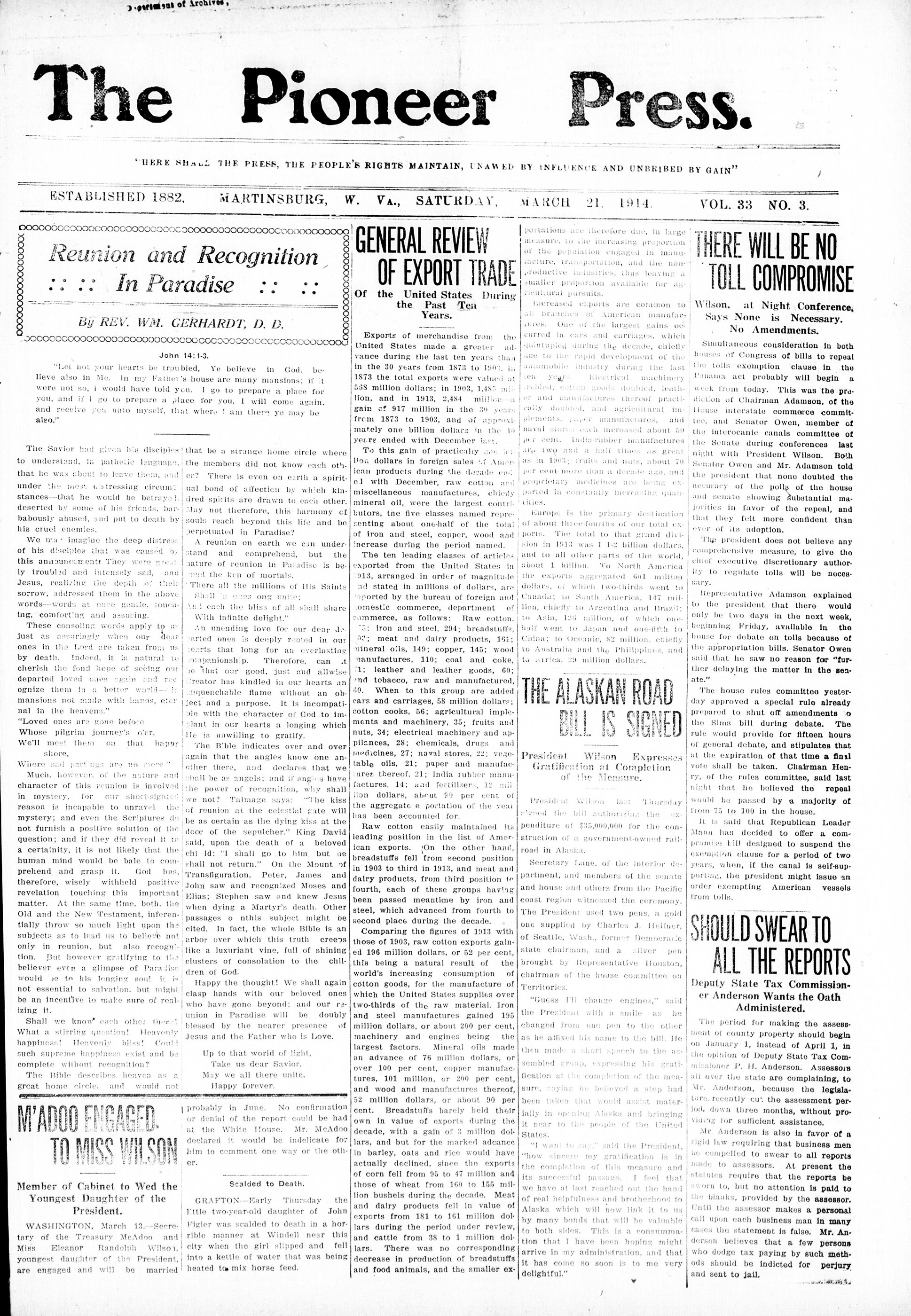
The Pioneer Press
Saturday, March 21, 1914
Martinsburg, West Virginia
Page text (machine-generated)
"HERE SHALL THE PRESS, THE PEOPLE'S RIGHTS MAINTAIN, UNAWED BY INFLUENCE AND UNBRIBED BY GAIN"
The Pioneer
"Let not your hearts be troubled, Ye believe in God, believe also in Me. In my Father's house are many mansions; if it were not so, I would have told you. I go to prepare a place for you, and if I go to prepare a place for you. I will come again, and receive you unto myself, that where I am there ye may be also."
ESTABLISHED 1882.
Reunion and R
:::: In Parad
By REV. WM. GERH
John 14:1-3.
"Let not your hearts be troubled, lieve also in Me. In my Father's house were not so, I would have told you. I you, and if I go to prepare a place for and receive you unto myself, that whe also."
John 14:1-3.
The Savior had given his disciples to understand, in pathetic language, that he was about to leave them, and under the most distressing circumstances—that he would be betrayed, deserted by some of his friends, barbably abused, and put to death by his cruel enemies.
We may imagine the deep distress of his disciples that was caused by this announcements. They were greatly troubled and intensely sad, and Jesus, realizing the depth of their sorrow, addressed them in the above words—words at once gentle, touching, comforting and assuring.
These consoling words apply to as just as assuringly when our dear ones in the Lord are taken from us by death. Indeed, it is natural to cherish the fond hope of seeing our departed loved ones again and recognize them in a better world—in mansions not made with hands, eternal in the heavens."
We'll meet them on that happy shore,
Much, however, of the nature and character of this reunion is involved in mystery, for our short-sighted reason is incapable to unravel the mystery; and even the Scriptures do not furnish a positive solution of the question; and if they did reveal it to a certainity, it is not likely that the human mind would be bale to comprehend and grasp it. God has, therefore, wisely withheld positive revelation touching this important matter. At the same time, both, the Old and the New Testament, inferentially throw so much light upon the subjects as to lead us to believe not only in reunion, but also recognition. But however gratifying to the believer even a glimpse of Paradise would be to his longing soul it is not essential to salvation, but might be an incentive to make sure of realizing it.
Shall we know each other there? What a stirring question! Heavenly happiness! Heavenly bliss! Could such supreme happiness exist and be complete without recognition? The Bible describes heaven as a great home circle. and would not
M'ADOO ENGAGED
TO MISS WILSON
Member of Cabinet to Wed the Youngest Daughter of the President.
WASHINGTON, March 13.—Secretary of the Treasury McAdoo and Miss Eleanor Randolph Wilson, youngest daughter of the President, are engaged and will be married
that be a strange home circle where the members did not know each other? There is even on earth a spiritual bond of affection by which kindred spirits are drawn to each other. May not therefore, this harmony of souls reach beyond this life and be perpetuated in Paradise? A reunion on earth we can understand and comprehend, but the nature of reunion in Paradise is beyond the ken of mortals.
"There all the millions of His Saints
Shall in onesong unite;
And each the bliss of all shall share
With infinite delight."
An unending love for our dear departed ones is deeply rooted in our hearts that long for an everlasting companionship. Therefore, can it be that our good, just and allwise Creator has kindled in our hearts an unquenchable flame without an object and a purpose. It is incompatible with the character of God to implant in our hearts a longing which He is unwilling to gratify.
The Bible indicates over and over again that the angles know one another there, and declares that we shall be as angels; and if angles have the power of recognition, why shall we not? Talmage says: "The kiss of reunion at the celestial gate will be as certain as the dying kiss at the door of the sepulcher." King David said, upon the death of a beloved chi ld: "I shall go to him but we shall not return." On the Mount of Transfiguration, Peter, James and John saw and recognized Moses and Elias; Stephen saw and knew Jesus when dying a Martyr's death. Other passages on this subject might be cited. In fact, the whole Bible is an arbor over which this truth creeps like a luxuriant vine, full of shining clusters of consolation to the children of God.
Happy the thought! We shall again clasp hands with our beloved ones who have gone beyond; and our reunion in Paradise will be doubly blessed by the nearer presence of Jesus and the Father who is Love.
Up to that world of light,
Take us dear Savior.
May we all there unite,
Happy forever.
probably in June. No confirmation or denial of the report could be had at the White House. Mr. McAdoo declared it would be indelicate for him to comment one way or the other.
Scalded to Death.
GRAFTON-Early Thursday the little two-year-old daughter of John Figler was scalded to death in a horrible manner at Windell near this city when the girl slipped and fell into a kettle of water that was being heated to mix horse feed.
Of the United States During the Past Ten Years.
Exports of merchandise from the United States made a greater advance during the last ten years than in the 30 years from 1873 to 1903. In 1873 the total exports were valued at 538 million dollars; in 1903, 1,485 million, and in 1913, 2,484 million—a gain of 917 million in the 30 years from 1873 to 1903, and of approximately one billion dollars in the 10 years ended with December last.
To this gain of practically one billion dollars in foreign sales of American products during the decade ended with December, raw cotton and miscellaneous manufactures, chiefly mineral oil, were the largest contributors, the five classes named representing about one-half of the total of iron and steel, copper, wood and increase during the period named.
The ten leading classes of articles exported from the United States in 1913, arranged in order of magnitude and stated in millions of dollars, are reported by the bureau of foreign and domestic commerce, department of commerce, as follows: Raw cotton, 75; iron and steel, 294; breadstuffs, 62; meat and dairy products, 161; mineral oils, 149; copper, 145; wood manufactures, 110; coal and coke, 71; leather and leather goods, 60; and tobacco, raw and manufactured, 60. When to this group are added cars and carriages, 58 million dollars; cotton cooks, 56; agricultural implements and machinery, 35; fruits and nuts, 34; electrical machinery and appliances, 28; chemicals, drugs and medicines, 27; naval stores, 22; vegetable oils, 21; paper and manufactures thereof, 21; India rubber manufactures, 14; and fertilizers, 12 million dollars, about 90 per cent of the aggregate e portation of the year has been accounted for.
Raw cotton easily maintained its leading position in the list of American exports. On the other hand, breadstuffs fell from second position in 1903 to third in 1913, and meat and dairy products, from third position to fourth, each of these groups having been passed meantime by iron and steel, which advanced from fourth to second place during the decade.
Comparing the figures of 1913 with those of 1903, raw cotton exports gained 196 million dollars, or 52 per cent, this being a natural result of the world's increasing consumption of cotton goods, for the manufacture of which the United States supplies over two-thirds of the raw material. Iron and steel manufactures gained 195 million dollars, or about 200 per cent, machinery and engines being the largest factors. Mineral oils made an advance of 76 million dollars, or over 100 per cent, copper manufactures, 101 million, or 200 per cent, and wood and manufactures thereof, 52 million dollars, or about 90 per cent. Breadstuffs barely held their own in value of exports during the decade, with a gain of 3 million dollars, and but for the marked advance in barley, oats and rice would have actually declined, since the exports of corn fell from 95 to 47 million and those of wheat from 160 to 155 million bushels during the decade. Meat and dairy products fell in value of exports from 181 to 161 million dollars during the period under review, and cattle from 38 to 1 million dollars. There was no corresponding decrease in production of breadstuffs and food animals, and the smaller ex-
Press.
MARCH 21. 1914.
portations are therefore due, in large measure, to the increasing proportion of the population engaged in manufacture, transportation, and the nonproductive industries, thus leaving a smaller proportion available for agricultural pursuits.
Increased exports are common to all branches of American manufactures. One of the largest gains occurred in cars and carriages, which quintupled during the decade, chiefly due to the rapid development of the automobile industry during the last ten years. Electrical machinery crubled, cotton goods doubled, leather and manufactures thereof practically doubled, and agricultural implements, paper manufactures, and naval stores each increased about 50 per cent. India-rubber manufactures are two and a half times as great as in 1903; fruits and nuts, about 70 per cent more than a decade ago, and proprietary medicines are being exported in constantly increasing quantities.
Europe is the primary destination of about three-fourths of our total exports. The total to that grand division in 1913 was 1 1-2 billion dollars, and to all other parts of the world, about 1 billion. To North America the exports aggregated 601 million dollars, of which two-thirds went to Canada; to South America, 147 million, chiefly to Argentina and Brazil; to Asia, 126 million, of which one-half went to Japan and one-fifth to China; to Oceanic, 82 million, chiefly to Australia and the Philippines, and to Africa, 29 million dollars.
THE ALASKAN ROAD BILL IS SIGNED
THE ALASKAN ROAD BILL IS SIGNED
President Wilson Expresses Gratification at Completion of the Measure.
President Wilson last Thursday signed the bill authorizing the expenditure of $35,000,000 for the construction of a government-owned railroad in Alaska.
Secretary Lane, of the interior department, and members of the senate and house and others from the Pacific coast region witnessed the ceremony. The President used two pens, a gold one supplied by Charles J. Heifner, of Seattle, Wash., former Democratic state chairman, and a silver pen brought by Representative Houston, chairman of the house committee on Territories.
"Guess I'll change engines," said the President with a smile as he changed from one pen to the other as he affixed his name to the bill. He then made a short speech to the assembled group, expressing his gratification at the completion of the measure, saying he believed a step had been taken that would assist materially in opening Alaska and bringing it near to the people of the United States.
"I want to say," said the President, "how sincere my gratification is in the completion of this measure and its successful passage. I feel that we have at last reached out the hand of real helpfulness and brotherhood to Alaska which will now link it to us by many bonds that will be valuable to both sides. This is a consummation that I have been hoping might arrive in my administration, and that it has come so soon is to me very delightful."
VOL. 33 NO. 3.
THERE WILL BE NO TOLL COMPROMISE
Wilson, at Night Conference. Says None is Necessary. No Amendments.
Simultaneous consideration in both houses of Congress of bills to repeal the tolls exemption clause in the Panama act probably will begin a week from today. This was the prediction of Chairman Adamson, of the house interstate commerce committee, and Senator Owen, member of the interocanic canals committee of the Senate during conferences last night with President Wilson. Both Senator Owen and Mr. Adamson told the president that none doubted the accuracy of the polls of the house and senate showing substantial majorities in favor of the repeal, and that they felt more confident than ever of its adoption.
The president does not believe any comprehensive measure, to give the chief executive discretionary authority to regulate tolls will be necessary. Representative Adamson explained to the president that there would only be two days in the next week, beginning Friday, available in the house for debate on tolls because of the appropriation bills. Senator Owen said that he saw no reason for "further delaying the matter in the senate."
The house rules committee yesterday approved a special rule already prepared to shut off amendments to the Sims bill during debate. The rule would provide for fifteen hours of general debate, and stipulates that at the expiration of that time a final vote shall be taken. Chairman Henry, of the rules committee, said last night that he believed the repeal would be passed by a majority of from 75 to 100 in the house.
It is said that Republican Leader Mann has decided to offer a compromise bill designed to suspend the exemption clause for a period of two years, when, if the canal is self-supporting, the president might issue an order exempting American vessels from tolls.
SHOULD SWEAR TO ALL THE REPORTS
Deputy State Tax Commissioner Anderson Wants the Oath Administered.
The period for making the assessment of county property should begin on January 1, instead of April 1, in the opinion of Deputy State Tax Commissioner P. H. Anderson. Assessors all over the state are complaining, to Mr. Anderson, because the legislature, recently cut the assessment period, down three months, without providing for sufficient assistance.
Mr Anderson is also in favor of a rigid law requiring that business men be compelled to swear to all reports made to assessors. At present the statutes require that the reports be sworn to, but no attention is paid to the blanks, provided by the assessor. Until the assessor makes a personal call upon each business man in many cases the statement is false. Mr. Anderson believes that a few persons who dodge tax paying by such methods should be indicted for perjury and sent to jail.
The Pioneer Press
An Independent Weekly Newspaper Devoted to the Moral, Religious and Financial Development of Humanity.
RATES OF SUBSCRIPTION:
1 year ..... $1.50
6 months ..... 75c.
3 months ..... 40c.
Pay for all advertisements is due in advance unless advertising is run by yearly contract, in which case the advertiser pays every three months.
Advertising 1 inch one time 75c.
Standing ..... 50c
Reduced Rates to Clubs.
Send for Sample Copies.
Entered in Post Office at Martinsburg, W. Va., as Second Class Matter.
J. L. Clifford, Editor and Proprietor.
Drawer 869, and Bell 'Phone 60K,
Martinsburg, W. Va.
SATURDAY, MARCH 21, 1914
Mrs. Elizabeth Clifford, of Williamsport, Grant County, West Virginia, our stepmother and wife of Isaac Clifford, deceased, died the 13th instant. May glorious be their reunion
Mr. T. Edward Hill, of Keystone, W. Va., stopped over here en route home from Lynchburg, Va., and Washington, D. C., Monday and Tuesday of this week. Mr. Hill is a lawyer and editor, and a man of considerable influence in the section where he lives. He has a number of warm friends in our city, who are always glad to shake his loyal hand. He and the newspaper of which he is part owner and one of the editors—(The McDowell Times)—always ring true for the interests of his people and the populace in general.
Anyone who knows John Mitchell, Jr., editor of the Richmond Planet, is well aware of his fighting proclivities when assailed, therefore no surprise is evinced by his intimates when they note the great victory he has won over Supreme Chancellor S. W. Green, of the Knights of Pythias, and those who follow his dictates. The injunction granted our brave friend, by the U. S. Supreme Court of the District of Columbia, through Mr. Justice Gould, goes clearly into all of the questions involved in the controversy, and shows fully to any fair minded man that had the Supreme Lodge of Pythians dealt justly with Mr. Mitchell and the Virginia Pythians, there would have been no necessity for any recourse to a court of justice for a final adjustment of matters. Congratulations Brother Mitchell, and may you continue to win renown along all lines in the future as you have in the past, is the wish of the Pioneer Press.
Hon. M. P. Shawkey, State Superintendent of Free Schools is the loser by death of a loving father, whom he buried last week. While he is a great man, his mother is greater, for she made him what he is. You both will live a reunited life. To know Mr. Shawkey is to quickly learn to love him. That he is deeply interested in the colored people's welfare, let the following attest. He arrived at Martinsburg the 12th of February past about 8.30 P. M. and was met and greeted by men of note and distinction. One of the party had been invited to a Lincoln Memorial meeting and in excusing him
to go, the Hon. Mr. Shawkey begged to be excused and came to our meeting. Took the whole thing in joyfully and gave us a splendid speech and stayed with us until nearly 11 o'clock. Blessed be the name of such a man and may every negro in this state vote for him for any place whenever he gets a chance.
For humanity's sake, let agitators get down to facts that benefit human beings, now that the cigarette excitement, the go to church fever and many other matters as important have had their day and have gone to sleep. Next to attention given to Mexico, comes in the cedar rust(?) and destruction of such trees. Cedars have always existed. Why have they not in other days played havoc with fruit trees? Possibly, since seed will not produce like fruit any more, it may be the fault of nurserymen. But let us throw the cedar rust to the winds, and deal with facts so harmful to the poor hard working people of all colors. Most all corporations in this state work men, no matter how poor and needy they be, for two weeks before paying
them, and then only part of it, keeping back their money for two more weeks. then pay with a reservation of two weeks pay in the office. Is that right? Assuredly not. Such corporations have stores and the men are compelled to buy of them. Added to this if any of the workers want some of their money held back they have to pay 10 cents on a dollar for it. This is not true, however, of the Bair Limestone Company. They check their men off any time with, out commission and have churches and school houses for their men.
If our next legislature will remedy these robber evils, every one can be reelected, or any man who is just enough to agitate the destruction of so rotten a system can go as high in politics as any man has ever done.
PROF DU BOIS.
We have always contended, and still do, that our worst foes are of our own. True education makes men humble, simple in style, custom and the use of language—the Son of God for example. Sad, however, that so few are truly educated.
It is so much better to do something of lasting good than to be constantly telling others how to do things. That Negro editors have done the race uncalable good, and freely given much of their space in defence of Prof. DuBois is a fact undeniable. In compensation for it, how cruel in him to find fault with the language they use.
Dr. Dubois should know that our language is in itself imperfect, hence how can men use it perfectly? The great object with conscientious writers is to use it to do others good. In doing so, how much better it is to lose sight of the studied beauty of language, and write it so it can be understood.
How would Dr. DuBois compare with Macauley, Blackstone, Frederick Douglass, Abraham Lincoln, Libert Hubbard and thousands of others who never went to college. All the colleges of the world declare Lincoln's language was and is the best ever written by man. Did he go to college? No! Was ever a child born poorer? What about Shakespeare? Is DuBois greater than he was? His was a hard life. His forbears were sea pirates, who used the skulls of men out of which they ate their food. Men only are great who try in honor to be great. It is only such that God helps. But those whose educat on teaches them there is no God, as a certain book bears testimony all through its pages, are dangerous lights along the shore of time. They are a network of excitability, live and die with nerves crying for rich blood and solid thought. We beseech Dr. DuBois to read carefully the 14th Chapter of the first Corinthians.
---
It is more than necessary that the whole world should now and henceforth take seriously into consideration the word white. It has been held up as a supreme sign of superiority and with little or no investigation to prove to the contrary, it is the dominating and unific power to rule or ruin. There is no color on earth that the power or absence of the sun did not make. To illustrate: In the extreme north everybody is white, and the same is true at the south pole. Leave either or both poles and travel toward the center, and as gradually as you go, color changes, until the torrid zone is reached where no white can be found, but earth's rarest beauties are.
That people have gone as crazy over the word white as they have over fashion is demonstrated every day and hour. It is possible that the real narrowly contracted ones with all they have on their backs, actually it is a passport into story. It is the mind and not the color that makes the man. So crazy are American people over what never has existed. "white people' that congress was afraid to pass a law to prevent the use of arsenic in food products for no other purpose than to bleach them whiter.
As to white: whoever saw a white living being? Snow is white. What people look like were they white as snow?
When eating meat no difference is made whether the sheep, beef or hog, had white or black skins; and even if the extreme hot heads in hatred on color, know it they would eat the meat and declare that the black skins did not hurt or change the meat. Feed hogs, horses, sheep, cattle and all kinds of fowls, do the white ones refuse to eat with the black ones, or vice versa? No and
AN APPEAL TO THE NEGRO BRETHREN
Anecdotal Literature
BY W G.
NEGH
for help wh
for the int
the Book-incl
Leipzig, May
for help while collecting materials for the international Exhibition of the Book-Industry and Graphic Arts Leipzig, May-October, 1914.
On account of the celebration of the 150th Anniversary of the Royal Academy for the Graphic Arts and the Book-Industry at Leipzig, Germany; there will be a great Exhibition made up and organized to show the Graphic products of all people, lands and nations from the earliest times up to these days. The plan of the exhibition shows the following; 16 groups: I. Graphic Arts; II. Applied Graphics and Book-making, Illustrating; III. Instruction, Education, Schools; IV. Paper Manufacturing; V. Stationery and Writing Materials; VI. Colors, Lithographies and Copper-plates; VII. Photography; VIII. Reproduction; IX. Streotypy, Electrotypy; X. Printing Processes; XI. Bookbinding; XII. Publishing, book-trade; XIII. Newspapers, Advertising, Canvassing, Periodicals; XIV. Libraries; XV. Machinery; XVI. Measures for the Protection and Welfare of the Workers, etc.
These groups have been subdivided into about 63 classes. Each group is to be introduced by a historical and a technical instructive department. The development and the position in the history of civilization of the various branches of the book industry will be clearly demonstrated, models and apparatus for demonstrating purposes and the cinematographic art will be shown. The publications of booksellers and music publishers will be brought directly to the notice of the public through the medium of libraries and reading rooms, through lectures, public readings, recitations and concert recitals. Anything in our minds will be under the banner "of the "black art." Many learned societies and associations connected with the book industry will have their congresses and meet at the exhibition ground.
When I read the news I asked my self if it would be possible to show at the exhibition some exhibits of the negro people in America, in whose matters I am especially interested. So I come to all willing to help me in my undertaking, to ask for their cooperation while collecting exhibition matters. Any printings, writings, photos, pictures out of the slavery time until this day will be welcome.
Pupils and students, lessons, school plans and pictures, photos of professors, teachers, students and buildings, whole models of publishing houses, Schools, Colleges and Universities will be heartily accepted. Likewise drawings of scholars and students.
Authors or publishing houses should send of all books and pamphlets and writing they have published one or better two copies with order blanks that every exhibitor visitor may have the opportunity of ordering the exhibits through myself.
Lodges, banks, societies and other organizations should contribute some amount to cover the cost of certain matters to be bought while not on the market. Editors should send the best they have, if possible a model of the whole business plan. Here is an opportunity for the Colored people of America and for those who have devoted their lives to the culture-work among the colored people, to demonstrate what they have done already and what they could do in the future. Another important feature while collecting exhibition materials is that all will
photographed;
The North American book is a faithful book of reference for young and old students of current events. It is surprisingly good and surprisingly cheap. Price, 25 cents; by mail, 10 cents extra.
---
No again. Why then should people be fools over their color? and unite to deprive, destroy and deny all others of their common rights?
BY W Q
THE YOUNG IDEA
Recently Senator Smoot's boy came to him with a pitiful story of a woman who needed a position. The woman's son was his playmate. The Senator's son pleaded and her husband was ewily with the tuberculosis. So eloquently did the young orator plead, that the Senator finally decided to do what he could to aid the woman. He asked for her and found that the story of her need and worthiness was true and finally got her position sufficient for her support.
Some days later young Sam received a letter and the former awaived a five dol ar b1 fall out. He demanded the reason for such encounters, and taking the letter saw the need to obtain expression of thanks from the mother, and read:
' Inclosed find $5 instead of the $1 which my son promised you should have if you obtained me the position.
The Senator told the young son, that government positions are not given even to the needy, on a commission basis.
Needless to add, that the money was returned.
A COMMANDMENT
A teacher in a big elementary school had given lessons to an infant class on the ten commandments. In order to test their memories, she said:
"Can any little child give me a commandment with only four words in it?"
A hand was raised immediately.
"Well," said the teacher.
"Keep off the grass," was the reply.
* * *
SLICK.
A gentleman sent a lad with a letter to the Post Office, and money to pay the postage. Having returned with the money, he said: "Guess I've done the thing slick; I saw a good many folks puttin' letters in the Post Office through a hole, and so I watched my chance and got mine in for nothing.
FINESSE
Senator Cummins, discussing a campaign victory said smiling, "It was won by finesse. The finesse displayed in it r minds me of a Concord banquet.
"Why is it that you fellows are omitting wine from your banquet this year? one Concord man asked another.
"So as to make sure of the presence of the A1 after dinner speakers of the country," was the reply. We have invited them, and they won't dare to stay away."
"Why not?" Because that if they did, people would say:
"There was no wine there."
* *
CHIPS
The majority of men who rob Peter to pay Paul, neglect to pay Paul.
Marriage and divorce are represented by a hitch and a kick.
Money is pretty tight with the man who has no loose change.
Money talks, but generally through a long-distance phone.
STORY OF A YEAR
TOLD IN PICTURES
THE NORTH AMERICAN OFFERS TO READERS AN UNUSUAL RECORD.
A very unusual publication, along entirely new lines, is the North American's "History of the Year in Pictures," a book that covers with artistic photographic reproductions all the big events of 1913 that could be treated successfully in such a way. The book 120 pages in board covers, costs 25 cents and is a faithful reminder of the year. Nearly 500 finely printed halftones are made use of in telling the story of the year. The events so treated will surprise the busy man, who would find himself stumped if called upon to name a score of the great occurrences of the year. The plague in Manchuria, the world's great inventions, the inauguration, the war in the Balkans, the completion of the Panama canal, naval advances, the conquest of the air, the succession of great rulers, women and the vote, fighting disease, labor troubles, the western floods, the Gettysburg celebration and numbers of other events are fully and faithfully pictured and
have great value for the future, as the great Museum-library of Leipzig will participate in the exhibits when the fair is over.
You will have no expenses to pay for the exhibition of what you send. I will care for that. But whatever you send write your name upon it.
Please do what you can in the matter. Write about your help as soon as possible and send your exhibits--old or new, good and bad--to
PASTOR PAUL O. HENTSCH,
Gundorferstr. 1, I, Leipzig-Li.
Germany.
Other negro papers are asked to print the foregoing lines of Paster Hentsch in their respective columns. THIS EDITION.
J. R. CLIFFORD
Attorney At Law
MARTINSBURG, WEST VIRGINIA.
Practices in all the Courts of West Virginia, the Supreme Court of Appeals and the United States Courts.
WHAT IS IT?
Ten year combination Distribution Certificate of Membership as devised by the American Workmen Fraternal Insurance Company. of Washington. D. C., one of the most liberal strongest and reliable fraterna institutions in the field. For further particulars see
D.E.V. JORDAN, GEN AGENT, W.VA.
ROOM 2 K P. BUILDING.
CHARLESTON, - W. VA.
STRICT CONFIDENCE LAW ON INCOME TAX RETURNS
International Revenue Collectors Warned By Secretary McAdoo Not to Disclose Information. Collectors of internal revenue have been warned by letter from Secretary McAdoo that they must keep income tax returns strictly confidential, and that to disclose any part of them is in violation of law. He further stated that the slightest infraction would result in severe punishment.
"Please impress upon the collectors of internal revenue in every district in the country the importance of preserving as inviolably confidential all income tax returns," the letter of warning said. "Not only is this the law, but the point which I wish to impress upon them is that the department will expect every collector and every employee to observe this law strictly, and that the slightest infraction of it will be severely punished. I should like to have all the collectors of internal revenue directed to keep vigilant watch over the employees, with a view to the prompt detection of any offender. It would be nothing short of a scandal for I earnestly hope that it will not dean any of these returns to be given out. develop during this administration, or during any succeeding one, that any employee of this department could be so faithless as to violate the laws of his country or be indifferent to his trust."
Many persons, it is declared, are
ing their returns under protest, so
that the money must be refunded in
case the Supreme Court declares the
law unconstitutional.
Year In Jail For Three Eggs.
For stealing three eggs Charles
Thomas, of Huntington, has begun a
year's term in the state penitentiary.
It was his second offense.
Press
San Francisco labor organizations
will make a strong effort to secure
the 1915 convention of the American
Federation of Labor.
Second Open Letter to the People of West Virginia
When we put forth our first Open Letter we had no idea that such great numbers would accept our invitation to write and tell us what they thought about the oil and gas business. The ink was scarcely dry before hundreds of letters and postal cards commenced pouring in and they are still coming. To analyze and classify these letters so that this answer could be prepared with care, was a welcome task. Above all else these letters proved that the people of West Virginia have in a high degree that American characteristic, a sturdy love of fair play, however willing they may be to argue a question.
About fifty per cent of those who wrote wanted to see the oil and gas companies keep on developing the resources of the state in a fair and just manner with no unfair discrimination or restriction or limitation by the state. About thirty per cent disagreed with one or other of the points in the Open Letter, but were fair-minded enough to acknowledge the benefits that have accrued to the state from the production of oil and gas. About fifteen per cent disagreed flatly with our views or said they lacked information, or declared they were not interested because they were outside the gas belt.
The remaining five per cent offered oil and gas territory, or supplies, asked for work, wanted to know what the Open Letter meant, had a complaint on their service, or asserted that gas rates are high enough or too high, without other comment. A scant half-score were abusive.
All communications were replied to except a few which were unsigned, or signatures blotted, or post-office address omitted, so that if you wrote and have not been answered, it must be for one of these reasons.
Many asked questions, the principal ones being the following, which we herewith answer.
Answers to Principal Questions Asked in The Letters
Q-You have shown us—the people of West Virginia—that hundreds of millions of dollars have been distributed among us by the oil and gas people in the quarter century past, for labor, royalties, rentals, timber, teaming, machinery, materials, boarding and various other items; that taxes paid by oil and gas interests now amount to enough to wipe off the Virginia debt in seven years; that great industrial development, new towns and cities and many other advantages which we have as a state have followed the discovery and production of oil and gas. Now give us the figures on the other side of the ledger:WHAT HAVE YOU MADE OUT OF THE BUSINESS?
A—Since the organization of our company, our stockholders have received a little less than $4\frac{1}{2}$ per cent annual dividends or interest on the money which they have invested. This is less than the legal rate of interest and they could earn more if the money were invested in mortgages. They have none of their capital paid back and have no sinking fund out of which to pay it back. It is our intention, as soon as the revenues will justify it, to establish a sinking fund to reimburse our stockholders for the money advanced, which you will admit is no more than fair to them.
Q—DOES THE GAS BUSINESS YIELD A MARGIN OF PROFIT LARGER THAN OTHER BUSINESSES HAVING THE SAME INVESTMENT AND RISKS?
A—It does not. In fact it does not return as large profits as other businesses, where there are practically no large hazards or risks attached. No other business has the same amount of uncertainty as the gas business, with such comparatively small profit.
Q—WHY DO YOU NEED TO RAISE THE RATES?
A—Because the company is entitled to interest on the money invested, to get back the capital
invested within a reasonable time, and to some compensation for taking the risk of the business. Any man or company going into any business that is not permanent, expects to earn enough to pay back his investment with interest on the same while invested and an amount in addition sufficient to pay for the chances of the business, otherwise he would lend his money on security or mortgage or buy Government or other bonds.
Q-You give the total of oil and gas rentals, royalties, drilling cost, maintenance, etc., paid out in West Virginia from 1889 to 1912, inclusive, as $209,750,309.00; WHAT WAS THE TOTAL VALUE OF THE OIL AND GAS PRODUCED IN THE SAME TERRITORY DURING THE SAME PERIOD, AND HOW MUCH REMAINS WITHIN THE STATE?
A-The total value of oil and gas produced in West Virginia from 1889 to 1912, inclusive, cannot be accurately ascertained. We have endeavored in every way to get the data, but owing to the great amount of operating done by individuals, of which there is no record, nothing more accurate than a guess or estimate could be made. It runs into the millions, of course.
By far the greater portion of the money received for the sale of oil and gas during the period mentioned was re-invested in the business in West Virginia and paid out for labor, drilling, laying pipe lines and other items incident to the business. Many claim that more has been invested than has been taken out. The profit as a whole must come from the future. It has not been made as yet.
Q—HOW LONG IS IT ESTIMATED THAT OIL AND GAS WILL LAST IN WEST VIRGINIA AT THE PRESENT RATE OF CONSUMPTION?
A—There is a wide difference of opinion on this point. Even experts do not agree. The length of time during which the present rate of consumption can be maintained depends very largely upon the results of future drilling, the extension of present territory and the discovery of new fields.
Q—DON'T YOU THINK GAS SHOULD BE SOLD CHEAPER NEAR THE WELLS THAN AT A DISTANCE, ON ACCOUNT OF THE COST OF TRANSPORTATION?
A—Yes. Gas should be sold at a lower rate close to the point of production than at points more distant. Such has always been our practice. Our rates at points near the fields are now lower than those at distant points.
Q—IS IT TRUE THAT GAS IS SOLD CHEAPER BY YOU IN SOME PLACES IN OHIO AND PENNSYLVANIA THAN IN SOME PLACES IN WEST VIRGINIA?
A—Yes. Gas is sold cheaper in some places in Ohio (but not in Pennsylvania) than it is in some places in West Virginia owing to the fact that these Ohio points are closer to the source of production than these West Virginia points. Where the distances from the fields are equal the rates are equal, regardless of state lines.
Q—ARE YOU PRODUCING GAS IN OTHER STATES THAN WEST VIRGINIA?
A—Yes. We have more wells and produce more gas in other states than in West Virginia. But adding the gas we buy to the gas we produce in West Virginia our supply from there is about the same as from other states.
Q—IS IT TRUE THAT AIR IS PUMPED INTO THE GAS LINES, THUS REDUCING THE QUALITY OF THE GAS?
A—It is not true that air is pumped into gas lines and mixed with gas; it cannot be done. It is just as impossible as mixing oil and water. This is a suspicion that can be scientifically demonstrated as baseless.
Q—DO YOU NOT THINK WEST VIRGINIA OUGHT TO COMPEL GAS TO BE SOLD CHEAPER TO MANUFACTURERS WITHIN THE STATE THAN WITHOUT, IN ORDER TO INDUCE FACTORIES TO LOCATE INSIDE THE STATE?
A—No. Cheap fuel alone will not bring industrial plants into West Virginia. Fuel is only one of the elements in manufacturing. It is manifestly unfair for a state to insist that one who has his capital invested in any business, should be compelled to sell the product of that business cheaper within the state than without under like conditions, which means taking into consideration the cost of transportation and amount of investment necessary; this applies to gas, to coal, to timber, to agricultural products, to manufactured products, or anything produced in the state.
If the state, in justice and fairness, can say to the gas company: "You must sell your gas cheaper to the factory in the state of West Virginia because you produce your gas in West Virginia," then it can say also to the owner of the factory. "You must sell what you make in the state of West Virginia cheaper to the people of West Virginia than to anybody else, because you get cheaper gas in the state of West Virginia, which the state has secured for you."
Q—IF YOUR COMPANY STOOD IN THE PLACE OF THE STATE OF WEST VIRGINIA, WOULD YOU NOT BE VIGOROUSLY ENGAGED IN WORKING OUT SOME METHOD OF CONSERVING THE RESOURCES WHICH ARE NOW BEING FAST DEPLETED WITHOUT SUBSTANTIAL BENEFIT TO THE STATE?
A—As already has been shown (which the question manifestly disregards) the state has received and is receiving enormously substantial benefits and returns, possibly greater than the oil and gas people.
Should we have overlooked any question that is important, kindly advise us and we will give you our answer either by letter or in a future newspaper advertisement.
West Virginia not only has the unrestricted use of this most convenient fuel and light product at an average rate considerably lower than her neighbors, but in addition the lion's share of the money received from the sale of her gas in Ohio and Pennsylvania comes back to her through expenditure in the search for, production and purchase of more gas. If the state wants to commit itself to the policy of restricting the production is it ready to pay the land owner his lease rentals while the gas is being held for the benefit of future generations?
If the state is not ready to commit itself to this policy by putting up the money for the benefit of all its people, what just right would it have to ask the gas company to tie up its money in the pursuit of this policy?
In either case wouldn't it be rather hard on the landowner, who might be up against it financially because he couldn't lease his land or derive any money from that source now, even though it might benefit his posterity?
Of course, all waste should be stopped. Economy in use is a cardinal point of conservation.
Q—WHAT PART HAS THE MANUFACTURERS LIGHT & HEAT COMPANY, ITS OFFICERS AND AGENTS, TAKEN IN MAINTAINING LOBBIES IN CHARLESTON TO PREVENT THE LEGISLATURE FROM PLACING A TAX UPON THE PRODUCTION AND TRANSPORTATION OF OIL AND GAS?
A—The Manufacturers Light & Heat Company has never maintained any lobbies in Charleston for the purpose of preventing the legislature from placing tax on production or transportation of oil and gas or for any other purpose, and has never spent a penny for any such purpose.
Gumshoe methods do not appeal to us. When any public matter affecting the interests of this company is impending we will bring it out for open discussion with the people, as the sovereigns of the state, through advertisements in the newspapers, like we are doing now. We believe this to be both efficient and honorable.
We would here point out to those over-wise critics who condemn us because we have gone to the people in this open, public way, their absurd inconsistency when they say to us: "Why do you publish these Open Letters and take your case to the people?" and then in the same breath recuse us of having a lobby in our interests to influence the legislature at Charleston. In other words, is it air or square to deny us the right to present our case anywhere, either to the public or to the legislature, either publicly or privately?
Q—WHAT IS YOUR PURPOSE IN DISCUSSING THE GAS BUSINESS WITH THE PUBLIC?
A—(Taken from a letter written by Mr. John E. Gill, president of the company, to a West Virginia State Senator.) "We want all the people of the state to get interested in the gas business and learn as much as they can about it from any source which is reliable. Only an informed public is capable of taking care of its own best interests in public matters, and we feel that our case is so clear and fair that it can be frankly entrusted to such a public for solution. Thus you see our motive is a combined one—for the good of the state and for our own good as well, because we believe that what is best for the people is also best for us, and vice versa."
Q-IS NOT YOUR PRESENT EXTRAVAGANT ADVERTISING IN THE NEWSPAPERS THROUGHOUT THE ENTIRE STATE MERELY AN EFFORT TO SUBSIDIZE THE PRESS?
A--We are using and paying for advertising space in the newspapers of West Virginia because this is the best way to state our views to all the people of the state. We are able thus to talk over our affairs with the entire population which we could do in no other way. By United States mail the cheapest it could be done would be many times as expensive, even if the address of every person in the state could be obtained, which it can't. Surely our way of doing it is far from extravagant.
As for "subsidizing the press," that is a cry as old as journalism and used only by persons whose idea of a free press is one which prints only their side of the story or mentions the other side only in abuse. Since we commenced this advertising we have noted that the newspapers have opened their columns freely to a discussion of all sides of the question. West Virginia newspapers accepting and printing our advertisements reserve the right to make such editorial comment upon them as they see fit. We have asked nothing more than this and no newspaper has offered more.
But this is a question we think the newspapers themselves can answer better than we. Ask them if they sell themselves when they sell advertising space to an advertiser.