The Pioneer Press
Saturday, June 27, 1914
Martinsburg, West Virginia
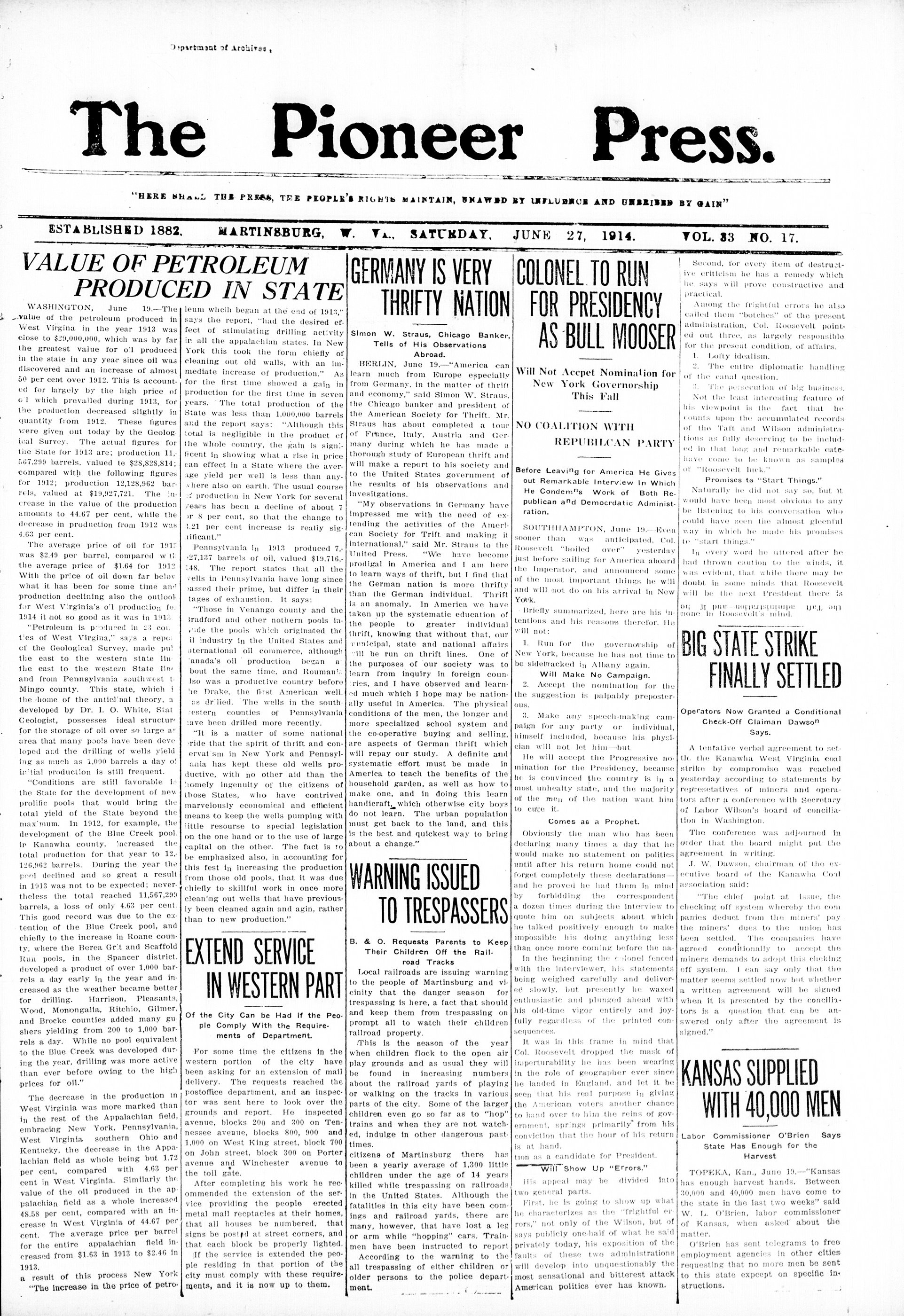
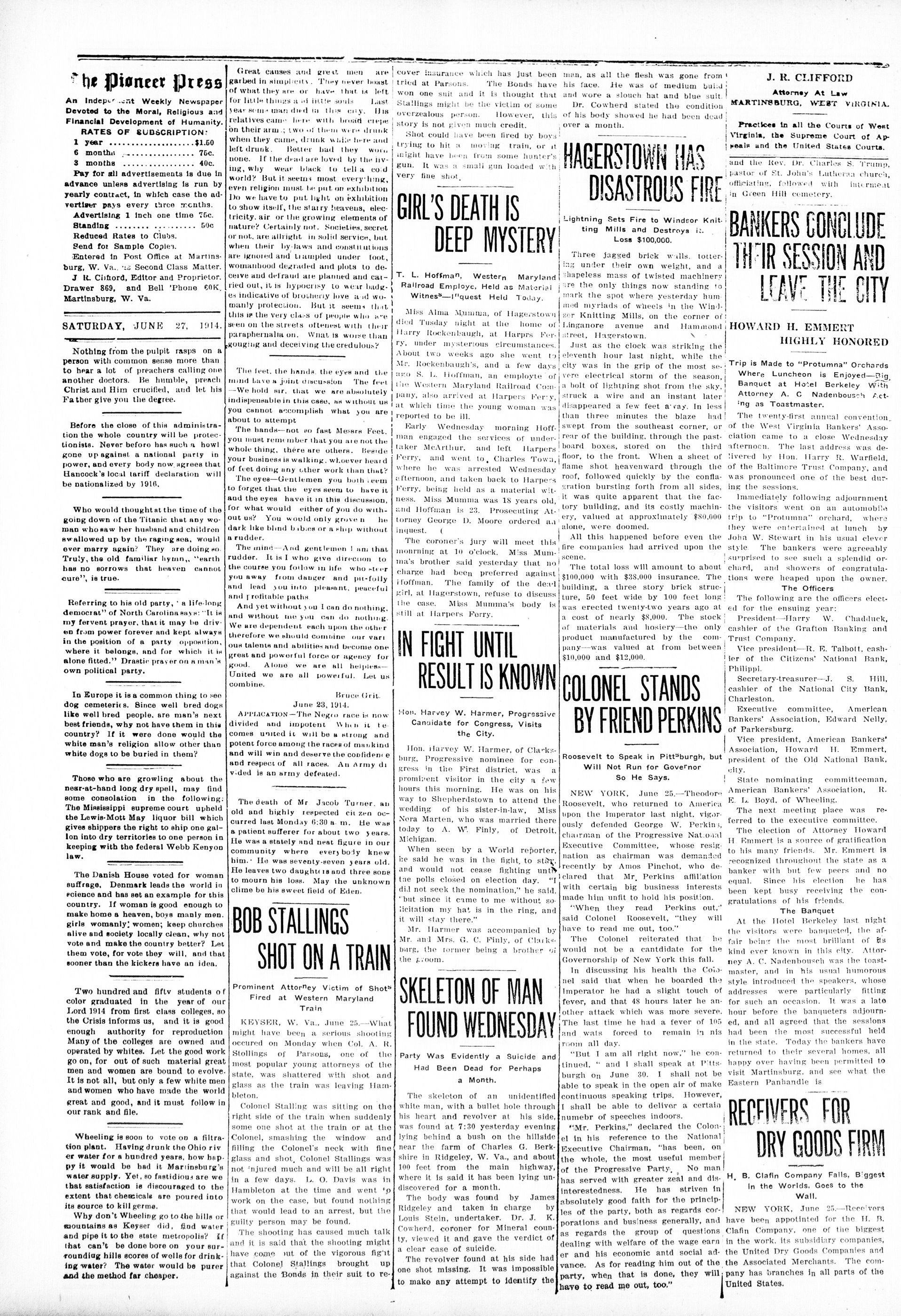
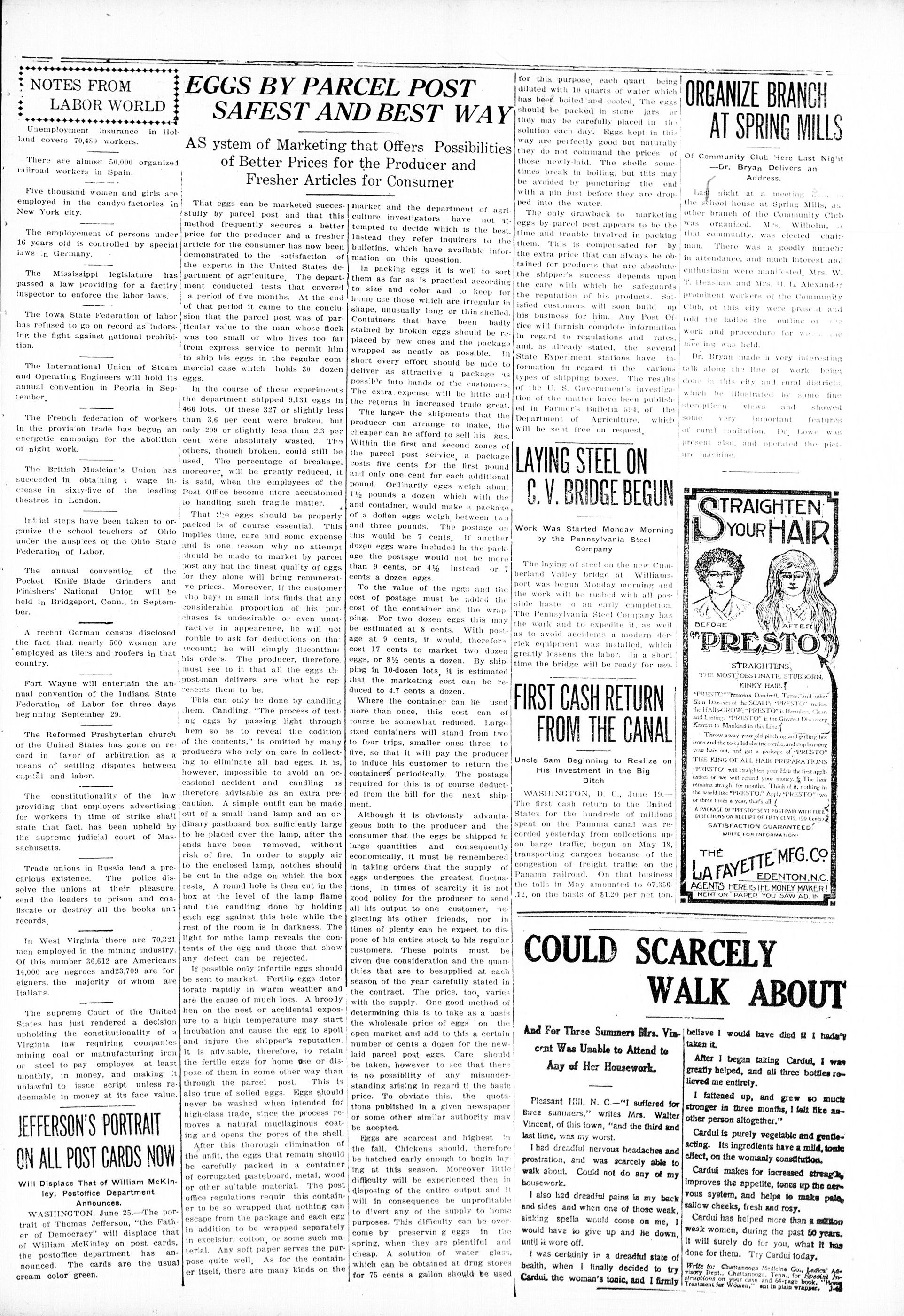
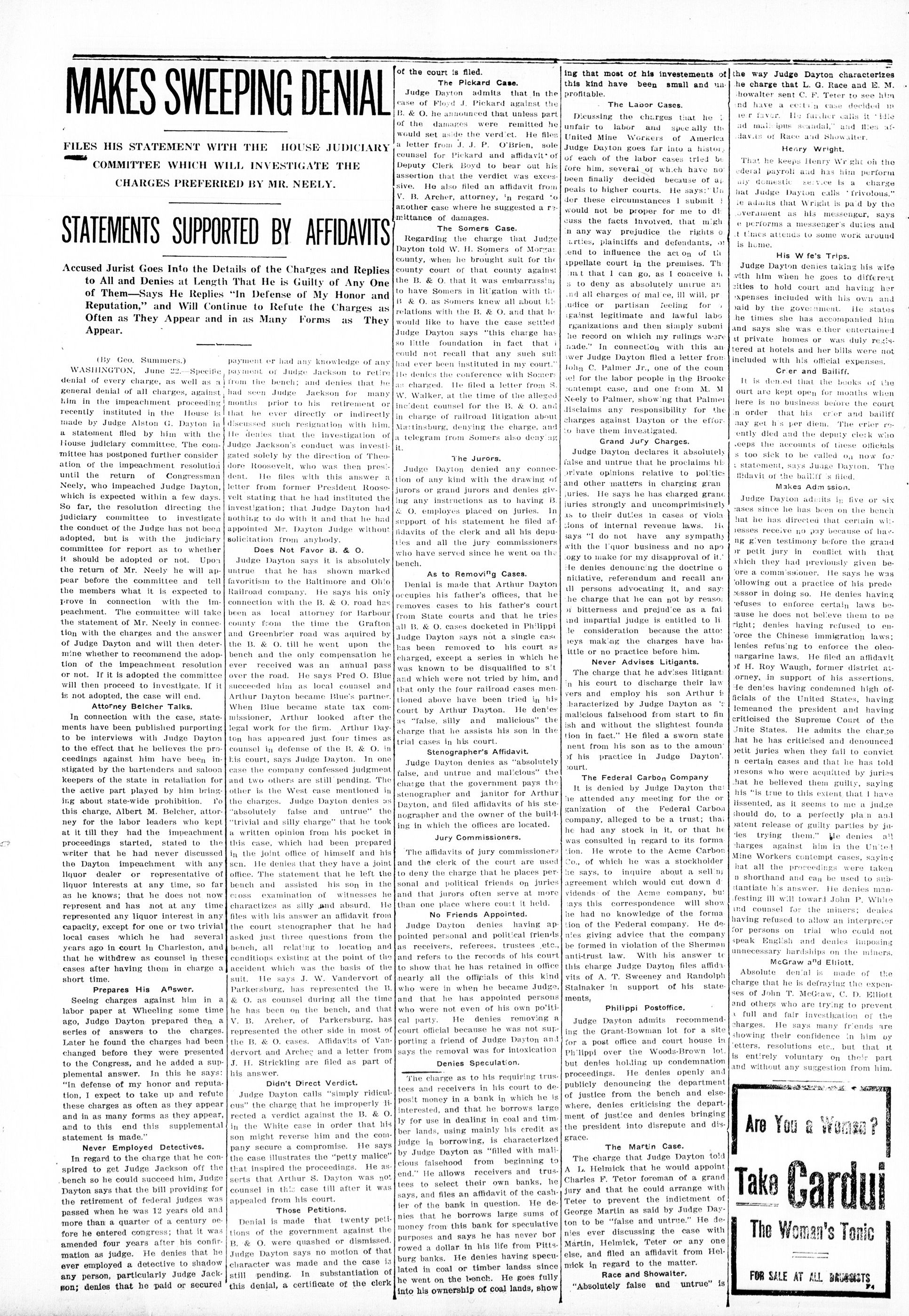
Page text (machine-generated)
The Pioneer Press.
"HERE SHALL THE PRESS, THE PEOPLE'S RIGHTS MAINTAIN, UNAWED BY UNFLUENCE AND UNBEIBED BY GAIN"
ESTABLISHED 1882.
WASHINGTON, June 19.—The value of the petroleum produced in West Virginia in the year 1913 was close to $29,000,000, which was by far the greatest value for oil produced in the state in any year since oil was discovered and an increase of almost 50 per cent over 1912. This is accounted for largely by the high price of oil which prevailed during 1913, for the production decreased slightly in quantity from 1912. These figures were given out today by the Geological Survey. The actual figures for the State for 1913 are; production 11,567,299 barrels, valued to $28,828,814; compared with the following figures for 1912; production 12,128,962 barrels, valued at $19,927,721. The increase in the value of the production amounts to 44.67 per cent, while the decrease in production from 1912 was 4.63 per cent.
The average price of oil for 1912 was $2.49 per barrel, compared with the average price of $1.64 for 1912 With the price of oil down far below what it has been for some time and production declining also the outlook for West Virginia's oil production for 1914 it not so good as it was in 1912
"Petroleum is produced in 23 counties of West Virginia," says a report of the Geological Survey, made pull the east to the western state line the east to the western State line and from Pennsylvania southwest to Mingo county. This state, which is the home of the anticliminal theory, a developed by Dr. I. O. White, State Geologist, possesses ideal structure for the storage of oil over so large an area that many pools have been developed and the drilling of wells yielding as much as 1,000 barrels a day of initial production is still frequent.
"Conditions are still favorable in the State for the development of new prolific pools that would bring the total yield of the State beyond the maximum. In 1912, for example, the development of the Blue Creek pool in Kanawha county, increased the total production for that year to 12,126,962 barrels. During the year the pool declined and so great a result in 1913 was not to be expected; nevertheless the total reached 11,567,299 barrels, a loss of only 4.63 per cent. This good record was due to the extension of the Blue Creek pool, and chiefly to the increase in Roane county, where the Berea Grit and Scaffold Run pools, in the Spancer district, developed a product of over 1,000 barrels a day early in the year and increased as the weather became better for drilling. Harrison, Pleasants, Wood, Monongalla, Ritchio, Gilmer, and Brocke counties added many gushers yielding from 200 to 1,000 barrels a day. While no pool equivalent to the Blue Creek was developed during the year, drilling was more active than ever before owing to the high prices for oil."
The decrease in the production in West Virginia was more marked than in the rest of the Appalachian field, embracing New York, Pennsylvania, West Virginia southern Ohio and Kentucky, the decrease in the Appalachian field as whole being but 1.72 per cent, compared with 4.63 per cent in West Virginia. Similarly the value of the oil produced in the appalachian field as a whole increased 48.58 per cent, compared with an increase in West Virginia of 44.67 per cent. The average price per barrel for the entire appalachian field increased from $1.63 in 1913 to $2.46 in 1913.
a result of this process New York "The increase in the price of petro-
Department of Archives
e Pi
SHALL THE PRESS, THE PEOPLE
82. MARTINSBURG,
PETROLEUM
CED IN STATE
leum wheih began at the end of 1913," says the report, "had the desired effect of stimulating drilling activity in all the appalachian states. In New York this took the form chiefly of cleaning out old walls, with an immediate increase of production." As for the first time showed a gain in production for the first time in seven years. The total production of the State was less than 1,000,000 barrels and the report says: "Although this total is negligible in the product of the whole country, the gain is significant in showing what a rise in price can effect in a State where the average yield per well is less than anywhere also on earth. The usual course of production in New York for several years has been a decline of about 7 or 8 per cent, so that the change to 1.21 per cent increase is really significant."
Pennsylvania in 1913 produced 7,27,137 barrels of oil, valued $19,716,148. The report states that all the wells in Pennsylvania have long since passed their prime, but differ in their tages of exhaustion. It says: "Those in Venango county and the Bradford and other northern pools include the pools which originated the oil industry in the United States and international oil commerce, although canada's oil production began about the same time, and Roumani also was a productive country before the Drake, the first American well as drilled. The wells in the southwestern counties of Pennsylvania have been drilled more recently.
"It is a matter of some national pride that the spirit of thrift and conservatism in New York and Pennsylvania has kept these old wells productive, with no other aid than the homely ingenuity of the citizens of those States, who have contrived marvelously economical and efficient means to keep the wells pumping with little resourse to special legislation on the one hand or to the use of large capital on the other. The fact is to be emphasized also, in accounting for this fest in increasing the production from those old pools, that it was due chiefly to skillful work in once more cleaning out wells that have previously been cleaned again and again, rather than to new production."
EXTEND SERVICE IN WESTERN PART
EXTEND SERVICE IN WESTERN PART
Of the City Can be Had if the People Comply With the Requirements of Department.
For some time the citizens in the western portion of the city have been asking for an extension of mail delivery. The requests reached the postoffice department, and an inspector was sent here to look over the grounds and report. He inspected avenue, blocks 200 and 300 on Tennessee avenue, blocks 800, 900 and 1,000 on West King street, block 700 on John street, block 300 on Porter avenue and Winchester avenue to the toll gate.
After completing his work he recommended the extension of the service providing the people erected metal mall receptacles at their homes, that all houses be numbered, that signs be posted at street corners, and that each block be properly lighted. If the service is extended the people residing in that portion of the city must comply with these requirements, and it is now up to them.
GERMANY IS VERY THRIFTY NATION
Simon W. Straus, Chicago Banker, Tells of His Observations Abroad.
BERLIN, June 19.—"America can learn much from Europe especially from Germany, in the matter of thrift and economy," said Simon W. Straus, the Chicago banker and president of the American Society for Thrift. Mr. Straus has about completed a tour of France, Italy, Austria and Germany during which he has made a thorough study of European thrift and will make a report to his society and to the United States government of the results of his observations and investigations.
"My observations in Germany have impressed me with the need of extending the activities of the American Society for Trift and making it international," said Mr. Straus to the United Press. "We have become prodigal in America and I am here to learn ways of thrift, but I find that the German nation is more thrifty than the German individual. Thrift is an anomaly. In America we have taken up the systematic education of the people to greater individual thrift, knowing that without that, our municipal, state and national affairs will be run on thrift lines. One of the purposes of our society was to learn from inquiry in foreign countries, and I have observed and learned much which I hope may be nationally useful in America. The physical conditions of the men, the longer and more specialized school system and the co-operative buying and selling, are aspects of German thrift which will repay our study. A definite and systematic effort must be made in America to teach the benefits of the household garden, as well as how to make one, and in doing this learn handicraft which otherwise city boys do not learn. The urban population must get back to the land, and this is the best and quickest way to bring about a change."
WARNING ISSUED TO TRESPASSERS
WARNING ISSUED TO TRESPASSERS
B. & O. Requests Parents to Keep Their Children Off the Railroad Tracks Local railroads are issuing warning to the people of Martinsburg and vicinity that the danger season for trespassing is here, a fact that should and keep them from trespassing on prompt all to watch their children railroad property.
This is the season of the year when children flock to the open air play grounds and as usual they will be found in increasing numbers about the railroad yards of playing or walking on the tracks in various parts of the city. Some of the larger children even go so far as to "hop" trains and when they are not watched, indulge in other dangerous past-times.
citizens of Martinsburg there has been a yearly average of 1,300 little children under the age of 14 years killed while trespassing on railroads in the United States. Although the fatalities in this city have been comings and railroad yards, there are many, however, that have lost a leg or arm while "hopping" cars. Trainmen have been instructed to report According to the warning to the all trespassing of either children or older persons to the police department.
COLONEL TO RUN FOR PRESIDENCY AS BULL MOOSER
COLONEL TO RUN FOR PRESIDENCY AS BULL MOOSER
Will Not Accpet Nomination for New York Governorship This Fall
NO COALITION WITH REPUBILCAN PARTY
Before Leaving for America He Gives out Remarkable Interview In Which He Condemn's Work of Both Republican and Democratic Administration.
SOUTHHAMPTON, June 19.—Even sooner than was anticipated, Col. Roosevelt "boiled over" yesterday just before sailing for America aboard the Imperator, and announced some of the most important things he will and will not do on his arrival in New York.
Briefly summarized, here are his intentions and his reasons therefor. He will not:
1. Run for the governorship of New York, because he has not time to be sidetracked in Albany again.
Will Make No Campaign.
2. Accept the nomination for the suggestion is palpably preposterous.
3. Make any speech-making campaign for any party or individual, himself included, because his physician will not let him—but
He will accept the Progressive nomination for the Presidency, because he is convinced the country is in a most unhealthy state, and the majority of the meh of the nation want him to cure it.
Comes as a Prophet.
Obviously the man who has been declaring many times a day that he would make no statement on politics until after his return home could not forget completely these declarations and he proved he had them in mind by forbidding the correspondent a dozen times during the interview to quote him on subjects about which he talked positively enough to make impossible his doing anything less than once more coming before the na-
In the beginning the colonel fenced with the interviewer, his statements being weighed carefully and delivered slowly, but presently he waxed enthusiastic and plunged ahead with his old-time vigor entirely and joyfully regardless of the printed consequences.
It was in this frame in mind that Col. Roosevelt dropped the mask of imperturability he has been wearing in the role of geographer ever since he landed in England, and let it be seen that his real purpose in giving the American voters another chance to hand over to him the reins of government, springs primarily from his conviction that the hour of his return is at hand. tion as a candidate for President. Will Show Up "Errors." His appeal may be divided into two general parts.
First, he is going to show up what he characterizes as the "frightful errors," not only of the Wilson, but of says publicly one-half of what he said privately today, his exposition of the faults of these two administrations will develop into unquestionably the most sensational and bitterest attack American politics ever has known.
VOL. 83 NO. 17.
Second, for every item of destructive criticism he has a remedy which he says will prove constructive and practical.
Among the frightful errors he also called them "botches" of the present administration, Col. Roosevelt pointed out three, as largely responsible for the present condition, of affairs.
1. Lotty idealism.
2. The entire diplomatic handling of the canal question.
3. "The persecution of big business.
Not the least interesting feature of his viewpoint is the fact that he counts upon the accumulated records of the Taft and Wilson administrations as fully deserving to be included in that long and remarkable catehave come to be known as samples of "Roosevelt luck."
Promises to "Start Things."
Naturally he did not say so, but it would have been most obvious to any be listening to his conversation who could have seen the almost gleentul way in which he made his promises to "start things."
In every word he uttered after he had thrown caution to the winds, it was evident, that while there may he doubt in some minds that Roosevelt will be the next President there is 60 if pure—noquarpsquique mull out none in Roosevelt's mind.
BIG STATE STRIKE FINALLY SETTLED
Operators Now Granted a Conditional Check-Off Claiman Dawson<sup>n</sup>
A tentative verbal agreement to settle the Kanawha West Virginia coal strike by compromise was reached yesterday according to statements by representatives of miners and operators after a conference with Secretary of Labor Wilson's board of conciliation in Washington.
The conference was adjourned in order that the board might put the agreement in writing.
J. W. Dawson, chairman of the executive board of the Kanawha Coul association said:
"The chief point at issue, the checking off system whereby the companies deduct from the miners' pay the miners' dues to the union has been settled. The companies have agreed conditionally to accept the miners demands to adopt this cheking off system. I can say only that the matter seems settled now but whether a written agreement will be signed when it is presented by the conciliators is a question that can be answered only after the agreement is signed."
KANSAS SUPPLIED WITH 40,000 MEN
Labor Commissioner O'Brien Says State Has Enough for the Harvest
TOPEKA, Kan., June 19.—"Kansas has enough harvest hands. Between 30,000 and 40,000 men have come to the state in the last two weeks" said W. L. O'Brien, labor commissioner of Kansas, when asked about the matter.
O'Brien has sent telegrams to free employment agencies in other cities requesting that no more men be sent to this state except on specific instructions.
The Pioneer Press
An Independent Weekly Newspaper Devoted to the Moral, Religious and Financial Development of Humanity.
RATES OF SUBSCRIPTION:
1 year ..... $1.50
6 months ..... 75c.
3 months ..... 40c.
Pay for all advertisements is due in advance unless advertising is run by yearly contract, in which case the advertiser pays every three months.
Advertising 1 inch one time 75c.
Standing ..... 50c
Reduced Rates to Clubs.
Send for Sample Copies.
Entered in Post Office at Martinsburg, W. Va., as Second Class Matter. J R. Clifford, Editor and Proprietor. Drawer 869, and Bell 'Phone 60K, Martinsburg, W. Va.
SATURDAY, JUNE 27, 1914.
Nothing from the pulpit rasps on a person with common sense more than to hear a lot of preachers calling one another doctors. Be humble, preach Christ and Him crucified, and let his Father give you the degree.
Before the close of this administration the whole country will be protectionists. Never before has such a howl gone up against a national party in power, and every body now agrees that Hancock's local tariff declaration will be nationalized by 1916.
Who would thought at the time of the going down of the Titanic that any woman who saw her husband and children swallowed up by the raging sea, would ever marry again? They are doing so Truly, the old familiar hymn, "earth has no sorrows that heaven cannot cure", is true.
Referring to his old party, "a lifelong democrat" of North Carolina says: "It is my fervent prayer, that it may be driven from power forever and kept always in the position of a party opposition, where it belongs, and for which it is alone fitted." Drastic prayer on a man's own political party.
In Europe it is a common thing to see dog cemeteries. Since well bred dogs like well bred people, are man's next best friends, why not have them in this country? If it were done would the white man's religion allow other than white dogs to be buried in them?
Those who are growling about the near-at-hand long dry spell, may find some consolation in the following: The Mississippi supreme court upheld the Lewis-Mott May liquor bill which gives shippers the right to ship one gallon into dry territories to one person in keeping with the federal Webb Kenyon law.
The Danish House voted for woman suffrage. Denmark leads the world in science and has set an example for this country. If woman is good enough to make home a heaven, boys manly men, girls womanly; women; keep churches alive and society locally clean, why not vote and make the country better? Let them vote, for vote they will, and that sooner than the kickers have an idea.
Two hundred and fifty students of color graduated in the year of our Lord 1914 from first class colleges, so the Crisis informs us, and it is good enough authority for reproduction. Many of the colleges are owned and operated by whites. Let the good work go on, for out of such material great men and women are bound to evolve. It is not all, but only a few white men and women who have made the world great and good, and it must follow in our rank and file.
Wheeling is soon to vote on a filtration plant. Having drunk the Ohio river water for a hundred years, how happy it would be had it Martinsburg's water supply. Yet, so fastidious are we that satisfaction is discouraged to the extent that chemicals are poured into its source to kill germs.
Why don't Wheeling go to the hills or mountains as Keyser did, find water and pipe it to the state metropolis? If that can't be done bore on your surrounding hills scores of wells for drinking water? The water would be purer and the method far cheaper.
Great causes and great men are garbed in simplicity. They never boast of what they are or have that is left for little things of little souls. Last year some man died in this city. His relatives came here with broad crepe on their arm; two of them were drunk when they came, drunk while here and left drunk. Better had they worn none. If the dead are loved by the living, why wear black to tell a cold world? But it seems most everything, even religion must be put on exhibition. Do we have to put light on exhibition to show itself, the starry heavens, electricity, air or the growing elements of nature? Certainly not. Societies, secret or not, are alright in solid service, but when their by-laws and constitutions are ignored and trampled under foot, womanhood degraded and plots to deceive and defraud are planned and carried out, it is hypocrisy to wear badges indicative of brotherly love and womanly protection. But it seems that this is the very class of people who are seen on the streets oftentimes with their paraphernalia on. What is worse than gouging and deceiving the credulous?
The feet, the hands, the eyes and the mind have a joint discussion The feet—We hold sir, that we are absolutely indispensable in this case, as without us you cannot accomplish what you are about to attempt
The hands—not so fast Messrs Feet, you must remember that you are not the whole thing, there are others. Beside your business is walking, whoever heard of feet doing any other work than that?
The eyes—Gentlemen you both seem to forget that the eyes seem to have it and the eyes have it in this discussion, for what would either of you do without us? You would only grove in the dark like blind babies or a ship without a rudder.
The mind—And gentlemen I am that rudder. It is I who give direction to the course you follow in life who steer you away from danger and put-folly and lead you into pleasant, peaceful and profitable paths.
And yet without you I can do nothing, and without me you can do nothing. We are dependent each upon the other therefore we should combine our various talents and abilities and become one great and powerful force or agency for good. Alone we are all helpless—United we are all powerful. Let us combine.
Bruce Grit.
June 23, 1914.
APPLICATION—The Negro race is now divided and impotent. When it becomes united it will be a strong and potent force among the races of mankind and will win and deserve the confidence and respect of all races. An Army divided is an army defeated.
The death of Mr. Jacob Turner, an old and highly respected citizen occurred last Monday 6:30 a.m. He was a patient sufferer for about two years. He was a stately and neat figure in our community where everybody knew him. He was seventy-seven years old. He leaves two daughters and three sons to mourn his loss. May the unknown clime be his sweet field of Eden.
BOB STALLINGS SHOT ON A TRAIN
Prominent Attorney Victim of Shots Fired at Western Maryland Train
KEYSER, W. Va., June 25.—What might have been a serious shooting occured on Monday when Col. A. R. Stollings of Parsons, one of the most popular young attorneys of the state, was shattered with shot and glass as the train was leaving Hambleton.
Colonel Stalling was sitting on the right side of the train when suddenly some one shot at the train or at the Colonel, smashing the window and filling the Colonel's neck with fine glass and shot. Colonel Stallings was not injured much and will be all right in a few days. L. O. Davis was in Hambleton at the time and went to work on the case, but found nothing that would lead to an arrest, but the guilty person may be found.
The shooting has caused much talk and it is said that the shooting might have come out of the vigorous fight that Colonel Stallings brought up against the Bonds in their suit to re-
cover insurance which has just been tried at Parsons. The Bonds have won one suit and it is thought that Stallings might be the victim of some overzealous person. However, this story is not given much credit.
Shot could have been fired by boys trying to hit a moving train, or it might have been from some hunter's gun. It was a small gun loaded with very fine shot.
GIRL'S DEATH IS DEEP MYSTERY
T. L. Hoffman, Western Maryland Railroad Employee, Held as Material Witness—I'nquest Held Today.
Miss Alma Mumma, of Hagerstown died Tusday night at the home of Harry Rockenbaugh, at Harpers Ferry, under mysterious circumstances. About two weeks ago she went to Mr. Rockenbaugh's, and a few days ago S. L. Hoffman, an employee of the Western Maryland Railroad Company, also arrived at Harpers Ferry, at which time the young woman was reported to be ill.
Early Wednesday morning Hoffman engaged the services of undertaker McArthur, and left Harpers Ferry, and went to. Charles Town, where he was arrested Wednesday afternoon, and taken back to Harpers Ferry, being held as a material witness. Miss Mumma was 18 years old, and Hoffman is 23. Prosecuting Attorney George D. Moore ordered an inquest. (
The coroner's jury will meet this monrning at 10 o'clock. Miss Mumma's brother said yesterday that no charge had been preferred against itoffman. The family of the dead girl, at Hagerstown, refuse to discuss the case. Miss Mumma's body is still at Harpers Ferry.
IN FIGHT UNTIL RESULT IS KNOWN
IN FIGHT UNTIL RESULT IS KNOWN
Hon. Harvey W. Harmer, Progressive Candidate for Congress, Visits the City.
Hon. Harvey W. Harmer, of Clarksburg, Progressive nominee for congress in the First district, was a prominent visitor in the city a few hours this morning. He was on his way to Shepherdstown to attend the wedding of his sister-in-law, Miss Nora Marten, who was married there today to A. W. Finly, of Detroit, Michigan.
When seen by a World reporter, he said he was in the fight, to stay, and would not cease fighting until the polls closed on election day. "I did not seek the nomination," he said, "but since it came to me without solicitation my hat is in the ring, and it will stay there." Mr. Harmer was accompanied by Mr. and Mrs. G. C. Finly, of Clarksburg, the former being a brother of the groom.
SKELETON OF MAN FOUND WEDNESDAY
Party Was Evidently a Suicide and Had Been Dead for Perhaps a Month.
The skeleton of an unidentified white man, with a bullet hole through his heart and revolver at his side, was found at 7:30 yesterday evening lying behind a bush on the hillside near the farm of Charles G. Berkshire in Ridgeley, W. Va., and about 100 feet from the main highway, where it is said it has been lying undiscovered for a month.
The body was found by James Ridgeley and taken in charge by Louis Stein, undertaker. Dr. J. K. Cowherd, coroner for Mineral county, viewed it and gave the verdict of a clear case of suicide. The revolver found at his side had one shot missing. It was impossible to make any attempt to identify the
man, as all the flesh was gone from his face. He was of medium build and wore a slouch hat and blue suit. Dr. Cowherd stated the condition of his body showed he had been dead over a month.
HAGERSTOWN HAS DISASTROUS FIRE
HAGERSTOWN HAS DISASTROUS FIRE
Lightning Sets Fire to Windsor Knitting Mills and Destroys it. Loss $100,000. Three jagged brick walls, tottering under their own weight, and a shapeless mass of twisted machinery are the only things now standing to mark the spot where yesterday hummed myriads of wheels in the Windsor Knitting Mills, on the corner of Linganore avenue and Hammond street, Hagerstown.
Just as the clock was striking the eleventh hour last night, while the city was in the grip of the most severe electrical storm of the season, a bolt of lightning shot from the sky, struck a wire and an instant later disappeared a few feet away. In less than three minutes the blaze had swept from the southeast corner, or rear of the building, through the pastboard boxes, stored on the third floor, to the front. When a sheet of flame shot heavenward through the roof, followed quickly by the conflagration bursting forth from all sides, it was quite apparent that the factory building, and its costly machinery, valued at approximately $80,000 alone, were doomed.
All this happened before even the fire companies had arrived upon the scene.
The total loss will amount to about $100,000 with $38,000 insurance. The building, a three story brick structure, 50 feet wide by 100 feet long was erected twenty-two years ago at a cost of nearly $8,000. The stock of materials and hosiery—the only product manufactured by the company—was valued at from between $10,000 and $12,000.
COLONEL STANDS BY FRIEND PERKINS
COLONEL STANDS BY FRIEND PERKINS
Roosevelt to Speak in Pittburgh, but Will Not Run for Governor So He Says.
NEW YORK, June 25.—Theodore Roosevelt, who returned to America upon the Imperator last night, vigorously defended George W. Perkins, chairman of the Progressive National Executive Committee, whose resignation as chairman was demanded recently by Amos Pinchot, who declared that Mr. Perkins affiliation with certain big business interests made him unfit to hold his position.
"When they read Perkins out," said Colonel Roosevelt, "they will have to read me out, too."
The Colonel reiterated that he would not be a cantdidate for the Governorship of New York this fall. In discussing his health the Colonel said that when he boarded the Imperator he had a slight touch of fever, and that 48 hours later he another attack which was more severe. The last time he had a fever of 105 and wats forced to remain in his room all day. "But I am all right now," he continued, " and I shall speak at Pittsburgh on June 30. I shall not be able to speak in the open air of make continuous speaking trips. However, I shall be able to deliver a certain numbr of speeches indoors.
"Mr. Perkins," declared the Colonel in his reference to the National Executive Chairman, "has been, on the whole, the most useful member of the Progressive Party. No man has served with greater zeal and disinterestedness. He has striven in absolutely good faith for the principles of the party, both as regards corporations and business generally, and as regards the group of questions dealing with welfare of the wage earner and his economic and social advance. As for reading him out of the party, when that is done, they will have to read me out, too."
J. R. CLIFFORD
Attorney At Law
MARTINSBURG, WEST VIRGINIA.
Practices in all the Courts of West
Virginia, the Supreme Court of Appeals and the United States Courts.
and the Rev. Dr. Charles S. Trump,
pastor of St. John's Lutheran church,
officiating, followed with intermeat in Green Hill cemetery.
BANKERS CONCLUDE THFIR SESSION AND LEAVE THE CITY
HOWARD H. EMMERT
HIGHLY HONORED
Trip is Made to "Protumna" Orchards Where Luncheon is Enjoyed—Big Banquet at Hotel Berkeley With Attorney A. C Nadenbousch Acting as Toastmaster.
The twenty-first annual convention of the West Virginia Bankers' Association came to a close Wednesday afternoon. The last address was delivered by Hon. Harry R. Warfield, of the Baltimore Trust Company, and was pronounced one of the best during the sessions.
Immediately following adjournment the visitors went on an automobile trip to "Protumna" orchard, where they were entertained at lunch by John W. Stewart in his usual clever style. The bankers were agreeably surprised to see such a splendid orchard, and showers of congratulations were heaped upon the owner.
The Officers
The following are the officers elected for the ensuing year:
President—Harry W. Chadduck, cashier of the Grafton Banking and Trust Company.
Vice president—R. E. Talbott, cashier of the Citizens' National Bank, Philini.
Secretary-treasurer-J. S. Hill, cashier of the National City Bank, Charleston. Executive committee, American Bankers' Association, Edward Nelly, of Parkersburg. Vice president, American Bankers' Association, Howard H. Emmert, president of the Old National Bank, city. State nominating committeeman, American Bankers' Association, R. E. L. Boyd, of Wheeling. The next meeting place was referred to the executive committee.
The election of Attorney Howard H Emmert is a source of gratification to his many friends. Mr. Emmert is recognized throughout the state as a banker with but few peers and no equal. Since his election he has been kept busy receiving the congratulations of his friends.
The Banquet
At the Hotel Berkeley last night the visitors were banqueted, the affair being the most brilliant of its kind ever known in this city. Attorney A. C. Nadenbousch was the toastmaster, and in his usual humorous style introduced the speakers, whose addresses were particularly fitting for such an occasion. It was a late hour before the banqueters adjourned, and all agreed that the sessions had been the most successful held in the state. Today the bankers have returned to their several homes, all happy over having been permitted to visit Martinsburg, and see what the Eastern Panhandle is.
RECEIVERS FOR DRY GOODS FIRM
H. B. Clafin Company Falls, Biggest in the Worlds. Goes to the Wall.
NEW YORK, June 25.—Receivers have been appointed for the H. B. Clafin Company, one of the biggest in the work, its subsidiary companies, the United Dry Goods Companies and the Associated Merchants. The company has branches in all parts of the United States.
Unemployment insurance in Holland covers 70,480 workers.
There are almost 50,000 organized railroad workers in Spain.
Five thousand women and girls are employed in the candy factoryes in New York city.
The employement of persons under 16 years old is controlled by special laws in Germany.
The Mississippi legislature has passed a law providing for a factiry inspector to enforce the labor laws.
The Iowa State Federation of labor has refused to go on record as indorsing the fight against national prohibition.
The International Union of Steam and Operating Engineers will hold its annual convention in Peoria in September.
The French federation of workers in the provision trade has begun an energetic campaign for the abolition of night work.
The British Musician's Union has succeeded in obtaining a wage increase in sixty-five of the leading theatres in London.
Initial steps have been taken to organize the school teachers of Ohio under the auspices of the Ohio State Federation of Labor.
The annual convention of the Pocket Knife Blade Grinders and Finishers' National Union will be held in Bridgeport, Conn., in September.
A recent German census disclosed the fact that nearly 500 women are employed as tilers and roofers in that country.
Fort Wayne will entertain the annual convention of the Indiana State Federation of Labor for three days beginning September 29.
The Reformed Presbyterian church of the United States has gone on record in favor of arbitration as a means of settling disputes between capital and labor.
The constitutionality of the law providing that employers advertising for workers in time of strike shall state that fact, has been upheld by the supreme judicial court of Massachusetts.
Trade unions in Russia lead a precarious existence. The police dissolve the unions at their pleasure, send the leaders to prison and confiscate or destroy all the books and records.
In West Virginia there are 70,321 men employed in the mining industry. Of this number 36,612 are Americans 14,000 are negroes and23,709 are foreigners, the majority of whom are Italians.
The supreme Court of the United States has just rendered a decision upholding the constitutionality of a Virginia law requiring companies mining coal or mat manufacturing iron or steel to pay employees at least monthly, in money, and making it unlawful to issue script unless redeemable in money at its face value.
JEFFERSON'S PORTRAIT ON ALL POST CARDS NOW
Will Displace That of William McKinley, Postoffice Department Announces. WASHINGTON, June 25.—The portrait of Thomas Jefferson, "the Father of Democracy" will displace that of William McKinley on post cards, the postoffice department has announced. The cards are the usual cream color green.
EGGS BY PARCEL POST SAFEST AND BEST WAY
AS system of Marketing that Offers Possibilities of Better Prices for the Producer and Fresher Articles for Consumer
That eggs can be marketed successfully by parcel post and that this method frequently secures a better price for the producer and a fresher article for the consumer has now been demonstrated to the satisfaction of the experts in the United States department of agriculture. The department conducted tests that covered a period of five months. At the end of that period it came to the conclusion that the parcel post was of particular value to the man whose flock was too small or who lives too far from express service to permit him to ship his eggs in the regular commercial case which holds 30 dozen eggs.
In the course of these experiments the department shipped 9,131 eggs in 466 lots. Of these 327 or slightly less than 3.6 per cent were broken, but only 209 or slightly less than 2.3 per cent were absolutely wasted. The others, though broken, could still be used. The percentage of breakage, moreover, will be greatly reduced, it is said, when the employees of the Post Office become more accustomed to handling such fragile matter.
That the eggs should be properly packed is of course essential. This implies time, care and some expense and is one reason why no attempt should be made to market by parcel post any but the finest quality of eggs for they alone will bring remunerative prices. Moreover, if the customer who buys in small lots finds that any considerable proportion of his purchases is undesirable or even unattractive in appearance, he will not rouble to ask for deductions on that account; he will simply discontinue his orders. The producer, therefore, must see to it that all the eggs the post-man delivers are what he represents them to be.
This can only be done by candling them. Candling, "The process of testing eggs by passing light through them so as to reveal the coition of the contents," is omitted by many producers who rely on care in collecting to eliminate all bad eggs. It is, however, impossible to avoid an occasional accident and candling is therefore advisable as an extra precaution. A simple outfit can be made out of a small hand lamp and an ordinary pastboard box sufficiently large to be placed over the lamp, after the ends have been removed, without risk of fire. In order to supply air to the enclosed lamp, notches should be cut in the edge on which the box rests. A round hole is then cut in the box at the level of the lamp flame and the candling done by holding each egg against this hole while the rest of the room is in darkness. The light for mthe lamp reveals the contents of the egg and those that show any defect can be rejected.
If possible only infertile eggs should be sent to market. Fertile eggs deteriorate rapidly in warm weather and are the cause of much loss. A broody hen on the nest or accidental exposure to a high temperature may start incubation and cause the egg to spoil and injure the shipper's reputation. It is advisable, therefore, to retain the fertile eggs for home use or dispose of them in some other way than through the parcel post. This is also true of soiled eggs. Eggs should never be washed when intended for high-class trade, since the process removes a natural mucilaginous coating and opens the pores of the shell.
After this thorough elimination of the unfit, the eggs that remain should be carefully packed in a container of corrugated pasteboard, metal, wood or other suitable material. The post office regulations requir this container to be so wrapped that nothing can escape from the package and each egg in addition to be wrapped separately in excelsior, cotton, or some such material. Any soft paper serves the purpose quite well. As for the container itself, there are many kinds on the
market and the department of agriculture investigators have not attempted to decide which is the best. Instead they refer inquirers to the bulletins, which have available information on this question.
In packing eggs it is well to sort them as far as is practical according to size and color and to keep for home use those which are irregular in shape, unusually long or thin-shelled. Containers that have been badly stained by broken eggs should be replaced by new ones and the package wrapped as neatly as possible. In short every effort should be made to deliver as attractive a package as possible into hands of the customers. The extra expense will be little and the returns in increased trade great.
The larger the shipments that the producer can arrange to make, the cheaper can he afford to sell his eggs. Within the first and second zones of the parcel post service, a package costs five cents for the first pound and only one cent for each additional pound. Ordinarily eggs weigh about $1\frac{1}{2}$ pounds a dozen which with the and container, would make a package of a dofien eggs weigh between two and three pounds. The postage on this would be 7 cents. If another dozen eggs were included in the package the postage would not be more than 9 cents, or $4\frac{1}{2}$ instead or 7 cents a dozen eggs.
To the value of the eggs and the cost of postage must be added the cost of the container and the wrapping. For two dozen eggs this may be estimated at 8 cents. With postage at 9 cents, it would, therefore, cost 17 cents to market two dozen eggs, or $8 \frac{1}{2}$ cents a dozen. By shipping in 10-dozen lots, it is estimated that the marketing cost can be reduced to 4.7 cents a dozen.
Where the container can be used more than once, this cost can of course be somewhat reduced. Large sized containers will stand from two to four trips, smaller ones three to five, so that it will pay the producer to induce his customer to return the containers periodically. The postage required for this is of course deducted from the bill for the next shipment.
Although it is obviously advantageous both to the producer and the consumer that the eggs be shipped in large quantities and consequently economically, it must be remembered in taking orders that the supply of eggs undergoes the greatest fluctuations. In times of scarcity it is not good policy for the producer to send all his output to one customer, neglecting his other friends, nor in times of plenty can he expect to dispose of his entire stock to his regular customers. These points must be given due consideration and the quantities that are to besupplied at each season of the year carefully stated in the contract. The price, too, varies with the supply. One good method of determining this is to take as a basis the wholesale price of eggs on the open market and add to this a certain number of cents a dozen for the new-laid parcel post eggs. Care should be taken, however to see that there is no possibility of any misunderstanding arising in regard to the basic price. To obviate this, the quotations published in a given newspaper or some other similar authority may be accepted.
Eggs are scarcest and highest in the fall. Chickens should, therefore be hatched early enough to begin laying at this season. Moreover little difficulty will be experienced then in disposing of the entire output and it will in consequence be unprofitable to divert any of the supply to home purposes. This difficulty can be overcome by preservin g eggs in the spring, when they are plentiful and cheap. A solution of water glass, which can be obtained at drug stores for 75 cents a gallon should be used
COULD SCARCELY WALK ABOUT
for this purpose, each quart being diluted with 10 quarts of water which has been boiled and cooled. The eggs should be packed in stone jars or they may be carefully placed in the solution each day. Eggs kept in this way are perfectly good but naturally they do not command the prices of those newly-laid. The shells sometimes break in boiling, but this may be avoided by puncturing the end with a pin just before they are dropped into the water.
The only drawback to marketing eggs by parcel post appears to be the time and trouble involved in packing them. This is compensated for by the extra price that can always be obtained for products that are absolute the shipper's success depends upon the care with which he safeguards the reputation of his products. Satisfied customers will soon build up his business for him. Any Post Office will furnish complete information in regard to regulations and rates, and, as already stated, the several State Experiment stations have information in regard to the various types of shipping boxes. The results of the U. S. Government's investigation of the matter have been published in Farmer's Bulletin 594, of the Department of Agriculture, which will be sent free on request.
LAYING STEEL ON C.V. BRIDGE BEGUN
LAYING STEEL ON C.V. BRIDGE BEGUN
Work Was Started Monday Morning by the Pennsylvania Steel Company
The laying of steel on the new Cumberland Valley bridge at Williamsport was begun Monday morning and the work will be rushed with all possible haste to an early completion. The Pennsylvania Steel Company has the work and to expedite it, as well as to avoid accidents a modern derick equipment was installed, which greatly lessens the labor. In a short time the bridge will be ready for use.
FIRST CASH RETURN FROM THE CANAL
FIRST CASH RETURN FROM THE CANAL
Uncle Sam Beginning to Realize on His Investment in the Big Ditch
WASHINGTON, D. C., June 19.—The first cash return to the United States for the hundreds of millions spent on the Panama canal was recorded yesterday from collections upon barge traffic, begun on May 18, transporting cargoes because of the congestion of freight traffic on the Panama railroad. On that business the tolls in May amounted to 07.356.12, on the basis of $1.20 per net ton.
And For Three Summers Mrs. Vincent Was Unable to Attend to Any of Her Housework.
Pleasant Hill, N. C.—"I suffered for three summers," writes Mrs. Walter Vincent, of this town, "and the third and last time, was my worst.
I had dreadful nervous headaches and prostration, and was scarcely able to walk about. Could not do any of my housework.
I also had dreadful pains in my back and sides and when one of those weak, sinking spells would come on me, I would have to give up and lie down, until it wore off.
I was certainly in a dreadful state of health, when I finally decided to try Cardui, the woman's tonic, and I firmly
ORGANIZE BRANCH AT SPRING MILLS
Of Community Club Here Last Night
—Dr. Bryan Delivers an
Address.
Last night at a meeting in the school house at Spring Mills, and other branch of the Community Club was organized. Mrs. Wilhelm, of that community, was elected chairman. There was a goodly number in attendance, and much interest and enthusiasm were manifested, Mrs. W. T. Henshaw and Mrs. H. L. Alexander prominent workers of the Community Club, of this city were present and told the ladies the outline of the work and procedure for we meeting was held.
Dr. Bryan made a very interesting talk along the line of work being done in this city and rural districts, which he illustrated by some fine steropticon views and showed some very important features of rural sanitation. Dr. Lowe was present also, and operated the picture machine.
STRAIGHTEN
YOUR HAIR
BEFORE AFTER
PRESTO
STRAIGHTENS
THE MOST OBSTINATE, STUBBORN,
KINK HAIR
"PRESTO" renewes Dandroff, Titter, and other Skin Diseases of the SCALP "PRESTO" makes the HAIR GROW "PRESTO" is Harmonious Clean and Lasting. "PRESTO" is the Greatest Discovery Known to Mankind in this Line.
Throw away your old pinching and polling but irons and the so-called electric comb, and stop burning your hair out, and get a package of "PRESTO"
THE KING OF ALL HAIR PREPARATIONS "PRESTO" will straighten your Hair the first application or we will refund your money. The hair remains straight for months. Think of it, the hair in the world like "PRESTO". Apply "PRESTO" two or three times a year, that's all.
A PACKAGE OF "PRESTO" SENT POST PAID WITH FULL
DIRECTIONS ON RECEIPT OF FIFTY CENTS, (50 Cents)
SATISFACTION GUARANTEED
WRITE FOR INFORMATION!
THE
LA FAYETTE MFG.CO
EDENTON, N.C.
AGENTS HERE IS THE MONEY MAKER!
MENTION PAPER YOU SAW AD. IN
ARCELY
ALK ABOUT
believe I would have died if I hadn't taken it.
After I began taking Cardui, I was greatly helped, and all three bottles relieved me entirely.
I fattened up, and grew so much stronger in three months, I felt like another person altogether."
Cardui is purely vegetable and gentle-acting. Its ingredients have a mild, tonic effect, on the womanly constitution.
Cardui makes for increased strength, improves the appetite, tones up the nervous system, and helps to make pale, sallow cheeks, fresh and rosy.
Cardui has helped more than a million weak women, during the past 50 years. It will surely do for you, what it has done for them. Try Cardui today.
Write to: Chattanooga Medicine Co., Ladica's Advisory Dept., Chattanooga, Tenn., for Special Instructions on your case and 64-page book "Hospice Treatment for Wobben," ent in plain wraper.
MAKES SWEEPING DENIAL
FILES HIS STATEMENT WITH THE HOUSE JUDICIARY COMMITTEE WHICH WILL INVESTIGATE THE CHARGES PREFERRED BY MR. NEELY.
STATEMENTS SUPPORTED BY AFFIDAVITS
Accused Jurist Goes Into the Details of the Charges and Replies to All and Denies at Length That He is Guilty of Any One of Them—Says He Replies "In Defense of My Honor and Reputation," and Will Continue to Refute the Charges as Often as They Appear and in as Many Forms as They Appear.
(By Geo. Summers.)
WASHINGTON, June 22.—Specific denial of every charge, as well as a general denial of all charges, against him in the impeachment proceeding recently instituted in the House is made by Judge Alston G. Dayton in a statement filed by him with the House judiciary committee. The committee has postponed further consideration of the impeachment resolution until the return of Congressman Neely, who impeached Judge Dayton, which is expected within a few days. So far, the resolution directing the judiciary committee to investigate the conduct of the Judge has not been adopted, but is with the judiciary committee for report as to whether it should be adopted or not. Upon the return of Mr. Neely he will appear before the committee and tell the members what it is expected to prove in connection with the impeachment. The committee will take the statement of Mr. Neely in connection with the charges and the answer of Judge Dayton and will then determine whether to recommend the adoption of the impeachment resolution or not. If it is adopted the committee will then proceed to investigate. If it is not adopted, the case will end.
Attorney Belcher Talks.
In connection with the case, statements have been published purporting to be interviews with Judge Dayton to the effect that he believes the proceedings against him have been instigated by the bartenders and saloon keepers of the state in retaliation for the active part played by him bringing about state-wide prohibition. To this charge, Albert M. Belcher, attorney for the labor leaders who kept at it till they had the impeachment proceedings started, stated to the writer that he had never discussed the Dayton impeachment with any liquor dealer or representative of liquor interests at any time, so far as he knows; that he does not now represent and has not at any time represented any liquor interest in any capacity, except for one or two trivial local cases which he had several years ago in court in Charleston, and that he withdrew as counsel in these cases after having them in charge a short time.
Prepares His Answer.
Seeing charges against him in a labor paper at Wheeling some time ago, Judge Dayton prepared then a series of answers to the charges. Later he found the charges had been changed before they were presented to the Congress, and he added a supplemental answer. In this he says: "In defense of my honor and reputation, I expect to take up and refute these charges as often as they appear and in as many forms as they appear, and to this end this supplemental statement is made."
Never Employed Detectives.
In regard to the charge that he conspired to get Judge Jackson off the bench so he could succeed him, Judge Dayton says that the bill providing for the retirement of federal judges was passed when he was 12 years old and more than a quarter of a century before he entered congress; that it was amended four years after his confirmation as judge. He denies that he ever employed a detective to shadow any person, particularly Judge Jackson; denies that he paid or secured
payment or had any knowledge of any payment or Judge Jackson to retire from the bench; and denies that he had seen Judge Jackson for many months prior to his retirement or that he ever directly or indirectly discussed such resignation with him. He denies that the investigation of Judge Jackson's conduct was investigated solely by the direction of Theodore Roosevelt, who was then president. He files with this answer a letter from former President Roosevelt stating that he had instituted the investigation; that Judge Dayton had nothing to do with it and that he had appointed Mr. Dayton Judge without solicitation from anybody.
Does Not Favor B. & O.
Judge Dayton says it is absolutely untrue that he has shown marked favoritism to the Baltimore and Ohio Railroad company. He says his only connection with the B. & O. road has been as local attorney for Barbour county from the time the Grafton and Greenbrier road was aquired by the B. & O. till he went upon the bench and the only compensation he ever received was an annual pass over the road. He says Fred O. Blue succeeded him as local counsel and Arthur Dayton became Blue's partner. When Blue became state tax commissioner, Arthur looked after the legal work for the firm. Arthur Dayton has appeared just four times as counsel in defense of the B. & O. in his court, says Judge Dayton. In one case the company confessed judgment and two others are still pending. The other is the West case mentioned in the charges. Judge Dayton denies as "absolutely false and untrue" the "trivial and silly charge" that he took a written opinion from his pocket in this case, which had been prepared in the joint office of himself and his scn. He denies that they have a joint office. The statement that he left the bench and assisted his son in the cross examination of witnesses he charactizes as silly and absurd. He files with his answer an affidavit from the court stenographer that he had asked just three questions from the bench, all relating to location and conditions existing at the point of the accident which was the basis of the suit. He says J. W. Vandervort of Parkersburg, has represented the B. & O. as counsel during all the time he has been on the bench, and that V. B. Archer, of Parkersburg, has represented the other side in most of the B. & O. cases. Affidavits of Vandervort and Archey and a letter from J. H. Strickling are filed as part of his answer.
Didn't Direct Verdict.
Judge Dayton calls "simply ridiculous" the charge that he improperly directed a verdict against the B. & O. in the White case in order that his son might reverse him and the company secure a compromise. He says the case illustrates the "petty malice" that inspired the proceedings. He asserts that Arthur S. Dayton was not counsel in this case till after it was appealed from his court.
Those Petitions.
Denial is made that twenty petitions of the government against the B. & O. were quashed or dismissed. Judge Dayton says no motion of that character was made and the case is still pending. In substantiation of this denial, a certificate of the clerk
of the court is filed.
The Pickard Case.
Judge Dayton admits that in the case of Floyd J. Pickard against the B. & O. he announced that unless part of the damages were remitted he would set aside the verdict. He files a letter from J. J. P. O'Brien, sole counsel for Pickard and affidavit of Deputy Clerk Boyd to bear out his assertion that the verdict was excessive. He also filed an affidavit from V. B. Archer, attorney, in regard to another case where he suggested a remittance of damages.
The Somers Case.
Regarding the charge that Judge Dayton told W. H. Somers of Morgan county, when he brought suit for the county court of that county against the B. & O. that it was embarrassing to have Somers in litigation with the B & O. as Somers knew all about his relations with the B. & O. and that he would like to have the case settled. Judge Dayton says "this charge has so little foundation in fact that I could not recall that any such suit had ever been instituted in my court." He denies the conference with Somers as charged. He filed a letter from S. W. Walker, at the time of the alleged incident counsel for the B. & O. and in charge of railroad litigation about Martinsburg, denying the charge, and a telegram from Somers also denying it.
The Jurors.
Judge Dayton denied any connection of any kind with the drawing of jurors or grand jurors and denies giving any instructions as to having B. & O. employees placed on juries. In support of his statement he filed affidavits of the clerk and all his deputies and all the jury commissioners who have served since he went on the bench.
As to Removing Cases.
Denial is made that Arthur Dayton occupies his father's offices, that he removes cases to his father's court from State courts and that he tries all B. & O. cases docketed in Philippi Judge Dayton says not a single case has been removed to his court as charged, except a series in which he was known to be disqualified to sit and which were not tried by him, and that only the four railroad cases mentioned above have been tried in his court by Arthur Dayton. He denies as "false, silly and malicious" the charge that he assists his son in the trial cases in his court.
Stenographer's Affidavit.
Judge Dayton denies as "absolutely false, and untrue and malicious" the charge that the government pays the stenographer and janitor for Arthur Dayton, and filed affidavits of his stenographer and the owner of the building in which the offices are located.
Jury Commissioners.
The affidavits of jury commissioners and the clerk of the court are used to deny the charge that he places personal and political friends on juries and that jurors often serve at more than one place where court it held.
No Friends Appointed.
Judge Dayton denies having appointed personal and political friends as receivers, referees, trustees etc., and refers to the records of his court to show that he has retained in office nearly all the officials of this kind who were in when he became Judge, and that he has appointed persons who were not even of his own political party. He denies removing a court official because he was not supporting a friend of Judge Dayton and says the removal was for intoxication
Denies Speculation.
The charge as to his requiring trustees and receivers in his court to deposit money in a bank in which he is interested, and that he borrows large ly for use in dealing in coal and timber lands, using mainly his credit as judge in borrowing, is characterized by Judge Dayton as "filled with malicious falsehood from beginning to end." He allows receivers and trustees to select their own banks, he says, and files an affidavit of the cashier of the bank in question. He denies that he borrows large sums of money from this bank for speculative purposes and says he has never borrowed a dollar in his life from Pittsburg banks. He denies having speculated in coal or timber landss since he went on the bench. He goes fully into his ownership of coal lands, show
ing that most of his investments of this kind have been small and unprofitable.
The Labor Cases.
Discussing the charges that he is unfair to labor and specially the United Mine Workers of America Judge Dayton goes far into a history of each of the labor cases tried before him, several of which have not been finally decided because of appeals to higher courts. He says: "Under these circumstances I submit I would not be proper for me to discuss the facts involved, that might in any way prejudice the rights of parties, plaintiffs and defendants, or tend to influence the action of the appellate court in the premises. The fact that I can go, as I conceive it, to deny as absolutely untrue and all charges of malice, ill will, prejudice or partisan feeling for against legitimate and lawful labor organizations and then simply submit the record on which my rulings were made." In connection with this answer Judge Dayton filed a letter from John C. Palmer Jr., one of the counsel for the labor people in the Brooks contempt case, and one from M. M. Neely to Palmer, showing that Palmer disclaims any responsibility for the charges against Dayton or the effort to have them investigated.
Grand Jury Charges.
Judge Dayton declares it absolutely false and untrue that he proclaims his private opinions relative to politics and other matters in charging grand juries. He says he has charged grand juries strongly and uncomprimisingly as to their duties in cases of violations of internal revenue laws. He says "I do not have any sympathy with the liquor business and no apology to make for my disapproval of it." He denies denouncing the doctrine of initiative, referendum and recall and all persons advocating it, and says the charge that he can not by reason of bitterness and prejudice as a fair and impartial judge is entitled to little consideration because the attorney makes the charges have little or no practice before him.
Never Advises Litigants.
The charge that he advises litigants in his court to discharge their lawyers and employ his son Arthur is characterized by Judge Dayton as 'a malicious falsehood from start to finish and without the slightest foundation in fact.' He filed a sworn statement from his son as to the amount of his practice in Judge Dayton's court.
The Federal Carbon Company
It is denied by Judge Dayton that he attended any meeting for the organization of the Federal Carbon company, alleged to be a trust; that he had any stock in it, or that he was consulted in regard to its formation. He wrote to the Acme Carbon Co., of which he was a stockholder, he says, to inquire about a selling agreement which would cut down dividends of the Acme company, but says this correspondence will show he had no knowledge of the formation of the Federal company. He denies giving advice that the company be formed in violation of the Sherman anti-trust law. With his answer to this charge Judge Dayton files affidavits of A. T. Sweeney and Randolph Stalnaker in support of his statements.
Philippi Postoffice.
Judge Dayton admits recommending the Grant-Bowman lot for a site for a post office and court house in Philippi over the Woods-Brown lot, but denies holding up condemnation proceedings. He denies openly and publicly denouncing the department of justice from the bench and elsewhere, denies criticising the department of justice and denies bringing the president into disrepute and disgrace.
The Martin Case.
The charge that Judge Dayton told A L. Helmick that he would appoint Charles F. Tetor foreman of a grand jury and that he could arrange with Teter to prevent the indictment of George Martin as said by Judge Dayton to be "false and untrue." He denies ever discussing the case with Martin, Helmick, Teter or any one else, and filed an affidavit from Helmick in regard to the matter.
Race and Showalter.
"Absolutely false and untrue" is
the way Judge Dayton characterizes the charge that L. G. Race and E. M. showalter sent C. F. Teter to see him and have a certain case decided in her favor. He further calls it "file and malicious scandal," and files adductions of Race and Showalter.
Henry Wright.
That he keeps Henry Wright on the edetal payroll and has him perform my domestic service is a charge that Judge Dayton calls "frivolous." he admits that Wright is paid by the government as his messenger, says e performs a messenger's duties and it times attends to some work around is home.
His W fe's Trips.
Judge Dayton denies taking his wife with him when he goes to different cities to hold court and having her expenses included with his own and paid by the government. He states he times she has accompanied him and says she was either entertained at private homes or was duly registered at hotels and her bills were not included with his official expenses.
Crier and Bailiff.
It is denied that the books of the court are kept open for months when here is no business before the court in order that his crier and bailiff may get his per diem. The crier recently died and the deputy clerk who keeps the accounts of these officials is too sick to be called on now for a statement, says Judge Dayton. The fidavit of the bailiff's filed.
Makes Admission.
Judge Dayton admits in five or six cases since he has been on the bench that he has directed that certain witnesses receive no pay because of having given testimony before the grand or petit jury in conflict with that which they had previously given before a commissioner. He says he was following out a practice of his predecessor in doing so. He denies having refuses to enforce certain laws because he does not believe them to be right; denies having refused to enforce the Chinese immigration laws; denies refusing to enforce the oleo-margarine laws. He filed an affidavit of H. Roy Waugh, former district attorney, in support of his assertions. He denies having condemned high officials of the United States, having lemeaned the president and having criticised the Supreme Court of the Unite States. He admits the charge that he has criticised and denounced petit juries when they fail to convict in certain cases and that he has told presons who were acquitted by juries that he believed them guilty, saying his "is true to this extent that I have lissented, as it seems to me a judge should do, to a perfectly plain and patent release of guilty parties by juries trying them." He denies all charges against him in the United Mine Workers contempt cases, saying that all the proceedings were taken in shorthand and can be used to substantiate his answer. He denies manifesting ill will toward John P. White and counsel for the miners; denies having refused to allow an interpreter for persons on trial who could not speak English and denies imposing unnecessary hardships on the miners.
McGraw a$^{n}$d Elliott.
Absolute denial is made of the charge that he is defraying the expenses of John T. McGraw, C. D. Elliott and others who are trying to prevent a full and fair investigation of the charges. He says many friends are showing their confidence in him by letters, resolutions etc., but that it is entirely voluntary on their part and without any suggestion from him.
Are You a Woman?
Take Cardui
The Woman's Tonic
FOR SALE AT ALL BRUGSSTS