The Pioneer Press
Saturday, September 26, 1914
Martinsburg, West Virginia
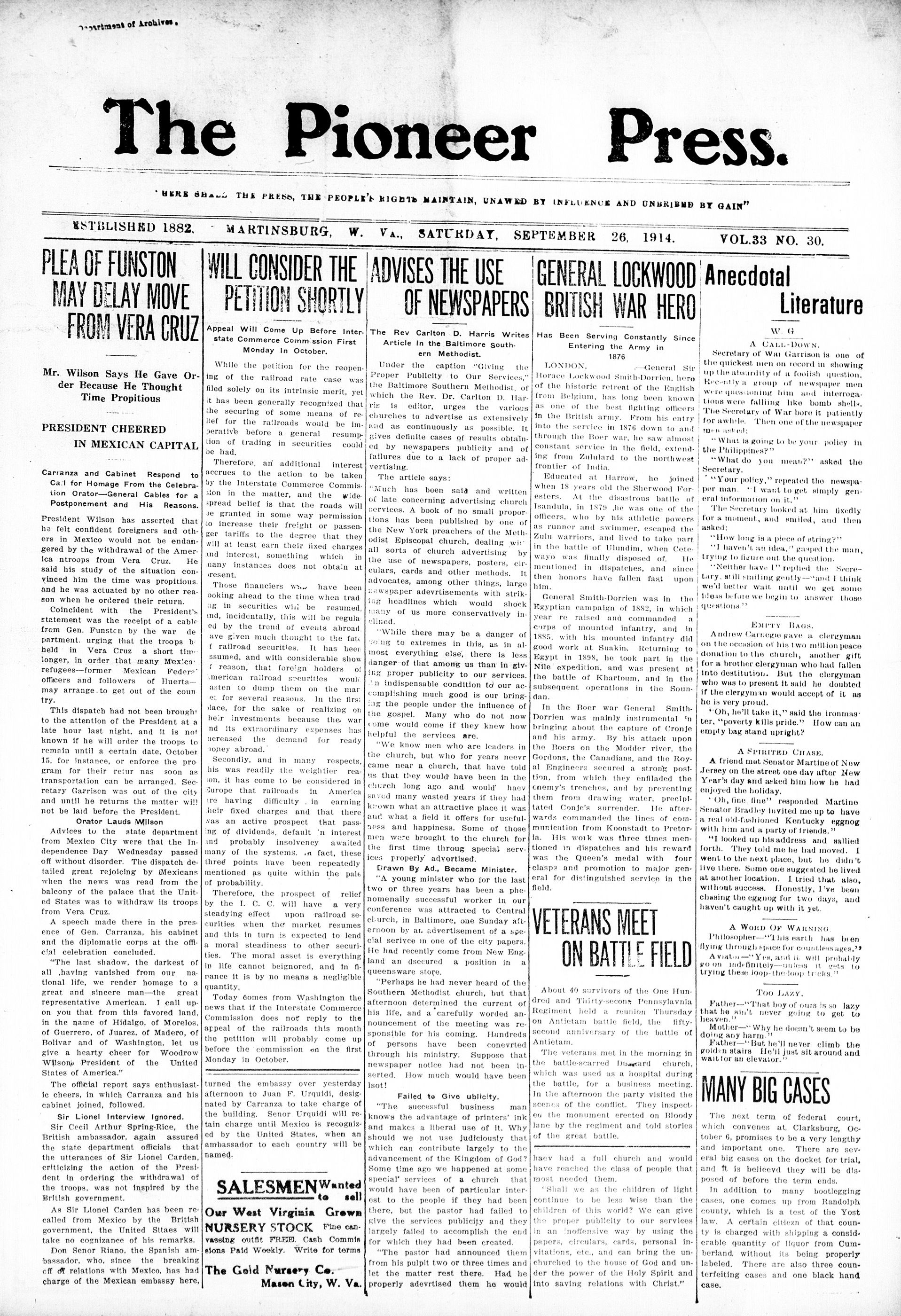
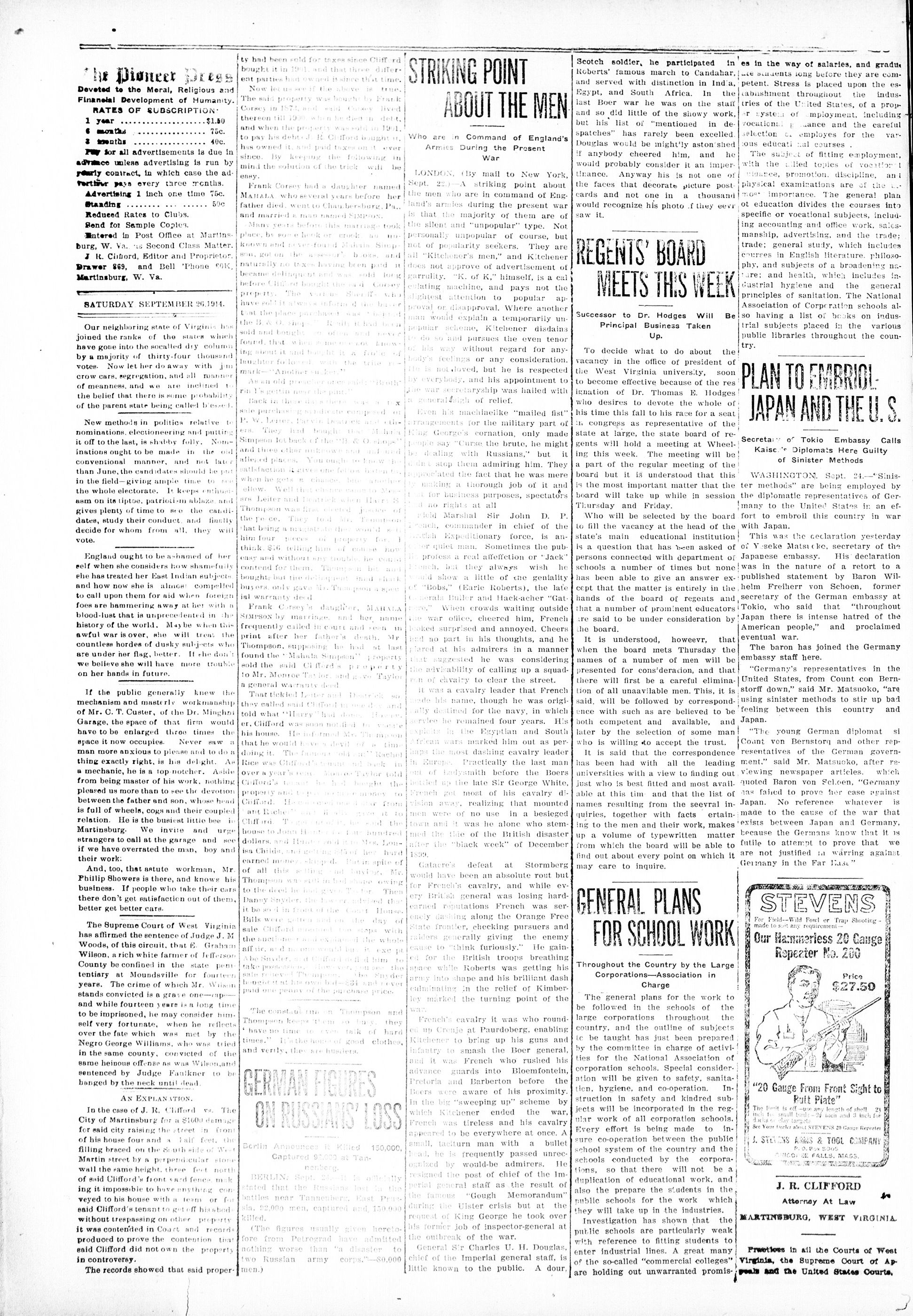

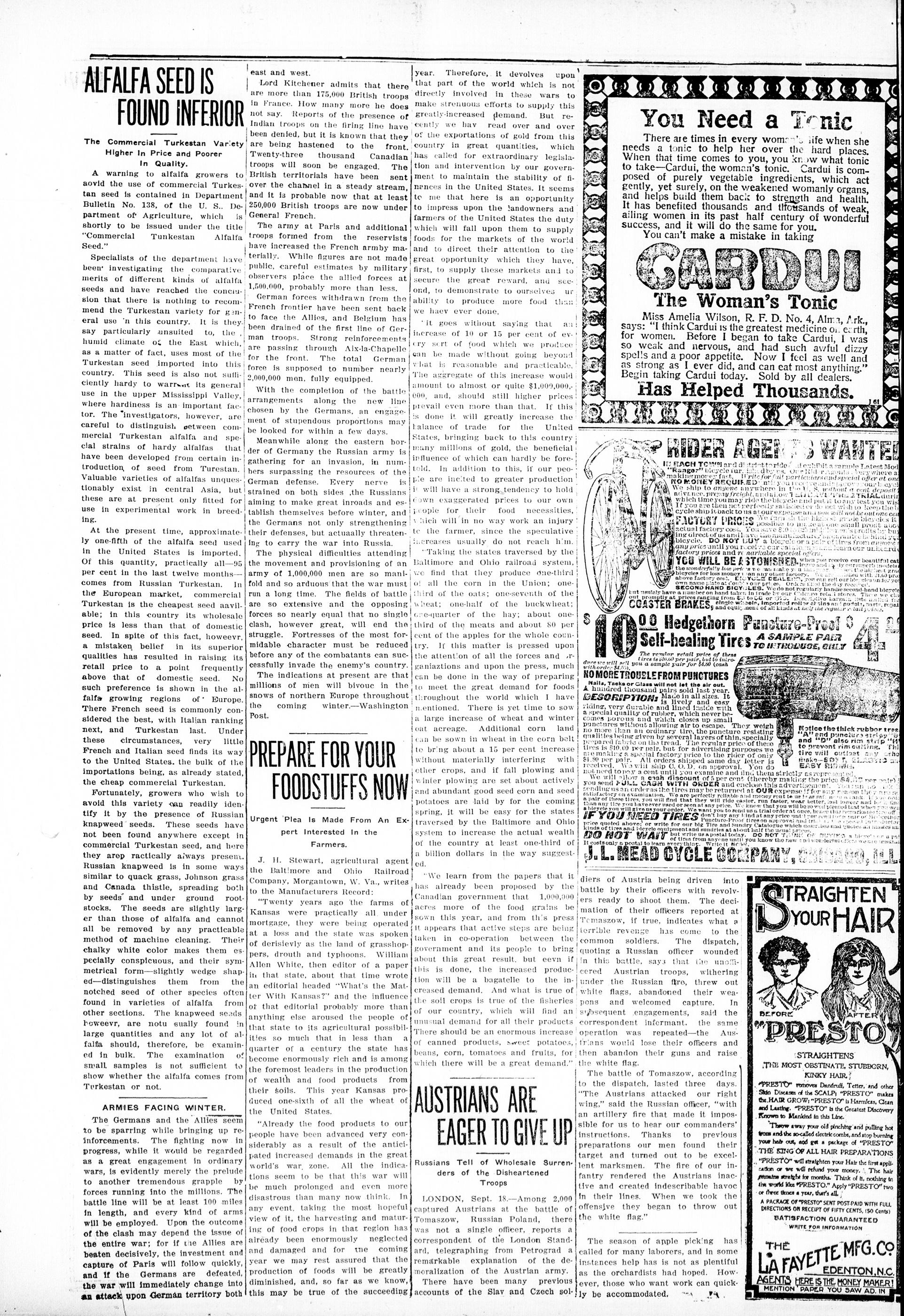
Page text (machine-generated)
The Pioneer Press.
" HERE SHALL THE PRESS, THE PEOPLE'S RIGHTS MAINTAIN, UNAWED BY INFLUENCE AND UNBRIBED BY GAIN"
Department of Archives.
Th
STBLISHED 1882
PLEA OF FUNSTON MAY DELAY MOVE FROM VERA CRUZ
Mr. Wilson Says He Gave Order Because He Thought Time Propitious
PRESIDENT CHEERED
IN MEXICAN CAPITAL
Carranza and Cabinet Respond to Call for Homage From the Celebration Orator—General Cables for a Postponement and His Reasons. President Wilson has asserted that he felt confident foreigners and others in Mexico would not be endangered by the withdrawal of the America ntroops from Vera Cruz. He said his study of the situation convinced him the time was propitious. and he was actuated by no other reason when he ordered their return.
Coincident with the President's statement was the receipt of a cable from Gen. Funston by the war department. urging that the troops be held in Vera Cruz a short time longer, in order that many Mexican refugees—former Mexican Federa officers and followers of Huerta—may arrange to get out of the country.
This dispatch had not been brought to the attention of the President at a late hour last night, and it is not known if he will order the troops to remain until a certain date, October 15, for instance, or enforce the program for their retur nas soon as transportation can be arranged. Secretary Garrison was out of the city and until he returns the matter will not be laid before the President.
Orator Lauds Millson
Advices to the state department from Mexico City were that the Independence Day Wednesday passed off without disorder. The dispatch detailed great rejoicing by Mexicans when the news was read from the balcony of the palace that the United States was to withdraw its troops from Vera Cruz. A speech made there in the presence of Gen. Carranza, his cabinet and the diplomatic corps at the official celebration concluded.
"The last shadow, the darkest of all, having vanished from our national life, we render homage to a great and sincere man—the great representative American. I call upon you that from this favored land, in the name of Hidalgo, of Morelos, of Guerrero, of Juarez, of Madero, of Bolivar and of Washington, let us give a hearty cheer for Woodrow Wilson, President of the United States of America."
The official report says enthusiastic cheers, in which Carranza and his cabinet joined, followed.
Sir Lionel Interview Ignored.
Sir Cecil Arthur Spring-Rice, the British ambassador, again assured the state department officials that the utterances of Sir Lionel Carden, criticizing the action of the President in ordering the withdrawal of the troops, was not inspired by the British government.
As Sir Lionel Carden has been recalled from Mexico by the British government, the United Sttaes will take no cognizance of his remarks.
Don Senor Riano, the Spanish ambassador, who, since the breaking off relations with Mexico, has had charge of the Mexican embassy here,
WILL CONSIDER THE PETITION SHORTLY
Appeal Will Come Up Before Interstate Commerce Commission First Monday In October.
While the petition for the reopening of the railroad rate case was filed solely on its intrinsic merit, yet it has been generally recognized that the securing of some means of relief for the railroads would be imperative before a general resumption of trading in securities could be had.
Therefore, an additional interest accrues to the action to be taken by the Interstate Commerce Commission in the matter, and the widespread belief is that the roads will be granted in some way permission to increase their freight or passenger tariffs to the degree that they will at least earn their fixed charges and interest, something which in many instances does not obtain at present.
Those financiers who have been looking ahead to the time when trading in securities will be resumed, and, incidentally, this will be regulated by the trend of events abroad, have given much thought to the fate of railroad securities. It has been assumed, and with considerable show if reason, that foreign holders of american railroad securities would asten to dump them on the market for several reasons. In the first place, for the sake of realizing on their investments because the war and its extraordinary expenses has increased the demand for ready money abroad.
Secondly, and in many respects, this was readily the weightier reason, it has come to be considered in Europe that railroads in America are having difficulty in earning their fixed charges and that there was an active prospect that passing of dividends, default in interest and probably insolvency awaited many of the systems. In fact, these three points have been repeatedly mentioned as quite within the pale of probability.
Therefore, the prospect of relief by the I. C. C. will have a very steadying effect upon railroad securities when the market resumes and this in turn is expected to lend a moral steadiness to other securities. The moral asset is everything in life cannot beignored, and in finance it is by no means a negligible quantity. Today comes from Washington the news that if the Interstate Commerce Commission does not reply to the appeal of the railroads this month the petition will probably come up before the commission on the first Monday in October.
turned the embassy over yesterday afternoon to Juan F. Urquidi, designated by Carranza to take charge of the building. Senor Urquidi will retain charge until Mexico is recognized by the United States, when an ambassador to each country will be named.
SALESMEN Wanted to sell
Our West Virginia Grown NURSERY STOCK Fine canvassing outfit FREED. Cash Commissions Paid Weekly. Write for terms The Gold Nursery Co. Mason City, W. Va.
ADVISES THE USE OF NEWSPAPERS
The Rev Carlton D. Harris Writes Article In the Baltimore Southern Methodist. Under the caption "Giving the Proper Publicity to Our Services," the Baltimore Southern Methodist, of which the Rev. Dr. Carlton D. Harris is editor, urges the various churches to advertise as extensively and as continuously as possible. It gives definite cases of results obtained by newspapers publicity and of failures due to a lack of proper advertising.
The article says:
"Much has been said and written of late concerning advertising church services. A book of no small proportions has been published by one of the New York preachers of the Methodist Episcopal church, dealing with all sorts of church advertising by the use of newspapers, posters, circulars, cards and other methods. It advocates, among other things, large newspaper adevrtisements with striking headlines which would shock many of us more conservatively inclined.
"While there may be a danger of going to extremes in this, as in almost everything else, there is less danger of that among us than in giving proper publicity to our services. An indispensable condition to our accomplishing much good is our bringing the people under the influence of the gospel. Many who do not now come would come if they knew how helpful the services are.
"We know men who are leaders in the church, but who for years neevr came near a church, that have told us that they would have been in the church long ago and would haev saved many wasted years if they had known what an attractive place it was and what a field it offers for usefulness and happiness. Some of those men were brought to the church for the first time through special services properly advertised.
Drawn By Ad., Became Minister.
"A young minister who for the last two or three years has been a phenomenally successful worker in our conference was attracted to Central church, in Baltimore, one Sunday afternoon by an advertisement of a special service in one of the city papers. He had recently come from New England an dsecured a position in a queensware store.
"Perhaps he had never heard of the Southern Methodist church, but that afternoon determined the current of his life, and a carefully worded announcement of the meeting was responsible for his coming. Hundreds of persons have been conevrted through his ministry. Suppose that newspaper notice had not been inserted. How much would have been isot!
"The successful business man knows the advantage of printers' ink and makes a liberal use of it. Why should we not use judiciously that which can contribute largely to the advancement of the Kingdom of God? Some time ago we happened at some special' services of a church that would have been of particular interest to the people if they had been there, but the pastor had failed to give the services publicity and they largely failed to accomplish the end for which they had been created.
"The pastor had announced them from his pulpit two or three times and let the matter rest there. Had he properly adevrised them he would
GENERAL LOCKWOOD BRITISH WAR HERO
Has Been Serving Constantly Since Entering the Army in 1876
LONDON. General Sir Horace Lockwood Smith-Dorrien, hero of the historic retreat of the English from Belgium, has long been known as one of the best fighting officers in the British army. From his entry into the service in 1876 down to and through the Boer war, he saw almost constant service in the field, extending from Zululard to the northwest frontier of India.
Educated at Harrow, he joined when 18 years old the Sherwood Foresters. At the disastrous battle of Isandula, in 1879 he was one of the officers, who by his athletic powers as runner and swimmer, escaped the Zulu warriors, and lived to take part in the battle of Ulundim, when Cetewayo was finally disposed of. He mentioned in dispatches, and since then honors have fallen fast upon him.
General Smith-Dorrien was in the Egyptian campaign of 1882, in which year he raised and commanded a corps of mounted infantry, and in 1885, with his mounted infantry did good work at Suakin. Returning to Egypt in 1898, he took part in the Nile expedition, and was present at the battle of Khartoum, and in the subsequent operations in the Soundan.
In the Boer war General Smith-Dorrien was mainly instrumental in bringing about the capture of Cronje and his army. By his attack upon the Boers on the Modder river, the Gordons, the Canadians, and the Royal Engineers secured a strong position, from which they enfiladed the enemy's trenches, and by preventing them from drawing water, precipitated Conje's surrender. He afterwards commanded the lines of communication from Koonstadt to Pretoria. His work was three times mentioned in dispatches and his reward was the Queen's medal with four clasps and promotion to major general for distinguished service in the field.
VETERANS MEET ON BATTLE FIELD
About 40 survivors of the One Hundred and Thirty-second Pennsylvania Regiment held a reunion Thursday on Antietam battle field, the fifty-second anniversary of the battle of Antietam.
The veterans met in the morning in the battle-scarred Duward church, which was used as a hospital during the battle, for a business meeting. In the afternoon the party visited the scenes of the conflict. They inspected the monument erected on Bloody lane by the regiment and told stories of the great battle.
haev had a full church and would have reached the class of people that most needed them.
'Shall we as the children of light continue to be less wise than the children of this world? We can give the proper publicity to our services in an inoffensive way by using the papers, circulars, cards, personal invitations, etc., and can bring the unchurched to the house of God and under the power of the Holy Spirit and into saving relations with Christ.'
VOL.33 NO. 30.
Anecdotal Literature
W. G
A CALL-DOWN.
W. G
Secretary of War Garrison is one of the quickest men on record in showing up the absurdity of a foolish question. Recently a group of newspaper men were questioning him and interrogations were falling like bomb shells. The Secretary of War bore it patiently for awhile. Then one of the newspaper men asked:
"What is going to be your policy in the Philippines?"
"What do you mean?" asked the Secretary.
"Your policy," repeated the newspaper man. "I want to get simply general information on it."
The Secretary looked at him fixedly for a moment, and smiled, and then asked:
"How long is a piece of string?"
"I haven't an idea," gasped the man, trying to figure out the question.
"Neither have I" replied the Secretary, still smiling gently—"and I think we'd better wait until we get some ideas before we begin to answer those questions."
EMPTY BAGS.
Andrew Carnegie gave a clergyman on the occasion of his two million peace donation to the church, another gift for a brother clergyman who had fallen into destitution. But the clergyman who was to present it said he doubted if the clergyman would accept of it as he is very proud.
"Oh, he'll take it," said the ironmaster, "poverty kills pride." How can an empty bag stand upright?
A SPIRITED CHASE
A friend met Senator Martine of New Jersey on the street one day after New Year's day and asked him how he had enjoyed the holiday.
"Oh, fine, fine" responded Martine Senator Bradley invited me up to have a real old-fashioned Kentucky eggnog with him and a party of friends."
"I looked up his address and sallied forth. They told me he had moved. I went to the next place, but he didn't live there. Some one suggested he lived at another location. I tried that also, without success. Honestly, I've been chasing the eggnog for two days, and haven't caught up with it yet.
A WORD OF WARNING
Philosopher—"This earth has been flying through space for countless ages." Aviator—"Yes, and it will probably go on indefinitely—unless it gets to trying these loop-the-loop tricks."
TOO LAZY.
Father—"That boy of ours is so lazy that he isn't never going to get to heaven."
Mother—"Why he doesn't seem to be doing any harm."
Father—"But he'll never climb the golden stairs. He'll just sit around and wait for an elevator."
MANY BIG CASES
MANY BIG CASES
The next term of federal court, which convenes at. Clarksburg, October 6, promises to be a very lengthy and important one. There are several big cases on the docket for trial, and it is believcd they will be disposed of before the term ends.
In addition to many bootlegging cases, one comes up from Randolph county, which is a test of the Yost law. A certain citizen of that county is charged with shipping a considerable quantity of liquor from Cumberland, without its being properly labeled. There are also three counterfeiting cases and one black hand case.
1 year ..... $1.50
6 months ..... 75c.
3 months ..... 40c.
Pay for all advertisements is due in
advance unless advertising is run by
yearly contract, in which case the ad-
vertiser pays every three months.
Entered in Post Office at Martinsburg, W. Va. as Second Class Matter.
J Rt. Cifford, Editor and Proprietor.
Drawer 869, and Bell 'Phone 60K.
Martinsburg, W. Va.
SATURDAY SEPTEMBER 26,1914.
Our neighboring state of Virginia has joined the ranks of the states which have gone into the so-called dry column by a majority of thirty-four thousand votes. Now let her do away with jim crow cars, segregation, and all manner of meanness, and we are inclined to the belief that there is some probability of the parent state being called blessed.
New methods in politics relative to nominations, electioneering and putting it off to the last, is shabby folly. Nominations ought to be made in the old conventional manner, and not later than June, the candidates should be put in the field—giving ample time to see the whole electorate. It keeps enthusiasm on its tiptoe, patriotism ablaze, and gives plenty of time to see the candidates, study their conduct, and finally decide for whom from all, they will vote.
England ought to be a haunted of her self when she considers how shamefully she has treated her East Indian subjects and how now she is almost compelled to call upon them for aid when foreign foes are hammering away at her with a blood-lust that is unprecedented in the history of the world. Maybe when this awful war is over, she will treat the countless hordes of dusky subjects who are under her flag, better. If she don't we believe she will have more trouble on her hands in future.
If the public generally knew the mechanism and masterly workmanship of Mr. C. T. Custer, of the Dr. Minghni Garage, the space of that firm would have to be enlarged three times the space it now occupies. Never saw a man more anxious to please and to do a thing exactly right, is his delight. As a mechanic, he is a top notcher. Aside from being master of his work, nothing pleased us more than to see the devotion between the father and son, whose head is full of wheels, cogs and their coupled relation. He is the busiest little bee in Martinsburg. We invite and urge strangers to call at the garage and see if we have overrated the man, boy and their work:
And, too, that astute workman, Mr. Phillip Showers is there, and knows his business. If people who take their cars there don't get satisfaction out of them, better get better cars.
The Supreme Court of West Virginia has affirmed the sentence of Judge J. M. Woods, of this circuit, that E. Graham Wilson, a rich white farmer of Jefferson County be confined in the state penitentiary at Moundsville for fourteen years. The crime of which Mr. Wilson stands convicted is a grave one—rap—and while fourteen years is a long time to be imprisoned, he may consider himself very fortunate, when he reflects over the fate which was met by the Negro George Williams, who was tried in the same county, convicted of the same heinous offense as was Wilson, and sentenced by Judge Faulkner to be hanged by the neck until dead.
AN EXPLANATION.
In the case of J. R. Clifford vs. The City of Martinsburg for a $1000 damage for said city raising the street in front of his house four and a half feet, the filling braced on the South side of West Martin street by a perpendicular stone wall the same height, three feet north of said Clifford's front yard fence, making it impossible to have anything conveyed to his house with a team or for said Clifford's tenant to get off his roof without trespassing on other property it was contended in Court and records produced to prove the contention that said Clifford did not own the property in controversy. The records showed that said proper-
ty had been sold for taxes since Clifford bought it in 1901, and that three different parties had owned it since that time. Now let us see if the above is true. The said property was bought by Frank Corsey in 1874, and said Corsey lived thereon till 1900, when he died in debt, and when the property was sold in 1901, to pay his debt to R. Clifford bought it, has owned it, and paid taxes on it ever since. By keeping the following in mind the solution of the trick will be easy. Frank Corsey had a daughter named MAMALA who several years before her father died, went to Chambersburg, Pa., and married a map named SIMPSON.
Many years before this marriage took place, by some hook or crook, no known and never-found Mahino Simpson, got on the a-season's books, and naturally no taxes having been paid it became delinquent and was sold long before Clinton bought the end Corsey property. The various Sheriffs who have sold it always informed the buyer that the place purchased was "beloved of the B. & O. shops." Really it had been sold and bought, so often and never found, that when someone not knowing about it and bought it a fool's of laughter followed with the trite remark—"Another sucker."
As an old preacher once said: "Brothrin'rin' I's gettin on the pint."
Back in these days there was a great sale purchasing syndicate composed on P. W. Letter, Parvin Dearden and others. They had bought that Manning Simpson lot back of the "B. & O. shops" and three other unknown and unfilled altered places. You ought to know the satisfaction it gives one fellow better to, when he gets a chance, bite another fellow. Well that chance came to Messrs Leiter and Dearden when Harry S. Thompson was first elected justice of the peace. They told Mr. Thompson that being a magistrate they would set him four pieces of property for. I think, $16 telling him of course how easy and without any trouble, he could contend for them. Thompson but and bought, but the delinquent third chark buyers, only gave Mr. Thompson a special warranty deed.
Frank Corsey's daughter, MAHALA SIMPSON by marriage, and her name frequently called in court and seen in print after her father's death, Mr. Thompson, supposing he had at last found the "Mahota Simpson" property sold the said Clifford's property to Mr. Monroe Taylor, and gave Taylor a general warranty deed.
That tickled Letter and Dustrick so they called said Clifford in one day and told what "Harry" had done. However, Clifford was soon notified to wooer his house. He informed Mr. Thompson that he would have a devil of a time doing it. The famous old man Rachel Rice was Clifford's tenant and back in over a year's rent. Monroe Taylor told Clifford's tenant he had bought the property and to pay him more money to Clifford. He canceled a star from "ant Rachel" and funds gave it to Clifford. Target on old, he said the house to John Hunter is four hundred dollars, and Hunter said it mes. Louisa Childs, and getting $15 of her hard earned money, skipped. Put in spite of of all this selling and buying, Mr. Thompson was still in bed shape owing to the deed he had given Taylor. Then Danny Snyder, the lawyer advised that it be soed in front of the Court House. Bills were gotten and on the day of sale Clifford moved two steps with the auctioneer and explained the whole affair, and money would buy is exe pt Abe Snyder, and Clifford defiled him to take possession, however, you see the sale renewed Thompson. (The Snyder bought it at his own bid—$34 and never paid one penny of the purchase price.
The constabulary on Thompson and Thompson keeps them so busy, they have no time to even talk of hard times." It's the house of good clothes, and vertly, they are husders.
GERMAN FIGURES ON RUSSIANS' LOSS
Berlin Announced R Killed 150,000,
Captured 92,000 at Tan-
BERLIN: Sept. 24.—It is officially stated that the Russians lost in the battles near Tannenberg, East Prussia, 82,000 men, captured and, 150,000 killed.
(The figures usually given heretofore from Petrograd have admitted nothing worse than "a disaster to two Russian army corps."—80,000 men.)
STRIKING POINT ABOUT THE MEN
Who are in Command of England's Armies During the Present War
LONDON, (By mail to New York, Sept. 22.)—A striking point about the men who are in command of England's armies during the present war is that the majority of them are of the silent and "unpopular" type. Not personally unpopular of course, but not of popularity seekers. They are all "Kitchener's men," and Kitchener does not approve of advertisement of garrulity. "K, of K," himself, is a calculating machine, and pays not the slightest attention to popular approval or disapproval. Where another man would explain a temporarily unpopular scheme, Kitchener disdains to do so and pursues the even tenor of his way without regard for anybody's feelings or any consideration. He is not loved, but he is respected by everybody, and his appointment to the war secretaryship was hailed with a general sigh of relief.
Even his machinelike "mailed fist" arrangements for the military part of King George's cornation, only made people say "Curse the brute, he might be dealing with Russians," but it didn't stop them admiring him. They appreciated the fact that he was mere by making a thorough job of it and that for business purposes, spectators had no rights at all.
Field Marshal Sir John D. P. French, commander in chief of the British Expeditionary force, is an answer quiet man. Sometimes the public profess a real affection or "Jack" French, but they always wish he would show a little of the geniality of "Bobs," (Earle Roberts), the late Generals Buller and Hack-acher "Gatere," When crowds waiting outside the war office, cheered him, French looked surprised and annoyed. Cheers and no part in his thoughts, and he placed at his admirers in a manner that suggested he was considering the advisability of calling up a squadron of cavalry to clear the street.
It was a cavalry leader that French made his name, though he was originally destined for the navy, in which service he remained four years. His exploits in the Egyptian and South African wars marked him out as perhaps the most dashing cavalry leader in Europe. Practically the last man out of Ladysmith before the Boers bottled up the late Sir George White, French got most of his cavalry division away, realizing that mounted men were of no use in a besieged town and it was he alone who stemmed the tide of the British disaster after the "black week" of December 1899.
Gataere's defeat at Stormberg would have been an absolute rout but for French's cavalry, and while every British general was losing hard-carned reputations French was serenely dashing along the Orange Free State frontier, checking pursuers and raiders generally giving the enemy cause to "think furiously." He gained for the British troops breathing space while Roberts was getting his army into shape and his brilliant dash culminating in the relief of Kimberley marked the turning point of the war.
French's cavalry it was who rounded up Cronje at Paurdoberg, enabling Kitchener to bring up his guns and infantry to smash the Boer general, and it was French who rushed his advance guards into Bloemfontein, Pretoria and Barberton before the Boers were aware of his proximity. In the big "sweeping up" scheme by which Kitchener ended the war, French was tireless and his cavalry appeared to be everywhere at once. A small, taciturn man with a bullet head, he is frequently passed unrecognized by would-be admirers. He resigned the post of chief of the Imperial general staff as the result of the famous "Gough Memorandum" during the Ulster crisis but at the request of King George he took over his former job of inspector-general at the outbreak of the war.
General Sir Charles U. H. Douglas, chief of the Imperial general staff, is little known to the public. A dour,
Scotch soldier, he participated in Roberts' famous march to Candahar, and served with distinction in India, Egypt, and South Africa. In the last Boer war he was on the staff and so did little of the showy work, but his list of "mentioned in despatches" has rarely been excelled. Douglas would be mightly astonished if anybody cheered him, and he would probably consider it an imperfinance. Anyway his is not one of the faces that decorate picture postcards and not one in a thousand would recognize his photo if they eevr saw it.
REGENTS' BOARD MEETS THIS WEEK
Successor to Dr. Hodges Will Be Principal Business Taken Up.
To decide what to do about the vacancy in the office of president of the West Virginia university, soon to become effective because of the resignation of Dr. Thomas E. Hodges who desires to devote the whole of his time this fall to his race for a seat in congress as representative of the state at large, the state board of regents will hold a meeting at Wheeling this week. The meeting will be a part of the regular meeting of the board but it is understood that this is the most important matter that the board will take up while in session Thursday and Friday.
Who will be selected by the board to fill the vacancy at the head of the state's main educational institution is a question that has been asked of persons connected with department of schools a number of times but none has been able to give an answer except that the matter is entirely in the hands of the board of regents and that a number of prominent educators are said to be under consideration by the board.
It is understood, howeevr, that when the board mets Thursday the names of a number of men will be presented for consideration, and that there will first be a careful elimination of all unavailable men. This, it is said, will be followed by correspondence with such as are believed to be both competent and available, and later by the selection of some man who is willing to accept the trust.
It is said that the correspondence has been had with all the leading universities with a view to finding out just who is best fitted and most available at this time and that the list of names resulting from the seevral inquiries, together with facts ertaining to the men and their work, makes up a volume of typewritten matter from which the board will be able to find out about every point on which it may care to inquire.
GENERAL PLANS FOR SCHOOL WORK
Throughout the Country by the Large Corporations—Association in Charge
The general plans for the work to be followed in the schools of the large corporations throughout the country, and the outline of subjects to be taught has just been prepared by the committee in charge of activities for the National Association of corporation schools. Special consideration will be given to safety, sanitation, hygiene, and co-operation. Instruction in safety and kindred subjects will be incorporated in the regular work of all corporation schools. Every effort is being made to insure co-operation between the public school system of the country and the schools conducted by the corporations, so that there will not be a duplication of educational work, and also the prepare the students in the public schools for the work which they will take up in the industries.
Investigation has shown that the public schools are particularly weak with reference to fitting students to enter industrial lines. A great many of the so-called "commercial colleges" are holding out unwarranted promis-
es in the way of salaries, and graduate students long before they are competent. Stress is placed upon the establishment throughout the industries of the United States, of a proper system of employment, including vocational guidance and the careful selection of employees for the various educational courses.
The subject of fitting employment, with the called topics of vocation, education, promotion, discipline, and physical examinations are of the most importance. The general plan of education divides the courses into specific or vocational subjects, including accounting and office work, salesmanship, advertising, and the trade; trade; general study, which includes courses in English literature, philosophy, and subjects of a broadening nature; and health, which includes industrial hygiene and the general principles of sanitation. The National Association of Corporation schools also having a list of books on industrial subjects placed in the various public libraries throughout the country.
PLAN TO EMBRIOL JAPAN AND THE U.S.
PLAN TO EMBRIOL JAPAN AND THE U.S.
Secretary of Tokio Embassy Calls Kaisei's Diplomats Here Guilty of Sinister Methods
WASHINGTON, Sept. 24.—"Sinister methods" are being employed by the diplomatic representatives of Germany to the United States in an effort to embroil this country in war with Japan.
This was the declaration yesterday of Yuseke Matsuko, secretary of the Japanese embassy. His declaration was in the nature of a retort to a published statement by Baron Wilhelm Freiherr von Schoen, former secretary of the German embassy at Tokio, who said that "throughout Japan there is intense hatred of the American people," and proclaimed eventual war. The baron has joined the Germany embassy staff here.
"Germany's representatives in the United States, from Count con Bernstorff down," said Mr. Matsucon, "are using sinister methods to stir up bad feeling between this country and Japan.
"The young German diplomat si Count von Bernstorq and other representatives of the German government," said Mr. Matsuoko, after reviewing newspaper articles, which quoted Baron von Schoen, "Germany has failed to prove her case against Japan. No reference whatever is made to the cause of the war that exists between Japan and Germany, because the Germans know that it is futile to attempt to prove that we are not justified in warring against Germany in the Far East."
STEVENS
For Field—Wild Fowl or Trap Shooting
made to suit any requirement—
Our Hammerless 20 Gauge
Repeater No. 200
Price
$27.50
"20 Gauge From Front Sight to
Putt Plate"
The limit is off—use any length of shell. 24
inch to small bore—24 men and 8 inch for
ducks or play targets
See Your Order about STEVENS 20 Gauge Repeater
J. STEVENS ARMS & TOOL COMPANY
PO BOX 5005
CHEVY FALLS, MASS.
MARTINSBURG, WEST VIRGINIA.
Practices in all the Courts of West Virginia, the Supreme Court of Appeals and the United States Courts,
APPLE GROWERS STRONGLY ADVISED TO USE COLD STORAGE
In view of the interference with the European market and the large production of American apples this season, specialists of the department of agriculture call the attention of apple growers to the advantages of cold storage for steadying the market at harvest and lengthening the selling period. Glutting of the market will result, it is feared, in many thousands of barrels of good apples rotting in the orchard or being disposed of at prices which figure a net loss to the grower.
The following are the directions given by the apple handling specialists of the department for using cold storage successfully in handling apples:
The proper function of cold storage is to retard the ripening processes of the fruit and the development of decay organisms and skin blemishes. The first responsibility for the keeping quality of his fruit rests with the grower since it is his growing and handling methods that largely determine its vitality freedom from disease, and general condition when stored. Cold storage is not a remedy, or a restorative for poorly developed, weak, imperfect fruit, but is the most effective method of preserving the quality, flavor and appearance possessed by the fruit at time of picking.
The first step in successful coid storage of apples has been found to lie in the practice of such culture, spraying and pruning methods as insure production of sound, healthy, well colored fruit, free from disease. Assuming this as the first requisite, the following factors have been found to most influence the keeping quality of the fruit, and furnish best conditions for long storage:
1. Proper maturity at time of picking.
2. Care in all handling preparations.
3. Prompt storage after picking.
4. A proper storage temperature.
Maturity Tests
Careful and extensive investigations have demonstrated that fruit picked at full maturity can be held for a longer period in storage, and is less affected by scald and decay than that picked when somewhat immature. Two important commercial varieties, Rome Beauty and Winesap, have been found to be especially susceptible to scald during storage, if pikced prematurely. There is no doubt that several thousand dollars are lost to the industry each year through the improper picking of these two varieties alone. The results emphasize strongly that more care and attention should be paid to this detail of the harvesting operations than is usually the case.
By full maturity, however, is not meant over-maturity, which may cause fully as heavy losses as immaturity. Each grower should study his own fruit and his own conditions in order to determine the proper picking stage. Probably the most reliable single indication of maturity is the whitening or slight yellowing
GREAT INCREASE IN DRUG PRICES
Since the Beginning of the European War Prices Have Advanced 300 Per Cent.
NEW YORK, Sept. 22.—The people of the United States are already paying a heavy war tax in the higher prices for drugs and medicines. Since the beginning of the European conflict the prices of some of the popular remedies have advanced as much as 300 per cent.
South Belgium, Germany and France grow many plants possessing medicinal virtues, and Germany, with her established research laboratories, has led in obtaining the derivations and utilizing by-products.
Derivatives from belladonna leaves are cited as among the drugs that have been soaring in price. One article, formerly selling at $45 an ounce now commands $180, and another has
of the "ground color" of the fruit. This is the color underlying the blush or red color and should not be confused with the latter.
Careful Handling.
Care in all handling operations is the second important requisite of successful storage. A class of fungi, of which the common blue mold is an example, are known to be unable to attack and cause decay of healthy, uninjured fruit. In spite of this fact, very serious rots both in storage and in transit to market are the work of fungi of this type, and the largest contributory cause in all cases is bruising or skin breaking suffered by the fruit in the picking packing operations. Microscopic bruises and breaks in the skin are large enough to afford entrance to the spores of these fungi and the necessity for the utmost care in all operations connected with the handling of the fruit to avoid bruising and mechanical injuries is more urgent than most growers realize.
Prompt Storage
There is a marked difference in condition between fruit stored promptly after picking, say not more than two days later, and otherwise comparable lots of which the storage is delayed ten days or two weeks. Such delay is especially injurious during a period of warm, humid weather. The delayed fruit at withdrawal from storage is riper, yellower and duller than the corresponding "immediate" stored fruit and in addition develops more serious scald and decay. The importance of eliminating all avoidable delay in storing cannot be too strongly emphasized.
Storage Temperatures.
31 degrees to 32 degrees F is the standard storage temperature for apples, and this has been found to be the best for long keeping of the fruit. Higher temperatures permit the ripening of the fruit to advance more rapidly than at 31 degrees to 32 degrees F., with the result that the fruit at these temperatures reached the end of its storage life much sooner. In addition the lower temperature rotards most effectively the development of fungus decays and skin blemshes. For a short storage period higher temperatures may be used without serious trouble especially with the better keeping varieties, but for long keeping 31 degrees to 32 degrees F., will best maintain the color, quality and texture of the fruit.
Apples should be withdrawn from storage while still firm, and in this condition can be held on the market in satisfactory shape for several days or weeks. If allowed to become excessively overripe in storage, however, they will break down very fast on withdrawal. Apples from 32 degrees F. will as a rule hold in better condition after withdrawal from storage than will comparable lots from higher temperatures.
There are several other factors affecting the behavior of apples in storage, but those discussed have been found to be of greatest importance, and their proper control will solve a large percentage of present serious storage difficulties.
advanced from $20 to $120. Crude opium has gone up 33 per cent, and 100 per cent has been added to the cost of gum camphor from Formosa.
Glycerine, produced in the manufacture of soap and used in explosives, is 40 per cent higher as a result of the war. Ichthyol, a dried fish product, is off the market entirely. Salvarian, an arsenical preparation selling at $3.50 before the war, is now quoted at $10.
A patented preparation selling in Canda at 25 cents, under a label "Not for exportation to the United States," commands $1 here, and a mineral oil from Russia, is up 300 per cent.
All bristle goods are higher. England, France and Germany produce 50 per cent of all the brushes, and of the remainder, 50 per cent comes from Japan. Caustic potash, for soap making, is quoted at 23 cents a pound against 3 7-8 wholesale while Europe was at peace. France has led in developing perfumes and toilet articles, as Germany has in chemicals, and the dainty extracts, such as still are vailable, are bringing fabulous prices.
TOTAL VALUE OF MINERAL PRODUCTS
Fatality Records Show That Thirty- Two Men Were Killed In August
The fatality records in the office of the department of mines show that during the month of August thirty-two men lost their lives at West Virginia coal operations. The fatality statistics for the month have just been made public by Chief Inspector Earl A. Henry.
Chief Henry is calling the attention of miners and operators all over the state to the number of accidents and deaths due to the riding on loaded trips. He points out that ten of the thirty-two fatalities in August were due to this cause.
$t$ is also shown that eleven of the thirty-two fatalities were the result of carelessness. Chief Henry again calls attention to the fact that a third of the fatalities in West Virginia are due to negligence on the part of the men themselves.
A classification of the accidents shows that fifteen were due to falls of coal and slate, ten to mine cars, motors and the like, six to electrocution, and one to machinery.
LUMBERMEN LOSE HEAVILY BY WAR
LUMBERMEN LOSE HEAVILY BY WAR
Southerners Point Out How They Must Suffer From Foreign Conflict MEMPHIS, Tenn., Sept. 18.—Bavain the export lumber trade from the United States has been heavy and because most of these shipments would be contraband, as all building of homes in the war zone has been stopped, southern lumbermen foresee a heavy loss in their industry on account of the European war.
Already the shipment of lumber from southern ports is entirely paralyzed. Great losses already have been sustained through the seizure of vessels which were on the high seas when the war was declared, or through cargoes diverted to points at which the timber cannot readily be sold, because lumber intended for export to one country is very seldom in such shape as to be readily salable in another.
In actual figures, the countries directly or indirectly involved in war take each year about 700,000,000 board feet of American timber, of which about 650,000,000 feet is southern yellow pine.
ANOTHER SHAKE-UP COMING IN NAVY
Secretary Daniels Announces Important Changes in Commands. Others Coming Important changes in naval commands have been announced by Secretary Daniels, continuing his policy of giving all line officers adequate sea duty.
Rear Admiral James M. Helm, commandant of the Charleston Navy Yard, succeeds Rear Adimarl William B. Caperton in command of the Atlantic reserve fleet at Philadelphia, Admiral Caperton having been detailed to command the newly organized cruiser squadron of the Atlantic fleet. Rear Admiral John R. Edwards, late president of the board of inspections for shore stations, which has been abolished, will assume command of the Charleston yard. Rear Admiral Nathaniel Usher, commandant of the Norfolk navy yard, goes to the New York yard, in succession of Captain Albert Gleaves, detailed to command the battleship Utah. For the present, Commander Louis R. DeSteiguer, captain of the Norfolk yard, will continue acting commandant, on account of the illness of Rear Admiral Usher.
Secretary Daniels intends to appoint an industrial manager to serve under Admiral Usher in the New York may yard.
KEEPS YOUR HOME FRESH and CLEAN
THIS Swiftly-Sweeping, Easy-Running DUNTLEY Sweeper, cleans without raising dust, and at the same time picks up pins, lint, ravelings, etc., in ONE OPERATION. Its ease makes sweeping a simple task quickly finished. It reaches even the most difficult places, and eliminates the necessity of moving and lifting all heavy furniture.
The Great Labor Saver of the Home—Every home, large or small, can enjoy relief from Broom drudgery and protection from the danger of flying dust.
Duntley is the Pioneer of Pneumatic Sweepers—Has the combination of the Pneumatic Suction Nozzle and revolving Brush. Very easily operated and absolutely guaranteed. In buying a Vacuum Cleaner, why not give the "Duntley" a trial in your home at our expense?
STEPHEN M. NEWMAN, A. M., D. D.
PRESIDENT.
COLLEGE OF ARTS AND
SCIENCES.
A. B. and B. S. Courses.
SCHOOL OF MANUAL ARTS AND
APPLIED SCIENCES.
Courses in Engineering
Domestic Science
Domestic Arts
Manual Arts
CONSERVATORY OF MUSIC
ACADEMY
Three Preparatory Courses
(Classical, Scientific, Normal)
Stenography
typewriting
Economics
Bookkeeping, Etc.
Professional Schools
LIBRARY SCHOOL
SCHOOL OF THEOLOGY.
THE SCHOOL OF MEDICINE.
College of Medicine
College of Dentistry
College of Pharmacy
SCHOOL OF LAW.
All Course begin Sept. 30th, 1914.
For Catalogue, address Howard University, Washington, D. C.
INCREASED EXPORT TRADE WITH CANADA
PHILLADELPHIA, Pa., Sept. 24. Great opportunities are available for the establishment of an enormously increased export trade with Canada in "made in America" oods accord ing-ng to Dudley Bartlett, chief of the Foreign Trade Bureau of the Philadelphia Commercial Museums. These opportunities are a driet result of the European war, through the acton of the Canaadian Minister of Customs in prohibiting the importation into Canada of goods from Germany and Austria-Hungary: The imports from these two countries into Canada amounted in round numbers to $16,060,000 annually. It was also pointed out that the imports from France, Belgium and Russ'a, which for the time being are as effectively cut off as if they were forbidden, amounted approximately to $30,000,000 a year. So this prohibited and interrupted import trade of Canada totals $36,:000,000.
"It is reasonable," Chief Bartlett says. "to assume that Canda will be in the market for substitutes for the goods which make up this total. That they will have to be imported is a reasonable assumption. It is hardly likely that the Canadian manufacturers at his time are in a position to make up the deficit though they may
KEEPS YOUR FRESH and
Mrs Coralie Jenkins, of Smithfield, Pa., is the guest of her parents, the editor and wife.
Mrs. Ellen Preston is spending the week in Carlisle, where she attended the fair, visited friends, and had a fine time generally.
Rev. R. R. Thompson, Messrs. John Carter and John Runner attended the Baptist Association which met in Hagerstown on Sunday last.
Rev. George H. Carter, pastor of Ebenezer Memorial Baptist Church, was a business visitor to Charles Town on Thursday evening.
Mrs Mattie Carter, who recently returned from Martins Ferry, Ohio, is somewhat better than she was upon her arrival home.
Mr. Henry Ford, of Darksville, was a business visitor to this city the other day, and before returning home, he called at the Press office.
Miss Hilda Hopewell, the popular and promising daughter of Mr. and Mrs. Henry Hopewell, left Monday for Harper's Ferry, where she goes to resume her studies at Storer College.
The Social and Dance given by the "Glee Club Girls," at Spears' Hall, was a highly enjoyable affair, and reflected credit upon those who were in charge of the arrangements.
Mrs. Sadie B Crane, of Arden and Harper's Ferry, is teaching the overflow number of children who were taken out of Summer School and put in the lodge room of the Bons and Daughters of Enoch Hall.
Messrs. Charles Carter and Henry Sinks, of Pittsburg, were here for several days this week with their friend, Mr. Lewis Ford. While in our city they were house guests of Mr. Ella James.
Mr. Charley Fox had his eye right badly hurt by coming in contact with a corr stalk on his farm Monday, and was in town for several days during the week receiving the attention of an optician.
Mr. and Mrs. Sidney Thoruton, of Pittsburg, stopped over enroute home from Atlantic City, and spent several days in Harper's Ferry and this city as the guests of frends and relatives. The former was born at the Ferry, is a graduate of Storer College, and her husband is a popular automobile liveryman in the "Smoky City."
seize the moment to develop along the necessaryy manufacturing lines. This leaves two alternatives; importation from Great Britain or from the United States. It is hardly reasonable to expect that British manufacturers will be able to take advantage of the present opoprtunity. On the other hand, it would not be surprising if imports from the mother country, which amounted to $139,646,356 last year, should e temporarily cur tabiled."
HOME
LEAN
ALFALFA SEED IS FOUND INFERIOR
The Commercial Turkestan Variety Higher In Price and Poorer In Quality.
A warning to alfalfa growers to aovid the use of commercial Turkestan seed is contained in Department Bulletin No. 138, of the U. S.. Department of Agriculture, which is shortly to be issued under the title "Commercial Tunkestan Alfalfa Seed."
Specialists of the department have been investigating the comparative merits of different kinds of alfalfa seeds and have reached the conclusion that there is nothing to recommend the Turkestan variety for general use in this country. It is they say particularly ansuited to, the humid climate of the East which, as a matter of fact, uses most of the Turkestan seed imported into this country. This seed is also not sufficiently hardy to warrant its general use in the upper Mississippi Valley, where hardiness is an important factor. The investigators, however, are careful to distinguish between commercial Turkestan alfalfa and special strains of hardy alfalfas that have been developed from certain introduction of seed from Turestan. Valuable varieties of alfalfas unquestionably exist in central Asia, but these are at present only fitted for use in experimental work in breeding.
At the present time, approximately one-fifth of the alfalfa seed used in the United States is imported. Of this quantity, practically all—95 per cent in the last twelve months—comes from Russian Turkestan. In the European market, commercial Turkestan is the cheapest seed aavailable; in this country its wholesale price is less than that of domestic seed. In spite of this fact, howeevr, a mistaken belief in its superior qualities has resulted in raising its retail price to a point frequently above that of domestic seed. No such preference is shown in the alfalfa growing regions of Europe. There French seed is commonly considered the best, with Italian ranking next, and Turkestan last. Under these circumstances, very little French and Italian seed finds its way to the United States, the bulk of the importations being, as already stated, the cheap commercial Turkestan.
Fortunately, growers who wish to avoid this variety can readily identify it by the presence of Russian knapweed seeds. These seeds have not been found anywhere except in commercial Turkestan seed, and here they arepractically always present. Russian knapweed is in some ways similar to quack grass, Johnson grass and Canada thistle, spreading both by seeds and under ground rootstocks. The seeds are slightly larger than those of alfalfa and cannot all be removed by any practicable method of machine cleaning. Their chalky white color makes them especially conspicuous, and their symmetrical form—slightly wedge shaped—distinguishes them from the notched seed of other species often found in varieties of alfalfa from other sections. The knapweed seeds, howeevr, are notu usually found in large quantities and any lot of alfalfa should, therefore, be examined in bulk. The examination of small samples is not sufficient to show whether the alfalfa comes from Turkestan or not.
ARMIES FACING WINTER.
The Germans and the Allies seem to be sparring while bringing up reinforcements. The fighting now in progress, while it would be regarded as a great engagement in ordinary wars, is evidently merely the prelude to another tremendous grapple by forces running into the millions. The battle line will be at least 100 miles in length, and every kind of arms will be employed. Upon the outcome of the clash may depend the issue of the entire war; for if the Allies are beaten decisively, the investment and capture of Paris will follow quickly, and if the Germans are defeated, the war will immediately change into an attack upon German territory both
east and west.
Lord Kitchener admits that there are more than 175,000 British troops in France. How many more he does not say. Reports of the presence of Indian troops on the firing line have been denied, but it is known that they are being hastened to the front. Twenty-three thousand Canadian troops will soon be engaged. The British territorials have been sent over the channel in a steady stream, and it is probable now that at least 250,000 British troops are now under General French.
The army at Paris and additional troops formed from the reservists have increased the French armby materially. While figures are not made public, careful estimates by military observers place the allied forces at 1,500,000, probably more than less. German forces withdrawn from the French frontier have been sent back to face the Allies, and Belgium has been drained of the first line of German troops. Strong reinforcements are passing through Aix-la-Chapelle for the front. The total German force is supposed to number nearly 2,000,000 men, fully equipped.
With the completion of the battle arrangements along the new line chosen by the Germans, an engagement of stupendous proportions may be looked for within a few days. Meanwhile along the eastern border of Germany the Russian army is gathering for an invasion, in numbers surpassing the resources of the German defense. Every nerve is strained on both sides, the Russians aiming to make great inroads and establish themselves before winter, and the Germans not only strengthening their defenses, but actually threatening to carry the war into Russia.
The physical difficulties attending the movement and provisioning of an army of 1,000,000 men are so manifold and so arduous that the war must run a long time. The fields of battle are so extensive and the opposing forces so nearly equal that no single clash, however great, will end the struggle. Fortresses of the most formidable character must be reduced before any of the combatants can successfully invade the enemy's country. The indications at present are that millions of men will bivouac in the snows of northern Europe throughout the coming winter.—Washington Post.
PREPARE FOR YOUR FOODSTUFFS NOW
Urgent Plea Is Made From An Expert Interested In the Farmers.
J. H. Stewart, agricultural agent the Baltimore and Ohio Railroad Company, Morgantown, W. Va., writes to the Manufacturers Record:
"Twenty years ago the farms of Kansas were practically all under mortgage, they were being operated at a loss and the state was spoken of derisievly as the land of grasshoppers, drouth and typhoons. William Allen White, then editor of a paper in that state, about that time wrote an editorial headed "What's the Matter With Kansas?" and the influence of that editorial probably more than anything else aroused the people of that state to its agricultural possibilities so much that in less than a quarter of a century the state has become enormously rich and is among the foremost leaders in the production of wealth and food products from their soils. This year Kansas produced one-sixth of all the wheat of the United States.
"Already the food products to our people have been advanced very considerably as a result of the anticipated increased demands in the great world's war, zone. All the indications seem to be that this war will be much prolonged and even more disastrous than many now think. In any event, taking the most hopeful view of it, the harvesting and maturing of food crops in that region has already been enormously neglected and damaged and for the coming year we may rest assured that the production of foods will be greatly diminished, and, so far as we know, this may be true of the succeeding
year. Therefore, it devolves upon that part of the world which is not directly involved in these wars to make strenuous efforts to supply this greatly-increased demand. But recently we have read over and over of the exportations of gold from this country in great quantities, which has called for extraordinary legislation and intervention by our government to maintain the stability of finances in the United States. It seems to me that here is an opportunity to impress upon the landowners and farmers of the United States the duty which will fall upon them to supply foods for the markets of the world and to direct their attention to the great opportunity which they have, first, to supply these markets and to secure the great reward, and second, to demonstrate to ourselves ur ability to produce more food than we haev ever done.
it goes without saying that an increase of 10 or 15 per cent of every sort of food which we produce can be made without going beyond what is reasonable and practicable. The aggregate of this increase would amount to almost or quite $1,000,000,000, and, should still higher prices prevail even more than that. If this is done it will greatly increase the balance of trade for the United States, bringing back to this country many millions of gold, the beneficial influence of which can hardly be foretold. In addition to this, if our people are incited to greater production it will have a strong tendency to hold down exaggerated prices to our own people for their food necessities, which will in no way work an injury to the farmer, since the speculative increases usually do not reach him.
Taking the states traversed by the Baltimore and Ohio railroad system, we find that they produce one-third of all the corn in the Union; one-third of the oats; one-seventh of the wheat; one-half of the buckwheat; one-quarter of the hay; about one-third of the meats and about 80 percent of the apples for the whole country. If this matter is pressed upon the attention of all the forces and organiaztions and upon the press, much can be done in the way of preparing to meet the great demand for foods throughout the world which I have mentioned. There is yet time to sow a large increase of wheat and winter oat acreage. Additional corn land can be sown in wheat in the corn belt to bring about a 15 per cent increase without materially interfering with other crops, and if fall plowing and winter plowing are set about actively and abundant good seed corn and seed potatoes are laid by for the coming spring, it will be easy for the states traversed by the Baltimore and Ohio system to increase the actual wealth of the country at least one-third of a billion dollars in the way suggested.
"We learn from the papers that it has already been proposed by the Canadian government that 1,000,000 acres more of the food grains be sown this year, and from this press it appears that active steps are being taken in co-operation between the government and its people to bring about this great result, but even if this is done, the increased production will be a bagatelle to the increased demand. And what is true of the soil crops is true of the fisheries of our country, which will find an unusual demand for all their products There should be an enormous increase of canned products, sweet potatoes, beans, corn, tomatoes and fruits, for which there will be a great demand."
AUSTRIANS ARE EAGER TO GIVE UP
Russians Tell of Wholesale Surrenders of the Disheartened
Troops
LONDON, Sept. 18.—Among 2,000 captured Austrians at the battle of Tomaszow, Russian Poland, there was not a single officer, reports a correspondent of the London Standard, telegraphing from Petrograd a remarkable explanation of the demoralization of the Austrian army.
There have been many previous accounts of the Slav and Czech sol-
You Need a Tonic
There are times in every woman's life when she needs a tonic to help her over the hard places. When that time comes to you, you know what tonic to take—Cardui, the woman's tonic. Cardui is composed of purely vegetable ingredients, which act gently, yet surely, on the weakened womanly organs, and helps build them back to strength and health. It has benefited thousands and thousands of weak, ailing women in its past half century of wonderful success, and it will do the same for you.
You can't make a mistake in taking
GARDEN
The Woman's
Miss Amelia Wilson, R. F. D.
says: "I think Cardui is the greatest
for women. Before I began to
so weak and nervous, and had
spells and a poor appetite. Now
as strong as I ever did, and can
Begin taking Cardui today. Sold
Has Helped The
RIDER AGES
IN EACH TOWN and district
"Ranger" bicycle run, fast,
making money fast. Write for
NO MONEY REQUIRED in
We ship to anyone anywhere
prepay freight, and da
which time you can pick up
If you are then perfectly
cycle ship back to us at our
FACTORY PRICES. We can
actual factory cost. You save
ing direct of us and have them
bicycle. DO NOT BUY a b
any prices until you receive
factory prices and re-markable
YOU WILL BE ASTONISH
the wonderfully low prices we can
bicycles for less money on any other
own name plate at our store your price
SECOND HAND DICYCLES.
last simply have a number on hand taken. In trade
out promptly at prices ranging from $4.99 to
single wheel, import
and equipment of all
$100 Hedgethorn Puncture
Self-healing Tires
AS TO IN
The regular retail price of these
tires is $20 per pair, but to intro-
you a sample pair for $4.99 (cash
due we will sell)
NO MORE TROUBLE FROM PUNCTURES
Nails, Tacke or Glass will not let the air out.
A hundred thousand pairs sold last year.
DESCRIPTION: Made in all sizes. It
riding, very durable and lined inside with
a special quality of rubber, which never be-
comes porous and which closes up small
GARDUI
Miss Amelia Wilson, R. F. D. No. 4, Alma, Ark., says: "I think Cardui is the greatest medicine on earth, for women. Before I began to take Cardui, I was so weak and nervous, and had such awful dizzy spells and a poor appetite. Now I feel as well and as strong as I ever did, and can eat most anything." Begin taking Cardui today. Sold by all dealers.
RIDER AGENT 73 WANTED
IN EACH TOWN and district to ride or exhibit a sample Latest Model "Ranger" bicycle our district has a biker where a makingmoney fast. If you are for particulars and special offer at one NOW ONE REQUIRED only you can visit us. We ship to anyone anywhere in the U.S. without a cost dependent advance, prepay freight, and allow TIME LIMIT TRIAL during which time you may ride the bicycle and put it to any test you wish. If you are then not perfectly satisfied or do not wish to keep the bicycle ship back to us at our expense, you will not be out one cent actual factory cost. You save $0.00 on bicycles, provide bicycles for aiding direct of us and have the most factory support to bear your bicycle. DO NOT BUY a bicycle or a pair of tires from our unbranded factory prices and rearrange special offers.
YOU WILL BE ASTONISHED when you receive our beautiful cars the wonderfully low prices we can make you with a bike for less money you may other factory. Do not buy a bicycle for less money you may other factory. ELSE DELIVER your own factory plate at our prices. Orders made the day they are received.
SECOND HAND BICYCLES. We do not regularly handle second-hand bicycles but usually have hand and hard handle bicycles. There we cut out promptly at prices ranging from $20 to $90 or £25. We also sell single wheeled, imported roller or crisis and possibly, parts, ropes and equipment of all kinds at the regular retail price.
```markdown
```
punctures without allowing air to escape. They weigh no more than an ordinary tire, the puncture resisting qualities being given by several layers of thin, specially prepared fabric on the tread. The regular price of these tires is $10.00 per pair, but for advertising purposes we make a special factory price to the rider of only $1.80 per pair. All orders shipped same day letter is received, with a will ship O.D. on approval. You do not need to pay a fee.
and find them strictly as represented,
inventory (thereby making the price $4.00 per unit)
and enclose this advertisement. You will no
need at our expense if for any reason the item
is no longer in stock and money rent to us is not paid. If you owe
any amount of money you owe, you will be required to
know that you will be so well presented that when you
send us a trial order at once, hence this remarkable offer
you can find at any price, you will be sent a unit of the
authority stock of the item you are purchasing. We
sundry Catalogue which describes and quotes all makes all
about half the usual prices.
DO NOT TOLL THE CALL. CALL US AT (800) 222-2222
until you know the new and wonderful facts we are teaching.
We will allow a cash discount of 5 per tire, thereby you send FULL CASH WITH ORDER and enclose sending us an order as the tires may be returned at OUR satisfactory on examination. We are perfectly reliable and money is a pair of these tires, you will find that they will ride easier, run far better than a bicycle you will give away at any price. We know that a bicycle you will give away at any price don't buy any kind at any price quoted above or write for our big tire and Sundry Catalog kinds of tires and bicycle equipment and auction a about half of this price. DO NOT WAIT but write us a postal day. DO NOT of tires from anyone until you know it costs only a penny to learn everything. Write it back.
J. L. MEAD CYCLE COMPANY
We will allow a cash discount of 5 per cent (thereby making the price $4.10 per pair) you send FULL CASH WITH ORDER and enclose this advertisement. You will receive the tires may be returned at OUR expense if for any reason they are not satisfactory to you. We will also satisfy you by guarantee that you will receive a pair of these tires, you will find that they will ride easier, run faster, wear better, just as new tires as you have never used or seen at any price. We know that you will be so pleased that when you receive a bicycle or a bike you will order at once, hence the marking on the price quoted above. We will not buy any bind at any time. If you need tires Puncture-Proof tires on approved and branded price quoted above or written on our website and Sunday, Monday and Sunday, an analogue which describes and describes all kinds of tires and bicycle equipment and supplies.
diers of Austria being driven into battle by their officers with revolvers ready to shoot them. The decimation of their officers reported at Tomaszow, if true, indicates what a terrible revenge has come to the common soldiers. The dispatch, quoting a Russian officer wounded in this battle, says that the unofficered Austrian troops, withering under the Russian fire, threw out white flags, abandoned their weapons and welcomed capture. In subsequent engagements, said the correspondent informant, the same operation was repeated—the Austrians would lose their officers and then abandon their guns and raise the white flag.
The battle of Tomaszow, according to the dispatch, lasted three days. "The Austrians attacked our right wing," said the Russian officer, "with an artillery fire that made it impossible for us to hear our commanders' instructions. Thanks to previous preparations our men found their target and turned out to be excellent marksmen. The fire of our infantry rendered the Austrians inactive and created indescribable havoc in their lines. When we took the offensive they began to throw out the white flag."
The season of apple picking has called for many laborers, and in some instances help has is not as plentiful as the orchardists had hoped. However, those who want work can quickly be accommodated.
STRAIGHTEN
YOUR HAIR
BEFORE AFTER
"PRESTO"
STRAIGHTENS
STRAIGHTENS
THE MOST OBSTINATE, STUBBORN,
KINKY HAIR.
"PRESTO" removes Dandruff, Tetter, and other Skin Diseases of the SCALP "PRESTO" makes the HAIR HAIRG "PRESTO" is Harmful, Clean and Lasting. "PRESTO" is the Greatest Discovery Known to Mankind in this Line.
Throw away your old pinching and pulling hot worms and the so-called electric combs, and stop burning your hair out, and get a package of "PRESTO."
THE KING OF ALL HAIR PREPARATIONS "PRESTO" will straighten your Hair the first application or we will refund your money. The hair penetrates straight for months. Think of it, nothing in the world like "PRESTO." Apply "PRESTO" two or three times a year, that all.
A PACKAGE of "PRESTO" SENT POST-PAID WITH FULL DIRECTIONS ON RECEIPT OF FIFTY CENTS, (150 Cents)
BATISFACTION GUARANTEED
WRITE FOR INFORMATION
THE LA FAYETTE MFG.CO EDENTON,N.C AGENTS HERE IS THE MONEY MAKER MENTION PAPER YOU SAW AD.IN
Notice the thick rubber tree
"A" and puncture strip "B"
and "D" also rim strip "H"
the tire is not running.
The tire will be easy with
moke - SOFT T. RUBBER OR
EASY RUBBER.