The Pioneer Press
Saturday, January 30, 1915
Martinsburg, West Virginia
Page text (machine-generated)
The Pioneer Press.
"HERE SHALL THE PRESS, THE PEOPLE'S RIGHTS MAINTAIN, UNAWED BY INFLUENCE AND UNBRIBED BY GAIN"
Department of Archives
The
"HERE BE
ESTABLISHED 1882.
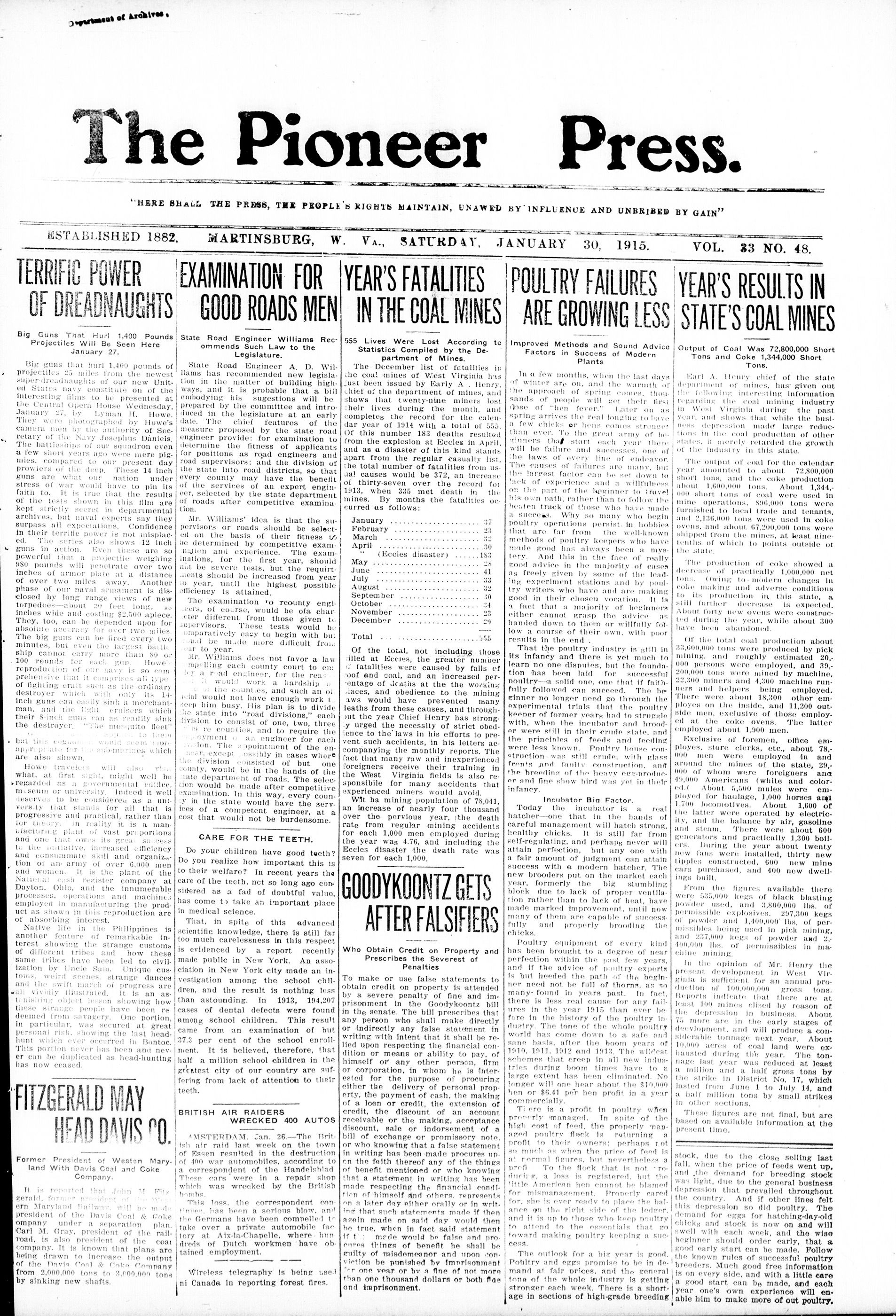
TERRIFIC POWER OF DREADNAUGHTS
Big Guns That Hurl 1,400 Pounds Projectiles Will Be Seen Here January 27.
Big guns that hurl 1,400 pounds of projectiles 25 miles from the newest super-dreadnoughts of our new United States navy constitute on of the interesting films to be presented at the Central Opera House Wednesday, January 27, by Lyman H. Howe. They were photographed by Howe's camera men by the authority of Secretary of the Navy Josephus Daniels. The battleships of our squadron even a few short years ago were mere pigmies, compared to our present day prowlers of the deep. These 14 inch guns are what our nation under stress of war would have to pin its faith to. It is true that the results of the tests shown in this film are kept strictly secret in departmental archives, but naval experts say they surpass all expectations. Confidence in their terrific power is not misplaced. The series also shows 12 inch guns in action. Even these are so powerful that a projectile weighing 980 pounds will penetrate over two inches of armor plate at a distance of over two miles away. Another phase of our naval armament is disclosed by long range views of new torpedoes—about 29 feet long, 10 inches wide and costing $2,500 apiece. They, too, can be depended upon for absolute accuracy for over two miles. The big guns can be fired every two minutes, but even the largest battle ship cannot carry more than 80 or 100 rounds for each gun. Howe's reproduction of our navy is so comprehensive that it comprises all type of fighting craft such as the ordinary destroyer which with only its 14 inch guns can easily sink a merchantman, and the light cruisers which their Sincn guns can as readily sink the destroyer. "The mosquito fleet" but this cognition would seem more appropriate for the submarines which are also shown.
Howe travelers will also visit what, at first sight, might well be regarded as a governmental edifice, museum or university. Indeed it well deserves to be considered as a university that stands for all that is progressive and practical, rather than for theory. In reality it is a manufacturing plant of vast proportions and one that owes its great success to the initiative, increased efficiency and consummate skill and organization of an army of over 6,000 men and women. It is the plant of the National cash register company at Dayton, Ohio, and the innumerable processes, operations and machines employed in manufacturing the product as shown in this reproduction are of absorbing interest.
Native life in the Philippines is another feature of remarkable interest showing the strange customs of different tribes and how these same tribes have been led to civilization by Uncle Sam. Unique customs, weird scenes, strange dances and the swift march of progress are all vividly illustrated. It is an astonishing object lesson showing how these strange people have been redeemed from savagery. One portion, in particular, was secured at great personal risk, showing the last headhunt which ever occurred in Bontoc. This portion never has been and never can be duplicated as head-hunting has now ceased.
FITZGERALD MAY HEAD DAVIS CO.
FITZGERALD MAY HEAD DAVIS CO.
Former President of Westen Maryland With Davis Coal and Coke Company.
It is reported that John M. Fitzgerald, former president of the Western Maryland Railway, will be made president of the Davis Coal & Coke company under a separation plan. Carl M. Gray, president of the railroad, is also president of the coa company. It is known that plans are being drawn to increase the output of the Davis Coal & Coke Company from 2,000,000 tons to 3,000,000 tons by sinking new shafts.
EXAMINATION FOR GOOD ROADS MEN
State Road Engineer Williams Recommends Such Law to the Legislature.
State Road Engineer A. D. Williams has recommended new legislation in the matter of building highways, and it is probable that a bill embodying his suggestions will be prepared by the committee and introduced in the legislature at an early date. The chief features of the measure proposed by the state road engineer provide: for examination to determine the fitness of applicants for positions as road engineers and road supervisors; and the division of the state into road districts, so that every county may have the benefit of the services of an expert engineer, selected by the state department of roads after competitive examination.
Mr. Williams' idea is that the supervisors or roads should be selected on the basis of their fitness to be determined by competitive examination and experience. The examinations, for the first year, should not be severe tests, but the requirements should be increased from year to year, until the highest possible efficiency is attained.
The examination to recount engineers, of course, would be of a character different from those given to supervisors. These tests would be comparatively easy to begin with but could be made more difficult from year to year.
Mr. Williams does not favor a law compelling each county court to employ a road engineer, for the reason
It would work a hardship o in the counties, and such an official would not have enough work to keep him busy. His plan is to divide the state into "road divisions," each division to consist of one, two, three or four counties, and to require the employment of an engineer for each division. The appointment of the engineer, except possibly in cases where the division consisted of but one county, would be in the hands of the state department of roads. The selection would be made after competitive examination. In this way, every county in the state would have the services of a competent engineer, at a cost that would not be burdensome.
CARE FOR THE TEETH.
Do your children have good teeth? Do you realize how important this is to their welfare? In recent years the care of the teeth, net so long ago considered as a fad of doubtful value, has come to take an important place in medical science.
That, in spite of this advanced scientific knowledge, there is still far too much carelessness in this respect is evidenced by a report recently made public in New York. An association in New York city made an investigation among the school children, and the result is nothing less than astounding. In 1913, 194,207 cases of dental defects were found among school children. This result came from an examination of but 37.3 per cent of the school enrollment. It is believed, therefore, that half a million school children in the greatest city of our country are suffering from lack of attention to their teeth.
BRITISH AIR RAIDERS
WRECKED 400 AUTOS
AMSTERDAM, Jan. 26.—The British air raid last week on the town of Essen resulted in the destruction of 400 war automobiles, according to a correspondent of the Handelsblad. These cars were in a repair shop which was wrecked by the British bombs.
This loss, the correspondent continues, has been a serious blow, and the Germans have been compelled to take over a private automobile factory at Aix-la-Chapelle, where hundreds of Dutch workmen have obtained employment.
Wireless telegraphy is being used in Canada in reporting forest fires.
YEAR'S FATALITIES IN THE COAL MINES
555 Lives Were Lost According to Statistics Compiled by the Department of Mines.
The December list of fatalities in the coal mines of West Virginia has just been issued by Early A. Henry, chief of the department of mines, and shows that twenty-nine miners lost their lives during the month, and completes the record for the calendar year of 1914 with a total of 555. Of this number 183 deaths resulted from the explosion at Eccles in April, and as a disaster of this kind stands apart from the regular casualty list, the total number of fatalities from usual causes would be 372, an increase of thirty-seven over the record for 1913, when 335 met death in the mines. By months the fatalities occurred as follows:
January ..... 37
February ..... 23
March ..... 32
April ..... 30
" (Eccles disaster) ..... 183
May ..... 28
June ..... 41
July ..... 33
August ..... 32
September ..... 30
October ..... 34
November ..... 23
December ..... 29
Total ..... 55
Of the total, not including those killed at Eccies, the greater number of fatalities were caused by falls of roof and coal, and an increased percentage of deaths at the working places, and obedience to the mining laws would have prevented many deaths from these causes, and throughout the year Chief Henry has strongly urged the necessity of strict obedience to the laws in his efforts to prevent such accidents, in his letters accompanying the monthly reports. The fact that many raw and inexperienced foreigners receive their training in the West Virginia fields is also responsible for many accidents that experienced miners would avoid.
Wit ha mining population of 78,041, an increase of nearly four thousand over the pervious year, the death rate from regular mining accidents for each 1,000 men employed during the year was 4.76, and including the Eccles disaster the death rate was seven for each 1,000.
GOODYKOONTZ GETS AFTER FALSIFIERS
GOODYKOONTZ GETS AFTER FALSIFIERS
Who Obtain Credit on Property and Prescribes the Severest of Penalties
To make or use false statements to obtain credit on property is attended by a severe penalty of fine and imprisonment in the Goodykoontz bill in the senate. The bill prescribes that any person who shall make directly or indirectly any false statement in writing with intent that it shall be relied upon respecting the financial condition or means or ability to pay, of himself or any other person, firm or corporation, in whom he is interested for the purpose of procuring either the delivery of personal property, the payment of cash, the making of a loan or credit, the extension of credit, the discount of an account receivable or the making, acceptance discount, sale or indorsement of a bill of exchange or promissory note, or who knowing that a false statement in writing has been made procures upon the faith thereof any of the things of benefit mentioned or who knowing that a statement in writing has been made respecting the financial condition of himself and others, represents on a later day either orally or in writing that such statements made if then again made on said day would then be true, when in fact said statement if it made would be false and proceeds things of benefit he shall be guilty of misdemeanor and upon conviction he is punished by imprisonment for one year or by a fine of not more than one thousand dollars or both flag and imprisonment.
POULTRY FAILURES ARE GROWING LESS
Improved Methods and Sound Advice Factors in Success of Modern Plants
In a few months, when the last days of winter are on, and the warmth of the approach of spring comes, thousands of people will get their first dose of "hen fever." Later on as spring arrives the real longing to have a few chicks or hens comes stronger than ever. To the great army of beginners that start each year there will be failure and successes, one of the laws of every line of endeavor. The causes of failures are many, but the largest factor can be set down to lack of experience and a willfulness on the part of the beginner to travel his own path, rather than to follow the beaten track of those who have made a success. Why so many who begin poultry operations persist in hobbies that are far from the well-known methods of poultry keepers who have made good has always been a mystery. And this in the face of really good advice in the majority of cases as freely given by some of the leading experiment stations and by poultry writers who have and are making good in their chosen vocation. It is a fact that a majority of beginners either cannot grasp the advice as handed down to them or willfully follow a course of their own, with poor results in the end.
That the poultry industry is still in its infancy and there is yet much to learn no one disputes, but the foundation has been laid for successful poultry—a solid one, one that if faithfully followed can succeed. The beginner no longer need go through the experimental trials that the poultry keeper of former years had to struggle with, when the incubator and brooder were still in their crude state, and the principles of feeds and feeding were less known. Poultry house construction was still crude, with glass fronds and faulty construction, and the breeding of the heavy egg-producer and fine show bird was yet in their infancy.
Incubator Big Factor.
Today the incubator is a real hatcher—one that in the hands of careful management will hatch strong, healthy chicks. It is still far from self-regulating, and perhaps never will attain perfection, but any one with a fair amount of judgment can attain success with a modern hatcher. The new brooders put on the market each year, formerly the big stumbling block due to lack of proper ventilation rather than to lack of heat, have made marked improvement, until now many of them are capable of successfully and properly brooding the chicks.
Poultry equipment of every kind has been brought to a degree of near perfection within the past few years, and if the advice of poultry experts is but heeded the path of the beginner need not be full of thorns, as so many-found in years past. In fact, there is less real cause for any failures in the year 1915 than ever before in the history of the poultry industry. The tone of the whole poultry world has come down to a safe and sane basis, after the boom years of 1910, 1911, 1912 and 1913. The wildcat schemes that creep in all new industries during boom times have to a large extent has been eliminated. No longer will one hear about the $10,000 hen or $6.41 per hen profit in a year commercially.
There is a profit in poultry when properly managed. In spite of the high cost of feed, the properly managed poultry flock is returning a profit to their owners; perhaps not so much as when the price of feed is at normal figures, but nevertheless a profit. To the flock that is not producing, a loss is registered, but the little American hen cannot be blamed for mismanagement. Properly cared for, she is ever ready to place the balance on the right side of the ledger, and it is up to those who keep poultry to attend to the essentials that go toward making poultry keeping a success.
The outlook for a big year is good. Potltry and eggs promise to be in demand at fair prices, and the general tone of the whole industry is getting stronger each week. There is a shortage in sections of high-grade breeding
VOL. 33 NO. 48.
Output of Coal Was 72,800,000 Short Tons and Coke 1,344,000 Short Tons.
Earl A. Henry chief of the state department of mines, has given out the following interesting information regarding the coal mining industry in West Virginia during the past year, and shows that while the business depression made large reductions in the coal production of other states, it merely retarded the growth of the industry in this state.
The output of coal for the calendar year amounted to about 72,800,000 short tons, and the coke production about 1,600,000 tons. About 1,344,000 short tons of coal were used in mine operations, 896,000 tons were furnished to local trade and tenants, and 2,136,000 tons were used in coke ovens, and about 67,200,000 tons were shipped from the mines, at least nineteenth of which to points outside on the state.
The production of coke showed a decrease of practically 1,000,000 net tons. Owing to modern changes in coke making and adverse conditions to its production in this state, a still further decrease is expected. About forty new ovens were constructed during the year, while about 300 have been abandoned.
Of the total coal production about 33,600,000 tons were produced by pick mining, and roughly estimated 20,000 persons were employed, and 39,200,000 tons were mined by machine, 22,300 miners and 4,300 machine runners and helpers being employed. There were about 18,300 other employees on the inside, and 11,200 outside men, exclusive of those employed at the coke ovens. The latter employed about 1,900 men.
Exclusive of foremen, office employees, store clerks, etc., about 78,000 men were employed in and around the mines of the state, 29,000 of whom were foreigners and 49,000 Americans (white and colored.) About 5,500 mules were employed for haulage, 1,000 horses and 1,700 locomotives. About 1,600 of the latter were operated by electricity, and the balance by air, gasoline and steam. There were about 600 generators and practically 1,300 boilers. During the year about twenty new fans were installed, thirty new tipples constructed, 600 new mine cars purchased, and 400 new dwellings built.
From the figures available there were 535,000 kegs of black blasting powder used, and 3,800,000 lbs. of permissible explosives. 297,300 kegs of powder and 1,400,000 lbs. of permissibles being used in pick mining, and 237,000 kegs of powder and 2,400,000 lbs. of permissibles in machine mining.
In the opinion of Mr. Henry the present development in West Virginia is sufficient for an annual production of 100,000,000 gross tons. Reports indicate that there are at least 100 mines elised by reason of the depression in business. About 75 more are in the early stages of development, and will produce a considerable tonnage next year. About 10,000 acres of coal land were exhausted during this year. The tonnage last year was reduced at least a million and a half gross tons by the strike in District No. 17, which lasted from June 1 to July 14, and a half million tons by small strikes in other sections. These figures are not final, but are based on available information at the present time.
stock, due to the close selling last fall, when the price of feeds went up, and the demand for breeding stock was light, due to the general business depression that prevailed throughout the country. And if other lines felt this depression so did poultry. The demand for eggs for hatching-day-old chicks and stock is now on and will swell with each week, and the wise beginner should order early, that a good early start can be made. Follow the known rules of successful poultry breeders. Much good free information is on every side, and with a little care a good start can be made, and each year one's own experience will enable him to make more of out poultry.
Entered in Post Office at Martinsburg, W. Va. as Second Class Matter. J. I. Clifford, Editor and Proprietor. Drawer 869, and Bell 'Phone 60K. Martinsburg, W. Va.
8ATURDAY, JANUARY 30, 1915.
We think the President shows crass ignorance of this nation's future welfare—judging it by the past, in contending for ignorant immigration. If he vetoes the bill as passed, it ought to be passed over his veto.
To Mr. John F. Carter's credit he wants the public to know that he had nothing to do with their forcing Lillie Smith swearing to a lie. He says he simply happened along, saw the crowd and out of curiosity followed it and witnessed the foul act.
There is no cause for war with England, or any of the other warring countries. If it come, olicial blatherskites will bring it. "Watchful waiting" covered over with secret writings is a pretty good way to bring it on. The flag is all right in its original intent, but owing to the wholesale murdering of its own citizenship under its folds without protest, gives it little or no standing abroad.
Rev. Dr. Prettyman, Chaplain of the United States Senate and who some years back was in charge of the Martin Street M. E. Church, South, is of the Christ type of men. To illustrate: When selected by a popular vote to go abroad with nearly a score of ministers at the expense of the Washington Post, Rev. Mr. Clair, a genuine black man was one of them. Most of the white preachers objected to go and associate with this real black man. Dr. Prettyman was not only willing to go with Dr. Clair, but told the world he had no objection whatever to associating with him. Had this country been thick with such men, Robert Ingersoll would not have been an infidel(?)
We are in receipt of "a marked copy" of the Huntington Herald-Dispatch. The marked writing is the production of Prof. Scott, favors a real state college for the people; and his statements are so sensible, practical and forceful they cannot be coughed down and out of the Legislature. We wholeheartedly endorse it, and urge our law makers to unite and give us a good State University. Believe it will without opposition be arranged for, we hope it will not be located at Institute, but a healthier and a better central place—Elkins, Buckhannon, or somewhere in the Eastern Panhandle.
On the project, the Herald-Dispatch's editorial is sound, fair and convincing. It is the only way for manly white men to boldly speak out and up for the black man's rights and equal chances in life.
TWO OATHS, EXPLANATION
EXCORIATION.
OATH No 1.
State of West Virginia, Berkeley County,
to wit:
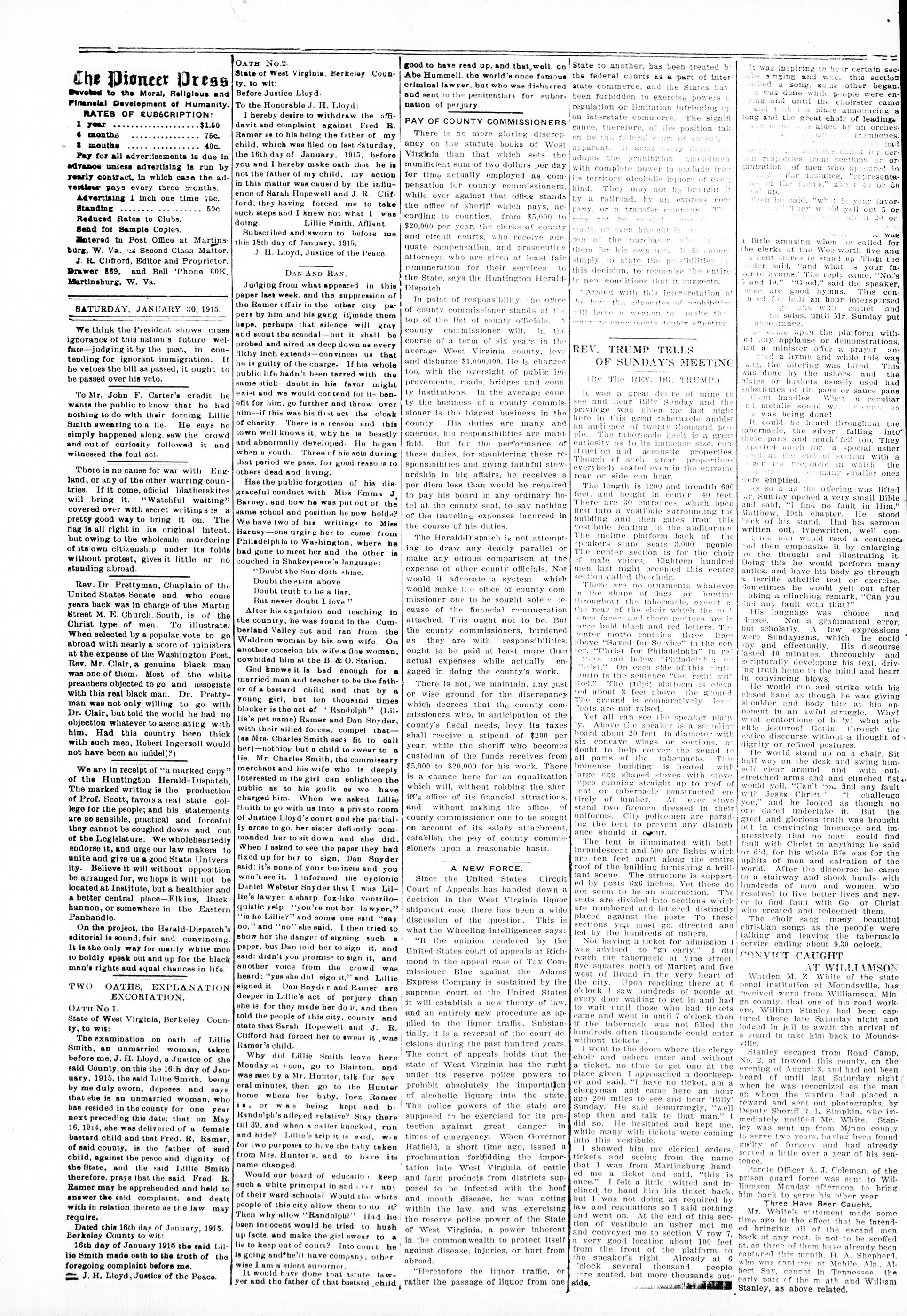
The examination on oath of Lillie Smith, an unmarried woman, taken before me, J. H. Lloyd, a Justice of the said County, on this the 16th day of January, 1915, the said Lillie Smith, being by me duly sworn, deposes and says, that she is an unmarried woman, who has resided in the county for one year next preceding this date; that on May 16, 1914, she was delivered of a female bastard child and that Fred. R. Ramer, of said county, is the father of said child, against the peace and dignity of the State, and the said Lillie Smith therefore, prays that the said Fred. R. Ramer may be apprehended and held to answer the said complaint, and dealt with in relation thereto as the law may require.
Dated this 16th day of January, 1915. Berkeley County to wit: 16th day of January 1915 the said Lillie Smith made oath to the truth of the foregoing complaint before me.
State of West Virginia. Berkeley County, to wit:
I hereby desire to withdraw the affidavit and complaint against Fred R. Ramer as to his being the father of my child, which was filed on last Saturday, the 16th day of January, 1915, before you and I hereby make oath that he is not the father of my child, my action in this matter was caused by the influence of Sarah Hopewell and J. R. Clifford, they having forced me to take such steps and I knew not what I was doing. Lillie Smith, Affiant.
Subscribed and sworn to before me this 18th day of January, 1915. J. H. Lloyd, Justice of the Peace.
DAN AND RAN.
Judging from what appeared in this paper last week, and the suppression of the Ramer affair in the other city papers by him and his gang, it made them hope, perhaps that silence will gray and scout the scandal—but it shall be probed and aired as deep down as every filthy inch extends—convinces us that he is guilty of the charge. If his whole public life hadn't been tarred with the same stick—doubt in his favor might exist and we would contend for its benefit for him, go further and throw over him—if this was his first act the cloak of charity. There is a reason and this town well knows it, why he is beastly and abnormally developed. He began when a youth. Three of his acts during that period we pass, for good reasons to others dead and living.
Has the public forgotten of his disgraceful conduct with Miss Emma J. Barney, and how he was put out of the same school and position he now hold? We have two of his writings to Miss Barney—one urging her to come from Philadelphia to Washington, where he had gone to meet her and the other is couched in Shakespeare's language:
"Doubt the Sun doth shine,
Doubt the stars above
Doubt truth to be a liar.
But never doubt I love"
After his expulsion and teaching in the country, he was found in the Cumberland Valley cut and ran from the Waldron woman by his own wife. On another occasion his wife a fine woman, cowhided him at the B. & O. Station.
God knows it is bad enough for a married man and teacher to be the father of a bastard child and that by a young girl, but ten thousand times blacker is the act of 'Randolph' (Lillie's pet name) Ramer and Dan Snyder, with their allied forces, compel that—(as Mrs. Charles Smith sees fit to call her)—nothing but a child to swear to a lie. Mr. Charles Smith, the commissary merchant and his wife who is deeply interested in the girl can enlighten the public as to his guilt as we have charged him. When we asked Lillie Smith to go with us into a private room of Justice Lloyd's court and she partially arose to go, her sister defiantly commanded her to sit down and she did. When I asked to see the paper they had fixed up for her to sign, Dan Snyder said: it's none of your business and you won't see it. I informed the cyclonic Daniel Webster Snyder that I was Lillie's lawyer: a sharp fox-like ventriloquistic yelp "you're not her lawyer," "is he Lillie?" and some one said "say no," and "no" she said. I then tried to show her the danger of signing such a paper, but Dan told her to sign it, and said: didn't you promise to sign it, and another voice from the crowd was heard: "yes she did, sign it," and Lillie signed it. Dan Snyder and Ramer are deeper in Lillie's act of perjury than she is, for they made her do it, and then told the people of this city, county and state that Sarah Hopewell and J. R. Clifford had forced her to swear it, was Ramer's child.
Why did Lillie Smith leave here Monday at noon, go to Blairton, and was met by a Mr. Hunter, talk for several minutes, then go to the Hunter home where her baby, Inez Ramer is, or was being kept and be Randolph's alleged relative? Stay there till 30, and when a caller knocked, run and hide? Lillie's trip it is said, was for two purposes to have the baby taken from Mrs. Hunter's, and to have its name changed.
Would our board of education keep such a white principal in and over any of their ward schools? Would the white people of this city allow them to do it? Then why allow "Randolph?" Had he been innocent would he tried to hush up facts, and make the girl swear to a lie to keep out of court? Into court he is going and he'll have company, otherwise I am a silent suitor. It would have done that astute lawyer and the father of that bastard child
good to have read up, and that well, on Abe Hummell, the world's once famous criminal lawyer, but who was disbarred and sent to the penitentiary for subornation of perjury.
PAY OF COUNTY COMMISSIONERS
There is no more glaring discrepancy on the statute books of West Virginia than that which sets the munificient sum of two dollars per day for time actually employed as compensation for county commissioners, while over against that office stands the office of sheriff which pays, according to counties, from $5,000 to $20,000 per year, the clerks of county and circuit courts, who receive adequate compensation, and prosecuting attorneys who are given at least fair remuneration for their services to the State, says the Huntington Herald-Dispatch.
In point of responsibility, the office of county commissioner stands at the top of the list of county officials. A county commissioner will, in the course of a term of six years in the average West Virginia county, levy and disburse $1,000,000. He is charged too, with the oversight of public improvements, roads, bridges and county institutions. In the average county the business of a county commissioner is the biggest business in the county. His duties are many and onerous, his responsibilities are manifold. But for the performance of these duties, for shouldering these responsibilities and giving faithful stewardship in big affairs, he receives a per diem less than would be required to pay his board in any ordinary hotel at the county seat, to say nothing of the traveling expenses incurred in the course of his duties.
The Herald-Dispatch is not attempting to draw any deadly parallel or make any odious comparison at the expense of other county officials. Nor would it advocate a system which would make the office of county commissioner one to be sought solely because of the financial remuneration attached. This ought not to be. But the county commissioners, burdened as they are with responsibilities, ought to be paid at least more than actual expenses while actually engaged in doing the county's work.
There is not, we maintain, any just or wise ground for the discrepancy which decrees that the county commissioners who, in anticipation of the county's fiscal needs, levy its taxes shall receive a stipend of $200 per year, while the sheriff who becomes custodian of the funds receives from $5,000 to $20,000 for his work. There is a chance here for an equalization which will, without robbing the sheriff's office of its financial attractions, and without making the office of county commissioner one to be sought on account of its salary attachment, establish the pay of county commissioners upon a reasonable basis.
A NEW FORCE.
Since the United States Circuit Court of Appeals has handed down a decision in the West Virginia liquor shipment case there has been a wide discussion of the question. This is what the Wheeling Intelligencer says: "If the opinion rendered by the United States court of appeals at Richmond in the appeal case of Tax Commissioner Blue against the Adams Express Company is sustained by the supreme court of the United States it will establish a new theory of law, and an entirely new procedure as applied to the liquor traffic. Substantially, it is a reversal of the court decisions during the past hundred years. The court of appeals holds that the state of West Virginia has the right under its reserve police powers to prohibit absolutely the importation of alcoholic liquors into the state. The police powers of the state are supposed to be exercised for its protection against great danger in times of emergency. When Governor Hatfield, a short time ago, issued a proclamation for bidding the importation into West Virginia of cattle and farm products from districts supposed to be infected with the hoof and mouth disease, he was acting within the law, and was exercising the reserve police power of the State of West Virginia, a power inherent in the commonwealth to protect itself against disease, injuries, or hurt from abroad.
"Heretofore the liquor traffic, or rather the passage of liquor from one
State to another, has been treated by the federal courts as a part of interstate commerce, and the States have been forbidden to exercise powers of regulation or limitation infringing upon interstate commerce. The significance, therefore, of the position taken by the federal court of appeals apparent. It arms every State that adopts the prohibition amendment with complete power to exclude from its territory alcoholic liquors of every kind. They may not be brought it by a railroad, by an express company, or a transfer company. They may not be carried through mails, or even brought in, by son of the purchaser who in them for his own use. It is enough simply to state the possibilities of this decision, to recognize the entirely new conditions that it suggests.
"Armed with this interpretation of the law, the advocates of prohibition will have a weapon to make the statutory enquiries doubly effective.
REV. TRUMP TELLS OF SUNDAY'S MEETING
(By The REV. DR. TRUMP.)
It was a great desire of mine to see and hear Billy Sunday and the privilege was given me last night here in this great tabernacle amidst an audience of twenty thousand people. The tabernacle itself is a great curiosity as to its immense size, construction and acoustic properties. Though of such great proportions everybody seated even in the extreme rear or side can hear.
The length is 1200 and breadth 600 feet, and height in center 40 feet. There are 30 entrances, which open first into a vestibule surrounding the building and then gates from this vestibule leading to the auditorium. The incline platform back of the speakers stand seats 3,000 people. The center section is for the choir of male voices. Eighteen hundred men last night occupied this center section called the choir.
There are no ornaments whatever in the shape of flags or bunting throughout the tabernacle, except at the rear of the chair which the and once faces, and these mottees are in large bold black and red letters. The center motto contains three lines above "Saved for Service" in the center, "Christ for Philadelphia" in refers and below "Philadelphia for Christ." On each side of this center motto is the sentence "Get right with God." The pulpit platform is elevated about 8 feet above the ground. The ground is comparatively level. Seats are not raised.
Yet all can see the speaker plainly. Above the speaker is a sounding board about 20 feet in diameter with six concave wings or sections, no doubt to help convey the sound to all parts of the tabernacle. This immense building is heated with large egg shaped stoves with sloepeipes running straight up to roof of tent or tabernacle constructed entirely of lumber. At ever stove stand two firemen dressed in their uniforms. City policemen are parading the tent to prevent any disturbance should it occur.
The tent is illuminated with both incandescent and 500 are lights which are ten feet apart along the entire roof of the building furnishing a brilliant scene. The structure is supported by posts 6x6 inches. Yet these do not seem to be an construction. The seats are divided into sections which are numbered and lettered distinctly placed against the posts. To these sections you must go, directed and led by the hundreds of ushers.
Not having a ticket for admission I was advised to "go early." I did reach the tabernacle at Vine street, five squares north of Market and five west of Broad in the very heart of the city. Upon reaching there at 6 o'clock I saw hundreds of people at every door waiting to get in and had to wait until those who had tickets came and went in until 7 o'clock then if the tabernacle was not filled the hundreds often thousands could enter without tickets.
I went to the doors where the clergy choir and ushers enter and without a ticket, no time to get one at the place given. I approached a doorkeeper and said, "I have no ticket, am a clergyman and came here an hour ago 200 miles to see and hear 'Billy' Sunday.' He said demurringly, "well step then and talk to that man." I did so. He hesitated and kept me, while many with tickets were coming into this vestibule.
I showed him my clerical orders, tickets and seeing from the name that I was from Martinsburg handed me a ticket and said, "this is once." I felt a little twisted and inclined to hand him his ticket back, but I was not doing as required by law and regulations so I said nothing and went on. At the end of this section of vestibule an usher met me and conveyed me to section V row 7, a very good location about 100 feet from the front of the platform to the speaker's right. Already at 6 clock several thousand people were seated, but more thousands outside.
It was inspiring to hear certain sec-
cles singing and when this section
inched a song, some other began.
It was done while people were en-
gling and until the choirist came
and took his place announcing a
song and the great choir of leading
Foen he said, "what is your favor-
ment?" They would yell out 5 or
more, and there were about 20 or
a little amusing when he called for
the clerks of the Woolworth five and
a cent stores to stand up. Then the
seller said, "and what is your favor-
ite hymns." The reply came, "No.'s
5 and 10." "Good," said the speaker,
those are good hymns. This con-
nued for half an hour interspersed
we come upon the platform without any applause or demonstrations, had a minister offer a prayer annecd a hymn and while this was long, the offering was lifted. This was done by the ushers and the plates or baskets usually used had substitutes of tin pans or sauce pans without handles. What a peculiar and metallic sound was produced as was being done! It could be heard throughout the tabernacle, the silver falling into these pans and much fell too. They expected much for a special usher used at the end of section with a larger to receptacle in which the contents of these many smaller ones were emptied.
As so it as the offering was lifted on, Sunday opened a very small Bible and said, "I find no fault in Him," Matthew, 19th chapter. He stood back of his stand. Had his sermon written out, typewritten, well congened and would read a sentence, and then emphasize it by enlarging on the thought and illustrating it. Doing this he would perform many antics, and have his body go through a terrific atheltic test or exercise. Sometimes he would yell out after taking a clinching remark, "Can you find any fault with that?"
His language was choice and chaste. Not a grammatical error, but scholarly. A few expressions were Sundayisms, which he could say and effectually. His discourse lasted 40 minutes, thoroughly and scripturally developing his text, driving truth home to the mind and heart in convincing blows.
He would run and strike with his closed hand as though he was giving shoulder and body hits at his opponent in an awful struggle. Why! what contortions of body! what athletic jestures! Gotin' through the entire discourse without a thought of dignity or refined postures.
He would stand up on a chair. Sit half way on the desk and swing himself clear around and with out-stretched arms and and clinched fist would yell, "Can't you find any fault with Jesus Christ" "I challenge you," and he looked as though no one dared undertake it. But the great and glorious truth was brought out in convincing language and impressively that no man could find fault with Christ in anything he said or did, for his whole life was for the uplifts of men and salvation of the world. After the discourse he came to a stairway and shook hands with hundreds of men and women, who resolved to live better lives and never to find fault with Go or Christ who created and redeemed them.
The choir sang many beautiful christian songs as the peopile were talking and leaving the tabernacle service ending about 9.30 oclock.
CONVICT CAUGHT
AT WILLIAMSON
Warden M. Z. White of the state penal institution at Moundsville, has received word from Williamson, Mingo county, that one of his road workers, William Stanley had been captured there late Saturday night and lodged in jail to await the arrival of a guard to take him back to Moundsville.
Stanley escaped from Road Camp, No. 2, at Inwood, this county, on the evening of August 8, and had not been heard of until last Saturday night when he was recognized as the man on whom the warden had placed a reward and sent out photographs, by Deputy Sheriff R. L. Simpkin, who immediately notified Mr. White. Stanley was sent up from Mingo county to serve two years, having been found guilty of forgery and had already served a little over a year of his sentence. Parole Officer A. J. Coleman, of the prison guard force was sent to Williamson Monday afternoon to bring him back to serve his other year.
Mr. White's statement made some time ago to the effect that he intended bringing all of the escapd men back at any cost, is not to be scoffed at, as three of them have already been captured this month. H. A. Shepherd, who was captured at Mobile, Ala., Albert Say, caught in Tennessee, the early part of the month and William Stanley, as above related.
CARPATHIANS FORM HUNGARY'S DEFENSE
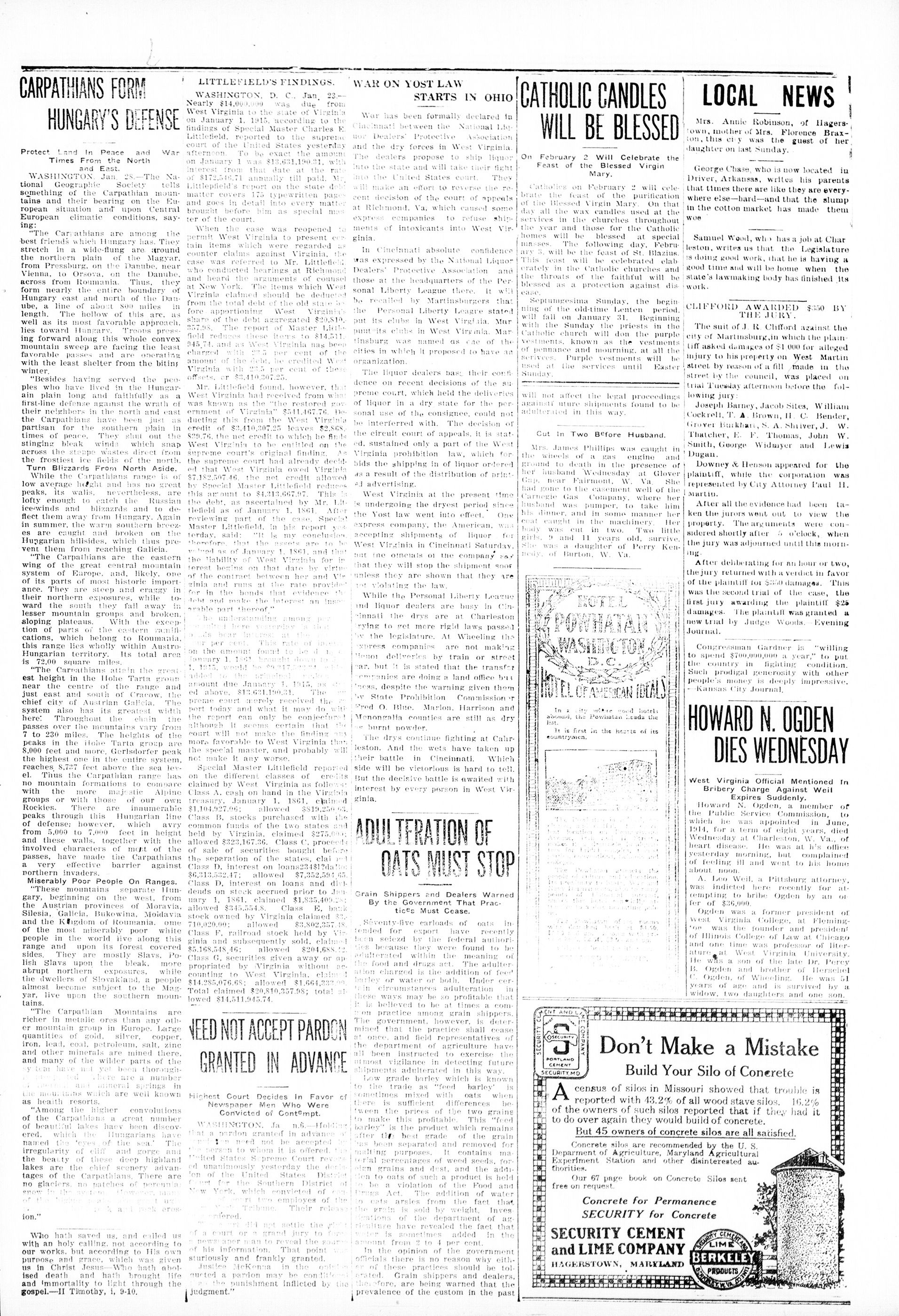
Protect Land In Peace and War Times From the North and East. WASHINGTON, Jan. 28.-The National Geographic Society tells something of the Carpathian mountains and their bearing on the European situation and upon Central European climatic conditions, saying:
"The Carpathians are among the best friends which Hungary has. They stretch in a wide-flung are around the northern plain of the Magyar, from Pressburg, on the Danube, near Vienna, to Orsova, on the Danube, across from Roumania. Thus, they form nearly the entire boundary of Hungary east and north of the Danube, a line of about 800 miles in length. The hollow of this arc, as well as its most favorable approach, lies toward Hungary. Troops pressing forward along this whole convex mountain sweep are facing the least favorable passes and are operating with the least shelter from the biting winter.
"Besides having served the peoples who have lived in the Hungarian plain long and faithfully as a first-line defense against the wrath of their neighbors in the north and east the Carpathians have been just as partisan for the southern plain in times of peace. They shut out the stinging bleak winds which snap across the stuppe wastes direct from the frostiest ice fields of the north. Turn Blizzards From North Aside. While the Carpathians range is of low average height and has no great peaks, its walls, nevertheless, are lofty enough to catch the Russian ice-winds and blizzards and to deflect them away from Hungary. Again in summer, the warm southern breezes are caught and broken on the Hungarian hillsides, which thus prevent them from reaching Galicia.
"The Carpathians are the eastern wing of the great central mountain system of Europe, and, likely, one of its parts of most historic importance. They are steep and eraggy in their northern exposures, while toward the south they fall away in lesser mountain groups and broken, sloping plateaus. With the exception of parts of the eastern manifestations, which belong to Roumania, this range lies wholly within Austro-Hungarian territory. Its total area is 72,00 square miles.
"The Carpathians attain the greatest height in the Hohe Tarta group near the centre of the range and just east and south of Cracow, the chief city of Austrian Galicia. The system also has its greatest width here. Throughout the chain the passes over the mountains vary from 7 to 230 miles. The heights of the peaks in the itohe Tarta group are 8,000 feet and more. Gerlsdorfer peak the highest one in the entire system, reaches 8,737 feet above the sea level. Thus the Carpathian range has no mountain formations to compare with the more majestic Alpine groups or with those of our own Rockies. There are innumerable peaks through this Hungarian line of defense; however, which avry from 5,000 to 7,000 feet in height and these walls, together with the involved characters of most of the passes, have made the Carpathians a very effective barrier against northern invaders.
Miserably Poor People On Ranges. "These mountains separate Hungary, beginning on the west, from the Austrian provinces of Moravia, Silesia, Galicia, Bukowina, Moldavia and the Kingdom of Roumania, one of the most miserably poor white people in the world live along this range and upon its forest covered sides. They are mostly Slavs, Polish Slavs upon the bleak, more abrupt northern exposures, while the dwellers of Slovakland, a people almost become subject to the Magyar, live upon the southern mountains.
"The Carpathian Mountains are richer in metalic ores than any other mountain group in Europe. Large quantities of gold, silver, copper, iron, lead, coal, petroleum, salt, zinc and other minerals are mined there, and many of the wilder parts of the system have not yet been thoroughly explored. There are a number of mineral and mineral springs in the mountains which are well known as health resorts.
"Among the higher convolutions of the Carpathians a great number of beautiful lakes haev been discovered, which the Hungarians have named the 'eyes of the sea.' The irregularity of cliff and gorge and the beauty of these deep highland lakes are the chief scenery advantages of the Carpathians. There are no glaciers, no patches of perennial snow in the system, however, many of the higher mountains have great ag. in rock and peak erosion."
Who hath saved us, and called us with an holy calling, not according to our works, but according to His own purpose and grace, which was given us in Christ Jesus—Who hath abolished death and hath brought life and immortality to light through the gospel.—II Timothy, i. 9-10.
LITTLEFIELD'S FINDINGS.
WASHINGTON, D. C., Jan. 23.—Nearly $14,000,000 was due from West Virginia to the state of Virginia on January 1, 1915, according to the findings of Special Master Charles E. Littlefield, reported to the supreme court of the United States yesterday afternoon. To be exact the amount on January 1 was $13,631,190.31, with interest from that date at the rate of $172,546.71 annually till paid. Mr. Littlefield's report on the state debt matter covers 175 typewritten pages and goes in detail into every matter brought before him as special master of the court.
When the case was reopened to permit West Virginia to present certain items which were regarded as counter claims against Virginia, the case was referred to Mr. Littlefield, who conducted hearings at Richmond and heard the arguments of counsel at New York. The items which West Virginia claimed should be deducted from the total debt of the old state before apportioning West Virginia's share of the debt aggregated $20,810,357.98. The report of Master Littlefield reduces these items to $14,511,945.74, and as West Virginia has been charged with 23.5 per cent of the amount of the debt, he credited West Virginia with 23.5 per cent of these offsets, or $3,410,307.25.
Mr. Littelfield found, however, that West Virginia had received from what was known as the "the restored government of Virginia" $541,467.76. Deducting this from the West Virginia credit of $3,410,307.25 leaves $2,868,829.76, the net credit to which he finds West Virginia to be entitled on the supreme court's original finding. As the supreme court had already decided that West Virginia owed Virginia $7,182,507.46, the net credit allowed by Special Master Littlefield reduces this amount to $4,313,667.97. This is the debt, as ascertained by Mr. Littelfield as of January 1, 1861. After reviewing part of the case, Special Master Littlefield, in his report yesterday, said: "It is my conclusion therefore, that the assets are to be valued as of January 1, 1861, and that the liability of West Virginia for interest begins on that date by virtue of the contract between her and Virginia and runs at the rate provided for in the bonds that evidence the debt and make the interest an insurable part thereof."
The understanding among per- sentees here yesterday is that our bears hear interest at the court per cent. This rate of interest on the amount found to be due on January 1, 1881 brought down to 1.1915, would be $9,217,523.41 which added to the principal wages amount due January 1, 1915, as stated above, $13,631,199.31. The preme court merely received the report today and what it may do with the report can only be conjectured although it seems certain that the court will not make the finding any more favorable to West Virginia that the special master, and probably will not make it any worse.
Special Master Littlefield reported on the different classes of credits claimed by West Virginia as follows: Class A, cash on hand in the Virginia treasury, January 1, 1861, claimed $1,104,927.96; allowed $819,250.63; Class B, stocks purchased with the common funds of the two states and held by Virginia, claimed $275,000; allowed $323,167.36. Class C, proceeds of sale of securities bought before the separation of the states, claimed Class D, interest on loans2341?dated $6,313,532.47; allowed $7,352,594.65. Class D, interest on loans and dividends on stock accrued prior to January 1, 1861, claimed $1,835,409.28; allowed $345,554.8. Class E, bank stock owned by Virginia claimed $3,710,020.00; allowed $3,802,357.48. Class F, railroad stock held by Virginia and subsequently sold, claimed $5,168,548.46; allowed $204,688.12. Class G, securities given away or appropriated by Virginia without accounting to West Virginia, claimed $14,285,076.68; allowed $1,664,333.00. Total claimed $20,810,357.98; total allowed $14,511,945.74.
NEED NOT ACCEPT PARDON GRANTED IN ADVANCE
Highest Court Decides In Favor of Newspaper Men Who Were Convicted of Contempt.
WASHINGTON. Ja n.6.—Holding that a pardon granted in advance of conviction need not be accepted by the person to whom it is offered, the United States Supreme Court reversed unanimously yesterday the decision of the United States District Court for the Southern District of New York, which convicted of conspiracy court two employees of the New York Tribune. Their release was ordered.
The court did not settle the guilt of a court or a grand jury to form a newspaper man to reveal the source of his information. That point was sturiously and frankly granted.
Justice McKenna in the opinion quoted a pardon may be conditional to the punishment inflicted by the judgment."
War has been formally declared in Cincinnati between the National Liquor Dealers' Protective Association and the dry forces in West Virginia. The dealers propose to ship liquor into the state and will take their fight into the United States court. They will make an effort to reverse the recent decision of the court of appeals at Richmond, Va, which caused some express companies to refuse shipments of intoxicants into West Virginia.
In Cincinnati absolute confidence was expressed by the National Liquor Dealers' Protective Association and those at the headquarters of the Personal Liberty League there. It will be recalled by Martinsburgers that the Personal Liberty League stated put its clubs in West Virgina. Murpunt its clubs in West Virginia. Martinsburg was named as one of the cities in which it proposed to have an organization.
The liquor dealers bas their confidence on recent decisions of the supreme court, which held the deliveries of liquor in a dry state for the personal use of the consignee, could not be interfered with. The decision of the circuit court of appeals, it is stated, sustained only a part of the West Virginia prohibition law, which for bids the shipping in of liquor ordered as a result of the distribution of print advertising.
West Virginia at the present time is undergoing the dryest period since the Yost law went into effect. One express company, the American, was accepting shipments of liquor for West Virginia in Cincinnati Saturday, but the omelets of the company said that they will stop the shipment soon unless they are shown that they are not violating the law.
While the Personal Liberty League and liquor dealers are busy in Cincinnati the drys are at Charleston trying to get more rigid laws passed by the legislature. At Wheeling the express companies are not making liquor deliveries by train or street car, but it is stated that the transfer companies are doing a land office business, despite the warning given them by State Prohibition. Commissioner Fred O. Blute, Marion, Harrison and Menongalia counties are still as dry as burnt powder.
The drys continue fighting at Calrleston. And the wets have taken up their battle in Cincinnati. Which side will be victorious is hard to tell. But the decisive battle is awaited with interest by every person in West Virginia.
ADULTERATION OF OATS MUST STOP
Grain Shippers and Dealers Warned By the Government That Practices Must Cease.
Seventy-five carloads of oats intended for export have recently been seized by the federal authorities because they were found to be adulterated within the meaning of the food and drugs act. The adulteration charged is the addition of feed barley or water or both. Under certain circumstances adulteration in these ways may be so profitable that it is believed to be at times a common practice among grain shippers. The government, however, is determined that the practice shall cease at once, and field representatives of the department of agriculture have all been instructed to exercise the utmost vigilance in detecting future shipments adulterated in this way.
Low grade barley which is known to the trade as "feed barley" is sometimes mixed with oats when there is sufficient differences between the prices of the two grains to make this profitable. This "feed barley" is the product which remains after the best grade of the grain has been separated and removed for mating purposes. It contains material percentages of weed seeds, foreign grains and dust, and the addition to oats of such a product is held to be a violation of the Food and Drugs Act. The addition of water to oats arcs from the fact that the grain is sold by weight. Investigations of the department of agriculture have revealed the fact that water is sometimes added in the amount from 2 to 4 per cent.
In the opinion of the government officials there is no reason why either of these practices should be tolerated. Grain shippers and dealers, therefore, are being warned that the prevalence of the custom in the past
Don't Make a Mistake
Build Your Silo of Concrete
A census of silos in Missouri showed that trouble is reported with 43.2% of all wood stave silos. 16.2% of the owners of such silos reported that if they had it to do over again they would build of concrete.
But 45 owners of concrete silos are all satisfied.
Concrete silos are recommended by the U. S. Department of Agriculture, Maryland Agricultural Experiment Station and other disinterested authorities.
Our 67 page book on Concrete Silos sent free on request.
Concrete for Permanence
SECURITY for Concrete
SECURITY CEMENT
and LIME COMPANY
HAGERSTOWN, MARYLAND
CATHOLIC CANDLES WILL BE BLESSED
On February 2 Will Celebrate the Feast of the Blessed Virgin Mary.
Catholics on February 2 will celebrate the feast of the purification of the Blessed Virgin Mary. On that day all the wax candles used at the services in the churches throughout the year and those for the Catholic homes will be blessed at special masses. The following day, February 3, will be the feast of St. Blazius. This feast will be celebrated elaborately in the Catholic churches and the throats of the faithful will be blessed as a protection against disease.
Septemberima Sunday, the beginning of the old-time Lenten period, will fall on January 31. Beginning with the Sunday the priests in the Catholic church will don the purple vestments, known as the vestments of penance and mourning, at all the services. Purple vestments will be used at the services until Easter Sunday.
will not affect the legal proceedings against future shipments found to be adulterated in this way.
Cut In Two Before Husband.
Mrs. James Phillips was caught in the wheels of a gas engine and ground to death in the presence of her husband Wednesday at Glover Gap, near Fairmont, W. Va. She had gone to the casement well of the Carnegie Gas Company, where her husband was pumper, to take him his dinner, and in some manner her coat caught in the machinery. Her body was cut in two. Two little girls, 9 and 11 years old, survive. She was a daughter of Perry Kennedy, of Burton, W. Va.
HOTEL
POWHATAN
WASHINGTON
D.C.
HOTEL OF AMERICAN IDEALS
In a city where good hotels
abound, the Powhatan leads the
list.
It is first in the hearts of its countrymen.
The Population estimates the
population of culture and education.
The proximity to State, Ward and
Navy Depot provides the many
points of interest.
The location • • • helps to
provide a clear understanding of
the area of operation of the
company.
The location of the company
is described below. $45, 50,
$45, 50 and $45, 50 are the
prices of the company at the
location. $25, 60, $25, 60 and $25, 60 are the
prices of the company at the
location.
SECURITY CEMENT AND LYME COMPANY
S
SECURITY
PORTLAND
CEMENT
SECURITY MD
Don't M
Build You
LOCAL NEWS
Mrs. Annie Robinson, of Hagerstown, mother of Mrs. Florence Braxton, this city was the guest of her daughter on last Sunday.
George Chase, who is now located in Driver, Arkansas, writes his parents that times there are like they are everywhere else—hard—and that the slump in the cotton market has made them woe.
Samuel Wood, who has a job at Charleston, writes us that the Legislature is doing good work, that he is having a good time and will be home when the state's lawmaking body has finished its work.
CLIFFORD AWARDED $350 BY THE JURY.
The suit of J. R. Clifford against the city of Martinsburg, in which the plaintiff asked damages of $1,000 for alleged injury to his property on West Martin street by reason of a fill made in the street by the council, was placed on trial Tuesday afternoon before the following jury:
Joseph Barney, Jacob Sites, William Cockrell, T. A. Brown, H. C. Bender, Grover Burkhart, S. A. Shriver, J. W. Thatcher, E. F. Thomas, John W. Smith, George Widmyer and Lewis Dugan.
Downey & Henson appeared for the plaintiff, while the corporation was represented by City Attorney Paul H. Martin.
After all the evidence had been taken the jurors went out to view the property. The arguments were considered shortly after 5 o'clock, when the jury was adjourned until this morning.
After deliberating for an hour or two, the jury returned with a verdict in favor of the plaintiff for $350 damages. This was the second trial of the case, the first jury awarding the plaintiff $25 damages. The plaintiff was granted a new trial by Judge Woods. Evening Journal.
Congressman Gardner is "willing to spend $700,000,000 a year," to put the country in fighting condition. Such prodigal generosity with other people's money is deeply impressive.—Kansas City Journal
HOWARD N. OGDEN DIES WEDNESDAY
West Virginia Official Mentioned In Bribery Charge Against Weil Expires Suddenly.
Howard N. Ogden, a member of the Public Service Commission, to which he was appointed in June, 1914, for a term of eight years, died Wednesday at Charleston, W. Va., of heart disease. He was at his office yesterday morning, but complained of feeling ill and went to his home about noon.
A. Leo Weil, a Pittsburg attorney, was indicted here recently for attempting to bribe Ogden by an offer of $36,000.
Ogden was a former president of West Virginia College, at Fleming-ton was the founder and president of Illinois College of Law at Chicago and one time was professor of literature at West Virginia University. He was a son of the late Dr. Percy B. Ogden and brother of Herschel C. Ogden, of Wheeling. He was 51 years of age and is survived by a widow, two daughters and one son.
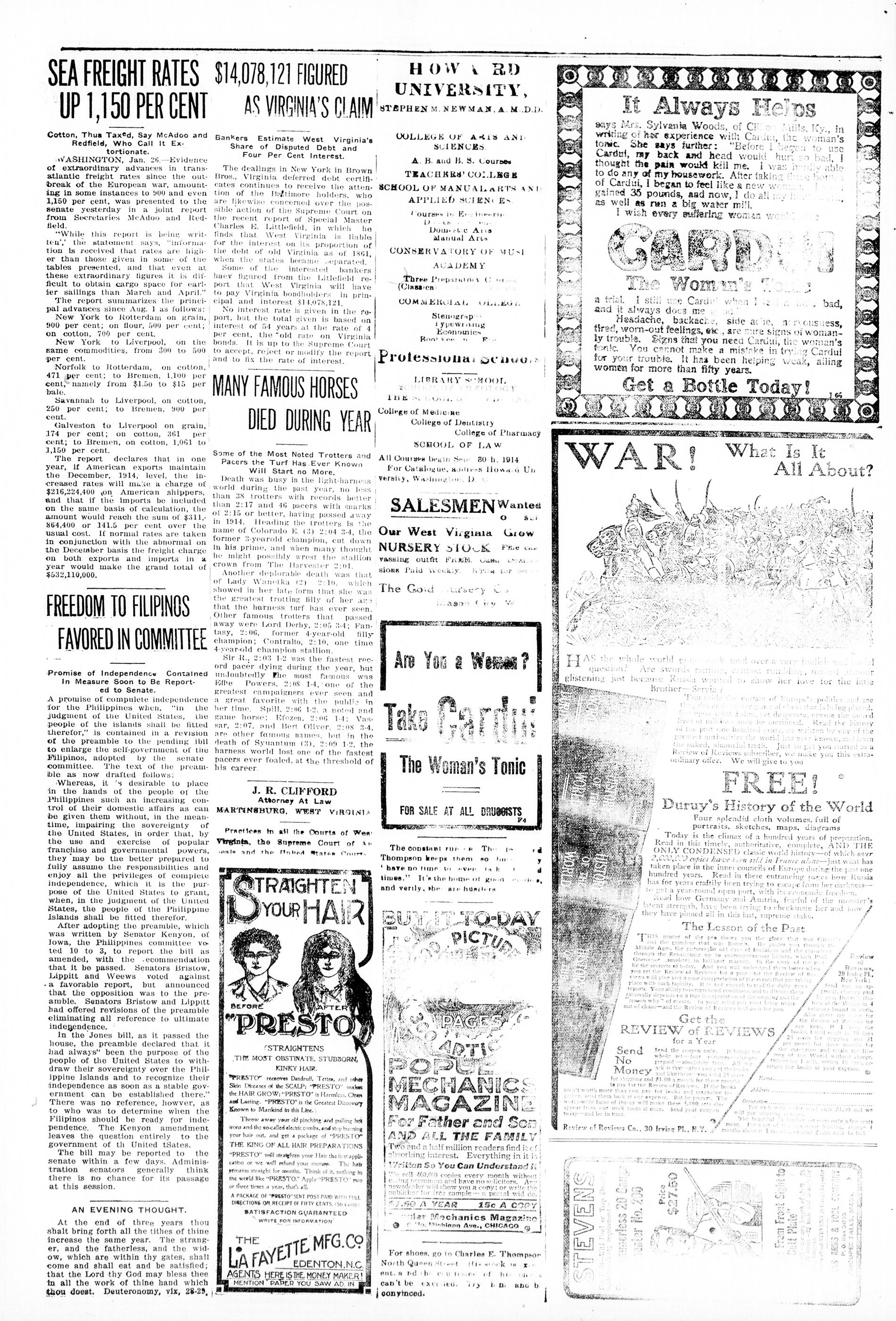
SEA FREIGHT RATES UP 1,150 PER CENT
Cotton, Thus Taxed, Say McAdoo and Redfield, Who Call It Extortionate.
WASHINGTON, Jan. 26—Evidence of extraordinary advances in transatlantic freight rates since the outbreak of the European war, amounting in some instances to 900 and even 1,150 per cent, was presented to the senate yesterday in a joint report from Secretaries McAdoo and Redfield.
"While this report is being written," the statement says, "information is received that rates are higher than those given in some of the tables presented, and that even at these extraordinary figures it is difficult to obtain cargo space for earlier sailings than March and April."
The report summarizes the principal advances since Aug. 1 as follows:
New York to Rotterdam on grain, 900 per cent; on flour, 500 per cent; on cotton, 700 per cent.
New York to Liverpool, on the same commodities, from 300 to 500 per cent.
Norfolk to Rotterdam, on cotton, 471 per cent; to Bremen, 1,100 per cent, namely from $1.50 to $15 per bale.
Savannah to Liverpool, on cotton, 250 per cent; to Bremen, 900 per cent.
Galveston to Liverpool on grain, 174 per cent; on cotton, 361 per cent; to Bremen, on cotton, 1,061 to 1,150 per cent.
The report declares that in one year, if American exports maintain the December, 1914, level, the increased rates will make a charge of $216,224,400 on American shippers, and that if the imports be included on the same basis of calculation, the amount would reach the sum of $311,864,400 or 141.5 per cent over the usual cost. If normal rates are taken in conjunction with the abnormal on the December basis the freight charge on both exports and imports in a year would make the grand total of $532,110,000.
FREEDOM TO FILIPINOS FAVORED IN COMMITTEE
Promise of Independence Contained In Measure Soon to Be Reported to Senate.
A promise of compule independence for the Philippines when, "in the judgment of the United States, the people of the islands shall be fitted therefor," is contained in a revision of the preamble to the pending ibil to enlarge the self-government of the Filipinos, adopted by the senate committee. The text of the preamble as now drafted follows:
Whereas, it is desirable to place in the hands of the people of the Philippines such an increasing control of their domestic affairs as can be given them without, in the meantime, impairing the sovereignty of the United States, in order that, by the use and exercise of popular franchise and governmental powers, they may be the better prepared to fully assume the responsibilities and enjoy all the privileges of complete independence, which it is the purpose of the United States to grant, when, in the judgment of the United States, the people of the Philippine Islands shall be fitted therefor
After adopting the preamble, which was written by Senator Kenyon, of Iowa, the Philippines committee voted 10 to 3, to report the bill as amended, with the recommendation that it be passed. Senators Bristow, Lippitt and Weews voted against a favorable report, but announced that the opposition was to the preamble. Senators Bristow and Lippitt had offered revisions of the preamble eliminating all reference to ultimate independence.
In the Jones bill, as it passed the house, the preamble declared that it had always" been the purpose of the people of the United States to withdraw their sovereignty over the Philippine Islands and to recognize their independence as soon as a stable government can be established there." There was no reference, however, as to who was to determine when the Filipinos should be ready for independence. The Kenyon amendment leaves the question entirely to the government of th United tSates. The bill may be reported to the senate within a few days. Administration senators generally think there is no chance for its passage at this session.
AN EVENING THOUGHT.
At the end of three years thou shalt bring forth all the tithes of thine increase the same year. The stranger, and the fatherless, and the widow, which are within thy gates, shall come and shall eat and be satisfied; that the Lord thy God may bless thee in all the work of thine hand which thou doest. Deuteronomy, vix, 28-29.
$14,078,121 FIGURED AS VIRGINIA'S CLAIM
Bankers Estimate West Virginia's Share of Disputed Debt and Four Per Cent Interest. The dealings in New York in Brown Bros., Virginia deferred debt certificates continues to receive the attention of the Baltimore holders, who are likewise concerned over the possible action of the Supreme Court on the recent report of Special Master Charles E. Littlefield, in which he finds that West Virginia is liable for the interest on its proportion of the debt of old Virginia as of 1861, when the states became separated. Some of the interested bankers have figured from the Littlefield report that West Virginia will have to pay Virginia bondholders in principal and interest $14,078,121.
No interest rate is given in the report, but the total given is based on interest of 54 years at the rate of 4 per cent, the "old rate on Virginia bonds. It is up to the Supreme Court to accept, reject or modify the report and to fix the rate of interest.
MANY FAMOUS HORSES DIED DURING YEAR
MANY FAMOUS HORSES DIED DURING YEAR
Some of the Most Noted Trotters and Pacers the Turf Has.Ever Known Will Start no More
Death was busy in the light-harness world during the past year, no less than 38 trotters with records better than 2:17 and 46 pacers with marks of 2:15 or better, having passed away in 1914. Heading the trotters is the name of Colorado E. (3) 2:04 3-4, the former 3-yearold champion, cut down in his prime, and when many thought he might possibly wrest the stallion crown from The Harvester 2:01.
Another deplorable death was that of Lady Wanetka (2) 2:10, which showed in her late form that she was the greatest trotting filly of her age that the harness turf has ever seen. Other famous trotters that passed away were Lord Derby, 2:05 3-4; Fantasy, 2:06, former 4-year-old filly champion; Contralto, 2:10, one time 4-year-old champion stallion.
Sir R., 2:03 1-2 was the fastest record pacer dying during the year, but undoubtedly the most famous was Efte Powers, 2:08 1-4, one of the greatest campaigners ever seen and a great favorite with the public in her time. Spill, 2:06 1-2, a noted and game horse; Efozen, 2:06 1-4; Vassar, 2:07, and Bert Oliver, 2:08 3-4, are other famous names, but in the death of Syuantum (3), 2:09 1-2, the harness world lost one of the fastest pacer ever foaled, at the threshold of his career.
J. R. CLIFFORD
Attorney At Law
Practices in all the Courts of West Virginia, the Supreme Court of Appeals and the United States Courts
STRAIGHTEN
YOUR HAIR
BEFORE AFTER
"PRESTO"
STRAIGHTENS
THE MOST OBSTINATE, STUBBORN,
KINKY HAIR.
"PRESTO" removes Dandruff, Tetters, and other
Skin Diseases of the SCALP; "PRESTO" makes
the HAIR GROW; "PRESTO" is Harmless, Clean
and Lasting. "PRESTO" is the Greatest Discovery
Known to Mankind in this Line.
Throw away your old pinching and pulling hot
irons and the so-called electric combs, and stop burning
your hair out, and get a package of "PRESTO"
THE KING OF ALL HAIR PREPARATIONS
"PRESTO" will straighten your Hair the first
application or we will refund your money. The hair
remains straight for months. Think of it, nothing in
the world like "PRESTO". Apply "PRESTO" two
or three times a year, that's all.
A PACKAGE of "PRESTO" SENT POST PADD WITH FULL
DIRECTIONS ON RECEIPT OF FIFTY CENTS. (150 CENTS)
BATISFACTION GUARANTEED
WRITE FOR INFORMATION
THE
LA FAYETTE MFG.CO
EDENTON.N.C
AGENTS HERE IS THE MONEY MAKER!
MENTION PAPER YOU SAW AD. IN
HOWARD UNIVERSITY.
STEPHEN M. NEWMAN. A. M. D.D.
COLLEGE OF ARTS AND SCIENCES
SCHOOL OF MANUAL ARTS AND
APPLIED SCIENCES
Courses in Engineering
Dress Design
Domestic Arts
Manual Arts
CONSERVATORY OF MUSI
Three Preparatory Courses
(Classics)
COMMERCIAL COLLEGE
Stenography
Typewriting
Economics
Professional Schools
LIBRARY SCHOOL
SCHOOL OF PHOTOLOGY
THE SCHOOL OF PHOTOGRAPHY
College of Medicine
College of Dentistry
College of Pharmacy
SCHOOL OF LAW
All Courses begin Sep. 80 h. 1914
For Catalogue, address Howard Un-
versity, Washington, D. C.
SALESMEN Wanted
Our West Virginia Grow
NURSERY STOCK. Fine cur-
vassing outfit FREE. Cash com-
sions Paid Weekly. Work for Oversee.
The Gold nursery Co.
Season City W.
Are You a Woman?
Take Cardui
The Woman's Tonic
FOR SALE AT ALL DRUGOISTS
The constant ruin is Thompson
Thompson keeps them so busy
'have no time to even talk to
times.' It's the home of good cooks,
and verily, they are buddies.
BUY IT TO-DAY
PICTURE
PAGES
APTIC
POPUL
MECHANICS
MAGAZINE
For Father and Son
AND ALL THE FAMILY
Two and a half million readers find it of absorbing interest. Everything in it is
Written So You Can Understand K
We sell 400,000 copies every month without raising premiums and have no solicitors. An newspaper will show you a copy; or write the publisher for free sample — a postal will do.
57.50 A YEAR 15c A COPY
Thermal Mechanics Magazine
Chelsea, Michigan Ave., CHICAGO
For shoes, go to Charles E. Thompson
North Queen Street. His stock is ex-
ent, and the customers of his shops
can't be excused. Try him and b
convinced.
says Mrs. Sylvania Woods, of Clifton Mills, Ky., in writing of her experience with Cardui, the woman's tonic. She says further: "Before I began to use Cardui, my back and head would hurt so bad, I thought the pain would kill me. I was hardly able to do any of my housework. After taking three bottles of Cardui, I began to feel like a new woman. I gained 35 pounds, and now, I do all my housework, as well as run a big water mill. I wish every suffering woman would use
GARDUI
a trial. I still use Cardui when I feel a little bad, and it always does me good.
Headache, backache, side ache, nervousness, tired, worn-out feelings, etc., are sure signs of womanly trouble. Signs that you need Cardui, the woman's tonic. You cannot make a mistake in trying Cardui for your trouble. It has been helping weak, ailing women for more than fifty years.
WAR! What Is It All About?
HAS the whole world gone wild mad over a very foolish and foolish question? Are swords mutilating, cannon rummbling, maimed amount glistening just because Russia wanted to show her love for the little Brother—Servia?
Tear aside the curtain of Europe's politics and see the prim and nobler games of chess that is being played. See upon what it slims yet despairing, enqueue the sacred lives of rabbits may be sacrificed. Read the history of the past one hundred years, written by one of the greatest authorities the world has ever known, and learn the naked, shameful truth. Just to get you started as a Review of Reviews subscriber, we make you this extraordinary offer. We will give to you
FREE!
Duruy's History of the World
Four splendid cloth volumes, full of portraits, sketches, maps, diagrams
Today is the climax of a hundred years of preparation. And in this timely, authoritative, complete, AND THELY CONDENSED classic world history—of which over 2,000 copies have been sold in France alone—just what has place in the inner councils of Europe during the past one hundred years. Read in these entrancing pages how Russia or years craftily been trying to escape from her darkness—a year-round open port, with its economic freedom.
And how Germany and Austria, fearful of the monster's strength, have been trying to checkmate her and how we pinned all in this last, supreme stake.
Today is the climax of a hundred years of preparation. Read in this timely, authoritative, complete, AND THE ONLY CONDENSED classic world history—of which over 2,000,000 copies have been sold in France alone—just what has taken place in the inner councils of Europe during the past one hundred years. Read in these entrenching pages how Russia has for years craftily been trying to escape from her darkness—to get a year-round open port, with its economic freedom.
Read how Germany and Austria, fearful of the monster's latent strength, have been trying to checkmate her and how they have pinned all in this last, supreme stake.
The Lesson of the Past
THIS master of the pen shows you the glory that was Greene and the grandeur that was Rome. He guides you through the Middle Ages, the picturesque old days of femininity and the casual life through the Renaissance up to contemporaneous history, which Paul, the governor, smiles in brilliant manner. In the story of the poet he governs of toddlers. And you will understand them better when you set the Review of Reviews for a year for the Review of Reviews. Views will give you a much better appreciation of the event that are taking place with such rapidity. It is not enough to read the daily news, send him on app-reports. Your ability to comprehend conditions and them in a rapidly nationally dependent on a true interpretation of the meaning and the "reason why" of events. In your mind you must bring together the world in 4 out of chaos—and the Review of Reviews will do it for you.
Send the coupon only. It brings the history of the World without charge. Whole set—four volumes—charges prepaid—absolutely free. All we rack is that—after you set the books and like them—you send 25 cents for shipping and $1.00 a month for three months.
to pay for the Review of Reviews. If the books aren't worth more than you pay for books and magazine to gether, send them back at our expense. But he prompts. The worldwide fame of Dumny will make these 5,000 sets dis-appear from our stock room at once. Send your coupon for each order send only $1.00 and we will pay shipping charges.
STEVENS
For 1911-1914 Fuel or Trap Shooting
made by any requirement.
Commercial 20 Cauge
Dealer No. 200
Price
$27.50
From Front Sight to
Gait Plate"
will secure any length of Aft
all limits - 24 inch and much of
the length. STEVENS is fond of buyer
ING ARMS & TOOL COUNTY
P.O. 0044 5005
CHICAGO, TALLS, MASS.