The Pioneer Press
Saturday, July 24, 1915
Martinsburg, West Virginia
Page text (machine-generated)
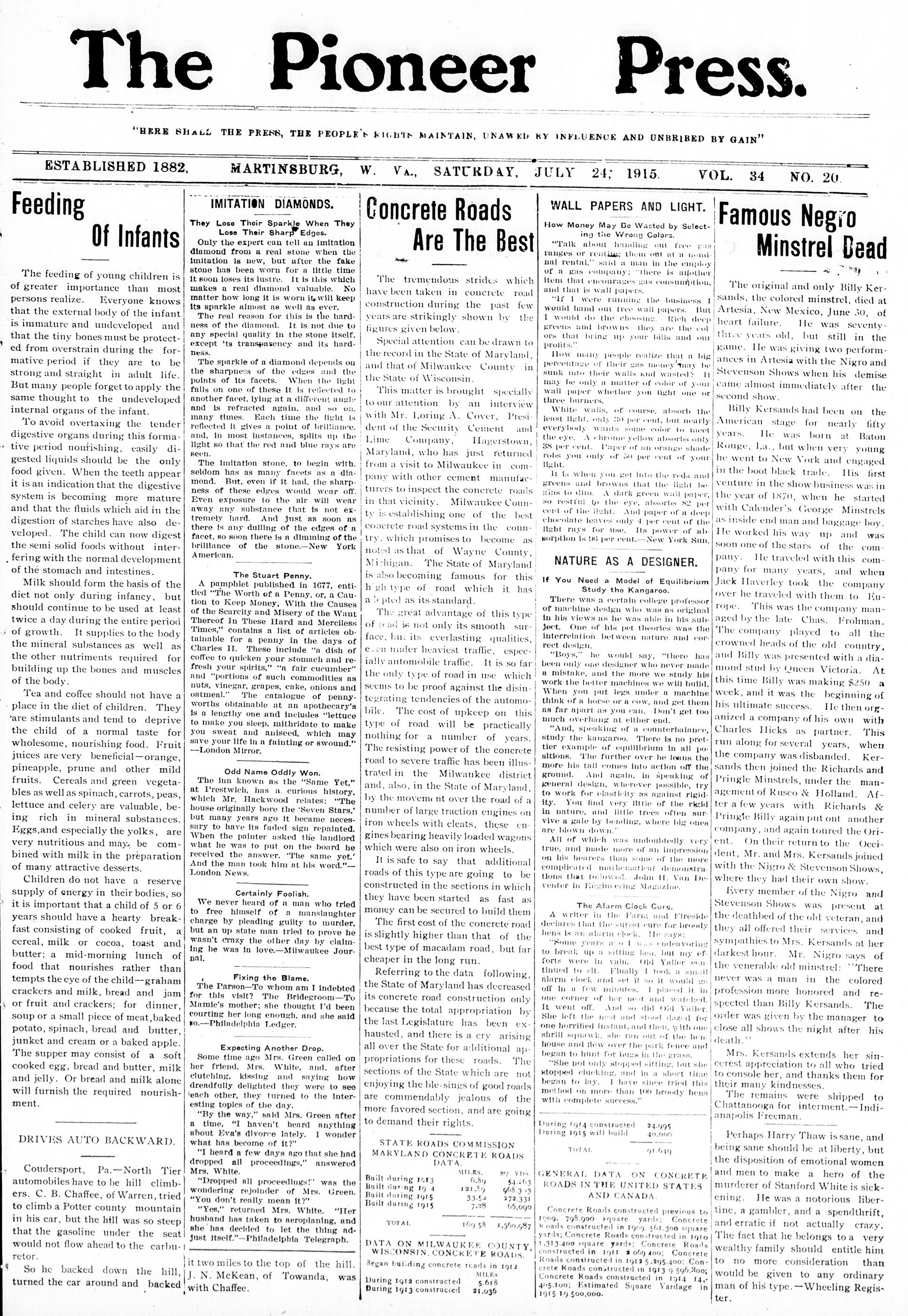
The Pioneer Press.
"HERE SHALL THE PRESS, THE PEOPLE'S RIGHTS MAINTAIN, UNAWED BY INFLUENCE AND UNBRIBED BY GAIN"
ESTABLISHED 1882
Feeding Of Infants
The feeding of young children is of greater importance than most persons realize. Everyone knows that the external body of the infant is immature and undeveloped and that the tiny bones must be protected from overstrain during the formative period if they are to be strong and straight in adult life. But many people forget to apply the same thought to the undeveloped internal organs of the infant.
To avoid overtaxing the tender digestive organs during this formative period nourishing, easily digested liquids should be the only food given. When the teeth appear it is an indication that the digestive system is becoming more mature and that the fluids which aid in the digestion of starches have also developed. The child can now digest the semi solid foods without interfering with the normal development of the stomach and intestines.
Milk should form the basis of the diet not only during infancy, but should continue to be used at least twice a day during the entire period of growth. It supplies to the body the mineral substances as well as the other nutriments required for building up the bones and muscles of the body.
Tea and coffee should not have a place in the diet of children. They are stimulants and tend to deprive the child of a normal taste for wholesome, nourishing food. Fruit juices are very beneficial-orange, pineapple, prune and other mild fruits. Cereals and green vegetables as well as spinach, carrots, peas, lettuce and celery are valuable, being rich in mineral substances. Eggs, and especially the yolks, are very nutritious and may be combined with milk in the preparation of many attractive desserts.
Children do not have a reserve supply of energy in their bodies, so it is important that a child of 5 or 6 years should have a hearty breakfast consisting of cooked fruit, a cereal, milk or cocoa, toast and butter; a mid-morning lunch of food that nourishes rather than tempts the eye of the child—graham crackers and milk, bread and jam or fruit and crackers; for dinner, soup or a small piece of meat, baked potato, spinach, bread and butter, junket and cream or a baked apple. The supper may consist of a soft cooked egg, bread and butter, milk and jelly. Or bread and milk alone will furnish the required nourishment.
DRIVES AUTO BACKWARD
Coudersport, Pa.—North Tier automobiles have to be hill climbers. C. B. Chaffee, of Warren, tried to climb a Potter county mountain in his car, but the hill was so steep that the gasoline under the seat would not flow ahead to the carburetor. So he backed down the hill, turned the car around and backed
IMITATION DIAMONDS.
They Lose Their Sparkle When They Lose Their Sharp Edges.
Only the expert can tell an imitation diamond from a real stone when the imitation is new, but after the fake stone has been worn for a little time it soon loses its ustre. It is this which makes a real diamond valuable. No matter how long it is worn it will keep its sparkle almost as well as ever. The real reason for this is the hardness of the diamond. It is not due to any special quality in the stone itself, except its transpazency and its hardness.
The sparkle of a diamond depends on the sharpness of the edges and the points of its facets. When the light falls on one of these it is reflected to another facet, lying at a different angle and is refracted again, and so on many times. Each time the light is reflected it gives a point of brilliance, and, in most instances, splits up the light so that the red and blue rays are seen.
The imitation stone, to begin with, seldom has as many facets as a diamond. But, even if it had, the sharpness of these edges would wear off. Even exposure to the air will wear away any substance that is not extremely hard. And just as soon as there is any dulling of the edges of a facet, so soon there is a dimming of the brilliance of the stone.—New York American.
The Stuart Penny.
A pamphlet published in 1077, entitled "The Worth of a Penny, or, a Caution to Keep Money, With the Causes of the Scarcity and Misery of the Want Thereof In These Hard and Merciless Times," contains a list of articles obtainable for a penny in the days of Charles II. These include "a dish of coffee to quicken your stomach and refresh your spirits," "a fair cucumber" and "portions of such commodities as nuts, vinegar, grapes, cake, onions and oatmeal." The catalogue of penny-worths obtainable at an apothecary's is a lengthy one and includes "lettuce to make you sleep, mithridate to make you sweat and aniseed, which may save your life in a fainting or s wound."—London Mirror.
Odd Name Oddly Won.
The inn known as the "Same Yet," at Prestwich, has a curious history, which Mr. Hackwood relates: "The house originally bore the 'Seven Stars,' but many years ago it became necessary to have its faded sign repainted. When the painter asked the landlord what he was to put on the board he received the answer. 'The same yet.' And the man took him at his word."—London News.
Certainly Foolish.
We never heard of a man who tried to free himself of a manslaughter charge by pleading guilty to murder, but an up state man tried to prove he wasn't crazy the other day by claiming he was in love.—Milwaukee Journal.
Fixing the Blame
The Parson—To whom am I indebted for this visit? The Bridegroom—To Mamie's mother; she thought I'd been courting her long enough, and she said so.—Philadelphia Ledger.
Expecting Another Drop.
Some time ago Mrs. Green called on her friend, Mrs. White, and, after clutching, kissing and saying how dreadfully delighted they were to see each other, they turned to the interesting topics of the day.
"By the way," said Mrs. Green after a time, "I haven't heard anything about Eva's divorce lately. I wonder what has become of it?"
"I heard a few days ago that she had dropped all proceedings," answered Mrs. White.
"Dropped all proceedings!" was the wondering rejoinder of Mrs. Green. "You don't really mean it?"
"Yes," returned Mrs. White. "Her husband has taken to aeroplaning, and she has decided to let the thing adjust itself."—Philadelphia Telegraph.
it two miles to the top of the hill. J. N. McKean, of Towanda, was with Chaffee.
Concrete Roads Are The Best
The tremendous strides which have been taken in concrete road construction during the past few years are strikingly shown by the figures given below. Special attention can be drawn to the record in the State of Maryland, and that of Milwaukee County in the State of Wisconsin.
This matter is brought specially to our attention by an interview with Mr. Loring A. Cover, President of the Security Cement and Lime Company, Hagerstown, Maryland, who has just returned from a visit to Milwaukee in company with other cement manufacturers to inspect the concrete roads in that vicinity. Milwaukee County is establishing one of the best concrete road systems in the country, which promises to become as noted as that of Wayne County, Michigan. The State of Maryland is also becoming famous for this high type of road which it has adopted as its standard.
The great advantage of this type of road is not only its smooth surface, but its everlasting qualities, even under heaviest traffic, especially automobile traffic. It is so far the only type of road in use which seems to be proof against the disintegrating tendencies of the automobile. The cost of upkeep on this type of road will be practically nothing for a number of years. The resisting power of the concrete road to severe traffic has been illustrated in the Milwaukee district and, also, in the State of Maryland, by the movement over the road of a number of large traction engines on iron wheels with cleats, these engines bearing heavily loaded wagons which were also on iron wheels.
It is safe to say that additional roads of this type are going to be constructed in the sections in which they have been started as fast as money can be secured to build them The first cost of the concrete road is slightly higher than that of the best type of macadam road, but far cheaper in the long run.
Referring to the data following, the State of Maryland has decreased its concrete road construction only because the total appropriation by the last Legislature has been exhausted, and there is a cry arising all over the State for additional appropriations for these roads. The sections of the State which are not enjoying the blessings of good roads are commendably jealous of the more favored section, and are going to demand their rights.
STATE ROADS COMMISSION
MARYLAND CONCRETE ROADS
DATA.
MILES. 8Q YDS.
Built during 1913 6,89 54,163
Built during 1914 121,89 968,303
Built during 1915 33,52 272,331
Built during 1915 7,28 66,090
TOTAL 169,58 1,360,987
DATA ON MILWAUKEE COUNTY,
WISCONSIN, CONCRETE ROADS.
Began building concrete roads in 1912
MILES
During 1912 constructed 5,618
During 1913 constructed 21,036
WALL PAPERS AND LIGHT.
How Money May Be Wasted by Selecting the Wrong Colors.
"Talk about handing out free gas ranges or renting them out at a nominal rental," said a man in the employ of a gas company; "there is another item that encourages gas consumption, and that is wall papers.
"If I were running the business I would hand out free wall papers. But I would do the choosing. Rich deep greens and browns—they are the colors that bring up your bills and our profits."
How many people realize that a big percentage of their gas money may be sunk into their walls and wasted? It may be only a matter of color of your wall paper whether you light one or three burners.
White walls, of course, absorb the least light, only 30 per cent, but nearly everybody wants some color to meet the eye. A chrome yellow absorbs only 38 per cent. Paper of an orange shade robs you only of 50 per cent of your light.
It is when you get into the reds and greens and browns that the light begins to dim. A dark green wall paper, so restful to the eye, absorbs 82 per cent of the light. And paper of a deep chocolate leaves only 4 per cent of the light rays for use. Its power of absorption is 96 per cent.—New York Sun,
NATURE AS A DESIGNER.
If You Need a Model of Equilibrium Study the Kangaroo.
There was a certain college professor of machine design who was as original in his views as he was able in his subject. One of his pet theories was the interrelation between nature and correct design.
"Boys," he would say, "there has been only one designer who never made a mistake, and the more we study his work the better machines we will build. When you put legs under a machine think of a horse or a cow, and get them as far apart as you can. Don't get too much overhang at either end.
"And, speaking of a counterbalance, study the kangaroo. There is no prettier example of equilibrium in all positions. The further over he loans the more his tail comes into action off the ground. And again, in speaking of general design, wherever possible, try to work for elasticity as against rigidity. You find very little of the rigid in nature, and little trees often survive a gale by bending, where big ones are blown down."
All of which was undoubtedly very true, and made more of an impression on his hearers than some of the more complicated mathematical demonstrations that followed. John H. Van Deventer in Engineering Magazine.
The Alarm Clock Cure.
A writer in the Farm and Flireside declares that the surest cure for broody bens is an alarm clock. He says:
"Some years ago I was endeavoring to break up a sitting hen, but my efforts were in vain. Old Yaller continued to sit. Finally I took a small alarm clock and set it so it would go off in a few minutes. I placed it in one corner of her nest and watched. It went off. And so did Old Yaller. She left the nest and stood dazed for one horrified instant, and then, with one shrill squawk, she ran out of the henhouse and flew over the park fence and began to hunt for bugs in the grass.
"She not only stopped sitting, but she stopped clucking, and in a short time began to lay. I have since tried this method on more than 100 broody heus with complete success."
Famous Negro Minstrel Dead
The original and only Billy Kersands, the colored minstrel, died at Artesia, New Mexico, June 30, of heart failure. He was seventy-three years old, but still in the game. He was giving two performances in Artesia with the Nigro and Stevenson Shows when his demise came almost immediately after the second show.
Billy Kersands had been on the American stage for nearly fifty years. He was born at Baton Rouge, La., but when very young he went to New York and engaged in the boot black trade. His first venture in the show business was in the year of 1870, when he started with Calender's George Minstrels as inside end man and baggage boy. He worked his way up and was soon one of the stars of the company. He traveled with this company for many years, and when Jack Haverley took the company over he traveled with them to Europe. This was the company managed by the late Chas. Frohman. The company played to all the crowned heads of the old country, and Billy was presented with a diamond stud by Queen Victoria. At this time Billy was making $250 a week, and it was the beginning of his ultimate success. He then organized a company of his own with Charles Hicks as partner. This run along for several years, when the company was disbanded. Kersands then joined the Richards and Pringle Minstrels, under the management of Rusco & Holland. After a few years with Richards & Pringle Billy again put out another company, and again toured the Orient. On their return to the Occident, Mr. and Mrs. Kersands joined with the Nigro & Stevenson Shows, where they had their own show.
Every member of the Nigro and Stevenson Shows was present at the deathbed of the old veteran, and they all offered their services and sympathies to Mrs. Kersands at her darkest hour. Mr. Nigro says of the venerable old minstrel: "There never was a man in the colored profession more honored and respected than Billy Kersands. The order was given by the manager to close all shows the night after his death."
Mrs. Kersands extends her sincerest appreciation to all who tried to console her, and thanks them for their many kindnesses.
The remains were shipped to Chattanooga for interment.—Indianapolis Freeman.
Perhaps Harry Thaw is sane, and being sane should be at liberty, but the disposition of emotional women and men to make a hero of the murderer of Stanford White is sickening. He was a notorious libertine, a gambler, and a spendthrift, and erratic if not actually crazy. The fact that he belongs to a very wealthy family should entitle him to no more consideration than would be given to any ordinary man of his type.—Wheeling Register.
Entered in Post Office at Martinsburg, W. Va., as Second Class Matter. J. Lt. Clifford, Editor and Proprietor. Drawer 869, and Bell 'Phone 60K, Martinsburg, W. Va.
SATURDAY, JULY 24, 1915.
Von Hindenberg seems to be doing about what he promised so far.
Prejudice and impolite christians, are the devils walking and talking contranictions.
Lieutenant Becker's confession as to others being in the game that slew Rosenthal, will not save him from the electric chair.
If Teddy can lash Germany into as much littleness as he did Mr. Bryan at the Panama Exposition, the quicker he enters the field of battle, the better.
If we go to war with Germany, how are we going to get to them to fight? That will be the all important question. Death will await us on water and destruction on land, as it looks to us.
The more we submit, the heavier and burdensome our yoke. As electricity has emancipated the mind from the body and given it wings, so will unific and manly contention against wrongs give us full-fledged men's rights.
An English officer yelled out on one occasion: "England expects every man to do his duty." "Thank God every man is so getting his eyes open that that is what he is expecting. Such expectations have no value unless they are reciprocally applied—not enforced.
Russia, a few years before the Negro got his reenslaved freedom, freed her slaves and gave every one a farm. This government owns more than a million acres of land and should have been as kind to us, for we have been its unpaid toilers for 300 years and always true to the flag and never faltered on a battlefield.
---
The B. & O., is doing something that may cause trouble. If the fare to Cumberland is $2.36, and a person only getting to the station in time to get on a starting train—no time to get a ticket—the conductor in collecting the fare charges 10c. extra, gives a slip to show same, but when presented for payment at any station they refuse. Heretofore, such slips were honored and redeemed. Why not continue to do so now?
It seems from close observation that the methods for education are undergoing about as much change as the dresses of women. No difference to what school you go, the best place for a person determined to be and do something worthwhile, is a quiet, comfortable room, by himself. There he gets inspiration, that is sure to lead him on by himself and with himself to glorious victories. No boy or girl ever adopted this method but what succeeded admirably well.
Out of 600,000 families in Switzerland, 500,000 own the farms they live on; and still our chief business in warm weather is to run excursions and hold campmeetings. Had all the money so spent been kept every Negro family in the Shenandoah Valley could have owned a farm. As it is, through our downright cussedness, and foolish spending of hard-earned money, we have enriched the great trunk lines and impoverished ourselves.
In Brookfield, Mass., the people work in mills, factories &c., and are prosperous, while 250 miles north of this place, within the Province of Quebec, the people buy from England, and till the soil and they sleep though the winter to avoid using fires and light. But why refer to them, when scores right here who are giving their money to railroads and camp meetings do the same, except the sky pilots whose pockets are full of the religion(?) they work, talk and pray so much over?
President Wilson is full of praise now and then for Negro soldiers' bravery—sees war clouds. Precisely as Washington did with the 3500 slaves he took to Yorktown and won a victory with them, and then sent them back to slavery, so would our noted segregation President, after the war, allow us to return home to be forced to ride in jimcrow cars, lynched, disfranchised, denied school rights and every other right he and his enjoy. We take the broad common sense theory that nothing is settled till it it is settled right, and wars may be at it.
Two weeks before this dreadful war broke out the Panama Canal was opened for traffic. So far 679 vessels have passed through with tolls amounting to nearly $3,000,000. Had not the cruel and uncivilized war been raging it is safe guessing that our tolls would have been fifty times three million dollars. Even as it is, the harpy tribe that condemned Roosevelt and his force for building the canal are forced to beg pardon and declare, in addition, in a thousand other ways, it is and is destined to be a big paying investment. The thing most important now to watch is that it be not destroyed by bombs of Germany.
Once on a time a certain stream was kept muddy for weeks. The people believing that its source was clear and pure, tried to find the cause. Finally going to the spring a hog had made it its favorite wallowing place. It was stopped and the stream got clear.
In every community we have filthy human hogs contaminating moral sentiment. That it is more essential to look them over and remove them than it was the real hog, goes without saying. Struggling for race recognition as we are, every decent person should unite in helping keep pure our moral stream, and thereby made a class of the best girls and boys that's possible--it will bless this town.
Now that the President's note to Germany has the ring of war, the all important question is, will the American Germans be loyal to the country of their adoption? Some declare they will, and others they will not. If not, then a great lesson will be taught this nation—that its best and tested friends have been treated worse than dogs.
It must be kept in mind that no government on earth, Japan excepted, brings up its youth like Germany. They love their fatherland in manhood no difference where found, akin to the love of the young for their mother's milk and true to
Catholic contention, about children having been properly drilled in that faith, are Catholics everywhere, so are they Germans. We are not properly prepared for war against a fighting class like Germany. She, ever since 1870, has been preparing for this war, and it will be a pity to have our soldiers butchered on and off the sea.
We have seen in print that because of the attendance of only ten pupils, five hundred schools will be closed in this state this year. It will injure more colored than white children. Under such a law colored children will be compelled to live and die untaught, or move to other states. Living in obedience to law in this state, voting for men to make laws, paying taxes &c., why can't West Virginia rise to the dignity of her constitutional honor on par with Ohio and Pennsylvania where all children go to school together? Is it not a crime to deny a child the right of education? How can an untaught boy tally up with one properly taught? Impossible. Then its plain that colored children are compelled to grope through life in the dark of ignorance, while the white girls and boys are fitted to battle with life to live. Give all the same chance and let God's blessings—not his curses—fall on you at the final judgment bar.
The School Commissioners of Baltimore the other day got very much tangled up over christening the colored schools after several colored men who had done something worth while to be remembered. They, or some of them, didn't know that Paul Laurence Dunbar was dead and the same was true of Samuel Coleridge Taylor. One feared he might before dying disgrace himself. They didn't know Banneker's christian name, and dubbed Attucks a "rabble rouser," and Robert Browne Elliot as "a glorified carpet-bagger." Would do them good to read up on Negro history. It recalls an act that transpired at the last National Republican Convention at Chicago. It was almost as hard to get friends into the convention hall, as it is for a camel to get through "the eye of the needle." Our own astute "Phil" Waters had planned to get a friend in. The friend was standing close to the entrance where "Phil" was door keeper and several policemen were there to keep intruders from entering. All of a sudden "Phil" rushed out, threw his arms around the neck of his friend, and screamed: "How are you Paul, come in." One of the policemen forbade his entering, whereupon "Phil" said: "Man this is Paul Laurence Dunbar, the greatest Negro on earth." The policeman shook Mr. Dunbar's hand and into the convention he went, notwithstanding the fact that Paul Laurence Dunbar had been dead for years.
Daly's Impecunious Employee.
Daily's Impecunious Employee.
Augustin Daly had in his employment a man who always addressed him a note periodically asking for an advance of money. This note was invariably answered by a most abusive letter in almost insulting terms and threatening instant discharge If the offense was ever repeated and enclosing a check for the money.
At regular intervals of about three months the man invariably made the same request, with the same results, always, however, getting a check enclosed. And thus it continued until Mr. Daly's death.
Reversed Conditions
"You are careful to set an example for your son?" "I used to try to set him an example," replied the serious man, "but now I study him attentively to ascertain what kind of clothes I ought to wear and the style of conversation that is considered smart."—Washington Star.
ARABIAN HORSES.
Ancient Stories of Their Care and
Trainment of Children
So far as we know, the Arabian breeders have no patented system of training their horses different from those prevailing among peoples of a similar degree of civilization. Naturally the lack of pasture results in young Arabian horses being fed a considerable quantity of barley and, so the story goes at least, a not inconsiderable quantity of the fruit of the date palm, fresh and dried, by way of succulence.
The colts are broken, usually bare-backed, at two or three years old. Their subsequent handling is much like that of all other horses, with perhaps the difference that as early in life as possible the young animals are accustomed to doing without water for increasing periods of time in order to accustom them later on to the scarcity of liquids in desert journeys.
The ancient stories about the Arab steed being kissed and bawled over by the sheik's whole family, kept in the living tent and foiled on the best silk rugs are picturesque fables containing about the same measure of truth as the one which dates the pilgrimages of Arabian horses back to the mares owned in Biblical times by King Solomon.—Breeder's Gazette.
THEY SAW THE GHOST
Easy to Recognize the Woman Who Had Haunted the Place.
"A certain lady and her family," says Sir Mountstuart Grant-Duff in his "Diary." "hired a place in Scotland which was haunted by the ghost of a woman, who was to be seen constantly at night wandering through the rooms and passages. When the family arrived the lady was much struck with the place and said, 'I must have been here before, for I know this place so well, only there ought to be two rooms here, and there is only one.'
"The agent replied that within a few weeks the owner had caused a partition to be taken down and made the two rooms into one. Still the lady was puzzled at her knowledge of the place till she remembered that it was a house she used to go to in her dreams.
"Well, some time passed, and the agent was up at the house again, when the lady complained that one part of the contract had not been fulfilled. They had hired a house and a ghost for the summer, and no ghost had she seen.
"The agent replied; 'Of course not, because you, madam, are the ghost. We recognized you the moment we saw you.'"
The Fate of the Oncida
One of the most extraordinary catastrophies that have befallen vessels of the United States destroyed the sloop of war Oneida in 1863. She was bound homeward with a jolly ship's company eager to see wives and sweethearts and native land once more, when not far out of port she was struck by the British steamer Bombay coming in. The stem of the Bombay cut off the stern of the Oneida. The ship was sinking rapidly, and guns of distress were immediately fired, but the Bombay steamed on her way and left the vessel to her doom. She went down, and all but one or two of her crew were drowned. The captain of the Bombay gave no ether reason for his conduct than that he had Lady Eyre, the wife of a distinguished British satrap, on board and did not wish to disturb her nerves with scenes of shipwreck. He was molled when he reached Yokohama, dismissed from the service, socially tabooed from that time on and died in disgrace a year or two later.
The Obstacles to Evil
In the constitution of our nature a limit has been fixed to the triumph of evil. Falsity in theory is everywhere confronted by the facts which present themselves to every man's observation. A lie has no power to change the ordinances of God. Every day discloses its utter worthlessness until it fades away from our recollection and is numbered among the things that were. The indispassible connection which our Creator has established between vice and misery results most continually to arrest the progress of evil and to render odious what ever would render evil attractive—it results wasmad.
Unforeseen
"Really, doctor, the medicine you prescribed for me is splendid. I think I shall be all right in a few days."
"Well, well! Who would have thought it!"—Fliegende Blatter
Switzerland's Cupola Fort.
The Swiss reckon that their cupola fort on the St. Gothard, manned by 200 artillerymen, could easily hold the pass against an army of 50,000.
If a man wishes to be treated with courtesy he should show courtesy to others.
MARTINSBURG, WEST VIRGINIA
Practices in all the Courts of West Virginia, the Supreme Court of Appeals and the United States Courts.
Turning the Tables.
"Turning the tables" in the sense of bringing a countercharge against an accuser has a classic origin. In the days of Augustus Imperator a regular craze seized the men of Rome to compete with one another for the possession of the costliest specimens of a certain description of table made for the most part of Mauritanian wood inlaid with ivory—"mensarum insania," or table mania, as Pliny called it. They were sold at most extravagant prices. When the men accused the ladies of sumptuary extravagance the latter naturally retorted by reference to the money squandered by their lords on these tables and so "turned the tables on them" by throwing them metaphorically in their teeth.
A Remarkable Suicide
One of the most remarkable cases of suicide was that of the king of Falaha, on the west coast of Africa. The king was attacked by a Mohammadian force, and, finding resistance impossible, he assembled his family and principal officers and after addressing them and intimating his determination never to accept Mohammadianism and inviting those who did not agree with him to go away, he applied a light to a large quantity of gumpowder collected for the purpose and blew into atoms the palace and all who were in it.
Vanity.
"That man says he wants his picture to look perfectly natural," said the photographer's assistant.
"Make it as handsome as possible," replied the proprietor.
"But he insists that he doesn't want the picture to flatter him."
"He won't think it flatters him. He'll think that at last somebody has managed to catch the way he really looks."
—Chicago News.
Girl With a Conscience.
Two little girls walking through a field were afraid of a cow. Said one of them. "Let's go right on and act as if we were not afraid at all." "But wouldn't that be deceiving the cow?" the other little girl expostulated.—Christian Herald.
Rubbing It In.
Proud Dad. I suppose in the course of time baby will be married, even as we were. Mamma — Yes, I suppose she'll throw herself away on some man. Philadelphia Ledger.
The Point.
"A joke's a joke, but did you ever make anybody laugh by pulling a chair from under him?"
"At least it upsets his gravity."—Baltimore American.
HOTEL
POWHATAN
WASHINGTON
D.C.
HOTEL OF AMERICAN IDEALS
In a city where good hotels abound, the Powhatan heads the list.
It is first in the hearts of its countrymen.
The Powhatan is refined, exclusive, and restful. Its excellent location on Pennsylvania Avenue, 18th and H Streets, makes it a desirable headquarters for bridal couples, tourist parties, conventions, Schools and colleges.
The Powhatan attracts the people of culture and education. Its proximity to State, War and Navy Departments, also to many points of historical interest, makes this hotel especially attractive to a discriminating public.
The Powhatan offers rooms with detached bath at $1.50, $2.00 and up. Rooms with private bath, $2.50, $3.00 and up.
Write for booklet with map.
E. C. O. EN,
MANAGER.
LOCAL NEWS
Mrs. Fannie Moten has returned home after a visit of several days to her daughter in Hagerstown, and reports a royal time.
Mr. Harry Fox has returned to this city after spending several weeks profitably and pleasantly in Hagerstown.
Mr. Dewey Fox, youngest son of the late Mr. John H. Fox, and a promising young man, circulated among friends in our city this week.
Miss Mildred Johnson, of Hagerstown, was the guest of Miss Matilda Green for several days during the week. While here she was the object of much attention.
The Pythians of Maryland held their annual grand lodge session and dress parade in Hagerstown on Monday last, and quite a number of Martinsburgers went over.
Our good friend, Mr. Michael Smeltzer is busy at this time selling toilet articles and flavoring extracts. His goods are fine, and there is no finer man to deal with in Berkeley County than is the above named gentleman.
Mr. James Jones, one of the thriftiest young men in the Shenandoah Valley, and a worthy pattern for our youth, was in to see us the other day, and was a welcome caller. The gentleman named above is the owner of some fine land in Luray and Shenandoah, Va., and bids fair to own more unless he dies very soon. More like him is what we need.
A TRIBUTE TO JOURNALISM
If the Campbellsville (Ky,) News-Journal can be trusted—and we have neither reason nor excuse for suspecting that it lacks veracity —somebody modestly described as "an editor" has received the following highly interesting communication from one of his readers:
"Please send me a few copies of the paper containing the obituary of my aunt. Also publish the enclosed clipping of the marriage of my niece, who lives in Lebanon. And I wish you would mention in your local column, if it don't cost anything, that I have two bull calves for sale. As my subscription is out, please stop my paper. Times are too bad to waste money on newspapers."
The author of this truly precious communication would have made it perfect had he added the familiar—"You can never believe what you see in the papers!" That statement, uttered earnestly enough, constitutes the sole claim to shrewdness and knowledge that is possessed by a considerable number of people, and the comfort they get out of repeating it is presumably very great. It must be, else the repetitions wouldn't be so frequent.
In reality, of course, the journalistic approach to complete accuracy is high-amazingly high, when account is taken of the almost innumerable opportunities for making mistakes that a newspaper has every day. It is also a fact that people do believe what they see in the papers, and while some papers are more trustworthy than others, they all do pretty well. They prosper in exact ratio to their truthfulness. New York Times.
A Shade of Doubt.
"What do you think of my graduation essay?" asked the young man. "Fine!" replied his father. "Only I'm afraid a lot of people are going to be bashful about offering plain wages to a man whose intellect is so much above the average."—Washington Star.
For Nature Students
The young author, reading a fake animal story to the attentive editor, said:
"Whereupon the woodchuck laughed softly to himself."
"Ah," remarked the editor, "I suppose he indulged in a woodchuckle!"—Chicago News.
Youth comes but once in a lifetime; therefore let us so enjoy it as to be still young when we are old.—Long-fellow.
BEAUTIFUL NOSES.
They Are Very Rare, It Sooms, and Deserve Honorable Mention.
Lovely eyes you will find a-plenty, and, though finely cut, mouths are scarcer, it will be a strange day when you do not see several. But the discovery of a really beautiful nose is an event of a lifetime. I myself have found exactly seven. And yet I consider myself catholic in my taste for noses. I can enjoy a nose for its mere expressiveness, whether it is aggressive or aristocratic or humorous.
But it is amazing how seldom this feature really satisfies the eye. The bridge may be too thick or too high, the line from the forehead too abrupt or too severely straight. More often a nose that is really promising in its beginning fails in the end. It keeps on too long or not long enough, while the tip finds a dozen ways to err, and a fine nostril is rarely seen. In our typical American faces, overcrowded with features as our houses are with furniture, the nose is commonly disproportionately large.
But your really beautiful nose is a delight in every way. It is as far from sharpness as from coarseness. It shows strength without obtrusiveness, delicacy without fastidiousness, breeding without arrogance. It suggests humor, spirit and daring. But I tell you candidly that there are not more than 100 such in the 4,000,000 noses of New York. You are lucky when one happens to come your way.—Atlantic Monthly.
On Prisoners of War.
With reference to the modern treatment of prisoners of war, it is interesting to recall the views which R. L. Stevenson in his novel, "St. Ives," puts into the mouth of a French prisoner of war in Edinburgh castle, which was turned into a military prison in the time of Napoleon. He says: "There is a horrible practice in England to trick out in ridiculous uniform and, as it were, to brand in mass, not only convicts, but military prisoners and even the children in charity schools, I think some malignant genius had found his masterpiece of irony in the dress which we were condemned to wear—jacket, waistcoat and trousers of a sulphur or mustard yellow and a shirt of blue and white stripe cotton."—London Standard
An Old Guidebook.
Of all the old guidebooks none is sought so keenly by collectors as some of Murray's early guides. Perhaps the most precious of these as a bibliographical curiosity is the first edition of "Murray's Guide to Switzerland," published in 1838. Mountaineering as a popular pastime was not then invented, and in the section devoted to Mont Blanc the author contemptuously declares that "it is a somewhat remarkable fact that a large proportion of those who have made this ascent have been persons of unsound mind." —London Chronicle
A Domestic Tilt.
"Why do you persist in propping your feet up on the veranda railing?" asked Mrs. Cobbles.
"I suggest it's just my contrary nature," answered Mr. Cobbles. "The veranda railing is one thing you have never been able to put where I can't find it."—Birmingham Age-Herald.
Due to Be Shocked.
"He has a great shock coming to him in a little while."
"Who has?"
"The new groom. All his friends have been telling him that two can live as cheaply as one."—Detroit Free Press.
The KONGOLENE
Veribest
Straight-
ener Yet
Marvelous
Discovery.
It is what you have been dreaming of for years. To discover an article that would actually straighten colored folk hair, without the use of Hot Ions or Heated Combs. KONGOLENE does it and more too. It makes Coarse, Hard Stiff hair straight. It prepares that wakes the hair STRAIGHT. But does not make the half look like it was straightened by the gile of Hot Ions or Combs—just makes it look though it naturally so. Simply sweat KONGOLENE on like buster, comb it for a few minutes, WASH IT OUT, and the hair is straight.
It keeps hair straight, not for a day or a week, but for two or three months. KONGOLENe is positively guaranteed to do what it does. The money is refunded. Ebionted Ground Oil, a necessary adjunct to KONGOLENe gives that ravens' wing effect.
KONGOLENE $1.00. EBONIZED GROUND OIL 25C.
Send $ 25 for trial jars, wilt, weft, then for Agency
KONGO PRODUCTS Co. DEPT. 33
1215 WYLLE AVENUE, PETTTSBURGH, PA.
LAYING THE CLOTH.
Table Covers at One Time Were Arranged In Puffs and Folds.
In the twelfth century tatfecloths were very large and were always laid on the table double. For a long time they were called "doubliers" for that reason. The cloth was first placed so as to touch the floor on the side at which the guests sat; then all that remained was folded so that it just covered the table.
Charles V. had sixty-seven tablecloths, which were from fifteen to twenty yards long and two yards wide. He had one cloth thirty two yards long, which had the arms of France embroidered on it in silk. All these were fringed.
In the sixteenth century "doubliers" were replaced by two tablecloths, one of which was small and was laid just as we lay ours today. The other, which was put on over it, was large and of beautifully figured linen. It was skillfully folded in such a way that, as one chronicler tells it, "it resembled a winding river, gently ruffled by a little breeze, for among very many little folds were here and there great bubbles."
It must have required much art and care to make dishes, plates, salted lars, sauce dishes and glasses; stand steadily in the midst of this undulating sea and among those "bubbles" and puffy folds. However, the fashion had only a short existence, and toward the latter part of the century a single cloth laid that and touching the floor on all sides of the table came into general use.
WHERE THE DAY CHANGES.
The International Date Line In the Pacific Ocean.
A great many people cannot see why when a man crosses the international date line in the Pacific ocean if he goes toward the east he loses a day and is toward the west he gains a day that is, if it, say, happens to be Tuesday just this side if he crosses to the west it will be Monday. The distance he may have actually gone need be only a few feet, but it is true nevertheless. The actual time may be only a second's difference.
To understand this remember that we go from Monday to Tuesday at 12 o'clock at night jump immediately from one day to another. Consider also that if a man could travel toward the east as fast as the earth rotates and if he started at midday, with the sun directly overhead, he would go completely round the earth in no solar time at all, for the sun would always be just over his head and to him it would be 12 o'clock all the time if he measured time by the position of the sun. He would not experience any night at all and so would have twenty four hours of sunlight. But it has actually taken him twenty four hours to get around, so the time when he reached his starting place again would be 12 o'clock noon all right, but would be a day later than when he started.
So it can be readily seen that som meridian on the earth's surface must be picked out as the starting point of a new day, and the chosen one lies at most entirely in the Pacific ocean. Every Week.
A DOCTOR'S HOBBY
There Was a Queer Twist to the End of Pecbies' Experiments.
There was a British physician named Robert Pecbies who created a sensation in London and Edinburgh several years ago by his insistent coaxing athletes for the privilege of stolling their bodies after death.
Peebles had been experimenting with the muscles and had arrived at what his associates termed a fantastic notion that some sort of operation could be performed on the leg of the human runner so that his speed could be increased. Leapers and high jumper were his hobby, and in the course of five years it was estimated that he had examined the leg muscles of nearly a thousand men, making comparisons with the running and leaping muscles of the frog, the deer, the greyhound and other animals.
Peebles was a man of means, and after he had succeeded in inducing half a dozen athletes of reputation to "will him their fees" the attention of surgeons was attracted. They took the matter under consideration at one of their quarterly meetings and warned Peebles they would have him compelled to a sanitarium if he continued his strange pursuit. Peebles defied them, and they had a commission appointed. While his sanity was being tested Peebles died. In his will he be bequeathed "his brain to the commission. — Exchange.
In Sight Already.
Mother-He may have money, but has he foresight? Daughter-Yes, mommer! He says everything he has is mine, to the last dollar!-New York Globe.
The man who never alters his opinion is like standing water and breeds contigs of the mind.
The Marlin
Model 1897
Repeating Rifle
Shoots all .22 short, .22 long and
.22 long-rifle cartridges; ex-
cellent for rabbits, squir-
rels, hawks, crows, foxes
and all small game
and target work
up to 200 yards.
Here's the best-made
.22 rifle in the world!
It's a take-down, convenient to carry and clean. The tool steel
working parts cannot wear out. It's easy to load and Rocky Mountain
sights are the best get ever furnished on any .22. Has never action—like a big
game rifle; has solid top and side ejection for safety and rapid accurate firing.
Beautiful case hardened finish and superb build and balance. Price, round barrel,
$14.50; octagon, $16.00. Model 1892, similar, but not take-down, prices $12.15 up.
NA FLOR'S
HAIR DRESSING
THE KING OF
ALL HAIR DRESSINGS
GROWS HAIR-REMOVES
DANDRUFF AND TETTER.
BUY IT-TRY IT-TEST IT.
ASK YOUR DRUGGIST FOR IT-
DEMAND IT! IF HE HAS NOT IT
WE WILL SEND IT FOR
25 CTS POSTPAID
NA FLOR DRUG CO.
AGENTS WANTED
EVERYWHERE
EDENTON, N.C.
MENTION PAPER YOU SAW AD
LIMITS OF VISION.
Why It Seems to Halt in Stroaks Instead of its Drags.
When it is raining, what does one see? We know that the rain consists of drops, nearly spherical, falling either vertically or at an angle to the wind be blowing. But what do we see? We see streaks through the air and not drops at all. The reason is that the eye cannot follow the raindrop in its flight and so cannot see just the drop continually. The eye gets only one glimpse of the drop in one position while an impression is made on the retina for some distance by the drop moving.
If the drop were still we could look at it as long as we chose, and the image of the drop would be in just one place on the retina, but if we let the drop escape from our direct view it makes an image, or, rather, a successor of images, on the retina, and that is what we see.
But why does the retina show this succession of images? It certainly sees at any one time the drop in just one position, so it would say that the last position each would be the one this is not the case, and the end is due to what it now as potent cause of vision. We cannot quite see a blind immediately after peeling off a view on it. It takes about an inch of a second for the retina to色 on images, and so this succession of images will be on the retina once the time and will cause a struggle.
For the above reason the spokes of a pupil, a cotton wool cannot be seen except in a form after the same person takes in a positive and possible Newborn.
F
Friesta. From wond'f today is the
riven. was either a good or goodness,
nec ordine, the nineteen sixty-four months. A
man he was a . . . a heart of good war-
rior strength represented within a dwarf
sword in one hand and a bow in the
other. In the dignitary countries
Friesta was entitled the "Venus of the
North," and the sixth day of the week
was consecrated to her worship. -London Mail.
Flight of a Rainbow.
The velocity with which a canopy falls depends on its size and the height, from which it started, but ordinarily, it travels a rate somewhere between three yards and six yards a second.
The
Mod
189
Here's the best-made
.22 rifle in the world!
It's a take-down, convenient to carry and cl
wothing parts cannot wear out. Its Every B
sights are the best 64 ever furnished on any .22
game rifle; has solid top and side cjection for s
Beautiful case hardened finish and superb build
$14.50; octagon, $16.00. Model 1892, similar,
Learn more about all Marlin repeaters. Send 3 stamps postage for the 128-page Marlin catalog.
An eight ounce can of carbolized vaseline, for cuts, burns, chapping and skin diseases.
A small bottle of carbolic acid, used as a disinfectant.
A small can of bicarbonate of soda for burns.
A small can of ground mustard for plasters, and an emetic in case of poisoning.
A bottle of tincture of jamaica ginger for colic and stomach pains.
A bottle of castor oil. Cathartic.
A bottle of turpentine. Useful mixed with lard as a rubifacient.
A bottle of camphor, to satisfy the old ladies.
A mixture of glycerine and bay rum with ten drops of carbolic acid added to each two ounces.
A small bottle of arnica, to rub on the skin.
A small bottle of glycerine, or what is better —
A hot water bag.
A fountain syringe.
A small, hard rubber syringe to be used in carache, for hot water, and to inject antiseptics into deep wounds.
A spool of surgeon's adhesive plaster an inch wide.
A pound package of absorbent cotton. Its uses are endless on the farm.
Six rolls of bandages from one to three inches wide.
A clinical, self registering thermometer. In these days of telephones its use may save a visit from the doctor.
A bottle of peroxide of hydrogen. For fresh wounds,a mouth wash.—A Doctor, in Farm Life.
Marlin
del
1997
Repeating Rifle
Shoots all .22 short, .22 long and
.22 long-rifle cartridges; ex-
cellent for rabbits, squirre-
lls, hawks, crows, foxes
and all small game
and target work
up to 200 yards.
clean. The tool steel
and Rocky Mountain
2. Has lever action—like a big
safety and rapid accurate firing.
and balance. Price, round barrel,
but not take-down, prices, $12.15 up.
The Marlin Firearms Co.,
42 Willow St., New Haven, Conn.