The Pioneer Press
Saturday, September 4, 1915
Martinsburg, West Virginia
Page text (machine-generated)
"HERE SHALL THE PRESS, THE PEOPLE'S FIGHTS MAINTAIN. UNAWEU BY INFLUENCE AND UNBRIBED BY GAIN"
The Pioneer
ESTABISHED 1882.
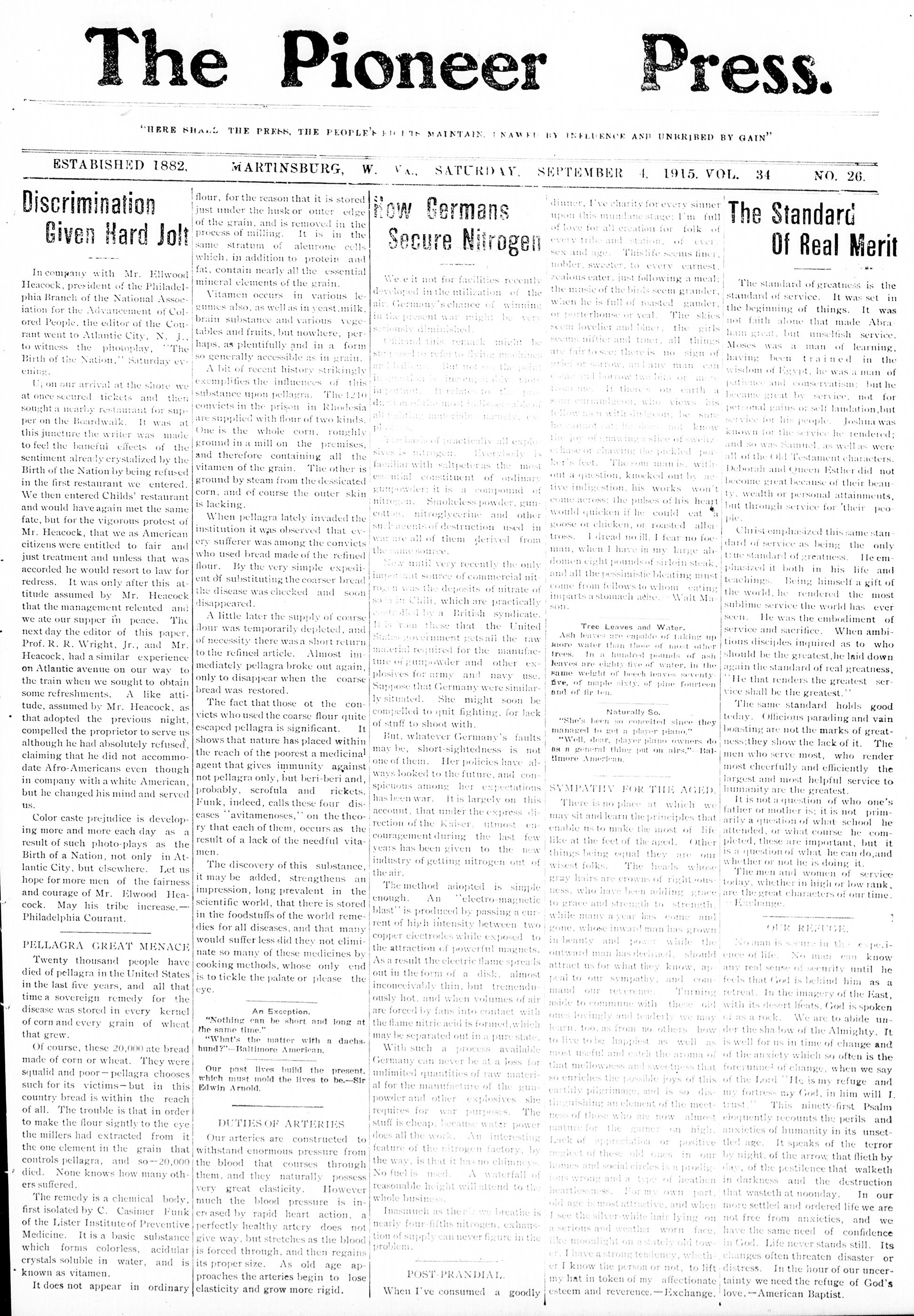
Discrimination Given Hard Jolt
In company with Mr. Ellwood Heacock, president of the Philadelphia Branch of the National Association for the Advancement of Colored People, the editor of the Courant went to Atlantic City, N. J., to witness the photoplay, "The Birth of the Nation," Saturday evening.
U' on our arrival at the shore we at once secured tickets and then sought a nearby restaurant for supper on the Boardwalk. It was at this juncture the writer was made to feel the baneful effects of the sentiment already crystalized by the Birth of the Nation by being refused in the first restaurant we entered. We then entered Childs' restaurant and would have again met the same fate, but for the vigorous protest of Mr. Heacock, that we as American citizens were entitled to fair and just treatment and unless that was accorded he would resort to law for redress. It was only after this attitude assumed by Mr. Heacock that the management relented and we ate our supper in peace. The next day the editor of this paper, Prof. R. R. Wright, Jr., and Mr. Heacock, had a similar experience on Atlantic avenue on our way to the train when we sought to obtain some refreshments. A like attitude, assumed by Mr. Heacock, as that adopted the previous night, compelled the proprietor to serve us although he had absolutely refused, claiming that he did not accommodate Afro-Americans even though in company with a white American, but he changed his mind and served us.
Color caste prejudice is developing more and more each day as a result of such photo-plays as the Birth of a Nation, not only in Atlantic City, but elsewhere. Let us hope for more men of the fairness and courage of Mr. Elwood Heacock. May his tribe increase. Philadelphia Courant.
PELLAGRA GREAT MENACE
Twenty thousand people have died of pellagra in the United States in the last five years, and all that time a sovereign remedy for the disease was stored in every kernel of corn and every grain of wheat that grew.
Of course, these 20,000 ate bread made of corn or wheat. They were squalid and poor-pellagra chooses such for its victims-but in this country bread is within the reach of all. The trouble is that in order to make the flour sightly to the eye the millers had extracted from it the one element in the grain that controls pellagra, and so-20,000 died. None knows how many others suffered.
The remedy is a chemical body, first isolated by C. Casimer Funk of the Lister Institute of Preventive Medicine. It is a basic substance which forms colorless, acidular crystals soluble in water, and is known as vitamen. It does not appear in ordinary
flour, for the reason that it is stored just under the husk or outer edge of the grain, and is removed in the process of milling. It is in the same stratum of aleurone cells which, in addition to protein and fat, contain nearly all the essential mineral elements of the grain.
Vitamen occurs in various legumes also, as well as in yeast, milk, brain substance and various vegetables and fruits, but nowhere, perhaps, as plentifully and in a form so generally accessible as in grain. A bit of recent history strikingly exemplifies the influences of this substance upon pellagra. The 1210 convicts in the prison in Rhodesia are supplied with flour of two kinds. One is the whole corn, roughly ground in a mill on the premises, and therefore containing all the vitamen of the grain. The other is ground by steam from the dessicated corn, and of course the outer skin is lacking.
When pellagra lately invaded the institution it was observed that every sufferer was among the convicts who used bread made of the refined flour. By the very simple expedient of substituting the coarser bread the disease was checked and soon disappeared.
A little later the supply of coarse flour was temporarily depleted, and of necessity there was a short return to the refined article. Almost immediately pellagra broke out again, only to disappear when the coarse bread was restored.
The fact that those of the convicts who used the coarse flour quite escaped pellagra is significant. It shows that nature has placed within the reach of the poorest a medicinal agent that gives immunity against not pellagra only, but beri-beri and, probably, scrofula and rickets. Funk, indeed, calls these four diseases "avitamenoses," on the theory that each of them, occurs as the result of a lack of the needful vitamen.
The discovery of this substance, it may be added, strengthens an impression, long prevalent in the scientific world, that there is stored in the foodstuffs of the world remedies for all diseases, and that many would suffer less did they not eliminate so many of these medicines by cooking methods, whose only end is to tickle the palate or please the eye.
An Exception.
"Nothing can be short and long at
the same time."
"What's the matter with a dachshund?"—Baltimore American.
Our past lives build the present,
which must mold the lives to be.—Sir
Edwin Arnold.
DUTIES OF ARTERIES
Our arteries are constructed to withstand enormous pressure from the blood that courses through them, and they naturally possess very great elasticity. However much the blood pressure is increased by rapid heart action, a perfectly healthy artery does not give way, but stretches as the blood is forced through, and then regains its proper size. As old age approaches the arteries begin to lose elasticity and grow more rigid.
Now Germans Secure Nitrogen
We're it not for facilities recently developed in the utilization of the air, Germany's chance of winning in the present war might be very seriously diminished. Offhand this remark might be surpused to refer to flying machines and balloons. But not so, the point in question is incomparably more important. It relates to the production of the most indispensable of all fighting materials, namely, explosives.
The basis of practically all explosives is nitrogen. Everybody is familiar with saltpeter as the most essential constituent of ordinary gunpowder; it is a compound of nitrogen. Smokeless powder, guncotton, nitroglycerine and other such agents of destruction used in war are all of them gerived from the same source.
Now until very recently the only important source of commercial nitrogen was the deposits of nitrate of soya in Chili, which are practically controlled by a British syndicate. It is from these that the United States government gets all the raw material required for the manufacture of gunpowder and other explosives for army and navy use. Suppose that Germany were similarly situated. She might soon be compelled to quit fighting, for lack of stuff to shoot with.
But, whatever Germany's faults may be, short-sightedness is not one of them. Her policies have always looked to the future, and conspicuous among her expectations has been war. It is largely on this account, that under the express direction of the Kaiser, utmost encouragement during the last few years has been given to the new industry of getting nitrogen out of the air.
The method adopted is simple enough. An "electro-magnetic blast" is produced by passing a current of high intensity between two copper electrodes while exposed to the attraction of powerful magnets. As a result the electric flame spreads out in the form of a disk, almost inconceivably thin, but tremendously hot, and when volumes of air are forced by fans into contact with the flame nitric acid is formed, which may be separated out in a pure state.
With such a process available Germany can never be at a loss for unlimited quantities of raw material for the manufacture of the gunpowder and other explosives she requires for war purposes. The stuff is cheap, because water power does all the work. An interesting feature of the nitrogen factory, by the way, is that it has no chimneys. No fuel is used. A waterfall of reasonable height will attend to the whole business.
Inasmuch as the air we breathe is nearly four-fifths nitrogen, exhaustion of supply can never figure in the problem.
POST-PRANDIAL
When I've consumed a goodly
Press.
dinner, I've charity for every sinner upon this mundane stage; I'm full of love for all creation for folk of every tribe and station, of every sex and age. This life seems finer, nobler, sweeter, to every earnest, zealous eater, just following a meal; the music of the birds seem grander, when he is full of roasted gander, or porterhouse or veal. The skies seem lovelier and bluer, the girls seem niftier and truer, all things are fair to see; there is no sign of grief or sorrow, and any man can come and borrow two bits or more from me. If there's on earth a sour curmudgeon, who views his fellow man with dulgeon, be sure he cannot eat; he does not know the joy of gnawing a slice of swetzerkase or chawing the pickled porker's feet. The sour man is, without a question, knocked out by active-indigestion, his works won't come across; the pulses of his heart would quicken if he could eat a goose or chicken, or roasted albatross. I dread no ill, I fear no foeman, when I have in my large abdomen eight pounds of sirloin steak, and all the pessimistic bleating must come from fellows to whom eating imparts a stomach ache. - Walt Mason.
Tree Leaves and Water.
Ash leaves are capable of taking up more water than those of most other trees. In a hundred pounds of ash leaves are eighty five of water, in the same weight of beech leaves seventy-five, of maple sixty, of pine fourteen and of fir ten.
"She's been so conceited since they managed to get a player piano." "Well, dear, player piano owners do as a general thing put on airs."-Baltimore American.
SYMPATHY FOR THE AGED
There is no place at which we may sit and learn the principles that enable us to make the most of life like at the feet of the aged. Other things being equal they are our wisest folks. The heads whose gray hairs are crowns of right-ousness, who have been adding grace to grace and strength to strength, while many a year has come and gone, whose inward man has grown in beauty and power while the outward man has declined, should attract us for what they know, appeal to our sympathy, and command our reverence. Turning aside to commune with these old ones lovingly and tenderly we may learn, too, as from no others how to live to be happiest as well as most useful and catch the aroma of that mellowness and sweetness that so enriches the possible joys of this earthly pilgrimage, and is so distinguishing an element of the meetness of those who are now almost mature for the garner on high. Lack of appreciation or positive neglect of these old ones in our homes and social circles is a prodigious wrong and a type of heathen heartlessness. For my own part, old age is most attractive, and when I see the silver-white hair lying on a serious and weather worn face, like moonlight on a stately old tower, I have a strong tendency, whether I know the person or not, to lift my hat in token of my affectionate esteem and reverence.—Exchange.
Naturally So.
The Standard Of Real Merit
The Standard Of Real Merit
The standard of greatness is the standard of service. It was set in the beginning of things. It was not faith alone that made Abraham great, but unselfish service. Moses was a man of learning, having been trained in the wisdom of Egypt, he was a man of patience and conservatism; but he became great by service, not for personal gains or self laudation, but service for his people. Joshua was known for the service he rendered; and so was Samuel, as well as were all of the Old Testament characters. Deborah and Queen Esther did not become great because of their beauty, wealth or personal attainments, but through service for 'their people.
Christ emphasized this same standard of service as being the only true standard of greatness. He emphasized it both in his life and teachings. Being himself a gift of the world, he rendered the most sublime service the world has ever seen. He was the embodiment of service and sacrifice. When ambitions disciples inquired as to who should be the greatest, he laid down again the standard of real greatness, "He that renders the greatest service shall be the greatest."
The same standard holds good today. Officious parading and vain boasting are not the marks of greatness; they show the lack of it. The men who serve most, who render most cheerfully and efficiently the largest and most helpful service to humanity are the greatest.
It is not a question of who one's father or mother is; it is not primarily a question of what school he attended, or what course he completed, these are important, but it is a question of what he can do, and whether or not he is doing it.
The men and women of service today, whether in high or low rank, are the great characters of our time. Exchange.
OUR REFUGE
No man is secure in the experience of life. No man can know any real sense of security until he feels that God is behind him as a retreat. In the imagery of the East, with its desert heats, God is spoken of as a rock. We are to abide under the shadow of the Almighty. It is well for us in time of change and of the anxiety which so often is the forcunnel of change, when we say of the Lord "He is my refuge and my fortress my God, in him will I trust." This ninety-first Psalm eloquently recounts the perils and anxieties of humanity in its unsettled age. It speaks of the terror by night, of the arrow that flieth by day, of the pestilence that walketh in darkness and the destruction that wasteth at noonday. In our more settled and ordered life we are not free from anxieties, and we have the same need of confidence in God. Life never stands still. Its changes often threaten disaster or distress. In the hour of our uncertainty we need the refuge of God's love.—American Baptist.
NO. 26.
Entered in Post Office at Martinsburg, W. Va., as Second Class Matter.
J. H. Clifford, Editor and Proprietor.
Drawor 869, and Bell 'Phone 60K.
Martinsburg, W. Va.
SATURDAY, SEPTEMBER 4, 1915
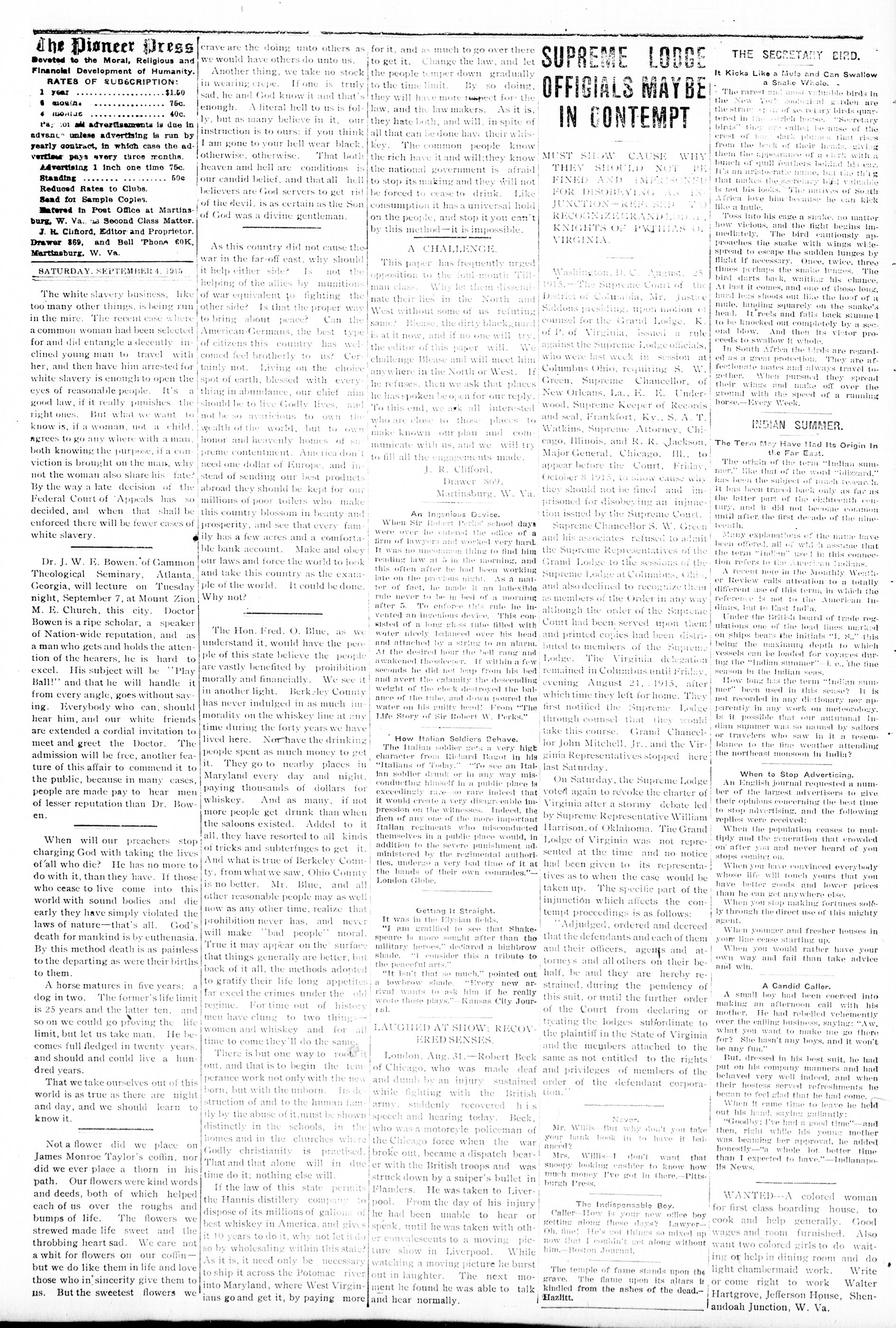
The white slavery business, like too many other things, is being run in the mire. The recent case where a common woman had been selected for and did entangle a decently inclined young man to travel with her, and then have him arrested for white slavery is enough to open the eyes of reasonable people. It's a good law, if it really punishes the right ones. But what we want to know is, if a woman, not a child, agrees to go any where with a man, both knowing the purpose, if a conviction is brought on the man, why not the woman also share his fate? By the way a late decision of the Federal Court of Appeals has so decided, and when that shall be enforced there will be fewer cases of white slavery.
Dr. J. W. E. Bowen. of Gammon Theological Seminary, Atlanta, Georgia, will lecture on Tuesday night, September 7, at Mount Zion M. E. Church, this city. Doctor Bowen is a ripe scholar, a speaker of Nation-wide reputation, and as a man who gets and holds the attention of the hearers, he is hard to excel. His subject will be "Play Ball!" and that he will handle it from every angle, goes without saying. Everybody who can, should hear him, and our white friends are extended a cordial invitation to meet and greet the Doctor. The admission will be free, another feature of this affair to commend it to the public, because in many cases, people are made pay to hear men of lesser reputation than Dr. Bowen.
When will our preachers stop charging God with taking the lives of all who die? He has no more to do with it, than they have. If those who cease to live come into this world with sound bodies and die early they have simply violated the laws of nature—that's all. God's death for mankind is by euthenasia. By this method death is as painless to the departing as were their births to them.
A horse matures in five years: a dog in two. The former's life limit is 25 years and the latter ten, and so on we could go proving the life limit, but let us take man. He becomes full fledged in twenty years, and should and could live a hundred years. That we take ourselves out of this world is as true as there are night and day, and we should learn to know it.
Not a flower did we place on James Monroe Taylor's coffin, nor did we ever place a thorn in his path. Our flowers were kind words and deeds, both of which helped each of us over the roughs and bumps of life. The flowers we strewed made life sweet and the throbbing heart sad. We care not a whit for flowers on our coffin—but we do like them in life and love those who in sincerity give them to us. But the sweetest flowers we
crave are the doing unto others as we would have others do unto us. Another thing, we take no stock in wearing crepe. If one is truly sad, he and God know it and that's enough. A literal hell to us is folly, but as many believe in it, our instruction is to ours: if you think I am gone to your hell wear black, otherwise, otherwise. That both heaven and hell are conditions is our candid belief, and that all hell believers are God servers to get rid of the devil, is as certain as the Son of God was a divine gentleman.
As this country did not cause the war in the far-off east, why should it help either side? Is not the helping of the allies by munitions of war equivalent to fighting the other side? Is that the proper way to bring about peace? Can the American-Germans, the best type of citizens this country has welcomed feel brotherly to us? Certainly not. Living on the choice spot of earth, blessed with everything in abundance, our chief aim should be to live Godly lives, and not be so avaricious to own the wealth of the world, but to own honor and heavenly homes of supreme contentment. America don't need one dollar of Europe, and instead of sending our best products abroad they should be kept for our millions of poor toilers who make this country blossom in beauty and prosperity, and see that every family has a few acres and a comfortable bank account. Make and obey our laws and force the world to look and take this country as the example of the world. It could be done. Why not?
The Hon. Fred. O. Blue, as we understand it, would have the people of this state believe the people are vastly benefited by prohibition morally and financially. We see it in another light. Berkeley County has never indulged in as much immorality on the whiskey line at any time during the forty years we have lived here. Nor have the drinking people spent as much money to get it. They go to nearby places in Maryland every day and night, paying thousands of dollars for whiskey. And as many, if not more people get drunk than when the saloons existed. Added to it all, they have resorted to all kinds of tricks and subterfuges to get it. And what is true of Berkeley County, from what we saw, Ohio County is no better. Mr. Blue, and all other reasonable people may as well now as any other time, realize that prohibition never has, and never will make "bad people" moral. True it may appear on the surface that things generally are better, but back of it all, the methods adopted to gratify their life long appetites far excel the crimes under the old regime. For time out of history men have eluded to two things—women and whiskey and for all time to come they'll do the same.
There is but one way to root it out, and that is to begin the temperance work not only with the new born, but with the unborn. Its destruction of and to the human family by the abuse of it, must be shown distinctly in the schools, in the homes and in the churches where Godly christianity is practised. That and that alone will in due time do it; nothing else will.
If the law of this state permits the Hannis distillery company to dispose of its millions of gallons of best whiskey in America, and gives it 10 years to do it, why not let it do so by wholesaling within this state? As it is, it need only be necessary to ship it across the Potomac river into Maryland, where West Virginians go and get it, by paying more
for it, and as much to go over there to get it. Change the law, and let the people temper down gradually to the time limit. By so doing, they will have more respect for the law, and the law makers. As it is, they hate both, and will, in spite of all that can be done have their whiskey. The common people know the rich have it and will; they know the national government is afraid to stop its making and they will not be forced to cease to drink. Like consumption it has a universal hold on the people, and stop it you can't by this method—it is impossible.
A CHALLENGE.
This paper has frequently urged opposition to the soul mouth Tillman class. Why let them disseminate their lies in the North and West without some of us refuting same? Please, the dirty blackguard is at it now, and if no one will try, the editor of this paper will. We challenge Blease and will meet him anywhere in the North or West. If he refuses, then we ask that places he has spoken be open for our reply. To this end, we ask all interested who are close to those places to make known our plan and communicate with us, and we will try to fill all the engagements made.
I. R. Clifford,
An Ingenious Device.
When Sir Robert Perks' school days were over he entered the office of a firm of lawyers and worked very hard. It was no uncommon thing to find him reading law at 5 in the morning, and this often after he had been working late on the previous night. As a matter of fact, he made it an inflexible rule never to be in bed of a morning after 5. To enforce this rule he invented an ingenious device. This consisted of a long glass tube filled with water nicely balanced over his head and attached by a string to an alarm. At the desired hour the bell rang and awakened the thresleeper. If within a few seconds he did not heap from his bed and avert the calamity the descending weight of the clock destroyed the balance of the tube, and down poured the water on his guilty head! From "The Life Story of Sir Robert W. Perks."
How Italian Soldiers Rehave
The Italian soldier gets a very high character from Richard Bagot in his "Italians of Today." "To see an Italian soldier drunk or in any way misconducting himself in a public place is exceedingly rare—so rare indeed that it would create a very disagreeable impression on the witnesses. Indeed, the men of any one of the more important Italian regiments who misconducted themselves in a public place would, in addition to the severe punishment administered by the regimental authorities, undergo a very bad time of it at the hands of their own comrades."—London Globe.
Getting It Straight.
"I am gratified to see that Shakespeare is more sought after than the military heroes," declared a highbrow shade. "I consider this a tribute to the peaceful arts." "It isn't that so much," pointed out a lowbrow shade. "Every new arrival wants to ask him if he really wrote those plays."—Kansas City Journal.
LAUGHED AT SHOW: RECOVERED SENSES
London, Aug. 31.—Robert Beck of Chicago, who was made deaf and dumb by an injury sustained while fighting with the British army, suddenly recovered his speech and hearing today. Beck, who was a motorcycle policeman of the Chicago force when the war broke out, became a dispatch bearer with the British troops and was struck down by a sniper's bullet in Flanders. He was taken to Liverpool. From the day of his injury he had been unable to hear or speak, until he was taken with other convalescents to a moving picture show in Liverpool. While watching a moving picture he burst out in laughter. The next moment he found he was able to talk and hear normally.
SUPREME LODGE OFFIGIALS MAYBE IN CONTEMPT
MUST SHOW CAUSE WHY
THEY SHOULD NOT BE
FINED AND IMPRISONED
FOR DISOBEYING AS INJUNCTION - REFUSED TO RECOGNIZE GRAND LODGE,
KNIGHTS OF PXTHAS OF VIRGINIA
1. a.
Washington, D. C. August, 25 1915. - The Supreme Court of the District of Columbia, Mr. Justice Siddons presiding, upon motion of counsel for the Grand Lodge, K. of P. of Virginia, issued a rule against the Supreme Lodge officials, who were last week in session at Columbus Ohio, requiring S. W. Green, Supreme Chancellor, of New Orleans, La., E. E. Underwood, Supreme Keeper of Records and seal, Frankfort, Ky., S. A. T. Watkins, Supreme Attorney, Chicago, Illinois, and R. R. Jackson, Major General, Chicago, Ill., to appear before the Court, Friday, October 8 1915, to show cause why they should not be fined and imprisoned for disobeying an injunction issued by the Supreme Court.
Supreme Chancellor S. W. Green and his associates refused to admit the Supreme Representatives of the Grand Lodge to the sessions of the Supreme Lodge at Columbus, Ohio, and also declined to recognize them as members of the Order in any way although the order of the Supreme Court had been served upon them and printed copies had been distributed to members of the Supreme Lodge. The Virginia delegation remained in Columbus until Friday, evening August 21, 1915, after which time they left for home. They first notified the Supreme Lodge through counsel that they would take this course. Grand Chancellor John Mitchell, Jr., and the Virginia Representatives stopped here last Saturday.
On Saturday, the Supreme Lodge voted again to revoke the charter of Virginia after a stormy debate led by Supreme Representative William Harrison, of Oklahoma. The Grand Lodge of Virginia was not represented at the time and no notice had been given to its representatives as to when the case would be taken up. The specific part of the injunction which affects the contempt proceedings is as follows:
"Adjudged, ordered and decreed that the defendants and each of them and their officers, agents and attorneys and all others on their behalf, be and they are hereby restrained, during the pendency of this suit, or until the further order of the Court from declaring or treating the lodges subordinate to the plaintiff in the State of Virginia and the members attached to the same as not entitled to the rights and privileges of members of the order of the defendant corporation."
Mr. Willis—But why don't you take your bank book in to have it balanced?
Mrs. Willis—I don't want that snoopy looking cashier to know how much money I've got in there.—Pittsburgh Press.
Caller—How is your new office boy getting along these days? Lawyer—Oh, fine! He's got things so mixed up now that I couldn't get along without him.—Boston Journal.
The temple of fame stands upon the grave. The flame upon its altars is kindled from the ashes of the dead.—Hazlitt.
THE SECRETARY BIRD.
It Kicks Like a Mule and Can Swallow a Snake Whole.
The rarest and most valuable birds in the New York zoological garden are the straight-leged of secretiary birds quartered in the ostrich house. "Secretary birds" they are called by use of the crest of lon' dark plumes that rises from the back of their heads, giving them the appearance of a clerk with a bunch of quill feathers behind his ear. It's an aristocratic name, but the thing that makes the secretary bird valuable is not his looks. The natives of South Africa love him because he can kick like a mule.
Toss into his cage a snake, no matter how vicious, and the fight begins immediately. The bird cautiously approaches the snake with wings widespread to escape the sudden lunges by flight if necessary. Once, twice, three times perhaps the snake lunges. The bird darts back, waiting his chance. At last it comes, and one of those long, hard legs shoots out like the hoof of a mule, landing squarely on the snake's head. It reels and falls back stunned to be knocked out completely by a second blow. And then its victor proceeds to swallow it whole.
In South Africa the birds are regarded as a great protection. They are affectionate mates and always travel together. When pursued they spread their wings and make off over the ground with the speed of a running horse.—Every Week.
INDIAN SUMMER.
The Term May Have Had Its Origin in the Far East.
The origin of the term "Indian summer," like that of the word "blizzard," has been the subject of much research. It has been traced back only as far as the latter part of the eighteenth century, and it did not become common until after the first decade of the nineteenth.
Many explanations of the name have been offered, all of which assume that the term "Indian" used in this connection refers to the American Indians.
A recent note in the Monthly Weather Review calls attention to a totally different use of this term, in which the reference is not to the American Indians, but to East India.
Under the British board of trade regulations one of the load lines marked on ships bears the initials "I. S.," this being the maximung depth to which vessels can be loaded for voyages during the "Indian summer"—i. e., the fine season in the Indian seas.
How long has the term "Indian summer" been used in this sense? It is not recorded in any dictionary nor apparently in any work on meteorology. Is it possible that our autumnal Indian summer was so named by sailors or travelers who saw in it a resemblance to the fine weather attending the northeast monsoon in India?
When to Stop Advertising
An English journal requested a number of the largest advertisers to give their opinions concerning the best time to stop advertising, and the following replies were received:
When the population ceases to multiply and the generation that crowded on after you and never heard of you stops coming on.
When you have convinced everybody whose life will touch yours that you have better goods and lower prices than he can get anywhere else.
When you stop making fortunes solely through the direct use of this mighty agent.
When younger and fresher houses in your line cease starting up.
When you would rather have your own way and fail than take advice and win.
A Candid Caller:
A small boy had been coerced into making an afternoon call with his mother. He had rebelled vehemently over the calling business, saying: "Aw, what you want to make me go there for? She hasn't any boys, and it won't be any fun."
But, dressed in his best suit, he had put on his company manners and had behaved very well indeed, and when their hostess served refreshments he began to feel glad that he had come.
When it came time to leave he held out his hand, saying gallantly:
"Goodbye; I've had a good time"—and then, right while his young mother was beaming her approval, he added honestly—"a whole lot better time than I expected to have."—Indianapolis News.
WANTED----A colored woman for first class boarding house, to cook and help generally. Good wages and room furnished. Also want two colored girls to do waiting or help in dining room and do light chambermaid work. Write or come right to work Walter Hartgrove, Jefferson House, Shenandoah Junction, W. Va.
Mrs. Fannie Baltimore, is back home again after a very pleasant visit of several weeks in Sewickley. Pa.
Mrs. Estella Bailey was a recent visitor to Williamsport, Md., and she says her trip was an enjoyable one.
Mr. W. A. Fisher, otherwise known as the "Count," was a welcome caller at our office the other day.
Mr. Walter Briscoe, of Harrisburg, Pa., attended the funeral of his brother-in-law, Mr. Monroe Taylor, in this city, on Monday last
```markdown
```
Mr. John Basey, the expert ball player, went to Berkeley Springs on Thursday last, where he officiated as catcher for the team of that lively little mountain city.
---
Mr. Howard Blakey, a venerable and respected resident of our city, continues quite ill at his home on Martin st., a fact which occasions considerable alarm among his many friends.
Mr. Charles Moten, the well known and popular janitor at the Old National Bank, has been suffering with rheumatism, but is somewhat improved at this time.
```markdown
```
A fair will begin at Ebenezer Memorial Baptist Church on next Tuesday night, and continue for 10 days. The public is cordially invited to attend.
Mr. John F. Carter, the well known soda fountain proprietor and all around man of West Burke Street, was quite sick for a few days, but is much better now.
4.2.1 calculate $P(0 \leq x \leq 1)$
Dr. George W. Baylis is spending some time at the parental homestead in Marshall, Virginia. He writes that he is enjoying himself, and sends greetings to his many friends hereabouts.
(1) (2) (3) (4) (5) (6) (7) (8) (9) (10) (11) (12) (13) (14) (15) (16) (17) (18) (19) (20) (21) (22) (23) (24) (25) (26) (27) (28) (29) (30) (31) (32) (33) (34) (35) (36) (37) (38) (39) (40) (41) (42) (43) (44) (45) (46) (47) (48) (49) (50) (51) (52) (53) (54) (55) (56) (57) (58) (59) (60) (61) (62) (63) (64) (65) (66) (67) (68) (69) (70) (71) (72) (73) (74) (75) (76) (77) (78) (79) (80) (81) (82) (83) (84) (85) (86) (87) (88) (89) (90) (91) (92) (93) (94) (95) (96) (97) (98) (99) (100)
Mr. Phillip Jackson, principal of the Charles Town School, and a man of much energy and influence in his home place, was a visitor to our city on Monday last, and before leaving, called at our office. We were glad to see him and wish he would come oftener.
The Pioneer Press has for sale one of the best poor man's printing presses, that can be found anywhere. It will do the best of work and is so simple a child can understand its use will not only sell it cheap, but put it up free of cost, and teach any one who has common sense, to understand and run it within two hours. It's a great bargain for anyone. Some brave, industrious young man try it. We would not give a bright, honest fearless editor relative to helping the race, for a hundred jackleg preachers. Believe us—the public salvation of our peculiar people lies in the work of the manly editors and teachers.
The VERIBEST Straightener Yet! KONGOLEME Marvelous Discovery.
It is what you have been dreaming of for years. To discover an article that would actually straighten colored folks' hair without the use of KONGOLEME. KONGOLEME does it and more than it. It makes Coats, Harsh, Stubborn, Naps, booking hair SOFT and SILKY. KONGOLEME is a preparation that makes the hair STRAIGHT, but does the hair look like it was straightened by the use of Hot Irons or Comb—just makes it look although it is naturally so. Simply apply the butter commit for a few minutes. WASH IT OFF and the hair is straight.
It keeps straight, not for a day or a week, but for two or three months. Kongooleme is positively guaranteed to do what you say will with your money is refunded. Ebonized Ground Oil gives that ravens' adjunct to Kongooleme gives that ravens' adjunct to KONGOLEME $100. EBONIZED GROUND OIL 250. Send $25 for trial jars, use it, then write for Agency KONGO PRODUCTS CO. DEPT. 33 1315 WILLI AVENUE, PITTSBURGH, PA.
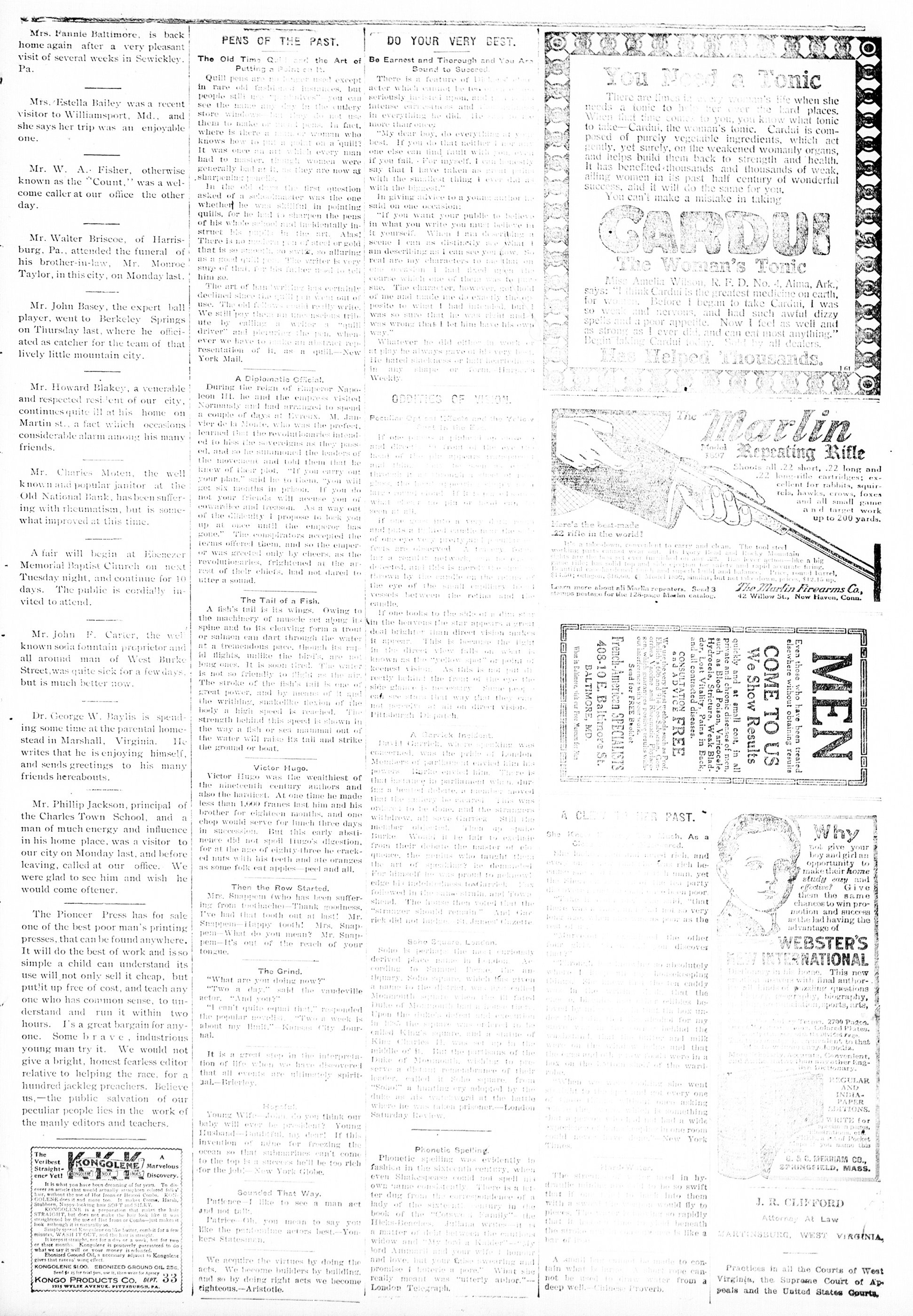
PENS OF THE PAST.
The Old Time Quill and the Art of Putting a Point on it.
Quill pens are no longer used except in rare old fashioned instances, but people still use "quillives" you can see the name any day in the cutlery store windows, but they do not use them to make or point pens. In fact, where is there a number woman who knows how to put a point on a quill? It was once an art which every man had to master, though women were generally bad at it, as they are now at sharpening penalties.
In the old days the first question asked of a schoolmaster was the one whether he was skillful in pointing quills, for he had to sharpen the pens of his whole school and incidentally instruct his pupils in the art. Alas! There is no modern pen of steel or gold that is so smooth, so swirly, so alluring as a good quill pen. The writer is very sure of that, for his father used to tell him so.
The art of handwriting has certainly declined since the quill pen went out of use. The old folks could really write. We still pay them an enormous tribute by calling a writer a "quill driver" and pleasing the pen, whenever we have to make an abstract representation of it, as a quill.—New York Mail.
A Diplomatic Official
During the reign of Emperor Napoleon III, he and the empress visited Normandy and had arranged to spend a couple of days at Lyreux, M. Janvier de la Monte, who was the prefect, learned that the revolutionaries intended to hiss the sovereigns as they passed, and so he summoned the leaders of the movement and told them that he knew of their plot. "If you carry out your plan," said he to them, "you will get six months in prison. If you do not your friends will accuse you of cowardice and treason. As a way out of the difficulty I propose to lock you up at once until the emperor has gone." The conspirators accepted the terms offered them, and so the emperor was greeted only by cheers, as the revolutionaries, frightened at the arrest of their chiefs, had not dared to utter a sound.
The Tail of a Fish.
A fish's tail is its wings. Owing to the machinery of muscle set along its spine and to its cleaving form a trout or salmon can dart through the water at a tremendous pace, though its rapid dights, unlike the birds, are not long ones. It is soon tired. The water is not so friendly to flight as the air. The stroke of the fish's tail is one of great power, and by means of it and the writhing, snake-like flexion of the body a high speed is reached. The strength behind this speed is shown in the way a fish or sea mammal out of the water will raise its tail and strike the ground or boat.
Victor Hugo.
Victor Hugo was the wealthiest of the nineteenth century authors and also the haunted. At one time he made less than 1,000 francs last him and his brother for eighteen months, and one chop would serve for lunch three days in succession. But this early abstinence did not spoil Hugo's digestion, for at the age of eighty-three he cracked nuts with his teeth and ate oranges as some folk eat apples—peel and all.
Then the Row Started.
Mrs. Snappem (who has been suffering from toothache)—Thank goodness, I've had that tooth out at last! Mr. Snappem—Happy tooth! Mrs. Snappem—What do you mean? Mr. Snappem—It's out of the reach of your tongue.
The Grind.
"What are you doing now?"
"Two a day," said the vaudeville actor, "And you?"
"I can't quite equal that," responded the popular novelist, "Two a week is about my limit."—Kansas City Journal.
It is a great step in the interpretation of life when we have discovered that all events are ultimately spiritual.—Brierley.
H . p = 1 . 0
Young Wife—John, do you think our baby will ever be president? Young Husband—bautiful, my dear! If this invention of nique for freezing the ocean so that submarines can't come to the top is a success he'll be too rich for the job! New York Globe
Sounded That Way.
Patience—I like to see a man act and not talk.
Patrice—Oh, you mean to say you like the pantomime actors best.—Yonkers Statesman.
We acquire the virtues by doing the acts. We become builders by building, and so by doing right acts we become righteous.—Aristotle.
DO YOUR VERY BEST.
Be Earnest and Thorough and You Are
Bound to Succeed.
There is a feature of Dickens often
acter which cannot be teed, or even
seriously instilled upon, and the
intense earnestness and the humility
in everything he did. He can do
more than once:
"My dear boy, do everything at your
best. If you do that neither I nor any
one else can find fault with you, even
if you fail. For myself, I can honestly
say that I have taken as great points
with the smallest thing I ever did as
with the biggest."
In giving advice to a young author he
said on one occasion:
"If you want your public to believe in what you write you must believe in it yourself. When I am describing a scene I can as distinctly see what I am describing as I can see you now. So real are my characters to me that on one occasion I had fixed upon the course which one of them was to pursue. The character, however, got hold of me and made me do exactly the opposite to what I had intended, but I was so sure that he was right and I was wrong that I let him have his own way."
Whatever he did either in work or at play he always gave or his very best. He hated sinness or hurt heartiness in any shape or form. Harper's Weekly.
OCCULTICS OF VISION
Peculiar Optical Effects and the Yellow
Frost in the Eye.
If one powers a pinhole on close
and directs it to front of the eye the
hand of the pinhole appears transparent
and thin, with the same effect
throught it at through a sheet of
glass, the hand appears sharply a
large normal model. If it is one of some
what else the pinhole or hand can be
seen at all.
if one goes into a very dark room and puts a trilobite inside near the side of one eye very pretty and colorful feet are observed. A tiny body forming a regular network, and the eyes detected, and this is meted the eyes thrown by the cannel on the retina of the eye of the small capillary vessels between the retina and the cannel.
If one looks to the side of a dim star in the heavens the star appears a great deal brighter than direct vision makes it appear. This is because the light in the direct view falls on what is known as the "yellow spot" or point of keenest vision. As this is not put directly behind the front of the eye the side glance is necessary. Some people can see storm that way that they cannot perceive at all on direct vision. Pittsburgh Dishmatch
A Garlick Incident.
David Garrick, where speaking was concerned, was the pride of London. Members of parliament envied him his powers. Kyrkei envied him. There is that instance in parliament when, during a heated debate, a member moved that the gentry be excavated. This was ordered to be done, and the strangers withdrew, all save Garrick. Still the member objected. When up spare Burke Woolf it be fair to exclude from their debate the master of eloquence, the genius who taught them the art of speaking? he demanded for himself he was proud to acknowledge his indebtedness to Garrick. Fox followed in the same strain, and Townshend. The house then voted that the "stranger should remain." And Garrick did not back, St. James's Gazette
Soho Square, London.
Soho is perhaps the most curiously derived place name in London. According to Samuel Pence, the antiquary, Soho square, which this given a name to the district, was first called Monmouth square who the ill-fated Duke of Monmouth had a house there. Upon the duke's defeat and execution in 1085 the square was ordered to be called King's square, and a statue of King Charles II, was set up in the middle of it. But the partisans of the Duke of Monmouth, wishing to preserve a distant remembrance of their leader, called it Soho square, from "Sonol" a haunting cry adopted by the duke as a sigh waterwagd at the battle where he was taken prisoner.—London Saturday Review.
Phonetic Spelling
Phonetic spelling was evidently in fashion in the sixteenth century, when even Shakespeare could not spell its own name consistently. There is a letter dug from the correspondence of a lady of the sixteenth century in the book of the "Cotswwea family" the Hicks-Benches, Jullana writes—it is a matter of debt between the emancipous widow and "My lord a Kander"—"My lord Ammaril and your wife I honour and love, but your Else sweeping and promise I hotte a pore." What she really meant was "utterly author."—London Telegraph.
You Need a Tonic
There are times in every woman's life when she needs a tonic to help her over the hard places. When that time comes to you, you know what tonic to take—Cardui, the woman's tonic. Cardui is composed of purely vegetable ingredients, which act gently, yet surely, on the weakened womanly organs, and helps build them back to strength and health. It has benefited thousands and thousands of weak, ailing women in its past half century of wonderful success, and it will do the same for you.
You can't make a mistake in taking
Miss Amelia Wilson, says: "I think Cardui is the for woman. Before I began so weak and nervous, and spells and a poor appetite, as strong as I ever did, and Begin taking Cardui today."
Here's the best-made .22 rifle in the world!
It is a tide-down, convenient to carry and working parts cannot wear it. In every rifle are the best set ever imprinted on a paper ribbed this solid top and silver-colored beautiful coarse-bound tread and the handle $11.00; octagon, $16.00. (1) Model 1802, similar.
Learn more about all Marlin repeaters. Send stamps postage for the 128-page Marlin catalog.
French-American SPECIALISTS
408-10 E. Baltimore St.
BALTIMORE, MD.
When in Baltimore, visit our Free Museum for Rifles.
CARDU
The Woman's Touch
Miss Amelia Wilson, R. F. D. No. 4, 42 Willow St.
"I think Cardui is the greatest medical woman. Before I began to take Cardui weak and nervous, and had such ails and a poor appetite. Now I feel as strong as I ever did and can eat most in laking Cardui today. Sold by all.
Has Helped Thousands
The Marlin
Model
1907
Shoots all
.22 lo
eat-made the world!
down convenient to carry and clean. The tool steels cannot wear with its Icery Head and Rocky Mount can not even be handled on any gait. This lever action solid top and middle portion for safety and rapid access, hardwood tread and smooth build and balance. Price: $10.00. Model 1907, similar, but not rub down, priced at all Marlin repeaters. Send 3 for the 126-page Marlin catalog.
COME TO US
We Show Results
quickly and at small cost, in all private and chronic diseases of men, such as Blood Poison, Varicocle, Hydrocele, Stricture, Weak Bladder, Lost Vitality, Paires in Back, and all contracted diseases.
CONSULTATION
and ADVICE
We use the very latest methods such as Proi Ehildia's 600 and 114 No Salvation, Conjurice Vaccine and Rheumatize Phydo-sion, which guarantee positive results with our interference with your work.
Send for FREE Bednet
French-American SPECIALISTS
409 FOR PETS
CARDUI The Woman's Tonic Miss Amelia Wilson, R. F. D. No. 4, Alma, Ark., says: "I think Cardui is the greatest medicine on earth, for woman. Before I began to take Cardui, I was so weak and nervous, and had such awful dizzy spells and a poor appetite. Now I feel as well and as strong as I ever did, and can eat most anything." Begin taking Cardui today. Sold by all dealers. Has Helped Thousands.
The Marlin
Model 1897
Repeating Rifle
Shoots all .22 short, .22 long and
.22 long-rifle cartridges; ex-
cellent for rabbits, squirrels, hawks, crows, foxes
and all small game
and target work
up to 200 yards.
Here's the best-made
.22 rifle in the world!
It's a take-down, convenient to carry and clean. The tool steel
working parts cannot wear out. Its Ivory Head and Rocky Mountain
sights are the best set ever furnished on any .22. Has lower action—like a big
gauge rifle; has solid top and side spectra for safety and rapid accurate firing.
Beautiful case included touch and superb build and balance. Price, round barrel,
$11,00; octagon, $16,60. ( Model 1892, similar, but not take-down, prices, $12.45 up.
Learn more about all Marlin repeaters. Send 3
stamps postage for the 125-page Marlin catalog.
The Marlin Firearms Co.
42 Willow St., New Haven, Conn.
A CLEVER TIME PAST.
She knew Mary was too much. As a
Glassman, she miserred.
She looked and noticed rich, and
every one she saw, and the fuss rich be-
cause she saw her own rich man, yet
the Sheeran was on the less party
discoverer and not the one been poor.
"Take it in hand and say, 'that
there was a man and that not so very
long ago, when she was poor as the
rest of it.'
"Murder not plundered, the other
four girls. 'You can still you discover
that?'
"Through the window so absolutely where I be preparing housekeeping tibbits. She knew that the ten caddy was in the washing dish, that the crescent bibbies and other edibles be layered by more than that tin box under the candle that the alcohol for my sauce was in the corner behind the washstand, that the butter and milk were on the what we believe and that the eggs and oil new food were in a box on the bottom shelf of the wardrobe.
"When we were cooking she went straight to the spot and got every one of those things without once asking what she was doing which is something that a person who had not had a wide exprese of that deep space in one poo could never have done"—New York Times.
HANDLE WINNER
The stream of water used in hydraulic mining are used to be so swift that if one tugged to back into them with a sword the woman would fly to pieces. The water is flowing so rapidly that it has over three hundred beneath the stroke of a chisel; otherwise it like a bar of fire.
A small boat cannot be made to contain what is large. A short rope cannot be used to draw water from a deep well—Chinese Proverb.
RDUI
man's Tonic
R. F. D. No. 4, Alma, Ark,
greatest medicine on earth,
can to take Cardui, I was
had such awful dizzy
Now I feel as well and
can eat most anything."
Sold by all dealers.
Thousands.
Marlin
Repeating Rifle
Shoots all .22 short, .22 long and
.22 long-rifle cartridges; excellent for rabbits, squirrels, hawks, crows, foxes and all small game and target work up to 200 yards.
The tool steel and Rocky Mountain
The lower action—like a big safety and rapid accurate firing,
and balance. Dice, round barrel,
but not rifle-chain, pictures $12.15 up.
The Marlin Firearms Co,
42 Willow St., New Haven, Conn.
MEN
Even those who have been treated elsewhere without obtaining results
COME TO US
We Show Results
quickly and at small cost, in all private and chronic diseases of men,
such as Blood Poison, Varicoccal,
Why
not give your boy and girl an opportunity to make their home study easy and effective? Give them the same chances to win promotion and success as the lad having the advantage of WEBSTER'S NEW INTERNATIONAL Dictionary in his home. This new medical answers with final authoritative all kinds of puzzling questions in biography, biography, biography, sports, arts, and literature. In the form of Verse, 2790 Pace, Colored Plates, and a divided Page. It is an excellent to that useful to work on many topics. More clearly, Accurate, Convenient, and another nature than any other English dictionary.
REGULAR AND INDIAPAPER EDITIONS.
WRITE for specimen pages, illustrations, etc. with a set of Pocket Maps of your name this
G. & C. MERNAM CO., SPRINGFIELD, MASS.
Attorney At Law
MARTINSBURG, WEST VIRGINIA
Practices in all the Courts of West
Virginia, the Supreme Court of Appeals and the United States Courts
J. R. CLIFFORD