The Pioneer Press
Saturday, April 22, 1916
Martinsburg, West Virginia
Page text (machine-generated)
"HERE SHALL THE PRESS, THE PEOPLE'S RIGHTS MAINTAIN, UNAWED BY INFLUENCE AND UNBRIBED BY GAIN"
The Pioneer
ESTABLISHED 1882
SCHOOL NUCLEUS OF SELF-GOVERNMENT
In the South As the Church Was In New England Two Centuries
WASHINGTON, April 17.—As Mr. James Bryce says in "The American Commonwealth," "the school is becoming the nucleus of local self-government in the South now, as the church was in New England two centuries ago," and both ought to be actively identified with the good roads movement without success of which neither can attain that degree of prosperity essential to the welfare of the whole community. The direct and immediate effect of improved highways upon the educational institutions in the country districts has been freely discussed in these chronicles. The building of modern school houses, the extension of the courses of study, the employment of community wagons for the transportation of pupils from wide districts to and from the school centres to their respective homes, the advantage of converting the school buildings between terms or on the days when "school is out" into community forms for the discussion of public questions of large moment or for such variety of public entertainment as the people might desire, are all subjects that have been treated by many wise and thoughtful leaders. In the consideration of the good roads problem strange to say however, one of the most influential bodies of workers has been passed over with little attention. The country doctors, whose labors are abundant and poorly rewarded, have been invited to take an active part in the good roads movement for their own benefit and the benefit of the patients who depend upon their ministrations for relief in their times of distress, and equally with these Samaritans are the country preachers whose mission it is to administer to the soul while the physicians are doing their best for the body.
In 1914 there were 178.313 ministers including the clergy of all the churches or denominations or sects in the United States who were ministering to 225.486 churches representing a membership of 28,805,559. The larger number of these ministers were engaged in the work of country parishes or congregations. They are all deeply concerned not only for the spiritual welfare of their flocks but for their material comfort as well. In the pursuit of their abundant labors they have found how difficult, how at times almost impossible, it is for them to do their work because of the impassable condition of the roads over which they must journey on their missions of mercy. The most of them are ill paid, many of them actually live from hand to mouth; the average salary of the country minister probably does not amount to over $400 the year, and how they live only the Lord knows. Take the Episcopal church, for example, which is said to contain "the richest church membership in the United States," and there are 4,420 men employed in its active service. The average salary of it ministers is $1,200 the year, all of which, however, is not paid in cash. More than 2,500 of its clergy receive less than $1,500, and only 237, including bishops, receive $4,000. Over 700 are paid less than $1,000. The "Southern Churchman" says they "are expected to have a good education, to dress well, to live and move among people where rents are high, keep open house, always appear cheerful and preserve their physical vigor." In the main they do all this and as
one of the Washington rectors said recently, "the preachers are the true economists of the age and do more for less money than any other workers in the land." The American Highway Association, unfortunately, cannot "raise their wages," so to say, but it can tell them, not only the Episcopal brethren but all who work in the same field, how, by the exercise of their admittedly great influence, they can help particularly to improve the condition of the preachers employed in the rural districts.
Preaching one or two sermons on Sunday, however important, is now by any means all that the country parson is expected and required to do—his pastoral work is as important as his preaching service. His parish generally covers a great stretch of country and his congregation is widely scattered. He must keep in close touch with them if he is to exercise the duties of the ministry with which he has been charged. In the order and really better time in New England and throughout the country, the country parson was the guide, counselor and friend of all his people. Being the most learned man in the community, he was consulted by his parishioners on all questions of public and domestic concern and wielded a tremendous influence in society and upon the body politics. He was the oracle of his parish, kept fully advised upon public question and their relation to the public morals, and where he led the people followed. In spite of the general dissemination of knowledge and the disposition of the crowd to do as it please, he still is, or ought to be the most influential man in his neighborhood—and he would be if he would only in his secular moments manifest an active interest in the practical affairs of his parish.
One of the most practical affairs with which the people have to deal is the building of good roads, roads which would tie the country and town together, which would make neighbors of those who dwell miles apart, which would afford the means of easy communication between the country doctor and his patients and between the country parson and the members of his church. The country parson finds it possible only at the expense of great nervous energy and physical exhaustion at certain times of the year to keep in touch with the members of his flock. He knows by hard experience the difficulty of riding or walking over muddy roads and through oceans of slush to those longing for his comforting presence in time of sickness and death, and how hard it is to convey to those who are ill the material things necessary to their recovery. It would be a great thing if the country parsons all over the land would agree among themselves to preach on a certain Sunday a sermon on the subject of good roads. The Bible is full of appropriate texts. Sermons are preached every Sunday on all sorts of social, ethical and political questions not one of which is of more immediate importance to the welfare of the community than the improvement of the public highways. The country parson who has not forgotten his "Pilgrim's Progress" will recollect what trouble Christian had on his way to the Celestial Country by the condition of the roads and how terribly he suffered when he took the wrong turn instead of holding straightforward in the appointed way. There was one point, the "Slough of Despond," which the surveyors had been working above sixteen hundred years and into which they had dumped "twenty thousand cart-loads, yea millions of wholesome instructions," and yet "it is the Slough of Despond still," although "certain good and substantial steps," had been "placed
even through the very midst of this slough," and it is noted in the story what terrible things happened to Christian and Hopeful, his companion on his journey, when leaving the main highway they sought smoother ground for their tired feet and fell into the hands of Giant Despair. For their own sake that they may do their work better for the sake of the people to whom they minister in the rural districts, for the promotion of industry and the common good, the American Highway Association in vites the active co-operation of the country preachers in the good roads movement.
Atkinson Retires.
Former Governor Atkinson, who for more than ten years has been a judge of the United States Court of Claims at Washington, formally retired from the bench today. Speeches by members of the bar comprised the entire formalities. It is reported here, but not confirmed by the judge, that he wants to follow in the footsteps of Judge Goff, who draws full pay as a retired judge and that of a senator also. The example seems to have been so alluring that it is said Judge Atkinson, now on retired pay, will also seek the senatorship. It is said friends of A. B. White would undertake to have White withdraw from the race if Judge Atkinson should enter it, in an effort to nominate Judge Atkinson.
NON. ELLIS YOST IS VERY HOPEFUL
NON. ELLIS YOST IS VERY HOPEFUL
Says He Expects to Win Republican Nomination for State Treasurer. Hon. Ellis A. Yost, of Morgantown, candidate for the Republican nomination for state treasurer, after attending the Berkeley Springs convention, arrived in the city Saturday evening and remained until this morning when he left for Jefferson county. Upon completing his visit there he will go to Romney, Petersburg and other places in the South Branch valley.
Talking to a World reporter this morning he expressed great faith in his success for the nomination. "I am going to win," he said. "It is quite a task to travel over West Virginia, but I am constantly on the job and expect to cover the entire state before June 6. I hope to return to the Second district, and especially attend the Keyser convention, and then go to the Wheeling convention. I find sentiment crystalizing in my favor, and when the votes are counted, I expect to be far in the lead." In addition to visiting the political conventions, Mr. Yost expects to attend the Independent Oil and Gas Producers' convention at Charleston.
AUBURNDALE CLUB MAY HOLD RACES
Some Talk Going the Rounds About Some Horse Racing in the Near Future.
For the past several days Prof. Bunce, a well-known horseman, has been faithfully training about one dozen racers at the fairgrounds for the coming racing season. While nothing definite has been done of late the members of the Auburndale Driving Club are contemplating holding a speed event in the near future. Great interest has always been taken in racing here and it is hoped that the Auburndale club does something to wards holding the event.
Department of Archives
BY INFLUENCE AND UNBRIBED
APRIL 22 1916.
FORTY-THREE STATES WILL GET U. S. AID
Indiana, South Carolina, Georgia, Mississippi and Texas Have Yet to Provide Organization. From the Washington Post.) Forty-three of the 48 states will qualify for federal aid in roads under the Bankhead bill, recently reported favorably to the senate by its committee on postoffices and post roads.
Indiana, South Carolina, Georgia, Mississippi and Texas are the five states which have yet to equip themselves with a centralized direction of roads improvement. Indiana has an active campaign in progress, which ought to prove successful, energized in great degree by the Hoosier State Automobile Association, which is affiliated with the American Automobile Association. Indiana is a great automobile producing state and a large percentage of its farmers have adopted the self-propelled vehicle.
South Carolina is giving the question of a state highway department serious consideration. Georgia is in an equally hopeful condition, while Mississippi in its house of representatives recently voted against the creation of a state commission. The legislators opposed the legislation because it called for an engineer with a salary of $2,500 a year. Maine pays $5,000 and possesses an unusually competent official.
Texas under the Bankhead measure would obtain more federal co-operation than any other state in the Union, its area taking it into first place, though it falls behind many other states in population and road mileage. It is a certainty that Texas will provide a highway department within three years, for Section 3 of the senate measure contains this proviso: "Except that amounts apportioned for any fiscal year to any state which has not a state highway department shall be available for expenditure in that state until the close of the third fiscal year succeeding the close of the fiscal year for which such apportionment was made."
The memorandum which accompanies the senate substitute bill contains this reference to the phenomenal traffic growth:
"Backwardness in the building of public roads has been all the more marked by contrast with the enormous development of traffic. Within the brief period of about 10 years the motor vehicle has been introduced and developed until it is now asserted that there are over 2,300,000 motor vehicles in use, or about one for every mile of public road. If these vehicles are estimated to average only 25-horsepower, it would mean a total of over 57,000,000-horsepower brought into use on our public roads with a suddenness which has no parallel in industrial history. This new and domestic traffic has, by its peculiar effect upon road surfaces, and its great strain upon bridges and road foundations, rendered infinitely more complex the problem of road construction and maintenance, which our systems of management has already proved utterly inadequate to meet.
"Ordinary horse-drawn traffic has also increased to such a point that we now speak of tonnage, not in millions, but in hundreds of millions, and of the ton mileage in billions. It has been estimated that removal of the wheat crop alone in 1915 involved the hauling of more than 30,000,000 tons over the public roads at a cost of over $50,000,000. Some conception of the immensity of our farm production and the consequent movement of farm products over the country roads can
be gained from the estimate prepared in the department of agriculture, that the production of corn, wheat, oats, potatoes, cotton and hay in 1915 aggregated 270,807,000 tons, while the total agricultural production for that year was valued at nearly $11,000,000,-000.
INSTITUTE HERE WEEK OF MAY 14
Indications Are State Secretary and Lecturers Will Visit the City. The indications are that State Secretary of Sunday Schools A. T. Arnold will hold an institute here the week of May 14. Some time ago the matter was taken up by Mr. Arnold with the Rev. G. C. Smith, pastor of the First Baptist church, and at a meeting held last night at the Y. M. C. A. the matter was thoroughly discussed by several prominent Sunday school workers.
While no final action was taken it is evident that satisfactory arrangements will be made, and that Mr. Arnold and his speakers will be invited. Martinsburg has been included in the circuit Mr. Arnold desires to visit prior to the state convention at Morgantown.
WILD ANIMAL EXHIBIT FEATURE OF CIRCUS
Tents are Crowded at Each Performance—Will be Here April 29th. (Gardiner, Mass., News.) About the best circus that has amused Gardner patrons in years, La Tena's wild animal circus played to a well filled tent on the Conant street grounds yesterday afternoon and evening and the big crowds were thoroughly satisfied that they had gotten their money's worth. There were 24 big acts, all of which found favor. There were pony drills, performing lions, trained seals, elephants, acrobats, performing bears, bareback riders and wire walkers, and they all deserved the applause that was accorded them.
The elephants, as is usually the case, were objects of interest and the tricks that they performed with Walter Allen and two assistants showed remarkable intelligence. Capt. Wessley's seal were a novelty.
Another act which furnished thrills was by Capt. Haggen, who put five lions through numerous stunts, not without danger. One of the beasts had a spring that carried him to the top of the cage. Will be in Martinsburg April 29.
DRY CANDIDATE NAMED AT ELKINS
The Rev. M. Steele, of Parsons, is Nominated by the Prohibition Party.
The Rev. M. Steele, of Parsons, pastor of the Methodist church of that place, was nominated for congress by the Prohibitionist party of the Second district, to fill the vacancy created by the death of the late William G. Brown, at a convention of the Prohibitionist party held at Elkins Friday.
Mr. Steele is one of the most prominent ministers of his denomination in the state, and is a member of the executive committee of the Prohibition party in West Virginia. He will run on a platform of national prohibition. J. W. Bedford, chairman of the Prohibition state committee, was chairman of the convention.
Devoted to the Moral, Religious and Financial Development of Humanity.
RATES OF SUBSCRIPTION:
Pay for all advertisements is due in advance unless advertising is run by yearly contract, in which case the advertiser pays every three months.
Advertising 1 inch one time 75c.
Standing ..... 50c
Reduced Rates to Clubs.
Send for Sample Copies.
Entered in Post Office at Martinsburg, W. Va., as Second Class Matter.
J. K. Clifford, Editor and Proprietor.
Drawer 869, and Bell 'Phone 60K.
Martinsburg, W. Va.
SATURDAY, APRIL 22, 1916
As we see and feel it, slated for slaughter.
Rev. Dr. Norwood gave the men last Sunday something to think of.
Candidates for office are thick as hops these days, and the greetings they give the voters are profuse, oh so profuse.
Judge Ira E. Robinson is gaining votes daily and is going to be this state's next governor by 35,000. He is a splendid man, a powerful orator and a superb scholar.
Just as long as we continue to make spectacular demonstrations at funerals, and put our five and ten cent Negroes in $100 dollar coffins instead of burying them cheap as possible and save our money and spend it for the good of the living, woeful will be our condition.
"Let up on me, there's nothing between us."
When the devil was sick the devil a monk would be.
When the devil was well devil of a monk was he."
Not long ago we had in our possession seven hundred dollars, to be ours on honorable terms—to be explained if necessary—and we could have kept it with a clean conscience had it not been for Dr. S. N. Myers.
It is reliably reported that Collier's Weekly desires neither Negro solicitors nor subscribers. This being so, any Negro who patronizes the Collier corporation is very much devoid of self respect, as well as unmindful of his race's interests.
After reading Hon. Elihu Root's criticism of the present Administration's Foreign and Mexican policies, it is a hard thing to see other than disastrous defeat for the party that is in power now. This opinion is vouchsafed, because, as thinks the great statesman from New York, so do millions of red blooded Americans in every section of our vast and rich country.
Absolutely the best editorial we have yet seen on the trouble at Howard University between certain upstart students and the Board of Deans of that institution, appeared in the Richmond Planet of April 15, 1916. Of course everybody knowing anything worth while regarding this race of ours, is aware of the fact that the Planet's editor, John Mitchell, is our sledge-hammer logician, and when he finishes, there is little else to be said.
Judge Emory Speer, the fearless and noble jurist who presides over the United States Courts of Georgia, is out in an interview in which he condemns lynching in the most unmeasured terms. Among other things,he says there has never been
a lynching of a Federal prisoner, and that if necessary, he would fill the Federal penitentiary at Atlanta with lynchers. He gives much other sage advice regarding the lynching evil, and shows conclusively how easily this greatest of American curses can be eradicated from our land if the officers of the law will do their duty, and repose the oaths that they take when they assume public office.
View it from any angle you may, and if Prof. George William Cook's position regarding the conduct of a few of the "frivolity" class students isn't right, religion is wrong. The bulk of the trouble of the Negro youth's prospective manhood and business qualities have been overlooked and battered by rowdyism. Both children and parents have lavishly indulged too long and too much in "frivolity," for three good. It must be checked and the quicker the better, or ruination will take possession of them. Education is one, if not the most serious duty in the life of every parent to his children and should absolutely be so impressed on them. Upon it not only depends this life's commendable success, but the other's glory, for both of which Dean Cook is toiling faithfully to so impress upon the students of Howard University.
Every student who goes there should strive to honor the name of that school in memory of General O. O. Howard, its creator. Be serious, sober, earnest, respectful, industrious and economical. No difference what's your color, if you follow our advice and master these essentials, places of all kinds will open wide for you. "Frivolty" never won a victory of importance and never will.
HON.M. P. SHAWKEY
As a member of the West Virginia Legislature he was chairman of the Committee on education which revised the entire school law and gave West Va. one of the most progressive codes in the Union. When County Superintendent of Kanawha County, he organized the county Superintendents of the state and was chosen first president of that association. The State Superintendents of the United States made him their leader on several occasions.
The department of superintendence of the National Education Association including all of the National leaders in all departments of education elected him president and gave him unstinted praise for his masterful leadership in this greatest of America's educational organizations. He believes in a square deal and generous support for schools of all classes, from the one room rural school to the State University.
He has great faith in the loyalty of the common people to their schools and in that belief has in person and through proper representatives gone into all sections of the State to explain school needs and to build up a sentiment of devotion and generosity which now characterizes the patrons of the schools of our State.
MONSTER ENGINE GOES THROUGH LAST EVENING
No. 7109 Passed Through Martinsburg Last Night Going West
One of the largest engines seen in Martinsburg in recent years passed through the city last night about 7 o'clock on the Baltimore and Ohio railroad going west.
The engine, No. 7109, was about 45 feet in length, and carried about 115 cars. It stopped at the local station several minutes, where many took advantage of the opportunity to view it. In the history of railroading in Martinsburg, only nine of these "7100" have been here.
ONE DROWNS TRYING TO SAVE THE OTHER
William and Jack Bechtol Lose Their Lives In Potomac Near Hancock.
William and Jack Bechtol, awed twelve and seven years, respectively, living at Sir John's Run, a little village across the river from Hancock, are lying somewhere at the bottom of the Potomac near Hancock. William, the older brother, died a hero while trying to save his younger brother. The accident occurred at 4:30 o'clock yesterday afterotion and up until a late hour last night their bodies had not been recovered.
The two boys, the last of a family of six and the only means of supper for their mother, Mrs. Mary Beedt were great favorites among the other people of the little hamlet situated along the river. They were dear to the heart of the little mother who has passed through many hardships within the last two years. Two years ago the family of eight was a harper one. Then the father died, and the first sorrow they had known came upon them. Four more children followed, leaving the two boys alone with their mother. The youths were inseparable, and what William would do, Jack was always sure to follow.
Yesterday morning, Mrs. Reecitol left her home for Berkeley Springs, where she attended the funeral of a neighbor. Then shortly after dinner, George Walford, an ace fiffisherman, residing in that neighborhood and a great favorite with the two boys, asked them if they would like to go fishing with him. As is the nature of the boys, they at once hurried for their fishing tackle and was soon off for the river. They met the old fisherman and jumped in the boat beside him.
The Potomac at this point is very deep and swift, and it was especially so yesterday on account of heavy rains hear the source. They anchored the boat near the middle of the stream and cast their lines into the water. They had been fishing sometime and it is understood had drawn in their lines preparatory to returning home, when something struck the boat and caused it to capsize.
All three were thrown into the water. William, the older of the two boys was a good swimmer, while his brother, who is but seven could not swim. According to the statements of Wolford, the older Bechtol had started to strike out for shore, but remembered his brother and turned back. Just as the little fellow was going under the second time, William grabbed his brother's coat and again struck out for shore. But he could not make it as the water was too swift. Rather than drop his brother's limp form and try to save his own life he stuck right by the side of Jack. The two sank together, arm in arm, according to Arthur Perry, a resident of that section who witnessed the accident and who hurried to the scene in another row boat, saving Mr. Wolford from drowning.
A party was immediately formed and search began for the bodies of the two boys. So far as is known the bodies have not been recovered. The mother of the dead youths was notified and the news. It is believed may prove serious to her. The loss of the last of her two children came as a great shock to her, but she is glad of one thing--that her boy died a hero.
THE CUMBO YARDS
WILL BE ENWARDED
Baltimore and Ohio Engineers Began Work There This Morning.
Monday evening a number of B. & O. engineers from Baltimore arrived in the city, and this morning went to Cumbo where the company plans to make some improvements. As to the nature of the improvements no information was given out, but it is understood that the yards will be enlarged so larger trains can be handled and the transfers to other roads made with greater dispatch. For some time the needs of more room at Cumbo has been a question of much concern to the officials, and to eliminate further delays the enlargement of the yards was decided upon.
For several weeks there have been large shipments of poultry from the west passing through the city en route to the eastern markets. At noon today a freight train carried 16 car loads of western poultry. Each car had one or more attendants, whose duties are to feed and water the poultry and see at all times that none suffer.
The worst has happened to T. R. Hearst is out for him.—Baltimore Sun.
JUDGE WOODS TELLS GRAND JURY ABOUT TAXING PROPERTY
EMPHASIZES FACT THAT ALL PROPERTY SHOULD PAY ITS EQUAL SHARE.
GRAND JURY RETURNS TWO FEW ONY INDUSTRIES AGAINST JOHN MILLER.
REGULAR AFFILIATE TEAM OF CUIT COURT CONVENED TUES DAY MORNING.
That all property in Berkeley county should pay its equal share of taxation was emphasized by Judd Woods in his charge to the grand jury Tuesday morning when the regular April term of court convened. The court said there was not much chance for any valuable property escrow but sometime in those who held notes mortgages etc., might not inform the assessor of their ownership and the would escape. Notes, bonds, etc., the court said, were just as much entitled to be taxed as were farms, liv stock, farming implements, etc. If urged the jury to make diligent inquiry, if such cases should be presented, and if sufficient evidence to warrant an indictment to act promptly.
In discussing the assessments the court called to the jury's attention the work of the assessors. There might be times when the assessors would through friendship or hatred would not properly assess property. This is an offense and should not be overlooked if complaints are filed. Concerning the revenue laws, the court still under certain restrictions druggists are permitted to sell alcohol, for medicinal and medicinal purposes, when for governmental purposes, and on occasion drugs they may be prescribed by reasonable physicians. Those abusing their privileges are liable to indictment, the court will devise a giving prescribing a habitual user of drugs or other medicinal purposes, as well as those selling them should be dealt with.
The questions of corporations, companies and all employees of labor laying their employees in something not money or redeemable in money is a violation, and should not be permitted. Special emphasis was laid upon this as the statute applies forth that such shall not be done. It was 19 o'clock when the jury referred to hear the examination of witnesses. The jury:
T. J. Bishop, Sewantman, Elden Henshaw, D. W. Pitzer, Lyle Campbell, L. D. Vanceke, H. C. Stewart, C. W. D. Fulk, Walton Huen, W. P. Ling ambleter, Oscar M. Thomas, Cecilia R. Tee, D. P. Lomester, H. P. Thorne Wap, S. Snyder, W. A. Gard and C. C. Culler.
Indictments Returned.
At noon the grand jury returned three felony indictments. John Miller (2) charged with shooting George Wasson.
Mac Maegruder, bigamy.
Another report will be made this evening but the indictments are the grand jury will not complete its work before tomorrow.
Orders Entered.
The following trustees for the Marinburg Presbyterian church were appointed: C. A. D. Slawer M. A. Snodgrass, George M. Powers, E. P. H. Harrison, W. O. Nicklas and W. A. Gard.
W. H. Lupton and Herlan Thatcher were named as trustees for the old Tescarora graveyard.
For the Pentecostal Assembly of God J. H. Hensley, J. A. Brown and R. B. Bayles were named as trustees. H. S. Butts, William F. Manspeaker, Walter W. Trout, Lee M. Bender, A. D. Darby, T. M. Turner, John W. Snowden and John A. Weaver were named as trustees of the Methodist Episcopal church.
In the cause of W. M. Thomas vs. J. H. Freed et al. the defendants tilled an answer.
An order filing petition was filed in the cause of Harry G. Shipper vs. Etta V. Shipper.
A decree directing the payment of certain money was entered in the cause of John W. Oliver vs. D. H. Rodgers.
WORKOUTS SWEET
THROUGH STAMPS
Sections of Missouri and Kansas Were devastated Last Night—At Least Ten People Dead.
KANSAS CITY, Mo., April 20.—Three distinct tornadoes swept a portion of Kansas and Missouri last night and exacted a toll of at least ten lives, according to reports reaching here from the devastated sections today. More than one hundred persons were injured and property was damaged to the amount of many thousands of dollars.
LALEY FUNERAL AT BERKELEY SPRING
Young Lady Who Died in Martinsbay Laid at Rest Yesterday Afternoon.
Several hundred people attend the funeral of the late Miss Evailey yesterday afternoon at Berkley springs. The services were conducted by the Rev. Switzer and the Phyterian church was packed to doors. There were about fifty best in local designs, including a larger presented by the Eastern Star which the deceased was a most prominent member. B. & O. Agent R. Some represented the local chapte of the Eastern Star.
Breat Lailey, brother of the deceased, was in the city this morning, and stated that his mother was in such strong condition over the loss, of h daughter that the services of a phyton were required early today.
VER $7,000,000 VOTED
FOR THE GOOD ROAD
According to figures on record at the headquarters of the state road beeh, counties and districts of West Virginia, since the new statutes were enacted, have voted a total of $2,500 in bonds to be used in the building or permanent roads. Pending to be voted on in the state before the 19th of June, 1916, are bonds in the amount of $4,125,000. Previous to the enactment of the bonding state, the amount of money invested in permanent roads in the state was more trade, and there was very little concrete or paved road outside of its corporation cities and towns.
in bond elections held Saturday
april 15, bonds in the sum of $493,500
for building permanent roads were
voted, and issues amounting to a total of $300,000 were rejected. This total includes the $300,000 of Gran district.
Greenbrier district, in Greenbrier county, carried a bond issue of $153,500 by a vote of 377 to 220. The vote is a very large one for the district and the vote for the bonds was 19 in excess of the required three-fifths. This money is to be spent in improving the old Jamestown and Kanawha turnpike, and the Pittsburgh and Brisbane highway, the projected thoroughfare to traverse the central part of West Virginia.
Church district, in Wetzel county, voted a bond issue of $240,000 by 448 to 131, making it almost as unanimous for the bonds as Grant district made it against the bonds.
While definite figures have not been received, it is believed that a proposed bond issue of $90,000 in Williamsburg district, Greenbrier county was defeated.
Turkey's explanation of that sunken Russian hospital ship goes Germany one better.—Wall Street Journal.
THEE IS WOUNDED
BUT HE GOT AWAY
Unknown Man Enters Office of Pittsburgh Limestone Company Late Last Night.
Some unknown thief broke into the office of the Pittsburgh Limestone company at Nessle last night and made away with a considerable amount of money and other valuable articles.
The thief was not seen by anyone until taking his leave, when he was fired at and wounded, tracks of blood being found in the vicinity of the office today.
The local police authorities were notified of the affair and are on the lookout for the man, who is supposed to have headed toward Martinsburg
MAY HOLD SPECIAL ELECTION IN OPEOUON
Good Roads Association of the District Requests That of the County Court.
The Opeqon Good Roads Association has submitted to the county court a resolution requesting that they authorize the holding of an especial election for the voters of the Opeqon district for the purpose of increasing the road levy of the district 20 cents on $100 valuation, and that the money thus raised be used to permanently improve the roads of the district.
This morning the resolution was submitted but at 2 o'clock this afternoon no action had been taken regarding the matter, but the court will most likely act this evening or tomorrow morning. If an election is to be held it will be May 9, the same day as the special congressional election. The precincts are at Ridenour's school and Swan Pond.
We have a splendid poor man's printing press to almost give away. Will put it up, teach any one how to operate it in an hour's time, and guarantee it will do good work.
COMMUNICATED
As a life-long member of the Dudley Baptist church, and having its interest at heart, I feel it is incumbent on me to express myself concerning its future welfare. We have a pastor in the person of Rev. R. R. Thompson, who is sick and on a vacation. By consent of the church he is supplied by a Mr. Pannell. As to myself, I know nothing of Mr. Pannell, nor anything of or about his credentials, and as one and an officer of said church, I think it does our pastor a wrong, and may be as harmful to this church and community, to accept Mr. Pannell instead of our absent pastor. Does Mr. Pannell belong to our church? Is it the spirit of a Christian to want to take the place of a man who got him here to assist him in revival work? The above is written for the good of our church, and to cause its membership to soberly think, before deciding upon a future pastor.
John F. Carter.
THE ASSESSMENTS OF CANDIDATES
Attorney General Writes Circuit Clerk Gerhardt Concerning the Matter.
L. DeW. Gerhardt, clerk of the circuit court and chairman of the board of ballot commissioners, has received numbers of inquiries concerning the assessment of candidates for district offices. Certain questions arose which he was unable to decide, or preferred to have the opinion of the attorney general. The same difficulties arose in other counties, and the attorney general has written Mr. Gerhardt, his opinion being set out in the following statement:
The law requires that certain candidates for county offices shall pay $25 each and for all other county offices the sum of $10 each. It also requires that the candidates for all offices to be filled by the voters of a county or district therein shall pay the amount of their assessments, etc.
This would seem to require that candidates for justice of the peace, constable, board of education, and for committeemen of the respective political parties would have to deposit the necessary assessment. The opinion states that because the jurisdiction, power and duties of justices and constables extend over the whole county such assessment must be paid by them. In some of the congested districts and in cities and towns the offices named are important and lucrative. In sparsely settled districts it is difficult to find suitable persons to stand for election to these offices and an assessment of ten dollars would deter candidates. In the former case persons naturally seek the offices, and will pay the assesments; but in the latter the candidates may be nominated by their party voters writing in the blank spaces left for candidates the names of the persons they desire to run for said offices.
As to all the other candidates for nomination, viz: Members of board of education, committeemen, etc., the opinion states that they were not intended to be assessed. Candidates for nomination for justices and constables will therefore be required to pay ten dollars each, while all other candidates for district offices may file their applications to go on the official ballot without paying the said assessment.
Why are efforts made to keep Herr Liebknecht from saying that German savings-bank money is used to fight the war? Of course it is so used, through war bonds, not only in Germany but in France and England. If savings-bank money is not safe in national bonds, where would it be safe?—New York World.
ATTORNEY LUTTRELL IS NEW CHAIRMAN
ATTORNEY LUTTRELL IS NEW CHAIRMAN
Succeeds Allen B. Noll As Chairman of Democratic City Executive Committee. A meeting of the Democratic City Executive committee was held this afternoon in the office of Assistant Prosecuting Attorney E. L. Luttrell at which time Chairman Allen B. Noll tendered his resignation, owing to his being a candidate for prosecuting attorney. Mr. Luttrell was elected in his stead. Senator A. C. McIntire was elected secretary and John Lloyd treasurer. The meeting was attended by about 20 members.
TO CROSS ATLANTIC IN THIRTY HOURS
TO CROSS ATLANTIC IN THIRTY HOURS
Monster Aeroplanes for United States Government to Be Best In the World.
Twenty monster aeroplanes, with 1,000 horse-power engines, which are expected to cross the Atlantic ocean in 30 hours, are to be built at the Burgess Aeroplane Company's plant, at Marblehead, for the United States government. One of the aeroplanes is now under construction, and as soon as it is completed aviation experts stationed at the United States School of Aerial Insruction will test it.
It is expected that these machines will cover 100 miles an hour, and they will prove one of the most wonderful scientific accomplishments of the 20th century.
The plans for construction of these gravity-defying seaplanes have been kept secret. They are the result of years of study. They will be the largest ever built. It will take about six weeks to complete each plane. Workmen employed on the new trans-Atlantic machine are in the dark concerning its wonders, as the officials of the company allow each employee but very little knowledge concerning the craft.
Officials of the Burgess Company assert that these aeroplanes will be the greatest advance made in the conquest of the air in the history of the world. An aeroplane recently completed at Marblehead and built along the lines of the new craft has withstood the greatest tests ever made on a machine, and the Burgess Company officials were so enthusiastic over the chances of a machine that would be able to cross the Atlantic in 30 hours that plans were immediately started for the greatest air craft ever built.
FIRES FOR 25 MILES
LURAY, Va.—The United States forest reservation has been calling for volunteers to assist in saving its thousands of acres of timber land in the Massanutten mountains, over which the most destructive fires in the history of the valley of Virginia are sweeping. For 25 hours hundreds of citizens of Page and Shenandoah counties have been fighting these fires which stretch in a direct line for 25 miles through the eastern side of the Massanutten mountains at times crossing into Shenandoah and Warren counties.
GERMANY WILL SEEK
STUPENDOUS LOAN
When Peace Comes Is the Report— Allies May Pool Indemnil
ties.
LONDON, April 1 (by mall.)—Juggling stupendous figures to show that Germany is in desperate financial straits, Edmond Crammond, well-known British statistician, declared here today that the Kaiser will seek a gigantic foreign loan at the conclusion of peace.
"This means, in effect," said Crammond, "that Germany will repudiate her internal war debt.
Germany's expenditures to date amount to about $9,595,000,000, while her estimated national wealth in 1913 was about $75,000,000,000."
"Germany's investments abroad amount to $5,800,000,000 of which about $750,000,000 have been sold in the United States and the remainder are unrealizable. Germany's colonies are gone; her shipping industry is ruined.
"I do not believe Germany is living and fighting solely on what she is producing. She is living on the fat she has accumulated during the last forty years.
"The decline in the exchange value of the mark and the failures which are taking place among the large banks, despite frantic efforts of the government to keep the financial machine going, point to the approach of the greatest financial debacle the world has ever seen."
Turning to the British financial problem, Crammond asserted that a stariff for revenue purposes here is
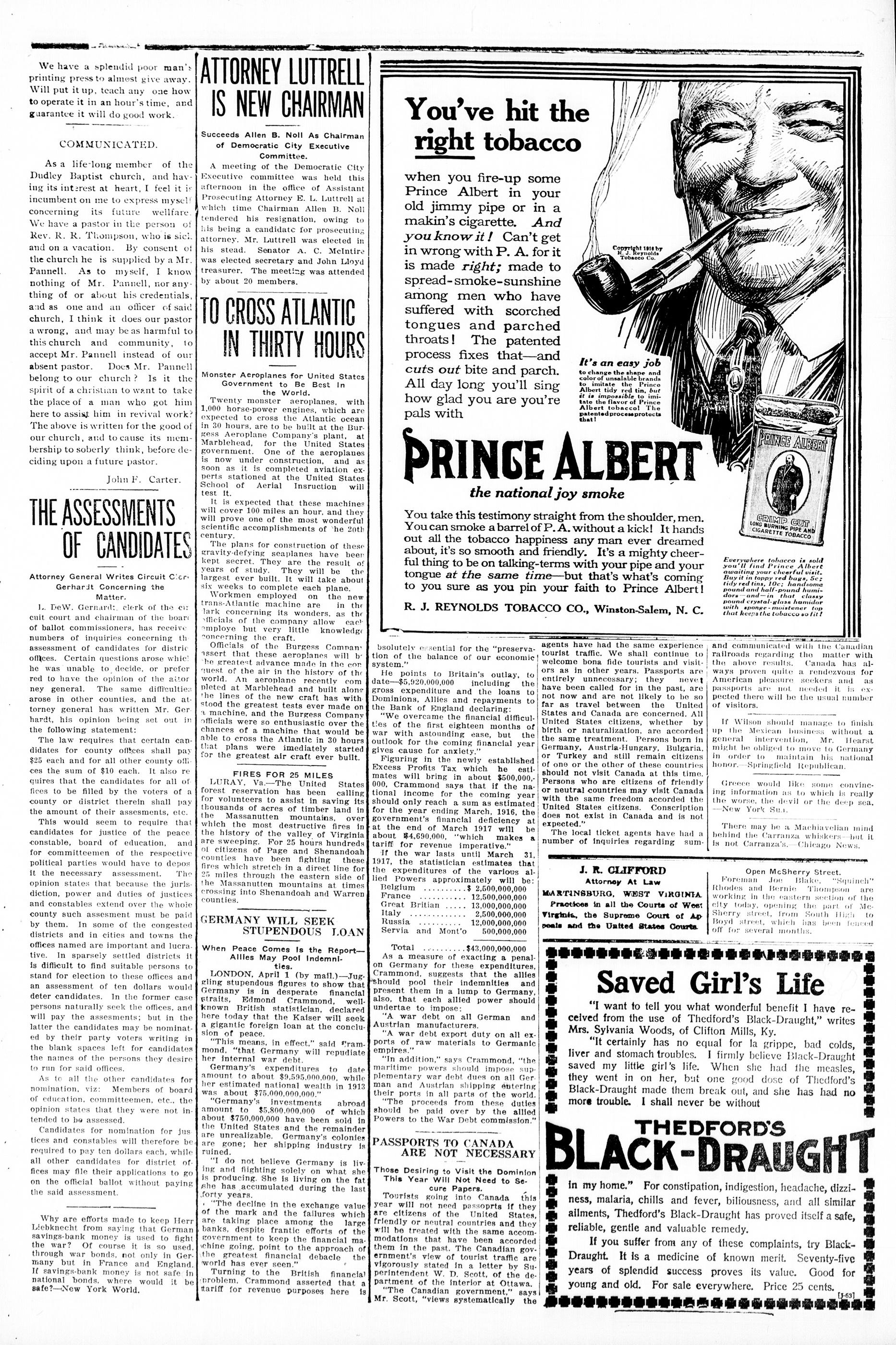
You've hit the right tobacco
Copyright 1916 by
R. J. Reynolds
Tobacco Co.
ALBERT
PRINGE ALBERT
the national joy smoke
is testimony straight from the shoulder, men, smoke a barrel of P. A. without a kick! It hands tobacco happiness any man ever dreamed to smooth and friendly. It's a mighty cheerbe on talking-terms with your pipe and your the same time—but that's what's coming as you pin your faith to Prince Albert!
OLDDS TOBACCO CO., Winston-Salem, N. C.
You take this testimony straight from the shoulder, men. You can smoke a barrel of P.A. without a kick! It hands out all the tobacco happiness any man ever dreamed about, it's so smooth and friendly. It's a mighty cheerful thing to be on talking-terms with your pipe and your tongue at the same time—but that's what's coming to you sure as you pin your faith to Prince Albert! R. J. REYNOLDS TOBACCO CO., Winston-Salem, N. C.
agents have had the same experience tourist traffic. We shall continue to welcome bona fide tourists and visitors as in other years. Passports are entirely unnecessary; they never have been called for in the past, are not now and are not likely to be so far as travel between the United States and Canada are concerned. All United States citizens, whether by birth or naturalization, are accorded the same treatment. Persons born in Germany, Austria-Hungary, Bulgaria, or Turkey and still remain citizens of one or the other of these countries should not visit Canada at this time. Persons who are citizens of friendly or neutral countries may visit Canada with the same freedom accorded the United States citizens. Conscription does not exist in Canada and is not expected."
The local ticket agents have had a number of inquiries regarding sum
MARTINSBURG, WEST VIRGINIA.
Practices in all the Courts of West
Virginia, the Supreme Court of Ap-
peals and the United States Courts.
Saved G
"I want to tell you what
ceived from the use of The
Mrs. Sylvania Woods, of Cl
"It certainly has no ea
liver and stomach trouble
"I want to tell you what wonderful benefit I have received from the use of Thedford's Black-Draught," writes Mrs. Sylvania Woods, of Clifton Mills, Ky.
"It certainly has no equal for la grippe, bad colds, liver and stomach troubles. I firmly believe Black-Draught saved my little girl's life. When she had the measles, they went in on her, but one good dose of Thedford's Black-Draught made them break out, and she has had no more trouble. I shall never be without
BLACK-DRAUGHT
in my home." For constipation, indigestion, headache, dizziness, malaria, chills and fever, biliousness, and all similar ailments, Thedford's Black-Draught has proved itself a safe, reliable, gentle and valuable remedy.
If you suffer from any of these complaints, try Black-Draught. It is a medicine of known merit. Seventy-five years of splendid success proves its value. Good for young and old. For sale everywhere. Price 25 cents.
when you fire-up some Prince Albert in your old jimmy pipe or in a makin's cigarette. And you know it! Can't get in wrong with P. A. for it is made right; made to spread-smoke-sunshine among men who have suffered with scorched tongues and parched throats! The patented process fixes that—and cuts out bite and parch. All day long you'll sing how glad you are you're pals with
absolutely essential for the "preservation of the balance of our economic system."
He points to Britain's outlay, to date—$5,920,000,000 including the gross expenditure and the loans to Dominions, Allies and repayments to the Bank of England declaring:
"We overcame the financial difficulties of the first eighteen months of war with astounding ease, but the outlook for the coming financial year gives cause for anxiety."
Figuring in the newly established Excess Profits Tax which he estimates will bring in about $500,000,000, Crammond says that if the national income for the coming year should only reach a sum as estimated for the year ending March, 1916, the government's financial deficiency at at the end of March 1917 will be about $4,690,000, "which makes a tariff for revenue imperative." If the war lasts until March 31, 1917, the statistician estimates that the expenditures of the various allied Powers approximately will be: Belgium ..... $ 2,500,000,000 France ..... 12,500,000,000 Great Britian ..... 13,000,000,000 Italy ..... 2,500,000,000 Russia ..... 12,000,000,000 Servia and Mont'o ..... 500,000,000
As a measure of exacting a penal-on Germany for these expenditures, Crammond, suggests that the allies should pool their indemnities and present them in a lump to Germany, also, that each allied power should undertae to impose:
"A war debt on all German and Austrian manufacturers.
"A war debt export duty on all exports of raw materials to Germanic empires."
"In addition," says Crammond, "the maritime powers should impose supplementary war debt dues on all German and Austrian shipping entering their ports in all parts of the world.
"The proceeds from these duties should be paid over by the allied Powers to the War Debt commission."
PASSPORTS TO CANADA ARE NOT NECESSARY
Those Desiring to Visit the Dominion This Year Will Not Need to Secure Papers. Tourists going into Canada this year will not need passports if they are citizens of the United States, friendly or neutral countries and they will be treated with the same accommodations that have been accorded them in the past. The Canadian government's view of tourist traffic are vigorously stated in a letter by Superintendent W. D. Scott, of the department of the interior at Ottawa. "The Canadian government" says
"The Canadian government," says Mr. Scott, "views systematically the
Saved Girl's Life
It's an easy job to change the shape and color of unsalable brands to imitate the Prince Albert tidy red tin, but it also imparts the flavor of Prince Albert tobacco The patented process protects that!
J. R. CLIFFORD
Attorney At Law
Everywhere tobacco is sold you'll find Prince Albert awaiting your cheerful visit. Buy it in toppy red bags, 5c; tidy red tins, 10c; handsome pound and half-pound humidors and—in that classy pound crystal-glass humidor with sponge-moistener top that keeps the tobacco so fit!
and communicated with the Canadian railroads regarding the matter with the above results. Canada has always proven quite a rendezvous for American pleasure seekers and as passports are not needed it is expected there will be the usual number of visitors.
If Wilson should manage to finish up the Mexican business without a general intervention, Mr. Hearst might be obliged to move to Germany in order to maintain his national honor.—Springfield Republican.
Greece would like some convincing information as to which is really the worse, the devil or the deep sea.—New York Su1.
There may be a Machiavelian mind behind the Carranza whiskers—but it is not Carranza's.—Chicago News
Open McSherry Street
Foreman Joe Blake, "Squinch"
Rhodes and Bernie Thompson are
working in the eastern section of the
city today, opening the part of Mc
Sherry street, from South High to
Boyd street, which has been fenced
off for several months.
VAN HORN AGAIN GETS PROMOTION
Goes to Pittsburgh as Assistant Sup. intendent of That Division.
The Baltimore and Ohio railroad announces the following promotions:
C. W. Van Horn is appointed assistant superintendent of the Pittsburgh division, having jurisdiction over the territory from McKeesport to Willow Grove, with headquarters at Pittsburgh.
G. K. Galloway is appointed assistant master mechanic, with headquarters at Glenwood, Pa.
Charles W. Van Horn was born January 17, 1879, and entered the Baltimore and Ohio service as a clerk at Fairmont, W. Va., June 19, 1901, and being made agent at Byron, W. Va., a few months later. April 1, 1911, he was advanced to chief clerk to the general superintendent of the main line district and in September of the same year was promoted to trainmaster at Clarksburg, W. Va. With three years' experience in this position, he was transferred to Chicago Junction, O., as terminal trainmaster where he has remained up to the present time.
STUART PRETENDER DEFEATED AT CULLODEN 170 YEARS AGO
It was 170 years ago Sunday—April 16, 1746—that the last hopes of the last of the Stuarts went down to rise no more upon the field of Culloden. Charles Edward, grandson of James the Second, known in history as the "Young Pretender," was a very interesting character, and it is easy to understand why it is that his story is still read by us with wide-open eyes.
He was a brave, resourceful, of engaging personality, and, most attractive of all, was a born optimist. He doubtless felt that he had a clear right to the English crown, and his story proves that he had the full courage of his convictions. Backed by the French government, Charles Edward, in 1744, set out for Scotland at the head of a formidable armament, but his fleet was destroyed by the elements.
In 1745, however, he embarked again in a small vessel with but seven friends and landed on a little island in the Hebrides. The clans rallied to his standard, and he soon found himself at the head of 1,500 men, and at Preston Pans he cut to pieces an English army 2,000 strong.
Victory Wins Recruits.
Victory at once trebled his force, and at the head of 6,000 Highlanders he pushed on into Derby. Convinced more and more as he moved southward that "the people had not called him," and learning that a large force was rapidly closing in upon him, he turned about and headed his army northward. At Glasgow he received reinforcements, and with his army, raised to some 9,000 men, he fell upon the English army, under Gen. Hawley, and almost annihilated it.
But his victory did him little good. The Highlanders, whose wild charges had scattered the English hosts, dispersed with their booty to the mountains, leaving Charles Edward with only the remnant of an army to retreat before the approaching forces of the Duke of Cumberland.
Fight at Culloden.
At last, on the 16th of April, the the half-starved Highlanders charging two armies, the Pretender's, 6,000 strong, all Highlanders; the Duke's about twice that number, faced each other on the Culloden Moor. The fight that followed was a spirited one with their old-time fury, but only to be mowed down by the fearful fire of the English. Red line after red line went down before the terrible fire claymores, but other lines appeared still, and at last not even Scotch High landers' valor could do more, and the Pretender's force became a mass of hunted fugitives.
It was all over with the Stuarts Charles Edward himself, after wandering among the wilds of Scotland for nearly six months, with a $150,000 reward for his capture hanging over his head, often hemmed around his enemies, but always rescued by some lucky accident, finally escaped to France, where he died, in 1784 years after his star went down in the glo moof Culloden Moor.
PREVENTION DAM SYSTEM IS BEGUN
$24,000,000 Will Be Spent In Ohio to Prevent Future
Floods.
DAYTON, O.. April 17.—Construction work was under way today on the great engineering project for flood prevention in the Miami valley to prevent a repetition of the disastrous floods of 1913 which caused millions of dollars' damage and claimed several hundred lives. Five mammoth detention basins, large enough to hold back the crest of a flood forty per cent greater than the devastating flood of three years ago, are being erected. The cost of materials will be about $24,000,000.
There will be five large dams at crucial points. The highest, at Englewood will rise 120 feet above the surrounding country, the lowest will be 65 feet high, and all 25 feet across at the top. Towns between Piqua and Hamilton, a distance of 100 miles, will be protected when the project is completed.
The plan of the flood prevention system is to let the rivers carry off water at their maximum capacity without doing damage. The retention basins are to take up excess water and then serve as feeders, allowing the run of a heavy rain to be distributed over several weeks instead of several days. The latter uncontrolled action is what caused so much damage in 1943.
It is expected that the work will be completed in three years. Enough steel will be used to build a 175 story skyscraper, enough concrete to build a column ten feet square and thirteen miles high, excavations enough for more than 3,000 miles of trenches and enough embankment to fill a train of cars reaching from New York to San Francisco.
DR. JOHNSON PUBLISHED HIS
DICTIONARY 161 YEARS / GO
Few people really appreciate or what value to them is a dictionary and under what a serious handicap people were compelled to labor barely more than a century and a half ago, for until Dr. Samuel Johnson published his dictionary in 1755 there was no complete English dictionary in existence. Today dictionaries are so numerous and so cheap that they are accessible to every one. True, before Dr. Johnson published his dictionary after seven years' labor there were other dictionaries, but they were designed chiefly for the use of learned men. One of these was made by James Bullokar in 1616. Nathan Bailey was the first English compiler to attempt to trace the derivation of English words in his diction, based in 1721. His was the standard until the Johnson publication.
Many Editions Issued.
Many editions issued.
So complete was Dr. Johnson's work that it was at once recognized as invaluable to the general public as well as the scholar. It was an encyclo-maker in the history of the language. The work passed through many editions, the last one appearing in 1888 by which time so many other educated men had taken up the work that the Johnson dictionary was leaked upon as somewhat antiquated.
It was in 1747 that Dr. Johnson issued the plan of his dictionary and dedicated the work to Lord Chesterfield. During the compiling of his dictionary the eminent lexicographer employed six amanuenses, five of whom were Scotsmen. He first read through all the books to be quoted, marked the sentences and had them transcribed by his clerks on separate slips of paper. After they had been arranged he added definitions and etymology. The work was done in a house in Gough square near his printers.
Became Standard Authority. Dr. Johnson's dictionary was first given to the public on April 15, 1756 and at once took its place as a standard authority. The general excellence of its definitions and the judicious selection of illustrative passage make it entertaining as well as useful for reference. His labors during the compiling of the work must have been enormous, especially while he was also publishing the Rambler. The initial work in lexicography in America was done by Noah Webster's American dictionary of the English language was issued in 1828, which was gone through many editions, the most recent Webster's International dictionary having been the work of Noah Porter.
You have heard, of course, of the ne man in a thousand?" Well camp Clark got him in the Illinois presidential preference primaries
That is, his vote was 43 to the President's 43,000.—Indianapolis News.
Georgia Republicans have made their reply to the National Committee for reducing their delegates from 28 to 17. There are so many of them that it takes two conventions to hold them.—New York Evening Post.
It looks as if the only way to get the British Mesopotamian army out of the fix it is in is to send a Russian army to the rescue.—Charleston News and Courier.
A yellow peril divided against itself suits the rest of the world very well.—Washington Post.
The German assaults at Verdin have been savage and prolonged, but they have illustrated the Kaiser's high cost of living rather than the weakness of the French.—Louisville Courier-Journal.
If the Colonel ever tires of heating his admiring friends say that the whole country is crazy for him, he might consult the election returns of 1912, when they entertained him in the same way.—New York World.
You must give Villa credit for one thing—he didn't deny that he shot up Columbus.—Doston Transcript.
In addition to the German denial President Wilson has a lot of other evidence that the Sussex was torpedoed by a German submarine.—Chicago Herald.
There remain none but tried Republicans—nearly of them solely tried.—New York Sun.
Republicans will have an uphill fight this year, the Democrats having captured and consolidated two traditional Republican issues—prosperity and bumper crops.—Chicago News.
BACK TO THE FARM.
The great "back to the farm" movement which has appealed so strongly to dwellers in the cities of the country, in theory, should eventually find its happiest realization in West
```markdown
```
Largest Mail Order House of its kind in
America.
All kinds of Toilet Articles for sale.
Human Hair Goods of the finest quality.
Our Hair Food and Skin Food never fail.
If the trouble is with the hair, scalp or
skin, we have the remedy.
We guarantee a remedy to make hair
grow on bald spots and bare temples.
Send 10c. for a sample and catalogue.
Send for our terms to agents.
Address Mine. L. C. PARRISH,
95 Camden Street, Boston, Mass.
BIG GAME
HUNTER
FIRST Choice
and Big enough
for the biggest
game of North
America.
STEVENS
"High Power" Repeating
Rifle No. 425.
List Price
.25-30-30-32 and .35 caliber
Use Rom Auto-Loading Cartridges
with copper primers
SURE FIRE NO BALKS NO JAMS
Our "High Power"
Rifles also furnished in fancy
grades. Ask your Dealer.
Sand for handsome, new
Rifle Catalog.
J. STEVENS ARMS
& TOOL COMPANY,
P. O. Box 5004
CHICOPEE, FALLS,
MASSACHUSETTS
read over a very foolish and trivial
comparison of common rumbling, mailed armour
and the desire to show her love for the little
fairy tale. This pales the curtain of Europe's politics and see the
fairy tale of chase that is being played. See upon what a slim,
just a little piece of chase the sacred lives of millions are being sacrificed. Read the
historic post one hundred years, as written by some of the greatest
authors of the world has ever known, and learn the naked, shameful truth.
Just to get you interested as a Review of Reviews subscriber we make you
this extraordinary order. We will give to you
A New York news paper contains the report of a strike of subway workers for a minimum wage of $2 a day, and the same paper contains the following statement:
"The minimum amount of money upon which a family of four can live in New York is $880.42 a year. In deduction was made yesterday by I. ward F. Brown, executive secretary."
"Mr. Brown pointed out that a subway worker is now
a minimum wage of $2 a day, or $6 a year, if the 6 workers can pay
the minimum, he said, they we
have left, even if they win the str
$43.68 a year.
12:11: the aerial picture of the school
12:11: the aerial picture of the school
12:11: the aerial picture of the school
558.32 a year.
"Figuring upon this birds, the said
I have not, as you will see, tried
into account the doctor the
be unintelligent in
recreational needs. Even the school
can hardly tell us how mental, moral
and physical starvation can be averted
on this impossible budget.
"According to the reports of the
school doctors, 10,000 children in the
public schools are starved. Every day
they eat insufficient food properly to
keep body and soul together.
"Waffle death from actual starvation is not of frequent occurrence among the children, so far as we know, death from disease due to improper food becomes more and more menacing. "Forty three per cent of the total cost of living is spent for food. The chance of securing an adequate diet
WAR!
HISTORY OF WAR
Tales inside the cen-
tury's prime of chess that
yet remain among the sacred lives of
history in the past hundred ye-
nths after the world has ever known.
Just to not you listed as a Review
this extraordinary one. We will give
FREE—"Entr
A big book and over 300 pages, size 19 x 7 inches, handsomely and durably bound in cloth, containing the dramatic history of the great events leading up to the present time; over 60 important and timely special articles; over 60 photographs of the conflict; hundreds of graphical contests, photographs, diagrams, specially drawn war maps, illuminating statistical records, copies of official documents and dramatic messages exchanged between the powers—court, yield, accurate, permanent, which once seen you will not be able to without, intricate past and present are kept dramatically pictured and presented. Hum
Get the Review of
Send the Coupon only. It brings the big, hand-
toped book, energies prepaid, absolutely true.
If we make it the first for you get the bank
and like it you spend 20 cents for shipping;
and a 100 month for three months to pay for
the "Review of Reviews" for one full year.
Review of Reviews Co.
80 Living Place, New York
ply of wholesome food usually declines with the limited income of the bread winner."
No one will doubt the statement or the conclusions.
Under present conditions of living with the prevailing prices of food produce the unskilled laborer in no city can provide properly for a family, no of small, not for his own com- mit with the greater proportional ex- ament which the roomer and the tender must live.
the movement undertaken in some
north-west Virginia to settle upon
the tracts of land suitable farmers
meeting with success. In one in-
ance, it was arranged to bring a
large number of Belgian farmers and
them establish homes in the
mountains of the state. This move-
ment so much impetus,
given encouragement.
Now for solution is a
which families may go up-
within a few months be-
sidently and regularly sup-
ply their own wants from the soil.
It has been done to the extent
that it should be,
to be done, and in the years
before West Virginia should be the
most in dense population of those
to be the roll and live in plenty and
outward from the fruits of their
lands.
Rev. S. Beane, who has been here for eight years, called at our office to say goodbye, and started for his new charge, Romoke, Va., where he good wishes of his many friends with him.
What Is It All About?
read over a very foolish and trivial custom rumbling, mailed armour wanted to show her love for the little train of Europe's politics and see the behr played. See upon what a slim, of millions are being sacrificed. Read the wars, as written by some of the greatest, and learn the naked, insane truth. Of Reviews subscriber we make you to you.
ope at War
details of illustrations graphically tell their own stories. More fascinating than any resume, here is a history so vivid, so dramatic, so stirring, so fascinating, so realate, so wonderfully presented, so thrillingly note that it leaves an indefeatable impression.
Your War News Clarified
It is not enough to read the daily news reports. Your ability to comprehend conditions and to discuss them rationally depends on a true interpretation of the meaning and the reason why" of events. In your mind you must bring order out of chaos and the Review of Reviews" will do it for you.
Reviews for a Year
Send no Money If the book isn't worth more than you pay for book and magazine together, send it back at our expense. But be prompt. The world will not this compendium will make these few volumes disappear from our stock room at once. Send your opinion today—and be in this.
Review of Restoration
01 January 1919
New York