The Pioneer Press
Saturday, September 16, 1916
Martinsburg, West Virginia
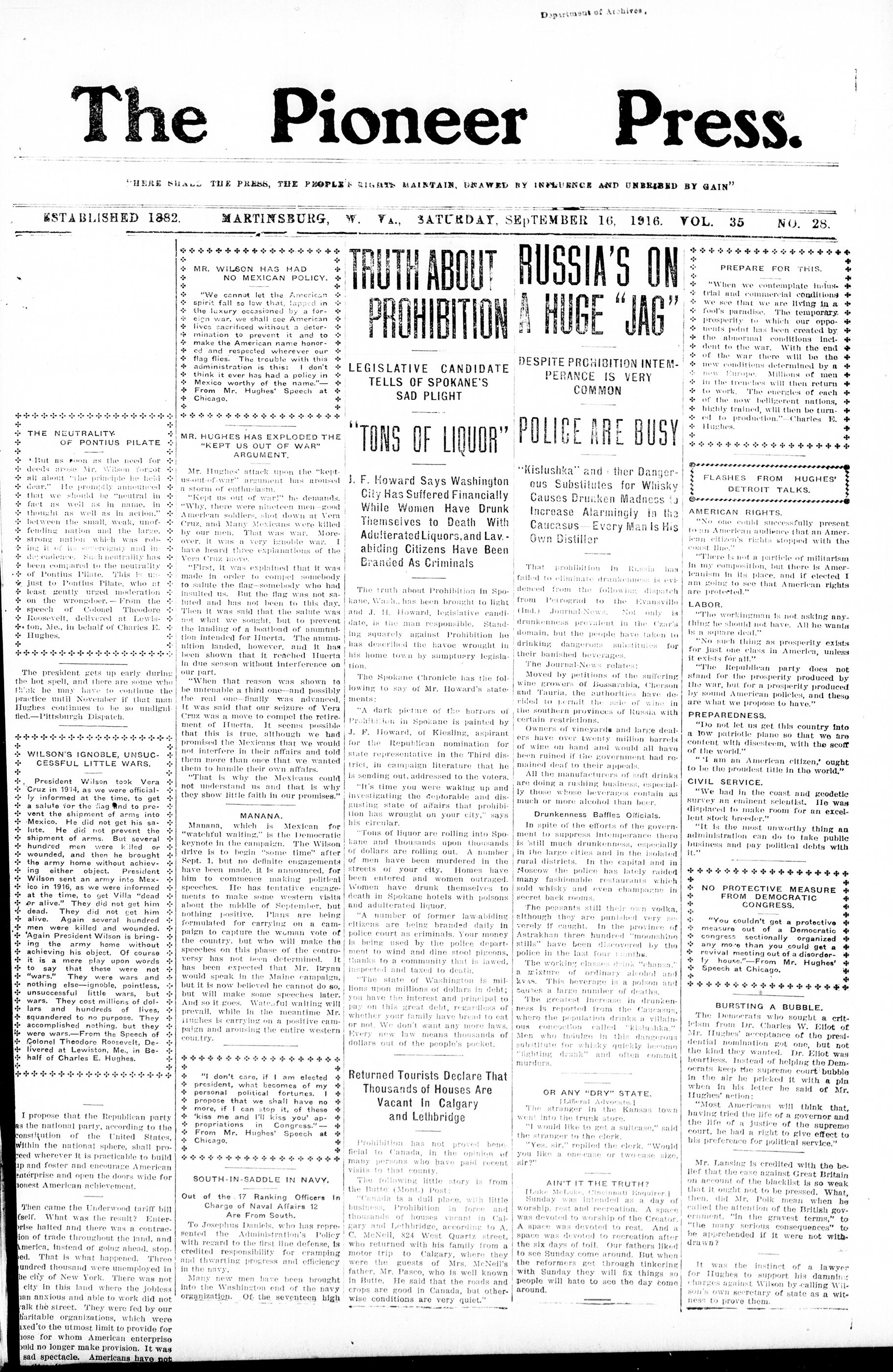
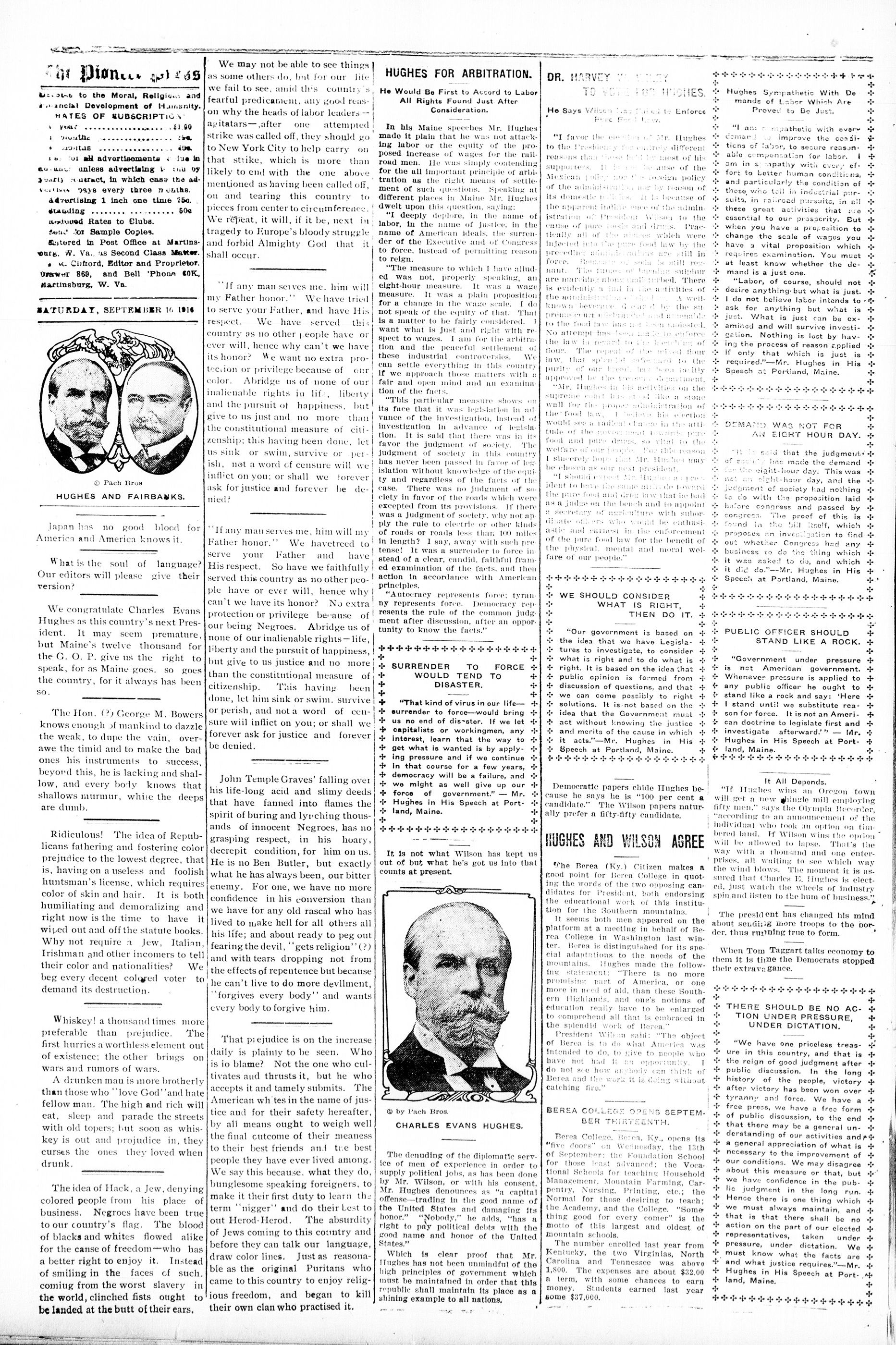
Page text (machine-generated)
"HERE SHALL THE PRESS, THE PEOPLE'S RIGHTS MAINTAIN, DRAWED BY INFLUENCE AND UNBRIBED BY GAIN"
The Pioneer
ESTABLISHED 1882.
*
THE NEUTRALITY
OF PONTIUS PILATE
* But as moon as the need for deeds arose Mr. Wilson forgot all about "the principle he held dear." He promptly announced that we should be "neutral in fact as well as in name, in thought as well as in action," between the small, weak, unoffending nation and the large, strong nation which was robing it of its sovereignty and independence. Such neutrality has been compared to the neutrality of Pontius Pilate. This is unjust to Pontius Pilate, who at least gently urged moderation on the wrongdoer.—From the speech of Colonel Theodore Roosevelt, delivered at Lewis-ton, Me., in behalf of Charles E. Hughes.
The president gets up early during the hot spell, and there are some who think he may have to continue the practice until November if that man Hughes continues to be so undignified.—Pittsburgh Dispatch.
---
WILSON'S IGNOBLE, UNSUCESSFUL LITTLE WARS.
President Wilson took Vera Cruz in 1914, as we were officially informed at the time, to get a salute for the flag and to prevent the shipment of arms into Mexico. He did not get his salute. He did not prevent the shipment of arms. But several hundred men were killed or wounded, and then he brought the army home without achieving either object. President Wilson sent an army into Mexico in 1916, as we were informed at the time, to get Villa "dead or alive." They did not get him dead. They did not get him alive. Again several hundred men were killed and wounded. Again President Wilson is bringing the army home without achieving his object. Of course it is a mere play upon words to say that these were not "wars." They were wars and nothing else—ignoble, pointless, unsuccessful little wars, but wars. They cost millions of dollars and hundreds of lives, squandered to no purpose. They accomplished nothing, but they were wars.—From the Speech of Colonel Theodore Roosevelt, Delivered at Lewiston, Me., in Behalf of Charles E. Hughes.
```markdown
```
I propose that the Republican party as the national party, according to the constitution of the United States, within the national sphere, shall proceed wherever it is practicable to build up and foster and encourage American enterprise and open the doors wide for honest American achievement.
Then came the Underwood tariff bill (self. What was the result? Enterprise halted and there was a contraction of trade throughout the land, and America, instead of going ahead, stopped. That is what happened. Three hundred thousand were unemployed in the city of New York. There was not city in this land where the jobless man anxious and able to work did not walk the street. They were fed by our charitable organizations, which were fixed to the utmost limit to provide for nose for whom American enterprise could no longer make provision. It was sad spectacle. Americans have not
"We cannot let the American spirit fall so low that, tapped in the luxury occasioned by a foreign war, we shall see American lives sacrificed without a determination to prevent it and to make the American name honored and respected wherever our flag flies. The trouble with this administration is this: I don't think it ever has had a policy in Mexico worthy of the name."—From Mr. Hughes' Speech at Chicago.
MR. HUGHES HAS EXPLODED THE "KEPT US OUT OF WAR" ARGUMENT.
Mr. Hughes' attack upon the "kept-us-out-of-war" argument has aroused a storm of enthusiasm.
"Kept us out of war!" he demands, "Why, there were nineteen men—good American soldiers, shot down at Vera Cruz, and Many Mexicans were killed by our men. That was war. Moreover, it was a very ignoble war. I have heard three explanations of the Vera Cruz move.
"First, it was explained that it was made in order to compete somebody to salute the flag—somebody who had insulted us. But the flag was not saluted and has not been to this day. Then it was said that the salute was not what we sought, but to prevent the landing of a boatload of ammunition intended for Huerta. The ammunition landed, however, and it has been shown that it reached Huerta in due season without interference on our part.
"When that reason was shown to be untenable a third one—and possibly the real one—finally was advanced. It was said that our seizure of Vera Cruz was a move to compel the retirement of Huerta. It seems possible that this is true, although we had promised the Mexicans that we would not interfere in their affairs and told them more than once that we wanted them to handle their own affairs.
"That is why the Mexicans could not understand us and that is why they show little faith in our promises."
MANANA
Manana, which is Mexican for "watchful waiting," is the Democratic keynote in the campaign. The Wilson drive is to begin "some time" after Sept. 1, but no definite engagements have been made, it is announced, for him to commence making political speeches. He has tentative engagements to make some western visits about the middle of September, but nothing positive. Plans are being formulated for carrying on a campaign to capture the woman vote of the country, but who will make the speeches on this phase of the controversy has not been determined. It has been expected that Mr. Bryan would speak in the Maine campaign, but it is now believed he cannot do so, but will make some speeches later. And so it goes. Watchful waiting will prevail, while in the meantime Mr. Hughes is carrying on a positive campaign and arousing the entire western country.
* "I don't care, if I am elected
* president, what becomes of my
* personal political fortunes. I
* propose that we shall have no
* more, if I can stop it, of these
* 'kiss me and I'll kiss you' ap-
* propriations in Congress." —
* From Mr. Hughes' Speech at
* Chicago.
*
SOUTH-IN-SADDLE IN NAVY.
To Josephus Daniels, who has represented the Administration's Policy with regard to the first line defense, its credited responsibility for cramping and thwarting progress and efficiency in the navy. Many new men have been brought into the Washington end of the navy organization. Of the seventeen high
TRUTH ABOUT PROHIBITION
LEGISLATIVE CANDIDATE
TELLS OF SPOKANE'S
SAD PLIGHT
"TONS OF LIQUOR"
J. F. Howard Says Washington City Has Suffered Financially While Women Have Drunk Themselves to Death With Adulterated Liquors,and Lavabiding Citizens Have Been Branded As Criminals
The truth about Prohibition in Spokane, Wash., has been brought to light and J. H. Howard, legislative candidate, is the man responsible. Standing squarely against Prohibition he has described the havoc wrought in his home town by sumptuary legislation.
The Spokane Chronicle has the following to say of Mr. Howard's statements:
"A dark picture of the horrors of Prohibition in Spokane is painted by J. F. Howard, of Kiesling, aspirant for the Republican nomination for state representative in the Third district, in campaign literature that he is sending out, addressed to the voters.
"It's time you were waking up and investigating the deplorable and disgusting state of affairs that prohibition has wrought on your city," says his circular.
"Tons of liquor are rolling into Spokane and thousands upon thousands of dollars are rolling out. A number of men have been murdered in the streets of your city. Homes have been entered and women outraged. Women have drunk themselves to death in Spokane hotels with poisons and adulterated liquor.
"A number of former law-abiding citizens are being branded daily in police court as criminals. Your money is being used by the police department to wind and dine stool pigeons, thanks to a community that is lawed, inspected and taxed to death.
"The state of Washington is millions upon millions of dollars in debt; you have the interest and principal to pay on this great debt, regardless of whether your family have bread to eat or not. We don't want any more laws. Every new law means thousands of dollars out of the people's pocket.
Returned Tourists Declare That Thousands of Houses Are Vacant In Calgary and Lethbridge
Prohibition has not proved beneficial to Canada, in the opinion of many persons who have paid recent visits to that county.
The following little story is from the Butte (Mont.) Post:
"Canada is a dull place, with little business. Prohibition in force and thousands of houses vacant in Calgary and Lethbridge, according to A. C. McNeil, 824 West Quartz street, who returned with his family from a motor trip to Calgary, where they were the guests of Mrs. McNeil's father, Mr. Pasco, who is well known in Butte. He said that the roads and crops are good in Canada, but otherwise conditions are very quiet."
---
Department of Archives
BY INFLUENCE AND UNBRIBED
EP TEMBER 16, 1916.
RUSSIA'S ON A HUGE "JAG"
RUSSIA'S ON A HUGE "JAG"
DESPITE PROHIBITION INTEMPERANCE IS VERY COMMON
POLICE ARE BUSY
"Kislushka" and other Dangerous Substitutes for Whisky Causes Drunken Madness to Increase Alarmingly in the Caucasus - Every Man Is His Own Distiller
That prohibition. In Russia has failed to eliminate drunkenness is evidenced from the following dispatch from Petrograd to the Evansville (Ind.) Journal-News. Not only is drunkenness prevalent in the Czar's domain, but the people have taken to drinking dangerous substitutes for their banished beverages.
The Journal-News relates:
Moved by petitions of the suffering wine growers of Bossarabia, Cherson and Tauria, the authorities have decided to permit the sale of wine in the southern provinces of Russia with certain restrictions.
Owners of vineyards and large dealers have over twenty million barrels of wine on hand and would all have been ruined if the government had remained deaf to their appeals. All the manufacturers of soft drinks are doing a rushing business, especially those whose beverages contain as much or more alcohol than beer.
Drunkenness Baffles Officials.
In spite of the efforts of the government to suppress intemperance there is 'still much drunkenness, especially in the large cities and in the isolated rural districts. In the capital and in Moscow the police has lately raided many fashionable restaurants which sold whisky and even champagne in secret back rooms.
The peasants still their own vodka, although they are punished very severely if caught. In the province of Astrakhan three hundred "moonshine stills" have been discovered by the police in the last four months.
The working classes drink "chansa," a mixture of ordinary alcohol and kvas. This beverage is a poison and causes a large number of deaths.
The greatest increase in drunkenness is reported from the Caucasus, where the population drinks a villainous concoction called "kislushka." Men who indulge in this dangerous substitute for whisky quickly become "fighting drunk" and often commit murders.
OR ANY "DRY" STATE.
The stranger in the Kansas town went into the trunk store.
"I would like to get a suitcase," said the stranger to the clerk.
"Yes, sir," replied the clerk. "Would you like a one-case or two-case size, sir?"
AIN'T IT THE TRUTH?
[Luke McLuke, Cincinnati Enquirer.] Sunday was intended as a day of worship, rest and recreation. A space was devoted to worship of the Creator. A space was devoted to rest. And a space was devoted to recreation after the six days of toil. Our fathers liked to see Sunday come around. But when the reformers get through tinkering with Sunday they will fix things so people will hate to see the day come around.
"When we contemplate industrial and commercial conditions we see that we are living in a fool's paradise. The temporary prosperity to which our opponents point has been created by the abnormal conditions incident to the war. With the end of the war there will be the new conditions determined by a new Europe. Millions of men in the trenches will then return to work. The energies of each of the now belligerent nations, highly trained, will then be turned to production."—Charles E. Hughes.
FLASHES FROM HUGHES'
DETROIT TALKS.
AMERICAN RIGHTS.
"No one could successfully present to an American audience that an American citizen's rights stopped with the const line."
"There is not a particle of militarism in my composition, but there is Americanism in its place, and if elected I am going to see that American rights are protected."
LABOR.
"The workingman is not asking anything he should not have. All he wants is a square deal."
"No such thing as prosperity exists for just one class in America, unless it exists for all."
"The Republican party does not stand for the prosperity produced by the war, but for a prosperity produced by sound American policies, and these are what we propose to have."
PREPAREDNESS.
"Do not let us get this country into a low patriotic plane so that we are content with disesteem, with the scoff of the world."
"I am an American citizen," ought to be the proudest title in the world."
CIVIL SERVICE.
"We had in the coast and geodetic survey an eminent scientist. He was displaced to make room for an excellent stock breeder."
"It is the most unworthy thing an administration can do to take public business and pay political debts with it."
NO PROTECTIVE MEASURE FROM DEMOCRATIC CONGRESS.
"You couldn't get a protective measure out of a Democratic congress sectionally organized any more than you could get a revival meeting out of a disorderly house."—From Mr. Hughes' Speech at Chicago.
BURSTING A BUBBLE
The Democrats who sought a criticism from Dr. Charles W. Ellot of Mr. Hughes' acceptance of the presidential nomination got one, but not the kind they wanted. Dr. Ellot was heartless. Instead of helping the Democrats keep the supreme court bubble in the air he pricked it with a pin when in his letter he said of Mr. Hughes' action:
"Most Americans will think that, having tried the life of a governor and the life of a justice of the supreme court, he had a right to give effect to his preference for political service."
Mr. Lansing is credited with the belief that the case against Great Britain on account of the blacklist is so weak that it ought not to be pressed. What, then, did Mr. Poik mean when he called the attention of the British government, "in the gravest terms," to "the many serious consequences" to be apprehended if it were not withdrawn?
It was the instinct of a lawyer for Hughes to support his damning charges against Wilson by calling Wilson's own secretary of state as a witness to prove them.
---
DISTRIBUTED TO the Moral, Religious and
Financial Development of Humanity.
HATES OF SUBSCRIPTION
1 year ..... $160
1 month ..... $50
1 month ..... $40
for all advertisements value in
advance unless advertising is due by
priority contract, in which case the ad-
vertiser pays every three months.
advertising 1 inch one time 75c.
standing ..... 50c
reduced Rates to Clubs.
Send for Sample Copies.
entered in Post Office at Martins-
burg, W. Va., as Second Class Matter.
w. Clifford, Editor and Proprietor.
Drawer 869, and Bell 'Phone 60K,
Martinsburg, W. Va.
SATURDAY, SEPTEMBER 16 1916
© Pach Bros
HUGHES AND FAIRBANKS.
Japan has no good blood for America and America knows it.
What is the soul of language? Our editors will please give their version?
We congratulate Charles Evans Hughes as this country's next President. It may seem premature, but Maine's twelve thousand for the G. O. P. give us the right to speak, for as Maine goes, so goes the country, for it always has been so.
The Hon. (?) George M. Bowers knows enough of mankind to dazzle the weak, to dupe the vain, overawe the timid and to make the bad ones his instruments to success, beyond this, he is lacking and shallow, and every body knows that shallows murmur, white the deeps are dumb.
Ridiculous! The idea of Republicans fathering and fostering color prejudice to the lowest degree, that is, having on a useless and foolish huntsman's license, which requires color of skin and hair. It is both humiliating and demoralizing and right now is the time to have it wiped out and off the statute books. Why not require a Jew, Italian, Irishman and other incomers to tell their color and nationalities? We beg every decent colored voter to demand its destruction.
Whiskey! a thousand times more preferable than prejudice. The first hurries a worthless element out of existence; the other brings on wars and rumors of wars.
A drunken man is more brotherly than those who "love God" and hate fellow man. The high and rich will eat, sleep and parade the streets with old topers; but soon as whiskey is out and prejudice in, they curses the ones they loved when drunk.
The idea of Hack, a Jew, denying colored people from his place of business. Negroes have been true to our country's flag. The blood of blacks and whites flowed alike for the cause of freedom—who has a better right to enjoy it. Instead of smiling in the faces of such, coming from the worst slavery in the world, clinched fists ought to be landed at the butt of their ears.
We may not be able to see things as some others do, but for our life we fail to see, amid this country's fearful predicament, any good reason why the heads of labor leaders agitatars—after one attempted strike was called off, they should go to New York City to help carry on that strike, which is more than likely to end with the one above mentioned as having been called off, on and tearing this country to pieces from center to circumference. We repeat, it will, if it be, next in tragedy to Europe's bloody struggle and forbid Almighty God that it shall occur.
"If any man serves me, him will my Father honor." We have tried to serve your Father, and have His respect. We have served this country as no other people have or ever will, hence why can't we have its honor? We want no extra protection or privilege because of our color. Abridge us of none of our inalienable rights in life, liberty and the pursuit of happiness, but give to us just and no more than the constitutional measure of citizenship; this having been done, let us sink or swim, survive or perish, not a word of censure will we inflict on you; or shall we forever ask for justice and forever be denied?
"If any man serves me, him will my Father honor." We havetreed to serve your Father and have His respect. So have we faithfully served this country as no other people have or ever will, hence why can't we have its honor? No extra protection or privilege because of our being Negroes. Abridge us of none of our inalienable rights—life, liberty and the pursuit of happiness, but give to us justice and no more than the constitutional measure of citizenship. This having been done, let him sink or swim, survive or perish, and not a word of censure will inflict on you; or shall we forever ask for justice and forever be denied.
---
John Temple Graves' falling over his life-long acid and slimy deeds that have fanned into flames the spirit of buring and lynching thousands of innocent Negroes, has no grasping respect, in his hoary, decrepit condition, for him on us. He is no Ben Butler, but exactly what he has always been, our bitter enemy. For one, we have no more confidence in his conversion than we have for any old rascal who has lived to make hell for all others all his life; and about ready to peg out fearing the devil, "gets religion" (?) and with tears dropping not from the effects of repentence but because he can't live to do more devilment, "forgives every body" and wants every body to forgive him.
That prejudice is on the increase daily is plainly to be seen. Who is io blame? Not the one who cultivates and thrusts it, but he who accepts it and tamely submits. The American whites in the name of justice and for their safety hereafter, by all means ought to weigh well the final outcome of their meaness to their best friends and the best people they have ever lived among. We say this because, what they do, bunglesome speaking foreigners, to make it their first duty to learn the term "nigger" and do their best to out Herod-Herod. The absurdity of Jews coming to this country and before they can talk our language, draw color lines. Just as reasonable as the original Puritans who came to this country to enjoy religious freedom, and began to kill their own clan who practised it.
HUGHES FOR ARBITRATION.
He Would Be First to Accord to Labor All Rights Found Just After Consideration.
In his Maine speeches Mr. Hughes made it plain that he was not attacking labor or the equity of the proposed increase of wages for the railroad men. He was simply contending for the all important principle of arbitration as the right means of settlement of such questions. Speaking at different places in Maine Mr. Hughes dwelt upon this question, saying: "I deeply deplore, in the name of labor, in the name of justice, in the name of American ideals, the surrender of the Executive and of Congress to force, instead of permitting reason to reign.
"The measure to which I have alluded was not, properly speaking, an eight-hour measure. It was a wage measure. It was a plain proposition for a change in the wage scale. I do not speak of the equity of that. That is a matter to be fairly considered. I want what is just and right with respect to wages. I am for the arbitration and the peaceful settlement of these industrial controversies. We can settle everything in this country if we approach those matters with a fair and open mind and an examination of the facts.
"This particular measure shows on its face that it was legislation in advance of the investigation, instead of investigation in advance of legislation. It is said that there was in its favor the judgment of society. The judgment of society in this country has never been passed in favor of legislation without knowledge of the equity and regardless of the facts of the case. There was no judgment of society in favor of the roads which were excepted from its provisions. If there was a judgment of society, why not apply the rule to electric or other kinds of roads or roads less than 100 miles in length? I say, away with such pretense! It was a surrender to force instead of a clear, candid, faithful framed examination of the facts, and then action in accordance with American principles.
"Autocracy represents force; tyranny represents force. Democracy represents the rule of the common judgment after discussion, after an opportunity to know the facts."
SURRENDER TO FORCE
WOULD TEND TO
DISASTER.
"That kind of virus in our life—
surrender to force—would bring
us no end of disaster. If we let
capitalists or workingmen, any
interest, learn that the way to
get what is wanted is by apply-
ing pressure and if we continue
in that course for a few years,
democracy will be a failure, and
we might as well give up our
force of government." — Mr.
Hughes in His Speech at Port-
land, Maine.
It is not what Wilson has kept us out of but what he's got us into that counts at present.
The denuding of the diplomatic service of men of experience in order to supply political jobs, as has been done by Mr. Wilson, or with his consent. Mr. Hughes denounces as "a capital offense—trading in the good name of the United States and damaging its honor." "Nobody," he adds, "has a right to pay political debts with the good name and honor of the United States."
Which is clear proof that Mr. Hughes has not been unmindful of the high principles of government which must be maintained in order that this republic shall maintain its place as a shining example to all nations.
DR. HARVEY W. WILLEY
He Says Wilson Has Tailed to Enforce
Federal Law.
"I favor the question of Mr. Hughes to the Presidency for entirely different reasons than those held by most of his supporters. It is because of the Mexican policy nor the foreign policy of the administration nor by reason of its domestic policies. It is because of the apparent indicture once of the administration of President Wilson to the cause of pure foods and drugs. Practically all of the crimes which were injected into the pure food law by the preceding animals' cultures are still in force. Because of soils is still regnant. The traps of burning sulphur are marching along cultured. There is evidently a fail in the activities of the administration of President Wilson. A well-known beverage clear it by the supreme court is disturbed and assembled to the food law has not been undistorted. No attempt has been made to enforce the law in record to the breaching of flour. The repeal of the related flour law, that spirit of enforcement to the purity of our brethren has been nicely approved by the precious department. "Mr. Hughes in his activities on the supreme court has acted like a stone wall for the proper administration of the food law. I believe his election would see a radiant change in the attitude of the government towards pure food and pure drugs, so vital to the welfare of our people. For this reason I sincerely hope that Mr. Hughes may be chosen as our next president.
"I should expect Mrs. Hurley a president to have the same attitude towards the pure food and drug law that he had as a judge on the bench and to appoint a secretary of agriculture with subordinate officers who would be enthusiastic and earnest in the enforcement of the pure food law for the benefit of the physical, mental and moral welfare of our people."
WE SHOULD CONSIDER
WHAT IS RIGHT,
THEN DO IT.
"Our government is based on
the idea that we have Legislatures to investigate, to consider
what is right and to do what is
right. It is based on the idea that public opinion is formed from
discussion of questions, and that
we can come possibly to right
solutions. It is not based on the
idea that the Government must
act without knowing the justice
and merits of the cause in which
it acts."—Mr. Hughes in His
Speech at Portland, Maine.
Democratic papers chide Hughes because he says he is "100 per cent a candidate." The Wilson papers naturally prefer a fifty-fifty candidate.
HUGHES AND WILSON AGREE
The Berea (Ky.) Citizen makes a good point for Berea College in quoting the words of the two opposing candidates for President, both endorsing the educational work of this institution for the Southern mountains. It seems both men appeared on the platform at a meeting in behalf of Berea College in Washington last winter. Berea is distinguished for its special adaptations to the needs of the mountains. Hughes made the following statement: "There is no more promising part of America, or one more in need of aid, than these Southern Highlands, and one's notions of education really have to be enlarged to comprehend all that is embraced in the splendid work of Berea."
President Wilson said: "The object of Berea is to do what America was intended to do, to give to people who have not had it an opportunity. I do not see how anybody can think of Berea and the work it is doing without catching fire."
BERSA COLLEGE OPENS SEPTEMBER THIRTEENTH.
Berea College, Berea, Ky., opens its "five doors" on Wednesday, the 13th of September; the Foundation School for those least advanced; the Vocational Schools for teaching Household Management, Mountain Farming, Carpentry, Nursing, Printing, etc.; the Normal for those desiring to teach; the Academy, and the College. "Something good for every comer" is the motto of this largest and oldest of mountain schools.
The number enrolled last year from Kentucky, the two Virginias, North Carolina and Tennessee was above 1,800. The expenses are about $32,000 a term, with some chances to earn money. Students earned last year some $37,000.
```markdown
```
```markdown
```
Hughes Sympathetic With Demands of Labor Which Are Proved to Be Just.
"I am sympathetic with every demand to improve the conditions of labor, to secure reasonable compensation for labor. I am in sympathy with every effort to better human conditions, and particularly the condition of those who tell in industrial pursuits, in railroad pursuits, in all these great activities that are essential to our prosperity. But when you have a proposition to change the scale of wages you have a vital proposition which requires examination. You must at least know whether the demand is a just one.
"Labor, of course, should not desire anything but what is just. I do not believe labor intends to ask for anything but what is just. What is just can be examined and will survive investigation. Nothing is lost by having the process of reason applied if only that which is just is required."—Mr. Hughes in His Speech at Portland, Maine.
DEMAND WAS NOT FOR
AN EIGHT HOUR DAY.
"It is said that the judgment
of society has made the demand
for the eight-hour day. This was
not an eight-hour day, and the
judgment of society had nothing
to do with the proposition laid
before congress and passed by
congress. The proof of this is
found in the bill itself, which
proposes an investigation to find
out whether Congress had any
business to do the thing which
it was asked to do, and which
it did do."—Mr. Hughes in His
Speech at Portland, Maine.
* PUBLIC OFFICER SHOULD
STAND LIKE A ROCK.
*
"Government under pressure
is not American government.
Whenever pressure is applied to
any public officer he ought to
stand like a rock and say: 'Here
I stand until we substitute rea-
son for force. It is not an American
doctrine to legislate first and
investigate afterward.'" — Mr.
Hughes in His Speech at Portland,
Maine.
It All Depends.
"If Hughes wins an Oregon town will get a new single mill employing fifty men," says the Olympia Recorder, "according to an announcement of the individual who took an option on timbered land. If Wilson wins the option will be allowed to lapse. That's the way with a thousand and one enterprises, all waiting to see which way the wind blows. The moment it is assured that Charles E. Hughes is elected, just watch the wheels of industry spin and listen to the hum of business."
The president has changed his mind about sending more troops to the border, thus running true to form.
When Tom Taggart talks economy to them it is time the Democrats stopped their extravagance.
```markdown
```
THERE SHOULD BE NO ACTION UNDER PRESSURE, UNDER DICTATION.
"We have one priceless treasure in this country, and that is the reign of good judgment after public discussion. In the long history of the people, victory after victory has been won over tyranny and force. We have a free press, we have a free form of public discussion, to the end that there may be a general understanding of our activities and a general appreciation of what is necessary to the improvement of our conditions. We may disagree about this measure or that, but we have confidence in the public judgment in the long run. Hence there is one thing which we must always maintain, and that is that there shall be no action on the part of our elected representatives, taken under pressure, under dictation. We must know what the facts are and what justice requires."—Mr. Hughes in His Speech at Portland, Maine.
---
Ira, son of Mr. and Mrs. T. S. Kent, of Williamsport, Grant County, W. Va., passed from suffering into rest. He was afflicted from birth, yet cheerful and loved most tenderly. Naturally he is missed, but he who would have him back must be void of sound judgment. Being afflicted, and cared for by two grandparents, both eighty odd years old, how they will miss him. So shall we, but no time will come when we shall wish him back.
"I'll learn ye to shy at me Naval Bill," says Balaam, peruin' the baste so he cud scarce stand.
"Ye can't pass ut without wearin' Republican clothes," says the Jack in a coarse whisper.
"Ye Ass," says Balaam. "Don't ye know that many cloes is betther nor nakedness? 'Gwam,' says Balaam, in tones uv thunder. So the poor baste lopes on, limpin' wid pain.
I've not time to tell ye all the adventures they had, but they kep' on over rough roads, now an' then crossin' a ditch on a wau term plank, which made even Balaam unaisy. Iviry time the Jack kicked, he got short rations an' a wallup. So when the journey was near over, the poor baste wus all in, and far too proud to fight. Any JackAss can be that when he's kicked.
Wan stormy night, the Jack booms into a burn thy like a Dinyerat Tariff! Hyam played on a gaspile wid the feet.
"Phwat nils ye now?" calls Balaam, clubbin' him wilt both hands.
"Niwer did I pass the like?" yells the Ass, sweatin' and threemblin'.
"Ur says ut's an eight hour law. Oh, phwat is ut?" screams the Ass to Balaam, feebly wagglin' his ears.
"I dinoh phwat ut is meself," says Balaam, "but I know phwat ut's got," Balaam says.
"Phwat?" axes the poor Ass.
"五heun hitherthou and votes," says Balaam, wid a pious air. "G'wan, ye big Ass, an' dount ye argue wid an Idaylist," says Balaam to the Ass.
"We can't pass ut in the dark," pleads the Ass. "Lave us wait for light," moans the Ass, weepin'.
"Nix," says Balaam, "There's a hot time comin' an' the votes'l spike. Do ye thirst for sixteen more years in the wilderness? Giddip," says he, "purgin' ye'r heart," says Balaam, "iv ivory thought that's selfish," says Balaam, "or personal," chants Balaam to the poor Ass ticklin' the Jack's slats wid a couplin' pin. By this time, the Ass was so wore out wid his ardyous labors, that he knew no more than Balaam himself. So, wid one despairin' cry, he dropped his ears, as he an' his master stumbled forward into the dark.
WE WANT THE AMERICAN FLAG UNSULLIED.
"Now, my friends, we want not only American efficiency in business, in efficiency in the organization of business, in the protection of the factors of human industry and commerce, we want the American flag unsullied and the American name honored throughout the world."
—From Mr. Hughes' Speech at Chicago.
It is true, as Vice President Marshall remarked, that the Hughes speech of acceptance "ind all the length and tone of a dissenting opinion." But he omitted to add that the dissenting opinion thus expressed is that of the American people.
CO
CHARLES WARREN FAIRBANKS.
Rev. John Barnett, a former pastor of Mount Zion M. E. Church, this city, circulated among old friends this week. He looked well and we were glad to see him.
Well do I mind the story, said Finnegan. Baham was a highbrow that knowed less than his Jackass. He took an office to curse the people. The Jackass saved them. "Tis all in Numbers Twinty-two. Och hone! 'Tis different these times. The Jackass knew better till Balaam tamed him.
"Lave me ride ye," says Balaam, "an' I'll make ye the biggest Ass in the warld."
"Great." says the Ass; "what d'ye feed?"
"Pork," says Balaam.
"Me savior," says the Ass.
Ss Balaam mounts. But soon the Jackalks.
"Phwat is it?" says Balaam.
"Snakes," says the Ass; "Ut looks like the jawbone uy me mother."
"G'wan," says Balaam, hiitin' the Ass a clip, "'tis me furren' policy," he says.
"Phwat's ut for?" axes the Ass.
"Ut defends the nashun," says Balaam.
"How?" says the Ass.
"Faith," says Balaam, "ut takes a bigger Ass than you to know that. Love it to Brine," says Balaam to the Ass; an' the Jack walks on meditatin'.
"Hee, haw," says the Ass, balkin' an' kickin'.
"What now?" says Balaam.
"Divil a Jackass ever seen the like," says the Ass. "Ut could be a frog," says he. "for ut stands up in front, an' sits down behind; an' tis moslly mouth," says the Ass. "Ut has white feathers," says the Jack. "wid yaller streaks, that changes," he says, "to Very Crooz Red, or Niagaray Blue, an now they're Carrysail Yaller again," says he. "Hivlns, have I been drinkin'?" screams the Ass to Balaam.
"Saints be praised," says Balaam. "Me Watchful Waitin' can still change its mind," he says. "Gwan, where glory waits," he says. "Gwan, in the service uv Mankind," says Balaam to the Ass, touching him up. An' the Ass shuffles ahead, wavin' his ears in admiration.
"Hee-haw! Hee-haw!" says the Jack, rearin' up wid his eyes bulgin'
"Phwat's grippin' ye now?" says Balaam, impashunt like
"I donno," says the Ass. "Ut looks like the Flyin' Dutchman with a Socialist Crew," he says.
"Tis me Ship Bill," says Balaam.
"Side step to the right," he says; "side step to the left," says he, weltn' him.
"Back up," says Balaam, near wrenchin' off the Jack's jaw. "Now forward for the Merchant Marine an' fifty millyum pork," says Balaam wid a shower uv blows; an' the Ass goes on threembin'.
"Wah-hee! Wah-hee! Wah-hee!" says the Jack, shyin' so he near threw his rider.
Haiti did not behave as badly to us as Mexico behaved; but Mr. Wilson intervened, fought the Haitiens, shedding their blood and the blood of our troops, took possession and now has our armed forces in control of Haiti and directing its government. His course of action in Haiti can be defended only if his course of action in Mexico is unqualifiedly condemned; for such action was far more needed in Mexico than in Haiti. But there was a difference in the two cases; and to Mr. Wilson it was a vital difference. Haiti was weaker than Mexico. No one was afraid of Haiti. From the Speech of Colonel Roosevelt Delivered at Lewiston, Maine, in Behaif of Charles E. Hughes.
The President says that he is above all things else "an American citizen." Fortunately for him, nothing has taken him to Europe or Mexico during the past few years.
Papers that used to call McKinley a crook and Roosevelt a tyrant are scandalized now that anybody should breathe a whisper against our high and holy Woodrow.
Another thing you never hear of since the Democrats reduced the cost of living is the "baker's dozen."
Mr. Hughes is criticised for his frequent use of the word "now." Evidently his immediateness is worrying the watchful waiters, who put things off until tomorrow.
Families living in the rural districts where mail service has been curtailed will be interested in knowing that Postmaster General Burleson has sent Secretary McAdoo a check for $5,200,000, representing surplus postal revenues.
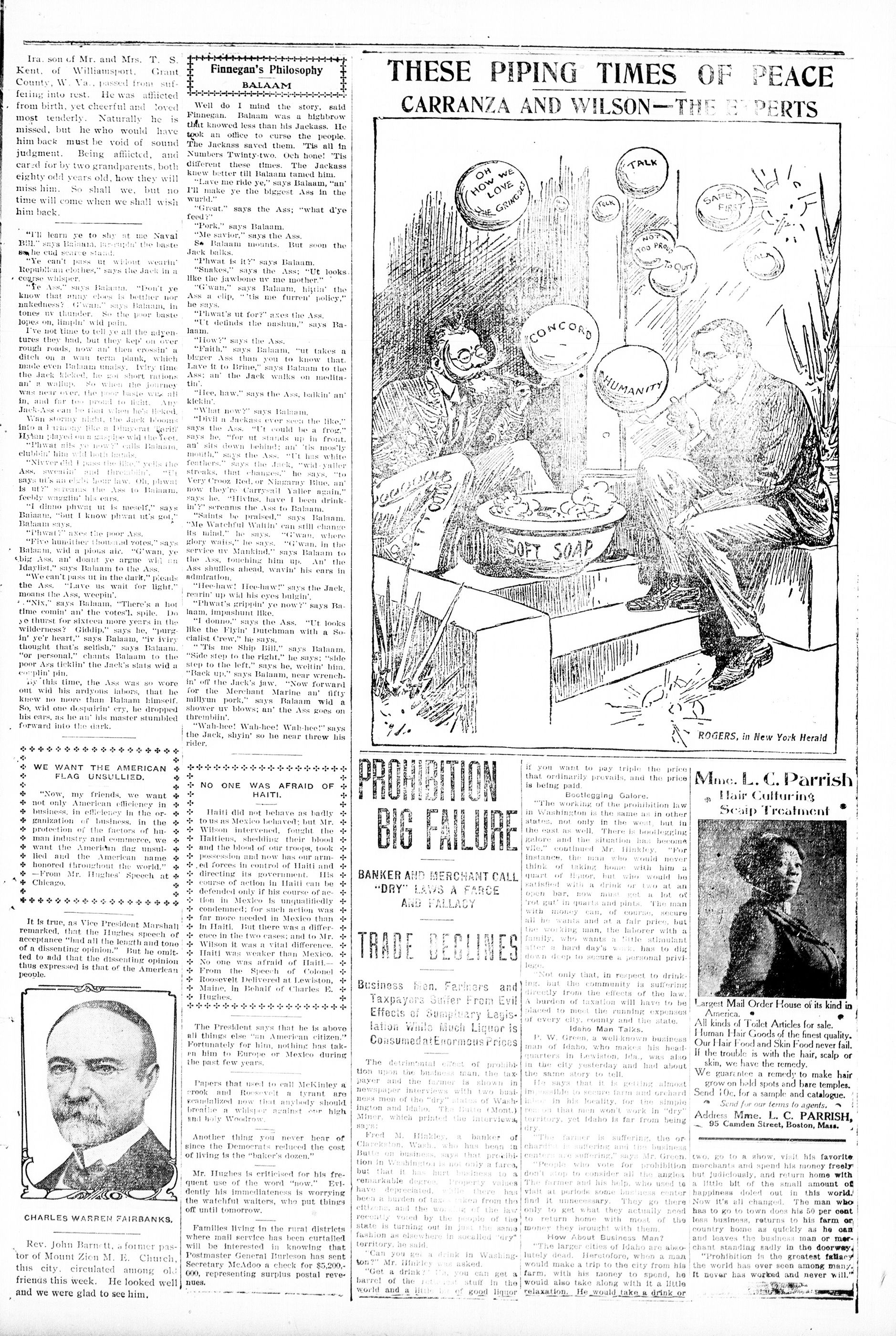
THESE PIPING TIMES OF PEACE CARRANZA AND WILSON—THE EXPERTS
OH HOW WE LOVE THE GRINGLES
TALK
SAFETY FIRST
NOT TOO PROUD TO QUIT
CONCORD
HUMANITY
SOFT SOAP
ROGERS, in New York Herald
PROBLEM BIG FAILURE
BANKER AND MERCHANT CALL "DRY" LAVIS A FARCE AND FALLACY
TRADE DECLINES
Business Men, Farmers and Taxpayers Suffer From Evil Effects of Summiary Legislation While Much Liquor Is Consumed at Enormous Prices
The detrimental effect of prohibition upon the business man, the taxpayer and the farmer is shown in newspaper interviews with two business men of the "dry" states of Washington and Idaho. The Batte (Mont.) Miner, which printed the interviews, says:
Fred M. Hinkley, a banker of Clarkston, Wash., who has been in Butte on business, says that prohibition in Washington is not only a farce, but that it has hurt business to a remarkable degree. Property values have depreciated, while there has been a burden of taxes taken from the citizens, and the worsening of the law recently voted by the people of the state is turning out in just the same fashion as elsewhere in so-called "dry" territory, he said.
"Can you get a drink in Washington?" Mr. Hinkley was asked.
"Get a drink?!" He, you can get a barrel of the rotten stuff in the world and a little bit of good liquor
if you want to pay triple the price that ordinarily prevails, and the price is being paid.
"The working of the prohibition law in Washington is the same as in other states, not only in the west, but in the east as well. There is bootlegging galore and the situation has become vile." continued Mr. Hinkley. "For instance, the man who would never think of taking home with him a quart of liquor, but who would be satisfied with a drink or two at an open bar, now must get a lot of 'rot gut' in quarts and pints. The man with money can, of course, secure all he wants and at a fair price, but the working man, the laborer with a family, who wants a little stimulant after a hard day's work, has to dig down deep to secure a personal privilege.
"Not only that, in respect to drinking, but the community is suffering directly from the effects of the law. A burden of taxation will have to be placed to meet the running expenses of every city, county and the state.
Idaho Man Talks.
P. W. Green, a well-known business man of Idaho, who makes his headquarters in Lewiston, Ida., was also in the city yesterday and had about the same story to tell.
He says that it is getting almost impossible to secure farm and orchard labor in his locality, for the simple reason that men won't work in "dry" territory, yet Idaho is far from being dry.
"The farmer is suffering, the orchardist is suffering and the business contents are suffering," says Mr. Green. "People who vote for prohibition don't stop to consider all the angles. The farmer and his help, who used to visit at periods some business center find it unnecessary. They go there only to get what they actually need to return home with most of the money they brought with them.
How About Business Man?
"The larger cities of Idaho are absolutely dead. Heretofore, when a man would make a trip to the city from his farm, with his money to spend, he would also take along with it a little relaxation. He would take a drink or
THE WOMEN'S HERALD
America.
All kinds of Toilet Articles for sale.
Human Hair Goods of the finest quality.
Our Hair Food and Skin Food never fail.
If the trouble is with the hair, scalp or skin, we have the remedy.
We guarantee a remedy to make hair grow on bald spots and bare temples.
Send 10c. for a sample and catalogue.
Send for our terms to agents.
Address Mme. L. C. PARRISH,
95 Camden Street, Boston, Mass.
two, go to a show, visit his favorite merchants and spend his money freely but judiciously, and return home with a little bit of the small amount of happiness doled out in this world. Now it's all changed. The man who has to go to town does his 50 per cent loss business, returns to his farm or country home as quickly as he can and loaves the business man or merchant standing sadly in the doorway. "Prohibition is the greatest fallacy the world has ever seen among many. It never has worked and never will."
HUSBAND RESCUED DESPAIRING WIFE
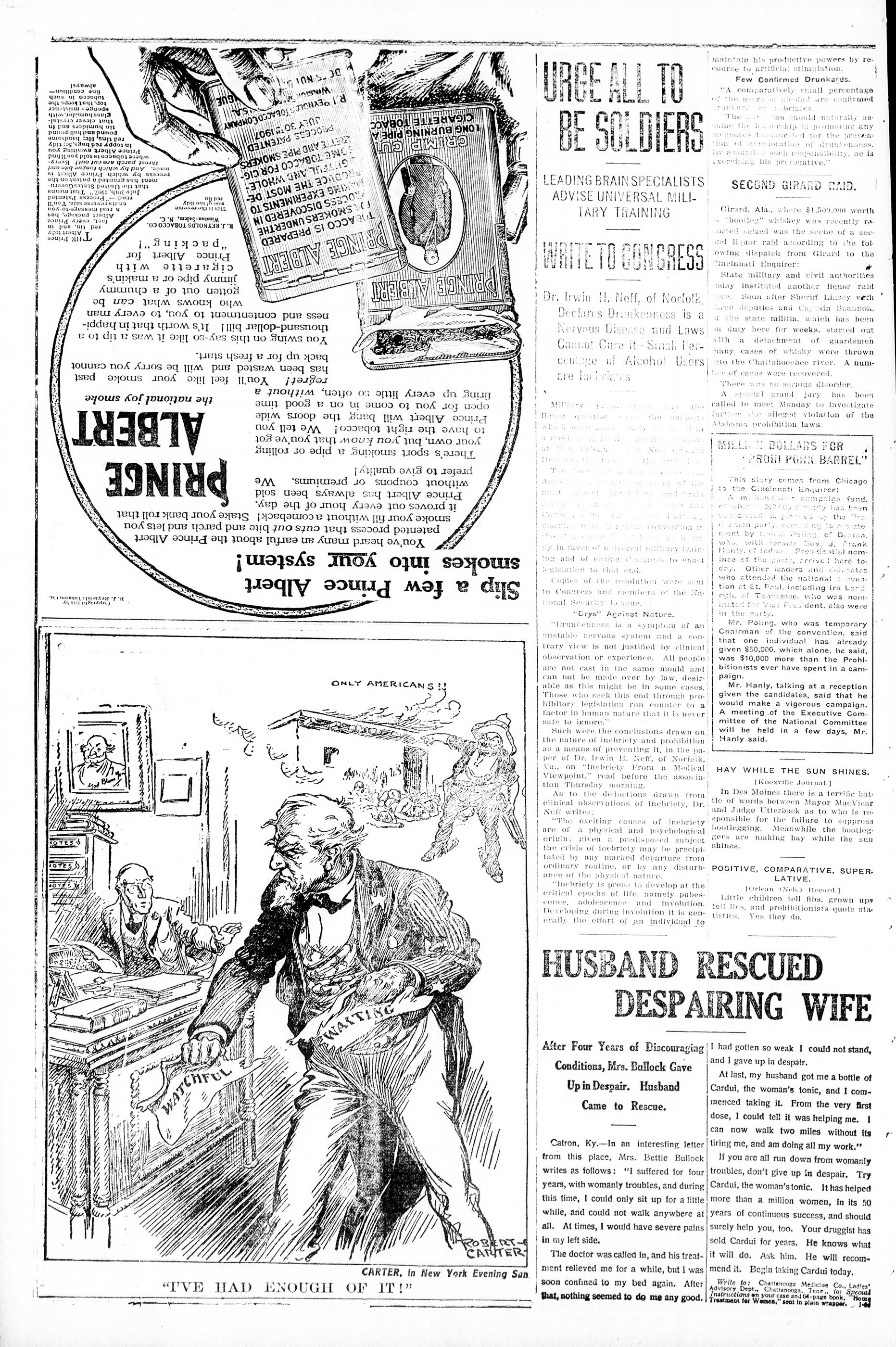
Slip a few Prince Albert smokes into your system!
You've heard many an earful about the Prince Albert patented process that cuts out bite and parch and lets you smoke your fill without a comeback! Stake your bank roll that it proves out every hour of the day. Prince Albert has always been sold without coupons or premiums. We prefer to give quality!
There's sport smoking a pipe or rolling your own, but you know that you've got to have the right tobacco! We tell you Prince Albert will bang the doors wide open for you to come in on a good time firing up every little so often, without a regret! You'll feel like your smoke past has been wasted and will be sorry you cannot back up for a fresh start.
You swing on this say-so like it was a tip to a thousand-dollar bill! It's worth that in happiness and contentment to you, to every man who knows what can be gotten out of a chummy jimmy pipe or a makin's cigarette with Prince Albert for "packing"!
THE Prince Albert tidy red tin, and in fact, every Prince Albert package, has a real message-to-you on its receipt side. You'll receive July 30th, 1907. That note that the United States Government has granted a patent on the process by which Prince Albert is made. And by which tongue bite and throat patch are cut out! Everywhere tobacco is sold you find Prince Albert there in copy red bags. So did red tins, 100; handsome pound and half pound tin humidors and in that clever crystal, glass humidor with sponge - moistner oil and tobacco in such fine condition—always!
URGE ALL TO BE SOLDIERS
LEADING BRAIN SPECIALISTS ADVISE UNIVERSAL MILITARY TRAINING
WRITE TO CONGRESS
Dr. Irwin H. Neff, of Norfolk Declares Drunkenness is a Nervous Disease and Laws Cannot Cure it-Small Percentage of Alcohol Users are Inhibiates
Military preparation and the Honor question were the subjects which were most likely to be at a meeting of health, birth or obstetrics at New York, the New York items was this time of the sixth day. The meeting of health was the Association of military officers of the most eminent philological and medical disciplines, in the medical field and Civil Affairs, with all concerned attending morning in their annual convention in the Congress of the Union, in aptly in favor of universal military training and of urging Congress to enact legislation to that end.
Copies of the resolution were sent to Congress and members of the National Security League.
"Drys" Against Nature.
"Drunkenness is a symptom of an unstable nervous system and a contrary view is not justified by clinical observation or experience. All people are not cast in the same mould and can not be made over by law, desirable as this might be in some cases. Those who seek this end through prohibitory legislation ran counter to a factor in human nature that it is never safe to ignore."
Such were the conclusions drawn on the nature of inebriety and prohibition as a means of preventing it, in the paper of Dr. Irwin H. Neff, of Norfoik, Va., on "Inebriety From a Medical Viewpoint," read before the association Thursday morning.
As to the deductions drawn from clinical observations of inebriety, Dr. Neff writes:
"The exciting causes of inebriety are of a physical and psychological origin; given a predisposed subject the crisis of inebriety may be precipitated by any marked departure from ordinary routine, or by any disturbance of the physical nature.
Inbriety is prone to develop at the critical epochs of life, namely pubescence, adolescence and involution. Developing during involution it is generally the effort of an individual to
HUSBAND DESPA
After Four Years of Discouraging Conditions, Mrs. Bullock Gave Up in Despair. Husband Came to Rescue.
Catron, Ky.—In an interesting letter from this place, Mrs. Bettie Bullock writes as follows: "I suffered for four years, with womanly troubles, and during this time, I could only sit up for a little while, and could not walk anywhere at all. At times, I would have severe pains in my left side.
The doctor was called in, and his treatment relieved me for a while, but I was soon confined to my bed again. After that, nothing seemed to do me any good.
maintain his productive powers by recourse to artificial stimulation.
Few Confirmed Drunkards.
"A comparatively small percentage of the users of alcohol are confirmed drunkard or alcoholizes.
"The physician should naturally assume the leadership in promoting any measures be encouraged for the prevention of arrestation of drunkenness, by assuming such responsibility, as is exercising his proprative."
SECOND GIRARD RAID.
Girard, Ala., where §1,500,000 worth of "bootleg" whiskey was recently reported seized was the scene of a second liquor raid according to the following dispatch from Girard to the Cincinnati Enquirer:
State military and civil authorities today instituted another liquor raid here. Soon after Sheriff Llusey with three deputies and Captain Shannon, of the state militia, which has been on duty here for weeks, started out with a detachment of guardsmen many cases of whisky were thrown into the Chattahoochee river. A number of cases were recovered.
There was no serious disorder.
A special grand jury has been called to meet Monday to investigate further the alleged violation of the Alabama prohibition laws.
MILLION DOLLARS FOR
"PROH PORK BARREL"
This story comes from Chicago to the Cincinnati Enquirer:
A million dollar campaign fund, of which 293,000 already has been contributed in押押押 by the Presidential party, according to a statement by national Polling of Boston, who, with former Gov. J. Frank Hanley, of Indian. Presidential nominee of the party, arrived here today. Other leaders and celebrities who attended the national convention at St. Paul, including Ira Landrigh, of Tennessee, who was nominated for Vice President, also were in the party.
Mr. Poling, who was temporary Chairman of the convention, said that one individual has already given $50,000, which alone, he said, was $10,000 more than the Prohibitionists ever have spent in a campaign.
Mr. Hanly, talking at a reception given the candidates, said that he would make a vigorous campaign. A meeting of the Executive Committee of the National Committee will be held in a few days, Mr. Hanly said.
HAY WHILE THE SUN SHINES.
[Knoxville Journal.]
In Des Moines there is a terrific battle of words between Mayor MacVicar and Judge Utterback as to who is responsible for the failure to suppress bootlegging. Meanwhile the bootleggers are making hay while the sun shines.
POSITIVE, COMPARATIVE, SUPERLATIVE.
[Orlean (Neb.) Record.]
Little children tell fibs, grown ups tell lies, and prohibitionists quote statistics. Yes they do.
RESCUED
IRING WIFE
I had gotten so weak I could not stand,
and I gave up in despair.
At last, my husband got me a bottle of Cardui, the woman's tonic, and I commenced taking it. From the very first dose, I could tell it was helping me. I can now walk two miles without its tiring me, and am doing all my work."
If you are all run down from womanly troubles, don't give up in despair. Try Cardui, the woman's tonic. It has helped more than a million women, in its 50 years of continuous success, and should surely help you, too. Your druggist has sold Cardui for years. He knows what it will do. Ask him. He will recommend it. Begin taking Cardui today.
Write to: Chattanooga Medicine Co., Ladies' Advisory Dept., Chattanooga, Tenn., for Special Instructions on your case and 64-page book. Huge Treatment for Women," sent in plain wrapper.