The Pioneer Press
Saturday, February 3, 1917
Martinsburg, West Virginia
Page text (machine-generated)
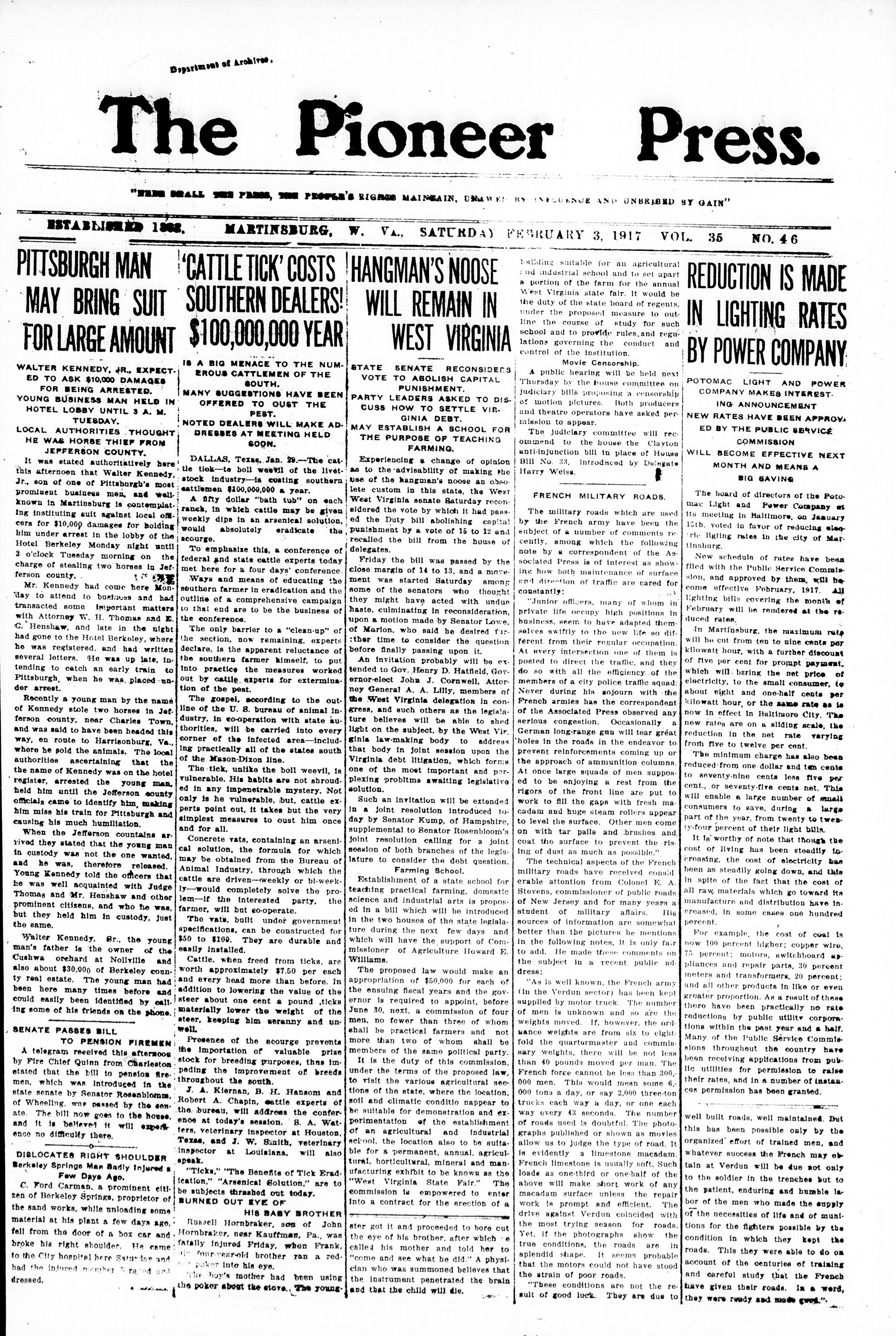
The Pioneer Press.
ESTABLISHED 1882.
PITTSBURGH MAN MAY BRING SUIT FOR LARGE AMOUNT
WALTER KENNEDY, JR., EXPECTED TO ASK $10,000 DAMAGES FOR BEING ARRESTED.
YOUNG BUSINESS MAN HELD IN HOTEL LOBBY UNTIL 3 A. M.
TUESDAY.
LOCAL AUTHORITIES THOUGHT HE WAS HORSE THIEF FROM JEFFERSON COUNTY
It was stated authoritatively here this afternoon that Walter Kennedy, Jr., son of one of Pittsburgh's most prominent business men, and well-known in Martinsburg is contemplating instituting suit against local officers for $10,000 damages for holding him under arrest in the lobby of the Hotel Berkeley Monday night until 3 o'clock Tuesday morning on the charge of stealing two horses in Jefferson county.
Mr. Kennedy had come here Monday to attend to business and had transacted some important matters with Attorney W. H. Thomas and E. G. Henshaw, and late in the night had gone to the Hotel Berkeley, where he was registered, and had written several letters. He was up late, intending to catch an early train to Pittsburgh, when he was placed under arrest.
Recently a young man by the name of Kennedy stole two horses in Jefferson county, near Charles Town, and was said to have been headed this way, en route to Harrisonburg, Va., where he sold the animals. The local authorities ascertaining that the the name of Kennedy was on the hotel register, arrested the young man, held him until the Jefferson county officials came to identify him, making him miss his train for Pittsburgh and causing his much humiliation.
When the Jefferson countains arrived they stated that the young man in custody was not the one wanted, and he was, therefore released. Young Kennedy told the officers that he was well acquainted with Judge Thomas and Mr. Henshaw and other prominent citizens, and who he was, but they held him in custody, just the same.
Walter Kennedy, Sr., the young man's father is the owner of the Cushwa orchard at Nollville and also about $30,000 of Berkeley county real estate. The young man had been here many times before and could easily been identified by calling some of his friends on the phone.
SENATE PASSES BILL
TO PENSION FIREMEN
A telegram received this afternoon by Fire Chief Quinn from Charleston stated that the bill to pension firemen, which was introduced in the state senate by Senator Rosenblomms, of Wheeling, was passed by the senate. The bill now goes to the house, and it is believed it will experience no difficulty there.
DISLOCATES RIGHT SHOULDER
Berkeley Springs Man Badly Injured a
Few Days Ago
C. Ford Carman, a prominent citizen of Berkeley Springs, proprietor of the sand works, while unloading some material at his plant a few days ago, fell from the door of a box car and broke his right shoulder. He came to the City hospital here Saturday and had the injured number strained and dressed.
Department of Archives
SMALL THE PRESS, THE PEOPLE
22. MARTINSBURG.
'CATTLE TICK' COSTS SOUTHERN DEALERS! $100,000,000 YEAR
IS A BIG MENACE TO THE NUMEROUS CATTLEMEN OF THE SOUTH.
MANY SUGGESTIONS HAVE BEEN OFFERED TO OUST THE PEST.
NOTED DEALERS WILL MAKE ADDRESSES AT MEETING HELD SOON.
DALLAS, Texas, Jan. 29.—The cattle tiok—te boll weevil of the livestock industry—is costing southern cattlemen $100,000,000 a year.
A fifty dollar "bath tub" on each ranch, in which cattle may be given weekly dips in an arsenical solution, would absolutely eradicate the scourge.
To emphasize this, a conference of federal and state cattle experts today met here for a four days' conference. Ways and means of educating the southern farmer in eradication and the outline of a comprehensive campaign to that end are to be the business of the conference. The only barrier to a "clean-up" of the section, now remaining, experts declare, is the apparent reluctance of the southern farmer himself, to put into practice the measures worked out by cattle experts for extermination of the pest.
The gospel, according to the outline of the U. 8. bureau of animal industry, in co-operation with state authorities, will be carried into every corner of the infected area—including practically all of the states south of the Mason-Dixon line.
The tick, unlike the boll weevil, is vulnerable. His habits are not shrouded in any impenetrable mystery. Not only is he vulnerable, but, cattle experts point out, it takes but the very simplest measures to oust him once and for all.
Concrete vats, containing an arsenical solution, the formula for which may be obtained from the Bureau of Animal Industry, through which the cattle are driven—weekly or bi-weekly—would completely solve the problem—if the interested party, the farmer, will but co-operate. The vats, built under government specifications, can be constructed for $50 to $100. They are durable and easily installed.
Cattle, when freed from ticks, are worth approximately $7.50 per each and every head more than before. In addition to lowering the value of the steer about one cent a pound , ticks materially lower the weight of the steer, keeping him seranny and unwell. Presence of the scourge prevents the importation of valuable prize stock for breeding purposes, thus impeding the improvement of breeds throughout the south.
J. A. Kiernan, B. H. Hansom and Robert A. Chapin, cattle experts of the bureau, will address the conference at today's session. S. A. Watters, veterinary inspector at Houston, Texas, and J. W. Smith, veterinary inspector at Louisiana, will also speak.
"Ticks," "The Benefits of Tick Eradication," "Arsenical Solution," are to be subjects thrashed out today.
BURNED OUT EYE OF
HIS BABY BROTHER
Russell Hornbraker, son of John Hornbraker, near Kauffman, Pa., was fatally injured Friday, when Frank, his four-year-old brother ran a red-eyed raker into his eye.
the boy's mother had been using the poker about the stove. The young-
HANGMAN'S NOOSE WILL REMAIN IN WEST VIRGINIA
STATE SENATE RECONSIDERS VOTE TO ABOLISH CAPITAL PUNISHMENT. PARTY LEADERS ASKED TO DISCUSS HOW TO SETTLE VIRGINIA DEBT. MAY ESTABLISH A SCHOOL FOR THE PURPOSE OF TEACHING FARMING.
Experiencing a change of opinion as to the advisability of making the use of the hangman's noose an obsolete custom in this state, the West West Virginia senate Saturday reconsidered the vote by which it had passed the Duty bill abolishing capital punishment by a vote of 15 to 12 and recalled the bill from the house of delegates.
Friday the bill was passed by the close margin of 14 to 13, and a movement was started Saturday among some of the senators who thought they might have acted with undue haste, culminating in reconsideration, upon a motion made by Senator Lowe, of Marlon, who said he desired further time to consider the question before finally passing upon it.
An invitation probably will be extended to Gov. Henry D. Hatfield, Governor-elect John J. Cornwell, Attorney General A. A. Lilly, members of the West Virginia delegation in congress, and such others as the legislature believes will be able to shed light on the subject, by the West Virginia law-making body to address that body in joint session upon the Virginia debt litigation, which forms one of the most important and perplexing probtms awaiting legislative solution.
Such an invitation will be extended in a joint resolution introduced today by Senator Kump, of Hampshire, supplemental to Senator Rosenbloom's joint resolution calling for a joint session of both branches of the legislature to consider the debt question. Farming School. Establishment of a state school for teaching practical farming, domestic science and industrial arts is proposed in a bill which will be introduced in the two houses of the state legislature during the next few days and which will have the support of Commissioner of Agriculture Howard E. Williams.
The proposed law would make an appropriation of $50,000 for each of the ensuing fiscal years and the governor is required to appoint, before June 30, next, a commission of four men, no fewer than three of whom shall be practical farmers and not more than two of whom shall be members of the same political party
It is the duty of this commission, under the terms of the proposed law, to visit the various agricultural sections of the state, where the location, soil and climatic condition appear to be suitable for demonstration and experimentation of the establishment of an agricultural and industrial school, the location also to be suitable for a permanent, annual, agricultural, horticultural, mineral and manufacturing exhibit to be known as the "West Virginia State Fair." The commission is empowered to enter into a contract for the erection of a
ster got it and proceeded to bore cut the eye of his brother, after which he called his mother and told her to "come and see what he did." A physician who was summoned believes that the instrument penetrated the brain and that the child will die.
building suitable for an agricultural and industrial school and to set apart a portion of the farm for the annual West Virginia state fair. It would be the duty of the state board of regents, under the proposed measure to outline the course of study for such school and to provide rules, and regulations governing the conduct and control of the institution.
Movie Censorship.
A public hearing will be held next Thursday by the house committee on judiciary bills proposing a censorship of motion pictures. Both producers and theatre operators have asked permission to appear.
The judiciary committee will recommend to the house the Clayton anti-injunction bill in place of House Bill No. 33, introduced by Delegate Harry Weiss.
FRENCH MILITARY ROAD8
The military roads which are used by the French army have been the subject of a number of comments recently, among which the following note by a correspondent of the Associated Press is of interest as showing how both maintenance of surface and direction of traffic are cared for constantly:
"Junior officers, many of whom in private life occupy high positions in business, seem to have adapted themselves swiftly to the new life so different from their regular occupation. At every intersection one of them is posted to direct the traffic, and they do so with all the efficiency of the members of a city police traffic squad. Never during his sojourn with the French armies has the correspondent of the Associated Press observed any serious congestion. Occasionally a German long-range gun will tear great holes in the roads in the endeavor to prevent reinforcements coming up or the approach of ammunition columns. At once large squads of men supposed to be enjoying a rest from the rigors of the front line are put to work to fill the gaps with fresh macadam and huge steam rollers appear to level the surface. Other men come on with tar pails and brushes and coat the surface to prevent the rising of dust as much as possible."
The technical aspects of the French military roads have received considerable attention from Colonel E. A. Stevens, commissioner of public roads of New Jersey and for many years a student of military affairs. His sources of information are somewhat better than the pictures he mentions in the following notes, it is only fair to add. He made these comments on the subject in a recent public address:
"As is well known, the French army (in the Verdun sector) has been kept supplied by motor truck. The number of men is unknown and so are the weights moved. If, however, the ordnance weights are from six to eight-fold the quartormaster and commissary weights, there will be not less than 40 pounds moved per man. The French force cannot be less than 300,000 men. This would mean some 6,000 tons a day, or say 2,000 three-ton trucks each way a day, or one each way every 43 seconds. The number of roads used is doubtful. The photographs published or shown as movies allow us to judge the type of road. It is evidently a limestone macadam. French limestone is usually soft. Such loads as one-third or one-half of the above will make short work of any macadam surface unless the repair work is prompt and efficient. The drive against Verdun coincided with the most trying season for roads. Yet, if the photographs show the true conditions, the roads are in splendid shape. It seems probable that the motors could not have stood the strain of poor roads.
"These conditions are not the result of good luck. They are due to
REDUCTION IS MADE IN LIGHTING RATES BY POWER COMPANY
POTOMAC LIGHT AND POWER COMPANY MAKES INTEREST ING ANNOUNCEMENT NEW RATES HAVE BEEN APPROVED BY THE PUBLIC SERVICE COMMISSION WILL BECOME EFPECTIVE NEXT MONTH AND MEANS A
BIG SAVING
The board of directors of the Potomac Light and Power Company at its meeting in Baltimore, on January 15th, voted in favor of reducing electric lighting rates in the city of Martinsburg.
New schedule of rates have been filed with the Public Service Commission, and approved by them, will become effective February, 1917. All Lighting bills covering the month of February will be rendered at the reduced rates.
In Martinsburg, the maximum rate will be cut from ten to nine cents per kilowatt hour, with a further discount of five per cent for prompt payment, which will bring the net price of electricity, to the small consumer, to about eight and one-half cents per kilowatt hour, or the same rate as is now in effect in Baltimore City. The new rates are on a sliding scale, the reduction in the net rate varying from five to twelve per cent.
The minimum charge has also been reduced from one dollar and ten cents to seventy-nine cents less five per cent., or seventy-five cents not. This will enable a large number of small consumers to save, during a large part of the year, from twenty to twenty-four percent of their light bills. It is worthy of note that though the cost of living has been steadily increasing, the cost of electricity has been as steadily going down, and this in spite of the fact that the cost of all raw materials which go toward its manufacture and distribution have increased, in some cases one hundred percent.
For example, the cost of coal is now 100 percent higher; copper wire, 75 percent; motors, switchboard appliances and repair parts, 30 percent meters and transformers, 20 percent; and all other products in like or even greater proportion. As a result of these there have been practically no rate reductions by public utility corporations within the past year and a half. Many of the Public Service Commissions throughout the country have been receiving applications from public utilities for permission to raise their rates, and in a number of instances permission has been granted.
well built roads, well maintained. But this has been possible only by the organized effort of trained men, and whatever success the French may obtain at Verdun will be due not only to the soldier in the trenches but to the patient, enduring and humble labor of the men who made the supply of the necessities of life and of munitions for the fighters possible by the condition in which they kept the roads. This they were able to do on account of the centuries of training and careful study that the French have given their roads. In a word, they were ready and made good."
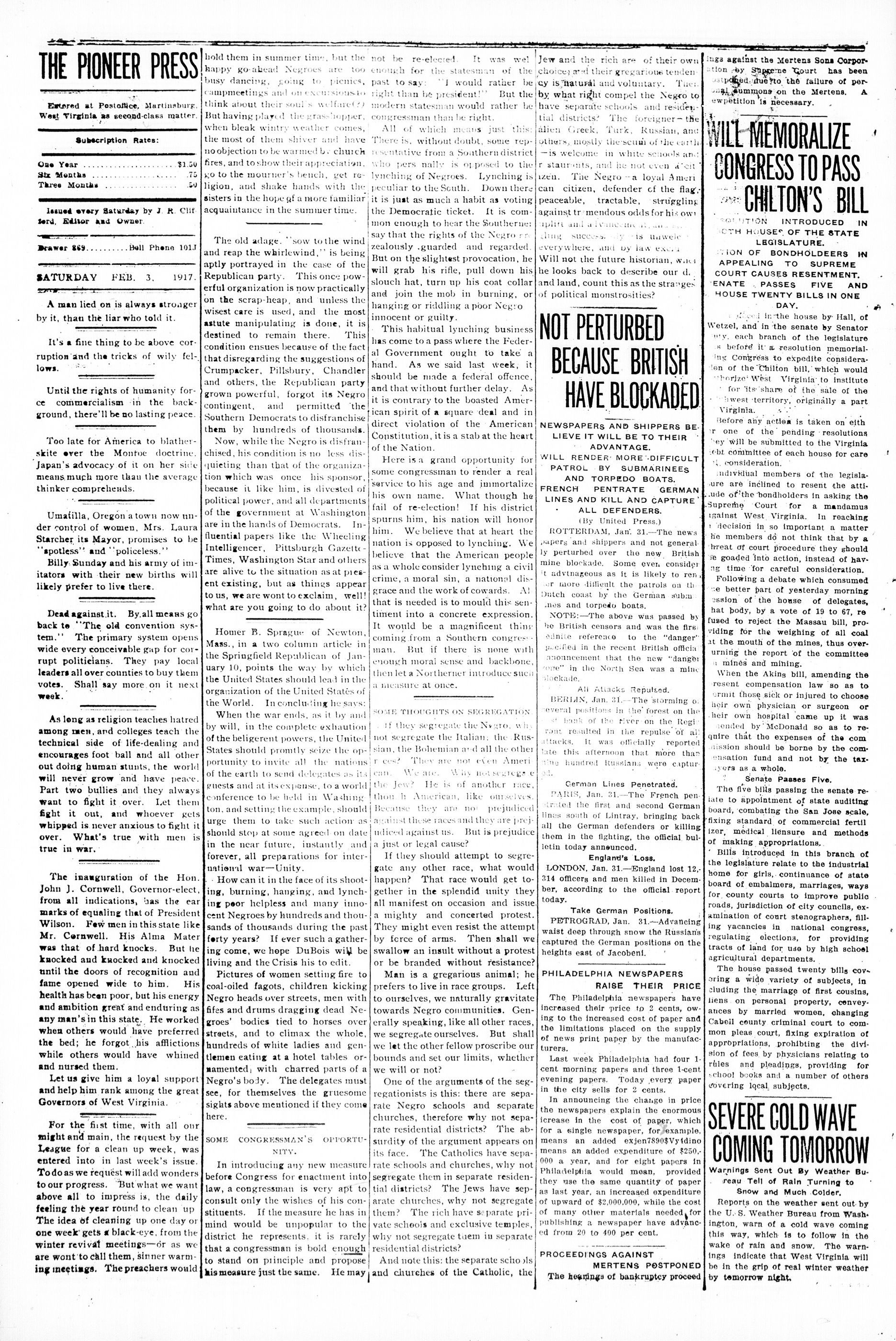
THE PIONEER PRESS
Entered at Postoffice, Martinsburg. West Virginia as second-class matter.
Subscription Rates:
One Year ..... $1.50
Six Months ..... 75
Three Months ..... 50
Issued every Saturday by J. R. Clifford, Editor and Owner.
Drawer 869.....Bell Phone 101J
SATURDAY FEB. 3. 1917.
A man lied on is always stronger by it, than the liar who told it.
It's a fine thing to be above corruption and the tricks of wily fellows.
Until the rights of humanity force commercialism in the background, there'll be no lasting peace.
Too late for America to blather-skite over the Montoe doctrine. Japan's advocacy of it on her side means much more than the average thinker comprehends.
Umafilla, Oregon a town now under control of women, Mrs. Laura Starcher its Mayor, promises to be "spotless" and "policeless." Billy Sunday and his army of imitators with their new births will likely prefer to live there.
Dead against it. By all means go back to "The old convention system." The primary system opens wide every conceivable gap for corrupt politicians. They pay local leaders all over counties to buy them votes. Shall say more on it next week.
As long as religion teaches hatred among men, and colleges teach the technical side of life-dealing and encourages foot ball and all other out doing human stunts, the world will never grow and have peace. Part two bullies and they always want to fight it over. Let them fight it out, and whoever gets whipped is never anxious to fight it over. What's true with men is true in war.
The inauguration of the Hon. John J. Cornwell, Governor-elect, from all indications, has the ear marks of equaling that of President Wilson. Few men in this state like Mr. Cornwell. His Alma Mater was that of hard knocks. But he knocked and knocked and knocked until the doors of recognition and fame opened wide to him. His health has been poor, but his energy and ambition great and enduring as any man's in this state. He worked when others would have preferred the bed; he forgot his afflictions while others would have whined and nursed them.
Let us give him a loyal support and help him rank among the great Governors of West Virginia.
---
For the first time, with all our might and main, the request by the League for a clean up week, was entered into in last week's issue. To do as we request will add wonders to our progress. But what we want above all to impress is, the daily feeling the year round to clean up The idea of cleaning up one day or one week gets a black-eye, from the winter revival meetings-or as we are wont to call them, sinner warming meetings. The preachers would
---
hold them in summer time, but the happy go-ahead Negroes are too busy dancing, going to picnics, campmeetings and on excursions to think about their soul's welfare(?) But having played the grasshopper, when bleak wintry weather comes, the most of them shiver and have no objection to be warmed by church fires, and to show their appreciation, go to the mourner's bench, get religion, and shake hands with the sisters in the hope of a more familiar acquaintance in the summer time.
The old adage, "sow to the wind and reap the whirlewind," is being aptly portrayed in the case of the Republican party. This once powerful organization is now practically on the scrap-heap, and unless the wisest care is used, and the most astute manipulating is done, it is destined to remain there. This condition ensues because of the fact that disregarding the suggestions of Crumpacker, Pillsbury, Chandler and others, the Republican party grown powerful, forgot its Negro contingent, and permitted the Southern Democrats to disfranchise them by hundreds of thousands.
Now, while the Negro is disfranchised, his condition is no less disquieting than that of the organization which was once his sponsor, because it like him, is divested of political power, and all departments of the government at Washington are in the hands of Democrats. Influential papers like the Wheeling Intelligencer, Pittsburgh Gazette-Times, Washington Star and others are alive to the situation as at present existing, but as things appear to us, we are wont to exclaim, well! what are you going to do about it?
Homer B. Sprague of Newton, Mass., in a two column article in the Springfield Republican of January 10, points the way by which the United States should lead in the organization of the United States of the World. In concluding he says:
When the war ends, as it by and by will, in the complete exhaustion of the beligerent powers, the United States should promptly seize the opportunity to invite all the nations of the earth to send delegates as its guests and at its expense, to a world conference to be held in Washington, and setting the example, should urge them to take such action as should stop at some agreed on date in the near future, instantly and forever, all preparations for international war—Unity.
How can it in the face of its shooting, burning, hanging, and lynching poor helpless and many innocent Negroes by hundreds and thousands of thousands during the past forty years? If ever such a gathering come, we hope DuBois will be living and the Crisis his to edit.
Pictures of women setting fire to coal-oiled fagots, children kicking Negro heads over streets, men with fifes and drums dragging dead Negroes' bodies tied to horses over streets, and to climax the whole, hundreds of white ladies and gentlemen eating at a hotel tables ornamented, with charred parts of a Negro's body. The delegates must see, for themselves the gruesome sights above mentioned if they come here.
SOME CONGRESSMAN'S OPPORTUNITY.
In introducing any new measure before Congress for enactment into law, a congressman is very apt to consult only the wishes of his constituents. If the measure he has in mind would be unpopular to the district he represents, it is rarely that a congressman is bold enough to stand on principle and propose his measure just the same. He may
not be re-elected. It was well enough for the statesman of the past to say: "I would rather be right than be president!" But the modern statesman would rather be congressman than be right.
All of which means just this: There is, without doubt, some representative from a Southern district who pers nally is opposed to the lynching of Negroes. Lynching is peculiar to the South. Down there it is just as much a habit as voting the Democratic ticket. It is common enough to hear the Southerner say that the rights of the Negro pro zealously guarded and regarded. But on the slightest provocation, he will grab his rifle, pull down his slouch hat, turn up his coat collar and join the mob in burning, or hanging or riddling a poor Negro innocent or guilty.
This habitual lynching business has come to a pass where the Federal Government ought to take a hand. As we said last week, it should be made a federal offence, and that without further delay. As it is contrary to the boasted American spirit of a square deal and in direct violation of the American Constitution, it is a stab at the heart of the Nation.
Here is a grand opportunity for some congressman to render a real service to his age and immortalize his own name. What though he fail of re-election! If his district spurns him, his nation will honor him. We believe that at heart the nation is opposed to lynching. We believe that the American people as a whole consider lynching a civil crime, a moral sin, a national disgrace and the work of cowards. All that is needed is to mould this sentiment into a concrete expression. It would be a magnificent thing coming from a Southern congressman. But if there is none with enough moral sense and backbone, then let a Northerner introduce such a measure at once.
---
SOME THOUGHTS ON SEGREGATION
If they segregate the Nigro, why not segregate the Italian; the Russian, the Bohemian and all the other races? They are not even American. We are. Why not segregate the Jew? He is of another race, though American, like ourselves. Because they are not prejudiced against these races and they are prejudiced against us. But is prejudice a just or legal cause?
If they should attempt to segregate any other race, what would happen? That race would get together in the splendid unity they all manifest on occasion and issue a mighty and concerted protest. They might even resist the attempt by force of arms. Then shall we swallow an insult without a protest or be branded without resistance?
Man is a gregarious animal; he prefers to live in race groups. Left to ourselves, we naturally gravitate towards Negro communities. Generally speaking, like all other races, we segregate ourselves. But shall we let the other fellow proscribe our bounds and set our limits, whether we will or not?
One of the arguments of the segregationists is this: there are separate Negro schools and separate churches, therefore why not separate residential districts? The absurdity of the argument appears on its face. The Catholics have separate schools and churches, why not segregate them in separate residential districts? The Jews have separate churches, why not segregate them? The rich have separate private schools and exclusive temples, why not segregate them in separate residential districts?
And note this: the separate schools and churches of the Catholic, the
Jew and the rich are of their own choice; and their gregarious tendency is natural and voluntary. Then by what right compel the Negro to have separate schools and residential districts? The foreigner—the alien Greek, Turk, Russian, and others, mostly the scum of the earth—is welcome in white schools and restaurants, and he not even a citizen. The Negro—a loyal American citizen, defender of the flag, peaceable, tractable, struggling against tremendous odds for his own uplift and advancement, and clinging success, is unweled everywhere, and by law exert Will not the future historian, when he looks back to describe our d. and land, count this as the stranges of political monstrosities?
NOT PERTURBED BECAUSE BRITISH HAVE BLOCKADED
NEWSPAPERS AND SHIPPERS BE
LIEVE IT WILL BE TO THEIR
ADVANTAGE.
WILL RENDER MORE DIFFICULT
PATROL BY SUBMARINEES
AND TORPEDO BOATS.
FRENCH PENTRATE GERMAN
LINES AND KILL AND CAPTURE
ALL DEFENDERS
(By United Press.)
ROTTERDAM, Jan. 31.—The news papers and shippers and not generally perturbed over the new British mine blockade. Some even consider it advnageous as it is likely to render more difficult the patrols on the Dutch coast by the German submarines and torpedo boats.
NOTE:—The above was passed by the British censors and was the first ednite reference to the "danger" specified in the recent British official announcement that the new "danger zone" in the North Sea was a mine blockade.
All Attacks Repulsed.
BERLIN, Jan. 31.—The storming of several positions in the forest on the first bank of the river on the Regiment resulted in the repulse of all attacks. It was officially reported late this afternoon that more than nine hundred Russians were captured.
German Lines Penetrated.
PARIS, Jan. 31.—The French penetrated the first and second German lines south of Lintray, bringing back all the German defenders or killing them in the fighting, the official bulletin today announced.
England's Loss.
LONDON, Jan. 31.—England lost 12, 314 officers and men killed in December, according to the official report today.
Take German Positions.
PETROGRAD, Jan. 31. Advancing waist deep through snow the Russians captured the German positions on the heights east of Jacobeni.
PHILADELPHIA NEWSPAPERS RAISE THEIR PRICE
The Philadelphia newspapers have increased their price to 2 cents, owing to the increased cost of paper and the limitations placed on the supply of news print paper by the manufacturers. Last week Philadelphia had four 1-cent morning papers and three 1-cent evening papers. Today every paper in the city sells for 2 cents.
In announcing the change in price the newspapers explain the enormous increase in the cost of paper, which for a single newspaper, for example, means an added exjen7890$Vy1dino means an added expenditure of $250,000 a year, and for eight papers in Philadelphia would mean, provided they use the same quantity of paper as last year, an increased expenditure of upward of $2,000,000, while the cost of many other materials needed for publishing a newspaper have advanced from 20 to 400 per cent.
PROCEEDINGS AGAINST
MERTENS POSTPONED The hearings of bankruptcy proceed
ings against the Mertens Sons Corporation by Supreme Court has been postponed due to the failure of personal summons on the Mertens. A petition is necessary.
WILL MEMORALIZE CONGRESS TO PASS CHILTON'S BILL
SOLUTION INTRODUCED IN
MOTH HOUSES OF THE STATE
LEGISLATURE.
VIGNON OF BONDHOLDEERS IN
APPEALING TO SUPREME
COURT CAUSES RESENTMENT.
ENATE PASSES FIVE AND
HOUSE TWENTY BILLS IN ONE
in the house by Hall, of Wetzel, and in the senate by Senator City, each branch of the legislature is before it a resolution memorialing Congress to expedite consideration of the Chilton bill, which would authorize West Virginia to institute for its share of the sale of the northwest territory, originally a part Virginia. Before any action is taken on either or one of the pending resolutions they will be submitted to the Virginia debt committee of each house for care of consideration.
individual members of the legislature are inclined to resent the attitude of the bondholders in asking the Supreme Court for a mandamus against West Virginia. In reaching a decision in so important a matter the members do not think that by a threat of court procedure they should be goaded into action, instead of having time for careful consideration.
Following a debate which consumed the better part of yesterday morning session of the house of delegates, that body, by a vote of 19 to 67, refused to reject the Massau bill, providing for the weighing of all coal at the mouth of the mines, thus overturning the report of the committee in mines and mining.
When the Akins bill, amending the present compensation law so as to permit those sick or injured to choose their own physician or surgeon or their own hospital came up it was
sended by McDonald so as to require that the expenses of the commission should be borne by the compensation fund and not by the taxpayers as a whole.
Senate Passes Five.
The five bills passing the senate relate to appointment of state auditing board, combating the San Jose scale, fixing standard of commercial fertilizer, medical liensure and methods of making appropriations. Bills introduced in this branch of the legislature relate to the industrial home for girls, continuance of state board of embalmers, marriages, ways for county courts to improve public roads, jurisdiction of city councils, examination of court stenographers, filling vacancies in national congress, regulating elections, for providing tracts of land for use by high school agricultural departments.
The house passed twenty bills covering a wide variety of subjects, including the marriage of first cousins, liens on personal property, conveyances by married women, changing Cabell county criminal court to common pleas court, fixing expiration of appropriations, prohibiting the division of fees by physicians relating to rules and pleadings, providing for school books and a number of others covering local subjects.
SEVERE COLD WAVE COMING TOMORROW
Warnings Sent Out By Weather Bureau Tell of Rain Turning to Snow and Much Colder. Reports on the weather sent out by the U.S. Weather Bureau from Washington, warn of a cold wave coming this way, which is to follow in the wake of rain and snow. The warnings indicate that West Virginia will be in the grip of real winter weather by tomorrow night.
Mr. Tom Jones, who has been very ill is able to be about, a fact gratifying to himself and friends.
Mr. John W. Lewis, B. & O. Station janitor at Harper's Ferry, was badly scalded on last Saturday, but is much improved now.
Miss Hilda Hopewell, who attends school at Storer College, Harper's Ferry, spent Sunday at the parental homestead in this city.
Mt. Pisgah Baptist Church, on the Boom is having a big revival. In addition to the pastor, Rev. M. C. Moore, the meeting is being addressed nightly by Rev. Dr. P. Richardson, of Pittsburg, Pa., a speaker of forcefulness and conviction. In addition to his presence here at the revival, the Rev. has many friends here who are glad to see him between times. While in our city, he is the house guest of Mr. Emanuel Pollard.
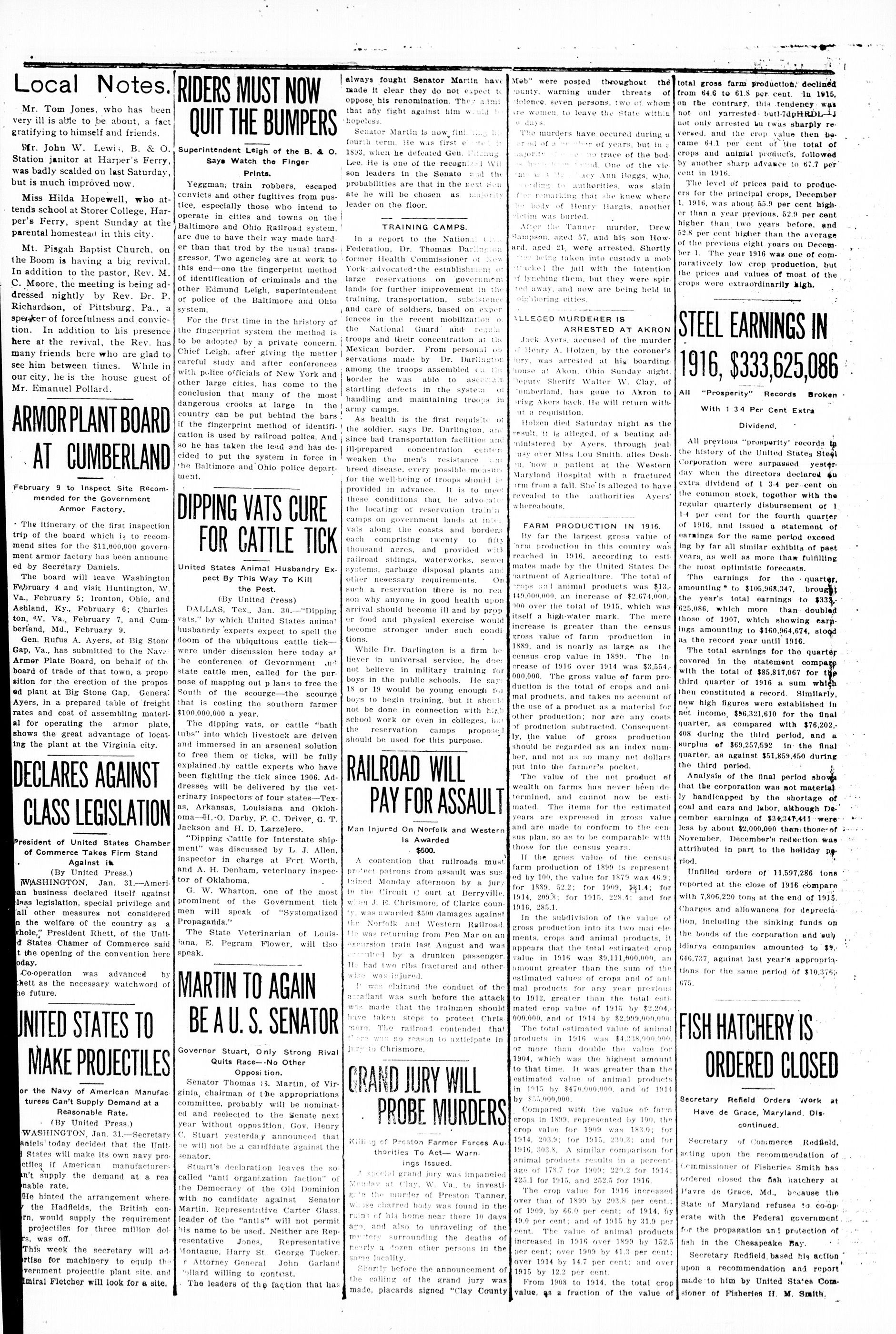
ARMOR PLANT BOARD AT CUMBERLAND
February 9 to Inspect Site Recommended for the Government Armor Factory.
The itinerary of the first inspection trip of the board which is to recommend sites for the $11,000,000 government armor factory has been announced by Secretary Daniels.
The board will leave Washington February 4 and visit Huntington, W. Va., February 5; Ironton, Ohio, and Ashland, Ky., February 6; Charles ton, d.V. Va., February 7, and Cumberland, Md., February 9.
Gen. Rufus A. Ayers, of Big Stone Gap, Va., has submitted to the Naval Armor Plate Board, on behalf of the board of trade of that town, a proposition for the erection of the proposed plant at Big Stone Gap. General Ayers, in a prepared table of freight rates and cost of assembling material for operating the armor plate, shows the great advantage of locating the plant at the Virginia city.
DECLARES AGAINST CLASS LEGISLATION
President of United States Chamber of Commerce Takes Firm Stand
WASHINGTON, Jan. 31.—American business declared itself against class legislation, special privilege and all other measures not considered in the welfare of the country as a whole," President Rhett, of the United States Chamer of Commerce said at the opening of the convention here today.
Co-operation was advanced by thett as the necessary watchword of the future.
UNITED STATES TO MAKE PROJECTILES
or the Navy of American Manufactures Can't Supply Demand at a
WASHINGTON, Jan. 31.—Secretary Daniels' today decided that the United States will make its own navy projectiles if American manufacturers can't supply the demand at a reasonable rate. He hinted the arrangement whereby the Hadfields, the British conrn, would supply the requirement projectiles for three million dollars, was off. This week the secretary will advertise for machinery to equip the government projectile plant site, and imiral Fletcher will look for a site.
RIDERS MUST NOW QUIT THE BUMPERS
Superintendent Leigh of the B. & O. Says Watch the Finger Prints.
Yeggman, train robbers, escaped convicts and other fugitives from pus-tice, especially those who intend to operate in cities and towns on the Baltimore and Ohio Railroad system, are due to have their way made harder than that trod by the usual transgressor. Two agencies are at work to this end—one the fingerprint method of identification of criminals and the other Edmund Leigh, superintendent of police of the Baltimore and Ohio system.
For the first time in the history of the fingerprint system the method is to be adopted by a private concern. Chief Leigh, after giving the matter careful study and after conferences with police officials of New York and other large cities, has come to the conclusion that many of the most dangerous crooks at large in the country can be put behind the bars if the fingerprint method of identification is used by railroad police. And so he has taken the lead and has decided to put the system in force in the Baltimore and Ohio police department.
DIPPING VATS CURE FOR CATTLE TICK
United States Animal Husbandry Expect By This Way To Kill
(By United Press)
DALLAS, Tex., Jan. 30.—"Dipping vats," by which United States animal husbandry experts expect to spell the doom of the ubiquitous cattle tick—were under discussion here today at the conference of Geovornment and state cattle men, called for the purpose of mapping out p lans to free the South of the scourge—the scourge that is costing the southern farmer $100,000,000 a year.
The dipping vats, or cattle "bath tubs" into which livestock are driven and immersed in an arsenal solution to free them of ticks, will be fully explained by cattle experts who have been fighting the tick since 1906. Addresses will be delivered by the veterinary inspectors of four states—Texas, Arkansas, Louisiana and Oklahoma—H. O. Darby, F. C. Driver, G. T. Jackson and H. D. Larzelero.
"Dipping Cattle for Interstate shipment" was discussed by L. J. Allen, inspector in charge at Fort Worth, and A. H. Denham, veterinary inspector of Oklahoma.
G. W. Wharton, one of the most prominent of the Government tick men will speak of "Systematized Propaganda." The State Veterinarian of Louisiana, E. Pegram Flower, will tiso speak.
MARTIN TO AGAIN BE A U. S. SENATOR
Governor Stuart, Only Strong Rival Quits Race-No Other
Opposition.
Senator Thomas S. Martin, of Virginia, chairman of the appropriations committee, probably will be nominated and reelected to the Senate next year without opposition. Gov. Henry C. Stuart yesterday announced that he will not be a candidate against the senator.
Stuart's declaration leaves the so-called "anti organization faction" of the Democracy of the Old Dominion with no candidate against Senator Martin. Representative Carter Glass, leader of the "antis" will not permit his name to be used. Neither are Representative Jones, Representative Montague, Harry St. George Tucker, Attorney General John Garland Pollard willing to contest. The leaders of the faction that has
always fought Senator Martin have made it clear they do not expect to oppose his renomination. They admit that any fight against him would be hopeless. Senator Martin is now finishing his fourth term. He was first elected in 1833, when he defeated Gen. Pitnugn Lee. He is one of the recognized Wilson leaders in the Senate and the probabilities are that in the next Senate he will be chosen as majority leader on the floor.
TRAINING CAMPS.
In a report to the National Civil Federation, Dr. Thomas Darlington former Health Commissioner of New York advocated the establishment of large reservations on government lands for further improvement in the training, transportation, subsistence and care of soldiers, based on experiences in the recent mobilization of the National Guard and regular troops and their concentration at the Mexican border. From personal observations made by Dr. Darlington among the troops assembled on the border he was able to ascertain startling defects in the system of handling and maintaining troops in army camps.
As health is the first requisite of the soldier, says Dr. Darlington, and since bad transportation facilities and ill-prepared concentration centers weaken the men's resistance and breed disease, every possible measure for the well-being of troops should be provided in advance. It is to meet these conditions that he advocate the locating of reservation train camps on government lands at intervals along the coasts and borders each comprising twenty to fifty thousand acres, and provided with railroad sidings, waterworks, sewer systems, garbage disposal plants and other necessary requirements. Or such a reservation there is no reason why anyone in good health upon arrival should become ill and by proper food and physical exercise would become stronger under such conditions.
While Dr. Darlington is a firm believer in universal service, he does not believe in military training for boys in the public schools. He says 18 or 19 would be young enough for boys to begin training, but it should not be done in connection with high school work or even in colleges, but the reservation camps propose should be used for this purpose.
RAILROAD WILL PAY FOR ASSAULT
Man Injured On Norfolk and Western Is Awarded $500.
A contention that railroads must protect patrons from assault was sustained Monday afternoon by a jury in the Circuit Court at Berryville when J. E. Chrismore, of Clarke county, was awarded $500 damages against the Norfolk and Western Railroad. He was returning from Pen Mar on an excursion train last August and was consulted by a drunken passenger. He had two ribs fractured and other wise was injured.
It was claimed the conduct of the availant was such before the attack was made that the trainmen should have taken steps to protect Chrismore. The railroad contended that there was no reason to anticipate injury to Chrismore.
GRAND JURY WILL PROBE MURDERS
Killing of Preston Farmer Forces Authorities To Act—Warnings Issued.
A special grand jury was impaneled Monday at Clay, W. Va., to investigate the murder of Preston Tanner, whose charred body was found in the ruins of his home near there 10 days ago, and also to unravel of the mystery surrounding the deaths of nearly a dozen other persons in the same locality.
Shortly before the announcement of the calling of the grand jury was made, placards signed "Clay County
Meb" were posted throughout the county, warning under threats of violence, seven persons, two of whom are women, to leave the State within 6 days.
The murders have occurred during a period of a number of years, but in a majority of cases no trace of the bodies have been found. One of the victims was 10, Lucy Ann Boggs, who, according to authorities, was slain for remarking that she knew where the body of Henry Hargis, another victim was buried.
After the Tanner murder, Drew Sampson, aged 57, and his son Howard, aged 21, were arrested. Shortly now being taken into custody a mob attacked the jail with the intention of lynching them, but they were spirted away, and now are being held in neighboring cities.
LLEGED MURDERER IS
ARRESTED AT AKRON
Jack Ayers, accused of the murder of Henry A. Holzen, by the coroner's jury, was arrested at his boarding-house at Akon, Ohio Sunday night. Deputy Sheriff Walter W. Clay, of Cumberland, has gone to Akron to bring Akers back. He will return without a requisition.
Holzen died Saturday night as the result, it is alleged, of a beating administered by Ayers, through jealousy over Miss Lou Smith, alias Deshon, 'now a patient at the Western Maryland Hospital with a fractured arm from a fall. She is alleged to have revealed to the authorities Ayers' whereabouts.
FARM PRODUCTION IN 1916
By far the largest gross value of farm production in this country was reached in 1916, according to estimates made by the United States Department of Agriculture. The total of crops and animal products was $13,449,000,000, an increase of $2,674,000,000 over the total of 1915, which was itself a high-water mark. The more increase is greater than the census gross value of farm production in 1889, and is nearly as large as the census crop value in 1899. The increase of 1916 over 1914 was $3,554,000,000. The gross value of farm production is the total of crops and animal products, and takes no account of the use of a product as a material for other production; nor are any costs of production subtracted. Consequently, the value of gross production should be regarded as an index number, and not as so many net dollars put into the farmer's pocket.
The value of the net product of wealth on farms has never been determined, and cannot now be estimated. The items for the estimated years are expressed in gross value and are made to conform to the census plan, so as to be comparable with those for the census years.
If the gross value of the census farm production of 1899 is represented by 100, the value for 1879 was 46.9; for 1889, 52.2; for 1909, 181.4; for 1914, 209.8; for 1915, 228.4; and for 1916, 285.1.
In the subdivision of the value of gross production into its two mal elements, crops and animal products, it appears that the total estimated crop value in 1916 was $9,111,000,000, an amount greater than the sum of the estimated values of crops and of animal products for any year previous to 1912, greater than the total estimated crop value of 1915 by $2,204,000,000, and of 1914 by $2,999,000,000. The total estimated value of animal products in 1916 was $4,238,000,000, or more than double the value for 1904, which was the highest amount to that time. It was greater than the estimated value of animal products in 1915 by $470,000,000, and of 1914 by $55,000,000.
Compared with the value of farm crops in 1899, represented by 100, the crop value for 1909 was 183.0; for 1914, 203.9; for 1915, 230.2; and for 1916, 303.8. A similar comparison for animal products results in a percentage of 178.7 for 1909; 220.2 for 1914; 225.1 for 1915, and 252.5 for 1916.
The crop value for 1916 increased over that of 1899 by 203.8 per cent.; of 1909, by 66.0 per cent; of 1914, by 49.0 per cent; and of 1915 by 31.9 per cent. The value of animal products increased in 1916 over 1899 by 152.5 per cent; over 1909 by 41.3 per cent; over 1914 by 14.7 per cent; and over 1915 by 12.2 per cent.
From 1908 to 1914, the total crop value, as a fraction of the value of
total gross farm production; declined from 64.6 to 61.8 per cent. In 1915, on the contrary, this tendency was not only yarrested butl-7dpHRDL-J not only arrested but two sharply reversed, and the crop value then became 64.1 per cent of the total of crops and animal products, followed by another sharp advance to 67.7 per cent in 1916.
The level of prices paid to producers for the principal crops, December 1, 1916, was about 55.9 per cent higher than a year previous, 52.9 per cent higher than two years before, and 52.8 per cent higher than the average of the previous eight years on December 1. The year 1916 was one of comparatively low crop production, but the prices and values of most of the crops were extraordinarily high.
STEEL EARNINGS IN 1916, $333,625,086
With 1 3 4 Per Cent Extra
All previous "prosperity" records in the history of the United States Steel Corporation were surpassed yesterday when the directors declared an extra dividend of 1 3.4 per cent on the common stock, together with the regular quarterly disbursement of 1 1.4 per cent for the fourth quarter of 1916, and issued a statement of earnings for the same period exceeding by far all similar exhibits of past years, as well as more than fulfilling the most optimistic forecasts.
The earnings for the quarter, amounting * to $105,968,347, brought the year's total earnings to $333,625,086, which more than doubled those of 1907, which showing earnings amounting to $160,964,674, stood as the record year until 1916.
The total earnings for the quarter covered in the statement compare with the total of $85,817,067 for the third quarter of 1916 a sum which then constituted a record. Similarly, new high figures were established in net income, $86,321,610 for the final quarter, as compared with $76,202,408 during the third period, and a surplus of $69,257,592 in the final quarter, as against $51,859,450 during the third period.
Analysis of the final period shows that the corporation was not materially handicapped by the shortage of coal and cars and labor, although December earnings of $34,347,411 were less by about $2,000,000 than those of November. December's reduction was attributed in part to the holiday period.
Unfilled orders of 11,597,286 tons reported at the close of 1916 compare with 7,806,220 tons at the end of 1915. Charges and allowances for depreciation, including the sinking funds on the bonds of the corporation and subsidiary companies amounted to $9,646,737, against last year's appropriations for the same period of $10,376,675.
FISH HATCHERY IS ORDERED CLOSED
Secretary Refield Orders Work at Have de Grace, Maryland. Discontinued.
Secretary of Commerce Redfield, acting upon the recommendation of Commissioner of Fisheries Smith has ordered closed the fish hatchery at Havre de Grace, Md., because the State of Maryland refuses to cooperate with the Federal government for the propagation and protection of fish in the Chesapeake Bay.
Secretary Redfield, based his action upon a recommendation and report made to him by United States Comsioner of Fisheries H. M. Smith.
C
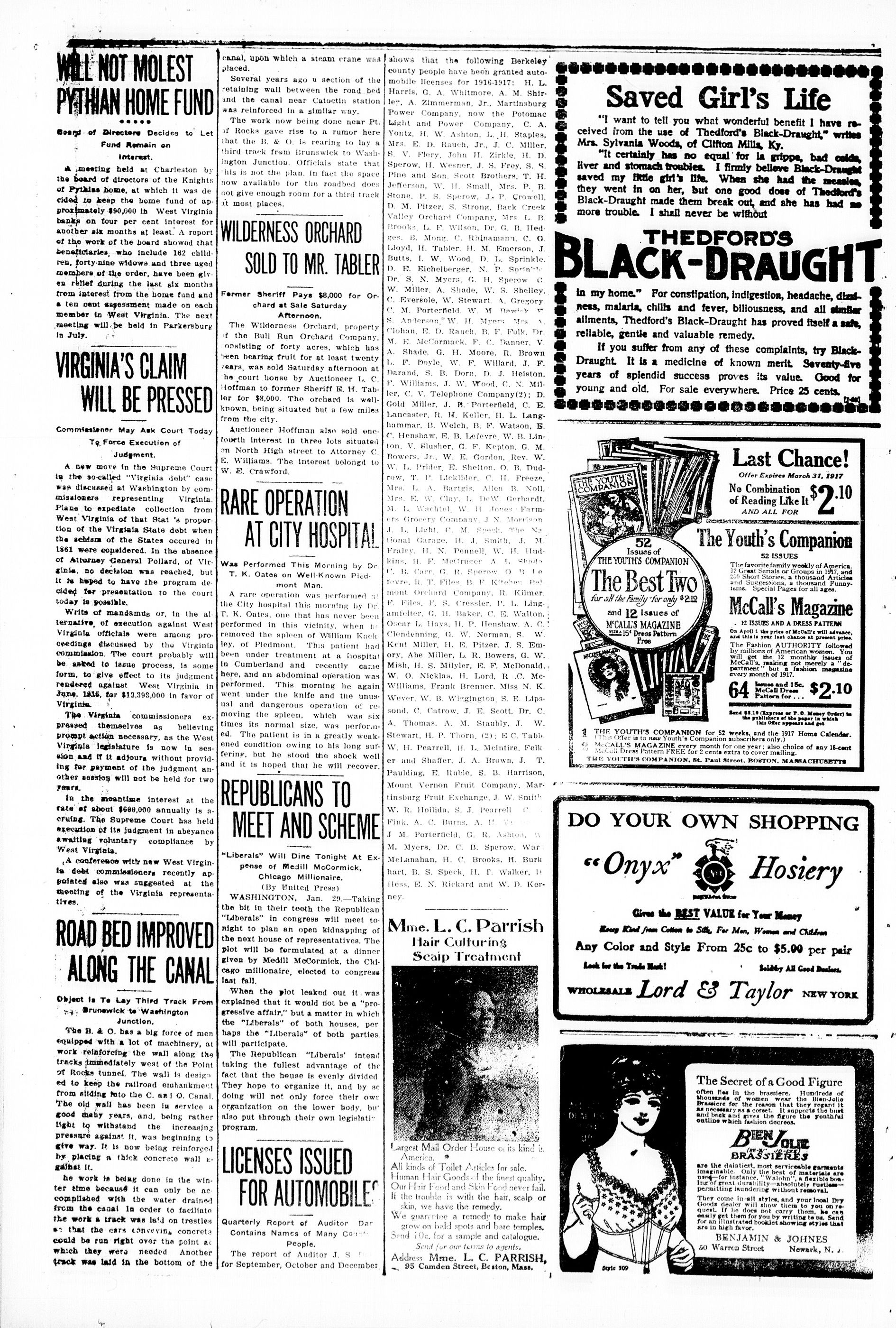
WILL NOT MOLEST
PYTHIAN HOME FUND
Board of Directors Decides to Let
Fund Remain on
Interest.
A meeting held at Charleston by the board of directors of the Knights of Pythias home, at which it was decided to keep the home fund of approximately $90,000 in West Virginia banks on four per cent interest for another six months at least. A report of the work of the board showed that beneficiaries, who include 162 children, forty-nine widows and three aged members of the order, have been given relief during the last six months from interest from the home fund and a ten cent assessment made on each member in West Virginia. The next meeting will be held in Parkersburg in July.
VIRGINIA'S CLAIM WILL BE PRESSED
A new move in the Supreme Court in the so-called "Virginia debt" case was discussed at Washington by commissioners representing Virginia. Plans to expediate collection from West Virginia of that Stat's proportion of the Virginia State debt when the schism of the States occured in 1861 were considered. In the absence of Attorney General Pollard, of Virginia, no decision was reached, but it is hoped to have the program decided for presentation to the court today is possible.
Writs of mandamus or, in the alternative, of execution against West Virginia officials were among proceedings discussed by the Virginia commission. The court probably will be asked to issue process, is some form, to give effect to its judgment rendered against West Virginia in June, 1815, for $13,393,000 in favor of Virginia.
The Virginia commissioners expressed themselves as believing prompt action necessary, as the West Virginia legislature is now in session and if it adjourns without providing for payment of the judgment another session will not be held for two years.
In the meantime interest at the rate of about $600,000 annually is accruing. The Supreme Court has held execution of its judgment in abeyance awaiting voluntary compliance by West Virginia.
A conference with new West Virginia debt commissioners recently appointed also was suggested at the meeting of the Virginia representatives.
ROAD BED IMPROVED ALONG THE CANAL
Object is To Lay Third Track From Brunswick to Washington Junction.
The B. & O. has a big force of men equipped with a lot of machinery, at work reinforcing the wall along the tracks immediately west of the Point of Rocks tunnel. The wall is designed to keep the railroad embankment from sliding into the C. and O. Canal. The old wall has been in service a good many years, and, being rather light to withstand the increasing pressure against it, was beginning to give way. It is now being reinforced by placing a thick concrete wall against it.
he work is being done in the winter time because it can only be accomplished with the water drained from the canal in order to facilitate the work a track was laid on trestles as that the cars conveying concrete could be run right over the point at which they were needed. Another track was laid in the bottom of the
canal, upon which a steam crane was placed.
Several years ago a section of the retaining wall between the road bed and the canal near Catoctin station was reinforced in a similar way.
The work now being done near Pt. of Rocks gave rise to a rumor here that the B. & O. is rearing to lay a third track from Brunswick to Washington Junction. Officials state that this is not the plan. In fact the space now available for the roadbed does not give enough room for a third track at most places.
WILDERNESS ORCHARD SOLD TO MR. TABLER
Former Sheriff Pays $8,000 for Orchard at Sale Saturday Afternoon.
The Wilderness Orchard, property of the Bull Run Orchard Company, consisting of forty acres, which has been bearing fruit for at least twenty years, was sold Saturday afternoon at the court house by Auctioneer L. C. Hoffman to former Sheriff E. H. Tablor for $8,000. The orchard is well-known, being situated but a few miles from the city.
Auctioneer Hoffman also sold one-fourth interest in three lots situated on North High street to Attorney C. E. Williams. The interest belonged to W. E. Crawford.
RARE OPERATION AT CITY HOSPITAL
RARE OPERATION AT CITY HOSPITAL
Was Performed This Morning by Dr. T. K. Oates on Well-Known Piedmont Man.
A rare operation was performed at the City hospital this morning by Dr. T. K. Oates, one that has never been performed in this vicinity, when he removed the spleen of William Kackley, of Piedmont. This patient had been under treatment at a hospital in Cumberland and recently came here, and an abdominal operation was performed. This morning he again went under the knife and the unusual and dangerous operation of removing the spleen, which was six times its normal size, was performed. The patient is in a greatly weakened condition owing to his long suffering, but he stood the shock well and it is hoped that he will recover.
REPUBLICANS TO MEET AND SCHEME
"Liberals" Will Dine Tonight At Expense of Medill McCormick.
WASHINGTON, Jan. 29.—Taking the bit in their tooth the Republican "Liberals" in congress will meet tonight to plan an open kidnapping of the next house of representatives. The plot will be formulated at a dinner given by Medill McCormick, the Chicago millionaire, elected to congress last fall.
When the plot leaked out it was explained that it would not be a "progressive affair," but a matter in which the "Liberals" of both houses, perhaps the "Liberals" of both parties, will participate.
The Republican "Liberals' intend taking the fullest advantage of the fact that the house is evenly divided. They hope to organize it, and by so doing will not only force their own organization on the lower body, but also put through their own legislative program.
LICENSES ISSUED FOR AUTOMOBILE
Quarterly Report of Auditor Dar Contains Names of Many Coun People. The report of Auditor J. S for September, October and December
shows that the following Berkeley county people have been granted automobile licenses for 1916-1917: H. L. Harris, G. A. Whitmore, A. M. Shirley, A. Zimmerman, Jr., Martinsburg Power Company, now the Potomac Light and Power Company, C. A. Yontz, H. W. Ashton, L. H. Staples, Mrs. E. D. Rauch, Jr., J. C. Miller, S. V. Flery, John H. Zirkle, H. D. Sperow, H. Wesner, J. S. Frey, S. S. Pine and Son, Scott Brothers, T. H. Jefferson, W. H. Small, Mrs. P. B. Stone, P. S. Sperow, J. P. Crowell, D. M. Pitzer, S. Strong, Back Creek Valley Orchard Company, Mrs. L. B. Brooks, L. F. Wilson, Dr. G. B. Hedges, B. Mong, C. Rhinamann, C. G. Lloyd, H. Tabler, H. M. Emerson, J. Butts, I. W. Wood, D. L. Sprinkle, D. E. Eichelberger, N. P. Sprinkle, Dr. S. N. Myers, G. H. Sperow G. W. Miller, A. Shade, W. S. Shelley, C. Eversole, W. Stewart, A. Gregory C. M. Porterfield, W. M. Bowick F. S. Anderson, W. H. Myers, Mrs. A. Clohan, E. D. Rauch, B. F. Fulk, Dr. M. E. McCormack, F. C. Danner, V. A. Shade, G. H. Moore, B. Brown L. F. Doyle, W. F. Willard, J. F. Darand, S. B. Dorn, D. J. Heiston, F. Williams, J. W. Wood, C. N. Miller, C. V. Telephone Company(2); D. Gold Miller, J. B. Porterfield, C. E. Lancaster, R. H. Keller, H. L. Langhammar, B. Welch, B. F. Watson, E. C. Henshaw, E. B. Lefevre, W. B. Linton, V. Slusher, G. F. Kepton, G. M. Bowers, Jr., W. E. Gordon, Rev. W. W. L. Prider, E. Shelton, O. B. Dudrow, T. P. Licklider, C. H. Freeze, Mrs. L. A. Bartigis, Allen B. Noll, Mrs. E. W. Clay, L. DeW. Gerhardt, M. L. Wachtel, W. H. Jones. Farmers Grocery Company, J. N. Morrison J. L. Light, C. M. Speck, The National Garage, H. J. Smith, J. M. Fraley, H. N. Pennell, W. H. Hudkins, H. F. Metrrucer A. L. Shade C. B. Carr, G. R. Sperow, O. P. Lefevre, R. T. Files, B. F. Kitchen Delmont Orchard Company, R. Kilmer, F. Files, F. S. Cressler, P. L. Lingamfelter, G. H. Baker, C. E. Walton, Oscar L. Hays, H. P. Henshaw, A. C. Clendenning, G. W. Norman, S. W. Kent Miller, H. E. Pitzer, J. S. Emory, Abe Miller, L. R. Bowers, G. W. Mish, H. S. Milyler, E. F. McDonald, W. O. Nicklas, H. Lord, R. C. McWilliams, Frank Brenner, Miss N. K. Wever, W. B. Wingington, S. E. Lipsond, C. Catrow, J. E. Scott, Dr. C. A. Thomas, A. M. Staubly, J. W. Stewart, H. P. Thorn (2); E. C. Tabb, W. H. Pearrell, H. L. McIntire, Felker and Shaffler, J. A. Brown, J. T. Paulding, E. Ruble, S. B. Harrison, Mount Vernon Fruit Company, Martinsburg Fruit Exchange, J. W. Smith W. R. Hoilida, S. J. Pearrell C. Fink, A. C. Burns, A. H. V. J M. Porterfield, G. R. Ashton, W. M. Myers, Dr. C. B. Sperow, War McLanahan, H. C. Brooks, H. Burkart, B. S. Speck, H. P. Walker, H. Hess, E. N. Rickard and W. D. Kerney.
Saved Girl's Life
"I want to tell you what wonderful benefit I have received from the use of Thedford's Black-Draught," writes Mrs. Sylvania Wooda, of Clifton Milla, Ky.
"It certainly has no equal for la gripe, bad colds, liver and stomach troubles. I firmly believe Black-Draught saved my little girl's life. When she had the measles, they went in on her, but one good dose of Thedford's Black-Draught made them break out, and she has had no more trouble. I shall never be wifihout
BLACK-DRAUGHT
in my home." For constipation, indigestion, headache, dizziness, malaria, chills and fever, billiousness, and all similar ailments, Thedford's Black-Draught has proved itself a safe, reliable, gentle and valuable remedy.
If you suffer from any of these complaints, try Black-Draught. It is a medicine of known merit. Seventy-five years of splendid success proves its value. Good for young and old. For sale everywhere. Price 25 cents.
Last Chance!
Offer Expires March 31, 1917
No Combination of Reading Like It $2.10
AND ALL FOR
The Youth's Companion
52 ISSUES
The favorite family weekly of America.
12 Great Serials or Groups in 1917, and
250 Short Stories, a thousand Articles
and Suggestions, a thousand Funny-
isms. Special Pages for all ages.
McCall's Magazine
12 ISSUES AND A DRESS PATTERN
On April 1 the price of McCall's will advance,
and this is your last chance at present price.
The Fashion AUTHORITY followed
by millions of American women. You
will get the 12 monthly issues of
McCall's, making not merely a "de-
partment," but a fashion magazine
every month of 1917.
64 Issues and 15c.
McCall Dress
Pattern for ...
Send $2.10 (Express or P.O. Money Order) to
the publishers of the paper in which
this Offer appears and get
1 THE YOUTH'S COMPANION for 52 weeks, and the 1917 Home Calendar.
(This Offer is to new Youth's Companion subscribers only.)
2 McCALL'S MAGAZINE every month for one year; also choice of any 15-cent
McCall Dress Pattern FREE for 2 cents extra to cover mailing.
3 THE YOUTH'S COMPANION, St. Paul Street, BOSTON, MASSACHUSETTS
DO YOUR OWN SHOPPING
"Onyx" Hosiery
Gives the BEST VALUE for Your Money
Rose Kind from Cotton to Silk, For Men, Women and Children
Any Color and Style From 25c to $5.00 per pair
Look for the Trade Mark!
Sold by All Good Bakers.
WHOLESALE Lord & Taylor NEW YORK
Mme. L.C. Parrish Hair Culturing Scaip Treatment
THE MAYOR OF BROOKLYN
The Secret of a Good Figure
often lies in the brassiere. Hundreds of thousands of women wear the Bien-Jolie Brassiere for the reason that they regard it as necessary as a corseit. It supports the bust and back and gives the figure the youthful outline which fashion decrees.
BEN JOLIE
BRASSIERES
are the daintest, most serviceable garments imaginable. Only the best of materials are used—for instance, "Walohn" a flexible boating of great durability—absolutely rustless—permitting laundering without removal.
They come in all styles, and your local Dry Goods dealer will show them to you on request. If he does not carry them, he can easily get them for you by writing to us. Send for an illustrated booklet showing styles that are in high favor.
BENJAMIN & JOHNES
50 Warren Street Newark, N. 4.
Style 309
Largest Mail Order House or its kind in America.
All kinds of Toilet Articles for sale.
Human Hair Goods of the finest quality.
Our Hair Food and Skin Food never fail.
If the trouble is with the hair, scalp or skin, we have the remedy.
We guarantee a remedy to make hair grow on bald spots and bare temples.
Send 10c. for a sample and catalogue.
Send for our terms to agents.
Address Mme. L. C. PARRISH,
95 Camden Street, Boston, Mass.