Plaindealer
Friday, January 26, 1900
Topeka, Kansas
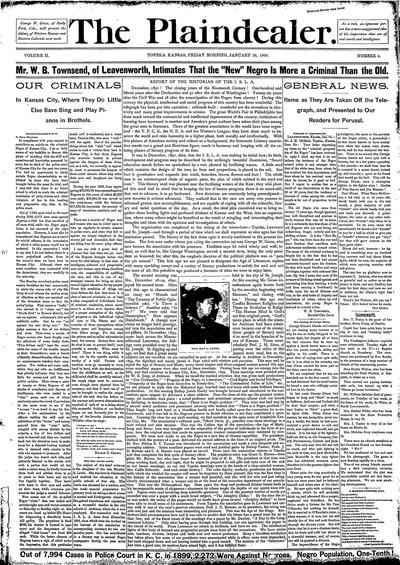
Page text (machine-generated)
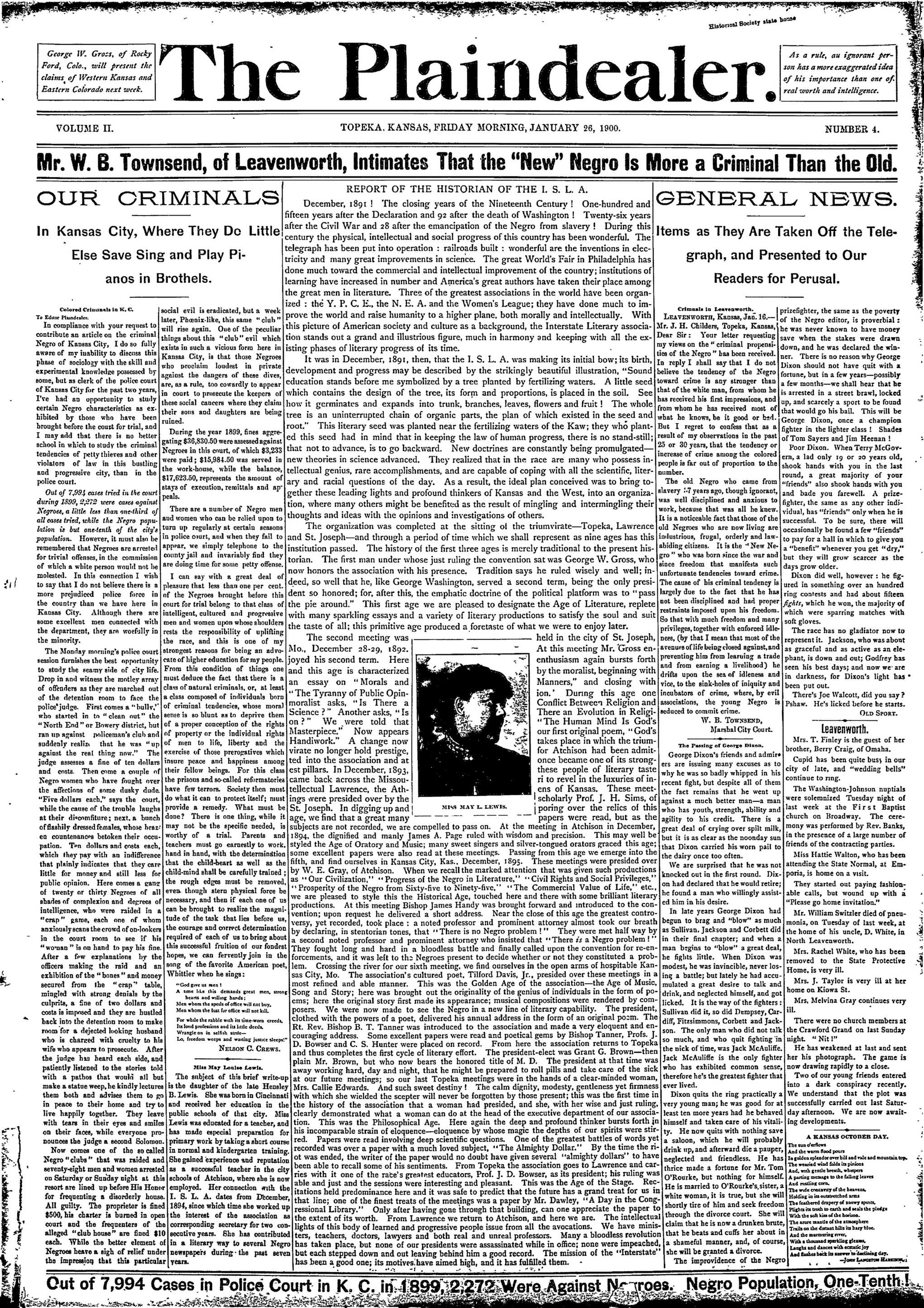
Mr. W. B. Townsend, of Leavenworth, Intimates That the "New" Negro Is More a Criminal Than the Old.
George W. Gross, of Rocky Ford, Colo., will present the claims, of Western Kansas and Eastern Colorado next week.
Mr. W. B. Towns
OUR CRIME
In Kansas City, Wh
Else Save Sing
OUR CRIMINALS
anos in Brothels.
Colored Criminals in K. C.
To Editor Plandesaler.
In compliance with your request to contribute an article on the criminal Negro of Kansas City, I do so fully aware of my inability to discuss this phase of sociology with the skill and experimental knowledge possessed by some, but as clerk of the police court of Kansas City for the past two years, I've had an opportunity to study certain Negro characteristics as exhibited by those who have been brought before the court for trial, and I may add that there is no better school in which to study the criminal tendencies of petty thieves and other violators of law in this bustling and progressive city, than in the police court.
Out of 7,993 cases tried in the court during 1899,2,272 were cases against Negroes, a little less than one-third of all cases tried, while the Negro population is but one-tenth of the city's population. However, it must also be remembered that Negroes are arrested for trivial offenses, in the commission of which a white person would not be molested. In this connection I wish to say that I do not believe there is a more prejudiced police force in the country than we have here in Kansas City. Although there are some excellent men connected with the department, they are woefully in the minority.
The Monday morning's police court session furnishes the best opportunity to study the seamy side of city life. Drop in and witness the motley array of offenders as they are marched out of the detention room to face the police' judge. First comes a "bully," who started in to "clean out" the "North End" or Bowery district, but ran up against policeman's club and suddenly realize that he was "up against the real thing now." The judge assesses a fine of ten dollars and costs. Then come a couple of Negro women who have fought over the affections of some dusky dude. "Five dollars each," says the court, while the cause of the trouble laughs at their discomfiture; next, a bunch of flashy dressed females, whose brazen countenances betoken their occupation. Ten dollars and costs each, which they pay with an indifference that plainly indicates that they care little for money and still less for public opinion. Here comes a gang of twenty or thirty Negroes of all shades of complexion and degrees of intelligence, who were raided in a "crap" game, each one of whom anxiously scans the crowd of on-lookers in the court room to see if his "woman" is on hand to pay his fine. After a few explanations by the officers making the raid and an exhibition of the "bones" and money secured from the "crap" table, mingled with strong denials by the culprits, a fine of two dollars and costs is imposed and they are hustled back into the detention room to make room for a dejected looking husband who is charged with cruelty to his wife who appears to prosecute. After the judge has heard each side, and patiently listened to the stories told with a pathos that would all but make a statue weep, he kindly lectures them both and advises them to go in peace to their home and try to live happily together. They leave with tears in their eyes and smile on their faces, while everyone pronounces the judge a second Solomon
Now comes one of the so called Negro "clubs" that was raided and seventy-eight men and women arrested on Saturday or Sunday night at this resort are lined up before His Honor for frequenting a disorderly house. All guilty. The proprietor is fined $500, his charter is burned in open court and the frequenters of the alleged "club house" are fined $10 each. While the better element of Negroes heave a sigh of relief under the impression that this particular
VOLUME II.
---
The Plaindealer.
social evil is eradicated, but a week later, Phoenix-like, this same "club" will rise again. One of the peculiar things about this "club" evil which exists in such a vicious form here in Kansas City, is that those Negroes who proclaim loudest in private against the dangers of these dives, are, as a rule, too cowardly to appear in court to prosecute the keepers of these social cancers where they claim their sons and daughters are being ruined.
During the year 1899, fines aggregating $36,830.50 were assessed against Negroes in this court, of which $3,233 were paid; $15,984.50 was served in the work-house, while the balance, $17,623.50, represents the amount of stays of execution, remittals and appeals.
There are a number of Negro men and women who can be relied upon to turn up regularly at certain seasons in police court, and when they fail to appear, we simply telephone to the county jail and invariably find they are doing time for some petty offense.
I can say with a great deal of pleasure that less than one per cent. of the Negroes brought before this court for trial belong to that class of intelligent, cultured and progressive men and women upon whose shoulders rests the responsibility of uplifting the race, and this is one of my strongest reasons for being an advocate of higher education for my people. From this condition of things one must deduce the fact that there is a class of natural criminals, or, at least a class composed of individuals born of criminal tendencies, whose moral sense is so blunt as to deprive them of a proper conception of the rights of property or the individual rights of men to life, liberty and the exercise of those prerogatives which insure peace and happiness among their fellow beings. For this class the prisons and so-called reformatories have few terrors. Society then must do what it can to protect itself; must provide a remedy. What must be done? There is one thing, while it may not be the specific needed, is worthy of a trial. Parents and teachers must go earnestly to work, hand in hand, with the determination that the child-heart as well as the child-mind shall be carefully trained; the rough edges must be removed even though stern physical force be necessary, and then if each one of us can be brought to realize the magnitude of the task that lies before us the courage and correct determination required of each of us to bring about this successful fruition of our fondest hopes, we can fervently join in the song of the favorite American poet Whittier when he sings:
"God give us men !"
A time like this demands great men, strong hearts and willing hands;
Men whom the spoils of office will not buy.
Men whom the lust for office will not kill.
For while the rabble with its time-worn creeds,
I its food professions and its little deeds.
Wrangle on in selfish tinkle—
Lo, freedom weeps and waiting justice sleeps!
NELSON C. CREWS.
The subject of this brief write-up is the daughter of the late Hensley B. Lewis. She was born in Cincinnati and received her education in the public schools of that city. Miss Lewis was educated for a teacher, and has made especial preparation for primary work by taking a short course in normal and kindergarten training. She gained experience and reputation as a successful teacher in the city schools of Atchison, where she is now employed. Her connection with the I. S. L. A. dates from December, 1894, since which time she worked up the interest of the association as corresponding secretary for two consecutive years. She has contributed in a literary way to several Negro newspapers during the past seven years.
Miss May Louise Lewis
TOPEKA, KANSAS, FRIDAY MORNING, JANUARY 26, 1900.
December, 1891! The closing years of the Nineteenth Century! One-hundred and fifteen years after the Declaration and 92 after the death of Washington! Twenty-six years after the Civil War and 28 after the emancipation of the Negro from slavery! During this century the physical, intellectual and social progress of this country has been wonderful. The telegraph has been put into operation: railroads built: wonderful are the inventions in electricity and many great improvements in science. The great World's Fair in Philadelphia has done much toward the commercial and intellectual improvement of the country; institutions of learning have increased in number and America's great authors have taken their place among the great men in literature. Three of the greatest associations in the world have been organized: the Y. P. C. E., the N. E. A. and the Women's League; they have done much to improve the world and raise humanity to a higher plane, both morally and intellectually. With this picture of American society and culture as a background, the Interstate Literary association stands out a grand and illustrious figure, much in harmony and keeping with all the existing phases of literary progress of its time.
It was in December, 1891, then, that the I. S. L. A. was making its initial bow; its birth, development and progress may be described by the strikingly beautiful illustration, "Sound education stands before me symbolized by a tree planted by fertilizing waters. A little seed which contains the design of the tree, its form and proportions, is placed in the soil. See how it germinates and expands into trunk, branches, leaves, flowers and fruit! The whole tree is an uninterrupted chain of organic parts, the plan of which existed in the seed and root." This literary seed was planted near the fertilizing waters of the Kaw; they who planted this seed had in mind that in keeping the law of human progress, there is no stand-still; that not to advance, is to go backward. New doctrines are constantly being promulgated—new theories in science advanced. They realized that in the race are many who possess intellectual genius, rare accomplishments, and are capable of coping with all the scientific, literary and racial questions of the day. As a result, the ideal plan conceived was to bring together these leading lights and profound thinkers of Kansas and the West, into an organization, where many others might be benefited as the result of mingling and intermingling their thoughts and ideas with the opinions and investigations of others.
The organization was completed at the sitting of the triumvirate—Topeka, Lawrence and St. Joseph—and through a period of time which we shall represent as nine ages has this institution passed. The history of the first three ages is merely traditional to the present historian. The first man under whose just ruling the convention sat was George W. Gross, who now honors the association with his presence. Tradition says he ruled wisely and well; indeed, so well that he, like George Washington, served a second term, being the only president so honored; for, after this, the emphatic doctrine of the political platform was to "pass the pie around." This first age we are pleased to designate the Age of Literature, replete with many sparkling essays and a variety of literary productions to satisfy the soul and suit the taste of all; this primitive age produced a foretaste of what we were to enjoy later.
The second meeting was Mo., December 28-29, 1892. joyed his second term. Here and this age is characterized an essay on "Morals and "The Tyranny of Public Opin moralist asks, "Is There a Science?" Another asks, "Is on?" We were told that Masterpiece." Now appears Handiwork." A change now virate no longer hold prestige, ted into the association and at est pillars. In December, 1893, came back across the Missouri intellectual Lawrence, the Athings were presided over by the St. Joseph. In digging up and age, we find that a great many
MISS MAY L. LEWIS.
held in the city of St. Joseph, At this meeting Mr. Gross enenthusiasm again bursts forth by the moralist, beginning with Manners," and closing with ion.' During this age one Conflict Between Religion and There an Evolution in Religi- "The Human Mind Is God's our first original poem, "God's takes place in which the triumfor Atchison had been admitonce became one of its strongthese people of literary taste ri to revel in the luxuries of inens of Kansas. These meetscholarly Prof. J. H. Sims, of poring over the relics of this papers were read, but as the
GENERAL NEWS.
Readers for Perusal.
Criminals in Leavenworth.
LEAVENWORTH, Kansas, Jan. 16.—Mr. J. H. Childers, Topeka, Kansas,
Dear Sir: Your letter requesting my views on the "criminal propensities of the Negro" has been received.
In reply I shall say that I do not believe the tendency of the Negro toward crime is any stronger than that of the white man, from whom he has received his first impressions, and from whom he has received most of what he knows, be it good or bad.
But I regret to confess that as a result of my observations in the past 25 or 30 years, that the tendency or increase of crime among the colored people is far out of proportion to the number.
The old Negro who came from slavery .7 years ago, though ignorant, was well disciplined and anxious to work, because that was all he knew. It is a noticeable fact that those of the old Negroes who are now living are industrious, frugal, orderly and lawabiding citizens. It is the "New Negro" who was born since the war and since freedom that manifests such unfortunate tendencies toward crime. The cause of his criminal tendency is largely due to the fact that he has not been disciplined and had proper restraints imposed upon his freedom. So that with much freedom and many privileges, together with enforced idleness, (by that I mean that most of the avenues of life being closed against, and preventing him from learning a trade and from earning a livelihood) he drifts upon the sea of idleness and vice, to the sink-holes of iniquity and incubators of crime, where, by evil associations, the young Negro is seduced to commit crime.
George Dixon's friends and admirers are issuing many excuses as to why he was so badly whipped in his recent fight, but despite all of them the fact remains that he went up against a much better man—a man who has youth, strength, ability and agility to his credit. There is a great deal of crying over spilt milk, but it is as clear as the noonday sun that Dixon carried his worn pail to the dairy once too often.
We are surprised that he was not knocked out in the first round. Dixon had declared that he would retire; he found a man who willingly assisted him in his desire.
In late years George Dixon had begun to brag and "blow" as much as Sullivan. Jackson and Corbett did in their final chapter; and when a man begins to "blow" a great deal, he fights little. When Dixon was modest, he was invincible, never losing a battle; but lately he had accumulated a great desire to talk and drink, and neglected himself, and got licked. It is the way of the fighters: Sullivan did it, so did Dempsey, Cardiff, Fitzsimmons, Corbett and Jackson. The only man who did not talk so much, and who quit fighting in the nick of time, was Jack McAuliffe. Jack McAuliffe is the only fighter who has exhibited common sense, therefore he's the greatest fighter that ever lived.
Dixon quits the ring practically a very young man; he was good for at least ten more years had he behaved himself and taken care of his vitality. He now quits with nothing save a saloon, which he will probably drink up, and afterward die a pauper, neglected and friendless. He has thrice made a fortune for Mr. Tom O'Rourke, but nothing for himself. He is married to O'Rourke's, sister, a white woman, it is true, but she will shortly tire of him and seek freedom through the divorce court. She will claim that he is now a drunken brute, that he beats and cuffs her about in a shameful manner, and, of course, she will be granted a divorce.
The improvidence of the Negro
As a rule, au ignorant person has a more exaggerated idea of his importance than one of real worth and intelligence.
Than the Old. L NEWS. Taken Off the Tele- sented to Our
prizefighter, the same as the poverty of the Negro editor, is proverbial: he was never known to have money save when the stakes were drawn down, and he was declared the winner. There is no reason why George Dixon should not have quit with a fortune, but in a few years—possibly a few months—we shall hear that he is arrested in a street brawl, locked up, and scarcely a sport to be found that would go his bail. This will be George Dixon, once a champion fighter in the lighter class! Shades of Tom Savers and Jim Heenan!
Poor Dixon. When Terry McGovern, a lad only 19 or 20 years old, shook hands with you in the last round, a great majority of your "friends" also shook hands with you and bade you farewell. A prizefighter, the same as any other individual, has "friends" only when he is successful. To be sure, there will occasionally be found a few "friends" to pay for a hall in which to give you a "benefit" whenever you get "dry," but they will grow scarcer as the days grow older.
Dixon did well, however: he figured in something over an hundred ring contests and had about fifteen fights, which he won, the majority of which were sparring matches with soft gloves.
The race has no gladiator now to represent it. Jackson, who was about as graceful and as active as an elephant, is down and out; Godfrey has seen his best days; and now we are in darkness, for Dixon's light has been put out.
There's Joe Walcott, did you say? Pshaw. He's licked before he starts.
OLD SPORT.
Mrs. T. Finley is the guest of her brother, Berry Craig, of Omaha.
Cupid has been quite busy in our city of late, and "wedding bells" continue to ring.
The Washington-Johnson nuptials were solemnized Tuesday night of last week at the First Baptist church on Broadway. The ceremony was performed by Rev. Banks, in the presence of a large number of friends of the contracting parties.
Miss Hattie Walton, who has been attending the State Normal, at Emporia, is home on a visit.
They started out paying fashionable calls, but wound up with a "Please go home invitation."
Mr. William Switzler died of pneumonia, on Tuesday of last week, at the home of his uncle, D. White, in North Leavenworth.
Mrs. Rachel White, who has been removed to the State Protective Home, is very ill.
Mrs. J. Taylor is very ill at her home on Kiowa St.
Mrs. Melvina Gray continues very ill.
There were no church members at the Crawford Grand on last Sunday night. "Nit !"
He has weakened at last and sent her his photograph. The game is now drawing rapidly to a close.
Two of our young friends entered into a dark conspiracy recently. We understand that the plot was successfully carried out last Saturday afternoon. We are now awaiting developments.
A KANSAS OCTOBER DAY.
The sun o'flows
And the warm flood pours
In golden splendor over hill and vale and mountain top.
The weared wind folds its pinions
And, with gentle breath, whispers
A parting message to the falling leaves
And ruthling corn.
The wide concordance of the heavens,
Holding in its outstretched arms
The feathered drapery of snowy spines,
Pflights its troth to earth and seals the pledge
With the soft kiss of the horizon.
The azure mantle of the atmosphere
Trails on the dantat hills its hary blue.
And the murmuring river,
With a thousand sparkling gleams,
Laughs and dances with ecstatic joy
And flashes back its answer to declining day.
-JOHN LAMBERTON HARRISON-
NUMBER 4.
Leavenworth.
Published as Topeka, Kansas, Shawnee county, very Friday morning, by The Piaindaler Publ
ishing company, 114 E. Seventh street.
Entered at the postoffice at Topeka, Kansas, Hawnee county, as second class mail matter.
SUBSCRIPTION RATES:
One year, by mail... $100
Six months, by mail... 75c
Three months, by mail... 50c
NICK CHILES, - Business Manager
J. H. CHILDREN, - Editor.
WILL HARRIS, - Managing Editor.
FRIDAY, JAN. 26, 1900.
[In order to insure publication of matter in the current issue, correspondence must be in this office not later than Tuesday]
ANNOUNCEMENTS.
W. E. Fagan.
W. E. Fagan announces his candidacy for Probate Judge. Subject to Republican primaries.
M. Snattinger.
We are authorized to announce the candidacy of M. Snattinger for Councilman from the Third ward, subject to the Republican primaries.
H. J. Hevelle.
I hereby announce myself a candidate for the office of Probate Judge of Shawnee county, Kansas. Subject to the Republican primaries when held this spring.
H. J. Bevelle.
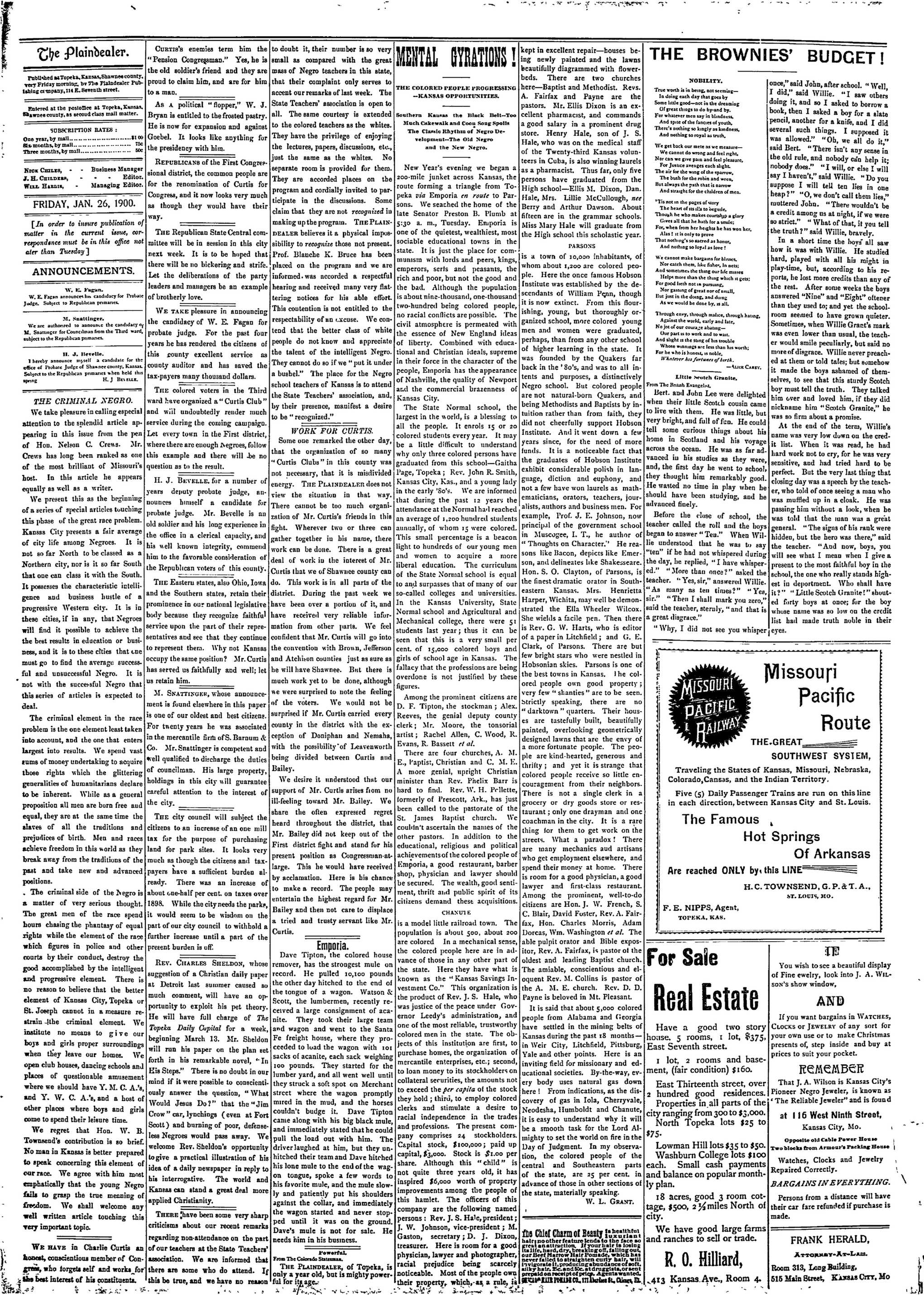
THE CRIMINAL NEGRO.
We take pleasure in calling especial attention to the splendid article appearing in this issue from the pen of Hon. Nelson C. Crews. Mr. Crews has long been ranked as one of the most brilliant of Missouri's host. In this article he appears equally as well as a writer.
We present this as the beginning of a series of special articles touching this phase of the great race problem. Kansas City presents a fair average of city life among Negroes. It is not so far North to be classed as a Northern city, nor is it so far South that one can class it with the South. It possesses the characteristic intelligence and business hustle of a progressive Western city. It is in these cities, if in any, that Negroes will find it possible to achieve the best results in education or business, and it is to these cities that one must go to find the average successful and unsuccessful Negro. It is not with the successful Negro that this series of articles is expected to deal.
The criminal element in the race problem is the one element least taken into account, and the one that enters largest into results. We spend vast sums of money undertaking to acquire those rights which the glittering generalities of humanitarians declare to be inherent. While as a general proposition all men are born free and equal, they are at the same time the slaves of all the traditions and prejudices of birth. Men and races achieve freedom in this world as they break away from the traditions of the past and take new and advanced positions.
. The criminal side of the Negro is a matter of very serious thought. The great men of the race spend hours chasing the phantasy of equal rights while the element of the race which figures in police and other courts by their conduct, destroy the good accomplished by the intelligent and progressive element. There is no reason to believe that the better element of Kansas City, Topeka or St. Joseph cannot in a measure restrain the criminal element. We institute no means to give our boys and girls proper surroundings when they leave our homes. We open club houses, dancing schools and places of questionable amusement where we should have Y. M. C. A.'s, and Y. W. C. A.'s, and a host of other places where boys and girls come to spend their leisure time.
We regret that Hon. W. B. Townsend's contribution is so brief. No man in Kansas is better prepared to speak concerning this element of our race. We agree with him most emphatically that the young Negro fails to grasp the true meaning of freedom. We shall welcome any well written article touching this very important topic.
WE HAVE in Charlie Curtis an honest, conscientious member of Congress, who forgets self and works for the best interest of his constituents.
Curtis's enemies term him the "Pension Congressman." Yes, he is the old soldier's friend and they are proud to claim him, and are for him to a man.
As a political "flopper," W. J. Bryan is entitled to the frosted pastry. He is now for expansion and against Goebel. It looks like anything for the presidency with him.
REPUBLICANS of the First Congressional district, the common people are for the renomination of Curtis for Congress, and it now looks very much as though they would have their way.
THE Republican State Central committee will be in session in this city next week. It is to be hoped that there will be no bickering and strife. Let the deliberations of the party leaders and managers be an example of brotherly love. WE TAKE pleasure in announcing the candidacy of W. E. Fagan for probate judge. For the past four years he has rendered the citizens of this county excellent service as county auditor and has saved the tax-payers many thousand dollars.
THE colored voters in the Third ward have organized a "Curtis Club" and will undoubtedly render much service during the coming campaign. Let every town in the First district, where there are enough Negroes, follow this example and there will be no question as to the result.
H. J. BEVELLE, for a number of years deputy probate judge, announces himself a candidate for probate judge. Mr. Bevelle is an old soldier and his long experience in the office in a clerical capacity, and his well known integrity, commend him to the favorable consideration of the Republican voters of this county.
THE Eastern states, also Ohio, Iowa and the Southern states, retain their prominence in our national legislative body because they recognize faithful service upon the part of their representatives and see that they continue to represent them. Why not Kansas occupy the same position? Mr. Curtis has served us faithfully and well; let us retain him.
M. SNATTINGER, whose announcement is found elsewhere in this paper is one of our oldest and best citizens. For twenty years he was associated in the mercantile firm of S. Barnum & Co. Mr. Snattinger is competent and well qualified to discharge the duties of councilman. His large property, holdings in this city will guarantee careful attention to the interest of the city.
The city council will subject the citizens to an increase of an one mill tax for the purpose of purchasing land for park sites. It looks very much as though the citizens and taxpayers have a sufficient burden already. There was an increase of about one-half per cent. on taxes over 1898. While the city needs the park, it would seem to be wisdom on the part of our city council to withhold a further increase until a part of the present burden is off.
REV. CHARLES SHELDON, whose suggestion of a Christian daily paper at Detroit last summer caused so much comment, will have an opportunity to exploit his pet theory. He will have full charge of The Topeka Daily Capital for a week, beginning March 13. Mr. Sheldon will run his paper on the plan set forth in his remarkable novel, "In His Steps." There is no doubt in our mind if it were possible to conscientiously answer the question, "What Would Jesus Do?" that the "Jim Crow" car, lynchings (even at Fort Scott) and burning of poor, defenseless Negroes would pass away. We welcome Rev. Sheldon's opportunity to give a practical illustration of his idea of a daily newspaper in reply to his interrogative. The world and Kansas can stand a great deal more applied Christianity.
THERE have been some very sharp criticisms about our recent remarks regarding non-attendance on the part of our teachers at the State Teachers' association. We are informed that there are some who do attend. If this be true, and we have no reason
to doubt it, their number is so very small as compared with the great mass of Negro teachers in this state, that their complaint only serves to accent our remarks of last week. The State Teachers' association is open to all. The same courtesy is extended to the colored teachers as the whites. They have the privilege of enjoying the lectures, papers, discussions, etc., just the same as the whites. No separate room is provided for them. They are accorded places on the program and cordially invited to participate in the discussions. Some claim that they are not recognized in making up the program. THE PLAINDEALER believes it a physical impossibility to recognize those not present. Prof. Blanche K. Bruce has been placed on the program and we are informed was accorded a respectful hearing and received many very flattering notices for his able effort. This contention is not entitled to the respectability of an excuse. We contend that the better class of white people do not know and appreciate the talent of the intelligent Negro. They cannot do so if we "put it under a bushel." The place for the Negro school teachers of Kansas is to attend the State Teachers' association, and, by their presence, manifest a desire to be "recognized."
WORK FOR CURTIS
Some one remarked the other day, that the organization of so many "Curtis Clubs" in this county was not necessary, that it is misdivided energy. THE PLAINDEALER does not view the situation in that way. There cannot be too much organization of Mr. Curtis's friends in this fight. Wherever two or three can gather together in his name, there work can be done. There is a great deal of work in the intercet of Mr. Curtis that we of Shawnee county can do. This work is in all parts of the district. During the past week we have been over a portion of it, and have received very reliable information from other parts. We feel confident that Mr. Curtis will go into the convention with Brown, Jefferson and Atchison counties just as sure as he will have Shawnee. But there is much work yet to be done, although we were surprised to note the feeling of the voters. We would not be surprised if Mr. Curtis carried every county in the district with the exception of Doniphan and Nemaha, with the possibility of Leavenworth being divided between Curtis and Bailey.
We desire it understood that our support of Mr. Curtis arises from no ill-feeling toward Mr. Bailey. We share the often expressed regret heard throughout the district, that Mr. Bailey did not keep out of the First district fight and stand for his present position as Congressman-at-large. This he would have received by acclamation. Here is his chance to make a record. The people may entertain the highest regard for Mr. Bailey and then not care to displace a tried and trusty servant like Mr. Curtis.
Emnoria.
Dave Tipton, the colored house remover, has the strongest mule on record. He pulled 10,100 pounds the other day hitched to the end of the tongue of a wagon. Watson & Scott, the lumbermen, recently received a large consignment of acanite. They took their large team and wagon and went to the Santa Fe freight house, where they proceeded to load the wagon with 101 sacks of acanite, each sack weighing 100 pounds. They started for the lumber yard, and all went well until they struck a soft spot on Merchant street where the wagon promptly mired in the mud, and the horses couldn't budge it. Dave Tipton came along with his big black mule, and immediately stated that he could pull the load out with him. The driver laughed at him, but they unhitched their team and Dave hitched his lone mule to the end of the wagon tongue, spoke a few words to his favorite mule, and the mule slowly and patiently put his shoulders against the collar, and immediately the wagon started and never stopped until it was on the ground. Dave's mule is not for sale. He needs him in his business.
Powerful.
From the Colorado Statesman,
THE PLAINDEALER, of Topeka, is
only a year old, but is mighty powerful
for its age.
THE COLORED PEOPLE PROGRESSING
-KANSAS OPPORTUNITIES.
Southern Kausas the Black Belt—Too Much Cakewalk and Coon Song Spoils
The Classic Rhythm of Negro Development—The Old Negro
and the New Negro.
New Year's evening we began a 200-mile junket across Kansas, the route forming a triangle from Topeka via Emporia en route to Parsons. We seached the home of the late Senator Preston B. Plumb at 5:30 a.m., Tuesday. Emporia is one of the quietest, wealthiest, most sociable educational towns in the state. It is just the place for communism with lords and peers, kings, emperors, serfs and peasants, the rich and poor, but not the good and the bad. Although the population is about nine-thousand, one-thousand two-hundred being colored people, no racial conflicts are possible. The civil atmosphere is permeated with the essence of New England ideas of liberty. Combined with educational and Christian ideals, supreme in their force in the character of the people, Emporia has the appearance of Nashville, the quality of Newport and the commercial brazenness of Kansas City.
The State Normal school, the largest in the world, is a blessing to all the people. It enrols 15 or 20 colored students every year. It may be a little difficult to understand why only three colored persons have graduated from this school—Gaitaia Page, Topeka; Rev. John R. Smith, Kansas City, Kas., and a young lady in the early '80's. We are informed that during the past 12 years the attendance at the Normal had reached an average of 1,200 hundred students annually, of whom 15 were colored. This small percentage is a beacon light to hundreds of our young men and women to acquire a more liberal education. The curriculum of the State Normal school is equal to and surpasses that of many of our so-called colleges and universities. In the Kansas University, State Normal school and Agricultural and Mechanical college, there were 51 students last year; thus it can be seen that this is a very small percent. of 15,000 colored boys and girls of school age in Kansas. The fallacy that the professions are being overdone is not justified by these figures.
Among the prominent citizens are D. F. Tipton, the stockman; Alex. Reeves, the genial deputy county clerk; Mr. Moore, the tonsorial artist; Rachel Allen, C. Wood, R. Evans, R. Bassett et al.
There are four churches, A. M. E., Baptist, Christian and C. M. E. A more genial, upright Christian minister than Rev. Phelix Barr is hard to find. Rev. W. H. Pellette, formerly of Prescott, Ark., has just been called to the pastorate of the St. James Baptist church. We couldn't ascertain the names of the other pastors. In addition to the educational, religious and political achievements of the colored people of Emporia, a good restaurant, barber shop, physician and lawyer should be secured. The wealth, good sentiment, thrift and public spirit of its citizens demand these acquisitions.
CHANUTE
is a model little railroad town. The population is about 500, about 200 are colored. In a mechanical sense, the colored people here are in advance of those in any other part of the state. Here they have what is known as the "Kansas Savings Investment Co." This organization is the product of Rev. J. S. Hale, who was justice of the peace under Governor Leedy's administration, and one of the most reliable, trustworthy colored men in the state. The objects of this institution are first, to purchase homes, the organization of mercantile enterprises, etc.; second, to loan money to its stockholders on collateral securities, the amounts not to exceed the per capita of the stock they hold; third, to employ colored clerks and stimulate a desire to racial independence in the trades and professions. The present company comprises 24 stockholders. Capital stock, $100,000; paid up capital, $3,000. Stock is $1.00 per share. Although this "child" is not quite three years old, it has inspired $6,000 worth of property improvements among the people of this hamlet. The officers of this company are the following named persons: Rev. J. S. Hale, president; J. W. Johnson, vice-president; M. Gaston, secretary; D. J. Dixon, treasurer. Here is room for a good physician, lawyer and photographer, racial prejudice being scarcely noticeable. Most of the people own their property, which, as a rule, is
kept in excellent repair—houses being newly painted and the lawns beautifully diagrammed with flowerbeds. There are two churches here—Baptist and Methodist. Revs. A. Fairfax and Payne are the pastors. Mr. Ellis Dixon is an excellent pharmacist, and commands a good salary in a prominent drug store. Henry Hale, son of J. S. Hale, who was on the medical staff of the Twenty-third Kansas volunteers in Cuba, is also winning laurels as a pharmacist. Thus far, only five persons have graduated from the High school—Ellis M. Dixon, Dan Hale, Mrs. Lillie McCullough, nee Berry and Arthur Dawson. About fifteen are in the grammar schools. Miss Mary Hale will graduate from the High school this scholastic year.
is a town of 10,000 inhabitants, of whom about 1,200 are colored people. Here the once famous Hobson Institute was established by the descendants of William Penn, though it is now extinct. From this flourishing, young, but thoroughly organized school, more colored young men and women were graduated, perhaps, than from any other school of higher learning in the state. It was founded by the Quakers far back in the '80's, and was to all intents and purposes, a distinctively Negro school. But colored people are not natural-born Quakers, and being Methodists and Baptists by intuition rather than from faith, they did not cheerfully support Hobson Institute. And it went down a few years since, for the need of more funds. It is a noticeable fact that the graduates of Hobson Institute exhibit considerable polish in language, diction and euphony, and not a few have won laurels as mathematicians, orators, teachers, journalists, authors and business men. For example, Prof. J. E. Johnson, now principal of the government school in Muscoogee, I. T., he author of "Thoughts on Character." He reasons like Bacon, depicts like Emerson, and delineates like Shakespearee. Hon. S. O. Clayton, of Parsons, is the finest dramatic orator in Southeastern Kansas. Mrs. Henrietta Harper, Wichita, may well be demonstrated the Ella Wheeler Wilcox. She wields a facile pen. Then there is Rev. G. W. Harts, who is editor of a paper in Litchfield; and G. E. Clark, of Parsons. There are but few bright stars who were nestled in Hobsonian skies. Parsons is one of the best towns in Kansas. The colored people own good property; very few "shanties" are to be seen. Strictly speaking, there are no "darktown" quarters. Their houses are tastefully built, beautifully painted, overlooking geometrically designed lawns that are the envy of a more fortunate people. The people are kind-hearted, generous and thrifty; and yet it is strange that colored people receive so little encouragement from their neighbors. There is not a single clerk in a grocery or dry goods store or restaurant; only one drayman and one coachman in the city. It is a rare thing for them to get work on the streets. What a paradox! There are many mechanics and artisans who get employment elsewhere, and spend their money at home. There is room for a good physician, a good lawyer and first-class restaurant. Among the prominent, well-to-do citizens are Hon. J. W. French, S. C. Blair, David Foster, Rev. A. Fairfax, Hon. Charles Morris, Adam Doreas, Wm. Washington et al. The able pulpit orator and Bible expositor, Rev. A. Fairfax, is pastor of the oldest and leading Baptist church. The amiable, conscientious and eloquent Rev. M. Collins is pastor of the A. M. E. church. Rev. D. D. Payne is beloved in Mt. Pleasant.
PARSONS
It is said that about 5,000 colored people from Alabama and Georgia have settled in the mining belts of Kansas during the past 18 months—in Weir City, Litchfield, Pittsburg, Yale and other points. Here is an inviting field for missionary and educational societies. By-the-way, every body uses natural gas down here! From indications, as the discovery of gas in Iola, Cherryvale, Neodesha, Humboldt and Chanute, it is easy to understand why it will be a smooth task for the Lord Almighty to set the world on fire in the Day of Judgment. In my observation, the colored people of the central and Southeastern parts of the state, are 25 per cent. in advance of those in other sections of the state, materially speaking.
the Chief Charm of Beauty is healthful
luxurious
hair no other feature lends to the face so
great an attraction. If your hair is losing
its life, hard, dry, breakage off, falling out,
it will never be as beautiful. Never
never failed to straighten curly hair, will
invigorate it, producing abundance of soft,
siky hair. Ec. and atc. drummers, or scent
prepared on receipt of price. Agents wanted.
SUGAR CITY FOUNDRY CO., 1178 W. 21st St., Chicago, IL.
THE BROWNIES' BUDGET!
NOBILITY.
True worth is in being, not seeming—
In doing each day that goes by
Some little good—not in the dreaming
Of great things to do by and by.
For whatever men say in blindness,
And spite of the fancies of youth.
There’s nothing so kingly as kindness,
And nothing so royal as truth.
We get back our mete as we measure—
We cannot do wrong and feel right,
Nor can we give pain and feel pleasure,
For Justice avenges each slight.
The air for the wing of the sparrow,
The bush for the robin and wren,
But always the path that is narrow
And straight for the children of men.
’Tis not in the pages of story
The heart of its ills to beguile,
Though he who makes cushionship a glory
Gives all that he hath for a smile;
For, when from her heights he has won her,
Alas! it is only to prove
That nothing’s so sacred as honor,
And nothing so loyal as love!
We cannot make bargains for blisses,
N not catch them, like fisher, in nets;
And sometimes the thing our life misses
Helps more than the thing it gets;
For good lest not in pursuing,
Nor gaining of great nor of small,
But just in the doing, and doing;
As we would be done by, is all.
Through envy, through malice, through hating,
Against the world, early and late,
No joi of our courage abating—
Our part is to work and to wait.
And slight is the sting of his trouble
Whose warnings are less than his worth;
For he who is honest, is noble,
Whatever his fortunes of birth.
Little Neutch Granite.
From The British Evangelist
Bert. and John Lee were delighted, when their little Scotland cousin came to live with them. He was little, but very bright, and full of fun. He could tell some curious things about his home in Scotland and his voyage across the ocean. He was as far advanced in his studies as they were, and, the first day he went to school, they thought him remarkably good. He wasted no time in play when he should have been studying, and he advanced finely.
Before the close of school, the teacher called the roll and the boys began to answer "Ten." When Willie understood that he was to say "ten" if he had not whispered during the day, he replied, "I have whispered." "More than once?" asked the teacher. "Yes, sir," answered Willie. "As many as ten times?" "Yes, sir." "Then I shall mark you zero," said the teacher, sternly, "and that is a great disgrace." "Why, I did not see you whisper
MISSOURI
PACIFIC
RAILWAY
Traveling the States of K
Colorado, Cansas, and the N
Five (5) Daily Passenger
in each direction, between
The Famous
Hot
Are reached ONLY by, t
H. C. T
F. E. NIPPS, Agent,
TOPEKA, KAS.
For Sale
Real Estate
Have a good two story house. 5 rooms, 1 lot, $375,
East Seventh street.
1 lot, 2 rooms and basement, (fair condition) $160.
East Thirteenth street, over 2 hundred good residences.
Properties in all parts of the city ranging from 300 to $3,000.
North Topeka lots $25 to $75.
Lowman Hill lots $35 to $50.
Washburn College lots $100 each. Small cash payments and balance on popular monthly plan.
18 acres, good 3 room cottage, $500, 2 1/2 miles North of city.
We have good large farms and ranches to sell or trade.
R. O. Hilliard.
once," said John, after school. "Well, I did," said Willie. "I saw others doing it, and so I asked to borrow a book, then I asked a boy for a slate pencil, another for a knife, and I did several such things. I supposed it was allowed." "Oh, we all do it," said Bert. "There isn't any sense in the old rule, and nobody can help it; nobody does." "I will, or else I will say I haven't," said Willie. "Do you suppose I will tell ten lies in one heap?" "O, we don't call them lies," muttered John. "There wouldn't be a credit among us at night, if we were so strict." "What of that, it you tell the truth?" said Willie, bravely.
In a short time the boys all saw how it was with Willie. He studied hard, played with all his might in play-time, but, according to his reports, he lost more credits than any of the rest. After some weeks the boys answered "Nine" and "Eight" oftener than they used to; and yet the schoolroom seemed to have grown quieter. Sometimes, when Willie Grant's mark was even lower than usual, the teacher would smile peculiarly, but said no more of disgrace. Willie never preached at them or told tales; but somehow it made the boys ashamed of themselves, to see that this sturdy Scotch boy must tell the truth. They talked him over and loved him, if they did nickname him "Scotch Granite," he was so firm about a promise.
At the end of the term, Willie's name was very low down on the credit list. When it was read, he had hard work not to cry, for he was very sensitive, and had tried hard to be perfect. But the very last thing that closing day was a speech by the teacher, who told of once seeing a man who was muffled up in a cloak. He was passing him without a look, when he was told that the man was a great general. "The signs of his rank were hidden, but the hero was there," said the teacher. "And now, boys, you will see what I mean when I give a present to the most faithful boy in the school, the one who really stands highest in deportment. Who shall have it?" "Little Scotch Granite!" shouted forty boys at once; for the boy whose name was so low on the credit list had made truth noble in their eyes.
Missouri Pacific Route
THE GREAT SOUTHWEST SYSTEM,
Kansas, Missouri, Nebraska,
Indian Territory.
Her Trains are run on this line
en Kansas City and St. Louis.
t Springs
Of Arkansas
this LINE
TOWNSEND, G.P. & T.A.,
ST. LOUIS, MO.
T
You wish to see a beautiful display of Fine ewelry, look into J. A. WILSON's show window,
AND
If you want bargains in WATCHES, CLOCKS or JEWELRY of any sort for your own use or to make Christmas presents of, step inside and buy at prices to suit your pocket.
REMEMBER
That J. A. Wilson is Kansas City's Pioneer Negro Jeweler, is known as "The Reliable Jeweler" and is found at 116 West Ninth Street, Kansas City, Mo.
Opposite old Cable Power House Two blocks from Armour's Packing House Watches, Clocks and Jewelry Repaired Correctly.
BARGAINS IN EVERYTHING.
Persons from a distance will have their car fare refunded if purchase is made.
FRANK HERALD,
ATTORNEY-AT-LAM.
Room 313, Long Building,
515 Main Street, KANSAS CITY, Mo
The Dyson restaurant, located at 440 Minnesota avenue, Kansas City, Kas., is the best restaurant in that city.
PERSONAL NOTES.
The Coterie party at Mrs. O. A.
Taylor's tonight.
The Imperial birthday party is
with Mrs. C. D. Moss Saturday
night.
Miss Lovie Venable, of Thompson-
ville, Kas., was up visiting Eva
Vance, of North Topeka, last week.
The Dumas club was pleasantly entertained at the residence of Mrs. McGuffin, 1316 Van Buren street. All reported a pleasant time. A good lunch was served. It adjourned to meet Friday, Feb. 2nd, with Mrs. W. M. Wilson, 228 Kansas avenue.
The Y P. C. E. S. of the Second C. P. church met Jan. 14, 1900, and elected the following officers for the next six months: President, Prof. W. J. Johnson; Vice President, Mrs. Julia Bigbee; Sec'y, Lona Gaines; Ass't Sec'y, Dora Allen; Treasurer, Susie Eagleton.
Rev. C. G. Tutt, of the Second Baptist church, of Valley Falls, Kas., was in the city on business. He reports a very successful revival service now in progress at his church. He left a cash subscription to THE PLAINDEALER. God will bless the efforts of such a man.
The Oak Leaf club met with Mrs. E. Drain Wednesday afternoon and received two pleasant callers, Mesdames H. Taylor and J. H. Thompson, of Pennsylvania. Mrs. Thompson made some very favorable and interesting remarks concerning the club. The Oak Leaf club members are glad to learn that the circulars concerning a convention are being met with approval. Being the first art club organized in the city, the ladies have made it a great success. Their energy, together with the different clubs, we hope to see them make this a fineaffair. The consideration of a convention is due to the ex-president, Mrs. H. Washington, now one of their most honored members.
The Big Meeting.
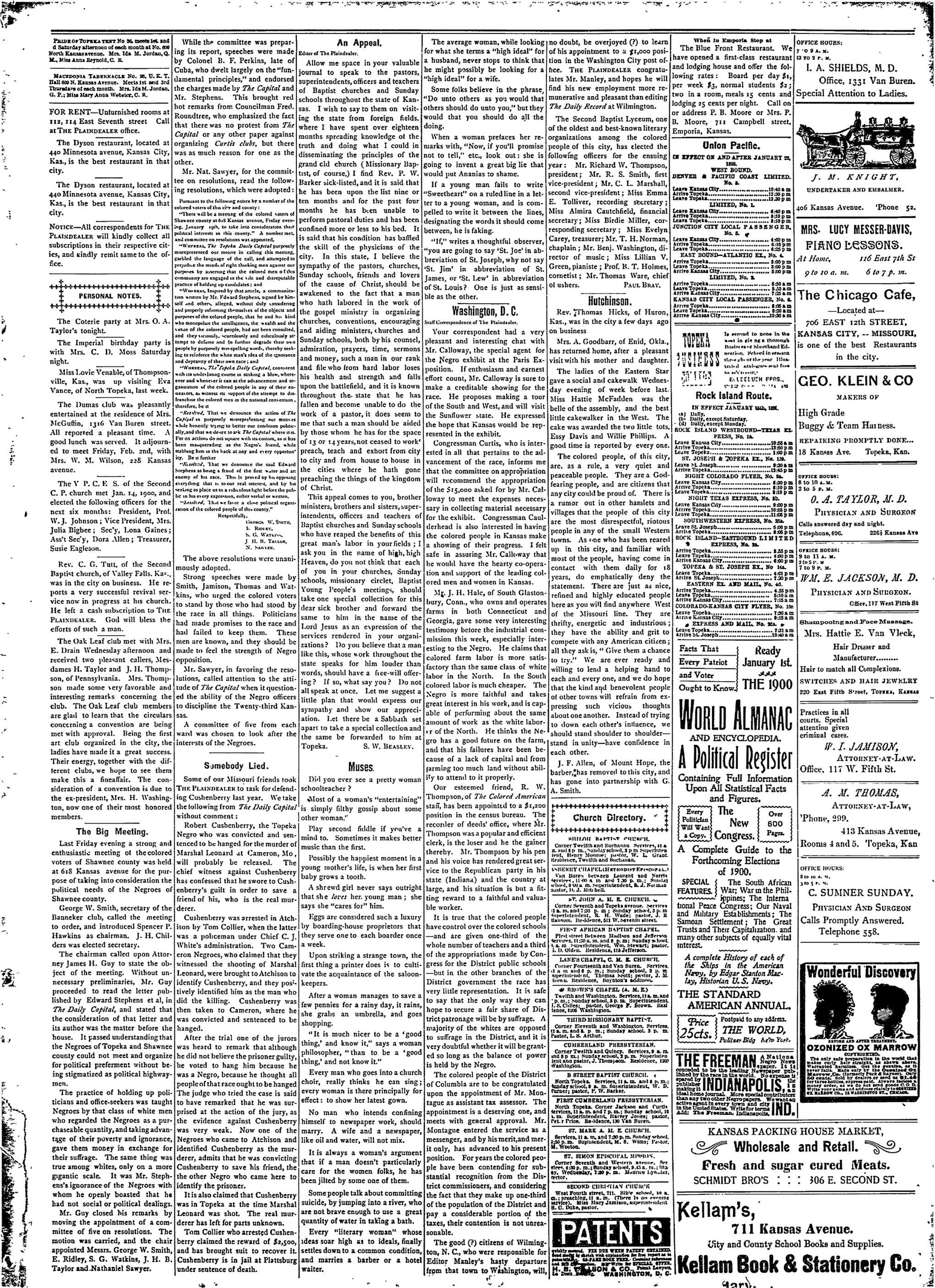
Last Friday evening a strong and enthusiastic meeting of the colored voters of Shawnee county was held at 618 Kansas avenue for the purpose of taking into consideration the political needs of the Negroes of Shawnee county.
George W. Smith, secretary of the Banneker club, called the meeting to order, and introduced Spencer P. Hawkins as chairman. J. H. Childers was elected secretary.
The chairman called upon Attorney James H. Guy to state the object of the meeting. Without unnecessary preliminaries, Mr. Guy proceeded to read the letter published by Edward Stephens et al, in The Daily Capital, and stated that the consideration of that letter and its author was the matter before the house. It passed understanding that the Negroes of Topeka and Shawnee county could not meet and organize for political preferment without being stigmatized as political highwaymen.
The practice of holding up politicians and office-seekers was taught Negroes by that class of white men who regarded the Negroes as a purchaseable quantity, and taking advantage of their poverty and ignorance, gave them money in exchange for their suffrage. The same thing was true among whites, only on a more gigantic scale. It was Mr. Stephens's ignorance of the Negroes with whom he openly boasted that he had not social or political dealings.
Mr. Guy closed his remarks by moving the appointment of a committee of five on resolutions. The motion was carried, and the chair appointed Messrs. George W. Smith, E. Ridley, S. G. Watkins, J. H. B. Taylor and Nathaniel Sawyer.
While the committee was preparing its report, speeches were made by Colonel B. F. Perkins, late of Cuba, who dwelt largely on the "fundamental principles," and endorsed the charges made by The Capital and Mr. Stephens. This brought red hot remarks from Councilman Fred. Roundtree, who emphasized the fact that there was no protest from The Capital or any other paper against organizing Curtis clubs, but there was as much reason for one as the other.
Mr. Nat. Sawyer, for the committee on resolutions, read the following resolutions, which were adopted:
Pursuant to the following notice by a number of the colored voters of this city and county:
"There will be a meeting of the colored voters of Shawnee county at 618 Kansas avenue, Friday evening, January 19th, in consideration their political interest in this county. A number met, and committee on resolutions was appointed.
"WHENAS, The Topkappa Daily Capital purposely misrepresented our move in calling this meeting, garbled the language of the call, and attempted to prejudice the minds of right thinking men against our purposes by asserting that the colored men of this community are engaged in the vile and disreputable practice of holding up candidates; and
"WHENREA Inspired by that article, a communication written by Mr. Fwd. Stephens, signed by himself and others, alleged, without duly considering and properly informing themselves of the objects and purposes of the colored people, that he and his kind who monopolize the intelligence, the wealth and the virtue of the colored people, had not been consulted, and they visually, curiously and ridiculously attempt to defame and to further degrade their own people by purposely mis-speaking words, thereby seeking to reliance the white man's idea of the ignorance and deprivacy of their own race; and
WHEREA, The Topics Daily Capital, consistent with its understated course in striking a blow, wherever and whenever it can at the advancement and organization of the colored people in any of their endeavors, as witness its support of the attempt to disfranchise the colored men in the national convention, therefore, be it
*Resisted, That we denounce the action of the *Capital* in purposely misrepresenting our motives while honestly trying to better our conflation politically, and that we desire to ask *The Capital* where its situs. For its actions do not square with its custom, as it has been masquerading as the Negro's friend, while stabbing him in the back at any and every opportunity. Be it further
*Resisted, That we denounce the said Edward Stephens as being a fraud of the first water and an enemy of his race. This is proved by his opposing everything that is to our real interest, and by his seeking to place us in a ridiculous light before the public in his every expression, either verbal or written.
*Resisted, That we favor a close political organization of the colored people of this county."
Respectfully,
GORGON, W. SMITH,
E. RUSSEY,
S. G. WATKIN,
J. H. B. TAYLOR,
N. SAWER.
The above resolutions were unanimously adopted.
Strong speeches were made by Smith, Jamison, Thomas and Watkins, who urged the colored voters to stand by those who had stood by the race in all things. Politicians had made promises to the race and had failed to keep them. These men are known, and they should be made to feel the strength of Negro opposition.
Mr. Sawyer, in favoring the resolutions, called attention to the attitude of The Capital when it questioned the ability of the Negro officers to discipline the Twenty-third Kansas.
A committee of five from each ward was chosen to look after the interests of the Negroes.
Somebody Lied.
Some of our Missouri friends took THE PLANDEALER to task for defending Cushenberry last year. We take the following from The Daily Capital without comment:
Robert Cushenberry, the Topeka Negro who was convicted and sentenced to be hanged for the murder of Marshal Leonard at Cameron, Mo, will probably be released. The chief witness against Cushenberry has confessed that he swore to Cushenberry's guilt in order to save a friend of his, who is the real murderer.
Cushenberry was arrested in Atchison by Tom Collier, when the latter was a policeman under Chief C. J. White's administration. Two Cameron Negroes, who claimed that they witnessed the shooting of Marshal Leonard, were brought to Atchison to identify Cushenberry, and they positively identified him as the man who did the killing. Cushenberry was then taken to Cameron, where he was convicted and sentenced to be hanged.
After the trial one of the jurors was heard to remark that although he did not believe the prisoner guilty, he voted to hang him because he was a Negro, because he thought all people of that race ought to be hanged The judge who tried the case is said to have remarked that he was surprised at the action of the jury, as the evidence against Cushenberry was very weak. Now one of the Negroes who came to Atechison and identified Cushenberry as the murderer, admits that he was convicting Cushenberry to save his friend, the the other Negro who came here to identify the prisoner.
It is also claimed that Cushenberry was in Topeka at the time Marshal Leonard was shot. The real murderer has left for parts unknown.
Tom Collier who arrested Cushenberry claimed the reward of $2,500, and has brought suit to recover it. Cushenberry is in jail at Plattsburg under sentence of death.
Allow me space in your valuable journal to speak to the pastors, superintendents, officers and teachers of Baptist churches and Sunday schools throughout the state of Kansas. I wish to say to them on visiting the state from foreign fields, where I have spent over eighteen months spreading knowledge of the truth and doing what I could in disseminating the principles of the grand old church (Missionary Baptist, of course.) I find Rev. P. W. Barker sick-listed, and it is said that he has been upon the list nine or ten months and for the past four months he has been unable to perform pastoral duties and has been confined more or less to his bed. It is said that his condition has baffled the skill of the physicians of the city. In this state, I believe the sympathy of the pastors, churches, Sunday schools, friends and lovers of the cause of Christ, should be awakened to the fact that a man who hath labored in the work of the gospel ministry in organizing churches, conventions, encouraging and aiding ministers, churches and Sunday schools, both by his counsel, admiration, prayers, time, sermons and money, such a man in our rank and file who from hard labor loses his health and strength and falls upon the battlefield, and it is known throughout the state that he has fallen and become unable to do the work of a pastor, it does seem to me that such a man should be aided by those whom he has for the space of 13 or 14 years, not ceased to work' preach, teach and exhort from city to city and from house to house in the cities where he hath gone preaching the things of the kingdom of Christ.
This appeal comes to you, brother ministers, brothers and sisters, superintendents, officers and teachers of Baptist churches and Sunday schools who have reaped the benefits of this great man's labor in your fields; I ask you in the name of high, high Heaven, do you not think that each of you in your churches, Sunday schools, missionary circlet, Baptist Young People's meetings, should take one special collection for this dear sick brother and forward the same to him in the name of the Lord Jesus as an expression of the services rendered in your organizations? Do you believe that a man like this, whose work throughout the state speaks for him louder than words, should have a free-will offering? If so, what say you? Do not all speak at once. Let me suggest a little plan that would express our sympathy and show our appreciation. Let there be a Sabbath set apart to take a special collection and the same be forwarded to him at Topeka. S. W. BEASLEY.
Did you ever see a pretty woman schoolteacher?
Most of a woman's "entertaining" is simply filthy gossip about some other woman."
Play second fiddle if you've a mind to. Sometimes it makes better music than the first.
Possibly the happiest moment in a young mother's life, is when her first baby grows a tooth.
A shrewd girl never says outright that she loves her young man; she says she "cares for" him.
Eggs are considered such a luxury by boarding-house proprietors that they serve one to each boarder once a week.
Upon striking a strange town, the first thing a printer does is to cultivate the acquaintance of the saloon-keepers.
After a woman manages to save a few pennies for a rainy day, it rains, she grabs an umbrella, and goes shopping.
"It is much nicer to be a 'good thing,' and know it," says a woman philosopher, "than to be a 'good thing,' and not know it."
Every man who goes into a church choir, really thinks he can sing; every woman is there principally for effect: to show her latest gown.
No man who intends confining himself to newspaper work, should marry. A wife and a newspaper, like oil and water, will not mix.
Muses.
It is always a woman's argument that if a man doesn't particularly care for the women folks, he has been jilted by some one of them.
Some people talk about committing suicide, by jumping into a river, who are not brave enough to use a great quantity of water in taking a bath.
Every "literary woman" whose ideas soar high as to ideals, finally settles down to a common condition, and marries a barber or a hotel waiter.
Some folks believe in the phrase, "Do unto others as you would that others should do unto you," but they would that you should do all the doing.
When a woman prefaces her remarks with, "Now, if you'll promise not to tell," etc., look out: she is going to invent a great big lie that would put Ananias to shame.
If a young man fails to write "Sweetheart" on a ruled line in a letter to a young woman, and is compelled to write it between the lines, designating the words it should come between, he is faking.
"If," writes a thoughtful observer, "you are going to say 'St. Joe' in abbreviation of St. Joseph, why not say 'St. Jim' in abbreviation of St. James, or 'St. Lew' in abbreviation of St. Louis? One is just as sensible as the other.
Washington, D. C.
Your correspondent had a very pleasant and interesting chat with Mr. Calloway, the special agent for the Negro exhibit at the Paris Exposition. If enthusiasm and earnest effort count, Mr. Calloway is sure to make a creditable showing for the race. He proposes making a tour of the South and West, and will visit the Sunflower state. He expressed the hope that Kansas would be represented in the exhibit.
Congressman Curtis, who is interested in all that pertains to the advancement of the race, informs me that the committee on appropriation will recommend the appropriation of the $15,000 asked for by Mr. Calloway to meet the expenses necessary in collecting material necessary for the exhibit. Congressman Caulderhead is also interested in having the colored people in Kansas make a showing of their progress. I felt safe in assuring Mr. Calloway that he would have the hearty co-operation and support of the leading colored men and women in Kansas.
Mr. J. H. Halc, of South Glastonbury, Conn., who owns and operates farms in both Connecticut and Georgia, gave some very interesting testimony before the industrial commission this week, especially interesting to the Negro. He claims that colored farm labor is more satisfactory than the same class of white labor in the North. In the South colored labor is much cheaper. The Negro is more faithful and takes great interest in his work, and is capable of performing about the same amount of work as the white laborer of the North. He thinks the Negro has a good future on the farm, and that his failures have been because of a lack of capital and from farming too much land without ability to attend to it properly.
Our esteemed friend, R. W. Thompson, of The Colored American staff, has been appointed to a $1,200 position in the census bureau. The recorder of deeds' office, where Mr. Thompson was a popular and efficient clerk, is the loser and he the gainer thereby. Mr. Thompson by his pen and his voice has rendered great service to the Republican party in his state (Indiana) and the country at large, and his situation is but a fitting reward to a faithful and valuable worker.
It is true that the colored people have control over the colored schools—and are given one-third of the whole number of teachers and a third of the appropriations made by Congress for the District public schools—but in the other branches of the District government the race has very little representation. It is safe to say that the only way they can hope to secure a fair share of District patronage will be by suffrage. A majority of the whites are opposed to suffrage in the District, and it is very doubtful whether it will be granted so long as the balance of power is held by the Negro.
The colored people of the District of Columbia are to be congratulated upon the appointment of Mr. Montague as assistant tax assessor. The appointment is a deserving one, and meets with general approval. Mr. Montague entered the service as a messenger, and by his merit, and merit only, has advanced to his present position. For years the colored people have been contending for substantial recognition from the District commissioners, and considering the fact that they make up one-third of the population of the District and pay a considerable portion of the taxes, their contention is not unreasonable.
The good (?) citizens of Wilmington, N. C., who were responsible for Editor Manley's hasty departure from that town to Washington, will,
no doubt, be overjoyed (?) to learn of his appointment to a $1,000 position in the Washington City post office. THE PLANDEALER congratulates Mr. Manley, and hopes he will find his new employment more remunerative and pleasant than editing The Daily Record at Wilmington.
The Second Baptist Lyceum, one of the oldest and best-known literary organizations among the colored people of this city, has elected the following officers for the ensuing year: Mr. Richard W. Thompson, president; Mr. R. S. Smith, first vice-president; Mr. C. L. Marshall, second vice-president; Miss Emma E. Tolliver, recording secretary; Miss Almira Cutchfield, financial secretary; Miss Birdie Miller, corresponding secretary; Miss Evelyn Carey, treasurer; Mr. T. H. Norman, chaplain; Mr. Benj. Washington, director of music; Miss Lillian V. Green, pianiste; Prof. B. T. Holmes, cornetist; Mr. Thomas Ware, chief ol ushers. PAUL BRAY.
Hutchinson.
Rev. Thomas Hicks, of Huron, Kas., was in the city a few days ago on business
Mrs. A. Goodbarr, of Enid, Okla., has returned home, after a pleasant visit with his mother and daughter.
The ladies of the Eastern Star gave a social and cakewalk Wednesday evening of week before last. Miss Hattie McFadden was the belle of the assembly, and the best little cakewalker in the West. The cake was awarded the two little tots, Essy Davis and Willie Phillips. A good time is reported by every one.
The colored people, of this city, are, as a rule, a very quiet and peaceable people. They are a God-fearing people, and are citizens that any city could be proud of. There is a rumor out in other hamlets and villages that the people of this city are the most disrespectful, riotous people in any of the small Western towns. As one who has been reared up in this city, and familiar with most of the people, having come in contact with them daily for 18 years, do emphatically deny the statement. There are just as nice, refined and highly educated people here as you will find anywhere West of the Missouri line. They are thrifty, energetic and industrious; they have the ability and grit to compete with any American citizen; all they ask is, "Give them a chance to try." We are ever ready and willing to lend a helping hand to each and every one, and we do hope that the kind and benevolent people of other towns will refrain from expressing such vicious thoughts about one another. Instead of trying to down each other's influence, we should stand shoulder to shoulder—stand in unity—have confidence in each other.
J. F. Allen, of Mount Hope, the barber, has removed to this city, and has gone into partnership with G. A. Smith.
Church Directory.
PATENTS
quickly removed. THE DUE WEEK PATENT OPERATED.
Good material to be draft with explanation for free report to
the PATENT OFFICE. PAY BOOK. PAYMENTS AND
BILL OF PAYMENT. WRITE FOR DECLARATION 6777.
H. E. KASSON & CO. Patent Lawyer.
Le Droit. New York. WASHINGTON, D. C.
Wholesale and Retail.
Fresh and sugar cured Meats.
SCHMIDT BRO'S :::: 306 E. SECOND ST.
Kellam's,
711 Kansas Avenue.
City and County School Books and Supplies.
Kellam Book & Stationery Co.
When in Emporia Stop at
The Blue Front Restaurant. We
have opened a first-class restaurant
and lodging house and offer the following rates: Board per day $1,
per week $3, normal students $2;
two in a room, meals 15 cents and lodging 25 cents per night. Call on
or address P. B. Moore or Mrs. P.
B. Moore, 711 Campbell street,
Emporia, Kansas.
Union Pacific.
IN EFFECT ON AND AFTER JANUARY 22,
1890.
WEST BOUND.
DENVER & PACIFIC COAST LIMITED.
No. 2.
Leave Kansas City.....10:40 a.m
Arrive Topeka.....12:30 p.m
Leave Topeka.....12:30 p.m
LIMITED, No. 2.
Leave Kansas City.....4:40 p.m
Arrive Topeka.....8:10 p.m
Leave Topeka.....8:10 p.m
JUNCTION CITY LOCAL PASSENGER,
No. 5.
Leave Kansas City.....4:00 p.m
Arrive Topeka.....6:10 p.m
Leave Topeka.....6:25 p.m
EAST BOUND-ATLANTIC EX, No.
Arrive Topeka.....9:00 p.m
Leave Topeka.....9:00 p.m
Arrive Kansas City.....5:50 p.m
LIMITED, No. 2.
Arrive Topeka.....5:50 a.m
Arrive Topeka.....5:50 a.m
Arrive Kansas City.....7:25 a.m
KANSAS CITY LOCAL PASSENGER, No. 6.
Arrive Topeka.....8:00 a.m
Leave Topeka.....8:20 a.m
Arrive Kansas City.....10:20 a.m
Facts That
Every Patriot
and Voter
Ought to Know.
Ready
January 1st.
THE 1900
WORLD ALMANAC
AND ENCYCLOPEDIA.
A Political Register
Containing Full Information
Upon All Statistical Facts
and Figures.
Every
Politician
Will Want
a Copy.
The
New
Congress.
Over
600
Pages.
A Complete Guide to the
Forthcoming Elections
of 1900.
SPECIAL FEATURES.
The South African War; War in the Philippines; The International Peace Congress; Our Naval and Military Establishments; The Samoan Settlement; The Great Trusts and Their Capitalization. and many other subjects of equally vital interest.
A complete History of each of the Ships in the American Navy, by Edgar Stanton Maclay, Historian U.S. Navy.
THE STANDARD AMERICAN ANNUAL.
Price
25cts.
Postpaid to any address.
THE WORLD,
Pulitzer Bldg New York.
THE FREEMAN A Nations Negro News paper. It is conceded to be the leading Negro newspaper linked by the race in the world. No expense is spared by INDIANAPOLIS, the making it ideal home journal. More special contributors than any two other Negro papers. We want an editor in the United States. Write for femina IND. Add: The Freeman, Indianapolis.
KANSAS PACKING
Wholesale
Fresh and sugar
SCHMIDT BRO'S : :
Kellam's,
711 Kansas
City and County School
Kellam Book &
OFFICE HOURS:
7 O'9 A.M.
12 TO 2 P.M.
I. A. SHIELDS, M. D.
Office, 1331 Van Buren.
Special Attention to Ladies.
J. M. KNIGHT,
UNDERTAKER AND EMBALMER.
406 Kansas Avenue. 'Phone 52.
MRS. LUCY MESSER-DAVIS,
PIANO LESSONS.
At Home, 116 East 7th St
9 to 10 a. m. 6 to 7 p. m.
The Chicago Cafe,
Located at--
706 EAST 12th STREET,
KANSAS CITY, -- MISSOURI,
is one of the best Restaurants
in the city.
GEO. KLEIN & CO
High Grade
Buggy & Team Harness.
REPAIRING PROMPTLY DONE....
18 Kansas Ave. Topeka, Kan.
OFFICE HOURS:
8 to 10 A.M.
3 to 5 P.M.
O. A. TAYLOR, M. D.
PHYSICIAN AND SURGEON
Calls answered day and night.
Telephone, 696. 226½ Kansas Ave
OFFICE HOURS:
9 to 11 A.M.
3 to 5 P.M.
7 to 9 P.M.
WM. E. JACKSON, M. D.
PHYSICIAN AND SURGEON.
Office, 117 West Fifth St
Shampooing and Face Massage.
Mrs. Hattie E. Van Vleck,
Hair Dresser and
Manufacturer.....
Hair to match all Complexions.
SWITCHES AND HAIR JEWELRY
220 East Fifth Street, TOPKEA, KANSAS
Practices in all
courts. Special
attention given
criminal cases.
W. I. JAMISON,
ATTORNEY-AT-LAW.
Office, 117 W. Fifth St.
A. M. THOMAS,
ATTORNEY-AT-LAW,
'Phone, 299.
413 Kansas Avenue,
Rooms 4 and 5. 'Topeka, Kan
OFFICE HOURS:
8 to 10 A.M.
3 to 5 P.M.
C. SUMNER SUNDAY.
PHYSICIAN AND SURGEON
Calls Promptly Answered.
Telephone 558.
Wonderful Discovery
BAYTREE AND AFTER TREATMENT.
OZONIZED OX MARROW
CONTIGENT.
The only safe preparation in the world that makes curls hair thicken, as shown above. Warranted harmless. Gets the gummie, as it makes curls hair thicken. Of the General OX Marrow Co., (formerly Fuck a Keysor). Only can be used to deceive or deceive or for the bottle neck or bottle neck. Always insure a money order, as we do not send goods C.O.D. We treat you with kindness OZONIZED OX MARROW Co., 14 WASHINGTON ST., CHICAGO.
HOUSE MARKET,
and Retail.
ear cured Meats.
: 306 E. SECOND ST.
s Avenue.
oal Books and Supplies.
Arkansas City.
The patrons, of the Nicodemus school, through the efforts of
§2 00,000 Worth of Proprety
§2 00,000 Worth of Proprety
Has been placed in my hand for disposal, for sale; and of which part has been taken under foreclosure. It principally is owned by Eastern Firms who are very anxious to sell on reasonable terms. I have beautiful houses and lots in all parts of the city, which can be bought almost at your own price. As this property has been placed in my hands for sale recently, I wish to wind it up in short order. Houses range from $500, to $1,000, each on easy terms; also I have beautiful residences ranging from $1,000 to $7,000 situated in the most beautiful part of the city, residences which you might desire.
We have a number of large and small farms near the city of Topeka, and farms to dispose of in all parts of the state.
North Topeka.
Holton.
Mexico. Mo.
Blanche Porter is on the sit-
tle.
Mrs. William Scott, of Cen-
clalia, is the guest of her re-
ives, Mr. Porter and family.
Maggie Baskett is at hone
from her school, near Louisiana.
Rev. J. J. Clark, of Topek
s.; Rev. Wheeler and M.
Baskett took dinner with Mr.
Artha Scott Saturday.
The quarterly meeting whi-
sis held in St. Luke's chap-
day, was largely attended.
Rev. J. J. Clark, the presi-
dent of St. Joseph district, he
last quarterly meeting, thir-
ing his last year in this de-
ct. We regret very much to
the Rev. Clark, as he has been
tithful elder.
White Cloud.
There's no escape, we all must die; Yes, gentle reader, you and I must in the quiet church-yard lie—
Sometime.
There's no escape, the young, the old And middle age their arms must fold. And sleep within the grave so cold—
Sometime.
There's no escape, all flesh is dust. The sick and poor alike must pass Down, down, again to mother earth I—
Sometime.
There's no escape, each royal king. Though closely to his home he cling Will his bright crown lay aside—
Sometime.
There's no escape, O, let us all Low at the feet of Mercy's fall. Since death will for us surely all—
Sometime.
—Mae. B. R. Ross