Plaindealer
Friday, August 1, 1902
Topeka, Kansas
Page text (machine-generated)
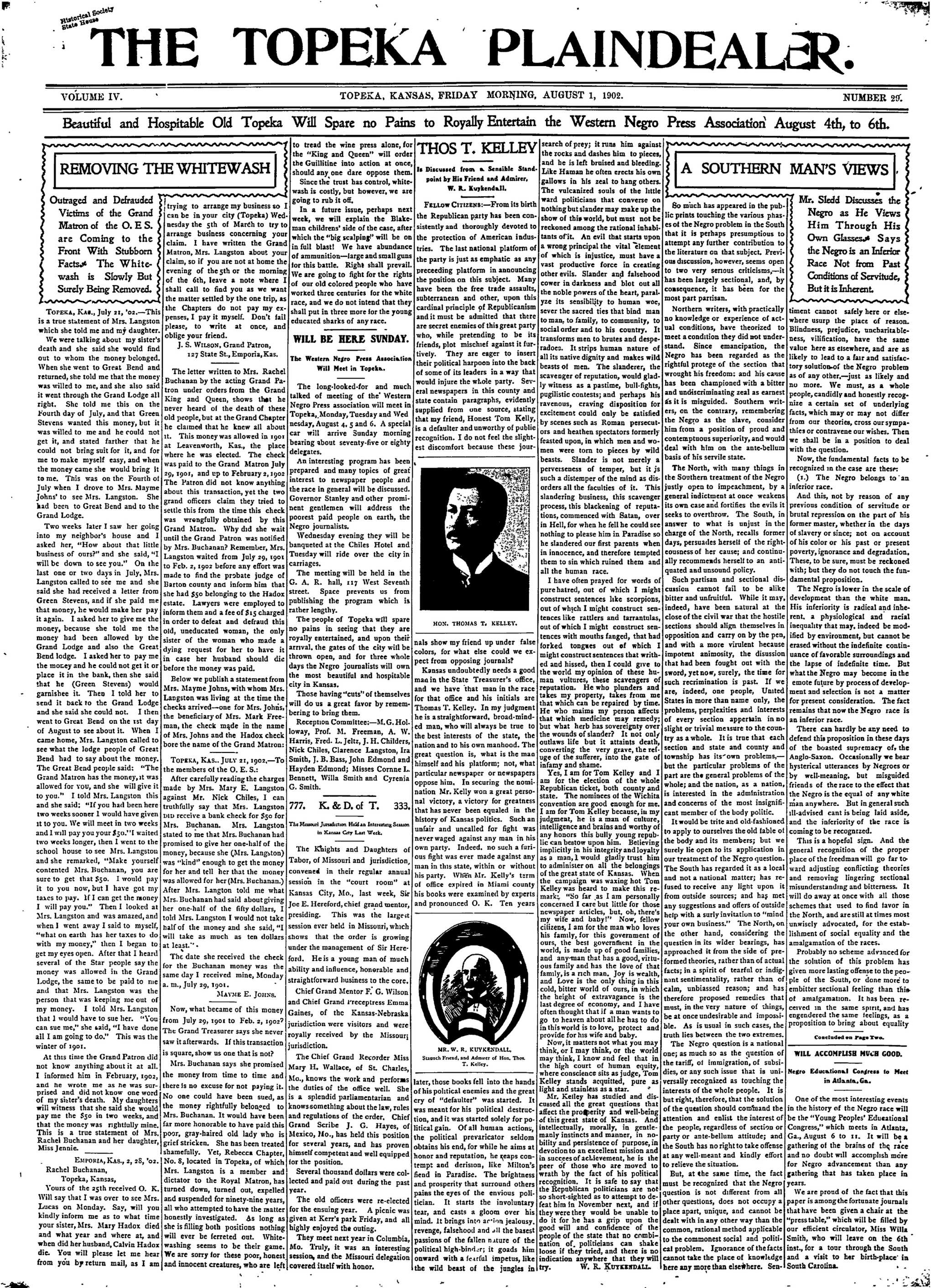
THE TOPEKA PLAINDEALER.
REMOVING THE WHITEWASH
Historical Society
State House
TH
VOLUME IV.
Beautiful and He REMOVING TH
Outraged and Defrauded Victims of the Grand Matron of the O. E.S. are Coming to the Front With Stubborn Facts. The Whitewash is Slowly But Surely Being Removed. TOPEKA, KA8., July 21, '02.—This is a true statement of Mrs. Langston which she told me and my daughter.
We were talking about my sister's death and she said she would find out to whom the money belonged. When she went to Great Bend and returned, she told me that the money was willed to me, and she also said it went through the Grand Lodge all right. She told me this on the Fourth day of July, and that Green Stevens wanted this money, but it was willed to me and he could not get it, and stated farther that he could not bring suit for it, and for me to make myself easy, and when the money came she would bring it to me. This was on the Fourth of July when I drove to Mrs. Mayme Johns' to see Mrs. Langston. She had been to Great Bend and to the Grand Lodge.
Two weeks later I saw her going into my neighbor's house and I asked her, "How about that little business of ours?" and she said, "I will be down to see you." On the last one or two days in July, Mrs. Langston called to see me and she said she had received a letter from Green Stevens, and if she paid me that money, he would make her pay it again. I asked her to give me the money, because she told me the money had been allowed by the Grand Lodge and also the Great Bend lodge. I asked her to pay me the money and he could not get it or place it in the bank, then she said that he (Green Stevens) would garnishee it. Then I told her to send it back to the Grand Lodge and she said she could not. I then went to Great Bend on the 1st day of August to see about it. When I came home, Mrs. Langston called to see what the lodge people of Great Bend had to say about the money. The Great Bend people said: "The Grand Matron has the money, it was allowed for you, and she will give it to you." I told Mrs. Langston this and she said: "If you had been here two weeks sooner I would have given it to you. We will meet in two weeks and I will pay you your $50." I waited two weeks longer, then I went to the school house to see Mrs. Langston and she remarked, "Make yourself contented Mrs. Buchanan, you are sure to get that $50. I would pay it to you now, but I have got my taxes to pay. If I can get the money I will pay you." Then I looked at Mrs. Langston and was amazed, and when I went away I said to myself, "what on earth has her taxes to do with my money," then I began to get my eyes open. After that I heard several of the Star people say the money was allowed in the Grand Lodge, the same to be paid to me and that Mrs. Langston was the person that was keeping me out of my money. I told Mrs. Langston that I would have to sue her. "You can sue me," she said, "I have done all I am going to do." This was the winter of 1901.
At this time the Grand Patron did not know anything about it at all. I informed him in February, 1902, and he wrote me as he was surprised and did not know one word of my sister's death. My daughters will witness that she said she would pay me the $50 in two weeks, and that the money was rightfully mine. This is a true statement of Mrs. Rachel Buchanan and her daughter, Miss Jennie.
Yours of the 25th received O. K.
Will say that I was over to see Mrs.
Lucas on Monday. Say, will you
kindly inform me as to what time
your sister, Mrs. Mary Hadox died
and what year and where at, and
when did her husband, Calvin Hadox
die. You will please let me hear
from you by return mail, as I am
trying to arrange my business so I can be in your city (Topeka) Wednesday the 5th of March to try to arrange business concerning your claim. I have written the Grand Matron, Mrs. Langston about your claim, so if you are not at home the evening of the 5th or the morning of the 6th, leave a note where I shall call to find you as we want the matter settled by the one trip, as the Chapters do not pay my expenses, I pay it myself. Don't fail please, to write at once, and oblige your friend.
The letter written to Mrs. Rachel Buchanan by the acting Grand Patron under orders from the Grand King and Queen, shows that he never heard of the death of these old people, but at the Grand Chapter he claimed that he knew all about it. This money was allowed in 1901 at Leavenworth, Kas., the place where he was elected. The check was paid to the Grand Patron July 29, 1901, and up to February 2, 1902 The Patron did not know anything about this transaction, yet the two grand officers claim they tried to settle this from the time this check was wrongfully obtained by this Grand Patron. Why did she wait until the Grand Patron was notified by Mrs. Buchanan? Remember, Mrs. Langston waited from July 29, 1901 to Feb. 2, 1902 before any effort was made to find the probate judge of Barton county and inform him that she had $50 belonging to the Hadox estate. Lawyers were employed to inform them and a fee of $15 charged in order to defeat and defraud this old, uneducated woman, the only sister of the woman who made a dying request for her to have it in case her husband should die before the money was paid.
Below we publish a statement from Mrs. Mayme Johns, with whom Mrs. Langston was living at the time the checks arrived—one for Mrs. Johns, the beneficiary of Mrs. Mark Freeman, the check made in the name of Mrs. Johns and the Hadox check bore the name of the Grand Matron: TOPEKA, KAS., JULY 21, 1902.—To the members of the O. E. S.:
After carefully reading the charges made by Mrs. Mary E. Langston against Mr. Nick Chiles, I can truthfully say that Mrs. Langston did receive a bank check for $50 for Mrs. Buchanan. Mrs. Langston stated to me that Mrs. Buchanan had promised to give her one-half of the money, because she (Mrs. Langston) was "kind" enough to get the money for her and tell her that the money was allowed for her (Mrs. Buchanan.) After Mrs. Langton told me what Mrs. Buchanan had said about giving her one-half of the fifty dollars, I told Mrs. Langston I would not take half of the money and she said, "I will take as much as ten dollars at least."
The date she received the check for the Buchanan money was the same day I received mine, Monday a. m., July 29, 1901.
MAYNE E. JOINS.
Now, what became of this money from July 29, 1901 to Feb. 2, 1902?
The Grand Treasurer says she never saw it afterwards. If this transaction is square, show us one that is not?
Mrs. Buchanan says she promised the money from time to time and there is no excuse for not paying it. No one could have been sued, as the money rightfully belonged to Mrs. Buchanan. It would have been far more honorable to have paid this poor, gray-haired old lady who is grief stricken. She has been treated shamefully. Yet, Rebecca Chapter, No. 8, located in Topeka, of which Mrs. Langston is a member and dictator to the Royal Matron, has turned down, turned out, expelled and suspended for ninety-nine years, all who attempted to have the matter honestly investigated. As long as she is filling both positions nothing will ever be ferreted out. White-washing seems to be their game. We are sorry for these poor, honest and innocent creatures, who are left
TOPEKA, KANSAS, FRIDAY MORNING, AUGUST 1, 1902.
to tread the wine press alone, for the "King and Queen" will order the Guillitine into action at once, should any one dare oppose them. Since the trust has control, whitewash is costly, but however, we are going to rub it off.
In a future issue, perhaps next week, we will explain the Blakeman childrens' side of the case, after which the "big scalping" will be on in full blast! We have abundance of ammunition—large and small guns for this battle. Right shall prevail. We are going to fight for the rights of our old colored people who have worked three centuries for the white race, and we do not intend that they shall put in three more for the young educated sharks of any race.
WILL BE HERE SUNDAY.
The Western Negro Press Association Will Meet in Topeka.
The long-looked-for and much talked of meeting of the Western Negro Press association will meet in Topeka, Monday, Tuesday and Wednesday, August 4. 5 and 6. A special car will arrive Sunday morning bearing about seventy-five or eighty delegates.
An interesting program has been prepared and many topics of great interest to newspaper people and the race in general will be discussed. Governor Stanley and other prominent gentlemen will address the poorest paid people on earth, the Negro journalists.
Wednesday evening they will be banqueted at the Chiles Hotel and Tuesday will ride over the city in carriages.
The meeting will be held in the G. A. R. hall, 117 West Seventh street. Space prevents us from publishing the program which is rather lengthy.
The people of Topeka will spare no pains in seeing that they are royally entertained, and upon their arrival, the gates of the city will be thrown open, and for three whole days the Negro journalists will own the most beautiful and hospitable city in Kansas.
Those having "cuts" of themselves will do us a great favor by remembering to bring them.
Reception Committee:—M.G. Holloway, Prof. M. Freeman, A. W. Harris, Fred. L. Leltz, J. H. Childers, Nick Chiles, Clarence Langston, Ira Smith, J. B. Bass, John Edmond and Hayden Edmond; Misses Cornne L. Bennett, Willa Smith and Cyrenja G. Smith.
777. K, & D, of T.
The Missouri Jurisdiction Held an Interesting Season in Kansas City Last Week.
The Knights and Daughters of Tabor, of Missouri and jurisdiction, convened in their regular annual session in the "court room" at Kansas City, Mo., last week, Sir Joe E. Hereford, chief grand mentor, presiding. This was the largest session ever held in Missouri, which shows that the order is growing under the management of Sir Hereford. He is a young man of much ability and influence, honorable and straightforward business to the core.
Chief Grand Mentor F. G. Wilson and Chief Grand Ireceptress Emma Gaines, of the Kansas-Nebraska jurisdiction were visitors and were royally received by the Missouri jurisdiction.
The Chief Grand Recorder Miss Mary H. Wallace, of St. Charles, Mo., knows the work and performs the duties of the office well. She is a splendid parliamentarian and knowssomething about the law, rules and regulations of the order. Chief Grand Scribe J. G. Hayes, of Mexico, Mo., has held this position for several years, and has proven himself competent and well equipped for the position.
Several thousand dollars were collected and paid out during the past year. The old officers were re-elected for the ensuing year. A picnic was given at Kerr's park Friday, and all highly enjoyed the outing. They meet next year in Columbia, Mo. Truly, it was an interesting session, and the Missouri delegation covered itself with honor.
THOS T. KELLEY
Is Discussed from a Sensible Stand point by His Friend and Admirer, W. R. Kuykendall.
FELLOW CITIZENS:—From its birth the Republican party has been consistently and thoroughly devoted to the protection of American industries. The last national platform of the party is just as emphatic as any preceeding platform in announcing the position on this subject. Many have been the free trade assaults, subterranean and other, upon this cardinal principle of Republicanism and it must be admitted that there are secret enemies of this great party who, while pretending to be its friends, plot mischief against it furtively. They are eager to insert their political harpoon into the back of some of its leaders in a way that would injure the whole party. Several newspapers in this county and state contain paragraphs, evidently supplied from one source, stating that my friend, Honest Tom Kelly, is a defaulter and unworthy of public recognition. I do not feel the slightest discomfort because these jour-
HON. THOMAS T. KELLEY.
nals show my friend up under false colors, for what else could we expect from opposing journals?
Kansas undoubtedly needs a good man in the State Treasurer's office, and we have that man in the race for that office and his initials are Thomas T. Kelley. In my judgment he is a straightforward, broad-minded man, who will always be true to the best interests of the state, the nation and to his own manhood. The great question is, what is the man himself and his platform; not, what particular newspaper or newspapers oppose him. In securing the nomination Mr. Kelly won a great personal victory, a victory for greatness that has never been equaled in the history of Kansas politics. Such an unfair and uncalled for fight was never waged against any man in his own party. Indeed, no such a furious fight was ever made against any man in this state, within or without his party. When Mr. Kelly's term of office expired in Miami county his books were examined by experts and pronounced O. K. Ten years
MR. W. R. KUYKENDALL,
Staunch Friend, and Admirer of Hon. Thos.
T. Kelley.
later, those books fell into the hands of his political enemies and the great cry of "defaulter" was started. It was meant for his political destruction, and it was started solely for political gain. Of all human actions, the political prevaricator seldom obtains his end, for while he aims at honor and reputation, he reaps contempt and derision, like Milton's fiend in Paradise. The brightness and prosperity that surround others paines the eyes of the envious politician. It starts the involuntary tear, and casts a gloom over his mind. It brings into action jealousy, revenge, falsehood and all the basest passions of the fallen nature of the political high-binder; it goods him onward with a fearful impetus, like the wild beast of the jungles in
search of prey; it runs him against the rocks and dashes him to pieces, and he is left bruised and bleeding. Like Haman he often erects his own gallows in his zeal to hang others. The vulcanized souls of the little ward politicians that converse on nothing but slander may make up the show of this world, but must not be reckoned among the rational inhabitants of it. An evil that starts upon a wrong principal the vital element of which is injustice, must have a vast productive force in creating other evils. Slander and falsehood cower in darkness and blot out all the noble powers of the heart, paralyze its sensibility to human woe, sever the sacred ties that bind man to man, to family, to community, to social order and to his country. It transforms men to brutes and desperadoes. It strips human nature of all its native dignity and makes wild beasts of men. The slanderer, the scavenger of reputation, would gladly witness as a pastime, bull-fights, pugilistic contests; and perhaps his ravenous, craving disposition for excitement could only be satisfied by scenes such as Roman persecutors and heathen spectators formerly feasted upon, in which men and women were torn to pieces by wild beasts. Slander is not merely a perverseness of temper, but it is such a distemper of the mind as disorders all the faculties of it. This slandering business, this scavenger process, this blackening of reputations, commenced with Satan, over in Hell, for when he fell he could see nothing to please him in Paradise so he slandered our first parents when in innocence, and therefore tempted them to sin which ruined them and all the human race.
I have often prayed for words of pure hatred, out of which I might construct sentences like scorpions, out of which I might construct sentences like rattlers and tarantulas, out of which I might construct sentences with mouths fanged, that had forked tongues out of which I might construct sentences that writted and hissed, then I could give to the world my opinion of these human vultures, these scavengers of reputation. He who plundered and takes my property, takes from me that which can be repaired by time. He who maims my person affects that which medicine may remedy; but what herb has sovereignty over the wounds of slander? It not only outlaws life but it attains death, converting the very grave, the refuge of the sufferer, into the gate of infamy and shame.
Yes, I am for Tom Kelley and I am for the election of the whole Republican ticket, both county and state. The nominees of the Wichita convention are good enough for me. I am for Tom Kelley because, in my judgment, he is a man of culture, intelligence and brains and worthy of any honors this bully young republic can bestow upon him. Believing implicitly in his integrity and loyalty as a man, I would gladly trust him to administer on all the belongings of the great state of Kansas. When the campaign was waxing hot Tom Kelley was heard to make this remark; "So far as I am personally concerned I care but little for those newspaper articles, but, oh, there's my wife and baby!" Now, fellow citizens, I am for the man who loves his family, for this government of ours, the best government in the world, is made up of good families, and any man that has a good, virtuous family and has the love of that family, is a rich man. Joy is wealth, and Love is the only thing in this cold, bitter world of ours, in which the height of extravagance is the last degree of economy, and I have often thought that if a man wants to go to heaven about all he has to do in this world is to love, protect and provide for his wife and baby.
Now, it matters not what you may think, or I may think, or the world may think, I know and feel that in the high court of human equity, where conscience sits as judge, Tom Kelley stands acquitted, pure as light and stainless as a star.
Mr. Kelley has studied and discussed all the great questions that affect the prosperity and well-being of this great state of Kansas. And intellectually, morally, in gentlemanly instincts and manner, in nobility and persistence of purpose, in devotion to an excellent mission and in succeeds of achievement, he is the peer of those who are moved to wrath by the fact of his political recognition. It is safe to say that the Republican politicians are not so short-sighted as to attempt to defeat him in November next, and if they were they would be unable to do it for he has a grip upon the good will and confidence of the people of the state that no combination of politicians can shake loose if they tried, and there is no indication anywhere that they will trv. W. R. KUYKENDALL.
A SOUTHERN MAN'S VIEWS
So much has appeared in the public prints touching the various phases of the Negro problem in the South that it is perhaps presumptious to attempt any further contribution to the literature on that subject. Previous discussion, however, seems open to two very serious criticisms,—it has been largely sectional, and, by consequence, it has been for the most part parrisan.
Northern writers, with practically no knowledge or experience of actual conditions, have theorized to meet a condition they did not understand. Since emancipation, the Negro has been regarded as the rightful protege of the section that wrought his freedom; and his cause has been championed with a bitter and undiscriminating zeal as earnest as it is misguided. Southern writers, on the contrary, remembering the Negro as the slave, consider him from a position of proud and contemptuous superiority, and would deal with him on the ante-bellum basis of his servile state.
The North, with many things in the Southern treatment of the Negro justly open to impeachment, by a general indictment at once weakens its own case and fortifies the evils it seeks to overthrow. The South, in answer to what is unjust in the charge of the North, recalls former days, persuades herself of the righteousness of her cause; and continually recommends herself to an antiquated and unsound policy.
Such partisan and sectional discussion cannot fail to be alike bitter and unfruitful. While it may, indeed, have been natural at the close of the civil war that the hostile sections should align themselves in opposition and carry on by the pen, and with a more virulent because impotent animosity, the discussion that had been fought out with the sword, yet now, surely, the time for such recrimination is past. If we are, indeed, one people, United States in more than name only, the problems, perplexities and interests of every section appertain in no slight or trivial measure to the country as a whole. It is true that each section and state and county and township has its own problems,—but the particular problems of the part are the general problems of the whole; and the nation, as a nation, is interested in the administration and concerns of the most insignificant member of the body politic.
It would be trite and old-fashioned to apply to ourselves the old fable of the body and its members; but we surely lie open to its application in our treatment of the Negro question. The South has regarded it as a local and not a national matter; has refused to receive any light upon it from outside sources; and has met any suggestions and offers of outside help with a surly invitation to "mind your own business." The North, on the other hand, considering the question in its wider bearings, has approached it from the side of preformed theories, rather than of actual facts; in a spirit of tearful or indignant sentimentality, rather than of calm, unbiased reason; and has therefore proposed remedies that must, in the very nature of things, be at once undesirable and impossible. As is usual in such cases, the truth lies between the two extremes
The Negro question is a national one; as much so as the question of the tariff, of immigration, of subsidies, or any such issue that is universally recognized as touching the interests of the whole people. It is but right, therefore, that the solution of the question should command the attention and enlist the interest of the people, regardless of section or party or ante-bellum attitude; and the South has no right to take offense at any well-meant and kindly effort to relieve the situation.
But, at the same time, the fact must be recognized that the Negro question is not different from all other questions, does not occupy a place apart, unique, and cannot be dealt with in any other way than the common, rational method applicable to the commonest social and political problem. Ignorance of the facts cannot take the place of knowledge here any more than elsewhere. Sen-
ER.
NUMBER 25.
ugust 4th, to 6th.
MAN'S VIEWS
Mr. Sledd Discusses the Negro as He Views Him Through His Own Glasses Says the Negro is an Inferior Race Not from Past Conditions of Servitude, But it is Inherent.
timent cannot safely here or elsewhere usurp the place of reason. Blindness, prejudice, uncharitableness, vilification, have the same value here as elsewhere, and are as likely to lead to a fair and satisfactory solution-of the Negro problem as of any other—just as likely and no more. We must, as a whole people, candidly and honestly recognize a certain set of underlying facts, which may or may not differ from our theories, cross our sympathies or contravene our wishes. Then we shall be in a position to deal with the question.
Now, the fundamental facts to be recognized in the case are these:
(1.) The Negro belongs to an inferior race.
And this, not by reason of any previous condition of servitude or brutal repression on the part of his former master, whether in the days of slavery or since; not on account of his color or his past or present poverty, ignorance and degradation. These, to be sure, must be reckoned with; but they do not touch the fundamental proposition.
The Negro is lower in the scale of development than the white man. His inferiority is radical and inherent, a physiological and racial inequality that may, indeed be modified by environment, but cannot be erased without the indefinite continuance of favorable surroundings and the lapse of indefinite time. But what the Negro may become in the remote future by process of development and selection is not a matter for present consideration. The fact remains that now the Negro race is an inferior race.
There can hardly be any need to defend this proposition in these days of the boasted supremacy of, the Anglo-Saxon. Occasionally we hear hysterical utterances by Negroes or by well-meaning, but misguided friends of the race to the effect that the Negro is the equal of any white man anywhere. But in general such ill-advised cant is being laid aside, and the inferiority of the race is coming to be recognized.
This is a hopeful sign. And the general recognition of the proper place of the freedman will go far toward adjusting conflicting theories and removing lingering sectional misunderstanding and bitterness. It will do away at once with all those schemes that used to find favor in the North, and are still at times most unwisely advocated, for the establishment of social equality and the amalgamation of the races.
Probably no scheme advanced for the solution of this problem has given more lasting offense to the people of the South, or done more to embitter sectional feeling than this of amalgamation. It has been received in the same spirit, and has engendered the same feelings, as a proposition to bring about equality
Concluded on Page Two.
WILL ACCOMPLISH MUCH GOOD.
Negro Educational Congress to Meet in Atlanta, Ga.
One of the most interesting events in the history of the Negro race will be the "Young Peoples' Educational Congress," which meets in Atlanta, Ga., August 6 to 11. It will be a gathering of the brains of the race and no doubt will accomplish more for Negro advancement than any gathering that has taken place in years.
We are proud of the fact that this paper is among the fortunate journals that have been given a chair at the "presstable," which will be filled by our efficient circulator, Miss Willa Smith, who will leave on the 6th inst., for a tour through the South and a visit to her birth-place in South Carolina.
FRIDAY, AUG. 1, 1902
Negro Inferiority.
In the Atlantic Monthly for July, Mr. Andrew Sledd writes about "The Negro: Another view." Just who this distinguished gentleman is, we do not know but we must confess to a high appreciation of his candor and frankness in discussing a question which has ever been approached by the Anglo-Saxon with more or less bias, apology and equivocation. In this issue will be found that portion of Mr. Sledd's contribution to current literature which deals with and explains one of the "fundamental facts" in this very important controversy. Mr. Sledd prefaces his discussion of the facts in the case with a contrast of the positions of the people of the North and South on the race problem. From the view point of the Negro the positions of the two contending forces is correctly stated and we go farther and state that neither side fully comprehends the situation from the fact that they do not see the question through the Negro's eyes. The opening paragraphs of Mr. Sledds discussion cannot be regarded other than an apology for conditions brought about through the lack of a perfect knowledge of the real needs of the Negro on the part of the great mass of Northern people who were and are now sincere in their desire to help the race, and the persistent refusal of the Southern white man to regard the Negro and those desirous of aiding him, from other than assumed "positions of proud and contemptuous superiority." In conclusion Mr. Sledd decides that "the Negro belongs to an inferior race."
Sectional Efforts.
It is unfortunate that all efforts in the direction of awakening in our people proper conception of the duties and responsibilities of freedman and citizenship on the philanthropic and patriotic people of the north has met with a stubborn resistance on the part of the white people of the South. This is clearly demonstrated and set forth in the history of the rise and progress of the "Klux Klans" and similar organizations, whose chief aim and object has been the intimidation of the freedman and any and all who might presume to point him the way out of the darkness and ignorance of slavery. This is as true today as it was in the years immediately following the Emancipation. The position of the North has not been so sectional in its nature as has that of the South. If the effort of the northern philanthropist has not been productive of the best results, it is due largely to the determined opposition of the South.
Equality and Amalgamation
No two terms seem to have irritated the people of the South as have Negro equality and the very remote probability of legalized amalgamation. There may have been in the early days of emancipation a belief in the minds of some that the demand for the civil rights of the freedman and the granting of the same to him would result in the utter demoralizing of our social system. It was therefore to be strenuously resisted. Later events are proving such fears groundless
O. K. Cafe and Ice Cream Parlors
In South Topeka are the neatest, cosiest and most artistically furnished place in the city to enjoy an Afternoon or Evening of pleasure. A full line of Candies, Fruits and Nuts. All the leading brands of Cigars. Call and see us. James E. Turner, Prop., 1303 KAS., AVE TOPEKA. SUCCESSOR TO RICE BROS.
From August 14 to September 14, 1902. The first practical demonstration ever given to the people of the North of the development and growth of the Negro race in this section. A grand display of race progress. The Nation's first event of the Twentieth Century. Chicago is the freest and most hospitable city in the U.S. The greatest summer resort in the West. Do not fail to visit Chicago and the greatest of all Race Expositions. Special railroad rates THE 14TH DAY OF AUG. TO THE 14TH OF SEPT. 1902. For information address the Committee.
and far fetched. Investigation into current history proves conclusively that education is causing the Negro to be more gregarious in all things than ever obtained under the old regime. Slavery taught the Negroes to distrust one another, to live as so many units, having no moral or social value, except as they served the purpose of their masters. Freedom and education are restoring to our people racial cohesiveness necessarily destroyed by slavery. This is shown in the powerful religious organizations that have grown up since the emancipation: in the multitude of secret societies, and business ventures more or less successful. These necessarily require confidence in one another of a high order. Equality before the law has not resulted in the mad rush of the Negro to the white man's fireside, thereby bringing about the much opposed amalgamation of the races.
Intermarrying—A Bugboo.
Mr. Sledd cannot resist the temptation to bring extremes together in his sublime effort to prove the inferiority of the Negro. His picture of the New England belle becoming the spouse of "the public scavenger" is decidedly overdrawn, and is far more of an impossibility than the frequent spectacle of a high bred southern gentleman, sah, leaving the chaste couch of his fair Diana to seek the lascivious embrace of a thick lipped, kinky haired Dinah. The records of the sunny south and the unpublished testimony of a million Negro mothers now living will show that the tendency towards racial amalgamation set in long ago from the opposite direction and the multitude of mixed blood today are ample proof that the sons of Japhet have been tampering with the daughters of Ham. There is no proof that white women are borning Negroes. Amalgamatien is a bugboo made use of by the enemies of our people to justify the denial of equal civil and industrial rights.
Is the Negro Inferior?
The mere assertion on the part of Mr. Sledd that the Negro is inferior proves nothing. This is merely the opinion of an interested participant. That the Negro has not accomplished all he can, no sane man will for a moment contend. The very fact that he has so far overcome the evils of slavery, and has gone forward and not backward since emancipation, proves that he belongs to a race only requiring the vivifying touch of knowledge and an equal chance in the world of labor and business. The Negro who has watched the upward tendency of his peeple in the mass and has seen their methods of thinking and their modes of
Everybody is· Saying That the
living change from year to year has great hopes for the future. In the general improvement of the race is seen its possibilities. Illustrating the case.
There are people who persistently declare that the Negro belongs to an inferior race, and forsooth is incapable of higher development. This class of people belong to the deceased preachers of ante-bellum days, whose sophistry was to justify human slavery in the teachings of the lowly Nazarine. These people refuse to consider the work the race is doing. As an example to illustrate something that the race is doing as a direct refutation of the assumption of racial inferiority. In the July 19th issue of the Outlook we find a story of the Negro Cotton Mill at Concord North Carolina erected at a cost of over $70,000 with a weaving capacity of 40000 yards of cloth per week. Every dollar of capital was drawn from 350 Negro shareholders and every employee is a Negro boy or girl except the manager, a white man from Massachusetts. The superintendent bears testimony of the alertness of the Negro employee and praises his skill and willingness to learn. The Negro is looking for a wider opportunity to develop.
A Southern Man's Veiws.
and a union between some cultured New England belle and the public scavenger of her city, with all the filth and foulness of his calling on his person and in his blood. The very words are sickening. And the idea, so coarse and repugnant to every finer feeling, could have originated only in the brain of the wildest theorist, ignorant of conditions, and hurried by his negrophile propensities and desire to do justice to the black man into entire forgetfulness of the rights and feelings of the Southern white man.
There seems to be no essential condition of casualty between the previous bondage and suffering of the Negro and the assumption by him or for him, on emancipation, of any equality with his former master other than the grand and fundamental equality of man to man before God and the national law. Emancipation could not eradicate the essential inferiority of the Negro. No such conditions existed as in other states of slavery,—in Greece, or Rome, for instance, where the slave was often of kindred blood, and even higher born, better educated, and of finer tastes and feelings than his master. Emancipation there might naturally be followed by an approximate equality between the ex-slave and his former master. But the Negro when enslaved was—a Negro; and the emancipated Negro was a Negro still. Freedom had not made him a new creature. He was, indeed, better than when he entered slavery, but his emancipation had not changed and could not change, the fundamental features, the natural inferiority of the race.
Ice Cream Parlors
neatest, cosiest and most artisti-
the city to enjoy an Afternoon or
full line of Candies, Fruits and
lands of Cigars. Call and see us.
her, Prop., 1303 KAS., AVE.
TOPEKA.
and Mississippi
ation in Chicago
On September 14, 1902. The first
er given to the people of the North
north of the Negro race in this sec-
race progress. The Nation's first
century, Chicago is the freest and
U.S. The greatest summer resort
to visit Chicago and the greatest of
special railroad rates THE 14TH
14TH OF SEPT. 1902. For infor-
mittee.
610 Grfield Boulevard,
CHICAGO, ILL.
Send Your Sons and Daughters to
THEOLOGICAL DEPARTMENT—Preparing trained Ministers for the demands of the pew of today.
NORMAL DEPARTMENT—Preparing Students for teaching in the public schools and giving higher training to those desiring the same.
SUB-NORMAL DEPARTMENT—Fitting Students for the Normal department and giving an opportunity for education to those deprived of such in childhood.
MUSICAL DEPARTMENT—Offering training in that art for which our youth seem adapted by nature—Music.
INDUSTRIAL DEEARTMENT—Fitting our youth to compete with the tradesmen in the field of organized labor. Here mainly rests the future of the race. This is to be the education of this century. Courses—Agricultural, Mechanical Drawing, Carpentry and Cabinet Making. Printing, Job and Journeyman. Tailoring, Business Course, Stenography and Typewriting. Dressmaking and Plain Sewing. Preparations are being made for teaching Scientific Agriculture. The faculty is composed of graduates from the best schools in the country.
FACULTY—Rev. Wm. T. Vernon, B. S. D., A. M., Lincoln, President, Philosophy, Logic and Economics; Rev. Jno. S. Johnson, B. D., Ohio State University, Hebrew, Greek and Theology; G. Archie Gregg, University of Kansas, Mathematics; Aguatus C. Perdue, Tuskegee, Architectural, Mechanical Drawing and Carpentry; Joseph Nelson Garratt, Wilberforce, Business Course Stenography and Typewriting Harry R. Graham, Printing and Book-binding; Mrs. Florence M. Crews, I. F. C. Y., Philadelphia, Pa., Literature and Latin; Mrs. S. L. Gross, Dressmaking, Plain Sewing; Mrs. N. Douglass Scroggins, Western University, Instrumental Music; Mrs. W. T. Vernon, B. S., Matron Stanley Hall. In addition, able and prominent lecturers on different subjects have been secured.
OPPORTUNITY—Teachers have a common interest in all Students, even the poorest and humblest. We only ask for merit and true worth here. Extravagance is discouraged, students struggling for an education need not feel ashamed of poverty. Come and try.
EXPENSES—Board per month $5.50. Tuition per month $1. Room rent per month $1. Incidental fee only for first month $1. Students received at any time. SCHOOL OPENS SEPT. 15, '02. REMARKS—We are trying to help solve the problem. Write us for catalogues or Information. Let us hear from you at once, we will give all particulars.
PATRIARCHS OF THE FAITH.—The association has decided to build a home for the Aged, Infirm and Orphans. This was decided upon at Leavenworth, last year. Five thousand dollars will procure an excellenthome. We are called upon to send fifty cents per member for the purpose, and if the 5,000 members of our fifty churches were to give the prescribed pro rata, $2,500 would be realized. But let us allow a liberal discount for the children and the disabled members of our churches, by cutting the aggregate in two. We would still have 2,500 members who could contribute 50 cents each, thus realizing $1,250 from the members and children of our churches in this district.
A committee was appointed—Rev. J. H. Vanleu, Mrs. M. D. Jones and Hon. H. I. Munroe—to look out site, etc., and report at this session of the association. They have done their work and call upon us to pass upon it. Let us, brethren, come to Topeka and make the Home a reality. Let us provide a Home for our mothers and fathers, sisters and brothers, who for any reason are unfortunate in this life. Let us purchase a $5,000 Home which will be the pride of the denomination and an honor to the race.
According to an action of the executive board which met at Osage City, Kas., Nov. 17, 1901, it was decided to ask each church 50 cents a member for the Home, this year. Brethren, let us be true to ourselves, to our God, to our neighbors. Don't ask curious questions but go to work. Religion that doesn't go pocket-deep cannot go heaven-high. Pray, plan and work. Let us collect $1,000 for the Home this year.
W. L. Grant
H. F. Frazier.
J. E. Lewis.
H. I. Monroe.
G. Mc Neal.
J. H. Ramey.
Members of the Executive Board present at the meeting Nov 17, 1901,
PUBLICATION NOTICE.
In the District Court of Shawnee County, Kansas, Israel Ward, plaintiff, v. William Zimmerman, and Mary M. Zimmerman, defendants. No. 21,768. William Zimmerman, and Mary M. Zimmerman, defendants in the above entitled action, you and each of you will take notice that you have been sued in the District Court of Shawnee County Kansas by the plaintiff above named; that said plaintiff filed his petition with the clerk of said court July 16, 1902, asking judgment against you and each $60 you for $28.33 together with interest and costs, and that unless you answer the same on or before the 28th day of August 1902 the allegations there will be taken as true and judgment rendered in favor of said plaintiff accordingly, and that an order of sale will issue to the sheriff of Shawnee County Kansas, directing him to sell the following described property attached in this action, to-wait:
The N. W. 3/4 Sec. 7 towship 13 range 17 in Shawnee County, Kansas to satisfy said judgment.
I BARL WARD, Plaintiff,
D. H. BRANVAN, Atty for Plaintiff.
Attest: I. S. CURTIS, Clerk.
(5241)
MISSION BUILDING
Nonsectarian, Co-educational, Practical Training of the Negro Youth.
DEPARTMENTS: Industrial, English, Normal. Music and Business. Trades taught:—Carpentry, Painting, Tailoring, Printing, Book-binding, Agriculture, Sewing, Cooking, Millinery, Laundrying and Domestic Science.
EXPENSES: Board, furnished room, light, fuel and tuition:—Literary and Industrial departments, $7.50 per month tuition, Musical department $1 per month. Typewriting and Stenegraphy (combined course) $5 per month. Special inducements to students in this department. Entrance fee $1. A limited number of students will be afforded an opportunity to work out a part of their expenses.
ADVANTAGES; Teachers especially trained for the work. Every student learns a trade. Home training is specialty. The institution is endorsed by ministers of EVERY denomination. Our training is thorough, systematic and Christiau. School begins TUESDAY, SEPT. 9. Enter your child the opening day. For further information, addaddress
WM. R. CARTER. PRINCIPAL
TOPEKA, KAS.
Denver, Colo. Springs, Manito, Pueblo
July 1st to 13th, August 1st to 14th. August 23, 24, 30
31st, Sept 1st to 10th. All other dates from June 1st to Sept 15,
819.00 for the round trip.
A new train to Colorado, composed of the same equipments as
the famous California limited, leaves Topeka at 8.35 p.m. Rock
ballast track free from dust and dirt. Harvey eating houses.
Observation cars—the only line running them to Colorado.
Send for book, "A Colorado Summer" free. Full information
for camping and fishing parties—how to go—where to go and
cost of trip—address,
T. L. KING, Ticket Agt. Depot.
T. M., JAMES, JR., Ticket Agent, 830 N. Kansas Ave., Topeka.
MISSOURI
PACIFIC
RAILWAY
Traveling the States of Kansas Colorado, Cansas, and the Indiana Five (5) Daily Passenger Trains in each direction, between The Famous H
Are reached ONLY by this H.C. TO
Traveling the States of Kansas, Missouri, Nebraska Colorado, Cansas, and the Indian Territory. Five (5) Daily Passenger Trains are run on this line in each direction, between Kansas City and St. Louis
Are reached ONLY by this LINE
H.C. TOWNSEND, G.P. & T.A.,
LOUIS, MO.
P. A. gent,
TOPHEA, KAS.
Western University; Quindaro
A Great School for the Youth. The Great State of Kansas Ha Given Her Approval. (Incorporated.)
```markdown
```
"FOR the moral, intellectual and industrial training of our youth." Advantages: Christian Influences, Thorough Instructors, Good Buildings, Fine Equipment, Healthy Moral Tone, Fine Drainage, Good Surroundings. DEPARTMENTS:
WM. T. VERNON, Quindaro, Kas.
Mrs. Phillips,
Proprietress
W. D. Phillips,
Manager
THE NEW PAXTON HOTEL
Newly Refitted. Rates Reasonable
BATHS FREE TO PATRONS.**
1841 Lawrence St. Denver, Colo.
The Perry Natel
Good Rooms.
Quick Service.
MRS. J. SNYDER, Mc'R.
PERRY, KANSAS.
When in Kansas City Please Call at
The Chicago Cafe,
HENRY COMPTON, Prop.
E. 12 St. - Kansas City Mo.
WONDERFUL DISCOVERY
Curly Hair Made Straight By
TAKEN FROM LIFE:
REPEAT AND AFTER TREATMENT.
ORIGINAL
OZONIZED OX MARROW
(Onyxpalmate)
This wonderful hair pomade is the only safe preparation in the world that makes thick or curly hair straight as shown above. It is now available for sale, falling out or breaking off, curse dandruff and makes the hair grow long and silky. Sold over forty years. Two times便宜 free on request. It was the first preparation ever sold for straightening thick hair. Beware of it in the heat. Get loose. Groomed. Get Marrow as the guarantee never fails to keep the hair straight, soft and beautiful. A solitary gift for ladies and ladies. Biologically perfumed. The greatest advantage of this wonderful pomade is that by its use you can straighten your hair and lasting qualities it is the best and most economical. It is not possible for anybody to produce a pre-made pomade in a bottle. Only 40 cents. Sold by drugrate and designer send us $8 cents for one bottle or $1.50 for three bottles. Mail or express money order. Write your name and address plainly to
OZONIZED OX MARROW CO...
76 Wabash Avenue, Chicago, Illinois
Phone 37 Store 105 W. Eigth St
J. E. Rodman,
FLORIST
PALMS AND CUT FLOWERS.
KANSASSAVING INVESTMENT
COMPANY (COLORED)
CHANUTE, KANSAS.
Authorized Capital $700,000
stock solicited by correspondence
General solicitor and financial agent
J. S. HALE.
RAY'S
314 Commercial Street
Is the place to receive first
class accommodations. Lunch
Room and the new Ice Cream
Parlor noatly arranged. Barber
Shop in connection. Give us a
call.
E. RAY & SONS., PROPS.
Emporia, Kansas.
ONLY 2-2 DAYS FROM KANSAS CITY
—TO—
California
-VIA THE-
Great
Rock Island
Route
Daily Tourist Cars.
PERSONALLY CONDUCTED
TUESDAYS AND THURSDAYS
THE LOW ALTITUDE ROUTE
Also, personally conducted tourist
Excursions Every Wednesday and
friday
via COLORADO AND SCENIC LINE.
QUICKEST STIME TO EL PASO.
BEST LINE TO OLD MEXICO.
For full information address
E. W. THOMPSON, A. G. P. A.
Topeka, Kas.
JOHN SEBASTIAN, G. P. A., Chicago
First-Class Restaurant.
Pies, Cakes and Ice Cream.
Pay us a visit.
618 VERMONT St. LAWRENCE, KAS
J. M. KNIGHT,
UNDERTAKER AND EMBALMER.
Have your prescriptions filled at B. B. Lee's, 113 West Eighth street.
Thomas McCampbell Sundayed in Atchison.
Mrs. M. Pace left Saturday for Pueblo, Colo.
Richard Gaines was among the excursionists from Kansas City, Sunday.
Mrs. J. F. Scales returned Wednesday, to her home in Kansas City.
Miss Eleanor Brasher has returned from Colorado.
Mrs. Amanda Peters has returned from Zion, Okla., where she has been visiting friends.
Mrs. A. P. Montgomery, of Alberquerque, New Mexico, is the guest of Miss Ogeal Wilson.
Mrs. L. White is ill at her home, 309 West Laurent street.
Judge Fagan has returned from Richmond, Ind., accompanied by his mother who is ill.
Winfield, the baby boy of Mr. and Mrs. Jerry Reynolds, died Sunday evening. Funeral services were held Monday afternoon at their home 1167 Buchanan street. Age 14 months.
Thos. McCampbell and Gaither Page spent Tuesday in Wamego, where they played ball.
Mrs. M. Roberts is ill at her home on East Seventh street.
Mrs. Anna Noble, sister of Nick Chiles, arrived Tuesday from Greenville, South Carolina and will make this state her future home.
See E. S. Lee, the druggist, at 112 West Eighth street.
H. I. Monroe spent last week in Yale, Kans.
Prof. McCoy and family of Tuskegee, Ala., have moved to this city where they will reside in the future.
The many friends of George Rucker will be grieved to hear of his death which occurred in Albequerque, New Mexico, Monday.
The third annual reunion of the Twenty-third Kansas will be held in Leavenworth, Kan., August 2, 3 and 4, 1902.
There will be a joint meeting of Euclid Lodge, Mount Moriah and Kaw Valley, Saturday night, for the purpose of conferring degrees.
Geo. W. Bryant, of Kansas City, Mo., was in the city Sunday, shaking hands with his friends.
If people would spend as much time trying to do things for thh good of the community as they do to spite some one, the world would be better.
"Tim" Cooper, the interesting midget of Kansas City, Mo., was in the city Sunday, making glad the heart of one of our "cross the creek" helles.
"Tim" always gets the glad hand when he "lights" this burg.
"Billie" Hall, "the ex king of Topeka dudes," was in town Tuesday, putting on fine clothes and lots of airs. He now owns a big block of Burlington stock, and puts in his time working the route between Omaha, Neb., and Billings, Montana.
Messrs. B. M. Bennett, Henry and Otto Bennett spent Sundy visiting relatives in Kansas City and Independence, Mo.
That the Twenty-third reunion will be a big thing no one will dispute as all Kansas feels proud that the state sent a colored regiment to the front officered by men of the race.
Saturday afternoon Mesdames Robt. Buckner and J. M. Wright entertained complimentary to Mesdames I. F. Bradley of Kansas, City and A. Richardson of Oklahoma City.
Mrs. Wm. Reynolds left last week for an extended visit with relatives in Oklahoma.
The reunion of the Twenty-third Kansas regiment starts Sunday in Leavenworth. A goodly number of Topekians are preparing to attend.
Mrs. M. Houson died Thursday after a brief illness at the home of Mr. and Mrs. G. W. Smith, 1161 Lane street. Funeral services were held at the residence Saturday morning. She leaves two grand children and a host of friends to mourn her emise.
Clay Odell left Wednesday for Chicago and Cincinnati.
A gathering of Kansas patriots—the Twenty-Third regiment ,reunion at Leavenworth which begins Sunday lasting three days. You should attend.
Sunday morning, Prof. Geo. W. Jackson's famous Twenty-Third Regiment Band will leave for Leavenworth to be in attendance at the reunion. Prof. Jackson says he has his boys in fine shape and will render some good music.
The reunion of the Twenty-third Regiment to be held in Leavenworth Aug. 2, 3 and 4 will be a gathering of more than ordinary note. Arrangements have been made to secure the best speakers in the county. Are you going?
Don't forget the Emancipation celebration this afternoon in Garfield Park.
Celebrate this afternoon with Jackson's Twenty-third Regiment Band at beautiful Garfield Park.
Mr. and Mrs. F. Weaver of Kansas City, Mo. spent Sunday with their sister, Mrs. Charles Talbott.
Mrs. Frank Adams is still convulsent.
The Compton Restaurant of 706 E. 12th street, Kansas City, Mo., is for sale. This is one of the best eating houses where colored people are accommodated. The right man with a little capital can do some business by calling on Mr. Compton. He wishes to retire from business.
Mrs. W. E. Helm is seriously ill in Christ's hospital.
Mrs. Ada Black entertained at dinner, Monday, complimentary to Miss Mattie Gillam of Lawrence. Those present were Misses Minerva Graham, Elizabeth Cluter, Bertie Scott, Anna Phillip, and Hortense Clark and Mrs. Emma Ellis and Mr Hobart McAfee.
Mrs. V. L. North and Miss Georgie St.Chaere, of Kansas City, were visiting in Topeka, Sunday, the guest of Mrs. J. R. Ransom.
Miss Fannie Madison left Thursday last for her home in Kansas City.
News reaches us that David Boyd, who is well known to the young people of this city is seriously ill in hospital in Chicago. The cause of his illness we know not, but wish him a speedy recovery.
Miss Della Jones returned to her home in Manhattan, Thursday of last week.
Mr. Dorsey Thomas' is visiting his brother and sister, in Hopkinsville, Ky., whom he has not seen for sixteen years. While there he will represent THE PLAINDEALER.
Miss Gertrude Wims entertained Tuesday evening, complimentary to Mrs J. T. Small, of Chicago.
Miss Ollie Henderson, of Leavenworth, is the guest of O. A. Taylor and wife.
Mrs. Carrie Evans and Miss Jacobs of Richmond, Mo., are the guests of Mrs. L. Clark.
Say!
When are you going to have that party you were talking about and found that it would be impossible to have it because your own parlor is to small for a party this time of year, and there is not a hall in town that will suit for a swell occasion of the kind? So why not go down and look at the O. K. parlors, 1303 Kansas avenue. They can't be beat, we have our own special decorations for parties and social meetings. From July 7, to August 7, we will furnish our parlors and music free, will serve refreshments, ice cream, cake and fruits, for a very small amount per couple. We have things arranged so that all events are private. We would like to have every one that intends to give a party to call and see us.
N. B.—We study to please the public, we have planned for years to have just such a place. Imagine yourself in a garden of palms and sweet smelling flowers all around you in the midst of sweet music, conversing with a lady or gentleman friend, with a glass of ice cream soda with crushed fruit before you, then you will have a correct picture of the O. K. parlors.
Prop. of O. K. cafe, and ice cream parlors.
A Grand Celebration
Prof. Geo. W. Jackson's famous Twenty-third Regiment band will celebrate August 1, in beautiful Topeka at Garfield Park, assisted by Miss Henrietta Vinton Davis, the talented elocationist of Washington, D. C., and Albert Young, of Lawrence, the renowned impersonator and the citizens of Topeka and Shawnee county. This promises to be one of the grandest affairs ever held in Topeka. Committees: Hon. John M. Wright, A. M. Thomas, A. T. Allen, Fred Stonestreet, and H. W. Dillard; reception: Hon. W. I. Jamison, Clarence Odell, Robt. Turner, Robert Keith and H. I. Mouroe, entertainment; G. W. Brown, M. L. Perry, H. E. Searcia and Geo. S. Oliver, arrangement; Geo. W. Jackson, bandmaster, G. W. Brown, manager.
NOTICE
All colored boys under sixteen years of age are requested to meet at Cumberland Hall, 1300 Quincy st. Sunday afternoon at 3 p.m., for the purpose of organizing a Junior Christian Endeavor. Older persons may attend if they desire, but only boys or girls under sixteen are expected to take part. G. A. BIGBEE. Manager Cumberland Band.
Horace Lamberson, who was arrested for disturbing the peace at Asbury Chapel was acquitted. The testimony looked very much like spite work.
Miss Leonora Spurlock, of Kansas City, spent Sunday in Topeka, the guest of Mrs. John Page, Jr.
The Benevolent Grand Lodge convened Tuesday morning in Leavenworth. The following were delegates from this city: Mesdames A. Williams, Eliza Morrison, Elbie Brown, Mariah Bradshaw, Mary Anderson, and Miss Mary Jordan: Messrs G. Brown and Thos. Scott.
William Brown and Fred Davis, of Lawrence, spent Friday in the city.
There will be a grand rally at the Third Baptist church, the second Sunday in August. Rev. P. Rucker will preach at 11 o'clock, Rev. White pastor of the B. street church, will preach at 3 o'clock, Rev. Johnston will preach at night. All friends of the 3rd Baptist church are invited to come and be with us and help us have a good time.—P. JOHNSON, PASTOR.
Mesdames Wm. Jacobs, R. T. Cole L. Jordan of Kansas City and M. Lemore of Centralia, Mo. spent Sunday in the city the guest of Mr. and Mrs. J. M. Wright.
S. E. McCarroll has recently fitted his tonsorial parlors with nice porcelain bath tubs. "Mack" is a good business man and always studies to please his customers, and at his present system of adding a little now and then will soo have one of the finest shops in the country for the accommodation of colored people. He deserves a good patronage.
HOUSE CONCURRENT RESOLUTION
No. 21.
For the submission of a proposition to amend the constitution of the state of Kansas.
Be it resolved by the Legislature of the State of Kansas, two-thirds of the members elected to each house thereof concurring therein:
Section 1. The following proposition to amend the constitution of the state of Kansas is hereby submitted to the qualified electors of the state for their approval or rejection: That section 3 of article 2 be amended to read as follows: Sec. 3. The members of the legislature shall receive as compensation for their services the sum of five hundred dollars for a regular session, and five dollars per day for any special session, and three cents for each mile traveled by the usual route in going to and returning from the place of meeting; but such compensation shall not in the aggregate exceed the sum of one hundred and fifty dollars for any special session.
Sec. 2. This proposition shall be submitted to the electors of this state at the general election of representatives to the legislature in the year A. D. 192, for their approval or rejection. The amendment hereby proposed shall be designated on the official ballot by the following title: "The amendment to the constitution relating to the compensation of members of the legislature," and shall be voted for or against as provided by law under such title.
Sec. 3. This resolution shall take effect and be in force from and after its publication in the U.S. Approved February 28, 1901.
I hereby certify that the foregoing is a true and correct copy of the original enclosed with the notice and that the same took effect by publication in the statute-book May 1, 1901.
[Seal.] GEORGE A. CLARK.
State of Kansas, Shawnee county, ss. In th matter of the estate of Rev. P. W. Barker, late of Shawnee county, Kansas. Notice is hereby given, that on the 26th day of July, A. D. 1902, the undersigned was, by the Probate Court of Shawnee county, Kansas, duly appointed and qualified as administrator of the estate of Rev. P. W. Barker deceased, late of Shawnee county. All parties interested in said estate will take notice, and govern themselves accordingly. R. O. HILLIARD,
PUBLICATION NOTICE.
In the District Court of Shawnee County, in the State of Kansas:
J. Mouldy, plaintiff, vs. Joseph Thomas Mouldy, defendant, in the State of Kansas.
Said defendant, Joseph Thomas Mouldy, will take notice that he has been sued in the district court of Shawnee county, in the State of Kansas, for the breach of duty and must answer the petition filed therein by said plaintiff, on or before the 13th day of September, A. D. 1923, or said petition, on or before the 13th day of September, A. D. 1923, or said petition, in said action, granting a divorce from said defendant and the custody of her children. E. J. CREGO.
Attorney for Plaintiff.
Attest:
ready to lend to this organization a helping hand. The PLAINDEALER wishes the boys abundance of success.
Misses Lula and Katherine Harris entertained Wednesday morning at 9 o'clock breakfast complimentary to Mrs. I. F. Bradley of Kansas City and Miss Ollie Henderson of Leavenworth.
The Crescent club entertained a number of friends Friday evening at a conversation party. This was something out of the ordinary, and the club spared no pains in making it a grand success.
One of America's greatest wonders is located in Edmonson County, Kentucky, 90 miles south of Louisville. This Company has just issued a very interesting booklet of 32 pages descriptive of the Cave. This booklet is well illustrated with many fine half-tone cuts, is printed on enameled book paper and design on cover is in three colors and very attractive. If you want a copy send 10 cents in silver or stamp to
C. L. STORE, Goull Pass. Agent
Louisville & Nashville R.R.
LOUISVILLE, KY.
H. H. WALKER, PROP.
N. W. COR. 5TH AND CHARLES STS.,
St. JOSEPH, Mo.
Ladies and Gentlemen's Clothes Cleaned Dyed and Repaired
GLOSSINE The True Hair Grower and Hair Straightener IS FOUND AT LAST.
Acts Quicker. Smells Sweeter, and Easier Applied than Any Other Preparation. IT WILL TAKE THE PLACE OF ALL OTHER HAIR TONICS. WHAT GLOSSINE WILL DO.
HERE IS A TRUE AND GENEROUS OFFER. Not a Bluff to get your money, but a chance we offer you to secure a beautiful head of hair, besides putting money in your pocket.
JUST READ THIS. Now, here is the glorious opportunity we offer you. Remember, GLOSSINE sells at 50c. for an extra large box. Now, we must sell to us only $2.00 and the very moment we receive the money we will at once send to you 12 extra large boxes of GLOSSINE which will sell at retail for 50c. each or $6.00. We exact of you only the following easy conditions, which are easily complied with: 1st. You agree to use it on your own Hair. 2d. Just as soon as you see the improvement in your own Hair (which will be in a few days only after you have commenced to use it) you must talk it up to your friends, showing your own Hair to prove its merits, and, as they will see what it has done for you, they will eagerly buy it. 3d. You are to sell it for no less than 50c. per box, and you are to keep all of the money that you receive for same, to compensate you for your kind efforts in introducing the great remedy in your locality. All we ask is that you act fair with us, and do us all the good you can, by showing the people, white and colored, what GLOSSINE has done for you. REMEMBER, we send you actually $6.00 worth of goods for only $2.00. Why? Because we know it, will give you a beautiful head of Hair, and, when the people have seen your Hair, they will buy thousands of boxes. Every one whom you sell a box, white or colored will be a walking advertisement for GLOSSINE. PLEASE DONOT WAIT A MINUTE, but fill out the Coupon and mail to us at once, and after you have received the $6.00 worth of GLOSSINE and seen its good effects you will certainly become our Agent. Remember that GLOSSINE is now recognized as the standard and acme of all Hair Tonics by the best people of the country, who are sending us hundreds of testimonials daily.
Special Trial-Order Agents' Contract.
To Continental Chemical Co., 1700 Lucas Ave., St. Louis, Mo.
Enclosed please find the sum of $8.00, for which please send me at once twelve (12) of your regular extra large boxes of GLOSSINE HAIR TONIC, worth 50c. each, or $6.00 in all. In return for this favor, I hereby bind myself to use GLOSSINE on my own Hair, and to sell all that I do not use at no less than 50c. per package. I also agree not to cut the price under any consideration. And for and in consideration of you allowing me to keep the money that I receive for same, I agree to act as your Agent in the future. But if all that you have told me is not true, you are to return the $2.00 that I hereby send to you. If from sickness or any other good reason, I cannot act as your Agent in the future, I will endeavor to find some one who will take the Agency in my place. To all these agreements I hereby bind myself for the privileges as specified above.
If you send only $1.00, 6 boxes, worth $8.00, will be sent to you.
The Western Negro Press Association meets in Topeka, Monday, Tuesday and Wednesday, Aug. 4, 5 and 8. It is cardstly hoped that all the Kansas, Nebraska and Missouri contingent will be present.
The owner of a Montana sheep ranch passed through Topeka this week. He is the only Negro in Montana who writes his wealth in six figures on the left of the decimal. He objects to our publishing his name for fear of the onslaughts of Topeka's strong-minded girls.
Mesdames E. Draine, L. Manning and E. M. Matley entertained yesterday morning at the home of the latter in honor of Mesdames I. F. Bradley, A. Richardson, S. Parks, E. Small and Miss Olla Henderson.
The following young people went fishing at Berryton last Thursday—Misses Ogeal Wilson, Cora Merritt, Frankie and Hattie Thomas, Mesdames A. B. Montgomery of Alberquerque N. M. and Geo. Moss, Dr. Dyke and Mr. Wilson. Dinner was served by Mrs. Sparks.
On Tuesday evening Mesdames C. Moss, M. Owens and Miss Cora Merrit entertained complimentary to Mrs. I.F. Bradley of Kansas City.
Mr. Bigbee's Good Work.
The Cumberland boy band under the management of Mr. G. A.Bigbee gave a very pleasing and commendable concert at their hall, 1300 Quincy street Tuesday evening. Those hearing the concert highly preises the boys and wish them much success in the future.
This band is composed of twenty-one boys ranging from 10 to 15 years and are a bright, industrious and gentlemanly lot of boys, each taking interest and working hard for the uplifting and betterment of the organization. We have to say in regard to the manager, Mr. Bigbee, we have done business with him and have found him to be an honest and upright gentleman, a devout Christian and church worker, and does all he can for the advancement of his race. We dare say that in this undertaking of only four months he has done more to advance the race than any two Divines who have stood in their pulpits and told the people how to do but never assist in doing. The people of this community should be ever
224 S. 8TH
COR. CHARLES.
GL
The True Hair
IS
Acts Quicker. Smells Swee
IT WILL TAKE T
WHAT
Cures Dandruff, Tetter, Itch, and all Scalp Diseases at once and forever. Straightens curly troublesome Hair in from 7 to 30 days, without the use of hot irons or any other mediums. When the Hair has become straight, which it surely will if you use GLOSSINE, it will stay straight forever. It will stop the Hair from falling out in 2 or 4 days. It will restore Gray Hair to its natural color in 30 to 60 days. It will grow Hair on the baldest head in from 10 to 40 days. It will improve the hair at once. You do not have to wait. Just as soon as it is applied the Hair will become soft, Justrus, pliant, and wavy, so that you can dress it in any style you wish. It has never failed to straighten and beautify the most obstinate, curly, refractory, troublesome Hair, and will be sure to give you supreme satisfaction. It is good for all kinds of Hair for white or colored, for ladies and gentlemen, children or grown up people, babies, and boys and girls. Good for the Hair, the Mustache, and the Eye-Brows. It is made from roots and herbs and leaves, and is
HERE IS A TRUE AND GENEROUS OFFER-Not a Bluff to get
JUST READ THIS. Now, here is the glare
Now you must send to us only $2.00 and the very
which will sell at retail for 50c. each or $6.00. We
agree to use it on your own Hair: 2d. Just as soo
have commenced to use it) you must talk it up to
done for you, they will eagerly buy it. 3d. You
receive for same, to compensate you for your kine
with us, and do us all the good you can, by showing
you actually $6.00 worth of goods for only $2.00.
have seen your Hair, they will buy thousands of
GLOSSINE. PLEASE DONOT WAIT A MINUTE
of GLOSSINE and seen its good effects you will
and acme of all Hair Tonicis by the best people of
$4.00-This
Special Tr
To Continental Chemical Co.
Enclosed please find the sum of $2.00, for w
HAIR TONIC, worth 50c. each, or $6.00, per
sell all that I do not use at no less than 50c. per
pation of you allowing me to keep the money that
me is not true, you are to return the $2.00 that I
the future, I will endeavor to find some one who
privileges as specified above.
If you send
alax
alvan
BURGESS
11 QUINCY STREET,
First Door South of Fifth Ave., Hotel Kansas.
By a Bottle of
Kohl's Cough Mixture
For Coughs, Colds, Hoarseness
Sore Throat, Etc.
Price 25 Cents per Bottle
Kohl's Cough Mixture
For Coughs, Colds, Hoarseness
Sore Throat, Etc.
Price 25 Cents per Bottle
RUCKER & LONG,
Blacksmithing
Horse Shoeing and General
Repair Shop.
COR. A St., AND KAS AVE.,
N. TOPEKA.
WILSON & MOREHEAD
First-Class Restaurant
MEALS AND SHORT ORDERS.
214 N. Main St. Ottawa, Kas
W.M. E. JACKSON, M. L
PHYSICIAN AND SURGEON
Patronize the Kansas City, Kas.,
Embalming and Cask ct Co.
Owned and controlled by Negroes - Capital Stock $2,000.
V. A. TAYLOR, M. D.
PHYSICIAN AND SURGEON
Calls answered day and night.
LODGES AND SOCIETIES
CHRIST OF TUPPERMAN NO. 28, meets I.S. and
red Saturday afternoon of each month at No. 906.
North Kansas Avenue. Mrs. Ida M. Jordan, Q.
W. Miss Anna Reynold, C. R.
MACKDONIA TABERNACLE No. 93, U. K. T.
Hall 600 N. Kansas Avenue. Meet it and
birthdays of each month. Mrs. Ida M. Jordan
NE
air Straightener
ST.
han Any Other Preparation.
ER HAIR TONICS.
ILL DO.
so harmless that it can do no injury—not even to a three-day-old baby. Three boxes are sure to complete the treatment, and in most instances one box alone is sufficient. It is very cheap—50c for an extra large size box, or $1.00 for three extra large size boxes, guaranteed a full and complete treatment. You will never have to use more than three boxes. After you have used that quantity Your hair will be in a perfect condition, and you will never have to use any Hair Tonic of any kind again. It is the greatest wonder of the century, and will take the place of all other Hair Tonics now on the market. No one, after once using GLOSSINE, will use any other Hair Tonic, because there is nothing to equal it in the whole wide world. Everybody be they white or colored, old or young, who will only use it, cannot fail to have a beautiful head of long, fine Hair. It is a wonder and as sure as sunrise. Who is it that will let a $1.00 bill prevent them from having a beautiful head of Hair?
beautiful head of hair, besides putting money in your pocket.
GLOSSINE sells at 50c. for an extra large box
which are easily compiled with: lat. You
Hair (which will be in a few days only after you
love its merits, and, as they will see what it has
and you are to keep all of the money that you
your locality. All we ask is that you act fair
GLOSSINE has done for you. REMEMBER. we send
a beautiful head of Hair, and, when the people
write or colored will be a walking advertisement for
once, and after you have received the $6.00 worth
that GLOSSINE is now recognized as the standard
of testimonials daily.
To You-$4.00.
's Contract.
Is, Mo:
your regular extra large boxes of GLOSSINE
yourself to use GLOSSINE on my own Hair, and to
consider any consideration. And for and in consider-
ment in the future. But if all that you have told
other good reason, I cannot act as your Agent in
these agreements I hereby bind myself for the
at to you.
---
Ice Cream. Open Day and Night.
OFFICE HOURS
TO 10 A.M.
The Colored Tailor.
ST. JOSEPH
GLOSSINE THE WONDER
QUEEN OF ALL HAIR TONES
FOR DIRECTORS
BEFORE
AFTER
SEE INSIDE
STRAIGHTENS
CURLY_KINKY
KNAPPY HAIR
CONTINENTAL CHEMICAL CO
SZ. LOUIS, MO.
Topeka.
Kansas.
WILSON & MOREHEAD
First-Class Restaurant
MEALS AND SHORT ORDERS.
214 N. Main St. Ottawa, Kau
W.M. E. JACKSON, M. L
PHYSICIAN AND SURGEON
TELEPHONE 685.
TELEPHONE 635. TOPHEA, KS
OFFICE HOURS
Telephone, 454
7 to 10 A.M.
12 M. to 4 P.M.
7 to 10 P.M.
J. M. JAMISON, M. D.
PHYSICIAN AND SURGEON,
Special Attention to deceases
of women and private deceases.
Office, 506 EAST STREET.
Grocery and Amusement Hall. Fancy Groceries, Vegetables and Fruits Sold Cheap for Cash. 1201 Washington St
MARY T. A.
his father.
Little Marie Elliot who has been seriously ill with typhoid fever is reported some better.
Miss Eleanor Brashears of Topeka passed through, enroute to her home from Colorado last week.
Jiles Elliot is building some additional rooms to his already nice residence on Congress street.
Miss Ida Dubroca of Cleburn, Texas, who has been attending Normal, left last week for Kansas City.
Miss Ollie Thurmah left Saturday for Strong City.
Rev. Gordon of Newton occupied the pulpit at St James Baptist church Monday evening.
Miss Pearl Henderson left for Guthrie, Oklahoma, Monday.
Eva and mayme Elliot were called home from Topeka on account of the serious illness of their sister, Marie.
Mrs. Lucas returned to her home in Topeka last week.
Miss Addie Poston of Lincoln is visiting Mrs, Lucy Duncan.
Gaither Page and Tom Mc Campbell played baseball here with Topeka business college team last week. Much credit is due them for their good work on the team.
Miss Moore of Dunlap was in town last week.
The Art Club will meet with Mrs. Alex Reeves this week and all who are interested in art are invited to be present.
There will be a matched game between the young single men and the young married men the 4th of August at Mit-way park. John Wilson ("Kiss") shot and seriously wounded his elder brother, Monday afternoon.
Mesdames Chas. King and W. Greene returned home from Ft. Scott Saturday.
John Tolson has returned from Omaha.
Fred Payne of Ottawa spent Sunday in our city.
Mrs. Ellen Payne and daughter, Mrs. Julia Duncan, have returned home from Kansas City.
Miss Ollie Martin is visiting in Kansas City.
Mrs. Bert Smith of Ottawa is the guest of Mrs. Jas. Hicks.
Mrs. R. Crutchfield and daughter Bertha returned home Saturday.
Misses Lena and Nona Reed are visiting relatives at Neosha Falls.
The J. S. Yates club entertained Prof. W. T. Vernon of Western University. Quindaro, Wednesday afternoon from 4 to 6 at the home of Mrs. J. B. Martin. After a musical program and a short address from Prof. Vernon, the afternoon closed with dainty refreshments.
Little Walter Powers celebrated his seventh birthday Tuesday and was the recipient of many beautiful presents.
Sir C. M. Johnson, past Grand Presiding Prince of Kansas, Nebraska Jurisdiction, of Omaha, attended Grand Session held here this week.
One of the most enjoyable affairs of the past was a reception given by Miss Viola McDaniel in honor of Sir C. M. Johnson of Omaha assisted by Misses Myrtle McDaniel and Minnie Powers of St Louis, at 2 p. m. Saturday. After a short program and a dainty luncheon, the guests accompanied Sir Johnson to the depot.
This paper was read before the State Sunday School convention by Mr. Isaiah Lisenby for which he received many complementary re-
ARKANSAS CITY, KANS.
The ladies of the Twentieh Century club royally entertained the United study club of Wellington, Kans, and the Booker T. Washington club of Newkirk, O. T. together with friends, Friday evening of last week on the lawn of Mr. and Mrs. P. B. Andrews, corner of 4th street and Maple ave. The lawn was beautifully decorated with Japanese lanterns. A handsome repast was served in four courses. The occasion was one highly enjoyed and long to be remembered by all present. Toasts were responded to by the presidents of the clubs. Music was furnished by the Arkansas City Mandolin club. Games and songs were the features of the evening. They made the closing song, "God be with you till we meet again".
JOPLIN MO.
Mrs. Sarah W. Dixon G. M. A. M. of the Grand Court of Mo. and jurisdiction arrived in the city from Palmyre, Mo. on the 13th to visit Guiding Star Court No 15 H. of P. She was the guest of Mrs. M. A. Knave P. M. A. M. A very interesting meeting was held at Masonic hall Monday evening after which a reception was tendered Mrs. Dixon at the residence of Mrs. Knave. A number of notable guests were present. Mrs. Dixon accompanied by Mesdames Winston and Knave, left the 15th for Springfield to attend Grand Chapter Order Eastern Star of Missouri and jurisdiction.
Grand master Chinn attended the state convention here on the 14th. G. H. H. Milton Fields and G. C. Prentiss were in the city last week and organized a chapter of Royal Arch Masons and Commandery of Knights Templer.
LINCOLN NEWS
Quarterly meeting was at A. M. E, church last Sunday. Rev. Ransom of Topeka preached during the day.
Rev. Ludden preached at the Baptist church Sunday.
The sewing circle of the Baptist church will give a picnic at city park August 4th.
Mrs. C. H. Barber and son of Atchison, are visiting in the city.
Mr. and Mrs. Moore entertained Nellie Roberson of Glenwood Iowa at dinner Sunday.
B. J. Robinson and Jerome Easley were both all smiles Saturday over the fact that in each home was a new arrival—a baby girl.
The ladies mite society of the Newman church gave a free drama last Monday evening.
Mrs. Bedell has returned from her visit at Rolla, Mo.
Miss Hattie Graves and brother Earnest are visiting friends at Waterloo.
NORTH TOPEKA.
The True Eleven will meet Tuesday evening August 5 at their hall 509 West B. Street.
The Twelve Star Club met with Mrs. Ida M. Jordan Wednesday evening. An essay entitled "The mission Boy" was read by Miss Glenn. After business refreshments were served and the club adjourned to meet Wednesday with Mrs. Chas. Reynolds 526 Buchanan street.
- Macedonia Tabernacle No 93 is progressing nicely. The members are requested to meet the first Thursday in August to attend to special business. IDA M. JORDAN.
EMPORIA.
Frank Evans and daughter, Mrs. Minnie Douglass were suddenly called to Valley Falls on account of the serious illness of
GARNETT, KANS.
KANSAS CITY, MO.
ODGER WILLIAMS
marks, June 27, and it was ordered printed in the TOPEKA PLAINDEALER. The paper was entitled "Roger Williams—the Pioneer of Religious Liberty." Fellow Representatives: A great life, dedicated to the welfare of religious liberty, here finds its remembrance through the many achievements, through the many deeds of right and justice wrought by the brain, brawn and determination of an immortal being.
Architecture has not paid high tribute to this, one liberator of human conscience but never could there be a remembrance more worthily bestowed or more gratefully accepted than that of Roger Williams the pioneer of religious liberty and the liberator of independent human conscience. History marks his career as having existed during the age of confusion, vile corruptness and base ignorance but there was not a man more adapted through his pugnacious disposition and his invincible determination could have trod the precious footsteps of our great and noble deliverer. It was an age when the Reformation, the Puritan Revolution and the establishment of Religious Liberty were the important stages in the development of freedom from Medieval despotism to the modern and present recognition of the inalienable rights of man.
There are links in the chain of history stretching from the reign of Henry VIII to the adoption of the constitution of the U. S. The leaders of these three-Epochs, the Reformation, the Puritan Revolution, and establishment of Religious liberty were Martin Luther, Cromwell and Roger Williams. It was a time when oratorical pleadings for freedom and justice were not considered only to an extent extremely limited; but this unbounded desire possessed by him to break down the bonds of tyranny and tear apart the partition which shuts the worshipers of Cod from the light of religious rights and freedom enabled him to reclaim liberty and conscience by separating the functions of church and state. We may picture him in his greatness not only as a man of war for conscience sake but likewise in connection with his many labors as a scholar, author and instructor. As a teacher he was sympathetic, deep and profound. Some of the fundamental principles upon which this man worked are, "that no human power had the right to intermeddle in matters of conscience and that neither church nor state, neither bishop nor king may prescribe the smallest iota of religious faith," for these principles of instruction he maintained that the individual man alone is responsible to God.
From England to Massachusetts came this remarkable liberator and baptist forerunner about the year 1630, accompanied by such noble followers as John Hooker; determined men to follow him through every controversy in wiping out soul oppression from the very face of existence. Conflicts and controversy came between church and king against the teachings of Roger Williams, they came not singly but many fold; John Cotton and Thomas Hooker, fearing the wrath of the king and his followers, withdrew their alliance with Williams and taking sides with barbarous tyranny were sent at the head of a body of ministers to censure him. But this man of brain, this man of reason could not allow such flimsy creatures clothed in human weakness to influence and dictate to him. Mr. Williams, having met this body of ministers completely confounded them, denied their spiritual diction and declared his determination to remove the yoke of soul oppression.
He lived and wrote in company with such men as Milton and Cromwell; in his home he was active, gentle and kind; but in his public life he was strong in endurance pugnacious and undaunted in controversy.
It appears to me though he has laid aside human existence some two hundred years past, that like the slaves who bore the yoke of slave oppression for so many years we have been set free to act and to worship as we choose, in as much we feel that the life time and deeds of some individual has been sacrificed in behalf of the unlimited freedom which we now enjoy.
A great life never dies. Great names are immortal. He was of a nature invincible yet calm and con-
A GRAND AFFAIR.... The Twenty-third Kansas Reunion
Leavenworth, Kas., Aug., 2, 3, 4, 1902.
LIEUT. S. T. JONES,
---
fident, he was so true, determined and uncompromising that his name will stand for all time as the imbodiment of the great cause for which he labored—religious liberty, loyalty and national unity. Poets, philosophers, deep and sound thinkers in every sphere have long since come to the conclusion that the proper study of man is man.
Rhode Island holds in keeping the precious dust of the silent liberator, but the achievements which he has wrought for the religious liberty of mankind are in the keeping of seventy millions of American people and worshipers.
777 DIRECTORY 333
All lodges will please send in the time and place of meeting, accompanied by the $1:00 subscription.
M's Addresses.
No. 3, J. G. Burdette, 819 North First street, Atchison.
No. 18, James Thomas, 339 W. First South street, Salt Lake, Utah.
No. 72, C. F. Crissman, 2244 S. 9th street, Lincoln, Neb.
No. 19, George H. Willoughby, 1335 New Jersey street, Lawrence.
No. 16, Richard Clark. 420 North Twenty-Fifth street, Omaha, Neb.
No. 25, Edward Henderson, 1917 North Third st., Kansas City, Kas.
No. 4, Thomas Holliday, 812 S. 24th street, Omaha, Neb.
No. 60, W. Ostein, 1214 Lane st. Topeka.
No. 10, Frank Smith, Third avenue, Leavenworth.
No. 13, A. H. Morton, 1308 Washington avenue, Parsons.
No. 3, Robert Jordan, 903 Western avenue, North Topeka.
No. 8, R. M. Bingham, 1727. E. 27th street, Fort Scott.
No. 426, M. E. Bird, Everett Washington.
No. 17, A. Garner, Box 67, Coffeyville.
No. 59, A. M. Harrold, 201, Jefferson street, Topeka.
No. 6, R. G. Christman, 609 Kansas avenue, Topeka.
No. 13, A. H. Morton, 1308 Washington avenue, Parsons.
No. 3, Robert Jordan, 903 Western avenue, North Topeka.
No. 8, R. M. Bingham, 1727. E. 27th street, Fort Scott.
No. 426, M. E. Bird, Everett Washington.
No. 17, A. Garner, Box 67, Coffeyville.
No. 59, A. M. Harrold, 201, Jefferson street, Topeka.
No. 6, R. G. Christman, 609 Kansas avenue, Topeka.
D. L. Taylor, 329 East Center street, Salina.
Addresses.
5 Parallel avenue,
801 North 2nd
125 East Ryley
329 East Center
111 Lalayette
city, Kas.
6 South Fifteenth
331 Freeman
city, Kas.
Box 146, Lene-
903 Western ave.,
88 East Eleventh
Bwell, 2113 Nicolas
Medic
Include
macentide
Thirty
begin O
seven (7)
Tritic
Colleges
lege $700
All s
October
For c
apply to
F.
Age
Eu
Dr
P. C's Addresses.
Cora Taylor, 116 Parallel avenue, Kansas City. Kas.
MissM. L. Stark, 801 North 2nd st., Atchison.
Hattie Jackson, 125 East Ryley street, Atchison.
Martha Taylor, 329 East Center street, Salina.
Bettie Hamilton, 111 Lafayette avenue, Kansas City, Kas.
Della Dorsey, 716 South Fifteenth street, Parsons.
Charlotte Dalton, 331 Freeman avenue, Kansas City, Kas.
Rosa Buffington, Box 146, Lenepah, I. T.
Ida M. Jordan, 903 Western ave., North Topeka.
Laura Smith, 308 East Eleventh street, Coffeyville.
Elizabeth Blackwell, 2113 Nicolas street, Nebraska.
Mrs. A. C. Scott, 2nd avenue and Rees street, Leavenworth.
Henrietta Clarady, 1126 Wilson avenue, Parsons.
Jennie Alexander, 918 Pennsylvania avenue, Lawrence.
Laura Johnson, 2010 South 14th street, Lincoln, Neb.
Kittie Willis, 722 Judson street, Fort Scott.
Anna Handley, 321 West Third street, Ottawa.
Emma'Maxie, 411 Ransom street
er, 918 Pennsylva-
ence.
. 2010 South 14th
eb.
22 Judson street.
321 West Third
Have
You
Tried the
Celebrat
Rals
111 Ransom street
enworth, Kass
FOR FURTHBR. PAR
ONES,
Fort Scott.
Maggie Fishback, 2054 Tennessee street, Lawrence.
Mrs. Lee Andetson, 724 St. Francis street, Wichita.
Anna Boyd, Rural Route, Pittsburg.
Fannie Corneal, Box 384, Alliance, Neb.
Ellen H. Johnson, 1105 West Galena street, Butte, Mont
Anna Brown, 1717 St. Mary's st. Omaha, Neb.
Mrs. W. W. Lewis, 527 North 27th street, South Omaha, Neb.
Annie Barnes, 339 W. 1st South street, Salt Lake City, Utah.
Mrs. M. E. Bird, 192 Wetmore street, Everett, Wash.
Sadie Chrisp, 615 Chestnut street, Iola.
Nannie Dunlap, Junction City.
Katie Miner, 315 Nebraska street,
Kansas City, Kas.
"A Society Roll and Will Book," by Rev. Frank Willson. Price $1.00 per copy. It is the best Roll Book that we have seen, and we commend it to all Lodges and Societies. Mrs. Emma Gaines, Agent, 1170 Filmore street, Topeka, Kas.
The Most Delicious
AT
808 or 833 KANSAS AVE
Office 'Phone, 132 West Yard 'Phone, 375 Whit
A. C. L. COAL CO.,
HOWARD UNIVERSITY
Medical Department
Including Medical, Dental and Pharmacetic Colleges.
Thirty-fifth Session (1903-1903) will begin October 1, 1902, and continue seven (7) months.
Tuition fee in Medical and Dental Colleges, each $80. Pharmacetic College $70.
All students must register before October 12, 1902.
For catalogue or further information apply to
F. J. SHADD, A. M., M. D.,
Secretary.
804 B Street, Northwest,
Washington, D. C.
Agency Topeka Plaindealer
Eureka
Drug Store
Temperate Drinks.
Have You Tried the Celebrated RALSTON YEAST?
Ralston Yeast Co.
TOPEKA, KANSAS
TO BE HELD IN THE CITY OF h, Kas., Aug., FURTHER:PARTICULARS:ADD
FOR FURTHER PARTIOULARS ADDRESS
RICHARD NICHOLS.
Box 384, Alli- 933 KANSAS A
TELEPHONE
son, 1105 West
ICE CREAM SODA
CANDIES. FRUITS.
NUTS. ETC. CAN
Mrs. Katie Ave
S. E. COR. OF SQUARE
435 MINNESOTA AVE.
KANSAS CITY, KAS.
We wish to announce to our friends that we have added to our present business a GROCERY DEPARTMENT in which we carry a full stock of Staple and Fancy Groceries. We are/headquarters for COAL, WOOD and STOCK FOODS of all Kinds. Branch office and warehouse on Third street, near Minnesota avenue, South of Riverside Mills. Order solicited and PROMPTLY DELIVERED to all parts of the Twin Cities. We want your patronage.
Pharmaceutical Col-
last register before
further information
A. M., M. D.,
Secretary.
D. C.
a Plaindealer
Carl W. Shaffer
Pharmacist,810 E. Twelfth
St., Kansas City, Mo.
Temperate Drinks.
TON YEAST?
Beast Co.,
KANSAS
THE
OF
As an all-year-roum
management of Mr.
in effect every day
senger representative
BE FOUND
., Aug., 2, 3,
TICULARS:ADDRESS
MR. MA
NICHOLS.
LBA
RIGHT UP TO NOW AND A LITTLE BEYOND
Luenberger Bros.,
GROCERIES
MEATS, FISH
AND POULTRY.
933 KANSAS AVENUE.
TELBPHONE 291
MRS. A. FINLEY
formerly of Leavenworth is at
2319 Champa St., Denver,
Colo.
Is prepared to give FIRST-CLASS room accommodations to the traveling. public. CLEAN BEDS A SPECIALTY. When in Denver stop there Lytle & Son,
BARBERS.
Good work by good artists Children's Hair Cutting a Specialty.
21 KANSAS AVE. TOPEK
CRYSTAL RESTAURANT
MEA and SHORT ORDERS
at all hours
Mrs. Katie Avery Prop.
S. E. COR. OF SQUARE PAOLA, KAS
Western Hotel,
1011 N. FOURTH STREET
KANSAS CITY, KAS.
First-class accommodations.—
Lunch counter Meals 15c; rates
75c per day and upward.
MRS. J. W. KING. PROP
HOUSES FOR SALE ON EASY TERMS HOUSES FOR BEST
$50 down balance on easy payments
Money to Loan at 6 Per Cent.
W. S. HARRIS,
Real Estate & Insurance
250 Lots for Sale, $50 Cash, $5 per Month
These properties are located
in the most desirable
parts of the city.
1034 NORTH FIFTH STREET
Phone 263 West.
KARIS, CITY, KIS
THE CR
Eureka
OPENS
As an all-year-round resort hotel, op-
management of Mr. E. E. Sumner. It
in effect every day in the year. For
sanger representative of the
THE HISTORY OF THE HOLY LAND OF GODS
As an all-year-round resort hotel, operated by the Frisco System, under the management of Mr. E. E. Sumner. Low round trip trips to Eureka Springs in effect every day in the year. For further information, address any passenger representative of the
MR. MATTHEW BURNS,
LITTLE BEYOND ...For Fine...
When in Salina
and want a first-class meal
for 15c stop at the
Midland Short Order Restaurant
Champion Pie Bakers.
Rooms in connection.
W. W. SHOEBE. PROPRISTO
Home Cooking Exchange
—AND—
Lunch Parlor
insurance
$5 per Month
e located
sirable
Dick Bros.,
Cough Syrup
CRESCENT,
Eureka Springs,
ENS JULY 3d
resort hotel, operated by the Frisco System, under the
E. Sumner. Low round trip rates to Eureka Springs
the year. For further information, address any pas-
f the
FRISCO
SYSTEM
LEAVENWORTH, KAS.
LUNCHES call on
A. H. HAMILTON.
314 Minnesota Ave.
KANSAS CITY, KANSAS
AMERICAN
Steam Laundry
and get the best.
114 E. SEVEXTH ST. 'PAONE 541
New York Cafe
JONES & JOHNSON, Props.
1002 E. 12th St. Kansas City, Mo.
1855 Arapahoe St., Denver, Colo.
Our meals begin at 6:00 a.m. Best meals in the city. A trial will convince you.
Mrs. Nannie King, Prop.
---
MUSICAL STUDIO
Miss Hicks is teaching music and singing at her studio, 422
E. 4th st. Terms reasonable.
Will teach at the homes if desired. It will pay you to see her before making terms.
Shampooing and Face Massage.
Mrs. Hattie E. Van Vleck,
Hair Dresser and
Manufacturer.....
Hair to match all Complexions.
SWITCHES AND HAIR JEWELRY.
220 East Fifth Street, TOPEKA, KANSAS
WILL STOP THAT COUGH.
LAWRENCE, KAS.
ton Se ea ne
=
:
=
ie
~
g
¥