Plaindealer
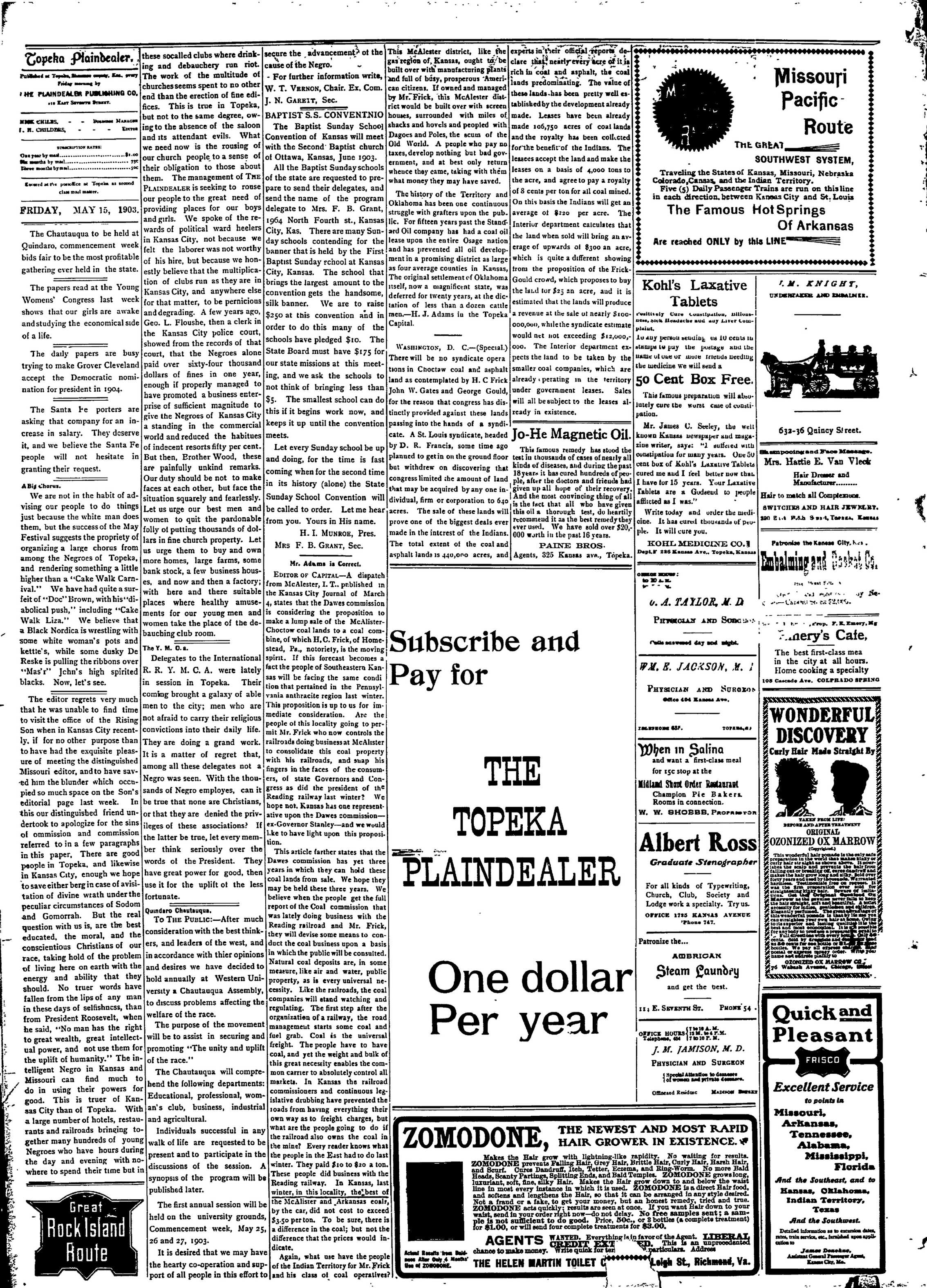
Friday, May 15, 1903
Topeka, Kansas
Page text (machine-generated)
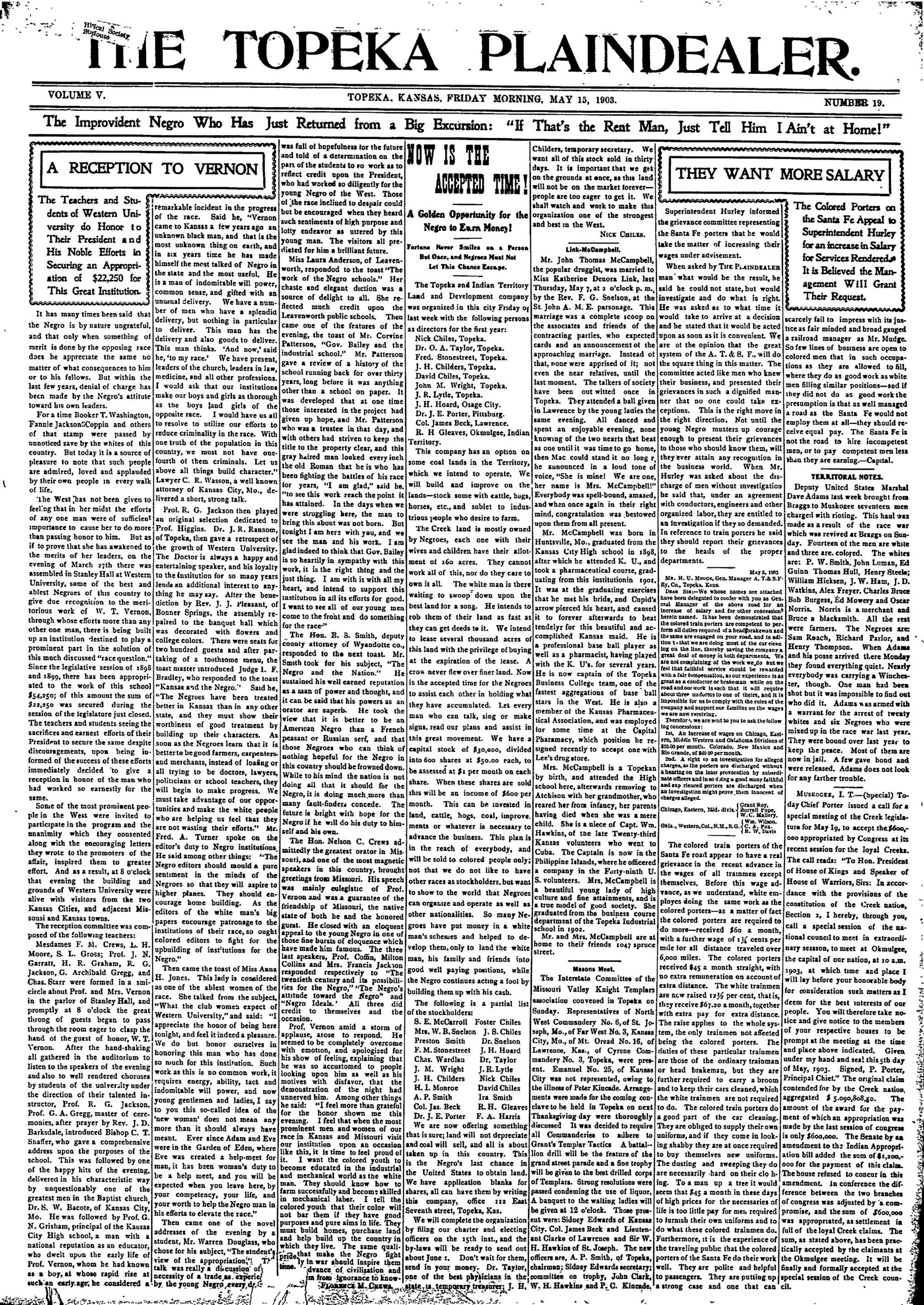
THE TOPEKA PLAINDEALER.
VOLUME V.
The Teachers and Students of Western University do Honor to Their President and His Noble Efforts in Securing an Appropriation of $22,250 for This Great Institution
It has many times been said that the Negro is by nature ungrateful, and that only when something of merit is done by the opposing race does he appreciate the same no matter of what consequences to him or to his fellows. But within the last few years, denial of charge has been made by the Negro's attitude toward his own leaders.
For a time Booker T. Washington, Fannie Jackson SCoppin and others of that stamp were passed by unnoticed save by the whites of this country. But today it is a source of pleasure to note that such people are admired, loved and applauded by their own people in every walk of life.
The West has not been given to feeling that in her midst the efforts of any one man were of sufficient importance to cause her to do more than passing honor to him. But as if to prove that she has awakened to the merits of her leaders, on the evening of March 27th there was assembled in Stanley Hall at Western University, some of the best and ablest Negroes of this country to give due recognition to the meritorious work of W. T. Vernon, through whose efforts more than any other one man, there is being built up an institution destined to play a prominent part in the solution of this much discussed "race question." Since the legislative session of 1898 and 1899, there has been appropriated to the work of this school $54,250; of this amount the sum of $22,250 was secured during the session of the legislature just closed. The teachers and students seeing the sacrifices and earnest efforts of their President to secure the same despite discouragements, upon being informed of the success of these efforts immediately decided to give a reception in honor of the man who had worked so earnestly for the same.
Some of the most prominent people in the West were invited to participate in the program and the unanimity which they consented along with the encouraging letters they wrote to the promoters of the affair, inspired them to greater effort. And as a result, at 8 o'clock that evening the building and grounds of Western University were alive with visitors from the two Kansas Cities, and adjacent Missouri and Kansas towns. The reception committee was composed of the following teachers:
Mesdames F. M. Crews, L. H. Moore, S. L. Gross; Prof. J. N. Garratt, H. R. Graham, R. G. Jackson, G. Archibald Gregg, and Chas. Starr were formed in a smicircle about Prof. and Mrs. Vernon in the parlor of Stanley Hall, and promptly at 8 o'clock the great throng of guests began to pass through the room eager to clasp the hand of the guest of honor, W. T. Vernon. After the hand-shaking all gathered in the auditorium to listen to the speakers of the evening and also to well rendered choruses by students of the university under the direction of their talented instructor, Prof. R. G. Jackson. Prof. G. A. Gregg, master of ceremonies, after prayer by Rev. J. D. Barksdale, introduced Bishop C. T. Shaffer, who gave a comprehensive address upon the purposes of the school. This was followed by one of the happy hits of the evening, delivered in his characteristic way by unquestionably one of the greatest men in the Baptist church, Dr. S. W. Bacote, of Kansas City, Mo. He was followed by Prof. G. N. Grisham, principal of the Kausas City High school, a man with a national reputation as an educator, who dwelt upon the early life of Prof. Vernon, whom he had known as a boy, at whose rapid rise at such an early age he considered a
remarkable incident in the progress of the race. Said he, "Vernon came to Kansas a few years ago an unknown black man, and that is the most unknown thing on earth, and in six years time he has made himself the most talked of Negro in the state and the most useful. He is a man of indomitable will power, common sense, and gifted with an unusual delivery. We have a number of men who have a splendid delivery, but nothing in particular to deliver. This man has the delivery and also goods to deliver. This man thinks. 'And now,' said he, 'to my race.' We have present, leaders of the church, leaders in law, medicine, and all other professions. I would ask that our institutions make our boys and girls as thorough as the boys land girls of the opposite race. I would have us all to resolve to utilize our efforts to reduce criminality in the race. With one truth of the population in this country, we must not have one-fourth of them criminals. Let us above all things build character." Lawyer C. R. Wasson, a well known attorney of Kansas City, Mo., delivered a short, strong talk.
Prof. R. G. Jackson then played an original selection dedicated to Prof. Higgins. Dr. J. R. Ransom, of Topeka, then gave a retrospect of the growth of Western University. The Doctor is always a happy and entertaining speaker, and his loyalty to the institution for so many years lends an additional interest to anything he may say. After the benediction by Rev. J. J. Pleasant, of Bonner Springs, the assembly repaired to the banquet hall which was decorated with flowers and college colors. There were seats for two hundred guests and after partaking of a toothsome menu, the toast master introduced Judge I. F. Bradley, who responded to the toast "Kansas and the Negro." Said he, "The Negroes have been treated better in Kansas than in any other state, and they must show their worthiness of good treatment by building up their characters. As soon as the Negroes learn that it is better to be good farmers, carpenters and merchants, instead of loafing on all trying to be doctor, lawyers, politicians or school teachers, they will begin to make progress. We must take advantage of our opportunities and make the white people who are helping us feel that they are not wasting their efforts." Mr. Fred. A. Turner spoke on the editor's duty to Negro institutions. He said among other things: "The Negro editors should mould a pure sentiment in the minds of the Negroes so that they will aspire to higher planes. They should encourage home building. As the editors of the white man's big papers encourage patronage to the institutions of their race, so ought colored editors to fight for the upbuilding of institutions for the Negro."
Then came the toast of Miss Anna H. Jones. This lady is considered as one of the ablest women of the race. She talked from the subject, "What the club women expect of Western University," and said: "I appreciate the honor of being here tonight, and feel it indeed a pleasure. We do but honor ourselves in honoring this man who has done so much for this institution. Such work as this is no common work, it requires energy, ability, tact and indomitable will power, and now young gentlemen and ladies, I say to you this so-called idea of the 'new woman' does not mean any more than it should always have meant. Ever since Adam and Eve were in the Garden of Eden, where Eve was created a help-meet for man, it has been woman's duty to be a help meet, and you will be expected when you leave here, by your competency, your life, and your worth to help the Negro man in his efforts to elevate the race."
Then came one of the novel addresses of the evening by a student, Mr. Warren Douglass, who chose for his subject, "The student's view of the appropriation." Tralk was really a discussion of necessity of a trade as experience by the young Nerro every day.
TOPEKA, KANSAS, FRIDAY MORNING, MAY 15. 1903.
was full of hopefulness for the future and told of a determination on the part of the students to so work as to reflect credit upon the President, who had worked so diligently for the young Negro of the West. Those of the race inclined to despair could but be encouraged when they heard such sentiments of high purpose and lotty endeavor as uttered by this young man. The visitors all predicted for him a brilliant future.
Miss Laura Anderson, of Leavenworth, respondd to the toast "The work of the Negro schools." Her chaste and elegant diction was a source of delight to all. She reflected much credit upon the Leavenworth public schools. Then came one of the features of the evening, the toast of Mr. Corvine Patterson, "Gov. Bailey and the industrial school." Mr. Patterson gave a review of a history of the school running back for over thirty years, long before it was anything other than a school on paper. It was developed that at one time those interested in the project had given up hope, and Mr. Patterson who was a trustee in that day, and with others had striven to keep the title to the property clear, and this gray haired man looked every inch the old Roman that he is who has been fighting the battles of his race for years, "I am glad," said he, "to see this work reach the point it has attained. In the days when we were struggling here, the man to bring this about was not born. But tonight I am here with you, and we see the man and his work. I am glad indeed to think that Gov. Bailey is so heartily in sympathy with this work, it is the right thing and the just thing. I am with it with all my heart, and intend to support this institution in all its efforts for good. I want to see all of our young men come to the front and do something for the race."
The Hon. B. S. Smith, deputy county attorney of Wyandotte co., responded to the next toast. Mr. Smith took for his subject, "The Negro and the Nation." He sustained his well earned reputation as a man of power and thought, and it can be said that his powers as an orator are superb. He took the view that it is better to be an American Negro than a French peasant or Russian serf, and that those Negroes who can think of nothing hopeful for the Negro in this country should be frowned down. While to his mind the nation is not doing all that it should for the Negro, it is doing much more than many fault-finders concede. The future is bright with hope for the Negro if he will do his duty to himself and his own.
The Hon. Nelson C. Crews admittedly the greatest orator in Missouri, and one of the most magnetic speakers in this country, brought greetings from Missouri. His speech was mainly eulogistic of Prof. Vernon and was a guarantee of the friendship of Missouri, the native state of both he and the honored guest. He closed with an eloquent appeal to the young Negro in one of those fine bursts of eloquence which have made him famous. The three last speakers, Prof. Coffin, Milton Collins and Mrs. Francis Jackson responded respectively to "The twentieth century and its possibilities for the Negro," "The Negro's attitude toward the Negro" and "Negro Ideals." All three did credit to themselves and the occasion.
NOW IS THE ACCEPTED TIME!
A Golden Opportunity for the Negro to Earn Money!
Fortune Never Smiles on a Person
But Oace, and Negroes Must Not
Let This Chance Escape.
The Topeka and Indian Territory Land and Development company was organized in this city Friday op last week with the following persons as directors for the first year:
Nick Chiles, Topeka.
Dr. O. A. Taylor, Topeka.
Fred. Stonestreet, Topeka.
J. H. Childers, Topeka.
David Chiles, Topeka.
John M. Wright, Topeka.
J. R. Lytle, Topeka.
J. H. Hoard, Osage City.
Dr. J. E. Porter, Pittsburg.
Col. James Beck, Lawrence.
R. H Gleaves, Okmulgee, Indian Territory.
This company has an option on some coal lands in the Territory, which we intend to operate. We will build and improve on the lands—stock some with cattle, hogs, horses, etc., and sublet to industrious people who desire to farm.
The Creek land is mostly owned by Negroes, each one with their wives and children have their allotment of 160 acres. They cannot work all of this, nor do they care to own it all. The white man is there waiting to swoop down upon the best land for a song. He intends to rob them of their land as fast as they can get deeds to it. We intend to lease several thousand acres of this land with the privilege of buying at the expiration of the lease. A crow never flew over finer land. Now is the accepted time for the Negroes to assist each other in holding what they have accumulated. Let every man who can talk, sing or make signs, read our plans and assist in this great movement. We have a capital stock of $30,000, divided into 600 shares at $50.00 each, to be assessed at $1 per month on each share. When these shares are sold this will be an income of $600 per month. This can be invested in land, cattle, hogs, coal, improvements or whatever is necessary to advance the business. This plan is in the reach of everybody, and will be sold to colored people only, not that we do not like to have other races as stockholders, but want to show to the world that Negroes can organize and operate as well as other nationalities. So many Negroes have put money in a white man's schemes and helped to develop them, only to land the white man, his family and friends into good well paying positions, while the Negro continues acting a fool by building them up with his cash.
The following is a partial list
of the stockholders:
S. E. McCarroll Foster Chiles
Mrs. W. B. Snelson J. S. Chiles
Preston Smith Dr. Snelson
F. M. Stonestreet J. H. Hoard
Chas. Wardlau Dr. Taylor
J. M. Wright J. R. Lytle
J. H. Childers Nick Chiles
H. I. Monroe David Chiles
A. P. Smith Ira Smith
Col. Jas. Beck R. H. Gleaves
Dr. J. E. Porter F. A. Harris
We are now offering something that is sure; land will not depreciate and coal will sell, and all is about taken up in this country. This is the Negro's last chance in the United States to obtain land. We have application blanks for shares, all can have them by writing this company, office 112 East Seventh street, Topeka, Kas. We will complete the organization by filing our charter and electing officers on the 15th inst., and the by-laws will be ready to send out about June 1. Don't wait for them, send in your money. Dr. Taylor, one of the best physicians in the state is temporary treasurer; J. H.
Childers, temporary secretary. We want all of this stock sold in thirty days. It is important that we get on the grounds at once, as this land will not be on the market forever—people are too eager to get it. We shall watch and work to make this organization one of the strongest and best in the West.
Link-MoCampbell.
Mr. John Thomas McCampbell, the popular druggist, was married to Miss Katherine Denora Link, last Thursday, May 7, at 2 o'clock p. m., by the Rev. F. G. Snelson, at the St. John A. M. E. parsonage. This marriage was a complete scoop on the associates and friends of the contracting parties, who expected cards and an announcement of the approaching marriage. Instead of that, none were apprised of it; not even the near relatives, until the last moment. The talkers of society have been out witted once in Topeka. They attended a ball given in Lawrence by the young ladies the same evening. All danced and spent an enjoyable evening, none knowing of the two hearts that beat as one until it was time to go home, then Mac could stand it no long r, he announced in a loud tone of voice, "She is mine! We are one, her name is Mrs. McCampbell!" Everybody was spell-bound, amazed, and when once again in their right mind, congratulation was bestowed upon them from all present.
Mr. McCampbell was born in Huntsville, Mo., graduated from the Kansas City High school in 1898, after which he attended K. U., and took a pharmaceutical course, graduating from this institution in 1904. It was at the graduating exercises that he met his bride, and Cupid's arrow pierced his heart, and caused it to forever afterwards to beat tendely for this beautiful and accomplished Kansas maid. He is a professional base ball player as well as a pharmacist, having played with the K. U.'s. for several years. He is now captain of the Topeka Business College team, one of the fastest aggregations of base ball stars in the West. He is also a member of the Kansas Pharmaceutical Association, and was employed for some time at the Capital Pharmacy, which position he resigned recently to accept one with Lee's drug store.
Mrs. McCampbell is a Topekan by birth, and attended the High school here, afterwards removing to Atchison with her grandmother, who reared her from infancy, her parents having died when she was a mere child. She is a niece of Capt. Wm. Hawkins, of the late Twenty-third Kansas volunteers who went to Cuba. The Captain is now in the Philippine Islands, where he officered a company in the Forty-ninth U. S. volunteers. Mrs. McCampbell is a beautiful young lady of high culture and fine attainments, and is a true model of good society. She graduated from the business course department of the Topeka Industrial school in 1902.
Mr. and Mrs. McCampbell are at home to their friends 1047 spruce street.
The Interstate Committee of the Missouri Valley Knight Templars association convened in Topeka on Sunday. Representatives of North West Commandery No. 6, of St. Joseph, Mo., of Far West No. 3, Kansas City, Mo., of Mt. Oread No. 16, of Lawrence, Kas., of Cyrene Commandery No. 3, Topeka, were present. Emanuel No. 25, of Kansas City was not represented, owing to the illness of Peter Kincade. Arrangements were made for the coming conclave to be held in Topeka on next Thanksgiving day were thoroughly discussed. It was decided to require all Commanderies to adhere to Grant's Templar Tactics. A battalion drill will be the feature of the grand street parade and a fine trophy will be given to the beat drilled corps of Templars. Strong resolutions were passed condemning the use of liquor. A banquet to the waiting ladies will be given at 12 o'clock. Those present were: Sidney Edwards of Kansas City. Col. James Beck and Lieutenant Clarke of Lawrence and Sir W. H. Hawkins of St. Joseph. The new officers are, A. P. Smith, of Topeka, chairman; Sidney Edwards secretary; committee on trophy, John Clark, W. H. Hawkins and P. C. Kincade.
Superintendent Hurley informed the grievance committee representing the Santa Fe porters that he would take the matter of increasing their wages under advisement.
When asked by THE PLAINDEALER man what would be the result, he said he could not state, but would investigate and do what is right. He was asked as to what time it would take to arrive at a decision and he stated that it would be acted upon as soon as it is convenient. We are of the opinion that the great system of the A. T. & S. F., will do the square thing in this matter. The committee acted like men who knew their business, and presented their grievances in such a dignified manner that no one could take exceptions. This is the right move in the right direction. Not until the young Negro musters up courage enough to present their grievances to those who should know them, will they ever attain any recognition in the business world. When Mr. Hurley was asked about the discharge of men without investigation he said that, under an agreement with conductors, engineers and other organized labor, they are entitled to an investigation if they so demanded. In reference to train porters he said they should report their grievances to the heads of the proper
departments.
May 5, 1903
Mr. H. U. Munge, Gen. Manager A. T. & S.F.
Ry, Co., Topeka, Kans.
DEAR Siepe, We whose names are attached
have been delegated to confer with you as Gen.
General Manager of the above road for an
increase of salary and for other concessions
herein named. It has been demonstrated that
the colored train porters are competent to per-
form all duties required of a headbrakeman and
the same are engaged on your road, and in addi-
tion t. that we are doing most of the car cleaning
on the line, thereby saving the company
great deal of money in both departments. We
are not complaining of the work we do, but we
feel that faithful service should be rewarded
with a fair compensation, as our experience is as
great as a conductor or brakeman while on the
road and our work is such that it will require
about three uniforms to one of theirs, and it is
impossible for us to comply with the rules of the
company and support our families on the wages
we are now receiving.
Therefore, we are sent to you to ask the follow-
ing concessions:
1st. An increase of wages on Chicago, East-
ern, Middle Western and Oklahoma Divisions of
$5.00 per month. Colorado, New Mexico and
Rio grande, of $6.00 per month.
2nd. A right to an investigation for alleged
charges, as the porters are discharged without
a hearing on the least provocation by subj-
direction officers and in so doing a good many faithful
and exp rieled porters are discharged when
an investigation might prove them innocent of
charges alleged.
Chicago, Eastern, Mid. divis. { Grant Roy,
Burrell Pork,
W.C. Mallory.
Oklahoma, Western, Col., N.M., R.G. { Wm. Wilson,
C.A. Fox.
B. W. Davis.
The colored train porters of the Santa Fe road appear to have a real grievance in the recent advance in the wages of all trainmen except themselves. Before this wage advance, as we understand, white employees doing the same work as the colored porters—as a matter of fact the colored porters are required to do more—received $60 a month, with a further wage of 1¼ cents per mile for all distance traveled over 6,000 miles. The colored porters received $45 a month straight, with no extra remuneration on account of extra distance. The white trainmen are now raised 12½ per cent, that is, they receive $67.20 a month, together with extra pay for extra distance. The raise applies to the whole system, the only trainmen not affected being the colored porters. The duties of these particular trainmen are those of the ordinary trainman or head brakeman, but they are further required to carry a broom and to keep their cars cleaned, which the white trainmen are not required to do. The colored train porters do a good part of the car cleaning. They are obliged to supply their own uniforms, and if they come in looking shabby they are at once required to buy themselves new uniforms. The dusting and sweeping they do are necessarily hard on their clothing. To a man up a tree it would seem that $45 a month in these days of high prices for the necessaries of life is too little pay for men required to furnish their own uniforms and to do what these colored trainmen do. Furthermore, it is the experience of the traveling public that the colored porters of the Santa Fe do their work well. They are polite and helpful to passengers. They are putting up a strong case and one that can
NUMBER 19.
The Colored Porters on the Santa Fe Appeal to Superintendent Hurley for an increase in Salary for Services Rendered. It Is Believed the Management Will Grant Their Request.
scarcely fail to impress with its justice as fair minded and broad gauged a railroad manager as Mr. Mudge. So few lines of business are open to colored men that in such occupations as they are allowed to fill, where they do as good work as white men filling similar positions—and if they did not do as good work the presumption is that as well managed a road as the Santa Fe would not employ them at all—they should receive equal pay. The Santa Fe is not the road to hire incompetent men, or to pay competent men less than they are earning.—Capital.
TERRITORAL NOTES.
Deputy United States Marshal Dave Adams last week brought from Braggs to Muskogee seventeen men charged with rioting. This haul was made as a result of the race war which was revived at Braggs on Sunday. Fourteen of the men are white and three are colored. The whites are: P. W. Smith. John Luman, Ed Guinn Thomas Hull, Henry Steele; William Hicksen, J. W. Ham, J. D. Watkins, Alex Frerey. Charles Bruce Bob Burgess, Ed Mowery and Oscar Norris. Norris is a merchant and Bruce a blacksmith. All the rest were farmers. The Negroes are Sam Roach, Richard Parlor, and Henry Thompson. When Adams and his posse arrived there Monday they found everything quiet. Nearly everybody was carrying a Winchester, though. One man had been shot but it was impossible to find out who did it. Adams was armed with a warrant for the arrest of twenty whites and six Negroes who were mixed up in the race war last year. They were bound over last year to keep the peace. Most of them are now in jail. A few gave bond and were released. Adams does not look for any farther trouble.
MUSKOGEE, I. T.—(Special) Today Chief Porter issued a call for a special meeting of the Creek legislature for May 19, to accept the $600,000 appropriated by Congress at its recent session for the loyal Creek. The call reads: "To Hon. President of House of Kings and Speaker of House of Warriors, Sirs: In accordance with the provisions of the constitution of the Creek nation, Section 2, I hereby, through you, call a special session of the national council to meet in extraordinary sesssion, to meet at Okmulgee, the capital of our nation, at 10 a.m. 1903, at which time and place I will lay before your honorable body for consideration such matters as I deem for the best interests of our people. You will therefore take notice and give notice to the members of your respective houses to be prompt at the meeting at the time and place above indicated. Given under my hand and seal this 5th day of May, 1903. Signed, P. Porter, Principal Chief." The original claim contended for by the Creek nation, aggregated $ 5,090,808,60. The amount of the award for the payment of which an appropriation was made by the last session of congress is only $600,000. The Senate by an amendment to the Indian Appropriation bill added the sum of $1,200,000 for the payment of this claim. The house refused to concur in this amendment. In conference the difference between the two branches of congress was adjusted by a compromise, and the sum of $600,000 was appropriated, as settlement in full of the loyal Creek claims. The sum, as stated above, has been practically accepted by the claimants at the Okmulgee meeting. It will be finally and formally accepted at the special session of the Creek council.
The papers read at the Young Womens' Congress last week shows that our girls are awake and studying the economical side of a life.
The daily papers are busy trying to make Grover Cleveland accept the Democratic nomination for president in 1904.
The Santa Fe porters are asking that company for an increase in salary. They deserve it, and we believe the Santa Fe people will not hesitate in granting their request.
We are not in the habit of advising our people to do things just because the white man does them, but the success of the May Festival suggests the propriety of organizing a large chorus from among the Negroes of Topeka, and rendering something a little higher than a "Cake Walk Carnival." We have had quite a surfeit of "Doc" Brown, with his "diabolical push," including "Cake Walk Liza." We believe that a Black Nordica is wrestling with some white woman's pots and kettle's, while some dusky De Reske is pulling the ribbons over "Mas'r" Jchn's high spirited blacks. Now, let's see.
The editor regrets very much that he was unable to find time to visit the office of the Rising Son when in Kansas City recently, if for no other purpose than to have had the exquisite pleasure of meeting the distinguished Missouri editor, and to have saved him the blunder which occupied so much space on the Son's editorial page last week. In this our distinguished friend undertook to apologize for the sins of ommission and commission referred to in a few paragraphs in this paper. There are good people in Topeka, and likewise in Kansas City, enough we hope to save either berg in case of avisitation of divine wrath under the peculiar circumstances of Sodom and Gomorrah. But the real question with us is, are the best educated, the moral, and the conscientious Christians of our race, taking hold of the problem of living here on earth with the energy and ability that they should. No truer words have fallen from the lips of any man in these days of selfishness, than from President Roosevelt, when he said, "No man has the right to great wealth, great intellectual power, and not use them for the uplift of humanity." The intelligent Negro in Kansas and Missouri can find much to do in using their powers for good. This is truer of Kansas City than of Topeka. With a large number of hotels, restaurants and railroads bringing together many hundreds of young Negroes who have hours during the day and evening with no where to spend their time but in
Great
Rock Island
Route
these socalled clubs where drinking and debauchery run riot. The work of the multitude of churches seems spent to no other end than the erection of fine edifices. This is true in Topeka, but not to the same degree, owing to the absence of the saloon and its attendant evils. What we need now is the rousing of our church people to a sense of their obligation to those about them. The management of THE PLAINDEALER is seeking to rouse our people to the great need of providing places for our boys and girls. We spoke of the rewards of political ward heelers in Kansas City, not because we felt the laborer was not worthy of his hire, but because we honestly believe that the multiplication of clubs run as they are in Kansas City, and anywhere else for that matter, to be pernicious and degrading. A few years ago, Geo. L. Floushe, then a clerk in the Kansas City police court, showed from the records of that court, that the Negroes alone paid over sixty-four thousand dollars of fines in one year, enough if properly managed to have promoted a business enterprise of sufficient magnitude to give the Negroes of Kansas City a standing in the commercial world and reduced the habitues of indecent resorts fifty per cent. But then, Brother Wood, these are painfully unkind remarks. Our duty should be not to make faces at each other, but face the situation squarely and fearlessly. Let us urge our best men and women to quit the pardonable folly of putting thousands of dollars in fine church property. Let us urge them to buy and own more homes, large farms, some bank stock, a few business houses, and now and then a factory; with here and there suitable places where healthy amusements for our young men and women take the place of the debauching club room.
Delegates to the International R. R. Y. M. C. A. were lately in session in Topeka. Their coming brought a galaxy of able men to the city; men who are not afraid to carry their religious convictions into their daily life. They are doing a grand work. It is a matter of regret that, among all these delegates not a Negro was seen. With the thousands of Negro employees, can it be true that none are Christians, or that they are denied the privileges of these associations? If the latter be true, let every member think seriously over the words of the President. They have great power for good, then use it for the uplift of the less fortunate.
To THE PUBLIC:After much consideration with the best thinkers, and leaders of the west, and in accordance with thier opinions and desires we have decided to hold annually at Western University a Chautauqua Assembly, to discuss problems affecting the welfare of the race.
The purpose of the movement will be to assist in securing and promoting "The unity and uplift of the race."
The Chautauqua will comprehend the following departments: Educational, professional, woman's club, business, industrial and agricultural. Individuals successful in any walk of life are requested to be present and to participate in the discussions of the session. A synopsis of the program will be published later.
The first annual session will be held on the university grounds, Commencement week, May 25, 26 and 27, 1903. It is desired that we may have the hearty co-operation and support of all people in this effort to
BAPTIST S.S. CONVENTNIO The Baptist Sunday School Convention of Kansas will meet with the Second Baptist church of Ottawa, Kansas, June 1903.
of Ottawa, Kansas, June 1903. All the Baptist Sunday schools of the state are requested to prepare to send their delegates, and send the name of the program delegate to Mrs. F. B. Grant, 1964 North Fourth st., Kansas City, Kas. There are many Sunday schools contending for the banner that is held by the First Baptist Sunday school at Kansas City, Kansas. The school that brings the largest amount to the convention gets the handsome, silk banner. We are to raise $250 at this convention and in order to do this many of the schools have pledged $10. The State Board must have $175 for our state missions at this meeting, and we ask the schools to not think of bringing less than $5. The smallest school can do this if it begins work now, and keeps it up until the convention meets.
Let every Sunday school be up and doing, for the time is fast coming when for the second time in its history (alone) the State Sunday School Convention will be called to order. Let me hear from you. Yours in His name.
H. I. MUNROE, Pres.
MRS F. B. GRANT, Sec.
Mr. Adams is Correct.
EDITOR OF CAPITAL—A dispatch from McAlester, I. T., published in the Kansas City Journal of March 4, states that the Dawes commission is considering the proposition to make a lump sale of the McAlister-Choctow coal lands to a coal combine, of which H. C. Frick, of Homestead, Pa., notoriety, is the moving spirit. If this forecast becomes a fact the people of Southeastern Kansas will be facing the same condition that pertained in the Pennsylvania anthracite region last winter. This proposition is up to us for immediate consideration. Are the people of this locality going to permit Mr. Frick who now controls the railroads doing business at McAlister to consolidate this coal property with his railroads, and snap his fingers in the faces of the consumers, of state Governors and Congress as did the president of the Reading railway last winter? We hope not. Kansas has one representative upon the Dawes commission—ex-Governor Stanley—and we would like to have light upon this proposition.
This article farther states that the Dawes commission has yet three years in which they can hold these coal lands from sale. We hope they may be held these three years. We believe when the people get the full report of the Coal commission that was lately doing business with the Reading railroad and Mr. Frick, they will devise some means to conduct the coal business upon a basis in which the public will be consulted. Natural coal deposits are, in some measure, like air and water, public property, as is every universal necessity. Like the railroads, the coal companies will stand watching and regulating. The first step after the organization of a railway, the road management starts some coal and fuel grab. Coal is the universal freight. The people have to have coal, and yet the weight and bulk of this great necessity enables the common carrier to absolutely control all markets. In Kansas the railroad commissioners and continuous legislative drubbing have prevented the roads from having everything their own way as to freight charges, but what are the people going to do if the railroad also owns the coal in the mine? Every reader knows what the people in the East had to do last winter. They paid $10 to $20 a ton. These people did business with the Reading railway. In Kansas, last winter, in this locality, the best of the McAlister and Arkansas coal; by the car, did not cost to exceed $3.50 per ton. To be sure, there is a difference in the coal; but not the difference that the prices would indicate.
Again, what use have the people of the Indian Territory for Mr. Frick and his class of coal operatives?
Subscribe and Pay for
Makes the Hair grow with lightning-like rapidity. No waiting for results. ZOMODONE prevents Falling Hair, Grey Hair, Brittle Hair, Curly Hair, Harsh Hair, and Scurf. Cures Dandruff, Itch, Tetter, Eczema, and Ring-Worm. No more Bald Heads, Scanty Partings, Splitting Ends, and Bald Temples. ZOMODONE grows long, luxuriant, soft, fine, alky Hair. Makes the Hair grow down to and below the waist line in most every instance in which it is used. ZOMODONE is a direct Hair food, and softens and lengthens the Hair, so that it can be arranged in any style desired. Not a fraud or a fake, to get your money, but an honest remedy, tried and true. ZOMODONE acts quickly; results are seen at once. If you want Hair down to your waist, send in your order right now—do not delay. No free samples sent; a sample is not sufficient to do good. Price, 50c., or 3 bottles (a complete treatment) for $1.00, or will send four complete treatments for $3.00.
AGENTS WANTED. Everything is in favor of the Agent. LIBERAL CREDIT EXT. ED. This is an unprecedented chance to make money. Write quick for ten particulars. Address
THE HELEN MARTIN TOILET C
Leigh St, Richmond, Va.
This McAlester district, like the gas region of, Kansas, ought to be built over with manufacturing plants and full of busy, prosperous American citizens. If owned and managed by Mr. Frick, this McAlester district would be built over with screen houses, surrounded with miles of shacks and hovels and peopled with Dagoes and Poles, the scum of the Old World. A people who pay no taxes, develop nothing but bad government, and at best only return whence they came, taking with them what money they may have saved.
The history of the Territory and Oklahoma has been one continuous struggle with grafters upon the public. For fifteen years past the Standard Oil company has had a coal oil lease upon the entire Osage nation and has prevented all oil development in a promising district as large as four average counties in Kansas, The original settlement of Oklahoma itself, now a magnificent state, was deferred for twenty years, at the dictation of less than a dozen cattle men.—H. J. Adams in the Topeka Capital.
WASHINGTON, D. C.—(Special.) There will be no syndicate operations in Choctaw coal and asphalt land as contemplated by H. C Frick John W. Gates and George Gould, for the reason that congress has distinctly provided against these lands passing into the hands of a syndicate. A St. Louis syndicate, headed by D. R. Francis, some time ago planned to get in on the ground floor but withdrew on discovering that congress limited the amount of land that may be acquired by any one individual, firm or corporation to 640 acres. The sale of these lands will prove one of the biggest deals ever made in the interest of the Indians. The total extent of the coal and asphalt lands is 440,000 acres, and
Subscribe
Pay for
TOP
PLAIND
One
Per
ZOMODO
Actual Results from Build-
ness After Only 4 Months
Use of ZOMOBONE.
experts in their official reports declare that nearly every acre of it is rich in coal and asphalt, the coal lands predominating. The value of these lands has been pretty well established by the development already made. Leases have been already made 106,750 acres of coal lands and the royalty has been collected for the benefit of the Indians. The leasees accept the land and make the leases on a basis of 4,000 tons to the acre, and agree to pay a royalty of 8 cents per ton for all coal mined. On this basis the Indians will get an average of $220 per acre. The Interior department calculates that the land when sold will bring an average of upwards of $300 an acre, which is quite a different showing from the proposition of the Frick-Gould crowd, which proposes to buy the land for $25 an acre, and it is estimated that the lands will produce a revenue at the sale of nearly $100,000,000, while the syndicate estimate would not exceeding $12,000,000. The Interior department expects the land to be taken by the smaller coal companies, which are already operating in the territory under government leases. Sales will all be subject to the leases already in existence.
Jo-He Magnetic Oil
This famous remedy has stood the test in thousands of cases of nearly all kinds of diseases, and during the past 18 years it has cured hundreds of people, after the doctors and friends had given up all hope of their recovery. And the most convincing thing of all is the fact that all who have given this oil a thorough test, do heartily recommend it as the best remedy they ever used. We have sold over $20,000 worth in the past 16 years.
PAINE BROS.
Agents, 325 Kansas ave., Topeka.
Traveling the States of Kansas, Missouri, Nebraska Colorado, Cansas, and the Indian Territory. Five (5) Daily Passenger Trains are run on this line in each direction, between Kansas City and St. Louis The Famous Hot Springs Of Arkansas Are reached ONLY by this LINE
M
R
Traveling the States of Kansas, Colorado, Kansas, and the Indiana Five (5) Daily Passenger in each direction, between The Famous Houses.
Are reached ONLY by the Kohl's Laxative Tablets
Positively Cure Constipation, Billionaires, Sick Headache and any Liver Complaint.
Do any person sending us 10 cents in stamps to pay the postage and the name of one or more friends needing the medicine we will send a 50 Cent Box Free.
This famous preparation will absolutely cure the worst case of constipation.
Mr. James C. Seeley, the well known Kansas newspaper and magazine writer, says: "I suffered with constipation for many years. One 50 cent box of Kohl's Laxative Tablets cured me and I feel better now than I have for 15 years. Your Laxative Tablets are a Godsend to people afflicted as I was."
Write today and order the medicine. It has cured thousands of people. It will cure you.
KOHL MEDICINE CO. 1
Dept. F 226 Kansas Ave., Topeka, Kansas
V. A. TAYLOR, M. D.
PHYSICIAN AND SURGEON
Only answered day and night.
W. M. E. JACKSON, M. I.
PHYSICIAN AND SURGEON
Office 404 Kansas Ave.
When in Salina and want a first-class meal for 15c stop at the Midland Short Order Restaurant Champion Pie Bakers. Rooms in connection. W. W. SHOBBB, PROPRIETOR
Albert Ross
Graduate Stenographer
For all kinds of Typewriting,
Church, Club, Society and
Lodge work a specialty. Try us.
OFFICE 1795 KANAS AVENUE
'Phone 747.
AMBRICAN
Steam Laundry
and get the best.
11; E. SEVENTH ST. PHONE 54
OFFICE HOURS {7 to 10 A.M.
13 M. to 4 P.M.
Telephone, 654 17 to 10 P.M.
J. M. JAMISON, M. D.
PHYSICIAN AND SURGEON
Special Attention to diseases
of women and private diseases.
Office and Residence MADISON BURKE
AND MOST RAPID
ER IN EXISTENCE.
Rapidity. No waiting for results.
Little Hair, Curly Hair, Harsh Hair,
and Ring-Worm. No more Bald
Samples. ZOMODONE grows long,
grows down to and below the waist
ZOMODONE is a direct Hair food,
to be arranged in any style desired.
On honest remedy, tried and true.
If you want Hair down to your
No free samples sent; a sam-
or 3 bottles (a complete treatment)
or $3.00.
flavor of the Agent. LIBERAL
ED. This is an unprecedented
particular. Address
Missouri Pacific Route
GREAT
SOUTHWEST SYSTEM,
Kansas, Missouri, Nebraska
Indian Territory.
Trains are run on this line
Kansas City and St. Louis
Hot Springs
Of Arkansas
s LINE
J. M. KNIGHT,
UNDERTAKER AND ENGRAINER.
---
632-36 Quincy Street.
Shampooing and Face Massage.
Mrs. Hartie E. Van Vleck
Hair Dresser and
Manufacturer.....
Hair to match all Complexions.
SWITCHES AND HAIR JEWELRY.
220 E.14 F.A.H Street, Tampa, Kansas
Patronize the Kanese City, N..
Embalming and Casket Co.
Prop. P. R. Emery, Mg
Anery's Cafe,
The best first-class mea
in the city at all hours.
Home cooking a specialty
105 Cascade Ave. COLPRAADO SPRING
WONDERFUL
DISCOVERY
Curly Hair Made Straight By
TAKEN FROM LIFE:
BEFORE AND AFTER TREATMENT
ORIGINAL
OZONIZED OX MARROW
(Copyrighted.)
This wonderful hair pomade is the only safe preparation in the world that makes kinky or curly hair straight as shown above. It is particularly falling out or breaking off, causes dandruff and makes the hair grow long and silky. Sold over forty years, it is thoroughly approved and harmless. Positionable free on request. It was the first preparation ever sold for straightening kinky hair. Wear of it in OX Marrow as the guarantee never fails to keep the hair straight, soft and beautiful. No toxin or harmful chemicals are involved. Biologically perfumed. The great advantage of this wonderful pomade is that by its use you can straighten hair without further护理 and lasting quality is the best and most economical. It is also possible for anybody to prepare a preparation gently and easily. Sold by dandruff and dermatology and as 50 cents for one bottle or 80 cents for two bottles. Mail postal or express money order. Write your name and address plainly to
OZONIZED OX MARROW CO.
76 Wabash Avenue, Chicago, Illinois
Quick and
Pleasant
FRISCO
Excellent Service
to points in
Missouri,
Arkansas,
Tennessee,
Alabama,
Mississippi,
Florida
And the Southeast, and to
Kansas, Oklahoma,
Indian Territory,
Texas
And the Southwest.
Detailed information as to extension dates,
rates, train service, etc., furnished upon application to
James Donohue,
Assistant General Passenger Agent,
Kansas City, Mo.
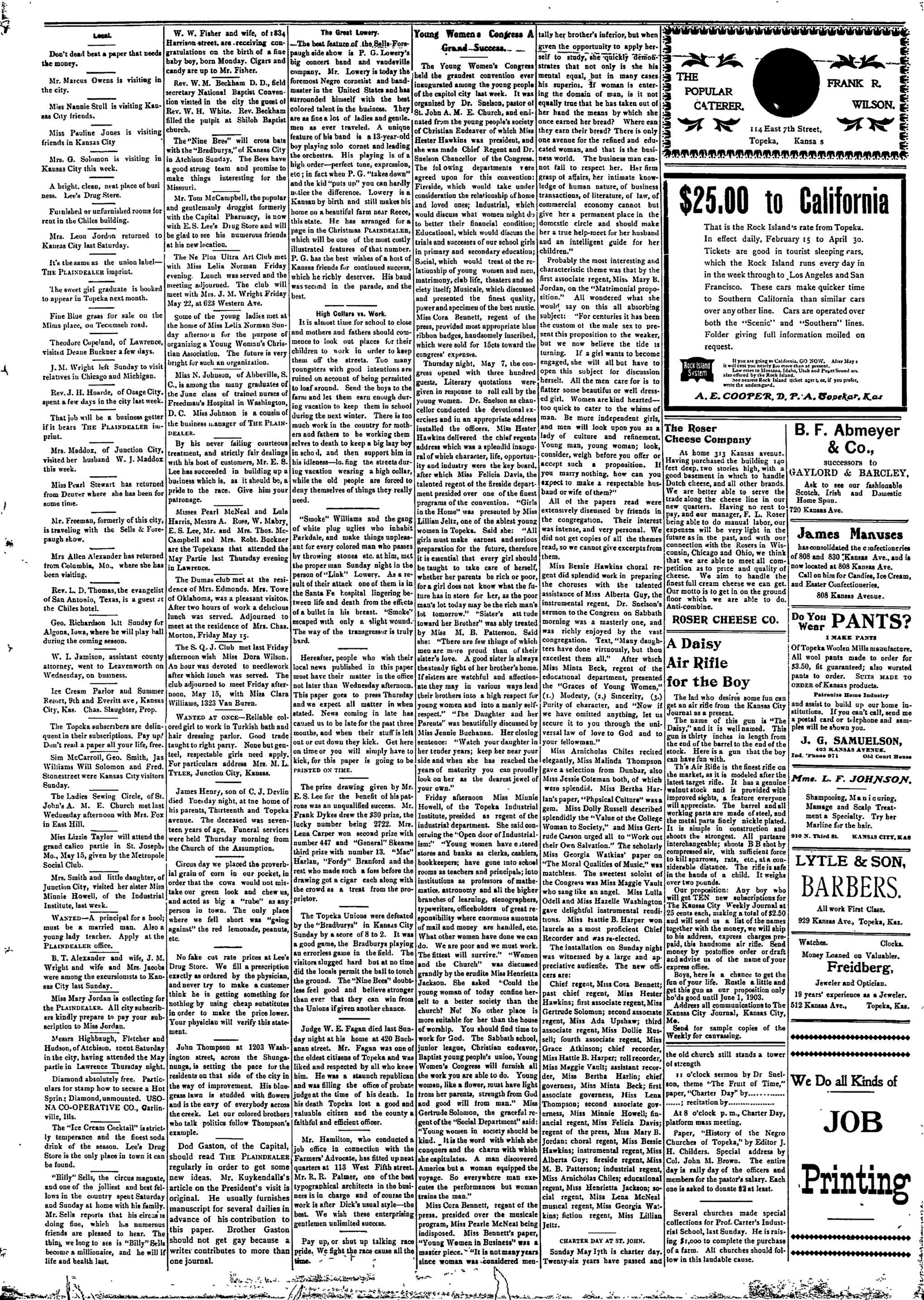
High Collars vs. Work
Friday afternoon Miss Miunie Howell, of the Topeka Industrial Institute, presided as regent of the industrial department. She said concerning the "Open door of Industrialism;" "Young women have entered stores and banks as clerks, cashiers, bookkeepers; have gone into school rooms as teachers and principals; into institutions as professors of mathematics, astronomy and all the higher branches of learning, stenographers, typewriters, officeholders of great responsibility where enormous amounts of mail and money are handled, etc. What other women have done we can do. We are poor and we must work. The fittest will survive." "Women and the Church" was discussed grandly by the erudite Miss Henrietta Jackson. She asked "Could the young woman of today confine herself to a better society than the church? No! No other place is more suitable for her than the house of worship. You should find time to work for God. The Sabbath school, junior league, Christian endeavor, Baptist young people's union, Young Women's Congress will furnish all the work you are able to do. Young women, like a flower, must have light from her parents, strength from God and good will from man." Miss Gertrude Solomon, the graceful regent of the "Social Department" said: "Young women in society should be kind. It is the word with which she conquers and the charm with which she capitulates. A man discovered America but a woman equipped the voyage. So everywhere man executes the performances but woman trains the man."
Miss Bessie Hawkins choral regent did splendid work in preparing the choruses with the talented assistance of Miss Alberta Guy, the instrumental regent. Dr. Snelson's sermon to the Congress on Sabbath morning was a masterly one, and was richly enjoyed by the vast congregation. Text, "Many daughters have done virtuously, but thou excelest them all." After which Miss Minta Beck, regent of the educational department, presented the "Graces of Young Women," (1.) Mudesty, (2.) Sincerity, (3.) Purity of character, and "Now if we have omitted anything, let us secure it to you through the universal law of love to God and to your fellowman."
Miss Arnicholas Chiles recited elegantly, Miss Malinda Thompson gave a selection from Dunbar, also Miss Jessie Coleman both, of which were splendid. Miss Bertha Harlan's paper, "Phpsical Culture" was a gem. Miss Dolly Russell described splendidly the "Value of the College Woman to Society," and Miss Gertrude Carson urged all to "Work out their Own Salvation." The scholarly Miss Georgia Watkins' paper on "The Moral Qualities of Music," was matchless. The sweetest soloist of the Congress was Miss Maggie Vault who sang like an angel. Miss Lulla Odell and Miss Hazelle Washington gave delightful instrumental renditions. Miss hattie B. Harper won laurels as a most proficient Chief Recorder and was re-elected.
Chief regent, Miss Cora Bennett; past chief regent, Miss Hester Hawkins; first associate regent, Miss Gertrude Solomon; second associate regent, Miss Ada Upshaw; third associate regent, Miss Dollie Russell; fourth associate regent, Miss Grace Atkinson; chief recorder, Miss Hattie B. Harper; roll recorder, Miss Maggie Vault; assistant recorder, Miss Bertha Harlin; chief governees, Miss Minta Beck; first associate governess, Miss Lena Thompson; second associate governess, Miss Minnie Howell; financial regent, Miss Felicia Davis; regent of the press, Miss Mary B. Jordan; choral regent, Miss Bessie Hawkins; instrumental regent, Miss Alberta Guy; fireside regent, Miss M. B. Patterson; industrial regent, Miss Arnicholas Chiles; educational regent, Miss Henrietta Jackson; social regent, Miss Lena McNeal musical regent, Miss Georgia Watkins; fiction regent, Miss Lillian Jeltz.
CHARTER DAY AT ST. JOHN.
Sunday May 17th is charter day.
Twenty-six years have passed and
$25.00 to California
Rock Island System
If you are going to Calif. it will cost you nearly $900 more. Low rates to Alaska. It also offered by the Rock Island See nearest Rock Island write the undersigned.
A. E. COOPER, D.
The Roser Cheese Company
At home 313 Kansas avenue. Having purchased the building 140 feet deep, two stories high, with a good basement in which to handle Dutch cheese, and all other brands. We are better able to serve the trade along the cheese line in our new quarters. Having no rent to pay, and our manager, F. L. Roser being able to do manual labor, our expenses will be very light in the future as in the past, and with our connection with the Rosers in Wisconsin, Chicago and Ohio, we think that we are able to meet all competition as to price and quality of cheese. We aim to handle the finest full cream cheese we can get Our motto is to get in on the ground floor which we are able to do Anti-combine.
ROSER CHEESE CO.
A Daisy Air Rifle for the Boy
The lad who desires some fun can get an air rifle from the Kansas City Journal as a present.
The name of this gun is "The Daisy," and it is well named. This gun is thirty inches in length from the end of the barrel to the end of the stock. Here is a gun that the boy can have fun with.
Th's Air Rifle is the finest rifle on the market, as it is modeled after the latest target rifle. It has a genuine walnut stock and is provided with improved sights, a feature everyone will appreciate. The barrel and all working parts are made of steel, and the metal parts finely nickle plated. It is simple in construction and shoots the strongest. All parts are interchangeable; shoots B B shot by compressed air, with sufficient force to kill sparrows, rats, etc., at a considerable distance. The rifle is safe in the hands of a child. It weighs over two pounds.
Our proposition: Any boy who will get TEN new subscriptions for The Kansas City Weekly Journal at 25 cents each, making a total of $2.50 and will send us a list of the names together with the money, we will ship to his address, express charges prepaid, this handsome air rifle. Send money by postoffice or draft and advise us of the name of your express office.
Boys, here is a chance to get the fun of your life. Ruatle a little and get this gun as our proposition only ho'd good until June 1, 1903.
Address all communications to The Kansas City Journal, Kansas City, Me.
Send for sample copies of the Weekly for canvassing.
the old church still stands a tower of st:ength
11 o'clock sermon by Dr Snelson, theme "The Fruit of Time," paper, "Charter Day" by......
;; recitation by......
At 8 o'clock p. m., Charter Day, platform mass meeting.
Paper, "History of the Negro Churches of Topeka," by Editor J. H. Childers. Special address by Col. John M. Brown. The entire day is rally day of the officers and members for the pastor's salary. Each one is asked to donate $2 at least.
Several churches made special collections for Prof. Carter's Industrial School, last Sunday. He is raising $1,000 to complete the purchase of a farm. All churches should follow in this laudable cause.
successors to
GAYLORD & BARCLEY,
Ask to see our fashionable
Scotch, Irish and Domestic
Home Spun.
720 Kansas Ave.
James Manuses
has consolidated the confectioneries of 808 and 830 Kansas Ave., and is now located at 808 Kansas Ave. Call on him for Candies, Ice Cream, and Easter Confectioneries.
Do You Wear PANTS?
I MAKE PANTS
Of Topeka Woolen Mills manufacture.
All wool pants made to order for
$3.50, fit guaranteed; also worsted
pants to order. SUITS MADE TO
ORDER of Kansas products.
Patronize Home Industry
and assist to build up our home
institutions. If you can't call, send me
a postal card or telephone and sam-
ples will be shown you.
J. G. SAMUELSON,
403 KANSAS AVENUE.
Ind. Phone 971 Old Court House
Mme. L. F. JOHNSON.
Shampooing, Manicuring, Massage and Scalp Treatment a Specialty. Try her Marline for the hair.
LYTLE & SON BARBERS.
All work First Class.
929 Kansas Ave., Topeka, Kas.
Watches. Clocks.
Money Loaned on Valuables.
Freidberg,
Jeweler and Optician.
19 years' experience as a Jeweler.
512 Kansas Ave., Topeka, Kas.
We Do all Kinds of
JOB
Printing
Headquarters: 501 Kansas Ave., Room 2 and 3, Topeka, Kas.
WOODNEY CALLOYS
PROTECTION
Society in the U.S. Our society is s to the KNIGHTS AND LADIES MODERN WOODMEN. No int INSURANCE. The protection of our matter of insurance. Good agents was
P.C. T
Headquarters: 501 Kansas Ave.,
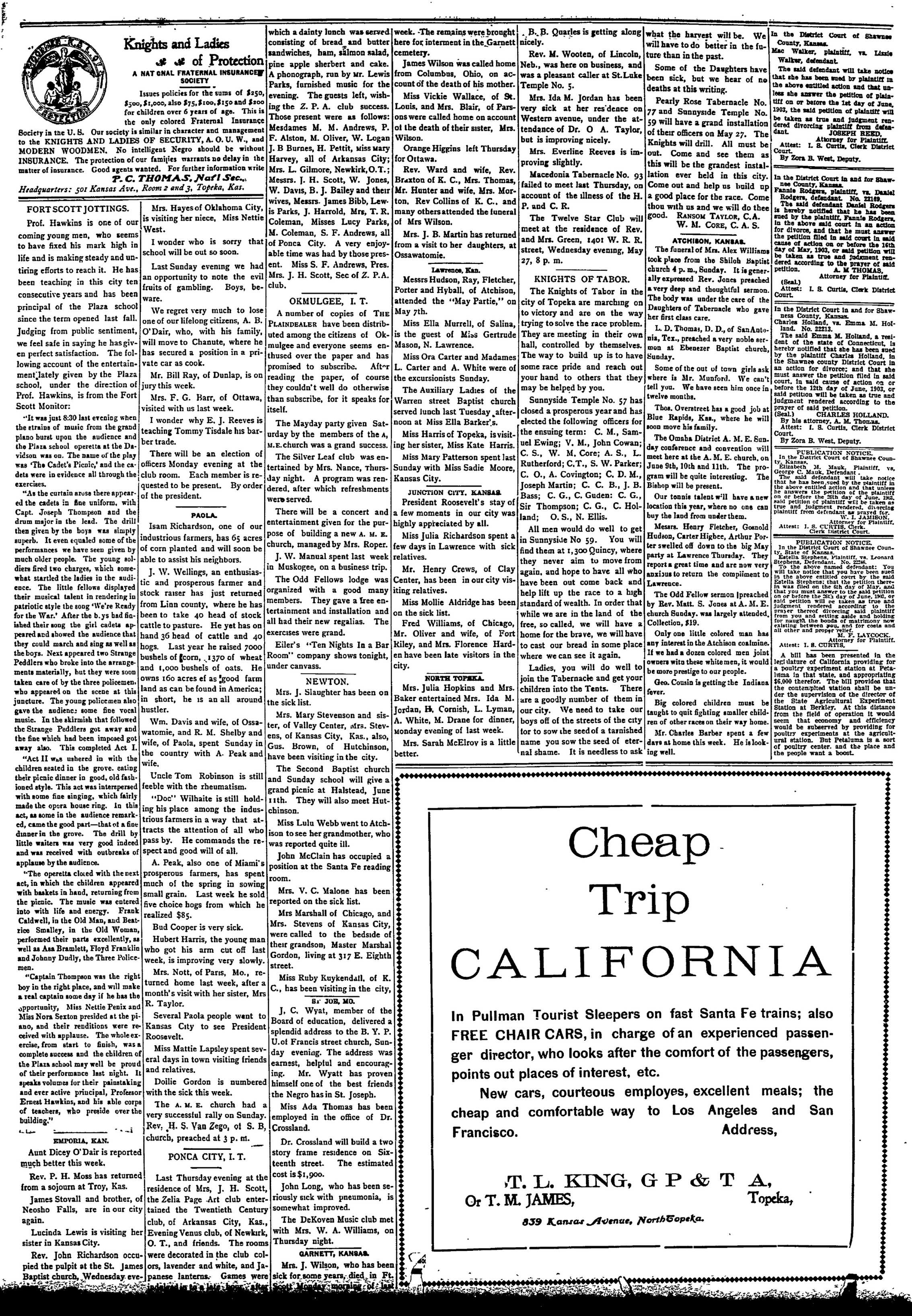
FORT SCOTT JOTTINGS.
Prof. Hawkins is one of our coming young men, who seems to have fixed his mark high in life and is making steady and untiring efforts to reach it. He has been teaching in this city ten consecutive years and has been principal of the Plaza school since the term opened last fall. Judging from public sentiment, we feel safe in saying he has given perfect satisfaction. The following account of the entertainment lately given by the Plaza school, under the direction of Prof. Hawkins, is from the Fort Scott Monitor:
"It was just 8:30 last evening when the strains of music from the grand piano burst upon the audience and the Plaza school operetta at the Davidson was on. The name of the play was 'The Cadet's Picnic,' and the cadets were in evidence all through the exercises.
"As the curtain arose there appeared the cadets in fine uniform, with Capt. Joseph Thompson and the drum major in the lead. The drill then given by the boys was simply superb. It even equaled some of the performances we have seen given by much older people. The young soldiers fired two charges, which somewhat startled the ladies in the audience. The little fellows displayed their musical talent in rendering in patriotic style the song 'We're Ready for the War.' After the boys had finished their song the girl cadets appeared and showed the audience that they could march and sing as well as the boys. Next appeared two Strange Peddlers who broke into the arrangements materially, but they were soon taken care of by the three policemen who appeared on the scene at this juncture. The young policemen also gave the audience some fine vocal music. In the skirmish that followed the Strange Peddlers got away and the fine which had been imposed got away also. This completed Act I.
"Act II was ushered in with the children seated in the grove. eating their picnic dinner in good, old fashioned style. This act was interpersed with some fine singing, which fairly made the opera house ring. In this act, as some in the audience remarked, came the good part—that of a fine dinner in the grove. The drill by little waiters was very good indeed and was received with outbreaks of applause by the audience.
"The operetta closed with the next act, in which the children appeared with baskets in hand, returning from the picnic. The music was entered into with life and energy. Frank Caldwell, in the Old Man, and Beatrice Smalley, in the Old Woman, performed their parts excellently, as well as Asa Bramlett, Floyd Franklin and Johnny Dudly, the Three Policemen.
"Captain Thompson was the right boy in the right place, and will make a real captain some day if he has the opportunity, Miss Nettie Penix and Miss Nora Sexton presided at the piano, and their renditions were received with applause. The whole exercise, from start to finish, was a complete success and the children of the Plaza school may well be proud of their performance last night. It speaks volumes for their painstaking and ever active principal, Professor Ernest Hawkins, and his able corps of teachers, who preside over the building."
Aunt Dicey O'Dair is reported much better this week.
Rev. P. H. Moss has returned from a sojourn at Troy, Kas.
James Stovall and brother, of Neosho Falls, are in our city again.
Lucinda Lewis is visiting her sister in Kansas City.
Rev. John Richardson occupied the pulpit at the St. James Baptist church. Wednesday eve-
PAOLA
Last Thursday evening at the residence of Mrs, J. H. Scott, the Zelia Page Art club entertained the Twentieth Century club, of Arkansas City, Kas., Evening Venus club, of Newkirk, O. T., and friends. The rooms were decorated in the club colors, lavender and white, and Japanese lanterns. Games were indulged in to a late hour after
OKMULGEE, I. T.
number of copies of the INDEALER have been distributed among the citizens of the city and everyone seemed over the paper and rised to subscribe. Using the paper, of course couldn't well do other subscribe, for it speaks to the Mayday party given by the members of the church was a grand success. The Silver Leaf club was named by Mrs. Nance, the night. A program was given, after which refreshments were served.
There will be a concert to attainment given for the proof of building a new A. Rich, managed by Mrs. R. W. Manual spent last week atuskogee, on a business. The Odd Fellows lodged with a good number of peers. They gave a free installation and installation and their new regalias. Cases were grand.
Her's "Ten Nights In A" company shows tonight canvass.
NEWTON.
s. J. Slaughter has been
ck list.
s. Mary Stevenson and
of Valley Center, Mrs.
of Kansas City, Kas.,
In Pullman Tourist Sleepers on fast Santa Fe trains; also FREE CHAIR CARS, in charge of an experienced passenger director, who looks after the comfort of the passengers, points out places of interest, etc.
T. L. KING, G P & T A,
Or T. M. JAMES, Topeka,
839 Kansas Avenue, North Topeka.
Lawrence, Kan.
Mrs Hudson, Ray, K.
and Hyball, of A.
and the "May Par-
son.
Ella Murrell, off-
guest of Miss O.
N. Lawrence.
Ora Carter and M.
Mer and A. White.
Cursionists Sunday.
Auxiliary Ladies.
street Baptist.
unch last Tuesday.
Miss Ella Barker.
Harris of Topeka,
sister, Miss Kate.
Mary Patterson sp.
with Miss Sadie.
City.
ACTION CITY. KANS.
ident Roosevelt's
oments in our o-
appreciated by all.
Julia Richardson's
in Lawrence wi-
s.
Henry Crews, o
has been in our
natives.
Mollie Aldridge h
rick list.
Williams, of O
river and wife, o
and Mrs. Florence
been late visitor.
NORTH TOPKA
Julia Hopkins a
intertained Mrs.
H, Cornish, L.
ie, M. Drane for
evening of last w
Sarah McElroy is
KNIGHTS OF TABOR.
ATCHISON, KANSAS
In the District Court of Shawnee County, Kansas.
se