Plaindealer
Friday, April 7, 1905
Topeka, Kansas
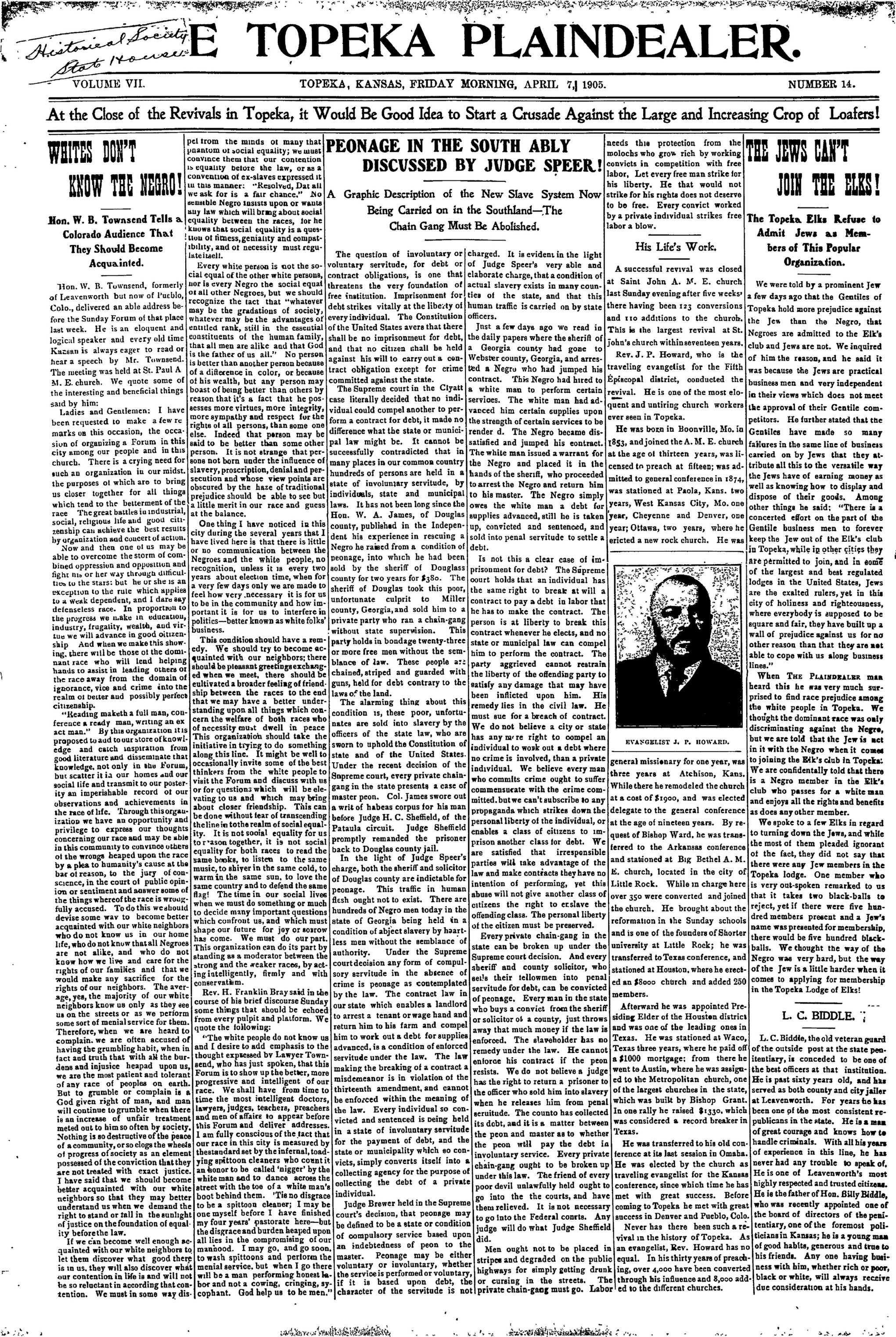
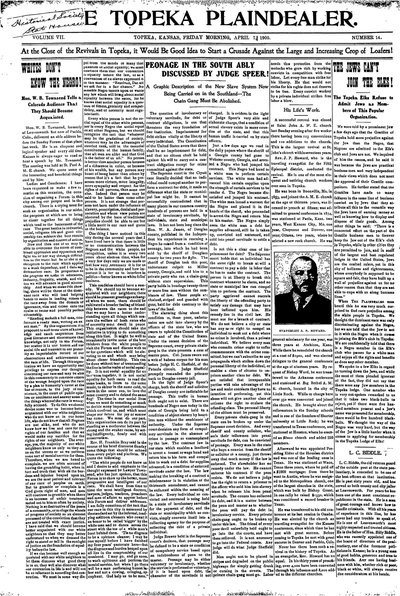
Page text (machine-generated)
TOPEKA PLAINDEALER.
At the Close of the Revivals in Topeka, it Would Be Good Idea to Start a Crusade Against the Large and Increasing Crop of Loafers!
Historical Society State House
VOLUME VII.
WHITES DON'T KNOW THE NEGRO!
Hon. W. B. Townsend Tells a Colorado Audience That They Should Become Acquainted.
Hon. W. B. Townsend, formerly of Leavenworth but now of Pueblo, Colo., delivered an able address before the Sunday Forum of that place last week. He is an eloquent and logical speaker and every old time Kanzan is always eager to read or hear a speech by Mr. Townsend. The meeting was held at St. Paul A. M. E. church. We quote some of the interesting and beneficial things said by him:
Ladies and Gentlemen: I have been requested to make a few remarks on this occasion, the occasion of organizing a Forum in this city among our people and in this church. There is a crying need for such an organization in our midst, the purposes of which are to bring us closer together for all things which tend to the betterment of the race The great battles in industrial, social, religious life and good citizenship can achieve the best results by organization and concert of action.
Now and then one of us may be able to overcome the storm of combined oppression and opposition and fight us or her way through difficulties to the stars: but he or she is an exception to the rule which applies to a weak dependent, and I dare say defenseless race. In proportion to the progress we make in education, industry, frugality, wealth, and virtue we will advance in good citizenship. And when we make this showing, there will be those of the dominant race who will lend helping hands to assist in leading others on the race away from the domain of ignorance, vice and crime into the realm of better and possibly perfect citizenship.
"Reading maketh a full man, conference a ready man, writing an exact man." By this organization it is proposed to aid to our store of knowledge and catch inspiration from good literature and disseminate that knowledge, not only in the Forum, but scatter it in our homes and our social life and transmit to our posterity an imperishable record of our observations and achievements in the race of life. Through this organization we have an opportunity and privilege to express our thoughts concerning our race and may be able in this community to convince others of the wrongs heaped upon the race by a plea to humanity's cause at the bar of reason, to the jury of conscience, in the court of public opinion or sentiment and answer some of the things whereof the race is wroughtly accused. To do this we should devise some wav to become better acquainted with our white neighbors who do not know us in our home life, who do not know that all Negroes are not alike, and who do not know how we live and care for the rights of our families and that we would make any sacrifice for the rights of our neighbors. The average, yes, the majority of our white neighbors know us only as they see us on the streets or as we perform some sort of menial service for them. Therefore, when we are heard to complain, we are often accused of having the grumbling habit, when in fact and truth that with all the burdens and injustice heapad upon us, we are the most patient and tolerant of any race of peoples on earth. But to grumble or complain is a God given right of man, and man will continue to grumble when there is an increase of unfair treatment meted out to him so often by society. Nothing is so destructive of the peace of a community, or so clogs the wheels of progress of society as an element possessed of the conviction that they are not treated with exact justice. I have said that we should become better acquainted with our white neighbors so that they may better understand us when we demand the right to stand or fall in the sunlight of justice on the foundation of equality before the law.
If we can become well enough acquainted with our white neighbors to let them discover what good there is in us, they will also discover what our contention in life is and will not be so reluctant in according that contention. We must in some way dis-
TOPEKA, KANSAS, FRIDAY MORNING, APRIL 7,] 1905.
pel from the minds of many that phantom of social equality; we must convince them that our contention is equality before the law, or as a convention of ex-slaves expressed it in this manner: "Resolved, Dat all we ask for is a fair chance." No sensible Negro insists upon or wants any law which will bring about social equality between the races, for he knows that social equality is a question of fitness, geniality and compatibility, and of necessity must regulate itall.
Every white person is not the social equal of the other white persons, nor is every Negro the social equal of all other Negroes, but we should recognize the tact that "whatever may be the gradations of society, whatever may be the advantages of entitled rank, still in the essential constituents of the human family, that all men are alike and that God is the father of us all." No person is better than another person because of a difference in color, or because of his wealth, but any person may boast of being better than others by reason that it's a fact that he possesses more virtues, more integrity, more sympathy and respect for the rights of all persons, than some one else. Indeed that person may be said to be better than some other person. It is not strange that persons not born under the influence of slavery, proscription, denial and persecution and whose view points are obscured by the haze of traditional prejudice should be able to see but a little merit in our race and guess at the balance.
One thing I have noticed in this city during the several years that I have lived here is that there is little or no communication between the Negroes and the white people, no recognition, unless it is every two years about election time, when for a very few days only we are made to feel how very necessary it is for us to be in the community and how important it is for us to interfere in politics—better known as white folks' business.
This condition should have a remedy. We should try to become acquainted with our neighbors; there should be pleasant greetings exchanged when we meet, there should be cultivated a broader feeling of friendship between the races to the end that we may have a better understanding upon all things which concern the welfare of both races who of necessity must dwell in peace. This organization should take the initiative in trying to do something along this line. It might be well to occasionally invite some of the best thinkers from the white people to visit the Forum and discuss with us or for questions which will be elevating to us and which may bring about closer friendship. This can be done without fear of transcending the line in tothe realm of social equality. It is not social equality for us to reason together, it is not social equality for both races to read the same books, to listen to the same music, to shiver in the same cold, to warm in the same sun, to love the same country and to defend the same flag! The time in our social lives when we must do something or much to decide many important questions which confront us, and which must shape our future for joy or sorrow has come. We must do our part. This organization can do its part by standing as a moderator between the strong and the weaker races, by acting intelligently, firmly and with conservatism.
Rev. H. Franklin Bray said in the course of his brief discourse Sunday some things that should be echoed from every pulpit and platform. We quote the following:
"The white people do not know us and I desire to add emphasis to the thought expressed by Lawyer Townsend, who has just spoken, that this Forum is to show up the better, more progressive and intelligent of our race. We shall have from time to time the most intelligent doctors, lawyers, judges, teachers, preachers and men of affaire to appear before this Forum and deliver addresses. I am fully conscious of the fact that our race in this city is measured by the standard set by the infernal, toadying spittoon cleaners who count it an honor to be called 'nigger' by the white man and to dance across the street with the toe of a white man's boot behind them. 'Tis no disgrace to be a spittoon cleaner; I may be one myself before I have finished my four years' pastorate here—but the disgrace and burden heaped upon all lies in the compromising of our manhood. I may go, and go soon, to wash spittoons and perform the menial service, but when I go there will be a man performing honest labor and not a cowing, cringing, sycophant. God help us to be men."
2024年1月1日星期日
PEONAGE IN THE SOUTH ABLY DISCUSSED BY JUDGE SPEER!
PEONAGE IN THE SOUTH ABLY DISCUSSED BY JUDGE SPEER!
A Graphic Description of the New Slave System Now Being Carried on in the Southland-The Chain Gang Must Be Abolished.
The question of involuntary or voluntary servitude, for debt or contract obligations, is one that threatens the very foundation of free institution. Imprisonment for debt strikes vitally at the liberty of every individual. The Constitution of the United States avers that there shall be no imprisonment for debt, and that no citizen shall be held against his will to carry out a contract obligation except for crime committed against the state.
The Supreme court in the Clyatt case literally decided that no individual could compel another to perform a contract for debt, it made no difference what the state or municipal law might be. It cannot be successfully contradicted that in many places in our common country hundreds of persons are held in a state of involuntary servitude, by individuals, state and municipal laws. It has not been long since the Hon. W. A. James, of Douglas county, published in the Independent his experience in rescuing a Negro he raised from a condition of peonage, into which he had been sold by the sheriff of Douglas county for two years for $380. The sheriff of Douglas took this poor, unfortunate culprit to Miller county, Georgia, and sold him to a private party who ran a chain-gang without state supervision. This party holds in bondage twenty-three or more free men without the semblance of law. These people are chained, striped and guarded with guns, held for debt contrary to the laws of the land.
The alarming thing about this condition is, these poor, unfortunates are sold into slavery by the officers of the state law, who are sworn to uphold the Constitution of state and of the United States. Under the recent decision of the Snpreme court, every private chaining in the state presents a case of master peon. Col. James swore out a writ of habeas corpus for his man before Judge H. C. Sheffield, of the Pataula circuit. Judge Sheffield promptly remanded the prisoner back to Douglas county jail.
In the light of Judge Speer's charge, both the sheriff and solicitor of Douglas county are indictable for peonage. This traffic in human flesh ought not to exist. There are hundreds of Negro men today in the state of Georgia being held in a condition of abject slavery by heartless men without the semblance of authority. Under the Supreme court decision any form of compulsory servitude in the absence of crime is peonage as contemplated by the law. The contract law in our state which enables a landlord to arrest a tenant or wage hand and return him to his farm and compel him to work out a debt for supplies advanced, is a condition of enforced servitude under the law. The law making the breaking of a contract a misdemeanor is in violation of the thirteenth amendment, and cannot be enforced within the meaning of the law. Every individual so convicted and sentenced is being held in a state of involuntary servitude for the payment of debt, and the state or municipality which so convicts, simply converts itself into a collecting agency for the purpose of collecting the debt of a private individual.
Judge Brewer held in the Supreme court's decision, that peonage may be defined to be a state or condition of compulsory service based upon an indebtedness of peon to the master. Peonage may be either voluntary or involuntary, whether the service is performed or voluntary, if it is based upon debt, the character of the servitude is not
charged. It is evident in the light of Judge Speer's very able and elaborate charge, that a condition of actual slavery exists in many counties of the state, and that this human traffic is carried on by state officers.
Just a few days ago we read in the daily papers where the sheriff of a Georgia county had gone to Webster county, Georgia, and arrested a Negro who had jumped his contract. This Negro had hired to a white man to perform certain services. The white man had advanced him certain supplies upon the strength of certain services to be render d. The Negro became dissatisfied and jumped his contract. The white man issued a warrant for the Negro and placed it in the hands of the sheriff, who proceeded to arrest the Negro and return him to his master. The Negro simply owes the white man a debt for supplies advanced, still he is taken up, convicted and sentenced, and sold into penal servitude to settle a debt.
Is not this a clear case of imprisonment for debt? The Supreme court holds that an individual has the same right to break at will a contract to pay a debt in labor that he has to make the contract. The person is at liberty to break this contract whenever he elects, and no state or municipal law can compel him to perform the contract. The party aggrieved cannot restrain the liberty of the offending party to satisfy any damage that may have been inflicted upon him. His remedy lies in the civil law. He must sue for a breach of contract. We do not believe a city or state has any more right to compel an individual to work out a debt where no crime is involved, than a private individual. We believe every man who commits crime ought to suffer commensurate with the crime committed, but we can't subscribe to any propaganda which strikes down the personal liberty of the individual, or enables a class of citizens to imprison another class for debt. We are satisfied that irresponsible parties will take advantage of the law and make contracts they have no intention of performing, yet this abuse will not give another class of citizens the right to enslave the offending class. The personal liberty of the citizen must be preserved.
Every private chain-gang in the state can be broken up under the Supreme court decision. And every sheriff and county solicitor, who sells their tellowmen into penal servitude for debt, can be convicted of peonage. Every man in the state who buys a convict from the sheriff or solicitor of a county, just throws away that much money if the law is enforced. The slaveholder has no remedy under the law. He cannot enforce his contract if the peon resists. We do not believe a judge has the right to return a prisoner to the officer who sold him into slavery when he releases him from penal servitude. The counto has collected its dobt, and it is a matter between the peon and master as to whether the peon will pay the debt in involuntary service. Every private chain-gang ought to be broken up under this law. The friend of every poor devil unlawfully held ought to go into the the courts, and have them relieved. It is not necessary to go into the Federal courts. Any judge will do what Judge Sheffield did.
Men ought not to be placed in stripes and degraded on the public highways for simply getting drunk or cursing in the streets. The private chain-gang must go. Labor
needs this protection from the molochs who grow rich by working convicts in competition with free labor. Let every free man strike for his liberty. He that would not strike for his rights does not deserve to be free. Every convict worked by a private individual strikes free labor a blow.
His Life's Work.
A successful revival was closed at Saint John A. M. E. church last Sunday evening after five weeks there having been 123 conversions and 110 additions to the church. This is the largest revival at St. John's church within seventeen years. Rev. J. P. Howard, who is the traveling evangelist for the Fifth Episcopal district, conducted the revival. He is one of the most eloquent and untiring church workers ever seen in Topeka.
He was born in Boonville, Mo. in 1853, and joined the A. M. E. church at the age of thirteen years, was licensed to preach at fifteen; was admitted to general conference in 1874, was stationed at Paola, Kans. two years, West Kansas City, Mo. one year, Cheyenne and Denver, one year; Ottawa, two years, where he erected a new rock church. He was
M.
EVANGELIST J. P. HOWARD.
general missionary for one year, was three years at Atchison, Kans. While there he remodeled the church at a cost of $1900, and was elected delegate to the general conference at the age of nineteen years. By request of Bishop Ward, he was transferred to the Arkansas conference and stationed at Big Bethel A. M. E. church, located in the city of Little Rock. While in charge here over 350 were converted and joined the church. He brought about the reformation in the Sunday schools and is one of the founders of Shorter university at Little Rock; he was transferred to Texas conference, and stationed at Houston, where he erected an $8000 church and added 250 members.
Afterward he was appointed Presiding Elder of the Houston district and was one of the leading ones in Texas. He was stationed at Waco, Texas three years, where he paid off a $1000 mortgage; from there he went to Austin, where he was assigned to the Metropolitan church, one of the largest churches in the state, which was built by Bishop Grant. In one rally he raised $1330, which was considered a record breaker in Texas.
He was transferred to his old conference at its last session in Omaha. He was elected by the church as traveling evangelist for the Kansas conference, since which time he has met with great success. Before coming to Topeka he met with great success in Denver and Pueblo, Colo. Never has there been such a revival in the history of Topeka. As an evangelist, Rev. Howard has no equal. In his thirty years of preaching, over 4,000 have been converted through his influence and 8,000 added to the different churches.
NUMBER 14.
The Topeka Elks Refuse to Admit Jews as Members of This Popular Organization.
We were told by a prominent Jew a few days ago that the Gentiles of Topeka hold more prejudice against the Jew than the Negro, that Negroes are admitted to the Elk's club and Jews are not. We inquired of him the reason, and he said it was because the Jews are practical business men and very independent in their views which does not meet the approval of their Gentile competitors. He further stated that the Gentiles have made so many failures in the same line of business carried on by Jews that they attribute all this to the versatile way the Jews have of earning money as well as knowing how to display and dispose of their goods. Among other things he said: "There is a concerted effort on the part of the Gentile business men to forever keep the Jew out of the Elk's club in Topeka, while in other cities they are permitted to join, and in some of the largest and best regulated lodges in the United States, Jews are the exalted rulers, yet in this city of holiness and righteousness, where everybody is supposed to be square and fair, they have built up a wall of prejudice against us for no other reason than that they are not able to cope with us along business lines."
When THE PLAINDEALER man heard this he was very much surprised to find race prejudice among the white people in Topeka. We thought the dominant race was only discriminating against the Negro, but we are told that the Jew is act in it with the Negro when it comes to joining the Elk's club in Topeka: We are confidently told that there is a Negro member in the Elk's club who passes for a white man and enjoys all the rights and benefits as does any other member.
We spoke to a few Elks in regard to turning down the Jews, and while the most of them pleaded ignorant of the fact, they did not say that there were any Jew members in the Topeka lodge. One member who is very out-spoken remarked to us that it takes two black-balls to reject, yet if there were five hundred members present and a Jew's name was presented for membership, there would be five hundred black-balls. We thought the way of the Negro was very hard, but the way of the Jew is a little harder when it comes to applying for membership in the Topeka Lodge of Elks!
L. C. BIDDLE.
L. C. Biddle, the old veteran guard of the outside post at the state penitentiary, is conceded to be one of the best officers at that institution. He is past sixty years old, and has served as both county and city jailer at Leavenworth. For years he has been one of the most consistent republicans in the state. He is a man of great courage and knows how to handle criminals. With all his years of experience in this line, he has never had any trouble to speak of. He is one of Leavenworth's most highly respected and trusted citizens. He is the father of Hon. Billy Biddle, who was recently appointed one of the board of directors of the penitentiary, one of the foremost politicians in Kansas; he is a young man of good habits, generous and true to his friends. Any one having business with him, whether rich or poor black or white, will always receive due consideration at his hands.
HORTICULTURE Subsoil for Fruit Trees.
On the subsoll depends a great deal. The tree that is planted over an impervious subsoll may do well if it is on a side-hill that will permit the water to run off through the soil that lies above the subsoll. But on other kinds of land the subsoll, if impervious, will cause the trees to grow slowly and bear fruit lightly. Bad drainage and impervious subsills largely go together. We have seen land that was friable on top and down a little way was composed of a layer of stones and clay so closely intermixed that it almost seemed that a great fire had melted them and they had run together. If such subsoll cannot be improved it is better to put the fruit trees in some other place.
The surest way to improve the subsoil is by drainage. That lowers the water table in the soil in winter and lets the frost in to pulverize the ground. Where the land is undrained the water table protects all the soil below it from the action of frost. We have known of clay soils through which the drains were dug to a depth of four feet. For a year or two it did not seem to make much difference with the general character of the soil, for the frost had not had time to work. But after the frost for two or three winters had got in to the soil the whole character of the ground seemed to be changed.
For the growing of apple trees especially it is best to select land where the subsoll is already in right condition, so that the roots may go down several feet if necessary. This makes it easy for the tree to send its roots deeply and to get down into a moist layer of soil. Trees in such locations stand drouth well and show green leav when all things else seem to be ing brown with drouth.
Leaving the Tree to Nature.
Every once in awhile we find a man that believes in leaving fruit trees alone, permitting nature to do as she wishes to with them. He generally says that the sprouts on trees, especially the water sprouts should not be cut off. We think that if this man had to raise grapes he would get very few of them.
Nature does not have to be fed and clothed, and therefore is not concerned with increasing the fruitfulness of trees and plants beyond the point where they will propagate themselves. But man has greater needs and forces the tree and plants to stop producing in one direction and go to producing in another. The great fruitfulness of trees cared for by man is merely due to the diversion of growth forces from one direction to another. A tree that is planted and cared for by man does not take in more nourishment than does another tree that is left to the direction of nature. But the nourishment that is taken in is made to go into the formation of things man can eat rather than into the formation of wood and leaves, which he cannot eat.
The Creator has placed in the hands of man the power of directing the processes of nature to a considerable extent. Man prunes a tree only to make it expend its energies in the fruit buds and so gives him more fruit. We should not leave things to nature, for in the main nature cares nothing for us. There is no moral reason why man should follow the leadings of nature. His own intelligence is not a thing to be lightly set aside.
Garden Pointers
In removing the tops before storing be careful not to cut too closely. Decay might result.
Put the beets, parsnips, carrots, etc., in a cool cellar in boxes with sand and moist earth between them.
The above way is especially suited for cabbage and turnips. Apples, too, can be kept well by the method.
Celery in process of blanching is less likely to decay if the leaves are exposed to the air and sunlight in mild weather. Loss frequently occurs from too close covering.
A mulch of manure on the raspberry patch is good for next season's crop, but it should not be so heavy near the plants as to furnish a harbor for field mice, beneath which they can dig down and eat the roots.
This is a good time to sow some lettuce seed in the cold frame and start a few bunches of parsley in the frame or the kitchen window. It will not be much trouble to arrange for a good supply of fresh vegetables in the winter.
Bees Useful to Farmers.
The great value and usefulness of the common honey bee on the farm has been tersely put by Prof. W. P. Hedrick of the agricultural college of Michigan. He says: The fruit grower who complains of bees is an ungrateful wretch. At best fair exchange is no rbberbery, but the bees take nothing. A crop of honey removes no fertility from the soil, no substance nor flavor from the fruit, nor even the fragrance from the flower. Multitudes of bees may store their hives with "choiceely called sweets" from your orchard, and you may take it and feast yourself on the apple-blossom flavored honey, or you may sell it for dollars and cents, yet neither your trees nor your farm is the loser by one penny's worth. If the bees take a little toll from the fruit, what of it? Should they not be repaid for officiating at the nuptials of your fruit blossoms. But do they take toll?
FARM MISCELLANY
A Remedy for Dodder.
We have had a number of letters from farmers who have unfortunately sowed dodder with their clover or alfalfa seed, asking how it may be destroyed without at the same time destroying the crop. We have not been able to suggest any method. We notice, however, that M. Baille has written an article as early as 1901 in the Horticultural Review of France in which he suggests that it may be absolutely destroyed by an application of powered sulphate of iron to the soil. This destroys not only the dodder, but also the plant. The tap roots, however, maintain their vitality and throw up a new growth.
Hoard's Dalryman suggests a cheaper and more effective substitute for the sulphate of iron in the refuse material used for purifying coal gas. This mixture is said to be composed of sixty-six pounds of sulphate of iron and one-third of a bushel of quick lime in half a bushel of sawdust. It would be worth while to try this. Unfortunately, we have no information as to how much of the sulphate of iron or the refuse mixture should be used per acre. As dodder is usually found only in patches and as there is no special hurry about making the application until the dodder commences seeding, one could spend some time in ascertaining by experiment the proper amount needed to do the business.
Profits From Apple Growing.
A New York state farmer says he gets more profit from his 20 acre orchard than from all his 145 acres besides. The average is about $1,000, or at the rate of $50 an acre, and the purchaser gathers and packs the fruit. His only expense is for fertilizing, spraying and pruning.
Many sections in this state are as well adapted to orcharding as any in New York, and no good reason can be given why more of our farmers should not engage in the business, in a commercial way. An exchange gives an account of less than two acres that gave over $100 net profit the present year; although the cost of caring for the trees, gathering and marketing the fruit, rental value of land, etc., amount to $40 or more. The owner sprays thoroughly, and covers the ground with blue grass and clover, which he mows once or twice each season, and leaves on the ground as a mulch and fertilizer. What better use can the farmer put his rough ground to than an apple orchard treated in this way. After 10 or 12 years if will pay him better than a like space in any of the field crops, several times over.
Washing Milk Utensils.
Milk utensils should be washed first in tepid water, and a good stiff brush should be kept handy for the purpose of scrubbing at this stage of the cleansing operations. Soda dissolved in warm water greatly helps matters at this time, especially if the milk utensils have stood dirty for some time. In bottling plants where the bottles come back with milk stuck to them that has been there for a day or so the bottles are soaked in water for several hours, soda having been first dissolved in the water. In the brightening of such vessels, salt is one of the best things to be used for scouring. In the cleansing of milk vessels, cloths should be avoided, and they should certainly never be used to wipe the vessels dry with. They are likely to contain too many germs to make their use safe. These germs will be for the most part of lactic acid ferments, those naturally found in milk and harmless, but they will start the new milk to souring, which of course is to be avoided in most cases.
Healthy Hog.
If the hog is in good, healthy growing condition his voidings are a sure index to that fact. When the droppings become hard and black it is a danger signal that trouble is at hand unless averted. Hogs need at all times plenty of range for exercise to strengthen the muscles and bones to develop growth.
The more a hog will eat and properly digest the greater will be the gain. Only feed to them what they will eat up clean, as overfeeding is not only wasteful, but injurious. Observe strict cleanliness in the troughs, especially where slop is fed, or they will become sour and foul-smelling and offensive, creating disorders of the stomach and system. Overfeeding leads to indigestion, in which condition hogs eat without the food doing them any apparent food, neither growing or gaining—American Swineherd.
Hens and Pullets
Hens often have diarrhoea from being fed too fattening a diet. This may occur when they are fed with the pullets; pullets do well and lay well on a diet which would take an old hen off her feed. This is because the pullet has to grow bone, meat, feathers, and eggs, and can use a large quantity of food. The droppings should be watched. Where there is a watery discharge streaked with more or less blood the ailing bird should be separated from the balance of the flock and given range. Put tincture of iron or a handful of old nails in the drinking water and feed dry grain, mostly wheat. Hens that are known to be laying should be fed apart from the older birds that are kept over ice breeders. They will lay on fat with the surplus food which their sisters are turning into eggs.
PARSONS, KANS.
An old resident of the city, Mrs. Westbrook, died recently.
Mrs. A. A. Glass left Sunday morning for Clinton and Appleton City, Mo., where she will visit relatives.
Woodie Grimes has joined the Ninth cavalry, now located at Fort Riley.
Earl Bradshaw visited his home in St. Paul last week.
The members of the New Hope Baptist church served dinner and refreshments last Tuesday.
Little Lena Allen is now making her home with B. Taylor and wife.
Walter Glass, who has been working at Strasburger's dry goods department for some time, is now located in the barber shop with his father.
ST. JOSEPH, MO.
A large and appreciative, idulence greeted J. Mord, Allen and Mrs. J. M. Wright at the A. M. E. church Thursday evening. Mr. Allen's humorous selections were greatly enjoyed. Mrs. Wright is by no means a stranger to the people of St. Joe, and her coming was looked forward to with much interest. She has a one mezzo-soprano voice and is one of the sweetest singers it has been our pleasure to hear. She is a graduate of Washburn school of fine arts.
Mrs. James Crews of Kansas City is in the city with a view to teaching millinery to the ladies of the race. She has the promise of quite a large class, and will give instruction at A. M. E. parsonage, where she is the guest of Mrs. J. C Caldwell.
The Study club met with Mrs. Joe Smothers Saturday. The lesson in literature was conducted by Mrs. J. Crews of Kansas City, who was a visitor the club. Mrs. J. N. Oliver led the history.
Mrs. Morns, the aged mother of Mrs. R. L. Scott, is still very ill at the home of the latter.
Miss Anna Harns of Kansas City is visiting relatives in the city.
The Social Pleasure club was entertained at the residence of Henry Grayson Tuesday evening.
Dr. Stewart left this week for Kansas City, where he will locate.
Mrs. J. M. Wright was the guest of Mrs. H. H. Walker during her stay here.
The High school orchestr will give a concert at A. M. E. church April 13th.
Miss May McDaniel and William Tinley were married in Atchison last Sunday at the home of the bride's mother by the Rev. M. S. Jones. They will live in St. Joseph.
SHERIFF'S SALE.
No. 20569.
In the District Court of Shawnee County, Kansas.
J. T. Ewing, Plaintiff.
C. H. Nagle. Defendant.
By virtue of an execution issued to me, out of said District Court, in the above-entitled action, I will, on Wednesday, the 3rd day of May, A. D. 1905, at 10 o'clock A. M., of said day, at the east front door of the Court Houee in the City of Topeka, in the County of Shawnee, in the State of Kansas, offer at public sale, and sell to the highest and best bidder, for cash in hand, all the following-described real estate, to-wit: Lots 339 to 351 inclusive on Michigan Avenue, in Jenkin W. Morris' Addition to the City of Topeka, lying and situate in the County of Shawnee, in the State of Kansas.
The above-described real estate is taken as the property of said defendant, and is directed by said execution to be sold, and will be sold without appraisement, to satisfy said execution.
A. T. Lucas,
Sheriff of Shawnee County, Kansas.
By J. A. OSTRAND, Deputy.
W. S. McCLINTOCK, Attorney.
Mr. M. L. Walker, agent for THE PLAINDEALER at Muskogee, Indian Territory, can always be found at the general merchandise establishment of J. W Adams, 22 W. Okmulgee.
FLL
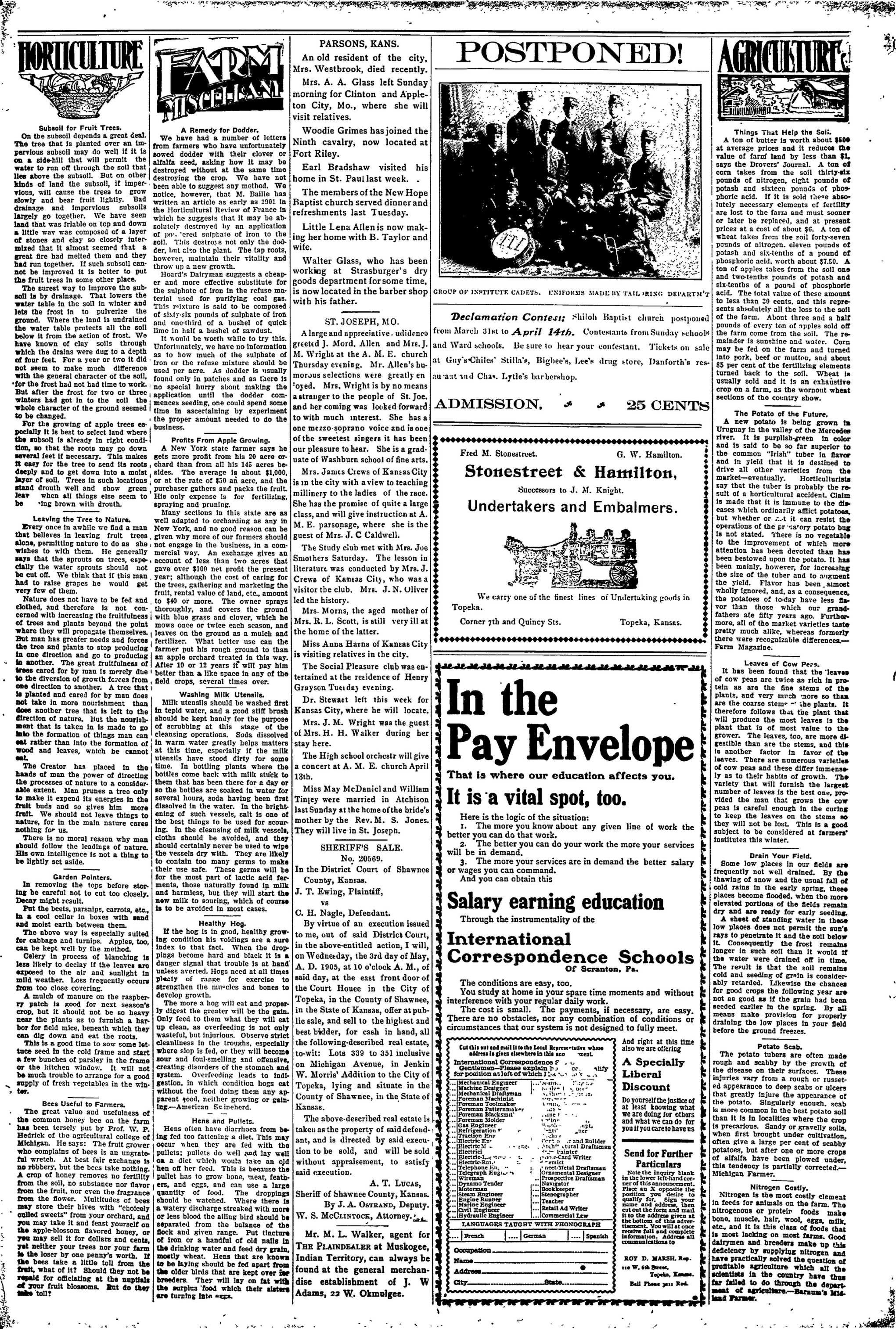
Declamation Contest; Shiloh Baptist church postponed from March 31st to April 14th. Contestants from Sunday schools and Ward schools. Be sure to hear your contestant. Tickets on sale at Guy's Chiles' Stilla's, Bigbee's, Lee's drug store, Danforth's restaurant and Chas. Lytle's barbershop.
```markdown
```
We carry one of the finest lines of UniLerta
Topeka.
Corner 7th and Quincy Sts.
Tope
In the
Pay Envel
That is where our education affect
It is a vital spot, too.
We carry one of the finest lines of Undertaking goods in Topeka.
In the Pay Envelope
1. The more you know about any given line better you can do that work.
2. The better you can do your work the more will be in demand.
3. The more your services are in demand the or wages you can command.
And you can obtain this
Salary earning educati
Through the instrumentality of the
International
Correspondence So
Of Scranton, Pa.
1. The more you know about any given line of work the better you can do that work.
2. The better you can do your work the more your services will be in demand.
3. The more your services are in demand the better salary or wages you can command.
And you can obtain this
You study at home in your spare time moments and without interference with your regular daily work.
You study at home in your spare time moment interference with your regular daily work. The cost is small. The payments, if neces There are no obstacles, nor any combination of circumstances that our system is not designed to i
The cost is small. The payments, if necessary, are easy. There are no obstacles, nor any combination of conditions or circumstances that our system is not designed to fully meet.
Here is the logic of the situation:
The conditions are easy, too.
Cut this out and mail it to the Local Representative whose address is given elsewhere in this and moment.
International Correspondence
Gentlemen—Please explain how to qualify for position at left of which I am
Mechanical Engineer
Machine Designer
Mechanical Draftsman
Foreman Machinist
Foreman Toolmaker
Foreman Patternmaker
Foreman Blacksmith
Foreman Molder
Gas Engineer
Refrigeration
Traction Eng
Fireplace En
Electric M
Electrician
Electric L
Electric Rail
Telephone En
Telegraph Eng
Wireman
Dynamo Tender
Motorman
Steam Engineer
Engine Runner
Marine Engineer
Civil Engineer
Hydraulic Engineer
LANGUAGES TAUGHT WITH PHONOGRAPH
French German Spanish
Occupation
Name
Address
City State
Do yourself the justice of at least knowing what we are doing for others and what we can do for you if you care to have us
Send for Further Particulars
Note the inquiry blank in the lower left-hand corner of this announcement. Place an X opposite the position you desire to qualify for. Sign your name and address, then cut out the form and mail it to the address given at the bottom of this advertisement. You will at once receive full and complete information. Address all communications to
ROY D. MARSH, Rep.
110 W. 6th Street.
Topkiss, Kansas.
Bell Phone 2111 Red.
AGRICULTURE
things That Help the Soil. A ton of butter is worth about $500 at average prices and it reduces the value of farm land by less than $1, says the Drovers' Journal. A ton of corn takes from the soil thirty-six pounds of nitrogen, eight pounds of potash and sixteen pounds of phosphoric acid. If it is sold these absolutely necessary elements of fertility are lost to the farm and must sooner or later be replaced, and at present prices at a cost of about $6. A ton of wheat takes from the soil forty-seven pounds of nitrogen, eleven pounds of potash and six-tenths of a pound of phosphoric acid, worth about $7.50. A ton of apples takes from the soil one and two-tenths pounds of potash and six-tenths of a pound of phosphoric acid. The total value of these amount to less than 30 cents, and this represents absolutely all the loss to the soil of the farm. About three and a half pounds of every ton of apples sold off the farm come from the soil. The remainder is sunshine and water. Corn may be fed on the farm and turned into pork, beef or mutton, and about 85 per cent of the fertilizing elements turned back to the soil. Wheat is usually sold and it is an exhaustive crop on a farm, as the wormout wheat sections of the country show.
The Potato of the Future.
A new potato is being grown in Uruguay in the valley of the Mercedes river. It is purplish-green in color and is said to be so far superior to the common "Irish" tuber in flavor and in yield that it is destined to drive all other varieties from the market—eventually. Horticulturists say that the tuber is probably the result of a horticultural accident. Claim is made that it is immune to the diseases which ordinarily afflict potatoes, but whether or not it can resist the operations of the primary potato bug is not stated. There is no vegetable to the improvement of which more attention has been devoted than has been bestowed upon the potato. It has been mainly, however, for increasing the size of the tuber and to augment the yield. Flavor has been almost wholly ignored, and, as a consequence, the potatoes of to-day have less flavor than those which our grandfathers ate fifty years ago. Furthermore, all of the market varieties taste pretty much alike, whereas formerly there were recognizable differences—Farm Magazine.
Leaves of Cow Peas.
It has been found that the leaves of cow peas are twice as rich in protein as are the fine stems of the plants, and very much more so than are the coarse stems of the plants. It therefore follows that the plant that will produce the most leaves is the plant that is of most value to the grower. The leaves, too, are more digestible than are the stems, and this is another factor in favor of the leaves. There are numerous varieties of cow peas and these differ immensely as to their habits of growth. The variety that will furnish the largest number of leaves is the best one, provided the man that grows the cow peas is careful enough in the curing to keep the leaves on the stems so they will not be lost. This is a good subject to be considered at farmers' institutes this winter.
Drain Your Field.
Some low places in our fields are frequently not well drained. By the thawing of snow and the usual fall of cold rains in the early spring, these places become flooded, when the more elevated portions of the fields remain dry and are ready for early seeding. A sheet of standing water in these low places does not permit the sun's rays to penetrate it and the soil below it. Consequently the frost remains longer in such soil than it would if the water were drained off in time. The result is that the soil remains cold and seeding of grain is considerably retarded. Likewise the chances for good crops the following year are not as good as if the grain had been seeded earlier in the spring. By all means make provision for properly draining the low places in your field before the ground freezes.
Potato Scab.
The potato tubers are often made rough and scabby by the growth of the disease on their surfaces. These injuries vary from a rough or russeted appearance to deep scabs or ulcers that greatly injure the appearance of the potato. Singularly enough, scab is more common in the best potato soil than it is in localities where the crop is precarious. Sandy or gravelly solls, when first brought under cultivation, often give a large per cent of scabby potatoes, but after one or more crops of alfalfa have been plowed under, this tendency is partially corrected. Michigan Farmer.
Nitrogen Costly.
Nitrogen is the most costly element in feeds for animals on the farm. The nitrogenous or protein foods make bone, muscle, hair, wool, eggs, milk, etc., and it is this class of foods that is most lacking on most farms. Good dairymen and breeders make up this deficiency by supplying nitrogen and have practically solved the question of profitable agriculture which all the scientists in the country have thus far failed to do through the department of agriculture.—Barnum's Midland Farmer.
BOYNTON, I. T.
Two more business houses for Ham in this town, and still there are more to follow. D. A. Lee has just opened a fruit stand, and will carry cigars, tobacco, canned goods, cold drinks and ice cream.
Rodgers and Ezell have gone out of the meat business and have opened a tailoring establishment.
A hardware store will soon be opened, where our people can be supplied with everything in that line.
Here is a good opening for a Negro bank. The business is here and it continues to grow. The whites who are largely dependent on the blacks for trade, have two banks and there is talk of a third. The blacks want to, and will patronage their own men in business.
Our merchants are abreast of the times. They not only keep a full stock, but like the whites, they expand. That's business.
Jack Rich, from near Checoda, is erecting a nice residence for his family, which he will more here.
Scott Bros., whose livery stable burned recently, are rebuilding. Louis Burr, a shoemaker, has gone into business here with David Bell. Mrs. James Kernel was called to Muscogee on Wednesday to attend a funeral. She left a son at home a corpse, Harry Johnson, whose funeral took place at Cain Creek Baptist church, the Rev. J. C. Grayson officiating.
The A. M. E. church people have erected a parsonage on the rear of their lot. It is a corner lot, so that the parsonage fronts on the street. Now the people are pulling for the church edifice.
J. W. Adams, proprietor of the Adams' Gents' Furnishing House of Muscogee, was a visitor in town last week. He was looking for a location for some of his friends from Alabama who are coming this way. He is a public spirited man and says he is going to leave his business and travel around over this section to find homes for a number of families who are coming out this way.
Mrs. Jack Rich and family went to Muscogee on the 31st ult. to attend the funeral of Allen Rich.
Attorney Covington made a flying grip to our city last week.
LIBERTY, M.O.
Prof. Bledseaux of Kansas City, Kans., was in the city Friday, making arrangements for a recital in the near future.
Presiding Elder Beal held quarterly meeting at the A. M. E. church Sunday. Rev. Real is an excellent speaker.
The pupils of Garrison school are preparing for the closing exercises.
Miss Anna Moore visited relatives in Kansas City last Saturday.
Miss Fannie Hughes is out of school on account of illness. Miss Dulciana Barker, who has been ill for several weeks, is mpr oving.
WINFIELD NOTES.
Rev. W. Garnett was with us last Sunday. The Sunday school was a success.
The Willing Workers met with Mrs. T. Campbell last Friday and the afternoon was spent most delightfully in work, after which a dainty lunch was served.
Rev. Harris, pastor of the A. M. K. church, preached last Sunday at Wellington.
Grandma McNeal is very ill in the Pilcher hospital, but is somewhat improved.
M. C. Doughty is visiting his sister, Mrs. Brnks, in this city.
Mrs. Morgan and Mrs. Ambler who are on the sick list, are both improving.
Mr. and Mrs. Banks entertained a few of their friends in honor of Mrs. Banks' brother from Okla.
Mr. and Mrs. Thomas are the guests of Mr. and Mrs. Johnson.
Preparations are being made by the members of the Second Baptist church to dedicate their house of worship the second Sunday in May. The edifice was erected nearly thirteen years ago.
Mr. Askings is in the Territory looking for a location.
Mrs. S. Johnson, since her return from Emporia, has been very ill.
FARM
MISCELLANY
Grain for Seed.
Samples of shrunken wheat are being submitted to us by persons residing in the rust stricken belt. These persons ask whether it will be safe to sow such grain for seed the coming year. It is very proper that they should ask this question and it is exceedingly important that it should be answered with intelligent discrimination. During a trip that we made the third week in August over the wheat growing area in the northern part of the state we noticed that some of the wheat was so shrunken that it was not worth cutting. In some localities the stands were fairly good. The variations ran all the way from No. 1 down to wheat that was really unfit to make good food for chickens. We have no doubt whatever but that such grain sown for seed will not give good results. It will be found quite practicable in many instances to so winnow the shrunken wheat that the very light material will all be blown out of it. The best sample obtainable, therefore, from the crop should usually answer for sowing next season. One difficulty is in the way however. Many farmers are not possessed of a fanning mill, so prevalent has the custom become to take wheat direct from the machine. Every farmer ought to have a fanning mill for such work.—Farm and Fireside.
The Destructive Bat
Housewives in the country sometimes complain that poultry raising is a great care on account of the losses that occur among the young chicks largely due to the presence of rats. The rat is far harder to hedge against than the cat. A good strong partition to the poultry house or a good wire fence around the poultry yard will keep out cats, but these have little effect in checking the depredations of rats. They can gnaw through the partition and tunnel under the wire fence and do the work so expeditiously that the damage to the flock is done before the farmer has had time to take combative measures. Then when he begins to fight the rodents he finds that the process is not a smooth one. The animals avoid the steel trap and the wire cage. Poison is the only thing that seems to be effective, and the farmer hesitates about employing this, as he is afraid of hurting other animals. But this method of destruction will be found to be about the only effective one if the rats are very numerous. If poison is used it should be placed where only the rats can get access to it.
Wool Clip Contracted.
Dealers in wool seem to have no fears of a decline of wool prices for another year at least. In various western states dealers have already been closing contracts for next year's wool clip at from seventeen to twenty cents per pound and seem willing to take all they can get at those figures. While many farmers have sold their next year's crop on such terms as these some are willing to wait until spring to dispose of their clip, taking the chances on the price going down. They don't consider there is much risk to run when buyers are so anxious to contract so far ahead, and prefer to take chances rather than to sell now and likely to regret making the agreement before shearing time.
The farmer who breeds and raises good sheep may be pretty sure of reaping some good profits from both his wool and mutton during the next few years. The sheep business certainly has a bright outlook at the present time.
Season's Potato Yield.
Revised returns justify the estimate of an average yield of 110.4 bushels of potatoes this year, instead of 100 bushels, as stated in the last number. The average yield for the previous ten years was 81 bushels, making the present a bumper year for this crop. Maine is credited with the largest average acre yield, 215 bushels. The Southern states had from 61 to 80 bushels, except Florida, which grew 102 bushels. Iowa's yield was 186 bushels and Wisconsin's 126, both extremely good for this country. The average of the old New England states is higher than in the same number of newer western states.—Farm, Stock and Home.
Our Butter Abroad.
The government has been making weekly experimental exports of the best quality of creamery butter to Manchester, England, continuing previous practical tests of the merits of such butter from the United States in comparison with the highest grades of butter from other countries to be found in British markets. The results as stated by the butter man of the dairy division have been, in a general way, quite favorable, but not such as to encourage commercial operations along the same line at the present price of butter in the United States—Barnum's Midland Farmer.
No Lime On Manure.
It is a mistake to put lime in the manure heap, for it destroys the salts of ammonia, and by compelling it to take the gaseous form drives it off. Lime will rot manure very quickly and do its work well, but it will be at the expense of a loss of nitrogen, which is an ingredient of ammonia, says the Farm Jaurnal, and it's good authority.
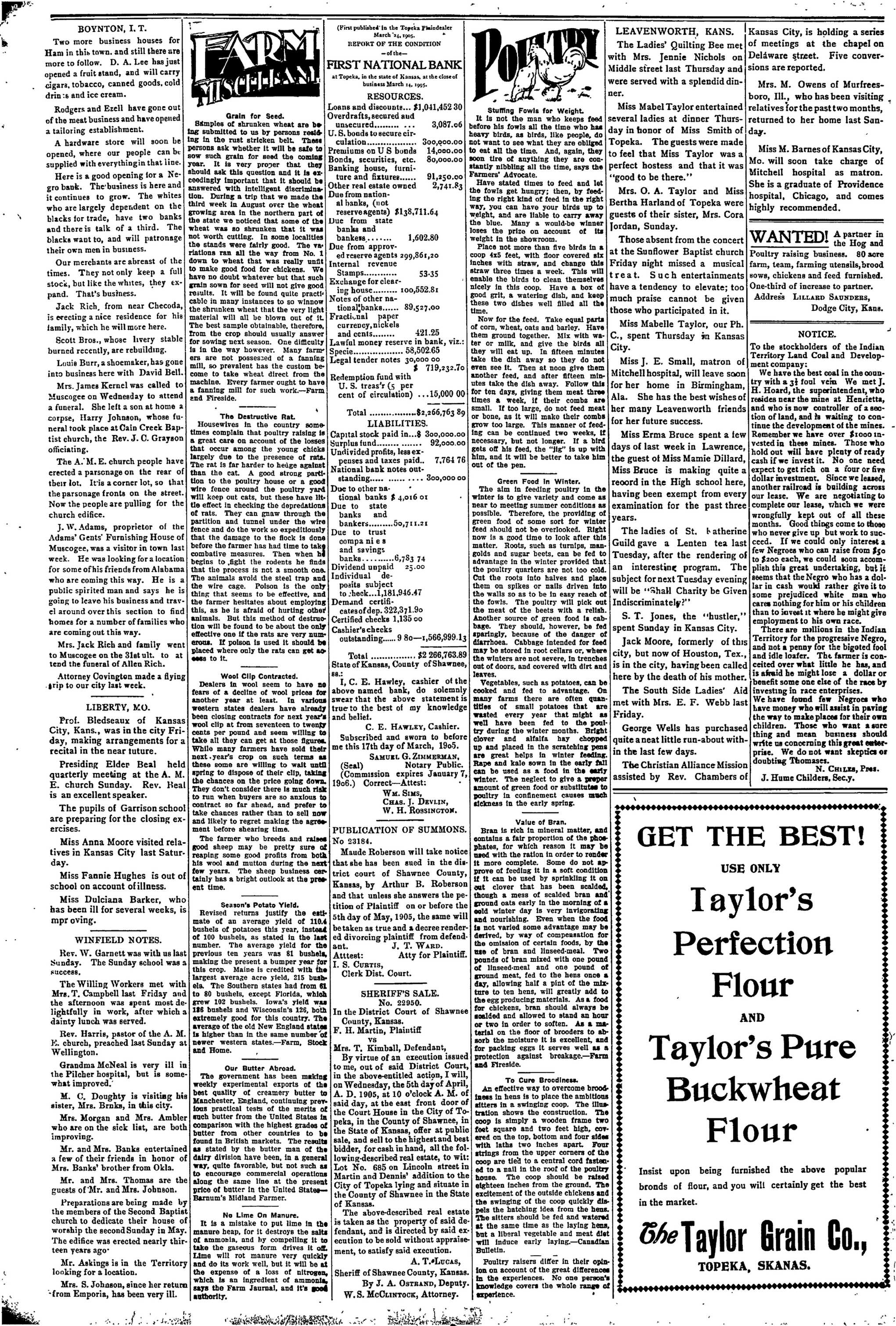
(First published in the Topeka Plaindealer March 24, 1905.
REPORT OF THE CONDITION
-of the—
FIRST NATIONAL BANK
at Topeka, in the state of Kansas, at the close of business March 14, 1905.
RESOURCES.
Loans and discounts... $1,041,452 30
Overdrafts, secured and
unsecured... 3,087.06
U. S. bonds to secure cir-
culation... 300,900.00
Premiums on U S bonds 14,000.00
Bonds, securities, etc. 80,000.00
Banking house, furniture and fixtures... 91,250.00
Other real estate owned 2,741.83
Due from national banks, (not reserve agents) $138,711.64
Due from state banks and bankers... 1,602.80
Due from approv-
ed reserve agents 299,861.20
Internal revenue Stamps... 53.35
Exchange for clear-
ing house... 100,552.81
Notes of other na-
tional banks... 89,527.00
Fractional paper currency, nickels and cents... 421.25
Lawful money reserve in bank, viz.:
Specie... 58,502.65
Legal tender notes 30,000 00
$ 719,232.70
Redemption fund with U. S. treas'r (5 per cent of circulation) ...15,000 00
Total ...$2,266,763 89
LIABILITIES.
Capital stock paid in...$ 300,000.00
Surplus fund... 92,000.00
Undivided profits, less expenses and taxes paid... 7,764 76
National bank notes out-
standing... 300,000 00
Due to other na-
tional banks $ 4,016 01
Due to state banks and bankers...50,711.21
Due to trust compa nies and savings
banks.....6,783 74
Dividend unpaid 25.00
Individual de-
posits subject
to check....1,181,946.47
Demand certific-
ates of dep. 322,371.90
Certified checks 1,135 00
Cashier's checks
outstanding.....9 80—1,566,999.13
Total ..... $2 266,763.89
State of Kansas, County of Shawnee,
88.:
I, C. E. Hawley, cashier of the
above named bank, do solemnly
swear that the above statement is
true to the best of my knowledge
and belief.
C. E. HAWLEY, Cashier.
Subscribed and sworn to before me this 17th day of March, 1905.
SAMUEL G. ZIMMERMAN,
(Seal) Notary Public.
(Commission expires January 7,
1906.) Correct—Attest:
WM. SIMS,
CHAS. J. DEVLIN,
W. H. ROSSINGTON.
PUBLICATION OF SUMMONS.
No 23184.
Maude Roberson will take notice that she has been sued in the district court of Shawnee County, Kansas, by Arthur B. Roberson and that unless she answers the petition of Plaintiff on or before the 5th day of May, 1905, the same will be taken as true and a decree rendered divorcing plaintiff from defendant. J. T. WARD. Atttest: Atty for Plaintiff. I. S. CURTIS.
Clerk Dist. Court.
SHERIFF'S SALE
In the District Court of Shawnee County, Kansas.
F. H. Martin, Plaintiff
vs
Mrs. T. Kimball, Defendant.
By virtue of an execution issued to me, out of said District Court, in the above-entitled action, I will, on Wednesday, the 5th day of April, A. D. 1905, at 10 o'clock A. M. of said day, at the east front door of the Court House in the City of Topeka, in the County of Shawnee, in the State of Kansas, offer at public sale, and sell to the highest and best bidder, for cash in hand, all the following-described real estate, to wit: Lot No. 685 on Lincoln street in Martin and Dennis' addition to the City of Topeka lying and situate in the County of Shawnee in the State of Kansas.
The above-described real estate is taken as the property of said defendant, and is directed by said execution to be sold without appraisement, to satisfy said execution.
A. T. LUCAS,
Sheriff of Shawnee County, Kansas.
By J. A. OSTRAND, Deputy.
W. S. McCLINTOCK, Attorney.
POULTRY Stuffing Fowls for Weight
It is not the man who keeps feed before his fowls all the time who has heavy birds, as birds, like people, do not want to see what they are obliged to eat all the time. And, again, they soon tire of anything they are constantly nibbling all the time, says the Farmers' Advocate.
Have stated times to feed and let the fowls get hungry; then, by feeding the right kind of feed in the right way, you can have your birds up to weight, and are liable to carry away the blue. Many a would-be winner loses the prize on account of its weight in the showroom.
Place not more than five birds in a coop 4x5 feet, with floor covered six inches with straw, and change this straw three times a week. This will enable the birds to clean themselves nicely in this coop. Have a box of good grit, a watering dish, and keep these two dishes well filled all the time.
Now for the feed. Take equal parts of corn, wheat, oats and barley. Have them ground together. Mix with water or milk, and give the birds all they will eat up. In fifteen minutes take the dish away so they do not even see it. Then at noon give them another feed, and after fifteen minutes take the dish away. Follow this for ten days, giving them meat three times a week, if their combs are small. If too large, do not feed meat or bone, as it will make their combs grow too large. This manner of feeding can be continued two weeks, if necessary, but not longer. If a bird gets off his feed, the "jig" is up with him, and it will be better to take him out of the pen.
Green Food In Winter.
Green Food in Winter.
The aim in feeding poultry in the winter is to give variety and come as near to meeting summer conditions as possible. Therefore, the providing of green food of some sort for winter feed should not be overlooked. Right now is a good time to look after this matter. Roots, such as turnips, mangolds and sugar beets, can be fed to advantage in the winter provided that the poultry quarters are not too cold. Cut the roots into halves and place them on spikes or nails driven into the walls so as to be in easy reach of the fowls. The poultry will pick out the meat of the beets with a relish. Another source of green food is cabbage. They should, however, be fed sparingly, because of the danger of diarrhoea. Cabbage intended for feed may be stored in root cellars or, where the winters are not severe, in trenches out of doors, and covered with dirt and leaves.
Vegetables, such as potatoes, can be cooked and fed to advantage. On many farms there are often quantities of small potatoes that are wasted every year that might as well have been fed to the poultry during the winter months. Bright clover and alfalfa hay chopped up and placed in the scratching pens are great helps in winter feeding. Rape and kale sown in the early fall can be used as a food in the early winter. The neglect to give a proper amount of green food or substitutes to poultry in confinement causes much slackness in the early spring.
Value of Bran.
Bran is rich in mineral matter, and contains a fair proportion of the phosphates, for which reason it may be used with the ration in order to render it more complete. Some do not approve of feeding it in a soft condition if it can be used by sprinkling it on out clover that has been scalded, though a mess of scalded bran and ground oats early in the morning of a cold winter day is very invigorating and nourishing. Even when the food is not varied some advantage may be derived, by way of compensation for the omission of certain foods, by the use of bran and linseed-meal. Two pounds of bran mixed with one pound of linseed-meal and one pound of ground meat, fed to the hens once a day, allowing half a pint of the mixture to ten hens, will greatly add to the egg producing materials. As a food for chickens, bran should always be scalded and allowed to stand an hour or two in order to soften. As a material on the floor of brooders to absorb the moisture it is excellent, and for packing eggs it serves well as a protection against breakage.—Farm and Fireside.
To Cure Broodiness.
An effective way to overcome broodiness in hens is to place the ambitions sitters in a swinging coop. The illustration shows the construction. The coop is simply a wooden frame two feet square and two feet high, covered on the top, bottom and four sides with laths two inches apart. Four strings from the upper corners of the coop are tied to a central cord fastened to a nail in the roof of the poultry house. The coop should be raised eighteen inches from the ground. The excitement of the outside chickens and the swinging of the coop quickly dispels the hatching idea from the hens. The sitters should be fed and watered at the same time as the laying hens, but a liberal vegetable and meat diet will induce early laying.—Canadian Bulletin.
Poultry raisers differ in their opinion on account of the great differences in the experiences. No one person's knowledge covers the whole range of experience.
GET THE BEST!
USE ONLY
Taylor's
Perfection
Flour
AND
Taylor's Pure
Buckwheat
Flour
Insist upon being furnished the above popular bronds of flour, and you will certainly get the best in the market.
LEAVENWORTH, KANS.
The Ladies' Quilting Bee met with Mrs. Jennie Nichols on Middle street last Thursday and were served with a splendid dinner.
Miss Mabel Taylor entertained several ladies at dinner Thursday in honor of Miss Smith of Topeka. The guests were made to feel that Miss Taylor was a perfect hostess and that it was "good to be there."
Mrs. O. A. Taylor and Miss Bertha Harland of Topeka were guests of their sister, Mrs. Cora Jordan, Sunday. Those absent from the concert at the Sunflower Baptist church Friday night missed a musical treat. Such entertainments have a tendency to elevate; too much praise cannot be given those who participated in it. Miss Mabelle Taylor, our Ph. C., spent Thursday in Kansas City.
Miss J. E. Small, matron of Mitchell hospital, will leave soon for her home in Birmingham, Ala. She has the best wishes of her many Leavenworth friends for her future success. Miss Erma Bruce spent a few days of last week in Lawrence, the guest of Miss Mamie Dillard, Miss Bruce is making quite a record in the High school here, having been exempt from every examination for the past three years.
The ladies of St. katherine Guild gave a Lenten tea last Tuesday, after the rendering of an interesting program. The subject for next Tuesday evening will be "Shall Charity be Given Indiscriminately?" S. T. Jones, the "hustler," spent Sunday in Kansas City. Jack Moore, formerly of this city, but now of Houston, Tex., is in the city, having been called here by the death of his mother.
The South Side Ladies' Aid met with Mrs. E. F. Webb last Friday.
George Wells has purchased quite a neat little run-about within the last few days.
The Christian Alliance Mission assisted by Rev. Chambers of
Kansas City, is holding a series of meetings at the chapel on Delaware street. Five conversions are reported. Mrs. M. Owens of Murfreesboro, Ill., who has been visiting relatives for the past two months, returned to her home last Sunday.
Miss M. Barnes of Kansas City, Mo. will soon take charge of Mitchell hospital as matron. She is a graduate of Providence hospital, Chicago, and comes highly recommended.
WANTED! A partner in the Hog and Poultry raising business. 80 acre farm, team, farming utensils, brood sows, chickens and feed furnished. One-third of increase to partner. Address LILLARD SAUNDERS, Dodge City, Kans.
NOTICE.
To the stockholders of the Indian Territory Land Coal and Development company:
We have the best coal in the country with a 3½ foul vein. We met J. H. Hoard, the superintendent, who resides near the mine at Henrietta, and who is now controller of a section of land, and is waiting to continue the development of the mines. Remember we have over $1000 invested in these mines. Those who hold out will have plenty of ready cash if we invest it. No one need expect to get rich on a four or five dollar investment. Since we leased, another railroad is building across our lease. We are negotiating to complete our lease, which we were wrongfully kept out of all these months. Good things come to those who never give up but work to succeed. If we could only interest a few Negroes who can raise from $50 to $200 each, we could soon accomplish this great undertaking, but it seems that the Negro who has a dollar in cash would rather give it to some prejudiced white man who cares nothing for him or his children than to invest it where he might give employment to his own race.
There are millions in the Indian Territory for the progressive Negro, and not a penny for the bigoted fool and idle loafer. The farmer is conceived over what little he has, and is afraid he might lose a dollar or benefit some one else of the race by investing in race enterprises. We have found few Negroes who have money who will assist in paving the way to make places for their own children. Those who want a sure thing and mean business should write us concerning this great enterprise. We do not want skeptics or doubting Thomases. N. CHILKS, Pres. J. Hume Childers, Sec.y.
THE PLAINDEALER PUBLISHING CO.
218 EAST SEVENTH STREET.
One year by mail.....$1.50
six months by mail.....$1.00
three months by mail.....$500
Entered at the postoffice at) Topeka as second class mall matter.
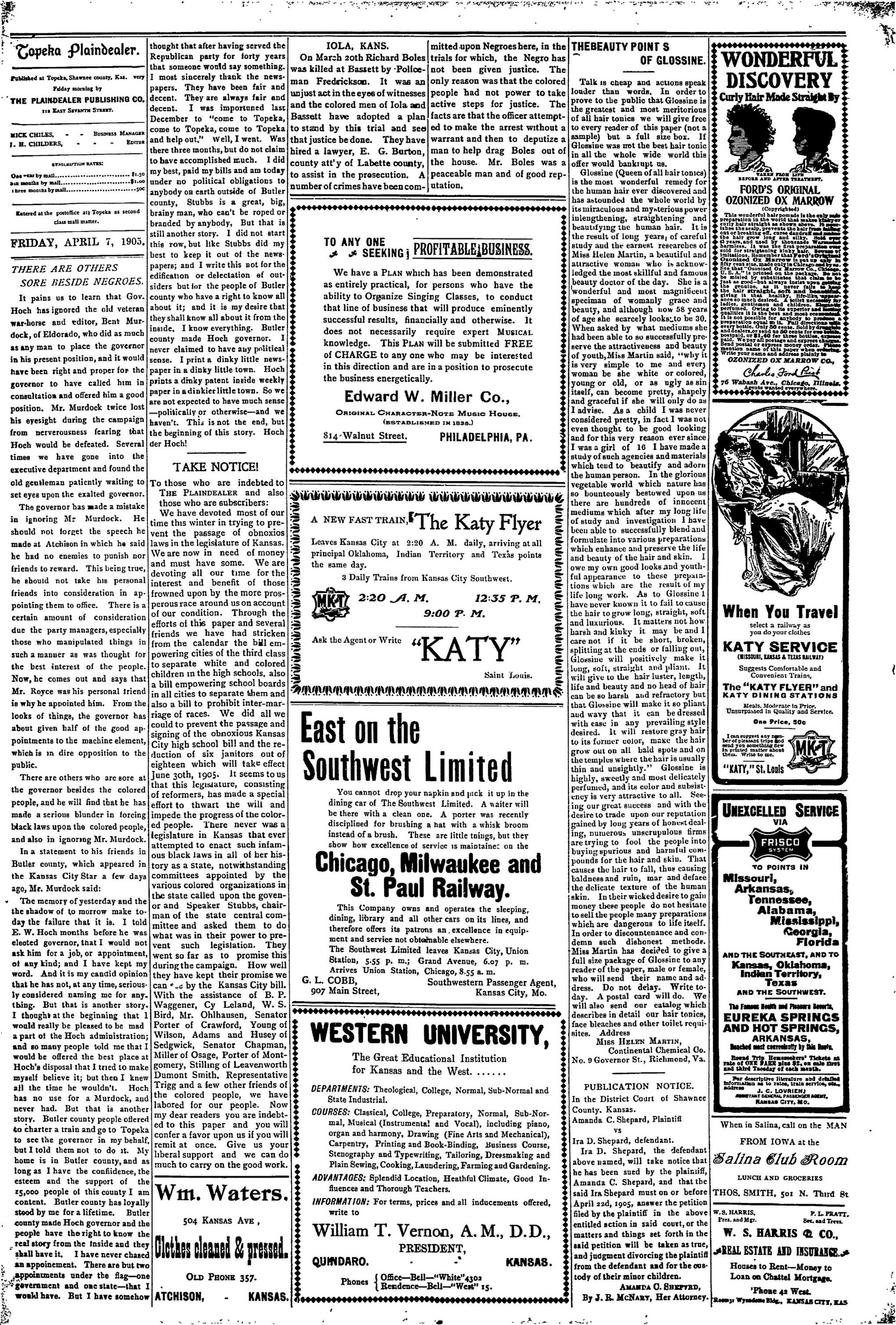
FRIDAY, APRIL 7, 1905.
THERE ARE OTHERS
SORE BESIDE NEGROES.
It pains us to learn that Gov. Hoch has ignored the old veteran war-horse and editor, Bent Murdock, of Eldorado, who did as much as any man to place the governor in his present position, and it would have been right and proper for the governor to have called him in consultation and offered him a good position. Mr. Murdock twice lost his eyesight during the campaign from nerverousness fearing that Hoch would be defeated. Several times we have gone into the executive department and found the old gentleman patiently waiting to set eyes upon the exalted governor.
The governor has made a mistake in ignoring Mr. Murdock. He should not forget the speech he made at Atchison in which he said he had no enemies to punish nor friends to reward. This being true, he should not take his personal friends into consideration in appointing them to office. There is a certain amount of consideration due the party managers, especially those who manipulated things in such a manner as was thought for the best interest of the people. Now, he comes out and says that Mr. Royce was his personal friend is why he appointed him. From the looks of things, the governor has about given half of the good appointments to the machine element, which is in dire opposition to the public.
There are others who are sore at the governor besides the colored people, and he will find that he has made a serious blunder in forcing black laws upon the colored people, and also in ignoring Mr. Murdock. In a statement to his friends in Butler county, which appeared in the Kansas City Star a few days ago, Mr. Murdock said:
The memory of yesterday and the shadow of to morrow make today the failure that it is. I told E. W. Hoch months before he was elected governor, that I would not ask him for a job, or appointment, of any kind; and I have kept my word. And it is my candid opinion that he has not, at any time, seriously considered naming me for anything. But that is another story. I thought at the beginning that I would really be pleased to be made a part of the Hoch administration; and so many people told me that I would be offered the best place at Hoch's disposal that I tried to make myself believe it; but then I knew all the time he wouldn't. Hoch has no use for a Murdock, and never had. But that is another story. Butler county people offered to charter a train and go to Topeka to see the governor in my behalf, but I told them not to do it. My home is in Butler county, and as long as I have the confidence, the esteem and the support of the 25,000 people of this county I am content. Butler county has loyally stood by me for a lifetime. Butler county made Hoch governor and the people have the right to know the real story from the inside and they shall have it. I have never chased an appointment. There are but two appointments under the flag—one government and one state—that I would have. But I have somehow
thought that after having served the Republican party for forty years that someone would say something. I most sincerely thank the newspapers. They have been fair and decent. They are always fair and decent. I was importuned last December to "come to Topeka, come to Topeka, come to Topeka and help out." Well, I went. Was there three months, but do not claim to have accomplished much. I did my best, paid my bills and am today under no political obligations to anybody on earth outside of Butler county, Stubbs is a great, big, brainy man, who can't be roped or branded by anybody. But that is still another story. I did not start this row, but like Stubbs did my best to keep it out of the newspapers; and I write this not for the edification or delectation of outsiders but for the people of Butler county who have a right to know all about it; and it is my desire that they shall know all about it from the inside. I know everything. Butler county made Hoch governor. I never claimed to have any political sense. I print a dinky little newspaper in a dinky little town. Hoch prints a dinky patent inside weekly paper in a dinkier little town. So we are not expected to have much sense—politically or otherwise—and we haven't. This is not the end, but the beginning of this story. Hoch der Hoch!
TAKE NOTICE!
To those who are indebted to THE PLAINDEALER and also those who are subscribers:
We have devoted most of our time this winter in trying to prevent the passage of obnoxios laws in the legislature of Kansas. We are now in need of money and must have some. We are devoting all our time for the interest and benefit of those frowned upon by the more prosperous race around us on account of our condition. Through the efforts of this paper and several friends we have had stricken from the calendar the bill empowering cities of the third class to separate white and colored children in the high schools, also a bill empowering school boards in all cities to separate them and also a bill to prohibit inter-marriage of races. We did all we could to prevent the passage and signing of the obnoxious Kansas City high school bill and the reduction of six janitors out of eighteen which will take effect June 30th, 1905. It seems to us that this legislature, consisting of reformers, has made a special effort to thwart the will and impede the progress of the colored people. There never was a legislature in Kansas that ever attempted to enact such infamous black laws in all of her history as a state, notwithstanding committees appointed by the various colored organizations in the state called upon the governor and Speaker Stubbs, chairman of the state central committee and asked them to do what was in their power to prevent such legislation. They went so far as to promise this during the campaign. How well they have kept their promise we can see by the Kansas City bill. With the assistance of B. P. Waggener, Cy Leland, W. S. Bird, Mr. Ohlhausen, Senator Porter of Crawford, Young of Wilson, Adams and Husey of Sedgwick, Senator Chapman, Miller of Osage, Porter of Montgomery, Stilling of Leavenworth Dumont Smith, Representative Trigg and a few other friends of the colored people, we have labored for our people. Now my dear readers you are indebted to this paper and you will confer a favor upon us if you will remit at once. Give us your liberal support and we can do much to carry on the good work.
OLD PHONE 357.
On March 20th Richard Boles was killed at Bassett by Policeman Fredrickson. It was an unjust act in the eyes of witnesses and the colored men of Iola and Bassett have adopted a plan to stand by this trial and see that justice be done. They have hired a lawyer, E. G. Burton, county att'y of Labette county, to assist in the prosecution. A number of crimes have been com-
TO ANY ONE SEEKING PR
We have a PLAN which as entirely practical, for ability to Organize Sing that line of business that successful results, finance does not necessarily knowledge. This PLAN of CHARGE to any one in this direction and are the business energetically
ANY ONE SEEKING PROFITABLE BUSINESS
We have a PLAN which has been demonstrated entirely practical, for persons who have a capacity to Organize Singing Classes, to construct line of business that will produce eminent successful results, financially and otherwise, is not necessarily require expert Musk knowledge. This PLAN will be submitted FOR CHARGE to any one who may be interested in this direction and are in a position to prosecute business energetically.
TO ANY ONE SEEKING PROFITABLE BUSINESS.
We have a PLAN which has been demonstrated as entirely practical, for persons who have the ability to Organize Singing Classes, to conduct that line of business that will produce eminently successful results, financially and otherwise. It does not necessarily require expert Musical knowledge. This PLAN will be submitted FREE of CHARGE to any one who may be interested in this direction and are in a position to prosecute the business energetically.
Edward W. Miller Co.,
ORIGINAL CHARACTER-NOTE MUSIC HOUSE. (ESTABLISHED IN 1838.)
814 Walnut Street. PHILADELPHIA, P.
A NEW FAST TRAIN, The Katy Fly
Leaves Kansas City at 2:20 A. M. daily, arriving at principal Oklahoma, Indian Territory and Texas p the same day.
NEW FAST TRAIN, The Katy F
Kansas City at 2:20 A. M. daily, arriving
al Oklahoma, Indian Territory and Texas
me day.
---
Leaves Kansas City at 2:20 A. M. daily, arriving at all principal Oklahoma, Indian Territory and Texas points the same day.
3 Daily Trains from Kansas City Southwest.
East on the Southwest
You cannot drop your r
dining car of The Southwest
be there with a clean on
disciplined for brushing
instead of a brush. These
show how excellence of s
Chicago, Mil
St. Paul
This Company owns a
dining, library and all o
therefore offers its patro
ment and service not obtai
The Southwest Limited
Station, 5.55 p. m.; Gr
Arrives Union Station,
G. L. COBB,
907 Main Street,
WESTERN
2:20 A.M. 12:35 P.M.
9:00 P.M.
Agent or Write "KATY"
Saint T.
It on the
Southwest Limited
You cannot drop your napkin and pick it up in
nining car of The Southwest Limited. A waiter
there with a clean one. A porter was recei
disciplined for brushing a hat with a whisk br
stead of a brush. These are little things, but
how excellence of service is maintained on
Chicago, Milwaukee and
St. Paul Railway.
This Company owns and operates the sleep
ning, library and all other cars on its lines,
therefore offers its patrons an excellence in equ
ent and service not obtainable elsewhere.
The Southwest Limited leaves Kansas City, U
ation, 5.55 p. m.; Grand Avenue, 6.07 p.
drives Union Station, Chicago, 8.55 a. m.
DBB,
Southwestern Passen
tain Street,
Kansas C
WESTERN UNIVERSE
Ask the Agent or Write "KATY"
---
East on the Southwest Limited
You cannot drop your napkin and pick it up in the dining car of The Southwest Limited. A waiter will be there with a clean one. A porter was recently disciplined for brushing a hat with a whisk broom instead of a brush. These are little things, but they show how excellence of service is maintained on the
This Company owns and operates the sleeping, dining, library and all other cars on its lines, and therefore offers its patrons an excellence in equipment and service not obtainable elsewhere. The Southwest Limited leaves Kansas City, Union Station, 5.55 p. m.; Grand Avenue, 6.07 p. m. Arrives Union Station, Chicago, 8.55 a. m. G. L. COBB, Southwestern Passenger Agent, 907 Main Street, Kansas City, Mo.
WESTERN UNIVERSITY,
The Great Educational Institution for Kansas and the West. .....
DEPARTMENTS: Theological, C
State Industrial.
COURSES: Classical, College, Nat
mal, Musical (Instrumenta
organ and harmony, Draw
Carpentry, Printing and I
Stenography and Typewrite
Plain Sewing, Cooking, Lat
ADVANTAGES: Splendid Locati
fluences and Thorough Tea
INFORMATION: For terms, pri
write to
William T. Vern
PRES
MENTS: Theological, College, Normal, Sub-National Industrial.
ES: Classical, College, Preparatory, Normal, Musical (Instrumental and Vocal), including organ and harmony, Drawing (Fine Arts and Metalpentry, Printing and Book-Binding, Business, Geography and Typewriting, Tailoring, Dressmaking, Sewing, Cooking, Laundering, Farming and Gaming).
TAGES: Splendid Location, Heathful Climate,ences and Thorough Teachers.
MATION: For terms, prices and all inducementite to
William T. Vernon, A. M., PRESIDENT,
DARO.
DEPARTMENTS: Theological, College, Normal, Sub-Normal and State Industrial.
COURSES: Classical, College, Preparatory, Normal, Sub-Normal, Musical (Instrumental and Vocal), including piano, organ and harmony, Drawing (Fine Arts and Mechanical), Carpentry, Printing and Book-Binding, Business Course, Stenography and Typewriting, Tailoring, Dressmaking and Plain Sewing, Cooking, Laundering, Farming and Gardening.
ADVANTAGES: Splendid Location, Heathful Climate, Good Influences and Thorough Teachers.
INFORMATION: For terms, prices and all inducements offered, write to
Phones { Office—Bell—"White"4302 Residence—Bell—"West" 15.
DR
MKT
QUINDARO.
mitted upon Negroes here, in the trials for which, the Negro has not been given justice. The only reason was that the colored people had not power to take active steps for justice. The facts are that the officer attempted to make the arrest without a warrant and then to deputize a man to help drag Boles out of the house. Mr. Boles was a peaceable man and of good reputation.
OFITABLE BUSINESS.
It has been demonstrated
persons who have the
ing Classes, to conduct
will produce eminently
socially and otherwise. It
require expert Musical
will be submitted FREE
who may be interested
in a position to prosecute.
NOTE MUSIC HOUSE.
ED IN 1836.)
PHILADELPHIA, PA.
The Katy Flyer
A. M. daily, arriving at all
Territory and Texas points
12:35 P.M.
0:00 P.M.
KATY"
Limited
napkin and pick it up in the
st Limited. A waiter will
. A porter was recently
hat with a whisk broom
are little things, but they
service is maintained on the
Milwaukee and
Railway.
and operates the sleeping,
other cars on its lines, and
is an excellence in equip-
nable elsewhere.
Leaves Kansas City, Union
and Avenue, 6.07 p. m.
Chicago, 8.55 a. m.
Southwestern Passenger Agent,
Kansas City, Mo.
UNIVERSITY,
college, Normal, Sub-Normal and Preparatory, Normal, Sub-Nor- and Vocal), including piano, singing (Fine Arts and Mechanical), Book-Binding, Business Course, Tailoring, Dressmaking and Handering, Farming and Gardening. on, Heathful Climate, Good Inchers. prices and all inducements offered, on, A. M., D.D., DENT,
Saint Louis.
KANSAS.
Talk is cheap and actions speak louder than words. In order to prove to the public that Glossine is the greatest and most meritorious of all hair tonics we will give free to every reader of this paper (not a sample) but a full size box. If Glossine was not the best hair tonic in all the whole wide world this offer would bankrupt us.
Glossine (Queen of all hair tonics) is the most wonderful remedy for the human hair ever discovered and has astounded the whole world by its miraculous and mysterious power inlengthening, straightening and beautifying the human hair. It is the result of long years of careful study and the earnest researches of Miss Helen Martin, a beautiful and attractive woman who is acknowledged the most skillful and famous beauty doctor of the day. She is a wonderful and most magnificent specimen of womanly grace and beauty, and although now 58 years of age she scarcely looks to be 30. When asked by what mediums she had been able to so successfully preserve the attractiveness and beauty of youth, Miss Martin said, "why it is very simple to me and every woman be she white or colored, young or old, or as ugly as sin itself, can become pretty, shapely and graceful if she will only do as I advise. As a child I was never considered pretty, in fact I was not even thought to be good looking and for this very reason ever since I was a girl of 16 I have made a study of such agencies and materials which tend to beautify and adorn the human person. In the glorious vegetable world which nature has so bountheously bestowed upon us there are hundreds of innocent mediums which after my long life of study and investigation I have been able to successfully blend and formulate into various preparations which enhance and preserve the life and beauty of the hair and skin. I owe my own good looks and youthful appearance to these preparations which are the result of my life long work. As to Glossine I have never known it to fail to cause the hair to grow long, straight, soft and luxurious. It matters not how harsh and kinky it may be and I care not if it be short, broken, splitting at the ends or falling out, Glossine will positively make it long, soft, straight and pliant. It will give to the hair luster, length, life and beauty and no head of hair can be so harsh and refractory but that Glossine will make it so pliant and wavy that it can be dressed with ease in any prevailing style desired. It will restore gray hair to its former color, make the hair grow out on all bald spots and on the temples where the hair is usually thin and unsightly." Glossine is highly, sweetly and most delicately perfumed, and its color and subsistence is very attractive to all. Seeing our great success and with the desire to trade upon our reputation gained by long years of honest dealing, numerous unscrupulous firms are trying to fool the people into buying spurious and harmful compounds for the hair and skin. That causes the hair to fall, thus causing baldness and ruin, mar and deface the delicate texture of the human skin. In their wicked desire to gain money these people do not hesitate to sell the people many preparations which are dangerous to life itself. In order to discountenance and condemn such dishonest method. Miss Martin has decided to give a full size package of Glossine to any reader of the paper, male or female, who will send their name and address. Do not delay. Write today. A postal card will do. We will also send our catalog which describes in detail our hair tonics, face bleaches and other toilet requisites. Address
MISS HELEN MARTIN.
MISS HELEN MARTIN,
Continental Chemical Go.
No. 9 Governor St., Richmond, Va.
PUBLICATION NOTICE. In the District Court of Shawnee County, Kansas.
Ira D. Shepard, defendant.
Ira D. Shepard, the defendant above named, will take notice that he has been sued by the plainiff, Amanda C. Shepard, and that the said Ira Shepard must on or before April 22d, 1905, answer the petition filed by the plainiff in the above entitled action in said court, or the matters and things set forth in the said petition will be taken as true, and judgment divorcing the plaintiff from the defendant and for the custody of their minor children.
AMANDA C. SHEFVRD,
By J. R. McNARY, Her Attorney.
TAKEN FROM LIFE
This wonderful hair pomade is the only sale preparation in the world that makes kinky hair. It is made out of the scalp, prevents the hair from out or breaking off, cared drizzle and makes the hair grow long and silky. Sold over a large area, it is durable and harmless. It was the first preparation ever sold for straightening kinky hair. Browse at Ozonized OX Marrow is put up only in fifty cent size, made only in Chicago and by us. Ozonized OX Marrow is made in Chicago, U.S.A. It is printed on the pack. It be misled by substitutes that claim to be just as good—but always insist upon getting the hair straight, soft and beautiful. giving it that healthy, life-like appearance, ladies, gentlemen and children. Highest quality perfumed. Owing to its superior and most economical preparation it is not possible for anybody to preparation equal to it. Full directions with every bottle. Only 50 cents. Sold by drugged and postpaid, or $1.49 for three bottles, express paid. We pay all postage and express charges. Please mention name of this paper when ordering. Write your name and address plainly to OZONIZED OX MARROW CO.
Charla Ford Post
76 Wabash Ave., Chicago, Illinois.
Agents wanted everywhere.
A
When You Travel
select a railway as
you do your clothes
KATY SERVICE
(MISSOURI, KANSAS & TEXAS RAILWAY)
Suggests Comfortable and
Convenient Trains,
The "KATY FLYER" and
KATY DINING STATIONS
Meals, Moderate in Price.
Unsurpassed in Quality and Service.
One Price, 50c
THE
MK-T
SUNSHINE BIKES
I can提问 any number
of questions.
send you something new
in printed matter about
them. Write to me.
"KATY," St. Louis
UNEXCELLED SERVICE
VIA
FRISCO
SYSTEM
TO POINTS IN
Missouri,
Arkansas,
Tennessee,
Alabama,
Mississippi,
Georgia,
Florida
AND THE SOUTHEAST, AND TO
Kansas, Oklahoma,
Indian Territory,
Texas
AND THE SOUTHWEST.
The Famous Health and Pressure Resorts,
EUREKA SPRINGS
AND HOT SPRINGS,
ARKANSAS,
Reached most conveniently by this Route.
Round Trip Homesekers' Tickets at
rate of ONE PAKE plus $2.0 on sale first
and third Tuesday of each month.
For descriptive literature and detailed
information as to rates, train service, etc.,
address
J. C. LOVRIEN)
ASSISTANT GENERAL, PASSENGER AGENT,
KANSAS CITY, MO.
When in Salina, call on the MAN
FROM IOWA at the
Salina Club Room
LUNCH AND GROCERIES
THOS, SMITH, 501 N. Third St
W. S. HARRIS,
Pres. and Mgr.
P. L. PRATT,
Set. and Treas.
W. S. HARRIS @ CO.,
REAL ESTATE AND INSURANCE.
Houses to Rent—Money to
Loan on Chattel Mortgage.
'Phone 42 West.
Roosevelt Wyndendale Bldg., KANSAS CITY, KAS
PHYSICIAN AND SURGEON
Examining Physician of the Knights and Ladies
[Protection.
{ Special Attention to desaees
of women and private deceases.
Office and Residence, 327 MADISON STREET.
O. A. TAYLOR, M. D.
PHYSICIAN AND SURGEON
836/Kansas Ave. Ind. Phone 774.
Office Hours 7 to 9 a.m.
2 to 4 and 6 to 8 p.m.
T. Wims, and Lunch Room,
523 N. KANSAS AVE.
As you pass by stop in Ice Cream Soda and be
and get a 5 or 10 cent refreshed
VISITING AND BUSINESS CARD CO.
Call or Phone us your order. Fine work. Prompt
Service. All work guaranteed.
Bell Phone 2102 Red. NORTH TOPEKA.
NEWS OF THE WEEK.
Praleau Smith Sundayed in Lawrence.
Mrs. Mollie Pace is improving in health.
Mrs. Henry Dillard is numbered among the sick.
Prof. W. T. Vernon was in the city Wednesday.
J. Alvin Bigham, of K. U. spent his spring vacation in this city.
Leonard Bell, of Hutchinson, transacted business in Topeka Tuesday.
Miss Lizzie Cooper, who has been ill at her home, 1413 Jackson street is improving.
Mrs. O. A. Taylor and sister, Miss Bertha Harlan, have returned from a visit to Leavenworth.
Miss Hattie Gough has been quite ill at her home 422 East First street. She is slowly improving.
Mrs. Thomas McAdoo, of Leadville, Colo, is here at the bedside of her father who is seriously ill.
Mrs. Herman Chiles left Tuesday for Chicago to visit friends. From there she will go to Springfield, Ill., where she will visit her parents.
The Oakleaf club met Wednesday with Mrs. J. M. Jamison. The next meeting will be held on the 12th inst., at the residence of Mrs. Paul Jones, 1211 Filmore street.
A baby girl arrived at the home of Mr. and Mrs. Aaron Wilson one day last week, and for the next eighteen or twenty years will play a prominent part in conducting the affairs of that household.
Mrs. Angeline Williams and family wish to thank the many warm friends who extended their assistance and sympathy during the illness of their deceased husband and father, Mr. Andrew Williams.
A baby girl was born Monday to Prof. and Mrs. W. R. Carter. Mr. Carter is happy as a prince, and in a few years more, some of the teachers at the Western Tueskegee will have to step asike for the brilliant sons and daughters of Prof. Carter.
The remains of Miss Jennie Woodall, who died at Los Vegas, New Mexico last Saturday were brought here and interred in the Topeka cemetery. The funeral was held Wednesday from the Shiloh Baptist church. She leaves a sister, Mrs. E. D. Jones and four brothers to mourn her demise.
Miss Lottie Washington returned from Emporia Wednesday.
Sylvester Banks, of Kansas City, was in town a few days this week.
Mrs. Alexander, of Keokuk, Ia., is visiting her sister, Mrs. V. E. Guy.
Mrs. W. H. Moody has returned home after spending three months in Xenia, O.
Miss Luvena Brown, who has been teaching in Dover, Okla., is in the city to spend her vacation.
Dean Buckner, Woodie Jacobs and Miss Helen M'Clain, are spending their spring vacation in the city.
Mrs. Susie Ford, of Dover, Okla., formerly Mrs. Lowery, is visiting her parents, Mr. and Mrs. Willis Brown, 205 Taylor street.
The rally at the A. M. E. church Sunday was a grand success, over $400 having been raised. It will continue until the first Sunday in May.
The Dumas club met with Mrs, Skearce last Friday. A delightful meeting was enjoyed by all present. They adjourned to meet on the 7th inst., with Mrs. Carles Morton, 1026 Washburn avenue.
George Carpenter returned last week from a business trip to Hill City. He owns a half section of good land in these parts—mostly sown in wheat, and he reports that the prospects for a large yield are excellent.
Mrs. Martha Powell, of East First strect is very sick and in a destitute condition. She and her husband came here about three years ago from Mississippi, and are hardworking, honest and industrious old people, and have no relatives or friends to care for them and they are here on the mercies of the people. Let our churches rally to the wants of this old lady and see that her bed and bedding are clean and that she is provided with the necessary comforts. Her condition is pitiable and to see her, one would think she lived in heathen China. Where are these great shouting religious folks who appear to be so sanctimonious? They can be seen but never visit and seek out those who are in needy circumstances!
A Church That Has
no Factional Fights!
As a rule, there is always considerable friction in the church and especially among our race where one faction withdraws, erects a church and selects pastors who will comply with their wishes.
There is a church on Chandler street, between Fourteenth and Fifteenth, where there is but one solitary member left, and that is Mrs Jane Cowan. She was one of the founders and organizers of the the Handside Primitive Baptist church. This church was erected some twenty odd years ago, and there has been several pastors and large congregations that warred with each other until all that was left is this old veteran sister. She is the preacher, and the sexton—administers her own sacrament, rings her own bell, holds her own prayer meetings and has no one to worry with but herself.
It is nothing unusual to go by and hear shouting and singing and singing and praying in the church and one would think there was a large congregation present, when there is no one but the old lady and the benches. This is certainly commendable in her in keeping the flock together!
This is the only church across the Shunganunga that has a bell to ring to the people, notifying them that services are about to begin. The old lady invariably rings her bell three times on the Sabbath, calling the attention of the wayward denizens on that side that they should attend devotional exercises. She is at peace with all the world. There is no trouble about electing pastors and officers as she is the whole thing.
We wish there were more churches in this condition and we think the race would grow better.
J. ORLANDO MITCHELL, Pres't & Mgr. MILTON C. SIMMONS, Secretary and Treasurer. JOHN DREW, Vice President.
Freedmen's Land & Trust Co.,
INCORPORATED.—AUTHORIZED CAPITAL $25,000. PAID UP $18,000. SHARES $25.
MUSKOGEE. IND. TER.
INVEST your savings with us in stock and receive tenfold. It is a Gilt-Edged Investment. The management is sound and conservative. The company is making money.
Get in on the Ground Floor. Invest your capital with us in Farms or City Property. We have improved and unimproved farms in any size tracts. PRAIRIE AND BOTTOM LANDS.
Write for circulars and information. When in Muskogee come to see us.
The Freedmen's Land & Trust Company.
At Rest
Mr. Marcus L. Freeman, died at his rooms at 117 West Fifth street Tuesday morning of a complication of diseases from which he had been ailing about two years. He was one of Topeka's most highly respected citizens and was born in Louisville, Ky., in the 30's. He was a slave and came West with his owner, first settling in Kansas City, Mo. There he was liberated and removed to Lawrence, Kas., where he was employed as chef at the Eldridge house, and was there at the time of the famous Quantrell raid. Afterward, he accepted a position at Kirkville, Mo., and cooked for a hotel, but still retained his residence at Lawrence. Leaving this place, he came to Topeka and accepted a position with Col. Cope Gordon, owner of the Copeland Hotel, which position he held for twenty years.
"Uncle Mark," as he was called by his host of friends, was one of the best cooks of his day, and was well acquainted with most of the leading men of the state and nation. He was a drawing card for the "Copeland" as it was often said by drummers and politicians that they always longed to get back to Topeka to get some of his cooking. He was one of the most faithful cooks that ever stood over a range, and for twenty long years never missed live meals. This is a record of which to be proud, and should be emulated by the young men of the race.
Mr. Freeman was a widower, his wife and children (except one) having died several years ago. He leaves a daughter, Mrs. Mayme Freeman Johns, a sister and a host friends to mourn his loss. He was a Scottish Rite Mason, and a charter member of Western Star Lodge, No. 1, A. F. & A. M., of Lawrence, one of the first Masonic lodges organized in Kansas. He was a member of St. John A. M. E. church, and was devoted to the cause and uplift of his race. Tho' uneducated, he undoubtedly kept pace with the times, and passed to a higher life with the consolation of knowing that he was at peace with his fellow man. He was a great lover of music and was charitable in dispensing money to that cause—especially brass bands, having contributed liberally to several bands of this city and Lawrence.
Yesterday afternoon at 2 o'clock, his remains were escorted to St. John A. M. E. church by Jackson's Twenty-third Regiment Band, Cyrene Commandery No. 3, K. T., and Lodges No. 2, 5 and 18, A. F. & A. M. A large concourse of sorrowing friends gathered at the church where the Rev. J. F. C. Taylor paid an eloquent tribute to the memory of one of the grandest and best old men that ever breathed the breath of life. His remains were conveyed to the Topeka cemetery and consigned to earth according to the Masonic ritual. May angels guard his soul.
WHEN IN ATCHISON —call on—
Mrs. Anna Lemons
at 116 N. 8th street, who keeps a first-class ROOMING HOUSE and RESTAURANT. Give him a call. Everything first-class and up-to-date.
I can sell YOUR REAL ESTATE OR BUSINESS, atter Where Located.
Properties and business of all kinds sold quickly for cash in all parts of the United States. Don't wait. Write to-day describing what you have to sell and give cash price on same.
A.P. Tone Wilson, Jr.
REAL ESTATE SPECIALIST,
413 Kansas Ave., TOPEKA, Ks.
—HOTEL WILLARD,—
1009 St. Louis Avenue, North of Viaduct and Union St.
KANSAS CITY, MISSOURI.
W. M. AILSTOCK, Prop.
Rates: $1.00, $1.50 and $2.00 per Day.
NICE ROOMS. Ice Cream and Soda Water.
J.W.RYAN, TIMES BUILDING, Leavenworth, — Kansas.
AGENT FOR
Heim's Famous Beer.
Sample Room in Connection.
Orders Shipped to All Parts of the Country.
SPECIAL BREW—Kyffhaster, the Best on the Market.
Shampoolug and Face Massage
MRS. HATTIE E. VAN VLECK
Hair Dresser and Manufacture1 ... ...
HAIR TO MATCH ALL COMPLEXIONS.
Doll Wigs—New Pompadours, Pompadour Combs, and other Toilet Combs, Switches and—Hair Jewelry...220 E. 5th St., TOPEKA, KANS
When in ATCHISON don't forget
Dt. ROBINSON'S RESTAURANT
623 Main Street,
Just three blocks from Union Depot.
Meals 20c.
Mrs. Mary Robinson, - - Propr.
If You Want to Get Cool and Want SOMETHING REFRESHING, CALL AT James Manuses,
808 KANSAS Ave.
Ice Cream, Soda Water, Candies, Fruits and Nuts.
Everything first-class and up-to-date.
WHEN IN WICHITA VISIT THE ARCADE BARBERSHOP AND BATH ROOMS.
The Only Place You Can Get a Bath.—First-Class in Every Respect.—J. E. LEWIS, PROP.
339 N. Main St. WICHITA.
When in Kansas City stop at Hotel Newport
1807 Tracy Avenue.
MRS. V. L. NORTH, Proprietress.
Furnished Rooms. Hot and Cold Water Baths. Gas and Furnace Heat.
Home Phone 5327 Main.
Kansas City, - - Missouri
TWO FOR ONE!
A Very Rare Chance!
Rooms 5, 6 and 7, Churchill Building,
On November 15th, and daily thereafter, until the summer season of 1905, the Frisco System, in connection with the Southern Railway, will operate through Pullman Sleepers between Kansas City, Mo. and Jacksonville, Fla. These sleeping cars will be placed in service as part of the equipment of the Popular Southeastern to leave Kansas City 6:30 P.M. A modernly equipped train, electric lighted cafe observation car, etc—the route of which carries the traveler through the populous cities of the southeast.
Berth reservations may be made through representatives of Frisco System or connecting lines. PASSENGER TRAFFIC DEPARTMENT.
One Year Old and 600 Inhabitants!
8000 Acres of Land Surrounding Boley has Already been Leased and Bought by Negroes. 20,000 Acres of the Best Land in the Creek Nation Surrounding Boley to be Leased and Bought by Negroes.
T. M. HAYNES, Local Townsite Mgr., BOLEY, I. T.
SALOON POOL HALL
FURNISHED ROOMS.
Open Day and Night. Fine Wines, Liquors and Cigars.
1215-1217 East 18th St., KANSASCITY, Mo.
Home Phone 2544. Lige Hendricks, Prop.
DAY MIXER,
JIM NICKOLS.
NIGHT MIXER.
HORACE BURKE.
GRAND PRIZE CONTESTS FOR 1905.
You Can Earn a Handsome Present by a Little Work.
Send all Votes Direct to
The Plaindealer,
Gramophone
$35 GraphophoneFree
---
LADY'S Contest Coupon.
I cast ...votes for....
...for
The Plaindealer Prize Finely Engraved Lady's Gold Watch.
for.....for
The lady receiving the largest number of votes in this contest up to July 1st, will receive this handsome prize. $1.50 subscription counts 150 votes; 6 months' subscription $1, 100 votes; 3 months 50c, 50 votes. Clip out, fill out and send in this Coupon.
The P
Send all
TOPEKA, KANSAS.
---
```markdown
```
Ladies' Size, Fine Gold Watch, $30.00.
and all
---
112 EAST SEVENTH STREET.
100
Graphophone - Free!
To the person sending in the largest number of paid-up subscriptions to THE PLAINDEALER by July 1, 1905, we will give absolutely free our grand prize of a $35 Victor Graphophone, the only condition is that the minimum number of subscriptions shall be fifty. This contest is open to all comers. Send in your subscriptions.
P.O. State, 1905.
Find enclosed $... for ... subscriptions to THE PLAINDEALER, for which count ... votes for
in the Grand Prize Graphophone Contest.
Signed:
Clip out, fill out and send in this Coupon.
9th Cavalry Coupon.
P.O. State 1905.
I cast votes for.
for
Gents' Size,
Fine Gold Watch,
$50.00.
The Plaindealer PRIZE GOLD WATCH
as the most popular non-commissioned officer of the
Ninth U. S. Cavalry.
Clip out, fill out and send in this Coupon.
---
LINCOLN INSTITUTE. The address given by President Allen of Lincoln institute before Bethel literary was honored with a rising vote of thanks, and referred to on all sides as the most satisfactory and scholarly effort of the season.
Since Bethel literary annually secures representatives from the best talent the country affords, such a concensus of opinion upon the work of any one speaker carries with it great weight; and Dr. Allen thus has won another wellmerited triumph for himself, Missouri, Lincoln Institute and the Negro, generally speaking.
The hearty welcome which the president received on his return to the institution was supreme evidence of the great love and esteem in which he is held by his co-workers and students. The presentation of a beautiful sterling silver loving cup, by the faculty at a reception which they held in his honor, and the banquet tendered by the Freshman class, afforded still more tangible proof of this love and esteem.
Professor Moten acting as toastmaster, the presentation speeches were made in appropriate and well-chosen words by Mcdames Jackson and Yates; Dr. Allen responded in language which plainly indicated howhighly he appreciated such a token of affection on the part of his faculty. The dainty and well-served menu was interspersed with toasts suited to the occasion.
In response to an invitation from the committee on general program of the Kansas City teachers' institute, of which committee Professor W. W. Yates is a member, Dr. Allen addresses that august body Saturday morning on "The Spirit of Modern Education."
W. H. Thomas, class of '05, is filling an unexpired term at Fulton, a vacancy having been caused by the death of Professor Nic Kim.
Several other members of the same class have doubtless secured work for the ensuing scholastic year.
Lincoln Institute material is always in demand, and President Allen's report of graduates whom he found at work in various professional lines in the cities he recently has visited is very encouraging.
Mrs. Estella Patton is on the sick list.
Mrs. Dennis Saunders left for Guthrie, Oklahoma in response to a telegram announcing the serious illness of her daughter.
Golden Link art club was entertained by Mrs. M. Frazier at the home of Mrs. Thos. Cox Tuesday afternoon.
Invitations have been issued for a banquet to be given at G. A. R. hall April 1 th by the G. S. club.
The senior choir is making preparations for musical program Easter.
Bert Fines and P. Bass of Pleasanton are in the city and have decided to locate here.
Mrs. Eva Withley of Chicago is in the city, the guest of Mrs. W. Gibbs.
The sewing circle of the Second Baptist church met this week with Mrs. H. W. Massey.
Mrs. Fannie Baker, who has been ill for several days, has recovered.
The annual sermon of the K. of P. was preached at the A. M. E. church Sunday afternoon.
Mrs. Pauline Johnson returned Monday from a trip to Texas.
The most brilliant party of the season after Lent will be given
by the Highbinders' club. This will be the society event looked for annually by the society people of the Southwest. Invitations will be extended to all the prominent society people of the state. This club is composed of fifteen of the most popular society boys of Wichita, and at all their entertainments expense is of secondary importance. They have selected May 1 as the date of the swell affair.
Mrs. H. W. Harding is quite ill at her home on North Main street.
Mesdames Wesley Barker and W. Bell entertained Tuesday in honor of Mesdames Pete Clemens of Winfield, Grant Ewing, J. Thompson, Virginia Matthews.
The B. T. W. club met last Wednesday afternoon with Mrs. John Phelps.
G. Williams and wife of Arkansas City are visiting relatives in the city. Miss Pansy Cox entertained friends Tuesday evening. A good time was reported by all present.
Frank Roberts was a pleasant visitor in the city last week, accompanied by his son, Homer, who was a student in the department of electrical engineering at Tuskegee, and who has opened an office in Wellington. Mrs. Thomas Glover is slowly recovering from her recent illness.
ATCHISON.
The Thelmenians are preparing for an Easter party.
Blaine Sullivan, an employee of Seaton's foundry, was accidentally shot Sunday by his brother, Emerson. The wound is not thought to be serious.
Ed Bright has purchased the McCubbins home on South Fifth street.
Miss Hattie Ingram, who has been ill for the past two weeks, resumed her school work Monday. The four clubs of the True Eleven lodge are working strenuously for the rally in June for the benefit of the order. The Blind Boone Concert company was at Ebenezer Baptist church Tuesday evening.
Miss Maggie Ogden, who has been very ill with pneumonia, is reported better.
Mrs. Eugene Lett entertained twenty-four little girls and boys Monday afternoon in honor of the twelfth birthday of her daughter, Alma. Games were played, and Julius Henderson and Gaynell Johnson won prizes in a peanut hunting contest. Alma received many nice presents. A very nice luncheon was served.
Rev. J. B. Jones is very ill, and his recovery is doubtful. Ice cream is served at the Kerford grocery store every Sunday evening. William Hall's infant daughter died Monday. His wife died two weeks ago. This is the fourth death in his family within a year.
For eight full pages of good, wholesome reading matter get THE PLAINDEALER, the best Negro journal in the West.
James Tyler, the defendant above named, will take notice that he has been sued by the Plaintiff, Anna Tyler, and that he must answer on or before the 11th day of March, 1905, the petition filed by the plaintiff in the above entitled action in said court, or said petition will be taken as true and judgment rendered divorcing the plaintiff from the defendant.
J. R. McNARY.
Attorney for Plaintiff.
SPRINGFIELD, MO.
E. Lewis, formerly of St. Louis has removed to Springfield, and has secured employment with Herman, the tailor.
The funeral of Mrs. White was largely attended last Sabbath at the A. M. E. church.
Rev. B. F. Abbott has been returned for the sixth year as pastor of Pitts chapel M. E. church. He expects to build a new edifice this year.
Mrs. L. Oliver gave a splendid house social last Thursday at her residence and realized considerable for her church club.
Socials were also given by Mesdames E. Cary, Ida Stewart, John Haywood and McAdams at their residences.
Dr. Snelson was the happy recipient of a "flood quilt" made from the scraps of garments left from the flood two years ago. It was made and presented by the ladies' of the splendid Sewing circle of St. John A. M. E. church of Topeka, where Dr. Snelson was then pastor. It was accompanied by a very complimentary letter.
Miss Dovie Williams has been forced by smallpox to close her school at Humansville, and is now at home. Rev. J. S. Dorsey has been suddenly called to Kentucky on account of the severe illness of his aged father.
The winner of the gold ring contest conducted by Mrs. Snelson was Miss Mabelle Bruce. Misses Cleo Young, Erva Cobb and Ora Crittenden each did well also, and were given presents. The affair was a complete success in every way.
The Spring festival and grand annual rally at the Benton avenue A. M. E. church this week is being largely attended. Tuesday night was the grand barbers' concert, Wednesday night, the choir carnival; Thursday night was Masonic night. Last Sabbath was high day in Zion. Mrs. Mayme Hardwick, who has been visiting in Columbia, is expected home this week.
John D. Lee and Harry Johnson are conducting a neat restaurant at 529 Boonville street.
Prof. McAdams and his able corps of teachers are doing good work in our schools.
The funeral of little Grantville Collins, the 11 months old infant of George Allen and wife was preached by Dr. Snelson last week.
Rev. Nicholson preached the funeral of Mrs. Ellen Majors last week.
Bishop Grant has requested Dr. Snelson to prepare a paper for the Literary Congress in June on "Fifty Years of African Methodism in Missouri." On account of the celebration of Bishop Turner's 25 years of Episcopacy in May at St. Louis, the general Missouri jubilee will not be so extensive as was originally planned. Indeed, we live and move in wonderful times! The heroic name of Henry McNeal Turner, the first colored officer in the U. S. army, the pioneer preacher in Georgia, who brought tens of thousands into the church, the missionary hero of West and South Africa will forever shine in the hall of fame when Christian heroes are extolled.
Miss Inez C. Parker, a new poet, of Raleigh, Mo., was greeted last Monday evening by a great crowd at the C. P. church. She captured her audience. J. Mord. Allen is even eclipsed, and Dunbar's successor comes to the front in this simple country maid! Subscribe for, pay for and read THE PLAINDEALER.
We have studied every detail of the LARD business and know how to please the most critical consumer. That's the reason our
O.K.Lard
is the favorite of all good housewives and cooks. It's a LARD that's ALL LARD. No cotton seed or other adulterations in it.
Insist on the Brand
Chas. Wolff Packing Co. Topeka, U.S.A.
On account of the disagreeable weather last Sunday the farmers' program at the Forum was postponed until late in April or early in May. Quotations, current events and discussions made the afternoon very interesting to the large crowd that attended.
The colored K. U. students who spent their spring vacation at home, have returned to the city.
The Imperial Art club met with Mrs. A. White last Friday afternoon. A number of visitors were present.
Dr. J. J. Kenner has been ill for the past week.
Miss Myrtle Claughton is now ready to send in your subscription to THE PLAINDEALER. Also all city news.
W. Douglass is able to be out again after a long illness.
John Wright of Topeka was the guest of Ben Hawkins last Snnday.
Mrs. Adella Miller is ill.
James and Howard Beck have returned from Wamego, where they visited relatives.
Presiding Elder Griffith conducted quarterly meeting at the A. M. E. church last Sunday.
Mrs. Mattie Bryant died last Saturday evening at her home in East Lawrence. Funeral services were held Monday. Messrs. Perry. Wright and Crosby entertained friends last Wednesday evening. Various games were indulged in throughout the evening. Lunch was served and a pretty souvenir was given each guest.
The Navarre club will issue invitations this week for its annual Spring party. The Carnation Art club had a pleasant meeting last week at Mrs. W. Harvey's.
COSMOPOLITAN MUTUAL BENEFIT ASSOCIATION!
THE COSMOPOLITA NMUTUAL BENEFIT ASSOCIATION will furnish you substantial aid and assistance in the way of a funeral benefit for the small sum of ONE-HALF CENT a day or FIFTEEN CENTS a month. For full information call at their offices. Rooms 20 21-22 Central National Bank Building, TOPEKA, KANSAS.
ONE FARE
PLUS $2.00
COLORADO
AND RETURN
DENVER, COLORADO SPRINGS OR PUEBLO.
Tickets on sale January 7, 8 and 9, with final
return limit January 31st, 1905. Be sure
your ticket reads via
-UNION PACIFIC-
The Popular Route to Colorado.
Shortest Line. Fastest Time.
INQUIRE OF
THE NEAREST UNION PACIFIC AGENT.
Our Great Special — Complete
WORTH FIVE DOLLARS. ONLY $1.00
BEAUTY OUTFIT
"Ozono"
THE SWEET-SCENTED KING OF HAIR TONICS
MOST RAPID HAIR-GROWER IN EXISTENCE
HARMLESS-RELIABLE-SUPREME
READ! READ!
TO THE
Colored
People
OF THE WORLD
POSITIVELY straightens, lengthens and beautifies the most obstinate, troublesome, refractory, curly, nappy hair. It never fails to straighten and can be absolutely relied upon to produce an abundant and luxurious growth of soft, fine, pliant, silky, long, flowing hair. It is very gentle and does not irritate to leave it. A TIDAL WAVY THICK BLACK GLOBY HAIR, so pliant and abundant that it can be easily dressed in any prevailing style. It causes the hair to grow quickly on thin temples and all bald spots. Ozono is a positive cure for dandruff, the better and all diseases of the scalp. It burns gray, faded and discolored hair. It GLOSSY BLACK. It cannot fail to lengthen, STRAIGHTEN and beautify the hair. Ozono is positively guaranteed to give perfect satisfaction to all who use it. It cannot be missed, the lightest of women scattered all over the world units in saying that Ozono is true to all that is claimed for it. Ozono is king of all hair tonics.
The price of Ozono is $60 a box. It takes four boxes to complete the treatment. No hot irons are used. No plastering down with grease. Ozono alone and unaided absolutely perfects the hair, making it Hair Intended to be-long, soft, straight and beautiful. Ozono prevents falling, breaking and splitting, brittle hair.
Our Great Special Offer
OUT OUT THIS ADVERTISEMENT and mail name to us with it, and immediately upon receipt of it we send to you (no matter where you may live) four large boxes of Ozono, worth $1.00. We will also send you one large package of Ozono, worth $1.00. We will also send you a Purity Scalp Soap, worth $1.00. This soap is absolutely pure and unadulterated and is specially for use on the human hair and scalp. It is the finest scalp soap is available to the above great offer we will send to you our COMPLETE SKIN CARE FILING OUTFIT, consisting of one large jar of Instantane Message Cream actually worth $1. This complete preparation BETTER THE BARKY SKIN immediately upon application. It is simply rubbed well into the skin, allowing it to come off in rolls, bringing with it all the dead, dark skin and callouses and then rubbed off. It is brighten UP THE BLACKET SKIN from three to six shades. Furthermore, we will also include a large-size jar of our Electrical Skin Food, worth $10, which cures all skin diseases, removes wrinkles, smears skin, peels skin, weals skin, it makes the old look young and the young look younger, and lessly, to prove our liberality. We will include one plant (Anti-Odor, worth $10, which removes all smells and odors from the human body, such as cures sore throat, nore mouth, frosted feet, chinballs, and is a certain cure for all wounds). All OF THE ABOVE-KNIFED PREPARATIONS (3 packages in all), actually worth $10, ONLY OF ONLY $1. This great offer made to introduce BOSTON CHEMICAL CO. 310 E. BROAD ST. RICHMOND, VA.
E. W. Treadwell, the above named defendant, will take notice that he has been sued by the plaintiff, Sophia M. Treadwell, and that the defendant, E. W. Treadwell, must, on or before the 22nd day of May, 1905, answer the petition filed by the plaintiff in the above entitled action in said court or the matter and things set forth in said petition will be taken as true and judgment rendered divorcing the plaintiff from the defendant, custody of children, and alimony.
Miss Daisy Foster of Carbondale received the highest honor in the graduating class of '05, and is valedictorian. She is the second colored graduate from C. H. S, and the first to receive the honor. Our people should be proud of this young lady.
WANTED-Five quarryman at once. Permanent work at one dollar and twenty-five ($1.25) per cord. Apply at Industrial Institute east of the city.
WHEN IN TOPEKA
STOP AT P. C. Danforth's.
Neatly Furnished Rooms—Board by the Day or Week. Lunch Counterin Connection. Open from 6 a.m.
108 Kansas Ave.