Plaindealer
Friday, January 23, 1914
Topeka, Kansas
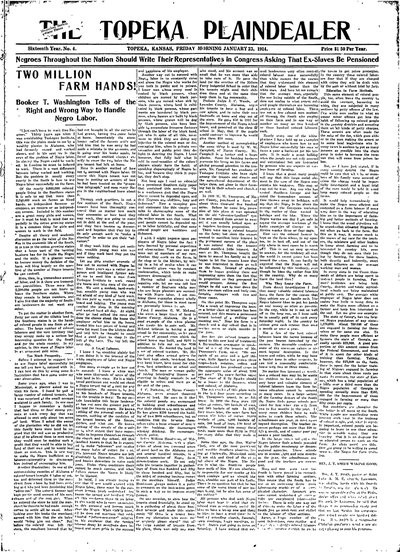
Page text (machine-generated)
TOPEKA PLAINDEALER
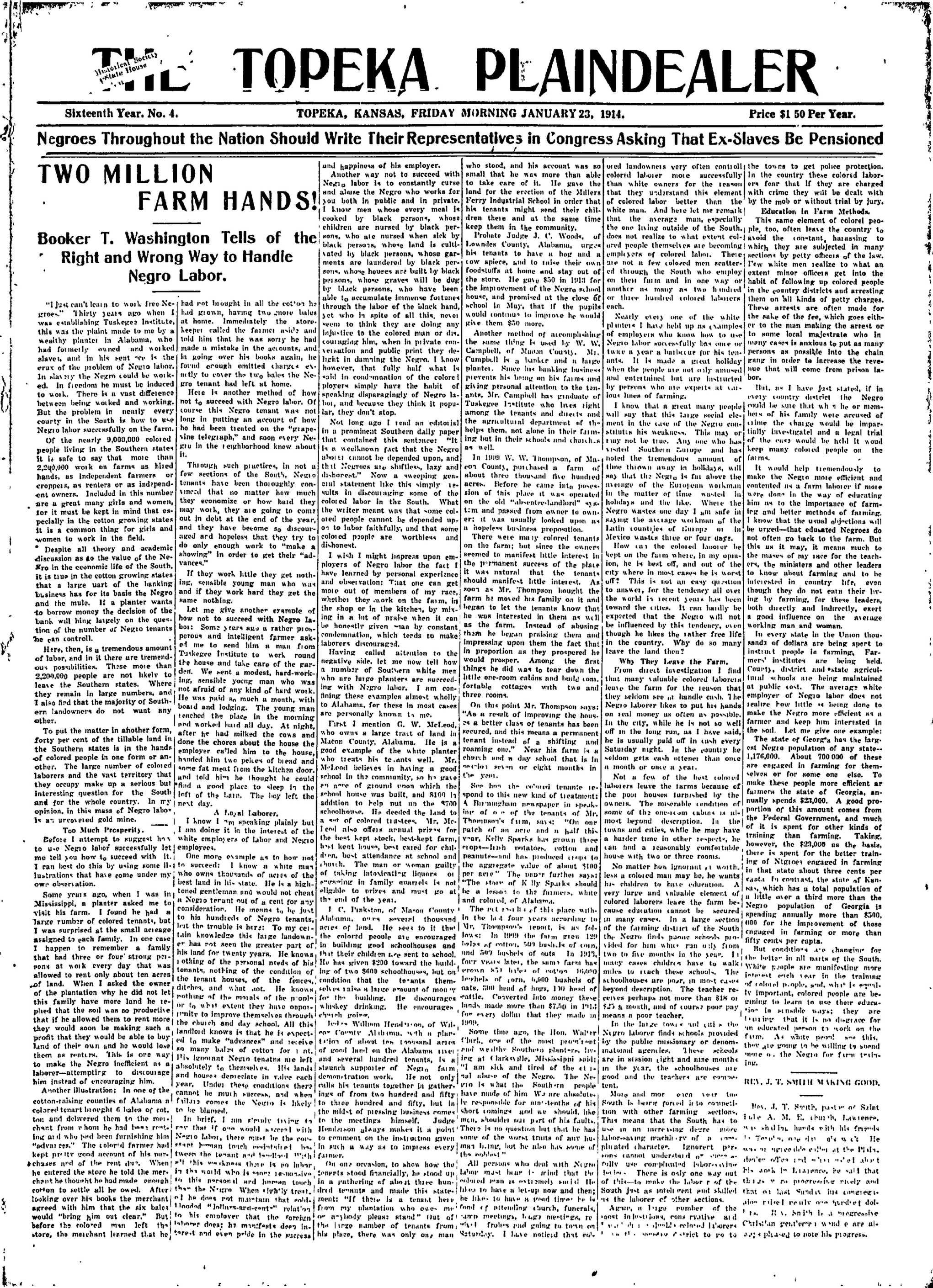
TWO MILLION FARM HANDS!
Booker T. Washington Tells of the Right and Wrong Way to Handle Negro Labor.
Historical Society
Ostate House
Sixteenth Year. No. 4.
Negroes Throughout the
TWO MILLION
FAR
Booker T. Washington
Right and Wrong W
Negro La
"I just can't learn to work free Negroes." Thirty years ago when I was establishing Tuskegee Institute, this was the plaint made to me by a wealthy planter in Alabama, who had formerly owned and worked slaves, and in his sentire was the crux of the problem of Negro labor. In slavery the Negro could be worked. In freedom he must be induced to work. There is a vast difference between being worked and working. But the problem in nearly every courtyard in the South is how to use Negro labor successfully on the farm.
Of the nearly 9,000,000 colored people living in the Southern states it is safe to say that more than 2,240,000 work on farms as hired hands, as independent farmers or croppers, as renters or as independent owners. Included in this number are a great many girls and women, for it must be kept in mind that especially in the cotton growing states it is a common thing for girls and women to work in the field.
Despite all theory and academic discussion as to the value of the Negro in the economic life of the South, it is true in the cotton growing states that a large uart of the banking business has for its basis the Negro and the mule. If a planter wants to borrow money the decision of the bank will hinge largely on the question of the number of Negro tenants he can controll.
Here, then, is a tremendous amount of labor, and in it there are tremendous possibilities. These more than 2,200,000 people are not likely to leave the Southern states. Where they remain in large numbers, and I also find that the majority of Southern landowners do not want any other.
To put the matter in another form, forty per cent of the tillable land in the Southern states is in the hands of colored people in one form or another. The large number of colored laborers and the vast territory that they occupy make up a serious but interesting question for the South and for the whole country. In my opinion, in this mass of Negro labor is an uncovered gold mine.
Too Much Prosperity.
Before I attempt to suggest how to use Negro labor successfully let me tell you how to succeed with it. I can best do this by using some illustrations that have come under my own observation.
Some years ago, when I was in Mississippi, a planter asked me to visit his farm. I found he had a large number of colored tenants, but I was surprised at the smell acreage assigned to each family. In one case I happen to remember a family that had three or four strong persons at work every day that was allowed to rent only about ten acres of land. When I asked the owner of the plantation why he did not let this family have more land he replied that the soil was so productive that if he allowed them to rent more they would soon be making such a profit that they would be able to buy land of their own and he would lose them as renters. This is one way to make the Negro inefficient as a laborer—attempting to discourage him instead of encouraging him.
Another illustration; In one of the cotton-ruining counties of Alabama a colored tenant brought 6 bales of cotton and delivered them to the merchant from whom he had been renting and who had been furnishing him "advances." The colored farmer had kept pretty good account of his purchases and of the rent due. When he entered the store he told the merchant he thought he had made enough cotton to settle all he owed. After looking over his books the merchant agreed with him that the six bales would "bring him out clear." But before the colored man left the store, the merchant learned that he
had not brought in all the cotton he had grown, having two more bales at home. Immediately the storekeeper called the farmer aside and told him that he was sorry he had made a mistake in the accounts, and in going over his books again, he found enough omitted charges evidently to cover the two bales the Negro tenant had left at home.
Here is another method of how not to succeed with Negro labor. Of course this Negro tenant was not long in putting an account of how he had been treated on the "grapevine telegraph," and soon every Negro in the neighborhood knew about it.
Through such practices, in not a few sections of the South, Negro tenants have been thoroughly convinced that no matter how much they economize or how hard they may work, they are going to come out in debt at the end of the year, and they have become so discouraged and hopeless that they try to do only enough work to "make a showing" in order to get their "advances." If they work little they get nothing, sensible young man who was and if they work hard they get the same nothing.
Let me give another example of how not to succeed with Negro labor. Some years ago a rather prosperous and intelligent farmer asked me to send him a man from Tuskegee Institute to work round the house and take care of the garden. We sent a modest, hard-working, sensible young man who was not afraid of any kind of hard work. He was paid so much a month, with board and lodging. The young man reached the place in the morning and worked hard all day. At night, after he had milked the cows and done the chores about the house the employer called him to the house, handed him two peeces of bread and some fat meat from the kitchen door, and told him he thought he could find a good place to sleep in the loft of the barn. The boy left the next day.
A Local Laborer.
I know I am speaking plainly but I am doing it in the interest of the white employers of labor and Negro employees.
One more example as to how not to succeed: I know a white man who owns thousands of acres of the best land in his state. He is a high-toned gentleman and would not cheat a Negro tenant out of a cent for any consideration. He means to be just to his hundreds of Negro tenants, but the trouble is here: To my certain knowledge this large landowner has not seen the greater part of his land for twenty years. He knows nothing of the personal needs of his tenants, nothing of the condition of the tenant houses, of the fences, ditches, and what not. He knows nothing of the moats of the propher to what extent they have opportunity to improve themselves through the church and day school. All this landlord knows is that he is expected to make "advances" and receive so many ballets of cotton for rent. His ignorant Negro tenatums are left absolutely to themselves. His lands and houses demiplate in value each year. Under these conditions there cannot be much success, and when failure comes the Negro is likely to be blamed.
In brief, I am really trying to say that if one would succeed with Negro labor, there must be the constant human touch maintained between the tenant and landlord "with all this weakness there is no labor in the world who is more responsive to this personal and human touch than the Negro. When slightly treat, all he does not maintain that solid blooded "Jollers-and-centre" relation to his employer that the foreign laborer does, he manifests deep interest and even pride in the success
TOPEKA, KANSAS, FRIDAY MORNING JANUARY 23, 1914.
and happiness of his employer.
Another way not to succeed with
Negro labor is to constantly curse
and abuse the Negro who works for
you both in public and in private.
I know men whose every meal I
cooked by black persons, whose
children are nursed by black persons,
who are nursed when sick by
black persons, whose land is cultivated
by black persons, whose garments are laundered by black
persons, whose houses are built by black
persons, whose graves will be dug by
black persons, who have been able to accumulate immense fortunes
through the labor of the black hand,
yet who is spite of all this, never seem to think they are doing any
injustice to the colored man or dis.
couraging him, when in private conversation and public print they de
right in damning the Negro. I know however, that fully half what is
said in condamnation of the colore I
players simply have the habit of speaking disparagingly of Negro lab
or, and because they think it popular, they don't stop.
Not long ago I read an editorial in a prominent Southern daily paper that contained this sentence: "It is a wellknown fact that the Negro abolition cannot be depended upon, and that Negroes are shiftless, lazy and dishonest." Now a sweeping general statement like this simply results in discouraging some of the colored labor in the South. What the writer meant was that some colored people cannot be depended upon to labor faithfully, and that some colored people are worthless and dishonest.
I wish I might impress upon employers of Negro labor the fact I have learned by personal experience and observation: That one can get more out of members of my race, whether they work on the farm, in the shop or in the kitchen, by mixing in a bit of praise when it can be honestly given man by constant condemnation, which tends to make laborers discouraged.
Having called attention to the negative side, let me now tell how a number of Southern white men who are large planters are succeeding with Negro labor, I am confining these examples almost wholly to Alabama, for these in most cases are personally known to me.
First I mention G. W. McLeod, who owns a large tract of land in Macon County, Alabama. He is a good example of the white planter who treats his tenants well. Mr. McLeod believes in having a good school in the community, so he gave an area of ground upon which the school house was built, and $100 in addition to help put up the $700 schoolhouse. He deeded the land to a set of colored trustees. Mr. McLeod also offers annual prizes for the best kept stock, best-kept farm, best kept house, best cared for children, best attendance at school and church. The man or woman guilty of taking intoxicating liquors or encamping in family annuels is not eligible to prizes and must go at the end of the year.
I. C. Pinkston, of Mason County, Alabama, owns several thousand acres of land. He sees to it that the colored people are encouraged in building good schoolhouses and that their children are sent to school. He has given $200 toward the building of two $600 schoolhouses, but on condition that the tenants themselves raise a large amount of money for the building. He discourages whiskey drinking. He encourages church going.
Judah William Henderson, of Wilcox County Alabama, with a plantation of about ten thousand acres of good land on the Alabama river and several hundred tenants, is a staunch supporter of Negro farm demonstration work. He not only calls his tenants together in gatherings of from two hundred and fifty to three hundred and fifty, but in the midst of pressing business comes to the meetings himself. Judge Henderson always makes it a point to comment on the instruction given in such a way as to impress every farmer.
On one occasion, to show how the tenants stood financially, he stood up in a gathering of about three hundred tenants and made this statement: "If there is a tenant here from my plantation who owes me or anybody please stand" Out of the large number of tenants from his place, there was only one man
who stood, and his account was so small that he was more than able to take care of it. He gave the land for the erection of the Millers Ferry Industrial School in order that his tenants might send their children these and at the same time keep them in the community. Probat Judge J. C. Woods, of Lowndes County, Alabama, urges his tenants to have a hog and a cow apiece, and to raise their own foodstuffs at home and stay out of the store. He gave $50 in 1913 for the improvement of the Negro school house, and promised at the close of school in May, that if the pupils would continue to improve he would give them $50 more.
Another method of accomplishing the same thing is used by W. W. Campbell, of Macon County, Mr. Campbell is a banker and a large planter. Since his banking business prevents his being on his farms and giving personal attention to the tenants, Mr. Campbell has graduate of Tuskegee Institute who lives right among the tenants and directs and the agricultural department of the helps them, not alone in their farming but in their schools and church as well.
In 1909 W. W. Thompson, of Macon County, purchased a farm of about three thousand five hundred acres. Before he came into possession of this place it was operated on the old "abenteur-landlord" system and passed from owner to owner; it was usually looked upon as a hopeless business proposition.
There were many colored tenants on the farm; but since the owners seemed to manifest little interest in the permanent success of the place it was natural that the tenants should manifest little interest. As soon as Mr. Thompson bought the farm he moved his family on it and began to let the tenants know that he was interested in them as well as the farm. Instead of abusing them he began praising them and impressing upon them the fact that in proportion as they prospered he would prosper. Among the first things he did was to tear down the little one-room cabins and build com-fortable cottages with two and three rooms.
On this point Mr. Thompson says: "As a result of improving the houses a better class of tenants has been secured, and this means a permanent tenant instead of a shifting and roaming one." Near his farm is a church and a day school that is in session seven or eight months in the year.
See how the colored tenants respond to this new kind of treatment: A Birmingham newspaper in speaking of one of the tenants of Mr. Thompson's farm, says: "On one patch of an acre and a half this year, Kelly Sparks has grown three crops—Irish potatoes, cotton and peanuts—and has produced crops to the aggregate value of about $100 per acre." The paper further says: "The story of Kelly Sparks should be a lesson to the farmers, white and colored, of Alabama.
The net result of this place within in the last four years according to Mr. Thompson's report, is as follows: In 1909 the farm grew 129 hales of cotton, 500 bushels of corn, and 500 bushels of oats. In 1913, four years later, the same farm has grown 851 hales of cotton 16,000 bushels of corn, 6,000 bushels of oats, 200 head of hogs, 100 head of cattle. Converted into money these hands made more than $7.50 in 1913 for every dollah that they made in 1909.
Some time ago, the Hon. Walter Clark, one of the most prominent and wealthy Southern planters, living at Clarksville, Mississippi said: "I am sick and tired of the eternal abuse of the Negro. The Negro is what the Southern people have made of him. We are absolutely responsible for nineteenth of his short comings and we should, like men, shoulder our port of his faults. There is no question but that he has some of the worst traits of any human being, but he also has some of the noblest."
All persons who deal with Negro labor must hour in mind that the colored man is extremely useful the blues to have a let-up now and then; he likes to have a good time; he is fond of attending church, funerals, camp meetings, huge meetings, received frobes and going to town on Saturday. I have noticed that col-
ored landowners very often controll colored laborer more successfully than white owners for the reason that they understand this element of colored labor better than the white man. And here let me remark that the average man, especially the one living outside of the South, does not realize to what extent colored people themselves are becoming employers of colored labor. There are not a few colored men scattered through the South who employ on their farm and in one way or another as many as two hundred or three hundred colored laborers each.
Nearly every one of the white planters I have held up as examples of employers who know how to use Negro labor successfully has once or twice a year a barbecue for his tenants. It is made a great holiday when the people are not only amused and entertained but are instructed by persons who are experts at various lines of farming.
I know that a great many people will say that this large social element in the case of the Negro constitutes his weakness. This may or may not be true. Any one who has visited Southern Europe and has noted the tremendous amount of time thrown away in holidays, will say that the Negro is fat above the average of the European workman in the matter of time wasted in holidays and the like. Where the Negro wastes one day I am safe in saying the average workman of the Latin countries of Europe or in Mexico wastes three or four days.
How can the colored loofer be kept on the farm where, in my opinion, he is best off, and out of the city where in most cases he is worst off? This is not an easy question to answer, for the tendency all over the world in recent years has been toward the cities. It can hardly be expected that the Negro will not be influenced by this tendency, even though he likes the rather free life in the country. Why do so many leave the land then?
Why They Leave the Farm.
Why They Leave the Farm.
From direct investigation I find that many valuable colored laborers leave the farm for the reason that they seldom see or handle cash. The Negro laborer likes to put his hands on real money as often as possible. In the city, while he is not so well off in the long run, as I have said, he is usually paid off in cash every Saturday night. In the country he seldom gets cash ottener than once a month or once a year.
Not a few of the best colored laborers leave the farms because of the poor houses furnished by the owners. The miserable condition of some of the one-room cabins is almost beyond description. In the towns and cities, while he may have a harder time in other respects, he can find a reasonably comfortable house with two or three rooms.
No matter how ignorant or worthless a colored man may be, he wants his children to have education. A very large and valuable element of colored laborers leave the farm because education cannot be secured in many cases. In a large section of the farming district of the South the Negro finds pauce schools provided for him while run only from two to five months in the year. In many cases children have to walk miles to reach these schools. The schoolhouses are poor, in most cases beyond description. The teacher receives perhaps not more than $18 or $25 a month, and of course pay means a poor teacher.
In the large town and city the Negro laborer finds schools provided by the public missionary or denominational agencies. These schools are in session eight and nine months in the year, the schoolhouses are good and the teachers are competent.
More and more ever the South is being forced into connection with other farming sections. This means that the South has to use in an increasing degree more labor-saving machinery of a complicated character. Ignorant persons cannot understand or use complicated labor-saving labor. There is only one way out of this—to make the laborer of the South just as intelligent and skilled as the laborer of other sections.
Again, a large number of the most inquisitive, conservative and
wildly self-collected laborers
have a sensitive interest to go to
Price $1 50 Per Year.
the towns to get police protection. In the country these colored laborers fear that if they are charged with crime they will be dealt with by the mob or without trial by jury.
This same element of colorel people, too, often leave the country to avoid the constant, harassing to which they are subjected in many sections by petty officers of the law. New white men realize to what an extent minor officers get into the habit of following up colored people in the country districts and arresting them on all kinds of petty charges. These arrests are often made for the sake of the fee, which goes either to the man making the arrest or to some local majestrate who in many cases is anxious to put as many persons as possible into the chain gang in order to increase the revenue that will come from prison labor.
But, as I have just stated, if in every country district the Negro could be sure that what he or members of his family were accused of crime the charge would be impartially investigated and a legal trial of the case would be held it would keep many colored people on the farms.
It would help tremendously to make the Negro more efficient and contented as a farm laborer if more were done in the way of educating him as to the importance of farming and better methods of farming. I know that the usual objections will be urged—that educated Negroes do not often go back to the farm. But this as it may, it means much to the mases of my race for the teachers, the ministers and other leaders to know about farming and to be interested in country life, even though they do not earn their living by farming, for these leaders, both directly and indirectly, exert a good influence on the average working man and woman.
In every state in the Union thousands of dollars are being spent to institute people in farming. Farmers' institutes are being held. County, district and state agricultural schools are being maintained at public cost. The average white employer of Negro labor does not realize how little it being done to make the Negro more efficient as a farmer and keep him interested in the soil. Let me give one example:
The state of Georgia has the largest Negro population of any state-1,176,000. About 700,000 of these are engaged in farming for themselves or for some one else. To make these people more efficient ar farmers the state of Georgia, annually spends $23,000. A good proportion of this amount comes from the Federal Government, and much of it is spent for other kinds of training than farming. Taking, however, the $23,000 as the basis, there is spent for the better training of Negroes engaged in farming in that state about three cents per capita. In contrast, the state of Kansas, which has a total population of a little over a third more than the Negro population of Georgia is spending annually more than $500,000 for the improvement of those engaged in farming or more than fifty cents per capita.
But conditions are changing for the better in all parts of the South. White people are manifesting more interest each year in the training of colored people, and, what is equally important, colored people are beginning to learn to use their education in sensible ways; they are learning that it is no disgrace for an educated person to work on the farm. As white people saw this, they are going to be willing to spend more on the Negro for farm training.
REV. J. T. SMITH MAKING GOOD
Rev. J. T. Smith, pastor of Saint Luke A. M. E. church, Lawrence, was shaking hands with his friends in Topeka, one of its wetest He was in agreeable edition at the Plain district office and when asked about his work in Lawrence, he said that things were progressing nicely and that at last Sunday his congregation raised nearly one hundred dollars. Rev. Smith is a progressive Christian gentleman who are always pleased to note his progress.
N. U. G. Club Anniversary.
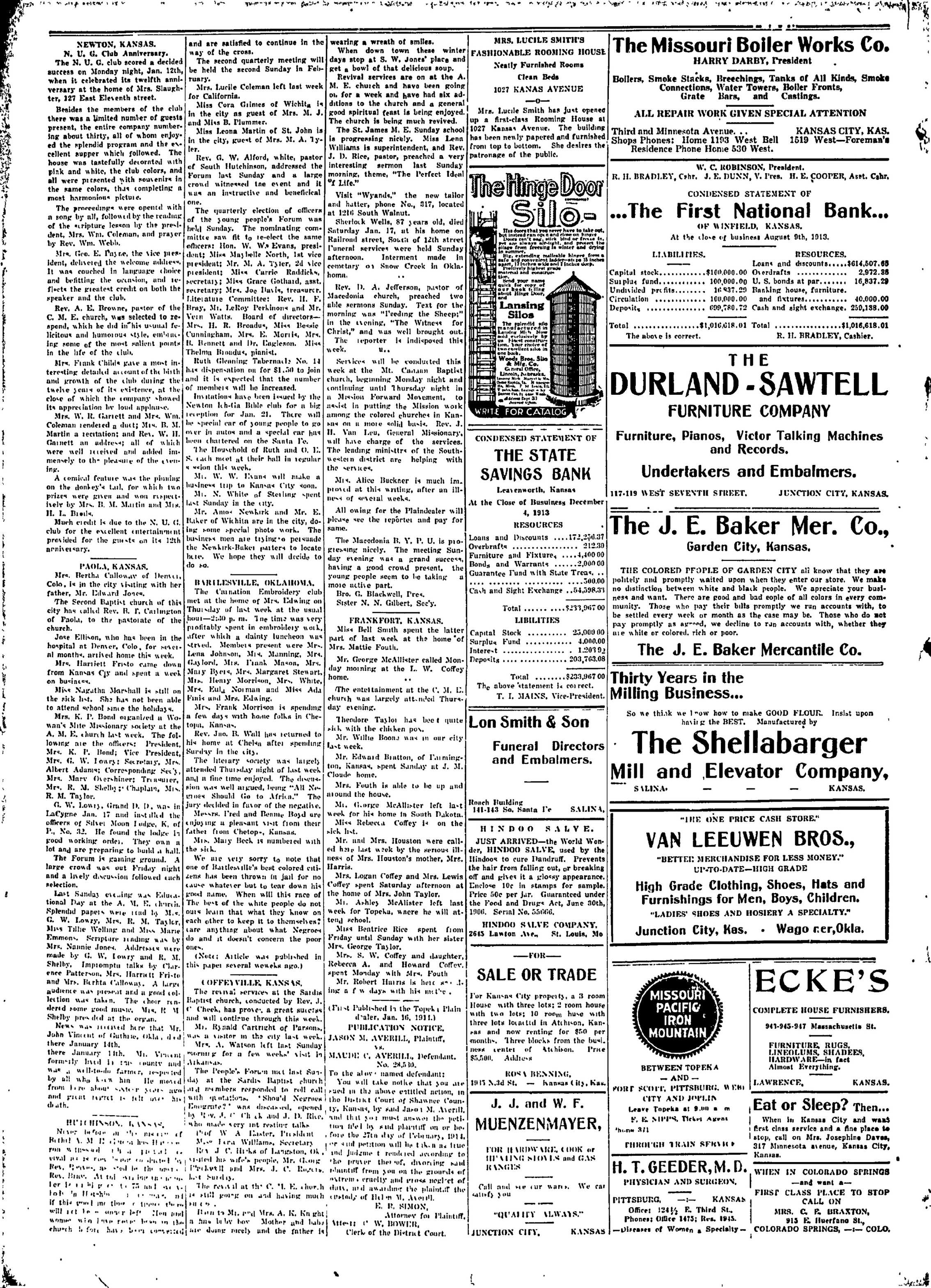
The N. U. G. club scored a decided success on Monday night, Jan. 12th, when it celebrated its twelfth anniversary at the home of Mrs. Slaughter, 127 East Eleventh street.
Besides the members of the club there was a limited number of guests present, the entire company numbering about thirty, all of whom enjoyed the splendid program and the excellent supper which followed. The house was tastefully decorated with pink and white, the club colors, and all were presented with souvenirs in the same colors, thus completing a most harmonious picture.
The proceedings were opened with a song by all, followed by the reading of the scripture lesson by the president, Mrs. Wm. Coleman, and prayer by Rev. Wm. Webb.
Mrs. Geo. E. Payne, the vice president, delivered the welcome address. It was couched in language choice and befitting the occasion, and reflects the greatest credit on both the speaker and the club.
Rev. A. E. Browne, pastor of the C. M. E. church, was selected to respond, which he did in his usual felicitous and humorous style, embracing some of the most salient points in the life of the club.
Mrs. Frank Childs gave a most interesting detailed account of the birth and growth of the club during the twelve years of its existence, at the close of which the company showed its appreciation by loud applause.
Mrs. W. R. Garrett and Mrs. Wm. Coleman rendered a duct; Mrs. B. M. Martin a recitation; and Rev. W. H. Garrett an address; all of which were well received and added immensely to the pleasure of the evening.
A comical feature was the pinning on the donkey's tail, for which two prizes were given and won respectively by Mrs. B. M. Martin and Mrs. H. L. Boulds.
Much credit is due to the N. U. G. club for the excellent entertainment provided for the guests on its 12th anniversary.
PAOLA, KANSAS.
Mrs. Bertha Calloway of Denver, Colo. is in the city visiting with her father, Mr. Edward Jones.
The Second Baptist church of this city has called Rev. R. F. Carlington of Paola, to the pastorate of the church.
Jose Ellison, who has been in the hospital at Denver, Colo., for several months, arrived home this week.
Mrs. Harriett Friosto came down from Kansas City and spent a week on business.
Miss Nagatha Marshall is still on the sick list. She has not been able to attend school since the holidays.
Mrs. K. P. Bond organized a Woman's Mite Missionary society at the A. M. E. church last week. The following are the officers: President, Mrs. K. P. Bond; Vice President, Mrs. G. W. Lowry; Secretary, Mrs. Albert Adams; Corresponding Secy. Mrs. Mary Overshiner; Treasurer, Mrs. R. M. Shelly; Chaplain, Mrs. R. M. Taylor.
G. W. Lowry, Grand D. D., was in LaCygne Jan. 17 and installed the officers of Silver Moon Lodge, K. of P., No. 32. He found the lodge in good working order. They own a lot and are preparing to build a hall
The Forum is gaining ground. A large crowd was out Friday night and a lively discussion followed each selection.
Last Sunday evening was Educational Day at the A. M. E. church. Splendid papers were read by Mrs. G. W. Lowry, Mrs. R. M. Taylor, Miss Tillie Welling and Miss Marie Emmons. Scripture reading was by Mrs. Nainie Jones. Addresses were made by G. W. Lowry and R. M. Shelby. Imptomptu talks by Clarence Patterson, Mrs. Harratt Frieto and Mrs. Berhta Calloway. A large audience was present and a good collection was taken. The choir rendered some good music, Mrs. R. M. Shelby presided at the organ.
News was received here that Mr. John Vincent of Guthrie, Okla., died there January 14th. there January 14th. Mr. Vincent formerly lived in this county and was a well-to-do farmer, respected by all who knew him. He moved from here about sixteen years ago and great sorrow is felt over his death.
Never before on the matter of Ruthal A. M. H. Glenn has been
run with us and this particular
vival of our new house conducted by
Rev. Percy, as well as by the other
Rev. Dray. At all times for the number
be in his place and we will
be in Hathin. If this good in those three there
will not be a slower left. Men and
women who have never been in the
church be for have been converted
and are satisfied to continue in the way of the cross.
The second quarterly meeting will be held the second Sunday in February.
Mrs. Lucile Coleman left last week for California.
Miss Cora Grimes of Wichita is in the city as guest of Mrs. M. J. and Miss B. Plummer.
Miss Leona Martin of St. John is in the city, guest of Mrs. M. A. Tyler.
Rev. G. W. Alford, white, pastor of South Hutchinson, addressed the Forum last Sunday and a large crowd witnessed the event and it was an instructive and beneficial one.
The quarterly election of officers of the young people's Forum was held Sunday. The nominating committee saw fit to re-elect the same officers: Hon. W. W. Evans, president; Miss Maybelle North, 1st vice president; Mr. M. A. Tyler, 2d vice president; Miss Carrie Raddick, secretary; Miss Grace Gothard, asst. secretary; Mrs. Joe Davis, treasurer. Literature Committee: Rev. H. F. Bray, Mr. LeRoy Perkinons and Mr. Vern Watts. Board of directors—Mrs. H. R. Broadus, Miss Bessie Cunningham, Mrs. E. Morris, Mrs. R. Bennett and Dr. Eagleson. Miss Thelma Broadus, pianist.
Ruth Gleening Tabernacle No. 14 has dispensation on for $1.50 to join and it is expected that the number of members will be increased.
Invitations have been issued by the Newton Ich-Gia Bible club for a big reception for Jan. 21. There will be special car of young people to go over in autos and a special car has been chattered on the Santa Fe.
The Household of Ruth and O. E. S. each meet at their hall in regular session this week.
Mr. W. W. Evans will make a business trip to Kansas City soon.
Mr. N. White of Sterling spent last Sunday in the city.
Mr. Amos Newkirk and Mr. E. Baker of Wichita are in the city, doing some special photo work. The business men are trying to persuade the Newkirk-Baker pattern to locate here. We hope they will decide to do so.
BARLESVILLE, OKLAHOMA.
The Cinnation Embroidery club met at the home of Mrs. Edwing on Thursday of last week at the usual hour—2:30 p.m. The time was very profitably spent in embroidery work, after which a dainty luncheon was sterved. Members present were Mrs. Lena Johnson, Mrs. Manning, Mrs. Gaylord, Mrs. Frank Mason, Mrs. Mary Byers, Mrs. Margaret Stewart, Mrs. Henry Morrison, Mrs. White, Mrs. Eula Norman and Miss Ada Finis and Mrs. Edwing.
Mrs. Frank Morrison is spending a few days with home folks in Checotah, Kansas.
Rev. Juno. B. Wall has returned to his home at Chelsea after spending Sunday in the city.
The literary society was largely attended Thursday night of last week and a fine time enjoyed. "The discussion was well argued, being "All Negroes Should Go to Africa." The jury decided in favor of the negative.
Messrs. Fred and Bennie Boyd are enjoying a pleasant visit from their father from Chetop-, Kansas.
Mrs. Mary Beck is numbered with the sick.
We are very sorry to note that one of Battlesville's best colored citizens has been thrown in jail for no cause whatever but to tear down his good name. When will this race of The best of the white people do not learn that what they know on each other to keep it to themselves? care anything about what Negroes do and it doesn't concern the poor ones.
(Note: Article was published in this paper several weeks ago.)
COFFEYVILLE KANSAS
The revival services at the Sardis Baptist church, conducted by Rev. J. C. Cheek, has prove, a great success and will continue through this week. Mr. Rynald Cartright of Parsons, was a visitor in the city last week. Mrs. A. Watson left last Sunday morning for a few weeks' visit in Arkansas. The People's Forum met last Sunday at the Sardis Baptist church and members responded to roll call with quotations, "Shou'd Negroes Emigrate?" was discussed, opened by Rev. J. C. Cheek and J. D. Rice, who made very int resting talks.
Miss Lora Williams, Secretary
Rev J. C. Hirks of Langston, Ok.
stored his wife's people, Mr. Gong
Pickwell and Mrs. J. C. Rogers,
last Sunday.
The revival at the C. "L. E. churh. h
is still going on and having much
success.
Born to Mr. and Mrs. A. K. Knight,
a fine baby boy. Mother and baby
are doing nicely and the father is
wearing a wreath of smiles.
When down town these winter days stop at S. W. Jones' place and get a bowl of that delicious soup.
Revival services are on at the A. M. E. church and have been going on for a week and have had six additions to the church and a general good spiritual feast is being enjoyed. The church is being much revived.
The St. James M. E. Sunday school is progressing nicely. Miss Lenn Williams is superintendent, and Rev. J. D. Rice, pastor, preached a very interesting sermon last Sunday morning, theme, "The Perfect Ideal 'I Life."
Visit "Wyands," the new tailor and hatter, phone No., 317, located at 1216 South Walnut.
Sherlock Wells, 87 years old, died Saturday Jan. 17, at his home on Railroad street, South of 12th street l'uneral services were held Sunday afternoon.
Interment made in cemetary on Snow Creek in Oklahoma.
Rev. D. A. Jefferson, pastor of Macedonia church, preached two able sermons Sunday. Text for the morning was "Feeding the Sheep;" in the evening, "The Witness for Christ," and was well brought out.
The reporter is indisposed this week.
Services will be conducted this week at the Mt. Canaan Baptist church, beginning Monday night and continuing until Thursday night in a Mission Forward Movement, to assist in putting the Mission work among the colored churches in Kansas on a more solid basis. Rev. J. H. Van Leu, General Missionary, will have charge of the services. The leading ministrs of the Southwestern district are helping with the services.
Mrs. Alice Buckner is much improved at this writing, after an illness of several weeks.
All owing for the Plaindealer will please see the reporter and pay for same.
The Macedonia B. Y. P. U. is progressing nicely. The meeting Sunday evening was a grand success, having a good crowd present, the young people seem to be taking a more active part.
Bro. G. Blackwell, Pres.
Sister N. N. Gilbert, Sec'y.
Miss Bell Smith spent the latter part of last week at the home of Mrs. Mattie Fouth.
Mr. George McAllister called Monday morning at the L. W. Coffey home.
The entertainment at the C. M. L. church was largely attended Thursday evening.
Theodore Taylor has been quite sick with the chicken pox.
Mr. Willie Boone was in our city last week.
Mr. Edward Bratton, of Farmington, Kansas, spent Sunday at J. M. Cloude home.
Mrs. Fourth is able to be up and around the house.
Mr. George McAllister left last week for his home in South Dakota.
Miss Rebecca Coffey is on the sick list.
Mr. and Mrs. Houston were called here last week by the serious illness of Mrs. Houston's mother, Mrs. Harris.
Mrs. Logan Coffey and Mrs. Lewis Coffey spent Saturday afternoon at the home of Mrs. John Taylor.
Mr. Ashley McAlister left last week for Topeka, where he will attend school.
Miss Bentrice Rice spent from Friday until Sunday with her sister Mrs. George Taylor.
Mrs. S. W. Coffey and daughter, Rebecca A. and Howard Coffey spent Monday with Mrs. Fouth
Mr. Robert Harris is here and J
ing a few days with his motive.
(First Published in the Topeka Plain
dealer, Jan. 16, 1911.)
PUBLICATION NOTICE.
JASON M. AVERILL, Plaintiff.
vs.
MAUDE C. AVERILL, Defendant.
No. 28,530.
To the above named defendant:
You will take notice that you are sued in the above entitled action, in the District Court of Shawnee County, Kansas, by said Jason M. Averill, and that you must answer the petition filed by said plaintiff on or before the 27th day of February, 1914, or said petition will be taken as true and judgment rendered according to the prayer thereof, divorcing said plaintiff from you on the grounds of extreme cruelty and gross neglect of duty, and awarding the plaintiff the custody of Helen M. Averill.
Attorney for Plaintiff.
Attest: C W. BOWER.
Clerk of the District Court.
MRS. LUCILE SMITH'S FASHIONABLE ROOMING HOUSE Nearly Furnished Rooms Clean Beds 1027 KANAS AVENUE Mrs. Lucile Smith has just opened up a first-class Rooming House at 1027 Kansas Avenue. The building has been newly papered and furnished from top to bottom. She desires the patronage of the public.
The Hinge Door
Silo-
Has doors that you never have to take out,
but instead ran open and close on hinges.
Doors can be made in any shape, size, and color,
perfectly at night, and protect the plaque from freezing in winter and drying in summer.
The hinges, standing malleable hinges form a safe and convenient ladder—up to 18 inches apart, 17 inches wide and 1 inch deep, positively highest grade material and construction.
Bend your name on the edge of our book killing about Hinge Door,
and
Lansing Silos
The palletid silos manufactured in Lansing, Michigan, sold exclusively by us. Hisst constructs them. Your choice of the most important silos in one book.
Woods Brox. Silo & Mfg. Co.
General Office,
Lincoln, Nebraska.
Lincoln, Nebraska.
Order Rapid, Inc.
Mt. Jackson
Mt. Jackson
Tahoe, Nebraska.
Boston, Mass.
Arlington, Va.
WRITE FOR CATALOG
THE STATE SAVINGS BANK
Leavenworth, Kansas
At the Close of Busuiness December
4, 1913
RESOURCES
Loans and Discounts ... 172,256.37
Overbraffs ... 212.30
Furniture and Fixture ... 4,400.00
Bonds and Warrants ... 2,000.00
Guarantee Fund with State Treas...
500.00
Cash and Sight Exchange ... 54,598.33
Total ... $233,967.00
LIBILITIES
Capital Stock ... 25,000.00
Surplus Fund ... 4,000.00
Interest ... 1,203.92
Deposits ... 203,763.08
Total ..... $233,967 00
The above statement is correct.
T. I. MAIN, Vice-President.
Lon Smith & Son
Funeral Directors and Embalmers.
Roneh Building
141-143 So, Santa Fe SALINA,
JUST ARRIVED—the World Wonder, HINDOO SALVE, used by the Hindoos to cure Dandruff. Prevents the hair from falling out, or breaking off and gives it a glossy appearance. Enclose 10c in stamps for sample. Price 50c per Jar. Guaranteed under the Food and Drugs Act, June 30th, 1906. Serial No. 55666.
HINDOO SALVE COMPANY.
2645 Lawton Ave. St. Louis, Mo
SALE OR TRADE
For Kansas City property, a 3 room
House with three lots; 2 room house
with two lots; 10 room house with
three lots located in Atchison, Kansas
and now renting for $50 per
months. Three blocks from the busi-
ness center of Atchison. Price
$5,500. Address
ROSA BENNING,
1915 N.3d St. — Kansas City, Ks.
J. J. and W. F. MUENZENMAYER,
FOR HARDWARE, COOK or
HEATING STOVERS and GAS
RANGES
Call and see our waro. We can
satisfy you
"QUALITY ALWAYS."
JUNCTION CITY. KANSAS
Bollers, Smoke Stacks, Breechings, Tanks of All Kinds, Smoke Connections, Water Towers, Boller Fronts, Grate Bars, and Castings.
ALL REPAIR WORK GIVEN SPECIAL ATTENTION
Third and Minnesota Avenue. ... KANSAS CITY, KAS.
Shops Phones: Home 1193 West Bell 1519 West—Foreman's Residence Phone Home 530 West.
W. C. ROBINSON, President.
R. H. BRADLEY, Cehr. J. E. DUNN, V. Pres. H. E. COOPER, Asst. Cehr.
CONDENSED STATEMENT OF
...The First No. OF WINFIELD
At the close of business
LIABILITIES.
Capital stock.....$100,000.00
Surplus fund.....100,000.00
Undivided profits.....16,837.29
Circulation.....100,000.00
Deposit.....699,780.72
Total.....$1,016,618.01
The above is correct.
THE DURLAND OF FURNITURE
Furniture, Pianos, Vi and R
Undertakers at
117-119 WEST SEVENTH STREET.
The J. E. Bake
Garden City
THE COLORED PEOPLE OF GAM politely and promptly waited upon no distinction between white and bla nness and want. There are good and munity. Those who pay their bills be settled every week or month as pay promptly as agreed, we decline are white or colored, rich or poor.
The J. E. Bake
First National OF WINFIELD, KANSAS. the close of business August 9th.
...The First National Bank...
$1,016,618.01 Total
Street. R. H. BRAD
THE
GARDEN-SAW
FURNITURE COMPANY
Pianos, Victor Talking
and Records.
Stakers and Embass
SEVENTH STREET. JUNCTION
E. Baker M
Garden City, Kansas.
PEOPLE OF GARDEN CITY all
fully waited upon when they enter
green white and black people. We
there are good and bad eople of all
to pay their bills promptly we run
back or month as the case may be.
agreed, we decline to run accounts
l. rich or poor.
E. Baker Mercan
DURLAND-SAWTELL FURNITURE COMPANY
Furniture, Pianos, Victor Talking Machines and Records.
Undertakers and Embalmers.
117-119 WEST SEVENTH STREET. JUNCTION CITY, KANSAS.
The J. E. Baker Mer. Co.,
Garden City, Kansas.
THE COLORED PEOPLE OF GARDEN CITY all know that they are politely and promptly waited upon when they enter our store. We make no distinction between white and black people. We appreciate your business and want. There are good and bad eople of all colors in every community. Those who pay their bills promptly we run accounts with, to be settled every week or month as the case may be. Those who do not pay promptly as agreed, we decline to run accounts with, whether they are white or colored, rich or poor.
The J. E. Baker Mercantile Co.
Thirty Years in the Milling Business...
So we think we know how to m
having the BEST.
The Shell
Mill and Elev
SALINA.
"THE ONE PRICE
VAN LEEUW
"BETTER MERCHANDI
UP-TO-DATE-
High Grade Clothin
Furnishings for M
"LADIES' SHOES AND
Junction City, Kas.
I know how to make GOOD FLOUR having the BEST. Manufactured by Shellabar and Elevator Co.
THE ONE PRICE CASH STORE
LEEUWEN BR
MERCHANDISE FOR LESS MONEY
UP-TO-DATE—HIGH GRADE
Trade Clothing, Shoes, Clothing for Men, Boys, C
SHOES AND HOSIERY A SPRE
City, Kas. . Wago
So we think we know how to make GOOD FLOUR. Insist upon having the BEST. Manufactured by
"BETTER MERCHANDISE FOR LESS MONEY." UP-TO-DATE-HIGH GRADE High Grade Clothing, Shoes, Hats and Furnishings for Men, Boys, Children. "LADIES' SHOES AND HOSIERY A SPECIALTY." Junction City, Kas. Wago ner,Okla.
MISSOURI
PACIFIC
IRON
MOUNTAIN
BETWEEN TOPEKA
— AND —
PORT SCOTF, PITTSBURG, WEST
CITY AND JOPLIN
Leave Topeka at 9.00 a.m.
F. E. NIPPS, Ticket Agent
phone 371
THROUGH TRAIN SERVICE
H. T. GEEDER, M. D.
PITTSBURG. KANSAS
Office: 1241/2 E. Third St.
Phones: Office 1475; Res. 1945.
Diseases of Women a Specialty-
---
NATIONAL Bank...
D, KANSAS.
less August 9th, 1913.
RESOURCES.
Loans and discounts.....$614,507.65
Overdrafts .....2,972.38
U. S. bonds at par.....16,837.29
Banking house, furniture.
and fixtures.....40,000.00
Cash and sight exchange. 250,138.00
THE SAWTELL COMPANY
Actor Talking Machines Records.
And Embalmers.
JUNCTION CITY, KANSAS.
Ker Mer. Co., City, Kansas.
GARDEN CITY all know that they are when they enter our store. We make people. We appreciate your business of all colors in every compromptly we run accounts with, to the case may be. Those who do not run accounts with, whether they or Mercantile Co.
Make GOOD FLOUR. Insist upon Manufactured by
Labarger Ector Company, KANSAS.
THE CASH STORE."
WEN BROS.,
USE FOR LESS MONEY."
-HIGH GRADE
Bag, Shoes, Hats and
Den, Boys, Children.
MOSIERY A SPECIALTY."
Wago ner,Okla.
ECKE'S
COMPLETE HOUSE FURNISHERS.
941-945-947 Massachusetts St.
FURNITURE, RUGS,
LINEOLUMS, SHADEES,
HARDWARE—in fact
Almost Everything.
Eat or Sleep? Then...
Eat or Sleep? Then...
When in Kansas City and want first class service and a fine place to stop, call on Mrs. Josephine Daves, 317 Minnesota avenue, Kansas City, Kansas.
WHEN IN COLORADO SPRINGS
and want a--
FIRST CLASS PLACE TO STOP CALL ON
MRS. C. E. BRAXTON,
915 E. HUERFAN St.,
COLORADO SPRINGS, --- COLO.
---
Mutual
"THE SOFT-WATER"
Laundry
C.H.MATTHEWS FOUNDER G' MANAGER.
We Wash Anything from a Lace Handkerchief to a Circus Tent. Everything Washed in Soft Water. Family Washing 6c Pound.
Free! Free! Free! Catalogue of the Latest Styles of AGENTS WANTED! FINE CREOLE HAIR
We are the largest dealers in Creole Hair Goods, Raw Hair by the pound; Electric Combs, Etc., in this country. We show a larger variety of styles and sell more Pine Creole Wigs than any other manufacturer in the United States.
Blum & Ste
Fresh and Cur
Home Made Lare
Susage a Special
Both Phones 185
OTTAWA, KAN
Both Phones 185 123 S. Main Street OTTAWA, KANSAS.
To Fine the Best Values In... Dry Goods M and Ready to wear,
Dry Goods Millinery and Ready to wear, come to the BOSTON STORE, OTTAWA, KANSAS Established 1896.
ARISTOS FLOUR
```markdown
```
RED TURKEY WHEAT FLOUR Use Less...It Goes Farther. We are operating the Crosby Mill at Topeka. THE SOUTHWESTERN MILLING CO., KANSAS CITY.
C. H. CAMPBELL Midland Meat Market
All Kinds of Meat at the Best Prices. Phones: Old 136-New 1. LEAVENWORTH, KANSAS
F. G. O. R. R. 510
LADIES' READY-TO-WEAR GARMENTS, MILLINERY, CARPETS AND SHOES
Relia/le Merchanise at reliabl prices. Courteous treatment to everyone.
—Satisfaction or Your Money Back.
THE : PATTON : HOTEL
N. P. PATTON, Prop.
(2 Blocks So. of Union Strtion.)
—CAFE IN CONNECTION.—
Meals at All Hours
Phone Douglas 4445
1014 16-18 South 11th St.
OMAHIA. NEBRASKA
COLORED MEN
TOLL FREE
Wanted to prepare as SLEEPING CAR AND TRAIN PORTERS. No experience necessary. Positions pay $65 to $100 a month. Steady work Kansas roads. Passes and uniforms furnished when necessary. Write now I. RY. C. I., Dept. 18, Indianapolis, Ind
"Why Have Kinky Hair?
PRESTO
STRAT-N-IT
NO. OF ALL HAIR
STRAIGHTENING"
BEFORE. AFTER.
Straightens the most obstinate coarse, kinky hair. Easily applied, Harmless, Odorless, Clean and Lasting. Apply once Presto and your Hair will become straight instantly, remaining so for months without another application. Presto eradicates Dandruff and other Diseases of the Hair and Scalp.
Nothing like PRESTO in the world. A package of Presto with directions sent postpaid securely sealed on receipt of One Dollar. Satisfaction guaranteed or money refunded. LAFAYETTE MANUFACTURING CO., Drevel Bldg., Philadelphia, Pa. Dept. "F" Reliable Agents wanted every where—Ladies or Gentlemen Presto is a money maker.
F RMS
Colored men, why not buy a farm in a land where a man is a man where ONE crop will pay for you farm. I can sell you a farm in Logan county, Kansas. PRICES FROM $10 $20 per acre; easy terrain, good soil, best climate. If you mean nust means, write
S. E. CAREY.
Attorney at Law, Russell Springs, Kansas.
Georgia Presents a Son That's Worthy.
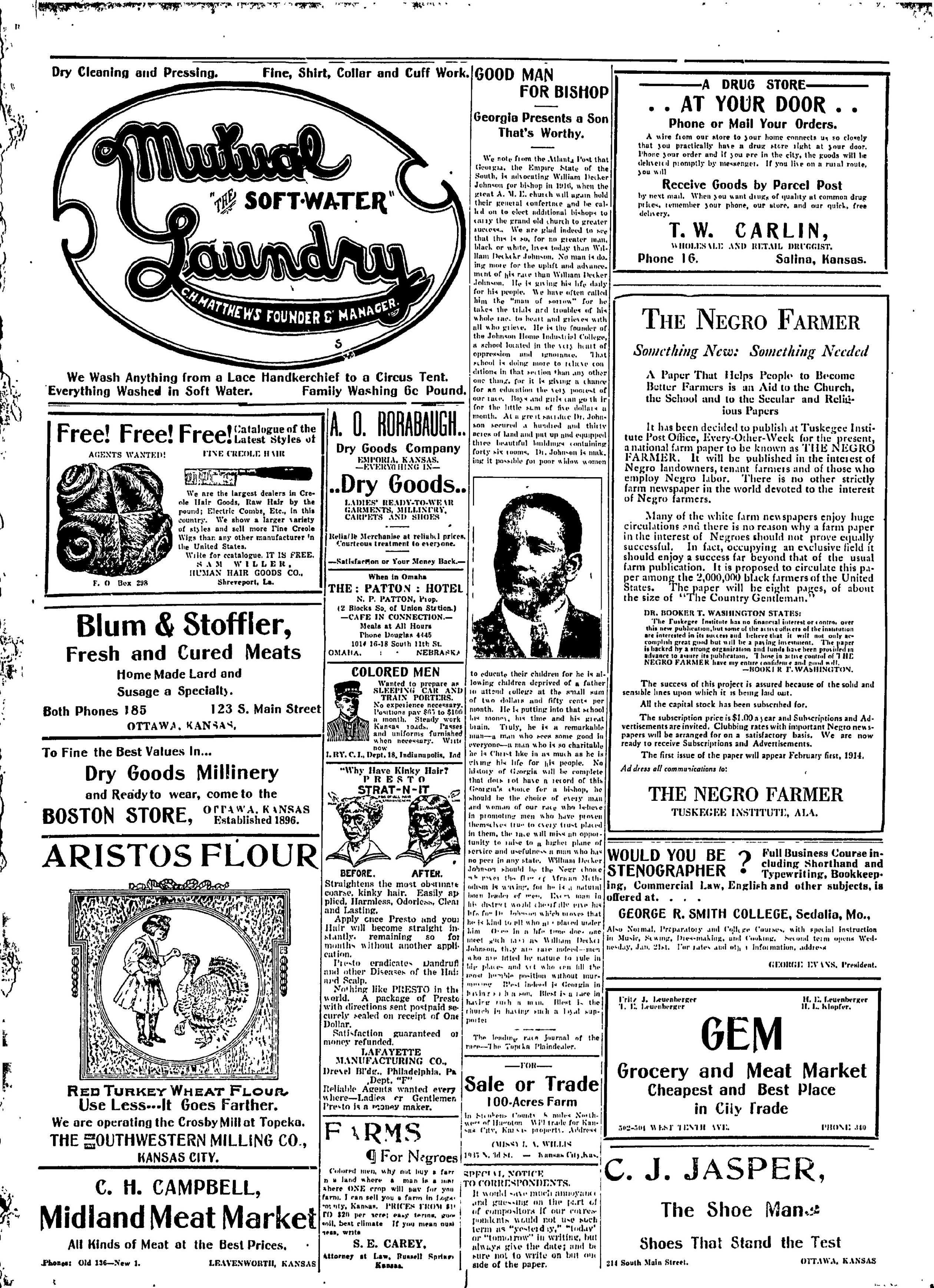
We note from the Atlanta Post that Georgia, the Empire State of the South, is advocating William Decker Johnson for bishop in 1916, when the great A. M. E. church will again hold their general conference and be called on to elect additional bishops to carry the grand old church to greater success. We are glad indeed to see that this is so, for no greater man, black or white, lives today than William Decker Johnson. No man is doing more for the uplift and advancement of his race than William Decker Johnson. He is giving his life daily for his people. We have often called him the "man of sorrow" for he takes the trials and troubles of his whole race, to heart and grieves with all who grieve. He is the founder of the Johnson Home Industrial College, a school located in the very heart of oppression and ignorance. That school is doing more to relieve conditions in that section than any other one thing, for it is giving a chance for an education the very poorest of our race. Boys and girls can go thir for the little sum of five dollars a month. At a great sacrifice Dr. Johnson secured a hundred and thirty acres of land and put up and equipped three beautiful buildings containing forty six rooms. Dr. Johnson is making it possible for poor widow women
M.
to educate their children for he is allowing children deprived of a father to attend college at the small sum of two dollars and fifty cents per month. He is putting into that school his money, his time and his great brain. Truly, he is a remarkable man—a man who sees some good in everyone—a man who is so charitable he is Christ like in as much as he is giving his life for his people. No history of Georgia will be complete that does not have a record of this Georgia's choice for a bishop, he should be the choice of every man and woman of our race who believe in promoting men who have proven themselves true to every trust placed in them, the race will miss an opportunity to raise to a higher plane of service and usefulness a man who has no peer in any state. William Decker Johnson should be the Negr choice who over the flare of African Methodism is waving, for he is a natural born leader of men. Every man in his district would cheerfully give his life for Dr. Johnson which moves that he is kind to all who are placed under him. Once in a life time does one meet such lady as William Decker Johnson, they are rare indeed—men who are fitted by nature to rule in his places and yet who can fill the most humble position without murmuring. West indeed is Georgia in having such a son. Blest is a race in having such a man. Blest is the church in having such a loyal supporter.
The leading race journal of the race-The Topeka Plaindealer.
Sale or Trade 100-Acres Farm
In Stephens County, Samples Northwest of Huceton Will trade for Kansas City, Kansas property. Address
(MISS) L. A. WILLIS
1935 N. 3d St. — Kansas City, Ks.
It would save much annoyance and guessing on the part of compositors if our correspondents would not use such term as "yesterday," "today" or "tomorrow" in writing, but always give the date; and be sure not to write on but one side of the paper.
A wire from our store to your home connects us so closely that you practically have a drug store right at your door. Phone your order and if you are in the city, the goods will be delivered promptly by messenger. If you live on a rural route, you will
Receive Goods by Parcel Post by next mail. When you want drugs of quality at common drug prices, remember your phone, our store, and our quick, free delivery.
T. W. CARLIN,
WHOLESALE AND RETAIL DRUGGIST.
Phone 16. Salina, Kansas.
THE NEGRO FARMER
Something New: Something Needed A Paper That Helps People to Become Better Farmers is an Aid to the Church, the School and to the Secular and Religious Papers
It has been decided to publish at Tuskegee Institute Post Office, Every-Other-Week for the present, a national farm paper to be known as THE NEGRO FARMER. It will be published in the interest of Negro landowners, tenant farmers and of those who employ Negro labor. There is no other strictly farm newspaper in the world devoted to the interest of Negro farmers.
Many of the white farm newspapers enjoy huge circulations and there is no reason why a farm paper in the interest of Negroes should not prove equally successful. In fact, occupying an exclusive field it should enjoy a success far beyond that of the usual farm publication. It is proposed to circulate this paper among the 2,000,000 black farmers of the United States. The paper will be eight pages, of about the size of "The Country Gentleman." DR. BOOKER T. WASHINGTON STATES:
The Fuskegeen this new publica are interested in complish great go is backed by a an advance to assure NEGRO FARM
The success of sensible lines upon v
The Fuskeegee Institute has no financial interest in this new publication, but some of the active officers of are interested in its success and believe that it will complish great good but will be a paying investment is backed by a strong organization and funds have be advance to assure its publication. Those in active of NEGRO FARMER have my entire confidence and
—BOOKI R F.WA
The success of this project is assured because able lines upon which it is being laid out.
The Fuskegee Institute has no financial interest or control over this new publication, but some of the active officers of the institution are interested in its success and believe that it will not only accomplish great good but will be a paying investment. The paper is backed by a strong organization and funds have been provided an advance to assure its publication. Those in active control of THE NEGRO FARMER have my entire confidence and good will.
—BOOK I R. WASHINGTON.
The success of this project is assured because of the solid and sensible lines upon which it is being laid out.
All the capital stock has been subscribed for.
The subscription
vertisements are invi-
papers will be arran-
ready to receive Subs
The first issue
Address all communications
THE N
TUSK
WOULD YOU
STENOGRAPH
ing, Commercial
tered at. . .
GEORGE R. S
so Normal, Preparator
Music, Sewing, Dress-
day, Jan. 21st. For 1.
The subscription price is $1.00 a year and Subscriptions are invited. Clubbing rates with importers will be arranged for on a satisfactory basis by to receive Subscriptions and Advertisements.
The first issue of the paper will appear February.
Press all communications to:
THE NEGRO FARM
TUSKEGEE INSTITUTE, AL
Would YOU BE A DYNOGRAPHER? Full Business including Typewriting, Commercial Law, English and other at.
GEORGE R. SMITH COLLEGE, Seymour, Preparatory and College Courses, with Sewing, Dressmaking, and Cooking. Second Jan. 21st. For rates and other information, ad
The subscription price is $1.00 a year and Subscriptions and Advertisements are invited. Clubbing rates with important Negro newspapers will be arranged for on a satisfactory basis. We are now ready to receive Subscriptions and Advertisements.
The first issue of the paper will appear February first, 1914.
Address all communications to:
THE NEGRO FARMER TUSKEGEE INSTITUTE, ALA.
WOULD YOU BE STENOGRAPHER? Full Business Course including Shorthand and Typewriting, Bookkeeping, Commercial Law, English and other subjects, is offered at. . .
GEORGE R. SMITH COLLEGE, Sedalia, Mo.,
Also Normal, Preparatory and College Courses, with special Instruction in Music, Sewing, Dress-making, and Cooking. Second term opens Wednesday, Jan. 21st. For rates and other information, address
Fritz J. Leuenberger
T. E. Leuenberger
GEM
Grocery and Meat Market Cheapest and Best Place in City Trade
C. J. JASPER,
Shoes That Stand the Test
214 South Main Street. OTTAWA, KANSAS
moral interest or control over active officers of the institution that it will not only acting investment. The paper funds have been provided in case in active control of THE confidence and good will. KIR R. F. WASHINGTON.
ear and Subscriptions and Ads with important Negro news- factory basis. We are now advertisements. Appear February first, 1914.
FARMER
RUTE, ALA.
Full Business Course in including Shorthand and Typewriting, Bookkeeping and other subjects, in EGE, Sedalia, Mo., courses, with special instruction. Second term opens Wed- mation, address
GEORGE EVANS, President.
Great Market
West Place
ade
ER,
H. E. Leuenberger
H. L. Klopfer.
PHONE 340
A Condition of Racial and National Achievement.
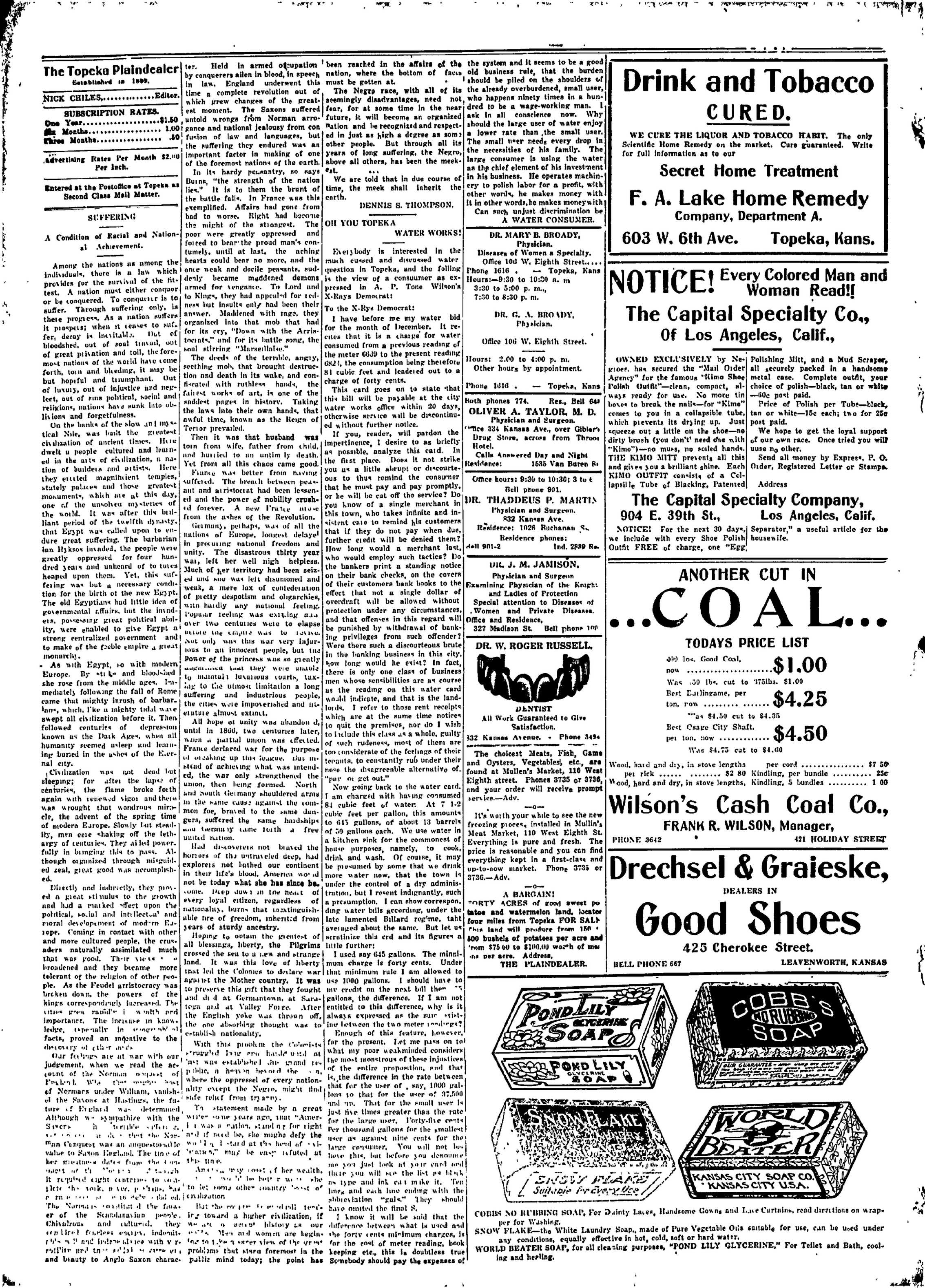
Among the nations as among the individuals, there is a law which provides for the survival of the fittest. A nation must either conquer or be conquered. To conquer is to suffer. Through suffering only, is these progress. As a nation suffers it prospects; when it ceases to suffer, decay is inevitable. Out of bloodshed, out of soul travail, out of great privation and toil, the foremost nations of the world have come forth, tomm and bleeding, it may be but hopeful and triumphant. Out of luxury, out of injustice and neglect, out of sins political, social and religions, nations have sunk into oblivious and forgetfulness.
On the banks of the slow and mystical Nile, was built the greatest civilization of ancient times. Here dwelt a people cultured and learned in the arts of civilization, a nation of builders and artists. Here they erected magnificent temples, stately palaces and those greatest monuments, which are at this day, one of the unsolved mysteries of the world. It was after this brilliant period of the twelfth dynasty, that Egypt was called upon to endure great suffering. The barbarian inn Hyksos invaded, the people were greatly oppressed for four hundred years and unheard of to tues heaped upon them. Yet, this suffering was but a necessary condition for the birth of the new Egypt. The old Egyptians had little iden of governmental affairs, but the invaders, possessing great political ability, were enabled to give Egypt a strong centralized government and to make of the feeble empire a great monarchy.
As with Egypt, so with modern Europe. By stile and bloodshed she rose from the middle ages. Immediately following the fall of Rome came that mighty inrush of barbarians, which, like a mighty tidal wave swept all civilization before it. Then followed centuries of depression known as the Dark Ages, when all humanity seemed asleep and learning buried in the ashes of the Eternal city.
Civilization was not dead but sleeping; for after the lapse of centuries, the flame broke forth again with renewed vigor and there was wrought that wondrous miracle, the advent of the spring time of modern Europe. Slowly but steadily, men were shaking off the lethargy of centuries. They allled powerfully in bringing this to pass. Although organized through misguided zeal, great good was accomplished.
Directly and indirectly, they proved a great stimulus to the growth and had a marked effect upon the political, social and intellectual and moral development of modern Europe. Coming in contact with other and more cultured people, the crusaders naturally assimilated much that was good. Their views broadened and they became more tolerant of the religion of other people. As the Feudel aristocracy was broken down, the powers of the kings correspondingly increased. The cities grew rapidly in wealth and importance. The increase in knowledge, especially in geographical facts, proved an incentive to the discovery of other lands.
Our feelings are at war with our judgement, when we read the account of the Norman conquest of England. Who the mightiest host of Normans under William, vanished the Saxons at Hastings, the future of England was determined. Although we sympathize with the Saxons in terrible affairs, we do not know that the Norman Conquest was an unquestionable value to Saxon England. The time of her greatness dates from the conquest of the Northern, though it required eight centuries to complete the work, never perhaps, has been more fully realized. The Normans constituted the forester of the Scandinavian people, Chivalrous and cultural, they confined forlorn enemy, indomitable and independent with veracity and truth, warrior and beauty to Anglo Saxon charac-
ter. Held in armed occupation by conquerers alien in blood, in speech in law. England underwent this time a complete revolution out of which grew changes of the greatest moment. The Saxons suffered untold wrongs from Norman arrogance and national jealousy from confusion of law and languages, but the suffering they endured was an important factor in making of one of the foremost nations of the earth.
In its hardy peasantry, so says Burns, "the strength of the nation lies." It is to them the brunt of the battle falls. In France was this exemplified. Affairs had gone from bad to worse. Right had become the might of the strongest. The poor were greatly oppressed and forced to bear the proud man's contumely, until at last, the aching hearts could bear no more, and the once weak and docile peasants, suddenly became maddened demons armed for vengeance. To Lord and to Kings, they had appealed for tenderness but insults only had been their answer. Maddened with rage, they organized into that mob that had for its cry, "Down with the Arriastocrats," and for its battle song, the soul stirring "Marseillaise."
The deeds of the terrible, angry, soothing mob, that brought destruction and death in its wake, and confiscated with ruthless hands, the fairest works of art, is one of the saddest pages in history. Taking the laws into their own hands, that awful time, known as the Reign of Terror prevailed.
Then it was that husband was toin from wife, father from child, and hurried to an untimely death. Yet from all this chaos came good.
France was better from having suffered. The breath between peasant and aristocrat had been lessened and the power of nobility crushed forever. A new France arose from the ashes of the Revolution. Germany, perhaps, was of all the nations of Europe, longest delayed in procuring national freedom and unity. The disastrous thirty year war, left her well nigh helpless. Much of her territory had been seized and one was left disunioned and weak, a mere lax of confederation of pretty despotism and oligarchies, with hardly any national feeling. Popular feeling was exiting and over two centuries were to elapse before the empire was to revive. Not only was this war very injurious to an innocent people, but the Power of the princess was so greatly augmented that they were unable to maintain luxurious courts, taxing to the utmost limitation a long suffering and industrious people, the cities were impoverished and literature almost extinct.
All hope of unity was abandon d, until in 1866, two centuries later, when a partial union was effected. France deflared war for the purpose of breaking up this league, that instead of achieving what was intended, the war only strengthened the union, then being formed. North and south Germany shouldered arms in the same cause against the common foe, braved to the same dangers, suffered the same hardships and Germany came forth a free united nation.
Had discoverers not braved the horrors of the untraveled deep, had explorers not bathed our continent in their life's blood. America would not be today what she has since be- come. Deep down in the heart of every loyal citizen, regardless of nationality, burns that inexinguishable fire of freedom, inherited from years of sturdy ancestry.
Hoping to obtain the greatest of all blessings, liberty, the Pilgrims crossed the sea to a new and strange land. It was this love of liberty that led the Colonies to declare war against the Mother country. It was to preserve this gift that they fought and did at Germantown, at Saratoga and at Valley Forge. After the English yoke was thrown off, the one absorbing thought was to establish nationality.
With this problem the Colonists
struggled long and hard until at
last was established the grand
republic, a heaven beyond the sea,
where the oppressor of every nation-
ality except the Negro, might find
safe relief from tryanny.
To statement made by a great
writer some years ago, that "Ameri-
l l was a nation, standing for right
and if need be, she might defy the
world, stand at the head of civilization," may be easy refuted at
this time.
Ameri l may resort to her wealth,
that she would be better wished she
to let some other country host of
civilization.
But the course of civilization tends
toward a higher civilization, if we
were to accept history as our
world. Men and women are begin-
ning to take a closer view of the great
problem that stard foremost in the
public mind today: the point has
been reached in the affairs of the nation, where the bottom of facts must be gotten at.
The Negro race, with all of its seemingly disadvantages, need not fear, for at some time in the near future, it will become an organized nation and be recognized and respected in just as high a degree as some other people. But through all its years of long suffering, the Negro, above all others, has been the meekest.
We are told that in due course of time, the meek shall inherit the earth.
DENNIS S. THOMPSON.
OH YOU TOPEKA
Everybody is interested in the much cussed and discussed water question in Topeka, and the folling is the view of a consumer as expressed in A. P. Tone Wilson's X-Rays Democrat:
To the X-Rys Democrat:
I have before me my water bid for the month of December. It recites that it is a charge for water consumed from a previous reading of the meter 6039 to the present reading 6823, the consumption being therefore 81 cubic feet and leadered out to a charge of forty cents. This card goes on to state that this bill will be payable at the city water works office within 20 days, otherwise service will be discontinued without further notice.
If you, reader, will pardon the impertinence, I desire to as briefly as possible, analyze this card. In the first place. Does it not strike you as a little abrupt or discourteous to thus remind the consumer that he must pay and pay promptly, or he will be cut off the service? Do you know of a single merchant in this town, who takes infinite and insistent care to remind his customers that if they do not pay when due, further credit will be denied them? How long would a merchant last, who would employ such tactics? Do the bankers print a standing notice on their bank checks, on the covers of their customers bank books to the effect that not a single dollar of overdraft will be allowed without protection under any circumstances, and that offenses in this regard will be punished by withdrawal of banking privileges from such offender? Were there such a discourteous brute in the banking business in this city, how long would he exist? In fact, there is only one class of business men whose sensibilities are as course as the reading on this water card would indicate, and that is the landlords. I refer to those rent receipts which are at the same time notices to quit the premises, nor do I wish to include this class as a whole, guilty of such rudeness, most of them are too considerate of the feelings of their tenants, to constantly rub under their nose the disagreeable alternative of, "pay or get out."
Now going back to the water card. I am charged with having consumed 84 cubic feet of water. At 7 1-2 cubic feet per gallon, this amounts to 615 gallons, of about 13 barrels of 50 gallons each. We use water in a kitchen sink for the commonest of house purposes, namely, to cook, drink and wash. Of course, it may be presumed by some that we drink more water now, that the town is under the control of a dry administration, but I resent indignantly, such a presumption. I can show corresponding water bills according, under the late lamented Billard regime, talt averaged about the same. But let us scrutinize this crd and its figures a little further;
I used say 645 gallons. The minimum charge is forty cents. Under that minimum rule I am allowed to use 1000 gallons. I should have to my credit on the next bill then 75 gallons, the difference. If I am not entitled to this difference, why is it always expressed as the sum existing between the two meter readings?
Enough of this feature, however, for the present. Let me pass on to what my poor weakminded considers the most monstrous of these injustices of the entire proposition, and that is, the difference in the rate between that for the user of , say, 1000 gallons to that for the user of 37,500 and up. That for the small user is just five times greater than the rate for the large user. Forty-five cents Per thousand gallons for the smallest user as against nine cents for the large consumer. You will not believe this, but before you denounce me you just look at your card and there you will see the list as blank as type and ink can make it. Ten lines and each line ending with the abbreviation "gals." They should have omitted the final S.
I know it will be said that the difference between what is used and the forty cents minimum charges, is for the cost of meter reading, book keeping etc., this is doubtless true Scrnebody should pay the expenses of
POND LILY
GLYCERINE
SOAP
POND LILY
GLYCERINE
SOAP
COBB'S
NO RUBBING
SOAP
BUR GUARANTEE
SNOW LAKE
GLYCERINE
SOAP
SNOW LAKE
Suitable For Every Use
WORLD
BEATER
KANSAS CITY SOAP CO.
* KANSAS CITY U.S.A.
COBBS NO RUBBING SOAP, For Dainty Laces, Handsome Gowns and Live Curtains, read directions on wrapper for Washing.
SNOW FLAKE—the White Laundry Soap., made of Pure Vegetable Oils suitable for use, can be used under any conditions, equally effective in hot, cold, soft or hard water. WORLD BEATER SOAP, for all cleaning purposes, "POND LILY GLYCERINE," For Toilet and Bath, cooling and healing.
the system and it seems to be a good old business rule, that the burden should be piled on the shoulders of the already overburdened, small user, who happens ninety times in a hundred to be a wage-working man. I ask in all conscience now. Why should the large user of water enjoy a lower rate than the small user. The small user needs every drop in the necessities of his family. The large consumer is using the water as the chief element of his investment in his business. He operates machinery to polish labor for a profit, with other words, he makes money with it in other words, he makes money with Can such unjust discrimination be
DR. MARY B. BROADY,
Physician.
Diseases of Women a Specialty.
Office 100 W. Eighth Street....
Phone 1616. Topeka, Kans
Hours:—9:30 to 10:30 n. m
3:30 to 5:00 p. m.,
7:30 to 8:30 p. m.
DR. G. A. BROADY,
Physician.
Office 106 W. Eighth Street.
Hours: 2.00 to 4:00 p. m.
Other hours by appointment.
Both phones 774. Res., Bell 64
OLIVER A. TAYLOR, M. D.
Physician and Surgeon.
Office 334 Kansas Ave., over Gibberd
Drug Store, across from Throon
Hotel.
Calls Answered Day and Night
Residence: 1535 Van Buren St
Office hours: 9:30 to 10:30; 3 to 4
Bell phone 901.
DR. THADDEUS P. MARTIN
Physician and Surgeon.
832 Kansas Ave.
Residence: 1026 Ruchanan S.
Residence phones:
dell 901-2 Ind. 2889 R
DIC. J. M. JAMISON.
Physician and Surgeon
Examining Physician of the Knight
and Ladles of Protection
Special attention to Diseases of
Women and Private Diseases.
Office and Residence,
327 Madison St. Bell phone 100
DR. W. ROGER RUSSELL.
DENTIST
All Work Guaranteed to Give Satisfaction.
332 Kansas Avenue. - Phone 3494
The choicest Meats, Fish, Game and Oysters, Vegetables, etc., are found at Mullen's Market, 110 West Eighth street. Phones 3735 or 3736, and your order will receive prompt service.—Adv.
It's worth your while to see the new freezing process, installed in Mullin's Meat Market, 110 West Eighth St. Everything is pure and fresh. The price is reasonable and you can find everything kept in a first-class and up-to-now market. Phone 3735 or 3736.—Adv.
A BARGAIN!
TORTY ACRES of good sweet potatoes and watermelon land, locate four miles from Topeka FOR SALP. This land will produce from 150 * 400 bushels of potatoes per acre and from $75.00 to $100.00 worth of meat per acre. Address,
THE PLAINDEALER.
POND LIL
SOAP
POND L
GLYCERIN
80A
Drink and Tobacco
WE CURE THE LIQUOR AND TOBACCO HABIT. The only Scientific Home Remedy on the market. Cure guaranteed. Write for full information as to our
Secret Home Treatment
F. A. Lake Home Remedy
Company, Department A.
603 W. 6th Ave. Topeka, Kans.
NOTICE! Every Colored Man and Woman Read!! The Capital Specialty Co., Of Los Angeles, Calif.,
OWNED EXCLUSIVELY by Negroes, has secured the "Mail Order Agency" for the famous "Kimo Shoe Polish Outfit"—clean, compact, always ready for use. No more tin boxes to break the nails—for "Kimo" comes to you in a collapsible tube, which prevents its drying up. Just squeeze out a little on the shoe—no dirty brush (you don't need one with "Kimo")—no mugs, no soiled hands. THE KIMO MITT prevents all this and gives you a brilliant shine. Each KIMO OUTFIT consists of a Collapsible Tube of Blacking, Patented
The Capital Spe
904 E. 39th St.,
NOTICE! For the next 30 days,
we include with every Shoe Polish
Outfit FREE of charge, one "Egg
ANOTHER
...CO
TODAYS P
NOTICE! For the next 30 days, Separator," a useful article for the we include with every Shoe Polish housewife. Outfit FREE of charge, one "Egg.
400 lbs. Good Coal,
now ..... $1.00
Was .50 lbs. cut to 375lbs. $1.00
Best Earlingame, per
ton, now ..... $4.25
"as $4.50 cut to $4.35
Best Osage City Shaft,
per ton, now ..... $4.50
Was $4.75 cut to $4.60
Wood, hard and dry, in stove lengths per cord ...
per rick ..... $2 80 Kindling, per bundle
Wood, hard and dry, in stove lengths, Kindling, 5 bundles
Wilson's Cash Coal
Wood, hard and dry, in stove lengths per cord $7.50 per rick $2.80 Kindling, per bundle 25c Wood, hard and dry, in stove lengths, Kindling, 5 bundles 1.00 Wilson's Cash Coal Co. FRANK R. WILSON, Manager, PHONE 3642 421 HOLIDAY STREET
Polishing Mitt, and a Mud Scraper, all securely packed in a handsome metal case. Complete outfit, your choice of polish—black, tan or white—60c post paid.
Price of Polish per Tube—black, tan or white—15c each; two for 25c post paid.
We hope to get the loyal support of our own race. Once tried you will use n<sub>0</sub> other.
Send all money by Express, P. O. Oider, Registered Letter or Stamp.
Socialty Company,
Los Angeles, Calif.
Separator," a useful article for the
housewife.
CUT IN
AL...
RICE LIST
per cord ..... $7 50
Kindling, per bundle ..... 25c
Kindling, 5 bundles ..... 1 00
ish Coal Co.,
Mrs. Bell Crith has returned from Kansas City, where she visited her sister, Miss Myrtle Gay.
Mrs. Mary Palmer left Sunday over the Santa Fe for Monmouth, Ill., where she will join her husband.
We have a rest room for ladies wishing to rest and also serve hot meals and lunches, 113 West 10th —Madam McClelland.
Miss Jessie Coleman, of Salida, Colo., chef at the Red Cross hospital is visiting Mr. and Mrs. G. J. Coleman, 116 N. Kansas Ave.
Miss Ida Groves was in the city with her father, Mr. J. G. Groves, attending the funeral of the late Mr. Corvine Patterson, Kansas City, Kansas.
Mrs. Frank McKinley, of Kingfisher, Okla, formerly of Topeka, since the death of her husband has returned to Topeka to make her future home.
Prices of hair dressing at Madam McClelland's New Beauty Parlor, 113 West 10th St.: Hair straightened 25 cents, Shampooing and Straightened 50 cents.
Mrs. Essie Williams and her mother, Mrs. Richard Roseman, left Wednesday for their home, Palmetto, Ga., after spending six weeks with B. G. Williams and family.
Hair Sale
Human hair goods on sale at Madam McClelland's New Beauty Parlor, at 113 West 10th street. Any switch in the house 39 cents.
The Oriental Art club met Thursday, Jan. 15, at the home of Mrs. S. F. Malone, 825 Center. After the general routine of business, a dainty repast was served and then they adjourned to meet at the home of Mrs. U. A. Gianam. Mrs. M. Hickerson and W. Graham as hostesses.
Mrs. C. Summit, of Wichita, Kansas, has been visiting her daughter Mrs. Geo. Levall, 1414 N. Logon St. and while in Troy, she called at the Plaindealer oTre and paid a years subscription. She is one of Kansas' poiner citizens and is a highly respected old lady and is full of nice pride.
A paper has been launched at Tuskegee Institute called the Negro Farmer. We hope the colored people will take hold of this paper as it is very necessary to have such an organ that will teach our people to own farms and then to farm them. We know it will be of interest and great importance.
We hope the colored people will get busy and write letters to the different Congressmen and urge them to do something for the ex-slaves and use their influence to pass some bill for caring for them. The Plaindener has taken up this work and will have some information to impart to the public soon.
The Ladies Shamrock club met with Mrs. Josie Bradshaw, Jan. 20. All members were present and two visitors. After the regular routine of business a delicious four course lunch was served. They were served from a long table, extending across the dining room. The table was decorated most beautifully with pretty flowers. They adjourned, to meet with Mrs. Byrd, Feb. 3.
Mrs. James Moore entertained at family dinner during the holidays. The table was decorated with a large basket of fruit. The dinner was served in four courses. Those present were: Mr. and Mrs. Allen Woods, Miss Jenet Johnson, of Colorado Springs, Colo., Miss Rosa Vann of Coffeyville, Kansas, Miss Lela Finney, Mr. Caul Sharp and Mr. R. Adam, of Coffeyville, Kansas.
The Joyance met with Mrs. James Preston Smith Saturday afternoon, Robert Burns being the author studying this month, the following program was rendered: Quotations, Biographical sketch. Miss Foster; "Tam O'Shanter," Mr. Cerrine Jones Song selection Miss Oden; Reading, Miss Conner; "Cottors Sound Night," Miss Minnie Jones; "Jane" Mrs. Smith; "Auld Lang Syne." Cluh. A delicious three course lunch con was served amid beautiful-linen and cut glass, such as only a recent bride may use.
Prof. Joel E. Spingarn Spoke Against Segregation of Races.
(Daily Capital, Jan. 17.)
"The New Abolitionism" is the name which Professor Joel H. Spingarn gives the widespread movement which he represented last evening in the lecture delivered at the Central Congregational church. Professor Spingarn is president of the New York branch of the National Association for the Advancement of the Colored People and is touring the middle western states at present under the auspices of the association. His trip is the beginning of an active campaign to organize the colored people and their white friends in a new movement against all form of race discrimination. The policy of compromise with some forms of injustice for the sake of advantages in other directions, urged by the old leaders of the fight for the welfare of the Negroes, has really represented a loss, urged Professor Spingarn, and has resulted in the continuation of race prejudice and the limiting of opportunity.
Farm segregation, conceded to be the most pressing of recent issues in the Negro problem of the South, was a prominent theme of the speaker. He told of the movement to curtail the land holdings of Negroes by the passage of laws allowing the voters of the section to say that when the larger part of the acreage of a section is held by one race, the voters may say that no land shall be sold to a member of a different race, claiming that the limitations on Negro suffrage in the South would make it possible for the whites to use this power to keep their communities white, while Negroes would never be able to use it in their own favor. The agricultural progress made by Negroes, represented in their steadily increasing land holdings, he said, has been responsible for this new move to check and segregate them; and he described the bitter feeling which it is creating.
The recent investigation of charges of Negro segregation in government departments at Washington, in which the National Association was active, was discussed by Prof. Spingarn against colored employees in federal offices and told of the attempts to get action from the department heads on the matter, which he said had met with indifference.
"The appearance of segregation at Washington," said Professor Spingarn, "has been a hard blow to Negroes throughout the country, and has created the most intense feeling of any issue of recent years. The feeling has been that segregation in Washington must carry with it the sanction of the government and the administration, and this has been much harder to face than state opposition. Protest has been widespread and the members of the association are determined not to let the matter drop until they have called forth some action from the men at the head of affairs and forced the administration to declare itself on the issue."
Work of N. A. A. C. P. Proffessor Spingain told of the work of the National Association for the Advancement of Colored People, and of how it has spread in a few years from being a small organization confined to one section to have a national membership and branches in important cities from the Atlantic to the Pacific coast. He reviewed the work of research and publicity in behalf of the Negro which the association has done, and told of its plans for continuing the campaign more actively during the coming year, with the support of many prominent men and social workers who are in league with it. An object of the present trip is to increase membership. Professor Spingarn's visit has been the subject of much interest in the cities where he has appeared. In Chicago The City club entertained him and heard him speak.
The meeting last night was called to order by Attaun Capper, who presided in the chair. The Rev. Roy B. Guild pronounced the invocation. A solo was sung by Miss Jessie Oden and music was furnished by the Industrial School Chorus. The follower also provided of the local organization attended the meeting and were asked on the platform with the speaker:
Governor George H. Hedges, Superintendent H. R. Wilson, John M. Wright, the Rev. G. W. Guy, Dr. L. H. Mann the Rev. P. Cull. Professor W. P. Carter the Rev. I. M. Brown Pollock Stine, P. P. Ponkwele C. G. Fishbane Cnt. P. H. Coney and T. A. McNeal.
Corner Third and Kansas Ave. JAMES WHITE and J. H. HARRIS
Prof. Spingarn Visits Topeka.
A large crowd greeted Prof. Joel E. Spingain at the Central Congregational church last Friday evening when he spoke on "New Abolitionism." We regret very much that after securing one of the largest white churches in the city, where the least prejudice is supposed to exist, that there were not more than one dozen white people present to hear him talk on this subject. It is more than we can understand, especially, when the congregation is led by Rev. Sheldon, a man who follows in the footsteps of Christ. So far as the colored people are concerned, they are in sympathy with Prof. Spingarn and admire his courage and bravery to take up the cause of the colored race and stand up for them, when there is so much prejudice among his own race. There should be some effort made on the part of some of those who are trying to break up race hatred and prejudice to try and secure a white audience to hear this talk that will set them right. It is just what the Plaindealer and other colored newspapers are publishing every day. The local organization of this national association for the advancement of the colored people is headed by a white man, who is president and we have met several white men who are sincere in trying to bring about the desired results, which Prof. Spingain is going over the country talking and contending for fair play for the colored man and more or no less than the white man demands.
While Toneka has her share of prejudice brought about by the Southern white men pouring in and in other parts of Kansas and making it hard for the colored man to get a paying position, we can boastfully say that the colored people hold more political positions in Topeka, than any other city in the United States, in proportion to the population. This is brought about by the constant agitation for their rights and the lower use of the ballot box.
After the meeting, Prof. Spingarn was the guest of a banquet, given by the local organization. Msal Lena Thompson one of the leading caterers of the West, served the banquet and was one of the finest ever given by that organization.
PREJUDICE IN THE FIRST
Two colored Scientists went to visit the First Church of Christ Science, Huntoon and Polk streets, Sunday morning and on entering the church and starting for their seats, as is the usual custom, were halted in the side, in a much embarrassing way by the usher and were taken back to a little bench in the corner. This being so unusual, they asked the usher why it was and what it meant and in reply he told them that he was authorized by a committee of the church to do so. So the visitors said that this was not Christian Science for Christian Science worships God in Spirit and truth and not in personality, "For God is no Respector of Persons." So the visitors quietly left the church and went to the Second Church of Christ Science, where they were treated with much honor and respect.
Mr. and Mrs. Alex Reeves and her brother, of Salina, were In Topekh last week to accompany the body of their mother Mrs. Mutha Bell, who died at the State hospital here, to Atchison. Mrs. Bell was one of Kansas' pioneer citizens and came to Kansas in the early "Girls" and about thirty years ago went to Emporia where she made her home. She has been in the state hospital for some time. She leaves two sons, three daughters, several grandchildren and a host of friends to mourn her loss.
A number of friends of Mr. Moe are entertained in honor of W. J. J. of Colorado Springs, Colo. The coming event will provide much and good conversation. Those present: Mrs. Ivan Vince, Miss M. Wood Cypressman, Miss I. In Dhore, Mrs. A. Woods, Mr. C. Sharp, Mr. F. Brown, Mr. E. Settler, Mr. C. Hardy, Wise Johnson left Sunday evening for Colorado Springs, Co.
Gives Five Hundred
Banker Binga, of Chicago Ansists New Allotition Movement by Liberal Offer.
Believes It is Uneaslen to Accumulate ..Property Unless the Afro-American Man the Ballot to Protect it.
Given Merge to National Association for the Advancement of Colored People Because the Organization Has Proved its Ability to Fight Discrimination and Regain Rights for Colored People.
Chicago, Jan. 20—Jesse Blinga, Chicago's rich Afro-American banker has given $500.00 to aid the work of the National Association for the Advancement of Colored People in its work fighting the wrongs of the colored race.
The monty was given at the Lincoln Center meeting, when the New Abolition movement was inaugurated, but owing to the modesty of Mr. Blinga, no public announcement was made.
Mr. Binga is very enthusiastic about the work of the association and thinks that the time has come for the colored people to give money and work together to retain the rights the race now enjoys and regain those which have been lost by the infidence and short-sightedness of those who in their preachments have put other things before the conversation of rights.
Mrs. Susie Pace Samson was brought to the city Saturday of last week from Laverworth by her mother, Mrs. Mollt Pace, in a very serious condition. Tomorrow she will enter Christ hospital where she will undergo an operation. The Plant-dealer joins her many friends in wishing her a speedy recovery.
Everybody visit Mullen's Meat Market, 110 West Eighth street. Phones 3735 or 3736.—Advt.
Mrs. J. E. Edwards left for her new home in Dallas, Texas one day this week. She was accompanied by Mrs. D. C. Scott.
Come to the family boarding house and get a good square meal. 113 West 19th St.
Rev. W. T. Nickerson, the noted evangelist, of New Orleans, In., is conducting a series of meetings at the Third Baptist church, 11th and Washington streets. Rev. W. W. Russell is pastor of the church.
Mrs. Frank R. McKinley is now residing in Topeka, and she has a host of good, warm, personal friends who are delighted to welcome her back once more. Mrs. McKinley is a valuable woman in church and society and her presence will greatly assist along all lines.
Mr. Oscar Hawkins, who for the most few weeks had been visiting his father and sisters, left one day this week for his home in Canada. He gave The Plaindealer some very interesting data concerning that country which we will dish up and serve to our readers when time and space will permit.
Word reached Topica on day this week that Miss. Ruthe Brown, formerly of this city, but now a resident of Los Angeles, Cal., was seriously burned in a gas explosion. A later report however, bears the glad news that her injuries are not as bad as first reported. This is very gratifying indeed to a host of Topekans who wish her speedy recovery.
We don't care. We don't care. You're ed nor color. We
are not of both same color as mother. Our motto is DO
it with the same color as mother. The same courteous treatment accor-
dent to our motto and our with
The Palace Hair Parlor
Has just received a large supply of Hair Goods for Colored people—best in town for the money. The Largest stock of HUMAN HAIR for Colored people in the city. SHAMPOO, STRAIGHTNING and all kinds of HAIR WORK done by first-class Hair Dressers. We guarantee satisfaction. Come and see our place—Better and bigger than ever.
832 KANSAS AVE. TELEPHONE 3494—W
* AGENTS WANTED to sell our goods. Call or write us.
Church Notes.
SAINT JOHN A. M. E. CHURCH. (By Church Staff.)
Superintendent Buckner opened his Sunday School promptly at 9:00 A.M., with his full corps of teachers. The "Good Samaritan" topic "as engaged in by some 150 students. Church services opened at 11:00 A.M. with standing room at a premium. After the choir had fulfilled its mission of preparing the minds for spiritual thought, our pastor, Eve, J. M. Brown, delivered a most highly appreciated sermon on "The Lines Fallen in Pleasant places," found in the 16th chapter of Psalms. It would be a pleasure if space would permit us to print this sermon in full. The trustees realized a good day financially.
A beautiful service, accompanied the installation of the Christian Endeavor officers, which was presided over by the very efficient president, Miss Flora Jeltz. The following officers were installed for the ensuing six months: Miss Flora Jeltz, president; Mr. Chas. Brown, vice president; Miss Chara Lamberson, see'y; Miss Ruth Ridley, cor. see'y; Mrs. Ridley, treasurer; Miss Alice Smith, Punist; Miss Mamie Johnson, supt. Junior League.
The evening services were attended by a full and appreciative audience.
The protracted meetings that have been in session for the past week is proving to be a great success spiritually. Many souls have been blessed and new names added to the church. Special services by the choir every Sunday evening. Everybody invited to attend.
Rev. B. R Ross has returned from Atchison where he has been assisting Rev. Taylor about 10 days, in a meeting. He reports quite a success.
Rev. Robert Cox of Salina, and Brother White, of Abeline, who had been attending a board meeting in Atchison last week, were in the city last Saturday, the guests of Rev. Ross, for dinner.
Miss. Maggie Howard entertained the Sewing Circle at her home 927 Wood street, last Thursday. Miss Louise Dumce send a paper title, "Some Ways of Making the Circle of More Interest." Each and every one spoke something on the subject, declaring it to be a very nice paper. After all business was disposed of, we were invited to the dining room to a very delicious lunch, she said, but we declared it was a square meal and to be sure, it was. Visit our Circle once, which meets every Friday afternoon at 2:30 P. M.
Star Junior Endeavor is progressing nicely under the superintendents of Miss Louise Dupree.
We are glad to note that Mrs. Encline Walker is able to be out again.
Mrs. Jane Adams served doughnut and tea at our home last Thursday evening, for the benefit of the Stewardess, who are making quite a success.
Sir Lay was a nice dear and we are proud to serve so many at church, at both services. The man at all and promised to serve us so well. We realize that it is good to be there for the Lord.
you and your friends present.
Rev. J. M. Brown was in this part of the city Tuesday, calling on his members, also made a pleasant call at the parsonage. Those who are on the sick list: Donon Donnelly, Mrs. Julia Bigby, Mr. Charles and the little daughter of Policeman Sam Jones. There were 69 present at the night school Wednesday night. Prof. Harrison and Ridley are certainly doing their best to teach the pupils and they certainly are making good of this opportunity. We almost feel safe in saying we have them in school from the age of 18 years up to 74 years and perhaps some older.
The Second Baptist Churth.
The Second Baptist church, Third and Quincy St., has purchased the property on the South side of the church for a parsonage, which is a splendid move on the part of the officers of the church.
This church is doing a great and good work under the leadership of Rev. G. W. Henry, a man of great sterling worth and splendid executive ability and a christian gentleman of the true type. Rev. Henry is ably assisted and encouraged by a splendid staff of officers, men of honour and truth, men who have the welfare of the church at heart. These men consist of the deacon board: Jason Smith, Chairman, B. G. Gattison, B. Arms, R. Carson, Tyree Smith, H. Sawyers and Chas Smith. The trustees are: G. W. Charles, Chairman, S. M. Ward, Sec. George Smith, Hiny Wilson, and Jesse Smith.
These noble and good men, backed up, and encouraged by a splendid membership, are pressing onward and upward.
Press on, good pastor and noble officers, press on, faithful and true members, your past has been stormy and dark, but your future is full of promise, and the Almighty God in whom you are trusting, will guide you all safely on the other side.
(Written by a friend who has watched the progress of the church.)
The Shiloh Baptist Sewing circle was entertained by Mrs. H. I. Monroe Friday at her home. The regular routine of business was transacted, president, Mrs. Annie Williams, presiding. Rev. E. T. Fishback of Wichita, Kans., as a visitor. The circle will meet with Mrs. A. R. Hightower, Friday Jun. 23, 1914, at her home on College Ave. ANNA WILLIAMS, President. BIRDIE SCOTT, Reporte.
Received from Washington D. C.
Fredrick J. Douglass, inventor of
the Steam Slide Valve Block, has
got a patent for an improvement
and he is an engineer and quite
a mechanic about machinery. Residence at 1548 Kansas Ave.
(First Published in The Topeka
Plungeer, Friday Jan. 23, 1914.)
In the District Court of Shawnee
County, Kansas.
Katie Boyles, Plaintiff.
George E. Boyles, Defendant.
PUBLICATION NOTICE.
Sout of Kunstra to George E. Boyles
You are hereby notified that you are in an action in the District Court of Shawnee County Kansas
Whereon Katie Boyles is plaintiff and George E. Boyles is defendant and that the petition in said action was filed in the clerk's office of said court on the 22nd day of January, 1914, and that unless you answer with motion on or before the 7th day of March 1914, judgment will be rendered against you in said action every time plurtiif a divorce from you.
W. J JAMISON.
Attorney for Plantuff.
(A. A. O.) C. W. Bower, clerk of
the District Court.
The Knights and Ladies of the Orient
A FRATERNAL BENEFICIARY SOCIETY
Will issue policies for yourself and children, paying Partial Life, Sick, Funeral, and Death Benefits in case of death. No home-loving man can afford to be without Life Insurance
THE KNIGHT AND ORIENT is duly authorized by the laws of the State of Kansas, and is under the Superintendent of Insurance of Kansas. Its officers are bonded in a reliable Safety Company. Liberal terms to Agents. For information address.
NATIONAL HEADQUARTERS.
519 Kansas Avenue. Topeka, Kansas.
OUR MOTTO: "Prompt Payment of Claims."
JOHN M. WRIGHT PEARL McNEAL,
National President National Secretary.
Colored People's Hair.
WIGS
WIGS
Our Specialty.
Send two cent stamp for New 1913 Catalogue
THE OLD Mme. Bail
RELIABLE 486 8th Ave, Bt. 34th and
Trolley To
Cars leave Third and from 6:20 A.M. to 10:00 day Thursday and Friday nights last car leaves 13
Cars leave Tenth and on the even hour from 6 P.M. on Monday, Tue-die nights. Saturday and 11 P.M. last car leaves
The Kansas City
From Me
Mme. Baum's Hair Emporium
North Ave, Bt. 34th and 35th Sts. NEW YORK CITY
Cars leave Third and Delaware every hour on the
on 6:30 A. M. to 10:00 P. M. on Monday, Tuesday, W
Thursday and Friday nights. Saturday and 2
nits last car leaves 12 o'clock midnight
Cars leave Tenth and Main, Kansas City, every
he even hour from 6 A. M. to 10 P. M., theatre car
L. on Monday, Tuesday, Wednesday, Thursday and
nits. Saturday and Sunday nights theatre car lea
P. M., last car leaves 12 o'clock midnight.
Kansas City-Western Railway
From Meadows of Gold
THE OLD Mme. Baum's Hair Emporium, RELIABLE 486 8th Ave. Bt. 34th and 35th Sts. NEW YORK CITY; N. Y.
Trolley To Kansas City
Cars leave Third and Delaware every hour on the half from 6:30 A.M. to 10:00 P.M. on Monday, Tuesday, Wednesday Thursday and Friday nights. Saturday and Sunday nights last car leaves 12 o'clock midnight
Cars leave Tenth and Main, Kansas City, every hour on the even hour from 6 A.M. to 10 P.M., theatre car 11:00 P.M. on Monday, Tuesday, Wednesday, Thursday and Friday nights. Saturday and Sunday nights theatre car leaves at 11 P.M. last car leaves 12 o'clock midnight.
The Kansas City-Western Railway Co.
The Kansas City-Western Railway Co.
A
Meadow Gold
Purest of cream, roughly pasteurized this the best of sweet and good.
Packed fresh from odor proof package ness for you.
Ask Y
Butter
nearest of cream, carefully selected, the
highly pasteurized, skilfully churned ma-
sure the best of all butter, always p
et and good.
packed fresh from the churns in pater-
or proof packages to preserve all its go
s for you.
Ask Your Grocer for
Purest of cream, carefully selected, thoroughly pasteurized, skilfully churned makes this the best of all butter, always pure, sweet and good.
Packed fresh from the churns in patented odor proof packages to preserve all its goodness for you.
Meadow Gold Butter
Continental Crea
Its flavor wins favor. Continental Creamery Co., Topeka,
Its flavor wins favor. Continental Creamery Co., Topeka, Kas.
RST FIELD Made with a part in the center, with a cut out 1 stand up. Will stand up.
Kansas City
aware every hour on the half
on Monday, Tuesday, Wednesday
nights. Saturday and Sunday
k midnight
in, Kansas City, every hour
to 10 P. M., theatre car 11:30
nnesday, Thursday and Friday
nights theatre car leaves at
clock midnight.
Western Railway Co.
news of Gold
efully selected, thor- fully churned makes butter, always pure.
e churns in patented preserve all its good-
Grocer for
ins favor. y Co., Topeka, Kas.
NOXIE, OKLAHOMA. (By Tolia Bradford.)
Mr. Jao. Woods celebrated his fortieth birthday anniversary and fifty guests were present to wish him the return of many more natal days.
Mrs. Eva Martin is still on the sick list.
Mr. S. H. Terry is on the sick list.
Miss Margie Terry is visiting her colins. Misses Peathe and Myrtle Terry, at Ellott.
Prof. A. L. Wright has returned from a trip to Kansas City and taken charge of his school again.
Mr. J. C. Colbert recently butchered a dog weighing 600 pounds.
Mr. and Mrs. John Haynes were guests of Mr. and Mrs. J. C. Colbert.
T. D. Bradford was a recent visitor at Nowata on business.
Mrs. Laura Garcia and family were guests of Mr. and Mrs. L. P. Garcia lost Sunday.
There seems to be no one in Novie anxious to go to Africa.
Mr. map talk and ice-slate and figure right and day, but no matter how they calculate the Negroes are here to stay.
Mr. Arthur Toliv was the guest of Mr. L. Colbert.
Miss Lilhel Harris is preparing to go to Missouri.
Th. High school child en are doing splendidly in their work.
Miss Julia Looney is visiting with her brother, Clarence Looney.
The railroad has changed the time of its trains. The evening train from Coff will be due at 1:10 p.m.
M. Chinles Whitmore was a visitor in the city last Sunday.
Miss Ada and Leona Riley, Viola and Lela Miller were visitors with Mrs. Eva Mattm at Timber Hill last Sunday.
Miss Ella Robinson and Mr. Clay Heady will be married next week. They have the hearty wishes of a host of friends. Mr. Ewing Heady and Miss Victoria Landmon will be married next Wednesday.
Mrs. J. Taylor was the hostess for an afternoon party at her residence Tuesday, Dec. 24, 19. The party was given in honor of the Carnation Art club. Mrs. Taylor's home was beautifully decorated with red lights, flowers and candles and there was a Christmas basket and each one received many beautiful presents. One of the presents received by the hostess was a beautiful berry spoon, given her by the club members. A program was tendered, after which a dainty luncheon was served. After this the guests deported, wishing the hostess a merry Christmas and a happy new year.
Mrs. Wilson, mother of Mr. James Wilson, of 1125 Walnut street, is on the sick list.
Dr. W. H. Hudson reports born to Mr. and Mrs. Hollowday, Tuesday, Jan. 6, a girl.
Mrs. J. W. Wilson, who has been numbered among the sick, is much improved at this writing.
Mrs. Frank Holbert has returned home from Hiawatha, where she visited with her parents through the holidays. She reports a nice time.
Mrs. Mery Caraday is numbered among the sick.
Prof R. I Hawkins, M. W. G. M.,
Prince Hall Grand Lodge, A. F. and
A M. of Kansas, visited with Lodge
No 61, Estella Chapter No. 1 and
Amity Court No 1 in joint meeting
of that hall on Jan 2. Every member in the house was glad to meet Prof Hawkins.
The marriage of Miss Carne Smith to Mr. George Ketford, Sr., occurred at the residence of the bride Thursday evening, Jan 1, at 7 o'clock. The house was beautifully decorated for the occasion, the windows being draped in green and pink and foliage abounded. Where the bridal party stood was a large pink heart near the center of the sitting. Rev. A. C. Terrell, the A. M. H. pastor, officiated. Prompt at the appointed hour the bridal party entered unattended. The bride was elegantly gowned in a beautiful white veil de chine with a lovely beaded band of white, with a bow of white ribbon caught on one side of the bride. She carried a large bouquet of bridal roses. Miss Iela Elimon of Kansas City, Mo., played the wedding march. The ceremony was short but impressive. He out of town guests were Mr. Walter Alban of Owatonna, Neb., Miss Ruth Pearl and Mr. O'Neal Smith. A formal reception as held at the home of the bride and the wedding supper was served to the bridal couple, near relatives and guests. Mr. Gus Ketford is a very fine and industrious man and has prepared a cozy little home on South St., where is all modern and nicely furnished. Mr. Ketford's sons accompanied him to his new home. There were new bedded invited guests present and there were many beautiful and useful presents
given. The bride is one of our best girls and has taught school here for several years. She was always kind and affectionate, and a happy, successful future is wished by her many friends. We can say Mr. Kersford has a good wife, and Mrs. Kersford has a splendid husband.
Rev. W. S. Blake is carrying on a revival at his church.
Rev. J. F. C. Taylor of the A. M. E. church is conducting a revival at his church.
Mrs. William Porter entertained at her home, 832 Mounud street, on Friday afternoon, Jan. 9th, in honor of Mrs. J. W. Smothers of Brooklyn, N. Y., Mrs. Corn Brown of Cheyenne, Wyn., and Mrs. P. Taylor of Indianapolis, Ind., and Mrs. H. M. Underwood of Wichita, Kansas. The house was beautifully decorated in pink. The program for the afternoon from two to five was a guessing contest Mrs. Clyde Briggs, Mrs. John Kelley, Mrs. Florence Dale, Mrs. J. W. Smothers, Mrs. H M Underwood, Mrs. Minnie Ewing, Mrs. Minnie Whitney, and Miss Minnie Johnson were all in the guessing contest. Mrs. Shackleford was set to for the contest. Mrs. Smothers received the first prize and Mrs. Underwood the second prize. There was a tie between Mrs. Ewing and Miss Johnson, who entered a "cutting" contest, and Mrs. Ewing won the prize. Mrs. F. Dale also received a prize. After the guessing contest was over a two-course luncheon was served. Pink ice cream was served in pink cones.
Mrs. J. W. George entertained at her home on N. Eighth street Tuesday in honor of Mrs. Corn Brown of Cheyenne, Wyoming.
Mrs. Nora Miller of So. Atchison entertained Monday, Jan. 5th, in a New Year's meeting for the Sunflower club. When the roll was called each member present responded with a New Year's resolution to some good purpose. The hostess served a two-course luncheon, after which all deputies to meet with Mrs. Annie Barnett in the next meeting.
Masonic Lodge No. 63. Estella Chapter No. 4 and Amity Court No. I am looking forward to the having of some property. A committee of all bodies concerned are now trying to find a suitable building in the business section. It is understood that they have about $8,070 to expend on such a project and they are looking at the old city hall on 6th street.
Mrs. Ivory Hickey delightfully entertained Saturday afternoon, Jan. 9 at her home, 905 N. 2d street, with a party of five in honor of Mrs. H M. Underwood of Wichita, Kansas A two-course luncheon was served after which all departed, declaring they had never enjoyed a more delightful time. Mr. Fred Shackleford of St. Louis, Mo. spent the Christmas holidays here with his brother, Mr. Jerry Shackleford, and family.
Mr. Willis Smith, Oklahoma City, Okla. spent a couple of days in the city this week visiting Mr. and Mrs. Allen.
Mr. Benj. White, Abilene, Kansas, stopped over Sunday in the city, as he was returning from the convention in Atchison, and reports a very successful meeting. Mr. White is a very prominent church worker and gave some very useful remarks to the young people at the B. Y. P. U.
Rev. R Cox, pastor of the Baptist church, preached two very able sermons Sunday morning and evening. Rev. Cox is indeed a Christian gentleman and it would speak we'll for the letterment of our race if we had a few more ministers like him.
Mr. Clarence Delley and little Miss Lola Krusel were here Saturday and Sunday visiting relatives and friends. The ladies of the Blue Ribbon club gave a social last Saturday night.
Mrs. Annie Smith of Kansas City, visiting Mrs. James Orendorf.
Last Monday was passing day in the public schools and we are glad to say that the larger portion of our children attending school took another step forward in this work.
Rev. Bindoid is attracting a great deal of attention of both white and colored in his preaching on the street and some good is being done.
The children's band reported a very successful meeting last Sunday at the home of Mrs. James Orendorf, mother of the band.
Little Miss Looks Hollow is having an extended visit at Kansas City with her relatives.
Mr. Elvis Allison is agent for the International Liberty Union and he desires anyone wishing to insure in this company to call at his home, 318 No. Fifth St.
A.P. TONE WILSON, Jr. Lawyer.
There is No Substitute
In the World for
for Pure, Wholesome
Substitutes are always advertised acknowledging the superiority of lur used to insure good cooking or baking.
O. K. Lard is made from select, under federal inspection, rendered packed in our patented, air-tight, odor.
O. K. Lard is used by thousands of it's the best lard that money can buil
Order today from your grocer or
The Chas. Wolff
TOPEK A, U.
O.K.LARK
ure, Wholesome Pastry
are always advertised "as good as
being the superiority of lard. Good, pur-
are good cooking or baking.
and is made from select, Kansas fed
al inspection, rendered in open bottle
our patented, air-tight, odor-proof pail
and is used by thousands of the best fa-
lard that money can buy. Don't acco-
pay from your grocer or butcher.
Chas. Wolff Packing
TOPEKA, U. S. A.
er House
ville.
Every
O.K.LARD
for Pure, Wholesome Pastry Cooking
Substitutes are always advertised "as good as lard," thereby acknowledging the superiority of lard. Good, pure lard must be used to insure good cooking or baking.
O. K. Lard is made from select, Kansas fed fat, little pigs, under federal inspection, rendered in open bottles and carefully packed in our patented, air-tight, odor-proof pails.
O. K. Lard is used by thousands of the best families who say it's the best lard that money can buy. Don't accept a substitute.
Order today from your grocer or butcher. He has it.
The Chas. Wolff Packing Co., TOPEK A. U. S. A.
Best Short Order House in Coffeyville.
JONES' CAFE.
Sanitary Rooms—Phone 167.
MAGIC IS 9 HUILD
THE MAGIC SHAD
AND HAIR STRAIGHTEN
MAILED ANY WHERE
POSTAGE
SEND MANLY BY POST O
Address all Hours Mag
Minneapolis Minn.
HEAD OF HAIR IS A LABY'S CROWNING CLOSE
The Magic. The Magic will dry the hair after a
head of hair. It will also stimulate its growth.
It cause it is never heated direct, but takes its heat from
hot heater, or any other heater. We advise the use
price per box, See Alcohol Heater, price the. L.
White for litter we take.
DO DRIFT COMPANY, MINNEAPOLIS
estreet &
kers and Funeral D
SHAMPOO DRIVER CO.
A BEAUTIFUL HEAD OF DAIR IS A LACY'S C
have it if she will use the Magic. The Magic will dry
straighten the curliest head of hair. It will also stimulate
not injure the hair, because it is never heated direct, but
is heated on our Alcohol Heater, or any other heater.
Best on the market. Price per box. See Alcohol Heater
Worth for literature.
MAGIC SHAMPOO DRIVER COMPANY.
Stonestreet
Undertakers and Fun
THE MAGIC SHAMPOO DRIER AND HAIR STRAIGHTENER
MAILED ANY WHERE IN U.S.$100
SEND MAILLY BY POST OFFICE MONEY ORDER
Address all streets Mason, Shampoo Drier Co.
Minneapolis, Minn. not to individuals.
A BEAUTIFUL HEAD OF DAIR IS A LABY'S CROWNING CLOSY - And every lady can have it if she will use the Magic. The Magic will dry the hair after a shampoo or bath, and straighten the curliest head of hair. It will also stimulate its growth. The Aluminum Comb cannot injure the hair, because it is never heated direct, but it makes it from the heating bar which is heated on our Alcohol Heater, or any other heater. We advise the use of Kayce' Fair Pomade, best on the market. Price per box, See Alcohol Heater, price 50c. L. card for resting nails. Write for literature.
MAGIC SHAMPOO DRIER COMPANY, MINNEAPOLIS, MINNESOTA
WILL H. WITTIG, President and Manager
Geo. Eysell D
Union Depot
Mail Orders Promil
Opposite Wait
All the Best Brand of W
Eysell Drug
on Depot Drug S
all Orders Prompily Attent
Opposite Waiting Room
All the Best Brand of Whiskey—Bottle
oe
KANSAS CITY, MI
369
Hell
et Heart F
"Sweet Heart F The Best Always. The Rea-Patterson Mill
a-Patterson Mil
The Rea-Patterson Milling Co.
COFFEYVILLE, KANSAS
HOME PHOSE WEST 740
Home Bak
Confectionery, Fruits, N
and Tobacco.
A Fine Assortment of Fresh Home-M
DAIRY LUNCH.
ome Baker
ionery, Fruits, Nuts
and Tobacco.
ment of Fresh Home-Made
CH.
Home Bakery
Confectionery, Fruits, Nuts, Cigars and Tobacco. A Fine Assortment of Fresh Home-Made Bakery Goods DAIRY LUNCH.
Clean and Careful Work
Eureka Steam
Your Home La
TENTH AND MINNESOTA AVE. PHONE
GEO F. BUEKER
We do Cleaning, Peessin
Eka Steam Laundry Your Home Laundry NESOTA AVE. PHONES: HOME GEO F. BUEKER, Prop. Cloaning, Peessing and Re
Eureka Steam Laundry
Your Home Laundry TENTH AND MINNESOTA AVE. PHONES: HOME W, 899; BELL, 906 GEO F. BUEKER, Prop. We do Cloaning, Peessing and Reparing
705 Union Street
1736 Union Avenue
home Phone West 369
951 Minresota Ave.
LARD
Home Pastry Cooking
artised "as good as lard," thereby of lard. Good, pure lard must be baking.
elect, Kansas fed fat, little pigs, served in open kettles and carefully light, odor-proof pails.
bands of the best families who say can buy. Don't accept a substitute, rocer or butcher. He has it.
Ilff Packing Co.,
A. U. S. A.
THE MAGIC SHAMPOO DRIED AND HAIR STRAIGHTENER
MAILED ANY WHERE IN U.S.$100 POSSIBLE POINT PAID — NO MONLY BY POST OFFICE MONEY ORDER. Areas all treat Magic Shampoo Drier Co., Minneapolis, Minn. not to individuals.
GYD'S CROWNING CLOEY — And every lady can will dry the hair after a shampoo or bath, and stimulate its growth. The Aluminium Comb can beet, but takes its heat from the heating hair which latter. We advise the use of Eayce' Fair Pomade. Hair tester, price $0e. L. Lord for resting into curative ballet.
ANY, MINNEAPOLIS, MINNESOTA
et & Son,
Funeral Directors.
We carry one of the finest lines of UNDERKING GOODS in the State We over sleep. Three Licensed Embarkment in attendance AXN QUINCY St Phone 87
Drug Co.,
Drug Store
Company Attentet
Waiting Room
of Whiskey—Bottled in Bond
KANSAS CITY, MISSOURI
Hell Phone West 800
heart Flour"
son Milling Co.
Bakery
uits, Nuts, Cigars
bacco.
Home-Made Bakery Goods
Everything First-Class. Quick Service
Coffeyville, Kansas
Kansas City, Kansas.
Mrs. A. M. Pope—Turnbo
Results of "Poro" Treatment.
"PORO COLLEGE"
Largest College of its kind in the world.
3100 PINE STREET, ST. LOUIS, MO.1
OUR GUARANTEE
Every box of "PORO" is fully guaranteed without reserve.
Mon or restriction. 4 Should the contents of this box, FOR
ANY REASON, not meet with the approval of the purchaser,
it may be returned at our expense, stalling where purchased,
and we will replace same free of charge.
Kansas City Nurseries GEO.'H.: JOHNSTON, Prop.
and have the very best assortment in Good, Heavy Stock. We have growing in our Nurseries at the present time more than eighty (80) varieties of Ornamental Trees; more than 175 varieties of Ornamental Shrubs; 25 of Vines; 50 of Roos, besides a large assortment of Evergreens, Hardy Mergrennials, Your Trees and Small Fruits. Will Be Pleased to-Mail Catalogue on Request
..The.. Ismert-Hincke Milling Co., Hard Wheat Flour Makers
Has stood the highest test, and is Pure, Sweet and Wholesome 365 days in the year. See that your dealer handles it. Have no other MADE IN KANSAS CITY, U. S. A.
Office 418 Reliance Bldg. Kansas City, Mo.
and have the very best assortment in our Nurseries at the present time of Ornamental Trees; more than 175 of Vines; 50 of Roos, besides a large Merrennials, Truit Trees and Small Will Be Pleased to-Mail ..T Ismert-Hincke Hard Wheat "i-H" Be Has stood the high Sweet and Wholesome See that your dealer has MADE IN KANS
STROUD, OLDSOMA.
The first quarterly meeting was held Sunday at the A. M. E. church and Presiding Elder Toombs preached two noble sermons. In the evening his subject was "Mother's Love." The house was set on fire with the Holy Spirit and many were moved to tears by the power of his words. Rev. Toombs is a man who practiced as he preaches.
Miss Delonche Campbell who is attending the C. M. E. college, at Boley, spent last week with her parents.
Mr. Lehous Carro'l has gone to St. Louis to attend school.
Mrs. S. Loaman, of Okmalgee, Okla, is visiting her daughter, Mrs. Alice Kotrnatric.
Rev. J. E. Toombs and Rev. J. H. Grier were the guests of Mr. and Mrs. Frank Carroll and Mr. and Mrs. I. R. Fowler last week.
Rev. J. E. Toombs returned to his home in Guthrie, Okla. Monday.
Mrs. Sallie Yeldal is just recovering from a serious illness.
Rev. J H Toll is quite ill.
Mrs. Mathi Napier has gone to Tulsa, Okla. to make it her future home.
Mr. J. R. Nell of Chicago, Ill., is here visiting his parents.
Rev. J. H. Grow returned to his home Tuesday, at Anodarko, after spending several weeks here.
Mrs. Marly Agnew of Tulsa, spent Christmas holidays with relatives.
Both Phones 370 Main
Good, Heavy Stock. We have grow-
time more than eighty (80) varieties
of varieties of Ornamental Shrubs; 25
assortment of Evergreens, Hardy
Fruits.
Catalogue on Request
The..
Milling Co.,
Flour Makers
Test Patent
hhest test, and is Pure,
365 days in the year
handles it. Have no other
AS CITY, U. S. A.
Mr. Roy Bryant, of Wellston, was the guest of Miss May Belle Powler Sunday.
Rev. J. Honbeck, of Marietta, preached an inspiring sermon at the Primative church Sunday night.
A pleasant surprise party was given at the home of Misses Helen and May Belle Fowler, on Thursday evening of last week and a delightful time was had. At a late hour an excellent repast was served. There were twelve present, all reported a jolly good time.
Mrs. Fannie Napter and daughter Jessie, of Depew, Okla., are visiting relatives.
Miss Hellena Fowler has a position at the Indian Agency.
Mrs. Zelfie Stanford, who has been in the city spending the past month with her parents, Mr. and Mrs. S. Williams, died Wednesday morning and was buried Thursday in the West cemetery. She leaves her relatives and friends to mourn her lost.
Miss. M. J. Rockway, of Oklahoma City, the president of the Woman's "State Convention, lectured at the May Bethel Baptist church Monday evening, her subject was "Unload and Shine" Those present felt it was good to have been there.
School opened Monday, after a vacation of two weeks. Miss Marie Patee of Chandler is teaching.
Farm and Garden
DOES SHELTER PAY?
Reckoning the Cost of Keeping Farm Machinery Under Cover.
A correspondent of the Kannan Farmer says that paper places undue importance upon the necessity of sheltering farm implements and that the cost of lumber and interest on the investment in a machinery shed is greater than the depreciation on implements as a result of exposure. The paper replies:
"The average 100 acre farm is regarded as saving $1,000 invested in farm machinery, including wagons and bugles. It is our judgment that the average Kansas farm has nearer $1,500 invested. We are confident that the depreciation on farm equipment when exposed to the storms is not less than 10 per cent per year. We are inclined to the belief that it is 20 per cent per year. We know that a 20 per cent depreciation will apply to at least a part of the equipment.
"The more equipment exposed to the weather the larger the depreciation in dollars and cents. One hundred dollars will erect a first class machinery shed. If $100 is not available $50 will erect a shed sufficiently large to house in a very satisfactory manner $1,000 to $1,500 worth of machinery The $50 shed will be smaller than the $100 shed, and its use will require some piling up of machinery.
"This, however, can be done with no cash outlay and with little outlay of time and labor. If the depreciation on the shed itself is 5 per cent per year and the interest on the investment is 5 or 6 per cent per year there is still a considerable amount in favor of saving the 10 per cent or minimum depreciation on the machinery.
"It does not seem possible that a wide awake farmer would argue against the advantages of good machinery care, even though it be impossible for him to provide a machine shed."
FLOUR BARREL COOP.
Cheaply Made and Provides Plenty of Room For the Chickens.
Flour barrels make excellent coops, roomy and cheap, says Farm and Fireside, from which this article and illustration are taken. A little frame is made for the front, consisting of four pieces of board, the uprights 6 by 24 inches, and two cross-pieces, top and bottom, 2 by 20 inches. Fasten frame to front of barrel by wire, leaving opening for door.
```markdown
```
Easlen it so that a slide door, eight inches wide can be easily dropped in from the top. This door is made of one half inch mesh celtar window wire, nailed
or stapled to strips of wood. This gives good ventilation and is absolutely vermin proof. Cover barrel with old tin roofing or spouting, so as to make it rain proof and prevent the sun from warping it. Of course a coat of paint will add to its attractiveness, but it is not necessary for practical purposes. Runs of any size made of wire netting can be attached to the barrel, and with netting over the top of runs the chicks are safe from craps or the annoyance of grown chickens. Barrels and runs can be easily moved to fresh ground. The runs are made substantial by the addition of a few stakes driven into the ground to support the wire netting.
CROPS AND CRITTERS.
Grow more leguminous crops and keep animals to consume these plants. This will build up your soil and increase the profits of your farm.
What the Lawyers Tell Us.
As a general rule, the owner of a vicious animal who has notice of its vicious character is liable for any injury committed by it and due to its fault.
A person who, with knowledge that his agent, in violation of his authority, is purchasing goods for use in the business of his computer, fails to disent will be held to have ratified and adopted the agent's notice. E. D. Ketterer & Co. Versa Union Pacific's company (Vt. 71 Atlantic 201).
If you will feel to a middleman who sells it to the consumer and the good prince to be disallowed to such an extent as to cause disease in the consumer, then you are liable to the consumer for the damage to his health. This is the definition of Judge Noyes in the federal district court in New York
and signed by the President and the Minister of Education in communication with the Secretary General of the Ministry of Education.
OLATHE, KANSAS.
Revival meeting at the Second Baptist church is progressing nicely.
Mrs. Eliza Clark, who has been sick for the past few weeks is much improved.
Miss Blanche Brady, of Spring Hill and Mr. Ruchen Tune, of Pleasanton, Kansas, spent Sunday afternoon with Rev. Jns. Holmes and family.
Mrs. James Divers, of Munice, Kansas, spent Sunday with her grand father, Mr. Irwin Dixon.
Mr. John Jenkins and family, have moved to Kansas City, Mo. Rev. James Holmes and family will occupy their property on North Walnut St. Mrs. Lydia Young, of Kansas City Kansas, was in Olathe Saturday on business. The joint installation of the U. B. F. and S. M. T. will be held
D.W. HAINER
Drugs, Medicines, Paints, Oils,
Toilet and Fancy Articles, Fine
Perfumery, Books and Stationery,
Cigars, Tobacco and Pipes.
NYALS FAMILY MEDICINES.
TWO OPEN FIELDS
Coffeyville is in much need of a good dentist and also a competent music teacher, one who is able to instruct in all classes of music and advanced scholars.
The leading race journal of the race—The Topka Plaindealer.
Geo. B. Blum. J. A. Guendling
Home Phone 586 West.
Wyandotte Sheet Metal Works.
Wyandotte Sheet Metal Works.
TIN, SHEET IRON and
COPPER WORK OF ALL
KINDS.
Cormices, Sky Lights, Slate Rooting,
Furnace and Blow Pipe Work.
447 MINNESOTA AVE.
KANSAS CITY. KANSAS
KANSAS CITY.
The Bulkley Dry Goods Company,
SALINA, KANSAS,
EXTENDS to the Colored People a Most Hearty Welcome to Come in and Visit this,
You'll Receive Courteous Treatment and Find Here Large Assortments of
DRY GOODS, MILLINERY,
READY-TO-WEAR GARMENTS, SHOES AND ACCESSORIES.
Send Your Mail Orders to:
The Bulkley Dry Goods Company.
WE PAY POSTAGE.
A. C. Cooke,
Prescription
Druggist...
Stationery, Toilet Articles, Sick Room
Supplies..
13th and Quindaro Blvd.
KANSAS CITY, KANSAS
1930
Mme. Beard's
WONDERFUL HAIR GROWER
It removes dandruff and top, it ling of his scalp and takes out theink and hide the hair grow less soft and beautiful.
Seal Stamp for Pamphlet
50c For Box.
Agents Wanted
MME. M. BEARD,
519 S. 160th St., ST. JOSPH. MO
---
Thursday night, January 22, at Cosgroves hall.
Little Lorenza Baker is on the sick list.
OMAHA, NEBRASKA.
Welcome 1914 for Omaha.
Mrs. Rachel Harroll is quite ill at this waiting at her home, the Nathan apartments, 16th and Spruce streets. We wish for her a very speedy recovery.
Mrs. C. M. Johnson and Mrs. W. M. Jackson are still sick, but are reported on the mend.
Mrs. Luevenia Stewar, of Topeka
spent the holidays here, with her
children, Mrs. Emma White and Mr.
Andrew Hurbin.
The Eureka Att class held its New Year meeting at the residence of Mrs. Rachel Harrold, Wednesday afternoon. As the hostess was indisposed, Mrs. Lillian Mitchell acted hostess. There were quite a number present. Mrs. Lolu Marshall was a delighted visitor. After regular routine of business, Mrs. James read the report of the year 1913. We then listened to a grand report from the Interstate that was held in Atchison, by our president, Mrs. L. Roundtree. The club was then served a delicious plate dinner.
Mr. H. Taylor left for Topeka declaring he had spent a happy New Year and the best time of his life. We invite him to come again.
Mrs. Mary Bandy, of St. Joe, Mo. spent the holidays with her sister, Mrs. Annie Mann, 305 N. 27th Ave. Mrs. Cora Jones and Mrs. Green entertained for her.
Mrs. Iola Payne, also of St. Joe, spent the holidays with her mother, Mrs. Hunter, on Dewey Ave.
Mrs. Ellis, 2030 Decator St., entertained at dinner last Sunday, in honor of Mr. H. Taylor, of whom she hadn't seen for 15 years. His sister, Mrs. Ella Harold, was also present and a very pleasant time was had.
Mrs. Gittude Malone and Mrs. Ella Harold are quite sick at this writing.
Mr. A. M. Horold Jr., is in Topoka on a short visit and a business trip. Gray-Davis.
The beautiful wedding of Miss Audrey Gray and Mr. A. V. Davis was solemnized Jan. 7, at 8:00 p.m. at the beautiful home of Mr. and Mrs. F. Gray. The house was decorated with feins and cut flowers. The bride wore a white satin with silver lace and pearls. She carried a beautiful white kallaney roses. The couple received many beautiful and useful presents. They have the best wishes of their many friends.
Mr. W. M. Jackson and Mr. Eve Bell, were called to Mornmouth, Ill. to appear in court. We wish them a successful trip.
Mr. Andrew Stewart spent the holidays in Kansas City and other points in Missouri. Mrs. Earl James is back from a visit in Missouri with relatives.
The Pleasant Hour club entertained their husbands and friends at the U. B. P. hall. The hall was beautifully decorated with club colors, blue and white. The evening was spent in playing games, afterwards the guests were served to a two course luncheon.
Miss Cecil Humburd and sister, Miss Ogle Lee, returned Sunday from Des Moines, Iowa, to attend Lincoln High school.
Mrs. Minnie Miller, of Excelsior Springs, was in the city visiting relatives and friends.
Mr. G. Tuggers and Miss Carrie White, were quietly married at the A. M. E. church parsonage Jan. 3, by Rev. J. R Carter. We wish them a happy and succsful life.
Those numbered among the sick are: Master Perles Mitchell, Mrs. Belle White, Mrs. P. Turner, Mrs. Rachel Smith and aunt Betty Perker.
Rev F. D. Lee, of Richmond, Mo. preached an elephant sermon at the Virginia St. Baptist church here Sunday.
Mr. Charlu Benson, of the city, departed this life Jan. 10. He was a member of the Virginia St. Baptist church for over 10 years. He told his family not to greet that he was going home. He leaves a wife and a host of friends to mourn his loss. The funeral was conducted by Rev. L. W. Harring, pastor of the Virginia St. Baptist church.
Mrs. D. Seward died this morning at 10 o'clock.
Mr. William Tough has returned from Salisbury.
Rev. J. R. Carter preached an intelligent sermon Sunday.
Quarterly meeting will be held at the A M E church Sunday.
BAXTER SPRINGS LANSAS.
Miss Martie Maly who has been
visiting in Pittsburg, has returned home. . .
Miss Ana Watson, of Columbus, Kansas, is visiting friends and relatives here.
The Mt. Olive Baptist Sunday School elected new officers Sunday, for the ensuing year. The following are the nament Mr. Fred E. Ster, Supt. Mrs. Maude Weekley, Ast. Supt. Mrs. Edna Conner, Rec'd Sec. Miss Lela Lavender, teacher in class No. 1, Rev. J. B. McDowell, teacher in class No. 2, Miss Gladys McClam, teacher in class No. 3, Mrs. Katie Brown, teacher in class No. 4, Mr. Monroe Lawrence, Treas., Miss Georgia Watson and Miss Stella Benton, librarians. The above officers were very intelligently selected by the pastor. Each one made some very eloquent remarks. The congregation ouse and gave them honor.
The ice cream social, which was given by the committees, Sister L. Lavender and sister E. McDowell and Bro. P. Esters, was well attended and a neat sum was realized.
A few members of the Mt. Olive Baptist church have organized what is known as the "Gospel Band." The principal leaders are: Sister L. Lavender and Sister E. McDowell. They have cottage prayer services and they are accomplishing great success.
Rev. J. W. Lavender preached two sermons in Galena, Kansas, Sunday and Sunday night.
Rev C. R. Bruster, pastor of the Mt. Olive Baptist church, preached two noble sermons Sunday and Sunday night, to a large intelligent audience. They were very much enthused over his effort. We are very proud of this noble leader.
Mrs. Edna Conner and Miss Lila M. Lavender were the guests of Miss Nannie Henry Sunday.
Rev. C. R. Bruster was the guest of Mr. and Mrs. Will Moore, Saturday.
The Mt. Olive Baptist church is at a high tide, both spiritually and financially.
Brother King Wright is out on the catpet at present. Widows put on your thinking caps.
The Deaconesses of the Mt. Olive Baptist church, will give an after supper Friday night. Everyone welcome.
Sargent... and Kincaid
Fine Groceries and Meats, Fish, Oysters and Poultry.
Both Phones West 781
901-3 N. 10th KANSAS CITY, KAS.
Flowers Sent
to all Parts of the
the United States.
ORDER BY TELEPHONE
OR TELEGRAPH
四
SPRAYS, $1 00 and upwards
DESIGNS, $150 and upwards
We Please the People Both in Price
and Quality.
Flowers Cut Fresh Every
Day.
Lodge Emrlems and
FUNERAL DESIGNS A SPECIALTY
Weaver Floral Co.,
1510 E. 18th
Phone:----Home: Main 7555----Bell:
East 1798.
miles from Nichemus, Kan.
acres in cultivation. Good farm
sidence—never-failing water su-
g. $30 per acre—one-half cash
Address. THE PLAINDEALEER
A man who could invest a quarter and get back a dollar and a half would think he had struck a good thing. That is about what a farmer can do in the handling of manure. Twenty-five cents' worth of acid phosphates added to the stable manure will return 150 cents' worth of crops. The Ohio experiment station has proved it, many farmers have found it to be so, and yet most of us fail to invest the quarter or make the worse mistake of failing to care for the manure at all—National Stockman and Farmer
FOUR SPUD CROPS A YEAR.
Spanlard's Methods May Be Good For Others to imitate.
From Spain comes the report of a Spanlard who grew four crops of potatoes on the same land in twelve months. The potatoes were grown under ordinary conditions, and the ground was fertilized with horse manure.
First crop. Scotch seed potatoes,
planted Aug 22 and dug Nov 6 1911
fair size, thin and good quality.
end crop. Scotch seed potatoes planted
Nov. 9 1911, and dug Feb 10 1912
fair size and very good quality; thorn
crop. Scotch seed potatoes, planted
Feb 21 and dug May 19 1912 large
size and much latter than those of
precelling crops, fourth crop. Spanish
seed potatoes, planted May 22 and dug
Aug 19, 1912. poor yield and potatoes
small.
The grower attributes the poor quality of the last crop to inferior soil lack of water for irrigation and to several very hot winds that prevailed in July but, as in other years, the crop of this same period has been a good one the low yield of 1912 does not detract from the feasibility of the plan - Kural New Yorker.
FOES OF THE ROSEBUD.
Get After the Fly and the Slug if You Want to Saye Your Flowers.
To destroy the green fly, colonies of which congregate on the young growth of the roachushes and suck the juices of the plant, and other insect pests, we spray the bushes with tobacco dust after wetting them so the dust will adhere. We have also found fresh white hellebore dusted on the bushes a very good remedy. A sifter can be made by punching the cover of a baking powder can full of small holes and using the can in the same manner as a salt or pepper shaker.
The rose slug, a light green worm that eats the leaves, may be controlled by applying whale oil soap, one-half pound dissolved in four gallons of water. The rose bug, a hard shell beetle that eats the leaves and blossoms and greatly damages the roses to best controlled by hand picking or knocking off on a sheet in the early morning. Rosebushes can be kept quite free of insects, however, by liberally and frequently sprinkling with tobacco dust.—Itural Life
Keen the Calves "Coming."
The calves must be kept "coming," whether they suck the cows or are hand fed Skimmilk calves grow strong and thrifty if given a chance. Their milk has to be clean and enough of it. With it they need something to take the place of the cream that is gone. Corn is a good substitute. It help also. Ground flaxseed in the milk is fine, but it costs too much these days. For cheapness and results corn and oats crushed together or just plain corn coarsely ground and fed dry are hard to bent. Iowa Homestead
Hand or Power Spraying?
Hand spraying is more expensive than power spraying. The cost varies much in different cases, depending on the efficiency of labor, convenience and other essentials, and much depends on the apparatus used. The pump should have capacity to maintain high pressure, and the nozzle must throw a fine spray. The requirements are the same for every kind of spraying--Farm Progress
To a short piece of half round post securely tack on the curved side with
of half round post
he curved able with
shingle nails a
sheet of heavy gal-
vanized iron about
fifteen inches long
Bore a hole in the
link at an angle
of about forty five
degrees, deep
sheet of heavy galvanized iron about fifteen inches long Bore a hole in the black at an angle of about forty five degrees, deep enough to receive a long handle. This works very satisfactorily.—Farm and Fireside
"GOING TO LAW."
A conveyance of land described as running with the members of a non navigable stream gives title to the thread of the stream in the absence of a contrary intention shown by the deed—Hobinson Versus Wells, Ky, 135 B W. 317
In selling personal property the general rule is that where no interpre-
sentations are made by the seller in re-
sponst to the quality or condition of the property the purchaser buys at his own risk and cannot recover damages on account of defects or unsoundness, but where similar or articles are sold for food the law implies a warranty on the part of the buyer that such provisions are wholesome and it to ent, and the rule of buyers' risk does not apply.
SUCCESSFUL MEN VISIT TUSKEGEE
No visitor to Tuskegee in recent years has been more warmly welcomed than Mr. Watt Terry, the real estate dealer and broker, of Brockton, Mass.
Mr. Terry was invited to speak at the meeting of the National Negro Business League, session held in Chicago in 1912. At that time when he told the story of his success, there was some disposition to regard his statements as advantage. The Executive Committee of the League, however, went to the palace of having Mr. Terry personally appear before it so that his opinion statements might be verified, and to his credit it may be said that not only did this investigation prove the truthfulness of every statement made by him, but subsequent investigations, among the strongest business men of Bockton, where he lives, shows that Mr. Terry has been more or less modest in regard to his achievements. The Executive Committee, through its secretary, Mr. Scott, made the results of this investigation known to the del gates assembled. Mr. Scott's statement was, in supersite, as follows:
"In order that Mr. Terry might not be misunderstood or misguided both he and the Executive Committee desire me to re-state and explain exactly what he meant to have you understand, namely, that he owns or hold a controlling equity in as at fifty (50) separate pieces of property and that these fifty separate pieces of property contains about two hundred and twenty two appr-ments; not that he owns 222 apart ment houses (for he did not mean to say that), but fifty pieces of property in which there are 222 apartments and that all the property in the aggregate is worth approximately five hundred thousand dollars."
On December 18th, 1913, the Brockton Times, of Brockton, Massachusetts, published the following statement in its news columns: Terry Pays Tax of $19 166
Watt Terry, of Main Street, real estate dealer, is Brockton's third largest individual tax payer, his assessments being exceeded only by that of George L. Keith and ex-Governor W. L. Douglass. Mr. Terry is assessed on $475,440 valuation in real estate. He pays a tax of $10, 160 10 on 46 parcels of real estate and on personal property. His name was inalverently omitted Wednesday from the Times list of heavy taxpayers.
The Mt. George E. Keith here referred to is the managing director of the Walk-Over Shoe Company. Ahl ex-Governor W. L. Douglas is at the head of the W. L. Doug'n Shoe Company, well-known throughout the Country.
Mr. Terry whir's here at Tuskegee
poke in the chapel Sunday evening,
January 1th, to the assembled student body, and
to near persons from the town of
Tuskegee and vicinity. He confined
his remarks almost entirely to the
story of his career outside of the
real estate business, emphasizing
particularly the humble way in
which he began, and of the various
positions held by him, as hostler, as
junior of the Y. M. C. A., as a lab-
pullman car porter. A heroous
open in the shoe factory, and as a
feature of his address was a descrip-
tion of his visit to his old home
county in Virginia; he said:
"A few days ago, on my way to Alabama, I stopped off at my old home, and to my great surprise I found more people that had raised me than I ever really knew. I fact, it seemed as if every other person I met had something to do with taking me. It really took considerable time to thank all the old I habitants for the part that I took in reading me."
With particular reference to the building principles in his life, he emphasized the fact that he was a member of the Young Men's Christian Association, and had been direct ever after he teach I Braxton. He never used tobacco or liquor and does not allow them in his home. That first and foremost of all in his business dealing is the thought that every man with whom he has relations is entitled to "a square deal."
O Mody event in the Assembly Room of the Academic Building, he spoke to the students of the Senior A Middle, and B Middle Classes, and to a large group of the teachers Lady as well. In his talk Mr.
Terry resumed where he left off Sunday evening, and told more in detail of his career as a real estate man. What Mr. Terry had to say was substantially as follows:
"I arrived in Brockton, Massachusetts, thirteen years ago, with a capital stock of fifteen cents. I worked for awhile as coachman for a family, there in the city of Brockton, and then I succeeded in getting into the Young Men's Christian Association, where I worked as assistant janitor for about two and a half years. After getting tired of my job at the Young Men's Christian Association, through a business man of my acquaintance, I succeeded in getting a position as porter on the tailroad. This position I did not care for, and I only worked at it about a month.
"Brockton is a shoe making center and it is extremely hard to get a place in the factories there. I had a friend who was working in the shoe shop and I consulted him as to the best way of getting a chance to work there and learn a trade. Following his advice, I went up to the white tenen an and asked him if he would give me an opportunity to learn a trade in the shoe factory. It is not only hard to get an opening in one of those factories because of the fact that they usually employ union labor, but also because the prejudice against men of my race which is entertained by the workers. The tenen an, however, talked to me frankly and kindly and said that he would give me a job provided I would work two weeks for nothing. This I was very glad to do, and later on I saw that it paid me to accept the proposition; in fact, by working two weeks for nothing I got an opportunity to work on one of the machines even though the men working in the factory did not want me to learn the trade. One of the white fellows working on a machine had been drinking pretty hard and as he had been slighting his work he did not stand very well in favor with the foreman; one day he went off from work and stayed off on a spree for several days; when he came back I was right on the job. *
I own nearly 50 pieces of property with 222 suites or apartments. Among this property are two very large apartment houses with five four suites in the two houses. I also have a lease of seven or more years from the United States Government on a building which I rent them and which is used as a Post Office Building of the city of Brockton, Massachusetts; and then I am honored to rent to the city of Brockton, a public reading room and library in one part of the city.
I have no desire to especially call anybody's attention to my individual property holdings, but the last taxes which I paid showed that I own property of an assessed valuation of $175,100, and which is worth, if offered in the market, nearly three quarters of a million dollars. I have given one thousand dollars to the Y. M. C. A., because I owe more to it than to any single agency in finding myself."
At the conclusion of Mr. Terry's address, Principal Washington emphasized the fact that any young man with courage and determination could accomplish as much as Mr. Terry has accomplished if he resolves to keep himself clean and manifest a willingness to take advantage of his opportunities.
Mr. Terry also spoke while here to the young men in the Shoemaking Division, and afterwards in the Carnegie Library to the young men of the Carpentry, Brackmasonry, Painting, and Electrical Divisions, all of which trades have some relation to the building of houses.
The young Ngo, only 32 years of age, a valuable financial wizard, received many social attentions at the hands of our officers and teachers during his stay here. The students, we feel, have been greatly helped -- Tuskegee Student.
THE BEST PLACE TO BUY IN THE CITY....
F.C.Kaufman
When in season at reasonable prices and courteous treatment to all.
Farm and Garden
Austrian or Black Pine Has Advantages Over Some Other Trees.
The Austrian pine, often spoken of as the black pine, is commonly planted throughout the United States east of the Rocky mountains for ornamental and windbreak purposes. Under favorable conditions it will attain a height of sixty or seventy feet, with a diameter of fully two feet at the stump. It is pleasing in appearance, grows erect with a straight heavy trunk and regular whorls of heavy limbs. The leaves are from five to seven inches long, very dark green and retain their green nears throughout the year.
If Your Lodge
In keeping with the general appear alice of the tree the foliage is dense and heavy, which makes it one of the very best of the plants for windbreak purposes it is readily propagated
```markdown
```
MINUTES
Photograph by Kansas State Agricultural college
THIRTY YEAR OLD AUSTRIAN PINES ON KANASAS FARM.
from seed, but the seedlings are tender and susceptible to several fungous diseases common in nurseries. The seedlings transplant with much dill'culty, and there is usually a heavy loss in the first transplanting, but only a small per cent of loss in the subsequent plantings. Only trees that have been transplanted once or twice should be bought for permanent plantings, and these should be from fifteen to twenty inches in height.
are Ready for the Printer THE PLAINDEALER
The Austrian pine is generally propagated by all nurserymen handling couiferous stock and can be obtained in any desired numbers. The tree requires special care in the swelling stage. It is impracticable for any except skilled nurserymen to attempt to grow it.-Kansas Farmer
THE FARMER'S PROBLEM.
According to Former Secretary Wilson, every day in the crop growing season is worth $70,000.00 to the farmers of the United States. This wealth, however, represents the work of nature as well as of men. The big problem for the farmer is to so arrange his affairs that he can keep nature working for him all the time.
For the Aquacua Bed.
The land for an asparagus bed must be well drained, warm, rich soil and thoroughly worked. For a home patch deep spading may do, but care must be taken to get the manure well mixed with the soil if best results are desired. For larger beds the manure should be turned under with a plow. Deep plowing is advantageous in most cases. The first plowing should be done late in the fall, the second early in the spring. Good, strong one year-old roots are the best. A long bed, single row for the home garden, is better and more easily managed than a short bed of a number of rows. The plants should have plenty of space - American Agriculturist.
Is Ready to Save You Money on Such Jods.
Let Out the Gas.
In severe cases of durility or wind colle the life of the horse may be saved by prompt tapping for the removal of gas. The trocar and capula used for the purpose are thrust into the most distended part of the right flank, high up near to the rib and at the edge of the feather of hair which runs the opposite way of that on the rib. In a row tapping is done on the left side. There is little danger in using the instrument, but it must be sterilized before use, and the wound should be disinfected after removal of the trocar- Farm Journal
It's a Useful Servant.
Where a farmer owns a wood lot and turns wood he can make an excel lent investment by purchasing a grass line engine and wood sawing machine. Even a two and one-fourth horsepower engine will do a lot of work, but it is advisable, perhaps, to get a somewhat larger one because the chances are that after a farmer gets an engine he will do other work for it to do.
Don't Grow Scabby Spuds.
One thing to note if your potatoes are mabby in the garden one year you find better not plant any on the same ground another year. Put them some size or you will have more than