The Professional World
Friday, November 29, 1901
Columbia, Missouri
Page text (machine-generated)
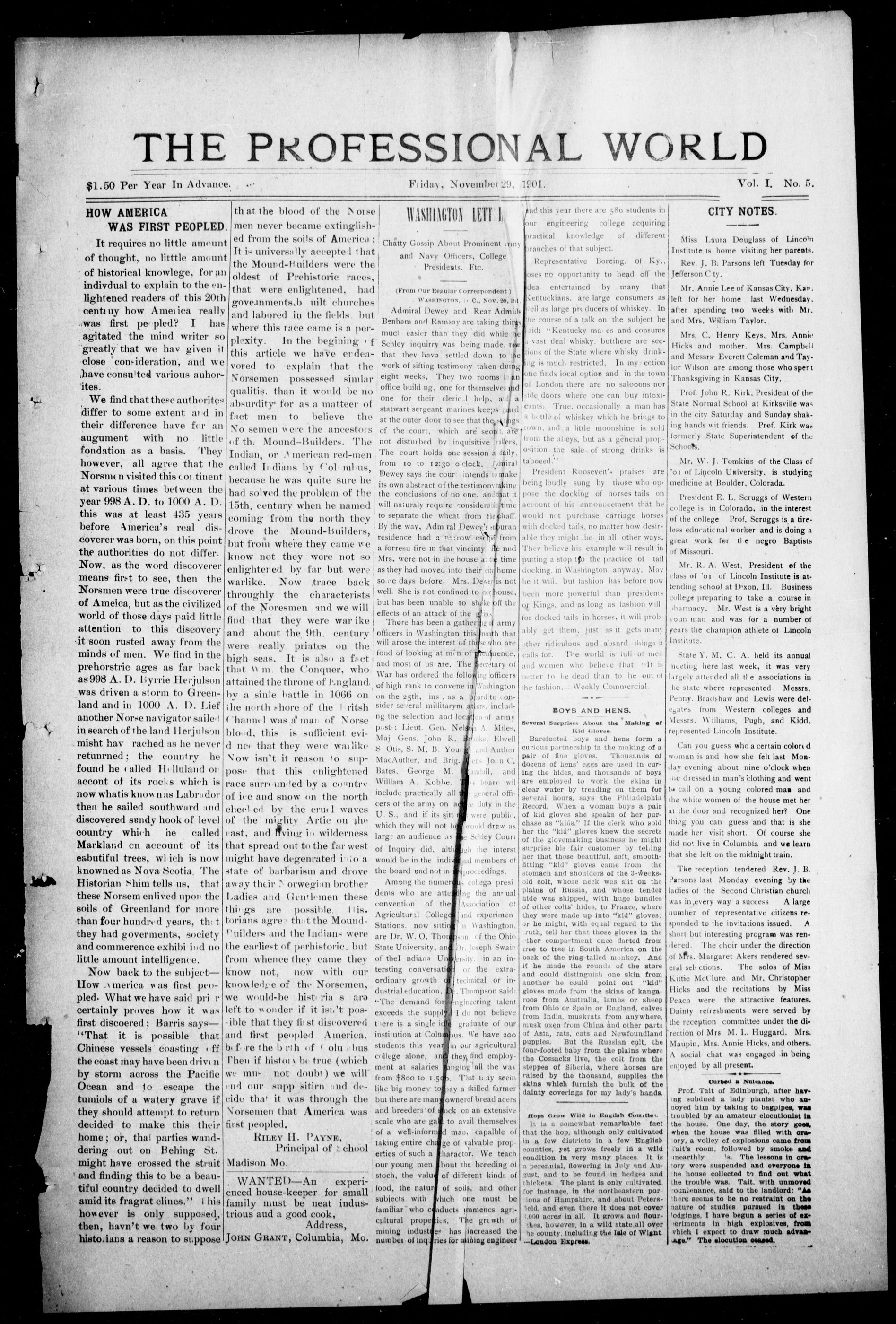
THE PROFESSIONAL WORLD
$1.50 Per Year In Advance.
HOW AMERICA WAS FIRST PEOPLED
It requires no little amount of thought, no little amount of historical knowledge, for an individual to explain to the enlightened readers of this 20th century how America really was first people? I has agitated the mind writer so greatly that we have given it close consideration, and we have consulted various authorities.
We find that these authorites differ to some extent and in their difference have for an augment with no little fondation as a basis. They however, all agree that the Norsmen visited this continent at various times between the year 998 A.D. to 1000 A.D. this was at least 435 years before America's real discoverer was born, on this point the authorities do not differ. Now, as the word discoverer means first to see, then the Norsmen were true discoverer of Ameica, but as the civilized world of those days paid little attention to this discovery it soon rusted away from the minds of men. We find in the prehorstric ages as far back as 998 A.D. Byrrie Herjulson was driven a storm to Greenland and in 1000 A.D. Lief another Norse navigator sailed in search of the land Herjulson misht hav rached as he never returnred; the country he found he called Helluland or account of its rocks which is now whatis known as Labrador then he sailed southward and discovered sandy hook of level country which he called Markland on account of its eabutiful trees, which is now known as Nova Scotia. The Historian Shim tells us, that these Norse enlived upon the soils of Greenland for more than four hundred years, that they had goverments, society and commerce exhibited no little amount intelligence.
Now back to the subject—How America was first people. What we have said prior certainly proves how it was first discoered; Barris says—"That it is possible that Chinese vessels coasting off the coast may have been driven by storm across the Pacific Ocean and to escape the tumiols of a watery grave if they should attempt to return decided to make this their home; or, that parties wandering out on Behing St. might have crossed the strait and finding this to be a beautiful country decided to dwell amid its fragrat clines." This however is only supposed, then, haven't we two by four historians a reason to suppose
th at the blood of the Norsemen never became extingished from the soils of America. It is universally accepted that the Mound-Builders were the oldest of Prehistoric races that were enlightened, had governments, built churches and labored in the fields, but where this race came is a perplexity. In the beginning of this article we have endeavored to explain that the Norsemen possessed similar qualitis, than it would be no absurdity for as a matteer of fact men to believe the No semen were the ancestors of th. Mound-Builders. The Indian, or American red-men called Indians by Columbus, because he was quite sure he had solved the problem of the 15th. century when he named coming from the north they drove the Mound-Builders, but from where they came we know not they were not so enlightened by far but were warlike. Now trace back throughly the characters of the Noresmen and we will find that they were warlike and about the 9th. century were really priates on the high seas. It is also a fact that Wm. the Conquer, who attained the throne of England by a sine battle in 1066 on the north shore of the British Channel was a man of Norse blood, this is sufficient evidence that they were warlike. Now isn't it reason to suppose that this enlightened race surrounded by a country of ice and snow on the north checked by the cruel waves of the mighty Artic on the east, and living in wilderness that spread out to the far west might have degenerated into a state of barbarism and drove away their Norwegian brother Ladies and Gentlemen these things are possible. Historians agree that the Mound-Builders and the Indians were the earliest of perhistoric, but from whence they came they know not, now with our knowledge of the Norsemen, we would-be historians are left to wonder if it isn't possible that they first discovered and first peopled America, before the birth of Columbus. Then if history be true (which we must not doubt) we will end our supp sitirn and decide that it was through the Norsemen that America was first peopled.
RILEY H. PAYNE,
Principal of school
Madison Mo.
WANTED—An experienced house-keeper for small family must be neat industrious and a good cook,
Address,
JOHN GRANT, Columbia, Mo.
Friday, November 29, 1901.
WASHINGTON LETT L
Chatty Gossip About Prominent army and Navy Officers, College Presidents. Etc.
Admiral Dewey and Rear Admiral Benham and Ramsay are taking third much easier than they did while at Schley inquirry was being made, now that they have settled down to the work of sifting testimony taken during eight weeks. They two rooms in an office building, one for themselves and one for their clerical help, and a statwart sergeant marines keeps guard at the outer door to see that the wings of the court, which are seconde are not disturbed by inquisitive callers. The court holds one session a daily, from 10 to 12:30 o'clock. Admiral Dewey says the court intends to make its own abstract of the testimony taking the conclusions of no one, and that it will naturally require considerable time to separate the wheat from the chaff. By the way, Admiral Dewey's suburban residence had a narrow escape from a forresu fire in that vincinty he and Mrs. were not in the house at the time as they had moved into their city home some days before. Mrs. Dewey is not well. She is not confined to her house, but has been unable to shake off the effects of an attack of the dino-
There has been a gathering of army officers in Washington this month that will arose the interest of those who are fond of looking at men of prominence, and most of us are. The Secretary of War has ordered the following officers of high rank to convene in Washington on the 25th, ins, as a board to consider several military matters, including the selection and location of army post: Lieut. Gen. Nelson A. Miles, Maj Gens. John R. Byoke, Elwell S Otis, S. M. B. Young, and Author MacAuther, and Brig. Jens Joan C. Bates, George M. Randall, and William A. Kobbe. This board will include practically all the general officers of the army on active duty in the U. S., and if its sitt men were public, which they will not be, would draw as large an audience as the Schley Court of Inquiry did, although the interest would be in the individual members of the board und not in its proceedings.
Among the numen
dents who are att
convention of the
Agricultural College
Stations, now siting
are Dr. W. O. Thou
State University, and
of the Indiana Uni
tersting conversation
ordinary growth of
dustrial education, L.
"The demand for
exceeds the supply.
there is a single idle
institution at Colum
students this year
college alone, and
ment at salaries wa
from $800 to 1,500
like big money too
but there are many o
breeders of sho
scale who are gale
of a well-informed
taking entire change
erties of such a cha
our young men abo
stoch, the value of
food, the nature of
subjects with which
familiar who conduc
cultural properties,
mining industries b
number of industries
---
and this year there are 580 students in our engineering college acquiring practical knowledge of different branches of that subject.
Representative Boreing, of Ky., loses no opportunity to head off the idea entertained by many that Kentuckians, are large consumers as well as large producers of whiskey. In the course of a talk on the subject he said: "Kentucky makes and consums a vast deal whiskey, but there are sections of the State where whiskey drinking is much restricted. In my section one finds local option and in the town of London there are no saloons nor side doors where one can buy intoxicants. True, occasionally a man has a bottle of whiskey which he brings to town, and a little moonshine is sold from the aleys, but as a general proposition the sale of strong drinks is taboed."
President Roosevelt's praises are being loudly sung by those who oppose the docking of horses tails on account of his announcement that he would not purchase carriage horses with docked tails, no matter how desirable they might be in all other ways. They believe his example will result in putting a stop to the practice of tail docking, in Washington, anyway. May be it will, but fashion has before now been more powerful than presidents or Kings, and as long as fashion will for docked tails in horses, it will probably get them, just as it gets many other ridiculous and absurd things it calls for. The world is full of men and women who believe that "It is better to be dead than to be out of the fashion.—Weekly Commercial.
BOYS AND HENS.
Barefooted boys and hens form a curious partnership in the making of a pair of fine gloves. Thousands of dozens of hens' eggs are used in curing the hides, and thousands of boys are employed to work the skins in clear water by treading on them for several hours, says the Philadelphia Record. When a woman buys a pair of kid gloves she speaks of her purchase as "kid's." If the clerk who sold her the "kid" gloves knew the secrets of the glovemaking business he might surprise his fair customer by telling her that those beautiful, soft, smooth-fitting "kid" gloves came from the stomach and shoulders of the 3-weeks-old colt, whose neck was slit on the plains of Russia, and whose tender hide was shipped, with huge bundles of other colts' hides, to France, where they were made up into "kid" gloves; or he might, with equal regard to the truth, tell her that those gloves in the other compartment once darted from tree to tree in South America on the back of the ring-tailed monkey. And if he made the rounds of the store and could distinguish one skin from another he could point out "kid" gloves made from the skins of kangaroos from Australia, lambs or sheep from Ohio or Spain or England, calves from India, muskrats from anywhere, musk oxen from China and other parts of Astia, rats, cats and Newfoundland puppies. But the Russian colt, the four-footed baby from the plains where the Cossacks live, the colt from the steppes of Siberia, where horses are raised by the thousand, supplies the skins which furnish the bulk of the dainty coverings for my lady's hands.
Hops Grow Wild in English Countrys. It is a somewhat remarkable fact that the hop, although only cultivated in a few districts in a few English counties, yet grows freely in a wild condition in very many places. It is a perennial, flowering in July and August, and to be found in hedges and thickets. The plant is only cultivated, for instance, in the northeastern portions of Hampshire, and about Petersfield, and even there it does not cover 4000 acres in all. It grows and flourishes, however, in a wild state all over the county, including the Isle of Wight. —London Express.
Vol. I. No. 5.
CITY NOTES.
Miss Laura Deuglass of Lincoln Institute is home visiting her parents. Rev. J. B. Parsons left Tuesday for Jefferson City. Mr. Annie Lee of Kansas City, Kan. left for her home last Wednesday, after spending two weeks with Mr. and Mrs. William Taylor. Mrs. C. Henry Keys, Mrs. Annie Hicks and mother. Mrs. Campbell and Messrs: Everett Coleman and Taylor Wilson are among those who spert Thanksgiving in Kansas City.
Prof. John R. Kirk, President of the State Normal School at Kirksville was in the city Saturday and Sunday shaking hands wit friends. Prof. Kirk was formerly State Superintendent of the Schools.
Mr. W. J. Tomkins of the Class of '01 of Lincoln University, is studying medicine at Boulder, Colorada.
President E. L. Scruggs of Western college is in Colorado, in the interest of the college. Prof. Scruggs is a tireless educational worker and is doing a great work for the negro Baptists of Missouri.
Mr. R. A. West, President of the class of '01 of Lincoln Institute is attending school at Dixon, Ill. Business college preparing to take a course in pharmacy. Mr. West is a very bright young man and was for a number of years the champion athlete or Lincoln Institute.
State Y. M. C. A. held its annual meeting here last week, it was very largely attended all the associations in the state where represented Messrs. Penny, Bradshaw and Lewis were delegates from Western colleges and Messrs. Williams, Pugh, and Kidd, represented Lincoln Institute.
Can you guess who a certain colored woman is and how she felt last Monday evening about nine o'clock when she dressed in man's clothing and went to call on a young colored man and the white women of the house met her at the door and recognized her? One thing you can guess and that is she made her visit short. Of course she did not live in Columbia and we learn that she left on the midnight train.
The reception tendered Rev. J. B. Parsons last Monday evening by the ladies of the Second Christian church was in every way a success A large number of representative citizens responded to the invitations issued. A short but interesting program was rendered. The choir under the direction of Mrs. Margaret Akers rendered several selections. The solos of Miss Kittie McClure and Mr. Christopher Hicks and the recitations by Miss Peach were the attractive features. Dainty refreshments were served by the reception committee under the direction of Mrs. M. L. Huggard. Mrs. Maupin, Mrs. Annie Hicks, and others. A social chat was engaged in being enjoyed by all present.
Curbed a Nulsance
Prof. Tait of Edinburgh, after having subdued a lady pianist who annoyed him by taking to bagpipes, was troubled by an amateur elocutionist in the house. One day, the story goes, when the house was filled with oratory, a volley of explosions came from Tait's room, followed by smoke and inearthly sounds. The lessons in oratory were suspended and everyone in the house collected to find out what the trouble was. Tait, with unmoved countenance, said to the landlord: "As there seems to be no restraint on the nature of studies pursued in these lodgings, I have begun a series of experiments in high explosives, from which I expect to draw much advantage." The elocution ceased.
KENTUCKY STRIKE RIOT
ONE DEAD, ONE FATALLY HURT AND MANY WOUNDED.
Western Kentucky Coal Field the Scene of Bloody Fight, Lasting an Hour and a Half—More Than Two Thousand Shots Exchanged Between Union Men and Non-Union Mine Workers.
A dispatch from Madisonville, Ky., says: The Western Kentucky coal field was the scene of a pitched battle Sunday morning, which lasted an hour and a half, between a party of union miners and guards and nonunion miners at the mines of the Providence Coal company, 17 miles from here. One man was killed, one fatally hurt, and many injured. More than 2,000 shots were exchanged.
James H. Smith, a negro, was the man killed, and George Crouch, another striker, the man fatally hurt. How many wounded the attacking party had is not known, although the number must have been large. John West, Hut Dawson, and Nathan Bush, the nonunion miners also were injured.
The trouble began at 6 o'clock in the morning, when a party of about 75 armed men appeared on a hill about 400 yards from the slope mine of the coal company and began firing on the Tipple.
At the first fire the guards were aroused and immediately prepared to resist the attack. They were soon joined by many of the nonunion miners, and the fire of the attacking party was returned. The attacking party where, while the bullets were falling all around them.
IOWA AT ST. LOUIS FAIR.
State Committee Visits Mound City to Look Over the Ground.
St. Louis, Mo., dispatch: William Logan, Keokuk; W. C. Hayward, Davenport; William T. Hayward, Des Moines; C. J. Erickson, Boone; Samuel M. Leech, Adel, and J. J. Hartenbower of Des Moines, members of the preliminary committee appointed by Governor Shaw of Iowa to promote the participation of that state in the Louisiana Purchase exposition spent today at St. Louis. After a preliminary meeting, the party examined the ground and plans of the fair and inspected the grounds set apart for the states and territories. Later they held a meeting at which a plan of the operations was mapped out. This evening the committee were guests of President Francis at the St. Louis club.
CITY'S LEDGERS DISAPPEAR
Chicago Council Finance Committee
Makes Discovery.
At Chicago, the finance committee of the city council has discovered that the city's ledgers, covering the accounts of 1876 to 1884, are missing. It was discovered in an investigation of the sinking fund accounts, in which a discrepancy of more than $2,100,000 was recently announced. It is claimed the previous administrations borrowed from this fund for other than corporation purposes, and no return has been made of the amounts diverted. There is no record, according to the comptroller, to show to what purposes the loans were applied during the eight years.
GUARDED FROM PUBLIC
Court Provides Close Confinement for Rathbun.
From Jeffersonville, Ind.: It is probable the public will hear nothing more soon directly from Rathbun. His lawyer has enjoined him not to talk, and Judge Morris of the county court has decided that no one shall see the prisoner except upon the order of the court. The newspaper men are also barred.
FAILURE OF CHEESE FIRM.
Grunert & Co., of Monroe Wis., Make an Assignment .
At Monroe, Wis., the big cheese firm of Ferdinand Brunert & Co., has made a voluntary assignment. The failure of the Chicago Cheese company involved Grunert & Co., by reason of the notes given in the sum of $200,000, which are still out. They claim to have plenty of assets, if they can be collected.
BACK FROM FOREIGN FIELD.
American Jockeys Return from Successful European Tour.
A party of American jokers who have been riding in Russia and Germany returned to New York on the Kaiser Wilhelm der Grosse. In the party were "Cash" Sloan, Jos Piggott, Eddie Ross, J. C. Mitchell and Nate Hall. Sloan won the Warsaw and Moscow derbies and 104 races out of 239 meunts. The entire party will go to California for the winter.
The walls of the new power house being erected for the University of Chicago suddenly collapsed, killing Geo. Jenkins and fatally injuring Henry Potts. Several other workmen were seriously hurt.
MISS FORAKER A BRIDE
Daughter of Ohio Senator Weds Randolph Matthews.
The wedding of Miss Florence Margaret Foraker, daughter of Senator Foraker, and Randolph Matthews, occurred at 4:30 p. m., Thursday in the Church of the Advent, Walnut Hills, near the senator's residence, and was followed by a brilliant reception at the bride's home. Randolph Matthews is an attorney, and is the son of C. Bentley Matthews and a nephew of the late Stanley Matthews, associate justice of the supreme court of the United States. Mr. and Mrs. Matthews will reside in the Foraker mansion in this city.
Miss Gary's Nuptials.
At Baltimore, Md.: Miss Midline Lavina Gary, youngest daughter of Ex-Postmaster General and Irs. aJmes A. Gary, was married to Dr. Andrew Henderson Whiteridge.
RUHLIN DEFEATED.
Akron Giant Disabled by a Blowin Second Round.
At San Francisco, in one of the most unsatisfacory prize fights ever witnessed in this country, James J. Jeffries proved the victor over Gus Rhulin, the Akron giant. In the fifth round of what was to have been a 20-round struggle Ruhlin wilted, and then he surrendered to his peer to the utter amazement and disgust of the assembled thousands. No one was more surprised at the outcome than Jeffries himself, who asserted that while he had delivered one telling blow in the second round he did not expect to win the victory so easily Ruhlin's sole explanation of the outcome of the fight is that he received a chance blow which utterly disabled him and that Jeffries persisted in fighting him low.
RUSSELL B. HARRISON.
He'll Fight War Department in the Federal Courts.
From Indianapolis, Ind.: Russell B. Harrison was today admitted to practice in the state and federal courts. Replying to an inquiry as to his reason for entering the profession of law, Colonel Harrison said: "This is the consummation of a long-cherished intention hastened by my own desire, and by my father's dying wish, that I should carry out his intention to fight to the end the unjust and unmilitary treatment meted out to me by the war department."
BOLD RAID BY HIGHWAYMEN.
They Loot Cashier's Till in Chicago Newspaper's Branch Office.
At Chicago, four masked highwaymen, who approached the scene of their bold robbery mounted on horses, held up the cashier's office at the Chicago American barns on Indiana street tonight, defied the six men who fought to frustrate the crime and secured $800. They then mounted their horses and galloped away. The police are on their trail.
PACKING PLANT IN LARAMIE.
Swift & Co. Will Build One There to Economize.
From Laramie, Wyo.: Swift & Co. are preparing to build a large packing plant here. The object is to save the car haul on live stock to the Missouri river points and Chicago. The company has vast live stock interests in North Park, Colorado, and other portions of the state contiguous to this city.
Negro Question the Theme.
At Pittsburg, Pa., the greater part of the third day's session of the general missionary committee of the Methodist Episcopal church was devoted to appropriations, but the burning question came up late this afternoon when the "negro question" was precipitated by a motion of Bishop Foss when the application of the Alabama conferences for missionary aid came up. The bishop's motion was that the appropriations for white work in the South (Maryland and Delaware excepted) and colored work mostly in the south be referred to special committees for consideration. During the debate some of the speakers plainly intimated that the time was coming when the negro would have to retire from the Methodist church as a co-member with his white brother, and organize a branch of his own.
Trouble in Glass Trade
The organization of the outside window glass manufacturers in Columbus Thursday night has aroused the greatest interest in Pittsburg glass circles. It is also stated that there is talk among manufacturers that indicates a feeling in the trade and presages a conflict in the glass business that will be sharp and decisive. Regarding the prospective cut in the price of glass, none of the manufacturers would offer a prediction today. They say it will depend upon the result of the meeting next Tuesday.
Blaze in a Canning Plant.
At aKusas City, Mo., a fire in the canning building of the Cudahy Packing company establishment destroyed the building with a large stock of canned meat. The loss is estimated at $150,000.
THE NEWS OF THE WORLD
CAUGHT ON THE FLY AND PRE-PARED FOR BUSY READERS.
General Happenings of the Past Few Days Taken from the Wires and condensed to Suit—Of Interest to All Who Wish to Know What Has Been Going On in This and Other Countries.
Deal in Railway World
Two important developments in the railroad situation of the Northwest, with tending to confirm the existing belief in the final basis of the settlement of the contest for the control of the Northern Pacific, have been definitely agreed to. The first is the incorporation at Trenton, N. J., of the Northern Securities company, with a capital of $400,000,000 and the second, the unanimous adoption by the Northern Pacific directors of the resolution providing for retirement at par of the company's preferred stock on Jan. 1, 1902.
Into the Civil Service.
About 200 employees of the executive branch of the rural free delivery service will be brought into the civil service by an order of President Roosevelt which, it is understood, will be issued with a week or two. These are clerks, special agents and inspectors. Six thousand rural free delivery carriers throughout the country will be brought into the civil service under the same order, but will be taken in at a later date.
War to the Bitter End.
Mr. Broderick, British war secretary, speaking at a banquet given in London in his honor by the Carlton club, declared that the Boers were hiding their tracks by murdering the Kaffirs behind them. Mr. Broderick explained that four battalions and two cavalry regiments would be drawn from India for service in South Africa. He added that he believed the number of Boers now in the field was about 10,000.
An Earthquake in Utah.
The damage to the property in Seiver county, Utah, from earthquake amounts to almost $100,000. Scarcely a building escaped damage of some kind. At Marysville, the entire population left their homes, after the first shock, built bonfires in the streets and camped out all night. In many parts of the country landslides occurred, blocking railroads, changing streams and causing general disorder.
They Form Weird Compact.
According to a compact entered into by a newly formed suicide club in New Jersey, a member must kill himself every year. The club was organized through the efforts of a man from Paterson, and it is reported to be in a fluorishing condition, so far as membership is concerned. Thirty-four persons are said to have been already enrolled, and it is asserted that 125 more have promised to join.
Over Three Million Short.
The director of the Pan-American exposition company and a number of creditors conferred and listened to the reading of the financial report of the company as prepared by the auditor. The report shows the total liabilities at present to $3,326,114.69 net, assuming that the assets of $146,454.15 are collectible in their face value.
Snowstorm in New York.
A blizzard struck central New York. Several inches of snow and drifts from one to six feet deep blocked traffic. The country roads are in many cases blocked, and huge drifts are piling along the fences. The streams are rising, and several places are reported threatened with floods.
Explosion Wrecks a Mine
Five dead bodies were taken from the Baby mine at Locahontas, Va. Several other persons are unaccounted for, and 25 persons have been rescued more or less severely burned.
FROM NEIGHBORING STATES.
General Items of News Culled From
All Parts of the United
Ovanda, Mont., a small town near Helena, is endangered by a swamp fire which has been burning for a week. If the wind turns-and blows the fire toward the town it is doomed. The treasury department has issued a warrant in favor of the administrators of the late President McKinley's estate for $1,856, which the auditor of the state department found due him on account of salary. Booker T. Washington has expressed through diplomatic channels, a willingness to accept an appointment from the St. Louis Exposition company as director of the proposed Afro-American exhibit at the world's fair.
Alice Nesenbauer, under conviction of murder of her husband last year, has been saved from the gallows by the decision of the supreme court of Missouri that there were no grounds for conviction. Mrs. Nesenbauer was also accused of the murder of two of her own children in order to secure insurance money.
The Dowager Baroness Carew died Tuesday at Woodstown, county Waterford, Ireland. She was 10 years old. She danced at the ball given by Lady Richmond at Brussels on the eve of the battle of Watrloo and was a noted beauty at the court of Louis Philippe.
Fred V. Stowe, or Grimes, Ia., had on the Chicago market this week 54 cattle averaging 1,417 pounds that sold at $6.60. These steers were of the very well known V-V brand, bred by B. R. Brooks, of Casper, Wyo. The steers were all reds, having been sired by Short Horn bulls from Angus cows. The cattle were on feed since July 1, getting crushed corn with oil meal during the last 30 days' feeding period. They were bought by the United Dressed Beef company for shipment to New York.
Dr. Tyree, a physician at McGee, I. T., shot and fatally wounded Thomas Moag, a drug clerk, in a quarrel over a prescription. Moag in turn turn, shot Tyree, causing a slight wound.
The body of a man supposed to be Herbert Ellwanger of Cleveland was found in Fairmount park, Philadelphia. He had evidently committed suicide, as there was a bullet wound in the head and a pistol lying beside the body.
C. E. Sismey, a London lawyer has been granted a divorce from his American wife, formerly Miss Catherine Woodhill, on statutory grounds. The couple were married in San Francisco in 1890. Mrs. Sismey is now believed to be in San Francisco with her parents.
Peter Miller, a Swedish laborer, suicided at Omaha in a tragic manner. He used a knife, spike, hatchet and finally a rope.
Captain Hartman's troop of the First cavalry early surprised 400 insurgents at Buan, Batangas province, in southwestern Luzon, killing 16, wounding five and capturing nine rifles. The insurgents broke and ran, the cavalry pursuing.
It has developed that Mrs. Rathbun was not implicated in the insurance swindle at Jeffersonville, Ind.
All efforts to find a clue to the murderer of the two women whose dead bodies were found at Evansville, Ind., have proved unavailing.
The statement of missionaries affirms there is no ground whatever for criticising Miss Stone for want of precaution in making the journey at the time she was taken.
Between 15,000 and 20,000 freight cars are needed for immediate use by the railroads centering in Chicago. Not since 1886 has the freight car shortage been so great as at present.
The city treasurer is taking steps to collect from the American Sugar Refining company $3,000 in taxes on sugar recently shipped into Omaha to meet the demand caused by the sugar war.
A meteoric shower of great brilliancy and considerable length occurred early Friday morning at Phoenix, Ariz. It continued half an hour. More than two hundred meteors were counted.
The navy department has been informed that the transport Buford with two battalions of the Twenty-third infantry sailed from Gibraltar Friday for New York.
The grand jury of the United States court at Indianapolis, Ind., has begun to consider the most important case that will come before it during the present session, that of Richard Davis, former cashier of the People's National bank of Washington, Ind. Davis is charged with embezzling and squandering $71,000 in bank funds. Davis made good the losses.
In the sale of 15 shorthorn steers at the Chicago stock yards this week the highest price of the year was realized. The sale was made at $7.10 a hundred, the average weight being 1,572 pounds. Two cars of cattle were also sold during the day at $6.80, both sales being made on their merits. The president has signed an executive order creating a naval reservation of a large tract of land just acquired by the navy department at Onbigapo, on Subig bay, Luzon. The department now will proceed with all dispatch to construct at this point a navy yard and station.
The American Anti-Cigarette association, which is said to have a membership of over 300,000, is said to have drawn a pledge which is to be read in every Sunday school in the United States on Nov. 24. It binds the signers to abstain from the use of cigarettes or tobacco in any form until 21 years of age, and it is expected that several hundred thousand signatures will be obtained.
The proposed railway from Dawson to the Klondike mines will be built next summer.
James Goings was found dead in his buggy a few miles south of Cave Springs, Ga., his neck having been broken. It is thought he was murdered and robbed by highwaymen.
The Colonel H. G. Jordan dairy farm cow barn at Hingham, Mass., was burned causing a loss of, between $50,000 and $60,000. Besides farming implements 140 head of cattle and seven horses were burned.
Rutus W. Blake, the piano manufacturer of Derby, Conn., who died of a self inflicted bullet wound in the head leaves $1,500,000 to his young widow. Mr. Blake was twice married.
Mrs. Cora Lathrop Patterson, a prominent member of the society of Colonial Dames, Virginia chapter, Omaha, has filed an answer to her husband's petition for divorce. She alleges that the son of the millionaire tobacco king had treated her cruelly, has been drinking excessively and neglected her and her child.
The wedding of Miss Florence Margaret Foraker, daughter of Senator Foraker, and Randolph Matthews, took place at 4:30 p. m. in the Church of the Advent, Walnut Hills, Cincinnati.
One hundred representative physicians and professional men of Ohio, in the office of the secretary of the state board of health, organized the Ohio Society for the Prevention of Tuberculosis, an association in the interest of humanity.
Local officials of the Burlington road admitted the night trains leaving Lincoln have gone out with a guard armed with Winchester rifles.
An Italian family feud resulted at San Francisco in two pistol encounters and the wounding of three men, one probably fatally.
Edward Stanton Maclay, the author of "A History of the United States Navy," who is still working as a clerk in the Brooklyn navy yard, is preparing to make changes in his history if Rear Admiral Schley is exonerated.
With a view to introducing American methods into Ireland, Bishop John Clancy of the diocese of Elphin, Ireland, arrived in Chicago on a tour of 'investigation of the technical and manual training schools of the United States.
The exports of merchandise from the United States in October were smaller by about $17,000,000 than those of the same month in 1900. The shipments last year, however, were phenomenally large.
Private parties are to build the new dock at Fairport, O., which will be ready for the opening of navigation next year. One million dollars will be spent in fitting out the new property, which will be one of the most complete on the great lakes.
Swift. & Co. are preparing to build a large packing plant at Lacamie, Wyo. The object is to save the car haul on live stock to the Missouri river points and Chicago.
B. A. Palmer, a retired banker of New York, has made a gift of $30,000 to Union Christian college, located in Indiana.
Mrs. Mary Preston Slosson, wife of the vice president of the faculty of the University of Wyoming, is the only woman chaplain of a prison in the United States.
NEWS OF FOREIGN LANDS.
Flashes From the Wires Portraying Occurrences in All Parts of the World.
Information has been received that the transport Buford, bringing troops from the Philippines, has reached Gloraltar. It is due to arrive at New York on the 27th inst.
Inmense anti-Chamberlain meetings have occurred at the University of Breslau and the technical institutes at Hanover and Darmstadt. They were attended and addressed by many professors.
The transport Chaco, which arrived at Buenos Ayres, reports having picked up at Staten Island, the southern extremity of South America, the captain, first and second officers, and 21 of the crew of the French ship Astree.
The illness and extreme debility of Premier Segasta at Madrid is causing anxiety.
The Vossische Zeitung says it learns Queen Wilhelmina was prematurely delivered of a child Nov. 10. The queen's condition is satisfactory.
The North China Daily News in its Pekin correspondence says Conger will soon be the only foreign minister in Pekin who passed through the siege and will then become dean of the diplomatic corps. All the other ministers have been returned or expect to leave Pekin soon.
Keen interest is displayed at St. John's, N. F., in the movement for reciprocity with the United States.
Information has reached the Colombian legation in Washington to the effect that a committee is about to leave Bogota for Mexico City to endeavor to induce Reyes to accompany it back and take up the reins of the government.
Lord Kitchener, in a dispatch from Pretoria, presents his weekly report and incidentally locates General Dewet in the northeastern part of the Orange river colony. He says the Boers have recently been collecting under his leadership, and that the British are now moving to disperse them.
Diaz, the president of Tacolban, island of Leyte, who has been proved to be an agent of the Filipino junta at Hongkong, has been arrested. Many incriminating papers, implicating numerous officials, were seized at the time of his arrest.
From the wreckage seen in Belfast Lough, it is supposed that the 59 collier White Abbey has been lost and her crew of nine drowned.
The Danish chocolate manufactures allege that New York customs official place an overvaluation on their product. If protests now on file are heeded Denmark may adopt retaliatory measures.
"King Edward's life is not worth more than two years at the very most. That is the opinion of the best physicians in the United Kingdom, and it may bet set down as truth on authority which cannot be doubted despite optimistic and inspired official bullets to the contrary." So says a London cable.
A London Times correspondent who has just passed over the whole route of the trans-Siberian railway, states that the Russian declarations regarding the completion of the line are untrue. He says there are many gaps in the permanent track, the large bridges are not completed, and three tunnels have already been begun.
The municipal council of Havana has unanimously voted to award Michael J. Dady the contract to pay and sewer Havana for $10,913,858.
The government of Denmark is considering the most effective method of retaliating against the United States should the diplomatic representation now being made in behalf of the Danish chocolate exporters fail. Denmark will suffer little loss in the event of retaliatory duties, since her exports to the United States are only $750,000 against America's $20,000,000 exports Denmark.
FARM NOTES
(Copyright, 1901, by J. S. Trigg.)
Rockford, Ia.
Correspondence Solicited.
Warmth for stock during the winter
is just another name for food.
The first thing a fellow finds out
when he goes to law is $10; sometimes
more.
The government wants blacksmiths and broseshoers for duty in the Philippines at $75 per month.
It costs more to put the last 25 pounds on a 300 pound hog than it did to make the first seventy-five pounds.
There are now 39 beet sugar factories in successful operation in this country, the state of Michigan leading with twelve.
While wheat is a much better balanced ration than is corn, still neither cattle nor hogs will put on flesh so fast with it as they will with corn.
We have known some otherwise very good and truthful people to fall from grace when they had a job of dividing a flock of mixed turkeys in the fall.
A man takes a certain hazardous risk when he buys land to farm in the usual manner in any locality where the average rainfall is 12 inches or less per annum.
The long continued drought of the past summer about finished up all clover sown last spring. Had the clover been sown alone this would not have happened.
The demand for the American horses for the Boer-English war still continues a demand which had not a little to do with the greatly increased price of horses all over this country.
We have the ancient story of Nebu-chadnezzar being turned out to grass, which he is said to have eaten like an ox. If it was an October blue grass pasture they turned him into, it was no so bad after all.
We cover up all grapevines, raspberry, and blackberry bushes in the fall. While they would pull through all right some winters, it still is the only sure method to follow if one wants to be sure of a crop next year.
The wise men composing the legislature of the great state of Ohio have enacted, some dairy legislation based upon the theory that the sort of ration fed to a cow determines the quality of her milk. This legislature is behind the times.
---
We never knew a man to get tired of raising good Shorthorn cattle, while we have known many a one to drop the other standard breeds. The Shorthorns are to cattle what the Poland-China and the Concord are to hogs and grapes.
The most valuable quarter section of land in the whole world is probably that of Beaumont, Tex., upon which are located the great oil wells. Two years ago this tract would have been dear at $30 per acre, while today it is valued at $400,000,000.
If you can get a load or two of well rotted stable manure it is the best top dressing available for the lawn. Put it on this fall and give the lawn a thorough raking in the spring. Care should be taken to use only well rotted manure; otherwise a plague of weeds may result.
We have lately received samples of the wheat, barley and oats grown in the Alberta country. The past season has been a very favorable one for cereal crops in that region, and the samples referred to are of exceptionally fine quality, much superior to the same cereals grown in more southern latitudes.
A writer recently referred to the frost as painting the colors on the foliage of the trees in the fall of the year. We think this is an error, for the most beautifully tinted foliage may always be found in those seasons when there is no frost when the leaves ripen naturally. This fact was especially noticeable this fall.
The hundreds of farmers' mutual insurance companies are making a fine record. If you have such a company in your county, join it; if there is none, unite with your neighbors in organizing one. You get absolutely safe insurance; no "nigging" when a loss is sustained, and the premiums paid are not sent out of the county.
Japan in the year 1900 took $15,000,-000 worth of the agricultural products of this country against only $2,000,000 then five years ago. This well illustrates the possible value of these oriental markets to the American farmer.
With the hogs worth close to 6 cents a pound live weight, wheat is worth over .25 per bushel to feed them.
Nebraska has made the following standard of quality for milk and cream which are sold to the public: Milk must test not less than 3 per cent. butter fat and cream not less than 15 per
cent. By the way, 3 per cent, milk is pretty thin stuff, and fat babies will not be found on the route of the milkman who sells it.
What may be done with a small piece of land is well illustrated by a man whom we know who the past season has sold the produce raised on two town lots containing just 64 square rods of ground for $125, or at the rate of over $300 per acre. The produce raised was mostly common garden vegetables.
When you have sown the clover in the spring with a nurse crop, pastured it in the fall after the crop has been removed, cut the field for hay the following June and taken a crop of seed from it in September, that clover field has fulfilled its mission and is done for unless enough seed is left on the ground to reseed the field.
A man who would kick up quite a fuss should some relation of his wife's come to his home and hang around unwilling to work for his board, will still keep in his cow barn and milk twice a day one or more cows who are just as big beats as any relative which his wife may have, and do it all complacently just because of his ignorance.
What seems to be a perfect remedy for sours in young calves, a trouble with which nearly every dairyman is familiar, is found in the use of dried blood is prepared for market at the large packing house concerns. A tablespoonful of this blood powder fed with the milk ration to the calf works a cure in every case in a short time. This is worth remembering.
The American people have cheaper coffee and sugar in plain sight. The production of coffee has been enormously increased, and that in many countries, while the production of beet sugar bids fair to become one of the leading agricultural industries of this country. Inasmuch as the American people use more coffee and sugar than any other people, this is not a bad prospect.
Persistent advertising will create a demand for any fairly good article, but a superlatively good article will find a market, anyway. There is a certain cereal breakfast food being made today which, so far as we have noticed, has never been advertised at all, yet because of its excellence, the demand is so great that the manufacturers cannot fill the orders sent them.
We have a friend who owns a good farm, and he rents this farm right along for 57 cents an acre less than he could get for the reason that he has a tenant who takes good care of the place. This tenant keeps the fences up, the barn doors in place, the manure hauled out the tree trimmed, the weeds on the highway mowed, and our friend thinks all these things are worth about 75 cents an acre to him when he goes out to see the place.
The man with a productive apple orchard located in the Northwest, while he has plenty of discouragement, always has this advantage over his brother orchardist in the more favored regions of the far East or the far West—he is always close to a good market in a territory where the production of apples will be far below the normal demand. And this question of a good market for fruit is one of the main elements of attaining success in the business.
In the city of Vienna, last year, there were 25,640 horses and donkeys slaughtered for food, the meat being sold in 185 meat shops specially licensed by the municipal authorities for that purpose. All this meat was carefully inspected by government officials before being sold. The fore quarters of these animals sell for from 5 to 8 cents per pound and the hind quarters at 6 to 9 cents, choice cuts retailing at 10 cents, or less than one-half the price of similar cuts of beef.
The past season has been a bad one for the farmers in England and Scotland. The competition of the low priced grains and meats of this country has about ruined the agricultural interests of those countries. Each year shows a fewer number of acres tilled and a lesser amount of stock kept, while my lord who lives in the castle
st
ot
Ve
st
he
no
y.
is
n-
ne
in
e,
z-
r-
s-
ot
0,-
sts
00
s-
n-
ats
th
A
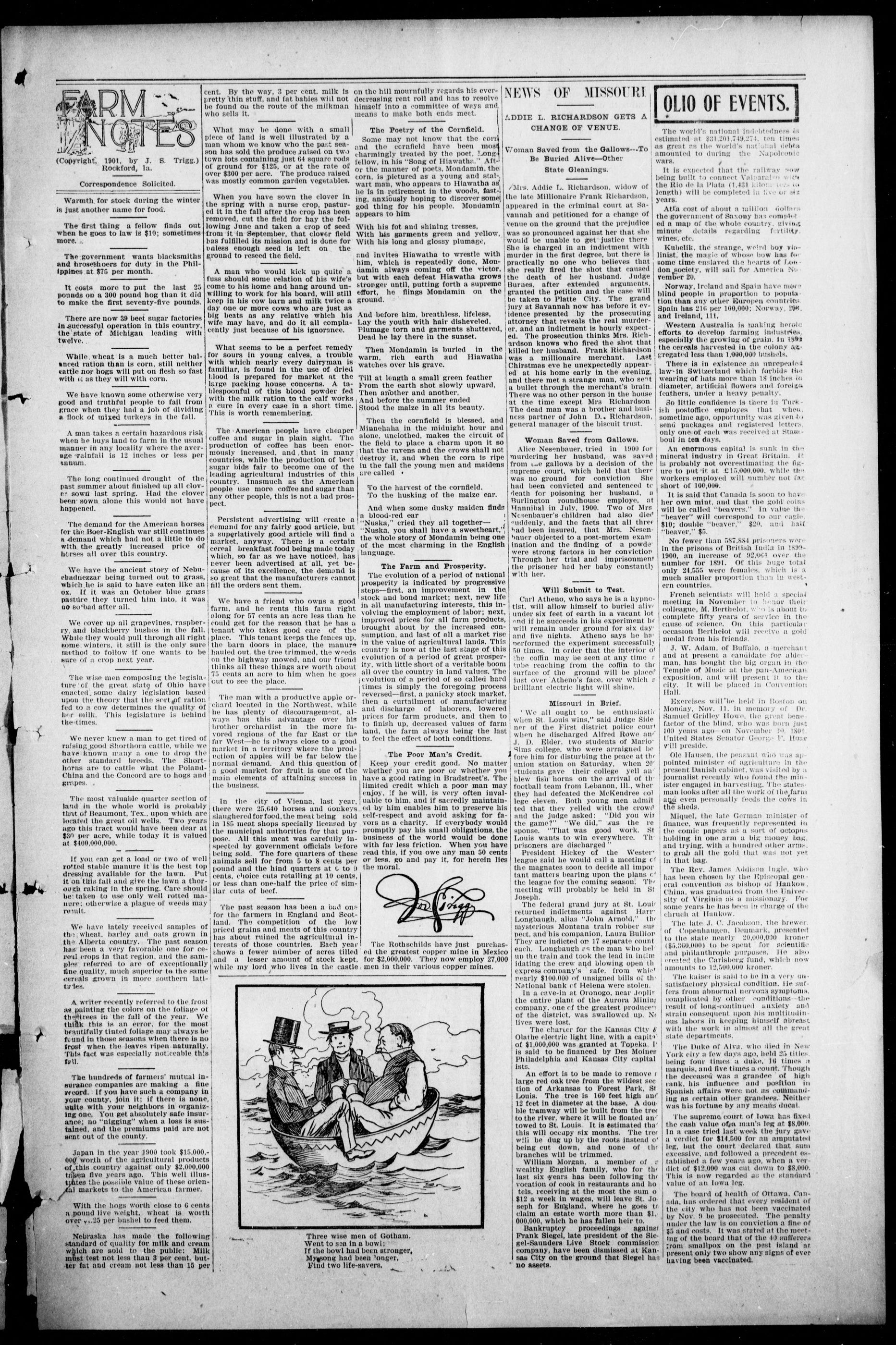
Three wise men of Gotham.
Went to sea in a bowl;
If the bowl had been stronger,
My song had been 'longer.
Find two life-savers.
on the hill mountfully regards his ever-decreasing rent roll and has to resolve himself into a committee of ways and means to make both ends meet.
The Poetry of the Cornfield.
Some may not know that the corn and the cornfield have been most charmingly treated by the poet, Long-fellow, in his "Song of Hiawatha." Aftor the manner of poets, Mondamin, the corn, is pictured as a young and stalwart man, who appears to Hiawatha as he is in retirement in the woods, fasting, anxiously hoping to discover some god thing for his people. Mondamin appears to him
With his fot and shining tresses,
With his garments green and yellow,
With his long and glossy plumage,
and invites Hiawatha to wrestle with him, which is repeatedly done, Mondamin always coming off the victor, but with each defeat Hiawatha grows stronger until, putting forth a supreme effort, he flings Mondamin on the ground.
And before him, breathless, lifeless,
Lay the youth with hair disheveled,
Plumage torn and garments shattered,
Dead he lay there in the sunset.
Then Mondamin is buried in the
warm, rich earth and Hiawatha
watches over his grave.
Till at length a small green feather
From the earth shot slowly upward,
Then another and another.
And before the summer ended
Stood the maize in all its beauty.
Then the cornfield is blessed, and
Minnehaha in the midnight hour and
alone, unclothed, makes the circuit of
the field to place a charm upon it so
that the ravens and the crows shall not
destroy it, and when the corn is ripe
in the fall the young men and maidens
are called.
To the harvest of the cornfield.
To the husking of the maize ear.
And when some dusky maiden finds a blood-red ear
"Nuska," cried they all together—
"Nuska, you shall have a sweetheart,"
the whole story of Mondain being one of the most charming in the English language.
The Farm and Prosperity.
The evolution of a period of national prosperity is indicated by progressive steps—first, an improvement in the stock and bond market; next, new life in all manufacturing interests, this involving the employment of labor; next, improved prices for all farm products, brought about by the increased consumption, and last of all a market rise in the value of agricultural lands. This country is now at the last stage of this evolution of a period of great prosperity, with little short of a veritable boom all over the country in land values. The evolution of a period of so called hard times is simply the foregoing process reversed—first, a panicky stock market, then a curtailment of manufacturing and discharge of laborers, lowered prices for farm products, and then to finish up, decreased values of farm land, the farm always being the last to feel the effect of both conditions.
The Poor Man's Credit.
Keep your credit good. No matter whether you are poor or whether you have a good rating in Bradstreet's. The limited credit which a poor man may enjoy, if he will, is very often invaluable to him, and if sacredly maintained by him enables him to preserve his self-respect and avoid asking for favors as a charity. If everybody would promptly pay his small obligations, the business of the world would be done with far less friction. When you have read this, if you owe any man 50 cents or less, go and pay it, for herein lies the moral.
The Rothschilds have just purchased the greatest copper mine in Mexico for $2,000,000. They now employ 27,000 men in their various copper mines.
A
---
NEWS OF MISSOURI
ADDIE L. RICHARDSON GETS A CHANGE OF VENUE.
Woman Saved from the Gallows----To Be Buried Alive----Other
/Mrs. Addie L. Richardson, widow of the late Millionaire Frank Richardson, appeared in the criminal court at Savannah and petitioned for a change of venue on the ground that the prejudice was so pronounced against her that she would be unable to get justice there. She is charged in an indictment with murder in the first degree, but there is practically no one who believes that she really fired the shot that caused the death of her husband. Judge Burnes, after extended arguments, granted the petition and the case will be taken to Platte City. The grand jury at Savannah now has before it evidence presented by the prosecuting attorney that reveals the real murder, and an indictment is hourly expected. The prosecution thinks Mrs. Richardson knows who fired the shot that killed her husband. Frank Richardson was a millionaire merchant. Last Chirstmas eve he unexpectedly appeared at his home early in the evening and there met a strange man, who sent a bullet through the merchant's brain. There was no other person in the house at the time except Mrs. Richardson. The dead man was a brother and business partner of John D. Richardson general manager of the biscuit trust.
Woman Saved from Gallows.
Alice Nesenbauer, tried in 1900 for murdering her husband, was saved from the gallows by a decision of the supreme court, which held that there was no ground for conviction She had been convicted and sentenced to death for poisoning her husband, a Burlington roundhouse employee, at Hannibal in July, 1900. Two of Mrs Nesenbauer's children had also died suddenly, and the facts that all three had been insured, that Mrs. Nesenbauer objected to a post-mortem examination and the finding of a powder were strong factors in her conviction. Through her trial and imprisonment the prisoner had her baby constantly with her.
Will Submit to Test
Carl Atheno, who says he is a hypnotist, will allow himself to buried alive under six feet of earth in a vacant lot, and if he succeeds in his experiment he will remain under ground for six days and five nights. Atheno says he has performed the experiment successfully 50 times. In order that the interior of the coffin may be seen at any time a tube reaching from the coffin to the surface of the ground will be placed just over Atheno's face, over which a brilliant electric light will shine.
Missouri in Brief.
"We all ought to be enthusiastic when St. Louis wins," said Judge Sidener of the First district police court when he discharged Alfred Rowe and J. D. Elder, two students of Marion Sims college, who were arraigned before him for disturbing the peace at the union station on Saturday, when 20 students gave their college yell and blew fish horns on the arrival of the football team from Lebanon, ill., where they had defeated the McKendree college eleven. Both young men admitted that they yelled with the crowd and the judge asked: "Did you win the game?" "We did." was the response. "That was good work. St. Louis wants to win everywhere. The prisoners are discharged."
President Hickey of the Western league said he would call a meeting of the magnates soon to decide all important matters bearing upon the plans of the league for the coming season. The meeting will probably be held in St. Joseph.
The federal grand jury at St. Louis returned indictments against Harry Longbaugh, alias "John Arnold," the mysterious Montana train robber suspect, and his companion, Laura Bullion. They are indicted on 17 separate counts. Longbaugh as the man who helped the train and took the lead in intimidating the crew and blowing open the express company's safe, from which nearly $100,000 of unsigned bills of the National bank of Helena were stolen. In a cave-in at Oronogo, near Joplin, the entire plant of the Aurora Mining company, one of the greatest producers of the district, was swallowed up. No lives were lost. The charter for the Kansas City & Olathe electric light line, with a capita of $1,000,000 was granted at Topeka. It is said to be financed by Des Moines Philadelphia and Kansas City capitalists.
An effort is to be made to remove a large red oak tree from the wildest section of Arkansas to Forest Park, St. Louis. The tree is 160 feet high and 12 feet in diameter at the base. A double tramway will be built from the tree to the river, where it will be floated and towed to St. Louis. It is estimated that this will occupy six months. The tree will be dug up by the roots instead of being cut down, and none of the branches will be trimmed.
William Morgan, a member of a wealthy English family, who for the last six years has been following the vocation of cook in restaurants and hot tels, receiving at the most the sum of $12 a week in wages, will leave St. Joseph for England, where he goes to claim an estate worth more than $1,000,000, which he has fallen heir to.
Bankruptcy proceedings against Frank Siegel, late president of the Siegel-Saunders Live Stock commission company, have been dismissed at Kansas City on the ground that Siegel has no assets.
OLIO OF EVENTS.
The world's national indebtedness is estimated at $31,201,749,274, ten times as great as the world's national debts amounted to during the Napoleonic wars.
It is expected that the railway now being built to connect Valparaiso with the Rio de la Plata (1,431 kilometers to length) will be completed in five or six years.
Atta cost of about a million dollars the government of Saxony has completed a map of the whole country, giving minute details regarding fertility, wines, etc.
Kubellik, the strange, weird boy violinist, the magic of whose bow has for some time enslaved the hearts of London society, will sail for America November 20.
Norway, Ireland and Spain have more blind people in proportion to population than any other European countries. Spain has 216 per 100,000; Norway, 208 and Ireland, 111.
Western Australia is making hercule efforts to develop farming industries, especially the growing of grain. In 1991 the cereals harvested in the colony aggregated less than 1,000,000 bushels.
There is in existence an unrepeated law in Switzerland which forbids the wearing of hats than 18 inches in diameter, artificial flowers and foreign feathers, under a heavy penalty.
So little confidence is there in Turkish postoffice employees that when sometime ago, opportunity was given to send packages and registered letters, only one of each was received at Stauboul in ten days.
An enormous capital is sunk in the mineral industry in Great Britain. It is probably not overestimating the figure to put it at £15,000,000, while the workers employed will number not far short of 100,000.
It is said that Canada is soon to have her own mint, and that the gold coins will be called "beavers." In value the "beaver" will correspond to our cagle $10; double "beaver," $20, and half "beaver," $5.
No fewer than 587,884 prisoners were in the prisons of British India in 1895-1900, an increase of 92,064 over the number for 1891. Of this huge total only 24,555 were females, which is a much smaller proportion than in western countries.
French scientists will hold a special meeting in November to honor their colleague, M. Berthelot, who is about to complete fifty years of service in the cause of science. On this particular occasion Berthelot will receive a gold medal from his friends.
J. W. Adam, of Buffalo, a merchant and at present a candidate for alderman, has bought the big organ in the Temple of Music at the pan-American exposition, and will present it to the city. It will be placed in Conventions Hall.
Exercises will be held in Boston on Monday, Nov. 11, in memory of Dr. Samuel Gridley Howe, the great benefactor of the blind, who was born just 100 years ago—on November 19, 1801, United States Senator George F. Hose will preside.
Ole Hausen, the peasant who was appointed minister of agriculture in the present Danish cabinet, was visited by a journalist recently who found the minister engaged in harvesting. The statesman looks after all the work of the farm and even personally feeds the cows in the sheds.
Miquel, the late German minister of finance, was frequently represented in the comic papers as a sort of octopus holding in one arm a big money bag, and trying, with a hundred other arms, to grab all the gold that was not yet in that bag.
The Rev. James Addison Jugle, who has been chosen by the Episcopal general convention as bishop of Hankow, China, was graduated from the University of Virginia as a missionary. For some years he has been in charge of the church at Hankow.
The late J. C. Jacobson, the brewer of Copenhagen, Denmark, presented to the state nearly 20,000,000 kroner ($3,360,000) to be spent for scientific and philanthropic purposes. He also created the Carlsberg fund, which now amounts to 12,500,000 kroner.
The taiser is said to be in a very unsatisfactory physical condition. He suffers from abnormal nervous symptoms, complicated by other conditions—the result of long-continued anxiety and strain consequent upon his multitudinous labors in keeping himself abreast with the work in almost all the great state departments.
The Duke of Alva, who died in New York city a few days ago, held 25 titles, being four times a duke, 16 times a marquis, and five times a count. Though the deceased was a grandee of high rank, his influence and position in Spanish affairs were not as commanding as certain other grandees. Neither was his fortune by any means ducal.
The supreme court of Iowa has fixed the cash value of a man's leg at $8,000. In a case tried last week the jury gave a verdict for $14,500 for an amputated leg, but the court declared that sum excessive, and followed a precedent established a few years ago, when a verdict of $12,000 was cut down to $8,000. This is now regarded as the standard value of an Iowa leg.
The board of health of Ottawa, Canada, has ordered that every resident of the city who has not been vaccinated by Nov. 9 be prosecuted. The penalty under the law is on conviction a fine of $5 and costs. It was stated at the meeting of the board that of the 40 sufferers from smallpox on the pest island are present only two show any signs of ever having been vaccinated.
The Professional World
KUFU'S L. LOGAN, B. S. D. ..... Editor
TERMS OF SUBSCRIPTINS:
One Year In Advance..... $1 50
Six Months In Advance..... 1 00
ADVERTISING RATES ON APPLICATION
JOB WORK OF ALL KINDS SOLICITED.
PUBLISHED EVERY FRIDAY.
POLITICS IN STATE INSTITUTIONS.
The address delivered by Hon. James L. Blair before the State Board of Charities which met in Columbia last week, certainly had the right ring. The making of political annexes of state institutions is a form of silk stocking corruption which the people are rising up against and are demanding that it be stopped.
All penal elemosonary and educational institutions of this state are supported by the taxpayers of Missouri who have a right to demand that the money appropriated for their support should be wisely and judicious'y spent and that those who manage these institutions be men qualified to do so.
If the Boards appointed to manage sueh institutions are to be mere figure heads they should be abolished and money used for maintaining them left in the state treasury. Public institutions are maintained for the benefit of those who need the good derived from and not to compensate political ward heelers and party sympathizers.
Mr. Blair voice the sentiment of all good citizens when he says that such corruptable practices are disgraceful to the commonwealth of Missouri and must be stopped.
No man should be elected to aposition in a state institution because he is a Democrat nor dropped fram such a position because heis a Republican.
The spoil system may work in State legislatures and subordinate clerkships, but when it comes to sacrificing the interest of State institutions to satisfy political grafters it is time to cry a halt.
The report of the religious census taken recently by the class in socialogy shows that 55 per cent of the white population of Columbia are church members while only 42 per cent of the colored population are church goers it also shows that 18 per cent of the adult colored population express no church preference whatever, in other words are not concerned about church matters. This certainly is not a very commendable showing for the negroes of Columbia, living as we do in this educational center in a town with four colored churches with able pastors, and to find that 18 per cent. of the negro men and women saying nothing about the children they have under their influence) without any religious inclin-
ation, loitering around the streets and their homer on the Sabbath day boasting of the fact that they never go to church is a state of affairs that should cause all christians to ask themselves if they are doing their duty as christians. All who live upright christian lives have influence enough over at least one individual who is not a christian ta persuade them to go church once a day on Sunday, and should feel it their duty to do so, religion is the only thing that will abolish cimes and immorality and to persuade men to go to church is to keep them out of prisons and rock piles but first of all those who persuade must walk in the right path themselves or no real good will be accomplished
HISTORY OF HUNTING
The recent newly awakened interest in the life and times of King Alfred, due to the celebration of the thousandth anniversary of his death and the placing of a statue at his birthplace has resulted in some interesting information on the evolution of the sportsman. One many see by reviewing the customs and conditions of Alfred's time, how it was that hunting came to be regarded as the noblest of all amusements. It was absolutely necessary to the safety and welfare of the people that the wolves, bears, wild boars, and other dangerous animals which then roamed over England, should be exterminated; and, of course, the king and his knights, as the bravest and best armed of the fighting population, were setting a good example and doing good service in their huntieg parties. These conditions continued for some hundreds of years and the nobility of the sport of hunting became firmly established and hedged about with many traditions as to the proper method of killing the game. The persistence of traditions in England is proverbial; and hence, after the whole country became as safe as a barnyard, people continued to suppose that there was something essentially courageous and fine in deer-stalking and grouse shooting.
The question now confronted by the intelligent American citizen is this: whether is necessary for a new country to take over the ideas and conventionf of its parent on this subject. Are we to consider a man a sportsman because he kills rabbits and pigeons, as his father killed bears and panthers? Is the man who takes his sport with rod and gun any more manly or brave than the one who arms himself with a camera or a microscope? The Englishman would probably say yes, because he was brought up to believe so.
The fact seems to be, however, that mere ability to go
does not constitute sportsmanship. The old-time huntsman, encuntering a stag at bay with the primitive weapons of his day, certainly did need to be brave; his modern piytotype, armed with a repeating rifle, is generally safe; the animal is the one who needs courage. The idea that popping about with a gun there is some peculiar manli ness in shooting harmless animals is, we hope, a vanishing illusion.—Weekly Commercial.
SOME WHYS ANSWERED.
The Ancient and Corious Origin of Fam-
iary Customs.
It is not surprising what a number of little things we do without knowing the reason. Why, for instance, do widows wear caps? Perhaps they may say because they make them look pretty and interesting. But the real reason is that when the Romans were in England they shaved their heads as a sign of mourning. Of course a woman couldn't let herself be seen with a bald head, so she made herself a pretty cap. And now, though the necessity of wearing it has passed away, the cap remains. Why do we have bows on the left side of our hats? In olden times, which men were much in the open air and hats couldn't be bought for half a dollar, it was the habit to tie a cord around the crown and let the ends fall on the left side to be grasped on the arising of a squall. They fell on the left side so they might be grasped by the left hand, the right usually being more usefully. 10. Later on, the ends got to be tied in a bow, and later still, they became endless, yet the bow has remained, and will probably remain till the next deluge or something of that sort. What is the meaning of the crosses or Xs on a barrel of beer? They shall degrees of quality nowadays. But originally they were put on by those ancient monks as a sort of trademark. They were crosses in those days, and meant a sort of oath on the cross, sworn by the manufacturer that his barrel contained good liquor. Why are bells toled for the dead? This has become so familiar a practice that a funeral without would appear unChristian. Yet the reason is quite harboured. Bells were toiled long ago, when people being buried in order to frighten away the evil spirits who lived in the air. Why do fair ladies break a bottle of wine on the ship they are christening? Morely another survival of barbary custom. In the days of sacrifice to the gods it was customary to get some poor victim when a boat was being launched and to cut his throat over the prow, so that his blood baptized it. Why are dignities deafened by a salute when they visit a foreign port? It seems a curious sort of welcome, this firing off of guns, but it seems the custom arose in a very reasonable way. Originally, a town or a warship fired off their guns on the approach of important and friendly strangers to show that they had such faith in the visitors' peaceful intentions they didn't think it necessary to keep their guns leaded. Why do we sometime throw a shoe after a bride? The reason is not very complimentary. From of old it has been the habit of mothers to chantise their children with a shoe. Hence the custom arose of the father of a bride making a present to the bridegroom of a shoe, as a sign that it was to be his right to keep his in order.—Cincinnati Enquirer.
Transportation in Ancient Egypt.
Transportation in Ancient Egypt.
On the way to Philae and the head of the cataract, a short distance south of Assouan, we come upon the ancient quarries which supplied granite for the columns, statues and obelisks throughout Egypt for many centuries. From illustrations in the temples, it is clear that these monuments were floated down the river on flatboats and rafts, and then carried inland by artificial canals or dragged overland by thousands of slaves. In one of the tombs at Beni-Hassan is a picture illustrating the process. The great stone is loaded upon a huge sled drawn by a multitude of workmen. One man is engaged in pouring water upon the runners to prevent friction. Another stands at the left of the statue and beats time that the men may work in unison, while overseers, provided with whips, urge the laborers to their task—Chantanquan.
Youngest Grandmother in America.
Cheboygan, Mich., climbs to have the youngest grandmother in America, she married at 12, and gave birth to a daughter a year later. The child, allowing her mother's example, married young and lately when 16 years old gave birth to a child, whose grandmother is now a little over 29 years
WONDERFUL ENDURANCE.
Archibald Forbes' Great Feat in the
Turkish-Soviet War.
As an instance of the remarkable powers of endurance possessed by Archibald Forbes, the famous war correspondent who died in London recently, the following story is told: The brief war between Turkey and Servia ended with the battle of Diunis, in the autumn of 1876. Forbes was the only correspondent on the spot, and there Servia lay at the mercy of the Turks. At 5 in the afternoon, when he rode away from the blazing Deligrade, more than 140 miles between him and his destination, a telegraph office at Semlin, in Hungary. He had an order for post horses on the road, and galloped hard for Parachin, the nearest post station. When he got there the postmaster had a horse but no vehicle. All night long he rode that weary journey, changing horses every fifteen miles and forcing the beasts along at the beat of their speed. Soon after noon of the following day, sore from head to foot, Forbes was clattering over the stones of the Delgrade main street. The field telegraph wires had conveyed but a curt, fragmentary intimation of disaster; and all Delgrade, feverish for further news, rushed out to meet the correspondent. But he had ridden hard all night, not to gossip in Delgrade, but to get to Semlin telegraph wire, and he never drew rein till he reached the ferry. At Semlin he took one long drink of beer, and then sat down to the task of writing, hour after hour, against time, the great tidings he carried. After he had written his story and put it on the wires he lay down in his clothing and slept twenty hours without so much as turning. He had meant to shunt back for Deligrade on the evening of the day of his arrival at Delgrade, but fatigue caused him to lose twenty-four hours. It seemed to him when he recovered from chagrin, his delay that perhaps, after all, he was entitled to a good long sleep. He had witnessed battle that lasted six hours, ridden 140 miles and written the Daily News a telegraphic message four columns long all in the space of thirty hours.
Who Seeks Refuge in America. The Russian secret police are probably the most skillful in the world; they need to be. In the days of Napoleon III, the police of France had that reputation. They haven't it now for the best of reasons. An emperor needs skillful spies in all the world—a republic doesn't. Russia has had its lessons in the death of the late czar and in many attempts made upon the present ruler. So the chief of political police keeps agents in every great city in the world. New York, where so many Russian nihilists have found refuge; San Francisco and Chicago are especially favored in this way. Escaped convicts from Siberia sometimes drift to the Pacific coast city, while Chicago is watched on general principles. New York, however, is getting to be more and more the chief object of the solicitous attentions of the czar's people. The spies who keep tab on nihilists in America always claim to be nihilists themselves, excited for their political views, or escaped suspects. It is their plan to secure admittance to some of the many nihilist circles here and keep the police informed of what goes on. So long as the nihilists confine themselves to speech-making nothing it done about it. But, if one of them should start for St. Petersburg with such a mission as that which took Bresci from Paterson the home authorities would be warned and stand ready to receive him after certain well-known recedents. As for the spy, his is a dangerous lift. If suspected he may become at almost any time the hero of a mysterious murder case.
Incentive to Good Roads.
A natural effect of the free delivery system is the improvement of highways throughout the country. In locating free delivery routes the condition of the roads is always an important consideration, and many petitions have been denied on the ground that the highways were not fit for travel during the muddy months of the year. This point is now understood, and nearly every petition that comes to the department these days is accompanied by an offer or a pledge on the part of the county commissioners to improve the roads and put them in it condition as rapidly as the new system is established.
A Gymnastica Race.
The racing races were precluded by gymnastica race, for the benefit of one of the charitable institutions of city. The races were participated by the elite of Florence, and a large and fresh unable audience, including the City of Turin and his party, witted to the sport. Three ladies of the eastern colony—Miss Thompson, Miss Ireland and Miss Walsh—took part in the races, which were a great success. A. E. Harnisch, in Chicago Record.
Cnunlag Gulfs.
An example of the cunning of gulls was observed at Tacoma, when several allighted on a bunch of logs that had been in the water for a long time, with the submerged sides thick with barnacles. One was a big gray fellow who seemed to be the captain. He walked to a particular log, stood on one side of it, close to the water, and then uttered peculiar cries. The other gulls came and perched on the same side of the log, which, under their combined weight, rolled over a few inches. The gulls, step by step, kept the log rolling until the barnacles showed above the water. The birds picked eagerly at this food, and the log was not abandoned until every barnacle had been picked.—Golden Days.
WISE KING CANUTE
how He Taught His Courtiers a Lesson
in Humility.
The old story of Canute rebuking his courtiers is well known to most of us, King, Canute, desirous of teaching his flattering courtiers a lesson, caused his throne to be set up on the seashore as the tide was coming in and nearing its height. Surrounded by all the great dignitaries of the kingdom, he summoned the flatterers to his presence and asked them if they believed the sea would recognize his authority, "Believe it," cried Earl Ealfryd, "there is no doubt of it. Your majesty has but to command, you will be obeyed." The obsequious courtiers joined in a chorus of "So say we, all of us." "Very good," said the king, "now do you, such in turn, stand on the steps of yonder throne and bid the sea retire." His command was obeyed and courtier after courtier, after complying, retired haplied amid the jeering laughter of the populace. In this manner the time was fully occupied until the hour of flood was passed and the tide was just about the obb when the king ascended the throne. He bade the waves retire and was soon left in triumph upon dry ground, amid the loud applause of his loyal subjects. "You see, gentlemen," he said, turning to his courtiers, "there is all the difference in the world between a regular threeply all-wool king, like myself, and a lot of insignificant subjects like you. Let this experience teach you hasuity."
DIET OF CRUSTACEANS.
How Monkeys Hunt for Land Crabs in Jungles.
"Most monkeys have a liking for land crabs, and the beasts when in their natural element in the jungle will often travel for miles to some marshy region in search of a crustacean meal," said a dealer in all sorts of wild animals to a Washington Star writer. "Some years ago, when I was in Singapore trading with the natives for monkeys, I was one day greatly amused to see the artful methods practiced by jocko to trap crabs. The monkey, having located the whereabouts of the crabs, lies flat down on his stomach, feigning death. Presently from the countless passages piercing the mud in every direction thousands of little red and yellow crabs make their appearance, and after suspiciously eyeing for a few minutes the brown fur of the monkey they slowly and cautiously slide up to him in great glee at the prospect of a big feed off the bones of Master Jocko. The latter now peeps through his half-bigged eyelids and fixes upon the biggest of the assembled multitude. When the crab homes within reach, out dashes the monkey's arms, and off he scamper into the jungle with a cry of delight, to discuss at leisure his cleverly earned dinner. Rarely did the monkeys seem to miss their prey. I saw, however, in old fellow do so, and it was ludicrous in the extreme to see the rage it put him in. Jumping for fully a minute up and down on all fours at the mouth of the hole into which the crab had escaped, he positively howled with vexation. Then he set to work poking the mud about with his fingers at the entrance to the passage, fruitlessly trying now and again to peep into 13."
Speaker Farris and Col Crisp
Col. Crisp, when in the Missouri legislature, was one of the central figures in a scene which promised bloodshed, which ended in a hearty laugh, and which was the cause of an astounding remark from Hon. John W. Farris, the then speaker. Crisp and another belligerent son of Anak got into a debate which grew into a quarrel. They shook their fists at each other and roared like a pair of Numidian lions. Everybody expected and many hoped to see a regular old-fashioned knock-down and drag-out fight, which expectations and hopes were frustrated and dashed to the ground by Speaker Farris remarking: "If you gentlemen do not quit fussing and take to your seats I will order the chaplain to take you into custody!" which so amazed the bellicose legislators that they stood in a state of lingual paralysis, while the spectators laughed till they were red in the face. Humor saved the day.—Champ Clark, in Denver Republican.