The Professional World
Friday, April 11, 1902
Columbia, Missouri
Page text (machine-generated)
THE PROFESSIONAL WORLD.
$1.50 Per Year in Advance
WHAT IS YOUR DUTY?
BY PROF. PAUL SCHWEITZER. (Concluded.)
2. THE GAINING OF MENTAL POWER.
Mental power is gained by exercise just as physical power is; it not the absorption of nourishing food that makes the body strong, but the constant exercise of its muscles; it is not the taking in of information, that strengthens the mind, but the constant employment of its powers in overcoming difficulties. Any branch of study, which is not merely formal, offers a field for such practice; the more varied the types, the more difficult and abstruse the conditions, the greater the possible accretion of mental power. Mental power, therefore, is specifically of a man's own begetting. Shun so-called easy studies; what is at the beck of everybody is not worth running after; if you can select none other, remember that you will, at best, acquire only an ornament. If you would have mental fibre, pursue the subject for which you have no talent and conquer its difficulties by sheer force of will; you will come out all the stronger and all the better prepared for the discharge of duties in life, which you do not like, but which necessity forces upon you and requires you to do well. To learn anything in the usual receptive, not to say passive, manner is of no benefit whatever toward that end; languages may be acquired to the point of reading, or speaking, history may become a rounded string of dates and events, geography a net work, in which every mesh is known, chemistry and physics may offer up their phenomena to curios gaze and retentive memory, yea, even algebra, geometry and allied branches of mathematics may be pursued without in any degree contributing to a development of mental power; it is possible to carry district school methods through a whole college career and to become a graduate devoid of force through never having attempted to convert mental food into mental fibre. Wofully mistaken, indeed, is the student, who believes he is doing all that is necessary or all that he can, when he attends faithfully to his classes and prepares his lessons mechanically and listlessly; if he acquire a language by repetition, as he does his mother tongue, calling for aid and explanation as soon as difficulties appear in sight upon the teacher or friend, or that common foe to mental development, a superabundantly annotated edition, he may acquire an ornamented feather to his cap, but he has wasted the opportunity of his life. Instead, he should, after mastering the forms, give his whole mind to the comprehension of the text in hand, and, not content with a general idea of its meaning, which usually covers a multitude of sins, apply himself the more arduously, the more difficult and obscure a sentence, until he has penetrated into and mastered its meaning; every day thus spent brings its reward; every new difficulty overcome adds a new fibre to the mind or seasons one already in existence, until at the end of a college career the student has become a man of conscious power, self-sustained and equal to any emergency in which life may place him. In a similar way chemistry or physics should be studied; in these the formal or phenomenal parts demand at the outset greater mental exertion than a language; no mere memory work suffices; all the powers of observation comparison, generalization are called into action and taxed severely, no mere process of logic leads to the truth; the divine spark of induction is sui generis; it is unique Memory and perception call up be
fore the mind all the facts of a group, and intuition sees through and behind them the law by which they are governed. This is likewise the manner in which we arrive at conclusions in life, and for that reason the study of the inductive sciences is so fructifying; each furnishes to the student, who has patiently and laboriously wrestled with its problems, an invigorating mental training and an instrument of power not obtained by any other. Here then lies the student's duty in a higher sphere and with graver import; do his friends send him and watch over him from afar with loving sympathy to be turned in to a mere receptacle of information or do they expect him to return a self-made man of power and promise. Are you doing your duty? But the highest aim as the result of an education is
3. THE FORMATION OF CHARACTER.
This differs from reputation in that character is what a man is, reputation what others think him to be, so that reputation can be either better or worse than a man's character, and is at best but a poor means for measuring a man's worth. Character is what a man is, and as a thinking moral being he must realize in himself an approach to perfection. Truthful, just, unselfish, merciful, sympathetic, strong, wise, bold, all this a man of character must be. Can he himself contribute to this result and how? If wisdom comes from knowledge and strength from mental vigor, then their acquisition depends upon individual effort as has been shown; should moral power be a mere gift of providence and circumstances and the individual only an instrument to display it? To suppose so would certainly be unphilosophical and incompatible with our belief in the goodness of God. Nay, moral power, as the outward manifestation of moral sense, is as much open to be striven for and attained as is mental power, the outward manifestation of reason, and if it takes effort to strengthen the powers of memory, perception, combination, deduction, and induction so likewise it takes effort to strengthen our love of truth, justice, unselfishness, mercy and sympathy. Rigid conformity in thought, act and speech to the reality of things constitutes truthfulness; it is at the base of moral character, and demands a long and laborious effort at self-examination, self-denial and courage, before it becomes engrafted into our moral fibre; but being the prerequisite to moral soundness the fight for it must be made by those who would possess the latter. As a help to it, avoid levity about so-called old fashioned ideas, speech and people; truth cannot be made ridiculous and those who would make it so should be shunned by all well-meaning, self-respecting youths; carry this same rigid conformity in thought, act and speech to the reality of things into politics, business, the church, in fact, everywhere. The ease with which the most atrocious stories, involving libel, misrepresentation and falsehood, are told about political candidates and measures, and gloated over, reveals a grave sore at the very heart of society. Justice and unselfishness come next and are acquired by like efforts at victorious self-denial. Love purity, not only purity in act, but purity in speech and thought; reverence its manifestations in others and do not abide a moment where it is lacking, unless, indeed, it is to make known in unmistakable language your abhorrence of everything that is vile or mean or dishonorable; the fact is, the effort
COLUMBIA, MISSOURI, FRIDAY, APR. 11, 1902.
to be made for the acquisition of character is longer, more severe and more taxing in every way, than the effort for the acquisition of mental power, and the query on the lips of the timid is, does it pay to make it? For answer, I would ask does it pay to have and preserve one's self-respect? And is that necessary to one's happiness? If it is then the question is answered; but it has yet another exceedingly practical side; most men are obliged to make a living, and to make it, by the exercise of mental power and the use of knowledge, is certainly more satisfactory and more remunerative than to make it by muscular exertion; but here character comes in, since no one would employ even the most learned and most vigorous person mentally if he were known to have no character; it is unnecessary to dwell further upon this point; false reputation may help out for a while, but in the end truth rises to the surface, and unhappiness and misery, though deserved, are the natural results.
May I hope that these hastily penned lines will cause the young men and young women of this University to think, whether they fulfill the expectations of their friends and their own mission as students, in making the proper and sustained effort to acquire knowledge, mental power and character with their complement of spiritual independence?
DIED.
FISHER.—At the residence of Mr. W. W. Lampkins, Tuesday, April 8, 1902, Mrs. A. M. Fisher, aged 68 years, after a long illness. The funeral was conducted by the Golden Queen Court from the A. M. E. church Wednesday.
MARRIED.
TURNER-WOODS.—At the residence of Mrs. Lina Hickman, Monday evening Mr. Thomas Turner and Miss Rebecca Woods, both of Columbia.
DENNY-WATTS.—At the residence of the groom in south Columbia, Mr. Eli Denny and Miss Eliza Watts were quietly married Wednesday evening Rev. J. B. Parsons officiating.
A WESTERN WOMAN
Mrs. J. Silone Yates, of Kansas City, the cultured president of the National Association of Colored Women, is receiving a most flattering reception in the east. Her address before the National Council of Women in Washington, was pronounced as "one of the most scholarly of the addresses given" while her addresses before the Congress of Mothers on "Kindergartens and Mothers' Clubs Among the Colored Race" was received with unbounded enthusiasm; portions of it being selected for publication in the Ladies' Home Journal. In Philadelphia her Washington triumphs were repeated.
Mrs. Yates is a scholarly cultured and refined woman and we of the West are particularly proud of her. Her election as president of the N. A. C. W. was the result of a compromise but she has demonstrated by her ability that the Association made no mistake in her selection. She is a representative cultured western woman and she is throwing the strength of her cultured mind and magnetic personality into the work assigned her.-The Omaha Enterprise.
LOST.
A new ladies shoe between C. B. Millers shoe store and the east broadway toll-gate finder please leave at Jas. William's barber-shop.
MACON NEWS.
Mr. Oscar Lobbins is well again to the delight of his many friends.
Mr. Harry Davis left Saturday for his home in Ohio after spending several weeks in this city in the Shear factory
Mrs. Vina Smith is visiting her daughter Mrs. Nellie Evans, in Plattsburg.
Mrs. Nannie Martin will leave for Kansas City about the 10 inst.
The K. P. Lodge has rented a hall on Vine st., and it is being fitted up by them to accommodate other lodges of the city.
Little Kathreen Smith is ill this week.
State of Ohio, city of Toledo, Lucas County,ss.
Frank J. Cheney makes oath that he is the senior partner of the firm of F. J. Cheney & Co., doing business in the City of Toledo, County and State aforesaid, and that said firm will pay the sum of One Hundred Dollars for each and every case of Catarrh that cannot be cured by the use of Hall's Catarrh Cure.
FRANK J. CHENEY.
Sworn to before me and subscribed in my presence, this 6th day of December, A. D. 1886.
A. W. GLEASON,
(SEAL) Notary Public.
Hall's Catarrh Cure is taken internally and acts directly on the blood and mucous surfaces of the system. Send for testimonials,
free. F. J. CHENEY & Co.,
Toledo, O.
Sold by Druggists, 75c.
Hall's Family Pills are the best.
PHILLIS WHEATLY.
The Greatest Negro poetess.
The poems of Phillis Wheatly, now little read, attracted great attention a century ago. The date of her birth is unknown, but she was supposed to be about seven or eight years old when brought from Africa and offered for sale in Boston in 1761. In that year, Mrs. John Wheatly living in King, now State, Street, wishing to buy a young slave womb she might train as her own personal attendant, went to the market to make a selection, and bought this child, being much attracted by her appearance.
The poor little creature had retained almost no remembrance of her home, but described some rude form of worship at which a libation was poured before the sun every day at his rising.
Phillis was soon seen trying to print letters with a piece of chalk, and Mrs. Wheatly's daughter, taking pity on her, taught her to read. Mrs. Wheatly became so much interested in her that she made her a companion, not allowing her to associate with the other servants.
About the age of sixteen she became a member of the Old South church, under the ministry of the Rev. Dr. Sewall, whose death she afterwards commemorated in a poem.
She early began to write, and her talents and intelligence brought her into notice, but she always retained a peculiarly modest and retiring demeanor. As an illustration of this it is said that when visiting she declined appearing at the table with the family, and begged permission to have her meals at a side table.
Many of her poems were never published. When she went to Wilmington a quantity of manuscript was left in charge of one of her friends, a relative of Mrs. Wheatly. When Peters, some time after her death, went south, he claimed these papers; nothing further was known of them.
NOTICE
The meeting, at which Subscriptions will be recieved for the proposed hospital, will be held at the St. Paul's Hall, Monday evening April 14th. The crowd will be favored with selections by the silver cornet band every body requested to be present. J. E. PERRY, Pres. R. L. LOGAN, Sec.
A NICE WEDDING
A very nice wedding occurred at the residence of Mr. and Mrs. William Blackman Wednesday evening, when Mr. Sylvester Logan, and Miss Virgie Blackman were made husband and wife. Rev. J. B. Parsons tied the nuptial knot. The bride and groom are well known in Columbia and are members of two of the oldest families in Boone county. Refreshments were served, and an enjoyable time was had by all present. The Columbia band of which the groom is a member, surprised the crowd by serenading them during the evening which was highly appreciated. Among those present were, Mr. and Mrs. June Blackman, Mr. and Mrs. Geo. Blackman, Mr. and Mrs. Edward Clarkson, Mr. and Mrs. Martin Freeman, Mr. and Mrs. Henry Logan, Mesdames Christopher Hicks, Annie Carter, Emiline Williams Emiline Worfield, Ellen Reeves, Mr. and Mrs. John Bryant, Mr John Brown, and Marnie Worfield.
SHORTCAKE WILL BE SHORTER.
Strawberry raisers have sent out a report that the strawberry crop in the Missouri field will be short for the next two seasons. The stock of plants is exhausted in the markets in which Missouri growers obtain their supplies.
WEB GORDON TELLS A STORY
From the Surgeon Leader.
Webster Gordon tells this story on Judge John A. Hockaday: The judge was trying a case when an old man who, it was plain, had never been in a court room before, was called to the witness stand to testify. He came forward and went straight up the steps leading to the bench, instead of turning off and going into the witness box. One of the court officials promptly brought the man down and showed him the proper place. The judge smiled at the man's mistake and asked; "Did you want to come up on the bench and be a judge, sir?" "I don't know, your honor," answered the man; "I'm getting old now, and I guess that's all I'm fit for."
A FABLE.
A Nebraska politician has grown tired of politics and public life and refused office. This is what he says: "I would rather stand and look at a pig squealing for a place at a trough than to sit in a luxurious office and hear the chronic office-seekers squealing for a snap. There is something restful about a barnyard. It is a real pleasure to lean against a haystack and converse with the hired man who has no axes to grind and whose highest ambition is to borrow a chew of tobacco. I take more pride in my ability to guess the weight of a fat hog than I do in my capacity to hold the helm of the ship of state."—Ex.
WALKED FROM COLUMBIA.
Having spent all their spare money in riotous living—a habit that college boys have—eight of the students at Columbia decided Friday that they would like to spend Easter Sunday in Sedalia. They counted their cash and then decided to walk back home. The immortal eight were: Leon Marshall, of Sikeston; Frank Kidd, Reuben, Lee and Dick Gentry,
Frank Hobart, Charlie Rhodes and Roy Dalby, of this city.
The party started at 12:56 p. m. Friday from Columbia and walked and walked and walked. They spent the night at Boonville, and from appearances, slept in a hay barn. About the time the party arrived at Pilot Grove the snow storm commenced and the train coming along about then they succeeded in raising enough money to ride into Sedalia.
The boys claim to have made three and one-half miles an hour while walking.
NEW SERIES OF STAMPS
We learn from a recent Associated Press dispatch that after twelve years of continuous use, Uncle Sam has grown tired of his "regular" series of postage stamps and has decided to surprise the public with an entirely new set. While the Postoffice department has issued three series of commemorative stamps—the Columbian, Transmississippi and Pan-American, its small, familiar 'regulars' now sold at all post offices have been in uninterrupted use since 1890.
Work on the new series has already begun at the bureau of engraving and printing, in which the government instituted its postage stamp mill eight years ago, when it took the work of manufacturing its millions of little engraved sticking plasters out of the hands of a private company.
Philatelists will be tickled to death when they hear that Uncle Sam has decided to launch this new issue of regular stamps. They always reap a harvest when a new issue of any kind is made, and there will be sufficient novelty in this to satisfy them all. There will be new sizes and shapes, new shades and tints and all will have new border designs.
CITY NOTES.
Mr. Warren Wilson spent Sunday in St. Louis visiting his children.
Prof. R. H. Payne returned from St. Louis Monday.
Mrs. A. B. Moore is visiting friends and relatives in Jefferson City.
Rev. J. B. Parsons left Thursday for his home in Jefferson City.
Miss Lucile Smith left last Thursday for Denver, Colorado, where she will remain some time on account of her health.
Rev. P. W. Montgomery, of Platt City, preached at the Second Baptist church last Sunday morning and evening.
Rev. A. A. Adams, of Omaha, Nebraska, will preach at the Second Baptist church Sunday morning and evening.
Presiding Elder Bryant is in the city and will hold quarterly meeting at the A. M. E. church Sunday.
Mr. Thad Lange is on the sick list.
The friends of Miss Lucile Smith gave her a pleasant surprise last Wednesday evening.
Mr. John Grant is building a nice house on Ash Street for Mr. Talton Woods.
Prof. J. S. Harris, of Kausas City, made a very pleasant visit to Columbia last week.
Born April 7th, to the wife of "Uncle Dave" Caldwell, City seavenger, an eight pound boy.
Dressmaking.
Plain sewing and dressmaking done by Mrs. A. B. Moore, prices reasonable. Phone 638; 305, N. fifth st.
RUFUS L. LOGAN, B. S. D., Edttor.
COLUMBIA. : : : MISSOURI
WHAT SOLONS ARE DOING
WHAT SOLONS ARE DOING
RESUME OF PROCEEDINGS IN
CONGRESS.
Friends of Cuban Reciprocity Win on
First Test Vote in the House—Result Shows Lack of Harmony on
the Part of the Democrats—Payne
Opens Debate With a Vigorous
Speech in Favor of the Bill.
Washington, D. C., April 9.—The first day of the debate on the Cuban reciprocity bill, which opened in the house today, was disappointing from a spectacular standpoint. There were no sensational clashes after the debate was actually begun, and none of the bitterness which was expected to crop out on the floor came to the surface. The vote on the motion to go into committee of the whole to consider the bill, however, developed the lines of cleavage, and showed that the Democrats are quite as much divided on the question as is the majority.
In the division, which is regarded as practically a test vote on the bill, 114 Republicans and 63 Democrats voted for the motion and 41 Democrats and 39 Republicans against it. The vote was in reality more embarrassing to the Democrats than to the Republicans, as the members of the minority had called a conference for tonight at which they desired to get together on a course of action.
The vote forced the hands of the Democrats as individuals before the caucus. Chairman Payne, the Republican leader, opened the debate for the bill today in a strong speech which commanded close attention from both sides of the house.
There were only two other speeches, Representative Newlands (Dem., Nev.) took the position that the concession should not be made to Cuba unless she were invited at the time time to become part of the United States.
Representative McClellan (Dem., N.Y.), who was the last speaker, favored a 50 per cent reduction for the benefit of Cuba, but gave notice that if the rate of reduction was not increased he would vote for the bill. He contended that reciprocity was in line with the time-honored doctrine, and that, while the Republicans might fear it, the Democrats should not.
Day in the Senate.
Washington, D. C., April 9.—A vigorous protest was made in the senate today by Senator Cullom of Illinois against the passage of the Chinese exclusion bill in its present form. Coming from the chairman of the committee on foreign relations, the protest made a deep impression on the senate. Senator Cullom, while expressing himself as in favor of the exclusion of Chinese laborers, said that many of the provisions of the pending measure were in contravention of our treaty obligations with China. He urged that the United States could not afford to ignore its solemn treaties, although he conceded the authority of congress to enact the proposed law if it saw fit to do so.
Senator Patterson of Colorado and Senator Perkins of California supported the pending bill, maintaining that in no way did it contravene existing treaties, as by the convention of 1894 China had agreed that Chinese laborers should be excluded from this country. The bill was drastic in its provisions, they admitted, but no more so than was necessary to eliminate the possibility of fraud.
Free Action for Democrats
Washington, D. C., April 9- At the conference tonight the Democratic members present tabled a number of propositions relative to the policy to be pursued on the Cuban reciprocity bill, and adjourned without action on the subject. Each Democratic member is free to exercise his individual opinion, and it is generally believed this will result in the passage of the reciprocity bill.
Rebate on Manila Goods.
Washington, D. C., April 9—Secretary of War Root, after consultation with the treasury authorities, has issued instructions to Acting Civil Governor Wright of the Philipine Islands, to give effect to that part of the Philippine tariff act which provides for the rebate of export duties on goods shipped from the Philippines into the United States. This matter is realized to be one of great importance, and has caused much agitation in Europe, and especially London, where the vast Manila rope industry is threatened with a severe blow by the advantage given the rope makers in the United States through the remission of the export duty which will be collected in full from European shippers. Aside from hemp, the regulations apply to all raw materials coming from the Philippines on which export duties are levied.
CIVIL RULE IN PHILIPPINES.
Republican Members of the House Committee Introduce Bill to Establish System.
Washington, April 9.—The house bill establishing civil government in the Philippines was perfected today by the Republican members of the insular committee, and its complete form was re-introduced by Chairman Cooper. There is little doubt that it will be reported to the house probably tomorrow. It is unlike the senate's bill in that it provides a complete form of civil government for the islands, to go into effect when the war terminates.
It provides that legislative power shall be vested in two houses—the Philippine commission and an assembly. A census will be taken within 30 days after the promulgation of peace. Ineaster the islands will be divided into election districts, and regular machinery for electing the legislature is provided. All residents of the Philippines shall have the same protection from the United States in their relations to foreign governments as are
accorded the citizens of the United States.
For the purchase of friar lands the bill makes provision for the issuance of the insular bonds at 5 per cent interest payable in gold, the total not being specified. Regulation of franchises, timber lands, mineral lands, etc., is provided for. The system of coinage differs from that in the senate bill, as it makes gold the standard, with Philippine token money on silver maintained at a parity with gold. The peso is to be of silver. It will equal our silver dollar in size, and will be worth half as much.
Conditions in Philippines
Washington, D. C., April 9.—General MacArthur today continued his testimony concerning conditions in the Philippines before the senate committee on the Philippines. He reviewed the conditions which led up to the present state of mind of the Philippine people, and said that long before the advent of the Americans the germs of democracy had been planted. He described the conditions in the archipelago at the time of the American occupation, saying at that time the Filipinos were in a vindictive and resentful mood toward Spain, with a general yearning for liberty. MacArthur then took up and discussed the economic conditions in the archipelago, saying they are the finest group of islands in the world, occupying a strategic position absolutely unexcelled.
WALLER IN OUR OWN DEFENSE
Samar Commander Says Genera Smith Instructed Him to Kill and Burn.
Manila, April 9.—Major Waller at today's session of the courtmartial by which he is being tried on the charge of executing natives of Samar without trial testified in rebuttal of the evidence given yesterday by General Smith, who commanded the American troops in Samar. The major said that General Smith instructed him to kill and burn, said that the more he killed and burned the better pleased he would be, that it was no time to take prisoners and that he was to make Samar a howling wilderness.
Major Waller asked General Smith to define the age limit for killing, and he replied: "Everything over ten."
Major Waller repeated this order to Captain Porter, saying: "We do not make war in that way on old men, women and children."
Captains Porter and Bearss, Lieutenant Halford, all of the Marine corps, testified corroboratively.
The defense requested that a subpoena be served on the adjutant general, demanding the production of the records of the massacre at Balangiga of a detachment of the Ninth infantry, in order to refute the statement of General Smith to the effect that the attack on the troops was made according to the laws of war. The request was granted.
Cholera Victims
Manila, April 9. — Port Surgeon Hagency, from Bulacanhas, reported 81 cases of cholera there and asked for assistance. At Manila, up to noon today, 184 cases of cholera had occurred, and there had been 140 deaths from that source.
Ladones Cut Captives to Pieces
Manila, April 9.—Fifty Ladrones, armed with rifles and bolos, recently attacked five members of the constabulary at Sarsegon, Luzon, captured three, and treated the captives with hideous barbary, eventually cutting them into small pieces. A large force of constabulary went in pursuit of the Ladrones.
Officer's Name a Secret
Washington, D. C., April 8—At the suggestion of the attorney general and secretary of state, the war department has decided to withhold from publication the name of the officer selected to inquire into the actual conditions at Port Chalmette, La., whence animals and supplies are being shipped to the British army in South Africa. It is felt that the officers' purpose might be thwarted by publicity at this stage. It had been rumored General Brooke, who has gone to Chickamauga to locate some camp sites for the returning cavalrymen from Cuba, had been charged to proceed thence to Port Chalmette to make investigation, but this is denied at the war department.
Michigan Sugar Law Void
Washington, D. C. April 8—In the Chief Justice Fuller delivered the opinion Chief Justice Fuller delivered the opinion declining to consider the case of the Michigan Sugar company vs. Roscoe D. Dix, auditor general of the state of Michigan, on the ground that no federal question is involved. The case was an effort to secure bounty on beet sugar offered by the state under the state laws of 1897 and 1898, which the state supreme court held to be constitutional. Today's opinion practically affirms the state court's opinion.
Powderly Tenders Resignation
Washington, D. C., April 8.—The resignation of Terrence V. Powderly, commissioner general of immigration, has been placed in the hands of President Roosevelt. Mr. Powderly is to be succeeded by Frank P. Sargent, but as the latter does not expect to take hold for more than a month, the present incumbent's resignation will probably not be accepted until that time.
New Manager for Rock Island Road
Chicago, April 8—The Tribune to
tomorrow will say: "It is learned from
reliable authority that it is learned
Goodnow, the general superintendent
of the Chicago, Milwaukee & St. Paul,
will become general manager of the
Chicago, Rock Island & Pacific system
on April 15th."
Rock Island's Coup.
Guthrie, O. T., April 8—It was announced here today that the Rock Island will enter the field at once with an extension of its line from Enid to this city, thus winning out over the Frisco, Choctaw, Fort Smith & Western in their proposed extensions from Guthrie to Enid, which is considered the most important gap yet unconnected in Oklahoma.
LABOR THEME OF TALKS
HANNA AND GOMPERS DISCUSS THE QUESTION.
Senator Tells of the Work of the Civic Federation and Decries Socialism as an Un-American Idea—President Gompers Declares That Strike is the Last Resort to Secure Redress.
Philadelphia, Pa., April 7—Senator Hanna was the principal speaker tonight at the closing session of the sixth annual meeting of the American Academy of Political Social Science. He divided his subject with Samuel Gompers, president of the American Federation of Labor, and the question of the relation of capital to labor was ably discussed by the two speakers.
Senator Hanna's topic was "The Industrial Conciliation of Arbitration," and President Gompers spoke on "Its Possibilities and Limitations." Senator Hanna said the industrial department of the National Civic Federation, although only two years old, settled seven strikes in three months, and prevented the occurrence of two strikes which would have rendered idle 200,000 men. Owing to the many nationalities represented among the laboring class, the speaker said the work of the Civic Federation must be principally educational. Senator Hanna denounced socialism as inimical to society and industrial development. Socialistic ideas, he said, are "un-American and unnatural to use as a people."
President Gompers' remarks referred chiefly to the question of strikes and lockouts. Much as a strike of laboring men is to be deplored, he said, such action by the wage-earner is the highest civilized expression of discontent among the workmen. The strike is a protest against wrong and injustice when there is no other way of securing redress.
Miners Reject Ultimatum.
Brazil, Ind., April 7.—The bituminous miners rejected the ultimatum submitted by the operators yesterday and adjourned sine die. Work will be indefinite suspended. An appeal to the national board of arbitration will follow, and meanwhile 6,000 men will be idle.
Providence Weavers Strike
Providence, R. I., April 7. The Weavers at the Moosup (Conn.) plant of the American Woolen company struck today, making 11 in the combine under the ban of the union. There are 7,700 looms idle. Four thousand weavers are out, and many other employees are unemployed because of the trouble.
Strike in Wisconsin Paper Mills.
Strike in Wisconsin Paper Mills.
Appleton, Wis., April 7.—The big strike in the Wisconsin paper manufacturing district, which has been pending four months, materialized this evening, when the day crews failed to repaint for duty. Suen is the information receiver at union headquarters here by telegrams whose various points affected. The mills where the strike is said to have been inaugurated tonight are two at Kaukauna, two at Marquette, two at Grand Rapids, one at Nekoosa and one at Port Edward. In all, about 500 men went out tonight. Besides the eight mills which struck tonight, there were six others where a strike has been on from six to 13 weeks, so that 14 mills are now affected, and the number of men out is about 1,200. About one-third of this number are girls employed in the finishing rooms. The strikers are opposed by the organization composed of the owners of 22 mills, which refused the short-schedule demanded. Both sides are well organized.
CRASH AF FOOTBALL GAME.
Stand at Glasgow Collapses and Five Persons are Killed, Many Being Injured.
Glasgow, April 5.—The struggle of the crowds which gathered at Ibrox Park today to witness the last International association football contest between the teams of England and Scotland of the spectators' terraces, resulting in the death of five persons and the injury of 125 others.
When the game began 70,000 spectators were on the ground and an immense crowd was outside. Being unable to obtain admittance, this crowd broke down some of the barriers, and swarmed to the field, whereupon the police charged, and drove the intruders back upon the terraces and seats, with the result that the railings dividing the crowds broke and the people were thrown over each other.
In frantic struggle towards the exits the pressure toward the upper portion of the westerly terrace was so great that 100 feet of the highest part of the structure collapsed under the weight of the crowd driven upon it, precipitating a mass of people to the ground, 60 feet below. Six persons injured are not likely to recover.
Up to midnight five deaths had been reported as a result of the accident, while in the cases of 20 other victims all hope of recovery has been abandoned. The fallen portion of the terraces is 1000 feet long and 30 feet wide, and contained 12 tiers of seats. The injured in many cases were lying five or six deep, and it is considered marvelous that there were not more fatalities. One man was hung by the boot, which caught in a splintered beam, head downward, 50 feet above the ground. Finally the boot was cut, and the man dropped into the sheet held below. The strangest feature of the affair is the fact that the crowd in the other parts of the grounds failed entirely to
SHORTAGE IN HIS ACCOUNTS.
Frederick Pratt, Minneapolis Bookkeeper, Arrested on the Charge of Embezzlement.
Minneapolis, Minn., April 5 — Frederick C. Pratt, for ten years confidential bookkeeper and cashier for J. M. Davis, a wholesale liquor dealer, has been arrested on the charge of embezzlement. It is reported that Pratt is $11,000 to $13,000 short, but representatives of the firm say it will not exceed 25 per cent of this amount.
SUIT TO SETTLE THE CASE.
Governor Yates Agrees to Proposition to Test Illinois Contract Labor Law.
Springfield, IL. April 8.—Governor Yates has decided not to ask the resignation of Warden Murphy and the commissioners of the Joliet penitentiary. He was requested to do so by Contractor Cochyan who preferred charges against the officials in connection with prison contracts. Governor Yates has agreed to the proposition for a friendly suit to test the legality of the convict contract labor law, now being practiced in the Illinois penitentiaries. The request was made last week by committees representing organized labor and the Illinois Manufacturers' association.
WILL CONTINUE THE STRIKE.
Miners of Rochester & Pittsburg Company Repudiate Agreement Made by President.
Dubois, Pa., April 8.-The district officials of the United Mine Workers of America and the delegates representing the miners of the Rochester and Pittsburg Coal & iron company, who met General Manager Robinson at Puxsutawney this afternoon repudiated the Indianapolis agreement entered into by President Mitchell, the national executive board and Mr. Robinson, and the strike will be continued.
BURNS LOSES MINE SUIT.
Judge Green of Council Bluffs Announces That Decision Will be for Doyle.
Council Bluffs, Ia., April 8.—Judge Green today announced that the decision in the famous Doyle-Burns mining suit would be against the defendant, Burns, and that he would overrule the motion for a new trial, and had instructed the attorneys to prepare papers for the filing of judgment of $446.000. He at the same time will refuse the petition for additional judgment of $38,000 prayed for by Doyle.
Revolution in Venezuela
Willemstad, Island of Curaca, April 8.—The revolution in the eastern part of Venezuela has made much progress and the government is obliged to send reinforcements daily to many parts of the republic.
General Escalante and two of President Castro's brothers suffered a severe defeat at the hands of the insurgents on April 3 at San Agostin. Of the 850 government soldiers engaged 350 retreated, the remainder being killed, wounded or deserted.
The government was defeated in another engagement on April 4 near El Pillar. The town of Cumana is surrounded by the revolutionary forces, and the Barcelona capital is again closely watched by insurgents.
Revolution in Hayti.
Port au Prince, Hayti, April 8.—A number of revolutionists, commanded by General Nicholas Baptiste, attacked and captured Jacmel, a town on the south coast of Hayti on Saturday, occupied the town for 24 hours, released the persons who had been imprisoned there, then retired to the hills, taking with the mthe arms and ammunition they could obtain.
During the fight which preceded the capture of Jacmel two men were killed, and a number wounded.
The Haytian cruiser, Crete-a-Pierot, has started for Jacmel with arms and ammunition. Minister of War Gull-laume has also left for Jacmel with a detachment of troops. All is quiet here.
Nicaraguan Canal Proposition
Washington, D. C., April 8. It is understood that Nicaraguan Minister Corea has forwarded to his government a proposition as to the price that the United States will be likely to pay for the Nicaraguan canal rights, the proposition having been submitted by Secretary Hay. The proposition is stated to be in the nature of a counter-proposal to that set out in the canal protocol drafted by United States Minister Merry last year.
Major Waller Contradicted.
Manila, April 8.—At the courtmartial of Major Waller, General Smith denied that he ever gave the major the power of life and death exceeding general order No. 100. General Smith explained that his order about not being burdened with prisoners meant to disarm and release those prisoners who were not charged with serious offenses.
Trust Deed for Millions:
Jollet. Ill., April 8—The Interstate Independent Telephone and Telegraph company, controlling several important companies, has given a $50,000,000 trust deed to the American Trust and Savings Bank of Chicago, drawing 5 percent interest during 25 years.
Italian Anarchist Sentenced.
Rome, April 8—Enrico Malatesta, an Italian anarchist, was today sentenced by the court of justice to five months' imprisonment for contumacy on account of certain articles applauding the murder of President McKinley, which were written for and published in an anarchist newspaper.
Will Advance Grain Rates.
Chicago, April 4.—The railroads in the Central Freight association have agreed to make an advance on April 14 of three cents per 100 pounds on grain and grain products for export from Chicago to New York. No change will be made in the domestic rate of 17 1-2 cents.
Found Guilty of Smuggling
Found Gurry of Smugging.
Detroit, April 5—In the United States district court today, Louis Busch of New York, was found guilty of smugging 518 diamonds into the United States from Windsor, Canada, in June, 1899. The case will be carried to the higher courts.
Foreign Company Incorporates.
Foreign Company Incorporates
Richmond, Va., April 8.—A copy of the
charters of Great Britain, imperial Tobacco
company of Great Britain, and
together with articles of the association,
was filed here tonight. The capital
stock is $5,000,000.
OLDEST MAINE INDIANS.
Newell Bear Is 104 Years of Age, Beyond All Question.
The longevity of the Indians of Maine has been remarked by many men, but probably the most remarkable, as well as the oldest, Indian alive today is Newell Bear, who was chief of the Old Tobique Indians, which tribe flourished at Aroostook county more than 60 years ago. He is beyond all doubt 104 years of age.
He was one of the most notorious poachers in Aroostook county, near the Tobique river, and has caused much trouble for the officers, although he was never caught and tried in court, a fact due, no doubt, to the pity which the officers felt for the old man. Every fall he and his oldest son go into the woods and stay until spring, when they return home laden with quantities of furs and hides, and make an annual trip to New York, where they receive good prices for the hides.
He always enjoyed perfect health until about ten years ago, when he began to lose his flesh and grow weaker. He started for the woods and began to eat beaver meat, and at once felt new strength, so now he claims that beaver meat saved his life.
He tells many stories of the early days of his tribe, and says that then he was noted for his wonderful feats of endurance. He was elected chieftain because he defeated every young brave in a long distance run, each contestant carrying a weight of 25 pounds. Even now his figure is tall and sinewy, and indicates remarkable strength at some earlier period.
There are four generations of his family alive, which is remarkable among Indians. His oldest son, Peter, is now over 70 years of age, and is one of the oldest Maline guides under Commissioner Carleton.
Newell has guided many Boston sportsmen in his day over long journeys, but now goes on short trips only, as he says he wishes to sleep in his own home nights, for he knows not when the Great Spirit will call him.
Six years ago he carried to Boston the largest caribou ever shot in the Maine woods. Thomas Allen, chief warden at Tobique river, says that he was the hardest man to watch in the woods of all the poachers with whom he came in contact, although he was by far the oldest. Newell was born in Andover, N. B., in 1798.—Boston Herald.
DISHONESTY IN ANIMALS.
They Frequently Steal Simply for the Sake of Stealing.
New Orleans Times - Democrat: "Speaking of degenerates," said an observant citizen. "I have often wondered why it was that some scientific man didn't take up the criminal instinct frequently found in animals of the lower order. I am not talking about the general lack of sense of right and wrong found in animals of a lower order, but I am referring to certain specialized traits in certain domestic animals, like dogs, horses, cats, and other specimens of this class. Dogs often steal just for the sake of stealing. I have known dogs to break into storehouses, steal a lot of food, and carry it away to a hiding place at some safe distance from the house. Dogs often acquire the habit of sucking eggs, and in rural sections farmers have experienced much trouble in protecting the nests of hens against the pifering animals. It is one of the most difficult things in the world to break a dog of the egg-sucking habit. The fact that the dog is well-fed has no tendency to arrest the inclination to steal. The dog may live in positive affluence, but when night falls he begins to slip around, and he will steal if there is any chance to steal. He may not be hungry. He will take the booty away and bury it.
"I recall the case of a dog which had been systematically robbing a farmer's smokehouse. One night he stole a whole ham. The farmer had been missling little things for some time. In a day or so he happened to see the dog digging around an old hollow tree not far from the barn. He thought the dog's action a little suspicious, and so he made an investigation. He was startled to find the missing ham and a whole lot of other things hid away in the old hollow tree. Dogs are often the very worst kind of thieves.
"Cows frequently get into the thieving habit of breaking into a cornfield at some remote place where discovery is well nigh impossible. Cats learn to steal things from the cupboard. Horses acquire the dishonest habit of slipping the bridle when the rider's back is turned. The old story about the mule that picked the lock or the crib door with a snagged tooth is not a legend. I have seen many mules of the kind, and in fact, this thing we call degeneracy is not by any means confined to members of the human family.
"Man like Darwin, and naturalists of this kind, have called attention to the thieving nature of certain lower orders of life, the system of piracy carried on by certain birds, and things of this kind, but it has occurred to me that we might find an interesting field of inquiry by taking up the domestic animals. I am inclined to believe that some very interesting cases could be reported."
One of the strict rules of the post-office department is that the names of the following states and territories shall never be abbreviated in the directing of a letter: Alaska, Hawaii, Idaho, Iowa, Ohio, Oregon, Samoa and Utah. The reason is obvious: Ala. might be mistaken for Alabama; Id., for Indiana; Ore. for either Ohio, Oregon for Oklahoma; Io., for Idaho, etc.
Assistant Secretary Spalding of the treasury department has announced that hereafter in the case of Americans going abroad and taking sundry articles with them, the rule will be that "personal effects may be examined by a customs officer before leaving and an itemized descriptive schedule prepared, and then upon the return of the person the good will be exempt from duty, provided they tally with the list."
Paul Muller, who is said to be the oldest man in Germany, celebrates his 109th birthday this month. He is a glassworker by trade, and lives at Klinkkathan.
ALL SORTS OF THINGS CAUGHT
FROM THE WIRES.
General Happenings Throughout the State Prepared for Perusal by Busy Readers.
From a poor girl in very moderate circumstances to the position of heiress of a fourth of a million dollars—this is the change which has come to Miss Belle Slater of 707 East Eighth street, Kansas City, recently. Two weeks ago Miss Slater did not even dream of riches. Today she is one of the heirs of B. C. Redon of Girard, Kan., whose wealth is estimated at over a million dollars. Mr. Redon is Miss Slater's uncle, but until a few days ago she was not aware of his existence. Mr. Redon knew that somewhere in the United States a niece of his by the name of Belle Slater was living, but where, he knew not. Through a combination of circumstances he heard of the whereabouts of his niece and came to Kansas City and found her. Up to the time of his visit to Kansas City Mr. Redon had not seen Miss Slater since she was a baby.
Kansas Wolf Drive Fails.
Two hundred men, farmers and sportsmen from Kansas City, took part in a wolf drive between that city and Leavenworth recently. Plenty of wolves were seen and driven, but only two were killed. The trouble was that there were not enough drivers. The wolves ran between the hunters and escaped. More than 50 wolves got through the line in this way. The drive was after the manner of a cattle round-up. A semi-circle would be formed and the wolves driven into it. Not more than 100 yards' space separated the hunters. Then the beat began the men moving forward through the dense underbrush, driving the wolves before them. But the distance between the men was too great. The wolves circled back and dashed to the rear between the men, who did not dare to shoot for fear of hitting each other. Eight lone wolves reached the open field, where all the shotguns opened fire. Two were killed. The others dashed away and the hunters fired wildly after them. The drive started at Walcott and ended on the Kansas side of the Missouri river, four miles north of Kansas City. It seems incredible that wolves could exist between two cities the size of Leavenworth and Kansas City. They are in the bettoms and hills along the Missouri river.
The Buffalo Gnat Busy
Within the past week the mill owners, lumbermen, teamsters and farmers of Pemiscot county have lost no less than 300 head of horses, mules and cattle from the ravages of the buffalo gnat. Fatalities frequently occur within four hours after the attack. The pests come in swarms, attacking the most about the flank or in the nostrils, and in nearly every instance death from torturing pain or strangulation, caused by distended membranes and blood poison, results. In this locality this is an annual occurrence, but this season it has not proven fatal, except in rare instances. The insects propagate and flourish in cool, damp weather, which has been prevalent for the past month. Animals are attacked by the swarms while afield or on the road, and, frequently unnoticed, ascend the nostrils, causing death in a few hours. As a preventive a hood of quinoa bar is applied, and smudges giving out volumes of smoke are maintained in and about the barn yards and cattle pens. The losses in most instances are by owners of teams used for farm work and log hauling, and fall heavily upon them, as the farmers will be unable to make a crop without teams, and log haulers are deprived of their means of support, while the mills are forced to shut down for want of logs. While many farmers are left almost in want the large lumber plants of Himmelburger-Friant, Deering & Co., Cunningham Bros., the Brinkerhoff company and Kennedy are heavy losers.
Missouri in Brief.
At St. Louis, Councilman Meysenberg, convicted of bribery and sentenced to three years in the penitentiary, was denied a new trial and his motion for an arrest of judgment was overruled by Judge Douglas. The court then passed sentence. Defendant filed notice of appeal to the supreme court. Judge Douglas then called the case of John K. Murrell, member of the house of delegates, who was indicted for bribery in concession with the Suburban railway bill. Murrell forfeited his bond of $5,000 on March 17, when the case was called for trial, and his present whereabouts is unknown to the authorities. As Murrell did not answer, the case was laid over until the next term of court.
Two men have been arrested charged with being the assassins of Orville Butler, who was found murdered near Nyhart, south of Butler, the 26th ult. The first was a stranger, having been there only a few days. He says he is A. A. Dice, and a deputy sheriff from El Reno, Okla., and was on his way back from the Kansas penitentiary, where he had taken some prisoners. His actions aroused the suspicions of the officers, and on examination they found a revolver on him, the caliber of which corresponded to the bullet taken from the dead man's body. Harrison Chipp, a resident of the community, was arrested and brought in this evening. The motive of the crime was not robbery, as Butler's money was still in his pockets. It is alleged that a neighborhood feud has existed there for some time, on account of some pliering and the exposure of the sale of liquor.
By means of a wooden key six prisoners escaped from the St. Louis workhouse after ten hours' work in breaking their shackles and opening the inner and outer doors of their cells. The escaped men, three of them still wearing chains, climbed the rear fence of the workhouse grounds, and took a skiff to the Illinois side of the Mississippi.
It is announced that C. F. Wennerstrum of Des Moines, retiring labor commissioner of Iowa, will be appointed world's fair commissioner to Norway and Sweden. Mr. Wennerstrum is in St. Louis in conference with world's fair officials. He expects to assume his duties abroad as soon as conditions connected with his retirement from office have been fulfilled.
FARM NOTES
Copyrighted, 1902. by J. S. Trigg
Rockford, Ia.
Correspondence Solicited.
The bare pasture makes the breechy cow.
The place to use a part of the skim-milk is in the family loaf of wheat bread.
The rural mail carrier now gets $600 per year, instead of $500. This is little enough for a daily trip of 25 miles.
We don't care if a man has his barn full of good hay, he misses it if he does not have plenty of good corn fodder for his milk cows.
The best eggs for cold storage purposes are laid in the month of April. As the season advances they deteriorate in quality.
Minneapolis mills will cut about 500,000,000 feet of lumber for the next ten years, and then will come the end of Northern lumbering.
Western horses and mules to the value of $134,483,052 have been shipped from New Orleans for service in South Africa on account of the Boer war.
We hate to see a worthless weed go to seed, and we hate to see a worthless specimen of man turning out a big family to become the social weeds of the future.
If English farmers can keep sheep profitably on land valued at $200 per acre and upward, surely the Western farmer can keep them on land worth one-fourth as much.
The general use of corn fodder in its various forms the past winter proves that stock seem to relish it much better in cold than in warm weather, and will then eat the fodder up much more closely.
Unless the oleo bill passes compelling oleo to be sold for just what it is and not as butter, it will be nlp and tuck between the cow and the steer as to which shall run the dairy business of this country.
A bull calf of fine Hereford blue blood recently sold for $4,995, and still we know of plenty of men who say they want to improve the quality of their herds who will not look at a sire that costs over $40.
Two Types.
We saw, the other day, two cows standing side by side in a barn—one a scrub cow worth about $25, the other a blue blooded Crulkshank worth $600. Each had a month old calf by her side, the scrub walf worth $5 for veal, the shorthorn calf already sold for $150 when it was weened. The scrub cow
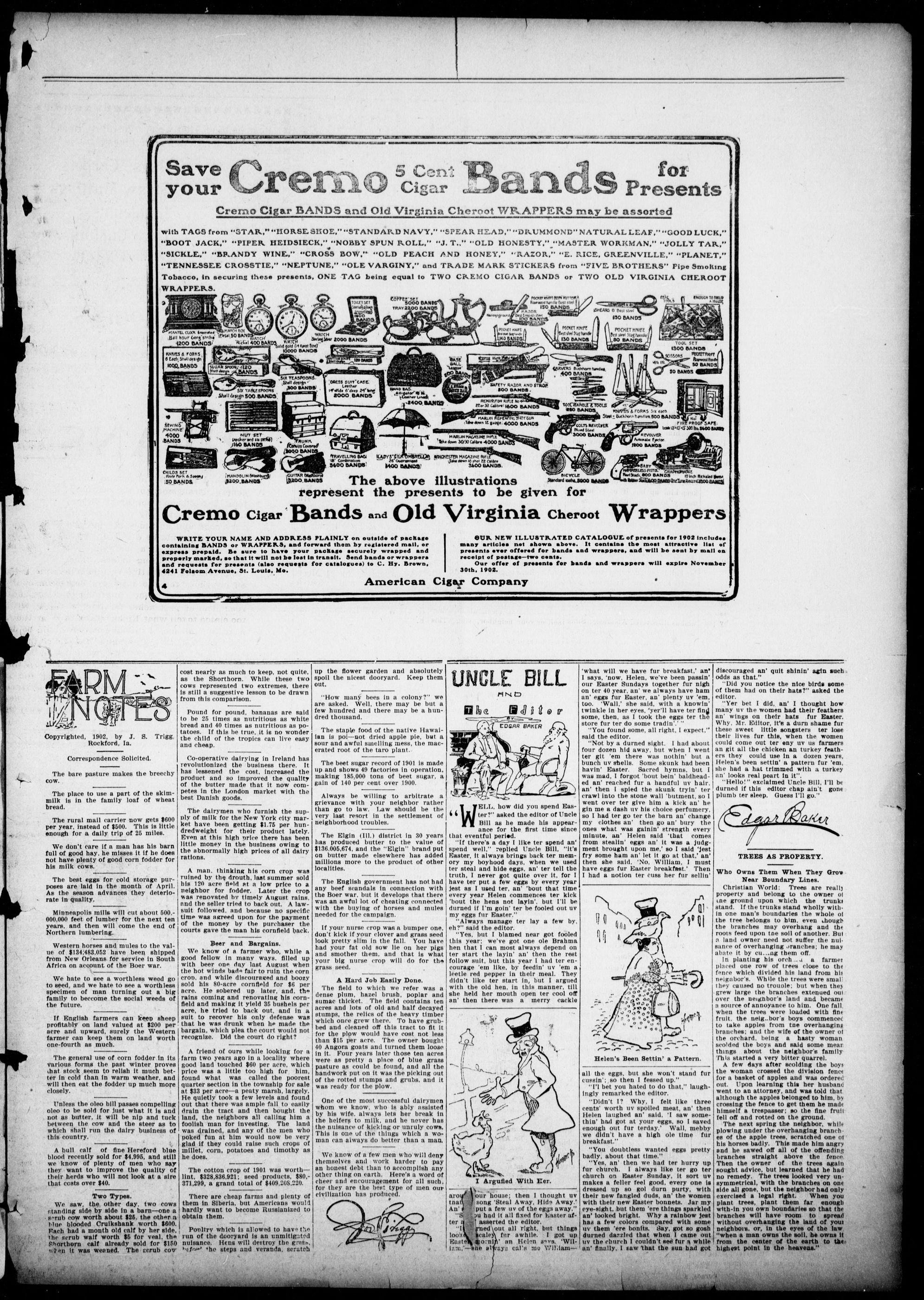
Save your Cremo 5 Cent Cigar Bands Presents
Cremo Cigar BANDS and Old Virginia Cheroot WRAPPERS may be assorted
with TAGS from "STAR," "HORSE SKOE," "STANDARD NAVY," "SPEAR HEAD," "DRUMMOND" NATURAL LEAF," "GOOD LUCK," "BOOT JACK," "PIPER HEIDSIECK," "NOBBY SPUN ROLL," "J. T.," "OLD HONESTY," "MASTER WORKMAN," "JOLLY TAR," "SICKLE," "BRANDY WINE," "CROSS BOW," "OLD PEACH AND HONEY," "RAZOR," "E. RICE, GREENVILLE," "PLANET," "TENNESSEE CROSSTIE," "NEPTUNE," "OLE VARGINY," and TRADE MARK STICKERS from "FIVE BROTHERS" Pipe Smoking Tobacco, in securing these presents, ONE TAG being equal to TWO CREMO CIGAR BANDS or TWO OLD VIRGINIA CHEROOT WRAPPERS
MANTEL CLOCK & FORKS
Hall hour Long strike
1200 BANDS
MATCH BOX
Metal 50 BANDS
WATCH
Metal 400 BANDS
WATCH
Shrink Silver 2000 BANDS
TOILET SET
Similar lighting
1000 BANDS
COPPER SET
TRAY 2200 BANDS
POCKET HAND GUN NETTLE
Rearward handle 150 BANDS
RAZOR
Heavy ground 100 BANDS
SHEARS 8 Best steel
150 BANDS
POCKET KNIFE
Best steel Stick handle
130 BANDS
POCKET KNIFE
Best steel Stick handle
80 BANDS
TOOL SET
1300 BANDS
SCISSORS
Rearwood Rough
50 BANDS
KNIVES & FORKS
Early Shell design
1000 BANDS
UGAR SMOOTH or BAG
Shell design
1000 BANDS
SIX TEASPOONS
Shell design
500 BANDS
DRESS SUIT CASE
14 wide 6 deep 24 long
2000 BANDS
BASE BALL
Ball
HAND BAG
Airlighter Linseed
2400 BANDS
SAFETY RAZOR AND STROB
800 BANDS
REMHUTTON RIFLE No. 22
30 Caliber 1600 BANDS
MARSHALL REE COORDINATOR
Take down 12 gauge 4000 BANDS
MARLIN MAGAZINE RIFLE
Bike down 30,000 Caliber 4000 BANDS
LADY'S SUN THORPELL
26 Guaranteed
4000 BANDS
INGHAMSTER MAGAZINE RIFLE
Joke down 16 shot 22 Caliber
3600 BANDS
BABY
Standard poke 8000 BANDS
ENOUGH TO BUILD A HOUSE
SERVING MACHINE
4000 BANDS
NUT SET
Jacker and 20 pincers
160 BANDS
TRUNK
Convas Covered
3000 BANDS
TRAVELLING BAG
US Combination
3600 BANDS
GUITAR SHARPENED
1200 BANDS
REVOLVER
Automatic Ejector
1200 BANDS
CHILD'S SET
Hole Pack & Scooters
MANPOLIN (Newport)
3200 BANDS
GUITAR SHARPENED
1200 BANDS
The above illustrations
WRITE YOUR NAME AND ADDRESS PLAINLY on outside of package containing BANDS or WRAPPERS, and forward them by registered mail, or express prepaid. Be sure to have your package securely wrapped and properly marked, so that it will not be lost in transit. Send bands or wrappers and requests for presents (also requests for catalogues) to C. Hy. Brown, 4241 Folsom Avenue, St. Louis, Mo.
cost nearly as much to keep, not quite, as the Shorthorn. While these two cows represented two extremes, there is still a suggestive lesson to be drawn from this comparison.
Pound for pound, bananas are said to be 25 times as nutritious as white bread and 40 times as nutritious as potatoes. If this be true, it is no wonder the child of the tropics can live easy and cheap.
Co-operative dairying in Ireland has revolutionized the business there. It has lessened the cost, increased the product and so improved the quality of the butter made that it now competes in the London market with the best Danish goods.
The dairymen who furnish the supply of milk for the New York city market have been getting $1.75 per hundredweight for their product lately. Even at this high price there has been little money in the business owing to the abnormally high prices of all dairy rations.
A man, thinking his corn crop was ruined by the drouth, last summer sold his 120 acre field at a low price to a neighbor for fodder. Later the crop was renovated by timely August rains, and the seller tried to back out. A lawsuit followed, and because no specific time was agreed upon for the payment of the money by the purchaser the courts gave the man his cornfield back.
Beer and Bargains.
We know of a farmer who, while a good fellow in many ways, filled up with beer one day last August when the hot winds bade fair to ruin the corn cron. and while discouraged and boozy sold his 80-acre cornfield for $6 per acre. He sobered up later, and, the rains coming and renovating his cornfield and making it yield 35 bushels per acre, he tried to back out, and in a suit to recover his only defense was that he was drunk when he made the bargain, which plea the court would not recognize. Did the court do right?
A friend of ours while looking for a farm two years ago in a locality where good land touched $60 per acre, which price was a little too high for him, found what was called the poorest quarter section in the township for sale at $33 per acre—a peaty marsh, largely. He quietly took a few levels and found out that there was ample to easily drain the tract and then bought the land, the neighbors all calling him a foolish man for investing. The land was drained, and any of the men who poked fun at him would now be very glad if they could raise such crops of millet, corn, potatoes and timothy as he does.
The cotton crop of 1901 was worth—lint, $288,836,921; seed products, $409,208,220.
There are cheap farms and plenty of them in Siberia, but Americans would hardly want to become Russianized to obtain them.
Poultry which is allowed to have the run of the dooryard is an unmitigated nuisance. Hens will destroy the grass, 'fro' the steps and veranda, scratch
up the flower garden and absolutely spoil the nicest dooryard. Keep them out.
"How many bees in a colony?" we are asked. Well, there may be but a few hundred and there may be a hundred thousand.
The staple food of the native Hawaiian is poi—not dried apple pie, but a sour and awful smelling mess, the macerated root of the taro plant.
The beet sugar record of 1901 is made up and shows 49 factories in operation, making 185,000 tons of beet sugar, a gain of 140 per cent over 1900.
Always be willing to arbitrate a grievance with your neighbor rather than go to law. Law should be the very last resort in the settlement of neighborhood troubles.
The Elgin (Ill.) district in 30 years has produced butter to the value of $136.005,674, and the "Elgin" brand put on butter made elsewhere has added millions more to the product of other localities.
The English government has not had any beef scandals in connection with the Boer war, but it develops that there was an awful lot of cheating connected with the buying of horses and mules needed for the campaign.
If your nurse crop was a bumper one, don't kick if your clover and grass seed look pretty slim in the fall. You have had your fat old sow lie on her pigs and smother them, and that is what your big nurse crop will do for the grass seed.
A Hard Job Easily Done.
The field to which we refer was a dense palm, hazel brush, poplar and sumac thicket. The field contains ten acres and lots of old and half decayed stumps, the relics of the heavy timber which once grew there. To have grubbed and cleaned off this tract to fit it for the plow would have cost not less than $15 per acre. The owner bought 40 Angora goats and turned them loose in it. Four years later those ten acres were as pretty a place of blue grass pasture as could be found, and all the handwork put on it was the picking out of the rotted stumps and grubs, and it was ready for the plow.
One of the most successful dairymen whom we know, who is ably assisted by his wife, always lets her break in the heifers to milk, and he never has the nulisance of kicking or unruly cows. This is one of the things which a woman can always do better than a man.
We know of a few men who will deny themselves and work harder to pay an honest debt than to accomplish any other thing on earth. Here's a word of cheer and encouragement for all such, for they are the best type of men our civilization has produced.
GUR NEW ILLUSTRATED CATALOGUE of presents for 1902 includes many articles not shown above. It contains the most attractive list of presents ever offered for bands and wrappers, and will be sent by mail on receipt of postage—two cents.
Our offer of presents for bands and wrappers will expire November 30th, 1902.
---
UNCLE BILL
The Editor
BY
EDGAR BAKER
"WELL, how did you spend Easter?" asked the editor of Uncle Bill as he made his appearance for the first time since that eventful period.
"If there's a day I like ter spend an
spend well," replied Uncle Bill, "it's
Easter, it always brings back ter memory
my boyhood days, when we used
ter steal and hide eggs, an' ter tell the
truth, I never got quite over it, for I
have ter put a few eggs by every year
jest as I used ter, an' baut that time
every year Helen commences ter kick
bout the hens not layin', but I'll be
burned if I'm goin' ter be fooled out uv
my eggs fur Easter."
"Always manage ter lay a few by,
eh?" said the editor.
"Yes, but I blamed near got fooled
this year; we've got one ole Brahma
hen that I can most always depend on
ter start the layin' an' then the rest
follow suit, but this year I had ter en-
courage 'em like, by feedin' uv 'em a
leaiteled red pepper in their meal.
She didn't like ter start in, but I argued
with the old hen, in this manner, till
she held her mouth open ter cool off
an' then there was a merry cackle
I Arguffed With Fer.
around our house; then I thought uv
tnat song 'Steal Away, Hide Away.'
An'e put a few uv of the eggs away."
"Sue you had it all fixed for baster after
a asserted the editor.
"I learned out all right, but things
looked scaled for awhile. I got up
Easter morning' an Helen says. 'William,'—she always cal's me William—
HND
'what will we have fur breakfast,' an I says, 'now. Helen, we've been passin' our Easter Sundays together fur nigh on ter 40 year, an 'we always have ham an' eggs fur Easter, an 'plenty uv 'em, too. 'Wall,' she said, with a known twinkle in her eyes, 'yer'll have ter fing some, then, as I took the eggs ter the store fur ter do some tradin'.'
"You found some, all right, I expect," said the editor.
"Not by a durned sight. I had about four dozen hid away, but when I went ter git 'em there was nothin' but a bunch uv shells. Some skunk had been havin' Easter. Sacred hymns, but I was mad, I forgot 'bout bein' baldheaded an' reached fur a handful uv hair, an' then I spied the skunk tryin' ter crawl into the stone wall 'butment, so I went over ter give him a kick an' he gin me a dash uv his choice perfumery, so I had ter go ter the barn an' change my clothes an' then go an' bury the ones what was gainin' strength every minute, an' Helen said 'that comes from stealin' eggs an' it was a judgment brought upon me', so I said 'jest fry some ham an' let it go at that, an' then she said. No, William, I must have eggs fur Easter breakfast.' Then I had a notion ter cus her furl sellin'
Helen's Been Settin' a Pattern.
all the eggs, but she won't stand fur cusin', so then I fessed up."
"I bet you hated to do that," laughingly remarked the editor.
"Didn't I? Why, I felt like three cents' worth uv spoiled meat, an' then Helen laughed an' said, 'I saw some-thin had got at your eggs, so I saved enough out fur terday.' Wall, mebby we didn't have a high ole time fur breakfast."
"You doubtless wanted eggs pretty badly, about that time."
"Yes, an' then we had ter hurry up fur church. I always like ter go ter church on Easter Sunday, it sort uv makes a feller feel good, every one is dressed up so gol durn purty, with their new fangled duds, an' the women with their new Easter bonnets. Jar my eye-sight, but them 'ere things sparkled an' looked bright. Why a rainbow jest has a few colors compared with some uv them 'ere bonits. Say, got so gosh durned dazzled that when I came out uv the church I couldn't see fur a while an' finally, I saw that the sun had got
discouraged an' quit shinin' agin such odds as that."
"Did you notice the nice birds some of them had on their hats?" asked the editor.
"Yer bet I did, an' I thought how many uv the women had their feathers an' wings on their hats fur Easter. Why, Mr. Editor, it's a durn shame fur these sweet little songsters ter lose their lives fur this, when the women could come out ter eny uv us farmers an git all the chicken an turkey feathers they could use in a dozen years. Helen's been settin' a pattern fur 'em, she had a hat trimmed with a turkey an' looks real peart in it."
"Hello!" exclaimed Uncle Bill, I'll be durned if this editor chap ain't gone plumb ter sleep. Guess I'll go."
Who Owns Them When They Grow Near Boundary Lines.
Christian World: Trees are really property and belong to the owner of one ground upon which the trunks stand. If the trunks stand wholly within one man's boundaries the whole of the tree belongs to him, even though the branches may overhang and the roots feed upon the soil of another. But a land owner need not suffer the nulsance of overhanging branches; he may abate it by cutting them off.
In planting his orch... a farmer placed one row of trees close to the fence which divided his land from his neighbor's. While the trees were small they caused no trouble; but when they grew large the branches extended out over the neighbor's land and became a source of annoyance to him. One fall when the trees were loaded with fine fruit, the neigbor's boys commenced to take apples from the overhanging branches; and the wife of the owner of the orchard, being a hasty woman scolded the boys and said some mean things about the neighbor's family. This started a very bitter quarrel. A few days after scolding the boys the woman crossed the division fence for a basket of apples and was ordered out. Upon learning this her husband went to an attorney, and was told that although the apples belonged to him, by crossing the fence to get them he made himself a trespasser; so the fine fruit fell off and rotted on the ground.
The next spring the neighbor, while plowing under the overhanging branches of the apple trees, scratched one of his horses badly. This made him angry and he sawed off all of the offending branches straight above the fence. Then the owner of the trees again sought advice, but learned that he had no remedy. The trees looked very unsymmetrical, with the branches on one side all gone, but the neighbor had only exercised a legal right. When you plant trees, plant them far enough with-in you own boundaries so that the branches will have room to spread without overhanging the land of your neighbors, or, in the eyes of the law "when a man owns the soil, he owns it from the center of the earth to the highest point in the heavens."
The Professional World
RUFUS L. LOGAN, B. S. D. - EDITOR
TERMS OF SUBSCRIPTION.
One Year in Advance - - - $1.50
Six Months in Advance - - 1.00
Three Months in Advance - - .50
Single Copies - - .05
Special rates of $1.00 per year to ministers.
Advertising Rates on Application.
Job Work of all Kinds Solicited.
Published Every Friday.
Entered at the postoffice at Columbia, Mo., as second class matter,
Jan. 15, 1902.
Agents wanted in every town in the state.
PRESS OF THE MISSOURI STATESMAN
Our thanks are due Prof. B. F.
Allen, of Savannah, Ga., for sub-
scription to the Professional
World.
Pay your subscription to the
Professional World, our best pay-
ing subscribers are those who are
seemingly the least able.
A COPY of The University Press, organ of the Western University, has reached our desk. It is a neat, newsy sheet edited by that great educator W. T. Vernon. We predict for it a great success.
STUDENTS who attend colleges should remember that the judgment of the faculty should be considered better than that of a student. Disobedience and riotous performance should not be tolerated in any school.
Notice.
All person who are interested in the success of The Professional World will show the same by patronizing the business men who advertise in these columns.
Wanted.
For our file, a few copies of the Professional World dated Jan. 24th; any one having one of the above dated copies will do us a favor by sending us the same.
"KAISER WILLIAM" AND HIS PALACE. (As Seen By Reuben.)
Royalty in Germany is now cheap. It costs nothing to see the Emperor, and only fifteen cents to go through his palace.
Emperor William can be seen daily on the Unter den Linden or in the Theirgarten, unless his Royal Highness is out of town, in which case some of his children are generally exhibited. Royalty is nothing if not on parade. The Emperor knows human nature and plays on it to perfection.
Every day and sometimes twice per day Emperor William launches forth from his castle, robed in buckles and buttons, and all ensigns of royalty, and, like lighting, flashes through the streets of the city to get a little air, and incidentally to let the people see him. At first I wondered why he drove so fast, but now I am convinced that it is not because he is scared, but that it is a part of the game of royalty to pose, exhibit and parade so swiftly that the people will not have time to think.
Sometimes the Emperor rides horseback and is accompanied by eight or ten of his officers. There is a sort of signal service on one corner of his castle which indicates when the Emperor is out of his palace and to be seen on the streets. It is interesting to see the people of such times, forming in line on both sides of the street in order to get a glimps of the Kaiser. I have gotten so that I like to look at him myself and if I were not an American I believe I would wish that I had been born a King.
The Emperor always has pretty horses, and on the seat with the driver is one of his officers with a rooster's tail in his cap. As he sails by the people lift their hats and the Emperor bows his head and points to his silver-plated hat. I have seen his Highness several times but have never worked up
to the point of tipping my hat to him but once, and that was to experiment on him. One day I was walking in the Theirgarten alone and I saw the Emperor and his wife coming. As no other people were in sight I got a good position and caught hold of my hat and raised it with a smile as he passed. I was surprised to see the Emperor and Empress both bow in recognition to the salute of a private foreigner.
I felt stuck up and could have maintained this feeling the rest of the day but like Lot's wife, I stopped to look back and saw a man who was raking the dirt off the street, step aside and raise his hat to the Kaiser and get a bow just like mine. Since then I have learned that the Kaiser will speak to anybody who will speak to him. He is a nice man and far from going crazy as some of the American papers say he is.
Germany has a constitution but the Emperor is constitution enough himself for most of the Germans to be willing to trust him to run the whole government. In spite of his bad speeches the people like him and have confidence in his ability. Until Germany has sense enough to set up a republic Kaiser William had just as well run the government as anybody else. It costs lots of money to keep him up but it costs lots of money to keep other rulers up too, some of whom are not kings.
As the Emperor's palace was said to be pretty and famous, I bought two tickets and went to see it. The royal palace as it now stands is a big, massive rectangular building, enclosing two large courts four stories high and with a tall tower on top. The original building was a castle erected by Elector Frederick I., before Columbus discovered America. Since then different princes and kings of the Hohenzollern line have added to it as fast as the money could be squeezed out of the people with which to build it. It has been adorned and embellished, inside and out, with the precious ointment of the poor man's brow, and is now well worth the money it costs to see it. In fact it is too fine—there is more room than is needed, and every room bears the mark of too much taxation. There are seven hundred rooms in this palace, more than any family could hope to fill. It took us two hours to visit it, and we did not go through a hundred rooms.
The Emperor could not even look into these seven-hundred rooms in one day much less to eat or sleep in them. For whom then are these rooms fixed up so fine? Anybody but the people who paid for them. In other words every door has a sign over it for taxpayers to keep out.
As we approach this mighty dwelling place of the Emperor's Royal Highness, we first behold on the balustrade four statues of, the old Emperor William I., Empress Augusta, Emperor Frederick and the Empress Victoria as Jupiter, Juno, Mars and Minerva. If Jupiter, Juno, Mars and company were real gods they would take this as a good joke. First we were led up stairs by a winding walk. In former times the horses and carriages were driven up on this winding place to the inside doors of the palace. Exertion and dirt were too ordinary in those times for royalty. Now the Emperor walks down to the foot of the steps and gets into his carriage like other people. Our party was next taken to a large pile of big felt slippers like snow shoes. These we were to put on in order to keep our feet off the floor. At first I felt like I was getting ready to join a party to go to discover the North Pole. But after a while I felt like only a fool. I was astounded and astonished from beginning to end. Every room was furnished with extravagance and adorned with luxury.
New Cash Grocery!
We save you money by paying cash for Groceries. All new goods; highest price paid for produce and poultry, 708 W. Broadway, Phone 631.
STATE FAIR SUPERINTENDENTS.
At a meeting of the Missouri State Fair Board, the following additional superintendents were appointed: E. E. Codding, Sedalia, poultry; W. Y. Buchanan, Moberly dairy cattle; T. S. Gordon, Columbia, speed department; T. W. Bast, Sedalia, concession; John I. Harmon, Browning, Linn county, heavy horses; W. L. Duncan, Sullivan county, jacks and mules; Charles L. Bush, Washington, Mo., light horses. An Angora goat department was added and three additional races were added to the speed program. Entries for all races will close on June 2.
There are four United States land offices in Arkansas—Camden, Dardanelle, Harrison and Little Rock. There are 337,946 acres of public land in Missouri and 3,493-444 acres in Arkansas subject to entry and settlement. The price is $1.25 an acre in Missouri.
There is so much in being cheerful. Instead of thinking about how you might hurt your enemies, try thinking about how you might help your friends; it will make you so much happier. Our remedy for a happy disposition is this: Smile; have a good laugh; if you happen to know some evil about somebody else, just whistle, don't talk; if someone wants to tell you something mean about yourself or your neighbor, sing. This followed every day will make a much brighter and happier world.
Want Postoffices Established.
The Postal Department at Washington has been petitioned to establish a postoffice at the residence of Jonn A. Winn, about 7 miles south of Sturgeon, to be called "Winn," "Winner," or "Winrow." An effort is being made to have a postoffice established at Rock Bridge, 6 miles south of Columbia. These two postoffices would be a great convenience to the people of those localities.
Boone County Cases.
On Monday last, the Kansas City court of appeals handed down opinions in two cases that were appealed from our county. The first was that of the estate of W. W. Tucker against the estate of R. L. Todd. The decision of the circuit court, which was in favor of the Todd people, was sustained by the appellate court, (opinion by judge Broaddus.) T. S. Carter and W. W. Fry represented the Tucker estate, and Turner and Hinton and N. T. Gentry the Todd estate.
The case of Columbus Thompson, a minor by Jas. H. Reid, his curator, vs M. K. & T. Railroad was reversed and remanded. This was a personal injury case, and the jury decided in favor of the road but another trial is granted, opinion by Judge Smith. N. T. Gentry appeared for the plaintiff, while the railroad was represented by Geo. P. B. Jackson and C. B. Sebastian.
YOU'LL
TELL
YOUR
FRIENDS
of the satisfaction you have received through getting your garments made to measure by Fred Kauffmann, The American Tailor, Chicago. Made by experienced men, they fit like a glove, and are as easy to wear as an old shoe. And they're only
VESSER & TRUE.
50 YEARS' EXPERIENCE
PATENTS
TRADE MARKS DESIGNS
COPYRIGHTS & C.
Anyone sending a sketch and description may quickly ascertain our opinion free whether an invention is patented by patentable corporations strictly confidential. Handbook on Patents sent free. Oldest agency for securing patents. Patent taken through Munn & Co. receive special notice, without charge, in the Scientific American.
A handsomely illustrated weekly. Largest circulation of any scientific journal. Terms, $3 a year; four months, $1. Sold by all newdealers.
MUNN & Co. 381 Broadway, New York
Branch Office, 625 F St. Washington, D.C.
Lodge and Church Directory.
Mrs. Irena Akers W. P.; Mrs. Lizzie Williams, W. S. Meeting first Monday in each month at 3 p. m.
U. B. F.
Crispus Attucks Lodge,No. 62. Meetings 2nd and 4th Tuesdays in each month. Visiting members cordially invited. Caleb Hall, W. M. A. M. Schweich, W. S.
K. P.
Acme Lodge, No. 24. Meetings second and fourth Fridays in each month. W. H. Turner, C. C. and D. D. G. C. W. W. Lampkins, M. F.
O. E. S.
Amos Chapter, No. 30. Meetings second Friday in each month. Mrs. A. B. Moore, W. M. Mrs. Lizzie Richardson, W. S.
SECOND CHRISTIAN CHURCH.
Rev. J. B. Parsons, pastor.
Preaching Sundays 11 a. m.
and 7:30 p. m.
Prayer meeting Wednesdays 7:30 p. m.
Everybody cordially invited to attend.
A. M. E. CHURCH.
Rev. P. C. Crews, Pastor.
Preaching Sundays 11 a
m.; 7:30 p. m.
Sunday school 2:30 p. m.
Prayer meeting every Wednesday eve, at 8:30; every body invited to attend.
M. E. CHURCH
Rev. J. Arlington Grant, pastor.
Preaching Sundays 11, a. m. and 7:30 p. m.
Sunday school, 9:30 a. m.
Prayer meeting Wednesdays 7:30 to 8:30; all are made welcome.
A banker sauntering home for dinner saw a $10 bill lying on the curbstone. Of course he picked it up and took the number of it, in order to find the owner. While at home his wife remarked that the butcher sent in his bill amounting to $10. The only money he had with him was the money he had found, which he gave to her and she paid the butcher. The butcher paid it for a calf. The farmer paid it to a merchant, who in turn paid it to his clerk, and the clerk, owing the banker a note of $10 went to the banker and paid off the note. The banker recognized the bill as the one he had found and which, up to that time, had settled $50 in debts. On careful examination he found the bill was counterfeit. Now will some of our financial friends tell us what has been lost by the transaction, if anything, and by whom.—Ex.
Bear in Mind That we are Positively Headquarters for the Finest
And Portieres, New Rogers' Superlative Carpets are in all Grades. Don't buy Assortment and get our Low
teries, New Stock & Patterns
relative Carpets and Rugs are the Best Made
Don't buy Until you see our Superb
and get our Low Prices.
And Portieres, New Stock & Patterns Rogers' Superlative Carpets and Rugs are the Best Made in all Grades. Don't buy Until you see our Superb Assortment and get our Low Prices.
R. F. ROGERS.
RIPA
I had nervous general derangement. It had been a for twelve years. very poor and at finger nails would be eating I would sit in my feet on something from swelling and off my shoes for the Whenever I experience remind me of past too elated to tell what have done for me. and then, because I have been. They needed.
REGISTER IN PATENT U.
BEFORE
A Wonderful Hair Straightener, a Flesh Pro with Puff and a Little Pink, and All seven of these articles pone Dollar, or three times as for two Dollars. Guaranteed and directed. Full directions on A WONDERFUL FACE BLEACH. A per directed. It will turn the skin of a black ker, a mulatto person perfectly white and forty-eight hours a shade or two will be spots but bleaches out white, the skin It removes pimples, black-heads, sunburn pits without any harm to the skin w
One package of our REFINED FACE which goes with every box sold, com bleach and makes a beautiful finish--the THE HAIR STRAIGHTENER, that you guaranteed to make the hair grow long and keeps it from falling out. The ha
One bottle of our FLESH PRODUC you to perfect health. After taking a fe getting fat, round, rosy and developing thing for a thin or run-down person.
Sole Agent for Standard Patterns.
had nervous indigestion and a
total derangement of the entire sys-
It had been a continual torture
twelve years. My blood became
poor and at times my toe and
nails would be diseased. After
I would sit in a chair and put
it on something to keep them
dwelling. and at times would take
shoes for the misery I had.
Never I experience anything to
me of past aches I cannot be
told to tell what Ripans Tabules
one for me. I still take one now
en, because I know how bad I
been. They were just what I
d.
REGISTERED
IN
PATENT OFFICE
U.S.
AFTER
Wonderful Face Bleach.
Her, a Flesh Producer, a Refined Face Powder
Little Pink, and a package of Love Powder.
These articles packed nicely in one box for
three times as much packed nicely in one box.
Guaranteed to do what we say if used as
directions on all articles.
FACE BLEACH. A peach-like complexion obtained if used as
the skin of a black or brown person five or six shades light-
perfectly white and a white person a model of beauty. In
shade or two will be noticeable. It does not turn the skin in
out white, the skin remaining beautiful without continual use.
Black-heads, sunburns, freckles, bumps, wrinkles and small-
ly harm to the skin whatever.
Our Refined Face Powder with puff and a little pink,
every box sold, comes in very nicely after using the face
a beautiful finish—this being the finest on the market.
RIGHTENER, that goes in every box, is highly perfumed and
the hair grow long and straight, makes it easy to comb
falling out. The hair begins at once to grow log and soft.
Our FLESH PRODUCER, that goes in every box, will restore
hair. After taking a few drops of it, you will see that you are
cosy and developing a very pretty shape. This is a very fine
run-down person.
---
RIPANS
I had nervous indigestion and a general derangement of the entire system. It had been a continual torture for twelve years. My blood became very poor and at times my toe and finger nails would be diseased. After eating I would sit in a chair and put my feet on something to keep them from swelling. and at times would take off my shoes for the misery I had. Whenever I experience anything to remind me of past aches I cannot be too elated to tell what Ripans Tabules have done for me. I still take one now and then, because I know how bad I have been. They were just what I needed.
REGISTERED
IN
PATENT OFFICE
U.S.
BEFORE AFTER
A Wonderful Face Bleach.
Hair Straightener, a Flesh Producer, a Refined Face Powder with Puff and a Little Pink, and a package of Love Powder. All seven of these articles packed nicely in one box for one Dollar, or three times as much packed nicely in one box for two Dollars. Guaranteed to do what we say if used as directed. Full directions on all articles.
A WONDERFUL FACE BLEACH. A peach-like complexion obtained if used as directed. It will turn the skin of a black or brown person five or six shades lighter, a mulatto person perfectly white and a white person a model of beauty. In forty-eight hours a shade or two will be noticeable. It does not turn the skin in spots but bleaches out white, the skin remaining beautiful without continual use. It removes pimples, black-heads, sunburns, freckles, bumps, wrinkles and small-box pits without any harm to the skin whatever.
One package of our REFINED FACE POWDER with puff and a little pink, which goes with every box sold, comes in very nicely after using the face bleach and makes a beautiful finish--this being the finest on the market.
THE HAIR STRAIGHTENER, that goes in every box, is highly perfumed and guaranteed to make the hair grow long and straight, makes it easy to comb and keeps it from falling out. The hair begins at once to grow log and soft.
One bottle of our FLESH PRODUCER, that goes in every box, will restore you to perfect health. After taking a few drops of it, you will see that you are getting fat, round, rosy and developing a very pretty shape. This is a very fine thing for a thin or run-down person.
One box of face Bleach, worth.....$1.00
One box of Hair Straightener, worth.....$1.00
One package of Love Powder, worth.....1.00
One box of Refined Face Powder, with Puff.....50
One bottle Flesh Producer, worth.....50
Total.....$3.50
all the
parti-
tor or if
tree
h in
l $2.
d the
in the mail, postage prepaid. You can send
at Office or express money order, or In reg-
aled letter. If you want it to come C. O. D., it
the express charges 35 Cts. extra. All goods
one will know contents except the receiver.
The Belt Drug Co.,
II West Jackson Street, - RICHMOND, VA.
goods through the mail, postage prepaid. You can send money by Post Office or express money order, or in registered or a sealed letter. If you want it to come C. O. D., it will cost you the express charges 35 Cts. extra. All goods packed so no one will know contents except the receiver.
goods through the mail, post money by Post Office or expistered or a sealed letter. If will cost you the express chapacked so no one will know o LOAD STONE IN EVERY BOX FREE. II West Ja
LOAD STONE IN The Bell Drug Co.,
EVERY BOX FREE. II West Jackson Street, - RICHMOND, VA.
RUGS
These are the wholesale prices.
If you want all the above named articles send $1. or if you want three times as much in one box send $2. and we will send the
Rugs, Carpets Straw Mattings Linoleums, Lace Curtains,
---
---
LOVE POWDER, that goes with every box, makes love and is the cause of many sweet kisses. This love powder is the greatest love-making thing on earth. You can make anyone love you that you want if used as directed. It is harmless and can be used in the presence of persons and they will not notice it.