The Professional World
Friday, August 15, 1902
Columbia, Missouri
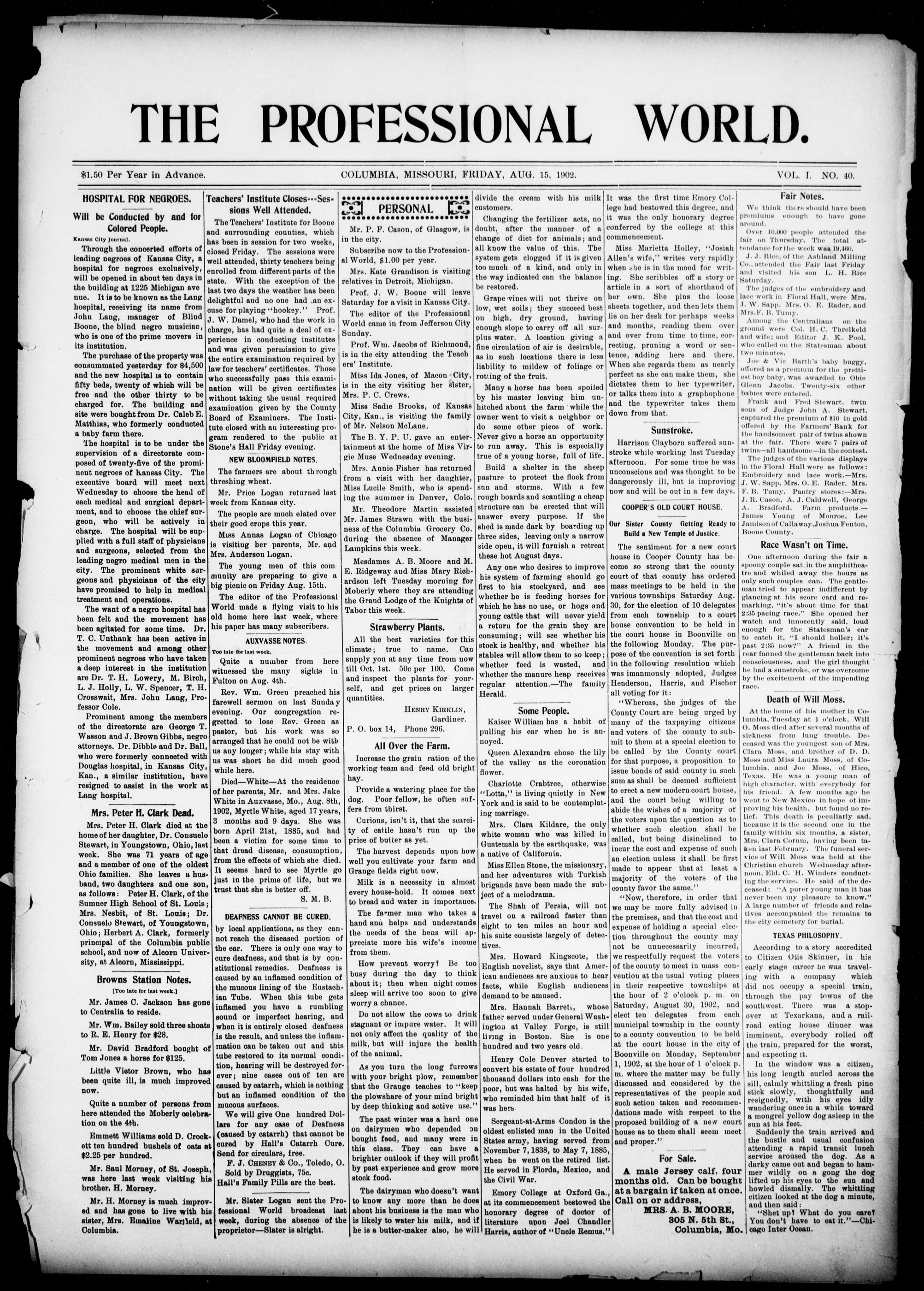
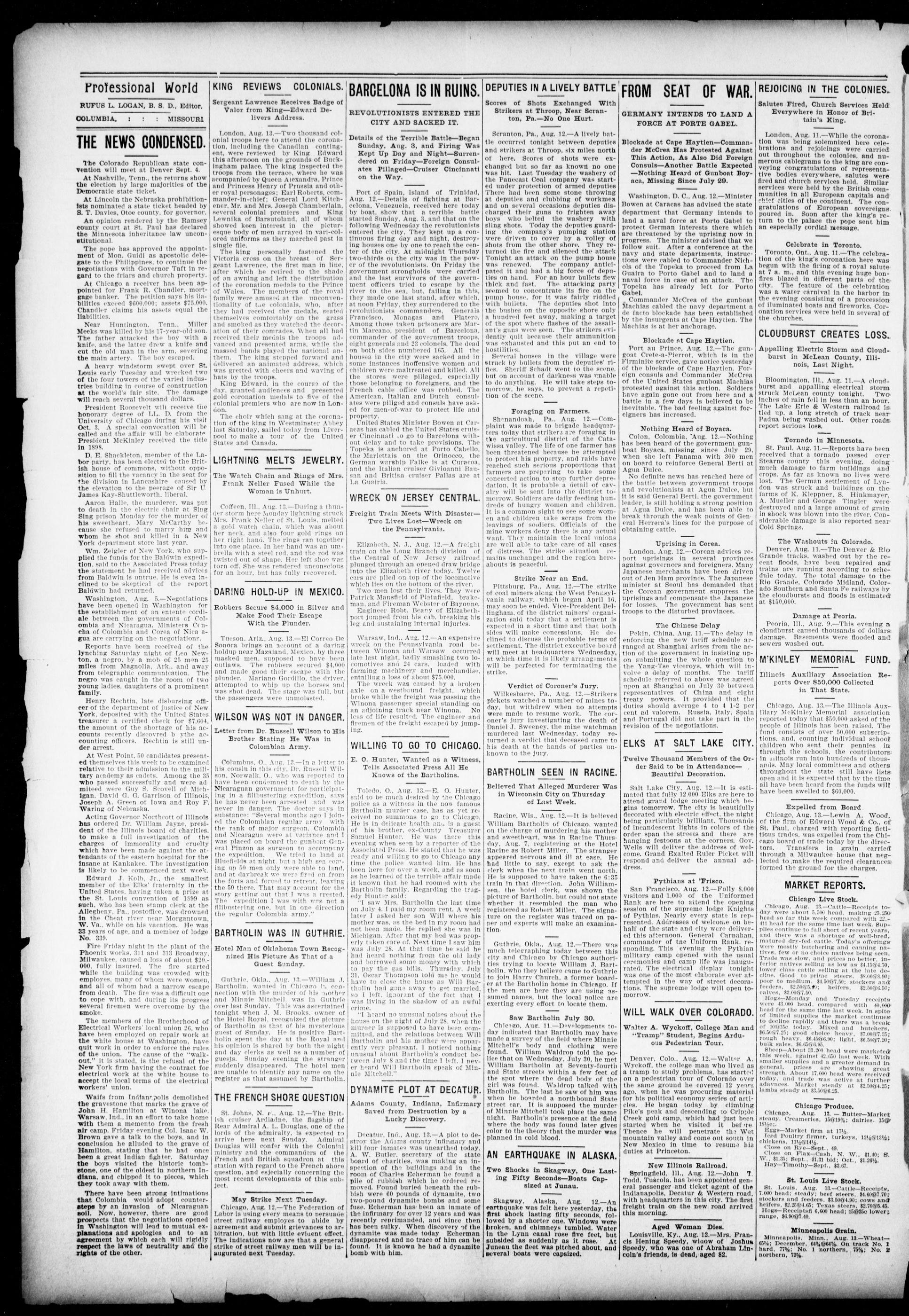
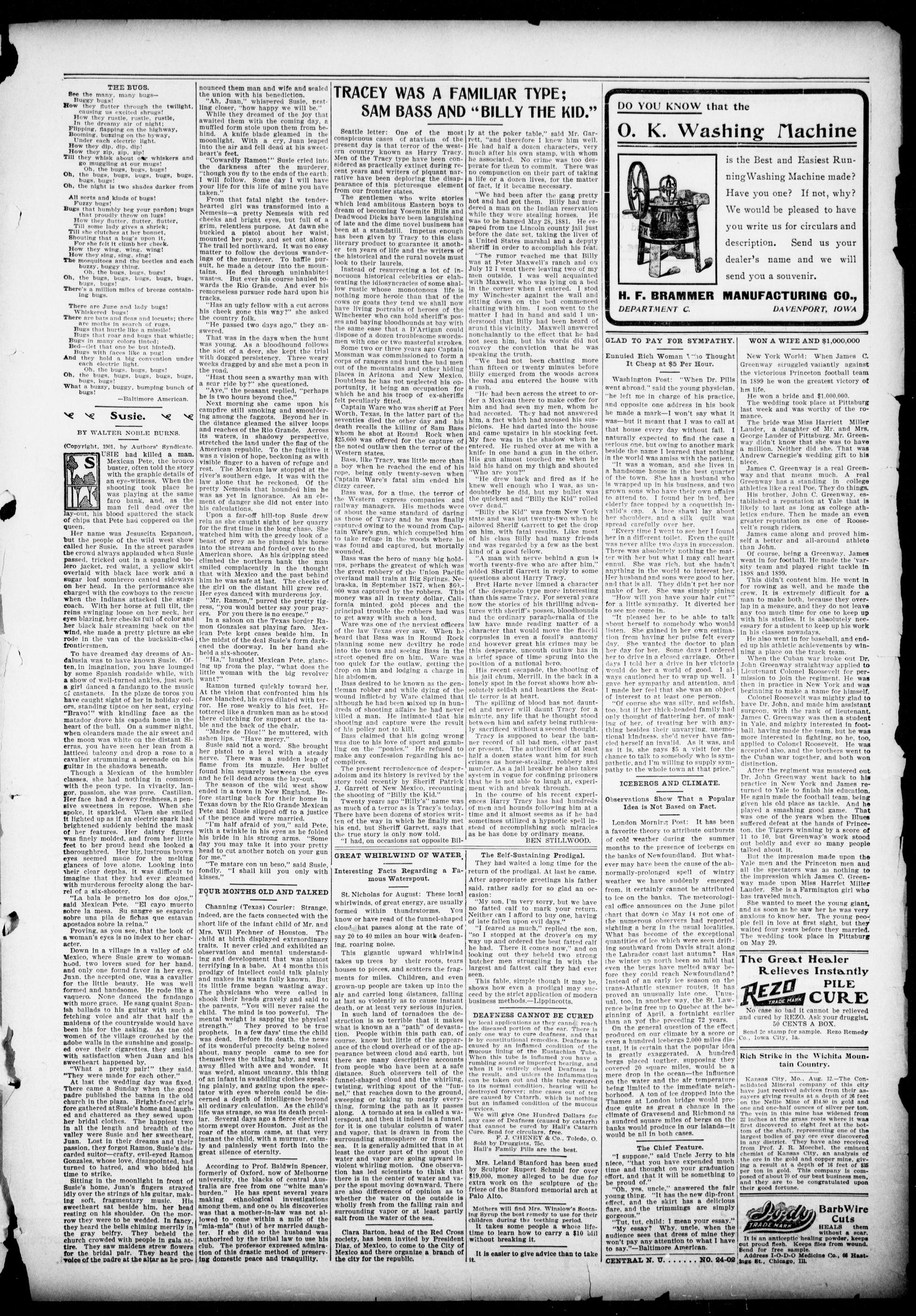
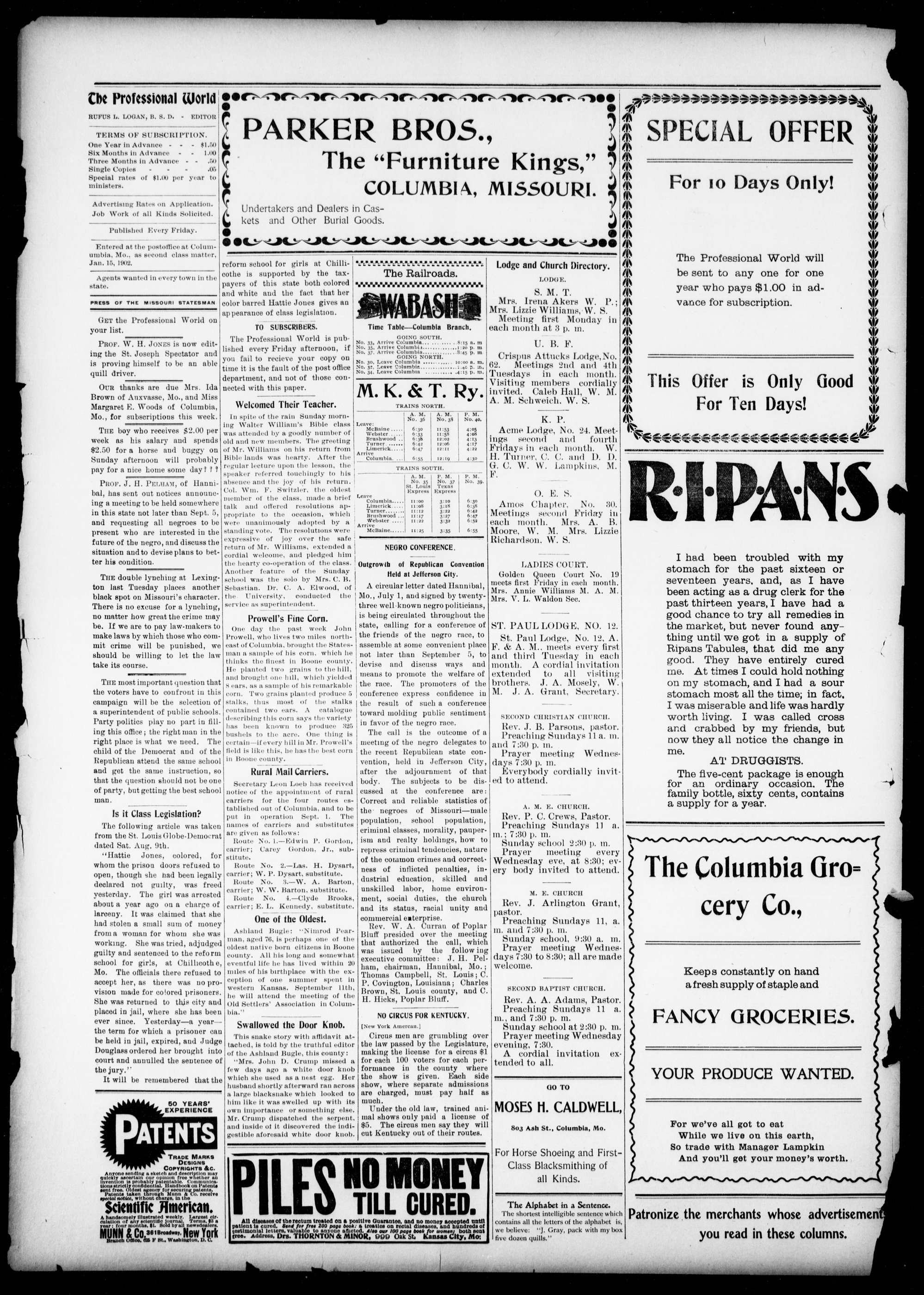
Page text (machine-generated)
THE PROFESSIONAL WORLD.
$1.50 Per Year in Advance
HOSPITAL FOR NEGROES.
Will be Conducted by and for Colored People.
Kansas City Journal. Through the concerted efforts of leading negroes of Kansas City, a hospital for negroes exclusively, will be opened in about ten days in the building at 1225 Michigan avenue. It is to be known as the Lang hospital, receiving its name from John Lang, manager of Blind Boone, the blind negro musician, who is one of the prime movers in its institution.
The purchase of the propsrty was consummated yesterday for $4,500 and the new hospital is to contain fifty beds, twenty of which will be free and the other thirty to be charged for. The building and site were bought from Dr. Caleb E. Matthias, who formerly conducted a baby farm there.
The hospital is to be under the supervision of a directorate composed of twenty-five of the prominent negroes of kansas City. The executive board will meet next Wednesday to choose the head of each medical and surgical department, and to choose the chief surgeon, who will be actively in charge. The hospital will be supplied with a full staff of physicians and surgeons, selected from the leading negro medical men in the city. The prominent white surgeons and physicians of the city have promised to help in medical treatment and operations.
The want of a negro hospital has been felt and the movement has been agitated for some time. Dr. T. C. Unthank has been active in the movement and among other prominent negroes who have taken a deep interest in the institution are Dr. T. H. Lowery, M. Birch, L. J. Holly, L. W. Spencer, T. H. Crosswait, Mrs. John Lang, Professor Cole.
Prominent among the members of the directorate are George T. Wasson and J. Brown Gibbs, negro attorneys. Dr. Dibble and Dr. Ball, who were formerly connected with Douglas hospital, in Kansas City, Kan., a similar institution, have resigned to assist in the work at Lang hospital.
Mrs. Peter H. Clark Dead.
Mrs. Peter H. Clark died at the home of her daughter, Dr. Consuelo Stewart, in Youngstown, Ohio, last week. She was 71 years of age and a member of one of the oldest Ohio families. She leaves a husband, two daughters and one son, as follows: Peter H. Clark, of the Sumner High School of St. Louis; Mrs. Nesbit, of St. Louis; Dr. Consuelo Stewart, of Youngstown, Ohio; Herbert A. Clark, formerly principal of the Columbia public school, and now of Alcorn University, at Alcorn, Mississippi.
Browns Station Notes.
[Too late for last week.]
Mr. James C. Jackson has gone to Centralia to reside.
Mr. Wm. Bailey sold three shoats to R. E. Henry for $28.
Mr. David Bradford bought of Tom Jones a horse for $125.
Little Victor Brown, who has been quite ill, is much improved now.
Quite a number of persons from here attended the Moberly celebration on the 4th.
Emmett Williams sold D. Crockett ten hundred bushels of oats at $2.25 per hundred.
Mr. Saul Morney, of St. Joseph, was here last week visiting his brother, H. Morney.
Mr. H. Morney is much improved and has gone to live with his sister, Mrs. Emaline Warleld, at Columbia.
Teachers' Institute Closes----Sessions Well Attended.
The Teachers' Institute for Boone and surrounding counties, which has been in session for two weeks, closed Friday. The sessions were well attended, thirty teachers being enrolled from different parts of the state. With the exception of the last two days the weather has been delightful and no one had an excuse for playing "hookey." Prof. J. W. Damel, who had the work in charge, has had quite a deal of experience in conducting institutes and was given permission to give the entire examination required by law for teachers' certificates. Those who successfully pass this examination will be given certificates without taking the usual required examination given by the County Board of Examiners. The Institute closed with an interesting program rendered to the public at Stone's Hall Friday evening.
NEW BLOOMFIELD NOTES
The farmers are about through threshing wheat. Mr. Price Logan returned last week from Kansas city. The people are much elated over their good crops this year. Miss Annas Logan of Chicago is visiting her parents, Mr. and Mrs. Anderson Logan. The young men of this community are preparing to give a big picnic on Friday Aug. 15th. The editor of the Professional World made a flying visit to his old home here last week, where his paper has many subscribers.
AUXVASSE NOTES
Too late for last week.
Quite a number from here witnessed the many sights in Fulton on Aug. 4th.
Rev. Wm. Green preached his farewell sermon on last Sunday evening. Our congregation regretted to lose Rev. Green as pastor, but his work was so arranged that he could not be with us any longer; while his stay with us was short he did much good while here.
Died—White—At the residence of her parents, Mr. and Mrs. Jake White in Auxvasse, Mo., Aug. 8th, 1902, Myrtle White, aged 17 years, 3 months and 9 days. She was born April 21st, 1885, and had been a victim for some time to that dread disease, consumption, from the effects of which she died. It seems hard to see Myrtle go just in the prime of life, but we trust that she is better off. S. M. B.
DEAFNESS CANNOT BE CURED
by local applications, as they cannot reach the diseased portion of the ear. There is only one way to cure deafness, and that is by constitutional remedies. Deafness is caused by an inflamed condition of the mucous lining of the Eustachian Tube. When this tube gets inflamed you have a rumbling sound or imperfect hearing, and when it is entirely closed deafness is the result, and unless the inflammation can be taken out and this tube restored to its normal condition, hearing will be destroyed forever; nine cases out of ten are caused by catarrh, which is nothing but an inflamed condition of the mucous surfaces.
We will give One hundred Dollars for any case of Deafness (caused by catarrh) that cannot be cured by Hall's Catarrh Cure. Send for circulars, free.
F. J. CHENEY & Co., Toledo, O.
Sold by Druggists, 75c.
Hall's Family Pills are the best.
Mr. Slater Logan sent the Professional World broadcast last week, during the absence of the proprietor—Slater is alright.
COLUMBIA, MISSOURI, FRIDAY, AUG. 15, 1902.
PERSONAL
Mr. P. F. Cason, of Glasgow, is in the city.
Subscribe now to the Professional World, $1.00 per year.
Mrs. Kate Grandison is visiting relatives in Detroit, Michigan.
Prof. J. W. Boone will leave Saturday for a visit in Kansas City.
The editor of the Professional World came in from Jefferson City Sunday.
Prof. Wm. Jacobs of Richmond, is in the city attending the Teachers' Institute.
Miss Ida Jones, of Macon City, is in the city visiting her sister, Mrs. P. C. Crews.
Miss Sadie Brooks, of Kansas City, Kan., is visiting the family of Mr. Nelson McLane.
The B. Y. P. U. gave an entertainment at the home of Miss Virgie Muse Wednesday evening.
Mrs. Annie Fisher has returned from a visit with her daughter, Miss Lucile Smith, who is spending the summer in Denver, Colo.
Mr. Theodore Martin assisted Mr. James Strawn with the business of the Columbia Grocery Co. during the absence of Manager Lampkins this week.
Mesdames A. B. Moore and M. E. Ridgeway and Miss Mary Richardson left Tuesday morning for Moberly where they are attending the Grand Lodge of the Knights of Tabor this week.
Strawberry Plants.
All the best varieties for this climate; true to name. Can supply you at any time from now till Oct. 1st. 50c per 100. Come and inspect the plants for yourself, and get prices on larger quantities.
HENRY KIRKLIN,
Gardiner.
P. O. box 14, Phone 296.
All Over the Farm.
Increase the grain ration of the working team and feed old bright hay.
Provide a watering place for the dog. Poor fellow, he often suffers from thirst.
Curious, isn't it, that the scarcity of cattle hasn't run up the price of butter as yet.
The harvest depends upon how well you cultivate your farm and Grange fields right now.
Milk is a necessity in almost every house-hold. It comes next to bread and water in importance.
The farmer man who takes a hand and helps and understands the needs of the hens will appreciate more his wife's income from them.
How prevent worry? Be too busy during the day to think about it; then when night comes sleep will arrive too soon to give worry a chance.
Do not allow the cows to drink stagnant or impure water. It will not only affect the quality of the milk, but will injure the health of the animal.
As you turn the long furrows with your bright plow, remember that the Grange teaches to "keep the plowshare of your mind bright by deep thinking and active use." The past winter was a hard one on dairymen who depended on bought feed, and many were in this class. They can have a brighter outlook if they will profit by past experience and grow more stock food. The dairyman who doesn't want to know any more than he does about his business is the man who is likely to water his milk, and if he is a butter-maker also, he will
divide the cream with his milk customers.
Changing the fertilizer acts, no doubt, after the manner of a change of diet for animals; and all know the value of this. The system gets clogged if it is given too much of a kind, and only in the way indicated can the balance be restored.
Grape vines will not thrive on low, wet soils; they succeed best on high, dry ground, having enough slope to carry off all surplus water. A location giving a fine circulation of air is desirable, as in such locations there is less liability to mildew of foliage or rotting of the fruit.
Many a horse has been spoiled by his master leaving him unhitched about the farm while the owner went to visit a neighbor or do some other piece of work. Never give a horse an opportunity to run away. This is especially true of a young horse, full of life.
Build a shelter in the sheep pasture to protect the flock from sun and storms. With a few rough boards and scantling a cheap structure can be erected that will answer every purpose. If the shed is made dark by boarding up three sides, leaving only a narrow side open, it will furnish a retreat these hot August days.
Any one who desires to improve his system of farming should go first to his stockyard, and see whether he is feeding horses for which he has no use, or hogs and young cattle that will never yield a return for the grain they are consuming; will see whether his stock is healthy, and whether his stables will allow them to so keep; whether feed is wasted, and whether the manure heap receives regular attention.—The family Herald.
Some People.
Kaiser William has a habit of pulling his ear when he is annoyed. Queen Alexandra chose the lily of the valley as the coronation flower. Charlotte Crabtree, otherwise "Lotta," is living quietly in New York and is said to be contemplating marriage. Mrs. Clara Kildare, the only white woman who was killed in Guatemala by the earthquake, was a native of California. Miss Ellen Stone, the missionary, and her adventures with Turkish brigands have been made the subject of a melodrama.
The Shah of Persia, will not travel on a railroad faster than eight to ten miles an hour and his suite consists largely of detectives.
Mrs. Howard Kingscote, the English novelist, says that American audiences are anxious to hear facts, while English audiences demand to be amused.
Mrs. Hannah Barrett, whose father served under General Washington at Valley Forge, is still living in Boston. Sine is one hundred and two years old.
Henry Cole Denver started to convert his estate of four hundred thousand dollars into cash for the poor, but was halted by his wife, who reminded him that half of it was hers.
Sergeant-at-Arms Condon is the oldest enlisted man in the United States army, having served from November 7, 1838, to May 7, 1885, when he went on the retired list. He served in Florida, Mexico, and the Civil War.
Emory College at Oxford Ga., at its commencement bestowed the honorary degree of doctor of literature upon Joel Chandler Harris, author of "Uncle Remus."
It was the first time Emory College had bestowed this degree, and it was the only honorary degree conferred by the college at this commencement.
Miss Marietta Holley, "Josiah Allen's wife," writes very rapidly when she is in the mood for writing. She scribbles off a story or article in a sort of shorthand of her own. She pins the loose sheets together, and then lets them lie on her desk for perhaps weeks and months, reading them over and over from time to time, correcting, pruning a word or sentence, adding here and there. When she regards them as nearly perfect as she can make them, she dictates them to her typewriter, or talks them into a graphophone and the typewriter takes them down from that.
Sunstroke.
Harrison Clayborn suffered sunstroke while working last Tuesday afternoon. For some time he was unconscious and was thought to be dangerously ill, but is improving now and will be out in a few days.
COOPER'S OLD COURT HOUSE.
Our Sister County Getting Ready to Build a New Temple of Justice.
The sentiment for a new court house in Cooper County has become so strong that the county court of that county has ordered mass meetings to be held in the various townships Saturday Aug. 30, for the election of 10 delegates from each township to a court house convention to be held in the court house in Boonville on the following Monday. The purpose of the convention is set forth in the following resolution which was immanously adopted, Judges Henderson, Harris, and Fischer all voting for it:
"Whereas, the judges of the County Court are being urged by many of the taxpaying citizens and voters of the county to submit to them at a special election to be called by the County court for that purpose, a proposition to issue bonds of said county in such sum as shall be deemed sufficient to erect a new modern court house, and the court being willing to abide the wishes of a majority of the voters upon the question as to whether such election shall be called, but being disinclined to incur the cost and expense of such an election unless it shall be first made to appear that at least a majority of the voters of the county favor the same."
"Now, therefore, in order that we may be more fully advised in the premises, and that the cost and expense of holding a special election throughout the county may not be unnecessarily incurred, we respectfully request the voters of the county to meet in mass convention at the usual voting places in their respective townships at the hour of 2 o'clock p. m. on Saturday, August 30, 1902, and elect ten delegates from each municipal township in the county to a county convention to be held at the court house in the city of Boonville on Monday, September 1, 1902, at the hour of 1 o'clock p. m. where the matter may be fully discussed and considered by the representatives of the people and such action taken and recommendations made with respect to the proposed building of a new court house as to them shall seem meet and proper."
For Sale.
A male Jersey calf, four months old. Can be bought at a bargain if taken at once. Call on or address,
MRS. A. B. MOORE,
305 N. 5th St.,
Columbia, Mo.
VOL. I. NO. 40.
Fair Notes.
We think there should have been premiums enough to have gone around.
Over 10,000 people attended the fair on Thursday. The total attendance for the week was 19,460.
J. J. Rice, of the Asbland Milling Co., attended the Fair last Friday and visited his son L. H. Rice Saturday.
The judges of the embroidery and lace work in Floral Hall, were Mrs. J. W. Sapp, Mrs. O. E. Rader, and Mrs.F. B. Tumy.
Among the Centralians on the ground were Col. H. C. Threlkeld and wife; and Editor J. K. Pool, who called on the Statesman about two minutes.
Joe & Vie Barth's baby buggy, offered as a premium for the prettiest boy baby, was awarded to Obie Glenn Jacobs. Twenty-six other babies were entered.
Frank and Fred Stewart, twin sons of Judge John A. Stewart, captured the premium of $10 in gold offered by the Farmers' Bank for the handsomest pair of twins shown at the fair. There were 7 pairs of twins—all handsome—in the contest. The judges of the various displays in the Floral Hall were as follows: Embroidery and lace work—Mrs. J. W. Sapp, Mrs. O. E. Rader, Mrs. F. B. Tuny. Pantry stores—Mrs. J. R. Cason, A. J. Caldwell, George A. Bradford. Farm products—James Young of Monroe, Lee Jamison of Callaway, Joshua Fenton, Boone County.
Race Wasn't on Time.
One afternoon during the fair a spoony couple sat in the amphitheatre and whiled away the hours as only such couples can. The gentleman tried to appear indifferent by glancing at his score card and remarking, "it's about time for that 2:35 pacing race." She opened her watch and innocently said, loud enough for the Statesman's ear to catch it, "I should holler; it's past 2:35 now?" A friend in the rear fanned the gentleman back into consciousness, and the girl thought he had a sunstroke, or was overcome by the excitement of the impending race.
Death of Will Moss.
At the home of his mother in Columbia, Tuesday at 1 o'clock, Will O. Moss died after several months of sickness from lung trouble. Deceased was the youngest son of Mrs. Clara Moss, and brother of D. D. Moss and Miss Laura Moss, of Columbia, and Joe Moss, of Hico, Texas. He was a young man of high character, with 'everybody for his friend. A few months ago he went to New Mexico in hope of improving his health, but found no relief. This death is peculiarly sad, because it is the second one in the family within six months, a sister, Mrs. Clara Corum, having been taken last February. The funeral service of Will Moss was held at the Christian church Wednesday afternoon, Eld. C. H. Winders conducting the service. He said of the deceased: "A purer young man it has never been my pleasure to know." A large number of friends and relatives accompanied the remains to the city cemetery for burial.
TEXAS PHILOSOPHY.
According to a story accredited to Citizen Otis Skinner, in his early stage career he was traveling with a company which did not occupy a special train, through the pay towns of the southwest. There was a stopover at Texarkana, and a railroad eating house dinner was imminent, everybody rolled off the train, prepared for the worst, and expecting it.
In the window was a citizen, his long length curled across the sill, calmly whittling a fresh pine stick slowly, thoughtfully and resignedly, with his eyes idly wandering once in a while toward a mongrel yellow dog asleep in the sun at his feet.
Suddenly the train arrived and the bustle and usual confusion attending a rapid transit lunch service aroused the dog. As a darky came out and began to hammer wildly on a gong the dog lifted up his eyes to the sun and howled dismally. The whittling citizen looked at the dog a minute, and then said:
"Shet up! What do you care? You don't have to eat it."—Chicago Inter Ocean.
RUFUS L. LOGAN, B. S. D., Editor.
COLUMBIA. : : : MISSOURI
THE NEWS CONDENSED.
THE NEWS CONDENSED.
The Colorado Republican state convention will meet at Denver Sept. 4.
At Nashville, Tenn., the returns show the election by large majorities of the Democratic state ticket.
At Lincoln the Nebraska prohibitionists nominated a state ticket headed by S. T. Davies, Otoe county, for governor.
An opinion rendered by the Ramsey county court at St. Paul has declared the Minnesota inheritance law unconstitutional.
The pope has approved the appointment of Mon. Guidi as apostolic delegate to the Philippines, to continue the negotiations with Governor Taft in regard to the friars and church property.
At Chicago a receiver has been appointed for Frank R. Chandler, mortgage banker. The petition says his liabilities exceed $600,000; assets $75,000. Chandler claims his assets equal the liabilities.
Near Huntington, Tenn., Miller Meeks was killed by his 17-year-old son. The father attacked the boy with a knife, and the latter drew a knife and cut the old man in the arm, severing the main artery. The boy escaped.
A heavy windstorm swept over St. Louis early Tuesday and wrecked two of the four towers of the varied industries building in course of construction at the world's fair site. The damage will reach several thousand dollars.
President Roosevelt will receive the honorary degree of LL. D. from the University of Chicago during his visit Oct. 3. A special convocation will be called and the affair will be elaborate. President McKinley received the title in 1898.
D. E. Shackleton, member of the Labor party, has been elected to the British house of commons, without opposition to fill the vacancy in the seat for the division in Lancashire caused by the elevation to the peerage of Sir U. James Kay-Shuttleworth, liberal.
Aaron Halle, the murderer, was put to death in the electric chair at Sing Sing prison Monday for the murder of his sweetheart, Mary McCarthy because she refused to marry him and whom he shot and killed in a New York department store last year.
Wm. Zeigler of New York, who supplied the funds for the Baldwin expedition, said to the Associated Press today the statement he had received advises from Baldwin is untrue. He is even inclined to be skeptical of the report Baldwin had returned.
Washington, Aug. 5.—Negotiations have been opened in Washington for the establishment of an entente cordate between the governments of Colombia and Nicaragua. Ministers Concha of Colombia and Corea of Nica agua are carrying on the negotiations.
Reports have been received of the lynching Saturday night of Leo Newton, a negro, by a mob of 25 men 25 miles from Magnolia, Ark., and away from telegraphic communication. The negro was caught in the room of two young ladies, daughters of a prominent family.
Henry Rechtin, late disbursing officer of the department of justice of New York, deposited with the United States treasurer a certified check for $7,604, the amount of the shortage of his accounts recently discovered b y the accounting officers. Rechtin is still under arrest.
At West Point, 50 candidates presented themselves this week to be examined relative to their admission to the military academy as cadets. Among the 35 who passed successfully and were admitted were Guy S. Scovell of Michigan, David G. G. Garrison of Illinois, Joseph A. Green of Iowa and Roy F. Waring of Nebraska.
Acting Governor Northcott of Illinois has ordered Dr. William Jayne, president of the Illinois board of charities, to make a full investigation of the charges of immorality and cruelty which have been made against the attendants of the eastern hospital for the insane at Kankakee. The investigation is likely to be commenced next week. Edward J. Kolb, Jr., the smallest member of the Elks' fraternity in the United States, having taken a prize at the St. Louis convention of 1899 as such, who has been stamp clerk at the Allegheny, Pa., postoffice, was drowned in the Cheat river near Morgantown, W. Va., while on his vacation. He was 33 years of age, and a member of lodge No. 339.
Fire Friday night in the plant of the Phoenix works, 311 and 313 Broadway, Milwaukee, caused a loss of about $20,000, fully insured. The fire started while the building was crowded with employees, many of whom were women, and all of whom had a narrow escape from death. The fire was a difficult one to cope with, and during its progress several firemen were overcome by the smoke.
The members of the Brotherhood of Electrical Workers' local union 26, who have been employed on repair work at the white house at Washington, have quit work in order to enforce the rules of the union. The cause of the "walk-out" it is stated, is the refusal of the New York firm having the contract for electrical work at the white house to accept the local terms of the electrical workers' union.
Waifs from Indianapolis demolished the gravestone that marks the grave of John H. Hamilton at Winona lake Warsaw, Ind., in an effort to take home with them a memento from the fresh air camp. Friday evening Col. Isaac W. Brown gave a talk to the boys, and in conclusion he alluded to the grave of Hamilton, stating that he had once been a great Indian fighter. Saturday the boys visited the historic tombstone, one of the oldest in northern Indiana, and chipped it to pieces, which they took away with them.
There have been strong intimations that Colombia would adopt counter-steps by an invasion of Nicaraguan soil. Now, however, there are good prospects that the negotiations opened in Washington will lead to mutual explanations and apologies and to an agreement by which each will rigidly respect the laws of neutrality and the rights of the other.
KING REVIEWS COLONIALS.
Sergeant Lawrence Receives Badge of Valor from King—Edward Delivers Address.
London, Aug. 13.—Two thousand colonial troops here to attend the coronation, including the Canadian contingent, were reviewed by King Edward this afternoon on the grounds of Buckingham palace. The king inspected the troops from the terrace, where he was accompanied by Queen Alexandra, Prince of Wales, and the British ambassador, royal personalities: Earl Roberts, commander-in-chief; General Lord Kitchener, Mr. and Mrs. Joseph Chamberlain, several colonial premiers and King Lewnika of Barsutoland, all of whom showed keen interest in the picturesque body of men arrayed in vari-colored uniforms as they marched past in single file.
The king personally fastened the Victoria cross on the breast of Sergeant Lawrence, the first man in line, after which he retired to the shade of an awning and left the distribution of the coronation medals to the Prince of Wales. The members of the royal family were amused at the unconventionality of the colonials, who, after they had received the medals, seated themselves comfortably on the grass and smoked as they watched the decoration of their comrades. When all had received their medals the troops advanced and presented arms, while the massed bands played the national anthem. The king stepped forward and delivered an animated address, which was greeted with cheers and waving of hands by the troops. King Edward, in the course of the day, granted audiences and presented gold coronation medals to five of the colonial premiers who are now in Lon-
The choir which sang at the coronation of the king in Westminster Abbey last Saturday, sailed today from Liverpool to make a tour of the United States and Canada.
LIGHTNING MELTS JEWELRY
The Watch Chain and Rings of Mrs. Frank Neller Fused While the Woman is Unhurt.
Coffeen, Ill., Aug. 13.—During a thunder storm here Monday lightning struck Mrs. Frank Neller of St. Louis, melted a gold watch chain, which was about her neck, and also four gold rings on her right hand. The rings ran together into one place. In her hand was an umbrella with a steel rod, and the rod was twisted out of shape. Her left shoe was torn off. She was rendered unconscious for an hour, but has fully recovered.
DABING HOLD-UP IN MEXICO.
Robbers Secure $4,000 in Silver and Make Food Their Escape With the Plunder.
Tueson, Ariz. Aug. 13—El Correo De Sonora brings an account of a daring holdup near Mazland, Mexico, by three masked men, supposed to have been outlaws. The robbers secured $4,000 and made good their escape with the plunder. Mariano Gordillo, the driver, attempted to whip up the horses and was shot dead. The stage was full, but the passengers were unmolested.
WILSON WAS NOT IN DANGER.
Letter from Dr. Russell Wilson to His Brother Stating He Was in Colombian Army.
Columbus, O., Aug. 13.—In a letter to his cousin in this city, Dr. Russell Wilson, Norwalk, O., who was reported to have been condemned to death by the Nicaraguan government for participating in a filibustering expedition, says he has never been arrested and was never in danger. The doctor says in substance: "Several months ago I joined the Colombian regular army, with the rank of major surgeon. Colombia and Nicaragua were at variance and I was placed on board the gunbuster General Pinzon as surgeon to accompany the expedition. We tried to land at Bluefields at night, but a high sea coming up 50 men only were able to land, and at daybreak we were fired on from the forts and forced to retreat, leaving the 50 there. That may account for the story getting out that I was a rested. The expedition I was with was not a filibustering one, but in one direction the regular Colombia army."
BARTHOLIN WAS IN GUTHRIE
Hotel Man of Oklahoma Town Recognized His Picture As That of a Guest Sunday.
Guthrie, Okla., Aug. 13—William J. Bartholin, wanted in Chicago to connection with the murder of his mother and Minnie Mitchell, was in Guthrie over last Sunday. This was ascertained tonight when J. M. Brooks, owner of the Hotel Royal, recognized the picture of Bartholin as that of his mysterious guest of Sunday. He is positive Bartholin spent the day at the Royal and his opinion is shared by both the night and day clerks as well as a number of guests. Sunday evening the stranger suddenly disappeared. The hotel men are unable to identify any name on the register as that assumed by Bartholin.
THE FRENCH SHORE QUESTION
St. Johns, N. r., Aug. 12—The British cruiser Ardidne, the flagship of Rear Admiral A. L. Douglas, one of the lords of the admiralty, is expected to arrive here next Sunday. Admiral Douglas will confer with the Colonial ministry and the commanders of the French and British squadron at this station with regard to the French shore question, and esejecially concerning the most recent developments of this subject.
May Strike Next Tuesday
Chicago, Aug. 12.—The Federation of Labor is using every means to persuade street railway employees to abide by agreement and submit grievances to arbitration, but with little evident effect. The indications now are that a general strike of street railway men will be inaugurated next Tuesday.
BARCELONA IS IN RUINS.
BARCELONA IS IN RUINS.
REVOLUTIONISTS ENTERED THE CITY AND SACKED IT.
Details of the Terrible Battle—Began Sunday, Aug. 3, and Firing Was Kept Up Day and Night—Surrendered on Friday—Foreign Consulates Pillaged—Cruiser Cincinnati on the Way.
Port of Spain, Island of Trinidad, Aug. 12. Details of fighting at Barcelona, Venezuela, received here today by boat, show that a terrible battle started Sunday, Aug. 3, and that on the following Wednesday the revolutionists entered the city. They kept up a continuous firing day and night, destroying houses one by one to reach the center of the city. At midnight Thursday two-thirds or the city was in the power of the revolutionists. On Friday the government strongholds were carried and the last survivors of the government officers tried to escape by the river to the sea, but, failing in this, they made one last stand, after which, at noon Friday, they surrendered to the revolutionists commanders. Generals Francisco, Monagas and Platero. Among those taken prisoners are Martin Marcano, president of Barcelona, commander of the government troops, eight generals and 23 colonels. The dead on both sides numbered 165. All the houses in the city were sacked and in some instances inoffensive women and children were maltreated and killed. All the stores were pillaged, especially those belonging to foreigners, and the French cable office was robbed. The American, Italian and Dutch consulates were pillaged and consuls have asked for men-of-war to protect life and property.
United States Minister Bowen at Caracas has cabled the United States cruiser Cincinnati go to Barcelona without delay and to take provisions. The Topeka is anchored at Porto Cabello the Mariettias on the Orinoco, the German warship Falke is at Curacao and the Italian cruiser Givioanni Bausan and British cruiser Pallas are at La Guairia.
WRECK ON JERSEY CENTRAL
Freight Train Meets With Disaster—
Two Lives Lost—Wreck on
the Pennsylvania.
Elizabeth, N. J., Aug. 12.—A freight
train on the Long Branch division of
the Central of New Jersey railroad
plugged through an opened draw bridge
into the Elizabeth river today. Twelve
cars are piled on top of the locomotive
which lies on the bottom of the river.
Two men lost their lives. They were
Patrick Mansfield of Plainfield, brakeman,
and Fireman Webster of Bayonne,
Engineer Robt. Beavy of Elizabeth-
port jumped from his cab, breaking his
leg and sustaining internal injuries.
Warsaw, Ind., Aug. 12.—An expensive
wreck on the Pennsylvania road between
Winona and Warsaw occurred
late last night, badly smashing two
locomotives and 24 cars, loaded with
farming machinery and merchandise,
entailing a loss of about $75,000.
The wreck was caused by a broken axle on a westbound freight, which broke while the freight was passing the Winona passenger special standing on an adjoining track near Winona. No loss of life resulted. The engineer and fireman of the freight escaped by jumping.
WILLING TO GO TO CHICAGO
E. O. Hunter, Wanted as a Witness,
Tells Associated Press All He
Knows of the Bartholins.
Toledo, O., Aug. 13.—E. O. Hunter, said to be much desired by the Chicago police as a witness in the now famous Bartholin murder case, has as yet received no summons to go to Chicago. He is in delicate health an., is a guest of his brother, ex-County Treasurer Samuel Hunter. He was there this evening when seen by a reporter of the Associated Press. He stated that he was ready and willing to go to Chicago any time the police wanted him. He has been here for over a week, and as soon as he was told he had been made it known that he had roomed with the Bartholin family. Regarding the tragedy Hunter said:
"I saw Mrs. Bartholin the last time on July 4. I paid my room rent. A week later I asked her son Will where his mother was, as the bed in my room had not been made. He replied she was in Michigan. After that my bed was properly taken care of. Next time I saw him was July 28. At that time he said he had heard nothing from the old lady and borrowed some money with which to pay the gas bills. Thursday, July 31, Oscar Thompson told me he would have to close the house as Will Bartholin had gone away to get married, so I left, ignorant of the fact that I was living in the shadow of an awful crime.
"I heard no unusual noises about the house on the night of July 28, when the murder is supposed to have been committed, and the relations between Will Bartholin and his mother were apparently very pleasant. I noticed nothing unusual about Bartholin's conduct between July 8 and the time I left. I never heard Will Bartholin speak of Minnie Mitchell."
DYNAMITE PLOT AT DECATUR.
Adams County, Indiana, Infirmary
Saved from Destruction by a
Lucky Discovery.
Decatur, Ind., Aug. 13.—A plot to destroy the Adams county infirmary and kill four inmates was unearthed today.
A. W. Butler, secretary of the state board of charities, was making an inspection of the buildings and in the room of Charles Echerman he found a pile of rubbish which he ordered removed. Found buried beneath the rubbish were 60 pounds of dynamite, two two-pound dynamite bombs and some fuse. Echerman has been an inmate of the infirmary for over 12 years and was recently reprimanded, and since then has been sulky. When discovery of the dynamite was made today Echerman disappeared and no trace of him can be found. It is known he had a dynamite bomb with him.
DEPUTIES IN A LIVELY BATTLE
Scores of Shots Exchanged With Strikers at Throop, Near Scranton, Pa.—No One Hurt.
Scranton, Pa., Aug. 12.—A lively battle occurred tonight between deputies and strikers at Throop, six miles north of here. Scores of shots were exchanged but so far as known no one was hit. Last Tuesday the washery of the Panecast Coal company was started under protection of armed deputies. There had been some stone throwing at deputies and clubbing of workmea and on several occasions deputies discharged their guns to frighten away boys who belted the washery with sling shots. Today the deputies guarding the company's pumping station were driven to cover by a volley of shots from the other shore. They returned the fire and silenced the attack Tonight an attack on the pump house was renewed. The company anticipated it and had a big force of deputies on hand. For an hour bullets flew thick and fast. The attacking party seemed to concentrate its fire on the pump house, for it was fairly riddled with bullets. The deputies shot into the bushes on the opposite shore only a hundred feet away, making a target of the spot where flashes of the assailant's guns were seen. The strikers evidently quit because their ammunition was exhausted and this put an end to hostilities.
Several houses in the village were struck by bullets from the deputies' rifles. Sheriff Schadt went to the scene, but on account of darkness was unable to do anything. He will take steps tomorrow, he says, to prevent a repetition of the scene.
Foraging on Farmers.
Shenandoah. Pa., Aug. 12.—Complaint was made to brigade headquarters today that strikers are foraging in the agricultural district of the Catawissa valley. The life of one farmer has been threatened because he attempted to protect his property, and raids have reached such serious proportions that farmers are preparing to take some concerted action to stop further depredation. It is probable a detail of cavalry will be sent into the district tomorrow. Soldiers are daily feeding hundreds of hungry women and children. It is a common sight to see some women and children take scraps from the leavings of souliers. Officials of the mine workers deny there is any actual want. Thry maintain the local unions are well able to take care of all cases of distress. The strike situation remains unchanged and the region here-abouts is peaceful.
Strike Near an End.
Pittsburg, Pa., Aug. 12.—The strike of coal miners along the West Pennsylvania railway, which began April 16, may soon be ended. Vice-President Bellingham, of the district miners' organization said today that a settlement is expected in a short time and that both sides will make concessions. He declined to discuss the probable terms of settlement. The district executive board will meet at headquarters Wednesday, at which time it is likely arrangements will be perfected for terminating the strike.
Verdict of Coroner's Jury
Wilkesbarre, Pa., Aug. 12.—Strikers pickets watched a number of mines today, but withdrew when no attempts were made to resume work. The coroner's jury investigating the death of Daniel J. Sweeney, the mine watchman murdered last Wednesday, today returned a verdict that deceased came to his death at the hands of parties unknown to the jury.
BARTHOLIN SEEN IN BACINE
Believed That Alleged Murderer Was in Wisconsin City on Thursday of Last Week.
Racine, Wis., Aug. 12.—It is believed William Bartholin of Chicago, wanted on the charge of murdering his mother and sweetheart, was in Racine Thursday, Aug. 7, registering at the Hotel Racine as Robert Miller. The stranger appeared nervous and ill at ease. He had little to say, except to ask the man and nurse train went north. He is supposed to have gone 6:35 train in that direction. John Williamsen, the hotel clerk, was shown the picture of Bartholin, but could not state whether it resembled the man who registered as Robert Miller. The signature on the register was traced on paper and experts will make an examination.
Guthrie, Okla., Aug. 12.—There was much telegraphing today between this city and Chicago by Chicago authorities trying to locate William J. Bartholin, who they believe came to Guthrie to join Harry Church, a former boarder at the Bartholin home in Chicago. If the men are here they are using assumed names, but the local police are exerting every effort to locate them.
Saw Bartholin July 30
Chicago, Aug. 11.—Developments today indicated that Bartholin may have made a survey of the field where Minnie Mitchell's body and clothing were found. William Waldrop told the police that on Wednesday, July 30, he met William Bartholin at Seventy-fourth and State streets within a few feet of the spot where the dead body of the girl was found. Waldrop talked with Bartholin. The last he saw of him was when he boarded a northbound State street car. It is supposed the murder of Minnie Mitchell took place the same night. Bartholin's presence at the field where the body was found later gives color to the theory that the murder was planned in cold blood.
AN EARTHQUAKE IN ALASKA
Two Shocks in Skagway, One Lasting Fifty Seconds—Boats Cap-sized at Junau.
Skagway, Alaska, Aug. 12.—An earthquake was felt here yesterday, the first shock lasting fifty seconds, followed by a shorter one. Windows were broken, and chimneys tumbled. Water in the Lynn canal rose five feet, but subsided as suddenly as it rose. At Juneau the fleet was pitched about, and several boats were capsized.
FROM SEAT OF WAR.
GERMANY INTENDS TO LAND A FORCE AT PORTE GABEL.
Blockade at Cape Haytien—Commander McCrea Has Protested Against This Action, As Also Did Foreign Consuls—Another Battle Expected—Nothing Heard of Gunboat Boyaca, Missing Since July 29.
Washington, D. C., Aug. 12.—Minister Bowen at Caracas has advised the state department that Germany intends to land a naval force at Porto Gabel to protect German interests there which are threatened by the uprising now in progress. The minister advised that we follow suit. After a conference at the navy and state departments, instructions were cabled to Commander Nichols of the Topeka to proceed from La Gualira to Porto Gabel and to land a naval force in case of an attack. The Topeka has already left for Porto Gabel.
Commander McCrea of the gunboat Machias cabled the navy department a de facto blockade has been established by the insurgents at Cape Haytien. The Machias is at her anchorage.
Blockade at Cape Haytien
Port au Prince, Aug. 12.—The gungoat Crete-a-Pierrot, which is in the Firminite service, gave notice yesterday of the blockade of Cape Haytien. Foreign consuls and Commander McCrea of the United States gunboat Machias protested against this action. Soldiers have again gone out from here and a battle in a few days is believed to be inevitable. The bad feeling against foreigners has increased.
Nothing Heard of Boyaca.
Colon, Colombia. 'Aug. 12.—Nothing has been heard of the government gunboat Boyaca, missing since July 29, when she left Panama with 300 men on board to reinforce General Berti at Agua Dulce. No definite news has reached here of the battle between government troops and revolutionists at Agua Dulce, but it is said General Berti, the government leader, is still holding a strong position at Agua Dulce, and has been able to break through the weak points of General Herrera's lines for the purpose of obtaining cattle.
Uprising in Corea.
London, Aug. 12.—Corean advises report uprisings in several provinces against governors and foreigners. Many Japanese merchants have been driven out of Jen Ham province. The Japanese minister at Seoul has demanded that the Corean government suppress the uprisings and compensate the Japanese for losses. The government has sent troops to the disturbed provinces.
The Chinese Delay
Pokin, China, Aug. 11.—The delay in enforcing the new tariff schedule arranged at Shanghai arises from the action of the government in insisting upon submitting the whole question to the Yang-Tse viceroy, which will involve a delay of months. The tariff schedule referred to above was agreed upon at Shanghai on July 30 between representatives of China and eight treaty powers. It provided that the duties should average 4 to 4 1-2 per cent ad valorem, Russia, Italy, Spain and Portugal did not take part in the revision of the negotiations.
ELKS AT SALT LAKE CITY.
Twelve Thousand Members of the Order Said to be in Attendance—Beautiful Decoration.
Salt Lake City, Aug. 12.—It is estimated that fully 12,000 Elks are here to attend grand lodge meeting which begins tomorrow. The city is beautifully decorated with electric effect, the night being particularly brilliant. Thousands of incandescent lights in colors of the order span the streets and there are hanging festoons at the corners. Gov. Wells will deliver the address of welcome, Grand Exalted Ruler Picket will respond and deliver the annual address.
Pythians at 'Frisco.
San Francisco, Aug. 12.—Fully 8,000 visitors and 1,000 of the Uniformed Rank are here to attend the opening session of the supreme lodge Knights of Pythias. Nearly every state is represented. Addresses of welcome on behalf of the state and city were delivered this afternoon. General Carnahan commander of the Uniform Rank, responding. This evening the Pythian military camp opened with the usual ceremonies and camp life was inaugurated. The electrical display tonight was one of the most elaborate ever attempted in the way of street decorations. The supreme lodge will open tomorrow.
WILL WALK OVER COLORADO
Walter A. Wyckoff, College Man and "Tramp" Student, Begins Arduous Pedestrian Tour.
Denver, Colo., Aug. 12.—Walter A. Wyckoff, the college man who lived as a tramp to study problems, has started on a pedestrian tour of Colorado over the same ground he covered 12 years ago, when he was procuring material for his political economy series of articles. He began today by climbing Pike's peak and descending to Cripple Creek gold camp, which had just been started when he visited it before. Thence he will penetrate the Wet mountain valley and come out south in New Mexico in time to resume his duties at Princeton.
New Illinois Railroad.
Springfield, Ill., Aug. 12.—John T. Todd, Tusca, has been appointed general passenger and ticket agent of the Indianapolis, Decatur & Western road, with headquarters in this city. The first freight train on the new road arrived this morning.
Aged Woman Dies
Louisville, Ky., Aug. 12—Mrs. Francis Hening Speedy, wiow of Joshus Speedy, who was one of Abraham Lincoln's friends, is dead, aged $2.
Salutes Fired, Church Services Held Everywhere in Honor of Britain's King.
London, Aug. 11.—While the coronation was being solemnized here celebrations and rejoicing were carried out throughout the colonies, and numerous cablegrams to the king are conveying congratulations of representative bodies everywhere, salutes were fired and church services held. Similar services were held by the British communities in all European capitals and chief cities of the continent. The congratulations of European sovereigns poured in. Soon after the king's return to the palace the pope sent him an especially cordial message.
Celebrate in Toronto.
Toronto, Ont., Aug. 11.—The celebration of the king's coronation here was begun with the firing of a royal salute at 7 a. m., and this evening huge bonfires blazed in different parts of the city. The feature of the celebration was a water carnival in the harbor in the evening consisting of a procession of illuminated boats and fireworks. Coronation services were held in several of the churches.
CLOUDBURST CREATES LOSS.
Appalling Electric Storm and Cloud-burst in McLean County, Illinois, Last Night.
Bloomington, Ill., Aug. 11.—A cloud-burst and appalling electrical storm struck McLean county on night. Two inches of rain fell in less than an hour. The Lake Erie & Western railroad is tied up, a long stretch of track near Padua being washed out. Other roads report serious loss.
Tornado in Minnesota
St. Paul, Aug. 11.—Reports have been received that a tornado passed over Stearns county this evening, doing much damage to farm buildings and crops. As far as known no lives were lost. The German settlement of Lyndon was struck and buildings on the farm were destroyed. S. Hinkmayer, A. Mueller and G. Tilton were destroyed and a large amount of pruned in shock was blown into the river. Considerable damage is also reported near Cold Springs.
The Washouts in Colorado.
Denver, Aug. 11.—The Denver & Rio Grande tracks, washed out by the recent floods, have been repaired and trains are running according to schedule today. The total damage to the Rio Grande, Colorado Midland, Colorado Southern and Santa Fe railways by the cloudbursts and floods is estimated at $150,000.
Damage at Peoria.
Peoria, Ill., Aug. 9.—This evening a cloudburst caused thousands of dollars damage. Basements were flooded and sewers washed out.
M'KINLEY MEMORIAL FUND.
Illinois Auxiliary Association Reports Over $50,000 Collected in That State.
Chicago, Aug. 13. — The Illinois Auxiliary McKinley Memorial association reported today that $50,000 asked of the people of Illinois has been raised. The fund consists of over 50,000 subscriptions, and, counting individual school children who sent their pennies in behalf of the contributors in illinois run into hundred ands. Many local committees and others throughout the state still have lists open and it is expected that by the time all have been heard from the funds will have been swelled to $60,000.
Expelled from Board
Chicago, Aug. 13.-Lewin A. Wood, of the firm of Edward Wood & Co., of St. Paul, charged with reporting fictitious trades, was expelled from the Chicago board of trade today by the directors. Transfers in grain carried through a Milwaukee house that neglected to.make the required clearances formed the ground for the charges.
MARKET REPORTS.
Chicago, Aug. 13—Cattle-Receipts today were about 5.50 head, making 35.250 head so far this week compared with 22.411 head for the same time last week. Supplies continue to fall short of recent years. We were a shortage of well-bred, mature dry cattle, and the numbers were mostly butchering and canning animals, few or no choice natives being seen. Trade was slow, and prices no better. inferior natives selling as low as $14.15@.470, lower class cattle selling at the late decline. Good to prime steers, $8.00@.880; poor to market, $49.00@.750; stockers and caddis, $250.05$; heifers, $2.50@.50; calves, $600.75$. Hogs—Monday and Tuesday receipts were 43.00 head, compared with 40,000 head for the same time last week. In spite of limited supplies the market continues to decline rapidly and there was a break in goods. Mixed and butchers, $65.00@.725; good choice heavy, $70.00@.735; rough heavy, $45.00@.80; light, $65.00@.730; bulk sales, $65.05@.85.
Sheep-About 32,300 head were marketed this week, against 42,500 last week. With smaller supplies and a greater demand in general, prices are showing great strength. About 17,600 head were received today, and trade was active at further advances. Market steady at $2.50/64.25; lambs steady at $3.50/64.25.
Chicago Produce
Chicago, Aug. 13. 13—Butter-Market
steady. Creamerers, 15%@19%; dairyers, 15%
@18%; Eggs—Market firm at 17%;
Iced Poultry firmer, turkeys, 12%@13%;
chickens, 11%@14%.
Close on Rye—Sept. 49.
Close on Rye—N. W., $1.40; S. W.
,$1.33; Sept., $1.31 bid; Oct., $1.26%.
Hay—Timothy—Sept. $3.67.
St. Louis Live Stock
St. Louis, Aug. 13—Cattle-Receipts,
7.00 head; steady; beef steers, $3.50/4.90; cows
stocks and feeders, $3.50/4.90; cows and
heffers, $2.25/4.50; Texas steers, $2.70/4.55
Hogs—Receiptsftsf 6,600 head; 15%25c lower;
range, $9.50/7.40.
Minneapolis Grain.
Minneapolis, Minn., Aug. 13. —Wheat= 65%; December, 64%/66%. On track No. 1 hard, 77%; No. 1 northern, 75%; No. 2 northern, 73%.
Susie.
(Copyright, 1901, by Authors' Syndicate.
1901, by Authors' Syndicate. USIE had killed a man. Mexican Pete, the bronco buster, often told the story with the graphic details of an eye-witness. When the shooting took place he was playing at the same faro bank, and, as the man fell dead over the blood spattered the stack at Pete had coppered on the
USIE had killed a man Mexican Pete, the bronze buster, often told the story with the graphic details of an eye-witness. When the shooting took place he was playing at the same faro bank, and, as the man fell dead over the lay-out, his blood spattered the stack of chips that Pete had coppered on the queen.
Her name was Jesuscita Espanosa, but the people of the wild west show called her Susie. In the street parades the crowd always applauded when Susie passed, tricked out in a spangled boiler jacket, red waist, a yellow skirt overlaid with black lace work and a sugar loaf sombrero canted sideways on her head. In the performance she charged with the cowboys to the rescue when the Indians attacked the stage coach. With her horse at full tilt, the reins swinging loose on her neck, her eyes blazing, her cheeks full of color and her black hair streaming back on the wind, she made a pretty picture as she rode in the van of the buckskin-clad frontiersmen.
To have dreamed day dreams of Andalusia was to have known Susie. Often, in imagination, you have loured by some Spanish roadside side, with a show of well-turned ankles, just such a girl danced a fandango to the music of castanets. In the plaze de toros you have caught sight of her in holiday colors, standing tiptoe on her seat, crying "Bravo!" with kindling face as the matador drove his cspa home in the heart of the bull. On a summer night, when oleanders made the air sweet and the moon was white on the distant Silerras, you have seen her lean from a latticed balcony and drop a rose to a cavalier strumming a serenade on his guitar in the shadows beneath.
Though a Mexican of the humber classes, she had nothing in common with the peon type. In vivacity, langer, passion, she was pure. Castillian. Her face had a dewey freshness, a sensitive sweetness in repose. When she spoke, it sparkled. When she smiled it lighted up as if an electric spark had brightened suddenly behind the masks of her features. Her dalty figures was finely molded, and from her little feet to her proud head she looked a thoroughbred. Her big, lustrous brown eyes seemed made for the melting glances of love alone. Looking into their clear depths, it was difficult to imagine that they had ever gleamed with murderer ferocity along the barrel of a six-shooter. La bala le penetro los dos ojos," said Mexican Pete. "El cayo muerto sobre la pila. Su sangre es espacioso sobre una pila de fichas que estavan apostados sobre la retina." Proving, as you see, that the look of a woman's eyes is no index to her character.
Down in a village in a valley of old Mexico, where Susie grew to womanhood, two lovers sued for her hand, and only one found favor in her eyes. Juan, the accepted one, was a cavalier for the little beauty. He was well formed and handsome. He rode like a vaquero. None danced the fandango with more grace. He sang quaint Spanish ballads to his guitar with such a fetching voice and air that half the maidens of the countryside would have been his for the asking. As the old women of the village crouched by the adobe walls in the sunshine and gossiped over their cigarettes, they smiled with satisfaction when Juan and his sweetheart happened by.
"What a pretty pair!" they said.
"They were made for each other."
At last the wedding day was fixed. There came a Sunday when the good padre published the banns in the old church in the plaza. Bright-faced girls fore gathered at Susie's home and laughed and chattered as they sewed upon her bridal clothes. The happiest two in all the length and breadth of the valley were Susie and her sweetheart, Juan. Lost in their dreams and their passion, they forgot Ramon, Susie's discarded suitor—crafty, evil-eyed Ramon Gonzales, whose love, disappointed, had turned to hatred, and who bided his time to strike.
Sitting in the moonlight in front of Susie's home, Juan's fingers strayed idly over the strings of his guitar, making soft, fragmentary music. His sweetheart sat beside him, her head resting on his shoulder. On the morrow they were to be wedded. In fancy, they heard the bells chiming merrily in the gray belfry. They beheld the church crowded with people in gala attire. They saw maidens strew flowers for the bridal pair. They heard the voices of the padre at the altar as he pro
nounced them man and wife and sealed the union with his benediction.
"Ah, Juan," whispered Susie, nestling closer, "how happy we will be."
While they dreamed of the joy that awaited them with the coming day, a muffled form stole upon them from behind. A knife blade gleamed in the moonlight. With a cry, Juan leaped into the air and fell dead at his sweet-heart's feet.
"Cowardly Ramon!" Susie cried into the darkness after the murderer, "youough you fly to the ends of the earth. I will follow. Some day I will have your life for this life of mine you have taken."
From that fatal night the tender-hearted girl was transformed into a Nemesis—a pretty Nemesis with red cheeks and bright eyes, but full of a grim, relentless purpose. At dawn she buckled a pistol about her waist, mounted her pony, and set out alone. The trail led northward. It was no easy matter to follow the devious wanderings of the murderer. To baffle pursuit, he made a detour into the mountains. He fled through uninhabited wastes. But ever his course hauled towards the Rio Grande. And ever his remorseless pursuer rode hard upon his tracks.
"Has an ugly fellow with a cut across his cheek gone this way?" she asked the country folk.
"He passed two days ago," they answered.
That was in the days when the hunt was young. As a bloodhound follows the siot of a deer, she kept the trial with dogged persistency. Three weary weeks dragged by and she met a peon in the road.
"Hast thou seen a swarthy man with a scar ride by?" she questioned. "Aye," the peasant replied, "perhaps he is two hours beyond thee." Next morning she came upon his campfire still smoking and smouldering among the faggots. Beyond her in the distance gleamed the silver loops and reaches of the Rio Grande. Across its waters, in shadowy perspective, stretched the land under the flag of the American republic. To the fugitive it was a sign of hope, beckoning as with visible fingers. In the defense of refuge and rest. The Mexican law stopped at the river's southern edge. It was with the law alone that he reckoned. Of the pretty Nemesis that hounded him he was as yet in ignorance. As an element of danger she did not enter into his calculations.
Upon a far-off hill-top Susie drew rein as she caught sight of her quarry for the first time in the long chase. She watched him with the greedy look of a beast of prey as he plunged his horse into the stream and forded over to the American shore. As his dripping steed climbed the northern bank the man smiled complacently in the thought that with Mexico and the past behind him he was safe at last. The cheeks of the girl on the distant hill grew red. Her eyes danced with murderous joy. "Mr. Ramon," purred the pretty tigress, "you would better say your prayers. For you there is no escape." In a saloon on the Texas border Ramon Gonzales sat playing faro. Mexican Pete kept cases beside him. In the midst of the deal Susie's form darkened the doorway. In her hand she held a six-shooter. "Ha," laughed Mexican Pete, glancing up from the play. "what does the little woman with the big revolver want?"
Ramon turned quickly toward her. At the vision that confronted him his face blanched, his eyes dilated with terror. He rose weakly to his feet. He otterted like a drunken man as he stood there clutching for support at the table and the back of the chair.
"Madre de Dios!" he muttered, with ashen lips. "Have mercy."
Susie said not a word. She brought her pistol to a level with a steady nerve. There was a sudden leap of flame from its muzzle. Her bullet found him squarely between the eyes and he fell dead across the lay-out. The season of the wild west show ended in a town in New England. Before starting back for their home in Texas down by the Rio Grande Mexican Pete and Eusie slipped off to a justice of the peace and were married.
"I'm half afraid of you," said Pete, with a twinkle in his eyes as he folded his bride in his strong arms. "Some day you may take it into your pretty head to cut another notch on your gun for me."
Te matte con un beso," said Susie,
fonsi, "I shall kill you only with
kisses."
FOUR MONTHS OLD AND TALKED
Channing (Texas) Courier: Strange, indeed, are the facts connected with the short life of the infant child of Mr. and Mrs. Will Fechner of Houston. The child at birth displayed extraordinary traits. It never cried and exhibited an observation and mental understanding and development that was almost terrifying in a babe. At 4 months this prodigy of intellect could talk plainly and makes its wants fully known. But its little frame began wasting away. The physicians who were called in shook their heads gravely and said to the parents, "You will never raise the child. The mind is too powerful. The mental weight is sapping the physical strength." They proved to be true prophets. In a few days' time the child was dead. Before its death, the news of its wonderful precocity being noised about, many people came to see for themselves the talking baby, and went away filled with awe and wonder. It was welded, almost uncanny, this thing of an infant in swaddling clothes speaking plainly, and gazing upon the spectator with eyes wherein could be discerned a depth of intelligence beyond all ordinary calculation. As the child's life was strange, so was its death peculiar. Several days ago a fierce electrical storm swept over Houston. Just as the roar of the storm came, at that very instant the child, with a murmur, calmly and painlessly went forth into the great silence of eternity.
According to Prof. Baldwin Spencer, formerly of Oxford, now of Melbourne university, the blacks of central Australia are free from one "white man's burden." He has spent several years making ethnological investigations among them, and one of his discoveries was that a mother-in-law was not allowed to come within a mile of the "mia-mla" (hut) of her married daughter. If she did so the husband was authorized by the tribal law to use his club. The professor expressed admiration of this drastic method of preserving domestic peace and tranquility.
TRACEY WAS A FAMILIAR TYPE; SAM BASS AND "BILLY THE KID."
Seattle letter: One of the most conspicuous cases of atavism of the present day is that terror of the western country known as Harry Tracy. Men of the Tracy type have been considered as practically extinct during recent years and writers of pliant narrative have been deploring the disappearance of this picturesque element from our frontier states.
The gentlemen who write stories which lead ambitious Eastern boys to dream of becoming Yosemite Bills and Deadwood Dicks have been languishing of the dime novel business has been at a nausea. Impetus enough has been given by Trace to write a literary product to guarantee it another ten years of life and the writers of the historical and the rural novels must look to their laurels.
Instead of resurrecting a lot of innocuous historical celebrities or elaborating the idiosyncracies of some shallow rustic whose monotonous life is nothing more heroic than that of the cows or goats they tend we shall now have living portraits of heroes of the Winchester who can hold sheriff's posses and baying bloodhounds at bay with the same ease that a D'Artigan could dispose of a dozen troublesome swordmen with one or two masterful strokes. Two or three years ago Captain Mossman commissioned to form a corps of rangers to hunt the bad men out of the mountains and other wild places in Arizona and New Mexico. Doubtless he has not neglected his opportunity, it being an occupation for which he and his troop of ex-sheriffs felt peculiarly fitted.
Captain Ware who was sheriff at Fort Worth, Texas, in the latter part of the seventies died the other day and his death recalls the killing of Sam Bass whom he shot at Round Rock when $25,000 was offered for the capture of the noted outlaw then the terror of the Western states. Bass, like Tracy, was little more than a boy when he reached the end of his rope, being only twenty-seven when Captain Ware's fatal aim ended his dizzy career. Bass was, for a time, the terror of the Western express companies and railway managers. His methods were of about the same standard of daring as those of Tracy, and apparently captured owing to the wound from Captain Ware's gun, which compelled him to take refuge in the woods where he was found and captured, but mortally wounded.
Bass was the hero of many big holdups, perhaps the greatest of which was the great robbery of the Union Pacific overland mail train at Big Springs, Nebraska, in September 1877, when $69,000 was captured by the robbers. This money was all in twenty dollar, California minted, gold pieces and the principal trouble the robbers had was to get away with such a load. Ware was one of the earliest officers of the law Texas ever saw. When he heard that Bass was in Inround Rock planning some new deviltry he rode into the town and seeing Bass in the street opened fire on him. Ware was too quick for the outlaw, getting the drop on him and lodging a charge in his abdomen. He robbed to be known as the gentleman robber and while dying of the wound inflicted by Ware claimed that although he had been mixed up in hundreds of shooting affairs he had never killed a man. He intimated that his shooting and capture were the result of his policy not to kill.
Bass claimed that his going wrong was due to his love of sport and gambling on the "ponies." He refused to make any confession regarding his accomplices.
The present recrudescence of desperadoism and its history is revived by the story told recently by Sheriff Patrick J. Garrett of New Mexico, recounting the shooting of "Billy the Trick." Twenty years ago "Billy's" name was as much of a terror as is Tracy's today. There have been dozens of stories written of the way in which he finally met his end, but Sheriff Garrett, says that the true story is only now told.
"I had, on occasions sat opposite Bill-
GREAT WHIRLWIND OF WATER
Interesting Facts Regarding a Famous Waterspout.
St. Nicholas for August: These local whirlwinds, of great energy, are usually formed within thunderstorms. You know or have read of the funnel-shaped cloud that passes along at the rate of say 20 to 40 miles an hour with deafening, roaring noise.
This gigantic upward whirlwind takes up trees by their roots, tears houses to pieces, and scatters the fragments for miles. Children, and even grown-up people are taken up into the air and carried long distances, falling at last so violently as to cause instant death, or at least very serious injuries.
In such land of tornadoes the destruction is so terrible that it makes what is known as a "path" of devastation. People within this path can, of course, know little of the appearance of the cloud overhead or of the appearance between cloud and earth, but there are many descriptive accounts from people who have been at a safe distance. Such observers tell of the funnel-shaped cloud and the whirling, twisting, writhing spout of the "funnel," that reaches down to the ground, sweeping or taking up nearly everything, forming the path as it passes along. A tornado at sea is called a waterspout, and then it indeed is a funnel, for it is one tubular column of water and vapor, that is drawn in from the surrounding atmosphere or from the sea. It is generally admitted that in at least the outer part of the spout the water and vapor are going upward in violent whirling motion. One observation has led scientists to think that there is in the center of water and vapor the spout moving downward. There are also differences of opinion as to whether the water on the outside is wholly fresh from the falling rain and surrounding vapor or at least partly salt from the water of the sea.
Clara Barton, head of the Red Cross society, has been invited by President Diaz, of Mexico, to come to the City of Mexico and there organize a branch of the city for the republic.
ly at the poker table," said Mr. Garrett, "and therefore I knew him well. He had half a dozen characters, very much after his own stamp, with whom he associated. No crime was too desperate for them to commit. There was no compunction on their part of taking a life or a dozen lives, for the matter of fact, if it became necessary.
"We had been after the gang pretty hot and had got them. Billy had murdered a man on the Indian reservation while they were stealing horses. He was to be hanged May 28, 1881. He escaped from the Lincoln county jail just before the date set, taking the lives of a United States marshal and a deputy sheriff in order to accomplish his feat.
"The rumor reached me that Billy was at Peter Maxwell's ranch and on July 12 I went there leaving two of my men outside. I was well acquainted with Maxwell, who was lying on a bed in the corner when I entered. I stod my Winchester against the wall and sitting down on the bed commenced chatting with him. I soon went to the matter I had in hand and said I understood that Billy had been heard of around this vicinity. Maxwell answered nonchallantly to the effect that he had not seen him, but his words did not compel the completion that he was speaking the truth.
"We had not been chatting more than fifteen or twenty minutes before Billy emerged from the woods across the road and entered the house with a rush.
"He had been across the street to order a Mexican there to make coffee for him and had seen my men, whom he had accosted. They had not answered him, a fact which aroused his suspicions. He had darted into the house and came upstairs in his stocking feet. My face was in the shadow when he entered. He rushed over at me with a knife in one hand a gun in the other. His gun almost touched me when he laid his hand on my thigh and shouted "Who are you?" He knew back and fired as if he knew so much who I was, as undoubtedly he did, but my bullet was the quickest and "Billy the Kid" rolled over dead." "Billy the Kid" was from New York state and was but twenty-two when he allowed Sheriff Garrett to get the drop on him, with fatal results. Like most of his class Billy had many friends and was regarded by a few as the best kind of a good fellow.
"A man with nerve behind a gun is worth twenty-five who are after him," added Sheriff Garrett in reply to some questions about Harry Tracy. Bret Harte never limmed a character of the desperado type more interesting than this same Tracy. For several years now the stories of his thrilling adventures with Sheriff's posses, bloodhounds and the ordinary paraphernalia of the law have made reading matter of a character that would move the flaccid corpuscles in even a fossil's anatomy and however great his crimes may be this desperate, uncount outlaw has in a brief space of time sprung into the position of a national hero. His recent escapade, the shooting of his jail chum, Merrill, in the back in a lonely spot in the forest shows how absolutely selfish and heartless the Seattle terror is at heart. The spilling of blood has not dauted and never will daunt Tracy for a minute, any life that he thought stood between him and safety being ruthlessly sacrificed without a second thought.
Tracy is supposed to bear the banner record of all bad men, either past or present. The authorities of at least half a dozen states want him for such crimes as horse-stealing, robbery and murder. As a jail breaker he also takes system in vogue for confining prisoners that he is not able to laugh at, experiment with and break through. In the course of his experiences Harry Tracy has had hundreds of men and hounds following him at a time and it almost seems as if he had sometimes utilized a hypnotic spell instead of accomplishing such miracles as he has done by ordinary means.
BEN STILLWOOD.
The Self-Sustaining Prodigal.
They had waited a long time for the return of the prodigal. At last he came. After appropriate greetings his father said, rather sadly for so glad an occasion:
"My son, I'm very sorry, but we have no fatted calf to mark your return. Neither can I afford to buy one, having of late fallen upon evil days." "I feared as much," replied the son, "so I stopped at the drover's on my way up and ordered the best fatted calf he had. There it comes now," and on looking out they beheld two strong butcher men struggling in with the largest and fattest calf they had ever seen. This fable, simple though it may be, shows how even a prodigal may succeed by the strict application of modern business methods.—Lippincott.
DEAFNESS CANNOT BE CURED by local applications as they cannot reach the diseased portion of the ear. There is only one way to cure deafness, and that is by an artificial remedies. Deafness is caused by an artificial condition, the mucous lining of the Eustachian Tube. When this tube is inflamed you have a rumbling sound or imperfect hearing, and when it is entirely closed Deafness is the result, and unless the inflammation can be taken out and this tube restored will be destroyed forever; nine cases out of nine are caused by Catarrh, which is nothing but an inflamed condition of the mucous services.
We will give One Hundred Dollars for any case of Deafness (caused by catarrh) that cannot be cured by Hall's Catarrh Cure. Sons of Dr. Free.
F. J. CHENEY & Co., Toledo, O. Sold by Druggists, 75c.
Mrs. Leland Stanford has been sued by Sculptor Rupert Schmid for over $19,000, money alleged to be due for extra work on the sculpture of the frieze of the Stanford memorial arch at Palo Alto.
Mothers will find Mrs. Winslow's Sootling Syrup the best remedy to use for their children during the teething period.
It takes some people a whole lifetime to learn how to carry a $10 bill without breaking it.
It is easier to give advice than to take it.
O. K. Washing Machine
OK
GLAD TO PAY FOR SYMPATHY.
Ennuied Rich Woman Who Thought It Cheap at $5 Per Hour.
Washington Post: "When Dr. Pills went abroad," said the young physician, "he left me in charge of his practice, and opposite one address in his book he made a mark—I won't say what it was—but it meant that I was to call at that house every day without fall. I naturally expected to find the case a serious one, but owing to another mark beside the name I learned that nothing in the world was amiss with the patient.
"It was a woman, and she lives in a handsome house in the best quarter of the town. She has a husband who is wrapped up in his business, and two grown sons who have their own affairs to attend to. I found her in bed, her elderly face topped by a coquettish invalid's cap. A lace shawl lay about her shoulders, and a silk quilt was spread carefully over her.
"Every time I went to see her I found her in a different toilet. Even the quilt was never alike two days in succession. There was absolutely nothing the matter with her but what I may call heart ennui. She was rich, but she hadn't anything in the world to interest her. He hadn't been so good to her and that is all. They didn't make of her. She was simply pining "How will you have your hair cut?" for a little sympathy. It diverted her to see me come in.
"It pleased her to be able to talk about herself to somebody who would listen. She gained in her own estimation from having her pulse felt every day. She wanted the doctor to plan her day for her. Some days I ordered her to drive in a closed carriage. Other days I told her a drive in her victoria would do her a world of good. I always cautioned her to wrap up well. I gave her sympathy and attention, and I made her feel that she was an object of interest to at least one person. "Of course she was silly, and selfish, too, but if her thick-headed family had only thought of flattering her, of making of her, of treating her with anything besides their unvarying, emotional kindness, she'd never have fancied herself an invalid. As it was, and as it is, she pays $5 a visit for the chance to talk to somebody who is sympathetic, and I'm willing to supply sympathy to the whole town at that price."
ICEBERGS AND CLIMATE.
Observations Show That A Popular Idea Is Not Based on Fact.
London Morning Post: It has been a favorite theory to attribute outbursts of cold weather during the summer months to the presence of icebergs on the banks of Newfoundland. But whatever may have been the cause of the abnormally-prolonged spell of wintry weather we have suddenly emerged from, it certainly cannot be attributed to ice on the banks. The meteorological office announces on the June pilot chart that down to May 14 not one of the numerous observers had reported sighting a berg in the usual localities. What has become of the exceptional quantities of ice which were seen drifting southward from Davis strait along the Labrador coast last autumn? Has the winter up north been so mild that even the bergs have melted away before they could reach Newfoundland? Instead of an early ice season on the trans-Atlantic steamer routes, it has proved an unusually late one. Unusual, too. in another way, the St. Lawrence being free up to Quebec at the beginning of April, a fortnight earlier than an yn of the preceding 72 years.
On the general question of the effect produced on our climate by a score or even a hundred icebergs 2,000 miles distant, it is certain that the popular idea is greatly exaggerated. A hundred bergs placed together, supposing they covered 20 square miles, would be a mere drop in the ocean—the influence on the water and the air temperature being limited to the immediate neighborhood. A ton of ice dropped into the Thames at London bridge would produce quite as great a change in the climate of Gravesend and Richmond as a sundried square miles of bergs on the banks would produce in our islands—it would be nil in both cases.
The Chief Feature.
"I suppose," said Uncle Jerry to his niece, "that you have expended much time and thought on your graduation effort, and that it will be something to be proud of."
"Oh, yes, uncle," answered the fair young thing. "It has the new dip-front effect, and the skirt has a delicious flare, and the trimmings are simply gorgeous."
"Tut, tut, child: I mean your essay."
"My essay? Why, uncle, when the audience sees that dress of mine they won't pay any attention to what I have to say."-Baltimore American.
CENTRAL N. U. NO. 24-02
is the Best and Easiest Running Washing Machine made? Have you one? If not, why? We would be pleased to have you write us for circulars and description. Send us your dealer's name and we will send you a souvenir. MANUFACTURING CO., DAVENPORT, IOWA
WON A WIFE AND $1,000,000
New York World: When James C. Greenway struggled valiantly against the victorious Princeton football team in 1899 he won the greatest victory of hrs life.
He won a bride and $1,000,000.
The wedding took place at Pittsburgh last week and was worthy of the romance.
The bride was Miss Harriett Miller Lauder, a daughter of Mr. and Mrs. George Lauder of Pittsburg, Mr. Greenway didn't know that she was to have a million. Neither did she. That was Andrew Carnegie's wedding gift to his niece.
James C. Greenway is a real Greenway and that means much. A real Greenway has a standing in college athletics like a real Poe. They do things.
His brother, John C. Greenway, established a reputation at Yale that is likely to last as long as college athletics endure. Then he made an even greater reputation as one of Roosevelt's rough riders.
He came along and proved himself a better and all-around athlete than John.
Of course, being a Greenway, James went in for football. He made the 'varsity team and played right tackle in 1898 and 1899.
This didn't content him. He went in for rowing as well, and he made the crew. It is extremely difficult for a man to make both, because they overlap in a measure, and they do not leave any too much time for one to keep up with his studies. It is absolutely necessary for a student to keep up his work in his classes nowadays.
He also went in for baseball, and ended up his athletic achievements by winning a place on the track team.
When the Cuban war broke out Dr. John Greenway straightway applied to Lieutenant Colonel Roosevelt for permission to join the regiment. He was then in practice in New York and was beginning to make a name for himself.
Colonel Roosevelt was mighty glad to have Dr. John, and made him assistant surgeon, with the rank of lieutenant, James C. Greenway was then a student in Yale, and mighty interested in football, having made the team, but he was more interested in fighting, so he, too, applied to Colonel Roosevelt. He was accepted also, and the brothers went to the Cuban war together, and both won distinction.
After the regiment was mustered out Dr. John Greenway went back to his practice in New York and James returned to Yale to finish his education. He again made the football team, being given his old place as tackle. And he played a smashing good game. That was one of the years when the Blues suffered defeat at the hands of Princeton, the Tiggers winning by a score of 11 to 10, but Greenway's work stood out boldly and ever so many people talked about it.
But the impression made upon the Yale men and the Princeton men and all the spectators was as nothing to the impression which James C. Greenway made upon Miss Harriet Miller Lauder. She is a Farmington girl who has traveled much.
She wanted to meet the young giant, and as soon as he saw her he was very anxious to know her. The young people fell in love at first sight, but they waited four years before they married. The wedding took place in Pittsburg on May 29.
The Great Healer
Relieves Instantly
REZO
TRADE MARK
PILE
CURE
No case so bad it cannot be relieved
and cured by REZO. Ask your druggist.
CENTS A BOX.
Send 20 stamps. Example. Rezo Remedy
Coe. Iowa, City, IA.
Rich Strike in the Wichita Mountain Country.
Kansas City, Mo., Aug. 12.—The Consolidated Mineral company of this city have just received advices from their assayers giving results at a depth of 36 feet on the Nellie Mine of $14.80 in gold and one and one-half ounces of silver per ton. From 22 inches at the gold roots where it first discovered to eight feet at the bottom of the shaft, representing one of the largest bodies of pay ore ever discovered in any district. They have also received from Prof. J. R. Moechel, the eminent chemist of Kansas City, an analysis of levels in the gold and copper mine was a result at a depth of 16 feet of $33 per ton in gold. This company is composed of about 70 of our best business men, and they are to be congratulated upon their good fortune.
BarbWire Cuts HEALTS them
It is an anticeptic healing powder, keeps out proud flesh. Keeps files from wound. Send for free sample. Medicine Co., 66 Hastings St., Chicago.
The Professional World
RUFUS L. LOGAN, B. S. D. - EDITOR
TERMS OF SUBSCRIPTION.
One Year in Advance - - - $1.50
Six Months in Advance - - 1.00
Three Months in Advance - - .50
Single Copies - - - .05
Special rates of $1.00 per year to ministers.
Advertising Rates on Application.
Job Work of all Kinds Sollicited.
Published Every Friday.
Entered at the postoffice at Columbumbia, Mo., as second class matter, Jan. 15, 1902.
Agents wanted in every town in the state.
PRESS OF THE MISSOURI STATESMAN
GET the Professional World on your list.
PROF. W. H. JONES is now editing the St. Joseph Spectator and is proving himself to be an able quill driver.
OUR thanks are due Mrs. Ida Brown of Auxvasse, Mo., and Miss Margaret E. Woods of Columbia, Mo., for subscriptions this week.
THE boy who receives $2.00 per week as his salary and spends $2.50 for a horse and buggy on Sunday afternoon will probably pay for a nice home some day ? ? ?
PROF. J. H. PELHAM, of Hannibal, has sent out notices announcing a meeting to be held somewhere in this state not later than Sept. 5, and requesting all negroes to be present who are interested in the future of the negro, and discuss the situation and to devise plans to better his condition.
THE double lynching at Lexington last Tuesday places another black spot on Missouri's character. There is no excuse for a lynching, no matter how great the crime may be. If we are to pay law-makers to make laws by which those who commit crime will be punished, we should be willing to let the law take its course.
THE most important question that the voters have to confront in this campaign will be the selection of a superintendent of public schools. Party politics play no part in filling this office; the right man in the right place is what we need. The child of the Democrat and of the Republican attend the same school and get the same instruction, so that the question should not be one of party, but getting the best school man.
Is it Class Legislation?
The following article was taken from the St. Louis Globe-Democrat dated Sat. Aug. 9th.
"Hattie Jones, colored, for whom the prison doors refused to open, though she had been legally declared not guilty, was freed yesterday. The girl was arrested about a year ago on a charge of larceny. It was claimed that she had stolen a small sum of money from a woman for whom she was working. She was tried, adjudged guilty and sentenced to the reform school for girls, at Chillicothe, Mo. The officials there refused to accept her, as there was no provision made for colored prisoners. She was returned to this city and placed in jail, where she has been ever since. Yesterday—a year—the term for which a prisoner can be held in jail, expired, and Judge Douglass ordered her brought into court and annulled the sentence of the jury."
It will be remembered that the
50 YEARS' EXPERIENCE
PATENTS
TRADE MARKS DESIGNS
COPYRIGHTS & C.
Anyone sending a sketch and description may quickly ascertain our opinion free whether an invention is probably patentable. Communications strictly confidential. Handbook on Patents sent free. Oldest agency for securing patents, patients taken through Mann & Co. receive special notice, without charge, in the
PARKER BROS. The "Furniture Kings," COLUMBIA, MISSOURI.
Undertakers and Dealers in Caskets and Other Burial Goods.
PILES NO MONEY TILL CURED. All diseases of the rectum treated on a positive Guarantee, and no money accepted until patient is cured. Send for free 200 page book: a treaties on rectal diseases, and hundreds of testimonial letters, valuable to anyone affected. Also our 100 page book for women; both sent free. Address, Drs. THORNTON & MINOR, 999 Oak St. Kansas City, Mo;
reform school for girls at Chillicothe is supported by the taxpayers of this state both colored and white and the fact that her color barred Hattie Jones gives an appearance of class legislation.
TO SUBSCRIBERS.
The Professional World is published every Friday afternoon, if you fail to recieve your copy on time it is the fault of the post office department, and not of those connected with this paper.
Welcomeed Their Teacher.
In spite of the rain Sunday morning Walter William's Bible class was attended by a goodly number of old and new members. The greeting of Mr. Williams on his return from Bible lands was hearty. After the regular lecture upon the lesson, the speaker referred touchingly to his absence and the joy of his return. Col. Wm. F. Switzler, the oldest member of the class, made a brief talk and offered resolutions appropriate to the occasion, which were unanimously adopted by a standing vote. The resolutions were expressive of joy over the safe return of Mr. Williams, extended a cordial welcome, and pledged him the hearty co-operation of the class. Another feature of the Sunday school was the solo by Mrs. C. B. Sebastian. Dr. C. A. Elwood, of the University, conducted the service as superintendent.
Prowell's Fine Corn.
One day the past week John Prowell, who lives two miles northeast of Columbia, brought the Statesman a sample of his corn, which he thinks the finest in Boone county. He planted two grains to the hill, and brought one hill, which yielded 8 ears, as a sample of his remarkable corn. Two grains planted produce 5 stalks, thus most of the stalks contained two ears. A catalogue describing this corn says the variety has been known to produce 325 bushels to the acre. One thing is certain—if every hill in Mr. Prowell's field is like this, he has the best corn in Boone county.
Rural Mail Carriers.
Secretary Leon Loeb has received notice of the appointment of rural carriers for the four routes established out of Columbia, and to be put in operation Sept. 1. The names of carriers and substitutes are given as follows:
Route No. 1.—Edwin P. Gordon, carrier; Carey Gordon, Jr., substitute.
Route No. 2.—Las. H. Dysart, carrier; W. P. Dysart, substitute.
Route No. 4—Clyde Brooks
carrier; E. L. Kennedy, substitute.
One of the Oldest.
Ashland Bugle: "Nimrod Pearman, aged 76, is perhaps one of the oldest native born citizens in Boone county. All his long and somewhat eventful life he has lived within 20 miles of his birthplace with the exception of one summer spent in western Kansas. September 11th, he will attend the meeting of the Old Settlers' Association in Columbia."
Swallowed the Door Knob.
This snake story with affidavit attached, is told by the truthful editor of the Ashland Bugle, this county: "Mrs. John D. Crump missed a few days ago a white door knob which she used as a nest egg. Her husband shortly afterward ran across a large blacksnake which looked to him like it was swelled up with its own importance or something else. Mr. Crump dispatched the serpent, and inside of it discovered the indigestible aforesaid white door knob.
The Railroads.
WABASH
Time Table—Columbia Branch.
GOING SOUTH.
No. 33, Arrive Columbia.....8:15 a.m.
No. 35, Arrive Columbia.....1:20 p.m.
No. 37, Arrive Columbia.....3:45 p.m.
GOING NORTH.....10:00 a.m.
No. 30, Leave Columbia.....10:00 a.m.
No. 32, Leave Columbia.....4:45 p.m.
No. 34, Leave Columbia.....4:15 p.m.
M. K. & T. Ry.
TRAINS NORTH.
A. M. No. 36
A. M. No. 38
P. M. No. 40.
Leave:
McBaine..... 6:30 11:53 4:05
Webster..... 6:33 11:58 4:08
Brushwood..... 6:38 11:02 4:13
Turner..... 6:42 12:06 4:17
Limerick..... 6:47 12:11 4:22
Arrive
Columbia..... 6:55 12:19 4:30
TRAINS SOUTH.
A. M. No. 35
St. Louis Express
P. M. No. 37
Texas Express
P. M. No. 39
Leave:
Columbia..... 11:00 3:10 6:30
Limerick..... 11:08 3:18 6:38
Turner..... 11:12 3:22 6:42
Brushwood..... 11:17 3:27 6:47
Webster..... 11:22 3:32 6:52
Arrive
McBaine..... 11:25 3:35 6:55
NEGRO CONFERENCE.
Outgrowth of Republican Convention Held at Jefferson City.
A circular letter dated Hannibal, Mo., July 1, and signed by twenty-three well-known negro politicians, is being circulated throughout the state, calling for a conference of the friends of the negro race, to assemble at some convenient place not later than September 5, to devise and discuss ways and means to promote the welfare of the race. The promoters of the conference express confidence in the result of such a conference toward molding public sentiment in favor of the negro race.
The call is the outcome of a meeting of the negro delegates to the recent Republican state convention, held in Jefferson City, after the adjournment of that body. The subjects to be discussed at the conference are: Correct and reliable statistics of the negroes of Missouri—male population, school population, criminal classes, morality, pauperism and realty holdings, how to repress criminal tendencies, nature of the common crimes and correctness of inflicted penalties, industrial education, skilled and unskilled labor, home environment, social duties, the church and its status, racial unity and commercial enterprise.
Rev. W. A. Curran of Poplar Bluff presided over the meeting that authorized the call, which was issued by the following executive committee: J. H. Pelham, chairman, Hannibal, Mo.; Thomas Campbell, St. Louis; C. P. Covington, Louisiana; Charles Brown, St. Louis county, and C. H. Hicks, Poplar Bluff.
NO CIRCUS FOR KENTUCKY.
[New York Amercan.]
Circus men are grumbling over the law passed by the Legislature, making the license for a circus $1 for each 100 voters for each performance in the county where the show is given. Each side show, where separate admissions are charged, must pay half as much. Under the old law, trained animal shows only paid a license of $5. The circus men say they will cut Kentucky out of their routes.
NO MONEY
TILL CURED.
positive Guarantee, and no money accepted until
a treaties on rectal diseases, and hundreds of
ted. Also our 100 page book for women; both sent
NOR, 999 Oak St. Kansas City, Mo:
LODGE.
S. M. T.
Mrs. Irena Akers W. P.
Mrs. Lizzie Williams, W. S.
Meeting first Monday in each month at 3 p. m.
U. B. F.
Crispus Attucks Lodge,No. 62. Meetings 2nd and 4th Tuesdays in each month. Visiting members cordially invited. Caleb Hall, W. M. A. M. Schweich, W. S.
K. P.
Acme Lodge, No. 24. Meetings second and fourth Fridays in each month. W. H. Turner, C. C. and D. D. G. C. W. W. Lampkins, M. F.
O. E. S.
Amos Chapter, No. 30. Meetings second Friday in each month. Mrs. A. B. Moore, W. M. Mrs. Lizzie Richardson, W. S.
LADIES COURT.
Golden Queen Court No. 19 meets first Friday in each month. Mrs. Annie Williams M. A. M. Mrs. V. L. Walden Sec.
ST. PAUL LODGE, NO. 12.
St. Paul Lodge, No. 12, A.
F. & A. M., meets every first
and third Tuesday in each
month. A cordial invitation
extended to all visiting
brothers. J. A. Mosely, W.
M. J. A. Grant, Secretary.
SECOND CHRISTIAN CHURCH.
Rev. J. B. Parsons, pastor.
Preaching Sundays 11 a. m.
and 7:30 p. m.
Prayer meeting Wednesdays 7:30 p. m.
Everybody cordially invited to attend.
A. M. E. CHURCH.
Rev. P. C. Crews, Pastor.
Preaching Sundays 11 a.
m.; 7:30 p. m.
Sunday school 2:30 p. m.
Prayer meeting every
Wednesday eve, at 8:30; every
body invited to attend.
M. E. CHURCH
Rev. J. Arlington Grant, pastor.
Preaching Sundays 11, a. m. and 7:30 p. m.
Sunday school, 9:30 a. m.
Prayer meeting Wednesdays 7:30 to 8:30; all are made welcome.
SECOND BAPTIST CHURCH.
Rev. A. A. Adams, Pastor.
Preaching Sundays 11 a.
m., and 7:30 p. m.
Sunday school at 2:30 p. m.
Prayer meeting Wednesday
evening, 7:30.
A cordial invitation
extended to all.
GO TO
MOSES H. CALDWELL
803 Ash St., Columbia, Mo.
For Horse Shoeing and First- Class Blacksmithing of all Kinds.
The Alphabet in a Sentence.
The shortest intelligible sentence which contains all the letters of the alphabet is, we believe: "J. Gray, pack with my box five dozen quills."
For 10 Days Only!
The Professional World will be sent to any one for one year who pays $1.00 in advance for subscription.
This Offer is Only Good For Ten Days!
RIPAN
I had been troubled with my stomach for the past sixteen or seventeen years, and, as I have been acting as a drug clerk for the past thirteen years, I have had a good chance to try all remedies in the market, but never found anything until we got in a supply of Ripans Tabules, that did me and good. They have entirely cure me. At times I could hold nothing on my stomach, and I had a sour stomach most all the time; in fact I was miserable and life was hard, worth living. I was called crook and crabbed by my friends, but now they all notice the change in me.
This Offer is Only Good For Ten Days!
RIPANS
I had been troubled with my stomach for the past sixteen or seventeen years, and, as I have been acting as a drug clerk for the past thirteen years, I have had a good chance to try all remedies in the market, but never found anything until we got in a supply of Ripans Tabules, that did me any good. They have entirely cured me. At times I could hold nothing on my stomach, and I had a sour stomach most all the time; in fact, I was miserable and life was hardly worth living. I was called cross and crabbed by my friends, but now they all notice the change in me.
AT DRUGGISTS.
The five-cent package is enough for an ordinary occasion. The family bottle, sixty cents, contain a supply for a year.
ne Columbia Gr
cery Co.,
The five-cent package is enough for an ordinary occasion. The family bottle, sixty cents, contains a supply for a year.
The Columbia Gro=cery Co.,
Keeps constantly on hand a fresh supply of staple and ANCY GROCERIE DUR PRODUCE WANT
FANCY GROCERIES.
YOUR PRODUCE WANTED.
For we've all got to eat
While we live on this earth,
So trade with Manager Lampkin
And you'll get your money's worth.
Patronize the merchants whose advertisement you read in these columns.