The Professional World
Friday, August 29, 1902
Columbia, Missouri
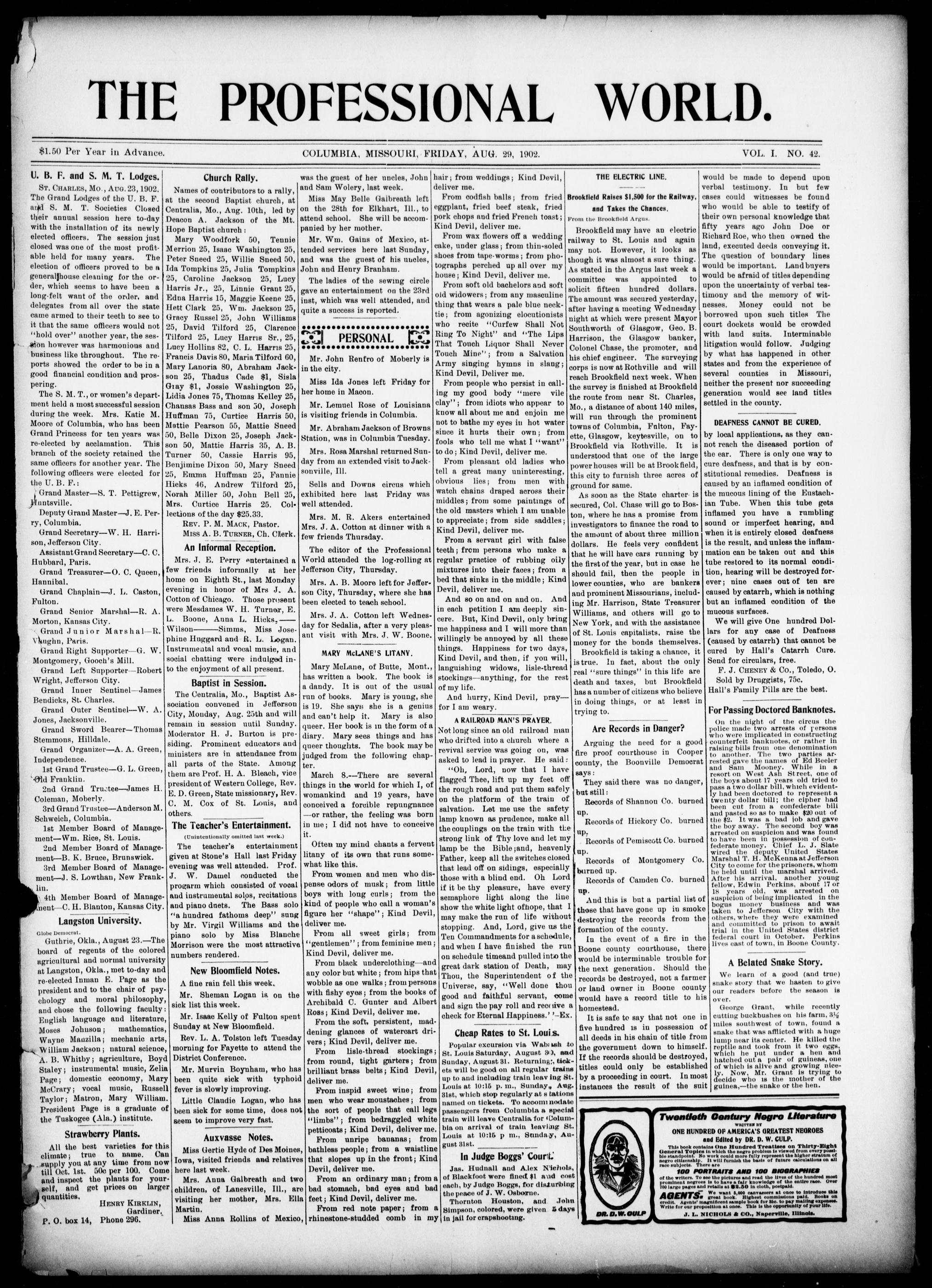
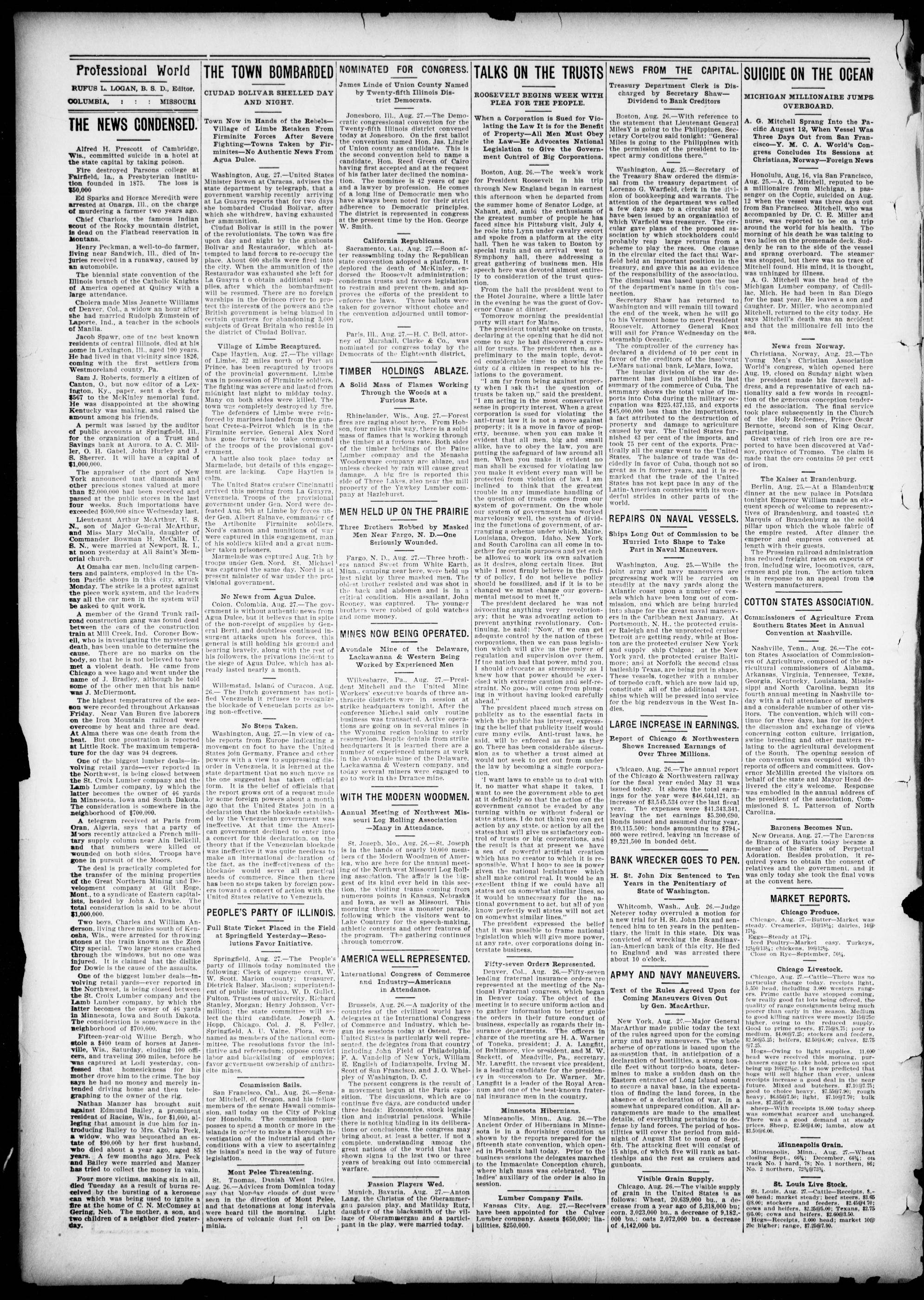
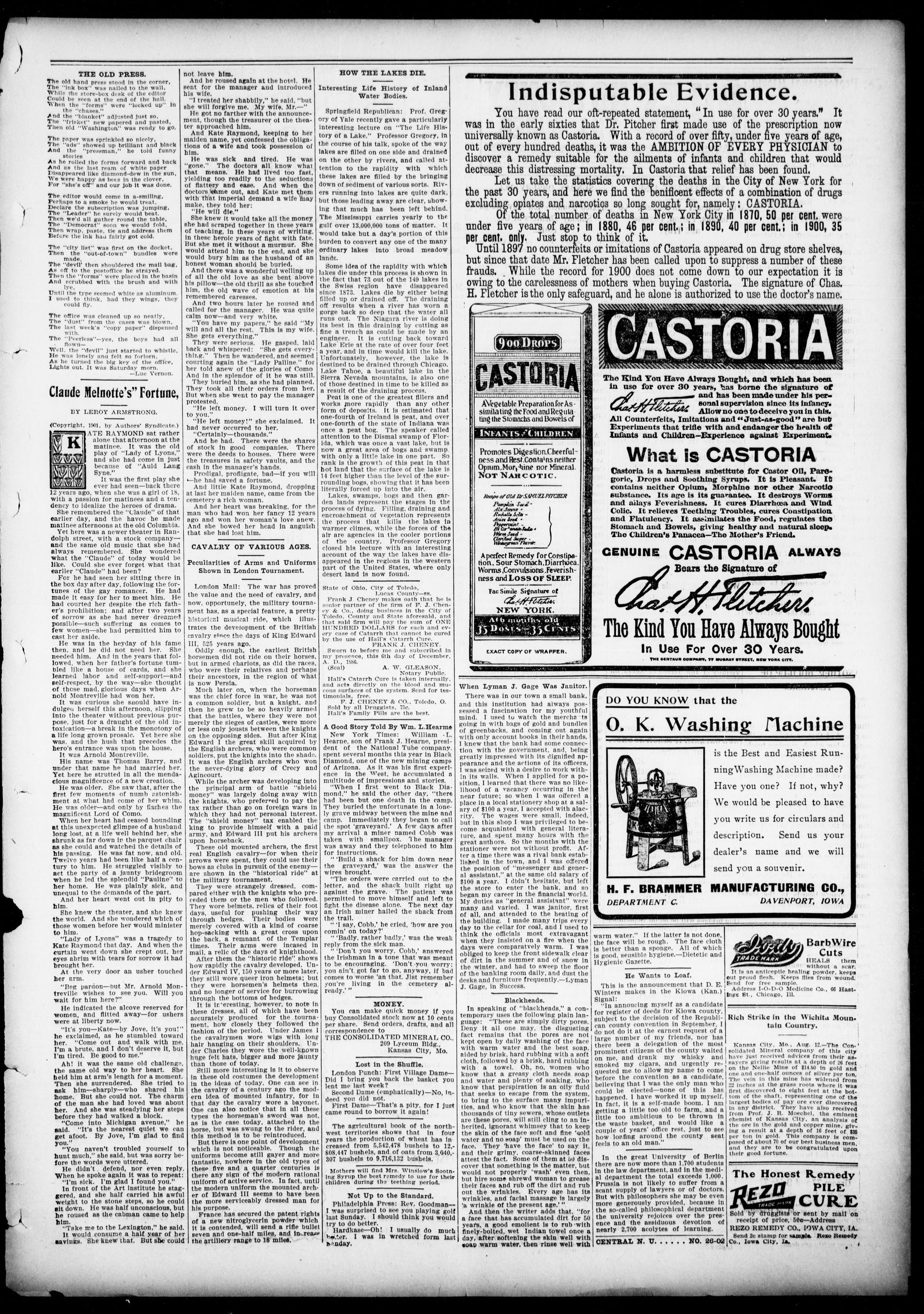
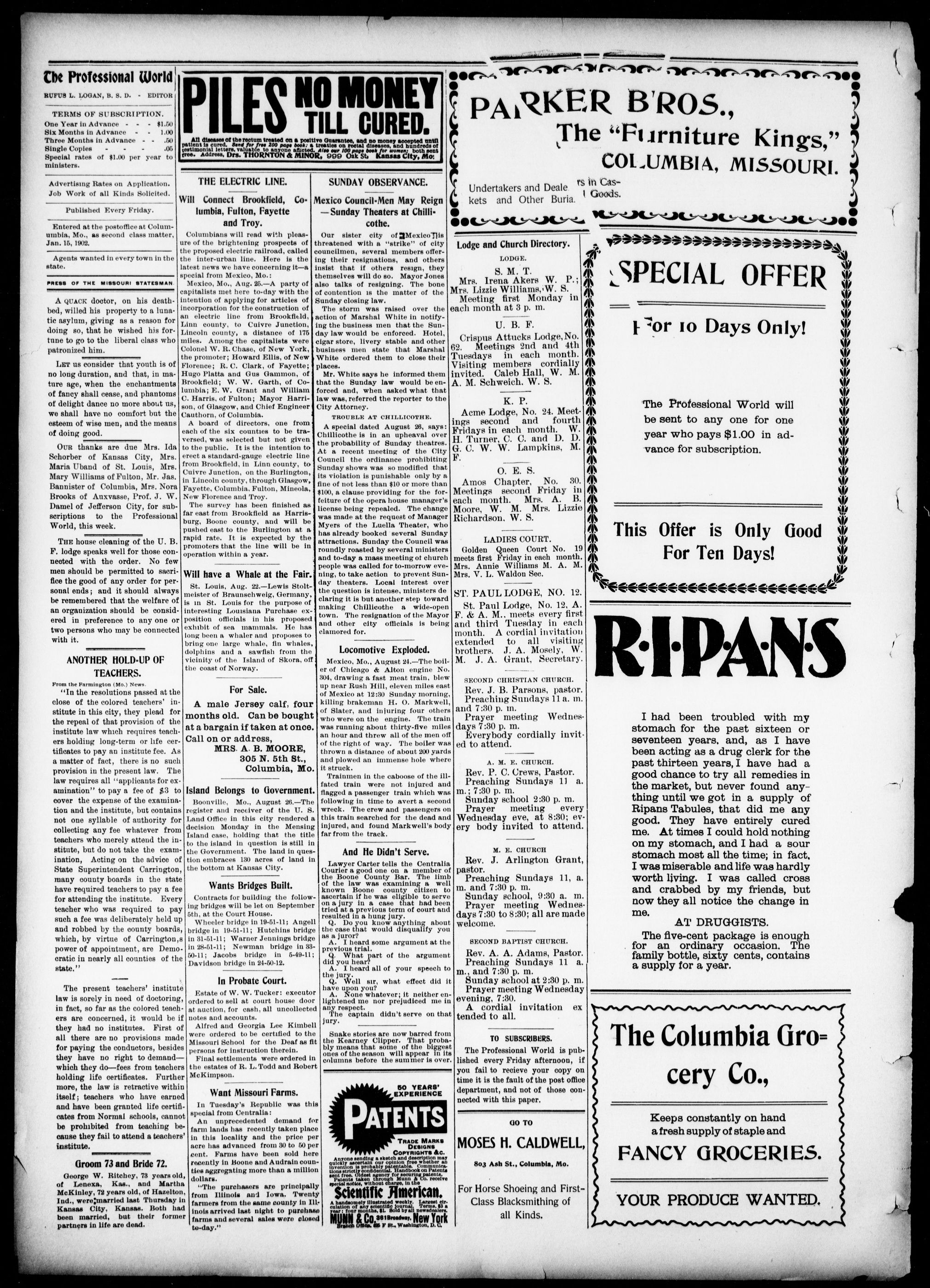
Page text (machine-generated)
THE PROFESSIONAL WORLD.
$1.50 Per Year in Advance
U. B. F. and S. M. T. Lodges.
ST. CHARLES, MO., AUG. 23, 1902.
The Grand Lodges of the U. B. F. and S. M. T. Societies Closed their annual session here to-day with the installation of its newly elected officers. The session just closed was one of the most profitable held for many years. The election of officers proved to be a general house cleaning for the order, which seems to have been a long-felt want of the order, and delegates from all over the state came armed to their teeth to see to it that the same officers would not "hold over" another year, the session however was harmonious and business like throughout. The reports showed the order to be in a good financial condition and prospering.
The S. M. T., or women's department held a most successful session during the week. Mrs. Katie M. Moore of Columbia, who has been Grand Princess for ten years was re-elected by acclamation. This branch of the society retained the same officers for another year. The following officers were elected for the U. B. F.:
Grand Master—S. T. Pettigrew, Huntsville.
Deputy Grand Master—J. E. Perry, Columbia.
Grand Secretary—W. H. Harrison, Jefferson City.
Assistant Grand Secretary—C. C. Hubbard, Paris.
Grand Treasurer—O. C. Queen,
Hannibal.
Grand Chaplain—J. L. Caston,
Fulton.
Grand Senior Marshal—R. A.
Morton, Kansas City.
Grand Junior Marshal—R.
Vaughn, Paris.
Grand Right Supporter—G. W.
Montgomery, Gooch's Mill.
Grand Left Supporter—Robert
Wright, Jefferson City.
Grand Inner Sentinel—James
Bendicks, St. Charles.
Grand Outer Sentinel—W. A.
Jones, Jacksonville.
Grand Sword Bearer—Thomas
Stemmons, Hilldale.
Grand Organizer—A. A. Green, Independence.
1st Grand Trustee—G. L. Green, Old Franklin.
2nd Grand Trustee—James H. Coleman, Moberly.
3rd Grand Trustee—Anderson M. Schweich, Columbia.
1st Member Board of Management—Wm. Rice, St. Louis.
2nd Member Board of Management—B. K. Bruce, Brunswick.
3rd Member Board of Management—J. S. Lowthan, New Franklin.
4th Member Board of Management—C. H. Blanton, Kansas City.
Langston University.
Globe Democrat.
Guthrie, Okla., August 23.—The board of regents of the colored agricultural and normal university at Langston, Okla., met to-day and re-elected Inman E. Page as the president and to the chair of psychology and moral philosophy, and chose the following faculty: English language and literature, Moses Johnson; mathematics, Wayne Manzilla; mechanic arts, William Jackson; natural science, A. B. Whitby; agriculture, Boyd Staley; instrumental music, Zelia Page; domestic economy, Mary McCrary; vocal music, Russell Taylor; Matron, Mary William President Page is a graduate of the Tuskogee (Ala.) institute.
Strawberry Plants.
All the best varieties for this climate; true to name. Can supply you at any time from now till Oct. 1st. 50c per 100. Come and inspect the plants for yourself, and get prices on larger quantities.
P. O. box 14, Phone 296.
Church Rally.
Names of contributors to a rally, at the second Baptist church, at Centralia, Mo., Aug. 10th, led by Deacon A. Jackson of the Mt. Hope Baptist church:
Mary Woodfork 50, Tennie Merrion 25, Isaac Washington 25, Peter Sneed 25, Willie Sneed 50, Ida Tompkins 25, Julia Tompkins 25, Caroline Jackson 25, Lucy Harris Jr., 25, Linnie Grant 25, Edna Harris 15, Maggie Keene 25, Hett Clark 25, Wm. Jackson 25, Gracy Russel 25, John Williams 25, David Tilford 25, Clarence Tilford 25, Lucy Harris Sr., 25, Lucy Hollins 82, C. L. Maria 25, Francis Davis 80, Maria Tilford 60, Mary Lanoria 80, Abraham Jackson 25, Thadus Cade $1, Sisla Guay $1, Jossie Washington 25, Lidia Jones 75, Thomas Kelley 25, Chausas Bass and son 50, Joseph Huffman 75, Curtice Harris 50, Mattie Pearson 55, Mattie Sneed 50, Belle Dixon 25, Joseph Jackson 50, Mattie Harris 35, A. B. Turner 50, Cassie Harris 95, Benjimine Dixon 50, Mary Sneed 25, Emma Huffman 25, Fannie Hieks 46, Andrew Tilford 25, Norah Miller 50, John Bell 25, Mrs. Curtice Harris 25. Collections of the day $25.33.
MISS A. B. TURNER, Ch. Clerk.
An Informal Reception.
Mrs. J. E. Perry entertained a few friends informally at her home on Eighth St., last Monday evening in honor of Mrs J. A. Cotton of Chicago. Those present were Mesdames W. H. Turnar, E. L. Boone, Anna L. Hicks, Wilson—Simms, Miss Josephine Huggard and R. L. Logan. Instrumental and vocal music, and social chatting were indulged into the enjoyment of all present.
Baptist in Session.
The Centralia, Mo., Baptist Association convened in Jefferson City, Monday, Aug. 25th and will remain in session until Sunday. Moderator H. J. Burton is presiding. Prominent educators and ministers are in attendance from all parts of the State. Among them are Prof. H. A. Bleach, vice president of Western College, Rev. E. D. Green, State missionary, Rev. C. M. Cox of St. Louis, and others.
The Teacher's Entertainment.
The teacher's entertainment given at Stone's Hall last Friday evening was well attended. Prof. J. W. Damel conducted the progarm which consisted of vocal and instrumental solos, recitations and piano duets. The Bass solo "a hundred fathoms deep" sung by Mr. Virgil Williams and the piano solo by Miss Blanche Morrison were the most attractive numbers rendered.
New Bloomfield Notes.
A fine rain fell this week.
Mr. Sheman Logan is on the sick list this week.
Mr. Isaac Kelly of Fulton spent Sunday at New Bloomfield.
Rev. L. A. Tolston left Tuesday morning for Fayette to attend the District Conference.
Mr. Murvin Boynham, who has been quite sick with typhoid fever is slowly improving.
Little Claudie Logan, who has been sick for some time, does not seem to improve very fast.
Auxvasse Notes.
Miss Gertie Hyde of Des Moines, Iowa, visited friends and relatives here last week. Mrs. Anna Galbreath and two children, of Lanesville, Ill., are visiting her mother, Mrs. Ella Martin. Miss Anna Rollins of Mexico,
COLUMBIA, MISSOURI, FRIDAY, AUG. 29, 1902.
was the guest of her uncles, John and Sam Wolery, last week.
Miss May Belle Gaibreath left on the 28th for Elkhart, Ill., to attend school. She will be accompanied by her mother.
Mr. Wm. Gains of Mexico, attended services here last Sunday, and was the guest of his uncles, John and Henry Branham.
The ladies of the sewing circle gave an entertainment on the 23rd inst, which was well attended, and quite a success is reported.
PERSONAL
Mr. John Renfro of Moberly is in the city.
Miss Ida Jones left Friday for her home in Macon.
Mr. Lemuel Rose of Louisiana is visiting friends in Columbia.
Mr. Abraham Jackson of Browns Station, was in Columbia Tuesday.
Mrs. Rosa Marshal returned Sunday from an extended visit to Jacksonville, Ill.
Sells and Downs circus which exhibited here last Friday was well attended.
Mrs. M. R. Akers entertained Mrs. J. A. Cotton at dinner with a few friends Thursday.
The editor of the Professional World attended the log-rolling at Jefferson City, Thursday.
Mrs. A. B. Moore left for Jefferson City, Thursday, where she has been elected to teach school.
Mrs. J. A. Cotton left Wednesday for Sedalia, after a very pleasant visit with Mrs. J. W. Boone.
MARY McLANE'S LITANY.
Mary McLane, of Butte, Mont., has written a book. The book is a dandy. It is out of the usual run of books. Mary is young, she is 19. She says she is a genius and can't help it. Mary is also queer. Her book is in the form of a diary. Mary sees things and has queer thoughts. The book may be judged from the following chapter.
March 8.—There are several things in the world for which I, of womankind and 19 years, have conceived a forcible repungnance—or rather, the feeling was born in me; I did not have to conceive it.
Often my mind chants a fervent litany of its own that runs somewhat like this.
From women and men who dispense odors of musk; from little boys with long curls; from the kind of people who call a woman's figure her "shape"; Kind Devil, deliver me.
From all sweet girls; from "gentlemen"; from feminine men; Kind Devil, deliver me.
From black underclothing—and any color but white; from hips that wobble as one walks; from persons with fishy eyes; from the books of Archibald C. Gunter and Albert Ross; Kind Devil, deliver me.
From the soft, persistent, maddening glances of watercart drivers; Kind Devil, deliver me.
From lisle-thread stockings; from round, tight garters; from brilliant brass belts; Kind Devil, deliver me.
From inspid sweet wine; from men who wear moustaches; from the sort of people that call legs "limbs"; from bedraggled white petticoats; Kind Devil, deliver me.
From unripe bananas; from bathless people; from a waistline that slopes up in the front; Kind Devil, deliver me.
From an ordinary man; from a bad stomach, bad eyes and bad feet; Kind Devil, deliver me.
From red note paper; from a rhinestone-studded comb in my
hair; from weddings; Kind Devil, deliver me.
From codfish balls; from fried eggplant, fried beef steak, fried pork chops and fried French toast; Kind Devil, deliver me.
From wax flowers off a wedding cake, under glass; from thin-soled shoes from tape-worms; from photographs perched up all over my house; Kind Devil, deliver me.
From soft old bachelors and soft old widowers; from any masculine thing that wears a pale blue necktie; from agonizing elocutionists who recite "Curfew Shall Not Ring To Night" and "The Lips That Touch Liquor Shall Never Touch Mine"; from a Salvation Army singing hymns in slang; Kind Devil, Deliver me.
From people who persist in calling my good body "mere vile clay"; from idiots who appear to know all about me and enjoin me not to bathe my eyes in hot water since it hurts their own; from fools who tell me what I "want" to do; Kind Devil, deliver me.
From pleasant old ladies who tell a great many uninteresting, obvious lies; from men with watch chains draped across their middles; from some paintings of the old masters which I am unable to appreciate; from side saddles; Kind Devil, deliver me.
From a servant girl with false teeth; from persons who make a regular practice of rubbing oily mixtures into their faces; from a bed that sinks in the middle; Kind Devil, deliver me.
And so on and on and on. And in each petition I am deeply sincere. But, Kind Devil, only bring me happiness and I will more than willingly be annoyed by all these things. Happiness for two days, Kind Devil, and then, if you will, languishing widows, lisle-thread stockings—anything, for the rest of my life. And hurry, Kind Devil, pray—for I am weary.
A RAILROAD MAN'S PRAYER
Not long since an old railroad man who drifted into a church where a revival service was going on, was asked to lead in prayer. He said: "Oh, Lord, now that I have flagged Thee, lift up my feet off the rough road and put them safely on the platform of the train of salvation. Let me use the safety lamp known as prudence, make all the couplings on the train with the strong link of Thy love and let my lamp be the Bible; and, heavenly Father, keep all the switches closed that lead off on sidings, especially those with a blind end. Oh Lord if it be thy pleasure, have every semaphore light along the line show the white light of nope, that I may make the run of life without stopping. And, Lord, give us the Ten Commandments for a schedule, and when I have finished the run on schedule timeand pulled into the great dark station of Death, may Thou, the Superintendent of the Universe, say, "Well done thou good and faithful servant, come and sign the pay roll and receive a check for Eternal Happiness."'—Ex
Cheap Rates to St. Louis.
Popular excursion via Wabash to St. Louis Saturday, August 30, and Sunday, August 31. Returning; tickets will be good on all regular trains up to and including train leaving St. Louis at 10:15 p. m., Sunday, Aug. 31st, which stop regularly at stations named on tickets. To accommodate passengers from Columbia a special train will leave Centralia for Columbia on arrival of train leaving St. Louis at 10:15 p. m., Sunday, August 31st.
In Judge Boggs' Court
Jas. Hudnall and Alex Nichols,
of Blackfoot were fined $1 and cost
each, by Judge Boggs, for disturbing
the peace of J. W. Osborne.
Thornton Houston, and John
Simpson, colored, were given 5 days
in jail for crapshooting.
Twentieth Century Negro Literature
This book contains One Hundred Treatises on Thirty-Eight General Topics in which the negro problem is viewed on the basis of negro citizenship. It will furnish the basis of future calculations on all race subjects. There are 100 PORTRAITS AND 100 BIOGRAPHIES of the most famous pictures of the negro and the most prominent negro image is to take the knowledge of the entire race. Over 700 large pages and retails at $2.50 in cloth, postpaid. AGENTS: We want 5,000 canvassers at once to introduce this book to the public. We are not paying credit. Agent's magnificent sample book for use. To pay mailing expenses. Write for our proposition at once. This is the opportunity of your life.
THE ELECTRIC LINE.
Brookfield Raises $1,500 for the Railway.
Brookfield may have an electric railway to St. Louis and again may not. However, it looks as though it was almost a sure thing. As stated in the Argus last week a committee was appointed to solicit fifteen hundred dollars. The amount was secured yesterday, after having a meeting Wednesday night at which were present Mayor Southworth of Glasgow, Geo. B. Harrison, the Glasgow banker, Colonel Chase, the promoter, and his chief engineer. The surveying corps is now at Rothville and will reach Brookfield next week. When the survey is finished at Brookfield the route from near St. Charles, Mo., a distance of about 140 miles, will run through the prominent towns of Columbia, Fulton, Fayette, Glasgow, keytesville, on to Brookfield via Rothville. It is understood that one of the large power houses will be at Brookfield, this city to furnish three acres of ground for same.
As soon as the State charter is secured, Col. Chase will go to Boston, where he has a promise from investigators to finance the road to the amount of about three million dollars. He feels very confident that he will have cars running by the first of the year, but in case he should fail, then the people in lower counties, who are bankers and prominent Missourians, including Mr. Harrison, State Treasurer Williams, and others will go to New York, and with the assistance of St. Louis capitalists, raise the money for the bonds themselves.
Brookfield is taking a chance, it is true. In fact, about the only real "sure things" in this life are death and taxes, but Brookfield has a number of citizens who believe in doing things, or at least in trying to.
Are Records in Danger?
Arguing the need for a good fire proof courthouse in Cooper county, the Boonville Democrat says:
They said there was no danger,
but still:
Records of Shannon Co. burned up.
Records of Hickory Co. burned up,
Records of Pemiscott Co. burned up.
Records of Montgomery Co. burned up.
Records of Camden Co. burned up.
And this is but a partial list of those that have gone up in smoke destroying the records from the formation of the county.
In the event of a fire in the Boone county courthouse, there would be interminable trouble for the next generation. Should the records be destroyed, not a farmer or land owner in Boone county would have a record title to his homestead.
It is safe to say that not one in five hundred is in possession of all deeds in his chain of title from the government down to himself. If the records should be destroyed, titles could only be established by a proceeding in court. In most instances the result of the suit
DR. D. W. OULP
VOL. I. NO. 42.
would be made to depend upon verbal testimony. In but few cases could witnesses be found who would be able to testify of their own personal knowledge that fifty years ago John Doe or Richard Roe, who then owned the land, executed deeds conveying it. The question of boundary lines would be important. Land buyers would be afraid of titles depending upon the uncertainty of verbal testimony and the memory of witnesses. Money could not be borrowed upon such titles. The court dockets would be crowded with land suits. Interminable litigation would follow. Judging by what has happened in other states and from the experience of several counties in Missouri, neither the present nor succeeding generation would see land titles settled in the county.
DEAFNESS CANNOT BE CURED.
by local applications, as they cannot reach the diseased portion of the ear. There is only one way to cure deafness, and that is by constitutional remedies. Deafness is caused by an inflamed condition of the mucous lining of the Eustachian Tube. When this tube gets inflamed you have a rumbling sound or imperfect hearing, and when it is entirely closed deafness is the result, and unless the inflammation can be taken out and this tube restored to its normal condition, hearing will be destroyed forever; nine cases out of ten are caused by catarrh, which is nothing but an inflamed condition of the mucous surfaces.
We will give One hundred Dollars for any case of Deafness (caused by catarrh) that cannot be cured by Hall's Catarrh Cure. Send for circulars, free. F. J. CHENEY & Co., Toledo, O. Sold by Druggists, 75c. Hall's Family Pills are the best.
For Passing Doctored Banknotes.
On the night of the circus the police made two arrests of persons who were implicated in constructing counterfeit banknotes, or rather in raising bills from one denomination to another. The two parties arrested gave the names of Ed Beeler and Sam Mooney. While in a resort on West Ash Street, one of the boys about 17 years old tried to pass a two dollar bill, which evidently had been doctored to represent a twenty dollar bill; the cipher had been cut from a confederate bill and pasted so as to make $20 out of the $2. It was a bad job and gave the boy away. The second boy was arrested on suspicion and was found to have been in possession of confederate money. Chief L. J. Slate wired the deputy United States Marshal T. H. McKenna at Jefferson City to come for the prisoners, whom he held until the marshal arrived. After his arrival, another young fellow, Edwin Perkins, about 17 or 18 years old, was arrested on suspicion of being implicated in the bogus money business and was taken to Jefferson City with the others, where they were examined and committed to prison to await trial in the United States district federal court in October. Perkins lives east of town, in Boone County.
A Belated Snake Story.
We learn of a good (and true) snake story that we hasten to give our readers before the season is over.
George Grant, while recently cutting buckbushes on his farm, $3\frac{1}{2}$ miles southwest of town, found a snake that was afflicted with a huge lump near its center. He killed the reptile and took from it two eggs, which he put under a hen and hatched out a pair of guineas, one of which is alive and growing nicely. Now, Mr. Grant is trying to decide who is the mother of the guinea, the snake or the hen.
Twentieth Century Negro Literature
WHITER BY
THE HUNDRED OF AMERICA'S GREATEST NEGROES
and Edited by DR. D. W. CULP.
Book contains One Hundred Treatises on Thirty-Eight
Topics in which the negro problem is viewed from every pos-
tion. No work could more fully represent the higher stratum
of leadership. It will furnish the basis of future calculations on all
THEODORE PORTRAITS AND 100 BIOGRAPHIES
To see the pictures and read the lives of the hundred most
at negroes is to have a fair knowledge of the entire race. Over
pages and retails at $2.50 in cloth, postpaid.
NTS. We want 5,600 cavansters at once to introduce this
Angel's magnent sample book for $3c. to pay mailing expenses.
our proposition at once. This is the opportunity of your life.
J. L. NICHOLS & CO., Naperville, Illinois.
---
RUFUS L. LOGAN, B. S. D., Editor.
COLUMBIA, : : : MISSOURI
THE NEWS CONDENSED.
Alfred H. Prescott of Cambridge, Wis., committed suicide in a hotel at the state capital by taking poison. Fire destroyed Parsons college at Fairfield, la., a Presbyterian institution founded in 1875. The loss is $50,000. Ed Sparks and Horace Meredith were arrested at Onarga, ill., on the charge of murdering a farmer two years ago. Chief Charlots, the famous Indian scout of the Rocky mountain district, is dead on the Flathead reservation in Montana. Henry Peckman, a well-to-do farmer, living near Sandwich, ill., died of injuries received in a runaway, caused by an automobile. The biennial state convention of the Illinois branch of the Catholic Knights of America opened at Quincy with a large attendance.
Cholea made Miss Jeanette Williams of Denver, Col., a widow an hour after she had married Rudolph Zumstein of Laporte, Ind., a teacher in the schools of Manila.
Jacob Spawr, one of the best known residents of central Illinois, died at his nome in Lexington, Ill., aged 100 years. He had lived in that vicinity since 1826, coming with the first settlers from Westmoreland county, Pa.
Sam J. Roberts, formerly a citizen of Canton, O., but now editor of a Lexington, Ky., paper, sent a check for $567 to the McKinley memorial fund. He was disappointed at the showing Kentucky was making, and raised the amount among his friends.
A permit was issued by the auditor of public accounts at Springfield, Ill., for the organization of a Trust and Savings bank at Aurora, to A. C. Miller, O. H. Gabel, John Hurley and J. S. Sherrer. It will have a capital of $1,000.000.
The appraiser of the port of New York announced that diamonds and other precious stones valued at more than $2,000,000 had been received and passed at the public stores in the last four weeks. Such importations have exceeded $600,000 since Wednesday last.
Lieutenant Arthur McArthur, U. S. N., son of Major General McArthur, and Miss Mary McCalla, daughter of Commander Bowman H. McCalla, U. S. N., were married at Newport, R. I., at noon yesterday at All Saint's Memorial church.
At Omaha car men, including carpenters and painters, employed in the Union Pacific shops in this city, struck Monday. The strike is a protest against the piece work system, and the leaders say all the car men in the system will be asked to quit work.
A member of the Grand Trunk railroad construction gang was found dead between the cars of the construction train at Mill Creek, Ind. Coroner Bowell, who is investigating the mysterious death, has been unable to determine the cause. There are no marks on the body, so that he is not believed to have met a violent death. He came from Chicago a wee kago and went under the name of J. Bradley, although he told some of the other men that his name was J. McDiermont.
The highest temperatures of the season were recorded throughout Arkansas Friday. Near Van Buren five laborers on the Iron Mountain railroad were overcome by heat and three are dead. At Alma there was one death from the heat. But one prostration is reported at Little Rock. The maximum temperature for the day was 94 degrees.
One of the biggest lumber deals—involving retail yards—ever reported in the Northwest, is being closed between the St. Croix Lumber company and the Lamb Lumber company, by which the latter becomes the owner of 46 yards in Minnesota, Iowa and South Dakota. The consideration is somewhere in the neighborhood of $700,000.
A telegram received at Paris from Oran, Algeria, says that a party of Moors recently attacked a French military supply column near Ain Delkell, and that numbers were killed or wounded on both sides. Troops have gone in pursuit of the Moors.
The deal is practically completed for the transfer of the mining properties of the Great Northern Mining and Development company at Gilt Edge, Mont., to a syndicate of Eastern capitalists, headed by John A. Drake. The total consideration is said to be about $1,000,000.
Two boys, Charles and William Anderson, living three miles south of Kenosha, Wis., were arrested for throwing stones at the train known as the Zion City special. Two large stones crashed through the windows, but no one was injured. It is claimed hat the dislike for Dowie is the cause of the assaults.
One of the biggest lumber deals—involving retail yards—ever reported in the Northwest, is being closed between the St. Croix Lumber company and the Lamb Lumber company, by which the latter becomes the owner of 46 yards in Minnesota, Iowa and South Dakota. The consideration is somewhere in the neighborhood of $700,000.
Fifteen-year-old Willie Bergh, who stole a $400 team of horses at Janesville, Wis., Saturday, eluding 100 officers, and traveling 300 miles, before he was captured at Lodi yesterday, confessed that homesickness for his mother drove him to the crime. The boy says he had no money and merely intended driving home and then telegraphing to the owner of the rig.
Nathan Manzer has brought suit against Edmund Bailey, a prominent resident of Racine, Wis., for $1,000, alleging that amount is due him for introducing Bailey to Mrs. Calvin Peck, a widow, who was bequeathed an estate of $30,000 by her first husband, who died about a year ago, aged 55 years. A few months ago Mrs. Peck and Bailey were married and Manzer has tried to collect the money in vain.
Four more victims, making six in all, died Tuesday as a result of burns received by the bursting of a kerosene can which was being used to ignite a fire at the home of C. N. McComsey at Gering, Neb. The mother, a son, and two children of a neighbor died yesterday.
THE TOWN BOMBARDED
CIUDAD BOLIVAR SHELLED DAY
AND NIGHT.
Town Now in Hands of the Rebels—Village of Limbe Retaken From Firminite Forces After Severe Fighting—Towns Taken by Firminites—No Authentic News From Agua Dulce.
Washington, Aug. 27.—United States Minister Bowen at Caracas, advises the state department by telegraph, that a government warship recently arriving at La Guayra reports that for two days she bombarded Ciudad Bolivar, after which she withdrew, having exhausted her ammunition.
Cludad Bolivar is still in the power of the revolutionists. The town was fire upon day and night by the gunboats Bolivar and Restaurador, which attempted to land forces to re-occupy the place. About 600 shells were fired into the city. When the ammunition of the Restaurador was exhausted she left for La Guayra t to obtain additional supplies, after which the bombardment will be resumed. There are no foreign warships in the Orinoco river to protect the interests of the powers and the British government is being blamed in certain quarters for abandoning 3,000 subjects of Great Britain who reside in the district of Cludad Bolivar.
Village of Limbe Recaptured.
Cape Haytien, Aug. 27—The village of Limbe, 32 miles north of Port au Prince, has been recaptured by troops of the provincial government. Limbe was in possession of Firminite soldiers. The fighting was severe and lasted from midnight last night to midday today. Many on both sides were killed. The town was completely destroyed by fire. The defenders of Limbe were reinforced by marines landed from the gunboat Coate-Peirrot which is in the Firminite service. General Alex Nord has gone forward to take command of the troops of the provisional government.
A battle also took place today. Marmelade, but details of this engagement are lacking. Cape Haytien is calm.
The United States cruiser Cincinnati arrived this morning from La Guayra, Venezuela. Troops of the provisional government under Gen. Nord were defeated Aug. 9th at Limbe by forces under Gen. Albert Salhave, commander of the Artibonite Firminite soldiers, Nord's cannon and munitions of war were captured in this engagement, man of his soldiers killed and a great number taken prisoners. Marmelade was captured Aug. 7th by troops under Gen. Nord. St. Michael was captured the same day. Nord is at present minister of war under the provisional government.
No News from Agua Dulce.
Colon, Colombia, Aug. 27.—The government is without authentic news from Agua Dulce, but it believes that in spite of the non-receipt of supplies by General Berti, and doubtless continued insurgent attacks upon his forces, this general is still holding his ground and bearing bravely, along with the rest of his followers, the privations incident to the siege of Agua Dulce, which has already lasted nearly a month.
Willemstad, Island of Curacao, Aug. 26.—The Dutch government has notified Venezuela it refuses to recognize the blockade of Veneuelan ports as being non-effective.
No Steps Taken.
Washington, Aug. 27.—In view of cable reports from Europe indicating a movement on foot to have the United States join Germany, France and other powers with a view to suppressing disorder in Venezuela, it is learned at the state department that no such move as the one suggested has taken official form. It is the belief of officials that the report grows out of a request made by some foreign powers about a month ago that the United States join in a declaration that the blockade established by the Venezuelan government was ineffective. At that time the American government declined to enter into a concert for this declaration, on the theory that if the Venezuelan blockade was ineffective it was quite needless to make an international declaration of the fact, as the ineffectiveness of the blockade would serve all practical needs of commerce. Since then there has been no steps taken by foreign powers toward a concert of action with the United States relative to Venezuela.
PEOPLE'S PARTY OF ILLINOIS.
Full State Ticket Placed in the Field at Springfield Yesterday—Resolutions Favor Initiative.
Springfield, Aug. 27.—The People's party of Illinois today nominated the following; Clerk of supreme court, W. W. Scott, Marion county; treasurer, Dietrick Balser, Madison; superintendent of public instruction, W. D. Gullet, Fulton. Trustees of university, Richard Stanley, Morgan; Henry Johnson, Vermillion; the state committee will select the third candidate. Joseph A. Hopp, Chicago, Col. J. S. Feller, Springfield, A. U. Valine, Flora, were named as members of the national committee. The resolutions favor the initiative and referendum; oppose convict labor and blacklisting of employees; favor government ownership of anthracite mines.
Commission Sails.
San Francisco, Cal., Aug. 26—Senator Mitchell, of Oregon, and his fellow members of the senate Hawai commission, sail today on the City of Peking for Honolulu. The commission purposes to spend a month or more in the islands in order to make a thorough investigation of the industrial and other conditions with a view to ascertaining the island's need in the way of future legislation.
Mont Pelee Threatening
St. Thomas, Danish West Indies, Aug. 26.—Advices from Dominica today say that Monday clouds of dust were seen in the direction of Mont Pelee, and that detonations at long intervals were heard till the morning. Light showers of volcanic dust fell on Deminia.
NOMINATED FOR CONGRESS
James Linde of Union County Named by Twenty-fifth Illinois District Democrats.
Jonesboro, 111., Aug. 27.—The Democratic congressional convention for the Twenty-fifth Illinois district convened today at Jonesboro. On the first ballot the convention named Hon. Jas. Lingle of Union county as candidate. This is the second convention held to name a candidate, Hon. Reed Green of Cairo having first accepted and at the request of his father later declined the nomination. The nominee is 42 years of age and a lawyer by profession. He comes of a long line of Democratic men who have always been noted for their strict adherence to Democratic principles. The district is represented in congress at the present time by the Hon. George W. Smith.
California Republicans.
Sacramento, Cal., Aug. 27.—Soon after reassembling today the Republican state convention adopted a platform. It deplored the death of McKinley, endorsed the Roosevelt administration; condemns trusts and favors legislation to restrain and prevent them, and approves the efforts of the president to enforce the laws. Three ballots were taken for governor without choice and the convention adjourned until tomorrow.
Paris, Ill., Aug. 27.—H. C. Bell, attorney of Marshall, Clarke & Co., was nominated for congress today by the Democrats of the Eighteenth district.
TIMBER HOLDINGS ABLAZE.
A Solid Mass of Flames Working Through the Woods at a Furious Rate.
Rhinelander, Wis., Aug. 27.—Forest fires are raging about here. From Hobson, four miles this way, there is a solid mass of flames that is working through the timber at a furious rate. Both sides of the timber holdings of the Paine Lumber company and the Menasha Woodenware company are ablaze, and unless checked by rain will cause great damage. A big fire is reported this side of Three Lakes, also near the mill property of the Yawkey Lumber company at Hazlehurst.
MEN HELD UP ON THE PRAIRIE
Three Brothers Robbed by Masked Men Near Fargo, N. D.—One Seriously Wounded.
Fargo, N. D., Aug. 27.—Three brothers named Sweet from White Earth, Minn., camping near here, were held up last night by three masked men. The oldest brother resisted and was shot in the back and abdomen and is in a critical condition. His assailant, John Rooney, was captured. The younger brothers were robbed of gold watches and some money.
MINES NOW BEING OPERATED.
Avondale Mine of the Delaware, Lackawanna & Western Being Worked by Experienced Men
Wilkesbarre, Pa., Aug. 27.—President Mitchell and the United Mine Workers' executive boards of three antracite districts were in session at strike headquarters tonight. After the conference Mitchell said of the outcure business was transactions. Active operations are going on in several mines in the Wyoming region looking to early resumption. Despite denials from strike headquarters it is learned there are a number of experienced miners at work in the Avondale mine of the Delaware, Lackawanna & Western company, and today several miners were engaged to go to work in the Drance mine.
WITH THE MODERN WOODMEN
Annual Meeting of Northwest Missouri Log Rolling Association Many in Attendance.
St. Joseph, Mo., Aug. 26.—St. Joseph is in the hands of nearly 10,000 members of the Modern Woodmen of America, who are here for the annual meeting of the Northwest Missouri Log Rolling association. The affair is the biggest of its kind ever held in this section, the visiting teams coming from numerous points in Kansas, Nebraska and Iowa, as well as Missouri. This morning there was a monster parade, following which the visitors went to Lake Contrary for the speech-making, athletic contests and other features of the program. The gathering continues through tomorrow.
AMERICA WELL REPRESENTED.
International Congress of Commerce and Industry-Americans
Brussels, Aug. 26.—A majority of the countries of the civilized world have delegates at the International Congress of Commerce and Industry, which began its sessions today at Ostend. The United States is particularly well represented, the delegates from that country including John Field of Philadelphia, F. A. Vandelpel of New York, William E. English of Indianapolis, Irving M. Scott of San Francisco, and J. O. Whepley of Washington, D. C.
The present congress is the result of a movement begun at the Paris exposition. The discussions, which are to continue five days, are conducted under three heads: Economics, stock legislation and industrial pensions. While there is nothing binding in its deliberations or conclusions, the congress may bring about, at least a better, if not a complete, understanding among the great nations of the world that have shown signs in the last two or three years of breaking out into commercial warfare.
Passion Players Wed
Munich, Bavaria, Aug. 27.-Anton Lang, the Christus of the Oberammergau passion play, and Matilday Rutz, daughter of the blacksmith of the village of Oberammergau and a participant in the play, were married today.
TALKS ON THE TRUSTS
ROOSEVELT BEGINS WEEK WITH
PLEA FOR THE PEOPLE.
When a Corporation is Sued for Violating the Law It is for the Benefit of Property—All Men Must Obey the Law—He Advocates National Legislation to Give the Government Control of Big Corporations.
Boston, Aug. 26.—The week's work for President Roosevelt in his trip through New England began in earnest this afternoon when he departed from the summer home of Senator Lodge, at Nahant, and, amid the enthusiasm of the greatest number of people he has faced since his Pittsburgh visit, July 4, he rode into Lynn under cavalry escort and spoke from a platform at the city hall. Then he was taken to Boston by special train and on arrival went to Symphony hall, there addressing a great gathering of business men. His speech here was devoted almost entirely to consideration of the trust question.
From the hall the president went to the Hotel Jourraine, where a little later in the evening he was the guest of Governor Crane at dinner. Tomorrow morning the presidential party will start for Maine. The president tonight spoke on trusts, declaring at the opening that he did not come to say he had discovered a cure-all for trusts. The president then, as a preliminary to the main topic, devoted considerable time to showing the duty of a citizen in respect to his relations to the government.
"I am far from being against property when I ask that the question of trusts be taken up," said the president, "I am acting in the most conservative sense in property interest. When a great corporation is sued for violating the anti-trust law it is not a move against property; it is a move in favor of property, because, when you can make it evident that all men, big and small alike, have to obey the law, you are putting the safeguard of law around all men. When you make it evident no man shall be excused for violating law you make it evident every man will be protected from violation of law. I am inclined to think that the greatest trouble in any immediate handling of the question of trusts comes from our system of government. On the whole our system of government has worked marvelously well, the system of dividing the functions of government, of arranging a scheme under which, Maine, Louisiana, Oregon, Idaho, New York and South Carolina can all come in together for certain purposes and yet each be allowed to work its own salvation as it desires, along certain lines. But while I most firmly believe in the fixity of policy, I do not believe policy should be fossilized, and if it is to be changed we must change our governmental method to meet it."
The president declared he was not advocating anything very revolutionary; that he was advocating action to prevent anything revolutionary. Continuing, he said: "Now, if we can get adequate control by the nation of these corporations, then we can pass legislation which will give us the power of regulation and supervision over them. If the nation had that power, mind you, I should advocate as strenuously as I knew how that power should be exercised with extreme caution and self-restraint. No good will come from plunging in without having looked carefully ahead." The president placed much stress on publicity as to the essential facts in which the public has interest, expressing the belief that publicity itself would cure many evils. Anti-trust laws, he said, will be enforced as far as they go. There has been considerable discussion as to whether a trust aimed at would not seek to get out from under the law by becoming a single corporation.
I want laws to enable us to deal with it, no matter what shape it takes. I want to see the government able to get at it definitely so that the action of the government cannot be evaded by any turning within or without federal or state statues. I do not think you can get action by any state, or action by all the states that will give us satisfactory control of trusts or big corporations, and the result is that at present we have a sea of powerful artificial creation which has no creator to which it is responsible. What I hope to see is power given the national legislature which shall make control real. It would be an excellent thing if we could have all states act on somewhat similar lines, so it would be unnecessary for the national government to act, but all of you know perfectly well states will not act on somewhat similar lines."
The president expressed the belief that it was possible to frame national legislation which will give more power, at any rate, over corporations doing interstate business.
Fifty-seven Orders Represented.
Denver, Col., Aug. 26.—Fifty-seven leading fraternal insurance orders are represented at the meeting of the National Fraternal congress, which began in Denver today. The object of the meeting is to secure uniform action and to gather information to better guide the orders in their future conduct of business, especially as regards their insurance departments. The officers in charge of the meeting are H. A. Warner of Toneka, president; J. A. Langfitt, of Baltimore, vice president, and M. W. Sackett, of Meadville, Pa., secretary. Mr. Langfitt, the present vice president, is a leading candidate for the presidency in succession to Dr. Warner. Mr. Langfitt is a leader of the Royal Arcanum and one of the best-known fraternal insurance men in the country.
Minnesota Hibernians
Minneapolis, Minn., Aug. 26.—The Ancient Order of Hibernians in Minnesota is in a flourishing condition as shown by the reports prepared for the fifteenth state convention, which opened in Phoenix hall today. Prior to the business sessions the delegates marched to the Immaculate Conception church, where high mass was celebrated. The ladies' auxiliary of the order is also in session.
Lumber Company Fails.
Kansas City, Aug. 27—Recelvers have been appointed for the Culver Lumber company. Assets $650,000; liabilities, $250,000.
Treasury Department Clerk is Discharged by Secretary Shaw—Dividend to Bank Creditors
Boston, Aug. 26.—With reference to the statement that Lieutenant General MilesY is going to the Philippines, Secretary Cortelyou said tonight: "General Miles is going to the Philippines with the permission of the president to inspect army conditions there."
Washington, Aug. 25.—Secretary of the Treasury Shaw ordered the dismissal from the treasury department of Lorenzo G. Warfield, clerk in the division of bookkeeping and warrants. The attention of the department was called a few days ago to a circular said to have been issued by an organization of which Warfield was treasurer. The circular gave plans of the proposed association by which stockholders could probably reap large returns from a scheme to play the races. One clause in the circular cited the fact that Warfield held an important position in the treasury, and gave this as an evidence of the responsibility of the association. The dismissal was based upon the use of the department's name in this connection.
Secretary Shaw has returned to Washington and will remain till toward the end of the week, when he will go to his Vermont home to meet President Roosevelt. Attorney General Knox will sail for France Wednesday on the steamship Oceanic.
The comptroller of the currency has declared a dividend of 10 per cent in favor of the creditors of the insolvent LeMars national bank, LeMars, Iowa. The insular division of the war department has just published its last summary of the commerce of Cuba. The summary shows the total value of imports into Cuba during the military occupation was $225,437,135, and exports $45,000,000 less than the importations, a fact attributed to the destruction of property and damage to agriculture caused by war. The United States furnished 43 per cent of the imports, and took 75 per cent of the exports. Practically all the sugar went to the United States. The balance of trade was decidedly in favor of Cuba, though not so great as in former years, and it is remarked that the trade of the United States has not kept pace in any of the Latin-American countries with its wonderful strides in other parts of the world.
REPAIRS ON NAVAL VESSELS.
Ships Long Out of Commission to be Hurried Into Shape to Take Part in Naval Maneuvers.
Washington, Aug. 25. -While the joint army and navy maneuvers are progressing work will be carried on steadily at the navy yards along the Atlantic coast upon a number of vessels which have been long out of commission, and which are being hurried into shape for the great naval maneuvers in the Caribbean next January. At Portsmouth, N. H., the protected cruiser Raleigh and the unprotected cruiser Detroit are getting ready, while at Boston are the protected cruiser New York and supply ship Culgoa; at the New York yard, the protected cruiser Baltimore; and at Norfolk the second class battleship Texas, are being put in shape. These vessels, together with a number of torpedo craft, which are now laid up constitute all of the additional warships which will be pressed into service for the big rendezvous in the West Indies.
LARGE INCREASE IN EARNINGS
Report of Chicago & Northwestern Shows Increased Earnings of Over Three Millions.
Chicago, Aug. 26.—The annual report of the Chicago & Northwestern railway for the fiscal year ended May 31 was issued today. It shows the total earnings for the year were $46,644,121, an increase of $3,545,554 over the last fiscal year. The expenses were $41,343,341 leaving the net earnings $3,500,690. Bonds issued and assumed during year, $10,115,500; bonds amounting to $794,000 were retired, leaving an increase of $9,212,500 in bonded debt.
BANK WRECKER GOES TO PEN.
H. St. John Dix Sentenced to Ten Years in the Penitentiary of State of Washington.
Whitcomb, Wash. Aug. 26.—Judge Neterer today overruled a motion for a new trial for H. St. John Dix and sentenced him to ten years in the penitentiary, the limit in this state. Dix was convicted of wrecking the Scandinavian-American bank of this city. He fled to England and was arrested there about 10 o'clock.
ARMY AND NAVY MANEUVERS.
Text of the Rules Agreed Upon for Coming Maneuvers Given Out by Gen. MacArthur.
New York, Aug. 27.—Major General MacArthur made public today the text of the rules agreed upon for the coming army and navy maneuvers. The whole scheme of operations is based upon the assumption that, in anticipation of a declaration of hostilities, a strong hostile fleet without torpedo boats, determines to make a sudden dash on the Eastern entrance of Long Island sound to secure a naval base, in the expectation of finding the land forces, in the absence of a declaration of war, in a somewhat unprepared condition. All arrangements are made to the smallest details, of everything pertaining to defense by land forces. The period of hostilities will cover the period from midnight of August 31st to noon of Sept. 6th. The attacking fleet will consist of 15 ships, of which five will rank as battleships and the rest as cruisers and gunboats.
Visible Grain Supply
Chicago, Aug. 26.—The visible supply of grain in the United States is as follows: Wheat, 20,639,000 bu., a decrease from a year ago of 5,318,000 bu; corn, 3,023,000 bu., a decrease of 9,182-200 bu.; oats 2,072,000 bu. a decrease of 4,142,000 bu.
SUICIDE ON THE OCEAN
MICHIGAN MILLIONAIRE JUMFS
OVERBOARD.
A. G. Mitchell Sprang Into the Pacific August 12, When Vessel Was Three Days Out from San Francisco—Y. M. C. A. World's Congress Concludes Its Sessions at Christiana, Norway—Foreign News
Honolulu, Aug. 16, via San Francisco, Aug. 25—A. G. Mitchell, reputed to be a millionaire from Michigan, a passenger on the Coptic, suicided on Aug. 12 when the vessel was three days out from San Francisco. Mitchell, who was accompanied by Dr. C. E. Miller and nurse, was reported to be on a trip around the world for his health. The morning of his death he was talking to two ladies on the promenade deck. Suddenly he ran to the side of the vessel and sprang overboard. The steamer was stopped, but there was no trace of Mitchell found. His mind, it is thought, was unhinged by illness.
A. G. Mitchell was the head of the Michigan Lumber company, of Cadillac, Mich. He had been in San Diego for the past year. He leaves a son and daughter, Dr. Miller, who accompanied each child to the city today. He says Mitchell's dull was an accident and that the millionaire fell into the sea.
News from Norway.
Christiana, Norway, Aug. 23.—The Young Men's Christian Association World's congress, which opened here Aug. 19, closed on Sunday night when the president made his farewell address, and a representative of each nationality said a few words in recognition of the generous conception tendered the association. The final service took place subsequently in the Church of the Holy Redeemer, Prince Oscar Bernotte, second son of King Oscar, participating. Great veins of rich iron ore are reported to have been discovered at Vadsov, province of Tromso. The claim is made that the ore contains 50 per cent of iron.
The Kaiser at Brandenburg
Berlin, Aug. 25.—At a Blandenburg dinner at the new palace in Potsdam tonight Emperor William made an eloquent speech of welcome to representatives of Brandenburg, and toasted the Marquis of Brandenburg as the solid pillar upon which the whole fabric of the empire rested. After dinner the emperor and empress conversed at length with their guests.
The Prussian railroad administration has reduced freight rates on exports or iron, including wire, locomotives, cars, cranes and pig iron. The action taken is in response to an appeal from the Western manufacturers.
COTTON STATES ASSOCIATION.
Commissioners of Agriculture From Southern States Meet in Annual Convention at Nashville.
Nashville, Tenn., Aug. 26.—The cotton States Association of Commissioners of Agriculture, composed of the agricultural commissioners of Alabama, Arkansas, Virginia, Tennessee, Texas, Georgia, Kentucky, Louisiana, Mississippi and North Carolina, began its fourth annual meeting in Nashville today with a full attendance of members and a considerable number of other visitors. The convention, which will continue for three days, has for its object the discussion and exchange of views concerning cotton culture, irrigation, swine breeding and other matters relating to the agricultural development of the South. The opening session of the convention was occupied with the reports of officers and committees. Governor McMillin greeted the visitors on behalf of the state and Mayor Head delivered the city's welcome. Response was embodied in the annual address of the president of the association, Commissioned S. L. Patterson of North Carolina.
Baroness Becomes Nun.
New Orleans, Aug. 27.—The Earoness de Branca of Bavaria today became a member of the Sisters of Perpetual Adoration. Besides probation, it required years to obtain the consent of relatives and the government, and it was only today she took the final vows at the convent here.
MARKET REPORTS.
Chicago, Aug. 27. -Butter-Market was
steady. Creameries, 15%@18%; dairies, 14%
17½.
Eggs -Steady at 17¼.
Iced Poultry-Market easy. Turkeys,
12%@18%; 10612½; 10613½.
Close on Rye. September, 50½.
Chicago Livestock.
Chicago, Aug. 27.—Cattle—There was no particular change today. receipts light, 5,550 head, including 3,000 western rangers. Prime cattle have stopped coming, but some have been allowed to have a quality of range consignments being much poorer than early in the season. Medium to good killing natives were mostly 15/45% higher, owing to the reduced supply. Good to prime steers, $7.75@8.75; poor to medium, $4.00@7.75; stockers and feeders, $2.50@5.25; heifers, $2.50@6.00; calves, $2.75@6.05.—Hogs—Owing to supply, 11,000 head were received this morning, purchasers eager to take hold, prices on spot being up 10%@22%c. It is now predicted that hogs will sell higher than ever, unless receipts increase a good deal in the near future. Receipts are good to choose heavy, $7.55@7.90; rough heavy, $6.55@7.50; light, $7.10@7.70; bulk sales, $7.55@7.00.
Sheep—With receipts 18,000 today sheep was somewhat scarcer and unchanged. There was a good demand at steady sheep, $2.50@4.00; lambs, slow at $3.50@6.00.
Minneapolis Grain.
Minneapolis, Minn., Aug. 27.—Wheat
closing Sept. 68%; December 64%; on
track No. 1 hard, 78; No. 1 northern, 86;
No. 2 northern, 72%@73%.
St. Louis Live Stock
St. Louis, Aug. 27—Cattle-Receipts 8. $-
600 head; market steer; beef steer; $3.65
@8.00; stockers and feeders. $2.45@4.70
cows and heifers. $2.25@5.00; Texans. $2.75
@5.00; cows and heifers. $2.00@3.50.
Hogs=Receipts. 3.00 head; market 10@-
3.00
THE OLD PRESS.
The old hand press stood in the corner,
The "ink box" was nailed to the wall.
While "ink box" was nailed to the wall,
Could be seen at the end of the hall.
When the "forms" were "locked up" in
the corner.
the "chases."
And the "blanket" adjusted just so.
The "frisket" new papered and pasted.
Then old "Washington" was ready to go.
The paper was sprinkled so nicely.
The "ads" showed up brilliant and black
And the "pressman," he told funny
stories
As he rolled the forms forward and back
And as the last ream of white paper
Iappeared like diamond-dew in the sun.
We were happy as bees in the clover.
For "she's off" and our job it was done.
The editor would come a-smiling.
Perhaps to a smoke he would treat.
Declare the subscription was jumping.
The "Leader" he surely would beat.
Then we'd all gather round the table.
The woman" soon we would hold.
Then worm paste, te and address them
Before the ink had finally got cold.
The "city list" was first on the docket.
Then the "out-of-town" bundles were
made.
The "devil" then shouldered the mail bag.
As to the postoffice he strayed.
Then the "forms" were placed in the basin
And scrubbed with the brush and with lye.
Until the type seemed white as aluminum.
I used to think, had they wings, they
could fly.
The office was cleaned up so neatly,
The "dust" from the cases was blown,
The last week's "copy paper" dispensed
with.
The "heless"—yes, the boys had all
flowers.
Well, the "devil" just started to whistle.
He was lonely and felt so forlorn.
As he turned the big key of the office,
Lights out. It was Saturday morning.
Claude Melnotte's" Fortune.
BY LEROY ARMSTRONG.
right, 1901, by Authors' Syndicate).
ATE RAYMOND sat rather alone that afternoon at the matinee. It was the old play of "Lady of Lyons," and she had come in just because of "Auld Lang Syne."
K
It was the first play she ever had seen—back there 12 years ago, when she was a girl of 18, with a passion for matinees and a tendency to idealize the heroes of drama. She remembered the "Claude" of that earlier day, and the havoc he made matinee afternoons at the old Columbia. Yet here was a newer theater in Randolph street, with a stock company—and the same old music that she had always remembered. She wondered what the "Claude" of today would be like. Could she ever forget what earlier "Claude" had been?
For he had seen her sitting there in the box day after day, following the fortunes of the gay romancer. He had asked her to meet him. He had courted her despite the rich father's prohibition; and after two years of sorrow as she had never dreamed possible—such suffering as comes to few women—she had permitted him to rest her aside.
He was in the heyday of his fame then, and he did not need her. She needed him. And in the years that followed, when her father's fortune tumbled like a house of cards, and she learned labor and self-support—and self-respect, by the way—she thought of those mad, glorious days when Arnold Montreville had won her.
It was curious she should have indulged herself this afternoon, slipping into the theater without previous purpose, just for a draught of the old intoxication—a break in the monotony of a life long grown prosala. Yet here she was, and the hush that precedes the hero's entrance was upon the house.
It was Arnold Montreville.
He then name was Harry, and under he he had married her. Yet here he strutted in all the mendacious magnificence of a new creation.
He was older. She saw that, after the first few moments of numb astonishment at what had come of her whim. He was older—and only by flashes the magnificent Lord of Como.
When her heart had ceased bounding at this unexpected glimpse of a husband long lost, at a life well behind her, she shrunk as far down in the parquet chair as she could and watched the details of his passing. He was fat now, and old. Twelve years had been like half a century to him. He struggled visibly to act the party of a jaunty bridegroom when he led the splendid "Pauline" to her home. He was plainly sick, and unequal to the demands of the part. And her heart went out in pity to him.
She knew the theater, and she knew the world. And she wondered which of those women before her would minister to him.
"Lady of Lyons" was a tragedy to Kate Raymond that day. And when the curtain went down she crept out, her eyes abrim with tears for sorrow it had brought her.
At the very door an usher touched her arm.
"Beg pardon—but Mr. Arnold Montreville wishes to see you. Will you wait for him here?"
He indicated the alcove reserved for women, and flitted away—for ushers were at liberty now.
"It's you—Kate—by Jove, it's you!" he exclaimed, as he stumbled toward her. "Come out and walk with me. I'm a brute, and I don't deserve it, but I'm tired. Be good to me."
Ah! it was the same old challenge, the same old way to her heart. She held him at arm's length for a moment. Then she surrendered. She tried to ask him—sharply—who shared his home. But she could not. The charm of the man she had loved was about her. And she was steadying her steps before they had walked a block.
"Come into Michigan avenue," he said. "It's the nearest quiet we can get afoot. By Jove, I'm glad to find you."
"You naven't troubled yourself to hunt much," she said, but was sorry before the words were uttered.
He didn't defend, nor even reply. When he spoke again it was to repeat: "I'm sick. I'm glad I found you."
In front of the Art institute he staggered, and she half carried his awful weight to the stone steps, so he could sit down. He was half unconscious, but he roused as the cabman came to help him.
"Take me to the Lexington," he said.
It would consume a half year of her savings. She knew that. But she could
not leave him.
And he roused again at the hotel. He sent for the manager and introduced his wife.
"I treated her shabbily," he said, "but she will forgive me. My wife, Mr.—"
she will forgive me. My wife, Mr.—
He got no farther with the announcement, though the treasurer of the theater approached him.
And Kate Raymond, keeping to her malden name, yet confessed the obligations of a wife and took possession of him.
He was sick and tired. He was "gone." The doctors all know what that means. He had lived too fast, yielding too readily to the seduations of fattery and ease. And when the doctors came out, and Kate met them with that imperial demand a wife may make, they told her:
"He will die."
She knew it would take all the money she had scraped together in these years of teaching, in these years of writing, in these heroic years of fight with fate. But she met it without a murmur. She would attend him to the end, and she would bury him as the husband of an honest woman should be buried.
And there was a wonderful welling up of all the old love as she bent above his pillow—the old thrill as she touched him, the old wave of emotion at his remembered caresses.
And two hours later he roused and called for the manager. He was quite calm now—and very white.
"You have my papers," he said "My will and all the rest. This is my wife. She gets everything."
They were serious. He gasped, laid back and whispered: "She gets everything." Then he wandered, and seemed courting again the "Lady Palline" for her told anew of the glories of Como And in the splendor of it he was still.
They buried him, as she had planned. They took all their orders from her. But when she went to pay the manager protested.
"He left money. I will turn it over to you."
"He left money!" she exclaimed. It had never occurred to her.
"Certainly—thousands."
And he had. There were the shares of stock in good companies. There were the deeds to houses. There were the treasures in safety vaults, and the cash in the manager's hands.
Prodigal, profligate, bad—if you will—he had saved a fortune.
And little Kate Raymond, dropping at last her maiden name, came from the cemetery a rich woman. And her heart was breaking, for the man who had won her fancy 12 years ago and won her woman's love anew. And she bowed her head in anguish that she had lost him.
CAVALRY OF VARIOUS AGES.
Peculiarities of Arms and Uniforms Shown in London Tournament.
London Mall: The war has proved the value and the need of cavalry, and now, opportunely, the military tournament has, as a special feature, a pretty historical musical ride, which illustrates the development of the British cavalry since the days of King Edward III, 525 years ago.
Oddly enough, the earliest British horsemen did not ride on their horses, but in armed chariots, as did the races, who were their relatives and perhaps their ancestors, in the region of what is now Persia.
Much later on, when the horseman was the chief force in war, he was not a common soldier, but a knight, and then he grew to be so heavily armed that the battles, where they were not merely the sieges of castles, were more or less only jousts between the knights on the opposing sides. But after King Edward I the great skill acquired by the English archers, who were common soldiers, put the knights into the shade. It was the English archers who won the never-dying glory of Crecy and Agincourt.
While the archer was developing into the principal arm of battle "shield money" was largely doing away with the knights, who preferred to pay the tax rather than go on foreign wars in which they had not personal interest. The "shield money" tax enabled the king to provide himself with a paid army, and Edward III put his archers upon horseback.
These old mounted archers, the first real English cavalry—for when their arrows were spent, they could use their bows as clubs in pursuit of the enemy—are shown in the "historical ride" at the military tournament.
They were strangely dressed, compared either with the knights who preceded them or the men who followed. They wore belmets, relics of their foot days, useful for pushing their way through hedges. Their bodies were merely covered with a kind of coarse hop-sacking with a great cross upon the back, a remnant of the Templar times. Their arms were incased in mail, a relic of the days of knighthood.
After them the "historic ride" shows how rapidly the cavalry developed. Under Edward IV, 150 years or more later, they still wore queer iron helmets; then they were horsemen's helmets then and no longer of service for burrowing through the bottoms of hedges.
It is ir-reesting, however, to note in these dresses, all of which have been accurately produced for the tournament, how closely they followed the fashion of the period. Under James I the cavalrymen wore wigs with long hair hanging on their shoulders. Under Charles they wore the well-known huge felt hats, bigger and more jaunty than those of today.
Still more interesting is it to observe in these old dresses the development in images of today. One can see in the cavalry of a century ago the modern idea of mounted infantry, for in that day the cavalry wore a bayonet. One can also notice that in all these types the horseman's sword was not, as is the case today, attached to the horse, but was swung to the rider, and this method is to be reintroduced.
But there is one point of development which is not noticeable. Though the uniforms become still gayer and more fantastic, nowhere in the old types of these five and a quarter centuries is there any sign of the modern rational uniform of active service. In fact, until the modern uniform the mounted archer of Edward III seems to have been the more serviceably dressed man for his purpose. France has secured the patent rights of a new nitroglycerin powder which it is contended, will send a rifle bullet seven and one-half miles, and in rease the artillery range to 18 miles.
HOW THE LAKES DIE.
Interesting Life History of Inland Water Bodies.
Springfield Republican: Prof. Gregory of Yale recently gave a particularly interesting lecture on "The Life History of a Lake." Professor Gregory, in the course of his talk, spoke of the way lakes are filled on one side and drained on the other by rivers, and called attention to the rapidity with which these lakes are filled by the bringing down of sediment of various sorts. Rivers running into lakes are quite dark, but those leading away are clear, showing that much has been left behind. The Mississippi carries yearly to the gulf over 13,000,000 tons of matter. It would take but a day's portion of this burden to convert any one of the many ordinary lakes into broad meadow lands.
Some idea of the rapidity with which lakes die under this process is shown in the fact that 73 out of the 149 lakes in the Swiss region have disappeared since 1873. Lakes die by either being filled up or drained off. The draining off results when a river has worn a gorge back so deep that the water all runs out. The Niagara river is doing its best in this draining by cutting as fine a trench as could be made by an engineer. It is cutting back toward Lake Erie at the rate of over four feet a year, and in time would kill the lake. Unfortunately, however, the lake is destined to be drained through Chicago, Lake Taheo, a beautiful lake in the Sierra Nevada mountains, is also one of those destined in time to be killed as a result of the draining process.
Peat is one of the greatest fillers and works more rapidly than any other form of deposits. It is estimated that one-fourth of Ireland is peat, and over one-fourth of the state of Indiana was once a peat bog. The speaker called attention to the Dismal swamp of Florida, which was once a vast lake, but is now a great area of bogs and swamp with only a little lake in one part. So rank is the growth of this peat in that hot land that the surface of the lake is 14 feet higher than the level of the surrounding bogs, showing that it has been literally forced up into the air. Lakes, swamps, bogs and then garden lands represent the stages in the process of dying. Filling, draining and encroachment of vegetation represents the process that kills the lakes in warmer climes, while the forces of the air are agencies in the cooler portions of the country. Professor Gregory closed his lecture with an interesting account of the way the lakes have disappeared in the regions in the western part of the United States, where only desert land is now found.
Frank J. Cheney makes oath that he is senior partner of the firm of F. J. Cheney & Co., doing business in the City of Toledo, County and State aforesaid, and that said firm will pay the sum of ONE HUNDRED DOLLARS for the sum and even the case of Catarrh that cannot be cured by the use of Hall's Catarrh Cure.
FRANK J. CHENEY.
Sworn to before me and subscribed in my presence, this 6th day of December, A. D., 1886.
(Seal)
A. W. GLEASON.
Notary Public.
Hall's Catarrh Cure is taken internally, and acts directly on the blood and mucous surfaces of the system. Send for testimonials, free.
A. J. CHENEY & CO., Toledo, O.
Sold by all Drugsists, 75c.
Hall's Family, Pills are the best.
A Good Story Told By Wm. L.Hearme
New York Times: William L. Hearne, son of Frank J. Hearne, president of the National Tube company, spent several months this year in Black Diamond, one of the new mining camps of Arizona. As it was his first experience in the West, he accumulated a multitude of impressions and stories.
"When I first went to Black Diamond," he said the other day, "there had been but one death in the camp. They buried the unfortunate in a lonely grave midway between the mine and camp. Immediately they began to call the spot 'graveyard.' A few days after my arrival a miner named Cobb was taken with smallpox. The manager was away and they telephoned to him for instructions.
"Build a shack for him down near the graveyard," was the answer the wires brought.
"The orders were carried out to the letter, and the shack built right up against the grave. The patient was permitted to move himself and left to fight the disease alone. The next day an Irish miner hailed the shack from the trail.
"I say, Cobb,' he cried, 'how are you comin' on today?'
"Badly, rather badly,' the weak reply from the sick man.
"Don't you worry, Cobb,' answered the Irishman in a tone that was meant to be encouraging. 'Don't you worry; you ain't got far to go, anyway, if bad comes to worse 'an that. Jist remember you're living in the cemetery already.'"
MONEY.
You can make quick money if you buy Consolidated stock now at 10 cents per share. Send orders, drafts, and all correspondence to MINERAL CO.
Lost in the Shuffle.
London Punch: First Village Dame—Did I bring you back the basket you lent me last week?
Second Dame (emphatically)—No, indeed you did not.
First Dame—That's a pity, for I just came round to borrow it again!
The agricultural book of the northwest territories shows that in four years the production of wheat has increased from 5,542,478 bushels to 12,808,447 bushels, and of oats from 3,040,307 bushels to 9,716,132 bushels.
Mothers will find Mrs. Winslow's Soothing Syrup the best remedy to use for their children during the teething period.
Not Up to the Standard.
Philadelphia Press: Rev. Goodman—I was surprised to see you playing golf last Sunday. I should think you would try to do better. I should thank you for chase Oh! I usually do much better. I was in wretched form last Sunday.
Indisputable Evidence.
You have read our oft-repeated statement, "In use for over 30 years." It was in the early sixties that Dr. Pitcher first made use of the prescription now universally known as Castoria. With a record of over fifty, under five years of age, out of every hundred deaths, it was the AMBITION OF EVERY PHYSICIAN to discover a remedy suitable for the ailments of infants and children that would decrease this distressing mortality. In Castoria that relief has been found.
Let us take the statistics covering the deaths in the City of New York for the past 30 years, and here we find the benificent effects of a combination of drugs excluding opiates and narcotics so long sought for, namely: CASTORIA.
Of the total number of deaths in New York City in 1870, 50 per cent. were under five years of age; in 1880, 46 per cent.; in 1890, 40 per cent.; in 1900, 35 per cent. only. Just stop to think of it.
Until 1897 no counterfeits or imitations of Castoria appeared on drug store shelves, but since that date Mr. Fletcher has been called upon to suppress a number of these frauds. While the record for 1900 does not come down to our expectation it is owing to the carelessness of mothers when buying Castoria. The signature of Chas. H. Fletcher is the only safeguard, and he alone is authorized to use the doctor's name.
900 DROPS
CASTORIA
A Vegetable Preparation for Assimilating the Food and Regulating the Stomachs and Bowels of
INFANTS & CHILDREN
Promotes Digestion, Cheerfulness and Rest. Contains neither Opium, Morphine nor Mineral.
NOT NARCOTIC.
Recipe of Old Dr. SAMUEL PITCHER
Pumpkin Seed -
Alx Sora -
Rochelle Sola -
Amin Seed -
Peppermint -
Bl Car - sweet Soda -
Harm Seed -
Chernut Seed -
Winegrey Flavor.
Aperfect Remedy for Constipation, Sour Stomach, Diarrhoea, Worms, Convulsions, Feverishness and LOSS OF SLEEP.
Fac Simile Signature of
Cha H. Fletcher
NEW YORK.
A6 months old
35 DROPS—35 CENTS
EXACT COPY OF WRAPPER.
CASTORIA
The Kind You Have Always Bought, and which has been in use for over 30 years, has borne the signature of and has been made under his personal supervision since its infancy. Allow no one to deceive you in this.
All Counterfeits, Imitations and "Just-as-good" are but Experiments that trifle with and endanger the health of Infants and Children—Experience against Experiment.
What is CASTORIA
Castoria is a harmless substitute for Castor Oil, Paragoric, Drops and Soothing Syrups. It is Pleasant. It contains neither Opium, Morphine nor other Narcotic substance. Its age is its guarantee. It destroys Worms and allays Feverishness. It cures Diarrhoea and Wind Colic. It relieves Teething Troubles, cures Constipation and Flatulency. It assimilates the Food, regulates the Stomach and Bowels, giving healthy and natural sleep. The Children's Panacea—The Mother's Friend.
GENUINE CASTORIA ALWAYS
Bears the Signature of
Cha H. Fletcher.
The Kind You Have Always Bought
In Use For Over 30 Years.
THE GENTAUR COMPANY, 77 MUBRAY STREET, NEW YORK CITY.
When Lyman J. Gage Was Janitor.
There was in our town a small bank, and this institution had always possessed a fascination for my youthful mind. I used to watch the mercha ts going in with bags of gold and bundles of greenbacks, and coming out again with only account books in their hands. I knew that the bank had some connection with the government, and, being greatly impressed with its dignified appearance and the actions of its officers, I was seized with a desire to work within its walls. When I applied for a position, I learned that there was no likelihood of a vacancy occurring in the near future; so when I was offered a place in a local stationery shop at a salary of $100 a year, I accepted with alacrity. The wages were small, indeed, but in this shop I was privileged to become acquainted with general literature, and spent many hours with the great authors. So the months with the stationer were not without profit. After a time there was a rival bank established in the town, and I was offered the position of "messenger and general assistant," at the same old salary of $100 a year. I didn't hesitate, but left the store to enter the bank, and so began my career in the financial world. My duties as "general assistant" were many and varied. I was janitor, first of all, and attended to the heating of the building. I made many trips every day to the cellar for coal, and I used to think the officials most extravagant when they insisted on a fire when the days were comparatively warm. I was obliged to keep the front sidewalk clear of dirt in the summer and of snow in the winter, and had to sweep the floor of the banking room daily, and dust the desks and furniture frequently—Lyman J. Gage, in Success.
Blackheads.
In speaking of "blackheads," a contemporary uses the following plain language: "These are simply dirty pores. Deny it all one may, the disgusting fact remains that the pores are not kept open by daily washing of the face with warm water and the best soap, aided by brisk, hard rubbing with a soft cloth, followed by a brisk, hard rubbing with a towel. Oh, no, women who know that a greasy cloth needs soap and water and plenty of soaking, who know that perspiration is an oily fluid that seeks to escape from the system, to bring to the surface many impurities, and who know that the skin has thousands of tiny sewers, whose outlets are these pores, will still cling to an inherited, ignorant whimsy that to keep the skin of the face soft and fine 'gold water and no soap' must be used on the face. They 'have the face' to say it, and their grimy, coarse-skinned faces attest the fact. Some of them at 10 discover that something is the matter, but would not properly 'wash' even then, but hire some shrewd woman to grease their faces and rub off the dirt and rub out the wrinkles. Every age has its wrinkles, and facial massage is largely 'a wrinkle of the present age.'
And then the writer adds that, "for a face that has accumulated dirt for 50 years, a good emollient is to rub-with finely-bolted, wet Indian towel once a day, after softening the skin well with soap warm water, then rinse well with
O. K. Washing Machine
DO YOU KNOW that the
O. K. Washin
H. F. BRAMMER MAN
DEPARTMENT C.
warm water." If the latter is not done,
the face will be rough. The face cloth
is better than a sponge. All of which
is good, sensible hygiene.—Dietetic and
Hygienic Gazette.
He Wants to Loaf.
This is the announcement that D. E. Winters makes in the Kliowa (Kan.) Signal:
"in announcing myself as a candidate for register of deeds for Kiowa county, subject to the decision of the Republican county convention in September, I do not do it at the earnest request of a large number of my friends, nor has there been a delegation of the most prominent citizens of the county waited on me, and drank my whisky and smoked my cigars, and urgently requested me to allow my name to come before the convention as a candidate, believing that I was the only man who could be elected—none of this has happened. I have worked it up myself. In fact, it is a self-made boom. I am getting a little too old to farm, and a little too ambitious to be thrown in the waste basket, and would like a couple of years' office rest, just to see how loeing around the county seat feels to an old man."
In the great University of Berlin there are now more than 1,700 students in the law department, and in the medical department the total exceeds 1,000. Prussia is not likely to suffer from a scant supply of lawyers or of doctors. But with philosophers she may be even more generously provided, because in the so-called philosophical department the university rejoices over the presence and the assiduous devotion of nearly 2,700 acolytes of learning.
CENTRAL N. U. . . . . NO. 26-02
is the Best and Easiest Running Washing Machine made? Have you one? If not, why? We would be pleased to have you write us for circulars and description. Send us your dealer's name and we will send you a souvenir. MANUFACTURING CO., DAVENPORT, IOWA
Lady
TRADE MARK
Address I-O-D-O Medicine Co., 66 Hastings St., Chicago, Ill.
Rich Strike in the Wichita Mountain Country.
Kansas City, Mo., Aug. 12.—The Consolidated Mineral company of this city have just received advices from their assayers giving results at a depth of 26 feet on the Nellie Mine of $14.80 in gold and one and one-half ounces of copper per ton. The vein in this mine has widened from 22 inches at the grass roots where it was first discovered to eight feet at the bottom of the shaft, representing one of the largest bodies of pay ore ever discovered in any district. They have also received from Prof. J. R. Moechel, the eminent the vein of Kansas City of an analysis of the ore in the gold and copper mine giving a result at a depth of 16 feet of $33 per ton in gold. This company is composed of about 70 of our best business men, and they are to be congratulated upon their good fortune.
The Honest Remedy
REZO
PILE
CURE
TRADE MARK
Sold by druggists or sent by mail on receipt of price, 50c-Address
REZO REMEDY CO., IOWA CITY, IA.
Send 2c stamp for sample. Rezo Remedy Co., Iowa City, Ia.
The Professional World
RUFUS L. LOGAN, B. S. D. - EDITOR
TERMS OF SUBSCRIPTION.
One Year in Advance - - - $1.50
Six Months in Advance - - 1.00
Three Months in Advance - - .50
Single Copies - - - .05
Special rates of $1.00 per year to ministers.
Advertising Rates on Application.
Job Work of all Kinds Solicited.
Published Every Friday.
Entered at the postoffice at Columbia, Mo., as second class matter, Jan. 15, 1902.
Agents wanted in every town in the state.
A QUACK doctor, on his deathbed, willed his property to a lunatic asylum, giving as a reason for doing so, that he wished his fortune to go to the liberal class who patronized him.
LET us consider that youth is of no long duration, and that, in mature age, when the enchantments of fancy shall cease, and phantoms of delight dance no more about us, we shall have no comfort but the esteem of wise men, and the means of doing good.
OUR thanks are due Mrs. Ida Schorber of Kansas City, Mrs. Maria Uband of St. Louis, Mrs. Mary Williams of Fulton, Mr. Jas. Bannister of Columbia, Mrs. Nora Brooks of Auxvasse, Prof. J. W. Damel of Jefferson City, for subscriptions to the Professional World, this week.
THE house cleaning of the U. B. F. lodge speaks well for those connected with the order. No few men should be permitted to sacrifice the good of any order for personal ends; and it should always be remembered that the welfare of an organization should be considered in preference to any one or two persons who may be connected with it.
ANOTHER HOLD-UP OF TEACHERS.
From the Farmington (Mo.) News.
"In the resolutions passed at the close of the colored teachers' institute in this city, they plead for the repeal of that provision of the institute law which requires teachers holding long-term or life certificates to pay an institute fee. As a matter of fact, there is no such provision in the present law. The law requires all "applicants for examination" to pay a fee of $3 to cover the expense of the examination and the institute, but contains not one syllable of authority for collecting any fee whatever from teachers who merely attend the institute, but do not take the examination, Acting on the advice of State Superintendent Carrington, many county boards in the state have required teachers to pay a fee for attending the institute. Every teacher who was required to pay such a fee was deliberately held up and robbed by the county boards, which, by virtue of Carrington's power of appointment, are Democratic in nearly all counties of the state."
The present teachers' institute law is sorely in need of doctoring, in fact, so far as the colored teachers are concerned, it would be if they had no institutes. First of all there are no provisions made for paying the conductors, besides they have no right to demand—which they do—fees from teachers holding life certificates. Further more, the law is retractive within itself; teachers who have earned and have been granted life certificates from Normal schools, cannot be prohibited from teaching because they fail to attend a teachers' institute.
Groom 73 and Bride 72.
George W. Ritchey, 73 years old, of Lenexa, Kas., and Martha McKinley, 72 years old, of Hazelton, Ind., were married last Thursday in Kansas City, Kansas. Both had been married, but their former partners in life are dead.
PILES NO MONEY TILL CURED.
All diseases of the rectum treated on a positive Guarantee, and no money accepted until patient is cured. Send for free 200 page book: a treaties on rectal diseases, and hundreds of testimonial letters, valuable to anyone affected. Also our 100 page book for women; both sent free. Address, Drs. THORNTON & MINOR, 999 Oak St. Kansas City, Mo;
THE ELECTRIC LINE.
Will Connect Brookfield, Columbia, Fulton, Fayette and Troy.
Columbians will read with pleasure of the brightening prospects of the proposed electric railroad, called the inter-urban line. Here is the latest news we have concerning it-a special from Mexico, Mo.:
Mexico, Mo., Aug. 25.—A party of capitalists met here to-day with the intention of applying for articles of incorporation for the construction of an electric line from Brookfield, Linn county, to Cuivre Junction, Lincoln county, a distance of 175 miles. Among the capitalists were Colonel W. R. Chase, of New York, the promoter; Howard Ellis, of New Florence; R. C. Clark, of Fayette; Hugo Platta and Gus Gammon, of Brookfield; W. W. Garth, of Columbia; E. W. Grant and William C. Harris, of Fulton; Mayor Harrison, of Glasgow, and Chief Engineer Cauthern, of Columbia.
A board of directors, one from each of the six counties to be traversed, was selected but not given to the public. It is the intention to erect a standard-gauge electric line from Brookfield, in Linn county, to Cuivre Junction, on the Burlington, in Lincoln county, through Glasgow, Fayette, Columbia, Fulton, Mineola, New Florence and Troy.
The survey has been finished as far east from Brookfield as Harrisburg, Boone county, and will be pushed east to the Burlington at a rapid rate. It is expected by the promoters that the line will be in operation within a year.
Will have a Whale at the Fair.
St. Louis, Aug. 22.—Lewis Stoltmeister of Braunschweig, Germany, is in St. Louis for the purpose of interesting Louisiana Purchase exposition officials in his proposed exhibit of sea mammals. He has long been a whaler and proposes to bring one large whale, fin whales, dolphins and a sawfish from the vicinity of the Island of Skora, off the coast of Norway.
For Sale.
A male Jersey calf, four months old. Can be bought at a bargain if taken at once. Call on or address. MRS. A. B. MOORE, 305 N. 5th St., Columbia, Mo.
Island Belongs to Government.
Boonville, Mo., August 26.—The register and receiver of the U. S. Land Office in this city rendered a decision Monday in the Mensing Island case, holding that the title to the island in question is still in the Government. The land in question embraces 130 acres of land in the bottom at Kansas City.
Wants Bridges Built.
Contracts for building the following bridges will be let on September 5th, at the Court House.
Wheeler bridge in 19-51-11; Angell bridge in 19-51-11; Hutchins bridge in 31-51-11; Warner Jennings bridge in 28-51-11; Newman bridge in 33-50-11; Jacobs bridge in 5-49-11; Davidson bridge in 24-50-12.
In Probate Court.
Estate of W. W. Tucker: executor ordered to sell at court house door at auction, for cash, all uncollected notes and accounts.
Alfred and Georgia Lee Kimbell were ordered to be certified to the Missouri School for the Deaf as fit persons for instruction therein.
Final settlements were ordered in the estates of R. L. Todd and Robert McKimpson.
Want Missouri Farms.
In Tuesday's Republic was this special from Centralia:
An unprecedented demand for farm lands has recently taken place in this locality and the price per acre has advanced from 30 to 50 per cent. Farms have been sold here recently in Boone and Audrain counties aggregating more than a million dollars.
"The purchasers are principally from Illinois and Iowa. Twenty farmers from the same county in Illinois arrived last night to purchase farms and several sales were closed to-day."
SUNDAY OBSERVANCE.
Mexico Council-Men May Reign
—Sunday Theaters at Chillicothe.
Our sister city of Mexico is threatened with a "strike" of city councilmen, several members offering their resignations, and others insist that if others resign, they themselves will do so. Mayor Jones also talks of resigning. The bone of contention is the matter of the Sunday closing law.
The storm was raised over the action of Marshal White in notifying the business men that the Sunday law would be enforced. Hotel, cigar store, livery stable and other business men state that Marshal White ordered them to close their places.
Mr. White says he informed them that the Sunday law would be enforced and, when asked what that law was, referred the reporter to the City Attorney.
TROUBLE AT CHILLICOTHE:
A special dated August 26, says: Chillicothe is in an upheaval over the probability of Sunday theatres. At a recent meeting of the City Council the ordinance prohibiting Sunday shows was so modified that its violation is punishable only by a fine of not less than $10 or more than $100, a clause providing for the forfeiture of the opera house manager's license being repealed. The change was made at the request of Manager Myers of the Luella Theater, who has already booked several Sunday attractions. Sunday the Council was roundly roasted by several ministers and to-day a mass meeting of church people was called for to-morrow evening, to take action to prevent Sunday theaters. Local interest over the question is intense, ministers declaring it is but another step toward making Chillicothe a wide-open town. The resignation of the Mayor and other city officials is being clamored for.
Locomotive Exploded.
Mexico, Mo., August 24.—The boiler of Chicago & Alton engine No. 304, drawing a fast meat train, blew up near Rush Hill, eleven miles east of Mexico at 12:30 Sunday morning, killing brakeman H. O. Markwell, of Slater, and injuring four others who were on the engine. The train was running about thirty-five miles an hour and threw all of the men off of the right of way. The boiler was thrown a distance of about 200 yards and plowed an immense hole where it struck. Trainmen in the caboose of the ill-fated train were not injured and flagged a passenger train which was following in time to avert a second wreck. The crew and passengers on this train searched for the dead and injured, and found Markwell's body far from the track.
And He Didn't Serve.
Lawyer Carter tells the Centralia Courier a good one on a member of the Boone County Bar. The limb of the law was examining a well known Boone county citizen to ascertain if he was eligible to serve on a jury in a case that had been tried at a previous term of court and resulted in a hung jury.
Q. Do you know anything about the case that would disqualify you as a juror?
A. None whatever; it neither enlightened me nor prejudiced me in any respect.
The captain didn't serve on that jury.
Snake stories are now barred from the Kearney Clipper. That probably means that some of the biggest ones of the season will appear in its columns before the summer is over.
50 YEARS' EXPERIENCE
PATENTS
TRADE MARKS DEBIGNS
COPYRIGHT & C.
Anyone sending a sketch and description may quickly ascertain our opinion free whether an inventor has patented a conception or situations strictly confidential. Handbook on Patents sent free. Oldest agency for securing patents. Patents taken through Humb. & Co. receive special notices, without charge, in the
PARKER B'ROS. The "Furniture Kings," COLUMBIA, MISSOURI.
Undertakers and Deale rs in Caskets and Other Buria. Goods.
Lodge and Church Directory.
S. M. T.
Mrs. Irena Akers W. P.; Mrs. Lizzie Williams, W. S.
Meeting first Monday in each month at 3 p. m.
U. B. F.
Crispus Attucks Lodge,No. 62. Meetings 2nd and 4th Tuesdays in each month. Visiting members cordially invited. Caleb Hall, W. M. A. M. Schweich, W. S.
K. P.
Acme Lodge, No. 24. Meetings second and fourth Fridays in each month. W. H. Turner, C. C. and D. D. G. C. W. W. Lampkins, M. F.
O. E. S.
Amos Chapter, No. 30. Meetings second Friday in each month. Mrs. A. B. Moore, W. M. Mrs. Lizzie Richardson, W. S.
LADIES COURT.
Golden Queen Court No. 19 meets first Friday in each month. Mrs. Annie Williams M. A. M. Mrs. V. L. Waldon Sec.
ST. PAUL LODGE, NO. 12.
St. Paul Lodge, No. 12, A.
F. & A. M., meets every first and third Tuesday in each month. A cordial invitation extended to all visiting brothers. J. A. Mosely, W.
M. J. A. Grant, Secretary.
SECOND CHRISTIAN CHURCH.
Rev. J. B. Parsons, pastor.
Preaching Sundays 11 a. m. and 7:30 p. m.
Prayer meeting Wednesdays 7:30 p. m.
Everybody cordially invited to attend.
A. M. E. CHURCH.
Rev. P. C. Crews, Pastor.
Preaching Sundays 11 a. m.; 7:30 p. m.
Sunday school 2:30 p. m.
Prayer meeting every Wednesday eve, at 8:30; every body invited to attend.
M. E. CHURCH
Rev. J. Arlington Grant,
pastor.
Preaching Sundays 11, a.
m. and 7:30 p. m.
Sunday school, 9:30 a. m.
Prayer meeting Wednes-
days 7:30 to 8:30; all are made
welcome.
SECOND BAPTIST CHURCH.
Rev. A. A. Adams, Pastor.
Preaching Sundays 11 a.
m., and 7:30 p. m.
Sunday school at 2:30 p. m.
Prayer meeting Wednesday
evening, 7:30.
A cordial invitation ex-
tended to all.
TO SUBSCRIBERS.
The Professional World is published every Friday afternoon, if you fail to recieve your copy on time it is the fault of the post office department, and not of those connected with this paper.
GO TO
MOSES H. CALDWELL
803 Ash St., Columbia, Mo.
For Horse Shoeing and First- Class Blacksmithing of all Kinds.
For 10 Days Only!
The Professional World will be sent to any one for one year who pays $1.00 in advance for subscription.
This Offer is Only Good For Ten Days!
I had been troubled with my stomach for the past sixteen eleventeen years, and, as I had been acting as a drug clerk for the last thirteen years, I have had good chance to try all remedies in the market, but never found anything until we got in a supply ofcipans Tabules, that did me a good. They have entirely cure me. At times I could hold nothing in my stomach, and I had a so stomach most all the time; in fact was miserable and life was hard worth living. I was called creed and crabbed by my friends, but they all notice the change.
---
RIPANS
I had been troubled with my stomach for the past sixteen or seventeen years, and, as I have been acting as a drug clerk for the past thirteen years, I have had a good chance to try all remedies in the market, but never found anything until we got in a supply of Ripans Tabules, that did me any good. They have entirely cured me. At times I could hold nothing on my stomach, and I had a sour stomach most all the time; in fact, I was miserable and life was hardly worth living. I was called cross and crabbed by my friends, but now they all notice the change in me.
AT DRUGGISTS.
The five-cent package is enough for an ordinary occasion. The family bottle, sixty cents, contact supply for a year.
The five-cent package is enough for an ordinary occasion. The family bottle, sixty cents, contains a supply for a year.
The Columbia Gro=
cery Co.,
Keeps constantly on hand
a fresh supply of staple and
FANCY GROCERIES.
YOUR PRODUCE WANTED.