The Professional World
Friday, October 10, 1902
Columbia, Missouri
Page text (machine-generated)
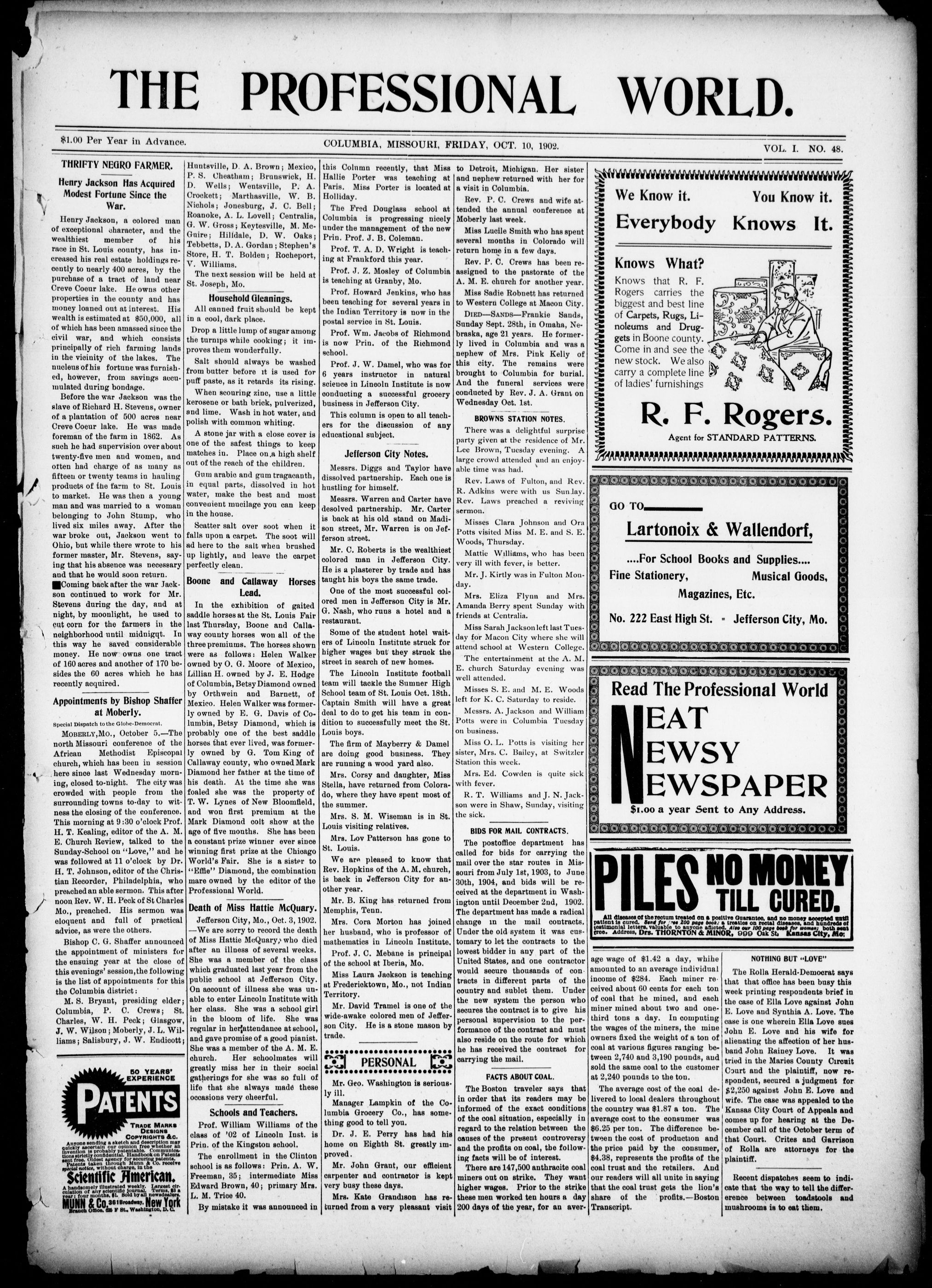
THE PROFESSIONAL WORLD.
$1.00 Per Year in Advance.
THRIFTY NEGRO FARMER.
Henry Jackson Has Acquired Modest Fortune Since the War.
Henry Jackson, a colored man of exceptional character, and the wealthiest member of his race in St. Louis county, has increased his real estate holdings recently to nearly 400 acres, by the purchase of a tract of land near Creve Coeur lake. He owns other properties in the county and has money loaned out at interest. His wealth is estimated at $50,000, all of which has been amassed since the civil war, and which consists principally of rich farming lands in the vicinity of the lakes. The nucleus of his fortune was furnished, however, from savings accumulated during bondage.
Before the war Jackson was the slave of Richard H. Stevens, owner of a plantation of 500 acres near Creve Coeur lake. He was made foreman of the farm in 1862. As such he had supervision over about twenty-five men and women, and often had charge of as many as fifteen or twenty teams in hauling products of the farm to St. Louis to market. He was then a young man and was married to a woman belonging to John Stump, who lived six miles away. After the war broke out, Jackson went to Ohio, but while there wrote to his former master, Mr. Stevens, saying that his absence was necessary and that he would soon return.
Coming back after the war Jackson continued to work for Mr. Stevens during the day, and at night, by moonlight, he used to cut corn for the farmers in the neighborhood until midniguit. In this way he saved considerable money. He now owns one tract of 160 acres and another of 170 besides the 60 acres which he has recently acquired.
Appointments by Bishop Shaffer at Moberly.
Special Dispatch to the Globe-Democrat.
MOBERLY, Mo., October 5.—The north Missouri conference of the African Methodist Episcopal church, which has been in session here since last Wednesday morning, closed to-night. The city was crowded with people from the surrounding towns to-day to witness the closing of the conference. This morning at 9:30 o'clock Prof. H. T. Kealing, editor of the A. M. E. Church Review, talked to the Sunday-School on "Love," and he was followed at 11 o'clock by Dr. H. T. Johnson, editor of the Christian Recorder, Philadelphia, who preached an able sermon. This after noon Rev. W. H. Peck of St Charles Mo., preached. His sermon was eloquent and full of practical advice, as were the others.
Bishop C. G. Shaffer announced the appointment of ministers for the ensuing year at the close of this evenings' session, the following is the list of appointments for this Columbia district:
M. S. Bryant, presiding elder; Columbia, P. C. Crews; St. Charles, W. H. Peck; Glasgow, J. W. Wilson; Moberly, J. L. Williams; Salisbury, J. W. Endicott;
50 YEARS' EXPERIENCE
PATENTS
TRADE MARKS DESIGNS
COPYRIGHTS & C.
Anyone sending a sketch and description may quickly ascertain our opinion free whether an invention is privately patented. Communications strictly confidential. Handbook on Patents sent free. Oldest agency for securing patents. Patents taken through Mamu & Co. receive special notice, without charge, in the
Huntsville, D. A. Brown; Mexico,
P. S. Cheatham; Brunswick, H.
D. Wells; Wentsville, P. A.
Crockett; Marthasville, W. B.
Nichols; Jonesburg, J. C. Bell;
Roanoke, A. L. Lovell; Centralia,
G. W. Gross; Keytesville, M. McGuire; Hilldale, D. W. Oaks; Tebbetts, D. A. Gordan; Stephen's Store, H. T. Bolden; Rocheport,
V. Williams.
The next session will be held at
St. Joseph, Mo.
Household Gleanings.
All canned fruit should be kept in a cool, dark place.
Drop a little lump of sugar among the turnips while cooking; it improves them wonderfully.
Salt should always be washed from butter before it is used for puff paste, as it retards its rising.
When scouring zinc, use a little kerosene or bath brick, pulverized, and lime. Wash in hot water, and polish with common whiting.
A stone jar with a close cover is one of the safest things to keep matches in. Place on a high shelf out of the reach of the children.
Gum arabic and gum tragacanth, in equal parts, dissolved in hot water, make the best and most convenient mucilage you can keep in the house.
Scatter salt over soot when it falls upon a carpet. The soot will ad here to the salt when brushed up lightly, and leave the carpet perfectly clean.
Boone and Callaway Horses Lead.
In the exhibition of gaited saddle horses at the St. Louis Fair last Thursday, Boone and Callaway county horses won all of the three premiums. The horses shown were as follows: Helen Walker owned by O. G. Moore of Mexico, Lillian H. owned by J. E. Hodge of Columbia, Betsy Diamond owned by Orthwein and Barnett, of Mexico. Helen Walker was formerly owned by E. G. Davis of Columbia, Betsy Diamond, which is probably one of the best saddle horses that ever lived, was formerly owned by G. Tom King of Callaway county, who owned Mark Diamond her father at the time of his death. At the time she was foaled she was the property of T. W. Lynes of New Bloomfield, and won first premium at the Mark Diamond colt show at the age of five months. She has been a constant prize winner ever since winning first prize at the Chicago World's Fair. She is a sister to "Effle" Diamond, the combination mare owned by the editor of the Professional World.
Death of Miss Hattie McQuary.
Jefferson City, Mo., Oct. 3, 1902. We are sorry to record the death of Miss Hattie McQuary, who died after an illness of several weeks. She was a member of the class which graduated last year from the public school at Jefferson City. On account of illness she was unable to enter Lincoln Institute with her class. She was a school girl in the bloom of life. She was regular in her attendance at school, and gave promise of a good pianist. She was a member of the A. M. E. church. Her schoolmates will greatly miss her in their social gatherings for she was so full of life that she always made these occasions very cheerful.
Schools and Teachers.
Prof. William Williams of the class of '02 of Lincoln Inst. is Prin. of the Kingston school.
The enrollment in the Clinton school is as follows: Prin. A. W. Freeman, 35; intermediate Miss Edward Brown, 40; primary Mrs. L. M. Trice 40.
By mistake it was announced in
this Column recently, that Miss Hallie Porter was teaching at Paris. Miss Porter is located at Holliday.
The Fred Douglass school at Columbia is progressing nicely under the management of the new Prin. Prof. J. B. Coleman.
Prof. T. A. D. Wright is teaching at Frankford this year.
Prof. J. Z. Mosley of Columbia is teaching at Granby, Mo.
to Detroit, Michigan. Here and nephew returned with a visit in Columbia.
Rev. P. C. Crews and wended the annual conference Moberly last week.
Miss Lucile Smith who has several months in Colorado return home in a few days.
Rev. P. C. Crews has been assigned to the pastorate A. M. E. church for another
Prof. Howard Jenkins, who has been teaching for several years in the Indian Territory is now in the postal service in St. Louis.
Prof. Wm. Jacobs of Richmond is now Prin. of the Richmond school.
Prof. J. W. Damel, who was for 6 years instructor in natural science in Lincoln Institute is now conducting a successful grocery business in Jefferson City.
This column is open to all teachers for the discussion of any educational subject.
Jefferson City Notes.
Messrs. Diggs and Taylor have dissolved partnership. Each one is hustling for himself.
Messrs. Warren and Carter have desolved partnership. Mr. Carter is back at his old stand on Madison street, Mr. Warren is on Jefferson street.
Mr. C. Roberts is the wealthiest colored man in Jefferson City. He is a plasterer by trade and has taught his boys the same trade.
One of the most successful colored men in Jefferson City is Mr. G. Nash, who runs a hotel and a restaurant.
Some of the student hotel waiters of Lincoln Institute struck for higher wages but they struck the street in search of new homes.
The Lincoln Institute football team will tackle the Sumner High School team of St. Louis Oct. 18th. Captain Smith will have a great deal to do to get his team in condition to successfully meet the St. Louis boys.
The firm of Mayberry & Damel are doing good business. They are running a wood yard also.
Mrs. Corsy and daughter, Miss Stella, have returned from Colorado, where they have spent most of the summer.
Mrs. S. M. Wiseman is in St. Louis visiting relatives.
Mrs. Lov Patterson has gone to St. Louis.
We are pleased to know that Rev. Hopkins of the A. M. church, is back in Jefferson City for another year.
Mr. B. King has returned from Memphis, Tenn.
Mrs. Cora Morton has joined her husband, who is professor of mathematics in Lincoln Institute.
Prof. J. C. Mebane is principal of the school at Iberia, Mo.
Miss Laura Jackson is teaching at Fredericktown, Mo., not Indian Territory. Mr. David Tramel is one of the wide-awake colored men of Jefferson City. He is a stone mason by trade.
PERSONAL
Mr. Geo. Washington is seriously ill.
Manager Lampkin of the Columbia Grocery Co., has something good to tell you.
Dr. J. E. Perry has had his home on Eighth St. greatly improved.
Mr. John Grant, our efficient carpenter and contractor is kept very busy these days.
Mrs. Kate Grandison has returned from a very pleasant visit
to Detroit, Michigan. Her sister and nephew returned with her for a visit in Columbia.
Rev. P. C. Crews and wife attended the annual conference at Moberly last week.
Miss Lucile Smith who has spent several months in Colorado will return home in a few days.
Rev. P. C. Crews has been reassigned to the pastorate of the A. M. E. church for another year.
Miss Sadie Robnett has returned to Western College at Macon City.
DIED—SANDS—Frankie Sands, Sunday Sept. 28th, in Omaha, Nebraska, age 21 years. He formerly lived in Columbia and was a nephew of Mrs. Pink Kelly of this city. The remains were brought to Columbia for burial. And the funeral services were conducted by Rev. J. A. Grant on Wednesday Oct. 1st.
BROWNS STATION NOTES
There was a delightful surprise party given at the residence of Mr. Lee Brown, Tuesday evening. A large crowd attended and an enjoyable time was had.
Rev. Laws of Fulton, and Rev. R. Adkins were with us Sunlay. Rev. Laws preached a reviving sermon.
Misses Clara Johnson and Ora Potts visited Miss M. E. and S. E. Woods, Thursday.
Mattie Williams, who has been very ill with fever, is better.
Mr. J. Kirtly was in Fulton Monday.
Mrs. Eliza Flynn and Mrs. Amanda Berry spent Sunday with friends at Centralia.
Miss Sarah Jackson left last Tuesday for Macon City where she will attend school at Western College.
The entertainment at the A. M. E. church Saturday evening was well attended.
Misses S. E. and M. E. Woods left for K. C. Saturday to reside.
Messrs. A. Jackson and William Potts were in Columbia Tuesday on business.
Miss O. L. Potts is visiting her sister, Mrs. C. Bailey, at Switzler Station this week.
Mrs. Ed. Cowden is quite sick with fever. R. T. Williams and J. N. Jackson were in Shaw, Sunday, visiting the sick.
BIDS FOR MAIL CONTRACTS.
The postoffice department has called for bids for carrying the mail over the star routes in Missouri from July 1st, 1903, to June 30th, 1904, and bids will be received at the department in Washington until December 2nd, 1902. The department has made a radical change in the mail contracts. Under the old system it was customary to let the contracts to the lowest bidder in any part of the United States, and one contractor would secure thousands of contracts in different parts of the country and sublet them. Under the new system the person who secures the contract is to give his personal supervision to the performance of the contract and must also reside on the route for which he has received the contract for carrying the mail.
FACTS ABOUT COAL.
The Boston traveler says that in order that its readers may be informed of the exact conditions of the coal situation, especially in regard to the relation between the causes of the present controversy and the profits on coal, the following facts will be of interest. There are 147,500 anthracite coal miners out on strike. They want higher wages. Prior to the strike these men worked ten hours a day 200 days of the year, for an aver-
R. F. Rogers.
....For School Books and Supplies.... Fine Stationery, Musical Goods, Magazines, Etc. No. 222 East High St. - Jefferson City, Mo.
All diseases of the rectum treated on a positive Guarantee, and no money accepted until patient is cured. Send for 200 page book: a treaties on rectal diseases, and hundreds of testimonial letters, valuable to anyone affected. Also our 100 page book for women; both sent free. Address, Drs. THORNTON & MINOR, 999 Oak St, Kansas City, Mo;
Knows What?
Knows that R. F. Rogers carries the biggest and best line of Carpets, Rugs, Linoleums and Druggets in Boone county. Come in and see the new stock. We also carry a complete line of ladies' furnishings
R. F.
Agent for ST.
GO TO
Lartonoix &
....For School Book
Fine Stationery,
Magazine
No. 222 East High St.
Read The Profe
NEAT
NEWS
NEWS
$1.00 a year Sent
PILES M
All diseases of the rectum treated on a po-
patient is cured. Send for res 200 page book.
postmonial letters, valuable to anyone affec-
tive. Address, Drs. THORNTON & MIN
age wage of $1.42 a day, whihe amounted to an average individual income of $284. Each miner received about 60 cents for each ton of coal that he mined, and each miner mined about two and one third tons a day. In computing the wages of the miners, the mine owners fixed the weight of a ton of coal at various figures ranging between 2,740 and 3,190 pounds, and sold the same coal to the customer at 2,240 pounds to the ton.
The average cost of the coal delivered to local dealers throughout the country was $1.87 a ton. The average cost to the consumer was $6.25 per ton. The difference between the cost of production and the price paid by the consumer, $4.38, represents the profits of the coal trust and the retailers. And our readers will all unite in saying that the coal trust gets the lion's share of the profits.—Boston Transcript.
---
VOL. I. NO. 48.
You Know it.
y Knows It.
MATRIX
Rogers.
STANDARD PATTERNS.
& Wallendorf,
books and Supplies....
Musical Goods,
medicines, Etc.
t. = Jefferson City, Mo.
Professional World
NY
SPAPER
nt to Any Address.
NO MONEY
TILL CURED.
a positive Guarantee, and no money accepted until book; a treaties on rectal diseases, and hundreds of indicted. Also our 100 page book for women; both sent MINOR, 999 Oak St Kansas City, Mo:
NOTHING BUT "LOVE"
The Rolla Herald-Democrat says that that office has been busy this week printing respondents brief in the case of Ella Love against John E. Love and Synthia A. Love. The case is one wherein Ella Love sues John E. Love and his wife for alienating the affection of her husband John Rainey Love. It was tried in the Maries County Circuit Court and the plaintiff, now respondent, secured a judgment for $2,250 against John E. Love and wife. The case was appealed to the Kansas City Court of Appeals and comes up for hearing at the December call of the October term of that Court. Crites and Garrison of Rolla are attorneys for the plaintiff.
Recent dispatches seem to indicate that the way to tell the difference between toadstools and mushrooms is to eat them.
RUFUS L. LOGAN, B. S. D., Editor.
COLUMBIA. : : : MISSOURL
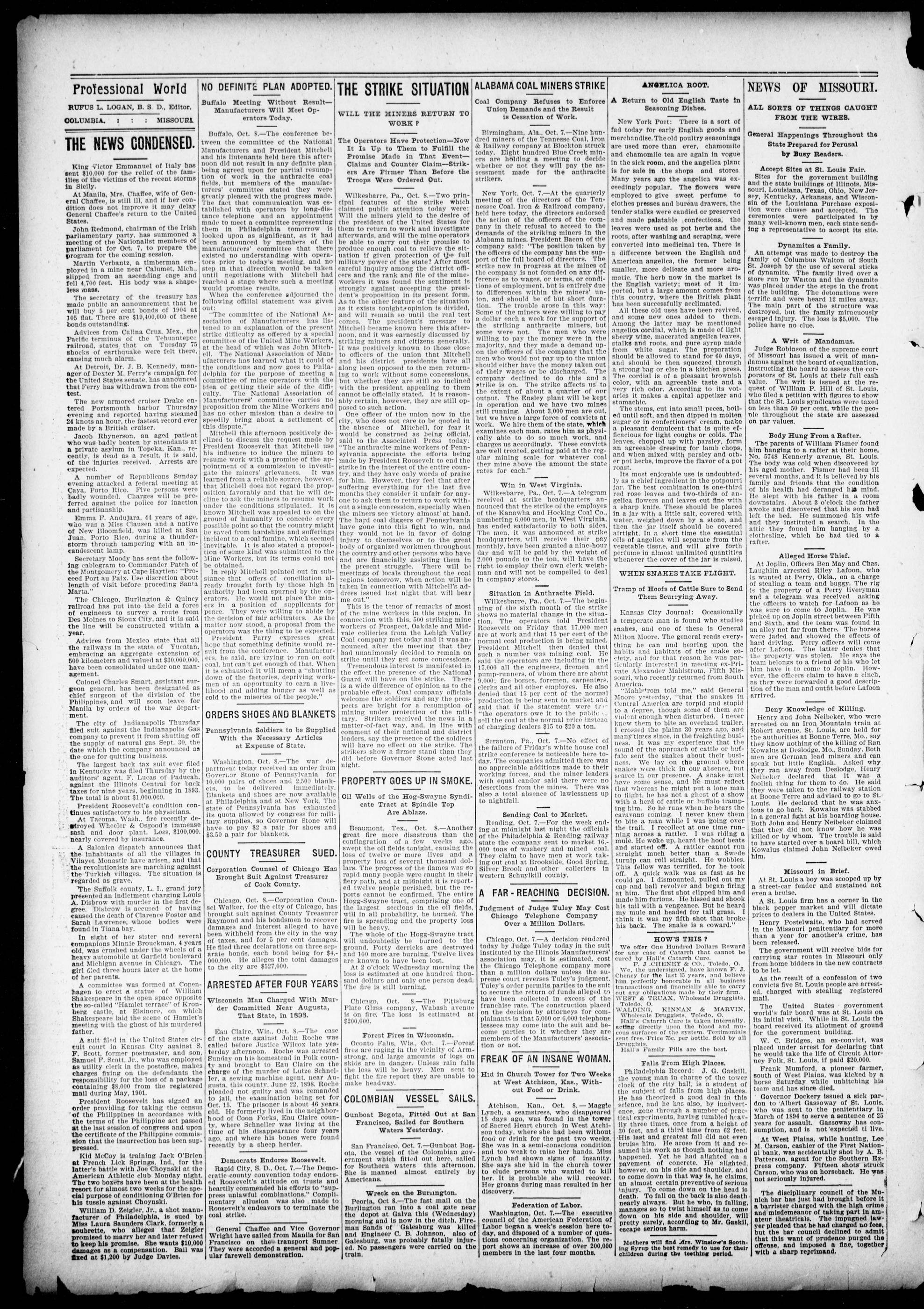
THE NEWS CONDENSED.
THE NEWS CONDENSED.
King Victor Emmanuel of Italy has sent $10,000 for the relief of the families of the victims of the recent storms in Sicily.
At Manila, Mrs. Chaffee, wife of General Chaffee, is still ill, and if her condition does not improve it may delay General Chaffee's return to the United States.
John Redmond, chairman of the Irish parliamentary party, has summoned a meeting of the Nationalist members of parliament for Oct. 7, to prepare the program for the coming session.
Martin Verbantz, a timberman employed in a mine near Calumet, Mich. slipped from an ascending cage and fell 4,700 feet. His body was a shapeless mass.
The secretary of the treasury has made public an announcement that he will buy 5 per cent bonds of 1904 at 105 flat. There are $19,400,000 of these bonds outstanding.
Advices from Callina Cruz, Mex., the Pacific terminus of the Tehuatepee railroad, states that on Tuesday 75 shocks of earthquake were felt there, causing much alarm.
At Detroit, Dr. J. B. Kennedy, manager of Dexter M. Ferry's campaign for the United States senate, has announced that Perry has withdrawn from the contest.
The new armored cruiser Drake entered Portsmouth harbor Thursday evening and reported having steamed 24 knots an hour, the fastest record ever made by a British cruiser.
Jacob Rhynerson, an aged patient who was badly beaten by attendants at a private asylum in Topeka, Kan., recently, is dead as a result, it is said, of the injuries received. Arrests are expected.
A number of Republicans Sunday evening attacked a federal meeting at Caya, Porto Rico. Five persons were badly wounded. Charges will be preferred against the police for inaction and partisanship.
Emma F. Andujara, 44 years of age, who was a Miss Clausen and a native of New Bloomfield, was killed at San Juan, Porto Rico, during a thunderstorm through tampering with an incandescent lamp.
Secretary Moody has sent the following cablegram to Commander Patch of the Montgomery at Cape Haytien: "Proceed Port au Palix. Use discretion about length of visit before proceeding Santa Marta."
The Chicago, Burlington & Quincy railroad has put into the field a force of engineers to survey a route from Des Moines to Sioux City, and it is said the line will be constructed within a year.
Advices from Mexico state that all the railways in the state of Yucatan, embracing an aggregate extension of 500 kilometers and valued at $30,000,000 have been consolidated under one management.
Colonel Charles Smart, assistant surgeon general, has been designated as chief surgeon of the division of the Philippines, and will soon leave for Manila by orders of the war department.
The city of Indianapolis Thursday filed suit against the Indianapolis Gas company to prevent it from shutting off the supply of natural gas Sept. 30, the date which the company announced as the one for quitting business.
The largest back tax suit ever filed in Kentucky was filed Thursday by the auditors' agent, F. Lucas of Paducah, against the Illinois Central for back taxes for nine years, beginning in 1893. The total is about $1,000,000.
President Roosevelt's condition continues satisfactory to his physicians.
At Tacoma, Wash., fire recently destroyed Wheeler & Osgood's immense ash and door plant. Loss, $100,000, nearly covered by insurance.
A Salonica dispatch announces that the inhabitants of all the villages in Vilayet Monastir have arisen, and that the revolutionists are marching against the Turkish villages. The situation is regarded as grave. The Suffolk county, L. I., grand jury presented an indictment染ing Louis A. Dishrow with murder in the first degree. Dishrow is accused of having caused the death of Clarence Foster and Sarah Lawrence, whose bodies were found in Tiana bay. In sight of her sister and several companions Minnie Brouckman, 4 years old, was crushed under the wheels of a heavy automobile at Garfield boulevard and Michigan avenue in Chicago. The girl died three hours later at the home of her parents.
A committee was formed at Copenhagen to erect a statue of William Shakespeare in the open space opposite the so-called "Hamlet terrace" of Kronberg castle, at Elsinore, on which Shakespeare laid the scene of Hamlet's meeting with the ghost of his murdered father.
A suit filed in the United States circuit court in Kensas City against S. F. Scott, former postmaster, and son, Samuel F. Scott, Jr., who was employed as utility clerk in the postoffice, makes charges fixing on the defendants the responsibility for the loss of a package containing $8,000 from the registered mail during May, 1901.
President Roosevelt has signed an order providing for taking the census of the Philippines in accordance with the terms of the Philippine act passed at the last session of congress and upon the certificate of the Philippine commission that the insurrection has been suppressed.
Kid McCoy is training Jack O'Brien at French Lick Springs, Ind., for the latter's battle with Joe Choynski at the American Athletic club Monday night. The two boxers have been at the health resort for almost two weeks for the special purpose of conditioning O'Brien for his tussle against Choynski. William D. Zeigler, Jr., a shot manufacturer of Philadelphia, is sued by Miss Laura Saunders Clark, formerly a soubrette, who alleges that Zeigler promised to marry her and later refused to keep his promise. She wants $10,000 damages as a compensation. Bail was fixed at $1,200 by Judge Davies.
NO DEFINITE PLAN ADOPTED.
Buffalo Meeting Without Result Manufacturers Will Meet Operators Today.
Buffalo, Oct. 8.—The conference between the committee of the National Manufacturers and President Mitchell and his lutenants held here this afternoon did not result in any definite plan being agreed upon for partial resumption of work in the anthracite coal fields, but members of the manufacturers' committee stated they were greatly pleased with the progress made. The fact that communication was established with operators by long-distance telephone and an appointment made to meet a committee representing them in Philadelphia tomorrow is looked upon as significant, as it had been announced by members of the manufacturers' committee that there existed no understanding with operators prior to today's meeting, and no step in that direction would be taken until negotiations with Mitchell had reached a stage where such a meeting would promise results.
When the conference adjourned the following official statement was given out:
"The committee of the National Association of Manufacturers has listened to an explanation of the present strike difficulty as offered by a special committee of the United Mine Workers, at the head of which was John Mitchell. The National Association of Manufacturers has learned what it could of the conditions and now goes to Philadelphia for the purpose of meeting a committee of mine operators with the idea of getting their side of the difficulty. The National Association of Manufacturers' committee carries no proposition from the Mine Workers and has no other mission than a desire to speedily bring about a settlement of this dispute."
Mitchell this afternoon positively declined to discuss the request made by President Roosevelt that Mitchell use his influence to induce the miners to resume work with a promise of the appointment of a commission to investigate the miners' grievances. It was learned from a reliable source, however, that Mitchell does not regard the proposition favorably and that he will decline to ask the miners to resume work under the conditions stipulated. It is known Mitchell was appealed to on the ground of humanity to concede every possible point so that the country might be saved from hardships and sufferings incident to a coal famine, which seemed inevitable. It is also stated a proposition of some kind was submitted to the Mine Workers, but its terms could not be obtained.
In reply Mitchell pointed out in substance that offers of conciliation already brought forth by those high in authority had been spurned by the operators. He would not place the miners in a position of supplicants for peace. They were willing to abide by the decision of fair arbitrators. As the matter now stood, a proposal from the operators was the thing to be expected. President Parry expresses great hope that something definite would result from the conference. Manufacturers, he said, are trying to run on soft coal, but can't get enough of that. When it is exhausted it will mean a "shutting down of the factories, depriving workers of an opportunity to earn a livelihood and adding hunger as well as cold to the miseries of the people."
ORDERS SHOES AND BLANKETS
Pennsylvania Soldiers to be Supplied
With the Necessary Articles
at Expense of State.
Washington, Oct. 8.—The war
department today received an order from
Governor Stone of Pennsylvania for
10,000 pairs of shoes and 2,500 blankets,
to be delivered immediately.
Blankets and shoes are now available
at Philadelphia and at New York. The
state of Pennsylvania has exhausted
its quota allowed by congress for military
supplies, so Governor Stone will
have to pay $2 a pair for shoes and
$3.50 a pair for blankets.
COUNTY TREASURER SUED.
Corporation Counsel of Chicago Has Brought Suit Against Treasurer of Cook County.
Chicago, Oct. 8.—Corporation Counsel Walker, for the city of Chicago, has brought suit against County Treasurer Raymond and his bondsmen to recover damages and interest alleged to have been withheld from the city in the way of taxes, and for 5 per cent damages. He filed three declarations on three separate bonds, each bond being for $4,000,000. He alleges the total damages to the city are $527,000.
ARRESTED AFTER FOUR YEARS
Wisconsin Man Charged With Murder Committed Near Augusta, That State, in 1898.
Eau Claire, Wis., Oct. 8.—The case of the state against John Roche was called before Justice Wilcox late yesterday afternoon. Roche was arrested Sunday on his homestead in Polk county and brought to Eau Claire on the charge of the murder of Lutze Schneller, a sewing machine agent, near Augusta, this county. June 22, 1898. Roche pleaded not guilty and was remanded to jail, the examination being set for Oct. 15. The prisoner is about 46 years old. He formerly lived in the neighborhood of Coon Forks, Eau Claire county, where Schneller was living at the time of his disappearance four years ago, and where his bones were found recently by a sheep herder.
Democrats Endorse Roosevelt
Rapid City, S. D., Oct. 7.—The Democratic county convention today endorsed Roosevelt's attitude on trusts and heartily commended his efforts to "suppress unlawful combinations." Compilatory allusion was also made to Roosevelt's endeavors to terminate the coal strike.
General Chaffee and Vice Governor Wright have sailed from Manila for San Francisco on the transport Sumner They were accorded a general and popular farewell demonstration.
THE STRIKE SITUATION
WILL THE MINERS RETURN TO
WORK ?
The Operators Have Protection—Now It Is Up to Them to Fulfill the Promise Made in That Event—Claims and Counter Claim—Strikers Are Firmer Than Before the Troops Were Ordered Out.
Wilkesbarre, Pa., Oct. 8.—Two principal features of the strike which claimed public attention today were: Will the miners yield to the desire of the president of the United States for them to return to work and investigate afterwards, and will the mine operators be able to carry out their promise to produce enough coal to relieve the situation if given protection of the full military power of the state? After most careful inquiry among the district officers and the rank and file of the mine-workers it was found the sentiment is strongly against accepting the president's proposition in its present form. As to the other feature of the situation as it exists tonight, opinion is divided, and will remain so until the real test comes. The president's message to Mitchell became known here this afternoon, and it was earnestly discussed by striking miners and citizens generally. It was positively known to those close to officers of the union that Mitchell and his district presidents have all along been opposed to the men returning to work without some concessions, but whether they are still so inclined with the president appealing to them cannot be officially stated. It is reasonably certain, however, they are still opposed to such action.
One officer of the union now in the city, who does not care to be quoted in the absence of Mitchell, for fear it would be construed as being official, said to the Associated Press today: "The anacritic mine workers of Pennsylvania appreciate the efforts being made by President Roosevelt to end the strike in the interest of the entire country, and they have only words of praise for him. However, they feel that after suffering everything for the last five months they consider it unfair for anyone to ask them to return to work without a single concession, especially when the miners see victory almost at hand. The hard coal diggers of Pennsylvania have gone into this fight to win, and they would not be in favor of doing injury to themselves or to the great body of organized workmen throughout the country and other persons who have and are financially assisting them in the present struggle. There will be meetings of locals throughout the coal regions tomorrow, when action will be taken in connection with Mitchell's address issued last night that will bear me out."
This is the tenor of remarks of most of the mine workers in this region. In connection with this, 500 striking mine workers of Prospect, Oakdale and Midvaie collieries from the Lehigh Valley Coal company met today and it was announced after the meeting that they had unanimously decided to remain on strike until they get some concessions. Tremendous interest is manifested in the effect the presence of the National Guard will have on the strike. There is a wide difference of opinion as to the probable effect. Coal company officials welcome the soldiers and say the prospects are bright for a resumption of mining under protection of the military. Strikers received the news in a matter-of-fact way, and, in line with comment of their national and district leaders, say the presence of the soldiers will have no effect on the strike. The strikers show a firmer stand than they did before Governor Stone acted last night.
PROPERTY GOES UP IN SMOKE.
Oil Wells of the Hog-Swayne Syndicate Tract at Spindle Top
Beaumont, Tex., Oct. 8.—Another great fire more disastrous than the conflagration of a few weeks ago, swept the oil fields tonight, causing the loss of twelve or more lives and a property loss of several thousand dollars. The progress of the flames was so rapid many people were caught in their fiery path, and at midnight it is reported twelve people perished, but the reports cannot be confirmed. The entire Hogg-Swayne tract, comprising one of the largest sections in the oil fields, will in all probability, be burned. The fire is spreading and the property loss will be heavy. The whole of the Hogg-Swayne tract will undoubtedly be burned to the ground. Forty derricks are destroyed and 100 more are burning. Twelve lives are known to have been lost. At 2 o'clock Wednesday morning the loss is estimated at one hundred thousand dollars and only one person dead. The fire is still burning.
Chicago, Oct. 8—The Pittsburgh Plate Glass company, Wabash avenue is on fire. The loss is estimated at $200,000.
Forest Fires in Wisconsin.
Oconto Falls, Wis., Oct. 7.—Forest fires are raging in the vicinity of Armstrong, and large amounts of logs on skis are in danger. Unless rain falls the loss will be heavy. Men sent to fight the fire report they are unable to make headway.
COLOMBIAN VESSEL SAILS.
Gunboat Bogota, Fitted Out at San Francisco, Sailed for Southern Waters Yesterday.
San Francisco, Oct. 7.—Gunboat Bogota, the vessel of the Colombian government which fitted out here, sailed for Southern waters this afternoon. She is manned almost entirely by Americans.
Wreck on the Burington
Peoria, Oct 8.—The fast mail on the Burlington ran into a coal gate near the depot at Galva this (Wednesday) morning and is now in the ditch. Fireman Sands of Galesburg was killed and Engineer C. B. Johnson, also of Galesburg, was probably fatally injured. No passengers were carried on the train.
ALABAMA COAL MINERS STRIKE
Coal Company Refuses to Enforce Union Demands and the Result is Cessation of Work.
Birmingham, Ala., Oct. 7.—Nine hundred miners of the Tennessee Coal, Iron & Railway company at Blockton struck today. Eight hundred Blue Creek miners are holding a meeting to decide whether or not they will pay the assessment made for the anthracite strikers.
New York, Oct. 7.—At the quarterly meeting of the directors of the Tennessee Coal, Iron & Railroad company, hold here today, the directors endorsed the action of the officers of the company in their refusal to accede to the demands of the striking miners in the Alabama mines. President Bacon of the company said: "The position taken by the officers of the company has the support of the full board of directors. The strike now in progress at the mines of the company is not founded on any difference as to wages, or terms, or conditions of employment, but is entirely due to differences within the miners' union, and should be of but short duration. The trouble arose in this way: Some of the miners were willing to pay a dollar each a week for the support of the striking anthracite miners, but some were not. The men who were willing to pay the money were in the majority, and they made a demand upon the officers of the company that the men who would not pay up to the union should either have the money taken out of their wages or be discharged. The company declined to do this and a strike is on. The strike affects us to the extent of about a quarter of our output. The Ensley plant will be kept in operation and we have two mines still running. About 3,000 men are out, but we have a large force of convicts at work. We hire them of the state, which examines each man, rates him as physically able to do so much work, and charges us accordingly. These convicts are well treated, getting paid at the regular mining scale for whatever coal they mine above the amount the state rates for each."
Win in West Virginia.
Wilkesbarre, Pa., Oct. 7.—A telegram received at strike headquarters announced that the strike of the employees of the Kanwha and Hocking Coal Co., numbering 6,000 men, in West Virginia, has ended satisfactorily to both sides. The men, it was announced at strike headquarters, will receive their pay monthly, have been granted a nine-hour day and will be paid by the weight of 2,000 pounds to the own, will have the right to employ their own clerk weighman and will not be compelled to deal in company stores.
Situation in Anthracite Field.
Wilkesbarre, Pa., Oct. 7.—The beginning of the sixth month of the strike shows no material change in the situation. The operators told President Roosevelt on Friday that 17,000 men are at work and that 15 per cent of the normal coal production is being mined. President Mitchell then denied that such a number was mining coal. He said the operators are including in the 17,000 all the engineers, firemen and pump-runners, of whom there are about 9,000; fire bosses, foremen, carpenters, clerks and all other employees. He also denied that 15 per cent of the normal production is being sent to market and said that if the statement were true "the operators owe it to the public to sell the coal at the normal price instead of charging dealers $15 to $20 a ton.
Scranton, Pa., Oct. 7.—No effect of the failure of Friday's white house coal strike conference is noticeable here today. The companies admitted there was no appreciable additions made to their working forces, and the miner leaders with equal candor said there were no desertions from the mines. There was also a total absence of lawlessness up to nightfall.
Sending Coal to Market.
Reading, Oct. 7.—For the week ending at midnight last night the officials of the Philadelphia & Reading railway state the company sent to market 16,000 tons of washery and mined coal. They claim to have men at work taking out coal at Brookside, Good Spring, Silver Brook and other collieriers in western Schuylkill county.
A FAR - REACHING DECISION.
Judgment of Judge Tuley May Cost Chicago Telephone Company Over a Million Dollars.
Chicago, Oct. 7.—A decision rendered today by Judge Tuley today in the suit instituted by the Illinois Manufacturers' association may, it is estimated, cost the Chicago Telephone company more than a million dollars unless the supreme court reverses Tuley's judgment. Tuley's order permits parties to the suit to secure the return of funds alleged to have been collected in excess of the franchise rate. The construction placed on the decision by attorneys for complainants is that 5,000 or 6,000 telephone lessees may come into the suit and become parties to it whether they are members of the Manufacturers' association or not.
FREAK OF AN INSANE WOMAN.
Hid in Church Tower for Two Weeks at West Atchison, Kas., Without Food or Drink.
Atchison, Kan., Oct. 8. — Maggie Lynch, a seamstress, who disappeared 15 days ago, was found in the tower of Sacred Heart church in West Atchison today, where she had been without food or drink for the past two weeks. She was in a weak-conscious condition and too weak to raise her hands. Miss Lynch had shown signs of insanity. She says she hld in the church tower to elude persons who wanted to kill her. It is probable she will recover. Her groans during mass resulted in her discovery.
Federation of Labor.
Washington, Oct. 7.-The executive council of the American Federation of Labor began a week's session here today, and disposed of a number of questions concerning organization. The report shows an increase of over 200,000 members in the last four months.
ANGELICA ROOT.
A Return to Old English Taste in Seasoning Dishes.
New York Post: There is a sort of fad today for early English goods and merchandise. The old poultry seasonings are used more than ever, chamomile and chamomile tea are again in vogue in the sick room, and the angelica plant is for sale in the shops and stores. Many years ago the angelica was exceedingly popular. The flowers were employed to give sweet perfume to clothes presses and bureau drawers, the tender stalks were candied or preserved and made palatable, confections, the leaves were used as pot herbs and the roots, after washing and scraping, were converted into medicinal tea. There is a difference between the English and American angelica, the former being smaller, more delicate and more aromatic. The herb now in the market is the English variety; most of it imported, but a large amount comes from this country, where the British plant has been successfully acclimated.
All these old uses have been revived, and some new ones added to them. Among the latter may be mentioned angelica cordial, which is made of light sherry wine, macerated angelica leaves, stalks and roots, and pure syrup made from white sugar. The preparation should be allowed to stand for 60 days, and should be then squeezed through a strong bag or else in a kitchen press. The cordial is of a pleasant brownish color, with an agreeable taste and a very rich odor. According to its votaries it makes a capital appetizer and stomachic.
The stems, cut into small pieces, boiled until soft, and then dipped in mottum sugar or in confectioners' cream, make a pleasant demulcent that is quite effervescent for light wines or the candles. The leaves, chopped up with parsley, form an agreeable dressing for lamb chops, and when mixed with parsley and other pot herbs, improve the flavor of a pot roast.
Its most enjoyable use is undoubtedly as a chief ingredient in the potpourri jar. The best combination is one-third red rose leaves and two-thirds of angelica flowers and leaves cut fine with a sharp knife. These should be placed in a jar with a little salt, covered with water, weighed down by a stone, and then the jar itself should be covered airtight. In a short time the essential oils of angelica will separate from the vegetable tissue, and will give forth perfume in almost unlimited quantities whenever the cover of the jar is raised,
WHEN SNAKES TAKE FLIGHT.
Tramp of Hoofs of Cattle Sure to Send
Them Scurrying Away.
Kansas City Journal: Occasionally a temperate man is found who studies snakes, and one of these is General Milton Moore. The general reads everything he can and hearing upon the habits and habitats of the snake society, and for that reason he was particularly interested in meeting ex-Private Alexander Mahlstrom, Fifth Missouri, who recently returned from South America.
"Mahal'rom told me," said General Moore yesterday, "that the snakes in Central America are torpid and stupid to a degree, though some of them are violent enough when disturbed. I never knew them to bite an overland trailer. I crossed the plains 20 years ago, and many times since, in the freighting business. It was my experience that the sound of the approach of cattle or buffalo sent the snakes about their business. We lay on the ground where snakes were thick in our absence, but scarce in our presence. A snake must have some sense, and he must reflect that whereas he might put a lone man to flight, he has not a ghost of a show with a hard of cattle or buffalo tramping him. So he runs when he hears the caravans coming. I never knew them to bite a man while I was going over the trail. I recollect at one time running across a rattler. I was riding a mule. He woke up, heard the hoof beats and started off. A rattler cannot run straight much better than a Swede turnup can roll straight. He wobbles. This fellow was terrified, for he took off. A quick walk was as fast as he could go. I dismounted, pulled out my cap and ball revolver and began firing at him. The first shot clipped him and made him furious. He hissed and shook his tail with a vengeance. But he heard my mule and headed for tall grass. I think it was my fifth shot that broke his back. The snake is a coward."
HOW'S THIS?
We offer One Hundred Dollars Reward for any case of Catarrth that cannot be cured by Hall's Catarrth Cure.
P. J. CHENEY & CO., Toledo, O.
F. J. CHENEY and his sisters, F. J. Cheney for the last 15 years, and believe him perfectly honorable in all business transactions and financially able to carry out any obligations made by their firm.
WEST & TRUAX, Wholesale Druggists,
WALDING, KINNAN & MARVIN,
Wholesale Druggists, Toledo, O.
Hall's Catarrth Cure is taken internally, acting directly upon the blood and mucous surfaces of the system. Testimonials 75c. per sottle. Sold by all Druggists.
Hall's Family Pills are the best.
Falls From High Places
Philadelphia Record: J. G. Gaskill, the young man in charge of the tower clock of the city hall, is a student of the subject of falls from high places. He has theorized a good deal in this science, and he has also, by inadvertence, gone through a number of practical experiments, having tumbled heavily three times, once from a height of 30 feet, and a third time from 62 feet. His last and greatest fall did not even bruise him. He arose from it and resumed his work as though nothing had happened. Yet he had alighted on a pavement of concrete. He alighted, however, on his side and shoulder, and to come down in that way is, he claims, an almost certain preventive of serious injury. To come down on the head is death. To fall on the back is also death nearly always. But he who, in falling manages so to twist himself as to come down on his side and shoulder, will pretty surely, according to Mr. Gaskill escape serious harm.
Mothers will find Mrs. Winslow's Sooth-
children during the teething period.
ALL SORTS OF THINGS CAUGHT FROM THE WIRES.
General Happenings Throughout the State Prepared for Perusal by Busy Readers.
Receives Sites at St. Louis Fair.
Sites for the government building and the state buildings of Illinois, Missouri, Louisiana, Texas, Ohio, New Jersey, Kentucky, Arkansas, and Wisconsin of the Louisiana Purchase exposition were chosen and accepted. The ceremonies were participated in by many well-known men, each state sending a representative to accept its site.
Dynamites a Family.
An attempt was made to destroy the family of Columbus Walton of South St. Joseph by the use of several sticks of dynamite. The family lived over a store run by Walton and the dynamite was placed under the steps in the front of the building. The detonations were terrific and were heard 12 miles away. The main part of the structure was destroyed, but the family miraculously escaped injury. The loss is $5,000. The police have no clue.
A Writ of Mandamus.
Judge Robinson of the supreme court of Missouri has issued a writ of mandamus against the board of equalization, instructing the board to assess the corporators of St. Louis at their full cash value. The writ is issued at the request of William P. Hill of St. Louis, who filed a petition with figures to show that the St. Louis syndicates were taxed on less than 50 per cent, while the people throughout the state are assessed on par values.
Body Hung From a Rafter.
The parents of William Fismer found him hanging to a rafter at their home, No. 5748 Kennerly avenue, St. Louis. The body was cold when discovered by his aged mother. Fismer had been ill several months, and it is believed by his family and friends that the condition of his health had deranged his mind. He slept with his father in a room downstairs. About 3 o'clock the father awoke and discovered that his son had left the bed. He summoned his wife and they instituted a search. In the attic they found him hanging by a clothesline, which he had tied to a rafter.
Alleged Horse Thief.
At Joplin, Officers Ben May and Chas, Laughlin arrested Riley Lafoon, who is wanted at Perry, Okla., on a charge of stealing a team and buggy. The rig is the property of a Perry livermann and a telegram was received asking the officers to watch for Lafoon as he was sure to come to Joplin. He was picked up on Joplin street between Fifth and Sixth, and the team was found in an alley not far from there. The horses were jaded and showed the effects of hard driving. Perry officers will come after Lafoon. The latter denies that the property was stolen. He says the team belongs to a friend of his who let him have it to come to Joplin. However, the officers claim to have a cinch, as they were forwarded a good description of the man and outfit before Lafoon arrived.
Deny Knowledge of Killing
Henry and John Nelbecker, who were arrested on an Iron Mountain train at Robert avenue, St. Louis, are held for the authorities at Bonne Terre, Mo., say they know nothing of the killing of Ran Kowalus at Deslodge, Mo., Sunday. Both men are German lead miners and can speak but little English. Asked why they ran away from Deslodge, Henry Nelbecker declared that it was a foolish thing for them to do. He said they were taken to the railway station at Boone Terre and advised to go to St. Louis. He declared that he was anxious to go back. Kowalus was stabbed in a general fight at his boarding house. Both John and Henry Nelbecker claimed that they did not know how he was killed or by whom. The trouble is said to have started over a board bill, which Kowalus claimed John Nelbecker owed him.
Missouri in Brief.
At St. Louis a boy was scooped up by a street-car fender and sustained not even a bruise.
A St. Louis firm has a corner in the black pepper market and will dictate prices to dealers in the United States.
Henry Postelwaite, who had served in the Missouri penitentiary for more than a year for another's crime, has been released.
The government will receive bids for carrying star routes in Missouri only from home bidders in the new contracts to be let.
As the result of a confession of two convicts five St. Louis people are arrested, charged with stealing registered mail.
The United States government world's fair board was at St. Louis on its initial visit. While in St. Louis the board received its allotment of ground for the government building.
W. C. Bridges, an ex-convict, was placed under arrest for declaring that he would take the life of Circuit Attorney Folk, St. Louis, if paid $20,000.
Frank Mumford, a pioneer farmer, south of West Plains, was kicked by a horse Saturday while unitching his team and has since died.
Governor Dockery issued a sick pardon to Albert Gassoway of St. Louis, who was sent to the penitentiary in March of 1894 to serve a sentence of 25 years for assault. Gassoway has consumption, and is not expected tlive.
At West Plains, while hunting, Lee M. Carson, cashier of the First National bank, was accidentally shot by A. B. Patterson, agent for the Southern Express company. Fifteen shots struck Carson, who was on horseback. He was not seriously injured.
The disciplinary council of the Munich bar has just had brought before it a barrister charged with the high crime and misdemeanor of taking part in amateur theatricals. The impugned lawyer pleaded that he had charged no fees, but the bar council declined to admit that this want of prudence purged the offense, and imposed a fine, together with a sharp reprimand.
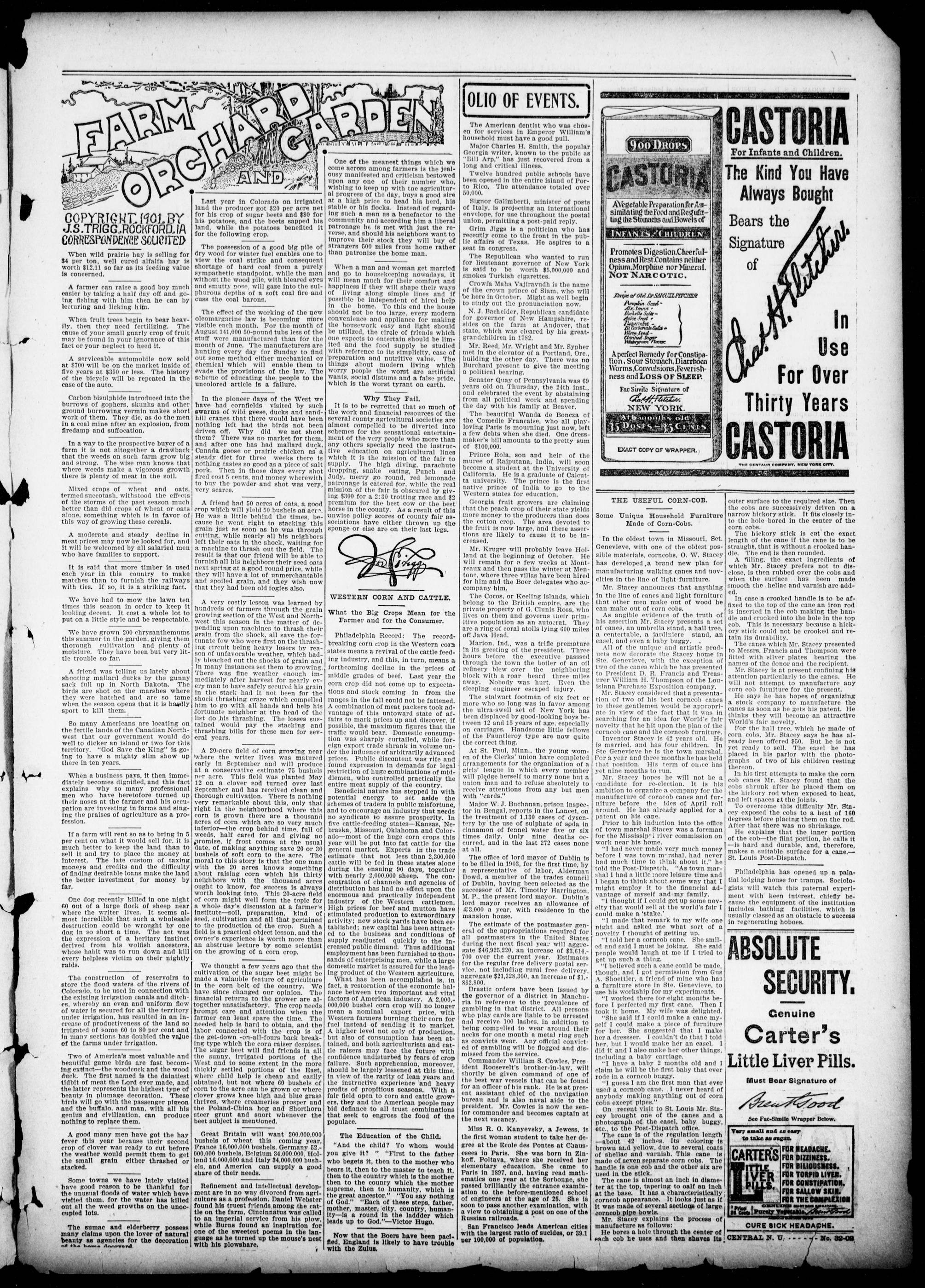
FARM ORCHARD GARDEN AND
Last year in Colorado on irrigated land the producer got $20 per acre net
One of the meanest things which we come across among farmers is the jealousy manifested and criticism bestowed upon any one of their number who, wishing to keep up with the agricultural progress of the day, buys a good sire at a high price to head his herd, his stable or his flocks. Instead of regard-
COPYRIGHT, 1901, BY J.S. TRIGG. ROCKFORD, IA CORRESPONDENCE SOLICITED
When wild prairie hay is selling for $4 per ton, well cured alfalfa hay is worth $12.11 so far as its feeding value is concerned.
A farmer can raise a good boy much easier by taking a half day off and going fishing with him then he can by lecturing and licking him.
When fruit trees begin to bear heavily, then they need fertilizing. The cause of your small gnarly crop of fruit may be found in your ignorance of this fact or your neglect to heed it.
A serviceable automobile now sold at $700 will be on the market inside of five years at $350 or less. The history of the bicycle will be repeated in the case of the auto.
Carbon bisulphide introduced into the burrows of gophers, skunks and other ground burrowing vermin makes short work of them. They die, as do the men in a coal mine after an explosion, from firedamp and suffocation.
In a way to the prospective buyer of a farm it is not altogether a drawback that the weeds on such farm grow big and strong. The wise man knows that where weeds make a vigorous growth there is plenty of meat in the soil.
Mixed crops of wheat and oats, termed succotash, withstood the effects of the storms of the past season much better than did crops of wheat or oats alone, something which is in favor of this way of growing these cereals.
A moderate and steady decline in meat prices may now be looked for, and it will be welcomed by all salaried men who have families to support.
It is said that more timber is used each year in this country to make matches than to furnish the railways with ties. If so, it is a striking fact.
We have had to mow the lawn ten times this season in order to keep it looking decent. It cost a whole lot to put on a little style and be respectable.
We have grown 200 chrysanthemums this summer in the garden, giving them thorough cultivation and plenty of moisture. They have been but very little trouble so far.
A friend was telling us lately about shooting mallard ducks by the gunny sack full up in North Dakota. The birds are shot on the marshes where they were hatched and are so tame when the season opens that it is hardly sport to kill them.
So many Americans are locating on the fertile lands of the Canadian Northwest that our government would do well to dicker an island or two for this territory. "God Save the King" is going to have a mighty slim show up there in ten years.
When a business pays, it then immediately becomes dignified, and this fact explains why so many professional men who have heretofore turned up their noses at the farmer and his occupation are investing in farms and singing the praises of agriculture as a profession.
If a farm will rent so as to bring in 5 per cent on what it would sell for, it is much better to keep the land than to sell it and try to place the money at interest. The late custom of taxing moneys and credits and the difficulty of finding desirable loans make the land the better investment for money by far.
One dog recently killed in one night 60 out of a large flock of sheep near where the writer lives. It seems almost incredible that such a wholesale destruction could be wrought by one dog in so short a time. The act was the expression of a heritary instinct derived from his wolfish ancestors, whose habit was to run down and kill every helpless victim on their nightly raids.
The construction of reservoirs to store the flood waters of the rivers of Colorado, to be used in connection with the existing irrigation canals and ditches, whereby an even and uniform flow of water is secured for all the territory under irrigation, has resulted in an increase of productiveness of the land so irrigated of some 60 to 80 per cent and in many sections has doubled the value of the farms under irrigation.
Two of America's most valuable and beautiful game birds are fast becoming extinct—the woodcock and the wood duck. The first named is the daintiest tidbit of meat the Lord ever made, and the latter represents the highest type of beauty in plumage decoration. These birds will go with the passenger pigeon and the buffalo, and man, with all his genius and civilization, can produce nothing to replace them.
A good many men have got the hay fever this year because their second crop of clover was ready to cut before the weather would permit them to get the small grain either thrashed or stacked.
Some towns we have lately visited have good reason to be thankful for the unusual floods of water which have visited them, for the water has killed out all the weed growths on the unoccupied lots.
the sumac and elderberry possess many claims upon the lover of natural beauty as agencies for the decoration of the home doorward
Last year in Colorado on irrigated land the producer got $20 per acre net for his crop of sugar beets and $80 for his potatoes, and the beets sapped his land, while the potatoes benefited it for the following crop.
The possession of a good big pile of dry wood for winter fuel enables one to view the coal strike and consequent shortage of hard coal from a purely sympathetic standpoint, while the man without the wood pile, with bleared eyes and smutty nose, will gaze into the sulphurous depths of a soft coal fire and cuss the coal barons.
The effect of the working of the new oleomargarine law is becoming more visible each month. For the month of August 141,000 50-pound tubs less of the stuff were manufactured than for the month of June. The manufacturers are hunting every day for Sunday to find out some method either mechanical or chemical which will enable them to evade the provisions of the law. The scheme of educating the people to the uncolored article is a failure.
In the pioneer days of the West we have had cornfields visited by such swarms of wild geese, ducks and sandhill cranes that there would have been nothing left had the birds not been driven off. Why did we not shoot them? There was no market for them, and after one has had mallard duck, Canada goose or prairie chicken as a steady diet for three weeks there is nothing tastes so good as a piece of salt pork. Then in those days every shot fired cost 5 cents, and money wherewith to buy the powder and shot was very, very scarce.
A friend had 50 acres of oats, a good crop which will yield 50 bushels an acre. He was a little behind the times, because he went right to stacking this grain just as soon as he was through cutting, while nearly all his neighbors left their oats in the shock, waiting for a machine to thrash out the field. The result is that our friend will be able to furnish all his neighbors their seed oats next spring at a good round price, while they will have a lot of unmerchantable and spoiled grain, and they wish now that they had been old forges also.
A very costly lesson was learned by hundreds of farmers through the grain growing section of the West and Northwest this season in the matter of depending upon machines to thrash their grain from the shock, all save the fortunate few who were first on the thrashing circuit being heavy losers by reason of unfavorable weather, which badly bleached out the shocks of grain and in many instances set them to growing. There was fine weather enough immediately after harvest for nearly every man to have safely secured his grain in the stack had it not been for the shock thrashing craze which compelled him to go with all hands and help his fortunate neighbor at the head of the list do his thrashing. The losses sustained would pay the stacking and thrashing bills for these men for several years.
A 20-acre field of corn growing near where the writer lives was matured early in September and will produce at a conservative estimate 75 bushels per acre. This field was planted May 12 on a clover sod turned over last September and has received clean and thorough cultivation. There is nothing very remarkable about this, only that right in the neighborhood where this corn is grown there are a thousand acres of corn which are so very much inferior—the crop behind time, full of weeds, half cared for and giving no promise, if frost comes at the usual date, of making anything save 20 or 20 bushels of soft corn to the acre. The moral to this story is that the one man with the 20 acres knows something about raising corn which his thirty neighbors with the thousand acres ought to know, for success is always worth looking into. This 20-acre field of corn might well form the tople for a whole day's discussion at a farmer's institute—soil, preparation, kind of seed, cultivation and all that pertained to the production of the crop. Such a field is a practical object lesson, and the owner's experience is worth more than an abstruse lecture by some scientist on the growing of a corn crop.
We thought a few years ago that the cultivation of the sugar beet might be made a valuable feature of agriculture in the corn belt of the country. We have since changed our opinion. The financial returns to the grower are altogether unsatisfactory. The crop needs prompt care and attention when the farmer can least spare the time. The needed help is hard to obtain, and the labor connected with the crop is of the get-down-on-all-fours back breaking type which the corn raises despies. The sugar beet will find friends in all the sunny, irrigated portions of the West and to some extent in the more thickly settled portions of the East, where child help is cheap and easily obtained, but not where 60 bushels of corn to the acre can be grown or where clover grows knee high and blue grass thrives, where creameries prosper and the Poland-China hog and Shorthorn steer grunt and snort whenever the beet subject is mentioned.
Great Britain will want 200,000,000 bushels of wheat this coming year, France 16,000,000 bushels, Germany 52,000,000 bushels, Belgium 34,000,000 Holland 16,000,000 and Italy 34,000,000 bushels, and America can supply a good share of their needs.
Refinement and intellectual development are in no way divorced from agriculture as a profession. Daniel Webster found his truest friends among the cattle on the farm, Cincinnatus was called to an imperial service from his plow, while Burns found an inspiration for one of the sweetest poems in the language as he turned up the mouse's nest with his plowshare.
One of the meanest things which we come across among farmers is the jealousy manifested and criticism bestowed upon any one of their number who, wishing to keep up with the agricultural progress of the day, buys a good sire at a high price to head his herd, his stable or his flocks. Instead of regarding such a man as a benefactor to the community and according him a liberal patronage he is met with just the reverse, and should his neighbors want to improve their stock they will buy of strangers 500 miles from home rather than patronize the home man.
When a man and woman get married and go to housekeeping nowadays, it will mean much for their comfort and happiness if they will shape their ways of living along simple lines and if possible be independent of hired help in the home. To this end the house should not be too large, every modern convenience and appliance for making the housework easy and light should be utilized, the circle of friends which one expects to entertain should be limited and the food supply be studied with reference to its simplicity, ease of preparation and nutritive value. The things about modern living which worry people the worst are artificial wants, social distums and a false pride, which is the worst tyrant on earth.
Why They Fail.
It is to be regretted that so much of the work and financial resources of the several county agricultural societies are almost compelled to be diverted into schemes for the sensational entertainment of the very people who more than any others specially need the instructive education on agricultural lines which it is the mission of the fair to supply. The high diving, parachute dropping, snake eating, Punch and Judy, merry go round, red lemonade patronage is catered for, while the real mission of the fair is obscured by giving $300 for a 2:30 trotting race and $2 premium for the best cow or the best horse in the county. As a result of this unwise policy scores of county fair associations have either thrown up the sponge or else are on their last legs.
WESTERN CORN AND CATTLE
What the Big Crops Mean for the Farmer and for the Consumer.
Philadelphia Record: The record-breaking corn crop in the Western corn states means a revival of the cattle feeding industry, and this, in turn, means a forthcoming decline in the prices of middle grades of beef. Last year the corn crop did not come up to expectations and stock coming in from the ranges in the fall could not be fattened. A combination of meat packers took advantage of this untoward state of affairs to mark prices up and discover, if possible, the maximum figures that the traffic would bear. Domestic consumption was sharply curtailed, while foreign export trade shrank in volume under the influence of arbitrarily advanced prices. Public discontent was rife and found expression in demands for legal restriction of huge combinations of middlemen, who controlled practically the entire meat supply of the country.
Beneficial nature has stepped in with potential energy to set aside the schemes of traders in public misfortune, and to encourage an industry that needs no syndicate to assure prosperity. In five cattle-feeding states—Kansas, Nebraska, Missouri, Oklahoma and Colorado—most of the huge corn crops this year will be put into fat cattle for the general market. Experts in the trade estimate that not less than 2,300,000 cattle will be fed in these states alone during the ensuing 90 days, together with nearly 2,000,000 sheep. The concentration of channels and agencies of distribution has had no effect upon the enormous and practically independent industry of the Western cattleman. High prices for beef and mutton have stimulated production to extraordinary activity; new stock yards have been established; new capital has been attracted to the business and conditions of supply readjusted quickly to the increased public demand. Thus additional employment has been furnished to thousands of enterprising men, while a large domestic market is assured for the leading product of the Western agriculture.
What has been accomplished is, in fact, a restoration of the economic balance between two important and vital factors of American industry. A 2,000-000,000 bushel corn crop will no longer mean a nominal export price, with Western farmers burning their corn for fuel instead of sending it to market. A higher level not only of production, but also of consumption has been attained, and both agriculturists and cattle raisers may face the future with confidence undisturbed by fears of crop failure. Such apprehension, moreover, should be largely lessened at this time, in view of the rarity of lean years and the instructive experience and heavy profits of propitious seasons. With a fair field open to corn and cattle growers, they and the American people may bid defiance to all trust combinations that seek to engross the food of the populace.
The Education of the Child.
"And the child? To whom would you give it? " "First to the father who begets it, then to the mother who bears it, then to the master to teach it, then to the country which is the mother then to the country which the mother supreme, then to humanity, which is the great ancestor." "You say nothing of God." "Each of these steps, father, mother, master, city, country, humanity—is a round in the laddder which leads up to God." -Victor Hugo.
Now that the Boers have been pacified, England is likely to have trouble with the Zulus.
The American dentist who was chosen for services in Emperor William's household must have a good pull.
Major Charles H. Smith, the popular Georgia writer, known to the public as "Bill Arp," has just recovered from a long and critical illness.
Twelve hundred public schools have been opened in the entire island of Porto Rico. The attendance totaled over 50,000.
Signor Gallimberti, minister of posts of Italy, is projecting an international envelope, for use throughout the postal union, permitting a post-paid reply.
Grim Jiggs is a politician who has recently come to the front in the public affairs of Texas. He aspires to a seat in congress.
The Republican who wanted to run for lieutenant governor of New York is said to be worth $5,000,000 and smokes Turkish cigarettes.
Crowfa Maha Vajiravudh is the name of the crown prince of Slam, who will be here in October. Might as well begin to study out the pronunciation now. N. J. Bachelder, Republican candidate for governor of New Hampshire, resides on the farm at Andover, that state, which was cleared by his great-grandchildren in 1782. Mr. Reed, Mr. Wright and Mr. Sypher met in the elevator of a Portland, Ore., building the other day. There was no Burchard present to give the meeting a political bearing. Senator Quay of Pennsylvania was 69 years old on Thursday, the 24th inst., and celebrated the event by abstaining from all political work and spending the day with his family at Beaver. The beautiful Wanda de Boncea of the Comedie Francaise, who all play-loving Paris is mourning just now, left a few debts when she died. One dressmaker's bill amounts to the pretty sum of $100,000.
Prince Rola, son and heir of the murree of Rajputana, India, will soon become a student at the University of California. He is a graduate of Calcutta university. The prince is the first native prince of India to go to the Western states for education.
Georgia fruit growers are claiming that the peach crop of their state yields more money to the producers than does the cotton crop. The area devoted to the fruit is now large, and these assertions are likely to cause it to be increased.
Mr. Kruger will probably leave Holland at the beginning of October. He will remain for a few weeks at Montreaux and then pass the winter at Mentone, where three villas have been hired for him and the Boer delegates who accompany him.
The Cocos, or Keeling islands, which belong to the British empire, are the private property of G. Clunius Ross, who lives on them and governs their primitive population as an autocrat. They are a ring of coral atolls lying 600 miles off Java Head. Marion, Ind., was a trifle premature in its greeting of the president. Three hours before the executive passed through the town the boiler of an oil refinery blew over the neighboring block with a roar heard three miles away. Nobody was hurt. Even the sleeping engineer escaped injury. The stalwart footman of six feet or more who so long was in favor among the ultra-swell set of New York has been displaced by good-looking boys between 12 and 15 years of age, especially on carriages. Handsome little fellows of the Fauntleroy type are now quite the correct thing.
At St. Paul, Minn., the young women of the Clerks' union have completed arrangements for the organization of a girl's league in which every member will pledge herself to marry none but a union man and to refuse absolutely to receive attentions from any but men with "cards."
Major W. J. Buchanan, prison inspector in Bengal, reports in the Lancet, on the treatment of 1,130 cases of dysentery by the use of sulphate of soda in cinnamon of fennel water five or six times daily. Only nine deaths occurred, and in the last 272 cases none at all.
The office of lord mayor of Dublin is to be filled in 1903, for the first time, by a representative of labor, Alderman Dowd, a member of the trades council of Dublin, having been selected as the successor of Mr. Timothy Harrington, M.P., the present lord mayor. Dublin's lord mayor receives an allowance of £3,000 a year, with residence in the mansion house.
The estimate of the postmaster general of the appropriations required for all postmasters in the United States during the next fiscal year will aggregate $46,925,220, an increase of $3,614-700 over the current year. Estimates for the regular free delivery postal service, not including rural free delivery, aggregate $21,328,300, an increase of $1,-882,800. Drastic orders have been issued by the governor of a district in Manchuria in reference to the prevalence of gambling in that district. All persons who play cards are liable to be arrested and receive 100 lashes, in addition to being compelled to wear around their necks for one month a metal ring such as convicts wear. Any official convicted of gambling will be flogged and dismissed from the service.
Commander William S. Cowles, President Roosevelt's brother-in-law, will shortly be given command of one of the best war vessels that can be found for an officer of his rank. He is at present assistant chief of the navigation bureau and is also naval alie to the president. Mr. Cowles is now the senior commander and becomes captain at the next vacancy.
Miss R. O. Kanyevsky, a Jewess, is the first woman student to take her degree at the Ecole des Pontes at Chaucees in Paris. She was born in Zinkoff. Poltava, where she received her elementary education. She came to Paris in 1887, and having read mathematics one year at the Sorbonne, she passed brilliantly the entrance examination to the before-mentioned school of engineers at the age of 25. She is soon to pass another examination, with a view to obtaining a post on one of the Russian railroads.
San Francisco leads American cities with the largest ratio of suicides, or 33.1 per 100,000 of population.
900 DROPS
CASTORIA
A Vegetable Preparation for Assimilating the Food and Regulating the Stomachs and Bowels of
INFANTS & CHILDREN
Promotes Digestion, Cheerfulness and Rest. Contains neither Opium, Morphine nor Mineral.
NOT NARCOTIC.
Recipe of Old Dr. SMOOTH PITCHER
Pumpkin Seed -
Alk. Sweet -
Ricotta Salad -
Raisin Seed -
Lagering -
Blastomarine Salad -
Wheat Seed -
Clarified Sugar
Whittygreen Flavor.
Aperfect Remedy for Constipation, Sour Stomach, Diarrhoea Worms, Convulsions, Feverishness and LOSS OF SLEEP.
Fac Simile Signature of
Charles H. Hitchner
NEW YORK.
At least 35 DROPS = 35 CENTS
EXACT COPY OF WRAPPER.
CASTORIA
For Infants and Children.
The Kind You Have Always Bought
Bears the Signature of
Charles H. Hitchner.
In Use
For Over Thirty Years
CASTORIA
THE CENTAUR COMPANY, NEW YORK CITY.
THE USEFUL CORN-COB.
Some Unique Household Furniture
Made of Corn-Cobs.
In the oldest town in Missouri, Set. Genevieve, with one of the oldest possible materials, corncobs, O. W. Stacey has developed, a brand new plan for manufacturing walking canes and novelties in the line of light furniture.
Mr. Stacey announces that anything in the line of canes and light furniture that other men make out of wood he can make out of corn cobs.
As angible evidence of the truth of his assertion Mr. Stacey presents a set of canes, an umbrella stand, a hall tree, a centertable, a jardiniere stand, an easel, and even a baby buggy.
All of the unique and artistic products now decorate the Stacey home in Ste. Genevieve, with the exception of two of the canes which he has presented to President D. R. Francis and Treasurer William H. Thompson of the Louisiana Purchase Exposition company.
Mr. Stacey considered that a presentation of two of his best corncob canes to these gentlemen would be appropriate in view of the fact that it was in searching for an idea for World's fair novelty that he hit upon the plan of the corncob cane and the corncob furniture. Inventor Stacey is 42 years old. He is married, and has four children. In Ste Genevieve he is the town marshal. For a year and three months he has held that position. His term of office has yet nine months to run.
Mr. Stacey hopes he will not be a candidate for re-election. It is his ambition to organize a company for the manufacture of corncob canes and furniture before theides of April roll around. He has already applied for a patent on his cane.
Prior to his induction into the office of town marshal Stacey was a foreman for the Mississippi river commission on work near his home.
"I had never made very much money before I was town marshal, had never had much time to think about it," he told the Post-Dispatch. "As town marshal I had a little more leisure time and I began to think about some way that I might employ it to the financial advantage of myself and my family.
"I thought if I could get up some novelty that would sell at the world's fair I could make a 'stake'.
"I made that remark to my wife one night and asked me what sort of a novelty I thought of getting up.
"I told her a corncob cane. She smiled and said I must be joking. She said people would laugh at me if I tried to get up such a thing.
"I believed such a cane could be made, though, and I got permission from Gus A. Sheottler, a friend of mine who has a furniture store in Ste. Genevieve, to use his workshop for my experiments.
"I worked there for eight months before I perfected my first cane. Then I took it home. My wife was delighted.
"She said if I could make a cane myself I could make a piece of furniture for her. She suggested that I make her a dresser. I couldn't do that I told her, but I would make her an easel. I did it and I also make her other things, including a baby carriage.
"I have a baby 2 months old and I claim he will be the first baby that ever rode in a corncob buggy.
"I guess I am the first man that ever used a corncob cane. I never heard of anybody making anything out of corn cobs except pipes."
On recent visit to St. Louis Mr. Stacey brought one of the canes and a photograph of the easel, baby buggy, etc. to the Post office office.
"To the regulation length—about 42 inches. Its coloring is brown and yellow, due to several coats of shellace and varnish. This cane is made of seven separate corn cobs. The handle is one cob and the other six are used in the stick."
The cane is almost an inch in diameter at the top, tapering to oalf an inch at the base. It has a characteristically cornbock appearance. It looks just as if it was made of several sections of large cornbock pipe bowls.
Mr. Stacey explains the process of manufacture as follows:
He bores a hole through the center of each cob he uses and then shaves its
outer surface to the required size. Then the cobs are successively driven on a narrow hickory stick. It fits closely into the hole bored in the center of the corn cobs. The hickory stick is cut the exact length of the cane if the cane is to be straught, that is without a crooked handle. The end is then rounded. A filling, the exact ingredients of which Mr. Stacey prefers not to disclose, is then rubbed over the cobs and when the surface has been made smooth the.hellac and varnish are added. In case a crooked handle is to be affixed to the top of the cane an iron rod is inserted in the cob making the handle and crooked into the hole in the top cob. This is necessary because a hickory stick could not be crooked and retain its durability. The canes which Mr. Stacey presented to Messrs. Francis and Thompson were fitted with silver plates bearing the names of the donor and the recipient.
Mr. Stacey is at present confining his attention particularly to the canes. He will not attempt to manufacture any corn cob furniture for the present.
He says he has hopes of organizing a stock company to manufacture the canes as soon as he gets his patent. He thinks they will become an attractive World's fair novelty.
For the hall tree, which he made of corn cobs, Mr. Stacey says he has already been offered $50. But he is not yet ready to sell. The easel he has placed in his parlor with the photographs of two of his children resting thereon.
In his first attempts to make the corn canes Mr. Stacey found that the cobs shrunk after he placed them on the hickory rod when exposed to heat, and left spaces at the joints.
To overcome this difficulty Mr. Stacey exposed the cobs to a heat of 160 degrees before placing them on the rod. After that there was no shrinkage.
He explains that the inner portion of the cob—the flint portion, he calls it—is hard and durable, and, therefore, makes a suitable surface for a cane. St. Louis Post-Dispatch.
Philadelphia has opened up a palatial lodging house for tramps. Sociologists will watch this paternal experiment with keen interest, chiefly because the equipment of the institution includes bathing facilities, which is usually classed as an obstacle to success in regenerating hoboes.
ABSOLUTE
SECURITY.
Genuine
Carter's
Little Liver Pills.
Must Bear Signature of
Grant Good
See Fac-Simile Wrapper Below.
Very small and as easy
to take as sugent.
CARTERS
LITTLE
LIVER
PILLS.
FOR READACHE.
FOR DIZZINESS.
FOR DILIOUSNESS.
FOR TORPID LIVER.
FOR CONSTIPATION.
FOR SALLOW SKIN.
FOR THE COMPLEXION
9 Prices
26 Cents
Purely Vegetable
GENUINE
MARKET NAME
CURE SICK HEADACHE.
CENTRAL N. U. - - - - - No. 32-08
This book contains One Hundred Treatises on Thirty-Eight General Topics in which the negro problem is viewed from every possible angle. It would more fully respond to citizenship, it will furnish the basis of future calculations on all race subjects. There are
100 PORTRAITS AND 100 BIOGRAPHIES of the writers. To see the pictures and read the lives of the hundred most famous writers, visit www.100bios.org. Over 700 large pages and retails at $2.50 in cloth, postpaid.
AGENTS: We want 5,000 cavassiers at once to introduce this great book. Highest commissioned. Books on credit. Agents on credit. Write for our proposition at once. This is the opportunity of your life.
The Professional World
RUFUS L. LOGAN, B. S. D. - EDITOR
Advertising Rates on Application.
Job Work of all Kinds Solicited.
Published Every Friday.
Entered at the postoffice at Colum-
umbia, Mo., as second class matter,
Jan. 15, 1902.
Agents wanted in every town in the
state.
PRESS OF THE MISSOURI STATESMAN.
AFTER all we may be compelled
to acknowledge that Henry George
was about right in his ideas re-
garding single taxation.
OUR thanks are due Rev. Wm. Young, of Macon City, Mr. Edward Brown, of Columbia, and Miss Dora Turner, of Ashland, for subscriptions to the Professional World this week.
THE recent cold blooded murder of Edward Chapman at Brown Station is to be regretted by all citizens of Boone county. Such occurrences are bad advertisements for any community.
THE "Northwestern Vine" published in Minnesota reminds the republican leaders of the manner in which they make use of the negro and his vote during the campaigns and forget they exist afterwards. Negroes should unite their forces and furnish the republican party with a surprise and thus show their strength and value.
PLAIN TALK.
Bishop C. T. Shaffer when giving out the appointments to the members of the conference at Moberly last Sunday lectured the ministers regarding their conduct. He called their attention to the fact that the minister should be the most refined man in the community and referred to the habit of so many ministers who, in making their "pastoral calls" call at the same house every time and remain an unreasonable length of time, ignoring other members of their congregation, etc. The Bishop's remarks are very timely. Let it be said to the shame and disgrace of some of those occupying the sacred rostrum and preaching Christianity to great congregations and often do we find them answering to grave charges of drunkenness and immorality etc. It is sad and it is to be regretted that such infest some communities but never the less it is true.
At Lincoln Institute.
Elder J. B. Parsons, President of the Christian Church Co-operation in Missouri, delivered an address to the students of Lincoln Institute last Sunday at 3. p. m., on the subject, "Crown Your Hope." Elder Parsons is an able speaker, and the subject was made very impressive.
A special program had been arranged by Prof. Reynolds, and the attendance was good. Madams Anthony and Salone Yates, were both present, and in their good humoredly way, added much to the dignity of the services. The singing was led by Miss Carney, and it was excellent. President B. F. Allen officiated in the meeting, and at the close of the services, made some very eulogistic remarks, with reference to the faithfulness and perseverance of the students.
DR. D. W. OULP
MONUMENT DEDICATED.
Memory of Lincoln's Mother Honored by Thousands of Indiana People.
Thousands of Indiana People.
Special Dispatch to the Globe-Democrat.
LINCOLN CITY, IND., October. A monument to Nancy Hanks Lincoln was dedicated here to-day, and notwithstanding the disagreeable weather, the largest crowd that ever gathered in the county witnessed the ceremonies. The grove in which the monument is located was cleaned of underbrush and a number of eating stands, one capable of seating a thousand people, were erected. One of the disappointing features of the exercises was the inability of J. S. Culver to be present. He is the contractor who furnished the stone for the Nancy Hanks monument, from the old base of the Abraham Lincoln monument at Springfield. He charged nothing for the stone, and his liberality made the Nancy Hanks monument a possibility. Gen. John C. Black of Chicago delivered the oration and Gov. Durbin accepted the monument.
How's This?
We offer One Hundred Dollars Reward for any case of Catarrh that cannot be cured by Hall's Catarrh Cure.
F. J. CHENEY & Co., Toledo, O.
We, the undersigned, have known F. J. Cheney for the last 15 years, and believe him perfectly honorable in all business transactions and financially able to carry out any obligations made by their firm.
WEST & TRUAX, Wholesale Druggists, Toledo, O. WALDING, KINNAN & MARVIN, Wholesale Druggists, Toledo, O.
Hall's Cattarrh Cure is taken internally, acting directly upon the blood and mucous surfaces of the system. Testimonials sent free. Price 75 c per bottle. Sold by all Druggists. Hall's Family pills are the best.
HUNTSVILLE NOTES
Rev. G. C. Chinn was in Macon City this week.
Rev. C. V. Page of Paris, preached at the A. M. E. church Monday evening.
Hon. Nelson Crews of Kansas City, passed through Huntsville Sunday evening.
The Professional World is only $1.00 per year. Order it now.
Mrs. Tennessee Warren is reported quite ill.
Mr. Edward Salisbury is out again after several days illness.
Mrs. C. B. Appleton of Kirksville, returned home Friday night after a very pleasant visit with friends and relatives in Huntsville.
Mr. David Mullen, who lives near Huntsville, met with a very painful accident last Thursday while chopping trees. He was struck by a limb and knocked into the creek, the fall resulting in a fractured hip. He is reported to be doing as well as could be expected under the circumstances.
To Our Readers.
Don't fail to patronize the business men whose advertisements you see in these columns. They show by their advertising that they appreciate your patronage.
AUXVASSE NOTES.
Mrs. Maggie Coats of Ottumwa, Iowa, arrived on the 30th of September and is visiting her mother, Mrs. Loraine Henderson, and other relatives of this place. Rev. William Young, of Macon City, who is a recent subscriber to the Professional World, is succeeding nicely as our pastor here. He is at present a student at Western College and is a very progressive young men. The ladies of the sewing circle have put a new pulpit in the church which adds much to the looks of the church.
THE CITY LEGISLATURE.
Local Law-makers Pass Ordinances, Allow Accounts, and So Forth.
City Council met at their hall Tuesday night. Present, Mayor Parker, Clerk Bicknell, Attorney Rothwell, Marshal Slate, Street Commissioner Edwards, and all the Council. The election returns were canvassed, showing the election of W. H. Rothwell, city attorney, and W. S. Pratt, councilman from fourth ward. These gentlemen were inducted into office. A petition for an arch light in the front of the Catholic church was referred to the Water and Light committee. A petition asking council to provide a house for voting precinct in fourth ward was referred to the committee on city property.
A petition from citizens in that neighborhood, asking the abatement of a pig pen nuisance now maintained by Thomas Ridgeway, was referred to health committee.
On petition, a four foot granitoid sidewalk was ordered on west side of Seventh street from Conley avenue to Rollins street.
The sum of $798.12 was appropriated out of the general revenue fund for salaries and current city expenses; and $16.10 out of the Conley poor fund for the worthy poor.
Ordinances were passed as follows: Making it a misdemeanor for any one to give a false police or fire alarm. Making it a misdemeanor for persons to wash animals or vehicles on the sidewalks, streets or alleys of the city. Making it a misdemeanor for one to beat his wife or child. Making it a misdemeanor to loudly swear or use offensive or indecent language. The penalties prescribed for violation of each of the foregoing ordinances is a fine of from $1 to $100. An ordinance authorizing the construction of sewer district No. 11, and the clerk was ordered to advertise for bids for said work, bids to open at next meeting of council, Oct. 21st.
The city engineer reported sewers in district No. 9 completed according to contract—total per thousand square feet being $2.59. Ordnance thereupon act levying tax upon real estate in the district on this basis. In the matter of improving the Fyfer hill on east Broadway, the street commissioner, attorney and engineer were in power to ascertain what part of the hill belongs to the city and to expend not more than $100 out of the street fund for the improvement of same.
Columbia Boy Stabbed.
News reached Columbia last Friday morning that Irvin Stephens, son of Mrs. M. G. Quinn, was perhaps fatally stabbed in Moberly by two men from Cairo, a little mining town near there. Stephens formerly lived in Columbia. Physicians sewed up his wounds, which were quite serious. He is yet alive and may recover.
Notice! Notice!
We will give $1.00 in cash for the best half bushel of potatoes raised in Boone county, delivered at our store. THE COLUMBIA GROCERY CO. The Railroads.
WABASH
Time Table—Columbia Branch.
GOING SOUTH.
No. 33, Arrive Columbia...8:15 a. m.
No. 35, Arrive Columbia...1:20 p. m.
No. 37, Arrive Columbia...8:45 p. m.
GOING NORTH.
No. 30, Leave Columbia...10:00 a. m.
No. 34, Leave Columbia...1:46 p. m.
No. 34, Leave Columbia...4:15 p. m.
M. K. & T. Ry.
TRAINS NORTH
TRAINS NORTH.
Leave:
McBaine .... 6:30
Webster .... 6:33
Brushwood .... 6:38
Turrier .... 6:42
Limerick .... 6:47
Arrive
Columbia .... 6:55
A. M. No. 36
6:30 11:53
6:33 11:58
6:38 12:00
6:42 12:06
6:47 12:11
6:55 12:19
TRAINS SOUTH.
Leave
Columbia.... 11:00
Limerick.... 11:08
Brushwood.... 11:12
Webster.... 11:22
A. M. No. 35
St. Louis
Express 11:00 3:10
11:08 3:18
11:12 3:22
11:17 3:27
11:22 3:32
11:25 3:35
P. M. No. 37
Texas
Express 3:10 3:60
3:18 3:38
3:22 3:42
3:27 3:52
3:32 3:52
3:35 3:55
MOSES H. CALDWELL,
For Horse Shoeing and First- Class Blacksmithing of all Kinds.
FURNITURE!
EVERYONE INVITED TO VISIT OUR STORE AND INSPECT THE LARGEST LINE OF FURNITURE AND UNDERTAKER'S GOODS EVER CARRIED IN THIS SECTION OF THE STATE.
WALTHERS HAS ALL KINDS OF FURNITURE AND DOES FUNERAL DIRECTING.
GO TO
Lodge and Church Directory.
LODGE.
S. M. T.
Mrs. Irena Akers W. P.; Mrs. Lizie Williams, W. S.
LODGE.
Meeting first Monday in each month at 3 p. m.
U. B. F.
Crispus Attucks Lodge,No. 62. Meetings 2nd and 4th Tuesdays in each month. Visiting members cordially invited. Caleb Hall, W. M. A. M. Schweich, W. S.
K. P.
Acme Lodge, No. 24. Meetings second and fourth Fridays in each month. W. H. Turner, C. C. and D. D. G. C. W. W. Lampkins, M. F.
O. E. S.
Amos Chapter, No. 30. Meetings second Friday in each month. Mrs. A. B. Moore, W. M. Mrs. Lizzie Richardson, W. S.
LADIES COURT.
Golden Queen Court No. 19 meets first Friday in each month. Mrs. Annie Williams M. A. M. Mrs. V. L. Waldon Sec.
ST. PAUL LODGE, NO. 12.
St. Paul Lodge, No. 12, A. F. & A. M., meets every first and third Tuesday in each month. A cordial invitation extended to all visiting brothers. J. A. Mosely, W. M. J. A. Grant, Secretary.
SECOND CHRISTIAN CHURCH.
Rev. J. B. Parsons, pastor.
Preaching Sundays 11 a. m. and 7:30 p. m.
Prayer meeting Wednesdays 7:30 p. m.
Everybody cordially invited to attend.
Rev. P. C. Crews, Pastor.
Preaching Sundays 11 a.
m.; 7:30 p. m.
Sunday school 2:30 p. m.
Prayer meeting every
Wednesday eve, at 8:30; every
body invited to attend.
M. E. CHURCH
Rev. J. Arlington Grant, pastor.
Preaching Sundays 11, a. m. and 7:30 p. m.
Sunday school, 9:30 a. m.
Prayer meeting Wednesdays 7:30 to 8:30; all are made welcome.
SECOND BAPTIST CHURCH.
Rev. A. A. Adams, Pastor.
I doctored for a year and a half for what the doctor told me was gall stones. I had read so much about the relief Ripans Tabules gave other people, I thought I would get some. I have used eight of the 5-cent boxes and have not had a spell since.
AT DRUGGISTS.
The five-cent price for an ordinary family bottle, sixte a supply for a yes
The Colum cery
Keeps constant a fresh supply
FANCY GR
YOUR PRODU
Columbia
Grocery Co.,
ps constantly on his
sh supply of staple
BY GROCER
PRODUCE WA
The five-cent package is enough for an ordinary occasion. The family bottle, sixty cents, contains a supply for a year.
The Columbia Gro=cery Co.,
Preaghing Sundays 11 a. m., and 7:30 p. m.
Sunday school at 2:30 p. m.
Prayer meeting Wednesday evening, 7:30.
A cordial invitation extended to all.
Read the Professional World.
It is $1.00 per year.
---
nbia Gro=
Co.,
ently on hand
of staple and
PROCERIES.
CE WANTED.
Notice to Correspondents.
All news from regular correspondents must reach us not later than Thursday morning to insure insertion. Write only on one side of paper and space each item plainly. Send only news items and do not attempt to write editorials.