The Professional World
Friday, October 24, 1902
Columbia, Missouri
Page text (machine-generated)
THE PROFESSIONAL WORLD.
$1.00 Per Year in Advance.
The Candidates in Cole County.
The following named gentlemen are the candidates on the Republican county ticket this fall. They are all well known business men and are excellent gentlemen.
For Representative, Dr. J. P. Porth.
For County Clerk, Emil Raithel.
For Circuit Clerk and Recorder, C. W. Clarenbach.
For Prosecuting Attorney, Conrad Waldecker.
For Sheriff, Henry Hagener.
For Sherin, Henry Hagener.
For Collector of the Revenue,
Chris J. Miller.
For Treasurer, Emil Schott.
For Probate Judge, J. J.
Sommer.
For Coroner,
For Presiding Judge, T. M.
Barker.
For Judge—First District,
George W. Spurr.
For Judge—Second District, E.
W. Heidbreder.
For Justice of the Peace—Jefferson Township, Charles E. Pollock,
Ed. L. King, Charles T. Bartlett.
For Constable, Joseph C. Weiss.
Lebanon School Entertainment.
Lebanon, Mo., Oct. 19th, 1902. The summer school rendered an excellent literary program Friday night at the Baptist church. The church was well filled, and every one was well pleased with the exercises. After the program Prof. J. H. Renfro delivered an address, he spoke on the following subjects. The stage of life and the actors. Relation of the parent to the teacher. Education the results of careful training. The following gem closed his address:
There is a gem of greater worth,
Than all the jewels fair of earth, Which had from God, its wondrous birth, It is the mind. Rev. McAllister, of Springfield, responded to the address, in which, he heartily indorsed the address and made several interesting remarks on education. The exercises were closed with a chorus by the school choir, entitled, "The Village Band."
Schools and Teachers.
The class of '79 Princeton will celebrate October 25 in a more than usually pleasant way. Prof. Woodrow Wilson, a member of this class, will be inaugurated president of the university, and besides that the ground will be broken for a new dormitory, the gift of this class.
The enrollment at the Sheffield school, Yale university, is 743, to 675 enrolled at the same time last year. The enrollment at the Missouri State University is 1440.
The Northwestern university at Chicago has purchased the historic Tremont house, and it will be dedicated for university purposes on October 20, at which time an address will be given by Oliver Wendell Holmes the new supreme judge of the United States. The Woman's Home Missionary Society of the M. E. Church started a'movement in Kansas City this
50 YEARS' EXPERIENCE
PATENTS
TRADE MARKS DESIGNS
COPYRIGHTS & C.
Anyone sending a sketch and description may quickly ascertain our opinion free whether an patent is properly patentable. Communications strictly confidential. Handbook on Patents sent free. Oldest agency for securing patents. Patents taken through Muni & Co. receive special notice, without charge, in the
week to have the Bible put into the public schools of this country. President Eliot, of Harvard University, in a speech last Friday made an attack on the present public school system. He virtually read an indictment against the public school system. He found radical fault with the work of the public schools of America, and claimed that the public schools have not kept pace with social development during the last fifty years, and that such industrial wars as are on now are an evidence that the common schools have not done their work as they should.
In fine, Dr. Eliot said: "That the results of American education have hitherto fallen far short of the hopes and expectations of its founders." and that the American people cannot afford to persist in the present low school expenditure per pupil.
Jefferson City News.
Mrs. Thomas Harrold is serious ly ill.
Subscribe to the Professional World $1.00 a year.
R. J. Goins attended the State Baptist Convention at K. C. last week.
Dr. J. H. Garnet preached at Central Baptist Church St. Louis on the 12th Inst.
Mr. Ollie Brook the artist of Kansas City was in the City last week on business.
Prof. J. W. Damel is attending the National Christian Convention at Omaha Nebraska.
Miss Leona Bennett who is taching school at Clarksburg spent last Sunday in the City
Mesdames S. Wiseman and Lou Patterson have returned from a weeks visit in St. Louis.
Mr. J. C. McMahan of Fulton has purchased a lot on Lafayette St. from Mr. M. D. Maberry.
Miss Florence Pigeon arrived in the City Wednesday and will be assistant music teacher at Lincoln Institute.
Mesdames Diggs and Goins have returned from Kansas City where they attended the State Baptist Convention; they report a pleasant time and a profitable meeting.
Mr. Hiram Brooks has returned from Springfield, Iils., where he went to attend the funeral of his son, David, who was crushed to death in a packing house in that city.
Mrs. J. Silone Yates, President of the Womans' National Federation, lectured at the Second Baptist Church Sunday, the 12 Inst, to an appreciative audience. Her subject was, "A Single Standard of Morality a Social Necessity." We cannot speak too highly of the lecture of this talented lady.
Huntsville Notes
Mr. Gilmore Cross is on the sick list.
Mr. Andrew Finney is reported quite sick.
Miss Fannie Taylor left last Monday for Kansas City.
Rev. G. C. Chinn is conducting a revival at the Baptist church.
Miss Della Bailer, of Salisbury, visited Misses Frances and Mabel Finney on last Saturday.
Rev. E. D. Green passed through Huntsville last week enroute to Kansas City.
Rev. P. W. Bryant of Liberty held quarterly meeting at the A. M. E. church last Sunday.
The total enrollment in the Lincoln school is as follows: Prin. R. L. Logan's room 63 Mrs. Ambrosia Viley asst's, room 97.
Auxvasse Items.
Rev. Sears of New London has been called to the pastorate of the
COLUMBIA, MISSOURI, FRIDAY, OCT. 24, 1902.
Baptist Church here and was installed by Rev. Wm. H. Young last Sunday afternoon.
The Gravel Road Case Much interest was shown cases of Columbia & Cedar
Capt. C. H. Tandy of St. Louis spoke in Auxvasse last Saturday evening. Mr. E. A. Minor drove over with him from Fulton. Mr. Tandy delivered a fine address; he has traveled very extensively and could tell many things of interest, among other things he said that too many colored people were like the Tortoise, as they carried all they had on their backs; he said that he had traveled in states for the distance of 650 miles and be traveling on land owned by colored people all the time and advised the young negroes to accumulate some real estate, etc.
Married.
HOLMES-WATTS—At the A. M. E. church parsonage at Huntsville, Mo., Friday evening Oct. 11th, 1902, Rev. D. A. ____ officiating, Mr.Joseph Holmes and Mrs. MalindaWatts, both of Huntsville.
Died.
TODD—At her home near Randolph Springs, Wednesday Oct. 15th, 1902, Mrs. Hattie Todd, age 38 years. She leaves a husband and three children to mourn her death.
To Our Reader.s
Don't fail to patronize the business men whose advertisements you see in these columns. They show by their advertising that they appreciate your patronage.
Coal Strike Ended.
Wilkesbarre, Pa., Oct. 21.—The convention of delegates representing the Mine Workers in the hard coal district of Pennsylvania voted at 11:55 o'clock to-day to end the strike. The vote was unanimous. The decision was greeted with tremendous cheering. It was decided that all men needed to put the mines in condition for work can return today. The coal miners themselves are to go back Thursday. The strike was called 163 days ago, nearly five and one half months. It was ended only when a coal famine had settled upon the nation.
Mule-Footed Hogs.
Dr. R. S. Black of Ottawa, who is owner of the flue Fair Acres stock farm south of Warrensburg will introduce next spring a novelty on his farm in the shape of stock. He has contracted with a breeder in Minnesota for a number of head of mule-footed hogs. The hogs are just as good a breed as a Poland China, and it is claimed they are immune from cholera. They are characterized by having no split in their hoops. They have been developed from the old hogs of the South to first-class animals.
Some Horse Cases.
Much of the time of the present term of circuit court was taken up in the trial of suits about horses. The first of these cases was that of John R. Stites vs. D. T. Hubbard, which was a suit for damages on account of false and fraudulent statements having been made (so it was alleged) as to the condition and ages of two carriage horses. This was a Centralia case, and it was tried at the June term 1908 of the circuit court, but the jury failed to agree. This term, it was tried before Judge Hockaday, and he found for the defendant. T. S. Carter and J. H. Cupp represented Mr. Stites; and Mr. Hubbard was represented by J. L. Stephens, Arthur Bruton and Frank Harris.
Geo. A. Gilpin sued the M. K. & T. railroad for killing his horse on a bridge near McBaine. A trial before Judge Hockaday, without a jury, resulted in a verdict for plaintiff for $150. Webster Gordon was attorney for Mr. Gilpin, and the railroad had its usual attorney, Geo. B. P, Jackson.
J. T. B. Redmond's case against M., K. & T. railroad was tried on Tuesday; it was for damages on account of killing of two horses at Huntsdale. Judge Hockaday decided this case in favor of defendant. Webster Gordon appeared for Mr. Redmond, and the road had C. B. Sebastian and W. H. Truitt. Jr.
The Gravel Road Cases.
Much interest was shown in the cases of Columbia & Cedar Creek Turnpike Co. vs I. C. Vivion, Jno. W. McBride, B. H. McKimpson, Turner Hamilton and Henry Frazier. These were suits for the collection of toll, alleged to be due this company from the various defendants, and for sums running from $2.43 up to $26.20. The defense was that the gravel road was not in good condition, and therefore the plaintiff had no right to charge or collect any toll. The cases originated in Justice's Boggs' court, where there was a judgment for all the defendants; the company appealing. After two days trial in the Circuit court at this term, and the examination of various records and about forty five witnesses, judgment was rendered for the company—the cases being tried before Judge Hockaday without a jury. It is understood that an appeal has been taken by all five of the defendants. N. T. Gentry represented the gravel road people; and C. B. Sebastian, Col. S. Turner and Judge W. M. Williams are attorneys for the defendants.
Marriage Licenses This Week
Dot Sappington, Ashland, and Lula Maupin, Columbia.
W. E. Roberts and Berbie Schultz, Centralia.
R. B. Glenn, Columbia, and Miss Pearl Cason, Stephens' Store.
R. L. Boldin, Columbia, and Ora Rummans.
Wm. H. Weant and Sophia Little, Englewood.
Arthur T. Bullard, Ashland, and Bessie Wilson, New Bloomfield.
Joe Freeman and Ollie Arnold, colored, Rocheport.
Grand Jury Work.
The grand jury Saturday returned an indictment against Fleetwood Gordon for the murder of H. G. Doeling last July. When arraigned Monday defendant pleaded not guilty and the case was continued, bond being allowed by the court at $9,000, which was furnished. Other indictments returned Friday were as follows: Bud Huston, colored, larceny. Ed Anderson, colored, stealing a horse. Fred Miller, white, larceny from a dwelling house.
Five Indicted.
The grand jury last Saturday returned indictments for murder in the first degree against Allen O'Rear, Wm. McClane, Samuel Chandler, Owen Woolfolk and Gilbert Turner, who were in jail charged with the murder of E. A. Chapman at Brown Station recently. They were formally arraigned in circuit court Monday pleaded not guilty, and the cases were continued till next term. Charlie Stephens was discharged.
Died on Horseback.
While riding along the road horseback, Tuesday, near Harrisburg, Mr. Marsh Barnett of that neighborhood (and brother of Joseph W. Barnett, of Columbia), died suddenly before he could dismount. Death was due to heart failure. A neighbor who was riding beside him when he bent forward, summoned help from a farm house near, but death was almost instantaneous.
Thev Take the Cake.
J. W. Tucker, who lives a mile south of Hallsville, was here Wednesday exhibiting some fine specimens of farm products, as follows: A yellow ear of corn 15 inches long, a turnip 2 feet and 2 inches, in circumference, and blue grass whose blades were 2 feet, 9 inches long. Mr. Tucker says he has 125 acres of grass like that which has never had a plow stuck in it; and has ten acres of sorghum which is too heavy to be cut with a machine, and will cut it with corn knives. Mr. J. C. Hall wanted the corn and turnip for his Centralia real estate office, but Mr. Tucker would not let him sell land in that way.
The authorities of a college at Waukesha, Wis., have put tobacco under the most rigorous of bans. For the students its a case of abstain or get out. The other day the prex—his name is Rankin—caught two members of the football team on a street corner with cigars in their mouths. He told them to go to their rooms, pack their belongings and take the next train out of town. He said the anti-tobacco rule was going to be enforced if he had to expel the entire team.
v it. You Know it. body Knows It.
Everybody
Knows What?
Knows that R. F. Rogers carries the biggest and best line of Carpets, Rugs, Linoleums and Druggets in Boone county. Come in and see the new stock. We also carry a complete line of ladies' furnishings R. F
F. Rogers.
R. F. Rogers.
Agent for STANDARD PATTERNS.
GO TO
Lartonoix
....For School B
Fine Stationery,
noix & Wallendorf,
school Books and Supplies....
ery, Musical Goods,
---
Lartonoix & Wallendorf,
...For School Books and Supplies....
Fine Stationery, Musical Goods,
Magazines, Etc.
No. 222 East High St. = Jefferson City, Mo.
st High St. - Jefferson City, Mo.
No. 222 East High St. - Jefferson City, Mo.
Just One Minute.
I wish to exchange shoes for cash. I am after your business in the shoe line. If low prices and good quality is what you are looking for, call and examine my stock. No trouble to show goods.
PILES NO MONEY TILL CURED.
All diseases of the rectum treated on a positive Guarantee, and no money accepted until patient is cured. Send for free 200 page book: a treatise on rectal diseases, and hundreds of testimonial letters, valuable to anyone afflicted. Also our 100 page book for women, both sent free. Address, Drs. THORNTON & MINOR, 999 Oak St. Kansas City, Mo.
We Know it.
VOL. I. NO. 50.
TEXT ONLY
RUFUS L. LOGAN, B. S. D., Editor.
COLUMBIA. : : : MISSOURI
THE NEWS CONDENSED.
THE NEWS CONDENSED.
The United States cruiser Chicago has arrived at Marseilles, France, for repairs. The Spanish cabinet has agreed to a renewal of the literary copyright treaty between the United States and Spain. Coal has advanced 25 cents a ton in London. Americans are said to be inquiring for coal in Scotland and Yorkshire. Ambassador Choate and Generals Corbin, Wood and Young were guests of King Edward at luncheon at Buckingham palace. At Decatur, Ill., Harrison S. Baker, for many years a prominent contracting builder, was struck and instantly killed by a street car Wednesday. It is announced that Firmin, with all the principal leaders of the Haytian revolution, has embarked on board the United States cruiser Cincinnati, and will probably be taken to Jamaica.
According to official reports a battle was fought between Venezuelan revolutionists and the forces of President Castro, near La Victoria, which resulted in a complete victory for the government.
Carleton S. Way, son of Charles L. Way of Hartford, Conn., has just completed the first volume of a history of the United States. He is 13 years old and is the youngest historian in the world.
On petition of the Union Trust company at Detroit, the receiver of the wrecked City Savings bank, Judge Donovan, today, ordered a dividend of 20 per cent paid to the savings depositors of the bank on or before Nov. 20.
Senator Cullom of Illinois has cancelled all his political speaking appointments for the campaign on account of the recent death at Washington of his sister. It is not likely that he will make any more speeches this fall.
The North German Gazette in an official note Wednesday announced that as for reasons already stated the audience of the Boer generals with Emperor William had been abandoned, no notice will be taken officially of the generals' presence in Berlin.
One man was killed and several injured in political riots in Porto Rico.
Twenty-two Macedonian villages are reported in revolt and half a battalion of Turkish troops is said to have been annihilated by the insurgents in the Krezna defile.
The general opinion in the city of Mexico is that the American capitalists seeking to combine the cigar companies of the republic have met with insuperable obstacles. One of the chief companies is doing a greatly enlarged business and the shareholders appear unwilling to sell.
Alexander Sullivan, one of the leaders of the Union Pacific railway machinists who are on strike, and James C. Wood have been indicted by the federal grand jury at Denver, Col., on a charge of obstructing the United States mails by disabling a Union Pacific engine at Deer Trail, Col.
Many of the striking anthracite miners of Pennsylvania are flocking to the Illinois fields, where they are finding ready employment in the bituminous mines. The Illinois operators have secured rates to the Atlantic seaboard, and are preparing to ship immense quantities there.
While approaching Sioux Falls with a Rock Island passenger train Wednesday, Engineer Chancey J. Fox of Estherville was stricken with apoplexy. Although dazed and scarcely able to retain his seat in the cab, he succeeded in running his engine for a mile until the Sioux Falls station was reached. He died at the city hospital.
Indications point to the German laboring classes having a hard winter. Many companies report the business situation shows no signs of improvement. Municipalities expect more calls on public charity than last winter, and the mayor of Frankfort-on-the-Main has announced a city appropriation of $1,000,000 for relief work of various kinds to assist laborers.
The formal sale and transfer of Beauvoir, the home of Jefferson Davis, by Mrs. Davis to the Sons of Confederate Veterans was made Wednesday at the opening session of the reunion of the Mississippi division. Sons of Confederate Veterans. The place will be used as a home for indigent confederate veterans. Mrs. Davis received $10,000 for the property.
Baroness Wolfhauer, the American wife of an Austrian nobleman, is domiciled at Sioux Falls, S. D., awaiting the expiration of the six months necessary in which to gain a legal residence for the purpose of commencing divorce proceedings. She made her first appearance in Sioux Falls last spring, and was accompanied by a young daughter. Her attorney is United States Senator A. B. Kitttredge.
The eight-hour schedule went into effect at all the flour mills in Minneapolis Monday. Hereafter there will be three instead of two shifts. While the millwrights did not identify themselves with the eight-hour movement, it has been understood that the rate of 3 cents an hour would apply equally to them. It is understood that the millwrights have asked the mill operators for eight hours and $3 a day.
There are indications that the huge contest between J. Pierpont Morgan and Charles T. Yerkes for underground London will end in a combination. The total capital involved is $30,000,000 more than the capital of the new steamship combine. The Morgan applications to parliament will come up for consideration in a few weeks and London will discover at that time the magnitude of the opposing forces, which have already spent $500,000 in lawyers' fees.
The Illinois state grand lodge of Masons at its recent convention in Chicago voted $25,000 for the erection of buildings upon the 250 acres of land near Sullivan, Moultrie county, their state, bequeathed to the Masons by the late J. R. Miller for an orphans' home. The plans for the buildings comprehend accommodations for the widows of Masons as well as for the orphaned children.
BREATHE SIGH OF RELIEF.
GREAT STRIKE OF MINE WORKERS DECLARED OFF.
Vote of the Convention Was Unanimous to Accept President Roosevelt's Proposition and Leave Settlement of Differences to Commission—Strike Commission Has Been Called to Meet This Week.
Wilkesbarre, Oct. 22.—With a shout that fairly shook the convention building, the report was received that 147,000 mine workers who had been on strike since last May, had officially declared off at noon today the greatest contest ever waged between capital and labor, and placed all questions involved in the struggle into the hands of the arbitration commission appointed by President Roosevelt. When the news was sent to the towns and villages down in the valleys and on the mountains of the coal regions the strike affected, the inhabitants breathed a sigh of relief. Everywhere there was rejoicing and in many places the end of the strike was the signal for impromptu town celebrations. While the large family of mine workers and their families, numbering approximately half a million persons are grateful work is to be resumed Thursday, the strikers have still to learn what their reward will be. President Roosevelt having taken prompt action in calling the arbitrators together for their first meeting Friday, the miners hope they will know by Thanksgiving day what practical gain they have made.
The vote to resume mining was unanimous and was reached only after a warm debate. The principal objection to accepting arbitration was that no provision was contained in the scheme to take care of those who would fail to get back their positions or would be unable to get any work at all. Engineers and pumpmen get better pay than other classes of mine workers and they did not wish to run the risk of losing altogether their places and be compelled to dig coal for a living. This question came up yesterday and was argued up to the time a vote was taken. No one had any definite plan to offer to overcome the objection, and the report of the committee on resolutions recommending the strike be declared off and that all issues be placed in the hands of the arbitration commission for decision was adopted without the question being settled. A few moments before adjournment, however, a partial solution was reached when a delegate moved the problem be placed in the hands of the executive boards for solution, and his suggestion was adopted.
The principal speech of the day was made by National Secretary-Treasurer Wilson, who practically spoke for Mitchell and the National organization. In a strong argument he counselled the men to accept arbitration, the very plan the strikers themselves had offered, return to work and trust to the president's tribunal to do them justice.
The question of taking care of all men who fail to get work immediately will be a serious one for the union. There is no doubt the executive boards will take care of the engineers, firemen and pumpmen, but there will be thousands of other classes of mine workers who have to be looked after. In some places hundreds will not be able to get work for weeks, and in other localities where the mines are in very bad condition, there will be no employment for many workmen for some months. Now that the strike is over the volume of relief money will decrease and local unions will be compelled to call upon national organizations for assistance when the money now in their hands runs out. With the close of the great conflict will also end, probably this week, the assessments now being levied on all bituminous mine workers affiliated with the union. Officials who care to talk of the situation feel confident that the national body will come to their assistance and help all who stood out during the suspension.
Hundreds of men needed to repair mines and otherwise place them in condition for operation will be at work tomorrow morning, the convention having decided this imperative in order to get the men at work quickly and satisfy the country's demand for coal. All locals will hold meetings tomorrow at which instruction will be given members regarding their applications for work. Mitchell received many congratulating telegrams from all over the country after the news spread that the strike had ended.
On his returning to headquarters he was asked for an expression of his views on the action of the convention, and in reply said: "I am well pleased with the action of the mine workers in deciding to submit the issues to the commission selected by the president of the United States. The strike itself has demonstrated the power and dignity of labor. Conservative, intelligent trade unionism has received an advancement the effect of which cannot be measured. I earnestly hope and firmly believe that both labor and capital have learned lessons from the miner's strike which will enable them to keep peaceful, humane and business methods of adjusting wage differences in the future.
After Mitchell had notified President Roosevelt of the action of the convention and received a reply to the effect that the commission would meet in Washington Friday he sent an official announcement to the strikers that the strike was off and advising them to report for work Thursday morning. The notice caused the miners to exercise more than usual care in order to avoid accidents, as the present condition of the mines are such there will be great danger when work is resumed. Mitchell has not made any arrangements regarding future movements. He does not know whether he should go to Washington. The miners' leader will act as attorney for the men at all sessions of the commission and will have with him several assistants.
The Tillamook stage was held up Saturday night by three masked men five miles from North Yankill, Ore. The robbers secured $200 from the passengers, and then escaped. The highwaymen compelled the passengers to get out of the stage, stand in line at the roadside and hand over their valuables. The country is heavily timbered, and there is little probability of capturing the robbers.
ROOSEVELT'S PROMPT ACTION.
Members of Strike Commission Summoned by Telegraph to Meet at National Capital Friday.
Washington, Oct. 22—News of the termination of the strike was received by the president with great satisfaction. Before a formal telegram from Mitchell had reached him he had been informed through the Associated Press of the convention's favorable action, Telegrams had been sent members of the commission summoning them to meet here Friday. It is probable that as soon as the commission organizes President Roosevelt will present a formal letter of instructions. The first step of the commission will be to take testimony of the miners, who will be regarded as plaintiffs in the case. Both sides will be informed they are to be present either personally or by counsel. The first testimony will probably be heard at Wilkesbarre and then in Philadelphia and New York. It is probable that during the taking of testimony reporters of the press will be present. How long the hearings will continue nobody can foretell. At the conclusion each member of the commission will be supplied with a copy of the testimony and will consider it at his leisure. Subsequently the commission will reconvene, perhaps in this city, to formulate its report for presentation to the president.
Boston, Oct. 21.—The United Irish league convention today voted to send messages of congratulations to Roosevelt and Mitchell upon the ending of the coal strike.
CREAMERY AND BUTTER MEN.
National Convention Opened at Mil waukee Tuesday With a Street Parade—Other Features
Milwaukee, Wis., Oct. 22.—Over two thousand delegates are attending the tenth annual convention of the National Creamery and Butter Makers' association which opened here today. The feature of the opening day was a street parade. H. J. Neitert of Walker, Iowa, chairman of the executive committee, presided in place of President Haskell of Lincoln, Neb., who was too ill to attend. Prof. Harrington of Wisconsin University dairy school, read a paper on "The Advancement and Progress of the Creamery Industry." P. H. Kiefer of Strawberry Point, Iowa, spoke on "What I Learned in Six Months' Educational Test." Prof. G. L. McKay of Ames, Iowa, J. A. Rushton, Fremont, Neb., and B. D. Chite of St. Paul, read papers pertaining to the trade at tonight's session.
HOW THE SOMALIS GOT GUNS
Supplied With Rifles by Americans and Germans in Spite of British Gunboats.
London, Oct. 22.—An official connected with a Red Sea port says: "The Mullah and other turbulent chiefs in Somaliland have been liberally supplied with rifles by Americans and Germans, in spite of British gunboats. The rifles supplied by Americans were done up as cotton goods. This explains a former reference in consular reports to the preference of Somalis for American calicoes and shirt goods. It is not the calico the Somali wants, but the rifles inside the calico."
TWO MORE GO ROPE ROUTE.
Negroes Convicted and Sentenced to Death for Assault and Murder Seized by a Mob.
Hempsted, Tex., Oct. 22.—After being legally tried for criminal assault and murder and given the death penalty in each case, Jim Wesley and Reddick Barton, negroes, were both seized by a mob and lynched in the public square. Both men pleaded guilty and the juries returned a verdict. Almost immediately the court officials were overpowered. Wesley seized and rushed out of court and at the same time the mob attacked the jail and took Barton from his cell. Both prisoners were taken to the public square and executed.
Suspect Arrested.
Paris, Oct. 22.—A man recognized as a dangerous anarchist was arrested in Palace garden. He was armed with a plognard and loaded revolver. It is believed he was seeking an opportunity to assassinate President Loubet.
Farmer Held Up
Larimore, N. D., Oct. 22.—Thomas May, a farmer, living six miles north of here, was held up on his way home last night and robbed of $2,500. Two men at the point of a shotgun made him hand over the money.
WE MAY NOT GET THE ISLANDS
Situation in the Danish Parliament Has Again Changed in Favor of the Anti-Sale Party.
London, Oct. 22.—"Not for years," cables the Copenhagen correspondent of the Times, "has any political question excited such general and absorbing interest as has the sale of the Danish West Indies. The situation seems again to have changed in favor of the anti-sale party. Of sixty-five members of the landsthing thirty are known to be against and thirty-one in favor of the sale; the remaining four are believed to be opposed to it. Two sick opponents, whose absence it was expected would lead to adoption of the treaty, have now recovered. One of them, M. Thygeson, who is nearly 97 years old, is coming from Jutland, to vote.
BIG DEAL IN ORE PROPERTY.
Independent Steel Manufacturers Secure Control of Ore Property in Minnesota and Michigan.
Pittsburg, Oct. 22.—It was announced here today that independent steel manufacturers had completed a deal whereby they secure control of $68,000,000 worth of ore property in Minnesota and Michigan. Part of the property is located in the Mesaba range, while the balance is in the Marquette district.
DEATH IN FIERY FURNACE
TWENTY-NINE MEN LOSE THEIR
LIVES IN FIRE
Chicago Sugar Refinery at Taylor Street and Chicago River Reduced to a Mass of Ruins Inside of Half an Hour—Fire Was Caused by an Explosion—Two Men Jumped from Seventh Story to the Pavement.
Chicago, Oct. 22.—By a fire which broke out shortly before midnight in the Glucose Sugar Refinery, at Taylor street and Chicago River, the factory was almost entirely destroyed, and it is said twenty-nine men lost their lives. The number of dead has not been established, but it is known they were in the building and all were working on the seventh floor. The flames spread so rapidly that a man working on the third floor had barely time to escape with his life, and it it not thought the men in the upper story could have avoided death. At midnight two bodies were taken from the ruins, but the fire was burning so fiercely it was impossible to make further search.
The plant consisted of three buildings, the drying house, seven stories in height, the main refinery, four stories high, and another structure four stories high. The fire started in the drying house, being caused by an explosion. By the time the first of the fire department arrived the building was ablaze from foundation to roof. It was impossible for the firemen to make any effective fight, and in a short time the walls were down and the building was a mass of ruins in half an hour. The fire was so hot it was feared the Taylor street viaduct, across which access is had to the South side of the city, would be destroyed, but the firemen saved this after a hard struggle. They bent every effort toward saving the fourteen-story refinery, but so intense was the fire in the drying house that this caught fire in several places and at 12:30 a.m. it was evident, even if it could be saved at all, it would be badly damaged.
The men on the three lower floors of the dry house escaped. Those on the seventh had no chance whatever for their lives. Several of them left the windows and crawled along the sills in an effort to reach a place of safety, but all except two made up their minds this meant certain death. Those two sprang into the air, and struck the pavement, so horribly mangled it was impossible to identify them. These are the bodies said to have been taken out. Four others who jumped from the fourth floor were terribly injured and taken to a hospital.
The fire was under control before 1 o'clock. The police then declared, that, in their opinion, the loss of life would not be more than ten or twelve.
It is thought the loss of life may reach thirty. Five bodies have been recovered. Only one has been identified, Frank Rotheberg.
Fire at Marshalltown
Marshalltown, Oct. 22.-Fire destroyed the elevator of the Lockwood Grain company today with 26,000 bushels of grain and 100 tons of coal. It also burned the Chicago & Northwestern freight depot. Loss. $50,000.
Wreck on the Big Four.
Cairo, Ill., Oct. 22.—A Big Four passenger train plunged through a burned trestle between Tunnel Hill and Parker tonight. Over 30 passengers were injured, only one, a woman, name unknown, fatally. The engine and mail car were demolished and the rest of the train was badly broken up.
ELEANOR DUSE IS IN BOSTON
Eminent Italian Actress Opens What She Calls Her Farewell Tour to the United States.
Boston, Mass., Oct. 20.—The event of the week in local dramatic circles is the appearance at the Tremont theater tonight of Eleanora Duse, the eminent Italian actress. Tonight's appearance marks the beginning of what the actress announces as her farewell American tour. She will appear in some of her old successes, and in "La Giaconda," "Citta Morta," and "Francesca da Rimini."
New York, Oct. 20. —Martin Harvey, the English actor, opens his first American tour, under the direction of Klaw & Erlanger, at the Herald theater tonight. His tour will last until spring and will embrace the leading American cities. He will present a repertoire of his successes, which will include "The Only Way," "The King's Children," "After All,' and probably "The Cigarette Maker's Romance."
BILLY STIFT GETS DECISION.
Defeats Harry Temple, Colored, in a Six-Round Contest—Billy Rotchford Defeats Patsy Haley.
Chicago, Oct. 20.—Billy Stift of Chicago, middle weight, won a decision over Larry Temple, colored, of New York, at the end of a six-round contest here tonight. Stift had the better of every round. Billy Rotchford of Chicago obtained a decision over Patsy Haley of Buffalo after six rounds.
Washington, D. C., Oct. 20.—Considerable interest is manifested in the case of the Indiana Manufacturing company, which was called for argument today in the United States supreme court. The case involves the right of the state to tax patent rights. It has been in the state and Federal courts for several years, but the point at issue has never been passed on by the United States supreme court.
THREATENED RICE FAMINE
Crops in the Philippines Are Small and the Oriental Supply Seems Limited—Price Advancing
Manila, Oct. 21. -It is believed that the Philippines will experience a rice famine. The island's crops are small and the Oriental supply seems limited. The price is advancing rapidly and it is possible that the government will be forced to provide supplies for the poorer natives.
DEMONSTRATION TO BOERS
Two Thousand People Met the Train at Hanover Station at 2 O'clock Sunday Morning.
Berlin, Oct. 21.—General DeWet spoke at 2 o'clock Sunday morning at Hanover station to 1,000 persons, who almost stormed the train. The general recounted the warmth of the Boers' reception in Berlin and the liberality of the Germans. The generals collected $87,500 here. They undertook to give autographic receipts to every contributor of $1.25 and had to spend several hours daily signing receipts. General DeWet said if the thing kept up his right arm would be in a sling as a result of writer's paralysis. Envelopes containing money were thrown into the Boers' carriage when they were out driving.
THE OPPOSITION TO IRELAND.
Archbishop Chapelle at the Vatican to Present Views Antagonistic to Bishop's Philippine Attitude
Rome, Oct. 21.—Much interest is taken at the vatican in the arrival here of Archbishop Chapelle, who is regarded as leader of the faction of American Catholics opposed to Archbishop Ireland. It is understood Archbishop Chapelle will present to the vatican and propaganda the views of clergy antagonistic to Ireland's attitude regarding the Philippines.
IN HONOR OF ADMIRAL SCHLEY
Gala Day at Dallas, Texas, in Honor of the Visit of the Hero of Santiago to That City
Dallas, Tex., Oct. 20.—The visit of Admiral Schley to Dallas was made the occasion today for a great demonstration in his honor. Public buildings and business houses were elaborately decorated and the city was thronged with visitors from far and near. A feature of the entertainment was a gathering of school children, every school, public and private, taking part. The admiral's visit is to extend over a period of three days. Monday there will be a military parade, a public reception and the presentation of a test-monial, followed in the evening by a banquet.
FOR A JEFFERSON MEMORIAL.
Board of Governors of Thomas Jeferson Memorial Association Meet at Philadelphia
Philadelphia, Pa., Oct. 20.—The board of governors of the Thomas Jefferson Memorial association of the United States was formally organized at a meeting held today in Independence hall. The day was appropriately chosen as tomorrow is the 117th anniversary of the surrender of Cornwallis at Yorktown. The memorial association was organized in Washington on April 13 last, the one 159th birthday anniversary of Thomas Jefferson, and was incorporated under the laws of the District of Columbia on July 4, having as its incorporators distinguished citizens of a large number of states. Its object is to erect at the national capital a national memorial to the author of the Declaration of Independence, none now existing.
THE PRESIDENT WILL VOTE
But He Will be Unable to Go to Oyster Bay in Order to Register for November Election
Washington, Oct. 20.—While President Roosevelt was unable to go to Oyster Bay to register his vote for the November election, he will go home to vote. The president is progressing finely toward complete recovery, and is now able to move about without the aid of crutches or even a cane, but his physicians have advised him not to travel any distance for at least two weeks. For this reason he will be unable to attend the inauguration of President Woodrow Wilson of Princeton university.
CONDITIONS OF THE STRIKERS
Miners' Unions in the Shenandoah District Instruct Delegates to Demand Certain Assurance.
Shenandoah, Pa., Oct. 20.—The majority of the local unions in this vicinity have instructed delegates to the Wilkesbarre convention to vote against calling the strike off unless assurance is given that every man who responded to the call to strike be given his old position back.
MEETING OF RELIGIOUS BODIES
Missionary Council of the Episcopal Church—Christians—M. E. Woman's Home Mission Society
Philadelphia, Oct. 22.—The missionary council of the Episcopal church met here today with a large number of bishops and delegates. The session was almost entirely devoted to routine business. The financial report of the missionary secretary shows a deficiency of $119,143. Appropriations for the first quarter this year are $150,000, with only $2,000 on hand.
Christian Convention
Omaha, Oct. 22.—The Christian convention today considered a number of reports and discussed several papers. In the matter of ministerial relief the balance on hand was shown to be $1.252; in permanent ministerial trust fund. $18.354.
Favor Bible in Schools
Kansas City, Oct. 22.—The Woman's Home Missionary society of the Methodist church today adopted a resolution in favor of placing the Bible in the public schools.
Kansas City, Oct. 18.—The Home Missionary society of the Methodist church today listened to reports of various missionary bureaus. Among the delegates who made reports today were Mrs. B. S. Potter of Bloomington, Ill., and Mrs. J. P. Negus of Sloux City, Ia.
PROGRESS OF MOLINEUX TRIAL
Rapidity of Court's Methods Such That the State Could Not Furnish Witnesses Fast Enough
New York, Oct. 22.—The Molineaux trial progressed so rapidly that adjournment was a necessity because the state had no more witnesses present. So far 13 witnesses have been examined, and the testimony at the previous
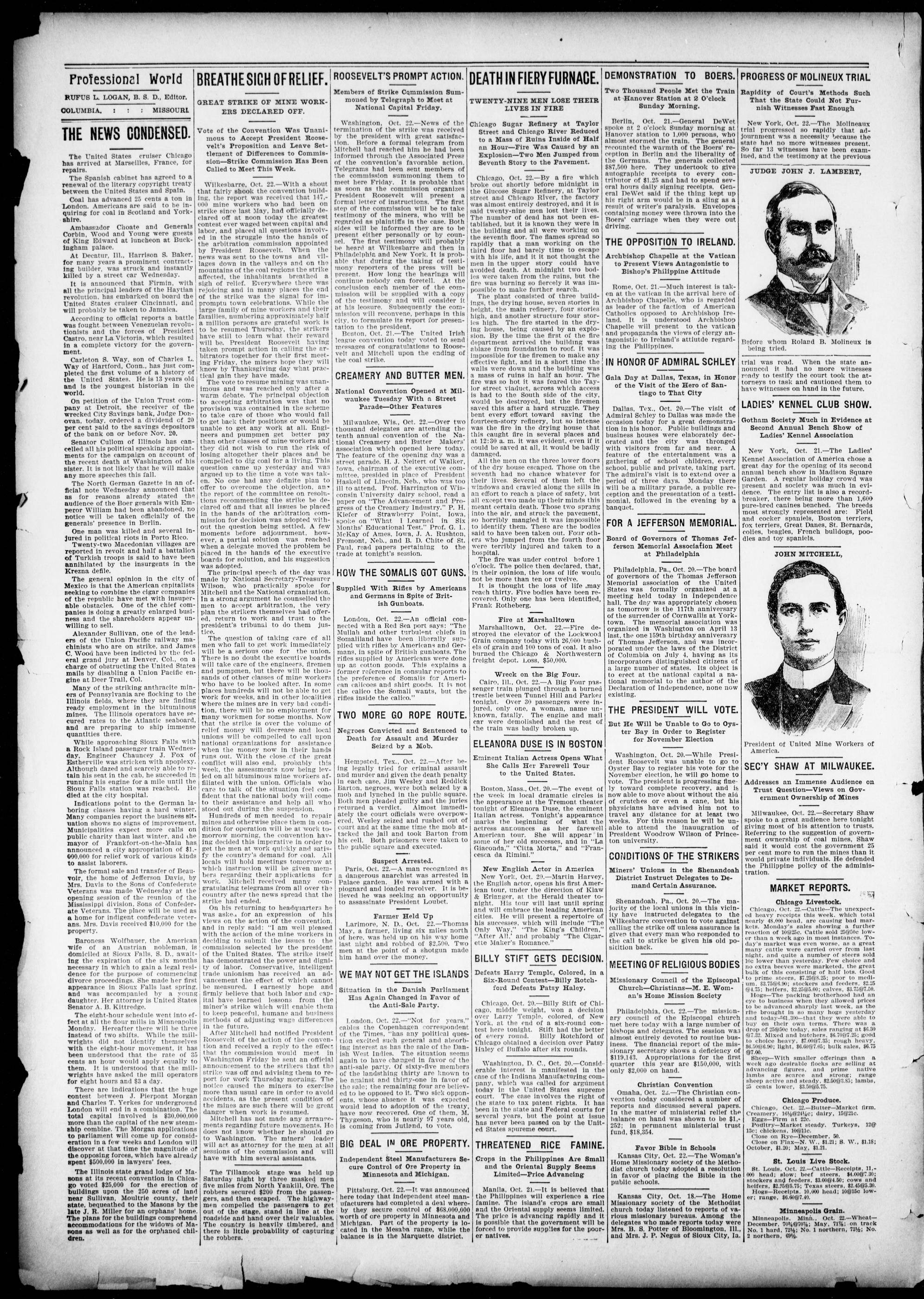
Before whom Roland B. Molineux is being tried.
trial was read. When the state announced it had no more witnesses ready to testify the court took the attorneys to task and cautioned them to have witnesses on hand in the future.
LADIES' KENNEL CLUB SHOW.
Gotham Society Much in Evidence at Second Annual Bench Show of Ladies' Kennel Association
New York, Oct. 21.—The Ladies' Kennel Association of America chose a great day for the opening of its second annual bench show in Madison Square Garden. A regular holiday crowd was present and society was much in evidence. The entry list is also a record-breaker, there being more than 1,600 pure-bred canines benched. The breeds most strongly represented are: Field and cocker spaniels, Boston terriers, fox terriers, Great Danes, St. Bernards, colles, beagles, French bulldogs, pooledies and toy spaniels.
JOHN MITCHELL,
President of United Mine Workers of America.
SEC'Y SHAW AT MILWAUKEE.
Addresses an Immense Audience on Trust Question—Views on Government Ownership of Mines
Milwaukee, Oct. 22.—Secretary Shaw spoke to a great audience here tonight giving most of his attention to trusts. Referring to the suggestion of government ownership of coal mines, Shaw said it would cost the government 25 per cent more to run the mines than it would private individuals. He defended the Philippine policy of the administration.
MARKET REPORTS.
12
Chicago Livestock.
Chicago, Oct. 22. Cattle—The unexpected heavy receipts this week, which total nearly 48,000 head, are causing bad markets. Monday's sales showing a further reaction of 109/23c. Cattle sold 250/50c lower than a week ago in most instances. Today's market was even worse, as a great last night, and quite a number of steers sold 10c lower than yesterday. Few choice and no extra bees were marketed, the great bulk of this consisting of half lots. Good to prime steers, $7.55@8.25, poor to medium, $3.75/6.90, stockers and feeders, $2.25@8.25, offer of feeders, $1.00, Hogs. Packing brotherhood had an eye to business when they allowed prices to be advanced sharply last week, as the rfsse brought in so many hogs yesterday and today—61.30—that they were able to buy on their own terms. There was a drop of 25%@60c today, sales ranging at $8.30 to $8.90, and prices to choose heavy, $7.00/7.35; rough heavy, $6.50/6.90; light, $6.90@7.05; bulk sales, $6.75@7.00.
Sheep—With smaller offerings than a week ago desirable flocks are selling at advancing figures, and prime native lambs are scarce and strong; range sheep active and steady. $2.50@3.85; lambs, 25 cents lower. $3.50@5.75.
Chicago Produce.
Chicago, Oct. 22—Butter—Market firm.
Creamery, 10½%@; dairy, 15@21c.
Eggs—Firm at 22c.
Poultry—Market steady. Turkeys, 12@
13c; chickens, 10@11c.
Close on Rye—December, 50.
Close on Flax—N. W., $1.21; S. W., $1.18;
October, $1.20; May, $1.21.
St. Louis Live Stock.
St. Louis, Oct. 22—Cattle—Receipts, 11.—
000 head; slow; beef steers, $4.00@70; stocks
and feeders and feeders, $3.00@4.50; cows and
heifers, $2.25@75; Texas steers, $2.45@50.
Hogs—Receipts, 10.00 head; 10@15c lower;
range, $6.00@7.40.
Minneapolis Grain.
Minneapolis. Minn. Oct. 22 —Wheat—
December, 70%@May; 75%; 71% on track
No 1. hard, 72%; No 1 northern, 73%; No
2 northern, 69%.
FARM ORCHARD GARDEN AND
One of the best farm tenants we have come across is a Swede with a large family. He has worked the same farm for 13 years and has always made money for his landlord and for himself while the farm is in a more productive state than ever before. This landlord is wise over time.
The good times of 1902, when a fat hog brought $20, will long be remembered.
The aster, we find, is subject to more insect pests than any flower which we try to grow.
Clean grainfields are almost impossible where there is neither rotation of crops nor sheep.
The largest and handsomest apple grown is the Wolf River, and it is at the same time the most wortless.
We note that one of the reclaimed lake beds in a Western state is affording the finest kind of duck shooting this fall.
The easiest way to keep a good hired girl in the farm house is to get a good looking hired man. We know that this plan works.
There is quite a risk in holding hogs at this season of the year, and just as soon as they are fit for market it is best to let them go.
We sometimes think that a man's reputation suffers almost as much to be known as small, mean and stingy as to be rated as dishonest.
The pansy bed has been a delight all summer, the cool, moist season having contributed to the very best development of this favorite flower.
A cornfield infected with both pocket gophers and wild morning glories is in a bad fix, and the sooner such a field is turned into pasture the better.
The canna roots should now be taken up and set on the floor of the cellar. Let them dry out, and they will be all ready for planting next spring.
The geraniums which have bloomed in the garden this summer may be taken up, potted and if well cut back will afford a lot of bloom all winter.
A clover sod is an ideal preparation for almost any sort of crop. There should be at least 20 acres of such land available each year on every quarter section farm.
If the hogs of the Northwest manage to get away with all the soft corn there is in the fields this year and not get the cholera, it will be a piece of rare good fortune.
Twenty thousand Americans have invaded the Canadian Northwest this season and have either bought or home-steaded a cast tract of the fertile land of that region.
Great Britain imports yearly nearly $100,000,000 of butter, and Denmark furnishes seventhends of it and makes it largely out of dairy rations imported from America. This ought to be stopped.
The Hibernal apple is every way as poor as it looks to be. The most that can be said in its favor is that it is so hardy that it will probably do fairly well where other apples cannot be grown.
They say that a goose will live to be 70 years old, though just why this bird should be so long lived it is hard to see when the more useful hen lays and cackles herself out inside of four or five years.
Where we live, while the second crop of clover was unusually fine and full of bloom, there is hardly any seed set, continuous wet and cold weather during the blooming season having kept the bumblebees from working.
More money is made from the Ben Davis apple than from any other variety. It is red for one thing, grows large and keeps well. It holds its own as a market apple in spite of the fact that the quality is of the poorest.
We came across a properly fed rapefield the other day. It was full of seemingly bare stalks of rape a foot or more high, these covered with little buds and shoots, tender and toothsome, which the hogs nipped with eagerness.
It seems queer that a man will work hard on a farm for 30 years to accumulate a little property and then fall an easy victim to some shell game fakir whom he knows nothing about. More men of 60 need guardians than have them.
It has been demonstrated the past season that the soil of Cuba will produce the much wanted sea island cotton in the greatest perfection, a staple three and half inches in length being grown. This fact makes any land which will grow this kind of cotton worth over $100 per acre.
The Gravel Road.
Wherever a piece of graded highway on the black prairie soils of the country has bene graveled a very practical object lesson has been given of the value of this method of making a good road out of a dirt road. We think that two applications of the gravel are much better for the road than where the whole amount is put on at once, the first coat of four inches to be allowed to incorporate with the muck soil and form a good foundation for a later coat of about four or six inches more gravel. Thus built, supposing the roadbed is properly drained, such a road will last indefinitely, with only a scant repairing from year to year.
There is a good deal in the papers about ginseng and the great profits connected with growing this plant. It is, however, a very infant industry, as there are less than 25 acres of ginseng all told in this country, all of which is found in two counties in the state of New York.
The traveling public will have to reckon with the automobile as a horse scarer all over the country. These machines are going to come into general use and before five years will be so reduced in price that common people who can afford to keep a horse will have them. The average horse is very much afraid of them.
The buffalo grass and the blue joint grass, the two principal native grasses of the Western prairie, have never, so far as we know, been successfully propagated from seed upon land which has been under cultivation. Like other wild things, they shun civilization and disappear with the Indian, buffalo, coyote and rattlesnake.
The localities where the biggest crops of corn weer raised during the lata census year, taking an average yield for a whole county, were two counties in Illinois, three in Indiana and one in Pennsylvania, the average yield for the five counties being over 62 bushels per acre, Tipton, Ind., leading with 53.7 bushels per acre.
Best beefsteak is quoted at 44 cents a pound in the city of Berlin, the same kind which is obtainable in this country for 25 cents. Other meats are also scarce and high priced. It seems queer that for the benefit of the few stock raisers in that country the government should see fit to bar out the cheap meat products of this and other countries.
Nineteen hundred and two has been a sort of freak season. We have noted more abnormal growths among fruits, grains and vegetables than we ever did before. Potatoes appeared in large nodules on the vines, corn grew unusually tall and set from two to four ears on a stalk, cabbage and celery have gone to seed the first season, while strawberries and raspberries set a second crop of fruit.
A farmer friend of ours after 30 years spent in peace and quiet on his farm, having retired to live in town, thought he would take an active interest in politics this fall and so came up as a candidate for an office. He tells us that while he knew there was a good deal of meanness in men he still had no idea of the depth of their total deprivacy until he got into politics. He says he can hardly now trust his best friends.
There are two things about which nothing bad is ever said—the brome grass and alfalfa. The former is of almost inestimable value to all that large territory where timothy and the clovers will not do well for lack of sufficient moisture, while alfalfa is proving the redeemer of a principality of heretofore worthless lands in the West. No fact is better proved than this—where grass can be made to grow there will follow all other good things in an agricultural way.
What He Has To Buy
The man who lives and works in town has to buy hay, corn, oats, poultry, eggs, milk, cream, butter, meat, vegetables, fruit, flour, meal, fuel and a host of other things which enter into the daily living of a family, while a man on a farm can produce all these things named and have them of the very best. The town man finds that a salary looks like 30 cents when he has bought all these necessities of living.
The government can sometimes interfere with the common business of the people to their great advantage. In France the government assumes to regulate the breeding of the horse, and none save sires registered by the government is used. The result is that all the world goes to France for its fine draft sires. The Danish government takes a hand in the creamy business of that country and by compelling the scientific education of the dairymen and butter makers and inspection of the product monopolizes the English market. To some extent American enterprise is accomplishing here what legal and governmental interference is accomplishing there, but as yet not in nearly so efficient a manner.
Beauty and Utility.
We have growing on the lawn a Wealthy apple tree which is very attractive and symmetrical in appearance, and, looking at it, we are impressed with the fact that we might often set out valuable fruit trees for ornament and shade in place of the other kinds which bear no fruit. There is no handsomer lawn tree than the cherry if properly cared for, with its thick and glossy foliage, profuse bloom and rare red fruit. We lately passed by the town residence of a man who had set a row of apple trees in front of his home outside the sidewalk, and they were producing lots of nice apples for him and the public as well. Where utility can be practically combined with beauty it should always be done.
The increasing use of machinery on the farm has of course increased the number of accidents happening to the men who operate it, but after all we have noted that more men have been killed this year by sliding off from loads of hay and grain on to pitchforks than in any other way.
It is no small thing in his favor that the farmer never has to sell his produce on tick or keep book accounts or dun or sue people. He just expects and gets the cash for all he has to sell, while the merchant has to charge things and carry a line of credit which often amounts to as much as his capital stock.
One of the best farm tenants we have come across is a Swede with a large family. He has worked the same farm for 13 years and has always made money for his landlord and for himself, while the farm is in a more productive state than ever before. This landlord is wise enough to treat his tenant liberally, furnishing him good stock and seed and such a share of the crop and farm income that his tenant can prosper. The dairy and chickens kept on this place alone constitute a gretty good income.
How He Got a Start.
Ten years ago he was a common laborer living in a small Western town. He had a wife and four children, and, as his labor was of the unskilled sort, he rarely received more than $1.50 per day. Deducting his lost time, his average earnings were not over $400 per year. It is easy to see that with such a small income he would have but little left after barely supporting himself and family. He had the honorable ambition to do something better; but, being without capital to make a start, it seemed to be a hopeless case. Finally he hit on this plan: He rented five acres of good land near his home at $6 per acre. He hired a man to plow and drag it, then planted one acre of onions, one acre of cabbage, one acre of potatoes, one acre of popcorn, half an acre of turnips and half an acre of melons and cucumbers. Aside from what he paid out to have some horse cultivation of the crop he, with his wife and children, took care of these crops. Now here is the result: Three hundred bushels of onions at 70 cents, $21; cabbage crop, $80; potatoes, $50; popcorn, $45; turnips, $20; melons and cucumbers, $60; a total of $465, or as much, deducting what he paid out for rent and help, as he had ever earned in a year when working for others by the day. In addition he had all his family wanted to use of the crops grown, and the entire crop had grown and disposed of inside of five months, leaving him seven months to work out as he had always done. Of course he could have done better if he had had his own team and tools. The case is cited just to show what a man can do who absolutely nothing but his hands to work with. It proved a getting out of the woods, a step in advance for him, and others may do the same thing, perhaps not quite so well, perhaps better.
A Wet Summer's Compensations.
A Wet Summer's Compensations. While crop losses were severe and almost total in valley locations during the past summer by reason of the unusual floods all through the West and Northwest territory, the compensations of a wet season are not to be overlooked. Throughout all the region so drenched five previous years of short rainfall ruined the water powers, made brooks of the rivers, dried up the springs, exhausted the subsol moisture, converted lake beds into cornfields, killed the trees both in grove and orchard and ruined the pastures. The downfall of 36 inches of water and in many localities much more during the months of May, June, July and August has wrought out a marvelous transformation. The rivers are once more bank full, every spring a-spouting, the earth saturated to a depth of ten feet or more, the lake bed cornfield is converted into a lake once more, all tree life has made a phenomenal growth, and pastures have been knee deep, as in June, all summer. It is all in line with nature's way of balancing things up, and all will feel better to think of the blessings brought by the rains rather than on the losses they may have entailed.
MEN AND WOMEN.
Forced to abandon all literary work during the summer because of continued illness, Dr Cyrus Townsend Brady, the author, has undergone an operation at his home in New York. The surgeons did not disclose the nature of the operation, but announced that it was a complete success.
Captain W. L. Rice, who has been mayor of Bristol, Tenn., ever since that place became a city, resigned the other day, pleading that being 70 years of age he was getting too old to properly fill the place. In response to general desire among the citizens he has just withdrawn his resignation and will serve out his term.
Pixley Ka Isaaka Seme, the first Zulu to enter an American university, has succeeded in passing the severe entrance examination at Columbia and has matriculated for an eight years' course in medicine and surgery. He has been in this country since 1898 and is 21 years old. His purpose is to practice medicine in his native land.
Dr. Albert R. Ledoux, an assayer of world-wide repute, recently undertook to ascertain the exact amount of copper which was available in the entire world in the hands of metal dealers. This amount he found to be less than 50,000 tons. The results were obtained by correspondence with the dealers and others.
Papa and the Count
"Tell me, frankly, count, how much you owe."
"Realy, sare, you questione covers me wiz confusione."
"That's all right. Confide in me. If you are to marry my daughter I want you to be open and honest. How much do you owe?"
"Nossing."
"Nothing! You owe nothing?"
"Alas, eat ees too true. Nobody weel trust-a-me."—Cleveland Plain-Dealer.
This is no time to give a party power that never gives the country good times.
COSTLY WOODS FOR FUEL.
Factory's Furnaces Fed With Rosewood, Ebony and Boxwood.
People have turned to everything for fuel during the coal famine brought on by the present strike, but it is doubtful if the furnaces of more than one factory are fed by costly imported woods, where every ton burned means a value of from $30 to $40 gone up in smoke.
The one firm in question is located in Cambridgeport. Its engineers have found that hard woods like ebony, rosewood, boxwood and lignum-vitae, well seasoned, burn almost as well as coal. The only precaution which they take is not to burn coal and wood at the same time. They stoke their fires with $40 wood fuel part of the time and with scarcely less expensive coal fuel the rest of the time.
On the face of it, it may look as if the concern's managers are throwing away (or burning up) good money, but with them it is a plain business proposition. As one of them explained this morning, they have unusual storage room, and for many years have been constantly in the market to buy. During the course of this time they have picked up a large amount of wood at extremely low prices. When, for instance, the National Mahogany and Cedar company was formed of several of the most prominent New York and Boston wood concerns the individual firms composing them had a general selling-out of stock, and when the same trust disintegrated a short time later, there was another sale, and at both of these the Cambridgeport company profiled in good wood at reduced prices. So if fine hardwood, worth $40 a ton, cost them here. It sounds epigramatic to use it under their boilers rather than buy bituminous coal at very nearly that price, or an arthrochite coal at half as much again—Boston Evening Transcript.
A CURE FOR RHEUMATISM
Bridgeport, Wash., Oct. 20th.—Rheumatism and Kidney Trouble seem to be the prevailing ailments in this territory and particularly in Douglas County.
A remarkable and plainly sure cure has, however, recently been introduced. It is called Dodd's Kidney Pills and although but a short time on the market, it has already worked many wonderful cures.
One of the most striking of these is that of Mr. John Higgins, who for a long time suffered with Rheumatism and Kidney Trouble. The pains of these diseases had combined to make his life very miserable indeed, and he could get nothing to do him any good till he heard of this new remedy. He tells his experience with it in these words:
"Dodd's Kidney Pills have done more for my Rheumatism and Kidney Trouble than anything else I have ever used. There is more virtue in them than in any other medicine and I will always highly recommend them to all of my friends."
TOPAZ WEIGHING TWO POUNDS
Huge Brazilian Gem May Find Its Way to the Vatican.
An interesting story of a valuable topaz now in the possession of Signor Nicol Carelli comes from Naples. The topaz, which Signor Carelli brought back from Brazil some years ago, is so large that it is said to weigh over two pounds.
A Neapolitan artist, seeing the stone, begged to be allowed to engrave the figure of Christ on it it cameo. The work is now finished and Signor Carelli has been looking for a purchaser. The value of the jewel is, however, so great that even the pope, to whom it was offered, could not afford to buy it. A committee has been formed in Naples, it is reported, with the purpose of buying the jewel from its present owner by public subscription and offering it to Leo XIII as a jubilee present. It is to be hoped, therefore, that this wonderful treasure will be seen by visitors to the Vatican museum. Signor Carelli declares there is no other such stone in the world.
There is more Catarch in this section of the country than all other diseases put together, and until the last few years was supposed to be incurable. For a great many years doctors pronounced it a local disease and prescribed local remedies, and by constantly falling to cure with local medicine, it pronounced it a constitutional disease and therefore requires constitutional treatment. Hall's Catarch Cure, manufactured by F. J. Cheney & Co. Toledo, Ohio, is the only constitutional cure on the market. It is taken internally in doses from 10 drops to a teaspoonful. It acts directly on the blood and mucous surface, and any other. They can cure dollars for any case it fails to cure. Send for circulars and testimonials.
Address. F. J. CHENEY & Co. Toledo, Ohio.
A Cheaper Fuel.
Over in Germany what is called briquettes are made from a cheap soft coal, peat and the dust and waste of coal mines. They are the principal fuel for domestic use in the cities, and are also used for manufacturing and engines for manufacturing purposes. The output of this fuel for 1901 was over a million and a half tons, and the present price at which it is sold is a little above $3. Seven or eight years ago it was sold at about $2.35. The increase in price is the result of a briquette "trust." Trusts are not organized for the health of stockholders in Germany any more than they are in this country. People who are in favor of municipal ownership are given something to think about in connection with the manufacture of briquettes. We have the material in abundance and need the fuel. The process of manufacture can easily be learned, and then why not every municipality have its fuel-making business, and so become independent of coal strikes and coal trusts?—Milwaukee Press.
Mothers will find Mrs. Winslow's Sootting Syrup the best remedy to use for their children during the teething period.
Retain the Patronage.
Her Papa—"Yo' asiph ter marry mah daughter, sah? H'm. Whad am yo'r prospect?'" The suitor (a widower)—"Ebery one ob de pussons fo' whom mah late lamented wife done washin' fo' ho promised ter liber'ly paternize her successah."—Judge.
CASTORIA The Kind You Have Always Bought has borne the signature of Chas. H. Fletcher, and has been made under his personal supervision for over 30 years. Allow no one to deceive you in this. Counterfeits, Imitations and "Just-as-good" are but Experiments, and endanger the health of Children—Experience against Experiment.
Castoria is a harmless substitute for Castor Oil, Paragoric, Drops and Soothing Syrups. It is Pleasant. It contains neither Opium, Morphine nor other Narcotic substance. Its age is its guarantee. It destroys Worms and allays Feverishness. It cures Diarrhoea and Wind Colic. It relieves Teething Troubles, cures Constipation and Flatulency. It assimilates the Food, regulates the Stomach and Bowels, giving healthy and natural sleep. The Children's Panacca—The Mother's Friend.
KING EDWARD'S LIFE.
Thousands of Insurance Policies Have Been Issued on It.
A recent London news item says that thousands of insurance policies on the life of the king have been issued during the past year; that the insurance which was at first taken by people who had business interests which would be specially affected by the life or death of the king has extended to others who are mere gambiers and take the insurance merely as a gambling speculation. This item says that there are thousands now gambling on the life of their ruler. The rates on the king's life are also stated to have been raised, when the magnitude of these insurance speculations began to increase, until it went up from 3 per cent to 10 per cent, and most of the policies are said to have been made for a short time, and designed to run only long enough to include the coronation. It is possible that there are some features of these insurance policies on the king's life that have not been fully explained to us on this side of the water. But, unless the news concerning them is altogether untrue, the insurance companies in England are carrying on a business that in this country would be deemed utterly void and peculiarly pernicious. Without any regard to the question of the king's consent to such insurance, which of course, he does not give, many of the insurance policies, if they are at all such as the news items from London have described, are contrary to the public policy recognized by the courts of this country, because they are issued to people who have no insurable interest. If the English courts uphold policies of this kind they furnish one striking instance, at least, in which the unwritten law of that country is on a lower level than that of this country. It has often been said that gambling is far more general in England than in this country, but it does not seem possible that the English courts can regard it as a legitimate branch of the insurance business.—Case and Comment.
A KLONDIKE AMUSEMENT
It is an Eskimo Race With Dogs—Description, by a Traveler.
"Yes, the Klondike country is in a much more settled state than it was three years ago, when I first went there," remarked C. H. Johnson at the Brown Palace hotel. Mr. Johnson is just returning from a three year's trip to the gold fields in Alaska and is returning much richer than when he left Atlanta, Ga., his home.
"One thing that amused me very much" he continued, "was the way the miners in that region had of entertaining themselves. For a small sum, one can hire a couple of the Eskimos with their dog sledges to run a race, but there must always be a prize for the winner, in addition to the sum agreed upon, in the beginning.
"I remember the first race I ever ocheld, was from Fort Yukon down the river 25 miles and return. These two men, Alukuk and Nowekakat, by name, had relays of dogs placed every ten miles, always reserving the best dogs for the last relay. Well, it seems that there was considerable rivalry between these two, for the affections of an Indian girl, and consequently not the best of feeling between them.
"On the day of the race both men had borrowed from their friends all the best dogs for miles around, and the indications were that we would see a good race, and we were not disappointed. After much wrangling between the two, and much yelping by the dogs, they got started, and what a sight it was. Each man lying at full length on his sledge and yelling at his dogs, as though his life depended on it.
"All went well until the last relay, when the friends of one man attempted to foul his opponent by throwing clubs over the ice in front of the dogs and causing a general fight, in which many heads were broken. This, of course, caused some delay and allowed Alukuk to gain, the lead. This lead he kept until within 100 years of the finish. When Nowlakat forced his dogs until the sledges were neck and neck, and he finally won by about three feet."
"Who got the girl;" Why she wouldn't have anything to with either, but went away with a half breed Indian trader."—Denver Republican.
NTRAL N. U. ------ NO. 84-02
SCOTLAND'S PROGRESS.
The Census Shows a Healthy Growth. Notwithstanding Emigration.
Notwithstanding the emigration, Scotland has still a plenty of the old stock left, as appears from the last census of Great Britain. On March 1, 1901, according to the returns which have just been made public, the population of Scotland was 4,472,103, of whom 2,173,755 were males and 2,298,348 females. The total increase since the census of 1901 was 1.09 per cent. There were 150 inhabitants, for every one of the 29,796 square miles of which Scotland consists. About seventy percent of the population lives in towns. Some of the counties are very sparsely populated. Sutherland, for instance, having only eleven inhabitants to the square mile.
The census shows that 28,106 inhabitants of the Highlands of Scotland cannot speak English, their language being the Gaelic. In addition, 202,700 Scotchmen and women who can speak English use the Gaelic language when not conversing with the Anglo-Saxon. The economic condition of the people shows a slight improvement since the census of 1891. In that year 22.16 per cent of the Scotch families resided in dwellings having only one room. In 1901 the percentage had fallen to 17.61 Andrew Carnegie has given the people of his native land $10,000,000 for the education of young men unable to pay their way through the Scottish universities. That was a splendid benefaction and ought to be a most useful one. Yet, it is said, many Scotchmen regret that the endowment has been made, fearing that their sons will be less studious than they were when an education could be obtained only through the great sacrifices of parents. This ought not to be the result of Mr. carnegie's munificence. The Scotch are a strong, self-reliant, progressive people. It is not probable that the rising generation, which has inherited so many fine qualities will be less studious or ambitious or resolute of purpose because Mr. Carnegie has made it easier for young Scotchmen to enjoy the advantages of university training—From The Baltimore Sun.
ABSOLUTE
SECURITY.
Genuine
Carter's
Little Liver Pills.
Must Bear Signature of
Great Good
See Fac-Simile Wrapper Below.
Very small and as easy
to take as sugar.
CARTER'S
LITTLE
LIVER
PILLS.
FOR HEADACHE.
FOR DIZZINESS.
FOR BILIOUSNESS.
FOR TORPID LIVER.
FOR CONSTIPATION.
FOR SALLOW SKIN.
FOR THE COMPLEXION
Price
25 Cents
GENUINE MUST HAVE SIGNATURE.
Purely Vegetable.
CURE SICK HEADACHE.
FREE ELECTRIC BELT OFFER
WITH TEN DAYS
FREE WEARING
TRIAL in your own home, we furnish the genuine and only
maintains all original features of the belt. No money in advance; very low
cost positive guarantee. COSTS ALWAYS BOTH INCOMP
with most all other forms of wearers. We provide
belt, bellpins, and reinsels fall. CHECK CURE for more
than 80 alliances. Only sure cure for all serious diathes,
wastess and anomalies. We provide and care
identical catalogue, cut this ad, out and mail to us.
SEARS, ROBUCK & CO., CHICAGO.
Twentieth Century Negro Literature
This book contains One Hundred Treatises on Thirty-Eight General Topics in which the negro problem is viewed from every possible standpoint. No work could more fully represent the higher stratum of race subjects. We could furnish the basis of future calculations on all race subjects. There are
100 PORTAITS AND 100 BIOGRAPHIES of the writers. To see the pictures and read the lives of the hundred most prominent negroes is to have a fair knowledge of the entire race. Over 100 large pages and retails at $2.50 in cloth, postpaid.
AGENTS* great book. Highest commissioned. Books on credit. Agent's magnificent sample book for $3c. to pay mailing expenses. Write for our proposition at once. This is the opportunity of your life.
J. L. NICHELS & CO., Naperville, Illinois.
RUFUS L. LOGAN, B. S. D. - EDITOR
TERMS OF SUBSCRIPTION.
One Year in Advance - - - $1.00
Six Months in Advance - - .75
Three Months in Advance - - .50
Single Copies - - - .05
Advertising Rates on Application.
Job Work of all [Kinds Solicited.
Published Every Friday.
Entered at the postoffice at Colum-
umbia, Mo., as second class matter,
Jan. 15, 1902.
Agents wanted in every town in the
state.
IT is very probable that Col. Ed Butler can bear witness to the fact that our troubles never comes singly.
OUR thanks are due Mrs. Lizzie Bailer, of Salisbury, Prof. E. W. Ewing, of Columbia, Mr. Jesse Black, of Calwood, and Mr. Duke Diggs, of Jefferson City, for subscriptions recently.
I. N. INLOE is not the man who will ever vote to let American soldiers suffer on a distant shore, for the lack of a few paltry dollars to provide them with shelter and comfort. Be and American. Vote for an American.—Linn Creek Reveille.
Please do not forget that the proper thing to do when you do not receive your paper regularly is to drop us a postal card stating what issues you have failed to receive and we will forward the same at once. This paper is published every week.
DR. I. N. ENLOE, Candidate for Congress in this the eighth district should receive the majority vote of the district regardless of politics especially should he receive the vote of those farmers whose land is being washed away by the Missouri. Dr. Enloe could secure an appropriation from Congress for river improvement because he will be with the majority party in Congress. Mr. Shackleford acknowledges his inability to secure any appropriation of this kind because he is with the minority party in Congress—vote for Dr. Inloe.
New Shoe Store.
Notice the advertisement of Pape's Shoe store at Hubbell's old stand. We urge our readers to call on Mr. Pape when needing anything in his line. His advertisement in this paper shows appreciation of your patronage.
Salisbury Items.
Mrs. Callie Jacobs, of Norborne, was here canvassing last week.
Subscribe to the Professional world it is only $1.00 per year.
Prof J. C. Russell is rapidly improving after an illness of two months.
Mrs. Sidney Gooch has returned from a visit of two weeks in Kansas City.
Mrs. Maria Ward is visiting friends and relatives in Kansas City this week.
After a few weeks visit Mr. Squire Gooch will leave for Los Angeles, California to join his family.
Mrs. Bettie Kilbert, of Atchison, Kan., formerly of this place, died last week and her remains were laid to rest in Porters Chapel Cemetery.
DR. D.W. OULP
Ashland News.
Subscribe to the Professional World only $1.00 per year.
Miss Macea Turner, teacher of the Ashland School, will give an entertainment at the opera house Friday evening, Oct. 31st. Every body is invited.
Miss Macea P. Turner entertained Mr. Benjamin F. Jones, a porter on the I. C. Railroad, at her home near Ashland last Sunday eve. Mr. Jones will be in our midst about tw) weeks.
At a church meeting, of Log-
Providence Church, last Saturday,
Rev. Jack Roberson, of Clarksville
was called to the pastorate of the
church. Mrs. Ara Bell Huggard was restored to the church. Miss
Macea Turner and Mr. Harrison
Logan are candidates for baptism.
We are well pleased with Rev.
Roberson and believe he will do
much good in our midst.
Deafness Cannot be Cured
by local applications as they cannot reach the diseased portion of the ear. There is only one way to cure deafness, and that is by constitutional remedies. Deafness is caused by an inflamed condition of the mucous lining of the Eustachian Tube. When this tube is inflamed you have a rumbling sound or imperfect hearing, and when it is entirely closed, deafness is the result, and unless the inflammation can be taken out and this tube restored to its normal condition, hearing will be destroyed forever; nine cases out of ten are caused by Catarrh, which is nothing but an inflamed condition of the mucous surfaces.
We will give One Hundred Dollars for any case of Deafness (caused by catarrh) that cannot be cured by Hall's Catarrh Cure. Send for circulars, free.
F. J. CHENEY & Co., Toledo, O. Sold by Druggists, 75c.
Hall's Family Pills are the best.
Boone County apples.
The largest apples we have ever seen grown in Missouri was exhibited at this office Friday by S. G. H. Strickler, who found them on his farm near Deer Park. They were of the Ben Davis variety, measured 15 and $15\%$ inches and weighed $16\%$ and $18\%$ ounces respectively. The two placed on exhibition were half of the full crop of one tree, there being only four apples matured thereon. Verily Boone county is rapidly becoming known as a great fruit center, and is distinctly a part of that famous Missouri section known as "The land of the big red apple."
The day following Mr. A. F. Lewis, of Sapp, was in town with a load of the finest Gano apples we have seen this year, which he sold readily for $1.00 a bushel. The best orchard in the county for the production of highly colored apples is that of Mr. Lewis, which is underlaid with limestone rock which contains a quantity of iron ore; this, Mr. Lewis says imparts the rich dark color, which characterizes his apples. Besides this, Mr. Lewis understands the cultivation of the various fruit crops—apples, pears, peaches, etc., and always has some of these for sale early in the season. So far as quality of fruit is concerned, he is beyond question the apple king of the county, though others produce greater quantities of fruit.
Speaking of apples, it might be well to remark that Boone county ought to produce enough apples for its own consumption. Every year thousands of bushels are shipped out in the fall, and later the merchants import apples in large quantities and retail them to the people for fabulous prices. If the crop could be kept at home, the people could avoid the extremely high prices later in the season. Some efforts have been made to do this, but we do not know with what success. It is understood that Mr. Nifong of the Columbia Ice & Cold Storage plant, has just imported about 400 bushels of apples from Howard county for his cold storage plant. It seems to us that several thousand bushels could be stored there and marketed at profitable prices.
Notice! Notice!
We will give $1.00 in cash for the best half bushel of potatoes raised in Boone county, delivered at our store.
THE COLUMBIA GROCERY CO.
Y. M. C. A. Last Sabbath.
Last Sabbath afternoon, Rev. Charles M. Sharpe who for two weeks past has been holding a series of interesting and largely attended meetings in the Christian Church, delivered by request in the University auditorium a sermon to the Young Men's Christian Association composed of students of the University. Very few of our citizens were present, but the students were out in very respectable force.
Wm. H. Goodson presided and introduced the speaker. Hymnal services were accompanied by the piano. Mr. Sharpe's sermon or address—call it what you may—was very well delivered, for he is a fluent, entertaining and forceful speaker, one who is heard without effort on the part of his auditors. It was a remarkably able and appropriate address and received the earnest and unflagging attention of all present. He did not consume time in giving advice to the young men, but by directing their attention to the temptations which beset the pathway of students absent from home at College, and in forceful and eloquent diction sought to impress them with the great responsibilities which will very soon confront them as citizens of the State. He certainly inspired them, regardless of their environments, difficulties and business or professional ambition, to covet above all else the highest christian citizenship, personal honor and individual usefulness in their day and generation.
Mr. Butler Didn't Say It.
I see in the daily St. Louis papers a conversation I had with Col. Butler in front of the hotel at Columbia, where, they say, I was asked by him what was the principal industry of Columbia, and I said; "Our principal support comes from our educational interests," and as for his saying "that is a hell of an occupation," is all untrue. He never said it, but asked the price of lands and so forth in our county and I referred him to Mr. Fielding Smith, who gave him the information, being a real estate man. Yours respectfully,
W. T. ANDERSON
Mission Sunday School.
The Mission east of town now has a School. Last Sunday the following officers were elected:
Superintendent, E. E. Brunner.
Assistantsuperintendent, Dr. Cole.
Secretary, Mr. Roberts.
Assistant secretary, Miss Clara Schmid.
Treasurer, Mr. Buttermeyer.
Organist, Miss Shockley.
Assistant organist, Miss Searcy.
The exercises will be as follows:
Sunday school 2 p. m. preaching 3 p. m. each Sunday.
The Railroads.
WABASH
Time Table—Columbia Branch.
GOING SOUTH.
No. 33, Arrive Columbia... 8:15 a. m.
No. 35, Arrive Columbia... 1:20 p. m.
No. 37, Arrive Columbia... 8:45 p. m.
GOING NORTH.
No. 30, Leave Columbia... 10:00 a. m.
No. 28, Leave Columbia... 1:40 p. m.
No. 34, Leave Columbia... 4:15 p. m.
M. K. & T. Ry.
TRAINS NORTH.
A. M. No. 36
A. M. No. 38
P. M. No. 40.
Leave:
McBaine ... 6:30
Webster ... 6:33
Brushwood ... 6:38
Turner ... 6:42
Limerick ... 6:47
Arrive
Columbia ... 6:55
TRAINS SOUTH.
A. M. No. 35
St. Louis Express
Limerick ... 11:00
Turner ... 11:08
Brushwood ... 11:12
Webster ... 11:22
Arrive
McBaine ... 11:25
P. M. No. 37
Texas Express
Limerick ... 3:10
Turner ... 3:18
Brushwood ... 3:22
Webster ... 3:27
Arrive
McBaine ... 3:32
Limerick ... 3:35
P. M. No. 39.
Limerick ... 6:30
Turner ... 6:38
Brushwood ... 6:42
Webster ... 6:52
Arrive
McBaine ... 6:55
GO TO
MOSES H. CALDWELL
803 Ash St., Columbia, Mo.
For Horse Shoeing and First-
Class Blacksmithing of
all Kinds.
FURNITURE!
EVERYONE INVITED TO VISIT OUR STORE AND INSPECT THE LARGEST LINE OF FURNITURE AND UNDERTAKER'S GOODS EVER CARRIED IN THIS SECTION OF THE STATE.
WALTHERS HAS ALL KINDS OF FURNITURE AND DOES FUNERAL DIRECTING.
GO TO
227 Madison Street
ANOTHER
WALTHERS H
AND DO
POSIT
CITY HALL BLDG. PHONE
Lodge and Church Directory.
LODGE.
S. M. T.
Mrs. Irena Akers W. P.; Mrs. Lizzie Williams, W. S.
Meeting first Monday in each month at 3 p. m.
U. B. F.
Crispus Attucks Lodge,No. 62. Meetings 2nd and 4th Tuesdays in each month. Visiting members cordially invited. Caleb Hall, W. M. A. M. Schweich, W. S.
K. P.
Acme Lodge, No. 24. Meetings second and fourth Fridays in each month. W. H. Turner, C. C. and D. D. G. C. W. W. Lampkins, M. F.
O. E. S.
Amos Chapter, No. 30. Meetings second Friday in each month. Mrs. A. B. Moore, W. M. Mrs. Lizzie Richardson, W. S.
LADIES COURT.
Golden Queen Court No. 19 meets first Friday in each month. Mrs. Annie Williams M. A. M. Mrs. V. L. Waldon Sec.
ST. PAUL LODGE, NO. 12.
St. Paul Lodge, No. 12, A. F. & A. M., meets every first and third Tuesday in each month. A cordial invitation extended to all visiting brothers. J. A. Mosely, W. M. J. A. Grant, Secretary.
Rev. J. B. Parsons, pastor.
Preaching Sundays 11 a. m.
and 7:30 p. m.
Prayer meeting* Wednesdays 7:30 p. m.
Everybody cordially invited to attend.
A. M. E. CHURCH.
Rev. P. C. Crews, Pastor.
Preaching Sundays 11 a.
m.; 7:30 p. m.
Sunday school 2:30 p. m.
Prayer meeting every
Wednesday eve, at 8:30; every
body invited to attend.
M. E. CHURCH
Rev. J. Arlington Grant, pastor.
Preaching Sundays 11, a. m. and 7:30 p. m.
Sunday school, 9:30 a. m.
Prayer meeting Wednesdays 7:30 to 8:30; all are made welcome.
SECOND BAPTIST CHURCH.
Rev. A. A. Adams, Pastor.
704, 706 W. BROADWAY, COLUMBIA
AGENT FOR STANDARD PATTERNS.
ER EDUC
HAS ALL KINDS OF
DES FUNERAL DIRI
TIVELY R
R·I·P
My skin was sa
taste in my mouth
and my breath w
times and occasion
headache. By th
Tabules I am now
to attend to my o
appetite is excell
gestion much imp
EDUCATION
BANDS OF FURNISHING
SPECIAL DIRECTING
BY RIGHT
JEFFERSON C.
In was sallow, I had
my mouth in the
my breath was offe
and occasionally I had
me. By the use of
I am now in a ce
d to my daily dut
he is excellent and
much improved.
My skin was sallow, I had a bad taste in my mouth in the morning and my breath was offensive at times and occasionally I had a bad headache. By the use of Ripans Tabules I am now in a condition to attend to my daily duties, my appetite is excellent and my digestion much improved.
AT DRUGGISTS.
The five-cent pa
for an ordinary
family bottle, sixt
a supply for a year
The Colum
cery
Keeps constan
a fresh supply
FANCY GR
YOUR PRODUC
ordinary occasion
bottle, sixty cents, or
7 for a year.
Columbia
Grocery Co.,
ops constantly on ha
sh supply of staple a
BY GROCER
PRODUCE WA
The five-cent package is enough for an ordinary occasion. The family bottle, sixty cents, contains a supply for a year.
The Columbia Gro= cery Co.,
Keeps constantly on hand a fresh supply of staple and FANCY GROCERIES.
Preaching Sundays 11 a. m., and 7:30 p. m.
Sunday school at 2:30 p. m.
Prayer meeting Wednesday evening, 7:30.
A cordial invitation extended to all.
Read the Professional World. It is $1.00 per year.
---
Jefferson City, Mo.
CATION!
FURNITURE,
RECTING.
RIGHT!
DFFERSON CITY, MISSOURI.
PANS
allow, I had a bad
m in the morning
was offensive at
nally I had a bad
use of Ripans
w in a condition
daily duties, my
client and my di-
proved.
mbia Gro=
Co.,
ntly on hand
of staple and
PROCERIES.
CE WANTED.
Notice to Correspondents.
All news from regular correspondents must reach us not later than Thursday morning to insure insertion. Write only on one side of paper and space each item plainly. Send only news items and do not attempt to write editorials.