The Professional World
Friday, February 13, 1903
Columbia, Missouri
Page text (machine-generated)
THE PROFESSIONAL WORLD.
$1.00 Per Year in Advance.
OUR $4,000,000 ELECTRIC ROAD
CHARTERED.
The Line Will Extend From Brookfield
to Cuivre Springs, Passing Throngh
Keyteville, Glasgow, Fayette,
Columbia, Fulton, Mineola
Springs, New Florence
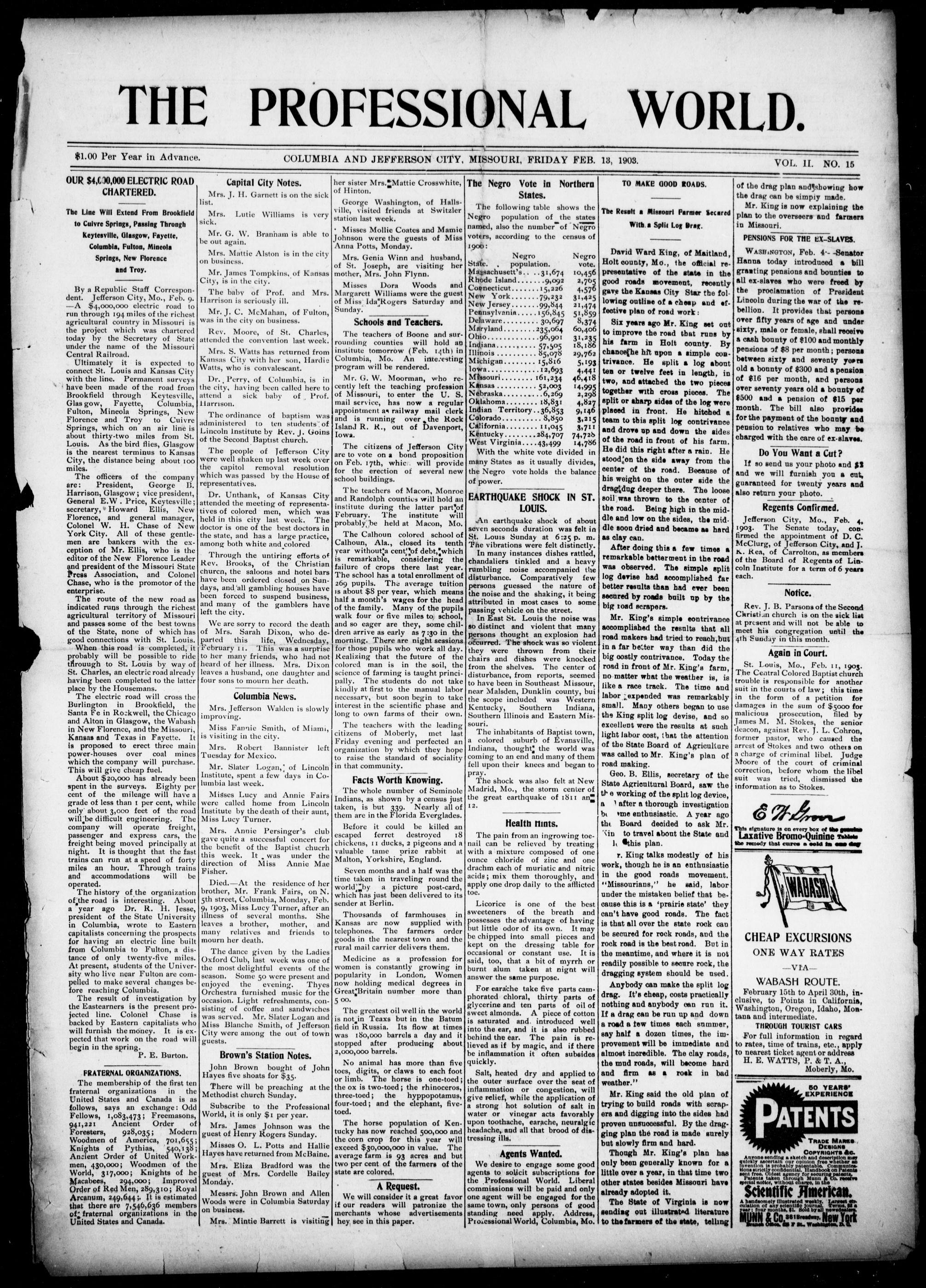
By a Republic Staff Correspondent. Jefferson City, Mo., Feb. 9. A $4,000,000 electric road to run through 194 miles of the richest agricultural country in Missouri is the project which was chartered today by the Secretary of State under the name of the Missouri Central Railroad.
Ultimately it is expected to connect St. Louis and Kansas City with the line. Permanent surveys have been made of the road from Brookfield through Keytesville, Glasgow, Fayette, Columbia, Fulton, Mineola Springs, New Florence and Troy to Cuierv Springs, which on an air line is about thirty-two miles from St. Louis. As the bird flies, Glasgow is the nearest terminus to Kansas City, the distance being about 100 miles.
The officers of the company are: President, George B. Harrison, Glasgow; vice president, General E.W. Price, Keytesville; secretary, Howard Ellis, New Florence, and general manager, Colonel W. H. Chase of New York City. All of these gentlemen are bankers with the exception of Mr. Ellis, who is the editor of the New Florence Leader and president of the Missouri State Press Association, and Colonel Chase, who is the promotor of the enterprise.
The route of the new road as indicated runs through the richest agricultural territory of Missouri and passes some of the best towns of the State, none of which has good connections with St. Louis. When this road is completed, it probably will be possible to ride through to St. Louis by way of St. Charles, an electric road already having been completed to the latter place by the Housemans. The electric road will cross the Burlington in Brookfield, the Santa Fe in Rockwell, the Chicago and Alton in Glasgow, the Wabash in New Florence, and the Missouri, Kansas and Texas in Fayette. It is proposed to erect three main power-houses over coal mines which the company will purchase. This will give cheap fuel.
About $20,000 has already been spent in the surveys. Eighty per cent of the mileage will have a grade of less than 1 per cent, while only about 3,000 feet of the road will be difficult engineering. The company will operate freight, passenger and express cars, the freight being moved principally at night. It is thought that the fast trains can run at a speed of forty miles an hour. Through trains and accommodations will be operated.
The history of the organization of the road is interesting. About a year ago Dr. R. H. Jesse, president of the State University in Columbia, wrote to Eastern capitalists concerning the prospects for having an electric line built from Columbia to Fulton, a distance of only twenty-five miles. At present, students of the University who live near Fulton are compelled to make several changes before reaching Columbia.
The result of investigation by the Eastearners is the present projected line. Colonel Chase is backed by Eastern capitalists who will furnish the money. It is expected that work on the road will begin in the spring.
FRATERNAL ORGANIZATIONS
The membership of the first ten fraternal organizations in the United States and Canada is as follows, says an exchange: Odd Fellows, 1,083,473; Freemasons, 941,221 Ancient Order of Foresters, 928,035; Modern Woodmen of America, 701,655; Knights of Pythias, 540,138; Ancient Order of United Workmen, 430,000; Woodmen of the World, 317,000; Knights of he Macabees, 294,000; Improved Order of Red Men, 289,310; Royal Arcanum, 249,644. It is estimated that there are 7,546,636 members of fraternal organizations in the United States and Canada.
Capital City Notes.
Mrs. J. H. Garnett is on the sick list.
Mrs. Lutie Williams is very sick.
Mr. G. W. Branham is able to be out again.
Mr. James Tompkins, of Kansas City, is in the city.
The baby of Prof. and Mrs. Harrison is seriously ill.
Mr. J. C. McMahan, of Fulton, was in the city on business.
Rev. Moore, of St. Charles, attended the convention last week.
Mrs. S. Watts has returned from Kansas City with her son, Hardie Watts, who is convalescant.
Dr. Perry, of Columbia, is in the city, having been called here to attend a sick baby of Prof. Harrison.
The ordinance of baptism was administered to ten students of Lincoln Institute by Rev. J. Goins of the Second Baptist church.
The people of Jefferson City were well shaken up last week over the capitol removal resolution which was passed by the House of representatives. Dr. Unthank, of Kansas City attended the meeting of representatives of colored men, which was held in this city last week. The doctor is one of the best doctors in the state, and has a large practice, among both white and colored Through the untiring efforts of Rev. Brooks, of the Christian churen, the saloons and hotel bars have been ordered closed, on Sundays, and all gambling houses have been forced to suspend business, and many of the gamblers have left the city.
We are sorry to record the death of Mrs. Sarah Dixon, who departed this life, Wednesday, February 11. This was a surprise to her many friends, who had not heard of her illness. Mrs. Dixon leaves a husband, one daughter and four sons to mourn her death.
Columbia News.
Mrs. Jefferson Walden is slowly improving.
Miss Fannie Smith, of Miami, is visiting in the city.
Mrs. Robert Bannister left Tuesday for Mexico.
Mr. Slater Logan, of Lincoln Institute, spent a few days in Columbia last week.
Misses Lucy and Annie Fairs were called home from Lincoln Institute by the death of their aunt, Miss Lucy Turner.
Mrs. Annie Persinger's club gave quite a successful concert for the benefit of the Baptist church this week. It was under the direction of Miss Annie Mae Fisher.
Died.—At the residence of her brother, Mr. Frank Fairs, on N. 5th street, Columbia, Monday, Feb. 9, 1903, Miss Lucy Turner, after an illness of several months. She leaves a brother, mother, and many relatives and friends to mourn her death.
The dance given by the Ladies Oxford Club, last week was one of the most delightful events of the season. Some 50 were present and enjoyed the evening. Thyes Orchestra furnished music for the occasion. Light refreshments, consisting of coffee and sandwiches was served. Mr. Slater Logan and Miss Blanche Smith, of Jefferson City were among the out of town guests.
Brown's Station Notes.
John Brown bought of John Hayes five shoats for $35.
There will be preaching at the Methodist church Sunday.
Subscribe to the Professional World, it is only $1 per year.
Mrs. James Johnson was the guest of Henry Rogers Sunday.
Misses O. L. Potts and Hallie Hayes have returned from McBaine.
Mrs. Eliza Bradford was the guest of Mrs. Cordelle Bailey Monday.
Messrs. John Brown and Allen Woods were in Columbia Saturday on business.
Mrs. Mintie Barrett is visiting
her sister Mrs. Mattie Crosswhite, of Hinton.
George Washington, of Hallsville, visited friends at Switzler station last week.
Misses Mollie Coates and Mamie Johnson were the guests of Miss Anna Potts, Monday.
Mrs. Genia Winn and husband, of St. Joseph, are visiting her mother, Mrs. John Flynn.
Misses Dora Woods and Margarett Williams were the guest of Miss Ida Rogers Saturday and Sunday.
Schools and Teachers
The teachers of Boone and surrounding counties will hold an institute tomorrow (Feb. 14th) in Columbia, Mo. An interesting program will be rendered.
Mr. G. W. Moorman, who recently left the teaching profession of Missouri, to enter the U. S. mail service, has now a regular appointment at railway mail clerk and is running over the Rock Island R. R., out of Davenport, Iowa.
The citizens of Jefferson City are to vote on a bond proposition on Feb. 17th, which will provide for the erection of several new school buildings.
The teachers of Macon, Monroe and Randolph counties will hold an institute during the latter part of February. The institute will probably be held at Macon, Mo.
The Calhoun colored school of Calhoun, Ala., closed its tenth year without a cent of debt, which is remarkable, considering the failure of crops there last year. The school has a total enrollment of 269 pupils. The average tuition is about $8 per year, which means half a month's wages for the head of the family. Many of the pupils walk four or five miles to school, and so eager are they, some children arrive as early as 7:30 in the morning. There are night sessions for those pupils who work all day. Realizing that the future of the colored man is in the soil, the science of farming is taught principally. The students do not take kindly at first to the manual labor necessary, but soon begin to take interest in the scientific phase and long to own farms of their own.
The teachers with the leading citizens of Moberly, met last Friday evening and perfected an organization by which they hope to raise the standard of sociality in that community.
Facts Worth Knowing.
The whole number of Seminole Indians, as shown by a census just taken, is but 339. Nearly all of them are in the Florida Everglades. Before it could be killed an escaped ferret destroyed 18 chickens, 11 ducks, 2 pigeons and a valuable tame prize rabbit at Malton, Yorkshire, England. Seven months and a half was the time taken in traveling round the world by a picture post-card, which has just been delivered to its sender at Berlin. Thousands of farmhouses in Kansas are now supplied with telephones. The farmers order goods in the nearest town and the rural mail carrier delivers them.
Medicine as a profession for women is constantly growing in popularity in London, Women now holding medical degrees in Great Britain number more than 500.
The greatest oil well in the world is not in Texas but in the Batum field in Russia. Its flow at times was 180,000 barrels a day and it stopped after producing about 2,000,000 barrels.
No animal has more than five toes, digits, or claws to each foot or limb. The horse is one-toed; the ox is two-toed; the rhinoceros, three-toed; the hyppopotamus, four-toed; and the elephant, five-toed.
The horse population of Kentucky has now reached 500,000 and the corn crop for this year will exceed $30,000,000 in value. The average farm is 93 acres and but two per cent of the farmers of the state are colored.
A Request.
We will consider it a great favor if our readers will patronize the merchants whose advertisements hey see in this paper.
The Negro Vote in Northern States.
The following table shows the Negro population of the states named, also the number of Negro voters, according to the census of 1900:
Negro vote.
State. population.
Massachusetts's . . . 31,674
Rhode Island . . . 9,092
Cornecticut . . . 15,226
New York . . . 79,232
New Jersey . . . 99,844
Pennsylvania . . . 156,845
Delaware . . . 30,697
Maryland . . . 235,064
Ohio . . . 96,901
Indiana . . . 57,505
Illinois . . . 85,078
Michigan . . . 15,816
Iowa . . . 12,693
Missouri . . . 161,234
Kansas . . . 52,003
Nebraska . . . 6,269
Oklahoma . . . 18,831
Indian Territory . . . 36,853
Colorado . . . 8,850
California . . . 11,045
Kentucky . . . 284,707
West Virginia . . . 43,499
60,406
31,235
18,186
29,762
5,193
4,441
46,418
14,995
2,298
4,827
9,146
3,215
3,711
74,726
14,786
With the white vote divided in many States as it usually divides, the Negro vote holds the balance of power.
EARTHQUAKE SHOCK IN ST. LOUIS.
An earthquake shock of about seven seconds duration was felt in St. Louis Sunday at 6:25 p. m. The vibrations were felt distinctly. In many instances dishes rattled, chandaliers tinkled and a heavy rumbling noise accompanied the disturbance. Comparatively few persons guessed the nature of the noise and the shaking, it being attributed in most cases to some passing vehicle on the street.
In East St. Louis the noise was so distinct and violent that many persons thought an explosion had occurred. The shock was so violent they were thrown from their chairs and dishes were knocked from the shelves. The center of disturbance, from reports, seemed to have been in Southeast Missour, near Malsden, Dunklin county, but the scope included was Western Kentucky, Southern Indiana, Southern Illinois and Eastern Missouri.
The inhabitants of Baptist town, a colored suburb of Evansville, Indiana, thought the world was coming to an end and many of them fell upon their knees and began to pray.
The shock was also felt at New Madrid, Mo., the storm center of the great earthquake of 1811 an 12.
Health Hints.
The pain from an ingrowing toenail can be relieved by treating with a mixture composed of one ounce chloride of zinc and one drachm each of muriatic and nitric acids; mix them thoroughly, and apply one drop daily to the afflicted toe.
Licorice is one of the best sweeteners of the breath and possesses the advantage of having but little odor of its own. It may be chipped into small pieces and kept on the dressing table for occasional or constant use. It is said, too, that a bit of myrrh or burnt alum taken at night will answer the same purpose.
For earache take five parts camphorated chloral, thirty parts of glycerine and ten parts of oil of sweet almonds. A piece of cotton is saturated and introduced well into the ear, and it is also rubbed behind the ear. The pain is relieved as if by magic, and if there be inflammation it often subsides quickly.
Salt, heated dry and applied to the outer surface over the seat of inflammation or congestion, will give relief, while the application of a strong hot solution of salt in water or vinegar acts favorably upon toothache, earache, neuralgic headache, and all that brood of distressing ills.
Agents Wanted.
We desire to engage some good agents to solicit subscriptions for the Professional World. Liberal commissions will be paid and only one agent will be engaged for the same town, only persons of good standing need apply. Address, Professional World, Columbia, Mo.
TO MAKE GOOD ROADS.
The Result a Missouri Farmer Secured With a Split Log Drag.
David Ward King, of Maitland, Holt county, Mo., the official representative of the state in the good roads movement, recently gave the Kansas City Star the following outline of a cheap and effective plan of road work:
Six years ago Mr. King set out to improve the road that runs by his farm in Holt county. By chance he hit upon a simple contrivance. He split a log about ten or twelve feet in length, in two, and attached the two pieces together with cross pieces. The split or sharp sides of the log were placed in front. He hitched a team to this split log contrivance and drove up and down the sides of the road in front of his farm. He did this right after a rain. He stood on the side away from the center of the road. Because of his weight on the outer side the dragdug deeper there. The loose soil was thrown to the center of the road. Being high in the middle and low on the sides, the middle soon dried and became as hard as clay can.
After doing this a few times a remarkable betterment in the road was observed. The simple split log devise had accomplished far better results than had ever been secured by roads built up by the big road scrapers.
Mr. King's simple contrivance accomplished the results that all road makers had tried to reach, but in a far better way than did the big costly contrivance. Today the road in front of Mr. King's farm, no matter what the weather is, is like a race track. The time and labor expended was remarkably small. Many others began to use the King split log devise, and so excellent were the results at such light labor cost, that the attention of the State Board of Agriculture was called to Mr. King's plan of road making.
Geo. B. Ellis, secretary of the State Agricultural Board, saw the the working of the split log device, a after a thorough investigation be time enthusiastic. A year ago the Board decided to ask Mr. Vin to travel about the State and this plan.
r. King talks modestly of his work, though he is an enthusiastic in the good roads movement. "Missourians," he said, labor under the mistaken belief that because this is a 'prairie state' they can't have good roads. The fact is that all over the state rock can be secured for rock roads, and the rock road is the best road. But in the meantime, and where it is not readily possible to secure rock, the dragging system should be used.
Anybody can make the split log drag. It's cheap, costs practically nothing and anybody can run it. If a drag can be run up and down a road a few times each summer, say half a dozen times, the improvement will be immediate and almost incredible. The clay roads, the mud roads, will become hard and firm as a rock in bad weather." Mr. King said the old plan of trying to build roads with scrapers and digging into the sides had proven unsuccessful. By the dragging plan the road is made surely but slowly firm and hard.
Though Mr. King's plan has only been generally known for a little over a year, in that time two other states besides Missouri have already adopted it. The State of Virginia is now sending out illustrated literature to the farmers of the state, telling
VOL. II. NO. 15
Mr. King is now explaining the plan to the overseers and farmers in Missouri.
PENSIONS FOR THE EX-SLAVES.
WASHINGTON, Feb. 4. -Senator Hanna today introduced a bill granting pensions and bounties to all ex-slaves who were freed by the proclamation of President Lincoln during the war of the rebellion. It provides that persons over fifty years of age and under sixty, male or female, shall receive a cash bounty of $100 and monthly pensions of $8 per month; persons between sixty and seventy years old a bounty of $300 and a pension of $16 per month, and persons over seventy years old a bounty of $500 and a pension of $15 per month. The bill also provides for the payment of the bounty and pension to relatives who may be charged with the care of ex-slaves.
Do You Want a Cut?
If so send us your photo and $2 and we will furnish you a cut, guaranteed for twenty years and also return your photo.
Regents Confirmed
Jefferson City, Mo., Feb. 4, 1903. The Senate today, confirmed the appointment of D. C. McClurg, of Jefferson City, and J. K. Rea, of Carrollton, as members of the Board of Regents of Lincoln Institute for a term of 6 years each.
Notice.
Rev. J. B. Parsons of the Second Christian church is on the sick list at present and will not be able to meet his congregation until the 4th Sunday in this month.
Again in Court.
St. Louis, Mo., Feb. 11, 1903. The Central Colored Baptist church trouble is responsible for another suit in the courts of law; this time in the form of a petition for damages in the sum of $5000 for malicious prosecution, filed by James M. M. Stokes, the senior deacon, against Rev. J. L. Cohron, former pastor, who caused the arrest of Stokes and two others on a charge of criminal libel. Judge Moore of the court of criminal correction, before whom the libel suit was tried, dismissed the information as to Stokes.
This signature is on every box of the general Laxative Bromo-Quinine Tablets the remedy that cure a cold in one day WABASH
CHEAP EXCURSIONS
ONE WAY RATES
WABASH ROUTE.
February 15th to April 30th, inclusive, to Points in California, Washington, Oregon, Idaho, Montana and intermediate.
THROUGH TOURIST CARS
For full information in regard to rates, time of trains, etc., apply to nearest ticket agent or address
H. E. WATTS, P. & T. A.,
Moberly, Mo.
50 YEARS' EXPERIENCE
PATENTS
TRADE MARKS
DESIGN
COPYRIGHTS
Anyone sending a sketch and description may quickly ascertain our opinion free whether an artist has seriously confidential. Handbook on Patients sent free. Oldest agency for securing patients, MUNN & Co. receive special notice, without charge, in the Scientific American.
A handsome illustrated weekly. Largest art gallery in the country. Year; four months, $1. Sold by all new dealers.
MUNN & Co. 381 Broadway, New York
Munn Office, 5 F St., Washington D.C.
RUFUS L. LOGAN, B. S. D., Editor.
COLUMBIA. : : : MISSOURL
THE NEWS CONDENSED
At the present time fifty German warships and one torpedo boat have been fitted with wireless telegraphy apparatus.
Mr. Choate, the United States ambassador at London, who has been traveling in Egypt on leave of absence, has left Cairo, Egypt, for England.
Ithaca, N. Y., has an epidemic of typhoid fever. There are two hundred cases in the city, and the hospital is crowded.
There are 106 independent anthracite operators in Pennsylvania, with an aggregate output from their collieries of 14,923,060 tons yearly.
A dispatch from Kingston, Jamaica, says a severe earthquake, accompanied by loud rumblings, has been felt in the Western part of Jamaica.
James I. McCallum, consul-general at St. Gall, Switzerland, has sailed for New York from Genoa and will resign on his arrival at Washington.
Kerr Stuart & Co., of Stoke-on-Trent, have secured a contract for locomotives of the American type for the Inter-Ocean railway of Mexico.
"Young" Corbett and Harris for McGovern have accepted an offer for a six-round bout before the Pennsylvania Atchletic club in Philadelphia.
The condition of Hubbard Smith, vice counsel to Cario, has suddenly grown worse. Blood poisoning has set in and his death is expected at any moment.
The directors of the Northern Pacific Railway company have declared the regular quarterly dividend of one and one-half per cent, and an extra dividend of one-half per cent.
At the Marquand sale in New York of rugs, tapestry, etc., which followed the pictures and keramics, one rug fetched $38,000, and the total for the entire sale to date was $706,009.75.
At the annual meeting of the National Rifle association at London Sir Henry Fletcher announced that the next competition for the Palma trophy has been fixed for July 11 at Blisley.
A resolution instructing the United States senators from Kansas to vote for the Cuban reciprocity treaty and the Colombian canal bill has been passed in both houses of the Kansas state legislature.
The senate in the amendment of the house providing for a new department of agriculture building fixing the cost at $1,500.00. This passed the bill. At 4:00 p. m. an executive was held and adjourned ten minutes later.
The great memorial committee appointed under the act of congress of 1901 to select plans for a monument to General Grant met and decided to select the model submitted by Henry Merwin Shreary of New York, N. Y.
The United States quarantine officials have declared Manila to be free from cholera which has lasted nearly a year. Though cholera has disappeared from Manila, it is still epidemic in parts of the islands.
The capital of the Fort Dearborn National bank, Chicago, probably will be increased to $1,000,000; its deposits now are $4,728,625, with $100,000 surplus; new incorporations for January in eastern states had $17,700,000 capital.
The Wisconsin Tobacco Growers' and Dealers' association has postponed its annual convention to Feb. 25, 1903. The sessions will be held in the capitol at Madison. The convention will be addressed by experts on the culture, curing and handling of tobacco.
The street railway strike at Montreal has been settled today. The officials of the street railway met a committee representing the men and offered them a 10 per cent advance, recognition of the union and the reinstatment of all men discharged for belonging to the union. A meeting of the men is being held to ratify the acceptance of the terms offered by the company.
Pupils in Michigan must hereafter go directly home after the close of the school. The supreme court of the state has declared that such a rule is valid and may be enforced by the principal. Furthermore, if a principal see fit, he may enter a store and order the children he finds there to leave and go home, and the owner of the store cannot get damages on the ground that the principal has ridden away trade and injured the business of his store.
The inspector of public instruction in the department of the Marne, in France, has recently issued to schoolmasters and school mistresses a circular requesting them to remove from the walls of their schools all pictures representing scenes of violence, such as beheadings, tortures, massacres and treacherous murders, on the ground that such pictures have immoral influence on the young. He maintained that while these engravings were hung to illustrate history, in reality they were "historically false and ridiculous."
The British turf goes on expanding, and reaches further and further season after season. Official figures show that in England, Ireland and Scotland in 1902 almost two thousand running races were decided, and the total amount won in stakes and purses and other prizes was, in round numbers, equal to more than two millions and a half of American dollars. The outlook for 1903 indicates still larger figures to come. King Edward is extremely fond of the national sport of his realm, and spares no effort for its advantage. The thoroughbred was never in higher esteem and never more popular than now.
The cabmen of Evansville, Ind., recently formed a combine and advanced their prices for taking a couple to the theater from $1 to $2. This led to the formation of a "gum shoe" union on the part of the society girls, who walked rather than pay the price demanded. The business of the cabmen fell off and they had to go back to the old prices. The girls are now rejoicing over their victory, to which they were helped by the support of the travelingmen, who were affected by a corresponding increase of other rates and had arranged to ask the city council to pass an ordinance establishing a uniform price for cabs.
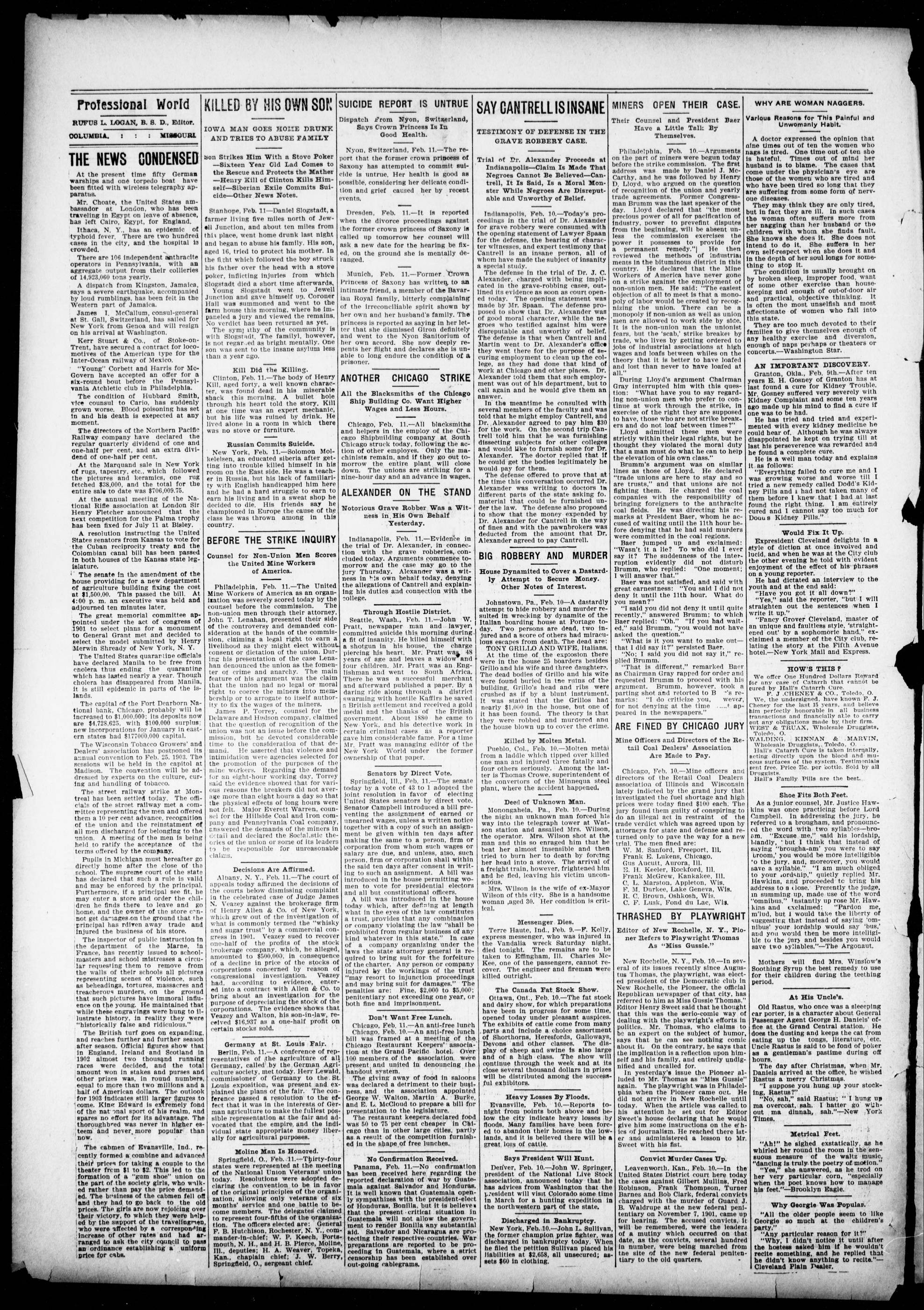
KILLED BY HIS OWN SON
IOWA MAN GOES HOLE DRUNK AND TRIES TO ABUSE FAMILY
Son Strikes Him With a Stove Poker
—Sixteen Year Old Lad Comes to the Rescue and Protects the Mather
—Henry Kill of Clinton Kills Himself—Siberian Exile Commits Suicide—Other News Notes.
Stanhope, Feb. 11—Daniel Slogstadt, a farmer living five miles north of Jewell Junction, and about ten miles from this place, went home drunk last night and began to abuse his family. His son, aged 16, tried to protect his mother. In the fight which followed the boy struck his father over the head with a stove poker, inflicting injuries from which Slogstadt died a short time afterwards.
Young Slogstadt went to Jewell Junction and gave himself up. Coroner Hall was summoned and went to the farm house this morning, where he impaneled a jury and viewed the remains. No verdict has been returned as yet. The sym thy of the community is with Slogstadt. The family, however, is not regarred as bright mentally. One son was sent to the insane asylum less than a year ago.
Kill Did the Killing.
Clinton, Feb. 11.—The body of Henry Kill, aged forty, a well known character, was found dead in his miserable shack this morning. A bullet hole through his heart told the story. Kill at one time was an expert mechanic, but his life was ruined by drink. He lived alone in a room in which there was no stove or furniture.
Russian Commits Suicide
New York, Feb. 11.—Solomon Mokkeelsen, an educated siberia after getting into trouble killed himself in his room on the East side. He was a teacher in Russia, but his lack of familiarity with English handicapped him here and he had a hard struggle to earn to earn his living and in a sweat shop he decided to die. His friends say he championed in Europe the cause of the class he was thrown among in this country.
BEFORE THE STRIKE INQUIRY
Counsel for Non-Union Men Scores the United Mine Workers of America
Philadelphia, Feb. 11.—The United Mine Workers of America as an organization was severely scored today by the counsel before the commission. The non-union men through their attorney, John T. Lenahan, presented their side of the controversy and demanded consideration at the hands of the commission, claiming a legal right to earn a livelihood as they might elect without consent or dictation of the union. During his presentation of the case Lenahan denounced the union as the fometer of crime and anarchy. The main feature of his argument was the claim that the union had no legal or moral right to coerce the miners into membership or to arrogate to itself authority to fix the wages of the miners.
James P. Torrey, counsel for the Delaware and Hudson company, claimed that the question of recognition of the union was not an issue before the commission, but he devoted considerable time to the consideration of that demand. He asserted that violence and intimidation were agencies selected for the promotion of the purposes of the mine workers. Regarding the demand for an eight-hour working day, Torrey said the evidence showed that for various reasons the breakers did not average more than eight hours a day so that the physical effects of long hours were not felt. Major Everett Warren, counsel for the Hillside Coal and Iron company and Pennsylvania Coal company, answered the demands of the miners in detail and declared the Social-sie theories of the union or some of its leaders to be responsible for unreasonable claims.
Decisions Are Affirmed
Albany, N. Y., Feb. 11.—The court of appeals today affirmed the decisions of the courts below dismissing complaint in the celebrated case of Judge James N. Veazey against the brokerage firm of Henry Allen & Co. of New York, which grew out of the investigation of what is commonly termed the "whisky and sugar trust" by a commercial congress in 1901. Veazey sued to recover one-half of the profits of the stock brokerage company, which, he alleged, amounted to $500,000, in consequence of a decline in price of the stocks of corporations concerned by reason of congressional investigation. Veazey had, according to evidence, entered into a contract with Allen & Co. to bring about an investigation for the purpose of depreciating the stock of the corporations. The evidence shows that Veazey and Walton, his son-in-law, received $16,937 as a one-half profit on certain stocks sold.
Germany at St. Louis Fair
Germany at St. Louis Fair.
Berlin, Feb. 11.—A conference of representatives of the agriculture of all Germany, called by the German agriculture society, to the town of Lewald, commune of Germany to the St. Louis exposition, was present and explained the plans of the fair. The conference passed a resolution to the effect that it was in the interests of German agriculture to make the fullest possible representation at the fair and advocated that the empire, and the individual state appropriate money liberally for agricultural purposes.
Moline Man Is Honored
Springfield, O., Feb. 11.—Tjirty-four states were represented at the meeting of the National Union Veterans' union today. Resolutions were adopted declaring the convention to be in favor of the original principles of the organization, allowing only veterans of six months' service and one battle to become members. The delegates claimed to represent four-fifths of the organization. The officers elected are: General F. B. Hutchison, Rochester, N. Y., commander-in-chief; F. W. P. Keech, Portsmouth, N. H. and H. B. Pierce, Moline, Ill., deputies; H. A. Weaver, Topeka, Kan., chaplain chief; J. W. Berry, Springfield, O., sergeant chief.
SUICIDE REPORT IS UNTRUE
Dispatch From Nyon, Switzerland,
Says Crown Princess Is In
Good Health.
Nyon, Switzerland, Feb. 11.—The report that the former crown princess of Saxony has attempted to commit suicide is untrue. Her health is good as possible, considering her delicate condition and grief caused her by recent events.
Dresden, Feb. 11.—It is reported when the divorce proceedings against the former crown princess of Saxony is called up tomorrow her counsel will ask a new date for the hearing be fixed, on the ground she is mentally deranged.
Munich, Feb. 11.—Former Crown Princess of Saxony has written to an intimate friend, a member of the Bavarian Royal family, bitterly complaining of the irreconcilable spirit shown by her own and her husband's family. The princess is reported as saying in her letter that she dismissed Gron definitely and went to the Nyon Sanitarium of her own accord. She now deeply repents her flight and declares she is unable to long endure the condition of a prisoner.
ANOTHER CHICAGO STRIKE
All the Blacksmiths of the Chicago Ship Building Co. Want Higher Wages and Less Hours.
Chicago, Feb. 11.—All blacksmiths and helpers in the employ of the Chicago Shipbuilding company at South Chicago struck today, following the action of other employees. Only the machinists remain, and if they go out toorrow the entire plant will close down. The unions are striking for a nine-hour day and an advance in wages.
ALEXANDER ON THE STAND
Notorious Grave Robber Was a Witness in His Own Belfh Yesterday.
Indianapolis, Feb. 11.—Evidence in the trial of Dr. Alexander, in connection with the grave robberies, concluded Thursday. Arguments commenced tomorrow and the case may go to the jury Thursday. Alexander was a witness in his own behalf today, denying the allegations of Cantrell and explaining his duties and connection with the college.
Through Hostile District.
Seattle, Wash., Feb. 11:—John W. Pratt, newspaper man and lawyer, committed suicide this morning during a fit of insanity. He killed himself with a shotgun in his house, the charge piercing his heart. Mr. Pratt was 48 years of age and leaves a widow and four children. Mr. Pratt was an Englishman and went to South Africa. There he was a successful merchant and afterward published a paper. By a daring ride along through a district swarming with hostile Kaffirs he saved a British settlement and received a gold medal and the thanks of the British government. About 1880 he came to New York, and his detective work in certain criminal cases as a reporter gave him considerable fame. For a time Mr. Pratt was managing editor of the New York World under the former ownership of that paper.
Senators by Direct Vote
Springfield, Ill., Feb. 11. —The senate today by a vote of 43 to 1 adopted the joint resolution in favor of electing United States senators by direct vote. Senator Campbell introduced a bill preventing the assignment of earned or unearned wages, unless a written notice together with a copy of such an assignment be given within ten days after making the same to a person, firm or corporation from whom such wages or salary are due, and unless, also, such person, firm or corporation shall within the said ten days after consent in writing to such an assignment. A bill was introduced in the house permitting women to vote for presidential electors and all but constitutional officers.
A bill was introduced in the house today which, after defining at length what in the eyes of the law constitutes a trust, provides that any combination or company violating the law "shall be prohibited from regular business of any kind whatever in this state." In case of a company organizing under the laws the state attorney general is required to bring suit for the forfeiture of company property or compulsory by the workings of the trust "may resort to injunction proceedings and may bring suit for damages." The penalties are: Fine, $2,000 to $5,000; penitentiary not exceeding one year, or both fine and imprisonment.
Don't Want Free Lunch.
Chicago, Feb. 11.—An anti-free lunch
Chicago, Feb. 10.—An anti-free lunch
bill was framed at a meeting of the
Chicago Restaurant Keepers' association
at the Grand Pacific hotel. Over
100 members of the association, were
present, and united in denouncing the
handout system.
The giving away of food in saloons
was declared a detriment to their business,
the association appointed George W. Walton, Martin A. Burke,
and E. L. McCloud to prepare a bill for
presentation to the legislature.
The restaurant keepers declared food was
50 to 75 per cent cheaper in Chicago
than in other large cities, partly as a result of the competition furnished in the shape of free lunches.
No Confirmation Received.
Panama, Feb. 11.—No confirmation has been received here regarding the reported declaration of war by Guatemala against Salvador and Honduras. It is well known that Guatemala openly sympathizes with the president-elect of Honduras, Bonilla, but it is believe that the present-critic situation in Guatemala will not allow the government to render Bonilla any substantial aid. Salvador and Nicaragua are protecting their respective countries. War preparations are reported to be proceeding in Guatemala, where a strict censorship has been established over out-going cablegrams.
SAY CANTRELL IS INSANE
SAY CANTRELL IS INSANE
TESTIMONY OF DEFENSE IN THE
GRAVE ROBBERY CASE.
Trial of Dr. Alexander Proceeds at Indianapolis—Claim Is Made That Negroes Cannot Be Believed—Cantrell, It Is Said, Is a Moral Monster While Negroes Are Disreputable and Unworthy of Belief.
Indianapolis, Feb. 10.—Today's proceedings in the trial of Dr. Alexander for grave robbery were consumed with the opening statement of Lawyer Spaan for the defense, the hearing of character witnesses, and expert testimony that Cantrell is an insane person, all of whom have made the subject of insanity a special study.
The defense in the trial of Dr. J. C. Alexander, charged with being implicated in the grave-robbing cases, outlined its evidence as soon as court opened today. The opening statement was made by Mr. Spaan. The defense proposed to show that Dr. Alexander was of good moral character, while the negroes who testified against him were disreputable and unworthy of belief. The defense is that when Cantrell and Martin went to Dr. Alexander's office they went there for the purpose of securing employment to clean up the college, as they had done that kind of work at Chicago and other places. Dr. Alexander told them that such employment was out of his department, but to call again and he would give them an answer.
In the meantime he consulted with several members of the faculty and was told that he might employ Cantrell, and Dr. Alexander agreed to pay him $30 for the work. On the second trip Cantrell told him that he was furnishing dissecting subjects for other colleges and would like to furnish some for Dr. Alexander. The doctor replied that if he could get the bodies legitimately he would pay for them.
The defense offered to prove that at the time this conversation occurred Dr. Alexander was writing to doctors in different parts of the state asking fo. material that could be furnished under the law. The defense also proposed to show that the money expended by Dr. Alexander for Cantrell in the way of fines and with the pawnbrokers was deducted from the amount that Dr. Alexander agreed to pay Cantrell.
BIG ROBBERY AND MURDER
House Dynamited to Cover a Dastardly Attempt to Secure Money. Other Notes of Interest.
Johnstown, Pa., Feb. 10—A dastardly attempt to hide robbery and murder resulted in wrecking by dynamite of the Italian boarding house at Portage today. Two persons are dead, two injured and a score of others had miraculous escapes from death. The dead are: TONY GRILLO AND WIFE, Italians. At the time of the explosion there were in the house 25 boarders besides Grillo and his wife and three daughter. The dead bodies of Grillo and his wife were found buried in the ruins of the building. Grillo's head and ribs were crushed as if by a blunt instrument. It was stated that the Grillos had nearly $1,000 in the house, but one of it has been found. The theory is that they were robbed and murdered and the house blown up to cover the crime.
Killed by Molten Metal.
Pueblo, Col., Feb. 10.—Molten metal from a laddle which tipped over killed one man and injured three fatally and four others seriously. Among the latter is Thomas Crowe, superintendent of the convertors of the Minnequa steel plant, where the accident happened.
Deed of Unknown Man.
Monongahela, Pa., Feb. 10. During the night an unknown man forced his way into the telegraph tower at Watson station and assailed Mrs. Wilson, the operator. Mrs. Wilson shot at the man and this so enraged him that he beat her almost insensible and then tried to burn her to death by forcing her head into a stove. The arrival of a freight train, however, frightened him and he fled, leaving his victim unconscious.
Mrs. Wilson is the wife of ex-Mayor Wilson of this city. She is a handsome woman, aged 30. Her condition is critical.
Messenger. Dies.
Terre Haute, Ind., Feb. 9.—F. Kelly, express messenger, who was injured in the Vandalia wreck Saturday night, died tonight. The remains are to be taken to Effingham, Ill. Charles McKee, one of the passengers, cannot recover. The engineer and fireman were killed outright.
The Canada Fat Stock Show.
Ottawa, Ont., Feb. 10.—The fat stock and dairy show, for which preparations have been in progress for some time, opened today under pleasant auspices. The exhibits of cattle come from many parts and include a choice assortment of Shorthorns, Heresfords, Galloways, Devons and other classes. The display of sheep and swine is also large and of a high class. The show will continue through the week and at its close several thousand dollars in prizes will be distributed among the successful exhibitors.
Heavy Losses By Floods
Evansville, Feb. 10—Reports tonight from points both above and below the city indicate heavy losses by floods. Many families have been forced to abandon their homes in the lowlands, and it is believed there will be a great loss of cattle.
Says President Will Hunt.
Deriver, Feb. 10.—John W. Springer, president of the National Live Stock association, announced today that he has advises from Washington that the president will visit Colorado some time in March for a hunting expedition in the northwestern part of the state.
Discharged in Bankruptcy.
New York, Feb. 10—John L. Sullivan, the former champion prize fighter, was discharged in bankruptcy today. When he filed the petition Sullivan placed his liabilities at $2,658, all unsecured; assets $60 in clothing.
MINERS OPEN THEIR CASE.
Their Counsel and President Baer Have a Little Talk By Themselves.
Philadelphia, Feb. 10.—Arguments on the part of miners were begun today before the strike commission. The first address was made by Daniel I. McCarthy, and he was followed by Henry D. Lloyd, who argued on the question of recognition of the union and yearly trade agreements. Former Congressman Brumm was the last speaker of the day. Lloyd declared that "the most precious power of all for pacification of industry, power to prevent disputes from the beginning, will be absent unless the commission exercises the power it possesses to provide for a permanent remedy." He then reviewed the methods of industrial means in the bituminous district in this country. He declared that the Mine Workers of America have never gone on a strike against the employment of non-union men. He said: "The easiest objection of all to meet is that a monopoly of labor would be created by recognizing the union. There can be a monopoly if non-union as well as union men are allowed to work side by side. It is the non-union man the unionist fears, but the 'seab', strike breaker by trade, who lives by getting ordered to jobs of industrial associations at high wages and loafs between whiles on the theory that it is better to have loafed and lost than never to have loafed at all."
During Lloyd's argument Chairman Gray interrupted him with this question: "What have you to say regarding non-union men who prefer to continue at work through the strike, in exercise of the right they are supposed to have, those who are not strike breakers and do not loaf between times?" Lloyd admitted these men were strictly within their legal rights, but he thought they violated the moral duty that a man must do what he can to help the elevation of his own class." Brummi's argument was on similar lines as those of Lloyd. He declared "trade unions are here to stay and so are trusts," and that unions are not fighting them. He charged the coal companies with the responsibility of bringing foreigners to the anthracite coal fields. He was directing his remarks at President Baer, whom he accused of waiting until the 11th hour before denying that he had said murders were committed in the coal regions.
Baer jumped up and exclaimed: "Wasn't it a lie? To who did I ever say it? The suddenness of the interruption evidently did not disturb Brumm, who replied: "One moment; I will answer that." Baer was not satisfied, and said with great earnestness: "You said I did not deny it until the 11th hour. What do you mean?" "I said you did not deny it until quite recently," answered Brumm; to which Baer replied: "Oh." "If you had waited," said Brumm, "you would not have asked the question." "What is it you want to make out—that did you say it?" persisted Baer. "No," said you did not say it," replied Brumm. "That is different." remarked Baer as Chairman Gray rapped for order and requested Brumm to proceed with his argument. Brumm, however, took a parting shot and retorted to B. "s remarks: "I do criticize you, wever, for not denying at the time ... appeared in the newspapers."
ARE FINED BY CHICAGO JURY
Mine Officers and Directors of the Retail Coal Dealers' Association Are Made to Pay.
Chicago, Feb. 10.—Mine officers and directors of the Retail Coal Dealers association of Illinois and Wisconsin lately indicted by the grand jury that investigated the fuel shortage and high prices were today finned $100 each. The jury found them guilty of conspiring to do an illegal act in restraint of the trade verdict which was agreed upon by attorneys for state and defense and returned only to pave the way for a new trial. The men fined are:
W. M. Sanford, Freeport, Ill.
Frank E. Lukens, Chicago.
Gus Aucutt, Aurora, Ill.
E. H. Keeler, Rockford, Ill.
Frank McGrew, Kankakee, Ill.
C. L. Marston, Appleton, Wis.
F. M. Durkee, Lake Geneva, Wis.
R. C. Brown, Oshkosh, Wis.
C. F. Lusk, Fond du Lac, Wis.
THRASHED BY PLAYWRIGHT
Editor of New Rochelle, N. Y., Pioneer Refers to Playwright Thomas As "Miss Gussie."
New Rochelle, N. Y., Feb. 10.—In several of its issues recently since August Thomas, the playwright, was elected president of the Democratic club in New Rochelle, the Pioneer, the official Republican newspaper of that city, has referred to him as Miss Gussie Thomas." Editor Henry Sweet said that he thought that this was the serio-comic way of dealing with the playwright's efforts in politics. Mr. Thomas, who claims to be an expert on the subject of humor, says that he can see nothing comic about it. On the contrary, he says that the implication is a reflection upon himself and his family, and entirely undignified and uncalled for.
In yesterday's issue the Pioneer alluded to Mr. Thomas as "Miss Gussie" again. The playwright was in Philadelphia when the Pioneer came out. He did not arrive in New Rochelle until today. When the article was called to his attention he set out for Editor Sweet's house declaring that he would give him some instructions on the ethics of journalism. He reached there later and administered a lesson to Mr. Sweet with his fist.
Convict Murder Cases Up.
Leavenworth, Kan., Feb. 10.—In the United States District court here today the cases against Gilbert Mullins, Fred Robinson, Frank Thompson, Turner Barnes and Bob Clark, federal convicts charged with the murder of Guard J. B. Waldrupe at the new federal penitentiary on November 7, 1901, came up for hearing. The accused convicts, it will be remembered, were the leaders of a mutiny which occurred on that date, as the convicts, several hundred in number, were being marched from the site of the new federal penitentiary to the old quarters.
WHY ARE WOMAN NAGGERS.
Varique Reasons for This Painful and Unwomanly Habit.
A doctor expressed the opinion that nine times out of ten the women who nags is tired. One time out of ten she is hateful. Times out of mind her husband is to blame. The cases that come under the physician's eye are those of the women who are tired and who have been tired so long that they are suffering from some form of nerve diseases. They may think they are only tired, but in fact they are ill. In such cases the woman often suffers more from her nagging than her husband or the children with whom she finds fault. She knows she does it. She does not intend to do it. She suffers in her own self-respect when she does it and in the depth of her soul longs for something to stop it. The condition is usually brought on by broken sleep, improper food, want of some other exercise than housekeeping and enough of out-of-door air and practical, objective thinking. It is often the most unselfish and most affectionate of women who fall into this state.
They are too much devoted to their families to give themselves enough of any healthy exercise and diversion, enough of naps perhaps or theaters or concerts.—Washington Star.
AN IMPORTANT DISCOVERY.
Granton, Okla., Feb. 9th.—After ten years E. H. Gossey of Granton has at last found a cure for Kidney Trouble, Mr. Gossey suffered very severely with Kidney Complaint and some ten years ago made up his mind to find a cure if one was to be had.
He has tried and tried and experimented with every kidney medicine he could hear of. Although he was always disappointed he kept on trying till at last his perseverance was rewarded and he found a complete cure.
He is a well man today and explains it as follows:
"Everything failed to cure me and I was growing worse and worse till I tried a new remedy called Dodd's Kidney Pills and I had not taken many of them before I knew that I had at last found the right thing. I am entirely cured and I cannot say too much for Doug's Kidney Pills."
Would Fix It Up.
Expresident Cleveland delights in a style of diction at once involved and lucid, and when he was at the City club the other evening he told with evident enjoyment of the effect of his phrases on a young reporter. He had dictated an interview to the youth and at the end said:
"Have you got it all down?"
Have you gue it in the "Yes," said the reporter, "but I will straighten out the sentences when I write it up."
"Fancy Grover Cleveland, master of an unique and faultless style, 'straightened out' by a sophomoric hand," exclaimed a member of the City club, relating the story at the Fifth Avenue hotel—New York Mall and Express.
HOW'S THIS?
We offer One Hundred Dollars Reward for any case of Catarrh that cannot be cured by Hall's Catarrh Cure.
F. J. CHENEY & CO., Toledo, O.
We, the undersigned, have known B. J. Cheney for the last 15 years, and have business transactions and financially able to carry out any obligations made by their firm.
WEST & TRUX, Wholesale Druggists, Toledo, O.
WALDING, KINNAN & MARVIN, Wholesale Druggists, Toledo, O.
Hall's Catarrh Cure is taken generally, surface surfaces used and mucous surfaces of the system. Testimonials sent free. Price 75c. per bottle. Sold by all Druggists.
Hall's Family Pills are the best.
Shoe Fits Both Feet.
As a junior counsel, Mr. Justice Hawkins was once practicing before Lord Campbell. In addressing the jury, he referred to a brougham, and pronounced the word with two syllables—broam, "Excuse me," said his lordship, blandly, 'but I think that instead of saying "brougha-am" you were to say uroom, you would be more intelligible to the jury, and, moreover, you would save a syllable." "I am much obliged to your lordship," quietly replied Mr. Hawkins, and proceeded to bring his address to a close. Presently the judge, in summing up, made use of the word "omnibus," instantly up rose Mr. Hawkins and exclaimed: "Pardon me, m'ud, but I would take the liberty of suggesting that instead of saying 'omnibus' your lordship would say 'bus,' and you would then be more intelligible to the jury and besides you would save two syllables."—The Argonaut.
Mothers will find Mrs. Winslow's Soothing Syrup the best remedy to use for their children during the teething period.
At His Uncle's.
Old Rastus, who once was a sleeping car porter, is a character about General Passenger Agent George H. Daniels' office at the Grand Central station. He does the dusting and keeps the cat from eating up the tongs, literature, etc. Uncle Rastus is said to be fond of poker as a gentleman's pastime during off hours.
The day after Christmas, when Mr. Daniels arrived at the office, he wished Rastus a merry Christmas.
"I suppose you hung up your stocking, Rastus?"
"No, sah," said Rastus; "I hung up ma overcoat, sah. I hatter go without ma dinnah, sah."—New York Times.
Metrical Feet.
"Ah!" he sighed exstatically, as he whirled her round the room in the sensuous measure of the waltz music, "dancing is truly the poetry of motion." "Yes," she answered, as he trod on her very particular corn, "especially when the poet knows how to manage his feet."—Brooklyn Eagle.
Why Georgie Was Popular.
"All the older people seem to like Georgie so much at the children's party."
"Any particular reason for it?"
"Why, I didn't notice it until after the hostess asked him if he wouldn't recite something, and he replied that he didn't know anything to recite."—Cleveland Plain Dealer.
Banking by Mail
Send for Booklet "A" for full particulars of how to open a savings account by mail.
3 Per Cent Interest Compounded Twice Each Year.
Capital, - $2,000,000
Surplus & Profits 1,000,000
Montgomery Ward & Co
W. H. M'DOEL,
President C. I. & L (Monon) R. R.
CHARLES T. TREGO.
Formerly Pres. G. B. Shaw Lumber Co
WILLIAM KENT, Kent Cattle Co.
E. H. H. H.
President A. T. & S. F. R. R.
CHAS. T. NASH.
Nash-Wright Co., Board of Trade.
JOY MORTION, Jorton & Co., Salt
T. P. SHONTS, Capitalstl,
C. W. RESIDENT, I. I. R. R.
C. W. POQUA, Vice President
JAS. R. CHAPMAN, Vice President
CHARLES H. THORNE.
Montgomery Ward & Co.
B. THOMS,
President Chicago & W. Ind R.
American Trust and Savings Bank CHICAGO, ILL.
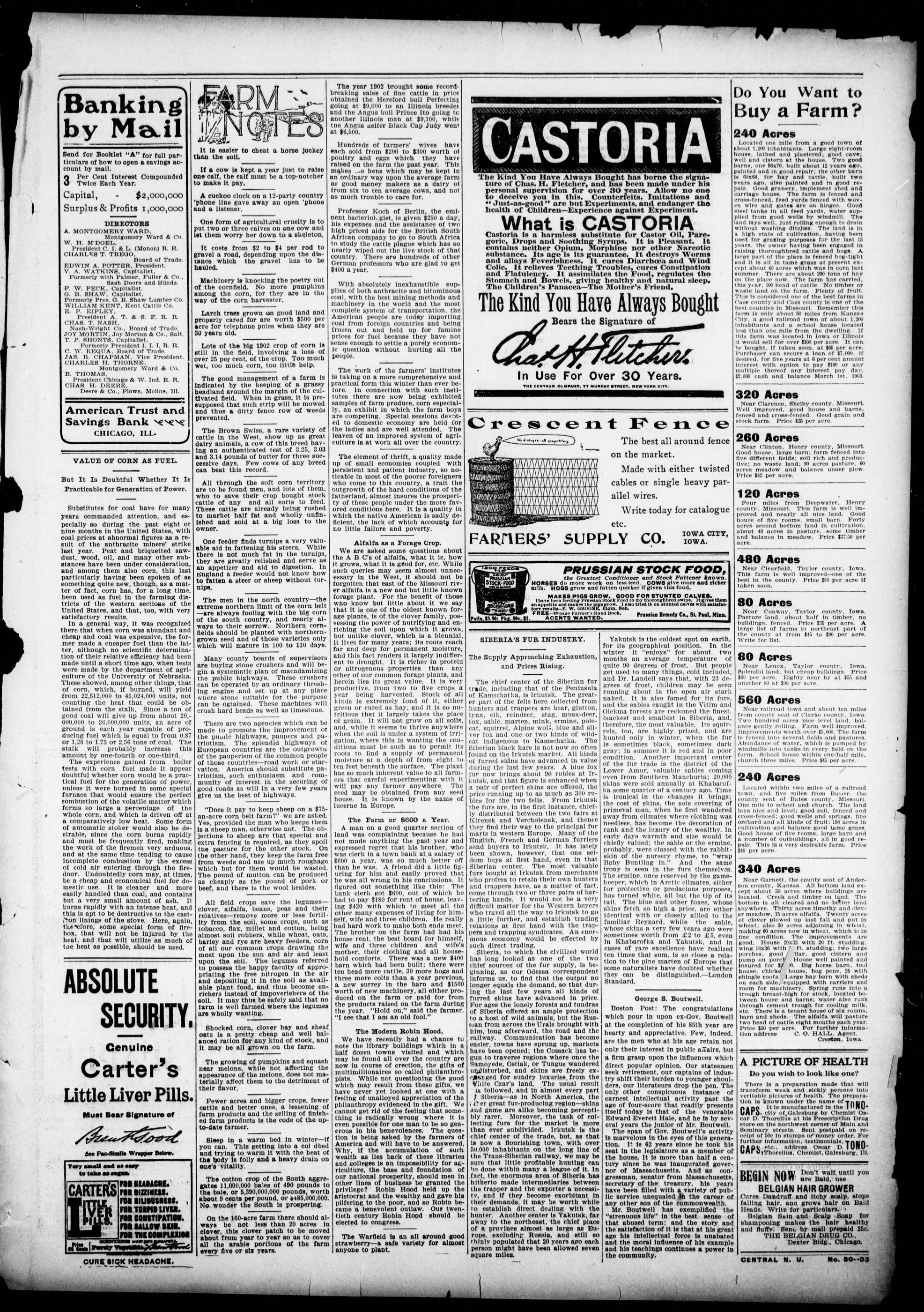
VALUE OF CORN AS FUEL.
But It Is Doubtful Whether It Is Practicable for Generation of Power.
Substitutes for coal have for many years commanded attention, and especially so during the past eight or nine months in the United States, with coal prices at abnormal figures as a result of the anthracite miners' strike last year. Peat and briquetted sawdust, wood, oil, and many other substances have been under consideration, and among them also corn, this last particularly having been spoken of as something quite new, though, as a matter of fact, corn has, for a long time, been used as fuel in the farming districts of the western sections of the United States, and that, too, with very satisfactory results.
In a general way, it was recognized that when corn was abundant and cheap and coal was expensive, the former made a cheaper fuel than the latter, although no scientific determination of their relative efficiency had been made until a short time ago, when tests were made by the department of agriculture of the University of Nebraska. These showed, among other things, that of corn, which, if burned, will yield from 22,512,000 to 45,024,000 units, not counting the heat that could be obtained from the stalk. Since a ton of good coal will give up from about 20,000,000 to 26,000,000 units, an acre of ground is each year capable of producing fuel which is equal to from 0.87 or 1.28 to 1.75 or 2.56 tons of coal. The stalk will probably increase this amount by one-fourth or one-third.
The experience gained from boiler tests with corn fuel made it appear doubtful whether corn would be a practical fuel for the generation of power, unless it were burned in some special furnace that would ensure the perfect combustion of the volatile matter which forms so large a percentage of the whole corn, and which is driven off at a comparatively low heat. Some form of automatic stoker would also be desirable, since the corn burns rapidly and must be frequently fired, making the work of the firemen very arduous, and at the same time tending to cause incomplete combustion by the excess of cold air entering through the firedoor. Undoubtedly corn may, at times, be a cheap and economical fuel for domestic use. It is cleaner and more easily handled than coal, and contains but a very small amount of ash. It burns rapidly with an intense heat, and this is apt to be destructive to the cast iron linings of the stove. Here, again, theorema, some special form of firebox, that will not be injured by the heat, and that will utilize as much of the heat as possible, should be used.
ABSOLUTE
SECURITY.
Genuine
Carter's
Little Liver Pills.
Must Bear Signature of
Burt Wood
See Fac-Simile Wrapper Below.
Very small and as easy
to take as sugar:
CARTER'S
LITTLE
LIVER
PILLS.
FOR HEADACHE.
FOR DIZZINESS.
FOR BILIOUSNESS.
FOR TORPID LIVER.
FOR CONSTIPATION.
FOR SALLOW SKIN.
FOR THE COMPLEXION
Price
$5 Coin
Purity Vegetable
FARM NOTES
It is easier to cheat a horse jockey than the soil.
If a cow is kept a year just to raise one calf, the calf must be a top-notcher to make it pay.
A cuckoo clock on a 12-party country 'phone line gave away an open 'phone and a listener.
One form of agricultural cruelty is to put two or three calves on one cow and let them worry her down to a skeleton.
It costs from $2 to $4 per rod to gravel a road, depending upon the distance which the gravel has to be hauled.
Machinery is knocking the poetry out of the cornfield. No more pumpkins among the corn, for they are in the way of the corn harvester.
Larch trees grown on good land and properly cared for are worth $500 per acre for telephone poles when they are 30 years old.
Lots of the big 1902 crop of corn is still in the field, involving a loss of over 25 per cent of the crop. Too much wet, too much corn, too little help.
The good management of a farm is indicated by the keeping of a grassy headland around the margin of the cultivated field. When in grass, it is presupposed that such strip will be mowed and thus a dirty fence row of weeds prevented.
The Brown Swiss, a rare variety of cattle in the West, show up as great dairy animals, a cow of this breed having an authenticated test of 3.25, 3.03 and 3.14 pounds of butter for three successive days. Few cows of any breed can beat this record.
All through the soft corn territory are to be found men, and lots of them, who to save their crop bought stock cattle of any and all sorts to feed. These cattle are already being rushed to market half fat and wholly unfinished and sold at a big loss to the owner.
One feeder finds turnips a very valuable aid in fattening his steers. While there is not much fat in the turnips, they are greatly relished and serve as an appetizer and aid to digestion. In England a feeder would not know how to fatten a steer or sheep without turnips.
The men in the north country—the extreme northern limit of the corn belt—are always fooling with the big corn of the south country, and nearly always to their sorrow. Northern cornfields should be planted with northern-grown seed and of those varieties only which will mature in 100 to 110 days.
Many county boards of supervisors are buying stone crushers and will begin a systematic plan of macadamizing the public highways. These crushers can be operated by an ordinary threshing engine and set up at any place where stone suitable for the purpose can be obtained. These machines will crush hard heads as well as limestone.
There are two agencies which can be made to promote the improvement of the pusic highways, paupers and patriotism. The splendid highways of European countries are the outgrowth of the pauperism of the common people of those countries—road work or starvation. America should substitute patriotism, such enthusiasm and community of interest in the securing of good roads as will in a very few years give us the best of highways.
"Does it pay to keep sheep on a $75-an-acre corn belt farm?" we are asked. Yes, provided the man who keeps them is a sheep man, otherwise not. The objections to sheep are that special and extra fencing is required, as they spoil the pasture for the other stock. On the other hand, they keep the farm free from weeds and use up much roughage which but for them would be wasted. The pound of mutton can be produced as cheaply as the pound of pork or beef, and there is the wool besides.
All field crops save the legumes—clover, alfalfa, beans, peas and their relatives—remove more or less fertility from the soil, some crops, such as tobacco, flax, millet and cotton, being almost soil robbers, while wheat, oats, barley and rye are heavy feeders, corn of all our common crops drawing the most upon the sun and air and least upon the soil. The legumes referred to possess the happy faculty of appropriating the free nitrogen in the air and depositing it in the soil as available plant food, and thus become enrichers instead of impoverishers of the soil. It may thus be safely said that no farm is well farmed where the legumes are wholly wanting.
Shocked corn, clover hay and sheaf oats is a pretty cheap and well balanced ration for any stock, and it may be all grown on the farm.
The growing of pumpkins and squash near melons, while not affecting the appearance of the melons, does not materially affect them to the detriment of their flavor.
Fewer acres and bigger crops, fewer cattle and better ones, a lessening of farm products and the selling of finished farm products is the code of the up-to-date farmer.
Sleep in a warm bed in winter—if you can. This getting into a col dbed and trying to warm it with the heat of the body is folly and a heavy drain on one's vitality.
The cotton crop of the South aggregates 11,000,000 bales of 480 pounds to the bale, or 5,390,000,000 pounds, worth about 9 cents per pound, or $485,000,000. No wonder the South is prospering.
On the 160-acre farm there should always be not less than 20 acres in clover, this clover patch to be moved about from year to year so as to cover all the arable portions of the farm every five or six years.
The year 1902 brought some record-breaking sales of fine cattle in price obtained the Herford bull Perfecting going at $9,000 to an Illinois breeder and the Angus bull Prince Ito going to another Illinois man at $9,100, while the Angus uelfer Black Cap Judy went at $6,500.
Hundreds of farmers' wives have each sold from $200 to $300 worth of poultry and eggs which they have raised on the farm the past year. This makes ...he hens which may be kept in an ordinary way upon the average farm as good money makers as a dairy of from six to ten average cows, and not as much trouble to care for.
Professor Koch of Berlin, the eminent bacteriologist, is given $250 a day, his expenses and the assistance of two high priced aids for the British South African company to go to South Africa to study the cattle plague which has so nearly wiped out the live stock of that country. There are hundreds of other German professors who are glad to get $400 a year.
With absolutely inexhaustible supplies of both anthracite and bituminous coal, with the best mining methods and machinery in the world and the most complete system of transportation, the American people are today importing coal from foreign countries and being frozen out and held up for famine prices for fuel because they have not sense enough to settle a purely economic question without hurting all the people.
The work of the farmers' institutes is taking on a more comprehensive and practical form this winter than ever before. In connection with such institutes there are now being exhibited samples of farm produce, corn especially, an exhibit in which the farm boys are competing. Special sessions devoted to domestic economy are held for the ladies and are well attended. The leaven of an improved system of agriculture is at work all over the country.
The element of thrift, a quality made up of small economies coupled with persistent and patient industry, so noticeable in most of the poorer foreigners who come to this country, a trait the outgrowth of the hard conditions of the fatherland, almost insures the prosperity of these people under the more favored conditions here. It is a quality in which the native American is sadly deficient, the lack of which accounts for no little failure and poverty.
Alfalfa as a Forage Crop.
We are asked some questions about the A B C's of alfalfa, what it is, how it grows, what it is good for, etc. While such queries may seem almost unnecessary in the West, it should not be forgotten that east of the Missouri river alfalfa is a new and little known forage plant. For the benefit of those who know but little about it we say that it is one of the oldest known forage plants, is of the clover family, possessing the power of nutrifying and enriching the soil upon which it grows, but unlike clover, which is a biennial, it lives for many years; its roots reach far and deep for permanent moisture, and this fact renders it largely indifferent to drought. It is richer in protein or nitrogenous properties than any other of our common forage plants, and herein lies its great value. It is very productive, from two to five crops a year being harvested. Stock of all kinds is extremely fond of it, either green or cured as hay, and it is so nutritious that it largely takes the place of grain. It will not grow on all soils, and, while it seems to thrive anywhere when the soil is under a system of irrigation, where this is wanting the conditions must be such as to permit its roots to find a supply of permanent moisture at a depth of from eight to ten feet beneath the surface. The plant has so much inherent value to all farmers that careful experimenting with it will pay any farmer anywhere. The seed may be obtained from any seed house. It is known by the name of lucerne in Europe.
The Farm or $600 a Year.
A man on a good quarter section of land was complaining because he had not made anything the past year and expressed regret that his brother, who was clerk in a town bank at a salary of $600 a year, was so much better off than he was. A friend did a little figuring for him and easily proved that he was all wrong in his conclusions. It figured out something like this: The bank clerk got $600, out of which he had to pay $180 for rent of house, leaving $420 with which to meet all the other many expenses of living for himself, wife and three children. He really had hard work to make both ends meet. The brother on the farm had had his house rent, the best board for himself, wife and three children and wife's mother, their clothing and all household comforts. There was a new $400 barn which had been built; there were ten head more cattle, 30 more hogs and three more colts than a year previous, a new surrey in the barn and $1500 worth of new machinery, all either produced on the farm or paid for from the products raised on the farm during the year. "Hold on," said the farmer. "I see that I am an old fool."
The Modern Robin Hood.
We have recently had a chance to note the library buildings which in a half dozen towns visited and which may be found all over the country are now in course of erection, the gifts of multimillionaires so called philanthropists. While not questioning the good which may result from these gifts, we have never yet looked at one with a feeling of unalloyed appreciation of the philanthropy evidenced in the gift. We cannot get rid of the feeling that something is radically wrong where it is even possible for one man to be so generous in his benevolences. The question is being asked by the farmers of America and will have to be answered, Why, if the accumulation of such wealth as lies back of these libraries and colleges is an impossibility for agriculture, the base and foundation of our national prosperity, should men in other lines of business be granted the privilege? Robin Hood held up the aristocrat and the wealthy and gave his filering to the poor, and so Robin became a benevolent outlaw. Our twentieth century Robin Hood should be elected to congress.
The Warfield is an all around good strawberry—a safe variety for almost anyone to plant.
The Kind You Have Always Bought has borne the signature of Chas. H. Fletcher, and has been made under his personal supervision for over 30 years. Allow no one to deceive you in this. Counterfeits, Imitations and "Just-as-good" are but Experiments, and endanger the health of Children—Experience against Experiment.
What is CASTORIA
Castoria is a harmless substitute for Castor Oil, Paregoric, Drops and Soothing Syrups. It is Pleasant. It contains neither Opium, Morphine nor other Narcotic substance. Its age is its guarantee. It destroys Worms and allays Feverishness. It cures Diarrhea and Wind and Tremors. It tames Tremors and Impulsions and Flatulency. It assimilates the Food, regulates the Stomach and Bowels, giving healthy and natural sleep. The Children's Panacea—The Mother's Friend.
Crescent Fence
**PRUSSIAN STOCK FOOD,**
the Greatest Conditioner and Stock Fattener known.
HORSES do more work on less feed. OOWS give more and richer milk. HOGS grow and fatten quicker if given this food.
MAKES PIGS GROW. GOOD FOR STUNTED CALVES.
I have been feeding Prussian Stock Food to my thoroughbred swine. It gives them an extra energy. I have tried it on stunted with satiatory results. F. W. GROOM, Elinn, Neb.
FREE-64 page Farmer's Hand Book.
Prussian Remedy Co. St. Paul, Minn.
We discuss all competing
120Q JEEDS
PRUSSIAN
STOCK-FOOD
Pails. $3.50. Pkg. $0.50. $1.00.
SIBERIA'S FUR INDUSTRY.
The Supply Approaching Exhaustion, and Prices Rising.
The chief center of the Siberian fur trade, including that of the Peninsula of Kamschatka, is Irkutsk. The greater part of the fells here collected from hunters and trappers are bear, glutton, lynx, ek, reindeer, stag, musk deer, fox, sable, marten, mink, ermine, polecat, squirrel, Alpine wolf, silver and wild cat indigenous to Kamschatka. The Siberian black hare is not now so often found on the Irkutsk market. All kinds of furred skins have advanced in value during the last few years. A blue fox fur now brings about 90 rubles at Irkutsk, and that figure is enhanced when a pair of perfect skins are offered, the price running up to as much as 300 rubles for the two fells. From Irkutsk the furs are, in the first instance, chiefly distributed between the two fairs at Kirensk and Vercholensk, and thence they find their way to the principal fur marts in western Europe. Many of the English, French and German furriers send buyers to Irkutsk. It has lately been shown, however, that one seldom buys at first hand, even in that Siberian center. The most valuable furs bought at Irkutsk from merchants who profess to retain their own hunters and trappers have, as a matter of fact, come through two or three pairs of bartering hands. It would not be a very difficult matter for the Western buyers who travel all the way to Irkutsk to go a little further, and establish trading relations at first hand with the trappers and trapping syndicates. An enormous economy would be effected by such direct trading.
Siberia, to which the civilized world has long looked as one of the two chief sources of the fur supply, is beginning, as our Odessa correspondent informs us, to find that the output no longer equals the demand, so that during the last few years all kinds of furred skins have advanced in price. For ages the lonely forests and tundras of Siberia offered an ample protection to a host of wild animals, but the Russian from across the Urals brought with him, long afterward, the road and the railway. Communication has become easier, towns have sprung up, markets have been opened; the Cossack as begun to traverse regions where once the Samoyede, Ostiak, or Tungus wandered undisturbed, and skins are freely exaggerated for sundry luxuries, from the White Czar's land. The usual result is followed, and in almost every part Siberia—as in North America, the older great fur-producing region—skins and game are alike becoming perceptibly rarer. Moreover, the task of collecting furs for the market is more than ever subdivided. Irkutsk is the chief center of the trade, but, as that is now a flourishing town, with over 50,000 inhabitants on the long line of the Trans-Siberian railway, we may be sure that little profitable hunting can be done within many a league of it. In fact, the enormous area of Siberia has hitherto made intermediaries between the trapper and the exporter a necessity, and if they become exorbitant in their demands, it may be worth while to establish direct dealing with the hunter. Another center is Yakutsk, far away to the northeast, the chief place of a province almost as large as Europe, excluding: Russia, and still so thinly populated that 20 years ago each person might have been allowed seven square miles.
The best all around fence on the market.
Made with either twisted cables or single heavy parallel wires.
Write today for catalogue etc.
LY CO. IOWA CITY,
IOWA.
Yakutsk is the coldest spot on earth, for its geographical position. In the winter it "enjoys" for about two months an average temperature of quite 90 degrees of frost. But people get used to many things, cold included, and Dr. Landell says that, with 23 degrees of frost, children may be seen running about in the open air stark naked. It is also famed for its furs, and the sables caught in the Vitim and Olekmai forests are reckoned the finest, blackest and smallest in Siberia, and, therefore, the most valuable. Its squirrels, too, are highly prized, and are hunted only in winter, when the fur is sometimes black, sometimes dark gray; in summer it is red and in poor condition. Another important center of the fur trade is the district of the Lower Amur, valuable sables coming even from Southern Manchuria; 20,000 sables were sold annually at Khabarofka some quarter of a century ago. Time is ironical in the changes it brings; the cost of skins, the sole covering of primeval man, when he first wandered away from climates where clothing was needless, has become the decoration of rank and the luxury of the wealthy. In early days warmth and size would be chiefly valued; the sable or the ermine, probably, were classed with the rabbitskin of the nursery rhyme, to "wrap Baby Buntling in." And the same irony is seen in the furs themselves. The ermine, once reserved by the gamekeeper, which in Arctic climates, either for protective or predacious purposes, has turned white, all but the tip of its tail. The blue and other foxes, whose skins fetch so high a price, are either identical with or closely allied to the familiar Reynard, while the sable, whose skins a very few years ago were sometimes worth from £2 to £5, even in Khabarofka and Yakutsk, and in cases of rare excellence have realized ten times that sum. is so close a relation to the pine marten of Europe that some naturalists have doubted whether they can be distinguished.—London Standard.
George S. Boutwell.
Boston Post: The congratulations which pour in upon ex-Gov. Boutwell at the completion of his 85th year are hearty and appreciative. Few, indeed, are the men who at his age retain not only their interest in public affairs, but a firm grasp upon the influences which direct popular opinion. Our statesmen seek retirement, our captains of industry shift their burden to younger shoulders; their officers drop the pen. The only other conspicuous achievement earnest intellectual activity past the age of four-score that readily presents itself today is that of the venerable Edward Everett Hale, and he is by several years the junior of Mr. Boutwell.
The span of Gov. Boutwell's activity is marvelous in the eyes of this generation. It: is 62 years since he took his seat in the legislature as a member of the house. It is more than half a century since he was inaugurated governor of Massachusetts. And as congressman, senator from Massachusetts, secretary of the treasury, his years have been filled with a variety of public service unequaled in the career of any other son of the commonwealth. Mr. Boutwell has exemplified the "strenuous life" in the best sense of that abused term; and the story and the satisfaction of it is that at his great age his intellectual force is unabated and the moral influence of his example and his teachings continues a power in the community.
Do You Want to Buy a Farm?
240 Acres
Located one mile from a good town of about 1,200 inhabitants. Large eight-room house, latted and plastered; good cave; well and cistern at the house. Two good wells, one for water and one for painted and in good repair; the other barn is 90x64, for hay and cattle, built two years ago, also painted and in good repair. Good granary, implement shed and carriage house. The farm is fenced and cross-fenced, feed yards fenced with woven straw, steel tanks in all feed yards, water supplied from good wells by windmill. The land lays well, just rolling enough to drain without washing ditches. The land is in a high state of cultivation, having been grown for approximately 20 years, the owner has been engaged in raising thoroughbred cattle and hogs. A large part of the place is fenced hog-tight and it is all in tame grass at present except about 40 acres which was in corn last summer. There are about 200 tons of hay and cattle, the owner has been engaged in this year, 100 head of cattle. No timber or waste land on the farm. Plenty of fruit. This is considered one of the best farms in Cass county and Cass county is one of the best counties in Missouri. Remember this farm is only about 50 miles from Kansas and it is not a farm for inhabitants and a school house located less than one mile from the dwelling. If this farm was located in Iowa or Illinois it would sell for over $100 per acre. It can be bought, if taken soon, at $6 per acre. It is desired, for five years at 6 per cent annual interest, with option to pay $100 or any multiple thereof any interest pay day, $2,000 cash and balance March 1st, 1993.
320 Acres
Near Clarence, Shelby county, Missouri.
Well improved, good house and barns,
fenced and cross-fenced. Good grain and
stock farm. Price $25 per acre.
260 Acres
Near Clinton, Henry county, Missouri.
Good house, large barn; farm fenced into five different fields; soil rich and productive; no waste land; 60 acres pasture, 60 acres meadow and balance under plow.
Price $42 per acre.
120 Acres
Four miles from Deepwater, Henry county, Missouri. This farm is well im-proved and nearly all nice land. Good house of five rooms, small barn. Forty acres second bottom land in cultivation, about 40 acres in pasture, some timber and balance in meadow. Price $7.50 per acre.
480 Acres
Near Clearfield, Taylor county, Iowa. This farm is well improved—one of the best in the county. Price $80 per acre if taken soon.
80 Acres
Near Conway, Taylor county, Iowa. Pasture land, about half in timber, no buildings, fenced. Price $25 per acre. A large list of farms in northeast part of the county at from $45 to $80 per acre. Write for list.
80 Acres
Near Lenox, Taylor county, Iowa.
Splendid land, but cheap buildings. Price
$60 per acre. Eighty near by at $55 and
another $80 at $60 per acre.
560 Acres
Near railroad town and about ten miles from county seat of Clarke county, Iowa. Two hundred acres mice level land, balancing the soil and water. Improvements worth over $ 5,000. The farm is fenced into several fields and pastures. Abundance of water, which is pumped by admits into tanks on field on the farm, is maintained within one acre of church three miles. Price $4 per acre.
240 Acres
Located within two miles of a railroad town, and five miles from Bueuer, the county seat of Bates county, Missouri. One mile to school and church. The land is well fenced, and cross-fenced; good wells and springs, fine orchard and all kinds of fruit; 150 acres in cultivation and balance good tame grass. Good house of five rooms, large barn and barns, and outbuildings, all in good repair. This is a very desirable farm. Price $40 per acre.
340 Acres
Near Garnett, the county seat of Anderson county, Kansas. All bottom land except about 50 acres where buildings are located. Creek and timber on land. The bottom is all cleared and no hoatte land. The middle is all cleared and no hoatte meadow. 15 acres alfalfa. Twenty acres of clover plowed up last fall and put in wheat; also 30 acres adjoining in wheat, making 60 acres now in wheat, which is in fine condition. Improvements are are made. 20x32 with stucco wing 16x36 with / ft. stuuding; two large porches, good / clar, good cistern and pump on porch. House well painted and insured for $7.00. Big horse barn, tool house chicken house, hog pens, large chicken house, with sheds on each side, equipped with carriers and room for machinery. Spring runs into a trough breast-high for stock, located between house and barns; water also runs through cement trough for cooling milk, water also runs through cement trough for cooling milk, barn and sheds. The alfalfa will pasture two head of cattle eight months each year. Price $50 per acre. For further information address C. O. HALL, Agent.
A PICTURE OF HEALTH Do you wish to look like one?
There is a preparation made that will transform weak and sickly persons into veritable pictures of health. The preparation is known under the name of TONOCAPS. It is manufactured in the TONOCAPS. city of Galesburg by Chemist Oscar D. Thorellus at his Prescription Drug store on the northwest corner of Main and Seminary streets. Sent postpaid on reimbursed mail, we are for further information; testimonials, etc., address Oscar D. TONOCAPS. Thorellus, Chemist, Galesburg, Ill.
BEGIN NOW Don't wait, until you are Bald, use
BELGIAN HAIR GROWER
Cures Dandruff and itchy scalp, stops
falling hair, and grows hair on Bald
Heads. Write for particulars.
Belgian Sain and Scalp Soap for
shampooing makes the hair healthy
and fluffy. Send by mail prepaid 25c.
CENTRAL N. U. No. 50--03
The Professional World
BUFUS L. LOGAN, B. S. D. - EDITOR
TERMS OF SUBSCRIPTION.
One Year in Advance - - - $1.00
Six Months in Advance - - .75
Three Months in Advance - - .50
Single Copies - - - .05
Advertising Rates on Application.
Job Work of all Hinds Solicited.
Published Every Friday.
Entered at the postoffice at Columbia, Mo., as second class matter, Jan. 15, 1902.
Agents wanted in every town in the state.
PRESS OF THE MISSOURI STATESMAN.
A SENSIBLE VIEW.
Here is a matter of great interest to the country at the present time. It can not be denied that the negro problem is more troublesome now than it has been recently in many years. The South is objecting to the presence of negro officeholders at the President's receptions, although it did not do this in the case of the receptions of Cleveland, Harrison and McKinley, in which negroes were in attendance. There is a spirit coming to the front in the South which can not possibly do that section any good, and may do it considerable harm. The thing that Southern men accepted in the White House functions in the days of Cleveland, Harrison and McKinley can not be objected to now with any consistency or sense. Moreover, such objections as chance to be made will not have the slightest influence on the President or his party.
It will be noticed that all the bloody-shirt waving which is being done at the present time is by the Democrats. Of course, there is not much likelihood that the scheme to boycott the President's receptions will amount to anything. The number of Southern men who will stay away from those functions who have a chance to go to them will be small in any case, and their absence will not be noticed. There will be a howl in some of the Southern papers about an alleged attempt to put the negroes above the whites and to bring black domination in the South, but that pretense will not deceive even the persons making it. The South and its party will lose if it brings the negro issue to the front in the campaign of 1904.—Globe Democrat.
Do you read the Professional World, if not, why not?
We must constantly remind the negro of this and other communities, that they can only rise by standing together, and patronizing negro enterprises.
We urge our readers to patronize the Columbia Grocery Co. store. It is in every respect a first class grocery store and is in charge of a man of 15 years experience as a groceryman. They keep only first class and fresh goods; such an enterprise is a credit to the negro race.
It would be far more sensible and manly for "Col. Crisp"", the limber-jointed spell-binder of Jackson county, to try to have the Missouri legislature make provisions for wayward negro girls, at the industrial home for girls at Chillicothe, than to try to get the disgraceful "Jim Crow" car.
Our thanks are due the following named persons who have recently sent subscriptions to this paper: Prof. John B. Davis, of New Haven, Mrs. M. S. Brown, of Miami, Miss Cannie Brown, of New Franklin, and Mr. Chas. Brown, of Columbia.
Mr. Andrew Carnegie has donated $25,000 to the Loyal Legion of Labor, a Negro organization. Mr. Carnegie is one man who seems to be imbued with that sentiment which prompted Joaquin Miller to write "For all you can hold in your cold dead hand is what you have given away," and unlike many would-be philanthropists, Mr. Carnegie's gifts usually go where the cause of the common people is benefited. —The Nashville Clarion.
Notice to Correspondents.
When you find it impossible for you to send the news regularly from your community after having agreed to do so, kindly notify us and do not have us reserving space for your items weekly and you not sending them.
CIRCUIT COURT.
Convened Monday—Allen B. Orear on Trial For Murder of E. A. Chapman —Other Proceedings.
The Boone Circuit Court convened Monday afternoon at 2 o'clock, Judge Hockaday presiding. The docket is unusually full and interesting. Not for years has so much business been before the Boone county circuit court. The court room has been crowded from the beginning of the term.
The first case set for trial was the case of the state of Missouri against Allen B. Orear, Sam Chandler, Gilbert Turner, Owen Woolfolk and William McClane, who are charged with having murdered E. A. Chapman, the Wabash station agent, on the night of September 27, 1902. Col. S. Turner and N. T. Gentry are attorneys for Orear. Sam Chandler is represented by Gillespy and Conley. Gilbert Turner is represented by Col. S. Turner, and J. L. Stephens appeared for Woolfolk and McClane. When the case came up for trial the defendants asked for a severance and the court granted it. Orear, Chandler, and Turner will each be tried separately, and McClane and Woolfolk will be tried together, but separate from the others. Tuesday morning it was decided that all of the defendants would be tried, and Allen Orear was the first case to be tried. Judge Hockaday decided to hold an adjourned term of court, beginning March 23, and all the cases except Orear's were continued until that time.
THE O'REAR TRIAL IN PROGRESS
At 9 o'clock Tuesday morning, Allen Orear, charged with complicity in the murder of E. A. Chapman, answered ready for trial. Thereupon Judge Hockaday ordered a special venire of sixty men, and promptly at 3 o'clock, Wednesday afternoon the twelve men, who are to decide whether or not Allen B. Orear participated in one of the most dastardly crimes ever committed in this county. The jurors are as follows: Anthony Wayne, H. T. Buckler, J. D. Hagan, G. H. Hopper, F. M. Lowery, C. W. Fisher, Arch S. Prather, W. M. McCasky, A. J. McKenzie, J. H. Million, N. A. Alton, E. S. Parmer.
James A. Collet, St. Louis, formerly prosecuting attorney of Chariton county, and Judge A. M. Waller, of Moberly, are assisting prosecuting attorney Harris. Col. S. Turner, N. T. Gentry and Hampton Rothwell represent the defendant. Prosecuting attorney Harris made the opening statement to the jury. It was a clear and concise statement of what the state expected to prove, and showed that Mr. Harris has the case well in hand.
At the time we go to press the trial is still in progress. So far the defense has not given any intimation of what the defense will be.
The following other cases have been disposed of:
State of Missouri vs. Fleetwood Gordon, continued to June term on application of defendant at his costs. The ground for continuance was that J. C. Gillespy, who was his only employed attorney, was in the legislature. Gordon is under indictment for murder in the first degree. He is charged with having killed one, H. G. Doeling, last summer. S. A. Reyburn vs. J. A. Reyburn, further time given referee in which to take evidence and report.
G. A. Gilpin vs. M. K. & T.
Ry. Co., time for filing bill of
exception extended to or during next
term.
Columbus Hickam vs. Samira
Hume, et al., continued on application
of defendant at his costs.
State of Missouri, vs. R. L. and
B. Hopper, charged with illegal
sale of intoxicating liquors.
Writing a Book.
Prof. John H. Jackson, of Colorado Springs, Colorado, formerly president of the Kentucky Normal and Industrial Institute, and who was also president of Lincoln Institute, Jefferson City, Mo., is writing a book on the "History of Pedagogy" from the earliest times to the present. In this book the part that the negro has played in educational affairs will be given a prominent place. He hopes to have the book ready for publication by June 1.
Notice!
We go to press on Thursdays. All matter for publication must reach us by that day to insure publication. No old news will be published.
It isn't printed daily, with an "extra" every hour,
And the editor's not bragging of his influence and power.
It may have faults and errors, but all these I will forgive,
For it's printed in the country, 'way back where I used to live.
It is only issued weekly, and it's not made up for style,
But when it arrives I gladly put the daily by awhile
I don't read in it's pages what the wise and great men say;
And that "Grandma Parks is better," or th "Old Bill Jones is dead,"
And it tells just what, the parson in his Sunday sermon said.
I see again the faces of the friends I used to know
In the dim and distant fancies of the happy Long Ago;
And I read up in one corner that the fall winds howl and blow,
And that "Uncle Nathan Smith
At which our fellow townsman, Abner Brotherton, will speak." There are never learned essays on the question of tae day.
I can see no glaring headlines of the last election fight, But it says that "Tom Shaw marries Ella Edgerton tonight!"
And my thoughts somehow grow
fonder when the old folks
names I see,
Telling that Rev. Tompkins was
invited there to tea.
It may be crude and homely—that
same little country sheet,
And the make up of its pages may
be rather obsolete;
It is damp when I unfold it, and
the print is sometimes blurred;
Yet it's always more than welcome
and I read its every word
And no reading to a city man a
greater joy can give
greater joy can give
Than the little country weekly,
printed where she used to live.
—Rochester Democrat and Chronicle.
COURT HOUSE MASS MEETING
The courthouse was crowded Saturday afternoon with Boone county's citizens who gathered for the purpose of discussing the erection of a new courthouse. J. H. Reid was chairman, and L. T. Searcy, sec'y. Enthusiastic speeches were made and everybody seemed in favor of the proposition, but the plans to pursue that would be feasible caused considerable discussion.
A motion was at last passed to allow the county court to appoint a committee of one hundred tax-paying citizens from the various townships in the county who should meet at a date in the near future and devise and discuss plans as to the best mode of procedure to accomplish the desired end. This 100 men are to act as an advisory committee to the court. The people now feel that the court and the committee will do the right thing. This committee has been asked to meet Tuesday, Feb. 24, 1903.
SETTLING THE MARRIAGE DAY.
A curious old marriage custom, called locally "the settling," still survives in county Donegal, Ireland, and in the Scottish districts of Kintyre and Cowal. After the marriage has been publicly anounced, the friends of the couple meet at the house of the bride's parents to fix a suitable date for the ceremony. A bottle of whiskey is opened, and as each guest drinks to their happiness he names a date. When each guest names a date an average is struck, and the "settling" is complete. Neither the bride or bridegroom ever thinks of protesting against the date so curiously chosen. It would be considered bad luck to even speak of alteration.—Baltimore News.
To Subscribers.
When your subscription expires and you receive a notice to that effect and do not respond, your paper will at once be discontinued.
The Railroads.
WABASH
GOING SOUTH.
No. 33. Arrive Columbia. 8:15 a. m.
No. 37. Arrive Columbia. 1:20 p. m.
No. 37. Arrive Columbia. 8:45 p. m.
GOING NORTH.
No. 30. Leave Columbia. 9:40 a. m.
No. 32. Leave Columbia. 1:40 p. m.
No. 34. Leave Columbia. 4:10 p. m.
TRAINS NORTH.
Leave:
McBaine ... 6:30 11:53 4:08
Webster ... 6:33 11:58 4:08
Brushwood ... 6:38 12:02 4:13
Turner ... 6:42 12:06 4:17
Limerick ... 6:47 12:11 4:27
Arrive:
Columbia ... 6:55 12:19 4:30
TRAINS SOUTH.
Leave:
Columbia ... 11:00 3:10 6:30
Limerick ... 11:08 3:18 6:38
Turner ... 11:12 3:22 6:42
Brushwood ... 11:17 3:27 6:47
Webster ... 11:22 3:32 6:52
Arrive:
McBaine ... 11:25 3:35 6:55
Lodge and Church Directory.
LODGE.
S. M. T.
Mrs. Ada Douglass, W. P.; Mrs. Lizie Williams, W. S. Meeting first Monday in each month at 3 p. m.
U. B. F.
Crispus Attucks Lodge,No. 62. Meetings 2nd and 4th Tuesdays in each month. Visiting members cordially invited. Caleb Hall, W. M. A. M. Schweich, W. S.
K. P.
Acme Lodge, No. 24. Meetings second and fourth Fridays in each month. W. H. Turner, C. C. and D. D. G. C. W. W. Lampkins, M. F.
O. E. S.
Amos Chapter, No. 30. Meetings second Friday in each month. Mrs. Bessie Washington, W. M. Mrs. Lizzie Richardson, W. S.
LADIES COURT
Golden Queen Court No. 19 meets first Friday in each month. Mrs. Annie Williams M. A. M. Mrs. V. L. Waldon Sec.
ST. PAUL LODGE, NO. 12.
St. Paul Lodge, No. 12, A. F. & A. M., meets every first and third Tuesday in each month. A cordial invitation extended to all visiting brothers. J. A. Mosely, W. M. J. A. Grant, Secretary.
Rev. J. B. Parsons, pastor. Preaching Sundays 11 a. m. and 7:30 p. m. Prayer meeting Wednesdays 7:30 p. m.
Everybody cordially invited to attend.
K. OF P.
Harrison Lodge No. 12,
Huntsville, Mo. Meeting the
second and fourth Thursdays
in each month. M. W. Tony,
C. C., W. T. Ansel, K. R. S.,
I. A. Robinson, M. E.
A. M. E. CHURCH.
Rev. P. C. Crews, Pastor.
Preaching Sundays 11 a.
m.; 7:30 p. m.
Sunday school 2:30 p. m.
Prayer meeting every
Wednesday eve, at 8:30; every
body invited to attend.
Rev. J. Arlington Grant, pastor.
Preaching Sundays 11, a. m. and 7:30 p. m. Sunday school, 9:30 a. m. Prayer meeting Wednesdays 7:30 to 8:30; all are made welcome.
Rev. A. A. Adams, Pastor.
Preaching Sundays 11 a.
m., and 7:30 p. m.
Sunday school at 2:30 p. m.
Prayer meeting Wednesday
evening, 7:30.
A cordial invitation ex
tended to all.
Staple and Fancy Groceries.
All Kinds of Fresh Lunch Goods. Wood and Coal. Prompt and Careful Attention Given to all Orders. Telephone 580.
with us. The only difference between our suits and the made-to-order suits is imagination. As to fit, we allow you to be judge and jury- Try us and be convinced. Your money back on any unsatisfactory article. We are bound to make a customer of you if low prices will do it.
Keeps constantly on hand a fresh supply of staple and FANCY GROCERIES.
YOUR PRODUCE WANTED.
....For School Books and Supplies.... Fine Stationery, Musical Goods, Magazines, Etc. No. 222 East High St. - Jefferson City, Mo.
Twentieth Century Negro Literature
This book contains One Hundred Treatises on Thirty-Eight General Topics in which the negro problem is viewed from every possible standpoint. No work could more fully represent the higher stream of race subjects. No work could furnish the frame of future calculations on all race subjects. There are
100 PORTAITS AND 100 BIGRAPHIES of the fourteen portraits of the hundred most prominent negro is to have a fair knowledge of the entire race. Over 100 large pages and retails at $2.50 in cloth, postpaid.
AGENTS: We want 50,000 canvassers at once to introduce this book to the public. We are offering a $2.50 credit. Agent's magnificent sample book for $2c. to pay mailing expenses. Write for our proposition at once. This is the opportunity of your life.
210 E. High St.
The Colu
cer
Keeps con
a fresh sup
FANCY
YOUR PRO
GO TO____
Lartonoix
....For School B
Fine Stationery,
Maga
No. 222 East High S
Read The Pr
NEAT
NEW
NEW
$1.00 a year S
DR. D.W. OULP
---
Jefferson City, Mo.