The Professional World
Friday, July 24, 1903
Columbia, Missouri
Page text (machine-generated)
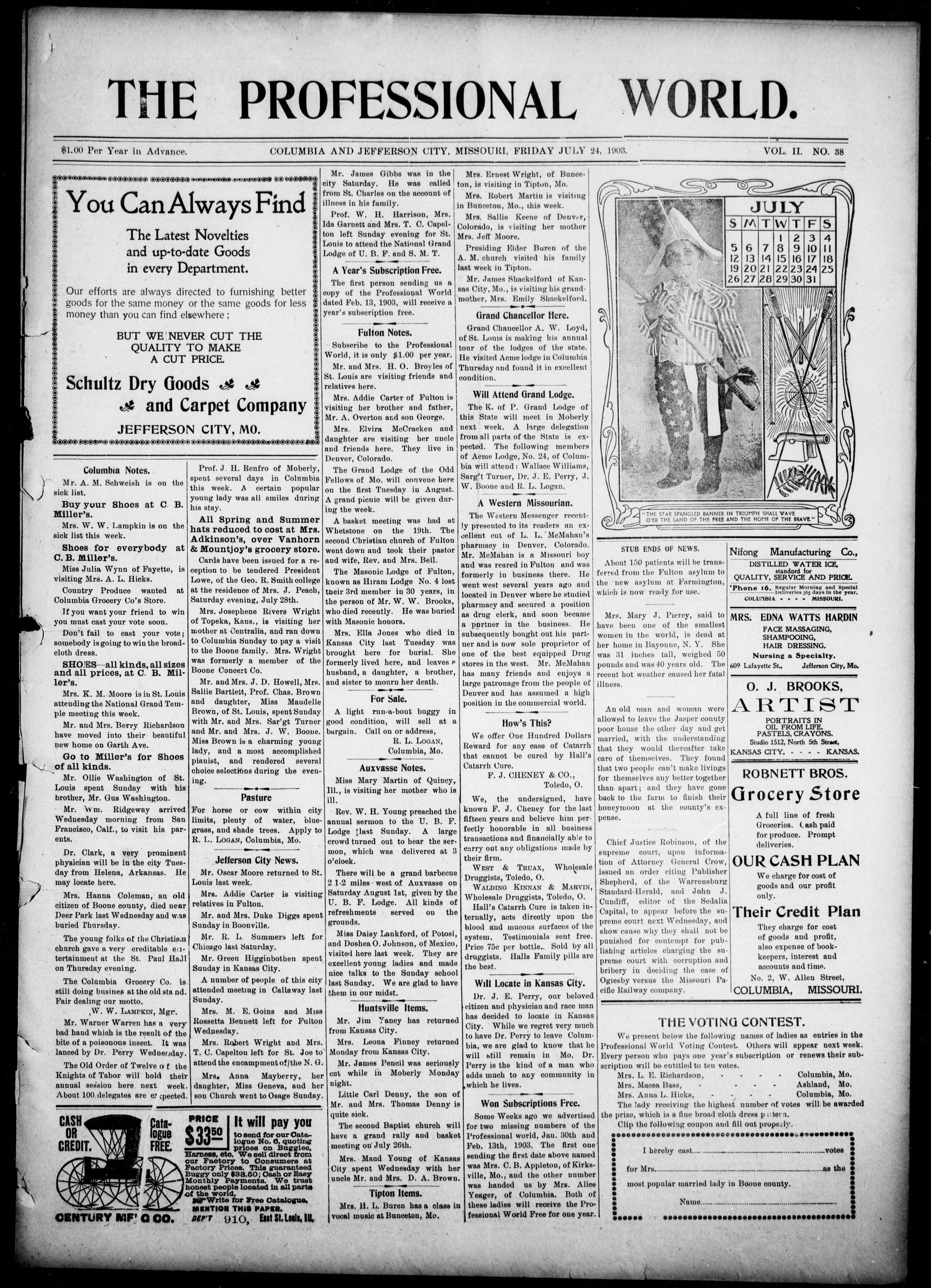
THE PROFESSIONAL WORLD.
$1.00 Per Year in Advance.
You Can A
The Latest
and up-to-date
in every D
Our efforts are always dir
goods for the same money
money than you can find el
You Can Always Find
Our efforts are always directed to furnishing better goods for the same money or the same goods for less money than you can find elsewhere;
BUT WE NEVER CUT THE QUALITY TO MAKE A CUT PRICE.
Schultz Dry Goods and Carpet Company
JEFFERSON CITY, MO.
Columbia Notes.
Mr. A. M. Schweish is on the sick list.
Buy your Shoes at C. B. Miller's.
Mrs. W. W. Lampkin is on the sick list this week.
Shoes for everybody at C. B. Miller's.
Miss Julia Wynn of Fayette, is visiting Mrs. A. L. Hicks.
Country Produce wanted at Columbia Grocery Co's Store.
If you want your friend to win you must cast your vote soon.
Don't fail to cast your vote; somebody is going to win the broadcloth dress.
SHOES—all kinds, all sizes and all prices, at C. B. Miller's.
Mrs. K. M. Moore is in St. Louis attending the National Grand Temple meeting this week.
Mr. and Mrs. Berry Richardson have moved into their beautiful new home on Garth Ave.
Go to Miller's for Shoes of all kinds.
Mr. Ollie Washington of St. Louis spent Sunday with his brother, Mr. Gus Washington.
Mr. Wm. Ridgeway arrived Wednesday morning from San Francisco, Calf., to visit his parents.
Dr. Clark, a very prominent physician will be in the city Tuesday from Helena, Arkansas. He may locate here.
Mrs. Hanna Coleman, an old citizen of Boone county, died near Deer Park last Wednesday and was buried Thursday.
The young folks of the Christian church gave a very creditable entertainment at the St. Paul Hall on Thursday evening.
The Columbia Grocery Co. is still doing business at the old stand. Fair dealing our motto.
Mr. Warner Warren has a very bad hand which is the result of the bite of a poisonous insect. It was lanced by Dr. Perry Wednesday. The Old Order of Twelve of the Knights of Tabor will hold their annual session here next week. About 100 delegates are expected.
CASH OR CREDIT. Catalogue FREE. CENTURY MF' G CO.
Gods Carpet Company N CITY, MO.
Prof. J. H. Renfro of Moberly, spent several days in Columbia this week. A certain popular young lady was all smiles during his stay.
All Spring and Summer hats reduced to cost at Mrs. Adkinson's, over Vanhorn & Mountjoy's grocery store. Cards have been issued for a reception to be tendered President Lowe, of the Geo. R. Smith college at the residence of Mrs. J. Peach, Saturday evening, July 28th. Mrs. Josephene Rivers Wright of Topeka, Kaus., is visiting her mother at Centralia, and ran down to Columbia Sunday to pay a visit to the Boone family. Mrs. Wright was formerly a member of the Boone Concert Co.
Mr. and Mrs. J. D. Howell, Mrs. Sallie Bartlett, Prof. Chas. Brown and daughter, Miss Maudelle Brown, of St. Louis, spent Sunday with Mr. and Mrs. Sar'gt Turner and Mr. and Mrs. J. W. Boone. Miss Brown is a charming young lady, and a most accomplished pianist, and rendered several choice selections during the evening.
For horse or cow within city limits, plenty of water, bluegrass, and shade trees. Apply to R. L. LOGAN, Columbia, Mo.
Jefferson City News.
Mr. Oscar Moore returned to St. Louis last week.
Mrs. Addie Carter is visiting relatives in Fulton.
Mr. and Mrs. Duke Diggs spent Sunday in Boonville.
Mr. R. L. Summers left for Chicago last Saturday.
Mr. Green Higginbothen spent Sunday in Kansas City.
A number of people of this city attended meeting in Callaway last Sunday.
Mrs. M. E. Goins and Miss Rossetta Bennett left for Fulton Wednesday.
Mrs. Robert Wright and Mrs. T. C. Capelton left for St. Joe to attend the encampment of/the N. G. Mrs. Anna Mayberry, her daughter, Miss Geneva, and her son Church went to Osage Sunday.
Harness, etc. We sell direct from our Factory to Consumers at Factory Prices. This guaranteed Buggy only $33.50; Cash or Easy Monthly Payments. We trust honest people located in all parts of the world.
Write for Free Catalogue.
MENTION THIS PAPER.
DEP'T 910, East St. Louis, IL.
COLUMBIA AND JEFFERSON CITY, MISSOURI, FRIDAY JULY 24, 1903.
Pasture
It will pay you
Mr. James Gibbs was in the city Saturday. He was called from St. Charles on the account of illness in his family.
Prof. W. H. Harrison, Mrs. Ida Garnett and Mrs. T. C. Capelton left Sunday evening for St. Louis to attend the National Grand Lodge of U. B. F. and S. M. T.
A Year's Subscription Free.
The first person sending us a copy of the Professional World dated Feb. 13, 1903, will receive a year's subscription free.
Fulton Notes.
Subscribe to the Professional World, it is only $1.00 per year. Mr. and Mrs. H. O. Broyles of St. Louis are visiting friends and relatives here. Mrs. Addie Carter of Fulton is visiting her brother and father, Mr. A. Overton and son George. Mrs. Elvira McCracken and daughter are visiting her uncle and friends here. They live in Denver, Colorado. The Grand Lodge of the Odd Fellows of Mo. will convene here on the first Tuesday in August. A grand picnic will be given during the week.
A basket meeting was had at Whetstone on the 19th. The second Christian church of Fulton went down and took their pastor and wife, Rev. and Mrs. Bell. The Masonic Lodge of Fulton, known as Hiram Lodge No. 4 lost their 3rd member in 30 years, in the person of Mr. W. W. Brooks, who died recently. He was buried with Masonic honors. Mrs. Ella Jones who died in Kansas City last Tuesday was brought here for burial. She formerly lived here, and leaves a husband, a daughter, a brother, and sister to mourn her death.
For Sale.
A light run-a-bout buggy in good condition, will sell at a bargain. Call on or address,
R. L. LOGAN,
Columbia, Mo.
Auxvasse Notes.
Miss Mary Martin of Quincy, Ill., is visiting her mother who is ill.
Rev. W. H. Young preached the annual sermon to the U. B. F. Lodge (last Sunday. A large crowd turned out to hear the sermon, which was delivered at 3 o'clock.
There will be a grand barbecue 2 1-2 miles west of Auxvasse on Saturday August 1st, given by the U. B. F. Lodge. All kinds of refreshments served on the grounds.
Miss Daisy Lankford, of Potosi, and Doshea O. Johnson, of Mexico, visited here last week. They are excellent young ladies and made nice talks to the Sunday school last Sunday. We are glad to have them in our midst.
Huntsville Items.
Mr. Jim Yancy has returned from Kansas City.
Mrs. Leona Finney returned Monday from Kansas City.
Mr. James Pencil was seriously cut while in Moberly Monday night.
Little Carl Denny, the son of Mr. and Mrs. Thomas Denny is quite sick.
The second Baptist church will have a grand rally and basket meeting on July 26th.
Mrs. Maud Young of Kansas City spent Wednesday with her uncle Mr. and Mrs. D. A. Brown.
Tipton Items.
Mrs. H. L. Buren has a class in vocal music at Bunceton, Mc.
Mrs. Ernest Wright, of Bunceton, is visiting in Tipton, Mo.
Mrs. Robert Martin is visiting in Bunceton, Mo., this week.
Mrs. Sallie Keene of Denver, Colorado, is visiting her mother Mrs. Jeff Moore.
Presiding Elder Buren of the A. M. church visited his family last week in Tipton.
Mr. James Shackelford of Kansas City, Mo., is visiting his grandmother, Mrs. Emily Shackelford.
Grand Chancellor Here.
Grand Chancellor A. W. Loyd, of St. Louis is making his annual tour of the lodges of the state. He visited Acme lodge in Columbia Thursday and found it in excellent condition.
Will Attend Grand Lodge
The K. of P. Grand Lodge of this State will meet in Moberly next week. A large delegation from all parts of the State is expected. The following members of Acme Lodge, No. 24, of Columbia will attend: Wallace Williams, Sarg't Turner, Dr. J. E. Perry, J. W. Boone and R. L. Logan.
A Western Missourian.
The Western Messenger recently presented to its readers an excellent cut of L. L. McMahan's pharmacy in Denver, Colorado. Mr. McMahan is a Missouri boy and was reared in Fulton and was formerly in business there. He went west several years ago and located in Denver where he studied pharmacy and secured a position as drug clerk, and soon became a partner in the business. He subsequently bought out his partner and is now sole proprietor of one of the best equipped Drug stores in the west. Mr. McMahan has many friends and enjoys a large patronage from the people of Denver and has assumed a high position in the commercial world.
How's This?
We offer One Hundred Dollars Reward for any case of Catarrh that cannot be cured by Hall's Catarrh Cure.
F. J. CHENEY & CO.,
Toledo, O.
We, the undersigned, have known F. J. Cheney for the last fifteen years and believe him perfectly honorable in all business transactions and financially able to carry out any obligations made by their firm.
WEST & TRUAX, Wholesale Druggists, Toledo, O.
WALDING KINNAN & MARVIN, Wholesale Druggists, Toledo, O.
Hall's Catarrh Cure is taken internally, acts directly upon the blood and mucous surfaces of the system. Testimonials sent free. Price 75c per bottle. Sold by all druggists. Halls Family pills are the best.
Will Locate in Kansas City.
Dr. J. E. Perry, our beloved citizen and physician and race man has decided to locate in Kansas City. While we regret very much to have Dr. Perry to leave Columbia, we are glad to know that he will still remain in Mo. Dr. Perry is the kind of a man who adds much to any community in which he lives.
Won Subscriptions Free.
Some Weeks ago we advertised for two missing numbers of the Professional world, Jan. 30th and Feb. 13th, 1903. The first one sending the first date above named was Mrs. C. B. Appleton, of Kirksville, Mo., and the other number was handed us by Mrs. Alice Yeager, of Columbia. Both of these ladies will receive the Professional World Free for one year.
JULY
S M T W T F S
5 6 7 1 2 3 4
12 13 14 15 16 17
19 20 21 22 23 24
26 27 28 29 30 31
"THE STAR SPANGLED BANNER IN TRIUMPH SHALL WAVE
O'ER THE LAND OF THE FREE AND THE HOME OF THE BRAVE."
STUB ENDS OF NEWS.
About 150 patients will be transferred from the Fulton asylum to the new asylum at Farmington, which is now ready for use.
Mrs. Mary J. Piercy, said to have been one of the smallest women in the world, is dead at her home in Bayonne, N. Y. She was 31 inches tall, weighed 50 pounds and was 40 years old. The recent hot weather caused her fatal illness.
An old man and woman were allowed to leave the Jasper county poor house the other day and get married, with the understanding that they would thereafter take care of themselves. They found that two people can't make livings for themselves any better together than apart; and they have gone back to the farm to finish their honeymoon at the county's expense.
Chief Justice Robinson, of the supreme court, upon information of Attorney General Crow, issued an order citing Publisher Shepherd, of the Warensburg Standard-Herald, and John J. Cundiff, editor of the Sedalia Capital, to appear before the supreme court next Wednesday, and show cause why they shall not be punished for contempt for publishing articles charging the supreme court with corruption and bribery in deciding the case of Ogiesby versus the Missouri Pacific Railway company.
THE VOTING CONTEST.
We present below the following names of ladies as entries in the Professional World Voting Contest. Others will appear next week. Every person who pays one year's subscription or renews their subscription will be entitled to ten votes.
Mrs. L. E. Richardson, - - - - Columbia, Mo.
Mrs. Macea Bass, - - - - Ashland, Mo.
Mrs. Anna L. Hicks, - - - - Columbia, Mo.
The lady receiving the highest number of votes will be awarded the prize, which is a fine broad cloth dress pattern.
Clip the following coupon and fill out properly.
I hereby cast.....votes
for Mrs.....as the
most popular married lady in Boone county.
Name.....
VOL. II. NO. 38
JULY
S M T W T F S
5 6 7 8 9 10 4
12 13 14 15 16 17 11
19 20 21 22 23 24 18
26 27 28 29 30 31 25
IN TRIUMPH SHALL WAVE
AND THE HOME OF THE BRAVE
Nifong Manufacturing Co.,
DISTILLED WATER ICE,
standard for
QUALITY, SERVICE AND PRICE.
'Phone 16. Regular Morning and Special
Deliveries 365 days in the year.
COLUMBIA - - - - MISSOURI.
MRS. EDNA WATTS HARDIN
FACE MASSAGING,
SHAMPOOING,
HAIR DRESSING.
Nursing a Specialty.
609 Lafayette St., Jefferson City, Mo.
O. J. BROOKS,
ARTIST
PORTRAITS IN
OIL FROM LIFE.
PASTELS, CRAYONS.
Studio 1512, North 5th Street,
KANSAS CITY. - - - KANSAS.
ROBNETT BROS.
Grocery Store
A full line of fresh Groceries. Cash paid for produce. Prompt deliveries.
OUR CASH PLAN
We charge for cost of goods and our profit only.
Their Credit Plan
They charge for cost of goods and profit, also expense of bookkeepers, interest and accounts and time. No. 2, W. Allen Street, COLUMBIA, MISSOURI.
ing names of ladies as entries in the
test. Others will appear next week.
us subscription or renews their sub-
sumes.
Columbia, Mo.
Ashland, Mo.
Columbia, Mo.
last number of votes will be awarded
with dress pattern.
fill out properly.
votes
RUPUS L. LOGAN, Editor
Columbia - - - - Missouri
WEEKLY CROP BULLETIN
Washington, D. C. special—The weather bureau's weekly summary of crop conditions is as follows: The temperature during the week ending July 13 was very favorable in all districts east of the Rocky mountains and on the Pacific coast, but in the northern Rocky mountain and middle plateau regions it was too cool, with frosts in exposed places on the 7th and 8th. Portions of the lower Ohio and central Mississippi valleys, southern Florida, Western Texas, northern Minnesota, and the southern Rocky mountain districts are in need of rain, but elsewhere there is ample moisture, northern Iowa, southern Minnesota, and portions of the South Atlantic and East Gulf states having suffered from excessive rains.
Corn has everywhere made splendid growth, and is much improved, though generally backward, and in portions of the upper Ohio valley and middle Atlantic states is weedy. The early planted is now in tassel in the more northerly districts, and a considerable part of the crop has received final cultivation. The week has been very favorable for harvesting winter wheat, which work is very largely completed, except in the more northerly sections. Thrashing has made good progress, and the reports generally indicate light yields. A feature of the reports respecting winter wheat is the entire absence of injury to grain in stack and shock.
in northern Minnesota and North Dakota spring wheat is thin and heading short, and lodging is reported from tue last-named state and Iowa. In Kansas, Wisconsin, and the southern part of South Dakota spring wheat is heading well, and very favorable reports are received from Washington and Oregon.
Considerable rust in oats is reported from Iowa, Missouri, and Illinois, and lodging from South Dakota and southern Minnesota. In North Dakota and northern Minnesota the crop is thin and heading short, but continues promising in Nebraska, Wisconsin, Michigan, and Pennsylvania. Harvest is in general progress in the central valleys, good yields being reported from Missouri, Nebraska, Kansas, and Oklahoma, but light yields from the states of the Ohio valley.
Throughout the cotton belt there has been a general improvement in cotton, which has made vigorous and healthy growth. There is, however, very general complaint of grassy fields in the coast districts of the eastern section and in Texas, the crop being in a better state of cultivation in Mississippi and over the northern portion of the central districts. Boll weevil in Texas are less numerous. The general outlook for tobacco is very promising, the least favorable reports being received from Ohio, where, however, the crop is doing fairly well. Only a fair crop of apples is indicated in the most of the principal apple states, the most favorable reports being received from Kansas and Iowa.
Haying has been delayed by rains in Iowa, Wisconsin, and southern Minnesota, but elsewhere has made excellent progress. A heavy yield of clover and timothy is being secured in the central valleys.
SUDDEN DISAPPEARANCE
Council Bluffs Man Has Been Missing From Home Since Last Sunday.
Council Bluffs, Ia., July 22.—Henry J. Smith, treasurer of the Council Bluffs Trades and Labor Assembly, has been missing from his home since early in the morning of July 5th. Mr. Smith is a carpenter, and had been treasurer of the local assembly for some time. He had handled large sums of money and has always been scrupulously honest. His accounts have not been checked, but it is thought he is about even with the assembly. His wife didn't report his absence from home until yesterday. She says that for some days before his disappearance he had acted queerly, and that she is now afraid he has committed suicide.
President's Twin for Vice
President Roosevelt's double having been found in California, the St. Louis Globe-Democrat suggests him for a vice presidential candidate. It's too bad the president isn't twins.—Tuscon Citizen.
Interesting to Know.
American tourists are going to spend $100,000,000 in Europe this summer. It would be interesting to know how much the shelter to monopoly contributes to this enrichment to the foreigner.—Sioux City Tribune.
Mrs. Roosevelt's Garden.
Mrs. Roosevelt is going to have a garden of old-fashioned flowers on the grounds of her official residence. Those steady bloomers, known as "Live Forevers," will doubtless have a place in that garden.—St. Paul Globe
Twenty Islands Situated Off Bornean Coast
THE CLAIM NOT A NEW ONE
International Commission Will be Necessary to Decide Ownership. Controversy Unlikely
London, July 22.—A rumor was current in the lobby of the house of commons last night to the effect that some United States warships has seized about 20 small islands off the coast of Borneo, which, it is understood, belong to Great Britain, and had planted the American flag on them. It is probable that a question on the subject will be asked in the house.
American Claims Not New.
Washington, D. C., July 16.—Some time ago a claim was made to a number of islands off the coast of Borneo by the United States on the ground that they belonged to no nation. Admiral Evans was directed by the department to send a gunboat for the purpose of making surveys and soundings. It is believed these are the islands said to have been seized by American warships.
A plausible explanation of the reported occurrence is that the commanding officer in the Philippines simply had sent one or more of his vessels and hoisted the flag of the United States over some islands near the coast of Borneo, which were purchased by the United States from Spain subsequent to the treaty of Paris, and that the sovereignty of the United States over them had been proclaimed formally.
These were the Cagayan Sulu group comprising one large and fourteen smaller islands, and the larger island of Palawan. These islands were not comprehended within the boundaries of the Philippine archipelago when the treaty of Paris was signed.
The islands of the Cagayan group are close to the Borneo coast, and the action of the American naval officials in formally raising the American flag over them, if this has been done, has no doubt given rise to the impression in the minds of those unacquainted with the real facts that the United States had seized the islands.
Philippines Are Widespread.
The Philippine group of islands, acquired from Spain as a result of the war of 1898, extends so far southward and there are so many of them that it is not unlikely an international commission will be necessary to decide the ownership of many of them. Fortunately there is not likely to be much of a controversy over the disputed islands. State department officials say the ownership in all probability will be adjusted with little friction.
THE GERMS OF LOCKJAW
They Are Found in Blank Cartridges Offered for Sale.
(New York dispatch.)—The discovery of tetanus germs in blank cartridges offered for sale in Newark, N. J., has been made by Dr. Richard N. Connolly, the bacteriologist of the board of health. An effort will be made to prevent their sale. This discovery is the result of an outbreak of lockjaw in Pittsburg, where 50 cases followed a celebration in which firearms were used. When informed of it Dr. H. C. Herold, the president of the health board, called a special session of that body to take action, and if possible enact rules at once to prevent the cartridges from reaching the public.
What action will be taken is not known. The police were called in consultation Friday night and informed of the matter. They were asked to induce the dealers to refrain from making sales, which, in the event of accident, might lead to cases of lock-jaw. When Dr. Herold was seen he said he has had suspicions as to the existence of bacillus in blank cartridges for some time. His belief was so strengthened by the outbreak of lock-jaw in Pittsburg that he decided to have Dr. Connolly, an eminent bacteriologist, make an investigation.
BROOKE ON THE GROUND
Superintendent of Iowa Central Will Arrange New Wage Scale.
Marshalltown, Ia., July 22.—Superintendent Geo. D. Brooke, of the Iowa Central, and committees of the shopmen are in session here to arrange a new wage schedule for the coming year. The men are asking a little more money in all departments, but the increase demanded is not large and it is believed will be granted.
RUSSIA WILL RETALIATE
Persons Who Are Active in the Kishlneff Affair Are Regarded as Unfriendly.
Washington, July 22. — Russia already has adopted retaliatory measures as a result of the Kishlneff petition. The state department has been given to understand that no person who has signed the petition will be acceptable to Russia in any diplomatic capacity, whether as ambassador or only a consular agent. The notification to that effect was not given in any formal way, but is none the less convincing.
Russia has made it plain to Secretary Hay that if the president appoints as a diplomatic representative to Russia in any grade a man whose name appears on the Kishineff petition this government will be told that he is persona non grata and asked to name someone else. Under the rules of diplomacy Russia cannot be asked to give any reasons for refusing to receive a diplomat appointed by this or any other country. The simple statement that the man selected is not acceptable is all that is required to bring about a new appointment.
NEGRO AGAINST NEGRO
The Shiftless Blacks in Indianapolis to Be Driven Out of Town.
Indianapolis, Ind. special.—Negro leaders in Indianapolis are taking steps to avert a race war. The Evansville riots and conflicts between the races in other cities have made them apprehensive of a similar outbreak here. An organization that is known as "the Negro Business league" has been formed to rid the city of what the better element of the race calls the "jim crow" negro. The prime movers of this league are J. H. Lott, Dr. B. J. Morgan and A. E. Manning.
Gurley Brewer, editor of the World, a negro organ, who is supporting the movement, said: "It is very easy to determine who the shiftless, worthless negroes are, for they are found almost altogether in the Indiana avenue district. Agents of the Negro Business league will make inquiry concerning them and those who will not work will be reported to the authorities with a request that they be driven out of town.
"This scheme of ridding the city of worthless negroes is both practical and sensible."
GENERAL C. M. CLAY
The Picturesque Kentucky Character is Dying.
Whitehall, Ky., July 22--Mind gone forever, life fast ebbing, General Cassius Marcellus Clay, picturesque character, soldier, diplomat, pro-abolitionist, duelist, lies raving and alone in a gloomy room in White hall. Save for his faithful bodyguard Joe Perkins, he is alone.
General Clay, in frequent outbreaks of insanity is the lion of old. He gives orders, but countermands them or storms when they are carried out. Joe Perkins obeys him to the letter. Only Thursday there arrived at White hall Drs. Thomas S. Bullock of Loulsville and W. O. Bullock of Lexington, who came in response to General Clay's demand that he was in need of medical attention.
When they came General Clay would have none of them. Perkins had orders and barred them from White hall, though they sought every effort to get into the sick room. Even Clay Goodloe, a nephew, summoned from Washington by General Clay, was refused an audience.
NEST OF COUNTERFEITERS
It Was Found in the Suburbe of Racine by Officers.
Racine, Wis., July 22.—At Corliss, a manufacturing suburb seven miles west of this city, the sheriff and chief of police found a counterfeiters' den and complete outfit of dies, metals, acids and $300 in counterfeit dollars and halves bearing the dates of 1894 and 1889, the same dates as many counterfeit coins passed in this city and Milwaukee, within a few months. The outfit was found about the home of Gustave Cuneo, electrician of the Brown-Corliss Engine company. When the officers entered to search the house they found all household goods packed ready to be shipped tomorrow to Milwaukee. Placed in mattresses and boxes were found the coins and dies.
BOOMING CRAIG L. WRIGHT
Sioux City Attorneys Camp in Dubuque in Wright's Interest.
Dubuque, July 22.—Judge E. H. Hubbard and Attorney Kennedy of Sioux City have ben here since Saturday, conferring with lawyers with intents to boom Craig L. Wright for the United States district bench to succeed Judge O. P. Shiras. Urgent letters were also sent by Wright's friends to local attorneys to seek his selection.
STUDENT MAKES MORE RIOTING A FORTUNE IN CHICAGO
Trades Bronche for Valuable Oil Lands
RUSH MEDICAL GETS BIG SUM
Vanderbilt Honors Paul Leicester Ford with a Handsome Tribute to His Memory
Sour Lake, Tex. special.—Another instance of remarkable rise to fortune came to light here yesterday. James Cochrane, a student in the state university at Austin, came here four weeks ago for this purpose of making some money during his vacation season. He rode a Texas broncho into town. The animal was worth probably $10. A week after he arrived heavy rains made the roads almost impassable and he traded the broncho to an oil operator for an acre of land situated far outside of what was then the proved oil field. A few days ago a gusher was struck within 400 feet of his acre and it was stated that he had just closed a deal for the sale of the tract for $30,000 cash.
ROCKEFELLER'S MILLIONS
Some of Them Are to Go to Rush Medical College.
Chicago special—John D. Rockefeller has expressed his approval of the various items contained in the $1,000,000 fund raised by the trustees of Rush Medical college as a condition to the admission of that institution to the University of Chicago.
This is the information obtained yesterday from a trustworthy source in New York by a trustee of the medical college and which is to be announced officially, it is said, during the present week.
The approval of the fund means that the college soon will become an integral part of the university; that Mr Rockefeller will make another big donation of several million dollars, and that the college within a few years will have a new home with a hospital attached which will be a model for other medical institutions.
PAUL LEICESTER FORD
George W. Vanderbilt Presents a Memorial Window of Stained Glass.
New York special.—There is now on the way to Biltmore, N. C., the home of George W. Vanderbilt, a handsome stained glass window for All Souls' church. The window will be erected by Mr. Vanderbilt in memory of Paul Leicester Ford, his friend and companion, and who dedicated "Janieice Meredith" to Mr. Vanderbilt
It is of American opalescent glass and was executed by Maitland Arm-strong of this city from designs by his daughter, Miss Helen Maitland Arm-strong. The subject is "The Entombment of Christ." The savior's body, supported in a sheet, is being borne in the tomb by the apostles. The Virgin Mary, with clasped hands, kneels at the head of the figure of the Lord, and behind her stands Mary Magda-ene.
MORGAN OFFERS COLLECTION
Gives Paintings Valued at $6,000,000 to National Art Gallery.
Washington, D. C., July 22.—J. Pierpont Morgan has offered to transfer his collection of painting, valued at $6,000,000, and the finest private collection in the country, to the proposed national art gallery in the event of its being established. This information was given by an official in the Corcoran gallery, which would be included in the new concern
BIG BUTTER OUTPUT
Calhoun Creamery Turned Out 43,000
Pounds of Butter During June.
Laurens, Ia., July 22.—The Calhoun
creamery, located at Church, seven
miles west of Lansing, turned out
43,000 pounds of butter for the month
of June. In May their output was
31,000 pounds.
DISCOVERS LOST ART
Tacoma Woman Finds Method of Tempering Copper.
Tacoma, Wash., July 22.—The long-lost art of tempering copper has been revived by the discovery of Mrs. Carrie Renstrom, who has incorporated a company to put her patented secret process into practical use. A plant is being established and already is turning out hardened and tempered copper possessing a spring not surpassed by steel.
Angry Mob Pursues Freight Wagon Two Miles
POLICE REQUIRED FOR ESCORT
Missles Thrown by Striking Freight Handlers Cause a Number of Painful Injuries
Chicago, Ill., July 22.—The motous scenes were repeated today when a mob of nearly 1,000 men and boys charged for nearly two miles a wagon loaded with freight from the Kellog Switchboard and Supply company's plant to the Northwestern freight house. Many persons were struck by missiles hurled at the men in charge of the wagon. A score of police forming an escort for a wagon repeatedly charged the crowd and beat back the rioters with clubs. All along the route blockades were formed by the sympathizing truck drivers and the way was cleared by the police with great difficulty. The freight was unloaded at the freight house by special officers employed by the Kellogg company, the freight handlers refusing to touch it. Five rioters were arrested.
Prospects for a cessation in the interference with business at the Chicago Terminal Transfer railroad company and with the understanding that the application of that company for an injunction against the union labor leaders would not proceed unless it became necessary. The hearing upon the application was continued until tomorrow. President Curran of the freight handlers union declared the trouble was practically over so far as that road was concerned and the strikink members of his union returned to work.
FRENCH NATIONAL HOLIDAY
It Was Enthusiastically Celebrated—Dumont in His Airship Lends Novel Incident.
Paris special—This is a French national holiday, and was enthusiastically celebrated in brilliant weather. The main feature was a review of the garrison of Paris by President Loubet, who was accompanied by Premier Combes and other cabinet ministers and the presidents of the senate and chamber of deputies. A novel incident of the review was the appearance of Santos Dumont in his airship over Longchamp. He saluted the president with three strident blasts from the whistle of his motor and with a salvo of revolver shots. Then amid the applause of the spectators the aeronat sailed off rapidly to his headquarters at Puteaux.
MILES SHOWS THEM HOW
Rides on Horse Back from Fort Sill to El Reno.
El Reno, O. T., July 22.—Lieut. Gen. Miles completed a horseback ride yesterday from Fort Sill to El Reno, ninety miles, in nine hours and ten minutes. The first thirty-five miles was made in record time, two hours and thirty-five minutes. Upon completing the trip, Miles showed no signs of fatigue and forty minutes after his arrival at El Reno, reviewed the troops. The ride was taken it is stated, to demonstrate that General Miles, at the age of retirement, is still a sturdy man.
BRIDE IS MISSING
Miss Gertrude McWilliams of Chicago
Weds and Tnen Disappears.
Laporte, Ind., July 22. — Miss Gertrude McWilliams, a young Chicago woman, arrived here on Sunday, June 28. The same day she met George Taylor, with yhom it was love at first sight, and the next day Mayor Darrow officiated at the marriage of the couple. On Tuesday the young bride strangely disappeared, and yesterday Taylor, with whom it was love at first sistent search on his part had failed to reveal her whereabouts, and he feared some tragic fate had befallen her.
CAUSE OF MASSACRE FOUND
Man Who Helped Murder Russian Boy Makes, Full Confession
Kishineff, July 22.—T murderer of the boy, Doubassary, whose death is charged to the Jews and which was the immediate cause of the massacre has been discovered. He is a gardner and confessed that he and the boy's uncle committed the crime. The new governor of Kishineff, Prince Urusoff, has exchanged visits with the leading Jews of this city.
WIRELESS SYSTEM ADOPTED
Bureau of Equipment Finds German Plan Best for War Vessels.
Washington, D. C., special—Experiments conducted by the bureau of equipment for more than a year to determine the best system of wireless telegraphy for use on vessels of war have ended, and it is a forgone conclusion that the officers in charge of these tests will select the Slaby-Arco system. Preliminary reports have indicated that this system was the most satisfactory, and the final report will bear out that idea. The bureau of equipment is practically satisfied that the Slaby-Arco system is superior to others for naval purposes, but naturally withholds an official announcement to that effect until the final report is at hand.
The Slaby-Arco is a German system, developed by two scientists, Herr Slaby and Count Arco. It was tested in competition with a number of other foreign wireless tecography devices, French, German and English. These did not include the Marconi system, a previous failure to make satisfactory terms with Mr. Marconi having rendered it virtually impossible.
Twenty sets of Slaby-Arco instruments which have arrived from Germany will be distributed among the eight warships that will use them in the coming joint war games and fleet maneuvers.
HOW THEY WORKED HIM
A Rockford, Ill., Man Swindled by Sharpers.
(Rockford, Ill., dispatch.)—Isaac M. Norcross, a veteran and wealthy building contractor here, was swindled out of $2,000 Friday by two sharpers on the old lottery game.
Norcross was invigiled into a room and made to believe that he had won $4,000 in a lottery drawing. He was required to produce $2,000 to prove his financial standing, and, going to the People's bank, drew out that amount and placed it into a box designated by the bunko men, which purported to contain the prize money.
When he opened the box at his home he found that he had been swindled, as the box contained only broken glass and brown paper instead of money. Mr. Norcross is well advanced in years, but is still in active business. He has a son, Ansel Uorcross, who has been on the police force in Chicago for over 20 years.
UNITE NORTH AND SOUTH
Ringing Speech at Baptist Young People's Union Favoring It.
Atlanta, Ga., special.—The feature of today's session of the Baptist Young People's Union was the speech of Sempel D. McKenney of Alton, Ill., who spoke for a union of the North and South, and declared it is time for the Northern people to stop putting "Uncle Tom's Cabin" before the eyes of children. "We have had enough of 'Uncle Tom's Cabin' declared McKinney, 'and the people of the North should not give it to their children to read, engendering feelings of bitterness. We need to cease giving ear to the prattle against the South and to unite in praising the names of Lincoln, Lee, Grant and Jackson."
WOMAN TRAPS A MAN
Gees Alleged Safe Blower Hiding and Causes His Arrest in Mokena.
Joliet, Ills., July 22.—William Warren, believed to be a safe blower, was captured at Mokena yesterday morning by the town marshal and brought to jail in Joliet. He had enough nitroglycerin to blow up the entire town of Mokena, five skeleton keys and a revolver. He was captured after a desperate fight. A woman having seen him in hiding and notified the marshal.
STUDENT HARVESTERS
Young Athletes Who Desire to Keep In Training Go To Kansas.
Great Bend, Kan., July 22. A delegation of thirty-three volunteer harvesters arrived here yesterday morning direct from New York. Among the number were one of the assistant professors in Columbia university and some of the athletic students of Columbia, Yale, Harvard and Lafayette universities who came out with the expectation of developing enough muscle to make the teams at their respective colleges next year.
HIS BAGGAGE SIEZED
Returned Engineer From Philippines Charged With Smugging,
San Francisco special.—The baggage of Captain Harris, of the engineer corps, who returned from the Philippines on the transport Thomas, was seized by custom officers today. It is alleged his baggage contained much durable goods, the duty being fixed at $500. If this is correct Harts is liable to a fine of $1,500 in addition to the duty claimed.
An Arkansas Planter
By OPIE READ
Printed by Permission and Copyright
1896 by Rand, McNally & Co. Chicago
CONCERNING MEN AND WOMEN OF THE DAY
CHAPTER VII. (Continued.)
"Or may be less affection," Gid replied. "They say she's strong, but I call her cold. Hold on and I'll walk with you." He got down off the fence and walked beside the giant. "She's a mighty strange woman to me," the old man sald when they had walked for a time in silence. "But there's no question of the fact that she's strong, that is, as some people understand strength. To me, I gad, there is more force in affection than in restraint. She loves her children — no doubt about that — and of course she thinks the world of the Major, but somehow she misjudges people. She doesn't understand me at all. But I reckon the majority of men are too deep for a woman. I didn't want to see them in the throes of their trouble, and I says to the Englishman, it's time to gilt, and we got. He wanted me to go over to his house and get some Scotch whisky. I told him that the last rain must have left some water in a hollow stump near my house, and that I preferred it to his outlandish drink. And hanged if he didn't think I was in earnest. Yes, sir, I knew that girl would marry him; and let me tell you. If I was a youngster I would rather have her love than the love of any woman I ever saw. There's something about her I never saw in any other woman—I gad, she's got character; understand me? She ain't beautiful, hardly handsome, but there's something about her, hanged if I know what it is. But it's something; and I've always found that the strongest charm about a woman is a something that you can't exactly catch — something that is constantly on the dodge. And you bet I've had lots of experience. The Major could tell you many a story on me. Yes, sir, Say, Jim, I know how you feel over this affair, and I want you to understand that I'm your friend, first, last, and all the time. I've been trying to talk up to the right place, but now I don't exactly know what to say."
"Don't say anything, Uncle Glideon." "I reckon that would be about the wisest plan. Just wanted to let you know where to find me. Strang things happen even in this quiet community, don't they? But I'm woefully sorry that this special thing has happened. I gad, the Major snorted so loud that my horse broke loose from the post, and that's the reason I'm stepping around here like a blind dog in a meat house. Begin pickin' tomorrow, I reckon?" "I don't know. I had made all my arrangements, but now after what's happened I don't care whether there's a boll picked or not. I'm let down." "Don't feel] that way, old fellow. You'll be all right in a day or two."
"Mr. Batts, if I didn't know that you were trying to soothe me I would take that remark as an insult. If I thought I wasn't any more steadfast than to be all right in a day or two—if I really believed my character that light, I swear I'd go this minute and drown myself."
"Why, my dear boy, you know I didn't mean to infer that your heart had no more memory than that. What I meant was that your sense of resignation would demand a hearing, so to speak. Let me tell you something. I understand that girl better than her father or mother does—I have made her a special study, and I want to tell you that when I take the trouble to throw my mind on a woman a mystery has to be cleared right then and there. And this is what I want to say: She has married that fellow out of pity. I don't believe she loves him. Always was ruled by pity. Recollect hearing the Major tell of a sudden streak of misfortune that overtook his family
General Thomas A. Morris, now a resident of Indianapolis, is the oldest living graduate of West Point, being of the class of 1834. Colonel William F. Fox, New York's state superintendent of forests, has gone to Europe to study the forestry systems of France, Germany and Italy.
when he was a child. His father had to sell several of his slaves, and his old black mammy stood on the block with him in her arms while they were auctioning her off. Well, sir, Louise cried about that fit to kill herself. We told her how long ago it had happened, and impressed on her the fact that the old woman was soon bought back, but she kept on crying over the cruelty of the thing. Yes, sir. Well, I turn off here. Good night."
In the dark the Major walked about the yard mournfully calling Tom. A negro woman said that she had seen him going down the road, and the old gentleman returned to the porch and sat down. In the sitting room a lamp was burning, and a patch of light fell about his chair. He wanted to tell the young man of the trouble that had fallen upon the household, and yet he dreaded to hear his footstep. Tom was so proud of his sister, had always looked up to her, had regarded her whims as an intellectual diversion; and now what a disappointment. How sadly would his heart be wring. From a distant room came the pling-plang of a banjo. "There's Tom, Margaret. Will you
THE BEST COOK IN THE COUNTRY
please tell him to come here? I don't want to see him in the light."
Mrs. Cranceford hastened to obey, and the Major sat listening. He pushed his chair back out of the patch of light. The banjo hushed its twanging, and then he heard Tom coming. The young man stepped out upon the porch. His mother halted in the doorway.
"Tom," said the Major, "I have a desperate piece of news, and I wish to break it to you gently, but there is no way to lead up to it. Your sister has married Carl Pennington."
"Yes, so Jim Taylor told me. Met him in the road awhile ago. I didn't know that there was anything of the sort on hand. Must have kept it mighty quiet. I suppose——"
"What, you suppose! What the deuce can you suppose! Stand there supposing when I tell you that she has married a dying man." The old gentleman flounced in his chair. "She has thrown herself away and I tell you of it and you want to suppose. What's the matter with you? Have you lost all your pride and sense? She has married a dying man, I tell you."
The young fellow began awkwardly to twist himself about. He looked at his mother, standing in the door with the light pouring about her, but her eyes were turned from him, gazing far away into the deepening night. "I know they might think he's dying," he said, "but they might be mistaken. Sometimes they believe a man's dying and he keeps on living. Wash Sanders—"
"Go back to your banjo, you idiot!" the Major shouted. "I'll swear this beats any family on the face of the earth." He got up, knocking over his chair. "Go on. Don't stand there try-
Some of the present Astor millions had their origin in the Bowery. William B. Astor's Uncle Henry, a celebrated butcher of that famous thoroughfare, left him his accumulations of a lifetime—about $500,000. This, well invested in 1846 or thereabouts, had much to do with building up the vast Astor estate.
n might have
this morning.
about her?"
ing to splutter an explanation of your lack of sense! No wonder you have always failed to pass a nexamination. Not a word, Margaret. I know what you are going to say: Beats any family on the face of the earth."
CHAPTER VIII
On the morrow there was a song and a chant in the cotton fields. Aged fingers and youthful hands were eager with grabbing the cool, dew-dampened fleece of the fields. The women wore bandana handkechiefs, and picturesquely down the rows their red heads were bobbing. Whence came their tunes, so quaintly weird, so boisterous and yet so full of melancholy? The composer has sought to catch them, has touched them with his refining art and has spoiled them. The playwright has striven to transfer from the field to the stage a cotton-picking scene and has made a travesty of it. To transfer the passions of man and to music-riddle them is an art with stiff-jointed rules, but the charm of a cotton-picking scene is an essence, and is breathed but cannot be caught. Here seems to lie a sentiment that no other labor invites, and though old with a thousand endearments, it is ever an opera rehearsed for the first time. But this is the view that may be taken only by the sentimentalist, the poet loitering along the lane. To him it is a picture painted to delight the eye, to soothe the nerves, to inspire a pastoral ode. There is, however, another side. At the edge of the field where the cotton is weighed, stands the planter watching the scales. His commercial instincts might have been put to dreamy sleep by the appearance of the purple bloom, but it is keenly aroused by the opening boll. He is influenced by no song, by no color fantastically bobbing between the rows. He is alert determined not to be cheated. Too much music might cover a raucally trick, might put a cloak in the cotton to be weighed. Sentiment is well enough and he can get it by turning to Walter Scott.
None of the planters was shrewder than the Major. In his community he was the business as well as the social model. At planting, at plowing and at gathering, no detail was too small or too illusive to escape his eye. His interests were under a microscopic view and all plans that were drawn in the little brick office at the corner of the yard, were rigorously carried out in the fields. In the one place he was all business; in the other there was in him an admixture of good humor and executive thoroughness. He knew how many pounds of cotton a certain man or woman was likely to pick within the working hours of a day and he marked the clean and the trashy pickers; and the play of his two-colored temperament was seen in his jovial banter of the one and his hash reprimand of the other. But today a hired man stood at the scales to see the cotton welghed. The Major walked abroad throughout the fields. As he drew near, the negroes husked their songs and their swaggering talk. They bowed respectfully to him and to one another whispered his affliction. At noon, when he returned home, the housekeeper told him that his wife was away. He sat down in the library to wait for her. Looking out he saw Sallie Prulit carrying a jug across the yard. A few moments later he asked for Tom and was told that he had just left the house. He tried to read, but nothing interested him. There was nothing but dullness in the newspaper and even Ivanhoe had lost his charm. It was nearly three o'clock when Mrs. Cranceford returned. He did not ask whither she had gone; he waited to be told. She sat down, taking off her gloves.
"Did you see Mr. Purdue?" she asked.
"No, I have seen no one. Don't care much to see any one."
"I didn't know but you might have met him. He was here this morning. Told me about Louise."
"What does he know about her?"
"He told me where she has gone to live—In that old log house at the end of the Anthony place."
"Well, go on, I'm listening."
"I didn't know that you cared to hear."
"Then why did you begin to tell me?"
course I'd like to know what has be come of her."
"I went over to see her," said Mrs Cranceford.
"The deuce you did."
Mile. Cauchet, a young lady living in Montmartre, France, has toured the world, paying her expenses by lecturing and by giving lessons in French. She went first to Belgium and then to London, Dublin and Glasgow. Subsequently she visited America, Africa, Australia, China and Japan, and returned to Paris via Russia and Germany.
"Yes, and in that miserable house, all open, she is nursing her drying husband."
The Major got up and began to walk about the room. "Don't, Margaret, I'd rather not hear about it."
"But you must hear. No place could be more desolate. The wind was moaning in the old plum thicket. The gate was down and hogs were rooting in the ya:1. Louise did not hear me as I drove up, the wind was moaning so distressfully among the dead plum bushes—she did not know that I was on the place until I entered the room where she sat at the bedside of her husband. She jumped up with a cry and ———"
"Margaret, please don't."
"I must tell you, John. I will tell you. She jumped up with a cry and ran to me, and started to take off my cloak, but remembering that there was no fire in the damp room, she let it stay on. She tried to speak but couldn't. Her husband held out his waxen hand, and when I took it I shuddered with the cold chill it sent through me."
"Margaret, I am going out," said the Major, turning toward the door.
"If you do, John, I will go with you and tell you as we walk along. Please sit down."
He sat down with an air of helplessness. His wife continued: "In the room there was scarcely any furniture, nothing to soften the appearance of bleakness. I asked why no fire had been made, and Louise said that she had engaged a negro to cut some wood, but that he had gone away. She had paid him in advance. She would herself have kindled a fire, but there was no axe on the place, and she was afraid to leave her husband long enough to go to the woods to gather sticks. I went out and found the negro dozing in the sun. He was impudent when I spoke to him, but when I told him my name and threatened him with you, he scuffled to his feet and sauntered off, and I thought that we should see no more of him, but soon we heard the lazy strokes of his axe. And shortly afterward we had a fire. Louise was in one of her silent moods, but Pennington talked as much as his cough would permit him. He said that it was all his fault. 'I told her,' said he, 'that unless she married me I would die blaspheming the name of God, and that if she would save me from hell she must be my wife. I know that it was selfish and mean, but I couldn't help it. And so she has married me to save my soul.' He grew excited and I tried to calm him. I told him that you were angry at first, but that now you were in a better humor toward him."
"Margaret——"
"This appeared to help him, but I saw that Louise did not believe me. However, I commanded her to come home and bring her husband with her. But she shook her head and declared that she would never again enter your house until she could in some way discharge the debt of gratitude with which you reproached her, which she says you flaunted in her face at a time whi she was greatly distressed." "..hat! I don't exactly understand." "Yes, you do. dear. You reminded her that you had saved her life, and told her that you based your plea for obedience upon your own gallantry."
"Oh, that was a piece of mere nonsense, a theatrical trick. Of course I don't deserve any credit for having saved the life of my own child." "It may have been a theatrical talk with you, but it wasn't with her. She keeely feels your reproach."
"Confound it, you are both making a monster of me."
"No, dear, that is not our design."
"Our design! Have you too, set yourself against me? Let me go to old Gideon. He's the only friend I've got."
(To be continued).
The governor general of Canada has just presented to Miss Georgia Pope the Royal Red Cross in recognition of her nursing services in South Africa. She is the first woman in Canada to become the recipient of this honor.
Prof. H. C. Price, professor of horticulture and forestry, will tender his resignation to the board of trustees of the Iowa State college at their coming meeting. He goes to the Ohio State university September 1 as dean of agriculture and domestic science.
FARM Orchard and Garden Notes By J. S. TRIGG Rockford, Iowa Copyrighted 1903 and Prepared SPECIALLY FOR THIS PAPER
Wicked Waste in Washington.
A short time since we questioned who in this country any of the old wasteful dent to the clearing up of timber landter from Washington says that hundred up in the mountains, where the giant high, from four to six feet in diameter 000 feet of lumber, board measure. A by these giant logs can be got to ma so the homesteader bores a two inch tree and another at an angle of forty- it. He then fills the hole with dry grass days the tree will burn off so that it weated to cut the trunk into ten or fif up and wholly burned. The timber t all the crops which will eer be raised being worth over $100 each if only the lumber to a railroad or navigable wanton waste of the finest forest prod only in the fact that the homesteader upon which to raise some crop to ena ter for him and the country could he leave these forests alone until such chinery could clear the land without in a recent trip down south that in e sections much of the old waste in the. The day will soon be here when a t sent a good deal of money.
A short time since we questioned whether there was now in operation in this country any of the old wasteful logging and burning business incident to the clearing up of timber land. It seems that there is, for a letter from Washington says that hundreds of men have taken homesteads up in the mountains, where the giant firs and cedars grow, trees 250 feet high, from four to six feet in diameter and containing from 6,000 to 20,000 feet of lumber, board measure. At present there is no method whereby these giant logs can be got to market or made available for lumber, so the homesteader bores a two inch hole horizontally to the heart of the tree and another at an angle of forty-five degrees from above to intersect it. He then fills the hole with dry grass and sets fire to it. In about four days the tree will burn off so that it will fall. The same process is repeated to cut the trunk into ten or fifteen foot logs, which are then piled up and wholly burned. The timber thus destroyed is worth more than all the crops which will eer be raised upon the land, these splendid trees being worth over $100 each if only there was some way in which to get the lumber to a railroad or navigable water. The justification for this wanton waste of the finest forest product in all the wide world is found only in the fact that the homesteader must have a piece of cleared land upon which to raise some crop to enable him to live. It would be far better for him and the country could he get his living somewhere else and leave these forests alone until such time as modern methods and machinery could clear the land without such an awful waste. We also noted in a recent trip down south that in east Texas there was in the timbered sections much of the old waste in the clearing up of the land for crops. The day will soon be here when a tree a hundred years old will represent a good deal of money.
Hybrids and Natural Law.
The most wonderful things that ap animal life are the involatleness and serves the different varieties of the indeed produces hybrids of any kind, and manipulation of man are hybrids family of finches or fly caters in birds and distinct varieties, some so closely marking of a few feathers or a crest of wing or size marks the variation, ing is so carefully observed that each and always will be kept distinct. So that hybridization is practically impo is to be found like the blending of a world. The mixing of white men with brids product of the race to be found of a natural and wise law, evidenced such hybrids. 'Twere well did man fo
The most wonderful things that appeal to us i the study of birds and animal life are the inviolateness and certainty with which nature preserves the different varieties of the same species. Nature very rarely indeed produces hybrids of any kind. Only under the domesticating care and manipulation of man are hybrids produced. For instance, take the family of finches or fly eaters in birds, with a score or more of separate and distinct varieties, some so closely allied to others that only the marking of a few feathers or a crest or a fractional difference in length of wing or size marks the variation, yet the law of selection and mating is so carefully observed that each type of family is, always has been and always will be kept distinct. So rigid and certain is this natural law that hybridization is practically impossible under it. Nothing in nature is to be found like the blending of types of man so common all over the world. The mixing of white men with Ethiopian, Malay, Indian, the hybrids product of the race to be found in a hundred types, is a violation of a natural and wise law, evidenced by the uniformly inferior quality of such hybrids. 'Twerse well did man follow nature's law in this matter.
A peculiar phenomenon has been noted during June of this year in the remarkable development of white clover in all blue grass pastures in Iowa, Minnesota and Illinois—such a dense growth of the clover, almost to the entire exclusion of the blue grass, and a mass of bloom such as we have never before seen, making the pasture lands look as though a snow had drifted over them, and the air filled with a delicate fragrance suggestive of a daintily gowned and triggered lady whose perfumed presence arrests attention, the bloom and its hidden sweets making high carnival for the bees, a harvest feast such as they seldom have. It is interesting to ask why this clover should this year make such a remarkable development. Was it the wet May or just one of Mother Nature's periodic freaks? Was the seed lying dormant awaiting some opportune time May resurrection time? Can any one tell? Be the cause what it may, it was a fragrant, fertilizing, funny freak.
Intelligent and sensible methods of agriculture will redeem many of the seemingly waste places, for it is a poor soil and most ungenial climate where nothing can be successfully grown. The boggy marsh may be drained and made the most productive acres on the farm, the bleak and barren knoll may be converted into a thrifty grove of pines and cedars, the duck pond be changed into a cranberry plantation and the white sand, piny sections be made to support a thrifty farm population by the judicious combination forye, clover, the potato and the cow. The new agriculture works much on this line of redemption, recovery and renovation of waste places.
When the syndicate of farmers who had invested in a $2,000 horse on the strength of what they thought they knew about horses sold the beast the other day for $200 they fully realized the truth of the old saw about the fool and his money.
A father sitting in the car seat behind us a short time since was busily engaged in showing his ten-year-old son how to match pennies. The boy learned easily, and if the father in a few years has to mortgage his home to pay a poker debt contracted by his son he will have nobody but himself to blame. We do not understand what excuse a man has to offer for being as big a fool as this.
At points on the new Siberian railway the finest wheat is produced and sold for the small sum of 30 cents per bushel, this wheat raised by a peasantry not as yet possessing a single modern implement or tool for the production of the crop.
Weather conditions have cut down the early estimates of the wheat crop for 1903, which forecasted the largest crop ever produced, but even with all losses counted out the crop is likely to be a "bumper" one.
whether there was now in operation all logging and burning business incl. It seems that there is, for a let-edges of men have taken homesteads firs and cedars grow, trees 250 feet over and containing from 6,000 to 20. At present there is no method where-market or made available for lumber, whole horizontally to the heart of the five degrees from above to intersect bass and sets fire to it. In about four will fall. The same process is re- fifteen foot logs, which are then piled thus destroyed is worth more than upon the land, these splendid trees were some way in which to get water. The justification for this product in all the wide world is found must have a piece of cleared land able him to live. It would be far bet- get his living somewhere else and time as modern methods and ma- such an awful waste. We also noted last Texas there was in the timbered clearing up of the land for crops. See a hundred years old will repre-
appeal to us in the study of birds and certainty with which nature pre- same species. Nature very rarely Only under the domesticating care produced. For instance, take the birds, with a score or more of separate allied to others that only the or a fractional difference in length yet the law of selection and mat- hype type of family is, always has been rigid and certain is this natural law possible under it. Nothing in nature types of man so common all over the Ethiopian, Malay, Indian, the hy- in a hundred types, is a violation by the uniformly inferior quality of follow nature's law in this matter.
It is well to discriminate in assigning causes for the disastrous floods of the year in the western sections. The flood which swept the Kaw valley in Kansas and, later, moving south, wrought so much damage at St. Louis cannot be traced to the cutting away of the forests, as the country which these flood waters came from is not and never has been in any sense a timbered county, but a vast reach of treeless prairies, and these destructive waters were the result of unprecedented rains, long continued, all over the territory drained by the Kaw and its tributaries. The periodical floods in the Ohio river may, however, be clearly traced to the denudation of the hill and mountain country which it drains.
No crop which is generally grown has greater recuperative power than corn. Through the corn growing belt the adverse climatic conditions of May and June may leave the crop on the 1st of July in a stunted, backward and altogether unpromising condition, but if it has been well cultivated up to that time the tropical heat of July, August and half of September will do wonders with it and often insure a fine crop where it had seemed impossible. We are very much of the opinion that September is really the crucial month of the corn growing season. When this month is hot and frostless it has much to do with the filling of empty corncribs.
The traction engine is coming more and more into use along agricultural lines. It has found no more useful field than in hauling the modern road grading machine, furnishing a steady and even power which permits of these machines doing their best work. It should entirely supersede the horse for this work.
We noted lately a long row of round willow posts about six inches in diameter which had been set this spring for a fence. Every last one of these posts —because of the excessive moisture of the month of May—has gone to growing and is now rapidly developing into a tree. We know of no other variety of timber with which this could be done.
We have raised the bush lima bean for some years with much satisfaction. The bush variety of this delicious bean is equally as good and prolific as the pole variety and not one-half the bother to care for.
With cotton quoted at 13 cents and wool at 18 cents we can't see what motive there can possibly be in adulterating woolen goods with cotton. Under these conditions all named woolen goods should be all wool and a yard wide.
---
RUFUS L. LOGAN, B. S. D. - EDITOR
TERMS OF SUBSCRIPTION.
One Year in Advance - - - $1.00
Six Months in Advance - - .75
Three Months in Advance - - .50
Single Copies - - - .05
Advertising Rates on Application.
Job Work of all Kinds Solicited.
Published Every Friday.
Entered at the postoffice at Columbumbia, Mo., as second class matter, Jan. 15, 1902.
Agents wanted in every town in the state.
Payments may be made in two cent stamps, by postal note, money order, by registered letter or express order.
Correspondence containing news of interest and importance is desired from all parts of the United States.
Communications should be made to reach us not later than Thursday morning, to insure insertion in the current issue.
No attention will be paid to anonymous communications.
Agents wanted everywhere. Write for terms.
Specimen copies sent to any address upon request.
PRESS OF THE MISSOURI STATESMAN.
If the Democrats nor the Republicans name Joe Folk for Governor he should run on an independent ticket. It would be a winner.
EDITOR Huston of the Sedalia Conservator warns the public of the danger of their getting lost in the weeds in that city if they don't stay in "the path" when walking around.
Two calls have been issued for the meeting of the Negro State League. One is to be held in Sedalia and the other in Springfield, both on August 4th. It is very doubtful that either meeting will amount to anything.
Our thanks are due the following named persons for subscriptions this week: Miss Nanie Logan of Englewood, Rev. P. C. Crews, Mr. Warner Warren of Columbia; Mrs. Wm. Mason of Fulton, Mr. Nelson McLane, of Columbia.
THE subscription list of the Professional World continues to grow much to the satisfaction of the proprietor. All we ask is for the public to examine carefully the make-up and the price of the Professional World and other papers, and make an honest comparison and we have no doubt about the results.
The Passing of Pope Leo.
The death of Pope Leo removes from the stage of action one of the greatest men who has ever lived. Pope Leo was a man of very rare attainments and the entire world to-day mourns his death. His entire life was that of exemplary christian sublimity. For a quarter of a century he directed the affairs of the great catholic church of the world and his acts and teaching were such as to command the respect of the entire universe.
Contest to Close.
The Professional World Voting Contest will close Aug. 15th. A musical and literary entertainment will be given at which time the ballot box will be opened by disinterested parties and the votes counted. The lady receiving the largest number of votes will be awarded the prize, which is to be a fine broad cloth dress pattern. Remember every body who pays $1.00 for the Professional World is entitled to cast ten votes for one of the contestants, whether you live in or out of Boone county.
Freak Monev.
Hartsburg Truth: Joseph Carter, who lives near Claysville, has three pieces of silver that are curiosities. One is a silver half-dime, and one is a $6\frac{1}{4}$ cent piece, a little smaller than a dime and the other is a $8\frac{1}{3}$ cent piece, half moon shape, and was cut from a 25 cent piece. They were given to Mr. Carter by his father, Shelton Carter, who came into possession of them about 75 years ago.
Our Benefactors, the Birds
HE economic value of birds to man lies in the service they render in preventing the undue increase of insects, in devouring small rodents, in destroying the seeds of harmful plants, and in acting as scavengers.
Entomologists estimate that insects cause an annual loss of at least $200,000,000 to the farmers of the United States. But if insects are the natural enemies of vegetation, birds are the natural enemies of insects.
Mr. E. H. Forbush, ornithologist of the Massachusetts board of agriculture, states that in the stomachs of four chickadees he found 105 female moths of the cankerworm. The average number of eggs found in 20 of these moths was 185; so that, as it is estimated that a chickadee may eat 30 female cankerworm moths per day, it follows that, during the 25 days when these moths crawl up trees, each chickadee would destroy nearly 140,000 eggs of this noxious insect.
The service rendered by birds in killing small rodents is performed by hawks and owls,—birds the uninformed farmer considers his enemies. Dr. A. K. Forbush, assistant ornithologist of the United States department of agriculture, has found that 90 per cent. of the food of the red-shouldered hawk, commonly called "chicken hawk" or "hen hawk," consists of injurious mammals and insects. Still, these birds are not only not protected, but in some states a price is actually set upon their heads!
As destroyers of the seeds of harmful plants the good done by birds cannot be overestimated. Throughout the winter seeds form the only food of many species.
As scavengers the vultures or buzzards of the south are protected both by law and public sentiment; but we do not realize that gulls are also beneficial in eating refuse which, if left floating on the water, would often be cast ashore to decay. Dr. George F. Gaumer, of Yucatan, tells me that the killing of immense numbers of herons that formerly assisted in keeping the beaches and bayous along that coast free from decaying animal matter has been followed by an increase in human mortality.
Christian Union Coming
OWEVER far the churches may be from the union of all Christians at the present day, the union sentiment is in the air, and many propositions are being made, upon which all lovers of Christ are asked to unite.
The churches must and will become one. They must unite and become one communion. This will not be brought about by the various denominations giving up their creeds and accepting the teaching of some one body or denomination. Union cannot come about in this way. Union will and must come by the churches of all sects or parties gradually giving up the theology of the creeds and going back to Christ, and to the simple helpful worship of the New Testament church.
We believe that much is being done by theYoung Men's Christian association, the international series of Sunday school lessons, the Young People's Society of Christian Endeavor, the evangelical alliance church federation in some of our large cities and other agencies at work at present which bring together the workers of the various religious bodies.
The leaven is at work in every religious body, and the effects are being felt in every denomination. When God speaks we must be unity, but when He is silent there must be liberty. We thank God that the time is coming when men will be Christians only and Christians truly in every sense of the word in the church of God.
Society and the Church.
AM not a pessimist on the subject of churchgoing. I believe that more thoughtful, intellectual men are going to church today than there were ten years ago.
On the other hand, proportionately, I believe, fewer women are attending church than formerly. That is especially so among women of leisure and the so-called society women, for whom the Sabbath is crowded with social engagements. It is also true largely of the wage-earning woman, who not unnaturally desires the Sabbath for recreation.
In the aggregate, of course, there are more women in our churches than men. Elaborate forms of ritual will naturally always attract women and certain men of an effeminate type, who are still in the kindergarten stage of their intellectual life.
But it is the Gospel in its terse, concrete application to common life that will alone successfully attract that type of thoughtful man who seeks the consecration of his intellect more than the sanctification of his emotions in the public worship of God.
Every man who habitually refuses to attend God's house is helping along to the limit of his personal influence this degradation of life for the entire country.
The Test of Life's Success
the first achieve success. Those in the second may chance upon it, BUT THOSE IN THE THIRD WILL SURELY FAIL, though they make millions, because they miss the highest success—nobility
Dorcas Sexton and Adam
T
board of chickadees he found age number of egg it is estimated that per day, it follows up trees, each chinnoious insect.
The service is formed by hawks his enemies. Dr. States department food of the red-or "hen hawk," these birds are not actually set upon.
As destroyers birds cannot be the only food of
As scavengerected both by lagulls are also been water, would offer of Yucatan, tells that formerly ass coast free from crease in human
H
unite and become about by the v accepting the tea cannot come about churches of all s the creeds and go of the New Test We believe the association, the i Young People's S church federation work at present ligious bodies. The leaven is being felt in even unity, but when I the time is coming truly in every se
Soci
By
I
On the en are attending women of leisure bath is crowded w wage-earning w recreation.
In the aggre than men. Elah women and cert kindergarten stag
But it is the life that will alo who seeks the co of his emotions i
Every man ing along to the for the entire co
The
By
P
the first achieve
BUT THOSE I
they make milli
of soul.
Frank M. Clausen
By REV. G. A. HOFFMAN
WEVER far the churches may be from the Christians at the present day, the union see the air, and many propositions are being which all lovers of Christ are asked to unite. The churches must and will become one become one communion. This will not be various denominations giving up their teaching of some one body or denomination about in this way. Union will and must all sects or parties gradually giving up the going back to Christ, and to the simple he testament church.
That much is being done by theYoung Men the international series of Sunday school's Society of Christian Endeavor, the evangelion in some of our large cities and other part which bring together the workers of the man is at work in every religious body, and to every denomination. When God speaks to He is silent there must be liberty. We the timing when men will be Christians only a sense of the word in the church of God.
Society and the Church
BY DR. DONALD SAGE MACKAY
Pastor Collegiate Church, New York
Not a pessimist on the subject of churchgoing more thoughtful, intellectual men are going than there were ten years ago.
On the other hand, proportionately, I believe church than formerly. That is especially nature and the so-called society women, for wed with social engagements. It is also true that woman, who not unnaturally desires the aggregate, of course, there are more women in elaborate forms of ritual will naturally a certain men of an effeminate type, who are stage of their intellectual life.
In the Gospel in its terse, concrete application alone successfully attract that type of the consecration of his intellect more than the us in the public worship of God.
Man who habitually refuses to attend God's the limit of his personal influence this degree country.
The Test of Life's Succ
churches may be from the union of all present day, the union sentiment is in propositions are being made, upon Christ are asked to unite. must and will become one. They must union. This will not be brought ininations giving up their creeds and one body or denomination. Union by Union will and must come by the gradually giving up the theology of Christ, and to the simple helpful worship being done by theYoung Men's Christian series of Sunday school lessons, the Christian Endeavor, the evangelical alliance, our large cities and other agencies at together the workers of the various revery religious body, and the effects areion. When God speaks we must be there must be liberty. We thank God that will be Christians only and Christians ord in the church of God.
God the Church.
BILD SAGE MACKAY
Associate Church, New York
In the subject of churchgoing. I believe intellectual men are going to church to years ago.
proportionately, I believe, fewer women formerly. That is especially so among called society women, for whom the Sabbath engagements. It is also true largely of the not unnaturally desires the Sabbath for there are more women in our churches of ritual will naturally always attract an effeminate type, who are still in the intellectual life.
is terse, concrete application to commonly attract that type of thoughtful man this intellect more than the sanctification worship of God.
refuses to attend God's house is help personal influence this degradation of life
Of Life's Success
By CYNTHIA WESTOVER ALDEN
President International Sunshine Society
This is the test of a life's succe
"What have I given to the wo
made life better, easier or more happ
ity? Have I paid my debt to life, or
on taking all I could get and giving
was forced to give?"
The inventor gives. The invest
takes. The speculator takes or loses.
may be divided into these three class
in the test of a life's success or failure have I given to the world? Have a better, easier or more happy for human I paid my debt to life, or have I gone all I could get and giving only when I give?" ventor gives. The investor gives and speculator takes or loses. All humanity ded into these three classes. Those in
This is the test of a life's success or failure:
"What have I given to the world? Have I made life better, easier or more happy for humanity? Have I paid my debt to life, or have I gone on taking all I could get and giving only when I was forced to give?"
The inventor gives. The investor gives and takes. The speculator takes or loses. All humanity may be divided into these three classes. Those in
Prof. I. E. Page Wins in Election, Fight Made on Him in Oklahoma.
We have watched with sympathetic interest the attitude of Prof. Inman E. Page, President of the Langston University, Oklahoma Territory, during the bitter and unwarranted, attacks which for some time past have been made upon his management of that institution and upon him personally with the declared purpose to cause his removal and our admiration for the man has increased greatly as we have noted his dignified and manly course. The eventuation has justified our predictions. The Governor of the State, who has the power of appointment, has peremptorially refused to remove the professor, and Langston University will continue to enjoy his almost invaluable services.
The allegations of the Professor's incompetency and of absolute methods create only amusement in this part of the country and farther east as well, where the solid qualities and thorough educational qualifications of Mr. Page are perfectly well known and highly commended. We congratulate the people of the Territory, the students of the University, and the race in general over the outcome. One of the most admirable features of the episode which must appeal to the tenderest sensibilities of Prof. Page was the active loyalty and support accorded to him by the really influential men of the Territory. Eminent among them and indeed the leader of the movement in his defense was Mr. John C. Leftwich the editor of that sterling race journal. "The Western World," a man of brains, power and influence. He appreciated the value of Prof. Page, and with voice and pen and his great personality he soon put to route the "titmice" who emerged from their native obscurity only long enough to exhibit an undraped base and to point the moral of the commanding influence of a really worthy and powerful newspaper like the World. We felicitate Prof. Page, but tender to Editor Leftwich the sentiment of our higher and most distinguished consideration.—Colored American.
Lodge and Church Directory.
G. U. O. F.
Boone county light lodge,
No. 3356. Meetings, 1st and
3rd Tuesdays in each month.
Visiting members in good
standing invited.
W. H. TURNER, N. G.
J. C. BURTON, P. S.
K. P.
Acme Lodge, No. 24. Meetings second and fourth Fridays in each month. W. H. Turner, C. C. and D. D. G. C. W. W. Lampkins, M. F.
St. Paul Lodge, No. 12, A. F. & A. M., meets every first and third Tuesday in each month. A cordial invitation extended to all visiting brothers. J. A. Mosely, W. M. J. A. Grant, Secretary.
K. OF P.
Harrison Lodge No. 12,
Huntsville, Mo. Meeting the
second and fourth Thursdays
in each month. M. W. Tony,
C. C., W. T. Ansel, K. R. S.,
I. A. Robinson, M. E.
LADIES COUET.
Golden Queen Court, No. 19, meets first Friday in each month. Mrs. M. E. Ridgway, M. A. M., Mrs. Lizzie Richardson, Secretary.
O. E. S.
Amos Chapter, No. 30. Meetings second Friday in each month. Mrs. Bessie Washington, W. M. Mrs. Annie Williams, W. S.
Rev. A. A. Adams, Pastor.
Preaching Sundays 11 a.
m., and 7:30 p. m.
Sunday school at 2:30 p. m.
Prayer meeting Wednesday
INDIANAPOLIS = = INDIANA. The Leading Agricultural Journal of the Nation, Edited by an Able Corps of Writers.
This valuable journal, in addition to the logical treatment of all agricultural subjects will also discuss the great issues of the day, thereby adding zest to its columns and giving the farmer something to think about aside from the every day humdrum of routine duties.
Within the Next Thirty Days We Offer TWO FOR THE PRICE OF ONE:
THE PROFESSI
The Leading St
THE AMERIC
BOTH ONE YE
This unparalleled offer
scribers, and all old
arrears and renew with
ple copies free. Addre
PROFESSIONAL
PROFESSIONAL WORLD
The Leading State Paper and
THE AMERICAN FARMER
TH ONE YEAR FOR $1.25.
An unparalleled offer is made to all new sub-
mers, and all old ones who pay up all
ars and renew within thirty days. Sam-
opies free. Address:
PROFESSIONAL WORLD, COLUMBIA, MO.
Twentieth Century Negro Literature
WRITTEN BY
ONE HUNDRED OF AMERICA'S GREATEST NEGROES
and Edited by DR. D. W. CULP.
This book contains One Hundred Treatises on Thirty-Eight
General Topics in which the negro problem is viewed from every pos-
sible standpoint. No work could more fully represent the higher stratum of
negro citizenship. It will furnish the basis of future calculations on all
race subjects.
FOR PORTRAITS AND 100 BIOGRAPHIES
of the writers. To see the pictures and read the lives of the hundred most
prominent negroes is to have a fair knowledge of the entire race. Over
700 large pages and retails at $2.50 in cloth, postpaid.
AGENTS. We want 5,000 canvassers at once to introduce this
great book. Highest commission paid. Books on
credit. Agents' magnificent sample body for sale. To pay finding rehearses.
Write for our proposition at once. This is the opportunity of your life.
THE PROFESSIONAL WORLD The Leading State Paper and THE AMERICAN FARMER BOTH ONE YEAR FOR $1.25.
This unparalleled offer is made to all new subscribers, and all old ones who pay up all arrears and renew within thirty days. Sample copies free. Address: PROFESSIONAL WORLD, COLUMBIA, MO.
Twentieth Century Negro Literature
This book contains One Hundred Treatises on Thirty-Eight General Topics in which the negro problem is viewed from every possible standpoint. No work could more fully represent the higher stratum of all race subjects. It will furnish the basis of future calculations on all race subjects. There are
100 PORTRAITS AND 100 BIOGRAPHIES of the writers. To see the pictures and read the lives of the hundred most prominent negroes is to have a fair knowledge of the entire race. Over 700 large pages and retails at $2.50 in cloth, postpaid.
**AGENTS:** We want 5,000 canvassers at once to introduce this agency to credit. Agents' magnificent sample book for $5c to pay mailing expenses. Write for our proposition at once. This is the opportunity of your life.
J. L. NICHIOS & CO., Naperville, Illinois.
KIDRAGENTS WANTED
in each town to take orders for our new High Grade
Guaranteed Bicycles.
New 1903 Models
"Belke, " Complete $8.75
"Cossack, " Guaranteed High Grade $10.75
"Siberian, " A Beauty $12.75
"Houder, " Road Racer $14.75
no better bicycle at any price.
Any other make or model you want at one-third
usual price. Choice of any standard tires and best
equipment on all our bicycles. Strongest guarantee.
We SHIP ON APPROVAL C. O. D. to any one
without a cent deposit and allow 10 DAYS FREE
TRIAL before purchase is binding.
500 Second Hand Wheels $3 to $3
taken in trade by our Chicago retail stores,
all makes and models good as we
are.
DO NOT BUY a bicycle until you have written for our
uses, equipment, sundries and sporting goods of all kinds, at half regular price.
our big free sundry catalog. Contains a world of useful information. Write for it.
L. MEAD CYCLE CO., Chicago, Ill.
Complete $8.75
"Cossack," Guaranteed High Grade $10.75
"Siberian," A Beauty $12.75
"Houdorf," Road Racer $14.75
no better bicycle at any price.
Any other make or model you want at one-third
usual price. Choice of any standard tires and best
equipment on all our bicycles. Strongest guarantee.
We SHIP ON APPROVAL C. O. D. to any one
without a cent deposit and allow 10 DAYS FREE
TRIAL before purchase is binding.
evening. 7:30.
A cordial invitation extended to all.
A. M. E. CHURCH.
Rev. P. C. Crews, Pastor.
Preaching Sundays 11 a.
m.; 7:30 p. m.
Sunday school 2:30 p. m.
Prayer meeting every
Wednesday eve, at 8:30; every body invited to attend.
M. E. CHURCH
Rev. J. Arlington Grant, pastor.
Preaching Sundays 11, a.
m. and 7:30 p. m.
Sunday school, 9:30 a. m.
Prayer meeting Wednesdays 7:30 to 8:30; all are made welcome.
SECOND CHRISTIAN CHURCH.
Rev. J. B. Parsons, pastor.
Preaching Sundays 11 a. m.
and 7:30 p. m.
Prayer meeting Wednesdays 7:30 p. m.
Everybody cordially invited to attend.
---
DR. D. W. GULP
ESTABLISHED
12 YEARS
Tires, equipment,
in our big free su
J.L.H
For Sale!
A Ffne
LYON & HEALY
ORGAN
good as new. Cost $300
can be bought at a
Bargain.
Call on or address
R. L. LOGAN,