The Professional World
Friday, September 18, 1903
Columbia, Missouri
Page text (machine-generated)
THE PROFESSIONAL WORLD.
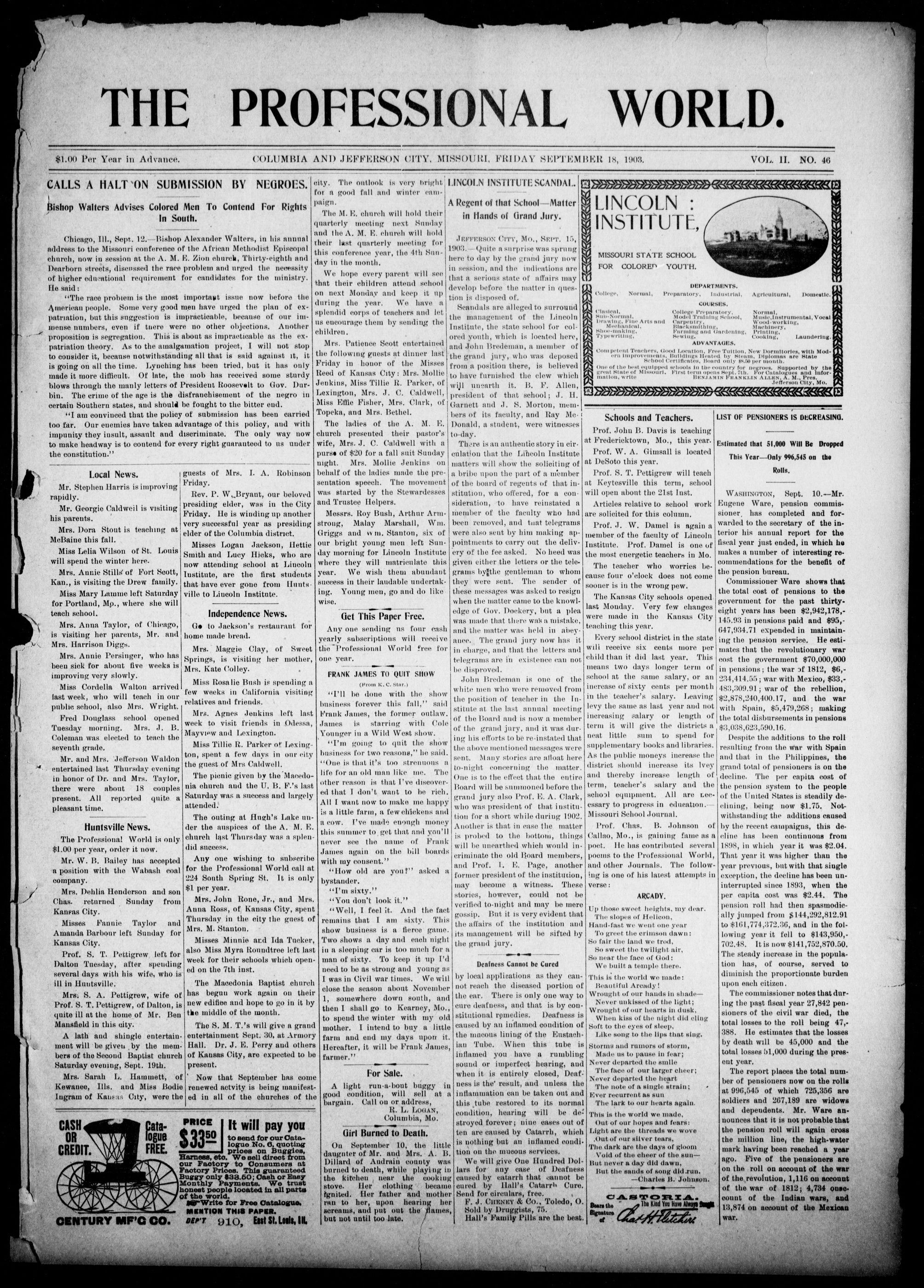
CALLS A HALT ON SUBMISSION BY NEGROES.
Bishop Walters Advises Colored Men To Contend For Rights In South.
Chicago, Ill., Sept. 12.—Bishop Alexander Walters, in his annual address to the Missouri conference of the African Methodist Episcopal church, now in session at the A. M. E. Zion church, Thirty-eighth and Dearborn streets, discussed the race problem and urged the necessity of higher educational requirement for candidates for the ministry. He said:
"The race problem is the most important issue now before the American people. Some very good men have urged the plan of expatriation, but this suggestion is impracticable, because of our immense numbers, even if there were no other objections. Another proposition is segregation. This is about as impracticable as the expatriation theory. As to the analgamation project, I will not stop to consider it, because notwithstanding all that is said against it, it is going on all the time. Lynching has been tried, but it has only made it more difficult. Of late, the mob has received some sturdy blows through the manly letters of President Roosevelt to Gov. Durbin. The crime of the age is the disfranchisement of the negro in certain Southern states, and should be fought to the bitter end.
"I am convinced that the policy of submission has been carried too far. Our enemies have taken advantage of this policy, and with impunity they insult, assault and discriminate. The only way now to make headway is to contend for every right guaranteed to us under the constitution."
$1.00 Per Year in Advance.
CALLS A HALT ON SUBMISSION
Bishop Walters Advises Colored Men in Some Chicago, Ill., Sept. 12.—Bishop's address to the Missouri conference of church, now in session at the A. M. B. Dearborn streets, discussed the race of higher educational requirement for He said:
"The race problem is the most American people. Some very good patriation, but this suggestion is immense numbers, even if there were proposition is segregation. This is a patriation theory. As to the analgia to consider it, because notwithstanding is going on all the time. Lynching made it more difficult. Of late, the blows through the manly letters of B. Bin. The crime of the age is the certain Southern states, and should I "I am convinced that the policy too far. Our enemies have taken advantage they insult, assault and do to make headway is to contend for even the constitution."
Local News.
Mr. Stephen Harris is improving rapidly.
Mr. Georgie Caldweil is visiting his parents.
Mrs. Dora Stout is teaching at McBaine this fall.
Miss Lelia Wilson of St. Louis will spend the winter here.
Miss Mary Lamme left Saturday for Portland, Mp., where she will teach school.
Mrs. Anna Taylor, of Chicago, is visiting her parents, Mr. and Mrs. Harrison Diggs.
Mrs. Annie Persinger, who has been sick for about five weeks is improving very slowly.
Miss Cordella Walton arrived last week, who will teach in our public school, also Mrs. Wright.
Fred Donglass school opened Tuesday morning. Mrs. J. B. Coleman was elected to teach the seventh grade.
Mr. and Mrs. Jefferson Waldon entertained last Thursday evening in honor of Dr. and Mrs. Taylor, there were about 18 couples present. All reported quite a pleasant time.
Huntsville News.
The Professional World is only $1.00 per year, order it now.
Mr. W. B. Bailey has accepted a position with the Wabash coal company.
Mrs. Dehlia Henderson and son Chas. returned Sunday from Kansas City.
Misses Fannie Taylor and Amanda Barbour left Sunday for Kansas City.
Prof. S. T. Pettigrew left for Dalton Tuesday, after spending several days with his wife, who is ill in Huntsville.
Mrs. S. A. Pettigrew, wife of Prof. S. T. Pettigrew, of Dalton, is quite ill at the home of Mr. Ben Mansfield in this city.
A lath and shingle entertainment will be given by the members of the Second Baptist church Saturday evening, Sept. 19th.
Mrs. Sarah L. Hammett, of Kewanee, Ills. and Miss Bodie Ingram of Kansas City, were the
CASH OR CREDIT. Catalogue FREE.
CENTURY MF'G CO.
COLUMBIA AND JEFFERSON CITY, MISSOURI, FRIDAY SEPTEMBER 18, 1903.
guests of Mrs. I. A. Robinson Friday.
Rev. P. W. Bryant, our beloved presiding elder, was in the City Friday. He is winding up another very successful year as presiding elder of the Columbia district.
Misses Logan Jackson, Hettie Smith and Lucy Hicks, who are now attending school at Lincoln Institute, are the first students that have ever gone from Huntsville to Lincoln Institute.
Independence News.
Go to Jackson's restaurant for home made bread.
Mrs. Maggie Clay, of Sweet Springs, is visiting her mother, Mrs. Kate Colley.
Miss Rosalie Bush is spending a few weeks in California visiting relatives and friends.
Mrs. Agnes Jenkins left last week to visit friends in Odessa, Mayview and Lexington.
Miss Tillie R. Parker of Lexington, spent a few days in our city the guest of Mrs Caldwell.
The picnic given by the Macedonia church and the U. B. F.'s last Saturday was a success and largely attended.
The outing at Hugh's Lake under the auspices of the A. M. E. church last Thursday was a splendid success.
Any one wishing to subscribe for the Professional World call at 224 South Spring St. It is only $1 per year.
Mrs. John Rone, Jr., and Mrs. Anna Ross, of Kansas City, spent Thursday in the city the guest of Mrs. M. Stanton.
Misses Minnie and Ida Tucker, also Miss Myra Roundtree left last week for their schools which opened on the 7th inst.
The Macedonia Baptist church has begun work again on their new edifice and hope to go in it by the middle of the month.
The S. M. T.'s will give a grand entertainment Sept. 30, at Armory Hall. Dr. J. E. Perry and others of Kansas City, are expected to be present.
Now that September has come renewed activity is being manifested in all of the churches of the
It will pay you
to send for our Catalogue No. 6, quoting prices on Buggies,
Harness, etc. We sell direct from our Factory to Consumers at Factory Prices. This guaranteed Buggy only $33.50; Cash or Easy Monthly Payments. We trust honest people located in all parts of the world.
Write for Free Catalogue,
MENTION THIS PAPER.
DEP'T 910. East St. Louis, Ill.
city. The onlook is very bright for a good fall and winter campaign.
The M. E. church will hold their quarterly meeting next Sunday and the A. M. E. church will hold their last quarterly meeting for this conference year, the 4th Sunday in the month.
We hope every parent will see that their children attend school on next Monday and keep it up during the year. We have a splendid corps of teachers and let us encourage them by sending the children.
Mrs. Patience Scott entertained the following guests at dinner last Friday in honor of the Misses Reed of Kansas City: Mrs. Mollie Jenkins, Miss Tillie R. Parker, of Lexington, Mrs. J. C. Caldwell, Miss Effie Fisher, Mrs. Clark, of Topeka, and Mrs. Bethel.
The ladies of the A. M. E. church presented their pastor's wife, Mrs. J. C. Caldwell with a purs. of $20 for a fall suit Sunday night. Mrs. Mollie Jenkins on behalf of the ladies made the presentation speech. The movement was started by the Stewardesses and Trustee Helpers.
Messrs. Roy Bush, Arthur Armstrong, Malay Marshall, Wm. Griggs and wm. Stanton, six of our bright young men left Sunday morning for Lincoln Institute where they will matriculate this year. We wish them abundant success in their laudable undertaking. Young men, go and do like wise.
Get This Paper Free.
Any one sending us four cash yearly subscriptions will receive the Professional World free for one year.
FRANK JAMES TO QUIT SHOW
(Prom K. C. Star.)
"I'll be done with the show business forever this fall," said Frank James, the former outlaw. James is starring with Cole Younger in a Wild West show.
"I'm going to quit the show business for two reasons," he said.
"One is that it's too strenuous a life for an old man like me. The other reason is that I've discovered that I don't want to be rich. All I want now to make me happy is a little farm, a few chickens and a cow. I've made enough money this summer to get that and you'll never see the name of Frank James again on the bill boards with my consent."
"How old are you?" asked a bystander.
"I'm sixty."
"You don't look it."
"Well, I feel it. And the fact remains that I am sixty. This show business is a fierce game. Two shows a day and each night in a sleeping car is too much for a man of sixty. To keep it up I'd need to be as strong and young as I was in Civil war times. We will close the season about November 1, somewhere down south, and then I shall go to Kearney, Mo., to spend the winter with my old mother. I intend to buy a little farm and end my days upon it. Hereafter, it will be Frank James, farmer."
For Sale.
A light run-a-bout buggy in good condition, will sell at a bargain. Call on or address. R. L. LOGAN, Columbia, Mo.
Girl Burned to Death.
On September 10, the little daughter of Mr. and Mrs. A. B. Dillard of Audrain county was burned to death, while playing in the kitchen near the cooking stove. Her clothing became ignited. Her father and mother ran to her, upon hearing her screams, and put out the flames, but not until too late.
LINCOLN INSTITUTE SCANDAL.
A Regent of that School—Matter in Hands of Grand Jury.
JEFFERSON CITY, Mo., SEPT. 15, 1903.—Quite a surprise was sprung here to day by the grand jury now in session, and the indications are that a serious state of affairs may develop before the matter in question is disposed of.
Scandals are alleged to surround the management of the Lincoln Institute, the state school for colored youth, which is located here, and John Bredeman, a member of the grand jury, who was deposed from a position there, is believed to have furnished the clew which will unearth it. B. F. Allen, president of that school; J. H. Garnett and J. S. Morton, members of its faculty, and Ray McDonald, a student, were witnesses to-day.
There is an authentic story in circulation that the Libcoln Institute matters will show the soliciting of a bribe upon the part of a member of the board of regents of that institution, who offered, for a consideration, to have reinstated a member of the faculty who had been removed, and that telegrams were also sent by him making appointments to carry out the delivery of the fee asked. No heed was given either the letters or the telegrams by the gentleman to whom they were sent. The sender of these messages was asked to resign when the matter came to the knowledge of Gov. Dockery, but a plea was made that there was a mistake, and the matter was held in abeyance. The grand jury now has it in charge, and that the letters and telegrams are in existence can not be disproved.
John Bredeman is one of the white men who were removed from the position of teacher in the Institute at the last annual meeting of the Board and is now a member of the grand jury, and it was during his efforts to be re-instated that the above mentioned messages were sent. Many stories are affloat here to-night concerning the matter. One is to the effect that the entire Board will be summoned before the grand jury also Prof. E. A. Clark, who was president of that institution for a short while during 1902. Another is that in case the matter is probed to the bottom, things will be unearthed which would in-eriminate the old Board members, and Prof. I. E. Page, another former president of the institution, may become a witness. These stories, however, could not be verified to-night and may be mere gossip. But it is very evident that the affairs of the institution and its management will be sifted by the grand jury.
Deafness Cannot be Cured
by local applications as they cannot reach the diseased portion of the ear. There is only one way to cure deafness, and that is by constitutional remedies. Deafness is caused by an inflamed condition of the mucous lining of the Eustachian Tube. When this tube is inflamed you have a rumbling sound or imperfect hearing, and when it is entirely closed, Deafness is the result, and unless the inflammation can be taken out and this tube restored to its normal condition, hearing will be destroyed forever; nine cases out of ten are caused by Catarrh, which is nothing but an inflamed condition on the mucous services.
We will give One Hundred Dollars for any case of Deafness caused by catarrh that cannot be cured by Hall's Catarrh Cure. Send for circulars, free. F. J. CHENEY & CO., Toledo, O. Sold by Druggists, 75. Hall's Family Pills are the best.
```markdown
```
Schools and Teachers.
Prof. John B. Davis is teaching at Fredericktown, Mo., this year.
Prof. W. A. Gimsall is located at DeSoto this year.
Prof. S. T. Pettigrew will teach at Keytesville this term, school will open about the 21st Inst.
Articles relative to school work are solicited for this column.
Prof. J. W. Damel is again a member of the faculty of Lincoln Institute. Prof. Damel is one of the most energetic teachers in Mo.
The teacher who worries because four o'clock does not come sooner is in the wrong pew.
The Kansas City schools opened last Monday. Very few changes were made in the Kansas City teaching this year.
Every school district in the state will receive six cents more per child than it did last year. This means two days longer term of school at the same salary, or an increase of sixty cents per month in the teacher's salary. Leaving levy the same as last year and not increasing salary or length of term it will give the districts a neat little sum to spend for supplementary books and libraries. As the public moneys increase the district should increase its lvey and thereby increase length of term, teacher's salary and the school equipment. All are necessary to progress in education. Missouri School Journal.
Prof. Chas. B. Johnson of Callao, Mo., is gaining fame as a poet. He has contributed several poems to the Professional World, and other Journals. The following is one of his latest attempts in verse:
ARCADY
Up those sweet heights, my dear.
The slopes of Helicon.
Hand-fast we went one year
To greet the crimson dawn:
So fair the land we trod,
So sweet the twilight air,
So near the face of God:
We built a temple there.
This is the world we made:
Beautiful Arcady!
Wrought of our hands in shade—
Never unkissed of the light;
Wrought of our hearts in dusk,
When kiss of the night did cling
Soft to the eyes of sleep,
Like song to the lips that sing.
Storms and rumors of storm,
Made us to pause in fear;
Never departed the smile
The face of our larger cheer;
Never departed the heart
The note of a single strain;
Ever recurrent as sun
The lark to our hearts again.
This is the world we made,
Out of our hopes and fears:
Light are the threads we wove
Out of our silver tears.
The dark are the days of gloom
Void of the cheer of the sun—
But never a day did dawn,
But the sands of song did run.
—Charles B. Johnson.
CASTORIA.
The Kind You Have Always
Bears the
Signature
of
Charles H. Patchin
VOL. II. NO. 46
DARTMENTS.
Industrial, Agricultural, Domestic.
COURSES.
Separatory,
Clining School,
Clining,
and Gardening,
Normal,
Muscle, Instrumental, Vocal
Wood-working,
Machinery,
Printing,
Cooking,
Laundering.
VANTAGES.
A. Free Tuition, New Dormitories, with Mod-
eated by Steam, Diplomas are State
Board only $8.50 per month.
The country for negroes. Supported by the
opens Sept. 7th. For Catalogues and Infor-
JAMIN FRANKIN ALDEN, A. M., Frees
Jefferson City, Mo.
LIST OF PENSIONERS IS DECREASING.
Estimated that 51,000 Will Be Dropped
This Year—Only 996,545 on the Rolls.
Rolls.
WASHINGTON, Sept. 10.—Mr. Eugene Ware, pension commissioner, has completed and forwarded to the secretary of the interior his annual report for the fiscal year just ended, in which he makes a number of interesting recommendations for the benefit of the pension bureau.
Commissioner Ware shows that the total cost of pensions to the government for the past thirty-eight years has been $2,942,178,-145.93 in pensions paid and $95,-647,934.71 expended in maintaining the pension service. He estimates that the revolutionary war cost the government $70,000,000 in pensions; the war of 1812, $6,-234,414.55; war with Mexico, $33,-483,309.91; war of the rebellion, $2,878,240,400.17, and the war with Spain, $5,479,268; making the total disbursements in pensions $3,038,623,590.16.
Despite the additions to the roll resulting from the war with Spain and that in the Philippines, the grand total of pensioners is on the decline. The per capita cost of the pension system to the people of the United States is steadily declining, being now $1.75. Notwithstanding the additions caused by the recent campaigns, this decline has been continuous from 1898, in which year it was $2.04. That year it was higher than the year previous, but with that single exception, the decline has been uninterrupted since 1893, when the per capita cost was $2.44. The pension roll had then spasmodically jumped from $144,292,812.91 to $161,774,372.36, and in the following year it fell to $143,950,702.48. It is now $141,752,870.50. The steady increase in the population has, of course, served to diminish the proportionate burden upon each citizen.
The commissioner notes that during the past fiscal year 27,842 pensioners of the civil war died, the total losses to the roll being 47,388. He estimates that the losses by death will be 45,000 and the total losses 51,000 during the present year.
The report places the total number of pensioners now on the rolls at 996,545 of which 725,356 are soldiers and 267,189 are widows and dependents. Mr. Ware announces that it is not probable that the pension roll will again cross the million line, the high-water mark having been reached a year ago. Five of the pensioners are on the roll on account of the war of the revolution, 1,116 on account of the war of 1812; 4,734 oncount of the Indian wars, and 13,874 on account of the Mexican war.
---
RUFUS L. LOGAN, Editor
Columbia - - - - Missouri
THE LIVE STOCK SITUATION
District reports from all over the United States relative to general conditions and prospects of the live stock industry for the first six months of this year have been gathered together, with some effort, and the following is the consensus as well as the itemized statements:
Western ranges have been overgrowned the past winter. The weather continued dry until May, when certain sections were visited by severe storms, resulting in heavy losses to both cattle and sheep, which were weakened by the continued drought. There was great scurrying about for say and prices in some sections went up to $20. This year is seeing more senting and fencing of state lands and more forage crops planted than ever before in the history of the stock industry of the West.
In many sections the cattle men are reducing their herds, because of the short range, and the consequence will be fewer cattle, but a far better quality. Sheepmen are, in the main, holding on; many of them are securing rights of some sort to their range. The nomadic herds are meeting with greater obstructions and objections, and there are signs that the settlement of the public domain question will soon be brought about. There is promise that the state of Kansas will feed more cattle in 1903 than ever before in the history of the state. This applies to hogs as well.
The unusually late and wet spring greatly delayed corn planting in Missouri, Iowa, Illinois and Indiana, but at this date a good harvest is assured, and there promises to be a great demand for feeders this fall. There is plenty of feed, plenty of pasture and plenty of money, and the stockraisers, encouraged by the assurance of good prices will invest extensively in the business.
In the South, particularly South Carolina and Louisiana, the live stock industry is making steady advances by the introduction of purebred stock.
Owing to the dry fall, the long winter and the late spring, the markets east were early crowded with shipments from the West and there was a weakening in prices. At this date with feed lot stock being held close for finish, there is a firming up of prices and a profitable trade is therefore to be expected this fall. The National Live Stock association has taken up the matter of rectifying the evils of the present forestry reserve laws. In this matter the association wants the aid of the entire industry. It wants every stock man interested to send in detailed complaints or grievances regarding the operations of the law in the various districts, and forward them at the earliest possible date.
The stock shippers have had more grievances against transportation companies for delay in moving stock and th supply of cars, entailing a great expense, than any other class of shippers. There is a bill now before congress to compel the railroads to haul live stock at a speed of not less than 20 miles an hour and the association is lending its support to this measure. All persons interested who have grievances along these lines are requested to forward such to this office at once. The live stock conditions for Iowa are reported as follows:
The spring was unusually wet, and storms frequent and severe, yet stock losses were light. Hay and fodder was well cleaned up and more corn than usual consumed. Beginning the second half of the year there were less cattle on feed than usual. Fat hogs were soon disposed of and the coming crop is better than usual although short. There are about 5,365,000 cattle, 1,050,000 sheep, 9,600,000 swine and 1,400,000 horses in the state. Excellent conditions relative to pastures, feed and corn crops prevail throughout Iowa, Illinois, Indians and feeding will be carried on extensively this fall and winter. Many farmers are already buying stock cattle. In Illinois the calf crop will be 100 per cent and the lamb crop 90 Wool is selling at 17 to 22 cents. In Indiana wool is selling at 18 and 19 cents, and the calf and lamb crop is 10 per cent above normal. The holdings of purebred stock by individuals show a great increase in these two states.
STEAL KAISER'S GIFT
Thleves Rob Soldiers' Chest of 400
Pieces of Choice Silver.
Hanover, Sept. 15.—The chest containing the silverware of the Thirteenth regiment of Uhlans, in garrison here, has been robbed of 400 pieces of silver, among them being massive cups which were the gifts of Emperor William. No trace of the burglarls has been found.
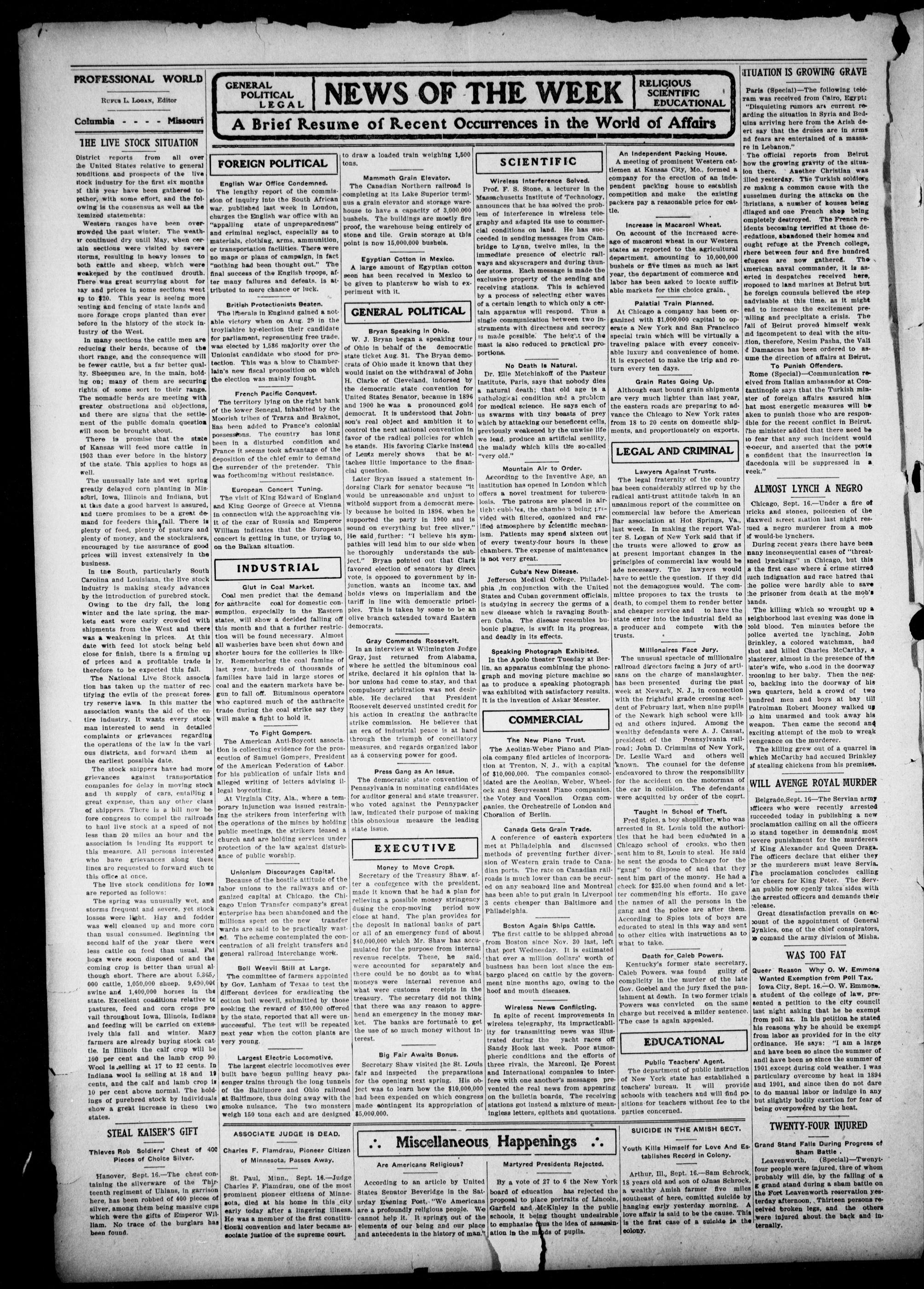
NEWS OF THE WEEK
GENERAL
POLITICAL
LE G AL
FOREIGN POLITICAL
English War Office Condemned. The lengthy report of the commission of inquiry into the South African war, published last week in London, charges the English war office with an "appalling state of unpreparedness" and criminal neglect, especially as to materials, clothing, arms, ammunition, or transportation facilities. There were no maps or plans of campaign, in fact "nothing had been thought out." The final success of the English troops, after many failures and defeats, is attributed to mere chance or luck.
British Protectionists Beaten.
The liberals in England gained a notable victory when on Aug. 29 in the troylishire by-election their candidate for parliament, representing free trade, was elected by 1,586 majority over the Unionist candidate who stood for protection. This was a blow to Chamberlain's new fiscal proposition on which the election was mainly fought.
French Pacific Conguest.
The territory lying on the right bank of the lower Senegal, inhabited by the Moorish tribes of Trarza and Braknot, has been added to France's colonial possessions. The country has long been in a disturbed condition and France it seems took advantage of the deposition of the chief emir to demand the surrender of the pretender. This was forthcoming without resistance.
European Concert Tuning.
The visit of King Edward of England and King George of Greece at Vienna in connection with the approaching visit of the ear of Russia and Emperor William indicates that the European concert is getting in tune, or trying to on the Balkan situation.
INDUSTRIAL
Glut in Coal Market.
Coal men predict that the demand for anthracite coal for domestic consumption, especially in the Eastern states, will show a decided falling off this month and that a further restriction will be found necessary. Almost all washeries have been shut down and shorter hours for the collieries is likely. Remembering the coal famine of last year, hundreds of thousands of families have laid in large stores of coal and the eastern markets have begun to fall off. Bituminous operators who captured much of the anthracite trade during the coal strike say they will make a fight to hold it.
To Eight Gompers:
The American Anti-Boycott association is collecting evidence for the prosecution of Samuel Gompers, President of the American Federation of Labor. for his publication of unfair lists and alleged writing of letters advising illegal boycotting. At Virginia City, Ala., where a temporary injunction was issued restraining the strikers from interfering with the operations of the mines by holding public meetings, the strikers leased a church and are holding services under protection of the law against disturbance of public worship.
Unionism Discourages Capital
Because of the hostile attitude of the labor unions to the railways and organized capital at Chicago, the Chicago Union Transfer company's great enterprise has been abandoned and the millions spent on the new transfer wards are said to be practically wasted. The scheme contemplated the concentration of all freight transfers and general railroad interchange work.
Boll Weevil Still at Large.
The committee of farmers appointed by Gov. Lanham of Texas to test the different devices for eradicating the cotton boll weevil, submitted by those seeking the reward of $50,000 offered by the state, reported that all were unsuccessful. The test will be repeated next year when the cotton plants are very young.
Largest Electric Locomotive.
The largest electric locomotives ever built have begun pulling heavy passenger trains through the long tunnels of the Baltimore and Ohio railroad at Baltimore, thus doing away with the smoke nuisance. The two monsters weigh 150 tons each and are designed
ASSOCIATE JUDGE IS DEAD.
Charles F. Flamdrau, Pioneer Citizen of Minnesota, Passes Away.
St. Paul, Minn., Sept. 16.—Judge Charles F. Flamdrau, one of the most prominent pioneer citizens of Minnesota, died at his home in this city early today after a lingering illness. He was a member of the first constitutional convention and later became as associate justice of the supreme court.
to draw a loaded train weighing 1,500 tons.
Mammoth Grain Elevator.
The Canadian Northern railroad is completing at its Lake Superior terminus a grain elevator and storage warehouse to have a capacity of 3,000,000 bushels. The buildings are mostly fire proof, the warehouse being entirely of stone and tile. Grain storage at this point is now 15,000,000 bushels.
Egyptian Cotton in Mexico.
A large amount of Egyptian cotton seen has been received in Mexico to be given to plantersw ho wish to experiment with it.
GENERAL POLITICAL
Bryan Speaking In Ohio.
W. J. Bryan began a speaking tour of Ohio in behalf of the democratic state ticket Aug. 31. The Bryan democrats of Ohio made it known that they would insist on the withdrawal of John H. Clarke of Cleveland, indorsed by the democratic state convention for United States Senator, because in 1896 and 1900 he was a pronounced gold democrat. It is understood that Johnson's real object and ambition it to control the next national convention in favor of the radical policies for which he stands. His favoring Clarke instead of Lentz merely shows that he attaches little importance to the financial question.
Later Bryan issued a statement indorsing Clark for senator because "it would be unreasonable and unjust to withhold support from a democrat merely because he bolted in 1896, when he supported the party in 1900 and is sound on everything but free silver." He said further: "I believe his sympathies will lead him to our side when he thoroughly understands the subject." Bryan pointed out that Clark favored election of senators by direct vote, is opposed to government by injunction, wants an income tax, and holds views on imperialism and the tariff in line with democratic principles. This is taken by some to be an olive branch extended toward Eastern democrats.
In an interview at Wilmington Judge Gray, just returned from Alabama, where he settled the bituminous coal strike, declared it his opinion that labor unions had come to stay, and that compulsory arbitration was not desirable. He declared that President Roosevelt deserved unstinted credit for his action in creating the anthracite strike commission. He believes that an era of industrial peace is at hand through the triumph of conciliatory measures, and regards organized labor as a conserving power for good.
Press Gang as An Issue.
The democratic state convention of Pennsylvania in nominating candidates for auditor general and state treasurer, who voted against the Pennypacker law, indicated their purpose of making this obnoxious measure the leading state issue.
EXECUTIVE
Money to Move Crops.
Secretary of the Treasury Shaw, after a conference with the president, made it known that he had a plan for relieving a possible money stringency during the crop-moving period now close at hand. The plan provides for the deposit in national banks of part or all of an emergency fund of about $40,000,000 which Mr. Shaw has accumulated for the purpose from internal revenue receipts. These, he said, were accounted for separately and there could be no doubt as to what moneys were internal revenue and what were customs receipts in the treasury. The secretary did not thing that there was any reason to apprehend an emergency in the money market. The banks are fortunate to get the use of so much money without interest.
Big Fair Awaits Bonus.
Secretary Shaw visited the St. Louis fair and inspected the preparations for the opening next spring. His object was to learn how the $10,000,000 had been expended on which congress made contingent its appropriation of $5,000,000.
Are Americans Religious?
According to an article by United States Senator Beveridge in the Saturday Evening Post, "We Americans are a profoundly religious people. We cannot help it." It springs out of the elements of our being and our place and antecedents in the history of man."
SCIENTIFIC
Wireless Interference Solved.
Wireless Interference Solved. Prof. F. S. Stone, a lecturer in the Massachusetts Institute of Technology, announces that he has solved the problem of interference in wireless telegraphy and adapted its use to commercial conditions on land. He has succeeded in sending messages from Cambridge to Lynn, twelve miles, in the immediate presence of electric railways and skyscrapers and during thunder storms. Each message is made the exclusive property of the sending and receiving stations. This is achieved by a process of selecting ether waves of a certain length to which only a certain apparatus will respond. Thus a single communication between two instruments with directness and secrecy is made possible. The height of the mast is also reduced to practical proportions.
No Death Is Natural.
Dr. Elle Metchinkoff of the Pasteur Institute, Paris, says that nobody dies a natural death; that old age is a pathological condition and a problem for medical science. He says each of us swarms with tiny beasts of prey which by attacking our beneficent cells, previously weakened by the unwise life we lead, produce an artificial senility, the malady which kills the so-called "very old."
Mountain Air to Order.
According to the Inventive Age, an institution has opened in London which offers a novel treatment for tuberculosis. The patrons are placed in airtight cubicles, the chamber being provided with filtered, ozonized and rarified atmosphere by scientific mechanism. Patients may spend sixteen out of every twenty-four hours in these chambers. The expense of maintenance is not very great.
Cuba's New Disease.
Jefferson Medical College, Philadelphia, in conjunction with the United States and Cuban government officials, is studying in secrecy the germs of a new disease which is ravaging Southern Cuba. The disease resembles bubonic plague, is swift in its progress, and deadly in its effects.
Speaking Photograph Exhibited.
In the Apolo theater Tuesday at Berlin, an apparatus combining the phonograph and moving picture machine so as to produce a speaking photograph was exhibited with satisfactory results. It is the invention of Askar Messter.
COMMERCIAL
The New Piano Trust.
The Aeolian-Weber Piano and Pianola company filed articles of incorporation at Trenton, N. J., with a capital of $10,000,000. The companies consolidated are the Aeolian, Weber, Wheelock and Seuyesant Piano companies, the Votey and Vocalion Organ companies, the Orchestrelle of London and Choralion of Berlin.
Canada Gets Grain Trade.
A conference of eastern exporters met at Philadelphia and discussed methods of preventing further diversion of Western grain trade to Canadian ports. The rate on Canadian railroads is much lower than can be secured on any seaboard line and Montreal has been able to put grain in Liverpool 3 cents cheaper than Baltimore and Philadelphia.
Boston Again Ships Cattle.
The first cattle to be shipped abroad from Boston since Nov. 30 last, left that port Wednesday. It is estimated that over a million dollars' worth of business has been lost since the embargo placed on cattle by the government nine months ago, owing to the hoof and mouth diseases.
Wireless News Conflicting.
Wireless News Connecting.
In spite of recent improvements in wireless telegraphy, its impracticability for transmitting news was illustrated during the yacht races off Sandy Hook last week. Poor atmospheric conditions and the efforts of three rivals, the Marconi, De Forest and International companies to interfere with one another's messages prevented the real news from appearing on the bulletin boards. The receiving stations got instead a mixture of meaningless letters, epithets and quotations.
By a vote of 27 to 6 the New York board of education has rejected the proposal to place portraits of Lincoln Garfield and McKinley in the public schools, it being thought undesirable to emphasize thus the idea of assassination in the minds of pupils.
RELIGIOUS
SCIENTIFIC
EDUCATIONAL
An Independent Packing House.
An Independent Packing House. A meeting of prominent Western cattlemen at Kansas City, Mo., formed a company for the erection of an independent packing house to establish competition and make the existing packers pay a reasonable price for cattle.
Increase in Macaroni Wheat.
On account of the increased acreage of macaroni wheat in our Western states as reported to the agricultural department, amounting to 10,000,000 bushels or five times as much as last year, the department of commerce and labor has been asked to locate suffitable markets for this choice grain.
Palatial Train Planned.
At Chicago a company has been organized with $1,000,000 capital to operate a New York and San Francisco special train which will be virtually a traveling palace with every conceivable luxury and convenience of home. It is expected to make the trip and return every ten days.
Grain Rates Going Up.
Although east bound grain shipments are very much lighter than last year, the eastern roads are preparing to advance the Chicago to New York rates from 18 to 20 cents on domestic shipments, and proportionately on exports.
LEGAL AND CRIMINAL
Lawyers Against Trusts.
The legal fraternity of the country has been considerably stirred up by the radical anti-trust attitude taken in an unanimous report of the committee on commercial law before the American Bar association at Hot Springs, Va., last week. In making the report Walter S. Logan of New York said that if the trusts were allowed to grow as at present important changes in the principles of commercial law would be ade necessary. The lawyers would have to settle the question. If they did not the demagogues would. The committee proposes to tax the trusts to death, to compel them to render better and cheaper service and to have the state enter into the industrial field as a producer and compete with the trusts.
Millionaires Face Jury.
The unusual spectacle of millionaire railroad directors facing a jury of artisans on the charge of manslaughter, has been presented during the past week at Newark, N. J., in connection with the frightful grade crossing accident of February last, when nine pupils of the Newark high school were killed and others injured. Among the wealthy defendants were A. J. Cassat, president of the Pennsylvania railroad; John D. Crimmins of New York Dr. Leslie Ward and others well known. The counsel for the defense endeavored to throw the responsibility for the accident on the motorman of the car in collision. The defendants were acquitted by order of the court
Taught in School of Theft.
Fred Spies, a boy shoplifter, who was arrested in St. Louis told the authorities that he had been educated in a Chicago school of crooks, who then sent him to St. Louis to steal. He said he sent the goods to Chicago for the "gang" to dispose of and that they sent him part of the money. He had a check for $25.00 when found and a letter commending his efforts. He gave the names of all the persons in the gang and the police are after them. According to Spies lots of boys are educated to steal in this way and sent to other cities with instructions as to what to take.
Death for Caleb Powers.
Kentucky's former state secretary, Caleb Powers, was found guilty of complicity in the murder of the late Gov. Goebel and the jury fixed the punishment at death. In two former trials Powers was convicted on the same charge but received a milder sentence. The case is again appealed.
EDUCATIONAL
The department of public instruction of New York state has established a teachers' bureau. It will provide schools with teachers and will find positions for teachers without fee to the parties concerned.
SUICIDE IN THE AMISH SECT.
Youth Kills Himself for Love And Establishes Record in Colony.
Arthur, Ill., Sept. 16.—Sam Schrock, 18 years old and son of oJnas Schrock, a wealthy Amish farmer five miles southeast of here, comitted suicide by hanging early yesterday morning. A love affair is said to be the cause. This is the first case of a suicide in the colony.
ITUATION IS GROWING GRAVE
Paris (Special)—The following telegram was received from Cairo, Egypt: "Disquieting rumors are current regarding the situation in Syria and Beduins arriving here from the Ardish desert say that the druses are in arms and fears are entertained of a massacre in Lebanon."
The official reports from Beirut how the growing gravity of the situation there. Another Christian was killed yesterday. The Turkish soldiers are making a common cause with the ausselmen during the attacks on the Christians, a number of houses being illaged and one French shop being completely destroyed. The French residents becoming terrified at these deredations, abandoned their homes and ought refuge at the French college, there between four and five hundred efugees are now gathered. The american naval commander, it is asserted in despatches received here, proposed to land marines at Beirut but he foreign counsuls believed the step nadvisable at this time, as it might end to increase the excitement pre-ailing and precipitate a crisis. The fall of Beirut proved himself weak and incompetent to deal with the situation, therefore, Nesim Pasha, the Vall of Damascus has been ordered to assume the direction of affairs at Beirut.
To Punish Offenders.
Rome (Special)—Communication received from Italian ambassador at Contantinople says that the Turkish minister of foreign affairs assured him that most energetic measures will be taken to punish those who are responsible for the recent conflict in Beirut. The minister added that there need be to fear that any such incident would e-oecur, and asserted that the ports confident that the insurrection in Macedonia will be suppressed in a week."
ALMOST LYNCH A NEGRO
Chicago, Sept. 16.—Under a fire of bricks and stones, policemen of the maxwell street station last night resued a negro murderer from a mob of would-be lynchers.
During recent years there have been many inconsequential cases of "threatened lynchings" in Chicago, but this is the first case where a crime stirred such indignation and race hatred that the police were hardly able to save the prisoner from death at the mob's hands.
The killing which so wrought up a neighborhood last evening was done in cold blood. Ten minutes before the police averted the lynching, John Brinkley, a colored watchman, had shot and killed Charles McCarthy, a plasterer, almost in the presence of the later's wife, who sood in the doorway protesting to her baby. Then the negro, backing into the doorway of his own quarters, held a crowd of two hundred men and boys at bay till Patrolman Robert Mooney walked up to him unarmed and took away his weapon. Then came the second and exciting attempt of the mob to wreak vengeance on the murderer.
The killing grew out of a quarrel in which McCarthy had accused Brinkley of stealing chickens from his premises.
WILL AVENGE ROYAL MURDER
Belgrade, Sept. 16—The Servian army officers who were recently arrested succeeded today in publishing a new proclamation calling on all the officers to stand together in demandig most severe punishment for the murderers of King Alexander and Queen Draga. The officers declare that either they or the murderers must leave Servia. The proclamation concludes calling for cheers for King Peter. The Servian public now openly takes sides with the arrested officers and demands their release.
Great dissatisfaction prevails on account of the appointment of General Synkics, one of the chief conspirators, to command the army division of Misha.
WAS TOO FAT
Queer Reason Why O. W. Emmons
Wanted Exemption from Poll Tax.
Wanted Exemption. From S. Iowa City, Sept. 16.—O. W. Emmons, a student of the college of law, presented a petition to the city council last night asking that he be exempt from poll ax. In his petition he stated his reasons why he should be exempt from labor as provided for in the city ordinance. He says: "I am a large and have been so since the summer of and have been so since the summer of 1901 except during cold weather. I was particularly overcome by heat in 1894 and 1901, and since then do not dare to do manual labor or indulge in any but slightly bodily exertion for fear of being overpowered by the heat.
TWENTY-FOUR INJURED
Grand Stand Falls During Progress of Sham Battle,
Leavenworth, (Special)—Twenty-four people were injured, thre of whom probably will die, by the falling of a grand stand during a sham battle on the Fort Leavenworth reservation yesterday afternoon. Thirteen persons received broken legs, and the others were injured about the back and internally.
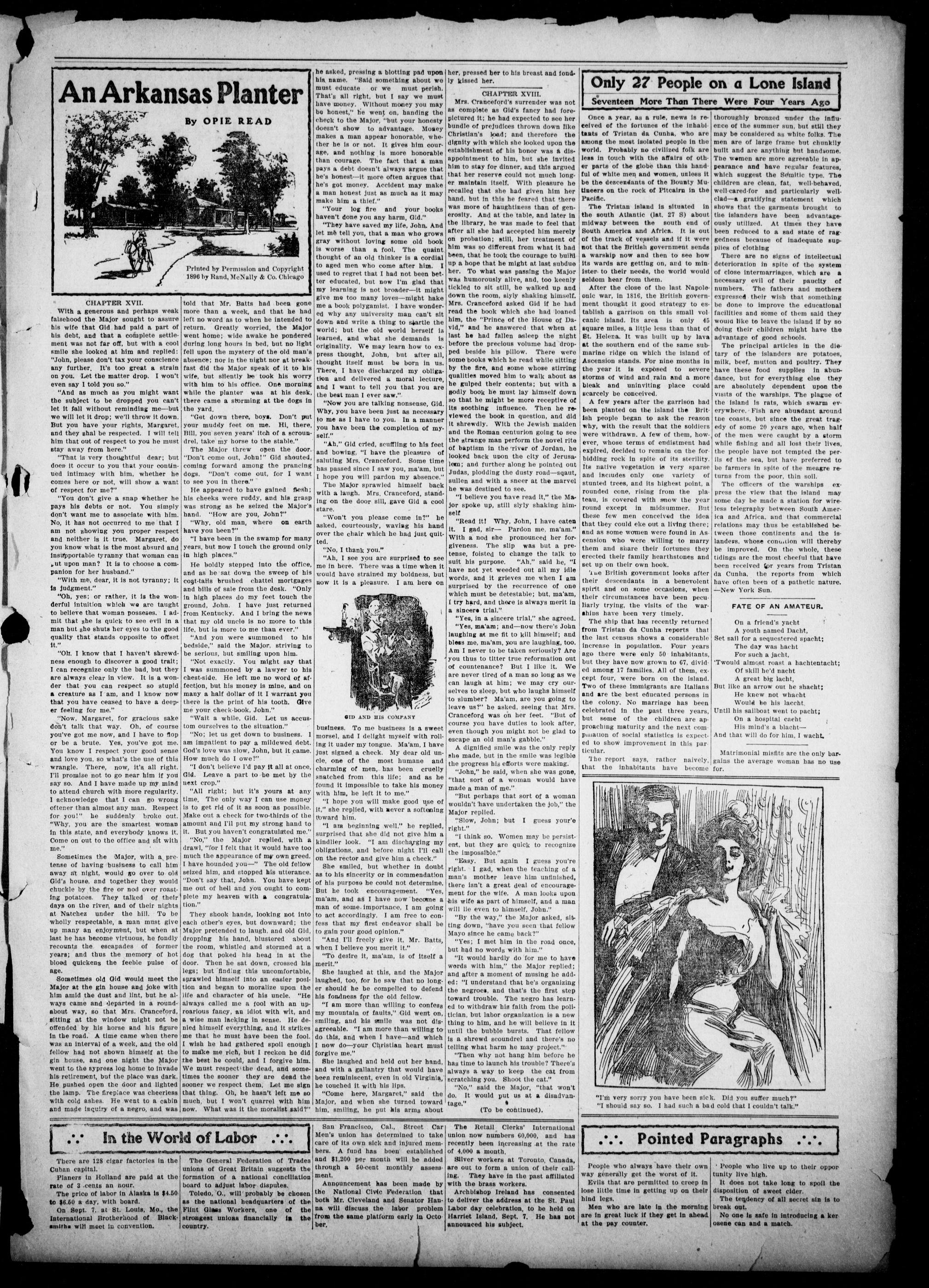
An Arkansas Planter
By OPIE READ
Printed by Permission and Copyright
1896 by Rand, McNally & Co. Chicago
CHAPTER XVII.
With a generous and perhaps weak falsehood the Major sought to assure his wife that Gld had paid a part of his debt, and that a complete settlement was not far off, but with a cool smile she looked at him and replied: "John, please don't tax your conscience any further. It's too great a strain on you. Let the matter drop. I won't even say I told you so."
"And as much as you might want the subject to be dropped you can't let it fall without reminding me—but we will let it drop; we'll throw it down. But you have your rights, Margaret, and they shall be respected. I will tell him that out of respect to you he must stay away from here."
"That is very thoughtful dear; but does it occur to you that your continued intimacy with him, whether he comes here or not, will show a want of respect for me?"
"You don't give a snap whether he pays his debts or not. You simply don't want me to associate with him. No, it has not occurred to me that I am not showing you proper respect and neither is it true. Margaret, do you know what is the most absurd and insupportable tyranny that woman can put upon man? It is to choose a companion for her husband."
"With me, dear, it is not tyranny; it is judgment."
"Oh, yes; or rather, it is the wonderful intuition which we are taught to believe that woman possesses. I admit that she is quick to see evil in a man but she shuts her eyes to the good quality that stands opposite to offset it."
"Oh. I know that I haven't shrewdness enough to discover a good trait; I can recognize only the bad, but they are always clear in view. It is a wonder that you can respect so stupid a creature as I am, and I know now that you have ceased to have a deeper feeling for me."
"Now, Margaret, for gracious sake don't talk that way. Oh, of course you've got me now, and I have to hop or be a brute. Yes, you've got me. You know I respect your good sense and love you, so what's the use of this wrangle. There, now, it's all right. I promise not to go near him if you say so. And I have made up my mind to attend church with more regularity. I acknowledge that I can go wrong oftener than almost any man. Respect for you!" he suddenly broke out. "Why, you are the smartest woman in this state, and everybody knows it. Come on out to the office and sit with me."
Sometimes the Major, with a pretense of having business to call him away at night, would go over to old Gld's house, and together they would chuckle by the fire or nod over roasting potatoes. They talked of their days on the river and of their nights at Natchez under the hill. To be wholly respectable, a man must give up many an enjoyment, but when at last he has become virtuous, he fondly recounts the escapades of former years; and thus the memory of hot blood quickens the feeble pulse of age.
Sometimes old Gid would meet the Major at the gin house and joke with him amid the dust and lint, but he always came and departed in a roundabout way, so that Mrs. Cranceford, sitting at the window might not be offended by his horse and his figure in the road. A time came when there was an interval of a week, and the old fellow had not shown himself at the gin house, and one night the Major went to the sypress log home to invade his retirement, but the place was dark. He pushed open the door and lighted the lamp. The fireplace was cheerless with cold ashes. He went to a cabin and made lacuity of a negro, and was
In the World of Labor
There are 128 cigar factories in the Cuban capital.
Planers in Holland are paid at the rate of 3.cents an hour.
The price of labor in Alaska is $4.50
to $6.50 a day, with board.
On Sept. 7, at St. Louis, Mo., the
International Brotherhood of Black-
smiths will meet in convention.
told that Mr. Batts had been gone more than a week, and that he had left no word as to when he intended to return. Greatly worried, the Major went home; wide awake he pondered during long hours in bed, but no light fell upon the mystery of the old man's absence; nor in the night nor at break fast did the Major speak of it to his wife, but silently he took his worry with him to his office. One morning while the planter was at his desk there came a storming at the dogs in the yard.
"Get down there, boys. Don't put your muddy feet on me. Hi, there Bill, you seven years' itch of a scroun drel, take my horse to the stable."
The Major threw open the door,
"Don't come out, John!" Gid shouted
coming forward among the prancing
dogs. "Don't come out, for I want
to see you in there."
He appeared to have gained flesh;
his cheeks were ruddy, and his grasp
was strong as he seized the Major's
hand. "How are you, John?"
"Why, old man, where on earth
have you been?"
"I have been in the swamp for many
years, but now I touch the ground only
in high places."
He boldly stepped into the office, and as he sat down the sweep of his coq-tails brushed chattel mortgages and bills of sale from the desk. "Only in high places do my feet touch the ground, John. I have just returned from Kentucky. And I bring the news that my old uncle is no more to this life, but is more to me than ever."
"And you were summoned to his bedside," said the Major, striving to be serious, but smiling upon him.
"Not exactly. You might say that I was summoned by a lawyer to his chest-side. He left me no word of affection, but his money is mine, and on many a half dollar of it I warrant you there is the print of his tooth. Give me your check-book, John."
"Wait a while, Gid. Let us accustom ourselves to the situation."
"No; let us get down to business. I am impatient to pay a mildewed debt. God's love was slow, John, but it came. How much do I owe?" "I don't believe I'd pay it all at once, Gid. Leave a part to be met by the next crop." "All right; but it's yours at any time. The only way I can use money is to get rid of it as soon as possible. Make out a check for two-thirds of the amount and I'll put my strong hand to it. But you haven't congratulated me." "No," the Major replied, with a drawl, "for I felt that it would have too much the appearance of my own greed. I have hounded you—" The old fellow seized him, and stopped his utterance. "Don't say that, John. You have kept me out of hell and you ought to complete my heaven with a congratulation."
They shook hands, looking not into each other's eyes, but downward; the Major pretended to laugh, and old Gid, dropping his hand, blustered about the room, whistled and stormed at a dog that poked his head in at the door. Then he sat down, crossed his legs; but finding this uncomfortable, sprawled himself into an easier position and began to moralize upon the life and character of his uncle. "He always called me a fool with an uproarous fancy, an idiot with wilt, and a wise man lacking in sense. He denied himself everything, and it strikes me that he must have been the fool. I wish he had gathered spoil enough to make me rich, but I reckon he did the best he could, and I forgive him. We must respect the dead, and sometimes the sooner they are dead the sooner we respect them. Let me sign that thing. Oh, he hasn't left me so much, but I won't quarrel with him now. What was it the moralist said?"
The General Federation of Trades unions of Great Britain suggests the formation of a national conciliation board to adjust labor disputes. Toledo, O., will probably be chosen as the national headquarters of the Flint Glass Workers, one of the strongest unions financially in the country.
he asked, pressing a blotting pad upon his name. "Said something about we must educate or we must perish. That's all right, but I say we must have money. Without money you may be honest," he went on, handing the check to the Major, "but your honesty doesn't show to advantage. Money makes a man appear honorable, whether he is or not. It gives him courage, and nothing is more honorable than courage. The fact that a man pays a debt doesn't always argue that he's honest—it more often argues that he's got money. Accident may make a man honest just as much as it may make him a thief."
"Your log fire and your books haven't done you any harm. Gid."
"They have saved my life, John. And let me tell you, that a man who grows gray without loving some old book is worse than a fool. The quaint thought of an old thinker is a cordial to aged men who come after him. I used to regret that I had not been better educated, but now I'm glad that my learning is not broader—it might give me too many loves—might hake me a book polygamist. I have wondered why any university man can't sit down and write a thing to startle the world; but the old world herself is learned, and what she demands is originality. We may learn how to express thought, John, but after all, thought itself must be born in us. There, I have discharged my obligation and delivered a moral lecture, and I want to tell you that you are the best man I ever saw."
"Now you are talking nonsense, Gid, Why, you have been just as necessary to me as I have to you. In a manner you have been the completion of myself."
"Ah," Gid cried, scuffling to his feet and bowing. "I have the pleasure of saluting Mrs. Cranceford. Some time has passed since I saw you, ma'am, but I hope you will pardon my absence."
The Major sprawled himself back with a laugh. Mrs. Cranceford, standing on the door sill, gave Gid a cool stare.
"Won't you please come in?" he asked, courteously, waving his hand over the chair which he had just quitted.
"No. I thank you."
"Ah, I see you are surprised to see me in here. There was a time when it would have strained my boldness, but now it is a pleasure. I am here on
©ID AND HIS COMPANY
business. To me business is a sweet morsel, and I delight myself with rolling it under my tongue. Ma'ma, I have just signed a check. My dear old uncle, one of the most humane and charming of men, has been cruelly snatched from this life; and as he found it impossible to take his money with him, he left it to me."
"I hope you will make good use of it," she replied, with ever a softening toward him.
"I am beginning well," he replied, surprised that she did not give him a kindlier look. "I am discharging my obligations, and before night I'll call on the rector and give him a check."
She smiled, but whether in doubt as to his sincerity or in commendation of his purpose he could not determine. But he took encouragement. "Yes, ma'am, and as I have now become a man of some importance, I am going to act accordingly. I am free to confess that my first endeavor shall be to gain your good opinion."
"And I'll freely give it, Mr. Batts, when I believe you merit it."
"To desire it, ma'am, is of itself a merit."
She laughed at this, and the Major laughed, too, for he saw that no longer should he be compelled to defend his fondness for the old fellow.
"I am more than willing to confess my mountain of faults," Gid went on, smiling, and his smile was not disagreeable. "I am more than willing to do this, and when I have—and which I now do—your Christian heart must forgive me."
She laughed and held out her hand, and with a gallantry that would have been reminiscent, even in old Virginia, he touched it with his lips.
"Come here, Margaret," said the Major, and when she turned toward him, smiling, he put his arms about
San Francisco, Cal., Street Car Men's union has determined to take care of its own sick and injured members. A fund has been established and $1,200 per month will be added through a 50-cent monthly assessment.
Announcement has been made by the National Civic Federation that both Mr. Cleveland and Senator Hanna will discuss the labor problem from the same platform early in October.
her, pressed her to his breast and fondly kissed her.
CHAPTER XVIII.
Mrs. Cranceford's surrender was not as complete as Gid's fancy had forpictured it; he had expected to see her bundle of prejudices thrown down like Christian's load; and therefore the dignity with which she looked upon the establishment of his honor was a disappointment to him, but she invited him to stay for dinner, and this argued that her reserve could not much longer maintain itself. With pleasure he recalled that she had given him her hand, but in this he feared that there was more of haughtiness than of generosity. And at the table, and later in the library, he was made to feel that after all she had accepted him merely on probation; still, her treatment of him was so different from what it had been, that he took the courage to build up a hope that he might at last subdue her. To what was passing the Major was humorously alive, and, too keenly tickled to sit still, he walked up and down the room, sily shaking himself. Mrs. Cranceford asked Gid if he had read the book which she had loaned him, the "Prince of the House of David," and he answered that when at last he had fallen asleep the night before the precious volume had dropped beside his pillow. There were some books which he read while sitting by the fire, and some whose stirring qualities moved him to walk about as he gulped their contents; but with a godly book he must lay himself down so that he might be more receptive of its soothing influence. Then he reviewed the book in question, and did it shrewdly. With the Jewish maiden and the Roman centurion going to see the strange man perform the novel rite of baptism in the river of Jordan, he looked back upon the city of Jerusalem; and further along he pointed out Judas, plodding the dusty road—squat, sullen and with a sneer at the marvel he was destined to see.
"I believe you have read it," the Major spoke up, still slyly shaking himself
"Read it! Why, John, I have eaten it. I gad, sir— Pardon me, ma'am." With a nod she pronounced her forgiveness. The slip was but a pretense, foisted to change the talk to suit his purpose. "Ah," said he, "I have not yet weeded out all my idle words, and it grieves me when I am surprised by the recurrence of one which must be detestable; but, ma'am, I try hard, and there is always merit in a sincere trial."
"Yes, in a sincere trial," she agreed,
"Yes, ma'am; and—now there's John laughing at me fit to kill himself; and bless me, ma'am, you are laughing, too. Am I never to be taken seriously? Are you thus to titter true reformation out of countenance? But I like it. We are never tired of a man so long as we can laugh at him; we may cry ourselves to sleep, but who laughs himself to slumber? Ma'am, are you going to leave us?" he asked, seeing that Mrs. Cranceford was on her feet. "But of course you have duties to look after, even though you might not be glad to escape an old man's gabble."
A dignified smile was the only reply she made, but in the smile was legible the progress his efforts were making.
"John," he said, when she was gone, "that sort of a woman would have made a man of me."
"But perhaps that sort of a woman wouldn't have undertaken the job," the Major replied.
"Slow, John; but I guess your'e right."
"I think so. Women may be persistent, but they are quick to recognize the impossible."
"Easy. But again I guess you're right. I gad, when the teaching of a man's mother leave him unfinished, there isn't a great deal of encouragement for the wife. A man looks upon his wife as part of himself, and a man will lie even to himself, John."
"By the way," the Major asked, sitting down, "have you seen that fellow Mayo since he came back?"
"Yes; I met him in the road once, but had no words with him."
"It would hardly do for me to have words with him," the Major replied; and after a moment of musing he added: "I understand that he's organizing the negroes, and that's the first step toward trouble. The negro has learned to withdraw his faith from the politician, but labor organization is a new thing to him, and he will believe in it until the bubble bursts. That fellow is a shrewd scoundrel and there's no telling what harm he may project." "Then why not hang him before he has time to launch his trouble? There's always a way to keep the cat from scratching you. Shoot the cat." "No," said the Major, "that won't do. It would put us at a disadvantage."
(To be continued).
The Retail Clerks' International union now numbers 60,000, and has recently been increasing at the rate of 4,000 a month.
Silver workers at Toronto, Canada, are out to form a union of their calling. They have in the past affiliated with the brass workers.
Archbishop Ireland has consented to deliver the address at the St. Paul Labor day celebration, to be held on Harriet Island, Sept. 7. He has not announced his subject.
Only 27 People on a Lone Island
Seventeen More Than There Were Four Years Ago
J. M.
"I'm very sorry you have been sick. Did you suffer much?"
"I should say so. I had such a bad cold that I couldn't talk."
"I'm very sorry you have been sick. Did you suffer much?"
"I should say so. I had such a bad cold that I couldn't talk."
... Pointed Paragraphs ...
Once a year, as a rule, news is received of the fortunes of the inhabitants of Tristan da Cunha, who are among the most isolated people in the world. Probably no civilized folk are less in touch with the affairs of other parts of the globe than this handful of white men and women, unless it be the descendants of the Bounty Mutineers on the rock of Pitcairn in the Pacific.
The Tristan island is situated in the south Atlantic (iat. 27 S) about midway between the south end of South America and Africa. It is out of the track of vessels and if it were not that the British government sends a warship now and then to see how its wards are getting on, and to minister to their needs, the world would seldom hear from them.
After the close of the last Napoleonic war, in 1816, the British government thought it good strategy to establish a garrison on this small volcanic island. Its area is only 45 square miles, a little less than that of St. Helena. It was built up by lava at the southern end of the same submarine ridge on which the island of Ascension stands. For nine months in the year it is exposed to severe storms of wind and rain and a more bleak and uninviting place could scarcely be conceived.
A few years after the garrison had been planted on the island the British people began to ask the reason why, with the result that the soldiers were withdrawn. A few of them, however, whose terms of endishment had expired, decided to remain on the forbidding rock in spite of its sterility. Its native vegetation is very sparse and includes only one variety of stunted trees, and its highest point, a rounded cone, rising from the plateau, is covered with snow the year round except in midsummer. But these few men conceived the idea that they could elke out a living there; and as some women were found in Ascension who were willing to marry them and share their fortunes they erected their family hearthstones and set up on their own hook.
The British government looks after their descendants in a benevolent spirit and on some occasions, when their circumstances have been peculiarly trying, the visits of the warships have been very timely.
The ship that has recently returned from Tristan da Cunha reports that the last census shows a considerable increase in population. Four years ago there were only 50 inhabitants, but they have now grown to 67, divided among 17 families. All of them, except four, were born on the island. Two of these immigrants are Italians and are the best educated persons in the colony. No marriage has been celebrated in the past three years, but some of the children are approaching maturity and the next compa- nation of social statistics is expected to show improvement in this particular.
The report says, rather naively, that the inhabitants have become
"I'm very sorry you have been sick
"I should say so. I had such a ba
People who always have their own way generally get the worst of it. Evils that are permitted to creep in lose little time in getting up on their hind legs. Men who are late in the morning are in great luck if they get in ahead at the pay counter.
thoroughly bronzed under the influence of the summer sun, but still they may be considered as white folks. The men are of large frame but chunkily built and are anything but handsome. The women are more agreeable in appearance and have regular features, which suggest the Semitic type. The children are clean, fat, well-behaved, well-cared-for and particularly well-clad—a gratifying statement which shows that the garments brought to the islanders have been advantageously utilized. At times they have been reduced to a sad state of raggedness because of inadequate supplies of clothing
There are no signs of intellectual deterioration in spite of the system of close intermarriages, which are a necessary evil of their paucity of numbers. The fathers and mothers expressed their wish that something be done to improve the educational facilities and some of them said they would like to leave the island if by so doing their children might have the advantage of good schools.
The principal articles in the dietary of the islanders are potatoes, milk, beef, mutton and poultry. They have these food supplies in abundance, but for everything else they are absolutely dependent upon the visits of the warships. The plague of the island is rats, which swarm everywhere. Fish are abundant around the coasts, but since the great tragedy of some 20 years age, when half of the men were caught by a storm while fishing and all lost their lives, the people have not tempted the perils of the sea, but have preferred to be farmers in spite of the meagre returns from the poor, thin soil.
The officers of the warships express the view that the island may some day be made a station for wireless telegraphy between South America and Africa, and that commercial relations may thus be established between those continents and the islanders, whose condition will thereby be improved. On the whole, these tidings are the most cheerful that have been received for years from Tristan da Cunha, the reports from which have often been of a pathetic nature.—New York Sun.
FATE OF AN AMATEUR.
On a friend's yacht
A youth named Dacht.
Set sail for a sequestered spacht;
The day was hacht
For such a jacht.
'Twould almost roast a hachtentacht;
Of skill he'd nacht
A great big lacht.
But like an arrow out he shacht;
He knew not whacht
Would be his lacht.
Until his sailboat went to pacht;
On a hospital cacht
His mind's a blacht—
And that will do for him, I wacht.
Matrimonial misfits are the only bargains the average woman has no use for.
k. Did you suffer much?"
d cold that I couldn't talk."
paragraphs ...
People who live up to their oppor tunity live high. It does not take long to spoil the disposition of sweet cider. The tendency of all secret sin is to break out. No one is safe in introducing a ker osene can and a match.
The Professional World
RUFUS L. LOGAN, B. S. D. - EDITOR
TERMS OF SUBSCRIPTION.
One Year in Advance - - - $1.00
Six Months in Advance - - .75
Three Months in Advance - - .50
Single Copies - - .05
Advertising Rates on Application.
Job Work of all Kinds Sollicited.
Published Every Friday.
Entered at the postoffice at Columbia, Mo., as second class matter, Jan. 15, 1902.
Agents wanted in every town in the state.
Payments may be made in two cent stamps, by postal note, money order, by registered letter or express order.
Correspondence containing news of interest and importance is desired from all parts of the United States.
Communications should be made to reach us not later than Thursday morning, to insure insertion in the current issue.
No attention will be paid to anonymous communications.
Agents wanted everywhere. Write for terms. Specimen copies sent to any address upon request.
PRESS OF THE MISSOURI STATESMAN
It seems that the negro is to have little or no show at the coming World's Fair.
OUR thanks are due Mrs. R. A. Terrie of Moberly and Mrs. Annie Persinger of Columbia, for subscriptions recently.
FRANK JAMES announces his intention to quit the show business. Is it possible that the ex-bandit has himself become disgusted with his desperado performance?
JOE FOLK need not worry about being nominated on the democratic ticket. There are other tickets he could run on. For instance he could run on the Joe Folk Ticket—and get there, too.
THE investigation of affairs at Lincoln Institute is just the thing and will meet the approval of all interested in Linecol and its success. The problematical part of it is, will it be a complete investigation? That is what the people want, and it should extend back a period of five or six years at least.
A NARROW-MINDED, moss-back editor at Poplar Bluff, Mo., makes the assertion that the republican party will never be recognized by the world until it "rids itself of the negro." This ignorant, two-by-four editor whom we guarantee has moss on his back a foot long, has not learned enough of the state of Missouri to know that there is in the city of St. Louis a negro democratic club known as the negro Jefferson Club and worships at the shrine of Harry Hawes seven days in a week, and this club is depended upon to do much for democracy on all election occasions. Of course, no sensible man would argue that these negroes have not a right to their political beliefs. But when this back-woods editor goes to St. Louis—probably for the first time in his life and finds that there are so many negroes in the democratic party, he will use a two column editorial in explaining why his party is not more "recognized by the world." It is gratifying, indeed, to know that there are not many such editors as the editor of the Poplar Bluff Journal.
Notice! Notice!
All persons writing me after September 6th, will please address my mail to Huntsville, Mo., Box "I." R. L. LOGAN.
LEAVES 94 DESCENDANTS
Topeka, Sept. 5.—Mrs. Permelia Curtis, the grandmother of Congressman Charles Curtis, died at the Curtis home in North Topeka last night. She was more than 96 years old and had been ill several weeks. Mrs. Curtis was born in Berkshire county Massachusetts, May 14, 1897, and came to Kansas in 1862. With her husband, she moved to North Topeka in 1864 and had lived there ever since. She is survived by four brothers, eleven children, twenty-nine grandchildren, forty-nine great-grandchildren and five great-great-grandchildren.
---
SUITS IN CIRCUIT COURT.
A Few That Have Been Filed for the October Term.
Below are some of the suits filed recently for the October term of Boone Circuit Court:
A G Tremaine brings suit against James W Elliott, to get possession of a strip of ground in 20-49-12, to compel defendant to remove fences at each end of the land, and for $100 and cost.
R L Wilhite against Wm R Wilhite, is a suit to construe the wills of Nancy Wilhite, who left money to the Baptist Mission work.
Sarah E Beeler sues for divorce from her husband, Ed Beeler, whom she as Sarah McCarty, married in Boone county, March 8, 1900. She alleges that her husband is now serving a term in the penitentiary for forgery.
M G Quinn and others, vs. Thos T Brashears and others, suit to perfect title.
Rena B Purdy asks to be divorced from Robt. E. Purdy, whom she married Jan. 12, 1898, alleging desertion by piaintiff.
S G Richards et al, vs. the unknown heirs of George Kineaide, deceased, suit to perfect title.
Katie L Hulen et al, vs. Laura B Brown, et al, petition for protection of real estate. M S Gannaway, vs. C J Walker, suit for moneys collected as clerk of sale in St. Charles county in 1900. Lizzie A Belcher against Geo J Bransch, suit to set aside deed of trust. Mattie T Winn, who married James Winn in 1894, says that he treated her with indignities that were unbearable, and she asks to be legally separated from him, and for her maiden name of Mattie Crews; also for the custody of their infant child.
Nevada May Skaggs who married Frank V. Skaggs, wants to be legally divorced, and be given custody of two children 8 and 2 years respectively. She charges desertion. Lulu Lewis asks to be divorced from David Lewis.
MARRIAGE OR DEATH.
When a young man has so far lost control of himself that he threatens to kill a young woman who refuses to marry him, the woman is only inviting trouble when she consents to receive him, after such a threat, or have anything further to do with him. Threats of this kind are not carried out at the first refusal of marriage. When they are repeated, the woman knows what to expect.
Any woman ought to know that a man impulsive to the verge of temporary insanity is unsafe. It is absurd to suppose that such a creature could make a husband worthy of the name. No woman, no matter how much she likes attention, is under the necessity of imperiling her life in order to enjoy the sensation of receiving a proposition of marriage, from a man who puts the alternative of acceptance or death before her. The proper course to pursue is to hand the crazy suitor over to an officer of the law before it is too late.
New Garnishment Law.
"The application of the new garnishment law is raising sand with a lot of people just now," said Tom McGuire, clerk in Justice Fairweather's court yesterday afternoon. The law was changed by the last session of the legislature and became effective January 21. It was some little time before the lawyers seemed to realize the new field opened up for them by the new law, but when they got started they have not been slow to take advantage of it. Under the old garnishment law every head of a family was allowed an exemption of $300 and one month's salary. Under this law it was pretty hard to catch debtors who worked for a salary and had an inclination to avoid payment of debts. But the new law provides that 10 per cent of an employee's weekly or monthly wages are subject to garnishment
at any time. This opens up the opportunity for jumping on the wages of a debtor at any time, and all kinds of cases are now being filed in the various justice courts of the city.
"It costs $5 to file a garnishment suit, which the debtor has to pay even though the amount collected on the judgment does not exceed 10 per cent of a $9 a week salary, or 90 cents. Then the proceedings may be repeated next week, making an endless chain under the operations of this new law which would wear out a wooden man.
"Old claims and judgments that have long been considered worthless are now being dug up and garnishment proceedings begun under this 10 per cent law, and a good many fellows are. having all kinds of trouble squaring matters so they can retain their positions, as the average business man will not to'erate being bothered with garnishment suits."
It is claimed by some lawyers who are making a specialty of collections that under this new law a garnishment holds good from week to week or month, according to the time of salary payments, until the judgment is fully satisfied. This proposition is stoutly denied by other lawyers, and, like most of the laws passed by the legislature, it is likely no one will know just what the law does mean until passed upon and construed by the higher courts.—Lunneus News.
LEARNED FROM HEADLINES
Photos of Missouri school children to be exhibited at the World's Fair.
Gov. Stewart's grave now marked with suitable monument at St. Joseph.
Southern Methodists want to raise 1 million dollars for home for superannuated ministers.
Negro Pythians will build $50,-000 National temple, also have scheme for sanitarium at Hot Springs.
Ship explosion killed 29 near Constantinople.
Forty thousand in labor parade in St. Louis.
Carey Snyder, son of Robt. M. Snyder, banker of Kansas City, has been arrested for complicity in a robbery. Coal operators win in the anthracite controversy. Carroll D. Wright renders decision that employers have right to discharge hands for any cause.
FOLK AT SHELBYVILLE, MO.
Shelbyville, Mo., Sept. 12. Circuit Attorney Joseph W. Folk of St. Louis delivered an address on good government here this afternoon to an audience of several thousand persons. He spoke at length on the duties of citizenship and the vigilance necessary to maintain good government. In his address he said:
"A party that cuts off its rotten limbs is entitled to credit. The weeding out of public corruption is creditable in any party. I am a democrat, but I do not believe a Democrat lawbreaker is any better than a Republican lawbreaker. Both are criminals. I believe in exposing and punishing Democratic rascals. Officials are not elected to prosecute only political opponents, but to enforce the law impartially against all offenders, Democrats or Republicans. The cloak of Democracy should be torn from him who tries to use it to hide his corruption. It should not injure any organization to get rid of public plunderers. If a party cannot get along without rascales the people will get along without that party."
BORN IN THE WHITE HOUSE:
Carthage, Mo., Sept. 12.—Mrs. Sallie Walker Boon, who died here recently, was born in the White House. She was a daughter of Colonel J. Knox Walker, a nephew of President Polk. Col. Walker was the President's private secretary and Mrs. Boon was born while her parents were living with Mr. Polk's family.
WHEN FROST COMES.
Since the quantity of corn produced in Missouri this year will depend in a large measure upon the date of occurrence of the first killing frost, the following data, furnished by Section Director A. E. Hackett, of the Weather Bureau, will be of interest to those interested in that crop:
The average date of the first killing frost at Oregon, Holt county, is October 9th; at Princeton, Mercer county, October 8th; at Keokuk, Iowa, October 15th; at Kansas City, October 22d; at Columbia, October 14; at St. Louis, October 29th; at Springfield, October 13th; at Ironton, Iron county, October 1st; and at Cairo, Ill., October 27th. Over the higher portions of the Ozark plateau, and along its northern slope, frost frequently occurs somewhat earlier than to the northward and southward of that region. The earliest date on which a killing frost has occurred over any considerable portion of the state during the last ten years was September 13, 1902.
Notice.
Persons desiring to employ help or persons desiring to secure employment, will do well to call and see me at the Herald office.
The prettier the child is the more emphatic the mother is in saying that the child "looks like my people."
The Great Southern Hair Pomade.
Softens, beautifies and promotes the growth of the hair.
PRICE 25c.
Fill out this blank, mention this paper, and send it with $1.00 and you will receive by express $2.00 worth of the Pomade and terms to agents:
F. J. NOTT, PARIS MO.:
Enclosed please find P. O. Money Order for $1.00, for which send me as per your offer, $2.00 worth of the Great Southern Hair Pomade, and terms to agents.
Name
Street
Town or City
County
State
Express Office
Date of this order
SEND ALL ORDERS TO
F. J. NOTT, Box 81, Paris, Mo.
Lodge and Church Directory.
LODGE.
U. B. F.
Crispus Attuicks Lodge,No.
62. Meetings 2nd and 4th
Tuesdays in each month.
Visiting members cordially
invited. Caleb Hall, W. M.
A. M. Schweich, W. S.
S.M.T.
Florence Woods, W. P.; Mrs. Lizzie Williams, W. S. Meeting first Monday in each month at 3 p. m.
G. U. O. F.
Boone county light lodge, No. 3356. Meetings, 1st and 3rd Tuesdays in each month. Visiting members in good standing invited.
W. H. TURNER, N. G.
J. C. BURTON, P. S.
K. P.
Acme Lodge, No. 24. Meetings second and fourth Fridays in each month. W. H. Turner, C. C. and D. D. G. C. W. W. Lampkins, M. F.
ST. PAUL LODGE, NO. 12.
St. Paul Lodge, No. 12, A.
F. & A. M., meets every first
and third Tuesday in each
Watch This Space.
Reserved for
The Globe Me
210 East
JEFFERSON CITY
JEFFERSON CITY, - - MISSOURI.
month. A cordial invitation extended to all visiting brothers. J. A. Mosely, W. M. J. A. Grant, Secretary.
Harrison Lodge No. 12, Huntsville, Mo. Meeting the second and fourth Thursdays in each month. M. W. Tony, C. C., W. T. Ansel, K. R. S., I. A. Robinson, M. E.
LADIES COURT.
Golden Queen Court, No. 19, meets first Friday in each month. Mrs. M. E. Ridgway, M. A. M., Mrs. Lizzie Richardson, Secretary.
Amos Chapter, No. 30. Meetings second Friday in each month. Mrs. Bessie Washington, W. M. Mrs. Annie Williams, W. S.
Rev. A. A. Adams, Pastor
Preaching Sundays 11 a.
m., and 7:30 p. m.
Sunday school at 2:30 p. m.
Prayer meeting Wednesday
evening, 7:30.
A cordial invitation ex-
tended to all.
Rev. P. C. Crews, Pastor.
Preaching Sundays 11 a.
m.; 7:30 p. m.
Sunday school 2:30 p. m.
Prayer meeting every
Wednesday eve, at 8:30; every
body invited to attend.
Rev. J. Arlington Grant,
pastor.
Preaching Sundays 11, a.
m. and 7:30 p. m.
Sunday school, 9:30 a. m.
Prayer meeting Wednesdays 7:30 to 8:30; all are made welcome.
SECOND CHRISTIAN CHURCH.
Rev. J. B. Parsons, pastor.
Preaching Sundays 11 a. m.
and 7:30 p. m.
Everybody cordially invited to attend.
Nifong Manufacturing Co.,
DISTILLED WATER ICE,
standard for
QUALITY, SERVICE AND PRICE.
'Phone 16. Regular Morning and Special
Deliveries 365 days in the year.
COLUMBIA MISSOURI.
MRS. EDNA WATTS HARDIN
FACE MASSAGING,
SHAMPOOING,
HAIR DRESSING.
Nursing a Specialty.
609 Lafayette St., Jefferson City, Mo.
RIDER
in each town
Guaranteed
New
"Bellisle
"Cossal
"Siberli
"Neudor
no better bid
Any other
usual price.
equipment or
We SHIP
RIDER AGENTS WANTED
in each town to take orders for our new High Grade
Guaranteed Bicycles.
New 1903 Models
"Bellise," Complete $8.75
"Cossack," Guaranteed High Grade $10.75
"Siberian," A Beauty $12.75
"Neudorf," Road Racer $14.75
no better bicycle at any price.
Any other make or model you want at one-third
usual price. Choice of any standard tires and best
equipment on all our bicycles. Strongest guarantee.
We SHIP ON APPROVAL C. O. D. to any one
without a cent deposit and allow 10 DAYS FREE
TRIAL before purchase is binding.
500 Second Hand Wheels $3 to $8
taken in trade by our Chicago retail stores.
all makes and models, good as new.
DO NOT BUY a bicycle until you have written for our
FACTORY PRICES AND FREE TRIAL OFFER.
Tires, equipment, sundries and sporting goods of all kinds, at half regular price.
in our big tires sundry catalog. Contains a world of useful information. Write for it.
J. L. MEAD CYCLE CO., Chicago, Ill.
K. OF P.
O. E. S.
A. M. E. CHURCH.
M. E. CHURCH
Mercantile Co.,
High St.,
MISSOURI.
O. J. BROOKS,
ARTIST
PORTRAITS IN
OIL FROM LIFE.
PASTELS, CRAYONS.
Studio 1512, North 5th Street,
KANSAS CITY. KANSAS.
I will be in Columbia for the next few weeks at HOTEL = KENNEDY UMBRELLAS AND PARA-SOLS RECOVERED AND REPAIRED. No extra charge for fixing frame if cover is ordered, from 75c to $4.00. ELIAS KAPELOWITZ.
ROBNETT BROS.
Grocery Store
A full line of fresh Groceries. Cash paid for produce. Prompt deliveries.
OUR CASH PLAN
We charge for cost of goods and our profit only.
Their Credit Plan
They charge for cost of goods and profit, also expense of bookkeepers, interest and accounts and time. No.2, W. Allen Street, COLUMBIA, MISSOURI.
ON CREDIT.
$22.90
Free
Catalogue
CENTURY MFG. CO.
EAST ST. LOUIS, IL
Century Steel Range, No. 80-A-18
Has six 8-inch lids, oven 172x11x12,
splendid reservoir and warming close,
lined throughout with asbestos, burns
anything, best bakers and roasters on
Earth. Guaranteed 10 years. Weight
475 lbs. Only $22.90. Terms $8.00 cash,
balance payment $3.00 a month, no interest.
Shipped immediately on receipt of
$8.00 bill. Last most honest
people located in all parts of the world.
Cash discount $1.50 on Range. Freight
average $1.25 for each 600 miles. Send
for free catalogue, but this is the greatest
bargain ever offered. We refer to
Southern Illinois National Bank.
CENTURY • MANUFACTURING • CO.
Dept. 910. East St Louis, IL
AGENTS WANTED
to take orders for our new High Grade
Bicycles.
1903 Models
" Complete $8.75
" Guaranteed High Grade $10.75
" A Beauty $12.75
" Road Racer $14.75
cycle at any price.
make or model you want at one-third
Choice of any standard tires and best
all our bicycles. Strongest guarantee.
ON APPROVAL C. O. D. to any one