Richmond Planet
Saturday, March 9, 1901
Richmond, Virginia
Page text (machine-generated)
THE RICHMOND PLANET
MOORE SCHOOL HONOR LIST.
6th Grammar—Pearl Bland, Cynthia Bimondson.
4th Grammar—Nelson Washington, Alice Lewis, Lillie Mines, Julia Perry, Ethel Willis, Samuel Carter, Osgood Wingfield Lena Booker, Gracie Wray.
2nd Grammar—Mary Brown, Eva Cowway, Louisa Dawson, Gracie Elliot, Williamina Green, Alice Johnson, Daisy Williams, Ines Williams, James Williams.
2nd Grammar—Ollie Frayser.
8th Primary—Ollie Guerrant, Leon Holmes Virginia Jackson, Inez Jackson, Celia Minor, Minnie Booker, Arnell Frayser, Alberta Jones Mary Mitchell, Rosa Patterson, William Brumskill, Cornelia Gray, Leonard Johnson.
7th Primary A—Hunter Goode, Willie Johnson, George Robinson, Cornelius Stewart, Mary Chandler, Larry Christian, Williana Goodman, Rosa Howard, Mary Hogan, Marian Jasper, Florence Lockley, Bradford Johnson, Ernest Johnson, Alfred Wyatt, Mary Reck, Lula Gray.
7th Primary B—Sallie Reader, Eva Sledd, Edward Booker, Samuel Randolph, Della Booker, Katie Cox, Rosa Lewis, Arabelle Minor.
6th Primary—Harriset Booker, Elizabeth Carter, Norma Goodman, Mand Johnson, Amanda Sayles, Ethel Shelton, Albert Martin, Arthur Randall, Samuel Regnolds, Robert Williams. Rhoda Neal, Mary Archer, Katie Booker, Mary Bury, Eva Carrington, Ellen Kenney, Henry Littlepage, Ashby Lucea.
5th Primary—Rebecca Branch, Clara Johnson, Mary Edwards, Bessie Harvey, Daisy Hurt, Rosa Johnson, Ruth Smith Virgine Sydney, Joanna Snyder, Ester Glasgow, Thomas Foster, Jackson, Sallie Ellis, Inez Jackson, Walter Harris, Larry Johnson, Alvin Smith, William Thomas, Will Thornton, Ed. Washington.
4th Primary A—Mary Patricket Louise Minor, Sallie Booker, Sarah Fleet, Nora Jackson, Mary Morton, Daisy N'Neil.
4th Primary B—Nettie Trent, Clara Reynolds, Mary Martin, Evanna Lewis, Mary Craig, Marie Cousins, Pinky Funn, Annie Jasper.
2nd Primary A—Freman Harris, Henry Johnston, Lloyd Glover, Nannie Jackson, Lizzie Hughes, Gertrude Johnson, Virgine Smith, Josephine Campbell.
2nd Primary B—S. Bolling, Ferris Carter, Leroy Johnston, Will Kenney, Harvey Page, Bessie Carter, Mary Carter, Eliza Calvaly, Ida Kenney, Margaret Richardson.
1st Primary A—Joseph Shelton, Clarence Parsons, Minnie Williams, Sarah Robinson, Moselle Lawson.
1st Primary B—Sarah Wyatt, Bessie Fleming, Rosa Thomas, Benet <u>stovall</u>, Laura Scott, Mary Coles <u>ace Henly</u>, Will Johnson, Westley <u>ce</u>.
BAKER SCHOOL
3rd Grammarar Grade- D. W. Water Davis, teacher-Chas. B. White, ary Johnson, Susie Monroe, Boran Nelson.
2nd grammar- Miss Vera A. Wilms teacher-William Partse, wild, alan dolph, Addie West, Lillie Harris, John Jackson, Sarah George, James Payne.
1st grammar- Miss M. H. Smith, teacher-Gwendela Brown, Glarence Grey, Mary Daggett, George Grey, Sylvester Elisa, Senora Eidridge, Mabel Smith, Marie Walker, Tamar Carter, Rosa Edwards, Mary Johnson, Mary Graves,
8th primary, Miss L. J. Corbin, teacher-er-Mamie Johnson, Henryene Taylor, Ellen Wilson, Louise Morton.
7th primary, Miss C. P. Brown, teach er-Persella Brown, Pearl Brown, Alice Kersey.
6th Primary—Miss M. C. Tinley,
teacher—Louisa Fountain, Cornelius
Gaston, Louis Bichardson, Parry
Stowe. Theresita Chiles, Lella Calloway,
Mattie Dawson, Francis Giles,
Emily Green, Ethel Jefferson, Leora
Smith, Lella White.
5th Primary, Miss M. E. Allen, teacher—John Augustus, Carroll Broady,
Preston Burrell, Dabney Morton, Walter
Royster, Laura Augustus, Alberta
Anthony, Bertha Campbell, Gertrude
Goode, Naomi Hill, Ethel Jackson,
Mellie Jones, Lizzie Parker, Florence
Sterrs, Jeannette West.
4th Primary, Miss Martha B. Crump,
teacher—Bruce Fountain, Charles
Gray, Abram Johnson, Walter Wilson,
William Young, Rhoda Bowles, Ida
Carter, Alice Edwards, Bettie Fitsugh
Hermione Jackson, Goldie Long, Mary
Pearson, Mabel West, Lily Weaver.
3rd Primary—Miss E. V. Trent, teacher—Veolly Washington, James Ehinson, Bennie Bass, Alfred Cross, Wille Dabney, Winston Ewell, Wert Ellis, Gratton Grays, Willie Grace, Joseph Lovings, Ellis Mayo, Allison Miles James royal, Clarence Thomas, Henry Yancey, Katie Glipin, Jennie Ummingham, Carrie Harris, Etheri James Lames Johnson, Carlota Kersay, Sadie Igwts, Marie Pettez, Armeta Stokus.
HARPER - ENG.
COLUMBUS - D.
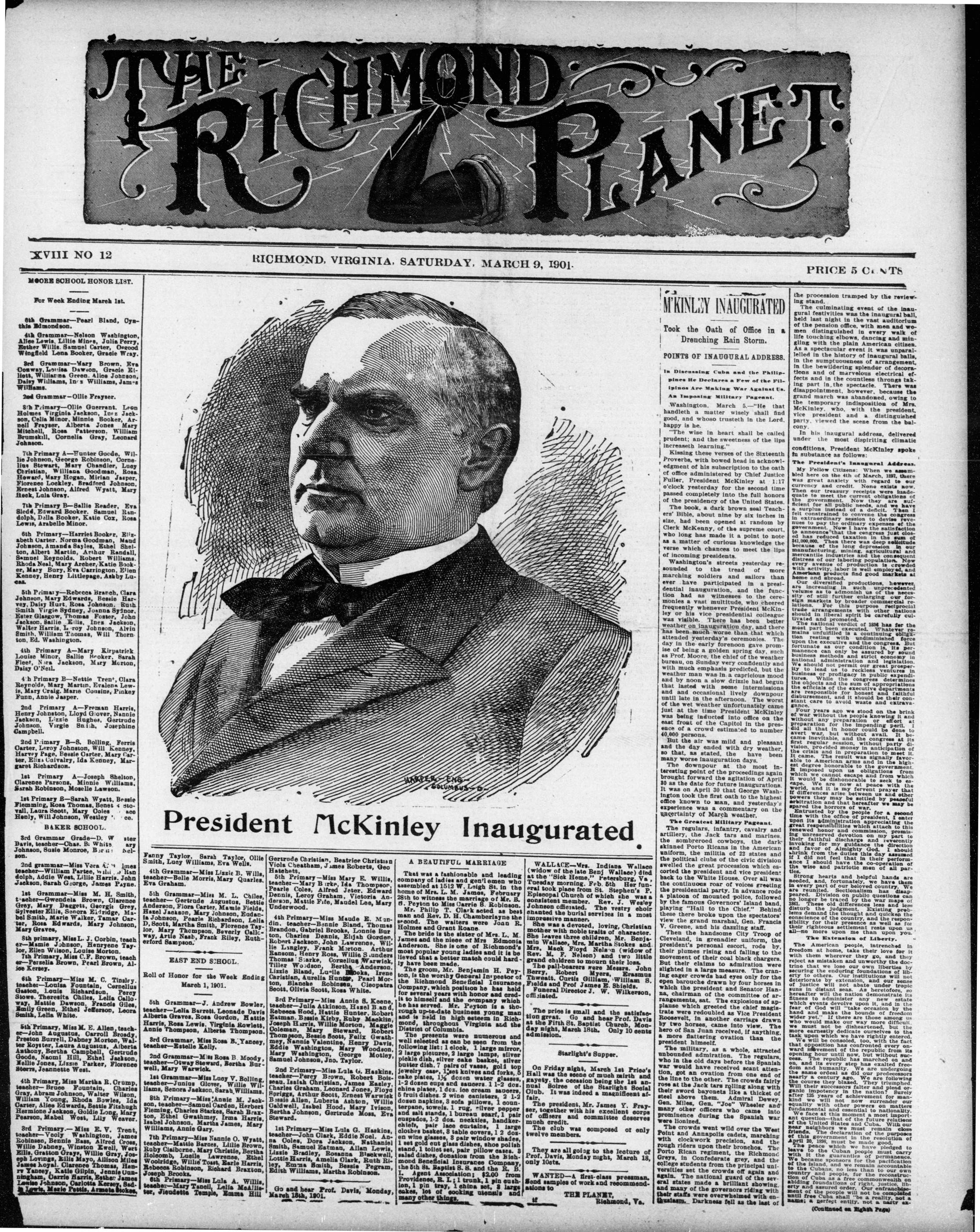
President McKinley Inaugurated
Fanny Taylor. Sarah Taylor, Ollie Smith, Lucy Williams, Eva Wells.
4th Grammar—Miss Lizzie B. Wills, teacher—Belle Morris, Mary Quarles. Eva Graham.
5th Grammar—Miss M. L. Chiles, teacher—Gertrude Augustus, Bettie Anderson, Flora Carter, Mamie Fields, Hazel Jackson, Mary Johnson, Eudan Anderson, Pearle Richardson, Lella D, Scott, Marissa Smith, Florence Taylor, Mary Thompson, Beverly Callery, Artie Nash, Frank Riley, Rutherford Samson.
EAST END SCHOOL
Roll of Honor for the Week Ending
March 1, 1901.
5th Grammar—J. Andrew Bowler,
teacher—Lella Barrett, Leonade Davis
Alberta Graves, Rosa Gordon, Hattie
Harris, Rosa Lewis, Virginia Rowlest,
Annie Thompson, Alberta Thompson.
8rd Grammar, Miss Rosa B. Yancey,
teacher—Estelle Kelly.
2nd Grammar—Miss Rosa B. Moody,
teacher—Otway Steward, Bertha Bur-
well, Mary Warwick.
1st Grammar—Miss Lucy V. Bolling,
teacher—Junius Glover, Willie Willi-
iams, Senora Jackson, Sarah Williams.
8th Primary—Miss' Annie M. Jack-
son, teacher—Samuel Garden, Herbert
Fleming, Charles Starkes, Sarah Braxton,
Ethel Gwathmey, Irma Harris,
Isabel Johnson, Martha James, Mary
Williams, Annie Gary.
7th Primary—Miss Nannie O. Wyatt,
teacher—Mattie Barnes, Lillie Brown,
Ruby Cialborne, Mary Christie, Bertha
Holcomb, Loulie Lawrence, Ethel
Woolridge, Willie Toast, Earle Harris,
Rebecca Robinson, Richard Braxton,
Joseph Brooks.
6th Primary—Miss Lula A. Willis,
teacher—Mary Tancil, Lelia McMallister,
Jouette Temple, Emma Hill.
Gertrude Christian, Beatrice Christian
Viola Cheatham, James Roberts, Geo
Hatehett,
5th Primary—Miss Mary E. Willis,
teacher—Mary Burke, Id Thompson,
Pearle Coles, Alfred Jeter, Edward
Dennis, Leroy Graham, Victoria
Anderson, Mattie Fife, Maudel Lee, Mary
Underwood.
4th Primary—Miss Maude E. Mundin,
teacher—Barnie Bland, Thomas
Brandon, Gabriel Brooks, Lonnie Burton,
Charles Dannie, Elijah Gordon,
Robert Jackson, John Lawrence, Willie
Langley, Frank Morton, Matthew
Banson, Henry Ross, Willie Sunder
Thomas Sarke, Cornelius Warwick
Tiller Woodson, Bertha Anderson,
Lizzie Bland, Luille Brooks, Irene
Christian, Aurelia Hunter, Pearl Morton,
Blanche Robinson, Cleopatra
Scott, Olivia Scott, Rose White.
3rd Primary—Miss Annie S. Keeen,
teacher—Julia Atkinson, Hasel B and,
Rebecca Hood, Hattie Hunter, Roberts
Eatman, Bassie Kirby, Ruby Mackin,
Joseph Harris, Willie Morton, Maggie
Coleman, Mary Steward, Roberts
Thompson, Bessie Scott, Felix Gwathmey,
Nannie Valentine, Henry Davis,
Eddie Washington, Mary Woodson,
Mary Washington, George Motley,
Samuel Johnson, Jno. Taylor.
2nd Primary—Miss Lula G. Haskins,
teacher—Percy Brown, Robert Bostease,
Isaiah Christian, James Eiley,
Charles Graham, Leonard Jones, Floy
Spriggs, Arthur Scott, Ernest Worsley,
Bessie Allen, Luberta Ashton, Willie
Caldwell, Isabel Hood, Mary Ivison,
Bertha Johnson, Gertrude Moss, Eva
Steward.
1st Primary—Miss Lula G. Haskins,
teacher—John Clark, Eddie Noel, Anna
Coles, Dora Jackson, Nathaniel
Smith, Samuel Eatman, Allan Lewis,
Lizzie Bradley, Rosanna Blackwell,
Lottie Harris, Amelia Clark, Ruth
Riley, Emma Smith, Bessie Pegram,
Edith Williams, Martha Robinson.
Go and bear Prof. Davis, Monday,
March 18th, 1901.
A BEAUTIFUL MARRIAGE
That was a fashionable and leading company of ladies and gent' emen who assembled at 1512 W. Leigh St. in the home of Mrs. L. M. James, February 28th to witness the marriage of Mr. B. Peyton to Miss Carrie B. Robinson. Mr. Philip T. Clark acted as best man and Rev. D. H. Chamberlayne the second. The waiters were Joan R. Holmes and Grant Roane.
The bride is the sister of Mrs. L. M. James and the niece of Mrs Edmonia Anderson. She is one of Richmond's most popular young ladies and it is be that a better match could hardly have been made.
The grammarian, Benjamin H. Peyton, is the worthy General Inspector of the Richmond Beneficial Insurance Company, which position he has held for several years with honor and credit it to himself and the company which he has served. Mr. Peyton is a thorough up-to-date business young man and is held in high esteem in Richmond, throughout Virginia and the District of Columbia.
The presents were numerous and well selected as can be seen from the following list: 1 elock, 1 large mirror, 2 large pictures, 2 large lamps, silver pickle dish, silver cake basket, silver butter dish, 7 pairs of vases, gold 1 top jewelry case, 1 set knives and forks, 5 cake plates, 1½ dozen water glasses, 1-2 dozen cups and saucers. 1-1-2 doz china plates, 1 doz. ice cream saucers, 5 fruit dishes, 2 wine canisters, 2-1-2 dozen napkins, 3 sofa pillows, 1 counterpane, towels, 1 bug, silver pepper and salt stands, 1 bureau scarf, 1 pair cusapados, 1-2 dos. neckties, handkerchiefs, pair lace curtains, 1 large clothes basket, 8 table covers, 1-2 dozen wine glasses, 3 pair window shades, 1 set gold cut dishes, shoe polish stand, 1 toilet set, pair pillow cases. 3 salad dishes, donation from the Bishmond Beneficial Insurance Company, the 5th St. Baptist S. S. and the R. B. I. Agent Association; $2.00 from Providence, R. L.; 1 trunk, 1 pin cushion, 1 pin tray, 1 china set, 3 large cakes, lot of cooking utensils and many other things.
WALLACE—Mrs. Indiana Wallace (widow of the late Benj Wallace) died at the "Sick Home," Petersburg, Va. Tuesday morning. Feb. 5th Her funeral took place from St. Stephen's P. Episcopal Church of which she was a consistent member. Rev. J. Wesley Johnson officiated. The vestry choir enchanted the burial services in a most impressive manner. She was a devoted, loving, Christian mother of noble traits of character. She leaves the children, Mr. Benjamin Wallace, Mrs. Michael Stokes and Mrs. Mack Floyd Nelson (widow of Rev. M. F. Nelson) and wives little grand children to mourn their loss. The pall-bearers were Messrs. John Berry, Robert Myers, Erasmus Thwaatt, Curtis Gilliam, William S. Fields and Prof James E. Shields.
Funeral Director J. W. Wilkerson,
officiated.
The price is small and the satisfaction great. Go and hear Prof. Davis at the Fifth St. Baptist Church, Monday night, March 18th. Only 10 cents admission.
Starlight's Supper.
On Friday night, March 1st Price's Hall was the scene of much mirth and gayety, the occasion being the 1st annual Soiree of the Starlight Social Club. It was indeed a magnificent affair.
The president, Mr. James Y. Frayser, together with his excellent corps of officers and committee deserves much credit.
The club was composed or only twelve members.
They are all going to the lecture of Prof. Davis, Monday night, March 18, only 100s.
WANTED—A first-class pressman. Send samples of work and recommendations to
M'KINLEY INAUGURATED
Took the Oath of Office in a Drenching Rain Storm.
POINTS OF INAUGURAL ADDRESS.
In Discussing Cuba and the Philippines He Declares a Few of the Philippines Are Making War Against Us. An Imposing Military Pageant.
Washington, March 5.—"He that handleth a matter wisely shall find good, and whoso trusteth in the Lord, happy is he.
"The wise in heart shall be called prudent; and the sweetness of the lips increaseth learning."
Kissing these verses of the Sixteenth Proverbs, with bowed head in acknowledgment of his subscription to the oath of office administered by Chief Justice Fuller, President McKinley at 1:17 o'clock yesterday for the second time passed completely into the full honors of the presidency of the United States. The book, a dark brown seal Teachers' Bible, about nine by six inches in size, had been opened at random by Clerk McKenny, of the supreme court, who long has made it a point to note as a matter of curious knowledge the verse which chances to meet the lips of incoming presidents.
Washington's streets yesterday resounded to the tread of more marching soldiers and sailors than ever have participated in a presidential inauguration, and the function had as witnesses to the ceremonies a vast multitude, who cheered frequently whenever President McKinley or his vice presidential colleague was visible. There has been better weather on inauguration day, and there has been much worse than that which attended yesterday's ceremonies. The day in the early foreonow gave promise of being a golden spring day, such as Prof. Moore, the chief of the weather bureau, on Sunday very confidently and with much emphasis predicted, but the weather man was in a capricious mood and by noon a slow drizzle had begun that lasted with some intermissions and occasional lively downpour until late in the afternoon. The worst of the wet weather unfortunately came just at the time President McKinley was being inducted into office on the east front of the Capitol in the presence of a crowd estimated to number 40,000 persons.
But the air was mild and pleasant and the day ended with dry weather, so that, as stated, the have been many worse inauguration days. The downpour at the most interesting point of the proceedings again brought forward the agitation of April 30 as the date for future inaugurations. It was on April 30 that George Washington took the first oath to the highest office known to man, and yesterday's experience was a commentary on the uncertainty of March weather. The Greatest Military Pageant.
The Greatest Military Pageant.
The regulars, infantry, cavalry and artillery, the Jack tars and marines, the somberroed cowboys, the dark skinned Porto Ricans in the American uniform, the militia of 22 states and the political clubs of the civic division swelled the great procession which escorted the president and vice president back to the White House. Over all was the continuous roar of voices greeting the presidential party. In advance rode a platoon of mounted police, followed by the famous Governors' Island band, playing "Hail to the Chief." Behind these there broke upon the spectators' view the grand marshal, Gen. Francis V. Greene, and his dazzling staff.
Then the handsome City Troop of Cleveland, in grenadier uniform, the president's personal escort, rode by, their plumes rising and falling to the movement of their coal black chargers. But their claims to admiration were slighted in a large measure. The craning eager crowds had eyes only for the open barchee drawn by four horses in which the president and Senator Hancock chairman of the committee of armenians sat. The explosions of applause which caused the chief magistrate were redoubled to Vice President Roosevelt, in another marriage drawn by two horses, came into view. The hero of San Juan received, if anything, a more flattering ovation than the president himself.
The military, as a whole, attracted unbounded admiration. The regulars, who in the old days before the Spanish war would have received scant attention, got an ovation from one end of the line to the other. The crowds fairly rose at the Jack tars rolling along with their sword bayonets like a thicket of steel above them. Admiral Deway, Gen. Miles, Gen. "Joe" Wheeler and many other officers who came into prominence during the Spanish war were lionized.
The crowds went wild over the West Point and Annapolis cadets, marching with clockwork precision, and the rough riders upon their bronchos. The Porto Rican regiment, the Richmond Greys, in Confederate grey, and the college students from the principal universities set the crowds off again and again. The national guard of the several states made a brilliant showing, and many of the governors riding with their staffs were overwhelmed with enthusiasm. Darkness fell as the last of
the procession trumped by the reviewing stand.
The culminating event of the inaugural festivities was the inaugural ball, held last night in the vast auditorium of the pension office, with men and women distinguished in every walk of lining touching elbows, dancing and mingling in the plain American citizen. As a spectacular event it was unparalleled in the history of inaugural balls, in the sumptuousness of management, in the bewildering splendor of tensions and in the countless thrilling part in the spectacle. There was disappointment, however, because the grand march was abandoned, owing to the temporary indisposition of Mrs. McKinley, who, with the president, vice president and a distinguished party, viewed the scene from the balcony.
In his inaugural address, delivered under the most disspiriting climatic conditions, President McKinley spoke in substance as follows:
The President's Inaugural Address
My Fellow Citizens: When we assembled here on the 4th of March, 1897, there was great anxiety with regard to our currency and credit. None exists now, but our treasury receipts were inadequate to meet the needs of the government. Now they are sufficient for all public needs, and we have the power to convey deficits. Then felt constrained to convey them in extraordinary session to devise revenues to pay the ordinary expenses of the government. Then we announced that the congress just closed had reduced taxation in the sum of 100,000. Then there was deep solicitude because of the manufacturing, mining, agricultural and mercantile industries and the consequent loss of our laboring population. Now every day we work with activity, labor is well employed, and American products find good markets at our diversified productions, however, are increasing in such unprecedented volume as to admonish us of the necessary measures to maintain our foreign market by broader commercial relations. For this purpose reciprocal arrangements with other nations should be instituted to be carefully cultivated and promoted.
The national verdict of 1886 has for the time been executed. Whatever remains remaining to be done resting with undiminished force upon the executive and the congress. But upon the executive and the congress, it is its permanence can be our condition. It is our business methods and strict economy in national administration and legislation. It does not permit our great prosperity to lead us to great business or profligacy in public expenditures. While the congress determines the rights and appropriations the officials of the executive and faithful are responsible for honest and faithful agreement, and it should be their constant care to avoid waste and extravagance.
Four years ago we stood on the brink of war, and people knowing it and without any preparation for the impending peril. I did all that in honor could be done to save the country. It became inevitable, and the congress at first regular session, without party disaffected money in anticipation of the crisis. It became honorable to the government. It imposed a law that which we cannot escape and from which would be dishonorable to seek to escape the world, and it is my fervent desire with the world, and it is my fervent desire with the world, and if differences arise between us and other countries they may be settled by peaceful objections, and a greater we may be spared the horrors of war.
Entrusted by the people for a second time with the office of president, I enter with great responsibilities while appreciating the great responsibilities which we have renewed honour and commitment, promising unreserved devotion on my part to the nation, and securing our security invoking for my guidance the discipline and favor of Almighty God. I should not utter duties this day assumed if I did not feel the performance I should have the co-operation of the wise and patriotic men of all parties. Strong hearts and helpful hands are needed, and, fortunately, we have them in every part of our beloved country. We should not be as disappeared. Division on public questions no longer be traced by the war maps of these old differences less and less disturbed. We demand the thought and quicken the conscience of the country, and the responsibility for their presence as well as for their actions. We all—no more upon me than upon you.
The American people, intrenched in freedom at home, take their love for it with them wherever they go, and they reject as mistaken and unworthy the doctrine that we lose our own liberties by securing the enduring foundations of liberty, the right to choose, the deteriorate by extension, and the sense of justice will not abate under tropic suns in distant seas. As heretofore, so we must be careful to maintain fitness to administer any new estate which events devolve upon it, and in the fear of God will “take occasion by the force of justice” to dictate ourselves to the task upon which we dedicate our success. We will be consoled, too, with the fact that opposition has confronted every on-ground movement of the republic from its opening to its closing, and that the success. The republic has marched on and, on, its every step has exalted freedom and humanity. We are undergoing the same process as the successes nearly a century ago. We are for the course they blazed. They triumphed their successors falter and plead organic and human causes. Surely after 125 years of achievement for kind we will not now surrender our equality with other powers on matters of justice.
We face at this moment a most important question—that of the future relations of the United States and Cuba. With our neighbors we must remain close friends in the face of the purposes of this government in the nation of April 20, 1898, must be made good.
The peace which we have pledged to lease to the people we must carry with it the guarantee that we will be sponsors for the pacification We became sponsors for the pacification we remain accountable to the Cubans, no matter where we country and people, for the reconstructive and people, for the free commonwealth on abiding foundation, for the security and order. Our enfranchisement and people will not be completed until free Cuban territory, not a name; a perfect entity, not a territory a
*(Continued on Eighth Press)*
Tragic DISAPPEARANCE
By
WILL H. HARBEN
Copyright, 1900, by A. N. Kellogg Newspaper Company.
CHAPTER XII.
During that night a light snow began to fall, and as the bridal party left the next morning to be driven to the house of Rev. Mr. Strothers a thin white carpet lay on the earth and fine feathery flakes continued to fall.
The servants had been apprised of the astonishing event and they gathered at the windows which look out upon the drive.
"A very sensible thing for 'em to do," said James. "She is the sort of mistress I want to work for. I should have left the other if she hadn't gone to the bottom of the Atlantic. I haven't lived with the aristocracy for ten years without knowing a sample when I see it. The good Lord has been kind to the major."
"I wish she had waited awhile, just for the looks o' the thing," said Katie, Blanche's favorite maid. "Then she could have had a swell wedding, plenty of presents, and—"
"And give you all her old clothes," sneered James, who was too fat to make use of the major's discarded apparel.
"I get everything I want anyway," was Katie's defense. "It is only because I think she deserves all that any rich young lady has that I object to this kind of a marriage; but if she is only happy, I won't complain."
These gossiping hirelings were at the windows when the returning carriage appeared in sight an hour later. The bride's beautiful face was flushed by the contact with the wind, and she had never looked so happy or moved with so much grace. Talley and Miss Dean had very serious faces as they came up the veranda side by side.
"Well, it is all over," said the major to his bride when they were alone in the luxurious company chamber, where a red fire glowed. He had never been such a mystery to himself as now. He felt as if he were drunken with delicious memories of their old courtship.
"Yes, I am your wife at last," she said, with a smile. "I am your wife, and I am going to make you happy. I feel it away down in my heart."
"You feel it," he repeated, as if in a dream, and he helped her to take off her cloak. He felt her warm breath on his face. He laid the cloak aside, then drew her into his arms and kissed her. "And so do I, dear girl. And so do I."
At that strange moment Jeanne Goddard and all her evil plans seemed as much removed from his life as if she had never entered it. It was as if the old life had come back to him—the life in which his love had for its object a creature so pure and undefiled that it lifted him up and opened his eyes to spiritual possibilities.
"I was at first afraid you would not consent so soon after—after her death," he said.
"I felt that it was my right to have you now," said Blanche, frankly. "She told me how she had deliberately beguiled you from me when she discovered that you loved me. The night before she sailed she confessed she had resorted to every trick and artifice within her power to make you cast me aside."
"She told you that?" the major exclaimed.
"Yes, and not only that, but she said she had some sort of presentiment that she was going to die abroad, and said if anything did happen to her she hoped I would marry you. Oh, I've tried to regret her taken away in the midst of such sins, but I cannot. She even told me—oh, I can't tell you what e'se she said. It makes me almost hate her memory."
"Please go on," said the major. "She confessed that she was unhappy with you—that she wanted to get away from you—that she married you simply for your money." "I suspected that," said the major, dreamily. It seemed so wonderful to him that he could now calmly contemplate Jeanne's shallow faithlessness without the pangs such thoughts had always caused him. Was it because he really loved his ward and that he had never loved Jeanne—that his passion for her had been only a base infatuation which had already taken wings.
He could not answer these questions; he could only wonder at the strange exultation which was swelling in his breast—the boundless enthusiasm over the thought that he was loved by the beautiful young creature before him. He lost sight of the wrong he had done her. She had only a short while to live—that time, he told himself, should constitute his life and hers; beyond that brief period he could not reckon.
"You have suffered?" he heard himself murmuring.
"Ever since that awful day when you introduced me to her in the drawing-room. I had never dreamed that God intended you for anyone but me. You had been my whole life, and even afterwards, when I saw the hold she had on you, I could not keep from suffering. The pain, the loss was with me night and day. I hated her; I despised myself. I planned a thousand times to leave, but I could not tear myself away, because I saw your soul in danger. I saw her day by day leading you downward instead of upward, as I had dreamt of doing. I knew how charitable you had been before your marriage—how many poor people you had helped, and I saw her drawing you away from such impulses by her sharp, heartless ridicule.
"And now that she is no longer—
no longer—here?] Goddard could not pronounce the word which lay on his tongue like a weight.
"Now that she is out of our way I shall pray God to help me exercise a better influence over you."
"You have always done that," he said. "Do with me as you will. I am a very bad man, Blanche; a very wicked man. If you knew me as I am you would despise me for my wickedness, as you despised her for hers."
"You never had a fault till she crossed your path, dear guardian, and nothing you have done since is going to count." She spoke lightly, and smiled as she laid her head on his shoulder.
The next day was, Sunday, and as Miss Dean had gone home, they drove alone to the village, about two miles distant, to attend church. Blanche had never looked so well. The crisp air brought the blood into her cheeks and blew her hair into a froth of gold about her eyes and brow.
"Perhaps we ought not to drive so 'ar'," he said, solicitously, as they were entering the carriage. "Do you think Dr. Fleming would approve of it?" "He said outdoor exercise was what I needed most," answered Blanche. "Don't worry about me; the medicine he prescribed is making me strong again. Did you notice the breakfast I ate? I was ashamed of my appetite."
I want you to go to a good physician to-morrow and ask his advice.
HE SAT STARING AT THE WORDS FOR SEVERAL MINUTES.
It has been some time since you saw Dr. Fleming.
"Oh, don't begin that," said Blanche, pretending to pout. "I am getting along beautifully."
"But I—I want—you must see a doctor," he stammered. "I shall feel better now to know that everything is being done that should be for you."
"You talk as if I were going to die," said the girl. "Why, I've just begun to live."
For a moment he looked confused. He could not reveal his real fears, and yet he was now deeply troubled about her condition.
"Of course, it isn't anything serious," he said; "but still to please me you will let me send for Dr. Fralieh."
"No, I don't know him, and I don't like to make new acquaintances. Besides, Dr. Fleming is coming to New York in about ten days. I promised faithfully to see him when he returned."
"How do you know he is coming?" asked the major, in surprise.
"I had a note from him yesterday. He explained that he was coming to New York earlier than he expected, owing to a sudden change in his plans. I will go to see him, if you insist on it, but I know he will tell me I have taken enough of his tonies."
"Well, that will do," said Goddard, reluctantly. He thought of the crimson picture in the medical book he had consulted, and his heart sank. After all, his new-found happiness was only to end in her death, and then—Goddard's meditations about Blanche always stopped there. He had shut his real wife out of his thoughts as men who are striving for better things shut out the memory of past evil deeds and associations.
That night when the house was still and he found himself alone in his study he forced himself to the task of communicating with Jeanne. And as I can in no better way reveal the workings of his heart, I shall reproduce the letter word for word.
In beginning it it he wrote "Dear Jeanne," but there he stopped abruptly, and sat staring at the words for several minutes, then he sheet the sheet into small bits and let them filter through his fingers. His letter began simply as follows:
"Well, I have at last done your bidding. I was a madman. I confess that—the very flames of hell had scorched my brain. I have committed an unspeakable crime against the purest, loveliest creature that will be to You. I will be surprised perhaps to find that I am so quickly, and really have changed completely. The scales have fallen from my sight. I feel like a man who has been hypnotized and wakes to find he has murdered his best friend. I despise myself as no more ever deserved himself before. I now know the truth of the blindest, most insane infatuation that ever dragged the soul of a man from an atmosphere of hope down into the mire of hellish despondency. I now know that my love for my ward was the only pure love I ever experienced. Yes, I loved her when I was not with all the tortured soul within me. I wronged her as no man ever wronged a pure, unsuspecting woman, but as her life will be of such short duration, if I can prevent it she shall never know of the torture put upon her fair name. While she lives I will be tendedness of my soul on her, praying that may in that way alone a little—very little.
THE RICHMOND PLANET, RICHMOND, VIRGINIA
"For my crime against her. She married me to comfort me in my loneliness; I married her to me, an intriguer of the most unparadonable type, confess all at this moment but for the fear that the shock would kill her. How could I be so afraid to be alive, and that I am not her legal husband."
"I would not write to you now, but for the fact that it is due you to know the stand I have taken, and that we must now understand each other in regard to Blanche's money. God is my judge I do not want her money. God is my judge you shall never lay your covetous hands upon it. I shall at once take precautions to see that, at her death, you should go to her blood relatives. As to you, I shall not judge you again, nor write you another line for this day forth. I see my duty and I shall do it. Any letter you write me will be re-read and unopened. Do your worst. If you write me you should credit that you and I have played on its credit so, I shall then confess to the part I took in your scheme. As much as I now hate you, I would not let you bear all the blame. If you write me you because I am a man, herewith enclose me. I herewith enclose Nolan; it is all the money I can send you now. I am about to enter into a speculation in railway stock and if it turns out that I shall send you more money. You are my own source of advice for you as well as my own means will you of Blanche's money you nor I shall ever have one penny. I shall try to get means out of my own resources to keep you at least as long as Blanche lives, but you are not as long as large remittances. I am not exactly thumb; your threats of exposure will not frighten me. I am desperate. I want Blanche to know what I am. I cannot face you understand and know that I am as vile as the seer. The sooner you make the whole thing known the better I shall be pleased.
Mrs. Nolan was standing in the door of the little gray brick cottage when the postman handed this communication to her. Recognizing the handwriting she took it unopened to Mrs. Goddard, who was restlessly walking in the little, high-walled garden in the rear of the house.
"Ah," she exclaimed, "he has written!"
"Yes, it is from him," said the angular woman, approaching slowly.
Mrs. Goddard tore open the envelope. She had hardly read a dozen lines before she uttered a little scream, and then, with quivering hands and expanding eyes, she continued to read.
"What is the matter?" asked Mrs. Nolan.
"Matter enough," answered Mrs. Goddard, clenching her hands and grating her teeth together. "Matter enough. He has married the girl, but has already—already fallen in love with her, and now he wants to throw me over."
"Didn't you expect that?" asked Mrs. Nolan, whose innate dislike for her mistress often fostered opposition to her plans.
"It was the last thing I did expect—the very last."
"Your egotism has undone you, Jeanne," said Mrs. Nolan with no little cautious unetion. "I had no sooner laid my eyes on that beautiful young creature than I knew if he ever was in love with her once he would be again."
"For mercy's sake, dry up!" commanded the furious woman. "This is no time for you to lecture me. Do you know that we shall be stranded here without money enough to keep us? Do you know that he defies me to expose the matter and that he swears I shall never touch the girl's money."
"Not after her death?" asked Mrs. Nolan, her own face growing suddenly grave.
"Death, you idiot? The girl is as sound as a dollar."
"I thought you said—"
"It makes no difference what I said," broke in Mrs. Goddard. "She'll never die till I get back to America, and—"
Mrs. Nolan caught the excited woman by her shoulders and forced her to look at her.
"Do you mean that—that you intended to commit murder. Jeanne?"
"Well, you must not draw me into that, Jeanne!"
"I shall draw you into nothing, but I shall expect you to hold your tongue."
"would he hold his if—if you resorted to—if you killed her?" asked Mrs. Nolan in a low, quivering voice.
They had now returned to the little sitting-room in the cottage. Mrs. Goddard was looking through a box of writing-paper, with nervous, fumbling fingers. Mrs. Nolan stood over her and ventured cautiously to repeat her question.
Mrs. Goddard hesitated as she found a telegraph blank, and dipped a pen.
"He'd have to, or be implicated with me in—in the whole business," she answered, doggedly.
"If she died suddenly or was shot, the law of self-preservation would be too strong for him."
"And what then?" Mrs. Nolan seemed scarcely to breathe.
"Then I could win him back to me—
if I wanted him."
"Are you sure?"
"With her out of the way, yes."
There was a dead silence in the room.
The outer circle of the underground
railway ran beneath the garden, and a
passing train shook the room like an
earthquake.
"What are you going to do now?"
asked Mrs. Nolan, curiously, eyeing
the telegraph blank.
Mrs. Goddard was writing, and when
she had finished and laid down her
pen she held the sheet to her companion.
It was addressed to Maf. Rowland
Goddard, Lyndhurst-on-the-Hudson,
N. Y., U. S. A. The message was but
a single word and no signature went
with it. The word was: "America."
"It will pass most eyes as a word from some telegraphic code," said Mrs. Goddard; "but the major will understand it in full. Now, Lucy, we must pack. We are going back on the first steamer. I shall run out and send this and inquire about the passage. Go to work. We have no time to lose." "But what if you were recognized on the steamer going over?" faltered Mrs. Nolan. "There is no likelihood of that. I know so few people." "But Henry Dugdale is in New York." "He may not be now; but we have to run even that risk. We are playing a big game, Lucy." "You mean you are," said Mrs. Nolan. "I shall never take a hand in the—the other."
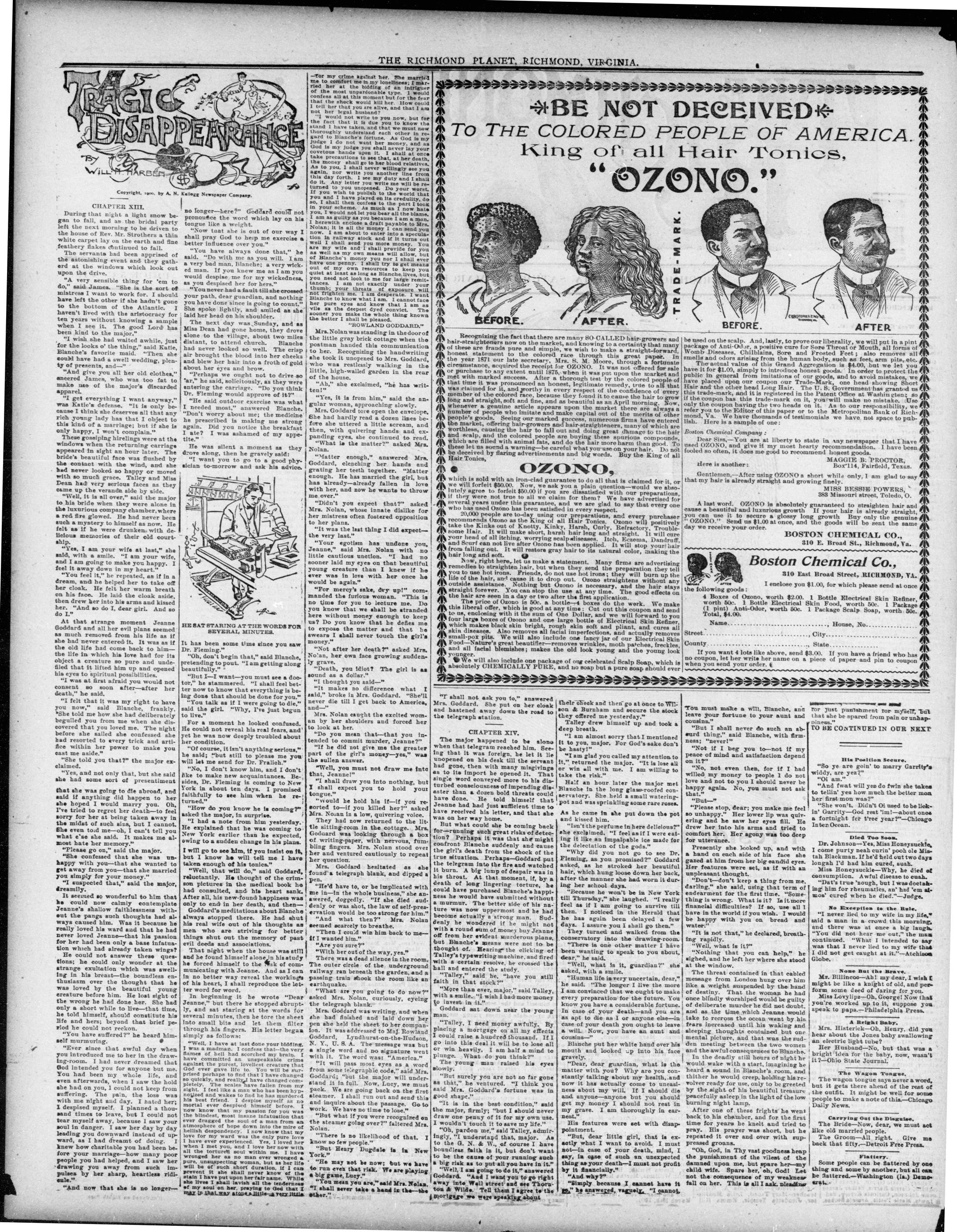
BE NOT DECEIVED
TO THE COLORED PEOPLE OF AMERICA.
King of all Hair Tonics,
"OZONO."
BEFORE. AFTER. TRADE-MARK. BEFORE. AFTER.
Recognizing the fact that there are many SO-CALLED hair-growers and hair-straighteners now on the market, and knowing to a certainty that many of these are frauds pure and simple, we wish to make a straight-forward, honest statement to the colored race through this great paper. In the year 1871 our late secretary, Mrs. S. M. Moore, through a fortune in our purchase, acquired the receipt for OZONO. It was not offered for sale or purchase, until 1875, when it was put upon the market and met with marked success, through test by the colored people of that time it was pronounced an honest remedy, true to all that was claimed for it, and worthy in every respect of every member of the colored race, because they found it to cause the hair, long and straight, soft and fine, and as beautiful as an April morning. Now whenever a genuine article appears upon the market there are always a number of people who imitate and make capital out of the merits of other people's goods. Seeing our marked success, numerous firms have entered the market, offering hair-growers and hair-straighteners, many of which are worthless, causing the hair to fall out and doing great damage to the hair, scalp, and the colored people are buying these spurious compounds, which filled the animal fats, and do the hair more harm than good. To these let us sound a warning—be careful what you use on your hair. Do not be deceived by flaring advertisements and big words. Buy the King of all Hair Tonics.
OZONO.
which is sold with an iron-clad guarantee to do all that is claimed for it, or we will forfeit $80.00. Now, we ask you a plain question—would we absolutely agree to forfeit $50.00 if you are dissatisfied with our preparations, if they were not true to all we claim for them? We have advertised for several years under this guarantee, and we are glad to say that every one who has used Ozono has been satisfied in every respect. 20,000 people are to-day using our preparations, and every purchaser recommends Ozono as the King of all Hair Tonics. Ozono will positively kinks out of Knotty, Kinky, Harsh, Curly, Refractory, Troublesome Hair, and make short, harsh hair long and straight. It will cure your head of all itching, worrying scalp diseases. Itch, Eczema, Dandruff, and Scurf can not live under Ozono has been applied. It will stop your hair from falling out. It will restore gray hair to its natural color, making the hair long and soft. Now, right here, let us make a statement. Many firms are advertising remedies to straighten hair, but when they send the preparation they tell you to use hot irons. Friends, do not use hot irons; they will burn up the life of the hair, and cause it to drop out. Ozono straightens without any outside assistance. Nothing but Ozono is necessary, and the hair stays straight forever. You can stop the use at any time. The good effects on the hair are seen in a day or two after the first application.
The price of Ozone is 50c. a bottle—4 boxes do the work. We make this liberal offer, which is good at any time: Cut out this coupon and send to us, enclosing with it the sum of One Dollar, and we will forward to you four large boxes of Ozone and one large bottle of Electrical Skin Refiner, which makes black skin bright, rough skin soft and pliant, and cures all skin diseases. Also removes all facial imperfections, and actually removes small-pox pits. We will also include one fancy jar of our Electrical Skin Food—Nature's great beautifier—removes wrinkles, moth patches, freckles, and all facial blemishes; makes the old look young and the young look younger.
We will also include one package of our celebrated Scalp Soap, which is absolutely CHEMICALLY PURE, and no soap but a pure soap should ever
"I shall not ask you to," answered Mrs. Goddard. She put on her cloak and hastened away down the road to the telegraph station.
The major happened to be alone when that telegram reached him. Seeing that it was foreign, he let it lie unopened on his desk till the servant had gone, then with many misgivings as to its import he opened it. That single word conveyed more to his disturbed consciousness of impending disaster than a dozen bold threats could have done. He told himself that Jeanne had had just sufficient time to have received his letter, and that she was on her way home.
But what could she be coming back for—running such great risks of detection? Perhaps it was that she might confront Blanche suddenly and cause the girl's death from the shock of the true situation. Perhaps—Goddard put the telegram into the fire and watched it burn. A big lump of despair was in his throat. At that moment, if, by a death of long lingering torture, he could have purchased Blanche's happiness he would have submitted without a murmur. The better side of his nature was now uppermost and he had become actually a strong man. Suddenly he wondered if he might not with a round sum of money buy Jeanne off from her evident murderous plans, but Blanche's means were not to be thought of. Hearing the clicking of Talley's typewriting machine, and fired with a certain resolve, he crossed the hall and entered the study.
"Talley," said he, "have you still faith in that stock?"
"More than ever, major," said Talley, with a smile. "I wish I had more money to invest in it."
Goddard sat down near the young man.
"Talley, I need money awfully. By placing a mortgage on all my effects I could raise a hundred thousand. If I go into this deal it will be to lose all or win heavily. I am half a mind to plunge. What do you think?"
The young man raised his eyes slowly.
"But surely you are not so far gone as that," he ventured. "I think you said Mrs. Goddard's fortune was in good shape."
"It is in the best condition," said the major, firmly; "but I should never draw one penny of it for my own use. I wouldn't touch it to save my life."
"Well, I am going to do it," answered Goddard. "And I want you to go right away into Wall street" and see Thornton & Wilde. Tell them I agree to the mortgage we were speaking about
CHAPTER XIV.
wanted to do all that is claimed for it, or ask you a plain question—would we also be disheartened with our preparations, aim for our Dream? We have advertised for and we are glad to say that every one died in respect. Our preparations, and every purchaser of all Hair Tonics. Ozono will positivelyky, Harsh, Curly, Refractory, Troubleshoot hair long and straight. It will cure scalp diseases. Itch, Exczema, Dandruff, has been applied. It will stop your hair any hair to its natural color, making the statement. Many firms are advertising men they send the preparation they tell you use hot irons; they will burn up the up out. Ozono straightens without any Ozono is necessary, and the hair stays a use at any time. The good effects on the first application.
bottle-4 boxes do the work. We make any time: Cut out this coupon and send One Dollar, and we will forward to you large bottle of Electrical Skin Refiner, much skin soft and pliant, and cures all imperfections, and actually removesude one fancy jar of our Electrical Skin removes wrinkles, moth patches, freckles, the old look young and the young look age of our celebrated Scalp Soap, which is and no soap but a pure soap should ever
their check and then go at once to Wilson & Burnham and secure the stock they offered me yesterday."
Talley drew himself up and took a deep breath.
"I am almost sorry that I mentioned it to you, major. For God's sake don't be hasty!"
"I am glad you called my attention to it," returned the major. "It is lose all or win all with me. I am willing to take the risk."
Half an hour later the major met Blanche in the long glass-roofed conservatory. She held a small watering-pot and was sprinkling some rare roses.
As he came in she put down the pot and kissed him.
"Isn't the perfume in here delirious?" she exclaimed. "I feel as if I were eating it like an impalpable ice made for the delectation of the gods."
"Why did you not go to see Dr. Fleming, as you promised?" Goddard asked, as he stroked her beautiful hair, which hung loose down her back, after the manner she had worn it during her school days.
"Because he won't be in New York till Thursday," she laughed. "I really feel as if I am going to survive till then. I noticed in the Herald that he has again been delayed a few days. I assure you I shall go then."
They turned and walked from the conservatory into the drawing-room. "There is one other matter I have been wanting to speak to you about, dear," he said.
"Well, what is it, guardian?" she asked, with a smile.
"Human life is very uncertain, dear," he said. "The longer I live the more I am convinced that we ought to make every preparation for the future. You know you have a considerable fortune. In case of your death—and you are as apt to die as I or anyone else—in case of your death you ought to leave a will. Now, you have an aunt and cousins—"
Blanche put her white hand over his mouth and looked up into his face gravely.
"Dear, dear guardian, what is the matter with you? Why are you constantly talking about my health, and now it has actually come to uneasiness about my will. If I should die and anyone—anyone but you should get my money I should not rest in my grave. I am thoroughly in earnest."
His features were set with disappointment.
"But, dear little girl, that is exactly what I want to avoid. I must not—in case of your death, mind, I say, in case of such an unexpected thing as your death—I must not profit by it financially."
"And why?" "Simply because I cannot have it so," he answered, vaguely, "I cannot.
be used on the scalp. And, lastly, to prove our liberality, we will put in a pint package of Anti-Odor, a positive cure for Sore Throat or Mouth, all forms of Womb Diseases, Chilblains, Sore and Frosted Feet; also removes all smells and odors arising from the human body, such as feet, arm pits, etc. The actual value of this Grand Aggregation is $4.00, but we let you have it for $1.00, simply to introduce honest goods. In order to protect the cloth in general from imitations of our goods, and to avoid mistakes, we have placed upon our coupon our Trade-Mark, one head showing Short Hair Long Hair. The U. S. Government has granted us this trade-mark, and it is the Paternal office at Washin'g; so if the coupon has this trade-mark on it, you will make to mistake. Use only the coupon having the two heads on it. As to return requests refer you to the Editor of this paper or to the Metropolitan Bank of Richmond, Va. We have thousands of testimonials we have not space to publish. Here is a sample of one:
Dear Sirs.—You are at liberty to s
used OZONO, and give it my most hea
fooled so often, it does me good to reco
Here is another:
Gentlemen.—After using OZONO a
that my hair is already straight and grow
A last word. OZONO is absolutely
cause a beautiful and luxurious growth
you can use it to secure a glossy loo
"OZONO." Send us $1.00 at once, and
day we receive your order.
BOST
33
*dear Sirs.* You are at liberty to state in any newspaper that I have used so often, and I am not sure. I have been fooled so often, it does me good to recommend good goods.
Gentlemen.—After using OZONO a short while only, I am glad to say that my hair is already straight and growing finely.
A last word. OZONO is absolutely guaranteed to straighten hair and cause a beautiful and luxurious growth. If your hair is already straight, you can use it to secure a glossy long growth. Buy only the genuine hair, and use $1.00 at once, and the goods will be sent the same day we receive your hair.
Boston Chemical Co.,
$10 East Broad Street, RICHMOND, VA.
I enclose you $1.00, for which please send at once
4 Boxes of Ozono, worth $2.00.
worth 50c. 1 Bottle Electrical $1
(1 pint) Anti-Odor, worth 50c.
Total, $4.00.
Name.
Street.
County.
If you want 4 lots like above, send $4
no coupon, let her write her name on a
when you send your order.
4 Boxes of Ozono, worth $2.00. 1 Bottle Electrical Skin Refiner,
worth 50c. 1 Bottle Electrical Skin Food, worth 50c. 1 Package
(1 pint) Anti-Odor, worth 50c. 1 Package Scalp Soap, worth 50c.
Total, $4.00.
If you want 4 lots like above, send $3.00. If you have a friend who has no coupon, let her write her name on a piece of paper and pin to coupon when you send your order.
You must make a will, Blanche, and leave your fortune to your aunt and cousins."
"But I shall never do such an absurd thing," said Blanche, with firmness; "never!"
"Not if I beg you to—not if my peace of mind and satisfaction depend on it?"
"No, not even then, for if I had willed my money to people I do not love and not to you I should never be happy again. No, you must not ask that."
"But—"
"Please stop, dear; you make me feel so unhappy." Her lower lip was quivering and he saw her eyes fill. He drew her into his arms and tried to comfort her. Her agony was too deep for utterance.
Presently she looked up, and with a hand on each side of his face she gazed at him from her big candid eyes. Her features were set, as if with an unpleasant thought.
"Don't—don't keep a thing from me, darling," she said, using that term of endearment for the first time. "Something is wrong. What is it? Is it more financial difficulties? If so, use all I have in the world if you wish. I would be happy with you on bread and water."
"It is not that," he declared, breathing rapidly.
"Well, what is it?"
"Nothing that you can help," he sighed, and he left her where she stood at the window.
The threat contained in that cabled message from London hung over him like a weight suspended by the hand of destiny. That the woman he had once blindly worshiped would be guilty of deliberate murder he did not doubt, and as the time which Jeanne would take to recross the ocean went by his fears increased until his waking and sleeping thoughts contained but one mental picture, and that was the sudden meeting between the two women and the awful consequences to Blanche. In the deadly still hours of night he would wake with a start, imagining he heard a sound in Blanche's room, and thither he would creep, holding his revolver ready for use, only to be greeted by the sight of his beautiful treasure peacefully asleep in the light of the low burning night lamp.
After one of these frights he went back to his chamber, and for the first time for years he knelt and tried to pray. His prayer was short, but he repeated it over and over with suppressed groans.
"Oh, God, in Thy vast goodness heap the punishment of the vilest of the damned upon me, but spare her—my child wife. Spare her, oh, God! Let not the consequence of my weakness fall on her. This is all I ask, needin
Boston Chemical Company :
BEFORE
AFTER
the following goods :
"Well, what is it?"
MAGGIE B: PROCTOR.
Box114, Fairfield, Texas.
MISS BESSIE POWERS,
383 Missouri street, Toledo, O.
BOSTON CHEMICAL CO., 310 E. Broad St., Richmond, Va.
for just punishment for myself, but that she be spared from pain or unhappiness." TO BE CONTINUED IN OUR NEXT
His Position Secure.
"So ye are goin' to marry Garrity's wildy, are yez?"
"Oi am."
"And fwat will yez do fwin she takes to tellin' yes how much the better mon her first mon was?"
"She won't. Didn't Oi used to be lickin' Garrity—God rest 'im!—about once a fortnight fer 'tree year?'—Chicago Inten Ocean.
Died Too Soon
Dr. Johnson—Yes, Miss Honeysuckle,
I come purge neat curin" pooh ole Mistah Blackman. If he'd held out two days longah I'd had him cured, suah.
Miss Honeysuckle—Why, he died of consumption. Afulf disease to cuah.
"Dat's true 'nough, but I was dooaking him for rheumatics, an' had 'em almos' cured when he died."—Judge.
No Exception to the Rule
"I never lied to my wife in my life," said a man in a crowd this morning, and there was at once a big laugh "You did not hear me out," the man continued. "What I intended to say was that I never lied to my wife that I did not get caught at it."—Atchison Globe.
None But the Brave
Mr. Billincoo—ah! my dear, I wish I might be like a knight of old, and perform some deed of daring for you.
Miss Lovilipz—Oh, George! Now that you're worked up to it, suppose you speak to papa.—Philadelphia Press.
A Bright Baby
Mrs. Histerick—Oh, Henry, did you hear about the Jones baby swallowing an electric light tube?
Her Husband—No, but that was a bright idea for the baby, now, wasn't it?—Ohio State Journal.
The Wagon Tongue.
The wagon tongue says never a word, but it gets there ahead of the rest of the outfit. It might be well for some people to make a note of this.—Chicago Daily News.
Carrying Out the Disguise.
The Bride—Now, dear, we must act like old married people.
The Groom—All right. Give me back that fifty.—Detroit Free Press.
Flattery.
Some people can be flattered by one thing and some by another, but all can be flattered.—Washington (la.) Democrat.
LEA PLAZA
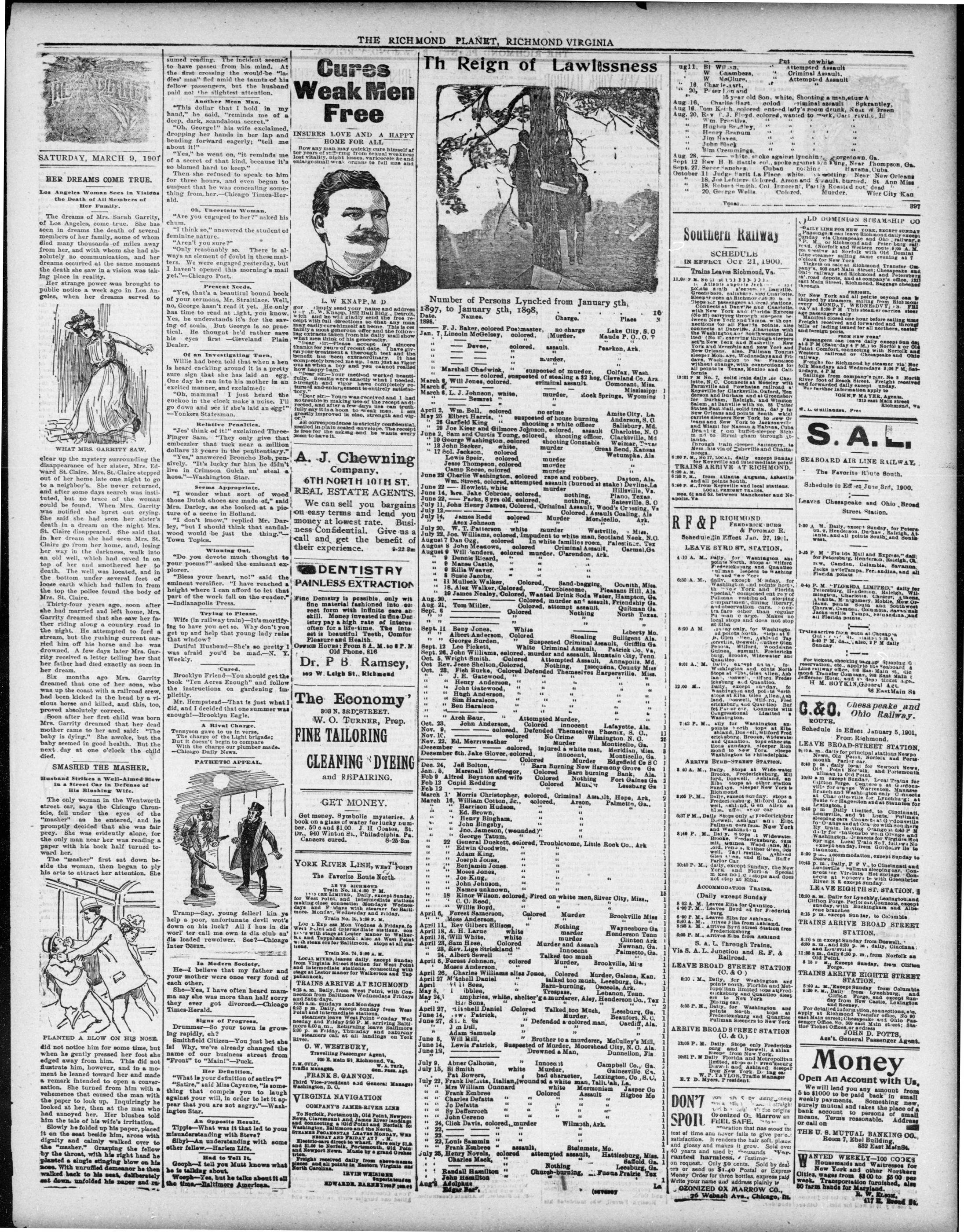
HER DREAMS COME TRUE.
Los Angeles Woman Sees in Visits the Death of All Members of Her Family.
The dreams of Mrs. Sarah Garrity, of Los Angeles, come true. She has seen in dreams the death of several members of her family, some of whom died many thousands of miles away from her, and with whom she had absolutely no communication, and her dreams occurred at the same moment the death she saw in a vision was taking place in reality.
Her strange power was brought to public notice a week ago in Los Angeles, when her dreams served to
WHAT MRS. GARRITY SAW
clear up the mystery surrounding the disappearance of her sister, Mrs. Edward St. Claire, Mrs. St. Claire stepped out of her home late one night to go to a neighbor's. She never returned, and after some days search was instituted, but no trace of the woman could be found. When Mrs. Garrity was notified she burst out crying. She said she had seen her sister's death in a dream on the night Mrs. St. Claire disappeared. She said that in her dream she had seen Mrs. St. Claire go from her home, and, losing her way in the darkness, walk into an old well, which had caved in on top of her and smothered her to death. The well was located, and in the bottom under several feet of loose earth which had fallen in from the top the police found the body of Mrs. St. Claire.
Thirty-four years ago, soon after she had married and left home, Mrs. Garrity dreamed that she saw her father riding along a country road in the night. He attempted to ford a stream, but the rushing current carried him off his horse and he was drowned. A few days later Mrs. Garrity received a letter telling her that her father had died exactly as seen in her dream.
Six months ago Mrs. Garrity dreamed that one of her sons, who was up the coast with a railroad crew, had been kicked in the head by a violent horse and killed, and this, too, proved absolutely correct.
Soon after her first child was born Mrs. Garrity dreamed that her dead mother came to her and said: "The baby is dying." She awoke, but the baby seemed in good health. But the next day at one o'clock the child died.
SMASHED THE MASHER.
Husband Strikes a Well-Almed Blow in a Street Car in Defense of His Blushing Wife.
The only woman in the Wentworth street car, says the Chicago Chronicle, fell under the eyes of the "masher" as he entered, and he promptly decided that she was fair prey. She was evidently alone, for the only man near her was reading a paper with his back half turned toward her.
The "masher" first sat down beside the woman, then began to ply his arts to attract her attention. She
PLANTED A BLOW ON HIS NOSE.
did not notice him for some time, but when he gently pressed the foot she edged away from him. This did not flustrate him, however, and in a moment he leaned toward her and made a remark intended to open a conversation. She turned from him with a heemence that caused the man with the paper to look up. Inquiringly he looked at her, then at the man who had annoyed her. Her blushes told him the tale of his wife's irritation. Slowly he folded up his paper, placed it on the seat beside him, arose with dignity and calmly walked over to the "masher." Grasping the fellow by the throat, with his right hand he planted a single stinging blow on his nose. With unruffled demeanor he then walked back to his seat, deliberately sat down, unfolded his paper and re-
sumed reading. The incident seemed to have passed from his mind. At the first crossing the would-be "indies" man" fled amid the taunts of his fellow passengers, but the husband paid not the slightest attention.
Another Mean Man.
"This dollar that I hold in my hand," he said, "reminds me of a deep, dark, scandalous secret."
"Oh, George!" his wife exclaimed, dropping her hands in her lap and bending forward eagerly; "tell me about it."
"Yes," he went on, "it reminds me of a secret of that kind, because it's so blamed hard to keep."
Then she refused to speak to him for three hours, and even began to suspect that he was concealing something from her.—Chicago Times-Herald.
Oh, Uncertain Woman.
"Are you engaged to her?" asked his chum.
"I think so," answered the student of feminine nature.
"Aren't you sure?"
"Only reasonably so. There is always an element of doubt in these matters. We were engaged yesterday, but I haven't opened this morning's mail yet."—Chicago Post.
Present Needs.
"Yes, that's a beautiful bound book of your sermons, Mr. Straitlace. Well, no, George hasn't read it yet. He only has time to read at light, you know. Yes, he understands it's for the saving of souls. But George is so practical. He thought he'd rather save his eyes first —Cleveland Plain Dealer.
Of an Investigating Turn.
Willie had been told that when a hen is heard cackling around it is a pretty sure sign that she has laid an egg. One day he ran into his mother in an excited manner, and exclaimed: "Oh, mammal I just heard the cuckoo in the clock make a noise. I'll go down and see if she's laid an egg!" —Yonkers Statesman.
Relative Penalties
"Jes' think of it!" exclaimed Three-Finger Sam. "They only give that embezzler that tuck near a million dollars 13 years in the penitentiary." "Yes," answered Broncho Bob, pensively. "It's lucky far him he didn't live in Crimson Gulch an' steal a hoss." -Washington Star.
Seems Appropriate.
"I wonder what sort of wood those Dutch shoes are made of," said Mrs. Darley, as she looked at a picture of a scene in Holland.
"I don't know," replied Mr. Darley, "but I should think that sandalwood would be just the thing."—Town Topics.
Winning Out.
"Do you devote much thought to your poems?" asked the eminent explorer. "Bless your heart, no!" said the eminent versifier. "I have reached a height where I can afford to let that part of the work fall on the reader." -Indianapolis Press.
Trying to Please
Wife (in railway train)—It's mortifying to have you act so. Why don't you get up and help that young lady raise that window?
Dutiful Husband—She's so pretty I was afraid you'd be mad.—N. Y. Weekly.
Cured.
Brooklyn Friend—You should get the book "Ten Acres Enough" and follow the instructions on gardening implicitly.
Mr. Hempstead—That is just what I did, and I decided that one summer was enough—Brooklyn Eagle.
A Rixal Charge
The charge of the Light brigade;
But it doesn't begin to compare
With the charge our plumber made.
—Chicago Daily News.
PATHETIC APPEAL.
Tramp-Say, young seller! kin ye help a poor, unfortunate devil woe's down on his luck? All I has in dis worl' ter call me own is dis club an' dis loaded rewolwer. See?—Chicago Inter Ocean.
In Modern Society
He—I believe that my father and your mother were once very fond of each other.
She—Yes, I have often heard mamma say she was more than half sorry they ever got divorced.—Chicago Times-Herald.
Signs of Progress
Drummer—So your town is growing rapidly, eh? Smithfield Citizen—You just bet she is! Why, we already changed the name of our business street from "Front" to "Main!"—Buck.
Her Definition
"What is your definition of satire?" "Satire," said Miss Cayenne, "is something that compels you to laugh against your will, in order to let it appear that you are not angry."—Washington Star.
Gooph - I tell you Mutt knows what he is talking about.
Wooph - Yes, but he talks about it all the time.-Baltimore American.
THE RICHMOND PLANET, RICHMOND VIRGINIA
Cures Weak Men Free
A man and a boy climbing a tree.
INSURES LOVE AND A HAPPY HOME FOR ALL
How any man may quietly cure himself after years of suffering from sexual weakness lost vitality, night losses, varicoccele & and enlargesmall weak organs to full size and
L W KNAPP, M D
gor . simply send your name and address
our L. W. Knapp, 1822 Hull Bldg, Devon
which and he will readily send the free
receipt with full directions so that any man
may easily cure himself at home. This is ce
generous offer and the following
extracts offer a mall show
what men think of his generosity.
"Dear sir,--Please accept my sincere thanks for years of recent date. I have given my treatment a through test and the benefit has been great. I have completely compelled me up, I am just as rious as when a boy and you can realise how happy I am. Dear sir, my method worked beautifully. Results were exactly what I needed. Strength and vigor have completely returned and enlargement is entirely satisfied. "Dear sir, Yours was received and I had no trouble in making use of the receipt as directed, and after a few days use can truthfully say a boon to weak men. I am greatly improved in size, strength and vigor."
their responses is strictly confidential, medically
needed, and not asking and he wants every
moment to be taken.
A. J. Chewning Company.
6TH NORTH 10TH ST.
REAL ESTATE AGENTS
DENTISTRY
PAINLESS EXTRACTION
Fine Dentistry is possible, only with fine material fashioned into cosmetic form for a durable infinite gare and skill. Money invested in Fine Dentistry pay a high rate of interest often for a life-time. The interest is beautiful Teeth, Comfor Pleasure and Health.
Office Hours: From 8 A. M. to 6 P. M. Old Phone, 816
The Economy
808 N. 3RD STREET.
W. O. TURNER, Prep.
FINE TAILORING
and REPAIRING.
GET MONEY
Get money. Symbolic mysteries. A book on a glass of water for lucky number. J H Coates, Bt.D. 940 Winton St., Philadelphia. Cancers cured. 8-25-95.
LE VE RICHMOND
Train No. 16.480 B
1111 CRE LIMITED. Daily, except Sunday,
for West point, and intermediate stations
making close connection. Mondays. Wednes-
days. Thursdays. Stearer for Baltimore.
Monday. Wednesdays.
Train No. 16, 5:88 P. M.
Loc L Exp sr Mon Wednes & Fridays, fo
and perimeter diate stations, con
writes with Tappanhannock; also at West Point
and Tappanhannock; also at West Point
steam anr at Baltimore; stops at all stations
Train No. 74. 3:00 A. M.
LOCAL MIXED, leaves daily, except Sunday
from Virginia Street Station for West Point
and Intermediate stations, connecting with
stage at Lester manor for Walkerton and Tap
pahnackn.
TRAINS ARRIVE AT RICHMOND
9:15 a.m. Bally, from West Point, with
connection from Baltimore Wednesday Fridays
and Saturdays.
10:30 a.m. Days and Mondays.
6:30 p.m. Daily, except Sunday from West
Point and intermediate stations.
steamers leave West Point *onday* Wed
morning, arriving in Salt-
more 400 a.m., Returning to
5:00 p.m. Friday, Thursday and saturday
steamers call at all landings on York
Rivers.
G. W. WESTBURY
Third Vice-President and General Manager
Washington, D.C.
To Norfolk, Portsmouth, Old Point, Newport News, Claremont and James River, and connecting a Old Point and Norfolk for washington, Baltimore and the North.
STREAMS, BALTIMORE and SUNDAY, WEB NESDAY AND FRIDAY AT 11
Electric car direct to wharf. Fare only $13.00
Newport News, Music by a grand Orsale irion.
Southern Railway
SCHEDULE
IN EFFECT OCT 21, 1900.
Trains Leaves Richmond, Va.
11.00 P.M. NO 21 (U) URREI DU
points south south of Richmond, Va.
Greensboro, salisbury, and Charlotte.
Sleepers open at Richmond 6:30 p.m.
the next day. Connects at Danville and Charlotte.
with New York and Florida Express
way carrying through sleepers between New York and Charlotte.
connections for all Florida points, also connects at Danville. Charlotte with the Washington and Southwestern Limits.
set in New York and Nashville. New York and Memphis and New York and New Orleans. Christian Tourist sleeper Mondays, Wednesday and Fridays.
Washington to San Francisco without change, with connections for all points in Texas, Mexico and California.
19:01 P M No. 7, solid train daily for or Cham
Commissioner of Railways, with a
Farmville and Cowhatan railway at
Kevilleville for Clarkville, Oxford, Hea
heatham for Burham and at Greenbraes
for Durham, for Durham, for Salem, at Davant with No. 85 United
States East Mail, solid train, day y for
carries sleeper New York to new Oreans and New York to Jacksonville,
Cuba Dreadlocks r on buffet-sleeper,
Cuba Dreadlocks r on buffet-sleeper,
m and to Birmi gham through Athens
through train sleeper Sanseury,
to Mem, his vis or sheville and Chattanooga.
6:00 P M. LOCAL, daily except Sunday,
for Kevilleville and intermediate point
TRAINS ARRIVE AT RICHMOND.
6:00 A M.
6:28 P M. from Atlanta Augusta, Ashville
and all points South.
6:48 P M. from Kevilleville and local stations.
Nos. 61 and 62, between Manchester and Neapol-
ia, Va.
R F & P RIGHMOND
FRED-BICK-BURO
4.10 A. M. Dally, for Washington and
poles North, Stops at Wilford
Fredericksburg and Quantico
railroad station to Washing
in and New York
6:50 A. M., daily, except Monday, for Washington and points hot or cold, special," composed en e rey of Pulman vestibu ed sleeping compartment, dining literary and observational tra fare other than regular Pu man c urge. Makes no local stops and does not stop at Ribas.
8:20 A. M., daily only, for Washington, ad points North, stop at Eden, corville, sowell, another Glen Penola, Milford, woodside Guinea, summit, Fredericks brooke, Widewater and Quantico.
9:01 A. M., daily, except nation, for Washington and oltas North Stops at Eden, corville, sowell, ilifra Fredericksburg and Quantico.
12:00 M., daily except nation, for Washington and oltas North Stops at Eiba Glen Allea, Ash land, sowell, Milford, Fred estuary, and Quantico. Buff for Paterson and connects with Congressional Limited with Washington.
7:42 P. M., ally for Washington and oltas North Stops at Eiba Glen Allea, Ash land, sowell, Milford Fred estuary, and Quantico. Buff for Paterson and connects with Congressional Limited with Washington.
7:42 P. M., ally for Washington and oltas North Stops at Eiba Glen Allea, Ash land, sowell, Milford Fred estuary, and Quantico. Buff for Paterson and connects with Congressional Limited with Washington.
ARRIVE BYRD-STREET STATION.
8 40 A. M., Daily, Stops at Wide-water,
Frederickburg, Milford,
ford, Doswell, ashland,
Eiba stops at other station
Sundays, sleeper New York to
Richmond.
8 35 P. M., Daily, except Sunday, stops a
Frederickburg, Milford dos
well, ashland, ashland an
ilh, nf, or car.
8 357 P. M., Daily stops only at Frederickburg
Doswell, ashland an Eldo
Pulman cara from New York
and Washington.
8 40 P. M., Daily, stops i Widewater,
Brooke, Frederickburg, sum
mit, Wood, wane, Mil-
ford, Troy, Ruther Glen, dos
well, Tayl resilie, an, and Eiba,
Paylor cara, Buffe
10 40 P. M., daily, except Sunday, the New
York, and Florina, Special
mits no lc, stops and does
not stop at Eiba.
ACCOMMODATION TRAINS.
(Daily except Sunday
8 02 A 2 M. Leaves Elba for Quantite.
4 02 A 4 M. L. Leaves Byrd for Frederick
burg.
8 02 A 5 M. Leaves Elba for Ashlain.
8 02 A 10 M. Leaves Elba for Ashlain.
8 02 A 15 M. Arrives Byrd Street station from
LEAVE BROAD STREET STATION
(C. & O.)
6:10 M. Daily, for Washington and
point north, Florida and Medi-
ropolitan limited tops at Frederick's
barges and Quantico sleep
east to New York
Dining car.
5:55 P. M. Daily, for Washington and
point North, tops at Frederick's barges and Quantico
Pullman Sleepers to New York
ARRIVE BROAD STREET STATION
(C. & O.)
12:08 P. M. Daily. Stops only Frederick's
burg and Dowell. Ashland
sleepers from New York.
10:51 P. M Daily Florida Metropolitan
limited, stops on Frederick's
burg and Ashland. Sleepers
from New York. Dining car
W. P. TAYLOR, Traffic Manager
E. T. D. Myers, President
DON'T SPOIL
DON'T
SPOIL
Ozonized O. Marrow and
FEEL SAFE.
The operation that has stood the
test of time and never falls to give per-
satisfaction. It renders the hair soft, place
and glossy and makes it grow. Sold over
40 years and used by thousands
warranted harmless. (festimo
on request. Only 50 cents. Sold by de-
liers or send us $1.40 Postal or Express
Money Order for three bottles, express paid
Write your name and address plainly to
OZONIZED OX MARROW CO.,
26 Wabash Ave., Chicago, IL.
LD DOMINION SUEAMSHIP CO
DAILY LINE FOR NEW YORK, EXCEPT SUNDAY
Passengers can leave Richmond daily except Sun
day. Passengers can leave Richmond daily except
6 P. M., or Richmond and P. M.
Norfolk and Western route: 9:00 A. M.
onto Richmond with Old Domini
Lite train sailing same evening at 7
o'clock or New York
Tickets on sale at Richmond Transfer O
mpany. On sale at Richmond Cheapeake and
O railway and Richmond and O railway,
road depots, and at company's office, 181
saint, Main Street, Richmond. Baggage checks
strong.
FREIGHT.
for New York and all points beyond can be
shipped by train from Richmond to
every MONDAY or WEDNESDAY.
0 a 5:00 P. M. This steamer carries sleer
passengers only.
Passengers can leave hour before sailing time.
Freight received and forwarded and
bills of lading issued for all northera, easter
and foreign ports.
NEW YORK 'new year'
Passengers can leave daily except Sun day
(M Sunday, 4 P. M.) to Norfolk or Old
Point comfort, connecting with Norfolk and
Western railroad or Cheapeake and Ohio
railway.
For Richmond by steamier via: Mor
Monday, 5 p.m. and Wednesdays 6 p.m.
Saturdays, 4 p.M
Allings from company's pier. No 3 North
Silver foot of Beach drive. Freight received
and forwarded daily except sunday.
For further information apply to
IOHN.F.MAYER, Agents.
1123 east Main street
Richmond, Va
W. L. cullaudeen, Prec
S.A.L.
The Favorite Route South.
Schedule in Effect June 3rd, 1900.
7-80 A. M. Daily, except Sunday, for Petersburg, bu. v. Henderson, Duhaw, Raleigh, Albany, and all points South and Southwest.
2-35 P. M. "Florida Mail and Express," dall for Petersburg, Henderson, Raleigh, Albany, Candam, Columbia, Savanna, Jacks nvileTampa, Fer. andina, and all Florida points.
0-40 P. M. "FLORIDA LIMITED," daily for Petersburg, Henderson, Raleigh, Wilmington, and Albany, the thems. Albanta, Mongomery, Mobile, Ocala, points South and Southwest Albanta, Candam, Columbia, Savanna Jacks myleTampa, berandina, and all Florida points.
Trains arrive from cities as Capsaipa Outlet, 34, St. Alta.
2-40 P. M. d. a. also, 2 P. M daily Sunday.
For tickets, checking baggage, Shaping O reservation, etc. apply to the seaboard and Lunar Bay. 26 East Main st., the mond Transfer Company Main st., Jefferson Hotel, and 2 dep. stores. H. M. BOYKIN, General Agt. 98 East Main St.
C. & O. Chesapeake and Ohio Railway.
Schedule in Effect January 5, 1901,
From Richmond,
LEAVE BROAD-STREET STATION,
9:10 a.m. daily for principal stations Newpo
News, Old Point, Portola and Portoum
Parker car,
8:40 a.m.
For Newport News,
Oil Point Nor-Oak, and Portmouth
ulman to Oid Point.
100
10:00 a.m. except Sunday. Local Traits for
Burton Forge. Concerts at Gordonsville
Branch and Washinton. Uncensored
at Charlotteville for Letchworth.
Best for Hagston and at Staunton for
Lakewood.
2:45 p.m. Daily, Limited to Cincinnati,
Louisville, and 31 Louth. Uncensored
sleeping cars Concerts at Gordonsville
for orange and Orange with Sonhers
Ry train station at 8:40 P.M
daily for stationless at 8:40 P.M
and Washington. Connects for Virginia Hot
Springs. Local Tail No. 7, folio was
no special day, from Gordonsville to
Iaunton.
5:30 p.m. accommodation, except Sunday to
Iaunton.
10:45 p.m. Daily, F. F. V. to Cincinnati and
Louisville满山睡眠 Concerts for Viruata Hot springs.
Concerts for Nevecevs with Greenfield
River R. E. except Sunday.
LEAVE EIGHT STP. STATION.
10:30 a.m. m. A. for Lynchburg, Lexington and
Clinton Forge. Parallel,Connects,except
rene branches, buckingham and Albe
Sils 512, to Columbia
TRAINS ARRIVING
STATION.
8:10 a m exept) Sunday from Doswell. *
8:30 a m and 8:30 p. m, daily, Ginchad, *
Ginchad.
11:38 a.m., daily 6:50 p.m., from Norfolk an Old Point.
8 15 r M., Except Sunday, from Clifton Forge.
TRAINS ARRIVE EIGHTH STREET STATION.
8:40 a.M., Except Sunday from Columbia
6:20 p.M., from Lynchburg, and
Clifton Forge, and except Sunday from New Castle, Lexington and Rosney.
For detailed information, connections, be
apply at Richmond Transfer office, No 90
Street; Chessapeake and Ohio Passenger
Station Office; Main Street; Station
Ticket Office, or call
JOHN D. POTTS,
Asst. General Passenger Agent.
Money
Open An Account with Us.
We will lend you any amount from
5 to $1000 to be paid back in small
weekly payments. Something new,
purely mutual and takes the place of
bank account to persons of small
means. Terms reasonable. Address
or call on
THE U. S. MUTUAL BANKING CO.
Room 7, Ebel Building.
882 East MainSt.
WANTED WEEKLY—100 COOKS
Housemaids and Waitresses for
New York and other Northern
Cities, wages from $80 to $500 per
week. Transportation furnished, also
50 farm hands for Maryland.
R. W. Elkorn
417 K. Breed St.
HEY PLANET
Published every Saturday by John Mitchell, Jr., at 311 North 4th Street
JOHN MITCUBE L JR EDITOR
All communications intended for publication should be sent so as to reach us by Wednesday
One Copy, one year.....81.54
One Copy, eight months.....1.00
One Copy, six months.....8
One Copy, four months.....5
One Copy, three months.....4
Single Copy.....06
ADVERTISING RATES
We cannot be responsible for money sent in letters in any other way than one of the four: in any other way, you must do it at your own risk. BENEWALS, etc. - If you do not want the PLAN transcription, ask run out, you then notify us by postal Card to discontinue it. The courts have ordered their newspapers who do not order their transcription to send a note of time for which it has been paid and liable for the payment of the subscription date when they order the paper discontinued.
COMMUNICATION - When writing to us to renew your subscription or to discontinue the subscription, you should give your name and address it, all of which we cannot find your name on our books.
CHANGES OF ADDRESS - In order to change the address of a subscriber we must be sent the corner as well as the present address.
Entered in the Post-Office at Richmond, Va. second class matter.
The International Council of the World of Seattle, Washington, has offered a reward of $500 for the arrest and conviction of the lynchers of John Knox at Saranacon, Miss., February 26, 1901 and George Ward at Terre Haute, Indiana, Feb 26 h 1901.
Mr. Samuel Burdett, President; John R Gibson, Secretary.
Agitation will serve to arouse the nation to a sense of its duty.
PRESIDENT M.KINLEY'S INAUGURAL
PRESIDENT MCKINLEY's inaugural address was a plea of justification of the policy of the administration and the government. Its brevity as compared with his previous dissertations was worthy of commendation.
He no longer indulges in platitudes and the enumeration of great principles, but contents himself with skillful argument and crafty assertions to sustain the foreign policy which has been so mercilessly criticised.
It seems plainly evident that he feels keenly the force of the argument used by the Anti-Imperialists and that he feels a contempt for them which shows itself whenever he has any thing to say upon the questions which affect our island possessions.
His statements concerning the Cubans are akin to those made concerning the Filipinos. He said:
"The declaration of the purposes of this government in the resolution of April 20, 1898 must be made good."
This sounds very much like his ringing announcement, when he declared that forcible annexation would be, according to our code of morality, criminal aggression.
It partakes of the nature of hypocrisy, when we remember that Congress has passed and he has approved of amendments which grant to Cuba qualified independence, or what may be rightly called independence "with a string to it."
His reference to the Filipinos was equally as unfortunate when he said: "We are not waging war against the inhabitants of the Philippine Islands. A portion of them are making war against the United States."
Such language is a play upon word.
We have not as yet heard of a single Filipine cruiser or battleship attacking any portion of America. It is claimed by the administration that the islands are outside of the Constitution of the United States.
What are our troops doing in the Philippines? What are our vessels doing there? If the army and navy were withdrawn to the shores of the United States of America, could a man be found who would claim that the inhabitants of the Philippines were waging war on us?
Is reminds us very much of the man who took possession of his neighbor's land on the "quatter sovereignty" order, and then charged that he was being outrageously attacked when he real owner came to take possession.
Mr McKINLY as president is endeavoring to carry out the will and wishes of the people as expressed at the polls, even though contrary to conscience and antigem-i-tis to justice. Possibly, it is well for him. Others
might do worse, and the day may yet dawn, when public opinion will change, and then the President with it
We regret that the course of the repub is contrary to the teachings of the Fathers of the Republic. If President McKinlay can see no cause for re-pining, then we see no reason for us to despair.
FULTON NEWS
Last Sunday b-ing Sunday-school prayer meeting Sunday in this section the services were very interesting in the Sunday-schools. Many of the scholars recited scriptural selections. Misses Jo echine Carter and Beatrice Whiting two small girls, sang very nicely for their first time before the pallie.
Messrs. Thomas Page and R. L. Holmes were appointed representatives of the Rising Mount Zion Sunday school to the Sunday-school Union Board.
Mr. A. Ferguson, pastor of Mt. Carmel Baptist Church, administered the Lord's supernumerary assisted by Rev. F. W. Williams.
Communion at the Rising Mt. Zion Baptist Church next Sunday at 8:80 p.m.
Mr. Washington Fields, sexton of Rising Mt. Zion Baptist Church, who has been also for two weeks is convallosing.
Dasonon W. F. Brown's funeral took place Monday, 8 p.m. at the First Baptist Church, Raw W. H. Stokes officiates. D. Price was in charge of the remains.
NOTICE.
To all who owe the Pittsburgh agent,
Mr. Joseph Eran: Please settle up
with him at once. The Planet can be
obtained at Mr Nelson Coleman's res-
taurant, 1214 Wylie Ave., Pittsburg, P
Mr. W. P. Epps is indisposed.
Mr. Sydney M. Ellington, Jr. who has been at the Virginia Hospital for the past two weeks is now at home gradually improving.
In the report of the surprise led on Mr. and Mrs. H. B. Burwell the names of Mrs. Fannie Hall and Mrs. Maria Lou Ferguson were unanimously omitted, and Mrs R. H. Hill was given instead of Mr. R. H. Hill.
Mr. G. C. W. Price of Oleveland O. called us. He is a brother of Mr. A. D. Price, and was originally of this city. He will leave the city Friday morning for his home. He is looking well and is engaged in practical horse-shoring in Ocala. He seem well pleased with his visit to his old home. His wife also campained him.
Rev. Branch Jackson, who has been quite ill at the Od Dominion Hospital is rapidly improving and under operation and will be out in a few days.
—Mr. Biehard T. Ogohill of 1017 Hull street, Manchester V4, who has been very sick, is convalescent. We hope his speed recovery.
Likes The Planet A Growing Tribute is Paid to it.
MONTEZUMA, GA., Foby 28, '01
Elliot Planter;
The publicity you give to the
marauders, defenders, crematers, lynch-
ers and distranchisers of the N-gro-
race is an eye-opener, and reflecte
great credit on you as an intrepid
defender of the race.
It is a burning shame for the white
people who have the r-ins of the gov-
ernment in their hands to make laws
to obey or disobey as they flirt and
are now drifting frauduently to divaze
the Negro of his constitutional rights
in enough to make satan nane his head
in shame.
Just to think, these constitutional
rights were purchased with the best
blood of the land in the crimson and
fiery battles of four years of the most
executive war ever waged.
Your editorials are pointed, instru-
tive, accurate and uncold.
In order that you may continue to pour hot shot into the camp of the enemy and remain the most intrepid journalistic race defender, I enclose you $1.50 for the continuation of the glorious fight you are making in the humanity with the hope that your exertion will reach every home in America. I am yours for the elevation of the race.
8. 8. Зумьвет.
Y. M. C. A. NOCE8
The Spring Weather permitted a large number to attend the explanation on the Sunday School Lesson last Saturday. You are welcome. Oomagain.
The meetings in the city jail last Sunday were very impressive. The very best of attention was given by the prisoners. We are hoping that much good has been accomplished.
General S city S. O Burrell was very much pleased with the voluntary program which was rendered at the boys' meeting last Sunday by the boys.
Special papers were read by Masters Brown, Saker, and Branch, all of the thoughts were excellent. This is an encouraging Special duet was sung by the Jhonson brothers. Many quotations were repeated by the boys. Pr. O. Observer a much credit.
The observer a much credit on Sunday by Prof. Jas. H. Blackwell was full of so many good thoughts which were so timely that the men deserved a having Prof. repeat it as early date.
The sale by Mr. Clinton Ocahal wang with much feeling accompanied by Mr. R. H. White.
We are expecting you to attend the explanation on the Sunday School Lesson saturday 5 P. M. Free.
Jail work and the Alms House Sunday 11 A M & 3 P. M.
Mr. M. Bailey formerly of the V. N. and C. I will address the boys Sunday 4 P. M. Mothers send your boy.
A open meeting for men Sunday 5 3 P. M. at our rooms. Subject: A wrong conception of life. All men are invited. Free Good singing. In the next fellow so that he may enjoy himself.
Remember that the Y M. C. A. is for every body. Call to see us.
DR. J. L M. CURRY INJURED IN WRE K
Columbia, S. O., Feb. 26—Dr J. L. M. Curry, of Washington, O. G., and Mary John A. Sperry, of Brooklyn, N. Y., were slightly injured later yearly in the deraliment, south of this city, of a Pulman car attach d to the Floridian bound Southern Railway fast mail. Dr J. L. M. injury consisted of a sprained shoulder.
THE RICHMOND PLANET RICMOND, VIRGINIA.
FOR NEW YORK HARBOR
A Colossal Naval Arch to Be Erected at the Battery.
COST NEARLY MILLION DOLLARS.
Some of the Wealthiest Men of the Metropolis Have Promised That Sufficient Money Will Be Forthcoming For the Project.
New York, March 6.—Supported by the promise of several of the wealthiest men of New York that sufficient money for the commission shall be forthcoming, the commission the alumni Association of the United States Naval academy has had completed the plans for a colossal arch and water gate to be erected at the Battery.
These designs, which have been prepared by Ernest Flagg, were submitted to Park Commissioner Clausen today for his official approval. He has already given his personal consent, as has also Mayor Van Wyck. These plans are for a water gate and arch of white marble, to cost nearly a million of dollars. The top of the massive quadrilga surmounting it will tower 165 feet in the air.
According to Park Benjamin, the chairman of the committee, the arch will be located on the sea wall of the Battery at the foot of Broadway, so that the top of the quadrilga will be visible from that street as far north as the postoffice. Two abutments, lighted by great beacon will extend about 30 feet into the bay. Inside of these the wall will be dug away, making a landing of about 150 feet wide, at which visiting dignitaries can be received. Great wide steps of white marble will lead to the arch.
The latter, which will be made of pure white marble, will be 125 feet high by 125 feet wide and 40 feet thick. Colossal figures of John Paul Jones and Admiral Farragut will stand on its front. Beneath these will be their famous orders to their sailors, "Strike no flags, we haven't begun to fight yet," and "Damn the torpedoes, go ahead." At the rear facing the city will be similar figures of Commodore Perry and Capt. Lawrence, with the inscriptions, "We have met the enemy and they are ours" and "Don't give up the ship." Inside the arch, four on each side, will be statues of other famous naval commanders. Great seals of the United States will adorn the front. The seals of the state and city of New York will be affixed at the back. On the side will be seals of the navy and naval academy. Tails bearing the names of famous naval commanders will be secured to the upper part over the arch. On the inner summit will be emblazoned in great characters, "To the Navy." From the rear a wide marble walk or road lined with statues will extend to Broadway.
John E. Searles Assigns.
New York, March 6.—John E. Searles, the well known financier and at present in the general corporation and financial business, made an assignment yesterday for the benefit of creditors to Edward F. Dwight. Mr. Searles is president and director of the American Cotton company and a director or officer in many other big companies, in-terior American Sugar Refining, Coffee company, American Sugar Refining, and various financial institutions. Estimates of Mr. Searles' liabilities are anywhere from $1,000,000 to $2,000,000. He was said to be worth several millions.
Wholesale Murderer Gets 21 Years.
Pekin, Ill., March 6—Samuel Moser, who killed his wife and three children, was found guilty yesterday and sentenced to 21 years in the penitentiary. Moser, whose father is said to be wealthy, formerly was a member of the religious sect. He became separated and religious charges, throws the peculiar beliefs of the family which forbid the show of affection for members of a participant's family. Moser claimed, in his story of the crime, that this so affected his mind that he decided to wipe out his family.
Woman Suffrage For Indiana
Indianapolis, March 6.—By a vote of 52 to 35 the lower house of the Indiana legislature yesterday adopted the Neal joint resolution for a constitutional amendment providing for woman suffrage in this state. After the vote a motion to reconsider was voted on, which the matter. Mr. Neal says he has canvassed the senate, and has assurances that the resolution will be adopted.
A Brooklyn Holocaust.
Brooklyn, March 6.—About midnight a frame stable on Marion street, owned by Lewis M. Curth, was burned. Curth is a household furniture mover, and two of his men, John McFarland, and John McFarland, were burned to death. Sixteen horses were also consumed. The monetary loss will not exceed $5,000.
Admirals Evans and Taylor:
Washington, March 6. It was announced at the navy deartment yesterday that Captains R. D. Evans and H. C. Taylor, having been advanced five years, were commissioned battle of Santiago, were commissioned rear admirals to date from Feb. 11, last.
A WEEK'S NEWS CONDENSED.
Thursday, Feb. 28.
Ex-Governor Liewollyn Powers will succeed C. A. Boutelle as congressman from Maine, having been nominated by Republicans.
The National Biscuit company urges employees to become stockholders, agreeing to buy the stock for them in open market.
Vice Admiral Cyprian Bridge has been selected to succeed Sir Edward Seymour as British commander-in-chief on the China station.
Quebec (Canada) city council granted the Sons of the Revolution of Massachusetts permission to erect a tablet to the memory of Gen. Richard Montgomery.
Friday, March 1.
The 15th victim of the recent railway wreck near Bordentown, N. J., dled yesterday in Camden.
Steve Delucus, Busto Barto and W. Welch were killed by a mine explosion at South McAllister, I. T.
Four young children of Mrs. Amy Scott were burned to death in their home in Bitchfield township, Pa.
Jesse R. Davis, the hospital nurse accused of kiling Louis Hillard, an insane patient, in New York, was acquitted.
The national senate yesterday passed the army appropriation bill, including the provisions affecting the Philippines and Cuba.
Rosalyn Ferrell, who murdered his
friend, Express Messenger Lane, for money with which to marry, was electrocuted at Columbus (O.) this morning.
Saturday, March 2.
The Boston cup defender will be named Independence. The senatorial deadlocks in Nebraska and Montana continue, fruitless ballots being taken daily. The queen regent of Spain has signed a decree appointing Rear Admiral Cervera to be a vice admiral. Mrs. Carrie Nation, the Kansas ailoon smasher, is again a prisoner in Topeka jail. She will be tried in April. The mayors of Pittburg and Allegheny will make a legal fight against the "ripper" bill passed by the Pennsylvania legislature. A man supposed to be George McAmary, of Chicago, was asphyxiated in a Scranton (Pa.) boarding house yesterday. Every evidence of suicide. Senator Edward O. Wolcott has resigned as a member of the Republican national committee from Colorado and Archie M. Stephenson has been designated as his successor.
Monday. March 4.
Capital punishment for kidnaping has been provided in Texas.
Republicans of Toledo nominated Brig. Gen. W. V. McMakin for mayor.
The torpedo boat destroyer Preble was launched Saturday at San Francisco.
A new extradition treaty between the United States and Switzerland was promulgated Saturday.
Four people were killed at Gallipolis, O., by the bursting of the boiler of Jacob Lindewond's sawmill.
Russia and other powers have addressed remonstrances to the sultan against the Macedonian disorders.
Bodies of the 28 victims of the Diamondville, Wyo., mine fire have been recovered and work will be resumed.
Tuesday, March 5.
Mayor Harrison was unanimously renominated today by Chicago's Democratic convention.
At Woodland, Pa., Woods Appleton, a well known citizen, shot and wounded his wife and then killed himself. The woman's condition is critical.
Lleut. Evlyn B. Baldwin yesterday closed a contract with a Chicago packing company for the entire supply of food for the Baldwin-Zeigler Polar expedition.
At Union City, Ind., United States officers seized 19,200 pounds of butter belonging to the Hudson Produce company, 81 tubs of which was oleomargarine.
Thomas H. Carter, the retiring Republican senator from Montana, defeated the river and harbor bill by a speech lasting nearly 13 consecutive hours. The St. Louis exposition bill passed.
Wednesday, March 6.
John D. Rockefeller has given $110,000 to Vassar college for a new dormitory.
Gen. Aaron S. Daggett, recently appointed brigadier general of the army, has 1 en retired.
The president yesterday sent to the senate the names-of all present cabinet officers. They were promptly confirmed.
Mr. John G. A. Leishman, the newly appointed United States minister to Turkey, arrived in Constantinople yesterday.
Miss Anna White, of Williamsport, Pa., was yesterday appointed a deputy factory inspector, vice Mrs. Mary Wagner, of Harrisburg.
GENERAL MARKETS.
East Liberty, Pa. March $. Cattle mar-
kens, $. 5.5, common; prime, $. 6.5,
$. 2.5, common; $. 63.7, $. 7.5,
mediums and best Yorkers, $. 7.5; heavy
pigs, $. 63.7, $. 7.5; mediums and best
pigs, $. 63.7, $. 5.5; roughs, $. 64.0, $. 5.5;
pigs, $. 64.0, $. 5.5; roughs, $. 64.0, $. 5.5;
steady; choice wethers, $. 4.76, $. 4.8; com-
mon to good, $. 4.76, $. 3.5; veal calves, $. 64.0
Had Been Hacked
It was a quiet stranger man,
Who sat among the rest
And listened to the tales they told
With energy and zeet.
On one hand he wilted with awe
While telling of the pain
Of ragged wounds he had received
While in the war with Spain.
Another had a fearful tale,
How sorely he had been
Maitreated, tortured—all but killed—
Wet captive in Peking.
A third held a day
He lay beneath a wreck.
An iron spike transfixing him,
An engine on his neck.
The fourth man bared his manly breast
And pointed to his scars.
He said: "Those red and angry marks
made by red-hot bars.
The Indiana man was on a day
And took me to their camp.
They left no unburnt skin on me
Large as a postage stamp."
The stranger man smiled scornfully,
As one above them all.
He murmured: "Ah, but then you should
have been with me last fall.
I do not know what to do.
Your sufferings, but yet
You must remember I was then
A new West Point cadet."
—Baltimore American.
The Cherry Tree Affair,
(In a new light).
Do father er his country—
Hit mighty ha'd ter trick 'im;
He tell no lie, although he t'ink
He told no lie, although he t'ink
He say: "I cut dat cherry tree."
(Kazee all de cuttin' showed it.)
But heah's de way hit took ter me;
He knowed de ol' man knowed til
I think he seen 'im comin'
Wid dat big switch er his,
En he up en say: "Dey ain't ne way
E r gittin' out er di!"
So, w'en de ol man hollor:
"Who cut dat cherry tree!"
He say: "Dis il'l hatchet-
so, lay dat switch on me!"
De ol man proud es preachin'
Dat George won't tell ne lie;
Whilst George congratulates hiss'o'
she's fur-oye!'
L. W. Stark Committee
IRISH MEMBERS OUSTED
Forcibly Ejected From the British House of Commons.
FREE FIGHTS BECOME GENERAL.
The Irishmen Resisted the Police Called in to Eject Them, and Several Were Carried Out by Arms and Legz—Twelve Suspended Fora Week
London, March 6.—In the house of commons after midnight Mr. Balfour applied the closure on the education estimates. The Nationalists shouted "Gag, gag," and refused to leave the house when the division was taken. The chairman twice asked them to retire to the division lobby, but they shouted "Certainly not." Mr. Flavin cried: "I protest against the way all Irish votes are closed."
The chairman then intimated that he must report the matter to the speaker. In the meantime the other members had returned from the lobbies some uproar, 30 or 40 Irishmen remaining in the seat.
The speaker then returned to the house, the chairman reported the matter to him, and the speaker asked if the Irish members still refused to obey the order, and there were cries of "Yes, yes."
The speaker then named 12 recalcitrants and Mr. Balfour moved their suspension. This was agreed to without a division. The suspensions last for a week.
The speaker ordered them to withdraw, but they refused amid great uproar. The speaker called upon the sergeant-at-arms to remove them. They shouted defiance. The deputy sergeant-at-arms advanced and asked them to leave, but still they refused. Then a number of officers and policemen entered to enforce removal.
Never before has such a scene occurred in the house as accompanied the southern Mr. Eugene Crean, member for southwest Cork. He struggled fiercely with the attendants who summoned the police, a dozen men entering the house. The Nationalists jeered at them. Four or five stalwart policemen proceeded to seize Mr. Crean, who stuck his legs under the seat and could not be moved for some minutes.
Meanwhile other policemen were struggling and fighting with other Irishmen who stood up and obstructed the passage of the police to Mr. Crean's seat.
The Nationalists fought and struggled frantically, but at length a superior force of police succeeded in dragging Mr. Crean out by the legs and arms and carrying him down the floor of the house, the Irishmen standing and wildly shouting "Shame," "Murderers" and "South African brutality." The speaker then called upon Mr. McHugh io retire, but he defiantly refused, his companions shouting approval. A strong body of 20 policemen again stormed the Irish benches. Mr. McHugh fought, struggled and impeded them in every way. Angry shouts rent the air. The benches below the gangway on the opposite side over a mass of mad and struggling humanity. Several policemen were struck with fists. Free fights between the police and the members were fairly general.
As Mr. McHugh was being carried out—his underclothes showing where the outer garments had been torn away in the struggle—Mr. Flavin shouted from the back benches: "Nineteen policemen to remove one Irishman," and cries of "Shame" were heard from the opposition benches. The same scenes were repeated as three other members were carried out, all the Irishmen vigorously protesting and fighting. Neither Mr. Dillon, Mr John Redmond nor Mr. T. P. O'Connor were present, having already left the house.
There were still about 50 Irishmen when the committee resumed, but they refused to appoint any tellers for a division. The Nationalists jeered Mr. Balfour and the other ministers as they left the building.
DEATH OF WILLIAM M. EVARTS
Attorney General Under Johnson and Secretary of State Fox Hager
Secretary of State For Hayes.
New York. March 1.—William M. Evarts died at his home in this city yesterday, aged 83 years. His death was caused by pneumonia. For several years past, he had been without the use of his eyes, and was otherwise so feeble that he was unable to live his home. Up to the time of his death he was the nominal head of the law firm of Evarts, Choate & Beaman, although for many years he had not been in active practice.
Mr. Evarts first gained prominence in the Republican national convention which nominated Abraham Lincoln. Mr. Evarts strongly supported William M. Seward, and it was believed that Seward's nomination and election would have led to Evarts' nomination as Seward's successor. Mr. Evarts subsequently successfully defended President Johnson in the impeachment proceedings, and was chosen by that president as nominee general. Later he performed signal service as counsel at Geneva to press the Alabama claims against Great Britain. He was appointed by President Hayes as tary of state, and afterward served a term as United States senator from New York.
American Killed in a Duel
Paris, March 6—John Wilson Durant, of Albany, N. Y., who has been living for the past two years in Paris with his mother at the Hotel Lafonde Tremolieu, has been killed at Ostend in a duel with a Russian count. According to the best information obtainable Mr. Durant had written letters to the wife of the Russian count. The latter's nephew came to Paris to settle the matter, where he met Mr. Durant in a restaurant. A vicious fight result-ened. Mr. Durant lost his front teeth. He struck Russian with a heavy glass water bottle, the latter died, but the doctor's certification gave concussion of the brain as the cause of death. This occurred during January. The duel followed yesterday.
GENERAL SOUTHERN NEWS.
Macon, Ga., March 1.—Levi Carell, a young negro, yesterday stabbed his father to death. He then went to the house of Diana Lockett (colored) and while she was asleep stabbed her to death. He said he killed his father because would not support him. Whee…ng. W., Vn., March 2.—At Claysville, Pa., 20 miles east of here, Town Constable Neely shot and killed one burglar early yesterday and
captured another after a desperate fight. The burglaries had entered half a dozen houses and were finally located in a store. They fought desperately, and Neely was badly hurt.
Defunlak Springs, Fla., March 4.—There was an attempt to wreck a crowded excursion train Saturday night nine miles west of Defunlak. The attempt was discovered before any damage was done. With bloodhounds the sheriff yesterday captured two negroes charged with the crime. It is supposed wholesale robbery from the bodies of the passengers was the motive.
Tampa, Fla., March 4—The cigar-makers in the factory of Lapaz & Parsons went out on a novel strike Saturday afternoon. Every factory has a "reader," whose duty it is to read to the workmen. The reader Saturday was instructed to read from a book to which the women objected on the ground of immorality. The men claimed the book was misjudged. The management was powerless, and as a result of the disagreement both sides followed their leaders to the streets.
Charleston, Feb. 28—Yesterday Carl Sanberg, while playing on a city dump at West Point mill, on the bank of Cooper river, this city, found $5,000 in money and certified checks. The boy took the find to his grandfather, Charles Colson, who reported the facts and delivered the letters to the postal authorities here. The package of letters in which the money was found is supposed to have been carelessly dropped at the postoffice here and swept out as rubbish.
Savannah, Ga., March 5.—A joint commission of the Rhode Island Society of the Cincinnati and the Georgia Historical society, headed by Col. Asa B. Gardiner, president of the former, yesterday afternoon discovered the remains of Gen. Nathaniel Greene, of the revolution. They were in the vault of Gen. Jones, in the Colonial cemetery. No interment had been made in the vault in 100 years. The name plate of Gen. Greene's coffin, rusted fragments of his sword, a number of colonial army buttons and the general's skull were recovered. The identification seems perfect. It has not yet been decided what will be done with the bones and relics.
Birmingham, Ala., March 4.—Ten days ago Mrs. Charles A. Foote, wife of a prominent contractor at Bessemer, was found dead in the kitchen of her home with her head almost severed. A bloody table knife lay under her body and there were evidences of a terrible struggle. The theory of suicide was advanced by some and of murder by others. The coroner's jury investigation, and on Saturday last Christmas, Foote, the husband, was arrested as a accessory to the murder of Mrs. Foote, four Foote, aged 18 years, a son of the woman, is in jail at Atlanta charged with being the principal in the crime. The woman's life was insured for $2,000. The elder Foote denies the crime.
Tan. pa, Fla., March 2.—Horace McCall, a negro hunting guide, armed with a shotgun, entered a Plant system passenger train here yesterday morning, went to the baggage car and covered the messenger, Marion Roberts. Before the negro could shoot Roberts escaped. McCall ran through the day coaches and Conductor W. T. Hubbard, ignorant of what had happened, ordered him to leave the train. Instead of doing so McCall emptied a load from his gun in the conductor's face and shoulders. Hubbard then shot the negro six times, each bullet taking effect. He was instantly killed. Hubbard's wounds are not serious.
Atlanta, Ga., March 1—Mrs. C. A. Buchanan, who resides at 95 Spring street, in the heart of a prominent residence section of the city, and within two blocks of the governor's mansion, was the victim yesterday of an outrage which has caused much excitement in Atlanta. Mrs. Buchanan was compelled at the point of a pistol, held by a burly negro, to give him all the money in the house and cook breakfast for him. The negro then bound Mrs. Buchanan to a bed and set fire to her clothes. Her screams brought assistance and she was rescued before being badly burned. About noon Mrs. Buchanan relapsed into a comatose state, and physicians consider her condition critical. The negro escaped.
FREE NEGROES IN CONVICT PENS
Astounding Revelations Expected in a South Carolina Court
Columbia, S. C., March 4—Astounding revelations are expected Thursday when the grand jury of Anderson county reports to a special sitting of the court upon the investigation ordered on Feb. 15 by Judge W. C. Bennett.
It was brought to the attention of the court that in the convict pens in Anderson county were confined negroes guiltless of any other crime then refusing to comply with labor contracts which demanded absolute slavery. The contracts signed by these ignorant negroes were negotiable paper. A landowner having a negro bound to him, for a year's work, could sell such contract to a third party.
Judge Bennett, in calling the attention of the grand jury in the premises, sternly excoriated such a system. The people of South Carolina were amazed when existing conditions were given publicity by Judge Bennett's charge to the grand jury. The entire state supports him in his undertaking.
The attention of the court was directed to this "slavery" by evidence in the trial of A. T. Newell, a planner, whose farms are worked by convicts. Newell was charged with murder, having shot Will Hull, a negro, who was trying to escape from his stockade. It was shown that the negro never had been convicted of any crime before any magistrate or judge.
1901 MARCH 1901
Su. Mo. Tu. We. Th. Fr. Sa.
1 2
3 4 5 6 7 8 9
10 11 12 13 14 15 16
17 18 19 20 21 22 23
24 25 26 27 28 29 30
31
Full Moon 5 2:04 a.m.
Third Quarter 13 8:06 a.m.
New Moon 20 7:05 a.m.
First Quarter 26 11:38 a.m.
CAPTURE OF ATLANTA.
Notable Incident Described by Gem
John Coburn, Who Also Makes
a Correction.
Few men have 'ed a more useful life than Gen. John Coburn, of this city. A just and wise judge, a useful member of congress and a public-spirited citizen, the encomium of "well done, they good and faithful servant," may well be credited to him, now, though he is yet in the full flush of lusty manhood and probably will be spared to the community for many years, says the Indian anapolis Press. He resigned a seat on the bench to fight his country's battles. Returned to his first sphere of usefulness after the war, he was elected for the house of representatives, and while a member of that body successfully fought to have Spanish retained in the curriculum at West Point, to have headstones placed at soldiers' graves and to deny promotion to soldiers who were inebriates. He also promoted the soldiers' orphans' home.
It is not generally known that it is to Gen. Coburn that the honor of having captured the city of Atlanta during Sherman's march to the sea should be accorded. Let Gen. Coburn tell his own story of the surrender. He says "During the march to the sea I was serving directly under Gen. William Gward, one of the ablest generals of the civil war. The day previous to the surrender he had sent out Col. Higgins to make a reconnaissance in force, but Higgins had been driven back with considerable loss. I was then ordered to take out a large force of men and ascertain the position of the enemy, so that we could push on toward the city. We started before daybreak and went on toward Atlanta. We proceeded along cautiously until we came to the confederate breastworks in front of the city. Meeting no opposition, and in order to avoid any ambush I ordered a skirmish line to proceed cautiously and learn if possible the force of men behind the breastworks. In half or three-quarters of an hour the detachment returned and reported to me that the works were deserted. I then ordered the whole force to proceed to the city of Atlanta, and sent on ahead small detachment commanded by Capt. Scott, a brother-in-law of Gen. Harrison, and Frank Crawford, of Toura Haute, and other officers. The entire force followed this detachment.
"When we had penetrated the city a few blocks one of my orderlies called my attention to a group of men up a side street, standing under a tree and waving a white flag. I rode up toward the party with my staff and was confronted by Mayor Calhoun. He rendered the city to me and asked protection for life and property. I asked him if there were any armed men in the city. "Yes," said he, "Gen. Ferguson is in command of a brigade of mounted men. 'Well,' I replied, 'you see we are going into the city, and if we meet opposition we shall fight. If our progress is impeded, if Gen. Ferguson stays and fights, I cannot promise you protection. In that event I do not know what will happen. We shall not offend peaceable citizens, and there shall be no molestation of property. We are not on a looting expedition.'
"I accepted the surrender of the city, and rode on with my staff. Going further into the town I found that Gen. Ferguson and his entire brigade had fled without fireing a gun, although his force was much larger than mine. I saw Mayor Calhoun once more and told him where my headquarters would be, and assured him that if any of my men were guilty of conduct unbecoming union soldiers, if he would report the circumstances to me I would see that the offenders were punished. I at once sent a messenger to Gen. Slocum, who
THE SURRENDER OF ATLANTA
commanded my corps and whose headquarters were at the Chattanooga river, telling him that I captured the city, and he arrived within two hours. I also sent a messenger to Gen. Ward, giving him the same information. Gen. Ward, however, did not arrive until the next day.
"Now, let me make one correction. In reading the 'Records of the Rebellion' some time ago, I found a written report from Capt Scott, claiming credit for the surrender of the city of Atlanta. He put into his own mouth, word for word, the conversation I had with Mayor Calhoun. I also find in the 'Records of the Rebellion' that the credit for capturing Atlanta is given to Gen. Ward, who did not arrive until the next day, whereas Gen. Sloeum reached the town within two hours from the time Mayor Calhoun surrendered the town to me. So much for the accuracy of history."
"Automobile or bicycle?"—Chicago Daily News.
Spanish-Speaking People.
In 90 years the Spanish-speaking people of the world have increased from 69,100,000 to 42,800,000—N. Y. Sun.
All family trees are more or less shady. - Chicago Daily News.
Townite—Great Scott! Can you hear it away out there in the suburbs?—Bristol Free Press.
Men are apt to put into the Bible their own theories and prejudices. This is a dangerous thing to do, for many theories once defended by torture are not known to be abused and thoroughly erroneous.—Rev. W. A. Hunter.
A Curious Receipt.
Hanover's registrar discovered a very curious document the other day as he was looking through a bundle of papers that date back to the eighteenth century. The document is a receipt—probably the only one of its kind in existence—which was given to a Hanoverian captain by a canon of Duisbourg during the Seven Years' war.
"I, the undersigned," it reads, "hereby acknowledge that I have received 50 blows of a stick, which were inflicted upon me by a leutenant of Capt. B—"s regiment as a punishment for the stupid and frivolous calumnies which I have uttered in regard to the regiment of chasseurs. For my imprudent words I now admit that I am profoundly sorry. I received my punishment lying on a heap of straw and held by two men, and I bear testimony to the fact that the officer struck me as vigorously as he could with a stick that was as thick as my finger.
"In proper form and with due gratitude I sign this receipt, and avow that all therein is true."—N. Y. Herald.
The person who rides into Athena for the first time on a summer's day is fairly overwhelmed with the brightness of it. It is a city of sun, a city fairly blinding to eyes accustomed to the dull skies of London or New York. The sky is extraordinarily clear and vividly transparent as the windows in a photographic studio. The square houses, of stone and stucco, are nearly all kalsomined to a dazzling whiteness. In the case of the few exceptions the whitewash has been tinted a delicate pink, cream color or blue, and they are all roofed, from the king's palace down to the meanest hovel, with red tiles White and red—the colors of fire and heat.—Scrubber's Magazine.
Seventeen fishing boats, one of which is said to have been built between 1740 and 1750, form the odd little fishing village of Carracross, on the west coast of Ireland. The only building in the place which is not constructed of an old boat is the priest's house, and this is built entirely of the driftwood which the gulf stream piles upon the rocky coast. There is not a tree of sufficient size to give building timber within eight miles of Carracross, and, though there is plenty of building stone, it is never used for anything except building fences around potato patches.—N. Y. Sun.
After nearly 30 years of constant effort, and the expenditure of nearly $500,000, scientists have succeeded in accurately measuring the earth. They have learned that its diameter through the equator is 7,926 miles; its height from pole to pole 7,899 miles. The earth, therefore, is flattened at the poles, and while this fact has long been asserted, the actual measurement has removed the question from the domain of doubt.—Scientific American.
Deltency Appreciated.
"Your friend says you are quick at repartee," said the young woman.
"That is very sweet of her," answered Miss Cayenne. "I don't know when I have been more touched. "I had no idea you ever took a compliment so seriously." "Oh, it isn't the compliment I care for. It is the consideration. She must be a true and loving friend or she wouldn't take such a round about way of declaring that I am ill natured."—Washington Star.
"The Experience of a British Pharmacist in China" was the title of an address by Mr. Frank Browne, who was introduced as the government analyst at Hong-Kong.
As illustrating the Chinese regard for filial piety the lecturer told an interesting mother-in-law story. A man and his wife maltreated the husband's mother. As a punishment the scene of the act was openly cursed, the active agents were put to death and the mother of the wife was bambooed, branded and exiled for her daughter's crime. The house in which the offenders lived was dug up from the foundations. Moreover, the scholars of the district were precluded from attending public examinations, and even the magistrates were deprived of their office. These frastic measures were designed to renfer the empire filial—London News.
Now, there was a certain man. He swore off from indulgence in alcoholic stimulation. To him came a friend.
"Hear you have sworn off?" said the friend.
"Yep."
"Glad to hear it; mighty glad to hea: it. You are looking better already."
Whereat the man transferred his custom to another.
Also came a second friend. "Is it a fact that you have sworn off?" he asked.
"It are."
"I can't see that it has made any dif-
ference in your looks."
So it came to pass that the second man borrowed an easy $50 from the maker of resolutions. — Indianapolis Press.
Craters of the Moon.
Astronomers are discussing the theory that the moon is in its glacial epoch. One telescopic expert calls the "craters" ice cups, and the streams along their sides glacial weather. Another insists that the signs of volcanic action are unmistakable. All agree that most of the moon's surface is intensely white. The dark regions are termed seas, but there is no evidence that they contain water. Some writers believe they are covered with the earliest forms of vegetation. It remains for the twentieth century to solve the mysteries of the moon, the nineteenth having made little positive progress in that direction. —Science.
THE PLANET
SATURDAY MARCH 9, 1901
FOR
SUNDAY
READING
O SOUL OF MINE.
O soul of mine, what dost thou here?
In things of earth thou hast no peer.
Whence canst thou to this world a seer?
Where is thine unseen native place,
Where souls commune in naked grace,
Where soul sits not behind masked face!
Why didst thou leave the Spirit land
To dwell in flesh with many a band—
Forged fetters—hard to understand.
Must souls dwell here in grief and pain
And grow strong spite of all the strain,
Till pure, refined—so Heaven gain?
If so, what course is doubtless best?
What toll pursued for spirit guest
With mark it for eternal rest?
Should
Should courts of earth so blind thine eyes
Those
That rare beauties thou surmise
Belittle thine eternal prize?
Should wealth—that glittering baule
hold
Thy highest thoughts—what gain for
A sculptured tomb thy dust to fold!
Should honor of the chattering throng
Gain all thy heart, or shouldst thou long
To sway men by thy jest and song?
Should learning turn thy maddened brain
Till you should'st say: "I naught can
I am my master—sun or rain?"
Should science or its phantom light
Divert thy course from heart-toid right,
So reeb tribute of God's honors bright?
Should sirens with melodic songs
Entice where Satan's vengeance longs
We reckree the on his rocks of wrong?
We reckree on his pilots at the wheel.
Trust Him—in your feet.
Sell on! God rules and guides for weal.
—Frank Moore Jeffery, in N. Y. Observer
IN ANSWER TO PRAYER.
For Our Own Good God Rules and Overrules According to His Greater Knowledge.
The silences of God are as significant as those responses which seem so direct that we can hardly question their authority; and the denials of God are as much answers to prayer as are His silences or His responses. Shakespeare saw this distinctly, great psychohologist as he was, when he said: We ignorant of ourselves.
We, ignorant of ourselves,
Bog often our own harms, which the wise
protect.
Deny us for our good; so find we profit
By losing of our prayers.
Probably no one will read these words who cannot look back at some cherished hope or some passionately loved purpose, the denial of which brought at the moment sorrow and something like despair; that denial, however, seen in the light of to-day, stands out as the greatest piece of good fortune. Many a man has striven for some special position upon which he had set his heart, some special specific opportunity which seemed to him the only open door to fortune, and when the position allied through his fingers, or the opportunity went in some other direction, it seemed as if life had ended; but, looking back after a decade, it is often evident that the loss of the position and the missing of the opportunity were the very things which opened the way for a higher and broader success. Our prayers are limited by our knowledge, but they are answered out of the wisdom of God. For that reason they are perhaps as often denied as granted, and in the denial the petitioners are most truly heard. -N. Y. Outlook.
GREAT THOUGHTS.
Heaven may include earth.—Ram's Horn.
All things can lead astray those ill-inclined.—Ovid.
Anger never made good guard for itself.—Shakespeare.
The first and worst of all frauds is to cheat one's self.—Bailey.
The hand which hath long held a violet doth not soon forego its fragrance.—Theocritus.
He who is lord of himself, and exists upon his own resources, is a noble but a rare being.—Brydgens.
To appreciate truth, beauty or love, is not remarkable; distinction is to practice them.—H. A. Kendall.
Nature is not a mere image or emblem of the spiritual; it is a working model of the spiritual.—Drummond.
The path of a good woman is indeed strewn with flowers; but they rise behind her feet, not before them.—Ruskin.
Steady, patient, persevering thinking will generally surmount every obstacle in the search after truth.—Emmons.
We must be as courteous to a man as we are to a picture, which we are willing to give the advantage of a good light.—Emerson.
No success is worthy of the name unless it is won by honest industry and a brave breasting of the waves of fortune.—Huxley.
It is thy duty oftentimes to do what thou wouldst not; thy duty, too, to leave undone what thou wouldst do.—Thomas a Kempis.
To seek the truth, wherever it leads; to live the life of love, whatever it costs—this is to be the friend and helper of God.—M. J. Savage.
Whoever is mean in his youth runs a great risk of becoming a scoundrel in riper years; meanness leads to vilainy with fatal attraction.—Cherbullies.
The three things most important to young men whose lot is cast in the city are self-possession, simplicity and a right standard of values.—Bishop Potter.
A Curious Receipt.
Athens a City of Sunlight
Ancient Bonts in Ireland.
The Earth Measured
Dedicacy Appreciated
Chinese Mother-in-Law Story
Diplomacy.
Craters of the Moon.
THE RICHMOND PLANET, RICHMOND, VIRGINIA
NEITHER WAS SLOW.
Remarkable Pistol Duel of Two
Bad Men of Colorado.
Both Quick on the Trigger, But Bratton Was the Better Marksmann—Escaped with One Hand and Still Plays the Fiddle.
"The most affectionate looking two-handed gun play that I ever saw," said a Colorado gentleman in one of the house committee rooms to a Washington Post reporter, "was the one that happened at La Junta, in my state, between 'Big Divide Jim' Bratton and George Gannon, as pizenish a pair of real bad men of the type that has now passed away as ever fanned a .45 or twisted a Bowie. Gannon was the proprietor of the 'Gilt Edge' homatkon in La Junta, and it was at this place that he bad some trouble with Bratton. The argument ended by Bratton backing out of the door with his hands up, Gannon having the drop. Gannon didn't shoot then because his gun wasn't loaded—he had been cleaning it and had forgotten to replace the cartridges. He'd have killed Bratton otherwise, as a matter of course.
That same night Bratton sent word to Gannon that he meditated shooting him up some on the following day. Gannon wasn't a man to take to the cliffs or the cactus, having plenty of notches on his gunbarrel himself, and he walked around the next afternoon like a light battery of artillery. "Big Divide Jim" Bratton bulged him, however, by turning a corner suddenly as Gannon paraded down the main street, and then it was Gannon's hands that went up for a change. Bratton had two guns covering him, and Gannon knew his gait.
"This," said Bratton, "is where I get an even break for my coin. Now, you like me so much, Gannon, that I want you to sort o' show your appreciations of me by walking around town linked arms with me for awhile."
"It was up to Gannon to comply with this peculiar request. 'Big Divide Jim' Bratton jabbed his guns back into his belt, and then he clutched Gannon's
"ONE-TWO-THREE!"
left arm and passed it through his right. The disadvantage of this arrangement accrued to Bratton. It left Gannon's gun-arm free, while in case of argument Bratton would have to us his left gun. But 'Big Divide Jim' wasn't selfish.
"The population of La Junta was amazed to see 'Big Divide Jim' Bratton and George Gannon, who had always been more or less sore on each other, and who had had a quarrel that meant the death of one or both of them on the night before, walking arm in arm up and down the main street of the town. It looked like a peripatetic love feast between the two of 'em. But they were watching each other like cats. At the end of the street Bratton, still with his right arm linked to Gannon's left, stopped suddenly and said:
"George, I ain't much on the blow about any gun-suddenness that I may possess, but I sure want to give you a chance. You thrung it into me last night in a way that's eat up so much of the atmosphere around here that there's not enough air left in this neighborhood for both of us to breathe at one and the same time. I'm a-goin' to count three, and when I say 'three,' it's a breakaway and a finish. You've got a loose arm, but I ain't no hog. One, two, three!" "The event proved 'Big Divide Jim' Bratton the quicker man and the better marksman. He got Gannon through the heart, whereas Gannon's ball lodged in Bratton's right wrist. Bratton had to suffer his right hand to be cut off that same night." "The last time I saw him was about seven years ago in Creede. He was sitting on the edge of a bunk in his own sabin, close to a claim he was workin'. I hadn't seen him since he'd lost his hand.
"Jim," said I, "it's too bad you should have lost that right hand. If the fellow that plugged you had only gotten the left hand, why—"
"Oh, I don't know," said Bratton, philosophically. "If I'd ha' lost my left I wouldn't have been able to play the fiddle any more."
"He reached under his bunk and brought forth an old violin. Then he rigged up an attachment he had for holding the bow in his right stump, and he played the instrument real sweetly for me for half an hour or so.
"I couldn't have done no fingerin' if I'd ha' lost my left hook, you know. he said, simply, when he put the old fiddle away."
Donkeys to Replace Dogs. Berlin now contains 1,000 donkeys which have been imported in the last 18 months to take the place of dogs as beasts of draught. The change is due to the agitation of the S. P. C. A.
An Ambiguous Answer
"Do you believe that a ring around the moon betokens a coming storm? "Yes, if my wife's temper is in a favorable condition for it." -Cleveland Plain Dealer.
Utilization of the Scenusational.
"Arabella is dreadfully lazy." "How do you know?" "She reads only novels that will make her hair curl." -Chicago Record.
OUT OF THE ORDINARY.
The great linguists have never been great, save in their specialty. No great linguist was also great as an author. The ability to learn languages does not seem to coexist with talent in other lines.
At the classical Court theater, in Weimar, no actor is now permitted to answer a curtain call. The manager announces to the public that such appearances before the footlights are "in-artistic and obsolete, foolish and in bad taste."
Washington's Mrs. Malaprop, it is related, who is very rich and very prominent in society, by the way, was talking about the diplomatic reception. "I like to meet them diplomates," she said, "but it is very hard to talk to some of them without an interpreter."
Several small boys were brought up before Recorder Hensel, of West Hoboken, recently on the charge of "crap shooting." The youngest was asked by the recorder: "Where did you get the money with which to play craps?" "My mother gave me a quarter for being a good boy," replied the youthful gambler.
A member of the Indiana legislature has introduced a bill to deny policemen the privilege of practicing law in the courts of that state. At present anyone of good moral character can practice law in the state if he knows enough, but one member of the legislature seemingly thinks the line ought to be drawn at policemen.
FASHION'S MIRROR.
Greek tulle is the newest of the transparent draperies for gowns entire, evening waists and accessories.
Among effective warm weather fabrics already on hand is the printed mercerized batiste in new snake effect designs.
Soft chips and crinoline straws which can be manipulated easily into any shape are promised as a feature of spring millinery.
Slightly mercerized silk and linen fabrics in dainty monochromes and stripes are among the inexpensive materials for spring shirt waists.
Fashionable color combinations for delicate silks, trimmings and French millinery, next season, will be white and green, pink and green, and gold, mauve and green.
White and tinted chiffon, in the forms of various kinds of flowers, some with jeweled centers and petals simulating dewdrops, will be used on some of the handsomest of the evening round hats for next season.
In Paris millinery hats are still low and flat, protruding over the eyes and small at the back. A charming example is in pale pink felt, almost covered with autumn leaves, the ruddy tints of the foliage harmonizing delightfully with the soft coloring of the felt.
THIS AND THE OTHER THING.
The first Australian wheat was grown at Sidney in 1890.
It is the testimony of the big tobacco dealers that one of the principal effects of the war on cigarettes has been to diminish their consumption and to increase correspondingly that of cheap cigars.
New York commission merchants are sending representatives to Cuba to purchase produce for shipment to this country. It is believed that Cuban products in large quantities will soon make their appearance in eastern markets.
There is a large market for America in Germany for various kinds of safes and a probable market for fountain pens at the Heidelberg university, where there are about 1,500 students in attendance, with few such pens in use.
Louisiana has been called the "Creole state," from the character of its population, many of the krench settlers having married Indian or mulatto women. It is also known as the "Pelican State." This bird was formerly very abundant in the delta of the Mississippi, and its representation in the state arms probably inspired the nickname.
MODGE-PODGE
Twenty-eight cases of plague in Glasgow cost the city £800,000.
An average sheep yields 911 pounds of meat, 43 pounds of fat and 18 pounds of hide and wool.
Potatoes were not introduced into Scotland until 1775. The man who sowed the first field died in 1880.
The Nicaragua canal will be 170 miles long, but only 27 miles will have to be dug. The rest is river, lake and artificial basins.
Bicycles are generally considered very modern inventions; but some of the Egyptian obelisss bear figures mounted on two-wheeled vehicles resembling the old velocipedes.
The arpa, or drum, of the South Pacific islands, is of wood, one end resembling a vase and the other evidently made in imitation of a shark's head. The head is covered with snake or fish skins.
ELECTRICITY AT WORK.
The world has now 170,000 miles of cable and 662,000 of land telegraph wires.
Free electricity travels at the same rate as light—186,000 miles a second. Through wire, electricity moves at only 16,000 miles a second.
Many Londoners insist that their appetite has improved since electricity was applied to some of the underground railways. It is believed to generate ozone.
In January of last year England imported 25 motor cars from the continent; the number rose to 135 in July, and was 391 for the seven months.
SHIPS THAT SAIL THE SEAS.
Britain adds 600,000 tons a year of new ships to her commercial marine. One hundred and ninety-four ships are annually burnt at sea: 188 are sunk by collision. The anchors of a vessel of 2,000 tons weigh 18 tons, and she carries 200 fathoms of cable.
TOOK STRANGE OATH.
Remarkable Matrimonial Agreement
Sworn To by a Repentant New
Jersey Husband.
New Jersey, the land of oddities, comes to the front again with a phenomenal matrimonial agreement, absolutely without a parallel anywhere, asserts the New York Post. Some time ago Hugo Kreig and his wife, of Hawthorne, had a quarrel and separated. He soon weared of the condition and loneliness into which the disagreement had plunged him and prayed to be restored to her favor. The only condition upon which she would con-
TAKING HIS LITTLE OATH.
sent to a reunion was that he subscribe to the following oath:
"In consideration of the fact that my wife allows me to return home and reside there and enjoy her companionship, love and care, I, Hugo Kreig, do hereby promise to begin anew, treat my wife properly, and return home before ten o'clock when not absent on mutual engagements.
"I do promise to work for her and support her as my position in life will allow.
"I do promise further to attend prayer meeting, to abstain from all intoxicating liquor, also from tobacco and cigars, and in future to conduct myself in a strictly decent, sober and orderly manner."—Oath taken before a magistrate by Hugo Kreig at Hawthorne, N. J.
Mrs. Kreig wrote out the oath. At first it staggered him. He walked about the village for two weeks cogitating and wavering. Then he resolved to do it and called in Magistrate John Kearn.
"I'm tired of eating cold dinners and having nowhere to live," he said. "My wife is the best little woman in Jersey, and I'm going to take that oath, and stick to it, if I can."
The magistrate was a little opposed to the oath. "There aren't any wings on your shoulders," he said, "and I don't believe you can keep it." But Kreig said he could, and the oath was administered.
COLORED ELOQUENCE.
How Parson Woolminton Reproved the Brethren and Sisters for Their Unsequined Meanness,
"Brudden and sistaaha" sternly said the good old Parson Woolom, after the collection had been taken up upon a recent Sabbath morning, "before de hat was done parsed around I expounded de request dat de congregation contribute accawdin' to deil means, and I so expectorated dat yo' all would chip in magnanimously. But now, upon examinin' de collection, finds that de concocted amount contributed by de whole entire posse ob yo' am only the significant and pusillianum sum of sixty-free cents. And at dis junction darn't no 'casion for yo'll to look at Brudder Slewfoot, what done circumambulated de hat around, in so much
OLD PARSON WOOLMON.
sapicions manner; for, in de fust place, Brudder Sleowt nicht dat ob a man, and, in de second place, I dons watched him like a hawke all de time muhself. No, sixty-free cents was all dat was dung in; and I dess wants say dat, in my humble opinion, instead ob contributin' accawding to yo' means, yo' all contributed accawding to yo' meanness. De choir will now favor us wid deir reg' lar melodiousness."
Will Never Do It Again.
While walking alongside the track of the Philadelphia & Reading railroad near Lebanon, Pa., a farmer began thinking about his boyhood days, and what fun it used to be to place his tongue against a piece of cold metal. Following up the thought, he knelt by the track and placed his tongue on one of the rails. The sensation was delightful, but he had not enjoyed it long before he heard a train coming, and then, to his dismay, found that his tongue was frozen to the rail. There was nothing to do but pull it loose, and when he did that he thought it was coming out by the roots. A visit to a doctor reassured him on that point, and he eventually got well. It will never be as good a tongue as it was, but he has a heap more sense than he had before.
THE BUFFALO EXPOSITION.
An electric tower 391 feet high will be the centerpiece of the Pan-American exposition. The original sculpture for the Pan-American exposition will cost about half a million dollars. The great floral display at the Pan-American exposition will include 600
The Oregon commissioners to the Pan-American exposition say that the state's exhibits will include nine-pound potatoes, the largest cherries and apples grown and trees six feet in diameter.
FROM OVER THE POND.
Every British subject now uses 400 pounds of iron a year, against 35 pounds in 1800.
Eighty million chickens, worth £4,000,000, are hatched in Great Britain yearly.
The penalty for refusing to answer questions asked by a census officer in England is £5.
The deepest bog in Britain is at Tregaron, in Cardiganshire. The peat is 20 feet to 25 feet thick.
There are 4,831,000 inhabited houses in England and Wales, 387,000 uninhabited, 47,000 building.
Changing one's name in accordance with a will costs an Englishman £50.
To do so voluntarily, only £10.
The British army has had 16 commanders in chief in the last two centuries. Five of them have been field marshals.
The longest period any man has been prime minister of England during last century was 178 months, between 1612-1827. Lord Liverpool was premier.
CONTEMPORARY CLIPS.
It is better to spoil the rod than spoil the child.—Chicago Dally News. A man is most foolish about women before he is 20; a woman is most foolish about men after she is 30.—Judge. The truly wise man does not get stuck on himself however grent may be his success, for he knows that he owes his elevation to the applause of fools.—Puck. So much fault is found with women who board, to avoid the trouble of housekeeping, that a woman boarder wrote to the Atchison Globe to defend the practice. She said that she and her husband were driven into a boarding house by kin; they found they were keeping a free boarding house, and broke up housekeeping in order to avoid a financial breaking-up which seemed inevitable.
POPULAR SCIENCE
Hydrophobia rarely shows till 60 days after the victim has been bliten.
No transit of Venus across the sun will be visible from the earth till 2004.
Ninety-three per cent. of the heat produced by all the coal dug is wasted, but only 50 per cent. of the heat of oil.
During a recent epidemic of diphtheria in a town on the Hudson, 208 cases were treated with serum, and among these there were only two deaths.
One hundred and four million gallons of oil are extracted each year from plants. Colza, rape, olives, linseed, palms and castor beans yield 120,000,000 of this quantity.
A LITTLE VARIETY.
The ancient Mexicans had a year of 18 months, of 20 days each. The postal revenue of the world is $70,000,000, of which Great Britain's share is one-sixth. A rubber-tree four feet in diameter yields 20 gallons of sap, making 40 pounds of dry india rubber. For every 28 gallons of refined paraffin burnt 100 gallons of crude oil have been pumped from an average depth of 500 feet. Alfred C. Harmeworth, the London publisher, owns no less than 11 horse-less carriages, eight being driven by gasoline motors, two by steam and one by electricity.
FACTS ABOUT RIVERS.
The ordinary Thames current is 180 feet a minute; that of the Rhine, 840 feet.
The Brahmapootra, from whose banks came the fowls that were so popular in this country a number of years ago, is 1,500 miles in length. It is said that every variety of precious stone has been found in the sand of its bed.
Odd Duties of German Firemen.
The inhabitants of Hanover object to paying highly for the fire brigade, which seldom has to extinguish a fire, so they now require that the wearers of the regulation helmet and ax shall attend to accidents and sudden illness in the public streets. For instance, if an old lady feels faint under the burdens of her winter finery she has but to attract the attention of the nearest policeman, who in his turn telephones for the fire brigade, which promptly turns up in a carriage and four—N. Y. Herald.
Biljingsgate wishes to rid itself of the imputation which rests upon it of being the ward in which the worst characters, judged by the language used, assembles. There is no doubt
at all that in Billingsgate a very mark improvement as regards the use of bad language has taken place, a fact undoubtedly due in a great measure to the good influence exercised by the Christian mission—London City Press.
A FOREIGN GRIST.
The average rent of a Spanish bulb ring is £1,301. There are 99 in all.
In Honduras $24 (gold) per 1,000 is considered a high price for co-canuts.
In 1900 the German mints coined $36,425,000 in gold and $5,925,000 in silver.
Great Britain and Sweden are the only European countries which do not tax sugar.
The colonies of Britain are 97 times her own size; those of Austria are 1-10th her own size.
The apartments of deceased kings of Italy are left absolutely untouched for two generations.
Spain and Russia are the only European countries which produce more wool than they consume.
Rangoon grows faster than any British city. Its average rate of increase is 3½ per cent. a year.
A new map of India, 16 miles to the inch, is about to be begun by the Indian survey department. It will cover 106 sheets.
The Indian salt tax brings in £400,000. The consumption in India is ten pounds a head, as against 72 pounds in England.
Every European country gained in population during the last century, except Ireland, which fell from 812 to 133 per square mile.
A club of divorced women has been formed in the Austrian capital, the object being to provide the comforts of home for all women who have been compelled to divorce their husbands. Legal aid will also be furnished to women seeking freedom from irksome bonds and every effort will be made to secure reforms in present marriage laws.
IN THE NAME OF CHARITY.
Over £10,000,000 sterling is spent every year in charity in the United Kingdom.
England spends £8,400,000 a year on her paupers; Scotland, £900,000; Ireland, £1,400,000. France spends altogether less than £1,500,000.
Poor-boxes were fixed up all over the Paris exhibition. When opened they were found to contain under £10.10, the offerings of the many million of visitors.
The latest labor-saving contrivance is said to be an electric collection box. No sidesmen are required, for as soon as the clergyman has touched a button in the pulpit the box runs along wires from pew to pew, and the congregation do the rest.
During the year just ended the total amount of public bequests in this country was $62,461,644, against $79,749,988 in 1899. The amount given to educational institutions in 1900 was $34,932,644; to charities, $13,621,722; to churches, $8,800,605; to museums and art galleries, $2,145,333, and to libraries $2,961,000.
TRADE AND FINANCE
Since 1640 banking capital in England has increased from 133 to 920 millions.
Ireland made 190,000,000 yards of linen in 1866. This has now dropped to 140,000,000.
Great Britain's mining population grew from 300,000 to 1,600,000 in the past century.
The annual exports of coal and coke from Great Britain aggregate nearly 50,000,000 tons.
Seven thousand and fifty-seven English people became bankrupt last year. Of these 373 were women.
On the £8,180,150 invested by English towns in municipal trading, a yearly profit is made of £3,600,000.
There were 500 bankruptcies a year in Great Britain between 1790 and 1800. This number has grown to 14,000 a year for the last ten years.
It is estimated that during the first five years of this century the enormous sum of $100,000,000 will be expended by purchasers of automobiles.
LITTLE PAPER FACTS.
Australia has 170 daily papers—just double Belgium's number.
Four and one-half tons of cotton rags will make two and four-fifths tons of paper.
England's consumption of paper in 13 pounds a head, that of Russia and of Turkey one pound a head only.
In Great Britain there are only 20 books in public libraries to each 100 of the population. France has 129 and Denmark 412.
Thirty thousand tons of writing paper a year, and 150 miles a day of wallpaper, is the output of the largest paper factory in the world.
FOR TEACHER AND PUPIL
Four hundred and fifty London schools accommodate 550,000 children.
On the public school enrollment in South Carolina there are 106,395 white pupils and 155,602 colored.
Stuttering is considered contagious in Germany. There are over 80,000 stuttering children in the schools of that country, and the number is steadily increasing.
A bill is before the federal council of Germany providing that the time of study shall be for medical students five years instead of the present term of four years and a half.
The Way.
The pathway to the Land of Life Passes the threshold of my door. It turns the arrow street Hedged by the dwelling of the poor. It winds beside the house of woe. Under lil panes where watchers wait. Who strives too swiftly on that road Reaches the end too late.
But he who pauses, turning back For deed of love, for word of cheer, Faithful, unhasting, unafraid, Nor wondering if the end be near-Let the heart be
The War
Show bleakest tans.
While yet he seems midmost the strife.
Enters through the uplifted gates.
Into the Land of Life.
THE PETE
A True Story That Has Few Equals
Even in Fiction.
When She Was a Child Boston Spid
ron Saved Her Life; Many Years
Later She Secured His Re-
lease from a Vile Pleon.
From Texas comes a story of a wom-
an's gratitude and devotion to a man
that has few equals even in fiction.
The story has been made public by
the granting of a pardon to an Ameri-
can, Boston Spidron, who was sent-
enced to a long term for being in a
fight between some cowboys and Mexi-
ans.
The pardon was granted through the
determination and unceasing devotion
of a young woman, Miss Lena Trent.
Fifteen years ago, Miss Trent, a four-
year-old orphan, was making a trip
across the prairies of Texas with an old
rancher, who was caring for her.
They were in the regulation prairie schooner and were nearing the end of their journey when Boston Spidron and a man of most evil appearance met them and asked for a ride in the wagon as far as the woodlands.
They had not gone far when the baying of a pack of mad wolves told them that their lives were in danger. The old rancher spurred the horses to their utmost speed, but the wolves were soon upon them and Spidron, with a standard that he had wrenched from the wagon, was engaged in a fierce fight with the -bloodthirsty animals.
Spidron shouted to the stranger, telling him to get a standard and help to beat off the wolves. The man buttered some unintelligible words and then threw his cap back into the trail. "If he could kill von de odder eat him," he said, "we must throw him sometimes."
Spidron was preparing to strike at the foremost of the pack when a sudden jolt of the wagon threw him to his knees. He thought the stranger had jostled against him with unnecessary energy, and as he rose to his feet a curious look in the man's eyes caused a hideous suspicion to flash across his mind. Had the monster attempted to push
HELD HER HIGH IN THE AIR
him out under the fangs and claws of the furious pack?
He turned upon the stranger and re-huked him for his cowardice.
Though the man's face was white and his knees were trembling with weakness caused by fear, he cast a threaten- look at Spidron and said, plainly enough:
"I as so strong as three men like you, but not so strong as a tousdle volves. If we save de life ltow him sometimes. Trow de brat, de ole man. Den we go to trees and go up de tree."
Spidron was amazed and so enraged that he was in the act of braining the man with his club when a wolf sprang into the wagon. He had only time to kill it and throw the careass out before others were leaping against the hind end of the wagon box.
The fight was continued for several agonizing minutes when suddenly Spidron saw the stranger seize the child Lena and throw her out of the wagon for the hungry wolves to devour.
The young man, without a moment's hesitation, leaped after her, and holding her high in the air with one hand, fought off the pack with the standard and succeeded in regaining the wagon, just in time to save the old man's life. The timely arrival of an armed cowboy saved the trilog from a horrible death, and ever since then Lena Trent has been faithful to the gratitude she owes Spidron for saving her from the wolves at the risk of his own life. When, about six months ago, she heard that Spidron had been sentenced to a long term in a Mexican prison, she determined to secure his pardon. All alone, and against the advice of her friends, she journeyed to the capital, securing signatures by the hundred to her petition. Then, after overcoming insurmountable obstacles, she secured an audience with President Diaz and told him her story. The old soldier heard her without comment and when she had finished he said:
"You are a brave little girl. The world would be better if there were more like you. Such courage and devotion shall not go unrewarded. Confident, if this man is not what you think he is, that you will make him a good citizen, if there is a spark of manhood in him, I will make you a present of Boston Spidron."
Legal Bar Pat on Kissing.
Two young unmarried St. Petersburg couples appealed against the sentence of imprisonment for kissing
each other in a restaurant, which the judge stigmatized as "shameless behavior in a public place." Counsel argued that kissing was a permissible expression of feeling, but the judge upheld the decision of the lower court.
A Shopping Episode.
"Isn't that a dream of a bonnet?" she inquired pointedly of the man at her side.
"I said," she repeated after a silence, "isn't that a dream of a bonnet?" Again there was silence. And she inquired in a tone of reproach:
"Well, why don't you say something?"
"My dear, you seemed to enjoy it so, I was afraid of waking you up."—Chicago Times-Herald.
Terrifying Thought.
"Dearest," wrote the charming young widow, after the manner of an English woman preparing her love letters for publication, "why should the discovery of the fact that my first husband was a drunkard cause your love for me to grow cold?" "Because," he wrote in reply, "I have been seized with a suspicion that you may have driven him to drink."—Chicago Tribune.
A Little Tongue-Twister.
Esther, W. Whistler's sister.
Dearly loved a trainee whistler;
"Just try this!" she off insisted.
Laughing when our tongues got twisted
Such a little prankish jester—
Mr. Whistler's sister Esther!
Judge.
Lady—I have told you once before that I do not want to see you around here any more.
Beggar—Why do you have "welcome" on your door mat?—Meggendorfer biaetter.
From Our Own Omar.
We hold before the foolish donkey's nose
The wisp of hay for which the creature
goes;
Fate keeps good fortune just in front of
man.
And so he hurries on and puffs and blows.
-Chicago Times-Herald.
Her Objection to Skitters.
Mr. Ferguson—Laura, why does it always make you so angry when Skitters dropa in to spend the evening?
Mrs. Ferguson—Because he always finds a rocking chair that creaks, and he sits in it the whole evening and stares at that grease spot on the wall paper—Chicago Tribune.
Unavailable
"Did you regard my suit with favor?" asked the young man in the ready-made garments.
"Well," replied the critical young woman, as she glanced at his apparel, "it isn't a suit that I would select for myself."—Chicago Daily News.
A Superfluous Question.
Plugwinch—So you've come to answer my advertisement for a janitor, eh? Are you married?
Applicant—Yes, sir.
Plugwinch—Any incumbrance?
Applicant—Didn't I tell you I was married?—Harriet Life.
About as Clear as Mud.
"There is one thing I can't quite understand," remarked the Observer of Events and Things; "why they call it the deadly microbe, when the thing is so thoroughly alive."—Yonkers Statesman.
New Name for a Parlor.
"This is the parlor, eh?" tentatively remarked the house agent, who was looking over the house.
"Yes," replied Jones; "but I usually call it the court-room—I've got seven daughters, you know."—Tit-Bita.
She Sits for Him.
"As I came by the kitchen window, Jane, I thought I saw you on a young man's knee!"
"Well, ma'm, it is an artist friend of mine, and I have been giving him a few gittings."—Fun.
Mrs. Crimsonbeak-There is one thing about my husband I never could understand.
Mrs. Yeast-And what's that?
"Why, when he comes home late he can't find the keyhole; but when he gets inside, from the noise he makes, he seems to find everything in the room."—Yonkers Statesman.
Disclaimed Responsibility.
"When I was your age I never thought of spending as much money as you do."
"Well, sir," the careless youth replied, "I cannot do more than offer my sympathies. It was grandfather's fault; not mine."—Washington Star.
Her Singing.
Father—You heard my daughter sing last night?
Artist—Yes.
"Did you observe the birdlike quality of her notes?"
"Ah—er—there are so many kinds of birds, don't you know?"—Detroit Free Press.
Sensible Woman
An Atchison man who had a finger cut off, wrote to his ex-wife, making to make up. She replied that if he had both legs cut off, and she would know where he was nights, she would consider it—Atchison Globe.
Art and Economy
Edmona—Edgar, I'm going to burn these new photographs of mine; they look ten years older than I do.
Edgar—Nomensez; put them away until you can catch up with them.—Indianapolis Journal.
THE RICHMOND PLANET RICHMOND VIRGINIA
CURES BALDNESS
Prevents Hair Falling Out, Removes Dandruf Stops Itching and Restores Luxuriant Growth to Shining Scalps, Evebrows and Evelashes
A TRIAL PACKAGE FREE.
M188 DELLA JONES of Calvert, Texas
Those who are losing their hair or have parted with their locks can have it restored by a remedy that is sent free to all. A Connecticut firm has concluded that the best way to convince people that hair can be grown on any head is to let them try it, and see for themselves. All sorts of theories have been advanced to account for falling hair, but after all it is the remedy we are after and not the theory. People who need more hair, or are anxious to save what they have, or from sickness, dandruff or other causes have lost their hair should at once send their names and address to the Alterheim Medical Expensary. 211 Butterfield Building Clinnanatt, Ohio, enclosing 2 cents stamps on postage stamps will forward prepaid by small, a sufficient free trial package of their remedy to fully prove its remarkable action in quickly removing all trace of dandruff and scalp disease and forcing a new growth of hair.
The remedy is not a new experiment and no one need fear that it is harmful. I cured John Bruner, Postmaster of Millville, Henry Co., Ind., and he strongly urges every one to try it. A Methodist pressher, Victor A. Fairaux of Trace City, Tenn, was perfectly bald on his forehead for many years, and he grew a new hair. Oysterman 843 St. Riveride Cal, reports her husband's shiny head now covered with soft, floe hair and she, too her dwarfed wonderful benefit
Among others who have used the remedy is the wife of Geo. Diefenbach, General Agent of the Big Four R. R. of Dayton O. , who was entirely cured of baldness. The President of Fairmount College, Sulphur, Ky., Prof. B. F. Turner, was bald for thirty years and now has a splendid growth of hair from having tried this remarkable remedy. Write to-day for a free trial package. It will be made secure.
SECOND TO NONE
Incorporated, March, 1897
OFFICE: - 502 W. Leigh St.
Authorized Capital, $5,000.
Claims promptly paid as soon as satisfactory notice of sickness or death is placed in home office.
OFFICERS:
Louisa E. Williams, President
Kate Holmes, Vice-President
Bettie Brown, Treasurer
Mildred Cooke Jones, Sec. & Bus. Man.
BOARD OF DIRECTORS:
Louisa E. Williams, Kate Holmes,
Mattie F. Johnson, Ann M. Johnson.
Bettie Brown, Mildred C. Jones.
DR. HUMPHREY'S MANUAL
NEW EDITION.
The edition of Dr. Humphrey's Manual, 145 pages, on "The Care and treatment of the Sick," mailed free Humphray's papers, William New York.
Pure and Fresh Mediimes only will
sure you then purchase your
Drugs and Medicine from:
Leonard's
Reliable
Prescription
Drug Store
724 North Second Street.
Wm. Tennant,
9 E. Duval St. Richmond, Va.
—Dealer in—
FINE GROCERIES, MEATS,
VEGETABLES, CIGARS
TOBACCO AND FEED.
WOOD AND COAL
PRICES LOW.
Goods strictly First-class and
lived free.
in a plain wrapper so that it may be tried privately at home.
Miss Della Jones of Calvert, Tex., Relates as Interesting Experience.
Used a Free Trial Package of a Remedy and the Result Was Wonderful.
Nothing can be more unfortunate to a lady than to lose her hair. To see it gradually getting thinner and thinner and the bad spot growing larger and larger day by day is apt to cause melanoma and be a cause of taking cold and serious sickness.
Miss Della Jones prominent in Calvert. Tex., colored society was having serious trouble with her hair but fortunately saw the notice of of the celebrated Foos treatment. She sent for a free trial package and says: "It affords me the greatest pleasure to say that everything regarding the treatment is just as represented. I had no need it and when it costs nothing to try I used it and hair has now been saved and restored to its original growth. Am very much pleased to recommend such a valuable and renarkable treatment.
The remedy also cures itching and dandruff sure signs of approaching baldness and keeps the scalp healthy and vigorous. It also restores gray hair to natural color and produces thick and lustrous eyebrows and eyelashes. By sending your name and address to the Medical Dispensary, 2311 Butterfield, Burlingame, Ocuncinta, Ohio, enclosing a 20-cent stamp to cover postage, they will mail you prepaid a free trial of their remarkable remedy.
CURLY HAIR MADE STRAIGHT
BY THE
TAKEN FROM LIVE
BROADCASTING
URGENS
Refrigerators,
Mattings, Oil-Cloths,
And in fact everything that is need-
ed in house furnishings.
RUGS AND CARPETS.
Of every description; also the la-
test designs in BOOKERS and speci-
ial OHAIRE. Our goods are the
best for the price and the price is
very low.
C. G. Jurgen's Son
ALL EAST BROAD ST.,
between 4th and 5th Street.
N & RY. W Norfolk AND Western
LEAVE RICHMOND, EYED STREET STATION.
9:00 A.M. M.. Daily - Richmond and Norfolk Ve-
lunteer limited. Arrives Norfolk
Pittsburgh, Peterburg,
Waverley and Norfolk. Sees
tickets not accepted on this train
9:00 A.M. M.. Daily - Chicago Express" for
Lynchburg, Richmond, Peterburg,
Waverley and Chicago. Pullman Sleeper Exc.
and Chicago. Pullman Sleeper Exc.
and Chicago. Pullman Sleeper Exc.
man sleeper Roanoke to Knoxville.
6:48 P.M. Daily for Norfolk. Suffolk and
Norfolk at 10:40 P.M.
9:00 P.M. Daily, for Lynchburg and Roanoke
and Richmond. Pullman and Chicago Lim-
tions. Pullman Sleeper Lynchburg to
Pullman Sleeper Lynchburg to Attala, Ala. Pullman Sleeper Lynchburg, and Richmond. Pullman Sleeper Lynchburg at 9:00 P.M. Also Pullman
Sleeper Lynchburg to Roanoke.
Train arrive at Richmond and Lynchburg,
and the West daily. 8:00 a.m. and Vest
from Norfolk and the East 11:00 a.m and Vest
Limited 7:00 a.m. and St. John's
JOHN E. KEENE
City Passenger and Ticket Agent
District Passenger Agent
W B SEVILL
General Passenger Agent
Roanoke Vehicle
W S. Selden,
1508 East Broad Street
Old 'Phone. 920
RESIDENCE
1308 E. Leigh St., Richmond, Va
one 1484.
MRS. MARTH. the world renowned and highly celebrated business and test Medium reveals everything. No imposition. Can be consulted upon all affairs of life, business, love and marriage a specialty. Every mystery revealed, also of absent, deceased and living friends. Removes all troubles and estrangements, challenges any Medium who can exceed her in startling revelations of the past, present and future events of one's life. Remember she will not for any price flatter you; you may rest assured you will gain facts without nonsense. She can be consulted upon all affairs of life. Love. Courtship. Marriage Friends. use with this description of future competition. She is very accurate in decribing missing 'rural' enemies etc. business, law suits juries omitted wills, divorce and speculation in valuable and reliable She reads your destiny--good or bad; she withhold nothing.
MRS. MARTH tells your entire life past, present and future in a DEAD TRANCE, has the power of any two Mediums you ever met. In tests she tells your mother's full name before marriage, the names of all your family their ages and description, the name and business of your present husband the name of your next if you are to have one, the name of the young man who new calls on you, the name of your future husband, and the day, month and year of your marriage, how many children you have or will have; whether your present sweetheart will be true to you and if he will marry you; if you have no sweetheart she will tell you when you will have and his name, business of your future. Your future will be told in an easy cleat and plain manner and in a dead trance. Mother's should know the success of their husbands and children young ladies should know everything about the sweethearts or intended husband. Do not keep company, marry or go into business until you knew all, do not let silly religious scruples prevent your consulting.
Madame is the only one in the world who can tell you the FULL NAME of your future husband, with age and date of marriage, and tells whether the one you love is true or false.
There are some persons who believe that the one is no truth to be gained from consultation, and that all beliefs are contrary to the truth. It is from the lack of discrimination that such a conclusion can be reached. It is not every one who placards himself or herself as a medium that can stand a test of what he or she aliares.
And a person of an enquiring mind may ask the reason why. It is simply that these advisers do not take the ability to study hun an nature. They do not spend their thoughts for a moment in making the art of phaseology and kindness, that will have a tendency to make the pathway to the road of the business clear and devoid of all obstacles.
It is an undeniable fact that persons will come for advice in full knowledge of what they want to know, and yet as soon as they confront a Medium they try their utmost endeavor to dispel from their minds what they know so as to hear if it will be rehearsed by the Medium. To get the secret out or a picture of the Medium is the art used by many unprincipled mediums, to take hold on the head and gain control of the mind thereby is a matter of impossibility: to most of them. And yet this can be done and by consulting Mrs. Marth the seeming mystery becomes a realization.
This subject has received no little attention by eminent men and even college professors. So it proves conclusively that although taurae are infringers in our midst with oily tongues perhaps the gates of wisdom have not been closed to the entire profession.
It takes a great deal of study to become a compiled medium and by a continuous and appraising effort, the key to the well of apparently unheem able mysteries has been secured by MRS. MARTH for the benefit of humanity.
ADVICE BY LETTER, $1.00
MOVES FROM 10 A. M., TO 8 P. M.
MRS. M. B. MARIH.
246 W. 81st St., (near 8th Ave.),
New York City.
Enclose stamp for reply.
Please mention the PLANET.
Wayland College. Richmond Theological Seminary.
MAGNIFICENT BUILDINGS OF GRANITE.
New Equipment, Fine Library, Electri; Light, Steam Heat.
Commanding Location on Border of Richmond.
Large Faculty of Enthusiastic and Able Professors.
Lectures by Distinguished Scholars, Educators and Preachers.
COLLEGE DEPARTMENT, Of High Grade, Modern, Broad, Thorough, with many Electives. Courses leading to Degrees of Bachelor of Arts, Bachelor of Science, and Bachelor of Literature.
THEOLOGICAL DLPARTIENT, Baptist, Conservative, Scholarly, with many electives; with Hebrew and Greek Courses leading to Degree of Bachelor of Divinity and English courses leading to Degree of Bachelor of Theology; Ministers' Course for those who with little previous education, desire to fit themselves for the ministry.
ACADEMY DEPARTMENT, Thorough and attractive, including College Preparatory Course; General Courses adapted to fit young men for useful, wise and noble living; and Normal Course to fit students for teaching. INDUSTRIAL DEPARTMENT, For manual training in wood and iron work and use of tools and machinery. Unequalled advantages for pursuing literary along with theological studies. Training in manners, habits and character receive special attention.
Entrance examination and classification of new students Tuesday, Oct. 2, 8:45 a.m. Teran begins Wednesday, Oct. 3, at 8:45 a.m. Catalogue and further information on application to THE PRESIDENT.
Orders by Telephone or Telegraph promptly filled wedding, Suppers and Entertainmentments promptly attended Old 'Phone, 686 Residence in Building New 'Phone, 48
Knights of Columbus of the World
TO WHOM IT MAY CONCERN:
This organization has been chartered and legally instituted under the laws and statute of the State of New York, for the purposes of uniting together all asceptable men on the Broad Bases of Charity—Benefit to promote the Social and Moral condition of humanity and uniform ranks will secure for this organism' s trusts of all sacred institutions of modern events, a native men. Deputies wanted in all section of the county-Kindly address.
G. W. ALLEN Supreme Voyager,
884 W. 58rd Street, New York
DO A Barrel of Money
and by our Agent before Christmas.
We that Cotton is bringing the highest price done for over ten years. Do you realize the North and West industries are springing running, wages are increasing, and peace, prosperity is with us, and money is going to aburdant—North, South, East and West. You will hear the chink of coin, and every ee fat with greenbacks. Our Agents are money—some of them making as high as Our laboratory is running night and day. Our goods are giving such decided satisfacpleased. My friend, don't waist time, for it sit right down and write to us, and we do make money every minute in the day, if our Agent. It does not matter whether or not. You can work in spare time. Our prospering and rising in the world. Write to
On Chemical o.
310 East Broad St., Richmond,
& West Coal Co.
East Cary Street,
—Dealers in all kinds of—
COA AND WOOD
dry under shelter
Delivery and Satisfaction Guarantee
: 1719 East Cary Street.
83, OLD AND NEW.
N W MURRAY,
formerly with John Podesta]
IS & COUNTRY PRODUCE
MEAT A SPECIALTY
N. 18th St. Prompt Delivery of Good
This organization has been chartered and legally instituted under the laws and statute of the States of New York, for the purposes of uniting together all asceptable men on the Broad Bases of Charity—Ranaf
$25000.00 A D
Will be earned by our A
Do you realize that Cotton
that it has done for ove
that in the North and
up, factories are running, wag
happiness, and prosperity is w
be plentiful and abundant—N
In every pocket you will hear
pocket-book will be fat with g
already coining money—some
$80.00 weekly. Our laborator
to fill orders. Our goods are a
tion, every one is pleased. My
time is money; but sit right de
will oll you how to make money
you will only be our Agent. I
not you are at work. You ca
Agents are all prospering and
orfull particulars to
Boston Ch
310 East H
Crump & W
No. 1719 East Cary
—Dealers in
COKE, COA
Kept dry un
Prompt Delivery and
Office: 1719
83, OLD
JOHN W
[Formerly with
GROCEREIS & CO
MEAT A S
No. 126 and 128 N. 18th St.
Gail and Praterial and to promote the Social and Meral condition of humanity. Its two distinct military and uniform ranks will secure for this organism a place in the front ranks of all secured institutions of modern events, a rand opportunity for active men. Degrees wanted in all section of the county to organise ledges. Kindly address.
G. W. ALLEN Supreme Veyger,
384 W. 38rd Street, New York
$25000.00 A Barrel of Money
Will be earned by our Agent before Christmas.
Do you realize that Cotton is priring the highest price that it has done for over ten years. Do you realize that in the North and West industries are springing up, factories are running, wages are increasing, and peace, happiness, and prosperity is with us, and money is going to be plentiful and abundant—North, South, East and West. In every pocket you will hear the chink of coin, and every pocket-book will be fat with greenbacks. Our Agents are already coining money—some of them making as high as $80.00 weekly. Our laboratory is running night and day to fill orders. Our goods are giving such decided satisfaction, every one is pleased. My friend, don't waist time, for time is money; but sit right down and write to us, and we will oll you how to make money every minute in the day, if you will only be our Agent. It does not matter whether or not you are at work. You can work in spare time. Our Agents are all prospering and rising in the world. Write orful particulars to
Boston Chemical o. 310 East Broad St., Richmond.
Crump & West Coal Co No.1719 East Cary Street. Dealers in all kinds of-
Kept dry under shelter Prompt Delivery and Satisfaction Guarantee Office: 1719 East Cary Street.
83, OLD AND NEW. JOHN W MURRAY, [Formerly with John Podesta] GROCEREIS & COUNTRY PRODUCE MEAT A SPECIALTY No. 126 and 128 N. 18th St. Prompt Delivery of Good
S W Robinson,
23 N. 18TH ST.
Dealer Fine Wines,
LIQUORS, CIGARS, &c.
All Stock Sold as Guaranteed
PROMPT ATTENTION
Patronage is Respectfully Soli
A
Richmond, Va.
V. P. & F. K. of W.
To Repair
Broken A
cles u
Major's
Cement
Remember
MAJOR'S
BRICKING
CEMENT.
MAJOR'S
LASTING
CEMENT.
THE PLANET
SATURDAY MARCH 9 1901
TEMPERANCE
THE DRUNKARD.
What left him void of reason and control?
All the idiotic shape? A ruined soul?
What drove the sparkle from those eyes?
What loosed that maudlin tongue?
What caused that hectic flush to rise,
That hectic flush and nerve unstrung?
What banished pity from that breast?
What lulled that conscience to its rest?
What shudded but to waste that brain?
What knocked the maudlin?
What dyed the cheek to leave the stain?
Of guilt and shame behind?
What fanned the latent fires of hate
To fury's maddened state?
What almed the deadly blow
The helpless hand must strike?
The blow that fell on friend or foe,
A friend or foe allike.
Faith, Hope and Love. The Solemn Vow,
Alas, Where are the safeguards of the soul?
Why must those life stars sink?
Who shall answer? Call the roll.
Who shall answer for the curse of
-Chicago Veloc
They Alone Can Make Wine Drinking Unfashionable and Aid Temperance Cause.
J. G. Holland wrote in Mrs. Hayes' album these words: "Women only can make wine-drinking unfashionable, and heal the nation of this curse."
What did Dr. Holland mean by "women only?" Is it true that only women can make wine-drinking unfashionable and heal the nation of this curse? You and I need to know this first; because if only we women can do this thing, why, it is an awful responsibility upon us, each one of us. And if some one else can do it, we, like all others, would like to give that somebody else the job. Mrs. Hayes became mistress of the white house, and it was for her to say what the social atmosphere should be which surrounded her guests, and how they should be entertained at her house. Well, she did an unheard of thing. She banished wine from all her entertainments, with just one exception. Secretary Evarts made a fuss. He was mortified. He could not endure to have Lord and Lady English, Count and Countess French, Baron and Baroness German, come to the white house dinners and have nothing fit for them to drink—not a drop of poison. He was too utterly queer! So Mrs. Hayes made one exception in favor of those great foreign highnesses, and only for once. His consciousness—high-souled woman that she was—smote her for that little cowardly compromise with wrong. She could better endure to have Secretary Evarts and the Smiths ashamed of her, than to be ashamed of herself. So she quietly and forever after prohibited wine from her table, and cheerfully endured the lifted eyebrows and shrugged shoulders of the diplomats, British, French, Russian, all, and the little short-lived hiss of "fashionable" society until that hiss turned to a cheer, and fashionable society turned round, like the spaniel it is, and trotted on behind its mistress. It became unfashionable to serve wine and to offer wine in fashionable society while Mrs. Hayes was in the white house.
What Mrs. Hayes did in the white house every woman can do in her own home, if she will. If the girls who read these words will each of them, altogether, use their influence on the side of temperance, they can make temperance fashionable where they are. Will you do it?
Gen. Grant did a manly thing in refusing to drink wine everywhere and in all society. It is only a strong man who can keep his wine glass upside down in this case right-side up, too-while all the grand people around him are sipping champagne and toasting each other in sparkling drinks. No one can tell how "far this little candle sheds its light." But no man can do for a fashion in society what a woman can. It is women only, as Dr. Holland said.
I wish some strong, bright angel stood before you just now, while you read, girls, to flash before you, as no words of mine can the power you possess to help or to hinder, the cause of temperance; to make you feel your responsibility, because you are girls, in this matter; to shudder at its weight, and to never cease trying to fulfill it. Doubtless you have heard a great deal about the value of your smiles; but do you know the value of your frowns? I wish I could make you feel the value of your frowns and the importance of knowing just what to trown upon. What a man must do by a blow, a woman can do by a frown. When the time comes that the young man who now shares his time in your society and the saloon, who jokes about temperance in your presence and takes a glass socially now and then, is made to feel that these things cannot be if you are to be his companion at party, ride or church; that good society cannot tolerate these things in its members; in short, that this kind of a man is unfashionable and unpopular, then alcohol will tremble on its throne, and the liquor traffic will hide its cancerous face.—Rose Elizabeth Cleveland, in Presbyterian Banner.
"Solid Been."
One of the recent inventions tried in the British soldiers in South Africa is called "solid beer." It is a jelly
made from malt and hops, from which beer can be made anywhere and fermented. It is said to make excellent beer and to work equally well in hot or cold climates, the process being very simple. The military authorities have reported favorably upon it.
Too Buay.
The man who thinks he knows it all perhaps is wondrous wise.
But never benefits mankind, no matter how he tries.
He leaves his fellow man to stray, or unenlightened elf.
His time's all taken up with admiration
of himself.
—Washington Star.
THOSE LAUNDRIES.
Mr. Throop (vexed)—They did not half wash this shirt at the laundry, my dear!
Mrs. Throop (hopelessly)—I know it Henry! About all they do is to wash out the indelible ink marks.—Brooklyn Life.
It Saddens the Soul
It saddens the soul when the time comes to take
That five-dollar bill we had vowed not to break—Chicago Record.
It Makes a Difference.
"What is the seating capacity of this car?" asked the curious passenger.
"Well, that depends," answered the conductor, guardedly.
"Depends on what?"
"On the people. If you want an estimate I should say that its seating capacity is about 23 men or 16 women."—Chicago Post.
Tit for Tat.
Slopay—I want you to make another suit for me.
Tailor (reluctantly)—Yes?
Slopay—Yes. Now let me see some thing in the way of a check.
Tailor—All right, but suppose you do the same for me.—Philadelphia Press
A Good Test.
Percy—Now, if I speak to your father and he gives his consent, then the next question is, how are we going to live? Edith—Don't worry, Percy. If you live through that interview you can live through anything—Judge.
The Shy Young Thing.
"Amy is so modest she blushes every time she goes out doors."
"Why, what shocks here, the bare limbs of the trees?"
"No; the weather strips, you know."
—Philadelphia Bulletin.
**Hotel Life.**
Jackson—What time do you wake up in the morning usually?
Jimson—Four o'clock.
"Great snakes! Why so early?"
"I board at a hotel, and that's the hour the man in the next room goes to bed."—N. Y. Weekly.
Would Like to Know
Bacon—Does your wife speak any foreign language?
Egbert—Well, that's what I don't know. She speaks some sort of language in her sleep which I don't seem to understand.—Yonkers Statesman.
The Double Letter.
The doubled letter is scarcely of use in any language. Sometimes we are purely inconsistent. Letter must have two t's, literal one. The double letter very seldom affects the pronunciation. Would it not be well to drop the double letter altogether? It would simplify spelling and save time, too.—Notes and Queries.
Her Course Explained
"I don't think much of a man who takes 'No' for an answer," she remarked, coyly. Thereupon, of course, he proposed again, and was accepted.
"But why," he asked, "did you refuse me in the first place?"
"I was thinking of the future," she replied. "If anything ever happens to mar our domestic happiness I insist upon having the satisfaction of saying that I refused you once and only yielded finally to your importunities."—Chicago Post.
A Step Upward.
McJigger—I notice Brown is getting to be a bit more stylish than he was. He used to carry his lunch to the office.
Thingumbob—He doesn't do it now, eh?
McJiggers—Oh, yes, he still does it, but he calls it "luncheon."—Philadelphia Press.
Another Exaggeration.
"How is your husband that was run over be the shtrate car, yisherder mornin', Mrs. McGinnis'?"
"The dooher tills us to be prepayered for the worsh, Mrs. Ryan."
"Och thin, there's no belayvin' thim newspaypers anny more, at all. They had it in that he was fatally hurt."
—Chicago Times-Herald.
The Tiger's Danger.
Bobby—I wonder why the tiger doesn't lie down and go to sleep once in awhile?
Nurse—I am sure I don't know, Bobby.
Bobby—Do you suppose he's afraid
he will turn into a rug if he does?
Cincinnati Enquirer.
Pointer for Llara.
A man who can tell a lie the same way twice is entitled to some credit.—Washington (Ia.) Democrat.
Idle Wishes.
Idle wishes are apt to enfeeble the mind.—Chicago Daily News.
THE RICHMOND PLANET RICHMOND, VIRGINIA.
AS ONE THAT SERVETH.
An Ober-Ammergau Incident That Interpreted and Exemplified the True Christian Spirit.
"What most impressed you at Ober-Ammergau?" was asked of a returned tourist recently.
"It was none of the things that the magazines tell about," replied the tourist. "It was the conduct of the young woman who waited on our table where we lodged."
"Tell me about it," said his friend.
"It was Anna Fluenger, who took the part of Mary, the mother of Jesus. The only remarkable thing about it was that sae was just as simple and unaffected as we might have expected any young woman of the village to be, though hers was the part which the young women of Ober-Ammergau count worthy a life's ambition, and the greatest honor that can come to one of them in ten years, and but once to one.
"Saturday night she served us at table, and Sunday morning she served our simple breakfast, all as if unconscious that in an hour she would be the heroine in that sublime drama. I could not help wondering how many American girls would have done so, even on so much smaller an occasion as their graduation."
"And did it seem inappropriate?" asked his friend.
"Not at all. Indeed, that was the most interesting thing about it. It was more than interesting; it was a sort of revelation of the spirit of Christian service. Would not Mary, the mother of Jesus, have done the same? I could not help thinking that she would, and in much the same way. And then I could not help reflecting that Christ Himself was among us as one that serveth.
"The best thing I got at Ober-Amergau was not anything that I saw on the stage. It was that simple exhibition of unaffected Christian service, and it helped me toward a truer interpretation of the true Christian spirit."—Youth's Companion.
"FRAID OF PRAYERS."
An Old Truth Remarkably Illustrated During a Camp-Meeting in Vermont.
The late Rev. H. L. Hastings related this incident of the September campmeeting in 1899, at Fairhaven, Vt.:
An aged lady, the widow of a clergyman, lost her money—nearly $200. The place where she lodged, a house near the camp grounds, was entered by some thievish person or persons, and the principal booty carried away was her property.
All efforts failed to trace the theft, and the distressed woman was helpless. Ill able to afford the loss, the only thing she could do was to pray about it; and she prayed through a sleepless night, and all the next day—in heart, if not in words. She thought it could not be God's will that she should be so wronged.
The following night, as she passed out of the evening meeting, a woman, or some one in woman's clothes, slipped a small packet into her hand and disappeared in the crowd. There was nothing surprising in the act, for the dropping of samples and parcels of circulars among the people was an everyday occurrence. She carried the packet to her room, and on opening it found all her lost money, $175. Around it was a strip of paper scrawled over with these words:
"Can't rob widders-'fraid of prayers. The boys--pray for us."
It is several thousand years since the supreme Lawgiver proclaimed: "Ye shall not afflict any widow or fatherless child. If thou afflict them in any, and they cry at all unto me, I will surely hear their cry."
And centuries of time do not alter a truth—save only that it is truer and stronger for being old.
THE DIVINE SECRET.
Living for Others Instead of Self the Real Secret of Human Happiness.
To most very young people the meaning of life resides in what they can get out of it for themselves; but, as they grow older and they experience the strains, the disappointments, and disillusions that come even to the most favored, the perspective shifts. If they have the faculty of clear and straight vision, they see that the meaning of life, the secret of its wealth and power and glory consists in what they can do for others. Then the first question they ask is not, "How can I enjoy the most?" but "How can I be the most helpful?" The transition from one mood to the other is something like a conversion and a remaking of character. It really is religious, though not always consciously so. Some bereavement or disillusion throws us back upon ourselves, and we see the truth; and, after we have once seen it and accepted it, we are never again quite the same. The center of gravity of personal life has shifted away from ourselves to others, or to God. And, strangely enough, many a troubled man and disappointed woman has found when they made this discovery—about the greatest anyone can make—that instead of being at the end of their happiness, a new fountain of joy has been unseen in their own hearts. Some of the happiest people you know, in whose eyes you see gleams of the eternal morning, are those who have suffered most; but they have learned the Divine secret.—Boston Watchman.
Good Luck and Ill Luck
If what is commonly termed good luck comes to you, accept it with gratitude, and if what is termed ill luck comes to you, accept it with fortitude. But no life can be planned in view of the one or the other.—Rev. Dr. Vosburgh.
She welged him in the balance,
Then answered him quite frank;
"You're welged and found wanting
A balance in the bank."
—Chicago Daily News.
The First Lesson.
Patience—Did you learn anything
at cooking school?
Patrice—Oh, yes; I never knew
what dyspepsia was until I attended.
—Yonkers Statesman.
1,000 REWARD.
Dr. Shea, Marvelous Medium
Gives the names of dead and living friend, tell who and when you will marry, also, a business journeys lawsuits, absent friends health or anything you know, no matter what it is. He can call up your spirit when you show you how to you. Can make them rap! around the world. He does not ask you to write names of questions don't go to pump you is any way but tells you right off. He is thoroughly endorsed by leading spiritualists everywhere and from them a gold medal and special license to the race to a wonderful power's predicational no one can lose a good sense of the thousands of references to both white and colored patrons. Twenty-five years practice—seven in Brooklyn—will show you that he can be all that he can tell of. Can tell what you know best for you and where, how to win speedy or low speed in the world—you love how to be successful in all your dollars—short what is here so do. He succeeds when all others fail. "Positive satisfaction or no pay." Call and see. You will find it lucky. Consult this Christian gentleman. He has a good time with care, a drunkenness, and be given patient not to knowing it. Thosand
RICH, HAPPY AND SUCCESSFUL.
With all their undertakings, while those who neglect his advice are still improving against poverty. Through his perfect knowledge and chemistry, he can impart to you a secret that will overcome your enemies and win your friends. His aid and advice has often been collected; the result has always been the so-called "good and happy marriages and all your wishes. In to the same news he has the secret of winning the act of the ppoate sex It is the ques of spiritualism that in all large cities there are a class of men and women who claim powers they do not possess. They have neither gifts, exolations (a) or savings (b) than the only one to be waiting to be made to the way they are in the way they are in.
William O'Donnell, 1911, is a well-belonged, 2nd-generation Investor at招商蛇口, New York, and a well-belonged, 2nd-generation Investor at招商蛇口, New York. He gives his most most free of his power to all. He does not have a great chance of�ng. O'Donnell and Louis lie, and, in the thoroughly the diseases, wells or influence the race is subject to. He is now and always had a large patronage from them.
Brooklyn, Aug. 15, 1801 — This is to certify that came to New York from Albany. I was out of money, I had no out of work and out of money. I had no out of work and I undertook. What to do I did not know. I friend advised me to go and see Dr. Shea. He took me in and treated me as a brother. Through him I got a good position that very much money and did me no good. I bless the day I first met Dr. Shea. I would advise all it had luck, sick or to bruise, to go to him at once. ALBERT AVERT, $357 Atlantic Ave. South Plainfield, Aug. 15, 1801 — This is to certify that my husband had gone away and I had money and day. I gave him up as dead. © Bearing of the wonderful things Dr. Shea doing, resolved to consult him. He told me he was to come home where he was; told me he would come home and when. To my joy all of it came true. He dead. I also wish to say that this month I lost the sum of $250. I am a poor woman and when I was told me he would find my money and he told me I would find my money to my intense joy I did find it as he told me to thank God there is a man so gifted in our love that he can help me and tell their what to do. Sincerely,
A SENSATION IN BROOKLYN - A MINIE
TEN'S STATEMENT.
I wish to state that one of my parishioner was sick and in trouble for a long time, Mrs. known, at Gay Street. No one seemed to unite, but none of them seemed to know what was the matter. None could do her any good. I was my duty as her pastor to call and see her. I was not alone, and done by Dr. Shea the last few years, I thought I would call and see him myself. I found him a kind sympathetic gentleman. He gave me the best of his power, told me to send him a look at the patient, which did by her daughter. He told atonice what we were and in time time, and well Her family was seeming. Now all is changed. . . . are well and prosperous. I can truly and heartily recomend Dr Shea to all those in sickness or dis- nurse. I am a pastor Lebanon Church, Brooklyn. Dr Shea can show thousands such
DR. SHEA
has been carefully educated in the Homeopathy and Eclectic Schools of Medicine, the Rheumatism, the Rheumatism, Asthma, Sore Rye, Tumor Dancers, Constipation, Ague, Dyspsychia, Tape Worms, Liver Complaints, Dearness, Nausea, Nausea, Nausea, Heart Disease, Consumption, Diseases of women and children, Fits, Kidney Disease, Nausea, Nausea, Nausea, which others don't understand. All diseases matter what they be. Nothing but honors their treatment. He can and will honestly remedies and new success. Has had ample experience in public hospitals and private clinics. No trifling with human life. Call us. Do not delay. Diplomas hang in parlors is a registered physician. A new remedy is available. New treatment. Hopeless cases and those that others cannot cure solicited to call. Fat folks than the childless made parents. All letters must be written two stamps, aacal book of hair. For consultation, advice and diagnosis. No postal cards.
Charges for medical treatment only. In
tion this paper.
651 FULTON STREET,
BROOKLYN, N. Y.
A REAL
GRAPHOPHONE
FOR---
$5.00
Stamp
incuser.
Motor,
beaconer.
Visible,
mobile use.
structure.
When accompanied by a Recorder
Graphophose can be used to make Records
Prescribed by 478.50 Repertoire
the standard Records
to our nearest office,
COLUMBIA PHONOGRAPH CO., BOSTON,
NEW YORK, 125 425 Broadway
CICAGO, 125 Broadway Ave.
ST. LOUIS, 125 Oversee Ave.
WASHINGTON, 200 Pennsylvania
PHILADELPHIA, 125 Chambers St.
AUTIMOR, 125 R. R. R. R.
Suffrage, 125 Mass St.
AMSTERDAM, 125 R. R. R.
PARK, 125 Environment
SELLIN, 125 Environment
G. W. LEWIS
Attorney at-Law. Nossary Public
Abstract of Public Opinion
property suitably
trained in given
NELSONS STRAIGHTINE
THE LATEST DISCOVERY FOR MAKING
KNOTTY, KUNKY, CURLY HAIR STRAIGHT
Read Carefully
BEFORE AFTER
Agents Wanted
STRAIGHTINE is a safe, certain and reliable preparation. It is absolutely free from all厉害的 chemicals and contains the most delicate head. It not only straightens the hair, but removes Dandruff, stimulates the roots of the hair, keeps it from failing cuts, and produces a rich long and luxurious head of hair. Cures all kinds of scalp diseases. Straightine is richly perfumed and is in every veil a quiet article for the toilet. It has been tested by thousands with the unanimous verdict that it is the best preparation made. Price, 25 cents at drug stores or sent by mail to any address for 30 cents in stamps. Address, NELSON MANUFACTURING CO., Richmond, Va.
Agents wanted. Write for terms.
Prescription Formankind
WANTED and one of b. health that B.T-P-A'S will not benefit. They health and prolong life. One gives relief. Note the word R. payment on application. K. be laid on any drug store. facilities will be made for forming the Mipano Street, New York.
CASH OR CREDIT CASH OR
SH OR CREDIT
THE GREAT PROVIDERS.
PORTUNITIES.
year. The time for
k. Profits will not
all. We will sim-
is as possible so as
sheet. Many an
cost, and the thrif-
choice bargains.
AS DELIVERY.
ETTIT
ND CARPET, CO.
OADST
OF GREAT OPPORTUNITIES.
THE cleaning-up month of the year. The time for weeding out and reducing stock. Profits will not figure into the calculations at all. We will simply try to choose of as many goods as possible so as to start the New Year with a clean sheet. Many an article we have marked away below cost, and the thrifty housekeeper can pick up some choice bargains.
ALL GOODS STORED FOR XMAS DELIVERY.
SOUTHERN FURNITURE AND CARPET CO.
Old Phone, 577, - New Phone, 1133
A. D. PRICE,
Funeral Director Embalmer and Liveryman
All orders promptly filled at short notices by telegraph or telephone
rented for meeting and nice entertainments. Plenty of room with
necessary conveniences. Large picnic or band wagons for
reasons and nothing
first class carriages. Business, etc. Keeps sor-
ly on headline Funeral Supplies.
211 East Leigh Street
[RESIDENCE NEXT DOOR.]
EN DAY AND NIGHT—MAN ON DUTY ALL NIGHT
All orders promptly filled at short notice by telegraph or telephone Halls rented for meeting and nice entertainments. Plenty of room with all necessary conveniences. Large plianc or band wagons for reasonable rates and nothing first class carriages. busguess, etc. Keeps or stantly on headline Funeral Supplies.
J. A. & C. J.
Cooke
SUCCESSORS TO
Henry Cooke
e
THIS WILL BE A MONTH
Old 'Phone 1431
Beware of Ointments or Catarr that Contain Mercury,
as mercury will surely destroy the sense of smell and completely derange the whole system when entering it through the mucous surfaces. Such articles should never be used except on prescriptions from reputable physicians, as the damage they will do tenfold to the good you can possibly derive from them. Hall'r Hall'r Oatarch Cure, manufactured by F. J. Cheney & Co., Toledo, O., contains no mercury, and is taken internally, acting directly upon the blood and mucous surfaces of the system. In buying Hall'r Oatarch Cure be sure you get the genuine. It is taken internally and is made in Toledo, Ohio, by F. J. Cheney & Co. Testimonials free.
Sold by Druggists, prise 75c
per bottle.
JOHN M. HIGGINS
DEALER IN
Cholce Groceries Wines
Liquors & Cigars.
PURE GOODS, FULL VALUE FOR
THE MONEY.
1610 E. Franklin, St.;
(Near Old Market.)
Richmond, Virginia.
The Custalo House.
702 E. BROAD ST.
Having remodeled my bar, and having an up-to-date place, I am prepared to serve my friends and the public at the same old stand.
Choice Wines, Liquors and Cigars.
FIRST CLASS RESTAURANT.
Meals At All Hours.
New 'Phone, 1261. Wm. Oustale, Prop
H. F. Jonathan,
Fish Oysters & Produce
Orders will receive prompt attention
Phone 157.
A. Hayes,
Office and Ware-Reams
727 North Second St.
Residence: 725 N. 2nd St.
First-Class Hacks and Caskets of all descriptions. I have a spare room for bodies when the family have not a suitable place. All Country orders are given Special Attention. Your special attention is called to the new style Oak Caskets. Call and see me and you shall be waited on kindly
New 'Phone 1198.
YUOR ATTENTION, PLEASE.
THE UNION BLOOM OF YOUTH
BENEFICIAL CLUB, NO. 1, of Richmond, Virginia, was chartered October 18, 1889, is known to be one of the finest and most charitable clubs in this state. Pays weekly Rick Benefits, Birth Benefits and Death Benefits.
Weekly Prom.
Ick Benefit.
Birth Benefit.
Death Benefit.
96. $ 1 50. $ $ 1 50.
10. 3 35. 6 00. 38 00.
10. 4 00. 6 00. 45 00.
75. 4 00. 6 00. 50 00.
75. 5 00. 7 00. 60 00.
80. 6 00. 7 00. 70 00.
80. 7 00. 7 00. 90 00.
40. 8 00. 7 00. 90 00.
45. 9 00. 7 00. 100 00.
50. 10 00. 7 00. 119 00.
Our Agents will call on you at any time and will be glad to write your application for membership at any time. Principal office, N. 708 East Broad Street. Richmond, Va. Office hours: from 9 A. M. to 5 P. M.
A. C. Hines, Pres.
JNO. H. HUNGSON, See.
J. H. BINFORD, Gen. Mang.
5-15-8m.
PATENTS
Caveats, and Trade-Marks obtained and on Patent business conducted for MUGENATE PRESS.
Our Office is open to U.S. PATENT OFFICE and we make an effort to give time than those remote from Washington.
Send modes, drawing or process, such as machine, aviator, a patentable or not, free of charge.
Our fee does not incl the cost of a PAMPHLEY.
How to Obtain Patents, with cost of same in the same manner, and further cost, and free address
C.A. SNOW&CO.
Dr. Humphreys'
Specific cure by acting directly upon
the disease, without exciting disorder in
any other part of the symt.
NO. CURSES PRINTER.
1-Fever, Congestions, Inflammation. .25
2-Worms, Worm Fever, Worm Colon. .25
3-Teething, Colic, Crying, Wakefulness. .25
4-Diarrhea, of Children or Adults. .25
5-Cough, Cough, Fronchitis. .25
6-Neuratoga, Toothache, Faceache. .25
7-Headache, Stick Headache, Vertigo. .25
8-Dyspneia, Indication, Weak Stomach. .25
11-Supressed or Painful Periods. .25
12-Whites, Tooth Profuse Periods. .25
13-Croup, Laryngitis, Poorness. .25
14-Salt Rheum, Erysipelas, Eruptions. .25
15-Rheumatism, Rheumatic Pain. .25
16-Malaria, Chills, Fever and Ague. .25
19-Catarrh, Influenza, Cold in the Head. .25
20-Whooping-Congh. .25
27-Kidney Diseases. .25
28-Nervous Debilitity. .1.00
30-Urinary Weakness, Wetting Bed. .25
77-Grip, Ray Fever. .25
HE PLANET
SATURDAY, MARCH 9, 1900
HANGED, AND BURNED
Negro Slayer of White Teacher a Victim of Mob Fury.
George Ward Confesses to the Murder of Ida Finkelstein at Terre Haute, Ill., and is Launched a Few Hours Afterward—Attack on Jail at First Repulsed, but a Second Rush Proves Irresistible—Troops Ordered to the Scene Too Late.
TERRE HAUTE, Ind. Feb. 28- Punishment swift and terrible was meted out to day to George Ward, colored, who murdered Miss Ida Finkelstein, the school teacher, by shooting her with a shotgun and cutting her throat yesterday afternoon. A few hours after his arrest an angry mob battered down the doors of the fall aid, dragged the prisoner to the Wabash bridge, several squares away, and hanged him to the bridge draw. Not content with the hanging, the crowd cut the corps down, and laying it on a sand bar under the bridge, kindled a fire and cremated the remains. It was the first lynching that ever occurred in Terre Haute, and the day abounded in exciting incidents. When arrested at 10 o'clock at the car work, where he was employed as a laborer, and after being fully identified by two sitzens, made a concession. His only excuse for the murder was that Miss Fieke's son called him a "dirty nigger" and slapped him in the face.
Sheriff Fatig communicated with Governor Gurbin, but the mob accomplished its work before the militia could be ordered cut. Being advised of the threatening situation, the Gov. wired Captain Thomas, of Company B, to place his company fully armed, in a position to be in immediate ready for duty in response to a call from the sheriff. Before the sheriff could call on the militia, the prisoner was in the hards of the mob and was dead even before being taken to the place arranged for hanging.
GATHERIEG OF THE M.B.
At room the crowd outside the jail, numtiring several hundred, including men, women and boys, battered down the iron doors, but were driven back by Jailer Lawrence O'Donnell, who tired over the heads of the mob.
Deputy Sheriff Cooper, Hossiek, and Le Forge were struck by scattering shot, and slightly injured, but nobody in the crowd was hurt. A detail of police arrived at the jail and tried to disperse the crowd, but with poor success.
The crowd kept on growing and the excitement increased, and at 12:35 o'clock another crowd of irresistible numbers attacked the jail, battering down the outer doors, securing possession of the keys and entering the cellroom. A piece of timber 26 feet long and 8 in. thick was used as a battering ram. The side door was opened by the crowd inside and the others were admitted in that way.
The cell was quickly entered and Ward was dragged forth. He realized that no mersey could be expected from the mob and he fought with the desperate ferocity of a beast at bay. He was dragged cut to the street, still fighting with all his strength, but a blow from a heavy hammer felled him to the ground.
A noose was quickly adjusted to his neck and the mob started with its victim towards the Wabash bridge. The fierce resistance made by the wretched creature after that blow with the hammer was soon quieted by the savage blows. Face downward he was dragged through the street to the bridge and across the rough planking of the driveway to the drawbridge.
Meny are of the opinion that Ward was dead before the scene of the hanging was reached. However, the rope was thrown over one of the upper beams and the body drawn up.
CUT DCWN AND CREMATED.
It had been swirging in that position but a short time when some suggested burning at the stake as the nearest approach to a proper explication of the awful crime. The suggestion was adopted unanimously, and as a fire was quickly kindled on the bank of the river just south of the west end of the bridge. Into the fire the body, bearing no sign of life, was thrown and faggots were piled upon it. The stake was omitted. The body was in a horizontal position, the feet protruding at one end and the head at the other. The fire had barely been started when a man arrived with a can of turpentine, which was fed to the eager flames. After that the combustible oil seemed to flow spontaneously toward the fire and the flames leaped high, while the body of Ward was rapidly consumed.
There was no attempt at disguise on the part of any member of the mob. Within ten minutes of the time when the mob reached the bridge with its victim the people began to assemble in ever increasing numbers. When the body was taken down to be carried to the fire the bridge west of the draw was barricaded and the erowd was step ped there, but the east bank of the river and the bridge on the city side of the draw was crowded with thousands of men, women and children, gazing at the awful spectacle of a human body being consumed in vengeful flames. As the bones began to crumble and fall apart the fragments were drawn from the fire and carried away. At 8 o'clock there was nothing left of the body except a small section of the trunk and the back of the head. Women same to the scene by scores and allowed their way into the inner circle of spectators, undetarred and apparently unmoved. At about 2:30 o'clock the barricade was removed from the west end of the bridge and the crowd streamed across and sur-
rounded the fire. They watched and waited and came and went while the flames did their work, and when the last fragment of the body was consumed the crowd still lingered, still augmented by new arrivals, satisfied to gene upon the ashes of the tragedy. Ward was twenty-seven years old, and leaves a widow and two children. He came here five years ago from Cleveland, Ohio. The statement that he had been killed in theUM is denied by his wife. He served a jail sentence in 1899 for larceny. The leaders of the mob are unknown, and as public sentiment upholds the lynching no prosecutions are expected.
EXCITEMENT AN INDIANAPOLIS.
Indianapolis, Feb. 26. The lynching and burning of the colored man at Terre Haute to-day, coming as it does so soon after the brutal assault of Dorothy Darter, a respectable white girl, on the streets of Irvington last Thursday, has fanned public feeling to a fever beat. Following the announcement tc-day of the arrest at N-w Castle of a colored man answering the description of the assailant of Miss Darter, many quiet meetings were held throughout the city, and plans to lynch him, if identified were made.
The police are on the watch and Sup interdent Quigley will have the entire city force on to guard the man if identified and brought here. The Negre at New Castle admitted to-day that he was at Irvington the day after the assault on Miss Darter. Twenty colored men have been arrested as suspects and taken before Miss Darter, but none has been identified by her.
A photograph of the New Castle Negro is on its way here. It will be shown Miss Darter, and if she is in doubt as to the identity the man will be brought here at once. Trouble is then feared by the authorities.
From The Philippines
CASTILLEJUL, P. I. Jan, 4th, 1900
Christmas week passed off no without its sadness. Pr. Jesie B. Smith.
Company K, 26th Infantry was accidentally shot and killed by Sergeant H. T. Henry, on December 31st about 6:30 p. m., beyond that it was conclusively proven it was an accident, particulars are meagre. Both men are popular in the company and both have the sympathy of their commands.
Deceased was 22 years old and a native of Kentucky and a fine specimen of physical manhood, always jolly and in good spirits. He was buried by the side of musician Wilburn and P. H. Bates, Co. I. Rev. Wimms officiated.
The 8rd Battalion B. B. team and quarrette took part in the exercises and took all prizes except the baseball game at Iota Xmaa. Captain O'Neil seems immensely proud of his teams. All the towns highly celebrated on Christmas here. Sergeant Watten and his cooks surpassed their Thanksgiving day repast. At San Mascellena Company L perhaps made the greatest dis play.
On New Year's evening Captain Dunlap, U. S. M. C. and his famous marine team came up from Subie and Oligaspio to cross bats with Captain O'Niel's 3rd Battalion team. The game was pulled of on the 2nd and was excellent up to the 8th inning when the home team batted the marines to pieces winning by the score of 28 to 22.
The U. S. Cruiser, Albany went on a reef in Subie Bay remaining 24 hours, being finally pulled off without injury. The cruiser Brooklyn with Admiral Remey on board is in Subie Bay making a tour to Selice, the proposed naval station. It is thought Olingaroo, 7 miles from Subie will get it.
The transport Indiana, with General J. T. Bell, Provost Marshall General of Mania and a party of officers and ladies accompanied by the 6th Arillery hard arrived in Subie Bay presumably to select an island sight for a military prison. She left the same afternoon.
The Indians went on a reef on the east coast a short time ago near Binangon, being pulled off by the Penna, and quite a little surprise was manifested to learn of her being in Subie. Five soldiers of the slet Infantry at Angeles blacked their faces and robbed a crowd of gambling natives of $2000 Mexican money and made their escape. The matter was reported and the commar dirg officer had the men lined up and inspected. He had completed the inspection just preparatory to dismiss them when his eye caught sight of a very small spot of Black's neck. This led to an investigation and was found black and dirty all over from the excitement and his hurry to wash his nose. He confessed and turned state's evidence to his companions. -Armyj and Navy Journal. Company B at Calmugoan captured their rifles not long ago and Company I, 145 miles south of San Antonio. No casualties to either parties.
General Arthur's campaign is proving very effective, every day the reports of engagements and captures of rebel arms come in. Generas Grant has Mt. Arrayat surrounded and Abyandrino ranned therein. The Insurgent are kept continually on the move and are becoming more and more disguised.
The native soldiers and Macabeles are proving excellent and trustworthy soldiers.
Lieutenant Jermigin and 82 Ilocano native scouts engaged and whipped over 409 Insurgents in a 4 hour fight. One of the most interesting tales ever told appeared in the American not long since of a citizen who said he was held up by about 10 or 12 Insurgents on bicycles between Mt. Arrayat and Santana.
A place was raided by the police in Manila where a ventrueclojist and a good looking senorita played Christ and Virgin Mary, the former by his voice changing power terrorizing the simple hearted natives to paying money which went into the treasury of the Insurgents.
It is rumored that the ship "Relief went down off Corregiden with 12 seals on board.
RINKZA B. LEMUS."
The colored baritone of St. [George's] church, in New York city—one Burleigh—went to Albany one day to sing at a private musicals. After it was over the baritone went to a nearby hotel, but was refused admittance because of his color. Four other hotels were unwilling to receive him. Coming back to the house where he had sung he explained his predicament, Governor Roosevelt, who had been one of the guests, heard the conversation, Here, Burleigh, you come here." He see to it that you get a bed." He drew to his own home, gave the singer the best room in the house, and saw to it before he went to bed that every Albany newspaper would announce the next meaning that Burleigh had been a guest at the Executive mansion.
THE RICHMOND PLANET. RICHMOND VIRGINIA
REV. DR. JOHNSON AND DR. MORGAN
The American Baptist Home Mission Society's Work.
Money of the Colored Baptista. Wishes to Get Credit. A Caustic Article.
BALTIMORE, Md., March 1, 1901. Will the Plan allow me to call attention to some thing. Dr. T. J. Morgan has to say in the February number of the University Journal ? For I consider that they need to be noticed, especially on account of their misleading tendency, if not design; and I must be greatly calculated both to mislead, and deceive. So I here note some of the things the Doctor has to say.
He says:
"It is now nearly forty years since the beginning of the late civil war.
THE OPENING GUN AT SUMTER.
The opening gun at Sumter was the death knell to American slavery. It called a new race into being and summoned the American people to new duties and responsibilities.
the American B pistol Home Mission Society was one of the first Northern organizations to respond to this new call.
It may be worth while as we enter upon a new century to look back upon nearly four decades, and recall briefly what the society has done for the Negro Baptists of the South."
But the Doctor leaves out entirely the important fact, that a great many of us are, and have been members of the society, and that we have been from its very earliest work among us, benefaction, not beneficiaries, but benefaction, the class of persons and members of whom we now speak, were pensioners on the basis of the society, but helpers to its great work, and so have been aids to its progress and success.
NCNE NOTICED.
Yet none of these facts does Doctor Morgan notice,—no, he does not even hint at them: neither does he tell the public whom he so readily takes into his confidence, of the thousands upon thousands of collections taken in our churebes, all over this country, for these forty years upon which he so calls us to look back. And neither does he tell of the hundreds of thousands of dolls that were gathered in those collections and the society in New York, and yet, he makes great professions of fair and honest dealings with and for us.
Dr. Morgan, where are the records of amounts of money the society has been collecting from our churches, Surday Schools and Church Societies all these years? For the society has been the custodian of our money we sent them, and the secretaries of the society have been our book keepers. We call for this because the society has kept a strict account year after year, of every dollar and cent paid out, of the account, and proper book kept in calls for us as well as a debit side. Now will the society render us an account of the money benefit, we as colored Baptists have been to it? We wait to see.
CAME TO THEIR AID.
In further speaking of the society's work, he says: "It came to their aid even before their shackles were struck from their limbs, while they were yet in bondage, noox, helpless and despised, and during all the years that have gone by since, it has been their fast and unfailing friend. It has played the part of a good Samaritan. It has supported among them a body of devout, consecrated, self-sacrificing, intelligent, sympathetic heroic men and women, like Tupper, King, Tefta, Oorey, Miss Packard and others, who have given their lives unreservedly in their behalf."
The statements just quoted from Dr. Morgan's article will give the reader an idea of the miscleaning and deepive character of the Doctox's paper; for it makes it appear that the friends who came to us in the time of our great need and distress, did so uncalled and unseust, just as the Samaritan did to the man who had fallen among thieves, when the fact is, they were, and are, the employees of a great corporation which is paying them splendid salaries, and has given them positions for life.
DRAWS A CONCLUSION
Do you see, reader? The Samaritan chanced to come upon the wounded man; so was not sent. The Samaritan took his own money and helped the wounded man, and did not beg it from the wounded man's race and then give it back to him, and make it appear that he himself, had made great sacrifice for his comfort and relief. But Home attention Society has been beginning from us, the wounded man—and giving us so in annual installments, but taking all the credit to itself and giving us none whatever.
THE QUESTIONS TO BE ANSWERED
In this fair? Is it honest? Is it just to us as a race of people who have a record to make in the world, yes, and that too against the greatest odds any people have ever had to make.
But what does the Doctor mean by the following? Does he not know the force of the language he uses, or is he dealing with his subject thoughtlessly and recklessly?
Hear what he says:
"It has encouraged them in every possible way in their efforts at self-help. More than half the schoolsided by the society have Negro trustees, Negro faculties; are owned and controlled by the Negroes absolutely with no interference or distention from the Society. It has shearished a peculiar affection for these independent efforts of the Negroes to establish, develop and maintain their own schools. It has provided expert Superintendents for them, has furnished them approvable school records and audited their books, and has been by year; consoled and advised with respect to organization, administration, course of study, selection of teachers, and has repeatedly come to their resone with liberal gifts of money thus saving valuable school property from loss."
A SOLEMN DECLARATION.
Why does not Dr. Morgan tell the public that every school that has colored trustees and faculties were organized, established and 'put a going' without the aid, knowledge or advice of the society; for if this had not been done, there would not be a single sol-
ored president, faculty or trustees in charge of any of these schools to day. Does he not know that the only condition upon which any of the schools of which he speaks, could get aid from the society, was that the trustees allow them to be me a part of the Home-Mission Society's system of education, and the entire management he subject to the commands, demands and dictation of the society's Superin tendent of Education?
READY TO SUBMIT PROOF.
Now, if proof is wanted as to the correctness of these statements, just ask Prof. G. W. Haves, President Virginia Seminary; the President and Board of the Virginia Baptist Sate Convention, or Prof. W. E. Holmes of Central City College, Georgia, and many others, and they will confirm every word I have said.
What is it but dictation, to the faculties of these schools, when reports are demanded of them annually, and when Dr. MeVicar in his first educational report as Superindendent of Education tells us that he rejected seven of them. I ask again, what is that but discipline? A. T. Morgan, tells the Society through Dr. T. J. Morgan, tells the Va. Baptists that it will make any appropriations for the work at the Virginia Seminary unless they dismise its president, Prof. G. W. Haves, the man that has done, and is doing such a grand and noble work for his race.
CHARGES DICTATION
What is that but dictation of the rankest kind? For while it is a fact that the Virginia Baptist State Convention entered into certain agreements with the society, by way of compact, that President Hayes should be damnated at the society's demand with no greater charge against him than that he was "too much of a race man" was not one of them.
Doctor Morgan in still speaking further of the society, says: "It has invited them to the closest fellowship with its work."
Now, Dr. tell us; oh, tell! when has any colored Baptists, living or dead, ever gotten close enough in fellowship to the Society's "work" to know anything whatsoever, about the real internal and official
which one of our students is best close enough to the society's "work." to know anything by personal knowledge of how the books and accounts of the society are kept? For the Dr. is kurd enough to tell the public that the society has had the books of our schools audited for us, free of cost; but we have never been able to get as near the society's books as would allow us even to "peep" into them, much less to find out their contents, if they are kept; and yet, the society expanded through its agents, officers and technicians school yar 1894-95 the grand sum of $88,105,70, nearly a hundred thousand dollars which was contributed by us to its "work."
THINK WE OUGHT TO KNOW
But we believe we ought to know just what we have given to the work of the society, not only for the year ending 1894-95 but for all the 80 years preceding that; and it ought to be no trouble whatever to give the information either from an office where it is kept such excellent, expert book keeping as that of the society, So I now call on Dr. Morgan and the Society to give us an accurate account of all the money given by us to the society's "work" for the forty years up to which he thinks it is well for us to work. The Doctor says the society has striven to promote peace and harmony among us. If that be true, what means the discord and divisions in seven of the states, in all of which the society has had a large share? To all of the foregoing questions I patiently await the Doctor's reply.
Respectfully,
HARVEY JOHNSON.
McKinley Inaugurated
(CONTINUED FROM 1ST PAGE.)
periment with the military elements of failure.
Our Mission in the Philippines.
While the treaty of peace with Spain was ratified on the 8th of February, 1889, and the elements were exchanged nearly two years later, the congregation no form of government for the Philippine islands. It has, however, provided insurrection, restraint to suppress insurrection, restraint to the inhabitants, and establish security to the inhabitants, and establish security to the United States throughout the Pacific, the islands thorized the organization of native troops as auxiliary to the regular force. It has from time to time to time of the acts of the military and national forces of the islands, of my action in appointing chief commissions, of the instructions with which the duties and powers, of their recommendations, and of their several acts under executive commission, together with the general information they have submitted.
The congress having added the sanc- tion of its authority to the powers al- lready granted and exercised by the ex- executive under the authority of the executive leaving with the executive the respon- sibility for the government of the Phillip pines, I shall continue the efforts already made under order shall be restored throughout the land and shall conditions permit will establish local gov- ernments, in the formation of which the full co-operation of the people has been invited, and when established will encourage the people to administer them.
Our countrymen should not be deceived. We are not waging war against the inhabitants of the islands. A portion of them are菲律宾 islands. A portion of them are Mexican islands. The United States. By far the greatest part of the inhabitants recognize American dignity and welcome it as a guaranty of order and of respect of peace, property, liberty, freedom of conscience, and the pursuit of happiness. To them they must be given. They shall not be abandoned. They shall the destiny of the loyal millions in the islands to the disloyal thousands who are against the United States Order under the United States Constitution as soon as those who now break the peace shall keep it. Force will not be needed to those who make war against us shall be defeated end without further bloodshad, and they be unhered in the reign of peace to be permeated by a government of liberty under law.
Make your engagement, boys, Go and hear Prof. Davis at the Fifth St. Baptist Church, Monday night, Ma shrub 18th.
Do You Know Her ?
Mrs. Mildred Robinson, she was Mildred Golden before marriage. Her father's name, Andrew Golden, mother's name Olara Golden.
Mrs. Mildred Robinson wishes to find her aunt, Mrs. Lavinia Epps, whose maiden name was Lavinia Golden. She is from Essex County and during slavery belonged to a man by the name of William Brooks. Any information will be thankfully received by Mrs. Mildred Robinson, Leedsport, Westmorland Co. Va.
A GRAND UNION.
The Schools Well Represented.
The Sunday School Union of the city of Richmond met at the First Baptist Church on last Sunday evening at 8:30 o'clock. Ex-president, R. H. Thurston was called upon by the president. Rev. Samuel W. Turner to preside. The opening hymn was then sung; the 84th Psalm was read by the chaplain, Mr. B. C. West; prayer by Rev. E. A. P. Cheake of the Union University. The excellent welcome address of Mr. W T. White, the superintendent of First Baptist Church S. S., was responded to in a most pleasing manner by Mr. W. P. Eops, superintendent of the Ethesner Baptist S. S.
The following is the list of speakers: Ethel Jackson of First Baptist S. S. Little Jack Wyche of Fifth St. Baptist S. S.; Lana Washington and Oora Banks or Mt. Olive Baptist S. S. A masterpiece was the selection by the well-known Mr. R. H. White of the 23 Baptist Church S. S. While singing he played on the great pipe organ of the First Baptist Churab. Recitations were then delivered by Esther James of Moore St. S. S; Annie Brown of Jefferson St. Mission Hattie Steward of First Church S. S. Jamesale Jacken of Ebenesee S. S. Jamesale Jacken of Ebenesee S. S. Wesley Grafton of Fifth S. S. S. Minnie Fields of First Baptist S. S. Ora Johnson of Moore St. S. S. and Lillie Barrett of Jefferson St. Mission S. S. A fine solo was rendered by Mr. George Herndon, the sweet singer from Mount Carmel Church S. S. Rev. S. E J. Watson of the Union University then delivered a most instructive and interesting address; subject, "The signs of the times."
Ebensen Chureb S. S. contributed largely to the musical part of the programme—the participants being the well known Miss Minnie Scott, Miss Nannie B. Jones, Mr. W. H. Trent and others.
A very rare treat was the solo by Miss Maria Miller of Hickory Hill Mission S. S.
Rev E. A. P. Cheake of the Union University. Ex-president R. H. Thurston, Vice-president A. Y. Harris, and chaplain B. C. West occupied seats on the platform.
A handsome collection was lifted.
Mules never grin, but they say they do when they hear the funny things said at Prof. Davis' lecture. Go Monday night, 18th.
Oat Meat For Sausage.
NORFOLK, VA., March 4th.—Decatur Brown, colored, asks the courts to give him $1,000 damages. He alleges that a sausage dealer sold him some sausage, representing it to be made of pork, but that after he was made slick by eating it, he examined the meat and became convinced that instead of being made of pork, the sausage was made of meat. The Plaintiff avers that he discovered cat hair and claws in the sausage.
NOTICE OF PS.
We have prepared an Official Service or Program, to be used on Anniversary or Thanksgiv-
NOTICE K or Ps
We have prepared an Official Service or Program, to be used on Anniversary or Thanksgiving days. The same can be had for $2 for 100, or $1.25 for 50. All lodges should have them. Money must be sent with your order to
S. W. STARKS,
Supreme Chancellor.
8-2 01-4t
Charleston, W Va.
JULIUS SYCLE & SON
THE TOWER
The New Rational Credit System
You can buy
CARPETS
RUGS
DRUGGETS OIL-
CLOTH SHADES
LACE CURTAINS
PORTIERRES
TABLE COVERS
TRUNKS
QUILTS
BLANKETS
BABY CARRIAGES
TAILOR SUITS
CLOAKS
TABLE LINEN
SHEETS.
HERE ON
Easy Payment.
Make your arrangements at the office.
JULIUS SYCLE & SON Cor. 2d & Broad.
Will the People of Richmond Stop, Give Ear and Listen? Have you heard the news of the
Great Lecture!!
That will be given at the
Fifth Street Baptist Church
Monday Night, M'ch
Have you heard that the Lecture will be
auspices of the Willing Workers Church C
ham, president and Miss Marie J. Williams,
Lecturer is
PROF. D. W. DAVIS
Considered by all to be one of the most p
of the south, his services being in demand
and south. Come and hear him.
Subject:--"What Shall I Do to H
It is not a sermon, but a lecture on the Salvati
Miss H. Belle Fitzhugh will render one
selections and the Misses Andersons will en
sion with a sweet duet. Come early if you w
ADMISSION, 10 CEN
C & O WRI
M C WALER
Fancy Groceries, Wood
No. 1310 Moore Street
Baptist Church,
st, M'ch 18th?
lecture will be given under the
rers Church Club, Mrs. Gra-
e J. Williams, secretary? The
DAVIS, A. M.
of the most popular lecturers
ing in demand in both north
him.
"I Do to Be Saved?"
on the Salvation of the Negro.
render one of her choicest
persons will enliven the oo-
early if you want to get a seat.
10 CENTS.
WRECK
LLER
s, Wood & Coal
re Street
KNOW YOUR
FATE and FORTUNE
Fifth Street Baptist Church,
Monday Night, M'ch 18th?
Have you heard that the Lecture will be given under the auspices of the Willing Workers Church Club, Mrs. Graham, president and Miss Marie J. Williams, secretary? The Lecturer is
PROF. D. W. DAVIS, A. M.
Considered by all to be one of the most popular lecturers of the south, his services being in demand in both north and south. Come and hear him.
Subject:--"What Shall I Do to Be Saved?"
It is not a sermon, but a lecture on the Salvation of the Negro Miss H. Belle Fitzhugh will render one of her choicest selections and the Misses Andersons will enliven the occasion with a sweet duet. Come early if you want to get a seat. ADMISSION. 10 CENTS.
Fancy Groceries, Wood & Coal No.1310 Moore Street
A.
Madam Alviah.
Wonderfully Gifted Clairvoyant and Business Medium
If your lost or absent friends; interest you; if you desire to be more successful; if you desire to have your domestic trouble removed; your lost love returned; your enemies converted into stairnch friends—in a word, whatever may be your trouble, suspicions or desires, call on this wonderfully gifted Lady
If secret enemies have hurt you the Madam can remove their evil influences and cure you.
Madam Alvish advises you with a more than human foresight and power. She can diagnose disease through her Clairvoyant sight.
Readings by mail, send soiled pocket handkerchief, $1.00, 2 cent stamp and receive complete life reading. All business strictly confidential.
321 Brook Ave.—Richmond.
OFFICE HOURS:
From 10 A. M. to 10 P. M.
DAILY.
K of P UNIFORMS
OR ANY KIND OF UNIFORMS
ON EASY TERMS.
Small Cash payments and remainder
in small installments.
WILLIAMS & MANN,
Box, 288, - - - Hampton. Va.
2-9-01-1yr.
BLACK SKIN REMOVER.
REGISTERED
PATTERN OFFICE
U.S.
BEFORE AFTER
A Wonderful Face Bleach
AND HAIR STRAIGHTENER
In a box for $1, or three boxes for $1,
do so what we say and to be
the best in the box is all that is
required if used as directed.
A WONDERFUL FACE BLEACH
A PEACH-LINE complexion obtained if used as desired. Will turn the skin of a black or brown person four or five shades lighter, and
will not do so. Will forty-eight hours a shade or two lighter will be
notable. Is does not turn the skin in spots but
bleaches out white, the skin remaining beautiful
without too much makeup. Will wipe
wrinkles, freckles, dark spots, plumps or bumps
or black heads, making the skin very soft and
soft, with pink pox pins, tan, liver spots removed without causing irritation. Will remove the color you wish, stop using the preparation.
that goes in every one dollar box, is enough to make anyone hair long and straight, and makes the hair shiny out. Highly perfumed and makes the hair shiny out. Many of our customers say one of our dollar boxes is worth ten dollars, yet we sell it for one dollar. Any person sending us one dollar in a letter or Post-Office money order, express money or registered letter, we will send it through the mail. C. O. D. it will come by express, 25c. extra. In any case where it fails to do what we want, we send a box free of charge. Packed so that no one will know contents except receiver.
—Rev. I. L. Morris of Alabama is in the city engaged in evangelistic work. He claims to be able to heal the sick through the efficacy of prayer. He is now preaching on the street here. He says he has travelled 6000 miles since '83.
—Rev. J. B. Griffin, pastor of St. John's Baptist Church, Philadelphia, sealed up ms. He left Thursday for his present field of labor.
The funeral of Mrs. Martha Johnson will take place Sunday First Baptist Church at 1 o'clock, she resided at 818 N. 6th St.
ATTORNEY MCGHEE HERE.
He Speaks to an Appreciative Audience—A Visit to the Institutions
Frederick L. McGhee, Eq., of St Paul, Minn. lectured at St. John the Baptist Institute last Monday night on the "Sodality of Man."
A most appreciative audience of white and colored people was present and lissened attentively to the close Father Jackson, the popular restor occupied a seat on the rostrum and introduced the distinguished visitor.
He discussed at length the sodality of mankind, and explained the d'furence between equality in the broad sense and social equality.
He explained the sollicitude of the church with which he is identified and was not at all backward in condemning the policy of the administration.
He was frequently applauded.
Mr. McGhee visited the Planet office in company with Rev. Walter R. Yates, the well known priest at St. Joseph's, and accompanied by Editor John Mitchell Jr., saw the sights of the city.
The visit to Hartshorn Memorial College especially interested him. President Lyman B. Tefft, assembled the students and Mr. McGhee and Rev. Yates addressed them. So enthusiastic did Mr. McGhee become that he premised to enter his daughter as a student. The visit concluded, they repaired to the Virginia Union University where the massive stone building gave evidences of a solidity which was gratifying.
Prof. G. B. Hovey, the dean in charge during the absence of President M Mac Vicar cordially greeted the visitors. Everything betokened a systematic arrangement. As at Hartshorn, the order was superb.
Nothing has been spared in order to make this one of the greatest institutions in all the Southland. Prof J. E. Jones and Prof. D. N. Vassar accompanied the visitors through the spacious edifices, abounding in every modern convenience. The lecture rooms, the printing department, the dormitories, are up to the modern idea of comfort.
The monster boilers which furnish the steam and generates the electricity all tended to show that we have at Richmond the nucleus for one of the greatest seas of learning in all the Southland.
The assembly room was another feature. The students assembled, while on the rostrum sat members of the faculty and the visitors.
Mr. McGhee spoke at length and was followed by Editor John Mitchell, Jr. and Rev. Walter R. Yates. It was an enthusiastising sight, one well calculated to cause a Virginian to feel proud of this institution and those who are doing so much to make its success an assured fact.
$150 ENDOWMENT PAID.
Danville, Va. Feb. 28, 1901
This is to certify that I have received
from Jno. Mitchell Jr. Grand Chancellor
off the Grand Lodge of Va. one
hundred and fifty dollars ($150.00) in
payment of death claim of Sir W. F.
Chaffin, who was a member of Roman
Eagle Lodge, No. 18, K. of P. N. A., S.
A., E., A., A. and A.
Maria Chaffin.
Witnesses:
A. Morton,
Jne. N. Howard,
W. A. Millner, D. D.G. C.
WANTED WEEK LY—100 COOKS
Housemaids and Waitresses for
New York and other Northern
Otties, wages from $3.00 to $6.00 per
week. Transportation furnished, also
50 farm hands for Maryland.
R. W. ELSON,
417 R. Breed St.
THE HAIR STRAIGHTENER
HINE AND CO.
122 West Broad Street,
RICHMOND, VA.