Richmond Planet
Saturday, February 8, 1902
Richmond, Virginia
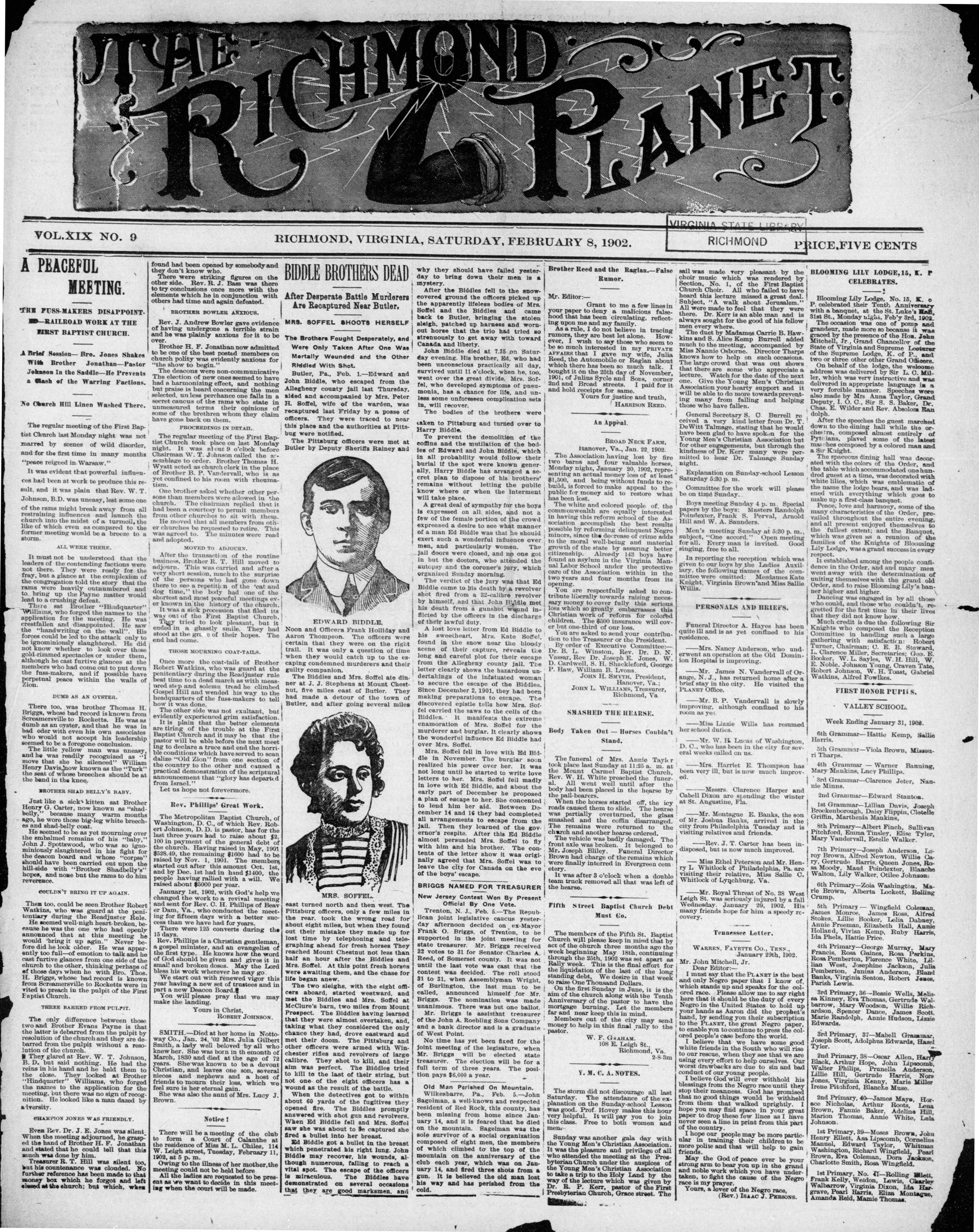
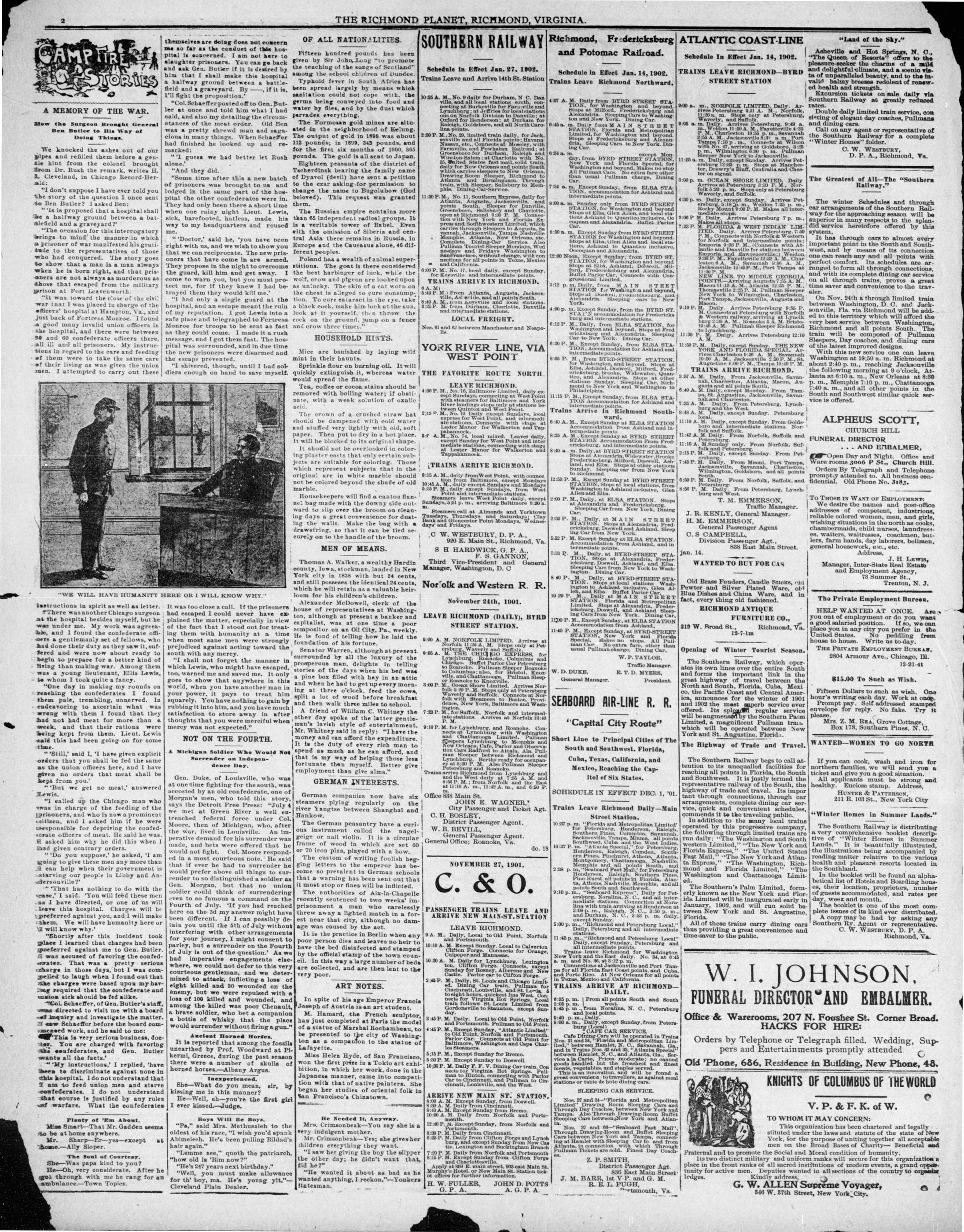
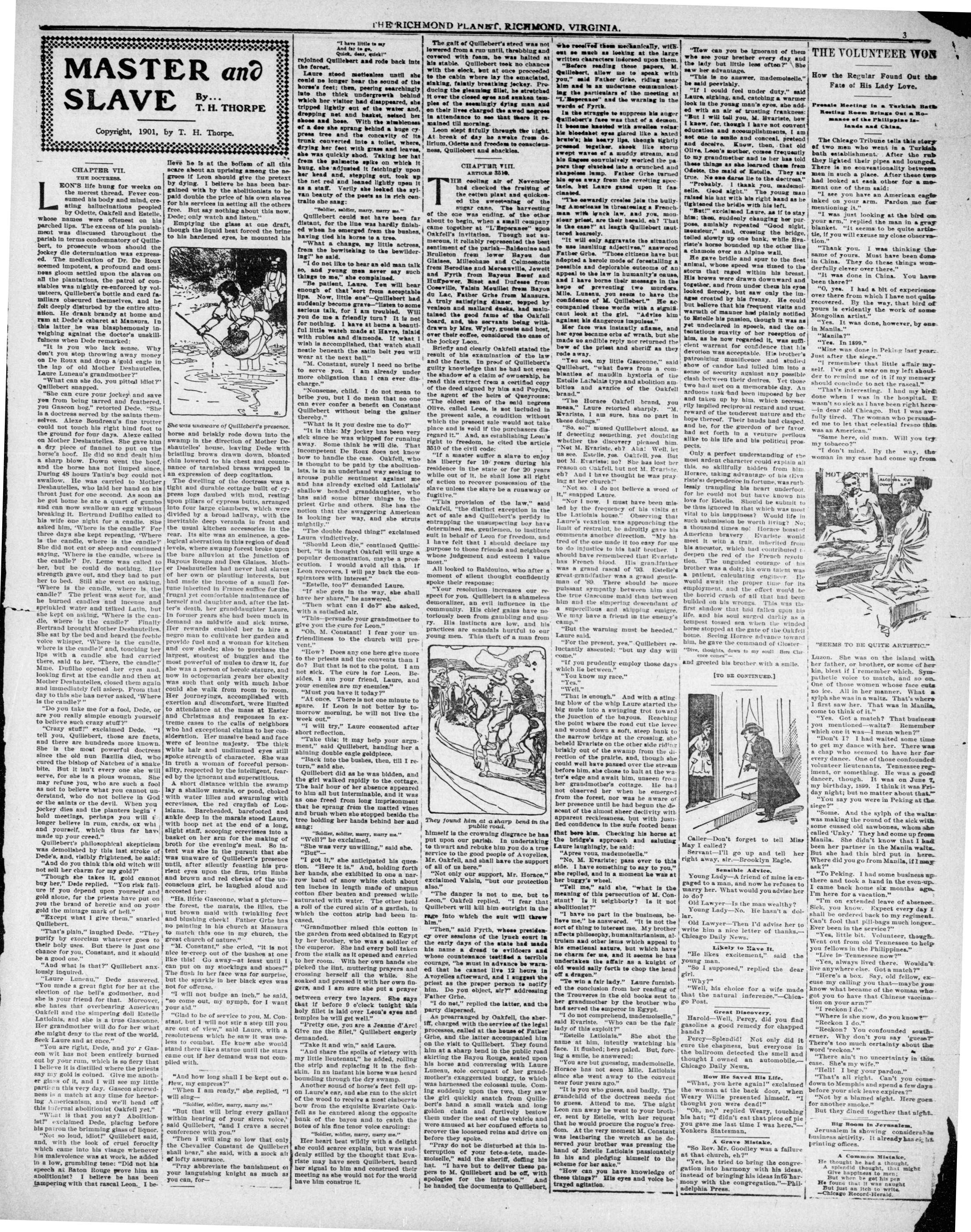
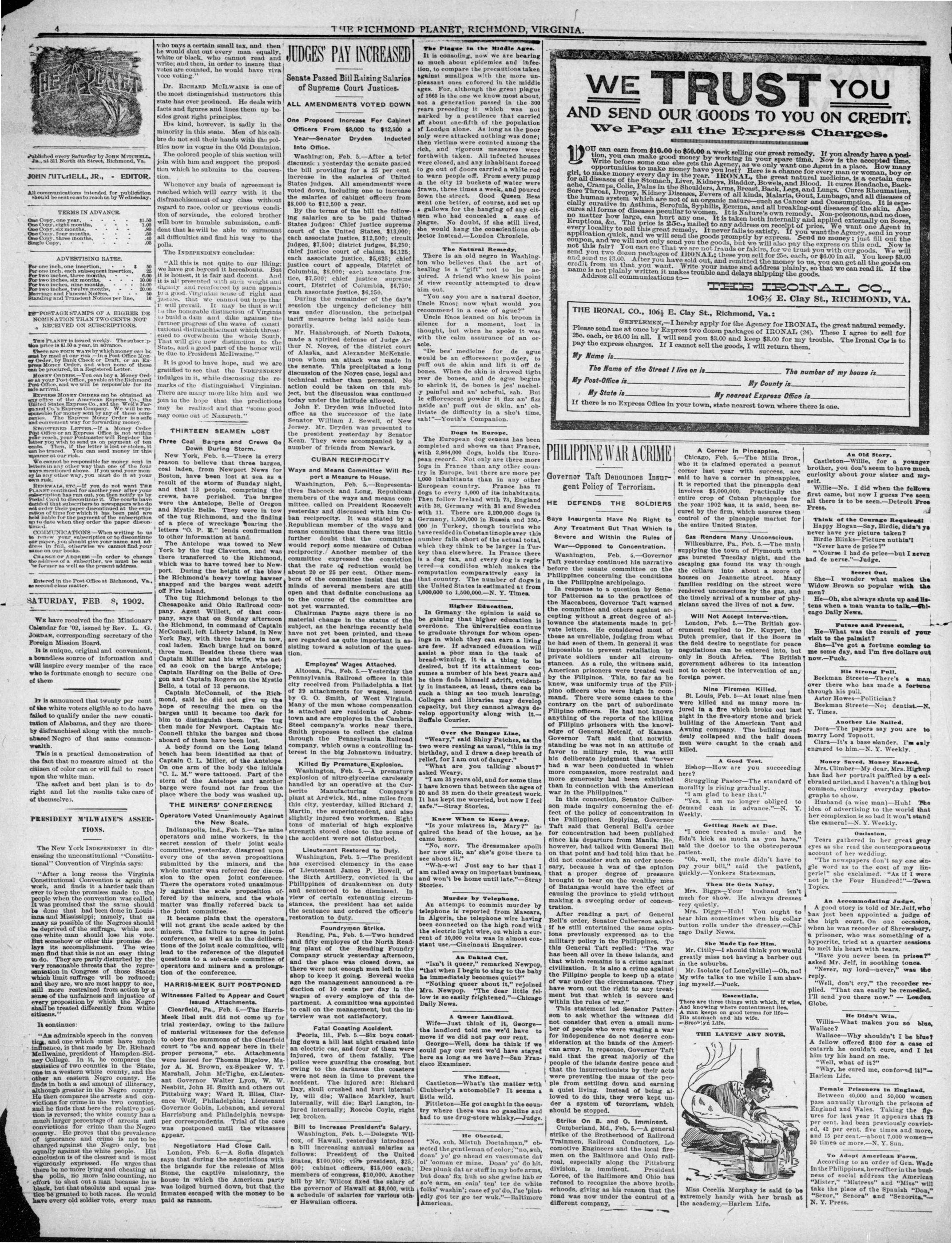
Page text (machine-generated)
THE RICHMOND PLANET
VOL.XIX NO.9
A PEACEFUL MEETING.
THE FUSS-MAKERS DISAPPOINT
RAILROAD WORK AT THE
MOST BAPTIST CHURCH.
A Brief Session—Bro. Jones Shakes With Brother Jonathan—Pastor Johnson In the Saddle—He Prevents a Crash of the Warring Factions.
No Church Hill Linen Washed There.
The regular meeting of the First Baptist Church last Monday night was not marred by scenes of wild disorder, and for the first time in many months "peace reigned in Warsaw."
It was evident that powerful influences had been at work to produce this result, and it was plain that Rev. W. T. Johnson, B.D. was uneasy, lest some one of the rams might break away from all restraining influences and launch the church into the midst of a turmoil, the like of which even as compared to the former meeting would be a breeze to a storm.
ALL WERE THERE.
It must not be understood that the leaders of the contending factions were not there. They were ready for the fray, but a glance at the complexion of the congregation told the story that the rams were heavily outnumbered and to bring up the Payne matter would lead to a crushing defeat. There sat Brother "Hisdquarter" Williams, who forged the names to the application for the meeting. He was crestfallen and disappointed. He saw the "handwriting on the wall". His forces could be led to the attack only to be ignominiously slaughtered. He did not know whether to look over those gold-rimmed spectacles or under them, although he cast furtive glances at the members who had come out to put down the fuss-makers, and if possible have perpetual peace within the walls of Zion.
DUMB AS AN OYSTER.
There too, was brother Thomas H. Briggs, whose bad record is known from Screamersville to Rocketts. He was as dumb as an oyster, and that he was in bad order with even his own associates who would not accept his leadership seemed to be a foregone conclusion.
The little yellow man was uneasy, and he was readily recognized as "I move that she be silenced" William Henry Davis, now known as the "Turk" the seat of whose breeches should be at the band in the knee.
BROTHER SHAD BELLY'S BABY:
Just like a sick' kitten sat Brother Henry G. Carter, now known as "shad-belly," because many warm months ago, he wore those big-legged white breeches and shad-belly coat. He seemed to be as yet mourning over the embalmed remains of his "baby." John J. Spottswood, who was so ignominiously slaughtered in his fight for the deacon board and whose "corpse" should have been carried out upon the hill-side with "Brother Shadbelly" hopes, and none but the rams to do him reverence.
COULDN'T BRING IT UP AGAIN
Then too, could be seen Brother Robert Watkins, who was guard at the peni-
century during the Readapter Rule. He seemed well-nigh heart-broken, because he was the one who had openly announced that at this meeting he would "bring it up again." Never before did he look older. He was apparently too full—of emotion to talk and he cast furtive glances from one side of the church to the other, thinking perhaps of those days when he with Bro. Thos. H. Briggs, whose bad record is known from Screamersville to Rockettets were invited to preach in the pulpit of the First Baptist Church.
THREE BARRED FROM PULPIT
The only difference between those two and Brother Evans Payne is that the latter is debarred from the pulpit by resolution of the church and they are debarred from the pulpit without a resolution of the church.
They glared at Rev. W. T. Johnson, B. D. but said nothing. He had the reins in his hand and he held them to the close. They looked at Brother "Hindquarter" Williams, who forged the names to the application for the meeting, but there was no sign of recognition. He looked like a man dazed by university.
CHAMPION JONES WAS FRIENDLY
Even Rev. Dr. J. E. Jones was silent. When the meeting adjourned, he grasped the hand of Brother H. F. Jonathan and stated that he could tell that this much was done by him. Treasurer R. T. Hill was silent too, but his countenance was clouded. No further reference has been made to that money box which he forgot and left elicited at the church: but which, where
found had been opened by somebody and they don't know who. There were striking figures on the other side. Rev. R. J. Bass was there to try conclusions once more with the elements which he in conjunction with others had time and again defeated.
BROTHER BOWLER ANXIOUS
Rev. J. Andrew Bowler gave evidence of having undergone a terrible strain and he was plainly anxious for it to be over.
Brother H. F. Jonathan now admitted to be one of the best posted members on church polity was evidently anxious for "the show to begin."
The deacons were non-communicative The election of new ones seemed to have had a harmonizing effect, and nothing but praise is heard concerning the men selected, unless persecuted or unlawfully secret caucus of the rams who state in unmeasured terms their opinions of some of the brethren whom they claim have gone back on them.
PROCEEDINGS IN DETAIL
The regular meeting of the First Baptist Church took place on last Monday night. It was about 9 o'clock before Chairman W. T. Johnson called the assemblage to order. Brother Thomas H. Wyatt acted as church clerk in the place of Brother B. P. Vandervall, who is as yet confined to his room with rheumatism.
One brother asked whether other persons than members were allowed in the church. The chairman replied that it had been a courtesy to permit members from other churches to sit with them. He moved that all members from other churches be requested to retire. This was agreed to. The minutes were read and adopted.
MOVED TO ADJOURN.
After the transaction of the routine business, Brother R. T. Hill moved to adjourn. This was carried and after a very short session, much to the surprise of the persons who had gone down there to see a repetition of the "cat and dog time," the body had one of the shortest and most peaceful meetings event, the history of the church. It was a sizeless session that tiled its way out of the Fire.
he hoped. Ourself.
They tried to look pleasant, but it
ended in a ghastly smile. They had
stood at the gr. o of their hopes. The
end had come.
THOSE MOURNING COAT-TAILS.
Once more the coat-tails of Brother Robert Watkins, who was guard at the penitentiary during the Readjuster rule beat time to a dead march as with measured step and solemn tread he climbed Gospel Hill and wended his way to the headquarters of the fuss-makers to tell how it was done.
The other side was not exultant, but evidently experienced grim satisfaction. It is plain that the better elements are tiring of the trouble at the First Baptist Church and it may be that the pastor will be able before the next meeting to declare a truce and end the horrible conditions which have served to scan dalize "Old Zion" from one section of the country to the other and caused a practical demonstration of the scriptural announcement that "glory has departed from Israel."
Let us hope not forevermore.
Rev. Phillips' Great Work.
The Metropolitan Baptist Church, of Washington, D. C., of which Rev. Robert Johnson, D. D. is pastor, has for the last three years had to raise about $2,100 in payment of the general debt of the church. Having raised in May, 1901 $528,49, the remaining $1600 had to be raised by Nov. 1, 1901. The members started out after this amount Oct. 1st, and by Dec. 1st had in hand $1400, the people having rallied with a will. We raised about $5000 per year.
January 1st, 1902, with God's help we changed the work to a revival meeting and sent for Rev. C. H. Phillips of Beaver Dam, Va., who conducted the meeting for fifteen days with a better success than we have had for years.
There were 125 converts during the 15 days.
Rev. Phillips is a Christian gentleman, a gospel minister, and an evangelist of the first type. He knows how the word of God should be given and gives it in small and broken doses. May the Lord bless his work wherever he may go. We start out with renewed vigor this year, having a new set of trustees and in part a new board. You will please pray that we may make the landing
SMITH.—Died at her home in Notto-
way Co., Jan. 24, '02 Mrs. Julia Gilbert
Smith, a lady well beloved by all who
knewher. She was born in the thmonth of
March, 1830 and died at the age of 72
years. She was known to be a devout
Christian, and leaves one son, several
neces, and nephews and a host of
friends to mourn their loss, which we
feel sure is her eternal gain.
She was also the aunt of Mrs. Lucy J.
Brown.
Notice!
There will be a meeting of the club to form a Court of Calanthe at the residence of Miss M. L. Chiles, 114 W. Leigh street, Tuesday, February 11, 1903, at 5 p. m.
Owing to the illness of her mother, the meeting could not be held before the parties are requested to be present as we wait. We are meeting when the court will be media.
RICHMOND, VIRGINIA, SATURDAY, FEBRUARY 8, 1902.
BIDDLE BROTHERS DEAD
BIDDLE BROTHERS DEAD
After Desperate Battle Murderers Are Recaptured Near Butler.
MRS. SOFFEL SHOOTS HERSELF
The Brothers Fought Desperately, and Were Only Taken After One Was Mortally Wounded and the Other Riddled With Shot.
Butler, Pa., Feb. 1.—Edward and John Biddle, who escaped from the Allegheny county jail last Thursday, aided and accompanied by Mrs. Peter H. Soffel, wife of the warden, was recaptured last Friday by a posse of officers. They were traced to near this place and the authorities at Pittsbug were notified.
The Pittsburgh officers were met at Butler by Deputy Sheriffs Rainey and
EDWARD BIDDLE
Noon and Officers Frank Holliday and Aaron Thompson. The officers were certain that they were on the right trail. It was only a question of time when they would catch up to the escaping condemned murderers and their guilty companion. The Blddles and Mrs. Soffel ate dinner at J. J. Stephens at Mount Chestnut, five miles east of Butler. They had made a detour of the town of Butler, and after going several miles
MRS. SOFFEL
MRS. SOFFEL.
east turned north and then west. The Pittsburg officers, only a few miles in the rear, took the wrong road for about eight miles, but when they found out their mistake they made up for lost time by telephoning and telegraphing ahead for fresh horses They reached Mount Chestnut not less than half an hour after the Biddles and Mrs. Soffel. At this point fresh horses were awaiting them, and the chase for life began anew.
The two sleighs, with the eight officers aboard, started westward, and met the Biddles and Mrs. Soffel at McClure's barn, two miles from Mount Prospect. The Biddles having learned that they were almost overtaken, and, taking what they considered the only chance they had, drove eastward and met their doom. The Pittsburg and other officers were armed with Winchester rifles and revolvers of large calibre. They shot to kill, and their aim was perfect. The Biddles tried to kill to the last of their string, but not one of the eight officers has a wound as the result of the battle.
When the detectives got to within about 60 yards of the fugitives they opened fire. The Biddles promptly answered with shot gun and revolvers. When Ed Biddles fell and Mrs. Soffel saw she was about to be captured she bulled a bullet into her breast.
Ed Biddle got a bullet in the breast which penetrated his right lung. John Biddle may recover, his wounds, although numerous, falling to reach a vital spot. The escape of the officers is miraculous. The Biddles have demonstrated on several occasions that they are good marksmen, and
Mr. Editor:—
Grant to me a few lines in your paper to deny a malicious falsehood that has been circulating, reflecting upon me and my family. As a rule, I do not believe in tracing rumors, they are best let alone. However, I wish to say those who seem to be so much interested in my PRIVATE are that I gave my wife, Julia Reed, the mobile or Raglan about which there has been so much talk. I bought it on the 25th day of November, 1901, of Julius Sycle and Sons, corner 2nd and Broad streets. I paid for it and hold receipts for same.
The Association having lost by fire two barns and four valuable horses, Monday night, January 20, 1902, representing an actual money loss of at least $1,500, and being without funds to rebuild, is forced to make appeal to the public for money aid to restore what has been lost. The white and colored people of, the commonwealth are equally interested in having this reform school of the Association accomplish the best results possible by reforming delinquent Negro minors, since the decrease of crime adds to the moral well-being and material growth of the state by assuring better citizenship. Already 143 boys have found an asylum in the Virginia Manual Labor School under the protective care of the Association within in the two years and four months from its opening.
You are respectfully asked to contribute liberally towards raising necessary money to cover fully this serious loss which so greatly embarrasses this Christian work of reform for colored children. The $500 insurance will cover but one-third of our loss.
You are asked to send your contribution to the Treasurer or the President.
By order of Executive Committee:—Dr. B. L. Winston, Rev. Dr. D. N. Vassar, Rev Dr. Joseph E. Jones, W. D. Cardwell, S. H. Shackleford, George P. Haw, William B. Lvons.
Body Taken Out — Horses Couldn't Stand.
The funeral of Mrs. Annie Taylor took place last Sunday at 11:25 a. m. at the Mount Carmel Baptist Church, Rev. W. H. White preached the funeral. All went well until after the body had been placed in the hearse by the pall-bearers.
When the horses started off, the icy roads caused them to slide. The hearse was partially overturned, the glass smashed and the coffin disarranged. The remains were returned to the church and another hearse ordered.
The vehicle was badly damaged. The front axle was broken. It belonged to Mr. Joseph Billey. Funeral Director Brown had charge of the remains which were finally interred in Evergreen cemetery.
It was after 3 o'clock when a double team truck removed all that was left of the hearse.
Fifth Street Baptist Church Debt Must Go.
The members of the Fifth St. Baptist Church will please keep in mind that by act of the church three months ago the week beginning May 18th, continuing through the 25th, 1903 was set apart as Rally week. This is the final effort for the liquidation of the last of the long standing debt. We desire in that week to raise One Thousand Dollars.
On the first Sunday in June, it is the aim of the church along with the Tenth Anniversary of the pastor to have the mortgage burning. Let the members far and near keep this in mind.
Members out of the city may send money to help in this final rally to the pastor.
The storm did not discourage all last Saturday. The attendance of the explanation on the Sunday-school Lesson was good. Prof. Hovey makes this hour very helpful. It will pay you to join this class. Free to both women and men.
Sunday was another gala day with the Young Men's Christian Association. It was the pleasure and privilege of all who attended the meeting at the Presbyterian Church under the auspices of the Young Men's Christian Association to take a trip to the Holy Land by the way of the lecture which was given by Dr. R. P. Kerr, pastor of the First Presbyterian Church, Grace street. The
why they should have failed yesterday to bring down their men is a mystery.
After the Biddles fell to the snow-covered ground the officers picked up the apparently lifeless bodies of Mrs. Sofel and the Biddles and came back to Butler, bringing the stolen sleigh, patched up harness and worn-out horse that the trio had tried so strenuously to get away with toward Canada and liberty.
John Biddle died at 7.35 on Saturday evening. His brother, Ed, who had been unconscious practically all day, survived until 11 o'clock, when he, too, went over the great divide. Mrs. Sofel, who developed symptoms of pneumonia, has a chance for life, and unless some unforeseen complication sets in, will recover.
The bodies of the brothers were
taken to Pittsburg and turned over to Harry Biddle.
To prevent the demolition of the coffins and the mutilation of the bodies of Edward and John Biddle, which in all probability would follow their burial if the spot were known generally, Harry Biddle has arranged a secret plan to dispose of his brothers' remains without letting the public know where or when the interment will take place.
A great deal of sympathy for the boys is expressed on all sides, and not a few of the female portion of the crowd expressed a desire to see what manner of a man Ed Biddle was that he should exert such a wonderful influence over men, and particularly women. The jail doors were closed, and no one got in but the doctors, who attended the autopsy and the coroner's jury, which organized Sunday morning.
The verdict of the jury was that Ed Biddle came to his death by a revolver shot fired from a 32-calibre revolver by himself, and that John Biddle met his death from a gunshot wound inflicted by the officers in the discharge of their lawful duty.
A lost love letter from Ed Biddle to his sweetheart, Mrs. Kate Soffel, found in the snow near the bloody scene of their capture, reveals the long and careful plot for their escape from the Allegheny county jail. The letter clearly shows the hazardous undertakings of the infatuated woman to secure the escape of the Biddles. Since December 2, 1901, they had been making preparations to escape. The discovered epistle tells how Mrs. Soffel carried the saws to the cells of the Biddles. It manifests the extreme enamoration of Mrs. Soffel for the murderer and burglar. It clearly shows the wonderful influence Ed Biddle had over Mrs. Soffel.
Mrs. Soffel fell in love with Ed Biddle in November. The burglar soon realized his power over her. It was not long until he started to write love letters to her. Mrs. Soffel fell madly in love with Ed Biddle, and about the early part of December he proposed a plan of escape to her. She conceived to lend him her ald. Between December 14 and 16 they had completed all arrangements to escape from the jail. Then they learned of the governor's respite. After this Ed Biddle almost persuaded Mrs. Soffel to fly with him and his brother. The contents of the letter show it was originally agreed that Mrs. Soffel was to leave the city for Canada on the eve of the boys' escape.
BRIGGS NAMED FOR TREASURER
New Jersey Contest Won By Present Official By One Vote.
Trenton, N. J., Feb. 5.—The Republican joint legislative caucus yesterday afternoon decided on ex-Mayor Frank O. Briggs, of Trenton, to be supported in the joint meeting for state treasurer. Mr. Briggs received 32 votes to 31 for Senator Charles A. Reed, of Somerset county. It was not until the last vote was cast that the contest was decided. The roll stood 31 to 31, when Assemblyman Wright, of Burlington, the last man to be called, announced himself for Mr. Briggs. The nomination was made unanimous. There was but one ballot.
Mr. Briggs is assistant treasurer of the John A. Roebling Sons Company and a bank director and is a graduate of West Point.
No time has yet been fixed for the joint meeting of the legislature, when Mr. Briggs will be elected state treasurer. The election will be for a full term of three years. The position pays $6,000 a year.
Old Man Perished On Mountain.
Wilkesbarre, Pa., Feb. 5—John Sagelman, a well-known and respected resident of Red Rock, this county, has been missing from home since January 14, and it is feared that he died on the mountain. Sagelman was the sole survivor of a social organization composed of eight men, the members of which climbed to the top of the mountain on the anniversary of the club each year, which was on January 14, and fired three shots from a gun. It is believed the old man lost his way and has perished from the cold.
Yours for justice and truth,
HARRISON REED
BROAD NECK FARM,
Hanover, Va., Jan. 22, 1902
JOHN H. SMITH, President,
Hanover, Va.;
JOHN L. WILLIAMS, Treasurer,
Richmond, Va.
SMASHED THE HEARSE.
Y. M. C. A. NOTES.
RICHMOND
sail was made very pleasant by the choir music which was rendered by Section, No. 1, of the First Baptist Church Choir. All who failed to have heard this lecture missed a great deal. Subject, "A walk about Jerusalem." All were made to feel that they were there. Dr. Kerr is an able man and is always sought for the good of his fellow men everywhere.
The duet by Madames Carrie B. Hawkins and S. Alice Kemp Burrell added much to the meeting, accompanied by Miss Nannie Osborne. Director Tharp knows how to help on such occasions. The harpist that was out shows that there are some who appreciate a lecture. Watch for the date of the one. Give the Young Men's Christian Association your heart support and it will be able to do more towards preventing many from falling and helping those who have fallen.
General Secretary S. C. Burrell received a very kind letter from Dr. T. DeWitt Talmage, stating that he would have been glad to have spoken for the Young Men's Christian Association but for other engagements, but through the kindness of Dr. Kerr many were permitted to hear Dr. Talmage Sunday night.
Explanation on Sunday-school Lesson Saturday 5:30 p. m.
Committee for the work will please be on time Sunday.
Boys meeting Sunday 4 p. m. Special papers by the boys: Masters Randolph Poindexter, Frank S. Perval, Arnold Hill and W. A. Saunders.
Men's meeting Sunday at 5:30 p. m., subject, "One accord." Open meeting for all. Every man is invited. Good singing, free to all.
In reporting the reception which was given to our boys by the Ladies Auxiliary, the following names of the committee were omitted: Mesdames Kate Knight, Virginia Brown'and Miss Sallie Willis.
PERSONALS AND BRIEFS.
Funeral Director A. Hayes has been quite ill and is as yet confined to his residence.
Mrs. Nancy Anderson, who underwent an operation at the Old Dominion Hospital is improving.
Mr. James N. Vandervall of Orange, N. J., has returned home after a brief stay in the city. He visited the PLANET Office.
Mr. B. P. Vandervall is slowly improving, although confined to his room as yet.
Miss Lizzie Wills has resumed her school duties.
Mr. W. H. Lucas of Washington, D. C., who has been in the city for several weeks called on us.
Mrs. Harriet E. Thompson has been very ill, but is now much improved.
—Messrs. Clarence Harper and Cabell Dixon are spending the winter at St. Augustine, Fla.
—Mr. Montague E. B.anks, the son of Mr. Joshua Banks, arrived in the city from Philadelphia Tuesday and is visiting relatives and friends.
—Rev. J. T. Carter has been indisposed, but is now much improved.
—Miss Ethel Peterson and Mr. Henry L. Whitlock of Philadelphia, Pa. are visiting their relative, Miss Sallie C. Whitlock of Lynchburg, Va.
—Mr. Royal Threat of No. 38 West Leigh St. was seriously injured by a fall Wednesday. January 29, 1902. His many friends hope for him a speedy recovery.
Tennessee Letter.
WARREN, FAYETTE CO., TENN., January 29th, 1902.
Mr. John Mitchell, Jr.
Dear Editor:—
I must say that the PLANET is the best and only Negro paper that I know of, which stands up and speaks for the colored race. Please allow me to say right here that it should be the duty of every Negro in the United States to hold up your hands as Aaron did the prophet's hand, by sending you their subscription to the PLANET, the great Negro paper, to enable you to continue to press the colored people's case before the world.
I believe that we have some good white friends in the South who will rise to our rescue, when they see that we are using every effort to help ourselves. Our worst drawbacks are due to sin and bad conduct of our young people.
I believe God will ever withhold his blessings from the Negro race until they stop their meanness. God has promised that no good things would be withheld from them that walked unrightly. I hope you may find space in your great paper to drop these few lines as I have never seen a line in print from this part of the country. I hope our people may be more particular in training their children to be more polite and that will help to gain friends. May the God of peace ever be your strong arm to bear you up in the grand and noble work which you have undertaken, to fight the cause of the Negro race is my prayer. Yours, a lover of the Negro race, (Rev.) ISAAC J. PERSONS
BLOOMING LILY LODGE,15, K. P
CELEBRATES.
Blooming Lily Lodge, No. 15, K. o P. celebrated their Tenth Anniversary with a banquet, at the St. Luke's Hall, 31st St., Monday night, Feb. 3rd, 1902. The occasion was one of pomp and grander, made more so because it was graced by the presence of the Hon. John Mitchell, Jr., Grand Chancellor of the State of Virginia and Supreme Lectorer of the Supreme Lodge, K. of P., and two or three other other Grand Officers. On behalf of the lodge, the welcome address was delivered by Sir L. C. Miller, which was very instructive and was delivered in appropriate language in a very fortable manner. Speeches were also made by Mrs Anna Taylor, Grand Director, I. O. C., Sir S. S. Baker, Dr. Chas E. Wilder and Rev. Absolom Randolph. After the speeches the guest marched down to the dining hall while the orchestra, composed almost entirely of Pythianis, played some of the latest matches composed by a colored man and a Sir Knight.
The spacecous dining hall was decorated with the colors of the Order, and the table which accommodated one hundred guest at a time, was decorated with white lilies, which was emblematic of the name the lodge bears, and was indented with everything which goes to make up a first-class banquet.
Peace, love and harmony, some of the many characteristics of the Order, prevailed throughout the entire evening, and all present enjoyed themselves to the fullest extent; and the Banquet, which was given as a reunion of the families of the Knights of Blooming Lily Lodge, was a grand success in every respect.
It established among the people confidence in the Order, and and many men went away with the determination of uniting themselves with the grand old Order, and to raise Blooming Lily's banner higher and higher.
Dancing was engaged in by all those who could, and those who couldn't, regretted for the first time in their lives that they did not know how.
Much credit is due the following Sir Knights who composed the Reception Committee in handling such a large gathering with satisfaction: Robert Turner, Chairman; C. E. B. Steward, L. Clarence Miller, Secretaries; Geo. E. Booker, W. L. Sayles, W. H. Hill, W. E. Noble, Johnson Young, Craven Tate, Robert Johnson, W. H. Toast, Gabriel Watkins, Alfred Fowlkes.
FIRST HONOR PUPIES.
Week Ending January 31, 1908.
6th Grammar—Hattie Kemp, Sallie Harris.
5th Grammar—Viola Brown, Missouri Tharps.
4th Grammar—Warner Banning, Mary Mankins, Lucy Phillips.
3rd Grammar—Clarence Jeter, Nannie Minns.
2nd Grammar—Edward Stanton.
1st Grammar—Lillian Davis, Joseph Brockenborough, Daisy Flippin, Cotlie Griffin, Marthemia Mankins.
6th Primary—Albert Finch, Sullivan Pitchford, Emma Tinsley, Elise Tyler, Mary Vandervall, Estelle Walker.
7th Primary—Joseph Anderson, Leroy Brown, Alfred Newton, Willie Cary, Gertrude Harris, Queen Jones, Rosa Moody, Maud Poindexter, Blanche Walton, Lily Walker, Otilee Johnson.
6th Primary—Zoia Washington, Marie Brown, Alberta Lockett, Bolling Crump.
5th Primary—Wingfield Coleman, James Monroe, James Ross, Alfred Stokes, Lillie Booker, Lelia Dabney, Annie Freeman, Elizabeth Hall, Annie Holland, Vivian Kemp, Ruby Harris, Ida Phels, Hattie Price.
4th Primary—George Murray, Mary Francis, Rosa Gaines, Rosa Parkins, Rosa Pemberton, Florence White, Lillian West, Josephine Jackson, Julia Pemberton, Janius Anderson, Bland Banks, Virginia Seaton, Robert Jones, Parish Lewis.
3rd Primary, 36—Bessie Wells, Melissa Kinney, Eva Thomas, Gertrude Walbarrow, Mary Woodson, Willie Richardson, Spencer Dance, James Scott, Marie Randolph, Annie Hudson, Lizzie Edwards.
3rd Primary, 37—Mabell Grammar, Joseph Scott, Adolphus Edwards, Hazel Tyler.
2nd Primary, 38—Oscar Allen, Harry Black, Arthur Hope, John Lipscomb, Walter Philips, Prunella Anderson, Lillie Hill, Gertrude Harris, Norw Jones, Virginia Kenny, Marie Miller Irene Pitchford, Blanche Muse.
2nd Primary, 40—James Maye, Horace Nicholas, Arthur Roots, Lena Brown, Fannie Baker, Adeline Hill, Marion Thomas, Annie White, Lula Johnson.
1st Primary, 39—Moses Brown, John Henry Ellett, Asa Lipscomb, Cornelius Manuel, Edward Taylor, Whitman Washington, Richard Wieldfield, Pearl Brown, Eva Coleman, Dora Jackson, Charlotte Smith, Rosa Wieldfield.
1st Primary, No. 41—Rolling Millett, Frank Kelly, Weidon, Lewis, Charley Walbarrow, Virginia Dixon, Ida Hargrave, Pearl Harris, Eliza Montague, Amanda Reid, Mamie Thomas.
THE JUDGE
"WE WILL HAVE HUMANITY HERE OR I WILL KNOW WHY."
CAMPFIRE STORIES
A MEMORY OF THE WAR.
Now the Surgeon Brought General Ben Butler to His Way of Doing Things.
We knocked the ashes out of our pipes and refilled them before a gentle hint from the colonel brought from Dr. Rush the remark, writes H. L. Cleveland, in Chicago Record-Herald:
"I don't suppose I have ever told you the story of the question I once sent to Ben Butler? I asked Ben:
"Is it proposed that a hospital shall be a halfway ground between a battlefield and a graveyard?"
"The occasion for this interrogatory brings to mind the manner in which a prisoner of war manifested his gratitude to the representatives of those who had conquered. The story goes to show that a man is a man always when he is born right, and that prisoners are not always as murderous as those that escaped from the military prison at Fort Leavenworth.
"It was toward the close of the civil war that I was placed in charge of the officers' hospital at Hampton, Va., and just back of Fortress Monroe. I found a good many invalid union officers in the hospital, and there were between 50 and 60 confederate officers there all ill and all prisoners. My instructions in regard to the care and feeding of them were to take the same care of their living as was given the union men. I attempted to carry out these
"WE WILL HAVE HUMANITY
instructions in spirit as well as letter. "There was another Chicago surgeon at the hospital besides myself, but he was under me. My work was agreeable, and I found the confederate officers a gentlemanly set of fellows, who had done their duty as they saw it, suffered and were now about ready to begin to prepare for a better kind of living than making war. Among them was a young lieutenant, Ellis Lewis, to whom I took quite a fancy. "One day in making my rounds on reaching the confederates I found them pale, trembling, unnerved. In endeavoring to ascertain what was wrong with them I found that they had not had meat for more than a week, and that their rations were being kept from them. Lieut. Lewis said this had been going on for some time.
"Still,' said I. 'I have given explicit orders that you shall be fed the same as the union officers here, and I have given no orders that meat shall be kept from you.'
"But we get no meat,' answered Lewis.
"I called up the Chicago man who was in charge of the feeding of the prisoners, and who is now a prominent citizen, and I asked him if he were responsible for depriving the confederate officers of meat. He said he was. I asked him why he did this when I had given contrary orders.
"Do you suppose,' he asked, 'I am going to give these men any more than I can help when their government is starving our people in Libby and Andersonville.'
"That has nothing to do with the case," I said. "You will feed these men as I have directed, or one of us will leave this hospital. Charges will be preferred against you, and I will make them. We will have humanity here or will know why."
"Shortly after this incident took place I learned that charges had been preferred against me to Gen. Butler. I was accused of favoring the confederates. That was a pretty serious charge in those days, but I was compelled to laugh when I found out that the charges were based upon my having required that the confederate and union sick should be fed alike.
"Col. Schaeffer, of Gen. Butler's staff, was directed to visit me with a board of inquiry and investigate the matter. Now Schaeffer before the board commissioned work, and he said to me:
"This is very serious business, doctor. You are charged with favoring the confederates, and Gen. Butler wants all the facts."
"My instructions," I replied, 'have been to discriminate against none in this hospital. I do not understand that I am to feed union men and starve confederates. I do not understand that course is justified by any rules of warfare. What the confederates
Plenty of 'Em About.
Miss Smart—That Mr. Gadden seems to be at home anywhere.
Mr. Sharp—Er—yes—except at home.—Ally Sloper.
The Soul of Courtesy.
She—Was papa kind to you?
He—Oh, very considerate. After he got through with me he rang for an ambulance.—Town Topics.
themselves are doing does not concern me so far as the conduct of this hospital is concerned. I am not here to slaughter prisoners. You can go back and ask Gen. Butler if it is desired by him that I shall make this hospital a halfway ground between a battlefield and a graveyard. By —, if it is, I'll fight the proposition.'
"Col. Schaeffer posted off to Gen. Butler at once and told him what I had said, and also my detailing the circumstances of the meat order. Old Ben was a pretty shrewd man and sagacious in many things. When Schaeffer had finished he looked up and remarked:
"I guess we had better let Rush alone."
"Some time after this a new batch of prisoners was brought to us and lodged in the same part of the hospital the other confederates were in. They had only been there a short time when one rainy night Lieut. Lewis, sick, barefooted, hatless, made his way to my headquarters and roused me.
"Doctor,' said he, 'you have been right with us, and we wish to show you that we can reciprocate. The new prisoners that have come in are armed. They propose in the night to overcome the guard, kill him and get away. I come to warn you, but you must protect me, for if they knew I had betrayed them they would kill me.'
"I had only a single guard at the hospital, and an escape meant the ruin of my reputation. I got Lewis into a safe place and telegraphed to Fortress Monroe for troops to be sent as fast as they could come. I made it a rush message, and I got them fast. The hospital was surrounded, and in due time the new prisoners were disarmed and the escape prevented.
"I shivered, though, until I had soldiers enough on hand to save myself
HERE OR I WILL KNOW WHY."
It was too close a call. If the prisoners had escaped I could never have explained the matter, especially in view of the fact that I stood out for treating them with humanity at a time when most sane men were strongly prejudiced against acting toward the south with any mercy.
"I shall not forget the manner in which Lewis, who might have escaped, too, warned me and saved me. It only goes to show that anywhere in this world, when you have another man in your power, it pays to treat him squarely. You have nothing to gain by rubbing it into him, and you have much satisfaction to store away in after thoughts that you were merciful when mercy was not expected."
NOT ON THE FOURTH.
A Michigan Soldier Who Would Not Surrender on Independence Day
Gen. Duke, of Louisville, who was at one time fighting for the south, was accosted by an old confederate, one of Morgan's men, who told this story, says the Detroit Free Press: "July 4 we met at Green River a well entrenched federal force under Col. Moore, then of Michigan, who, after the war, lived in Louisville. An imperative demand for his surrender was made, and bets were offered that he would not fight. Col. Moore responded in a most courteous note. He said that if ever he had to surrender he would prefer above all things to surrender to so distinguished a soldier as Gen. Morgan, but that no union soldier could think of surrendering even to so famous a command on the Fourth of July. 'If you had reached here on the 3d my answer might have been different. If I can possibly detain you until the 5th of July without interfering with other arrangements for your journey, I might consent to parley, but a surrender on the Fourth of July is out of the question.' As we had imperative engagements elsewhere, we could not defer to this very courteous gentleman, and we determined to attack, inflicting a loss of eight killed and 30 wounded on the enemy, but we were repulsed with a loss of 100 killed and wounded, and among the killed was poor Chenault, a brave soldier, who bet a companion a bottle of whisky that the place would surrender without firing a gun."
It is reported that among the fossils unearthed by Prof. Woodward at Pikermi, Greece, during the past season there were a number of skulls of horned horses.—Albany Argus.
Inexperienced
She—What do you mean, sir, by kissing me in this manner? He—Well, eh—you're the first girl I ever kissed.—Judge.
Boys Will Be Boys.
"Pa," said Mrs. Methusaleh to the oldest of his race, "I wish you'd spank Abimelech. He's been pulling Bildad's hair again."
"Lemme see," quoth the patriarch, "how old is 'Bim now?'"
"He's 247 years next birthday."
"Well, you must make allowance for th' boy, ma. He's young yit."—Cleveland Plain Dealer.
THE RICHMOND PLANET. RICHMOND. VIRGINIA
OF ALL NATIONALITIES
Fifteen hundred pounds has been given by Sir John, Long "to promote the teaching of the songs of Scotland" among the school children of Dundee. Typhoid fever in South Africa has been spread largely by means which sanitation could not cope with, the germs being conveyed into food and water by flies, and by the dust which parvades everything.
The Formosan gold mines are situated in the neighborhood of Kelung. The output of gold in 1898 was about 112 pounds; in 1899, 343 pounds, and for the first six months of 1900, 365 pounds. The gold is all sent to Japan.
Eighteen peasants of the district of Tscherdinsk bearing the family name of Dyavol (devil) have sent a petition to the czar asking for permission to change the name to Bugolubow (God beloved). This request was granted them.
The Russian empire contains more than 65 independent radical groups. It is a veritable tower of Babel. Even with the omission of Siberia and central Asia there remains in Russia, in Europe and the Caucasus alone, 46 different peoples. Poland has a wealth of animal superstitions. The goat is there considered the best harbinger of luck, while the wolf, crow and pigeon are looked upon as unlucky. The skin of a cat worn on the chest is alleged to cure consumption. To cure ecataract in the eye, take a black cock, make him look at the sun, look at it yourself, then throw the cock on the ground, jump on a fence and crow three times."
HOUSEHOLD HINTS
Mice are banished by laying wild mint in their haunts.
Sprinkle flour on burning oil. It will quickly extinguish it, whereas water would spread the flame.
Tea, coffee or cocon stains should be removed with boiling water; if obstinate, with a weak solution of oxalic acid.
The crown of a crushed straw hat should be dampened with cold water and stuffed very lightly with old, soft paper. Then put to dry in a hot place. It will be blocked to its original shape.
It should not be overlooked in coloring plaster casts that only certain subjects are suitable for coloring. Those which represent subjects that in the original are in white marble should not be colored beyond the shade of old marble.
Housekeepers will find a canton flannel bag made with the downy side outward to slip over the broom on cleaning days a great convenience for dusting the walls. Make the bag with a drawstring, so that it can be tied securely on to the handle of the broom.
MEN OF MEANS.
Thomas A. Walker, a wealthy Hardin county, Iowa, stockman, landed in New York city in 1838 with but 24 cents, and still possesses the identical 24 cents, which he will retain as a valuable heirloom for his children's children.
Alexander McDowell, clerk of the house of representatives at Washington, although at present a banker and capitalist, was at one time a poor composer on an Oll City, Pa., weekly. He is fond of telling how he laid the foundation of his fortune.
Senator Warren, although at present surrounded by all the luxury of the prosperous man, delights in telling stories of the days when his bed was a pine box filled with hay in an attic and when he had to get up every morning at three o'clock, feed the cows, split a lot of wood before breakfast and then walk three miles to school.
A friend of William C. Whitney the other day spoke of the latter gentleman's lavish style of entertainment. Mr. Whitney said in reply: "I have the money and can afford the expenditure. It is the duty of every rich man to spend as much as he can afford, and that is my way of helping those less fortunate than myself. Better give employment than give alms."
GERMAN INTERESTS.
German companies now have six steamers plying regularly on the river Yangtse between Shanghai and Hankow.
The German peasantry have a curious instrument called the nagelgeige or nail violin. It is a circular frame of wood in which are set 60 or 70 iron pins, played with a bow.
It is the practice in Berlin when any poor person dies and leaves no heir to have the bed disinfected and stamped by the official stamp of the town council. In this way a large number of beds are collected, and are then lent to the very poor.
ART NOTES.
In spite of his age Emperor Francis Joseph of Austria is an art student. M. Hamard, the French sculptor, has just completed at Paris the model of a statue of Marshal Rochambeau, to be presented to the city of Washington as a companion to the statue of Lafayette. Miss Helen Hyde, of San Francisco, won the first prize in a Tokio art exhibition, in which her work, done in the Japanese manner, came into competition with that of native painters. She began her studies of oriental folk in San Francisco's Chinatown.
He Needed It, Anyway.
Mrs. Crimsonbeak—You say she is a very indulgent mother.
Mr. Crimsonbeak—Yes; she gives her children everything they want.
"I saw her giving the boy the slipper the other day; he didn't want that, did he?"
"He wanted it about as bad as he wanted anything, I reckon."—Yonkers statesman.
SOUTHERN RAILWAY
Schedule in Effect Jan. 27. 1902.
Trains Leave and Arrive 14th St. Station
10:25 A. M. No. 9 daily for Durham, N C. Dan
ville, and all local stations, south, con-
lucting at Burkville for Farnville and
Lynchburg; at 4:25 for local stations
outside Durham. Not for Oxford or Henderson; at Durham; for
Raleigh, Goldsboro, and all North Carolina
points.
2:30 P. M. No. 29, limited train daily, for Jack,
sessional and all Florida points, from
Nassan, etc., Connects at Moseley, with
Farnville, and Powhatan Railroad; at
Greenbrook for Durham, Raleigh and
Woodside stations, with N. C. 35.
United States fast mail, solid train,
daily for New Orleans and points South
which carrier leaves to New Orleans.
Drawing Room Sleeper, Richmond to
Atlanta and Birmingham. Through
train, with Shipper, Salisbury to Memphis.
11:30 P. M. No. 11, Southern Express, daily for Atlanta, Augusta, Jacksonville, and points South. Sleeper for Danville, Georgia, with Charlotte and Charleston open at Richmond 9:30 P. M. Connection with New York and Florida Express and Southwestern Limited, which can be through Sleepers to Augusta, San yamana, Charlotte and Washington to Memphis, Atlanta, New Orleans, etc. Complete Dining-Car Service. Also Pullman Tourist Sleepers Friday, not on weekdays. Washington to San Francisco, without change, with connections for all points in Texas, Mexico and California.
6:00 P. M. No. 17, local daily, except Sunday for Keysville and intermediate points.
TRAINS ARRIVE IN RICHMOND.
6 A. M.
5:43 P. M.) From Atlanta, Augusta, Jacksonville, Asl.ville, and all points South.
8:40 A. M., from Keysville and local stations.
3:25 P. M. from Durham, Charlotte, Danville and intermediate stations.
LOCAL FREIGHT.
Nos. 61 and 62 between Manchester and Neapolis.
YORK RIVER LINE, VIA WEST POINT
THE FAVORITE ROUTE NORTH
LEAVE RICHMOND.
4:30 P. M., No. 16, Baltimore Limited, daily except Sundays, connecting at West Point with steamers for Baltimore and York River landings stops only at stations between Baltimore and York River. No. 10, Daily except Sundays, local express for West Point, and intermediate stations, Connects with stage at Lake Monitor for Walkenkort and Tappahannock. 5:3 A. M., No. 74, local mixed. Leaves daily, except Sunday for West Point and intermediate stations, connecting with stage at Lake Monitor for Walkenkort and Tappahannock.
TRAINS ARRIVE RICHMOND.
9:15 A. M., daily from West Point, with connec-
tion from Baltimore, except Mondays
10:15 A. M., daily except Sundays and Mondays
5:15 P. M., daily except Sundays, from West
Park,下午4点
Steamers leave West Point daily, except Sundays, 5:31 p. m., arriving Baltimore 8:30 a.m.
Steamers call at Almonds and Yorktown Tuesdays, Thursdays and Saturdays; Clay Bank and Gloucester Point Mondays, Wednesdays and Fridays.
C W. WESTBURY, D. P. A., 920 E. Main St., Richmond, Va.
S H HARDWICK, G. P. A., F. S GANNON.
Third Vice-President and General Manager, Washington, D. C
Norfolk and Western R. R.
November 24th, 1901.
LEAVE RICHMOND (DAILY), BYRD
STREET STATION.
9:00 A. M. NORFOLK LIMITED. Arrives at
Petersburg, Waverley and Snuffols.
9:05 A. M. THE CHICAGO EXPRESS, for Lynchburg. Roanoke, Columbus and Chicago. Buffet Parlor Car Petersburg to Roanoke. Pullman Sleeper Roanoke to Roanoke for Pristol, Knoxville, and Chattanooga. Pullman Sleeper or Roanoke to Knoxville.
3:00 P. M., Ocean Shore Limited. Arrives Norfolk
3:20 P. M. P. Stops only at Petersburg
Washington, with buffalo train and
folk with Steamers to Boston, Providence,
New York, Baltimore and Washington
7:23 P. M. Suffolk, Norfolk and intermine
instations. Arrives at Norfolk 10:40
P. M.
9:10 P. M. for Lynchburg, and Rosnoke. Connects
Lynchburg with Washington and
Charlotte. Steeps Lynchburg to Memphis
and New Orleans, Cafe, Parlor and Observation
Cars Radford to Attalla, Al. Pullman,
Steeps Lynchburg. Berths ready for occupancy
at 8:30 P. M. Also Pullman Sleeper
Trains arrive Richmond from Lynchburg and
and the West daily at 7:35 A. M. and
8:56 P. M.; from Norfolk and the East
at 11:10 A. m., 11:42 A. m., and 6:50 P. M.
Office 838 Main St.
JOHN E. WAGNER,*
City Passenger and Picket Agt.
C. H. BOSLEY,
District Passenger Agent.
W. B. BEVILL,
General Passenger Agent.
General Office: Roanoke, Va.
NOVEMBER 27, 1901.
C. & O.
PASSENGER TRAINS LEAVE AND
ARRIVE NEW MAIN-ST. STATION
LEAVE RICHMOND.
9 A. M., Daily, Local to Old Point, Norfolk
and Portsmouth.
10:10 A. M. Except Sunday. Local to Calverton
Clifton Forge. Connects for Orange,
Culpeper and Mannassas.
10:20 A. M. Except Lynchburg. Lexington
ton, Clifton Forge. Connects except
Sunday for Rosney, Alberene and New
Castle. Parlor car to Clifton Forge.
2:45 P. M., Daily. St. Louis and Chicago Limited,
Dining Car train, Pullman for
Chicago. Connects to eight hours, quickest line West.
Connects for Virginia Hot Springs. Local
train follows St. Louis Limited from
Gordonsville to Staunton, except Sun-
day.
3:45 P. M., Daily. Local to Old Point, Norfolk
and Portsmouth. Pullman to Old Point.
4:45 P. M., Except Sunday, "Atlantic Limited"
to Old Point, Norfolk and Portsmouth.
Portsmouth. Connects at Old Point for
Baltimore, Washington and Cape Charles Steamers.
5:15 P. M., Except Sunday for Bremo.
6:10 P. M. Except Sunday to Doswell.
10:30 P. M. Daily F. F. V. Dining Car train. Connects for Virginia Hot Springs. Pullman to Hinton, connecting with Parlor Car to Cincinnati, and Pullman to Cincinnati, Louisville, and the West.
ARRIVE NEW MAIN ST. STATION.
8:00 A. M. Except Sunday, from Doswell.
8:00 A. Daily from Cincinnati.
8:00 A. Daily from Doswell.
10:00 A. M. Daily from Norfolk and Portsmouth.
12:40 P. M. Except Sunday, from Norfolk and Portsmouth.
3:20 P. M. From Cincinnati.
6:35 P. M. Daily from Clifton Forge and Lynch burg, and except Sunday from New Cast tie, Lexington and Buckingham Branch
7:20 P. M. Daily from Norfolk and Portsmouth
8:15 P. M. Except Sunday from Clifton Forges
Apply at 80 E. main street, 903 east Main St. Murphy's Hotel, or New Main St. Station ticket offices for further information.
H. W. FULLER, JOHN D. POTTS
G. P. A., A. G. P. A.
Richmond, Fredericksburg and Potomac Railroad.
Schedule in Effect Jan. 14, 1902.
Trains Leave Richmond Northward.
4:07 A. M. Daily from BYRD STREET STATION,
for Washington, and beyond.
Stops at Milford, Fredericksburg and
Alexandria. Sleeping Cars to Washington
and New York. Dining Car.
6:45 a. m. for BYRD STREET STATION,
Florida and beyond.
Limited, for Washington and beyond.
Stops at Fredericksburg and Alexandria.
Sleeping Cars to New York. Dining
Car.
6:54 a. m. except Monday,
from BYRD STREET STATION,
New York and Florida Special, for
Washington and beyond. Makes no stop
All Pullman Cars. Do not have other
than usual Pullman charge. Dining
Car.
7:24 a. m. Except Sunday, from ELBA STATION,
accommodation for Ashland and
intermediate cars.
8:00 a. m. Sunday only from BYRD STREET
STATION, for Washington and beyond
Stops at Eiba, Glen Allen, and local sta-
tions Ashland to Quantice inclusive, Oe
coquan and Alexandria. Buffet-Purior
Car.
11:15 P. M. Except Sunday, from ELBA STATION accommodation for Ashland and Trains Arrive in Richmond Southward.
6:40 A. M. Except Sunday at ELBA STATION accommodation from Ashland and Interstate Railway.
8:40 a. m., Daily at BYRD STREET STATION
Stops at Alexandria, Widewater, Brooke
Stops at Bourg, Milford, Dowell, Ash
land, and Elba. Other stations
Sunday. Sleeping car from New York
to Richmond.
12:58 P. M., Except Sunday at BYRD STREET
STATION. Stops at local stations, from
Washington to Ashland inclusive, Glen
Allen and Elba.
2:00 P. M., Daily, at ELBA STATION. Stops
at Alexandria and Fredericksburg.
Sleeping car from New York, Dining
Car.
2:30 P. M., Daily at MAIN STREET
STATION. Stops at Alexandria, Fredericks
burg, Dowell and Ashland. Sleep
in Car from New York.
5:52 P. M., Except Sunday at ELBA STATION.
Accommodation from Ashland, and in
intermediate points.
7:13 P. M., Daily, at BYRD STREET STATION
Stops at Alexandria, Fredericksburg,
Dowell, Ashland. Sleeping cars from New York to
Washington. Dining Car.
8:40 P. M., Daily, at BYRD STREET STATION
Stops at Alexandria, Dowell, Ashland,
Washington to Ashland inclusive, Glen
Allen, and Elba. Buffet Parlor Car.
11-40 P. M., Except Sunday, at BYRD-STREET
STATION, New York and Florida
Special dealer no steps. A Pull
man Car. No extra fare, other than
usual Pullman charge, Dining Car.
W. P. TAYLOR,
Traffic Manager.
W. D. DUKE,
E. T. D. MYERS,
General Manager.
President.
SEABOARD AIR-LINE R. R.
SEABOARD AIR-LINE R. R.
"Capital City Route"
Short Line to Principal Cities of The South and Southwest. Florida, Cuba, Texas, California, and Mexico, Reaching the Capitol of Six States.
SCHEDULE 1N EFFECT DEC: 1, '01.
10:37 p. m. "Florida and Metropolitan Limited" for Petersburg, Henderson, Raleigh, Southern Pines, Columbia, Savannah, Southwellville, Miami, all points, Southwest, Cuba, West Virginia.
10:37 p. m. "Atanta Special" for Petersburg, Henderson, Raleigh, Camden, Southern Pines, Pinehurst, Athens, Atlanta, Montgomery, Chattanooga, Nashville.
2:38 p. m., "Seaboard Fail Mail," for Petersburg
Henderson, Raleigh, Southern Pines,
Pine Hurst, all points in Florida, Ala-
tonia, asville, Memphis, and all
points South Carolina.
9:10 p. m., "Seaboard Express." Daily for
petersburg, Noralina, N.C., and all inter-
mediate stations. Connection at Noralina
at Henderson at Henderson at
2:39 p. m., Raleigh, N.C., at 3:00 p.
m., and Durham, N.C., 3:38 p. m., daily,
except Sunday.
5:00 p. m., Amondi and Petersburg Local,
Daily Petersburg and all intermediate
stations.
11:45 p. m., "Richmond and Petersburg Local"
"Petersburg and Petersburg
and Dulph intermediate police."
Trains leave Richmond for Washington New York and the East daily. No. 34, at 6:45 a. m. and No. 38, at 3:12 p. m. a. m. and No. 39, at 3:12 p. m. a. m. and Port Tampa for all Florida East Coast points, and Cuba, and Port Rico. At New Orleans for all points in Texas, Mexico and California.
TRAINS ARRIVE AT RICHMOND DAILY
6:35 p. m. | From all points South and South
8:05 p. m. | west
8:00 a. m., Daily, except Sunday, from Petersburg (Local)
CAFE CAR SERVICE.
Cafe Dining-Cars will be operated in Trains Nos. 31 and 34, "Florida and Metropolitan Limited," between Hamlet, N.C., Savannah, Ga., and Tampa, Fla., between Hamlet, N.C., and Atlanta, Ga. Service a la Carte, Prices moderate; no canned goods handled but the freshest and finest meats, vegetables, and staples served.
This is an innovation, and will be found a great addition against meal stations or table de hote dining cars.
SLEEPING CAR SERVICE
Nos. 37 and 34 "Florida and Metropolitan Limited" Drawing Room Sleeping Cars and Through Drawing Room Gallee, between New York and Tampa. Also Through Drawing-Room Buffet Sleeping Cars between New York and Atlanta.
Nos. 37 and 06 "Seaboard Fast Mail" Through Drawing-Room and Buffet Sleeping Cars between New York and Tampa, connect- ing Home with Sleeping Car to Atlanta, connection with which Through Fullman Tickets are sold. Finest Day Coaches.
Z. P. SMITH,
District Passenger Agt.
836 East Main Street
J. M. BARR, 1st V.P. and G. M.
R. E. L. PUGH,
Portsmouth, Va.
Schedule In Effect Jan. 14, 1902.
TRAINS LEAVE RICHMOND—BYRD
STREET STATION
NEW LINE TO MIDDLE GEORGIA
11:35 A.M. M. Daliy, Petersburg 12:10
M. Macon 11:15 A.M. M. Atlanta 12:35 P.M.
M. Thomasville 2:25 P.M. M. Pullman Sleeper
New York to Wilmington, Charleston,
Pet Tampa, Jacksouville, Augusta and
Macon.
9:10 P.M. Daily. Arrives Petersburg 9:35 P.M.
M. Macon & Western railway, arriving at Lynch
burg 2:30 A.M. M. Roanoke 5 A.M. M. Bristol-
burg 2:30 A.M. M. Pullman Sleeper Richmond
to Lynchburg.
11:30 P. M. Daliy. Arrives Petersburg 12:10
A.M.
11:50 P.M. Daily, except Sunday. THE NEW
YORK AND FLORIDA SPECIAL. Arrives Charleston 9:36 A.M. M. Savannah
10:50 A.M. M. Jacksonville 9:36 P.M. M. St.
Augustine 10:50 P.M. Tampa 10:40 P.M.
TRAIN DRIVEN RICHMOND.
3:57 A.M. Daily. Pullman, Jacksonville, Savannah, Charleston, Atlanta, Augusta and all points South.
6:40 A. M. Daily, except Monday. From Tampa, Shall, Jacksonville, Savannah and Charleston.
7:35 A. M. Daily. From Petersburg, Lynch and West.
8:48 A. M. Daily, except Sunday. Petersburg local.
11:10 A. M. Daily, except Sunday. From Goldsboro and intermediate stations. Norfolk and Suffolk.
11:42 A. M. Daily. From Norfolk, Suffolk and Norfolk and Petersburg.
11:10 A. M.Sunday only. From Norfolk, Suffolk and Petersburg.
2:15 P. M. Daily, except Sunday. From Peterson.
7:45 P. M. Daily. From Miami, Port Tampa, Jacksonville, Savannah, Charleston, Wilmington, Goldsboro, and all points Son.
6:50 P. M. Daily. From Norfolk, Suffolk, and Petersburg.
8:56 P. M. Daily. From Petersburg, Lynchburg and West.
T. M. EMMERSON,
Traffic Manager.
J. R. KENLY, General Manager.
H. M. EMMERSON,
General Passenger Agent
C. S CAMPBELL,
Division Passenger Agt.,
838 East Main Street.
WANTED TO BUY FOR CAS
Old Brass Fenders, Candle Stocks, old
Pewter and Silver Plated Ware, old
Blue Dishes and China Ware, and in
fact, every thing old fashioned.
219 W. Broad St. Richmond, Va.
12-7-1m
Opening of Winter Tourist Season.
The Southern Railway, which operates its own lines over the entire South and forms the important link in the great highway of travel between the North and South, Florida, Cuba, Mexico, the Pacific Coast and Central America, announces for the winter of 1901 and 1902 the most superb service ever. Its splendid, regular service will be announced by the New York Limited, a magnificent Pullman train, which will be operated between New York and St. Angustine, Florida.
The Highway of Trade and Travel
The Southern Railway begs to call attention to its unequalled facilities for reaching all points in Florida, the South and Southwest. It is justly termed the representative railway of the South, the highway of trade and travel. Its import through connections, through car arrangements, complete dining car service, quick and convenient schedules, commends it to the traveling public.
In addition to the many local trains operated by this progressive company, the following through limited trains are run daily: "The Washington and South western Limited," "The New York and Florida Express," "The United States Fast Mail," "The New York and Atlanta Express," "The Washington, Richmond and Florida Limited," "The Washington and Chattanooga Limited.
The Southern's Palm Limited, formerly known as the New York and Florida Limited will be in inaugurated early in January, 1902, and will run solid be between New York and St. Angustine, Florida.
All of these trains carry dining cars thus providing a great convenience and time-saver to the public.
W. I. JOE
FUNERAL DIRECTOR
Office & Warerooms, 207 N HACKS R
Orders by Telephone or Te
pers and Entertainment
Old 'Phone, 686, Residence
W. I. JOHNSON. FUNERAL DIRECTOR AND EMBALMER.
Office & Warerooms, 207 N. Foushee St. Corner Broad. HACKS FOR HIRE: Orders by Telephone or Telegraph filled. Wedding, Suppers and Entertainments promptly attended. Old 'Phone, 686, Residence in Building, New Phone, 48.
TO WHOM IT MAY CONCERN:
This organization has been chartered and legally
stituted under the laws and statute of the state of New
York, for the purpose of uniting together all acceptable
men on the Broad Bases of Charity—Beneficial and
Fraternal and to promote the Social and Moral condition of humanity.
It is two distinct military and uniform ranks will secure for this organization a
place in the front ranks of all sacred institutions of modern events, a grand oppo-
tunity for active men. Deputies wanted in all sections of the country to organize
ledges.
Kindly address,
G. W. ALLEN Supreme Voyager,
346 W. 37th Street, New York City.
THE FIGHT
Asheville and Hot Springs, N. C., "The Queen of Resorts" offers to the pleasure-seeker the charms of a mild and delightful climate, and a scenic vista of unparalleled beauty, and to the invalid balmy breezes redolent of renewed health and strength.
Excursion tickets on sale daily via Southern Railway at greatly reduced rates.
Double daily limited train service, con sideing of elegant day coaches, Pullmans and dining cars.
Call on any agent or representative of the Southern Railway for a complete "Winter Homes" folder.
C. W. WESTBURY,
D. P. A., Richmond, Va.
The Greatest of All-The "Southern Railway."
The winter Schedules and through car arrangements of the Southern Railway for the approaching season will be superior in many respects to the splendid service heretofore offered by this system.
It has through cars to almost every important point in the South and Southwest, and by means of its connection one can reach any and all points with perfect comfort. Its schedules are arranged to form all through connections, and with its complete dining car service on all through trains, proves a great time saver and convenience to the traveler.
D. Nov. 24th a through limited train between Washington, D. C. and Jacksonville, Fla. via Richmond will be added to this territory which will afford the very best service between Washington Richmond and all points South. The train will be composed of Pullman Sleepers, Day coaches, and dining cars of the latest improved designs.
With this new service one can leave Washington at 10:50 a. m. Richmond at about 2:40 p. m., reaching Jacksonville the following morning at 9 o'clock, Atlanta at 6:10 a. m., New Orleans at 8:30 p. m., Memphis 7:10 p. m., Chattanooga 7:40 a. m., and all other points in the South and Southwest similar quick service is offered.
AND ENBALMER,
Open Day and Night. Office and
Ware rooms 3006 P St., Church Hill.
Orders By Telegraph and Telephone
promptly attended to. All business con-
fidential. Old Phone No. 3183.
TO THOSE IN WANT OF EMPLOYMENT:
We desire the names and post-office
addresses of competent, industrious,
reliable colored women, men, and girls,
wishing situations in the north as cooks,
chambermaids, child nurses, laudresses,
waiters, waitresses, coachmen, butlers,
farm hands, day laborers, bellmen,
general housework, etc., etc.
Address,
J. H LEWIS,
Manager, Inter-State Real Estate
and Employment Agency,
73 Summer St.
Trenton, N. J.
The Private Employment Bureau.
HELP WANTED AT ONCE. Are you out of employment or do you want a good salaried position. If so, we can place you in any city you prefer in the United States. No pedding from house to house. Write us to-day.
THE PRIVATE EMPLOYMENT BUREAU,
2804 Armour Ave., Chicago, Dl.
12-21-4t
$15.00 To Such as Wish.
Fifteen Dollars to such as wish, One hour's writing each day. Work at once. Prompt pay. Self addressed stamped envelope for reply. No fake. Try it please.
Mrs. Z. M. REA, Grove Cottage, Box 173, Southern Pines, N. C.
WANTED—WOMEN TO GO NORTH
If you can cook, wash and iron for northern families, we will send you a ticket and give you a good situation.
All applicants must be strong, and
All applicants must be strong and healthy. Enclose stamp. Address.
"Winter Homes in Summer Lands."
The Southern Railway is distributing a very comprehensive booklet descriptive of "Winter Homes in Summer Lands." It is beautifully illustrated, the illustrations being accompanied by reading matter relative to the various health and pleasure resorts located in the Southland.
In the booklet will be found an alphabetical list of Hotels and Boarding houses, their location, proprietors, number of guests accommodated, and rates per day, wear and month.
The booklet is the most complete issues of its kind ever distributed. A copy may be had by asking any Southern Ry. Agent or representative.
C. W. WESTBURY, D. P. A., Richmond, Va.
V. P. & F. K. of W.
MASTER and SLAVE By... T. H. THORPE
Copyright, 1901, by T. H. Thorpe.
LEON'S life hung for weeks on the merest thread. Fever consumed his body and mind, creating hallucinations peopled by Odette, Oakfell and Estelle, whose names were oftened on his parched lips. The excess of his punishment was discussed throughout the parish in terms condemnatory of Quillebert, to prosecute whom should the jockey die determination was expressed. The medication of Dr. De Roux seemed impotent, a profound and omnious gloom settled upon the slaves on all the plantations, the patrol of constables was nightly re-enforced by volunteers, Quillebert's bottle and card familiars obscured themselves, and he felt deeply disturbed by the entire situation. He drank brandy at home and rum at Dede's cabaret at Manura. In this latter he was blasphemously inveighing against the doctor's unskillfulness when Dede remarked:
"It is you who lack sense. Why don't you stop throwing away money on De Roux and drop a gold eagle in the lap of old Mother Deshautelles, Laure Luneau's grandmother?" "What can she do, you pitted idlot?" Quillebert snapped.
"Do you take me for a fool, Dede, or are you really simple enough yourself to believe such crazy stuff?"
"Crazy stuff!" exclaimed Dede. "I tell you, Quillebert, those are facts, and there are hundreds more known. She is the most powerful doctress since the old nun Bazilla died, who cured the bishop of Natchez of a snake bite. But it isn't every one she will serve, for she is a pious woman. She may refuse you, who are such a fool as not to believe what you cannot understand, who do not believe in God or the saints or the devil. When you jockey dies and the planters begin hold meetings, perhaps you will longer believe in rum, cards, or whil and yourself, which thus far have made up your creed."
Quillebert's philosophical skepticism was demolished by this last stroke of Dede's, and, visibly frightened, he said: "And do you think this old witch will not sell her charm for my gold?"
"Though she takes it, gold cannot buy her," Dede replied. "You risk failure if you depend upon yourself and gold alone, for the priests have put on you the brand of heretic and on your gold the mintage mark of hell."
"Except what I give them," snarled Quillebert.
"That's plain," laughed Dede. "They purify by exorcism whatever goes to their holy uses. But there is just one chance for you, Constant, and it should be a good one."
"And what is that?" Quillebert anxiously inquired.
"Laure Luneau," Dede answered.
"You made a great fight for her at the election of the bell's godmother, and she is your friend for that. Moreover, she hates that overbearing American Oakfell and the simpering doll Estelle Latolais, and she is a true Gascone. Her grandmother will do for her what she might deny to the rest of the world. Seek Laure and at once."
"You are right, Dede, and yor Gasson wit has not been entirely burned out by your rum, which is so fiery that I believe it is distilled where the priests say my gold is coined. Give me another glass of it, and I will see my little partisan this very day. Gascon shrewdness is a match at any time for hectoring Americanism, and we'll head off this infernal abolitionist Oakfell yet."
"What is that you say? Abolitionist!" exclaimed Dede, placing before his patron the brimming glass of liquor. "No so loud, idiot!" Quillebert said, and, with the look of cruel ferocity which came into his visage whenever his malevolence was at work, he added in a low, grumbling tone: "Did not his speech at Baton Rouge prove him an abolitionist? I believe he has been tampering with that rascal Leon. I be-
Iieve he is at the bottom of all this scare about an uprising among the negroes if Leon should give the pretext by dying. I believe he has been bargained with by the abolitionists to be paid double the price of his own slaves for his services in setting all the others free. But say nothing about this now. Dede; only watch and listen."
Emptying the glass at one draft, though the liquid heat forced the brine to his hardened eyes, he mounted his
00.
She was unaware of Quillbert's presence. horse and briskly rode down into the swamp in the direction of Mother Deshautelles' house, leaving Dede with bristling brows drawn down, bloated chin lowered to his chest and countenance of tarnished brass wrapped in an expression of deep cogitation.
The dwelling of the doctress was a tight and durable cottage built of cypress logs danbed with mud, resting upon pillars of cypress butts, arranged into four large chambers, which were divided by a broad hallway, with the inevitable deep veranda in front and the usual kitchen accessories in the rear. Its site was an eminence, a geological aberration in this region of dead levels, where swamp forest broke upon the bare alluvion at the junction of Bayous Rouge and Des Glaises. Mother Deshautelles had never had slaves of her own or planting interests, but had made the income of a small fortune inherited in France suffice for the frugal yet comfortable maintenance of herself and daughter and, after the latter's death, her granddaughter Laure. In former years she had been much in demand as midwife and slick nurse. Her rewards enabled her to hire a negro man to cultivate her garden and provide fuel and a woman for kitchen and cow sheds; also to purchase the largest, stoutest of buggies and the most powerful of mules to draw it, for she was a person of heroic stature, and now in octogenarian years her obesity was such that only with much labor could she walk from room to room. Her journeyings, accomplished with exertion and discomfort, were limited to attendance at the mass at Easter and Christmas and responses in extreme cases to the calls of neighbors who had exceptional claims to her consideration. Her massive head and face were of leonine majesty. The thick white hair and undimmed eyes still spoke strength of character. She was in truth a woman of forceful personality, respected by the intelligent, feared by the ignorant and superstitious.
A short distance within the swamp lay a shallow marals, or pond, choked with water lilies and swarming with ecrevisses, the red crayfish of Louisiana. Bareheaded, barefooted and ankle deep in the marals stood Laure, with hoop net at the end of a long, slight staff, scooping ecrevisses into a basket on her arm for the making of broth for the evening's meal. So intent was she in the pursuit that she was unaware of Quillebert's presence until, after silently feasting his prudent eyes upon the firm, trim limbs and brown and red cheeks of the unconscious girl, he laughed aloud and accosted her:
"Ha, little Gasconne, what a picture—the forest, the marals, the illies, the nut brown maid with twinkling feet and blushing cheek! Father Grhe has no painting in his church at Mansura to match this one in my church, the great church of nature."
"M. Constant," she cried, "it is not nice to creep out of the bushes at one like this! Go away—at least until I can put on my stockings and shoes!" The fush in her face was for surprise, but the sparkle in her black eyes was not for offense.
"I will not budge an inch," he said, "so come out, my nymph, for I want your aid."
"Glad to be of service to you, M. Constant, but I will not stir a step till you are out of view," said Laure, with a resoluteness which he saw it was useless to combat. He knew she would stand there like a statue until the stars came out if her demand was not complied with.
"And how long shall I be kept out o' flow, my empress?"
"When I am ready," she replied, "I will sing—
"Soldier, soldier, marry, marry me."
sober, sorter, marry, marry me.
"But that will bring every gallant within hearing of your siren voice," said Quillebert, "and I crave a secret conference with you."
"Then I will sing so low that only the Chevallier Constant de Quillebert shall hear," she said, with a mock alt of lofty assurance.
"Pray abbreviate the banishment of your languishing knight as much as you can, for—
THE RICHMOND PLANET, RICHMOND, VIRGINIA
"I have little to my
And far to go,
Quick, dear, quick!"
rejoined Quillebert and rode back into the forest.
Laure steed motionless until she could no longer hear the sound of the horse's feet; then, peering searchingly into the thick undergrowth behind which her visitor had disappeared, she tripped lightly out of the water and, dropping net and basket, seized her shoes and hose. With the nimbleness of a doe she sprang behind a huge cypress tree and the concavity of its trunk converted into a toilet, where, drying her feet with grass and leaves, she was quickly shaken. Taking her hat from the palmette spike on which it hung, she adjusted it fetchingly upon her head and, stepping out, took up the net red and leaned lightly upon it as a staff. Verily she looked the sylvan beauty of the peets as in rich contralto she sang:
"Soldier, soldier, marry, marry me."
Quillebler could not have been far distant, for the line was hardly finished when he emerged from the bushes, having tied his horse to a tree.
"What a change, my little actress, from the bowwishing to the bewildering!" he said.
"I do not like to hear an old man talk so, and young man never say such things to me," she complained.
"Be patient, Laure. You will hear enough of that 'sort from acceptable lips. Now, little one'-Quillebler had suddenly become grave-"listen to some serious talk, for I am troubled. Will you do me a friendly turn? It is not for nothing. I have at home a beautiful little watch made at Havre, inlaid with rubies and diamonds. If what I wish is accomplished, that watch shall nestle beneath the satin belt you will wear at the next ball."
"M. Constant, surely I need no bribe to serve you. I am already under more obligation than I can ever discharge."
"Nonsense, child. I do not mean to bribe you, but I do mean that no one can ever confer a benefit on Constant Quillebert without being the gainer thereby."
"What is it you desire me to do?" "It is this: My jockey has been very slick since he was whipped for running away. Some think he will die. That incompetent De Roux does not know how to handle the case. Oakfell, who is thought to be paid by the abolitionists, is in an underhand way seeking to arouse public sentiment against me and has already excited old Latiolais' shallow headed granddaughter, who has said some bitter things to the priest Grhe and others. She has the notion that the swaggering American is looking her way, and she struts mightly."
"The double faced thing!" exclaimed Laura vindictively.
"Should Leon die," continued Quillebert, "it is thought Oakfell will urge a popular demonstration, maybe a prosecution. I would avoid all this. If Leon recovers, I will pay back the spiritors with interest."
"Estelle, too?" demanded Laure.
"If she gets in the way, she shall have her share," he answered.
"Then what can I do?" she asked, with a satisfied air.
"This—persuade your grandmother to give you the cure for Leon."
"Oh. M. Constant! I fear your unfriendliness to the church will prevent."
"How? Does any one here give more to the priests and the convents than I do? But that is not to the point. I am not sick. The cure is for Leon. Besides, I am your friend, Laure, and your enemies are my enemies."
"Must you have it today?"
"At once. There is not one minute to spare. If Leon is not better by tomorrow morning, he will not live the week out."
"I will try," Laure consented after short reflection.
"Take this; it may help your argument," said Quillelbert, handing her a shining double eagle goldpiece.
"Back into the bushes, then, till I return," said she.
Quillelbert did as he was bidden, and the girl walked rapidly to the cottage. The half hour of her absence appeared to him all but interminable, and it was as one freed from long imprisonment that he sprang from the matted vines and brush when she stopped beside the tree holding her hands behind her and sang:
"Soldier, soldier, marry, marry me."
"Well?" he exclaimed.
"She was very unwilling," said she.
"But"—
"I got it," she anticipated his question. "Here it is." And, holding forth her hands, she exhibited in one a narrow band of snow white cloth about ten inches in length made of unspun cotton fiber beaten and pressed while saturated with water. The other held a roll of the cured skin of a garfish, in which the cotton strip had been incased.
"Grandmother raised this cotton in the garden from seed obtained in Egypt by her brother, who was a soldier of the emperor. She had every boll taken from the stalk as it opened and carried to her room. With her own hands she picked the lint, muttering prayers and crossing herself all the while. She soaked and pressed it with her own fingers, and I am sure she put a prayer between every two layers. She says that if before 9 o'clock tonight this holy fillet is laid over Leon's eyes and temples he will get well."
"Pretty one, you are a Jeanne d'Arcl! Give me the fillet," Quillelbert eagerly demanded.
"Take it and win," said Laure.
"And share the spoils of victory with my little lieutenant," he added, rolling the strip and replacing it in the fashskin. In an instant his horse was heard bounding through the dry swamp.
Another sound of horse's feet fell up on Laure's car, and she ran to the skirt of the wood to receive a most elaborate bow from the exquisite Evariste Oakfell as he cantered along the opposite bank of the bayou and to catch the notes of his fine tenor voice caroling:
"Soldier, soldier, marry, marry me."
Her heart beat wildly with a delight she could scare explain, but was suddenly stilled by the thought that Evariste may have seen Quillelbert, heard her signal to him and construed their meeting as she would not for the world have him construe it.
The gait of Quillbert's steed was not lowered from a run until, throbbing and covered with foam, he was halted at his stable. Quillbert took no chances with the clock, but at once proceeded to the cabin where lay the emaculated, sinking, falsely breathing jockey. Producing the gleaming fillet, he stretched it over the closed eyes and sunken temples of the seemingly drying man and on their lives charged the awed negroes in attendance to see that there it remained till morning.
Leon slept fitfully through the night. At break of day he awoke from delirium, Odette and freedom to consciousness. Quillbert and shackles.
CHAPTER VIII.
ARTICLE 351
THE cooling air of November had checked the fruiting of the cotton plant and quickened the sweetening of the sugar cane. The harvesting of the one was ending, of the other about to begin, when a small company came together at "L'Esperance" upon Oakfell's invitation. Though not numerous, it reliably represented the best sentiment of the parish—Baldonline and Brulleton from lower Bayou des Glaises, Milleoaze and Celmesnotte from Berodine and Mereauville, Jewett and Fyrth from Bayou Bousf and Huffpower, Bisset and Dufse from Coeville, Yalins Meullett from Bayou du Lac, Father Ghe from Mansura. A truly satisfying dinner, topped by venison and mallard ducks, had maintained the good fame of the Oakfell board, and, the servants being withdrawn by Mrs. Wyley, guests and host, over their coffee, considered the case of the jockey Leon.
Briefly and clearly Oakfell stated the result of his examination of the law and the facts. In proof of Quillebert's guilty knowledge that he had not even the shadow of a claim of ownership, he read this extract from a certified copy of the deed signed by his and Poydra, the agent of the heirs of Queyrouz: "The oldest son of the said negress Olive, called Leon, is not included in the present sale, a condition without which the present sale would not take place and is void if the purchasers disregard it." And, as establishing Leon's right to freedom, he cited the article 3510 of the civil code: "If a master suffer a slave to enjoy his liberty for 10 years during his residence in the state or for 20 years while out of it, he shall lose all right of action to recover possession of the slave unless the slave be a runaway or fugitive."
"This provision of the law," said Oakfell, "the distinct exception in the act of sale and Quillebert's peridly in entrapting the unsuspecting boy have determined me, gentlemen, to institute suit in behalf of Leon for freedom, and I have felt that I should declare my purpose to those friends and neighbors whose judgement and esteem I value most."
All looked to Baldouino, who after a moment of silent thought confidently spoke their response:
"Your resolution increases our respect for you. Quillebert is a shameless demoralizer, an evil influence in the community. His chief gains have notoriously been from gambling and usury. His instincts are low, and his practices are scandals hurtful to our young men. This theft of a man from
A
They found him at a sharp bend in the public road. himself is the crowning disgrace he has put upon our parish. In undertaking to thwart and rebuke him you do a true service to the good people of Avoyelles, Mr. Oakfell, and shall have the support of all of us here." "Not only our support, Mr. Horace," exclaimed Valsin, "but our protection also." "The danger is not to me, but to Leon," Oakfell replied. "I fear that Quillebert will kill him outright in the rage into which the suit will throw him."
"Then," said Fyrth, whose presidency over sessions of the lynch court in the early days of the state had made his name a dread to evildoers and whose countenance testified a terrible courage, "he must in advance be warned that he cannot live 12 hours in Avoyelles afterward, and I suggest the priest as the proper person to notify him. Do you object, sir?" addressing Father Grhe.
"I do not," replied the latter, and the party dispersed.
As prearranged by Oakfell, the sheriff, charged with the service of the legal processes, called at the house of Father Grhe, and the latter accompanied him on the visit to Quillebert. They found him at a sharp bend in the public road skirting the Bayou Rouge, seated upon his horse and conversing with Laure Luneau, sole occupant of her grandmother's exaggerated buggy, to which was harnessed the colossal mule. Coming suddenly upon the two, they saw the girl quickly snatch from Quillebert's hand a small watch and long golden chain and furtively bestow them under the seat of the vehicle and were amused at her confused efforts to recover the loosened reins and drive on before they spoke.
"Pray do not be disturbed at this interruption of your tete-a-tete, made-moiselle," said the sheriff, doffing his hat. "I have but to deliver these papers to M. Quillebert and be off, with apologies for the intrusion." And he handed the documents to Quillebert.
who received them mechanically, without so much as looking at the large written characters indorsed upon them. "Before reading those papers, M. Quillebert, allow me to speak with you," said Father Grhe, riding near him and is in an undertone communicating the particulars of the meeting at "L'Esperance" and the warning in the words of Fyrth.
In the struggle to suppress his anger Quillebert's face was that of a demon. It became knotted with swollen relasus his bloodshot eyes glared like a hated brute's; his heavy lips, though tightly pressed together, shook like storm swept waves of a muddy stream, and his fingers convulsively worked the papers they clutched into a ornured and shapeless lump. Father Grhe turned his eyes away from the revolting spectacle, but Laure gasped upon it fascinated.
"The cowardly creoles join the bullying Americans in threatening a Frenchman with lech law, and you, monsoir priest, are their herald, eh? That is the case!" at length Quillebert muttered heartily.
"It will only aggravate the situation to use insulting adjectives," answered Father Grhe. "Those citizens have but adopted a heroic mode of forestalling a possible and deplorable outcome of an appeal to the law in humanity's cause, and I have borne their message in the hope of preventing two murders. Mile, Luneau, you seem to have the confidence of M. Quillebert." He accompanied these words with a significant look at the girl. "Advise him against his dangerous impulses."
Her face was instantly afame, and her eyes became orbs of wrath, but she made no audible reply nor returned the bew of the priest and sheriff as they rode away.
"You see, my little Gasconne," said Quillebert. "what flows from a combination of maudlin hysteria of the Estelle Latelbels type and abolition ambition and avarice of the Oakfell brand."
"The Horace Oakfell brand, you mea," Laure retorted sharply. "M. Evariste, I am sure, has no part in these doings."
"So, so!" mused Quillebert aloud, as if detecting something, yet doubling whether the discovery pleased him. "Not M. Evariste, eb? Ala! Well, let us see. Estelle, yes. Oakfell, yes. But not M. Evariste; no? She has lost her reason on Oakfell, but not M. Evariste, eb? And I have thought he was praying at her church."
"Not so. I do not believe a word of it," snapped Laure.
"Nor I now. I must have been misled by the frequency of his visits at the Latiolais house." Observing that Laure's vexation was approaching the limit of restraint, he adroitly gave his comments another direction. "My hatred of the one made it too easy for me to do injustice to his half brother. I should have remembered that Evariste has French blood. His grandfather was a grand rascal of '33. Estelle's great-grandfather was a grand gentleman of '39. There should be more pulsant sympathy between him and the true Gasconne maid than between him and the simpering descendant of a supercilious and skipping emigre. We may have a friend in the enemy's camp."
"But the warning must be heeded," Laure said.
"For the present, yes." Quillebert reluctantly assented; "but my day will come."
"If you prudently employ those days which lie between."
"That is enough." And with a stinging blow of the whip Laure started the big mule into a swinging trot toward the junction of the bayous. Reaching the point where the road cut the levee and wound down a soft, steep bank to the narrow bridge at the crossing, she beheld Evalerie on the other side riding briskly out of the swamp from the direction of the prairie, and, though she could have passed over the stream before him, she chose to halt at the water's edge and await him, unseen from her grandmother's cottage. He had not observed her when he emerged from the forest, nor was he aware of her presence until he had begun the descent of the almost sheer declivity with apparent recklessness, but with justified confidence in the sure footed beast that bere him. Checking his horse at the bridge's approach and saluting Laure laughingly, he said:
"Apres vouz, demoissele."
"No. M. Evariste; pass over to this slide. I have something to say to you," she replied, and in a moment he was at her buggy's wheel.
"Tell me," said she, "what is the meaning of this persecution of M. Constant? Is it neighborly? Is it not abolitionist?"
"I have no part in the business, believe me," he answered. "It is not the sort of thing to interest me. My brother affects philosophy, humanitarianism, altruism and other isms which appeal to his emotional sature, but which have no charm for me, and it seems he has undertaken the affair as a knight of old would sally forth to chop the head off a dragon."
"To win a fair lady." Laure furnished the conclusion from her reading of the Trouveres in the old books sent to her grandmother by the brother who had served the emperor in Egypt.
"I do not comprehend, mademoiselle," said Evariste. "Who can be the fair lady of this exploit?"
"Estelle Latiolais." She shot the name at him, intently watching his face. It fushed; hers paled. But, forcing a smile, he answered:
"You are but guessing, mademoiselle. Horace has not seen Mlle. Latiolais since she went away to the convent near four years ago."
"It is you who guess, and badly. The grandchild of the doctress needs not to guess. Attend to me. The night Leon ran away he went to your brother, sent by Estelle, with her request that he would procure the rogue's freedom. At the very moment M. Constant was leathering the wretch as he deserved your brother was pressing the hand of Estelle Latiolais passionately in his and pledging himself to the scheme for her sake."
"How can you have knowledge of these things?" His eyes and voice betrayed agitation.
"How can you be ignorant of them who see your brother every day and the lady but little less often?" She saw her advantage.
"This is no answer, mademoiselle," he said pevvishly.
"If I could feel under duty," said Laure, sighing, and catching a warmer look in the young man's eyes, she added with an air of trusting frankness: "But I will tell you, M. Ivariste, how I know, for, though I have not convent education and accomplishments, I am not one to smile and conceal, pretend and deceive. Know, then, that old Olive, Leon's mother, comes frequently to my grandmother and to her has told these things as she learned them from Odette, the maid of Estella. They are true. No one dares lie to the decretess."
"Probably. I thank you, mademoiselle. Good night." The young man raised his hat with his right hand as he tightened the bridle with his left.
"But," exclaimed Laure, as if to stay him; then, suddenly changing her purpose, amably repeated "Good night, monsieur," and, crossing the bridge, toled slowly up one bank, while Evariste's horse bounded up the other like a chamols over an Alpine wall.
He gave bridle and spur to the fleet animal, whose speed was timed to the storm that raged within his breast. His brows were drawn downward and together, and from under them his eyes looked fiercely, but saw only the images created by his frenzy. He could but believe that his frequent visits and warmth of manner had plainly notified to Batelle his passion, though it was as yet undecided in speech, and the ostentatious suavity of her reception of him, as he now regarded it, was sufficient warrant for confidence that his devotion was acceptable. His brother's patronizing munificence and studied show of candor had pulled him into a sense of security against any possible clash between their desires. Yet those two had met on a memorable day. An arduous task had been imposed by her and taken up by him, which necessarily implied reciprocal regard and trust, reward of the tenderest nature and the hope thereof. Their hands had clasped, and he, for the guerdon of her favor, had set forth in a venture perilous alike to his life and his political prospects.
Only a perfect understanding of the most ardent character could explain all this, so skillfully hidden from him. Horace, taking advantage of his (Evariste's) dependence in fortune, was ruthlessly trampling his heart underfoot, for he could not but have known his love for Estelle. Should he submit to be thus ignored in that which was most vital to his happiness? Would life in such submission be worth living? No; a thousand times no! Horace boasted American bravery. Evariste would meet it with a trait, inherited from his ancestor, which had contributed to the deep red of the French revolution. The unguided courage of his brother was a dot; his own talent was a patient, calculating engineer. He would await the proper time for its employment, and the effect would be the horrid crash of all that had been builted on his wrongs. This was the first shadow that had fallen upon his life, and his soul surged darkly as a tempest tossed sea when the winded horse stopped at the gate of the Oakfell home. Seeing Horace advance toward him, he gave the command of Gloster "Dire, thoughts, down to my soul! Here Clar
and greeted his brother with a smile
Caller—Don't forget to tell Miss May I called?
Servant—I'll go up and tell her right away, sir—Brooklyn Eagle.
Sensible Advice.
Young Lady—A friend of mine is engaged to a man, and now he refuses to marry her. What would you advise her to do?
Old Lawyer—Is the man wealthy?
Young Lady—No. He hasn't a dollar.
Old Lawyer—Then I'd advise her to write him a nice letter of thanks.—Chicago Daily News.
Likely to Have It.
"He likes excitement," said the young man.
"So I supposed," replied the dear girl.
"Why?"
"Well, his choice for a wife made that the natural inference."—Chicago Post.
Great Discovery.
Harold—Well, Percy, did you find gasoline a good remedy for chapped hands?
Percy—Splendid! Not only did it cure the chapness, but everyone in the ballroom detected the smell and thought I owned an automobile.—Chicago Daily News.
How He Saved His Life.
“What, you here again!” exclaimed the woman at the back door, when Weary Willie presented himself. “I thought you were dead!”
“Oh, no,” replied Weary, touching his hat; “I didn’t eat that piece of pie you gave me last time I was here.”—Yonkers Statesman.
A Grave Mistake
"So Rev. Mr. Goodley was a failure at that church, eh?" "Yes, he tried to bring the congregation into harmony with his ideas, instead of bringing his ideas into harmony with the congregation."—Philadelphia Press.
Pronale Meeting in a Turkish Bath
Resting Room Brings Out a Ro-
mance of the Philippine Is-
lands and China.
The Chicago Tribune tells this story
of two men who went in a Turkish
bath establishment. After the rub
they lighted their pipes and lounged.
There is no conventionality between
men in such a place. After these two
had looked at each other for a moment one of them said:
"I see you have an American eagle
inked on your arm. Pardon me for
mentioning it."
"I was just looking at the bird on
your arm," replied the man in a gray
blanket. "It seems to be quite arti-
tic, if you will excuse my close observation."
"Thank you. I was thinking the
same of yours. Must have been done
in China. They do these things wou-
derfully clever over there."
"It was done in China. You have been there?"
"O, yes. I had a bit of experience over there from which I have not quite recovered. By the way, that bird of yours is evidently the work of some Mongolian artist."
"Yes. It was done, however, by one in Manila."
"Manila?"
"Yes. In 1899."
"Mine was done in Peking last year. Just after the siege."
"I remember that little affair myself. I've got a scar on my left shoulder to remind me of it if my memory should conclude to not the rascal."
"That's interesting. I had my bird done when I was in the hospital. It wasn't so sick as I have been right here—in dear old Chicago. But I was awfully tired. The woman who persuaded me to let that celestial fresco this was an American."
"Same here, old man. Will you try my tobacco?"
"I don't mind. By the way, the woman in my case had come up from
MOTION
ALCOHOL RUB
DOWN
"SEEMS TO BE QUITE ARTISTIC."
Luzon. She was on the island with her father, or brother, or some of her kin, blest if I remember which. Sympathetic voice to match, and so on. One of those women whose face cuts no ice. All in her manner. What a sylph she was in a waltz. That's where I first saw her. That was in Manila, come to think of it.
"Yes. Got a match? That business you mentioned—waltz? Remember which one it was—I mean when?" "Don't I? I had waited some time to get my dance with her. There was a chap who seemed to have her for every dance. One of those confounded volunteer lieutenants. Tennessee regiment, or something. He was a good dancer, though. It was on June 4, my birthday, 1899. I think it was Friday night; but no matter about that."
"You say you were in Peking at the siege?"
"Some. And the sylph of the walz was making the round of the sick with some cussed old sawbones, whom she called 'Unky.' They had come up from Manila. She didn't know that I had been her partner in the Manila walz. But she had this bird put in here. Where did you go from Manila, if I may ask?" "To Peking. I had some business up there and took a hand in the even-up. I came back home six months ago. I'm here for a vacation." "I'm on extended leave of absence. Sick, you know. Expect every day I shall be ordered back to my regiment. Can't fool that pill-bags much longer. Ever been in the service?" "Yes, little bit. Volunteer, though. Went out from old Tennessee to help you fellows in the Philippines." "Live in Tennessee now?" "Yes, always lived there. Wouldn't live anywhere else. Got a match?"
"Here's a box. Say, old fellow, excuse my calling you that--maybe you know what became of the woman who got you to have that Chinese vaccination on your arm?"
"I reckon I do."
"Where is she now, do you know?"
"Reckon I do."
"Reckon? You confounded southerner. Why don't you say 'guese? There's too much certainty about the word 'reckon.'"
"There ain't no uncertainty in this case. She's my wife."
"Hell! I beg your pardon."
"That's all right. Can't you come down to Memphis and spend a few days before your sick leave expires?"
"Not by a blamed sight. Here goes for another smoke."
But they dined together that night.
Big Boom in Jerusalem.
Jerusalem is showing considerable business activity. It already has eight printing offices.
A Common Mistake.
He thought he had a thought,
A splendid thought, that might Give happiness to men;
But when he got his pen
He found that it was night
But just an itch to write
-Chicago Record-Herald.
BET JULIET
JOHN MITCHELL, JR., - EDITOR.
All communications intended for publication
should be sent so as to reach us by Wednesday.
One Copy, one year, . $1.50
One Copy, eight months, . $1.00
One Copy, six months, . $1.80
One Copy, four months, . $1.50
One Copy, three months, . $1.40
Single Copy, . $1.05
ADVERTISING RATES.
REGISTERED LETTER.—If a Money Order Post Office or an Express Office is not within reach, you must mail the letter to your sender with payment. Then, if the letter is lost or stolen, it can be traced, or you can send money in this manner or risk it.
We cannot be responsible for money sent in letters in any other way than one of the four ways mentioned above. If you send your money in any other way, you must do it at your own.
RENEW, ETC. If you do not want the PLANET continued for another year after your subscription has run out, you then notify us by email or by distribution of the decision that subscribers to newspapers who do not order their paper discontinued at the expiration date for the payment of the subscription up to date when they order the paper discontinued.
COMMUNICATIONS.—When writing to us to request your subscription of the document our paper, you should give your name and address in full, otherwise we cannot find your name on our books.
COMMUNICATIONS.—In order to change the address of a subscriber, we must be sent 'be former as well as the present address.
Entered in the Post Office at Richmond, Va., as second class matter.
We have received the fine Missionary Calendar for '02, issued by Rev. L. G. JORDAN, corresponding secretary of the Foreign Mission Board.
It is unique, original and convenient, a boundless source of information and will inspire every member of the race who is fortunate enough to secure one of them
It is announced that twenty per cent of the white voters eligible so to do have failed to qualify under the new constitution of Alabama, and they are thereby disfranchised along with the much-abused Negro of that same commonwealth.
This is a practical demonstration of the fact that no measure aimed at the citizen of color can or will fail to react upon the white man.
The safest and best plan is to do right and let the results take care of of themselves.
PRESIDENT M'ILWAINE'S ASSERTIONS.
The New York INDEPENDENT in discussing the unconstitutional "Constitutional" Convention of Virginia says:
"After a long recess the Virginia Constitutional Convention is again at work, and finds it a harder task than ever to keep the promises made to the people when the convention was called. It was promised that the same should be done that had been done in Louisiana and Mississippi; namely, that as many as possible of the Negroes should be deprived of the suffrage, while not one white man should lose his vote. But somehow or other this promise delays its accomplishment. The wise men find that this is not an easy thing to do. They are partly disturbed by the very reasonable threats that the representation in Congress of those States which limit suffrage will be reduced; and they are, we are most happy to see, still more restrained from action by a sense of the unfairness and injustice of every proposition by which the Negro shall be treated differently from white citizens."
It continues:
"An admirable speech in the convention, and one which must have much influence, is that made by Dr. Richard McIlwaine, president of Hampden-Sidney College. In it, he compares the statistics of two counties in the State, one in a western county, and the other an eastern Negro county. He finds in both a sad amount of illiteracy, although greater in the Negro county. He then compares the arrests and convictions for crime in the two counties, and he finds that here the relative position is reversed; the white county has a much larger percentage of arrests and convictions for crime than the Negro county. He proves that the prevalence of ignorance and crime is not to be charged against the Negro only, but equally against the white people. His conclusion is of the clearest and is most vigorously expressed. He argues that there be no more lying and cheating at the polls, no more false counting, no effort to shat out a man because he is black, but that absolute and equal justice be granted to both races. He would have every old soldier vote, every man
who pays a certain small tax, and then he would shut out every man equally, white or black, who cannot read and write; and then, in order to insure that votes are counted, he would have viva voce voting."
Dr. RICHARD McILWAINE is one of the most distinguished instructors this state has ever produced. He deals with facts and figures and lines them up besides great right principles.
His kind, however, is sadly in the minority in this state. Men of his calibre do not soil their hands with the politics now in vogue in the Old Dominion.
The colored people of this section will join with him and support the proposition which he submits to the convention.
Whenever any basis of agreement is reached which will carry with it the disfranchisement of any class without regard to race, color or previous condition of servitude, the colored brother will bow in humble submission, confident that he will be able to surmount all difficulties and find his way to the poll.
The INDEPENDENT concludes:
"All this is not quite to our liking; we have got beyond it hereabouts. But it is honest, it is fair and decent. And it is all presented with such weight and dignity and reinforced by such appeals to a good Virginian sense of right and justice, that we cannot but hope that it will prevail. It may be that it will be the honorable distinction of Virginia to build a dam and dike against the further progress of the wave of constitutional distranchise which threatened to overwhelm the whole South. That will give new distinction to the State, and a good part of the honor will be due to President McIlwaine."
It is good to have hope, and we are gratified to see that the INDEPENDENT indulges in it, while discussing the remarks of the distinguished Virginian. There are many more like him and we join in the hope that the predictions may be realized and that "some good may come out of Nazareth."
THIRTEEN SEAMEN LOST
Three Coal Barges and Crewe Go Down During Storm.
New York, Feb. 5.—There is every reason to believe that three barges, coal laden, from Newport News for Boston, have been lost at sea as a result of the storm of Sunday night, and that 13 people, comprising the crews, have perished. The barges were the Antelope, Belle of Oregon and Mystic Belle. They were in tow of the tug Richmond, and the finding of a piece of wreckage bearing the letters "O. P. E." lends confirmation to other information at hand.
The Antelope was towed to New York by the tug Claverton, and was there transferred to the Richmond, which was to have towed her to Newport. During the height of the blow the Richmond's heavy towing hawser snapped and the barges went adrift off Fire Island.
The tug Richmond belongs to the Chesapeake and Ohio Railroad company. Agent Willett, of that company, says that on Sunday afternoon the Richmond, in command of Captain McConnell, left Liberty Island, in New York Bay, with three barges in tow, coal laden. Each barge had on board three men. Besides these there was Captain Miller and his wife, who acted as cook on the barge Antelope; Captain Harding on the Belle of Oregon and Captain Rogers on the Mystic Belle, a total of 13 persons.
Captain McConnell, of the Richmond, said he did not give up the hope of rescuing the men on the barges until it became too dark for him to distinguish them. The tug then made for Newport. Captain McConnell thinks the barges and those aboard of them have been lost.
A body found on the Long Island beach has been identified as that of Captain C. L. Miller, of the Antelope. On one arm of the body the initials "C. L. M." were tattooed. Part of the stern of the Antelope and another barge were found not far from the place where the body was washed up.
THE MINERS' CONFERENCE
Operators Voted Unanimously Against the New Scale.
Indianapolis, Ind., Feb. 5.—The mine operators and mine workers, in the secret session of their joint scale committee, yesterday, disagreed upon every one of the seven propositions submitted by the miners, and the whole matter was referred for discussion to the open joint conference. There the operators voted unanimously against the scale proposition offered by the miners, and the whole matter was finally referred back to the joint committee.
It became plain that the operators will not grant the scale asked by the miners. The failure to agree in joint conference, as well as in the deliberations of the joint scale committee, will lead to the reference of the disputed questions to a sub-scale committee of operators and miners and a prolongation of the conference.
HARRIS-MEEK SUIT POSTPONED
Witnesses Failed to Appear and Court Issued, Attachments.
Clearfield, Pa., Feb. 5.—The Harris-Meek libel suit did not come up for trial yesterday, owing to the failure of material witnesses for the defense to obey the summons of the Clearfield court to "be and appear here in their proper persons," etc. Attachments were issued for Thomas Bigelow, Major A. M. Brown, ex-Speaker W. T. Marshall, John McTighe, ex-Lieutenant Governor Walter Lyon, W. W. Nesbitt, John H. Smith and others out Pittsburg way; Ward R. Blis, Clarence Wolf, Philadelphia; Lieutenant Governor Gobin, Lebanon, and several Harrisburg and Philadelphia newspaper correspondents. Trial of the case was postponed until the witnesses appear.
Negotiators Had Cross Call. London, Feb. 5.—A Sofa dispatch says that during the negotiations with the brigands for the release of Miss Stone, the captive missionary, the house in which the American party was lodged burned down, but that the inmates escaped with the money to be paid as ransom.
THE RICHMOND PLANET, RICHMOND, VIRGINIA
JUDGES' PAY INCREASED
JUDGES' PAY INCREASED
Senate Passed Bill Raising Salaries of Supreme Court Justices.
ALL AMENDMENTS VOTED DOWN
One Proposed Increase For Cabinet Officers From $8,000 to $12,500 a Year—Senator Dryden Inducted Into Office.
Washington, Feb. 5.—After a brief discussion yesterday the senate passed the bill providing for a 25 per cent increase in the salaries of United States judges. All amendments were voted down, including one to increase the salaries of cabinet officers from $8,000 to $12,500 a year.
By the terms of the bill the following salaries are to be paid United States judges: Chief justice supreme court of the United States, $13,000; each associate justice, $12,500; circuit judges, $7,500; district judges, $6,250; chief justice court of claims, $6,125; each associate justice, $5,625; chief justice court of appeals. District of Columbia, $5,000; each associate justice, $7,500; chief justice supreme court, District of Columbia, $6,750; each associate justice, $6,250.
During the remainder of the day's session the urgency deficiency bill was under discussion, the principal tariff measure being laid aside temporarily.
Mr. Hansbrough, of North Dakota, made a spirited defense of Judge Arthur N. Noyes, of the district court of Alaska, and Alexander McKenzie, upon whom an attack was made in the senate. This preclitated a long discussion of the Noyes case, legal and technical rather than personal. No action could be taken on this subject, but the discussion was continued today under the latitude allowed. John F. Dryden was inducted into office as the successor of the late Senator William J. Sewell, of New Jersey. Mr. Dryden was presented to the president yesterday by Senator Kean. They were accompanied by a number of friends from Newark.
CUBAN RECIPROCITY
Ways and Means Committee Will Report a Measure to House
Washington, Feb. 5.—Representatives Baboock and Long, Republican members of the ways and means committee, called on President Roosevelt yesterday and discussed with him Cuban reciprocity. It was stated by a Republican member of the ways and means committee that there was little further doubt that the committee would report some measure of Cuban reciprocity. Another member of the committee expressed the conviction that the rate of reduction would be about 20 or 25 per cent. Other members of the committee insist that the minds of several members are still open and that definite conclusions as to the course of the committee are not yet warranted.
Chairman Payne says there is no material change in the status of the subject, as the hearings recently held have not yet been printed, and these are regarded as quite important in assisting toward a solution of the question.
Employs' Wages Attached.
Altoona, Pa., Feb. 5.—Yesterday the Pennsylvania Railroad offices in this city received from Philadelphia a list of 39 attachments for wages, issued by G. O. Smith, of West Virginia. Many of the men whose compensation is attached are residents of Johnstown and are employees in the Cambria Steel company's works near there. Smith proposes to collect the claims through the Pennsylvania Railroad company, which owns a controlling interest in the big Johnstown industry.
Killed By Premature Explosion
Washington, Feb. 5.—A premature explosion of nitro-glycerine carelessly handled by an operative at the Cerberite Manufacturing Company's plant at Ardwick, Md., nine miles from this city, yesterday, killed Richard J. Martin, the superintendent, and also slightly injured two workmen. Eight tons of material of high explosive strength stored close to the scene of the accident were not disturbed.
Lieutenant Restored to Duty
Washington, Feb. 5.—The president has exercised clemency in the case of Lieutenant James P. Howell, of the Sixth Artillery, convicted in the Philippines of drunkenness on duty and sentenced to be dismissed. In view of certain extenuating circumstances, the president has set aside the sentence and ordered the officer's restoration to duty.
Foundrymen Strike.
Reading, Pa., Feb. 5.—Two hundred and fifty employees of the North Reading plant of the Reading Foundry Company struck yesterday afternoon, and the place was closed down, as there were not enough men left in the shop to keep it going. Several weeks ago the management announced a reduction of 10 cents per day in the wages of every employee of this department. A committee was appointed to call on the management, but the interview was not satisfactory.
Fatal Coasting Accident.
Peoria, Ill., Feb. 5.—Six boys coasting down a hill last night crashed into an electric car, and four of them were injured, two of them fatally. The police were guarding the crossing, but owing to the darkness the coasters were not seen in time to prevent the accident. The injured are: Richard Day, skull crushed and hurt internally, will die; Wallace Markley, hurt internally, will die; Earl Langton, injured internally; Roscoe Coyle, right leg broken.
Bill to Increase President's Salary.
Washington, Feb. 5.—Delegate Wilcox, of Hawaii, yesterday introduced a bill increasing annual salaries as follows: President of the United States, $100,000; vice president, $25,000; cabinet officers, $15,000 each; members of congress, $10,000. Another bill by Mr. Wilcox fixed the salary of the governor of Hawaii at $2,000, with a schedule of salaries for various other Hawaiian officers.
The Plague in the Middle Ages.
It is consoling, now we are hearing to much about epidemies and infection, to compare the precautions taken against smallpox with the more unpleasant ones enforced in the middle ages. For, although the great plague of 1655 is the one we know most about, not a generation passed in the 300 years preceding it which was not marked by a pestilence that carried off about one-fifth of the population of London alone. As long as the poor only were attacked nothing was done; then victims were counted among the rich, and vigorous measures were forthwith taken. All infected houses were closed, and any inhabitant forced to go out of doors carried a white rod to warn people off. From every pump in the city 12 buckets of water were drawn, three times a week, and poured down the street. Good Queen Bess went one better, of course, and set up gallows for the hanging of any citizen who had concealed a case of plague. No doubt, if she still lived, she would hang the conscientious objector instead—London Chronicle.
The Natural Remedy.
There is an old negro in Washington who believes that the art of healing is a "gift" not to be acquired. A friend who knew his point of view recently attempted to draw him out.
"You say you are a natural doctor, Uncle Enos; now what would you recommend in a case of ague?" Uncle Enos leaned on his broom in silence for a moment, lost in thought, but when he spoke it was with the calm assurance of an oracle.
"De bes' medicine for de ague would be an efflorescent powder, to puff out de skin and lift it off de bones. When de skin is drawn tight over de bones, and de ague begins to shrink it, de bones is Jes' nachelly painful and an' acheful, sah. But if efflorescent powder it fizz an' fizz inside an' puff out de skin, an' oblivate de difficulty in a sho't time, sah!" -Youth's Companion.
Dogs in Europe
The European dog census has been completed and shows us that France, with 2,864,000 dogs, holds the European record. Not only are there more dogs in France than any other country in Europe, but there are more per 1,000 inhabitants than in any other European country. France has 75 dogs to every 1,000 of its inhabitants. Then follow Ireland with 78, England with 38, Germany with 31 and Sweden with 11. There are 2,200,000 dogs in Germany, 1,500,000 in Russia and 350,000 in Turkey, though tourists who have resided in Constantinople earlier this number falls short of the actual total, which they think to be larger in Turkey than elsewhere. In France there is a dog tax, and every dog is registered—a condition which makes the computation comparatively easy in that country. The number of dogs in the United States is estimated at from 1,000,000 to 1,500,000.—N. Y. Times.
Higher Education
In Germany the opinion is said to be gaining that higher education is overdone. The universities continue to graduate throngs for whom openings in which they can earn a living are few. If advanced education will assist a poor man in the task of bread-winning, it is a thing to be desired, but if its attainment consumes a number of his best years and he then finds himself adrift, evidently in instances, at least, there can be such a thing as too much learning. Colleges and libraries may develop capacity, but they cannot always develop opportunity along with it.—Buffalo Courier.
Over the Danger Line
"Weary," said Shiny Patches, as the two were resting as usual, "this is my birthday, and I draw a deep breath of relief, for I am out of danger."
"What are you talking about?" asked Weary.
"I am 35 years old, and for some time I have known that between the ages of 20 and 35 men do their greatest work. It has kept me worried, but now I feel safe." - Stray Stories.
Knew When to Keep Away.
"Is your mistress in, Mary?" inquired the head of the house, as he came home.
"No, sorr. The dressmaker spoilt her new silk, an' she's gone there to see about it."
"W-h-e-w! Just say to her that I am called away on important business, and won't be home until late."—Stray Stories.
Murder by Telephone.
An attempt to commit murder by telephone is reported from Mascore, in Algeria, the telephone wire having been connected on the high road with the electric light wire, on which a current of 10,000 volts was in almost constant use.-Cincinnati Enquirer.
An Unkind Cut.
"Isn't it queer," remarked Newpop,
"that when I begin to sing to the baby
he immediately becomes quiet?"
"Nothing queer about it," rejoined
Mrs. Newpop. "The dear little fellow
is so easily frightened."—Chicago
Daily News.
A Queer Landlord.
Wife—Just think of it, George—the landlord told me we'd have to move if we did not pay our rent. George—Well, does he think if we could pay our rent we'd have stayed here as long as we have?—San Francisco Examiner.
The Effect.
Castleton—What's the matter with Clubberly's automobile? It seems a little wild. Fittleton—He got caught in the country where there was no gasoline and had to use drug-store whisky.—Judge.
He Obeeted.
"No, suh, Mistuh Doctahman," objected the gentleman of color; "no, suh, donan' yo' go ahead en vacumate dat ol' ooaman er mine. Doan' yo' do hi, Des plunk dat ar stuff in my bofe arms, but donan' fix huh so she gwine hab er soe' arm, en cain' ten' ter de white folks' washin'; case ef yo' do, Ise 'pintedly got ter go ter wuk." -Baltimore American.
WE TRUST YOU AND SEND OUR GOODS TO YOU ON CREDIT.
YOU can earn from $10.00 to $50.00 a week selling our great remedy. If you already have a position, you can make good money by working in your spare time. Now is the accepted time. Write before some one else gets the Agency, as we only want one Agent in a place, and many opportunities to make money have you lost? Here is a chance for every man or woman, to girl, to make money every day in the year. IRONAL, the great natural medicine, is a certain cure for all diseases of the Stomach, Liver, Kidneys, Bladder, Bowels, and Blood. It cures Headache, Backache, Cramp, Colic, Ins in the Shoulders, Arms, Breast, Back, Legs, and Lungs. Cures Rheumatism, Sore Throat, Dropsy, Kidney Diseases, Fevers of all kinds, Malaria, Gout, Lumbago, and all diseases of the human system which is of an organic nature—such as Cancer and Consumption. It is especially curative in Asthma, Scroffin, Syphilis, Eczema, and all breaking-out diseases of the skin. Also cures all forms of diseases peculiar to women. It is Nature's own remedy. Non-poisonous, and no dose, no matter how large, can hurt any one. It is the address and receipt of price. We want one Agent in every locality to sell this great remedy. It never fails to satisfy you the Agent, send in your application quick, and we will send the goods promptly by express. Serve your money; just fill out the coupon, and we will not only send you the goods, but we will also pay the express this day. We not this fair? You can see that we are not frauds or fakings, for we trust you with our goods. We will send you two dozen packages of IRONAL; these you sell for $25, each, or $6.00 in all. You keep $3.00 and us $3.00. After you have sold out, and remitted the money to us, you can get all the goods on credit for us that you want. Write your name and address plainly, so that we can read it. If the name is not clearly written it makes trouble and delays shipping the goods.
GENTLEMEN.—I hereby apply for the Agency for IRONAL, the great natural remedy. Please send me at once by Express two dozen packages of IRONAL (24). These I agree to sell for 25c. each, or $6.00 in all. I will send you $3.00 and keep $3.00 for my trouble. The Ironal Co. is to pay the express charges. If I cannot sell the goods, I will return them.
PHILIPPINE WAR A CRIME
PHILIPPINE WAR A CRIME
Governor Taft Denounces Insurgent Policy of Terrorism.
HE DEFENDS THE SOLDIERS
Says Insurgents Have No Right to Any Treatment But That Which Is Severe and Within the Rules of War—Opposed to Concentration.
Washington, Feb. 5. 6—Governor Taft yesterday continued his narrative before the senate committee on the Philippines concerning the conditions in the Philippine archipelago.
In response to a question by Senator Patterson as to the practices of the Maccabees, Governor Taft warned the committee and others against accepting without a great degree of allowance the statements made in private letters. He considered most of these as unreliable, judging from what he had seen of them. In general it was impossible to prevent retaliation by private soldiers under all circumstances. As a rule, the witness said, American prisoners were treated well by the Filipinos. "This, so far as he knew, was uniformly true of the Filipino officers who were high in command. There were some cases to the contrary on the part of subordinate Filipino officers. He had not known anything of the reports of the killing of Filipino prisoners with the knowledge of General Metcalf, of Kansas. Governor Taft said that notwithstanding he was not in an attitude of favor to military rule, it was still his deliberate judgment that "never had a war been conducted in which more compassion, more restraint and more generosity had been exhibited than in connection with the American war in the Philippines."
In this connection, Senator Culberson made inquiry concerning the effect of the policy of concentration in the Philippines. Replying, Governor Taft said that General Bell's order for concentration had been published since his departure from Manila. He, however, had talked with General Bell on that point and had told him that he did not consider such an order necessary, because h was of the opinion that a proper degree of pressure brought to bear on the wealthy men of Batangas would have the effect of causing the province to yield without making a sweeping order of concentration.
After reading a part of General Bell's order, Senator Culberson asked if he still entertained the same opinions previously expressed as to the military policy in the Philippines. To this General Taft replied: "The war has been all over in these islands, and that remains is a crime against civilization. It is also a crime against the Filipino people to keep up a state of war under the circumstances. They have worn out the right to any treatment but that which is severe and within the rules of war."
This statement led Senator Patterson to ask whether the witness did not consider that even a small number of people who were waging a war for independence do not deserve consideration at the hands of the American army. In response, Governor Taft said that the great majority of the people of the islands desire peace and that the insurrectionists by their acts were preventing the mass of the people from settling down and earning a quiet living. Instead of being allowed to do this, they were kept under a system of terrorism, which should be stopped.
Strike On B. and O. Imminent.
Cumberland, Md., Feb. 5.—A general strike of the Brotherhood of Railroad Trainmen, Railroad Conductors, Locomotive Engineers and the local firemen on the Baltimore and Ohio railroad, especially along the Pittsburgh division, is imminent. President Loree, of the Baltimore and Ohio has refused to recognize the above brotherhoods, giving as his reason that the road was now under the control of a different company.
106½ E. Clay St., RICHMOND, VA.
A Corner In Pineapples.
A Corner in Pineapples.
Chicago, Feb. 5.—The Mills Bros., who it is claimed operated a peanut corner last year with success, are said to have a corner in pineapples, it is reported that the pineapple deal involves $5,000,000. Practically the entire crop of Cuban pineapples for the year 1902 has, it is said, been secured by the firm, which assures them control of the pineapple market for the entire United States.
Gas Renders Many Unconscious
Wilkesbarre, Pa., Feb. 5.—The main supplying the town of Plymouth with gas bursted Tuesday night, and the escaping gas found its way through the cellars into about a score of houses on Jeannette street. Many families residing on the street were rendered unconscious by the gas, and the timely arrival of a number of physicians saved the lives of not a few.
Will Not Ascent Intervention
London, Feb. 5.—The British government replied to Dr. Kuyper, the Dutch premier, that if the Boers in the field desire to negotiate for peace negotiations can be entered into, but only in South Africa. The British government adheres to its intention not to accept the intervention of any foreign power.
Nine Fireman Killed
St. Louis, Feb. 5—At least nine men were killed and as many more injured in a fire which broke out last night in the five-story stone and brick building of the American Tent and Awning company. The building suddenly collapsed and the half dozen men were caught in the crash and killed.
A. Good Text.
Bishop—How are you succeeding here?
Struggling Pastor—The standard of morality is rising gradually.
"I am glad to hear that."
"Yes, I am no longer obliged to demand cash in advance."—N. Y. Weekly.
Getting Back at Doc.
"I once treated a mule and he didn't kick as much as you have," said the doctor to the obstreperous patient.
"Oh, well, the mule didn't have to pay your bill," said the patient, quickly—Yonkers Statesman.
Then He Gets Nosey
Mrs. Biggs—Your husband isn't much for show. He always dresses very quietly.
Mrs. Diggs—Huh! You ought to hear him sometimes when his collar button rolls under the dresser.—Chicago Daily News.
She Made Up for Him.
Mr. Citily - I should think you would greatly miss not having a barber out in the suburbs.
Mr. Isolate (of Lonelyville) -Oh, no! My wife talks to me while I am shaving myself -Puck.
Essentials.
There are three things with which, if wise,
And knowing where contentment lies,
A man keeps on good terms for life—
His stomach and his wife.
—Brooklyn Life.
Miss Cecelia Murphay is said to be extremely handy with her brush at the academy.—Harlem Life.
An Old Story.
Castleton—Willie, for a younger brother, you don't seem to have much curiosity about your sister and myself.
Willie—No. I did when the fellows first came, but now I guess I've seen all there is to be seen—Detroit Free Press.
Think of the Courage Required!
Happy Hogan—Say, Birdie, didn't ye never have yer picture taken?
Birdie Blinks—Picture nuthin'I
"Never have de price?"
"Course I had de price—but I never had de nerve."—Judge.
Secret Out.
She—I wonder what makes the Widow Brown so popular with the men?
He—Oh, she always shuts up and listens when a man wants to talk.—Chicago Daily News.
He—What was the result of your visit to the palmist?
She—I've got a fortune coming to me some day, and I'm five dollars out now.—Puck.
His Strong Pull.
Beekman Streete—There's a man over there who has made a fortune through his pull.
Astor Howes—Politician?
Beekman Streete—No; dentist.—N. Y. Times.
Another Lie Nailed.
Dora—The papers say you are to marry Lord Tonnott.
Clara—It's a base slander. I'm only engaged to him.—N. Y. Weekly.
Money Saved. Money Earned
Mrs. Climber—My dear, Mrs. Highup has had her portrait painted by a celebrated artist, and I haven't a thing but common, ordinary everyday photographs to show.
Husband (a wise man)—Huh! The idea of advertising to the world that her complexion is so bad it won't stand the camera!—N. Y. Weekly.
Omission.
Tears gathered in her great gray eyes as she read the contemporaneous account of her wedding.
"The newspapers don't say one single word as to the cost of my lingerie!" she exclaimed. "As if I were not ja the Four Hundred!"—Town Topics.
An Accommodating Judge
An Accommodating Judge.
A good story is told of Mr. Jelf, who has just been appointed a judge of the high court. On one occasion, when he was recorder of Shrewsbury, a prisoner, who was something of a hypocrite, tried at a quarter sessions to melt his heart with tears.
"Never, my lord—never," was the reply.
"Well, don't cry," the recorder replied.
"That can easily be remedied. I'll send you there now." — London Globe.
He Didn't Win
Willis—What makes you so blue, Wallace?
Wallace—Why shouldn't I be blue?
A fellow offered $100 for a case of catarrh he couldn't cure, and I let him try his hand on me.
"Well, what of it?"
"Why, he cured me, confound it!"—Harlem Life.
Female Prisoners in England.
Between 40,000 and 50,000 women pass annually through the prisons of England and Wales. Taking the figures for last year it appears that 72 per cent. had been previously convicted, 42 per cent. five times and more, and 15 per cent.—about 7,000 women—$0 times or more.—N. Y. Sun.
To Adopt American Form
According to an order of Gen. Wade in the Philippines, hereafter in the business of social address the American "Mister," "Mistress" and "Miss" will take the place of the Spanish "Don," "Senor," Senora" and "Senorita."—N. Y. Press.
REVENGE
TEMPERANCE
WHISKY HIS RUIN
College Graduate and Fine Greek Scholar Kept Down by His Overpowering Appetite.
One of the best Greek scholars in New York city is a guard on the Sixth Avenue Elevated railway. Not long ago a famous professor in one of our leading universities published a volume on certain features of the ancient Grecian dialects, of interest only to scholars. The "L" guard referred to wrote to a newspaper, pointing out several errors made by the professor in his book, and signed himself by his road and number. After a month's search a correspondent found the man. "How does it happen," he said, showing his card, "that you, a Greek scholar of first rank, should be doing such work as this?" He looked at the correspondent sadly, and his red face flushed more than usual. "I was the best
WHISKY WAS THE CAUSE OF IT.
Hellenist of my year at Dublin," he replied. "My Greek is still what it used to be, but my career has been ruined by—whisky!"
AMERICAN LIBERTY.
Will Alcohol Help the Soldiers Maintain It?- Six Strong Indications Against the Evil.
It goes without saying that our army should represent our best American citizenship. The character of the men who wear the United States uniform should represent the flag that floats over them; that flag stands for the upholding and defense of liberty under law. Its defenders, therefore, should be not only brave but morally and physically strong, law-abiding men.
Abundant testimony might be cited on this point, showing that alcohol blunts the sense of duty and obligation, that it disqualifies for devotion, even at the cost of risk and sacrifice, to the good of one's country and its principles. Such devotion constitutes the sublimest patriotism and true courage. In all climates, in all conditions, and in all countries, that such patriotism is lowered in the soldier by beer drinking is the testimony of both science and experience.
The thought of liberty as freedom from all restraint except such as duty to God and the rights of others prescribe, has been a slow evolution through centuries of human experience at countless cost of blood and treasure. It has found its highest expression in government in our republic. To the American soldier is intrusted the defense of this priceless liberty.
Our first indictment against beer is, then, that it lowers the soldier's moral nature and thus weakens his efficiency to meet the demands of his high calling.
Modern warfare demands intelligent alertness, coolness, self-restraint, strength and precision of muscle and protracted endurance in action. Among the experiments performed in Prof. Kraepelin's laboratory was one which shows how alcohol affects that precision of muscle which is an essential requisite in the man behind the guns. The subject held down, with a finger of each hand, two Morse keys, one of which he was to release on a given signal, the right hand upon one signal, the left upon another. After taking alcohol the subject would often release the keys a little sooner than he would in his normal state, but he released oftener the wrong key. Muscular movement was precipitated without proper control. The cool head and steady eye and nerve necessary to the unerring marksman are sacrificed by the use of alcohol.
Our second indictment against beer for the soldier, therefore, is that it impairs his physical strength. For a modern military authority to ignore this testimony of science that alcohol weakens physical strength is utter folly.
A famous military authority said: "The army moves upon its stomach." That being true, it is very important to learn how the alcohol in beer will affect the process of digestion and its organs. In the very elaborate experiments on the effect of alcohol and digestion reported by Chittenden and Mendel, in the American Journal of Physiology, they found that the digestive process took from one-half to
three-quarters of an hour longer when alcohol was given with meals than it did when it was not.
Recent experiments made by G. Rosenfeld, of Germany, to ascertain the effect of alcohol on the liver,
showed that alcohol caused an accumulation of fat in the liver which may appear as fatty degeneration or fatty infiltration and that it also diminished the amount of glycogen in the liver. Since glycogen is the substance which is burned or oxidized in the muscles to afford muscular energy it is easy to see why alcohol weakens the muscles.
Third indictment—Beer will hinder the soldier's digestion of his hard-tack.
Other vital organs affected by the strain of military life are the heart, kidneys, lungs, etc.
Fourth indictment against beer in the canteen—Science and experience show that alcohol instead of helping any organ of the soldier's body to do its best work has the power to injure any one of them, although not necessarily every organ at the same time. Military statistics show that the proportion of men killed or fatally wounded in battle during the war is only a small fraction of the large number of soldiers who die of diseases, largely epidemic diseases. Experimenters have found that alcohol greatly increases susceptibility to disease and diminishes the ability to resist disease germs. This is true not only of large amounts of alcohol, but of what is called its moderate use. The most recent experimenter on this point, Laitinen, says:
"Alcohol under all circumstances increases the susceptibility of the animal body for infection, whether it be given before or after the inoculation and whether in a few large doses or in numerous small ones extending over a long time."
Fifth indictment against beer for the soldier—Alcohol predisposes to the diseases that are more to be dreaded by the soldier than bullets or bayonets.
All this, perhaps you say, may be true of taking too much, but the limited amount of beer the soldier is allowed to drink in a post exchange or canteen ought not to be forbidden him because some one else has drunk too much.
Under the most careful regulations there is no guarantee that the men who patronize the canteen will confine themselves to small amounts, and even if they should scientific research to-day shows small amounts to be harmful.
Sixth indictment—The little alcohol in beer has the power to create an uncontrollable and destructive appetite for more.
The great mass of testimony from which we have culled a little, shows that there is no justification in observation, experience, science or reason for the sale of beer either with or without government sanction to the American soldier.
It is said that beer should be sold in the canteen because the soldier will get it anyway and that if he buys it outside the saloon keeper pockets the profits, but if it is sold in the canteen the profit from its sale contributes to the purchase of luxuries for his mess. That arrangement is asking a man to poison himself in order that goodies may be bought with the profit on the poison. The proposition is an appeal for the use of beer that the government ought never to tolerate. Beer is poisonous because it contains alcohol. Let the luxuries be placed in the exchange at cost price, where the men can buy them directly instead of indirectly through the profits on drinks that unfit them to represent and defend American liberties.
The sum of it all is this: moral and physical strength are needed alike in civilian and soldier in all our land in order that both may be true representatives and defenders of our blood-bought liberties.
To repeal the anti-canteen law and restore government consent to the sale to the soldiers of beer or any alcoholic liquors would be to announce to the world that we have decided to weaken our defenses and to invite attack. Abolish alcohol from the habits of the 75,000,000 inhabitants over whom the stars and stripes are floating, then, with God's blessing, we may safely trust that the heart, brain and brawn of this people will be equal to the demands of the future and that liberty will be safe in their hands.—Mary H. Hunt, in Union Signal.
TEMPERANCE NOTES.
Potter county, Tex., has voted out its saloons.
The Birmingham (England) Temperance society has recently celebrated its seventieth anniversary. Their new hall, which is being constructed, will hold over 1,000 persons. The very large yields of wine in recent years in French vineyards are attributed largely to the importation of vigorous American vines to replace those killed by phylloxera. The quality, however, is said to be inferior to that of the wine made from the old French vines.
“There are two classes of persons who should not use tobacco—ministers and physicians,” said Bishop McCabe recently to a number of young men who were candidates for deacon's orders, and all the young men had to sign the usual pledge to abstain from its use, before they were ordained.
Inebriety is a condition of diminished and defective consciousness of the relations of time and surroundings. The memory is unable to accurately record events, and the senses fail to give correct impressions; the brain cannot coordinate or discriminate such impressions, and a state of anaesthesia is present which often deepens into imbecility. The inebriate is thrown out of harmony with his surroundings and the organism is both mentally and physically enfeebled, and he becomes unfit for normal life and living—Journal of Inebriety.
A Full Peek.
"When I was in a peck of trouble."— Judge.
THE RICHMOND PLANET, RICHMOND: VIRGINIA.
She Knew
"Seems to me that the rising generation is rising pretty fast," said the bachelor, who expects soon to become a benedict, after his friends had given him up as hopeless. "I was out walking with my intended the other day, and her small niece, a girl not over seven years of age, accompanied us. Naturally, the conversation, owing to the near approach of our wedding day, took a turn that was interesting to two of us, but not to the third.
"Finally I turned to the young lady who is soon to be my bride, and said, with a smile:
"I suppose all this talk is over the little one's head?
"Before she could reply, the nose of the 'little one' went up several degrees and she answered, jelly, her words falling like so many hallstones on a tin roof:
"Oh, don't mind me! I know what it is! I've been in love myself!"
"It was several minutes before Isucceeded in catching my breath."—Detroit Free Press.
Pern's History.
The shortest history on record, probably, has been written by Senor Carlos Escribans, a Peruvian. It is only 100 words in length. Following is the English translation: "The Asiatic origin of the primitive Peruvians admitted, their rudimentary civilization ended with the appearance of Manco Capac, founder of the Inca empire. His 13 successors, continuing his policy, constituted that vast theocratic and communistic monarchy which astonished the world. Conquered by Pizarro (1838), it became a Spanish colony, whose 14 viceroys kept it in medieval darkness, and whose heavy yoke provoked the independence proclaimed by San Martin (1821), cemented by Bolivar and Sucre at Junin and Ayacucho. The republic established, anarchy supervened, presidents rapidly succeeded, until the disastrous war with Chill, which, chastening minds, has prepared the future."—Detroit Free Press.
The Matabeleland Piano
The piano in a very primitive form is found in Matabeleland, where, primitive as it is, it is as much appreciated as the finest "grand" in our own country, even though it consists merely of a number of pieces of iron strung on a wooden board. A picture of one of these shows 23 pieces of iron of varying lengths and breadths, no two alike, arranged in an ascending scale along the board. Thus a scale of 23 notes is produced, quite sufficient for elaborate tunes. To add to its sonorousness, the instrument is usually put inside a hollow gourd, round the opening of which bits of bone are placed, with the same end in view. The performer sits, places the gourd on his knees, the opening toward him, and then plays his "piano" with both hands through the opening. The late Mr. Bent, the great South African traveler, describes the sound as "decidedly melodious" and recalling a spinet.—Good Words.
Singular Religion of Japanese
Japan's religion has no creed, no ceremonies necessary to its practice, no sacred legends or mysteries, and nothing of the machinery of spiritual power which characterizes great religions in other countries. It makes no proselytes. It opposes no belief and insists on none. But it is the animating spirit that causes a Japanese to love his children, to be kind to his wife, to help the stranger, to be loyal to Japan, to devote his life to her service.-Chicago Tribune.
Applying Her Belief
They were discussing the labor question.
"I believe in shorter hours," said Mr. Linger.
"So do I," replied Miss Keedick, earnestly. "I think an hour and a half is plenty long enough for an evening call."
As the young man had been there three hours, he began to look for his hat.—Harlem Life.
Bologna's Tipay Towers.
Bologna's two square leaning towers, the Garisenda and the Asinelli, which are more startling than the tower of Pisa, are safe. A rumor was started that they showed signs of weakening, but a commission of engineers pronounces them as solid as ever. The Asinelli tower is 315 feet high and was built in 1109. The Garisenda was built a year later, and was originally taller, but is now only 153 feet high. Its inclination, however, is greater than that of the other tower. —N. Y. Sun.
Alaska's Queer Dogs
Alaskan dogs are called malamutes and are a cross between a dog and a wolf. About two months after birth they are trained to draw little wagons, and soon become very useful. They do not bark, but utter a melancholy howl. They have long hair and can sleep in the open air with the thermometer 60 degrees below zero. They are fed once a day, usually at night.-N. Y. Sun.
Progress of Mississippi
In the last four years the taxable wealth of Mississippi has increased $32,000,000, and there has been a large increase in population. The development has been largely due to the utilization of the magnificent forests of long-leaf pine in the southeastern part of the state.—Indianapolis News.
Not Impossible.
"You may not believe it," said the young man with the bad eye, "but I found a needle in a haystack once, when I was a boy."
"How long did it take you?" inquired the other fellows.
"About the tenth part of a second. I sat down on it."—Chicago Tribune.
Improvement of Haynes
Improvement or Havana.
It used to be that the people left Havana in the summer if they could afford it, in order to avoid death by yellow fever. Last summer the city was a delightful place to live in, and there were but 30 cases of yellow fever.
—N. Y. Sun.
Woman of It.
Clare—I broke my engagement with Jack Swiftleigh last night. He's too fast.
Maude—Foolish girl! Don't you know that people should wed their opposites?—Chicago Daily News.
Straightens Kinky, Curly Hair
N order to protect the public from the numerous quack nostrums now on the market, which claim to straighten and cause the hair to grow long, and which are simply put up by a lot of quacks, charlatans, and fakirs, who have no chemical skill, with the sole idea to get your hard-earned cash and give you nothing in return for your money but a dirty, sticky mass of worthless greases, which injure the hair and cause it to fall out, we have placed our trade mark, granted to us by the Government of the United States of America, on every box of OZONO, King of all Hair Growers and Hair-Straighteners. This trade-mark consists of two heads, as shown in this advertisement—one head showing short, curly hair, the other showing long, flowing hair by preparation showing the heads with the hair done up in a coil, or showing features different from the faces shown in this advertisement, is not OZONO. Seeing our marked success with the true hair straightener, OZONO, King of all Hair Growers, numerous firms are now widely advertising spurious compounds, and trading on the reputation that we have made for OZONO. Do not be fooled by these flaring advertisements, which are all promises. Buy the genuine and only original King of all Hair Tonics, OZONO. Two hundred and fifty thousand colored people bought OZONO in the last twelve months. OZONO is sold in every State in the Union, all over Europe, Asia, Africa, and South America, also in Cuba and the West Indies. Its fame has travelled around the world, because it is a true Hair Tonic, that straightens without any outside assistance. No hot irons are used; nothing but OZONO. It not only straightens the hair, but produces a long, silky, beautiful, luxurious growth of soft, fine hair. To neglect your hair is more than foolish, when you can increase its beauty by a few applications of OZONO. We can send OZONO to any place that you may live in, no matter where you may live. The price of OZONO is 50c. a box, sent to any point on receipt of price. Four boxes is a complete treatment. In order to introduce this great Hair Tonic, we will send to you, on receipt of only $1.00, the following grand aggregation: Four boxes of OZONO; one bottle of ELECTRICAL SKIN REFINER, which softens rough skin and brightens black skin, making it several shades lighter, worth 50c.; also one bottle of ELECTRICAL SKIN FOOD, Nature's cure for all skin diseases, such as Pimples, Tan, Acne, Itch, Eczema, and Boils. It also removes Wrinkles, and makes the skin soft and pliant. We will also include a one-pint package of ANTI-ODOR, which removes all smells and odors arising from the human body, such as feet, arm-pits, &c.; also one bar of our PURITY SCALP SOAP, made expressly for the human scalp. This grand aggregation offer is made to introduce honest goods. Cut out this coupon and mail to us, with $1.00, and we will send the goods the same day we receive the money. If you send $3.00, we will send you four lots; if you send $2.00, we will send you three lots. If you have a friend who wishes to take advantage of this lot, let them pin their name to this coupon, and the goods will be sent promptly. If this offer is read by some one who does not own this newspaper, they can get the goods by simply sending $1.00 and mentioning the name of the paper in which they saw our advertisement. Parties who desire one of our MAGNETIC COMBS, which aids materially in the straightening process, can obtain same by sending 50c. extra. Remember, OZONO is guaranteed to straighten the hair—to
BOSTON CHEMICAL CO., 310 E. Broad St., Richmond, Va.
Enclosed and $1.00, for which please send me the following goods, as by your offer:
Four large boxes of Deone, worth..... $3.00
One large bottle of Electrical Skin Refiner..... 50
One large bottle of Electrical Skin Food..... 50
One large pint package Anti-Ocor, worth..... 25
One large package Purity Scalp Soap, worth..... 25
Total..... $3.50
Name..... House No. Street.
Post-Office..... Nearest Express Office.
County..... State
A Romance of Finance.
An element of romance attaches in most countries to the annals of national debts in respect of the struggles and vicissitudes to which they relate, but in Egypt, a land where finance spells politics, the story of the public debt is preeminently romantic. Recklessly and prodigally contracted, that debt has for years pressed with crushing severity upon the docile Egyptian peasantry; but the astonishing feature of its history is that, in the end, out of evil came good. The public debt, with its association of grinding taxation and of the koorbash, was destined itself to become the salvation of the fellaheen. Foreign intervention in the interest of the creditors brought with it the foreign control which has secured the Egyptian peasantry better conditions of life than they have enjoyed for centuries, possibly better conditions for the mass of the people than have ever been known on the Nile. Reform in Egypt grew out of the necessity of protecting the labor of the fellaheen and of securing them such immunity from extortion and maltreatment that the fruit of their toil would suffice to meet the obligations imposed upon them without their knowledge and without their assent.—North American Review.
Great Singers Of the St
great singers on the stage.
I remember how amused I was when Mme. Eames told me how capitally Jean De Reskze, who undoubtedly is the greatest of living tenors, imitates animal sounds—how he "bow-wows" and "meows" with the same voice which has thrilled thousands. Also how Edouard De Reskze delights in imitating the sounds of various orchestral instruments; but in order to do this he is obliged to assume the pose of the player, so that if he is imitating the sounds of a celle he sits as if he had the instrument between his knees and were drawing a bow across the imaginary strings. As for Planeon, whenever he and the prima donna step out upon the stage together he always whispers to her just as they are leaving the wings: "Now, they are going to see the two most beautiful noses in the company."—Gustav Kobbe, in Woman's Home Companion.
Indians at Work
A requisition was recently received at the Indian supply depot at Omaha for plows for the Sioux Indians. As this was the second request received within a short time an investigation was ordered. The first lot had been received all right, and had been used to prepare Indians' lands for irrigation. On being asked to show the inspector the ditches and reservoir, the Indians proudly led him to a large dam built so high that all the surrounding country was inundated. The back of the dam was composed
BE WARNED
of the new plows. They had used the entire shipment for the purpose. And now the Indians at Standing Rock agency are undoing their fall work.-N. Y. Tribune.
Domestic Science
A girl who had been very clever at collge came home the other day and said to her mother:
"Mother, I've graduated; but now I must inform myself in psychology, philology, bibli—"
"Just wait a minute," said the mother. "I have arranged for you a thorough course in roastology, boilology, stitchology, darnology, patchology, and general domesticology. Now, put on your apron and pluck that chicken."—Tit Bits.
After the Wedding.
The Courtess—You've no idea how embarrassed the count was when he proposed to me.
The Dear Friend—I heard it took considerable of your father's money to pay his debts.—Judge.
The Impossible
First Ragmuffin (in front of toy window)—I wonder if Heaven is as fine as that?
Second Ragmuffin—Naw, of course not. You must be stuck on Heaven.
-Harlem Life.
The New Fad.
Stubbs—Since my wife has taken up bowling she is always after me for money to play the game.
Penn—More pln money, eh?—Chicago Daily News.
Misunderstood
Hospital Doctor—Have you ever been asphyxiated before?
Mose—Yes, sah; in de lef ahm—but it didn't take, sah—San Francisco Bulletin.
The Way She Said It.
He—Will you sit out this dance?
She—No; I can't stand sitting down during a dance—Yonkers Statesman.
Not a Miracle, Either
Larry—Was thor iver inything iny more wonderful thon th' camel going tro th' eye av th' needle?
Denny—Yis. Olv's sane me two-hundred-pound owl woman go tro me vist pocket, bedad.—Chicago Dally News.
Domestic Trials.
Mrs. Swagger—That horrid Mrs. Puffins, next door, has bought a new raglan coat just like mine.
Her Husband—That's the way it goes. Now I suppose Puffins will have it in for me—Boston Post.
Extreme Measure Needed
So great has been the killing of birds in France for military purposes that the department of agriculture is considering some extreme measure to prevent their wholesale destruction. N. Y. Herald.
OZONO is guaranteed to straighten the hair—make it grow long, soft, and glossy; also to cure all itching, burning, humiliating scalp diseases. To make the hair grow out again on bald spots, especially around the temples, there is no Hair Tonic on earth one-half so good. The Boston Chemical Company holds a charter granted by the State of Virginia. We also refer to the Metropolitan Bank of Richmond, Va., and to the Southern Express Company. Register your letters; it protects you. Address your letters plainly to—
BOSTON CHEMICAL COMPANY,
310 East Broad Street, RICHMOND, VA.
Queer Traits of Locomotives.
"The queerest thing about machinery," said an old railroad man, "is that different machines, all built on exactly the same lines, with every part of the same size and of the same material, possess a distinct individuality. Take locomotives, for instance. A railroad will build a batch of engines, say, 20, of a certain class. All of them will be of the same dimensions, the same details in every particular, and yet every one will behave in a different manner. There will be as much difference between them as between 20 men. Some will steam well, others not. One will be cranky in a certain particular, and a second in still another way. One will be stiff, rigid; another loose jointed. And then, just like members of the human family, some will be remarkably unlucky, through no fault of their own, while their mates go through life without a scratch."—Galveston News.
Royalty Expert with a Rifle
Royalty Expert with a Rifle.
Quite a number of royal ladies are adepts with the rifle. One of these is Portugal's plucky queen, who recently received the German medal for saving life. Her majesty is a keen sportswoman, and can handle her gun with a precision which is positively deadly. Queen Helena of Italy is another clever shot. She spends much of her time in her pretty little hunting lodge in the island of Monte Cristo, and is as clever with the revolver as with the rifle. Duchess Carl-Theodore of Bavaria and her sister, Archduchess Carl-Ludwig, the grand duchess of Luxembourg, and the grand duchess of Hesse are others who can hold their own with the gun. Our own queen and her daughters prefer the rod to the gun, and may be regarded as expert fisherwomen.—Chlisga Record-Herald
He had been paying tribute at the shrine of the fair maid for many moons, and his progress was anything but satisfactory. One evening when he called the object of his giant heart throbs was admiring a pair of shoes she had just purchased.
"Aren't they lovely?" she querled. "I paid seven dollars for them at Fittem's."
"Is it possible!" he exclaimed in affected astonishment. "What an awful big price for such a very little pair of shoes."
That night before retiring the happy maiden stole softly upstairs to her mother's bedside and broke the news of her engagement.—Chicago Daily News.
Perdita—Trust Delia to get around the men!
Penelope—Yes. She has given it out that she does not see why a woman cannot dress well on $300 a. year.—Brooklyn Eagle.
How He Won Her.
The Mean Thing.
---
The Final Stage.
Mary Ann—I am afraid, Julius, you are tired holding me on your lap.
Julius—Oh, never mind; sit still. I was tired awhile ago, but it doesn't hurt now—I numb—Harlem Life.
His Opinion.
Friend—There’s lots of folks yet that hang up old horseshoes for luck.
Blacksmith—Well, I think there’s more luck in makein’ new ones.—Puck.
A Candid Statement
A Candid Statement.
He—Do you suppose you will even get tired of my making love to you?
She—There's no reason why A shouldn't—Detroit Free Press.
A Good Doctor
He is a good physician who administers medicine to the heart in the shape of wit and humor.—Chicago Daily News.
His Hope.
Sue Brette—I see they have named a
eigar after your leading man.
The Manager—Well, I hope to gra-
cious it will draw better than he does.
—Yonkers Statesman.
Not the Way to Get Ahead.
You will never get ahead by fol-
lowing the crowd.—Chicago Daily
News.
SYDNOR &
HUNDLEY.
DON'T MISS THIS OPPORTUNITY TO SECURE GREAT VALUES IN ELEGENT, NEW FURNITURE AT SYDNOR & HUNDLEY'S Rebuilding, Reduction Sa
6
ee
ori Mae ieee
pL PBS SA
& ak Seca
i Sees
FNS: ae
>
SATURDAY, FEBRUARY 8, 1908
——————
LARGE PARTY ARRIVED. |
ew a Big Indinna Attorney Fooled
@ Rallroad Conductor and Made
eisea, cdanecdione:
From Indianapolis comes this story
‘ef Mr. Levi Mock, a well-known at-
forney and ex-member of the legisle-
‘ture, who is seven feet tall in his stock-
mg fect and weighs 305 pounds. He
Aives at Bluffton, and the other day he
(was very anxious to reach Hunting-
Yon, where he was to sit in an im-
Portant case as special judge, the at-
Yorneys for the plaintiff and defend-
nt having agree that he was big
senough, at any rate, to be impartial.
In order to get to Huntington he would
Jhave to change cars at Kingland, the
| . Py 7]
A ra
ey NiCr
yc =e
Junction of the Lake Erie & Western
land the Chicago & Erie railroads.
When Mock reached the railway sta-
ton at Bluffton the Lake Erie train
was several minutes late and the
hances were that he would miss con-
ection at Kingland. The Chicago &
Brie train usually waited for connect-
Ang passengers jf there were several
to transfer, but the conductor had
‘erders not to hold his train for: one
er two persons. After consider-
ble argument with the Lake Erie
agent Mock got him to send this tele-
Bravfto the conductor of the Chicago
@ Erie train at Kingland:
“Hold train for a large party.”
When the Lake Erie & Western train
weached the junction Mock got off and
hurried to the Chicago & Erie train,
Which had been held for “a large
party.” The conductor waited for
wethers to come, but when the Lake
Erie & Western train started away
‘the troth flashed upon him and he
turned to Mock, surveyed him from
head to foot and said:
“Damned if that's any joke, either.”
DUCK INSIDE A FISH.
Memarkable Discovery Reported by
\ the Commander of a United
‘n ‘taste therdnetien tents
The remarkable discovery of a full-
grown duck in the stomach of a hali-
Dut is reported by Capt. Kilgore, of
the United States revenue’ cniter
Rush, now stationed at Sitka. The
Mish, an unusually large one, was
aught by one of the quartermasters
of the cutter November 13. In a let-
‘ter dated November 14, Capt. Kilgore
@escribes the landing of the fish and
hi2~ e
i wes ee ate
| rg sew
eee
= erSSK 7
ed ff, se NS a.
<J/; BM Sas
FOSS SRO
SSH SPORE
y SY RRS
ES
aN }\ ~~
SES =n
ye =
seep oe nae
Ba Fee te
‘the discovery of the bird as follows:
“It has been the habit of the crew
when the cutter comes into the har-
bar to set a troll near the vessel for
hall which are found in these wa-
ere from 50 to 75 pounds.
‘When Quartermaster Pedersen, an en-
thusiastic fisherman, hauled in his
line the other morning he was re-
swarded with a fine halibut, weighing
170 pounds. The landing naturally
produced quite a commotion on board.
But the surprising feature occurred
when the halibut was opened in the
Process of distribution to the messes.
A blue-bill duck as large as a mallard
was found in his stomach in a perfect
state of preservation, its flat bill,
fect and feathers all in place as in
Vite. The fish, evidently, not satis-
fied with his meal, feathers not being
very digestible, came along and took
‘the hook baited with salt herring,
‘which resulted in his capture. I have
thousands of fish opened, from
to shark, and knew that sea
gaught fish, but this is the first
instance in my experience when the
order was reve’ sed and @ duck was
found in @ fish.” *
Rlephants Are Not Laxy.
An elephant sleeps only about five
fours each day.
A Modern Instance,
Courtship—
Matrimony; |
Courthouse ‘
‘Alimony. ef
| Town Tepies,
THE POET'S CORNER.
F Shs Stabin ]
The air is clear and erlap and bright,
‘The snow ix sparkling, smooth and white
And tempted by thelr magic might
‘The Dells and I are out.
Now gliding swiftly down the streot
‘My happy eyes with rapture greet
‘Two dainty forms with faces sweet.
Ab, ba! ‘The belles are out!
I quickly stop, and, not dented
‘The boen I ask, soon side by side,
With laugh and Jost away we glide,
‘The belles and I are out! :
Swift as the wind, with hearts so gay
We dash along a crowded way,
‘When—cruel Fate o'erturns my sleigh!
‘And belles and Uare out!
Excuses uttered o'er and o'er
Avail me naught; we reach the door
And coldly part.’ Forevermore
‘The belles and I are out!
—Chicago Daily News.
Whon Te@ate le Antace,
Ah, there Is silence im the house!
"No shout upon the stairs;
No clattering of chairs—
Indeed, I think we'd hear a mouse
If one should chance to stir.
‘The rocking horse, with bridle loose,
‘Stares blankly at the wall,
While motionioss the Dall
Lies near the painted, wooden goose,
Whence now no squeak is heard.
‘Yonder a train of cars Is ditched;
Behind some bullding blocks
Quiet hides “Jack-in-Box,”
While to the table-legs is hitched
No basket, box or cart,
‘What means It all—thts silence deep;
‘This peace so blessed and sweet:
‘This comfort so complete?
It means, wee Toddle is asleep.
‘Whist!’ Hush! or all will change.
Clara J. Denton, in Golden Days.
A Wise Move.
‘There's much to be learned from the een:
‘ate, you'll find,
Though many presume to deny It.
‘When doubt on some topic envelopes th
mind,
Just study its plan and apply it.
For silence Is xolden. Whenever your bratr
Is tempted into a digression
‘Whose results you confess to yourself are
not plain—
Go Into executive sesston.
And when you are tempted to anger, m}
lend,
And like to be overly candid,
And detract from the dignity which you
would lend
‘Wherever your smile ts expanded,
Remember “tis often the word that’s unsalé
That leaves the most happy impression
Don't open your mouth. Leave them guess-
tng Instead,
Go into exceutive session. -
oefeaieheethe daa:
tim the Present.
‘But hark! the village bell, with solemn
sound,
Procluims, in long and melancholy tone
‘That Time again has run his daily round,
And claimed the world's achievements
for his own!
© Time, defacer of the sculptured stone,
Destroyer grim of all things here below—
‘The clay-Dullt cottage and the princely
Fone
By thee are laid, without distinction, low:
‘Without a pause, thou run’st thy swif
career—
‘Unthinking man does not percelve ‘ti
50;
He hopes another, and another year,
‘Til Death, unlooked for, strikes’ the
+ fatal blow.
In moll lke thine, my being ever shall
Of Life's bright Present weave its coronal
Robert Mackay, in Success.
Refore the Dawn.
Before the dawn, the woods awaken fair,
And life sings lightly from’ the sllence
where
‘The solemn night has fled away forlorn:
Nature ts full of hope, and unaware,
Before the dawn,
‘The mist hangs low to hide the coming
morn,
And flowers open in the languid alr;
‘The way amid the trees Is yet unworn
Betore the dawn.
‘The song of Lite is sweet beyond com-
pare:
No golden sunlight shadows dark despair;
The earth Is scarce awake, shadow ut:
orn:
Only the tears of yesterday are there—
Before the dawn.
—Pall Mall Magazine,
‘tobe soo.
The king will have to quit his throne some
day,
And some cne else will wear the crown,
‘and then
‘The newer monarch's rule may please; be
may
Win heaven's approval and tft love o!
‘men.
‘The man who gathers mighty millions, too,
Must soon oF late pass outward, leaving
al,
And after him will come some other who
‘Will ft his place or find it e'en too small
A greater man than Is the sceptered king
‘And xreater than the richest Ishall be
If I can learn to do some honest thing
So well no man may come replacing me,
~S. E. Kiser, in Chicago Record-Herald.
Go eis ee eee
Backwards and forwards, ceaselessebb and
flow
Within thy mighty bounds, O purple sea!
Eternal change meets changelessness In
‘thee:
‘Thy future as thy past will come and go,
And every golden ripple on thy breast—
Flashing in sunshine, Joyous in its life
For a brief moment—sinks into the strife
‘Of tumbling waters; restless, seeking rest.
As ripples on Time's sea we corse and go,
Swept on the eternal waters fo and fro,
Shadowed by clouds, or Joycus In the sun,
Drops of that infinite ocean from whose
heart
We start and thrill, an instant held apart,
Before we melt and merge into the One.
—Francis Annesley, in Chambers’ Journal
‘Seutain oni %:
denny and I, and a blue sky above us—
‘What do we care if the world doesn't love
Autumn ts laying
‘Her gold at our feet,
Autumn fs saying
‘That life still is sweet!
Jenny and I in the deep of the daytime—
‘What do we care for lost flowers o° the
Maytime?
Autumn Is giving
Her smiles where we meet,
Life's worth the living,
‘And Ufe stilt is sweet!
-F. L. Stanton, in Atlanta Constitution,
A Winter Pleture,
An alr as sharp as steel, a sky
Pierced with « million points of fire;
‘The level fields hard, white and dry,
‘The road as straight and tense as wire.
No hint of human voice or face
In frost below or fire above,
Save where the smoke's blue billowing
‘grace
Files flaglike trom the roofs of love.
—Bthelwyn Wetheraid, in Youth's Com-
‘panion.
THE RICHMOND PLANE, RIUMMUND, VIRGINIA.
Seme Ancient Ships,
Tt is stated that a ship dating from
the time of Columbus is still trading
between Spain and America. The con-
@ition of the Anita—which is sald te
be her mame—must resemble that of
the ancient sloop Lively, wrecked at
Baeton, near Cromer, England, de-
soribed as follews in the Whitby Ga-
nette, July, 1888: “The Lively was
bulk by Mr. Spence in 1786, and is,
therefore, more than 100 years eld,
and was the oldest Whitby-built ship
afloat. * * * We believe she had but
ene of her original planks in her, hay-
ing been partially rebuilt once or
twice.” Anether ancient ship was the
Liberty, wrecked in 1856. It was built
im Whitby, England, in 1750, and was
employed in the ‘coal and Baltic
trades, The Russian admiral at Cron-
stadt inspected her in 1880, and ex-
preased surprise at her ago and build,
remarking that he had commanded a
ship of 100 guns, but never » ahip 100
years old.—N. Y. World.
‘hex Sieh tinea eneioce ee,
‘The queen of the Belgians, who has
Juat oslebrated hersixty-first birthday,
‘comes of the most ill-fated royal house
in Europe—the house of Hapsburg—
and her cup of grief is more than full.
Her hair is said to have been white
while she was still {wher thirties. The
queen's only son, the duke of Bra-
Dant, died suddenly under circum-
stances which suggested poisoning;
her son-in-law was Crown Prince Ru-
dolph, who ended his life in a most
tragio manner; her favorite nephew
was killed in an accident, and her als-
ter is in a lunatic asylum not far from
the palace of Brussels. Queen Marie
Henrietta has not neglected the social
and intellectual side of life, howaver.
She is a clever horsewoman, a gifted
composer of music and as fond of her
stud as she is of her camera and her
piano.—Chicago Record-Herald.
“Winter Homes in Summer Lands.”
‘The nbove is the title of an attractiv
booklet just issued by Passenge:
Department of ‘the Southern ail
tis beautifully illustrated and Fully
describes the winter resorts of the
South. A copy may be scoured by send
ing a two-cent stamp to S. H. Hardwick
G.P. A., Washington, D. O.
USEFUL ARTICLES FOR
if
GiftS.
Cooking and Heating Stoves
and Ranges. Decorated
Table and Swinging
Lamps, Table Knives and
Forks, Plated Tea and Table
Spoons, etc., Fi
WS Way up Goods at way
down prices.
See the $2.50 centre draft,
nickle plated brass lamps that
we are selling for a short time
only at... . ... .. $3.25
N.. KLEIN & SON,
620 East Broad Street
THE ELKWOOD—
— RESTAURANT
SERVED ON EU-
ROPEAN AND
MEALS “Sze
PLAN.
OPEN AT ALL HOURS.
AUGUSTUS PHILLIPS,
Proprietor.
W. R. Minor, Manager,
$12 North 7th Street,
Richmond, Virginia.
2-in-8-mos Be
N. Y. And BOSTON
LIMITED.
KNICKERBOCKER
SPECIAL,
SOUTH-WESTERN
LIMITED,
—Famous Trains Between—
BOSTON, CINCINNATI,
NEW YORK, CHICAGO
WASHINGTON, ST. LOUIS
Big Four Route,
AND
NEW YORK CENTRAL,
BOSTON & ALBANY,
CHESAPEAKE & OHIO
Cafe, Library, Dining and Sleeping
Cars.
M. E. Incas, President.
W J. Lysxcu, G.P. & Ticket Agent
W. P. Derpz, Asst. G. P. & T. A.
Cincinnati.
50 YEARS’
a EXPERIENCE
‘Trace Marks
Desians
Ad Copyricuts &c.
suena ree
aches eee
= wane ; a
| aie il taeda ia
36 (Brosdway,
- MONAT & Co, 2+:2-ssen. New York
IEE IIS INI RII ETT, ey,
| |
'{ PRINTING HOUSE,
? 311 N. 4th St., Rich
i 3 : -, Richmond, Va.
srr From a Dodger to a Three-sheet Poster, Bessiness Cards of all sizes,
; WE PRINT, Note, Letter and Bill-heads, Placards, Statements, Envelopes, Checks,
7 on Financial Cards, Order and Financial Book. for Lodges and Societies,
EVERYTHING Policies, Application Blanks, Medical Certificates, Tags, Labels,
Beh ra cancetaatietl cs Minutes, Lodge and Society Constitutions.
& » a ene ores :
¢Our Job Department {, WE WONT :
rs IS THOROUGHLY EQUIPPED FOR THE PROMPT DE- '
$ LIVERY OF ALL KINDS OF JOB WORK. OUR PRICES You TRA E
'@ ARE THE LOWEST, CONSISTENT WITH FINE STOCK . :
AND GOOD WORK.
je i‘ Wi 5 A
‘tine Wedding Stationery...
OUR LATEST DESIGNS IN STATIONERY FOR BALLS, PARTIES, ENTERTAINMENTS §
MAY BE SEEN AT THIS OFFICE.
Che Richmond Planet4
'
A As an Advertising Medism cannot be surpassed. Our Solicitor will quote you Special Rates. Asa j
5 Family Paper, it is not to be excelled in any quarter, It is known of all men. One Year, $1.50; Six Months, j
SS ’
2 80 cents. For further information, call on §
E JOHN MITCHELL, JR., Proprietor,
,
4 New Telephone, 328. 311 N. 4th St., Richmond, Va. f
as
SSRI) SITIO AS ae TIO) CITI) ROR) PROF) FIR) FIT) TR”
JOHN M HIGGINS,
DEALER IN
CHOICE GROCERIES,
WINES LIQUORS,
AND CIGARS.
PURE GOODS, FULL VALUE FOR
THE MONEY,
4610 East Franklin Street,
e (Near Old Market.]
RICHMOND, - - - Vici
S. W. ROBINSON,
NO. 23 NORTH 18TH ST.
DEALER IN
FINE WINES, LIQUORS,
CIGARS, &c.
BG@MAll Stock Sold as Guaranteed.-wa
PROMPT ATTENTION.
Your patronage is respecttully solicited.
The Custalo House
702 E. BROAD ST,
Hoving remedeled my bar, and hav.
tetsecrey trode nod we" pomiea!
the vane old stand.
Chotce Wtnes, Ltquors and
Ctaars.
FIRST CLASS RESTAURAN?
Meals At All Hours,
‘New "Phone, 1261. Wm. Gustalo, Pre
eterna eS
H. F. Jonathan.
Fish Oysters & Produc:
120N, 17th St., Richmond, ¥«
ar r= receive prompt attantte:
A. Ha yes
OFFICE AND WARE-ROOMS,
727 North Second Street.
> RESIDENCE, 725 N. and St.
First-class Hacks and Caskets of all de-
scriptions, I have a spare room for bod-
ies when the family have not a. suitable
Place All conntry orders ‘are giver
Special attemtion. Your special attention
Beers Seances
see me
bu kindly." “NEW "PHONE, 198
Pat a i a a ee)
BEFORE
MAKING >
JsStsearemie
aoe in the city ana see the fine
U Retrigerators,
Blattings, Oil-Gloths,
R And ei eee that is need
qj) RUGS AND CARPETS,
Of every description ; also the las-
B jest designs in ROOKERS and spee-
ial CHAIRS, Our Cae are the
best for the price and the price it
N= ions
g) 0. G. Jargen’s Son
421 EaST BROAD 8T,, »
ae ta 4th and 5th Street
stpsekesorvestsinindbtasdes eetnoscseos
=, SECOND TO NONE. °
WOMAN'S CORNER-STONE
BENEFICIAL PSSOCIATION.
INCORPORATED, MARCH, 1897.
Offfce: - 502 W. Leigh St.
Authorized Capital, $5,000:
Claims promptly paid as soon as satis-
factory notice of sickness or death is
placed in homeffice.
LOUISAR WILLIAMS, Present
KATE HOLMES, - Vice-President
BETTIE BROWN, - Treasurer
MILDRED COOKE JONES,
Secretary and Business Manager
Loursa EB. Wrirrans, Kats Hormes,
MATTIE F. Joussox. A Ms, JOUNSON,
Bertie Ro ow ~
® DENTISTRY. 5
PAINLESS EXTRACTION
Fine Dentistry is possible only wit!) i.e
material fashioned into correct form
with infinite care and skill,
Moy nrc an bee
istry pays a high rate of
interest ofter for a
life-time.
The interest is beautiful Teeth, Com-
fort, Pleasure and Health.
Office Hours:—From 8 A. M. to 6 P
xo "Gta "Phone, Bree
9 DR. P. B, RAMSEY, ©
102 W. Leigh St., Richmond, Va
The Economy’
908 N. SRDCSTREFT
__ _W.O. Turner, Prop.
F NE TAILORING
EAN G DYEING
CLE NING DYI NG
E a
AR se ANY
= ts
YOU aes ie. HEAD
su Rs
hated LG
En
DEAF? UNS Oy” ~- NOISES?
ALL CASES OF
ARE NOW CURABLE
by our new invention. Only those born deaf are incurable.
NOISES, CEASE , IMMEDIATELY.
Genemen — Retag entirety cred of deetacen Gans iat Gente | Lee IS yom
a tliat of my cake toe Lac st Soar Maton
veut: Gre pores aga my right cad begs toting, and this Kept on getting worse nl lot
Epler reie seen E> carh Sik acon tin Sint sy encom, <poeitint mec
leer ef phyeicia, Senor there tae Boek Selnecee eth cat oP Tae re
‘aby aticoaraizn uvla'nelp ie aad’ even at gay ciaporaty, that te head sole out
aed Snack the SettigTd the adeaed oor Cea ear ees
3 thon ner your stetinccres scucian” Ere ce VOTE Paper, mud ordered yout treat,
mops, shor ed eat cant soe aoe ne eee Betas tate ees
BSED seer ave weeks my hesen tn he dseaned ir his been Sate resoned Thank oe
saint pened: 2 4. eres
Our treatment does not interfere with your usual occupation.
stave tee" YOU CAN GURE YOURSELF AT HOME “‘*cove!=™*
INTERNATIONAL AURAL CLINIC, 596 LA SALLE AVE., CHICAGO, ILL.
W. S, SELDEN,
FUNERAL DIRECTOR
AND EMBALMER.
Warerooms:
3508 E. Broad Street,
OLD "PHONE, 1484
RESIDENCE,
1308 E. Leigh St.
Richmond, Virginia.
S. J, GILPIN,
506 E. BROAD STREET,
© Richmond, Va.
DEALER IN —aat>
Fine Boots, Shoes,
aad Ladies Gaiters,
All Kinds oi Fine Footwear.
NEW STORE!! FRESH DRUGS!!
LOWEST PRICESIttt
GOLDEN & ©0., PH. G.
780 N. Second St., - Richmond, Va.
Drags. Medicines and_Barbers’ Sup-
om een of Dr. Tupman’s
edies, ae. and eon Pills,
Liniment, an Cure.
Tilgive guick elie? Price, 2g cts.
MF Prescriptions a specialty, and 20
oe. less than others, ‘Med orders
forwarded at once.
Have you paid’your subscription?
If not do #0 at once.
- When You Are Sick
‘Sw jccayeu then persian Pea
Drugs and Medieine from:
Leonard’s
Reliable
Prescription
Drug Store,
724 NorthSecond Street. “{
caer eee eee
‘Wm. Tennant,‘
9 E. Duval St. Richmond, Va.
—Desler in—
FINE GROCERIES, MEATS,
| VEGETABLES, CIGARS
TOBACCO AND FEED.
WOOD AND COAIs
@ PRISESLow. @
| M-Goods Stetotly First-aless und
Hew Phone, 47s. SAS RU eT
‘ROBT. S. FORRESTER,
| FLORIST
215 E. Leigh Street,
RICHMOND, - - VIRGINIA.
Hee oemamatins
Cut Flowers, Faneral Designs, House
Decorations for Wedding, Parties, &.,
Seely Give me a call.
2inch, 8m,
BE FLY JET
RELIGIOUS MATTERS
For all Thy goodness, O dear Lord,
I give Thee thanks and praise;
For health and strength, for friends and
home,
For joys that all the days;
For glad returning of the day,
With coming sweet of morning light,
For glories of the world renewed
With sunrise gold o'er shadowy night;
For all the varied joys of earth,
Its winter snow, its summer prime,
Its springide bloom, its harvest sun,
Each full of beauty in its time;
For all my body's varied powers,
For faculties of mind,
For means to lend a helping hand
For others' needs I find;
For all the holy joys that wait
Within Thy house of prayer,
For hallowed Sabbath's sweet return,
Forestace of Heaven to share;
For peace amid earth's changing scenes,
Comfort and sorrow's hour,
Assured of ever deterring earth
By Thy own loves and power;
For glorious hope beyond the grave,
"Life immortal given.
In peace the brave beloved,
Our Father's home in Heaven.
—Phebe A. Holder, in United Presbyterian
OUR LIFE IN CHRIST.
A Helpful Word on the Relationship Which Should Exist Between Christ and His Follower.
In the light of God's divine word there certainly must be a relationship existing between Christ and the true believer far above the experience of pardon, justification and sanctification. Yet, if we are to judge by words and acts, how few realize this. To know and understand this is the great need of our time. From the moment when the divine record of Eph. 2:6-7 comes to our hearts as a living reality, Christ is to us our bridegroom. Here it is revealed that God, in great mercy, "hath raised us up together and made us sit together in heavenly places in Christ Jesus; that in the ages to come He might show the exceeding riches of its grace in His kindness toward us through Christ Jesus." This most inspiring and potent declaration clearly shows us that we have been exalted to a most gracious position of a standing in Christ Jesus. It is this important declaration that gives us a conscious experience of living in Christ. By faith we stand, and by faith we walk
In this union with Christ there is a conscious knowledge that though in the world we are not of it; that "here we have no continuing city, but we seek one to come." The messiahship of our adorable Lord, His presence in this world in person, His words and acts, His doctrines and love, His sufferings and crucifixion, His burial and resurrection, His ascension and the promise that He will come again, all alike bring to our hearts and lives the most blessed experience of abiding and living in Himself. The faith we have in Him in all this knowledge gives us the most blessed consciousness that we are in Him, and that He is to us a living presence continually. Herein is our constant satisfaction in the holiness of God. By this we are made partakers of His holiness; that holiness without which no man shall see the Lord. This abiding is of the most vital importance in our Christian life. Indeed, there can be no soul prosperity without it. With it in the constant power of living faith there is joy, peace and strength.
"Tis to my Saviour I would live,
To Him who for my ransom died;
Nor could all worldly honors give
Such bliss as crownes at His side."
"His work my hoary age shall bless,
With worthful vigor is no more,
And my last heart is still.
His saving love, His glorious power."
—A. P. Graves, in Baptist Standard
RAM'S HORN SPEAR POINTS.
Moral sincerity is the salt of life.
Principles are better than precepts.
The aimless man is often accused of
amiability.
There can be no dead member in a
living church.
It is easy to be liberal with what
you do not own.
Further service is God's reward for faithful service.
The love of home is the beginning of true patriotism.
Serf may be but the shadow of God drawing near. Where there is faith there is almost sure to be fighting.
We can bear pain without when there is peace within.
The most perfect etiquette will prove helpless in eternity.
The more human the preacher the more divine will his preaching be.
You can never be ruined by others if your riches are those of righteousness.
He who has sat at his Lord's table can never be satisfied with this world's trash.
Justice.
Justice is the only solvent of modern civilization. It is not pity or charity
that is to save society, but justice.—
William J. Tucker.
Character.
A character big, though rough, is
to be preferred above one small
though smooth and symmetrical.—
Wellapring.
THE HOLY SPIRIT IN REVIVAL
An Essential Factor in Leading the Christian and Convicting the Sinner.
And shall we say that the day of revival is past? Does the present parched condition of our fields mean that no showers will fall? Is the laborer not to feel the thrill of joy that tomes with the sound of harvesting and the song of "harvest home?" Some say "yes" and others "no." Which is correct? It is a matter of vital interest to us all. A right answer will determine the character of our faith and work.
Emphatically I say the day of revival is not past unless the church of Christ is on the down grade to oblivion, which never for a moment will I admit. That methods for to-day and hereafter must be those used in other days does not follow, because it be insisted that the means and power of the past must be the same for to-day and forever.
He who is the guide to truth, the convictor of sin and righteousness and judgment to come, who takes of the things of Christ and shows them to us—He, the Holy Spirit of God, third person of the Trinity, a living, acting, almighty person, dwelling in His temple, the church of Christ and the individual believer. He is the presiding genius over all revival worth the name and He is still alive and willing to waken us individually and the church as a body, alive, to pour into our reins the tonic of His power to overcome the lassitude and laziness that sin and idleness and unwillingness have produced, and to make us stronger in faith, more constant in effort, more availing in service.
The Holy Spirit must be believed. We are not to "grieve the Holy Spirit of God in Whom we were sealed unto the day of redemption." None but he who has a claim of friendship can be grieved by our misconduct. The Holy Spirit is the friend of all true believers. Not to accord Him His rightful place is to be little and to grieve Him. To grieve Him is to put ourselves where He cannot use us fully. Too many Christians do not give the Holy Spirit His rightful place.
The Holy Spirit must be allowed to work. He is the convicter and convicer of men. He opens blind eyes and unstops closed ears and renews worn-out natures and plants new seed and makes new creations in Christ Jesus. He brings to the birth souls struggling into life. "Quench not the Spirit." If He be in a church or soul travelling let Him labor. Let no parent say of the child in whose soul the Spirit of God is struggling: "He is too young." She does not know enough." lest by such discouraging the Spirit be enquipped.
The church must work with the Holy Spirit in revival. No church will have the Holy Spirit in revival that says: "Lord, here am I—send Him." Personal loyalty to Jesus (Christ means personal obedience to and cooperation with the Holy Spirit. When the Spirit calls a church to repentance let it fall on its face and repent. What church does not need such repentance from sin, worldliness, mammon worship, frivolity, half-heartedness, unbelief? The number of churches free from these is comparatively small. Why are revivals so few? Not because the Holy Spirit is weak or absent. Water cannot flow through a plugged pipe. God cannot flow through a plugged church and in all too many cases our churches are plugged with uncounted people, worldly Christians, men and women who have quenched the Spirit and dishonored Him by unbelief.
May God sound a call by His ministry that shall wake dead churches to a new life and lead them to an obedient end following of His Holy Spirit and we shall have revival deep, widespread, gracious and mighty, that shall bear upon its bosom churches that are now swirling around in some eddy of selfishness or whirlpool of worldliness, making no progress and becoming every day more water-logged.
We need a revival of belief in the Holy Spirit's place, personality and power, then He can revive us and through us arouse others and the mercy drops shall quickly become a copious shower that shall refresh the desert and make it spring into a bountiful harvest.—Charles H. Moss, in Baptist Union.
Children of a King.
No man so highly honoreth God as he whose conversation is in Heaven. Is not a parent disgraced when his children feed on husks, are clothed in rags and keep company with none but rogues and beggars? Is it not so with our Heavenly Father, when we who call ourselves His children feed on earth and the garb of our souls is like that of the world; and our hearts familiarly converse with and cleave to the dust rather than stand continually in our Father's presence? Surely we live below the children of the king, not according to the height of our hopes, nor the provision of our Father's house and the great preparations made for the saints—Richard Baxter.
Bishop Whipple as a Boy.
Bishop Whipple was as remarkable in some ways when a boy as when he became a man. It is related that one time when a bully was meddling with a boy half his size, he took him in hand and gave him a sound thrashing. Mrs. Whipple was alarmed at his sanguinary appearance. "Yes, I know it's bad," he said "but, mother, you ought to see the other fellow!" His mother was a sensible woman, and bade him always defend the weak and helpless. The same characteristic appeared in later life when he upbraided the government for its treatment of the Indian.
The Standpoint of Success.
A foot idea is at right if you can make it a-Atchison Globe.
THE RICHMOND PLANET, RICHMOND: VIRGINIA
Metals as Fuel.
"Metal may be burnt for the sake of the heat and light they produce, just as ordinary fuels are burnt," said Prof. Roberts-Austen in a recent discourse at the Royal institution in London. But the burning of metals, he proceeded to show, differs from that of ordinary fuels, in that the products of combustion are not gaseous but solid. "The burning of aluminum gives sapphires and rubies in the place of ashes." An instance of burning metal for the sake of light is furnished by the "magnesium star," a contrivance by which a shell packed with magnesium and attached to a parachute is fired electrically, high in the air, thus producing an illumination of the ground beneath at night. This finds its use in warfare. Recently aluminum has been found to be an admirable fuel for producing an intense heat to be used in welding. This kind of metallic fuel has assumed much industrial importance at Essen, in Germany, where, in consequence, "metallurgy enters upon a new phase."—Youth's Companion.
Spies in French Private Houses.
The "raison d'état" (state reason) has been fully revived in France in connection with the czar's visit. In order to get a police emissary into every house and hamlet in the towns honored by the royal presence, which "raison d'état" demanded, all the inhabitants, without class or distinction, were invited to receive a certain number of guests under the pretext of offering hospitality to the soldiers. The number of "mouchards" thus introduced into private dwellings is astonishing, and one cannot help thinking of all the dossiers that will go to swell the big collection already in the hands of the "Surete General"; for people who have not been permitted to even stand in the streets, to gaze upon the guest whose entertainment they are invited to pay for, will hardly be likely to hold their tongues in criticism of the ministers.-London Mail.
Wants Gold for Confederate Note.
A letter came recently to the treasury department in Washington from Great Grimsby, England. It contained a $50 confederate note, and in rather pompous language demanded that its equivalent in gold be forwarded at once to the address, given. Treasury officials say that the incident was not an uncommon one. Although the civil war closed 36 years ago, confederate notes and bonds are received two and three times a week. Nearly all of them come from England, where the bonds were sold. Some of the Englishmen, who have been notified that the bonds and notes are worthless, have grown indignant, and replied to the department that they propose to take action looking to the creation of an international incident unless the paper is redeemed.-St. Louis Globe-Democrat.
Walking Match on Shipboard
Walking Match on Shipboard.
A feature of the voyage of the steamer Coptic, from China, to San Francisco, was a five-day walking match. Sixteen of the passengers entered the competition. The deck was measured, and from six o'clock in the morning until six o'clock in the evening the contestants walked encouraged by the plaudits of more sedentary passengers, who drew up their deck chairs close to the space allotted to the walkers and watched the match.
Lieut. Heinrich, of the German army, was the winner, walking 128 miles. A. J. Flaherty, of the Peking consular cadets, was second with a score of 116 miles.-Chicago Chronicle.
Good Thing for Poor Brides.
A curious custom exists in the Prussian family of selecting every July a half dozen young couples too poor to marry and having them wedded in the garrison church at Potsdam on the anniversary of the death of Queen Louise of Prussia. After the ceremony each bride receives a gift of a sum equivalent to about $125 and a handsome family Bible.—Chicago Chronicle.
Hindrance to Success
Many a man with great brain power and fine physique who started in life with good prospects has failed to attain great success because of little idiosyncracies, peculiarities of speech or manner; things not in themselves vicious or wrong, but which render him disagreeable or unacceptable to those who have dealings with him.—Success.
Her Preferences
Young Praisemuch (whose salary is $3,000)—Don’t you think if a girl really loved she’d be willing to marry without expecting every luxury?
Romantic Maiden—I’d rather marry a man with an income of $10,000 a year than a millionaire I didn’t love.—Harper’s Bazar.
Exception Proves the Rule.
There is one man who can go to a wedding, and his wife won’t ask when he gets home: “How did she look?” It is the preacher, and his wife’s curiosity is all about how much he got.—Atchison Globe.
His Favorite Dish.
Stuyvesant—What is your favorite dish?
Joblots—Well, I don’t know that I have any, but I think I should like a gold plate about as well as anything.—Somerville Journal.
Bronze in Vogue
Bronze is a fashionable color for wall paper, especially in rooms where it is admissible to use dark brown fumed oak furniture.—Detroit Free Press.
Comfort in Comparison.
Every time one sees a kid worse than his own he takes new courage.—Washington (Ia.) Democrat.
Cost of Royal House Moving.
Contrary to the general opinion, the expense of the many' changes made necessary by the queen's death in the various royal residences will not be paid by the state. All the changes in Buckingham palace and Windsor castle have to be paid for out of the king's own pocket, for while they belong to the government the reigning monarch occupies them only on a life lease, rent free, and it
WEAK MEN CURED FREE!
(1)
The world's greatest living Specialist who discovered the grandest remedy ever known which has been the means of curing thousands of men of nervous debility, lost vigor, varicose, night losses failing memory, and all other consequent ces of youthful ignorance or other causes, and restoring the organs to full strength and vigor sends free to every sufferer the entire receipt so that each despairing man may cure himself at home and thus obtain the greatest result of
'PHONE, 577
A. D. P
THE FUNERAL DIRECTOR, E
All orders promptly filled at short n
reated for meetings and nice entertainment
conveniences. Large picnic or band wag
ing but first-class carriages, buggies, etc.
Supplies.
212 EAST LE
NEW
D. PRICE
DIRECTOR, EMBALMER
ply filled at short notice by telegraph
and nice entertainments Plenty of re-
nicic or band wagons for hire at rea-
ges, buggies, etc. Keeps constantl
EAST LEIGH STRE
A. D. PRICE,
All orders promptly filled at short notice by telegraph or telephone. Hall rented for meetings and nice entertainments Plenty of room with all necessary conveniences. Large picnic or band wagons for hire at reasonable rates and nothing but first-class carriages, buggies, etc. Keeps constantly on hand fine Funers Supplies.
[Residence Next Door.]
OPEN ALL DAY & NIGHT-Man on
Coal! Coal!
ALL KINDS OF FUEL AND THE
ANTHRACITE AND BITUMIN
Y & NIGHT—Man on the
Coal!
OF FUEL AND THE
TE AND BITUMIN
OPEN ALL DAY & NIGHT—Man on Duty All Night
Coal! Coal! Coal!
ALL KINDS OF FUEL AND THE VERY BEST ANTHRACITE AND BITUMINOUS COAL
At the Prevailing Prices.
Our reliability guarantees to our patron service.
The very best WOOD, either long or will avoid worry when they place their Order Prompt service. New Phone, 83.
CRUMP & WEST COAL CO. 171 Ri
city guarantees to our patron
WOOD, either long or
when they place their Orde
ce. New Phone, 83. F
WEST COAL CO, 171
Ric
Our reliability guarantees to our patrons the very best service. The very best WOOD, either long or sawed. Patrons will avoid worry when they place their Orders with us. Prompt service. New Phone, 83. CRUMP & WEST COAL CO, 1719 E. Cary St., Richmond, Virginia.
is understood distinctly that any interior repairs have to be made at the occupant's expense. Sandringham, Osborne and Balmoral are the private property of the royal family, and the king can do as he likes with them, inside and outside, and pay accordingly.—London M. A. P.
Why Mountains Never Grow Smaller
Why Mountains Never Grow Smaller.
The mountains are always moving down into the valleys. When spring-time comes every stream will run muddy in its course. At this rate all the soil from the hills would soon be gone were not this soil being constantly replaced. Water soaks into the crevices of the rocks, and when it freezes it swells with almost irresistible force. That a very little of it can crack an iron pipe most of us have found to our cost. Thus the rock is split, and the pieces made in this way are again broken into finer and finer fragments until new soil is made to take the place of that which is so rapidly moving down to the lowlands.-Prof. S. C. Schmucker, in Ladies' Home Journal.
A Test of Friendship
A Test of Friendship.
A gentleman has tried the following peculiar way of probing the ties of friendship. He sent letters to 29 intimate friends, asking for a loan of £1. Thirteen of the two dozen friends did not reply at all; five declined to lend the money; two promised to send it on the next day and did not do it; one sent his "last ten shillings," and only three sent the full sum asked for. The supplicant and all the "friends" he had written to are well off.—St. Petersburg Novoe Vremya.
A Foot in China.
In Chinese length measure ten fun equal one tsun, or an inch; ten tsun equal one chih, or the standard treaty foot; that is, the foot arranged by treaty between China and the various foreign powers holding direct intercourse with the empire. This being 14.1 inches, ten chih equal one chang, or about two fathoms, or 12 feet.—Indianapolis News.
Friend—Did you break your uncle's will?
Dooley—Yes. Proved that the old man made a million without knowing how to manage his affairs, because his mind was overshadowed by an approaching mania for leaving his money to charitable institutions.—Puck.
A Foot in China.
The Result.
perfect manly strength and vigor for life.
The doctor wants all suffering men to share with him the knowledge he has personally obtained. He sends the receipt free, and all the reader need do is to send his name and address to L. W. Knapp, M. D., 1822 Hull Building, Detroit, Mich, requesting the free receipt as reported in this paper. It is a generous offer and all men ought to be glad to have such an opportunity.
NEW PHONE, 1133
PRICE,
EMBALMER AND LIVERYMAN
notice by telegraph or telephone. Hall
ents Plenty of room with all necessar
rons for hire at reasonable rates and noth
Keeps constantly on hand fine Funers
EIGH STREET.
T—Man on Duty All Night
al! Coal!
AND THE VERY BEST
BITUMINOUS COAL
to our patrons the very best
either long or sawed. Patrons
face their Orders with us.
one, 83.
L CO, 1719 E. Cary St.,
Richmond, Virginia.
The
JUST
Actual Size.
Send A
WE WILL SEND YOU
YOUR PICTURE
THEREON FREE OF CH
WE WILL SEND YOU A HANDSOME GOLD-PLATED BREAST-PIN WITH YOUR PICTURE HANDSOMELY COLORED AND REPRODUCED THEREON FREE OF CHARGE.
They can be worn by either male or female, being called either Button or Medallions. We have made special arrangements with one of the largest concerns in the country to furnish all new subscribers, who pay $1.50 cash in advance for the PLANET one of these handsome Medallion free of charge. Fill out the Coupon and send it with $1.50 together with a good Photograph of the person whose features you desire reproduced in colors and we will send the button or medallion. All photographs will be returned. Enclose 5 cents extra to pay postage on the same. If you are not satisfied, your money will be refunded. Send us one yearly subscriber and we will send one Medallion. Two yearly subscribers, two Medallions.
Now is the time to take advantage of the offer. The Medallion alone is worth the price of the subscription.
Please find enclosed $1.50 for the Planet for one year, which you will send to the following address:
The Greatest Offer Yet!
Send A Good Photograph.
The Southern Railway's Palatial Richmond and Florida Limited.
The Washington, Richmond and Florida Limited is the name of the Southern's new train, inaugurated Nov. 24, 1901, and is being operated daily between Washington, Richmond and Jacksonville, Fla. It is in every detail a complete train, composed of day coaches of the very latest improved patterns, Pullman drawing-room cars and dining cars. The day coaches go through assembling and Richmond to Charlotte, Columbia, Savannah and Jacksonville, Richmond a drawing-room sleeper is added through to Atlanta and Birmingham. The lottie this sleeper is attached to the United States Fast Mail, forming through service for New Orleans, Memphis and all the South and Southwest. The important connections and quick time made by this train makes it one of great importance to Richmond and the territory through which it runs.
It leaves Washington daily 10:50 a.m., Richmond 2:30 p.m., arriving Jas konville 9:15 a.m. following morning, and correspondingly quick time is made to all other Southern points. This service is in addition to the numerous trains operated daily over the main line, thus making five limited trains daily with dining car service between the North and South over the Southern.
Wanted Weekly-100 Cooks
Housemaids and Waitresses for New
York and other Northern cities. Wages from $3.00 to $5.00 per week. Transportation furnished. Also 50 Farm hands for Maryland.
R. W. ELSON,
417 E. Broad St., Richmond, Va
WONDERFUL
DISCOVERY
Curly Hair Made Straight By
BAKERY FROM LASER
This wonderful hair pomade is the only safe preparation in the worm that makes kinky or curly hair straight as shown, also in the form of fats, black and black-led hair, falling out or breaking off, cures dandruff and makes the hair grow long and silky. Sold over forty years and used by thousands. Warranted harmless. Testimónials free on request. It was the first preparation ever sold for highlighting kinky hair. Beware of imitation.
Get the Original Ozonized Ox
Marrow as the genuine never fails to keep the hair straight, soft and beautiful. A toilet necessity for ladies, gentlemen and children. Elegantly perfumed. The great advantage of this wonderful pomade is that by its use you can straighten your own hair at home. Owing to its superior and lasting qualities it is the best and most economical. It is not possible for any person to prepare a preparation equal to it. Full directions with every bottle. Only 50 cents. Sold by druggists and dealers or send us 50 cents for one bottle or $1.40 for three bottles. We pay all express charges. Send postal or express money order Write your name and address plainly to
OZONIZED OX MARROW CO.
76 Wabash Avenue, Chicago, Illinois
PATENTS
promptly procured, OR BOEFE. Send model, sketch, or photo for free report on patentability. Book "How to Obtain U.S. and Foreign Patents and Trade Marks," availors' patent LAWYERS OF 36 YEARS. PRE-OFFICE 20,000 PATENTS PROCURED THROUGH THEM. All business confidential. Sound advice. Faithful servicer. Moderate charge.
Write to C. A. SNOW & CO.
PATENT LAWYERS,
Opp. U. S. Patent Office,
WASHINGTON, D. C.
Greatest WHAT THE L
[Image of a man with dark hair and a light-colored shirt. The background is plain white. There are no other discernible details or text.]]
MRS. MARTH, the world renowned, highly educated Business and Test Manager reveals everything. No imposition, no coercion, no marriage or speciality. Every event, marriage and marriage is special. Everyone wealed, also of absent, deceased and friends. Removes all trouble and estrangement the challenges any Mediums who can answer can face. Removes all present, future events of one's life. Remember she will not for any price fatter you; you must rest assured you will gain facts without non-essential information. Life, Love, Courtship, Marriage Friends. Else with full description of your future companion. She is very accurate in describing most journeys, contested wills, disqualification is valuable and reliable. She reads your destiny—good or bad; she withholds nothing.
MRS. MARTH tells your entire life past and present and future in a DEAD TRANCE, has
the power of any two Mediums you ever met. In tests she tells your mother's full name before marriage, the names of a your family, their birth dates, the names of your present husband, the name of your next you are to have one, the name of the person you will marry, your future husband, and the day, month and year of your marriage, how many children you will have, and your sweetheart will be true to you and if he will marry you; if you have no sweetheart she will marry you when you will have one and his name, the name of your future husband, and the day, month and future will be told in an honest, clear and plain manner in a dead trance. Mother's children young ladies should know everything about their sweethearts or intended husband, their company, man or woman, into business until you marry, not into business叔 scruples prevent your consulting.
Mainme is the only one in the world who can tell you the full name of your future husband with age and date of marriage, and tells whether you have you love is true or false.
There are many people who believe that there is no truth to be gained from consulting a Medium, but such beliefs are contrary to the truth. It is only from the lack of discrimination that such a conclusion can be reached. It is every time who placards himself or herself as a evidence that can stand the test of what he or she claims.
And a person of an inquiring mind may not be the reason why. It is simply that these advertisers do not take the trouble to study human nature. They do not spend their thoughts for the rest of life and will be a person who is a philosopher and kindred branches that will have a lending to make the pathway to the road of the bestness clear and devoid of all obstacles. It is and undentable fact that persons will come for advice in full knowledge of what they have done and how they can as they confront a medium they try their unless they dispeel from their minds what they know, so as to hear if it will be rehearsed by the Medium.
To get the secret out of a person by unfair and dishonest means is the art used by many unsolved mediums, but to take hold of the hand and main name, the most of the way is a matter of impossibility to, most of there
And yet this can be done and by consulting Mrs. Marth the seemingly mystery becomes a realization. This effect has received no little attention by emented men and even college professors. So it proves conclusively that although these are infringers in our midst with oily tongue, perhaps the gates of wisdom have not been closed to the process. It takes a great deal of study to become an accomplished medium and by a continuous and untiring effort, the key to the well of apparent success will be provided by MRS. MARTH for the benefit of humanity.
ADVICE BY LETTER, $1.00.—HOURS 10 A. M. to 9 P. M.
MRS. M. B. MARTH.
Please mention the PLANET.
Tonsorial Artist.
20 W. Leigh St., Richmond, Va.
FIRST CLASS SHAVING
AND HAIR-CUTTING.
Our Styles are the Latest and can
not be easily imitated. Your patronage
respectfully solicited.
RE PLANET
BY ELIZABETH CHERRY WALTZ.
(Copyright, 1911, by Authors Syndicate.)
HE SAT in his studio, lost in his dream, a dream of early summer and blossoming boughs, under which a girl walked. His thought followed her as she went on her way out of the picture, down a lane, and to an old gray house under tall trees.
He did not hear the tap on his door nor the step across the thick rug. He started at the hand on his shoulder, the small hand that was covered with a perfumed and dainty glove. He turned dream-drowsy eyes upon the woman who smiled at him.
“Your wits must be wool-gathering, indeed,” she cried, “for I knocked three times. I knew you were here.”
He roused himself.
"I have been painting all day," he made reply, "painting—until I forgot where I was."
She glanced about.
"This is not a bad place to wake in—nor am I a bad person to wake you. I have good news, Eustace. Col Verkamp will see you to-morrow—about sitting for his portrait."
The artist threw back his forehead locks.
"Oh, yes! but I am tired of portraits. I cannot idealize the colonel. It is better to paint pictures of women—they are suggestive, at least, of ideals."
She shook out her illac silken skirts.
"Where is my portrait? What more have you done to it?"
"Not much—my mood changed."
She gave him a sharp glance.
"Your mood changed—and you began painting girls in country lanes? Always the same. Is there a bit of concentration, of fidelity, in your make-up?"
It was his turn to laugh.
"Who can tell? I baffle myself. But to-day it was worse than usual. Shall I get out your portrait? You are wearing the lilac gown."
Wearily, it seemed to her, he replaced the light and airy canvas with one larger and more pretentious. And out from the oapal splendor of a sunset scene she, Hortense Grace, looked proudly. He had done a great deal to it, and, as she looked at it, her face softened.
"You are doing your best there. Why put it aside for the other scenes? You cannot finish so much."
"My mood, perhaps," he replied, shortly, "a thing wholly beyond my making. There are times when memory calls me—and I often obey."
She threw herself into a chair, an old carved chair with a high back, against which her fair hair stood out well.
"Moods again, Eustace? What will become of you if you allow these moods to come between you and your fame? For you must have fame. You know our agreement. Name for fame.
"YOU WILL BE A FAMOUS ARTIST."
I found you starving; I have more than befriended you. I have saved you. To avoid scandal, I told my friends, always with your consent, that we are betrothed. You are received and treated as such everywhere."
He compressed his lips.
"You are here—in ease and luxury. You never have a care; yet you indulge in dreams—dreams of the past."
He was silent.
"You have painted my portrait—and several others. You have several landscapes. Nothing will be finished for the academy unless you work hard and be done with dreams. You will be a famous artist and we will be married."
Heaughed low in his throat.
"Name and fame. Hortense, you are very beautiful and very kind. I wish you would tell me why you have desired me. I was little more than a vagabond tramp when you first knew me."
Her eyes grew large and dark.
"You are a genius."
"Then you love the divine afflatus, not Eustace Morley?"
"Oh, no, no!"
"The man? I am much honored. You have done all and everything for me—but I cannot part with what you call my dreams, not even for as fair a woman as you are."
She looked at him without a vestige of passion or resentment.
"And these dreams include another woman?"
"A girl—the girl I loved—in the long so."
"Is she still a girl?"
He started—vexed.
"No—hardly. I am not a child mysei:—but that makes little difference. She is still the same."
"Ah—then you know?"
He colored under his delicate pallor.
"I met an old friend—quite by accident. He told me that she had never married."
She measured him with a look.
"Turn the canvas around, Eustace."
He turned it, perplexed at her calmness. She looked at it keenly. Then she said, very gently:
"You must go to see her, Eustace; and at once."
He flashed her a look of joy.
"Yes—go! I am not at all afraid. You must go, Eustace, and then come back and finish your pictures."
She smiled like a triumphant goddess. The lace fell away from her throat and showed its beauty. She smiled with a fascination that had never stirred him before.
"I never have any money, Hortense. You know I cannot keep it—and my expenses are so great."
She laughed a little mockingly.
"I am sure you cannot ask me to be purse-bearer for that. Oh, no, I have a due respect for myself. But go, Eustace. Break the silken snare and go—in your real poverty and hardship. See the woman of your dreams—now—and you will return and tell me about it."
A last flash of his manliness arose.
"I might not. Take care. I might not."
She was at the door.
"But you will, Eustace. You will. Go and see her—after these years—and see life as it is. You will return, return to wealth, to ease, to care, to me. You will return—for I know you and the stuff of which your dreams are bred."
He leaned over the window rail and saw her enter her carriage far below. "I will have to walk if I get there," he said; "walk all night. But I'll go—though I know that Fate returns me here and to Hortense in the end."
MAKING A MATCH.
Result of the Inquisitiveness of a Chinese Nobleman at an Evening Function.
"One of the interesting novelties of the social life of the new century is the occasional appearance of our Mongolian neighbors in society," said a matron to a New York Tribune man. "It goes to show how small the world really is and how intimate the nations are becoming. As yet, these visiting noblemen from the orient are few and far between, but they will undoubtedly soon be as familiar a sight in our drawing-rooms as are the titled Hindoos in England. Although he often speaks English remarkably well, a Chinaman has no idea of what conventionally ought or ought not to be said, and his artless frankness in this respect is most amusing. He also asks questions with a direct simplicity that is sometimes embarrassing.
"A Chinese nobleman who was presented to a young woman at an evening function not long ago began the conversation after the manner of his nation by propounding a series of questions. At first the answers were easy. 'Do you live in New York?' 'Have you both parents living?' 'Have you brothers and sisters?' 'How old are you?'
"These being answered to his satisfaction, he became more particular in his inquiries.
"Why are you not married?"
"Perhaps the right person has not asked me,' answered the young woman, laughing.
"Have you any objection to matrimony?' asked the Chinaman, gravely.
"Not in the least,' she replied, immensely amused by his persistence.
"For the time being he seemed satisfied, but later in the evening he came up to her with a young American, who evidently had no idea of what was in store for him. 'This is Mr. Robinson,' began the old man; 'he is a graduate of Harvard; he, too, is unmarried, and also has no objection to matrimony. Why do you not marry him?"
"And the odd part of it all was that he actually made the match, for the pair, until then were not acquainted, were engaged not long afterward."
"Master of the Musick."
The court position of "master of the musick," to which Sir Walter Parratt was reappointed recently in London, is much sought after by composers. One first hears of this quaint office in 1660, the first holder being Davies Mell, famous as a violinist and clockmaker. John Bannister, his successor, was dismissed because he dared to think that English violinists were superior to those who came from France. In 1672 Thomas Purcell, uncle of the great Henry Purcell, held the appointment, and he was succeeded ten years later by Dr. Nicholas Staggins, the first professor of music at Cambridge university. Sir Walter Parratt, who is the organist of St. George's chapel, Windsor, and who is an eminent chess player, was appointed "master of the musick" in 1893 on the death of Sir William Cusins. The band he conducts consists of 34 instrumentalists, one of whom, the harpist, is a woman. When performing before the court they wear a very picturesque costume of blue—Chicago Record-Herald.
A simple remedy for dandruff consists of powdered borax, two ounces; powdered camphor, one ounce; boiling water, two quarts. When cold, bottle for use. It makes an excellent shampoo. No soap is needed. Rub into the scalp every few days with a sponge, a small brush or the finger tips.
There are over 3,000 firms in the world manufacturing munitions and supplies of war; of these 900 are in America.
A WEEK'S NEWS CONDENSED
A syndicate of Norfolk, Va., capitalists bought the Consumers' Light, Heat and ice company at Newport News, Va.
To escape arrest, J. M. Walsh, charged with burglary, committed suicide by blowing out his brains in a Chicago hotel.
President Baer, of the Reading Railway, denies that his company has made an offer to purchase the Western Maryland railroad.
Captain Charles Barr, who sailed the Columbia in her victorious race against Shamrock II., has been engaged by August Belmont to sail his 70-foot yacht Mineola.
Friday, January 31.
Rev. Madison C. Peters, of New York, has accepted a call to Immanuel Baptist Tabernacle, Baltimore.
The navy department announced that Rear Admirals William T. Sampson and B. J. Cromwell will be retired on the 9th of February.
In a rear-end collision of freight trains on the Chicago, Milwaukee and St. Paul railroad at Deerfield, Ill., Hugh Cox was killed and three others were badly injured. A bill introduced in the United States senate provides for the union of Oklahoma and Indian territory and their admission into the Union as a state to be called Oklahoma.
Saturday. February 1.
There are rumors of renewed differences between Queen Wilhelmina, of Holland, and Prince Henry, her consort.
A. J. Cassatt, president of the Pennsylvania railroad, was yesterday elected president of the West Jersey and Seashore road.
The Treasury Club, composed of officials of the treasury department, gave a farewell dinner at Washington to Secretary Gage.
The senate committee on building and grounds made favorable report for an appropriation of $600,000 for an addition to the Nashville, Tenn., public building.
Monday, February 3.
King Edward of England will organize a bodyguard of native Indian cavalry.
J. Santos Zalaya was inaugurated president of Nicaragua for his third term yesterday.
Jacob Christman, of Summit Hill, Pa., died suddenly on Saturday. Arising in the morning in good spirits, he foretold his death.
Relatives of James Lee, a resident of Calhoun, Mich., who died yesterday, have found over $6,000 in gold buried in the cellar of his home.
It is feared at St. Johns, N. F., that many American fishing vessels bound for Gloucester, Mass., were caught in last Thursday's storm and are lost.
Tuesday, February 3.
Through misreading of orders a passenger and freight train collided near Savannah, Ga., killing one person and injuring three others.
A fire at the Cook & White coal mine, at Madrid, N. M., caused the death of two men and did great damage to property.
It is stated Emperor William of Germany will present Miss Alice Roosevelt with a gold jewel box on the occasion of the launching of his yacht. A lock-out in the four large mills of the American Woollen Company, at Olneyville, R. L., took place yesterday. More than 6,500 operatives are idle.
The second annual sportsman's show of the International Forest, Fish and Game Association opened in Chicago, with an attendance of 10,000 people.
Wednesday, February 5.
James L. Hall, of Scranton, Pa., a commercial traveler, was found dead in a hotel at Albany, N. Y.
Burglaries entered the postoffice at Canal Winchester, O., and secured $400 worth of stamps and $20 in cash.
The Dowle-Stephenson suit for a receivership of the Zion lace industries, at Chicago, has been settled out of court.
M. A. Emluck, of Carlisle, Pa., has been appointed an aide-de-camp to Commander-in-chief Torrence, of the G. A. R. Owing to the absence of members the meeting of the board of pardons of Pennsylvania was indefinitely postponed. Heater Turner, of Scottsville, Ky., shot his brother James dead, but not before James had struck him on the head with a hatchet, inflicting fatal injuries.
-GENERAL MARKETS.
Philadelphia, Pa., Feb. 4 — Flour
steady; winter superfine, $2.65@2.90;
Pennsylvania roller, clear, $3.25@3.45;
city mills, extra, $2.90@3.15. Rye flour
quiet, at $3.25@2.35 per barrel. Wheat
steady; no. 2 Penna, red, $7.75@8c;
farm, no. 2 white local, $7.75@
67c%; Oats firm; no. 2 black local, $7.75;
low; lower grades, $7.4c;肝皮; No.
1 timothy sold at $15.50@16 for
large bales. Beef steady; beef hams,
19.50@20.50. Pork firm; family, $19@
19.50. Live poultry, at 12c% for hens,
and 8c% for old roosters. Dressed
poultry sold at 12c for choice fowls,
butter steady; creamy, 29c% for roosters.
New York and Pennsylvania, 29c% per
dozen. Potatoes were dull; eastern,
78@80c. per bushel.
Live Stock Markets.
East Buffalo, N. Y., Feb. 4—Cattle
lower for good steers; fair to medium
grades, 15@25c. off; veals, tops, $8.50
@9; light to good, $6.50@2.55. Hogs
mixed and lower; heavy, $6.45@5.00;
mixed, $6.25@6.45; light do, $6.25@
6.30; pigs, $6.25@6.40; roughs, $5.30@
5.70; stags, $6.25@6.40. Sheep and lambs
mixed and larger; sheep, $6.25@6.40;
mixed steers, $6.00@5.40; wethers, $5.40; yearlings, $6.25@
5.45; fancy, $5.60. Lambs, tops, $6.25@
6.35; culls to good, $6.45@6.20.
East Liberty, Pa. Feb. 4—Cattle
firm; choice, $5.60@7.0%; prime, $5.90@
6.25; good, $5.50@7.5; Hogs steady;
good, $5.50@7.5; Hogs steady;
$6.40@4.65; heavy workers, $8.30@6.35;
light do, $6.10@6.25; pigs, $5.00@6.
roughs, $6.00@6.2; sheep steady; best
roughs, $6.00@6.2; cattle and
common, $2@3; yearlings, $4@2; veal
calves, $7.60@2.8.
Found Dead In the Street
Trenton, N. J., Feb. 4—The body of John Erle was discovered yesterday in a suburban street, with his body frozen and at the same time badly burned. Erle's clothes were also partly burned. The cause of his death is being investigated, but the police think the man while drinking was smoking a pipe and that his clothing caught fire.
Will Rule In Favor of Schley.
Washington, Feb. 5.—The president will decide in the Schley case that Rear Admiral Schley was in command "under orders" of the American squadron during the battle of Santiago. This can be said on the authority of a senator with whom President Roosevelt has discussed the case. The phrase "under orders" is intended to let the navy department down easily, but it is bell-ended that even such a gentle turning down will force Secretary Long's resignation and result in the reorganization of that department.
Poison Suspect Arrested
Trenton, N. J., Feb. 5.—Dominick Zorora, an Italian laborer, died at the Mercer Hospital yesterday afternoon, and the physicians believe that his death was caused by arsenical poisoning. The man before he died, through an interpreter, said that his wife had given him something which made him sick. The wife was arrested last night pending an investigation. She denies that she gave her husband any poison. A post-mortem examination will be held.
ROLL OF HONOR
BAKER SCHOOL
For The Week Ending Jan. 24th, 1902
6th Grammar, Mrs. R. D. Bowser, teacher—Gertrude Augustus.
5th Grammar, Miss M. L. Chiles, teacher—Belle Morris.
3rd Grammer, Mr. D. W. Davis, teacher—Bassine Bolling, Jas. Payne, Wm. Partee, Wm. Randolph.
2nd Grammar, Miss V. A. Holmes, teacher—Tamar Carter, Mary Daggett, Wendola Brown.
1st Grammar, Miss M. H. Smith, teacher—Mamie Johnson, Rebeces Mitchell, Martha Minor, Amelia Lipscomb, Rachel Lemus, Maylon Bolling, Annie Thomas, Minnie Carter.
7th Primary. Miss C. F. Brown, teacher—Emily Green, Leora Smith.
6th Primary, Miss M. C. Tinsley, teacher—Naoni Hill, Ethel Jackson, Nellie Jones, Florence Storrs.
5th Primary, Miss M. E. Allen, teacher—Bruce Fountain, James Smith, Edward Yancey, Maggie Farrar, Hermione Jackson, Cassie Nelson, Mary Pierson.
4th Primary, Miss M. R. Crump, teacher—Augustine Bolling, Ellis Maye Ester Beverly, Erma Benjamin Jeanie Cunningham, Victoria Farley, Katie Gilpin, Carrie Harris, Malone Jackson, Esther James, Carlotta Kersey, Arnetta Stokes, Fannie Taylor, Sarah Taylor, Lucy Williams.
3rd Primary, Miss E. V. Trent, teacher—Mercer Burrell, James Edwards, Wm. Gayles, Willie Jenkins, Winston Payne, Marie Brown, Estelle Briggs, Ruby Coots, Eugenia Ellis, Lelia Giles, Sallie Gayles, Pinkie Howard, Theresa Hayes, Silvia Jackson, Hazel Johnson, Susie Johnson, Sarah Sydney.
— Miss Lottie Smith of 116 W. Jackson St. has been very ill and is now under the treatment of Drs. Edward McGuire, Merriwweather and Dunn.
Mrs. Robert S, Forrester has been confined to her bed three weeks with La Gripe.
Sir Knight R. B. Mosby has been confined to his bed at his residence, 910 N. 3rd St., ever since Jan. 28th, under the treatment of Dr. S. G. Jones.
Prof. W. B. Patterson, President of the State Normal and Industrial College of Montgomery, Ala. was in the city this week, the guest of Dr. R. E. Jones of W. Leigh St.
I would like to know the whereabouts of a Mr. Samuel Scott, (colored.) who had a sister by the name of Lucy Scott. I am her daughter, and if this reaches the above named person, for further information please write to Mrs. JENNIE HUNT, McBaine, Mo.
RIPANS.
There is scarcely any conditions of ill-health that is not benefited by the occasional use of a R-I-P-A-N-S Tabule. For sale by Druggists. The Five-Cent packet is enough for an ordinary occasion. The family bottle, 60 cents, contains a supply for a year.
Nicely Furnished Rooms to let. large and small. Good accommodation. MRS. GARRETT, 251 W. 20th St., New York City, MECHANICS'
MECHANICS' SAVINGS BANK
511 North 3rd Street, Richmond, Va.
CAPITAL $25000.
4 PER CENT Interest Paid on All Depositing 60 Days or over.
LOANS NEGOTIATED.—The patronage of is solicited.
For all information concerning Stock, D. Loans, Etc., apply to the Cashier.
Apartments are fitted up with modern improvements. Buildi gas and electricity. Polite officials will be pleased to serve you.
OFFICERS:
JOHN MITCHELL, JR., President. WM. A. HANKINS,
GEO. W. LEWIS, Cashier.
BOARD OF DIRECTORS: I. C. FARLEY W. E. CRANE
4 PER CENT Interest Paid on All Deposits Remaining 60 Days or over. LOANS NEGOTIATED.—The patronage of the Public is solicited. For all information concerning Stock, Deposits, and Loans, Etc., apply to the Cashier. Apartments are fitted up with modern improvements. Building lighted with gas and electricity. Polite officials will be pleased to serve you.
OFFICERS
JOHN MITCHELL, JR., President. WM. A. HANKINS, Vice-President.
GEO. W. LEWIS, Cashier.
BOARD OF DIRECTORS: J. C. FARLEY, W. F. GRAHAM, E. R. JEFFERSON,
JNO. R. CHILES, B. P. VANDERVALL, SCOY, D. J. CHAVERS, W. A. HANKINS,
JOHN MITCHELL, JR., JNO. T. TAYLOR, H. F. JONATHAN, THOMAS SMITH,
R. W. WHITING, THOS. M. CRUMP, E. A. WASHINGTON, J. J. CARTER,
WILLIAM CUSTALO
FOR RENT.
Do You Know Her?
Mrs. Alice Granville, residence, No. 100 Sawyer street, Boston, would like to know the whereabouts of her sister, who was a Miss Mary E. Tomlinson, adopted some years ago by a Mrs. Priscilla Davis at Portsmouth, Va., and also same of an Aunt, whom was a stewardess on a boat, plying between Norfolk via Baltimore. Maiden name, Ellen Smith.
She Knows Them.
RICHMOND, Va., Jan. 20, '02.
Mr. Editor,
Dear Sir:—
I saw an advertisement in
your paper last week. One Charlie Oliver
wants to find some of his relatives.
I am well acquainted with all of his
people who now live in King William
Co. Va.
For further information call at No.
911 N. 32nd St.
Mrs. R. W. WILLIAMS
COLUMBUS, O., Feb. 3, 1902.
I desire to know the whereabouts of Jacob Turner, Burl Hill or Adelina Smith. I have not heard from them for years. Any information concerning them will be thankfully received.
Address
ROBERT HILL,
644 Starring St.,
Columbus, O.
In the Circuit Court of Henrico County, February 4, 1902.
Richardson, Fleming,
Vs.
Richardson, Susan.
The object of this suit is to obtain a divorce a vinculo matrimonii by the plaintiff from the defendant and an affidavit having been made and filed that the defendant is a non-resident of the State of Virginia, it is ordered that he appear here within fifteen (15) days after due publication of this order and do whatever is necessary to protect his interest in this suit.
Teste:
J. E. BROADDUS, Clerk.
E. M. Roscher, d. c.
To Fleming Richardson:
Take notice that I shall on the 25th day of March, 1909, at my office, No. 1115 E. Main street, in the city of Richmond, Va. between the hours of 11 A.M. and 6 P.M. on that date, proceed to take depositions of C. A. Arthur and others, to be read in evidence in my behalf, in a certain suit in Equity depending in the Circuit court for the County of Hearnco. Va., wherein you are defendant and I am plaintiff, and if, from aause, the taking of the said denotations, is commenced on that day, or if commenced, is not concluded on that day, the taking of the same will be adjourned and continued from that day, or from time to time, at the same place and between the same hours, until the same shall be completed.
The East End Memorial Burial Association of Richmond informs the public that having purchased six (6) acres of land, situated in Henrico County, near the city of Richmond, adjoining Oakwood Cemetery and that they are disposing of the same, in sections, half sections and at the following terms. Sections, $25.00 and Half Sections, $15.00.
The situation of this Cemetery is high, dry and rolling and accessible to the Richmond Traction Street Railway and Seven Pines Railway lines, adjoining Oakwood Cemetery.
This Association has at a considerable expense divided this tract of land into sections, erected a fence around its boundaries, which with the additional improvements contemplated, will be an inducement to those desiring or contemplating purchasing resting places for their deceased relatives and friends.
The attention of the general public is solicited and advantageous inducements offered.
J. R. Griffin, President, No. 2412 E. Broad street; E. A. Washington, Secretary. Old Phone, 1983.
For information, apply to John Coleman, Keeper, No. 2920 P street; Wm. Custalo, 702 East Broad street; W. H. Jones, 1037, St. Peter street; W. H. Lewis, 806 Buchanan street; Samuel Meredith, 1223 North 26th street; Joseph Robinson, No. 49 1st Market or 2811 9-mile Road; D. J. Chavers, Supt.. 1827 Carrington street.
WANTED—Names and addresses of 5000 respectable colored girls for high class domestic service in the north as cooks, chambermaids, child nurses, laundresses and general house-work.
Address,
INTER STATE REAL ESTATE AND
EMPLOYMENT AGENCY,
73 Summer Street,
Trenton, N. J.
Asthma Cure Free! Asthamalene Brings Instant Relief and Permanent Cure
SENT ABSOLUTELY FREE ON RECEIPT OF POSTAL
WRITE YOUR NAME AND ADDRESS PLAINLY
After having it carefully analyzed, we can state that Asthmalene contain no opium, morphine, chloroform or ether. Very truly yours. REV. DAVID WILSON, VENTURER
Gentlemen. I write this testimonial from a sense of duty, having tested the wonderful effect of your Asthmalene, for the cure of Asthma. My wife has been afflicted with spasmodic asthma for the past 12 years. Having exhausted my own skill as well as many others, I chanced to see your sign upon your windows on 130th St. New York, I at once obtained a bottle of Asthmalene. My wife commenced taking it about the first of November. I very soon noticed a radical improvement. After using one bottle her asthma has disappeared and she is entirely free from all symptoms. I feel that I can consistently recommend the medicine to all who are afflicted with this distressing disease.
Yours respectfully,
O. D. PHELPS, M. D.
DR. TAFT BROS'. MEDICINE Co.
Feb' 5, 1901.
Gentlemen: I was troubled with Asthma for 22 years. I have tried numerous remedies, but they have all failed. I ran across your advertisement and started with a trial bottle. I found relief at once. I have since purchased your full sized bottle, and I am ever grateful. I have a family of four children, and for six years was unable to work. I am now in the best of health and am doing business every day. This testimony you can make such use of as you see fit.
Do not Delay. Write at once; addressing DR. TAFT BROS'. MEDICINE CO., 79 East 130th St, N Y City
CHAINED
FOR TEN
YEARS
HAY
FRIERY
ASTIANA
EVERY
BRINGS
RELIEF.
DR. TAFT BROS'. MEDICINE CO
Gentlemen. I write this testimonial wonderful effect of your *Asthmalea*, f afflicted with spasmodic asthma for the skill as well as many others, I chanced 130th St., New York, I at once obtained men taking it about the first of Novem provement. After using one bottle her free from all symptoms. I feel that ince to all who are afflicted with this di Yours respect.
DR. TAFT BROS'. MEDICINE Co.
Gentlemen: I was troubled with A ous remedies, but they have all failed. ed with a trial bottle. I found relief at sized bottle, and I am ever grateful. I six years was unable to work. I am not ness every day. This testimony you can Home address, 235 Rivington St.
TRIAL BOTTLE SENT ABSOLUTE FOR SALE BY Do not Delay. Write at once; ad CO., 79 East 130th St, N Y City
VIRGINIA:
In the Law and Equity Court of the City of Richmond. December 31st, 1901.
The object of this suit is to obtain a divorce, a Vincolo Matrimonii by the complainant from the defendant, and an afilidavit having been made and filed that the defendant, James Hayes is a non-resident of this State, it is ordered that he do appear here within fifteen days after the due publication of this order and do what is necessary to protect his interest in this suit.
A copy—Teste
P. P. WINSTON,
Clerk.
WARREN MERCER, p. q.
To James Hayes:
Take notice that I shall on the 17th day February, 1903, at the Law Office of Warren H. Mercer, 1110 East Main Street, Richmond, Virginia, between the hours of 9 a. m and 6 p. m on that day, proceed to take the depositions of Nannie Horsely and others to be read as evidence in my behalf in a certain suit in equity pending in the Law and Equity Court of the City of Richmond, Virginia, wherein you are the defendant and I am complainant; and if from any cause, the taking of said depositions be not commenced on that day or if commenced, be not concluded on that day, the taking of the same will be adjourned and continued from day to day, or from time-to-time, at the same place between the same hours, until the same shall be completed.
Is there any reader of the PLANET who can inform me of any of the persons whose names I have mentioned? If so please inform me through the PLANET or by letter.
I am inquiring for my grandfather who is likely to be in this city now. He is sometimes known as "Free John," and has been a barber in Richmond since 1855. He was a free man all his life, hence his name, but his family was owned by "Jack Vius."
Free John's family's names were as follows: his wife, Nancy Vius, Daughters, Harriet, Dinah and Emily Vius, sons, Henry and Thomas Vins.
Jack Vius lived 3 miles west of Ellot, Va., King William Co., in 1860. I was then known as "Daudridge Vius." I was sold in 1859 and my name was then changed to Charlie Oliver. My father was "Ottawa Boshare," mother, Harriet Vius.
An early reply will be much accepted.
Respectfully,
CHARLIE OLIVER,
Greenbrier, Ark.
Southern Literature.
The following is a list of attractive publications issued by the Passenger Department, Southern Railway:
"Winter Homes in Summer Lands."
"Hunting and Fishing in the South," "Land of the Sky," "Charleston and her Exposition," "The Beautiful Sapphire Country," "Illustrated Folder—Cuba, Nassan, and Porta Rica." Copies may be had upon application to ticket agents.
WANTED.
Wanted, a home in a kind Christian family, for a strong, healthy colored baby boy, 8 months old.
FOR SALE- One black Funeral Car,
newly painted, with rubber tires. Can
be seen at Conrad Gross, corner Adams
and Broad Street, Richmond, Va.
WANTED Experienced Shoe-maker.
Apply to
There is nothing like Asthmalacele
It brings instant relief, even in the
worst cases. It cures when all else fails.
The Rev. C. F. WELLS, of Villa
Ridge Ill., says. "Your trial bottle of
Asthmalene received in good condition.
I cannot tell you how thankful I feel
for the good derived from it. I was a
slave, chained with putrid sore throat
and Asthma for ten years. I despaired
ever being eured. I saw your adver-
ment of the cure of this dreadful and
menting disease, Asthma,
and ought you had overspoken yourselves,
but resolved to give it a trial. To my
astonishment, the trial acted like, a
charm. Send me a full size bottle."
REV DR. MORRIS WECHSLER.
Rabbit of the Cong, Binai Israel. 1, 1091.
DNRS. TACT BROS.' MENUNGKE. 6
DRS. 'TAFT BROS.' MEDICINE Co., Gentlemen: Your Asthalene is an excellent remedy for Asthma and Hay Fever, composition alleviates all troubles which combine with Asthma. Its success is astonishing and wonderful.
AVON SPRINGS, N. Y., Feb. 1, 1901.
from a sense of duty, having tested the
or the cure of Asthma. My wife has been
past 12 years. Having exhausted my own
to see your sign upon your windows on
a bottle of Asthmalene, My wife com-
bler. I very soon noticed a radical ima-
sthma has disappeared and she is entire-
can consistently recommend the medi-
tressing disease.
oftfully,
O. D. PHELPS, M. D.
Feb'y 5, 1901.
athma for 22 years. I have tried numer-
I ran across your advertisement and start
once. I have since purchased your full
have a family of four children, and for
w in the best of health and am doing busi-
make such use of as you see fit.
eet.
S. RAPHAEL.
67 East 129th St., New York City.
LY FREE ON RECEIPT OF POSTAL ALL DRUGCISTS dressing DR. TAFT BROS'. MEDICINE
Do You Know them?
I desire to find my relatives. I left my mother in Sewal, Va. I was sold from her in slavery. Her name was Easer Mitchell, my father belonged to another white man by the name of Barley Brockston, which was his name.
I have some brothers but cannot remember but two, Peter Mitchell, being the oldest, Alexander next. Have several sisters but cannot remember but two, Lucinda, the oldest and Margaret Mitchell. The old white man's name was Dickie Mitchell. He had thirteen children, all boys except two.
Any information will be gladly received by
BRAXTON MITCHELL.
Springhill, Johnson Co.,
Kansas.
Washington, Richmond and Florida Limited, Via Southern Railway.
The above palatial limited train leaves daily at 2:30 p. m. for all Florida points, the South and Southwest with through drawing-room Pullman for Colombia, Savannah and Jacksonville. Drawing-room Pullman for Atlanta and Birmingham. Uniting with through service for New Orleans, Memphis, Atlantaoga, Nashville, Knoxville and Atlanta. Through passenger coach to Jacksonville without change. Dining car service.
WOMAN'S UNION.
(INCORPORATED, JULY, 1898.)
HOME OFFICE:
ST. LUKE'S HALL, 900 ST. JAMES
RICHMOND, VA.
We pay sick Benefits Promptly.
Death Benefits in 24 hours after satisfactory proof has been filed in the Office.
OFFICERS & BOARD:
PRES, ROSA K. JONES
VICE-PRES, MAGGIE L. WALKER
TREAS, FANNIE C. THOMPSON
SEC V & MAN'GR, PATSIE K. ANDERSON
LIZZIE M. DAMMALLS, M. LOU HARRIS,
VICTORIA MOON, LILIAN H.
HANH, H
PAYNE, JULIA, H
ROSA E. WATSON, DELLA LEWIS
BLACK SKIN REMOVER.
REGISTERED
IN
PATENT OFFICE
U.S.
BEFORE AFTER
A Wonderful Face Bleach.
AND HAIR STRAIGHTENER.
both in a box for $1, or three boxes for $2. Guaranteed to do what we say and to be the "best in the world." One box is all that is required if used as directed.
A WONDERFUL FACE BLEACH
A PEACB-Like complexion, and as directed, will turn the skin of a black or brown person four or five shades lighter, and a mutate person perfectly white. In forty-eight hours a shade noticeable. It does not turn the skin in spots, but it keeps the skin remaining beautiful without contouring. remove winkles, freckles, dark spots, pimples or bumps or black heads, making the skin very soft and smooth. Small pox pits, tan, liver spots reappear on the skin. When you get the color you wish, skin will bleach.
THE HAIR STRAIGHTENER
that goes in every one dollar box is enough to make anyone's hair grow long and straight, and makes the hair falling out. Highly perfumed and makes the hair shiny. Many of our customers say one of our dollar boxes worth ten dollars, yet we sell it for one dollar a box. NO SHOULD thrown in free. We sell one dollar in a letter or Post-Office money order, express money order or registered letter, we will send it through the mail postage prepaid; or if you want it sent O. D. O. it will come by soft, and to extra. In any case where it fails to meet what we claim, we will return the money or send a box free of charge. Packed so that no one will know contents except receiver.
CRANE AND CO.
122 west Broad Street.
RICHARD, W.