Richmond Planet
Saturday, June 7, 1902
Richmond, Virginia
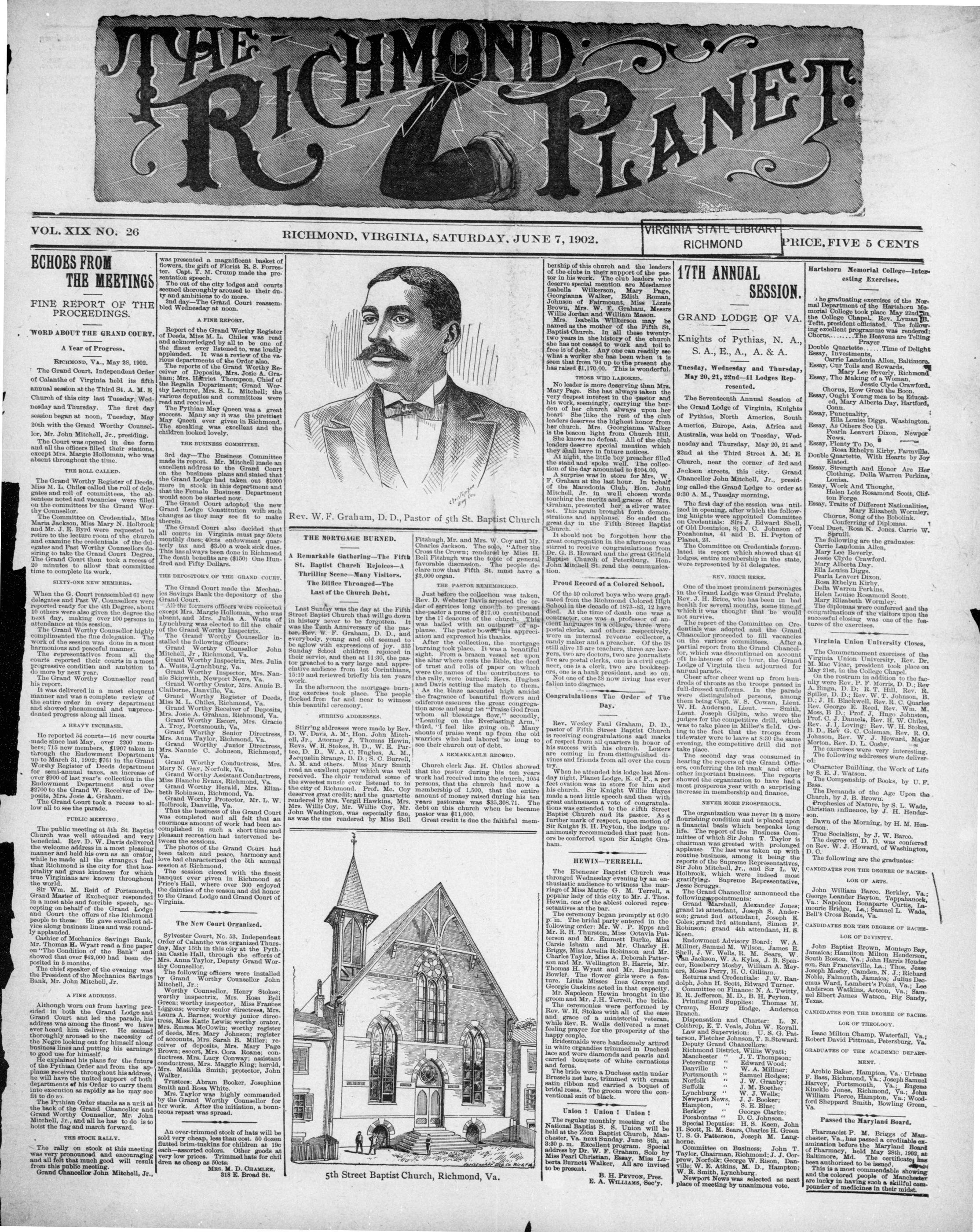
Page text (machine-generated)
THE RICHMOND PLANET
VOL. XIX NO. 26
ECHOES FROM THE MEETINGS
FINE REPORT OF THE PROCEDINGS.
WORD ABOUT THE GRAND COURT.
A Year of Progress.
RICHMOND, VA., May 28, 1902. The Grand Court, Independent Order of Calanthe of Virginia held its fifth annual session at the Third St. A. M. E. Church of this city last Tuesday, Wednesday and Thursday. The first day session began at noon, Tuesday, May 20th with the Grand Worthy Counsellor, Mr. John Mitchell, Jr., presiding. The Court was opened in due form and all the officers filled their stations, except Mrs. Margie Holloman, who was absent throughout the time.
THE ROLL CALLED.
The Grand Worthy Register of Deeds, Miss M. L. Chiles called the roll of delegates and roll of committees, the absentees noted and vacancies were filled on the committees by the Grand Worthy Counselor. The Committee on Credentials, Miss Maria Jackson, Miss Mary N. Holbrook and Mr. J. E. Byrd were requested to retire to the lecture room of the church and examine the credentials of the delegates and Past Worthy Counsellors desiring to take the Grand Court Degrees. The Grand Court then took a recess of 20 minutes to allow that committee time to complete its work.
SIXTY-ONE NEW MEMBERS.
When the G. Court reassembled 61 new delegates and Past W. Counsellors were reported ready for the 4th Degree, about 10 others were also given the degree the next day, making over 100 persons in attendance at this session.
The Grand Worthy Counsellor highly complimented the fine delegation. The work of the session was done in a most harmonious and peaceful manner.
The representatives from all the courts reported their courts in a most progressive condition and ambition to do more by next year.
The Grand Worthy Counsellor read his report.
It was delivered in a most eloquent manner and was a complete review of the entire order in every department and showed phenomenal and unprecedented progress along all lines.
A HEAVY INCREASE
He reported 54 courts—16 new courts made since last May, over 2200 members; 715 new members, $1907 taken in through the Endowment Department up to March 31, 1902; $761 in the Grand Worthy Register of Deeds department for semi-annual taxes, an increase of $800 of last year's collection in the Endowment Department and over $2700 to the Grand Court to receive of Depositions, Mrs. Josie A. Graham. The Grand Court took a recess to allow all to see the parade.
PUBLIC MEETING
The public meeting at 5th St. Baptist Church was well attended and very beneficial. Rev. D. W. D. Wavis delivered the welcome address in a most pleasing manner and held his own as an orator, while he made all the strange's feel that Richmond is the city for that hospitality and great kindness for which true Virginians are known throughout the world.
Sir Wm. M. Reid of Portsmouth, Grand Master of Exchequer responded in a most able and forcible speech, accepting on behalf of the Grand Lodge and Court the offers of the Richmond people to them. He gave excellent advice along business lines and was roundly applauded.
Cashier of Mechanics Savings Bank, Mr. Thomas H. Wyatt read a fine paper on "The Condition of the Bank" and showed that over $42,000 had been deposited in 5 months.
The chief speaker of the evening was the President of the Mechanics Savings Bank, Mr. John Mitchell, Jr.
A FINE ADDRESS.
Although worn out from having presided in both the Grand Lodge and Grand Court and led the parade, his address was among the finest we have ever heard him deliver. He seemed thoroughly aroused to the necessity of the Negro looking out for himself along business lines and putting his earnings to good use for himself. He explained his plans for the future of the Pythian Order and from the applause received throughout his address, he have the united support of both departments of his Order to carry them into execution as rapidly as he may see fit to do so. The Pythian Order stands as a unit at the back of the Grand Chancellor and Grand Worthy Counsellor, Mr. John Mitchell, Jr., and all he has to do is to hoist the flag and march forward.
THE STOCK RALLY
The rally on stock at this meeting was very pronounced and encouraging and all felt that much good will result from this public meeting.
Grand Chancellor John Mitchell, Jr.
was presented a magnificent basket of flowers, the gift of Florist R. S. Forrester. Capt. T. M. Crump made the presentation speech. The out of the city lodges and courts seemed thoroughly aroused to their duty and ambitions to do more.
2nd day—The Grand Court reassembled Wednesday at noon.
A FINE REPORT
Report of the Grand Worthy Register of Deeds, Miss M. L. Chiles was read and acknowledged by all to be one of the finest ever listened to, was loudly applauded. It was a review of the various departments of the Order also. The reports of the Grand Worthy Receiver of Deposits, Mrs. Josie A. Graham; Mrs. Harriet Thompson, Chief of the Regalia Department; Grand Worthy Lecturer, Mrs. S. L. Mitchell; the various deputies and committees were read and received. The Pythian May Queen was a great success. Many say it was the prettiest May Queen ever given in Richmond. The speaking was excellent and the children looked lovely.
THE BUSINESS COMMITTER.
3rd day—The Business Committee made its report. Mr. Mitchell made an excellent address to the Grand Court on the business plans and stated that the Grand Lodge had taken out $1000 more in stock in this department and that the Female Business Department would soon be started now.
The Grand Court adopted the new Grand Lodge Constitution with such changes as they may see fit to make that change.
The Grand Court also decided that all courts in Virginia must pay 50cts monthly dues; 40cts endowment quarterly tax and $3.00 a week dues. This has always been done in Richmond. The death benefits are ($150) One hundred and Fifty Dollars.
THE DEPOSITORY OF THE GRAND COURT
The Grand Court made the Mechanics Savings Bank the depository of the Grand Court.
All the formers officers were reelected except Mrs. Margie Holloman, who was absent, and Mrs. Julia A. Watts of Lynchburg was elected to fill the chair of the Grand Worthy Inspectrix.
The Grand Worthy Counsellor installed the following officers:
Grand Worthy Counsellor John Mitchell, Jr., Richmond, Va.
Grand Worthy Inspectrix, Mrs. Julia A. Watts, Lynchburg, Va.
Thus the business of the Grand Court was completed and all felt that an enormous amount of work had been accomplished in such a short time and pleasant recreation had intervened between the sessions.
The photos of the Grand Court had been taken and peace, harmony and love had characterized the 5th annual session at Richmond.
The session closed with the finest banquet ever given in Richmond at Price's Hall, where over 300 enjoyed the dainties of the season and did honor to the Grand Lodge and Grand Court of Virginia.
The New Court Organized.
Sylvester Court, No. 53, Independent Order of Calanthe was organized Thursday, May 15th in this city at the Pythian Castle Hall, through the efforts of Mrs. Anna Taylor, Deputy Grand Worthy Counsellor.
The following officers were installed by Grand Worthy Counsellor John Mitchell, Jr.:
Worthy Counsellor, Henry Stokes; worthy inspectrix, Mrs. Rosa Bell Green; worthy inspector, Miss Frances Liggons; worthy senior directress, Mrs. Laura A. Barnes; worthy junior directress, Miss Katie Lewis; worthy orator, Mrs. Emma McCowin; worthy register of deeds, Mrs. Mary Johnson; register of accounts, Mrs. Sarah B. Miller; receiver of deposits, Mrs. Mary Page Brown; escort, Mrs. Cora Roane; conductress, Mrs. Lucy Conway; assistant conductress, Mrs. Maggie King; heruld, Mrs. Matilda Smith; protector, John Walker.
Trustees: Abram Booker, Josephine Smith and Rosa White.
Mrs. Taylor was highly commended by the Grand Worthy Counsellor for her work. After the initiation, a bounteous repast was spread.
An over-trimmed stock of hats will be sold very cheap, less than cost. 50 dozen fluffed brim-tuskins for children at 18c each--assorted colors. Other goods at very low prices. Trimmed hats for child dren as cheap as 50cts.
MRS. M. M. D. CHAMLEE,
318 E. Broad St.
RICHMOND, VIRGINIA, SATURDAY, JUNE 7, 1902.
Christopher Bray Co.
Rev. W. F. Graham, D. D., Pastor of 5th St. Baptist Church
CHURCH OF THE LORD'S SUNDAY SERVICE
5th Street Baptist Church, Richmond, Va.
A Remarkable Gathering—The Fifth St. Baptist Church Rejoices—A Thrilling Scene—Many Visitors. The Eifice Thronged—The Last of the Church Debt.
Last Sunday was the day at the Fifth Street Baptist Church that will go down in history never to be forgotten. It was the Tenth Anniversary of the pastor, Rev. W. F. Graham, D. D., and everybody, young and old seemed to be aglow with expressions of joy. 335 Sunday School children rejoiced in their service, and then at 11:30, the pastor preached to a very large and appreciative audience from 1st Corinthians, 15:10 and reviewed his ten years with them. In the afternoon the mortgage burning exercises took place. The people flocked from far and near to witness this beautiful ceremony.
STIRRING ADDRESSES
Stirring addresses were made by Rev. D. W. Davis, A. M. Hon, John Mitchell, Jr., Attorney J. Thomas Hewin, Revs. W. H. Stokes, B. D., W. E. Partee, D. D., W. A. C. Hughes, A. M. Jacquintrone Strang, D. D.; S. C. Burrell, A. M. and others. Miss Mary Smith read an excellent paper which was well received. The choir rendered some of the sweetest music ever listened to in the city of Richmond. Prof. Mc. Coy deserves great credit; and the quartette rendered by Mrs. Vergil Hawkins, Mrs. Mrs. Willie Coy, Mr. Willie Coy, Mr. John Washington, was especially fine, as was the one rendered by Miss Bell
Fitzzhugh, Mr. and Mrs. W. Coy and Mr. Charles Jackson. The solo, "After the Cross the Crown; rendered by Miss H. Bell Fitzzhugh was the topic of general favorable discussion. The people declare now that Fifth St. must have a $2,000 organ.
THE PASTOR REMEMBERED
Just before the collection was taken, Rev. D. Webster Davis arrested the order of services long enough to present the pastor a purse of $17.00 contributed by the 17 deacons of the church. This was hailed with an outburst of applause. The pastor bowed his appreciation and expressed his thanks.
After the collection, the mortgage burning took place. It was a beautiful sight. From a brazen vessel set upon the altar where rests the Bible, the deed of trust and rolls of paper on which were the names of the contributors to the rally, were burned; Revs. Hughes and Davis setting the match to them. As the blaze ascended high amidst the fragrance of beautiful flowers and odiferous essences the great congregation arose and sang 1st "Praise God from whom all blessings flow," secondly, "Leaning on the Everlasting Arm," third, "I feel like going on." Many shoats of praise went up from the old warriors who had labored so long to see their church out of debt.
A REMARKABLE RECORD.
Church clerk Jas. H. Chiles showed that the pastor during his ten years work had received into the church, 1054 persons, that the church had now a membership of 1,500, that the entire amount of money raised during his ten years pastorate was $35,308,71. The debt on this church when he became pastor was $11,000. Great credit is due the faithful mem-
bership of this church and the leaders of the clubs in their support of the pastor in his work. The club leaders who deserve special mention are Mesdames Isabella Wilkerson, Mary Page, Georgiana Walker, Edith Roman, Johnson of Fairmount, Miss Lizzie Brown, Mrs. W. F. Graham, Mossrs Willie Jordan and William Mason. Mrs. Isabella Wilkerson may be named as the mother of the Fifth St. Baptist Church. In all these twenty-two years in the history of the church she has not ceased to work and toil to free it of debt. Any one can readily see what a worker she has been when it is seen that from '14 up to the present she has raised $1,700.00. This is wonderful.
THOSE WHO LABORED.
No leader is more deserving than Mrs. Mary Page. She has always taken the very deepest interest in the pastor and his work, seemingly, carrying the burden of her church always upon her heart. She 'like the rest of the club leaders deserves the highest honor from her church. Mrs. Georgianna Walker is the beacon light from Church Hill. The club leaders deserve no defeat. All of the club leaders deserve no mention, which they shall have in future meetings. At night, the little boy preacher filled the stand and spoke well. The collection of the day amounted to $104.00.
A surprise was in store for Mrs. W, F. Graham at the last hour. In behalf of the Macedonia Club, Hon. John Mitchell, Jr. in well chosen words touching the merits and graces of Mrs. Graham, presented her a silver water set. This again brought forth demonstrations and applause. So ended the great day in the Fifth Street Baptist Church.
It should not be forgotten how the great congregation in the afternoon was stirred by congratulations from Dr. G. B. Howard the great Gillfield Baptist Church of Petersburg. Hon. John Mitchell St. read the communication.
Proud Record of a Colored School.
Of the 50 colored boys who were graduated from the Richmond Colored High School in the decade of 1878-83, 12 have died. At the time of death one was a contractor, one was a professor of ancient languages in a college, three were postal clerks, and others, respectively, were an internal revenue collector, a candy maker and a preacher. Of the 38 still alive 13 are teachers, three are lawyers, two are doctors, two are journalists five are postal clerks, one is a civil engineer, one is a clerk, two are bookkeepers, one is a bank president, and so on.
Not one of the 38 now living has ever fallen into disrace.
Rev. Wesley Faul Graham, D. D., pastor of Fifth Street Baptist Church is receiving congratulations and marks of respect from all quarters in honor of his success with his church. Letters are coming in from distinguished divines and friends from all over the country. When he attended his lodge last Monday night, Planet Lodge, K. of P., a perfect vocation was in store for him and his church. Sir Knight Willie Hayes made a neat little speech and then with great enthusiasm a vote of congratulations was extended to the fifth Street Baptist Church and its pastor. As a Knight H. B. H. respect, upon motion of Knight B. H. Peyton, the lodge unanimously recommended that past honors be conferred upon Sir Knight Graham.
HEWIN—TERRELL:
The Ebenezer Baptist Church was thronged Wednesday evening by an enthusiastic audience to witness the marriage of Miss Mattie G. M. Terrell, a popular lady of this city to Mr. J. Thos. Hewin, one of the ablest colored representatives at the bar.
The ceremony began promptly at 6:30 p.m. The bridal party entered in the following order: Mr. W. P. Epps and Mr. R. H. Thurston, Miss Octavia Patterson and Mr. Emmett Burke, Miss Carsie Isham and Mr. Charley H. Briggs, Miss Artela Robinson and Mr. Charles Taylor, Miss A. Deborah Patterson and Mr. Wellington B. Harris, Mr. Thomas H. Wyatt and Mr. Benjamin Bowler. The flower girls were a feature. Little Misses Inez Graves and George Gaskins acted in that capacity. Mr. Napoleon Hewin brought in the groom and Mr. J. H. Terrell, the bride.
The ceremonies were performed by Rev. W. H. Stokes with all of the ease and grace of a ministerial veteran, while Rev. R. Wells delivered a most feeling prayer for the prosperity of the happy couple.
Bridesmaids were handsomely attired in white organies trimmed in Duchess lace and wore diamonds and pearls and carried bouquets of white carnations and ferns.
The bride wore a Duchess satin under Brussels net lace, trimmed with cream satin ribbon and carried a bouquet of bridal roses. The groom wore the conventional suit of black.
Union ! Union ! Union !
The regular monthly meeting of the National Baptist S. S. Union will be held at the Zion Baptist Church, Manchester, Va. next Sunday. June 8th, at 3:30 p.m. Excellent program. Special address by Dr. W. Graham, Soly by Miss Pearl Christian, Essay, Miss Liberta Burnett Walker, All are inviated to be present. B. H. PEYTON, Pres. E. A. WILLIAMS, Secy.
17TH ANNUAL SESSION.
GRAND LODGE QF VA.
Knights of Pythias, N. A..
Tuesday, Wednesday and Thursday,
May 20, 21, 22nd—41 Lodges Represented.
The Seventeenth Annual Session of the Grand Lodge of Virginia, Knights of Pythias, North America, South America, Europe, Asia, Africa and Australia, was held on Tuesday, Wednesday and Thursday, May 20, 21 and 22nd at the Third Street A. M. E. Church, near the corner of 3rd and Jackson streets, this city. Grand Chancellor John Mitchell, Jr., presiding called the Grand Lodge to order at 9:30 A. M., Tuesday morning.
The first day of the session was utilized in opening, after which the following knights were appointed Committee on Credentials: Sirs J. Edward Shell, of Old Dominion, 8; D. C. Johnson of Pocahontas, 41 and B. H. Peyton of Roberts. The Committee on Credentials formulated its report which showed that 41 lodges, entire membership in the state, were represented by 51 delegates.
REV. BRICE HERE.
One of the most prominent personages in the Grand Lodge was Grand Prelate, Rev. J. H. Brice, who has been in bad health for several months, some time of which it was thought that he would not survive.
The report of the Committee on Credentials was adopted and the Grand Chancellor proceeded to fill vacancies on the various committees. After a partial report from the Grand Chancellor, which was discontinued on account off the lateness of the hour, the Grand Lodge of Virginia then adjourned for annual parade.
Cheer after cheer went up from hundreds of throats as the troops passed in full-dressed uniforms. In the parade were distinguished persons, among them being Capt. W. S. Cowan, Lieut. W. H. Anderson, Lieut. — Smith, Lieut. Joseph Gilpin, who were the judges for the competitive drill, which was to take place in Miller's field. Owing to the fact that the troops from tidewater were to leave at 8:30 the same evening, the competitive drill did not take place.
The second day was consumed in hearing the reports of the Grand Officers, conferring the 5th rank and other other important business. The reports were to have had a most prosperous year with a greater increase in membership and finance.
NEVER MORE PROSPEROUS
The organization was never in a more flourishing condition and is placed upon a financial basis which bespeaks long life. The report of the Business Committee of which Sir John T. Taylor is chairman was greeted with prolonged applause. The last was taken up with routine business, among it being the reports of the Supreme Representatives, Sir John Mitchell, Jr., and Sir L. W. Holbrook, which were indeed most grating. Supreme Representative, Jesse Singsge. The Grand Chancellor announced the following appointments:
Grand Marshall, Alexander Jones; grand 1st attendant, Joseph S. Anderson; grand 2nd attendant, Joseph E. Coles; grand 3rd attendant, Simon P. Robinson; grand 4th attendant, H. S. Keen.
Endowment Advisory Board: W. A. Millner, Samuel M. Wilson, James E. Shell, J. W. Wells, R. M. Sears, W. Van Jackson, W. A. Kyles, J. B. Spencer, Roseberry Mosby, William A. Meyers, Moses Perry, H. C. Gilliam.
Returns and Oredentials: J. W. Randolph, John H. Scott, Edward Turner. Committee on Finance: N. A. Twitty, F. R. Jefferson, M. A.
Committee on Finance: N. A. Twitty,
E. R. Jefferson, M. D., B. H. Peyton.
Printing and Supplies: Thomas M. Crump, Henry Hodge, Anderson Branch.
Dispensation and Charter: L. N. Colthrop, E. T. Veals, John W. Royall. Law and Supervision: U. S. G. Patterson, Fletcher Johnson, T. B. Steward. Deputy Grand Chancellors: Richmond District, Willis Wyatt; Manchester " J. T. Thompson; Petersburg " Edward Wood; Danville " W. A. Millner; Portsmouth " Samuel Hotges; Norfolk " J. W. Granby; Suffolk " J. M. Boothe; Lynchburg " W. J. Wells; Newport News, J. J. Booker; Hampton, " S. E. Blue; Berkley " George Clarke; Pocahontas " D. C. Johnson.
Special Deputies: H. S. Keen, John H. Scott, R. M. Sears, Charles H. Green U. S. G. Patterson, Joseph M. Langhorne.
Committee on Business; John T. Taylor, Chairman, Richmond; J. J. Corprew, Norfolk; George W. Rison, Dan, E. Eakins, M. D., Hampton, W. R. Smith, Newport News was selected as next place of meeting by unanimous vote.
Hartshorn Memorial College—Interesting Exercises.
the graduating exercises of the Normal Department of the Hartshorn Memorial College took place May 22nd in the College Chapel, Rev. Lyman B. Tefft, president officiated. The following excellent programme was rendered: Chorus..... The Heavens are Telling Prayer Double Quartette..... Time of Delight Essay, Investments, Carrie Landonia Allen, Balsamorn Essay, Our Toils and Rewards.
Jessie Clyde Crawford.
Chorus, Great the Boom.
Essay, Quch Your Dream.
Mississippi. How Great the Boom.
Essay. Onset. Young men to be Educated,
Mary Alberta Day, Hartford,
Conn.
Essay. Punctuality.
Ella Louise Diggs, Washington.
Essay. As Others See Us.
Pearla Leavert Dixon, Newpor
Newpor.
Essay. To Do.
Essay, Plenty To Do,
Rosa Ethyln Kirhy, Farmville.
Double Quartette, With Hearts by Joy
Elated.
Essay, Strength and Honor Are Her
Clothing, Della Warren Perkins,
Louisa.
Essay, Work And Thought,
Helen Lois Rosamond Scott, Clifton Forge.
Meeting of Diplomas.
Vocal Duee, Rosa K. Jones, Carrie W.
Sprulli
The following are the graduates:
Carrie Landonia Allen,
Mary Lee Beverly.
Jessie Clyde Crawford.
Mary Alberta Day.
Ella Louisa Diggs.
Pearla Leavert Dixon.
Rosa Ethelyn Kirby.
Della Warren Perkins.
Helen Louise Rosamond Scott.
Mary Elizabeth Wormley.
The diplomas were conferred and the
congratulations of the visitors upon the
successful closing was one of the features
of the exercises.
Virginia Union University Closes.
The Commencement exercises of the Virginia Union University. Rev. Dr. M. Mac Vicar, president took place on May 21st, in the College Chapel.
On the rostrum in addition to the faculty were Rev. P. F. Morris, D. D.; Rev. A. Binga, D. D.; R. T. Hill, Rev. R. Spiller, D. D.; Rev. W. T. Johnson, B. D.; J. H. Blackwell, Rev. R. C. Quarles, Rev. George E. Reed, Rev. Wm. M. Moss, B. D.; Prof. J. Hugo Johnston, Prof. C. J. Daniels, Rev. H. W. Chiles, Rev. J. I. Loving; Rev. W. H. Stokes, B. D., Rev. G. C. Coleman, Rev. R. O. Johnson, Rev. W. J. Howard, Major Morton, Rev. D. L. Cosby.
The exercises were very interesting.
The following addresses were delivered:
Character Building, the Work of Life by S. E. J. Watson.
The Companship of Books, by U. F. Bass.
The Demands of the Age Upon the Church, by J. B. Brown.
Prophesies of Nature, by S. L. Wade, Christian influence, by J. H. Henderson.
Dawn of the Morning, by H. M. Henderson.
True Socialism, by J. W. Barco.
The degree of D. D. was conferred on Rev. W. J. Howard, of Washington, D. C.
The following are the graduates:
CANDIDATES FOR THE DEGREE OF BACHELOR OF ARTS.
John William Barco. Berkley, Va.; George Leander Bayton, Tappanahock, Va.: Napoleon Bonaparte Curtis, Lamourie Bridge, La.; Samuel L. Wade, Bell's Cross Roads, Va.
CANDIDATES FOR THE DEGREE OF BACHELOR OF ARTS.
LOR OF DIVINITY
John Baptist Brown, Montego Bay, Jamaica; Hamilton Milton Henderson, South Boston, Va.; John Harris Henderson, San Francisville, La.; Thos. Jesse Joseph Mosby, Camden, N. J.; Richard Noble, Falmouth, Jamaica; Julius Doeumus Ward, Lambert's Point, Va.; Lee Anderson Watkins, Acteon, Va.; Samuel Elbert James Watson, Big Sandy, Texas.
Isaac Milton Champ, Waterfall, Va.; Robert David Pittman, Petersburg, Va.
GRADUATES OF THE ACADEMIC DEPART
Archie Baker, Hampton, Va. 'Urbana F. Bass, Richmond, Va.; Joseph Samuel harvey, Portsmouth, Va.; Engene Kirkman, Jones, Richmond, Va.; John William Pierce, Hampton, Va.; Woodford Sheppard Smith, Bowling Green, Va.
Passed the Maryland Board.
Pharmacist P. M. Briggs of Manchester, Va., has passed a creditable examination before the Maryland Board of Pharmacy, held May 28th, 1902, at Baltimore, Md. The certificate has been authorized to be issued. This is a most commendable showing and the colored people of Manchester are lucky in having such a skillful compounder of medicines in their midst.
NEW PLANET
SATURDAY, JUNE 7, 1902.
"REALISM."
through the window wide.
To reveal the scowling villain, lamping
from the dark outside.
While the rain is pouring, pouring, and
the hero, warmly cloaked.
Pause on the threshold to observe
that he is saddened.
See the canvas houses tremble in the fury
of the rage.
And the heroine, poor creature, look all terrified and pale.
Oh, the dread of those dark moments, there amid that awful din.
But the hero weathers safely all the fury of the storm.
Braves the shot that makes the rain fall, and escapes quite dry and warm.
While the villain, like an Ajax, gives the thunder to the firefighters.
And amid those blazing flashes smokes the prop man's pipe the white.
Hear the solemn curwen ringing at the tender close of day.
As the molten notes go floating 'o'er the hills and far away.
See the peasants streaming homeward and the body twilight's glow.
Listening to the bell's ringing as along their way they go.
**How** the solenoid spell is carried till it thrills
the very air,
And o'ercomes those simple people as they stand bareheaded there.
What a flood of sweet emotion that melodious music brings.
As it's hammered from a crowbar that's thumped by the wings.
-Portland, Oregonian.
Cobb's Love Story
By BLANCHE A. DONALDSON.
CORNWALLIS COBB—Corn Cobb, as he was familiarly called by his associates—was indubitably a more ludicrous than elegant name.
Katherine never knew why he should be so burdened, except that Cornwallis was an old family name, "as though that were any reason," she once remarked indignantly, "to mark a man through life."
She remembered vividly when she had considered it the most ridiculous name in the world, but somehow today, as she thought of a tall, handsome man she had met on Regent street in the morning, the absurd side did not appeal to her so strongly.
Before that chance meeting it had been four years since she had seen him in a small town in New Jersey, where, after leaving Princeton, he had laid his heart and worldly goods at her feet.
In the interval the Cobb exchequer had been materially increased through the death of a near relative. Cornwallis, tall and ungainly in those days, smarting under Katherine's ungracious refusal, shook the dust of his native town from his feet and sailed to Germany to study.
For the first time, in looking back over this episode, Katherine realized how disdainful had been her refusal. When pressed for a reason, she had replied with unblushing candor that she never could care for a man whose
"THEY MUST 'AVE COST A 'EAP'"
name was Corn Cobb, no matter what merits he possessed.
But that morning, when he had almost stumbled over her in a depressing London fog, he seemed to feel nothing but the utmost pleasure in the unexpected meeting.
In a delicate way he drew from her the account of her father's death and the necessity now laid upon her of earning her own living, all of which was news to him. Her voice and powers of mimicry she told him were her only gifts, and on the advice of a friend who had lived abroad she had come to London and found employment in singing coon songs in the drawing-rooms of people of wealth and title.
Katherine Whitney had come to London six months before with eager relief, to escape the poverty which faced her in her own country, but though well received, she never forgot her position; she was hired at so much to entertain my lady's guests, and when that was over they had no further use for her.
In former days she had looked upon the Cobbs with amused tolerance at their lavish display, feeling an inborn sense of pride that though poor, she was a Whitney, and one of
her ancestors had signed the declaration of independence.
From childhood she had hated poverty; it meant to her a cramped, narrow life; desires that could not be fulfilled, generosities that could not be gratified, and yet, when a way of escape had presented itself in the person of Cornwallis Cobb, she had decided that there could perhaps be more distasteful experiences than poverty.
That night Katherine amused herself by reading the society news in the Queen. The high-sounding titles interested her and beguiled the time, for she had made few friends in London, and found people not eager to welcome a stranger.
Suddenly among the names that met her eye she saw one that she recognized—it was Cornwallis Cobb. The item read: "Mr. Cornwallis Cobb, one of America's young millionaires, is being entertained by Lady Henry Clayborne, at Clayborne manor, Yorkshire. Rumor has it that a marriage has been arranged between Mr. Cobb and Lady Clayborne's eldest daughter, Lady Marian Clayborne." Katherine could not help a regretful feeling. It was like finding a friend and then losing him suddenly forever. Lady Clayborne was evidently not averse to the name of Cobb, and Katherine laughed a little to herself at her former feeling of condescension to the Cobbs.
It was nearly ten days before Cobb called, as he had promised. When day by day, passed without any sign from him Katherine was conscious of a distinct sense of disappointment, and she concluded his other social duties had made him forget her.
But one morning there arrived a big bunch of violets. The maid who brought them in to her was overcome by the size.
"Laws, Miss," she exclaimed, with delight, "they must 'ave cost a 'aep!' That evening Cobb called, and explained that he had been summoned to Paris suddenly the day atefr he had last seen her, and had just come back.
It was wonderful how many things they had to talk about as they sat there in the shabby little back drawing-room. Katherine seemed to forget, she had never shown him so much of herself before, it was so natural to be talking to him about things that interested her most.
It was a fortnight later that she was engaged to sing at Lady Leeland's reception. Her head ached, and her eyes were dazzled by the blaze of lights and jewels.
Suddenly she saw moving across the room Cornwallis Cobb, on whose arm leaned a tall, pretty girl. Someone near by whispered it was Lady Marian Clayborne.
For a moment her heart beat violently, and then Lady Leeland moved over and motioned her to sing. It was a catchy little coon song, and when she finished it it was greeted with well-bred applause. Lady Marian had come so near that she could hear her remark to her companion:
"Clever little thing—quite an air about her!"
Katherine took elaborate care not to look in their direction, and did not hear his reply, but the patronizing tone of the girl's voice filled her with indignation. The evening seemed terribly long drawn out, and Katherine thought it would never end. She found herself sitting in a corner alone just after refreshments were served, when she heard her name mentioned by two rather dissipated-looking youths, who stood ogling her not far away. That their conversation was meant for her to hear she had not the least doubt, and her face burned.
"She looks a jolly sort," said one "I have half a mind to ask her out in the conservatory. Thea Americans do anything."
"Aw, quite so," assented the other. "Go and ask her and I'll join you later." At this moment Sig Maroni, the little man who played the 'cello came forward and pompously offered his arm to conduct her to a small retreat where members of the profession were served by themselves.
She rose with relief at his appearance, when, to her surprise, Cobb suddenly stepped forward, and with a slight bow to Maroni explained that Miss Whitney had promised him the honor of serving her, and before she knew what to say, Cobb was bending over her in the conservatory.
"Confound the impertinence of those idiots!" he said, angrily. "Did they frighten you?"
"O, no," replied Katherine, faintly. "I had a headache, that was all"—and with energy—"I hate this sort of thing!"
"You mean—"
"Yes, I mean this amusing people," she interrupted. "Their insults madden me."
"O. Katherine, let's run away from it all," he began, with sudden eagerness. "I would be so good to you, but then—" a long pause.
"O, my confounded name," he replied, bitterly. "You know you told me once you would never marry a Corn Cob."
"Yes," she said, with a proud little gesture, laying her hand on his sleeve. "I know I said it once, but that was before I cared; now" her voice was very low "there is nothing in the world so sweet to me as to be Mrs. Cornwallis Cobb."—Vogue.
Changed His Mind
A young officer had been ordered to the Philippines. According to a western paper, he received the following telegram from the war department at Washington:
"You can go to New York, and sail on transport that goes by Suez."
The officer replied: "Would prefer to cross Pacific direct."
Then the department telegraphed him again: "Transport will make good time; has 60 women school teachers on board."
The young lieutenant answered: "Save me a berth on transport."—Youth's Companion.
Evidently Innocent.
First Thug-De jury acquitted Bill uv dat murder charge widout leaving deir seats.
Second Thug—Did Bill prove his innocence?
First Thug—Sure! He proved dat no woman had fallen in love wit' him since he's been in jail, nor sent him any bouquets, or jelly, or photografts!—Puck.
while preparing his canny croscourse he was suddenly called away from his desk on a mission of mercy. The sentence at which he left off was: "I never see a young man of splendid physique and the promise of a glorious manhood almost reak
CURES W
Insure Love a
How any man
self after years
PRESENCE OF MIND.
To It a Philadelphia Workman Owes His Escape from Almost Certain and Terrible Death.
By a rare exhibition of presence of mind Harry Brown, of Philadelphia, saved his life. When a huge sheet steel smokestack on which he was working toppled and started to fall, he dived inside it.
Brown was at work on a new building four stories high. A score of men were engaged in placing the smokestack, which is 30 feet long and five feet in diameter, on its brick base at the top of the building. It had been hoisted with powerful pulleys, and Brown was on top of the stack steering it into place.
Suddenly there was a shock and a sharp grating noise. Brown realized
SLOWLY CRAWLING OUT
that the tackle was slipping, and that the metal cylinder was certain to crash down through the maze of steel beams between him and the ground. Like a flash he dropped the guide rope and dived into the stack just as it started to fall. It dropped with a tremendous clatter and bounded from one steel beam to another until it struck the ground 50 feet below, with Brown still inside. His comrades hurried to the spot, expecting to find him crushed to death. When they looked into the stack he was slowly crawling out. He said he didn't think he was much hurt, but an ambulance surgeon found the right leg broken and one shoulder bruised.
"It was rather a close call, wasn't it?" said Brown. "Oddly enough, while I was being drawn up with the stack I was wondering what I would do if the tackle should break. Only a few seconds before I saw the stack begin to topple I had decided that my only chance was to jump inside of the stack and go down with it.
"I would surely have been killed had I fallen down the steel frame work. I knew if I could stick inside of the stack it would protect me from the beams and would give me a chance of getting out alive. I barely had time to make the dive, for I was losing my balance as the tackle slipped."
FROG IN HER STOMACH
Operation for Appendicitis in a New York Hospital Leads to an Astonishing Result.
A large frog was removed from a woman's stomach in St. Catherine's hospital, in Williamsburg, N. Y., the other day. The woman is Mrs. Charles Burtis, of Hopewell Junction, near Mattewan, N. Y. She had been suffering from a trouble which baffled her physicians for some time. It was finally decided that an operation for appendicitis would be advisable, and
PHYSICIAN WAS BAFFLED
she was taken to the Williamsburg hospital.
A Fishkill (N. Y.) doctor performed the operation, which revealed that she was not suffering from appendicitis. But the doctors did discover and remove from her stomach a live frog, said to have been five inches long. It is supposed that she swallowed the frog when it was small while she was drinking water.
It was said at the hospital that Mrs. Burtis had already returned to her home and had recovered entirely from the ill effects of her unpleasant experience.
Big Lot of Freight Cars.
In the past four years, at Pittsburg, Pa., 40,578 cars have been built, using over 202,890,000 pounds of iron and steel. If these cars were placed end to end, and allowing for length of coupling three feet, they would make a train 270 miles long, would carry 4,057,200,000 pounds of freight, and the total weight of cars and freight would be over 4,260,090,000 pounds.
Pa Expressed Her Sentiments.
It is related of a clergyman who was the happy father of a charming and beautiful daughter that one day
while preparing his Sunday course
he was suddenly called away from
his desk on a mission of mercy. The
sentence at which he left off was
this: "I never see a young man of
splendid physique and the promise
of a glorious manhood almost real-
ized but my heart is filled with
rapture and delight."
His daughter, happening to enter
the study, saw the sermon and read
the words. Sitting down, she wrote
underneath: "Them's my sentiments,
papa, exactly."—Tit-Bits.
In Spirit and in Truth.
"One swallow does not make a spring."
That's patent to the minds of all.
But copious shows surely bring
In time, a most distressing fall.
—Boston Courier.
THREE OF A KIND.
"Say, Cindy, why is de man dat owns dos chickens, de chickens demselves and you all alike?"
Sam-'Cause you're all three laying
for me - St. Louis Globe-Heueretz.
In the Whirl.
We long for rest—for rest and play.
Our heart gives forth but weary throbs.
We long to rest, but never may.
Lest others come and get our jobs.
We long to rest.
Marrying for Title
"Well, that Miss Willing is an American girl who is not after a title. She has refused the attentions of the duke and engaged herself to that Mr. Robert Acres, who passes most of his time on his ranches."
"You're wrong, my dear fellow; for it's the title to the ranches that she has in mind."—N. Y. Herald.
Pleasant for the Caller.
"Mamma is dressing."
"Why, she needn't have dressed just for me, dearie."
"She knows that, but she said the more time she killed in dressing the less time you'd have to bore her."—Indianapolis News.
Vital Question
Simkins-It's so long since we met that doubtless you never heard of my marriage.
Timkins-No. Is it recent enough for congratulations or remote enough for sympathies?—Chicago Daily News.
An Annoying Question
Teddy-Mamma, Tommy knocked me down on the way home from school to-day. (After a pause.) But I gave him a bat in the eye! Mamma-Before he knocked you down, Teddy, or afterward?-Somerville (Mass.) Journal.
The Hardened Cynic.
"When the average fashionable woman smiles sweetly at another fashionable woman," said the hardened cynic, "it is to show her placid indifference for the other's contemptuous dislike."—Los Angeles Herald.
Pearls
"Pearls," remarked the wise guy, "are emblematic of tears."
"I guess that's right," agreed the simple mugg. "My wife cries because I can't afford to buy her any."—Philadelphia Record.
She Enjoys a Monopoly
Gobang—Does your wife always insist on having the last word in an argument?
Grymes—Sure. So anxious is she about it that she has all the words.—Brooklyn Life.
**Not to Be Surprised.**
Boarder (warmly)—Oh, I know every one of the tricks of your trade. Do you think I have lived in boarding houses 20 years for nothing? Landlady (frigidly)—I shouldn't be at all surprised.—Tit-Bits.
**The Cook Lady's Favorite.**
Mr. Hauskeep—Here's the roast beef cooked to death again. Can't we ever have it rare? Mrs. Hauskeep—I'm afraid not. The policeman on this beat likes his meat well done.—Philadelphia Press.
Chicago Nerve
The Maid—In Shekaggy, I'm ather radin', the misthrusses trates their hilp as aquals.
The Cook—Och, the nerve av thim Shekaggyans!—Town Topics.
His Advantage.
"Then you are not the first boy in your class?"
"No; but I know how to get a lot more fun out of going to school than he does!"—Puck.
A Peculiarity of Conscience.
"I suppose you will vote according to your conscience?" said the friend.
"I will," answered the politician, who is sadly practical.
"Peculiarity considerations will not figure."
"Well, I don't know. There's nothing that hurts my conscience more than to feel that I have been wasting money."—Washington Star.
Population of the Philippines.
In a recent table giving the population of various parts of the Orient, the American possessions in the Philippines are described as follows: Area in square kilometers, 296,310; total population, 7,000,000; population per square kilometer, 27.—N. Y. Herald.
Approves of the Club
"So you approve of the woman's club?"
"Yes. I find that my wife gets all the debating that she wants there, and so we have less of it at home." Chicago Post.
CURES WEAK MEN FREE.
How any man may quickly cure himself after years of suffering from sectal weakness, loss vitality, night losses, varicocele, etc., and enlarge small weak organs to full size and vigor. Simply send your name and address to Dr. Knapp Medical Co., 1822 Hull Building, Detroit, Mich., and they will gladly send the free receipt with full directions so that any man may easily cure himself at home. This is certainly a most generous offer, and the following extracts taken from their daily mail, show what men think of their generosity.
"Dear Sirs: Please accept my sincere thanks for yours of recent date. I have given your treatment a thorough test and the benefit has been extraordinary. It has completely braced me up. I am just as vigorous as when a boy and you cannot realize how happy I am."
"Dear Sirs: Your method worked beautifully. Results were exactly what I needed. Strength and vigor have completely returned and enlargement is entirely satisfactory."
Dear Sirs—Yours was received and I had no trouble in making use of the receipt as directed, and can truthfully say it is a boon to weak men. I am greatly improved in size, strength and vigor." All correspondence is strictly confidential, mailed in plain, scaled envelope. The receipt is free for the asking and they want every man to have it.
4-5-02 tf
WANTED-5 INDUSTRIUS COLORED MEN
and women in each locality. $10 to $30 per
week can be made good done for the race. This announcement is
of special interest to men and women of the
race who desire to work themselves up. Full
particulars furnished free. Apply by letter
only.
Address.
UNITED M'F G FUR COMPANY,
116 & 117 on 109. Main St.
Richmond, Va.
On to Chicago THE MIDDLE STATES AND MISSISSIPPI
VALLEY EXPOSITION
To be held Chicago from the 14th of August to the 14th of September, 1902. The first practical demonstration ever given to the people of the north of the development and growth of the Negro race in this section. A grand display of race progress. The nation's first big event of the 20th century. Chicago is the freest and most hospitable city in the United States. The greatest summer resort in the west. Do not fail to visit Chicago, and the greatest of all Race Expositions. Special railroad rates. The 14th of August to the 14th September, 1902.
For information, address the COMMITTEE,
No. 610 Garfield Boulevard,
Chicago, Illinois.
Miller, Graves & Wright.
BILLIARDS AND POOL
SAMPLE ROOM,
Nos. 216-218-220 Eighth Street,
Huntington, W. Va.
Barber Shop Connected, 216 8th St.
Best Wines, Liquors, Beer, Cigars.
5-17-3m.
Seaboard Air Line R. R.
"CAPITAL CITY ROUTE"
Short line 14: Principal Cities of the South and Southwest, Florida, Cuba, Texas, California, and Mexico, reaching the Capitals of Six States.
SCHEDULE IN EFFECT APRIL 13, 1903
TRAINS LEAVE RICHMOND—MAIN ST.
STATION—DAILY.
No. 27 No. 31.
1. 21 P.M. 10:35 P.M. Lv.-Liv. Richmond.
2. 21 P.M. 10:35 P.M. Lv.-Liv.burg.
3. 21 P.M. 4:12 P.M. Lv.-Raleigh.
4. 21 P.M. 7:00 P.M. Ar.-Hamlet.
10. 23 P.M. 7:20 P.M. Lv.-Hamlet.
7. 23 P.M. 7:20 P.M. Atlanta.
2 A.M. 10:35 A.M. Ar-Columbia.
(Eastern Time.)
1:05 A. M 9:40 A. M.-Lv. Columbia.
(Central Time.)
4:55 A. M 2:10 P. M. A. Savannah.
9:15 A. M 7:00 P. M. -A. Jacksonville.
10:25 A. M 1:00 P. M. Augustine.
5:45 P. M 6:45 P. M.-A. Tampa.
10:32 P. M 7:20 A. M.-Lv. Hamict.
7:50 A. M 4:55 P. M.-A. Atlanta.
2:00 A. M 10:30 A. M.-Columbia.
(Eastern Time.)
1:05 A. M 9:40 A. M.-Lv. Columbia.
(Central Time.)
4:55 A. M 2:10 P. M.-A. Savannah.
9:15 A. M. -A. St. Augustine.
5:45 P. M 6:45 m.-A. Tampa.
10:25 A. M 10:25 A. M.-Lv. Chester.
8:43 A. M 12:35 P. M.-Lv. Greenwood.
6:18 A. M 5:20 P. M.-Lv. Athens.
7:50 A. M 5:40 P. M.-A. Augusta.
11:35 A. M 7:20 P. M.-A. Macon.
6:25 P. M 7:20 P. M.-A. Montgomery.
2:00 A. M. -A. Mobile.
7:25 A. M. -A. New Orleans.
6:55 P. M 1:40 A. M.-A. Nashville.
6:55 P. M 1:40 A. M.-A. Memphis.
Train No. 35 leaves Richmond A. M. daily for Petersburg, Noralina, N. C., and all intermediate points. Connection at Noralina with train Henderson 2:10 P. M. and Railroad 6:00 P. M. daily, and Durham 4 P. M. daily except Sunday.
Trains leave Richmond for Washington, and New York and the East daily-No. 34 at 6:45 A. M.
Connections at Jacksonville and Tampa for all Florida East coast points and Cuba, and Porto Rica; at New Orleans for all points in Texas, Mexico and California.
TRAINS ARRIVE AT RICHMOND-DAILY.
6 23 A.M. M. No 34 From all points South.
4 55 P. M. M. No 66 From southwest.
5 55 P. M. M. Noralina, N. C., Petersburg and local points.
SLEEKING-CAR SERVICE
Nos. 31 and 34—Florida & Metropolitan Limited, Pullman Drawing-Room, and Sleeping Cars between New York and Tampa. Vestibuled Couches between New York and Richmond, and between Richmond and Jacksonville. Pullman Sleeping Cars (daily) between Jacksonville and Tampa. Also through Drawing Room Sleeping Cars between New York and Atlanta, and Cafe-Cars between Hamlet and Atlanta and Hamlet and Savannah. Nos. 27 and 66—Seaboard Past Mail. Pullman Drawing-Room Buffet Sleeping Cars between New York and Jacksonville, connecting at Hamlet with Sleeping-Car to and from Atlanta, in connection with which through Pullman tickets are sold. Pullman Parlor-Cars between Jacksonville and Tampa. Finest Day Coaches.
W. J. MAY, City Ticket Agent.
Z. P. SMITH,
District Passenger Agent,
100th East Main Street
Phone 405.
We promptly obtain U. S. and Foreign
PATENTS
Send model, sketch or photo of invention for
free report on patentability. For free book,
How to Secure Patents and TRADE-MARKS to
C.A.SNOW &
Opposite U. S. Patent Office
WASHINGTON D. C.
C & O
MAY 4, 1902.
7:30 A. M., Except Sunday, Local to Newport
News.
8:35 A. M., Daily F. M. F. V. Limited to Old
Boston, New York and Portsmouth, makes
no local stops, except at Williamsburg
and Hampton.
10:20 A. M., Except Sunday, Local to Calverton
Forge, Connects for Orange, Culverton,
Culverton and New York.
10:20 A. M., Daily for Lynchburg, Lexington
ton, Clifton Forge, Connects, except
Sunday for Rosney, Alberene and New
Cleveland.
2:45 P. M., Daily, St. Louis and Chicago Limited,
Dining Car train, Fullman for
Cincinnati, Louisville, and St. Louis. 5
to Cincinnati, 10 to St. Louis, 20 to
connects for Virginia Hot Springs,
train follows St. Louis Limited from
Gordonsville to Staunton, except Sund
4:00 P. M. Except Sunday, "Seaside Limited"
for Old Point, Norfolk and Portsmouth.
Parker Car to Old Point, makes no Lost-
steps except at Williamsburg and
Hampton. Connects at Old Point with
Washington, Baltimore and Cape
Charles steamers. Connects at Norfolk
with O. S. S. for New York.
5:00 P. M. Daily for Newport News and Old
Point.
5:15 P. M. Except Sunday for Bremo.
5:30 P. M. Except Sunday to Doswell.
10:30 P. M. Daily F. F. V. Dining Car train. Con-
nects for Virginia Hot Springs. Pull-
man to Baltimore, connecting with Parlor
Car to Clinton, and Pullman to Cincinnati,
Louisville, and the West.
ARRIVE NEW MAIN ST. STATION.
8:00 A. M. Except Sunday, from Doswell.
8:30 A. M. Daily from Cincinnati.
8:40 A. M. Except Sunday, from Doswell.
10:30 A. M. Daily from Old Point Norfolk and
Portsmouth.
2:15 P. M. Except Sunday, from Old Pont t
Portkilt and Portmouth.
H. W. FULLER, JOHN D. POTTS
G. P. A. A. G. P. A.
ATLANTIC COAST-LINE
TRAINS LEAVE RICHM AL.-BYRD
STREET STA1
9:00 a. m. NORFOLK I4
Daily. Arrives
Petersburg, 8.
11:30 a. m. Petersburg.
Waverley, and Suff
9:05 a. m. Daily. Arrives
Petersburg, 11:30 a. m.
P.M., Charleston
2:55 a. M. Jacks. v.
8:40 a. m. Port
Tampa 7:50 p. m. Connects at Wilson
waveney at gateland
p.m. Wilming
p.m. Pullman
Sieper New York.
scksonville.
11:55 a. m. OCEAN
Sunday. Arrives Petersburg
12:55 a. m. Stops at Manchester
Drewry's m. entralia and Chester
on signal.
3:00 p. m. OCEAN
LIMITED. Daily
Petersburg 12:55 p. m. Stops at Petersburg
Waverley, and Suff
4:30 p. m. Daily. o.
Sunday. Arrives Petersburg, 5. m. Weldon 7:35 p. m.
Rocky M. Makes all intermediate st.
7:38 P. M. FLOG
ITED.
P. M. Arrives Petersburg, 7:59
P. C. cottets with Norfolk & Western
for Nor
Empt. i. Intermediate points:
Iantie
d. lantie for stations between
Empo. d. & awrenceville); Weddon
9:30 P. M. Savannah, 9:00 A.
lesto 1 A. M. Savannah, 9:00 A.
Jack. k. 12:45 P. M. Port Amm.
AT
NEW LINE TO MIDDLE GEORGIA
POI. — Arriving Augusta 7:55 A. M.
Ma. 1:15 A. M. Atlanta 12:35 P. M.
Th. savannah 2:35 P. M. Pullman Sleeper
N.ork. in Jacksonton, Charleston,
P. k. Tampa, Jacksonville, Augusta
and
9:10 P. M. daily. Arrives Petersburg 9:35 P.
M. daily. Arrives Petersburg 9:35 P.
& Western railway, arriving at Lynchburg 2:30 A. M. Roanoke 5 A. M. Brisstoe
A. M. Pullman Sleeper Richmond
nishburg.
11:30 M. D. Mair. Arrives Petersburg 12:10 A.
11:50 M. D. Daily, except Sunday. THE NEW
ORK AND FLORIDA SPECIAL. Arrives
12:00 A. M. Jacksonville 2:30 P. M.
Augustine 4:00 P. M. Tampa 10:40 P. M.
FLAINS ARRIVE RICHMOND
nah, Charleston, Atlanta, Macon, Augusta and all points South. y, except Monday. From Tampa, St. Marys, Jacksonville, Savannah and Charleston. m. from Petersburg, Lynchburg and the M. D. Daily, except Sunday. Petersburg
J.A. M. Daily, except Sunday, From Goldsboro and intermediate stations. Norfolk and Suffolk.
4.1 A. M. Daily, From Norfolk, Suffolk and Petersburg.
1:10 A. M. Sunday only. From Norfolk, Suffolk and Petersburg.
2.15 P. M. Daily, except Sunday. From Petersburg.
7.45 P. M. Daily, From Miami, Port Tampa, Jacksonville, Savannah, Charleston, Wilmington, Goldsboro, and all points South.
6:50 P. M. Daily, From Norfolk, Suffolk, and Petersburg.
8:50 P. M. Daily, From Petersburg, Lynchburg and West.
T. M. EMMERSON,
Traffic Manager.
J. R. KENLY, General Manager.
H. M. EMMERSON,
General Passenger Agent
C. S. CAMPBELL,
Division Passenger Agent.,
838 East Main Street.
jan. 14.
Norfolk and Western R. R
LEAVE RICHMOND (DAILY), BYRD
STREET STATION.
9:00 A. M. NORFOLK LIMITED. Arrives at
Norfolk 11:20 A. M. Stops only at
Petersburg, Waverly and Sufok.
9:05 A. D. DENNIS, Columbus, for
Lynchburg, Roanoke, Columbus and
Chicago. Buffet Parlor Car Petersburg
to Roanoke. Pulman Sleeper Roanoke
to Columbus; also, for Bristol, Knoxville
and Columbus. Pulman Sleeper
Roanoke to Knoxville.
8:00 P.M. , Ocean Shore Limited. Arrives Norfolk
P. 5:20 P.M. M. Stops only at Petersburg
Washington, Fairfax and Baltimore. Arrives
with Steamers to Boston, Providence,
New York, Baltimore and Washington
7:23 P.M. Suffolk, Norfolk and interm-
mediate stations. Arrives at Norfolk 10:40
P. M.
9:10 P.M. m. for Lynchburg, and Roanoke. Con-
nexes Lynchburg, with Washington and
Charleston. Arrives at Steepers Lynchburg to Memphis
and New Orleans, Cafe, Parker and Observation
center. Arrives at Steepers Lynchburg with
man Sleeper between Richmond and
Lynchburg, Berths ready for occupancy
center. Also pullman Sleeper
Petersburg and Roanoke.
Trains arrive Richmond from Lynchburg and
and the West daily at 7:35 A. M. and
8:30 P. M.; from Norfolk and the East
at 10:00 A. m., 11:42 A. m., and 6:30 P. M.
Office 838 Main St.
JOHN E. WAGNER,
City Passenger and Ticket Agt.
C. H. BOSLEY,
District Passenger Agent.
W. B. BEVILL,
General Passenger Agent.
General Office; Roanoke, Va.
dc.18
Richmond, Fradersticksburg and Potomac Railroad.
Schedule in Effect April 14, 1992.
Trains Leave Richmond Northward.
4:57 A. M. Daily from BIRD STREET STATION, for Washington and Stops at Milford, Fredericksburg and Alexandria, Stops Occupan Sunday, Sharing Carriage Washington and New York. Dining Car.
4:54 a. M. from MAIN STREET STATION, for Washington, Limited, for Washington and beyond.
Stops at Fredericksburg and Alexandria.
8:00 a. m. Sunday only from BYRD STREET
Stops at Ela Glen Glon and beyond
Stops at Ela Glon and beyond
Stations Ashland to Quantico, inclusive,
Negley, Ocoquan and Alexandra.
8:50 a. m. Except Sunday from BYRD STREET
STATION for Washington and beyond.
Stops at Ela Glen Allen and local站
Stops at Ashland to Accotink inclusive,
and Alexandra.
12:05 Noon, Except Sunday, from BYRD ST.
Stops at Ela, Ashland, Dowell, Mi-
ford, Fredericksburg and Alexandra,
Broadway connects with Congressional
Limited.
4:00 p. m. Except Sunday, from the BYRD ST.
Station for accommodation for Fredericks
burg and beyond.
5:05 P. M., Daily, from Main St. Station, for
Washington and beyond. Stops at Dos-
well, Fredericksburg and Alexandra.
5:12 P. M., Daily from Ela Station for Washington
and beyond. Stops at Fredericksburg
and Alexandra. Sleeping
Cars.
8:05 P. M., Daily from Byrd-Street Station,
for Washington, and beyond. Stops at
Elba, Ashland, Dowell, Milford, Fredr-
tico, Brooke, Brooks, Tacoma, Tacoma,
and Pacific Air. Stops at other
stations Sunday. Sleeping Car, Rich-
mond to New York and Washington to
Poughkeepsie. 11:15 P. M., Except Sunday, from ELBA 'STA-
TION Accommodation for Ashland and
intermediate points.
Trains arrive Richmond South-
ward.
8:25 A. M., Except Sunday at BYRD STREET
8:40 A. M., Accommodation from Frederick
8:40 a. m., Daily at BYRD St. Station, Stops at
Alexandria, Occoquan Widewater, Brooke
Frederickburg, Milford, Dawson, New York
Station, Sunday at BYRD St. stations
Sunday, Sleeping car from New York to
Kitchener
12:50 P. M., Except Sunday at BYRD STREET
STATION, Stops at local stations, from
Washington to Ashland inclusive, Glenn
Brown Station
2:32 P. M., Daily, at ELBA Station, Stops
at Alexandra, Frederickburg, Norton
Station, Sleeping car from New York, Dining
Sleeping Car from New York, Dining Car.
6:00 P. M. Except Sunday at ELBA STATION.
Accommodation from Ashland, and in tertiary
7:13 P. M., Daily, at BYRD-STREET STATION.
Stops at Alexandria, Fredericksburg, Doswell, Ashland, and Elba.
Stopping from New york to Washington,
Dunlap City.
8:50 P. M., Daily, at BYRD-STREET STATION.
Stops at Alexandria and local
stations, quintet to Ashland inclusive,
Glen Allen Buset Parker,
Car.
10 20 P. M., Daily at MAIN TREET
STATION, Florida and Metropolitan
Limited. Stops at Alexandria, Fredericksburg, Doswell, and Ashland Sleep
in fromew.
11 20 P. M., Except Sunday, at ELBA STATION
Accommodation from Ashland.
W.P. TAYLOR.
Traffic Manager.
D.W. DUKE.
General Manager.
E.T.D. MYKELY.
President.
SOUTHERN RAIL Y
Schedule in Effect Feb. 16
Trains Leave and Arrive 14th S
10:20 A. M. 9 no. 9 for Durham
ville, and all local stations
connecting at Burkeville with
to New Orleans.
stations West; at Jeffrey
stations on Norfolk Division
at Oxford for Henderson
2:30 P. M. No. 29 limited train
seat, and New Orleans.
Nassau, etc., Connects
Farmville, and Powha
Gambrelboro to New Orleans.
Winston-Salem; at Co
35, United States fast
daily for New Orleans
with points South
Drawing Room She
or, Ricmond to
Atlanta and Bir
harm. Through
trains with Bir
harm to Memphis.
Dining Car
11:30 P. M., No. 11, South express, daily for Atlanta, Angus recksonville, and grounds South. (Cyr for Danville, Gromann, Na, Na for Charlotte, open at Richmo P. M., M. tion with New and Florida Express and South (Cyr Limited, which connects to Richmo vannah, Jacks Tampa Nashville Memphis, Atria, New Orleans, etc. Complete D. (Cyr Service, Also Primmau, Na, Na for Needles anays anays Washington to SanFrancos without change, with con sections foroints in Texas, Mexico and California.
6:00 P. M., No. 17 (Cyr daily, except Sunday, for Keysville intermediate points.
TRAINS ARRIVE RICHMOND.
6 A. M)
5:43 P. M.) Pro tanta, Augusta, Jacksonville, A (Cyr all and all points South.
8:40 A. M., Pro ceyville and local stations.
8:45 A. M., Pro urham, Charlotte, Danville and in ciate station.
I CAL PREIGHT.
Nos. 61 and (tween Manchester and Neapolis
YORA RIVER LINE, VIA WEST POINT.
THE AVORITE ROUTE NORTH.
LEAVE RICHMOND.
No. 16, Baltimore Limited, daily ex-
p. Sunday for West Point, connect-
ance for West Point, and inter-
mediate stations, York-river landings
mondays, Wednesdays and Fridays.
No. 10, Mondays, Wednesdays, Fridays
for West Point, and intermediate
stations, Connaught with stage
Manor for Walkerton and Tappahannock.
Mason, local mixed, Leaves daily,
except Sunday for West Point and inter-
mediate stations, connecting with stage
at Manor for Walkerton and Tappahannock.
TRAINS ARRIVE RICHMOND
A. M. daily from West Point, with con-
tention from Baltimore, Mondays, Wed-
nesday and Fridays,
40:46 A. M. No. 9, Wednesdays and Fridays,
6:30 P. M. daily except Sundays, from West
Park and interment location,
Steamers leave West Point Mondays, Wed-
days and Fridays 5:50 p. m., arriving Balt-
ic 8:50 p.
Steamers call at Almonds Clay Bank and
oucester point.
C W. WESTBURY, D. P. A.,
920 E. Main St., Richmond, Va.
S H HARDWICK, G. P. A.,
F. S. GANNON,
Third Vice-President and General
Manager, Washington, D. C
ALPHEUS SCOTT,
CHURCH HILL
FUNERAL DIRECTOR
... AND EMBALMER,
Open Day and Night. Office and
Ware rooms 3006 P 5t., Church Hill.
Orders By Telegraph and Telephone
promptly attended to. All business
confidential. Old Phone No. 3182.
THE SPUR OF FATE By Ashley Towne COPYRIGHT, 1901. BY CHARLES B.
CHAPTER I.
THE MAN WHO WOULD BEST.
TYPICAL Paristan crowd," said Darrell, indicating by an almost imperceptible gesture the passing through upon the pavement--"always animated, various, and safe conclusions and one who took a very serious view of all things great or small. In reality his manner was a mask and the man behind it a born jester. He was enjoying at that moment the drunken dignity of the ponderous, yellow bearded Russian, copying it mentally for use in some story that should set a dinner party of good fellows roaring. But no man could have guessed it.
He greeted Cotkoff with greetings.
TYPICAL Parishian crowd," said Darrell, indicating by an almost imperceptible gesture the passing throng upon the pavement—"always animated, various, full of life and color."
"Interesting because interested," rejoined Gordon, slowly twirling his wineglass by the stem—"interested in a vast range of small matters, the trifling affairs of the moment."
"Not a bit like New York," Darrell continued, "and always new to me. See those young fellows, clerks, I suppose, going home. Would you see any so light hearted on Broadway? Why, every mother's son of them would be guawning his mustache with fierce determination, and if an honest answer could be had you might ask one question of fifty of them in succession and get the same answer every time. 'What are you thinking about? ' I'm thinking about a scheme to get hold of some money.' And if two were talking it would be of business—girls, perhaps, once in awhile, but of business nine times in ten. Look at the people sitting around these tables"— Darrell shifted his glance with the last words, and there was a pause before he added in an altered and much lower tone: "Now, that's a little more like what we're accustomed to see at home."
Gordon turned a cautious eye toward a table upon their left.
"You mean," he said, "your Russian friend and the black whiskered pirate who is talking to him?"
Darrell nodded.
"From a snatch of their conversation which I overheard," said Gordon, "I judge that your friend has been losing money in a gambling club and is anxious to return and lose some more. The other is disuading him."
"Then I beg the pirate's pardon," replied Darrell. "I thought he was trying to sell Getchikoff a gold brick. That's what reminded me of New York."
"What's his name?" asked Gordon, "I didn't catch it."
"Ivan Getchikoff," was the reply, "He's the son of the governor general of Stavropol, in the Caucasus, and colonel in the czar's army. I met him through Braybrook of the British embassy. He seems to be a gentleman, but he's no friend of mine. His society is a little too thrilling for me in my present state of nerves."
"Wanted you to assist at some sort of a duel, didn't he?"
"Yes, but I succeeded in dodging it," said Darrell, "without getting into one myself, as usually happens over here when a fellow attempts to evade those little social obligations. No more of that sort of thing for me. Bob, there's nothing in it, and nobody knows that better than I do."
Gordon nodded several times slowly and with a glance that may have betrayed a trace of envy.
"You've had adventures in all quarters of the globe," he said, "while I—well, I married early and settled down, and I've been thoroughly happy." he added almost defiantly.
"I shan't marry," replied Darrell, "but I shall certainly settle down. In fact, I have. I've seen a good deal of life in the last ten years. No dissipation, you understand, or as little as a man can get along with. And really it was all luck. Wherever I went something was bound to happen."
"And if it didn't," rejoined Gordon, "you made it. I know you, Jack. I know you through and through. Adventure is your natural food. Was it luck that got you into that last awful jlg in Wall street?"
"No; but it was luck that got me out of it," said Darrell, with a laugh. "Upon my soul, Bob. I was near losing every cent I had in the world, and then—well, I think it was the winning that broke me down. At any rate, I was a wreck when the thing was all cleaned up. I have the doctor's word for it, and if my mother bribed the doctor to say it, why, so much the better for the doctor—and for me if I take his advice. 'Absolute rest,' he said, and he was right. If a fire engine goes by in these days, I turn my back to avoid the excitement, though there's nothing nervous in the sight of a Paris engine plodding along. But this man Getchikoff is another proposition. Hello, he's getting out his checkbook! I knew it was a gold brick game! Walter!"
He took a passing servant by the sleeve and whispered to him:
"If that Russian gentleman asks you for a pen and ink, don't get them. Do you comprehend? This for yourself."
And he put some money into the fellow's hand.
Ten seconds later Getchikoff was asking for writing tools, and the obliging servitor was promising to fetch them instantly. But he did not do it.
Getchikoff had been drinking more wine than was good for him and had passed into a condition where a friend might prevent him from spending his money foolishly by any device that seemed adequate. He swore at the waiter for returning without the pen, and it was while relieving his feelings in this way that he saw Darrell, to whom his back had been turned when the two Americans sat down. Arising unsteadily, he approached their table, with extended hand.
Darrell slowly raised his eyes, with a glance of mild curiosity quite characteristic of him. He had the face of a student and a gently questioning manner. He seemed a person of leisurely
and safe conclusions and one who took a very serious view of all things great or small. In reality his manner was a mask and the man behind it a born jester. He was enjoying at that moment the drunken dignity of the ponderous, yellow bearded Russian, copying it mentally for use in some story that should set a dinner party of good fellows roaring. But no man could have guessed it.
He greeted Getchikoff with gravity and introduced Gordon, with the result that the swarthy and formidable individual hitherto called "the pirate" was summoned and presented. It appeared that he was a captain and that his patronymic was Ladislov. He spoke French like one long accustomed to its use, and the conversation offered no linguistic difficulties. It had, indeed, scarcely begun when Getchikoff suddenly spied a stylographic pen in Darrell's waistcoat pocket and requested permission to use it. The pen was a very large one, and a good three inches of it protruded from the pocket, so that it was quite conspicuous as Darrell sat there with his coat thrown open.
"Pen?" cried Darrell, annoyed by the incident and determined to save Getchikoff from a folly if possible or at least to avoid assisting him in the commission of it. "That isn't a pen; it's a musical instrument."
And he put it to his lips as one holds a flute. Getchikoff, whose wits were by no means clear, seemed to credit this fiction without question. Indeed, as Darrell knew, he was a man who would believe anything of an American, even to the eccentricity of carrying a little flute in a waistcoat pocket.
"It is much used in my country," said Darrell politely. "You might almost call it the national instrument."
"I never saw one before," replied Getchikoff, with perfect seriousness, and the jest was in a fair way to pass successfully when Ladisiew, leaning upon the table and looking keenly at Darrell, said:
"I would give much to hear you play upon it."
Gordon glanced at Ladisiew in surprise, being still convinced that the man had sought to dissuade Getchikoff from drawing a check. In fact, he had distinctly heard him speak against that course.
"Would you?" said Darrell, redening at this obvious attempt to put him in a difficulty. "Then you shall be gratified."
And softly, but with a clear and very agreeable tone, he played "Hail, Columbia!" in a manner that was a perfect illusion. It was a trick that Darrell had learned long ago, in college days, when his repertory of imitations had included many instruments. Gordon, to whom the performance had been familiar in those old times, could not remember to have heard it better
VAN GOGH
"I do not like your American jokes," done, and he experienced a boyish delight in the utter surprise and confusion of the captain.
Having finished the air, Darrell smilingly passed the air to Ladislov, a proceeding not unsafe, for the cap closed and opened by means of a spring not easily discovered. Incident to this mechanism there were two perforations of the outer shell, which might seem to connect with the inner parts, though they did not.
"That's where you blow," said Darrell, pointing to the holes, while Gordon controlled his countenance with considerable difficulty.
Ladislov fumbled with the pen, and he became red with wrath.
"A clever trick," he said in a very unpleasant voice, "an accomplishment of the vaudeville."
"I do not like your tone, sir," said Darrell calmly as he extended his hand for the pen.
"And I do not like your American jokes," replied Ladislov, rising. "Among gentlemen there are certain views about lying"—Gordon expected to see Ladislov's body go flying over the table behind him, for he knew Darrell of old as a man exceedingly prompt in such matters. But Darrell merely put the pen into his pocket as if he had heard nothing offensive, and, leaning back in his chair, he regarded Ladislov with an agreeable smile.
"You should not permit yourself to become excited," he said. "I have been informed by my physician that it is exceedingly bad for the health."
Getchikoff was staring stupidly, unable to comprehend what was passing. Seeing Ladislov standing, he staggered to his feet.
"You are right," he said. "We must
go. Gentlemen, we regret that we have not more leisure."
And he struggled clumsily with his watch. Ladislov remained for a moment scowling at Darrell and seemingly at a loss for words; then, taking Getchlkoff suddenly by the arm, he led him away among the tables and into the cafe beyond. Ten minutes afterward the waiter whom Darrell had bribed came up behind him and said in a cautious tone:
"Monsleur, I did as you told me, but they found pen and ink inside. The man with yellow hair signed something for the other."
"A check?" asked Darrell.
"We must get away. "If I may have friends"—Darrell where to drive, "We must lead she said, and be tion, opened the stepped out. "N And they ran girl's left arm he could—for she w cloak—and help speed. They turned a street and from then into a third
"No, monsleur; it was some sort of document which the man with the black beard took from his pocket."
"Thank you," said Darrell, rewarding him once more.
"They say," remarked the waiter, "that monsleur and the man with the black beard had a quarrel."
"They lie," said Darrell, addressing Gordon rather than the servant. "No man can quarrel with me, and the next one that tries it will get his head broken. I am here for rest."
He tapped gently on the table with his clinched fist to emphasize this statement, and Gordon laughed.
"You will go with my wife and me to the students' ball this evening," he said. "That will be restful after the company in which you probably attended the last one. And, besides, we shall leave before the trouble begins."
CHAPTER II
I
HE Gordons had spent the winter in Paris and had occupied a house in Passy, modest considering their means, but exceedingly comfortable and convenient. They were people of a wide ac-
quintance, and their home had sheltered many guests, mostly Americans making brief visits to the French capital. At the time of the incidents herein described there were but two, Darrell and Miss Edith Lorrimer. The young woman was cousin to Mrs. Gordon and, like that lady herself, a student of art. Mrs. Gordon, indeed, was something more than a student, having won the beginnings of a name among painters. As to Miss Lorrimer and Darrell, the Gordons had entertained a hope that had recently taken on the color of fear, for a match implies the desire of two, and the worst that can happen is that the woman alone shall feel it.
When Gordon and Darrell returned to the villa after the incident just described, they learned that Miss Lorrimer's uncle and aunt had arrived in Paris earlier than they had been expected and that the young lady had gone to take up her abode with them in one of the big hotels. It was in the nature of a flight, and not even Darrell himself could be blind to the fact. He suffered the pangs of remorse that particularly distressing remorse which does not permit a man to mention his fault to his own soul, since the confession must be tainted with presumption. Indeed, a gentleman cannot even plead complete innocence, for to say to his conscience that he has won a heart without attempt is to flatter his own vanity and slur the lady as too willing.
The party of four for the ball was broken up. The Gordons attended, upon their guest's insistence, leaving the house about 10 o'clock, and Darrell rode with them in their carriage a little way, alighting near a club, which, upon second thought, he did not visit. Instead he spent some hours roaming almessly about the city, a prey to great discomfort and full of the best resolutions concerning the avoidance of all communications with women that should go beyond the yea, yea and nay, nay approved in holy wrkt.
It may have been about midnight when he wandered into a dark street which attracted him because it seemed to be deserted, though the boulevard from which he had just come was all alive. A carriage passed him at a smart pace, and he looked after it with a vague notion of something unusual. The impression gradually became more definite, and he perceived that his attention had been attracted by the peculiar noise made by the equipage or, to be more accurate, by the lack of noise. The wheels rolled silently, and the beat of the horses' hoofs was muffled. Stepping down from the sidewalk in front of one of the few lamps upon the way, Darrell discovered that the street was paved with wooden blocks, and then he remembered having read that an English company was endeavoring to introduce a new pavement and had furnished a sample gruntfully.
As he stood staring, with true American curiosity for anything partaking of the nature of an invention, a span of horses drawing a closed carriage wung around from the boulevard, and some small outey was raised. Then from within the vehicle there came a single sharp scream as of terror, a woman's voice raised and almost instantly checked. Obviously here was a runaway, and in two seconds Darrrell was hanging upon the horses' bridles, dragged and trampled and very nearly impaled upon the pole, for the animals had swerved just as he had sprung toward them, bringing him much more squarely in front of them than he had intended to be. However, he succeeded in halting the team without sustaining serious injury, and as they showed no desire to bolt again he stepped away from their heads and back toward the vehicle.
He was about to speak when suddenly the coachman leaned far forward from his seat and struck violently with a heavy whip. The lash cleared Darrell's head as he dodged forward under it and came down with great force upon his back. The sharp pain and, above all, the unexpected and unnatural act itself inspired Darrell with a purely instinctive wrath. He leaped to one side, avoiding a second blow, and then sprang up in such a way as to get a momentary footing on the forward wheel, whence he passed on upward as if upon wings, alighting against the coachman, who, rather from surprise perhaps than from the force of the shock, lost his balance and fell to the street.
It was lucky for Darrell that the fellow did not carry the reins with him.
A
for the horses nearly jumped out of their harness, frightened by the whirling whip and perhaps by the volley of curses with which the coachman had re-enforced the blows that he had aimed at Darrrell's head. The team bolted frantically, and it was a matter of life or death for the man on the box. His own safety, coupled with a fleeting thought of the woman whose ery he had heard, kept Darrrell busy with the horses, and he had no time to look back to see whether the coachman had broken his neck. There was a clear inference that he had not, however, for it could hardly have been any one else who, at the moment when the frightened animals sprang forward, discharged a pistol that had the resonance of a small cannon and shook the windows of the narrow street.
Fortunately, the way was absolutely clear. Moreover, Darrell was a strong and well trained master of horses, and he had not a particularly mettlesome team to deal with. He had secured something near to control of the brutes, though he could not yet stop them, when he reached the end of the street and turned into the avenue. It was not a right angle, but the carriage was on two wheels as it went round. Favored by fortune, he found another unfrequent street convenient for his need, and before he had come to the end of it the horses were weary of the struggle. Yet for the sake of safety Darrrell turned them up a hill, upon the crest of which he brought them to a stand.
Upon the last part of the course Darrell had had time for reflection, and there were many puzzles whirling through his mind. Granting that he had stopped a team that was not running away, it was natural, perhaps, that the driver should have remonstrated with him, but hardly so vehemently, with such blows and maniacal curses. Why had the woman screamed? How had it happened that a Paris jehu had been so prompt with his revolver? Why had he not fired a second time? Why had he raised no hue and cry?
At the moment of turning into the avenue Darrall had had a glimpse of the street, and he had seen two figures running, one undoubtedly the coachman, the other perhaps a chance wayfarer, but both silent. That they should do that amounted to an absurdity, for either he was running away with the horses or they were running away with him, and in one case or the other it would be natural that the pursuer should cry out. Moreover, there had been no sound from the interior of the vehicle since the moment when the horses had made their first plunge. Then Darrall had fancied that he had heard a stifled scream and even the rattling of the catch upon the door, but from that instant there had been silence.
The spot where he had stopped the horses was unfamiliar to him. It was quite dark, though a little farther on were several cafes, and there were cabs upon the street. His own equipage excited no attention, for there had been nothing sensational about the ascent of the hill. Indeed, the runaway had created no commotion except upon the avenue which had been crossed, and very little even there. Darrell got down from the box, holding the reins in his hand, and approached the door of the cab. Immediately the window was lowered, and he saw a woman's face.
It is remarkable, but true, that the essence of an adventure changes the instant that a beautiful woman appears in it. Though the circumstances may be most unfavorable for romance and the man as cold as he can be and yet live, there will be no exception to the rule.
When Darrell saw that face at the carriage window, everything was different. Even the past was changed, and in an instant's pause his sensations of the last ten minutes hurried to rearrange themselves. It became a fine thing to have stolen a cab and a pair of horses in a most unusual manner and to have gone careering through the streets of Paris at the risk of one's neck.
The woman had large and dark eyes, with such a warm touch of hazel in them that it was visible even in so bad a light. Her face was well modeled, strong and full of meaning, the brows clean cut, the lips rather full and deep tinted, the nostrils delicate and tremulous, as one sees them best among the Greeks. But, upon the whole, the countenance impressed Darrell as that of a lady of his own land, and he was greatly surprised to be addressed in Russian, a language of which he had a fair command.
"A long war, in the snow," said she and paused, eying him intently. The words could have no possible relevancy, considering the season and the surroundings.
"In the snow?" repeated Darrell. "I am afraid that I do not understand." "You are not Russian," she said in French. "Why have you done this?" "I don't clearly know what I have done," he replied. "I saw some horses running away, as I supposed, and heard a woman's voice that seemed to call for help, so I stopped the horses, and then the coachman hit me on the head with his whip. So I pitched him off his seat, and then the horses ran away, and here we are."
"We shall be followed!" she cried.
"If I may restore you to your friends"—Darrell began. "Tell me where to drive, and I"— "We must leave this carriage here," she said, and he, perceiving her intention, opened the door for her, and she stepped out. "Now let us run!" And they ran, Darrell taking the girl's left arm in his hand as best he could—for she was wrapped in a long cloak—and helping her to make good speed. They turned at once into a darker street and from that into another and then into a third until Darrell had lost even his notion of the points of the compass. "I can go no farther," gasped the girl at last, and she leaned upon Darrell, almost fainting. "You run well," said he, "and your endurance is remarkable, considering the disadvantage of a woman's attire. Would it be an impertinence for me to inquire where we are going?"
"I don't know," she said. "It was merely to get away."
"Do you think this is far enough?" he asked after a brief pause. "Because if it isn't, you know, I can call a cab. I think we might find one at the end of this street."
The girl seemed to consider. "It might be the safest thing to do," she said. "I must have time to think, and I owe you an explanation."
"Tell me as much or as little as you please," said Darrell. "You owe me nothing; but, on the contrary, I am indebted to you for a very pleasant adventure. By the way, if you will accept my card—I am John Darrell, an American visiting Paris and quite at home in the city, which makes it the more surprising that at this moment I have only a vague idea where we are. But when we come out upon a better street"
His utterance was checked by his interest in his companion's conduct. She seemed to be indulging in some sort of strange and violent exercise under her cloak.
"If I could only be rid of this!" she cried at last between her clinched teeth, and suddenly she thrust out her right hand.
Darrell was amazed to perceive that there was a handcuff upon her wrist, from which the other iron swung by a chain.
"You will think me a criminal, I suppose," said she, "but"—
"On the contrary," said he, "I perceive you to be the victim of a crime. There was, then, some one in the carriage with you?"
"Yes."
"And you were being taken away against your will?"
"The matter grows clear," said Darrell. "May I ask what became of the abductor, the man who was in the cab with you?" "He sprang out when you stopped the horses," she replied. "He supposed—and so did I—that it was an attempt at rescue by my friends." Darrell was engaged in testing the size of the handcuff with reference to the very pretty hand which it restrained. It was a white hand, a warm hand, altogether a most delightful hand to hold in one's own in the light of two bright brown eyes. Darrell was obliged to squeeze it as he had never squeezed a woman's hand before, for surely it had never fallen to his lot to find one in such an embarrassing predicament.
"Your friends?" said he, pressing the hand into the smallest possible compass and glancing at the eyes to see how much pain he was causing. "I will take you to them."
"No," she replied: "I must not go near them. I cannot bring them into peril. Oh, really that hurts, my friend; but don't stop, if there's a chance of freezing me. I can bear it."
"Pull!" said Darrell, his face contorted as if it were he that bore the pain. "Gently, with caution. It is not to be scarred, this hand so white, Free, by jinge!" The last words in English, for one's native tongue is best in moments of congratulation. "Free, and no great harm done, thank the Lord!"
"I speak no English or only a very little," she said. "But I understood what you said. Yes, I am free, thanks to you, as free as I am ever likely to be. And my hand is not torn, though my wrists are, but not by you."
She exhibited the evidences of cruel usage, and Darrell's face blazed with wrath.
"If I had known this"—be began.
"But that is like boasting. We will wait until I have found the men who did it. Why was it done? I cannot understand how any one could have thought it necessary."
"The man whom you encountered did it," she replied. "I was captured in a narrow and dark street as I was leaving the house of some friends of mine. The man who seized me thrust a gag into my mouth, but one can always make a little noise, so he put these upon my wrists and twisted them to torture me into silence as he led me to the carriage. The other, whom I found inside the vehicle, was much more merciful. He did not torture me. Indeed he removed the gag and silenced me only by putting his hand over my mouth. Upon my word, I think the fellow was a gentleman, more or less."
"Much less, I should say," replied Darrell. "And now what shall we do? We can wait here, you know. Shall I get the cab?"
"One word," she said, laying her hand upon his arm. "What do you think of me?" "I will tell you frankly," he replied. "In the first place let me say that I am quite sure I know the man whom I threw down from the box of that carriage. I did not immediately recognize him, for I had no clear view of his face, yet unless I am greatly mistaken he was a Russian officer, one who held the title of captain, but had not the air of a military man; probably a secret agent of the government. Then this capture was in the nature of an arrest, one of those quiet affairs that are outside the law of the land. It follows, then, my friend, that you am a nihilist." "I swear to you that I am not!" she said, with impressive earnestness. "I am a friend of liberty, but no friend of
E.
She thrust out her right hand.
assassination. Of course there are many nihilists who could say the same—the vast majority, in fact—but I am not one of them. I know not of what I may be suspected"—
"And I," said Darrell, "care not. You are in trouble, and I am going to help you. I am on your side, my child. Do you understand? Whatever you desire shall be accomplished if it lie within my small capacity."
"I would not lead you into danger," she replied. "You have saved me from utter destruction, and I should make a poor return"—
"If there is one thing that I despise more than another in a man," said Darrell, "it is prudence. Thank heaven, it was left out of me entirely. Let us find a cab."
[TO BE CONTINUED.]
Age Makes Brittle Bones.
The bones of aged people have more lime in them than those of the young, and therefore are more brittle. This is the reason why a fall is apt to be more hurtful to an elderly person than to a young person.
Better Than Insecticides.
Electric lights, with basins of petroleum below them, are now used in France to destroy night-flying insects that injure vineyards. In one basin 4,888 insects were recently caught in one night.
Danger from Lightning.
Lightning statistics in the United States last year showed that nine-sixteenths of the persons struck recovered. Less than one-fourth were struck in open ground.
COURT PROTECTS WIDOW.
Love-Sick Prisoner is Forbidden by a Chicago Judge to Call on Woman He Adores.
Frank Yinker was told by a Chicago justice the other day that he must not annoy Mrs. Annie Zappergolka, a widow, of 172 West Fourteenth street, who caused his arrest a few days ago because he persisted in laying his heart and soul at her feet. Yinker explained to the justice that he was in love with the widow, and he believed he could not go through this life without her.
"I can't help that," answered Yinker. "She is the only woman I ever loved, and I want to marry her. I
A man in a suit is shouting into a phone. He is standing in front of a wooden fence with a house behind it.
BOMBARDED WITH OLD LETTERS.
will make her my wife at this moment if she will only consent."
"I wouldn't have him," answered the widow. "I don't want him to come to my home, and I want him to keep away from me. I have told him repeatedly not to call on me, but he insists."
Yinker looked appealingly at the woman, only to receive a cold look from her.
"Forgive me," he pleaded, as he held out his hands. "Let me come back and I'll be good."
"No, sir; you can never come back, and I want you to take your presents back and never bother me any more," was the answer.
The justice told the prisoner that if the widow objected to his calling on her he must cease.
"But I must return there and get my presents back," he pleaded.
"He can't come into my home. I will throw the presents through a window," insisted the complainant. The love-sick prisoner gave his consent and followed the widow to her home. There through an open window bunches of letters and other articles were thrown to him, and Yinker walked sadly away.
GIRL FOILS ROBBERS.
How Merta Covert Protected Her Grandfather and Saved His Hard-Earned Money.
There is a white-haired man in the state of New York who thinks that it would be hard to find a braver girl than Merta Covert. Merta is his own granddaughter, but that fact does not alter his opinion.
One day just as the winter was closing the grandfather, Joseph Covert and Merta were driving from Middletown to their country home. Both were feeling unusually light hearted, for Mr. Covert had disposed of some cattle very profitably and was carrying home several hundred dollars. At a lonely spot in the hilly road two strangers met them, stopped the
A
horses and attempted to spring into the sleigh. The old man realized as once what their purpose was, and made desperate efforts to protect his property, but he was helpless in their hands. Neither of them paid any attention to the girl, but Merta, who has a pair of strong arms of her own, and courage to match, had no intention of quietly looking on to see her grandfather robbed. Snatching up the whip, she wielded it vigorously. One of the men she knocked from the sleigh at the first blow. Leaning forward, she lashed the horses to a run, and then as the sleigh leaped ahead she gave her attention to the second man, who apparently lost courage on finding himself abandoned. In a moment he, too, dropped off into the snow, and Merta and her grandfather triumphantly went on their way with the money the girl had so bravely defended.
Pointed Question.
"Are you a self-made man?" asked little Bobbie of the visitor.
"I am, my boy," replied the visitor, much pleased.
"An' ain't you sorry you didn't let sumbuddy else help you?" persisted Bobbie.—Ohio State Journal.
Too Much for Papa
"Papa, do you know how to reach
& conclusion?"
"Certainly. Do you?"
"Easy. Just take a train."
"What are you talking about?"
"A train of thought."
"Go to bed!"—N.Y. Herald.
TABLE AND KITCHEN.
The boiling of salt beef or pork make excellent peasouf if the salt be neutralized by the addition of some brown sugar and several carrots. In making custard for lemon pies it is better to partly bake the crust before adding the mixture so that it may not be absorbed by the paste. Always salt any article where lard is used instead of butter. Water is better than milk in most cookery recipes. Hickory nut meats are nice for the top of sugar cookies. New cabbage, scalded for five minutes in fast boiling water, coarsely chopped, sprinkled with flour, salt and pepper, and gently stewed for five minutes with milk or cream enough to cover it, is good.
Hot bananas constitute a nice dish. Put four tablespoonfuls of sugar and four of orange juice into a saucepan, stir in six peeled bananas, and cook five minutes. Either sponge cake or landy fingers can be served with them.
The food value of different varieties of cheese considered as general diet can only be determined by conditions of its manufacture. The poorer the cheese in fat the greater the amount of casein or nitrogenous element, while the richer the cheese the greater the amount of fat.
Fruits, vegetables and cereals make a perfect diet for all parts of the year, and particularly for hot weather. It might not be well for those who have been accustomed to the use of a great deal of meat to discard it altogether or at once, but the quantity could be diminished by a large proportion without trouble.
Cheese may generally be classified as hard and soft, and the different varieties are obtained by varying the proportions of cream. When made of cream alone and at a low temperature with little pressure, we have the soft or cream cheese. These must be used while comparatively fresh, as they soon decompose and become rancid.
ALL SORTS.
Fire-escapes were first used in Paris in 1761. The shipyards of the Pacific coast are at work on scores of vessels.
China raises and consumes more ducks than any other country in the world. The police force of Montreal, Canada, are hearing lectures once a week on both civil and criminal law. The Columbia, which sailed from Boston in September, 1787, was the first ship that carried the stars and stripes completely round the world.
tripes completely round the world.
French has been made the official language of the Quebec legislature, city council and board of trude. English-speaking members will be allowed to use their own language, of course, but all the records are to be kept in French. The change is due to the growth of the French element in the three bodies named.
THE PLANET
published every Saturday by JOHN MITCHELL
Jn. at 311 North 4th Street, Richmond, Va.
All communications intended for publication should be sent so as to reach us by Wednesday.
TERMS IN ADVANCE.
One Copy, one year,
One Copy, eight months,
One Copy, six months,
One Copy, four months,
One Copy, three months,
Single Copy,
ADVERTISING RATES
REGISTERED LETTER.—If a Money Order Post Office or an Express Office is not within your reach, your Postmaster will Register the letter and send it to the payment of the cents. Then, if the letter is lost or stolen, it can be traced. You can send money in this manner at our risk.
We cannot be responsible for money sent in your reach, unless you are on a payment of ways mentioned above. If you send your money in any other way, you must do it at your own risk.
REWARNS. ITC.—If you do not want THE subscription has run out, you then notify us by Postal Card to discontinue it. The course have decided that subscribers to newspapers who do not order their paper discontinued at the expiration date holdable for the payment of the subscription up to date when they order the paper discontinued.
COMMUNICATIONS.—When writing to us to renew your subscription or our paper, you should give your name and address in full, otherwise we cannot find your name on our books.
CHANGE OF ADDRESS.—In order to change your address, we must be sent by former office as the presided office.
SATURDAY. JUNE 7. 1902
We received an invitation to attend the Commencement Exercises of the following institutions: Virginia Theological Seminary and College at Lynchburg Va., Lincoln University, June 3rd, at Chester, Pa., Tuskegee Normal and Industrial Institute at Tuskegee, Ala., on May 25th, Industrial High School, May 29th, at Danville, Va.
ADMITS ALL.
THE Richmond, Va., TIMES in its issue of May 30, 1902, in discussing the act of proclaiming the Constitution says:
"It is not only the simplest and surest way of putting the constitution into effect, but we are fully persuaded that it is the best way. Had it been decided to submit the question to a full vote of people, there might have been a long and bitter contest, and there might have been other things too disagreeable to mention, of which we should all have been ashamed after the election was over. The Democrats would not have permitted the constitution to be defeated.
It is best to do it this way. The whole movement is revolutionary and the simplest and quickest way of disposing of the subject is the best."
This is a barefaced acknowledgement of fraud in the promulgating of an organic law. It is the tendering to the high-way-man your valuables, because you believe that he will take them any way.
It is the practicing of evil that good may come. The admission that the whole movement is revolutionary is an acknowledging concession that admits all that the most strenuous opponent of the unlawful methods has ever claimed. The result will be manifest and the outrageous practices serve to embarrass our children for years to come.
In reaching after the Negroes, a staggering blow was dealt the white men themselves.
THE NEW CONSTITUTION.
The Constitutional Convention now in session in this city is the most remarkable gathering of revolutionists ever seen in modern times. It was called in accordance with the provisions of the old constitution, but it proceeded not only to ignore that instrument, but actually defied the very people who created it.
The declination to take the oath of office at once proclaimed the body, not only to be autocratic, but also irresponsible, bounded by no limitations and acknowledging no superior authority.
The power it assumed and proceeded to exercise was that which could be enjoyed only by a national Constitutional Convention.
Its work was not of a high order, and when carefully examined, it will be found to be inferior to the Underwood Constitution which it is intended to superede.
The desperate struggle over the Bill
Of Rights will always be memorable.
and the discussion which ensued will form one of the most remarkable chapters in the history of this old commonwealth.
The reduction of taxation from forty cents on the hundred to thirty cents was a play to the galleries.
The abolition of the county courts and the reduction of expenses tended to popularize the body in some localities and embitter the people in other localities.
The reform made in the election laws was a blow aimed at the colored voter, but it is now conceded that it operates against a certain class of white voters as well.
It is known that the colored man was permitted to vote in some localities and the returns falsified.
Under the new regime, the same result will be accomplished by denying to him the right to even go to the polls.
The crowning act of this most remarkable body was the determination to proclaim the Constitution without submitting it to the people for ratification. This was agreed to by a vote of 37 to 48.
In other words, a majority of the members of the body itself could not be induced to vote for this revolutionary policy. The membership of this body is 100.
It is evident that if the white men of the commonwealth can live under this unconstitutional constitution, colored men can do the same.
Its beneful effects will be felt more keenly by the brother in white than it will be by the brother in black.
We know "what sublime a thing it is to suffer and be strong."
BITTER MEDICINE.
THE Petersburg INDEX-APPEAL, in its issue of May 29th, discussed the proposition to proclaim the new Constitution. It said:
"It is a critical and crucial moment in the life of the Old Dominion, and we greatly fear that it is a crisis in which a great principle will be sacrificed to expediency and an imaginary danger, and the right of the people to rule slaughtered in the house of its friends, or professing friends."
It continued as follows:
"In the debate of the question of submitting the new constitution or proclaiming it, the weight of argument and authority has been overwhelmingly with the advocates of submitting the instrument to the decision of the people, the whole people, in accordance with time honored precedents and every precept of right and justice. The ablest lawyers, the soundest thinkers and the most conservative of the members discerned in the revolutionary movement to proclaim the new constitution grave danger of present legal entanglements and difficulties and of future trouble. The act flies in the face of some of the most eminent legal authorities on constitutional law, and stolidly contents itself to exercise, without argument and without defense, the mere brutal power of a majority."
The above is strong language. Is there a colored man in the state who can fail to realize its full import? The very power which has been exercised against the Negroes is now being used upon the white men.
The INDEX-APPEAL spoke savagely when it remarked:
"It is pretended that this is necessary because of an assumed hostility of corporations, office-holders and Negroes to the work of the convention, on grounds of selfish or partisan interests. We must believe that this assumption is well founded, as we have frequently endeavored to show. But suppose it it, does that fact furnish moral or even a reasonable excuse for repriving these citizens of their right to vote, or the question of the kind of organic law der which they are to live? Such an idea is a travesty on free government and popular suffrage. Russia and Turkey could not prescribe a more odious condition of suffrage than that the people might be permitted to vote, provided they voted to suit the government and not themselves.
This is the most intolerable and most insulting proposition ever submitted to a free people. Good and defensible as the new constitution undoubtedly is, it would be far better for it to fail at the hands of the people in an honest recognition of their sovereign right to rule, than to succeed by the despotic and undemocratic method of proclamation—the method of autocrats and tyrants." Compare these statements with those of the Richmond, Va., DAILY TIMES which we quote in this issue, and you can realize fully to what straits the commonwealth has been brought by the practicing of evil that good may come. The destruction of the rights of the Negroes has led to the sacrificing of the rights of the white men.
Jefferson Davis' Birthday
Savannah, Ga., June 4. The anniversary of the birth of Jefferson Davis was generally observed here yesterday. The stores, schools, banks and markets were closed, and many private residences were decorated. 'The Confederate Veterans' Association held a meeting in the evening and listened to an address by Veteran Captain L. G. Young. The feature of the day was the unveiling in Chippewa Square of bust statues to the memory of General Francis S. Bartow and General Lafayette McLaws, gallant soldiers of the Confederate army. The military of the city and the Confederate veterans paraded in honor of the event.
English Earl Becomes An Actor.
London, June 4.—The Earl of Rosslyn has signed a contract with Charles Frohman to open at the Garrick Theatre in New York on September 5, as the hero in Captain Marshall's new comedy, in which the earl will play the part of a young lover. The Earl of Rosslyn will attend the coronation of King Edward as a peer, and will sail for the United States August 8.
Asleep for Nine Days.
Windsor, Ont, June 8.—Physicians here are much puzzled over the case of John Redmond, of Anderdon, a wealthy farmer, 54 years old, who fell asleep nine days ago and has not awakened. All efforts to restore him to consciousness have been unavailing. Redmond walks in his sleep, drinks frequently, but eats little or no food.
THE RICHMOND PLANET, RICHMOND, VIRGINIA
QUIET IN COAL REGION
Engineers, Pumpmen and Firemen Nearly All Went Out.
A FEW MINES ARE FLOODED Coal Companies Seem to Have the Better of the Struggle, No Difficulty Being Experienced In Filling the Places of the Strikers.
Wilkesbarre, Pa., June 3.—The order of the United Mine Workers of America, calling out on strike all engineers, firemen and pumpmen employed at collieries where the eight-hour workday with present wages was not granted, went into effect yesterday, and, as has been predicted, a majority of the men obeyed the order. Neither side can claim a victory at this time because the struggle on this phase of the anthracite coal miners' strike has just opened. There was only a partial showing of strength. The real test of whether or not the mine pumps shall be manned began today. Although a majority of the men quit work, the companies, generally speaking, succeeded in keeping their pumps in operation. The operators feel that at present they have the advantage, but they are not so sanguine of the future. The exact number of men who quit work yesterday cannot be obtained. Each side refuses to make public their figures, but gave out information that roughly estimates the number of men affected. These estimates are far apart.
National President Mitchell, of the Miners' Union, gave out a statement yesterday, in which he said: "Reports received from every important mining community indicate that where the eight-hour day has not been conceded full 80 per cent. of the firemen, pumpmen and engineers have ceased work. The number will be materially increased tomorrow. In some sections mine foremen have positively declined to perform the work of engineers, firemen and pumpmen. In some places foremen have manned the pumps, and clerks have also been required to perform this labor. A perfect army of irresponsible men have been employed by the coal companies to act as coal and iron policemen. The services of these men are unnecessary and their presence unwarranted. There have been no violations of law by mine workers, and I am sanguine there will be no overt acts on the part of the strikers."
On the other hand, a minting official of one of the largest coal companies who received accurate information from the entire coal belt, made this statement: "President Mitchell's estimate is too high. We have received figures from all our collieries and the general superintendents of all the other coal companies, but they are not to be given out, as it would not be policy to reveal our weak spots or to betray our strongholds as far as they relate to the collieries individually."
J. F. Mullahy, state secretary-treasurer of the Stationary Firemen's Union, last night issued a statement, in which he said: "Reports received at headquarters from all districts indicate that the firemen have obeyed the strike order almost to a man, and no doubt within the next 24 hours every fireman within our jurisdiction will fall into line unless an eight-hour day is granted."
More Pumpmen Strike.
Wilkesbarre, Pa., June 4.—There were no developments or incidents of special mention in the anacritche coal miners' strike yesterday. The mine workers tried hard to bring out additional engineers, firemen and pump runners, and the companies were equally earnest in their efforts to hold the employees that have been loyal to them. The union succeeded in getting out a large number of men and last night the labor leaders asserted that they were satisfied with the day's work. One or two collieries were compelled to shut down their pumps because of a lack of men, but in all other cases the operators were able to fill the vacancies by drawing on their reserve force of office and other employees. The mine owners claim that thus far they have employed a very few non-union men, and have plenty of workers to draw on.
MINE OFFICIAL BEATEN
Trouble at Pittston Caused By Police men's Attack, On Boy.
Pittston, Pa., June 4—John Williams, superintendent of the Erie Coal Company, was attacked by strikers' sympathizers yesterday morning and badly beaten. The trouble grew out of the action of several coal and iron police, who attacked a 10-year-old boy because he called them "scabs." The boy was seriously injured, and the men soon gathered about the colliery and attacked the deputies. The superintendent is injured, but will not leave the colliery and is without medical aid. All physicians of the city refuse to enter the works or have anything to do with non-union men.
Germany Has Not Recognized Cuba.
Berlin, June 4.—The German government has taken no steps to recognize the Cuban Republic. The official explanation of this fact is that as yet the government has not been notified of a change in the political status of the island, the affairs of which, in theory, are wholly within the military jurisdiction of the United States.
Martinelli's Successor Selected.
London, June 4.—A dispatch to the Central News from Rome says that Monsignor Falconio, the Papal delegate in Canada, has been definitely selected to succeed Cardinal Martinelli as Papal delegate in the United States.
ASCENDED MONT PELEE
Daring Scientists Stood on Very Edge of the Crater.
Fort de France, June 4. — George Kennan, accompanied by Mossrs. Jaccari and Varian, arrived here yesterday morning after an absence of 12 days. Prof. Angelo Helirpin, president of the Philadelphia Geographical Society, and Mr. Leddbetter reached Fort de France this morning.
Professor Hellprin, Mr. Kennan and
Mr. Varian have ascended Mont Polee. They stood on the very edge of the crater, and looked down on the incandescent mass within. This ascent was made last Sunday, and it was the second time Professor Heilprin climbed the mountain.
In an interview Mr. Kennan said: "Five of us started for the crater of the volcano last Sunday, and three of us reached our objective. We crossed Lake Palmiste, which is now dry and full of boulders and huge, ragged rocks of trachyte, rhyloteil and ashes. We then climbed on up and reached the edge of the crater. We found it to be a huge chasm or crevasse, with perpendicular walls. We could see down into the crater more than 150 feet; it was like looking into a white hot furnace. The chasm opens out towards St. Pierre, but the enormous columns of steam cut off the view in that direction. There were hundreds of fumaroles all about us. What was thought to be a cone of clinders in the crater was learned in reality to be a huge pile of gigantic rocks, piled up one on the other. There were crusts of sulphur everywhere, but we saw no ashes or clinders in or near the crater. The whole, vast bed of the old crater and of Lake Palmiste is emitting steam through thousands of crevices." Mont Pelee is quiet, but great volumes of steam are issuing from the volcano. The lower mud craters, however, are still pouring forth torrents. The Le Precheur district is sald to be caving in, but this report has not been verified. Almost all the newspaper correspondents who were here left on the United States steamer Dixie.
FOUND DYING IN A FIELD
Brute Waylaid Mary Quinn and Crushed Her Skull With Club.
Scranton, Pa., June 4.—One of the blackest tragedies in this region was that of Monday night, in which Mary Quinn, 34 years old, was heartlessly murdered by some unknown fiend or fiends, who also ravished her person after she had been felled by a club which crushed her skull and rendered her unconscious. She was found yesterday by two men who were crossing a field by a short-cut path leading from Luzerne street, this city, to the cluster of miners' homes near the Continental breaker, and where she made her home with her brother, John Quinn, a saloonkeeper. The unconscious woman was carried to her home, where she Iingered several hours, when she died.
The perpetrator of this flendish crime is unknown, as no clue has yet been gathered by the police that would lead to his identity. Miss Quinn had gone over to the Luzerne street section to get some yeast, leaving her home about 9.30 o'clock Monday night. She took the path that led across the field, had obtained the yeast and was on her return home when she was struck down by the murderous brute, who had evidently observed her movements and laid in wait for her.
The police are leaving nothing undone to apprehend the woman's murderer.
Powder Works Blown Up.
Wilkeabarre, Pa. June 4—Fifteen hundred kegs of powder blew up at the Oliver powder works, located on the mountain south of here during a thunder storm yesterday afternoon. No one was injured. Because of the coal miners' strike and the consequent lack of demand for powder, the works have been closed down, and no one was about the place except Superintendent William MacDonald. The powder was stored in two small buildings which were situated close to a group of other small structures. The superintendent said he was standing near the buildings, when a blinding bolt of lightning struck one of the buildings, and both of them were wiped out of existence.
CONCESSIONS FOR CUBA
Beet Sugar Men Introduce New Bill In the Senate.
Washington, June 4.—On behalf of the 20 beet sugar senators who have placed themselves in opposition to the Aldrich-Platt plan for Cuban reciprocity, Senator Dietrich yesterday introduced a bill amending the sugar schedule in the Dingley tariff law. He proposes to abolish the differential on refined sugars, adding that amount to the tariff on raw sugars. In other words, the bill increases the present duty on raw sugar to the present duty on refined sugar. It also gives a $5 per cent. tariff reduction to Cuban sugars when the Cuban government makes a reciprocal arrangement with the United States.
The senator says that his bill "will compel those who have been advocating the Cuban reciprocity, which would injure and retard the upbuilding of the sugar industry in the United States, to declare themselves, whether they are interested or not in helping Cuba or helping the sugar trust speculators and Cuban exploiters only."
Cuban Resolutions Tabled
Washington, June 4.—The house committee on military affairs yesterday voted to table the resolutions of inquiry addressed to the war department relative to expenditures in Cuba. The action was on party lines, and the Democrats gave notice of filing minority reports. It was stated that the action in tabling the resolutions was because they were looked upon as an indirect criticism of the administration's course in Cuba.
Roosevelt to Open Olympian Games. Chicago, June 3.—President Furber, of the International Games, has received a letter from President Roosevelt accepting an invitation to open the games in person. The president's letter was accompanied by letters from the department of state for use of the Olympian games delegates, who will sail for Europe July 1 for the purpose of securing representation on the part of foreign nations.
Presbyterians to Join.
Pittsburg, Pa., June 4.—The United Presbyterian General Assembly was surprised yesterday morning by an overture for union with the Reformed Church. It came from the Rev. Dr. John S. Allen. The overture was received with unanimous favor, and committees will be appointed to mak-proposals for union.
DEFENDS THE ARMY
DEFENDS THE ARMY
President Roosevelt's Address to Veterans at Arlington.
PHILIPPINE WARFARE HUMANE
He Deplored Cruelties and Sald the Nation's Defenders Have Their Defamers Today As They Had In the Civil War.
Washington, May 31.—The address of President Roosevelt at the memorial exercises in Arlington yesterday was the most important deliverance of the kind in many years. The patriotic spirit of the occasion furnished him a timely text for the expression of his sentiments towards the country's defenders of today as well as those of a generation ago.
The address was almost wholly devoted to a vigorous defense of the United States army in the Philippines, and partook of the nature of a presidential message to the people on a subject now engrossing their attention and provoking acrimonious discussion in the halls of congress. The president said:
"It is a good custom for our country to have certain solemn holidays in commemoration of our greatest men and of the greatest crises in our history. There should be but few such holidays. To increase their number is to cheapen them. Washington and Lincoln—the man who did most to found the Union, and the man who did most to preserve it—stand head and shoulders above all other public men, and have by common consent won the right to this pre-eminence.
"You whom I address today and your comrades who wore the blue beside you in the perilous years during which strong, sad, patient Lincoln bore the crushing load of national leadership, performed the one feat the failure to perform which would have meant destruction to everything which makes the name America a symbol of hope among the nations of mankind. You left us a reunited country.
"The army of the United States today is carrying to completion a small, but trying and difficult war, in which is involved not only the honor of the flag, but the triumph of civilization over the black chaos of savagery and barbarism.
"The rules of warfare which have been promulgated by the war department and accepted as the basis of conduct by our troops in the field are the rules laid down by Abraham Lincoln when you, my hearers, were fighting for the Union. These rules provide, of course, for the just severity necessary in war. But all cruelty is forbidden, and all harshness beyond what is called for by need. Our enemies in the Philippines have not merely violated every rule of war, but have made of these violations their only method of carrying on the war. We would have been justified by Abraham Lincoln's rules of war in infinitely greater severity than has been shown. The fact really is that our warfare in the Philippines has been carried on with singular humanity. For every act of cruelty by our men there have been innumerable acts of forbearance, magnanimity and generous kindness. These are the qualities which have characterized the war as a whole. The cruelties have been wholly exceptional on our part. The guilty are to be punished; but in punishing them, let those who sit at ease at home, who walk delicately and live in the soft places of the earth, remember also to do them common justice. Let not the effortless and the unattempted rail overmuch at strong men who with blood and sweat face years of toil and days and nights of agony, and at need lay down their lives in remote tropic jungles to bring the light of civilization into the world's dark places. The warfare that has extended the boundaries of civilization at the expense of barbarism and savagery has been for centuries one of the most potent factors in the progress of humanity.
"It behooves us to keep a vigilant watch to prevent these abuses and to punish those who commit them; but if because of them we flinch from finishing the task on which we have entered, we show ourselves cravens and weaklings, unworthy of the sires from whose loins we sprang. There were abuses and to spare in the Civil War. Your false friends then called Grant a 'butcher' and spoke of you who are listening to me as mercenaries, as 'Lincoln's hirlings'. Abraham Lincoln was singled out for especial attack because of his 'spirit of barbarous ferocity'. Verily, these men who thus foully slandered you have their heirs today in those who traduce our armies in the Philippines, who fix their eyes on individual deeds of wrong so keenly that at last they become blind to the great work of peace and freedom that has already been accomplished.
"This should no more be a party question than the war for the Union should have been a party question. At this moment the man in highest office in the Philippine Islands is the vice governor, General Luke Wright, of Tennessee, who gallantly wore the gray in the Civil War, and who is now working hand-in-hand with the head of our army in the Philippines, Adna Chaffee, who in the Civil War gallantly wore the blue. These two, and the men under them, from the north and from the south, in civil life and in military life, as teachers, as administrators, as soldiers, are laboring mightily for us who live at home. All honor to them; and shame, thrice shame, to us if we fall to uphold their hands!"
According to the United States census bureau, there were 223,720 farms in New York on June 1, 1900, valued at $888,134,180.
Coal dealers at Baltimore, Md., report that there is hardly a week's supply of anthracite coal in the city and a coal famine is threatened. Senator Quay introduced a bill in the United States senate appropriating $75,000 for the purchase of additional land for the Gettysburg National Park.
PEACE TREATY SIGNED
War In South Africa Ended After
Nearly Three Years' Fighting.
London, June 2—Peace has been declared after nearly two years and eight months of a war which tried the British empire to its utmost and wiped the Boers from the list of nations.
The war has come to an end with Lord Kitchener's announcement from Pretoria that he, Lord Milner and the Boer delegates had signed "terms of surrender." This announcement had been anticipated for several days, and it was definitely forecasted in these dispatches, but its receipt yesterday afternoon took the nation by surprise, as everybody had confidently believed that the house of commons would hear the first news today. The edge of the anticipation with which Great Britain awaited the promised statement in the house of commons from Mr. Balfour, the government leader, was still further dulled by the following message from King Edward to his people, which was issued after midnight:
"The king has received the welcome news of the cessation of hostilities in South Africa with infinite satisfaction, and his majesty trusts that peace may speedily be followed by the restoration of prosperity in his new dominions, and that the feelings necessarily engendered by war will give place to earnest co-operation on the part of his majesty's South African subjects in promoting the welfare of their common country."
At about one o'clock yesterday afternoon the war office received the following despatch from Lord Kitchener, dated Pretoria, Saturday, May 31, 11.15 P. M.: "A document concerning terms of surrender was signed here this evening at half-past 10 o'clock by all the Boer representatives, as well as by Lord Milner and myself."
NO MORE OFFICES FOR LIFE
President Roosevelt Orders Removal of Incompetent Officials
Washington, June 4. The civil service commission yesterday made public a decision just rendered by President Roosevelt, affecting removal from office of incompetent or unfit persons employed in the government departments. The gist of the decision is that the heads of bureaus "may remove when they find unfit" without resorting to the usual filing and proving of charges. The civil service will not inquire into the causes of such removals, the statement continues, "unless it is charged that the removal was made for political or religious reasons." "The idea that appointment to the classified service insures a life tenure is without foundation," is the last sentence of the statement. This action on the part of the president and the commission was taken primarily for the purpose of removing certain employees in the New York custom house who are believed to be dishonest.
SUICIDE CLUB VICTIM
L. Wachmann, a Salesman, Kills Himself in Chicago.
Chicago, June 1.—A letter found in the possession of L. Wachmann, a traveling salesman, who committed suicide in a North Clark saloon early to-day, leads to the belief that he was a member of a New York suicide club. Physicians who examined the body declared it was a case of poisoning.
The letter which leads to the theory that the suicide was a premeditated affair was from T. Wulff, New York, dated May 25. One of the passages read:
"Will commit suicide at once, and I am sorry that we could not be together and end it. I had thought that we could do this business together."
Strike Bits In Chicago
Strike Riots In Chicago.
Chicago, June 4—Chicago's police were given a strenuous life yesterday by the striking packing house teamsters. From daylight yesterday morning until long after dark last night the bluecoats were kept busy dispersing trouble-makers, who congregated along the streets and in every conceivable manner placed obstacles in the way of the meat dealers who endeavored to move their supplies with non-union drivers. In spite of the striking teamsters and their friends, 33 wagon loads of meat were delivered from the stock yards to down-town stations. Before the task was accomplished, however, a score of policemen and rioters had been injured and fully 50 persons had been placed under arrest. Two of the injured may die.
THE MIDWAY LUNCH ROOM.
726 N. 3rd St. Richmond, Va.
MEALS FROM 7 A.M. TO 8 P.M.
Term Reasonable, Quick Service.
Give Me A Call.
MRS. S. L. MITCHELL, Proprietress.
W. I. JOE
FUNERAL DIRECTOR
Office & Warerooms, 207 N.
HACKS FO
Orders by Telephone or Tele-
pers and Entertainment
Old 'Phone, 686, Residence
W. I. JOHNSON. FUNERAL DIRECTOR AND EMBALMER.
Office & Warerooms, 207 N. Foushee St. Corner Broad. HACKS FOR HIRE: Orders by Telephone or Telegraph filled. Wedding, Suppers and Entertainments promptly attended. Old 'Phone, 686, Residence in Building, New Phone, 48.
KNIGHTS OF COLUMBUS OF THE WORLD
TO WHOM IT MAY CONCERN:
This organization has been chartered and legally
stituted under the laws and statute of the state of New
York, for the purpose of uniting together all acceptable
men on the Broad Bases of Charity—Beneficial and
Fraternal and to promote the Social and Moral condition of humanity.
Its two distinct military and uniform ranks will secure for this organization a
place in the front ranks of all sacred institutions of modern events, a grand oppo-
nunity for active men. Deputies wanted in all sections of the country to organiz
lodges.
G. W. ALLEN Supreme voyager,
846 W. 87th Street, New York City.
THE MUSICIAN
WANTED - Agents wanted for Joe's Electric cough Syrup. cures a cough in one day. Price to agents $1.50 per dozen bottles.
Address,
L. A. BRUMSKIN,
Box 42. Woodstown, N. J.
New Outing and Picnic Park at Jonesboro.
There is a New Outing and Picnic Park, Jonesboro, at Fort Lee on the Eastern Branch of the O. & O. R. R. convenient for Picnics by wagon or rail.
There is a large pavilion that will accommodate 800 persons and other attractions such as swings, base ball etc.
Excellent water on the grounds. You cannot find a more durable resort for church, Sunday School, ecclesiastical or private picnics or one that will afford a more perfect day of rest, recreation or pleasure. For particulars as to dates and rates apply at once to
The East End Memorial Burial Association of Richmond informs the public that having purchased six (6) acres of land, situated in Henrico County, near the city of Richmond, adjoining Oakwood cemetery and that they are disposing of the same, in sections, half sections and at the following terms. Sections, $25.00 and Half Sections, $15.00.
The situation of this Cemetery is high, dry and rolling and accessible to the Richmond Traction Street Railway and Seven Pines Railway lines, adjoining Oakwood cemetery.
This Association has at a considerable expense divided this tract of land into sections, erected a fence around its boundaries, which with the additional improvements contemplated, will be an inducement to those desiring or contemplating purchasing resting places for their deceased relatives and friends.
The attention of the general public is solicited and advantageous inducements offered.
J. R. Griffin, President, No. 2413 E. Broad street; E. A. Washington, Secretary. Old 'Phone, 1983. For information, apply to John coleman, Keeper, No. 2920 P street; Wm. Custalo, 702 East Broad street; W. H. Jones, 1037, St. Pater street; W. H. Lewis, 806 Buchanan street; Samuel Maredith, 1223 North 26th street; Joseph Robinson, No. 49 1st Market or 8311 8-mile Road; D. J. O'havers, Supt., 1837 Carrington street.
RIPANS
There is scarcely any conditions of ill-health that is not benefited by the occasional use of a R-I-P-A-N-S Tabula. For sale by Druggists. The Five-Cent packet is enough for an ordinary occasion. The family bottle, 60 cents, contains a supply for a year.
Washington, Richmond and Florida Limited.
Leaves Richmond, daily at 2:30 p. m. via Southern Railway for Jacksonville and all Florida points, St. Augustine, Palm Beach, Miami and all Florida East Coast, Havana, Cuba and Nassau; Tampa, St. Petersburg and all Florida West Coast points. Solid train to Jacksonville without obstruction. Drawing-Room Pullmans, Dining car and the finest of Day coaches.
Round-trip excursion tickets on sale daily at greatly reduced rates.
HAVE YOU SEEN
SYDNOR &
HUNDLEY'S
ENLARGED AND
BEAUTIFIED
FURNITURE
STORE,
AND ELEGANT
FRESH STOCK.
AT
711 EAST BROAD ST.
JOHNSON,
AND EMBALMER.
Foushee St. Corner Broad.
OR HIRE:
Graph filled. Wedding, Supp-
tals promptly attended.
In Building, New Phone, 48.
OF COLUMBUS OF THE WORLD
V. P. & F. K. of W.
ization has been chartered and legally the laws and statute of the state of New purpose of uniting together all acceptable broad Bases of Charity—Beneficial and foral condition of humanity. ranks will secure for this organization unions of modern events, a grand oppo in all sections of the country to organiz
JNO. H. BRAYTON,
10 W. Jackson St.
Notice IIII
THE OLNET
PHILIPPINE BILL PASSED
Measure Received a Majority of Eighteen in Senate.
MINORITY AMENDMENTS LOST
Three Republicans Voted Against the Measure, and One Democrat For It. Nicaragua Canal Bill Made Unfinished Business In Senate.
Washington, June 4.—Shortly after 5 o'clock yesterday afternoon the senate passed the Lodge Philippine government bill by a vote of 48 to 30. Three Republicans, Messrs. Hoar, of Massachusetts; Mason, of Illinois, and Wellington, of Maryland, voted against the measure, and one Democrat, Mr. McLaurin, of South Carolina, voted for it. All amendments offered by the minority were rejected.
The debate on the measure has been in progress seven weeks and two days. Mr. Lodge, of Massachusetts, chairman of the Philippine committee, who has been unremitting in his advocacy of the measure, was the recipient of many cordial congratulations on his successful conduct of the bill. Just at the close of the discussion, a sharp exchange occurred between Mr. Dettrict, of Nebraska, and Mr. Patterson, of Colorado, in the course of which the former reflected caustically upon the Colorado senator. He was called to order, his remarks were read and he was declared to have been out of order in uttering them. He withdrew his statement, thus ending the controversy. During much of the time yesterday the senate was in recess, no senator caring to discuss the measure.
The Philippine government bill as passed by the senate approves the action of the president in creating the Philippine commission and the offices of civil governor and vice governor of the islands, and authorizes the governor and vice governor to exercise the powers of government as directed by executive order. Future appointments of the governor or vice governor shall be made by the president, with the advice and consent of the senate.
The "bill of rights" of the United States constitution are applied to the Philippine Islands, with the exception of the right to bear arms and the right to a trial by jury. The supreme court and other courts of the islands shall exercise jurisdiction as heretofore provided by the Philippine commission, and the justices of the supreme court shall be appointed by the president and the senate; the others by the civil government and the commission. All the inhabitants of the Philippine Islands are deemed to be citizens of the Philippine Islands and entitled to the protection of the United States. The Philippine commission is authorized to establish municipal and provincial governments, with popular representative government so far, and as fast as the communities are capable and fit for the same, the Philippine commission being authorized to determine the qualifications of the electors. After the passage of the Philippine bill the Nicaragua canal bill was made the unfinished business, and its consideration began today.
A WEEK'S NEWS CONDENSED.
Thursday, May 29.
Florian Aust, of Wilmington, Dei,
choked to death yesterday while eating
a piece of meat.
The congressional conferees on the
public building bill agreed to an appropriation of $4,500,000 for New York city.
Attorney General Knox is confined to his bed with a very heavy cold, which is slowly yielding to treatment.
During a quarrel in Louisville, Ky., Archie James, a negro, cut John Black's throat with a razor, killing him instantly.
The United States collier Hannibal sailed yesterday from Norfolk, Va., for St. Vincent with a cargo of coal and lumber and a large amount of provisions.
Frlday, May 30.
Atlantic City's new bicycle coliseum was opened for the season last night with a fine racing program.
Wednesday night's heavy frost almost entirely destroyed vegetation and truck patches in the vicinity of Altoona, Pa.
H. Clay Evans, the new consul general to London, paid his farewell visit to President Roosevelt yesterday. He will sail for London June 4.
The senate committee on military affairs authorized a favorable report on the bill to retire General Brooke with the rank of lieutenant general.
Senator Platt, of New York, introduced a bill in the senate yesterday, making train robbery a felony and providing the death penalty for the offense.
Saturday, May 81.
Representatives of first class post-offices in Pennsylvania met in Harrisburg yesterday and formed a state organization. Battle With Yagul Indiana.
Tucson, Ariz., June 4—Advices from Torres state that in the fighting Saturday between the Mexican soldiers, under General Izabel, and the Yaquls, on the Sonora river, 18 Yaquls and three Mexicans were killed. There were 400 Indians engaged. Another strong force of men have moved to the Bacatee mountains, a former stronghold of the Yaquls, to head them off in that direction. The government confidently expects that between these forces the Yaquls will be captured or destroyed.
THE AWAKENING OF MARY BLAKE
MARY BLAKE was a domestic in a family at Oak Park, where she had lived more years than she had fingers on both hands, and she was as much an integral force of that family as the head of it, Mr. Munson. The one hope of these good people was that Mary Blake would never either resign or die. One horn of the dilemma would have been as serious to them as the other.
Mary Blake—she was called by her full name to distinguish her from Mary Munson, the daughter of the family—was as much attached to the people she had lived with so many years as it is possible for those who are neither kith nor kin to their employers, and she was perfectly satisfied with her place and position, with no foolish ideas about "culture" or "aspirations" after the unreachable. She was, however, a model domestic, a cook that would put to shame the greatest chef in the country with her well-seasoned dishes, an excellent laundress, and, when there was sickness, a capable nurse. Added to these rare qualities was honesty and a fairly good temper. A little stolid, perhaps, and fond of her own way, which was such a good one that it needed no interference. This was the aggregate of Mary Blake's virtues and the Munson's depended on her to such an extent that it really seemed as if any member of the family could have been spared with less friction to its running gear.
One morning—In the eleventh year of her reign—Mary Blake came to grief. She went out the back way with a pitcher in her hand, walked a block or two, on an errand to a neighboring grocery store, and, returning, fell on a piece of defective sidewalk, where she lay helpless, dazed and badly hurt. She was taken to a hospital by order of a physician, where a serious dislocation of the hip was reduced by the surgeons, and she was laid on a white cot in a private ward, where the
Munsons visited her every day and held themselves responsible for all expenses.
It troubled them much to see their faithful domestic suffer, but under their grief lurked the hope that Mary Blake was not permanently injured, but would return to them, and they did everything in their power to make her convalescence a speedy one.
Then a great scheme entered Mr. Munson's head. He feared that they had never appreciated the services of this excellent domestic, and he nursed and fondled and matured that scheme until at the end of six weeks Mary Blake walked in upon them. She looked white and limped slightly, but after she had taken off her things and given one look around the kitchen the girl who had supplied her place said she was ready to leave, and the cat retired under the range.
Then Mr. Munson unfolded his scheme. He sent for Mary Blake when seated at the breakfast table with the family.
"How are you feeling now?" he asked, considerably.
"I'm all right, sir," she answered, briefly, not being given to many words.
"Oh, no, not all right. You limp a little yet."
"But it don't hurt a bit. I'm as right as I'll ever be."
"That's it, Mary," said Mr. Munson, "you will never again be well; you've received a shock that you will never get over. You will always be lame and feel the effects of the fall."
"If you're meanin' that I can't do my work or earn my wages just say so an' I'll be leavin' at once't," and Mary Blake gave her little snort of defiance that suggested temper.
"It has cost you," continued Mr. Munson, "all the money you had saved up for hospital expenses and doctor's bills—supposing you had to pay it—and was a loss to us of—let me see—at least two dollars a day."
"Am I worth the likes of that?" asked the "girl," with a look of surprise.
Then Mr. Munson explained that the town owned that particular piece of sidewalk; that it was defective, causing the fall; that he had secured several witnesses who saw her fail, and that his own family would go into
THE
MARY BLAKE.
"Oh, those are imaginary figures," said Mr. Munson, who saw he had made a mistake. "Now, Mary, I am a lawyer, and I advise you to sue the town for damages. I will conduct your case, and there will be no trouble in getting a snug sum of money that will keep you in your old age without working. It will be a long time to then, but the money will draw interest, and it's only fair that you should have your rights."
THE RICHMOND PLANET, RICHMOND, VIRGINIA
court and letter to the magistrate of hospital expenses and the value of her services. It took Mary Blake a long time to get the idea into her head, but once there it took complete possession of her, and the discharged girl had to be recalled to assist in the housework, and the kitchen became a scene of wrangling and discontent. Mary Blake was despotic among her own class of people, and no wonder; she found no one who could carry out her plan of work as it should be done, and with a lawsuit with the city on her hands she was not expected to do more than keep a supervision of affairs.
Lawyer Munson won the case. His wife and daughter were in the witness box, where the city attorney badgered them until they were frantic with rage. The presiding judge made eyes at pretty Mary Munson, causing her to blush distressfully. Mary Blake was as cool and stolid as if she had spent half her days in courts, answering just as her lawyers instructed her to, and she was accorded half the sum demanded. Mr. Munson had asked for $3,000 and she was given $1,500 in 30 days after the trial was concluded.
The money was paid to Mary Blake herself, as the records show. Mr. Munson wished it settled in that way, and he then gave her his bill for law services, never imagining for a moment that he would have any trouble in getting his pay. But Mary Blake had been awakening to the value of her own services. The Munsona had said under oath that she was worth $2 a day to them, yet they had never paid her but $4 a week, during her long term of service. She had done a little figuring on her own account, and the result was a counter bill that appalled Mr. Munson by its dimensions, minuteness of detail and summing up. He was caught in a trap of his own construction.
A compromise was effected and Mary Blake at once retired from domestic service, leaving the Munson family to get along as best they might. She went neither in sorrow nor anger, but with a determination that brooked no appeal, leaving Mr. Munson to mourn the hour when he took a legal view of her accident.
One day Mary Munson sought her mother. "There is a lady in the parlor to see you."
"Who is she?" asked Mrs. Munson. Her daughter languished, but would not tell. Mrs. Munson went into the parlor with a company smile on her face.
"Goodness! Is it possible? Mary Blake?"
Mrs. Munson tried to keep from laughing as she shook hands with her ex-cook. She was rigged out in a cheap silk dress, with many flounces, wore a feather-bedecked hat and an imitation seal coat. Her pudgy hands were crowded into white kid gloves several sizes too small.
"I wouldn't have known you," said Mrs. Munson, "you look so fine."
"Yes'm, an' it's time. Them's the first pair of kid gloves I ever had on, and me workin' and savin' all them years."
"They built a monument in New Orleans to a woman who never wore a pair of kid gloves," said Mrs. Munson, gently.
"I'd a heap rather be here than atop any monmoney," answered Mary Blake, who had her own ideas of mortuary art. "I'm enjoyin' meSEL now like other folks, goin' to the theaetyr every night and the parks every Sunday, an' I'm never soilin' me hands with work."
"We've one hope," said Mrs. Munson, when her caller had gone, "at the rapid pace she is going now Mary's damage fund won't last a great while, and when it is gone she may get back her common sense and her usefulness. Until then we must worry along with substitutes."—Mrs. M. L. Rayne, in Chicago Record-Herald.
Poison in the Lily of the Valley.
A German botanist has discovered that the pretty flower known as the lily of the valley contains a poison of the most deadly kind. Not only the flower itself, but also the stem as well, contains an appreciable quantity of prussic acid. While injecting a decoction of lily of the valley into the ear of a guinea pig he noticed the animal succeeded immediately, with all the symptoms of poisoning by hydrocyanic acid. Chemical analysis of the little plant has disclosed, however, the presence of this poisonous constituent, to which—strange to say—scientists attribute precisely the penetrating perfume of the lily of the valley. The attention of the German botanist has been drawn by the fact that one of his gardeners has felt himself seized with dizziness and vomiting after having raised inadvertently a bunch of lilies of the valley to his mouth, the lips of which were cracked.—Detroit Free Press.
Short Measure.
"What am I so mad about?" repeated the popular actress, with flashing eye. "I only got three bouquets, that's what!" "But," said the manager, "you surely didn't expect more?" "Of course I did. I paid for five."—Philadelphia Press.
"Does he know much?" "Well, he not only knows that he doesn't know much, but he knows enough to keep others from knowing it."—Judge.
During His Absence
He—I know it! I feel it! You have been flirting with some other man.
She—But, my dear, I was so lonesome without you.—Detroit Free Press.
Sometimes the Case.
Farmer Bentback—Col. Gabbleton, the politician, denies that he is out of the race for congress.
Farmer Buckover—P'raps he don't know it—Puck.
A Bunco Game
Cora—Why won't you read the current historical romances? Merritt—I object to paying $1.50 for a dime novel—N. Y. Sun.
BITS OF SCIENCE.
Six of the planets have between them 20 moons.
150 gallons of oil have been obtained from the liver of a single basking-shark.
To kill fungus on her currant vines, Greece imports 5,000 tons of copper sulphate every year.
If great cold turned our atmosphere to liquid air, it would make a sea 35 feet deep over the surface of the whole globe.
Prof. Alexander Agassiz, who has just returned from studying the coral structure of the Maldive islands, says he learned more about the subject during a few months' visit than in the whole 15 years he had previously studied the subject.
Lately at Winchester, England, with a bright moon in a cloudless sky, between nine and ten o'clock, a well marked aurora occurred, the brightest of the beams being to the east. These did not scintillate, but slowly paled and brightened up again.
From a study of leprosy in South Africa J. Hutchinson concludes that the primary cause is the eating of badly-cured fish. He believes that it is not contagious in the ordinary sense, but it may be communicated by food poisoned by a leper's hands.
The third annual report of the Liverpoor School of Medicine shows that eight expeditions have been sent out for purposes of medical research and sanitary measures. Among the students trained at the school in the last year were medical men from Canada, India, East Africa, Penang, Sierra Leone, Uganda, Germany, Belgium and Sweden. More than 130 cases of tropical disease were treated at the school.
JUST A BIT PERSONAL.
William Boucher, of Baltimore, who is still living, made the first screwhead banjo in 1847. It is now in the National museum.
Francisco Gorgia, aged 60, a New York beggar, has stored a fortune in Rome, having $12,000 in a bank. Although living in the greatest squail, he has crossed the sea many times to place his boardings in safety. This fact was brought out by his arrest for vagrancy.
Jane Addams was aptly characterized by a Philadelphia judge the other day, who was presiding at a meeting of the American Academy of Political and Social Science as a woman whose charity partakes of the brain as well as of the heart, as one who thinks as well as feels.
The famous surgeon, Sr Henry Thompson, was called in early in his career to perform an operation on the king of the Belgians. This brought him a title and fame, but says he, though it made my fortune it spilled my practice, for I was inundated with applications for similar operations and henceforth could do little less." Queen Alexandra has a collection of tiny animals, birds and insects cut out of precious and rare stones. They are necessarily very small, and some are extremely beautiful. The collection is quite unique, and the items have come from all parts of the world. Many of these most valuable and dainty treasures are cut from turquois and jade.
Mr. and Mrs. Walter Vowells, a newly-married couple of Owensboro, Ky., are spending part of their honeymoon in the pesthouse at the place named. The bride was quarantined in her home, where her brother lay ill of smallpox. She escaped and eloped with her lover to the next town, where they were married, and on their return they were both sent to the pesthouse.
GATHERED ABROAD.
The vineyards of France cover 8, 288,037 acres. In British India only $ 9 \frac{1}{2} $ per cent. of the population live in cities.
Germans smoked 368 tons of cigarettes last year, against 38 tons in 1891.
The French government has 20 tobacco factories, of which three are in Paris.
In 1899 Italy had but 30 coal mines. She now has 45, giving 480,000 tons a year.
The metropolitan police of London have to look after 8,200 miles of road and streets.
There has just arrived in Paris a man named Hessan Ali. He is seven feet six Inches in height.
Mexican servants are said to be almost worthless, judged by the American standard of good service.
Venice is increasing very rapidly in population. It had 17,000 more people last year than it had in 1891.
Germany's highest smokestack is at Rheinan. It is 396 feet high, just eight feet short of St. Paul's spire.
TRADES AND TEETH.
Chloride of lime, employed by bleachers, frequently destroys the enamel and dentine of the teeth.
People who work in soda factories are affected by the teeth becoming soft and translucent; they break off close to the gums.
Dr. Hesse, of Leipside, states that bakers are liable to suffer from carious teeth on account of the flour entering the mouth during work, collecting on and around the teeth, where it decomposes and generates an acid destructive to the dentine.
Quicksilver miners follow the most unhealthy trade in the world. The fumes of the mercury produce constant salivation, and the system becomes permeated with the metal; the teeth of the unfortunate men drop out, they lose their appetite, become emaciated, and, as a rule, seldom live longer than two years.
INDUSTRIAL ITEMS
The world's total annual production of rubber is about 100,000,000 pounds. Experiments have lately been made at Grand Rapids, Mich., to demonstrate the possibility of using telephones on street cars. A machine for boring in corners, and especially useful to the men who do electric wiring in houses, has been invented recently and created a fine
impression.
The machine which cuts rifle bullets from rods of lead stamps them into shape by means of steel dies, and drops them, finished, into a box at the rate of 7,000 an hour.
Chinese make their spades from British horseshoes. Shiploads of old horseshoes are sent from England to China every year. Thousands of these spades are shipped back to London.
Many thousands of dollars are spent throughout the world in the purchase of new packs of cards to replace those soiled by frequent handling. Now a German inventor brings forward a machine to clean the dirt from the cards and repolish the surfaces.
The capacity for the production of steel ingots of the constituent companies of the United States Steel corporation is as follows in long tons: Carnegie Steel company, 3,000,000; Federal Steel company, 2,225,000; National Steel company, 2,210,000; American Steel and Wire company, 1,300,000; National Tube company, 480,000; American Sheet Steel company, 247,000; total, 10,362,000 tons.
WALL STREET WHISPERS.
England's import of cotton during the first quarter of 1902 increased $30\%$ per cent. in quantity and $15\%$ per cent. in value.
If a man steals a loaf of bread he goes to jail—if he wrecks a corporation he assesses the stockholders.—Town Topics.
In the first week of April the Austro-Hungarian bank gained $20,455,000 gold. It now holds $29,670,000 more than it held a year ago.
A lady of my acquaintance whose husband dabbles considerably in stocks, generally on the short side, is praying hard for a bear market, for, as she puts it, "When we have a bear market he is just bully, but when the bull campaign comes around he is as cross as an old bear."—Town Topics.
The Reichsanzeiger publishes the regulation with reference to the sale of butter in Germany, which will go into effect on July 1, 1902. According to this it will be unlawful to sell or offer for sale butter which in 100 parts of weight contains less than 80 parts of fat or more than 18 parts of water if unsalted, or more than 16 parts of water if salted.
FOR THE OLD BALL PLAYER.
If you attempt to renew your youth by engaging in a little game of ball with the boys, you will be surprised to discover that: They use a much harder ball than they used to. The gloves they use now are delusions, as they afford no protection whatever to the hand in which you always catch the ball. That skinny little boy next door can throw a ball with awful speed, and delights in showing it every time he throws to you. The distances between the bases have grown to an unreasonable length. If you attempt to follow the order to "sili-iide" everybody laughs; and it becomes apparent that it looks easier than it is. The umpire takes a delight that is simply flendish in calling you down. The bats are from six to 18 inches too short, or are of the "perforated" variety which fills you with so much scorn when you go to see the home team play.
At the end of the third inning you will suddenly recall a pressing business engagement that had entirely slipped your mind.
COLORS FOR WOMEN.
Many green gowns are being worn in Paris.
Shades of blue, fawn and gray stand out prominently among the new gowns.
Changeable taffeta silk skirts can be found in all the light colors that are fashionable for spring wear.
After the long reign of black, light colors are again in vogue to a degree that transforms the streets into festive parade grounds.
In colors a touch of green is good.
Gray is a favorite, more so than it has been for some years. It has rather supplemented the biscuit tones.
Suits are touched up here and there with a note of vivid color in cloth or velvet. If the former it is covered with white mousseline, which seems to give it the bloom of a grape or peach.
Handsome sash ribbons in the pastel shades have an applique scroll of grass linen running through the center. The design is usually caught down with machine stitching in a single line along the edges, while French knots in black are embroidered at intervals.
TOLD IN NUMBERS
Upon 12 bells there can be played 479,091,600 changes.
Ten men can be arranged to march in single file in 3,628,800 different ways.
It takes the constant labor of 60,000 people to make matches for the world.
Chicago expends $3,100,000 a year for its police department and $1,870,000 for its fire department.
There are to-day in Canada some 3,000 cheese factories, with an annual aggregate output of 180,000,000 pounds of cheese, or an average of about 60,000 pounds per factory.
Merely a Reminder
Borem (time 11 p. m.)—I'm very absent-minded, don't you know. I'm always forgetting something.
Miss Cutting (suppressing a yawn)—Yes, I've noticed that you even forget how to tell time by the clock.—Chicago Daily News.
Another View.
He—Yes, she looked really beautiful; her face is a perfect poem.
Her Wish
"I if had to earn my own living," she remarked, thoughtfully, "I think I should try to get a position in the municipal department of contracts."
"Why?"
"Because that's where they receive proposals, isn't it?" - Chicago Post.
Well Brought Up.
Grateful Parent—What can I do, sir, to show my gratitude? You have saved my daughter from drowning. Rescuer—Don't thank me. Thank yourself. She owes her life, and I owe mine, to the fact that you brought her up in Boston. "Eh?" "It is very simple. Most girls would grab a rescuer by the neck, and both would be drowned; but your daughter modestly waited for an introduction." —N. Y. Weekly.
Fame.
This thing called fame off brings regret;
Its ways are light and breezy.
The kind you want is hard to get;
The kind you want is easy.
-Washington Star.
Little Reginald—Are you like tobacco, Mr. Jimford?
Jimford—What put that in your head, Reggy?
Little Reginald—Why, sister Mary says you have horrid taste.—Chicago Daily News.
Just an Opinion
"I can't see," said the well-preserved but rather plump widow, "why an old man should ever want to marry a young woman."
"May be," replied the sour-looking bachelor, "it's because he thinks of two evils he prefers to take the slenderist"—Chicago Record-Herald.
Sound Philosophy
Friend (from the city)—Why don't you move away from this dead little town and get among people?
Village Magmate—Because I amount to something here. It is better to be a live man in a dead town than a dead man in a live town—Chicago Tribune.
Her Mother's Visit
Mrs. Benham—You don't seem to be very glad that mother is here.
Benham—What did you expect me to do—die of joy?—N. Y. Herald.
WANTED—Man and wife. Man to take care of a horse and cow; woman to cook; best wages paid.
Apply, 2601 Grove Ave., city.
Go to Beach Park. Westpoint Excursion and Picnic Grounds.—Only 30 Miles, One Hour's Ride From Richmond, via Southern Ry.
A great many excursions have already been booked for "Beach Park" for June and July. The various attractions and improvements at this popular resort gives it more prominence each season.
To close proximity to Richmond, and the unlimited supply of the most wholesome artesian water, together with many other natural advantages, places it second to none as a pleasure and health resort for Richmond people.
King William Pier, a substantial structure, extending 689 feet in length and 25 feet wide over the York River, with waterproof roofing as a protection from sun and rain, adds considerably to the beauty and convenience for pio-nic and other outing parties.
In addition to the new Beach Park Hotel, new being erected, you will find other hotels and many nice boarding houses, furnishing cheap rates and good first-class accommodations.
The principal attractions are such as fine fishing, boating, sailing, merry-go-round, shooting galleries, steam and napha launches, a large dancing pavilion with a band of music day and night, several wells of fine artesian water on the grounds, and various other attractions to suit the older people as well as the little ones.
For any other information apply at or write to the Southern Ry. office, 920 E. Main St., Richmond, Va.
A Good Route to Try
FRISCO SYSTEM It traverses a territory rich in undeveloped resources; a territory containing unlimited possibilities for agriculture, horticulture, stock raising, mining and manufacturing. And last, but not least it is
The Scenic Route for Tourists.
The Frisco System now offers the traveling public excellent service and fast time—
Between St. Louis and Kansas City and points in Missouri, Kansas, Arkansas, Oklahoma, Indian Territory, Texas and the Southwest.
Between Kansas City and points in Tennessee, Alabama, Mississippi, Georgia, Florida and the Southeast.
Between Birmingham and Memphis and points in Kansas, Arkansas, Oklahoma, Indian Territory, Texas and the West and Southwest.
Full information as to route and rates cheerfully furnished upon application to any representative of the Company, or to
Passenger Traffic Department,
Commercial Building,
Saint Louis.
Wanted Weekly-100 Cooks
Housemaids and Waitresses for
New York and other Northern cities.
Wages from $3.00 to $5.00 per week.
Portation furnished. Also 50 Farm
hands for Maryland.
corporated in one. Capital, $500,000, divided in
corporated in two. Capital, $250,000, divided in
$1 monthly. We guarantee $250,000 on the $1
The OBJECTS for which this Corporation is
founded are FATURE, PURCHASE,
or otherwise acquire, hold, or
transfer, invest, trade, deal in and deal with
GOODS, WARS and MERCHANDISE and
MERCHANDISE or otherwise acquire, hold, or
transfer, invest, trade, deal in and deal with
PROTECTIVE, BENEVOLENT and INDUS-
FRIAL DEPARTMENT for the BENEFIT of the
ORATIONS PERPETUAOIRE, 511 S12MPOW
Come & Join with us, admission $1.
OBJECT-Buy and borrow of ourselves. All
kind of goods, equipment, and/or
NO PASSWORDS, GRIPS OR SIGNS.
THIS ASSOCIATION buys properties for
members and gives long time to pay for it. Saves
money for the purchase of goods and
dry good bills. Loans them money at small
interest. Gives them $2 to $10 week when slick.
Nomen paid for all complaints. Furnished do-
nothing. $200 for each do-it-yourself
leather; also $100 to $500 if living ten years.
Secures EMPLOYMENT for them FREE
in the foregoing, if you are satisfied that we can be of
benefit to you cut this circular out, send it and
receive a certificate of satisfaction.
Lombard street, Philadelphia, and a certificate
will be sent you and authority to act as agent,
Dr. E. P. Rend, Pres.
Miss J.P. Shields, Sec
Rev. A. H. Newton Tre
"awyer T. Wheeler, Sol"
CORNS, BUNIONS AND SORE FEET
THEIR CAUSE, TREATMENT AND CURE.
If you are troubled with either of these com-
plâu, please contact your your PERMANENTLY CURE THEM in. SHORT TIME, or NO PAY. By our method thousands have been relieved and cured of these most trouble-
mays. If you are so much so much to cure WARTS, FROST BITES, CHILBLAINS, BTC. Now don't delay, but send us 600¢ to the store over the next day. You may at once be relieved of this most distressing FOOT TROUBLE ONCE for ALL. Address Dr. Edwards, 511 S., 12th St., Phila.
HOW TO GET ALMOST ANYTHING
You want without spending a penny
Stop buying $25 charms; buy Professor Con's
wonderful book show, show you make
how to GET LUCK'S NUMBERS; HOW TO
CONQUER ENEMIES; how to tell for
how to get money; how to cure peculiar complaints
how to get a correct yourself; how to break
spells; how to make others do anything you
wish; how to find hidden treasures; how to
win all kinds of games; in fact, how to tell and
do something in the same way. Prices
$1.50 by mail. Not for Contra Co. $11.50, $225.
SAY, FRIEND, ARE YOU SICK? HAVE YOU any complaints that doctors have? HAVE YOU any complaints that doctors tell me how you are afflicted. I HAVE CURSED 1000'S OF PERSONS DURING THE PAST 22 OF PERSONS IN this country that other doctors failed to cure or amputate a short time; makes no difference how bad off you may be. So don't wait. DR. E. P. RBAD, Phila SMALL CHARGE, FOR MED CINC
WONDERFUL DISCOVERY Curly Hair Made Straight By
```markdown
```
OZONIZEL MARROW
(Copyrighted.)
The wonderful hair pomade is the only safe preparation in the world that makes kinky or curly hair straight as shown above. It nourishes the hair from falling out or breaking off, pure and strong and makes the hair grow long and silky. Sold over forty years and used by thousands. Warranted harmless. Testimonial Free on request. It is a first-hand form of the gold-flour-strengthening kinky half. Beware of imitations. Get wie Original Oznified @ X. Marrow as the genuine never fails to keep the air soft and beautiful. A toilet necessity for ladies, sometimes and even the Elegantly perfumed. The great advantage of this wonderful pomade is that by its use you can straighten your own hair at home. Owing to the great quality of the question, it is the best and most economical. It is not possible for anybody to produce a preparation equal to it. Full directions with every bottle. Only 50 cents. Sold by druggists and dealers or sizes as 50 cents for one bottle or $1.40 for three bottles. We pay all express charges. Send postal or express money order. Write your name and address plainly to
OZONIZED OX MARRU -- CO.,
76 Wahash Avenue, Chicago, HINole
The Inventions of the Nineteenth Century will save Many
No labor saving invention of the century appeals so strongly to the brain worker. It enables him to do twice the writing with half the labor and in half the time.
Grand Prix,
Paris, 1900
Outranking
all medals
Grand Prix,
Paris, 1900
Outranking
all medals
Wyckoff, Seamans & Benedict
527 Broadway, New York
Richmond Standard Typewriter Co.,
Richmond, Va.
For Beast
The man who wishes
to hunt any kind of game
from the largest to the smallest
will find the
Marlin
line complete. We make all sizes of repeating
rifle forms, as to .ag calibre, and our repeating
shotguns are the best value for the money ever
offered. All have the solid top action and
the clear shot. Our new automatic
recoil-operating device now hybrised on
all of our shotguns makes it the safest
torch-booting device, great built.
Illustrated Catalog for 6 cts.
The Marlin Fire Arms Co.
Sew Birds, Co.
WANTED
—Colored girls for domestic work for such positions as cooks, housework girls, chambermaids and waitresses for Philadelphia, subarbs and seashore. Best wages paid for competent help. Accommodation furnished at this agency and no fees solicited until placed. LADIES SOUTHERN DIRECTORY, 1231 Pine St., Phila, Pa., Mrs. J. T. UPCHURON.
THE PLANET
BITS OF INTEREST.
While at school Cecil Rhodes did best as a student of theology. He won six prizes in that study while fitting himself for Oxford.
A woman examined in a New York bankruptcy court said she had failed in her livery business because while in a fashionable (or, as she said, "swell") neighborhood, her patrons didn't pay her. She said she lost $75,000.
Not until Henry VIII's time were either raspberries or strawberries or cherries grown in England, and we do not read of tulip, cauliflower and quince being cultivated before the sixteenth century, or the carrot before the seventeenth century.
While 100 tons is a load for an English freight train, an average load on one of our railroads last year was 540 tons. On two British railroads it costs from 48½ cents to move a ton of freight one mile, while the cost on a leading New York road is 23½ cents a mile.
Boston is a shade more foreign than Chicago. It has 35.1 per cent. of foreign born, while Chicago has only 34.6 per cent. But New York is more foreign than either. The percentage of foreign born is 37 per cent. These three run a close race for the lead. San Francisco comes in with 31.2 per cent.
The Blakeslee collection of 163 paintings, sold in New York recently, brought $168,940. The "Portrait of the Duke of Portland," Van Dyke, Judge S. L. Bronson, $16,000; a "Portrait of Mrs. Siddons," Sir Thomas Lawrence, J. Henry Smith, $17,000; "Opening the Lock," John Constable, Eugene Fischhof, $13,000. The others ranged in prices from $300 to $4,500.
ALL SORTS.
Ping-pong balls are made of xylonite.
A man of 70 has eaten in his lifetime about 58½ tons of food.
Silver does not rust, but tarnishes on exposure to air containing sulphur.
Silk thread is three times stronger than flax thread of the same thickness.
Honolulu maintains a public committee whose sole business it is to exterminate rats.
It takes 3,600,000 grains of oats to sow an acre; 2,800,000 of barley, and only 1,000,000 of wheat.
The birch grows farther north then any other tree. Next comes the Siberian larch and then the fir.
Blue Peter, the flag shown on ships about to sail, is derived from the French word "partir," to leave.
The systematic use of capital letters in writing and printing was not common until about the year 1430.
The largest serpent ever measured was a Mexican anaconda, found to be 37 feet in length. It was measured by Dr. Gardner.
"Cleave" is the best instance of an English word with two opposite meanings. "Nervous," "let" and "propugn" are other instances.
The average man is at his weakest, from a muscular point of view, when he rises in the morning. His strength is greater after the midday meal.
OUT OF THE ORDINARY.
Mindanao is part of the sultanate of Sulu; slavery exists there.
Agrarian crimes of violence are fewer in Ireland now than at any time since 1879.
Accidents due to the increasing use of wire fences have done much to cause a decline in the popularity of fox hunting in England.
An interesting form of celebration in England during the coronation will be bonfires that will blaze from heights all over the land.
Germany furnishes more than one-fourth of the foreign-born immigration to this country, 25.8 per cent.; Ireland is next, with 15.6 per cent., and England follows with 8.1 per cent.
Smyrna is the smartest town in Turkey, so far as trade is concerned. It does a bigger business than Constantinople. It is the headquarters of the wool and of the rug and carpet trade.
Evidently Friday is to be the great day for state events in England. The first court was held on Friday. The king's birthday is to be celebrated on Friday, and the coronation procession is to be on Friday. Four of the oldest men in the United States senate sit side by side in seats 11, 12, 13 and 14 in the front row of the democratic side of the chamber--Mr. Pettus and Mr. Morgan, of Alabama, and Mr. Cockrell and Mr. Vest, of Missouri.
POPULAR SCIENCE
The great armadillo has 92 teeth—more than any other animal possesses. The eel has two separate hearts. One beats 60, the other 160, times a minute. One hundred and seventy-two species of blind creatures are known to science and many more are constantly being discovered in great caves. In Siberia a winter rainbow sometimes lasts almost all day. It is caused by fine particles of snow suspended in the air. French scientific journals report that a small room renews its air through the walls in an hour, with 25 degrees difference between the outdoor and inner temperature. It is only of late years that geologists have discovered that fine volcanic dust is carried over the whole
of the earth's surface and plays a very important part in the deep sea deposits. On deserts and nearly rainless regions blown sand will wear away the hardest rocks by beating against them. Some sandstone formations appear to have been piled up by winds.
ARE GREAT HUNTERS
They Ride Horses Over Cliffs and Rope "Critters"—Cowboys Afraid to Accept Their Challenge
According to an Oregon correspondent of the New York World one of the most picturesque characters in Oregon has lately paid Pendleton a visit with his two daughters, and the people there are still talking of the visitors. William Walker is the name of the man, and his daughters are Marcalette and Susie, both expert rifle shots, both splendid cowgirls and both mighty hunters. Walker is 58 years old, was born in Kentucky, is six feet one inch high, as straight as an Indian, and has clear, calm blue eyes—the Saxon fighting eye, more dangerous than any other. He has long been known as a great bear killer, and for years he supported himself by that perilous pursuit. For the past 20 years he has been raising horses, sheep and cattle. He married a half-breed Indian, and his children plainly show the strain of Indian blood.
In the Bannock war of 1878 he performed valuable services as a government scout. At one time he was surrounded for two days by the Indiana and escaped by crawling through the brush like a snake.
The two girls he brought in town with him are Marcalette, better known as "Babe," who tips the scales at 160 pounds and is 18 years old, and Susie, 16 years old, weight 145 pounds.
The girls, who rode astride and managed their ponies with the utmost grace and dexterity, wore cowboy hats, men's coats, Dolly Varden calico dresses, heavy shoes, thick woolen stockings, loosely tied handkerchiefs about their necks, and their faces were brown as berries from exposure to the elements. This was their holiday attire for service when on dress parade in a large city; but when hiding the range at home they wear the typical cowboy dress, consisting of wide-
MISS SUSIE'S DARING JUMP.
brlimmed sombereros, overalls, "chaps," high-top boots and spurs. Their reputation as horsewomen extends all through the bunchgrass regions, and they have a standing offer of $100 reward for any cowboy who will perform any feat of horsemanship which they will not equal or surpass, but no man has yet claimed the reward.
These girls take care of 500 head of horses, a band of 1,500 sheep and numerous cattle, together with their father performing the entire work of the ranches including breaking and branding of wild horses and all the other arduous duties which pertain to stock-raising. About one year ago Susie started to round up a bunch of wild horses which seemed on the point of getting away from her. They were on a slightly elevated ridge of rim rock, which was so narrow that she was unable to pass them and head them off, whereupon, without the slightest hesitation she spurred her horse off the edge of the level on a dead run and landed on the level ground nine feet below, without being dismounted or injuring her horse, and succeeded in turning the band back and rounding them up.
The horse upon which she performed this remarkable feat is a thoroughbred, for which her father gave 15 of his best horses, and the same which she rode into Pendleton. Marcialette, the elder, is no less a dexterous horsewoman than Susie, and is an artist in all the branches of her profession, but she is also famous as an expert shot with a rifle. About one year ago she took a few days off from the routine business of the range and went into the mountains for game. In less than two weeks she killed and sent home from the woods 26 deer, without counting coyotes, jack rabbits and mountain lions.
A. Child's Faith:
The sublime belief of the child in those they love was shown by the little girl who cried; "Do it again, mamma—do it again!" when the eclipse of the sun was over.—Judge.
Victims of Veracity.
Patience—Why do men grow old sooner than women?
Patrice—Because, I suppose, they are more truthful. Yonkers Statesman.
Base of His Belief.
Singleton—Say, Wederly, is it true that you believe in second sight?
Wederly—You bet it is. My marriage was the result of love at first sight.—Chicago Daily News.
Delays Are Dangerous.
He—I am going to kiss you when I go.
She—Really? Couldn't you—er—make a bluff at going now?—Chicago Daily News.
THE RICHMOND PLANET, RICHMOND, VIRGINIA
Bill Juggins—I've got a bruvver a pleeceman!
Molly Malone—That's nuffn—I've got a sister a hangel!—Ally Sloper.
A Complete Monopoly.
No more the childish jingle wins
Our souls from musings sad;
The meat trust owns the little lamb
That gentle Mary had.
—Washington Star.
A Foregone Conclusion.
Jack—And what answer did you get?
Reggie—Well, she said she had not as yet questioned her heart. I must wait.
Jack—And what did you say to that?
Reggie—I haven't the least idea.
But, say, I'd be awfully glad if you would be my best man—Brooklyn Life.
Mean of Her.
"I love you more than words can tell," breathed the ardent youth, "and if I died I should like to take your letters with me to the other world."
"Indeed!" laughed the maiden.
"Then I will have to begin writing them on asbestos."—Chicago Daily News.
The Editor's Advice.
"He met the cuss in a barroom and they blazed away for about six shots; but nobody was hurt."
"That's singular."
"Yes. I told him if they couldn't shoot better than that they might as well forgive their enemies!"—Puck.
Suggesting a Remedy.
With sarcastic fingers the deaf and dumb lady curtain lectured her husband for betting on the races.
"Either talk slower," he spelled out on his hand, "or put hobbies on your fingers. They interfere when you strike this gait."—Judge.
Worst Kind.
"Rose and Mabel have never spoken since they took part in the private theatricals."
"Professional jealousy?"
"Worse than that -- amateur jealousy." — Life
Corroboration
"You can say what you like about Gilfoyle," said Fosdick, "but I say he's a rattling good fellow." "He is," replied Fosdick; "I've often heard him rattle." — Philadelphia North Amerian.
An Infallible Sign:
Allice—I wonder how old Miss Serele leaf is?
Anne—Well, she is certainly over 40! Whenever she speaks of herself and friends she always says: "We girls."
—Judge.
Victim of a Dream
Dream.
The Benedict—When I was married it seemed like a dream.
The Bachelor—Yes; that's why we threw those shoes after you—so that when you woke up you could kick yourself—Yonkers Statesman.
THE ELKWOOD=
RESTAURANT
MEALS
SERVED ON EU-
ROPEAN AND
AMERICAN
PLAN.
OPEN AT ALL HOURS.
AUGUSTUS PHILLIPS,
Proprietor.
W. R. Minor, Manager.
912 North 7th Street,
Richmond, Virginia.
2-in-8-mos.
N. Y. And BOSTON
LIMITED.
KNICKERBOCKER
SPECIAL,
SOUTH-WESTERN
LIMITED,
Famous Trains Between—
BOSTON, CINCINNATI,
NEW YORK, CHICAGO
WASHINGTON, ST. LOUIS,
VIA,1
Big Four Route.
AND
NEW YORK CENTRAL,
BOSTON & ALBANY,
CHESAPEAKE & OHIG
Cafe, Library, Dining and Sleeping
Cars.
M. E. INGALLS, President.
W J. LYNCH, G. P. & Ticket Agent
W P. DEPPE, Asst. G. P. & T. A.
Cincinnati.
50 YEARS' EXPERIENCE
PATENTS
TRADE MARKS DESIGN
COPYRIGHTS & C.
Anyone sending a sketch and description may
carry ascertained our opinion free whether an
invention is probably patentable. Commissions
strictly confidential. Handbook on Patents
sons free. Oldest agency for securing patents.
Purchase taken through Kumu & Co. receive
special notice, without charge, in the
Scientific American.
A banknote illustrated with a
circulation of any scientific journal. Torns, $2 a
year; four months, $1. Sold by all newadcalers.
MUNN & Co. 38 Broadway, New York
Branch Office, 8 F St., Washington, D.C.
THE WHITE FRONT PRINTING HOUSE 311 N. 4th St., Richmond, Va.
WE PRINT. .
EVERYTHING
Our Job D
IS THOROUGHLY EQUIPPED
LIVERY OF ALL KINDS OF
ARE THE LOWEST, CONSID
AND GOOD WORK.
Fine Wed
OUR LATEST DESIGNS
MAY BE SEEN AT THE
The
As an Advertising Medium of
Family Paper, it is not to be exceed
80 cents. For further information
Our Job Department
Our Job Department
IS THOROUGHLY EQUIPPED FOR THE PROMPT DELIVERY OF ALL KINDS OF JOB WORK. OUR PRICES ARE THE LOWEST, CONSISTENT WITH FINE STOCK AND GOOD WORK.
OUR LATEST DESIGNS IN STATIONERY FOR BALLS, PARTIES, ENTERTAINMENTS MAY BE SEEN AT THIS OFFICE.
The Richmond Planet
As an Advertising Medium cannot be surpassed. Our Solicitor will quote you Special Rates. As a Family Paper, it is not to be excelled in any quarter. It is known of all men. One Year, $1.50; Six Months, 80 cents. For further information, call on
---
---
Refrigerators,
Mattings, Oil-Cloths,
And in fact everything that is need-
ed in house furnishings.
RUGS AND CARPETS.
1610 East Franklin Street,
[Near Old Market.]
RICHMOND, VIRGINIA
Of every description; also the latest designs in ROOKERS and spec-
tacles. Our goods are the best for the price and the price is very low.
SECOND TO NONE.
WOMAN'S CORNER-STONE
BENEFICIAL ASSOCIATION.
New Telephone. 328.
JOHN M. HIGGINS.
CHOICE GROCERIES,
WINES LIQUORS,
AND CIGARS.
PURE GOODS, FULL VALUE FOR
THE MONEY.
S. W. ROBINSON.
NO. 23 NORTH 18TH ST.
DEALER IN
FINE WINES, LIQUORS, CIGARS, &c. All Stock Sold as Guaranteed. PROMPT ATTENTION. Your patronage is respectfully solicited.
The Custalo House
702 E. BROAD ST.
Having remodeled my bar, and having an up-to-date place, I am prepared to serve my friends and the public at the same old stand.
FIRST CLASS RESTAURANT Meals At All Hours.
H. F. Jonathan
120 N. 17th St., Richmond, Va
Orders will receive prompt attention
Phone 157.
A. Hayes
First-class Hacks and Caskets of all descriptions. I have a spare room for bedz when the family have not a suitable place. All country orders are given special attention. Your special attention is called to the new style Oak Caskets. Call and see me and you shall be waited on kindly. NEW PHONE, 1198.
From a Dodger to a Three-sheet Poster, Business Cards of all sizes, Note, Letter and Bill-heads, Placards, Statements, Envelopes, Checks, Financial Cards, Order and Financial Book for Lodges and Societies, Policies, Application Blanks, Medical Certificates, Tags, Labels, Minutes, Lodge and Society Constitutions.
BEFORE
MAKING
*Your purchase you would do walk to call at the most reliable furniture house in the city and see the fine line of
C. G. Jurgen's Son 431 EAST ROAD ST
INCORPORATED, MARCH, 1897.
Office: - 502 W. Leigh St.
Authorized Capital, $5,000:
Claims promptly paid as soon as satisfactory notice of sickness or death is placed in home office.
OFFICERS:
LOUISA E. WILLIAMS, President
KATE HOLMES, Vice-President
BETTIE BROWN, Treasurer
MILDRED COOKE JONES,
Secretary and Business Manager
BOARD OF DIRECTORS:
LOUISA E. WILLIAMS, KATE HOLMES,
MATTIE JOHNSON, ANN M. JOHNSON,
BETTIE BROWN. MILDRED C. JONES.
DENTISTRY.
PAINLESS EXTRACTION
Fine Dentistry is possible only with fine material fashioned into correct form with infinite care and skill.
Money invested in fine Dentistry pays a high rate of interest offer for a life-time.
The interest is beautiful Teeth, Comfort, Pleasure and Health.
Office Hours:-From 8 A. M. to 6 P.
M. Old 'Phone, 816.
DR. P. B. RAMSEY,
102 W. Leigh St., Richmond, Va.
The Economy'
809 N. 38D STREET.
W. O. TURNER, Prop.
F NE TAILORING
CLEANING DYEING
AND REPAIRING.
WE WANT
YOUR TRADE.
stationery...
FOR BALLS, PARTIES,
ond Pla
Our Solicitor will quote you
is known of all men. One Ye
JOHN MITCHELL
ery...
PARTIES, ENTERTAINMENT
Planet
will quote you Special Rates. As
men. One Year, $1.50; Six Month
N MITCHELL, JR., Proprietor,
JOHN MITCHELL, JR., Proprietor,
311 N. 4th St., Richmond, Va.
---
W. S. SELDEN,
FUNERAL DIRECTOR
AND EMBALMER.
Warerooms:
1508 E. Broad Street,
OLD 'PHONE, 1484
RESIDENCE,
1308 E. Leigh St.
Richmond, Virginia.
S. J. GILPIN.
506 E. BROAD STREET,
Richmond, Va.
DEALER IN
Fine Boots, Shoes,
and Ladies Gaiters,
All Kinds of Fine Footwear.
A man whispering to a woman.
ALL CA
DEAFNESS OR
ARE NOW
by our new invention. Only
* HEAD ' NOISES GEAR
F. A. WERMAN, OF
Gentlemen: Being entirely cured of deafness
a full history of my life at your discus
About five years ago my right ear began to
my hearing in the ear entirely.
I must write a treatment for catarach, for the
ber of physicians, among others, the most un-
only an operation could help me, and even ther
then cease, but the hearing in the affected ear wi
then saw very good improvement. After I had used it, my hearing in the diess
heartily and to remain. Very truly you
F. A.
Our treatment does not interfere
examination and YOU CAN CURE YOU
advice free.
INTERNATIONAL AURAL CLINIC,
NEW STORE !!! FRESH DRUGS !!!
LOWEST PRICES !!!
GOLDEN & CO., PH. G.
ALL CASES OF
BISS OR HARD HEAR
ARE NOW CURABLE
new invention. Only those born deaf are incurable
NOISES CEASE IMMEDIATELY
A. WERMAN, OF BALTIMORE, SAYS:
BALTIMORE, Md., Mar.
entirely cured of deafness, thanks to your treatment, I will
be used at your discretion.
go my right ear began to sing, and this kept on getting
entirely
ment for catarrh, for three months, without any success, coo-
ing others, the most eminent ear specialist of this city, who
help me, and even that other temporarily, that the head
in the affected ear would be lost forever.
mentation accidentally in a New York paper, and order
my hearing in the diseased ear has been entirely restored
very truly yours.
F. A. WERMAN, 730 S. Broadway, Balt-
it does not interfere with your usual occupa-
YOU CAN CURE YOURSELF AT HOME
AL AURAL CLINIC, 596 LA SALLE AVE., CHICAGO
FRESH DRUGS!!! New Phone, 475
PRICES!!! ROBT. S. FORK
OO., PH. G.
**Gentlemen** :— Being entirely cured of deafness, thanks to your treatment, I will now give you a faint impression of my case, to be used at your discretion. About five years ago, my right ear began to sing, and this kept on getting worse, until I lost my hearing in this ear entirely. I underwent a treatment for catarrh, for three months, without any success, consulted a numbness specialist, the most eminent ear specialist of this city, who told me that only an operation could help me, the most important that the head noises would then cease, but the hearing in the affected ear would be lost forever.
Then saw your advertisement accidentally in a New York paper, and ordered your treatment. After I had used it only a few days according to your directions, the noises ceased, and 20-day, after five weeks, my hearing in the diseased ear has been entirely restored. I thank you heartily and beg to remain. Very truly yours.
730 N. Second St., Richmond, Va.
Drugs, Medicines and Barbers' Supplies.
Proprietors of Dr. Tupman's
Remedies, Head ache and Liver Pills,
Limiment, Oough Symp and Pile Cure.
All give quick Relief. Price, 25 cts.
Prescriptions a specialty, and 30
per cent less than others. Mail orders
forwarded at once.
Have you paid your subscription?
If not do so at once.
ENTERTAINMENTS
net
Special Rates. As a
ar, $1.50; Six Months,
JR., Proprietor,
---
When You Are Sick
Pure and Fresh Medicines only will
eure you then purchase your
Drugs and Medicine from.
Prescription
Drug Store
724 North Second Street.
Wm. Tennant
9 E. Duval St. Richmond, V.
—Dealer in—
FINE GROCERIES, MEAT
VEGETABLES, CIGARS
TOBACCO AND FEED.
WOOD AND COAL
PRICES LOW.
Goods Strictly First-class and
vered free.
HEARD HEARING
CURABLE
those born deaf are incurable.
SE IMMEDIATELY.
BALTIMORE, SAYS:
Barramento, Md., March 30, 1908,
thanks to your treatment, I will now give you
tion,
ing, and this kept on getting worse, until I lost
months, without any success, consulted a num-
ent ear specialist of this city, who told me that
it only temporarily, that the head noises would
uld be lost forever.
in a New York paper, and ordered your treat-
ing to your directions, the noises ceased, and
ear has been entirely restored. I thank you
tirs.
WERMAN, 730 S. Broadway, Baltimore, Md.
me with your usual occupation.
URSELF AT HOME
at a nominal
cost.
96 LA SALLE AVE., CHICAGO, ILL.
New Phone, 473.
ROBT. S. FORRESTER,
FLORIST
215 E. Leigh Street,
RICHMOND, VIRGINIA.
Plant Decorations, Choice Rosebuds,
Cut Flowers, Funeral Designs, House
Decorations for Wedding, Parties, Dec,
a specialty. Give me a call.
2 inch, $m.
ANY HEAD NOISES?
THE SPACE
SATURDAY. JUNE 7. 1902
CAMPFIRE STORIES
GRANT'S READY-WIT.
The General's Happy Faculty of Saying the Right Thing at the Right Time.
By force of both association and contrast, thought instinctively turns from Robert E. Lee, the commander in chief of the confederate armies, to the man to whom he hurrendered at Appomattox. One was the embodiment of courtesy, elegance and rare social gifts; the other was less polished, though of the loftiest manhood, but silent and shy. Grant had the rare faculty of saying the right thing in a social conversation as well as in a military or cabinet conference. Never have I heard him make a more characteristic reply than on the occasion of a reception at my own home at Highland Place, in Washington, writes Thomas B. Bryan, in the Philadelphia Saturday Evening Post. The attendance at the reception was very large, and a space for the dances of the young people was set aside by means of a line of ribbon.
No sooner had the dancing begun than Gen. Grant took his position a few feet from the ribbon, his eyes following the graceful figure of his daughter Nellie, now Mrs. Sartoris, as she glided across the floor among her gay companions. There was a light of ingenuous satisfaction and pride in the eyes of the general. Evidently this expression attracted the attention of Gen. Sherman, and was thought by him to betray a hint of longing to join the brilliant and happy group of waltzers.
Placing a hand upon the shoulder of Grant, Sherman pointed to the line of ribbon and said:
"This is not a bar to you, general. You're a privileged character and may cross the line without leave."
With a smile which had in it a hint of sadness Grant quickly stepped forward in military order, his toes dressed squarely to the line, and replied:
"Ah, general! I've long since learned to toe the mark!"
Though the incident passed with a laugh, no one who witnessed it could fail to catch the serious meaning underneath it. He, the idol of the American nation, had learned the lessons of obedience and of personal limitations with respect to the rights of others!
The great dispositional contrast between Grant and Sherman was sharp, brought out by the events of that night. Not half an hour after Grant赋ed at the line and made the giant reply which I have narrated. Gen. Sherman had stirred the older members of the company to hear the main floor for the stately old argentina reel. That evening confirmed its reputation as the prince of gal-
"THIS IS NOT A BAR TO YOU, GENERAL."
"THIS IS NOT A BAR TO YOU, GENERAL."
lants, for, instead of the customary bow, he saluted many with a kiss. At first this created a buzz of comment, but it was done only to the youngest, and so gracefully and in such a spirit of fun-making that no one thought of offering the most delicate or diplomatic of objections.
At the beginning of this exhibition of Gen. Sherman's temperamental gayety I laughingly exclaimed: "Come, general! It's hardly fair for you to take special privileges and not share them with your host!"
"Are you yet 60?" he inquired.
"Not quite," I answered.
In a tone of assumed severity he instantly replied: "Then, sir, you are not in it!"
On this occasion I recognized these troops, as they passed along the roads in the dead of night, by hearing one of them repeat the Texas version of a passage of Scripture with which I was familiar. I mean with the Texas version. You will readily recall the original text when I repeat the Texas version of it that fell upon my ear as I lay in the woods by the roadside that dark night;
The race is not to them that's got
The longest legs to run,
Nor the battel to that peopel
That shoots the biggest gun.
This simple confession of faith assured me that the immortal brigade of Hood's Texans was marching to battle in the darkness.—Col. Charles Marshall, in Century.
His Experience.
Singleton — What a wonderful
change a good woman can work In a man's life.
Wederly—Yes, and what a wonderful lot of change she can work out of him—Chicago Daily News.
SOLDIER FROLICS UNDER FIRE
A Sleepy Color-Bearer's Nap Disturbed by His Mischief-Loving Comrades.
"The boys," said the major, "played tricks on one another even when under fire. On one occasion after our lines of battle had been formed the color bearer stuck the flagstaff in a hole in a stump, behind which he sought shelter from the bullets of the enemy's sharpshooters. For a time the confederate fire centered on that stump, or rather on the flag waving from it, while all the time the color bearer, curled up behind the stump, smiled at the efforts of the confederates to cut his flag down.
"Soon the firing became regular and the boys relaxed from the high tension of the opening session. The color bearer, as the boys settled down to regular business, drowned off to sleep, his flag still flying from the stump. I. N. Cook, now of Guilford, Ill., thought the c. b. was having a pretty easy time and he crept off, lifted the flagstaff out of the stump and let the colors fall to the ground. The boys yelled 'raise the flag,' and the color bearer, waking up, crawled around to the confederate side of the stump
HIS FLAG STILL FLYING FROM THE STUMP.
caught up the flag, examined it for bullet marks and, finding none, was greatly mystified.
"He placed the colors again on the stump and in a short time was asleep again. Cook slipped up again and dropped the flag on the ground, and again the boys shouted: 'raise the flag,' and kept it up. They wanted the color bearer to explain how the confederates could shoot the colors out of the stump and leave no bullet marks on the stuff. The color bearer replaced the flag at great personal risk, and in a few minutes seemed to be sound asleep. But when Cook made a third attempt to remove the flag from the stump the color bearer, making a jump, landed squarely on Cook's back.
"The two men clinched and were soon engaged in a rough-and-tumble fight. The color bearer was swearing at the top of his voice, our boys were yelling in encouragement or derision, and the confederates opened a furious fire on the combatants. Finally some of our men crept up, separated the fighters and put the flag again in the stump. This ended the incident, but not until years after the close of the war did Cook and the color bearer become friends."
ONLY SURVIVING OFFICER.
Veteran of the "Cheese-Box on Raft" the Sole Living Member of the Crew.
Of the officers of the little ironclad Monitor, which went into commission January 30, 1862, and before the 10th of March had achieved her momentous victory over the Merrimac, only one remains. His name is Capt. Louis N. Stodder, and is at present supervisor of anchors at the port of New York and a veteran of the United States revenue service, says the Brooklyn Standard Union. Capt. Stodder was born in Boston in 1838 and entered the navy from the merchant marine at an early age, and was in the gunnery school then established in Brooklyn, when in January, 1828, a call was made for volunteers to work the guns of the "cheesebox on a raft," then in an unfinished state at Greenpoint. John Ericson's "new-fangled concern," as some then styled it, was the laughing stock of all the naval wits who had seen or heard of it, and the prospective gunners were warned that they were taking their lives in their hands when they volunteered. Butmen were found, and the vessel was constructed at a rate of progress probably unprecedented. Within 100 days from the laying of her keel the Monitor was launched with machinery complete, and within 150 days she had won the victory over the Merrimac, which revolutionized naval architecture.
The Monitor was commenced in October, 1861, and was launched January 30, 1862. Mr. Stodder was present on both occasions, and as he remained with his vessel until she foundered off Cape Hatteras the last day of December, 1862, it will be seen that he stood by her during her entire existence.
The Place for Them.
"Phwat do yez call thim things?" asked the Irishman on board a steamboat, pointing to a lot of queer-looking objects on deck.
"They are life preservers," replied a bystander.
"Lofi presarvers!" echoed the son of Erin. "Thin why ain't they ather takin' him to th' hospital where payle do be doyin' most ivory day, Oi dunno."—Chicago Daily News.
So-Called Facts
The logical deduction from many a so-called statement of facts is fully 100 per cent.-Chicago Daily News.
Excellent Renson for It.
"I don't see why you speak of her as an acrobat."
"That, my dear boy, is because you didn't happen to see her trying to learn to skate."—Brooklyn Eagle.
THE RICHMOND PLANET, RICHMOND; VIRGINIA
LOST ALL HIS DUST
And Then Staked His Provisions on a Game of Cards.
How Seven-Up Pete Gulch, a Rich Montana Mining District, Got Its Name—Commemorates a Unique Card Duel.
The report of the consummation of a large mining deal in Seven-up Pete Gulch last week reminds me of what was probably the most remarkable game of seven-up ever played in the state of Montana," said an old-time miner to a New York Sun correspondent.
"Peter Sharf was in the early days a wellknown mining man. Prosperity did not agree with him, however. That is, money burned in his pockets. He appeared never to be satisfied with sheer money, no matter what the amount. He wanted action all the time. In other words, he was an inveterate gambler.
"He had some placer claims in the Blackfoot country north of Helena, and after his clean-up had come to town, exchanging his dust for cash, and started out to buck the tiger, after having taken the precaution to purchase a supply of provisions.
"He had quite a run of luck, and at one time was several thousand dollars ahead. After an intermittent sitting of a week or ten days, however, he went flat broke, and hitching up his team to the wagonload of provisions, departed for his mountain home, to wash out another fortune.
“Arriving at the main divide on crest of the Rockies, Pete met another miner en route to town, whose season had been less fortunate than his. He had in fact just about enough dust to pay for the next year's provisions.
“Exchanging a few casual remarks, during which this fact was brought out, Pete's mania for gambling led him to make the proposition that as they were both in about the same financial condition they play a game of seven-up to see which one should
"WHAT HAVE YOU FOR HIGH?"
possess all the provisions, dust and teams.
"I do not remember the other fellow's name, but at any rate he assented and the game began, the men playing on a log lying at the side of the road. At first the cards favored Pete and he began to speculate on returning to town and recouping his losses at faro.
"The game stood three to nothing in Pete's favor, when, to his dismay, the other fellow scored high, low and the game. The next hand Pete made high game to his opponent's low. The following deal favored Pete's opponent in a like manner, and the game was now a tie, six to six.
"It was his adversary's deal, and Pete, after scanning his, announced that he would stand. His adversary said:
"What have you for high?" giving up in despair as he had not a trump.
"Nothing," replied Pete.
"It's your play, then," came the reply.
"Both wanted but one point to win, and game was the only one out. Pete lost the game by one, turned his wagon, team and provisions over to the other fellow and started up the gulch, entering the road at that place on a prospecting tour. Thus the gulch achieved its name, Seven-up-Pete gulch.
"Pete upon being asked why he stood without a trump, said: 'I thought he'd turn a jack on me and go out.' And sure enough, the seventh card was a jack. Pete did well on his tour and washed out a great many dollars in the gulch that bears his name."
The Vegetable Beefsteak
The notion, long held, that the mushroom presented the composition of animal flesh is rudely shattered. In one regard, at any rate, the mushroom does resemble a beefsteak—it contains practically the same amount of water. This fact, as ascertained by recent analyses, hardly justifies the mushroom being regarded as a "vegetable beefsteak." It may be a blow to the vegetarian, but he would have to consume at least ten pounds of mushrooms in order to gain the equivalent of a little over a pound of prime beef. Still, the tender mushroom is undoubtedly easily digestible, and it contains an unusual proportion of potassium salts. Few will deny that the mushroom is an excellent adjunct to many dishes; it has an appetizing flavor and this quality alone makes it dietetically valuable.
Where Breath Gives Out
The highest point to which man can ascend without his health being seriously affected is 16,500 feet.
About the Size of It.
Little Willie—Pa, what's a political crank?
Pa—A political crank, my son, is a fool voter employed to turn the stone by politicians who have axes to grind,
—Chicago Daily News.
Monochromatic.
Brown her eyes and hair and gown;
Brown her dainty little shoe;
Alba's she's engaged to Brown—
That's why I am blue.
—Philadelphia Little
HEALTH HINTS
An egg added to the morning coffee is a good tonic.
A teaspoonful of lemon juice in a small cupful of black coffee will almost certainly relieve a billious headache.
A healing soap is made by melting a small cake of pure toilet soap with an equal quantity of mutton tallow and half as much cornmeal. It should be well mixed and let cool. If the hands are washed with it they will never chap.
Black currants are a specific for colds and hoarseness; so is honey and vinegar. Black currant jam made into tea is the old-fashioned cure for a cold, while glycerin and lemon juice in equal parts will quickly give back a lost voice. This mixture is quite palatable.
Insomnia is often caused by worry upsetting the stomach, for indigestion will inflate the blood vessels of the brain. Recognizing this, doctors are now prescribing hot water internally and externally. Before going to bed the person so afflicted should put the feet into hot water. The object of this is to draw the blood from the head, for when the blood vessels are inflated they press against the skull, the result being fears, apprehensions and wakefulness.
GENERAL GLEANINGS.
Idsen's "Enemy of the People" is the first Swedish book to be translated into Japanese.
Senator Elkins, of West Virginia, has one son at Princeton, another at Harvard and a third at the University of Pennsylvania.
Texas has a permanent school fund amounting to nearly $5,000,000, and not a dollar of it is in the form of a certificate of indebtedness.
Gilbert Parker, the novelist and member of parliament, says he thinks Fifth avenue, New York, the most beautiful street in the world, next to the Champs Elysees, Paris.
The Inevitable Doubt.
That arbitration is the cure
For every ill, they say.
I'd like it more if I were sure
They'd arbitrate my way.
—Washington Star.
QUESTION OF RELATIONSHIP.
"Say, pop?"
"Well, what is it now?"
"If you'd married Aunt Kate 'stead of ma, I'd be your nephew, wouldn't I?"—Chicago American.
Little Charlie's Lamentation.
I'm such a boy to wear out clothes,
I skip about, and dance.
She Wanted an Injunction. "Is Mrs. Brimfield-Baker the daughter of a judge?"
"Yes. Why do you ask?"
"Because I just now met her and she said she was hurrying down to ask her father to grant her an injunction to prevent her husband from beginning divorce proceedings."—Cleveland Plain Dealer.
Subterfuge.
"I must say that your appetite has greatly improved of late."
"Yes," answered the hypochondriac. "My doctor said he would have to limit my tobacco. He said I might smoke a cigar after each meal. I am now eating six meals a day."—Washington Star.
On Jordan's Banks.
"Bre'r William, since you all time singin' bout de yuer side er Jordan, how come you ain't in no hurry ter git dar?"
"Bre'r Thomas, you shouldn't ax sch leadin' questions. 'Sides dat, you well knows I can't swim!"—Atkanta Constitution.
Hard Luck.
"I don't see why you're always croaking about you're hard luck," said the optimistic clerk. "You're getting $10 a week and—"
"No, I ain't," replied the pessimistic one, "for I had it raised lately."
"And I suppose you consider that unlucky."
"Sure. That made it $13."—Philadelphia Press.
Opposing Bargain.
"Oh, George," exclaimed Mrs. De Style, "Drigurdds & Pricemark advertise their $60 spring bonnets for $55.90. I shall die if you do not get me one."
"Well," answered Mr. De Style, "I noticed an ad. in the paper stating that Coolem & Plantem would give a first-class funeral for $39.50."—Baltimore American.
Merchant and Mother.
New Merchant—I wish I knew how to interest mothers in my child's clothing department.
Old Merchant—That's easy. Mark up the sizes on your clothes. Nothing tickles a mother so much as to find that her ten-year-old boy takes a 12-year-old size of suit.—N. Y. Sun.
Made Him Happler.
Mamma—How cruel, Eleanor, to hurt the poor little worm!
Eleanor-But he looked so lonesome, mamma, an 'i Jus' cut him in two so's he'd company, an' the two of him wiggled off together Jus' ever so happy.-Brooklyn Eagle.
Was Overweight
"I wish I knew of a good way to raise bread," remarked the wife as she tackled one of her biscuits at the breakfast table.
"Why not try a derrick, my dear?" suggested the brutal other half of the combination. "Chicago Daily News."
This offer is, without the least doubt, the greatest value for the least money ever offered by any newspaper in the whole history of journalism.
FULL SIZE
3 1/2 cts.
LARGE TYPE
SHEET MUSIC
a Copy
UNABRIDGED
WE have made arrangements with one of the largest music houses of Boston to furnish our readers with ten pieces, full size, complete and unabridged Sheet Music for thirty-five cts. The quality of this sheet music is the very best. The composer's names are household words all over the continent. None but high-paid copyright pieces on the most popular reprint! It is printed on regular sheet-music paper, from new plates made from large clear type—including colored titles—and in every way first-class, and worthy of your home. 3,000,000 copies sold!
DON'T FORGET that the price you have to pay for this sheet music is only thirty-five cents; that for this you get ten pieces, not one; that it is sent to any address, postpaid; that all the little details are up to the standard, including colored titles; that the vocal pieces have full piano accompaniments; that the instrumental pieces give the bass as well as the piano; that you are not to any published. Also don't forget to make your selection at once, to send us the order, and to send our friends about this Sheet Music Offer, Satisfaction guaranteed. Order by Numbers, not Names.
This offer holds good to any of our subscribers or to any person sending as much as 50 cents for a subscription to the PLANET. Address, JOHN MITCHELL, JR., 311 N. 4th St., Richmond, Va.
The Greatest Offer Yet! JUST WHAT THE LADIES WANT. Send A Good Photograph.
WE WILL SEND YOU A HANDSOME GOLD-PLATED BREAST-PIN WITH YOUR PICTURE HANDSOMELY COLORED AND REPRODUCED THEREON FREE OF CHARGE.
They can be worn by either male or female, being called either Button or Medallions. We have made special arrangements with one of the largest concerns in the country to furnish all new subscribers, who pay $1.50 cash in advance for the PLANET one of these handsome Medallion free of charge. Fill out the Coupon and send it with $1.50 together with a good Photograph of the person whose features you desire reproduced in colors and we will send the button or medallion. All photographs will be returned. Enclose 5 cents extra to pay postage on the same. If you are not satisfied, your money will be refunded. Send us one yearly subscriber and we will send one Medallion. Two yearly subscribers, two Medallions.
Now is the time to take advantage of the offer. The Medallion alone is worth the price of the subscription.
Please find enclosed $1.50 for the Planet for one year, which you will send to the following address:
PRICE OF ABOVE PIECES.
Any 10 for 35 cents.
Any 91 for 65 cents.
Any 43 for $1.25.
Any 100 for $3.00.
This offer holds good to any
as much as 50 cents for a subscription
Address,
The
JUST
Actual Size.
Write your name, full address, and list of
pieces wanted by the numbers; enclose
this, with stamps or silver, and mail or bring
to address given below, and the music will
bessent direct from Boston, postage prepaid.
JOHN H.
MRS. MARTH, the world renowned and highly celebrated Business and Test Medium, consulted upon all affairs of life, Business, love and marriage a specialty. Every mystery or friend. Removes all tangle and estrangements, challenges any Medium who can answer present, future events of once life. Responds she will not for any price flatter you. You may not miss her. She can be consulted upon all other names. She can be consulted upon all other names. Life, Love, Courtship, Marriage Friend, Life. She is the creation of your future companion. She is very familiar with friends, enemies etc., business, law suite journeys, contested wives, divorce and special destiny—good or bad; she withholds nothing.
MRS. MARTH tells your entire life past and future, and HE has the power of any two Medellins you may have in tests she tells your mother's full name before marriage, the names of all your family, and description, the name and business of your family, and next if you are to have one, the name of the young man who now calls on you, the name of your future husband, and the day, month and year of your marriage, and have or will have, whether your present sweetheart will be true to you and if he will marry you, if you have no sweetheart she will marry you, if you have a business and date of acquaintance. All your future will be told in an honest, clear and fair manner, and in a dead trench. Mother's children: young ladies should know everything about their sweethearts or intended husband.
Do not keep company, marry or go into bars
Do not leave your cell phone unattended, willy noisy
lions snapping your phone
Madame is the only one in the world who can teach you the name of your future husband with the same name of your future wife, tells us when the one you love is true or false. There are some persons who believe that their husband is a Medium, but such beliefs are contrary to that. It is only from the lack of discrimination that a Medium can stand for the test of what is not every one who placards himself or herself as a medium that can stand the test of what is called. And a medium of an inquiring mind may ask the reason why. It is simply that these adversaries want to stun you to simu human nature. They do not spend the time to simu human nature. They do not spend the time to simu human nature with acquiring the art of phrasology to kindle branches that will have a tendency to be difficult to understand the business clear and devoid of all obstacles. It is and undeniable fact that persons will want to know, and yet as soon as they confront a medium they try their utmost endeavor to hear it. It will be rehearsed so that
this can be done and by consulting
Mrs. Marth the seemingly mystery becomes a
realization.
This subject has received no little attention by eminent men and, even today, by many who think that although these airfringers in our midst with oily tongues shape the map, they have not been close to the professional profession. It takes a great deal of study to become an eminent and attaining effort, the key to the well-being of unfortunate mysteries has been secured by MRS. MARTH for the benefit of humanity.
ADVICE BY LETTER, $1.00.
HOURS 10 A. M. to 9 P. M.
246 W. 31st St. (Near 8th Avenue)
NEW YORK CITY.
Enclose Stamp for proof.
Tonsorial Artist.
20 W. Leigh St., Richmond, Va.
FIRST CLASS SHAVING
AND HAIR-CUTTING.
Our Styles are the Latest and can
not be easily imitated. Your patronage
respectfully solicited.
Offer Yet!
ADIES WANT.
tograph.
THE PLANET
Brother, hath the Lord bereft thee?
Severed needles ties?
Caused thy earthly hopes to languish,
Ere they lived to die?
Strength divine He'll surely give thee,
And thy walture seek.
"I am the Life! Fear not!" saith He
Who thus bids thee cheer,
Christ hath promised to sustain thee,
When all fail thee here.
Brother, trust! the lord is near thee,
Thou shalt meet again
Those whose spirits still are near thee,
And with them remain.
Clouds now keep thy sun from shining,
They shall rifted be,
Those for whom thy soul is pining,
Thou again shalt see.
—O. M. STEWARD.
A Tribute To Captain Hankins.
PHILADELPHIA: PA., May 17th, 1902.
Hon. John Mitchell, Jr.,
Editor Richmond PLANET:
Dear Sir:
Your most valuable paper, the Richmond PLANET having been the idol of our household for the last fifteen years and is still as fresh to us as the first one, is it true that it is not?
We cannot say too much about this noble paper and its brave editor.
We shall always have it in our homes, and it is the duty of every colored man or family to do the same, who are interested in the welfare of his race.
In opening your paper this morning, (and looking for that Ten thousand Dollar ($10,000) Suit) out bursted sorrow and sadness, the death of Captain Wm. A. Hankins, a soldier, a hero, a gentleman,) a dayster afternoon Capt. Hankin's name was the mouthpiece of the waiters at Wanmaker's store, and dining room and speaking in the highest terms of that great captain, soldier and gentleman, who with 52 non-commissioned officers and private soldiers of Company F, 48th Infantry, U. S. V. (of which he was commander) broke up one of the hottest bed of insurgents that was on the North Luzon at that time, the 3rd U. S. comp., the 33rd S. V. Infantry, the 34th S. V. Infantry, all white, who had to retreat from the enemies strong hold and the trenches because of lost and wounded of their own men are wondering to-day how did Negro officer with 52 enlisted men take Policy Poth, and with out even one man getting wounded.
It is well known by old military men in the field that if you don't take your enemy by surprise you will have trouble in trying to drive them out of their position, and that is what Captain Hankins taught his men, to learn to take advantage of the enemy and his teachings proved a success. At 2:15 a. m. on the morning of the downfall of San Gabriel and Policy Poth, Captain William A. Hankins, with a detachment of 52 men marched up Policy Poth, a distance of 25 miles from Tagudin in 5 hours and arrived at 2:15 a. m., taking their position as best they could at that still hour of the morning without the knowledge of the enemy in such short distance of them. Obedient and watchful as they had been taught by their commander, they stayed in one position until 5 o'clock a. m. with their hands on their guns and hungers on the trigger awaiting orders to fire. The order was given to the bugler and that part of the ceremonies was performed in an excellent manner.
assignment.
In the course of 20 minutes, Poth Poth and her strong trenches and fortifications were silent, for Hankins had proved too strong for them and the aim of the colored soldiers with the Kragg, was too true. When day arrived another charge was made on the trenches; finding a large number dead and wounded, captured several officers and a large number of private soldiers, at the same time a large number of government rifles and revolvers and ammunition were recaptured. This was the property of the 3rd corp, 33rd U. S. V. Infantry and the 36th Infantry. They also captured several government horses and cavalry riggings.
Then the march was made on to San Gabriel and finding out after arriving in sight of that place that the town had to be burned to be taken. The second minute of that place was 30 minutes the entire town with the exeption of a large stone barracks, previously used as Headquarters for the Spanish troops, went up into smoke. Over the barracks floated the Philippine flag, which was hauled down and the stars and stripes went up in its place.
Hankins placed it there and it is floating there to day. Message was sent immediately to the Regimental Headquarters to Col. Duval at San Fernand-De-lal Union, and in 45 minutes the news had spread all over the Island of Northern Luzon. Telegraphs and letters of praise were arriving every ten or fifteen minutes complimenting him for his gal lant work and his daring charge upon the breast works and trenches of Policy Pothe with 52 men against 250 Insurectors. The number of dead and the wounded on the enemy's side outnumbered his detachment doubled. That is an honor, if a white officer and soldiers had been entered some day upon the pages of our history; but it was a Negro and if they can they (the white people) will try to blot it out of their memory.
Too much can not be said about this good man, and therefore a number of ex 48th Regiment, non commissioned have drawn up these resolutions.
RESOLUTIONS OF CONDOLENCE.
Whereas it pleased Almighty God in His all wise providence to remove from our ex-regiment our dear captain William A. Hankins of Rlchondm, Va., be it
Resolved that we humbly submit to the will of Almighty God who doeth all things well.
Resolved that we extend to the family our heartfelt sympathy and point them to a torment of grace and remind them that if they only prove faithful to the
end they shall receive a crown of glory,
and also meet their husband and father
who has gone on before them.
Resolved, That as one of our captains,
brother and comrad has been taken
from our midst by the omnipotent hand
of God, that we do strive as far as our
power lies, to live such lives that we
may also meet our beloved captain who
has gone on just a little ahead of us.
Resolved, That a copy of these resolutions be sent to the bereaved family
and also to the Richmond PLANET for publication.
By order of the committee.
Captain JAS. K. SPENCE,
" ENWDAR HEATH,
Sergt. JAS. H. SPENCR,
Sergt. and Major, WM. H. COX, Jr.
Chairman.
Locals From Suffolk.
Mrs. Charlie Forman was the hostess on May 22 of one of the most elegant socials given this season. Quite a number were present and spent the time quite pleasantly.
Mr. Henry Faulk is quite ill at his home on Sycamore street.
Miss Addie Cargal arrived hear Monday night from Portsmouth, the guest of her mother. We hope Miss Cargal a pleasant stay in our city.
Mr. B. B. Elliott arrived on Tuesday morning from Norfolk after spending some time with his family and friends.
Mr. Warren White lives near five miles from town is quite sick at his home. Mr. White's friends no doubt, will be sorry to learn of his illness.
Mr. W. L. Brandon spent a few days with friends in Portsmouth last week and is delighted over his trip.
The teachers held their regular meeting last Friday night at the home of Miss Maggie Ashburns, Lee street.
All friends should take a copy of the Richmond PLANET, it is the paper that our friends want to read.
There was no meeting of the Suffolk Mercantile Co., Monday night as a quorum failed to attend.
Miss Mollie F. Kelley, graduate of V. N. & C. I. arrived home sick last week.
We are glad to see Miss Kelley out again.
Decidedly the leading Club Social of the week in the social world was given by Mr. Herbert Rodgers at the A.M. E. Bazaar on Thursday, May 22, for the benefit of the trustees.
The B. Y. P. U. held its regular meeting Tuesday night at the First Baptist Church of which Mr. Willie Hurst is Pres.
All friends should attend these meetings because they are elevating to our people.
Mrs. James Willie Boone has been quite sick at her home on London Ave.
We are glad to state that she is improving.
We are also glad to welcome the Misses Ethel and Mattie Coonhack back to our town, young ladies who have been attending V. N. & C. I.
Mr. R. H. Hines left Monday for Norfolk on a business trip.
Grand Rally.
Sunday, June 8th, 1902 at the Third St. A. M.E. Church, Rev. R. Wells, Pastor Emeritus of the Ebenezer Baptist Church will preach at eleven o'clock. Rev. W. F. Graham, D. D., pastor of the Fitch Baptist Church at 3 p.m. the choir and congregation are invited. Rev. Jamie will preach at 3 p.m. Everybody will please come and help us in this struggle. Rev. J. STRANGE, Pastor.
Y. M. C. A. NOTES.
The class for the explanation on the Sunday School lesson closed last Saturday for the summer after a very successful term. We count ourselves very fortunate in having Prof. G. R. Hovey, Vice-President of the Va. U. U. to teach this class. Prof. Hovey has had this class for many years and has always taken 'great interest in it. Hundreds have been benefited by his help. Many of the pastors of our city are members with other Christian workers. The Prof. was very pleasantly surprised with a handsome umbrella which was a token of the appreciation which the class has for him. After receiving the present the Prof, made some very kind and encouraging remarks which were very helpful. With pleasure we announce that Prof. Hovey will teach the class next term which begins September Saturday 27th, 5 p.m. All are invited to come. We wish all a pleasant vacation.
The men's meeting last Sunday was well attended. A very helpful address was delivered by Bro. D. J. Ross. The singing was enjoyed by all. Committees for the work next Sunday are requested to be on time. Boys' meeting Sunday 4 p. m. Special papers by Masters Wiley Weyginson, R. Williams, U. Stokes, George Woodson, Willie D. Spain, and Miss Brown. Every boy is requested to be on time. Mothers, send your boys. We are happy to say that two of our boys have accepted Christ and were with us last Sunday rejoicing. "Suffer little children to come unto me."
Brother William Liggins will address
the men Sunday 3:30 p. m. at our rooms.
He and bring another man. Help
to make and bring a good one. All
men are invited.
Colored Editors Will Be There.
Now that a coonnil of eminent Baptist ministers in Richmond has decided that our distinguished confrere, John Mitchell, Jr., of the PLANET, was illegally excommunicated from the First Baptist church of that city and recommended the Fifth Street church to receive him into good and regular standing, we hope this will close the incident. Brother Mitchell's Macedonian cry has at last been heard, and it is no wonder, as he has been screaming for months at the top of his voice. It is of no use brethren, you cannot keep a newspaper man out of the church and St. Peter will have trouble with Brother Mitchell, if he lets John get in the first word on him.
The trials of the average colored editor are so varied that he reaches perfection in this world through long suffering and incessant disappointment. Whoever passes through the convincing experience of looking for unpaid subscriptions which hardly ever come, learns a lesson in patience that is denied the most ardent and faithful. Out of the church or in it most of the colored editors will be 'there when those who have gone up through hard trials and hard situations stand the face of glass. Cheer up, Brother Mitchell, if you do not receive your full recognition on this side, it will not be because you do not hustle for it.
Mrs. F. D. Robinson of Batavia, N. Y. is in the city visiting Mrs. Samuel Powell, 502 N. 13th St.
Returned to the Fold.
[Philadelphia, Pa., Odd Fellows Journal]
John Mitchell, Jr., editor of the Richmond PLANET, has again returned to the Baptist fold. This time he has been received into membership in the Fifth St. Baptist church of Richmond, Va., where he will have his spiritual wants supplied under the administration of the sequent Dr. Graham. Brether Mitchell's recent religious experiences have been very exciting and sensationally charged in publishing a private letter which was addressed to 2500 people, he was given an unfair and irregular trial and dismissed from membership in the First Baptist church of that city.
LAWYER CHILES SUES.
Asks $5,000 Damages.
[Loxington, Ky., Morning Herald.]
J. Alexander Chiles, the colored lawyer, sues the Chesapeake & Ohio Railway Company for $5,000, alleging that he, on June 2, 1901, purchased from the defendant company, at its office in Lexington, a first class railroad ticket, to ride as a first class passenger from Lexington to Old Point Comfort, Va., that he boarded the defendant's train at 11:30 a.m. and traveled to Gordonville, Va., where he paid a cash fare for first class passage to Washington, D.C.; that he traveled first class from Lexington to Goshen, Va., where the de
VIRGINIA
Court of the day of May 19, Henry Price, Vs. Ellen Price.
The object of a divorce a plaintiff again affidavit having the state of Vs. she appear here and so that whatever may her interest be
Acopy.
Teste
J. Henry Cru
He has claimed that the application for the calling of the special meeting which tried him, bore several forged signatures. On this account he has been sued for $10,000 damages. In turn, he has brought suit for the same amount against those whom he claims filed false charges against him. They appear to be fighting Baptists down there. Perhaps they would get along better if they were praying Baptists. The best thing that they could do would be to have both suits for damages dismissed and close the incident. If they go into court and give testimony, outlining exactly what was done at these several church meetings, they will furnish ammunition for Ernest Hogan, Williams & Walker for Ernest Hogan, Williams and other rag-time specialists for the next year to come. The funny almanacs will be full of side-splitting jokes at their expense and there will be put on record for all time a history of the most ignorant and disgraceful religious transaction that has ever taken place in the memory of the present generation.
A Deserving Member Added.
(Alexandria, Va. Industrial Advocate.)
Editor John Mitchell, Jr., the brave editor of the Richmond, Va., PLANET, has been admitted to membership in the Fifth St. Baptist Church Richmond of which that prince of Baptists, Rev. W. F. Graham, D. D. is pastor.
Editor John Mitchell Jr. has been vindicated. The Fifth St. Baptist Church hass added a worthy and deserving member to its fold.
A Representative Council.
[Louisville, Ky. American Baptist.]
Some months ago Editor John Mitchell, Jr. was excluded from the fellowship of the First Baptist Church, Richmond, Va. It was said at the time that the church action was irregular and hasty and he has made efforts to have the church undo the wrong, but without avail. After taking the necessary preliminary steps the Fifth Street Baptist Church, Richmond, Va. called a Council last week to consider the question as Mitchell had applied to them after failing to get a rehearing from the First Baptist Church. This was the most representative Council ever convened among Negro Baptists and embraced in its membership some of the ablest and most distinguished ministers in the denomination
After a thorough investigation of the matter, the Council decided that the First Baptist Church was in error in dealing with Brother Mitchell and recommended any Baptist Church to admit him to membership upon application. He will possibly connect himself with the Fifth St. Baptist Church and in this way end this unfortunate affair.
Notice Delegates.
All persons who attend the Women's Baptist State Educational Convention which will convene in the First Baptist Church, Harrisonburg, Va., on the 19th day requested to send their names to Rev. H. H. White, Harrisonburg, Va., at once.
GUIDE TO DELEGATES
All from Tidewater and eastern Virginia come via C. & O. and B. & O. connecting at Staunton.
From Danville, Lynchburg and middle Virginia via Southern, C. & O., B. & O., connecting at Charlottesville and Staunton.
From west of Bedford City and Southwest Virginia via Shenandoah Valley branch of the N. & W. and C. & W. connecting at Elkton, leave Roanoke at noon.
From Alexandria and northern Virginia via Southern.
6-7-02-3t
Samaritans Convention.
Wednesday night, June 4th, the delegates appointed to arrange for celebration of the 86th anniversary and the Grand Lodge Representatives met in joint session at the Navy Hill Hall to make final report on the anniversary and the Grand Lodge delegates to decide which railroad they would go over to Lynchburg. Monday the 9th inst. Affer finishing routine business the convention'voted to go over the Norfolk and Western R. R. Train leaving Union Depot at 7th and Byrd Sts, at one o'clock p. m. and join the delegation from Norfolk, Portsmouth, Berkley, Suffolk and Ivor at Petersburg. J. W. Thompson, President of the Benevolent Endowment Association of State Grand Lodge, No. 6, I. O. G. S. paid $0.00 to the beneficiaries of Frances Fauntiery deceased, of Shining Star Lodge, No. 26 of Richmond, Policy No. 113. The State Grand Lodge will have a parade in the afternoon of the first day's session. We've been informed that every arrangement has been made for the comfort of the representatives.
J. B. TAYLOR,
District Deputy.
Notice.
A meeting of the Past Chancellors,
K. of P. will be held, Wednesday, 18th
inst at 8 p. m. at the Pythian Castle
Hall.
Do You Know Them?
Dolly Mack of Springfield, Mass. has been dead a year. She formerly resided in Chesterfield county, Va., but has not been home for many years. She left much money, and it is now being held pending the appearance of her relatives. It is desired to find Mrs. Charlotte Dabney, wife of Mr. George Dabney, who was a member of the First Baptist church of Manchester, Va., Rev. Dr. A. Binga, pastor. Address, the PLANET, Richmond, Va.
How to make paint for 1 cent per lb. to make paint without oil or lead to make paint fireproof, formula and full directions for 25 cts., Address, Star Novelty Co., 615 Jesse St. Richmond, Va.
LAWYER CHILES SUES.
Asks $8,000 Damages.
[Loxington, Ky., Morning Herald.]
J. Alexander Chiles, the colored lawyer, sues the Chessapeake & Ohio Railway Company for $5,000, alleging that he, on June 2, 1901, purchased from the defendant company, at its office in Lexington, a first class railroad ticket, to ride as a first class passenger from Lexington to Old Point Comfort, Va.; that he boarded the defendant's train at 11:30 a. m., and traveled to Gordonville, Va., where he paid a cash fare for first class passage to Washington, D. C.; that he traveled first class from Lexington to Goshen, Va., where the defendant, through its agents, servants and employees, unlawfully, willfully and forcibly ejected him from the first class passenger coach and compelled him to enter the smoker and travel therein from Goshen to Washington. He alleges that the smoker had been used from Cincinnati, and was full of smoke, dirty and badly ventilated. He alleges that the wrongful act of defendant in compelling him to go to the smoker subjected him to great discomfort and mortification. B. E. Smith and Allen & Duncan are the attorneys.
Mrs. Media Mason of Philadelphia is in the city, the guest of her daughter, Mrs. W. A. Young.
Rev. W. F. Graham, D. D. left Wednesday for Plainfield, New Jersey to preach the funeral of one of his members.
M. D. Moskins Supreme Exalted Ruler; Wm. E. Noel; supreme Secretary, O. B. Jackson; supreme Organizer of the National Independent B. P. Organ of the world were in the city last Sunday. Mr. Wyatt Roane of Newport News was also here.
Do You Know Him?
STAUNTON, VA., May 80, 1962.
Wanted, to know the whereabouts of John W. Cash (colored cook) lately in the employ of the C. & O. Railway at Lorain, Va. Inform this paper, PLANET, 311 N. 4th Street, Richmond, Va.
$100.00 Endowment Paid.
RICHMOND, VA., May 16, 1902
This is to certify that I have received from John Mitchell, Jr., Grand Worthy Counsellor of the Grand Court, I. O. C.
One Hundred Dollars in payment of the death claim of my mother, Mrs. Catherine Tinsley, who was a member of Maceo Court. No. 222, I: O. C.
Signed:
PETER TINSLEY,
Administrator of Catherine Tinsley, deceased.
Witnesses:
J. Henry Crutchfield.
N. Beransenia Norrell.
Notice.
Calacanthus Band, No. 8 was organized May 19th, 1902 on Church Hill, through the untiring efforts of Mrs. Sarah Steward, who is the matron of the band, and I am proud to see the ladies of that vicinity rally to her assistance. Refreshments were served in abundance to all present.
Office of Grand Chief, 112 W. Jackson St., Richmond, Va.
To the Fraternity,
Greeting:
The 30th Annual Session of the State Grand Lodge, 100 O. G. S., and D. of S. Virginia will convene in Lynchburg, June 10, 1902. Session will be called to order at 10 o'clock a.m. sharp.
All Grand Lodge officers will be expected to answer call. Every lodge
Business of great importance claims your attention. All delegates and visitors who will attend this session will please write to District Deputy A. V. Brown, No. 918 Polk St., Lynchburg, that comfortable homes may be provided for you.
J. W. THOMPSON, R. W. G. C.
Q. W. MOON, G. S.
Your Fortune Free
By Astrological information you can be guided and often a fortune made, a ruined life prevented and happiness secured. Send me your birthdate with two stamps for postage and I will send you your life reading free. matter of Love, Health and Speculation all made clear by my investigations which have become world-renowned. Mysteries revealed, advice given and description of the person you should marry. Be guided right and enjoy Health, Wealth and Happiness. All questions
inward.
I. N. CABANISS, St. James Hotel,
Washington, D.C.
Rich! Royal! Rare!!!
The Play of the Queen of the Fairies
Will be Given at the Second Baptist
Church, Monday, June.9, 1902, for
the Benefit of the Pilgrim Progress
Club.
50 of Richmond's best known speakers
will appear before us. Opening
address by Miss Viola Grey; Solo, Miss
Annie Owens; Herald, Miss Alberta
Hughes. The accomplished and well-
known speaker, Miss Josephine Davis
will be our Queen. Full chorus, "Hail
to our beautiful Queen." Tablean and
Solo by Miss Eva Graham. Manager,
Mrs. Nannie Price. General Admission,
10 cents. Doors open 8 p. m.
Mrs. ROSA E. WATSON, Pres.
Mrs. ALICE T. OWENS, Sec'y.
MRS. P. C. EASLEY.
MRS. P. C. EASLEY.
615 N. Second St.
ICE CREAM, CONFECTIONARIES,
| CAKES, ETC. |
Lawn and Pic-nic Parties, Festivals,
Weddings etc., furnished with
the best high-grade Ice Cream on
the Shortest Notice.
Satisfaction Guaranteed.
6-7-3mos.
Clairvoyant.
Fortunes told. Send 12 cents, birthday
3 questions answered, your lucky birth-
stone and horoscope promptly mailed
free. Gonzales heals Body and Mind,
removes evil influences, reunites the sep
arated, causes speedy marriage, teaches
how to make the one you love, loves,
you, gives luck and success.
Address,
GONZALES, 236 Bergen St.,
5-31-3mos.
Brooklyn, N. Y.
VIRGINIA:—In the Law and Equity
Court of the city of Richmond, the 27th
day of May, 1902.
Henry Price, .....Plaintiff
Vs.
Ellen Price, .....Defendant
IN CHANCERY.
The object of this suit is to obtain a divorce a vinculo matrimonii by the plaintiff against the defendant. An affidavit having been made and filed that the defendant is a non-resident of the state of Virginia, it is ordered that she appear here within fifteen days after the due publication hereof and do whatever may be necessary to protect her interest herein.
A copy:
J. Henry Crutchfield, p. q. 5-31-4
To Ellen Price:
Take notice that I shall on the 24th day of July, 1902, at the office of J. Henry Crutchfield, numbered 1211¹. E. Broad street in the city of Richmond, Virginia, between the hours of 6 o'clock a. m. and 6 o'clock p. m. of that day, proceed to take the depositions of witnesses to be read as evidence in my behalf in a certain suit in chancery, depending in the Law and Equity Court for the city of Richmond, Virginia, wherein you are defendant and I am plaintiff; and if from any cause, the taking of the said depositions be not commenced on that day, or, if commencement on that conclusion on that day, the taking of the same place, ordered and continued from day to day or from time to time at the same place and between the same hours until the same shall be completed.
J. Henry Crutchfield, p. q.
A Baptist minister of 15 years experience as a first grade teacher, is desirous of position in school connected or unconnected with pastoral duties. Can teach any branch of University curriculum, and stenography and typewriting.
Address,
JAMES A. BURNS, A. B., Ph. C.,
Principal District Schools, Box 311,
Biloxi, Miss.
CANVASSER
—WANTED—
to sell PRINTERS' INK
a journal for advertisers
published weekly at five
dollars a year. It teaches
the science and practice of
Advertising, and is highly
esteemed by the most
successful advertisers in
this country and Great
Britain. Liberal commi
sion allowed. Address
PRINTERS' INK No. 10
Spruce St., New York
NOT ONE CENT TO PAY!
GLOSSINE THE WONDER
QUEEN OF ALL HAIR TONICS
FOR WECTOR
SEE INSIDE
STRAIGHTENS
CURLY KINKY
KNAPPY HAIR
CONTINENTAL CHEMICAL CO
ST. LOUIS MO
GLOSSINE is Queen of all Hair Tonics
to straighten the hair and
cause it to grow long and beautiful.
We will need you a large sample box FREE OF CHARGE,
which will prove its value. If you will plainly write
your name and add on a power bill, all
promptly to CONTINENTAL CHEMICAL CO.
ST. LOUIS, MO.
WOMAN'S UNION.
(INCORPORATED, JULY, 1898.)
We pay sick Benefits Promptly.
Death Benefits in 24 hours after satisfactory proof has been filed in the Office.
OFFICERS & BOARD:
PRES., - - - ROSA K. JONES
TICE-PRES., - - MAGGIE L. WALKER
TREAS., - - FANNIE C. THOMPSON
SIC'V & MAN'GR, PATSIK, ANDERSON.
LIZZIE M. DAMMALLS, M. LOU HARRIS,
VICTORIA MOON, LILLIAN H.
PANNE JOTAH H. MOON
VICTORIA MOON, LELLIAN H.
PAYNE, JULIA H. HAYES,
ROSA K. WATSON, DELIA LEWIS.
BLACK SKIN REMOVER.
REGISTERED
IN PATENT OFFICE
U.S.
BEFORE
AFTER
both in a box for $1, or three boxes for $2 Guaranteed to do what we want and to be the "bases in the world." One box is all that is required if used as directed.
A WONDERFUL FACE BLEACH
A PEACH-Like GOLD FACE BLEACH.
A PEACH-Like GOLD FACE bleach obtained if used as directed. Will turn the skin four or five shades lighter, and a mutate person perfectly white. In forty-eight hours shade the skin be noticeable. It does not turn the skin in spots and is beautiful beautiful without continual use. Will remove wrinkles, freckles, dark spots, pimples or bumps or black heads, making the skin very soft and smooth. Do not put pox, tin, liver spoils removed without hardness, or color the color you wish. stop using the preparation.
THE HAIR STRAIGHTENER
that goes in every one dollar box from neck to
make anyone's hair grow long and straight, and
keeps it from falling out. Highly perfumed and
makes the hair soft and easy to comb. Many
worn ten dollars, one of our air dollar boxes is
worth ten dollars, we have one dollar in a
box. The NO-SMELL, throw in one dollar.
Any person sending us one dollar in a letter or
Penalty order, express money order or
registered letter, may send it through the mail
postage prepaid; or if you want it sent to G, O, D,
it will come by express, 260 extra. If we claim,
we will return the money or send a box of
charge. Packed so that no one will know contents
except receiver.
GRANE AND CO.
123 west Broad Street,
Bloomington, V.
To the Readers of this Great Paper. THE PLANET.
Know all Men by these Presents. - Greeting:
Whereas Storms, Tornadoes, Droughts, Floods and divers evils have devastated the country, and whereas money is scarce and bread is dear, and whereas we desire to show our appreciation for the patronage so bountiful bestowed upon us by the noble readers of this great paper; therefore, be it known to all who shall read this Proclamation that, until further notice, we shall send to all who shall send us their name and address on a postal card a full size package of OZONO, Free of charges, and not one cent to pay for this great King of all Hair Tonics, which removes the curl from the hair and gives it length, Justre and beauty, thus enabling any one to arrange the hair in any desired style or fashion. And whereas we send you this OZONO, King of all Hair Tonics and Hair Straighteners, to prove its superior merits, now be it known that we send no sample, but a full size package free.
Therefore, write your name and address plainly, so that you may receive the
OZONO without delay, and send your letter quickly, as this great chance will not last forever. Address.
Manufacturing Chemists,
No. 310 East Broad St
Richmond, Va.
The Commanding superiority
o. 310 East Broad Street Richmond, Va.
No.310 East Broad Street, Richmond, Va.
of our stock of
FURNITURE, CARPETS,
Is noticeable in many
Better Quality, More
than you can find else
OUR PRICES ARE PRONOUN
And yet we are alw
Terms of Pay
UNITURE, CARPETS, STOVES, AND ETC noticeable in many ways, Greater Quantity better Quality, More Variety and Lower Price can you can find elsewhere CES ARE PRONOUNCEDLY LOW, And yet we are always willing to arrange Terms of Paymens
Is noticeable in many ways, Greater Quantity, Better Quality, More Variety and Lower Prices than you can find elsewhere
OUR PRICES ARE PRONOUNCEDLY LOW.
And yet we are always willing to arrange Terms of Paymens To Suit Our Customers. Without any additional cost. A trial is all we ask. Mayer & Pettit,
Mayer & Pettit,
Southern Furniture and Carpet Co.,
Cor. Foushee & Broad Sts.
HANICS' SAVINGS B
MECHANICS' SAVINGS BANK
MECHANICS' SAVINGS BANK
511 North 3rd Street, Richmond, Va.
Capital $25000.
4 PER CENT Interest ing 60 I
LOANS NEGOTIATED.—
is solicited.
For all information on
Loans, Etc., apply to the Cas
Apartments are fitted up with mod
gas and electricity. Polite officials will
OFF
JOHN MITCHELL, JR., President.
THOS. R. H.
BOARD OF DIRECTORS: J. C. R.
JNO. R. CHILES, B. P. VANDERVALL, S.
JOHN MITCHELL, JR., JNO. T. TAY
R. W. WHITING, THOS. M. CRUN
WILLIAM
CENT Interest Paid on All Deposits ing 60 Days or over.
NEGOTIATED.—The patronage of the Publicited.
For all information concerning Stock, Deposit etc., apply to the Cashier.
4 PER CENT Interest Paid on All Deposits Remaining 60 Days or over.
LOANS NEGOTIATED.—The patronage of the Public is solicited.
For all information concerning Stock, Deposits, and Loans, Etc., apply to the Cashier.
Apartments are fitted up with modern improvements. Building lighted with gas and electricity. Polite officials will be pleased to serve you.
OFFICERS:
JOHN MITCHELL, JR., President. WM. A. HANKINS, Vice-President.
THON. H. WYATT, Cashier.
BOARD OF DIRECTORS:—J. O. FARLEY, W. F. GRAHAM, E. R. JEFFERSON,
JNO. R. CHILES, B.P. VANDEWALL, SEC'Y, D. J. CHAVERS, WM. A. HANKINS,
JOHN MITCHELL, JR., JNO. T. TAYLOR H. F. JONATHAN, THOMAS SMITH,
R. W. WHITING, THOS. M. CRUMP, E. A. WASHINGTON, J. J. CARTER,
WILLIAM CUSTALO.
JOHN MITCHELL, JR., President. WM. A. HANKINS, Vice-President. THON. H. WYATT, Cashier.
A. D. THE FUNERAL DIRECTOR, All orders promptly filled at short rented for meetings and nice entertain
A. D. PRICE, GENERAL DIRECTOR, EMBALMER AND LIV ers promptly filled at short notice by telegraph or telepho meetings and nice entertainments Plenty of room with a
A. D. PRICE,
THE FUNERAL DIRECTOR, EMBALMER AND LIVERYMAN. All orders promptly filled at short notice by telegraph or telephone. Hall tested for meetings and nice entertainments. Plenty or room with all necessary conveniences. Large picnic or band wagons for hire at reasonable rates and nothing but first-class carriages, buggies, etc. Keeps constantly on hand fine Funeral Supplies.
OPEN ALL DAY & NIGHT—Man on Duty All Night
Subscribe to the Planet.
SEAL.
'PHONE, 577
Broad Street,
Va.
ES, AND ETC.
greater Quantity,
and Lower Prices
LOW,
ing to arrange
Dettit,
INGS BANK
All Deposits Remain over.
Autronage of the Public
G Stock, Deposits, and
ements. Building lighted with
d to serve you.
A. HANKINS, Vice-President,
Cashier.
F. GRAHAM, E. R. JEFFERSON,
J. CHAVERS, WM. A. HANKINS,
JONATHAN, THOMAS SMITH,
WASHINGTON, J. J. CARTER,
NEW PHONE, 1133.
RICE,
MER AND LIVERYMAN.
telegraph or telephone. Hall
enty of room with all necessary
OFFICERS: