Richmond Planet
Saturday, June 21, 1902
Richmond, Virginia
Page text (machine-generated)
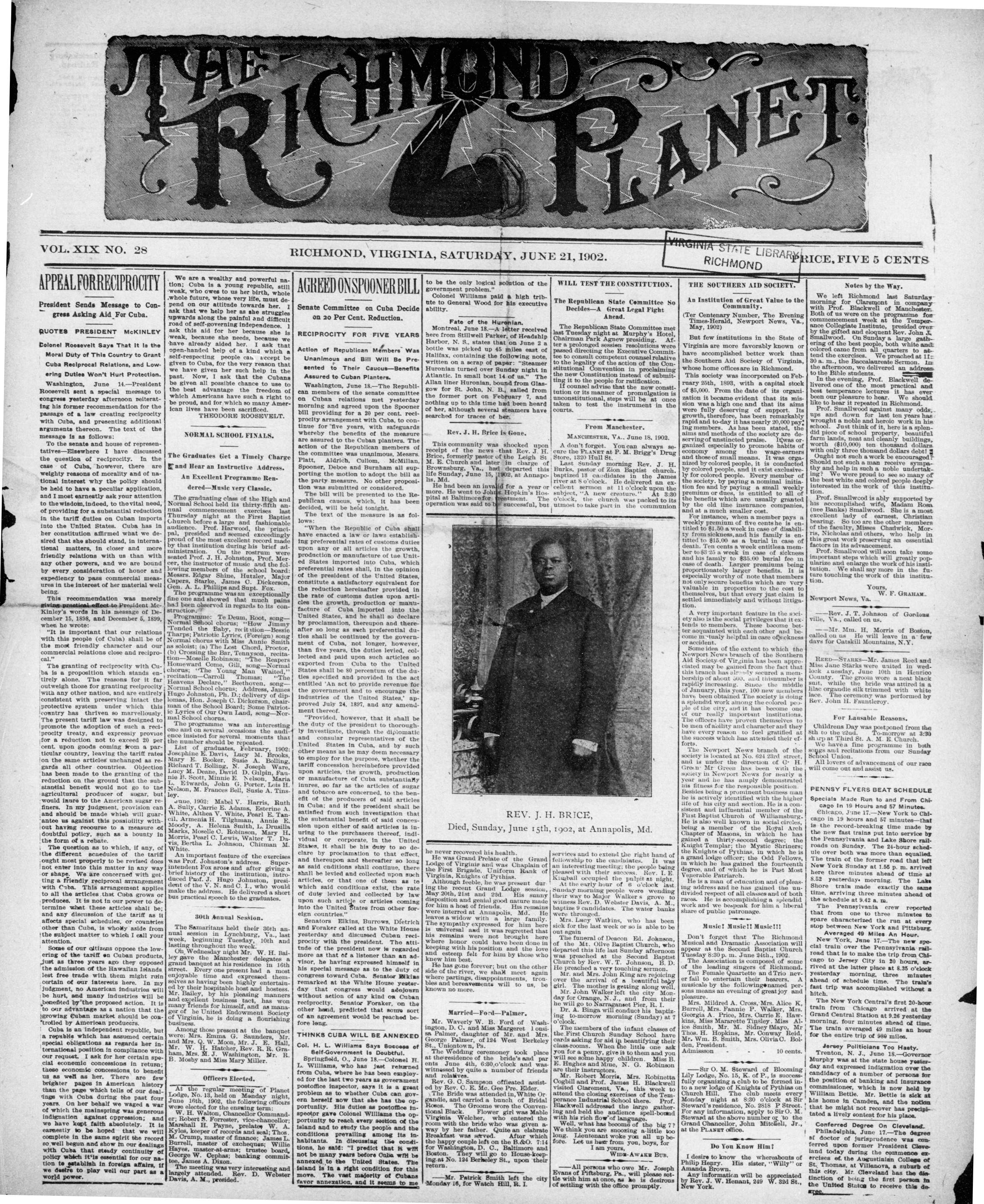
THE RICHMOND PLANET
VOL. XIX NO. 28
APPEALFORRECIPROCITY
APPEALFORRECIPROCITY
President Sends Message to Congress Asking Aid For Cuba.
QUOTES PRESIDENT McKINLEY
Colonel Roosevelt Says That It Is the Moral Duty of This Country to Grant Cuba Reciprocal Relations, and Lowering Duties Won't Hurt Protection.
Washington, June 14.—President Roosevelt sent a special message to congress yesterday afternoon reiterating his former recommendation for the passage of a law creating reciprocity with Cuba, and presenting additional arguments thereon. The text of the message is as follows:
To the senate and house of representatives—Elsewhere I have discussed the question of reckprocy. In the case of Cuba, however, there are weighty reasons of morality and of national interest why the policy should be held to have a peculiar application, and I most earnestly ask your attention to the wisdom, indeed, to the vital need, of providing for a substantial reduction in the tariff duties on Cuban imports into the United States. Cuba has in her constitution affirmed what we desired that she should stand, in international matters, in closer and more friendly relations with us than with any other powers, and we are bound by every consideration of honor and expediency to pass commercial measures in the interest of her material well being.
This recommendation was merely giving practical effect to President McKinley's words in his message of December 15, 1898, and December 5, 1899, when he wrote:
"It is important that our relations with this people (of Cuba) shall be of the most friendly character and our commercial relations close and reciprocal."
The granting of reciprocity with Cuba is a proposition which stands entirely alone. The reasons for it far outweigh those for granting reciprocity with any other nation, and are entirely consistent with preserving intact the protective system under which this country has thriven so marvellously. The present tariff law was designed to promote the adoption of such a reciprocity treaty, and expressly provue for a reduction not to exceed 20 percent. upon goods coming from a particular country, leaving the tariff rates on the same articles unchanged as regards all other countries. Objection has been made to the granting of the reduction on the ground that the substantial benefit would not go to the agricultural producer of sugar, but would inure to the American sugar refiners. In my judgment, provision can and should be made which will guarantee us against this possibility without having recourse to a measure of doubtful policy, such as a bounty in the form of a rebate.
The question as to which, if any, of the different schedules of the tariff ought most properly to be revised does not enter into this matter in any way or shape. We are concerned with getting a friendly reciprocal arrangement with Cuba. This arrangement applies to all the articles that Cuba grows or produces. It is not in our power to determine what these articles shall be; and any discussion of the tariff as it affects special schedules, or countries other than Cuba, is wholly aside from the subject matter to which I call your attention.
Some of our citizens oppose the lowering of the tariff on Cuban products, just as three years ago they opposed the admission of the Hawaiian Islands, lest free trade with them might ruin certain of our interests here. In my judgment, no American industries will be hurt, and many industries will be benefited by the proposed action. It is to our advantage as a nation that the growing Cuban market should be controlled by American producers.
Cuba is an independent republic, but a republic which has assumed certain special obligations as regards her international position in compliance with our request. I ask for her certain special economic concessions in return; these economic concessions to benefit us as well as her. There are few brighter pages in American history than the page which tells of our dealings with Cuba during the past four years. On her behalf we waged a war of which the mainspring was generous indignation against oppression; and we have kept faith absolutely. It is earnestly to be hoped that we will complete in the same spirit the record so well begun and show in our dealings with Cuba that steady continuity of policy which it is essential for our nation to establish in foreign affairs, if we desire to play well our part as a world power.
We are a wealthy and powerful nation; Cuba is a young republic, still weak, who owes to us her birth, whole, whole future, whose very life, must depend on our attitude towards her. I ask that we help her as she struggles upwards along the painful and difficult road of self-governing independence. I ask this aid for her because she is weak, because she needs, because we have already aided her. I ask that open-handed help of a kind which a self-respecting people can accept be given to Cuba, for the very reason that we have given her such help in the past. Now, I ask that the Cubana be given all possible chance to use to the best advantage the freedom of which Americans have such a right to be proud, and for which so many American lives have been sacrificed.
THEODORE ROOSEVELT.
NORMAL SCHOOL FINALS.
The gradating class of the High and Normal School held its thirty-fifth annual commencement exercises last Thursday night at the First Baptist Church before a large and fashionable audience. Prof. Harwood, the principal, presided and seemed exceedingly proud of the most excellent record made by that institution during his brief administration. On the rostrum were seated Prof. J. H. Johnston, Prof. Mercer, the instructor of music and the following members of the school board: Messrs. Edgar Shine, Hutzler, Major Capers, Starke, James C. Dickerson, Gen. A. L. Phillips and Supt. Fox. The programme was an exceptionally fine one and showed that much pains had been observed in regards to its construction.
Programme: Te Deum, Root, song—Normal School chorus; "How Jimmy Tended the Baby, recitation—Bessie Tharps; Patriotic Lyrics, (Foreign) song Normal chorus with Miss Annie Smith as soloist; (a) The Lost Chord, Proctor, (b) Crossing the Bar, Tennyson, recitation—Moselle Robinson; "The Reapers Homeward Come, Gill, song—Normal chorus; "The Young Man Waited," recitation—Carroll Thomas; "The Heavens Declare," Beethoven, song—Normal School chorus; Address, James Hugo Johnston, Ph. D.; delivery of diplomas, Hon. Joseph C. Dickerson, chairman of the School Board; Some Patriotic Lyrics of Our Own Land, song—Normal School chorus.
The programme was an interesting one and on several occasions the audience insisted for several moments that the number should be repeated.
List of graduates, February, 1902: Josephine E. Davis, Lucy M. Brooks, Mary E. Booker, Susie A. Bolling, Richard T. Bolling, N. Joseph Ware, Lucy M. Dane, David D. Gilpin, Faunie B. Scott, Minnie E. Nelson, Maria L. Edwards, John G. Porter, Lois H. Nelson, M. Frances Bell, Susie A. Tinsley.
June, 1902: Mabel V. Harris, Ruth A. Sally, Carrie E. Adams, Esterine A. White, Althea V. White, Pearl E. Tancil, Armenia H. Tighman, Annie E. Moody, A. Helena Smith, L. Drusilla Marks, Moselle C. Robinson, Mary H. Morris, Pearl C. Lewis, Walter T. Davis, Bethel A. L Johnson, Chirman M. White.
An important feature of the exercises was Prof. Johnston's address. Superintendent Fox arose and after giving a brief history of the institution, introduced Prof. J. Hugo Johnston, president of the V. N. and C. I., who would make the address. He delivered a short but practical speech to the graduates.
30th Annual Session.
The Samaritans held their 30th annual session in Lynchburg, Va., last week, beginning Tuesday, 10th and lasting throughout the week.
On Wednesday night Mr. W. H. Bailey gave the Manchester delegates a grand banquet at his residence in 16th street. Every one present had a most enjoyable time and expressed themselves as having been highly entertained by their hospitable host and hostess. Mr. Bailey, by his pleasing manners and excellent business tact, has won many friends for himself, and as manager of he United Endowment Society of Virginia, he is doing a flourishing business.
Among those present at the banquet were: Mrs. Emma G. Saunders, Mr. and Mrs. Q. W. Moon, Mr. J. E. Hall, Mr. W. H. Hatcher, Rev. R. R. Grum, Mrs. M. J. Washington, Mr. R. B. Mosby and Miss Mary Miller.
Officers Elected.
At the regular meeting of Planet Lodge, No. 13, held on Monday night, June 16th, 1902, the following officers were elected for the ensuing term: W. H. Walton, Chancellor Commander; Robert S. Forrester, vice-chancellor; Marshall H. Payne, prelate; W. A. Kyle, keeper of records and seal; Thos. M. Crump, master of finance; James L. Burrell, master of exchequer; Willie Hayes, master-at-arms; trustee board, George W. Cephas; banking committee, James A. Dixon.
The meeting was very interesting and largely attended. Rev. D. Webster Davis, A. M., presided.
RICHMOND, VIRGINIA, SATURDAY, JUNE 21, 1902.
AGREEDONSPOONERBILL
Senate Committee on Cuba Decide on 20 Per Cent. Reduction.
RECIPROCITY FOR FIVE YEARS
Action of Republican Members Was Unanimous and Bill Will Be Presented to Their Caucus—Benefits Assured to Cuban Planters.
Washington, June 18. The Republican members of the senate committee on Cuban relations met yesterday morning and agreed upon the Spooner bill providing for a 20 per cont. reciprocity arrangement with Cuba, to continue for five years, with safeguards whereby the benefits of the measure are assured to the Cuban planters. The action of the Republican members of the committee was unanimous, Messrs. Platt, Aldrich, Cullom, McMillan, Spooner, Deboe and Burnham all supporting the motion to adopt the bill as the party measure. No other proposition was submitted or considered.
The bill will be presented to the Republican caucus, which, it has been decided, will be held tonight. The text of the measure is as follows:
"When the Republic of Cuba shall have enacted a law or laws establishing preferential rates of customs duties upon any or all articles the growth, production or manufacture of the United States imported into Cuba, which preferential rates shall, in the opinion of the president of the United States, constitute a satisfactory equivalent for the reduction hereinafter provided in the rate of customs duties upon articles the growth, production or manufacture of Cuba imported into the United States, and he shall so declare by proclamation, thereupon and thereafter so long as such preferential duties shall be continued by the government of Cuba, not longer, however, than five years, the duties levied, collected and paid upon such articles so exported from Cuba to the United States shall be 80 percentum of the duties specified and provided in the act entitled 'An act to provide revenue for the government and to encourage the industries of the United States,' approved July 24, 1897, and any amendment thereof.
"Provided, however, that it shall be the duty of the president to thoroughly investigate, through the diplomatic and consular representatives of the United States in Cuba, and by such other means as he may deem necessary to employ for the purpose, whether the tariff concession hereinbefore provided upon articles, the growth, production or manufacture of Cuba substantially inures, so far as the articles of sugar and tobacco are concerned, to the benefit of the producers of said articles in Cuba; and if the president shall be satisfied from such investigation that the substantial benefit of said concession upon either of said articles is inuring to the purchasers thereof, individual or corporate, in the United States, it shall be his duty to so declare by proclamation to that effect, and thereupon and thereafter so long as said conditions shall continue, there shall be levied and collected upon such articles, or that one of them as to which said conditions exist, the rate of duty levied and collected by law upon such article or articles coming into the United States from other foreign countries."
Senators Elkins, Burrows, Diefrich and Foraker called at the White House yesterday and discussed Cuban reciprocity with the president. The attitude of the president now is regarded more as that of a listener than an advisor, he having expressed himself in his special message as to the duty of congress toward Cuba. Senator Elkins remarked at the White House yesterday that congress would adjourn without action of any kind on Cuban reciprocity. Senator Foraker, on the other hand, predicted that some sort of an agreement would be reached before long.
THINKS CUBA WILL BE ANNEXED
Col H. Williams Save Sponsor
Col. H. L. Williams Says Success of Self-Government is Debtful.
Springfield, O., June 18.—Colonel H. L. Williams, who has just returned from Cuba, where he has been employed for the last two years as government postoffice inspector, says it is a great problem as to whether Cuba can govern herself now that she has the opportunity. His duties as postoffice inspector gave Colonel Williams the opportunity to reach every section of the island and to study the people and the conditions prevailing among its inhabitants. In discussing the conditions, he said: "I predict that it will not be many years before Cuba will be annexed to the United States. The island is in a right condition for this move. The vast majority of Cubans favor annexation, and it seems to me
REV. J. H. BRICE,
Died, Sunday, June 15th, 1902, at Annapolis, Md.
to be the only logical solution of the government problem." Colonel Williams paid a high tribute to General Wood for his executive ability.
Fate of the Huronian
Montreal, June 18.—A letter received here from Stillwell Parker, of Headship Harbor, N. S., states that on June 2 a bottle was picked up 45 miles east of Halifax, containing the following note, written on a scrap of paper: "Steamer Huronian turned over Sunday night in Atlantic. In small boat 14 of us." The Allan liner Huronian, bound from Glasgow for St. John, N. B., sailed from the former port on February 7, and nothing up to this time had been heard of her, although several steamers have searched for traces of her.
Rev. J. H. Brice is Gone.
This community was shocked upon receipt of the news that Rev. J. H. Bruce, formerly pastor of the Leigh St. M. E. Church and later in charge of Brownsburg, Va., had departed this life Sunday, June 15, 1902, at Annapolis, Md.
He had been an invalid for a year or more. He went to Johns Hopkin's Hospital at Baltimore for treatment. The operation was said to be successful, but
REV. J. H.
Died, Sunday, June 15th
he never recovered his health.
He was Grand Prelate of the Grand Lodge of Virginia and was Chaplain of the First Brigade, Uniform Rank of Virginia, Knights of Pythias.
Although feeble, he was present during the recent Grand Lodge session, May 20th, 21st and 22d. His sunny disposition and genial good nature made for him a host of friends. His remains were intered at Annapolis, Md. He leaves a widow with a large family.
The sympathy expressed for him here is universal and it was regretted that his remains were not brought here where honor could have been done in keeping with his position and the love and esteem felt for him by those who knew him best.
He has gone forever; but on the other side of the river, we shall meet again where partings, disappointments, troubles and bereavements will to us, be known no more.
Married—Ford—Palmer
Mr. Waverley W. B. Ford of Washington, D. C. and M. Miss Margaret 1 onsi萨 Palmer, daughter of Mr. and Mrs George Palmer, of 124 West Berkeley St., Unionton, Pa.
The Wedding ceremony took place at the residence of the bride's and parents June 4th, 6:30 o'clock and was witnessed by quite a number of friends and relatives.
Rev. G. O. Sampson officiated assisted by Rev. C. F. Me. Goe Res. Elder.
ed by Rev. C. E. Mc. Gee Pre. Elder.
The Bride was attended in, White Organdie, and carried a bunch of Bridal Roes. The Groome wore the Conventional Black Flower girl was Mable Virginia Welcher, who entered the room with the bride who was given away by her father. Quite elaborate Breakfast was served. After the happy couple left on the R.&O. 7:14 for Washington, D. C., Baltimore and Boston. They will go to House-keeping at No. 124 Berkeley St., upon their return.
Mr. Patrick Smith left the city Monday 16, for Watch Hill, R. I.
WILL TEST THE CONSTITUTION.
The Republican State Committee So Decides—A Great Legal Fight Ahead.
The Republican State Committee met last Tuesday night at Murphy's Hotel, Chairman Park Agnew presiding. After a prolonged session resolutions were passed directing the Executive Committee to consult competent counsel relative to the legality of the action of the Constitutional Convention in proclaiming the new Constitution instead of submitting the people for ratification. If counsel approved that the new constitution or its maneuvering unconstitutional, steps will be at once taken to test the instrument in the courts.
MANCHESTER, VA.. June 18, 1902.
A don't forget. You can always secure the PLANET at P. M. Brigg's Drug Store, 1330 Hull St.
Last Sunday morning Rev. J. H. Burks, pastor of Zion Baptist church, baptized 13 candidates in the James river at 8 o'clock. He delivered an excellent sermon at 11 o'clock upon the subject, "A new creature." At 3:30 o'clock, the church was packed to its utmost to take part in the communion
H. BRICE,
1902, at Annapolis, Md.
services and to extend the right hand of fellowship to the candidates. It was an interesting meeting; the people being pleased with their success. Rev. I. Kimball occupied the palpit at night. At the early hour of 6 o'clock last Sunday morning people were wending their way to Major Walker's grove to witness Rev. D. Webster Davis, A. M., baptize 9 candidates. The water banks were thronged. Mrs. Lucy Watkins, who has been sick for the last week or so is able to be out again. The funeral of Deacon Ed. Johnson, of the Mt. Olive Baptist Church, who departed this life last Sunday afternoon was preached at the Second Baptist Church by Rev. V. T. Johnson, B. D. He preached a very touching sermon.
Mr. and Mrs. John King are rejoicing over the arrival of a beautiful baby girl. The mother is getting along well, Mr. John Walker left the city Monday for Orange, N.J., and from their he will go to Narragansett Pier, R. I. Dr. A. Binga will conduct his baptizing to-morrow Sunday (morning) at 7 o'clock.
The members of the infant classes of the First Church Sunday School have cards asking for aid in beautifying their classrooms. When the little one ask you for a penny, give it to them and you will see some happy children. Miss B. R. Hughes and Mine, N. G. Robinson are their instructors.
Mr. Robbins Morris, Mrs. Robinett Cogbill and Prof. James H. Blackwell visited Clarence, this week to attend the closing exercises of the Temperance Industrial School there. Prof. Blackwell addressed the large gathering and held the audience spell-bound with his rich flow of language.
Well, what has become of the big ?7 We think you are snoozing a little too long. Lieutenant woke you all up before. Let us hear from you, boys, for
—— All persons who owe Mr. Joseph Evans of Pittsburg, Pa., will please settle with him at once, as he is desirous of settling with the office promptly.
THE SOUTHERN AID SOCIETY.
An Institution of Great Value to the Community. (Ter Centenary Number, The Evening Times-Herald, Newport News, Va., May, 1902) But few institutions in the State of Virginia are more favorably known or have accomplished better work than the Southern Aid Society of Virginia, whose home offices are in Richmond.
This society was incorporated on February 25th, 1893, with a capital stock of $5,000. From the date of its organization it became evident that its mission was a high one and that its aims were fully deserving of support. Its growth, therefore, has been remarkably rapid and to-day it has nearly 20,000 paying members. As has been stated, the aims and methods of the society are deserving of unstricted praise. It was organized especially to promote habits of economy among the wage-earners and those of small means. It was organized by colored people, it is conducted by colored people, and it exist exclusively for colored people. Every member of the society, by paying a nominal initiation fee and by paying a small weekly premium or dues, is entitled to all of the benefits which are usually granted by the old line insurance companies, and at a much smaller cost.
For instance, when a member pays a weekly premium of five cents he is entitled to $1.50 a week in case of disability from sickness, and his family is entitled to $15.00 as a burial in case of death. Ten cents a week entitles a member to $3.25 a week in case of sickness and his family to $35.00 burial fee in case of death. Larger premiums being proportionately larger benefits. It is especially worthy of note that members not only secure benefits which are very valuable in proportion to the cost to themselves, but that every just claim is settled immediately and without littigation.
A very important feature in the society also is the social privileges that it extends to members. These become better acquainted with each other and become mutually helpful in case of sickness or accident.
Some idea of the extent to which the Newport News branch of the Southern Aid Society of Virginia has been appreciated may be gained from the fact that this branch has already secured a membership of about 500, and this number is rapidly increasing. Since the middle of January, this year, 100 new members have been obtained. The society is doing a splendid work among the colored people of the city, and it has become one really important institution. The officers have proven that the be men of ability and character and they have every reason to feel gratified at the success which has attended their efforts.
The Newport News branch of the society is located at No. 624 23rd street, and is under the direction of G·H. Green; Mr Green has been with the society in Newport News for nearly a year and he has amply demonstrated his fitness for the responsible position. Besides being a prominent business man he is actively identified with the higher life of his city and section. He is a consistent and influential member of the First Baptist Church of Williamsburg. He is also well known in social circles, being a member of the Royal Arch Chapter of Masons, in which he has gained a thirty-second degree; the Knight Templar; the Mystic Shriners; the Knights of Pythias, in which he is a grand lodge officer; the Odd Fellows, in which he has gained the fourteenth degree, and of which he is Past Most Venerable Patriarch.
He is a man of education and of pleasing address and he has gained the undivided respect of all classes and of both races. He is accomplishing a splendid work and we bespeak for him a liberal share of public patronage.
Music! Music!! Music!!!
Don't forget that The Richmond Musical and Dramatic Association will appear at the Second Baptist Church Tuesday 8:30 p.m. m. June 24th, 1902. The Association is composed of some of the leading singers of Richmond. The Female Quartette and dTrio never fail to entertain their hearers. A musical by the following named persons means an evening of great joy and pleasure. Mrs. Mildred A. Cross, Mrs. Alice K. Burrell, Mrs. Fannie P. Walker, Mrs. Georgia A. Price, Mrs. Carrie E. Hawkins, Miss Mararette Tinsley, Miss Alice Smith, Mr. M. Sidney Mayo, Mr Thos. H. Hopkins, Mr. Conway Reid, Mr. Wm. B. Smith, Mrs. Olivia C. Bolden, President.
Admision. 10 cents
---
—Sir O. M. Steward of Blooming Lily Lodge, No. 15, K. of P., is successfully organizing a club to be formed into a new lodge of Knights of Pythias on Church Hill. The club meets every Monday night at 8:30 o'clock at Sir Steward's residence, No. 2818 P Street. For any information, apply to Sir O. M. Steward at the above number or 'to the Grand Chancellor, John Mitchell, Jr., at the PLANET office.
Do You Know Him?
I desire to know the whereabouts of Philip Henry. His sister, "Willy" or Amanda Brown. Any information will be appreciated by Rev. J. W. Henant, 249 W. 32d St., New York.
Notes by the Way.
We left Richmond last Saturday morning for Clarendon in company with Prof. Blackwell of Manchester. Both of us were on the programme for commencement week at the Temperature College Institute, presided over by the gifted and eloquent Rev. John L. Smallwood. On Sunday a large gathering of the best people, both white and colored came from all quarters to attend the exercises. We preached at 11:30 a.m., the Baccalaureate Sermon. In the evening, we delivered an address to the Bible studies. In the evening, Prof. Blackwell delivered one of the most practical and best temperance lectures it has ever been our pleasure to hear. We should like to hear it repeated in Richmond.
Prof. Smallwood against many odds, ups and down for last ten years has wrought a noble and heroic work in his school. Just think of it, here is a splendid piece of school property, beautiful farm lands, neat and cleanly buildings, worth ($10,000) ten thousand dollars with only three thousand dollars debt! Ought not such a work be encouraged? Should not such a man receive sympathy and help in such a noble undertaking? We were proud to see so many of the best white and colored people deeply interested in the work of this institution.
Prof. Smallwood is ably supported by his accomplished wife, Madam Rosa (nee Banks) Smallwood. She is a most excellent lady of earnest, Christian bearing. So too are the other members of the faculty, Misses Chadwick, Morris, Nicholas and others, who help in this great work preserving an essential factors in its advancement.
Prof. Smallwood will soon take some important steps which will greatly popularize and enlarge the work of his institution. We shall say more in the future touching the work of this institution.
Rev. J. T. Johnson of Gordon's ville, Va., called on us.
Mr. Mm. H. Morris of Boston, called on us. He will leave in a few days for Catskill Mountains, N.Y.
REED—STARKS—Mr. James Reed and Miss Jane Starks were united in wedlock Tuesday, June 10th in Henrico County. The groom wore a neat black suit, while the bride was attired in a lilac organicle silk trimmed with white lace. The ceremony was performed by Rev. John H. Fauntleroy.
For Lausable Reasons.
Children Day was postponed from the 8th to the 22nd. To-morrow at 3:30 sh urp at Third St. A. M. E. Church. We have a fine programme in both soops and recitations from our Sunday School Union. All lovers of advancement of our race will come out and assist us.
PENNSY FLYERS BEAT SCHEDULE
Specials Made Run to and From Chicago In 19 Hours and 57 Minutes
Cagua 14 is 18 hours and 57 minutes.
Chicago, June 17.—New York to Chicago in 19 hours and 57 minutes—that is the record-breaking time made by the new fast trains put into service by the Pennsylvania and Lake Shore railroads on Sunday. The 24-hour schedule over both was more than equalled. The train of the former road that left New York Sunday at 1.55 p. m. arrived here three minutes ahead of time at 8.52 yesterday morning. The Lake Shore train made exactly the same time, arriving three minutes ahead of the schedule at 9.42 a. m.
The Pennsylvania crew reported that from one to three minutes to spare characterized the run at every stop between New York and Pittsburgh.
New York, June 17.—The new special train over the Pennsylvania railroad that is to make the trip from Chicago to Jersey City in 20 hours, arrived at the latter place at 8.35 o'clock yesterday morning, three minutes ahead of schedule time. The train's fast trip was accomplished without a hitch. The New York Central's first 20-hour train from Chicago arrived at the Grand Central Station at 9.26 yesterday morning, four minutes ahead of time. The train averaged 49 miles an hour for the entire trip of 980 miles.
Trenton, N. J., June 18—Governor Murphy was at the state house yesterday and expressed indignation over the candidacy of a number of persons for the position of banking and insurance commissioner, which is now held by William Bettle. Mr. Bettle is sick at his home in Camden, and the notion that he might not recover has precipitated a lively contest for his place.
Conferred Degree On Cleveland.
Philadelphia, June 17.—The degree of doctor of jurisprudence was conferred upon former President Cleveland today during the commence exercises of the Augustinian College of St. Thomas, at Villanova, a suburb of this city. Mr. Cleveland has the distinction of being the first person in the United States to receive this degree.
HEY LUNET
SATURDAY, JUNE 21, 1902.
TEMPERANCE
DID THE TIGERS KNOW?
Savage Wild Beasts Lose Their Respect for Their Master Whom They Saw Drunk,
A really remarkable story of animal perception has been contributed to Frank Leslie's Monthly by Mr. Frank Bostock, who may be considered an authority on wild animals in captivity.
I once had a trainer, Mr. Bostock says, an old Irishman who had served in a British regiment in India, and who knew the ways of tigers in every detail. He taught three of them to do more work in the arena than I have ever seen done by any other tigers. I have seen him sitting down between two of them at rest times during rehearsals and examining their claws to see if any of them were sore or split. Anyone who has ever tried that with even a house cat knows that it strikes the feline nature as an unwarrantable familiarity. But they never did more than show their teeth and whine, and that half in playfulness.
One day the old fellow got very drunk, the first time in his life, to my knowledge. Before he was noticed on his return to the cage he had gone
THEY GUARDED HIM ALL NIGHT.
in with his tigers and fallen in a heap on the floor.
The other keepers made several attempts to take him out of the cage, but it was at once apparent that to do so meant a bitter and bloody fight with the tigers. They guarded him all night in his drunken slumber. But the next time he put them to work they halked, and he could neither persuade nor drive them.
They had ceased to trust him, or something of that sort, and his usefulness with them was at an end forever.
That was indeed "judgment . . . fled to brutish beasts."
THE TEMPERANCE MOVEMENT
Splendid Progress Made in the Flight Against King Alcohol During the Last Century.
The chronicle of wonders, called the history of the nineteenth century, records victories of civilization trans-ending those of the previous 1,400 years taken together, and in its long list of moral triumphs the progress of temperance ranks second only to the abolition of the slave traffic. A complete success of the prohibition movement would reverse that sequence of prestige.
The alcohol mania has proved a far more ruminous delusion than the belief in the justice of the custom to enforce the servitude of uncivilized races. For one suicide caused by slavery, the liquor passion has caused a thousand. The inhumanities perpetrated by the taskmasters of helpless bondmen are surpassed by those which millions of women and children have suffered at the hands of rum craved relatives. The social degradation of slaves is more than equaled by the social, moral, mental and physical abasement of drunkards. Bigots of class prerogatives never despised the poorest negro as a slave of the drink vice is despised by his neighbors and acquaintances, whose verdict is not even offset by the moral resisting power of its victim, since drunkennes leads to the loss of self-respect.
```markdown
```
Nay, it might be even questioned if the loss of freedom, incident to the man-hunts of the African slave dealers, is not dwarfed by the results of intemperance. Four out of five convicted criminals can trace their ruin to their passion for intoxicating beverages, and an equal percentage of lunatics owe their affliction to the "foe that steals away the brain." Moreover, the manacles of the alcohol passion are harder to break than the chains of serfdom, and the circumstance is perhaps the ultimate cause of the difference in the completeness of the triumphs achieved by the abolition league and the advocates of prohibition.
Still, the progress of temperance during the last hundred years is enormous as compared with that of any previous century since the days of Pythagoras, and may even be said to eclipse the general success of the struggle against the power of ignorance and delusion.
The time evidently is near when no scholar of the west Caucasian nation will venture to dispute that alcohol is in every sense a foe to life, a nervous irritant, without a trace of nutritious ingredients, and unauthorized by an inevitable progressive power in its tendency to clutch the human organism in the grip of a body and mind-destroying vice.
It would not be too much to say that the more or less clear knowledge of those facts has by this time reached a hundred million of our fellow men, without counting whole nations of Buddhists and Mohammedans, who have for ages mentioned it as an article of faith.
"I'm not conscious of any prejudices," said a London physician, in reply to a convivial invitation, "and I wish you a pleasant evening, but I hope you will kindly excuse my personal presence. Experience has taught me that I cannot drink and attend to my business."
In that sense converts to the doctrine of total abstinence have multiplied in every country of the civilized world, and their ranks recruit themselves by a process of natural selection. Topers are crowded out; the most complete abstainers forge to the front, and competition has already resulted in an increasing tendency to total abstinence from all virulent tonics whatever. Hence, anti-tobacco societies, tea renouncers, and all sorts of non-stimulating substitutes for coffee.
"I wish you a pleasant evening," said the London doctor, but a doubt is gaining ground if even intelligent votaries of pleasure had not better try to realize their ideals outside of rum shops. Epicureans are beginning to appreciate the truth that the attempt to trick life'out of the extra enjoyments is a failure on the alcohol plan; that the present pursuit of happiness by intoxication is in every instance a losing game, a miscalculation by just as much as the delights of the brief delirium are outweighed by the miseries of the inevitable reaction. The practical outcome of that experience has taken the form of a growing addition to the literary enjoyments, amateur art work, travel and door-sports among classes whose former habits had almost identified the ideas of merry-making and intoxication.
"Vexing with mirth the drowsy ear of night."
Slavery was doomed from the day of its repudiation by a league of international philanthropists, and the triumphant adoption of the Wilburforce amendment turned the scales in the deliberations of an assembly of Spanish-American delegates, who had come half disposed to vote for a resumption of the African man-hunts.
Private propaganda of the anticleruity movement had no chance of success so long as kings and queens were patronizing cruel sports (like the badger baitings, conducted by the courtiers of Queen Bess), but when society leaders had set the fashion of humanitarian reform, beast-figils abated from the lack of patronage, till it has now become nothing unusual to see artisans rush out of their shops to stop a scuffle of obstreperous dogs.
The progress of total abstinence has raised the standard of efficiency, and has made competitors more strenuous, but incidentally it has also accelerated its rate of advance, by compelling the recognition of its power, and, as it were, conscripting thousands of reluctant recruits. The intelligent part of mankind has, in fact, almost emerged from the poison fumes of alcoholism. The hideous mist is still lurking in the valley regions, but its efforts at ascendance have nearly ceased, and its apparently ominous concentration in the depths only, proves that it is fighting its last struggle for existence at a disadvantage, and that light, its destroyer, has conquered the heights.—Felix L. Oswald, in Union Signal.
NOTES FROM AFIELD.
the supreme court of Kansas has decided that the section of the Hurrel liquor law which gives cities the right to pass ordinances to suppress nuisances and providing for "search and seizure" is valid.
The excise board of Jersey City, N. J., has adopted a resolution instructing the city clerk to refuse all applications for liquor licenses for any new saloon within 200 feet of any church or public school.
Local option entered largely into the election contests in Nebraska this year. The towns reported as voting no license are: Fullerton, Elgin, Rising City, Franklin, Shelton, Pender, Stella and Benkleman.
The comptroller of New York has refused to pay a bill of $627, contracted by Police Capt. Smith, for wines and liquors consumed by politicians on the police boat at the time of the reception of Admiral Dewey in September, 1899.
The Saloon. Responsible.
Rev. S. H. Morgan, chaplain of the Huntsville branch of the Texas state penitentiary, in a recent report, says: "The number of prisoners is less than a few years ago. One-third of the populous portion of the state is under prohibition. Seventy-five per cent. of the inmates come to the prison from saloons and saloon influences. As these influences are curtailed, the number of state criminals decreases." This testimony merely affirms the assertion of the many temperance workers that the saloon is the chief source of crime.
Edward's Temperance Contribution.
King Edward has just sent a personal contribution of $54.50 (ten guineers) to the British Army Temperance association. This is the first time in its history, extending over 40 years, that the association has received a contribution from the head of the state. The war office contributes $3,750 a year to the funds of the association. And well it might, as Lord Roberts has stated that the work of the A. T. A. had been equal to the addition of two battalions to the effective strength of the army in India, where the membership is 23,000.
A Disappointment.
Shopper—want a share that is both comfortable and good, but the age of miners is not good.
THE RICHMOND PLANET, RICHMOND, VIRGINIA.
TRINKETS AND TRIFLES.
Odd and pretty among silver fittings for the desk is a solid-silver-mounted pig penwiper, the back of the pig being filled with bristles for wiping the pen.
Ivory and tortoise-shell toilet articles are pushing the silver articles aside. Tortoise-shell is particularly fashionable and usually bears the owner's monogram in gold.
A pretty hair ornament is in the shape of a gauze wing butterfly with trimmings of gold braid. In the center of each wing is a mother-of-pearl ornament in shape following the outline of the wings.
Peacock jewelry is having a great rage at present and many beautiful articles in the jewelry line are shown in peacock designs. Pina, belts, buckles and purses are all made in representation of this gorgeous fowl.
A shirt-waist set consists of a crystal buckle for the belt, crystal drop buttons for the front fastenings, crystal cuff links for the sleeves and a crystal bar pin with drop ends for fastening the tie at the neck.
Watch fobs are made of shirt-waist materials. They are the plain strap, like those made of leather, and the pendant is a stirrup and the strap of the material, the buckle a small horseshoe in a metal that looks like gun metal.
COUNTER AND SHOWCASE
Handsome glove boxes in burned leather, with satin linings, are shown. In the top of each box is a silver glove stretcher. One sees all sorts of dress accessories in the new fashionable moire and among them is a parasol of white moire antique silk with stick of the natural wood. In the stationery department can be found a folding desk pad that seems to possess several desirable points. It is in three panels, medium size, which fold flatly together. Any one panel can be used, the others folding over and protecting the loose papers from draft or dust.
Ivory is coming into popularity again and is largely supplanting silver and gun-metal for ornamental parasol and umbrella handles, Brooches and sash clasps and toilet articles, as well as exquisitely carved fans in the small Empire size, are made of ivory; also dainty statuettes and other ornaments for cabinets are of carved ivory.
Ping-pong has so taken the town that there is quite an epidemic of goods called by this name in the shops, one of the latest things being a bonbon box. This is in shape of a ricket, with a ball upon it. The round part is white and the handle an imitation of one of the solid woods. To fill these boxes appropriately is a new kind of confection called "ping-pong" candy.
IN THE ANIMAL KINGDOM.
Cleveland has an auto dog ambulance. It is also used for cats and other small animals, and is the only one in the world.
The fight against the mosquito pests in New Jersey continues with vigor. Crude oil is being used, this being the best and most efficacious remedy yet known. It is also proposed to breed dragon flies to assist in the crusade.
Tarantulas are now bred in Australia for their webs, the filaments of which are made into threads for balloons. Each tarantula yields from 20 to 40 yards of filament, of which eight twisted together form a single thread of sufficient stoutness. It is much lighter than silk.
More protection is needed for lobsters. It is a slow breeder, laying eggs but once in two years, and carrying these eggs attached to the modified legs under the abdomen for ten or eleven months after laying; while the young require probably four to seven years to reach maturity and attain a length of from seven to ten inches.
A German observer noticed during a thunderstorm a wild goose fall heavily to the ground at his feet. After the storm had abated he found another dead goose lying on the ground at a distance of about a mile. An examination of their carcasses revealed two quite small wounds a little over an inch long on the back of the neck of each bird.
A CINDER IN THE EYE.
Boracile acid in solution with rose water makes a very good eye wash. It should be applied warm, through a glass plpette.
Foreign bodies lodging on the eye may be imbedded in the cornea or eyeball, or may be beneath either lid. The mistake the majority of people make in looking for a foreign body in the eye is in presupposing that it is under either lid, and the search is fruitless.
If a foreign particle is found in the eye the best way to remove it is to roll cotton on a match stick, dip it in warm water and gently rub over the particle and it will adhere to the cotton. This is much better than the corner of a handkerchief or any other method and gives less pain.
After the removal of the object, if the eye is much inflamed or painful, great relief may be obtained by ice cold compresses. These should be small square pieces of muslin or linen large enough to cover the whole eye; three or four should be placed on a cake of ice near the bed side. One compress is placed when cold on the eye; when it begins to get warm it should be again applied to the ice and another cold one substituted. The sufferer can do this himself.
LITTLE RECIPES.
For a cottage sauce: Cream half a cupful of sugar and one-fourth cupful of butter; when creamy add half a teaspoonful of vanilla or lemon extract and half a cupful of boiling milk.
Honeycomb pudding is made with three cupfuls of flour, one cupful of mild one cupful molasses, and one of
Frains. Dissolve one teaspoon of soda in a cup of milk; beat well; steam in a buttered mold three hours, and serve with hard sauce.
For a lemon sauce, put one cup of water over the fire; rub two tablespoonfuls of cornstarch in a little cold water until it is smooth; add to the boiling water and stir until thickened; add half cup sugar and rind and juice of one lemon.
For potted ham, chop one cupful of cold boiled ham fine, using a little fat. Mix tablespoonful of flour in little cold water and rub smooth; add to this one cupful boiling water, stir in the chopped ham and one tablespoonful dry mustard; mix well and pack in a jar.
Many people like chocolate. Put one quart of milk over the fire, and two squares of chocolate in a pan on the back of the range; add two tablespoonfuls of water and three tablespoonfuls of sugar; stir until smooth; stir this into the boiling milk, and when boiling beat with an egg beater for three or four minutes.
Prune toast affords a pleasing change. Stew half a pound of prunes until tender, remove stones, return with their juice to the fire, add the juice of half a lemon and half a cup of sugar, and cook until the sugar is dissolved. Cut several slices of bread, remove the crust, fry in small quantity butter on both sides until delicately browned; cover bread with prunes and serve at once with rich cream.
To make a sultana cake use six ounces of butter, six ounces of sugar, four eggs, one-half pound flour, three-quarters of a pound of sultanas. Beat the butter to a cream, add the sugar, and beat for ten minutes longer, add two eggs, and beat for a few minutes, then add the other two, mix in the flour and sultanas, stir gently. Pour into cake tin, lined with buttered paper, and bake in a moderate oven for one and a half hours.
HEARD IN THE STUDIOS.
The South Kensington is no longer to be known by that appellation, but by the title Victoria and Albert museum.
The question of a coinage suited to the present condition of things artistic in the United States has been revived recently.
Henry Bussin, formerly a seafaring character, who has posed for artists during the last 20 years, has retired. He was "the original Gibson old man."
Paris is to have a statue of Gavarni, the caricaturist, soon. A Gavarni ball will be given in his honor and to pay for the statue, in which the costumes he drew will be worn. Gavarni was as much the historian of Louis Philippe's reign as John Leech was of the first part of Queen Victoria's.
Philadelphia has yet another art society—a brand new organization, which, though it has been talked of for some years, has only just come into existence. It is a "society of miniature painters," and it exists to the end that its members, who all paint miniatures, may occasionally have special exhibitions of their work apart from the larger exhibitions.
The best portraits of Gen. Grant, Gen. Sherman and Gen. Sheridan, it is said, were painted by Daniel Huntington many years ago. At the time the pictures were painted Gen. Grant was 53 years of age and serving his second term in the white house; Gen. Sherman was the general commanding the army of the United States and 55 years old; Gen. Sheridan was lieutenant general and 42 years of age.
PRESS GLEANINGS.
When a man feels mean it's his cue to keep silent.—Chicago Daily News.
Automobile weddings are the latest. They are another form of the automobetter wedding.—Red Wing (Minn.) Republican.
There are all kinds of trusts, but none are as big or fatal as the trust a girl has in a worthless man.—Atchison (Kan.) Globe.
People over in Zapata county are reported to be starving, but they can pull off political conventions yet.—Shiner (Tex.) Gazette.
Bert Birdsall's cat tried suicide by sticking its tail tall under a Michigan Central car wheel. It was a painful failure. Try the other end, kitty. — Correspondence Sheboygan (Mich.) News.
This here making those islanders take a water cure is a crowning infamy which has no sense. A little whisky would do more in a minute to get their affections.—Hardman (Tenn.) Free Press.
What is the matter? Three most popular young ladies had to walk home four miles alone after the basket picnic. Girls are searce here and can't afford to be neglected.—Eastwood (Minn.) Correspondence.
Over in the next county a very nervous groom just before entering the church asked: "Is it the right or left hand the ring goes on? And, say," he stuttered, "is it kisstomary to cuss the bride?"—Louisiana Press Journal.
A Loss.
The Plutocrat—I am $100,000 richer than I was yesterday.
His Wife—You don't seem happy over it.
"No, I'm two days older."—Detroit Free Press.
One of Many.
Myer—This paper gives a detailed account of a train in Arizona being held up by a woman.
Gyer—Well, what of it? I've seen lots of women hold up trains.—Chicago Daily News.
Not Worth Saving.
Mike (going down a ladder)—Hould on, Pat. Don't yez come on the ladder till Oi'm down. It's ould and cracked.
Pat (getting on)—Arra, be aisy. It would sarve th' boss right to have to buy a new one.—N. Y. Weekly.
Insure Love and a Happy Home For All.
How any man may quickly cure himself after years of suffering from sectual weakness, loss vitality, night losses, varicose, etc., and enlarge small weak organs to full size and vigor. Simply send your name and address to Dr. Knapp Medical Co., 1822 Hull Building, Detroit, Mich., and they will gladly send the free receipt with full directions so that any man may easily cure himself at home. This is certainly a most generous offer, and the following extracts taken from their daily mail, show what man think of their generosity.
It has completely braced me up. I am just as vigorous as when a boy and you cannot realize how happy I am."
"Dear Sirs--Your method worked beautifully. Results were exactly what I needed. Strength and vigor have completely returned and enlargement is entirely satisfactory."
Dear Sirs--Yours was received and I had no trouble in making use of the receipt as directed, and can truthfully say it is a boon to weak men. I am greatly improved in size, strength and vigor."
All correspondence is strictly confidential mailed in plain, sealed envelope. The receipt is free for the asking and they want every man to have it.
4-5-02-tf
WANTED--5 INDUSTRIOUS COLORED MEN and women in each location. $10 to $18 per person for the mailing. We each good done for the race. This announcement is of special interest to men and women of the race who desire to work themselves up. Full particulars furnished free. Apply by letter only.
Address:
On to Chicago THE MIDDLE STATES AND MISSISSIPPI
VALLEY EXPOSITION
To be held Chicago from the 14th of August to the 14th of September, 1902. The first practical demonstration ever given to the people of the north of the development and growth of the Negro race in this section. A grand display of race progress. The nation's first big event of the 20th century. Chicago is the most hospitable city in the United States. The greatest summer resort in the west. It falls to visit Chicago and the greatest of all Race Expositions. Special railroad rates. The 14th of August to the 14th September, 1902.
For information, address the COMMITTEE,
No. 610 Garfield Boulevard,
Chicago, Illinois.
Miller, Graves & Wright,
BILLIARDS AND POOL
Nos. 216-218-220 Eighth Street,
Huntington, W. Va.
Barber Shop Connected, 216 8th St.
Best Wines, Liquors, Beer, Cigars.
5-17-3m.
Seaboard Air Line R. R.
"CAPITAL CITY ROUTE"
Short line to Principal Cities of the South and Southwest, Florida, Cuban Texas, California, and Mexico, reaching the Capitals of Six States.
SCHEDULE IN EFFECT APRIL 13, 1983
TRAIN$ LEAVE RICHMOND-MAIN ST.
STATION-DAILY.
No. 27 No. 31.
2:15 P.M. 10:37 P.M. -LV. Richmond.
2:36 P.M. 11:20 P.M. -LV. Petersburg.
7:23 P.M. 4:12 A.M. -LV. Raleigh.
10:25 P.M. 7:00 A.M. -A.V. Hamlet.
10:35 P.M. 7:20 A.M. -A.V. Hamlet.
7:30 A.M. 3:55 P.M. -A.V. Atlanta.
2:40 P.M. 10:35 A.M. -A.V. Columbia.
(Eastern Time.)
1:05 A.M. 9:40 A.M. -LV. Columbia. (Central Time.)
4:55 A.M. 2:10 P.M. -A.R. Savannah.
9:15 A.M. 7:00 P.M. -A.R. Jacksonville.
10:50 A.M. -A.R. Augustine.
5:45 P.M. 6:45 A.M. -A.R. Tampa.
10:02 P.M. 7:20 A.M. -A.V. Miami.
7:50 A.M. 8:25 P.M. -A.R. Atlanta.
2:38 P.M. 10:34 A.M. -A.R. Columbia. (Eastern Time.)
1:05 A.M. 9:40 A.M. -LV. Columbia. (Central Time.)
4:55 A.M. 2:10 P.M. -A.R. Savannah.
9:15 A.M. 7:00 A.M. -A.R. Jacksonville.
10:50 A.M. -A.R. Augustine.
10:32 P.M. 8:45 A.M. -A.R. Tampa.
10:32 P.M. 10:08 A.M. -A.R. Charlotte.
1:35 A.M. 10:22 A.M. -A.V. Chester.
5:35 P.M. 11:25 A.M. -A.V. Greenwood.
6:13 A.M. 2:50 P.M. -A.V. Atlanta.
7:50 A.M. 8:50 P.M. -A.R. Atlanta.
11:35 A.M. 7:30 P.M. -A.M. Jacksonville.
6:25 P.M. 9:20 P.M. -A.M. Montgomery.
3:55 A.M. -A.R. Mobile.
7:35 A.M. -A.R. New Orleans.
6:55 P.M. 1:40 A.M. -A.R. Nashville.
8:29 A.M. 8:29 A.M. -A.R. New Orleans.
Train No. 35 leaves Richmond 9:10 A.M. daily for Petersburg, Noralina, N.C. and all intermediate points. Connection at Noralina with Richmond P. M. and Raleigh 3:50 A.M. daily; Durkham 4:50 P.M. daily except Sunday. Trains leave Richmond for Washington, and Durkham for Raleigh. Daily-No. 34 at 6:45 A.M. and No. 66 at 5:03 P.M. Connections at Jacksonville and Tampa for all Florida East coast points and Cuba, and Port St. Lucie for all points in Texas, Mexico and California.
TRAINS ARRIVE AT RICHMOND-DAILY.
4:35 A. M. No 34 From all points South.
6:35 A. M. No 66 and Southwest.
5:45 P. M. No 30, Noralina, N. C., Petersburg and local points.
SLEEI ING-CAR SERVICE
Nos. 31 and 34—Florida & Metropolitan Limited, Pullman Drawing-Droom, and Sleeping Cars between New York and Tampa. Vestibular Coach, and Coach Richmond and New York, and between Richmond and Chinookville. Pullman Sleeping Cars (daily) between Jacksonville and Tampa. Also through Drawing Room Sleeping Cars between New York and Jacksonville, connecting at Hamlet and Atlantis and Hamlet and Savannah. Nos. 27 and 66—Seaboard Fast Mail. Pullman Drawing-Room Buffet Sleeping Cars between New York and Jacksonville, connecting at Hamlet with Sleeping Cars, in connection with which through Pullman tickets are sold. Pullman Parlor-Cars between Jacksonville and Tampa. Finest Day Coaches. W. J. MAY, City Ticket Agent. Z. P. SMITH, District Passenger Agent, 1006 East Main Street
We promptly obtain U. S. and Foreign PATENTS Send model, sketch or photo of invention for free report on patentability. For free book, How to Secure Patents and TRADE-MARKS to C.A.SNOW & C. Opposite U. S. Patent Office WASHINGTON D. C.
C & O
PASSENGER TRAINS LEAVE AND
ARRIVE NEW MAIN-ST. STATION.
MAY 4, 1902.
LEAVE RICHMOND.
7:30 A. M., Except Sunday, Local to Newport
New.
8:35 A. M., Daily F. F. V., Limited to Old
Point, Norfolk and Portsmouth, makes
no local stops except at Williamsburg
and Hampton.
10:20 A. M., Except Sunday, Local to Calverton
Cifton Forge, Connects for Orange,
Culpeper, and Manassas.
10:20 A. M. Daily for Lynchburg, Lexington,
Clifton Forge. Connects, except
Sunday for Roxanne, Alberene and New
Caddis.
2:45 P. M., Daily, St. Louis and Chicago Limited.
Dining Car train, Pullman for
Cincinnati, Louisville, and St. Louis.
e to eight hours, quickest line West. Con-
train follows St. Louis Limited from
Gordonsville to Staunton, except Sun-
day.
4:00 P. M. Except Sunday, "Seashore Limited"
for Old Point, Norfolk and Portsmouth.
Parlor Car to Old Point, makes no Lost-
possess. Except Norfolk and Portsmouth.
Hopper. Connects at Old Point, Wash-
ington, Baltimore and Cape
Charles steamers. Connects at Norfolk
with O. D. S. S. for New York.
5:00 P. M. Except Sunday, Norfolk and
5:00 P. M. Daily for Newport News and Old Point.
5:15 P. M. Except Sunday for Bremo.
5:15 P. M. Except Sunday for Doswell.
10:30 P. M. Daily F. F. V. Dining Car train. Connects for Virginia Hot Springs. Pullman to Boston, connecting with Parlor Car to Cincinnati, Pullman to Cincinnati, Louisville, and the West.
ARRIVE NEW MAIN ST. STATION.
8:00 A. M. Except Sunday, from Doswell.
8:00 A. M. Daily from Cincinnati.
6:30 P. M. Daily from Old Point, Norfolk and
Point.
8:15 P. M. Except Sunday from Clifton Forge
and Charlotteville.
Apply at 80 East Main Street, Murphy's Hotel
and Main-Street Station ticket offices
for further information.
H. W. FULLER, JOHN D. POTTS
G. P. A.
A. G. P. A.
ATLANTIC COAST-LINE.
Schedule In Effect Jan. 14, 1902.
TRAINS LEAVE RICH@ AD—BYRB
STREET STAL
9:10 P. M. Daily. Arrives Petersburg 9:35 P.
M. connects Petersburg with Norfolk
& eastern railway, arrive 10:30 A. M. Bristol
& A. M. Pulmable Sleeper Richmond
nchurch.
11:30 M. Dairy. Arrives Petersburg 12:10
A. M.
11:50 M. Daily, except Sunday. THE NEW
ORK AND FLORIDA SPECIAL. Arrives
12:30 A. M. Jacksonville 2:30 A. M.
Augustine 4:00 P. M. Tampa 10:40 P. M.
FLAINS ARRIVE RICHMOND.
3. M. Daily, From Jacksonville, Savannah, Charleston, Atlanta, Macon, Augusta and all points South,
4. J. M. Daily, Except Sunday, From Tampa, St. Augustine, Jacksonville, Savannah and Charleston.
5. J. M. Daily, From Petersburg, Lynchburg and the West.
6. A. M. Daily, except Sunday. Petersburg local.
7. A. M. Daily, except Sunday. From Goldsboro and intermediate stations. Norfolk and Suffolk.
8. A. M. Daily, From Norfolk, Suffolk and Petersburg.
9. A. M. Sunday only. From Norfolk, Suffolk and Petersburg.
10. A. M. Sunday only. From Norfolk, Suffolk and Petersburg.
11. A. M. Daily except Sunday. From Petersburg.
12. A. M. Daily, From Miami, Port Tampa, Jacksonville, Savannah, Charleston, Wilmington, Goldsboro, and all points South.
13. A. M. Daily, From Norfolk, Suffolk, and Petersburg.
14. M. Daily, From Petersburg, Lynchburg and West.
T. M. EMMERSON, Traffic Manager.
J. R. KENLY, General Manager.
H. M. EMMERSON, General Passenger Agent.
C. S. CAMPBELL, Division Passenger Agent.
838 East Main Street.
jan. 14.
Norfolk and Western R. R.
LEAVE RICHMOND (DAILY), BYRD
STREET STATION.
: 900 A. M. NORFOLK LIMITED. Arrives at Petersburg, Waverly and Suffolk.
9:06 A. M. THE CHICAGO EXPRESS, for Lynchburg, Roanoke, Columbus and Chicago, and Pillar Lake Petersburg to Lynchburg, Pillar Lake Petersburg to Columbus; also for Bristol, Knoxville, and Chattanooga. Pullman Sleeper to Roanoke to Knoxville. Arrives Norfolk 5:20 P. M. Stops only at Petersburg Waverly and Suffolk. Connects at Norfolk with Steamers to Boston, Providence, New York, Baltimore and Washington.
7:28 P. M. for Suffolk, Norfolk and intermediates stations. Arrives at Norfolk 10:40 P. M.
9:10 P. M. for Lynchburg, and Roanoke. Comes and Lynchburg to Columbus and Chattanooga Limited. Pullman Sleepers Lynchburg to Memphis and New Orleans, Cafe, Parlor and Observatory. Pullman Sleepers Lynchburg to Tallman Sleeper between Richmond and Lynchburg. Berths ready for occupancy at 8:30 P. M. Also Pullman Sleepers Petersburg and Roanoke.
Trains from Lynchburg to Lynchburg and the West daily at 7:38 A. M. and 8:56 P. M.; from Norfolk and the East at 11:10 A. m., 11:42 A. m., and 6:50 P. M.
Office 838 Main St.
JOHN E. WAGNER
City Passenger and Ticket Agt.
C. H. BOSLEY,
District Passenger Agent.
W. B. REVILL,
General Passenger Agent.
General Office: Roanoke, Va.
dc.18
Richmond, Fredericksburg and Potomac Railroad.
Schedule in Effect April 16, 1902.
Trains Leave Richmond Northward.
A. M. A. Daily from BYRD STREET STATION, for Washington and beyond.
Steps at Milford, Fredericksburg and Alexandria. Days Occoquan Sunday.
Silver Creek, Washington and New York.
Dining Car.
6:45 a. m. Daily from MAIN STREET STATION, Florida and Metropolitan Landing, Stops at Fredericksburg and Alexandria. Sleeping Cars to New York.
7:00 a. M. Except Sunday from Ella Station, accession for and ashland and intermediate points.
8:00 a. m. Sunday only from BYRD STREET STATION, Glen Allen, Bay and local stops at Ela, Glen Allen, and local stops Ashland to Quantico inclusive, New Occupan and Alexandria. Buffet Sunday.
8:50 a. m. Except Sunday from BYRD STREET STATION for Washington and beyond. Stops at Glen Allen and local stops Ashland to Acotink inclusive, and Alexandria.
12:05 Noon. Except Sunday, from BYRD ST. Station, Ela, Ashland, Dowell, Milford, Fredericksburg and Alexandria. Milford. Fredericksburg Connects with Congressional Lodge.
6:05 P. M., Daily, from Main St. Station, for Washington and beyond. Stops at Downtown, Frederickshaw, Alexandria. Sleeping Car to New York.
6:12 P. M., Daily from Elba Station for Washington and beyond. Stops at Frederickshaw, Alexandria. Sleeping Car to New York. Dining Car.
6:30 P. M., Except Sunday, from ELBA STATION. accommodation for Ashland and intermediate stations. Daily from Byrd Street Station, for Washington and beyond. Stops at Elba, Ashland, Dowell, Milford, Frederickshaw, Alexandria. Stops at other stations Sunday. Sleeping Car, Richmond to New York and Washington to Philadelphia.
11:15 P. M., Except Sunday, from ELBA STA-
TATION Accommodation for Ashland and
intimate arrivals
Trains Arrive in Richmond South-
ward.
6:40 A. M., Except Sunday at ELBA STATION
from Aslahand and intermediate
points
8:25 A. M., Except Sunday at BYRD STREET
from Indication from Fredricksburg, and inter-
mission.
8:40 a. m., Daily at Byrd St. Station, Stops at Alexandra, Occoquan Widewater, Brooks Fredericksburg, Milford, Dowell, Ashland, Stops at other stations Sunday, Sleeping car out from Richmond.
12:50 P. M., Sunday at BYRD STREET STATION, Stops at local stations, from Washington to Ashland inclusive, Glenn Allen and Ela.
12:52 P. M., Ela ELA STATION. Stops at Alexandra, Fredericksburg, Lorton and Occoquan. Sleeping car from New York, Dining Car.
12:55 P. M., Daily at MAIN STREET STATION. Stops at Alexandra, Fredericksburg, Lorton and Occoquan. Sleeping car from New York, Dining Car.
12:60 P. M., Except Sunday at ELA STATION. Accommodation from Ashland, and in intermediate points.
17:13 P. M., Daily at BYRD STREET STATION, Stops at Alexandra, Fredericksburg, Dowell, Ashland, and Ela. Sleeping cars from New York 1cr to Washington. Dining Car.
8:50 P. M., Daily at BYRD STREET STATION. Stops at Alexandra and local stations Quantico to Ashland inclusive, Glenn Allen, and Ela. Buffet Parlor Car.
10 29 P. M., Daily at MAIN STREET
STATION. Florida and Metropolitan
Lake, Florida, Alexandria, Frederick,
kicksburg, Dover, and Atlantic. Sleeping
Cars from New York.
11200 P. M., Except Sunday, at ELBA STATION
Accommodation from Ashland.
SOUTHERN RAIL Y
SOUTHERN RAIL Y
Schedule in Effect Feb. 16.
Trains Leave and Arrive 14th S
tation
10:20 A. M., No. 9 daily for Durha
ville, and all local stations
connecting at Burkville with
Fairbanks, Lynchbur
station on Norfolk Division
at Oxford for Henderson
P. M., No. 10 daily for Durha
ville, and all Florida
serville and all Florida
Nassau, etc., Connects
Nassau, etc., and Powha
at Greenbush, etc.
Winston-Salem; at Ch
35, United States fas
solid truth, in
which carries sleepee to New
Rockland
Drawing Room She
Atlanta, and Bir
pham. Through
tribune with Bir
burry to Memphis.
Dining-Dar-eyes
11:36 P. M., No. 11, South Atlanta, Angus jacksonville, and point Greenboro, Sa. carrier for Danville, open at Richmo 13:36 P. M., Charlotte, open at Richmo 13:36 P. M., Charlotte, open at New and Florida Express and South limited, which can be used to安德森 vannah, Jacksville Thanksgiving Nashville Memphis, Atanta, New Orleans, etc. Complete D. Car Service. Also Permanent Ten days and wednesday days Washington to SanFrancisco without change, with connections for points in Texas, Mexico and California.
6:00 P. M., No. 17, daily, except Sunday, for Keysville no intermediate points.
TRAINS ARRIVE IN RICHMOND.
6 A. M)
5:43 P. M.) Pro Atlanta, Augusta, Jacksonville, Aville, and all points South.
8:40 A. M.) Pro ceyville and local stations.
8:36 P. M.) Pro urham, Charlotte, Danville and in mediate station.
1 CAL PREIGHT.
Nos. 61 and between Manchester and Neapolis.
YORA RIVER LINE, VIA WEST POINT.
THE AVORITE ROUTE NORTH.
LEAVE RICHMOND.
No. 16, Baltimore Limited, daily ex-
pansion for West Point, connect-
ing West Point to Baltimore for
midtimore and York river landings
mondays, Wednesdays and Fridays.
2;11. No.10 Mondays, Wednesdays, Fridays
11. l express for West Point, and intermediate
stations, Connects with stage at
Manner for Walkerton and Tappahannock.
12. M., No. 74, local mixed. Leaves daily,
except Sunday for West Point and inter
mediate stations, connecting with stage at
Leater for Walkerton and Tappahannock.
TRAINS ARRIVE RICHMOND.
A. M. daily from West Point, with concessions
from Moreau, Mondays, Wednesday and Friday
No. 6, No. 5, Wednesdays and Fridays.
1:35P. Mornings to West.
* Points and intermediate stations.
Steamers call at Almonds Clay Bank and
ousteer For
O W. WESTBURY, D. P. A.,
920 E. Main St., Richmond, Va.
S H HARDWICK, G. P. A.,
F. S. GANNON,
Third Vice-President and General
Manager, Washington, D. C
ALPHEUS SCOTT.
Open Day and Night. Office and Ware rooms 3006 P St., Church Hill. Orders By Telegraph and Telephone promptly attended to. All business confidential. Old Phone No. 3182.
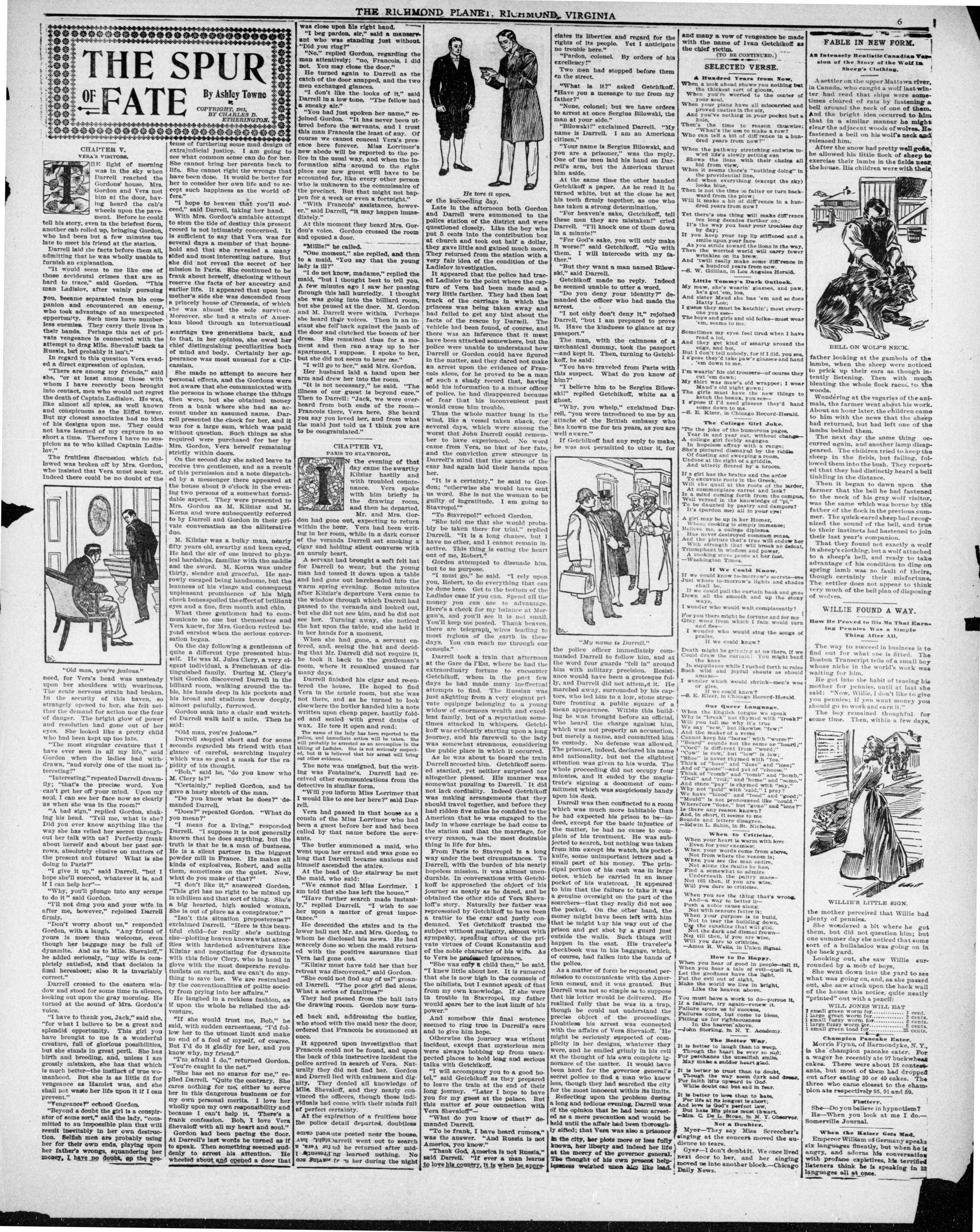
THE SPUR OF FATE By Ashley Towne COPYRIGHT, 1901 BY CHARLES R.
CHAPTER V.
VERA'S VISITORS.
HE light of morning was in the sky when Darrell reached the Gordons' house. Mrs. Gordon and Vera met him at the door, having heard the cab's wheels upon the pave tense of furthering some mad design of extrajudicial justice. I am going to see what common sense can do for her. She cannot bring her parents back to life. She cannot right the wrongs that have been done. It would be better for her to consider her own life and to accept such happiness as the world offers."
"I hope to heaven that you'll succeed," said Darrell, taking her hand.
HE light of morning was in the sky when Darrell reached the Gordons' house. Mrs. Gordon and Vera met him at the door, having heard the cab's wheels upon the pavement. Before he could tell his story, even in the briefest form, another cab rolled up, bringing Gordon, who had been but a few minutes too late to meet his friend at the station. Darrell laid the facts before them all, admitting that he was wholly unable to furnish an explanation. "It would seem to me like one of those accidental crimes that are so hard to trace," said Gordon. "This man Ladislov, after vainly nursing
you, became separated from his companion and encountered an enemy, who took advantage of an unexpected opportunity. Such men have numberless enemies. They carry their lives in their hands. Perhaps this act of private vengeance is connected with the attempt to drag Mille. Shevaloff back to Russia, but probably it isn't."
In regard to this question Vera evaded a direct expression of opinion.
"There are among my friends," said she, "or at least among those with whom I have recently been brought into contact, men who would not regret the death of Captain Ladislov. He was, like almost all spies, as well known and conspicuous as the Eiffel tower. But my closest associates had no idea of his designs upon me. They could not have learned of my capture in so short a time. Therefore I have no suspicion as to who killed Captain Ladislov."
The fruitless discussion which followed was broken off by Mrs. Gordon, who insisted that Vera must seek rest. Indeed there could be no doubt of the
A
"Old man, you're jealous."
need, for Vera's head was unsteady upon her shoulders with weariness. The acute nervous strain had broken. In the security of this haven, so strangely opened to her, she felt neither the demand for action nor the fear of danger. The bright glow of power and resolution had gone out of her eyes. She looked like a pretty child who had been kept up too late.
"The most singular creature that I have ever seen in all my life," said Gordon when the ladies had withdrawn, "and surely one of the most interesting!"
"Interesting," repeated Darrell dreamily; "that's the precise word. You can't get her off your mind. Upon my soul, I can see her face now as clearly as when she was in the room!"
"A bad sign," replied Gordon, shaking his head. "Tell me, what is she? Did you ever know anything like the way she has velled her secret throughout her talk with us? Perfectly frank about herself and about her past sorrows, absolutely elusive on matters of the present and future! What is she doing in Paris?"
"I give it up," said Darrell, "but I hope she'll succeed, whatever it is, and if I can help her"—
"Why, you'll plunge into any scrape to do it" said Gordon.
"I'll not drag you and your wife in after me, however," rejoined Darrell firmly.
"Don't worry about us," responded Gordon, with a laugh. "Any friend of yours is more than welcome, even though her baggage may be full of dynamite. And as to Mile. Shevaloff," he added seriously, "my wife is completely satisfied, and that decision is final hereabout; also it is invariably correct."
Darrell crossed to the eastern window and stood for some time in silence, looking out upon the gray morning. He turned at the sound of Mrs. Gordon's voice.
"I have to thank you, Jack," said she, "for what I believe to be a great and splendid opportunity. This girl you have brought to me is a wonderful creature, full of glorious possibilities, but she stands in great peril. She has birth and breeding, and, unless I am grossly mistaken, she has that which is much better—the instinct of true womanhood. But she is as little fit for vengeance as Hamlet was, and she shall not waste her life upon it if I can prevent."
"Vengeance" echoed Gordon.
"Beyond a doubt the girl is a conspirator of some sort," said the lady, "committed to an impossible plan that will result inevitably in her own destruction. Selfish men are probably using her for their own ends, playing upon her father's wrongs, squandering her money, I have no doubt, on the pre-
COPYRIGHT, 1901.
BY CHARLES B.
ETHERING
tense of furthering some mad design of extrajudicial justice. I am going to see what common sense can do for her. She cannot bring her parents back to life. She cannot right the wrongs that have been done. It would be better for her to consider her own life and to accept such happiness as the world offers."
"I hope to heaven that you'll succeed," said Darrell taking her hand.
With Mrs. Gordon's amiable attempt to stem the tide of destiny this present record is not intimately concerned. It is sufficient to say that Vera was for several days a member of that household and that she revealed a many sided and most interesting nature. But she did not reveal the secret of her mission in Paris. She continued to be frank about herself, disclosing without reserve the facts of her ancestry and earlier life. It appeared that upon her mother's side she was descended from a princely house of Circassia, of which she was almost the sole survivor. Moreover, she had a strain of American blood through an international marriage two generations back, and to that, in her opinion, she owed her chief distinguishing peculiarities both of mind and body. Certainly her appearance was most unusual for a Circassian.
She made no attempt to secure her personal effects, and the Gordons were not aware that she communicated with the persons in whose charge the things then were, but she obtained money from a bank where she had an account under an assumed name. Darrell presented the check for her, and it was for a large sum, which was paid without question. Such things as she required were purchased for her by Mrs. Gordon, Vera herself remaining strictly within doors.
On the second day she asked leave to receive two gentlemen, and as a result of this permission and a note dispatched by a messenger there appeared at the house about 9 o'clock in the evening two persons of a somewhat formidable aspect. They were presented to Mrs. Gordon as M. Kilziar and M. Korna and were subsequently referred to by Darrell and Gordon in their private conversation as the alliterative duo.
M. Killiar was a bulky man, nearly fifty years old, swarthy and keen eyed. He had the air of one inured to physical hardships, familiar with the saddle and the sword. M. Korna was under thirty, slender and graceful. He narrowly escaped being handsome, but the leanness of his visage and consequent unpleasant prominence of his high cheek bones spoiled the effect of brilliant eyes and a fine, firm mouth and chin. What these gentlemen had to communicate no one but themselves and Vera knew, for Mrs. Gordon retired beyond earshot when the serious conversation began. On the day following a gentleman of quite a different type presented himself. He was M. Jules Clery, a very elegant individual, a Frenchman of distinguished family. During M. Clery's visit Gordon discovered Darrell in the billiard room, walking around the table, his hands deep in his pockets and his broad and studious brow deeply, almost painfully, furrowed.
Gordon sank into a chair and watched Darrell walk half a mile. Then he said: "Old man, you're jealous." Darrell stopped short and for some seconds regarded his friend with that glance of careful, searching inquiry which was so good a mask for the rapidity of his thought. "Bob," said he, "do you know who M. Clery is?" "Certainly," replied Gordon, and he gave a hasty sketch of the man.
"Do you know what he does?" demanded Darrell.
"Does?" repeated Gordon. "What do you mean?"
"I mean for a living," responded Darrell. "I suppose it is not generally known that he does anything, but the truth is that he is a man of business. He is a silent partner in the biggest powder mill in France. He makes all kinds of explosives, Robert, and sells them, sometimes on the quiet. Now, what do you make of that?"
"I don't like it," answered Gordon. "This girl has no right to be mixed up in nihilism and that sort of thing. She's a big hearted, high souled woman. She is out of place as a conspirator."
"Isn't this situation preposterous?"
exclaimed Darrell. "Here is this beautiful child—for really she's nothing else—plitting heaven knows what atrocities with hardened adventurers like Killziar and negotiating for dynamite with this fellow Clery, who is hand in glove with the most desperate revolutionists on earth, and we can't do anything to save her. We are restrained by the conventionalities of polite society from prying into her affairs."
He laughed in a reckless fashion, as if upon the whole he relished the adventure.
"If she would trust me, Bob," he said, with sudden earnestness. "I'd follow her to the utmost limit and make no end of a fool of myself, of course. But I'd do it gladly for her, and you know why, my friend."
"I'm afraid I do," returned Gordon. "You're caught in the net."
"She has set no snarls for me," replied Darrell. "Quite the contrary. She cares nothing for me, either to serve her in this dangerous business or for my own personal merits. I love her wholly upon my own responsibility and because I can't help it. There's a frank confession. Bob, I love Vera Shevalloff with all my heart and soul." Gordon had been pacing the floor. At Darrell's last words he turned as if to speak. Then something seemed suddenly to arrest his attention. He wheeled about and opened a door that
THE RICHMOND PLANE1. RICHMOND. VIRGINIA
was close upon his right hand.
"I beg pardon, sir," said a manservant who was standing just without.
"Did you ring?"
"No," replied Gordon, regarding the man attentively; "no, Francois, I did not. You may close the door."
He turned again to Darrell as the catch of the door snapped, and the two men exchanged glances.
"I don't like the looks of it," said Darrell in a low tone. "The fellow had a sneaky air."
"You had just spoken her name," rejoined Gordon. "It has never been uttered before the servants, and I trust this man Francois the least of any. Of course we cannot conceal Vera's presence here forever. Miss Lorrimer's new abode will be reported to the police in the usual way, and when the information sifts around to the right place our new guest will have to be accounted for, like every other person who is unknown to the commissaire of the precinct. But that might not happen for a week or even a fortnight." "With Francois' assistance, however," said Darrell, "it may happen immediately." At this moment they heard Mrs. Gordon's voice. Gordon crossed the room and opened a door. "Millie!" be called. "One moment," she repiled, and then to a maid. "You say that the young lady is ill?"
"I do not know, madame," replied the maid, "but I thought best to tell you. A few minutes ago I saw her passing through this hall hurriedly. I thought she was going into the billiard room, but she paused at the door. M. Gordon and M. Darrell were within. Perhaps she heard their voices. Then in an instant she fell back against the jamb of the door and clutched the bosom of her dress. She remained thus for a moment and then ran away up to her apartment, I suppose. I spoke to her, but she did not seem to hear me." "I will go to her," said Mrs. Gordon. Her husband laid a hand upon her arm and drew her into the room. "It is not necessary," he said. "The illness of our guest is beyond cure." Then to Darrell: "Jack, we were overheard from both ends of the room—Francois there, Vera here. She heard you say you loved her, and from what the maid just told us I think you are to be congratulated."
CHAPTER VI.
PARIS TO STAYROPOL
f the evening of that day came the swarthy Kilziar hastily and with troubled countenance. Vera spoke with him briefly in the drawing room, and then he departed. Mr. and Mrs. (or
N the evening of that day came the swarthy Kilziar hastily and with troubled countenance. Vera spoke with him briefly in the drawing room, and then he departed. Mr. and Mrs. Gordon had gone out, expecting to return within the hour. Vera had been writing in her room, while in a dark corner of the veranda Darrell sat smoking a cigar and holding silent converse with an unruly heart.
A servant had brought a soft felt hat for Darrell to wear, but the young man had tossed it down upon a table and had gone out bareheaded into the warm spring evening. Some minutes after Klizar's departure Vera came to the window through which Darrell had passed to the veranda and looked out, but she did not see him, and he did not see her. Turning away, she noticed the hat upon the table, and she held it in her hands for a moment.
When she had gone, a servant entered, and seeing the hat and deciding that Mr. Darrell did not require it, he took it back to the gentleman's room, where it remained unused for many days.
Darrell finished his cigar and re-entered the house. He hoped to find Vera in the music room, but she was not there, and as he turned to look elsewhere the butler handed him a note written upon cheap paper, hastily folded and sealed with great daubs of wax. He tore it open and read:
The name of the lady has been reported to the police, and immediate action will be taken. She will probably be arrested as an accomplice in the killing of the woman. She is not seriously suspected, but it is believed that her arrest will bring out other evidence.
The note was unsigned, but the writing was Fontaine's. Darrell had received other communications from the detective in similar form.
"Will you inform Miss Lorrimer that I would like to see her here?" said Darrell.
Vera had passed in that house as a cousin of the Miss Lorrimer who had been a guest before her and had been called by that name before the servants.
The butler summoned a maid, who went upon her errand and was gone so long that Darrell became anxious and himself ascended the stairs.
At the head of the stairway he met the maid, who said:
"We cannot find Miss Lorrimer. I am told that she has left the house."
"Have further search made instantly," replied Darrell. "I wish to see her upon a matter of great importance."
He descended the stairs and in the lower hall met Mr. and Mrs. Gordon, to whom he disclosed his news. He had scarcely done so when the maid returned with the positive assurance that Vera had gone out.
"Killiar must have told her that her retreat was discovered," said Gordon.
"She could not find any of us!" groaned Darrell. "The poor girl fled alone. What a series of fatalities!"
They had passed from the hall into the drawing room. Gordon now turned back and, addressing the butler, who stood with the maid near the door, ordered that Francois be summoned at once.
It appeared upon investigation that Francois could not be found, and upon the back of this instructive incident the police arrived in search of Vera. Naturally they did not find her. Gordon and Darrell lied with calmness and dignity. They denied all knowledge of Mile. Shevaloff, and they nearly convinced the officers, though those individuals had come with their minds full of perfect certainty.
At the expiration of a fruitless hour the police detail departed, doubtless prompts posted near the house. Aunt Darrell went out to search a wound he returned after midnight, learned nothing. Noose Summers framed her during the night
He tore it open.
or the succeeding day.
Late in the afternoon both Gordon and Darrell were summoned to the police station of the district and were questioned closely. Like the boy who put 5 cents into the contribution box at church and took out half a dollar, they gave little and gained much more. They returned from the station with a very fair idea of the condition of the Ladislov investigation.
It appeared that the police had traced Ladislov to the point where the capture of Vera had been made and a very little farther. They had then lost track of the carriage in which the princess was being taken away and had failed to get any hint about the facts of the rescue by Darrell. The vehicle had been found, of course, and there was an inference that it must have been attacked somewhere, but the police were unable to understand how Darrell or Gordon could have figured in the matter, and they dared not make an arrest upon the evidence of Francois alone, for he proved to be a man of such a shady record that, having sold his information to a minor officer of police, he had disappeared because of fear that his inconvenient past would cause him trouble.
Thus the whole matter hung in the wind, like a vessel taken aback, for several days, which were among the worst that John Darrell could remember to have experienced. No word came from Vera, no hint of her fate, and the conviction grew stronger in Darrell's mind that the agents of the czar had again laid their hands upon her.
"It is a certainty," he said to Gordon; "otherwise she would have sent us word. She is not the woman to be guilty of ingratitude. I am going to Stavropol."
"To Stavropol!" echoed Gordon.
"She told me that she would probably be taken there for trial," replied Darrell. "It is a long chance, but I have no other, and I cannot remain inactive. This thing is eating the heart out of me, Robert."
Gordon attempted to dissuade him, but to no purpose.
"I must go," he said. "I rely upon you, Robert, to do everything that can be done here. Get to the bottom of the Ladislov case if you can. Spend all the money you can use to advantage. Here's a check for my balance at Morgan's, and you'll see it is not small. You'll keep me posted. Thank heaven, there are telegraph wires leading to most regions of the earth in these days. You can reach me through our consuls."
Darrell took a train that afternoon at the Gare de l'Est, where he had the extraordinary fortune to encounter Getchikoff, whom in the past few days he had made many ineffectual attempts to find. The Russian was just alighting from a very elegant private equipage belonging to a young widow of enormous wealth and excellent family, but of a reputation sometimes attacked in whispers. Getchikoff was evidently starting upon a long journey, and his farewell to the lady was somewhat strenuous, considering the public place in which it occurred.
the phone place in which it occurred.
As he was about to board the train Darrell accosted him. Getchikoff seemed startled, yet neither surprised nor altogether pleased. His manner was somewhat puzzling to Darrell. It did not lack cordiality. Indeed Getchikoff was making arrangements that they should travel together, and before they had ridden five miles he confided to the American that he was engaged to the lady in whose carriage he had come to the station and that the marriage, for every reason, was the most desirable thing in life for him.
From Paris to Stavropol is a long way under the best circumstances. To Darrell, with the burden of his nearly hopeless mission, it was almost unendurable. In conversations with Getchikoff he approached the object of his journey as nearly as he dared, and he obtained the other side of Vera Shevałoff's story. Naturally her father was represented by Getchikoff to have been a traitor to the czar and justly condemned. Yet Getchikoff treated the subject without malignity, almost with sympathy, speaking often of the private virtues of Count Konstantin and of the noble character of his wife. As to Vera he professed ignorance.
"She was only a child then," he said. "I knew little about her. It is rumored that she is now high in the counsels of the nihilists, but I cannot speak of that from my own knowledge. If she were in trouble in Stavropol, my father would spare her to the last limit of his power."
And somehow this final sentence seemed to ring true in Darrell's cars and to give him hope.
Otherwise the journey was without incident, except that mysterious men were always bobbing up from unexpected places to hold long and serious talks with Getchikoff.
"I will accompany you to a good hotel," said Getchikoff as they prepared to leave the train at the end of their long journey. "Later I hope to have you for my guest at the palace. But this matter of your connection with Vera Shavaloff—"
"What do you know of that?" demanded Darrell.
"To be frank, I have heard rumors," was the answer. "And Russia is not America, you know."
"Thank God, America is not Russia," said Darrell. "If ever a man learns to love his country, it is when he appro-
clates its liberties and regard for the rights of its people. Yet I anticipate no trouble here."
"Pardon, colonel. By orders of his excellency?"
Two men had stopped before them on the street.
"What is it?" asked Getchikoff.
"Have you a message to me from my father?"
"None, colonel; but we have orders to arrest at once Sergius Billowski, the man at your side."
"Billowski!" exclaimed Darrell. "My name is Darrell. I am an American citizen."
"Your name is Sergius Billowski, and you are a prisoner," was the reply. One of the men laid his hand on Darrell's arm, but the American thrust him aside.
At the same time the other handed Getchikoff a paper. As he read it he turned white, but at the close he set his teeth firmly together, as one who has taken a strong determination.
"For heaven's sake, Getchikoff, tell these men they are mistaken!" crled Darrell. "I'll knock one of them down in a minute!"
"For God's sake, you will only make it worse!" said Getchikoff. "Go with them. I will intercede with my father."
"But they want a man named Bilowski," said Darrell.
Getchikoff made no reply. Indeed he seemed unable to utter a word.
"Do you deny your identity?" demanded the officer who had made the arrest.
"I not only don't deny it," rejoined Darrell, "but I am prepared to prove it. Have the kindness to glance at my passport."
The man, with the calmness of a mechanical dummy, took the passport—and kept it. Then, turning to Getchikoff, he said:
"You have traveled from Paris with this suspect. What do you know of him?"
"I believe him to be Sergius Billowskil" replied Getchikoff, white as a ghost.
"Why, you whelp," exclaimed Darrell, "you were introduced to me by an attacke of the British embassy who has known me for ten years, as you are well aware."
If Getchikoff had any reply to make, he was not permitted to utter it, for
M.
"My name is Darrell," the police officer immediately commanded Darrell to follow him, and at the word four guards "fell in" around him with military precision. Resistance would have been a grotesque folly, and Darrell did not attempt it. He marched away, surrounded by his captors, who led him to a loy, stone structure fronting a public square of a mean appearance. Within this building he was brought before an official, who heard the charge against him, which was not properly an accusation, but merely a name, and committed him to custody. No defense was allowed. The prisoner, indeed, declared his name and nationality, but not the slightest attention was given to his words. The whole proceeding did not occupy four minutes, and it ended by the magistrate's signing a document of commitment which was suspiciously handy upon his desk.
Darrell was then conducted to a room which was much more habitable than he had expected his prison to be—indeed, except for the basic injustice of the matter, he had no cause to complain of his treatment. He was subjected to search, but nothing was taken from him except his watch, his pocketknife, some unimportant letters and a small part of his money. The principal portion of his cash was in large notes, which he carried in an inner pocket of his waistcoat. It appeared to him that the failure to take it was a genuine oversight on the part of the searchers—that they really did not see the pocket. On the other hand, the money might have been left with him that he might buy his way out of the prison and get shot by a guard just outside the walls. Such things will happen in the east. His traveler's checkbook was in his baggage, which, of course, had fallen into the hands of the police.
As a matter of form he requested permission to communicate with the American consul, and it was granted. But Darrell was not so simple as to suppose that his letter would be delivered. He realized fully that he was in a trap, though he could not understand the precise object of the proceedings. Doubless his arrest was connected with the affairs of Vera Shevaloff. He might be seriously suspected of complicity in her designs, whatever they were, and he smiled grimly in his cell at the thought of his own complete ignorance of the matter. It would have been hard for the governor general's secret police to find a man who knew less, though they had searched the city for the most innocent within its limits. Reflecting upon the problem during a long and tedious evening, Darrell was of the opinion that he had been arrested as a mere precaution and would be held until the affair had been thoroughly sifted; that Vera was also a prisoner in the city, her plots more or less fully known, her liberty and indeed her life at the mercy of the governor general. The thought of his own present helplessness weighed upon him like load.
and many a vow of vengeance he made with the name of Ivan Getchikoff as the chief victim.
SELECTED VERSE
A Hundred Years from Now.
When a look ahead shows you nothing but
a set of gloom.
When you're worried to the center of
your soul.
When
When your plans have all miscarried and proved casties in the air.
And you've nothing in your pocket but a hole,
Then's the time to reason thuswise;
Then's the time to make a row?
Who can tell bit of difference in a hundred years from now?"
When the way path stretching endwise to ward life's slowly settling end
Shows the lions with their claws all
hid from view.
When it seems there's "nothing doing" in
providential line.
And when "everything" (except the sky)
lookes blue.
Then is not the time to falter or turn backward from the plow;
Will it make a bit of difference in a hundred years from now?
Yet there's one thing will make difference ten long decades further on;
It's the way you bear your trouble day by day;
If you keep your top lip stiffened and a smile upon your face
As you stride toward the lions in the way,
The knight world will carry fewer
wrinkles.
Little Tommy's Dark Outlook.
My maw, she's wearin' glasses, and paw,
he's got 'em, too.
And
And sister Maud she has 'em and so does
Hatty Loo;
I guess they must be ketchin'; most every-one you see—
The boys and girls and old folks—must wear 'em, seems to me.
Sometimes my eyes feel tired when I have read a lot.
And they get kind of smarty around the bed. But I don't tell nobody, for if I did, you see. I s'pose they'd take paw's glassee and hand 'em down to me.
I'm wearin' his old trousers—of course they cut 'em down;
My shirt was maw's old wrapper; I wear
Maud's old night gown;
The girls must have the new things to
ketch the beaux, you see—
I suppose if I'd need glasses they'd hand
up down to me.
-S. E. Kline, Bernard Hornibrook
The College Girl Joke
the humorous pages,
Year in and year out change
A college girl feebly engages
In hopeless affray with a range;
She dissected dismayed by the riddle
of dumbing down a room.
Undone at the sight of a griddle.
And utterly floored by a broom.
If a girl has the brains and the ardor
To excavate roots in the Greek.
Nice!
will the quail at the roots of the larder,
a commonplace carrot and leek?
Is a commonplace pump, well versed in the knowledge of "bl";
To be daunted by pastry and dampers?
It's (pardon me) all in your eye!
A girl may be up in her Homer,
Whose cooking is simply immense;
Believe me, a college diploma
Has never destroyed common sense;
Attitude will true will endow her
With strength that will no defeat,
Trumpphant in wisdom and power,
A cooking stone prone at her feet.
we could know to-morrow's secrets—see
Just as to-morrow's lights and shades
shall be.
If we could pull the curtain back and gaze
Down all the smooth and up the stony
I wonder who would wait complacently?
For you there might be fortune and for me
Gray woes from which I fain would turn
and flee
f wonder who would sing the songs of praise,
If we could know?
Death might be grinding at us there. If we Could draw the curtain. You might bend the knee
In supplance while I rushed forth to raise
Such wild and joyful shouts as should
amaze—
I wanna wish would
1 wonder which would shrink—men's woe or glee.
If we could know?
-S. E. Kiser, in Chicago Record-Herald
Our Queer Language
When the English tongue we speak
Why is 'break' not rhymed with 'fresh?'
Will you tell me why it's true?
I say 'rew,' but likewise 'few.'
And in man's language
Cannot keep his 'horse' with 'worse?'
'Beard' sounds not the same as 'heard?'
'Cord' is different from 'word;'
'Cow' is cow, but 'low' is low;
'Shoe' is shoe, but 'thyme' is say.
Thick of 'hose' and 'dose' and 'lose';
And of 'goose'—and yet of 'choose.'
Think of 'comb' and 'tomb' and 'bomb.'
And 'roll' and 'home' and 'some.'
And strain them thyme with say.
Why not 'pold' with say.
We have 'blood' and 'food' and 'good.'
'Mould' is not pronounced like 'could.'
Wherefore 'done,' but 'gone' and 'lone?'
And, in short, it seems known?
And, in short, it seems known?
Sounds and letters disagree.
—Edwin L. Sabin, in St. Nicholas.
When to Criticize.
When your heart is warm with love
Even for your enemies;
that to admire
Underneath the policy mues-
Not till then, if you are wise,
Will you dare to criticise.
When you see the thing that's wrong,
And—a way to better it—
Push a noble cause along.
Not with censure fetter it:
When as a noble cause builds,
Not to tear the building down,
Use the sunshine that will gild,
Not the dark and desmal frown—
Not till then you are wise.
Will you dare to criticise—
Amos R. Wells, in Union Storm
How to Be Henry
the happy.
When you hear of good in people—tell it,
When you hear a tue of evil—quell it.
Let the goodness have the light,
Put the evil out of sight.
Make the world we live in bright,
Like the heaven above.
You must have a work to do—pursue it,
If a failure, try again—renew it.
Failure spurs us to success.
Failures come, but come to bless.
The Better Way
It is better to laugh than to weep,
Though the heart he ever so sad;
For perchance the unselfish smile,
May make a sadder heart glad.
It is better to trust than to doubt,
Though the way seem dark and dream,
For faith lifts upward to God.
While doubt can but and in fear.
It is better to love than to hate,
For life at its longest is show;
And love is God's perfect law.
But hate His plans must thwart.
-Mrm. C. De L. Stone, in N. Y. Observer.
Not a Doubt.
Myer—They say Miss Screecher's singing at the concert moved the audience to tears.
Gyer—I don't doubt it. We once lived next door to her, and her singing moved us into another block.—Chicago Daily News.
---
6
An Intensely Realistic Canadian Version of the Story of the Wolf in Sheep's Clothing.
A settler on the upper Mattawa river, in Canada, who caught a wolf last winter had read that ships were sometimes cleared of rats by fastening a bell around the neck of one of them. And the bright idea occurred to him that in a similar manner he might clear the adjacent woods of wolves. He fastened a bell on his wolf's neck and released him.
After the snow had pretty well goofed, he allowed his little flock of sheep to exercise their lambs in the fields near the house. His children were with their
BELL ON WOLF'S NECK.
father looking at the gambols of the lambs, when the sheep were noticed to prick up their ears as though intently listening. Then with much bleating the whole flock raced to the woods.
Wondering at the vagaries of the animals, the farmer went about his work. About an hour later, the children came to him with the news that the sheep had returned, but had left one of the lambs behind them.
The next day the same thing occurred again, and another lamp disappeared. The children tried to keep the sheep in the fields, but failing, followed them into the bush. They reported that they had distinctly heard a bell tinkling in the distance.
Then it began to dawn upon the farmer that the bell he had fastened to the neck of his gray wolf visitor, was the same which was borne by the father of the flock in the previous summer. The quick-eared sheep had recognized the sound of the bell, and true to their instincts had hastened to join their last year's companion. That they found not exactly a wolf in sheep's clothing, but a wolf attached to a sheep's bell, and ready to take advantage of his condition to dine on spring lamb was no fault of theirs, though certainly their misfortune. The settler does not appear to think very much of the bell plan of disposing of wolves.
WILLIE FOUND A WAY
How He Proved to His Ma Thint Earning Pennies Was a Simple Thing After All,
The way to succeed in business is to find out for what one is fitted. The Boston Transcript tells of a small boy whose niche in the world's work was waiting for him.
He got into the habit of teasing his mother for pennies, until at last she said: "Now, Willie, I don't like to give you pennies; if you want money you should go to work and earn it."
The boy remained thoughtful, for some time. Then, within a few days.
奥密尔辛
WILLIE'S LITTLE SIGN.
the mother perceived that Willie had plenty of pennies.
She wondered a bit where he got them, but did not question him; but one summer day she noticed that some sort of a hullabaloo was going on in the back yard.
Looking out, she saw Willie surrounded by a mob of boys.
She went down into the yard to see what was going on, and, as she passed out, she saw stuck upon the back wall of the house this notice, quite neatly "printed" out with a pencil:
WILL JONES WILL EAT
1 small green worm for... 1 cent.
1 large fuzzy worm for... 2 cent.
1 large fuzzy worm for... 6 cents.
1 large fuzzy worm for... 25 cents.
Champion Pancake Eater.
Morris Flynn, of Harmondyke, N.Y.
is the 'champion pancake eater. For a wager he recently ate 97 buckwheat cakes. There were about 25 contestants, but most of them had dropped out after eating 30 or 40 cakes. The three who came closest to the champion ate respectively 95.91 and 59.
Flattery.
She—Do you believe in hypnotism?
He—When you look at me I do.
Somerville Journal.
When the Kaiser Gets Mad.
Emperor William of Germany speaks six languages fluently, but when he is angry, and adorns his conversation with profane expletives, his terrified listeners think he is speaking in 32 languages all at once.
THE PLANET
Published every Saturday by JOHN MITCHELL,
Jr., at 811 North 4th Street, Richmond, Va.
JOHN MITCHELL, JR., - EDITOR.
All communications intended for publication
should be sent so as to reach us by Wednesday.
One Copy, one year, . $1.50
One Copy, eight months, . $1.00
One Copy, six months, . $0.80
One Copy, four months, . $0.50
One Copy, three months, . $0.40
Single Copy, . $0.05
ADVERTISING RATES.
For one inch, one insertion, ..$50
For one inch, each subsequent insertion, ..$25
For two inches, three months, ..$0.00
For two inches, nine months, ..$14.00
For two inches, twelve months, ..$20.00
For two inches, twelve months, ..$50
Marriage and Funeral Notices, ..$50
Standing and Transient Notices per line, ..$10
POSTAGE STAMPS OF A HIGHER DE-
NOMINATION THAN TWO CENTS NOT
RECEIVED ON SUBSCRIPTIONS.
THE PLANET is issued weekly. The subscrip-
Mon price is $1.50 a year, in advance.
There are FOUR WAYS by which money can be sent by mail at our risk - In a Post Office Mon-
ary, by link the post or Draft on an Express Money Order, and when none of these can be procured, in a Registered Letter.
MONEY ORDERS.—You can buy a Money Ord-
at your Post Office, payable at the Richmond
Post Office, and we will be responsible for its
same arrival.
MONEY ORDERS can be obtained at
any office of the American Express Co., the
United States Express Co., and the Web's Farg-
and Co., as Express Company. We will be re-
sponsible for money sent by any of these com-
penses. The Express Money Order is a safe
and convenient way for forwarding money
REGISTERED LETTER—If a Money Order Post Office or an Express Office is not within the city, you should send your letter you wish to send us on payment of ten cents. Then, if the letter is lost or stolen, it can be traced, but can send money in this manner. On our risk.
We cannot be responsible for money sent in letters in any other way than one of the four ways mentioned above. If you send your monograph other way, you must do it at your own risk.
RENEWALS, ETC. If you do not want the PLANET continued for another year after your subscription has run out, you then notify us by email or by phone. The course has decided that subscribers to newspapers who do not order their paper discontinued at the expiration date, and hold liable for the payment of the subscription up to date when they order the paper discontinued.
COMMUNICATIONS—When writing to us to renew your subscription or to discontinue our paper, you should give your name and address in full, otherwise we cannot find your information.
CHANGE OF ADDRESS—In order to change the address of a subscriber, we must be sent the former as well as the present address.
Entered in the Post Office at Richmond, Va., as second class matter.
SATURDAY. JUNE 21. 1902
It is now announced from Martinsville, Va., that one of the white members of the Board of Registrars, recently appointed under the new Constitution can neither read nor write.
THE transfer of Mr. JOHN D. POTTS, Assistant General Passenger Agent of the C. & O. R. R. Company from this city to Cincinnati, Ohio, is universally regretted by all regardless of color, who have had cause to deal with him or his agents.
We feel safe in saying that no official either private, state or national has been as successful as he, in winning favors and enjoying popularity at the hands of an exacting public.
With him the advancement of the road with which he was identified was first and foremost. He had no business hours. Any time from dawn to dawn again was the hour of business with him. The doors of the C. & O. office here, so far as the passenger department was concerned, were practically never shut.
We are informed that this transfer is in the nature of a promotion. If this is a fact, we congratulate him upon his good fortune. Although his business duties may call him .o Cincinnati, let us hope that he will make his home in Richmond.
THE "Jim Crow" Car Law was the cause of another serious row on Sunday, June 15th near Lynchburg, Va., on the Lynchburg and Durham Division. HENRY GRIFFIN (white) 23 years of age, not only entered the apartments set apart for colored people, but being under the influence liquor attempted to hug a colored lady seated in the coach. Now, while it is a well-known fact that this kind of familiarity is indulged in among lower classes of colored women of questionable reputation and white men, the self-respecting colored females will not tolerate or submit to such excesses. The result was that her appeal for help was answered and a colored man carved HENRY GRIFFIN in a way that would have done credit to a regular surgeon. One of his arteries was cut and he narrowly escaped bleeding to death.
The conductor and brakesman had several times before removed the white man from the colored coach, but he persisted in returning and paid the penalty.
The colored man who cut him did not wait to be captured, but took French leave. When last seen, his coat-tails were playing hide and seek with the wind as he made his way in another direction from that on which the train was going.
This was a caseof a white man forcing himself upon colored people. These happenings are unfortunate; but they
emphasize the fact that the colored people are contented to be to themselves and make no effort as in this case to intrude themselves where they are not wanted.
THE CHIEFTAIN'S DAUGHTER.
It seems that every effort made to humiliate and embarrass the colored people reacts upon the white people, while the light-hearted "brother in black" regards with amusement the discomfiture of the Negro-haters when their bitterest measures fail in accomplishing the purpose.
Legislator JAMES R. CATON of Alexandria, Va., attempted to secure the passage of a "Jim Crow" car law for the street-car lines of the state.
He met bitter opposition at the hands of the street-car syndicates. Finally, he secured the passage of a law which operated only in his own county. It provided for the separation of the races. So far, so good. The line is known as the Washington, Alexandria and Mount Vernon Railway.
The trouble is that the white passengers are so much more numerous than the colored ones that frequently colored people have the room and the white people the crowding.
The result has been that the white people have done more in the way of disregarding the law than the colored.
On Friday, 13th inst., a white lady passenger boarded the cars in Washington and occupied a seat in the apartments designated for the colored people. The conductor insisted that she should move to the other apartment. She declined to do so, urging that she was comfortable and that it was very inconvenient for her to remove her bundles.
The conductor became indignant, and telegraphed to Alexandria for officers to arrest the passenger.
The officers were on hand upon the arrival of the train and their chagrin and surprise were plainly apparent when it was ascertained that they had arrested Miss MARY CUSTIS LEE, the daughter of the late Gen. ROBERT E. LEE.
She was released at once on her own recognition and ex-Confederates in that locality hastened to tender their assistance and offer her protection.
On Saturday morning, her collateral of ($5.00) five dollars which had been sent to the station house was declared forfeit, the being placed at that sum.
Nothing has tended more to make obnoxious the law in question.
The ex-Confederates of Richmond have been so indignant over the affair, that it is announced that an attempt will be made at the next session of the legislature to repeal the law.
The ruling of the United States Supreme Court has been that interstate passengers are not subject to local restrictions.
The conductor therefore was acting outside of the law when he attempted to evict a passenger who had boarded a train in Washington for a point in Virginia.
But then it is the white folks fight. If they can stand insulting and fining a daughter of the great Confederate Chieftain, ROBERT E. LEE, it is none of our funeral and the followers of the LOST CAUSE are the ones to take up the gauntlet and fight the matter to its logical conclusion.
After He Had Been Accepted,
Mrs. Crawford (exchanging confidences)—How did Mr. Crabshaw act after you accepted him?
Mrs. Crabshaw—As nearly as I can figure, my dear, it was just then that he stopped acting—Town Topics.
No Mitigativity Circumstance.
"He has proposed to Molly Thompson."
"Dear me, you don't say so? But perhaps there's some excuse for him?"
"Not a bit of excuse—he did it in broad daylight!"—Tit-Bits.
Proud.
"Does Miss Billions think a great deal of the nobleman she married?" said one young woman.
"Yes," answered the other; "she is as proud of him as she can be. She says he was such a bargain."—Washington Star.
Seat of the Trouble.
"Your sire objects to me, I tear," Said Jack, while they were rowing; "Do you your coming," said Edyth, dear; "He only kicks at your going."
—Chicago Daily News.
A CRITERION
She—Jack, I'm afraid this dog you've given me isn't a good one. He—Not a good one! Why, what's the matter with him?
She—I don't know, I'm sure; but I've had him a whole month now, and no one has even tried to steal him—London Punch.
9b. Those Girls
Patience—Did you ever let a man win a pair of gloves by kissing you when you were supposed to be asleep?
Patrice—Oh, yes; I was wide awake enough for that.—Yonkers Statesman.
THE RICHMOND PLANET, RICHMOND, VIRGINIA
A WEEK'S NEWS CONDENSED.
Thursday, June 12
The new sciencefine building of Franklin and Marshall College, at Lancaster, Pa., was dedicated yesterday. Senator Gonzales de Quesada, the first Cuban minister to the United States, arrived in New York yesterday from Havana. Samuel Caldwell, of West Chester, Pa., was killed while placing a revolver in his pocket, when the weapon was accidentally discharged. Considerable alarm is felt by federal and state officers over the forest fires raging in Colorado. Three fires are now raging, and all are of incendiary origin.
Friday, June 13.
A Paris dispatch says a theft of 1,000,000 francs has been discovered at the Bank of France.
After Victor Crouser died in an almshouse at Toledo, O., a certificate of deposit for $1,500 on a national bank was found.
At the 66th commencement of Franklin and Marshall College, at Lancaster, Pa., yesterday, a class of 35 was graduated.
The United States transport Warren arrived at San Francisco yesterday from Manila, bringing 300 marines and 650 casuals and short-term men.
Saturday, June 14.
President Roosevelt yesterday signed the river and harbor bill.
Two men were killed yesterday by the fall of an elevator in the veneer mill of C. C. Manuel & Son, at Richforth, Vt. The seventh annual meeting of the American Association of Farmers' Institute Workers will be held in Washington June 24, 25 and 26. The police of Butte, Mon., claim they have unearthed a conspiracy to do a wholesale kidnapping business among the wealthy families of the city. The alleged leader of the band is under arrest.
Monday, June 16.
The national house of representatives passed 199 private pension bills on Saturday. The Southern Inter-State Bankers' Association held its annual session at Savannah, Ga., today. Manila, P. L. printers in the employ of the government have asked that their salaries be paid in gold. They are now paid in Mexican silver. The telegraphers of Chicago, who have been without a union for several years, were organized yesterday by the American Federation of Labor. Rev. Dr. Henry Van Dyke, of Princeton, N. J., preached the baccalaureate sermon to the graduates of Cornell University at Ithaca, N. Y., yesterday. Tuesday, June 17. A number of Baltimore manufacturers are using oil in place of coal to furnish heat for the boilers at their plants.
Colonel Myron T. Herrick, treasurer of the McKinley National Memorial Association, has received from Paris a check for $7,814 for the fund.
A New York dispatch says all steamship lines operating between England and Atlantic seaboard ports have entered into an agreement on freight rates to Europe.
President Roosevelt yesterday received over 400 delegates of the International Association of General Secretaries of the Y. M. C. A., who recently held a convention at Mountain Lake, Md.
Wednesday. June 18.
Brigadier General Charles Bird was retired yesterday, having reached the age of 63 years.
The next tournament of the National Telegraphers' Association will be held in Cincinnati. No date has been fixed as yet.
The navy department yesterday issued an order placing Captain Samuel C. Lemly, judge advocate of the navy, on the retired list.
Despondent because of failure of his business since the miners' strike began, Samuel Gelsinger, of Wilkesbarre, Pa., committed suicide yesterday.
Edward Bailey, of Harrisburg, and General David McM. Gregg, of Reading, were reappointed trustees of the Pennsylvania Insane Asylum at Harrisburg yesterday by Governor Stone.
Secretary of the Navy Moody has refused to loan models of warships to the New England Art Association to display at their expo at Crescent, R. I., claiming he has no authority to make the loan.
GENERAL MARKETS
Philadelphia, Pa., June 17—Flour was steady; winter superfine, $2.85@3.10; Pennsylvania roller, clear, $3.40@3.65; city mills, extra, $3.10@3.08; Rye flour, was quiet, at $3.25@3.30 per mills; red mills, $8.34@3.10; Pennsylvania red, $8.34@3.10; Steady, No. 2 yellow, local, $6.75%; Oats were quiet; No. 2 white, clipped, $5.25%; lower grades, 50c. Hay was steady; No. 1 timothy sold at $15.50@16 for large beets; Beef was steady; beef was steady; 21.50. work was family; family, $20.5@21. Live chickens, $24@28%. 12%c. for hens, and at 9c. for old roosters; spring chickens, $24@28%. Dressed poultry sold at 12%c. for choice fowls, and at 8%@9c. for old roosters. Butter was steady; cream-filled. Biggs were steady; New York and Pennsylvania 17%c. per dozen. Potatoes were dull; eastern, old, 60c. per bushel.
Live Stock Markets
East Buffalo, N. Y., June 17—Cattle were firm; steers, $4.50; helfers, $3.75@4.25; cows, $2.75@3.25. Veals were dull and slow and $2.50; lower; tops, $7.50@7.25; fair to good, $6.25@7.25; heavy hogs, $4.75@5.75. Hogs were active and slow; higher on light hogs; steady on heavy; heavy hogs, $7.50@4.60; mixed, $7.35@7.45; pigs, $7.10@7.15; roughs, $6.80@7.15; stags, $5.50@6.00; Sheep and lambs were steady; cattle, $6.50@7.25; fair to good, $7.57@6.25; culls, mon, $4@5; yearlings, $5.25; sheep, mixed tops, $4.25@4.50; fair to good, $4@4.42; culls to common, $1.75@3.75. Cattle were steady; choice, $6.15@6.50; time, $6.75@7.15; good, $6.60@3.00. Hogs were slow; prime hogs, $7.40@7.55; medium, $2.75; heavy workers, $7.20@7.25; light yorkers, $7.10@7.15; pigs, $7.40@7.25; sheep were slow; best wethers, $4.50@7.00; culls and common, $1.50@2; choice lambs, $6@5.0; veal calves, $7.75.
Lightning's Strange Prank
Pennsgrove, N. J., June 16--During a violent storm lightning struck the home of Thomas J. Torton, the game warden. The course of the bolt was through Mr. Torton's bedroom, into the hall, across another bedroom, down stairs, and into the sitting room. The last apartment was completely wrecked, pictures being torn from the walls and a desk being neatly emptied of the books and papers, which it contained.
CAMPFIRE STORIES
Interesting War Facts Recalled by the Meeting Between Prince Henry and Carl Schurz.
Prince Henry's overtures to Carl Schurz at the opera, when he invited the former revolutionary leader to sit by him in his box, have called attention to the fact that Carl Schurz would not have been able to enjoy the friendship of Prince Henry had he not fled from Germany over 50 years ago, says the New York Times. In connection with Mr. Schurz the name of another prominent German who also had to leave his fatherland under similar conditions is recalled, that of Franz Sigel, who is five years older than his compatriot and is now living in New York city in his seventy-eighth year.
After their part in the unsuccessful Hecker-Strube insurrection in 1843 to secure greater freedom for the German states both Sigel and Schurz spent some time in France and then came to America.
In the civil war they came together again, when both took an honorable part in the struggle. Schurz resigned an appointment as minister to Spain in order to enlist in the army, and in 1862 he had command of the Third division in the corps of Maj. Gen. Franz Siegel, of the Army of Virginia. It was this army which had the difficult task of holding "Stonewall" Jackson at bay and a number of hot engagements
MAJ. GEN. FRANZ SIGEL were fought, beginning at Cedar Creek and ending with the second battle of Bull Run, where Sigel commanded the bowl, crier right wing and scored a decided advantage over Jackson in the first day's teaspoons conflict. When the union forces were best trip finally foreced back Sigel skillfully covered yet. Looked the retreat to Centerville.
At the outbreak of the war Sigel was a school teacher in St. Louis, where he had gone from New York in 1857. He organized in 1861 the Third regiment of Missouri volunteers. Sigel soon became the great rallying center for the St. Louis Germans, whose devotion to the union is so well brought out in Churchill's latest novel, "The Crisis." He participated in the famous affair of Camp Jackson in St. Louis, and later was of invaluable assistance in saving St. Louis, and with it Missouri, to the union cause. A little later he and his intrepid Germans performed such deeds of valor at the battles of Carthage and Wilson's Creek that the young leader's name became famous throughout the north, and for a German to say he "fit mit Sigel" was honor enough.
The brave Gen. Lyon met his death at the latter battle and Sigel conducted the retreat from a vastly superior force with such skill that he became the favorite of his troops and was honored with their highest confidence. His successes in those trying days of Missouri were recognized by his appointment as brigadier general of volunteers, and after the battle of Pea Ridge in March, 1862, he was elevated to a major generalship.
At this time many war songs and patriotic sentiments in rhyme appeared with the "fit mit Sigel" expression for the chief theme. Our verse of these popular effusions, describing a typical Sigel soldier, may be interesting:
The next time I saw him his knapsack was gone.
His cap and cane were missing.
Shell, shrapnel and grape, and the swift rifle ball
Around him and o'er him were hissing.
"How are you, my friend, and where have you been,
And for what and for whom are you fighting?"
He said, as a shell from the enemy's gun
Sent his arm and his musket a "killing":
"I rights mit Sigel."
After Sigel was made major general
he was transferred to the east and his faithful St. Louis Germans separated from him with the deepest sorrow and reluctance. He was placed in command of the troops at Harper's Ferry and followed Gen. "Stonewall" Jackson in his retreat to Winchester and Middleton. In June, 1862, after the creation of the army of Virginia, which was placed under the command of Gen. John Pope, Sigel was given command of the First corps. He was engaged in the battle of Cedar Mountain.
With Gens. Banks and McDowell, he took an active part in the operations on the Rappahannock and performed valuable services at the disastrous second battle of Bull Run. Carl Schurz' division held Bald Mountain against many charges of Hood's Texan troops, in one charge nearly one-
fourth of the latter's men being killed or wounded. Finally Schurz had to retire and with the remainder of Sigel's crops effected an orderly retreat. Soon after these stirring scenes Gen. Sigel obtained a leave of absence on account of poor health, but in June, 1863, he returned to active service, taking command of the reserve army of Pennsylvania, and he organized a corps of 10,000 men to aid in repelling Lee's invasion. In February, 1864, President Lincoln placed him in charge of the army of West Virginia, but after his defeat at New Market by Gen. John C. Breckinridge he was relieved, being succeeded by Gen. Hunter, and Sigel was sent to the reserve division on the Potomac. He defended Maryland Heights in July, 1864, against the attacks of Gen. Jubal A. Early.
A WAR-TIME SOUVENIR.
Piece of Silver That Was Buried for Safe Keeping During the Great Civil Strife.
"Here's what you might call a genuine souvenir spoon," remarked a pleasantly-colloquial gentleman in a large china store in New Orleans to a northern tourist, says the Detroit Free Press. "As you see, it is an old silver-plated teaspoon, marked 'Mary Keene,' and its history runs back before the civil war. Just before the war began, a popular river man down south built a steamboat, to run between Yazoo City and New Orleans. The owner we will call Capt. McCorkery, and he named his boat 'Mary Keene,' for a sweetheart in New Orleans, I have always supposed. All china stores at that time carried large lines of good silver-plated ware; and I happened to be a clerk in the establishment which fitted out the 'Mary Keene'; $2,000 worth of fine silverware was billed in the furnish-
ANZ SIGEL.
ings, six tables were fitted with dinner and breakfast castors, sugarbowl, cream pitcher, cake basket, ice pitcher, a dozen forks and as many teaspoons and tablespoons—all in the best triple-plate—it isn't worn off yet. Look at this teaspoon, bright as new, made in 1862.
"Well, the Mary Keene had made but few trips when the war cut her off at Vicksburg. She couldn't go south or come north, and her captain, not wanting her to fall into unfriendly hands on either side, ran her up Yazoo river, if my memory serves me right, and burned her to the water's edge. It must have made his heart ache. Before he did it, however, he had all the silverware taken off and buried somewhere in the woods in Mississippi.
"After the war was ended, the faithful captain, who had lost all he owned in the Mary Keene, had the silverware dug up and shipped back to us. It was all he could do to reimburse our firm. The silver was as black as ink, from its long burial, and a disheartening sight. For many months my employer would not even look at it, but at last he told the boys in the store to polish it up and sell it for what it would bring. We sold the large pieces like hot cakes, at $60 a set, to private families; $300 for $2,000 worth of silverware! Those teaspoons and the fools—all marked "Mary Keene"—have now been in use for years and years, rented out frequently to church socials and the like.
"You would like to have a teaspoon, as a genuine war souvenir?
"Buy it? Oh, no; take it—take it along. You're thoroughly welcome."
The Invertebrate Angler
Mrs. Malaprop—My husband's getting ready for the opening of the fishing season.
Browne—Fond of the sport, eh?
"Well, I should say. Why, he's a regular anglomaniac."—Philadelphia Press.
JUST AMONG OURSELVES.
The man who carries a pocket comb or mirror is by no means exceptional.
Some men call women angels—but then you can't believe all that some men say.
The proudest moment in a bride's life is when she sees her first cards bearing the title of Mrs.
The man who has an unusually bright young son is not apt to dispute the doctrine of heredity.
Some women will stand in front of a soda water counter and read the entire list of flavors and then call for sarsparilla.—Philadelphia Times.
A Phase of Contrariness.
"What has made you such a determined optimist?"
"Well, to be honest about it, I began it because I boarded where the folks were all pessimists."—Puck.
A Phases of Continuity
His One Regret.
"Henry," said Mrs. Peck severely,
"I am inclined to think you have
quandered a lot of money foolishly
n your life."
"I know it, my dear," replied the
meek and lowly Henry.
"Well, don't you regret it?" she
asked.
"Some of it," answered Henry, with
long-drawn-out sigh. "I've never
reced to regret the ten dollars I
gave up to the parson who officiated
at our wedding."—Chicago Daily
News.
The Rain.
The rain comes down obedient to
The law of gravitation.
If it went up planted, I think,
Twould make a great sensation.
-Judge.
SEEN THROUGH.
Mary—So you think she is two-faced?
Janet—Certainly; I have seen her when her own showed through—Chicago Daily News.
His Unfortunate Position.
"I fear," said the friend, "that you take your wealth too seriously."
take your wealth too seriously.
“Well,” answered Senator Sorghum.
“I don't know. But it seems to me that nearly everybody who comes near me is willing to take my wealth seriously or any other way, so long as they get a chance to take it.”—Washington Star
The Reason for It
"Why do men flock after the widows?"
"Because," explained the sweet young thing, not without a touch of bitterness, "the average man lacks confidence in his own judgment, and in the case of a widow he feels that he is merely backing the judgment of another man." -Chicago Post.
Not In His Line
"William, wake up!" she whispered. "I'm sure I heard a burglar down-stairs. You'd better go down and see." "My goodness, woman," he replied, sleepily; "what a low opinion you must have of me! I'm not in the habit of hobnobbing with burglars."—Catholic Standard and Times.
Not Real Silver
Lady (hysterically)—Waiter, waiter! come quickly. Oh! what shall I do? My—my little boy has swallowed one of the salt spoons! Waiter (kindly)—Calm yourself, madam; don't worry. They're not worth sixpence at the most.—Ally sloper.
Getting Even.
Miss Passe was distressed by the hint as to her age.
"Yes," she said to Miss Pert, concealing her annoyance, "I am old enough to remember you as a baby. You were such a pretty, sweet, innocent little thing—then."—Chicago Post.
All in the Family
Father—I spoke to the young man you wish to marry to-day, Kate, and I must confess that I was not favorably impressed. He seems utterly lacking in will power!
Kate—True, but his father has enormous will power, and he is an only son, and I think I can supply the domestic want!—Tit-Bits.
Well Fitted.
She—The new member, Mr. Stuckler, is going to help us think of some new schemes for making money for the church.
He—What he know about it?
"He is a reformed gambler."—Life.
Wes Buncoed.
The Drummer (from New York)—When I first landed in New York I had only one dollar in my pocket.
The Country Storekeeper—Gosh! I wish I'd a only had that much when I landed there!—Puck.
Excensed.
Judge—Have you formed any prejudice against the prisoner?
Juryman—I have seen some newspaper pictures of him.
Judge-You are excused.—N. Y.
Weekly.
W. I. JOE
FUNERAL DIRECTOR
Office & Warerooms, 207 N.
HACKS F
Orders by Telephone or Te
pers and Entertainme
Old 'Phone, 686, Residence
W. I. JOHNSON. FUNERAL DIRECTOR AND EMBALMER.
Office & Warerooms, 207 N. Foushee St. Corner Broad. HACKS FOR HIRE: Orders by Telephone or Telegraph filled. Wedding, Suppers and Entertainments promptly attended.
KNICHTS OF COLUMBUS OF THE WORLD
This organization has been chartered and legally stituted under the laws and statute of the state of New York, for the purpose of uniting together all acceptable men on the Broad Bases of Charity—Beneficial and Fraternal and to promote the Social and Moral condition of humanity.
It two distinct military and uniform ranks will secure for this organization place in the front ranks of all sacred institutions of modern events, a grand opportunity for active men. Deputies wanted in all sections of the country to organize lodges.
G. W. ALLEN Supreme voyager,
348 W. 37th Street, New York City.
THE MARRIAGE OF THE
MARRIED WOMAN
New Outing and Pic.nic Park at Jonesboro.
There is a New Outing and Pie-nic Park, Jonesboro, at Fort Lee on the Eastern Branch of the C. & O. R. R. convenient for Picnics by wagon or rail. We have a large pavilion that will accommodate 800 people for attractions such as swings, balloons
Excellent water on the grounds. You cannot find a more desirable resort for church, Sunday School, society or private pic-nics or one that will afford a more perfect day of rest, recreation or pleasure. For particulars as to dates and rates apply at once to
The East End Memorial Burial Association of Richmond informs the public that having purchased six (6) acres of land, situated in Henrico County, near the city of Richmond, adjoining Oakwood cemetery and that they are disposing of the same, in sections, half sections and at the following terms. Sections, $25.00 and Half Sections, $15.00.
The situation of this Cemetery is high, dry and rolling and accessible to the Richmond Traction Street Railway and Seven Pines Railway lines, adjoining Oakwood cemetery.
This Association has at a considerable expense divided this tract of land intuitions, erected a fence around its boundaries, which with the additional improvements covenanted, will be an inducement to those desiring or contemplating purchasing cresting places for their deceased relatives and friends.
The attention of the general public is solicited and advantageous inducements offered.
J. R. Griffin, President, No. 2412 E. Broad street; E. A. Washington, Secretary. Old 'Phone, 1983.
For information, apply to John coleman, Keeper, No. 2920 P. Wm.; Wm. Custalo, 702 East Broad street; W. H. Hones, St. Peter street; W. H. Hones, 806 Northman street; Sammel Meredith, 1233 Northman street; Joseph Robinson, No. 49 1st Mariner 9-1me Road; D. J. Chavers, Supt. 1837 Carrington street.
RIPANS
There is scarcely any conditions of ill-health that is not benefited by the occasional use of a R-I-P-A-N-S Table. For sale by Druggists. The Five-Cent packet is enough for an ordinary occasion. The family bottle, 60 cents, contains a supply for a year.
WANTED—Man and wife. Man to take care of a horse and cow; wean to cook; best wages paid.
Apply, 2601 Grove Ave., city.
THE MIDWAY LUNCH ROOM,
726 N. 3rd St. Richmond, Va.
MEALS FROM 7 A. M. TO 8 P. M.
Term Reasonable, Quick Service.
Give Me A Call.
MRS. S. L. MITCHELL, Proprietress.
Go to Beach Park. Westpoint Excursion and Picnic Grounds.—Only 30 Miles, One Hour's Ride From Richmond, via Southern Ry.
A great many excursions have already been booked for "Beach Park" for June and July. The various attractions and improvements at this popular resort gives it more prominence each season. To close proximity to Richmond, and the unlimited supply of the most wholesome artesian water, together with many other natural advantages, places it second to none as a pleasure and health resort for Richmond people. King William Pier, a substantial structure, extending 689 feet in length and 25 feet wide over the York River, with waterproof booing as a protection from sun and rain, is considerably to the beauty and convenience for picnic and other outing parties. In addition to the new Beach Park Hotel, new being erected, you will find other hotels and many nice boarding houses, furnishing cheap rates and good first-class accommodations.
the principal attractions are such as fine fishing, boating, sailing, merry-go-round, shooting galleries, steam and naphaa launches, a large dancing pavilion with a band of music day and night, several wells of fine artesian water on the grounds, and various other attractions to suit the older people as well as the little ones.
For any other information apply at or write to the Southern Ry. office, 920 E. Main St.. Richmond, Va.
Old Phone, 1233. New Phone, 1553,
THE PRIVATE LIVERY
700 CATHERINE ST.,
QUICK TRANFERING
AND MOVING.
Saddle or Driving Horses, Buggies and Surries To Let at Lowest Prices.
N. B. Tandem Lessons Given. Strict attention given to all orders.
George Jenkins, Proprietor.
JOHNSON,
R AND EMBALMER.
N. Foushee St. Corner Broad.
FOR HIRE:
Legraph filled. Wedding, Sup-
rants promptly attended.
in Building, New Phone, 48.
OF COLUMBUS OF THE WORLD
V. P. & F. K. of W.
T MAY CONCERN:
Organization has been chartered and legally
the laws and statute of the state of New
purpose of uniting together all acceptable
Broad Bases of Charity—Beneficial and
Moral condition of humanity.
ranks will secure for this organization
stations of modern events, a grand oppo-
in all sections of the country to organise
Notice !!!
THE PLANET
SATURDAY. JUNE 21. 1902.
FOREIGNERS OF NOTE
Prince Henry of Prussia has been celebrating at Kiel the twenty-fifth anniversary of his entry into the German navy.
The king of Greece delights in tuking recreation in the fields. He can plow, cut and bind corn, milk cows and, in short, could at a pinch keep a farm going single-handed.
In denying the story that he has a ping-pong ankle Minister Wu says some American newspaper man must have originated it because it sounded nice to say that Wu Ting Fang had a ping-pong pang. It is not astonishing that the man who thought of that could not resist the temptation to print it.
It is said that when M. Nisard, the French ambassador, was received in solemn audience by the pope recently, the beautiful clock presented by the kaiser was covered with a veil, the vatican fearing that the sight of it might call to the mind of the ambassador the haul of cloaks made by the Prussians at Paris in 1870. J. B. Grant, a city councillor of Liverpool, is furnishing aviaries for the public parks in that bustling British city. He has already erected two and a third is now in process of construction. Residents of the city are thus given an opportunity to become acquainted with much that is beautiful and strange in bird life, and show gratifying appreciation of the privilege.
Mr. Lucy, a working journalist of London, who has reported the proceedings of parliament for nearly 30 years, is one of the few of his profession who have accumulated wealth. He has just given $5,000 as the nucleus of a fund for the benefit of the families of deceased newspaper workers, and $5,000 more for the endowment of a bed in the Westminster hospital to be occupied by members of the guild.
PLANTS AND BLOSSOMS.
Parsley makes a good border for beds of bright blossoms, and thus fulfills two uses. It is hardy and quite easy to grow.
Who tends a garden knows not doubts or pessimism. With the growing plants faith flourishes, and good spirits thrive inevitably with sunshine and the smell of fresh earth.
That "every other man believes himself a natural farmer" has passed into a proverb. A similar conviction lies at the root of many gardening failures. It is hardy, fair to blame seeds or seedsmans for the poor success of a kind of floriculture quite opposite to that prescribed.
The ameliposis veitchi, or Boston ivy, gives unfailing satisfaction as a porch, wall, or veranda climber. The olive green foliage turns to bright scarlet, crimson, and orange in the autumn, and it will cling to the smoothest surface. Either seeds or young plants may be used to start it.
The balsam is an old-fashioned flower, but it is always attractive. Some of the newer varieties are almost like camelias, and many shades of blue, red, purple, and lilac afford contrast with the white. The dwarf balsams are fine for borders, and the taller kinds look well wherever placed. The "dear old-fashioned columbine" is always delightful. It comes now in many shades and colors, and the veriest amateur can grow it. The golden, white, sky blue, and purple tones are all satisfactory. White, yellow, and purple, or white, yellow, and blue arranged together will make beautiful beds.
WELL FOR WIVES TO KNOW
It is always decidedly cheaper in the end to buy only good carpets and good furniture.
Brass may be beautifully cleaned and polished with a paste of emery powder and paraffine.
Before laying oilcloth, cover the floor thinly with sawdust. This will increase the wearing power of the oilcloth and will serve to deaden sound.
Make a splendid furniture polish by taking a wineglass of olive oil, one of vinegar, and two tablespoonfuls of alcohol; apply with a soft cloth and polish with flannel.
During the last few years the disposition toward novelty sorts in rugs has been continually growing stronger. These Chinese rugs are an excellent example of this.
To make a cheap floor polish save all the ends of candles, put them in a jar and melt on a stove. Mix enough turpentine to make a soft paste and you will have an excellent polishing material for oilcloth, linoleum, etc., which will cost you hardly anything.
Silk should never be folded away for any length of time in white paper, since the chloride of lime used in bleaching the paper produces a chemical change in the silk and impairs the color. A way to prevent silk or woolen turning yellow is to place pieces of beeswax in with the fabrics when putting them away.
As Mabel Saw It
Little Mabel had attended a church christening and upon her return home her grandmother asked what they did. "Nothing much," replied Mabel, "except wash a little kid's hair."—Detroit Free Press.
No Aid to Wit.
Landlady—My lodgers are all so witty.
Mr. Firstfloor—Ah, there is nothing like hunger to sharpen the wits!—Tit-Bits.
NORTH PACIFIC
RHEISLAND
OCEAN
SULU SEA
MAP OF THE PHILIPPINE ISLANDS.
due the natives and gain a foothold in the islands. At this later date a Spanish fleet sailing from Mexico punished the natives for the killing of Magellan, and formally took possession of the entire group in the seventeenth century of the sovereign. Five years later the city of Manila was founded, and the different native chiefs in Laos took the oath of allegiance to Spain.
Chinese pirates, who had virtually been the rulers of the islands for many years previous to the Spanish occupation, gave the new rulers much trouble, and disputed with them the sovereignty. Two serious attempts were made by these pirates to drive the Spanish from the islands, but both resulted disastrously to them, and in time they learned that the hated Europeans were too powerful for them.
In 1606 the Dutch attempted to wrest the control of the islands from Spain, but were unsuccessful, loosing their fleet in the project. In 1762 Manila was captured by England. That country intended to hold the city, and would probably have added the whole of the archipelago to the British empire had not political combinations in Europe prevented. As it was Manila was again surrendered to Spain upon a promise to pay a ransom amounting to $3,000,000. It is a debt that England has never been able to collect.
Throughout the present century rebellions on the part of the natives have been frequent. The first serious one began in 1822, which continued for some months before it was suppressed by the Spanish troops. Another came in 1841, lasting through the following year. The next one of any consequence was that of 1872, and this was followed by the one of 1890-97, which resulted in the banishment of Aguinaldo and his followers to Hong-Kong.
The estimated population of the Philippines is given at from 8,000,000 to 12,000,000 people. A census of the islands was taken in 1887 by Spain, but it was far from perfect, and in fact was but little more than a guess for the greater part of the territory, as Spanish officials never penetrated to the interior of several of the larger islands, and it is doubtful if they ever visited a large number of the smaller ones. A sanitary census of Manila taken in May last year under the supervision of United States army officers showed a total population of 244,732, of which 181,361 were Philippine, 51,367 Chinese, 8,532 Americans, 2,323 Spanians and 900 of other nationalities. The American soldiers were not enumerated in the total.
Mindanao Island, from which comes our latest troubles in the Philippines, promises to become a veritable paradise for fortune hunters along various lines. Its soil is probably more fertile than that of any of the other islands, and its streams and mountains are said to abound in liberal quantities of gold and other minerals. It is inhabited by the Moro tribes, all of whom are Mohammedans. Spain never succeeded in establishing anything like a staple government in the island.
School System Established
A department of public instruction for the Philippines was established at Manila on January 21, 1901, and rapid progress was made during the year in the organization of free public schools. Some 500 teachers were sent to the islands from the United States. English was made the official language of the schools.
Climate of the Philippines.
A weather record kept in Manila between the years 1883-98 shows that the temperature never went beyond the 100-degree point and never fell below 60. The annual mean temperature is given as about 80 degrees.
Knows His Business.
Freddie—A cat keeps only his front claws sharp.
Cobwigger—Come to think of it, that's so. Those are the ones he scratches you with.
Freddie—I know it, dad; but when he goes to scratch himself he uses only his hind claws—Judge.
"I should think Toonitt would start an orchestra in his family?" "I..."
"Why? Are they musical?"
"Well, he can certainly blow his own horn, his lazy son fiddles most of his time away, and as for his wife—well, she's the greatest harper you ever saw."—Philadelphia Bulletin.
**Going In and Coming Out.**
Patience—I saw your friend going into a place where they sell a hair restorer.
**Patrice—Going in, was he?**
"Yes."
**Well, I suppose his hair was coming out."—Yonkers Statesman.
Resources of the Philippines Speaking of Philippine resources Hon. John Barrett, formerly United States minister to Siam, and an authority on all the far eastern countries, says "a richer isolation land or group of islands, viewed comparatively area and population, variety of agriculture, and forest resources undeveloped, in addition to those already improved, cannot be pointed out on the man of the world"
That paragraph gives in a general way the wonderful resources of the Philippines. The soil of the islands is of phenomial fertility, but its capacities have been most imperfectly developed, neither the natives or the Spaniards seemingly never thinking of the future. When even improperly cultivated as it has been it produces bountiful crops of tropical staples, such as sugar, tobacco, rice, cocoa, gums of various kinds, arrowroot, indigo, cotton, pepper, cocoanut, leafroot, areca nut, cocoanuts, cocoanut oil and the Mali hemp so well known to commons. Of this product between 600,000 and 700,000 bales annually, of which practically one-half comes to the United States. The annual value of the hemp crop exported is about $7,000,000.
The mineral resources of the islands are as yet almost an unknown quantity. Gold, copper and coal are all found, but as yet in limited quantities. Native legends are authority for the tales of fabulously rich gold mines, but these have never been found. It is said that gold formed the chief product of Duzon as far back as the third century, and to-day it is mined in several sections of the island. Parcacle is the center of the gold mining industry, and is a village that is but little known of to the majority of the people of the islands excepting the Chinese traders who purchase the product of the mines and dispose of it secretly in Hong-Kong or Amoy. It is so far removed from the centers of population that even the Spanish officials, ever looking for something to tax, failed to seriously disturb it. Cebu, Mindora, Panson and Mindanao are all said to be rich in gold deposits. Cebu produces some copper, but the mines which are worked by natives, are not of sufficient value to warrant development on a large scale, and the industry will probably continue.
There are comparatively few coal deposits known in the islands. Cebu has a limited coal belt of rather inferior quality, and another coal field of some magnitude and of better quality is located in the island of Masbate, not far from the coast. This latter field has been worked to some extent by a local steamship owner who sourced fuel for his ships from this field so long as the native laborers could secure it by the use of crowbars only. When the vein ran beneath the ground, so that tunneling was necessary, the field was abandoned. Practically all the coal found in the islands, however, is not true coal but fignite, but experts believe there is no reason why the better mineral should not be found in paying quantities.
Area of the Philippines
The Philippine group contains approximately 125,000 square miles of land area, and numbers 2,000 different islands. Of
lands Mindanao is the largest with 46,521 square miles, and Luzon second with 42,600 square miles. Either of these are larger than Ireland. Among the others of the larger islands are Mindoro, Panay, Samar, Masbate, Negros, Cebu, Leyte, Bohol and Palauan. These vary considerably in size, averaging from 6,000 square miles down to less than 3,000. Of the more than 2,000 islands there are only some 600 that are inhabited, or are large enough to support a population of any size, the majority of the others being but more rocks or reefs.
Roads of Mindanao.
Our soldiers will find considerable difficulty in penetrating to the center of the Mindanao because of the lack of roads. The towns and villages of the island are situated, however, along the rivers to a great extent, and these furnish easy means of access, several of them being comparatively large streams which are navigable for light draught river boats for considerable distances.
Some Philippine History
Spain must credit Magellan with her possession of the Philippines. That bold explorer sailed around Cebu. Horn, crossed the Pacific and
on the island of Cebu in 1521 and indeed he attempted to take possession in the name of Spain, but was killed in a skirmish among the natives. The skips of Magellan returned to Spain and his companions around an interest in the wonderful land they had discovered, but it was not until 1563 that another attempt was made to sub
THE RICHMOND PLANE1. RICHMOND. VIRGINIA
Philippine Population
Island of Mindance.
Knows His Business
All in the Family
Three Moonshiners Trapped by Internal Revenue Men.
The Story of a Typical Meeting of Officers of the Government and Illicit Distillers—Exciting Midnight Battle.
Standing out in the firelight, plain marks for the antagonists, Internal Revenue Agent R. A. Hancock and Special Deputy Jeff Cundiff fought three hidden moonshiners and killed one, says the Louisville Courier-Journal. The exciting midnight battle took place on Big Meeting creek, in Hordin county. Asa Humble, a young fellow just 21, fell because he wouldn't run. After the fight they found him with two empty chambers in his pistol and the weapon half-cooked. Maj. Hancock bears an ugly red welt on his face, where a bullet scraped the cheek.
Asa Humble was one of a gang that has been making "moonhine" in that vicinity for some time. A few weeks ago Maj. Hancock and Jeff Cundiff thought they had located the still. It was in a cave that opened out from the bottom of a sink-hole within a few yards of the county road. To enter the cave meant almost certain death, but Maj. Hancock and Cundiff determined to try.
They creep out one dark night and dropped down into the hole. Just the length of a man's leg down in the hole was a ladder that dropped away into darkness. Without a light and silently as possible, the two men climbed down the ladder into the unexplored cave, not knowing what might be awaiting them. Once in the cave, they used dark lanterns. It so happened that the moonshiners were not there, so the officers, after exploring the cave, noting the moonshiners' plans for defense and securing evidence to show who were members of the gang, creep away without disturbing anything. The
SAW THE MEN AT WORK.
moonshiners had hidden the worm and still too securely for the searchers to find them.
Nothing more was heard of the gang until Jeff Cundiff got information that the outfit was located on Big Meeting creek, four miles north of Big Clifty. Maj. Hancook left town Monday afternoon at 4:30 o'clock for Big Clifty. Jeff Cundiff met him with five pressemen. The party left Big Clifty at 10:30 o'clock Monday night, going north. It was about midnight when they came into the neighborhood of the still.
Creeping as close as they could by taking advantage of the ground the officers from a distance of 25 feet watched the shiners at work. There were three of them, and they were just preparing to stop for the night. Hancock and Cundiff crept up to 15 feet, and then suddenly stepping out into the light with their pistols drawn. "Surrender in the name of the government!"
Two moonshiners jumped back into the shadow of the cliff, the third leaped sidewise and crouched behind the worm. And then three shots rang out together. A bullet scared Maj. Hancock's face, spinning him around.
Jeff Cundiff's pistol had already been to work. As the old soldier straightened his hand went up and his 44-caliber Colt spoke out, with the deputy's gun. The two were standing straight up in the firelight, plain marks themselves, and with only the flashes of their antagonists pistols to shoot at. For a minute it was like the sound of a corporal's squad firing at will, then the two moonshiners who had jumped back against the cliff broke away and ran down stream.
The boy crouching behind the worm only took more careful aim at the officers. In another instant the firing was over, the boy was dead.
The men who had run brushed past the guards on the lower path, taking a pot shot as they ran past, and escaped.
Maj. Hancock and Jeff Cundiff examined the young man who had fallen. He was dead, with a bullet hole through the lower part of his head. Both recognized him as Asa Humble, one of the men for whom they were searching. Next, while some of the posse laid him out as decently as they could others destroyed the still.
LACERATED BY WOLF.
Woman Badly Bitten by Brute of the Gray Timber Variety Which Was a Farm Pet.
News has reached Clinton, Ia., that Mrs. William Carhurst, residing at Lyndon, a small town in Illinois, a few miles east of the Mississippi river, was badly if not fatally injured, in a terrific fight with a tame Wolf. The result of her injuries will not be known until all danger of blood-poisoning is past.
The wolf had been the pet of the family for three years. It was captured when a cub and was as tame as a kitten. Mrs. Carhurst went into the yard to call her son, who was working
A WOLF
THE WOLF WAS LOOSE.
near. As she stepped out of the door she noticed the wolf, which had been tied in the yard, was loose. Mrs. Carhurst called the animal by name, and it hurried to her. She noticed at once that the animal was in an ugly mood and attempted to catch hold of its collar just as it made a spring at her.
The frightened woman screamed for help and her son came to her assistance. Before he could give any assistance the wolf had thrown the woman down and had badly bitten her in several places. The young man grabbed the animal by the throat and pulled it off his mother, who by this time was unconscious. A terrific struggle ensued between the wolf and the boy. The plucky lad clung to the animal's throat until his father, who was working in the field nearby, came to the boy's assistance and shot the wolf.
Mrs. Carhurst was carried into the house and a physician was summoned. An examination revealed four wounds, the teeth in each instance penetrating to the bone. The wolf was of the large gray timber species and was of immense size. It had been well fed and grew rapidly, and was much larger than the members of the same family which are compelled to secure their own living.
ESCAPED FROM HAREM.
Leyin, a Turkish Girl, Followed by Faithful Dog, Picked Up Exhausted by Yankee Yacht.'
The American yacht Wanderer, which lately reached Constantinople with a party including Commodore Robinson, its owner, Mrs. Marster, Miss Robinson, Mr. and Mrs. Storey and Mr. Blagdon, has been dry-docked for cleaning.
A member of the party writes to the New York World correspondent this strange story:
On leaving Mudania, on the south shore of the Sea of Marmora, a few days back, the yacht stopped outside the harbor to leave the pilot, when those on board saw a human being
A
A BOAT WAS LAUNCHED.
swimming toward the boat from the land, but so far out that it seemed incredible that anyone could be capable of such endurance.
The yacht waited and soon the passengers were able to perceive that the swimmer was a native girl, who was followed by a dog.
A boat was launched and picked up the girl and dog, both utterly exhausted.
The girl explained through the pilot, who alone understood her language, that she had escaped from the harem of a resident of Brousaea, and that the faithful canine had followed her.
The yacht then proceeded, taking along the girl.
Her name is Leyla. She is about 17 years old and seems bright.
She will be taken to America for education.
Smoking as a Reward.
Smoking is permitted in the prisons of Belgium only as a reward for good behavior.
Hickory, dickory, dock, the mouse ran up
the clock;
He gave his last squeal
When he tackled a wheel—
Hickory, dickory, dock.
-Cincinnati Enquirer.
Damaged by the Storm.
Stranger — Did the late storm do
much damage in this section.
Farmer Meadow—Did it? I should say it did. It rained so hard that my wife and six darters, who got caught in it, rushed into the Cross-Roads store an' bought seven umbrellas an' had 'em charged to me—N. Y. Weekly.
Modest
"It worries him to think how narrow-chested he is."
"Afraid of consumption, eh?" "Oh no. He's afraid his breast won't be big enough to hold all the medals he expects to win before he dies."—Philadelphia Press.
Society as the Doctor Saw It. When the doctor was asked what he thought of the reception he had attended the previous evening he said:
"It was a carbuncle."
"What do you mean by that?"
"Why, it was a great gathering and a swell affair."—N. Y. Times.
WOMANLY COMMENT.
At one time Ellen Terry had three sisters and a brother on the stage—Kate, Marion, Florence and Fred. All attained distinction behind the footlights. Kate and Marion have retired and Florence died in 1896.
Dean Eliza M. Mosher, of the woman's department of the University of Michigan, has resigned, and will resume her medical practice in Brooklyn, N. Y., next October. She left Brooklyn six years ago to take her present place.
Mrs. Emma E. Forsythe, whose father was an American and whose mother was the daughter of a Samoan chief, is the richest woman in the South Pacific islands. She lives on the island of Neu Pommern, where she has a plantation of 120,000 acres.
One of the most remarkable women in Great Britain resides at Swansea, Miss Dillwyn has written successful novels, acted as a reviewer, carried out the duties of farm bailiff, and is now the partner in a flourishing speller business. She walks three miles to business every morning, and remains till five in the evening. She is a member of the school board and chairman of the hospital committee.
Miss Mary Morton, youngest daughter of the former vice president of the United States, devotes the greater part of her time, and of the income of the real estate, which, like each of her sisters, she received from her father on her debut, to efforts for the benefit of unfortunate children of New York city. Just now she is very busy establishing a home at Rhinebeck on the Hudson for convulsive children from the New York hospitals.
MISCELLANEOUS MATTERS
Private McCulloch, of the Guards reserves, an Irishman of 6 foot $10\%$, is now the tallest man in the British army.
Many Boers in the British concentration camps are studying medicine, law and civil engineering.
To prevent indiscriminate manufacture the design of the new regulation British army felt hat has been registered at the war office.
Four railway lines now connect Mexico with the United States. In 1880 there was only one railway in Mexico, leading from the capital to Vera Cruz.
Baroness Burdett-Coutts, now 88 years of age, intends to look at King Edward VIL's coronation procession out of the same windows from which she looked on Queen Victoria's 64 years ago.
One hundred thousand dollars is being spent in the construction of a tunnel for telephone wires between Minneapolis and St. Paul. The object of the tunnel is to protect interurban service from interruption by storms and to increase the capacity for communication between the cities.
SAYINGS OF BOYS
(The following, according to the West-minster Gazette, are a few "blossoms of style" picked from a recent account of the achievements by the scholars of a famous Vatican rabbit school for boys:)
Many a man line down in good health and gets up dead.
In Rome the martyrs were collected and torn by wild beasts.
Human beings ceased to walk on all four and walked on the hindmost.
He sacrificed a rich woman and other priests.
Hannibal stood with one foot in Spain, while with the other he beckoned to the troops.
Fellow-Workers.
Mr. Hauskeep—And what are you going to call your verses?
Rimer—"A Broken Vase."
Mr. Hauskeep—Ah! That reminds me of a little thing our servant girl dished off the other day—Philadelphia Press.
What Did He Mean?
"But I tell you there is honor among thieves; do you believe it now?"
"Yee; but I never should have believed it unless I had met you."—Yonkers Statesman.
A Good Route to Try
It traverses a territory rich in undeveloped resources; a territory containing unlimited possibilities for agriculture, horticulture, stock raising, mining and manufacturing. And last, but not least it is
The Scenic Route for Tourists.
The Frisco System now offers the traveling public excellent service and fast time—
Between St. Louis and Kansas City and points in Missouri, Kansas, Arkansas, Oklahoma, Indian Territory, Texas and the Southwest.
Between Kansas City and points in Tennessee, Alabama, Mississippi, Georgia, Florida and the Southeast.
Between Birmingham and Memphis and points in Kansas, Arkansas, Oklahoma, Indian Territory, Texas and the West and Southwest.
Full information as to route and rates cheerfully furnished upon application to any representative of the Company, or to
Passenger Traffic Department,
Commercial Building,
Saint Louis.
Wanted Weekly-100 Cooks
Mousemaids and Waitresses for New
York and other Northern cities. Wage
es from $3.00 to $5.00 per week. Trans-
portation furnished. Also 50 Farm
hands for Maryland.
R. W-ELSON,
417 E. Broad St., Richmond, Va.
SAY, FRIEND, DO YOU WANT
GOOD LOCK IN THREE DAYS!
positively bring luck to the owner in
nine days. It makes no difference
how many days it may be; this
charm will make it happen also; come
you to gain and control the affections of anyone
you wish, and brings back atrailed ones in ninete
days. It is a sure preventive
have this charm, because it’s a sure preventive
against both natural and unnatural sickness. It
will not fail to get this farm at once. Price $1 to $85,
when. Also tells what you want to know, and
go anything you wish, and remove spells and
Madam Parker, 1244 S. 35th, Philia.
PARKER’S PREVENTATIVE COM
FOUND. Positively prevents ladies having
tremble, tremble, tremble, tremble, tremble,
PILLS, guaranteed to remove obstructions in 2
days. Prevents and feely harmless, $1 and $2
GILLS, restores weakness of men and causes
production in barren women in one month. $1
and $2. Structure, 2 to 10 days, syphil, fetching, cataract
to 5 to 35 days; 2 aloes; $1 and $2 by mail.
The East India Remedy Co., 51 S. 128, Philia.
IF YOU ARE OUT OF WORK AND
cant find any to do; or if you are already
not GETTING THE
WAGES YOU WOULD BE HAVING,
send and see what we can do for you.
PROCURE POSITIONS IN ALL parts of the
WAGES FROM $15 TO $60 PER
MONTH, for you to receive.
one send us $2 membership fee and state the
kind you want, and if we fail to get that, or
some other kind, return your money. Add
the Co-Op-Office to your
sociation. 511 S. 12th, St. Phila. Montclair this
corporated in one. Capital, $500,000, divided in
shares of $10 to $100 each. Payable $1 cash, $1
bond. All stockholders are members of the
OBJECTS for which this Corporation is
formed are to MANUFACTURE, PURCHASE,
or otherwise acquire hold, own, or
design and design GOODS, WARS and MERCHANDISE
and PROPERTY of every KIND; also to provide a
FRIAL DEPARTMENT for the BENEFIT of the
MEMBERS TIB DURATION OF THIS CORPORATIONS PERPETUA0100ce. 511 TIB2PULFED
OBJECT-Buy and borrow of ourselves. All kinds of clubs and clubs can join.
NO PASSWORDS, GRIPS OR SIGNS.
members and gives long time to pay for it. Saves them 25 per cent. on house rent, fuel, provisional rent and interest. Gives them $2 to $10 week when sick. Women paid for all complaints. Furnishes doctor and medicine free. Gives $45 at doctor's office. Secures EMPLOYMENT for them FREE.
Having briefly outlined our intention in the foregoing benefit to you cut this circular out, send it and $1.00 to the president, Dr. E. Parker Reed, 227 and will be sent you and authority to act as agent, Dr. E. P. Reed, Pres.
A
Miss J. P. Shields. See Rev. A. H. Newton, Tre lawyer T. Wheeler, Sol
WONDERFUL DISCOVERY
Curly Hair Made Straight By
OZONIZED OX MARROW
(Copyrighted).
This wooden bottle is the only easy preparation in the world that makes kiky or curly hair straight as shown above. It nourishes, moistens and curls hair falling out or breaking off, cures dandruff and makes the hair grow long and silky. Sold over every year and made in Hamilton, it on request it was the first preparation ever sold for its features. Get the Original Organized Ox Marrow as the genuine never fails to keep hair healthy. It is necessary for ladies, gentlemen and children elegantly perfumed. The great advantage of Marrow is that it can straighten your own hair at home. Owing to its superior and lasting qualities it is the perfect preparation for anybody to produce a preparation equal to it. Full directions with every bottle. Only 50 cents for one bottle or $1.40 for three bottles. We pay all express charges. Send your name and address plainly to
OZONIZED OX MARRO... CO.
76 Wabash Avenue, Chicago, Illinois.
The Inventions of the Nineteenth Century will save Many Centuries of labor in ages to come.
True, above all things, of the Remington TYPEWRITER
No labor saving invention of the century appeals so strongly to the brain worker. It enables him to do twice the writing with half the labor and in half the time.
Grand Prix, Paris, 1900 Outranking all medals
Grand Prix,
Paris, 1900
Outranking
all medals
Wyckoff, Seamans & Benedict
527 Broadway, New York
Richmond Standard Typewriter Co.,
Richmond, Va.
For
Beast
The man who wishes
to hunt any kind of game
from the largest to the smallest
will find the
Marlin
like complete. We make all kinds of repeating
riders as to of callow, and our repeating
shotguns are the best value for the money ever
offered. All have the solid top action and
direct at the hide. Our new automatic
recoil-operating device now furnished on
all of our shotguns makes it the easiest
behind heading, gun ever built.
Illustrated Catalog for 6 cts.
The Marlin Fire Arms Co.
New Haven, Conn.
CLAIRVOYANT.
Fortunes told. Send 12 cents, birthday 3 questions answered, your lucky birthstone and horoscope promptly mailed free. Gonzales heals Body and Mind, removes evil influences, reunites the sap arated, causes speedy marriage, teaches how to make the one you love, loves, you, givis luck and success.
Address,
GONZALES, 236 Bergen St.,
5-31-3-mos.
Brooklyn, N. Y.
THE PLANET
FIRST HONOR PUPILS
The Public Schools
A SUCCESSFUL SESSION ENDED.
High and Normal School.
Senior B,—Alphonso Norrell.
Intermediate A,—Lillie Riley.
Intermediate B, 1—Rosa Sutton.
Junior A, 1,—Pearl Bland, Maria Beverly.
Junior B, 1,—Eleanora Smith, Flora Carter.
Junior B, 3,—Julia Lawson.
BAKER SCHOOL.
5th Gram. Grade—Miss M. L. Chiles,
teacher. Viola Gray, Arsena Lemus,
Clairborne Stors, Mattie Underwood,
Bernice Nelson, Inez Jones, Mozelle
Wells, Philip Albright, Susie Monroe,
Alice Price, Mamie Smith, Gracie Clarke.
4th Gram. Grade—Miss L. B. Wills,
tea cher, Lillie Harris, William Parte.
3rd Gram. Grade—Mr.D. Webster Davis
teacher, Mary Daggett, Gwendola
Brown, Tamar Carter.
2nd Gram. Grade—Miss Vera A. Holmes,
teacher. Mamie Johnson Bessie Ed-
wards, Rebecca Mitchell, Minnie Carter,
Maylon Bolling, Marie Walker.
1st Gram. Grade—Miss M. H. Smith,
teacher. Azelia Stors, Alice Augustus,
John Brown, Thomas Knight, Ada
Greene.
8th Primary Grade—Miss L. J. Corbin,
teacher. Emily Greene, Cornelius Gas-
ton, Percy Stowe, Lilia Calloway, Ida
Pearson, Wyndham Cadron, Louise
Fountain, Thereseta Chiles, Leora
Smith, Mattie Dawson, George Johnson.
7th Primary Grade—Miss C. F. Brown, teacher. Ethel Jackson, Florence Storrs, Naomi Hill, Nellie Jones, Preston Burrell, Lucy Combs, Bertha Campbell.
6th Primary Grade—Miss Mattte F. Tinsley, teacher. Maggie Farrar, John Pierson, Bernetta Young, Mabel West, Mamie Lewis, Mary Pierson, Bruce Fountain, Hermione Jackson, Pauline Morris.
6th Primary Grade—Miss M. E. Allen, teacher. Grattan Graves, Viola Washington, Armeta Stokes, Bonnie Bass, Katie Gilpin, Mahone Jackson, Carlota Kersey, Mary Miller.
4th Primary Grade—Miss Martha R. Crump, teacher. Mercer Burrell, Robert Harris, Ruby Coots, Marie Brown, Sarah Sydney, Benjamin Wilkerson, Theresa Hayes, Bessie Ware, Celia Giles, Mildred Anderson, Hazel Johnson, Estelle Briggs, Ethel Forrester.
3rd. Primary Grade. — Miss E. V.
Trent, teacher, Charles Stors, Frank
Stewart, Ruby Green, Charles Brannon,
Thurlow Jones, Louise Christian, Harry
Nibbs, James Taylor, Ethel Ellis, John
Sheppard.
2nd. Primary Grade. — Miss Lizzie
G. Yancey, teacher, Sammy Woolfork,
Mamie Robinson, Eva Smith, Anna
Moss, Flonnie Taylor, Irene Brown,
Lottie Lewis, Fennie Pollard, Williana
Branch, Joe Meade, Alice Green, Irene
Pollard, Virginia Anderson.
1st. Primary, Grade. — Miss Lizzie
G. Yancey, teacher, Iacute Knight, Celleste Weaver, Mosele Coleman, Fred
Blunt, John Mosby, Adolphus Gardener,
Alice Anderson, Mark Randall, Andrew
Peasants, Percy Robinson.
Navy Hill School.
6th Grammar, — Mr. A- V. Norrell,
teacher, Fannie Cowan, Jeannette Forrester.
5th Grammar, — Miss Rosa B.
Brooks, teacher, Lillie Porter, Coralease
Norrell.
4th Grammar, — Miss Lena V. Isham,
teacher, Lillie Fox.
1st Grammar. — Miss Mollye E. Turnee,
teacher, Annie Burrows, James
Ware.
8th Primary. — Miss Mary L. Jasper
teacher, Leroy Lewis, Viola Logan,
Alfred Kemp, Maggie Young, Mary
Brown, Martha Williams.
7th. Primary. — Miss E. B. Lucas
teacher, Robert Woodson, Willie Frayser, Mattie Peterson.
6th Primary. — Miss Virginia B. Harper,
teacher, Ellen Griffis, Eva Cosby,
Mary Jackson, Dora Watson.
6th. Primary, — Miss E. A. Lee,
teacher, Benjamin Berkeley, Lillian
Frayser, Mattie Norrell, Pearl D.
Banks, Marp Richardson, Rasa Page
Willie Kersey.
5th. Primary, — Miss E. Madeline
White, teacher, Mary Cabell, Lucy
Branch.
4th. Primary, — Miss S. E. Brown,
teacher, Rosalie Primus, Adell Richardson,
Sherman Brown, Irene Gregory,
Nellie Owens.
4th. Primary, — Miss M. E. Morris,
teacher, Emma Randolph, Albert Caeser,
Earnest Murray, Mildred Grander-
son, Martelle Brooks, Engene George.
3rd. Primary, — Miss S. E. Brown,
teacher, Minnie Smith, Edith Hill,
Frank Mason, Mary Mogleey.
3rd. Primary, — Miss M. E. Trice, teacher, Ruth V. Cooper, Iantha Hudson, Berrice Edmonds, Aurelia Edmon, Julia Kinney, Florence Booker, Nita Hope, Bessie Minor, Martha Jonathan, John Johnson, George Robinson, John Drew.
2nd. Primary, — Miss M. E. Trice teacher, Magnolia Boaker, Julia Taylor Ruth Lounds, Maggie Fountain, Willie Hunt, Fannie Meyer, Clazence Friend, Ruth Scott, Mamie Bentley, Samuel Green, Samuel Morgan, Irey Morton, Mary Terry, Alice Meyer, Florence Hunt, Jennie Jones, Alice Fenner, Pear, Stcvall, John Beale, Cornelius Mino
2nd Primary - Miss J. I. Stephens teacher, Marion Payne, Blanche Hurte, Frank Arvir, James Eaton, Haywood Cabell, Era Tally, Lena Stith, Ethel Howell, Mattie Grammar, Mattie Scott, Rebecca Mantley, Cora Robinson, Catherine Monroe.
1st Primary - Miss Julia I. Stephens teacher, Lillie Mosley, Eilef Errurus, John Anderson, Sadie Selby, James Peters, Mamie Brown, Charles Harris, Elise Robins n. Oscar Hopson.
Valley School.
6th Grammar—Ethel Bowler, Missouri Tharps.
4th Grammar—Carrie Rogers.
3rd Grammar—Edward Stanton.
2nd Grammar—Nettie Banks, Octavia Robinson.
1st Grammar—Sullivan Pitchford.
8th Primary—Leroy Brown, Willie Carry, Gertrude Harris, Blanche Walton, Joseph Anderson.
7th Primary—Zoie Washington, Susie Williams, Marie Brown, Bolling Crump, Pearl Brown, Rosa Nelson, Archer Johnson, Lessie Matthews, Collin Johnson.
6th Primary—Ida Phels, Ernest Edwards, Vivien Kemp, Annie Holland, Lottie Thompson, Emmett Coleman, Annie Freeman, Elizabeth Hall.
5th Primary—Mary Francis.
4th Primary, 35—Charles Davis, Morris Tyler, Thomas Scott, Mabel Grammar, Millie Washington.
4th Primary, 36—Mary Woodson, Gertrude Walbarrow, Fannie Braxton, Joseph Pernell, Pearl Jackson, Bessie Wells, Spencer Dance, Zipporah Yearman, Lizzie Johnson, Willie Richardson, Melissa Kinney.
3rd Primary—Ruby Johnson, James Mayo, Louise Duncan, John Lipscomb, Mattie Thomas, Irene Pitchford, Lula Johnson, Arthur Hope.
2nd Primary, 38—Mattie Jackson, Rosa Wingfield, Charles Young, John Ellett, Charlotte Smith, Mara Brooks, Charles White, Cornelius Manual, Jas. Byrd, Walter Walker, Edward Robinson, Dora Jackson, Raymond Scott, J. Milton Dabney, Mattie Divon, Mary Blake, Asa Lipscomb, Edward Taylor.
1st Primary, 39—Eli Anderson, Cora Whitaker, John Moody, Cabel Hill, Joseph Gibbons, Julia Moore, Sadie Dabney, Katie Thomas William Anderson, Annie White, Alma Minton, Isetta Keiley, Willie Lee Burrell.
2nd primary, No. 40—George Moody, Charles Walbarrow, Gertrude Ellett, Ida Hargrave, Emma Moody, Edward Mankin, Amanda Reid, Mamie Thomas, Roland Ellett, Clinton Jennings, Eliza Montague, Susie Christian, Leon Crawley, Weldon Lewis, Zebulon Lancaster, Virginia Dixon, Bessie St. Clair, Estelle Wilkinson, Benj. Hartwell, Robert Bell, Annie Williams, Frank Kelly.
1st Primary, No. 41—John Hargrave, Chastain Williams, Charles Shields, Mabel Jones, Lily Scott, Matilda Harris, Lucinda Gaines, Abram Smith, James Smith, Mary Harris, Ollie Meekins, Maria Nash, Rosetta Wilson, Bessie Davis, Samsel Robinson, Willie Lockett, Andrew Barnes.
2nd Grammar—Miss Lucy A. Peters,
teachers: Celia Minor, Leon Holmes.
1st Grammar—Miss E. E. Christian,
teacher: Henry Johnson.
8th Primary—Miss O. L. Patterson,
teacher: Geneva Trent.
7th Primary—Miss A. D. Patterson,
teacher: Esther Young, Clara Johnson,
Hester Glasgow.
6th Primary—Miss H. E. Wallace,
teacher: Daisy Oneal, Nettie Trent,
Julian Robinson, Ida Collins, Pearl Anderson.
6th Primary B, 101—Miss A. B.
Moseley, teacher: Mattie Walters, Rebecca Branch.
5th Primary—Miss B. L. Murray,
teacher: Leroy Frysier.
4th Primary—Miss Annie E. Grant,
teacher: Ida Booker, Fannie Payne Virgie Smith, William Jackson, William Lyons, Loyd Glover.
4th Primary Grade, 86.—Miss C. W. Taylor, teacher, Lucy Christian, Serlentine Bolling, Lila G. Cuvillay, Simon Oneil, William Ellis, William Logan, Leroy Johnson, Harvey Page, James Randolph, William Johnson, Belle Smith.
3rd Primary, 87.—Miss C. W. Taylor, teacher, Clarence Parsons, Minnie Williams, Mozelle Lawson, Joseph Shelten, James Booker; Henry Booker, George Brown, Mary Johnson, Martha Butler.
3rd Primary—Miss E. S. Powell, teacher, Rosa Thomas, Mary Coles, Ginter Chatman, Sarah Wyatt, Mary Carter, Sam Mayo, Isaac Randolph, Lacy Tucker, Blanche Sully, Louise Johnson, Willie Walker.
2nd. Primary.—Miss E. S. Powell teacher. Lucy Hilton, Addie Glover, Waverley Jackson, Queen Brown, Eddie Randolph, Lillie Walker, Emma Smith, Clarence Lewis, James Beale, Ada Freeman, Clara Edwards, Bruce Ray, Ada Booker.
2nd. Primary. — Miss K. G. Robinson teacher, Annie Green, Willie Elett, Grace Branch, William Randolph, Oliva Branch, Florine Johnson, Haskins Woodson, William Jackson, Alexandria Washington.
1st. Primary. — Miss K. G. Robinson teacher, Richard Branch, Catherine Pleasants, Peter Mc.Guinn, Rebecca Motley, Bertie Seay, Kate Smith, Jera niah Winston, Hermion Lee, Flanigan Randolph, Cora Baker, Laura Price Junius Jeffries, Allen Addison, Floyd Thornton, William Evans, Hiley Richardson. Calvin Roach, Martha Harris.
Fulton School.
1st Primary—Mr. Nelson Williams, Jr., teacher. Adel Kelly, Bessie White, Leroy Morris, Ella Jordon, Wilfert Clarke.
2nd Primary—Mr. Nelson Williams, Jr., teacher. Willie Jefferson, Tempy Williams, Ruth Manning, John Epps.
4th Primary--Mr. Nelson Williams, Jr., teacher. Bertha. Johnson.
A countryman wandering about a churchyard came upon a stone having the inscription "Sie transit gloria mundi."
"What does it mean?" he asked of the sexton, who had been explaining the inscriptions to him.
The sexton peered towards it and, not wishing to show any ignorance, replied: "Well, it means that he was sick transient, and went to glory Monday morning."—Pit-Bits.
THE RICHMOND PLANET, RICHMOND, VIRGINIA
The Difference
"You see," said the wise woman, confidentially, "there's one difference between receiving men and women visitors who are to stay for meals. When a woman's coming I aim to have things looking awfully nice and don't care much what I have for her to eat. But when it's a man I aim to see how good I can make the dinner and don't pay much attention to the looks of things." —Los Angeles Herald.
In the Near Future
The Cook—Ol'm sorry, mum, but the walkin' diligate av th' Suphrame Orderh of Cooks how ordered me t' throw up me job.
Mrs. Subbub (tearfully)—Oh, Norah! What have I done?
The Cook—Nawthin', mum; but yer foolish husbind got shaved in a nonun barber shop, th' day before yesterday.—Brooklyn Life.
The One Wise Man.
Mr. Blinks—There goes Prof. Knowall, the great phrenologist, psychologist and phaslogomist. He is the wisest man in the world.
Mrs. Blinks—Of all things! In what way?
Mr. Blinks—He can tell whether a woman is an angel or a vixen without marrying her.—N. Y. Weekly.
Room for One More
Tess—I told Miss Sharpe what you said about her sewing society—that you would not join because it was too full of stupid nobodies.
Jess—Did you? What did she think of it?
Tess—She said you were mistaken—that there was always room for one more—Tit-Bits.
**Novel Part of it.**
Blowit—A man in North Carolina recently bought a farm for $90 and sold one walnut tree on it for $700.
Wisewell—There is one thing about that story I really admire.
Blowit—What's that?
Wisewell—The tree, at least, wasn't a chestnut.—Chicago Daily News.
High Hopes.
"Hello! You're looking unusually happy to-day."
"Yes," replied the optimist. "I have hopes of getting a fine job. I just answered an advertisement in the paper offering a canvasser's outfit for one dollar that'll easily earn me $50 a week."—Philadelphia Press.
The Discouraged Mathematician.
Oh, figures are too hard for me I never try again.
I play the horses 1-2-3—
They finish 4-5-10.
-Washington Star.
WOULD PROTECT HER.
"Docs the company permit you to accept tips?" asked the kind lady.
"No'm," said the fine little messenger boy, "but if dey asks me if you give me one, I'd lie like a gentleman to protect you."—Louisville Courier-Journal.
THE ELKWOOD
RESTAURANT
MEALS SERVED ON EUROPEAN AND AMERICAN PLAN.
OPEN AT ALL HOURS.
AUGUSTUS PHILLIPS,
Proprietor.
W. R. Minor, Manager.
812 North 7th Street,
Richmond,
Virginia.
2-in-8-mos
N. Y. And BOSTON
LIMITED.
KNICKERBOCKER SPECIAL,
SOUTH-WESTERN LIMITED,
—Famous Trains Between—
BOSTON, CINCINNATI,
NEW YORK, CHICAGO
WASHINGTON, ST. LOUIS.
Big Four Route.
NEW YORK CENTRAL,
BOSTON & ALBANY,
CHESAPEAKE & OHIO
Cafe, Library, Dining and Sleeping
Cars.
M. E. INGALLS, President.
W J. LYNCH, G. P. & Ticket Agent
W. P. DEPPE, Asst. G. P. & T. A.
Cincinnati.
50 YEARS'
EXPERIENCE
PATENTS
TRADE MARKS
DESIGNS
COPYRIGHTS & C.
Anyone sending a sketch and description may
quickly ascertain our opinion free whether an
invention is probably patentable. Communications
partly confidential. Handbook on Patent
sent free. Oldest agency for securing patents.
Patent lakes, through 60, receive
special notice, without charge, in the
Scientific American.
A handsomely illustrated weekly. Largest circulation of any scientific journal. Turves, N.A. a year; four months, N.A. Sold by all newsagents.
MUNY & Co. 301Broadway, New York
Broadway Office, N.P. St., Washington, D.C.
THE WHITE FRONT PRINTING HOUSE,
Our Job Department
IS THOROUGHLY EQUIPPED FOR THE PROMPT DELIVERY OF ALL KINDS OF JOB WORK. OUR PRICES ARE THE LOWEST, CONSISTENT WITH FINE STOCK AND GOOD WORK.
Fine Wedding Stationery...
OUR LATEST DESIGNS IN STATIONERY FOR BALLS, PARTIES, ENTERTAINMENTS MAY BE SEEN AT THIS OFFICE.
The Richmond Planet
As an Advertising Medium cannot be surpassed. Our Solicitor will quote you Special Rates. As a Family Paper, it is not to be excelled in any quarter. It is known of all men. One Year, $1.50; Six Months, 80 cents. For further information, call on
---
New Telephone, 328.
JOHN M. HIGGINS,
CHOICE GROCERIES,
WINES LIQUORS,
AND CIGARS.
PURE GOODS, FULL VALUE FOR
THE MONEY.
1610 East Franklin Street,
[Near Old Market.]
RICHMOND, VIRGINIA
- S. W. ROBINSON, -
NO. 23 NORTH 18TH ST.
DEALER IN
FINE WINES, LIQUORS, CIGARS, &c. All Stock Sold as Guaranteed. PROMPT ATTENTION
The Custalo House
702 E. BROAD ST.
Having remodeled my bar, and having an up-to-date place, I am prepared to serve my friends and the public at the same old stand.
Choice Wines, Liquors and Cigars.
FIRST CLASS RESTAURANT.
Meals At All Hours.
New Phone. 1261. Wm. Custalo, Pro
H. F. Jonathan
Fish Oysters & Produce
120 N. 17th St., Richmond, Va
Orders will receive prompt attention
Phone 157.
A. Hayes
First-class Hacks and Caskets of all descriptions. I have a spare room for bodies when the family have not a suitable place. All country orders are given special attention. Your special attention is called to the new style Oak Caskets. Call and see me and you shall be waited on kindly. NEW PHONE, 1196.
From a Dodger to a Three-sheet Poster, Business Cards of all sizes, Note, Letter and Bill-heads, Placards, Statements, Envelopes, Checks, Financial Cards, Order and Financial Books for Lodges and Societies, Policies, Application Blanks, Medical Certificates, Tags, Labels, Minutes, Lodge and Society Constitutions.
Your purchase you would do well to call at the most reliable furniture house in the city and see the fine line of
Refrigerators,
Mattings, Oil-Gloths.
And in fact everything that is need ed in house furnishings.
RUGS AND CARPETS.
Of every description; also the latest designs in ROCKERS and special OHAIRS. Our goods are the best for the price and the price is very low.
C. G. Jurgen's Son
421 EAST BROAD ST.,
between 4th and 5th Street
SECOND TO NONE. WOMAN'S CORNER-STONE BENEFICIAL ASSOCIATION. INCORPORATED, MARCH, 1897.
Office: - 502 W. Leigh St.
Authorized Capital, $5,000:
Claims promptly paid as soon as satisfactory notice of sickness or death is placed in home office.
OFFICERS:
LOUISA E. WILLIAMS, President
KATE HOLMES, Vice-President
BRETTE BROWN, Treasurer
MILDRED COOKE IONES.
Secretary and Business Manager BOARD OF DIRECTORS: LOUISA E. WILLIAMS, KATE HOLMES, MATTIE F. JOHNSON, ANN M. JOHNSON, BETTIE BROWN. MILDRED C. JONES.
DENTISTRY.
PAINLESS EXTRACTION
Fine Dentistry is possible only with fine material fashioned into correct form.
The interest is beautiful Teeth, Com-
fort, Pleasure and Health.
Office Hours:—From 8 A. M. to 6 P.
M. Old 'Phone, 816.
DR. P. B. RAMSEY,
102 W. Leigh St., Richmond, Va.
The Economy'
809 N. 3RD STREET.
W. O. TURNER, Prop.
F NE TAILORING
CLEANING DYEING
and REPAIRING.
WE WANT YOUR TRADE.
stationery ...
FOR BALLS, PARTIES, E
ond Pla
Our Solicitor will quote you
is known of all men. One Year
JOHN MITCHELL,
ery...
PARTIES, ENTERTAINMENT
Planet
will quote you Special Rates. As
men. One Year, $1.50; Six Month
MITCHELL, JR., Proprietor,
JOHN MITCHELL, JR., Proprietor,
311 N. 4th St., Richmond, Va.
---
W. S. SELDEN.
FUNERAL DIRECTOR
AND EMBALMER.
Warerooms:
1508 E. Broad Street,
OLD 'PHONE, 1484
RESIDENCE,
1308 E. Leigh St.
Richmond, Virginia.
S. J. GILPIN.
506 E. BROAD STREET,
Richmond, Va.
DEALER IN
Fine Boots, Shoes,
and Ladies Gaiters,
All Kinds of Fine Footwear.
A man and a woman
ALL CARE
DEAFNESS OR
ARE NOW
by our new invention. Only if
HEAD 'NOISES CEASE
F. A. WERMAN, OF
Gentlemen—Being entirely cured of deafness
a full time job, to be used at your discern
About five years ago, my right ear began to
my hearing in this ear entirely.
Underwent a treatment for catarrh, for three
bear of phytolag, among others, the most em-
only an operation could help me, and even th
then cease, but the hearing in the affected ear w
then saw your advertisement accidentally
ment. After I had missed on a few days acc
to-day, after five weeks, my hearing in the dises
heartily and beg to remain
F. A.
Our treatment does not interfere
Examination and
advice free.
YOU CAN CURE YOU
INTERNATIONAL AURAL CLINIC,
NEW STORE!!! FRESH DRUGS!!!
LOWEST PRICES!!!
GOLDEN & OO., PH. G.
ALL CASES OF
BISS OR HARD HEAT
ARE NOW CURABLE
new invention. Only those born deaf are incurable
NOISES CEASE IMMEDIATELY
A. WERMAN, OF BALTIMORE, SAYS:
BALTIMORE, Md., Ma.
entirely cured of deafness, thanks to your treatment, I will
be to be used at your discretion.
Mentions me, and even that only temporarily that the hea-
tering in the affected ear would be lost forever.
It only a few days according to your directions, the not-
my hearing in the diseased ear has been entirely restored
Very truly yours.
F. A. WERMAN, 730 S. Broadway, Balt-
at does not interfere with your usual occu-
YOU CAN CURE YOURSELF AT HOME
NAL AURAL CLINIC, 59G LA SALLE AVE., CHICAGO
FRESH DRUGS!! New Phone, 473.
PRICES!!!
OO., PH. G.
ROBT. S. FORD
Gentlemen: — Belgium entirely cured of deafness, thanks to your treatment, I will now give you a full history of my case, to be used at your discretion.
About five years ago my right ear began to sing, and this kept on getting worse, until I lost my hearing in this ear entirely.
For four months, without any success, consulted a number of physicians, among others, the most eminent ear specialist of this city, who told me that only an operation could help me, and even that only temporarily, that the head noises would then cease, but the hearing in the affected ear would be lost forever.
Saw your advertisement accidentally in a New York paper, and ordered your treatment. After five weeks, my hearing in the diseased ear has been entirely restored. I thank you heartily and beg to remain
Very truly yours,
736 N. Second St., Richmond, Va.
Drugs, Medicines and Barbers' Supplies.
Proprietors of Dr. Tupman's
Ramedies, Head-acme and Liver Pills,
Liniment, Oough Syrup and Pile Cure.
All give quick Relief. Price, 25 cts.
Prescriptions a specialty, and 20 per cent less than others. Mail orders forwarded at ences.
Have you paid your subscription?
If not do so at ences.
---
ENTERTAINMENTS
net
Special Rates. As a
ar, $1.50; Six Months,
JR., Proprietor,
---
MRS. P. C. EASLEY.
615 N. Second St.
ICE CREAM, CONFECTIONARIES,
| CAKES, ETC. |
Lawn and Pic-nic Parties, Festivals, Weddings etc., furnished with the best high-grade Ice Cream on the Shortest Notice.
Satisfication Guaranteed.
6-7-3mos.
When You Are Sick
Pure and Fresh Mediences only will
sure you then purchase your
Drugs and Medicine from:
Leonard's
Reliable
Prescription
Drug Store
724 North Second Street.
USES OF
HARD HEARING
CURABLE
those born deaf are incurable.
USE IMMEDIATELY.
BALTIMORE, SAYS:
BALTIMORE, Md., March 30, 1901.
less, thanks to your treatment, I will now give you
action.
sing, and this kept on getting worse, until I lost
see months, without any success, consulted a num-
ent ear specialist of this city, who told me that
that only temporarily, that the head noises would
could be lost forever.
in a New York paper, and ordered your treat-
ording to your directions, the noises ceased, and
used ear has been entirely restored. I thank you
ours.
WERMAN, 730 S. Broadway, Baltimore, Md.
are with your usual occupation.
OURSELF AT HOME
at a nominal
cost.
596 LA SALLE AVE., CHICAGO, ILL.
New Phone, 473.
ROBT. S. FORRESTER,
FLORIST
215 E. Leigh Street,
RICHMOND, VIRGINIA.
Plant Decorations, Choice Rosebuds, Out Flowers, Funeral Designs, House Decorations for Wedding, Parties, &c., a specialty. Give me a call.
2 inch, 3m.
ANY HEAD NOISES?
THE SPACEER
CAMPFIRE STORIES
The Execution of Timothy Webster,
Famous Union Spy, and His
Burial Place.
No doubt many of our readers have
read Allen Pinkerton's famous story,
"The Spy of the Rebellion," which was
published in installments in The
National Tribune, of Washington, B. C.,
and in which the bravery and heroism
of Timothy Webster is related.
Although the work has become
famous as one of the great war narratives, very few persons were aware until recently that the remains of this brave man lie buried in the little cemetery at Onarga, 18 miles north of this city, says the Eastern Illinois Register, Paxton, Ill. On the little weather-benten headstone above his grave are the words: "Timothy Webster—I died for my country."
The Onarga Leader-Review, in speaking of the matter, has the following: "Timothy Webster was the great Pinkerton detective, a member of Uncle Sam's secret corps, and his service to his country is written in detail in one of the Pinkerton's works, called "The Spy of the Rebellion." His fearless manner of going into the very heart of the enemy's camp, even into the tents of generals and commanding officers, learning their plans, their
strength and their weakness, sometimes as a peddler, then again as an agent for some industry, always at home in his disguises, proved him a great man in his profession. The information obtained by him saved hundreds of lives and thousands of dollars, and more than one battle was won because of his work. After about three years of the most imminent danger and also of the utmost value to the nation, after many of the most marvelous escapes from detection and death, often in prison, he was finally caught, convicted as a spy, and on April 14, 1862, was hanged by the confederates at Richmond, Va. His fate was a great blow to Lincoln's secret service, and was mourned by the north as a dire calamity. Even while under sentences of death in a confederate camp, his name was whispered among the people he had warred against with respect and even with admiration. The remains of Timothy Webster, hero and martyr, have rested in their little narrow bed since May 18, 1871. They were transferred from Richmond to Chicago by Mr. Pinkerton himself and placed there in Mr. Pinkerton's private lot for men in his service, in Grace-land cemetery."
The story of the removal of the remains to Onarga is a long one, and one in which a tragedy was almost enacted. Thomas Robinson, who still has a brother, James Robinson, living in One
HANGED BY THE CONFEDERATES
arga, married a daughter of Timothy Webster, and as soon as he learned that the body of his father-in-law was buried in Chicago went to that city to see Mr. Pinkerton and obtain his consent to remove it to Onarga. The request was denied, but Mr. Robinson returned with a revolver and attempted to intimidate the great detective. Pinkerton ordered him from the room, and Robinson did not shoot. Afterward Pinkerton called on Robinson and granted the request. There were two Timothy Websters, father and son, and the remains are buried side by side, but the father was the great "Spy of the Rebellion." The wives of both of these men are still living.
Jackson's Last Flank Movement.
A confederate prisoner gave an account of Stonewall Jackson's admission into heaven as follows: "They were strong admirers of Gen. Jackson and especially of the great success of his flank movements. 'The day after his death,' said they, 'two angels came down from heaven to carry Gen. Jackson back with them. They searched all through the camp, but could not find him. They went to the prayer meeting, to the hospital, and to every other place where they thought it likely they would find him, but in vain. Finally they were forced to return without him. What was their surprise to find that he had just executed a splendid flank movement and got into heaven before them."—Chicago Inter Ocean.
Education in Turkey.
In every harem of any pretensions in Turkey there are French, English
and German governesses. In Constantinople there is a great high school, called the "Gate of Knowledge," where Turkish girls are being trained as teachers.-Chicago Inter Ocean.
HELD THE FLAG UNDER FIRE.
How the Colors Were Kept Affront Through the Hot Work at Kenesaw.
"That story of Sergt. David U. McColloough," said the captain, according to the Chicago Inter Ocean, "reminded me that I was almost at McColloough's side when he was shot. He was carrying the colors of the Fifty-second Ohio when we made the assault on Kenesaw, June 27, 1864. He was at the abattoir in front of the main confederate works when he was shot through the shoulder. As one of the color guards caught him and lowered him to the ground McColloough handed Maj. J. H. Holmes, then in command of the Fifty-second, the colors, and said: "Take them, major; they never touched the ground."
"The major grasped the colors, gave them to one of the corporals of the color guard, and led the way through the obstructions. At first the colors were planted on top of the confederate works. When they were shot down and the flagstaff splintered, the boys cut a canteen in stirls, repaired
THE MAJOR GRASPED THE COLORS.
the staff, and planted the colors in the loose earth at the foot of the works. I remember that a confederate captain was killed in trying to get the flag while it was on top of the works, and when the burial parties went out between the lines to look after the dead, the adjutant of the Rock City guards told me that he saw Col. Dan McCook on top of the works, and said further that officers and men were amazed to see him there and to hear him coolly demand their surrender. For a minute no one fired. Then came the fusillade that wounded fatally the colonel.
When we reached the works, Maj. Holmes and myself lay down against the glacis face of the fortifications, our heads close together, and our feet wide apart, our bodies making a letter 'A' or an inverted 'V'. Walters, of company II, came up and lay down between us, his head near the major's feet. We were watching the confederates on the opposite side of the works and keeping them under cover. Maj. Holmes spoke to Walters and told him that he would be in less danger if he came closer to the works, and explained that, located as he was, the confederates could put their guns over the breastworks and fire, whereas, if they were on our line, they would have more difficulty in depressing their rifles, and we could divert the shot by striking the guns aside.
"Walters was watching for an opportunity to get in a shot, and was so eager that he rose to his knees, then stood up. Before he could fire, however, he was severely wounded on the left side of the neck, the confederate bullet missing the artery, but making an ugly wound, which bled profusely. Before he was struck Walters had been full of fight. After he was struck he stood as one dazed, holding his gun mechanically away from his body. Then, as he saw the blood spurt and run down his breast, he dropped his gun, turned, and started on a run back down the hill.
"He never halted until he reached Gen. Morgan's line on the hill, across Noyes' creek, where we had formed for the charge. It seemed to me that the whole confederate division in front of us opened fire on Walters as he ran, but he escaped without another scratch. I never laid eyes on him again until we arrived at Columbus, O., to be mustered out, when we marched into camp and reported to company H. He told me privately that that shot at Kenesaw took all the sand out of him, and when he got back to Big Shanty he was so confused that he couldn't remember to what command he belonged. He was sent from Big Shanty to Chattanooga, from there to Nashville, and from there to Columbus. His memory did not return to him, he said with a smile, until his old regiment marched into camp to be mustered out.
Friendly Enemies in Kentucky.
In these matters of principle not a hand was raised to prevent a free choice; no feeling of personal hatred stood between those who saw life's duty differently. A neighbor to the right of a little home called one evening on his neighbor to the left. He kissed the children and shook hands with the parents. "I may not see you again; to night I go to join Morgan," he said. The host went to his little wardrobe took therefrom his greatcoat, thrust a pistol into the pocket, and threw it over the arm of his guest. Both were poor men, and winter approached. The recipient attempted to return it. "No," said the donor, "no, you take this coat. Your path is to be one of privation; besides, I won't need it. To-morrow morning I start north to enlist. My government has overcoats to spare, and pistols, too; you who go south may find neither. God bless you friend; may we return to meet again.
Frank Leslie's Popular Monthly.
but.
Ethel—A 16-page letter from George! Why, what on earth does he say?
Mabel—He says he loves me.—Brooklyn Life.
THE RICHMOND PLANET, RICHMOND: VIRGINIA
BUSY GHOST IN OHIO
Hardin County Armory the Scene of Its Operations.
Spook Opens Doors, Walks Through the Big Hall Without Leaving a Mark Behind Him, and Laughs at Watchers.
There are uncanny doings in the Hardin county armory at Kenton, Ohio, and according to common report, the handsome structure is haunted. The armory is used by company I, Second regiment, O. N. G, and the offices of the Hardin county surveyor and probate judge are on the first floor. The building is lighted by electricity. The uncanny demonstrations consist of unearthly laughs, sounds as though heavy boxes were being dragged across the floor, and a number of similar demonstrations, including a mysterious opening of locked doors.
A few evenings ago a party, consisting of William B. Strope, first lieutenant company I; Corp. Ned F. Stevenson, William Alt, William Watson, Lucien Brown, and the Chicago Inter Ocean correspondent, made an investigation. In order to more easily detect any attempt at practical joking, the rope, by which the large are lights which illuminate the drill floor are turned on and off, was carried up into the gallery, where the watchers took their station, leaving the drill floor vacant. By these means the are light could be flashed on in a second, and every nook and cranny of the old floor lighted up brightly. Previous to turning out the lights the whole floor was gone over from cellar to roof, and every door and window tightly locked.
The watchers·then retired to a small room off the gallery and waited. There was nothing doing until almost midnight. Suddenly one of the party said: "Look at that door!" Although it had been tightly latched, it was slowly swinging open as though some unseen force was push-
"LOOK AT THAT DOOR!"
ing it. One of the party arose and, closing the door, stationed one man on the outside, while he saw that it was locked from the inside and the key removed. He had no more than taken his seat until it opened as before. This time it was allowed to swing all the way open, and as it struck the wall, out of the darkness of the drill floor came a laugh that can be described no other way than "nerve chilling." The man who held the rope that lighted the lamps gave a quick jerk. In his haste, both arcs and incandesces were thrown on, and with their brilliancy the laughter ceased. There was nothing whatever on the floor. Although the nerves of the watchers were somewhat shaken, the lights were again turned out.
The lights were allowed to remain on for a few minutes, and French chalk was spread all over the floor. In spite of this, as soon as the examination was made, the chalk was undisturbed by any footprints.
At this point another inspection was made of the locks on the doors and windows. There was no possible way for anyone in the building to escape. The party then went together and explored the whole building once more. Even a coal pile was turned over in the cellar, but nothing whatever could be found. While the party was downstairs the foot-steps and other noises above them on the drill floor could be heard, but the chalk was again undisturbed.
The watch was continued until one o'clock in the morning in the store-room. The noises continued at intervals, and the door refused to stay shut unless there was a heavy box against it. As the party left the building the laughs reechoed through the empty halls.
The spooky demonstrations began to be noticed last fall. The county surveyor and a force of his men were at work late one night when they heard a noise in the main part of the building. Thinking that some one had broken in and was trespassing they made a search but found nothing.
Bell Vailed by Electricity.
The poetry of chimes has seen its day. Electricity has displaced the bellringer. Americans who have climbed Montmartre, at Paris, are familiar with the 22-ton bell on the Sacre Couer, known as La Savoyarde. The monster is too heavy to be toled by human agency, so a couple of electric magnets have been fitted which do the trick with the greatest ease. Henceforth two choir boys, by pressing an electric button, will be able to toll the monster to the discomfort of the irreligious population of the sacred hill.
THE WOMAN OF FASHION
fied by flax embroideries this year.
The stout woman should avoid muslins, at least those of a startling nature.
Blue, from the brightest mazarine to the darkest navy, is a predominating spring tint.
Bruskin says that the second duty of girls (and this applies to young women) is to dress as beautifully as possible on all occasions, and "to consider all ill-dressed woman or child as a personal disgrace.
It is safe to say that there are many more long coats being made than short ones—that is, in cloth or mohair—and the Eton jacket is so modified and changed that it bears little resemblance to the original model.
There is always something new in the way of stocks. Some of the latest come with the stocks in pink, or blue, or linen color, embroidered in dots, small diamond-shaped figures, the colors outlined with black.
One of the most realistic serpents to be found in one's shopping is on a hat pin. It is a coiled snake with a green, scaly body and gold head with green eyes. The coils are lose, forming a large round head for the pin.
Lace insertions in every possible width and device are still used in unlimited quantities, and whether the material is silk or cotton the amount is as lavish in one case as the other. Some dressy summer gowns are made of ecru batiste, sheer, and exquisitely fine and delicate in tint.
IN CASE OF BROKEN BONES.
Contrary to the prevalent notion, a fracture and a broken bone are the same thing.
A broken arm should be supported on a soft pillow and covered with hot cloths, which will do much to mitigate the suffering.
No attempt should be made by anyone save the surgeon to set the broken bone, as all efforts of this kind only add to the pain and are very apt to do injury to the surrounding parts.
The first thing to do in the case of a broken bone is to place the part at complete rest. In fracture of the collarbone the sufferer will instinctively do this, relieving the broken bone of the weight of the arm by supporting it with the other. But even in this case great relief can be obtained until the surgeon arrives by making the person lie flat on his back on a bed or lounge without a pillow.
Fractures may be simple where there is no connection with the outside air; compound where the broken bone communicates with the outside air through a wound, which is generally made by the end of one of the broken fragments of bone; and comminuted when there are more than two fragments of bone. We can easily see the danger from the compound fracture; the wound which communicates with the fracture allows entrance to the air and it also allows entrance to microbes. This, if the fracture is not cared for carefully and antiseptically, will cause blood poisoning and loss of the limb.
COURT DECISIONS OF NOTE.
A recovery of commissions by a real estate agent from both parties is held by the supreme court of North Carolina in the case of Lamb vs. Baxter (40 S. E. Rep., 850) to be justified where he informed them that he would charge them both, and they both agreed to pay him. A testator may select his executor, and unless the selection is made from a class of persons which by common law or statute is excluded from appointment, the supreme court of errors of Connecticut, in the case of Farmers' Loan and Trust company vs. Smith (51 Alt. Rep., 609), holds that the probate court cannot reject the person selected.
When an employer undertakes to convey an injured employee to his home, and in so doing neglects to take proper precaution to cover and protect him, in consequence of which exposure complications ensue, causing his death, the supreme court of Rhode Island, in the case of Bresnahan vs. Sonsdale (Co. 51 Atl. Rep., 624), holds that the employer is liable.
BITS OF SCIENCE.
The latest astronomical photographs, prepared by the joint exertions of the observatories of London, Berlin, and Paris, shows 68,000,000 stars.
In France fuel briquettes are made from garbage. The refuse from the streets, from markets, and abattoirs are mixed with naphtha and tar.
The Parisians are to walk on glass hereafter. Broken bottles are to be used to pave the French capital after the pieces have been devitrified and molded into blocks.
Herman W. Adams, of Boston, has started on an Alaskan trip of some extent. He says he will make no attempt to find the pole, his idea being solely for the purpose of studying anthropology among the natives of the north. An interesting branch of weather lore is that connected with plants. In many parts of the country the people place more reliance upon the natural barometers and the habits of animals than upon the various scientific contrivances for forecasting the weather
Raising Quall for Market
Raising Quail for Market.
Raising quail and phaeanants is being successfully done by F. J. Wilson, an Ohio breeder, who feeds the young chicks on ants and eggs until they are two weeks old. After two weeks, he feeds hard-boiled eggs made fine, a little clover chopped fine and occasionally a little curd, or curd daily instead of eggs. Quails can be raised in the same way with much less bother, for at a week old they can be let run with their bantam mother, and she will take the best of care of them, and bring them in te roost every night.—American Agriculturist.
Life a Vacation.
Hicks—My wife has such a cold that she can't speak aloud.
Wicks—Congratulate you, old man!—Somerville Journal.
This offer is, without the least doubt, the greatest value for the least money ever offered by any newspaper in the whole history of journalism.
★ FULL SIZE ★
3½ cts.
★ LARGE TYPE ★
SHEET MUSIC
a Copy
★ UNABRIDGED
WE have made arrangements with one of the largest music houses of Boston to furnish our leaders with ten pieces, full size, complete and unabridged. Sheet Music for thirty-five cts. The quality of this sheet music is the highest. The composer names are household words all over the continent. None but high-priored copyright pieces are more popular than printed on regular sheet-music paper, from new plates made from large, clear type—including colored titles—and is in every way first-class, and worthy of your home. 3,000,000 copies sold.
This offer holds good to any of our subscribers or to any person sending as much as 50 cents for a subscription to the PLANET.
Address, JOHN MITCHELL, JR.,
311 N. 4th St, Richmond, Va.
The Greatest Offer Yet! JUST WHAT THE LADIES WANT. Send A Good Photograph.
WE WILL SEND YOU A HANDSOME GOLD-PLATED BREAST-PIN WITH YOUR PICTURE HANDSOMELY COLORED AND REPRODUCED THEREON FREE OF CHARGE.
They can be worn by either male or female, being called either Button or Medallions. We have made special arrangements with one of the largest concerns in the country to furnish all new subscribers, who pay $1.50 cash in advance for the PLANET one of these handsome Medallion free of charge. Fill out the Coupon and send it with $1.50 together with a good Photograph of the person whose features you desire reproduced in colors and we will send the button or medallion. All photographs will be returned. Enclose 5 cents extra to pay postage on the same. If you are not satisfied, your money will be refunded. Send us one yearly subscriber and we will send one Medallion. Two yearly subscribers, two Medallions.
Now is the time to take advantage of the offer. The Medallion alone is worth the price of the subscription.
PRICE OF ABOVE PIECES.
Any 10 for 35 cents.
Any 21 for 65 cents.
Any 42 for $1.25.
Any 100 for $3.00.
This offer holds good to any
as much as 80 cents for a subscription.
Address,
The
JUST
Actual Size.
Write your name, full address, and list of pieces wanted by the numbers; enclose this, with stamps or silver, and mail or bring to address given below, and the music will besent direct from Boston, postage prepaid.
7
MRS. MARTH, the world renowned and highly celebrated Business and Test Medium, covers everything. No imposition. Can be a business, business, business and marriage a specialty. Every vealed, also of absent, deceased and liv friends. Removes all trouble and estrangement. Changes any Mediums who can succeed her in changes. Presents a present, future events of one's life. Remembers she will not for any price flatter you: you may rest assured you will gain facts without non Life, Love, Courtship, Marriage, Friendship with full description of your future companion. She is very accurate in describing business, law tours, journeys, contested wills, education is valuable and reliable. She reads your destiny—good or bad; she withholds nothing.
present and future in a DEAD TRANSFER has the power of any two Mediums you ever meet. In tests she tells your mother's full name before you are married, on you, the name of your future husband and on you, the name of your future business, and on you, the name of your marriage, how many children you have or will have whether your present business and date of acquaintance. All your business and date of acquaintance, clear and plain manners and in a clear and should know the success of their husbands and children; young ladies should know everything about their sweethearts or intended husband, and should go into business until you know all, do not religious serums prevent your consulting.
There are some persons who believe that there is no truth to be gained from consulting a Marmite. It is only from the lack of discrimination that such a conclusion can be reached. It is even one who placards himself or herself as the one that can stand the test of whether he or she claims.
And a person of an inquiring mind may ask a person with acquiring the art of phrasology and kindness do not take the path to the tendency to make the pathway to the road of the humility clear and devoid of all obstacles. It is and undeniable fact that persons will want to know, and yet as soon as they confront a medium they try their utmost endeavor to a hear if it will be rehearsed by them.
To get the secret out of a person by unfaithful means is the art used by many unprincipled persons to the hand and gain control of the mind thereby is a matter of impossibility to most of them.
This can be done and by consulting Mrs. Martin the seemingly mystery becomes realization.
This subject has received no little attention by eminent men and, especially the college professors, by the students. Only the few are infringers in our midst with oily tongues, perhaps the most custom not have been taught in the esteemed professors' library. It takes a great deal of study to become an avid reader, by a continuous and unifying effort, the key to the study of apprehension unfathomable mysteries has been brought by MRS. MARTH for the benefit of humanity.
ADVICE BY LETTER, $1.00.
HOURS 10 A. M. to 9 P. M.
246 W. 31st St. (Near 8th Avenue.)
NEW YORK CITY.
Enclose Stamp for reply.
Please mention the PLANET.
Tonsorial Artist.
LITTLE BILLY'S PLACE,
20 W. Leigh St., Richmond, Va.
FIRST CLASS SHAVING
AND HAIR-CUTTING.
Our Styles are the Latest and can
not be easily imitated. Your patronage
respectfully solicited.
Offer Yet! ADIES WANT.
REPULCHER
FREED FROM ASYLUM
Plucky Florida Girl Saves Lover from Living Death.
Brothers-in-Law of Young Man Oppose Match and Lure Him Into "Sanitarium"—Experts Say He Is Sane.
Jenny Urania Pinder, of Key West, Fla., after months of incessant effort, succeeded in releasing her lover from the insane asylum at Amityville, L. I., and married him a few days ago in the face of all opposition of his people, says the Chicago Tribune.
Adolph Gundesheimer, for it is the young man's name, is a well-to-do citizen of Mobile, La. He met Miss Pinder on a visit to Key West last fall, where her father, Whitmore Pinder, is a merchant of high position. Last November, when Gundesheimer left Key West to visit his brothers-in-law in New York the happy pair arranged to be married the month following. He was run down with hard work and malaria, and looked forward to his visit with pleasure.
When he reached New York he found that Isaac and Bertram, the brothers-in-law in question, were opposed to his coming marriage. They begged him to postpone it until he was recovered, and, with the help of the family doctor, induced him to go to a "sanitarium" to rest. He left for Amityville one night with a nurse.
It never entered his head that the great house to which they drove was an insane asylum until the following morning he found his door locked. Storming was of no use. Gundes-heimer submitted to the advice of Dr. Wilsey, the superintendent, who declared that his relatives merely wished him to stay two weeks, and urged him to profit by the chance to rest.
The patient wrote daily to his fiancee. At the end of two weeks he was not permitted to go, and discovered that his letters were never
Curtis
FOUND HIS DOOR LOCKED.
mailed. He was, however, allowed to walk about the country under guard, and at last managed to slip a note into a wayside post box.
Miss Pinder was in agony. She got no answer to her letters and could not find where her lover was. At last she heard from his relatives that the marriage could never take place, and immediately after received the letter from Adolph, explaining his silence and pledging his undying love. Her parents forbade her to leave Key West. She wrote to her brother-in-law in New York, Dr. J. Victor Wilson, and then began the investigation that ended in Gundesheimer's release.
"I had never seen Mr. Gundesheimer," said Dr. Wilson, "but he had not been adjudged insane by any court and deserved a trial.
"The family was induced to bring him to the supreme court in Brooklyn. They testified that he had boasted that he was the strongest man on earth, and said he could eat more than anything alive. Two physicians declared him insane.
"However, the family agreed to the appointment of two alienists by the supreme court and to his release in my custody.
"Dr. Allan Hamilton and Dr. Saah, the alienists appointed, pronounced Gundesheimer sane."
"My examination failed to reveal any mental unsoundness. He had no delusions.
"His memory and judgment were not at fault. His handwriting did not suggest insanity."
Bertram Barnett spoke for the family.
"Two physicians, pronounced our brother-in-law insane. Two did not. It only shows how diagnoses can disagree. We are glad to believe Adolph is mentally sound and hope he is happy."
Not Certain as to the Present. Hubbubs—How many servants have you at your place? Subbubs—Well, there were three when I left home this morning. Philadelphia Record.
Discovery of a Big Pearl. A pearl has been found in West Australia an inch and a quarter in length, of graceful shape, and perfect luster. In the same oyster shell two other good small pearls were found.
SIXTH WEEK OF STRIKE
SIXTH WEEK OF STRIKE
Loss is Now Estimated at About a Million Dollars a Day.
MINE BOSSES JOIN THE STRIKERS
How Many Quit Work Is Problematical, As Operators Claim to Have More Than Last Week, and Mitchell Says One-Half Quit Work.
Wilkesbarre, Pa., June 17—The sixth week of the anthracite coal miners' strike began yesterday without a ripple to disturb the calmness of the situation. Rain fell nearly all day, which helped to keep the more than 150,000 idle men and boys laddoons. Several reports of assaults on workingmen and coal and iron policemen were received here from different sections of the region, but no one was seriously injured. Most of these attacks occur under the cover of darkness or at starting time in the morning.
The sum of $30,000,000 will barely cover the losses of the five weeks of the anthracite strike, the losses now amounting to about $1,000,000 a day. The figures follow: Losses to operators in price of coal (normal), $13,100,000; loss to mine workers in wages, $6,480,000; loss to employees, other than miners, made idle by the strike, $1,600,000; to business men in coal region, $4,200,000; loss to business men outside the region, $2,560,000; cost of maintaining coal and iron police, $553,000; cost of maintaining non-union workers, $50,000; estimated damage to the mines, $1,000,000. Total, $29,280,000.
It was expected that yesterday would witness the refusal of a large number of fire bosses and other mine bosses to go to work, but the best information obtainable shows that the number of men who quit was not large. In fact several of the mining superintendents in this region asserted that they had more men at work at the engines and pumps than they had last week. President Mitchell and other labor leaders question this assertion, and on the contrary claim that nearly half of the men who were at work on Saturday refused to go into the collieries yesterday. Neither side gave out any figures.
CANNOT IMPORT MINERS
Only Way Collieries Can Start Is By Break In Strikers' Ranks.
Break in Strikers Ranks.
Wilkesbarre, Pa., June 18. — The general strike situation remains unchanged. The miners report that more men came out, and the coal company officials, on the contrary, claimed that they are increasing their forces around the collieries. Some of these men are used in the fire rooms and at the pumps, and others were engaged to do guard duty.
There is a persistent rumor afloat that non-union men will be brought into the coal fields to mine coal. This cannot be done, because practically all the anthracite miners in the country are located in this region, and all are on strike. New men cannot take their places, because under the laws of Pennsylvania no man can be employed as a miner without having first obtained a certificate showing that he has had two years' experience at anthracite mining. These certificates are issued by examining boards, composed of miners appointed by the president judge of each county in which anthracite coal is produced. The only way the companies can start their collieries is by a break in the ranks of the strikers. At present there is no sign that such a thing will happen.
BOER SURRENDERS COMPLETE
All Burgers In Transvaal and Orange
River Colony Loid Brazzaville
River Colony Laid Down Arms.
London, June 18 — A dispatch from Lord Kitchener, dated Pretoria, Monday, June 16, announces the additional surrender of 915 Boers. This completes the surrenderers in the Transvaal. Under date of June 17, Lord Kitchener announces that 700 Boers surrendered at Bloemfontein on Monday, and that all the surrenderers in the Transvaal and Orange River Colony are now complete. In the Transvaal 11,225 men surrendered and 10,813 rifles were given up, while in the Orange River Colony 5,395 men surrendered and 5,280 rifles were turned in. The figures for Cape Colony have not been fully received.
Lord Kitchener adds: "I have handed over the South African constabulary to the civil authorities, as the necessity for further military operations has ceased."
KING EDWARD IS ILL
England's Ruler Took a Ghil While Viewing Torchlight Procession.
London, June 16.—King Edward is suffering from a chill, which has prevented him from attending yesterday's church parade of the Aldershot garrison. The chill came as a result of the king's prolonged stay outdoors on Saturday night upon the occasion of the torchlight tattoo at Aldershot. The chill is a slight one, accompanied by symptoms of lumbago.
The weather Saturday night was extremely cold, and it rained at intervals before their majesties left the bengead ground. King Edward returned to his apartments chilled from the swelled exposure. These reports of his majesty's illness have naturally caused apprehension, but there is apparently no reason to anticipate serious results.
Plot to Kill King Edward
London, June 13.—A sensational
story was current in London last night
of the discovery of a plot to assassinate King Edward. This story has
created considerable discussion in
newspaper and other circles, but it is
lacking in anything like official con-
firmation.
According to the current report,
King Edward's sudden illness at Aldershot was not due to a cold, but was
merely an excuse for withdrawing his
majesty from public functions, owing
to the discovery by Scotland Yard of
a plot against his life. The principals
in this plot have not yet been arreste d. It is cited in confirmation of this
story that King Edward's recovery
when he was encamped at Winchester
Castle was as complete as his attack
had been sudden.
On the other hand, it must be point
ed out that King Edward's journey from Aldershot to Windsor in his motor car and his subsequent drive yesterday in Windsor Park do not seem to indicate any fear of a violent attack upon his person.
gave notice of appeal. It was agreed by counsel for both sides that the form of order for the appeal should be submitted to the court, which was done yesterday afternoon.
VIRGINIA: Court of the city day of May, 190 Henry Price, Vs. Ellen Price, .
LAND DISPUTE ENDS IN MURDER
Jured at Oklahoma City.
Oklahoma City, Okla., June 18.—E. W. Johnson, vice president of the Classen Real Estate Company, and who served through the Cuban campaign with the Rough Riders and was personally known to President Roosevelt, was shot and killed here yesterday by W. T. McMichael, as a result of a contest over a land claim. Before he died, Johnson shot and fatally wounded McMichael. E. E. Brown, one of the oldest newspaper men in the territory, fired five shots at McMichael in defense of Johnson, but none of them took effect. There was talk of lynching McMichael, until it was learned that his wound was fatal
Brown and Johnson attempted to lead away a cow placed on Brown's lot by McMichael, when McMichael fired without warning at Johnson. Johnson fell with a bullet in his head. Brown then drew his revolver and began firing at McMichael. Johnson, dying, raised himself upon his elbow, rested his pistol on his wrist and fired twice at McMichael. One shot struck McMichael in the abdomen, the other going wild, and he dropped his revolver and ran for aid. Johnson died in ten minutes. None of Brown's shots took effect, and he was unhurt.
TRAGEDY AT COATESVILLE
Widow Shot By Sultan, Who Is Also
Killed In Struggle For Weariness
Killed in Struggle For Weapon.
Coatesville, Pa., June 16—Mrs. Rachel Sahler, a widow, was yesterday shot and instantly killed by Harry N. Ricer, of Newcastle, Pa., who was also killed by a bullet from his revolver while struggling with another woman for possession of the weapon. The tragedy, it is said, was the result of a quarrel. Ricer was regarded as Mrs. Sahler's accepted suitor. He appeared at the house and demanded an interview with Mrs. Sahler. She declined to receive him and was dismissing him at the door, when he drew a revolver from his pocket and shot her through the heart. He then, it is claimed, aimed the revolver at Mrs. Ernest, who grappled with him. During the struggle the pistol was discharged, the bullet taking effect in Ricer's head, killing him almost instantly.
Wild Race For Free Land.
Rocatello, Idaho, June 18.—Exactly at 12 o'clock yesterday 1,300 men and boys of all ages rushed across the line of the ceded Fort Hall Reservation and disappeared in a cloud of dust in their mad rush for homestead and mineral lands. Most of them were mounted on horses and ponies, and a majority were heavily armed. Probably 1,000 persons departed later with peak mules. Before 2 o'clock Pocatello was practically deserted. Many signs of trouble were apparent before the starting signal was given. In scores of instances it was known that three or more men intended to locate on the same piece of land.
Jealous Husband's Crime
Norfolk, Va., June 18—In a fit of jealous rage, R. S. Harris yesterday shot his wife through the head, and then, turning the weapon on himself, sent a bullet through his left breast, above the heart, following it with another through the head. Husband and wife died immediately. Three children, one married and living in Philadelphia, and the others, aged 12 and 7 years, survive.
Dean Hoffman Is Dead.
New York, June 18.—A dispatch from Plattsburg, N. Y., announces the sudden death yesterday of the Very Rev. Eugene Augustus Hoffman, D. D., dean of the General Theological Seminary of the Protestant Episcopal Church. He was in his 74th year. Dean Hoffman was the wealthiest clergyman in the United States, his estate being valued at $20,000;000.
PENNYPACKER NAMED
Senator Quay Controlled Pennsylvania Republican Convention.
Republican Convention.
Harrisburg, Pa., June 12.—Judge Samuel W. Pennypacker, of Philadelphia, was nominated for governor over Attorney General John P. Elkin, of Indiana county, by yesterday's Republican state convention by a vote of 206 to 152. Ex-State Senator William M. Brown, of Newcastle, and Major Isaac B. Brown, of Erie, were nominated by acclamation for lieutenant governor and secretary of internal affairs respectively. Senator Quay was unanimously chosen chairman of the Republican state committee by a suspension of the rules, requiring the state chairman to be chosen by the nominees and the presiding officers of the convention, and he will conduct the campaign for the state ticket.
The platform endorses the administration of President Roosevelt; reaffirms loyalty to the principles of protective tariff; declares for pure and honest ballot reform; condemns trusts; approves the action of the attorney general in proceeding against the beef trust, and makes no mention of the state administration.
Mr. Elkin was placed in nomination for governor by Robert S. Murphy, of Cambria, and was seconded by Clarence Burleigh, of *Alegheny*. Major Everett Warren, of *Lackawanna*, announced that he had been requested by Colonel Watres not to present his names as a candidate. Hampton L. Carson, of Philadelphia, presented Judge Pennypeaker's name, which was seconded by J. Hampton Moore, also of Philadelphia.
BLOW TO THE STEEL TRUST
Injunction Against Retirement of Preferred Stock Made Permanent.
Newark, N. J., June 17—Vice Chancellor Emory yesterday gave an oral opinion making permanent the temporary injunction secured 'a week ago by Mrikam 'Bergor, of Sullivan county, New York. The injunction restrains the United States Steel Corporation from refiring $200,000,000 of preferred stock and issuing $250,000,000 in bonds instead. R. V. Lindsbury, counsel for the United States Steel Corporation
gave notice of appeal. It was agreed by counsel for both sides that the form of order for the appeal should be submitted to the court, which was done yesterday afternoon. In his opinion the vice chancellor held that the retirement of preferred stock constituted a preferential reduction of the corporation's capital among those assenting to the plan and a corresponding impairment of the right of those not assenting. According to the vice chancellor's decision, preferred stockholders have vested property rights which cannot be impaired by a board of directors without the consent of the holders of preferred stock.
A minority of the stockholders objected to the plan and a restraining order was asked for by Berger. A bill was passed by the legislature last winter for a deal of this kind, and it was supposed then that the way was clear. While the court of appeals may possibly decide against the vice chancellor this would be most unusual.
Preacher Rejects D. D. Title:
Chicago, June 18.—The Rev. John Thompson, pastor of Centennial M. E. Church, Rockford, Ill., has declared that he will never use the title of doctor of divinity, which was conferred on him last week by Taylor University. "The question," he said, "is not one to be settled by a decision as to whether the school is big enough, but whether the man is big enough."
Palma's Salary $25,000 Yearly
Havana, June 17.—The senate has approved the bill fixing President Palma's salary at $25,000 a year and that of Senor Esteves, the vice president, at $6,000 a year.
Brother and Sister Drowned
Gettysburg, Pa., June 18—Dewey, aged four years, and Irene, aged 12 years, children of Jeremiah Small, were drowned near Hendricks Station this county, by falling into an abandoned stone quarry. The boy fell into the water, and his sister in attempting to rescue him got beyond her depth, and both were drowned.
WANTED—Active men and women as mail order managers at home. Wages $10 per week to start. Instructions, 50c in silver.
Address,
L. A. BRUMSKIN,
Box 42, Woodstown, N. J.
6-14-4t
WANTED—To find the relatives of Dolla Mack. She died about a year ago at Springfield, Mass. Her native home was in Chesterfield County, Va.
Address.
Mrs. LIZZIE PARKER,
22 Tremont St.,
Providence, R. I.
BOTHWELL PARK.
Bothwell Park is now opened for picnics and excursions; nicely located, about 23 miles north of Richmond city, distance from the R. F. & P. Railroad, 800 yards, five minutes walk from the train. It is supplied with swings and two good wells with extra good cool water and a pavilion, 30x40 and also a hall room large enough to accommodate 300 or 400 people.
For further information, apply to
J. R. FERRELL,
Union Depot, Richmond, Va.
6-14-2t
MAKE BIG MONEY by making and selling the best application for the hair known. Will straighten the most indifferent hair. Take advantage of this grand offer. Send one dime for receipt to EDWARD B. SELBY,
Glyndon, Baltimore Co., Md.
6-14-4
Notice.
There will be a grand bazar given at the Pythian Castle Hall, beginning Tuesday night, June 24th and continuing the 25th, 26th and 27th, for the benefit of Royal Court, No. 148. Admission, 10 cents. Good music and refreshments in abundance. Mrs. Octavia Faunterley, chairman; Mrs. Anna Mosey, Misses Fannie Broad's, Rachel Jefferson.
Excursion!
Will be given under the auspices of Mt. Olivet and Lewis H. Carter's Commanderies, K. T., of the city of Richmond to NORFOLK, JUNE 24th, 1902, ST. JOHN'S DAY via Norfolk and Western Railroad, passing through Petersburg. The train leaves Monday night, June 23rd at 11:30 o'clock, arriving in Norfolk Tuesday, June 24th. We go rain orshine. Ladies without escorts will have special attention. Committee of Arrangements: Sirs W. H. Spain, Wm. Mason, E. S. Brown, E. T. Jenkins, A. C. Coleman, Nelson Harris, J. J. Carter, Thos. P. Mathews, Fred. Goodman, E. T. Colman, J. P. Graham, Peter W. Wilks.
How would you like to be a fire eater?
To eat balls of fire without any trouble, you can make an easy living by eating fire.
How to eat fire and the receipts to do it with. Printed instructions accompany each package. Send post paid on receipt of $1.00.
Address all orders to
"The Contest Depot."
1453 Lycoming St.
Nicetown, Phila.
Your Fortune Free
By Astrological information you can be guided and often a fortune made, a ruined life pre-empted, or a birthday with two stamps for postage and I will send you your reading free. masters will send you my investigations which have become my remo- rent stories revealed, advice given to you described in a description should marry. Be guided right and enjoy questions answered. Addreses Happiness. All questions answered.
I. N. CARANISS, St. James Hotel,
Washington, D. C.
VIRGINIA.—In the Law and Equity Court of the city of Richmond, the 27th day of May, 1902.
Henry Price, _____. Plaintiff Vs.
Ellen Price, _____. Defendant IN CHANCERY.
The object of this suit is to obtain a divorce a vinculo matrimonii by the plaintiff against the defendant. An affidavit having been made and filed that the defendant is a non-resident of the state of Virginia, it is ordered that she appear here within fifteen days after the due publication hereof and do whatever may be necessary to protect her interest herein.
A copy:
Teste: P. P. WINSTON, Clerk.
J. Henry Crutfield, p. q. 5-31-4t
To Ellen Price
Take notice that I shall on the 24th day of July, 1902, at the office of J. Henry Crutchfield, numbered 12111. E. Broad street in the city of Richmond, Virginia, between the hours of 6 o'clock a. m. and 6 o'clock p. m. of that day, proceed to take the depositions of witnesses to be read as evidence in my behalf in a certain suit in chancery, depending in the Law and Equity Court for the city of Richmond, Virginia, wherein you are defendant and I am plaintiff; and if from any cause, the plaintiff said depositions be not commenced that Day, or, if commenced be not concluded that Day, the taking of the same will be adjourned and continued from day to day or from time to time at the same place and between the same hours until the same shall be completed.
Respectfully yours,
HENRY PRICE.
By counsel.
J. Henry Crutchfield, p. q.
A Baptist minister of 15 years experience as a first grade teacher, is desirous of position in school connected or unconnected with pastoral duties. Can teach any branch of University curriculum, and stenography and typewriting.
Address,
JAMES A. BURNS, A. B., Ph. C.,
Principal District Schools, Box 311,
Biloxi, Miss.
CANVASSER
—WANTED—
to sell PRINTERS' INK—a journal for advertisers—published weekly at five dollars a year. It teaches the science and practice of Advertising, and is highly esteemed by the most successful advertisers in this country and Great Britain. Liberal commission allowed. Address PRINTERS' INK No. 10 Spruce St., New York
NOT ONE CENT TO PAY!
GLOSSINE THE WONDER
QUEEN OF ALL HAIR TONICS
FOR MOTIONS
SEE INSIDE
STRAIGHTENS
CURLY KINKY.
KNARPY HAIR
CONTINENTAL CHEMICAL CO
ST. LOUIS, MO.
GLOSSINE is Queen of all Hair Tonics to straighten the hair and cause it to grow long and beautiful.
We will send you a large sample of GLOSSINE, which will prove its value, if you will plainly write your name and address on a postal card and mail promptly to CONTINENTAL CHEMICAL CO., ST. LOUIS, MO.
WOMAN'S UNION.
(INCORPORATED, JULY, 1898)
HOME OFFICE:
ST. LUKE'S HALL, 900 ST. JAMES
RICHMOND, VA.
We pay sick Benefits Promptly.
Death Benefits in 24 hours after satisfactory proof has been filed in the Office.
OFFICERS & BOARD:
PRES., - - - ROSA K. JONES
VICE-PRES., - - MAGGIE L. WALKER
TREAS., - - FANNIE C. THOMPSON
SEC'V & MAN'GR, PATSEK K. ANDERSON,
LIZZIE M. DAMMALLS, M. LOU HARRIS,
VICTORIA MOON, LILLIAN H
BLACK SKIN REMOVER.
REGISTERED
PATENT OFFICE
Q.5.
BEFORE AFTER
A Wonderful Face Bleach
both in a box for $1, or three boxes for $2 Guarana to what we say and to be the "best in the world. One box is all that is required if used as directed.
A WONDERFUL FACE BLEACH.
A PEACH-Like completion obtained if used as directed. Will turn into a black or brown person four or five shades lighter. Person perfect white. In forty-eight hours shade will be noticeable. It does not turn the skin in brown, obscures out white, the skin remains beautiful, freckles, dark spots, pumps, bumps or black heads, making the skin very soft in a box pox plus tan. Liver spots removed without help, with sun protection. When you get the color you wish, sun protects the skin.
THE HAIR STRAIGHTENER
THE STRAIGHTENER
that goes in every dollar box is enough to make anyone's hair grow longer, thicker, and keeps it from falling out. Highly perfec-
mates the hair soft and easy to comb. Many makes the hair soft and easy one of our dollar boxes is worth ten dollars. One one dollar a box. THE NO-SMALLT shown from.
Any person sending us one dollar in a letter or
money money order, express money order or
registered letter is welcome through the mail
postage prepaid; or if you want it sent C, O, D,
it will come by express, 25c. extra. In what we claim,
we will return the money or send a box of free
of charge. Packed so that no one will know conti-
nents except receiver.
GRANE AND CO.
123 west Broad Street.
To the Readers of this Great Paper. THE PLANET.
Know all Men by these Presents.—G eeting:
Whereas Storms, Tornadoes, Droughts, Floods and divers evils have devastated the country, and whereas money is scarce and bread is dear, and whereas we desire to show our appreciation for the patronage soountifully bestowed upon us by the noble readers of this great paper; therefore, be it known to all who shall read this Proclamation that, until further notice, we shall send to all who shall send us their name and address on a postal card a full size package of OZONO, Free of charges, and not one cent to pay for this great King of all Hair Tonics, which removes the curl from the hair and gives it length, lustre and beauty, thus enabling any one to arrange the hair in any desired style or fashion. And whereas we send you this OZONO, King of all Hair Tonics and Hair Straighteners, to prove its superior merits, now be it known that we send no sample, but a full size package free.
Therefore, write your name and address plainly, so that you may receive the
OZONO without delay, and send your letter quickly, as this great chance will not last forever. Address,
No. 310 East Broad Street, Richmond, Va.
The Commanding Superiority OF OUR STOCK
Is noticeable in many ways. Greater quantity, better quality, more variety and lower prices than you can find anywhere else. It is a fact, too, that we are more careful in the selection of patterns and carry a greater number of exclusive designs than any other establishments, our vast business causing the manufacturer to give us the preference. Our prices are pronouncedly low, and yet we are always willing to arrange TERMS OF PAYMENT TO SUIT OUR CUSTOMERS WITHOUT ANY ADDITIONL COST You can come here with the surety of right treatment and conscientious consideration.
Mayer & Pettit,
Southern Furniture and Carpet Co.,
Cor. Foushee & Broad Sts.
MECHANICS' SAVINGS BANK
MECHANICS' SAVINGS BANK
511 North 3rd Street, Richmond, Va.
CENT Interest Paid on All Deposit ing 60 Days or over.
NEGOTIATED.—The patronage of Excited.
For all information concerning Stock, D. . . apply to the Cashier.
Uses are fitted up with modern improvements. Buildi city. Polite officials will be pleased to serve you.
4 PER CENT Interest Paid on All Deposits Remaining 60 Days or over.
LOANS NEGOTIATED.—The patronage of the Public is solicited.
For all information concerning Stock, Deposits, and Loans, Etc., apply to the Cashier.
Apartments are fitted up with modern improvements. Building lighted with gas and electricity. Polite officials will be pleased to serve you.
OFFICERS:
JOHN MITCHELL, JR., President; WM. A. HANKINS, Vice-President; THOS. H. WYATT, Cashier.
BOARD OF DIRECTORS: J. C. FARLEY, W. F. GRAHAM, E. R. JEFFERSON.
JNO. R. CHILES, B. P. VANDERVALL, SEC'Y, D. J. CHAVERS, WM. A. HANKINS,
JOHN MITCHELL, JR., JNO. T. TAYLOR, H. F. J. ONATHAN, THOMAS SMITH,
R. W. WHITING, THOS. M. CRUMP, E. A. WA SHINGTON, J. J. CARTER,
WILLIAM CUSTALO
All orders promptly filled at short notice by telegraph or telephone. Halls rented for meetings and nice entertainments. Plenty of room with all necessary conveniences. Large picnic or band wagons for hire at reasonable rates and nothing but first-class carriages, buggies, etc. Keeps constantly on hand fine Funeral Supplies.
4 PER CENT
LOANS NEGO
is solicited
For all it
Loans, Etc., app
Apartments are fi
gas and electricity.
JOHN MITCHELL,
BOARD OF DIRE
JNO. R. CHILES, B. I.
JOHN MITCHELL,
R. W. WHITING
'PHONE. 577
Capital $25000.
OFFICERS