Richmond Planet
Saturday, September 13, 1902
Richmond, Virginia
Page text (machine-generated)
THE RICHMOND PLANET
VOL. XIX NO. 40
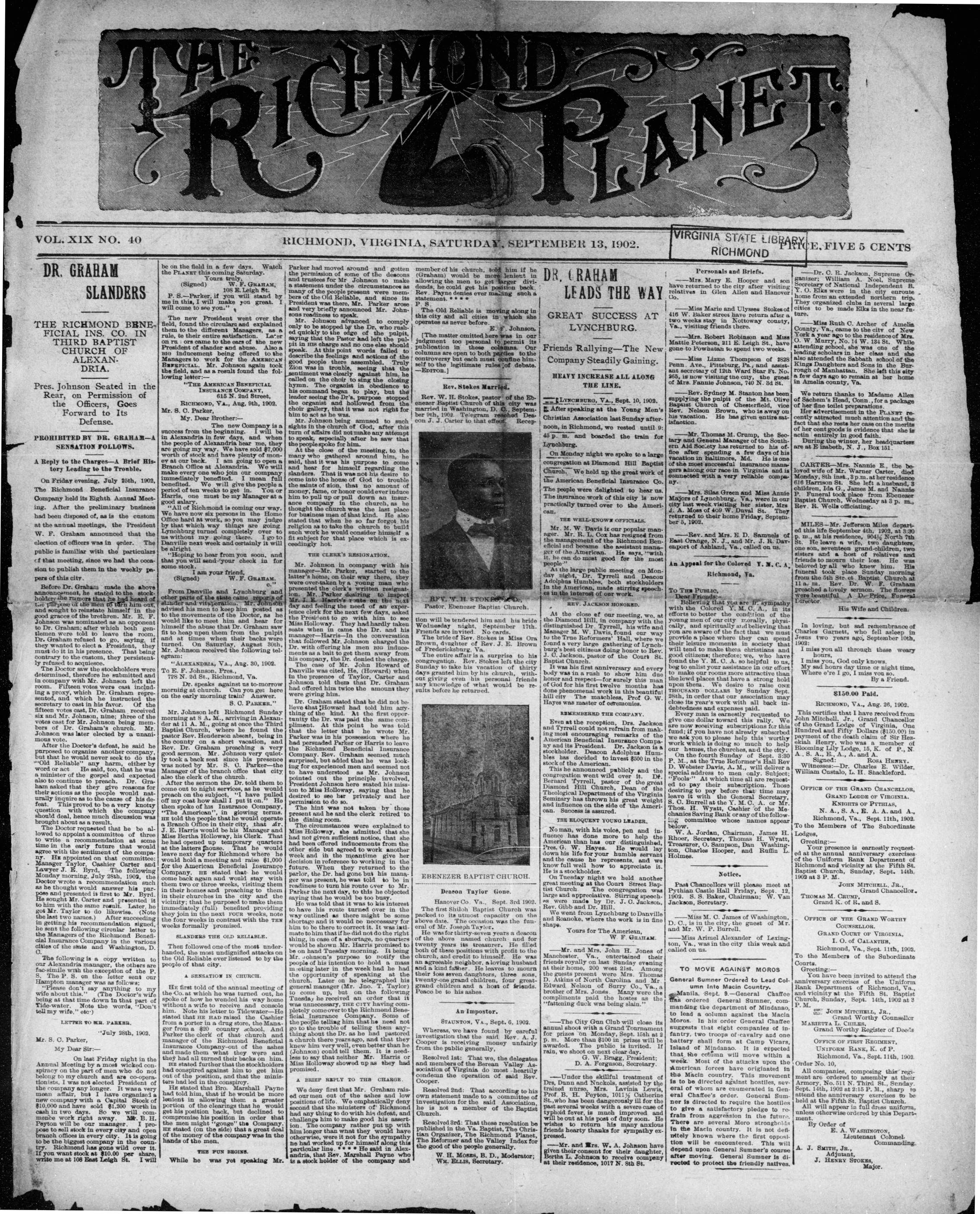
DR. GRAHAM SLANDERS
THE RICHMOND BNE,
FICIAL INS. CO. IN
THIRD BAPTIST
CHURCH OF
ALEXAN-
DRIA.
Pres. Johnson Seated in the
Rear, on Permission of
the Officers, Goes
Forward to Its
Defense.
PROHIBITED BY DR. GRAHAM—A SENSATION FOLLOWS.
A Reply to the Charges—A Brief History Leading to the Trouble.
On Friday evening, July 25th, 1902, The Richmond Beneficial Insurance Company held its Eighth Annual Meeting. After the preliminary business had been disposed of, as is the custom at the annual meetings, the President W. F. Grabam announced that the election of officers was in order. The public is familiar with the particulars of that meeting, since we had the occasion to publish them in the weekly papers of this city.
Before Dr. Graham made the above announcement, he stated to the stockholder the rumors that he had heard of the purpose of the men of turn him out, and sought to reinstate himself in the good graces of the brethren. Mr. E. F. Johnson was nominated as an opponent to Dr. Graham; after which both gentlemen were told to leave the room. Dr. Graham refused to go, saying, if they wanted to elect a President, they must do it in his presence. That being contrary to the custom, they persistently refused to acquiesce.
The Doctor saw the stockholders were determined, therefore he submitted and in company with Mr. Johnson left the room. Fifteen votes were cast including a proxy, which Dr. Graham represented, and which he instructed the men to cast in his hands. Of the fifteen votes cast, Dr. Graham received six and Mr. Johnson, nine; three of the votes cast for Mr. Johnson being members of Dr. Graham's church. Mr. Johnson was later elected by a unanimous vote.
After the Doctor's defeat, he said he purposed to organize another company, but that he would never seek to do the "Old Reliable" any harm, either by word or act. He said, too, that he was a minister of the gospel and expected also to continue to preach. Dr. Graham asked that they give reasons for their actions as the people would naturally inquire as to the cause of his defeat. This proved to be a very knotty question with which the company should deal, hence much discussion was brought about as a result.
The Doctor requested that he be allowed to appoint a committee of three to write a recommendation at some time in the early future that would agree with the sentiment of the company. He appointed on that committee: Manager Taylor, Cashier Carter and Lawyer J. E. Byrd. The following Monday morning, July 28th, 1902, the Doctor wrote a recommendation such as he thought would answer his purpose and presented it first to Mr. Byrd. He sought Mr. Carter and presented it to him with the same result. Later he got Mr. Taylor to do likewise. (Note he had two names.) After succeeding in getting a recommendation signed, he sent the following circular letter to the Managers of the Richmond Beneficial Insurance Company in the various cities of the state and Washington, D. C.
The following is a copy written to our Alexandria manager, the others are fac-simile with the exception of the P. S. The P. S. on the letter sent our Hampton manager was as follows:
"Please don't say anything to my wife about this." (The Doctor's wife hides down in that part of Tide-water. Note the words, "Don't tell my wife." etc.)
LETTER TO MR. PARKER.
On last Friday night in the Annual Meeting by a most wicked conspiracy on the part of men who do not belong to my church and are co-operationists. I was not elected President of the company any longer. It was a very mean affair, but I have organized a new company with a Capital Stock of $10,000 and have sold $1,200 worth in cash in two days. So we will commence work right away. Mr. B. H. Peyton will be our manager. I propose to sell stock in every city and open branch offices in every city. It is going to be the biggest company in the country. Richmond has gone wild over it. If you want stock at $10.00 per share, write me at 108 East Leigh St. I will
be on the field in a few days. Watch the PLANET this coming Saturday.
Yours truly,
(Signed)
W. F. GRAHAM,
108 E. Leigh St.
P. S.—Parker, if you will stand by me in this, I will make you great. I will come to see you."
The new President went over the field, found the circulars and explained them to the different Managers, as a rule, to their entire satisfaction. Later on ours came to the ears of the new President of slander and abuse. Also a nice inducement being offered to the Managers to work for the AMERICAN BENEFICIAL. Mr. Johnson again took the field, and as a result found the following letter:
"THE AMERICAN BENEFICIAL
INSURANCE COMPANY,
615 N. 3ad Street,
RICHMOND, VA., Aug. 9th, 1902.
Mr. S. C. Parker.
The new Company is a success from the beginning. I will be in Alexandria in few days, and when the people of Alexandria hear me, they are going my way. We have sold $7,000 worth of stock and have plenty of money at our back. I am going to open a Branch Office at Alexandria. We will make every one who join our company immediately benefited. I mean full benefited. We will give the people a period of ten weeks to get in. You or Harris, one must be my Manager at a good salary.
"All of Richmond is coming our way. We have now six persons in the Home office hard at work, so you may judge by that which way things are going Lynchburg turned completely over us without my going there. I go to Danville next week and certainly it will be alright.
"Hoping to hear from you soon, and that you will send your check in for some stock.
I am your friend,
(Signed) W. F. GRAHAM.
c."
From Danville and Lynchburg and other parts of the state came reports of slaughter and vitaparation. Mr. Johnson advised his men to keep him posted as he would like to meet him and hear for himself the abuse that Dr. Graham saw fit to heap upon them from the pulpit and at times when their backs were turned. On Saturday, August 30th, Mr. Johnson received the following telegram:
"ALEXANDRIA, VA., Aug. 30, 1002.
To F. E. Johnson, Pres.
10 22 Y. Johnson, Pres.
788 N. 3d St., Richmond, Va.
Dr. speaks against us to-morrow morning at church. Can you get here on the early morning train? Answer.
S. O. PARKER."
Mr. Johnson left Richmond Sunday morning at 8 A. M., arriving in Alexander at 11 A. M., going at once the Third Baptist Church, where he found the pastor Rev. Henderson absent, being in the county on a short vacation, and Rev. Dr. Graham preaching a very good sermon. Mr. Johnson very quietly took a back seat since his presence was noted by Mr. S. O. Parker—the Manager of the branch office that city also the clerk of the church.
After the sermon the Dr. told them to come out to night services, as he would preach on the subject, "I have pulled off my coat how shall I put it on." He then spoke of his Insurance Company, "The American", in glowing terms. he told the people that he would operate a Branch Office in their city, that Mr. J. E. Harris would be his Manager and Miss Bertha Holloway, his Olerk. That he had opened up temporary quarters at the latters fouse. That he would leave next day for Richmond where he would hold a meeting and raise $1,000 for the American Beneficial Insurance Company. he stated that he would come back again and would stay with them two or three weeks, taking them in and preparing to them in their churches in the city and the vicinity; that he purposed to make them immediately (full) benefited providing they join in the next four weeks, note the four weeks in contrast with the ten weeks formally promised.
SLANDERS THE OLD RELIABLE.
Then followed one of the most underhanded, the most undignified attacks on the Old Reliable ever listened to by the people of that city.
SENSATION IN CHURCH
HE first told of the annual meeting of the Co. at which he was turned out, he spoke of how he wended his way home without a wife to receive and console him. Note his letter to Tidewater—He stated that HE had raised the Cashier from a porter in a drug store, the Manager from a $20 country school, And Parker the clerk of that church and manager of the Richmond Beneficial Insurance Company-out of the ashes and made them what they were and they had all turned their backs on him. HE stated further that the stockholders had conspired against him to get him out of the position, and that the ministers had led in the conspiracy. HE stated that Bro. Marshall Payne had told him, that if he would be more lenient in allowing them a greater portion of the clearings that he would get his position back, but declined to compromise his position in order that the men might "gouge" the Company. HE stated (on the side) that a great deal of the money of the company was in the hands of the men.
THE FUN BROGINS.
Parker had moved around and gotten the permission of some of the deacons and trustees for Mr. Johnson to make a statement under the circumstances as many of the people present were members of the Old Reliable, and since its President was there, Mr. Parker arose and very briefly announced Mr. Johnson's readiness to speak.
Mr. Johnson advanced to comply only to be stopped by the Dr, who rushed quickly to the edge of the pulpit, saying that the Pastor had left the pulpit in his charge and no one else should speak. At this point words failed to describe the feelings and actions of the good people there assembled. Truly Zion was in trouble, seeing that the sentiment was clearly against him, he called on the choir to sing the closing hymn. The organist in obedience to his command began to play, but the leader seeing the Dr's, purpose stopped the organist and hollowed from the choir gallery, that it was not right for him to act as he was.
Mr. Johnson being amused to such sights in the church of God, after this turn of affairs did not make any attempt to speak, especially after he saw that the people spoke for him.
At the close of the meeting, to the many who gathered around him, he said, that it was his purpose to come and hear for himself regarding the slanders. That it was not his desire to come into the house of God to trouble the saints of zion, that no amount of money, fame, or honor could ever induce him to pull up or pull down an insurance company in the church, as he thought the church was the last place for business men of that kind. He also stated that when he so far forgot his religion as to take the church to build such work he would consider himself a fit subject for that place which is exceedingly hot.
THE CLERK'S RESIGNATION:
Mr. Johnson in company with his manager—Mr. Parker, started to the latter's home; on their way there, they were over-taken by a young man who presented the clerk's written resignation. Mr. Parker desiring to inspect Mr. J. E. Harris's routes on the next day and feeling the need of an experience clerk for the next few days, asked the President to go with him to see Miss Holloway. They had hardly taken seats when in came the Dr. and his manager—Harris—In the conversation that followed Mr. Johnson charged the duties of the men he induced as a bait to get them away from his company, the Dr. denied the charge. The case of Mr. John Howard of Danville was cited, He, (Howard) when in the presence of Taylor, Carter and Johnson told them that Dr. Graham had offered him twice the amount they were giving him.
Dr. Graham stated that he did not believe that Howard had told him anything of the kind. At the first opportunity the Dr. was paid the same compliment. At this point he was told that the letter that he wrote Mr. Parker was in his possession where he had persuaded Parker or Harris to leave the Richmond Beneficial Insurance Company. Rev. Graham seemed much surprised, but added that he was looking for experienced men and seemed not to have understood as Mr. Johnson out the principle involved, President Holloway here quitted his mission to Miss Holloway, saying that he desired to see her privately and her permission to do so. The hint was not taken by those present and he and the clerk retired to the dining room.
The circumstances were explained to Miss Holloway, she admitted that she had not given sufficient notice, that she had been offered inducements from the other side but agreed to work another week and in the meantime give her decision in reference to working in the future. When they returned to the parlor that she had gone but his mana present, he told her he had readiness to turn his route over to Mr. Parker the next day, to this he objected saving that he would be too busy.
He was told that it was to his interest to have his route turned over in the way outlined as there might be some shortage and it would be necessary for him to be there to correct it. It was intimate to him that if he did not do the right thing, in case of a shortage, no quarters would be shown Mr. Harris promised to be on hand Tuesday morning. It being Mr. Johnson's purpose to notify the people of his intention to hold a mass meeting later in the week had he had the opportunity of speaking at the church. Later on he telegraphed his general manager (Mr. Jno. T. Taylor) to come up, but on the following Tuesday he received the order that it was unnecessary, THE CITY having likely corresponded to the Richmond Benefit Commerce Company. Some of the people telling him that he need not go to the trouble of telling them anything about the Dr. as he had pastored a church there years ago, and that they knew him very well, even better than he (Johnson) could tell them. It is needless to say that neither Mr. Harris or Miss Holloway showed up as they had promised.
A BRIEF REPLY TO THB CHARGE.
We deny first that Mr. Graham raised our men out of the ashes and low positions of life. We emphatically deny second that the ministers of' Richmond had any thing to do with his defeat, and challenge him to make good his assertion. The company rather put up with him longer than what they would have other men worked up for himself along this particular line, **** He said in Alexandra, that Rev. Marshall Payne who is a stock holder of the company and
member of his church, told him if he (Graham) would be more lenient in allowing the men to get larger dividends, he could get his position back. Rev. Payne denies ever making such a statement. **** P. S.
The Old Reliable is moving along in this city and all cities in which she operates as never before.
E. F. Johnson.
[The matter omitted here was in our judgment too personal to permit its publication in these columns. Our columns are open to both parties to the controversy but each must confine himself to the legitimate rules of debate. —EDITOR.]
Rev. Stekes Marries
Rev. W. H. Stokes, pastor of the Ebenezer Baptist Church of this city was married in Washington, D. C. September 9th, 1902. Telegram reached Deacon J. J. Carter to that effect. Recen-
A. B.
RFV, W. H. STOKES, D.D.
Pastor, Ebenezer Baptist Church.
tion will be tendered him and his bride
Wednesday night, September 17th.
Friends are invited. No cards.
The bride of Rev. Stokes is Miss Ora
Brownbridge, Rev. J. E. Brown
of Frederickshire, Va.
The entire affair is a surprise to his
congregation. Rev. Stokes left the city
Sunday to take his vacation of thirty
days granted him by his church, without giving even his personal friends any knowledge of what would be results before he returned.
1
EBENEZER BAPTIST CHURCH.
Deason Taylor Gone.
Hanover Co. Va., Sept. 3rd 1902.
The first Shiloh Baptist Church was packed to its utmost capacity on the above date. The occasion was the funeral of Mr. Joseph Taylor.
He was for thirty-seven years a deacon of the above named church and for twenty years its treasurer. He filled both of these positions with profit to the church, and credit to himself. He was an agreeable neighbor, a loving husband and a kind father. He leaves to mourn their loss seven daughters, three sons, twenty-one grand children, four great-grand children and a host of friends. Peace be to his ashes.
An Impostor.
STAUNTON, VA., Sept. 6, 1902.
Whereas, we have found by careful investigation that the said Rev. A. J. Cooper is receiving money unfairly from the public generally,
Resolved 1st: That we, the delegates and members of the Berne Valley Association of Virginia do most heartily condemn the operation of said Rev. Cooper.
Resolved 2nd: That according to his own statement made to a committee of investigation for the said Association, he is not a member of the Baptist Church.
Resolved 3rd: That these resolution be published in the Va. Baptist, The Christian Organizer, The Richmond Planet, The Reformer and the Valley Index for the good of the people generally.
W. H. MOSES, B. D., Moderator;
WM. ELLIS, Secretary.
GREAT SUCCESS AT
LYNCHBURG.
Friends Rallying—The New
Company Steadily Gaining.
HEAVY INCREASE ALL ALONG
THE LINE.
LYNCHBURG, VA., Sept. 10, 1902.
After speaking at the Young Mon's
Christian Association last Sunday afternoon, in Richmond, we rested until 9:45 p. m. and boarded the train for Lynchburg.
On Monday night we spoke to a large congregation at Diamond Hill Baptist Church. We held up the great work of the American Beneficial Insurance Co. The people were delighted to hear us. The insurance work of this city is now practically turned over to the American
THE WELL-KNOWN OFFICIALS.
Mr. M. W. Davis is our popular manager. Mr. R. L. Cox has resigned from the management of the Richmond Beneficial and became the assistant manager of the American. He says, "with it, he can do most good for the most people." At the large public meeting on Monday night, Dr. Tyrrell and Descon Adolphus Humbles, both stockholders in the American, made stirring speeches in the interest of our work.
REV. JACKSON HONORED.
At the close of our meeting, we, at the Diamond Hill, in company with the distinguished Dr. Tyrrell, his wife and Manager M. W. Davis, found our way to the True Reformers' Hall, where we found a very large gathering of Lynchburg's best citizen doing honor to Rev. J. C. Jackson, pastor of the Court St. Baptist Church.
It was his first anniversary and every body was in a rush to show him due honor and respect—for surely this man of God for his first twelve months has done a remarkable work in this beautiful hill city. The G. W. Hayes was master of ornaments.
REMEMBERED THE COMPANY.
Even at the reception, Drs. Jackson and Tyrrell could not refrain from making most encouraging remarks of the American Beneficial Insurance Company and its President. Dr. Jackson is a stockholder. Deacon Adolphus Humbles has decided to invest $500 in the stock of the American.
This he announced publicly and the congregation went wild over it. Dr. Bernard Tyrrell, pastor of the great Diamond Hill Church, Dean of the Theological Department of the Virginia Seminary has thrown his great weight and influence on the side of the American. Success is assured.
THE ELOQUENT YOUNG LEADER
Noman, with his voice, pen and influence has done more to help the American than has our distinguished, Pres. G. W. Hayes. He would lay down his life for your humble servant and the cause he represents, and we know full well how to appreciate it. He is a stockholder.
On Tuesday night we held another great meeting at the Court Street Baptist Church. The congregation was large and appreciative. Stirring speeches were made by Dr. J. O. Jackson, Rev. Gibb and Dr. Hill.
We went from Lynchburg to Danville and Roanoke, where the work is in fine shape.
Yours for The American, W. F. GRAHAM.
Mr. and Mrs. John H. Jones of Manchester, Va., entertained their friends royally on last Sunday evening at their home, 200 wost 21st. Among the guests present were Mrs. Thomas D. Atkins of North Carolina and Mr. Edward Nelson of Surry Co., Va., a brother of Mrs. Jones. Many were the compliments paid the hosts as the "fattening duck was being slain."
The City Gun Club will close its annual shoot with a Grand Tournament for prizes on Monday, Sept. 15th at 2 p.m. More than $100 in prizes will be awarded. The public is invited. If rain, we shoot on next clear day.
G. W. Bragg, President;
D. A. Ferguson, Secretary.
Under the skillful treatment of Drs. Dunn and Nuckols, assisted by the trained nurse, Mrs. Lavinia Lewis, Prof. B. H. Poyton, 1011½ Catherine St., who has been dangerously ill for the past several weeks with a severe case of typhoid fever is much improved and will be out at his post of duty soon. He wihes to return his many anxious friends hearty thanks for sympathy expressed.
Mr. and Mrs. W. A. Johnson have given their consent for their daughter, Bertha L. Johnson to receive company at their residence, 1017 N. 8th St.
Personals and Briefs.
—Mrs. Mary E. Hooper and son have returned to the city after visiting relatives in Glen Allen and Hanover Oo.
—Miss Marie and Ulysses Stokes of 416 W. Baker street have return after a two weeks stay in Nottoway county, Va., visiting friends there.
—Mrs. Robert Robinson and Miss Mattie Peterson, 211 E. Leigh St., have gone to Poyhatan to spend two weeks.
—Miss Lizzie Thompson of 2828 Penn. Ave., Pittsburgh, Pa., and assistant secretary of 129th Ward Star Ft. No. 265, is now visiting the city, the guest of Mrs. Fannie Johnson, 740 N. 3d St.
—Rev. Sydney M. Stanton has been supplying the pulpit of the Mt. Olive Baptist Church of Chesterfield, vice Rev. Nelson Brown, who is away on his vacation. He has given entire satisfaction.
Mr. Thomas M. Crump, the Secretary and General Manager of the Southern Aid Society has returned to his office after spending a few days of his vacation in Baltimore, Md. He is one of the most successful insurance managers among our race in Virginia and is connected with a very reliable company.
Mrs. Silas Green and Miss Annie Majors of Lynchburg, Va., were in our city when we visited her sister, Mrs 4 A. Moss of 409 W. Duval St. They returned to their home Friday, September 5, 1902.
Rev. and Mrs. E. D. Samuel of East Orange, N. J., and Mr. J. R. Davenport of Ashland, Va., called on us.
An Appeal for the Colored Y. M. C. A.
TO THE PUBLIC,
Dear Friends:
Believing that you are fr. sympathy with the Colored Y. M. C. A., in its efforts to better the condition of the young men of our city morally, physically, and spiritually and believing that you are aware of the fact that we must provide a place where they can spend their leisure moments in society that will tend to make them christians and good citizens; therefore; we, who have found the Y. M. C. A. so helpful to us, bog to enlist your assistance in our effort to make our rooms more attractive than the lewd places that have a strong hold upon them. We desire to raise ONE THOUSAND DOLLARS by Sunday Sept. 28th, in order that our association may close its year's work with all back indebtedness and expenses paid.
Every man is earnestly requested to give one dollar toward this rally. We are now receiving subscriptions for this fund; if you have not already subscribed we ask you to please help this worthy work which is doing so much to help our homes, the churches, and the city.
On the fourth Sunday of Sept. 3:30 P. M., at the True Reformer's Hall Rev D. Webster Davis, A. M., will deliver a special address to men only. Subject: "Fools." At which time all are requested to pay their subscription. Those desiring to pay before that time may leave it with the General Secretary, C. S. Burrell at the Y. M. C. A. or Mr. Thos. H. Wyatt, Cashier of the Mechanics Saving Bank or any of the following committee whose names appear below. W. A. Jordan, Chairman, James H. Rhoe, Secretary, Thomas H. Wyatt, Treasurer, O. Sampson, Dan Washington, Charles Hooper, and Ruffin L. Holmes.
Notice.
Past Chancellors will please meet at Pythian Castle Hall Friday, Sept. 12, 1902. S. S. Baker, Chairman; W. Van Jackson, Secretary.
Miss M. C. James of Washington, D. C., is in the city, the guest of Mr. and Mr. W. P. Burrell.
Miss Arimel Alexander of Lexington, Va., was in the city this week and called on us.
TO MOVE AGAINST MOROS
General Sumner Ordered to Lead Col
ump into Maine Gov.
Uhm Into Macin Country.
Manila, Sept. 9.—General Chaffee has ordered General Sumner, commanding the department of Mindanao, to lead a column against the Macin Moros. In his order General Chaffee suggests that eight companies of infantry, two troops of cavalry and one battery shall form at Camp Vicars, Island of Mindanao. It is expected that the column will move within a week. Most of the attacks upon the American forces have originated in the Macin country. This movement is to be directed against hostiles, several of whom are enumerated in General Chaffee's order. General Sumner is directed to require the hostiles to give a satisfactory pledge to refrain from aggression in the future. There are several Moro strongholds in the Macin country. It is not definitely known where the first opposition will be encountered. This will depend upon General Sumner's course after moving. General Sumner is directed to protect the friendly natives.
Dr. C. R. Jackson, Supreme Organizer; William A. Noel, Supreme Secretary of National Independent B. Y. O. Elks were in the city enroute home from an extended northern trip. They organized clubs in several large cities to be made Elks in the near future.
Miss Ruth C. Archer of Amelia County, Va., came to the city of New York a year ago to the residence of Mrs. O. W. Murry, No. 14 W. 134 St. While attending school she was one of the leading scholars in her class and she also attended the Sabbath school of the Kings Daughters and Sons in the Burrough of Manhattan. She left this city a few days ago to remain at her home in Amelia county, Va.
We return thanks to Madame Allen of Sachem's Head, Conn., for a package of her fine toilet preparations.
Her advertisement in the PLANET recently attracted much attention and the fact that she rests her case on the merits of her cent goods is evidence that she is actin entirely in good faith.
During the winner, her headquarters are at E isabeth, N. J., Box 151.
CARTER—Mrs. Nannie E., the beloved wife of Mr. Warner Carter, died Monday, 8th inst. 3 p.m. at her residence 616 Harrison St. She left a husband, 3 children, Ida G., James M. and Nannie P. Funeral took place from Ebenezer Baptist Church, Wednesday at 3 p. m., Rev. R. Wells officiating.
MILES—Mr. Jefferson Miles departed this life September 4th, 1902, at 3:30 p. m., at his residence, 904½ North 7th St. He leave a wife, two daughters, one son, seventeen grand-children, two sisters and a host of relatives and friends to mourn their loss. He was beloved by all who knew him. His funeral took place Sunday morning from the 5th St. et. Baptist Church at 11 a. m. Rev. Dr. W. F. Graham proached a lovely sermon. The flowers were beautiful A. D. Price, Funeral Librero.
His Wife and Children.
In loving, but sad remembrance of Charles Garnett, who fell asleep in Jesus two years ago, September 10th, 1903:
I miss you all through these weary hours,
I miss you, God only knows.
My sad hours day time or night time,
Where e're I go, I miss you so.
By a Friend.
$150.00 Paid.
This certifies that I have received from John Mitchell, Jr., Grand Chancellor of the Grand Lodge of Virginia, Ona Hundred and Fifty Dollars ($150.00) in payment of the death claim of Sir Hezekiah Henry, who was a member of Blooming Lily Lodge, 15, K. of P., N. A., S. A., E., A., and A.
Signed: ROSA HENRY.
Witnesses:—Dr. Charles E. Wilder, William Custalo, L. H. Shackleford.
OFFICE OF THE GRAND CHANCELLOR,
GRAND LODDE OF VIRGINIA.
KNIGHTS OF PYTHIAS,
N. A., S. A., E. A. A. and A.,
Richmond, Va., Sept. 11th, 1902.
To the Members of the Subordinate Lodges,
Greeting:—
Your presence is earnestly requested at the annual anniversary exercises of the Uniform Rank Department of Richmond and vicinity at the Fifth St. Baptist Church, Sunday, Sept. 14th, 1902 at 3 P. M.
JOHN MITCHELL, JR.,
Grand Chancellor.
THOMAS M. CRUMP,
Grand K. of R. and S.
OFFICE OF THE GRAND WORTHY
I. O. of CALANTHB,
Richmond, Va., Sept. 11th, 1902.
To the Members of the Subordinate
Courts.
Greeting:—
You have been invited to attend the
anniversary exercises of the Uniform
Rank Department of Richmond, Va.,
and vicinity at the Fifth St. Baptist
Church, Sunday, Sept. 14th, 1902 at 3
P. M.
Grand Worthy Register of Deeds
Richmond, Va., Sept. 11th, 1903.
Order No. 10.
All companies, composing this regiment are ordered to assembly at their Armory, No. 511 N. Third St., Senday.
Sept. 14th, 1902 at 2:15 P. M., sharp to attend the anniversary exercises to be held at the Fifth St. Baptist Church.
All will appear in full dress uniform, unless otherwise ordered by this Department.
By Order of
E. A. WASHINGTON,
Lieutenant Colonel.
Commanding.
A. J. SMITH, JE.,
Adjutant,
J. HENRY STOKES,
Major.
PLANET
SATURDAY ..... SEPT 13, 1902
CAMPFIRE STORIES
Union Soldiers Left Their Trail on Frozen Ground by Almost Shoeless Feet.
"That story of Jack Jeffers," said Sergt. Sam Grimshaw, according to the Chicago Inter Ocean, "reminded me of Haynes, and that story of the march down from Wild Cat reminded me of another like it. After the battle of Missionary Ridge our division, with others, was ordered to Knoxville to relieve Burnside. We were long on ammunition and short on rations and clothes, but, as the boys put it, we marched so darned fast we had little time to enjoy our misery. And we didn't feel any better when we learned, only ten miles from Knoxville, that Burnside had licked Longstreet, and that we were to return at once to Chattanooga.
"We were shorter than ever on ractions, and weighted down with ammunition, and going back was worse than going forward, with the prospect of a fight in front. "But, much to our relief, we turned, after we had recrossed the Cinch river into the Con
SPRINGING SUDDENLY ON THE QUAR
message they, our brigade taking possession of a large grist mill. Volunteer millers were called for, and a dozen responded. Heavy detachments went into the farming districts near, and gathered all the wheat and corn available. This was ground into flour and meal, and bread and corn pone and sinkers were baked to take us back to Chattanooga. We remained at the mill about a week, eating up nearly everything that was get-atable, but resumed the march with full stomachs, at least.
"Before we were out two days on the return trip we were again short on rations, and were compelled to resort to parched corn. We were shorter than ever on clothes, and as this was in December, and the weather was cold, there was much suffering. Many of the boys had no shoes, and the line of march of our brigade could be traced by the blood on the frozen ground from almost shoeless feet. To save our feet we made rough moeasins of blankets and pieces of clothing, or made soles of two or three thicknesses of cloth, and tied them on with strings. Some of the boys, however, were barefoot, and swore that their feet got so tough and hard they could strike fire out of the flinty rocks along the road.
"But, hard or not, the feet bled, and as we could not fall out we let them bleed, and plodded on. There was indination, however, to find the softest spots on the road or in the fields near the road, and this brings me to my messmate, Haynes. One day, as we were passing through a piece of timber land, Haynes and others went about 200 yards to our right into an open field that flanked the timber. A company of cavalry in blue uniforms rode in among the stragglers without exciting much attention until it was discovered the cavalrymen were conederates in Yankee dress. Many of the stragglers made a rush back to our line of march, but Haynes and a score of others were carried off as prisoners.
"The confederates hurried their prisoners off as quietly as possible three or four miles to an old house in a sheep hollow or gorge. Late in the evening they took all the prisoners away except Haynes and a unionist civilian, who had been marching back with our army. They bound the hands, of these two, and left them in charge of one guard. During the night they were permitted to go outside, and Haynes, stooping down, worked his hands loose, caught up a club, and, springing suddenly on the guard, knocked him down. The refugee finished the business, and he and Haynes made a bee-line for the Tennessee driver aiming to strike it just above Cleveland.
"The refugees knew the country well and where to find union people. The first night they were hidden in a house which was searched early the next morning from top to bottom by confederate cavalry, but the West Tennesseeans of those days know how to hide a fellow, and Haynes and his friend were not found. The next night they were lucky enough to get across the river and worked their day cautiously toward Chattanooga. In the meantime our brigade had marched back to the camp on the North Chickamauga, which we had occupied before the battle of Missionary Ridge. This
day after our arrival Bob, Lou and Dave made a scout up the creek about eight biles and located a calf, which they intended to return for that night, cut its throat and carry the carcass quietly into camp.
"This was the phin, but it didn't work. The boys came to camp, went back at night and found the calf in a pen. But when one of them jumped in to cut the calf's throat without making any noise, the little beast set up such a bleating that the farmer came out and ordered the boys off. They told him to go to blazes, when he declared that he had a guard and would send him out. Dave thought this was a bluff, and had just killed the calf when the guard came out and ordered that nothing on the place he touched
"No sooner had the guard spoken than the boys recognized the voice as that of Haynes, who had been taken in and cared for that night by the true blue unionist. The boys were so overjoyed to find Haynes alive that they gave themselves away and made no attempt to conceal their identity. After making much of Haynes they brought the calf into camp, but the next day the farmer came down, proved his standing by Haynes, identified the calf thieves and they were required to pay the owner five dollars, the captain lending them the money. When they learned how the old farmer had treated Haynes they were not sorry—they thought the calf was worth the money."
REMARKABLE EXPERIENCE
War History of an Illinois Veteran Who Carries a Ballet in His Brain.
Comrade Jacob Miller, of Bradford, Ill., had a most remarkable experience during his service with company K. Ninth Indiana, and still carries a piece of confederate lead in his brain, says the National Tribune, Comrade Miller enlisted at Logansport, Ind., in 1861. His first captain was W. P. La Salle, and his regiment was commanded by Robert Milleux.
At the battle of Chickamauga, September 19, 1863, while in the act of aiming, Comrade Miller was struck by a musket ball, which penetrated the forehead, and he fell backward and was left for dead. Comrade Miller recollects hearing his captain say: "It's no use to remove poor Miller, for he is dead." By the shot one of his eyes was knocked out of its socket, and the other was soon so swollen that he could see nothing. But he retained consciousness, and crawled forth from among the dead, after his comrades and fallen back, and made his way to a field hospital. The next morning, having a great dread of being taken prisoner, he started out to make his way to Chattanooga on foot. He could only see a few feet ahead of him by holding open the lids of the swollen eye.
Comrade Miller walked as far as he could and then lay down by the roadside. An ambulance driver, finding him still breathing, picked him up and put him in the ambulance in the space which had been occupied by a comrade who had just died. In this way Miller finally reached Chattanooga on September 21, and there fell in with two members of his own company, and with them crossed the river in the evening and stayed all night with the company teamster. At noon the next day he had his wound dressed for the first time. Then he drew rations and, with his comrades, started across the mountains to Bridgeport, where they arrived September 25. From Bridgeport he rode to Nashville, lying on his back in a box car. In Nashville his wound received its second dressing.
Miller's two comrades sent a letter to their captain asking for descriptive lists for themselves and for Miller, so that they could draw their pay. The captain answered, inclosing the lists, but added that he would
M. B.
JACOB MILLER
never have included one for Jacob Miller had it not been for the testimony of his two comrades who were with him, for the reason that he was sure that he had left Miller dead on the field on Chickamauga. Indeed, after the battle, Miller was reported dead by his captain, and his name was printed in the newspapers among the killed.
Miller's friends in Indiana did not know he was alive until two months later. The army surgeons feeling sure that Miller would die, told him they would not give him any more pain by probing for the bullet, so it was left in the wound until he went home. Nine months after he was wounded he arrived home. Two surgeons operated on him and succeeded in removing about one-third of the musket ball. Seventeen years after he was shot he was cleansing his wounds one day when a place of lead dropped into the water.
Comrade Miller has no memory for names, but very vividly roals all the little details of how he was shot and how he was left for dead, and finally crawled away from among the dead and dying.
Like Most Jokes.
Hewitt—The first comic opera was written in 1240.
Jewett—And there hasn't been a new one written since.—N. K. Times.
THE RICHMOND PLANET, RICHMOND, VIRGINIA
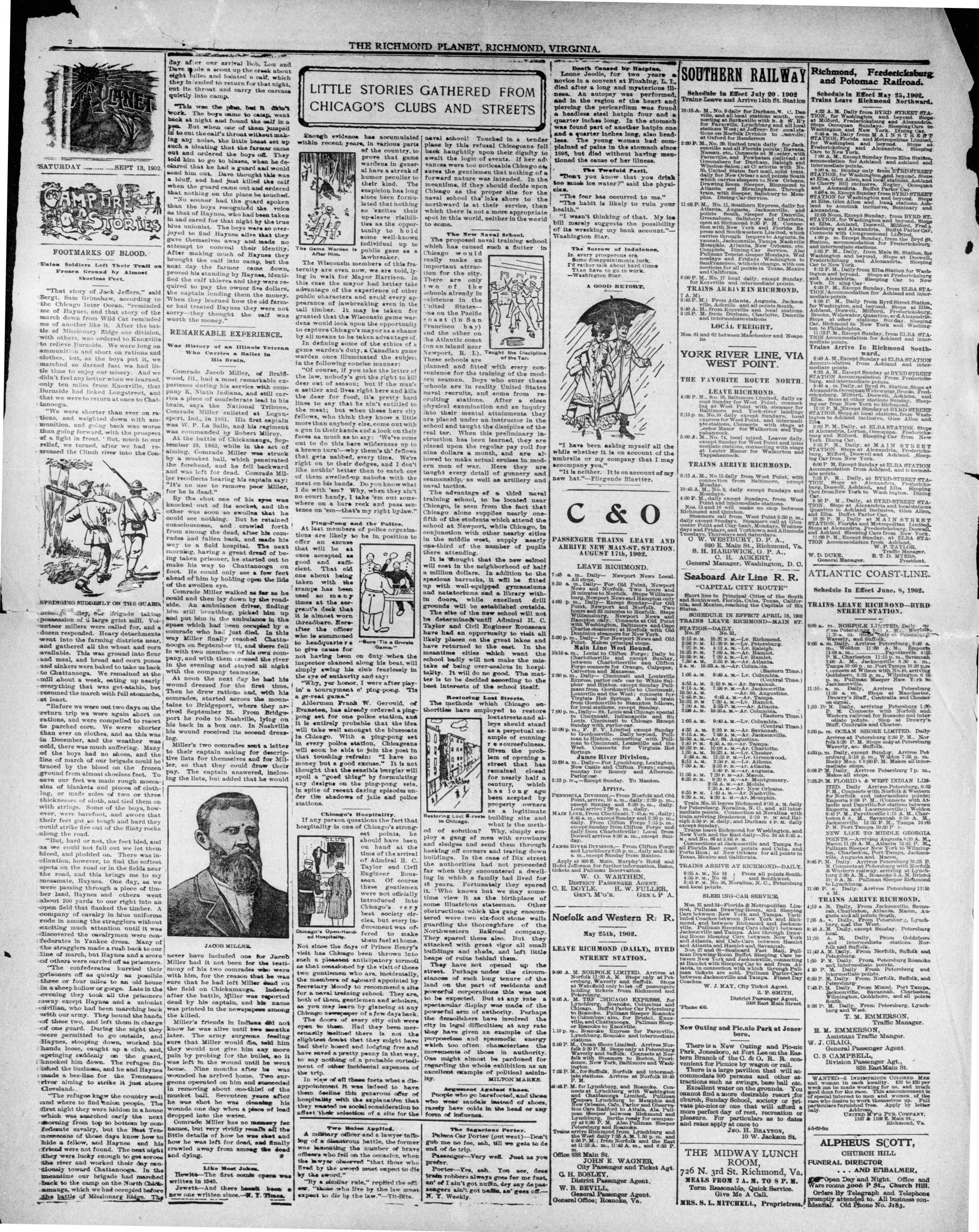
LITTLE STORIES GATHERED FROM CHICAGO'S CLUBS AND STREETS
Enough evidence has accumulated within recent years, in various parts
has accumulated
in various parts
of the country,
to prove that game
wardens in general
have a streak of
humor peculiar to
their kind. The
suspicion has long
since been formulated
that nothing
excites their
up-sleeve risibilities as the opportunity to hold
some well-known
individual up to
public gaze as a
lawbreaker.
CORRECTION
The Wisconsin members of this fraternity are even now, we are told, lying in wait for Mayor Harrison. In this case the mayor had better take advantage of the experience of other public characters and avoid every appearance of lawbreaking even in the tall timber. It may be taken for granted that the Wisconsin game warden would look upon the opportunity to capture Chicago's mayor as a chance by all means to be taken advantage of. In defining some of the ethics of a game warden's duty, a Canadian game warden once illuminated the subject in the following concise manner:
"Of course, if you take the letter of the law, nobody's got the right to kill deer out of season; but if the man's a settler and lives right here and kills the deer for food, it's pretty hard lines to say that he isn't entitled to the meat; but when these here city fellows, who think they know a little more than anybody else, come out with a gun in their hands and a look on their faces as much as to say: 'We've come out to do this here wilderness up to a brown turn—why them'th' fellows that gets nabbed, every time. We're right on to their dodges, and I don't like nothin' better than to catch one of them swelled-up nabbs with the meat on bins hands. Do you know what I do with 'em? Why, when they don't hand court, I take 'em out somewhere on a bare rock and pass sentence on 'em—that's my right by law."
Ping-Pong and the Police. At last members of police organizations are likely to be in position to
offer an excuse that will be at once accepted as good and sufficient. That old one about being taken with the ramps has been used so many times at the surgeon's desk that it is almost worn threadbare. Hereafter the officer who is ammunition to headquarters to give cause for
that will be at once accepted as good and sufficient. That old one about being taken with the ramps has been used so many times at the sergeant's desk that it is almost worn threadbare. Hereafter the officer who is aummoned to headquarter to give cause for not having been on duty when the inspector chanced along his beat, will simply swing his club fearlessly in the eye of authority and say: "Why, yer honor, I were after play-in' a tournament o' ping-pong. 'Tis a gr-rate game."
Alderman Frank W. Gerould, of Ervanan, has already ordered a ping-pong set for one police station, and it is entirely probable that the idea will take well amongst the bluecoats in Chicago. With a ping-pong set in every police station, Chicagoans will soon be able to join the poet in that touching refrain: "I have no money but a good excuse." It is not thought that the sensible burglar will spoil a "good thing" by formulating any designs on the ping-pong sets, in spite of recent daring episodes under the shadows of jails and police stations.
Chilongo's Hospitality.
If any person questions the fact that hospitality is one of Chicago's strong-
est points, he should have been on hand at the time of the arrival of Admiral H. C. Taylor and Civil Engineer Rousseau. Of course these gentlemen were not officially introduced into Chicago's very best society circles, but every inducement was offered to make them feel at home.
CLUB
Chicago's Open-Hand
ed Hospitality.
Not since the days of Prince Henry's visit has Chicago been thrown into such a pleasant anticipatory turmoil as that occasioned by the visit of these two gentlemen who are, incidentally, the members of a board appointed by Secretary Moody to recommend a site for a naval training school. They are, both of them, gentlemen and scholars, as you may learn by glancing at any Chicago newspaper of a few days back. The doors of every city club were open to them. Had they been mercenarily inclined there is not the slightest doubt that they might have had their board and lodging free and have saved a pretty penny in that way, to say nothing of a probable curtailment of other incidental expenses of the trip.
In view of all these facts what a disappointment it was indeed to have them decline this generous offer of hospitality with the explanation that they wanted no social consideration to affect their seclusion of a site for the
Two Rules Applied
A military officer and a lawyer talking of a disastrous battle, the former was laugening the number of brave officers who fell on the occasion, when the lawyer observed "that those who lived by the sword must expect to die by the sword."
"By a similar rule," replied the officer, "those who live by the law must expect to die by the law."—Tit-Bits.
naval school! Touched in a tender place by this refusal Chicagoans fell back haughtily upon their dignity to await the logic of events. If her advances were too noticeable Chicago as surea the gentlemen that nothing of a forward nature was intended. In the meantime, if they should decide upon Chicago as the proper site for the naval school the lake shore to the northward is at their service, than which there is not a more appropriate spot in this world, neither in the world to come.
The New Naval School
The proposed naval training school which has caused such a flutter in
which has caused Chicago would really make an important attraction for the city. There are only two of the schools already in existence in the United States—one on the Pacific coast (in San Francisco bay) and the other on the Atlantic coast (on an island near Newport, R. I.). These schools are
Chicago would really make an important attraction for the city. There are only two of the schools already in existence in the United States—one on the Pacific coast (in San Francisco bay) and the other on the Atlantic coast (on an island near Newport, R. I.). These schools are
Taught the Discipline of the Tar.
planned and fitted with every convenience for the training of the modern seaman. Boys who enter these schools are in reality United States naval recruits, and come from recruiting stations. After a close physical examination and an inquiry into their mental attainments they are placed under an instructor in the school and taught the discipline of the real tar. When this preliminary instruction has been learned, they are placed upon the regular pay roll for nine dollars a month, and are allowed to make actual cruises in modern mon of war. Here they are taught every detail of gunnery and seamanship, as well as artillery and naval tactics.
The advantage of a third naval training school, to be located near Chicago, is seen from the fact that Chicago alone supplies nearly one-fifth of the students which attend the school at Newport, while Chicago, in conjunction with other nearby cities in the middle west, supply nearly one-third of the number of pupils there attending.
It is thought that the new school will cost in the neighborhood of half a million dollars. In addition to the spacious barracks, it will be fitted up with well-equipped gymnasiums and natatoriums and a library within doors, while excellent drill grounds will be established outside.
The site of the new school will not be determined until Admiral H. C. Taylor and Civil Engineer Rousseau have had an opportunity to visit all likely places on the great lakes and have returned to the east. In the meantime cities which want the school badly will not make the mistake of being overzealous in hospitality. It will do no good. The matter is to be decided according to the best interests of the school itself.
Restoring Lost Streets.
The methods which Chicago authorities have employed to restore
loyed to restore loostreets and alleys should stand as a perpetual example of cunning r sourcefulness. Given the problem of opening a street that has remained closed for nearly half a century, which has long ago been accepted by property owners as a legitimate building site and what is the meth-
```markdown
```
Restoring Lost Streets building site and in Chicago. what is the method of solution? Why, simply employ a gang of men with crowbars and sledges and send them through haeking off corners and tearing down buildings. In the case of Dix street the authorities had not proceeded far when they encountered a dwelling in which a family had lived for 46 years. Fortunately they spared it. 'Who knows but we may sometime view it as the birthplace of some illustrious statesman. Other obstructions which the gang encountered were two six-foot stone walls guarding the thoroughfare of the Northwestern Railroad company. They spared these also. But they attacked with great vigor all small buildings and sheds, and left little heaps of ruins behind them.
They have not opened up the street. Perhaps under the circumstances of such long tenure of the land on the part of residents and powerful corporations this was not to be expected. But as any rate a spectacular display was made of the powerful arm of authority. Perhaps the demolishers have involved the city in legal difficulties; at any rate they have given an example of the purposesless and spasmodic energy which too often characterizes the movements of those in authority. One might almost be pardoned for regarding the whole exhibition as an excellent example of political asininity. MILTON MARKS.
Argument Against Shoes.
People who go barefooted, and those who wear sandals instead of shoes, rarely have colds in the head or any form of influence.
Palace Car Porter (put west)—Don't gub me no fee, sah, till we gets to de end of de trip.
Passenger—Very well. Just as you prefer.
Porter—Yes, sah. You see, dee train robbera always goes for me fast, an' ef I ain't got nuffin, dey say de passengers aln't got naffin, an' goes off.—M. Y. Weekly.
Office 888 Main St.
JOHN E. WAGNER
City Passenger and Ticket Agt.
G. H. BOSLEY,
District Passenger Agent.
W. B. BEVILL,
General Passenger Agent.
General Office; Roanoke, Va.
Death Caused by Hatpins
Leone Jeodie, for two years a novice in a convent at Flushing, L. I., died after a long and mysterious illness. An autopsy was performed, and in the region of the heart and pleuring the pericardium was found a headless steel hatpin four and a quarter inches long. In the stomach was found part of another hatpin one and a quarter inches long, also headless. The young woman had complained of pains in the stomach since 1896, but died without having mentioned the cause of her illness.
The Twofold Paril.
"Don't you know that you drink too much ice water?" said the physician.
"The fear has occurred to me."
"The habit is likely to ruin your health."
"I wasn't thinking of that. My ice bill merely suggests the possibility of its wrecking my bank account."—Washington Star.
The Sorrow of Indolence.
In every prosperous era.
Some disappointments lurk.
I'd rather talk about hard times.
Than have to go to work.
—Washington Star.
A GOOD RETORT.
A
"I have been asking myself all the while whether it is on account of the umbrella or my company that I may accompany you."
"It is neither. It is on account of my new hat."—Ellegende Blaetter.
C & O
PASSENGER TRAINS LEAVE AND ARRIVE NEW MAIN-ST. STATION. AUGUST 17th, 1902.
LEAVE RICHMOND.
7:45 a. m. Daily.
Newport News Local. All stops.
8:50 a. m. Daily. For Old Point, Newport News and Norfolk. Two hours and 3 minutes to Norfolk. Steps Williamsburg, Newport, Newport.
4:00 p.m. Daily. - Except Sunday. For Old Point, Newport and Norfolk. Two hours and 25 minutes to Norfolk. Steps Williamsburg, Newport, Newport.
5:00 p.m. - Daily. - For Newport News and Old Point. Makes principal stops.
Main Line West Bound.
10:10 a.m., Local to Clifton Forge; Daily to Charlottesville and except Sunday between North Springfield and Clifton Forge connects for Orange, Callipet, Calverton and Manassas.
2:50 p.m. - Daily. - Cincinnati and Louisville Expo; Forcafe car to White Salluphr and Hinton except Sunday. Pullmans from Gordonsville to Cincinnati, Louisville and the West; connects for Virginia Hot Springs. A local train for the South of St. Louis, for local stations, except Sunday.
7:00 p. m., Daily. St. Louis and Chicago special
to Quincy, Indianapolis and St.
Louis. Clinton, Chicago. Chicago Accept
Sunday with parlor-car.
10:30 p. m., F. F. V. Limited except Sunday
to Hinton, connecting with Pull-
man to Hinton, connecting with Pull-
man to Cincinnati, Louisville and
The Walters. Connects for Virginia Hot
Springs.
James River Division.
10:20 a. m., Daily. For Lynchburg, Lexington,
New Castle and Clifton Forges; except
sunday for Rosney and Alberene.
Parlor-car.
5:15 p. m., Except Sunday. To Mantoe.
Arrive.
PENNIBULA DIVISION. From Norfolk and Old
Point, arrive, 10 a. m., daily. 2:20 p. m.
excursion, limps and 6:30 p. m., daily.
Local Carriage.
JAMES RIVER DIVISION — From Clifton Forge and Lynchburg 838 p. m., d., maily and 8:30 a.m. to New York 838 p. m., d., maily. Apply at 800 E. Main, Murphy's Hotel and Hotel Jefferson for further information, Rates, tickets and Pulaski Reservation. A. ARVEN DISTRICT PASSenger AGENT. C. E. DOYLE, H. W. FULLER, GENL' M'G'R. GENL' P A.
Norfolk and Western R: R.
May 25th, 1902.
LEAVE RICHMOND (DAILY), BYRD
STREET STATION.
9:00 A. M. NORFOLK LIMITED. Arrives at
Norfolk 12:30 A. M. Stops at Petersburg, Waverly and Suffolk. Stops at Petersburg only to let off passengers holding tickets from Richmond and Petersburg.
9:05 A. M. TEP CHICAGO EXPRESS, for Lepidochea Rousea, Columbus and Chicago. Buffet Parter Our Sleeper to Roanoke. Pullman Sleeper Roanoke to Columbus; also, for Bristol, Knoxville, and Chattanooga. Pullman Sleeper
3:00 P. M., Ocean Shore Limited. Arrives Norfolk
8:20 P. M. Shops only at Petersburg
Washington, M.D. Shops only at Petersburg
with Steamers to Boston, Providence, New York, Baltimore and Washington.
7:26 P. M., Suffolk, Norfolk and interm-
mediate stations. Arrives at Norfolk 10:40
P. M.
6:48 P. M. for Lynchburg, and Roanoke. Connects at Lynchburg, with Washington and
Steamers Lynchburg to Memphis and
New Orleans, Cafe, Parlor and Observation
Cars Radford to Attalas, Ala. Pulm-
nage, Lynchburg, Berths ready for occupancy at 8:30 P. M. Also Pullman Sleeper
Petersburg and Roanoke.
Trains to Petersburg and Lynchburg and
the West daily 7:35 A.M. 1.50 p. m. and
8:56 P. M.; From Norfolk and the East at 11:10 A. m., 11:43 A. m., and 6:50 P. M.
SOUTHERN RAILWAY
Schedule in Effect July 20. 1902
Trains Leave and Arrive 14th St. Station
10:15 A. M., No. 9 daily for Durham, N. C. Danville, and all local stations south, contem-
dary and north of N. C. Ry. for Farmville, Lynchburg, and all local stations West; at Jeffrey for local stations on Norfolk Division to Danville; at Henderson
2:00 P. M., No. 29 limited for Danville for Jack sonville and all Florida points; Havana, Nassan, etc. Connects at M. sesley, with Farmville, and Powhatan railroad; at Gatlinburg, which carries sleeper to Winston-Salem; at Cl arlotte with No. 35, United States fast mail, solid train, with Powhatan and North South, which carries sleeper to Drawing Room Sleeper, Richmond to Atlanta and Birmingham. Through train with Birmingham to Memphis. Dining-Car Service.
11:06 P.M. No.11, Southern Express, daily for Atlanta, Augusta, Jacksonville, and Palm Beach. Open at Richmond 9:30 P.M. M. Connecticut, York and New York. Florida Express and South Florida Express carry through leppers to Augusta. Svanah, Jacksonville, Tampa Nashville, Miami, Jacksonville, etc. Complete, Dining-Car. Services. Pullman Tourist sleeper Mondays. Wed and Saturdays. Washington to San Francisco, without intermediation for all points in Texas, Mexico and California.
6:00 P.M. No.10, daily, except Sunday, for Keysville and intermediate points.
TRAINS ARRIVE IN RICHMOND.
7 A.M. 5:43 P.M. From Atlanta, Augusta. Jacksonville, Ashville and all points South. 8:40 P.M. From Charlotte, all stations. 8:35 P.M. From Durham, Charlotte, Danville and intermediate stations.
LOCAL FREIGHT.
Nos. 61 and 62 between Manchester and Neapolis.
YORK RIVER LINE, VIA WEST POINT.
THE FAVORITE ROUTE NORTH.
LEAVE RICHMOND.
4:30 P. M., No. 16, Baltimore Limited, daily except Sunday for West Point, connecting at West Point with steamer for Baltimore and York-river landings.
2:15 P. M., No. 16, Baltimore Sundays, local express for West Point, local station stations, Connects with stage at stater Manor for Walkerton and Tappahannock.
5:00 A. M., local mixed. Leaves daily except Sunday for West Point and intermediate stations, connecting with stage at Lester Manor for Walkerton and Tappahannock.
TRAINS ARRIVE RICHMOND.
9:15 A. M. No 15 daily from West Point, with
citation from Baltimore, except
Monday.
10:45 A.M., M., No. 9, daily except Sundays and
Mondays.
4:50 P.M., daily except Sundays, from West
Park. Post office stationations.
Nos. 15 and 10 will make no stop between
Richmond and Quinton.
Steamers sail from West Point 5:00 p.m.
Gloucester and Clay-bank, Mondays, Wednes-
days and Fridays, and Yorktown and Allmoun-
ties, Thursdays and Saturdays.
C W. WESTBURY, D. P. A.,
920 E. Main St., Richmond, Va.
S. H. HARDWICK, G. P. A.,
C. H. ACKERT,
General Manager, Washington, D.
Seaboard Air Line R.R.
"CAPITAL CITY ROUTE"
Short line to Principal Cities of the South and Southwest, Florida, Cuba, Texas, California, and Mexico, reaching the Capitals of Six States.
SCHEDULE IN EFFECT APRIL 13, 1903
TRAINS LEAVE RICHMOND-MAIN STATION
STATION-DAILY.
No. 27. No. 31.
2.15 P.M. No. 31.
2.15 P.M. L.-M. L.-Liv. Richmond.
2.25 P.M. L.-M. L.-Liv. Petersburg.
7.25 P.M. L.-M. L.-Ar. Atlanta.
7.25 P.M. L.-M. L.-Ar. Hamlet.
10.25 P.M. L.-M. L.-Ar. Atlanta.
7.35 A.M. L.-M. L.-Columbia.
2.45 A.M. 10.35 A.-M. Columba.
(Eastern Time.)
1:05 A.M. 9:40 A.M.-Lv. Columbia.
Central Time.
4:55 A.M. 2:10 P.M.-Ar. Savannah.
9:15 A.M. 7:00 P.M.-Ar. Jacksonville.
9:15 A.M. 7:00 P.M.-Ar. Augustine.
6:45 P.M. 6:45 A.M.-Tampa. Hammett.
10:33 P.M. 7:20 A.M.-Hamlet.
7:50 A.M. 2:55 P.M.-Ar. Atlanta.
2:90 A.M. 10:35 A.M.-Columbia.
Eastern Time.
10:55 A.M. 9:40 A.M.-Lv. Columbia.
(Central Time.)
4:55 A.M. 2:10 P.M.-Ar. Savannah.
9:15 A.M. 7:00 P.M.-Jacksonville.
10:50 A.M.-Ar. St. Augustine.
5:45 P.M. 6:45 A.M.-Ar. Tampa.
10:35 A.M. 10:22 A.M.-Chester.
8:48 A.M. 12:55 P.M.-Lv. Greenwood.
6:25 A.M. 2:50 P.M.-Athens.
7:50 A.M. 5:40 P.M.-Ar. Augusta.
11:35 A.M. 7:20 P.M.-Ar. Macon.
6:25 P.M. 2:50 P.M.-Montgomery.
2:55 A.M.-Mobile.
7:25 A.M.-Ar. New Orleans.
6:25 P.M. 1:40 A.M.-Nashville.
8:25 P.M. 2:50 A.M.-Memphis.
Train No. 36 leaves Richmond, N.C., and all intermediate points. Connection at Noralina with train passing Headerson 2:10 P.M. and Railroad 3:50 P.M., and Durham 4 P.M. daily except Sunday.
Trains leave Richmond for Washington, and New York and the East daily—No. 34 at 6:45 A.M. Connections at Jacksonville and Tampa for all Florida east coast points and Cuba, and Porto Rica; at New Orleans for all points in Texas, Mexico and California.
TRAINS ARRIVE AT RICHMOND—DAILY.
6:35 A.M. No. 34 From all points South, 6:45 P.M. No. 66 And southwest.
6:35 A.M. No. 38, Noralina, N.C. Petersburg and local points.
SLEEI ING-CAR SERVICE
Nos. 31 and 34-Florida & Metropolitan Lima-
tated, Pullman Drawing-Droom, and Sleepap-
lated, Pullman Sleeping Cars through
bulled Coaches between New York and Rich-
mond, and between Richmond and Jackson-
ville, and between Richmond and Jackson-
ville and Tampa through Bray-
nong Room Sleeping Cars between New York
and Tampa. Braynong Room Sleeping Cars
Hamlet and Atlanta and Hamlet and Savannah.
Nos. 27 and 66-Seaboard Fast Mail. Pull-
man Drawning-Room Buffet Sleeping Cars be-
tween New York and Savannah. Hamlet
at Hamlet with Sleeping Car to and from
Atlanta, in connection with which through Pull-
man tickets are sold. Pullman Parlor Cars
Jacksonville and Tampa. Finest Day
Coaches. W. J. MAY, City Ticket Agent.
Z. P. SMITH,
District Press.
1006 East Main Street
Phone 405
New Outing and Pic.nio Park at Jones boro.
There is a New Outing and Plioc-n Park, Jonesboro, at Fort Lee on the Eastern Branch of the O. & O. R. R. convenient for Pliocns by wagon or rail. There is a large pavilion that will accommodate 800 persons and other attractions such as swings, base ball etc.
Excellent water on the grounds. You cannot find a more desirable resort; for church, Sunday School, society or private pic-nics or one that will afford a more perfect day of rest, recreation or pleasure. For courses as to dates and rates apply at once to JNO. H. BRAYTON. 10 W. Jackson St.
THE MIDWAY LUNCH ROOM
726 N. 3rd St. Richmond, Va
MEALS FROM 7 A. M. TO 8 P. M.
Term Reasonable, Quick Service.
Give Me A Call.
Richmond, Fredericksburg and Potomac Railroad.
Schedule In Effect May 25, 1902.
Trains Leave Richmond Northward.
8:05 P. M., Daily from Byrd Street Station,
le Washington, and beyond. Stops at Ela,
Ashley, Brookside, Knoxville, Knicksburg,
Brooke, Widewater, Quantico, or d.Allen.
Stops at other stations Sunday. Sleeping
Oar, Amherst, to New York and Washington
to Philadelphia.
11:35 P. M., Except Sunday, from ELBA STATION
Accommodation for Ashland and intermediate
points.
Trains Arrive In Richmond Southward.
6:40 A.M. Except Sunday at ELBA STATION
Accumulation from Ashland and inter-
mural streams
8.25 A. M., Except Sunday at BYRD STREET
from Fredericksbury, and intermediate points
8:40 a. M., Daily at Byrd St. Station, Stops at Alexandria, Ocoquan Widewater, Brooks, Fredrickburg and Elba. Stops at other stations Sunday, Sleeping car from New York to Richmond. Stops at Sunday at BYRD STREET STATION, to Ashland inclusive, Glan Allen and Ington to Ashland inclusive, Glan Allen and 2:02 P. M., Daily at ELBA STATION, Stops at Alexandria, Lorton, Ocoquan, Fredrickburg and Milford. Sleeping car from New York. 2:05 P. M., Daily at MAIN STREET STATION, Stops at Alexandria, Fredrickburg and Ashland, Sleeping car from New York. 6:00 P. M. Except Sunday at ELBA STATION Accommodation from Ashland, and it terminated point. 6:00 P. M., Daily at BYRD STREET STATION, Stops at Alexandria, Fredrickburg, Dowell, Ashland, and Elba. Sleeping car from New York to Washington, Dining Car
8 50 P. M., Daily, at BYRD-STREET STATION Quantico to Ashland involve, Glen Allen, and Elba, Buffet Parlor Car, AIN STREET STATION, Florida, Metropolitan, Ashland Stops at Alexandra, Fredericksburg, Doswell, and Ashland Sleeping Cars from New York. P. M., Excet Sunday, at STATION accommodation from Ashland. W. P. TAYLOR, Traffic Manager. W. D. DURE, E T.D. MORGAN, General Manager. President.
ATLANTIC COAST-LINE.
TRAINS LEAVE RICHMOND—BYRD
STREET STATION.
9:00 a. m. NORFOLK LIMITED. Daily. arrives Petersburg 9:11 a. M. Norfolk, interstate at Petersburg Waverly, and Saffolk.
9:05 a. m. Daily. Arrives Petersburg 9:40 a. m. Weldon 11:30 a. M. Emporia 11:55 a. M. Charleston 11:15 p. m., Savannah 3:00 a. M. Jacksonville 8:30 a. m. Tampa 10:00 p. m. Port Tampa 10:30 p. m. connects at Weldon with 10:40, arriving Petersburg 8:25 p. m. Pullman Sheep New York to Jacksonville.
11:10 a. m. Daily. Arrives Petersburg 11:35 a. m. Stops at Manchester, Drewry's Bluff, Centralia and Chester on signal.
1:10 p. M. Daily. arriving Petersburg 1:20 p. M. Connects with Norfolk and Western railroad for Roanoke and interstate points. Stop at Drewry's Bluff, Centralia and Chester.
3:00 p. m. OCEAN SHORE LIMITED. Daily arrives at Petersburg 3:30 p. M. Norfolk 5:20 p. M. Stops only at Petersburg Waverly, and Saffolk.
4:00 p. m. Daily, except Sunday. Arrives Petersburg, 5:18 p. m. Weldon 7:35 p. m. Rocky Mou 9:00 p. M. Makes all interstate points.
6:00 p. M. Daily. Arrives Petersburg 7 p. m., makes all stops.
7:25 P.M. FLORIDA & WEST INDIAN LIMITED.
Dally Arrives Petersburg, 8:02 P.M., Connects with Norfolk & Western for Norfolk end intermediate pointer; Emporia 9:08 P.M. (Connects with Atlantic and Lavernees between Esmond and Laverneesville); Weldon 9:8 P.M., Fayetteville 1:15 A.M., Charleston 6 A.M., Savannah 8:10 A.M., Jacksonville 12:50 P.M., Tampa 10:00 P.M., Port Tampa 10:30 P.M.
NEW LINE TO MIDDLE GEORGIA POINTS.—Arriving August 8:10 A.M., Macon 11:20 A.M., Atlanta 12:45 P.M., Pullman Sleeper New York to Wilmington, Charleston, Port Tampa, Jacksonville, Augusta and Macon.
8:45 P.M., Daily. Arrives Petersburg 10:25 P.M., Connecticut; Petersburg with Norfolk & Western railway, arriving at Lynchburg 2:30 A.M., Ronnoke 5 A.M., Bristol 10:0 A.M., Pullman Sleeper Richmond to Lynchburg.
11:30 P.M. Daily. Arrives Petersburg 12:10 A.M. TRAINS ARRIVE RICHMOND.
4:12 A. Daily, From Jacksonville, Savannah, Charleston, Atlanta, Macon, Ansonville,
11:10 A. M. Dally, From Goldsboro
and intermediate stations. Nor-
wester Suffolk.
11:32 A. M. Dally, From Norfolk, Suffolk and
Petersburg.
Petersburg
7:45 P. M. Daily. From Miami, Port Tampa,
Savannah, Savannah, Charleston,
Wilmington, Goldsboro, and all point
South.
8:56 P. M. Daily. From. Petersburg, Lynchburg and West.
Assistant Traffic Manger.
W. J. CRAIG.
General Passenger Agent.
C. S. CAMPBELL,
Division Passenger Agt.,
888 East Main St.
WANTED--5 INDUSTRIUS COLORED MEN
and women in each locality, $10 to $30 per
work can be made working for us, and much
good done for the race. This announcement is
of special interest to men and women of the
race who desire to work themselves up. Full
particulars furnished free. Apply by letter
only.
Address:
UNITED MFG. CO. COMPANY,
1197 & 1198 E. Main St.
Richmond, Va.
ALPHEUS SCOTT,
CHURCH HILL
FUNERAL DIRECTOR
... AND EMBALMER,
Open Day and Night. Office and
Ware rooms 3006 P. St., Church Hill.
Orders by Telegraph and Telephone
promptly attended to. All business con-
fidential. Old Phone No. 3183.
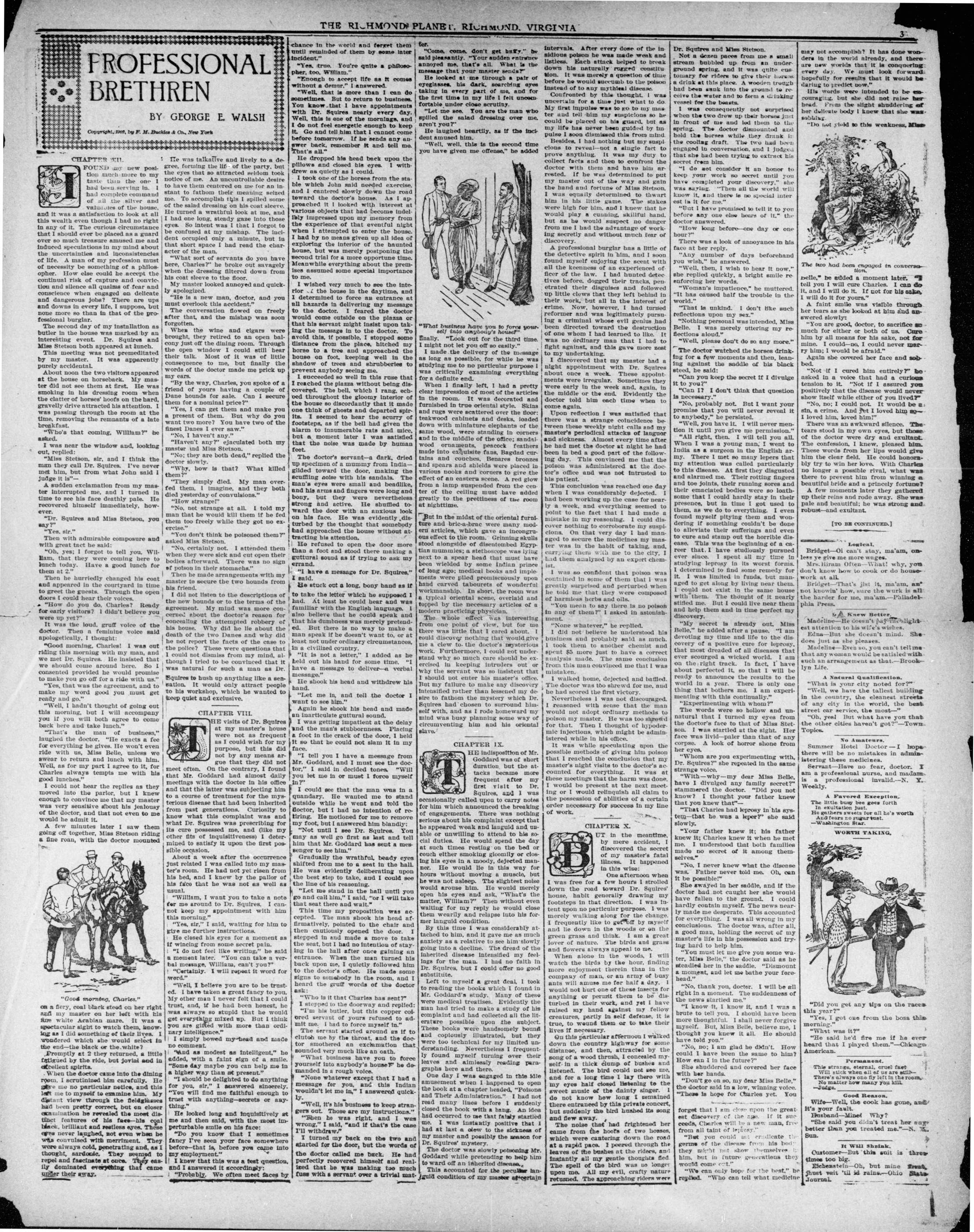
PROFESSIONAL BRETHREN
BY GEORGE E. WALSH
Copyright, 1902, by F. M. Buckles & Co., New York
CHAPTER WIL.
FOUND my new position much more to my taste than the one I had been serving in. I had complete command of all the silver and valinates of the house, and it was a satisfaction to look at all this wealth even though I had no right in any of it. The curious circumstance that I should ever be placed as a guard over so much treasure amused me and induced speculations in my mind about the uncertainties and inconsistencies of life. A man of my profession must of necessity be something of a philosopher. How else could be accepted the continual risk of capture and convict.
He was talkative and lively to a degree, forming the life of the party, but the eyes that so attracted seldom took notice of me. An uncontrollable desire to have them centered on me for an instant to fathom their meaning seized me. To accomplish this I spilled some of the salad dressing on his coat sleeve. He turned a wrathful look at me, and I had one long, steady gaze into those eyes. So intent was I that I forgot to be confused at my mishap. The incident occupied only a minute, but in that short space I had read the character of the man.
“What sort of servants do you have here, Charles?” he broke out savagely when the dressing filtered down from his coat sleeve to the floor.
My master looked annoyed and quickly apologized.
"He is a new man, doctor, and you must overlook this accident."
The conversation flowed on freely after that, and the mishap was soon forgotten.
When the wine and cigars were brought, they retired to an open balcony just off the dining room. Through the open window I could still hear their talk. Most of it was of little consequence to me, but finally the words of the doctor made me prick up my ears.
"By the way, Charles, you spoke of a friend of yours having a couple of Dane hounds for sale. Can I secure them for a nominal price?"
"Yes, I can get them and make you a present of them. But why do you want two more? You have two of the finest Danes I ever saw."
"No, I haven't any."
"Haven't any?" ejaculated both my master und Miss Stetson.
"No; they are both dead," replied the doctor slowly.
"Why, how is that? What killed them?"
"They simply died. My man overfed them, I imagine, and they both died yesterday of convulsions."
"How strange!"
"No, not strange at all. I told my man that he would kill them if he fed them too freely while they got no exercise."
"You don't think he poisoned them?" asked Miss Stetson.
"No, certainly not. I attended them when they were sick and cut open their bodies afterward. There was no sign of poison in their stomachs."
Then he made arrangements with my master to secure the two hounds from his friend.
I did not listen to the descriptions of the new hounds or to the terms of the agreement. My mind was more concerned about the doctor's reason for concealing the attempted robbery of his house. Why did he lie about the death of the two Danes and why did he not report the facts of the case to the police? These were questions that I could not dismiss from my mind, although I tried to be convinced that it was natural for such a man as Dr. Squires to hush up anything like a sensation. It would only attract people to his workshop, which he wanted to keep quiet and exclusive.
HE visits of Dr. Squires at my master's house were not as frequent as I could wish for my purpose, but this did not by any means argue that they did not meet often. On the contrary, I found that Mr. Goddard had almost daily meetings with the doctor in his office and that the latter was subjecting him to a course of treatment for the mysterious disease that had been inherited from past generations. Curiosity to know what this complaint was and what Dr. Squires was prescribing for its cure possessed me, and (like my other fits of inquisitiveness) I determined to satisfy it upon the first possible occasion.
About a week after the occurrence just related I was called into my master's room. He had not yet risen from his bed, and I knew by the pallor of his face that he was not as well as usual.
"William, I want you to take a note for me around to Dr. Squires. I cannot keep my appointment with him this morning."
"Yes, sir," I said, waiting for him to give me further instructions.
He closed his eyes for a moment as if wincing from some secret pain.
"I do not feel like writing," he said a moment later. "You can take a verbal message, William, can't you?
"Certainly. I will repeat it word for word."
"Well, I believe you are to be trusted. I have taken a great fancy to you. My other man I never felt that I could trust, and, if he had been honest, he was always so stupid that he would get everything mixed up. But I think you are gifted with more than ordinary intelligence."
I simply bowed my head and made no comment.
"And as modest as intelligent," he added, with a faint sign of a smile. "Some day maybe you can help me in a higher way than it present."
"I should be delighted to do anything for you, sir," I answered sincerely. "You will find me faithful enough to trust with anything—secrets or anything."
He looked long and inquisitively sat me and then said, with the most imperturbable smile on his face:
"Do you know that I sometimes fancy I've seen your face somewhere before—that is, before you came into my employment."
I knew that this was a test question,
and I answered it accordingly:
"Probably. We often meet faces by
CHAPTER VII.
FOUND my new position much more to my taste than the one I had been serving in. I had complete command of all the silver and valuables of the house.
FOUND my new position much more to my taste than the one I had been serving in. I had complete command of all the silver and valuages of the house, and it was a satisfaction to look at all this wealth even though I had no right in any of it. The curious circumstance that I should ever be placed as a guard over so much treasure amused me and induced speculations in my mind about the uncertainties and inconsistencies of life. A man of my profession must of necessity be something of a philosopher. How else could he accept the continual risk of capture and conviction and silence all qualms of fear and conscience when engaged on delicate and dangerous jobs? There are ups and downs in every life, I suppose, but none more so than in that of the professional burglar.
The second day of my installation as butler in the house was marked by an interesting event. Dr. Squires and Miss Stetson both appeared at lunch. This meeting was not premeditated by my master. It was apparently purely accidental. About noon the two visitors appeared at the house on horseback. My master did not see them at first. He was smoking in his dressing room when the clatter of horses' hoofs on the hard, gravelly drive attracted his attention. I was passing through the room at the time, removing the remnants of a late breakfast. "Who's that coming, William?" he asked. I was near the window and, looking out, replied: "Miss Stetson, sir, and I think the man they call Dr. Squires. I've never met him, but from what John said I judge it is"—
A sudden exclamation from my master interrupted me, and I turned in time to see his face deathly pale. He recovered himself immediately, however.
"Dr. Squires and Miss Stetson, you say?"
"Yes, sir." Then with admirable composure and with great tact he said: "Oh, yes; I forgot to tell you, William, that they were coming here to lunch today. Have a good lunch for them at 2." Then he hurriedly changed his coat and appeared in the courtyard in time to greet the guests. Through the open doors I could hear their voices. "How do you do, Charles? Ready for early visitors? I didn't believe you were up yet?" It was the loud, gruff voice of the doctor. Then a feminine voice said apologetically, I thought: "Good morning, Charles! I was out riding this morning with my man, and we met Dr. Squires. He insisted that we should come around here. So I consented provided he would promise to make you go off for a ride with us." "Yes, that was the agreement, and to make my word good you must get ready and go."
"Well, I hadn't thought of going out this morning, but I will accompany you if you will both agree to come buck here and take lunch."
"That's the man of business," laughed the doctor. "He exacts a fee for everything he gives. He won't even ride with us, Miss Belle, unless we swear to return and lunch with him. Well, as for my part I agree to it, for Charles always tempts me with his good lunches."
I could not hear the replies as they moved into the parlor, but I knew enough to convince me that my master was very sensitive about his jealousy of the doctor, and that not even to me would he admit it.
A few minutes later I saw them going off together, Miss Stetson riding a fine roam, with the doctor mounted
"Good morning, Charles."
on a fiery, coal black steed on her right and my master on her left with his fire white Arabian mare. It was a spectacular sight to watch them, knowing as I did something of their lives. I wondered which she would select in the end—the black or the white? Promptly at 2 they returned, a little fatigued by the ride, but jovial and in excellent spirits. When the doctor came into the dining room, I scrutinized him carefully. He gave me no particular notice, and this left me to myself to examine him. My distant view through the fieldglasses had been pretty correct, but on closer examination he revealed the most distinct features of his face—his coal black, brilliant and restless eyes. These eyes never laughed, not even when he was convulsed with merriment. They were always cold, penetrating and, as I thought, sardonic. They seemed to repel and fascinate at once. They easily dominated everything that came under their sway.
CHAPTER VIII
HE visits of Dr. Squires at my master's house were not as frequent as I could wish for my purpose, but this did not by any means argue that they did not
chance in the world and forget them until reminded of them by some later incident." "Yes, true. You're quite a philosopher, too, William."
for. "Come, come, don't get bully." be said pleasantly. "Your audden entrance annoyed me, that's all. What is the message that your master sends?"
intervals, sidious po listless. I down his lion.
"Enough to accept life as it comes without a demur," I answered.
"Well, that is more than I can do sometimes. But to return to business. You know, that I have appointments with Dr. Squires nearly every day. Well, this is one of the mornings, and I do not feel energetic enough to keep it. Go and tell him that I cannot come before tomorrow. If he sends any answer back, remember it and tell me. That's all."
He dropped his head back upon the pillows and closed his eyes. I withdrew as quietly as I could.
I took one of the horses from the stable which John said needed exercise, and I cantered slowly down the road toward the doctor's house. As I approached it I looked with interest at various objects that had become indelibly impressed upon my memory from the experience of that eventful night when I attempted to enter the house. I had by no means given up all idea of exploring the interior of the haunted house, but was merely postponing the second trial for a more opportune time. Meanwhile everything about the premises assumed some special importance to me.
I wished very much to see the interior. I the house in the daytime, and I determined to force an entrance at all hazards in delivering my message to the doctor. I feared the doctor would come outside on the plaza or that his servant might insist upon taking the messages in to the doctor. To avoid this, if possible, I stopped some distance from the place, hitched my horse to a tree and approached the house on foot, keeping well in the shadow of trees and shrubberies to prevent anybody seeing me.
I succeeded so well in this rose that I reached the plaza without being discovered. The bell, which I rang, echoed throughout the gloomy interior of the house so discordantly that it made one think of ghosts and departed spirits. I seemed to hear the scurry of footsteps, as if the bell had given the alarm to innumerable rats and mice, but a moment later I was satisfied that the noise was made by human feet.
The doctor's servant—a dark, dried up specimen of a mummy from India—gilded toward the door, making the scuffling noise with his sandals. The man's eyes were small and beadlike, and his arms and fingers were long and bony, but they were nevertheless strong and active. He shuffled toward the door with an anxious look on his face. He was evidently disturbed by the thought that somebody had approached the house without attracting his attention.
He refused to open the door more than a foot and stood there making a guttural sound as if trying to ask my errand.
"I have a message for Dr. Squires," I said.
He stuck out a long, bony hand as if to take the letter which he supposed I had. At least he could hear and was familiar with the English language. I also believe that he could speak and that his dumbness was merely pretended. But there is no way to make a man speak if he doesn't want to, or at least not under ordinary circumstances, in a civilized country.
"It is not a letter," I added as he held out his hand for some time. "I have a message to deliver—a verbal message."
He shook his head and withdrew his hand.
"Let me in, and tell the doctor I want to see him."
Again he shook his head and made an inarticulate guttural sound.
I was getting impatient at the delay and the man's stubbornness. Placing a foot in the crack of the door, I held it so that he could not slam it in my face.
"I tell you I have a message from Mr. Goddard, and I must see the doctor," I said in decided tones. "Will you let me in or must I force myself in?"
I could see that the man was in a quandary. He wanted me to stand outside while he went and told the doctor, but I had no intention of retiring. He motioned for me to remove my foot, but I answered him blandly:
"Not until I see Dr. Squires. You may as well go first as last and tell him that Mr. Goddard has sent a messenger to see him."
Gradually the wrathful, beady eyes shifted from me to a seat in the hall. He was evidently deliberating upon the best step to take, and I could see the line of his reasoning.
"Let me stand in the hall until you go and call him," I said, "or I will take that seat there and wait."
This time my proposition was accepted. The man shook his head affirmatively, pointed to the chair and then cautiously opened the door. I stepped in and made a move to take the seat, but I had no intention of staying in the hall after once gaining an entrance. When the man turned his back upon me, I quietly followed him to the doctor's office. He made some signs to somebody in the room, and I heard the grunt words of the doctor ask:
"Who is it that Charles has sent?"
I stepped to the doorway and replied: "I'm his butler, but this copper colored servant of yours refused to admit me. I had to force myself in."
The servant started around as if to clutch me by the throat, and the doctor smothered an exclamation that sounded very much like an oath.
"What business have you to force yourself into anybody's house?" he demanded in a rough voice.
"None whatever except that I had a message for you, and this Indian wouldn't let me in," I answered quickly.
"Well, it's his business to keep strangers out. Those are my instructions."
"When he was right, and I was wrong," I said, "and if that's the case I'll withdraw."
I turned my back on the two and started for the door, but the words of the doctor called me back. He had perfectly recovered himself and realized that he was making too much fuss with a servant over a trivial mat-
for.
"Come, come, don't get hurt," he said pleasantly. "Your sudden entrance annoyed me, that's all. What is the message that your master sends?"
He looked at me through a pair of eyeglasses, his dark, searching eyes taking in every part of me, and for the first time in my life I felt uncomfortable under close scrutiny.
"Let me see. You are the man who spilled the salad dressing over me, aren't you?"
He laughed heartily, as if the incident amused him.
"Well, well, this is the second time you have given me offense," he added
A
finally. "Look out for the third time. I might not let you off so easily." I made the delivery of the message as long as possible, for while he was studying me to no particular purpose I was critically examining everything for a definite end.
When I finally left, I had a pretty clear impression of most of the articles in the room. It was decorated and furnished in true oriental style. Skins and rugs were scattered over the floor; teakwood cabinets and desks, loaded down with miniature elephants of the same wood, were standing in corners and in the middle of the office; sandalwood ornaments, peacock feathers made into exquisite fans, Bagdad curtains and couches, Benares bronzes and spears and shields were placed in various nooks and corners to give the effect of an eastern scene. A red glow from a lamp suspended from the center of the ceiling must have added greatly to the prettiness of the room at nighttime.
But in the midst of the oriental furniture and brie-a-brac were many modern articles, which gave an incongruous effect to the room. Grinning skulls stood alongside of disentembed Egyptian mummies; a stethoscope was lying next to a spear head that must have been wielded by some Indian prince of long ago; medical books and implements were piled promiscuously upon hand carved tabourets of wonderful workmanship. In short, the room was a typical oriental scene, overlaid and topped by the necessary articles of a modern practicing physician.
The whole effect was interesting from one point of view, but for me there was little that I cared about. I could discover nothing that would give me a clew to the doctor's mysterious work. Furthermore, I could not understand why so much care should be exercised in keeping intruders out or why the servant was so insistent that I should not enter his master's office. But my failure to make any discovery intensified rather than lessened my desire to fathom the mystery which Dr. Squires had chosen to surround himself with, and as I rode homeward my mind was busy planning some way of circumventing him and his oriental slave.
CHAPTER IX.
HE indisposition of Mr. Goddard was of short duration, but the attacks became more frequent after my first visit to Dr. Squires, and I was
HE indisposition of Mr. Goddard was of short duration, but the attacks became more frequent after my first visit to Dr. Squires, and I was occasionally called upon to carry notes for him which announced the breaking of engagements. There was nothing serious about his complaint except that he appeared weak and languid and unable or unwilling to attend to his social duties. He would spend the day at such times resting on the bed or couch either smoking gloomily or closing his eyes in a moody, dejected manner. He would lie in this way for hours without moving a muscle, but he was not asleep. The slightest noise would arouse him. He would merely open his eyes and ask, "What's the matter, William?" Then without even waiting for my reply he would close them wearily and relapse into his former languid condition.
By this time I was considerably attached to him, and it gave me as much anxiety as a relative to see him slowly going into a decline. The dread of the inherited disease intensified my feelings for the man. I had no faith in Dr. Squires, but I could offer no good substitute.
Left to myself a great deal, I took to reading the books which I found in Mr. Goddard's study. Many of these were medical treatises. Evidently the man had tried to make a study of his complaint and had collected all the literature possible upon the subject. These books were handsomely bound and copiously illustrated, but they were too technical for my limited understanding. Nevertheless I frequently found myself turning ever their leaves and almighty reading paragraphs here and there.
One day I was engaged in this idle amusement when I happened to open the book at a chapter headed, "Polens and Their Administration." I had not read many lines before I suddenly closed the book with a bang. An idea had occurred to me that fairly startled me. I was instantly positive that I had at last a clew to the sickness of my master and possibly the season for Dr. Squires' mystery.
This accounted for the peculiar languid condition of my masses a certain
intervals. After every dose of the insidious poison he was made weak and listless. Each attack helped to break down his naturally rugged constitution. It was merely a question of time before he would succumb to the poison instead of to any mythical disease. Confronted by this thought, I was uncertain for a time just what to do. My first impulse was to go to my master and tell him my suspicions so he could be placed on his guard, but as my life has never been guided by impulse I soon dismissed this from mind
Beside, I had nothing but my suspicions to reveal—not a single fact to prove anything. It was my duty to collect facts and then to confront the doctor with them and have him arrested. If he was determined to put my master out of the way and gain the hand and fortune of Miss Stetson, I was equally determined to thwart him in his little game. The stakes were high for him, and I knew that he would play a cunning, skillful hand, but as he would suspect no danger from me I had the advantage of working secretly and without much fear of discovery.
A professional burglar has a little of the detective spirit in him, and I soon found myself enjoying the scent with all the keenness of an experienced officer of the law. I had hunted detectives before, dogged their tracks, penetrated their disguises and followed up little claws that they left behind in their work, but all in the interest of crime. Now, however, I had turned reformer and was legitimately pursuing a criminal whose evil genius had been directed toward the destruction of one whom I had learned to like. It was no ordinary man that I had to fight against, and this gave more zest to my undertaking.
I discovered that my master had a night appointment with Dr. Squires about once a week. These appointments were irregular. Sometimes they were early in the week and, again, in the middle or the end. Evidently the doctor told him each time when to come again.
Upon reflection I was satisfied that there was a strange coincidence between these weekly night calls and my master's periodical attacks of languor and sickness. Almost every time after he had met the doctor at night he had been in bed a good part of the following day. This convinced me that the poison was administered at the doctor's office and was not intrusted to his patient.
This conclusion was reached one day when I was considerably dejected. I had been working up the case for nearly a week, and everything seemed to point to the fact that I had made a mistake in my reasoning. I could discover nothing to corroborate my suspicions. On that very day I had managed to secure the medicines my master was in the habit of taking, and, carrying them with me to the city, I had them analyzed by an expert chemist.
I was so confident that poison was contained in some of them that I was greatly surprised and perturbed when he told me that they were composed of harmless herbs and oils.
"You mean to say there is no poison in any of them?" I asked in astonishment.
"None whatever." he replied.
Noble whatever, he replied.
I did not believe he understood his business and probably said as much. I took them to another chemist and spent $5 more just to have a correct analysis made. The same conclusion from this man convinced me that I was mistaken.
I walked home, dejected and baffled. The doctor was too shrewd for me, and he had scored the first victory.
Nevertheless I was not discouraged. I reasoned with sense that the man would not adopt ordinary methods to poison my master. He was too shrewd for that. Then I thought of hypodermic injections, which might be administered while in his office.
It was while speculating upon the possible methods of giving him poison that I reached the conclusion that my master's night visits to the doctor's accounted for everything. It was at these meetings that the harm was done, I would be present at the next meeting or I would relinquish all claim to the possession of abilities of a certain order necessary for success in my line of work.
CHAPTER X
UT in the meantime, by mere accident, I discovered the secret of my master's fatal illness. It happened in this wise:
UT in the meantime, by mere accident, I discovered the secret of my master's fatal illness. It happened in this wise:
One afternoon when I was free for a few hours I strolled down the road toward Dr. Squires' house, habit generally drawing my footsteps in that direction. I was intent upon no particular purpose. I was merely walking along for the change, I frequently like to get off by myself and lie down in the woods or on the green grass and think. I am a great lover of nature. The birds and grass and flowers always appeal to me.
When alone in the woods, I will watch the birds by the hour, finding more enjoyment therein than in the company of man, or an army of busy ants will amuse me for half a day. I would not hurt one of these insects for anything or permit them to be disturbed in their work, and yet I have raised my hand against my fellow creatures, partly in self defense, it is true, to wound them or to take their lives if necessary.
On this particular afternoon I walked down the country highway for some distance, and then, attracted by the song of a wood thrush, I concealed myself in a thick clump of bushes and listened. The bird could not see me, and for a long time I lay there with my eyes half closed Listening to the sweet music of the dainty singer. I do not know how long I remained there entranced by this private concert, but suddenly the bird hushed its song and few away.
The noise that had frightened her came from the hoots of two hoses, which were cantering down the road at a rapid pace. I peered through the leaves of the bushes at the riders, and instantly all my gentle thoughts fed. The spell of the bird was no longer upon me. All my evil, crafty nature returned. The approaching riders were
Dr. Squires and Miss Stetson.
Not a dozen paces from me a small stream bubbled up from an underground spring, and it was quite customary for riders to give their horses a drink at this place. A wooden trough had been sunk into the ground to receive the water and to form a drinking vessel for the boasts.
I was consequently not surprised when the two drew up their horses just in front of me and led them to the spring. The doctor discounted and hold the horses while they drank in the cooling draft. The two had been engaged in conversation, and I Judged that she had been trying to extract his secret from him.
"I do not consider it an honor to keep your work so secret until you have completed your discovery," she was saying. "Then all the world will know it, and there is no special interest in it for me."
"But I have promised to tell it to you before any one else bears of it." the doctor answered.
"How long before—one day or one hour?"
There was a look of annoyance in his face at her reply.
"Any number of days beforehand you wish," he answered.
"Well, then, I wish to hear it now," she replied quickly, a bright smile re-enforcing her words.
"Woman's impatience," he muttered.
"It has caused half the trouble in the world."
"That is unkind. I don't like such reflections upon my sex."
"Nothing personal was intended, Miss Belle. I was merely uttering my reflections aloud."
"Well, please don't do so any more."
The doctor watched the horses drinking for a few moments and then, leaning against the saddle of his black steed, he said:
"Can you keep the secret if I divulge it to you?"
"Can I? I don't think that question is necessary."
"No, probably not. But I want your promise that you will never reveal it to anybody." he persisted.
"Well, you have it. I will never mention it until you give me permission." "All right, then. I will tell you all. When I was a young man, I went to India as a surgeon in the English army. There I met so many lepers that my attention was called particularly to this disease. At first they disgusted and alarmed me. Their rotting fingers and toe joints, their running sores and their emaciated bodies were so loathsome that I could hardly stay in their presence, but in time I got used to them, as we do to everything. I even found myself pitying them and wondering if something couldn't be done to alleviate their sufferings and even to cure and stamp out the horrible disease. This was the beginning of a career that. I have studiously purued ever since. I spent all my time in studying leprosy in its worst forms. I determined to find some remedy for it. I was limited in funds, but managed to get along by living near them. I could not exist in the same house with them. The thought of it nearly stifed me. But I could live near them and help them and in time perfect my discovery.
"My secret is already out. Miss Belle," he added after a pause. "I am devoting my time and life to the discovery of a positive cure for leprosy, that most dreaded of all diseases that ever scourged a wicked world. I am on the right track. In fact, I have about perfected it, so that I will be ready to announce the results to the world in a year. There is only one thing that bothers me. I am experimenting with this continually."
"Experimenting with whom?"
The words were so hollow and unnatural that I turned my eyes from the doctor's face to that of Miss Stetson. I was startled at the sight. Her face was livid—paler than that of any corpse. A look of horror shone from her eyes.
"Whom are you experimenting with, Dr. Squires?" she repeated in the same strange voice.
"With—why—my dear Miss Belle, have I divulged any family secret?" stammered the doctor. "Did you not know? I thought your father knew that you knew that"— "That Charles had leprosy in his system—that he was a leper?" she said slowly.
"Your father knew it; his father knew it; Charles knew it when he met me. I understood that both families made no secret of it among themselves."
"No. I never knew what the disease was. Father never told me. Oh, can it be possible!"
She awayed in her saddle, and if the doctor had not caught her she would have fallen to the ground. I could hardly contain myself. The news nearly made me desperate. This accounted for everything. I was all wrong in my conclusions. The doctor was, after all, a good man, holding the secret of my master's life in his possession and trying hard to help him.
"You must let me give you some water, Miss Belle," the doctor said as he steadled her in the saddle, "Dismount a moment, and let me bathe your forehead."
"No, thank you, doctor. I will be all right in a moment. The suddenness of the news startled me."
"I know it, I know it, and I was a brute to tell you. I should have been more thoughtful. I shall never forgive myself. But, Miss Belle, believe me, I thought you knew it all. He should have told you."
"No, no; I am glad he didn't. How could I have been the same to him? How can I in the future?"
She shuddered and covered her face with her hands.
"Don't go on so, my dear Miss Belle," the doctor said in a low, winning voice.
"There is hope for Charles yet. You
forget that I am close upon the greatest discovery of the age. If it succeeds, Charles will be a new man, free from all taint of leprosy."
"But you could not eradicate the germs of the disease from his body they might not show themselves in him, but in future generations they would come out."
"We can only hope for the best," he replied. "Who can tell what medicine
may not accomplish? It has done wonders in the world already, and there are new worlds that it is conquering every day. We must look forward hopefully for results that it would be daring to predict now."
His words were intended to be encouraging, but she did not raise her head. From the slight shuddering of her delicate body I knew that she was sobbing.
"Do not yield to this weakness. Miss
The two had been engaged in conversation. belle," be added a moment later. "I tell you I will cure Charles. I can do it, and I will do it. If not for his sake, I will do it for yours."
A faint smile was visible through her tears as she looked at him and answered slowly:
"You are good, doctor, to sacrifice so much for either or both of us. Cure him by all means for his sake, not for mine. I could—no, I could never marry him; I would be afraid."
Again she covered her face and sobbed.
"Not if I cured him entirely?" be asked in a voice that had a curious tension to it. "Not if I assured you positively that the disease would never show itself while either of you lived?" "No, no; I could not. It would be a sin, a crime. And yet I loved him so—I loved him, loved him!"
There was an awkward silence. The tears stood in my own eyes, but those of the doctor were dry and exultant. The confession, I knew, pleased him. These words from her lips would give him the clear field. He could honorably try to win her love. With Charles no longer a possible rival, what was there to prevent him from winning a beautiful bride and a princely fortune? A few moments later they gathered up their reins and rode away. She was pale and beautiful; he was strong and robust—and exultant.
[TO BE CONTINUED.]
Bridget—Oi can't stay, ma'am, onless ye give me more wages.
Mrs.Hiram Often—What! why, you don't know how to cook or do housework at all.
Bridget—That's jist it, ma'am, an* not known'in how, sure the wurk is all the harder for me, ma'am—Philadelphia Press.
Know Better
Madeline—He doesn't pay the slightest attention to his wife's wishes. Edna—But she doesn't mind. She does just as she pleases. Madeline—Even so, you can't tell me that any woman would be satisfied with such an arrangement as that.—Brooklyn Life.
A Natural Qualification.
"What is your city noted for?" "Well, we have the tallest building in the country, the cleanest streets of any city in the world, the best street car service, the most—" "Oh, yes! But what have you that the other cities haven't got?"—Town Topics.
No Amateurs.
Summer Hotel Doctor—I hopes there will be no mistakes in administering these medicines.
Servant—Have no fear, doctor. I am a professional nurse, and madam is a professional invalid.—N. Y. Weekly.
A Favored Exception.
The little busy bee goes forth In exultation just He gathers wives for all he's worth And fears no sugar tust.
—Washington Star.
"Did you get any tips on the races this year?"
"Yes, I got one from the boss this
morning."
"What was it?"
"He said he'd fire me if he ever
heard that I played them."—Chicago
American.
Permanent.
This strange, eternal, cruel fast
Will stick when all of us are still—
There's always one fly left in the room.
No matter how many you kill.
Good Reason.
Wife—Well, the cook has gone, and
it's your fault.
Husband—Mine! Why?
"She said you didn't treat her say
better than you treated me."—N. X.
Sun.
Eichenstein—Oh, but mine
just wait 'til id rains—Ohio
Journal.
HE PLANET
published every Saturday by JOHN MITCHELL
JR., at 311 North 4th Street, Richmond, Va.
All communications intended for publication should be sent so as to reach us by Wednesday.
TERMS IN ADVANCE.
One Copy, one year, - $1.50
One Copy, eight months, 1.00
One Copy, six months, 0.80
One Copy, four months, 0.50
One Copy, three months, 0.40
Single Copy, 0.05
ADVERTISING RATES.
For one inch, one insertion . . . $ 60
For one inch, each subsequent insertion, . . . 25
For two inches, three months, . . . 6.00
For two inches, six months, . . . 10.00
For two inches, nine months, . . . 14.00
For two inches, twelve months, . . . 20.00
Marriage and Funeral Notices, . . . 50
Standing and Transient Notices per line, . . . 10
POSTAGE STAMPS OF A HIGHER DENOMINATION THAN TWO CENTS NOT RECEIVED ON SUBSCRIPTIONS.
THE PLANET is issued weekly. The subscription price is $1.50 a year, in advance.
There are FOUR WAYS by which money can be by mail at our risk. — In a Post Office Money Order, by Bank Check or Draft, or an Express Money Order, and when note of these money orders is received, the Money ORDERS—You can buy a Money Order at your Post Office, payable at the Richmond Post Office, and we will be responsible for its arrival. The Money ORDERS can be obtained at any office of the American Express Co., the United States Express Co., and the Web's Farmer and Co.'s Express Company. We will be responsible for your payment of these Express Money Orders is a safe and convenient way for forwarding money.
REGISTERED LETTER—If a Money Order is written in your office or an Express Company, will Register the letter you wish to send us on payment of ten cents. Then, if the letter is lost or stolen, it may be that you can send money in this manner at our risk.
We cannot be responsible for money sent in letters in any other way than one of the four ways mentioned above. If you send your money in any other way, you must do it at your
REWENALS, ETC.—If you do not want THE PLANET continued for another year after your position has run out you then modify by Postal Card to discontinue it. The courts have decided that subscribers to newspapers who do not order their paper discontinued at the expiration date of which it has been paid, hold liable for the payment of the subscription up to date when they order the paper discontinued.
COMMUNICATIONS—When writing to us to renew your subscription or to discontinue your paper, you should give your name and address in full, otherwise we cannot find your name on our books.
QUESTIONS—In order to change the address of a subscriber, we must be sent the former as well as the present address.
ENTERed in Office at Richmond, Va., as second class matter.
SATURDAY.....SEPT 13 1902
It earlier announced that the Republican State Convention of Alabama will be asked to follow in the foot-steps of North Carolina and exclude all colored delegates. It is claimed that the two colored delegates regularly elected by the regular Republican convention at Montgomery about two weeks ago were arbitrarily removed by the white Republican club last Wednesday and two white delegates substituted.
Well, let them go ahead with the funeral. They will find that the colored men will not submit without a long and protracted struggle which we hope will extend over a period of one hundred years. If President Roosevelt has been deceived by such idle vaporings as that which is contained in the prediction that there will be a break in the solid south, then he has not only deceived his friends, but himself as well.
In its blind haste to disfranchise the colored people the unconstitutional "Constitutional Convention made a most amusing, and from a Democratic standpoint deplorable blunder. In order to get rid of the alleged floating Negro population it provided that in order for a citizen to register, he must have resided in the state for two years in the county one year and in the precinct in which he offers to vote, three months.
Now, it seems that CHARLES I. STENGLE, (white) Democratic editor of the Fredericksburg, Va., Free Lance has been living in the state two years, but not long since changed his residence to the city of Fredericksburg. He could vote there under the old constitution, but was ruled out under the new as not having resided there twelve months. He became indignant and appealed to the courts. The results is that a decision has been handed down against him and he is the victim of the very law framed to catch only Negroes.
DISFRANCHISING US.
REPORTS from all over the state go to show that no white men are being denied the right to register and only Negro property owners are being accorded a similar privilege. There are a few isolated exceptions, but this is a rule.
The pledge of the Democrats that no white man shall be disfranchised is being literally carried out. It is apparent however that the white people themselves are regarding with indifference this revision of the elective franchise.
We are opposed to all such departures from the fundamental principles of government. Still these Negro-haters have "built better than they knew."
This law will yet prove a most remarkable incentive for the colored man to obtain property. Even as the stubbornness of the late JEFFERSON DAVIS and his supporters led to the issuance of the Emancipation Proclamation for the colored people, so this persistent effort
to disfranchise him leads to his industrial and financial enfranchisement in the field of commerce.
It is a poor specimen of racial humanity who will not now gird up his loins and march forward.
Money must be earned and saved. We must segregate and colonize. When we secure finance, it must be kept among colored people as long as possible before it flows back again to the white man's channels of commerce. By this means, we can be getting the benefit of it, even as the ramification of a steam pipe warms a building. We are in the fight to stay, but it is a bloodless one. If colored men will take advantage of the opportunities afforded, stay away from Negro-hating hotels and bar rooms, and if we must have either, build and patronize our own there will be a different state of affairs in this locality.
We should launch out in all branches of business. We should establish boot and shoe stores, dry-goods establishments, grocery stores, millinery establishments, in fact, everything that the white man has put into operation. We should have our own publishing houses, newspapers and they should be liberally supported.
The disreputable, insulting Negroes in our midst should be sent to the rear. They disgrace not only themselves but us as well. We know that there are similar elements among the white people, but they can afford to tolerate those kind of people much better than we can afford to do it. Unfortunately, we are on trial before the world. Every bad act on our part is magnified and every good one is minimized.
We are fighting an up-hill battle and good behavior and true politeness will prove one of our strongest and most powerful weapons. Let them disfrain us! Let them spur us on to buy land and acquire a competency! The curtain will in a few years be lifted and the Negroes of the United States will have the proud satisfaction of seeing the nations of the world laugh at the southern white man's folly.
"God reigns and the government at Washington still lives!"
A WEEK'S NEWS CONDENSED.
Thursday, September 4
Paris has raised $1,700,000 for the relief of the volcanic sufferers on the Island of Martinique. John A. Schmitt, a prominent builder of Wilkesbarre, Pa., died yesterday of injuries received in a mine accident at Plymouth. The Pennsylvania Republican state committee yesterday appointed a committee to endeavor to settle the coal strike. The enlisted men of the United States ship Dolphin presented Secretary of the Navy Moody with a beautiful silk flag during his visit to the vessel.
Friday, September 5.
The war department cannot find a sufficient number of army officers to supply the demand for military instructors in colleges.
The Philadelphia board of education ordered $3,000 tons of hard coal to heat school houses from a British firm, at $6.50 per ton.
The Chesapeake, which was used as a training ship for cadets during the summer, was placed out of commission at Annapolis, Md., yesterday.
Plans were made in New York yesterday to form an international banking institution, capitalized at $10,000,000, to operate in Latin-American countries.
Saturday, September 6.
The big inter-state shooting tournament at Sea Girt, N. J., ended yesterday.
Over 2,000 Quakers attended the Friends' General Conference at Asbury Park, N. J.
The postoffice at Tazewell, Tenn., was entered by robbers last night, who secured $500 in stamps and money.
Mrs. Annie B. Robin, of Philadelphi, was struck by an express train at Wayne Junction yesterday and instantly killed.
A conference of Boer sympathizers was held at New York yesterday to provide relief for Boer prisoners still in the hands of the British.
Monday, September 8.
William N. Roach, formerly United States senator from North Dakota, died in New York yesterday.
Daniel Omler, 3 years old, of Lancaster, Pa., Saturday set his clothing on fire with a match and was fatally burned.
Attorney General P. C. Knox arrived in Paris yesterday, where he will inquire into the title of the Panama Canal Company.
The real estate valuation of Cook county, Ills., in which Chicago is located, has been fixed at $1,488,749,810, an increase of $33,000,000 over last year.
Tuesday, September 9.
Over 400 delegates attended the 16th annual convention of the United Typotheta at Pittsburg.
The Socialists of Massachusetts held a convention yesterday and nominated a full state ticket.
The annual football game between the Annapolis Cadets and West Point Cadets will be played at Philadelphia, November 29.
President Roosevelt accepted an invitation to be present at the Southern Illinois Soldiers' and Sailors' reunion at Carbondale, Ills., on October 1, 2 or 3.
Hamilton Armstrong, principal of the schools at Otisville, N. Y., was struck by an Erie Railroad train yesterday and instantly killed. He was formerly district attorney of Pike county, Pa.
Wednesday. September 10.
WEDNESDAY, SEPTEMBER 14
California yesterday celebrated the 52d anniversary of her admission to the union.
James T. Kaye, of Topeka, Kae., was sentenced to 27 years in the penitentiary for the murder of his wife.
John Loma, a negro, who assaulted Susie Costenbader near Alexandria, Va., last June, was hanged at Montrose, Va., yesterday.
THE RICHMOND PLANET. RICHMOND; VIRGINIA.
FAILED TO END STRIKE
FAILED TO END STRIKE
Governor Stone's Efforts Proved Unsuccessful.
MORGAN DECLINED TO INTERFERE
Governor Stone, Attorney General Elkin and Senator Flynn Had Conference With P. A. B. Widener, Who Later Called On Mr. Morgan.
New York, Sept. 10.—Governor William A. Stone, of Pennsylvania, who came to this city and made an effort yesterday to see what could be done towards settling the anthracite coal strike, returned to Harrisburg, Pa. last night, without apparently having been able to accomplish a settlement. There were rumors aloft that the governor's visit had results, but George W. Perkins, of J. P. Morgan & Co., denied last night that there was any change in the situation. Word to the same effect was received by long distance telephone from President Truesdale, of the Delaware, Lackawanna and Western Railway.
Governor Stone was accompanied to the city by Attorney General Elkin, of Pennsylvania, and Senator Flynn, of Pittsburg. The three had a conference of several hours' duration with P. A. B. Widener, of Philadelphia, in the offices of the United States Steel Corporation. After the conference had lasted an hour, Mr. Widener went to see J. Plerpont Morgan at the latter's office, and asked him to use his influence to end the strike. Ten minutes later he returned to his fellow conferences and told them that Mr. Morgan had declined to interfere.
Before leaving the city Governor Stone gave out the following statement: "Attorney General Elkin, Senator Flynn and myself were in consultation for several hours, with P. A. B. Widener, of Philadelphia, who is a director of the United States Steel Corporation, and associated with Mr. Morgan in many business interests. Mr. Widener is very anxious to see the strike settled, and took the matter up with Mr. Morgan. We are doing what we can." Governor Stone was asked what progress toward a settlement had been made during the conference, and whether any direct communication had been had from Mr. Morgan. To these questions he answered that he had nothing to say beyond what was contained in his statement, and that the other parties to the conference had also pledged to silence.
Morgan Agrees to PlanF
Another report says that J. Pleperp Morgan has assented to a plan proposed by Governor Stone for ending the coal miners' strike. The plan, according to the report, was submitted to Mr. Morgan yesterday by P. A. B. Widenter. The plan, in brief, is for the mine workers to return to work, without a signed agreement; that the operators, by concessions, adjust the differences existing between the men and the companies; that if after waiting a reasonable time the operators fail to do this, an arbitrator be appointed, and that if the men deem the decision of the arbitrator as unjust, then the men can again go on strike.
It is said that Governor stone immediately telegraphed President Mitchell for a conference, and that the meeting between the miners' chief will take place probably today or tomorrow.
President Michelle early this morning said he had received no information from Governor Stone with reference to a conference, and as far as he knew the strike situation was unchanged. President Baec, of the Reading, was in the city yesterday and at his office. He met President Truesdale, of the Lackawanna, and President Fowler, of the Ontario and Western, and had a brief conference with them. President Fowler was authority for this, but he would not say where the conference was held, or whether the coal presidents had in any way taken cognizance of Governor Stone's and Mr. Widener's efforts to end the strike, or whether the railroad presidents had been in communication with Mr. Morgan.
Up to the Operators.
Up to the Operators.
Wilkesbarre, Pa., Sept. 10—President John Mitchell, of the United Mine Workers of America, last night denied in the most emphatic terms that the coal miners' strike is ended. "You can quote me in the strongest terms," he said. "that the strike is still on. I have received no proposition from the other side, and I have made none to the operators. All I know of any negotiations to end the strike I have read in the newspapers. The strike is still on, and will remain so until declared off by the mine workers in convention. It is up to the operators."
President Mitchell said he hears rumors of the ending of the strike almost every hour each day. When he was told of the rumors last night, he asked: "On what basis?"
$9 a Day Men Strike
Chicago, Sept. 10.—Three hundred bricklayers, employed on sewer work throughout the city here, have gone out on a strike. The men, who are paid $9 a day, quit work without notice. Unsatisfactory shifting of men was given as the cause of the walkout. The strike has tied up the sewer work in the city.
Found $4,000 In Gold.
New Orleans, Sept. 10.—John Moore, a farmer living near Hermansville, Clayborne county, Miss., while demolishing an ancient dwellings on his farm, found a jug containing nearly $4,000 in $20 gold pieces. The money is thought to have been hidden during the Civil War.
ST. LOUIS BOODLER CONFESSES
St. Louis, Sept. 8.—A sensation was caused yesterday by the issuance of bench warrants for the arrest of 18 members of the house of delegates on the confession of Delegate J. K. Murrill, who fled to Mexico last year, after being indicted for bribery for the December grand jury in connection with the alleged boodling operations of the
municipal assembly in relation to granting of street railroad franchises, and who unexpectedly returned to the city through the efforts of the St. Louis Post-Dispatch and surrendered. Murrell is now in the custody of Circuit Attorney Folk, and will, it is stated, be granted immunity from punishment for turning state's evidence.
J. K. Murrill made the following statement yesterday: "I have surrendered unconditionally to the circuit attorney, and have made a full and free confession. I held the key to the box in the Lincoln Trust Company containing the $75,000 bribe money to go to the house of delegates on the passage of the suburban bill. This money was the purchase price of the votes of the assembly. I am not permitted to make the operations of the combine on this particular matter public at this time. The purpose of the combine was to control legislation and sell legislation for the benefit of the members of the combine. Shortly before the suburban bill, the combine sold their votes on the lighting bills for $47,500. Each member of the combine received $2,500."
The grand jury returned indictments against the 18 members on three charges of bribery and perjury. Bonds were fixed at $15,000 for each indictment, making a total of $45,000 necessary to be secured for the release of each of the accused. The police and sheriff's deputies are still looking for Delegate Kelly, former Delegates Hartmann, Decker, Sheridan, Lehmann and Harry A. Faulkner. Faulkner already has been convicted on the charge of perjury in connection with the Suburban Railway case.
CUBAN LOAN BILL PASSED
President Palma Authorized to Borrow $35,000,000.
Havanna, Sept. 10. — The loan bill passed the house of representatives yesterday by 48 votes to 2. President Palma is authorized to make a loan in the name of the nation for the amount of $35,000,000, the minimum price of issue to be 90, and the maximum rate of interest to be 5 per cent. According to the bill the loan is payable in 40 years, payments to begin ten years after the date of issue. Four million dollars of the loan is to be devoted to the encouragement of agriculture and the cattle industry, and the sum of $31,000,000 is for the fulfillment of obligations contracted during the revolution and the payment of the Cuban army.
The executive is authorized to issue the loan in whatever series he may deem fit; he is also authorized to guarantee the operation with the custom receipts of the nation.
The bill provides for a tax of 20 cents a litre on alcohol, 30 cents a litre on brandy, 40 cents a litre on whiskey, 30 cents a litre on wine and 10 cents a litre on beer. The bill will go to the senate conference committee.
VOLCANO IN FULL ERUPTION
Stromboli Island, In Mediterranean, Shrouded in Smoke.
Rome, Sept. 10.—The volcano on Stromboli Island is in full eruption and is throwing up great columns of fire and torrents of stones. The island is shrouded in smoke. Mount Vesuvius is showing signs of activity.
Stromboli is the northernmost of the Lipari Islands, in the Mediterranean, off the north coast of Sicily. Its area is eight square miles. It is wholly of volcanic formation, and has a constantly active volcano 2,040 feet high, with an extinct crater on top, but an active one on the side at the height of about 2,150 feet. On the east side of the island lies the small town of Stromboli. The population of the island is placed at 600 persons.
Assailed Doctrine of Baptism
New York. Sept. 8.—Rev. Dr. R. S. MacArthur, at the 100th meeting in the "Evangel" tent yesterday, assailed the doctrine of baptism. He declared that the dropping of water on an infant at birth was heathenism, and that the idea that God would forever condemn an innocent but unbaptized babe makes Him a tyrant, a monster and a demon. That utterance, coming from Dr. MacArthur, had a wonderful effect on his hearers. They rose to their feet and applauded wildly. The scene was striking.
Killed Wife As Sacrifice.
Killed Wife As Sacrifice.
Genoa, W. Va., Sept. 10.—Rev. Maurice Wilson, who almost severed his wife's head from her body with a razor, saying as he did so, "without the shedding of blood there can be no remission of sin," was found yesterday in the woods a few miles from his house. He was so exhausted that he could not speak. He had had no food since the commission of the crime on Saturday morning. He is unquestionably insane, and will not be taken to jail. He is over 80 years old.
Malcolm's Shortage Over $150,000.
Jersey City, Sept. 9.—Lawyer W.
R. Ryan reported to Vice Chancellor
Stevens, in the chancery court yesterday,
that new defalcations were daily
coming to light in the case of William
Malcolm, the treasurer of the Passaic
Mutual Building and Loan Association,
who has disappeared. The shortage
was at first thought to be $60,000. Mr.
Ryan said that an examination had
shown that it was over $150,000, and
there are still $8 pass books to be
examined.
Lincoln, Neb. Sept. 9. W. J. Bryan began yesterday a speech-making tour, which will continue, with little interruption, until the November election. He made the opening address to the members of the Grand Army at their state reunion near Hastings. Today he opened the campaign for the Democrats of Missouri at Joplin. He will make other political speeches during this month in nearby states.
Prominent Minister Drowned
Shepardstown, W. Va., Sept 10. — Rev. Max Lentz, pastor of the Lutheran church here, and former editor of the Lutheran World, was drowned in the Potomac yesterday afternoon while teaching his young daughter how to swim. The young lady reached a place of safety. The body of Mr. Lentz was found near the spot where he sank. Mr. Lentz was 50 years old and had filled a number of important pubs.
MAY ATTACK PANAMA
MAY ATTACK PANAMA
Surrender of Colombian Forces at Agua Dulce Causes Uneasiness.
BERTI'S TROOPS STARVED OUT
Rebels Will Probably Locate Their Camp Between Panama and Colon, and It Is Believed a Big Battle Will Take Place.
Panama, Colombia, Sept. 10. — The surrender to the Colombian insurgents of the government General Morates Berti and the troops of his command at Agua Dulce, which has previously been reported, and which was generally believed to have taken place, has now been confirmed. This news reached Panama through some former Conservative prisoners of the insurgents, who were liberated Monday at San Carlos as a result of the landing there of an expedition from the government fleet of gunboats.
General Berti, who had been besieged at Agua Dulce by the insurgents since July 28, only surrendered when his cause was hopeless. Insurgent General Herrera promises to hold inviolate the lives and honor of his prisoners, and he allows General Berti to retain his sword as a mark of honor in recognition of his heroic defense of Agua Dulce. The surrendered generals and officers have been paroled at Penonome and Santiago de Veragus. The insurgent general says the necessities of war compel him to keep them as prisoners, but that he may exchange them for some of the thousands of Liberal prisoners now in possession of the government.
In the last article of the act of surrender General Berti makes it known that he only capitulated to the enemy when compelled to do so by absolute lack of food of any kind for his men, and the conviction that the government could not send him timely help.
It is believed in government circles that the surrender of General Berti at Agua Dulce simplifies the situation, for General Salazar, governor of Panama, who can now devote the forces of his command to the defense of Panama and Colon. That the national government has confidence in General Salazar is proved by the fact that his appointment as supreme commander of all the government forces on the isthmus has been received by telegraph from Bogota.
There is great uneasiness here now that the details of the Agua Dulce affair have become known. The strong entrenchments which have been erected in and around Panama are defended by 2,500 men, and there are over 1,000 government soldiers at Colon. A dispatch was received yesterday from the minister of war at Bogota, saying that a large number of reinforcements had left Ronda, on the Magdalena river, for the isthmus, and 3,000 more men are expected to come in this week.
General Hervera is expected to change his field of operations to the isthmus, and he will probably locate his camp somewhere on the railroad line between Panama and Colon. It is believed that a big battle will take place somewhere between these two ports.
RIVER A STREAM OF FIRE
Interesting Sights From the Eruption of Soufriere Volcano
Kingstown, Island of St. Vincent, Sept. 9.—The sights in the Windward district of this island resulting from the eruption of the Soufriere volcano September 3 are very interesting. The Raabacba river even now is a stream of fire a quarter of a mile wide. The greater part of the Raabacba estate is wrapped in vapor, and there are mimic eruptions everywhere. The river bed is continually throwing up columns and dense clouds of steam, mud and pobbles. The land has spread farther seaward, and is changing considerably the appearance of the district from what it was prior to September 3. This was probably caused by the ejecta that flowed down the slopes filling the sea about the coast.
Fifty laborers, deceived by the apparent quietude of the volcano, were working within the fire zone at the extreme north of the island, when they surely saw evidence of an approaching disturbance of the mountain, but were unable to leave the spot before electric flashes and an outpour of gases drove them to their shelter, where they remained, at the base of the mountain, throughout the terrible night, while forked lightning darted in all directions around them. The men miraculously escaped unhurt and have arrived at Kingstown.
Gored to Death By a Bull.
Harrisburg, Pa., Sept. 8 — Samuel Huff, aged 65 years, for many years prothonotary of York county, was gored to death by a bull Saturday evening at his farm near New Cumberland. Mr. Huff had gone to a field to drive the animal to another pasture. The bull became stubborn, and when Mr. Huff used a club the animal showed fight. A farm hand, seeing the battle, hastened to Mr. Huff's assistance, but the latter was dead before the bull could be driven away.
Gen. Booth Will Seek Reconciliation.
New York, Sept. 10. A former officer of the Salvation Army, who does not wish to be mentioned in the matter, said yesterday that Herbert Booth, who recently left the army, is now in America, having arrived a few weeks ago, and that it is highly probable that General Booth will arrive in this country within a few weeks to make an effort to bring about a reconciliation between himself and his children, six of whom are now out of the Salvation Army.
ROOSEVELT ON LABOR
Tells Brotherhood of Firemen He Bats
Hives in Unions
Chatnnooga, Tehn., Sept. 9.—President Roosevelt yesterday was elected an honorary member of the Brotherhood of Locomotive Firemen. He attended the executive session of the order in the morning, walking from the hotel to the Auditorium, a distance of a few blocks, escorted by Grand Mas
W. I. JOHNSON, FUNERAL DIRECTOR AND EMBALMER.
Office & Warerooms, 207 N. Foushee St. Corner Broad HACKS FOR HIRE: Orders by Telephone or Telegraph filled. Wedding, Suppers and Entertainments promptly attended. Old 'Phone, 686, Residence in Building, New Phone, 48.
KNIGHTS OF COLUMBUS OF THE WORLD
This organization has been chartered and legally stituted under the laws and statute of the state of New York, for the purpose of uniting together all acceptable men on the Broad Bases of Charity—Beneficial and Praternal and to promote the Social and Moral condition of humanity. Its two distinct military and uniform ranks will secure for this organization a place in the front ranks of all sacred institutions of modern events, a grand opportunity for active men. Deputies wanted in all sections of the country to organize lodges. Kindly address,
ter Sargent, a committee of the Brotherhood and a detachment of Troop B, Tennessee National Guard.
Mayor Chambliss delivered a short address of greeting, in which the welcomed to Chattanooga all the firemen, "whether they came from Canada, Mexico or Oyster Bay." After an address of welcome in behalf of the state by Governor McMillan, and an address by Grand Master Sargent. President Roosevelt was introduced by Acting Grand Master Hannahan. His reception was most enthusiastic, the audience rising to its feet and cheering.
"I believe emphatically." Mr. Roosevelt said, "in organized labor. The worth of an organization depends upon its being handled with the courage, the skill, the wisdom, the spirit of fair dealing as between man and man, and the wise self-restraint, which I am glad to be able to say your Brotherhood has shown." The president spoke of the necessity of work. "I pity the creature who does not work." he said, "at which ever end of the social school he regards himself as being." He said the law of work well done secures the successful American life.
"A great deal can be accomplished," he said, "by working each for all and all for each, but we must not forget that the first requisite in accomplishing that is that each man should go on and work for others by working for himself. I feel that organizations like yours have a tonic effect upon the whole body politic. It is a good thing that there should be a large body of our fellow citizens who exercise the old qualities of courage, daring and resolute, unflinching, willingness to meet danger at need, and that there should be a profession whose members must year in and year out display these qualities. All the organizations in the world won't make a coward or a shirk a good engineer or a good fireman, and the best constitution will work but ill if we have not in the average citizen something that stands as far above intellect as intellect does above mere brute strength—character that is composed of honesty, of courage and of hard common sense."
PRESIDENT DEPLORES STRIKE
Will Appoint Arbitration Board If Both Sides Request It.
Cincinnati, Sept. 10—A guest of President Roosevelt during a portion of his trip through Ohio, when asked yesterday if the subject of the settlement of the Pennsylvania coal strike was discussed, said it was. The president said that the printed interview with him on that subject was imaginative.
The guest of the president said: "No man deplores the present condition more than the president does, but he does not see clearly how he could take any part in adjusting the differences. Any interference on his part except by the request of both parties would be construed into a threat to use the great power of his office to coerce one side or the other. If that were really so, the action would be interference and not arbitration. If both sides should make the request that the president should select an arbitration commission, he would be glad to do so, but he could not give his personal time to investigation of the subject, to the end of arriving at a just conclusion. If such a request should be made, with the agreement that the miners should be permitted to return to work pending the decision, and both to abide by the finding of the commission, the finding to be effective from the time the men went to work, the president would be glad to select such a committee. Unless both sides shall make the request, voluntarily, he will not feel at liberty to interfere in the matter."
Waylaid By Negroes.
Felton, Del., Sept. 8.—This town was the scene of a bloody combat yesterday morning between whites and negroes. John P. and Evan Benson led an attack of negroes upon some whites because of an alleged injury to the Bensons on Saturday evening. The Bensons waited outside of a hotel for Lemuel W. Wyatt and a crowd of white men. When they appeared the negroes opened fire on them. Two bullets from John Benson's pistol took effect, one hitting Wyatt and the other Anthony Seward. The negroes then fled John and Evan Benson were later arrested by a posse headed by Sheriff Reedy. Seward died two hours after being shot. It is thought that Wyatt will recover.
Walking Around the World.
Johannesburg, Sept. 10—Pedestrian
Schilling, who is attempting to walk
around the world, resumed his task yes-
terday, proceeding northward through
Africa. He has already walked 7,000
miles, and he is confident that he will
accomplish his purpose.
W. I. JO
FUNERAL DIRECTOR
Office & Warerooms, 207 N
HACKS F
Orders by Telephone or Te
pers and Entertainme
Old 'Phone, 686, Residence
KNIGHTS
TO WHOM I
This organ
stituted under
York, for the
men on the
Fraternal and to promote the Social and
Its two distinct military and uniform
place in the front ranks of all sacred instu-
nty for active men. Deputies wante
lodges.
Kindly address,
G. W. ALLEN S.
346 W 37th Street
Good Horse Sense
teaches that glue and
old eggs (used to glaze
some coffees with) are
not fit to drink.
Lion Coffee
is never glazed—it's
pure, undoctored coffee.
The sealed package keeps
it fresh and pure.
CANYASSER
—WANTED—
to sell PRINTERS' INK—
a journal for advertisers—
published weekly at five
dollars a year. It teaches
the science and practice of
Advertising, and is highly
attested by the most
successful advertisers in
this country and Great
Britain. Local commission
down. Address
PRINTERS' No. 10
Spruce St. New 10.8
Notice !!!
The East End Memorial Burial Association of Richmond informs the public that having purchased six (6) acres of land, situated in Henrico County, near the city of Richmond, adjoining Oakwood cemetery and that they are disposing of the same, in sections, half sections and at the following terms.
Sections, $25.00 and Half Sections, $15.00.
The situation of this Cemetery is high, dry and rolling and accessible to the Richmond Traction Street Railway and Seven Pines Railway lines, adjoining Oakwood cemetery.
This Association has at a considerable expense divided this tract of land into sections, erected a fence around its boundaries, which with the additional improvements contemplated, will be an inducement to desiring or contemplating purchasing resting places for their deceased relatives and friends.
The attention of the general public is solicited and advantageous inducements offered.
J. R. Griffin, President, No. 2412 E. Broad street; E. A. Washington, Secretary. Old 'Phone, 1983.
For information, apply to John coleman, Keeper, No. 2930 P street; Wm. Custalo, 702 East Broad street; W. H. Jones, 1037, St. Peter street; W. H. Jones, 1037, St. Peter street; Samuel Meredith, 1233 North Street; Joseph Robinson, No. 49 1st Street; 9-1me Road; D. J. Chaves, Supt., 1827 Carrington street.
Go to Beach Park, Westpoint Excursion and Picnic Grounds...Only 30 Miles, One Hour's Ride From Richmond, via Southern Ry.
A great many excursions have already been booked for "Beach Park" for June and July. The various attractions and improvements at this popular resort gives it more prominence each season. To close proximity to Richmond, and the unlimited supply of the most wholesome artesian water, together with many other natural advantages, places it second to none as a pleasure and health resort for Richmond people.
King William Pier, a substantial structure, extending 689 feet in length and 25 feet over the York River, with waterproof roofing as a protection from sun and rain, considers to the beauty and convenience for picnic and other outing parties.
In addition to the new Beach Park hotel, now being erected, you will find other hotels and many nice boarding houses, furnishing cheap rates and good first-class accommodations.
The principal attractions are such as fine fishing, boating, sailing, merry-go-round, shooting galleries, steam and naptha launches, a large dancing pavilion with a band of music day and night, several wells of fine artesian water on the grounds, and various other attractions to suit the older people as well as the little ones.
For any other information apply at or write to the Southern Ry. office, 920 E. Main St., Richmond, Va.
Old Phone, 1233. New Phone, 1553.
QUICK TRANFERING
Saddle or Driving Horses, Buggies and Surries To Let at Lowest Prices. $ ^{*}$
N. B. Tandem Lessons Given. Strict attention given to all orders.
George Jenkins, Proprietor.
JOHNSON, AND EMBALMER. N. Foushee St. Corner Broad. FOR HIRE: Telegraph filled. Wedding, Suppants promptly attended. in Building, New Phone, 48.
REYLANET
SATURDAY.....SEPT. 13. 1902
TEMPERANCE NOTES
IF IT WASN'T FOR DRINK.
"If it wasn't for a drink," said the mendicant old.
While begging his bread in the wet and the cold,
"I would not be doomed thus to wander and weep.
A hoodyless old outcast, with nowhere to sleep
In the days of my youth I bartered my soul
For the poisonous sweets of the wine cup and bowl.
Till by habit my fetters were forged and to-day
I'm a hoodman and slave to drink's infamous sway."
"If it wasn't for drink," the doomed convict complains,
As he hides in the clutch of his shackles and chains.
"I would not in sorrow and agony wait
The gallows, the rope, the base murderer's fate.
I would not be branded, like miserable Cain.
If drink had not crazed me and maddened my brain.
"Twas wine nerved my arm for the dastardly blow
That caused the lifeblood of another to flow."
"If it wasn't for drink," a woman declares,
As she sinks 'neath the burden of shame that she bears.
*I would not be now a base creature of
woe.
Vice juice the still, 'its you that I blame
For my downfall and guilt—my-terrible
heart.'
If it wasn't for drink, oh! how many en-
snared
The burdens of guilt and the chains of despair.
Owe all their agonies, tortures and woes.
To the madness and franny the wine cup bestows.
BRUTALIZED BY DRINK.
Flendishness of a Philadelphia Drunkard in Persecuting and Abusing His Wife.
That a life will sometimes procure for years husband rather than seek freedom through the courts, has been made pathetically apparent in the case of Christine Wetherill Rice, who has just been granted a divorce from her husband, John V. Rice, who is an inventor of some prominence in Philadelphia. She was 19 years old when she married Rice in 1897, and was the daughter of Samuel Price Wetherill, a wealthy manufacturer living on Walnut street, and yet almost immediately after they were married the husband was in the habit of bringing workmen into the house, drinking whisky with them and forcing his wife to play the piano for them early in the morning.
In her testimony the abused woman said: "After my marriage I found Mr. Rice to be an habitual drunkard. That is, he was under the influence of liquor more or less every day and generally drunk by night time. He absolutely refused to come home to his meals at the regular time. He always cursed me violently when I told him a meal was ready, and often told the servants to take it off the table and not put it on again without his permission.
"When he came home in the afternoon he would fall into a dead sleep, which lasted until midnight, from which it was utterly impossible to awaken him, or he would go on drink-
"I WILL MAKE YOU MAD."
ing until he reached a condition of frantic excitement, brandishing a pistol in a manner dangerous both to himself and me.
"In June, 1899, we moved into my father's house at Edgewater. One evening shortly before we moved out of the cottage we were sitting on the cottage porch, when Mr. Rice suddenly became unreasonable and devilish. He said I should not sleep in the house that night. He ran in and locked the door. I took refuge in the hammock, expecting to spend the night there, as I saw he was too unreasonable to let me in. He looked out of the window, and was infuriated to find me comparatively comfortable in the hammock, and threw a pitcher of cold water down on me, and threatened to throw another if I did not move.
"I was sufficiently familiar with his mode of behavior to realize that he would do so and took refuge in the woodshed, where he permitted me to
remain in my wet clothes until five o'clock in the morning. I did not care to take refuge with my neighbors, as I did not want them to know of his behavior. At about five o'clock in the morning he came out and said I could come in the house.
"For the year and a half that we were in my father's house, from November, 1898, until October, 1900, when I left him. Mr. Rice did nothing to maintain the house. I constantly sat up with him all night, and his conduct was as barbarously cruel as before.
"I got worried because he did not come home one night, and slipped downstairs in my nightgown to look for him, and found him in the hammock on the porch. He jumped up quickly and ran into the house and locked all the doors. I remained there in my nightgown for an hour. Then I rang the bell. He opened the door, apparently thinking it was some one else, and I slipped in. It was about one o'clock in the morning.
"He would get violent at meals. Sometimes he would fling all the dishes and food on the floor.
"He was constantly trying to aggrate me, and if he knew I was fond of an ornament or piece of furniture he would smash it and then say: 'Now, are you angry?' He broke a handsome cloisonne vase and one rookwood and an old colonial chair in that way. My composure always aggrated him, and one night he said with an awful oath: 'I will make you mad.' And he poured a quart bottle of whisky down my neck and in my hair. If he found me reading a book he would snatch it from me and tear it to bits. He used to kick me out of bed, and several times forced me to sleep on the floor.
"While in my father's house at Edgewater, N. J., Mr. Rice drank two quarts of whisky a day, and took one with him to bed and drank it before he got up in the morning. One night in October, 1900, he kept me wandering all night from one room to another trying to escape him. He pulled me out of every bed I got into and threatened to throw me out of the window. He said if I locked a door he would break it down. As he once broke a screen door in a fit of anger, I knew this was true. He ended by kicking me till I was bruised and sore all over my body"—N. Y. Journal.
NEGRO INSANITY INCREASING.
Alarming Increase of Malady in South Carolina Attributed to Use of Alcohol and Drugs.
Physicians in South Carolina are greatly concerned over what they believe to be the alarming increase of insanity among negroes. Years ago this disease was almost unknown to the colored population, but it appears to be spreading. According to estimates made by Dr. Babock, superintendent of the state lunatic asylum, this condition now is worse than ever before.
Many reason are assigned, but it is the opinion of leading physicians that the common use of drugs and bad whisky is in a large measure responsible. Ten years ago the suicide of a negro was such a rare occurrence that it attracted universal attention. Nowadays such an occurrence is unnoticed.
There is probably more imane negroes in the state institution at Columbia than at any other time in its history. They are sent in from all sections of South Carolina, the majority going from towns and cities. In Charleston crazy negroes are picked up almost every day, and while many of them are released after a brief term in the hospital, a considerable number develop such violent symptoms that it is found necessary to ship them to Columbia. It is seldom that the asylum negroes are cured, and many of them die after violent suffering. The state authorities give the colored people the most humane treatment, yet it does not seem possible wholly to restore their minds.
One of the oldest physicians of Charleston told the Sun correspondent recently that in the days of slavery it was most uncommon to find an insane negro. The spread of the disease he attributes to rough living liquor and drugs. Along the coast the negroes are addicted to the use of opiates, cocaine being the drug which is most commonly used. Among the thousands of vicious negroes who work in the rock fields, opium is a popular drug, and almost any form of "hop" is relished. The left arm of a black prisoner, captured recently, was fearful lacerated by continued jabs from a hypodermic syringe.
The bad liquor is sold in the blind tigers. The police here believe that Bill Simmons, a negro who killed his wife and then attempted suicide several days ago, was a victim of cocaine. He had been using the drug steadily for days, and while under its influence he drank a pint of corn whisky, which made him a maniac for the time being.
Usually, when a crime of this kind is committed, the first impulse of the negro is to escape. Simmons did not move. He turned the pistol to his head and fired and was still trying to put bullets in his body when the weapon was seized by bystanders.—N. Y. Sun.
Obtain Good Results
In a report of the work done by the Manchester and Salford (England) Women's Temperance association the following statement is made concerning the result of treatment in a retreat for inebriate women which is maintained by the association: "The rigid enforcement of total abstinence proves invariably beneficial The recovery begins at once in body and mind. Soon a change is seen in the very countenance, and many a woman grows five years younger within a twelvemonth."
Phenomenon.
Popleigh—I'm awfully proud of that boy of mine.
Simkins—Unusually intelligent, eh?
Popleigh—Yes. He is three years old, and hasn't made a single bright remark—Chicago Daily News.
THE RICHMOND PLANER. RICHMOND. VIRGINIA
HAS HUMOROUS SIDE.
Charity Work Sometimes Calls Forth Laughter or Smiles.
A Case of Pride and Conl Reported from New York-A Happy Re-conciliation — How Mike Wanted to Be Helped.
How flexible and adaptable in its methods and how difficult to reduce to fast rules and principles the work of a great charity is, is illustrated by a few typical anecdotes which have been prepared by the Association for Improving the Condition of the Poor. The following are reported by the New York Post:
Two sisters, unusually large, powerful women, applied for coal. When visited they admitted that they had plenty of work, but some neighbor had "got it," and they wanted some, too. Seeing that there was not the shadow of an excuse for their asking for the coal, the visitor began to explain why they should not have it given to them, appealing to their pride, when, in reply, one of them shrieked at her:
"Pride, did you say? Well, I'll tell you what, miss; you can have the pride and we'll take the coal."
Visits of investigation frequently result in lasting good to the beneficiaries, as in the case of a woman who asked for sewing to do at home, because it was difficult for her to go out. It was found that this "difficulty" was caused by the lack of a thick-soled boot, one leg having been shortened through a fracture which she had sustained several years ago. It was decided at once to supply this need, but a visit was first made to her "only relative", a sister, to see if she was in a position to help. She, too, was poor, but it was learned from her that there was a brother somewhere in the city with whom they were not on good terms, and whom the sisters had not seen for years. Through the city directory he was traced and found to be in comfortable circumstances.
A
TOO STOUT FOR COOKING.
When his sister's condition was tactfully presented to him, he expressed gratitude for this opportunity of learning her address, which he "had lost," and said that he would immediately attend to the need. He kept his word, and a reconciliation was effected between these elderly people, which did the lame woman even more good than the shoe.
A visitor, upon her first call, found at home a huge Irishman, comfortably eating a dinner of potatoes and codfish, his wife, a thin, faded young woman, and several pale young children, looking on. An equally thin, half-fed looking boy, of 14, the main support of this family of ten, was at home, too, that being his noon lunch hour, and had just finished his bread and tea, and was reading "Dombey and Son." Upon inquiry as to what their trouble was, the meek little woman waited for the head of the house to speak. In a few seconds he waved to her to explain, as he evidently did not wish his dinner interrupted, so she said that "Mike didn't seem to be able to get no work at all." The visitor promptly and cheerfully replied that the society could help him in that respect immediately, and would give him tickets to the wood yard. "Mike" suddenly became interested, and said that he did not know about taking the tickets, as he had never done that kind of work, but added: "I'll tell you what would help—if you'll just get my wife some work."
A rather difficult case to plan for and assist in is that of a woman 40 years old, who has grown to an enormous size, having passed the 400-pound mark. She worked as cook, and, during her earlier years, supported her delicate mother and sisters, until they died. She grew too stout to keep her place in a boarding house, and some friends gave her a little furniture with which to make a home for herself. She absolutely refused to consider going into a museum, which every one advised, and is now modestly trying to make a living at washing. As she cannot walk a block without being utterly exhausted and creating a good deal of amusement for the neighborhood, she took in a homeless, feeble-minded old woman, whom she knew to be respectable, to call for and deliver her work; and this combination promises well, as the old woman required very little food or clothing. But one day the feeble-minded old woman wandered off, and now the plucky fat woman is endeavoring to get on with the occasional help of a neighbor's boy, who treats the situation as a huge joke.
Law of Compensation
Bridget and Pat were sitting in an emchair reading an article on "The law of Compensation."
"Just fancy," exclaimed Bridget; "accordin' to this, whin a man loses wan iv 'is sinses another gits more sinse av hearin', an' touch, an—"
"Shure, an' it's quite thrue," answered Pat. "Olive noticed it mescape. Whin a man has wan leg shorter than the other, begorna the other's longer."—Answers.
The True Hair Grower and Hair Straightener IS FOUND AT LAST.
Acts Quicker. Smells Sweeter, and Easier Applied than Any Other Preparation. IT WILL TAKE THE PLACE OF ALL OTHER HAIR TONICS.
Cures Dandruff, Tetter, Itch, and all Scalp Diseases at once and forever. Straightens curly troublesome Hair in from 7 to 30 days, without the use of hot irons or any other mediums. When the Hair has become straight, which it surely will if you use GLOSSINE, it will stay straight forever. It will stop the Hair from falling out in 2 to 4 days. It will restore Gray Hair to its natural color in 30 to 60 days. It will grow Hair on the baldest head in from 10 to 40 days. It will improve the hair at once. You do not have to wait. Just as soon as it is applied the Hair will become soft, lustrous, pliant, and wavy, so that you can dress it in any style you wish. It has never failed to straighten and beautify the most obstinate, curly, refractory, troublesome Hair, and will be sure to give you supreme satisfaction. It is good for all kinds of Hair for white or colored, for ladies and gentlemen, children or grown up people, babies, and boys and girls. Good for the Hair, the Mustache, and the Eye-Brows. It is made from roots and herbs and leaves, and is
HERE IS A TRUE AND GENERAL
JUST READ THIS. Now you must send to us
which will sell at retail f
agree to use it on your o
have commenced to use it
done for you, they will e
receive for same, to com
with us, and do us all the
you actually $6.00 worth
have seen your Hair, the
GLOSSINE. PLEASE
of GLOSSINE and seen
and acme of all Hair Tons
To Continental
Enclosed please find
HAIR TONIC, worth
sell all that I do not use
ation of you allowing me
me is not true, you are to
the future, I will endeav
privileges as specified al
JUST READ THIS. Now, here is the glorious opportunity we offer you. Remember, GLOSSINE sells at 50c. for an extra large box. Now you must send to us only $2.00 and the very moment we receive the money we will at once send to you 12 extra large boxes of GLOSSINE which will sell at retail for 50c. each or $0.00. We exact of you only the following easy conditions, which are easily complied with: 1st. You agree to use it on your own Hair. 2d. Just as soon as you see the improvement in your own Hair (which will be in a few days only after you have commenced to use it) you must talk it up to your friends, showing your own Hair to prove its merits, and, as they will see what it has done for you, they will eagerly buy it. 3d. You are to sell it for no less than 50c. per box, and you are to keep all of the money that you receive for same, to compensate you for your kind efforts in introducing the great remedy in your locality. All we ask is that you act fair with us, and do us all the good you can, by showing the people, white and colored, what GLOSSINE has done for you. REMEMBER, we send you actually $6.00 worth of goods for only $2.00. Why? Because we know it will give you a beautiful head of Hair, and, when the people have seen your Hair, they will buy thousands of boxes. Every one whom you sell a box, white or colored will be a walking advertisement for GLOSSINE. PLEASE DONOT WAIT A MINUTE, but fill out the Coupon and mail to us at once, and after you have received the $6.00 worth of GLOSSINE and seen its good effects you will certainly become our Agent. Remember that GLOSSINE is now recognized as the standard and acme of all Hair Tonics by the best people of the country, who are sending us hundreds of testimonials daily.
Enclosed please find the sum of $2.00, for which please send me at once twelve (12) of your regular extra large boxes of GLOSSINE HAIR TONIC, worth 50c, each, or $6.00 in all. In return for this favor, I hereby bind myself to use GLOSSINE on my own Hair, and to sell all that I do not use at no less than 50c, per package. I also agree not to cut the price under any consideration. And for and in consideration of you allowing me to keep the money that I receive for same, I agree to act as your Agent in the future. But if all that you have told me is not true, you are to return the $2.00 that I hereby send to you. If from sickness or any other good reason, I cannot act as your Agent in the future, I will endeavor to find some one who will take the Agency in my place. To all these agreements I hereby bind myself for the privileges as specified above. If you send only $1.00, 6 boxes, worth $3.00, will be sent to you.
Name ___ P. O.___
Street ___ House No.___
State ___
Nearest Express Office ___
Arguing for Delay.
"Kiss the Book," said the judge, as the lady got into the witness chair.
"If you don't mind, your honor, I would prefer not to kiss the Book until after the question of my age has been put to me."—Yonkers Statesman.
A Part of the Course.
"And above all things," said the earnest friend, "you must learn patience."
"Yes," answered the graduate. "We take lessons in that, too. Observe the oratory we are obliged to listen to during the graduation exercises."
—Washington Star.
To whom I'm pledged by grace of love's old story,
"Were you not rather startled, when, last night,
I caught you in the dark conservatory
And kissed you?" The effect of her reply
I'll turn for you to glimpse, then draw
the curtain:
"Well, no. not startled," came her answer
"I rather thought 'twas you—but wasn't
certain"
-Brooklyn Life.
THEY NEVER SPEAK NOW.
Little Jenkins (who has tried many subjects)—Are you fond of rifle shooting?
Long Tomkins—Yes, sometimes—but I can never stand a small bore.
—Ally Sloper.
The Only Way.
Lives of most rich men remind us
That if we would be sublime,
When assessors try to find us
We must dodge them every time.
—Chicago Record-Herald.
A Good Plan.
She —The Burrowes are having
their wooden wedding next week.
What can we give them?
"We might send them a receipt for
some of the money he owes me."—Brooklyn Life.
Mischievous Caterpillars.
First Caterpillar—See that sweet
girl down there in the hammock?
Second Caterpillar—Yes.
And they did.—Ohio State Journal.
GLOSSINE
WHAT GLOSSINE WILL DO
UPS OFFER-Not a Bluff to get your money, but a coupon.
Now, here is the glorious opportunity only $2.00 and the very moment we receive for 50c, each or $6.00. We exact of you on Hair! 2d. just as soon as you see the man you must talk it up to your friends, she eagerly buy it. 3d. You are to sell it for a sensate you for your kind efforts in introducing good you can, by showing the people, which of goods for only $2.00. Why? Because we will buy thousands of boxes. Every one DONOT WAIT A MINT, but if these good effects you will certainly become rich by the best people of the country, whichever the sum of $2.00, for which please send for 50c, each, or $6.00 in all. In return for that less than 50c. per package, I also want to keep the money that I receive for same return the $2.00 that I hereby send to you or to find some one who will take the Agent love. If you send only $1.00, 6 books.
Name
Street
State
Nearest Express Office
$4.00—This Coupon is worth $4.00 to You—$4.00.
All He Wanted to Know,
"My dear," he said, softly.
"Well?" she returned with some
asperity.
"There is just one thing I desire
to know in order to be contented
with my lot."
"What is it?" she asked.
"Will you hold me up as a model
to your third husband as you now
hold your first husband up to me?"—
Chicago Post.
WONDERFUL
DISCOVERY
Curly Hair Made Straight By
EARLY BRONX CARE
OZONIZED OX MARROW
(Copyrighted)
This wonderful full-size oak marrow is the only rare preparation in the world that makes lily or curly hair straight as shown above. It nourishes hair and helps it fall out or break off, cures dandruff and makes the hair grow long and silky. Sold over the holidays, it is a timeless and beautiful harmless. Testimonials free on request.
It was the first preparation ever sold for this occasion. Get the Original Ozonized OX marrow as the genuine never falls to keep the skin healthy. It is the necessity for ladies, gentlemen and children. It is highly perfumed. The great advantage of this marrow is that it can straighten your own hair at home. Owing to its superior and lasting qualities it is the best marrow for anybody to produce a preparation equal to your own hair with every bottle. Only 50 cents. Sold by delivery or with a 50 cents. Built for one bottle or $1.49 for three bottles. Charges. Send postal or express money order. Write your name and address plainly to
OZONIZED OX MAKRO CO.
76 Wabash Avenue, Chicago, Illinois.
ast
ween who wishes
may think of greater
request to the sanificat
Marlix
Now complete. We make all sizes of repeating
rises from an to 25 calibres, and our repeating
llegions each week when we are offered.
All have the solid top action and
screwless body. Our new automatic
reco-operating devices now launched on
all of our alongs can make it the most
breach-bound machine of great height.
Illustrated Catalog for 6 cm.
The Marlix Fire Arms Co.
Brow Harbor, Cana.
GLOSSINE THE WONDER
QUEEN OF ALL HAIR TONICS
FOR DIRECTIONS
BOWNIE
AFTER
SEE INSIDE
STRAIGHTENS
CURLY, KINKY
KNAPPY HAIR
CONTINENTAL CHEMICAL CO
ST. LOUIS, MO.
we offer you. Remember, GLOSSINE
we the money we will at once send to you,
the following easy conditions, which
improvement in your own Hair (which
wiring your own Hair to prove its merits,
to less than 50c. per box, and you are to
lacing the great remedy in your locality,
and colored, what GLOSSINE has done
we know it will give you a beautiful hair
whom you sell a box, white or colored
the Coupon and mail to us at once, and after
our Agent. Remember that GLOSSINE
are sending us hundreds of testimonials.
worth $4.00 to You—$4.00
Our Agents' Company
as Ave., St. Louis, Mo.
come at once twelve (12) of your regular
this favor, I hereby bind myself to use G
gree not to cut the price under any consi
me, I agree to act as your Agent in the futu
ry in my place. To all these agreements
es, worth $3.00, will be sent to you.
P. O.
House No.
(15 Aug.)
A Good Route to Try
FRISCO SYSTEM
It traverses a territory rich in undeveloped resources; a territory containing unlimited possibilities for agriculture, horticulture, stock raising, mining and manufacturing. And last, but not least it is
The Scenic Route for Tourists.
The Friaco System now offers the traveling public excellent service and fast time—
Between St. Louis and Kansas City and points in Missouri, Kansas, Arkansas, Oklahoma, Indian Territory, Texas and the Southwest.
Between Kansas City and points in Tennessee, Alabama, Mississippi, Georgia, Florida and the Southeast.
Between Birmingham and Memphis and points in Kansas, Arkansas, Oklahoma, Indian Territory, Texas and the West and Southwest.
Full information as to route and rates cheerfully furnished upon application to any representative of the Company, or to
Passenger Traffic Department, Commercial Building, Saint Louis.
1800
The inventions of the Nineteenth Century will save Many Centuries of labor in ages to come.
True, above all things, of the Remington TYPEWRITER
No labor saving invention of the century appeals so strongly to the brain worker. It enables him to do twice the writing with half the labor and in half the time.
Grand Prix;
Paris, 1900
Outranking all medals
Wyckoff, Seamans & Benedict
527 Broadway, New York
Remington Standard Typewriter Co.
Richmond, Va.
so harmless that it can do no injury—not even to a three-day-old baby. Three boxes are sure to complete the treatment, and in most instances one box alone is sufficient. It is very cheap—50c. for an extra large size box, or $1.00 for three extra large size boxes, guaranteed a full and complete treatment. You will never have to use more than three boxes. After you have used that quantity your Hair will be in a perfect condition, and you will never have to use any Hair Tonic of any kind again. It is the greatest wonder of the century, and will take the place of all after once using HOLD NH4Cl on the market. No one, after once using HOLD NH4Cl on the market, Hair Tonic, because there is nothing to equal it in the whole wide world. Everybody be they white or colored, old or young, who will only use it, cannot fail to have a beautiful head of long, fine Hair. It is a wonder and as sure as sunrise. Who is it that will let a $1.00 bill prevent them from having a beautiful head of Hair?
beautiful head of hair, besides putting money in your pocket.
Hair, GLOSSINE sells at 50c. for an extra large box once send to you 12 extra large boxes of GLOSSINE conditions, which are easily complied with: 1st. You Hair which will be in a few days only after you move it neatly, and as they will see what it has and you are to keep all of the money that you your locality. All we ask is that you act fair GLOSSINE has done for you. REMEMBER, we send a beautiful head of Hair, and, when the people write or colored will be a walking advertisement for once, and after you have received the $6.00 worth that GLOSSINE is now recognized as the standard of testimonials daily.
To You—$4.00.
Is' Contract.
Mrs. Mo.:
If your regular extra large boxes of GLOSSINE myself to use GLOSSINE on my own Hair, and to consider any consideration. And for and in consider agree the future. But all that you have told my other good reason, I cannot act as your Agent in these agreements I hereby bind myself for theent to you.
(if any)
SAY, FRIEND, DO YOU WANT
Parker's Indian Lucky Charm will
positively bring luck to the owner in
nine days. It makes no difference
beyond how much the charm will make it better. It will also cause
you to gain and control the affections of anyone
nine days. No one can hurt or harm you while
have this charm, because it's a sure preventive.
If you want to be protected for life, this
charm at once. Price $1 to $3. Send any
when. Also tells what you want to know, and
also Madam Parker, 1244 S. 88th, Philadelphia.
corporated in one, Capital, $500,000, divided in
of $10 to the payer. We guarantee $1 cash, $1
money, and we guarantee the ORJECKS for which this Corporation
is formed are to MANUFACTURE, PURCHASE,
acquire, acquire hold, own, assign,
transfer invest, invest in, and
GOODS, WARKS and MERCHANDISE and
PROTECTIVE, BENYROLENT and INDUSTRIAL
DEPARTMENT for the BENEFIT of the
MEMBERS THE DURATION OF THIS CORP
Come & join with us, admission $1,
OBJECT-Buy and borrow of ourselves. All
kinds of societies and clubs can join.
Gives them $10 to pay for SIGNS.
THIS ASSOCIATION buys properties for members
and gives long time to pay for it. Saves
and dry goods bill. Loves them money at small
interest. Gives them $10 to $10 week when sick.
Women paid for all complains. Furnishes do-
nor to eat. $10 to $50 for death; also $100 to $500 if living ten years.
Secures EMPLOYMENT for them FREE.
In the foregoing, if you are satisfied that we can be
of benefit to you cut this circular out, send it and
$1.00 to the president, Dr. B. Parke. Receipts
will be sent you and authority to act as agent.
Dr. E. P. Rend, Pres.
Miss J. S. Shields,
Rep. A. H. Barker, Tre.
*Lawyer T. Wheeler, Sol*
Miss J. P. Shields, See Rev. A. H. Newton, Tre lawyer W. Wheeler, Sol
PARKER'S PREVENTATIVE CO. POUND. Positively prevents ladies having trouble, unless desired. QUICK RELIEF. Uses guarantee and reinforcement sections, 11 days. Prevents sexually harmed women. REPRODUCTIVE AND INVIGORATING PRODUCTIONS of men and causes production in barn wounds. Cures GN, Gt, and Structure, 2 to 10 days; sph, itching, cataract, agenesis. SYPHILORIHOEA cures GN, Gt, and Structure, 2 to 10 days; sph, itching, cataract, agenesis. The East India Remedy Co., 511 12th, Philadelphia.
IF YOU ARE OUT OF OR ARE can't and are not to do anything working, BUT ARE NO. GOING TO WAGES YOU WOULD LIK. isn't to do anything. PROCURE POSITIONS IN ALL sorts of country. PAYING FROM $15 TOTAL. one send us $2 membership fee and so to the kind you want, and if we fail to get your money, a cross the National Co-operate association, 511 12th, st. Philadelphia this
CLAIRVOYANT.
Fortunes told. Send 12 cents, birthday
3 questions answered, your lucky birth-
stone and horoscope promptly mailed
free. Gonzales heals Body and Mind,
removes evil influences, remites the sop
arated, causes speedy marriage, teaches
how to make the one you love, loves
you, gives luck and success.
Address,
GONZALES, 236 Bergen St.,
5-31-3-mos.
Brooklyn, N. Y.
Wanted Weekly-100 Cooks
Housemaids and Waitresses for New
York and other Northern cities. Wag
es from $3.00 to $5.00 per week. Trans-
portation furnished. Also 50 Farm
hands for Maryland.
HE PLANET
TREED BY MAD BUCK.
Disagreeable Plight of a Man Who Played Good Samaritan to an Injured Fawn.
Olen Bowles, of Costello, Pa., will never stop again to be Good Samaritan to a deer in trouble.
He works for the big tannery company there. He was in the woods one day recently looking over a bark contract.
Passing along an old woods road he saw a fawn lying in a clump of bushes. As the fawn did not move he walked up to it and found that it was bleeding from an injury in its shoulder.
With the intention of taking the wounded fawn home with him and
THE BUCK ON GUARD
doctoring it, Bowles was stooping to lift it up in his arms when the frightened little animal began bleating piteously. It had scarcely uttered its first cry when Bowles heard a commotion in the brush, and looking up saw two deer, a big buck and a doe, bounding toward him.
The buck had on a fierce front, the bristle on his neck standing erect and his eyes blazed with fury. Bowles hastily climbed a tree. He got out of range of the buck just in time to escape a savage lunge from his horns.
The doe took the fawn away into the wood. The buck, however, stayed right at the foot of the tree and pranced and snorted around it at every move Bowles made, keeping him there until long after dark.
When he thought the buck had gone away Bowles slipped down out of the tree and started to put behind him the three miles that lay between that spot and home as quickly as his legs would let him. He hadn't gone 50 yards, though, before the buck was after him. Dodging from tree to tree Bowles made his way along until a man answered his cries for help. Then the buck abandoned the chase. The settler who went to Bowles' rescue said the buck was a terror of that neighborhood and known to the hunters as Old Golden.
CONDUCTOR WAS WITTY.
Didn't Care Whether Passenger Was Man or Monkey So Long as He Paid the Fare.
The street-car conductor with a talent for repartee of the neat and polished order is rare, and note should be made of him when found. A dissatisfied passenger found one out in the neighborhood of Bronx park last week.
A
"TWO, MA'AM?"
says the New York Times, when two women who had been trying to get to the zoological show complained of the difficulty they had had in eliciting any information about its whereabouts.
"Yes, madam," the dissatisfied man—a stranger to them—chimed in, "I can quite sympathize with you. The fact is, I don't believe these conductors know the difference between botanical gardens and zoological. I doubt if any of them could even tell a monkey from a man."
"Fares, please," said the conductor, interrupting the conversation just at that point. "Fares, please. None of our business what you are so long as you pay your fare. Two, ma'am?"
Changing the Subject
She—Well. Let us change the subject. I've done nothing but talk about myself all evening.
He—I'm sure we couldn't find anything better.
She—Very well, then! Suppose you talk about me for awhile—Brooklyn Life.
THE EXCITING DAYS OF THE GREAT BONANZA MINE
Perseverance That Won Success and Fortune for the Late John W. Mackay.
HE recent death of John W. Mackay, and the recording of his will which disposes of his vast fortune, bring vividly to mind the exciting days of the discovery of the great Bonanza mine in the Comstock lode at Virginia City. It will be many a year hence before those days in the early seventies will be forgotten by the mining interests of this country, and, while equally as great deposits of metal have since been found in many places, and especially in Montana and the placer mines of Alaska, none have produced a greater upheaval in financial circles than did the discovery of the Great Bonanza.
What is without doubt the best and most interesting record of the discovery of the Bonanza mine is given by Mr. Charles Howard Shinn in his volume entitled "The Story of the Mine," issued by D. Appleton & Co., as one of their "Story of the West" series. It is from this volume that we quote much of the following articles, with the kind permission of the publishers.
Among the hundreds who were attracted to Virginia City in 1860 was Mackay. He had been placed mining in California since 1852. In that state he had experienced the ups and downs that come to virtually all prospectors, and with his last stake he removed to Nevada to try his luck in the new diggings in the Comstock lode. He was
VIRGINIA O
VIRGINIA CITY, NEVADA.
Dublin born, but had been in this country for a number of years, 18 of which he had spent in the mining camps of the west.
At Virginia City practically all conditions were against him, but he had with him his own keen perception, his industry and the good luck that sometimes follows the miner. Within a short time after the arrival of Mackay William Sharon began the operations that gave him control of virtually all the paying properties in the Comstock lode. He was backed by almost unlimited means, and played the game with all the audacity of the plunger, and won. He controlled practically everything that was considered valuable in the mining districts of Nevada, and virtually manipulated the stocks to suit his own convenience. His hand was against all those who were not included in his, combinations, if he thought there was any possibility of their winning. He paid but little attention to Mackay and those interested with him, for the reason that he did not expect them to win.
Passing over Mackay's early ventures and his work in the mines with pick and shovel as an employee of others let us st,art him at the beginning of that venture which resulted in the discovery of the Great Bonanza and made of him a many times millionaire. With him were associated James G. Fair, James C. Flood, William S. O'Brien and J. M. Walker, though the latter soon sold out his interests to Mackay. The other four became the four "bonanza kings" of the period.
There was one stretch of 1,310 feet on the lode that was believed to be unprofitable. It had been operated by assessable stock companies until the stockholders had refused to stand further assessments, and this could be bought at a nominal price. Mackay and Fair had both made considerable money out of another venture they had been interested in, principally a matter of speculation, and they, with the other three who became interested with them, could produce quite a sum of money. Together they bought this tract of property, determined to stake all they had upon its exploration to great depths. The stretch of land had cost them to secure control by buying the majority of the stock in the mines located upon it about $100,000, but this gave them three-fourths of all the different stocks.
During 1872 they pushed a drift through at a depth of 1,167 feet, and for months worked without finding any trace of the treasure house for which they were seeking. James G. Fair was the superintendent, and atlast his trained eye discovered a narrow seam of ore not wider than a knife blade. He ordered his men to follow it, and they did so. Overwork upon Fair's part brought on a severe illness, and during this illness the miners lost trace of the narrow ore vein, but it was found again when he returned to his place in the mine. The work thus far had cost many thousands of dol-
His Sphere.
Politious—There was some disagreement among the powers.
Familien—Are you referring to my wife, mother-in-law and cook?"—Judge.
Old Gentleman (to little girl who is weeping bitterly)—Why, what are you crying about, little girl?
Little Girl—Oh, I don't know. Cause I'm a woman, I's pose—Tit-Bita.
T
His Sphere.
Why She Went
lars; stock assessments had been made until it was thought the outside stockholders would not stand another, and the stock rapidly decreased, and the daring operators were said by the public to have come to grief. Sharon and his followers were chuckling in their sleeves at the seeming discomfiture of the men, who for a time they feared might find the bonanza they were seeking.
While matters were in this condition the narrow metallic film so long followed began to widen until it measured seven feet across. A month more of work, and the vein was 12 feet wide, and a few weeks more saw the vein 40 "eet wide. From this point a new shaft was sunk 250 feet in a southeasterly direction, and the Great Bananza had been tapped; "the very top had been pried off from nature's huge treasurehouse."
What had the daring prospectors found? We will quote from Mr. Shinn's work to answer the question. First, as to the rise in the value of the mining stock, which they held, and then as to the value of the ore as estimated by competent men
"... The general public has been roused to a daring fervor, and the value of the famous mines is even on the stock boards. In December, 1874, Consolidated Virginia reached $180 per share, rising again in January to $700 and continuing until the mine in the mine $75,600,000. California stock went."
Aspen
higher, for it was said that the bonanza extended over the Consolidated Virginia in such a way as to give the California mine $77 in September rose to $78 in January, 1875, making the valuation of that mine $44,200,000. The 1,100 feet on the lode which mined five years before at $40,000 or $80,000 would be worth $20,000 according to stock sales, about $100,000,000.
Of the estimated value of the ore in sight at this time, Mr. Shinn says: "Now that the Pacific coast was stirred with great news, estimates of the actual 'ore' to be found have alluded to the first newspaper estimate, about $15,000,000. Next came Mr. Diederhelm, the inventor of the 'square-set-system', and one of the most careful mining engineers on the Pacific coast. He reported in 1970 that he had $15,000,000 in sight, and added that each mine ought to pay in dividends $5,000 a share under proper management. A little later he gave proof of his faith in his own report by putting every dollar he could raise into shares of the company. He was the director of the Carson mine, with his assistants, who examined the banana, was unable to fix any definite limit to its yield, and thought there was not less than ever, a minute already in sight. Mackay, however, a miner, refused to make any estimates, finally said it was an impossible task, because barren masses of rock, porphyry, the difficulty of obtaining accurate assays, and other elements of uncertainty made calculation more preferred to mine it out first and then take the mulling returns."
But the days of the great Bonanza, and, in fact, of the whole Comstock lode, are virtually over. Mackay and his associates became millionaires, and he and James G. Fair have since then played prominent parts in other walks of life. They got out of the lode before the fall came. Of the present conditions Mr. Shinn says:
"After 1879, the close of the bonanza period came with exceeding swiftness. The stock of the 20 mines on the lode, valued in 1876 at ever $383,000,000, sank in February, 1880, to something less than $7,000,000, to something less than $1.25 a share and the Consolidated Virginia, and so on down the forlora list. How hard mighty fallen! The Great Bonanza, after yielding in five years nearly $106,000,000, was exhausted, and nothing even approaching in value to the earlier group of ore bodies since been discovered. Hundreds of thousands of ore bodies rock have been taken out of long-neglected mines, of the mines and worked at a profit, small dividends have been paid by a few mines, and the working efficiency of the lode has been well maintained. There may be new bonanza in the depths or new grinding of the mine, or morphyr, but nothing of striking importance has been found. Once more the endurance of the mine owners and of the towns on the lode is being severely tested. California ceased paying dividends in 1873; Consolidated Morphyria paid its last installment, but nothing successive stockholders, however, ruined the decay of once popular mining towns, have, in short, come near to breaking the hearts of the brave Gematockers."
Glare- Oh! I'm really learning a great deal about baseball. I found out what a base hit means without asking George. Mabel-Did you, really?
"Yes, the paper said McGraw hit the unpire with a bat and in the score he is credited with a base hit, so that must be the one."—Chelsea Gazette
"Don't talk to me about the aristocracy of mind!" exclaimed the purse-proud man. "Why, the man with money can buy all the intellect he wants in books or pictures or anything else. Why, right in my business I am buying broke every day." "Yes," was the quiet reply "that's the only way these people can get them."—Brooklyn Eagle.
THE RICHMOND PLANET, RICHMOND; VIRGINIA
Libel on Mac
His Only Cleanser
THE WHITE FRONT PRINTING HOUSE,
WE PRINT.. EVERYTHING
Our Job D
IS THOROUGHLY EQUIPPE
LIVERY OF ALL KINDS OR
ARE THE LOWEST, CONSID
AND GOOD WORK.
Fine Wed
OUR LATEST DESIGNS
MAY BE SEEN AT THE
The
As an Advertising Medium o
Family Paper, it is not to be exce
80 cents. For further informati
Our Job Department
IS THOROUGHLY EQUIPPED FOR THE PROMPT DELIVERY OF ALL KINDS OF JOB WORK. OUR PRICES ARE THE LOWEST, CONSISTENT WITH FINE STOCK AND GOOD WORK.
OUR LATEST DESIGNS IN STATIONERY FOR BALLS, PARTIES, ENTERTAINMENTS MAY BE SEEN AT THIS OFFICE.
The Richmond Planet
As an Advertising Medium cannot be surpassed. Our Solicitor wfll quote you Special Rates. As a Family Paper, it is not to be excelled in any quarter. It is known of all men. One Year, $1.50; Six Months, 80 cents. For further information, call on
By Medical Mines
Fine Tailoring
CLEANING,
DYEING,
AND REPAIRING,
W. S. SELDEN,
FUNERAL DIRECTOR
AND EMBALMER.
Warerooms:
1508 E. Broad Street,
OLD 'PHONE, 1484
RESIDENCE,
1308 E. Leigh St.
Richmond, Virginia.
506 E. BROAD STREET
Richmond, Va.
DEALER IN
Fine Boots, Shoes.
New Phone, 478.
ROBT. S. FORRESTER.
FLORIST
215 E. Leigh Street,
RICHMOND. VIRGINIA
Plant Decorations, Choice Rosebuds,
Cut Flowers, Funeral Designs, House
Decorations for Wedding, Parties. &c.
a specialty. Give me a call.
Scientific American.
A handsomely illustrated weekly. Largest civil
collection of any scientific journal. Taurus, 84
year; four months. $1. Sold by all newsstands.
MUNN & Co. 361 Broadway, New York
4 Breaux Office, 625 7th St., Washington, D.C.
On the Plains.
Elle—What is your idea of a successful woman?
Stella—A mounted queen—W. A. Times.
New Telephone. 328.
Brooks came to the office the other morning with a cigar ten inches long and thick in proportion in his mouth. "For the love of heaven, old boy," sald Rivers, "what are you smoking such a thing as that for?" "I'm doing it," responded Brooks, "by the advice of my doctor. He ordered me to smoke just one oligar a day, and I never disobey the doctor. I have a hundred of this size made to order and I use one every day—but it keeps me pretty busy." — Chicago Tribune.
The Wrong Expression.
The Wrong Expression.
The policeman heard high words and poked his head in the door.
“What's goin' on here?” he demanded.
“Nawthin't Nawthin' at all!” answered one of the belligerent Irishman in the middle of the floor. “There's nawthin' goin' on, but there's a fight comin' off in less than a minute, if you'll only keep movin'.”—Chicago Post.
Apology Needed
"That," said Scribble, as he finished reading his manuscript, "is the story as far as I've got. I was thinking of winding it up with the heroine's letter accepting the hero."
"Good ideal!" exclaimed the crite; "that'll give you a chance to conclude the whole thing with 'please excuse bad writing.'"—Philadelphia Press.
Small But Flourishing.
Papa—You were up last night, daughter?
Daughter—Yes, papa; our Fresh-Air club met on the piazza.
Papa—Who belongs to your Fresh-Air club?
Daughter (slowly and somewhat reluctantly)—Well—Jack—and—and—me.—Detroit Free Press.
Ment Is High Everywhere.
Wife—Oh, John, how could you be so cruel—Chicago American.
Binks' Quinion.
Mrs. Binks—There goes a man who proposed to me once. He's rich, too. Mr. Binks—I'll bet he wasn't rich when you refused him. N. Y. Woolley.
From a Dodger to a Three-sheet Poster, Business Cards of all sizes, Note, Letter and Bill-heads, Placards, Statements, Envelopes, Checks, Financial Cards, Order and Financial Books for Lodges and Societies, Policies, Application Blanks, Medical Certificates, Tags, Labels, Minutes, Lodge and Society Constitutions.
"THE ECONOMY." 803 N. 3rd St..
W. O. TURNER, PROPRIETOR.
S. J. GILPIN.
and Ladies Gaiters. All Kinds of Fine Footwear.
50 YEARS
EXPERIENCE
PATENTS
TRADE MARKS
DESIGNS
Copyright © &c
Anyone sending a sketch and description must quickly ascertain our opinion free whether an invention is probable patentable. Committing an invention to confidential. Handbook for Patent seekers free. Oldest agency for securing patents. Patents taken through AM & Co. receive special notice, without charge, in the
WE WANT .
YOUR TRADE.
stationery ...
FOR BALLS, PARTIES,
Second Place
Our Solicitor will quote you
it is known of all men. One Ye
JOHN MITCHELL
311 N. 4th
ry...
ARTIES, ENTERTAINMENTS
Planet
all quote you Special Rates. As a
n. One Year, $1.50; Six Months,
MITCHELL. JR., Proprietor.
811 N. 4th St., Richmond, Va.
JOHN MITCHELL.JR., Proprietor
311 N. 4th St., Richmond, Va.
JOHN M. HIGGINS.
CHOICE GROCERIES,
WINES LIQUORS,
AND CIGARS.
PURE GOODS, FULL, VALUE FOR
THE MONEY.
1610 East Franklin Street,
[Near Old Market.]
RICHMOND, VIRGINIA
NO. 23 NORTH 18TH ST.
FINE WINES, LIQUORS,
CIGARS, &c.
All Stock Sold as Guaranteed.
PROMPT ATTENTION.
Your patronage is respectfully solicited.
The Custalo House
702 E. BROAD ST.
Having remodeled my DBR, and have ing at up-to-date place, I am prepared to serve friends and the public at the same old stand.
Choice Wines, Liquors and Cigars.
FIRST CLASS RESTAURANT
Meals At All Hours.
New 'Phone, 1261. Wm. Custalo, Prc.
H. F. Jonathan
17th St., Richmond, Va
(III receive prompt attention
Refrigerators, Mattings, Oil-Cloths, And in fact everything that is need ed in house furnishings. RUGS AND CARPETS.
A. Hayes
RESIDENCE, 725 N. 2nd St.
First-class Hacks and Cassets of all descriptions. I have a spare room for bodies when the family have not a suitable place. All country orders are given special attention. Your special attention is called to the new style Oak Cassets. Call and see me and you shall be waited on kindly.
NEW PHONE, 1198
S. C. G. Jurgen's Son
431 EAST BROAD ST.,
between 4th and 5th Street
Oak Canyon,
shall be rented
HOME, 1196
---
S. W. ROBINSON.
615 N. Second St.
ICE CREAM, CONFECTIONARIES,
| CAKES, ETC. |
Lawn and Pio-nio Parties, Festivals, Weddings etc., furnished with the best high-grade Ice Cream on the Shortest Notice.
Satisfication Guaranteed.
6-7-8mos.
When You Are Sick
Pure and Fresh Medicines only will cure you then purchase your Drugs and Medicine from:
Leonard's
Reliable
Prescription
Drug Store
724 North Second Street.
SECOND TO NONE.
WOMAN'S CORNER-STONE
BENEFICIAL ASSOCIATION.
INCORPORATED, MARCH, 1897.
Office: 502 W. Leigh St.
Authorized Capital, $5,000:
Claims promptly paid as soon as satisfactory notice of sickness or death is placed in home office.
OFFICERS:
LOUISA E. WILLIAMS, President
KATE HOLMES, Vice-President
BETTIE BROWN, Treasurer
MILDRED COOKE JONES,
Secretary and Business Manager
BOARD OF DIRECTORS:
LOUISA E. WILLIAMS, KATE HOLMES,
MATTIE F. JOHNSON, ANN M. JOHNSON,
BETTIE BROWN, MILDRED C. JONES.
BEFORE MAKING
*Your purchase you would do well to call at the most reliable furniture house in the city and see the fine line of
Of every description; also the latex designs in ROCKERS and special UHAIRS. Our goods are the best for the price and the price is very low.
THE PLANET
SATURDAY... SEPT 18, 1903
RELIGIOUS MATTERS
"Your lever is long and your lever is strong.
And strong are your arms that wield;
Thrust it down with a shock beside this huge rock.
And lift the curse from the field."
A cheer smites the sky as to their work his.
The workmen brawny and bold
"Hurrah; now shall come out with care and with shout.
The rock that curses the world."
They work with a will and they work with skill;
At cry of thy grief I will tell thee, O chief,
What rock thy workmen assail;
With the strength of their sleight and
*Tls the Book of the Lord, the Root of His Word.*
Sunk deep in the heart of the race,
On which the Lord stands, all worlds in
His hands.
To keep the Rock in its place.
When the Lord of all lands on his bed-rook
stands,
His weight the weight of the sky.
Full surely in vain will men struggle end
strain.
That Rock from its bed to pry.
They may wrestle and pry, may wrestle
and die,
To lift that Rock from its bed;
But their thought and their levers
are naught—
But shadows in hands of the dead!
—B. F. Burr, in Ram's Horn.
THE STEADFAST FACE.
How to Meet the Temptation to Turn
Aside from the Plain Path
of Duty.
There is nothing more striking in the story of the Christ than the phrase: "He steadfastly set His face to go to Jerusalem." It is a sentence that might well be set high in the memory of every young man and woman who may read these lines. The greatest temptation that sweeps over one's life was met by Him. That temptation is to turn aside from the plain path of duty; the temptation to let go and "climb up some other way." Whatever we may think of the temptation in the wilderness, the sum of it was: "Turn aside from the Divine path; do not go to your throne by the pathway of suffering; come with me and I will show you an easier way." It was the temptation to gain the victory without the cross that threw its shadow over Him. But against this temptation, as against all others of a similar kind, He set His face, and steadfastly went toward the goal God had set for Him. He had a face of flint, and nothing could turn him aside. That spirit of steadfastness, that face of flint, is needed to-day. We need to put a bolder front toward the tempter.—Baptist Union.
MOST PUZZLING OF VICES.
Profunity Promotes No Interest and
Gives No Pleasure, But Only
Brutalizes Character.
"Thou shalt not take the name of Jehovah thy God in vain." Profanity is the most puzzling of all vices, for it looks so improbable that its effects should be so profound. No man realizes beforehand what damage it will do him, nor afterwards what it has done him. Thus discovery is left for others. They know that he has been coarsened, vulgarized and brutalized. I knew a man who wouldn't believe how coarse and vulgar and brutal profanity was, until one day (to teach him a lesson), his beautiful wife began to swear like a pirate. It gave him such a shock of horror that he never uttered another oath. The devil has some sort of reward for every vice but swearing, and this dirty service he gets men to perform for nothing. It gratifies no passion, it promotes no interest, it gives no pleasure. On the other hand, it destroys reverence, offends all decent people, and insults God. An oath in the mouth of a boy is a worm in a flower, a serpent in a bird's nest, a walk in a cradle. S. S. Times.
RELIGIOUS TRUTHS.
They are dearer to God that seek something from Him than they that seek to bring something to Him—John Evangelist Gossner.
What the world really needs is men who have news from the land of the ideal, who have God's life within them, who open afresh the springs of living water that quench the thirst of the soul.—J. Brierley.
Aim at perfection in every thing, though in most things it is unattainable; however, they who aim at it and persevere will come much nearer to it than those whose laziness and despondency make them give it up as unattainable.—Chesterfield.
True success does not mean simply having one's own way. There is a way which seemeth right unto a man, but the end thereof are the ways of death. True success in this case would mean failure, so far as our plans and purposes are concerned.—United Presbyterian.
There is a fullness of the Spirit in Christ; and it is not like the fullness of a vessel which only retains who:
is poured into it; but it is the fullness of a fountain, for diffusion and communication; which is always sending forth its water and yet is always full—Thomas Boston.
SOUL BREATHING ROOM.
The Inner Life Needs a Large Place in Which to Expand—Some Simple Suggestions.
There is something very suggestive in the thanksgiving which David returns to God for bringing him into a large place. He had been beset by enemies and had been compelled, perhaps, to hide away in a cave and keep in narrow quarters. And so, when his enemies were overthrown and he was permitted to go out at will on the mountain or in the valley, to go freely in the open fields or in the town, to breathe the air of liberty with none to make him afraid, he would, because of his past experience, have a new sense of appreciation of the largeness of an unfettered, uncramped life.
I saw a man recently who, after living for many years in the heart of the city, had moved out into the suburbs, where he had a little ground about with a chance for a garden and a few apple trees, and I asked him why he liked being out there so much better, and he replied: "Oh, I have a chance to turn round and to breathe."
The soul as well as the body needs breathing-room. And to give it a chance to breathe well we must not crowd it too closely with worldly things that can never furnish an atmosphere for it. The supreme folly of the rich man described by Jesus, whom God named "Fool," was that he undertook to feed his soul on the kind of goods which he could stow away in the barn. Many people are making the same mistake now. They crowd their lives so full of work and pleasure which appeal only to the temporary life that they another the soul to death.
There are some simple things which help to give breathing-room to the soul. One of them is Bible-reading. The best soul atmosphere in the world is that which clings about the word of God. We have a great deal to say now about condensed foods. And we have exhibitions occasionally showing the marvelous power of liquid air. There is more condensed spiritual atmosphere, if I may so speak, in the word of God than anywhere else in the world. There are breezes stored up in the Psalms which a man may feel on the inner brow if he gives himself up to them for a few moments. The water of life springs fresh and cool and inspiring from many a mountain range of Bible prophecy. The fragrance of wild flowers, the charm of water lilies, may be breathed from the sayings of Jesus, and from the incidents of loving self-sacrifice and transformed living which one finds in the stories of early Christianity in the New Testament. If one will give a certain amount of time every day to reverent reading of the Bible, the soul will have a chance to breathe.
Prayer is another source of spiritual atmosphere. Quiet contemplation of the Divine existence, of God's nearness, of His loving care, the breathing out to Him thanksgiving for past mercies and present joys and the expression of the longings and desires of one's inner self are soul-breathings. Especially is this true of secret prayer. To go alone into the closet and shut the door, separating one's self from troublesome thoughts, of money, and perplexing problems on expedition in daily living and turning to God, seeking His guidance, opening the heart and pouring out its confidence in loving trust to the Divine Friend is for the soul's breathing like going out of some smoky city, where the air hangs low with fumes of oil and the dust of traffic, into the open country where the breath of the fields and the woods sweetens the clear atmosphere through which the eyes look up to the stars.
Another way through which the soul finds breathing-room is in doing good to others. Jesus kept His soul wholesome and sweet during His earthly pilgrimage not only by much prayer and communion with God, but by going about doing good. Day by day He had the satisfaction of knowing that His deeds were blessing others, and so His soul breathed constantly this atmosphere of helpfulness and blessing.
No man can have a wholesome, healthy, happy spiritual nature unless he gives the soul breathing-room in unselfishly doing good deeds to his fellow-men. Many a man who has been selfish and fretful, unhappy, spiritually diseased, has had his life transformed into joyous spiritual health by being led into fellowship with Christ while bringing blessings to others.
Dr. Arthur Brooke points out how well Dickens pictures this in his Christmas carol. At the beginning of the story we have a portrait of Scrooge, a tight-fisted man, hard as a grindstone, sharp as a flint, from which no steel had ever struck out generous fire; secret and self-contained and solitary as an oyster. Nobody ever stopped him in the street to say with happy look: "How, are you?" Even the beggar never implored him for alms; no child ever looked up in his face to ask him the time of day. He was rich, but dismal, morose and blue. He had never done good to any one. He had planned and toiled only for himself; but he was visited by three ghosts—the ghost of the past, the ghost of the present and the ghost of the future—and they taught him a lesson. He became a good friend, a good employer and a good man and opened his heart and purse to others. His soul began to breathe and happiness and beauty blossomed in the life that had been desolate and barren. I commend to you these three storehouses of condensed spiritual atmosphere, open to all-prayer, Bible-reading and unselfish service for your fellow-men—Louis Albert Banks, D. D., in N. W. Christian Advocate.
"How did it happen?"
"Well, she insisted on going to the club, and he threatened to go home to his father."—Judy.
THE RICHMOND PLANET, RICHMOND, VIRGINIA.
HOME IN PIANO BOX.
Baltimore Fisherman Spends His Life in Tight Quarters.
Likes It Because He Has to Pay No Reni and Isn't Bothered About Anything—Hint to Prospective Hermits.
Not many of even the meek and lowly spirited citizens of Baltimore would take kindly to the thought of living nine months of the year in a piano box six feet long by two and one-half feet wide and five feet high, says the Baltimore Sun.
And yet that is what James Thomas Bailey, a weather-beaten and white-haired fisherman, 58 years old, has been doing for the past four years. He seems to thrive on it, too.
The box stands at the end of a row of others, all of which, with the exception of Bailey's, contain fishing tackle, on the shore of Spring Gardens, at the foot of Hanover street.
About ten years ago Bailey became a fisherman at the spot where he now lives. He says that the idea of seeking the piano box was first suggested to him when the snow of the famous blizzard of February, 1898, sifted through the cracks of a shanty he was then occupying and opened its sides to the weather. He thought a more compact apartment would be better, and, looking upon the row of boxes that line the shore, determined that one of them would be the very thing. He bought one for 75 cents, fitted it with some bed clothing, and has lived there ever since, cooking his meals on the open ground just outside.
To a visitor of the place Mr. Bailey hospitally showed his home. "Yes," he said, in reply to a question as to whether it really was true that he lived in a box, "there it is." And, lifting the tin-covered lid, he displayed the interior.
It is truly a lesson in economy of space. On a shelf running the length of the box, out a half-foot below the
M. J.
"THERE IS MY HOME."
top, were placed pipes, tobacco, a coffee pot, comb and brush, fishing tackle and many useful articles. There was no attempt at ornamentation. In the bottom, with about three feet of space between it and the top, was Mr. Bailey's bed. It hardly looked like a bed, wearing apparel being scattered about it so promiscuously—blue overalls, spare trousers, and, sticking aggressively in the center, Mr. Bailey's reserve wooden leg, painted black and highly polished.
"Well, you will certainly never tumble out of bed," said the visitor.
"No, and I never have to hunt for the keyhole," was the answer, as Mr. Bailey showed that he had no lock on his street door, but it was simply fastened by a common padlock staple minus the padlock. "I don't live here all the year 'round," he further explained. "You see, in the real cold weather a man would freeze. That blizzard taught me that. But I come early in April and stay until late in December. The other months I usually spend with my daughter in town. I make my living by fishing here in the river. I own a boat and I own my own house, and I'm contented. When I go in and shut the lid down nothing bothers me—I'm dead to the world. If it rains I hear the patter of it outside, but it don't come in. You see, I have the top covered with tin. I don't pay any taxes—I don't pay any rent. I can't bother about anything."
It All Depended on Dinab
A girl baby was recently brought to a clergyman to be baptized. He asked the name of the baby. "Dinah M." the father responded. "But what does the M.' stand for?" interrogated the minister. "Well, I do not know yet; it all depends upon how she turns out." "How she turns out? Why, I do not understand you," said the cleric. "Oh, if she turns out nice and sweet and handy about the house like her mother I shall call her Dinah May. But if she has a fiery temper and displays a bombshell disposition like mine I shall call her Dinah Might."
Market for Stolen Goods
In the City of Mexico is a Thieves' market, in which stolen goods are publicly offered for sale. It occupies an entire square. Here may be found everything that is portable, from a telescope to a ring, a silk dress, or a pair of stockings, and the articles are sold at about one-fifth of their actual value. The thieves do not sell the goods openly, for that would be dishonest, in the estimation of the Mexicans, but the sellers are they who purchase secretly from the thieves.
TRAMP ACROSS COUNTRY:
Fecular Trip Undertaken by Two Chicago Girls for a Wager of Six Pairs of Gloves.
Having "benten" their way, penniless, almost 5,000 miles, Miss Louise Gauss and Miss Grace Fosland, of Chicago, have reheated Omaha again, on their return trip, and, while the life of adventure has had its charms, the
young women are overjoyed at being so near the end of their long journey. It was a little wager of six pairs of gloves that actuated this freak trip on the part of two girls, who were well provided for at home. On March 20 last, more than three months ago.
A
REDING ON A COAL CAR.
they started to reach San Francisco and to return without a cent.
Since then they have experienced many odd and some fascinating adventures. Much of the way they rode on the best trains, simply inviting conductors to "search us" for money. Some of the distance they "bummed" on freights, while many miles were covered by actual pedestrianism.
The cold waves throughout the valleys of the middle west in May has made "hoboing" really dangerous, and the girls say they almost froze one night, as they rode two hours on the brake beams of a coal car, between North Platte and Kearney, Neb.
At Omaha the tramps found awaiting them complete new attire, sent on by a Salt Lake City man, who had learned their story when they passed through there and admired their pluck. The girls are somewhat dubious now as to the wisdom of their actions. Said Miss Gauss: "It's been a good experience, no doubt, and in some practical ways I suppose we have both benefited. However, it has cost me dear. My face is now as leathery as a cowboy's and my hair is bleached to an unlively tint. I'll stay home thereafter. We expected to get passes from here to Chicago, but failed, so will be compelled to 'bum' on in. But that comes easy now. Have we walked much? Well, I've worn out ten pairs of shoes on this trip."
PBRFORATED AT LAST.
The Long-Expected Happens to the Little Boy Who Tears His Big Sister's Dove.
H. C. Jenkins, of Saylersville, Ky., is in jail, and Wallis Eastop, the ten-year-old son of a prominent farmer, is dying because of Jenkins' appeal to the
SHOT AT HIS TORMENTOR
pistol to settle the vexed problem of how to deal with infant terrible.
Jenkins, says the Philadelphia American, has been in love with the boy's sister for several years, but the youngster has not looked on his suit with favor. On numerous occasions tender passages between the lovers have been interrupted by the sudden endurance of dead cats through an open window, or unsentimental inquiries and observations from beneath the sofa.
Jenkins called the other morning. The boy met him at the front door and was asked to go out and pay some of his neighbors a visit. This he refused to do. The lover made a dash for him and the boy fled. Three times around the house went pursuer and pursued, and then the boy made a break for the fence.
Jenkins took a shot at him while he was on the top rail. The bullet entered the hip, ranging toward the knee, and the youngster's death is near at hand.
When Books Were Dead
In the reign of Edward I—that was
from 1272 till 1807—the price of a
fairly written Bible was 27 pounds.
The hire of a laborer was only three
半价ence a day, so it may easily be
calculated what the purchase of a
copy of the Scriptures would then
have cost a laboring man.
Hottest Place on Earth.
"I suppose," said Uncle Jerry Peebles, "the hottest place on earth is the stoke hold of an iron battleship in action?"
"There is one hotter," remarked Uncle Allen Sparks. "It's the place where a young husband site when he carves his first turkey for company." —Tit-Bite.
This offer is, without the least doubt, the greatest value for the least money ever offered by any newspaper in the whole history of journalism.
★ FULL SIZE ★
3½ cts.
★ LARGE TYPE ★
SHEET MUSIC
a Copy
★ UNABRIDGED ★
WE have made arrangements with one of the largest music houses of Boston to furnish our readers with ten pieces, full size, complete and unabridged Sheet Music for thirty-five cts. The quality of this sheet music is the very best. The composers' names are household words all over the continent. None but high-priced copyright pieces or the most popular reprintings are printed on regular sheet music paper, from new plates made from large, clear type—including colored titles—and is in every way first-class, and worthy of your home. 3,000,000 copies sold!
This offer holds good to any of our subscribers or to any person sending as much as 50 cents for a subscription to the PLANET.
Address, JOHN MITCHELL, JR.,
311 N. 4th St, Richmond, Va.
The Greatest Offer Yet!
WE WILL SEND YOU A HANDSOME GOLD-PLATED BREAST-PIN WITH YOUR PICTURE HANDSOMELY COLORED AND REPRODUCED THEREON FREE OF CHARGE.
They can be worn by either male or female, being called either Button or Medallions. We have made special arrangements with one of the largest concerns in the country to furnish all new subscribers, who pay $1.50 cash in advance for the PLANET one of these handsome Medallion free of charge. Fill out the Coupon and send it with $1.50 together with a good Photograph of the person whose features you desire reproduced in colors and we will send the button or medallion. All photographs will be returned. Enclose 5 cents extra to pay postage on the same. If you are not satisfied, your money will be refunded. Send us one yearly subscriber and we will send one Medallion. Two yearly subscribers, two Medallions.
Now is the time to take advantage of the offer. The Medallion alone is worth the price of the subscription.
COUPON.
JOHN MITCHELL, JR..
Publisher, THE PLANET:
Please find enclosed $1.50 for the Planet for one year, which you will send to the following address:
NAME,.....
STREET,.....
CITY OR TOWN,.....
COUNTY, STATE,.....
closed photograph which I desire inserted in medallion or button.
PRICE OF ABOVE PIECES.
Any 10 for 35 cents.
Any 21 for 65 cents.
Any 43 for $1.95.
Any 100 for $3.00.
Write your name, full address, and list of pieces wanted by the numbers; enclose this, with stamps or silver, and mail or bring to address given below, and the music will be sent direct from Boston, postage prepaid.
V
MR8. MARTH, the world renowned highly celebrated Business and Test Medium can be consulted upon all affairs of life. Can be consulted upon all affairs of life and marriage a speciality. Every mystery revealed, also of absent, deceased and livetimes, challenges any Medium who can succeed her in startling revelations of the past progeny and events of one's life. Remember that rest assured you will gain facts without nonsense. She can be consulted upon all affairs of life with full description of your future companion. She is very accurate in describing mining projects, life, business, law and construction. She is very accurate in describing value and reliability. She reads your destiny—good or bad; she withholds nothing. She presents a vivid life past present and future in a MARTH.
the power of any two Mediums you ever meet, you will be your mother's full name before marriage, your father's full name before marriage, their ages and description, the name and business of your present husband, the name of your young man who now calls on you, the name of your future husband, and the day, month and year of your marriage, how many children you will have, how many sweetheart she will tell you when you no sweetheart she will tell you when you no acquaintance with business and date of acquaintance. All your future will be told in an honest, clear and honest manner, you will not need husbands should know the success of their husbands and children, young ladies should know everything that you need to prevent extended husbands from not keep company, marry business until you know all, do not let silly rileer children prevent your consulting. If ladies who can tell you the full name of your future husband with age and date of marriage, and tells when or the one you love, know one who believe that there is no truth to be gained from consulting them, but seem to be contrary to the truth. It is important that such a conclusion can be reached. It is not every one who placards himself or herself as a medium that can stand the test of reason.
And a person of an inquiring mind may ask a question that these advantages do not take into account nature. They do not spend their thoughts for a moment with acquiring the art of philology and grammar, nor do they tendency to make the pathway to the road of the necessary clear and devoid of all obstacles. The person who asks for advice in fall knowledge will want to know, and yet as soon as they confound a medium they try their utmost endeavor to hear it, and yet if it will be rehearsed by the Medium. To get the secret out of a person by untrained or unprinpled Medigms, but to take hold of the hard and gain control of the mind thereby is a thing that must be done with them. And yet this can be done by Mrs. Marth the seemingly mystery becomes a realization.
The object has received no little attention by eminent men and even college professors. So it proves conclusively that although there are many things that oily tongues, perhaps, gates of wisdom have not been closed to the entire profession.
ADVICE BY LETTER, $1.00.
FOR YOURS 10 A. M. to 9 P. M.
MRS. M. B. MARTH,
246 W. 31st St. (Near 8th Avenue.
NEW YORK CITY.
Enclose Stamp for reply.
Please mention the PLANET.
RIPANS
There is scarcely any conditions of ill-health that is not benefited by the occasional use of a R-I-P-A-N-S Tabule.
For sale by Druggists. The Five-Cent packet is enough for an ordinary occasion. The family bottle, 60 cents, contains a supply for a year.
Offer Yet! ADIES WANT.
THE PLANET
HAYTIAN GUNBOAT SUNK
Crew Fired Her After German Warship Demanded Surrender.
WAS CHARGED WITH PIRACY
Before German Sailors Could Take Possession of Crete-a-Pierret Flames Broke Out On Her, and the Panther Fired On the Vessel Until She Sank.
Cape Haytlen, Haytl, Sept. 8.—The gunboat Crete-a-Pierret, which was in the service of the Firminist party, has been sunk at the entrance of the harbor of Gonaives by the German gunboat Panther. The crew of the Crete-a-Pierret left her before she went down
The German gunboat Panther arrived at Port Au Prince September 5, and received instructions from the German government to capture the Firminist gunboat Crete-a-Pierret. She left immediately for Gonaives, the seat of the Firminist government. The Panther found the Crete-a-Pierret in the harbor of Gonaives, and the commander of the German gunboat informed Admiral Killick, on the Crete-a-Pierret, that he must remove his crew and surrender his vessel in five minutes' time. Admiral Killick asked that this time be extended to 15 minutes. This request was granted, on the condition that the arms and ammunition on board the Crete-a-Pierret should be abandoned when her crew left her.
The crew of the Crete-a-Pierret left that vessel amid great disorder. At the end of 15 minutes the Panther sent a small boat carrying an officer and 20 sailors, who were to take possession of the Firminist gunboat. When these men had arrived at a point about 30 yards from the Crete-a-Pierret, flames were seen to break out on board of her. She had been fired by her crew before they left her. The Panther then fired on the Crete-a-Pierret until she was completely immersed. Thirty shots all told were fired. There is much feeling here against the Firminists, and their cause is considered to be a bad one. Soldiers are leaving here to attack St Marc.
It was announced from Cape Haytien that the German steamer Markomannia, Captain Nansen, of the Hamburg-American Packet Company, having on board arms and ammunition sent by the provisional government to ape Haytien, had been stopped on September 2 by the Firminist gunboat Crete-a-Pierret at the entrance to the harbor of Cape Haytien, and that an armed force was sent on board the steamer from the gunboat and took possession of the war munitions in spite of the protestations of Captain Nansen and the German consul. The seizure of the Markomannia has been characterized as an act of piracy, but a dispatch from Berlin, dated September 6, said German government circles did not take a tragic view of the seizure of the German vessel, but that satisfaction would be demanded. The foreign office agrees with the view held by the foreign representatives at Port Au Prince, said the dispatch, that the action of the Crete-a-Pierret was piracy, but it was not then known whether satisfaction would be demanded from General Firmin, or whether the result of the revolution in Haytien would be awaited.
Found $37,000 Worth of Ambergls.
New Bedford, Mass., Sept. 9. — According to Captain Oliver, of the schooner David A. Story; which is at this port from Brava, Cape Verde Islands, the schooner Freeman, bound from New Bedford for Brava, picked up a lump of ambergls estimated to be worth $37,000 on the passage. The lump weighed 145 pounds.
Nominated After 7,000 Ballots.
Fort Worth, Tex., Sept. 8. — The deadlock in the Twelfth district Democratic congressional convention, at Cleburne, was broken Saturday by the nomination of O. W. Gillespie. It required more than 7,000 ballots to make a nomination.
"I'm always at a disadvantage out in company," she sighed.
No; I never get a chance to hear
any of the gossip." -Chicago Record-
Record-
Hewald
"Oh, yes, indeed! I'm sure she loves her husband dearly; yet she conceals the fact beautifully."—Town Topics.
A Wise Reminder.
Gladys—What do you think of mamma?
Cholly—I think she's out of sight.
Gladys—You forget the keyhole.
Judge.
Harold—Will you get my building blocks, mamma?
Boston Mamma—Which do you wish, Harold, your Greek or Sanscrit blocks?—Detroit Free Press.
Too Old Story
He—Are you fond of fiction, darling?"
"Yes, darling, but don't tell me I am the only girl you have ever loved."
—life.
SAVED HIS POSITION.
Store Detective Nearly Knocked Out by a Kleptomaniac.
Just When Things Looked Most
Squally an Accident Enabled Him
to Make Good His Charge
Against Madame
"The most remarkable case of kleptomania that ever came to my notice, and one that came very near being my ruin," said a detective the other day to a Washington Post man, "occurred several years ago. I was then employed in a large department store in Washington. One day during the winter holiday season a well-dressed woman entered the store carrying a muff and umbrella. As she passed by the leather goods department I saw her skillfully 'swipe' a pocketbook from a number that were on display. She placed the pocketbook in her muff. I followed her to the elevator, and on up to the third floor. On the way up she discovered that I was following her, and when she left the elevator she managed, without my seeing her, to place the pocketbook that she had stolen between two boxes on the doll counter. This, however, I failed to notice, and when she came downstairs I told the proprietor in her hearing that she had stolen a pocketbook.
"The propletor looked at me horr-stricken, while the lady, turning about, demanded to know what I had said. I was so certain of my ground that I repeated the accusation, whereupon the propletor said:
"Oh, no, you're mistaken. This lady and her husband are friends of mine, whom I entertain frequently." "I was feeling awful shaky, but being so cocksure that she had the pocketbook, I put on a bold front and stuck to my first statement. The lady was terribly indignant, and the proprietor had a regular ease of trembles. While he was making all sorts of apologies she was reading
BARGAIN SALE
SWIPED A POCKETBOOK.
the riot act to me. She told me that I 'would pay for this dearly;' gave orders to the floorwalker to telephone for her husband, and insisted on being searched.
"Things were looking pretty squally for me, when a thing happened that changed the complexion of events very materinally. I nothed that she had shifted the position of her hands in her muff several times, and that she had also placed her umbrella leaning against the counter, and thinking that she might have slipped the pocketbook down into the latter, I, without saying a word, reached over, picked up the umbrella and turned it upside down. The pocketbook did not drop out as I had expected, but, what was better still, eight pairs of kid gloves, from which the tags had never been removed, rolled out upon the floor. They were not taken from nor did they belong in our store, but from the tags I recognized them as belonging in another establishment which dealt in gloves next door.
"I was beginning by this time to catch on, and without losing any time I went for the proprietor of the store next door. He came in, identified the gloves, and stated that the lady had been in his store, but that she made no purchases. At this time she broke down and began to cry, and, desiring to clinch matters all around, I made a hurried trip up to the third floor, looked over the doll counter, found the pocketbook she had stolen, and brought it back in triumph.
"It turned out that her husband was a wealthy man, and could have purchased her almost anything she needed. She broke down completely, confessed that she was a kleptomaniac, and that she could not resist the temptation to take things. Her husband, who was coming down to polish me off as an impudent blackmailer, had the job of paying for the gloves and pocketbook and of brushing things up with the storekeepers."
"If I had failed to make good the charge I had preferred against this lady, losing my job would have been the lightest of all the woes that would have fairly rained down upon me. There is a great deal more of this than one thinks, and a department store detective frequently has to stand by in silence and see things stolen, rather than take the consequences that would certainly follow in the event he undertook to apprehend the genteel 'kleptomaniac' who do the stealing."
HONESTY IS REWARDED.
Chicago Woman Gives a Whole Dime
to the Man Who Returned
$40,118 to Her.
A Chicago woman lost a bag containing papers and currency valued at $40,118 the other afternoon and when they were returned to her she rewarded the finder with $00,000.10.
He was unable to reply or to learn
her name before she hurried away, but later he recovered from the shock and placed the dime in a gilded frame. The woman who lost the bag was nervous, middle-aged and dressed in black. She left the bag on a seat in a South Side elevated car. It con-
She Agreed with Him
Maude—Gaskell thinks he is a regular lady killer.
Esther—I shouldn't wonder. I had a talk with him last evening, and I really thought I should die, he weared me so.—Tit-Bits.
100 COLORED will be paid wi is healthy, lig Excellent wi they have learn Apply a
A
tained $118 in cash, besides mortgages amounting to $40,000. The man who found it was Charles A. Stuckrath, a guard on the Union loop at Madison street and Fifth avenue.
At five o'clock in the afternoon Stuckrath, passing through the car, espied the portemonnaie and picked it up. When he saw what was in it he notified the officials of the road. About six o'clock the owner of the lost property entered the general offices of the Union loop in the Fisher building and excitedly told of her loss. She was referred to Stuckrath and hurried to his station.
"I think it may be yours, madam," said the guard when she had described her loss, "but you must first identify it."
"It is mine! Oh, I'm so glad!" she said when she had proved ownership. Then she took a tight grip of the bag, calmly opened it and carefully selecting a dime from within its folds gave the coin to the guard.
TRIED TO STARVE SNAKE
But It Crawled from Its Prison, Hate and Hearty, After a Lapse of 18 Months.
"The man who tries to starve a snake to death is in a bad way," said a man who has had some experience in dealing with reptiles, "and I happen to know what I am talking about, because of a little thing that happened to me a number of years ago. There is really no telling how long a snake can go without food. It is estimated that a horse can live 25 days without solid food. A horse will live on water for that length of time. Bears can live six months without food. They generally live through the winter months by sucking their paw. Of course, they
A LIVELY SNAKE CORPSE
have some food on hand, and they slip out to get what they can, but the main sustenance of the bear is the accumulated flesh of the summer. But I am inclined to believe that the snake can hold the record when it comes to doing without food. I had an experience a few years ago which convinced me of this fact. I caught a rattlesnake in my heuhouse in the southeastern part of Arkansas, and happened to catch him so that he could not get out. There was a good-sized rat hole in the place, and he darted into this as a last resort. I stopped the hole so the snake could not get out, and for the purpose of starving the reptile to death. I never thought anything more about the snake until more than 18 months after that, when I had occasion to make some repairs about the place. It was necessary to do some excavating. I was simply startled to find a short distance below the surface the snake I had sought to starve to death. He was a little lank, and was not very active. But he was still alive. I felt sorry for the reptilian, and would not kill him, allowing him to crawl away. Since that time I have been convinced that a snake could do without food for a considerable length of time, and the claim that they can go 21 months does not startle me at all."
Doubly Armed
Chief of Police—Why, man, what could we do with you on the force? You're a cripple. Applicant (with some heat)—A man with a club foot, sir, ought to be equal to two ordinary policemen in a fight! Chicago Tribune.
In the Sun
"I don't suppose you're very good
of Browning," said Miss Bosting.
bowing, said him and dosing.
"Oh, I wouldn't mind that at all," replied the seaside belle, "if the browning was only uniform, but I merely freckle, you know."—Philadelphia Press.
Between Friends
Mrs. Oldgirl—I think I will have to marry young Gayboy and try to improve him.
Miss Budd—Well, it's worth trying.
They say a man improves with age.
—Judge.
She Agrees with Him.
Maude—Gaskell thinks he is a regular lady killer.
Esther—I shouldn't wonder. I had a talk with him last evening, and I really thought I should die, he weared me so—Tt-Bits.
A Constant Draft.
The scaide scores you most to death
And leaves your hopes a wreck.
For every time you draw your breath
You have to draw a check.
—Washington Star.
CONTENTED.
Delegate—You're ordered to strike
—I'm the walking delegate.
Pat—Indade? An'you better mosey,
br I'll sthroike, sure, an' then you'll
be a ruin' delegate, I'm thinkin'.—N.
Y. Times.
Another Mrs. Candle.
"Is your wife a professional woman?
"No, not exactly. She is a private lecturer."—N. Y. Journal.
CURES WEAK MEN FREE
How any man may quickly cure himself after years of suffering from sextual weakness, loss vitality, night losses, varicocele, etc., and enlarge small weak organs to full size and vigor. Simply send your name and address to Dr. Knapp Medical Co., 825 Hull Building, Detroit, Mieh, and they will gladly send free receipt with full directions so that any man may easily cure himself at home. This is certainly a most generous offer, and the following extracts taken from their daily mail, show what man think of their generosity.
"Dear Sirs:—Please accept my sincere thanks for yours of recent date. I have given your treatment a thorough test and the benefit has been extraordinary. It has completely braced me up. I am just as vigorous as when a boy and you cannot realize how happy I am."
"Dear Sirs:—Your method worked beautifully. Results were exactly what I needed. Strength and vigor have completely returned and enlargement is entirely satisfactory."
Dear SirS:—Yours was received and I had no trouble in making use of the receipt as directed, and can truthfully say it is a boon to weak men. I am greatly improved in size, strength and vigor." All correspond.ace is strictly confidential, mailed in plain, sealed envelope. The receipt is free for the asking, and
tial, mailed in plain, sealed envelope. The receipt is free for the asking and they want every man to have it.
Seaboard Air-Line Railway, low rates to California and the West.
Every day during the months of September and October, the Seaboard Air Line will sell one-way second class setters tickets to California and other Western points at exceedingly low rates. Service offered by the Seaboard unsurpassed by any railroad in the south. Further information cheerfully furnished by agents or representatives of S. A. L., or call on or address,
Z. P. SMITH,
District Passenger Agent,
1006 East Main St.,
Richmond, Va.
Special rates to California and the Northwest, Via Southern Railway.
During the month of September and October, the Southern Railway will sell one-way, second-class settlers ticket to California and the northwest at greatly reduced rates. Superb service is offered by this route. Before arranging your trip, it will pay you to see a representative of the Southern Railway for detail information. The schedule and service via this popular route is without equal, in many respects.
VIRGINIA:—IN THE CLERK'S OFFICE OF THE LAW AND EQUITY COURT OF THE CITY OF RICHMOND, IN VACATION. THE 2ND DAY OF SEPTEMBER, 1903.
Evelina Allen and Charlotte
B. Allen, Plaintiffs,
vs. (In Chancery.)
John P. Allen et al. D.fendants.
The object of this suit is to sell a lot of land in the city of Richmond, Virginia, fronting 31 feet on Cabell street, and running back 70 feet, of which James E. Allen died seized and possessed, to commute the dower interest of the widow, and distributed the proceeds among the parties entitled thereto.
And Affidavit having been made and filed that John P. Allen and William T. Allen are non-residents of the state of Virginia, and that there may be persons interested in the real estate to be devided or disposed of in this suit, whose names are unknown, such persons being made defendants under the general description of parties unknown, it is ordered that the said non-resident defendants and unknown parties, if any there be, do appear here within fifteen days after due publication hereof, and do what is necessary to protect their interests in this suit.
DAVID MADE WHITE and
W. D. GAY, P. Q.
A copy teste
P. P. WINSTON Olerk.
4t
Removal.
Removal.
Mr. T. C. Tinsley, Tinner and Plumber, has removed from 433 Brook, Ave., to North East corner Clay and Graham, Streets, where he will be pleased to serve his many friends.
100 COLORED GIRLS to make Cheroots will be paid while learning. The work is healthy, light, clean and easy.
Excellent wages can be made after they have learned.
Apply at once to
VA. STAR CHEROOT FACTORY,
25th, between Main and Franklin, Sts
3t
WANTED-A family servant for small family. Apply to J. D. Lecky 1217 West Ave., city.
Do You Know Him?
I desire to know the whereabouts of his son, William H. Bowman. He was last heard from in Richmond. Any information will be communicated to his father by sending same to DENNIS JOHNSON,
96 Bryn Ave., Kingston, N. Y.
Wanted—By a lady, a position as shorthand teacher. References given on application.
Address,
M. LULU HILL,
No. 310 Sidney St.,
South Bend, Ind.
Southern Employment Agency is the leading agency for good work of all kinds for both white and colored, to obtain a position of any kind, namely as Cook, Chambermaid, Waitresses, House workers, Waiters, Butlers, Janitors, and useful men Laudras, Gardeners, Porters, maids, Book-keepers, Elevators, any place you wish in private family or boarding house.
N. F. DREW & BRO., Props.
WANTED—To know the whereabouts of Sallie Gatewood. Her address was No. 130 Granby St., Norfolk, Va.
Yours truly
Sandy Anderson,
Mineola, Tex.
Notice.
I want Six good COLORED BOYS to learn the Carpenter Trade expertly and I want all friends white and colored to send me money to help to teach them. The first profits, I will expend to build a strong, much needed fence around our Cemetary, etc.
Respectfully,
JOHN E. C. FARRAR,
Shop 406 North 1st Street.
P. S.
All money received will publish and name in the PLANET each week.
For Sale.
105 N. Linden- To sell cheap—house hold furniture, ice-box, kitchen press, parlor suit & etc.
COLORED COOKS' ATTENTION.
$10.00 per month for a good cook, washer and ironer. If in need of a good home with a small family, or if desirous of a change, send name, giving references, to
W. G. Long.
1004 E. Cary St.,
Richmond, Va.
NOW OPEN
WALKER'S HOTEL
For First-class Colored Guests.
116 South Aye.,
Near New Market, Petersburg, Va:
7-14-3m
Money to Loan
On Easy Terms
Rents are being advanced every day.
It is cheaper to buy. After you have
bought, the price cannot be raised on
you. We will loan you the money to
buy, or pay off your mortgage on such
easy monthly terms that the money you
pay in rent will pay for your house.
Call on.
GEO. C. JEFFERSON,
Times Building,
No. 6 North Tenth Street.
HOWARD UNIVERSITY,
Medical Department
Including Medical, Dental and Pharma-
mentic Colleges.
Thirty-fifth Session (1902-1903) will begin October 1, 1902, and continue seven (7) months.
Tuition fee in Medical and Dental Colleges, each $80. Pharmaceutic College $70.
All students must register before October 12, 1903.
For catalogue or further information apply to
001 R Street, Northwest,
Washington, D. C.
BLACK SKIN REMOVER.
REGISTERED
IN
PATENT OFFICE
U.S.
BEFORE AFTER
both in a box for $1, or three boxes for $2. Unarrained to do what we say and to be the "best in the world." One box is all that is required if needed as directed.
A WONDERFUL FACE BLEACH.
A PEACH-LIKE complexion obtained it needed as directs to a skin of a black or brown person four or five shaded. In forty-eight hours of attention to the person perfectly white, in forty-eight hours of attention to two will be noticeable. It does not turn the remaining beautiful face without a continual use. Will remove wrinkles, freckles, dark spots, plumps of bumps or black heads, making the skin very soft and smooth. Small pox pits, tan, liver spots re-
The HAIR STRAIGHTENER.
THE HAIR STRAIGHTENER.
that goes in every one dollar box is enough to make anyone's hair goin' and straight, and keeps it from falling out. High-quality, and makes the hair soft and easy to comb. Many of our customers say one of our dollar boxes is a box that is not as well as for one dollar a box. THE NO-SMELL was one of the best or most-office money order, express money order or post-office letter, we will send it through the mail to you to find a lot of the money you want to send.
In any case where it fails to do what we claim, we will return the money or send a box free of shaded. Packed so that no one will know con
CRANE AND CO.,
122 west Broad Street,
RICHMOND.
THE PLACE WHERE
You Speak
All Y
May be as pretty as
you will only make
WE WILL
OUR TERMS
PETTIT
You Spend
All Your L
May be as pretty as any in the land
you will only make it so,
WE WILL HELP YOU
OUR TERMS ARE YOUR
PETTIT & CO
May be as pretty as any in the land if you will only make it so, WE WILL HELP YOU.
Successor to Mayer & Pettit. Southern Furniture and Carpet Co. Cor. Foushee & Broad Sts. MECHANICS' SAVINGS
HANICS' SAVINGS
MECHANICS' SAVINGS BANK
511 North 3rd Street, Richmond, Va.
Capital $25000.
4 PER CENT Interest Banking 60 DAYS
LOANS NEGOTIATED.—This is solicited.
For all information concerning Loans, Etc., apply to the Cashier.
Apartments are fitted up with modern gas and electricity. Polite officials will be present.
OFFICE
JOHN MITCHELL, JR., President.
THOS. H. W.
BOARD OF DIRECTORS: J. C. FAIR
JNO. R. CHILES, B. P. VANDERVALL
JOHN MITCHELL, JR., JNO. T. TAYLOR
R. W. WHITING, THOS. M. CRUMP
WILLIAM
St. Paul M. LAWRENCEVILLE
ADMITS BOTH SEXES 12 YEARS
BOYS' DORMITORY
Central building, Boys Dormitory.
Has Primary, Normal amenities in addition to special courses.
Stenography and Typewriting.
A full corps of competent Teachers, the reach of the poorest. Board and other months.
Students pay a portion of the Session opens October 1st, 1902. New buildings and grounds lighted by electric lamps apply to the Principal.
REV. JAMES S. RUSSELL,
'PHONE, 577
A. D. H
THE FUNERAL DIRECTOR,
All orders promptly filled at short rented for meetings and nice entertainment conveniences. Large picnic or band wagging but first-class carriages, buggies, etc. Supplies.
212 EAST LU
[Residence]
OPEN ALL DAY & NIGHT
WOMAN'S UNION.
(INCORPORATED, JULY, 1898.)
HOME OFFICE:
ST. LUKE'S HALL, 900 ST. JAMES RICHMOND, VA.
CENT Interest Paid on All Deposit in 60 Days or over.
NEGOTIATED.—The patronage of the publicized.
For all information concerning Stock, Dept., apply to the Cashier.
Officers:
CHELL, JR., President. H. F. JONATHAN, W.
THOS. H. WYATT, Cashier.
F DIRECTORS: J. C. FARLEY, W. F. GRAHAM, E.
MES, B. P. VANDERVALL, D. J. CHAVERS, W.
CHELL, JR., JNO. T. TAYLOR, H. F. JONATHAN, THOS.
WHITING, THOS. M. CRUMP, SECY, E. A. WASHINGTON,
WILLIAM CUSTALO.
Paul M. & T. Scott
LAWRENCEVILLE, VIRGINIA
ITS BOTH SEXES 12 YEARS OLD AND UP.
4 PER CENT Interest Paid on All Deposits Remaining 60 Days or over.
LOANS NEGOTIATED.—The patronage of the Public is solicited.
For all information concerning Stock, Deposits, and Loans, Etc., apply to the Cashier.
Apartments are fitted up with modern improvements. Building lighted with gas and electricity. Pollite officials will be pleased to serve you.
OFFICERS:
JOHN MITCHELL, JR., President. H. F. JONATHAN, Vice-President.
THOS. H. WYATT, Cashier.
St. Paul M. & T. School,
St. Paul M. & T. School,
ADMITS BOTH SEXES 12 YEARS OLD AND UPWARD.
BOYS' DORMITORY.
al building, Boys Dormitory on lower line not yet
Primary, Normal and over Twenty Tr
addition to special courses in Music, Boc
phy and Typewriting.
corps of competent Teachers and Instructors employed
the poorest. Board and other bills $0.00 per session.
students pay a portion of their bills in some department
us October 1st 1002. New spaces Dining Hall b
and grounds lighted by electricity. For Catalogue and
the Principal,
W. JAMES S. RUSSELL, Lock Box 149, Lawrence
E, 577
NEW PHOTO
A. D. PRICE
GENERAL DIRECTOR, EMBALMER AND
aders promptly filled at short notice by telegraph or to
meetings and nice entertainments. Plenty of room wi
s. Large picnic or band wagons for hire at reasonable
class carriages, buggies, etc. Keeps constantly on h
212 EAST LEIGH STREET
[Residence Next Door.]
ALL DAY & NIGHT—Man on Duty
Has Primary, Normal and over Twenty Trades Departments in addition to special courses in Music, Book-keeping, Stenography and Typewriting.
A full corps of competent Teachers and Instructors employed. Terms within the reach of the poorest. Board and other bills $50.00 per session of nine school months. Students pay a portion of their bills in some department of Industry. Session opens October 1st 1903. New spacious Dining Hall being built. All buildings and grounds lighted by electricity. For Catalogue and further particulars apply to the Principal.
REV. JAMES S. RUSSELL, Lock Box 149, Lawrenceville, Virginia
A. D. PRICE.
All orders promptly filled at short notice by telegraph or telephone. Halla rented for meetings and nice entertainments. Plenty of room with all necessary conveniences. Large picnic or band wagons for hire at reasonable rates and noth- first-class carriages, buggies, etc. Keeps constantly on hand fine Funeral Supplies.
OPEN ALL DAY & NIGHT-Man on Duty All Night.
We pay sick Benefits Promptly.
Death Benefits in 24 hours after satisfactory proof has been filed in the Office.
OFFICERS & BOARD:
PRES. ROSA K: JONES
VICE-PRES. MAGGIE L, WALKER
TREAS. FANNIE C. THOMPSON
SEC'V & MAN'GR, PATSIE K. ANDERSON.
LIZZIE M. DAMMALLS, M. LOU HARRIS,
VICTORIA MOON, LILLIAN H.
PAYNE, JULIA H. HAYES,
ROSA E. WATSON, DELLIA LEWIS.
---
and
our Life
ny in the land if
so,
HELP YOU.
ARE YOURS.
& CO.,
AVINGS BANK
aid on All Deposits Remain-
days or over.
The patronage of the Public
cerning Stock, Deposits, and
arter.
improvements. Building lighted with
pleased to serve you.
ERS:
H. F. JONATHAN, Vice-President.
TIT, Cashier.
KEY, W. F. GRAHAM, E. R. JEFFERSON.
D. J. CHAVERS, WM. A. HANKINS.
H. F. JONATHAN, THOMAS SMITH.
REY, E. A. WASHINGTON, J. J. CARTER.
USTALO.
& T. School,
ALE, VIRGINIA
YEARS OLD AND UPWARD.
MITORY.
on lower line not yet erected.
Over Twenty Trades Depart-
cuses in Music, Book-keeping.
And Instructors employed. Terms within
bills $50.00 per session of nine school
air bills in some department of Industry.
Incandes Dining Hall being built. All
erty. For Catalogue and further partiu-
ock Box 149, Lawrenceville, Virginia.
NEW PHONE, 1133
PRICE,
BMBALMER AND LIVERYMAN.
Notice by telegraph or telephone. Hall
ents Plenty of room with all necessary
ns for hire at reasonable rates and noth
Keeps constantly on hand fine Funeral
HIGH STREET.
Next Door.]
T—Man on Duty All Night.
NOT ONE CENT TO PAY!
GLOSSINE THE WONDER QUEEN OF HAIR TONICS
FOR MEDICINAL USE
SEE INSIDE
STRAIGHTENS CURLY KINKY KNAPPY HAIR
CONTINENTAL CHEMICAL CO. ST. LOUIS MO.
GLOSSINE Is Queen of all Hair Tonics to straighten the hair and cause it to grow long and beautiful.
We will send you a large sample but FREE of CHARGE, which will prove its value, if you will jointly write your name and address on a postal card and mail promptly to: CONTINENTAL CHEMICAL CO. ST. LOUIS MO.
---