Richmond Planet
Saturday, November 1, 1902
Richmond, Virginia
Page text (machine-generated)
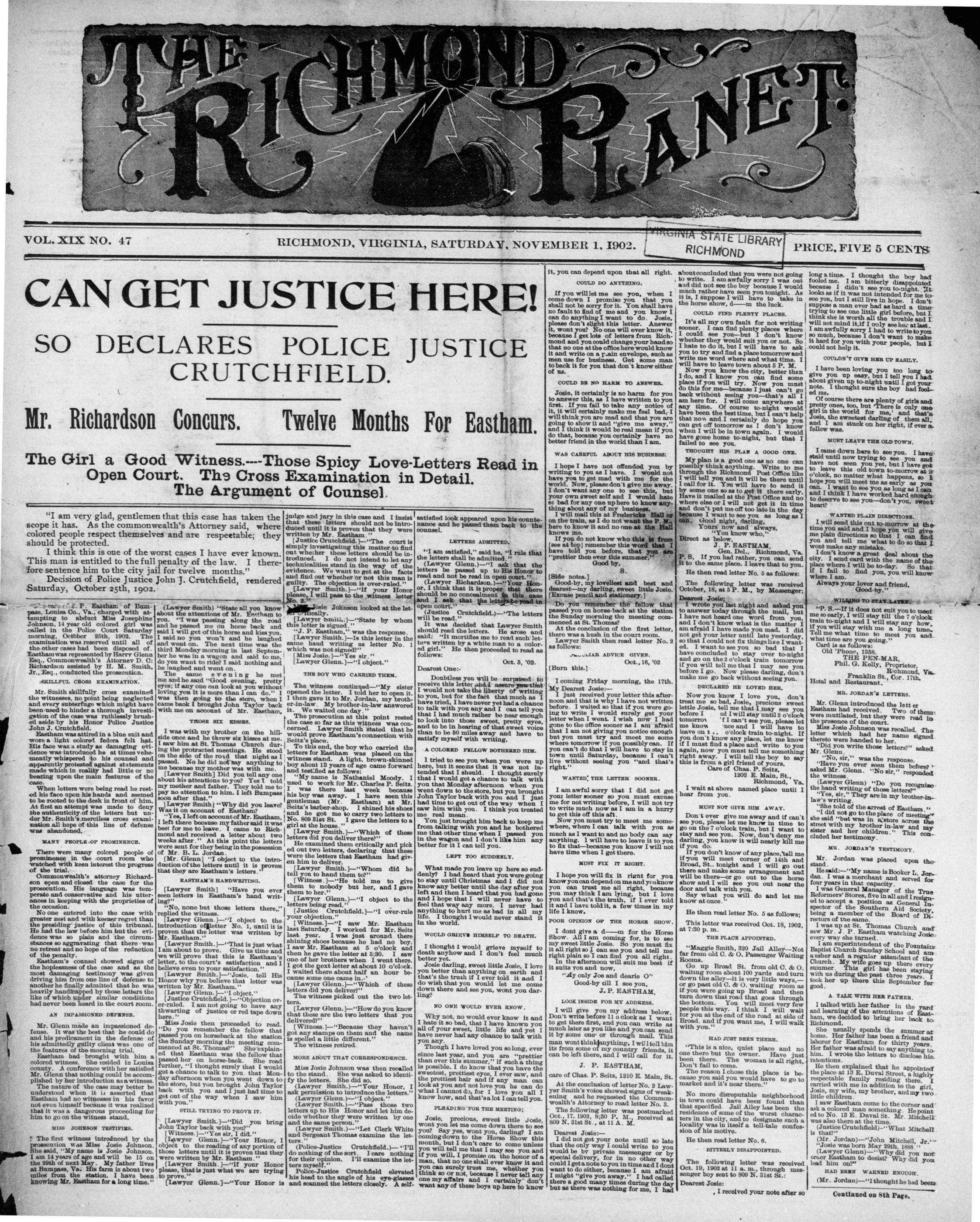
THE RICHMOND PLANET
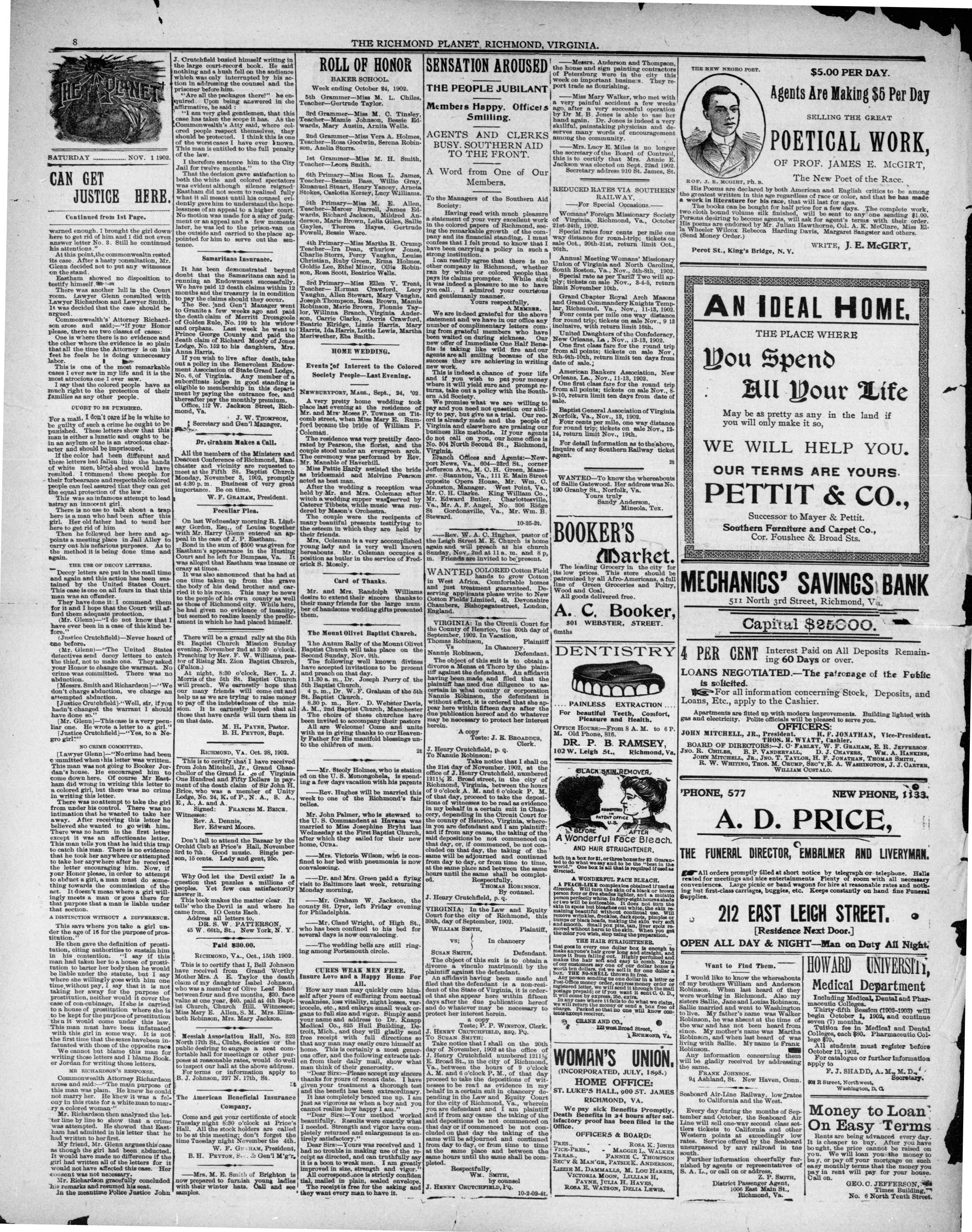
CAN GET JUSTICE HERE!
SO DECLARES POLICE JUSTICE CRUTCHFIELD.
Mr. Richardson Concurs. Twelve Months For Eastham.
The Girl a Good Witness.----Those Spicy Love-Letters Read in Open Court. The Cross Examination in Detail. The Argument of Counsel.
"I am very glad, gentlemen that this case has taken the scope it has. As the commonwealth's Attorney said, where colored people respect themselves and are respectable; they should be protected.
I think this is one of the worst cases I have ever known. This man is entitled to the full penalty of the law. I therefore sentence him to the city jail for twelve months."
Decision of Police Justice John J. Crutchfield, rendered Saturday, October 25th, 1902.
judge and jury in this case and I insist that these letters should not be introduced until it is proven that they were written by Mr. Eastham."
(Justice Crutchfield.)—"The court is simply investigating this matter to find out whether these letters should be introduced. I do not intend to let any technicalities stand in the way of the evidence. We want to get at the facts and find out whether or not this man is guilty. The objection is over-rules."
(Lawyer Smith.)—"If your Honor satisfied look appeared upon his countenance and he passed them back to the counsel.
LETTERS ADMITTED.
"I am satisfied," said he, "I rule that the letters shall be admitted."
(Lawyer Glenn.)—"I ask that the letters be passed up to His Honor to read and not be read in open court."
(Lawyer Richardson.)—"Your Honor, I think that it is proper that they
VOL. XIX NO. 47
CAN G
SO DEC
Mr. Richardson
The Girl a Good
Open Co
"I am very glad, gentlemen
scope it has. As the common
colored people respect themselves
should be protected.
I think this is one of the w
This man is entitled to the full
fore sentence him to the city ja
Decision of Police Justice
Saturday, October 25th, 1902
pass, Louisa Co. Va., charged with attempting to abduct Miss Josephine Johnson, 14 year old colored girl was called in the Police Court Saturday morning, October 25th, 1902. The examination was reserved until all of the other cases had been disposed of. Eastham was represented by Harry Glenu Esq., Commonwealth's Attorney D. C. Richardson assisted by H. M. Smith Jr., Esq., conducted the prosecution.
SKILLFUL CROSS EXAMINATION.
Mr. Smith skillfully cross examined the witnesses, no point being neglected and every subterfuge which might have been used to hinder a thorough investigation of the case was ruthlessly brushed aside by his Honor Police Justice John J. Crutchfield. Eastash was attired in a blue suit and wore a light colored fedora felt hat. His face was a study as damaging evidence was introduced he at times vehemently whispered to his counsel and apparently protested against statements made which in reality had little or no bearing upon the main features of the case.
When letters were being read he rested his face upon his hands and seemed to be rooted to the desk in front of him. At first an attempt was made to deny the authenticity of the letters but under Mr. Smith's merciless cross examination all hope of this line of defense was abandoned.
MANY PEOPLE OF PROMINENCE
There were many colored people of prominence in the court room who watched with keen interest the progress of the trial. Commonwealth's attorney Richardson open and closed the case for the prosecution. His language was temperate and conservative and his utterances in keeping with the proprieties of the occasion.
No one entered into the case with greater zest and with keener regret than the presiding justice of this tribunal. He had the law before him but the evidence was so plain and the circumstances so aggravating that there was no retreat and no hope of the reduction of the penalty.
Eastash's counsel showed signs of the hopelessness of the case and as the most damaging testimony was given driving him from one line of defense to another he finally admitted that he was heavily handicapped by those letters the like of which under similar conditions had never been heard in the court room.
AN IMPASSIONED DEFENSE.
Mr. Glenn made an impassioned defense. It was the best that he could do and his predicament in the defense of his admittedly guilty client was one of the features of the morning trial. Eastham had brought with him a colored witness. She resided in Louisia county. A conference with her satisfied Mr. Glenn that nothing could be accomplished by her introduction as a witness. The nature of the case may better be understood when it is asserted that Eastham had no witnesses in his favor not even himself because it was realized that it was a dangerous proceeding for him to go on the witness stand.
MISS JOHNSON TESTIFIES.
The first witness introduced by the prosecution was Miss Josie Johnson. She said, "My name is Josie Johnson. I am 14 years of age and will be 15 on the 29th of next May. My father lives at Bumpass, Va. His farm is about two miles from the station. I have been knowing Mr. Eastham for a long time."
(Lawyer Smith) "State all you know about the attentions of Mr. Eastham to you. "I was passing along the road and he passed me on horse back and said I will get of this horse and kiss you. I said no you won't and he laughed and went on. The next time was the third Monday morning in last September he was in a wagon and said to me, do you want to ride? I said nothing and he laughed and went on.
The same evening he met me and he said "Good evening, pretty eyes; if any one can look at you without loving you it is more than I can do." I was then going to the store, when I came back I brought John Taylor back with me on account of Mr. Eastham.
THOSE SIX KISSES.
I was with my brother on the hillside once and he heared six kisses at me. I saw him at St. Thomas Church during the protracted meetings. He stood on the side of the road that night as I passed. No he did not say anything to me because my mother was with me. [Lawyer Smith] Did you tell any one about his attentions to you? Yes I told my mother and father. They told me to pay no attention to him. I left Bumpass soon after that."
[Lawyer Smith] "Why did you leave? Was it on account of Eastham? "Yes, I left on account of Mr. Eastham, I left there because my father said it was best for me to leave. I came to Richmond and received a letter about two weeks after." At this point the letters were sent for they being in the possession of Mr. B. L. Jordan.
[Mr. Glenn] "I object to the introduction of the letters until it is proven that they are Eastham's letters."
EASTHAM'S HANDWRITING
[Lawyer Smith] "Have you ever seen letters in Eastham's hand writing?"
"No, none but those letters there," replied the witness.
[Lawyer Glenn.]—"I object to the introduction of letter No. I, until it is proven that the letter was written by Mr. Eastham."
[Lawyer Smith.]—"That is just what I am about to prove. Give us time and we will prove that this is Eastham's letter, to the court's satisfaction and I believe even to your satisfaction."
[Lawyer Smith.]—"Josie, tell His Honor why you believe that letter was written by Mr. Eastham."
[Lawyer Glenn.]—"I object."
[Justice Crutchfield.]—"Object over-ruled. I am not going to have any thwarting of justice or red tape down here."
Miss Josie then proceeded to read. "Do you remember the fellow that passed you on horseback at the station the Sunday morning the meeting commenced at St. Thomas?" She explained that Eastham was the fellow that passed her on horse-back. She read further, "I thought surely that I would get a chance to talk to you that Monday afternoon when you went down to the store, but you brought John Taylor back with you and I just had time to get out of the way when I saw him with you."
STILL TRYING TO PROVE IT.
[Lawyer Smith.]—"Did you bring John Taylor back with you?" [Witness.]—"Yes sir, I did." [Lawyer Glenn.]—"Your Honor, I object to the reading of any portion of those letters until it is proven that they were written by Mr. Eastham." [Lawyer Smith.]—"If your Honor please, that is just what we are trying to prove." [Lawyer Glenn.]—"Your Honor is
RICHMOND, VIRGINIA, SATURDAY, NOVEMBER 1, 1902.
satisfied look appeared upon his countenance and he passed them back to the counsel.
LETTERS ADMITTED.
"I am satisfied," said he, "I rule that the letters shall be admitted."
the letters shall be admitted."
(Lawyer Glenn.)—"I ask that the letters be passed up to His Honor to read and not be read in open court."
(Lawyer Richardson.)—"Your Honor, I think that it is proper that there should be no concealment in this case and I ask that the letter be read in open court."
(Justice Crutchfield.)—"The letters will be read."
It was decided that Lawyer Smith should read the letters. He arose and said: "It morifies me to read such letters written by a white man to a colored girl." He then proceeded to read as follows:
Dearest One:--
Doubletless you will be surprised to receive this letter and I assure you that I would not take the liberty of writing to you, but for the fact that much as I have tried, I have never yet had a chance to talk with you any and I can tell you that I had much rather be near enough to look into those sweet, pretty eyes, and to be in hearing of that sweet voice than to be 50 miles away and have to satisfy myself with writing.
A COLORED FELLOW BOTHERED HIM.
I tried to see you when you were up here, but it seems that it was not intended that I should. I thought surely that I would get a chance to talk with you that Monday afternoon when you went down to the store, but you brought John Taylor back with you and I just had time to get out of the way when I saw him with you. I think you treated me well. You just brought him back to keep me from talking with you and he bothered me that other time when I passed you in the wagon and I don't like him any better for it I can tell you.
What made you leave up here so suddenly? I had heard that you were going to stay until Christmas and I did not know any better until the day after you left and then I heard that you had gone and I hope that I will never have to feel that way any more. I never had anything to hurt me as bad in all my life. I thought I would never stand it in the world.
WOULD GRIEVE HIMSELF TO DEATH.
I thought I would grieve myself to death anyhow and I don't feel much better yet.
Josie darling, sweet little Josie, I love you better than anything on earth and that's the truth if I ever told it and I do wish that you would let me come down there and see you, wont you darling?
Why not, no would ever know it and
I hate it so bad, that I have known you
all of your sweet, little life and yet
I have never had any chance to talk with
you any.
Though I have loved you so long, ever
since last year, and you are "prettier
than ever this summer," if such a thing
is possible. I do know that you have the
sweetest, prettiest eyes, I ever saw, and
the prettiest hair and if any man can
look at you and not love you he can do
what I cannot do, for I love you all I
know how, and that's all I can tell you.
Josie, precious, sweet little Josie, wont you let me come down there to see you? Say yes, wont you, darling? I am coming down to the Horse Show this month, but I don't care to come unless you will tell me that I may see you and if you will, I promise on the honor of a man, that no one shall ever know it and you can surely trust me, whether you think so or not, because I never tell any one my affairs and I certainly don't want any of these boys up here to know
judge and jury in this case and I insist that these letters should not be introduced until it is proven that they were written by Mr. Eastham." [Justice Ornutchfield.]—"The court is simply investigating this matter to find out whether these letters should be introduced. I do not intend to let any technicalities stand in the way of the evidence. We want to get at the facts and find out whether or not this man is guilty. The objection is over-ruled." [Lawyer Smith.]—"If your Honor please, I will pass to the witness letter No. 2."
Mary Josie Johnson looked at the letter critically.
[Lawyer Smith.]—"State by whom this letter is signed."
"J. P. Eastham," was the response.
[Lawyer Smith.]—Is this letter in the same hand writing as letter No. 1 which was not signed?"
[Miss Josie.]—"Yes sir."
[Lawyer Glenn.]—"I object."
THE BOY WHO CARRIED THEM
The witness continued—"My sister opened the letter. I told her to open it. I then gave it to Mr. Jordan, my brother-in-law. My brother-in-law answered it. We waited one day." The prosecution at this point rested the case so far as this witness was concerned. Lawyer Smith stated that he would prove Eastham's connection with Seitz's place.
To this end, the boy who carried the letters for Eastham was placed on the witness stand. A light, brown-skinned boy about 13 years of age came forward and testified as follows:
"My name is Nathaniel Moody. I used to work for Mr. Charles P. Seitz. I was there last week because his boy was away. I have seen this gentleman (Mr. Eastham) at Mr. Seitz's barber-shop. I shined his shoes and he got me to carry two letters to No. 809 St St. I gave the letters to a girl at the house."
[Lawyer Smith.]—"Which of these letters did you deliver there?"
He examined them critically and pick ed out two letters, declaring that these were the letters that Eastham had given him to deliver.
[Lawyer Smith].—"Whom did he tell you to hand them to?"
[Witness.].—"He told me to give them to nobody but her, and I gave them to her."
[Lawyer Glenn].—"I object to the letters being read."
[Justice Crutchfield].—"I over-rule your objection."
[Witness.].—"I saw Mr. Eastham last Saturday. I worked for Mr. Seitz last year. I was just around there shining shoes because he had no boy. I saw Mr. Eastham at 5 o'clock and then he gave the letter at 5:30. I saw one of her brothers when I went there. I took the next letter at about 10 o'clock. I waited there about half an hour because some one came in."
[Lawyer Glenn].—"Which of these letters did you deliver?" The witness picked out the two letters.
[Lawyer Glenn.].—"How do you know that these are the two letters that you delivered?" [Witness.].—"Because they haven't got any stamps on them and the name is spelled a little different."
MORE ABOUT THAT CORRESPONDENCE.
Miss Josie Johnson was then recalled to the stand. She was asked to identify the letters. She did so.
(Lawyer Smith.)—"Your Honor, I ask permission to introduce the letters."
(Lawyer Glenn.)—"I object."
(Lawyer Smith.)—"Pass those two letters up to His Honor and let him decide whether they were written by one and the same person."
(Lawyer Smith.)—"Let Clerk White and Sergeant Thomas examine the letters."
(Police-Justice Crutchfield.)—"I'll do nothing of the sort. I care nothing for their opinion. I'll examine the letters myself."
Police-Justice Crutchfield elevated his head to the angle of his eye-glasses and scanned the letters closely. A self-
LEFT TOO SUDDENLY
NO ONE WOULD EVER KNOW.
PLEADING FOR THE MEETING:
VIRGINIA STATE LIBRARY
RICHMOND
COULD DO ANYTHING.
If you will let me see you, when I come down I promise you that you shall not be sorry for it. You shall have no fault to find of me and you know I can do anything I want to do. Josie, please don't slight this letter. Answer it, wont you? No one will ever know it, because I get lots of letters from Richmond and you could change your hand so that no one at the office here would know it and write on a pain envelope, such as men use for business. Get some man to back it for you that don't know either of us.
COULD BE NO HARM TO ANSWER.
Josie, it certainly is no harm for you to answer this, as I have written to you first. If you fail to take any notice of it, it will certainly make me feel bad. I will think you are mad and that you are going to show it and "give me away," you do that, because you certainly have no better friend in the world than I am.
WAS CAREFUL ABOUT HIS BUSINESS:
I hope I have not offended you by writing to you as I have. I would not have you to get mad with me for the world. Now, please don't give me away. I don't want any one to see this, but your own sweet self and I would hate sc bad for any one uphere to know anything about any of my business.
I will mail this at Fredericks Hall or on the train, as I do not want the P.M. here to know it and no one at the Hall knows me.
If you do not know who this is from [see at top] remember this word that I have told you before, that you are 'prettier then ever this summer.'
Good-by, my loveliest and best and dearest—my darling, sweet little Josie. [Excuse pencil and stationery.]
Do you remember the fellow that passed you on horse-back at the station the Sunday morning the meeting commenced at St. Thomas?
At the conclusion of the first letter, there was a hush in the court room.
ACQUIRIAR ADVICE GIVEN.
Oct., 16, '02
[Burn this.]
I coming Friday morning, the 17th.
My Dearest Josie:
I just received your letter this afternoon and that is why I have not written before. I waited so that if you were going to write I would surely get your letter when I went. I wish now I had gone to the office sooner as I am afraid that I am not giving you notice enough but you must try and meet me some where tomorrow if you possibly can. If you can't do that I will have to stay in town until Saturday, because I can't live without seeing you "and that's right."
WANTED. THE LETTER SOONER.
I am awful sorry that I did not get your letter sooner so you must excuse me for not writing before, I will not try to write much now as I am in a hurry to get this off this aft.
Now you must try to meet me somewhere, where I can talk with you as much as I want to and no body can say anything. I will have to leave it to you to fix that—because you know I will not have time when I get there.
MUST FIX IT RIGHT.
I hope you will fix it right for you
know you can depend on me and youknow
you can trust me all right, because
you may think I am lying, but I love
you and that's the truth, if I ever told
it and I have told it, a few times in my
life I know.
POOR OPINION OF THE HORSE SHOW.
I don't give a d—m for the Horse
Show. All I am coming for, is to see
my sweet little Josie. So you must fix
it all right so I can see you and tell me
it right plain so I can find you all right.
In the afternoon will suit me best if
it suits you and now,
"My only Joe and dearie O"
Good-by till I see you,
J.P. EASTHAM
LOOK INSIDE FOR MY ADDRESS.
I will give you my address below. Don't write before 11 o clock as I want to get there first, and you can write as much later as you like and you can send it by some one' or through mail. This man won't think anything, I will tell him its from some of my country friends, it can be left there, and I will call for it.
J. P. EASTHAM
care of Chas. P. Seitz, 1210 E. Main, St.
care of Chas. P. Setz, 1210 E. Main, St.
At the conclusion of letter No. 2 Lawyer Smith's voice showed signs of weakening and he requested the Commonwealth's Attorney to read letter No. 3.
The following letter was postmarked
The following letter was postmarked Oct., 17, 1902, 8;30 P. M., received at 809 N. 1st St., at 11 A. M.
Dearest Josie:—
I did not get your note until so late that the only way I could write to you would be by private messenger or by special delivery, for in no other way could I get a note to you in time and I don't because I would. I also afraid I might "give you a message." I called there a good many times during the day but as there was nothing for me, I had
about concluded that you were not going to write. I am awfully sorry I was out and did not see the boy because I would much rather have seen you tonight. As it is, I suppose I will have to take in the horse show, d——m the lock.
COULD FIND PLENTY PLACES.
It's all my own fault for not writing sooner. I can find plenty places where I could see you—but I don't know whether they would suit you or not. So I hate to do it, but I will have to ask you to try and find a place tomorrow and write me word where and what time. I will have to leave town about 5 P. M.
Now you know the city, better than I do, and I know you can find some place if you will try. Now you must do this for me—because I just can't go back without seeing you—that's all I am here for. I will come anywhere at any time. Of course to-night would have been the best time, but I can't help you do it, certainly do hope you can get off tomorrow as I don't know when I will be in own again. I would have gone home to night, but that I failed to see you.
THOUGHT HIS PLAN A GOOD ONE.
My plan is a good one as no one can possibly think anything. Write to me through the Richmond Post Office like I will tell you and it will be there until I call for it. You will have to send it by some one so as to get it there early. Have it mailed at the Post Office and no where else or I will not get it in time and don't put me off too late in the day and don't see you as long as I can. Good night, dear. Yours now and always,
"You know who."
Gen. Del., Richmond, Va.
P. S. If you had rather, you can send
it to the same place. I leave that to you.
He then read letter No. 5 as follows:
The following letter was received October, 18, at 5 P. M., by Messenger; Dearest Josie;
I wrote you last night and asked you to answer today through the mail, but I have heard one word from you, and I don't know what the matter I am afraid I have told you mad. I did not get your letter until late yesterday, so that I could not fix things like I wanted. I want to see you so, but that I have concluded to stay over to night and on the 2 o'clock train to night, if you will tell me that I may see you before I go. Now please darling, don't make me go back without seeing you.
DECLARED HE LOVED HER.
Now you know I love you, don't treat me so bad, Josie, precious sweet little Josie, tell me that I may see you before I , ad I will stay until 3 o'clock tomorrow 'if I can't see you, please let me know and I will have to leave on t . , o'clock train to night. If you don't know any place, let me know if I must find a place and write to you again, now you must tell me something right away. I will tell the boy to say this is from a girl friend of yours.
I wait at above named place until I hear from you.
MUST NOT GIVE HIM AWAY
Don't ever give me away and if can't see you, please let me know in time to go on the 7 o'clock train, but I want to stay and see you. Now, don't deny me darling, you know it will nearly kill me if you do.
If you don't know of any place, 'tell me if you will meet corner of 14th and Broad, St., tonight and I will go out there and make some arrangement and will be there—or go out to the horse show and I will see you out near the door and talk with you.
Say what you will do and let me know at once."
He then read letter No. 5 as follows;
This letter was received Oct. 18, 1902, at 7:30 p. m.
THE PLACE APPOINTED.
"Maggie Smith, 320 Jail Alley—Not far from old C. & O, Passenger Waiting Rooms.
Go up Broad St. from old O. & O. waiting room about 100 yards and turn down the alley—it is very little ways,—or go past old O. & O. waiting room as if you were going up Broad and then turn down that road that goes through the yard. "You will meet very few people this way, the road will wait for you at the end of the road at side of Broad, and if you want me, I will walk with you."
HAD JUST BEEN THERE
"This is a nice, quiet place and no one there but the owner. Have just been there. The woman is all right. Don't fail to come. The reason I chose this place is because you said you would have to go to market and it's near there." No more disreputable neighborhood in town could have been found than that specified. Jail Alley has been the residence of some of the worst characters in the city, and to designate such a locality was in itself a tell-tale confession of his motive.
He then read letter No. 6.
BITTERLY DISAPPOINTED.
The following letter was received
Oct. 19, 1902 at 11 a.m., through messenger boy sent to 809 N. 31st St.:
Dearest Josie:
I received your note after so
PRICE,FIVE 5 CENTS
long a time. I thought the boy had fooled me. I am bitterly disappointed because I didn't see you to-night. It looks as if it was not intended for me to see you, but I still live in hope. I don't suppose a man ever had as hard a time trying to see one little girl before, but I will not mind it with all the trouble and I will not mind it only see her at last. I am awfully sorry I can't write to you so much, because I don't want to make it hard for you with your people, but I could not help it.
COULDN'T GIVE HER UP BASILY.
I have been loving you too long to give you up easy, but I tell you I had about given up to-night until I got your note. I thought sure the boy had fooled me. O O course there are plenty of girls and pretty ones, too, her 'There is only one girl in the world for me,' and that's Josie, the sweetest darling of them all, and I am stuck on her right, if ever a fellow was.
MUST LEAVE THE OLD TOWN
I came down here to see you. I have staid until now trying to see you and have not seen you yet, but I have got to leave this old town to-morrow at 2 o'clock, no matter what happens, so I hope you will meet me as early as you can. I want to see you as long as I can and I think I have worked hard enough to deserve to see you—don't you, sweet heart?
WANTED PLAIN DIRECTIONS
I will send this out to-morrow at the time you said and I hope you will give me plain directions so that I can find you and tell me what to do so that I wont make any mistake.
I don't know a great deal about the city. I send card with the name of the place where I will be to-day. So that if I fail to find you, you will know where I am.
Always your lover and friend,
Good by."
WILLING TO STAY LATER.
"P. S.—If it does not suit you to meet me so early, I will stay till the 7 o'clock train to-night and I will stay any how, if you will stay with me a long time. Tell me what time to meet you and what time are you going."
Card is as follows:
Old 'Phone, 1358.
THE PEN-MAR,
Phil. G. Kelly, Proprietor,
Richmond, Va.
Franklin St., Cor. 17th.
Hotel and Restaurant.
MR. JORDAN'S LETTERS.
Mr. Glenn introduced the lett er Easham had received. Two of them were mutilated, but they were read in the presence of the court.
Miss Josie Johnson was recalled. The letter which had her name signed thereto were handed to her.
"Did you write those letters?" asked Mr. Glenn.
"No, sir," was the response.
"you even seem them before" asked MK Glenn. "No sir," responded the witness.
(Lawyer Glenn) "Do you recognize the hand writing of those letters?" "Yes, sir." They are in my brother-in-law's writing. "She told the arrest of Eastam." "I did not go to the place of meeting" she said "but was in a store across the street with my brother in law and my sister and her children." This concluded her testimony.
MR. JORDAN'S TESTIMONY
Mr. Jordan was placed upon the stand.
He said:—"My name is Booker L. Jordan. I was a merchant and served for four years in that capacity.
I was General Manager of the True Reformers' Stores, five in all and I resigned to accept a position as General Inspector of the Southern Aid Society, being a member of the Board of Directors of the same.
I was up at St. Thomas Church and saw Mr. J. P. Eastham watching Josie every way she turned.
I am superintendent of the Fountain Baptist Church Sunday School and am a usher and a regular attendant of the Church. My wife goes up there every summer. This girl has been staying with us during the past three years. I took her up there this September for good.
A TALK WITH HER FATHER
I talked with her father in the yard and learning of the attentions of Eastham, we decided to bring her back to Richmond.
She usually spends the summer at home. Her father has been a friend and laborer for Eastham for thirty years. Her father was afraid to say anything to him. I wrote the letters to disclose his intentions.
He then explained that he appointed the place at 13 E. Duval Street, a highly respectable family residing there. I carried with me in addition to the girl, Josie, my wife, my brother, and my two little children.
I saw Eastham come to the corner and ask a colored man something. He pointed to No. 13 E. Duval St. Mr. Mitchell was also there at the time.
(Justice Crutchfield)—"What Mitchell is that?"
(Mr. Jordan)—"John Mitchell, Jr." "Josie was born May 29th, 1888." (Lawyer Glenn)—"Why did you not order Eastham to desist? Why did you lead him on?"
HAD BEEN WARNED ENOUGH
(Mr. Jordan)—"I thought he had been
Continued on 8th Page.
SATURDAY. NOV. 1. 1800
TEMPERANCE
ALCOHOLISM IN FRANCE.
Dr. Vaillant, a Socialist Deputy for Paris, Making a Bitter Fight Against the Curse.
The most strenuous fighter against alcoholism in France to-day is Dr. Vaillant, a socialist deputy for Paris. He introduced the subject in the last chamber and had to struggle against general indifference. On all sides of the house deputies personally feared the publicans. The government feared loss of revenue. Dr. Vaillant made so strong a case against alcohol that the resolution he moved was voted by a show of hands. But this act of the legislature came to nothing. The minister of finance at the next cabinet council asked the minister of the interior, who spoke in favor of "doing something," whether, to give pleasure to a faddish, he was going to destroy one of the most fruitful sources of taxation?
Dr. Vaillant believes that he will "slay the monster" "What grounds have you for this faith?" I asked. "Simply that I have on my side science, sad and convincing experience, and the conscience of every non-intebrate workman. I may say the conscience, too, of every decent workwoman. The alcohol drinkers, poor souls, do not count. They are morally, mentally and almost physically played out."
Dr. Vaillant believes that the leaflet, and especially the pictorial leaflet, has a deterrent effect on those who have not found their way to the public house. His greatest ambition is to be Peter the Hermit in a crusade against alcohol. He warns young doctor's who help him to avoid rhetoric or strong language, but to give strong facts and in such a way that a man must be a fool who cannot draw from them the right conclusion. Deputy Vaillant has had reason to complain of every minister of the interior since he began to wage his holy war. But he hopes M. Combes will give more satisfaction. He is a practicing physician and he has long fought and still fights, the publicans at Pons, the town of Lower Charente of which he has been mayor for 30 years. M. Combes has the virtue of fearlessness and is of one mind with the Academy of Medicine on the race deterioration that alcoholism causes.
M. Valliant will soon bring the drink question again before the chamber. He looks forward to the passing of a stringent bill against the manufacture or the sale of drinks destructive to health, according to the list of the Academy of Medicine. The propertied class with big incomes are on the side of the publicans. Revenue derived from drink is, in their opinion, clear gain to themselves, as it saves them from an income tax.-National Advocate.
A HELPING HAND
Extended to a Failed Cubman It Re-
cuces Him from the Depths of
A cabman signed the pledge for Rev Charles Garrett, but soon after broke it. Conscience-stricken and ashamed, he tried to keep out of the way of his friend; but Mr. Garrett was not to be put off. One day he found the poor miserable man and, taking hold of his hand, he said: "John, when the road is slippery, and your cab horse falls down, what do you do with him?" "I help him up again," replied John, "Well, I have come to do the same," said Mr. Garrett, affectionately: "the
THE CABMAN'S HEART WAS
THRILLED.
road was slippery, I know, John, and you fell; but there's my hand to help you up again."
The cabman's heart was thrilled. He caught his friend's hand in a vise-like grip and said: "God bless you, sir; you'll never have cause to regret this—I'll never fall again." And to this day he kept his word.
**Widow Against Saloonkeepers.**
Mrs. Summers, of Sheldon, Ill., has been given a judgment for $3,500 against Messrs. Baker & Reddick, saloon keepers, whom she sued for damages for the death of her hus-
band, who was killed in a drunken brawl. Mrs. Summers was given a verdict in the circuit court, which has been affirmed by the appellate court.
FOOD OR POISON QUESTION.
Summary of Exhaustive Treatment of Atwater Theory by a Vienna Professor.
In view of the discussion called forth some time ago by the report of Prof. Atwater's experiments, which were intended to throw light on the question: Is alcohol a food or a poison? a paper in the latest number of Plüger's Archiv is of more than passing interest. This periodical is the leading physiological journal of Germany if not of the world. The paper referred to is by Prof. Kassowitz, of Vienna. It consists of 39 pages of carefully discriminating review of the scientific evidence on the question, under the title: "Food and Poison: A Contribution to the Alcohol Question."
The position of the author and the place of the publication would lead one to expect a rigidly scientific treatment of the subject, not a prejudiced polemic, and certainly not a harangue from the point of view of the professional temperance reformer. For this reason the paper is one of unusual importance, and ought to be read by those who profess to speak on the matter from a scientific standpoint. The author sums up at the close the main conclusions to bedrawn from the results of all reliable investigations up to the present time. I give below the gist of the greater part of the summary, presenting the general ideas rather than a literal translation:
1. The assumption of a nutritive action of alcohol rests upon the supposition that a part of the food is consumed by direct chemical change without first taking part in the upbuilding of the protoplasmic substance.
2. The logical consequence of this supposition, that substances of equal fuel values can take the place one of another in the chemical changes in the living tissue, is contradicted by reliable experiments. The same can be said of the supposition that a food can be of use through its direct destruction without any intermediate protoplasmic steps.
3. The single remaining possibility, that all food material is assimilated, i.e., is applied to the building up of chemical units, agrees very well with all the ascertained facts and stands in contradiction to none.
4. According to this conception of the nature of food the protoplasmic molecules are highly complex and hence chemical changes are extremely easy to bring about in them.
5. Evey stimulus and every chemically acting poison causes a disturbance, destruction of chemical units of the protoplasm.
6. Since alcohol as a stimulating and poisonous substance destroys the protoplasmic molecules, it cannot at the same time be assimilated and applied as a food material. A substance cannot simultaneously act as a food and a poison.
7. After a short period of stimulation, alcohol acts as a paralyzing agent to the nerve centers which innervate the muscles; the muscles are thus less efficiently excited through the action of the nerves and less carbon dioxide is produced.
8. The reduced amount of carbon dioxide excreted indicates no economy of the tissue substance, but is an indirect consequence of the poisonous action of the alcohol.
9. In agreement with the above conclusion is the fact proved by experiment that if for a part of the non-nitrogenous food a quantity of alcohol of equal fuel value is substituted, there results a reduction of working power and a loss of body weight.
10. The nutritive value of a substance does not depend simply upon the fact of its oxidation in the body.
11. The practical conclusion to be drawn from the known facts both on theoretical and empirical grounds, is to the purport that for purposes of nutrition alcohol should be employed neither for the well nor for the sick. S. S. Maxwell, in Chicago Standard.
Quite Naturally
man, and nobody disputes him." "Of course not. If he's willing to take the blame, why should anyone else go out hunting for it?"—Chileago Post.
ITEMS.
The mistake of the state is locking up the drinker instead of the drink. National Advocate.
Within the last five years the consumption of absinthe has doubled in Paris. The amount now drunk in a year is 8,000,000 bottles.
There is an English total abstinence society among railroad employees which now numbers 20,000 and has been in existence 18 years.
No more wine for banquets. This is the decision of the Alumni Association of the William and Mary college, of Richmond, Va.
Prof. Hoppe, of Berlin, calls attention to the fact that in 1899 and 1900 41 per cent. of the insane admitted in the hospitals of Prussia were chronic alcoholists or children of alcoholic parents.
The treasurer of the United States Brewers' association reported at the annual meeting last month a balance on hand of $56,496.58, and it was expected that increased assessments would bring it up to $100,000 or more, to fight against righteous legislation affecting the traffic.
The local council of women at Ottawa have adopted a resolution asking that the government establish cottage homes for inebriate women. They state that in their city of Ottawa intemperance among women and girl prisoners has increased to the alarming extent of 75 per cent., and that women in many cases under or about the age of 20, have been incarcerated for drunkenness or for crimes committed while under the influence of drink. Imprisonment to check this evil has proven an utter failure, as there are women in a brief life of 40 years who have spent 20 years in jail. Journal of Inebriety.
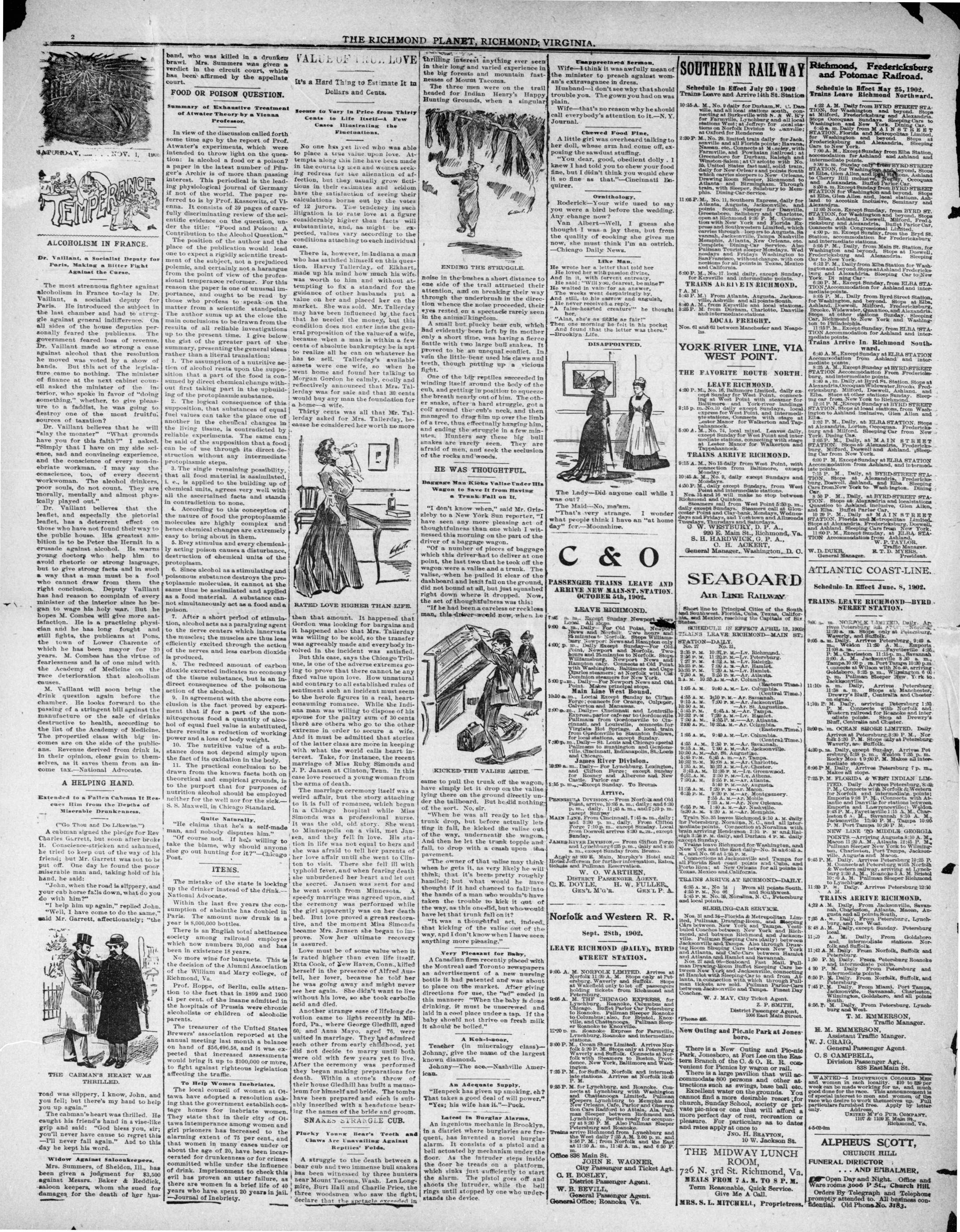
THE RICHMOND PLANET, RICHMOND; VIRGINIA VALUE OF TRUE LOVE thrilling interest anything ever seen
No one has yet lived who was able to place a true value upon love. Attempts along this line have been made in the courts by men and women seeking redress for the alienation of affection, but they usually grow fictitious in their estimates and seldom have the satisfaction of seeing their calculations borne out by the votes of 12 jurors. The tendency in such litigation is to rate love at a figure considerably higher than facts will substantiate, and, as might be expected, values vary according to the conditions attaching to each individual case.
There is, however, in Indiana a man who has satisfied himself on this question. Harvey Tallerday, of Elkhart, made up his mind how much his wife was worth to him and without attempting to fix a standard for the guidance of other husbands put a value on her and placed her on the market. She was sold. Mr. Tallerday may have been influenced by the fact that he needed the money, but this condition does not enter into the general proposition of the value of a wife, because when a man is within a few cents of absolute bankruptcy he is apt to realize all he can on whatever he has to sell. Tallerday's available assets were one wife, so when he went home and found her talking to Morgan Gordon he calmly, coally and reflectively announced that Mrs. Tallerday was for sale and that 30 cents would buy any man the foundation for a home—a wife.
Thirty cents was all that Mr. Tallerday asked for Mrs. Tallerday, because he considered her worth no more
RATED LOVE HIGHER THAN LIFE.
than that amount. It happened that Gordon was looking for bargains and it happened also that Mrs. Tailierday was willing to be sold, so the transfer was agreeably made and everybody involved in the incident was satisfied. But this case, says the Chicago Tribune, is one of the adverse extremes going to prove that there cannot be any fixed value upon love. How unnatural and contrary to all established rules of sentiment such an incident must seem to the heroile figures in a real, heart-consuming romance. While the Indiana man was willing to dispose of his spouse for the paltry sum of 30 cents there are others who go to the other extreme in order to secure a wife. And it must be admitted that stories of the latter class are more in keeping with what the world calls heart interest. Take, for instance, the recent marriage of Miss Ruby Simonds and J. P. Jansen at Clinton, Tenn. In this case love rescued a young woman from the arms of death.
The marriage ceremony itself was a weird affair, but the story attaching to it is full of romance, which began in a Chicago hospital while Miss Simonds was a professional nurse. It was the old, old story. She went to Minneapolis on a visit, met Jansen, and they fell in love. His station in life was not equal to hers and she was afraid to tell her parents of her love affair until she went to Clinton to visit. There she fell ill with typhoid fever, and when fearing death she unburdened her heart and let out the secret. Jansen was sent for and he went south from Minnesota. A speedy marriage was agreed upon, and the ceremony was performed while the girl apparently was on her death bed. But love proved a great restorative, and the moment Miss Simonds became Mrs. Jansen she began to improve. Now her ultimate recovery is assured.
Love must be of some value when it is rated higher than even life itself. Etta Cook, of New Haven, Conn., killed herself in the presence of Alfred Austell, her lover, because he told her he was going away and might never see her again. She didn't want to live without his love, so she took carbolic acid and died.
Another strange ease of lifelong devotion came to light recently in Milford, Pa., where George Gledhill, aged 60, and Anna Mayo, aged 76, were united in marriage. They had admired each other from early childhood, yet did not decide to marry until both were old with few years yet to live. After the ceremony was performed they began making preparations for death. Within a stone's throw of their house Gledhill has built a mausoleum for himself and bride. The tombs have been prepared and each is suitably inscribed with a headstone bearing the names of the bride and groom.
SNAKES STRARGLE CUB.
A struggle to the death between a bear cub and two immense bull snakes has been witnessed by three hunters near Mount Tacoma. Wash. Len Longmire, Burt Hall and Charlie Price, the three woodmen who saw the fight, declare that the spectacle exceeded in
thrilling interest anything ever seen in their long and varied experience in the big forests and mountain fastnesses of Mount Tacoma. The three men were on the trail headed for Indian Henry's Happy Hunting Grounds, when a singular
ENDING THE CREEK
ENDING THE STRUGGLE.
noise in the bushes a short distance to one side of the trail attracted their attention, and on breaking their way through the underbrush in the direction whence the noise proceeded, their eyes rested on a spectacle rarely seen in the animal kingdom.
A small but plucky bear cub, which had evidently been left by its mother only a short time, was having a fierce battle with two large bull snakes. It proved to be an unequal conflict. In vain the little-bear used his claws and teeth, though putting up a vicious fight.
One of the big reptiles succeeded in winding itself around the body of the cub, and getting in position to squeeze the breath nearly out of him. The other snake, after a hard struggle, got a coil around the cub's neck, and then managed to drag him up over the limb of a tree, thus effectually hanging him, and ending the struggle in a few minutes. Hunters say these big bull snakes are rarely seen. They are afraid of men, and seek the seclusion of the rocks and woods.
HE WAS THOUGHTFUL
Baggage Man Kicks Valise Under His Wagon to Save It from Having a Trunk Fall on It.
"I don't know when," said Mr. Grizzleby to a New York Sun reporter, "I have seen any more pleasing act of thoughtfulness than one which I witnessed this morning on the part of the driver of a baggage wagon.
"Of a number of pieces of baggage which this driver had to deliver at one point, the last two that he took off the wagon.were a valise and a trunk. The valise, when he pulled it clear of the dashboard and let it fall on the ground, did not bound at all, but just squashed right down where it dropped. Now, the act of thoughtfulness was this;
"If he had been a careless or reckless man, this driver could now when he
KICKED THE VALISE ASIDE
name to pull the trunk off the wagon,
have simply let it drop on the valise
lying there on the ground directly under
the tailboard. But he did nothing,
of the sort. No, sir.
"When he was all ready to let the
trunk drop, but before actually let-
ting it fall, he kicked the valise out
of the way, underneath the wagon.
And then he let the trunk topple and
fall, to drop with a crash upon the
pavement.
"The owner of that valise may think
when he gets it, as very likely he will
think; that it's been pretty roughly
handled; but what would he have
thought if it had chance to fall into
the hands of a man who wouldn't have
taken the trouble to kick it out, of
the way, as this one did, but who would
have let that trunk fall on it?
"It was a thoughtful act, indeed,
that kicking of the valise out of the
way, and I don't know when I have seen
anything more pleasing."
Very Pleasant for Baby
A Canadian firm recently placed with the Montreal and Toronto newspapers an advertisement of a new nursing bottle it had patented and was about to place on the market. After giving directions for use, the "ad" ended in this manner: "When the baby is done drinking, it must be unscrewed and laid in a cool place under a tap. If the baby should not thrive on fresh milk it should be boiled."
A Kohlschroer
Teacher (in mineralogy class)—Johnny, give the name of the largest known diamond.
Johany—The aea—Nashville American.
An Adequate Supply.
"Henpeck has given up smoking, eh? That takes a good deal of will power."
"Yes; his wife has it."—Puck.
Latest in Burglar A
An ingenious mechanic in Brooklyn, in a district where burglaries are frequent, has invented a novel burglar alarm. It consists of a pistol and a bell actuated by mechanism under the floor. As the intruder steps inside the door he treads on a platform, which sinks just sufficiently to start the alarm. The pistol goes off and shoots the intruder, while the bell rings until stopped by one who understands the device.
Wife—I think it was awfully mean of the minister to preach against woman's extravagance in dress.
Husband—I don't see why that should trouble you. The gown you had on was plain.
Wife—that's no reason why he should call everybody's attention to it.—N. Y. Journal.
Chewed Food Fine
A little girl was overheard talking to her doll, whose arm had come off, exposing the sawdust stuffing.
"You dear, good, obedient dolly. I knew I had told you to chew your food fine, but I did not think you would chew it so fine as that."—Cincinnati Enquirer.
Ornithology.
Roderick—Your wife used to say you were a bird before the wedding. Any change now?
Van Albert—Well, I guess she thought I was a jay then, but from the quality of cooking she gives me now, she must think I'm an ostrich.
—Chicago Daily News.
Like Man.
He wrote her a letter that told her
He loved her with passion divine,
And in it, with servant entreaty,
He said: "Will you, dearest, be mine?"
He waited in vain for an answer,
The weeks went deceptively by.
And still, to his sarcrow and anguish,
He never received a reply.
Like Man.
"A false-hearted creature"" he thought her.
"Alas, she's as nickle as fair!"
Then one morning he felt in his pocket
And found that the letter was there."
—Brooklyn Life.
DISAPPOINTED.
The Lady--Did anyone call while I was out?
The Maid--No, ma'am.
"That's very strange. I wonder what people think I have an "at home day" for--Moonshine.
C & O
PASSENGER TRAINS LEAVE AND
ARRIVE NEW MAIN-ST. STATION.
OCTOBER 5th, 1902.
LEAVE RICHMOND
n. m. Except Sunday Newport News Local. All stops.
9:00 a.m. Daily — For Old Point, Newport News and Norfolk. Two hours and 25 minutes to Norfolk. Steps Williamsburg Newport News and Hampton only.
4:00 p.m. Daily Except Sunday—For Old Point, Newport and Norfolk. Two hours and 25 minutes to Norfolk. Steps Williamsburg, Newport News and Hampton only. Connects at Old Point with Washington, Baltimore and Cape Otarles steamers; at Norfolk with Old Dominion steamers for New York.
5:30 p.m. - Daily - Newport News and Old
Bridge
Main Line West Bound.
10:10 a.m. - Local Except Sunday to Clifton
Borough, Orange, Orange, Outpaper,
Calverton and Manassas.
2:00 p.m., Daily—Gincinnati and Louisville,
Pasadena, parlor cake ear to Gordonville,
Pasadena, parlor cake ear to Gordonville,
Pasadena, and Louisville, connects for
Virginia Hot Springs. A local train
from Huntington, shows, and
for local stations, except Sunday.
7:30 p.m., Daily—St. Louis and Chicago special
to huntington and Gondensville,
Gincinnati, Indianapolis, St. Louis,
and Chicago.
James River Division.
10.29 a. n. Daily—For Lynnburgh, Losington,
and Clifton Forge; except Sunday
for Rosney and Alberene and New
Castle. Parlor ear
Arrive.
PENNELBURG DIVISION — From Norfolk and Old Point, arrive 10,95 a.m. daily; and 6,30 a.m. daily; and 1,45 a.m. daily; and 2,50 p.m. except Sunday.
MAIN LANE — From Cincinnati, 7:45 a.m. daily; and 8:30 a.m. daily; and 10:30 a.m. daily; and 12:30 a.m. daily; and 14:30 a.m. daily; except Sunday. Local from Dowell arrive 8,30 a.m. except Sunday.
JAMESBURG DIVISION — From Cifton Forge and Lynchburg 6:35 a.m. daily and 8,40 a.m. except Sunday from Bromo.
Apply at 809 E. Main, Murphy's Hotel and Hotel Jefferson for free full accommodation, Rates, tickets and Reservation.
W. O. WARTHEN.
DISTRICT PASSenger AGENT.
C. E. DOYLE, H. W. FULLER.
GENL M'G'R.
GENL P. A.
Norfolk and Western R. R.
LEAVE RICHMOND (DAILY), BYRD
STREET STATION.
9:00 A. M. NORFOLK LIMITED. Arrives at
Norfolk 12:00 A. M. Stops only at Petersburg,
Waverly to Wakefield only to let off passengers
holding tickets from Richmond and
Petersburg.
9:06 A. M. THF CHICAGO EXPRESS, for
Lynchburg, Roanoke, Columbus and
Chicago. Buffet Parker Our Petersburg
to Columbus; also to Columbus; also to
Columbus; also to Bristol, Bronx,
ville, and Chattanooga. Pullman Sleep-
ing at n. m. Roanoke. Express for Parmelia,
Lynchburg, Roanoke and intermediate stations.
8:00 P. M. Roanoke Share Limited. Arrives
Norfolk & 20 P. M. Stops only at Petersburg
Waverly and Suffolk. Connects at Norfolk
with Steamers to Boston, Provid-
ance, New York, Baltimore and Washington.
7:25 P. M. for Suffolk, Norfolk and inter-
mediate stations. Arrives at Norfolk 10:40 P. M.
9:35 P. M. for Lynchburg, and Roanoke. Connate
Washington and Chattanooga, Pullman
Sleepers Lynchburg to Memphis and
New Orleans, Cafe, Parlor and Observat-
ion Hall. Oral Radiologist at Mt. Tabor
man Sleeper between Richmond and
Lynchburg. Berks ready for occupancy
and Pullman Sleeper
Petersburg and Roanoke.
Traina arrive Richmond from Lynchburg
and the West daily 7:35 A.M. 2:00 p. m. and
8:35 P. M.; from Norfolk and the East
at 11:10 A. m. 11:42 A. m., and 6:50 P.
m.
Office 886 Main St.
JOHN E. WAGNER,
City Passenger and Ticket Agt.
C. H. BOSLEY,
District Passenger Agent.
W. B. BEVILL,
General Passenger Agent.
General Office; Roanoke Va.
SOUTHERN RAILWAY
Schedule In Effect July 20 *1902*
Trains Leave and Arrive lst St. Station
10:15 A. M. No. 9 daily for Durham, N. C. Dan
ville and all local stations south, con-
tinue to arrive for Farnville, Lynchburg and all local
stations West; at Jeffrey for local站
on Norfolk Division to Canville; at
austin for local station on Norfolk
2:30 P. M. No. 29, limited train daily for Jack,
serville and all Florida points; Havana,
Nassan etc., Connects at M. sceley, with Farnville,
Pawtucket Railroad; at Greenbore for
Winston-Salem; at Cl arlotte with No. 29,
United States fast mail, solid train, da-
niel, at Pawtucket, point to point, which
carries sleeper to Orlando,
Drawing Room Sleeper, Richmond to
Atlanta and Birmingham. Through
trains with burying to Memphis.
Dining-Car Services.
11:05 P.M. M., No. 11, Southern Express, daily for Atlanta, Augusta, Jacksonville, and Pompano Beach, and Greenbore, Salisbury and Charleston, open at Richmond 9:30 P. M. Connection with New York and Florida Express carries through. leap to Augusta, Sa vanahn, Jacksonville, Tampa Nashville, Montana, Alamogordo, New Jersey, etc. Company Car Service. Pullman Tourist sleeper Mondays. Wed nedays and Fridays Washington to San Diego without change, with connections for all points in Texas, Mexico and California.
6:00 P. M. M., No. 17 local daily, except Sunday, for Keysville and intermediate points.
**TRAINS A KKI E IN RICHMOND.**
7 A. 4 P. M.) From Atlanta, Augusta, Jacksonville, Ashville and all points South.
8:40 A. M., from Keysville and local stations.
8:25 P. M., from Charlotte, Danville and intermediate stations.
**LOCAL FREIGHT.**
Nos. 61 and 62 between Manchester and Neapolus.
YORK RIVER LINE, VIA WEST POINT.
THE FAVORITE ROUTE NORTH
4:30 P. M., No. 16. Baltimore Limited, daily except Sunday for West Point, connection Baltimore and York-river landings Baltimore and York-river landings 2;15 p. M., connection Sundays, local express for West Point, Sundays, local express for West Point, station stations, Connects with stage at Walkerton for Walkerton and Tapahannocks.
5:00 A. M. No. 74, local mixed. Leaves daily, except Sunday for West Point and intermediate stations, connecting with stages at baner for Walkerton and Tupuahapahua.
TRAINS ARRIVE RICHMOND.
9:15 A. M. No 15 daily from West Point, with
connection from Baltimore, except
Pittsburgh.
10:45 A. M., No. 9, daily except Sundays and
4:25 P. M., daily except Sundays, from West
Point and intermediate stations.
No. 15 and 16 will make no stop between
Richmond.
Steamers sail from West Point 5:50 p.m. daily except Sundays. Steamers call at Gloucester, and Steamers call at New York, Sundays and Fridays, and Yokotown and Allendale Tuesdays, Thursdays and Saturdays.
G W. HARDWICK, 290 E. Main St., Richmond, Va.
S. H. HARDWICK, G. P. A.
C. H. ACKERT,
General Manager, Washington, D. C.
SEABOARD AIR LINE RAILWAY
Short line to Principal Cities of the South and Southwest. Florida, Cuba, Texas, California, and Mexico, reaching the Capitals of Six States.
SCHEDULE IN EFFECT APRIL 13, 1902
TRAINS LEAVE RICHMOND—MAIN ST.
STATION-DAILY.
No. 27. No. 31.
2:35 P. M. 10:30 P. M.—Lv. Richmond.
2:35 P. M. 11:30 P. M.—Lv. Petersburg.
2:35 P. M. 12:30 P. M.—Lv. Petersburg.
2:35 P. M. 7:30 P. M.—Ar. Hamlet.
10:35 P. M. 7:30 A. M.—Ar. Hamlet.
10:35 P. M. 7:30 A. M.—Lv. Hamlet.
3:35 A. M. 10:30 A. M.—Alanta.
3:35 A. M. 10:30 A. M.—Columbia.
(Eastern Time.)
1:05 A.M. 9:40 A.M.-Lv. Columbia.
Central Time.)
4:55 A.M. 2:10 P.M.-Ar. Savannah.
9:15 A.M. 7:00 P.M.-Jacksonville.
8:45 P.M. 6:45 A.M.-Ar. Tampa.
8:45 P.M. 6:45 A.M.-Ar. Tampa.
10:32 P.M. 7:20 A.M.-Hamlet.
7:50 A.M. 8:55 P.M.-Ar. Atlanta.
2:00 A.M. 10:32 A.M.-Ar. Columbia.
(Eastern Time.)
1:05 A.M. 9:40 A.M.-Lv. Columbia.
Central Time.)
4:55 A.M. 2:30 P.M.-Ar. Savannah.
9:15 A.M. 7:00 P.M.-Jacksonville.
10:50 A.M.-Ar. St. Augustine.
5:15 P.M. 6:35 A.M.-Ar. Tampa.
6:15 P.M. 6:35 A.M.-Ar. Tampa.
1:35 A.M. 10:22 P.M.-Chester.
8:43 A.M. 12:35 P.M.-Irv. Greenwood.
6:55 A.M.-Irv. Alcorn.
7:50 A.M. 8:55 P.M.-Ar. Atlanta.
8:40 P.M. 8:40 A.M. Augusta.
11:25 A.M. 7:20 P.M.-Ar. Macon.
6:35 P.M. 7:35 A.M.-Montgomery.
6:35 P.M. 7:35 A.M.-Mar. New Orleans.
7:35 A.M. 8:35 A.M.-Ar. Nashville.
8:30 A.M. 8:30 A.M.-Ar. Nashville.
Train No. 38 leaves Richmond 9:10 A.M. daily
for Petersburg, Norwalk, N.C., and all inter-
mediate points. ConNECTION at Norwalk is
Conference 2:10 P.M. *M* and Railway
2:15 P.M. *4* P.M. daily except Sunday.
Save Richard to Washington, and
New York and the east daily. No. 64 a.k. 6:35
A.M. and No. 66 a.k. 5:35 P.M.
Connections at Jacksonville and Tampa for all Florida East coast points and Cuba, and Puerto Rico; at New Orleans for all points in Texas, Mexico and California.
**TELLIES ARRIVE AT RICHMOND-DAILY.**
6 35 A.M. No 34
4 55 P.M. No 68
5 45 P.M. No 69
3 45 N. Noralima, N. C., Petersburg and local point.
SLEBLING-CAR SERVICE
Nos. 31 and 34—Florida & Metropolitan Limited, Pullman, Drawing Room, and Sleeping Cars between New York and Tampa. Vestibuled Conches between New York and Richmond, and between Richmond and Jacksonville. Pullman Sleeping Cars (daily) between Jacksonville and Tampa. Also through Drawing Room Sleeping Cars between New York and Atlanta, and Cafe-Cars between Hamlet and Atlanta and Hamlet and Savannah. Nos. 27 and 66—Seaboard Fast Mail. Pullman Drawing-koom Buffet Sleeping Cars between New York and Jacksonville, connecting at Hamlet with Sleeping Cars to and from Atlanta, in connection with which through Pullman tickets are sold. Pullman Parlor-Cars between Jacksonville and Tampa. Finest Day
New Outing and Plicnic Park at Jones
boro.
There is a New Outing and Picnic Park, Jonesboro, at Fort Lee on the Eastern Branch of the C. & O. R. R. convenient for Picnics by wagon or rail. There is a large pavilion that will accommodate 800 persons and other attractions such as swings, base ball etc. Excellent water on the grounds. You cannot find a more desirable resort, for church, Sunday School, society or private picnics or one that will afford a more perfect day of rest, recreation or pleasure. For particulars as to dates and rates apply at once to
JNO. H. BRAYTON,
10 W. Jackson St.
THE MIDWAY LUNCH
ROOM,
726 N. 3rd St. Richmond, Va.
MEALS FROM 7 A. M. TO 8 P. M.
Term Reasonable, Quick Service.
Give Me A Call.
MRS. S. L. MITCHELL, Proprietress.
Richmond, Fredericksburg and Potomac Railroad.
Schedule in Effect May 25, 1902.
Trains Leave Richmond Northward.
4.22 A.M. Daily from BYRD STREET STATION,
for Washington, Frederickburg and Alexandria.
At Milford, Frederickburg and Sundays. Sleeping Cars to
Washington and Richmond.
7 000 a. M., except Sunday from Elba Station, accommodation for Ashland and Ashland and住宿 for Ashland and Ashland. 8 300 a. m. Sunday only. FROM BYRD STREET STATION, for Washington and beyond. STOPS on Cherry Hill, item and legal stations. Ashland to Cherry Hill, item and legal stations. Occoquan and Alexandria. Buffet Parker Center.
8 250 a.m. Except Sunday from BYRD STREET
8 250 a.m. Except Sunday from BYRD STREET
for Washington and beyond. Stops
from Glen Allen and, local stations, Ashland,
to acctoin Inclusive, Seminary and
Alexandria.
p. M. in Except Station, from the Bryd St. Station and intermediate stations.
5:35 P. M., Daily, from Main St. Station, for Worthingbury, beyond, Stops at Doswell, Fredericksburg and Alexandrin Sleeping Car to New York.
6:12 P. M., Daily from Kibra Station for Washinton, stops at Ashland Fredericksburg and Alexandrin Sleeping Car to New York. Di ning Car.
6:30 P. M., Except Sunday, from ELBA STATION Accommodation for Ashland and intermediate points. 8:35 P. M., Daily from Byrd Street Station, for Washington, and beyond. Stops at Elba, Ashland, Dowwoll, Milford, Frederickcilsburg, Alexandria, Stops at other stations Sunday, Car, Richmond to New York and Washington to Philadelphia. 8:35 P. M., Except Sunday, from ELBA STATION Accommodation for Ashland and intermediate points.
Trains Arrive In. Richmond Southward.
6:40 A.M. Except Sunday at ELBA STATION
Assistance from Ashland and intermediate
points.
5:25 A.M. Except Sunday by BYRD STREET
from Fredericksbury and intermediate points.
8:40 a. m. Daily, at Byrd St. Station, Stops at Alexandra, Occoquan Widewater, Brooks, Fredricusbush, Ashland, Ashland, and Sleeping car from New York to Richmond.
12:01 P. M. Except Sunday at BYRD STREET STATION. Stops at Alexandria, at stations, from Washington to Dowell, and Allen and Elba. P. M. Daily, at ELBA STATION. Stops at Alexandria, Lorton, Oceanaquanburg and Milford. Sleeping Car from New York. Dining Car. Daily, at MAIN STREET STATION. Stops at Alexandria, Fredericksburg, Milford, Dowell and Ashland. (Sleeping Car from New York). P. M. Except Sunday at ELBA STATION. 6:00 P. M. Except Sunday at ELBA STATION. Accommodation from Ashland, and in intermediate points. P. M. Daily, at BYRD STREET STATION. Stops at Alexandria, Fredericksburg, Dowell, Ashland, and Elba. Sleeping Cars from New York to Washington. Dining
8 50 P. M., Daily, at BYRD-STREET STATION. Stops at Alexandria and localizations Quantico to Auckland, inclusive, Glen Allen, and Elba. Buffet Parker Car.
10 29 P. M., Daily at MAIN STREET STATION. Florida and Metropolitan Limited. Stop at Auburn, New York, and Ashland. Sleeping Care from New York. 11:00 P. M., Except Sunday, at ELBA STATION Accommodation from Ashland. W. P. M., NR. Traffic Manager. W.D. DURR. R.T. D. MYERS. General Manager. President.
ATLANTIC COAST-LINE.
Schedule In Effect June, 8, 1902.
TRAINS LEAVE RICHMOND—BYRD STREET STATION.
9:00 a. m. NORfolk LIMITED. Daily. Am. Petersburg, AL. 9:00 a. m. Slope only at Petersburg. Waverly, and Suffolk.
9:05 a. m. Duluth arrives Petersburg. 9:40 a. m. Weekon. 12:00 a. m. Emporia. 11:38 a. m. Payetteville. 4:35 a. m. Charleston. 11:35 p. m. Savannah Tampa. 10:30 p. m. Port Tampa. 10:38 p. m. Connects at Wilson with No.40, arriving Goldsboro. 3:35 p. m., Wilmington 6:00 p. m., Snoqualmie Sleeper York, York to bebourneville.
11:10 a. m. Daily, Arrives Petersburg
11:38 a. m. Stops at Manchester,
Bluff, Centralia and Chester on
signal.
1:19 p. M. Daily, arriving Petersburg 1:30
p. M. Connects with Norfolk and
Western railroad for at and inter-
portate stops. Stop, Drewry's
Bluff, Centralia and Chester.
8:00 p. m. OCEAN SHORE LIMITED. Daily
Arrives at Petersburg. 3:00 p. M. Nor-
folk 5:20 p. M. Stops only at Petersburg.
Waverly, also Suffolk.
4:30 p. m. Daily, except Sunday. Arrives Pet-
sburg. 6:18 p. m. Wadon 7:35 p. m.
Boston. 9:00 p. M. Makes all inter-
mediate stores.
6:30 P. M. Daily. Arrives Petersburg 7 p. m.
Makes all stops.
7:25 P. M. FLORIDA & WEST INDIAN LIM-
MER. Arrives Petersburg, 8:45
P. M. Connects with Norfolk & Western
for Norfolk and intermediate points;
Eastern and Western coasts; lauric
and Daville for stations between
Emporia and Lawrenceville). Widgion
9:45 P. M. Bryeterville 1:15 A. M. Char-
leson, Port Tampa. Jacksonville 12:30 P. M. Tampa 10:30
P. M. Port Tampa 10:30 P. M.
NEW LINE TO MIDDLE GEORGIA
POINTS. Arriving Augusta 10:10 A. M.
MTS. Arriving Tampa 10:10 A. M.
Pullman Sleeper New York to Wilmington,
Charleston, Port Tampa, Jacksonville
9:45 P. M. Daily. Arrives Petersburg 10:25 P. M.
Connects with Petersburg with Norfolk
and Western coasts; burg 2:30 A. M. Roanoke 5 A. M. Bristol
10:40 A. M. Pullman Sleeper Richmond
to Lynchburg.
11:30 P. M. Daily. Arrives Petersburg 12:10
A. M.
TRAINS ARRIVE RICHMOND.
burg, and the West.
Sunday. Petersburg
S: 48 A. M. Green, Green Sunday.
local.
11; 10 M. Daily. From Goldshoro
and. intermediate stations.
Norfolk and Suffolk.
intermediate points.
6:50 P: From Norfolk, Suffolk, and
Petersburgh.
7:45 P. M. Daily, From Miami, Port Tampa,
Savannah, Savannah, Charleston,
Goldsboro, and all points
South.
8:50 P. Daily, From Petersburg, Lynch-
boro and West.
E. M. EMMERSON,
Assistant Traffic Manger.
W. J. CRAIG,
General Passenger Agent.
C. S CAMPBELL,
Division Passenger Agt.,
838 EastMain St.
WANTED-5 INDUSTRIOUS COLORED MEN and women in each locality. $10 to $30 per week and $50 per month and much good done for the race. This announcement is of special interest to men and women of the race who desire to work themselves up. Full particulars furnished free. Apply by letter.
UNIED M.F'G PUB. COMPANY,
1107 & 1109 E. MAIN St.
Richmond, Va.
4-5-02-0m
ALPHEUS SCOTT
CHURCH HILL
Open Day and Night. Office and Ware rooms 3006 P St., Church Hill Orders By Telegraph and Telephone promptly attended to. All business confidential. Old Phone No. 3182.
乌云仁水
WHICH CONCERNS SOME STRANGE BE-
HAVIOR.
I left the school with much regret and a vast amount of uneasiness. My father's manner, nervous, excitable and suspicious, was one well calculated to arouse suspicion and excitability in others. He gave me no reasons for his hurried departure. He did not even condescend to tell me why he was going to Wales. We drove in a fly to the station, and, though the afternoon was beautifully fine, he made the man put the hood up. This naturally produced an atmosphere which was anything but agreeable, and when I hinted at it he replied that he always avoided an unnecessary draft. To me, on the contrary, it seemed that a draft was most necessary, but what I thought mattered nothing. The silent man in the corner had taken the helm.
At the station he discharged the fly and hurried me into the waiting room, in the remotest corner of which we sat with our belongings. He informed me that his heavy stuff had gone on to Denbigh, which "heavy stuff," I discovered later on, consisted of nothing but a Gladstone bag. My father was a man who did not believe in heavy baggage. To move and move quickly was the principle upon which he worked.
He never went out on the platform to see a train dash through or to watch the passengers alight, but sat in his corner of the waiting room reading, reading incessantly. And yet I noticed that whenever any one entered the room he seemed to know it as if by intuition, and the top of the paper would gradually drop to a level with his eyes, and he would subject the newcomer to a careful scrutiny. At first I thought that I must be mistaken, that his glance was such as most people bestow upon the advent of a stranger, for who has not entered such a place and seen every eye immediately turn his way? To me, however, there seemed something more than mere id curiosity in my father's glance, and after a brief interval I was assured of it.
I happened to be speaking to him at the moment, when, without any apparent cause, I saw his eyes, which were turned toward the door, start nervously, while a sudden spasm seemed to sweep across his face. Hastily he raised his paper and at once seemed to be deeply engrossed in his reading. The cause of this sudden transition I immediately sought for, but I could see nothing to warrant it. The few people scattered about the room were yawning as usual and lolling about on the hard benches in the most ungraceful attitudes, while in the doorway, the direction in which my father had looked, there stood a little man of a dark, foreign appearance, but whether he was Turk, Malay or Mongol I could not tell. He merely stood there for a few moments while he surveyed the room, but evidently not liking the appearance of it turned away and began slowly to promenade up and down the platform.
As soon as he had gone my father, as though instinctively aware of the man's departure, stole a stealthy glance over the top of his paper, and I saw that his usually pale face was if anything more ghastly than usual.
"You are ill, str," I said. "What is the matter?"
"Nothing," he answered sharply, irritably, "except the cursed cold of this dreary room." And he huddled up closer into the corner as though he gained warmth thereby.
Now, to me the room seemed unpleasantly warm, permeated as it was by an odor which seems inseparable from such places, and I could not help saying something to that effect.
"Aye," he answered, "but if you had the fever in you as I have you'd wish yourself well out of this cursed drafty country."
Well, as far as the country was concerned, he had little to complain of. He had not troubled it much of late years. Presently a train thundered into the station, and I went to the door to watch the people coming and going. When I returned, my father evinced some curiosity as to the passengers who had departed, and even went so far as going to the door and looking out. The scrutiny evidently satisfied him, for he came back with a smile and told me to bring my things out on the platform.
Punctually to time our train slid into the station, and my father and I entered a first class smoker. During the few minutes that the train stood there he glued his face to the window and watched anxiously the entrance to the platform. But at last the guard's whistle sounded, the engine replied with a short, sharp shriek, and slowly we crept out of the station. Then my father threw himself back with a sigh of content, rested his feet on the seat opposite and quietly began to fill his pipe. Once the train was fairly under way, the land skimming by us on either side, and no sound came but the roar and the rush of the wheels, my father settled himself down to read, and I scarcely think he moved unless it was to retail his pipe or to cross or uncross his legs. I tried hard to follow his example, tried hard to convince myself that I found my varied store of literature interesting, but I was conscious all the time of the utter failure of my endeavor.
As we began to approach Shrewsbury
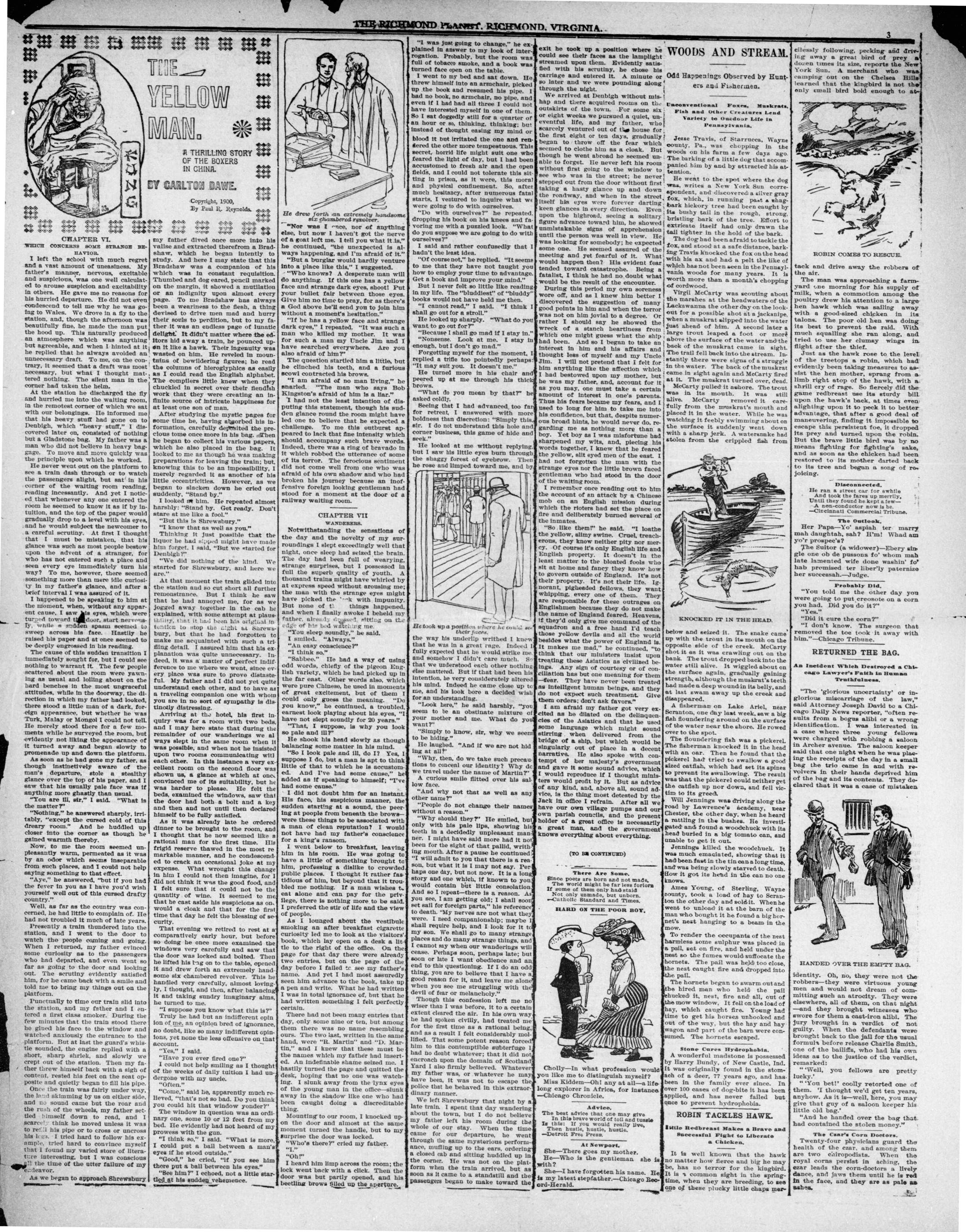
THE YELLOW MAN.
A THRILLING STORY
OF THE BOXERS
IN CHINA.
BY CARLTON DAWE.
Copyright, 1900,
By Paul R. Reynolds.
my father dived once more into his valise and extracted therefrom a Bradshaw, which he began intently to study. And here I may state that this Bradshaw was a companion of his which was in constant requisition. Thumbed and dog cared, pencil marked on the margin, it showed a mutilation or an indignity upon almost every page. To me Bradshaw has always been a weariness to the flesh, a thing devised to drive men mad and hurry their souls to perdition, but to my father it was an endless page of lunatic delight. It didn't matter where the editors hid away a train, he pounced upon it like a hawk. Their ingenuity was wasted on him. He revealed in mountains of bewildering figures; he read the columns of hieroglyphics as easily as I could read the English alphabet. The compilers little knew when they chuckled in secret over their friendliness work that they were creating an infinite source of intricate happiness for at least one son of man.
After studying the mystic pages for some time he, having absorbed his information, carefully deposited the precious tome once more in his bag. When he began to collect his various papers, which he also placed in the bag. It looked to me as though he was making preparations for leaving the train; but, knowing this to be an impossibility, I merely regarded it as another of his little eccentricities. However, as we began to slacken down he cried out suddenly, "Stand by." I looked at him. He repeated almost harshly: "Stand by. Get ready. Don't stare at me like a fool." "But this is Shrewsbury." "I know that as well as you." Thinking it just possible that the liquor he had sipped might have made him forget, I said, "But we started for Denbigh?" "We did nothing of the kind. We started for Shrewsbury, and here we are."
At that moment the train glided into the station and so cut short all further remonstrance. But I think he saw that he had annoyed me, for as we jogged away together in the cab he explained, with some attempt at plausibility, that it had been his original intention to stop the night at Snewsbury, but that he had forgotten to make me acquainted with such a trifling detail. I assured him that his explanation was quite unnecessary. Indeed, it was a matter of perfect indifference to me where we went, since every place was sure to prove distasteful. My father and I did not yet quite understand each other, and to have as a traveling companion one with whom you are in no sort of sympathy is distinctly distressing.
Arriving at the hotel, his first inquiry was for a room with two beds, and I may here state that during the remainder of our wanderings we all ways slept in the same room when it was possible, and when not he insisted upon two rooms communicating with each other. In this instance a very excellent room on the second floor was shown us, a glance at which at once convinced me of its suitability, but he was harder to please. He felt the beds, examined the windows, saw that the door had both a bolt and a key and then and not until then declared himself to be fully satisfied.
As it was already late he ordered dinner to be brought to the room, and I thought that he now seemed like a rational man for the first time. His frigid reserve thawed in the most remarkable manner, and he condescended to crack an occasional joke at my expense. What wrought this change in him I could not then imagine, for I did not think it was the good food, and I felt sure that it could not be the quantity of wine. It seemed to me that he cast aside his suspicions as one would a cloak and that for the first time that day he felt the blessing of security.
That evening we retrained to rest at a comparatively early hour, but before so doing he once more examined the windows very carefully and saw that the door was locked and bolted. Then he lifted his bag on to the table, opened it and drew forth an extremely handsome six chambered revolver. This he handled very carefully, almost lovingly, I thought, and then, after balancing it and taking sundry imaginary alms, he turned to me.
"I suppose you know what this is?" Truly he had but an indifferent opinion of me, an opinion bred of ignorance, no doubt, like so many indifferent opinions, yet none the less offensive on that account.
"Yes," I said.
"Have you ever fired one?"
I could not help smiling as I thought of the weeks of daily tuition I had undergone with my uncle.
"Often."
"Come," said he, apparently much relieved, "that's not so bad. Do you think you could hit that window yonder?"
The window in question was an ordinary one, some 10 or 12 feet from my bed. He evidently had not heard of my prowess with the gun.
"I think so," I said. "What is more, I could put a ball between a man's eyes if he stood outside."
"Good," he cried, "if you see him there put a ball between his eyes."
"See him?" I echoed, not a little startled at his sudden vehemence.
THE RICHMOND PLANET, RICHMOND, VIRGINIA.
THE WEEKLY PRESS
He drew forth an extremely handsome six chambered resolver.
"Nor was I once, nor of anything else, but now I haven't got the nerve of a goat left me. I tell you what it is." he continued, "the unexpected is always happening, and I'm afraid of it."
"But a burglar would hardly venture into a place like this," I suggested.
"Who knows? A desperate man will do anything. If this one has a yellow face and strange dark eyes, shoot! Put your bullet fair between those eyes. Give him no time to pray, for as there's a God above he'll send you to join him without a moment's hesitation."
"If he has a yellow face and strange dark eyes," I repeated. "It was such a man who killed my mother. It was for such a man my Uncle Jim and I have searched everywhere. Are you also afraid of him?"
The question startled him a little, but he clinched his teeth, and a furious scowl contracted his brows.
"I am afraid of no man living," he snarled. "The man who says Bob Kingston's afraid of him is a liar."
Kingston's afraid or him is a harr." I had not the least intention of disputing this statement, though his sudden glance round the room might have led one to believe that he expected a challenge. To me this outburst appeared to lack that fine intensity which should accompany such brave words. Indeed, there was a ring of bravado in it which robbed the utterance of some of its terror. The ferocious sentiment did not come well from one who was afraid of his own shadow and who had broken his journey because an inoffensive foreign looking gentleman had stood for a moment at the door of a railway waiting room.
CHAPTER VIII
Notwithstanding the sensations of the day and the novelty of my surroundings I slept exceedingly well that night, once sleep had seized the brain. The day had been full of wearying, strange surprises, but I possessed in full the superb quality of youth. A thousand trains might have whirled by at express speed without arousing me; the man with the strange eyes might have picked the look with impunity. But none of the things happened, and when I finally awoke I beheld my father, already dressed, sitting on the edge of his bed watching me.
"You sleep soundly," he said.
I smiled. "Always."
"An easy conscience?"
"I think so."
"Sabbee." He had a way of using odd words, chiefly of the pigeon English variety, which he had picked up in the far east. Other words also, which were pure Chinese, he used in moments of great excitement, but of them I could only guess the meaning. "Do you know," he continued, a troubled, earnest look playing about his eyes. "I have not slept soundly for 20 years." "That, I suppose, is why you look so pale and ill?" He shook his head slowly as though balancing some matter in his mind. "So I look pale and ill, do I? Yes, I suppose I do, but a man is apt to think little of that to which he is accustomed. And I've had some cause," he added as if speaking to himself; "I've had some cause."
I did not doubt him for an instant. His face, his suspicious manner, the sudden starting at a sound, the peering at people from beneath the brows—were these things to be associated with a man of clean reputation? I would not have had my father's conscience for a king's ransom. I went below to breakfast, leaving him in his room. He was going to have a little of something brought to him, professing a dislike to crowded public places. I thought it rather fastidious of him, but beyond that it troubled me nothing. If a man wishes to eat alone and can pay for the privilege, there is nothing more to be said. I preferred the stir of life and the view of people.
As I lounged about the vestibule smoking an after breakfast cigarette curiosity led me to look at the visitors' book, which lay open on a desk a little to the right of the office. On the page for that day there were already two entries, but on the page of the day before I failed to see my father's name. And yet I had most assuredly seen him advance to the book, take up a pen and write. What he had written I was in total ignorance of, but that he had written something I felt perfectly certain.
There had not been many entries that day, only some nine or ten, but among them there was no name resembling ours. The two last, written in the same hand, were "R. Martin" and "D. Martin," and I knew that these must be the names which my father had inserted. An indefinable shame selzed me. I hastily turned the page and quitted the desk, hoping that no one was watching. I slunk away from the lynx eyes of the young man in the office—slunk away in the shadow like one who had been caught doing a discreditable thing.
Mounting to our room, I knocked upon the door and almost at the same moment turned the handle, but to my surprise the door was locked.
"Who's there?" cried my father.
"I."
I heard him limp across the room; the lock went back with a click. Then the door was but partly opened, and his beetling brows filled up the aperture.
"I was just going to change," he explained in answer to my look of interrogation. Probably, but the room was full of tobacco smoke, and a book was turned face open on the table.
I went to my bed and sat down. He threw himself into an armchair, picked up the book and resumed his pipe. I had no book, no armchair, no pipe, and even if I had had all three I could not have interested myself in one of them. So I sat doggedly still for a quarter of an hour or so, thinking, thinking; but instead of thought easing my mind or blood it but irritated the one and renamed the other more tempestuous. This secret, horrid life might suit one who feared the light of day, but I had been accustomed to fresh air and the open fields, and I could not tolerate this sitting in prison, as it were, this moral and physical confinement. So, after much hesitancy, after numerous fatal starts, I ventured to inquire what we were going to do with ourselves.
"Do with ourselves?" he repeated, dropping his book on his knees and favoring me with a puzzled look. "What do you suppose we are going to do with ourselves?"
I said and rather confusedly that I hadn't the least idea.
"Of course not," he replied. "It seems to me that they have not taught you how to employ your time to advantage. Get a book and improve your mind."
But I never felt so little like readings in my life. The "bludiest" of "bluddy" books would not have held me then.
"I cannot read," I said. "I think I
"I cannot read," I said. "I think I shall go out for a stroll."
He looked up sharply. "What do you want to go out for?" "Because I shall go mad if I stay in." "Nonsense. Look at me. I stay in enough, but I don't go mad." Forgoring myself for the moment, I replied a trifle too pointedly perhaps: "It may suit you. It doesn't me." He turned more in his chair and peered up at me through his thick brows. "What do you mean by that?" he asked coldly. Seeing that I had advanced, too far for retreat, I answered with more boldness than discretion: "Simply this, sir. I do not understand this hole and corner business, this game of hide and seek." He looked at me without replying, but I saw his little eyes burn through the shaggy forest of eyebrow. Then he rose and limped toward me, and by
He took up a position where he could see their faces.
the way his underlip writhed I knew that he was in a great rage. Indeed I fully expected that he would strike me and somehow I didn't care much. So that we understood each other nothing else mattered. But if that had been his intention, he very considerably altered his mind. Indeed he came close up to me, and his look bore a decided wish for an understanding.
"Look here," he said harshly, "you seem to be an obstinate mixture of your mother and me. What do you want?
"Simply to know, sir, why we seem to be hidding."
He laughed. "And if we are not hiding at all?"
"Why, then, do we take such precautions to conceal our identity? Why do we travel under the name of Martin?"
A curious smile flitted over his sallow face.
"And why not that as well as any other name?"
"People do not change their names without a reason."
"Why should they 7" He smiled, but only with his pale lips, showing his teeth in a decidedly unpleasant manner. I might have said more had it not been for the sight of that pallid, writting mouth. After a pause he continued: "I will admit to you that there is a reason, but what it is I may not say. Perhaps one day, but not now. It is a long story and one which, if known to you would contain but little consolation. And so I repeat—there is a reason. As you see, I am getting old; I shall soon set sail for foreign parts," his reference to death. "My nerves are not what they were. I need companionship; maybe I shall require help, and I look for it to my son. We shall go to many strange places and do many strange things, and I cannot say when our wanderings will cease. Perhaps soon, perhaps late; but soon or late I want obedience and an end to this questioning. If I do an odd thing, you are to believe that I have a good reason for it, and leave me alone when you see me struggling with the devil of fear or melancholy."
Though this confession left me not wiser than I was before, it to a certain extent cleared the air. In his own way, he had spoken civilly, had treated me for the first time as a rational being, and as a result I felt considerably mollified. That some potent reason forced him to this contemptible subterfuge I had no doubt whatever; that it did not encoach upon the domain of Scotland Yard I also firmly believed. Whatever my father was, or whatever he may have been, it was not to escape the police that he behaved in this extraordinary manner.
We left Shrewsbury that night by a late train. I spent that day wandering about the town, but I do not believe my father left his room during the whole of our stay. When the time came for our departure, he went through the same mysterious performance, mulling up to the ears, ordering a closed cab and sitting huddled up in the corner. He was not on the platform when the train arrived, but as soon as it came to a standstill and the passengers began to make toward the
exit he took up a position where he could see their faces as the lamplight streamed upon them. Evidently satisfied with his scrutiny, he chose his carriage and entered it. A minute or so later and we were pounding along through the night.
We arrived at Denbigh without mishap and there acquired rooms on the outskirts of the town. For some six or eight weeks we pursued a quiet, uneventful life, and my father, who scarcely ventured out of the house for the first eight or ten days, gradually began to throw off the fear which seemed to clothe him as a cloak. But though he went abroad he seemed unable to forget. He never left his room without first going to the window to see who was in the street; he never stepped out from the door without first taking a hasty glance up and down the roadway, and when in the street itself his eyes were forever darting keen glances in every direction. Even upon the highroad, seeing a solitary figure advance toward him, he showed unmistakable signs of apprehension until the person was well in view. He was looking for somebody; he expected some one. He seemed assured of the meeting and yet fearful of it. What would happen then? His evident fear tended toward catastrophe. Being a fatalist, I think he had no doubt what would be the result of the encounter.
During this period my own soreness wore off, and as I knew him better I discovered the suggestion of many good points in him and when the terror was not on him jovial to a degree. Or rather I should say he showed the wreck of a stanch heartiness from which one might guess what the ship had been. And so I began to take an interest in him and his affairs and thought less of myself and my Uncle Jim. I will not pretend that I felt for him anything like the affection which I had bestowed upon my mother, but he was my father, and, account for it as you may, one must take a certain amount of interest in one's parents. Thus his fears became my fears, and I used to long for him to take me into his confidence, but that, despite numerous broad hints, he would never do, regarding me as nothing more than a boy. Yet boy as I was misfortune had sharpened my wits, and, pleasing his words together, I knew that he feared the yellow, slit eyed men of the east. I had not forgotten the man with the strange eyes nor the little brown faced gentleman who had stood in the door of the waiting room.
I remember once reading out to him the account of an attack by a Chinese mob on an English mission during which the rioters had set the place on fire and deliberately burned several of the inmates.
"So like them!" he said. "I loathe the yellow, slimy swine. Cruel, treacherous, they know neither pity nor mercy. Of course it's only English life and English property. It doesn't in the least matter to the bloated fools who sit at home and fancy they know how to govern outside of England. It's not their property. It's not their life. Ignorant, pigheaded fellows, they want whipping, every one of them. They are responsible for these outrages on Englishmen because they do not make the name of England feared. Heavens, if they'd only give me command of the squadron and a free hand I'd teach those yellow devils and all the world besides what the power of England is. It makes me mad," he continued, "to think that our ministers insist upon treating these Asiatics as civilized beings. Any sign of courtesy or of conciliation has but one meaning for them—fear. They have never been treated as intelligent human beings, and they do not expect such treatment. Give them orders; don't ask favors."
I am afraid my father got very excited as he dilated on the delinquencies of the Aslatsics and that he used some language which might sound stirring when delivered from the bridge of a ship, but which would be singularly out of place in a decent narrative. He also spoke with contempt of her majesty's government and gave it some sound advice, which I would reproduce if I thought ministers would profit by it. But as advice of any kind, and, above all, sound advice, is the thing most detested by the Jack in office I retrain. After all we have our own village pumps and our own parish councils, and the present holder of a great office is necessarily a great man, and the government knows everything about everything.
(TO BE CONTINUED)
Since poets are born and not made,
The world might be far less forlorn
If some of them only had staid
Not only unmade, but unborn.
-Catholic Standard and Times.
HARD ON THE POOR BOY.
A
Cholly—In what profession would you like me to distinguish myself?
Miss Kiddem—Ohl any at all—a life-long explorer in Africa, for instance—Chicago Chronicle.
Advice.
The best advice that one may give
In this brave effort of toll and tussle
Is this: If you would really live,
Then hustle, hustle, hustle.
—Detroit Free Press.
She—I have forgotten his name. He is my latest stepfather.—Chicago Record-Herald.
WOODS AND STREAM
Odd Happenings Observed by Hunters and Fishermen.
Unconventional Foxes, Muskrats, Fish and Other Creatures Lend Variety to Outdoor Life in Pennsylvania.
Jesse Travis, of Starruce, Wayne county, Pa., was chopping in the woods on his farm a few days ago. The barking of a little dog that accompanied him by and by attracted his attention.
He went to the spot where the dog was, writes a New York Sun correspondent, and discovered a silver gray fox, which, in running past a shagbark hickory tree had been caught by its bushy tail in the rough, strong, bristling bark of the tree. Effort to extricate itself had only drawn the tail tighter in the hold of the bark.
The dog had been afraid to tackle the fox, and stood at a safe distance, barking Travis knocked the fox on the head with his ax and had a pelt the like of which has not been seen in the Pennsylvania woods for many years. It is worth more than a month's chopping of cordwood. Virgil McCarty was scouting about the marshes at the headwaters of the Lackawanna the other day on the look-out for a possible shot at a jacksnipe, when a muskrat slipped into the water just ahead of him. A second later a large trout leaped a foot or more above the surface of the water and the back of the muskrat came in sight. The trail fell back into the stream. Instantly there were signs of a struggle in the water. The back of the muskrat came in sight again and McCarty fired at it. The muskrat turned over dead.
McCarty pulled it ashore. The trout was in its mouth. It was still alive. McCarty removed it carefully from the muskrat's mouth and placed it in the water. While he was watching it feebly swimming about on the surface it suddenly went down with a sharp jerk. A watersnake had stolen from the crippled fish from
KNOCKED IT IN THE HEAD.
below and seized it. The snake came up with the trout in its mouth on the opposite side of the creek. McCarty shot it as it was crawling out on the bank. The trout dropped back into the water still alive. It wiggled about on the surface again, gradually gaining strength, although the muskrat's teeth had made a deep wound in its belly, and at last swam away up the creek and disappeared.
A fisherman on Lake Ariel, near Scranton, one day last week, saw a big fish fouling around on the surface of the water near the shore. He rowed over to the water.
The foulinging fish was a pickerel. The fisherman knocked it in the head with an ear. Then he found that the pickerel had tried to swallow a good sized catfish, which had set its spines to prevent its swallowing. The result was that the pickerel could neither get the catfish up nor down, and fell victim to its greed.
Will Jennings was driving along the road by Lawrence's academy, near Chester, the other day, when he heard a rattling in the bushes. He investigated and found a woodchuck with its head buried in a big tomato can, and unable to get it out.
Jennings killed the woodchuck. It was much emaciated, showing that it had been fast in the tin can a long time, and was being slowly starved to death. How it got its head in the can no one knows.
Ames Young, of Sterling, Wayne county, took a load of hay to Scranton the other day and sold it. When he went to unload it at the barn of the man who bought it he found a big hornet's nest hanging to a beam in the mow.
To render the occupants of the nest harmless some sulphur was placed in a pail, set on fire, and held under the nest so the fumes would suffocate the hornets. The pail was held too close, the nest caught fire and dropped into the pail.
The hornets began to swarm out and the hired man who held the pail chucked it, nest, fire and all, out of the mow window. It fell on the load of hay, which caught fire. Young had time to get his horses unhooked and out of the way, but the hay and hay wagon and part of the barn were consumed. The hornets escaped.
**Stone Cures Hydrophobia.**
A wonderful madstone is possessed by Harry Bundy, of New Castle, Ind. It was originally found in the stomach of a deer, 77 years ago, and has been in the family ever since. In over 100 cases of dog-bite it has been applied, and has never failed but once to prevent hydrophobia.
ROBIN TACKLES HAWK.
Little Redbreast Makes a Brave and Successful Fight to Liberate a Chicken.
It is well known that the hawk no matter how fierce and big he may be, has no terror for the kingbird.
It is a common sight in the springtime, when they are breeding, to see one of these plucky little chaps mer-
cilessly following, pecking and driving away a great bird of prey a dozen times its size, reports the New York Sun. A merchant who was camping out on the Chelsea Hills learned that the kingbird is not the only small bird bold enough to at-
ROBIN COMES TO RESCUE
tack and drive away the robbers of the air.
The man was approaching a farmyard one morning for his supply of milk, when a commotion among the poultry drew his attention to a large hen hawk which was sailing away with a good-sized chicken in its talons. The poor old hen was doing its best to prevent the raid. With much squalling she ran along, and tried to use her clumsy wings in flight after the thief.
Just as the hawk rose to the level of the treetops a robin, which had evidently been taking measures to assist the hen mother, sprang from a limb right atop of the hawk, with a shrill cry of rage. So fiercely did the game redbreast use its sturdy bill upon the hawk's back, at times even alighting upon it to peck it to better advantage, that after a good deal of maneuvering, finding it impossible to escape this persistent foe, it dropped its prey and turned upon the robin. But the brave little bird was by no means fighting for fighting's sake, and as soon as the chicken had been restored to its mother darted back to its tree and began a song of rejoicing.
Disconnected.
He ran a street car for awhile. And took the fares up merrily. When they found he kept a few—A non-contained one—Cincinnati Commercial Tribune.
The Outlook.
Her Papa—Yo' aspiah ter marry mah daughtah, sah? H'm! Whad am yo'r prospec's?
The Suitor (a widower)—Ebery single one ob de pussions fo' whom mah late lamented wife done washin' fo' hab premised ter liber'ly paternize her successah.—Judge.
Probably Did.
"You told me the other day you were going to put creosote on a corn you had. Did you do it?"
"Yes."
"Did it cure the corn?"
"I don't know. The surgeon that removed the toe took it away with him."—Chicago Tribune.
RETURNED THE BAG.
An Incident Which Destroyed a Chicago Lawyer's Faith in Human Truthfulness.
"The 'glorious uncertainty' or inglorious miscarriage of the law," said Attorney Joseph David to a Chicago Daily News reporter, "often results from a bogus alibi or a wrong identification. I was interested in a case where three young fellows were charged with robbing a saloon in Archer avenue. The saloon keeper said that one night when he was placing the receipts of the day in a small bag the trio came in and with revolvers in their hands deprived him of the bag and its contents. They declared that it was a case of mistaken
HANDED OVER THE EMPTY BAG.
identity. Oh, no, they were not the robbers—they were virtuous young men and would not dream of committing such an atrocity. They were elsewhere, all of them, on that night—and they brought witnesses who swore for them a cast-iron alibi. The jury brought in a verdict of not guilty. When the defendants were brought back to the jail for the usual formula before release Charlie Smith, one of the bailiffs, who had his own ideas as to the justice of the verdict, remarked:
"Well, you fellows are pretty lucky."
"You bet!" coolly retorted one of them. I thought we'd get ten years, anyhow. As it is—well, here, you may give that guy of a saloon keeper his little old bag.
"And he handed over the bag that had contained the stolen money."
The Czar's Corn Doctors.
Twenty-four physicians guard the health of the czar, and among them are two cairopodists. When the royal corn persists in aching, the czar leads the corn-doctors a lively dance, and jaws them until he is red in the face, and they are as pale as ashes.
HE PLANET
JOHN MITCHELL JR. - EDITOR.
All communications intended for publication should be sent so as to reach us by Wednesday.
TERMS IN ADVANCE.
One Copy, one year, $1.50
One Copy, eight months, 1.00
One Copy, six months, $80
One Copy, four months, $10
One Copy, three months, $40
Single Copy, $0.05
ADVERTISING RATES
For one inch, one insertion.
For one inch, each subsequent insertion.
For two inches, three months.
For two inches, six months.
For two inches, nine months.
For two inches, twelve months.
Marriage and Funeral Notices.
Standing and Transient Notices per line.
POSTAGE STAMPS OF A HIGHER DE-
NOMINATION THAN TWO CENTS NOT
RECEIVED ON SUBSCRIPTIONS.
THE PLANET is issued weekly. The subscri-
mon price is $1.50 a year, in advance.
There are FOUR WAYS by which money can be sent by mail at our mail: - In a Post Office Money Order, by Bank Cheek or Draft, or an Exempt Money Order, by a Post Office. Of these can be procured, in a Registered Letter. MONEY ORDERS.—You can buy a Money Order at your Post Office, payable at the Richmond Post Office, and we will be responsible for its invaivtion. MONEY ORDERS can be obtained at any office of the American Express Co., the United States Express Co., and the Wek's Fargo Company. You can pay for money available for money sent by any of these companies. The Express Money Order is a safe and convenient way for forwarding money. REGISTERED LETTER.—If a Money Order is registered, you can send your resch, your Postmaster will Register the letter you wish to send us on payment of ten cents. Then, if the letter is lost or stolen, it can be sent money in this manner at our risk. We cannot be responsible for money sent in letters in any other way than one of the four ways mentioned above. If you send your money in another way, you must do it at your own risk.
BENEWAL, ETC.—If you do not want THE PLANET continued for another year after your birthday, you may take the day off Postal Card to discontinue. The courts have decided that subscribers to newspapers who do not order their paper discontinued at the expiration of time for it, it has been paid new halders for the payment of the subscription up to date when they order the paper discontinued.
COMMUNICATIONS:—When writing to us to request your paper, you should give your name and address in full, otherwise we cannot find your name on our books.
CHANGE OF ADDRESS:—In order to change the address of a subscriber, we must be sent the former as well as the present address.
Entered in the Post Office at Richmond, Va., as second class matter.
SATURDAY, NOV. 1, 1903
The lawless colored elements must learn that they do us much harm, and endanger the shred of rights which we now enjoy.
---
COLORED men can 'console themselves with the hope that there is an end to everything, even to the outrageous conditions now existing in the Southland.
POLICE-JUSTICE ORUTCHFIELD seems to have sounded the key-note in the EASTHAM attempted abduction case. He has been unanimously commended by both white and colored citizens. He had the law and the facts before him, and he fearlessly did his duty.
---
So EASTRAM is crazy. We thought it would come to this, when it was ascertained that the commonwealth had a "dead open and shut case" on him. "Crazy" colored men who commit crimes are either hanged or sent to the penitentiary.
CULTIVATE and practice politeness, colored men. Impress these principles upon the minds of your children. The present school system does little in this direction and at times it erroneously appears that the more education, this rising generation receives, the more boorish and insulting it becomes. We need a cultured, educated element in our midst in order to promote our success.
President Will Vote at Oyster Bay.
Washington, Oct. 29. — President Roosevelt next Monday will go to Oyster Bay, where he will cast his vote on Tuesday. He will receive the election returns at Sagamore Hill that night, and on Wednesday will attend a Masonic celebration in Philadelphia, returning to Washington on Wednesday night or the following morning.
Mrs. Roosevelt will probably leave Oyster Bay at the same time as her husband, and come direct to Washington, probably taking up her abode in the remodeled White House. Several of the living rooms in the second story of the White House are now ready for occupancy.
U. S. Consul Was Lost In Mountains.
Huntington, Ky. Oct. 27.-United States Consul Alonzo Garrett, at Lando, Mexico, returned to the consulate Saturday night, according to a telegram received yesterday, after wandering with a party of friends in the Sierra Madre mountains for twenty days, the greater part of the time without food. The party was on a hunting trip and its water supply failed. Garrett resides here.
Coal Barge Crew Probably Lost.
Nortport, L. I., Oct. 29.-It is feared that the crew of a coal barge has been lost off Eaton's Neck. The barge, which had a full load of coal broke away from the tow yesterday and soon afterward sank. A gale was blowing at the time. No trace of the crew has been found.
ARBITRATORS START WORK
Strike Commission to Investigate Mines and Homes of Men.
BAER OBJECTS TO MITCHELL
Reading's President Took Exceptions to Labor Leader Representing Mine Workers' Union—Operators Offer to Furnish Full Data—Commission Will Not Accept Special Train Offered Them By Presidents of Coal Roads. Washington, Oct. 28.—The anthracite coal strike commission yesterday, in the hearing room of the interstate commerce commission, held its first conference with the parties to the controversy in the anthracite regions. The commission occupied the elevated seats, Judge Gray, as president, occupying the center seat, and Messrs. Wright, Watkins and Clark the seats to the right of him in the order named, while General Wilson, Bishop Spalding and Mr. Parker sat on the left in the order of their names. The proceedings covered about two hours' time and were given up entirely to a discussion of the time and method of proceeding with the proposed investigation.
Mr. Mitchell, president of the United Mine Workers of America, and District President Fahey appeared for the miners, and the coal carrying roads were represented as follows: President Baer, of the Reading; E. B. Thomas, of the Pennsylvania Coal Company; Alfred Walter, of the Lehigh Valley; W. H. Truesdale, of the Delaware, Lackawanna and Western; David Wilcox, of the Delaware and Hudson; John B. Herr, of the Scranon Coal Company; J. H. Torrey, attorney for the Delaware and Hudson, and Francis I. Gowan, attorney for the Lehigh Valley Company.
To Begin Its Work at Scranton.
The commission decided to begin its work Thursday morning at 9 o'clock, the first days of the investigation to be devoted to an examination of the mines and the homes of the miners, starting in the vicinity of Scranton. The entire anthracite field will be covered. There was considerable discussion over a proposition made by the commission to have expert accountants appointed to audit statements of wages and classification of miners to be made by the operators for the use of the commission, but no result was reached on this point beyond the announcement by the chairman of the commission's intention to appoint such an accountant in case his services should be found necessary.
During the progress of the meeting, Mr. Mitchell, as the representative of the miners, presented a copy of the original declaration of the miners as formulated by the Shamokin convention, as the basis of the demands of the miners. This demand is for an increase of 20 per cent. in wages of those not engaged by the day, a reduction of 20 per cent. in working hours of those engaged by the day; the payment for coal mined by weight at a minimum rate of 60 cents per ton of 2.240 pounds; a wage agreement between the operators and the miners for an adjustment of wages.
Baer Objects to Mitchell.
Mr. Baer, on the part of the coal operators, took exception to Mr. Mitchell's appearance before the commission as a representative of the Mine Workers' Union, but said that he had no objection to his presence as a representative of the strikers as such in their individual capacity. The commission made no attempt to settle the controversy, but it was made apparent that the recognition of the Miners' Union will be an important and knotty problem for the arbitrators.
Preceding the discussion over opening the books to the experts, Mr. Baer said the operators would be prepared to meet the miners in the region and to assist in giving all information. Many of the individual operators are not represented, and they were not consulted and were not compromised by the letter he had written.
Judge Gray suggested that they could be represented. At the meeting next Monday they would determine which of the companies would be taken up first, and the place of meeting could be determined by the location of the coal company taken up.
Mr. Baer made a point of saying that if the case of each coal company would be dealt with separately he would contend for the sliding scale in the regulation of wages.
"I shall urge the adoption of that profit-sharing plan," he said, "which gave us peace formerly in our relation to our employees."
Mr. Thomas, of the Hillside Iron and Coal and the Pennsylvania Coal Company, said he noticed that the word "arbitration" had been applied to the commission's work, while he wanted it considered as an investigation.
Judge Gray said the president's instruction settled that as an arbitration.
The question of the examination by the commission into the conditions under which the mining of anthracite coal is conducted was then entered on, and Mr. Watkins, of the commission, suggested that a week or ten days' time would be necessary in order to make an adequate examination of the physical conditions about the mines. He appealed to Mr. Thomas for his opinion as to the time necessary, and
that gentleman replied: "You will certainly need that much time; I should think that 30 days would be none too little. We've grown gray in our study of that question." Mr. Baer also fell in with the suggestion, saying that it would be impossible to do justice to the investigation without a complete physical inspection of the mines and the methods of operating them. Mr. Mitchell thought that not only should there be
an inspection of the mines, but also of the homes of the miners. He considered this investigation necessary to a complete understanding of the subject.
Commission Will Accept No Favors. While the subject was being considered, Mr. Baer said that the mine operators would furnish all facilities at their command to enable the commission to make its investigation thorough. He said they would place a special train at the disposal of the commission, providing also for the accommodation of miners' representative
WUTING FANG RECALLED
Chinese Minister Ordered to Shanghai by Shortest Route.
HIS SON MAY REMAIN HERE
Emperor Appoints Mr. Wu Minister of Commerce and a Member of Commission to Negotiate Treaties With Foreign Powers
necticut, New North Carolina, Ida, Alabama, nols, Missouri, Dakota, Wis, Utah, Colorado and California, Oregon, Arkansas also elect a se chosen.
ELIZABETH WELL-Known W OLD A
The public meeting of the commission then came to a close, and the commissioners retired for the purpose of private consultation. They first took up the question which had been raised by the proffer of a special train by Mr. Baer, and unanimously decided not to accept the train. The exchange of views which followed brought out the fact that the commissioners expect personally to pay all of their expenses, accepting no favors and relying on the government to reimburse them if so disposed.
Official stenographers to report the proceedings of the commission and also to act as secretaries were appointed. An agreement was reached to leave the Hotel Jermyn in Scranton at 9 o'clock next Thursday morning for the first tour of inspection. There was, however, no agreement as to what mines should be visited first, that point being left for future determination.
MANY MINES WORKING
Scranton, Pa., Oct. 28—Of the 108 collieries operated by the five big companies having headquarters here, only 13 are still idle. The Erle has 33 places working and one idle; the Delaware & Hudson, 25 working and five idle; Delaware, Lackawanna & Western, 19 working and three idle; Ontario and Western, 11 working and three idle; Temple, seven working and one idle. Even the Butler colllery of the Erle Company, which was allowed to flood, is being worked in the levels not reached by the water. The individual operators are rapidly getting into line, and before many more days all of them except a very few will be in operation. About 80 per cent. of the old employees of the collieries in the Lackawanna regions are back at work. The companies are getting out 70 per cent. of their normal output.
Large Output of Coal.
Wilkesbarre, Pa., Oct 28.—More coal was mined and more men were employed in mining it yesterday than any day since the mines in the anthracite region resumed work. The only districts that lag behind in the output are Lehigh and Mahanoy. The individual operators and their employees in those districts are still at loggerheads. In the Wyoming and Lackawanna regions all the collieries are in operation with the exception of a few which are still under water. The seven large companies all had large outputs, and heavy trains of coal were moved rapidly to seaboard points. The miners and laborers who left the region during the strike are returning in large numbers.
MITCHELL DAY IN MINE REGION
Coal Miners Celebrate With Parades and Mass Meetings.
Wilkesbarre, Pa., Oct. 29.—Mitchell Day was celebrated throughout the anthracite mining regions today. Nearly all the mines were closed and a general holiday observed. The operators preferred that the men would work, but under the circumstances they were helpless in the matter, and as a consequence nearly all of the mines were idle. Thousands of visitors arrived in this city to witness the demonstration and attend the mass meetings. Owing to the presence of President Mitchell in Wilkesbarre the principal demonstration of the day was held here.
Among those registered at miners' headquarters are: Rev. Powers, of Spring Valley, Ill.; "Mother Jones" and Organizers William Blakely, of Linton, Ind.; T. L. Wright, of Carbon, Ind.; Thomas Haggerty, of Reynoldsville, Pa. The latter was the principal speaker at the meeting. Mr. Mitchell and citizens and clergymen rode in carriages in the parade, which was composed of about 15,000 men and many bands, floats and banners bearing pictures of John Mitchell and other prominent labor leaders.
T. L. Lewis, vice president of the United Mine Workers, was the orator of the day at the demonstration held at Hazleton, where over 5,000 men were in line.
In the Lackawanna Region.
Scranton, Pa., Oct. 29—Nearly every coal mine in the Lackawanna region was closed today by reason of the observance of Mitchell Day by the mine workers. The companies received no notice that the men would not work, and blew their whistles as usual this morning, but very few of the men responded. The day was observed by a parade and several mass meetings. President Mitchell's portrait was conspicuously displayed in the mining towns throughout the region, and was greeted with enthusiastic cheers by the mine workers and their friends.
Bear Fatally Injures a Boy.
Hot Springs, Ark, Oct. 29.—At Happy Hollow, a resort near here which, among other attractions, include a zoo, a black bear fatally injured Robert Tatum, an 8-year-old boy. The lad was passing the animal which was chained, but came too close, and before the horrified spectators could interfere the brute had the boy hugged to his breast. Then the animal closed his great jaws on his prisoner's head. A keeper pried the bear's mouth open and released the boy, but he was unconscious and dying from several fractures of the skull.
Crowd Threatened Boer Generals.
London, Oct. 28.—The Boer commander, Kritzinger, Fouche and Joubert, after addressing a meeting at Cambridge last night, had a narrow escape from the angry crowd of people that had listened to their speeches. Kritzinger was obliged to scale a wall to get away, while the others were escorted to their hotel by the police.
WUTING FANG RECALLED
Chinese Minister Ordered to Shanghai by Shortest Route.
HIS SON MAY REMAIN HERE
Emperor Appoints Mr. Wu Minister of Commerce and a Member of Commission to Negotiate Treaties With Foreign Powers.
Washington, Oct. 28. — Wu Ting Fang, who has been the minister of the Chinese empire to the United States
Wu Ting Fang.
since May 1, 1897, has been recalled to China by an edict of the emperor cabled to Minister Wu yesterday by the Chinese foreign office. The edict is peremptory. Mr. Wu being directed to return to China at as early a date as possible, over the route by which he is to make his voyage from this country being indicated.
The edict informs Mr. Wu that he has been appointed minister of commerce in association with Chang Chi Tung. He takes the position just vacated by Sheng, whose father died recently. Under a peculiar provision of Chinese law, when an office holder loses by death his father or mother, he vacates his office and he is not eligible to hold office again for three years, although by custom the period of his official mourning is reduced to 27 months. Mr. Wu said yesterday that he might be able to leave this country in about three weeks, but the precise date of his departure has not been determined.
Mr. Wu also received a cablegram announcing that he had been appointed one of the two members of a commission to negotiate commercial treaties with foreign powers. He will be at the head of this commission and will have associated with him Mr. Lu, who, until about a year ago, was the Chinese minister to Germany. As Mr. Wu has been ordered to proceed direct to Shanghai, it is probable that the headquarters of the commission will be in that city.
Minister Wu will be accompanied to China by Madame Wu and some members of his personal suite, but he said that whether he would leave his young son in this country had not been determined. He desires that his son should have a good American education, and he may conclude to leave him in the United States, at least for a time.
In official and diplomatic circles the news of the early departure of Minister Wu was received with sincere regret. For years he has been one of the most popular-members of the diplomatic corps.
MARKSMAN'S FATAL SHOT
Feat of Shooting: Apple From Man's Head Ends In Death.
Cold Spring Harbor, N. Y., Oct. 27.—The coroner yesterday held an inquest on the body of John Volkman, aged 18 years, a barber, who was accidentally shot and killed Saturday night on the stage at the Thespian Hall by Charles Meinel, of a company which has been giving a two weeks' show in connection with the sale of medicine. One of the star features of the show was Meinel's feat of shooting an apple from the head of any person who would volunteer to stand up and allow the apple to have his head for a resting place. When no one volunteered a member of the troupe performed this service.
Volkman had offered to allow the apple to be placed on his head. Meinel for some reason was not shooting well, having missed a card target a short time before the barber came on the stage. When the apple was placed on Volkman's head, Meinel began shooting at a distance of about 20 feet. The first two shots failed to hit either the apple or the man, but the third struck Volkman in the forehead and he dropped to the stage and died within an hour. Meinel was arrested and held for a hearing on a charge of man-slaughter.
THE FALL ELECTIONS
Forty-two States Will Choose Officials and Congressmen.
Washington, Oct. 29.—There will be elections in 42 states next Tuesday, the other three (Maine, Vermont and Oregon) having already selected this year, state officials and their representatives in the Fifty-Eighth Congress. In 22 of the 42 states, a governor and other state officers and congressmen are to be chosen, in 11, minor state officers or judges of the supreme court and congressmen are to be voted for, while in nine, congressmen only are to be elected.
The principal state officers are to be chosen in Massachusetts, Rhode Island, Connecticut, New York, South Carolina, Alabama, Texas, Michigan, Kansas, Minnesota, South Dakota, Nebraska, Wisconsin, North Dakota, Colorado, Wyoming, Idaho, Nevada and California. New Hampshire elects only a governor, Tennessee, a governor and railroad commissioner, and Pennsylvania, a governor and two other state officials.
The terms of thirty United States senators expire March 4th, 1903. Five, have already been filled by the election of James B. McCreary (Dem.), Kentucky; Joseph B. Foraker (Rep.), Ohio; Arthur P. Gorman (Dem), Maryland; W. P. Dillingham (Rep.), Vermont; and Samuel B. McEnery (Dem), Mississippi. In the following states legislatures which select a senator, are to be chosen: New Hampshire, Con-
necticut, New York, Pennsylvania, North Carolina, South Carolina, Florida, Alabama, Georgia, Indiana, Illinois, Missouri, North Dakota, South Dakota, Wisconsin, Kansas, Idaho, Utah, Colorado, Nevada, Washington and California. The legislatures of Oregon, Arkansas and Georgia, which also elect a senator, have already been chosen.
ELIZABETH CADY STANTON DEAD
Well-Known Woman Suffragist Dies of Old Age in New York
Old Age in New York.
New York, Oct. 27.—Elizabeth Cady
Stanton, the well-known woman suf-
ELIZABETH CADY STANTON.
fragist, died yesterday at her home in West Ninety-fourth street, in this city. Old age was given as the cause of death. She was conscious almost to the last. About a week ago Mrs. Stanton began to fall rapidly. This became more noticeable last week, and then it was known to the family that her death was only a question of days or hours. She was nearly 87 years of age.
STARVING DUKHOBORS MARCH
Sixteen Hundred of Them May Cause
Trouble at Yorkton, Manitoba.
Winnipeg, Manitoba, Oct. 29—A special from Yorkton, Assinibola, says that 1,600 Dukhobors, men, women and children, have arrived at that place. They entered the town last evening singing a weird hymn and carrying their sick and infants on stretchers. They are in want of food. A hasty meeting of the town council has been summoned. Special constables are being sworn in. The citizens are greatly excited.
The Dukhobors are affected by a religious mania. They believe it to be a sin to hold domestic animals in restraint, and they have, therefore, turned their cattle and horses loose upon the prairie. They will not wear leather shoes or any clothing produced from animals, and the men and women have been yoking themselves to the plow and wagon. A large number of the horses and cattle have been seized by the government and sold at public auction. The amount realized, about $20,000, will be used to take care of the fanatics when the winter sets in.
Will Finance Beef Trust
New York, Oct. 27. — John D. Rockefeller and James Stillman, president of the National City Bank, will finance the $500,000,000 Beef Trust, according to Wall Street. It is conceded that the syndicate will make not less than $10,000,000 in financing the merger, and probably its profits will be nearer $20,000,000. P. H. Valentine, of Armour & Co., who engineered the merger, is to be the potent figure in the packing world under the new regime. The companies in the merger have already paid out more than $30,000,000 in absorption of the smaller plants, and by January 1 the trust will be doing business.
10,000 Died From Measles.
London, Oct. 29.—The St. Petersburg correspondent of the Dally Mall cables that there is an epidemic of measles on the Kamchtka peninsula. Ten thousand persons have died of the disease, and the populations of some country villages have been nearly wiped out.
Plead Guilty to Bigamy.
Baltimore, Md., Oct. 28—Ephraim Skorman, charged with bigamy, on being confronted by the three women he had married, in the criminal court yesterday, plead guilty. One of these he married in Russia, one in Boston and one in Baltimore.
SOFT COAL COMBINE
Companies to Consolidate, With $110,
400,000 Accumulated
000,000 Authorized Capital.
Pittsburg, Pa., Oct. 29 - Negotiations are under way for a merging of the Pittsburg Coal Company and the Monongahela River Consolidated Coal and Coke Company, with their combined authorized capitalization of $110,000,000 and assets of $120,088,581. Consolidation of these interests will launch by far the strongest bituminous concern in the world. The combined coal output of the two concerns is close to 30,000,000 tons a year. The plan is to make the Pittsburg company lesssee and the purpose to economize operations.
Successful termination of the deal will end the trade rivalry which has existed between the two companies, either under or on the surface.
Easy Proposal.
"If I only had an ambassador at the court of love!" sighed the bashful swain.
"A minister would be good enough for me," replied the demure malden.
"Arabella!"
"Herbert!"
And so they were married.—N. O. Times-Democrat.
Contemptible Young Chap.
Ethel—Why, what's the matter, Gertrude?
Gertrude—Oh, nothing. Only Jack and I had a quarrel the other day, and I wrote and told him never to dare speak or write to me again—and the wretch hasn't even had the decency to answer my letter.—Tit-Bits.
Feminine Charity
Tom—I don't see what Miss Thirty-odd ever married such a homely chap for. He must have been her last chance.
Nell—On the contrary, I imagine he was her first.—Chicago Daily News.
W. I. JOHNSON, FUNERAL DIRECTOR AND EMBALMER.
Office & Warerooms, 207 N. Foushee St. Corner Broad. HACKS FOR HIRE: Orders by Telephone or Telegraph filled. Wedding, Suppers and Entertainments promptly attended. Old 'Phone, 686, Residence in Building, New Phone, 48.
This organization has been chartered and legally situated under the laws and statute of the state of New York, for the purpose of uniting together all acceptable men on the Broad Bases of Charity—Beneficial and
Fraternal and to promote the Social and Moral condition of humanity. It is two distinct military and uniform ranks will secure for this organization a place in the front ranks of sacred institutions of modern events, a grand opportunity for active men. Departmented in all sections of the country to organize lodges. Kindly address.
Coffees Coated
with stale eggs, glue
and other things are
not fit to drink.
Lion Coffee
is pure, uncoated
coffee—fresh, strong,
well flavored.
The sealed package insures uniform quality and freshness.
PETER
MRS. MARTH, the world renowned and highly celebrated Business and Test Medium, reveals everything. No imposition. Can be consulted upon all affairs of life, business, love and marriage a specialty. Every mystery revealed, also of absent, deceased and living friends. Removes all trouble and estrangements, challenges any Mediums who can exceed her in startling revelations of the past, present, future events of one's life. Remember she will not for any price flatter you; you may rest assured you will gain facts without nonsense; she can be consulted upon all affairs of Life, Love, Courtship, Marriage, Friends, etc. with full description of your future companion. She is very accurate in describing missing friends, enemies etc., business, law suits journeys, contested wills, divorce and speculation is valuable and reliable. She reads your destiny—good or bad; she withholds nothing.
MRS. MARTH tells you entire life test and the power of the world. The FD TRANCE, has been the power of any two Mediums.
In tests she tells your mother's full name before marriage, the names of all your family members and description, the name and business of the family. The name of your next if you are to have one, the name of your young man who now calls on you, the name of your future husband, and the day, month and year, the name of how many children you have, or will have, who will have a good, sweet heart will be true to you and if he will marry upon; if you have no sweetheart she will tell you when you will have one and his name, but when you are in a health care, the future will be told in an an-d trance. All your family members and in a dead trance. Mothers should know the success of their husbands and their children, and they should know everything about them.
Do not keep company, marry or to do business until you know all, do not let sily religious scramples prevent your consulting.
If you have a good time in the world who can tell you the full name of the husband with age and date of marriage, and tells whether the one you love is true or false.
There are some persons who believe that they are the only people who are consulting a Medium, but such beliefs are controlless truth. It is only from the lack of discriminations that such a conclusion can be reached. It is not over-the-局, who placards himself or herself as a medium that can stand the test of what he or she claims.
And a person of an inquiring mind may ask the reason why. It is simply that these advertisers do not take the trouble to study human nature. They do not spend their thoughts for a moment with acquiring the art of phraseology and kindred branches that will have a tendency to make the pathway to the road of the business clear and devoid of all obstacles.
It is and undeniable fact that persons will come for advice in full knowledge of what they want to know, and yet as soon as they confront a medium they try their utmost endeavor to dispel from their minds what they know so as to hear if it will be rehearsed by the Medium.
To get the secret out of a person by unfair and dishonest means is the art used by many unprincipled Mediums, but to take hold of the hand and gain control of the mind thereby is a matter of impossibility to most of them.
And yet this can be done and by consulting Mrs. Marth the seemingly mystery becomes a realization.
This subject has received no little attention by prominent men and even college professors. So far it has continued that although the
are infringes in our midst with oily tongues,
perhaps the gates of wisdom have not been
cleared to permit professions.
It takes a great deal of study to become an
accomplished medium and by a continuous and
untiring effort, the key to the well of apparent
properties has been secured by MRS. MARTH for the benefit of humanity.
ADVICE BY LETTER, $1.00.
HOURS FROM 10 A. M. TO 9 P. M.
MRS. M. B. MARTH,
246 W. 31st St. (Near 8th Avenue.)
NEW YORK CITY.
Enclose Stamp for reply.
Please mention the PLANET.
MEXICAN VOLCANO ACTIVE
Sun Hidden By Showers of Ashes.
People Are Terror-Stricken.
People Are Terror-stricken.
Mexico City, Oct. 28.—Showers of ashes have fallen in the extensive region from San Juan Bautista, capital of the state of Tabasco, and Comitan, in the state of Chiapas. It is believed that a hill near Palenque, where there is a great prehistoric city in ruins, has suddenly been transformed into an active volcano. The ashes falling at Palenque and Comitan have hidden the sun.
Indians arriving at San Cristobal Las Casas say that a hill in the Guadeloupe Sierra is vomiting fire and smoke. People in many towns have been running about in terror and offering prayers publicly for the safety of themselves and children. Scientific opinion is that the eruption is part of the general awakening of volcanic forces in the West Indies and Central America.
W. I. JO
FUNERAL DIRECTOR
Office & Warerooms, 207 N
HACKS F
Orders by Telephone or Te
pers and Entertainme
Old 'Phone, 686, Residence
KNIGHTS
TO WHOM I
This org
stituted under
York, for the
men on the
Fraternal and to promote the Social and
Its two distinct military and uniform
place in the front ranks of all sacred ins
tunity for active men. Deputies wante
lodges.
Kindly address,
G. W. ALLEN S
346 W 37th St
Special rates to California and the Northwest, Via Southern Railway
During the month of September and October, the Southern Railway will sell one-way, second-class settlers ticket to California and the northwest at greatly reduced rates. Superb service is offered by this route. Before arranging your trip, it will pay you to see a representative of the Southern Railway for detail information. The schedule and service via this popular route is without equal, in many respects.
CANYASsER
—WANTED—
to sell PRINTERS' INK—a journal for advertisers—published weekly at five dollars a year. It teaches the science and practice of Advertising, and is highly esteemed by the most successful advertisers in this country and Great Britain. Lateral commission allowed Address PRINTERS No. No 10
Spruce St., New York
Notice !!!
The East End Memorial Burial Association of Richmond informs the public that having purchased six (6) acres of land, situated in Henrico County, near the city of Richmond, adjoining Oakwood cemetery and that they are disposing of the same, in sections, half sections and at the following terms. Sections, $25.00 and Half Sections, $15.00.
The situation of this Cemetery is high, dry and rolling and accessible to the Richmond Traction Street Railway and Seven Pines Railway lines, adjoining Oakwood cemetery.
This Association has at a considerable expense divided this tract of land in sections, erected a fence around its improvements, which with the additional improvements contemplated, will be an inducement, those desiring or contemplating purchasing resting places for their deceased relatives and friends.
The attention of the general public is solicited and advantageous inducements offered.
J. R. Griffin, President, No. 2412 E. Broad street; E. A. Washington, Secretary. Old 'Phone, 1983.
For information, apply to John coleman, Keeper, No. 2920 street; Wm. Custalo, 702 East Broad street; W. H. Jones, 1037, St. Peter street; W. H. Maredith, 1323 North Street; Samuel Maredith, 1323 North Street; Joseph Robinson, No. 49 1st Market; 39 9-mile Road; D. J. Chavers, Supt., 1827 Carrington street.
Go to Beach Park. Westpoint Excursion and Piecie Grounds.—Only 30 Miles, One Hour's Ride From Richmond, via Southern Ry.
A great many exclosures have already been booked for "Beach Park" for June and July. The various attractions and improvements at this popular resort gives it more prominence each season. To close proximity to Richmond, and the unlimited supply of the most wholesome artesian water, together with many other natural advantages, places it second to none as a pleasure and health resort for Richmond people. King William Pier, a substantial structure, extending 689 feet in length and 38 feet wide over the York River, with waterproof roofing as a protection from sun rain, adds considerably to the beauty and convenience for pic-nic and other outing parties. In addition to the new Beach Park Hotel, now being erected, you will find other hotels and many nice boarding houses, furnishing cheap rates and good first-class accommodations.
The principal attractions are such as fine fishing, boating, sailing, merry-ground, shooting galleries, steam and naptha launches, a large dancing pavilion with a band of music day and night, several wells of fine artesian water on the grounds, and various other attractions to suit the older people as well as the little ones. For any other information apply at or write to the Southern Ry. office, 920 E. Main St., Richmond, Va.
Old Phone, 1233. New Phone, 1553.
THE PRIVATE LIVERY
700 CATHERINE ST.,
QUICK TRANFERING
AND MOVING.
Saddle or Driving Horses, Buggies and
Surries To Let at Lowest Prices.
N. B. Tandem Lessons Given. Strict
attention given to all orders.
George Jenkins, Proprietor.
NE PLANET
SATURDAY. NOV. 1. 1903
WAR
REMINISCENCE
GETTYSBURG, THE THIRD DAY.
From the picket lines, on ridge and hill.
All through the night the lines reforming,
Strong lines of cannon, and of mow as well.
Now commander waits the storming,
The crash and havoc of both shot and shell.
Then from the ride, where Lee had formed
His lines of cannon with their brazen throats,
Turned to the hill soon to be stormed;
Burst forth a roar, and d'or the field of cats
Swept the fierce gale of shell and shot.
The answering came the thunder sound,
As cannon vole with cannon hot.
Till all the distant hills resound.
Now comes a full, amid the storm of fire,
And all the hosts the respite glady greet;
When from the strong a mass in gray attire,
Five thousand strong, come forth grim
death to meet.
In double line, as if on dress parade,
They march, nor filch, on each side
Their even lines are torn and frayed,
As comrades fell, and falling died.
Oh, men of valor, true ye are,
From Picket down to private least;
An high above the smoke of war
The nations on your valor feast,
But on
And shot and shell pour out as fast.
As gunners in their garb of blue
Stand by their guns until the last.
But on they move; the columns newly
drest.
As in their ranks the guns sad havoc
make.
For from the batterles on the crest.
The men roars make earth to quake.
And from the ranks come bursts of
flame.
And rank by rank the soldiers fall.
Each cannon seems to mow a lane
With cannister, and grape, and ball.
Tis man to man, and breast to breast.
For upward climb the ranks of gray.
To reach at last the hillop's crest.
And find a foemin brains bearer.
They waver, all in vain they strive.
Back from the crest now step by step.
No reinforcements can arrive,
So, backward from the hill are swept.
The day was lost, and yet the day was won;
The ground is sacred in our eyes today.
Our hearts rejoice at deeds of valor done by those who wore the blue, the gray. For as o'er the storied hills we roam, And live the scenes of war again. The flag, dear emblem of our home, Waste o'er the men of Georgia and of Maine.
For men are men, and a human breast Pierced by the implements of war Lets loose the life blood, and they sink to rest While yet the triumph is afar. So of the thousands that went forth that day, From out the wood, in valor strong and true, So few returned, the rest they lay Down where they fell beneath the night and dew.
H. J. LA TOUR
LAST SHOT OF THE WAR.
Fired by a Texan in a Hot Battle with Yankees on the Old Palo Alto Battlefield.
A Texan in Washington tells the Post that the last shot of the rebellion was fired by Capt. S. H. Barton, now a prosperous ranchman in western Texas. He says:
"When a line of the confederate cavalry was slowly retiring from the field on the plains of Brazos Santiago, in Texas, where the blue and the gray had met in deadly encounter for the last time, a soldier turned in his saddle, and, throwing his gun to his shoulder, fired. It proved to be the last shot of the last battle, and it was certainly the last shot of the long war. Barton was a captain in the confederate army and was held in high esteem by his superiors and loved by the brave Texans he led.
"He now lives at Del Rio, in Western Texas, where he owns one of the
HE FIRED THE LAST SHOT
most desirable small ranches in the state and considerable town property. Capt. Barton is sure that he fired the last shot at the close of the last battle of the civil war, and I believe him, for he is a perfectly truthful man and would not misrepresent a matter of that kind in the least, not even to have his fame spread over 40 pages of history.
"The story of that last battle, which was fought on the 13th of May, 1865, after the war was ended and peace was declared, has escaped the attention that it merits, for it was an affair or no little importance. Gen. Egbert Brown, who recently died at West Plains, Mo., was in command of the federal troops in southern Texas; and he was doubtless well informed concerning the termination
of hoazillifies. Gen. J. E. Slaughter, who commanded the confederate troops encamped at Brazos Santiago, had heard rumors of the surrender of the armies commanded by Lee, Johnston and other generals, but he had received no official notice of these facts from the war department. Gen. Brown, under a flag of truce, informed the confederates of the state of affairs about Washington and Richmond, at the same time inviting them to come in and lay down their arms, as the war was certainly over.
"Gen. Slaughter refused to act in the affair of such importance until he was better informed. Thereupon Col. Barret, at the head of a considerable force, was dispatched to break up the enemy's camp. A hot battle ensued, and, curiously enough, most of the fighting was done on the old field of Palco Alto, where Gen. Taylor achieved his victory ever the Mexicans nearly 20 years before. The French soldiers encamped on the southern shore of the Rie Grande were in sympathy with the southerners, and they kept Gen. Slaughter posted as to the movements of the federal troops. Several spirited encounters occurred, and the loss sustained by some of the colored regiments must have been severe.
"While the battle raged the confederates were frequently informed by some bold cavalrymen in blue that the war was over; one daring fellow shouted 'Lee surrendered a month ago; the war is ended; why don't you go home?'
"When the engagement was hottest, Gen. Slaughter received dispatches, and the French sent him a bundle of newspapers. Fully satisfied that the cause for which they were fighting was forever lost, he ordered the firing to cease. At that particular moment neither side could have claimed any advantage, but both armies began to retire from the field at the same time.
"As Capt. S. H. Barton, in command of the rear guard, was slowly riding away a etray ball struck a young man by his side, and he fell from his saddle. That was certainly the last man killed in the long war. Capt. Barton has been unable to recall his name. "I thought that was hard luck," said the old soldier. "The young man had served four years and never got a scratch. The last bullet that came our way killed him. Prompted more by spite at fate than bitterness toward the enemy. I turned in my saddle and fired toward a dark blue line, which I hope was out of range. That was certainly the last shot of the great war."
ORIGIN OF "FIT MIT SIGEL."
An Ex-Confederate Thinks the Welk Known Phrase Started in a Missouri Court Room.
"The poem of Grant P. Robinson, I Fights Mit Sigel," reproduced in the Sun of August 22, in connection with the death of Gen. Franz Sigel, reminds me of the time when the name of Sigel was despised in Missouri." says an ex-confederate living in New York who was chased by the men who "fit mit Sigel" in that state, relates that paper. "It was the belief in old Missouri that Pap Price, as his soldiers called him, was invincible. When we heard that a Dutchman named Sigel was in the field on the union side we Johnny Rebs laughed until we were too rous to march. Anything in camp that was no good was called Sigel. Whenever we got into a country where the people were weaving between the seash and the union we brought the hesitators around by asking them how they liked a country that had to hire a Dutchman to fight its battles. This started the laugh and often won a recruit.
"Finally we went up against it in the battle of Pea Ridge. It was the first square-toed fighting we had done, and, according to history, we were not in it. We didn't sit up in camp much after that singing and cracking jokes about Sigel.
"But the saying: 'He fit mit Sigel,' originated, I think, in the court of a justice of the peace of Missouri who was a union man. An old soldier was arraigned before him on the charge of stealing hogs. The evidence was going against the prisoner pretty hot and the old J. P. was scratching his head and biting the ends of his whiskers until his beard looked like a hedge fence after a rabbit chase. The soldier, who couldn't speak much, if any, English, was put on the stand, and muttered something the justice didn't understand.
"What's your client trying to say?" asked the justice of the country lawyer. "The lawyer replied—of course the lawyer did not know—he says he fit mit Sigel.' " "Then he didn't steal the hog,' said the justice. 'Prisoner discharged.'"
No Danger.
"Old Skynflint's one fear is premature burial," said the doctor. "Huh!" remarked Skynflint's neighbor, "his burial couldn't be too premature to suit us."—Philadelphia Press.
Another Genius Discouraged.
He glided into the office and quietly approached the editor's desk.
"I have written a poem," he began. "Well!" exclaimed the editor, with a look and a tone intended to annihilate.
But he calmly resumed.
"I have written a poem on 'My Father's Barn,' an—"
"O!" interrupted the editor with extraordinary gentleness, "you don't know how greatly I am relieved. A poem written on your father's barn, eh? I was afraid it was written on paper, and that you wanted me to publish it. If I should ever happen to drive past your father's barn I'll stop and read the poem." — Stray Stories.
Only Indian Pensioner.
Armstrong Cornsilk, who has been granted a pension by the North Carolina pension board, is the only Indian thus provided for by that state. Cornsilk is a Cherokee. He served in the Sixty-ninth North Carolina regiment from April, 1862, to the close of the war—Indianapolis News.
Is Not Labeled.
The opportunity of a lifetime seldom has a label on it.-Chicago Daily News.
THE RICHMOND PLANET, RICHMOND, VIRGINIA
FIDDLES IN HIS SLEEP.
Untrained Harvey Joyce, of Tingley, Pa., Develops Truly Marvelous Musical Gift.
Harvey Joyce, of Tingley, Pa., who has never had any musical training, while in a somnambulistic state can play a violin with the skill of a professional.
Joyce is a planing hand. His fellowworker and roommate is John Richler, who plays the violin at dances and other festivities. A few nights ago Richler awoke to see Joyce standing in the middle of the room with the violin in his hand. Richler saw by the fixed gaze of
MIDNIGHT SERENADE
Joyce's eyes that he was in a somnambulistic state.
Suddenly Joyce struck up a familiar tune. Richler immediately recognized it as one he had played on various festive occasions. Joyce also rendered other selections, some of which Richler was familiar with, while others he never remembered having heard.
The impromptu programme consisted of selections ranging from the inspiring music of the waltz to the most difficult classical selection.
The midnight concert was brought to a sudden close by Richler leaning too far over in his excitement and falling out of bed, awakening the somnambulistic musician.
Joyce was apparently very much astonished to find himself in that attitude with the violin in his hands. He looked to Richler for an explanation. When informed of what had occurred he was as much surprised as Richler was.
Love's Tender Eye.
Harold—How do you know you really love me, Henrietta?
Henrietta—O Harold! Since There have known you I have come to admire ears that stand out—Puck.
No Big Purse.
He—I really believe that you enjoy fighting with me.
His Wife—Well, I don't know. I would enjoy it more if there was more money in it.—N. Y. Herald.
THE CRUISER CLIMBED.
Indians Made White Man Ascend a Norway Pine and Kept Him There for Hours.
A Chicago Inter Ocean correspondent writes from St. Paul, Minn., that Gideon Young, timber cruiser, a resident of Duluth, was accosted by two drunken Indians near Virginia, on the Rainy Lake road, in the vicinity of the international boundary.
"White man Finlander?" grunted one of the reds.
"White man got money?" "No." "White man no good," grunted the second brave.
"GOT BOTTLE?"
"White man climb tree?" one asked after a pause.
"N—n—n, yes, if I have to," said Gideon.
"Then white man climb tree," pointing to a Norway pine. The cruiser climbed. The reds insisted that he go "way up." He did. Then the Indians smoked and watched him, with grim enjoyment. At the end of three hours Young's party overtook the treed man, and the reds were frightened away.
A Tenement House Tragedy.
In Philadelphia is a big dog, rejoicing in the name of Kaiser. He has all the affection and much of the intelligence of a human being. Early one morning he discovered the dead body of Rebecca Ettleman, the nine-year-old daughter of his master, lying at the bottom of an air shaft in a downtown tenement, into which she had fallen during the night. No one heard her fall, and the dog, knowing that something was wrong, sought the father, who was sleeping in a doorway, and awakening him, led him to where the body lay. The family had come from Massachusetts on a visit. The night was hot, the quarters close, and all the inmates of the house slept on rooftops and fire-escapes and in doorways. This is a typical tenement house tragedy.
Cats Exterminate Birds.
Cats have become so numerous in Switzerland that the extermination of the birds is feared.
The True Hair Grower and Hair Straightener IS FOUND AT LAST.
Acts Quicker. Smells Sweeter, and Easier Applied than Any Other Preparation. IT WILL TAKE THE PLACE OF ALL OTHER HAIR TONICS.
Cures Dandruff, Tetter, Itch, and all Scalp Diseases at once and forever. Straightens curly troublesome Hair in from 7 to 30 days, without the use of hot irons or any other mediums. When the Hair has become straight, which it surely will if you use GLOSSINE, it will stay straight forever. It will stop the Hair from falling out in 2 to 4 days. It will restore Gray hair to its natural color in 30 to 60 days. It will grow Hair on the baldest head in from 10 to 40 days. It will improve the hair at once. You do not have to wait. Just as soon as it is applied the Hair will become soft, lustrous, pliant, and wavy, so that you can dress it in any style you wish. It has never failed to straighten and beautify the most continate, curly, refractory, troublesome Hair, and will be sure to give you supreme satisfaction. It is good for all kinds of Hair for white or colored, for ladies and gentlemen, children or grown-up people, babies, and boys and girls. Good for the Hair, the Mustache, and the Eye-Brows. It is made from roots and herbs and leaves, and is
HERE IS A TRUE AND GENERAL
JUST READ THIS.
Now you must send to us
which will sell at retail for
agree to use it on your ow
have commenced to use it
done for you, they will e
receive for same, to coop
with us, and do unall they
you actually $6.00 worth
have seen your Hair, the
GLOSSINE, PLEASE
of GLOSSINE and seen
and some of all Hair Ton
To Continental
Enclosed please find
HAIR TONIC, worth
sell all that I do not use
ation of you allowing me
me is not true, you are to
the future, I will endeav
privileges as specified ab
JUST READ THIS. Now, here is the glorious opportunity we offer you. Remember, GLOSSINE sells at 50c. for an extra large box. Now you must send to us only $2.00 and the very moment we receive the money we will at once send to you 12 extra large boxes of GLOSSINE which will sell at retail for 50c. each or $6.00. We exact of you only the following easy conditions, which are easily complied with: 1st. You agree to use it on your own Hair: 2d. Just as soon as you see the improvement in your own Hair (which will be in a few days only after you have commenced to use it) you must talk it up to your friends, showing your own Hair to prove its merits, and, as they will see what it has done for you, they will eagerly buy it. 3d. You are to sell it for no less than 50c. per box, and you are to keep all of the money that you receive for same, to compensate you for your kind efforts in introducing the great remedy in your locality. All we ask is that you act fair with us, and do us all the good you can, by showing the people, white and colored, what GLOSSINE has done for you. REMEMBER, we send you actually $0 worth of goods for only $2.00. Why? Because we know it will give you a beautiful head of Hair, and, when the people Hair from Hair to thousands of boxes. Every one whom you sell a box) white or colored will be a walking advertisement for GLOSSINE. PLEASE DONOT WAIT A MINUTE, but fill out the Coupon and mail to us at once, and after you have received the $0.00 worth of GLOSSINE and seen its good effects you will certainly become our Agent. Remember that GLOSSINE is now recognized as the standard and acme of all Hair Tonics by the best people of the country, who are sending us hundreds of testimonials daily.
Enclosed please find the sum of $2.00, for which please send me at once twelve (12) of your regular extra large boxes of GLOSSINE HAIR TONIC, worth 50c. each, or $6.00 in all. In return for this favor, I hereby bind myself to use GLOSSINE on my own Hair, and to sell all that I do not use at no less than 50c. per package. I also agree not to cut the price under any consideration. And for and in consideration of you allowing me to keep the money that I receive for same, I agree to act as your Agent in the future. But if all that you have told me is not true, you are to return the $2.00 that I hereby send to you. If from sickness or any other good reason, I cannot act as your Agent in the future, I will endeavor to find some one who will take the Agency in my place. To all these agreements I hereby bind myself for the privileges as specified above.
If you send only $1.00, 6 boxes, worth $3.00, will be sent to you.
Name___ P.O.___
Street___ House No.___
State___
Nearest Express Office___
The curious ways of curious old Fats
Is there a man who understands?
We scarcely lose one candidate
Till there's another on our handel
-Los Angeles Herald.
Time Yet.
"That certainly was a clever joke of
yours," said the first paragrapher, en-
violously. "I wish I had written it."
"You will, some day," replied the
other, pointedly—Philadelphia Press.
Wit.
Hillis—Whew! Why do you have
your office as hot as an oven?
Intended as a Compliment.
They were dining out.
"But, Henry," she protested, "you know you shouldn't drink coffee at night. It keeps you awake."
"Oh, well," he replied, with a polite bow to the hostess, "this coffee won't." - Chicago Post.
Marriage Would Cure Him.
Mr. Gumpps—That boy will never be good for anything until he marries.
Mrs. Gumpps—I suppose not.
Mr. Gumpps—No. He's got to get over the habit of hanging around the house. - N. Y. Weekly.
There's the Rub
Mrs. Clubb—I tell you this discussion of the servant girl problem is a serious thing.
Mrs. Housekeep—It is, indeed. You can't tell what minute the servant girl will overhear you.—Catholic Standard and Times.
"Type Ever Then
High-priced meat makes boarding houses
Harp the same continuous tunes;
they give you hash for breakfast, and
for prunes. They prune.
Dolly—Please, Miss Sharp, mamma says, have you really left your songs at home?
Miss Sharp—Yes, dear. Why?
Dolly—Well, papa says "it sounds too good to be true!"—Punch.
GLOSSINE
WHAT GLOSSINE WILL DO
BUSS OFFER-Not a Bluff to get your money, but a ch
Now, here is the glorious opportunity,
only $2.00 and the very moment we receive
or 50c, each or $6.00. We exact of you on
own fair: 2d. Just as soon as you see the
you must talk it up to your friends, she
aggerly buy it. 3d. You are to sell it for
you for your kind efforts in intellect
good you can, by showing the people, whit
good you can, by showing the people, whit
you will buy thousands of boxes. Every one
you will buy thousands of boxes. Every one
it good effects you will certainly become
lic by the best people of the country, whi
$4.00—This Coupon is
Special Trial-Order
Chemical Co., 1700 Luc
the sum of $2.00, for which please send
50c. each, or $6.00 in all. In return for
at no less than 50c. per package. I also s
to keep the money that I receive for sam
return the $2.00 that I hereby send to you
to find one who will take the Age
love. If you send only $1.00, 6 box
Name
Street
State
Nearest Express Office
Southern Employment Agency is the leading agency for good work of all kinds for both white and colored, to obtain a position of any kind, namely as Cook, Chambermaid, Waitresses, House workers, Waiters, Butlers, Janitors, and useful men Laundras, Gardeners, Porters, maids, Book-keepers, Elevators, any place you wish in private family or boarding house.
N. F. DREW & BRO., Props.
1793 3rd Ave., near 100 St.
New York, N. Y.
WONDERFUL
DISCOVERY
Curly Hair Made Straight By
RATEN WREN JACK
ZONIZED OX 11400, CO.
76 WOODLANDS, COLLEGE.
man who whiten
any kind of game
rargest to the smallest
marlin
time complete. We make all short of repeating
riles from as to 45 cage, cafe, and our reputing
shoguns are the best value for the money over
offered. All these also sell well and
eject at the skic. Our newustomed
recruit-operating device now furnished on
all of our shops can make it the unbiit
breech-loading gun ever
Illustrated Catalog for 5 eta.
The Browne Pwr Arms Co.
Rew Harrow, Dorset.
---
GLOSSINE THE WONDER
QUEEN OF ALL HAIR TONICS
FOR DIRECTIONS BEFORE AFTER SEE INSIDE
STRAIGHTENS CURLY KINKY
KNAPPY HAIR
CONTINENTAL CHEMICAL CO
ST. LOUIS, MO.
your money, but a chance we offer you to secure a beautiful head of Hair. Various opportunity we offer you. Remember, GLOSSINE moment we receive the money we will at once send to you. We exact of you only the following easy conditions, which you as you see the improvement in your own Hair (which we your friends, showing your own Hair to prove its merits, are to sell it for no less than 50c. per box, and you are to do efforts in introducing the great remedy in your locality, the people, white and colored, what GLOSSINE has done. Why? Because we know it will give you a beautiful hair box. Every one whom you sell a box, white or colored in, but fill out the Coupon and mail to us at once, and affair certainly become our Agent. Remember that GLOSSINE of the country, who are sending us hundreds of testimonials.
Coupon is worth $4.00 to You—$1.00 Mail-Order Agents' Company, 1700 Lucas Ave., St. Louis, Mo. which please send me at once twelve (12) of your regular mail. In return for this favor, I hereby bind myself to use this package. I also agree not to cut the price under any conscience. I receive for same, I agree to act as your Agent in the future, thereby send to you. If from sickness or any other good reason will take the Agency in my place. To all these agreements only $1.00, 6 boxes, worth $3.00, will be sent to you.
P. O.
House No.
(if any)
(if any)
separation equal to
every bottle. Only 50
and delivery or sent.
or $1.40 for three
less charges. Send
order. Write your
no.
KROD . CO.
Centuries of labor in ages to come. True, above all things, of the Remington TYPEWRITER.
and Prix
Paris, 1900
Outranking
all medals
Bird Remington Standard Typewriter Co. Richmond, Va.
so harmless that it can do no injury—not even to a three-day-old baby. Three boxes are sure to complete the treatment, and in most instances one box alone is sufficient. It is very cheap—50c. for an extra large size box, or $1.00 for three extra large size boxes, guaranteed a full and complete treatment. You will never have to use more than three boxes. After you have used that quantity your Hair will be in a perfect condition, and you will never have to use any Hair Tonic of any kind again. It is the greatest worth of century, and will take the place of all other Hair Tonic, and will take the place of no one, after once using GLOSSINE, will take the place of any Hair Tonic, because there is nothing to equal it in the whole wide world. Everybody be they white or colored, old or young, who will only use it, cannot fail to have a beautiful head of long, fine Hair. It is a wonder and as sure as sunrise. Who is it that will let a $1.00 bill prevent them from having a beautiful head of Hair?
beautiful head of hair, besides putting money in your pocket.
Glossine sells at 50c. for an extra large box once send to you 12 extra large boxes of Glossine conditions, which are easily complied with: 1st. You Hair (which will be in a few days only after you love its merits, and, as they will see what it has and you are to keep all of the money that you your locality. All we ask is that you act Glossine has done for you. REMEMBER, we send a beautiful head of Hair, and, when the people write or colored will be a walking advertisement for once, and after you have received the $6.00 worth that Glossine is now recognized as the standard of testimonials daily.
To You—$4.00.
Is' Contract.
Mails, Mo:
In your regular extra large boxes of Glossine myself to use Glossine on my own Hair, and to tender any consideration. And for and in consider- agent in the future. But if all that you have told my other good reason, I cannot act as your Agent in these agreements I hereby bind myself for theent to you.
(if any)
A Good Route to Try
It traverses a territory rich in undeveloped resources; a territory containing unlimited possibilities for agriculture, horticulture, stock raising, mining and manufacturing. And last, but not least it is
The Frisco System now offers the traveling public excellent service and fast time—
Between St. Louis and Kansas City and points in Missouri, Kansas, Arkansas, Oklahoma, Indian Territory, Texas and the Southwest.
Between Kansas City and points in Tennessee, Alabama, Mississippi, Georgia, Florida and the Southeast.
Between Birmingham and Memphis and points in Kansas, Arkansas, Oklahoma, Indian Territory, Texas and the West and Southwest.
Full information as to route and rates cheerfully furnished upon application to any representative of the Company, or to
Passenger Traffic Department,
Commercial Building,
Saint Louis.
Hotel Building, Int Louis.
REPRODUCTIVE INFILMS, restores weakness of men and causes reproduction in barren women in one month. INFILMS, restores weakness of men and causes reproduction in barren women in one month. INFILMS, restores weakness of men and causes reproduction in barren women in one month. INFILMS, restores weakness of men and causes reproduction in barren women in one month.
2 to 10 days; 3ph, $16, stitching, carton, 5 to 35 days; 2 sizes, $1 and $2 each; by mail.
The East India Remedy Co., 511 - 12th, Delhi.
IF YOU ARE OUT OF YOUR WORK, can't find any to do; or if you are working, BUT ARB NO GREAT WORK, WAIT WORK NO GREAT WORK, and see what we can do, you can PROCURE POSITIONS IN ALL counties, LYING FROM $15 IN COUNTY, SINGH IN COUNTY.
No labor saving invention of the century appeals so strongly to the brain worker. It enables him to do twice the writing with the hoof of the foot and in half the time.
Wyckoff, Seamans & Benedict
527 Broadway, New York
FRISCO
SYSTEM
The Scenic Route for Tourists.
BEND ME DO YOU WANT
GOOD HAND IN DENY
Parker's Indian Lucky Charm will positively bring luck to the owner in
many different ways, no difference
how bad your condition may be,
the charm will make it better. It will also cause
you to gain and control the affections of anyone
who sees you. It will prevent
those days. No one can hurt or harm you while
have this charm, because it's a sure preventive
that will prevent an unnatural sickness. If
you want to be protected from this
"arm" at once, Price $1 to $5. Sent anywhere.
Also tell what you want to know, and
say any spells or mages you want.
Madden Parker 1244 W. 12th St.
corporated in one. Capital, $0,000,000 divided in
or $10 to each person. PAYABLE $1 cash $1
months. PAYABLE $1 cash $1 month.
THE OBJECTS for which this Corporation
is formed are to MANUFACTURE, PURCHASE,
CONSIGN, PAYMENT, TRANSFER, INVEST, DEAL in and deal with
GOODS, WARS and MERCHANTABILITY and
PROTECTIVE, BENEVOLENT and INDIVIS
FRIAL DEPARTMENT for the BENEFIT of the
MEMBERS THE DURATION OF THIS CORP
Come & join with us, admission $1.
OBJECT-Buy and borrow of ourselves. All
kinds of societies and clubs can join.
SIGNS. THIS ASSOCIATION buys properties for
members and gives long time to pay for it. Saves
and dry goods bill. Looks then money at small
interest. Gives them $1 to $10 week when sick.
Women paid for all complaints. Furnishes docu-
sors and dry goods bill. Looks then money at small
interest. Gives them $1 to $10 week when sick.
Having briefly outlined our intentions
to benefit you, we can be of benefit to you cut this circular out, send it and
$1.00 to the president, Dr. E. Parker Reed, $27
combined and made and certificate
to send you and authority to act as
Dr. E. P. Reed, Pres.
Miss J. P. Shields, Sec.
Bob P. Shields, Sec.
Lawyer T. Wheeler, Sol.
PARKER'S PREVENTATIVE COM-
POUND. Positively prevents ladies having
trouble, unless desired. QUICK BELIEF.
PILLS, guaranteed to remove obstructions like
IF YOU ARE OUT OF WORK, AND
cannot find any to do, or if you
would like to work with a
WAGES YOU WOULD LIKE,
send and see what we can do,
PROCURE POSITIONS IN ALL
DATES, and send a MONTH,
for either sex or color. If
one send us $2 membership fee and satur-
kind you want, and if we fail to get
the money, we will dress the National Co-Operative Employment
sociation, 511 S. 12th st., Philadelphia, PA 19105.
CLAIRVOYANT.
Fortunes told. Send 13 cents, birthday
3 questions answered, your lucky bitch,
stone and horoscope promptly mailed
free. Gonzales heals Body and Mind,
removes evil influences, reunites the Mip
arated, causes speedy marriage, teaches
how to make the one you love, loves
you, gives luck and success.
Address,
GONZALES, 236 Bergen St.
5-31-3mos.
Brooklyn, N. J.
Wanted Weekly-100 Cooks
Housemaids and Waitresses for New
York and other Northern cities. Wages
from $3.00 to $5.00 per week. Transport
portion furnished. Also 50 Fare
hands for Marynard.
R. W. ELSON,
417 E. Broad St. Richmond Va.
REC PLANET
SATURDAY. NOV. 1, 1802
FARM AND GARDEN
Effecacious Cure for Plant Diseases Due to Fungus Parasites Has Now Been Discovered.
The agricultural department has been studying certain diseases which attack plants and, for some of them at least, has found a cure. The Saturday Evening Post assures farmers who raise peaches, sea island cotton or cowpeas, that they need no longer fear "peach leaf curl," "yellows," "little peach disease," "cotton wilt," or "pea sickness."
All these diseases are due to fungus parasites, which, year after year, have been slowly but surely spreading through the country. Besides the external symptoms, they manifest themselves by causing knots to form on the roots, whereupon all the small fibers become distorted, swollen, and incapable of fulfilling their proper functions, and this leads, of course, to the death of the plant. Every attempt to kill the fungus by the ordinary ways of treating the soil, and the plants with fungicides failed entirely, and growers were in despair when the department hit upon the cure.
When it was found it was so astonishingly simple that the only wonder was that no one had thought of it before. It seems that in many cotton fields, and in many peach orchards, in many pea patches, there were often observed to be one or more plants that refused to die with the rest and which survived to come to bearing. When the seeds—or cuttings—of these were sown in the same soil, it was found that a large proportion of the resultant plants possessed the resistant power of the parent. Repeating this process of artificial selection again and again, sooner or later there developed a strain that was wholly resistant to the attacks of the fungus. When this was done the problem was solved.
STARTING A CORN SHOCK.
With the Aid of the Device Here Described the Heaviest Crop Is Handled Readily.
Last season quite a number of corn binders were purchased and used in this country. The acreage of the individual farmer is so small that it does not pay one man to buy a machine, but in many instances three or four have combined and seem well satisfied. They worked perfectly in standing corn and picked up the stalks that were down very readily, making fair bundles. Of course, if the stalk is lying along the row the way the machine is running it cannot be picked up, but if it lies crossways, or, in fact in any other position, the corn binders will as a rule pick it up nicely. Where the corn is badly down and quite ripe quite a number of ears are knocked off, but these can be picked up when shocking and no great loss will result. Down
FOR STARTING CORN SHOCK.
corn can be picked up much better than by hand.
The grain ordinarily is cut quite green. Shocks contain 20 to 30 bundles. No trouble has been experienced in corn molding. Seven acres is a good day's work for a corn binder. Two men can keep up shocking. For shocking, a horse like that shown in the accompanying illustration is very satisfactory. When the shock is well started the crosspiece is pulled out and the horse removed. This horse enables the shockers to make a shock that will withstand wind much better than if it is not used. Any farmer can make this in a short time. The very heaviest corn is thus handled readily by the binder. —Orange Judd Farmer.
Worms as Soil Renovators
Earthworms are not soil farmers, for they are seldom met in soils that are destitute of organic matter. They are simply renovators. Every time a worm is driven by dry weather or any other cause, to descend deep it brings to the surface, when it empties the contents of its body, a few particles of fresh earth. At the same time it fertilizes the subsol by opening up passages which encourage the roots of plants to penetrate deeper, these passages being lined with excreted matter, which provides a store of nourishment for the roots. On meadow land Darwin found these worm casts amount annually to 18 tons an acre, and on good arable land to about ten tons.-American Fertilizer.
The Fool and His Money.
An amateur was induced to place a ten-dollar bet with a bookmaker, and won $25. This pleased him so much that he placed the $25 with the bookmaker on the next heat. He won again. The third heat he played all his roll, amounting to $60 or $70, and lost, whereupon he fell over in a dead faint. His brother, who chanced to be present, ran for a doctor and asked him to make haste, he imagined, his
brother was dying. "I am a veterinary surgeon," the doctor said. "You are just the man I am looking for," the man replied, excited, "as my brother is a jackass." -Rural World.
Natural Enough
Mrs. Gaussip—I hear Mrs. Vane has several full-length mirrors in her dressing-room.
Mr. Gaussip—I suppose, womanlike, she wants to see everything that's going on. Philadelphia Press.
PRACTICAL FARM GATE.
Its Usefulness Will Quickly Pay for the Time and Money Devoted to Its Construction.
A good practical farm gate is one of the handiest conveniences a farmer can have on his farm to save time and unnecessary labor. Its usefulness will pay for all time and expense of constructing it and the worth adds a good percentage to the valuation of a farm. As a general rule, farmers overlook the simple conveniences about their farms, while in reality such
DURABLE FARM GATE.
things would increase greatly the appearance of their property.
The sketch inclosed shows a practical farm gate. In making a gate of any kind see that it is wide enough to admit all kinds of farm machinery. The gate shown in the cut is one I built some time ago. It hangs on the corner of a barn and leads to the barnyard. In constructing the gate I used two eight-inch boards and one 12-inch, to make the main strips, each strip being four inches wide, except the bottom board, for this used an eight-inch piece, to add strength to the gate. For cleats I used the same four-inch stuff, nailing one on each side of the gate. The main piece on which the gate rests is four by four, extending about four feet above the top of the gate. I mortised the strip into the four by four to hold the gate when swinging. A brace is firmly nalled, as shown in the cut. The gate will swing either way, which I think is a strong point in favor of this kind of a hanger. —Leo C. Reynolds, in Ohio Farmer.
KNOWLEDGE OF PLANTS
Farmers Should Know What Their Crops Need In the Way of Food and Cultivation.
Prof. S. F. Johnston, of Purdue university, writes: If we would be successful in the culture of Indian corn, we must first know what the plant requires in the way of food, water, cultivation and climatic conditions. Two of these lessons are early learned, viz.: the fact that plenty of water must be had, and that the sun must be generous in supplying heat. We do not always stop to think just why the water is so necessary. If we did give more attention to this thought we should be surprised, perhaps, to find that the plant performs all its functions of growth, either directly or indirectly by the aid of water and the sun's light and heat. No food can be supplied in a form available to the plant without first being broken down and brought into solution by the action of water. After the small particles of rock and vegetable matter are broken down and have passed into solution they enter the very small rootlets of the plant and are carried along in the stream until they have passed all growing parts of the plant and nourishment has been taken out with which the tissues of the plant are built up. This stream of water also serves to keep the cells expanded and in growing condition. When we have come to understand fully the structure of the plant we shall see the importance of carefully guarding all the conditions which influence its growth. Cultivation of the soil will have a new significance when looked at from this viewpoint; and the fact that there is only about half enough rainfall in the state of Indiana to produce maximum crops will also make us want to understand better the growth of plants, that we may increase in all possible ways their development. Thus if we have a working idea of the extent of the root systems of crops, know whether they are plants that get food readily, know whether they demand large quantities of a particular element in the soil—in short, if we know something of what the plant is and what it demands as well as the means for supplying its demand—we can work intelligently. In production, therefore, of natural products, constant care and thought are absolutely necessary.
GENERAL FARM NOTES.
If you have not time to kill weeds when they are young, mow them off so as to prevent seed ripening.
The first cotton bale of this season in the Tennessee valley was marketed 22 days earlier than last year.
Plan to attend the home county fair and if possible the state fair. Not only be an attendant, but be an exhibitor.
Exports of wheat from India for the year 1901-02 were 366,601 tons of 2,240 pounds each, or 13,667,397 bushels of 60 pounds each.
The progressive farmer likes to have a good road along his farm, and is willing to work out his tax; yes, and a little more, too, for the sake of having it.
The way to make your county fair a success is to make just as big a showing of your live stock and farm products as possible; get your neighbor to do the same and both go with your families.
The more thorough knowledge the farmer has of general principles, the better he is equipped for his business. It is his place to apply them and determine what to do when the opportunity arises.
Early plowing, rolling and harrowing for winter wheat grows against the effects of deficient soil. With a given amount of fertility, the better the control of the moisture, the better he yield of the crops.—Farmers' Voice.
THE RICHMOND PLANET. RICHMOND, VIRGINIA.
BUM BILL IS TOUGH.
Chicago Dog Who Is a Veritable Canine Degenerate.
Associates Only with Racehorse Toutts, Bartenders, Cheap Graffers, Prize Fighters and Women of Questionable Repute.
"Bum Bill" is what they call him on the levee, but before he came there to live, says the Chicago Tribune, he probably answered to a less disreputable name, and it is barely possible he was the pet of some Chicago household that still mourns his absence. He was found in the doorway of a barber shop at 372 State street one frosty morning three years ago this coming winter by the proprietor, George Norris. If you were to ask the saloon keeper next door who George Norris was he would shake his head and say: "Never heard of him." For Norris is known only as "Props."
"Bum Bill" was a pup about three months old when he was found almost frozen to death in the barber shop entrance. "Props" carried him in and made a bed for him under the stove. The colored porter raked the heater and dumped in another scuttle of coal. After awhile the little black pup began to get thawed out. He timidly crept out from under the stove and took a turn around the room, sniffing for the pan of food which he undoubtedly was used to before he left his happy home. A saucer of milk was set before him, and to show his appreciation he drank every drop of it. Then he played with the barbers until he got tired and again sought the cozy spot under the stove. That is how "Bum Bill" came to the levee. The story of his life since that winter morning when "Props" found him would make a good-sized book. He is known to everybody in
BEGAN TO TUG AT HER SKIRT.
State street, from Van Buren to Twelfth. Having lived for nearly three years in the toughest part of Chicago, it is not strange that the dog has become contaminated from evil associations. He goes from one saloon to another "down the line." Ike Roderick, court clerk at the Harrison street station, is one of "Bum Bill's" numerous friends. This is a story that Roderick tells of the dog's sagacity;
"One night about a year ago, 'Bum Bill' followed me from State street to the station. There had been a 'touch' a day or two before that in a State street saloon and the man who was robbed was at the station when 'Bum Bill' and I came in. He was telling the 'coppers' on the case that the woman who stole his money was at that moment in a saloon a few doors from where the robbery had taken place. He had been doing a little detective work on his own hook and had seen her enter the saloon with a man. The police had recognized her from the description and her name was mentioned while 'Bum Bill' and I were standing by listening.
"The officers and the victim hurried over to State street to get the woman, but 'Bum Bill' beat them to the saloon. We afterward learned that the dog rushed into the room where the woman and her escort were drinking and he began to tug at her dress skirt. She tried to drive him away, but he kept on barking and tugging at her garment From the dog's queer actions the woman got a 'hunch' that something was doing and out the back door she goes with 'Bum Bill' just as the 'coppers' came in the front way. An hour later she was arrested, but through no fault of 'Bum Bill's.' He knew the police were next to him for tipping them off to the woman and he kept away from the station for weeks. Every man in the station knows that to be true."
"Bum Bill" cats three squares a day—as they call it on the levee—at Stross' restaurant. He is as regular as clock work in showing up at meal time, and the patrons of the place all know him as the star boarder.
There isn't a dog in town that "Bum Bill" won't tackle if he ventures on "Whisky Row." He has been chewed up several times, but, like all real prize fighters, he doesn't know when he's whipped. He's a terror to cats, and one of them can't live in the neighborhood.
Like the denizens of the levee, "Bum Bill" is most wakeful at night. He makes his nightly rounds of the saloons and other resorts and sleeps late in the morning.
If there is such a thing as degeneracy in the canine family "Bum Bill" is a degenerate.
The Way It Often Is.
"Now, what do you advise me to do?"
"Will you act on my advice?"
"Not necessarily."
"Then why do you want it?"
"Well, if your advice coincides with my intentions I'll feel a good deal better satisfied with myself, and if it doesn't I'll put you down as a fool and won't feel any worse."—Chicago Post.
THE WHITE FRONT PRINTING HOUSE.
WE PRINT.. EVERYTHING
Our Job D
IS THOROUGHLY EQUIPPED
LIVERY OF ALL KINDS OF
ARE THE LOWEST, CONSI
AND GOOD WORK.
Fine Wed
OUR LATEST DESIGNS
MAY BE SEEN AT THIS
The R
As an Advertising Medium c
Family Paper, it is not to be excel
80 cents. For further information
Our Job Department
IS THOROUGHLY EQUIPPED FOR THE PROMPT DELIVERY OF ALL KINDS OF JOB WORK. OUR PRICES ARE THE LOWEST, CONSISTENT WITH FINE STOCK AND GOOD WORK.
Fine Wedding Stationery...
OUR LATEST DESIGNS IN STATIONERY FOR BALLS, PARTIES, ENTERTAINMENTS MAY BE SEEN AT THIS OFFICE.
The Richmond Planet
As an Advertising Medium cannot be surpassed. Our Solicitor will quote you Special Rates. As a Family Paper, it is not to be excelled in any quarter. It is known of all men. One Year, $1.50; Six Months, 80 cents. For further information, call on
---
Fine Tailoring,
CLEANING,
DYEING,
AND REPAIRING,
FUNERAL DIRECTOR
AND EMBALMER.
Warerooms:
1508 E. Broad Street,
OLD PHONE, 1484
RESIDENCE,
1308 E. Leigh St.
Richmond, Virginia.
506 E. BROAD STREET,
Richmond, Va.
DEALER IN
Fine Boots, Shoes,
and Ladies Gaiters,
All Kinds of Fine Footwear.
New Phone, 478.
ROBT. S. FORRESTER,
FLORIST
215 E. Leigh Street,
RICHMOND,
VIRGINIA
Plant Decorations, Choice Rosebuds,
Cut Flowers, Funeral Designs, House
Decorations for Wedding, Parties, &c.,
a specialty. Give me a call.
Scientific American.
A handsomely illustrated weekly. Largest circulation of any scientific journal. Terms, $3 a year; four months, $1. Sold by all new dealers.
MUNN & Co. 361Broadway, New York
Branch Office, 258 F St., Washington, D.C.
New Telephone, 328.
IN LIFE'S JOURNEY.
The race for wealth and fame often ends in poverty and disgrace.
We find many occasions to wish we had chosen a different course.
It is not always the great men who are thought of the most kindly.
Many men achieve success by an ability to conceal their lack of ability.
We see indifferent men march to fame through some other man's mistake.
Too little attention is given to the signs of the times.—Philadelphia Bulletin.
High hopes are often shattered through too much attention to personal comfort.
Come moments when a man is capable of any act of cruelty or of generosity.
Did Very Well.
"How did your son do at college last year?"
"Very well, indeed. He did so well that he got an encore."
"A what?"
"An encore. You see, the faculty requested him to repeat the year."—Chicago American.
Knew from Experience.
Proser—You know Scribbly, don't you?
Barder—Yes, the fellow who edits the Cozy Corner Companion, you mean? What about him?
Proser—Oh, he's going to marry one of his lady contributors, that's all! Awfully struck on her he seems, too—told me to-day she was a perfect poem.
Barder—Don't you believe it; he doesn't know good poetry when he sees it. Why, he declined things of mine that would have made the fortune of his wretched little rag.—Ally Sloper.
A Common Sentiment.
I grieve to see these millionaires
Who glitter on the highway
Spend money on these fads of them.
I wish they'd spend it my way.
—Washington Star.
A
She—I wonder how you can bear to
see me go out in this old hat.
He—I can't—I've got an idea.
She—What is it?
He—Is it cook's day out?
She—No.
He—Then borrow her! — Ally.
Sloper.
From a Dodger to a Three-sheet Poster, Business Cards of all sizes, Note, Letter and Bill-heads, Placards, Statements, Envelopes, Checks, Financial Cards, Order and Financial Books for Lodges and Societies, Policies, Application Blanks, Medical Certificates, Tags, Labels, Minutes, Lodge and Society Constitutions.
"THE ECONOMY." 808 N. 3rd St..
W. O. TURNER, PROPRIETOR.
W. S. SELDEN.
S. J. GILPIN.
50 YEARS' EXPERIENCE
PATENTS
TRADE MARKS
DESIGNS
COPYRIGHTS & C.
Anyone sending a sketch or patent
quickly ascertain our opinion free whether an
patent is valid, lawful, tentable. Communications
surely confidential. Lumboch in Patent
sons free. Oftest agency for securing patents.
Patents taken through Munn & Co. receive
special notice, with thank you to the
WE WANT YOUR TRADE.
stationery...
FOR BALLS, PARTIES,
Second Place
Our Solicitor will quote you
it is known of all men. One Ye
JOHN MITCHELL
erry...
PARTIES, ENTERTAINMENTS
Planet
will quote you Special Rates. As a
men. One Year, $1.50; Six Months,
MITCHELL, JR., Proprietor.
JOHN MITCHELL, JR., Proprietor
311 N. 4th St., Richmond, Va.
---
JOHN M. HIGGINS.
DEALER IN
CHOICE GROCERIES,
WINES LIQUORS,
AND CIGARS.
PURE GOODS, FULL VALUE FOR
THE MONEY.
1610 East Franklin Street,
[Near Old Market.]
RICHMOND. VIRGINIA
- S. W. ROBINSON.
NO. 23 NORTH 18TH ST
FINE WINES, LIQUORS,
CIGARS, &c.
All Stock Sold as Guaranteed.
PROMPT ATTENTION.
Your patronage is respectfully solicited.
Guaranteed. TENTION. Secfully solicited. Drug 724 North Second St SECOND TO NO
The Custalo House
702 E. BROAD ST.
Having remodeled my bar, and having in up-to-date place, I am prepared to serve my friends and the public of the same old stand.
Choice Wines, Liquors and Cigars.
FIRST CLASS RESTAURANT.
Meals At All Hours.
New 'Phone, 1261. Wm. Oustalo, Pre
H. F. Jonathan
Fish Oysters & Produce
17th St., Richmond, Va
ill receive prompt attention
BEFORE MAKING
A. Hayes
First-class Hacks and Caskets of all descriptions. I have a spare coum for bodies when the family have not a suitable place. All country orders special attention. Your special attention is called to the new style Oak Caskets. Call and see me and you shall be waiting on kindly. NEW PHONE 111
ENTERTAINMENTS
net
Special Rates. As a
ar, $1.50; Six Months,
JR., Proprietor.
---
MRS. P. G. EASLEY.
615 N. Second St.
ICE CREAM, CONFECTIONARIES,
| CAKES, ETC. |
Lawn and Pio-no Parties, Festivals,
Weddings etc., furnished with
the best high-grade Ice Cream on
the Shortest Notice.
Satisfaction Guaranteed.
6-7-8mos.
When You Are Sick
Pure and Fresh Mediames only will
sure you then purchase your
Drugs and Medicine from.
Leonard's
Reliable
Prescription
Drug Store
724 North Second Street.
SECOND TO NONE.
WOMAN'S CORNER-STONE
BENEFICIAL ASSOCIATION.
INCORPORATED, MARCH, 1897.
Office: 502 W. Leigh St.
Authorized Capital, $5,000:
Claims promptly paid as soon as satisfactory notice of sickness or death is placed in home office.
OFFICERS:
LOUISA E. WILLIAMS, President
KATE HOLMES, Vice-President
BETTIE BROWN, Treasurer
MILDRED COOKE JONES,
Secretary and Business Manager
BOARD OF DIRECTORS:
LOUISA E. WILLIAMS, KATE HOLMES,
MATTIE F. JOHNSON, ANN M. JOHNSON,
BETTIE BROWN. MILDRED C. JONES.
BEFORE
MAKING
Your purchase you would do well to call at the most reliable furniture house in the city and see the fine line of
Refrigerators,
Mattings, Oil-Cloths,
And in fact everything that is need-
ed in house furnishings.
RUGS AND CARPETS.
Of every description; also the la-
stest designs in BOOKERS and speci-
cal CHAIRS. Our goods are the
best for the price and the price is
very low.
C. G. Jurgen's Son
421 EAST BROAD ST.
between 4th and 5th Street
THE PLANET
SATURDAY.....NOVEMBER 1 1903
FOR
SUNDAY
READING
REVIEWING THE PAST.
The past lies all before me,
A map before my sight,
A scene of sun and shadows,
Of darkness and of light.
Of many pleasant pathways,
Delightful to me then:
And as I lie and ponder
I tread them o'er again.
Oh, many cares and sorrows
Came to us by the way;
And many joys and comforts
Were gathered day by day.
Yes, sometimes heavy shadows
Come looming up to sight;
And then again dispersing,
By God's most precious light.
And when my most great sorrow came,
What anguish! what surprise!
I thought my bleeding heart was crushed
That it could never rise
But God, my God, drew near me then,
And taught me lessons wise.
Duties and cares were waiting me,
And many tender ties.
I rose and asked of God my aid,
And heart and hands were fill'd.
My sorrows at his feet I had,
And in His strength was stilled.
It seemed God's sovereignty to prove,
With such a blessed light:
He gave in love and took in love,
Twas God, and so twas right.
—Mrs. E. H. Walker (a very aged invalid),
in N. Y. Observer.
ONE'S WORTH TO OTHERS.
A Principle That Relates to Self, But That Is Very Far from Being Selfish.
It is intensely important to every young person to have foremost in mind the purpose to so qualify himself as to become increasingly worthful to other people. I believe that this principle is, in various ways, prominently presented in the Bible. It is a principle which, first of all, relates to one's self, yet is far from selfish. It means that one ought to begin early in life to use the best possible means to rightly cultivate both mind and heart for the express purpose of using the cultivated powers in the coming years in just such ways as God's providence may guide one into.
It is not to be expected that a Godless youth will or can take a view; and yet if even such an one have Christian parents they ought to regard it as their duty to properly shape the education of their young son or daughter, with an eye to his or her best worth to other people in the advancing years. Their position and prestige should be kept out of mind; the highest personal worth to others should be the dominant thought and ambition. And every young Christian should be steadily urged to possess himself with this wide and far-reaching principle. The more thoroughly that one equips himself for some honorable sphere of service the more worthful will he become to others.
The question: "What is the Christian religion worth to you?" is really not so important as is the question: "What is the Christian religion, as possessed by you worth to the community in which you live, and to those beyond it whom you reach in various ways?" It was very common, during past generations, to ask a professed Christian: "Are you enjoying religion?" A much better question is: "Are you doing all you can to make the religion of Christ in you permanently worthful to all with whom you have dealings?"—Rev C. H. Wetherbe, in Boston Watchman.
Some Don't Enjoy the Bible
Because they have learned to enjoy trashy novels.
Because they think it is a back number.
Because it doesn't give the telegrams.
Because they don't like to feel serious.
Because they think it is a funeral director's guide.
Because they understand it conflicts with science.
Because it doesn't speak well of their habits.
Because they had to read it as a punishment when they were children.
Because they go to the book out of tune with it.
Because they read it for want of something better to do.
Because it contains so many uncomfortable reminders.
Because they don't want to enjoy it.
—Cincinnati Lookout.
The Road to Right Living
He who hath appointed thee thy task, will proportion it to thy strength, and thy strength to the burden which He lays upon thee. He who maketh the seed grow thou knowest not how, and seest not, will, thou knowest not how, ripen the seed which He hath sewn in thy heart, and leaven thee by the secret workings of His good Spirit. Thou mayst not see the change thyself, but He will gradually change thee, make the another man. Only yield thyself to His molding hand, as clay to the potter, having no wishes of thy own, but seeking in sincerity, however faint, to have His will fulfilled in thee, and He will teach thee what to pray for, and will give thee what He teachet thee. He will retrace Fis own own image on thee, line by line, etailing by His grace and gracious discipline the marks
and spots of sin which have defaced
it.—Edward B. Pusey.
Need Courage.
We need courage to be righteous in
small things.—Rev. E. D. McHose.
THE SIN OF WORRY.
Thousands Trust God for the Distance Future, But Not at All for Present Difficulties.
There are thousands of Christians who trust God absolutely and quietly for the eternal life, who hardly trust Him at all for to-morrow. They have given over worrying about the great decision and expect to be accepted by the company of Heaven, but they are wasting strength God gave for service in worrying about bread and clothes and shelter for themselves or those they love. Of all the promises of Christ the one which is most frequently forgotten is that which Christ most frequently insisted on: "Seek ye first the kingdom of God and His righteousness, and all these things shall be added unto you."
"Your Heavenly Father knoweth that ye have need for these things." Is He helpless, then, or can He only begin to provide when we have passed the confines of this present life? Are His hands tied for to-morrow, that they may be loosed in some far distant hour of Heavenly care? It is blind and stupid unbelief or childish perversion of our faith which thus falsely estimates the love and care of God. Worry is unbelief, or, at the best, a warped and unaccomplishing belief. It takes for granted either God's carelessness or powerlessness for earthly days, and a careless or a powerless God is not the Heavenly Father whom our Saviour taught us to obey.
Life is for work; and work depends upon efficiency; and efficiency is destroyed by worry. There is nothing more distracting, nothing more disintegrating. It writes its tale of inward weakness on the face. It trembles in the quaver of the voice. It transforms a brave disciple, armed by faith and love against the trials of the world, into a servant of the times, a trembler at the threats of fortune.
Kill-joy worry robs the world of its needed witness of good cheer. To win men to our hope, we must make that hope attractive. And we must make it attractive in spite of real trouble, which no man can escape. It is easier to endure real than imaginary and borrowed troubles. It is the foreboding that bows down our hearts in weak despair. Suffering weakens less than worry.
There is contrast even in our Lord's experience. He lived the perfect life of faith and was never guilty of the sin of worry. Yet He who bowed in anguish with the foretaste of death in Gethsemane, and longed in vain for human sympathy, stood upright before priests and rulers, and bore in silence the anguish of the cross. Sorrow and cheer, trial and peace, are combinations which the church has often shown the world, and they have proved its best attraction. But when did the companionship of worry ever win a soul to Christ?
Life is not easy for most of us. We have battles to fight and troubles to endure—and the hardest of all we must carry in our little Gethsemanes, as our Master did, alone. God will not give us more than we can bear. He will sustain us in every trouble and provide for every need. But where is it promised that there shall be help in borrowed trouble? The canker of worry can only be cured by the simplicity of faith. Let God be real—a very present help in trouble—and the sunshine will break through. We shall be strong to meet our trial when it comes. We shall work to-day, trusting quietly for to-morrow, casting all our anxious care on God—for He careth for us.—Boston Congrationalist.
Still Open.
She—I suppose games of chance are absolutely prohibited in New York city?
He—Oh, no. The marriage license office is still running wide open. Judge.
RELIGIOUS TRUTHS.
Human gratitude should rise to meet divine goodness.—Wellspring.
No brotherhood less wide than the brotherhood of man can satisfy the disciple any more than the Master.—Seth Low.
May we not only be delivered from the outward act or word that grieves thee, but may the very springs of our nature be purified!—F. B. Meyer.
A man's best desires are always the index and measure of his possibilities; and the most difficult duty that a man is capable of doing is the duty that above all he should do.—Charles H. Brent.
No gift, no talent or faculty is merely private property. The right use of our powers, our opportunities and our time puts us in direct relations to our fellow beings. Whether it be a day's work, a sermon or a song, we owe it to somebody.—Charles Gordon Ames.
A man must not choose his neighbor; he must take his neighbor that God sends him. In him, whoever he be, lies hidden or revealed a beautiful brother. The neighbor is just the man who is next to you at the moment. This love of our neighbor is the only door out of the dungeon of self.—George Macdonald.
Do not fear circumstances. They cannot hurt us, if we hold fast by God and use them as the voices and ministries of His will. Trust Him about every one and everything, for all times and all needs, earth and heaven, friends and children, the conquest of sin, the growth of holliness, the cross that chafes, the grace that stirs.—Anthony W. Thorold.
Every hard effort generously faced, every sacrifice cheerfully submitted to, every word spoken under difficulties, raises those who speak or act or suffer to a higher level; endows them with a clearer sight of God; braces them with a will of more strength and freedom; warms them with a more generous and large and tender heart.—Henry P. Liddon.
Selfishness.
In the last analysis, every fault, sin and vice in human nature begins with an "s," for selfishness includes them all.—Wellspring.
IN A COURSE GIRP.
Six-Year-Old Child Is Rescued from Perilous Position by His Plucky Older Brother.
Four children of Mr. Rodenberg, whose home is at Big Skookum, in Washington state, go to school at a public schoolhouse a long way off. One Wednesday during the last of June these children, being on the road homeward, were straggling along at some distance from each other, when a cougar sprang out of an ambush and seized the little boy who brought up the rear. This little fellow was the youngest of the party, being only six years old, and least likely to resist the beast, as that watchful creature seems moved the dog kept vigil and then ran to the spot where Moore was killed by a train.
Moore was a machinist and lived with his wife and mother at No. 1225 West Marshall street. When he left his work Wednesday night in the Sen-board Air line shops his little dog
MILK BOTTLE HIS WEAPON.
to have known when it saw the school children going by, single file.
The cougar seized the lady by the head and sat crouched upon him, snarling at another boy of the party, an eight-year-old youngster, who came running with might and main to save his brother. The brave boy had in his right hand a milk bottle, of heavy glass. He took hold of one of the cougar's ears, and with the bottle began to beat the snarling beast over the head. At the third or fourth blow the bottle broke, and a hundred fragments of glass were shattered about.
It is possible that some of these fragments entered the cougar's eyes, for as soon as the bottle broke he let go his hold and ran off, plunging into the bushes, from which he did not again emerge.
Meanwhile the unhurt children took the wounded boy into a neighboring farmhouse. The wounds were all flesh wounds, and when they had been dressed the little fellow grew quite animated in his account of the adventure, which was soon the talk of the neighborhood.
HE'S SAFE EITHER WAY
An Interesting Situation in the Shack of a Western Man Who Entertains a Rattler.
Every time John Prentice, of Kennewick, Wash., rolls over in bed at night, a big rattlesnake lifts its ugly head and bur-r-rs, and some night there promises to be a battle between the two.
Ten days ago Prentice first heard the warning bur-r-r of the rattle in his shack. He is an old westerner and dwells on the bank of the Columbia, half a mile from Kennewick, and just across the river from Pasco.
His cabin is a one-room affair in the midst of a wild, sparsely settled, sage brush country, and is piled high on one
WATCHING FOR THE BATTLER
side with plunder gathered from the river. Here are dozens of heavy boxes and other articles which would take half a day to drag out. Prentince heard the rattler, looked twice at the boxes and then decided not to interfere with the intruder enclosed behind the mass of rubbish. He shifted his bed a little and gave up half his house to the snake. The rattlesnake bur-r-rs at every move Prentice makes, but the nervy westerner pays little attention to it. On one side of the shack dweller as he sleeps is a big shotgun and on the other a bottle of approved snake bite. "If I see that snake first, heaven help him," remarked Prentice. "If he gets in on me first, here's the snake bite. I'm safe either way."
The law of Connecticut allows a one-dollar bounty for each fox killed, and the state refunds to the town the amount paid, and allows the town treasurer 15 cents for his services in each case. Last year the various towns paid bounties on 1,272 foxes killed within their respective limits.
Oszrich Has Queer Ways.
An ostrich never goes straight to its nest, but always approaches it with many windings and detours, in order, if possible, to conceal the locality from observation.
But In Accomplishing the Humane Feat, Waverly Moore Lost His Own Life.
Under a recent date a Richmond (Va.) correspondent writes that, with grief according to its kind, a faithful dog mourned the other day when its master, Waverly Moore, was buried Moore sacrificed his life for the dog. Until the casket was re-
moved the dog kept vigil and then ran to the spot where Moore was killed by a train. Moore was a machinist and lived with his wife and mother at No. 1223 West Marshall street. When he left his work Wednesday night in the Seaboard Air line shops his little dog
THREW IT OFF THE TRACK
was there as usual to accompany him home. Moore was wearied after his day's work and was walking along the main line tracks over which the fast trains pass, when the Southern express approached from behind. Neither Moore nor his dumb companion heard the express until it was upon them. A shrill whistle was the first warning and it came too late. Moore glanced around and saw that the engine was almost upon him. He was apparently unmindful of himself in the presence of the sudden danger. The dog was trembling from terror a few paces in front of him. Moore made a mighty effort, and bending forward, grasped the dog and threw it clear of the track. The next instant the express train struck him and hurried his lifeless body high in the air. But the dog was saved.
Two tramps witnessed the tragedy. They say that Moore could probably have saved himself had he not overlooked his own danger and turned to the dog. From the time his master was killed the dog remained beside the body. He followed the undertaker's wagon, and was allowed to take his place beside the casket, where he watched until the time of the funeral, when he was taken away from the sad scene.
A TOUCHING INCIDENT.
It Filled the Conductor's Eyes with Tears and Pleased His Little Passengers.
A baker's dozen of little tots—all girls—stood in a row under the bridge in the charge of a young woman, says the Brooklyn Eagle. Evidently they were orphans and were waiting for a car to bear them to the seashore. In little white bonnets and clean calico dresses they stood with cheeks flushed with excitement and
SHE WANTED A KISS.
their eyes sparkling with anticipated pleasures. They looked as fragrant and were as pretty as the peeping rosebuds of June. By and by the proper car came along and the young woman hailed it. The indifferent conductor turned with callous face to see what had obstructed the passage of his car and caught a glimpse of the happy and expectant row. His face softened; he was off his platform in a twinkling, busy with lifting the little ones into place, all the passengers looking on with interest and smiles and some assisting. As the last little tot was lifted into place with a heavy sigh of satisfaction, she lifted her little hand to pat the cheek of the conductor and her crumpled rose-leaf mouth to be kissed. Then they saw the eyes of the conductor fill, two tears coursing down his cheeks. They smiled some more, with little lip quivers. Akwwardly and hurriedly the conductor, brushing the tears away, sought his eyrie, and when there said out loud: "I'm a big stiff, I know, but the grass hasn't grown over a little one of my own in Cypress Hills yet."
Jews T thrive in Russia. Russia has more Hebrews than any other nation in the world. The number is about 5,800,000.
Suffering for His Dogs. A tender-hearted man in Hoboken, N. J. pawned his only coat to enable him to pay for two dog licenses. Although lacking money enough to supply bread for himself, his kind heart would not permit him to part with his beloved dogs.
Salting and Salting.
"Well, 'salting' a mine may be a good way to sell it to folks what want to buy anything, but it don't work with other things," remarked Johnny Upthecreek to his friend, Willie Hayrick.
"Been tryin' it?" asked Willie.
"No; but a feller I sold a string of fish to the other day came back inside an hqrr and said he would lick me if I didn't give him his money back. He was real mad jest because I'd sold him some salt mackerel, out'n the grocery store."—Cincinnati Commercial Tribune.
The Greatest Offer Yet!
Send A Good Photograph.
WE WILL SEND YOU A HANDSOME GOLD-PLATED BREAST-PIN WITH YOUR PICTURE HANDSOMELY COLORED AND REPRODUCED THEREON FREE OF CHARGE.
They can be worn by either male or female, being called either Button or Medallions. We have made special arrangements with one of the largest concerns in the country to furnish all new subscribers, who pay $1.50 cash in advance for the PLANET one of these handsome Medallion free of charge. Fill out the Coupon and send it with $1.50 together with a good Photograph of the person whose features you desire reproduced in colors and we will send the button or medallion. All photographs will be returned. Enclose 5 cents extra to pay postage on the same. If you are not satisfied, your money will be refunded. Send us one yearly subscriber and we will send one Medallion. Two yearly subscribers, two Medallions.
Now is the time to take advantage of the offer. The Medallion alone is worth the price of the subscription.
Please find enclosed $1.50 for the Planet for one year, which you will send to the following address:
Quality Furniture
We have some twenty-five or thirty suits bought, most of which will be in stock in a few days. "Don't do a thing" until you see this line.
MORRIS CHAIRS
This always popular chair of rest will be in as much demand this fall as ever. Part of our stock has already arrived and $10 values vie with $15 values of a year ago.
Call, see our stock of Bed Room Furniture and save time and money.
Passenger elevator.
Sydnor & Hundley,
NOW OPEN
WALKER'S HOTEL
For First-class Colored Guests.
116 South Ave.,
Near New Market, Petersburg, Va.
7-14-3m
NOT ONE CENT TO PAY!
GLOSSINE THE WONDER
QUEEN OF ALL HAIR TONICS
FOR DIRECTING
SEE INSIDE
STRAIGHTENS
KNADPY, HAIR
CURLY KINKY
CONTINENTAL CHEMICAL CO
ST. LOUIS, MO.
GLOSSINE is Queen of all Hair Tonics to straighten the hair and cause it to grow long and beautiful.
We will send you a large sample box PRESENT CHAGER which will prove its value. If you absolutely write your name and address on a postal card and mail promptly to CONTINENTAL CHEMICAL CO., ST. LOUIS, MO.
RIPANS
There is scarcely any conditions of ill-health that is not benefited by the occasional use of a R-I-P-A-N-S Tabule. For sale by Druggists. The Five-Cent packet is enough for an ordinary occasion. The family bottle, 60 cents, contains a supply for a year.
The JUST
Actual Size.
This offer is, without the least doubt, the greatest value for the least money ever offered by any newspaper in the whole history of journalism.
★ FULL SIZE ★
3½ cts.
LARGE TYPE ★
SHEET MUSIC
★ GOOD PAPER ★
a Copy
UNABRIDGED ★
WE have made arrangements with one of the largest music houses of Boston to furnish our readers with ten pieces, full size, complete and unabridged. Sheet Music is thirty-five. The quality of this sheet music is the very best. The compagnet's names are housed works all over the continent. None but high-prized copyright pieces or the most popular reprints. It is printed on regular sheet-music paper, from new plates made from large, clear type—including colored titles—and is in every way first-class, and worthy of your home. 3,000,000 copies sold
This offer holds good to any of our subscribers or to any person so much as 50 cents for a subscription to the PLAYER.
PRICE OF ABOVE PIECES.
Any 10 for 35 cents.
Any 21 for 65 cents.
Any 43 for $1.35.
Any 100 for $3.00.
Write your name, full address, and list of
pieces wanted by **the number**; enclose
this, with stamps or silver, and mail it bring
to address given below, and the music will
besent direct from Boston, postage prepaid
JOHN MITCHELL, JR.,
311 N. 4th St., Richmond, Va.
THE PLANET
CAN GET
JUSTICE HERE.
Continued from 1st Page.
warned enough. I brought the girl down here to get rid of him and I did not even answer letter No. 3. Still he continued his attentions.
At this point, the commonwealth rested its case. After a hasty consultation, Mr. Giess decided not to put any witnesses on the stand.
Eastham showed no disposition to testify himself.
There was another hull in the Court room. Lawyer Glenn consulted with Lawyer Richardson and Lawyer Smith. It was decided that the case should be argued.
Commonwealth's' Attorney Richardson arose and said: "If your Honor please, there are two classes of cases:
One is where there is no evidence and the other where the evidence is so plain that all the time the Attorney is on his feet he feels he is doing unnecessary labor.
This is one of the most remarkable cases I ever saw in my life and it is the most atrocious one I ever saw.
I say that the colored people have as
many friends as any other people,
families as any other people.
OUGHT TO BE PUNISHED.
For a man, I don't care if he is white to be guilty of such a crime he ought to be punished. These letters show that this man is either a lunatic and ought to be in an anylum or he is an atrocious character and should be imprisoned.
If the color had been different and these letters had fallen into the hands of white men, blood-shed would have resulted. I commend these people for their forbearance and respectable colored people can feel assured that they can get the equal protection of the law.
This was an infamous attempt to lead astray an innocent girl.
There is no use to talk about a trap here is a man who had been after this girl. Her old father had to send her here to get rid of him.
Then he followed her here and appoints a meeting place in Jail Alley to carry out his fearful purposes. As to the method it is being done time and again.
THE USE OF DECOY LETTERS.
Decoy letters are put in the mail time and again and this action has been sustained by the United States Court. This case is one on all fours in that this man was an offender. They have done it: I commend them for it and I hope that the Court will afford them adequate protection. (Mr. Glenn)—"I do not know that I have ever been in a case of this kind before." (Justice Crutchfield)—Never heard of one before. (Mr. Glenn)—"The United States courts send decoy letters to catch the thief, not to make one. They asked your Honor to change the warrant. No crime was committed. There was no abduction.
[Justice Crutchfield]—"Well, sir, if you hadn't changed the warrant I should have done so."
[Mr. Glenn]—"This case is a very peculiar. He wrote a letter to a girl."
[Justice Crutchfield]—"Yes, to a Negro girl."
NO CRIME COMMITTED.
[Lawyer Glenn]—"No crime had been committed when his letter was written. This man was not going to Booker Jordan's house. He encouraged him to come down here. Of course Mr Eastham did wrong in writing this letter to a colored girl, but there was no crime in writing this letter.
There was no attempt to take the girl from under his control. There was no intimation that he wanted to take her away. After receiving this letter he believed she wanted to go with him. There was no harm in the first letter except it was an affectionate letter. This man tells you that he laid this trap to catch this man. There is no evidence that he took her anywhere or attempted to take her anywhere after he received the letter encouraging him. Now, if your Honor please, in order to attempt to abduct a girl, a man must do something towards the commission of the act. It doesn't mean where a girl willingly meets a man or goes there for that purpose that a man is liable under that section.
A DISTINCTION WITHOUT A DIFFERENCE.
This says where you take a girl under the age of 16 for the purpose of prostitution.3
He then gave the definition of prostitution, citing authorities to sustain him in his contention. "I say if this man had taken her to a house of prostitution to barter her body then he would be liable under the statute, but I say where she willingly goes with him one time, without pay, I say that it is not taking her away for the purpose of prostitution, neither would it cover the case of con-cubinage. If she is carried to a house of prostitution where she is to be kept for the purpose of prostitution then it would come under this law. This man must have been infatuated with this girl in some way. It is not the first time that the sexes have been infatuated with those of the opposite race. We cannot but blame this man for writing those letters and I blame Booker Jordan for writing those letters.
MR RICHARDSON'S RESPONSE
Commonwealth Attorney Richardson arose and said: "The main purpose of this man was plan. He knew he could not marry her. He knew it was a felony in this state for a white man to marry a colored woman."
Mr. Richardson then analyzed the letter line by line to show that a crime was attempted. He showed that Eastham had admitted in his letter that he had written to her first.
My friend, Mr. Glenn argues this case as though the girl had been abducted. It would have made no difference if the girl had written all of the letters for it would not have affected this case. Her consent was not necessary.
Mr. Richardson gracefully concluded his remarks and resumed his seat. In the meantime Police Justice John
J. Crutchfield busied himself writing in the large court-record book. He said nothing and a hush fell on the audience which was only interrupted by his action in addressing the counsel and the prisoner before him.
"Are all the packages there?" he enquired. Upon being answered in the affirmative, he said:
"I am very glad gentlemen, that this case has taken the scope it has. As the Court wills," Atty said of the ordered people respect themselves, they should be protected. I think this is one of the worst cases I have ever known. This man is entitled to the full penalty of the law.
I therefore sentence him to the City Jail for twelve months."
That the decision gave satisfaction to both the white and colored spectators was evident although silence reigned—Eastham did not seem to realized fully what it all meant until his counsel evidently gave him to understand the hopelessness of an appeal to a higher court. No motion was made for a stay of judgment or an appeal and a few moments were added to the prison-van on the outside and carried to the place appointed for him to serve out the sentence.
Samaritans Insurance.
It has been demonstrated beyond doubt that the Samaritans can and is running an Endowment successfully. We have paid 12 death claims within 12 months and the treasury is in condition to pay the claims should they occur. The Sec. 'and Gen'l Manager went to Granite a few weeks ago and paid the death claim of Merritt Dromgoole of Golden Rule, No. 199 to his widow and orphans. Last week he went to Prince County County and paid the death claim of Richard Moody of Jones Lake No. 199 to his daughters, Mrs. Anna Harris. If you wish to live after death, take out a policy in the Benevolent Endowment Association of State Grand Lodge, No. 6, of Virginia. Any member of a subordinate lodge in good standing is eligible to membership in this department by paying the entrance fee, and thereafter pay the monthly premium.
Office, 112 W. Jackson Street, Richmond, Va. J.W. THOMPSON, Secretary and Gen'l Manager.
Dr. Graham Makes a Call.
All the members of the Ministers and Deacons Conference of Richmond, Manchester and vicinity are requested to meet at the Fifth St. Baptist Church Monday, November 3, 1902, promptly at 4:30 p.m. Business of very great importance. Be on time. W. F. GRAHAM, President.
On last Wednesday morning R. Lindsay Gordon, Lord, Esq., of Louisa together with Mr. Harry Glenn entered an appeal in the case of J. P. Eastham. Bond in the sum of $500 was given for Eastham's appearance in the Husting Court and he left for Bumpass, Va. It was alleged that Eastham was insane or crazy at times.
It was also announced that he had at one time taken up from the grave the body of his dead brother and carried it to his room. This may be now to the people of his own county as well as those of Richmond city. While here, he had given no evidence of insanity, but seemed to realize keenly the predicament in which he had placed himself.
There will be a grand rally at the 5th St Baptist Church Mission Sunday evening, November 2nd at 3:30 o'clock. Preaching by Rev. F. W. Williams, pastor of Rising Mt. Zion Baptist Church, (Fulton).
At night, 8:30 o'clock, Rev. L. K. Morris of the 5th St. Baptist Church will preach. We earnestly hope that our many friends will come out and help us as we are trying to raise money to pay off the indebtedness of the mission. It is earnestly hoped that all those that have cards will turn them in on that date. M. H. PAYNE, Pastor. B. H. PRYTON, Sunt.
RICHMOND. VA. Oct. 28. 1902.
This is to certify that I have received from John Mitchell, Jr., Grand Ohanchellor of the Grand L. ge of Virginia One Hundred and Fifty Dollars in payment of the death claim of Sir John H. Brice, who was a member of Unity Lodge, No. 24, K. of P., N. A., S. A., E., A. A, and A.
Signed: FRANCES M. BRICE.
Witnesses:
Rev. A. Dennis,
Rev. Edward Moore.
Don't fail to attend the Bazaar by the Orchid Club at Price's Hall, November 3rd to 7th. Good music. Single person, 15 cents. Lady and gent, 250.
Why God let the Devil exist? Is a question that puzzles a millions of peoples. Yet few can satisfactorily answer it.
This book makes the matter clear. It tells' who the Devil is and where he came from. IO Cents Each.
DR. S. W. PATTERSON,
45 W. 66th, St., New York, N. Y
Paid $30.00.
RICHMOND, VA., Oct., 15th 1902.
This is to certify that I, Bell Johnson have received from Grand Worthy Mother Mrs. A. E. Taylor the death claim of my daughter Isabel Johnson, who was a member of Olive Leaf Band between Dear and five months, $30, race value at one year, $40, paid at 4th Baptist Church, Church Hill, Witnesses; Miss Mary E. Allen, S. M. Mrs. Elizabeth Robinson, Mrs. Mary Jackson.
Messiah Association Hall, No. 823 North 17th St., Clubs, Societies or the public desiring to engage a neat comfortable hall for meetings or other purposes at reasonable rates, would do well to inspect our hall at the above address.
For terms or information apply to B. J. Johnson, 227 N. 17th, St.
The American Beneficial Insurance Company.
Come and get your certificate of stock
Tuesday night 8:30 o'clock at Price's
Hall. All the stock holders are called
to be at this meeting; don't forget the
time Tuesday night November the 4th.
W. F. GRAHAM, President,
B. H. PEYTON, Sec. & Gen'l M'g'r.
—Mrs. M. E. Smith of Brighton is
now prepared to furnish young ladies
with their winter hats. Call and see
samples.
THE RICHMOND PLANET, RICHMOND, VIRGINIA.
ROLL OF HONOR
BAKER SCHOOL
Week ending October 24, 1902.
5th Grammer—Miss M. L. Chiles,
Teacher—Gertrude Taylor.
3rd Grammer—Miss M. C. Tinsley,
Teacher—Mamie Johnson, Bessie Ed-
wards, Mary Austin, Arnita Wells.
2nd Grammer—Miss Vera A. Holmes,
Teacher—Rosa Goodwin, Serena Robinson,
Azelia Strors.
1st Grammer—Miss M. H. Smith,
Teacher—Leora Smith.
6th Primary—Miss Rosa L. James,
Teacher—Bennie Bass, Willie Gray,
Emmanuel Stuart, Henry Yancey, Arneta
Stokes, Carlotta Kersey, Lucy Williams.
5th Primary—Miss M. E. Allen,
Teacher—Mercer Burrell, James Ed-
wards, Richard Jackson, Mildred
Anderson, Mary Brown, Leila Giles, Sallie
Gayles, Theresa Hayes, Gertrude
Powell, Bessie Ware.
4th Primary—Miss Martha R. Crump
Teacher—Ira Dean, Thurlow Jones,
Charlie Storrs, Percy Vaughn, Louise
Christian, Ruby Green, Erma Holmes,
Goldie Lee, Ethel Minor, Ollie Robinson,
Ross Scott, Beatrice Wells.
3rd Primary—Miss Ellen V. Trent,
Teacher—Herman Crawford, Lucy
Vangue, Allen Stewart, Mary Vaughn,
Joseph Thomas, Rose Brown, Mamie
Robinson, Marie Brown, Michel
Taylor, Willna Branch, Virginia,
Anderson, Carrie Clarke, Dorris Crawford,
Beatric Elridge, Lizzie Harris, Mary
Harris, Ida Harris, Lottie Lewis, Martha
Mariwether, Ea Smith.
HOME WEDDING.
Events of Interest to the Colored Society People-Last Evening.
A very pretty home wedding took place last evening at the residence of Mr. and Mrs. Moses P. Townes on Titcomb street, when Miss Mary E. Rumford became the bride of William P. Coleman.
The residence was very prettily decorated by Pearson, the florist, and the couple stood under an evergreen arch. The ceremony was performed by Rev. Mr. Manable of Haverhill.
Miss Pattie Hardy assisted the bride as bridesmaid and Melvine Pearson acted as best man.
After the wedding a reception was held by Mr. and Mrs. Coleman after witch a wedding supper was served by Caterer Tibbets, while music was rendered by Mason's Orchestra.
The couple were the recipients of many beautiful presents testifying to the esteem in which they are held by their friends.
Mrs. Coleman is a very accomplished young lady and is very well known hereabouts. Mr. Coleman occupies a position as butler in the service of Frederick S. Mosely.
Card of Thanks
Mr. and Mrs. Randolph Williams desire to extend their sincere thanks to their many friends for the large number of handsome wedding gifts presented them.
The Mount Olivet Baptist Church.
The Autumn Rally of the Mount Oliver Baptist Church will take place on the Second Sunday, Nov. 9th. The following well known divines have accepted invitations to be present and preach on that day. 11.30 a. m., Dr. Joseph Perry of the 5th Baptist Church.
4 p. m., Dr. W. F. Graham of the 5th St. Baptist Church.
8.30 p. m., Rev. D. Webster Davis, A. M., 2nd Baptist Church, Manchester The choirs of these churches have been invited to accompany their pastors All are Welcome! Come and unite with us in giving thanks to our Heavenly Father for His manifold blessings unto the children of men.
—Mr. Steely Holmes, who is station ed on the U. S. Monongohela, is spending a few days vacation with his parents
—Rev. Hughes will be married this week to one of the Richmond's fair belles.
Mr. John Palmer, who is steward to the U. S. Commandent at Havana was married to Miss Josephine Bryht last Wednesday at the First Baptist Church, after which they sailed for their new home, CUBA.
—Mrs. Victoria Wilson, who is confined to her bed with pneumonia is now convalescing.
—Dr. and Mrs. Green paid a flying visit to Baltimore last week, returning Monday morning,
—Mr. Graham W. Jackson, the county St. Dyer, left Friday evening for Philadelphia.
—Mr. Cland Wright, of High St., who has been confined to his bed for several days is now convalescing.
——The wedding bells are still ringing among Portsmouth circle.
How any man may quickly cure himself after years of suffering from sectal weakness, loss vitality, night losses, varicocele, etc., and enlarge small weak organs to full size and vigor. Simply send your name and address to Dr. Knapp Medical Co., 885 Hull Building, Detroit, Mich., and they will gladly send free receipt with full directions so that any man may easily cure himself at home. This is certainly a most generous offer, and the following extracts taken from their daily mail, show what man think of their generosity.
"Dear Sirs: Please accept my sincere thanks for yours of recent date. I have given your treatment a thorough test and the benefit has been extraordinary.
"Dear Sirs: Your method worked beautifully. Results were exactly what needed. Strength and vigor have come back, return and enlargement is entirely satisfactory."
An correspondence is strictly confiden
tial, malled in plain, sealed envelope.
The receipt is free for the asking and
they want every man to have it.
SENSATION AROUSED
THE PEOPLE JUBILANT
Members Happy. Officers Smilling.
AGENTS AND CLERKS BUSY. SOUTHERN AID TO THE FRONT.
A Word from One of Our Members.
To the Managers of the Southern Aid Society:
Having read with much pleasure a statement of your very excellent work in the colored papers of Richmond, seeing the remarkable growth of the company and its financial standing, I must confess that I felt proud to know that I have been carrying a policy in such a strong institution.
I can readily agree that there is no other company in Richmond, whether run by white or colored people that pays its claims prompler. While sick it was indeed a pleasure to me to have you call, I admired your courteous and gentlemanly manner.
Yours respectfully,
A MEMBER.
We are indeed grateful for the above statement and we have in our office any number of complimentary letters coming from grateful members who have been waited on during sickness. Our new offer of Immediate One Half Benefits is taking like wild fire and our agents are all smiling because of the success they are achieving in writing new work.
This is indeed a chance of your life and if you wish to put your money where it will yield sure and prompt returns, take out a policy with the Southern Aid Society.
We promise what we are willing to pay and you need not question our ability to pay, but give us a trial. Our record is already made and the people of Virginia and elsewhere are praising our business like methods. If your agents do not call on you, our home office is No. 604 North Second St., Richmond, Virginia.
Branch Offices and Agents:—Newport News, Va., 604–23rd St., corner Jefferson Ave., M. O. H. Green, Manager. Staunton, Va., 111 E. Main Street opposite Opera House, Mr. W. m. C. Johnson Manager. West Point, Va. Mr. O. H. Oliphge, King William St., Mr. Edward Butler, Charlottesville, Va. Mr. A. F. Angel, No. 306 Ridge St. Gordonsville, Va., Mr. W. B. Steward.
10-25-3t.
—Rev. W. A. C. Hughes, pastor of the Leigh Street M. E. Church is home again and will preach at his church Sunday, Nov. 2nd at 11 a. m. and 8 p. m. Friends are invited to be present.
WANTED COLORED Cotton Field hands to grow Cotton in West Africa. Comfortable homes and just treatment guaranteed. Deserving applicants please write to New Cotton Fields Limited, 48, Devonshire Chambers, Bishopsgatstreet, London, England.
VIRGINIA: In the Circuit Court for the County of Henrico, the 30th day of September, 1902. In Vacation, Thomas Robinson, Plaintiff Vs In Chancery. Nannie Robinson, Defendant.
The object of this suit is to obtain a divorce a Mensa at Thorby by the plaintiff against the defendant. An affidavit having been made and filed that the plaintiff has used due diligence to assemble in that county or corporation Nannie Robinson, the Defendant is without effect, it is ordered that the appear here within fifteen days after the due publication hereof and do whatever may be necessary to protect her interest herein.
J. Henry Crutchfield, p. q.
Nancy Hobson
Take notice that I shall on the 21st day of November, 1902, at the office of J. Henry Crutchfield, numbered 18111 ™. E. Broad street, in the city of Richmond, Virginia, between the hours of 9 o'clock A. M. and 6 o'clock P. M. of that day, proceed to take the depositions of witnesses to be read as evidence in my behalf in a certain suit in Chancery, depending in the Circuit Court for the county of Henrico, Virginia, where you are defendant and I am plaintiff; and if from any cause, the taking of the said depositions be not commenced on that day, or, if commenced, be not concluded on that day, the taking of the same will be adjourned and continued from day to day, or from time to time, at the same place and between the same hours until the same shall be complet-
J. Henry Crutchfield, p. q.
VIRGINIA; In the Law and Equity Court for the city of Richmond, this 30th, day of September, 1902.
WILLIAM SMITH. Plaintiff.
The object of this suit is to obtain a divorce a vinculo matrimonio by the plaintiff against the defendant.
An affidavit having been made and filed that the defendant is a non-resident of the State of Virginia, it is ordered that she appear here within fifteen days after the due publication hereof and do whatever may be necessary to protect her interest herein.
a copy
Teste; P. P. WINSTON, Clerk.
J. HENRY CRUTCHFIELD, ESQ. PQ.
TO SUSAN SMITH.
Take notice that I shall on the 20th day of November, 1902 at the office of J. Henry Crutchfield numbered 12111 % E. Broad St., in the city of Richmond, Va., between the hours of 9 o'clock A. M. and 6 o'clock P. M., of that day proceed to take the depositions of witnesses to be read as evidence in my behalf in a certain suit in chancery depending in the Law and Equity Court for the city of Richmond, Va., wherein you are defendant and I am plaintiff and if from any cause the taking of the said depositions be not commenced on that day or if commenced be not commenced on that day the taking of the same will be adjourned and not time from day to day, or from time to time at the same place and between the same hours until the same shall be completed.
Respectfully,
WM. SMITH,
by counsel
J. HENRY CRUTCHFIELD, PQ.
10-2-02-4t.
Messrs. Anderson and Thompson, the house and sign painting contractors of Petersburg were in the city this week on important business. They report trade as flourishing.
Miss Mary Walker, who met with a very painful accident a few weeks ago, after a very successful operation by Dr M. B. Jones is able to her hand again. Dr. Jones is indeed a very skilful, painstaking physician and deserves many words of encouragement among the community.
Mrs. Lucy E. Miles is no longer the secretary of the Boys of Contreol, this is to certify that Mrs. Annie E. Jackson was elected on Sept. 21st, 1909. Secretary address 910 St. Ia. St.
REDUCED RATES VIA SOUTHERN
RAILWAY,
—For Special Occasions.—
Womans' Foreign Missionary Society
of Virginia, Richmond, Va., October
21st-24th, 1902.
Special rates four cents per mile one
way distance for round-trip; tickets on
sale Oct., 20th-21st, return limit Oct.
, 26th.
Annual Meeting Womans' Missionary
Union of Virginia and North Carolina,
South Boston, Va., Nov., 5th-8th, 1902.
Special rate as per Tariff Two will
apply; tickets on sale Nov., 3-4-5, return
limit November 10th.
Grand Chapter Royal Arch Masons
and Grand Commandery Knights Templar,
Richmond, Va., Nov., 11-18, 1902.
Four cents per mile one way distance
for round trip; tickets on sale Nov., 9 18
inclusive, with return limit 16th.
United Daughters of the Confederacy, New Orleans, La, Nov., 12-13, 1902. One first class fare for the round trip from all points; tickets on sale Nov., 8th-9th-10th, return limit ten days from date of sale; American Bankers Association, New Orleans, La., Nov., 11-13, 1902.
Baptist General Association of Virginia
Norfolk, Va., Nov., 18, 1902.
Four cents per mile, one way distance
for round trip; tickets on sale Nov., 13,
14, return limit Nov., 19th.
For detail information as to the above,
inquire of any Southern Railway ticket
agent.
WANTED-To know the whereabouts of Sallie Gatewood. Her address was No. 120 Granby St., Norfolk, Va.
BOOKER'S
The leading Grocery in the city for its low prices. This store should be patronized by all Afro-Americans, a full line of Green Groceries and Poltry, Wood and Coal.
All goods delivered free.
501 WEBSTER, STREET.
6mths
DENTISTRY
... PAINLESS EXTRACTION ...
For beautiful Teeth, Comfort,
Pleasure and Health.
OFFICE HOURS:—From 8 A. M. to 6 P.
M. Old Phone, 816.
DR. P. B. RAMSEY,
102 W. Leigh St., Richmond, Va.
BLACK SKIN REMOVER.
REMEMBERED
IN
PATENT OFFICE
U.S.
BEFORE
AFTER
In any case where it fails to do what we claim,
we will return the money or send a box free of
charge. Packed so that no one will know conti-
nents except receiver.
GRANE AND CO.,
122 West Broad Street,
RICHMOND, VA.
WOMAN'S UNION.
(INCORPORATED, JULY, 1898.)
HOME OFFICE:
ST. LUKE'S HALL., 900 ST. JAMES
RICHMOND, VA.
We pay sick Benefits Promptly.
Death Benefits in 24 hours after sat-
satisfactory proof has been filed in the
Office.
OFFICERS & BOARD:
PRES., ROSA K: JONES
VICK-PRES., MAGGIE L, WALKER
TREAS., FANNIE C. THOMPSON
SEC'Y & MAN'GR, PATSIE K. ANDERSON,
LIZZIE M. DAMMALLS, M. LOU HARRIS,
VICTORIA MOON, LILLIAN H.
PAYNE, JULIA H. HAYES,
ROSA E. WATSON, DELIA LEWIS.
THE NEW NEGRO POET.
POETICAL WORK.
OF PROF. JAMES E. McGIRT.
ROF. J. E. MCGIRT, Ph. B.
are declared by both American and English critics
written in this age regardless of race or color, and that
feature for his race, that will last for ages.
It can be bought for half price for a few days. The co-
dition volume silk finished, will be sent to any one
to become agents, will ask for agent's terms wit-
ened by the Mr. Julian Hawthorne, Col. A. K. McCox Rebecca Harding Davis, Margaret Sangster
(order.)
by both American and English critics to be among age regardless of race or color, and that he has made race, that will last for ages. For half price for a few days. The complete work, finished, will be sent to any one sending $1.00.ents, will ask for agent's terms with their order. r. Julian Hawthorne, Col. A. K. McClure, Miss El-Harding Davis, Margaret Sangster and others.
His Poems are declared by both Ama
the greatest written in this age regardl
a work in literature for his race, that
The books can be bought by half pr
two cloth bound volume silk finished,
Persons desiring to become agents, will
His poems are endorsed by Mr. Julian H
la Wheeler Wilcox Rebecca Harding I
(Send Money Order.)
His Poems are declared by both American and English critics to be among the most recognizable of race color, and that he has made a work in literature for his race, which he for
The books can be bought for half price for a few days. The complete work, two cloth bound volume silk finished, will be sent to any one sending $1.00. Persons desiring to become agents, will ask for agent's terms with their order. His poems are endorsed by Mr. Julian Hawthorne, Col. A. K. McOlnre, Miss Elia Wheeler Wilcox Rebecca Harding Davis, Margaret Sangster and others. (Send Money Order.) WRITE, J. E. McGIRT, Perot St., King's Bridge, N. Y.
DEAL HOME.
THE PLACE WHERE
Spend
All Your Life
pretty as any in the land if
ly make it so,
WILL HELP YOU.
FARM'S ARE YOURS.
TIT & CO.,
lessor to Mayer & Pettit.
Furniture and Carpet Co.,
Foushee & Broad Sts.
S' SAVINGS BANK
AN IDEA
THE PLACE
You Speak
All You
May be as pretty as
you will only make
WE WILL
OUR TERMS
PETTIT
Successor to
Southern Furniture
Cor. Foushee
MECHANICS'
AN IDEAL HOME
THE PLACE WHERE
You Spend
All Your Lives
May be as pretty as any in the land
you will only make it so,
WE WILL HELP YOU
OUR TERMS ARE YOURS
PETTIT & CO.
Successor to Mayer & Pettit.
Southern Furniture and Carpet Co.,
Cor. Foushee & Broad Sts.
MANICS' SAVINGS
AN IDEAL HOME.
THE PLACE WHERE
You Spend
All Your Life
May be as pretty as any in the land if
you will only make it so,
WE WILL HELP YOU.
OUR TERMS ARE YOURS.
PETTIT & CO.,
Successor to Mayer & Pettit.
Southern Furniture and Carpet Co.,
Cor. Foushee & Broad Sts.
MECHANICS' SAVINGS BANK
Capital $25000.
Capital $25000.
CENT Interest Paid on All Deposit
ing 60 Days or over.
NEGOTIATED.—The patronage of cited.
all information concerning Stock, Industry, and Industry are fitted up with modern improvements. Building city. Polite officials will be pleased to serve you. OFFICERS:
ELL, JR., President. H. F. JONATHAN, THOS. H. WYATT, Cashler. DIRECTORS: J. C. FARLEY, W. F. GRAHAM, E. S. B. P. VANDERVAL, D. J. CHAERS, W. HELL, JR., J. NO. T. TAYLOR, H. F. JONATHAN, THOS. H. T. THOS. M. CRUMP, SEG'Y.E. A. WASHINGTON, WILLIAM OUSTALO.
Interest Paid on All Deposits Remaining 60 Days or over.
TED.—The patronage of the Publication concerning Stock, Deposits, and the Cashier.
with modern improvements. Building lighted with officials will be pleased to serve you.
OFFICERS:
president. H. F. JONATHAN, Vice-President.
HOS. H. WYATT, Cashier.
J. C. FARLEY, W. F. GRAHAM, E. R. JEFFERSON
INDERVALL, D. J. OHAVERS, WM. A. HANKINS,
D. T. TAYLOR, H. F. JONATHAN, THOMAS SMITH,
M. CRUNP, SEGO, E. A. WASHINGTON, J. J. CARTER,
WILLIAM CUSTALO.
4 PER CENT
LOANS NEGOTIATED.—is solicited.
For all information co
Loans, Etc., apply to the Cash
Apartments are fitted up with mode
gas and electricity. Polite officials will
OFFI
JOHN MITCHELL, JR., President.
THOS. H. W.
BOARD OF DIRECTORS:—J. O. FA
JNO. R. OHILES, B. P. VANDERVALL,
JOHN MITCHELL, JR., J. O. TAYL
R. W. WHITING, THOS. M. ORUMP
WILLIAM
LOANS NEGOTIATED.—The patronage of the Public is solicited. For all information concerning Stock, Deposits, and Loans, Etc., apply to the Cashier. Apartments are fitted up with modern improvements. Building lighted with gas and electricity. Polite officials will be pleased to serve you. OFFICERS:
BOARD OF DIRECTORS—J. C. FARLEY, W. F. GRAHAM, E. R. JEFFERSON
JNO. R. CHILES, B. P. VANDERVALL, D. J. CHAVERS, WM. A. HANKINS,
JOHN MITCHELL, JR., JNO. T. TAYLOR, H. F. JONATHAN, THOMAS SMITH,
R. W. WILLIAMS
R. W. WHITING, THOS. C. CRUMP, SECY E. A. WASHINGTON, J. J. CARTER,
WILLIAM CUSTALO.
A. D. P
THE FUNERAL DIRECTOR,
All orders promptly filled at short rented for meetings and nice entertainment conveniences. Large picnic or band waving but first-class carriages, buggies, etc. Supplies.
212 EAST LN
A. D. PRICE
GENERAL DIRECTOR, EMBALMER AND L
s promptly filled at short notice by telegraph or tele-
tings and nice entertainments. Plenty of room with
Large picnic or band wagons for hire at reasonable
less carriages, buggies, etc. Keeps constantly on hand
12 EAST LEIGH STREET
D. PRICE,
DICTOR, EMBALMER AND LIVERYMAN.
ed at short notice by telegraph or telephone. Halls
entertainments Flenty of room with all necessary
or band wagons for hire at reasonable rates and noth-
uggies, etc. Keeps constantly on hand fine Funeral
ST LEIGH STREET.
A. D. PRICE,
All orders promptly filled at short notice by telegraph or telephone. Halls rented for meetings and nice entertainments Plenty of room with all necessary conveniences. Large picnic or band wagons for hire at reasonable rates and nothing but first-class carriages, buggies, etc. Keeps constantly on hand fine Funeral Supplies.
[Residence Next Door.]
Y & NIGHT-Man on Duty All Night.
Them. HOWARD UNIVERSITY,
OPEN ALL DAY & NIGHT-Man on Duty All Night
Want to Find Them.
I would like to know the whereabouts of my brothers William and Anderson Robinson. When last heard of they were working in Richmond. Also my sisters Sallie, Jane and Louisa Robinson, Sallie married and went to Washington to live. My father's name was Walker Robinson, he was absent at the time of the war and has not been heard from since. My mother's name was Martha Robinson, and when last heard of was living with Sallie. My name is Frank Robinson.
Any information concerning them will be gladly received by addressing the same.
Seaboard Air-Line Railway, low rates to California and the West.
Every day during the months of September and October, the Seaboard Air Line will sell one-way second class setters tickets to California and other Western points at exceedingly low rates. Service offered by the Seaboard unsurpassed by any railroad in the south.
Further information cheerfully furnished by agents or representatives of S. A. L., or call on or address,
Z. P. SMITH,
District Passenger Agent,
1006 East Main St.,
Richmond, Va.
'PHONE. 577
SELLING THE GREAT
The New Poet of the Race.
WRITE, J. E. McGIRT.
NEW PHONE, 1133.
Medical Department
Including Medical, Dental and Pharmacetic Colleges.
Thirty-fifth Session (1902-1903) will begin October 1, 1902, and continue seven (7) months.
Tuition fee in Medical and Dental Colleges, each $80. Pharmacetic College $70.
All students must register before October 12, 1902.
For catalogue or further information apply to
F. J. SHADD, A. M. M.D.
Secretary.
001 R Street, North west.
Money to Loan On Easy Terms
Rents are being advanced every day.
It is cheaper to buy. After you have
bought, the price cannot be raised on
you. We will loan you the money to
buy, or pay off your mortgage on such
easy monthly terms that the money you
pay in rent will pay for your house.
Call on.
GEO.C. JEFFERSON,
Times Building,
No. 6 North Tenth Street