Richmond Planet
Saturday, December 26, 1903
Richmond, Virginia
Page text (machine-generated)
THE RICHMOND PLANET
UNCLE HENRY'S OPTIMISM.
I don't pretend to say that things are all right here before that there are fools that have angel's wings, there's gobs of sin and woe;
The man's a fool that shes his eyes and says there's nothing wrong—
It isn't the good chap gits the prize, unless big and strong;
This here is not heaven yit, it's full of wrongs to-day—
But I've the think we'll git 'em straightened out some way.
I don't uphold the man who stands around and talks of love
And sort of folds his peaceful hands and thinks that up above
There's One who guldes us, wet or dry, we 'a plannin' us here
And who will out by and by and make sin disappear—
I don't believe that kind of stuff, but I believe some day
We'll have the grit and wit enough to clear the wrongs away.
I don't deny that God is there—He may be watchin', too;
But don't leave to His kind care the work we ought to do.
If He'd take hold and banish all the woe
It seems to me that He'd of rolled the clouds back long ago—
I don't believe that He's inclined to clear the wrongs away.
But I believe He'll us find out how ourselves, some day.
Some people think it ain't jest right to not sing happy songs
About a sky that's always bright, a world that's always wrong;
But I can't somehow, seem to think it noble not to care.
Or that the wrongs at which you wink don't keep on bein' there—
The world isn't paradise just yit, there's a way, much, much.
But I believe well have the grit to clean it up some day.
S. E. Kiser, in Chicago Record-Herald.
THE RIVER OF PEACE STILL FLOWS.
Great Time at the Fourth Baptist Church.
Your reporter wended his way on last Sunday 3:30 p.m., to the Fourth Baptist Church, havin head that there would be a kind of Love Feast among the Baptists and between some of their distinguished leaders. I took my seat in the rear and watched the proceedings. It is said for the first time in thirty-five years peace now reigns among the colored Baptists of this city, and the whole town seems to be rejoicing. As I sat in the middle aisle on the last seat watching the proceedings, notwithstanding the weather in the morning had been severe, I witnessed great crowds of people, coming from every direction, members of all of the different churches, and soon I saw Rev. W. W. Wings and then Dr. Z. D. Lewis, and soon I in ticed entering the Church Dr. W. F. Graham accompanied by his wife. As he walked up the center aisle Rev. Evans Payne extended a hand of happy greeting, and when he and Dr. Lewis and all the preachers on the rostrum greeted one another, it seemed that Heaven itself had come down to earth.
Rev. Evans Payne was in his glory and sang and spoke as seldom we have heard him before. Drs. Graham and Lewis addressed the large congregation while the bread and wine being passed. They spoke with profound and deepest interest. The souls of the people seemed to have been stirred. Rev. Evans Payne announced that just as they had assembled at his church, so on tomorrow at the 5th St. Church would 're gather the ministers and members of other churches for another glorious meeting. He said that Rev. Dr. Lewis and himself with the rest of the pastors of the city would be present at 3:30 p.m. to mite with Dr. Graham in having a joyous meeting. We are of this, Mr. Editor, all through the congregation we could hear the people make remarks, some rejoicing, about Editor John Mitchell, Jr., some rejoicing about Dr. W. T. Johnson, some rejoicing because peace and harmony reign between the 1st Baptist Church and the 5 h St. Church, and others rejoicing because they knew when Drs. Lewis, Graham and Payne shook hands, peace was sealed forever. It was declared also that on the second Sunday in January another such meeting would be held at the second Baptist Church and all of the preachers are expected to be present and so they say until they get around to all of the churches.
Brown—Mills.
Miss Mary A. Brown, the handsome and loving daughter of Mr. and Mrs. Anthony C. Brown, of Buckingham county, Va. was quietly married to Mr. Edgar M. Mills, the popular son of Mr. and Mrs. Lemon, the alabaster, Florida man, at 1005, in the alabaster, Rockefeller, who performed the ceremony, at 7:35 p. m.
Miss Brown is a popular, public school teacher of Buckingham county of eight years experience from Petersburg V. N. & I. Institute. Mr. Mills was formerly a prominent mayor of Florida.
young man of K
This popular and handsome couple
will reside at at 111 West Leigh St.,
after traveling south on a bridal tour.
We learn with regret of the death
of Mr. W. M. Johnson, of Danville,
Va., who departed this life December
1st, 1803.
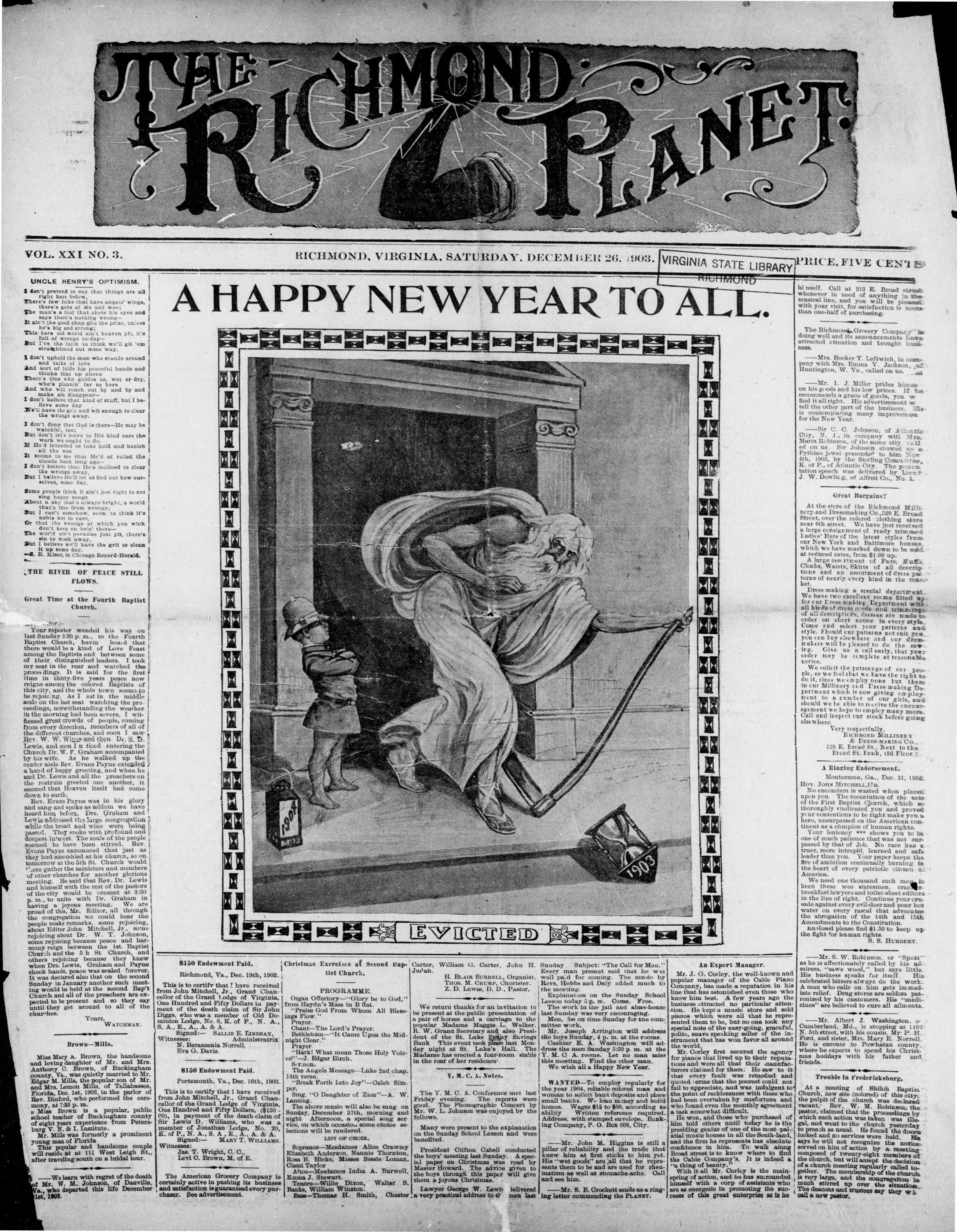
A HAPPY NEW YEAR TO ALL.
```markdown
```
1904
1903
$150 Endowment Paid.
Richmond, Va., Dec. 19th, 1903.
This is to certify that I have received from John Mitchell, Jr., Grand Chancellor of the Grand Lodge of Virginia, One Hundred and Fifty Dollars in payment of the death claim of Sir John Diggs, who was a member of Old Dominion Lodge, No. 8, K of P., N. A., S. A. E., A., A. & A.
Signed:— SALLIE E. LINDSAY,
Witnesses: Administratrix
N. Beransenia Norrell,
Eva G. Davis.
8150 Endowment Paid.
Portsmouth, Va., Dec. 16th, 1903
This is to certify that I have received from John Mitehall, Jr., Grand Chancellor of the Grand Lodge of Virginia, One Hundred and Fifty Dollars, ($150 - 90) in payment of the death claim of Sir Lewis D. Williams, who was a member of Jonathan Lodge, No. 20, K. of P., N. A, S. A. E., A., A. & A. Signed:— MARY T. WILLIAMS. Witnesses: Jas. T. Wright, C. C., Levi C. Brown, M. of E.
The American Grocery Company is certainly active in pushing its business and satisfaction is guaranteed every purchaser. See advertisement.
RICHMOND, VIRGINIA, SATURDAY, DECEMBER 26. 1903.
Christmas Exercises at Second Baptist Church.
PROGRAMME
Organ Offertory—"Glorify be to God," from Haydn's Mass in B flat.
"Praise God From Whom All Blessings Flow." Prayer. Chant—The Lord's Prayer.
Bethlehem—"It Came Upon the Midnight Clear."
Prayer
"Hark! What mean Those Holy Voices?"-J. Edgar Birch.
Sing, "O Daughter of Zion"—A. W. Lansing.
The above music will also be sung on Sunday, December 27th, morning and night. Afternoon, a special song service, on which occasion some choice selections will be rendered.
LIST OF CHOIR.
Sopranos—Mesdames Alice Crawley
Elizabeth Anderson, Nannie Thornton,
Rosa B. Hicks, Misses Bessie Lomax,
Cliami Taylor
Altos—Mesdames India A. Burwell,
Erna J. Stewart
Carter, William G. Carter, John H. Judah.
H. BLAIR BURRELL, Organist,
THOS. M. CRUMP, Chorister.
Z. D. LEWIS, D. D., Pastor.
We return thanks for an invitation to be present at the public presentation of a pair of horses and a carriage to the popular Madame Maggie L. Walker.
R. W. Grand Secretary and also President of the St. Joseph Savings Bank. This event took place last Monday night at St. Luke's Hall. The Madame has erected a four-room stable in the rear of her residence:
The Y. M. C. A. Conference met last Friday evening. The reports were good. The Phonographic Concert by Mr. W. L. Johnson was enjoyed by the fellows.
Many were present to the explanation on the Sunday School Lesson and were benefited.
President Clifton Cabell conducted the boys' meeting last Sunday. A special paper on Christmas was read by Master Howard. The advice given to the boys through this paper will give them a joyous Christmas.
Lawyer George W. Lewis delivered a very practical address to th' men last
Sunday. Subject: "The Call for Men." Every man present said that he was well paid for coming. The music by Revs. Hobbs and Daly added much to the meeting. Explanation on the Sunday School Lesson today 5 p. m. Come. Free. The work in the jail and alms-house last Sunday was very encouraging. Men, be on time Sunday for the committee work. Mr. Joseph Arrington will address the boys Sunday, 4 p. m. at the rooms. Cashier E. A. Washington will address the men Sunday 5:30 p. m. at the Y. M. C. A. rooms. Let no man miss this meeting. Find the other man.
---
WANTED—To employ regularly for the year 1904, reliable colored man and woman to solicit bank deposits and place small banks. We loan money and build homes. Wages $15 to $50, according to ability. Written reference required. Address, with stamped envelope, Banking Company, P. O. Box 608, City.
Mr. John M. Higgins is still a pillar of reliability and the trade that knew him at first sticks to him yet. His "wet goods" are all that he represents them to be and are used for rheumatism as well as stomache-ache. Call and see him.
Mr. S. B. Crockett sends us a ringing letter commending the PLANET.
```markdown
```
An Expert Manager.
Mr. J. G. Corley, the well-known and popular manager of the Cable Piano Company, has made a reputation in his line that has astonished even those who know him best. A few years ago the business attracted no particular attention. He kept a music store and sold pianos which were all that he represented them to be, but no one took any special note of the easy-going, graceful, polite, suave speaking seller of the instrument that has won favor all around the world.
Mr. Corley first secured the agency for pianos that lived up to their reputations and were all that their manufacturers claimed for them. He saw to it that every fault was remedied and quoted terms that the poorest could not fail to appreciate, and was indulgent to the point of recklessness with those who had been overtaken by misfortune and who found even the monthly agreement a task somewhat difficult.
He won, and those who purchased of him told others until today he is the presiding genius of one of the most palatial music houses in all the South-land, and the firm he represents has absolute confidence in him. To walk along Broad street is to know where to find the Cable Company's. It is indeed a "a thing of beauty." With it all Mr. Corlley is the mainspring of action, and he has surrounded himself with a corp of assistants who are as energetic in promoting the success of this great enterprise as is he
himself. Call at 213 E. Broad street whenever in need of anything in the musical line, and you will be pleased with your visit, for satisfaction is more than one-half of purchasing.
The Richmond Grocery Company is doing well and its announcements have attracted attention and brought business.
Mrs. Booker T. Leftwich, in company with Mrs. Emma V. Jackson, of Huntington, W. Va., called on us.
Mr. L. J. Miller prides himself on his goods and his low prices. If he recommends a grade of goods, you will find it all right. His advertisement will tell the other part of the business. He is contemplating many improvements for the New Year.
—Sir C. C. Johnson, of Atlantic City, N. J., in company with Mrs. Maria Robinson, of the same city, called on us. Sir Johnson showed us a Python jewel presenced to him Now. He was the Sterling Committee, K. of P., of Atlantic City, presenting speech was delivered by J. W. Dowling, of Alfred Co. No. 4.
Great Bargains?
At the store of the Richmond Millinery and Dressmaking Co., 528 E. Broad Street, over the colored clothing store near 6th street. We have just received a large consignment of ready trimmed Ladies' Hats of the latest styles from our New York and Baltimore houses, which we have marked down to be sold at reduced rates, from $1.00 up.
A large assortment of Fuse, Muki Cloaks, Waists, Skirts of all descriptions and an assortment of dress patterns of nearly every kind in the market.
Dress-making a special department. We have two excellent rooms fitted up for dress making Department with all kinds of dress goods and trimming of all descriptors, dresses are made to order on short notice in every style. Come and select your patterns and style. Should our patterns not suit you you can buy elsewhere and on dressmakers will be pleased to do the sewing. Give us a call early, that your order may be complete at reasonable notice.
We solicit the patronage of our people, as we feel that we have the right to do it, since we employ none but them in cut Millinery and Press-making Department which is now giving employment to a number of our girls, and should we be able to receive the encouragement we hope to employ many more. Call and inspect our stock before going elsewhere.
Very respectfully
RICHMOND MILLINERY
& DRESS-MARING CO.
528 E. Broad St., Next to the
Broad St. Fank, 92d Floor.
A Ringing Endorsement.
Montezuma, Ga., Dec. 21, 1908
HON. JOHN MITCHELL, 41R.
No cominium is wasted when placed upon you. The recitation of the acts of the First Baptist Church, which so thoroughly vindicated you and proved your contentions to be right make you a hero, unsurpassed on the American continent as a champion of human rights.
Your lenency *** shows you to be one of much patience that was not unpassed by that of Job. No race has a truer, more intrepid, learned and safe leader than you. Your paper keeps the fire of ambition continually burning in the heart of every patriotic citizen of America.
We need one thousand such men to keep these wee statesmen, cracer-breakfast lawyers and toilet-sheet editors in the line of right. Continue your cruse against every evil-deer and pour hot water on every rascal that advocates the abrogation of the 14th and 16th Amendments to the Constitution.
Enclosed please find $1.50 to keep up the fight for human rights.
S. S. HUMER
10 10
—Mr. S. W. Robinson, or "Spoff" as he affectionally called by his admirers, "saws wood," but says little. His business speaks for itself. His celebrated bitters always do the work. A man who calls on him gets immed-员ized by his customers. His "medicines" are believed to cure all ailments.
---
—Mr. Albert J. Washington, or Cumberland, Md., is stopping at 1105 N.5th street, with his cousin, Mr. P. H. Ford, and sister, Mrs. Mary E. Norrell. He is enroute to Powhatan county, where he expects to spend his Christmas holidays with his father and friends.
Trouble in Fredericksburg
At a meeting of Shiloh Baptist Church, new site (colored) of this city, the pulpit of the church was declared vacant, Rev. W. M. Robinson, the pastor, claimed that the proceedings by which such action was taken was illegal, and went to the church yesterday to preach as usual. He found the doctors locked and no services were held. He says he will not recognize the notice composed him of action by a meeting composed twenty-eight members of the church, but will accept the decision of a church meeting regularly called together. The membership of the church is very large, and the congregation in much stirred up over the situation. The deacons and trustees say they will call a new pastor.
HE PLANET
SATURD... DLCEMBER 26, 1908
MAN HAS PIG'S SKIN.
Virginia Surgeon Grafts Over Two Hundred Inches of Porker's Cuticle on Patient.
Dr. Hamilton Browning, teacher of clinical surgery in the University of Virginia hospital, has succeeded in grafting the skin of a two-months-old pig upon a large surface of one of the patients under his charge.
As a general rule, grafting is made by taking the skin from the body of the person upon whom the graft is to be made, or from the bodies of the generous persons who are not afraid of a little pain. Dr. Bornning, however, would use neither of these methods, as the surface to be grafted covered 225 square inches of area on the thigh of the young man patient, who had been injured in a railway accident.
Two weeks elapsed before the wound was ready for the operation. The
THE PIG WAS SHAVED.
treatment to which the pig was subjected was thorough, if no more. First the animal was shaved and washed with warm water and green soap. Then it was rewashed in the same way, and a thick coat of green soap was allowed to remain upon it for four hours. Next it was given another thorough scrubbing with green soap and alcohol. After this its body was inclosed with a strong chloride of mercury poultice, which was left on for ten hours.
On the day the grafting began the pig was chloroformed and thin shavings of skin were taken from it and gently pressed upon the patient's wound by a nurse. The whole operation required several days, but the result was perfect. Within a few months the young man had a whole skin, had passed a rigid examination for life insurance, and had resumed his work.
MONKEY SCRUB LADY.
Animal in Philadelphia Park Becomes Proficient in Handling Soap and Brush.
"Monkeys, like men, should learn to work," says Keeper McCrossin, of the Philadelphia zoological gardens. He has taught one of his charges to overcome her distaste for soap and water and to wield a scrub brush with skill. Every day the monkey goes carefully over the inside of its cage, scrubbing floor and ceiling, back wall and iron bars, as carefully as it could be done with human hands.
McCrossin saw the monkey imitating him in his scrubbing operations. Tightly clutching a paper bag, she rubbed it over one rolling after another, evincing great enjoyment. Then McCrossin gave
ALL READY FOR WORK.
her a big wash cloth and instructed her
how to wet it in a pail of water.
It was long before she understood what soap was for, and even yet she occasionally takes a bite out of a cake, to make sure it is not something to eat. "I intend to teach the other animals to scrub their cages, if possible," said McCrossin. "All the monkeys in the cage take great interest in the scrubbing operations, but the trained animal will not allow them to touch, the brush, soap or pail of water. At first she attempted to scrub one or two of her brothers, but it precipitated such a fight that she dared not repeat it."
**presents.**
"Is a cord of wood much
"Well, my son, it is
whether you are burnt
ping it."—Yonkers Sta'
UNHAPPY
HQMES
Caused By
Weakness in Men
A Michigan Specialist Finds an Easy Way to Cure Any Case of Sexual Weakness Even in the Oldest Men, This Wonderful Cure Has a Most Marvelous Record of Successes.
SENT FREE TO ALL WHO
There are thousands of cheerless homes in this country filled with discontent and unhappiness, lack in love and companionship through the sexual weakness and physical impairment of a condition whose years do not justify such a condition, numerous abuses, and recklessness often caused by the cessation of vital power that instantly yields to the wonderful treatment discovered by the great specialist, Dr. H. C. Raynor, of Detroit, Michigan. It has remained for this great physician to discover that sexual we kness and similar troubles can be cured and in a remarkable short space of time. This treatment does not ruin the stomach, adding the miseries such injury entails, but it is a new treatment that easily and quickly restores youthful vigor to
The discovery is beyond doubt the most scientific and comprehensive that our attention has ever been called to. From all sides we hear private reports of cures in stubborn cases of sexual weakness, enlargement of the prostate, variocelle, spermatorrhoea, lost manhood, im potency, emissions, prematurity, shrunken organs, lack of virile power, bashfulness and timidity and like unnatural conditions. It does this without appliances, vacuum pumps, electric belts or anything of that kind.
Satisfactory results are produced in a day's use and a perfect cure in a short time, regardless of age or the cause of. The lucky discoverer simply desires to get in touch with all men who can make of such a treatment. They should address him in confidence, Dr. H. C. Rayn, 173 Luck Building, Detroit, Mich, and immediately receipt of your name and address it is his agreement with this paper to send a free receipt or formula of this modern treatment by which you can cure yourself at home.
Very Drunk.
Magistrate—How do you know this gentleman was drunk when you arrested him?
Policeman—He was talking about his wife, and he said she didn't care what sort of 'dresses she had so iong as she was comfortable, and she didn't get mad about the furniture when the neighbors had better, and she didn't care for a fine house, and didn't want a carriage, and she would rather do her own housework than bother with servants—N. Y. Weekly.
A Glorious Victory
Mrs. DeStyle—I've got ahead of Mrs. DeFashion at last.
Husband—How?
Mrs. DeStyle—At Mrs. DeFashion's last party, two of the guests fainted; but at my grand reception last night the crush was so great six of the ladies had to be carried out and one had to have a doctor—N. Y. Weekly
She Declides for Him
Jobberwok—Your friend Meekerton appears to be a man of very decided views.
Dinglebatz—Yes, did you ever meet his wife?
Jobberwok—No. I believe not.
Dinglebatz—Well, when you do you will understand why he has them.—Cincinnati Enquirer.
Annoying.
Layzee—My wife isn't exactly an anarchist, but she annoyed me this morning with one of her incendiary speeches.
Jenks—You don't say so?
Layzee—Yes, she said: "Henry, get up this minute and make the fire."—Philadelphia Ledger.
His Opinion
"Do you believe that every man has his price."
"I won't discuss that." answered Senator Sorghum; "but I will say that the reason some men stay honest is because the price asked is so much higher than the price bid."—Washington Star
He Needs Best
"You should speak when you're spoken to, my son."
"Yes, pop, but I can't be talking al-
ways."
"No, of course not."
"Well, ma' is speaking to me nearly all the time." -Yonkers Statesman
Family History
"Both of my grandparents on my mother's side were nonogenarians" said Mrs. Oldcastle. "Is that so?" replied her "My folks was all Baptists, bostess comes from a Methodist fraternity" Josiah cage Record-Herald. —olly—Chi
Farew
cert? You know this a farewell con-
the singer will. The chances are that
"Yes, but this is as usual."
a seat such as give on the purchaser of to say farey,ell to amenable opportunity fington Starp. his money." Wash-
eyes, which possess more than two leech, for do not act together. top of it example, has ten eyes on the concert bead which do not work in two and a kind of marine worm has each eyes on the head and a row down of the body. Some leeches
two. A bee or wasp has two large compound eyes which possibly help each other, and are used for near vision, and also three little simple eyes on the top of the head which are employed for seeing things a long way off.
Sleepless Repose.
Brownovitch—My wife says I talk in my sleep.
THE RICHMOND PLANET, RICHMOND, VIRGINIA.
IT CAN'T BE EXCELLED
Your Patronage is Invited.
1221 St. James Street.
When you want nice dry, sawed pine wood, call up 2883. We sell ½ cord for $2.75, guaranteed full measure.
A full line of fancy and staple groceries and fresh meats. Granulated sugar 4¾ per lb. Prices low on everything this week. Hard and soft coal. Hay and Grain.
FRANK WALLER, JR
PRACTICAL HOUSE
914 N. St. James St., Richmond, Va.
Residence, 1 E. Orange St.
Prompt attention given to all mail
orders. Satisfaction guaranteed
All Kinds of Painting Done Cheap
Give me a call before going elsewhere
Hello! Call Phone No. 4432.
NO. 430 N. 6TH STREET.
And order your high grade goods
AT LOW PRICES.
POLITE ATTENTION,
Prompt and free delivery to any part
of the City or Manchester.
E. F. LIGHTFOOT, and
6mo R. D. GRANDERSON, Agts
WHY WORRY over your dreams or
enemies when our book will give
you the interpretation to any
dream, also a charm to protect you from
danger! If you are in trouble or want
to find anything out it will tell you ex-
actly what to do. It also contains the
Hindoo secret of love, how to manage,
what to say and do to gain the love,
heart and hand. Sent postpaid to any
address for 18c in stamps. PRUNTY &
Co., 123 Roy St., Braddock, Pa.
Wanted—TRUSTWORTHY LADY or Gentleman to manage business in this County and adjoining territory for house of solid financial standing. $20.00 straight cash salary and expenses paid each Monday direct from headquarters. Expense money advanced; position permanent. Address, Manager, 605 Monon Bldg., Chicago. 11-21-08t01-9-04
THE
FRISCO
SYSTEM
Carrying Pullman Sleepers. Cafe Co.
(a la carte) and Chair Cars (seats are
Electric Lighted Throughov
BETWEEN
Birmingham, Memphis and Kansas
AND TO ALL POINTS IN
Texas, Oklahoma and New
Texas, Oklahoma and Indian Territory
THE ONLY THROUGH SLEEPING CAR
BETWEEN THE SOUTHEAST AND
KANSAS CITY
Descriptive literature, tickets
ranged and through reservations
upon application to
W. T. SAUNDERS, GEN'L AGT. AGR. DE
OR
F. E. CLARK, TRAV. PASS. AGT. ATLANTA.
W. T. SAUNDERS
Gen'l Agent Pass. Anger Department
ATLANTA. TA. GA.
YOUR LIFE READ FROM THE CRADLE TO THE GRAVE
For the benefit of those who wish to have their life read by the world's greatest life reader, one that can tell you all that you wish to know, give you luck, change your life from evil to good, remit the separated, restore a lost love, draw to you your sweetheart, husband or wife, make people do as you wish them
Now you want to find out what your future life will be and what your past has been, and want to have it changed from evil to good, send at once to this wonderful medium.
Send lock of hair, date of your birth and 25 cents in silver, and receive your life from cradle to grave. Do not send postage to Mrs. Dr. WHITE, to Mrs. Dr. WHITE.
1917 E. Pratt St. Baltimore, Md.
The Watch-word should be, "YOUR OWN FIRST, LAST AND ALL TIMES."
We carry a full line of Overcoats for men, youths and children from $2 up to $15. SUITS, from $1.00 up to $18.00. SHOES, from $1.00 up to $4.00. HATS, from 25cts. up to $4.50. UNDERWEAR of all descriptions for men and women, both wool, cotton and mixed. Special discount allowed to Ministers and Students. Don't make a mistake in the place. The only one of the kind in Richmond. Country Orders Solicited and Goods promptly shipped to any part of the state.
New Enterprise,
Southern Aid Society
HOME OFFICE -- 504 N. 2nd St. Richmond, Va.
One of the strongest and promptest paying Sick Benefit Insurance Companies in the State. You cannot afford to be out of it and should not hesitate to join when our agents call on you.
HONESTY THE BEST POLICY IS "OUR MOTTO'
OFFICERS AND BOARD:
A. WASHINGTON, PRESIDENT; EDWARD STEWARD, VICE-PRESIDENT;
WALTER E. BAKER, TREASURER;
B. L. JORDAN,
REV. SIDNEY B. STANTON,
HENRY B. BURWELL
JAMES T. CARTER,
A. D. PRICE.
THOS. M. ORUMP, SECRETARY & GENERAL MANAGER.
W. I. JOHNSON. FUNERAL DIRECTOR AND EMBALMER.
Office & Warerooms, 207 N. Foushee St. Corner Broad HACKS FOR HIRE:
Orders by Telephone or Telegraph filled. Wedding, Suppers and Entertainments promptly attended.
Old 'Phone, 686. Residence in Building, New Phone, 48.
Mechanics'
Savings Bank
OF RICHMOND, VA
— 511 North Third Street.
Capital, $25,000.
Mechanics'
Savings Bank
OF RICHMOND, VA
511 North Third Street.
Capital, $25,000.
Money received on deposit and interest paid on a amounts above $1.00 which remains 60 days and over.
Money Loaned on Satisfactory Security.
Business Accounts Handled Promptly.
Amounts of ten cents and upwards received on deposit.
This establishment is fitted up in the most improved style, having a large white vault, burlar-proof steel chest, electric lights and every modern convenience for safety and the accommodation of the public.
For all information concerning Stocks, Deposits, Loans, etc., apply to the Cashier.
Banking Hours have been arranged for the special convenience of the working people as follows: 9 A. M. to 4 P. M. Saturdays, 9 A. M. to 3 P. We close Saturday at 3 P. M. and open again at 5 P. M., remaining open :til 7 P. M. Call by as you come from work.
OFFICERS:
JOHN MITCHELL, JR., President. H. F. JONATHAN, Vice-President. THOS. H. WYATT, Cashier.
WILLIAM CUSTALO, J. J. CARTER,
THOMAS M. CRUMP, SGC.
DENTISTRY
X X
PAINLESS EXTRACTION For beautiful Teeth, Comfort, Pleasure and Health.
OFFICE HOURS:—From 8 A. M. to 6 P.
M. Old Phone, 816.
DR. P. B. RAMSEY,
102 W. Leigh St., Richmond, Va
Fred G. Gray,
THE STOVE MAN.
You can have all kinds of Stoves Re paired and put up. Also your Roofs Gutters, Conductors Repaired and Painted at a reasonable price. Your patronage will be highly appreciated. old Phone, 2807 FRED G. GRAY, Richmond, Va
HUNDLEY,
I. J. MILLER, Prop.
Quality Furniture
Out of Town Orders Solicited and will
Receive Provision and Careful
Attention
Family Wine, Liquor and Cigar Store
422 East Broad Street, Richmond, Va.
We make a specialty of, Mt. Verne
Clifford, Old Jasper, Pennbrook
Rye, Wilson, Old Henry,
Old North Carolina Corn Whiskey
and Mountain Apple Brandy.
PARLOR SUITS.
We have some twenty-five or thirty suits bought, most of which will be in stock in a few days. "Don't do a thing" until you see this line.
BEST AND MOST POPULAR
BRANDS OF CIGARS.
Goods Delivered Free to all
Parts of the City. BUFFETIN REAR.
PHONE 2234.
MORRIS CHAIRS.
This always popular chair of rest will be in as much demand this fall as ever. Part of our stock has already arrived and $10 values vie with $15 values of a year ago. Call, see our stock of Bed Room Furniture and save time and money. Passenger elevators
Hotel Lawson,
406 Cor. Monroe & Gay Sts.
DANVILLE, VIRGINIA.
OPEN AT ALL HOURS.
The only colored Hotel in the city.
Visitors will find this the place to rest well and enjoy a good repast. Meals—28cts and served at regular hours on reasonable notice.
Sydnor & Hundley,
9-11-18 E. Broad St.
MISS O. E. JONES, Proprietress
O. J. LAWSON, Gen. Manager
deo12-18iP
George H.
Wood and Coal, Cigar
AT THE LOWEST
YOU CAN SAVE MONEY
ALL GOODS DELIVER
TELEPHONE
A. C. BOOKE
501 WEBSTER S
PHONE 577.
A. D. I
THE FUNERAL DIRECTOR,
All orders promptly filled at short
rented for meetings and nice entertainment
conveniences. Large picnic or band w
ing but first-class carriages, buggies, etc.
Supplies.
212 EAST L
Coal, Cigars and Tobacco.
THE LOWEST MARKET PRICES.
SAVE MONEY BY GIVING ME A CALL.
GOODS DELIVERED TO YOU FREE.
ELEPHONE 1307
BOOKER, Prop.
1 WEBSTER ST., RICHMOND, VA.
E 577. RICHMOND, VA.
A. D. PRICE,
RAL DIRECTOR, EMBALMER AND LIVERYMAN.
promptly filled at short notice by telegraph or telephone. Halliings and nice entertainments. Plenty of room with all necessary Large picnic or band wagons for hire at reasonable rates and notices carriages, buggies, etc. Keeps constantly on hand fine Funera.
12 EAST LEIGH STREET.
Wood and Coal, Cigars and Tobacco. AT THE LOWEST MARKET PRICES. YOU CAN SAVE MONEY BY GIVING ME A CALL.
All orders promptly filled at short notice by telegraph or telephone. Halle rented for meetings and nice entertainments. Plenty of room with all necessary conveniences. Large picnic or band wagons for hire at reasonable rates and notation first-class carriages, buggies, etc. Keeps constantly on hand fine Funera) supplies.
[Residence Next Door.]
L DAY & NIGHT--Man on Duty All Nights
KNIGHTS OF COLUMBUS OF THE WORLD
OPEN ALL DAY & NIGHT--Man on Duty All Night
KNICHTS OF COLUMBUS OF THE WORLD
TO WHOM IT MAY CONCERN:
This organization has been chartered and legally
situated under the laws and statute of the state of New
York, for the purpose of uniting together all acceptable
men on the Broad Bases of Charity - Beneficial and
to promote the Social and Moral condition of humanity
direct military and uniform ranks will secure for this organization
ent ranks in all sacred institutions of modern events, a grand oppo-
men. Deputies wanted in all sections of the country to organize
Kindly address,
This organization has been chartered and legally
stituted under the laws and statute of the state of New
York, for the purpose of uniting together all acceptable
men on the Broad Bases of Charity—Beneficial and
Fraternal and to promote the Social and Moral condition of humanity
It is two distinct military and uniform ranks will secure for this organization
place on the front ranks at all sacred institutions of modern events a grand opportu
tuit, for active men. Deputies wanted in all sections of the country to organize
lodge.
G. W. ALLEN Supreme voyager.
846 W 87th Street, New York City.
New Entr
New Stock.
AN APPEAL to the People
Virginia to call and examine
Shoes and Gents' Furnishi
elsewhere, as we are the only
We carry a well selected line
dies and Children. We kn
prices and quality. An incre
crease of clerks.
If there is any Negro Probe
it is to build up and patronize
oe, "YOUR OWN FIRST,
of Overcoats for men, youths
.00. SHOES, from $1.00 up
R of all descriptions for men a
allowed to Ministers and Stud
of the kind in Richmond.
my part of the state.
New Enterp
528
GIFTS OF FU
are becoming more pupu
It's a wiser plan to BUY
set aside. The diversity
number of exclusive des
HIGH GRA
make our store particula
New Enterprise !!
New Stock. New Prices.
AL to the People of Richmond and the State of call and examine our Stock of Clothing, Hats, Gents' Furnishings before making purchases as we are the only Colored Clothiers in the state. We well selected line of goods for Gentlemen, Laidchildren. We know we can please you both in quality. An increase of business means an inkerks. Any Negro Problem to solve, the only way to do up and patronize colored enterprises.
OWN FIRST, LAST AND ALL TIMES."
for men, youths and children from $2 up to $15. S, from $1.00 up to $4.00. HATS, from 25cts. Scriptions for men and women, both wool, cotton Ministers and Students. Don't make a mistake in Richmond. Country Orders Solicited and the state.
enterprise,
New Enterprise !!
New Stock. New Prices. AN APPEAL to the People of Richmond and the State of Virginia to call and examine our Stock of Clothing, Hats, Shoes and Gents' Funnishings before making purchases elsewhere, as we are the only Colored Clothiers in the state. We carry a well selected line of goods for Gentlemen, Ladies and Children. We know we can please you both in prices and quality. An increase of business means an increase of clerks.
If there is any Negro Problem to solve, the only way to do it is to build up and patronize colored enterprises.
GIFTS OF FURNITURE
coming more pupular each succeeding year.
wiser plan to BUY NOW and have the goods
made. The diversity of our stock and the large
er of exclusive designs in
HIGH GRADE GOODS
our store particularly interesting to gift buyers.
are becoming more pupular each succeeding year. It's a wiser plan to BUY NOW and have the goods set aside. The diversity of our stock and the large number of exclusive designs in
CREDIT AND TERMS TO SUIT
PETTIT & CO
Corner Foushee and Broad Streets.
ETTIT & CO.,
Corner Foushee and Broad Streets.
Corner Foushee and Broad Streets.
TOMB OF THE MARY OF THE
WESTERN WESTERN WESTERN
Booker's Market
501 Webster St. A FULL LINE OF FINE GROCERIES AND FRESH MEATS & VEGETABLES
V. P. & F. K. of W.
528 E. Broad St., Richmond, Va.
SCOUNDRELS & CO.
By COULSON HERNAHAN
Author of "Captain Shannon," "A Book of Strange Sins," "A Dead Man's Diary," Etc.
CHAPTER III.
I FIGHT FOR MY LIFE.
"You've made a mess of it, Marten, haven't you?" said a voice behind me, and, turning, I saw framed in the doorway a tall, clean-shaven man. He was holding the very brown bag which had been handed to him in my presence only an hour ago, but had he been without it I should have known that he was the newly appointed councillor.
One surprise had succeeded another so rapidly on this eventful evening that I was less taken aback than might have been expected. And now that I knew how unscrupulous was the man I was dealing with, and what was the errand that brought him there, I realized at once that, naked and unarmed as I was, I should have to play my cards very carefully if I was to get out of the business alive. My only chance lay, so it seemed to me, in keeping up the role that had been thrust upon me. So when the new arrival said, "You've made a mess of it, Marten, haven't you?" I replied as naturally as if I had answered to the name Marten all my life.
"Yes," I said wearily, "I suppose, as you say. I've made a mess of it. But, since you seem to know me, I call you to witness that I laid no finger on the man."
"Well," said Number Seven, "all I know of the business is, that I had only just set foot on the yacht's deck when some one screeched out in the cabin. I hurried down as fast as I could, but was only in time to see our friend here throw up his arms and fall back. I'll stand by you if anything comes of it, however, and will swear that you didn't lay hands on him. But I know why he seat for you to come here to-night, and what it was he meant telling you, so before we go any farther I'd like to know how much he has told you and how much he hasn't. You needn't be afraid to speak out, for I was in his confidence; besides, I know as much of the matter as he did, and can very likely put you right on a point or two."
The fellow's motives in trying to wheedle me into telling him what had passed between the dead man and myself were not difficult to diagnose. He knew that Inspector Marten had promised to visit the yacht that night, and, finding me there, he had not unnaturally concluded that I was the wily inspector, and that I had in some way contrived to outwit the scoundrels who had been so confident of their ability to prevent the visit from taking place. If Councillor Number Seven could satisfy himself that no communication had been made to me by the dean man, he would not trouble himself greatly about my movements; but if, on the contrary, he had reason to believe that I had been made acquainted with the facts concerning the syndicate, he would at once decide that I must not leave the yacht alive. The villain had come there prepared to murder, and he was not likely to stick at a trifle when his neck and the necks of his fellow-conspirators were in danger.
"Oh," I said, "there isn't much to tell. I had only just arrived here a few minutes, and our friend there had told me nothing of the business about which he had summoned me. I swam out to the yacht, as you see, instead of coming in a boat."
"Why did you do that?" interrupted Councillor Number Seven, sharply.
"Why did I do that?" I repeated after him, so that I might have a moment or two's grace in which to frame some plausible explanation. "Why? Oh! only because I thought I could slip away from the shore unnoticed if I swam, whereas if I hired a boat I might attract attention."
It was an indiscreet answer, for my companion evidently interpreted it as meaning that I was not altogether unaware of the fact that steps were to have been taken by the syndicate to prevent Inspector Marten from paying his promised visit.
"But why should you suppose you were being watched at Soutend?" he answered, suspiciously.
"I didn't suppose," I answered; "I only wanted to guard against observation. But, as I was saying when you interrupted me, I swam out instead of rowing, and, being a bit cold after the long swim, I asked our host there to give me a drink before we got to business. He gave me one and was going to help himself, when suddenly, without a word of warning, he jumped up as if to make a murderous attack upon me, and then fell dead, as you saw, killed by his own fury. However, there it is, and it can't be helped; so now I think I will bid you good-night and get ashore."
"Not without a drink, at all events," said the councillor, with a singularly mirthless smile. "This is really a most unfortunate and unhappy affair, although I'm not a bit surprised at the sequel, for I've warned our friend there not once, but a dozen times, that his passion would cost him his life one day. But he was a hospitable man, and, as his friend, I stand in the place of host to you; so you must allow me to do the honors."
For all his protested politeness there was a look in his eyes as he spoke which convinced me that he meant to do me a mischief. If he believed that I was in possession of no dangerous information, he would surely have let me go about my business unmolested; but his pressing me to drink foreboded no good, and when I thought of the India-rubber ball I wished heartily that I were safe on shore again. The honest truth is that the strain to which I had been subjected was beginning to tell upon me and that my nerve was falling. I was possessed with a great desire to be done with the whole business and out in the open, so with a civil "Thank you; I won't take any more whisky to-night." I made a move to
wards the door.
He stepped forward hastily to inter-
cept me and we stood for a moment al-
most breast to breast, each looking the other in the face with eyes of menace.
"Will you allow me to pass, please?"
I said, with freezing politeness.
"Not till I have satisfied myself about your share in this business," he protested with equal determination, pointing as he spoke to the corpse, and advancing one leg, as if to plant that limb more securely, and thus more effectively to bar the way. In so doing he set his heavy heel right upon my naked foot, and with such force that the scar is there to this day.
Screaming with pain and maddened beyond endurance, I struck out at him with my clenched fist, catching him fairly between the eyes, and with such force that the back of his head cannoned against the door with a bang that set all the crockery on board rattling like a house-wife's china closet after an earthquake shock.
To say the "fur flew" during the next half minute would be—in view of my unclothed condition—an inaccurate metaphor; but all I know is that I was for that space of time as uncertain which of me was I and which of me was he, as if the pair of us had been a ball of string in the claws of a kitten. For one moment we untangled ourselves, so to speak, to get breath; and I well remember with what joy I caught sight of the livid, ugly jump between his eyes where I had struck him. The next instant we were at it again, rolling over and upon the floor like wild cats and striving each to throttle the life out of the other. No one who has not fought for his life stark naked, as I did then, would believe how much I was handicapped by the absence of clothing. There is not much protection, one would think, in coat, waistcoat and trousers; yet without them I felt as a mediaeval warrior might without his armour. The very buttons on my enemy's clothing fought for him. They were like so many claws that scored and scratched my skin; and when, while we struggling, he got the upper berth, and knelt over me, with his knee pressed against my breastbone, I felt as if the chest of我 was scarce stronger than a cardboard box. I was well-nigh gone that time, if he reached over and got such a vise-like grip upon my throat that my eyes stood out on their stalk, and my knee could have been more slippery to hold in I. Straining every sinew in my body in one supreme effort, I managed to roll him off, and upon his back, and wriggling from his grasp, I sprang to my feet on the look-out for a weapon. He caught at my legs to throw me, but snatching up the heavy whisky decanter by the neck, I whirled it aloft, and dealt him a blow behind the ear that put an end both to him and to the fight. At first I thought he was only stunned, but when I found that his heart had indeed ceased to beat (and small wonder, for I had hit him with terrific force, and upon a vulnerable spot), I stripped him, and, opening the brown bag, took out the weighted chain with which he had meant to sink the body of his victim. Then I lashed the pair of them—the man who was to have been murdered and the man who was to have murdered him—together, and, passing the chain around the ankles of both, I made it fast and dragged my double and ghastly burden upon deck, where I toppled it over into the water.
"And now," I said, "I'll dress myself in the clothes of my late antagonist and go ashore in the dinghy, taking with me the bag containing his disguse. In the pocket of his coat is a paper telling where and when the next meeting of the Syndicate of Scoundrels takes place. What's to hinder me from going there instead of him? He's my height, figure and complexion, and, dressed in his clothes and wearing the disguse which has been provided for him, there's no reason why anyone should suspect I am not he, especially as I know enough of his affairs to give a very good account of myself and of to-night's work. Anyhow, danger or no danger, discovery or no discovery, when the next meeting of the Syndicate of Scoundrels takes place I shall be there."
CHAPTER IV.
MY REASON FOR DECIDING TO PERSONATE THE DEAD COUNCILLOR.
Before relating the adventures which befell me on the occasion of my personating the dead councillor at the meeting of the syndicate, I ought, perhaps, to state the reasons which led me to decide to be present.
Those who have done me the honor of following my narrative thus far may not, unnaturally conclude that I am a professional detective. In that, however, they will be mistaken. I do not know that I am a professional anything, unless it be a professional failure. Being possessed of some private means, I am in the fortunate position of being able to choose my occupation, and, as a matter of fact, I have, as they say in America, "sampled" several professions. As an Irishman, not, I hope, without an Irishman's versatility, I found something to interest me in each. But my dislike to what is called "shop" made it difficult for me to settle down definitely to any one pursuit.
The moody, run-in-a-circle "shop" chatter of the second-rate musician, who shambles yearnful and morose at your side; the insistent, assertive "shop" jabber of third-rate actors who stalk the Strand, their hard, lined faces and bold eyes proclaiming them members of the "profession," as they arrogantly style their art; the inconspicu
THE RICHMOND PLANET, RICHMOND, VIRGINIA
quent cackle of literary "at homes;" or the shamelessness of the self-advertising scribbler, touting, bagmanlike, for reviews—all this I found and find insufferable. But, taking one thing with another—and since some amount of "shop" there appears to be in every profession—it seems to me that the craft of letters has, or should have, a tolerably wide "look-out." The "shop" of literature is, or ought to be, the world. It is because life is more fascinating than literature, that literature is so fascinating a profession. The man of letters is before all things a student of life. Hence he is never without resource, for all life interests him. He never loses the sense of wonder. He can fold his hands devoutly, and with bowed head repeat after Robert Louis Stevenson that General Thanksgiving that breathes a more childlike spirit of true and joyous gratitude to the God and Giver of all than any Doxology:
"The world is so full of a number of things
I think we should all be as happy as kings."
I had drifted into, rather than seriously adopted, the profession of authorship, but I was at all times ready to lay aside my pen for any enterprise that promised adventure; and here was adventure ready to hand, and calling for me to make the most of what it afforded. To play the spy upon such scoundrels, to "confound their knavish tricks," and to be the means ultimately of bringing them to justice, offered sport in plenty for my money, and would, moreover, give me an opportunity of putting to the test a long-cherishe' theory of mine. This theory is that a story-writer who has attained some proficiency in his art is in possession of several of the qualities that go to make a good detective. That I shall be accused by some persons of talking the very "shop" which I profess to dislike is quite possible, but I submit that .o discuss the principles of the novelist's art is very different from discussing the price per thousand words and the personality of the artist.
I contend that the qualities of mind which are necessary for the construction of a successful story are not very different from those which are required for the planning of a successful crime. The novelist makes a rough draft of his story, just as the criminal maps out his lines of action, and both fill in details and fit them together in a similar way. The novelist has, on the first blush of it, the easier task, for he has only himself and his own characters to manage, whereas the criminal has other people to reckon with; but I am not sure that the novelist does not find his imaginary characters quite as difficult to deal with as the criminal finds his actual folks. And the novelist is no less liable to discover himself "in a corner" by rea-
Jannas
I FOUND A PAPER.
son of some unexpected development than is his fellow artist; and both are apt to court failure by neglecting to take probabilities into account, or by overlooking some unexpected and important factor.
Fortunately for the welfare of society, the average perpetrator of a crime is as wanting in originality as is the average perpetrator of a book; and if crimes were "reviewed" in the same way as stories, a critic might "slate" the two offenses in almost identical words. For the commonplace misdoer only commonplace methods of detection are necessary. But for the more unusual criminal more unusual methods are required.
And if my theory holds good, a novelist—other things being equal—is by no means badly equipped as a criminal-catcher.
He is, to begin with, well informed and observant, and he has—if his successes have not been entirely meretricious—considerable knowledge of character. He is a psychologist, and, given certain constitutional tendencies in conjunction with certain circumstances, can predict with tolerable precision the logical results. He has, if a capable novelist, the artist's power of entering into the lives of other people, or creeping, so to speak, into the criminal's brain. He can put himself into the criminal's place, see as the criminal sees, feel as the criminal feels, think as the criminal thinks, and consequently determine with considerable accuracy the criminal's probable line of action. He can detect the weak point in a chain of evidence just as quickly as he can detect the weak point in the probabilities of a story; and he has the inventive and imaginative qualities which are so necessary for the construction and the following out of a theory that may account for an otherwise unaccountable crime.
In saying all this I am, of course, presupposing that the story-writer in question is a man of proved ability, and I am crediting him with capabilities to the possession of which I should no more think myself of laying claim than I should to the laureate-ship. But by dint of a peculiarly dogged determination, unwillingness to admit myself beaten, some luck, and perhaps a little natural capacity, I had been successful in one or two similar ventures; and, on the principle that every private soldier carries in his knapsack a possible field-marshal's baton, I saw no reason why I should not enter the lists.
CHAPTER V.
I SQUIRM UNION THE COLD KISS THAT A REVOLVER'S BULGY LIPS PRESS TO MY FOREHEAD.
In the pocket of the coat which had belonged to the newly-elected Councillor Number Seven I found a paper which contained instructions regarding the next meeting of the Syndicate of Scoundrels. Here is a copy of the document in question:
"Last day of month. Midnight. Gipsy wagon drawn up on waste space near first finger-post on high-road to Southeast after leaving Leigh. Knock at door, and in reply to question 'Who's there?' state your number. Make yourself acquainted with locality beforehand, that you need not have to ask directions. Leave Fenchurch street by ten o'clock p. m. train and alight at Leigh. Obey instructions implicitly, especially about leaving London by ten o'clock from Fenchurch, and destroy this when read without fall."
These were my "sailing orders," and plain and straightforward enough they seemed. I wondered at first why the very train by which I was to journey down was expressly stipulated, but a moment's consideration showed me that some such arrangement was very necessary. Otherwise it was possible that the whole seven of us might elect to travel by one and the same train, in which case the ticket inspectors could hardly fall to notice that seven men all exactly alike had passed the barrier.
It was not probable that Councillor Number One would overlook the complications that might arise from the fact of even two members of the council choosing the same train, and, as I afterwards learned, he had taken every precaution to prevent any such dilemma. Councillor Number Two had received instructions to stay at Leigh, whither he was to journey by the London, Tilbury & Southend railway on the evening before the meeting. Councillor Number Three was also to start the evening before the meeting, but was to put up at Southend, whither he traveled by the Great Eastern railway. Councillor Number Four was to go to Southend by steamer on the morning of the council meeting. Councillor Number Five was also to start on the morning of the meeting, but was to use the Great Eastern line. Councillor Number Six was to wait until the afternoon and was to travel via Tilbury; and Councillor Number Seven (represented by myself) was to wait till the ten o'clock down from Fenchurch street.
These instructions I rigidly obeyed, and on the last day of the month I was at Fenchurch Street station in time to catch the train in question, and was so fortunate as to secure a compartment to myself.
I fully realized the risk I was running in this electing to personate the dead man at the meeting of the Council of Seven, and had not come unarmed. I had put my unloaded revolver in one pocket and some cartridges in another, and did not intend to set foot inside the gipsy wagon, where the council was to meet, until I had made sure that the weapon was charged in every chamber. When we were approaching Leigh it would be quite soon enough, I decided, to slip in the cartridges, and in the meantime I would do my best to shorten the long journey by means of a nap.
Like a friend of mine, who complains that no sooner has he put his head upon the pillow than some one knocks at the door and says it is time to get up, I can go to sleep at a moment's notice; so I lay down at full length upon one side of the carriage, and, putting my head upon the arm-rest at the end, was soon fast asleep, and, I fear, snoring.
I remember my awakening distinctly. Whether I had been disturbed by a sound or a movement I cannot say, but suddenly the stilled waters of my slumbers became troubled. It was as if, from a mirror reflecting a calm stretch of sky, a satyr face had leered. I stirred uneasily, and lay for some moments half asleep and half awake, but conscious of impending disaster; and when at last I opened my eyes, if was to find a man's face pressed close to mine. He was bending over me as I lay, and his eyes, as I met them, seemed to fasten on mine and to hold me as a hawk's talons hold the screaming sparrow out of which he means to tear the life. So spellbound and fascinated was I by the intentness of the man's gaze that I was at first hardly conscious of the fact that he was pressing a revolver barrel to my forehead.
"Put up your hands," he said, impera' vely, an' the ring of command in his voice recalled to my mind the scene in the yacht's cabin when the candidate for the seventh place on the council had been bidden to stand forward. But had I not heard my companion's voice I should have known him—if only by his eyes—for Councillor Number One, the leading spirit and originator of the infamous brotherhood. Excepting for the fact that he wore no beard, he was dressed exactly as when I had seen him on that eventful evening. The dark mustache and the equally dark and bushy hair, were evidently natural; and I remember that as I lay there squirming under the cold kiss that the revolver's ugly lips were pressing to my forehead, I said to myself, in the dazed, half mechanical way in which, in moments of supreme peril, one notes details, "So ho! my friend! It was from yourself, was it, that you took the pattern of the disguise which the seven councillors have to assume. When you want to disguise yourself all you have to do is to slip on the beard which you, no doubt, have in the bag I see in the rack behind you, so that you can assume or discard your disguise at a moment's notice, instead of having to 'get yourself up,' as the rest of the councillors have to."
"Councillor Number One" evidently included thought reading among his accomplishments, for, as if in reply to my self-communings, he nodded pleasantly and said:
"Quite so. You are remarking, no doubt, upon the fact that, except for the absence of the beard, my personal appearance very nearly resembles the disguise you are yourself wearing. You haven't seen me in deshabille before, have you? But before we discuss that subject I have a question or two to ask you. I'll trouble you to sit
up, still keeping your nands above your head. And be careful how you move, as it would be highly unpleasant for you were this revolver to go off, as it certainly will. If you try any hankypanky with me."
I rose to a sitting posture, with upheld hands, as bidden. Had my head been fastened to my body with gummed paper I could not have moved more gingerly, for the revolver barrel never budged an inch, but clung leech-like to my forehead while I shifted.
"And now," said Number One, politely, "I'll trouble you, sir, to tell me who you are."
"I am Councillor Number Seven," I said.
"That's a lie!" he replied, calmly. "You ought to be Councillor Number Seven, out who the devil you are, and how you come to be here and in that disguise, I don't know and can't think. If, as seems likely, you are a detective who has found out something, and you meant attending the meeting to-night, and plan taking us in our own trap, it is possible that you know enough of me to understand that I'm not a man to be played with. Tell me who you are, how you came to get that disguise, and where the real Number Seven is, and I'll spare your life, under certain conditions. But you must be quick about it, and make a clean breast of it with no trickery, or, by God! man, I'll scatter your brain pan for you. No, it's no use your trying to look outside to see where we are, and if there will be a stoppage soon. I got in at Steney, and the station we have just left is Upminster. So the train won't stop any more this side of Benfleet. Out with it, man, unless you want your brains outside your head instead of in it. Who are you?"
"Councillor Number Seven," I protested stoutly, seeing no way out of it but to lie.
"You're not. That game won't do for me. Now do as I bid you or it will be the worse for you. First of all, remove your hat. Now unhook the beard and take it off, too. That's right, keep your hands up still. Now turn your face this way, to the light, and let's have a look at you, but move carefully, for the trigger of this revolver is hung as light as a watch balance. No, I'm hanged if I know you. Come, you are quite a young man, whoever you are, and it's a pity to throw away your life out of sheer obstinacy. I'd rather spare you than shoot you, especially as I want to know who's blown on us. When you are dead meat what good will it do you whether we are nabbed or not? Once more, who are you?" "Councillor Number Seven," I repeated, doggedly.
"Twon't do!" he said, decisively.
"But come, I'll give you a chance. You say you are Councillor Number Seven. What's his real name, then?"
This was a poser which I tried to evade by answering his question with another question:
"Didn't you tell me yourself at the last meeting of the council on board the yacht that the names of the different members were kept secret?"
"So that's how the land lies, is it?" he said, with a whistle. "You were concealed on that yacht, were you? You were a brave man and a bold one, my friend, to have put your head into that den of lions. It seems a pity to spill such brains as yours for nothing. Let me see if I can't find out something about you for myself, since you won't tell me. Put your leaf hand in the breast-pocket of your coat and take out any papers you have there. But don't forget that the revolver is at your forehead all the time, and at the first sign of disobedience or of anything like hanky-panky—snap goes the trigger, and bang goes your life."
I did as he told me, and took from my pocket the only paper which it contained. It happened to be no other than the very document giving notice of the place and date of the meeting, to attend which I was then on my way. As the reader knows, I had taken it from the pocket of the dead man whom I was personating, and when I realized what document it was, I knew that the sight of it would bring matters to a crisis. As yet, however, Number One had not recognized it, for it was folded when I took it from my pocket and held it out to him.
"No, thank you, my friend," he said with an ugly smile. "It's very kind of you to wish to take me into your confidence in regard to your private papers. You have no doubt overlooked the trifling fact that if I took that paper into my hand to open it, my attention would be withdrawn from your agreeable self. Not that you would take any unfair advantage of my pre-occupation, I am sure. But somehow this little bit of cold steel with which I am cooling your heated brow seems to have so beneficial influence upon you—seems so to stimulate your faculties and to render you so willing and obliging—that I should be sorry to deprive you of its influence. Perhaps you will favor me by opening that paper and holding it out before you, so that I can read it without having to remove this little plaything from your forehead. No. wait a moment. I think we'll have a bigger target this time. If your head were by
any chance to jerk aside while I am engaged, I might miss you when I pull the trigger, and get into trouble with the railway company for damaging the paddings of the carriage. Sit still now, while I shift the popgun."
So saying, he slowly lowered the revolver till it was between my eyes. Then he brought it down the bridge of my nose until it was over my mouth, and I could smell burnt powder, and thence he let it travel down my chin and my neck till it was pressing against my breast-bone.
"Just an inch or two to the left," he said, suiting the action to the word, "and we shall be all right. There! now we're snug and comfortable. If you'll kindly open out that paper and hold it so that I can read it, I'll be obliged to you."
I did as he told me, but with unwilling fingers, for I knew that the sight of it would, as I have already said, bring matters to a crisis.
Nor was I mistaken, for the start which he gave when he set eyes on it was so great that I felt the revolver leap against my chest, and was minded to cry out to him to have a care lest
He slipped the trigger.
"My God!" he said, "this is worse than I looked for. Either that man Number Seven has played us false or else you killed him before you got possession of this."
As he spoke he bent forward slightly to assure himself that the document was not a forgery, and thus gave me what I knew was my only chance. His fine words about wishing to spare my life I took no account of, knowing very well that had he not wished to discover who I was and how I came by the knowledge I possessed, he would have shot me at sight. If by promising me my life he could induce me to tell him whether what I knew was known to others, he would then be aware with whom he had to deal; but if he were in too great a haste to make what he called "dead meat" of me, he would have no other opportunity of obtaining the information he desired.
But that he would spare me one minute longer than suited his purpose. I did not for a moment suppose, and I had all along decided that I must wait for my opportunity, and when it came, take it. That opportunity had
J. M.
THAT OPPORTUNITY HAD, I FELT,
NOW COME.
THAT OPPORTUNITY HAD, I FELT, NOW COME.
I felt, now come, so when he bent forward to look more closely at the document, I let go of the thing and struck with all my strength at the hand that held the revolver hoping to dash the weapon aside. Had things been as he thought they were, that moment would have been my last, for he had, no doubt, expected some such onslaught, and had made of his arm a very bar of iron, so that my blow scarce budged the revolver an inch. At the same moment he pulled the trigger, and, knowing what was coming, I shut my eyes and waited to feel my life*rush out of the hole made by the bullet.
But, to his and my astonishment, the revolver gave tongue to no more deadly sound than a click, and, looking down, I saw, to my amazement and joy, that it was my own unloaded revolver he was holding.
I had, no doubt, surprised him by awakening while he was bending over me, and, catching sight of my revolver in my pocket, and having no weapon of his own, he had in all probability snatched at it, and had presented it at my forehead, with what result the reader knows.
Again he pulled the trigger, and yet again. Each time the weapon derided him with a harmless click, as if it were, so to speak, putting its tongue in its cheek.
With an oath he flung it from him, and at that moment the engine of the train whistled for the stoppage at Benfeet.
"That settles the matter," said Number One, standing up to stretch himself and then sliding his hands into his trouser pockets negligently. "I'm beaten, and I'm ready to take my defeat like a gentleman and surrender quietly. Do you intend to hand me over to the authorities here or at Southend?"
"I didn't say I was going to hand you over to the authorities," I answered; "I'm not a detective. But the authorities at this hole of a place and at this time of the night consist in all probability of a boy who takes the tickets. I don't think we'll trouble him."
"As you like," he said, indifferently, sitting down with outstretched legs and looking at his boots critically. "As you like, my friend. It's all the same to me."
I made no answer, but when the train was moving again after leaving Benfeet station he walked to the window near which I was sitting and leant out, as he said, to get a breath of air.
As he leant, resting on his arms, he kept up a constant chatter of conversation, turning his head every now and then to look at me.
I pretended to be indifferent to what he was saying and to his movements, but I promise you that I kept a keen eye upon him all the same. And as the event proved, I had reason to suspect him, for when he turned round to look back at me with some banter by which he hoped to distract my attention, he slyly slipped out a fist and turned the door-handle. This done he withdrew his head and walked to the other end of the carriage.
"I'll wish you good-night, my friend," he said. "I'm going to open this door and hang on to the footboard till the train is slowing off outside Leigh, and then I shall drop off and slip away."
I very naturally sprang to my feet to prevent him, when having got me, as had, no doubt, been his plan, between himself and the unfastened door, he suddenly leapt upon me, to push me against it, and so out upon the line. But I was not the fool for which he took me, for, divining his purpose, I dropped suddenly down, so that missing me he fell heavily against the door, and the handle being turned, pitched out head foremost upon the line.
Very quickly I shut the door again, and when we got to Leigh I took his bag from the rack and giving up my ticket passed out. The village was now almost in darkness, so, turning in the direction whence we had come, I skirted the line till I came to a gate, which I climbed and walked guck between
the rails till I came to the body.
Number One was lying on his back with his brains dashed out.
"I've been instrumental in sending two of these seven rulers to their account," I said. "Now I'll pay a visit to the gipsy wagon, according to instructions, and interview the other five."
TO BE CONTI·UED
Why They Settle
Wife—Who can doubt the power of woman's love? Think of the thousands of wild youths who have settled down into staid and respectable citizens soon as they married.
Husband—Good lands! they couldn't afford to be anything else after they got married—N. Y. Weekly.
Not Pretty
Fred—of course, she poses a good deal, but she's awfully pretty.
May—Ok, did you hear of the mean trick Mr. Kammerer played on her?
Fred—No. What was it?
May—He took a snapshot of her while she was in the act of eating corn off the cob. Philadelphia Press.
Peace Assured
"Aren't there some jealousies in your progressive euchre club?" "No, indeed," answered young Mrs Torkins; "when we buy prizes we are always careful to select things that no one really wants, so that the winner will not be an object of envy."—Washington Star.
One or the Other
"Gee whizz!" exclaimed the nerve caller, "I haven't another match, and my cigarette has gone out."
"Well," replied the polite young woman, who could stand it no longer. "you would have had to if it hadn't Catholic Standard and Times."
Confession.
"Mistah Pinkley," said Miss Miami Brown, "you sings jes' like you was bird."
"Deed, Miss Miami," was the joinder, "If I was a bird I reckon wouldn't be able to sing. I'd be chicken hawk."—Washington Star.
Mental Reservation
Madge—It isn't long ago you told me you'd never again wear any but common sense shoes.
Delly—But I didn't know then, my dear, that high heels would be in fashion again—Town Topics.
flow It Happened
"Yes; he disregarded the doctor's orders and is now in the hospital." "Is, eh?" "Yes; the doctor told him not to work so hard and the chump went on a vacation."—Puck.
In After Years.
"When you were courting me," said the anexed rib, "you said life was only a lovely dream."
"Ah, yes," sighed the ex-dreamer, "but what a rude awakening I had!"—Chicago Daily News.
Wanted to See the Stork.
Nurse—Tommy, dear, do you want to come with me and see the sweet little sister a stork has left for you?
Tommy—Naw. I don't want to see a sister—I want to see the stork—Town Topics.
A Daring Man.
"He's the kind of a man who courts danger, I understand."
"Well, I should say so. Why, he
doesn't hesitate to open a firrstation with
any young widow he meets."—Chicago
Post.
Comforting Conviction.
Bessie—What! Don't you ever take
up any collections for the neathen at
your church?
Kitty—No; we never have any
heathens at our church—Chicago Tri-
buts
6.134 Success
He—Do you say their married life is a happy one?
She—Why, of course it is. Haven't they had the same cook now for over year?—Syracuse Herald
smoke when he is with a lady.
He—And I don't think a lady should
fume when she is with a man.—Yon-
kers Statesman.
When Angry.
Count 100 before speaking if you are angry, and if the other fellow is the biggest count 10,000.—Chicago Daily News
We Have the Best
A German astronomical journal admits that American observatories are better than those of its own country.
Age Limit for Professors.
Yale professors will hereafter be retired from service, except in special cases at 68 years of age.
Common Sense?
Common sense enables a man to see things as they are and do things as they should be done.
He Usually Makes Good.
The harder it is to get a man to make a promise the easier it is to get him to make good.
Appendicitis Insurance.
Appendicitis insurance policies are issued in England at $1.25 a year for every $500.
As to Appearances.
Usually, the smaller a man's salary the bigger the bluff he makes.—Washington (ia.) Democrat.
Know It by Hearsay.
Too many people only know by hear-say that it is more blessed to give than to receive.
A Curious Fact.
Birds, with the exception of the bark and woodlark, do not sing in their flight.
The Longest Animal.
The longest animal in existence is the orqual whale, which often measures 100 feet in length.
Have Many Meanings.
There are words in the Chinese language which have as many as 40 different meanings.
THE PLANET
every Saturday by JOHN K. CHEA
21 North 4th Street. Richmond, Va.
special communications intended for publicactor
who present sons to reach us by Wednesday
ADVERTISING RATES
one inch, one insertion, . . . $ 50
one inch, each subsequent insertion, . . . 50
two inches, six months, . . . 65
two inches, nine months, . . . 10.00
two inches, twelve months, . . . 14.00
marrige and Financial Notes, . . . 26.00
handling and Transcript Notices per line, . . . 16
POSTAGE STAMES OF A HIGHER DECOMINATION THAN TWO CENTS NOT RECEIVED ON SUBSCRIPTIONS
THE PLANET is issued weekly. The subscript price is $1.50 a year, in advance.
There are four ways by which money can be obtained in a Post Office Money Order, by bank Check or Draft, or an Expense Money Order and when none of these are procured, in a Registered Letter.
Your Post Office, payable at the Richmond Post Office, and we will be responsible for its arrival.
Expense Money ORDER can be o'rained at the United States Express Co., and the Web, for and express Company. We will be responsible for money sent by any of these com-
REGISTERED LETTER—If a Money Order
office or an Express Office is not within
the county you wish to send us on payment of ten
dollars. Then, if the letter is lost or stolen,
it may be you can send money in this
manner at our risk.
We cannot be responsible for money sent in
letters in any other way than one of the four
sessions above. If you send your mon-
ney other way, you must do it at your
NEWENESS, ETC. If you do not want the
LANET continued for another year after your
description has run out, you then notify us by
email to discontinue the booking.
We ordered that subscribers to newspapers who do
not order their paper discontinued at the expiration
date, and paid any amount available for the payment of the subpoena
to date when they order the paper discontinued.
COMMUNICATIONS.—When writing to us,
your subscription to our paper, you should give your name and address in full, otherwise we cannot find your name on our books.
COMMUNICATIONS—In order to change
address of a subscriber, we must be sent
former as well as the present address.
Entered in the Post Office at Richmond, Va.
and elesse matter.
ATURD AY - DECEMBER, 26 1903
We should not fail to impress upon our children the necessity of being polite to white people and all other kind of people.
COLORED women, who follow a band of music through the streets of a city or village are not helping to better our condition. They are bringing reproach upon the race with which they are identified.
We know that our industrial and material progress tend to increase the friction between some members of the races, but at the same time it gives us additional strength to meet this embarrassing condition of affairs and multiplies our friends among the better races of white people, who in their own way find many methods to help us.
FOUGHT TO THE DEATH.
We have more than once noted the fact that colored people are more like sheep than they are like lions and that this to a great extent accounted for their increasing slaughter. The following extract from the daily telegraphic columns tells its own story:
"Chattanooga, Tenn., Dec. 20—News has been received here of a double killing at Whiteside, Tenn., last night, in which a white man add a Negro lost their lives. The two were gambling, a caper and a joke. The Negro grabbed a poker and rushed at his companion, who fired into the Negro's breast. Fatally wounded, the Negro struck the white man over the head, killing him. The names of the parties cannot be learned."
That Negro had the right kind of "horse sense." He died, but he carried this slayer with him. This is the spirit that must animate the breast of the colored man in the Southland. It will tend to bring respect to even those colored men who survive him.
The unfortunate part of the affair is the association and disreputable nature of the transaction. Still, when one is bound to go, die like men and fight to do the "water's edge." Cowardice has never won respect. It invites contempt. Truly, "brave men die but once, but cowards many times before their death."
WHITE MEN DISFRANCHISED.
THE following news item from the Richmond, Va., TIMES-DISPATCH of the 15th instant explains itself:
By sunset of yesterday about one thousand citizens had passed before the desk of the treasurer of Richmond and the electorate of the city had been swelled to perhaps 6,000 out of a possible vote of 23,000, and an actual registered vote of more than 9,000.
To this startlingly small number must be added one of two thousand more—veterans of the Civil or Spanish-Americans wars, who are by virtue of service in defense of their country, exempt from the tax with which the ordi-
hary layman must purchase his right of suffrage. But even with this addition the number is remarkably, almost ridiculously, small for a community of the sze of Richmond. There has never before been known so small a poll, and the fact will, perhaps, be significant of things to come."
Here then is a practical demonstration of an off uttered principle—you cannot injure the Negro in the Southland without working harm to the white man. There are not more than 5,000 colored men in the entire city, and of this number there are not more than 500 on the reg st red list of voters. It will be seen then that about 11,000 white men are disfranchised by their own acts in reaching after 4,500 Negroes. This is indeed retribution with a vengeance.
The city will now be a government of the few and men who have been standing on the street-corners damning the Negro and discoursing upon the heinous nature of the 14th and 15th Amendments to the Constitution of the United States will find that they will in course of time be forced to make common cause with these same Negroes in order to regain the rights of which they too are deprived.
Truly is this a case "with the same measure ye mete withal, it shall be measured to von again."
THAT MEETING AT WASHINGTON.
WE have read with interest the reports of the meeting of the sessions of the National Negro Suffrage League as published in the columns of the WASHINGTON, D. C., POST, and so astounded we we that we were unwilling to believe that these reports were not colored by the white reporters, who were unfriendly to the cause which these alleged colored delegates essayed to represent. But the Washington, D. C., BEE and the Washington, D. C., COLORED AMERICAN, both reputable colored journals, occupying front seats at the scene of the contest have virtually confirmed all that the white journal stated and we must necessarily accept the previous statements sent out as true. It is stated that the proceedings were so disorderly that the police had to be called in to preserve order, although the sessions were held in the Metropolitan Baptist Church. The chairman was treated with scant courtesy and no respect. Finally the body by a vote of 32 to 36 declined to enforce President ROOSEVELT and his administration and the minority withdrew and organized another National Negro Suffrage League. All of this was done within hearing of the Congress of the United States and the Chief Executive of the Nation and while questions affecting our political integrity are pending before Congress and the Supreme Court of the United States. Truly should the colored people in this section of the country exclaim, "Save us from our friends!"
It has been and is still being demonstrated that agitation in our interest, save under the wisest and most conservative leadership has done and will do us more harm than good. Resolutions passed by such a meeting as the one held in Washington will have no more effect in the way of benefiting us than "water on a duck's back." It furnishes campaign material to our enemies and makes every Negro-hater in the South-land happy.
The worst part of the business is the absurd impossibility for the polite, hard-working, praying, good-meaning colored people down here to repudiate all such exhibitions. They are busy and haven't the time to go to Washington, and, therefore, must suffer for the faults of those who misrepresent them. When great interests are at stake and the fundamental rights of a people jeopardized, no one should be allowed to "fiddle while Rome is burning," but all should work in harmony and give force and prestige to all that the body proper might be far-seeing enough to say.
The colored people of the United States could afford to pay ($25,000) twenty-five thousand dollars for the privilege of having no more meetings like the National Negro Suffrage League sessions at Washington.
Mineratological Nobility.
The Iron Duke was a man
of stern, inflexible will.
But the Anthracite Baron, they say,
Is a chap that is harder still.
-Chicago Tribune.
ELEVATOR
The Twinkletors sisters rehearse their new cakewalk.
The Janitor--Sorry, mum, but you'll have to stop it. The old gent in the flat below can't read.
Dotty--The old imbecile! I could read when I was six. Tell him to go to night school--Boston Globe.
"Katie got the first prize at our cooking-class."
"How proud she must be! What was it?"
"A very useful book—First Aid to the Injured!"—Judge.
THE RICHMOND PLANET. RICHMOND. VIRGINIA
HE GAINED CONSENT.
Impulsive Suitor Forces Girl's Father to Capitula e.
Talked, and Talked, and Talked, Until Pater Families Would Have Been Ready to Agree to Any Old Proposition.
"Sir!" declaimed young Brash, the bookkeeper, "I desire to gain your consent to my marriage with your daughter."
And the intrepid young man proudly threw back his head awaiting the answer that would be made by his employer.
The great merchant slowly swung his chair around, so that he might face the bold individual who had uttered the words quoted. It was clearly to be seen that he was amazed. "I cannot but say, Mr. Brash," he began, "that this is—"
"I know what you would say, sir," passionately interrupted the bookkeeper. "You would say that my position in this establishment does not justify this presumption on my part. Therefore, sir, I wish to add that I have means aside from the salary that I receive from you. I—"
"Young man! young man!" exclaimed the merchant, his voice rising to a tone seldom adopted by him, "will you not let me have a word? I was about to say that—"
"O. sir!" interposed the bookkeeper, "I feel that you were about to state your conviction that, even if she were of an age to wed, I am not; that a youth of 22 does not realize the seriousness of the step. Do not say, sir, that I am too young! Reflect, sir, upon the fact that I love her dearly; that she is devoted to me, and that if you withhold your consent you may blight two lives! Two lives, sir! Think of that! And if you—"
Then, says the New York Times, the merchant gave a spasmodic clutch at his throat, as if he were going into apoplexy. Then he beat frantically upon his desk. "Will you, will you," he sounced, when he had in a measure
"YOU MAY BLIGHT TWO LIVES!"
recovered the use of his voice, "will you let me get a word in edgewise"? The young man bowed his head in assent. "Pray go on, sir," he said.
assent. Play go on, sir, he said.
"I desire to say," gasped the merchant, in a broken voice, "that I do not—"
"O. sir, you do not—"
"I do not—"
But the employer's words failed him, and his head sank upon the desk before him. Hastily ringing the bell for assistance, the bookkeeper afforded what relief he could to the exhausted man, until other and more efficacious aid arrived.
When the old man had recovered the use of his faculties, he said to the employees who had hastened into his office: "Thank you, gentlemen, and now you may leave me with Mr. Brash. I may say, however, that I would esteem it a favor if some one of you would gag the young man, as I much desire to have a word with him, a thing that seems impossible under any other condition than that of enforced silence."
"And now, sir!" he said sternly to young Brash, when once more they were alone, "if you utter another word before I shall have completed the observations which I now purpose to make, depend upon it I shall certainly offer you grievous bodily harm! Listen!
"You wish to marry a daughter of mine. Well, sir, you may! This is not an entire surprise to me. I made so bold some time since as to institute an investigation with regard to this attachment on your part; and the result of that investigation showed me no reasons why you two should not marry. But I submit that I was entitled, in all propriety, in my role of father to four marriageable girls, to ask the usual, formal and conventional query:
Baldness Among Bachelors
Baldness Among Bachelors.
It has been found on study of 300 cases of loss of hair that baldness prevails most with unmarried men, which is contrary to the general belief. The worries of the bachelor may be fewer, but they are more trying to the scalp than are the multitudinous cares of the man of family. Most bald people are found to live indoor lives, and almost all of them belong to the intellectual class. Usually the loss of hair begins before the thirtieth year. In women it usually constitutes a general thinning; in men it affects the top of the head. Diseases that affect the general nutrition of the body are likely to thin the hair.
Street Paved with Glass.
A street in Lyons, France, the Rue de la Republique, is paved with glass. The blocks are eight inches square, and so closely fitted that water cannot pass between the interstices.
A Genuine Testimonial.
"But the medicine must be all right," said she. "They print a splendid testimonial here from a man who has been cured."
"Fake letter, no doubt."
Take notice, no doubt.
"They wouldn't dare do that. The writer's name and address are given, so any one might write to him. It's signed John Smith—and dated 'New York, June 1,' just as plain as plain can be."—Philadelphia Catholic Standard and News
Girl Spends a Night of Horror
Besieged for Hours by Ugly Tarantulas Whose Bite Is Death — Loathsome Greatures Crawled All Over Her Bed and About the Room — Were Caught by Her Host's Son Who Hid Them in Spare Room to Avoid Detection.
It was a strange, fearful experience that Miss Hitchcock, a beautiful young California girl, had as a welcome home to her native state after three years spent in school in Paris. How she escaped a terrible death is a mystery, but although she received no injury, she sustained a shock that made her ill many days and lived through a night so full of horror that the memory of it will never fade from her recollection.
During one long night she was besieged by hideous tarantulas, whose bite is death. They crawled and wriggled all about her. They were on her face and arms, and when she tried to escape from the room they were under her feet and forced her to retreat again to the bed.
boy in the family was observed to be in some distress. He was taken into the inquisition and his father interviewed him at some length. Then the mystery was solved. The small boy had secured the tarantulas in a vacant field. A curio firm in Los Angeles who kill and mount the insects pay a royalty of five cents apiece for them, and the boys of the town go out into the fields and catch them with pincers.
The boy in the family where Miss Hitchcock was stopping had rounded
She was stopping at the home of some friends in Los Angeles on the night of her arrival. She was awakened in the middle of the night by some bristling, fuzzy thing crawling over her face. She struck the object away. She dropped her hand and it fell on some other hairy, wriggling object. She was badly frightened and stepped from the bed, and her bare foot fell upon some coarse, wriggling creature, and another one brushed against her ankles. She cried out, but her room was in a wing of the house removed from the parts of the mansion where the other members of the household and the servants slept and no one came to her aid.
She plunged back into bed, and her face as it touched the pillow came in contact with another of the mysterious visitors that had so alarmed her. She pulled the bedclothes about her, but the night was warm, and she was forced to throw them off, and then the horrible, wriggling, hairy disturbers of her sleep swarmed over her. All night she sat screaming and trembling and striking at the mysterious objects that assailed her. When morning came the family heard cries and rushed to her room, to discover that she was besieged by tarantulas. The loathsome creatures were crawling all over the bed and about the room. Miss Hitchcock's host secured a cane and killed all of the tarantulas and then the young women promptly falted and was ill for several days before she finally recovered from her fright.
The explanation of how the tarantulas came to be in Miss Hitchcock's room could not be secured at first. The case was a great mystery until a small
SOUELCHING A MASHER.
This Girl Did It by Accepting His Escape and Guiding Him to a
none you should, not treating him with dignity and disdain, accept his attentions. Then, instead of guiding him to your abode, steer him to the nearest police station. This is the theory and practice of Miss Lizzie Burgess, of 624 Foster street, Evanston, Ill.
- "Even flirt with him," she says.
Even later with him, she says.
Miss Burgess had a chance to put her theory into practice the other evening, says the Chicago Inter Ocean, with the result that Charles Scott, who is said to have attempted to flirt with her, occupies a cell in the Evanston police station.
Miss Burgess had been visiting friends last evening, and was walking
"MAY I SEE YOU HOME?"
in Emerson street on her way home. As she reached Maple avenue a man turned the corner and followed her. She gave no heed to the man's remarks until she reached Sherman avenue and Emerson street, about two blocks from her home.
She waited until, the "masher" reached her.
"May I see you home?" asked the "masher."
"Certainly," said Miss Burgess, sweetly, but instead of going north on Sherman avenue toward her home, she started south, with the Evanston police station as her destination.
The man waited outside while Miss Burgess entered the police station to "see a friend."
"There is a 'masher' outside whom I wish you would take care of," she told Sergt. Waldron.
The policeman accompanied the young woman outside and she introduced him to her escort. He took the "masher" inside and placed him in a cell. Hope for the Grayheads. Exposure to the X-rays has restored its natural color the gray hair of Dr K. D. Hawley, of Columbus, Ind. The same treatment had the same effect on one of Dr. Hawley's patients.
MET THE REAL THING
A Female Walking Delegate Runs
Across a Woman Who Had No
Use for Unions.
A well-dressed, attractive, tall, intelligent-appearing woman recently came to Detroit from St. Louis and began vanassing the city for the purpose of organizing a servant girls' union. The walker delegated wore a suit of the
boy in the family was observed to be in some distress. He was taken into the inquisition and his father interviewed him at some length. Then the mystery was solved. The small boy had secured the tarantulas in a vacant field. A curio firm in Los Angeles who kill and mount the insects pay a royalty of five cents apiece for them, and the boys of the town go out into the fields and catch them with pincers. The boy in the family where Miss Hitchcock was stopping had rounded
A
CRIED OUT IN HORROR.
up 40' or 50 of the insects. He put them in a big basket and took them home. Rightly conjecturing that his family would raise a protest against their home being made a penitentiary for tarantulas, the small boy had hidden his basket in Miss Hitchcock's room, not knowing it was going to be occupied. The tarantulas during the night had tuned their way to freedom, but not being able to escape from the room, had turned their attention to assaulting Miss Hitchcock.
The vigorous discipline applied to the small boy by his father when the facts in the case came out caused him to loathe tarantulas with a deep and deadly loathing, and now when they are even mentioned in his presence he grows sad and hastily slides for the outer air.
ghest black broadcloth with a stylish skirted coat and a fetching hat. Residing in Piquette avenue is a woman who employs servants and who heir to the writing school in the town from 1100 to 1200.
When the Piquette avenue women espied the woman wearin the black arouсаcion suit and fetching hat approaching the front door the other day the doorbell was answered by the mistress of the house herself.
By a slight subterfuge the Piquette avenue woman led the walking delegate to believe that the mistress of the house was absent. The walking delegate, thinking she was talking to a mald, gave voice to all kinds of advice about not doing this or that, and about striking for higher wages, winding up with
M. B. K.
SHOWED THE WOMAN OUT.
an invitation to join the servant girls'
union.
After awhile Mrs. Piquette Avenue revealed herself to the walking delegata,
and while showing the woman to the door gave her a severe lambasting for
meddling with her persons' affairs.
Since then there has been a slight falling off in solicitations to join the servant girls' union, which, in fact, does not seem to have materialized so's you can notice it.
Creek Cures Rheumatism.
A sure cure for rheumatism has been discovered in Boyne, Mien. A little creek there possesses medicinal qualities which banish rheumatic pains from all who baths in it. Invalid suffering from rheumatism go there from far and near, and a dozen baths effect a cure in most cases.
Man Dressmaker—Well, what now?
Apprentice—I have discovered a way to make a woman's dress so that she will look like a hump-backed baboon with bat's wings.
Man Dressmaker—Glorious! It will become the rage—N. Y. Weekly.
"Trying to be a 'good fellow.'"
"Did he succeed?"
"As long as his money lasted, yes."—Chicago Post.
The Sort of Fellow He Is.
Knippe—What sort of a fellow is Johnson?
Tucque—Oh, he is one of that kind of men who are always remarking: "It looks as though we'd have a little rain before night."—Syracuse Herald.
OUR FASHION LETTER.
Smart Wooden Buttons For Tailor Made Costumes.
LONG FUR FACED CLOTH COATS.
They Are Useful and Need Not Be Expensive-Shirred Waists of White China Silk For Young Girls-The Loose Hanging Bell Sleeves.
A new button is made of two colored polished wood, those of dark wood being intaid with satinwood. These are especially smart for taller mades.
The three-quarter coat, tight fitting in the back, is especially smart when trimmed with strappings.
Three-quarter length costs of fur are made with loose hanging bell sleeves and a wide collar. These are useful for driving, walking or motoring.
Delicate gray feathers, shading from iron tint to the faintest pearl, are very smart on hats of gray shirred velvet.
A black silk or moire evening coat is always useful and is really pretty when trimmed with white lace and black and white chiffon frillings.
Many skirts are trimmed with ruches and some with ribbons of a different
SMART TEA COAT.
color. A very smart white serge skirt seen recently had every seam outlined with a piping of black panne. The blouse bodice was drawn down into a waistband, of black panne, fastened at the back with fancy battons and worn with a beautiful collar of white embroidery edged with black and a dainty little cravat of white cambric finished with a small collar. The blouse up with black velvet and a big white ostern pimme drooping right on to the shoulder. A wrap also made to be worn with this costume was composed of white cloth with a huge double cape collar and stoles of black and white embroidery outlined with gold thread.
The illustration shows a tea coat with a novel handkerchief arrangement of crepe de chine. The underblouse is of knee.
COLD WEATHER STYLES
A long coat coat faced with fur is a very useful and smart garment for cold weather. Made in deep red cloth and trimmed with skunk or marten, this need not be expensive to be pretty. The collar should be of the storm shape, with the lapels wide and gracefully rounded. A French sailor of red felt trimmed with an edging of the fur and a bunch of shaded roses would be smart worn with such a coat. Feather hats are among the novelties of the winter. They are prettiest in green, gray or shaded red, and there are even stoles and muffs made to
```markdown
```
WALKING COSTUME.
match them. The bats are untrimmed save for a rich buckle, and the majority are of the exaggerated turban shape raised at one side.
Shirred waists of white china silk are particularly desirable for young girls whenever a dressy garment is required. They are made collarless, with shirred neck pieces and sleeve tops.
A beautiful wine colored chiffon velours model was made after the style of an old picture frock, being cut away to show an underdress of accordion plaited chiffon with a deep bertha and long stoles of point de venise. The sleeves, reaching to the elbow, were turned back with a full cuff of this wonderful old lace. To a woman with fair hair wine color is peculiarly becoming, particularly at night and in velvet or some such sumptuous fabric. The cut shows a walking costume of stitched blue cloth.
TURBANS ARE FASHIONABLE. The loose hanging bell sleeve is a feature of many coats. Frequently it is
so cut as to give a double or triple effect, and this same double or triple effect is to be seen in the skirt and in the short bolero. Turbans are very fashionable head gear, and they are made narrower than formerly. The smartest are shaded with different tones of velvet. Feather
A
SABLE HAT.
hats are novelties, as also are hats trimmed with a single bird with out-stretched wings.
Mink is much used on deep green panne. A dress made of such a combination is prettier tempered by embroidery touches of black and white. Both suede leather and panne velvet are used to relieve mink, moleskin and caracal coats.
Veils of chiffon with heavy hems will still be on winter tailor made hats. A skirt made entirely of superposed folds almost imperceptibly graduated from seven inches at the hem to four at the waist is among the immediate novelties. A slight upward slant at the back gives an additional air of chic.
The illustration shows a hat of sable trimmed with a white feather pompon.
GDD HALF SLEEVES
The sleeve of an evening gown frequently begins halfway down the arm, the upper part being composed of a latticework of ribbon or chiffon cords, or indeed in many cases of the bare arm. Three-quarter coats of white cloth are excessively smart, especially when trimmed with dainty touches of black or of Persian trimming. Bias folds to simulate ruffles sloping upward in the back are used in cloth skirts at equal distances. Some new tailor suits show plaited hounces on the skirts and plait
```markdown
```
GOWN OF BLACK NET
fullnesses on the lower halves of
the sleeves.
The new petticoat is habit backed
and gored very tightly around the hips.
The ruffles are laid on a gored flounce
which starts at the knees.
A new feature in wide belts worn with full gathered skirts is seen in the very pretty Swiss shaped satin belts narrowing at the side and forming a deep point in front and at the back, from beneath which the fullness appears to spring forth. The dwarf sash is dainty and manipulated in knotted ends or fringe is again introduced on many of the soft velvet gowns. The high draped directoire cearth, having short flat hip pockets and rounded at the back of the waist, promises to be a style essentially useful for the long plaited baskole Lobis XVI. coats. Such a detail as a centeure is more important than may generally be supposed, for the waist line must always be well and neatly defined. It is not at all necessary to have a small waist to be smart. Becomingness to the wearer is the essential question. The cut shows a gown of black doted net trimmed with black renaissance lace over white chiffon.
JUDIC CHOLLET.
Unguestioning Obedience.
"Oh, Patrick! What has happened to the lawn? There's not a green spot on it!"
"Yez told me to take th' weeds out, mum."—Brooklyn Life.
A Discriminating Dog.
"Bridget, did the dog eat much when he got into the pantry?"
"Shure, mum, he are everything but the dog be."
—Theo Wasp.
The Dude.
When a dude turns a woman's head it is usually in the other direction.
THE PANET
SATURDAY .....DECEMBER 26, 1903
An Element of Prudence.
"Why is it," said the student of human nature, "that when a man once starts 'grafting' there seems to be no limit to his eagerness for spoils?"
"The explanation is simple," replied the man with the cold, gray eyes; "the wants to make sure that he is going to have enough money laid by to employ competent lawyers and to meet the expense of fighting the case if it comes into court."—Washington Star.
Cause of Sleeplessness.
"Willie," said that young man's mother, "you were very restless in church."
"Yes," was the penitent response. "You never see papa behaving in that way. Why couldn't you be quiet like him?"
"Well, mamma," he answered, frankly, "you see, I wasn't a bit sleep."—Cincinnati Enquirer.
His Location.
Visitor (in insane asylum)—Ah, an empty cell! May I step in and examine it?
Attendant—Guess you'd better not. The occupant—a hopeless automobile crank, you know—is under the cother, trying to find out why it won't go. If you disturb him he is liable to think you want him to tell you all about it.—Town Topics.
Not Yet Paid.
"They're saying you're just like all the other members of the house," remarked the newly elected legislator's close friend. "They say you have your price."
"That's a lie," declared the new member.
"I thought so."
"Yes. I haven't got it yet, but I have hopes."—Catholic Standard and Times.
The Correct Article.
Farmer Greene—Oh, yes; there are several "gentlemen farmers" around here.
The Fair Stranger—And what is a "gentleman farmer?
Farmer Greene—Oh, a feller that knows enough ter run a farm as it should be run, and rich enough ter stand th'loss!—Puck.
The Pleasures of Imagination.
"It is not so much what a thing is as what we think it is that influences us" I insisted earnestly for I believed in booking the big title of things "True," replied the unsentimentalist. "Nothing adds so much to the bouquet the wine as the right label on the book." Judge.
Makes a Big Difference.
Mr. Timmidd—How would a girl feel if she received a proposal by letter?
Friend—If she didn't care for you, she'd feel insulted.
"She'd say 'yes' by telegraph."—N. Y.
Weekly.
That Language of Ours.
Stringer—Do you see that man on the
corner?
Marks—Sure I do.
Stringer—You see him, yet he's out of
sight.
Marks—Why, how can that be?
Mrs. Closefist—Oh, do buy me a new bonnet, my dear. It will set all my friends talking.
Closefist—If you're after notoriety, why don't you get the old one retrimmed? That will make your friends talk twice as much—Tit-Bits.
Beyond Them.
Ration.
To their distress they cannot break
The law of gravitation.
—Brooklyn Life.
ANSWER RIGHT AT HAND.
Wife—You ask "how did he get into this obese state?" Well, doctor, I'll tell you. He's signed a pledge only to drink at meals, and I'm afraid he's overeaten himself—Punch.
In Double Harpers
When he asked the blushing malden.
Whom he wished to make his wife,
"If she'd trot in double harness
Down the rocky road of life."
She it seems, had no objection;
Were of gladness was his cup-
Quick they galloped to the parson,
And he straightway hitched them up.
Yonkers Statesman.
Dressing Room Gossip.
"And he told her she was the only
horus girl he ever loved."
Madge I hate the very deep man who says things I don't understand. Dolly -So do I, dear. I prefer the cow who says things I have to preid I don't understand.—Town Topics.
Delayed Regrets.
Madam," sate the racer of the bride. "we'll have to hold you until your band ransoms you." las!" replied the woman. "I wish I'd fed him a little better."—Tit-Bits.
Tramp—Please, mum, my partner found an old ice cream freezer down in the gully.
Housekeeper—I threw it away. It was no use.
Tramp—Well, we've been examinin' it, and if you'll lend us some cream, and some ice, and some sugar, and flavoring, and send your boy down to turn it. I think we can make it do.—N. Y. Weekly.
Quite a Monthful.
Naggin—But why don't you argue the matter out with your wife?
Meekton—Huh! my wife has very positive ideas on that subject. The moment I opened my mouth my wife would put her foot down and—Naggin—The idea! I should think you'd choke to death.—Philadelphia Press.
The Omnipresent.
You know him; he's in everybody's mouth; The whole world talks him—east, west, north and south;
north and south;
Ubiquitous in palace and in cot,
Persuasive, omnipresent Tommy Rot.
-Brooklyn Life.
THE BEST OF REASONS.
Auntie—Do you know you are playing with two very naughty little boys, Johnny?
Johnny—Yes.
Auntie—You do! I'm surprised. Why don't you play with good little boys?
Johnny—Because their mothers won't let them,—Punch.
Devotion.
She fondly kissed the little face she loved,
Then in the bed she placed the tiny form,
And to her husband tenderly she said:
Unreformed.
"I was really surprised at the dinner last night," said Mrs. Oldcastle. "Your husband is quite a raconteur."
"I know it. The doctor told Josiah years ago that he'd stuff himself to death, but he just eats away as hearty as ever."—Chicago Record-Herald.
Their Nature
Friend—I presume you receive from time to time a good many anonymous letters criticising your actions on various questions?
Statesman—Well, some of them are anonymous, but a far greater number of them are unanimous—Judge.
An Insinuation.
He—Yes, I loved a girl once, but didn't marry her.
She—Why not?
He—Oh, she made a fool of me.
She—It's queer what lasting impressions some girls make.—Chicago Daily News.
Had No Objection
"Edgar," shyly asked the maid, "would you be willing to omit the word 'obey' from the ceremony?"
"Why, of course," said the young man, clasping her a life closer. "You'd never live up to it anyway."—Chicago Tribune.
Should Be Cautions
Daughter—Edwin says he wants a wife with good lungs. It shows how considerate he is of her health. Mother—I wouldn't be too sure. He might want her to blow the kitchen fire in the morning.—Chicago Daily News.
A Hint for Her
"You're all run down," said the doctor. "What you need is quiet and rest. You ought not to be worried at all." "Will you put that in the form of a prescription, doctor, and give it to my wife?" asked the man—Chicago Post.
Took the Matter Coolly.
He—I hear that your engagement is broken?
Femina—Yes; he acted horribly.
He—But I thought that you broke it?
Femina—So I did; but he made absolutely no fuss about it. Yale Record.
Fairly Convincing:
"If it was so dark," said the magistrate, "how could you tell that the man was a negro?"
"I could tell," replied the old farmer, "by the way he hung 'round the chicken house."—Chicago Post.
Her Accomplishments.
Mr. Newport—Young man, do you gamble, drink or smoke?
The Lover—N-no, sir!
Mr. Newport—Then you would never get along with my daughter; she is a thorough society girl!—Puck.
One Comfort
Struggling Poet (gloomily)—All my verses have been sent back.
Wife—Well, I wouldn't worry, dear.
They pay so little when they accept them that it does not matter much.—N. Y. Weekly.
Law.
"Posses ion, my dear sir, is nine points of the law."
"But the prick of conscience?"
"Oh, that isn't a law point at all."—Detroit Free Press.
THE RICHMOND PLANET, RICHMOND, VIRGINIA
FOR
---
Limits of Delzarte.
Friend—Does the Delsarte system each you how to act when proposed to? Bride—Yes; I studied that part carefully.
"Did you use it?"
"I used it with three or four whom I ejected, and I did it beautifully, I now; but when dear Tom proposed, I forgot all about it."—N. Y. Weekly.
Wanted Bath, Asked for Meal.
"There's a strange man at the door, sir," announced the new servant.
"What does he want?" asked the master of the house, impatiently.
"Begging your pardon, sir," replied the servant, a shade of disapproval manifest in his voice, "he wants a bath, but what he is asking for is something to eat."—Tit-Bits.
Afraid He'd Invest.
Mother (reading)—A Pittsburgh inventor has patented a machine that will toss a man 500 feet in the air by simply touching a spring.
Pretty Daughter—My gracious. Let me destroy that paper before papa lets it—Cincinnati Enquirer.
He Was Quick
"To kiss me," said she, thoughtfully,
"a man would have to be either
extraordinarily nice or extraordinarily
quick. Now, of course, every man
cannot be extraordinarily nice, but any
man—if he isn't paralyzed—can—"
He did!—Town Topics.
Poor Shakespeare.
Ned—Your Literary circle is making
study of Shakespeare now, I believe.
Bess—Yes, indeed.
Ned—And what do you think of
him?
Friend—You still employ Dr. Hardhead, I see.
Mrs. De Style—He's just lovely! My husband and I both like him. When we are ailing, he always recommends old port for my husband, and Newport for me. N. Y. Weekly.
Small Crime
"On what grounds, madam?"
"He stole my heart."
"I beg your pardon, but that's only petty larceny."—Cincinnati Commercial Tribune.
Higher Thoughts.
"You look like a regular beer guzzler. Don't your thoughts ever rise above heat?"
"Yes, me, I offer a drink, of 16 oz drinks. But what's de use when a gent isn't go de price?"—Kansas City Journal.
Trouble Ahead.
"Oh, doctor, come up to our house right away."
"Who's sick?"
"Nobody is yet, but my little brother found a quarter and he's going to spend it all for candy."—Chicago American.
Sudden Industry.
"If I'd offer you a collar a day for doing chores, what would you do?"
"I'd git industrious right away." an-
The Superlative
"I suppose when you landed on your head like that you were considerably dazed?"
"Dazed? I felt like a young man whose best g.r.l has declined going to the theater."—N. Y. Times.
Said he, while courting the maiden sweet,
But after marriage he simply said:
"Jane, your face to as red as a beet!"
—Chicago Daily News.
Mrs. Verl Rich (viewing his masterpiece)—Yes, I'll take that one, it will just match the wall paper in the spare room. N. Y. Times.
Little Mary.
Mary had a splendid leg—
It was a turkey's—oh.
How hard her ma did scold because
She smeared her sweet face so.
-Chicago Record-Herald.
Equivocal.
Squibbs—I heard that Bimler said I looked like a sausage.
Phibbs—Somebody has been stuffing you.—Cleveland Plain Dealer.
Same Throat.
Yeast—Have you got another sore throat?
Crimsonbeak—No, it's the same throat.—Yonkers Statesman.
Variable.
The Family Friend—I suppose the baby is the sunshine of your home?
Mamma—Sometimes. Frequently he is the storm center.—Puck.
On the Safe Side.
Miss Elderly—You mustn't believe all you hear.
Mr. Malaprop—I don't! Nor half I say.—Town Topics.
Too Busy.
First Gossip—You haven't told me a thing about yourself.
Second Gossip—I haven't had time.—Town Topics.
FUN
He Qualified.
The Bishop—What qualifications have you that you should wish to enter the church?
The Aspirant—I was about to say I am very good at drumming cash prizes out of a congregation.
The Bishop—My dear sir, you were born a minister. I'll place you without a diploma—Cincinnati Commercial Tribune.
An Average Murder Trhal.
Friend—You don't expect to get that murderer off, do you?
Great Lawyer—Certainly.
"Why, sir, the evidence against him is complete. He has been a thief and a thug all his life, and, in fact, is notorious as the worst man in the city.
"That's it—that's it. His record is so bad that I can easily prove him insane.—N. Y. Weekly.
Some Preparations.
Wife—Considering how long I've been away, I think you might have made some preparations to receive me.
Husband—You do me injustice, my dear. I have had the library and parlor thoroughly cleaned and aired.
Servant (Interrupting)—Please, sir, the man has come with the wagon for them empty bottles.—N. Y. Weekly.
He Was Warned
"They say," said Mrs. Oldcastle, "that Mr. Faddlethwaite, who used to belong to our church, has become an agnostic." "Is that so? Josiah used to take his lunch at the same place he did downtown, and he says he often warned him that he'd get it if he didn't give up eatin' so fast."—Chicago Record-Herald.
A. Wise Gnx:
Peckem—There goes a man to whose superior wisdom I respectfully doff my hat.
Peckem—Because he once had a chance to wed the woman I married, and didn't—Cincinnati Enquirer.
Making Him Useful.
"So your wife doesn't object to your smoking in the house?"
"Not a bit of it," replied Mr. Meckton.
"I often wish that Henrietta objected to smoking, then I wouldn't be obliged to sit for hours blowing smoke over her window plants to kill the insects"—Washington Star.
A Sharp Dig.
Mrs. Buxom—That hateful Mrs. Knox
mara's a very poor comment upon
you to say.
Mr. Buxom—Did she say you were get-
ting old?
Mrs. Buxom—No, indeed. She said
I "still looked quite young."—Philadelphia Press.
Just What She Said.
Bobby—I say, Mr. Updike, what do you suppose Clara said about you just before you came in?
Bobby (amazed) — Well, you've guessed it! That's just what she did say! —Tit-Bits.
Turning the Joke.
"I'm sure I never could love another man," she said.
"Have you tired?" he asked facetiously.
"No, but I will, if you'd like to have me." Then he ceased being facetious,—Chicago Post.
Objection Well Founded.
Mrs. Wabash—I shouldn't call her so.
"Why not?"
"Because all the marriages she has
made were misfits."—Yorkers States-
man.
"See here, son-in-law, you ought to be more attentive to Alice! I hope you won't forget that she's your wife!"
"I try to remember it, my dear mother-in-law, but that always reminds me that she is your daughter!"—Lustige Blaetter.
Out of It.
That he is "dropping politics"
He doth declare with vim.
By which we guess, who know the tricks.
That it is dropping him.
—Philadelphia Press.
His Sacrifice.
Green—I did Brown a great favor once, but he doesn't seem to appreciate it.
White—What did you do?
Green—I eloped with the woman he was engaged to.—Chicago Dally News.
His Specialty.
"What has he ever done that amounted to anything?"
"Well, he's great on figuring out re-buses."—Chicago Record-Herald.
That's Different.
"The old lady'll give you half Columbia for betting on a horse race."
"No, she won't. This time I won!"—
Atlanta Constitution.
A Case in Point.
Crabshaw—That's so. My wife begged
me to get her a chinchilla coat and now
she wants to go south for the winter.—
Puck.
LOV
---
To Be Sure.
"What is the difference," asked the inveterate maker of conundrums, "between a woman and a phonograph factory?" "Well," hazarded the obliging listener, the output of a phonograph factory is meant to be listened to, but the output of a woman has to be listened to." "No," was the gleeful reply of the conundrum fiend. "You can't shut a woman up, but you can shut down the factory."-Judge.
In Disguise.
"You are Prof. Brace, antiquarian?" said Slopay, coming down to the caller who had sent up the card bearing that egend.
"Yes," replied the caller, "I am what you might call a collector of antiquities."
"Ah, glad to know you, professor."
"Thank you. I've called to see you about that little bill you owe Sellem & Frustham."—Philadelphia Press.
The Foolish Bluff.
Bankrupt at last! His bitter cup he drank, and skipped the town.
Appearances he would keep up And that's what pulled him down.
—Philadelphia Press.
QUESTIONABLE INDUSTRY.
Father (to landlady of his son, who is attending the conservatory)—My boy, I hope, plays industriously every day."
Landlady—Sure he does; but he's an unlucky dog. He loses almost all the time."—Filegende Blaetter.
The Brave Young Maid
She was shy of germs in the water.
She boiled and killed them by steam;
She was sny of germs in the butter,
And microbes that flourish in cream
We was sh' of germs in the slioth,
And microbes that flourish in cream
She was sh' of germs in her Loney
And germs that you meet at the 'slioth,
She was shy of germs at the play house,
Of germs on the tramway ships.
But she wasn't a bit shy of the microbes
If there were any on Archibald's lips.
—London Tit-Pits.
A Literary Winner.
Scriblets—I've got a book that will sell this time.
Friend—New historical novel?
Scriblets—No, it's a book of excuses for borrowing money. They're all catalogued—five for every day in the year.
—Tit-Bits.
Well, Rather!
"I was so astonished," she said,
"when Charley asked me to marry him that I couldn't speak."
"But you recovered before he got out the door, didn't you, dear?" her glad friend asked.-Chicago Record-Herald.
An Unsercupious Financier.
She-I understand the count feels quite bitter towards his father-in-law.
He-Why?
She-Well, it seems in the marriage settlement the old gentleman unloaded a lot of undigested securities.-Puck.
Hard on Auttie
Ethel—Auntie, when will I be old enough to kiss really and truly?
Auntie—When you're as old as I am,
Ethel.
Ethel—But Uncle Jack says that's
too old.-Detroit Free Press.
Secret Should Be Kent.
"What is your opinion of the secret ballot?" asked the citizen after election. "Weh, it is my opinion," replied the defeated candidate, "if it were kept secret longer some of us would be happier."—Yonkers Statesman.
Well Named.
Patience—What do you think of my brother's book, "Autumn Leaves?"
Patrice—Well, I think it is well named; there are certainly a lot of dry leaves in it.—Yonkers Statesman.
The Modern Panacea.
Tom—What makes you look so blue?
Jack—The girl I want to marry is going to marry another man next week.
Tom—Why don't you get out an injunction?—Somerville Journal.
The Reply Unkind
Benham—Our boy was a pretty baby, but he gets more homely every day.
Mrs. Benham—Well, you didn't expect him to get to look like you all at once, did you?—Brooklyn Life.
Sure Enough.
Wife-Before marriage a man is known by the company he keeps.
"Do you believe it will ever be possible to fly?"
"Certainly. Lots of elopements turn out successfully."—Philadelphia Bulletin.
Made Sure.
"Mrs. Ka Flipe seems to be showing her age lately."
"Oh, no! She burned the family Bibie years ago."—Chicago Record-Herald.
At the Musicale
"I suppose you have to cultivate a taste for this kind of music?"
Enjoyment Somewhere.
"Did he enjoy his trip to the city?"
"Well, if he didn't, the bunko man
did."—Chicago Post.
ERS.
---
Quite Different.
"Did papa have any money when you married him?"
"No, dear."
"How did you come to make such a blunder?"
"You mustn't call it a blunder, child. You know your father has plenty of money now. Besides, I would do the same thing again."
"Then why are you making such a fuss because I want to marry a poor young man?"
"Arabella, if you can't talk sense, don't talk at all!"—Chicago Tribune.
"They Are All Allike."
"Yes, my boy," said the grandmother to six-year-old Tommie; "there were two of every kind in the ark. Now you must go straight to bed."
"But," said Tommie, glancing across the table at his father; "there couldn't have been two kinds of mother-in-laws, for there's only one kind, isn't there, pop?"—Yonkers Statesman.
His Offer.
"The pay is $20 a month and board," said pessimistic Farmer Bentover, addressing the applicant for work, who had a pronounced drawl in his speech and an uncompromising hitch in his get-along. "And I've got a standin' offer of a present of a ten-dollar gold piece to any hired man who kills himself by workin' too hard."—Puck.
Strictly Honest Above All.
Woman—Land sakes! You ain't goin' away without splittin' some wood, be you, after all them nice vittles you et up?
Polite Stranger — Lady, nothing would give me greater pleasure than to split some wood for you, but I am a kleptomaniac and am afraid I might steal your ax—Judge.
Immaterial.
Tuffold Knutt (with a hollow cough) —Mister, when a pore man gits tired of olivin', like, wot's the easiest way fur 'im to kill hissef? Takin' plizen or inhalin' gas?
Man of the House—Well, I can recommend both ways. I own a drug store and I have some stock in a gas company. —Chicago Tribune.
Spoke Too Well
She—I don't like that Mr. Stinger—he speaks so disrespectfully of women. Last night he said that Mabel was quite a fast girl.
He—Why, the brute! Mabel is the most modest girl I ever saw!
She—Indeed! I see you don't know Mabel very well—Kansas City Journ.
Ask Al Wade
"I am afraid that boy of mine will kill himself by overwork."
"Overwork! I didn't know he ever worked."
"Oh, I refer to mental, and not physical, work. He overworks his brain trying to find excuses for not doing anything worth while—Chicago Post
Often Happens That Way
Briggs—It's too bad about Winkle and the girl he is engaged to. Neither of them is good enough for the other. Griggs—What makes you think that?
"Well, I've just been talking the matter over with both families."—Tit-Bits.
Not Quite What She Meant.
The New Woman—What I want to know is: has a woman a right to bear arms?
Professor of Heraldry—To bare arms? Why, certainly—especially when she is washing or making pastry.—Ally Sloper.
Sweet Dreams.
From griefs that make us shiver
We turn to days more bright;
There's fish in a river,
And bait to make 'em bite!
-Atlanta Constitution.
C. S. Brace
Tom (romantically)—Never mind, sweetheart, all the world loves a lover. Tess—Don't say that until you've spoken to papa.—Chicago Chronicle.
Speed.
The horse upon the race track
Is very speedy. Yet
He never tires to run fast.
As money that you bet.
—Washington Star.
"He poses for photographs so well, with his arms folded and looking as if he was thinking.-Judge
A Good Thing
"I can't see," said the grafter gentleman, "why these reformers are doin' so much talkin' about makin' this a better town. It's a good thing right now."—Chicago Record-Herald.
Painful Prospect
"Cheer up," said the minister. "You'll meet your three wives in heaven." "Parson," gasped the man, "that's just what's bothering me."—Atlanta Constitution.
Ob. What a Bump.
Von Blumer—We'll have to get rid of this cook. Why, the dinner couldn't be any worse if you had cooked it yourself—Brooklyn Life.
In Danger.
"Your rich brother is in the hospital, isn't he?"
"So sorry. Are you afraid he will not recover?"
"Oh, no, it isn't that I'm worrying about. It's his pretty nurse."—Cleve and Plain Dealer.
A Judge of Art.
First Artist—Old Moneybags wouldn't buy my pictures—wouldn't even look at them.
Second Artist—Never mind, old man. He was more considerate of your feelings than he was of mine.
"How is that?"
"He refused to buy my pictures because he did look at them."—Town and Country.
Another Airship Flasco.
A small boy climbed out on a bough. And asked, "From this limb I allough. I can see out of it."
And like a bird fligh." But the kid's in the hospital nough—Cincinnati Enquirer. WHICH LET HIM OUT
He—Madeline, darling, could you. Oh could you, marry a poor, penniless lawyer?
She—Oh, yes, I could; but I'm not going to.—Fliegende Blatter
Revised History
There was a young fellow named Calm,
Who was wicked, like Mary McLane.
With the leg of a table
He slugged brother Abel,
And shouted: "Remember the Maine!"
—Milwaukee Sentinel.
Appreciated His Good Fortune.
"As for me," said the turkey sadly,
"I suppose folks would hardly bother about
feeding me at all if I were not good to eat."
"Just so," replied the peacock. "I'm very thankful to be ornamental rather than useful."—Brooklyn Life.
Wonders of a Great City.
Uncle Josh, just in from Ispcreek, saw a wagon with a sign, "Eagle Laundry," painted on one side moving rapidly along the street.
"Gosh!" he exclaimed, "can anybody make a living in this town washing eagles?"—Chicago Tribune.
The New Relative.
Father — Archela, do you know our housekeeper is going to be married?
Daughter — Is that so? It's time the old dragon is getting out of the house. Who is she going to marry?
Father — Me — Cincinnati Commercial Tribune.
What He Meant.
"Archibald saved the widow from drowning, you know, but he couldn't save himself."
"You surely don't mean that he lost his life?"
"Not exactly. The widow married him." — Puck.
Her Impression.
"Does your daughter play Mozart? inquired the young man with gold glasses."
"I think she does," answered Mrs. Cumrox, affably. "But I think she prefers bridge whist." — Washington Star.
Friendly Concern.
"Mercy, what a pity! He was such a good chauffer! Brown will never be able to replace him!"—Smart Set.
No Objection
First Lawyer—Don't you think we are giving our client unnecessary trouble?
Second Lawyer—Yes, but we'll charge him for it—N. Y. Times.
Love's Young Dream.
"Jack says that when we're married we'll have a house on the Lake Shore drive and a cottage at Lake Geneva."
"Goodness! He must think you have money."—Chicago American.
Modern in Every Respect.
Mrs. Hatterson—Your new house, I suppose, will be finished in modern style?
Mrs. Catterson—Oh, yes! nothing in it but antiques.—Town Topics.
Limitations.
Dobbs (meditatively)—Do you believe a man can really love two women at the same time?
Nobbs (sadly)—Not after one of them finds it out.—Tit-Bits.
"I'll admit,'madam, that many engagements end happily," remarked the crusty old bachelor, "but most of them end in marriage."—Cincinnati Commercial Tribune.
Absurd Proposition.
Dusty Dave—Dey say dat a man changes every seven years.
Plodding Pete—Oh, fudge! A shirt wouldn't last as long as dat!"—Yonkers Statesman.
"Yes; between running down pedestrians and running up repair bills the expense was too much for him."—Brooklyn, Life.
Pamela—I just dots on a real, real man. The man I marry must, above all, have—courage.
"Was his wife with him when he died?"
THE PLANET
SATURDAY....DECEMBER 26, 1908
WAR
REMINISCENCE
BEYOND THE HILLS.
I can hear the drums as the army comes
From beyond the hills," he said,
And he leaned and smiled like a happy
child
As he shook his snowy head.
And he clutched his cane while the far re-
frain
And it is no drum he hears.
"I can hear the file as it leaps with life,
And the drums roll gladly, too."
Was the old man's sigh as with kindling
eye
He would hum the war songs through.
"It is Jimmy Shea—that is how he'd play
When the road was hard and long;
And
And it'silly's drum that is calling;
'Come!'
As it keeps time with the song."
And his fingers slim beat a tattoo grim
On the stout arm of the chair,
While his lips grew stern and his eyes
would burn
With the fire that once was there.
'Oh, the bugle call, and the drums and
alley.'
He would say, 'Their music fills
All the night and day; I can hear them
play
In the march beyond the hills."
"I can hear the drums, and the army comes
From beyond the hills," he said.
With his eyes aglow he saluted slow
And he touched his snowy head.
Then his eyes were closed as if he but
dosed.
And his day of days had dawned.
For the drum beat had allured his feet
To the hills and far beyond.
-Chicago Daily Tribune
ANECDOTES OF SHERMAN
Young Southern Woman's Odd Tribute to the General's Military Genius.
At an informal dinner of about a dozen grand army comrades, the other evening, conversation took the course of reminiscences of Sherman's "March Through Georgia," says the New York Tribune. One of the veterans related a story in this way:
"Everybody who served under Sherman as a commander must give him credit for his strategy in flanking the confederates out of their strong positions. Even a young woman of Georgia could not help observing his military genius, and her remarks were amusing, to say the least. She told how Sherman's army marched down through her country, and how he detached his commanders to do certain things. I think I can recall her language, which was about like this: 'It wasn't fair for Sherman to fight the southern soldiers on end. Now, it was right smart of Gen. Bragg to form two streaks of fight in our dooryard with walking soldiers, and then he got Gen. Joe Wheeler to line up one streak of fight with critter soldiers [meaning cavalry] behind the house. And just as our side was ready to whip the Yankees Sherman sent Joe Hooker up, and he flanked Bragg and made him fall back, which he did in such a hurry that he upset dad's ask hopper plant, which cost $2.50 in Atlanta, and dad vows as how he is again' to sue Bragg for waste. But I'd like to know where the Yanis get those guns which they load on Sunday and fire all the week?"
"I remember a young confederate prisoner, who was standing near the young woman, evidently her best fellow, who responded with this remark: 'Why, Sherman can do anything. He gets on a hill, flops his wings and crowds; then he yells out: "Attention, creation! By kingdoms, right wheel, march!" and then we git.'"
Another of the veterans told a story of how Gen. Sherman outwitted a so-called British consul at Savannah. Upon arriving in the city Sherman noticed a surprisingly large number of British flags flying on as many buildings and he became curious to know whether all of the British consuls in the southern states had taken refuge in Savannah. In the
"I AM HE." RESPONDED THE GEN-
ERAL.
course of his investigation he discovered that where the British flags were displayed the buildings were stored full of cotton, and he at once ordered it to be seized. Then he returned to his headquarters and a little later a pompous fellow rushed in in great haste and impersonally demanded that his card be sent in to Gen. Sherman. "I am he," responded the general. The visitor inflated himself and then angrily charged that the Yankee troops were removing his cotton from a building which was protected by the British flag. "Stop, sir; not your cotton, sir, but my cotton, seized in the name of the United States government, sir." interrupted the
general. "I have noticed," he continued, "that a great many buildings over which the British flags were flying were filled with cotton, and I have seized it all in the name of my government."
"But, sr.," said the haughty visitor, "there is scarcely any cotton in Savannah that does not belong to me."
"There is not a pound of cotton in Savannah, sir, that does not belong to me, or the United States government," said he general.
"Well, sir," said the visitor, again swelling himself with great indignation and reddening in his face, "my government shall hear of this. I shall report you to my government, sir, and you will be held responsible."
"Ah, pray who are you, sir?" asked the general.
"I am consul to her British majesty," was the answer.
"Oh, indeed! Please report it, but bear in mind that I learned long ago that I had such sympathizers as you to fight in addition to the rebels, and I have been hoping for orders for some time to take a run over to Nassau to destroy that supply station for the blockade runners."
"Indeed!" sarcastically responded the visitor. "And how would you propose to do it?"
"Oh, I would take over a few picks and shovels and throw the cursed sandbank into the sea, sir; and then—well—good lay, sir."
SAW THE CANNON BALLS.
Fuse Shells in the Air Were Distinctly Visible to the Ones They Were Almed At.
"That bearded colonel at Stone river," said the major, "must have been in our division. There were a good many full-bearded officers in those days, but this particular one must have been in our part of the field. There was hot work for all of Palmer's division that day, and the 2d of January
WE COULD SEE THE FUSE SHELLS IN THE AIR
WE COULD SEE THE FUSE SHELLS IN THE AIR.
following. I remember one young fellow of the Thirty-first Indiana, a tall, slender, black-haired fighter, whose face was black from powder smoke, but who fired as rapidly as any man in his company. Finally his ramrod stuck in his overheated and foul gun barrel. Turning to Capt. Hallowell, he said: 'Cap, my ramrod's. Stuck. Have you a rag about you person that I can swab her out with?'
"The captain tore his handkerchief in two and handed one-half to the owner of the stuck ramrod. The latter, with the zip, zip of rifle balls in his ear, proceeded coolly to swab out his gun. This was not an easy job when a man had nothing to think about; it was a very trying one with the bullets flying. But the young fellow worked steadily until his gun was in good working order, when he went into action with energy and enthusiasm. Just before he resumed business, looking up into, Capt. Hallowell's face, he said: "Jerusalem! Cap, ain't we makein' history to-day?" The captain probably thought the slender youngster was doing his full share of history making."
"There was close work that day," said the sergeant. "I remember that after the repulse of Breckenridge on the 2d of January, 1863, our regiment went forward at a run and we kept running until we struck the confederates' reserve. We were almost upon a full battery, when the six guns blazed away with shot and shell. We dropped down in the mud while that battery pounded away at us, throwing all sorts of things at us. We could see the fuse shells in the air as they came from guns further to the rear, and as darkness came we could see the lines made by the shells coming from the battery near us. All the men were quiet as mice, but in the hull one man near me said in an unconcerned way: 'The man who says you can't see a cannon ball in the air is a liar.' This was so pertinent that a dozen men laughed, and there was a chuckle in front. A little later the battery wasn't there.
"The cool fellows were not all on our side. In one of our charges on the 31st of December, 1862, we were just ready to pick up two guns of a battery, when the drivers came up, each with four horses, at a gallop, made a feint of riding over us, wheeled in a magnificent sweep, caught up the two guns, and, making another sweep across our front, galloped away. Not half the men fired, and the captain, turning upon the fellows who were watching the confederates' maneuvers admiringly, thundered: 'Why in hell don't you shoot?' Just then one of the confederate drivers turned in his saddle, and, taking off his cap, waved it in salute. As he did so one of our best shots, a backwoodsman, said to the captain: "I had the buck fever. I couldn't shoot; he was too darned brave, you know."
Horrible!
"What," said the hostess to the old soldier, "is the most awful, the most harrowing time you ever experienced, general?" "I can tell you that easily enough, madam," replied the old warrior with a reminiscent shudder. "Oh, tell us!" with an ectastic clasping and unclasping of her delicate fingers. "That time, madam, was rag-time." —Houston Post.
"The ten commandments," piped a shrill voice from the tail of the class. Philadelphia Record.
THE RICHMOND PLANET. RICHMOND VIRGINIA.
FAMOUS FIGHTING DOG.
His Name Is 51 and He Would Rather
Lick Another Canine Than
Guaw a Bone.
Miss Anna Dunn, of Plymouth, Ind, owns the grittiest fighting dog in the Hoosier state. She has spent no time in teaching the animal to pitch on to other dogs. In fact, she has been trying for seven years to have her pet give up his quarrelsome tricks, but without avail.
The dog is a Scotch terrier and is known all over town as Si. The dog began fighting when he was a pup and has kept it up ever since. He refused to go with his mistress when she changed her boarding place, because the new place was not so well adapted to canine mixups. She sent the animal out on a farm, hoping to cure Si of his troublesome disposition, but in a single
SL. THE FIGHTING DOG.
week he had thrashed all the farm dogs within two miles of the house, and one morning, bright and early, he was back at his city home, where he was found occupying his customary position on the street corner. The attitude that he takes is shown in the picture. In this pose he has been known to sit on the pavement for hours looking for trouble, which comes along in anything that looks like a dog, no matter how large or ferocious.
Si despies a circus, and when one of these aggregations strikes town he runs along ahead of the elephant, barking and snarling as if he would like to drive the big fellow off the earth.
The dog still refuses to live in the new home of his mistress, puts up at her old boarding house, contenting himself with a daily visit. More than this Miss Dunn is unable to coax from her fighting pet.
HONEY HAD VAMOOSED.
Hotel Waiter Replied to Guest's Question in a Way That Surprised Young Bride.
A young man, whom we may call Johnson, because that was not his real name, was married several days ago, and it occurred to him that he would take his bride to a town which he knew well on their honeymoon.
He was particularly desirous of visiting this town, as he told his bride, because at the hotel where he intended
"YOUR HONEY HAS LEFT."
staying "they served such delicious honey at every meal." "That will be delightful," said Mrs. Johnson.
The couple arrived at the hotel in due course, and they were just in time for tea. Johnson escorted his bride to a table in the dining-room, and then, after an admiring glance at her, looked quizically round the board.
There was no honey on the table, and none in the room. Johnson was surprised, and called a walter.
"See here," said he, "where's my honey?"
The waiter seemed at a loss what to say, but finally leaned forward, and, in a stage whisper, said: "She don't work here no more!"
Governor Shoveled Dist
"I shoveled dirt for the first railroad built within the limits of the Louisiana purchase," said Former Gov. A. J. Seay, of Oklahoma. "The line I helped build was from St. Louis to Jefferson City, and the people I lived among of that sturdy pioneer stock that transformed the wilderness into smiling farms and planted the seeds of civilization in the west. Many a time as a boy I got up at midnight to take a bag of corn to the mill in order to be on hand when the mill roused at dawn of day to begin his daily task. Every fellow wanted his meal ground first, and so there was tremendous rivalry among the country lads to see who would be first on the ground."
To Bank a Fire:
Cool dust moistened with salted water will be found useful in banking up a fire which is to be kept in the night.
Between Friends.
Phyllis—I would go to Mme. LeFrizzle's often to have my hair dressed, but one has to wait so awfully long.
Eloise—Why don't you leave it, dear, and have them send it home when it's finished?—Cincinnati Enquirer.
OLD DOMINION Ship Company.
Night Line for Norfolk.
Leave Richmond daily at 7 p.m., stopping at Newport
News in both directions.
Daily except Sunday by C. & O. Railway, 9:00 a.m. 4 p.m. 9 a.m. and 3 p.m. by N. & W. Railway; all lines connect at Norfolk with direct steamers for New York, sailing daily except Sunday, 7 p.m.
Steamers sail from company's wharf (foot of Ash Street) Rockets.
K. F. CHALKLER, City Ticket Agt.
1213 E Main St.
JOHN F. MAYER, Agt. Wharf Foot of Ash St., Richmond, Va.
C & O
2 Hours and 25 Minutes to Norfolk.
LEAVE RICHMOND—EASTBOUND.
7:50 a.m.—Daily—Local to Newport News
and way stations.
9:00 a.m.—Daily—Limited—Arrives Williamsburg 9:30 a.m. Newport News 10:30 a.m.
Daint Point 11:30 a.m. Norfolk 11:28 a.m.
4:00 p.m.—Week days—Special—Arrives Williamsburg 4:36 p.m. Newport News 5:36 p.m.
Daint Point 6:36 p.m. Norfolk 6:36 p.m.
5:00 p. m.-Daily-Locales to Old Point.
5:10 p. m.-Except Stoundest BROUND.
2:00 p. m.-Daily-Special to Cinnamint, Louisville, St. Louis and Chicago.
1:50 p. m.-Daily-Attended to Fred's Halls
1:50 p. m.-Daily-Attended to Cinnamint, Louisville, St. Louis and Chicago.
1:50 p. m.-Daily-Attended to Fred's Halls
10:20 p. m.-Daily-Express to burg, New Castle, Clifton Forge and principal stations except Sunday to Lexington.
5:15 p. m.-TRAIN ARIVER RICHMOND FROM Norfolk and Old Point 10:35 m. daily. 11:45 m. daily.
5:15 p. m.-TRAIN ARIVER RICHMOND FROM Norfolk and Old Point 10:35 m. daily. Newport News 1:30 m. daily. 8:15 m. daily.
5:15 p. m.-Cincinnati and West 7:45 m. daily. Cincinnati and West Main Line Local from Clifton Forge 8:15 m. daily. Sun. Frederick's Hall Accommodation. 8:10 m. e.
James River Line Local from .lifton Forge
6:35 p. m. daily. Bremo Accom. 8:10 m. e. Ex.
DONELY
DOYLE, W. O. WARTHEN,
Gen'l Manager. Dist. Pass. Agt
SOUTHERN RAILWAY
Effective Oct. 4th, 1903.
TRAINS LEAVE RICHMOND.
7:00 a.m. M.-Daily. Local for Charlotte.
12:30 p.m. M.-Daily. Local for Miami to
Atlanta and Ft. Ingham, New Orleans.
Miami to Shattara and all the South.
6:00 p.m. F-M-Faily.
11:05 p.m. M-Daily. I mited. Paulman ready
9:30 p.m. M-Faily. OVERNIGHT. OVERNIGHT.
WORK EVERYLINE
The favorite race for 4 Baltimore and eastern
Richmond 4:36 p.m. Daily expe
cept Sunday.
5:39 a.m. m--Except Sunday. Local mixed for
2:15 p.m. m--Local for West Point.
4:30 p.m. m--Except Sunday. For West Point,
4:30 p.m. m--Steamers with steamers for Baltimore and
river landings
**TRAINS ARRIVE RICHMOND.**
5:35 a.m. and 6:45 p.m. - From all the South.
5:45 a.m. - From Chase (Ily).
5:45 a.m. - From West Point.
4:50 p.m. - From West Point.
H.C. ACKERPT, G.M. H. HARDWICK, G.P.A.
C. W. WESTBURY, D.P. A. - Richmond, Va.
SEABOARD AIR LINE RAILWAY
**TRAINS LEAVE RICHMOND DAILY**
m. 2:30 a.m. - Boardman MAIL - 10:35 p.m. m. Seaboard EAST MAIL - Jennah, Jacksonville, Atlanta and Southwest.
9:10 a.m. m. - Local for Norrilla and Hamlet.
10:35 a.m. m. - HONDON - DAILY.
6:25 a.m. m. - No. 34-4-35 m. - 60 - From Florida, Atlanta and Southwest.
p.m.—From Norrila and local points.
H. S. District Passenger Agent,
No. 880 M. St., Richmond, Va.
"Phone" 405.
W. J. MAY, Ticket Agent.
TRAINS LEAVE SICHMON DAILY
BYRD STREET STATION.
9:30 a.m. CHICAGO EXPRESS Buffet Partio
Lynchburg to Lynchburg end Yorktown,
Pullman to Pullman end Cincinnati and
Rhode Island to Cincinnati also
Ranoke to洛克维尔, and Knoxville to
洛克维尔, and Knoxville to
Maryland.
12:30 p.m. Roanoke Express for Farmville,
Lynchburg, and Roanoke
Ocean Shore, mixed Arrives Norris
6:30 p.m. Roanoke Waverly and Suffolk. Censors with Stetson,
Providence, W. K. c. k. Baltimore and
Washington.
6:56 p.m. for Norris, all stations east of
Petersburg.
NEW ORLEANS SHORT LINE. Pullman
Sleeper Richmond to Chattanooga
burg to Roanoke: Lynchburg to Chattanooga
burg to New Orleans. Cafe Dining Car,
Transit.
12:35 a.m. 11:10 a.m.
12:38 a.m. a.m. and 8:56 p.m. from Norfolk
11:38 a.m. a.m. and 8:56 p.m.
W. B. BEVILLE
Gen. Pass. Art
Div. Pass. Agent
Low Winter Tourist Rates via Seaboard Air Line Ry.
Seaboard Air Line Railway announces special winter tourist rates to all of the principal points in Florida and the Southwest. Tickets on sale daily until April 30th good returning until May 31st, 1904.
Drawing-room Pullman Cars on all through trains; Dining, Car service south of Hamlet, Information as to rates, tickets, etc., cheerfully furnished on application to the undersigned.
H. S. LEARD, W. J. MAY,
Dist. Pass. Agt., City Ticket Agt.
880 E. Main St.
Richmond, Va. tildec19inc
ALPHEUS SCOTT,
OHUROH HILL
FUNERAL DIRECTOR
... AND ENBALMER.
tildec19inc
Open Day and Night. Office and Ware rooms 3006 P St., Church Hill Orders By Telegraph and Telephone promptly attended to. All business confidential. Old Phone No. 3183.
The Greatest Offer Yet! JUST WHAT THE LADIES WANT Send A Good Photograph.
WE WILL SEND YOU A HANDSOME GOLD-PLATED BREAST-PIN WITH YOUR PICTURE HANDSOMELY COLORED AND REPRODUCED THEREON FREE OF CHARGE.
They can be worn by either male or female, being called either Button or Medallions. We have made special arrangements with one of the largest concerns in the centre to furnish all new subscribers, who pay $1.50 cash in advance for the PLANET on these handsome Medallion free of charge. Fill out the Coupon and send it with $1.50 together with a good Photograph of the person whose features you desire reproduced in colors and we will send the button or medallion. All photographs will be returned. Enclose 5 cents extra to pay postage on the same. If you are not satisfied, your money will be refunded. Send us one yearly subscriber and we will send one Medallion. Two yearly subscribers, two Medallions.
Now is the time to take advantage of the offer. The Medallion alone is worth the price of the subscription.
closed photograph which I desire inserted in medallion or button.
WONDERFUL DISCOVERY
Curly Hair Made Straight By
```markdown
```
OZONIZED OX MARROW CO.
700-730-7300
www.ozonizedoxmarrrow.com
Special Land Buyers' Excursions
Will run to the new lands of Greer County, Oklahoma, and other sections of the great Southwest in November and December, via the Frisco System.
Are you looking for rich and fertile farming lands in the Southwest which you can buy for from one-fourth to one-tenth the cost of lands of the East and North. They produce as much acre for acre. Here is a chance to better your condition and add a liberal amount to your pocket book.
For full particulars and special railroad rates apply at once to R. S. Lemon, Secretary Frisco System Immigration Bureau, St. Louis, Mo.
Winter Tourist Excursion Rates Via the Southern Railway
Beginning with October 15th, 1908 and continuing until April 30th, 1904, the Southern Railway will have on sale excursion tickets to many points in the South and South-west, at greatly reduced rates. Frequent and convenient schedules; Through Pullman and Thoroughfare cars; diving car service of the highest class on all through trains. For details, apply to agents. C. W. Westbury, D. P. A., Richmond, Va.
To California, the South and South West Via Southern Railway.
West Via Southern Railway.
Low rates excursion ticket one way,
and round trip now on sale Via Southern
Railway to California and the South
West. Elegant through service, "Ding
cars." For details, apply to agents.
C. W. Westbury, D. P. A.
Cheap Settlers' Tickets.
On the first and third Tuesday of each
month till April, 1904, the Frisco System
(St. Louis and San Francisco Railroad)
will sell reduced one-way tickets from
Birmingham, Memphis and Saint
Louis to all points in Arkansas, Kansas,
Missouri, Oklahoma, Indian Territory
and Texas. Write W. T. Saunders,
General Affient Passenger Dept., Atlanta,
Ga., for further information.
CHESAPEAKE & OHIO RAILWAY.
2000-Mile Tickets Discontinued.
On and after June 1, 2000-Mile Tickets will be withdrawn from sale and replaced by the 1000-Mile Refund Interchangeable Tickets heretofore announced.
The
JUST
Actual Size.
This offer is, without the least doubt, the greatest value for the least
money ever offered by any newspaper in the whole history of journalism.
★ FULL SIZE ★
3½ cts.
★ LARGE TYPE ★
SHEET MUSIC
a Copy
★ GOOD PAPER
WE have made arrangements with one of the largest music houses of Beacon to furnish one
readers with 12 pieces, full size, complete and unabridged Sheet Music for thirty-81 cts.
The quality of this sheet music is the very best. That composers' names are household words
over the continent. None but high-prized copyright pieces on the most popular printers
printed on regular sheet-music paper, from new plates made from large, clear type—including
color titles—and in every way listless, and worthy of your home. 3,000,000 copies sold.
DON'T FORGET that the price you have to pay for this sheet music is only thirty cents; that for this you get ten pieces, not one; that it is sent to address, postpaid; that all the little details are up to the standard, including colored titles; that the piano accompaniments; that the instrumental pieces give the well as melody; that this sheet music is not published. Also don't forget to your selection at once, to send us the order, and to问你 friends about this Sheet Music Satisfaction guaranteed. Order by Numbers, not Names.
This offer holds good to any of our subscribers or to any other person much as 50 cents for a subscription to the PLANET
Address, JOHN MITCHELL, JR.,
311 N.4th St., Richmond, Va.
PRICE OF ABOVE PIECES.
Any 10 for 35 cents.
Any 21 for 65 cents.
Any 43 for $1.25.
Any 100 for $3.00.
Write your name, full address, and
pleases wanted by **the numbers**;
this, with stamps or silver, and mail to
address given below, and the num-
besent direct from Boston, postage prepaid
8
SATURDAY,.... DECEMBER 26, 1903
AUNTIE'S BABIES
There are three of them; bless the darlings.
There's Laurence and Edith May
And the dear little baby—Walter,
The six months old to-day,
And I think the wee one
To sleep in his tiny nest,
And kiss the smiles and dimples,
"It is you I love—the best."
But Edith, with eyes as solemn,
Climbs up on my knees to say:
"May I hold 'oer twotch?' and listens
As it measures our lives away,
I stroke the brown locks sunny,
The sweet smile brow caressed,
And I think: 'Your auntie loves you,
Dear little niece—the best.'
But little arms clasp softly
My neck in a close embrace,
And a boyhail cheek all rosy
Is press'd against my face.
"Is auntie's 'little sweetheart;
As I do,' I say.
Whole quen'd bushels, auntie,
Is 'at enough for 'oof'"
know, as I tuck them under,
That I love them all—the best.
Washington Star.
The Revenge
of Reggie ♥ ♥
By EDITH M. BLANCHARD
[Copyright, 1903, by Daily Story Pub. Co.]
EVERYBODY did not think Eva Bradford handsome, but most people did, and even her worst enemy was forced to admit that she was good looking. She was a brilliant, dark beauty, so aristocratic in every movement that she reminded one of "the princess" in childhood's fairy tales. When she danced, her tiny feet glided with such lightness and grace that they hardly seemed to touch the floor, and happy was the man who kept time with them. She was well acquainted with her good points, and spent most of her time and thought in bringing them out.
Her fortune consisted of—herself! And she considered it adequate. It would have been, if she could have refrained from talking. When she began to speak, much of her charm departed; her conversation proved her shallow, and her laugh was discordant. In spite of this, however, many men had loved her—or thought they had. She was an uniting hunter and usually had several captives at the same time. It was such fun to play one against the other.
Proposal after proposal she received—and refused. Some of the men were young, handsome, and—poor; others, old, decrepit, and rich. Eva allowed them all to stand by and worship and make themselves useful at times—but she was waiting for a rich man that was young. She often wondered why all the rich men were old and bald. Surely there must be some somewhere that were young! She would wait, and in the meantime, dance the time away as fast as possible. She enjoyed herself for, as all women know, there is a certain satisfaction in hearing men say that they love you—even if you are on the brink of hatred
HE TOLD HER OF LIFE IN THE SAD
DLE AND ON THE PLAINS.
HE TOLD HER OF LIFE IN THE SADDLE AND ON THE PLAINS.
yourself. So Eva waited and flirted and flirted and waited.
One fine September morning a new man appeared in town. He wore a broadrimmed, high hat, corduroy trousers, and flannel shirts. He was not like the other men of Eva's acquaintance, and she noticed him on that account. When she heard that he was staying at the best hotel in town and smoking 25-cent cigars without number, she condescended to make inquiries. She found the name on the register to be Jim Brooks, Stag Station, Mont. Eva was interested. A western scalp had never dangled from her belt. She asked Reggie Hill, who had a slight acquaintance with the stranger, for an introduction.
"Well," said Reggie, who was still sore over Eva's rejection of his suit. "I'll try to manage it, but—this is in strict confidence, mind—he doesn't want to be bothered with social affairs and all that, you know. He's just rotten with money—owns half a dozen big ranches out there somewhere. Doesn't look the millionaire, does he? He is, though, but he's in incog for a rest."
"I will promise not to tell," replied Eva, eagerly. "But bring him up to the house to night, Reggie, can't you? I'll see that no one else is there, if he does not care for society just now."
Reggie's hair bimid the flash in his eyes as he promised to do the best he could.
Eva spent the rest of the day planning her toilet for the evening. She wanted to take the stranger by storm. She wondered what western girls wore. She had not the slightest idea; but whatever it was, she determined to surpass them. Finally she decided on a furry pink
creation. Nothing could have sufted her better—or at least Jim Brooks thought so, when she appeared. Her first thought was far from romantic.
"Whoever made that set of false teeth did not know their business," she thought. "Heavens! Western dentists must be blacksmiths!"
The westerner's face boasted neither beard nor mustache. The nose and forehead were good, but the mouth was too full of long broad teeth. Eva's mind traveled rapidly.
"He must get a new set when—" she thought. Then she was amazed to see Mr. Brooks raise his handkerchief to his mouth. His heavy gums were bleeding.
"Heavens!" again exclaimed Eva to herself. "They are not false, after all! Well, he has got to have them out! Dr. Finch could fix him up a set that would look much better."
At first conversation lagged. The brilliant Eva's mind flow from one thing to another so rapidly that she forgot to talk. She had decided that Jim Brooks—or rather his money—"would do." That gentleman himself, who sat, hardly daring to steal a glance at the most beautiful girl he had ever seen, would have evinced considerable western surprise, had he known that the vision in pink had decided to "accept" him, made all arrangements for the wedding and reception, decided on the color scheme in furniture—and also on having his own teeth replaced by false ones—after knowing him 20 minutes!
Her plans once made, Eva began to exert herself. Ignoring Reeggle, she lead Mr. Brooks to talk about western life. Once started, he had plenty to say. He told her of life in the saddle, on the plains, at the ranches and colored it well.
"Oh, shouldn't I like to ride out there!" Eva interrupted once. "There's so much—er-room, you know. I suppose the ladies ride there, as they do here?"
"Yes," smiled the westerner, broadly.
"They ride, but they use a man's saddle, you know. That's the only way for a woman to ride. Why, Lord Lizzie! You could ride any cayuse that ever bucked or pitched, if you was in a man's saddle. But you'd go to the tall grass quick in one of those no good side saddles. Stuff would be off, I tell you, in short order."
Eva's eyes shone. "I'd love it!" she exclaimed. "It is very, very wild out there, isn't it!"
Jim Brooks eyes twinkled. "Well," he drawled, "we all carry six-guns; but we don't use them much unless somebody calls us names or something."
"Do you men that you would—would shoot a—man!"
"Well, I should tell a boy!" exclaimed the westerner. "We'd do it mighty quick—if it was necessary." Then he told more of the free, out-door life, and the wonderful air.
"Gee!" he burst out, "but it gives a fellow an awful appetite! After three days, you could eat the corpse and chase the mourners!" Far into the night Eva kept Jim Brooks talking. She hardly noticed Reggle; but somehow that young gentleman did not seem to mind. Finally Mr. Brooks arose, with reluctance, to go. It was very late. "I hope you have enjoyed yourself well enough to come again," said Eva, looking straight into his eyes. "You know it!" he replied, blushing to the roots of his hair, and departing with his head in a whirl because the most beautiful girl he had ever seen had smiled upon him.
After that, he was a frequent visitor at the Bradford house. Eva became accustomed to western ways and western slang and took particular pains to let him see that she liked him. The consequence was that in October they were married. The wedding was rather a grand affair, and Eva the cynosure of all eyes, as usual. Reggie Hill was best. After the reception, as they were preparing to depart for Montana, some of the wedding bills were handed in. The sums were large, but Eva glanced at them carelessly.
"Well, you may as well give those people a check, Jim," she said. The westerner's jaw dropped. His mouth opened so wide that his new store teeth nearly escaped.
"What do you mean?" he gasped. Eva saw his genuine surprise, and felt suddenly faint.
"What—what are you?" she demanded. "Don't you own a lot of ranches—aren't you rich?"
The "store teeth" tried to force the wide mouth into a smile.
"Lord Lizzie! No!" he drawled. "Why I'm just a cowboy, at $20 a month, all found! Hain't you got any money? Reggie said you was rich!"
Sun Spots and Weather.
As to the connection of the sun spots with the weather, no certain conclusions can as yet be said to have been reached. The subject is a most complicated and difficult one. Nevertheless the researches conducted by Sir Norman and Dr. Lockyer as to the connection of barometric pressure and sun spots are most hopeful, and should it be, indeed, possible to predict famines in India by a knowledge of the relations between the curves of sun spottedness and of barometric pressure, then a vast boon would have been conferred upon a large portion of mankind from the enumeration and classification of those seemingly dark smudges on the surface of our center of energy which are called sun spots.—A. L. Cortie, in Nineteenth Century.
Alcohol from Sawdust.
According to Consul General Guenthier, at Frankfort, a Norwegian chemist has discovered a new and cheap process for making alcohol from sawdust. Sawdust is treated under pressure with diluted sulphuric acid, by which the cellulose is transformed into sugar, which, by adding fermentation producers, is converted into alcohol in the old manner and then distilled. One hundred kilograms (220.46 pounds) of sawdust yield from six to seven kilograms (13.2 to 15.4 pounds) of alcohol. Valuable by-products are methyl alcohol and acetic acid. While in Norway 100 kilograms (220.46 pounds) of potato to alcohol costs $10.50, the price of sawdust alcohol is only $6.50.
During the Paris exposition, the Bank of France estimates that its increase in business was $166,000,000.
Discouraged.
"There is no such thing as luck," safe the sturdy, self-reliant person.
"I can't contradict you," answered the patient sufferer. "All I can say is that if there is I haven't seen it."—Washington Star.
THE RICHMOND PLANET, RICHMOND, PLANET.
MET AN EMERGENCY.
MET AN EMERGENCY.
Double Wedding Results Which Brought Happiness to Four Hearts — Bride Had Wed Another When Suitor Arrived.
When Orville Cowden and Miss Mary Baker, of Zanesville, O., decided that they cared enough for each other to marry, they found an obstacle standing in the way.
Miss Baker sorrowfully told Cowden of this when he began to urge her to name a day.
"I can't," she exclaimed. "I can't leave father."
"You don't expect us to sit around and wait for the old folks to die, do you?" asked the young man.
"I don't know," said the malden, hesitatingly, "but I can't leave father all alone."
Father would have been a lonely man if the daughter had married. Mrs.Baker had died and the daughter was the only member of his family. When Miss Mary thought of him sitting in a lonely room, spending lonesome evenings by himself, and eating at a dismal table set for one, she decided that she could not plunge him into this condition for all the lovers in the world.
So the affair ran along for a half year, and then Cowden began to do some thinking. His mother was a widow, and the young man saw that if he left her she would be alone in the world.
The logical course to pursue came so suddenly to the understanding of the two young people that it quite took their breath away.
"It's the thing to do," said Cowden. "Do you think we can?" asked Miss Mary.
"Well, we can try," replied the young man. And try they did.
John V. Baker, the father, was introduced to Mrs. Lucy Cowden, the mother. The young people sat down to watch what followed. Gradually it came about that about the time the
BAKER CONSULTED HIS DAUGHTER.
young Cowden was preparing to go to the Baker homestead the elder Baker was preparing to go to the Cowden home. And they passed each other on the way home again.
It all came out just as the young people had intended it should. Mr. Baker finally asked his daughter if she had any objections to a stepmother, and she replied that she didn't if he had none to a son-in-law. Then a double wedding was planned, and it has taken place.
A brave young woman set forth from her home in Ireland not long ago. Fourteen years before she had been engaged to marry John Lewis, who decided that he would make his fortune in America first. After 14 years trying he succeeded, and Miss Phoebe Jane Benn, the girl who had waited all these years for him, was told to join him.
With a willing heart she packed her trunks and came to New York. Thence she went to Northport, L. I., and the groom met her. The wedding took place immediately.
Thomas Norman, a bachelor living near South Wayne, Wis., was about to be married. He understood that he had been accepted by Mrs. Susie Saucerman, living in another town. He had written four letters full of plans for the wedding, which was to take place on a certain day.
On the day appointed he arrived at Mrs. Saucerman's residence, attired as befits a bridegroom. He noticed that the place was enilvened, but considered this just and proper, the wedding to take place immediately.
"Where's the bride?" he asked, presenting himself at the door.
"Here's Mrs. Evans," said the person who opened it to him. "Mrs. Evans, here's somebody wants to see you."
When Mrs. Evans reached the door she gaped, and when Mr. Norman got his scattered wits together he gasped. There had been a wedding, but he had not figured in it. Mrs. Sancerman had not received his letters, had concluded that he had changed his mind, had accepted the proposal of E. H. Evans—and—well that was all there was to it. Mr. Norman was in time to extend his congratulations to the groom and
Oarsman's Wonderful Feat.
Jules Pliot, an oarsman, of Lyons, who held the sculling championship of France in 1895, matched himself for a wager to scull from Lyons to Chalon, a distance of 80 miles, up the Saone, less than 24 hours. He entered his boat at five o'clock on a Saturday afternoon, and reached Chalon at three p. m. on Sunday. He is described as having arrived in the very pink of condition.
Experienced.
"Women feel where men think," said the female with the square chin. "Yes," sighed the man who had been married three times; "that's why men become bald." "The Lyre.
Very New
"Have they been long in society?"
"Dear me, no! I heard her husband say the other day that he had never seen a lady smoking cigarettes."—Chicago Record-Herald.
Lovers Have Their Ups and Downs
One Father Prepares Wedding Supper for Eloping Son—Child Wife Caught by Parents and Marched Home, Leaving Bridegroom Lamenting—Double Wedding Results from a "Dare"—Quick Wit Makes a Hero.
Now there are not many fathers like the following one. It would save lots of trouble of there were. Young Erwin Rossbach went hurrying before Judge Maes, of Jersey City, the other day with Hedwig Abel, his bride-to-be, and his brother and a girl friend hurrying after him.
"Will you marry us—that is, me and Hedwig?" he asked, as the justice answered the doorbell.
"Just a minute, my young friend," half whispered the justice. "This is most embarrassing. Your father is sitting in the room there, and I suppose you want this kept a secret."
They assured him that there was not to be a double wedding. Then it was seen that father had been not only forgiving, but thoughtful. It was late at night when the wedding was over and it had been their plan to take a midnight train out of town, but father had a better plan. There was a wedding supper all prepared at the home of the justice and it was served as soon as the ceremony had been performed. Father had got wind of the affair and had made preparations to be present and enjoy the merry making.
No such luck was encountered by
This announcement was a killer of mirth. The young bridegroom's face became as long as a fence rail and there wasn't any more gayety in the wedding party. The brothers and the two young women looked at each other and none of them spoke. They couldn't surprise their friends as they had planned. Instead, it seemed that father had surprised them. The silence was embarrassing and the justice shifted from one foot to another.
"JUST A MINUTE."
The young people were feeling like school children caught in mischief. Suddenly the curtains parted and the elder Rossbach appeared on the scene.
"Hello, son," he said. "I came out to see why you were getting so quiet after making so much noise when you came in."
"I guess we did make a noise, dad," said Rossbach, younger. "Most fellows feel like it when they are going to get married."
A long sigh from the curtains behind which the other young people had retired proclaimed their presence.
"Well, boy, don't let your father spoil the lark," said Rossbach, elder. "If the bride is pretty Hedwig Abel bring her out. I want to give her to you."
"Come on; dad's game," cried the groom, and out flailed the three.
"Well, if there isn't Victor and Miss Muller, too," exclaimed this accommodating father, as he caught sight of the bridal party. "Am I to give away two brides?"
THE SMALLEST WOMAN.
Is But Two Feet High, But Her Mind
And Two Feet High, But Her Mind
One of the most interesting little women in the world is Miss Florence M. Tate, of Granite City, Ill. She is probably the world's smallest woman, being but 24 inches in height, while her age is 35 years. She weighs but
MISS FLORENCE M. TATE
36 pounds. Her father was a soldier of the civil war, being a member of company I, Fortieth Illinois volunteer infantry. Miss Tate is proud of her diminutive size and enjoys answering letters from correspondents. She is very intelligent, has an excellent education and is active in church work, being an earnest Christian, a member of the First Methodist church of Granite City and also of the Epworth league. She is an adept at fancy work, painting, embroidery and the like. She is an entertaining conversationalist, has a most interesting personality and is highly thought of by everybody in Granite City as well as acquaintances in other places she has visited. While conversing with her one forgets her small size, as her mind is active and she has a thorough knowledge of public events.
Good News for the Ladies.
A man's hair turns gray five years sooner than a woman's.
THE RABBIT SHOT HIM.
Tables Were Turned on Hunter Milton Reynolds When He Laid Down His Gun.
Milton Reynolds, of Livingston manor, Ten-Mile River, N. Y., took his gun the other day and went out after rabbits. A big one got up, and Reynolds chased it until it disappeared in a hole in the ground.
They assured him that there was not to be a double wedding. Then it was seen that father had been not only forgiving, but thoughtful. It was late at night when the wedding was over and it had been their plan to take a midnight train out of town, but father had a better plan. There was a wedding supper all prepared at the home of the justice and it was served as soon as the ceremony had been performed. Father had got wind of the affair and had made preparations to be present and enjoy the merry making.
No such luck was encountered by Charles McCutchan and Miss Angel, of Evansville, Ind. The young girl was only 15 years old when she eloped with her lover to Boonville in a buggy and was married. The parents discovered the plans too late to prevent the wedding, but in time to pursue and catch the bride a short time after the marriage. Mother, in this case, took possession of the child wife and marched her home, leaving the bridegroom lamenting.
A double wedding took place the other day in Anderson, and all of it was due to the resourcefulness of the brides. They fairly ran off with the bridegrooms. Miss Bertha Miller dared Miss Nellie Hobaugh, of Alexandria, to "take a young man to Anderson and marry him."
It does not seem that the young men had a great deal to say about it. Maybe they were told what was going to happen, but there is a possibility that all they knew was that they were asked to make the trip. Anyway, when Anderson was reached the young men—George W. Powell, of Warren, and Lester Siebert—were told that they could procure marriage licenses, and they obeyed.
Then the marriage took place and the girls had made good their “dare.”
A bit of heroism on the part of Prof. Albert Hume, of the Winona agricultural and technical Institute, has won a bride. The reward was claimed the other day when he was married to Miss Ruth Thompson, a teacher in the Plymouth (Ind.) schools.
Last winter Mr. Hume and Miss Thompson were sleigh riding, when their sleigh was run down by another sleigh, the horses to which were running away.
Just as the runaway team was upon them, Hume seized Miss Thompson and hurled her from the sleigh into a snowbank. He himself jumped just in time to escape the smash-up that followed. Neither was hurt, though the occupants of the runaway sleigh were dangerously injured.
Mr. Hume and Miss Thompson were no more than friends at the time of this episode, but Hume's brave act won for him the admiration—and eventually the love—of Miss Thompson, and the marriage followed.
Mr. Hume is an alumnus of Purdue and both he and his wife are well known in educational circles of northern Indiana. Many students attended the romantic wedding.
The hunter laid his gun down, got a pole and punched it in the hole to rout the rabbit out. The gun was gocked all ready for Reynolds to pick it up and shoot the rabbit the moment it came from the hole.
The cotton-tail came out with a sudden rush. Its first bound landed it on the gun. Its fore feet struck the trigger. The gun was discharged, both barrels going off at once.
Reynolds was in a stooping position, his dog near him. He was just far
THE GUN WENT OFF
enough out of line of the gun to escape
the full force of the charges in it, but
two fingers were torn from his left hand,
his left calf was badly lacerated by shot
and his left cheek filled with them.
One of the dog's legs was shot off.
The rabbit went on, and is still at large.
In Ireland.
The actual number of naval and military prisoners committed to civil prisons in Ireland during 1902 was 527.
"Willie Waite's uncle can make him do anything he wants him to do." "His uncle must be a man of great will power." "Yes, indeed. He can will half a million dollars at least."—Philadelphia Press.
The Essence of Pessimism.
"Father," said little Harold, "what is an optimist?"
"An optimist, my son, is a man who feels so confident that he is going to get the worst of everything that he is trying to pretend not to mind it."—Washington Star.
Her Excuse.
Gladys—Ethel tells me you are engaged to her.
Cholly—Hum! She promised to keep it a secret.
Gladys—Well, I guess she thinks the joke is too good to keep—Judge.
CAKES
CONFECTIONARY
&
ICE = CREAM
FIND HIDDEN WOMAN, SAUCER AND SPOON.
PICTORIAL PUZZLE.
EXTRA
EXTRA
FIND A POLICEMAN AND A DOG
A Merry Christmas
AND A
Happy New Year
Compliments of the AMERICAN GROCERY
ION MARKET 1221 St. James St. Ph
Thanking our many customers for their b
ge and hoping that our low prices, free and
our goods will merit your continuance, we a
nd examine our Xmas goods and varieties of
Merry Christmas
AND A
joy New Year
of the AMERICAN GROCERY
MARKET 1221 St. James St. Ph
ing our many customers for their l
g that our low prices, free and o
will merit your continuance, we a
our Xmas goods and varieties of
A Merry Christmas AND A Happy New Year to all.
Compliments of the AMERICAN GROCERY and PROVISION MARKET 1221 St. James St. Phone 2883.
Thanking our many customers for their liberal patronge and hoping that our low prices, free and quick delivery if our goods will merit your continuance, we ask you to call and examine our Xmas goods and varieties of Fire Works.
Granulated Sugar, per lb ..... 4¾ c Large Jars Pickle ..... 5 and 100
All kinds of Candies, per lb. from ..... Gelatine, per pkg ..... 5 and 90
6½ to 10c
Layer Raisins, per lb, from ...9 to 12c
All kinds of Fancy Cakes, per lb,
from 8½ to 15c
Mixed Nuts, per lb 12½c
Prunes, per lb 6c
Dates, per lb 8c
Large Cocnutans 5c
Large, Juicy Lemons, per doz 15c
Oranges, per doz, 25 and 30c
Sweet Cider, per qt 10c
Vinegar, per gal 24c
Butter, per lb 15 to 25c
Plenty of fresh eggs and Country
hundreds of articles. Canned good at c
and cigars. Nice Citron, 12½c per lb.
Coal and wood. ½ cord dry, sawed, pin
Per cord, $5.00, delivered to you.
S.
Now Tourist Sleeping Car Line to
California.
Plenty of fresh eggs and Country Produce. We have LOW PRICES on hundreds of articles. Canned good at cost. Fine teas and coffees. Fine tobacco and cigars. Nice Citron, 13/8¢ per lb. Hay and grain. Herrings, per doz, 10c. Wood, cost. Wood, pine wood, pine wood, $2.75, fall measure, guaranteed. Per cord, $5.00, delivered to you.
Commencing December 9th, the Frisco System will inaugurate through Pullman Tourist Sleeping Car service between Birmingham, Ala., and San Francisco, California. Cars will leave Birmingham at 10:20 p. m., every Tuesday, and will be routed via: the Frisco System to Kansas City, Rock Island System to Pueblo, Denver and Rio Grande and Rio Grande Western to Ogden and Southern Pacific to San Francisco.
Requests for reservations should be addressed to W.T. SAUNDERS, General Agent, Pass. Dept.
R.F. & P. R.:R:mond, Fredericksk-
berg & Potomac R.R.
R.F. & P. R.:R:mond, Fredericksk-
berg & Potomac R.R.
Trains Leave Richmond—Northward.
8:51 a.m. daily. By A st. Through.
8:55 a.m. daily. Main st. Through.
8:55 a.m. daily. week days. Elba. Ashland accommodation.
8:00 a.m. Sunday only. Byrd st. Through.
Local stops.
4:54 a.m. week days. Byrd st. Through.
Local stops.
12:05 noon. week days. Byrd st. Through.
12:05 noon. week days. Byrd st. Fredericksburg accommodation.
8:55 p.m. daily. Main st. Through.
8:25 p.m. week days. Elba. Ashland accommodation.
8:25 p.m. daily. Byrd st. Through.
Trains Arrive Richmond—Southward.
4:55 a.m. week days. Elba. Ashland accommodation.
8:15 a.m. week days. Byrd st. Fredericksburg accommodation.
8:15 a.m. week days. Byrd st. Through.
11:45 a.m. week days. Byrd st. Through.
Local stops.
4:55 a.m. daily. Main st. Through.
8:20 p.m. week days. Elba. Ashland accommodation.
7:15 p. m. daily. Byrd st. Through.
7:15 p. m., daily. Byrd st. Through. Local
m. daily. Byrd st. Through.
10:29 p. m. daily main st. Through.
*Note-Pullman Sleeping or Parlor Cars on al-
leys.*
NOTE-Pullman Sleeping or Parlor Cars on all trains except local accommodations.
W. D. DUKE, C. W. CULP, W. P. TAYLOH,
Gen'l Man'r. Asn't Gen'l Man. Traf. Man.
---
A man running
Christmas
N D A
new Year to all.
CAN GROCERY and PROVIS-
St. James St. Phone 2883.
customers for their liberal patron-
prices, free and quick delivery
continuance, we ask you to call
is and varieties of Fire Works.
60 Large Jars Pickle ... 5 and 100
60 Gelatine, per pkg ... 5 and 90
60 Condensed Milk, per can ... 5 and 100
60 Snow Drift Lard, per lb ... 90
60 Butchers' Lard, per lb ... 110
60 Salt Pork, per lb ... 710
60 Best Pork, per lb ... 110
60 Smoked and Fresh Shoulders.
per lb. 9 1/2 c
Cheese, per lb. 180
Varieties of fresh meats, per lb,
from. from 10 to 120
Planters, Pressed Fowl, Large rabbits,
Best flour, per bag. 28 and 300
Preserves, per lb. 90
S. H. WILLIAMS, GEN'L MANAGER.
ANNOUNCEMENT
OF THE
LINCOLN UNIVERSITY
ORCHESTRA AND GLEE CLUB.
The Club is a unique organization,
the only one of its kind traveling. It
gives a high class and refined entertainment
of orchestral music, song and story.
It has appeared under the patronage of various churches and other organizations and has been commended
by pulpit and press.
It has given concerts in Carnegie Hall, N. Y.; Odd Fellows' Temple, Wiltington, Del., under the anspices of U.
A. M. P. Church; Carroll Hall, Philadelphia.
Under patronage of Dr. Blackwell, Wesley A. M. E. Z. Church; Rev. J. B. Reeve, D. D., Central Presbyterian Church; Rev. W. A. Creditt, D.D., Cherry Street Baptist Church; Rev. Dr. Phillips, Silhoh Baptist Church; Rev. J. W. Lee, First A. Presbyterian Church.
The Club will appear in True Reformers' Hall, Friday, January 1st, 1904, at 8:15, p.m.
Tickets sold at box office on evening of December 31st and afternoon of January 1st, 1904.
M. L. BETHEL
Conductor.
A. B. McCov,
Manager.
Baltimore, Md., Dec. 1903.
Mrs. Fannie Hill.
I would like so much to have you home. My dear wife, if you only knew my feelings I am sure you would not come home once again. Do reme
---
---
Your loving husband, JAMES HILL.