Richmond Planet
Saturday, January 23, 1904
Richmond, Virginia
Page text (machine-generated)
THE RICHMOND PLANET
```markdown
```
T
VOL. XXI NO.7.
BAPTISTS WRATHY.
Recent Attack on Their Pastor—Stirring Resolutions—Echoes From the Emancipation Celebration.
Suffolk, Va.. Jan.. 1904.
We, your committee appointed by the First Baptist Church of Suffolk, Va., for the purpose of drafting suitable resolutions expressive of the indignant feeling brought about by the very bitter antagonistic and slanderous remarks delivered on Emancipation Day, Jan 1st, 1904, in Macedonia A. M. E. Church by Jas. H. Hayes, Secretary and Attorney of the Negro Industrial and Educational Association of Virginia, against the colored Baptist ministry of the State in general and Rev. W. W. Gaines, D. D., in particular, after a careful and judicious consideration of all the facts in this very unpleasant matter, do beg leave to submit the following: 1st. Whereas, Jas. H. Hayes, a representative counsel of the Negro Industrial and Educational Association of Virginia, did, in insulting speech delivered on Emancipation Day, slanderously abuse and insult the colored Baptists by false accusation and misrepresentation impressing the people with the idea that their leaders were traitorous and false to their best interest, urg them not to support or give encouragement to such men.
2nd. And, whereas, he personally named, abused and slandered Rev. W. W. Gaines, pastor of the First Baptist Church, as being an enemy of the people, untrue to their interest and there fore unfit to lead them.
3rd. And, whereas, the Emancipation service and the Negro Indus. & Educational Asso. are separate and distinct and bear no legal relation one to the other thus far, the president or any other officer; person or persons of the Industrial and Educational Association to hold such a celebration, provide place of meeting, print bills and insert the names of officers without the consent of the people of the community is unwarranted and is intentional usurpation of authority.
4th. And, whereas, we believe and know that it is the duty of Rev. W. W. Gaines or any other pastor to advise and lead his people any way he may deem necessary if he sincerely believe it to be to their best interest and is fully justified by the authority in him vested.
Therefore, be it resolved, That it is the sense of this meeting as Christian and intelligent people, we unalterably and positively enter our pretest against such uncharitable action and condemn the remarks made by Jas. H. Hayes as being slanderous insulting, and cowardly.
Be it resolved further, That we stamp the impress of our disapproval of such attempts to lead the people to disloyalty to true leaders, and that the colored Baptist ministry be advised of the true purpose of Jas. H. Hayes, to sow seeds of discord and strife, to create opposition and trouble between the pastor and his people.
Be it finally resolved, That we believe that it is the highest duty of man to contend for freedom and citizenship at whatever cost, but we condemn the methods used by this organization to accomplish that end.
R. H. HINES,
B. F. JOHNSON,
J. A. ESTES,
N. A. TWITTY,
Committee.
On motion the above resolutions were received and adopted, and the committee was authorized to have them published.
DAVID JORDAN,
Acting Church Clerk.
Sir Knights' Attention
Blooming Lily Lodge, No. 15, K. of P., will celebrate its 12th anniversary with public exercises at the Fourth Baptist Church on Tuesday, February 2nd, 1904, at 8 o'clock p. m. All Pythians and members of the Courts of Calanthe of Richmond are respectfully invited to attend, and please wear the regalia of the order. The committee of arrangements have spared no pains in arranging a very strong programme for the occasion, upon which are some notable speakers and eminent divines. There will also be a good many musical numbers, for which some of our best talent has been procured.
PROGRAMME:
Opening ode—The lodges.
Scripture Reading—Sir Rev. F. W.
Williams.
Prayer—Sir Rev. R. W. Monroe.
Music—Choir.
Welcome Address—Sir Elam L.
Banks.
Solo—Sir Dr. Chas. E. Wilder.
Oration, "The Order of Knights of
Pythias"—Past Chancellor Sir. W. H.
Randolph.
Music—Choir.
Select Recitation...Miss Madeline
Randolph.
Duet—Mrs. Mary Wilder Lucas and
Mrs. Catherine Wilder Evans.
"The business features of the Order"
—Sir E. A. Washington.
Music—Choir.
Poem—Sir O. M. Steward.
Offering.
Benediction by Rev. Evans Payne.
The music for this occasion will be
furnished by Prof. Isaiah H. Carter,
supported by his company of talented
artists.
The public is invited. Refreshments
will be served in the basement.
---
Y. M. C. A. NOTES.
The reports which the men made to Y. M. C. A. Conference last Friday evening were very encouraging. A special paper was read by Rev. A. D. Daly.
The explanation on the Sunday School lesson by Prof. B. F. McWilliams was helpful to all. We were glad to see new members. Others are invited to do the same. Come.
The committee on the work last Sunday produced good results. The way to win men is to keep at it.
The boys crowded the rooms last Sunday and took an active part in the meeting.
Every man who attended the men's meeting last Sunday was well paid. Dr. Z. D. Lewis delivered an address that was crowded with thoughts that will help the men to shine for the right. The music, under the directions of Director Thomas M. Crump, accompanied by Prof. H. B. Burwell, gave much life to the meeting, and all enjoyed it. The doctor was very much pleased to see the interest which the men manifested by turning out in such large numbers.
Five p. m., today, you are invited to the explanation on the Sunday School lesson. Come and bring a friend.
The committee for the work Sunday is requested to be present and on time.
President Clifton Cabell will deliver a special address to the boys Sunday, 4 p. m., at the rooms. Subject: "The Boy Riding the Horse."
Prof. Barce, of the Virginia Union University, will address the men Sunday, 5:30 p. m., at the Y. M. C. A. rooms. Every man is invited. Find the other man. Good singing.
Watch for the opening of the Greater Meeting. The Search Light.
Call at the Y. M. C. A. every day. You are welcome.
For Colored Women to the St. Louis World's Fair.
The Gem Shop at Columbus, Ohio, has arranged a novel contest to send 8 colored girls or women to the St. Louis World's Fair for one week absolutely free. No money is required to enter this contest. For particulars address THE GEM SHOP, 49 East Long Street, Columbus, Ohio.
$100 Endowment Paid.
Richmond, Va., Jan. 18, 1904.
This is to certify that I have received from John Mitchell, Jr., Grand Worthy Counsellor of the Grand Court of Virginia, ($100.00) One Hundred Dollars, in payment of the endowment claim of Everline Robinson, who was a member of Silver Star Court, No. 65, I. O. of Calanthe.
his
Signed: ARCHER X ROHNSON,
Witnesses. mark
S. S. Baker. Beneficiary.
John R Oogbill.
Officers Installed.
The following officers of Manchester
Lodge, No. 11, have been installed by
D. D. G. C. James T. Thompson: R. J.
Jackson, M. of W.; Alex. Brooks, C.
C. Thos. Perry, V. C.; J. W. Smith, P.
Cyrus Jones, K. of R. & S.; Ben Smith,
M. of F.; J. P. Harris, M. of E; Alphe
Byrd, M. at A.; Samuel Young,
I. G.; Mist. Foster, O. G; Benj. Smith,
G. R.; Alex. Brooks, Alternata.
Election of Officers.
The following is a list of officers of Eureka Lodge, No. 30, K. of P., of Newport school, Va., for the term beginning, Jan. 1st, 1904 and ending June 30th, 1904: Charles H. Robinson, C. C.; Robt. Mimmus, V. C.; Jas. R. Allen, K. of R. & R.; Joseph T. Branch, M. of F.; Moses Moore, M. of Exchequer; C. Alexander, Prelate; F. Johnson, M. at A.; Samuel Yates, Grand Representative.
— Mrs. Suan Jacobs, the mother of Miss V. C. Proctor is indisposed.
— Mr. William H. Evans, headwaiter of the Homestead Hotel at Hot Springs, Va., and his private secretary, Mr. Robert W. Bell, called on us in company with Mr. William Custalo.
Miss Rebecca V. Farley, daughter of Photographer J. C. Farley, left last Tuesday for Ingleside Seminary at Burkeville, Va.
——Mr. Jeff Anderson, 608 W. Marshall street, has a copy of the New York Herald, dated April 15th, 1865, and containing a full account of the assassination of President Lincoln.
——Miss Lelia H. Steel, of Hinton, W. Va., is the guest of Mrs. Chas. H. Lewis, 811% N. 7th Street, and will be glad to see her many friends.
——Mrs. J. M. Palmer, of Pittsburg, Pa., called on us. She is the guest of Mrs. Truecheart, 1113 N. 5th St.
——Prof. J. Hugo Johnston, President of V. N. and C. I., of Petersburg, Va., was in the city last week. He reports his school in a flourishing condition.
RICHMOND, VIRGINIA, SATURDAY, JANUARY 23, 1904.
The Baptist Ministers' Conference.
The Baptist Ministers' Conference met last Monday at the Fifth Street Baptist Church in full. The new constitution was read and approved. The document is liberal, conservative and ample in all of its subject matter. All of the pastors of the city, regardless of their connection with the different associations, State bodies and the National conventions," may meet on equal grounds of freedom and liberty under the conference was very largely attended. Dr. Walter Brooks from Washington, D. C., was present and made some timely remarks. Dr. Ellis Watts, of Petersburg, was also present and was greeted happily by all of the brethren. Rev. Hugh Williams, of the Fountain Church, was appointed to preach a special sermon next Monday morning for the discussion of the brethren. Wholesome remarks were made by Revs. Dr. Binga, Dr. Perry, Dr. A. S. Thomas, Bishop Evans Payne, Dr. Z. D. Lewis, H. W. Williams, Dr. W. T. Johnson, W. F. Graham, Branch Jackson and others.
The conference will meet hereafter at the Fifth Street Baptist Church every Monday morning and adjourn at 1 p.m. It is now thought that in the near future the conference will popularize special meetings by inviting such men as Drs. Henry Madison, R. H. Bowling, Walter H. Brooks, J. M. Armistead, G. B. Howard, R. Spiller and Profs. Hugo Johnston, Gregg W. Hayes, George Rice Hovey and many others to deliver special addresses at its public meetings,
Special Services at Mt. Olivet Baptist Church.
Unveiling of the Scroll Sunday, Jan.
24th, 1904. 11:30 a.m. sermon by Rev. J. R. L. Diggs, A. M. Subject: "The Mission of the Church of God." Special music. Solo by Miss Pearl E. Tancil. Remarks by Dr. R. F. Tancil and others.
Afternoon, 4 o'clock, sacred concert for the benefit of the Charity Ward, Richmond Hospital. Free to all.
8:30 p.m., sermon by Rev. R. Beecher Taylor. Subject: "Yielding the Sceptre."
Mr. Royal Threats of 38 W. Leigh, St., received a telegram telling him of the death of his sister Mrs. Ella Easley of South Boston. He left Thursday night to attend the funeral Friday the 22nd inst.
$100 Endowment Paid.
Richmond Va. Jan. 20th, 1904.
This is to certify that I have received from John Mitchell, Jr., Grand Worthy Counsellor of the Grand Court of Virginia ($100.00) One Hundred Dollars, in payment of the death claim of Sister Mary Jane Williams, who was a member of Old Dominion Court, No. 114, I. O. of Calanthe.
her
Signed:— MARY A. X BADLEY,
Witnesses: mark
Alice Anderson, Beneficiary.
Eva. G. Davis.
Do You Know Her?
I desire to know the whereabouts of my sister, Mary F. Thomas, when last heard of she was living at No. 4, Thompson St., East Orange, N. J. Any information concerning her will be thankfully received by her brother,
Southern Women Wanted.
Young women to do plain cooking,
washing and ironing for families in
and around New York. Nice homes
and good wages. We send you tickets.
Address
HUNTER,
321 W. 59th St.,
New York.
Enclose stamp. Agents wanted
at once.
1m-1-16-04
WANTED—Cooks and house-girls for
this and Northern cities. Wages good.
Transportation furnished. R. W. Elsom,
417 E. Broad St.
Negro Chokes and Robs Woman.
Princeton, N. J., Jan. 20—Mrs. Stella
Applegate, of Princeton, was brutally
assaulted in the outskirts of the town
by an unknown negro. She was on
her way home, when the negro jumped
from a clump of bushes, hurled her to
the ground and choked her into insensibility. Her cries brought aid, but the negro escaped with a gold watch and $15, leaving her in a critical condition. Mrs. Applegate, who is about 30 years old, is the wife of Frank Applegate, of Princeton, and is in the employ of the Princeton Lighting company.
Governor Murphy Appoints a Judge.
Trenton, N. J., Jan. 19—Governor
Murphy sent to the senate the name of
William H. Vredenburgh to succeed
himself to be special judge of the court
of errors and appeals.
Cripple Fatally Trample.
Dayton, O., Jan. 19. — The Allen school building, in North Dayton, was gutted by flames which originated in the basement. The 400 pupils were gotten out in safety, with the exception of Edna Baum, a little cripple in the first grade, who was thrown down, trampled and fatally injured in the panic. A man at work in the basement is missing and is believed to have been burned to death.
EVIDENCE AGAINST MRS.BECHTEL ENDS
The Prosecution Closes After Calling Forty Witnesses.
BLOOD EXPERTS ON THE STAND
Allentown, Jan. 20.—After having called 40 witnesses in its endeavor to prove that Mrs. Catherine Bechtel was guilty of being an accessory after the fact in the murder of her daughter Mabel, last October, the commonwealth closed its case.
The cases against John, Charles and Myrtha Bechtel were continued until the April term of court. Their bail was renewed.
Dr.John Lear, professor of biology at Muhlenberg College, testified to finding human blood on the ingrain carpet, bolsters and sheets from Tom's bed, wash rag, two aprons, Mabel's stockings, skirts, waist, undervest, on the grooved head of the hatchet, Tom's overalls, wall paper and on five of the cellar steps. Efforts, he said, had been made to wash the stains from the ingrain carpet and bolster. On cross-examination he said it was impossible to tell the age of blood. Dr. Lear said he used three methods—the microscopical, chemical and biological or Bordet method. This is the first time, he said, that the biological or Bordet method has ever been tried in a murder case in this country.
Lawyer Schaadt, for the defence, tried to discredit the biological or Bordet test of determining human blood, but the cross-examination failed to shake the direct testimony of the witness.
Dr. John Eckert, of this city, who assisted Dr. Lear in his tests, was called to the stand. The defense objected to Dr. Eckert testifying as an expert, on the ground of youth and inexperience, but the court overruled the objection, stating that inasmuch as the test was new there could be no experience of long standing. Dr. Eckert was on the stand over two hours, during which he corroborated Dr. Lear's statements and conclusions regarding blood tests, and declared that all the stains in question were made by human blood.
Dr. W. D. Penniman, of Johns Hopkins University, an expert on blood, who was in the city on private business, was subpoenaed by the commonwealth. He was taken in hand by District Attorney Lichtenwalner, and he declared that the biological or Bordet test to show the difference between human and animal blood to be very reliable. The Bordet test, he said, is absolute in its conclusions.
Dr. W. W. Eshbach, of this city, who was present when the blood tests were made by Dr. Lear, confirmed the latter's conclusions that the stains on the articles exhibited were made by human blood, and Dr. C. D. Schaefer, surgeon-in-chief at the Allentown hospital, the last witness to testify, regarded Dr. Lear's test as reliable.
Alois Eckstein, Mabel Bechtel's fiance, was called to the stand and said that four years ago he "picked up" Mabel Bechtel on the street and went home with her, and had been keeping company with her ever since. The attorney then led him directly to the Sunday night when Mabel Bechtel is supposed to have been killed. Eckstein said he had called at the house and visited with Mabel all afternoon, and that they made taffy, then at 5.30 they had supper, and Mabel went upstairs to dress. When she came down she talked in a merry mood with Myrtha, who, she said, was waiting for her beau, while she was going out to meet her beau. When asked by her mother who she meant, Mabel said she meant Weisenberger. Eckstein then told of the visit he made to the Bechtel home on Monday night to get the answer that Mabel had promised him. He found at home Mrs. Bechtel, Tom and Charles.
"Well, much cooler than ever before. I noticed that Mrs. Bechtel looked at me in a peculiar way; in fact, they all acted queer."
"How did they act?"
"Well, I stepped into the kitchen to get a drink of water, and then went on into the back yard. I didn't know Charlie was in the back yard, but I met him coming up the steps, and when I spoke to him he said gruffly that he was sick and was going to bed. It seemed as if they wanted to get rid of me. Tom sat in the kitchen near the door reading a paper. He kept watching every move I made.
"On Tuesday," continued Eckstein, "I went to the factory to work, and one of the boys telephoned me that I had better go to the Bechtel home, as my girl was dead. I hurried there and found there Mrs. Bechtel, Myrta, Mrs. Brobst, Mrs. Mitchell and John
Bechtel, I tried to comfort Mrs. Bechtel, and then she told me the story about the dogs barking, about the men carrying the bundle, and about the clothes of Mabel being found on the chair in the parlor. I asked her where the clothes were, and she said she had carried them upstairs. Directly after this John carried downstairs the beaver hat, the tan coat and shoes and put them on the chair in the parlor, where Mrs. Bechtel said she had found them. Just then Tom came in and began to cry. I said, 'John, it's too bad! If she were only alive to tell who struck her.
"I wanted very much to go to the funeral, but Tom said he never could face it. Then all night long he used to cry, 'Oh, Mabel;' 'Oh, Mabel.' 'Don't I wish I could die with you.' Then he asked me if I didn't think it nice to die. He repeatedly said, about the funeral, that he couldn't "face it."
About 5.30 in the afternoon he fell asleep, and about 4.50 he woke up and thought he heard Tom snoring. Then he heard a sound like a man having hemorrhages, and he knew something was wrong. He rapped with his ticup, but it was 5.30 before the sergeant came. When he asked him to look into the cell he at first refused, but when he finally entered he found Tom had cut his throat.
On cross-examination, Eckstein said he slept at the Bechtel home on October 17, he and Mabel occupying the same room. He said that at one time Mabel went driving with another man, and that her mother said: "Make all the money you can out of him." Eckstein said that at another time he had slapped Mabel's face because she had used profane language when he refused to take her uptown. He admitted telling her: "Mabel, if you kep on tantalizing me like this I will be in the grave, but if you do not take care you will get there before me."
"Did you strike, threaten and even bite Mabel because she did not like you and because she went with other men?"
Eckstein did not give a direct answer to this question, saying: "I did not call it quarrelling. I was merely giving her advice."
Miss Hilda Dreisbach, who lives next door, testified that she retired at 1.20 a.m. on October 25, the night Mabel Bechtel is supposed to have been murdered. She did not hear dogs barking. Neither did she hear a carriage dri'e up to the rear of the Bechtel home.
Sylvester Helfrich testified that he had engaged Tom Bechtel to cut corn for him on October 26 and 27. He said Tom cut his hand, but did not bandage it. This, the defense claims, accounts for the blood spots on Tom's clothing.
DEMOCRATS CALLED TOGETHER
Washington, Jan. 19.—The following official call was issued for the assembling of the Democratic national convention at St. Louis, July 6 next:
"The Democratic national committee, having met in the city of Washington on the 12th day of January, 1904, has appointed Wednesday, the 6th day of July, 1904, as the time, and chosen St. Louis, Mo., as the place for holding the Democratic national convention. Each state is entitled to representation therein equal to double the number of its senators and representatives in the congress of the United States, and each territory, Alaska, Indian Territory and the District of Columbia, shall have six delegates.
"All Democratic citizens of the United States who can unite with us in the effort for a pure and economical constitutional government are cordially invited to join us in sending delegates to the convention.
"JAMES K. JONES, Chairman."
The Republican Convention
The Republican Convention.
Washington, Jan. 18.—Senator M. A. Hanna has issued the call for the Republican national convention to meet at Chicago at noon, June 21, 1904, to select candidates for president and vice president. The call makes the usual provisions for the number of delegates, four at large from each state and two from each congressional district. Delegates must be elected at least 30 days before the national convention meets.
WILL TRY REV. ELWOOD
New Castle, Del., Presbytery to Hear Charges February 2.
Dover, Del, Jan. 20.—The New Castle Presbytery decided to try the Rev. R. A. Elwood, of Wilmington, Del., on charges in connection with the preaching of a sermon by him last June, entitled "Should the Murderer of Helen Bishop Be Lynched?" The trial will take place in the Presbyterian church at New Castle, on February 2. Former Attorney General Robert C. White, a Presbyterian elder and a member of the presbytery, will defend Mr. Elwood.
The complaint against Mr. Elwood is that he delivered a sermon at Wilmington, which, it is alleged, so work
ed up the people that the next night a mob gathered, stormed the workhouse, took out George White, the colored man, who confessed to assaulting and killing Helen Bishop, and burned him at the stake.
Bloemfontein, Orange River Colony, Jan. 19. — About 60 persons were drowned, and three hotels and 176 houses destroyed as the result of the bursting of a reservoir here. Hundreds of persons have been rendered homeless and destitute by the disaster.
Cuban President Adjourns Congress.
Havana, Jan. 20.—President Palma ordered congress to adjourn, and the session came to an end soon after the receipt of the order. The presidential message said briefly as that the houses had not arrived at an agreement as to the date of closing the session, he directed an adjournment under the authority of the constitution. No objection was made in either house to this manner of closing the session. No other important measures are pending, and the members for the most part are glad to get their freedom and to be able to take part in the election campaign.
Greek Catholic Church Burned
Bayonne, N. J., Jan. 20.—The Greek Catholic Church of St. Johanna was totally destroyed by fire which badly damaged the adjoining rectory. The sacred vessels were rescued from the altar by Father Elias Goldich, the rector, who entered the building at great risk to his life.
Big Coal Breaker Burned
Big Coal Breaker Buried.
Scranton, Pa., Jan. 18—The Olyphant breaker .and washery of the Delaware and Hudson company, at Olyphant, were totally destroyed by a fire which broke out in the engine room of the breaker. A hot journal is supposed to have started the blaze. The breaker is one of the largest and most modern in the state, having a capacity of 2200 tons a day. It prepared coal from six openings. Upwards of 2500 hands will be thrown idle for two months or more. The company's estimate of the direct loss to breaker and washery is $110,000.
Adjutant General Saunders Dead.
Adjutant General Saunders Dead.
Annapolis, Md., Jan. 20.-Adjutant General John S. Saunders, of the Maryland National Guard, died at the home of his daughter, Mrs. Bullard, wife of Lieutenant Commander W. H. J. Bullard, at the naval academy. He was 58 years of age. General Saunders had been very sick for several months with a serious stomach trouble. General Saunders, when a lieutenant in the United States army, was one of those detailed to escort the Prince of Wales, now King Edward VII, during his visit to this country in 1860.
His Legs Frozen Solid.
Altoona, Pa., Jan. 20—The thermometer here registered 18 degrees below zero. The cold wave is general in this section. Passenger traffic on the Pennsylvania railroad suffered, the trains being run without particular regard to schedule. A number of freight trains were frozen up on the mountain divisions. At Cressona an unknown man was found almost perished in the cold. His legs were frozen solid, and he died several hours later in the hospital.
Erie Voting Trust Dissolved
New York, Jan. 20.—The directors of the Erie railroad declared a 2 per cent, semi-annual dividend on the first preferred stock. This action dissolves the "voting trust" on Erie first preferred, the agreement providing that the trust should be dissolved whenever 4 per cent, cash dividends are paid in any one year on first preferred stock. A semi-annual dividend of 2 per cent, was paid last August, the fiscal year ending June 30. J. P. Morgan and two associates had control of the stock under this agreement.
Stray Torpedo Found On Beach
Stray Torpedo Found On Beach.
Newport News, Va., Jan. 18.—A torpedo, 14 feet long, with propeller, car and all attachments ready for firing was picked up on the beach of the reservation of Old Point Comfort by Captain John Burns, of the steam launch Hygeia. Where the torpedo came from is a mystery, but it is supposed that it fell overboard from one of the torpedo boats which have been manoevering hereabouts for some time. How long it had been afloat, or how near it had come to blowing up some of the many steamships plying in Hampton Roads, are matters of conjecture.
Celebrated Lee's Birthday.
Richmond, Va., Jan. 20.—Lee's birthday, which now has been made Lee Jackson day, was quietly observed here. The Richmond Howitzers paraded to the Lee monument, in the West End, and fired a salute there. The other local military paraded last Sunday in honor of the anniversary. The banks were closed, and the house of delegates adjourned almost immediately on meeting in honor of the day. The senate did not meet.
PRICE, FIVE CENTS
W. J. BRYAN ON POLITICAL ISSUES
Gives Democrats Wholesome Advice and Denounces Corruption.
STILL STICKS TO BI-METALISM
Lincoln, Neb., Jan. 19.—A formal welcome to W. J. Bryan on his return from Europe, taking the form of a "dollar dinner," was held here, and it was attended by nearly 700 Democrats. The dinner was intended as a testimonial of regard and sympathy with Mr. Bryan's political policies and to mark his entry into active participation in the pre-convention campaign. Mr. Bryan spoke on "The Moral Issue." His speech was heartily applauded. He said in part:
"Instead of talking of concessions and compromises, it is time for honest and aggressive action. We are confronted with a condition that may well alarm the thoughtful and patriotic. We find corruption everywhere. Voters are bought at so much a head, representatives in our city governments are profiting by their positions, and even federal officers are selling influence. What is the cause? The commercial spirit that puts a price on everything and resolves every question into 'will it pay?' What is the remedy? There is only one remedy, an appeal to the moral sense of the country, an awakening of public conscience.
"And how can this appeal be made? Not by showing a greater desire for the spoils of office than for reforms, but by turning a deaf ear to the contemptible cry of 'anything to win', and by announcing an honest and straightforward position on every public question.
"Shall we accept imperialism as an accomplished fact in order to appease those who are willing to endorse government without the consent of the governed?" There can be no thought of such a surrender, for who would trust us to deal with other questions if we prove false to the fundamental principles of self-government?
"Shall we change our position on the trust question in order to secure the support of the trust magnates? Not for a moment can we think of it. We want the trust magnates against us, not for us.
"Shall we abandon our advocacy of bi-metalism in order to conciliate those who defeated the party in other campaigns? Never. Some phase of the money question is always before congress.
"Shall we change our position on the tariff question in order to win over Democrats who are enjoying the benefits of protection? It is absurd to suggest it, for the same vicious principle runs through all of the abuses from which the people suffer.
"The Kansas City platform is sound on every plank, and the first act of the next Democratic convention should be to reaffirm it in its entirety, and its next act should be the addition of new planks in harmony with it and covering such new questions as demand consideration.
"Then the convention should select candidates who believe in the platform, candidates whose Democracy will not be an issue in the campaign and whose fidelity to Democratic principles will not be doubted at the election. And then the committee should announce that it will neither ask nor receive contributions from those who are entrenched behind the bulwarks which we are attacking. And then let us defend our position, not on the low ground of dollars and cents, but by showing how Republican policies invite the punishment that sooner or later overtakes the wrongdoer.
"Will such a course insure victory? The best that our party can do is to deserve victory, and an appeal to the conscience of the American people is sure to win ultimately and offers the best promise of immediate success."
BRIDESMAID ODDLY SLAIN
Wedding Guest Shot Through His Hand Into Her Brain.
Connellsville, Pa, Jan. 18. — Mary Mehallick, 14 years old, of Summit Mines, two miles from here, was shot in the head and instantly killed by John Hudock. The young girl, in company with Joe Mehallick and his bride, were returning from Connellsville, where she had acted as bridesman at the wedding. The men of the party began to celebrate by firing revolvers after leaving the city limits, and continued all the way to the Mehallick home. Hudock, who boards at the Mehallick house, after firing his revolver, jumped into the carriage, and, remarking that his pistol was empty, put his hand over the muzzle and pulled the trigger. The ball passed through his hand and penetrated Mary Mehallick's forehead, killing her instantly. Hudock was arrested, charged with murder, although he protested that the shooting was accidental.
HEY PLANET
SATURDAY..... JANUARY 23, 1904
THE river is deep at Shell Bend and the hills are high on either side of the narrow valley, and when rains are heavy to the northward trouble comes there in floods. The Big Eastern Railway company had surveyed its line through the valley instead of cutting through the hill a mile above, and a difference of opinion existed as to the wisdom of the course. Certain it is that in a few years of heavy rains the damage from high water at Shell Bend amounted to a sum not lightly to be considered.
A number of men, members of a construction gang, sitting on ties one noon time eating their dinners from the conventional tin pails, discussed this question as it had been discussed on many former occasions, and they were of one mind. The waters were bubbling and sneathing at their feet, the track for 50 yards on either side of them was gone, and great bowlers, washed from the all sides, were scattered here and there along the right of way. The scene was far from inspiriting. The men, naturally enough, perhaps, were in bad humor, and they cursed fervently the memory of the engineer who had put the road at the mercy of the waters in that spot. Between verbal explosions they ate.
Now it is hardly to be expected that several men of naturally belligerent natures, aggravated by untoward circumstances, will pass through an hour of comparative idleness at peace with one another. It is all very well to direct words of disapprobation at a muddy river and at a distant engineer, but it is not satisfying. The natural food of bad tempered men is flesh and blood.
Wherefore Tim Reagan reached over and took a piece of bread from the pail of Jim Gidler and put it between his teeth, which were working close together at the time. This was annoying to Jim, but not sufficient cause for combat. Tim chewed the bread, however, and spat it out with an insulting bah! This meant business.
"Yer woman's not much of a bread maker," he commented viciously.
"You're a liar," said Jim, promptly. Whereupon the two stood up, and the other men, with the wisdom that is born of experience, placed the pails behind the ties.
"I'll teach you—you monkey-faced baloot—to insult the fruit of my woman's oven!" snapped Jim, who was a poet and rich in vocabulary. "Tis the broad that's made the muscle of the gentleman that can lick the sawdust out of your doggoned homely hide, and don't you forget it!" "Whirroo!" laughed Tim, derisively. "It weighs a ton to the loaf an tis sour to the tongue. I can whip any man that's fed on the stuff—easy, ye plug. Take that now!" He lunged forward, and the two men enlucked. Then they broke away.
"If ye'd not been so devilish fery," said Tim, "takin' insult where no insult was meant, I'd have traded ye a bit of bread that's bread for that lump of abomination I took from ye. The bread I eat is made by Miss Bridget Conlan, of the railroad man's paradise, where I board when at home. 'Twould have made ye sick at heart that ye married so impetuous like without lookin' further than ye did. Miss Bridget Conlan, me boy, she makes bread that strengthens the body and soothes the soul. Maybe now you'll let me offer ye a piece!"
He reached down to his pall quickly, getting a half-eaten slice of bread.
"No," snorted Jim.
"Well then, I'll ram it down that murky red neck we wear under yer phin; 'twill do yer soul and heart good." Jim's retort was unintelligible. He darted forward, and blood spurred from Jim's nose. This betokened that the sight was on in earnest.
Biff—biff—the blows went in straight from sturdy shoulders. For fully three minutes they kept at it, neither seeming to gain an advantage. Then, little by little, Jim forced Tim back toward the steep bank and the rushing waters. At last he struck him squarely on the point of the chin, and Tim toppled down the bank and into the water like a log. In another instant the current had him and was bearing him away.
Jim, breathing hard, stood looking into the water. The other men ran about excitedly.
"He'll drown!" they cried, "he'llrown like a rat! You stunned him, Jim."
"Twas a fine blow," said Jim, proudly, taking down his suspenders. He did not remove his gaze from the water. But he jumped up and down and removed his rousers. Then he kicked off his shoes.
"Look out!" he called, and ran down the bank to a short distance above a snag where Tim, paddling feebly, but making no outcry for assistance, had temporarily halted. Then he was in the river, swimming with long even strokes toward the snag. He reached it presently and grasped Tim by the half, holding his head above water with one hand. Thus—far down the stream, for the current was very strong—he brought him to shore. It was a hard fight—more exhausting by far than the one which had preceded it. But he was little the worse for the exertion. Neither was Tim.
You may believe it or not, as you please, but both men were ready for work at one o'clock. And they walked side by side to the place designated by the foreman. As they walked they talked.
"My woman_borrowed the bread she
put into my dinner pall this morning from the folks over at your boarding place," said Jim gently, "and 'twas good bread. You'll get a great woman when you marry Bridget, Tim." "Huh?" Tim stopped, staring into Jim's face. Jim nodded, his eyes twinkling. "Well then, I—I—" Tim's usually ready tongue refused to perform its office. "I—well then—'twas good bread, Jim, and that's the truth!" Then, laughing, the two men shook hands cordially.
The story of the flight chanced to travel far. An assistant roadmaster of the Great Eastern, walking over the track from Shell Bend station that morning, arrived in season to witness the somewhat extraordinary spectacle and to join in the shout that went up when Tim told the joke to the gang as being something altogether too good to keep. And the assistant roadmaster told the roadmaster of it, and the roadmaster told a conductor, and the conductor told a friend in the general offices, and so it went on until it came to the ears of the general manager himself. It was a division superintendent who told the general manager, and he coupled the recountal with references to the trouble that always came to Shell Bend when the waters were high.
"They tell me," said he, smiling slightly, "that whenever the track goes out at that point, and so far this year it has gone out twice—the men mix curses with their bread because the line wasn't cut through the hill above. Had it been cut through the hill a nasty reverse cut would have been avoided and the track would have been beyond the reach of high water. The men recognize the fact—it is so manifest they can't avoid recognition of it, they say—and for some reason it frets them. I think I can understand it. They feel a certain pride in their work, as do the rest of us; they have a keen eye for good track; they dislike to see good track destroyed. There may also be something deeper than this—something that reaches to the core of all mankind; I think there is, but I can't say exactly what it is; I know that I sympathize with the men in this case, that's all; I've felt that my myself."
The general manager was a broad man, and he listened seriously. The moral aspects of the Shell Bend proposition had never been presented to him before. The story of the fight between Tim Reagan and Jim Gilder touched him in a new spot. Perhaps he, too, had felt that way.
"We'll have to look into the matter," he said to the division superintendent.
"Twould be dollars and cents saved to the road," said the division superintendent.
"We haven't thought so. It is a big
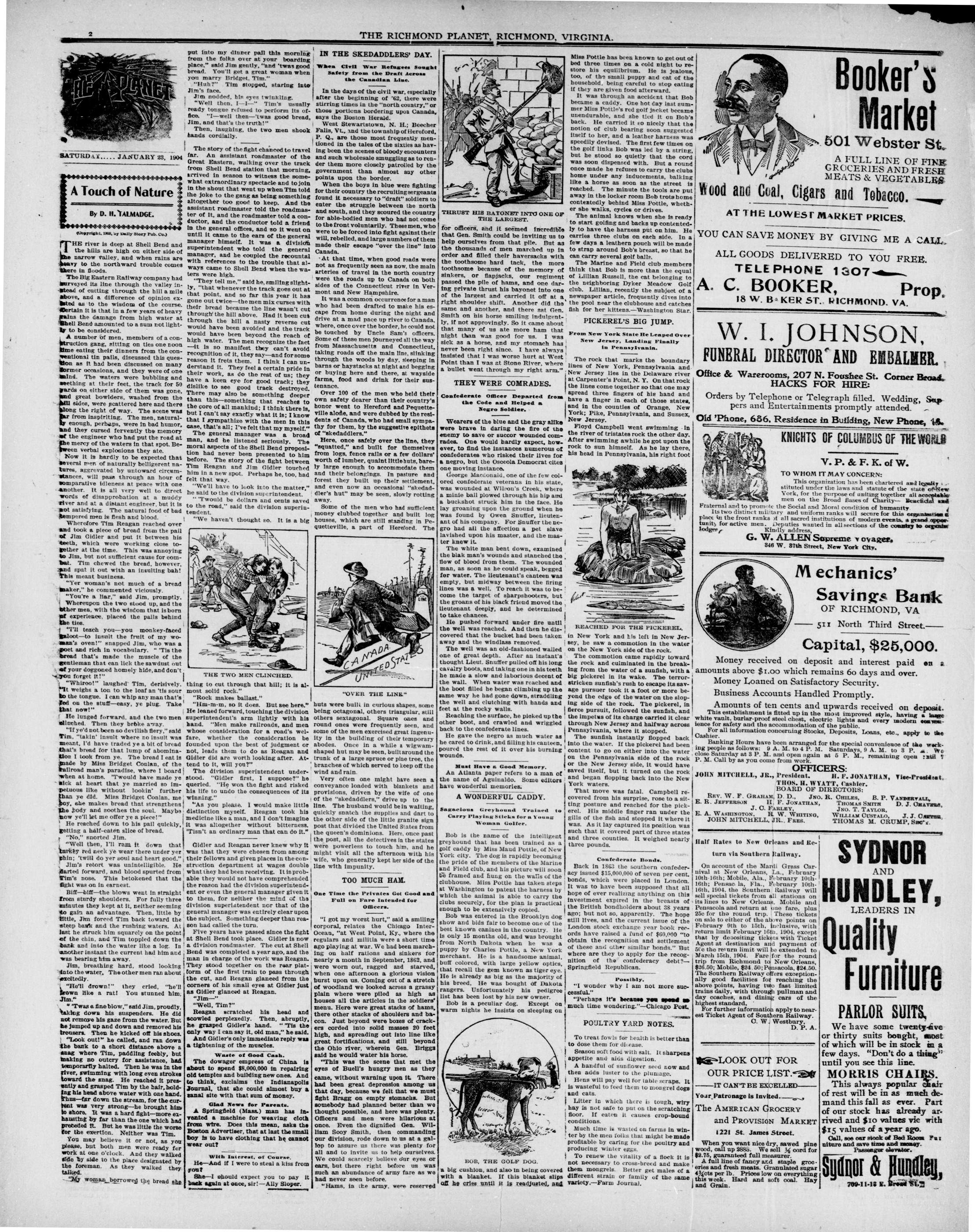
THE TWO MEN CLINCHED.
thing to cut through that hill; it is almost solid rock."
"Rock makes ballast."
"Hm-m-m, so it does. But see here."
He leaned forward, touching the division superintendent's arm lightly with his hand.
"Men make railroads, and men whose consideration for a road's welfare, whether the consideration be founded upon the best of judgment or not, leads them to do as Reagan and Gidler did are worth looking after. Attend to it, will you?"
The division superintendent understood.
"Gidler first, I suppose?" he querled.
"He won the fight and risked his life to undo the consequences of its winning."
"As you please. I would make little distinction myself. Reagan took his medicine like a man, and I don't imagine it was altogether without bitterness.
"Tisn't an ordinary man that can do it."
Gidler and Reagan never knew why it was that they were chosen from among their fellows and given places in the construction department at wages double what they had been receiving. It is probable they would not have comprehended the reason had the division superintendent or even the general manager given it to them, for neither the mind of the division superintendent nor that of the general manager was entirely clear upon the subject. Something deeper than reason had called the turn.
Five years have passed since the fight at Shell Bend took place. Gidler is now a division roadmaster. The cut at Shell Bend was completed a year ago, and the man in charge of the work was Reagan. They stood together on the rear platform of the first train to pass through the cut, and Reagan glanced from the corners of his small eyes at Gidler just as Gidler glanced at Reagan.
"Jim—"
"Well, Tim?"
Reagan scratched his head and scowled perplexedly. Then, abruptly, he grasped Gidler's hand. "Tis the only way I can say it, old man," he said. And Gidler's only immediate reply was a tightening of the muscles.
Waste of Good Cash.
The dowager empress of China is about to spend $8,000,000 in repairing old temples and building new ones. And to think, exclaims the Indianapolis Journal, that she could almost buy a canal site with that sum of money.
Glad News for Parents.
A Springfield (Mass.) man has invented a machine for weaving cloth from wire. Does this mean, asks the Boston Advertiser, that at last the small boy is to have clothing that he cannot wear out?
With Interest, of Course.
He—And if I were to steal a kiss from you?
She—I should expect you to pay it back again at once, sir!—Ally Sloper.
THE RICHMOND PLANET, RICHMOND, VIRGINIA
IN THE SKEDADDLERS' DAY.
When Civil War Refugees Sought Safety from the Draft Across the Canadian Lice.
In the days of the civil war, especially after the beginning of '62, there were stirring times in the "north country," or those portions bordering upon Canada, says the Boston Herald.
West Stewartstown, N. H.; Beecher Falls, Vt., and the township of Herford, P. Q., are those most frequently mentioned in the tales of the sixties as having been the scenes of bloody encounters and such wholesale smuggling as to render them more closely patrolled by the government than almost any other points upon the border.
When the boys in blue were fighting for their country the recruiting sergeants found it necessary to "draft" soldiers to enter the struggle between the north and south, and they scoured the country for able-bodied men who had not come to the front voluntarily. These men, who were to be forced into fight against their will, rebelled, and large numbers of them made their escape "over the line" into Canada.
At that time, when good roads were not as frequently seen as now, the main arteries of travel in the north country were the roads up to Canada on both sides of the Connecticut river in Vermont and New Hampshire.
It was a common occurrence for a man who had been drafted to make his escape from home during the night and drive at a mad pace up river to Canada, where, once over the border, he could not be touched by Uncle Sam's officers. Some of these men journeyed all the way from Massachusetts and Connecticut, taking roads off the main line, slinking through the woods by day, sleeping in barns or haystacks at night and begging or buying here and there, at wayside farms, food and drink for their sustenance. Over 100 of the men who held their own safety dearer than their country's honor went to Hereford and Pequetteville alohe, and were dubbed by the residents of Canada, who had small sympathy for them, by the suggestive epithets of "skedaddlers."
Here, once safely over the line, they "squatted," and built for themselves from logs, fence rails or a few dollars' worth of lumber, qualit littlehuts, barely large enough to accommodate them and their belongings. In pasture and forest they built up their settlement, and even now an occasional "skedaddler's hut" may be seen, slowly rotting away.
Some of the men who had sufficient money clubbed together and built log houses, which are still standing in Pequettville, a part of Herford. The
CANADA
UNITED STATES
"OVER THE LINE."
buts were built in curious shapes, some being octagonal, others triangular, still others sextagonal. Square ones and round ones were frequently seen, and some of the men exercised great ingenuity in the building of their temporary abodes. Once in a while a wigwam-shaped hut may be seen, built around the trunk of a large spruce or pine tree, the branches of which served to keep off the wind and rain.
Very often one might have seen a conveyance loaded with blankets and provisions, driven by the wife of one of the "skedaddlers," drive up to the line. The husband would be in waiting, quickly snatch the supplies and dart to the other side of the little granite sign post that divided the United States from the queen's dominions. Here, once past the post, all the detectives in the states were powerless to touch him, and he might visit all the afternoon with his wife, who generally kept her side of the line with impunity.
TOO MUCH HAM.
One Time the Privates Got Good and Full on Fare Intended for Officers.
"I got my worst hurt," said a smiling corporal, relates the Chicago InterOcean, "at West Point, Ky., where the regulars and militia were a short time ago playing at war. We had been marching on half rations and sinkers for nearly a month in September, 1862, and were worn out, ragged and starved, when one afternoon a glorious vision burst upon us. Coming out of a stretch of woodland we looked across a grassy plain where were piled as high as houses all the articles in the soldiers' menu. Here were great stacks of hams, there other stacks of shoulders and bacon. Just beyond were boxes of crackers corded into solid masses 20 feet high, and spreading out into line like great fortifications, and still beyond the Ohio river, wherein Gen. Britgga said he would water his horse.
"This was the scene that met the eyes of Buell's hungry men as they came, without warning upon it. There had been great depression among us that day, because we felt that we must fight Bragg on empty stomachs. But somebody had planned better than we thought possible, and here was plenty. Officers and men were hilarious at once. Even the dignified Gen. William Sooy Smith, then commanding our division, rode down to us at a gallop to assure us there was plenty for all and to invite us to help ourselves. We could scarcely believe our eyes or ears, but there right before us was such an abundance of army fare as we had never seen before.
"Hams, in the army, were reserved
THRUST HIS BAYONET INTO ONE OF THE LARGEST.
for officers, and it seemed incredible that Gen. Smith could be inviting us to help ourselves from that pile. But as the thousands of men marched up in order and filled their hawersacks with the toothsome hard tack, the more toothsome because of the memory of sinkers, or flapjacks, our regiment passed the pile of hams, and one daring private thrust his bayonet into one of the largest and carried it off at a right shoulder shift. Another did the same and another, and there sat Gen. Smith on his horse smiling indulgently, if not approvingly. So it came about that many of us ate more ham that night than was good for us. I was sick as a horse, and my stomach has never been right since. I have always insisted that I was worse hurt at West Point than I was at Stone River, where a bullet went through my right arm."
THEY WERE COMRADES.
Confederate Officer Departed from the Code and Helped a Negro Soldier.
Wearers of the blue and the gray alleys were brave in daring the fire of the enemy to save or succor wounded comrades. One would hardly expect, however, to find the instances numerous of confederates who risked their lives for a negro, but the Osecola Democrat cities one moving instance.
George Macdonald, one of the few colored confederate veterans in his state, was wounded at Wilson's Creek, where a minie ball plowed through his hip and a buckshot struck him in the face. He lay groaning upon the ground when he was found by Owen Snuffer, lieutenant of his company. For Snuffer the negro had all the affection a pet slave lavished upon his master, and the master knew it.
The white man bent down, examined the blak man's wounds and stanched the flow of blood from them. The wounded man, as soon as he could speak, begged for water. The lieutenant's canteen was empty, but midway between the firing lines was a well. To reach it was to become the target of sharp shooters, but the groans of his black friend moved the lieutenant deeply, and he determined to take chances.
He pushed forward under fire until the well was reached. And then he discovered that the bucket had been taken away and the windlass removed.
The well was an old-fashioned walled one of great depth. After an instant's thought Lieut. Snuffer pulled off his long cavalry boots, and taking one in his teeth he made a slow and laborious decent of the wall. When water was reached and the boot filled he began climbing up the same way he had gone down, straddling the well and clutching with hands and feet at the rocky walls.
Reaching the surface, he picked up the other boot, and crawled and wriggled back to the confederate lines.
He gave the negro as much water as he cared to drink, and filling his canteen, poured the rest of it over his burning wounds.
Must Have & Good Memory.
An Atlanta paper refers to a man of the name of Aguinaldo. Some editors have wonderful memories.
A WONDERFUL CADDY.
Sagacious Greyhound Trained to Carry Playing Sticks for a Young Woman Golfer.
Bob is the name of the intelligent greyhound that has been trained as a golf caddy by Miss Maud Pottle, of New York city. The dog is rapidly becoming the pride of the members of the Marine and Field club, and his picture will soon be framed and fung on the walls of the clubhouse. Miss Pottle has taken steps at Washington to patent the harness by which the animal is able to carry the clubs securely, for the plan is practical enough to be extensively copied.
Bob was entered in the Brooklyn dog show and bids fair to become one of the best known canines in the country. He is only 15 months old, and was brought from North Dakota when he was a puppy by Charles Pottle, a New York merchant. He is a handsome animal, buff colored, with large yellow optics, that recall the gem known as tiger eye. He is already as big as the majority of his breed. He was bought of Dakota rangers. Unfortunately his pedigree list has been lost by his new owner. Bob is a peculiar dog. Except on warm nights he insists on sleeping on
BOB, THE GOLF DOG.
a big cushion, and also in being covered with a blanket. If this blanket slips off he cries until it is readjusted, and
Miss Pottie has been known to get out of bed three times on a cold night to restore his equilibrium. He is jealous, too, of the small puppy and cat of the household, being careful to stop eating if they are given food afterward.
It was through an accident that Bob became a caddy. One hot day last summer Miss Pottie's red golf jacket became unendurable, and she tied it on Bob's back. He carried it so nicely that the notion of club bearing soon suggested itself to her, and a leather harness was speedily devised. The first few times on the golf links Bob was led by a string, but he stood so quietly that the cord was soon dispensed with. But a round once made he refuses to carry the clubs home under any inducements, balking like a horse as soon as the street is reached. The minute the tools are put away in the locker room Bob trots home contentedly behind Miss Pottie, whether she walks, cycles or drives.
The animal knows when she is ready to start golfing and backs up contentedly to have the harness put on him. He carries three clubs on each side. In a few days a leathern pouch will be made to strap around Bob's breast, so that he can carry several golf balls.
The Marine and Field club members think that Bob is more than the equal of Lillian Russell, the cat belonging to the neighbor Dyker Meadow Golf club. Lillian, recently the subject of a newspaper article, frequently dives into the pool near the clubhouse and catches fish for her kittens.—Washington Star.
PICKEREL'S BIG JUMP.
From New York State He Leaped Over New Jersey, Landing Finally in Pennsylvania.
The rock that marks the boundary lines of New York, Pennsylvania and New Jersey lies in the Delaware river at Carpenter's Point, N.Y. On that rock the lines come together so that one may spread three fingers of his hand and have a finger in each of those states, and in the counties of Orange, New York; Pike, Pennsylvania, and Sussex, New Jersey.
Floyd Campbell went swimming in the river of tristates rock the other day. After swimming awhile he got upon the rock to sun himself. As he lay there, his head in Pennsylvania, his right foot
Vilhelm
REACHED FOR THE PICKEREL,
in New York and his left in New Jersey,
he saw a commotion in the water
on the New York side of the rock.
The commotion came rapidly toward
the rock and culminated in the breaking
from the water of a sunfish, with a big pickerel in its wake. The terror-strecken sunfish's rush to escape its savage pursuer took it a foot or more beyond the edge of the water on the sloping side of the rock. The pickerel, in fierce pursuit, followed the sunfish, and the impetus of its charge carried it clear through New Jersey and halfway across Pennsylvania, where it stopped.
The sunfish instantly flopped back into the water. If the pickerel had been content to go on either into the water on the Pennsylvania side of the rock or the New Jersey side, it would have saved itself, but it turned on the rock and began flopping back into the New York waters.
That move was fatal. Campbell recovered from his surprise, rose to a sitting posture and reached for the pickerel. His middle finger ran under the gills of the fish and stopped it where it was. As it lay captured its position was such that it covered part of three states and three counties. It weighed nearly three pounds.
Confederate Bonds.
Back in 1863 the southern confederacy issued $15,000,000 of seven per cent, bonds, which were placed in London. It was to have been supposed that all hope of ever realizing anything on this investment expired in the breasts of the British bondholders about 38 years ago; but not so, apparently. The hope still lives, and the current issue of the London stock exchange year book records have raised a fund of $60,000 "to obtain the recognition and settlement of these and other similar bonds." But where are they to apply for the recognition of the confederacy debt?—Springfield Republican.
Possibly.
"I wonder why I am not more successful."
"Perhaps it's because you spend so much time wondering."—Chicago Post.
POULTRY YARD NOTES.
To treat fowls for health is better than to dose them for disease.
Season soft food with salt. It sharpens appetite and aids digestion.
A handful of sunflower seed now and then adds luster to the plumage.
Hens will pay well for table scraps. It is wasteful to feed them to mongrel dogs and cats.
Litter in which there is tough, wiry hay is not safe to put on the scratching floor. If eaten it causes crop-bound conditions.
Much time is wasted on farms in winter by the men folks that might be made profitable by caring for the poultry and producing winter eggs.
To renew the vitality of a flock it is not necessary to cross-breed and make them mongrels. Better get males of a different strain or family of the same variety.—Farm Journal.
J. W. H.
Wood and Coal, Cigar
AT THE LOWEST P
YOU CAN SAVE MONEY
ALL GOODS DELIVER
TELEPHONE
A. C. BOOKER
18 W. B. KER ST
W. I. JO
FUNERAL DIRECTOR
Office & Warerooms, 207 N.
HACKS F
Orders by Telephone or Tele-
pers and Entertainment
Old 'Phone, 686, Residence
Coal, Cigars and Tobacco.
THE LOWEST MARKET PRICES.
SAVE MONEY BY GIVING ME A CALL.
GOODS DELIVERED TO YOU FREE.
ELEPHONE 1307
BOOKER, Prop.
B W. BAKER ST., RICHMOND, VA.
I. I. JOHNSON,
SAL DIRECTOR AND EMBALMER.
Varerooms, 207 N. Foushee St. Corner Broad.
HACKS FOR HIRE:
Telephone or Telegraph filled. Wedding, Sup-
s and Entertainments promptly attended.
686, Residence in Building, New Phone, 18.
KNIGHTS OF COLUMBUS OF THE WORLD
AT THE LOWEST MARKET PRICES. YOU CAN SAVE MONEY BY GIVING ME A CALL.
W. I. JOHNSON. FUNERAL DIRECTOR AND EMBALMER.
Office & Warerooms, 207 N. Foushee St. Corner Broad. HACKS FOR HIRE: Orders by Telephone or Telegraph filled. Wedding, Supers and Entertainments promptly attended.
KNIGHTS OF COLUMBUS OF THE WORLD
TO WHOM IT MAY CONCERN:
This organization has been chartered and legally constituted under the laws and statute of the state of New York, for the purpose of uniting together all acceptable men on the Broad Bases of Charity—Bacetic and to promote the Social and Moral condition of humanity. Direct military and uniform ranks will secure for this organization constant ranks of all sacred institutions of modern events, a grand oppose men. Deputies wanted in all sections of the country to organise Kindly address,
This organization has been chartered and legally situated under the laws and statute of the state of New York, for the purpose of uniting together all acceptable men on the Broad Bases of Charity—Baccalaureal and Praternal and to promote the Social and Moral condition of humanity. Its two distinct military and uniform ranks will secure for this organization a place in the front ranks of all sacred institutions of modern events, a grand opportunity for active men. Deputies wanted in all sections of the country to organize lodges. Kindly address,
G. W. ALLEN Supreme voyager,
846 W. 87th Street, New York City.
Mechanics'
[Picture of a man in a robe, seated in a chair, with a book on his lap.]
Money received on deposit amounts above $1.00 which re-
Money Loaned on Satisfaction
Business Accounts Handl
Amounts of ten cents and
This establishment is fitted up in the white vault, burlar-proof steel chest, elec-
ience for safety and the accommodation is
For all information concerning Stock Cashier.
Banking Hours have been arranged in large people as follows: 9 A.M. to 4 P.M. close Saturday at 3 P.M. and open again P.M. Call by as you come from work.
OFFIC
JOHN MITCHELL, JR., President.
THOS. H. WY
BOARD OF
REV. W. F. GRAHAM D. D., JNG
E. R. JEFFERSON H. F. JONATHAN,
J. C. FARLEY.
received on deposit and interest paid on a
love $1.00 which remains 60 days and over.
Loaned on Satisfactory Security.
Us Accounts Handled Promptly.
sets of ten cents and upwards received on deposit.
ishment is fitted up in the most improved style, having a large
car-proof steel chest, electric lights and every modern conven-
tion concerning Stocks, Deposits, Loans, etc., apply to the
urs have been arranged for the special convenience of the work-
lows: 9 A.M. to 4 P.M. Saturdays, 9 A.M. to 3 P. . We
set 3 P.M. and open again at 5 P.M., remaining open : until
you come from work.
OFFICERS:
ELL, JR., President. H. F. JONATHAN, Vice-President.
THOS. H. WYATT, Cashier.
BOARD OF DIRECTORS:
GRAHAM, D. D., JNO. R. CHILES, B. P. VANDERVALL,
H. F. JONATHAN, THOMAS SMITH D. J. OHAYSEN,
J. C. FARLEY. INO. T. TAYLOR
Money received on deposit and interest paid on amounts above $1.00 which remains 60 days and over.
Money Loaned on Satisfactory Security.
Business Accounts Handled Promptly.
Amounts of ten cents and upwards received on deposit.
This establishment is fitted up in the most improved style, having a large white vault, burlar-proof steel chest, electric lights and every modern convenience for safety and the accommodation of the public.
For all information concerning Stocks, Deposits, Loans, etc., apply to the Cashier.
Banking Hours have been arranged for the special convenience of the working people as follows: 9 A.M. to 4 P.M. Saturdays, 9 A.M. to 3 P.M. We close Saturday at 3 P.M. and open again at 5 P.M., remaining open until 7 P.M. Call by as you come from work.
OFFICERS
JOHN MITCHELL, JR., President. H. F. JONATHAN, Viec-President.
THON. H. WYATT, Cashier.
BOARD OF DIRECTORS:
REV. W. F. GRAHAM D. D., JNO. R. CHILES, B. P. VANDERVALL,
E. R. JEFFERSON H. F. JONATHAN, THOMAS SMITH D. J. O'MAYES,
J. C. FARLEY, JNO. T. TAYLOR
E. A. WASHINGTON. R. W. WHITING.
JOHN MITCHELL, JR., FRES.
Half Rates to New Orleans and Return via Southern Railway.
On account of the Mardi Grass Carnival at New Orleans, La., February 10th: 16th; Mobile, La., February 10th: 16th; Pensacola, Fla., February 10th: 16th, 1904, the Southern Railway will sell special tickets from all stations on its lines to New Orleans. Mobile and Pensacola and return at one fare, plus 25c for the round trip. These tickets on sale to either of the above points on February 9th to 15th, inclusive, with return limit February 16th, 1904, except that by depositing tickets with Ticket Agent at destination and payment of 5c the return limit will be extended to March 15th, 1904. Fare for the round trip from Richmond to New Orleans, $26.50; Mobile, $24.50; Pensacola, $24.50. The Southern Railway offers exceptionally good facilities for reaching the above points, having two fast limited trains daily, with through pullman and day coaches, and dining cars of the highest standard.
For further information apply to near
est ticket Agent of South Railway.
LOOK OUT FOR
OUR PRICE LIST.
IT CAN'T BE EXCELLED
Your Patronage is Invited.
The AMERICAN GROCERY
and PROVISION MARKET
When you want nice dry, sawed pine wood, call up 288s. We sell ½ cord for $2.75, guaranteed full measurer.
A full line of fancy and staple groceries and fresh meats. Granulated sugar 4¾ cts per lb. Prices low on everything this week. Hard and soft coal. Hay and Grain.
709-11-18 K. Broad St.
A
Booker's Market
501 Webster St. A FULL LINE OF FINE GROCERIES AND FRESH MEATS & VEGETABLES
V. P. & F. K. of W.
Savings Bank OF RICHMOND, VA 511 North Third Street
Capital, $25,000.
WILLIAM CUSTALO, J. J. CARTER,
THOMAS M. CRUMP, Spect.
SYDNOR AND HUNDLEY, LEADERS IN Quality Furniture
PARLOR SUITS
We have some twenty-five or thirty suits bought, most of which will be in stock in a few days. "Don't do a thing" until you see this line.
MORRIS CHAIRS.
This always popular chair of rest will be in as much demand this fall as ever. Part of our stock has already arrived and $10 values vie with $15 values of a year ago.
Oall, see our stock of Bed Room Furniture and save time and money.
Passenger elevator.
Sydnor & Hundley,
SCOUNDRELS & CO.
By COULSON KERNAHAN
Author of "Captain Shannon," "A Book of Strange Sins," "A Dead Man's Diary," Etc.
CHAPTER XI.
HOW A GREAT NATIONAL CATASTROPHE WAS AVERTED ON JUBILLE DAY.
Being desirous of seeing the play out, I had secured—at a reasonable enough price—a front seat in the top window of the house exactly opposite to that from the roof of which Number Two hoped, with one snip of his "abhorred shears," to "silt the thin-spun life" of the royal family of England.
The morning of the jubilee saw me take my place—not this time in my councillor's disguise—in my allotted seat, whence I watched with no little curiosity for the final act in what was meant to be a tragedy, but which I had been the means of transforming into a farce.
Number Two was not astir as early as I was, and did not put in an appearance on the roof until the tail of the great procession was in sight. Meanwhile I sat looking down on the stalwart fellows who went swinging along at quick march on foot, or upon the stately pacing and prancing of the cavalry that passed, clattering and jingling, in pursuing lines.
My enjoyment of the pageant was, however, considerably marred by the constant growling of a man sitting near me, whose natural moroseness of disposition was accentuated by the fact that he was dissatisfied with his rest.
"Who wants to see a lot of court funky riding in double rows or driving in carriages?" he grumbled.
"That's what most of 'em are, you know. It's bad enough for the nation to 'ave to pay for their keep-royal keep too—and pay 'em big salaries for doing nothing, without our 'aving 'em stuck up on a 'orse or in a fine carriage for us to 'ave to pay to see 'em go by. If you and me were dressed up in those fine uniforms and 'ad 'orses found for us to ride on, we'd look just as fine men as they. Isn't that so, mister?" "Oh, yes," I said, "it is quite possible."
"There you are, then. And who are they, after all? That's what I want to know."
"Who, indeed?" I made answer.
"Whe, indeed?" I made answer.
"Now if they'd ask me," he went on,
as though he had rather expected
they would have done so, and felt aggrieved by the oversight, "if they'd
'ave asked me, I'd ave said, What you want is all the great people in the
queen's reign—them as is living, of course. They 'ave got Roberts and
Wolseley, and quite right too, but where's Gladstone, and Roseberry, and
D. Parker, and W. G.? There's the president of the Royal academy and all
the big doctors? Ain't they done a precious sight more good than all your
funkeys and princes? Princes! We've got too many of 'em as it is. There's
'Enry Irving, and Wilson Barrett, and 'AM Caine, and Marie Corelli, and
George R. Sims, and Penley and Stanley? They ain't 'ere—leastwise, not
in the show. I tell you if they'd asked me"—with another splutter of resentment—"I could 'ave told 'em who to put in."
"Yes, there's a great deal in what you say," I said, thinking it wiser to agree with him than to add fuel to the fire of his grievance by a dispute. "All the same," put in a man of conciatory countenance who sat behind me, "all the same, you can't deny that it's an imposing sight."
"I'm imposing enough as a 'ole,' admitted the iconoclast, "but if you look at it separate-like, it's only a lot of 'human beings' like you and me dressed up in uniforms and riding by on 'orses. But, 'Uilo! Why, I'll beigger if there ain't Freddy 'Opkins—im as married my cousin—a-riding by in the Lancers! That's 'im on the white 'orse with the black mustache. Fred—I! Fred 'Opkins! How are you, Freddy? See, 'e's a-looking this way. What yer Fred! How goes it, bonny? See 'im nod? He looked up and nodded, e'd. Now e' is what I call a fine-looking chap. Fancy 'is being 'ere too! Well, I'm jiggered! I must tell 'em at 'ome as I see Fred 'Opkins in the percession, and that 'e' looked up and nodded—not a bit proud-like."
Just at this moment the sound of distant cheering from the west increased perceptibly in volume. It was no longer mere cheering, but the almost frenzied shout of a multitude swayed by some great emotion. It was cantagious. It seemed to run along the lines like kindling fire. It grew nearer—hoarser—louder—till it was almost upon us. Leaning forward with out-stretched head, I looked westward along the Strand. The great street itself seemed palpitating with excitement. The houses seemed to resemble avenues of trees, every leaf of which was a human being, all quivering—like the leaves of a forest in a storm—under some supreme agitation.
And then, amid a whirling of waving hands and fluttering handkerchiefs, a string of carriages swept by. No one stayed to notice the mechanical, almost automatic, backward and forward swaying of the royal princesses. Even the prince, the ever-popular prince, was deemed scarce worthy a glance by the eager, hungry eyes that sought only the one central figure of that little lonely old woman who sat there, queenly of men, and none the less queenly because on that sadly-smiling face, so schooled to royal self-passion, the look of trembling wonderment—almost of fear—told how deeply moved was the widowed woman heart.
"Queen! Queen! God bless her! God save her!" burst from many thousand throats. With the cries ringing in my ears I switched my eyes upward—not without an effort—and looking across at Number Two, I saw that he was in the act of cutting the thread.
Something fell, harmless and unseen,
or, at all events, unnoticed, amid the
unproar and excitement. Once more I
turned my eyes upon the street and leaned out of the window with craned head. I caught a peep of a parasol, had a glimpse of the patient and beautiful, but coldly impassive and weared, face of the Princess of Wales, and then the cavalry closed in behind the carriages, and the great pageant was already a thing of the past.
I drew in my head once more and glanced across at Number Two, who was staring blankly, even stupidly, at the spot where the ineffectual ball had fallen.
Suddenly the fact that someone was looking at him—that at that moment, when every other head but his own was turned eastward for a last glimpse of the queen, one person's eyes were fixed upon him—seemed in some way to make itself known to his consciousness. His own eyes swept the opposite house like a searchlight, and in another moment I saw that they were fixed upon mine. As I felt their fire concentrating, so to speak, upon me, some instinct prompted me to make myself look as little like myself as possible. In the hope of masking my real personality and of preventing him from identifying me, I raised my shoulders almost to my ears and dropped my jaw, so as to give new character, or want of character, to my mouth. Then I drew back from his sight into the crowd.
"Did he recognize me?" I said to myself, "God knows, I don't. But whether he did or not, I have at least the satisfaction of knowing that I have been instrumental in avoiding a great catastrophe, and in preventing this day of national rejoicing from being turned into a day of national mourning."
CHAPTER XII.
EXIT COUNCILLOR NUMBER FIVE.
The next meeting of the council was arranged to take place, as the reader will remember, in a disused shed that stood on the brickfields near the cemetery at Tarborough. There we were to assemble at midnight, and thither I accordingly betook myself at the appointed hour.
It was not a cheerful spot. Though fairly roomy, the building was a mere shed. For what use it had originally been intended I cannot say. There was neither fireplace nor window. It consisted merely of four wooden walls, a roof and a clay floor. A grave could not have been barer, for from floor to ceiling there wasn't so much as a nail on which to hang one's hat. Someone had improvised a can-
A man is running through a rainstorm.
IT WAS NOT A CHEERFUL SPOT.
dlistick by jabbing the sharp point of a big pocket-knife into the wall. The knife had a flat double-edge blade, upon which there stood a guttering candle-end, which was our only light.
As soon as the circle was complete, Number Two, who was the last to arrive, took up his place by the candle; perhaps that he might better see the faces of his comrades, perhaps because he fancied that nearness, even to this miserable emblem, constituted the place of precedence in the assembly.
"Fellow-councillors," he said, "I am here as promised to report progress, but I regret to say, as you must already have assumed, that there is no progress to report. Our glorious jubilee scheme has failed, not for want of care on my part, but because there has been a traitor in our midst. The more I think of it, the more irresistibly am I forced to that conclusion. Gentleman, how did our late chief, Number One, meet his death? We took it for granted—and I admit that I took it for granted—that the irreparable loss which the society sustained by his removal was the result of an accident. But does it not strike some of you as strange that, ever since that lamentable accident, things have gone wrong with us, and that some power seems to have been at work whose object apparently is to pull the linc-pin out of our most carefully planned projects? What about the unaccountable occurrence in connection with the punishment which we proposed to mete out to Lord Granthorpe? Was that the result of another accident, or was it the deliberate folling of our schemes by some one that knows our secrets? And now what about the jubilee fasco? I pledge you my word, brother councillors, that the project was carried out exactly as I had planned it. The celluloid ball, containing an explosive so deadly and so sure that a smart rap with the finger end would have sufficed to explode it, was hung, as I promised you it should be hung, exactly over the spot where the queen was to pass. And as she bye by, I, with my own hand, cut the thread and saw the ball fall to the ground, scarcely a yard behind her carriage. What was the result? A miserable failure! But why? Because the ball had been tampered with. Because we have been fooled. Instead of coming here to-night flushed with success and proud to receive your
THE RICHMOND PLANET, RICHMOND, VIRGINIA.
congratulations. I am here feeling like and looking like a fool. And only because of treachery, black, hell-damned treachery!$^{17}$
He stopped speechless with passion, and glared around the assembly like a madman. As for myself, the very heart of me went down into my boots. No doubt his next words would be to denounce me. If, as he said, and said rightly, he had been fooled, and the ball had been tampered with, by whom could it have been done but by the councillor who had volunteered to assist him—myself, the so-called and supposed Number Seven?
It was true that they had been fooled, but who was so great a fool as the man who had hugged himself for his own cleverness and had laughed at the conspirators as his dupes, and yet had been so blind as not to know that in coming there that night he was deliberately putting his head into a noose of his own making? But if I was to die I would at least sell my life dearly. Even while Number Two had been speaking, I had sought the pocket where lay my revolver. The next instant would have seen me whip the weapon out, and indeed my finger was already on the trigger, when a derisive laugh from one of the party stayed my hand.
The laugh came from Number Five—the man who, either from jealousy or because he was himself ambitious of being elected to fill the post of the dead leader, had all along endeavored to throw cold water upon Number Two's projects.
"The old story!" he said contemptuously. "Every clumsy bungler, who makes a mess of what he has undertaken, tries to excuse himself by putting the blame on somebody else. You remind me of a schoolboy, who when he is fairly beaten in a game calls out 'Cheat! Cheat!' Why don't you admit that you've failed, and have done with it."
I was thankful for any diversion which turned to another quarter the attention which I had anticipated was soon to be centered upon myself, and I took the opportunity which the respite afforded of edging cautiously towards the door. While I was doing so Number Two's reply came cold and clear:—
"Fellow councillors, the traitor among us stands self-revealed. When the bomb which ought to have destroyed the royal family fell harmlessly in the roadway, and while I was standing there gnashing my teeth with rage, I felt instinctively that some one person was watching me when every other eye in the assembly was fixed upon the show. I know instinctively if I am watched, even when the watcher is behind me, and my eyes went straight to the watching person on this occasion. He was sitting on a stand—had chosen the place, no doubt, that he might gratify his jealous hate by being a witness of my discomfiture—exactly opposite. When he saw that I had discovered him he drew back out of sight among the crowd, but not before I had seen that he was long-faced and high-shouldered. Look at the man who has just spoken, the man who is trying to belittle me in your eyes because he fears that you will elect me to the post that he hankers for himself. Look at him, I say, and see whether he is the man I have described or not. He thinks, no doubt, that he is safe because he is wearing the beard which we all wear, and had none when I caught sight of him on Jubilee day. But he has shown his hand too plainly on this occasion. I told you that there was a traitor in our midst and he stands there!"
Here was a curious throw of Fate's dice indeed! Little did I think on Jubilee day, when some instinct of self-preservation caused me to seek to disguise my identity from Number Two by humping my shoulders and dropping my jaw, that I was unconsciously mimicking one of the syndicate of scoundrels and so probably saving my own life.
Before I could ask whether it would not be a cowardly thing to shelter myself under so curious an accident and to let another man be made answerable for my action, Number Five had leapt forward and confronted his accuser.
"Liar!" he screamed, almost hysterically. "Coward and liar! take that!"
As he spoke his hand darted towards the knife in the wall, which was doing duty as a candlestick. I saw him clutch the handle and wrench the weapon from its place, and then as the candle fell and we were plunged in total darkness, he sprang upon Number Two with upraised blade.
In the second before the candle went out I had seen the other conspirators start forward instinctively with out-stretched hands to stay the descending knife; and for the next few seconds the picture so formed remained on my retina like a tableau vivant, in which, as if Time's pendulum had suddenly stopped, we see action frozen in a moment's space into inaction, life caught and fixed in an instant to still life. Then, as the picture thus imprinted on the retina lifted rigidly and edged anglewise away until it swam and dissolved of ken in an upper corner of the shed, I seemed to see the succeeding and inclosing darkness writing around me like the coils of two huge wrestling and intertwining black snakes; I heard the scuffle of feet as the two combatants swayed backward and forward on the floor; there was a cry, the thud of a falling body; and the next instant some one struck a match.
The picture that presented itself was exactly like that I have seen in melodramas, when the curtain, which has fallen upon some tragic situation, lifts for a moment to allow the spectators another glimpse of the ghastly sight. Number Two—his tie and collar torn open and hanging loose—was leaning back white-faced and panting against the door, looking almost stupidly at a gaping cut across the palm of his right hand. The others were bending over Number Five, his lay on his back upon the floor, his features twitching and working horribly, while his nerveless hands fumbled at the handle of a knife which was buried up to the hilt in his throat.
I have said that the whole scene reminded me of a "curtain" from a transportine melodrama, and the stageness of the situation was sug-
tained by the subsequent introduction of the inevitable "comic relief."
The man who held the match was bending over the body on the floor, and the other conspirators had naturally drawn as close to him as possible, in their eagerness to see what had happened or to render help. Suddenly the man who was holding the match dropped it with a yell.
"Damn your clumsy, clumping feet!" he roared, as he stumped backward and forward—whistling with pain.
"Here am I with an ingrowing nail that has given me hell and Old Harry for weeks, and you must needs go set your hobnail hoof upon it."
"Beg pardon I'm sure," answered a voice from the darkness.
"Beg pardon be damned!" came the reply. "A man's no right to bring feet like those among gentlemen. They're only fit to hire out, instead of steamrollers, to crush stones on a country road."
In the meantime another match had been struck, and the man with the ingrowing nail found another grievance.
"Be damned if he ain't standing on the candle with 'em now," he grumbled.
"Here, move 'em, will you, if you can do it without knocking anybody down. You'll kill one one before you've done, if we don't have a light. I feel like a black-beetle on a kitchen floor, I do, when you're walking about with those boots on."
"Is he hurt?" asked some one, when the candle had been rescued and relit, and attention was once more turned to the prostrate man upon the floor.
"No, he ain't hurt; he's only dead, that's what he is," said the fellow with the ingrowing nail, whose number on the council I subsequently discovered was Number Six. "It would take a power o' hurting to trouble a man who's wearing a necktie like that. You might as well talk of hurting a skewered chicken."
"Gentlemen," said Number Two, "you are my witnesses that I struck in self-defense. It was he who drew steel on me, not I on him. Besides, even if this hadn't happened, the necks of none of us would have been safe if he had been allowed to leave this place alive to-night. How he did it I don't know, but there's no question but that it was he who changed the ball that I had prepared for Jubilee日. I saw him with my own eyes sitting in the building exactly opposite. And what would have been easier for a man who knew our plans, and had the run of the building opposite, than to play tricks with the other end of the festoon upon which the ball was hung? No doubt, after I had fixed the bomb and gone away, he managed to lasso it in some fashion and then haul it up and change it. If you remember I invited him to assist me in carrying out the project. But he was too clever for that. He knew that if anything went wrong I should naturally suspect him (and, in fact, I was inclined at first to suspect Number Seven, who assisted me) and so, after this fellow had acquainted himself with my proposed plan, he goes and installs himself in the building that faced my headquarters, so that he can spoil the game without incurring suspicion. It was very prettily planned, and, no doubt, if we knew the truth the poor man who went to his account over that attempt on Lord Cranthorpe was a victim of this same Judas's treachery."
As he spoke he spurned the body on the floor with his foot.
"Damme! I don't believe he's dead, after all," said Councillor Number Six. Kneeling down and placing one hand on the prostrate man's shoulder, he began to undo the buttons of the waist-coat.
"Umph!" he grunted. "There's a pound or two of stiff horsehair padding in the man's shoulders. You can feel it jutting out where the coat joins the sleeve. Wanted to make himself look broad and military, I suppose. A rum fancy. Now let's see if his heart's going." Opening the shirt at the collar, he slipped an open palm over the victim's left breast.
Then he sprang to his feet with a startled cry. "My God! mates," he said. "It isn't a man at all, but a woman!"
"A woman!" chorused the conspirators.
"Yes, it is a woman right enough!" said the fellow. He stood for a moment or two staring meditatively at the body, and then, with eyes narrowed to slits, he looked curiously at each of us in turn, as if expecting to find on one of our faces something which might indicate a previous knowledge of the victim's sex. In this he was disappointed, for I watched the faces of the others meanwhile, and could detect no such sigh as he sought
This, in fact, was hardly to be wondered at under the circumstances. Some physiognomists tell you that if you suspect a man of lying, or an enemy of finching, you should look him in the eyes. Do so by all means, but better still, watch his mouth. Many men will brazen it out boldly with their eyes, but all their hardihood cannot quite control the traitor mouth from betraying secrets to those who can read the signs aright. Several times eyes have looked unwaveringly into mine, as if steadied by the consciousness of truth, even while the word "liar" was plainly written on the lips.
On the occasion of which I am writing, the lips of those present were hidden by the false beards and mustaches which we wore, and physiognomy (I never yet met a man or woman who did not plume himself, or herself, on being an adept in that science) was disadvantaged thereby. But, if the expression counts for anything, one and all were taken aback and bewildered by the surprise which had been sprung upon them regarding the victim's sex.
"Did you know it was a woman?" asked the man who had made the discovery, wheeling round sharply upon Number Two.
"Indeed, I did not," was the calm but decisive reply. "The possibilities of such a thing never as much as occurred to me. But what you say about her shoulders being padded goes to prove that I was right in accusing this person of having played tricks with my plan for celebrating the jubilee. I distinctly said that the man I saw
watching me was high-shouldered as well as long-faced."
"Do you think the chief knew this person was a woman?" inquired the man who had constituted himself spokesman.
"He must have done so. Each member of the council was selected by him and was known to him personally. No doubt he had good reason for what he did. In fact, if you think of it, there were one or two little affairs planned by him and carried out under his superintendence that, if we had thought of it at all, we might have known only a woman could have worked successfully. All the same, if I'd suspected we had a woman amongst us, I'm afraid I should have funked the whole business. The woman isn't born yet, and never will be born, that I'd trust my neck to. Sooner or later they're bound to play you false. I've known a good many bad men in my time—men who were sensual as hogs and as cruel as tigers—but the biggest brute of a man living couldn't stoop to the black treachery that some women are capable of. And they can be as treacherous to the man who's faithful to them and works his fingers to the bone for them, as they can to the blackguard that kicks them to death with hob-nailed boots. I tell you what it is, my friends, it's lucky for us we have made this discovery while our necks were safe. Some one has been playing us false ever since our chief died (and we don't know that somebody didn't play him false, and that he wouldn't have been among us today but for that same somebody). But there lies the traitor, beyond all doubt, and you see if things don't work better with us now that the Judas who has been trying to circumvent us is out of the way."
No one dissenting from this view of the case, Councillor Number Two dropped his platform manner, and addressed himself to the practical side of the question. "Well, my friends," he said, "we don't stop now to argue whether I'm right or whether I'm wrong. Let's
A man is lying on a table, his head resting on a pillow. A woman is sitting beside him, her eyes closed and her hands clasped. The table is covered with a sheet of paper, and there is a pen and a pencil on it.
NUMBER TWO, SCOUNDERREL THOUGH HE WAS, KNELT DOWN.
have that wig and beard off. It's possible some of us may be able to identify this woman." He plucked off the disguise as he spoke, and then staggered back, his face grown gray as putty, the pupils of his eyes unnaturally dilated, and his breath coming in short, quick inspirations.
"My God!" he gasped; "and I've killed her."
"Yes," said Number Six; "the job goes down in your account right enough, my friend. You make yourself easy about that. There's no one here would be so mean as to want to do you out of it."
The taunt passed unheeded, if not unheard, for, to the dismay, and probably to the disgust, of the onlookers, Number Two, scoundrel though he was, knelt down beside the corpse with a look on his face that seemed strangely out of keeping in that company.
Councillor Number Six was apparently not a sentimental person.
"H'm!" he sneered. "First we stick a knife into folk, and then we do the handkerchief business over 'em. Seems to me this syndicate ought to turn itself into an amalgamated murder and mourner company combined. 'Murders committed on the shortest notice; funerals to match; tears always in stock. If you don't see the kind of corpse you'd like in the window, step inside and ask for another. No extra charge for handkerchiefs.'" He spoke to unlistening ears, as far as Number Two was concerned; seeing which the fellow slapped the kneeling man on the shoulder noisily. "Cheer up, my buck!" he said; "you had a lot to say against women just now, but you seem mightly low down all at once because one of 'em's met with an accident."
"Yes," answered Number Two, rising and looking around wearedly; "I've a good deal to say against them, as you observe, and that particular one has a good deal to say against me, if she could say it."
"You've taken good care she can't," sneered the other. "But, look here, my friend. It strikes me that that lady came here meaning mischief. When a woman wants to make it nasty for a man, she ain't too particular if she makes it nasty for his mates, too. That's the worst of a woman. When she's set on a thing she goes at it blind. Now we don't institute too rigorous an investigation into the moral character of those who have seats on this council—not too rigorous, that is—but we hope, for the sake of all our peace of mind, not to say our necks, that there aren't any other ladies who want to get equal with you. Otherwise we might have old Jonah on board at once."
"I don't think you need fear any further trouble of the sort," answered Number Two, with a mirtless smile. Then he turned to address the company more generally:
"I had a proposal to submit to you to-night, gentlemen, but perhaps it will be best for all our safety if we get out of this place as soon as possible, and out of sight of"—he hesitated a moment, gulped at something in his throat, like one suffering from physical sickness, and then, as if impatient of his weakness, pointed deliberately at the corpse" of that. With your per-
mission we'll postpone this meeting.
It won't be safe to meet here again, especially after what's happened. I know it's desirable to change the place of meeting as often as possible, but for the present I'm absolutely positive that the gipsy wagon at Leigh is safe. Let us all meet there at midnight the day after to-morrow. Do you agree?"
"Yes, we agree," said Councillor Number Six. "But first we must get rid of the body. Is there a pond handy? If we button a brick under the coat so that it can't slip out, and pack the pocket with stones, she'd keep down all right."
"There is no pond anywhere near," said Number Two, with a curiously hard note in his voice. "But I'm answerable for the woman's death, and I'll be answerable for the disposal of the body. The fact is, my friends, I came here to-night determined that the person who played us false should pay the price of his treachery. And when I've made up my mind to a certain course of action I make my preparations beforehand accordingly. That's the only way to carry a crime through successfully. It's your criminal who does things in a hurry who plays into the hands of the police. Sometimes unforeseen circumstances compel one to act in a hurry, and I rather flatter myself I'm as good as most people in an emergency. But, as I say, I prefer to take my time to fix things up scientifically. I knew that there'd be a body to dispose of tonight, for I knew that when you had heard what I had to tell you, you would decide that the person who played us false should not leave here alive. That person didn't come by his, or rather her, death in the way I had intended. I arranged a much surer and comparatively safe method of doing the painful business. But the thing has been taken out of my hand, as you all know, and we needn't discuss it. Not need we trouble ourselves about the body. I came here, as I said, to dispose of, and it was my duty, therefore, to look round the place and make the necessary arrangements beforehand. They are quite simple. I've been in the cemetery close by today, and I see that they have been digging a grave ready for a funeral tomorrow. It's a deep grave, and if we lay the body at the bottom and put enough earth over to cover it, no one is likely to notice that the grave is slightly shallower. It is surprising the little notice people take of things, unless, of course, they have a reason for being suspicious. You'll find that the coffin will be let down on the body there to-morrow, the service read, the grave filled in without any living soul suspecting that they have hidden away our ugly secret for us. If some one will volunteer to lend me a hand, we'll have the whole thing done in a quarter of an hour. Who will do so? There's practically no risk. What do you say, Number Seven? You and I worked all right together in the jubilee business. Do you feel like throwing in your lot with me again?"
For one moment I hesitated. Not-withstanding his assurance that the minimum of risk was practically nil, I foresaw that were anything unforeseen to upset his calculation I might as a result find myself in the dock on a charge of murder. As a matter of fact I was beginning to realize the tremendous responsibility I had taken upon myself when I first embarked on this venture. What I ought then to have done was to inform the police of the facts which had come to my knowledge while I was secreted in the fo'castle of the Sea Swallow, so that they might have surrounded the meeting-place of the conspirators at Leigh and effected the arrest of the rascally gang. Were individual members of the community, to whose cognizance the actual committal or the proposed committal of a crime has come, to constitute themselves, as I did, private detectives, the results would be deplorable. My own plea is that I entered upon the business thoughtlessly and while the itch for adventure was on me, and that once having become involved I saw no way out at present.
Even while Number Two was speaking that adventurous spirit stirred again within me. Sooner or later the psychological moment would come for calling in the police, and bringing the ruffans, red-handed, to justice. Until that psychological moment arrived I preferred to steer clear of Scotland yard and to do my detective work after my own methods.
By falling in with Number Two's proposal I might learn something important about the personality of the man who was practically the leader of the gang. That decided me. I opened my mouth to say, "Yes, I will do as you wish," but before I cuddle so Councillor Number Six forced himself to the front and said rongly—"Come along, guv'nor. I'm your man. And let's get to business."
"Thank you," replied Number Two. "Then, gentlemen, I need detain the rest of you no further. The day after to-morrow we meet at midnight at the old place. Good night."
CHAPTER XIII
A BIT OF "BOUNCE" THAT SENT SIX POLICEMEN OFF ON A FALSE SCENT.
As he spoke we heard the grating of wheels on the shingly high-road that skirted the cemetery. In an instant Number Two had blown out the candle and opened the door softly.
It was a bright moonlight night, and we could distinctly see a trap, from which seven men got out noiselessly. They stood a moment, and then, in obedience to a muffled word of command, each produced something that, from the way in which the moonlight glanced upon it, appeared to be polished metal.
"Don't move, any one, on your life," said Number Two, in an imperative whisper. "We're betrayed, and by that woman; but I see a way out of it I'm going to bluff them. It's the only way. I'm going to send all but one or two of them—all but one if I can manage it—on a wild goose chase. The one that's left I shall find an excuse to bring in here. The instant he crosses the door you must down him. One crushing blow on the head fire and then finish him off while he's no conscious. Now, I'm going out to the to pretend I'm the intruder. It's a
impudent bit of bluff, but it's our only chance. Even if it fails, we shall be any the worse off than we were."
As he spoke he ran forward to meet the advancing constables.
"Why are you so late?" he called out excitedly. "They're gone. Four of them drove off in a trap ten minutes ago, along the road there, to catch the midnight express from Stoky. I wouldn't leave here for fear of missing you, but I wish you'd come earlier. The other has gone to catch the last train up from here. If one of you comes with me we can secure him all right. Two of us will be enough for that job. Hadn't the rest of you better drive after the other four? You'll be six to four, but remember they're armed. If you are quick about it, you'll get to Stolby station as soon as they will. But there's not an instant to lose. If they catch that train they'll be in London before you can telegraph, and the game'll be up."
It was, as he said, an "impudent bluff," but it succeeded, as impudence often does.
"Tumble in, lads. Sharp as you can. I wouldn't miss 'em for a thousand pounds" yelled the man in command of the constables. "You stay with him, as he suggests. Brown, and secure the fifth man. We'll get the other four right enough. But don't let the informer there get out of your sight, mind. His evidence is too valuable to run the risk of losing it."
The boldness of Number Two's ruse and the unsuspecting way in which the police had "tumbled" to it fairly took my breath away. Before I had got it back, the trap containing the six defenders of the peace was tearing along the Stolby road like a fire-engine.
"They'll catch them all right," said Number Two gleefully to the constable who had been told off to assist him in the capture of the conspirator who was supposed to have gone to Tarborough station. "And now you and I'll make sure of the other man. We'll have the whole six of them safely lodged in stone walls to-night. Come along—there's no time to lose. If one of 'em's left at large, my life wouldn't be worth a moment's purchase when they know who's turned informer. But stop a minute; my bag's in the shed, and as it contains the documents that prove their guilt, the inspector there won't thank us for leaving it behind us. I'll run back and get it."
"Not without me," said the constable knowingly. "My instructions were not to lose sight of you, my friend; and though it's all square, I've no doubt I'm bound to obey instructions."
"Oh, come, by all means," said Number Two indifferently.
"Yes, I mean to," was the policeman's answer, as he took his companion's arm.
The words were the last he uttered for, as he stooped his head to enter the shed, Number Six, who was standing in the shadow of the door, struck him a terrific blow with a brick he had snatched up from the floor.
It crushed in the poor devil's skull as easily as a tap from a spoon crushes the shell of an egg, and he went down without a cry.
"That'll do," said Number Two. "You did it quite scientifically, my friend. Now, gentlemen, I think we'd better make ourselves scarce. We shall not have time to attend to this lady's funeral service, after all. You're satisfied now, I hope, that it is this woman who was the traitor. It's a lucky thing for us it was so. If a man was going to turn informer he'd have taken care to do the thing properly, and to have taken time about it, not have gone in some hysterical moment to a set of booby country bobbles. She could only have laid information just before the meeting, or they'd have telegraphed to town, and got the London detectives down. Those who came were all Tarborough men. And now I'm going to take you all in my confidence. It isn't safe for us to try to get away from here to-night. That's why I bluffed the bobbles, instead of showing fight or making a run for it. There's no train we could catch now, and, even if we could do so, the stations will no doubt be watched. And if we tried to get away on foot, or to hire a trap, we should be traced to a certainty in an hour or two, and the whole lot of us just swept up into a dustpan by the broom of the law, as easily as a woman sweeps up the pieces of a broken china jug."
"You talk about it damned lightly," said Number Six; "but if that's so, the hangman's noose is as good as round our necks."
"Not at all," said Number Two. "Trust yourself to me, and you are perfectly safe. It so happens that I've lived near Tarborough a long time, where I am looked upon as a respectable, if eccentric, member of society, and I shall never be suspected of harboring criminals or of being one myself. My house is only a mile or two away. It's a little old-fashioned place, where I and my one man-servant—no woman shall ever set foot in house of mine—have lived on and off for ten years. My man's as safe as I am—I'll go ball for him. In fact, I was going to propose him for one of the three—there are three now—vacancies on the council. You must ane low at my house for the present, and when the hue and cry is over you can get away one at a time. And while you are there we can scheme out our plan of campaign together. You see, I'm giving myself away to you entirely by letting you know where I live and breaking the secret of my identity. But I trust you, and I promise you that you are safe in trusting me."
"Stop a minute," said the freepresible Number Six. "Do you think that woman peached on us to spite you? If so, she knows who you are, and most likely where you live; and in that case to go home with you would be walking right into the lion's den, as if she's told the police, they'll make for your house first."
"I don't believe she did know who I am," answered Number Two. "Our late chief kept all our identities secret. She may have guessed that I'm a man she knew ten years ago, but in that case she knew me under another name. Still, there is the chance that she knows, and she has told the police You never know how to reckon when
CONTINUED ON 6TH PAGE.
HE PLANET
Published every Saturday by JOHN L. CHELL JA., at 81 North 4th Street, Richmond, Va
BOHN MITCHELL, JR., - EDITOR
All communications intended for publication should be used to reach us by Wednesday
TERMS IN ADVANCE
One Copy, one year, $1.50 One Copy, eight months, One Copy, six months, One Copy, four months, One Copy, three months, Single Copy, three months,
ADVERTISING RATES
For one inch, one insertion, $5 for one inch each subsequent insertion. For two inches, three months, $6.00 for two inches, six months, $10.00 for two inches, nine months, $14.00 for two inches, two months, $20.00 for two inches and Mineral Notes, Standing and Transcript Notices per line.
POSTAGE STAMPS OF A HIGHER DE
NOMINATION THAN TWO CENTS NOT
RECEIVED ON SUBSCRIPTIONS.
THE PLANET is issued weekly. The subscript
price is $1.50 a year, in advance.
There are FOUR WAYS by which money can be sent by mail at our risk.— In a Post Office Mobile Expense Money Order, or an Expense Money Order, and when such these can be procured, in a Registered Letter.
MONEY ORDERS— You can buy a Money Order at your Post Office, payable at the Richmond and we will be responsible for its arrival.
EXPRESS MONEY ORDERS can be obtained at any office of the American Express Co., the United States Express Co., and the Well-Formed will be responsible for money sent by any of their companies. The Express Money Order is a safe and convenient way for forwarding money.
REGISTERED LETTER— If a Money Order is registered, your reach, your Postmaster will Register the letter you wish to send us on payment of ten cents. Then, if the letter is lost or stolen, you can car send money in this manner at our risk.
We cannot be responsible for money sent in letters in any other way than one of the four ways mentioned above. If you send your monogram or other way, you must do it at your own risk.
REWENSA, ETC.—If you do not want THE
CARLEN continued for another year after your
subscription that continue it. It is courteously
by Postal Card to discontinue it. The courts have
decided that subscribers to newspapers who
discontinued their paper discontinued at the ap-
plication of time for which they have held
holdable for the payment of the subscription
up to date when they order the paper discon-
tinue.
COMMUNICATIONS—When writing to us to
renew your subscription or to discontinue
our paper, you should give your name and ad-
dress it, otherwise we cannot and your
name can not.
CHANGE OF ADDRESS—In order to change
to address of a subscriber, we must be sent
the former as well as the present address.
Entered in the Post Office at Richmond, Ta-
nley, second class matter.
SATURDAY — JANUARY 23, 1904
WELL, F. M. PRESTWOOD (white) has been indicted by the grand-jury of the Federal Court in ALABAMA for holding Bob ENGLISH, a white man, in a state of peace. We always believed that the white folks would catch the "butt fond" of it after awhile.
---
THE Democrits of MARYLAND, under the leadership of Senator A.P. GORMAN propose to further disfranchise the citizens of color. They do not know whether to do it by legislative enactment or constitutional revision. In either event, "there'll be a hot time in the old town to-night." The colored people are organizing to meet these threatening conditions.
THE death of Col. WILLIAM A. PLEDGER of Georgia removes from the arena of public life one of the ablest race defenders that has appeared before the public during the last forty years. He was as "true as steel" to the interests which he represented. His life was an open book and no where could be discovered either chicanery or deceit in his dealings with either men or measures.
We were honored with his personal friendship, and as we cast our eyes over the horizon of Afro-American leaders in this country to-day, we find none, whom we regard as a friend so close as he.
We feel his loss almost as keenly as does his widow. The race lost a valiant defender when PLEDGER fell. Let us hope that, as with bowed head he obediently received the summons, he was buoyed up by the hope of immortality beyond the grave, where "sickness, sorrow, pain and death are felt and feared no more."
He is gone, and if God will raise up another of like sincerity, influence and valor to take his place, PLEDGER will not have died in vain.
On the other side of the River, God grant that we shall clasp a glad hand with him "to meet and part no more!"
THE UNITED STATES SUPREME COURT SPEAKS AGAIN.
THE United States Supreme Court has rendered another decision affecting the common-law rights of colored men. On Monday, January 18th, 1904, it reaffirmed its ruling in the case of CARTER verses the State of Texas to the effect that the exclusion of colored men from grand juries in cases involving criminal charges against members of the race is in violation of the Constitution and, therefore, not permissible. It seems that ROOGERS, colored, a resident of Alabama was indicted for murder by a grand jury, composed entirely of white men. and from which all colored men were excluded because of their color. His counsel appealed to the Supreme Court of Alabama, which sustained the trial court. An appeal was taken to the Supreme Court of the United States with the result that the
---
Alabama Supreme Court and the trial court have been reversed and the case remanded to the state courts for further proceedings, not inconsistent with the opinion of the court.
This decision carries with it no ray of hope for the colored people of the Southland. It omits the vital feature in the case. Here is the text of the original opinion:
"The exclusion of all persons of the African race from a grand jury which finds an indictment against a Negro in a state court, when they are excluded solely because of their race or color, denies him equal protection of the laws, in violation of the Fourteenth Amendment of the Constitution of the United States, whether such exclusion is through the action of the Legislature, through the courts or through the executive or administrative officers of the State."
Now a grand jury reaches a conclusion by a majority vote. It may have two colored men on it out of twelve or sixteen men and the ruling of the Supreme Court of the United States has been complied with. Thoughtful colored men will wonder why it did not apply this "blanket" decision to the petit or trial jury which is required to reach a decision by a unanimous vote.
As the matter now stands ROGERS has secured a lease of life or liberty for a few months. He has aroused the ire of the Negro-haters in ALARAMA and will be indicted again and railroaded by an all-white petit jury either to the penitentiary or the gallows. As the United States Supreme Court has now gone into the business of re-affirming previous decisions, we may expect to hear of another "bow-legged" opinion hardened down in the franchise cases, reiterating utterances in the MISSISSIPPI, LOUISIANA and ALARAMA cases.
To be plain, this tribunal stands where it has always stood, opposed to the civil and political rights of the colored people of the United States.
Oh, how happy we would be to find ourselves mistaken in our conclusions! But, we shall see what we shall see.
HONORED THE SEXTON.
THE daily newspapers tell of the honors accorded to Mr. WILLIAM ELLIOTT, the colored sexton of one of the wealthiest white Baptist Churches in Portsmouth, Va. The funeral took place in the Court Street Baptist Church (white) of which he had been sexton for forty-nine years. The colored minister, Rev. J. M. ARMISTEAD, D. D., was permitted to conduct the funeral services, while the deacons of the white church acted as pall-bearers for this worthy colored man. Some surprise has been expressed, but there is no need of any.
Similar evidences of heart-felt esteem have been shown in this city. It usually is exhibited however on the part of the wealthy classes, who know the worth of a self-respecting colored man and are thoroughly advised as to how to treat him. This constitutes the "bond of union" between the races. There are some colored men, who would give up life itself in behalf of certain white people and there are certain white people who would make almost any sacrifice in behalf of some colored ones. It is usually the politicians and designing men who cause most of the trouble between the races down here anyway. They feast upon racial antipathy as a vulture does upon a carcass. But it will not be always thus. A change will come and a better understanding will be had between the God-fearing white and black people of the South-land.
This proscriptive legislation, "Jim Crow" arrangements, introduction of unsatisfactory white immigrants and all other pernicious methods are resorted to in order to drive the self-respecting colored elements outof ear-shot of the Christian, ex-slave-holding white folks. The colored people are then pictured as savages who have deteriorated by virtue of this very separation and should be treated only as beasts of burden and denied all of the rights of man.
Too often these schemes carry and trouble is the result. Still there are many white people, who have not forgotten their crooning black mammies and today cherish a fondness for their off-spring.
It is this class of white people, who made it possible for Rev. Dr. J. M. ARMISTEAD to preach the funeral of Brother ELLIOTT, Monday Jan. 18th, in the white Court St. Baptist Church of which he had so long been a faithful sexton. God grant that other cases similar in their nature may multiply and the veil that now hangs over us may be lifted and the Sun of Liberty and political enfranchisement shine once more for us.
THAT REMARKABLE REPORT.
We hope that the white people of the city and state will read with care the very cautious report of the special committee of investigation appointed by the Richmond, Va., City Council for the purpose of ascertaining the facts relative to the bribery of the members of that body in order to secure the passage of certain telephone and street-can franchises.
The report will be better understood when it is known that the law makes a person tendering a bribe as liable to punishment as the one who receives it.
The report assumes a humorous aspect when it is announced that seventy thousand dollars were spent on franchises, and ten thousand dollars were spent on political workers and lobbyists and seventeen thousand dollars were spent at another time in the same way, and then five thousand dollars were spent at still another time and in the same way. In addition to this, two hundred and
THE RICHMOND PLANET, RICHMOND, VIRGINIA
forty thousand dollars worth of stock and bonds were distributed to private citizens. There are thirty councilmen and eighteen aldermen, and all that it was shown that they received were suppers, every one of which resulted in the members who ate the suppers voting for the company which furnished the meals.
It appears too that forty-eight men sat in their seats while nearly a half-million dollars were being distributed on the outside, being paid, cf-course, with the understanding that the majority of these forty-eight innocents would vote as the "lobbyists told them to." There is no evidence, says the committee that the members of the council received any of this money, except John M. KING, who has been already convicted.
The committee recommends that an ordinance be enacted, making it a misdemeanor, punishable by a fine of not less than $100 nor more than $200 for any person to pay or receive money or other compensation directly or indirectly for the purpose of securing the passage or defeat of any measure by the council of the city of Richmond.
If this ordinance had been in effect when the Committee commenced its investigation, it would have been equally as frank in reporting that although nearly a half a million dollars had been spent to secure the granting of a franchise, it had no evidence to establish the fact that any person either inside or outside of the council had received a cent of the money.
The proposed ordinance is one of the best drawn measures to prevent the apprehension and conviction of either party to the transaction that we have as yet seen presented to the public.
Under its provisions, a lobbyist may take money, violate his agreement by working against the man that paid him and then defy exposure, as both would be punished.
It is about time that white men should cease talking about financial corruption among colored folks. Lifting a chicken may be a sin, but lifting a half-million dollars seems to be a fashionable past-time among white men who occupy exalted positions in this community and front seats in the churches.
GOY. VARDAMAN AND THE NEGRO
THAT a man of education should so far forget himself as to make an attack upon that educational system by which he had profited would be a surprise in any section of the country save that from which Governor JAMES K. VARDAMAN of Mississippi hails.
His address to the legislature of that state Tuesday, January 18th, 1904, is an attack upon the civilizing and educational influences of education. He said in discussing the Nepro, and advocating a division of the school-funds of that state:
"As a race, he is deteriorating morally every day. Time has demonstrated that he is more criminal as a free man than as a slave, that he is increasing in criminality with frightful rapidity being one-third more criminal in 1890 than in 1880."
That any man should have the effrontery to criticize the Negro for criminality in view of the recent disclosures made in this country is astonishing. Negroes, who commit crimes are almost invariably punished and are therefore recorded as criminals. White men, who commit crimes are generally excused; and only in the most flagrant cases are they brought to justice. The white boodleers of St. Louis, Mis, souri, are said to have criminally received amounts aggregating millions, while in nine southern states white Democrats have stolen money, the like of which rivals the fortune of Cressus.
The Post Office scandals, which are now being exposed at Washington and the recent disclosures of corruption among the white officials in the Philippines are enough to cause the average white man to hang his head in shame and keep silent with reference to any of the alleged short-comings of the much despised, but humble Negro. Here in Richmond city, a Democratic investigating committee has reported that about half a million dollars were spent in buying up white men with a successful view of securing the passage of certain elective franchises.
According to Gov. VARDAMAN's reasoning, these criminal deals and immoral actions are due to the influence and effect of education. Possibly Gov. VARDAMAN read Hon. WILLIAM J. BRYAN's speech as delivered by him at Lincoln, Nebraska, Jan. 18th, 1904:
The latter found the same species of immorality in white men that the former alleges to have found in colored ones, for he said:
"Instead of talking of concessions and compromises, it is time for honest and aggressive action. We are confronted with a condition that may well alarm the thoughtful and patriotic. We find corruption everywhere. Voters are bought at so much a head, representatives in our city governments are profiting by their positions, and even Federal officers are selling influence. What is the cause? The commercial spirit that prices on women in and around every question into 'will it pay?' This commercialism has given popularity to that theory of government which permits the granting of privileges to a favored few and defends the theory by an attempt to show that the money thus given directly finds its way indirectly back into the pocket of the taxpayers."
There you have it. Has there ever been an indictment against the colored men that will surpass this one against the white men? Colored people are great imitators, and we may add that they are apt pupils. Their instructors have set the example and taught them the lesson. Gov. VARDAMAN proposes as a remedy for the conditions, the elimination of
the educational system. Despite the fact that history, ethics and experience have taught that ignorance is the handmaiden of crime, he would wed the Negro to ignorance and take the chance of having a return on the part of the "brother in black" to the practices of barbarism.
But Mr. Bryan takes a different view. He replies to the same question and this is what he says:
"What is the remedy? There is only one remedy, an appeal to the moral sense of the country, an awakening of public conscience."
This is true. We must appeal to the moral sense of the Negro with reference to his wrong-doing. The progress made by the citizen of color is without a parallel in the history of the world and tens of thousands of intelligent white southerners have sense enough to see it.
Place this 'son of Negro hating thunder' in the class with the TILLMANS, for that class is sadly in the minority, not only in the North, but in the South as well.
THE ELECTIVE FRANCHISE IN VIRGINIA.
THE work of the unconstitutional "Constitutional" Convention of Virginia has occasioned so much discussion and elicited so much comment that it may be of interest to analyze the effect of the change which took place January 1st, 1904 as set forth in that instrument.
All persons white, and colored who were registered previous to that time are now on a permanent registration list and can always vote or be assisted by the election officers in voting, provided they have paid six months preceding the poll-tax of ($1.50) one dollar and fifty cents assessed against them.
The veterans of either the United States or Confederate armies are excepted from this poll-tax provision, and can vote whether they have paid it or not.
Any one who is not now registered can be registered, provided he pays all the poll-taxes assessed or assessable against him under this or the former Constitution for the three years next preceding that in which he offers to vote. In plain words, a voter must now pay ($4.50) four dollars and fifty cents if he now wishes to register. If he has just become of age, he must pay a poll-tax of ($1.50) one dollar and fifty cents.
In addition to this, he must be able to read and write, to such an extent that he can make out his application to register without aid, suggestion or memorandum, stating therein his name, age, date and place of birth, residence and occupation at the time for the two years next preceding and whether he has previously voted, and if so, the state, county, and precinct in which he voted last.
This will be a test of tests, for under this provision the applicant could be made to memorize this section of the law, for, if he filled out the application and failed to state the date of his birth, he could be rejected, or if he failed to state his occupation, he could be rejected.
He will then be required to answer under oath all questions affecting his qualification as an elector.
It will be seen that the Grandfather Clause is no longer operative and that no one can now register by virtue of his being a veteran in either the United States or Confederate armies. If they failed to avail themselves of the privilege last year, they are barred out.
Any person, white or colored, who was registered before January 1, 1904, may be aided in the preparation of his ballot by such election officer as he may ask to help him. The law provides, too, that the ballot-box shall be kept in public view during all elections, and that it shall not be opened or the ballots counted or canvassed in secret. It provides that the ballot shall have no distinguishing marks or symbols and that the form thereof shall be the same throughout the state.
The law provides for the appointment of an electoral board of three, all of whom may be Democrats, which electoral board is to appoint the judges, clerks and registrars of elections. It mildly suggests that the judges of elections appointed, so far as possible shall be so named as to give representation to the two political parties, which at the general election preceding their appointment cast the highest and next highest number of votes.
We have stated the main features of the election law under which we are now living. The effect has been to eliminate a large proportion of the colored voters of the state, but it has on the other hand wiped out many white men who presumed that they would still exercise the right of suffrage.
Virginia is now ruled by an oligarchy and the elective franchise is no longer a synonym of popular government.
As strange as it may seem, many ignorant white men can vote in this state, and many intelligent-colored men are denied the same privilege.
It is but fair to state that every educated colored man will now be able to register, if he so desires and the law is administered as it is written.
We console ourselves with the thought that even though it may be bad, in the language of the colored brother, it might have been "much wusser."
[DR. THIRKIELD AND THE NEGRO]
WILBUR P. THIRKIELD, D. D., has contributed an address which appears in the annual report number of the CHRISTIAN EDUCATOR, of Cincinnati, Ohio, under the caption of "The Industrial and Higher Education of the Negro." It is the ablest dissertation on that subject that we have seen in recent
years and is a clarion plea, backed up by ready statistics and facts to support the position that the Negro should be subjected to the elevating influence of a higher education.
MR. THIRKIELD begins his address in the following interesting manner:
"We all believe that the largest culture should be open to the white man. To rich and poor; to high born, low born; to uppermost, downmost among white men—let the doors to largest intellectual opportunity and achievement be thrown wide open. Without debate, every higher institution of the land is open to him.
"But as so the Negro?
"How far is it wise for him to go in education? To what extent shall his higher education be attempted? This question is the outcome not so much a color as of the class idea. We put him in a class by himself; we differentiate him because of color and of past conditions."
And again:
"The Negro is a man. Therefore, educate him as a man. Do not force education upon him. Do not veneer him. Simply open the door to highest opportunity in the intellectual life. Let him have a man's chance."
This is a fair proposition. He continues:
"The capacity of the Negro for the higher education has been demonstrated. Linguistic acquirements are at the basis. Strong testimony as to the capacity of the race for the English language is given by Professor Shaler, of Harvard University: 'The Negro has mastered the English in a very remarkable manner. There are tens of thousands of untrained blacks of this country who by their command of English phrase are entitled to rank as educated men. I believe, in general, that our Negroes have a better sense of English than the peasant-class of Great Britian.' And the capacity of the Negro for genuine scholarship has never been more strongly stated than by the Rev. Dr J. E. E'-wards, of the Methodist Episcopal Church, South, in the Methodist Review for April, 1882: 'In many instances it must be admitted—and examples are in this city (Petersburg, Va.) that they do not only make a rapid advances as the whites, but really acquire thorough scholarship in the different departments of learning, and carry off medals for proficiency in mathematics and languages that would be creditable to any one of any race or color. It is idle and only shows the inveracity of our prejudice to shut our eyes to the fact that the Negroes of the coming generation are just as capable of scholarship and culture as whites.' "The capacity of the Negro for the higher education has been settled."
This is advanced ground and all through this admirable article may be found portraits of Negro college graduates who have attained high rank in their respective localities. We shall content ourselves with these extracts this week, and in our next issue we shall quote him further. His logic is convincing and his argument unanswerable.
OPEN THE SHUTTERS.
To the Soul Sitting in Darkness the Inner Light Brings a Message of Larger Life.
It is night. There are flickering gas jets on a city street. They struggle ineffectually to light up the gloom. On both sides long rows of brick houses with solid shutters closed tightly—within, brightness and cheer, cozy drawing-rooms, happy family circles. The throng without struggles on in the darkness. The groups within are content in the good cheer of the fireside. Only a wooden shutter between. One day a stranger from another city moved into one of these houses. When the night drew on the shutters were left open as was the custom in the city from whence he came. His new neighbors beholding, pondered; and in a little while nearly all of the shutters remained opened. The street was transformed—tired pedestrians stumbled no more—people weary of loneliness and the dark sought this street and lingered—the light within shone into the gloom without.
Is there "sunshine in our souls?" Are the shutters closed? Then open them wide, says the Baptist Union. Let the light of God's love flash forth upon the drear night of the world's sorrow and sin. A radiant countenance, a voice of Divine melody with the ring of faith, hope and love in it, will inspire the hopeless with hope, the doubter with trust, the joyless with joy and energize the lifeless. When the heart is weary and tears like mist hide Heaven's blue, the unvelled luminous face is an antidote for pessimism and despair, and to the soul sitting in darkness and the shadow of death it brings a message of the larger, fuller, nobler life. Throw open the shutters.
SEEDS THAT WILL GROW
True culture is simply soul growth.—Ram's Horn.
It is impossible for that man to despair, who remembers that his Helper is omnipotent.—Jeremy Taylor.
Your daily duties are part of your religious life just as much as your devotions.—H. W. Beecher.
There is no self-compacency in feeling ourselves in harmony with the Divine, for the more you feel so the more you feel that it is God that worketh in you to will and to do of His good pleasure.—Gail Hamilton.
When I found that it was Christ's nature to lift men out of weakness to strength, out of impurity to goodness, out of everything low and debasing to superiority, I felt that I had found a God—Henry Ward Beecher.
A commanding love has made a homely face beautiful with aspiration and self-sacrifice. What may we expect when the spirit of God, without measure, breaks through a physical nature molded to the perfection of grace and harmony? —S. S. Helker.
If one carefully notices the course of the world, every man, be he religious or irreligious, will come, at the middle or end of life, to the same conclusion as David: "I have been young and now am old; yet have I not seen the righteous forsaken nor his seed begging bread." Not that all is smooth or easy or fortunate; on the contrary, "Many are the afflictions of the righteous; but the Lord delivereth him out of them all."—Dinah M. Craik.
BUT no; work had never seemed shameful to Marie before. She had always toiled willingly at her father's side at the kiln or in the field. Had driven the steers that drew the wood; had dropped the corn and sacked the coal. And her self-respect had never suffered. Cest bon; neither had she lacked the esteem of her neighbors. They counted her a "fine gal, yaa." Standing stunchily by a father not over strong; by a mother burdened with many small children. Sewing, scrubbing, cooking, doing whatever her hand found to do and doing it gladly. Generally dirty, frequently tired, but, ah, out always bright and neat on Saturday evening when the sun dropped behind the pines and she sat down on her steps to await Donician's coming.
Tlen. When she caught the flash of his red tie as he swung from saddle and heard the creak of his patent leathers as he strode up the walk, happier heart had no girl. For her love affair was in that sweetest of all sweet stages—the certainty of her love for him beginning to blend deliciously with the certainty of his love for her. And now she was ashamed of her work, of her clothes, of her love, Malheroux. And it was a wee, winsome woman who had brought all this shame upon her.
Marie had welcomed the school teacher without a misgiving. Had taken up uncomplainingly the extra load of work and gone to sleep in the shed that the teacher might have "a room to herself." Perhaps in her heart she had noped to get some new ideas from the teacher—how to do her hair more stylishly and tie her ribbons into more fetching bows. Volla. She did, indeed, get some new ideas. The teacher may have learned, mais certainment, but she had no natural science. School had not been running a week before she showed that. It was the morning that she met Marie coming out of the cornfield, where the girl had been pulling fodder since daylight. Marie, drenched with dew, her skirts tucked up to her knees, gave the teacher a blithe good morning. The teacher returned the greeting, stared at those bare, wet legs, and the girl tugging at her skirts had run into the house hot with shame. Sacre. It did not occur to her that any one so sweet and dainty could be so ill bred. She could only feel wretched in the wrong and for the first time in her fresh young life, ashamed.
The next morning, si drole, yes, Marle tried to pull fodder with her long skirts wrapping about her ankles. She tired herself terribly and came to the house so dreadfully bedraggled that her mother cried out in consternation; but she did not pull much fodder. There was only needed what happened a few days later to complete the girl's undoing. She had been helping her father load his wagon with sacked charcoal. He had started his slow-moving team down the road and Marle had dropped into the grass to rest a bit when the teacher came by. Flushing with her new-found shame the girl started to her feet while the teacher's eyes took in every fleck of coal dust upon her.
"Don't you hate to do such dirty work?" she asked, compassionately. Shades of sanity! she meant to be kind.
Eh bien. The girl bore up under the sense of degradation as best she could. Oh, maids out. But her shame was not her most dreadful dose. A startung fear had thrown its grim shadow athwart her hitherto fearless future. If Doniclan should be made ashamed also, Suppose the teacher should talk to him and tell him that she did "dish" work.
They had been keeping company only six months, but he never went with any other girl and for a long time none of the boys had tried to walk home from church with her. Marie knew that behind her back her girl friends called her Madam Donician; that everybody was watching slyly for the silver ring that would announce her betrothal. And—and—ah, Mere de Dieu, the last time he called Donician had gone all red when he told her he had broken the blade of his pocketknife. When she asked how he had broken it he had gone redder still and muttered something about cutting a dime. She had laughed gayly then with that sudden quickening of the heart-beat that a true-born 'Cajan girl will always cover with a laugh.
"So simple, to try to cut a dime with a pocketknife," she had jeered. Donician had justified himself awkwardly with the explanation that it was the first dime he had ever made, that he had kept it for good luck and then with a rather staggering directness demanded if she thought it was going to bring him good luck this time. But to this Marie had only a delicious display of dimples and dancing eyes. She had teased him royally that night and he had gone away a little sullen at the last—the foolish boy—to be gone a month. Pourquoi? He was captain of a coal barge. Neither of them had suspected when they parted that he would be gone so long—his sailing orders had come a week ahead.
Dame! Marie felt a little bad about it when she heard. If she had only been kinder—next time he came—
But now everything was changed. All her gay coquetry gone. A hundred times a day she looked in torment at her bare feet and soiled or faded clothes, and thought of his creaking patent leather and natty ties. Elle a confus! Ashamed? Almost she wished that she might never see him again, while her sense or degradation burn her the patient steers dragged the sideloads of wood to the central spike, and while she suffered the slow smoke curled higher and higher from the sides of the kiln.
Voila! And while she worked at her father's side in a cloud of fine dust and ashes she heard the news: "The Lily, Donician's charcoal barge—and the blackest thing on the river—had returned to her moorings." Instantly Marie's one consciousness became an aching dread. Suppose he should not
wait for Sunday—should come to the house while she was sacking coal and see her all dirty. And the teachers would be there.
She rushed that sacking feverishly in paure fille, but sunset sound still 20 sacks to be filled and at the sound of horse's hoofbeats she looked through the soft black haze to see Donician's roan mare rounding the corner. He had on a new straw hat and sat very straight in the saddle. Her father saw him also.
"Mon Dieu, dere's Donician, cheré You had better go to de house. Marie shook her head. There was good stuff in the girl yet.
"You can't finish by yo'sof, papa, Donician can wait," she said bravely. But while her fingers flew about her smutty task her heart prayed ceaselessly: If only one of the children would think to bring her some clean clothes, she could go down to the branch and wash. Alas! The little ones were too busy flying into their shoes and stockings and making coffee, and Madam was too excited over her preparations for an extra good supper to think of poor Marle down to the kiln. Almost regrettfully the girl tied up the last sack. She had but a faint smile for her father's hearty "Blen."
"We go dis way," he said soothingly and struck into a path that would lead
MARIE WAS BACK IN THE VEGETABLE GARDEN.
them through the vegetable garden to the back door. Quivering with dread expectancy, Marie followed in her father's sturdy footsteps through the garden, past the potato house. If only Donlian was on the front gallery, Barely ten steps away was clean clothes and shoes and stockings, but to reach her goal she must pass before the kitchen door—if he should be in there drinking coffee. Shrinking behind her father's shoulders, the beating in her throat choking her, she came opposite the door. There was a sound of scraping chair on the bare floor, a stamping of feet, a blurred vision of a tall, clean man and a fair, fresh woman—and Marie was back in the vegetable garden behind the butterbeans, the point of a picket clinched in either hand, her head bent upon her arm, a maddening sound ringing in her ears, her brain, her heart. A sound of clear, sweet laughter, mingling with a dear deep note of masculine mirth. How every spot of smut burnt her at the sound. Her bare feet and untidy hair and dirty, dirty clothes.
Too wretched to notice it, she heard her mother's call to supper; her father's mighty ha-ha as he left the kitchen with his guest; her little brother's shrill whistling as he stabled Donclian's horse. Tired and ashamed she clung to the pickets behind the butterbeans and drank dry-eyed her bitter dose. Round and yellow the moon swung up over the pines and found her there. And then the garden gate did not click and the bean leaves stirred not, but a strong arm closed caressingly about her shrinking shoulders, a deep, quick-breathing brushed her cheek and a dear pleading voice comforted to the very core of her: "Why don' you hurry up and wash, chere. I'm tired talking to das school tether, me."
HOW TO REACH THE SKY.
Vienna Scientist Tells Aeronauts How They Can Safety Rench the Disziest Heights In a Balloon.
Dr. Hermann von Schrotter, of Vienna, predicts that aerial navigators desiring to reach great heights will shut themselves up in hermetically sealed double-walled aluminum and glass cages and wear masks in which they can inhale oxygen.
The idea seems sound, says the New York World. There is no apparent reason why the height to which an aeronaut can ascend should not be the limit of buoyancy of a balloon. Hitherto the record has been held by Glaisher, who rose to a height of 37,000 feet, more than seven miles, or over a mile and a half above the top of the highest mountain. That was a remarkable feat, although Glaisher was unconscious and his companion nearly so at its climax.
But balloons carrying scientific instruments but no passengers have been known to go as high as 50,000 feet. A man could take such a trip and be in good observing condition all the time if he took the precautions recommended by Dr. von Schrotter. Men who have to work under water wear diving suits such an outfit would be just as useful for a long dive into the sky.
Professional Pride
"I," said the canary bird that had been hung out in the porch, "am one of nature's songsters. Your cackle disturbs me."
"Sorry," said the humble hen. "But every time I cackle it means ah egg that is worth money in market."—Washington Star.
Very Rare.
"Remus," said Chloe, "Ah saw some self-raisin' buckwheat down et de stoeh."
"Dat's nuffin," grumbled Remus, who had ten dependent offsprings.
"What Ah want to see is some self-raisin' children."—Chicago Daily News
Dnk Ya Turkey
Ella—Yes, Fred called me his "own sweet ducky" last night.
Mabel—"Ducky?" Stingy of him. He ought to've said "turkey." It's a good deal sweeter and much dearer this year.
—Philadelphia Bulletin.
THE PLANET
SATURDAY ... JANUARY 23, 1901
LIVE
STOCK
Construct a Good, Strong Hanger, as It Saves Lots of Annoyance and Hard Work.
Construct a Good, Strong Hanger, as
It Saves Lots of Annoyance
and Hard Work.
For hogs we prefer the Poland-Chinas
While they do not produce as large lit-
ters, they are larger hogs and of a more
"digitified" appearance. For meat, feed
bone and muscle producing food until
about six months old and give them a
steady shove then, and fatten on corn
and sometimes mush. For meat, we
often kill some of the old sows. These
we fatten in the same manner. Do not
A HANGER THAT HOLDS
feed your sow for at least 12 hours before killing; longer is better. When ready to kill, go quietly to the pen with rifle in hand and shoot them. To knock them in the head is a brutal method and is fast being done away with. Bleeces them quickly. Take to your barrel or mat and place the hog into same. Pours the water (which must be boiling hot) over the hog and scald well. Rake away the hair and then scrape. When this is done, hang on a hanger like the one in the cut. Place the hog on hook B, and then lift up on the lever A. Place the legs against the force or other stationary object. Take out entrails, etc., and wash off by dashing water over it. After it has cooled cut up and place in stccroer to cool, until the next day, two days is better. Then apply salt and let it stand for another day or two. Then put down in salt in barrels or boxes. When it has thoroughly taken salt take it up and smoke, either with hickory chips or the liquid preparation. We have tried both and they are both satisfactory. Use whichever you wish. The condensed smoke is, I think, perfectly harmless.—B. P. Wagner, in Ohio Farmer.
A LITTLE HORSE SENSE.
Now is a good time to whitewash the stables.
Never tie a horse when hot and sweaty in a draft.
Shredded corn fodder is excellent feed for horses that are idle or doing light work, but it must be dry and free from mold.
Good for Gen. Miles. His latest general order before retirement was to prevent the docking or mutilation of horses in the army.
The lenses of a horse's eye are so shaped as to greatly magnify objects at which he looks. Then don't beat him if he "boogers" a little.
The muscles of a horse used for heavy work become used to heavy strain, but are not accustomed to quick motion. Remember this when tempted to drive fast.
Close up the cracks, as drafts cause stiffness of muscles and much grain is needed to keep in good work trim and provide warmth. Boards and nails, on paper and shingles, are cheaper than feed.
Sole leather nailed on under the shoe will protect the frog from sharp points of frozen ground and prevent snow-balls forming in the hollow hoof, besides giving confidence and sure-footedness to the animal. It is easily put on and easily removed after the icy weather has passed.—Farm and Home
Should Sheep Eat Salt?
Experiments have recently been made in France for the purpose of ascertaining the nutritive value of salt for sheep. Three groups of sheep were otherwise fed with the same feed, but the first lot received no salt, each of the second lot half an ounce of salt daily, and each of the third lot three-fourths of an ounce daily (the ounce being reckoned at about $28\frac{1}{2}$ grams). The result was that the sheep of the second group each gained in weight $4\frac{1}{2}$ pounds more than those which received no salt, and about $1\frac{1}{2}$ pounds more than those which received over half an ounce. Moreover, the sheep which received salt produced $1\frac{1}{2}$ pounds more wool than those which received no salt. The report does not state how long the experiments were continued.
Boxing Hogs for Shipping
Previous to shipping, place the hog in a pen or lot by himself to accustom him to being alone. Feed him lightly, which puts him in better condition for the trip. Measure the animal and cut your material accordingly. Permit him to step forward and back again and be able to lie down with comfort. Let the box be high enough to prevent the pig's back
from touching the top. Light wood that will not easily split is the kind that is used for boxes. See that he is well watered and fed (not slopped) and have sufficient food for the journey.—Up-to-Date Farming.
POULTRY AND BEES
HANDLING COMB HONEY.
Well-Known Apiarist Tells About Method Practiced by Him with Considerable Success.
All strong colonies, when run for comb honey, will generally cast a swarm. The parent colony should be set aside and the swarm hived on the old stand in order to catch all the field bees, and will strengthen the swarm considerably. In four or five days after the swarm has been hived, the bees will have some comb built in the brood nest and the queen will begin laying in it. The super, which is now probably partly filled with honey, can be taken from the parent colony and put on the swarm, and they will soon have
COMB HONEY IN SECTIONS.
it filled. This should, however, not be done too soon, for they comb in the sections will induce the queen to commence laying in them and spoil a lot of nice white sections, as bees invariably start at the top and work downward, if the queen should lay in the sections, which sometimes happens to most careful apiarists. The honey can be extracted from them and the combs melted into wax.
When the bees commence to cap the middle sections, the upper should be lifted and an empty one put under it, and when the top one is completed the under one will probably be half filled. They should then be lifted and a third put under the other two and a bee escape should be slipped under the top super. In a day or two the bees will have all made their exit through the bee escape in the board and the super will then be ready to come off. It is not advisable to leave comb honey on the hive after it is all capped.
Care should be taken about keeping the honey when off the hives. It should be kept in a warm, dry room. Capped honey, when taken from the hive, is thoroughly ripened and there is nothing in it to ferment, unless it is put in a damp place, where it will absorb moisture, which will come to it and burst the cappings. Any place where salt will keep dry is a good place to keep honey. When selling honey to grocers there is nother neater to pack it in than 24-pound shipping cases, made of nice white basswood, as shown in the picture. They are easily handled and the honey is well protected, for the sections fit in the case neatly and snugly. When selling honey from the house by the section, we use a nicely printed cardboard cartoon, with a tape handle, which is neatly folded together with the ends tucked in, and just in-cases a pound box of honey—G. Herman, in Orange Judd Farmer.
POULTRY IN WINTER.
Green Cut Bone Is the Best Food, Provided It Is Given in Proper Proportions.
The season of green cut bone is now upon us. We all know that there is no better food. That is a fact. But many a breeder has caused himself and fowls no end of trouble by the improper feeding of this excellent ration, remarks an Iowa poultryman in Poultry Herald. It is the easiest thing in the world to throw fowls off their feed by improperly feeding green cut bone. When the birds are in this condition—off their feed—they are in an unnatural condition, and cannot gain in flesh or egg production. It would be impossible here to state the exact amount of food. No two men feed alike, exactly. I have given this matter careful attention. Like every other breeder who ever purchased a bone mill, overfed for a time. As a result that greatly increased egg yield did not follow the feeding of green cut bone. Nor would the fowls partake of food as they should. Experience has taught me that the breeds of fowls I handle should receive about four ounces each of the bone a week. Instead of feeding the green cut bone by itself, as is usually done, it should be mixed with soft feed. As stated, no definite rule can be laid down as to just how much of this ration should be fed. Some breeds will stand up under these rich foods better than others. I am satisfied, however, that to get the best results green cut bone and blood meal, and so forth, should be fed sparingly. Such materials should not be made to take the place of regular foods.
Good Shelter for Stock
Good shelter for the stock is absolute economy. With warmth there must be an ample supply of pure, fresh air. The time may come when we shall find coal cheaper than the extra food needed to sustain vital heat under extreme cold, and use fire heat for our animals. At present we must keep our stables as warm and dry as we can. But pure air, with severe cold, and plenty of food, is preferable to warm, impure stables, with food saved.—Farm Journal.
One Man's Way
Brownovich—Owens is a man who makes light of his troubles.
Smithinskl—How does he manage it?
Brownovich—By burning his unreceipted bills.—Cincinnati Enquirer.
THE RICHMOND PLANET, RICHMOND, VIRGINIA
BABY BEEF PRODUCTION.
Gain Largely Depends on Age of the Animal and the Way in Which It Is Fed.
Feeders of baby beef, who keep their animals up to their work, are known to make a gain of over two pounds daily for 12 months. This gain depends upon the age of the animal and the manner in which it is fed. A matter that should not be overlooked by the farmer is the appropriate food for each animal; he should aim to increase the weight by making the animal as fat as possible, as fat is more easily produced on an animal than either lean meat or bone. It has been shown that to increase the excess of either fat or lean on an animal depends upon the age. The natural inclination of a yearling animal is growth, and the system demands materials containing but a small portion of fat producing qualities, but as growth adds to weight, the more rapid the growth the greater the increase in weight, which, of course, accounts for the quick gains made by young animals as compared with those approaching maturity, and which fact gives rise to the claim that baby beef is the cheaper form of the two. To know the breeds and how to use them; to be aware of the fact that some breeds assimilate more food and give off less waste than others, and to learn how to convert food into a salable product quickly and economically is what each one must study out for himself. Have a pair of scales, weigh frequently and note the ratio of increase in weight. By so doing one can cover the causes of failure and correct mistakes. The time is coming when the farmer will not be satisfied with less than a pound a day from birth for his farrows and wethers up to one year old. In approaching maturity gains are not so great, but previous to that animals for the block should be pushed. Finally, breeds that gain weight in the high-priced portions of the carcass must be given preference, and feeders must know that they are breeding for definite results. Baby beef must have the fat in the right place.—Agricultural Epitomist.
GOOD TONICS FOR HOGS.
The Kind of Mixture That Should Be Accessible to Them All the Year Around.
It is necessary to keep constantly accessible to all hogs, both pigs and old hogs, some material that supplies lime and salt to aid in bone-building, as an appetizer, and to remove intestinal parasites. This mixture should be kept in a strong box protected from rain, and quantity and frequency with which pigs will visit and eat of the mixture will often be surprising. The following is the mixture that we use: Charcoal, one and one-half bushels. Common salt, four pounds. Hard wood ashes, ten pounds. Slacked lime, four pounds.
Another thing which is good for the pig is a variety of feeds. Pigs do better on a variety than on any single feed. This fact is scarcely ever disputed by the farmer, but is often enough ignored to give it some emphasis. Just how much better the pig will do if fed a variety, we will let the pig himself testify; for whatever other mean thing a pig will do he will not tell a lie about his feed.
Fresh water, shade in summer, grain food when on grass, and dry bed free from dust, shelter in winter, and above all, when confined, have the area sufficiently large so that it will not become foul with droppings and mud bugs. These are essential for successful hog-raising.—Arkansas Bulletin.
HIDING MANURE PILE.
Simple and Inexpensive Way of Hiding Objectionable Sights of Any Kind from View.
The manure from the horse or cow must be thrown out in a pile beneath the stable window, often to be an eye-
SCREEN FOR MANURE PILE
sore to the owner, neighbors or passerby. A way to hide the small manure heap is here illustrated. A tight fence of boards on two sides, the boards painted like the stable, and the unsightly manure heap is hidden from view.—Orange Judd Farmer.
Some Agricultural Facts
People who are not in the habit of following trade, and comparing figures, will be surprised to learn that the export of apples from this country to Europe has, within five years, increased from 25,000 to more than 1,500,000 barrels. The claim recently made by an expert of the agricultural department that the hen and not the eagle, is the great American bird, is backed up by the fact that the eggs produced in this country in a single year have a market value of $200,000,000.
Pasture Sod for Corn
Here is a new wrinkle in preparing pasture sod for corn: Plow late this fall and plow shallow—two inches is deep enough. Then next spring, when ready to plant, plow it again, this time five inches deep, and harrow and plant. The reason may not be apparent until you have put this method to actual test and noted the excellent mechanical condition of ground so treated.—Midland Farmer.
SOLD INTO WEDLOCK.
Husband Paid One Dollar and a Razos for Wife and Then Refused to Support Her.
By her detention at the county fall at Port Huron, Mich., deserted by her husband and abandoned by her parents, a peculiar transaction in the life of Mrs. Anna Horn, nee Jones, has ce me to light. For one dollar and an old razor, accord-
up to the story, the woman was sent into wedlock, a bargain which she her many times had cause to rue. Up to a year ago the young woman lived at the home of her parents, Mr. and Mrs. Jones, of Commercial street. About that time George Horn, of Clyde township, came to town in search of a wife.
He met an old friend—Harvey Lakin—and asked him to recommend a wom-
FIXING UP THE MATCH.
an. Lakin thought of Miss Anna Jones as being of marriageable age, and the match was made without much ado, the intermediary receiving for his services a silver dollar and the razor. The alliance did not prove a happy one, and the bride soon returned to her old home, at the same time having her husband prosecuted for nonsupport. The criminal case, however, was dropped on advice of the prosecutor.
Now the mother asserts that she is unable to support the young woman, and a few days ago appealed to Sheriff Davidson, saying that her daughter was insane and asking that officer to take her. She was taken to fall but an investigation failed to show any signs of insanity, and a petition was then filed with the poor commissioners, asking them to care for the unfortunate woman. Pending action on the case she will remain with the sheriff.
EX-SAILOR RESCUES CAT.
Climbs Structure of Elevated Railroad and Drops the Animal Into a Elanket.
The attention of an early morning crowd on Columbus avenue, at New York, was attracted by a large tocat cat perched on a girder of the elevated road directly underneath the tie. He had evidently been there most of the night, and looked badly scared.
What excited the crowd was the narrow escape the animal had every time he tried to climb up to the track. Time and again he would poke his head up and duck just as a train roared over him. Between attempts he sat and mewed. It was a thirty-foot jump, or a climb down an iron pillar.
A changing crowd, that kept growing, watched the cat for three hours.
C.
GRABBED THE CAT.
Finally Jesse Emery, an expressman, who once was in the navy, came along. He jumped off his wagon and started up the iron pillar. He took a rope with him to lasso the feline, but found he didn't need it.
Emery climbed sailor-fashion up the pillar, and then along the lower girder, while the trains roared over his head. When he grabbed the cat, there was a yell of delight from the crowd, and another when he dropped the rescued animal into a blanket which two men and two small boys held.
The cat landed on his feet, and with a spring jumped out of the blanket. He didn't stop to thank his rescuer. The rescuer jumped onto his wagon. said: "Ferget it," to the crowd, and the incident was closed.
Domestic Service in Germany.
It is difficult in Germany for a professional rogue to enter a family as a domestic servant. There every servant has a character book, in which the mistress must enter the dates of the coming and leaving of the servant, with her character while in service.
This the girl is obliged to take to the nearest police station and have it dated with the official stamp, thus preventing the manufacture of bogus recommendations.
"RING IN THE NEW."
Without Frukless Regrets for the Past, Avail Yourself of Whatever Resources You May Have.
Last week it was "Ring out the Old;"—now it is "Ring in the New." In a sense we put the old behind; with deeper significance, says Christian Work, we confront the new. For most of us, the Bible holds certain texts which are pivotal texts around which many meanings, strengthenings, pithy and fruitful, are clustered. One of these is the Pauline injunction: Forgetting the things which are behind, we press forward." In some relations, of course, we are not in need of the reminder to forget the things which are behind. We are very eager to let the old year go, though it has, in the main, been a friend to us, coming to our doors full handed and leaving good gifts; but, but as it has been, we are all, from the gray-haired
man to the toddling child, charmed to offer the New Year's greeting to friend and kinsman. The old year was marred by mistakes, was brimmed with mercies, was profaned by sins, was hallowed by pardon, was full of struggle, was sweet with peace, was a year of work, a year of rest, a year of opportunity, a year of grace. It had the same sharp contrasts, the same glad surprises, the same checkered course, which every one of our years has had. We ought to be, at least in sentiment, a little regretful as its last sands run out, but we are the reverse. Every throb of our hearts is hopeful—hopeful that the New Year will bring us good fortune, greater success, a wider horizon, a firmer standing-ground.
And if we are so fortunate as to be able to begin the year with no hampering debts; no morbid griefs, and no bitter memories, we are right in facing life cheerly, in setting our eyes bravely toward the mark, in pressing onward.
Right we are, whatever the situation, in meeting it cheerly. Of all things depressing and disheartening, the burden of disheartening and chilling memory is the most onerous. The discouraged person has no strength to look forward. Melancholy not only arrests progress, it really palsies the foot that would go forward. Among the most unproductive mental exercises are those which spend energy imperatively needed for present action in vain broodings and futile penitence for mistakes of the past. Even for sin, wilful and heinous, the Lord does not exact at our hands a never-ceasing course of sackcloth and ashes. He bids us repent and be done with it; repent and begin again. While we are bemoaning the cowardice of yesterday, we might, if we would, be up and doing; retrieve the lost field, and drive the enemy from his strong position. While we mourn over what we might have done, another, less disposed to the weakness of self-reproach, steps into our vacant place and performs some deed of valor, inaugurates some worthy enterprise. Use the power to seize on whatever tool lies next to you; avail yourself of whatever resources are presented first, and without fruitless regrets go on toward conquest. "The busy have no time for tears."
If the New Year hope is to blossom into New Year results of joy and gladness, we must see to it that we keep our resolution to ourselves as faithfully as we are expected to keep our promises to others. We must see to it that a spirit of kindness is behind our purposes and impulses. To lay an ungentle touch upon an aching wound is always most ungrateful. So deep and sincere is our sympathy with the thousands who cannot meet the New Year with compose because of the longing for the vanished hand and their yearning for the sound of the voice that is still, that we hesitate to remind them that there is grace in forgetting our grief; not in forgetting our dead; in a sense profoundly sweet and helpful, they abide with us when they are out of sight, if they and we are Christ's. But to indulge in a mere luxury of woe to the manifest detriment of interests which require our utmost strength and attention, to so lament the dead that we are neglecful of the living beloved, driving them from us by our coldness and indifference, is mere than foolish;—It is wicked and ungrateful, and unworthy of a Christian man or woman. While the New Year cannot return what the old year took away, it can and does accentuate the fact that we are nearer
"but our children down."
It reminds us that soon we shall have passed when "beyond these voices there is peace!" Shall we not look forward to reunion, rather than sigh bitterly over lost pleasures and weep over interrupted communion?—
"Ring out the o.3, ring in the new, Ring out the o.4, ring in the snow; The year is going, let him, Ring out the false, ring in the true!"
An Unprofitable Job.
As unprofitable a thing as we can well do is to make people over in our thoughts.
"Why doesn't she do this? why doesn't she do that?" "How can he feel as he does? Why will he do so?" Thus our poor brains run on and on, waisting precious energy, dissipating nerve force, clouding worthy resolves and endearces.
And the result is only to make ourselves miserable. Would it be an advantage to you or to me to have our friends or acquaintances consider us or our doings in this wise? Then why should we as uselessly bankrupt our mental and physical stock in trade? There are individualities and individualities. Each one must work out his destiny in his own way.
Perhaps it is a different way from the one we should choose, but that does not necessarily make ours the better one.
Let us say the helpful word if we can, set the helpful example, and then be content to pursue the even tenor of our way, our minds undisturbed by what may seem the vagaries or limitations of others, but which, after all, may be needful for the working out of their life problems. Surely we can leave some things to God.—Philadelphia Young People.
NOT HIS HALF OF IT.
Sammy (just been accepted)—I can imagine already the papers talking about "the handsome couple"—
Florinda—What a wonderful imagination you must have got.—Ally Sloper.
What's the best?
Southern Aid Society
One of the strongest and promptest paying Sick Benefit Insurance Companies in the State. You cannot afford to be out of it and should not hesitate to join when our agents call on you.
HONESTY THE BEST POLICY IS "OUR MOTTO"
OFFICERS AND BOARD:
A. WASHINGTON, PRESIDENT; EDWARD STEWARD, VICE-PRESIDENT;
WALTER E. BAKER, TREASURER;
REV. SIDNEY B. STANTON,
HENRY B. BURWELL
JAMES T. CARTER,
A. D. PRICE.
THOS. M. ORUMP, SECRETARY & GENERAL MANAGER.
All orders promptly filled at short notice by telegraph or telephone. Halls rented for meetings and nice entertainments Plenty of room with all necessary conveniences. Large picnic or band wagons for hire at reasonable rates and nothing but first-class carriages, buggies, etc. Keeps constantly on hand fine Funeral Supplies.
OPEN ALL DAY & NIGHT--Man on Duty All Night!
PARROT TALKED BASS.
Bird Resorted to Clever Ruse to Imitate His Master's Voice Almost to Perfection.
The Epworth Herald gives the following instance of the ingenuity of a parrot in mimicking its master's bass voice:
The parrot, it seems, began, as soon as it was bought, to learn to mimic the voices of the household of my friend. It mimicked the contralto voice of the mistress, the treble voice of the young son, the soprano voice of the daughter, and the Irish voice of the cook; but the heavy and deep bass voice of the master it was quite unable to cope with. It would practice for hours at a time, but it could not produce from its throat the deep, hoarse sounds that it desired.
Therefore, the family was astonished one day to hear the parrot mimicking the master's voice exactly. They sat in the dining-room. The bird was in the hall in its cage. Distinct and loud the sounds came from the hall to them, a thunderous and rolling bass voice, saying:
"Bring me the evening paper."
Some one went out and looked at the parrot. Its head was hidden in its seed cup, and it was making its voice resonant by speaking from within the seed cup's hollow. And always now, when it wants to speak in a bass voice, it puts its head in its seed cup. Isn't that a proof of the almost human intelligence of the bird?
This Dog Is Not for Sale
If everybody had a dog like Jip, the fox terrier belonging to John Gould, of Shadyside, N. J., there would be a glut in the servant market. Jip can light fires, weed gardens and make himself generally useful. The other night, when Mr. Gould came home from work he started to weed his garden. Jip immediately joined him and helped pull up the weeds with his teeth. When he got a fairly good pile he carried them to a corner of the garden. Just then his master lit his pipe and threw away the match. And Jip picked it up with his teeth, ran to the pile of weeds and set fire to them, holding the match until it began to scorch his jowls. Mr. Gould says the dog is not for sale.
LATEST GOLD BRICK.
New Jersey Farmer Is Still Waiting for Reward Offered for Lost Diamond Ring.
James Thompson, a well-to-do farmer, living in New Jersey, near the Delaware Water Gap, was working on a fence along the road when a well-dressed stranger came along searching for some lost article in the road. Inquiry revealed that the stranger had dropped a $500 diamond ring a few hours before. He said he would give $100 for it. After an hour's fruitless labor the stranger gave it up and went away, giving the farmer his address in Scranton. A little later a tramp appeared on the scene, and as he passed along the road he stopped and picked something from the dust. The farmer hastened out and
FARMER SECURED THE STONE
found it to be the lost diamond. He negotiated for the possession of the stone and finally secured it for $50. Then he rushed off to Scarron, but failed to locate the well-dressed stranger. Later he learned from a jeweler that rings such as he had were worth about 25 cents each, if well cleaned.
THE
FRISCO
SYSTEM
Carrying Pullman Sleepers, Cafe Cars (a la carte) and Chair Cars (seats free)
Electric Lighted Throughout
BETWEEN
Birmingham, Memphis and Kansas City
AND TO ALL POINTS IN
Texas, Oklahoma and Indian Territories
AND THE
Far West and Northwest
THE ONLY THROUGH SLEEPING CAR LINE
BETWEEN THE SOUTHEAST AND
KANSAS CITY
Descriptive literature, tickets arranged and reserved upon application to
W. T. SAUNDERS, GEN'L AST. PASS. DEP.
OR
F.E.CLARK, TRAV.PASS.AGT., ATLANTA, GA.
W. T. SAUNDERS
Gen'l Agent Passenger Department
ATLANTA, GA.
THE
Wonder of the World
YOUR LIFE READ FROM THE CRADLE TO THE GRAVE
For the benefit of those who wish to have their life read by the world's greatest life reader, one that can tell you all that you wish to know, give you luck, change your life from evil to good, reunite the separated, restore a lost love, draw to you your sweetheart, husband or wife, make people do as you wish them
In fact this wonderful WOMAN is the Greatest on Earth.
Now if you want to find out what your future life will be and what your past has been, and want to have it changed from evil to good, send at once to this wonderful medium.
Send lock of hair, date of your birth and 25 cents in silver, and receive your life written from cradle to grave. Do not send postage stamps. Address all letters to MRS. DR. WHITE. 1917 FARMER'S COLLEGE.
Now Tourist Sleeping Car Line to California.
Commencing December 9th, the Frisco System will inaugurate through Pullman Tourist Sleeping Car service between Birmingham, Ala., and San Francisco, California. Cars will leave Birmingham at 10:20 p. m., every Tuesday, and will be routed via: the Frisco System to Kansas City, Rock Island System to Pueblo, Denver and Rio Grande and Rio Grande Western to Ogden and Southern Pacific to San Francisco.
Requests for reservations should be addressed to
W. T. SAUNDERS, General Agent,
Pass. Dept.
Corner Pryor and Decatur St's
Atlanta, Ga
WANTED—Agents to work Southern
District of Illinois, soliciting for Industrial, Sick and Death Benefits Association. Good position for right party.
Write at once.
PEOPLE'S UNITED INDUS, ASS'N.
716½ Washington St.
Springfield, Illinois.
Aid Society
VIRGINIA
2nd St. Richmond, Va.
omptest paying Sick Bene-
the State. You cannot
should not hesitate to join
ou.
HE PLANET
Scoundrels & Co.
By COULSON KERNAHAN
Author of "Captain Shannon," "A Book of
Strange Sins," "A Dead Man's Diary," Etc.
Copyright, 1899, by Herbert S. Stone & Co.
you're dealing with women. But I'm
going to chance it, and go back to
the house; and you'll have to make
your minds pretty quickly, unless
you want to stay here till those bob-
bles find out they've been fooled, and
come back for us. Which is it to be,
friends? Are you coming with me or
set?
"Yes, we're coming with you," was
the answer.
"All right, come along. If the bobbles know who I am, they'll make awlight for my house, and'll be there almost as soon as we shall. So we shan't be wanting excitement this trip, anyway. Come along. Here goes to try our luck! If they are there, the best we can do is to die hard. I'd rather be shot or clubbed in a tussel than be fed up like a Michaelmas goose to have my neck twisted on a coffold. Mind. if we are caught, every can jack of us here will play a game of swing at Newgate, with a hangman so push us off."
CHAPTER XIV.
THE BURGLAR, MR. PAUL AND SOME
"BOBIES."
Number Two was not mistaken in believing that his identity was unknown to the police, and that his house was, therefore, a secure hiding-place. Accepting that a contable called to secure whether Mr. Hall—as we learned our hosts name was—had seen any suspicious characters in the neighborhood or about his premises, they left us entirely unmolested, although
A
LONDON AND LOCAL PAPERS INFORMED US.
the affair had, as the London and local papers informed us, created a sensation. From them we learnt that Number Two was right in supposing that the information had been laid hurriedly, and only a short time before the meeting took place. Late on the evening in question a letter had been received at the Tarborough police station, stating that the writer was a member of a gang of five criminals who were to meet that night in a disused shed in the brick-field close to the cemetery. The letter then went on to say that the writer wished to turn informer, and that if the police would surround the shed and make prisoners of those there assembled, the writer would then make himself known to the authorities, and would place at their disposal whatever evidence was necessary to procure the conviction of his accomplices.
Under ordinary circumstances the police woIld have treated the letter as a joke, and either taken no action, or sent, penups, a single constable to inspect the shed. But since the discovery of dynamite at Fassett Square, and the subsequent murder of the caretaker, the authorities at New Scotland yard had instructed the provincial police that there was reason to believe some treasonous plot was hatching, and that a sharp eye was everywhere to be kept upon suspicious strangers. Hence the Tarborough police superintendent had decided to act upon the assumption that the letter was genuine, and had mustered the entire strength of the local constabulary to effect an arrest.
The newspaper account then went on to say that the police had arrived at the shed, only to discover that the birds had flown; for, with the exception of the informer, who was impatiently awaiting them, they had found the place empty.
This, I may remark in parenthesis, was a touch of that adroit "official" marbling of reports or of evidence with which the country—and, I fear, sometimes the town—policeman, who is more anxious to make out a case for himself and to convict somebody than to see justice done, contrives to keep his own blunder or oversight from coming to light. As a matter of fact, as the reader knows, the police did not find the shed "empty," for the very good reason that they had not looked to see if any one were there, but had let themselves be hustled off in pursuit of the supposed runaways.
So far as one could judge from the newspaper report, no suspicion that the police had been sent off on a wildgoose chase had occurred to them.
They accounted for the fact that they had been unable to find any trace of the four men or of the trap by the theory that the conspirators, suspecting that they had been betrayed, had driven a short distance away, and had then returned to the shed to be revenged upon the betrayer. This theory was supported by the circumstance that the dead bodies of a person whom the police apparently took to be the informer, as well as of the constable in whose charge he had been left, were found lying together within the shed. No mention was made in any newspaper report of the fact that, though dressed as a man, the dead informer was in reality a woman; so it is to be presumed that the police had some reason for wishing the secret of the informer's sex to be suppressed.
Mr. Hall, though a scoundrel, was, I am bound to confess, a hospitable scoundrel, and made the three of us—Number Four, Number Six and myself (the so-called Number Seven), who with himself now constituted the council—very comfortable during our enforced stay at Heath Cottage, as his home was named. It was a two-stored house, but Hall had transformed the space immediately under the roof into an eccentric, but by no means uncozy, apartment, which reminded me of a cross between a barn loft and a billiard-room.
Of the existence of this room no one but Hall and his man Hubbock had any suspicion, the entrance to it being very cunningly contrived. In most houses of the sort, where the space under the roof has been utilized as a loft for the storage of lumber—or possibly for the placing of a cistern—access to this loft is generally betokened by a small trap-door in the ceiling, either of the landing or of an upper apartment. In Hall's house there was no such trap-door, and the unbroken stretch of whitewashed, but evidently ancient, plaster on the ceilings of the upper rooms and the landing, was the best possible answer to an inquiry whether the house had an additional chamber, or even a lath and plaster-floored loft under the roof.
But had any one opened the very ordinary-looking cupboard in Hall's bedroom, and pressed in a particular way one of the pegs upon which clothes were hanging, pushing one hand at the same time against the top of the cupboard, that person would have been surprised to find that the cupboard top opened upwards on hinges, and that by letting down a rope ladder that had been tossed backward ready for use he could clamber easily into a chamber, one existence of which he would never otherwise have suspected. The rooms of Heath Cottage were all small, but by pulling down the central partition in the space under the roof Hall had improvised one apartment that stretched the entire length and width of the house. Around the sides, where, owing to the slope of the roof, it was not possible to stand upright, low and luxurious lounges, resembling eastern divans, were arranged; and in the center of the room was a billiard table, upon which—in spite of the fact that it had been brought thither in parts, and put together by Hall and his man—one could play a surprisingly good and true game. The sides of the apartment were draped with lengths of gorgeously colored and superbly worked Indian fabric, which, following the line of the roof, were caught together, tentwise, overhead, whence hung several exquisitely wrought eastern lamps, that threw soft but sufficient light upon the table below.
A more bizarre, but at the same time more cosy, apartment I have never seen in all my wanderings. Curious and out of place as the billiard table looked amid its oriental surroundings, it served to wile agreeably many an hour which might otherwise have hung heavily on our hands; for to the "prophet's upper chamber," as our host styled the room, my colleagues and myself were confined during our stay with him.
"Well, gentlemen," he said, when he came up to apprise us of the constable's visit, "will you be surprised to hear that that polite man the superintendent of the Tarborough police has sent round specially to inquire about your health?"
Number Six, who was in the act of playing a ball and had not noticed Number Two's entrance, missed the stroke badly and let the cue fall rattling upon the floor as he turned round to face the new-comer.
"God forgive us!" he gasped. "You don't mean to say we're found out?" "God may forgive you, but I won't, if you cut the cloth of my table," was the answer. "Found out? No, and never will be, if you'll only refrain from throwing cues about in that silly way. The constable merely called to know whether I had seen any suspicious characters about. You are safe enough here. It would take a cleverer man than any one they've got in the Tarborough force to find out this room."
"You seem to have a poor opinion of the local constabulary," I said.
"Poor opinion! Why, man alive. I've got no opinion of them. Nor would you if you'd seen the way they muddled the burglar at my friend Paul's not long ago."
"Tell us about it," I said. "A yarn will be a change after so much billiards."
"Oh, there isn't much to tell," replied our host; "but if you'd like to hear it I'll tell you, if only to give you an idea of the way the Tarborough Sherlock Holmes goes to work. "Paul in a quirky friend of mine
a bachelor and good fellow, but the most nervous of men. There's a big orchid-growing establishment here, and as Paul is writing a book about orchids, he has taken rooms in the town for a month of two, while he's pursuing his studies. As I said, he's the most nervous man I ever knew, and one of his special nightmares is burglarls—why I can't think, for he has nothing that's worth any one's while to burge. All the same, whenever he's changing his lodgings (and he's frequently changing them) he makes it a condition that he himself shall be allowed to lock up the house every night, to assure himself that all's right, having a castiron conviction that every maid-servant is either a fool, to whom the would-be burglar makes love for his own nefarious pur-
pose, or else that she is nothing more than a thief herself and the accom- plice of thieves.
"Anyhow, before taking rooms here Paul made the usual stipulation about being allowed to lock up, and, although the people of the boarding-house thought it queer, they raised no objection, especially as Paul pays promptly and never disputes a bill. Such a thing as a burglar is almost unknown in Tarborough, but one night there was a burglary at the boarding-house, and whether it was what the German poet Heine called the satire of the Almighty, or whether the thief was a humorous cuss (as some of our profession occasionally are), and having heard about Paul's little fad, thought he'd have a joke as well as a burgle, you must decide for yourselves. All I can tell you is that every single article that the thief of thieves took away belonged to poor Paul—his new great-coat, his boots, his umbrella, his clean linen just home from the laundry, his slippers and his stick, yea, everything that was his. Of course, he got no sympathy. The landlord, he very nounsly about the unchuck of thing happening at his smile, could scarcely refrain from smiling; the servants giggled whenever they passed Paul on the landing, and the other lodgers chaffed him unmercifully. The only person who looked solemn was our friend the constable, who came down at once when Paul sent word to the station. Paul is always afraid of the powers that be. Officialism overawes him, and when the pompous policeman fixed a sternly official eye upon the poor little chap and put two or three searching questions, my friend got so confused and self-conscious that he afterwards confided to me he more than fancied that the officer suspected him of being the thief himself. However, he did his best to conciliate the representative of the law by inviting him very respectfully into the sitting-room, where he pulled forward his snuggest chair, brought out his best 'Scotch', and placing a syphon of soda and a box of fragrant Havanas upon the table, invited Mr. Policeman to help himself. This the legal sleuthound condescended to do
—pretty liberally, too—and while Paul in his apologetic way particularized his losses, the Tarborough luminary sat with knitted brows and pursed lips, looking as learned as a judge. Finding the cigars so good and the whisky so much to his liking, he expressed a wish—when he had heard Paul out—that the officer next above him should be consulted. The maid was duly dispatched to request the presence of the official in question, to whom on his arrival his colleague passed the cigars and whisky, with the request that Paul would 'run over the details again.'
"The newcomer, after some consideration, was convinced that nothing could be done without Sergt. Davis. Once more the housemaid was put into requisition, once more Paul told his story, once more the cheering cup went round, and once more the soothing weed was kindled. The sergeant made a very serious business both of the whisky and of the robbery. He shook his head solemnly at the decanter as each detail was related, and declared, after hearing Paul to the end, that the matter was too serious for him to deal with, and that the superintendent must at once be sent for. "Well, to make a long story short, poor Paul had the entire staff of the station at his place, where they stayed knocking their heads together and punishing his whisky and his weeds until the decanter was empty and the fireplace was strewed with cigar stumps.
"Then the superintendent took Paul aside with the air of a cabinet minister communicating a state secret and told him not to be unasy, for, though he wasn't, for official reasons, at liberty to go into particulars just then, he might tell Paul in confidence that they'd got their eye upon some one; but as they did not get any other portion of their anatomy upon the thief for detaining purposes, poor Paul never saw his property again.
"And all the time the thief, as might have been supposed, was living in the same house. He turned out afterwards to be a humorous rascal of an Irishman—an impecuous devil who rented a room on the third floor, and had come to Tarborough to give singing lessons. The police did search his room, it is true, but, of course, they found nothing, for after securing the stolen goods the fellow had opened a ground-floor window, to give the place the appearance of having burgled, and had then carried his booty to his bedroom, where he made it into a parcel, which he dropped out of the window into the garden below, whence it was carried away by an accomplice. Of course, the police found footmarks on the flowerbed next morning, and this confirmed the burglar theory. Hence no further suspicion attached to the other lodgers, a circumstance of which the Irishman took advantage by wearing openly the only stolen article he had retained—a pair of brown boots, which he blackened over. When he disappeared soon after, he left them—worn to the uppers—behind him, with a short note
to Paul complaining of the quality of the leather. He sent his love to the police, and advised Paul if ever he found himself getting shabby about the feet to borrow somebody's brown boots and 'Try Day & Martin's blacking!'
"That's the story, gentlemen. It wasn't worth the telling, except for the welcome assurance it gives you that we have nothing to fear from the Tarborough police. And now, with your permission, we'll come to business."
(TO BE CONTI UED.)
The Same Old Lamb.
Wall street found a little lamb
With pockets full of dough;
Steered it to a bucket shop;
The result of it you know.
-San Francisco Bulletin.
Kid—Sure! I rung 'em on on Jimmie Jones for marbles an' won every alley he had!—Chicago American.
Proof.
"What makes you think he has proposed?"
"Because, when I asked her how old she was she forgot to get angry."—Detroit Free Press.
THE WHITE FRONT PRINTING HOUSE 311 N. 4th St., Richmond, Va.
Our Job Department
IS THOROUGHLY EQUIPPED FOR THE PROMPT DELIVERY OF ALL KINDS OF JOB WORK. OUR PRICES ARE THE LOWEST, CONSISTENT WITH FINE STOCK AND GOOD WORK.
Fine Wedding Stationery...
OUR LATEST DESIGNS IN STATIONERY FOR BALLS, PARTIES, ENTERTAINMENTS MAY BE SEEN AT THIS OFFICE.
The Richmond Planet
Fam Paper, it is not to be excelled in any quarter. It is known of all men. One Year, $1.50; Six Months, For further information, call on
---
New telephone, 328.
P.
the power of any two Mediumns you ever met. In tests she tells your mother's full name before you give it, their ages and description, the name and business of your present husband, the name of your own son or have one, the name of the young man you have, the name of your future husband, and the day, month and year of your marriage, how many children you will have, when you will have one and his name, business, future will be true to you and 'f' will marry you; if you have no sweetheart she will marry when you will have one and his name, business, future will be told in an honest, clear and plain manner and in a dead trance. Mothers children; young ladies should know everything about their sweethearts or intended husband, to do with your company, into business until you do, not let a religious scruples prevent your consulting.
This subject has received no little attention by eminent men and, ever college professors, by many students. There are infringers in our midst with oily tongues, perhaps the gates of wisdom have not been closed. It takes a great deal of study to become an accomplished medium and by a continuous and unbroken mind, an unmistakable mystery has been secured by MRS. MARTH for the benefit of humanity.
ADVICE BY LETTER, $1.00.
Hours From 10 A. M. TO 9 P. M.
Enclose stamp for reply.
Please mention the PLANET.
From a Dodger to a Three-sheet Poster, Business Cards of all sizes, Note, Letter and Bill-heads, Placards, Statements, Envelopes, Checks, Financial Cards, Order and Financial Book for Lodges and Societies, Policies, Application Blanks, Medical Certificates, Tags, Labels, Minutes, Lodge and Society Constitutions.
"THE ECONOMY."
303 N. 3rd St..
Fine Tailoring,
CLEANING,
DYEING,
AND REPAIRING,
W O. TURNER, PROPRIETOR.
W. S. SELDEN.
FUNERAL DIRECTOR AND EMBALMER. Warerooms: 1508 E. Broad Street,
RESIDENCE,
1308 E. Leigh St.
Richmond, Virginia.
S. J. GILPIN,
506 E. BROAD STREET,
Richmond, Va.
and Ladies Gatters,
All Kinds of Fine Footwear.
H. F. JONATHAN Fish Oysters & Produce
120 N. 17th St., RICHMOND, VA.
ALL ORDERS WILL RECEIVE
PROMPT ATTENTION.
Long Distance Phone, 752.
New Phone, 478.
ROBT. S. FORRESTER
FLORIST
215 E. Leigh Street.
RICHMOND, VIRGINIA
Plant Decorations, Choice Rosebuds,
Cut Flowers, Funeral Designs, House
Decorations for wedding, Parties, &c.
a specialty. Give me a call.
2 inoh. 8m.
WE WANT.
YOUR TRADE.
stationery...
FOR BALLS, PARTIES.
Second Place
Our Solicitor will quote you
it is known of all men. One Y
JOHN MITCHELL
ry...
PARTIES, ENTERTAINMENTS
Planet
will quote you Special Rates. As a
en. One Year, $1.50; Six Months,
MITCHELL, JR., Proprietor,
JOHN MITCHELL, JR., Proprietor,
311 N. 4th St., Richmond, Va.
---
JOHN M. HIGGINS,
CHOICE GROCERIES,
WINES LIQUORS,
AND CIGARS.
PURE GOODS, FULL VALUE FOR
THE MONEY.
1610 East Franklin Street,
[Near Old Market.]
RICHMOND, VIRGINIA
NO. 23 NORTH 18TH ST.
DEALER IN
FINE WINES, LIQUORS,
CIGARS, &c.
All Stock Sold as Guaranteed.
PROMPT ATTENTION.
Your patronage is respectfully solicited.
ENTION. Totally solicited. No. 911 32d SECOND TO NONE. WOMAN'S CORNER-STONE BENEFICIAL ASSOCIATION. WILLIAMS, ERECTOR.
ROBT. W. WILLIAMS,
FUNERAL DIRECTOR &
EMBALMER.
NO. 3019 P. STREET, BETWEEN
30TH AND 31ST STREETS.
RICHMOND, - - - VA.
Special attention given to all business
entrusted to me. Carriages for funerals,
receptions and marriages at all
hours. Satisfaction guaranteed to all.
titl 30-04
A. Hayes
OFFICE AND WARE-ROOMS,
727 North Second Street
RESIDENCE, 725 N. 2nd St.
BEFORE MAKING
First-class Hacks and Caskets of all descriptions. I have a spare room for bodies when the family have not a suitable place. All country orders give special attention. Your special attention is called to the new style Oak Caskets. Call and see me and you shall be watted on kindly.
The Custalo House
Having remodeled my bar, and having an up-to-date place, I am prepared to serve my friends and the public of the same old stand.
Choice Wines, Liquors and
Cigars.
FIRST CLASS RESTAURANT
Meals At All Hours,
New 'Phone, 1281. Wm. Oustalo, Pre
S. C. G. Jurgen's Son
421 EAST BROAD ST.,
between 4th and 5th Street
S. W. ROBINSON,
MRS. P. G. EASLEY.
ICE CREAM, CONFECTIONARIES,
—— | CAKES, ETC. | ——
Lawn and Pic-nio Parties, Festivals,
Weddings etc., furnished with
the best high-grade Ice Cream
the Shortest Notice.
Satisfaction Guaranteed.
6-7-3mos.
When You Are Sick
Pure and Fresh Medicines only will
eure you then purchase your
Drugs and Medicine from:
Leonard's
Reliable
Prescription
Drug Store
724 North Second Street.
INCORPORATED, MARCH, 1897.
Office: 502 W. Leigh St.
Authorized Capital, $5,000:
Claims promptly paid as soon as satisfactory notice of sickness or death is placed in home office.
OFFICERS:
LOUISA E. WILLIAMS, President
KATE HOLMES, Vice-President
BETTIE BROWN, Treasurer
MILDRED COOKE JONES,
Secretary and Business Manager
BOARD OF DIRECTORS:
LOUISA E. WILLIAMS, KATE HOLMES,
MATTIE F. JOHNSON, ANN M. JOHNSON,
BETTIE BROWN, MILDRED C. JONES.
Your purchase you would do well to call at the most reliable furniture house in the city and see the fine line of Refrigerators,
Mattings, Oil-Cloths,
And in fact everything that is needed in house furnishings.
Of every description; also the latest designs in ROOKERS and special CHAIRS. Our goods are the best for the price and the price is very low.
THE PLANET
TEMPERANCE
HOW HE GOT THE POWER.
The Story of W. F.'s Victory Over
Drink-A Message to Victims
of Alcohol.
It was early on Sunday morning,
when I was roused up by a man want-
ing an interview, being in distress of
soul. Hastily dressing, I went out to
him, and we stood talking in the deli-
cious early morning air of a typical
colonial spring day.
"My name is W. F., and I have had a treadful night. I made up my mind I would come and see you the first thing this morning. I want to be saved properly. I am just going down last under the drink. I came out from the old country some years ago, having had a good education, but I began then to give way, and here I am no better."
"What made you come to me?"
"I heard you preaching in the open air last night and I stopped to listen, and something you said made me feel there might be hope for me. I want to know how to get deliverance from this habit of sin that so completely masters me."
Then there followed a long conversation about his past history, where he lived, what he was doing for a living and a variety of details, leading up to the previous night, when he had been drinking, the effects of which were only too visible. In fact, he was not then, strictly speaking, sober, but his mind was clear enough to understand the truth. He was thoroughly awakened and sincerely anxious. What he felt he needed, and what I saw he needed was a Gosped not of pardon so much as of power over sin, and this is what many to-day are wanting. Men believe that somehow God is good and kind, and is willing to forgive their
"POWER ACCOMPANYING PARDON."
sins, but it is to be delivered from the awful control of it that they are longing for.
"Behold, I give unto you power over all the power of the enemy."
This is the sort of goodness we want to know about, and that W. F. was to hear of. So our talk came round somehow to the story of how the Lord Jesus healed the paralyzed man that was carried on his mattress by four of his friends, and because there was no room for him in the crowd that had blocked the passages as well as the meeting place, had taken him up by an outside staircase, had most unceremoniously torn up the roof and let him down upon the heads of the people, who were obliged to make room for him, whether they would or not!
To this man the Lord said: "Son, thy sins are forgiven thee."
The Lord had, in a moment, read through the past story, had seen all the history of sin and suffering, and had attacked the root of the trouble first, which was the sin in the heart. It is no use lopping off some of the branches and leaving the roots and stump to sprout out again. W. F. and I talked out this first fact very fully, until he saw that his future must very largely depend on a fresh start being given him, with a new power, from an entirely new source—alone from God. Then he began to ask for, and receive, the pardon of all his past life up to that Sunday morning hour, trusting to a person to see to and carry through what He had offered to do, and for which He was thoroughly competent and willing.
"But how shall I know that I am truly and really forgiven? What will be the result?"
"The very thing you most long for—namely, power over the drink craze. Let us continue the story.
"Jesus said: 'But that ye may know that the Son of Man hath power on earth to forgive sins, I say unto the sick of the palsy, Arise, take up thy bed and walk!'
"To carry what had carried him, to master what had mastered him, was to be the proof of the genuineness of His pardoning, and the man accepting the forgiveness of sins. Immediately the man took up his mattress, and throwing it over his shoulder, walked straight home. This was power accompanying pardon.
"The question is, 'Is the Lord Jesus as competent, as able, as willing, to save a man like you from the drink hakit as to save that man from the paralysis?' If so, will you let Him? Do
you agree that He shall, and do you expect Him to take you in hand right away, as you stand here this Sunday morning?"
After some little time of thinking it all seemed clear to him, and there and then he told the Lord he trusted Him to do all this, he expected it, he accepted it. It just had to be, and he gave himself up fully and unreservedly for the extinction of the drink power, for the incoming of the new power that should expel and repel the old temptation.
"And," said I, "you'll know, and we shall know, that you have been fully forgiven, by seeing you saved completely from the love and power of the old enemy.
"But, W. F., mark my words. You will have a bright, happy Sunday, full of a new-found peace and joy. You will be thrown among fresh friends, who will give you a warm welcome, a hearty hand-shake, and treat you right off as one of themselves, and you will feel you are a new man.
"But by six o'clock to-morrow evening the effects of the drink will be out of you, and you will go down, down. A fit of the 'blues' will be on you, and then will come the strong temptation to go back to the old thing You will begin to think. What a fool I made of myself yesterday, and what a fool they've made of me! It's all rot, there's nothing in it; I am no different, I am no better, nothing has really happened. I am as far off as ever."
"Now will come the first real bit of fight. You have got to keep telling the Lord this: 'Lord, I'm in the "blues," and I can't help it; but I'm not going to mind. Thou art all right, and I am Thine, and it's Thy business to drive the "blues" away, for I can't and shan't try to. I gave myself to Thee yesterday with my full will and heart, and I haven't changed, so please look to the "blues" and book to me, for I am trusting Thee all the time."
"You haven't got to help the Lord Do his own work, but you have just not to hinder Him by not believing He will. Be sure you come and see me at 7:30 to-morrow evening, it will be our prayer meeting night."
And so it happened, after a delightful Sunday, Monday evening arrived, and about six o'clock came the woofful "blues." At 7:30 he made his way down to the week night prayer meeting. There, surrounded by judging friends, some of whom had gone through the same experience before, he simply trusted Him who had pardoned, to empower, and He did. W.F. was splendidly saved. By nine o'clock that evening he was right through on the other side of the "blues," and from that night his voice was continually heard praising and blessing God for His mighty mercy.—George Soltau, in Ram's Horn.
DRINKERS CAUSE ACCIDENTS.
Why It Is Not Safe for Even Moderate Drinkers to Operate Motor Cars.
A friend has sent us a table of a hundred accidents, and the causes, occurring among inebriates or persons intoxicated. The causes were breaking of carriages, runaway horses, getting in front of railway trains, falling out of windows, and so on. From this table it appears that over half of the accidents are due to railroads and motor wagons. Within the last year a large percentage of accidents occurred in the use of automobile wagons, and he draws the inference that these vehicles are the most perilous for any persons who use spirits. An inebriate engineer in the cab of an engine has only to open or close the throttle valve, and the rails will hold the wheels on the track, and the driver has little danger unless some obstruction occurs. In driving a horse, the inebriate has the intelligence of an animal to protect him from some of the dangers, but in guiding a motor wagon there is absolutely nothing to protect him except his senses and reason. When these are defective and faulty, disaster is invited at every turn of the road. Nothing will more clearly bring out the defects of reason and sense than driving a motor wagon. In a recent race the drivers were examined carefully before the race began, and cautioned under no circumstances to use spirits in any form. A moderate drinker, who probably was convinced that alcohol had a food and stimulant value, invited two friends to take a ride with him for the purpose of showing the great value of his machine. They stopped at a roadhouse, drank freely of spirits, and were never seen after. The motor wagon was found at the bottom of a river some miles away, but the occupants were carried out to sea on the tide. Several very sad accidents on motor wagons have been traced to the alcoholized state of the driver.—Journal of Inebriety.
TEMPERANCE POINTS.
When London has decided whether or not it eats too much, says the Chicago Tribune, it will find it equally profitable to ask itself if it doesn't drink a little too much.
A new $100,000 hotel with 240 rooms especially for the moral, religious traveling public is one of the latest projects in Indianapolis. It will be without bar or billiard room and card playing will not be allowed.
The Total Abstinence society of Copenhagen, Denmark, reports a membership of over 100,000, among whom are 37 ministers and 403 teachers. Last year the society arranged for 3,981 temperance lectures at a cost of about $17,-000.
Gen. Coronnat, commander in chief of the French troops in Indo-China, is making especial effort to suppress drunkenness among the soldiers. He expresses his regret that warnings concerning the serious effects of drinking habits upon the health are not heeded.
Out of 670 members of parliament 87 are reported to be total abstainers. England and Wales are credited with 50 abstainers out of 485 representatives, and Scotland with seven out of 72 members, while Ireland with 103 representatives has as many as 30 abstainers.
Cruel Father.
"I asked papa to let me go abroad and develop my voice."
"What did he say?"
"He said it was over-developed now."
—Chicago American.
THE RICHMOND PLANET, RICHMOND VIRGINIA
UNHAPPY HOMES Caused By
Weakness in Men
A Michigan Specialist Finds an Easy Way to Cure Any Case of Sexual Weakness Even in the Oldest Men. This Wonderful Cure Has a Most Marvelous Record of Successes.
OLD DOMINION SPA- SHIP COMPANY.
Niv it Line for Norfolk.
Leave Richmond daily at 7 p. m., stopping at Newport News in both directions.
Daily except Sunday by C. & O. Railway, 9:00 a. m., 4 p. m 9 a. m. and 3 p. m. by N. & W. Railway; all lines connect at Norfolk with direct steamers for New York, sailing daily except Sunday, 7 p. m.
Steamers sail from company's wharf (foot of Ash Street) Rockets.
K. F. OHALKLER, City Ticket Agt., 1212 E Main St.
JOHN F. MAYER Agt. Wharf Foot of Ash St., Richmond, Va.
H. R. WALKER, N. R. & T. M. N.
WONDER DISCO
Curly Hair M
TAKEN BEFORE AND AFTER
SENT FREE TO ALL WHO
APPLY IN WRITING
There are thousands of cheerless homes in this country filled with discontent and unhappiness, lack in love and companionship through the sexual weakness and physical impairment of a man whose years do not justify such a condition. Indiscretions, abuses, and recklessness often cause a temporary cessation of vital power that instantly yields to the wonderful treatment discovered by the great specialist, Dr. H. C. Raynor, of Detroit, Michigan. It has remained for this great physician to discover that sexual we kness and similar troubles can be cured and in a remarkable short space of time. This treatment does not ruin the stomach, adding the miseries such injury entails, but it is a new treatment that easily and quickly restores yourthful vigor to
The discovery is beyond doubt the most scientific and comprehensive that our attention has ever been called to. From all sides we hear private reports of cures in stubborn cases of sexual weakness, enlargement of the prostate, varicocle, spermatorrhca, lost manhood, im potency, emissions, prematurity, shrunken organs, lack of viper power, basfulness and timidity and like unnatural conditions. It does this without appliances, vacuum pumps, electric belts or anything of that kind.
Satisfactory results are produced in a day's use and a perfect cure in a short time, regardless of age or the cause of the unucky discoverer simply desires to get in touch with all men who can make use of such a device. They should address him in confidence. D. H. C. Raynor, 173 Lack Building, Detroit, Mich, and immediately on receipt of your name and address it is his agreement with this paper to send you a free receipt or formula of this modern treatment by which you can cure yourself at home.
PRACTICAL HOUSE
914 N. St. James St., Richmond, Va
Residence, 1 E. Orange St.
All Kinds of Painting Done Cheap
Give me a call before going elsewhere
Fred G. Gray,
206 West Leigh St.
THE STOVE MAN.
You can have all kinds of Stoves Re
paired and put up. Also your Roofs,
Gutters, Conductors Repaired and
Painted at a reasonable price.
Richmond, Va
WIFE'S VIEW OF IT.
Hubby Repeated Good Joke to His Better Half and Now He Wishes He Hadn't.
The New York Times tells a good story on a prominent citizen of Syracuse who tried to repeat a joke to his wife and found the joke was on himself. It seems that the citizen was in a downtown hat store one evening, after closing hours, and the proprietor from some incentive sald: "I will give to any man here a new silk hat if he will swear on his word of honor that never since his marriage has he cast a languishing
"WHY DON'T YOU LAUGH?"
glance, or the eye of love, on any woman other than his wife."
A young man stepped forward and said: "Give me the hat."
"Are you ready to so swear?" asked the shopkeeper.
"I am," replied the young man, firmly.
"Take the hat," said the hatter, who then added: "When were you married, by the way?"
"Last night," replied the young man.
This was the joke—the joke on the hatter—which the prominent citizen ran home and repeated to his wife with much gusto.
After he had finished the wife did not seem to appreciate the humor as keenly as had been anticipated by the husband.
"Why don't you laugh?" asked the
"Why don't you laugh?" asked the latter. "Don't you see it is funny?"
"I was thinking," replied the wife. "Why didn't you bring home the hat, dear?"
"Well, darn it! A silk hat never did look well on me," remonstrated the prominent citizen.
OLD DOMINION ST AM.
SHIP COMPANY
Leave Richmond daily at 7 p. m., stopping at Newport News in both directions.
Daily except Sunday by C. & O. Railway, 9:00 a. m., 4 p. m. 9 a. m. and 3 p. m. by N. & W. Railway; all lines connect at Norfolk with direct steamers for New York, sailing daily except Sunday, 7 p. m.
Steamers sail from company's wharf (foot of Ash Street) Rockets.
K. F. CHALKLER, City Ticket Agt., 1212 E Main St.
JOHN F. MAYER, Agt. Wharf Foot of Ash St., Richmond, Va.
H. B. WALKER, V. P. & T. M., New York.
Nov. 1st, 1903
C & O
ROUTE.
CHESAPEAKE & OHIO
RAILWAY.
2 Hours and 25 Minutes to Norfolk.
LEAVE RICHMOND-EASTBOUND.
7:50 a.m.-daily-Local to Newport News
and way stations.
9:30 a.m. limited—Arrives Williams-
burg 9:30 a.m. Newport News 10:30 a.m.
a.m. Old Point 10:30 a.m. a.m. Norfolk 11:25 a.m.
a.m.
4:00 a.m. Week days—Special—Arrives Williams-
burg 4:00 p.m. Newport News 5:30 p.m.
p.m. Old Point 6:00 p.m. Norfolk 6:25 p.m.
5:00 p. m.-Daily-Locales to Old Point.
10 a.m.-LINE-WESTHOUND.
10 10 a.m.-Daily-Forge.
2:00 p. m.-Daily-Special to Cincinnati, Louis
ville, St. Louis and Chicago.
5:15 p. m. - Week days - Local 10 Fred's Hall
5:15 p. m. - Limited to Cincinnati,
Louisville, St. Louis
JAMES RIVER LINE
10:20 a. m. - Daily-Express to Lynchburg,New
Mary, Clifton Force and principal sta-
tions to Lexington.
5:15 p. m. - Week days
Cinnamal and West 7.45 a.m. m. daily
and 8.30 p.m. m. daily. Line Local from
Clifton Forge 8.10 p.m. m. Ex.
Frederick's Hall Accommodation 8.10 a.m.
Ex.
Jane River Line Local from Clifton Forge
6.35 p.m. daily. Bremo Accommodation 6.35 a.m. Ex.
Sun
SOUTHERN RAILWAY
SOUTHERN RAILWAY
Effective Jan. 10th, 1904.
TRAINS LEAVE RICHMOND.
7:00 a. m.-Daily. Local for Charlotte.
12:30 p. m.-Daily. Limited, Buffet Pullman
12:30 p. m.-Daily. Fiesta in singham, New Orleans,
Memphis, Chattawan, and the South.
6:00 p. m.-Ex. ur 4:30 p.Keysville.
10:00 p. m.-Daily. Limited; Pullman ready
9:30 p. m., for lunch.
YORK EVER LINE
The favorite to route Baltimore and eastern
port. Leave Richmond 4:30 p. m. Daily ex-
cept Sunday.
4:35 a. m.-Except Sunday. Local mixed for
east Point.
2:15 p. m.-Wed. Fri Local for West Point.
2:15 p. m.-Except Sunday. For West Point,
connecting with steamers for Baltimore and
river landings. Mon. Wed. and Friday.
TRAINS ARRIVE RICHMOND.
a. m. and 6.2 p. m. - From all the South.
a. 3 p. m.
a. 4 p. m. - From Keysville.
a. 5 p. m. - From West Point.
a. 6 p. m. - From West Point.
H. G. ACKERT, G. M. H. HARDWICK, G.P.A.
C. W. WESTBURY, D. P. A., Richmond, Va.
ATLANTIC OAST-LINE.
POLICE STATION.
8:30 a. m. To all points south.
12:30 p. m. Petersburg and Norfolk.
12:30 p. m. Petersburg and N. & W. West.
14:10 p. m. Petersburg and Norfolk.
14:10 p. m. Goldsburg local.
8:56 p. m. Petersburg local.
9:56 p. m. To points South.
9:56 p. m. To points North. N. & W. West.
11:30 p. m. Petersburg local.
TRAINS ARRIVE RICHMOND.
4:07 a. m. 7:35 a. m. 8:25 a. m. except Sunday
11:10 a. m. 11:42 a. m. 2.00 p. m. 7:45 p. m. 8:45 p. m.
*Excursion*
C. S. CAMELLE, Div. Pass. Agt.
W. J. CRAIG, Gen. Pass. Agt.
Norfolk and Western R. R.
LEAVE RICHMOND (DAILY), BYRD
STREET STATION.
9:00 a. m. NORFOLK LIMITED. Arrives at Norfolk 11:30 a. m. Only access only at Peersburg, Waverly and Suffolk.
6:00 A.M. CHICAGO EXPRESS Buffet Parlor
Car Petersburg to Lynchburg and Ravenskag,
Stonewall Creek to Columbia and
Bruceville to Gwinnette, Enokee to
Knoxville, and Knoxville to Chattanooga,
Memphas.
D. Ramone Express for Farmville,
Lynchburg, and Roanoke.
3:00 P.M. Ocean Sheets. Limited Arrives Nor
folk 3:20 P.M. Stops only. Petersburg Wav-
er. Consents with Steamers to
Boston, Providence, Mack's cork, Baltimore and
Washington.
6:56 P.m., for Norfolk and all stations east of Petersburg.
9:35 P. M. NEW ORLEANS SHORT LINE. Pullman Sleeper Richmond to Lynchburg, Peters to Roanoke; Lynchburg to Chattanooga, Memphis; Lynchburg to Chattanooga, Trans arrives from the west 7:35 a.m. 2 p.m and 8:56 p.m. from Norfolk 11:10 a.m. 11:38 a.m. and 6:30 p.m. and 8:58 E88 East Main Street. W. B. BEVILL G. H. BOSLEY Gen. Pass. Agt Div. Pass Agent.
Severe Blow to Hypnotists.
In Germany a severe blow has just been dealt to hypnotists, magnetic healers and other so-called occultists. A law has been passed prohibiting such persons from holding public seances, and heavy fines are prescribed as penalties in case of disobedience. The reason why such a measure has been passed is curious. "Seances, given by magnetic healers and others," says the law, "are likely to arouse public prejudice against the persons who are used as mediums for such occasions, and, therefore, it is ordained that no meeting of this kind shall be held in the future." Moreover, the magistrates throughout Germany have received strict instructions to prosecute with the utmost vigor any persons who publicly practice hypnotism, magnetic healing, or any other of the so-called occult arts.
Where Do They Go To?
Over 3,000,000,000 cents have been issued from the Philadelphia mint during the past five years.
A Post-Graduate Course.
Mrs. Richmond—Is your daughter going back to the cooking-school this year?
Mrs. Bronxborough—No; I'm going to keep her home until she learns to cook some dishes that we can afford to eat—Judge.
Day Laborers in America.
There are to-day 5,000,000 day laborers in this country. One and one-fourth million belong to national trade unions, another 1,000,000 to trade unions not yet national in their scope, and the remainder comprise the army of unorganized labor.
The Greatest Offer Yet! JUST WHAT THE LADIES WANT. Send A Good Photograph.
WE WILL SEND YOU A HANDSOME GOLD-PLATED BREAST-PIN WITH YOUR PICTURE HANDSOMELY COLORED AND REPRODUCED THEREON FREE OF CHARGE.
They can be worn by either male or female, being called either Button or Medallions. We have made special arrangements with one of the largest concerns in the country to furnish all new subscribers, who pay $1.50 cash in advance for the PLANET one of these handsome Medallion free of charge. Fill out the Coupon and send it with $1.50 together with a good Photograph of the person whose features you desire reproduced in colors and we will send the button or medallion. All photographs will be returned. Enclose 5 cents extra to pay postage on the same. If you are not satisfied, your money will be refunded. Send us one yearly subscriber and we will send one Medallion. Two yearly subscribers, two Medallions.
Now is the time to take advantage of the offer. The Medallion alone is worth the price of the subscription.
closed photograph which I desire inserted in medallion or button.
TAKEN FROM LIKE
T. a wonderful hair pomade is the oily safe
curly hair straight as shown above. 1. L. ar-
shes the scalp, prevents the hair from fail-
ing. 2. Makes the hair grow long and silky. Sold over
forty years and used by thousands. 3. Provides
sold for straightening kinky hair. Beware of
Ox Marrow as the genuine never fails to
grow. 4. Provides good hair it is good at
it that healthy, life-like appearance.
much desired. A tolster necessity for ladies.
5. Owing to the superior and lasting qualities it
is possible for anybody to produce a preparation
equation, to it. 6. Full directions with every
and dealer or with 50 coins for one bat-
ple and express charges. Send postal or pay
money order. Please mention name of this
business. Write your name and address plainly to
OZONIZED OX MARROW CO.
76 Wabash Ave., Chicago, Illinois.
Hello! Call Phone No. 4432.
NO. 430 N. 6TH STREET
And order your high grade goods
AT LOW PRICES
POLITE ATTENTION.
Prompt and free delivery to any part
of the City or Manchester.
E. F. LIGHTFOOT, and
6mo R. D. GRANDERSON, Agts
ALPHEUS SOTT,
OHUROH HILL
FUNERAL DIRECTOR
... AND ENBALMER,
Open Day and Night. Office and
Ware rooms 3006 P St., Church Hill
Orders By Telegraph and Telephone
promptly attended to. All business con-
fidential. Old Phone No. 3183.
DENTISTRY
```markdown
```
OFFICE HOURS:—From 8 A. M. to 6 I.
M. Old Phone, 816.
# Chap St. Tickets.
On the first and third Tuesday of each month till April, 1904, the Frisco System (St. Louis and San Francisco Railroad) will sell reduced one-way tickets from Birmingham, Memphis and Saint Louis to all points in Arkansas, Kansas, Missouri, Oklahoma, Indian Territory and Texas. Write W. T. Saunders, General Aftent Passenger Dept., Atlanta, Ga., for further information
# CHESAPEAKE & OHIO RAILWAY.
# 2000-Mile Tickets Discontinued.
On and after June 1, 2000-Mile Tickets will be withdrawn from sale and replaced by the 1000-Mile Refund Interchangeable Tickets heretofore announe-
The
JUST
Actual Size.
Send Me
WE WILL SEND YOU
YOUR PICTURE
THEREON FREE OF CH
They can be worn by eit
lions. We have made special
to furnish all new subscribes
This offer is, without the least doubt, the greatest value for the least money offered by any newspaper in the whole history of journalism.
FULL SIZE
3½ cts.
LARGE TYPE
SHEET MUSIC
a Copy
UNABRIDGED
WE have made arrangements with one of the largest music houses of Boston to furnish our readers with ten pieces, full size, complete and managed. Each of thirty-five are printed on regular sheet-music paper, from new states made from large, clear type — including colored titles — made in every manner, your home, $2,000,000 copies sold.
LIST OF THE PIECES OFFERED AT THE
This offer holds good to any of our subscribers or to any person sendi much as 50 cents for a subscription to the PLANET.
Address, JOHN MITCHELL, JR.,
311 N.4th St., Richmond, Va.
PRICE OF ABOVE PIECES.
Any 10 for 35 cents.
Any 21 for 65 cents.
Any 43 for $1.25.
Any 100 for $3.00.
Write your name, full address, and
pieces wanted by the numbers;
this, with stamp or silver and mail
to address given below, and the mum
besent direct from Boston, postage present
THE PLANET
SATURDAY,.... JANUARY 28, 1904
God God, in Thy New Year
Heed Thou our song and prayer:
With world, O Lord, is sweet
With flowery prints of feet
Of children, who for rest
Climb to the mother's breast,
Cut off the mother weeps
Where weeps deepen
Love with the children sleeps.
Spare them life's little while
They make Heaven smile.
God God, in Thy New Year
Heed Thou our song and prayer:
A naked birds leave the nest,
Do from the mother's breast
Wander the children sweet—
That they may see the sweet
Shed from life's starless skies
Blindness falls on their eyes.
Lead them through darkest night,
Lord, to Thy light—Thy light!
Shield them life's little while
They make Heaven smile.
God God, in Thy New Year
Heed Thou our song and prayer:
Which is the way to tread
Heavenward above our dead?
Which the true way that leads
Starward from stormy creeds?
All we are wrapped in night;
Unblind of light from the
Arch in Thy Heaven again
Rainbows of hope to men!
Lead us through darkest night,
Lord, to Thy light—Thy light!
This is our song and Frayer,
Lord, in Thine new Year.
F. J. Stanton, in Atlanta Constitution.
HEN SAW PINK BEAR
Wife Thought for a Time That Husband Was Crazy.
Subsequent Events Proved, However,
That the Old Man Knew What He
Was Talking About—A Complete
Vindication.
From Bridgewater, Vt., the cheerful
news comes to the New York World that
the mystery of Hen White's pink bear
has been cleared, and Hen has been
restored to his old place among the sane-
minded and truthful citizens of the Cormers.
There was a time a few weeks ago
when he was looked at askance and
classed with Mose Perkins, who, while
haying, declared he had run across a
nest of purple snakes, with eyes in their
halls.
The pink bear first put in an appearance at the Bigelow abandoned farm, whither Hen had gone alone to gather butternuts. It was investigating an old bee tree when the farmer first laid eyes on it and then was so spellbound at the eight that he swallowed a lump of spruce gum he was chewing. The bear had his head in the bee hole and hadn't seen Hen.
When Hen arrived he was so out of breath that it was a considerable time before he could explain matters to his wife. Mrs. White is a practical woman and she advised her spouse to put his feet in hot water, take a pint of catnip tea and go to bed.
When, after a night's rest, Hen still declared he had seen a pink bear, Mrs. White "allowed" there must be something in it, but strongly advised that the story be kept for home use. But Hen insisted on telling the neighbors. They treated the man kindly, but shook their heads and spoke to Mrs. White about the state insane asylum at Waterbury. Her husband might get dangeroys at any time, they told her, and urged her to take time by the forelock and send him away before he murdered the baby. The arguments were beginning to have
BUGBEE FIRED.
effect when the vindication of Hen came in a most unexpected manner.
John Bugbee, who lives back in the hills on a farm he bought in the spring, both vindicated Hen and killed the pink bear. The farm buildings needed much fixing up when Bugbee took the place, and the first thing he did was to lay in a supply of red paint. In fair weather he tilled the soil, and when it rained he painted. The soil was pretty rocky and promised little the first year, so Bugbee bought a dozen hives of bees. He figured that the honey with what crops he could raise would carry him over the first winter, and then the sailing would be before a fair wind. The bees thrived and the farmer hived several swarms and then built a bee house. This he completed about a week before Hen saw his bear.
Ordinarily Bugbee wouldn't have painted the bee house, but inasmuch as he had some red paint he thought he would make a good job of it. There wasn't enough of the red paint to do the work, and he added some white lead and spread a coat over the house, inside and out, floor and ceiling. The next
morning he awoke to find that a bear had invaded the bee house and ripped open several hives. The newly painted floor showed many tracks, and the walls were scratched where Bruin had attempted to climb them. It then developed that he had eaten so much honey that he had difficulty in making an exit through the low narrow door through which he had entered, and that he had been forced to lay down and worm his way to freedom. Bugbee would have taken the news to the village and Hen would have been cleared at once, but the farmer had too much to do to gather his slim crops and repair the bee house to indulge in an afternoon off. Then, too, he was bound to get the bear, and sat up several hours every night awaiting his return. Finally, early in the week, he was rewarded.
The moon had just come up when Bugbee heard a movement back of the bee house and soon discerned an odd-appearing animal sniff around the corner and look in the door. He was a dirty pink and the farmer knew the old marauder had come back for more honey. After a few more sniffs the bear crawled inside and Bugbee sneaked up and pounded on the side of the house with the stock of his rifle.
Instantly the bear stuck his head out of the door and, seeing the farmer, growled. The moon gave plenty of light to shoot at ten paces, and Bugbee fired, catching the animal between the eyes and killing him instantly. When he was drawn from the bee house Bruin was found to be a faded and soiled pink, the paint having dried on the hair and then become dirty through contact with the woods.
EYE TO MAIN CHANCE.
Colored Man Forsakes Daughter When He Finds That Mother Has Money in Bank.
At ten o'clock the other forenoon a citizen passed a house on Brush street, in Chicago, to see a young colored man and woman seated on the doorstep with their arms around each other. The pedestrian smiled and passed on, but before he had gone a block he was overtaken by the young man who, shamefaced, said:
"I seed yo' grinnin', boss, an' I thought I'd explain dat it was a case of widat gal de first minit I sot eyes on her, an' I reckon she'll dun promise to marry me befo' noon."
Three hours later the citizen returned that way, and he found the young man
"MUDDER OWNS THE HOUSE."
billing and cooing with a much older woman, while the other sat sulking ten feet away. He passed on as before, and again the young man overtook him to say:
"Reckon yo' am sorter surprised obei de change, eh?"
"Yes, rather. You were courting the daughter two hours ago."
"Dat's a fact, sah."
"And you said it was a case of love at first sight."
"Yes, I said dat."
"Well, why did you drop her for the other?"
"Dey am mudder an' daughter, sah."
"So I should say, but what of that? You ain't going to make love to both at once, are you?"
"No, sah; no, sah. Ize gwine to let de gal slide."
"But for why?"
"Bekase, sah," replied the lover as he dropped his voice to the confidential pitch. "I has diskibered dat it's de mudder who owns de house an' has de $300 in de bank."
LOST VALUABLE BAG
It Contained Half a Million Dollars and Was Returned Safely to Excited Owner.
Flustered and frightened, a well-dressed young man ran into the upper waiting-room of the Broadway street station, at Philadelphia, recently, and asked the special policeman:
"Where's my satchel? Have you seen it? I've lost it, and it has half a million dollars in it."
The policeman fell against the steam radiator and gasped. "Half a million
CHRISTINA
MUNICIPAL
PRINT
READY
dollars?" he murmured. "Why, I don't suppose anyone could carry that much away with 'em. could they? Ask
THE RICHMOND PLANET, RICHMOND, PLANET.
the information bureau. Maybe one of the porters has wheeled it over there."
The information bureau had only three handkerchiefs and a penknife in stock.
"I stopped at the news stand; probably I left it there," said the young man.
The news agent said he had an old satchel which a suburban passenger had found, and handed to him, with the suggestion it might have money in it, if its weight was any indication of its contents. The satchel was produced.
"That's mine," said the young man. "It contains $260,000 in gold bonds, and as much more in other securities. Thanks." Then he hurried out into the train shed.
A featherless chicken, six months old, is a curiosity belonging to Charles Robinson, of Phillipsburg, N. J. Its skin is smooth and velvety, without a sign of hair or feather. It is the owner's intention is to breed from this chick, as featherless broilers would be likely to command high prices.
LOST IN CATACOMBS.
Party of Tourists Lose Their Way in Dismal Old Hole.
For Over Two Hours They Trapped at Random Over the Stony Paths of the Oldest Burial Place of Paris.
A party of tourists had an experience of the most startling character in the Catacombs of Paris recently.
The party, which consisted of 25 persons, 19 of whom were English and American, were lost for over two hours in the underground passages in the midst of piles of grinning skulls and stacks of human bones. When ultimately they found their way out, the women were on the verge of collapse and all were suffering from nervous shock.
For some years past the Catacombs have been recognized as dangerous. Formerly visitors were allowed to enter unattended, and were merely told to follow a broad black band which is painted along the roof. By following this instruction they were able to find an exit a couple of miles away.
Owing, however, to several mysterious disappearances of tourists and to the ground having given way under several of the labyrinthine galleries, it was decided that visitors should be admitted only when accompanied by a guide. Recently a large party entered the Catacoms at the Rue Denfert-Rocheau entrance. They were accompanied by a guide, and carried lighted candles. After wandering along the dark narrow passages for some time, an Englishman stopped to examine some curious inscriptions, and a crowd gathered round. When they started again the guide and rest of the party had disappeared.
An American woman, Mrs. Frederic Brady, who was one of the party, states that after having gone on for 20 minutes without finding their friends, the Englishman who had been the cause of the trouble admitted that he had lost
V.
AMID PILES OF BONES.
his way. Then several of the women began to cry. Some of the party were afraid to go forward, but others urged that they must pass on to find an outlet before the candles burnt out. The scene was one of indescribable confusion.
The men shouted in the hope of making those who had gone on ahead hear, but there was no answer, and the party. In a state of greatest excitement, wandered on through passage after passage, turning in and out amid the piles of human bones. This went on for an hour and a half, and some of the candles were burning very low.
Mme. Chambronty, a French woman who had been in the Catacombs several times before, at last noticed a spring of water, and exclaimed in broken English that she knew the way. For another 20 minutes the visitors followed her, and when nearly all the candles had gone out they came to an exit. But it was locked, and there was another cry of despair. Happily, some keepers, who evidently thought that all visitors had left, appeared and unlocked the iron gates. According to rule, the men in charge are ordered to count the number of visitors who enter and leave the Catacombe, but this precaution is evidently neglected. For the future it has been decided that visitors shall be accompanied by two guides, one of whom will go in front of and the other will follow a party.
The Catacombs of Paris are abandoned quarries extending under a large portion of the city. They were made into a receptacle for human bones in 1786, when the cemeteries of the city were condemned and the bones removed thither.
Unexpected.
"What do you think, Mr. Dinsmore," said Miss Frocks, "I lost my fine new umbrella to-day, and it had my name on the handle, too."
"Oh, Mr. Dinsmore, this is so sudden! Still you may ask papa."—Town Topia.
And Fell in Love White Weeping
O'er Partners Gone Before.
Courtship Begun In Strange Place
A cemetery seems hardly the kind of spot one would choose to go a-courting in, yet it proved an attractive trysting-place to a couple who were married in Baltimore the other day. Both had been married previously, and the acquaintance of the bereaved widow and widower began through visits made to the cemetery containing the remains of their departed partners.
Mr. Charles H. Ogie, who is an engineer on the Pennsylvania railroad and 30 years of age, lost his wife a year ago, and, having been very happy with her in former days, frequently visited the spot where she lay buried in order to meditate and put a few flowers on her grave. Mrs. Katherine Elder, who lost her husband three years previously, and who is now only 26, spent much of her time in the cemetery with the same praiseworthy object as Mr. Ogie.
The two mourners soon began to notice one another, and one day Mr. Ogle, stepping over to the tombstone of the deceased Mr. Elder, offered the weeping widow his sympathy, which was gratefully, if tearfully, accepted. A few days later the two mourners met once more, and, having laid their floral offerings on the graves, strolled out of the cemetery together. Almost unconsciously their steps led them in the direction of the parsonage of the Church of St. John, wehe Rev. Thomas Lowe, who seemed to expect them, speedily made them one.
A lunatic asylum, one would think, is a queer place in which to find a bride. A gentleman, whose home is in the west of England, found it necessary in 1900 to put his wife in an asylum, as she had developed suicidal mania. Here she remained under close observation for
LEFT CEMETERY TOGETHER
nearly a year, during which time she was placed in the special charge of a pretty, fair-haired nurse of 24, who seemed to have made a pleasant impression on the husband of her patient. In the summer of 1901 the lady died, and of course the widower had no further need to call at the asylum. But after a few weeks he began to miss seeing the pretty nurse, and when six months had passed he felt so strong a desire to know if she were still in the same situation that one day he called and inquired for her. Six months later, when he considered his term of mourning had expired, he proposed, was accepted, and the two are now the happiest married couple you could wish to see.
Jail is not altogether a pleasant place in which to meet one's future life-partner, but several instances go to prove that there are unlikelier spots. Early in the nineteenth century a young man of the name of Benjamin Flower was imprisoned in Newgate for writing a spirited defense of the French revolution. While there he was visited by a Miss Eliza Gould, a lady of a philanthropical turn of mind, who spent much of her time "visiting the prisoners in their affliction," and, when permitted to do so, reading to them and writing their letters.
Mr. Flower was strongly attracted by Miss Gould's goodness no less than by her remarkable beauty, and when his term of imprisonment expired and he gained his freedom, the friendship began under such romantic circumstances continued, and the two frequently met. Ultimately, finding that they could not live apart, they were married. Two daughters were born to them, one of whom, Sarah, gained immortality as the authoress of that beautiful hymn: "Nearer, My God, to Thee."
Bright Scheme That Failed
Bristling with ambition, a young physician who has a limited practice recently thought of a scheme which he felt would be a money maker for him. His idea was to fool his neighbors into the belief that he was overrun with business. This he attempted to do by inducing all the charity patients he treated at the dispensary with which he is connected to come to his office, telling them it would be a convenience for him, and that it would cost them nothing. But the result was not all he anticipated. While his office was always crowded, the number of his paying patients did not increase, and at the end of the month he had made a visible impression on but one person. His landlord raised his rent, because she was sure he had acquired an extensive and prosperous practice.
Air Cushions Made of Paper.
The Japanese use air cushions made of stout paper.
Unsophisticated Surprise.
Physician—Your alliment lies in the farynx, thorax and epiglottis.
Hoolihan—Indade? An' me after thinkin' th' throble was in me throat.
—Judge.
Unpardonable.
Algy—Yes, we expelled Fweddy fwom the club.
Cholly—Deah! Deah! Why?
Algy—Wearing a coat that didn't fit.
Puck.
RUSSIA NOW
TALKING PEACE
London Hears Special Council Declares War Should Be Avoided.
CAUSED BY ENGLAND'S ATTITUDE
St. Petersburg, Jan. 18. — Emperor Nicholas' pacific utterances made during the New Year's reception at the winter palace in St. Petersburg. Thursday last, together with the favorable comments of the foreign press, which have been reproduced here, have created a splendid impression and have also had a good effect in perceptibly diminishing the war talk in army and navy circles, which were quick to take their cue from the assurances coming from the throne.
The newspapers, which have been discussing the Far Eastern situation with considerable freedom, have grown almost silent, and what they do say is commendatory of the improved prospects of peace.
The clear continues to talk peace, and the dowager czarina, in conversation, remarked: "War is a horrible thing. There will not be war."
That the two countries are not so far apart may be fairly inferred from the following statement made by Mr. Kurino, the Japanese minister: "War now would only be disastrous to both countries. Owing to the geographical situation an armed conflict would result in a great drain of the men and treasure of both Japan and Russia without being decisive. Besides I believe it would not be worth while to go to war on the questions still in dispute."
War Must Be Avoided.
London, Jan. 18.—The Russian correspondents of the Times hear that a special council presided over by the czar arrived at the conclusion that war should be avoided. The inference, they say, is that the speech of Premier Balfour at Manchester, January 11, in which he said: "No one can contemplate hostilities between two great civilized countries without feelings of misgiving and of depression," declaring that Great Britain would carry out to the fullest extent all her treaty obligations, greatly influences this decisian.
It is reported that as a result of this conclusion Russia intends to open ports in Manchuria, withdraw her pretensions with regard to Corea, and possibly even not retain Port Arthur as a military stronghold.
ALL DANGER OF WAR ENDED
Tension Is Greatly Relaxed.
London, Jan. 19.—The czar in receiving the ministers in state at Tarkoo-Sele, on Sunday, declared, says the Daily Mall's St. Petersburg correspondent, that all danger of a conflict was now ended.
All the special cablegrams from St. Petersburg published in this morning's papers confirm the belief that the tension has been greatly relaxed; but, according to the correspondent of the Paris edition of the New York Herald, there is a strong feeling in official quarters in St. Petersburg against the representatives of both Great Britain and the United States.
The special cablegram from Tokio, on the other hand, still reflects the bellicose feeling of the Japanese press and people and suspicion of the Russian assurances.
PENNSYLVANIA EDITORS MEET
Harrisburg, Pa., Jan. 20—The Pennsylvania State Editorial Association, at its annual meeting in this city, decided to hold its regular summer session at St. Louis during the week of June 16. The committee on legislation appointed at the convention held at Atlantic City last summer, for the purpose of organizing the newspapers of the state, without regard to political lines, to make a united effort to have the Salus-Grady libel law repealed, reported favorable progress. It was decided that efforts should be made by the association to secure pledges from candidates for the legislature this year to vote at the next session for the repeal of the present libel law and the passage of a more liberal act.
The following officers were elected for the ensuing year: President, Dietrich Lamade, Williamsport; first vice president, A. Nevin Pomeroy, Chambersburg; second vice president, T. H. Harter, Bellefonte; third vice president, W. L. McQuown, Clearfield; secretary and treasurer, R. H. Thomas, Mechanicsburg; assistant secretary, R. H. Thomas, Jr., Chambersburg; corresponding secretary, Cyrus T. Fox, Reading; l. W. Executive committee, O. D. Schock, Hamburg; A. D. Gould, Eldred; I. O. Missley, Middletown; W. Hayes Grier, Columbia, and C. H. Griffith, Marion Centre.
CANAL TREATY IN SENATE
Heated Controversy Followed Favorable Report From Committee. Washington, Jan. 19. — While the Panama canal question has been before the senate on general principles during the greater part of the present session, the Panama canal treaty was not reported until yesterday. It had no sooner been reported favorably to the senate in executive session than it became the subject of heated controversy. Senator Cullom made the report in favor of the treaty, whereupon Senator Morgan, as a member of the committee, at once entered a formal protest against the acceptance of the report, on the ground that when the committee decided to report the treaty an amendment was still under consideration, and that he had not had time to present an amendment looking to the striking out of article 22 of the treaty, in which Panama renounces her right to participation in the earnings of the canal when built.
Senator Allison suggested that Democritic senators could offer amendments at any stage of the proceedings in the senate, and assured them that all such amendments would have fair and deliberate consideration. No action was taken on Senator
No action was taken on Senator
S
Daniels' resolution or Senator Morgan's protest, but Mr. Cullom gave notice that he would ask the senate to take up the treaty tomorrow, and until disposed of to consider it from day to day to the exclusion of other business.
WOMEN DENOUNCE MORMONISM
Mass Meeting Petitions U. S. Senate to Probe Charges Against Smoot. Philadelphia, Jan. 18. At a mass meeting held under the auspices of the leading women's clubs of this city at Horticultural Hall, resolutions were adopted denouncing polygamy and Mormonism, and petitioning the United States senate to investigate the charges made against Senator Reed Smoot. If the charges are found to be true, the resolutions ask that he be expelled from that body. A half score of representatives of the Mormon church were present listening to the bitter denunciation of Mormonism. At the conclusion of the meeting they handed around literature.
The meeting was presided over by Dr. Joseph Swain, president of Swarthmore College, an institution dominated by the Quakers. Mrs. Frederick Schoff, of this city, president of the National Congress of Mothers, one of the speakers, explained why the women of the country had taken up the fight against Senator Smoot, and said that 400,000 women are already engaged in the movement. "We have engaged Representative Taylor as our legal adviser," she said, "and I was assured in Washington that had we women not done so, no objections would have been made to seating Mr. Smoot."
A WEEK'S NEWS CONDENSED.
Governor Pennypacker, of Pennsylvania, has reappointed John C. Delaney factory inspector.
Mrs. Ruth Brown Thompson, daughter of John Brown, of Harper's Ferry fame, is dying at Pasadena, Cal.
The office of the Pittsfield (us.) Gas company was blown to pieces by a gas explosion. No one was injured.
Postmaster Albert Cashman, of Stahl, Mo., is under arrest for embezzling government funds to the amount of $1000.
The American Car and Foundry company, of St. Louis, has reduced its employees' wages 10 per cent. About 8000 men are affected.
Lawrence White was killed and three other miners injured by the explosion of a box of dynamite at the Lyle colliery, near Pottsville, Pa.
Friday, January 15.
George F. Randolph has been elected first vice president and traffic manager of the B. & O. railroad.
The Kentucky house of representatives has invited Senator Arthur P. Gorman to address them.
Three unknown miners were drowned at Charleroi, Pa., while crossing the Monongahela river on the ice.
All the wholesale grocery houses of Central West Virginia have consolidated, with a capital of $2,000,000.
Mrs. Elizabeth W. Lee and her two daughters were burned to death in their home at Terre Haute, Ind. The building caught fire from an overheated stove.
Saturday, January 16.
Brigadier General Frederick D. Grant has assumed command of the department of the lakes.
General Lee, a negro, was lynched near Charleston, S. C., for attempting to criminally assault a white woman.
The three-story car barn and 50 cars of the Coney Island and Brooklyn railroad in Brooklyn were destroyed by fire. Loss, $125,000.
William J. Bryan will publish a daily edition of his newspaper, The Commoner, during the Democratic national convention in St. Louis.
The boiler of a freight locomotive on the New York Central railroad exploded at Syracuse, N. Y., killing the engineer and brakeman and fatally injuring the fireman.
Monday, January 18.
All the steel mills at South Chicago have resumed, but at greatly reduced wages.
Colonel John H. Bacon, former mayor of Colorado Springs, Colo., committed suicide because of illness.
William Niemaler was killed and three others fatally injured by a dynamite explosion at a lumber camp near Phillips, Wis.
Charles Bonier, aged 74 years, was found guilty of first degree murder at Buffalo, N. Y., for killing an old German couple for their money.
Losing control of his sled while coasting, Earl Bird, 10 years old, of Shamokin, Pa., plunged from a bridge 40 feet into a ravine, fatally injuring himself.
at Elkhard, Ind., went into the hands of receivers. Assets, $156,000; liabilities, $80,000.
The plate department of the National Tube Company, at Wheeling, W. Va., resumed, giving employment to over 1500 men at reduced wages.
A delegation from Michigan has invited President Roosevelt to attend the 50th anniversary of the birth of the Republican party at Jackson, July 8.
The state department has issued a warrant for the surrender to the Chilean authorities of Russell Beckett, now under arrest in Philadelphia. He is charged with forgery.
Wednesday, January 20.
The 46th annual meeting of the Pennsylvania Horticultural Association was held at Lancaster, Pa.
Unable to endure the intense cold, thousands of ice harvesters quit the river ice fields at Catskill, N. Y.
United States Senators A. C. McLaurin and H. D. Money were re-elected by the Mississippi legislature
Eighty-three head of high breed Hereford cattle were burned to death in the barn of C. A. Stannard, at Emporia, Kan. Judge William L. Penfield, solicitor of the national state department, h. announced himself as a candidate fo. the Indiana Republican gubernatorial nomination.
GENERAL MARKETS
Philadelphia, Pa., Jan. 20. — Flour
steady; winter superfine, $3.20@3.50;
Penna, roller, clear, $3.90@4.10;
mills, fancy, $5.50@2.10; Rye flour was
met. $5.50 per barrel. Wheat was
firm. $5.50 per barrel. Corn firm. No. 2 yellow, local; $5.3
Oats were quiet; No. 2 white, clipped;
47c; lower grades, 46c. Hay steady;
No. 1 timothy, large bales, $15@15.50;
Work firm; family, $19@20. Beef was
firm. $19@20. Live poultry, 14c for hens and 91c for
roosters. Dressed poultry, 13c for
choice fowls and 10c for old roosters.
Butter was steady; creamy, 27c per
pound. Eggs steady; New York and
Potatoes were steady; 85c per bushel
Baltimore, Md., Jan. 20. — Wheat
strong; spring contract, $91@19c;
spot red western, $92%@92c; steamer
No. 2 red, $41%@84c; Corn firm. No.
2 red, $41%@84c; Strong and
higher: No. 2 white, 47@47c;
mixed, 43@43c; Rye firm; No. 2 in
export elevator, 60@61c; uptown, 65@6c;
No. 2 western, in export elevator
@62c; uptown, 67@68c. Butter
@62c; uptown, 20@21c; fancy creamy, 25@28; fancy lady,
16@18c; packed, 15@17c. Eggs firm; 20c per dozen.
Live Stock Markets
Union Stock Yards, Pittsburg, Pa.
Jan. 20—Cattle supply light and market slow, choice, $5.10@5.30; prime active and active stronger; heavy heavy and mediums, $5.15@5.20; heavy Yorkers, $5.10@5.15; light Yorkers, $4.80@4.90; pigs, $4.60@4.75; roughs, $3.50@4.50; supply light and market steady; prime active and active stronger; common, $2@2.75; choice lambs, $6.10@6.25; val calves, $8@8.25.
The Deadly Microbe.
"Germs cause an enormous amount of sickness, don't they?" said the superficially informed young man.
"Yes," answered the old-fashioned doctor; "if they don't get into a man's system they are liable to get on his mind and worry him half to death."—Washington Star.
On Dangerous Ground.
He (smilingly)—You remind me of an old friend of mine.
She (haughtly)—Indeed! How old, please?—Yonkers Statesman.
VIRGINIA—In the Law and Equity
Court in the city of Richmond, Janu-
ary 13th, 1904.
BESSIE JOHNSON, ..... Plaintiff
vs.
BEN JOHNSON, ..... Defendant.
In Chancery
The object of this suit is to obtain a divorce, a vinculo matrimonium, on behalf of the plaintiff from the defendant.
An affidavit having been made and filed that the defendant Ben Johnson, is a non-resident of the State of Virginia, it is ordered that he appear here within fifteen days after due publication of this order and do what is necessary to protect his interest in this cause. A copy test. P. P. WINSTON.
Clerk.
A. L. TOLIVER, p. q.
To BE JOHNSON:
Take notice,
That I shall on the 23rd day of February, 1904, between the hours of 9 a.m. and 6 p.m. on that day, at the office Phil B. Shields, Commissioner in Chancery, room 62, Chamber of Commerce Building, in the city of Richmond, Va., proceed take the deposition of witnesses to be read in evidence on my behalf in a certain suit pending in the law and equity Court of the city of Richmond, wherein you are defendant and I am plaintiff.