Richmond Planet
Saturday, April 23, 1904
Richmond, Virginia
Page text (machine-generated)
THE RICHMOND PLANET
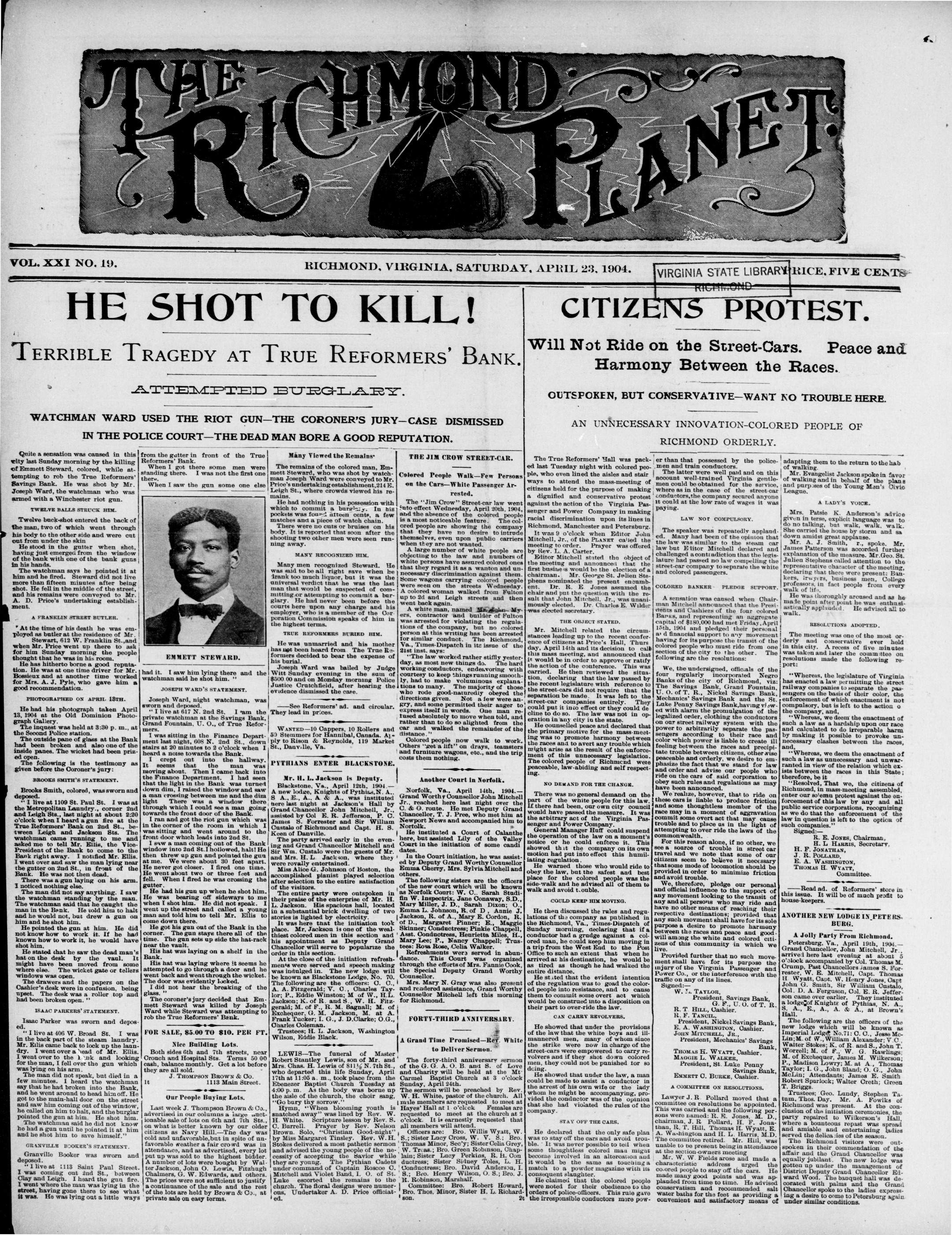
HE SHOT TO KILL!
TERRIBLE TRAGEDY AT TRUE REFORMERS' BANK.
IN THE POLICE COURT—THE DEAD MAN BORE A GOOD REPUTATION
VOL. XXI NO. 19.
HE
TERRIBLE T
WATCHMAN WARD
IN THE PO
Quite a sensation was caused in this city last Sunday morning by the killing of Emmett Steward, colored, while attempting to rob the True Reformers' Savings Bank. He was shot by Mr. Joseph Ward, the watchman who was armed with a Winchester riot gun.
TWELVE BALLS STRUCK HIM.
Twelve buck-shot entered the back of the man, two of which went through his body to the other side and were cut out from under the skin
He stood in the gutter when shot, having just emerged from the window of the bank with one of the bank guns in his hands.
The watchman says he pointed it at him and he fired. Steward did not live more than fifteen minutes after being shot. He fell in the middle of the street, and his remains were conveyed to Mr. A. D. Price's undertaking establishment.
A FRANKLIN STREET BUTLER.
"At the time of his death he was employed as butler at the residence of Mr. Stewart, 612 W. Franklin St. and when Mr. Price went up there to ask for him Sunday morning the people thought that he was in his room. He has hitherto borne a good reputation for Mr. Bossius and at another time worked for Mrs. A. J. Pyle, who gave him a good recommendation.
PHOTOGRAPHED ON APRIL. 18TH
He had his photograph taken April 13, 1904 at the Old Dominion Photograph Gallery.
The inquest was held at 3:30 p. m., at the Second Police station.
The outside plane of glass at the Bank was broken and also one of the inside planes. The wicket had been prized open.
The following is the testimony as given before the Coroner's jury:
BROOKS SMITH'S STATEMENT.
Brooks Smith, colored, was sworn and deposed.
"I live at 1109 St. Paul St. I was at the Metropolitan Laundry., corner 2nd and Leigh Sts., last night at about 2:20 o'clock when I heard a gun fire at the True Reformers' Bank on 2nd St., between Leigh and Jackson Sts. The watchman came running to me and asked me to tell Mr. Ellis, the Vice-President of the Bank to come to the Bank right away. I notified Mr. Ellis. I went over and saw the man lying near the gutter on 2nd St., in front of the Bank. He was not then dead. There was a gun laying on his arm. I noticed nothing else.
The man did not say anything. I saw the watchman standing by the man. The watchman said that he caught the man in the Bank. He told him to hatch and that he could drew a gun on him and he shot him.
He pointed the gun at him. He did not know how to work it. If he had known how to work it, he would have shot him.
He stated that he saw the dead man's hat on the desk by the vaul. It might have been moved from some where else. The wicket gate or tellers windows was open. The papers on the Cashier's desk were in confusion, being upset. The desk was a roller top and had been broken open."
ISAAC PARKERS' STATEMENT
Isaac Parker was sworn and deposed.
"I live at 406 W. Broad St. I was in the back part of the steam laundry. Mr. Ellis came back to lock up the laundry. I went over a head of Mr. Ellis. I went over to the bank and looking for the man, I fell over the gun which was lying on his arm.
The man and I speak, but died in a few minutes. I heard the watchman say that he had broken into the Bank, and he went around to head him off. He got to the main-hall door on the street and saw him coming out of the window, he called on him to halt, and the burglar pointed the gun at him. He shot him.
The watchman said he did not know he had been until he pointed it at him and he said he was.
GRANVILLE BOOKER'S STATEMENT
Granville Booker was sworn and deposed.
"I live at 1113 Saint Paul Street.
I was coming out 2nd St., between Clay and Leigh. I heard the gun fire.
I went where the man was lying in the street, having gone there to see what it was. He was lying out a little ways
ATTEMPTED BURGLARY
from the gatter in front of the True Reformers' Bank. When I got there some men were standing there. I was not the first one there.
When I saw the gun some one else
EMMETT STEWARD.
had it. I saw him lying there and the watchman said he shot him. "
JOSEPH WARD'S STATEMENT.
Joseph Ward, night watchman, was sworn and deposed.
"I live at 617 N. 2nd St. I am the private watchman at the Savings Bank, Grand Fountain, U. O., of True Reformers.
I was sitting in the Finance Department last night, 608 N. 2nd St., down stairs at 20 minutes to 2 o'clock when I heard a noise towards the Bank.
I crept out into the hallway. It seems that the man was moving about. Then I came back into the Finance Department. I had seen that the light in the Bank was tucked down dim, I raised the window and saw a man crossing between me and the dim light. There was a window there through which I could see a man going towards the front door of the Bank.
I ran and got the riot gun which was in the corner of the room in which I was sitting and went around to the front door which leads into 2nd St. I saw a man coming out of the Bank window into 2nd St. I hollowed, halt! He then threw up gun and pointed the gun at me. We were about 30 feet apart. He never got closer. I fired one time. He went about two or three feet and fell. When I fired he was crossing the gutter. He had his gun up when he shot him. He was bearing off sideways to me when I shot him. He did not speak. I went up the street and called a young man and told him to tell Mr. Ellis to come down there. He got his gun out of the Bank in the corner. The gun stays there all of the time. The gun sets up side the hat-rack near the vault. His hat was laying on a shelf in the Bank. His hat was laying where it seems he attempted to go through a door and he went back and went through the wicket. The door was evidently locked.
I did not hear the 'breaking of the glass.' " The coroner's jury decided that Emmett Steward was killed by Joseph Ward while Steward was attempting to rob the True Reformers' Bank.
FOR SALE, $5.00 TO $10. PER FT.
Nice Building Lots.
Both sides 6th and 7th streets, near Cronch and Hospital Sts. Terms 50 00 cash, balance monthly. Get a lot before they are all sold.
J. THOMPSON BROWN & Co.
1t 1113 Main Street.
Our People Buying Lots
Last week J. Thompson Brown & Co. advertised in our columns a large auction sale of lots on 6th and 7th Sts. on what is better known by our older citizens as Navy Hill.—The day was cold and unfavorable, but in spite of unfavorable weather a fair crowd was in attendance, and as advertised, every lot put up was sold to the highest bidder. A number of lots were bought by Walter Jackson, John O. Lewis, Fitzhugh Chalmers, G. W. Edwards, and others. The prices were not sufficient to justify a continuance of the sale and the rest of the lots are held by Brown & Co. at private sale on easy terms.
RICHMOND, VIRGINIA, SATURDAY, APRIL 23, 1904.
Many Viewed the Remains:
The remains of the colored man, Emmett Steward, who was shot by watchman Joseph Ward were conveyed to Mr. Price's undertaking establishment, 214 E. Leigh St., where crowds viewed his remains.
He had nothing in his possession with which to commit a burglary. In his pockets was found ateen cents, a few matches and a piece of watch chain.
There were no cuts or bruises on his body. It is reported that soon after the shooting two other men were seen running away.
MANY RECOGNIZED HIM.
Many men recognized Steward. He was said to be all right save when he frank too much liquor, but it was the universal verdict that he was the last man that would be suspected of committing or attempting to commit a burglary. He had never been before the company he employed, who is a member of the Corporation Commission speaks of him in the highest terms.
TRUE REFORMERS BURIED HIM.
He was unmarried and his mother has not been heard from. The True Reformers decided to bear the expense of his burial.
Joseph Ward was bailed by Judge Witt Sunday evening in the sum of $500.00 and on Monday morning Police Justice Crutchfield, after hearing the evidence dismissed the case.
—See Reformers' ad. and circular. They lead in prices.
WANTED—10 Cappers, 10 Rollers and 50 Stemmers for Hannibal, Canada. Apply to Rison & Reynolds, 119 Market St., Danyville, Va.
PYTHIANS ENTER BLACKSTONE
Mr. H. L. Jackson is Deputy.
Blackstone, Va., April 12th, 1904.—A new lodge, Knights of Pythias, N. A., S. A., E., A., A. & A., was instituted there last night at Jackson's Hall by Grand Chancellor John Mitchell, Jr., assisted by Col E. R. Jefferson, P. C. James S. Forrester and Sir William Custalo of Richmond and Capt. H. S. Keen of Danville.
The party arrived early in the evening and Grand Chancellor Mitchell and Sir Wm. Custalo were the guests of Mr. and Mrs. H. L. Jackson, where they were royally entertained.
Miss Alice G. Johnson of Boston, the accomplished pianist played selection after selection to the entire satisfaction of the visitors.
The entire party were outspoken in their praise of the enterprise of Mr. H. L. Jackson. His spacious hall, located in the stately park dwelling of two stories is lighted by electricity.
It was here that the initiation took place. Mr. Jackson is one of the wealthiest colored men in this section and his appointment as Deputy Grand Chancellor will serve to popularize the order in this section.
At the close of the initiation refreshments were served and speech making was inculged in. The new lodge will be known as Blackstone Lodge, No. 70. The following are the officers: C. C. A. A. Fitzgerald; V. C. Charles Taylor; P., Eddie Winston; M of W, H.L. Jackson; K of R. and S., W. H. Fitzgerald; M of F., R. M. Bagnall; M of Exchequer, G. M. Jackson, M at A. Frank Tucker, I. G., J. D. Clarke; O.G., Charles Coleman. Trustees; H. L. Jackson, Washington Wilson, Eddie Black.
LEWIS—The funeral of Master Robert Stantley Lewis, son of Mr. and Mrs. Chas. H. Lewis of 8111' N 7th St., who departed this life Sunday, April 17th at 11:05 a.m., took place from the Ebenezer Baptist Church Tuesday at 4:00 p.m. As the body was borne up the aisle of the church, the choir sang, "Go bury thy sorrow."
Hymn. "When blooming youth is snatched away" was lined by Rev. W. H. White. Scripture lesson by Rev. S. C. Burrell. Prayer by Rev. Nelson Brown. Solo, "Christian Good-night" by Miss Margaret Tinsley. Rev. W. H. Stokes delivered a most pathetic sermon and advised the young people of the necessity of accepting the Savior while they are young. The Pythian Cadets under command of Captain Roscoe C. Mitchell and Violet Band, I. O. of St. Luke escorted the remains to the church. The floral designs were numerous, Undertaker A. D. Price officiated.
THE JIM CROW STREET-CAR.
Colored People Walk—Few Person on the Cars—White Passenger Arrested.
The "Jim Crow" Street-car law went into effect Wednesday, April 20th, 1904, and the absence of the colored people is a most noticeable feature. The colored people are showing the company that they have no desire to intrude themselves, even upon public carriers when they are not wanted.
A large number of white people are objecting to the law and numbers of white persons have assured colored ones that they regard it as a wanton and unnecessary discrimination against them. Some wagons carrying colored people were seen on the streets Wednesday. A colored woman walked from Fulton up to 2d and Leigh streets and then went back again.
A white man, named Mr. John Myers, contractor and builder of Fulton was arrested for violating the regulations of the company, but no colored person at this writing has been arrested for similar conduct. The Richmond, Va., Times-Dispatch in its issue of the 21st inst. says:
"The law worked rather stiffly yesterday, as most new things do. The hard working conductors, endeavoring with courtesy to keep things running smoothly, had to make voluminous explanations to many. The majority of those who rode good-naturedly obeyed the directions given. Not a few were angry, and some permitted their anger to express itself in words. One man refused absolutely to move when told, and rather than to do so alighted from the car and walked the remainder of the distance."
Colored people now walk to work. Others "get a lift" on drays, teamsters and furniture wagons, etc., and the trip costs them nothing.
Another Court in Norfolk.
Norfolk, Va., April 14th, 1904.—Grand Worthy Counsellor John Mitchell Jr., reached here last night over the C. & O. route. He met Deputy Grand Chancellor, T. J. Pree, who met him at Newport News and accompanied him to Norfolk.
He instituted a Court of Calanthe here, but assisted Lily of the Valley Court in the initiation of some candid dates.
In the Court initiation, he was assisted by Deputy Grand Worthy Counsellor Emma Cherry, Mrs. Sylvia Mitchell and others.
The following sisters are the officers of the new court which will be known as Norfolk Court: W. C., Sarah Stiflin fw. Inspectrix, Jane Connaway, S.D., Mary Miller, J. D., Sarah Dixon; O. Emma L. Johnson, R of D, Annie J. Jackson, R of A, Mary E. Cordon, R of D., Margaret Pinner; E., Maggie Skinner; Conductress; Pinkie Chappell, Asst. Conductress, Henrietta Miles, H., Mary Lee P., N. Nancy Chappell; Trustees: Rosa Rose, Celia Walker.
Refreshments were served in abundance. This Court was organized through the efforts of Mrs. Fannie Cook, the Special Deputy Grand Worthy Counselor. Gary N. Gray was also present and rendered assistance, Grand Worthy Counselor Mitchell left this morning for Richmond.
The forty-third anniversary sermon of the G. G. A. O. B. and S. of Love and Charity will be held at the Mt Carmel Baptist Church at 3 o'clock Sunday, April 24th.
The sermon will be preached by Rev. W. H. White, pastor of the church. All male members are requested to meet at Hayes' Hall at 1 o'clock. Females are requested to meet at the church at 2 o'clock. It is earnestly requested that all members will attend.
Officers are: Bro. Willis Wyatt, W. S.; Sister Lucy Cross, W. V. S.; Bro. Thomas Minor, Sec'y; Sister Celia Grey, W. Treas.; Bro. Green Robinson, Chaplain; Sister Lucy Perkins, R. H. Conductress; Sister Sidney Toles, L. H. Conductress; Bro. David Anderson, I. S.; Bro. Henry Wilson, O. S.; Bro. J. R. Robinson, Marshall.
| Committee: Bro. Robert Howard,
Thos. Minor, Sister H. L. Richard.
| 698.
CITIZENS PROTEST.
Will Not Ride on the Street-Cars. Peace and Harmony Between the Races.
OUTSPOKEN, BUT CONSERVATIVE—WANT NO TROUBLE HERE
AN UNNECESSARY INNOVATION-COLORED PEOPLE OF
The True Reformers' Hall was packed last Tuesday night with colored people, who even lined the aisles and stairways to attend the mass-meeting of citizens held for the purpose of making a dignified and conservative protest against the action of the Virginia Passenger and Power Company in making racial discrimination upon its lines in Richmond, Manchester and Petersburg. It was 9 o'clock when Editor John Mitchell, Jr., of the PLANET called the meeting to order. Prayer was offered by Rev. L. A. Carter. Editor Mitchell stated the object of the meeting and announced that the first business would be the election of a chairman. Mr. George St. Julien Stephens nominated the present encumbent. Dr. R. E Jones assumed the chair and put the question with the result that John Mitchell, Jr., was unanimously elected. Dr. Charles E. Wilder was elected secretary.
THE OBJECT STATED:
Mr. Mitchell related the circumstances leading up to the recent conference of citizens at Price's Hall, Thursday, April 14th and its decision to call this mass meeting, and announced that it would be in order to approve or ratify the action of the conference. This was carried. He then reviewed the situation, declaring that the law passed by the recent legislature with reference to the street-cars did not require that the separation be made. It was left to the street-car companies entirely. They could put it into effect or they could decline to do so. The law was not in operation in any city in the state.
He counselled peace and declared that the primary motive for the mass-meeting was to promote harmony between the races and to avert any trouble which might arise as the result of the enforcer's unnecessary legislation. The colored people of Richmond were peaceable, law-abiding and self respecting.
NO DEMAND FOR THE CHANGE
There was no general demand on the part of the white people for this law. If there had been, our own city council would have passed the measure. It was the arbitrary act of the Virginia Passenger and Power Company.
General Manager Huff could suspend the operation of the law on a moment's notice or he could enforce it. This showed that the company on its own public health effect this humiliating regulation.
He warned those who would ride to obey the law, but the safest and best place for the colored people was the side-walk and he advised all of them to walk and avoid t.ouble.
COULD KEEP HIM MOVING.
He then discussed the rules and regulations of the company as published in the Richmond, Va., Times-Dispatch of Sunday morning, declaring that if a conductor had a grudge against a colored man, he could keep him moving in a trip from the West End to the Post Office to such an extent that when he arrived at his destination, he would be as tired as though he had walked the colonnade. He steted that the evident intention of the regulation was to goad the colored people into resistance, and to cause them to commit some overt act which would be construed into a disposition on their part to over-ride the law.
CAN CARRY REVOLVERS.
He showed that under the provisions of the law that the white boys and ill-mannered men, many of whom since the strike were now in charge of the street-cars were empowered to carry revolvers and if they shot down colored men, they could not be punished for so doing.
He showed that under the law, a man could be made to assist a conductor in the arrest of his own wife, the lad whom he might be accompanying, provided the conductor was of the opinion that she had violated the rules of the company.
STAY OFF THE CARS.
He declared that the only safe plan was to stay off the cars and avoid trouble. It was never possible to tell when some thoughtless colored man might become involved in an altercation and it would be the same as touching a match to a powder magazine with its consequent slaughter. He claimed that the colored people were noted for their obedience to the orders of police-officers. This rule gave the irresponsible conductors more pow-
RICHMOND ORDERLY
er than that possessed by the policemen and train conductors. The latter were well paid and on this account well-trained Virginia gentlemen could be obtained for the service, where as in the case of the street canvassers company secured anyone it could at the low rate of wages it was paying.
LAW NOT COMPULSORY
The speaker was repeatedly applauded. Many had been of the opinion that the law was similar to the steam car law but Eitor Mitchell declared and challenged a contradiction that the legislature had passed no law compelling the street-car company to separate the white and colored passengers.
COLORED BANKER PLEDGE SUPPORT
A sensation was caused when Chairman Mitchell announced that the Presidents and Cashiers of the four colored Bans, and representing an aggregate capital of $180,000 had met Friday, April 15th, 1904 and pledged their personal support to any movement having for them the most of the colored people who must ride from one section of the city to the other. The following are the resolutions:
We, the undersigned, officials of the four regularly incorporated Negro Banks of the city of Richmond, viz The Savings Bank, Grand Fountain, U. O. of T. R., Nickel Savings Bank, Mechanics' Savings Bank and the St. Luke Penny Savings Bank, having viewed with alarm the promulgation of the legalized order, clothing the conductors on our street railway system with the power to arbitrarily separate the passengers according to their race and color which power is liable to create ill feeling between the races and precipitate trouble between citizens, other wise peaceable and orderly, we desire to emphasize the fact that we stand for law and order and advise our people who on the cars of said corporation to obey the regulations as may have been announced. We realize, however, that to ride on these cars is liable to produce friction and some thoughtless member of the race may in a moment of aggravation commit some overt act that may cause trouble and to place us in the light of attempting to over ride the laws of the commonwealth.
For this reason alone, if no other, we see a source of trouble in street car travel and we note that some of our citizens seem to believe it necessary that some mode of locomotion should be provided in order to minimize friction and avoid trouble.
We, therefore, pledge our personal and official influence to the support of any movement looking to the transit of any and all persons who may ride and have no other means of reaching their respective destinations; provided that any such movement shall have for its sole purpose a desire to promote harmony between the races and peace and good will among the white and colored citizens of this community in which we live.
Provided further that no such movement shall have for its purpose the injury of the Virginia Passenger and Power Co., or the interference with the traffic on any of its lines.
President, Nickel Savings Bank,
E. A. WASHINGTON, Cashier.
JOHN MITCHELL, JR.
President, Mechanics' Savings
Bank,
THOMAS K. WYATT, Cashier.
MAGGIE L. WALKER.
President, St. Luke Penny
Savings Bank,
EMMETT C. BURKE, Cashier.
A COMMITTEE ON RESOLUTIONS.
Lawyer J. R. Pollard moved that a committee on resolutions be appointed. This was carried and the following persons were named: R. E. Jones, M. D., chairman, J. R. Pollard, H. F. Jonathan, R. T. Hill, Thomas H. Wyatt, E. A. Washington and H. L. Harris, M.D. The committee retired. Mr. Hill, was unable to be present being in attendance at the section owners meeting. Mr. W. W. Fields arose and made a characteristic address urged the cooled people to stay off the cars. He made many good points and was applauded from time to time. He advised conservatism and recommended salt water baths for the feet as providing a convenient and satisfactory means of.
6.
adapting them to the return to the hab of walking.
Mr. Evangelist Jackson spoke in favor of walking and in behalf of the plans and purposes of the Young Man's Civic League.
A LADY'S VOICE.
Mrs. Patsie K. Anderson's advice given in tense, explicit language was to do no talking, but walk, walk, walk. She carried the house by storm and sa'd amidst great applause. Mr. A. J. Smith, r., spoke. Mr. James Patterson was accorded further explanation of the measure. Mr. Geo. St. Julien Stephens called attention to the representative character of the meeting, declaring that there were present: Bankers, lawyers, business men, College professors, in fact people from every walk of life. He was thoroughly aroused and as he made point after point he was enthusiastically applauded. He advised all to walk.
RESOLUTIONS ADOPTED
The meeting was one of the most orderly and conservative ever held in this city. A recess of five minutes was taken and later the committee on resolutions made the following report:
"Whereas, the legislature of Virginia has enacted a law permitting the street railway companies to separate the passengers on the basis of their color, the enforcement of which enactment is not compulsory, but is left to the action o the company, and,
Whereas, we deem the enactment of such a law in order upon our race and calculated to do irreparable harm by making it possible to provoke unnecessary clashes between the races, and,
Whereas, we deem the enactment of such a law as unnecessary and unwarranted in view of the relation which exists between the races in this State; therefore, be it
"Resolved, That we, the citizens of Richmond, in mass-meeting assembled, enter our solemn protest against the enforcement of this law by any and all public service corporations, recognizing as we do that the enforcement of the law in question is left to the option of such companies."
Read ad. of, Reformers' store in this issue, will be of much profit to house
ANOTHER NEW LODGE IN PETERS BURG.
A Jolly Party From Richmond.
Petersburg, Va., April 19th, 1904.
Grand Chancellor, John Mitchell, Jr., arrived here last evening at about 5 o'clock accompanied by Col. Thomas M. Crump, Past Chancellors James S. Forrester, W. E. Mitchell, Capt. Thomas H Wyatt, Capt. W. Henry Jones, Capt John G. Smith, Sir William Caskett, Col. D. A. Ferguson, Col. E. R. Jefferson came over earlier. They instituted a lodge of Knights of Pythias, N. A. S. A. E., A. A. & A., at Brown's Hall.
The following are the officers of the new lodge which will be known as Imperial Lodge No.71: C. C., Jesse McLin; M. of W. William Alexander; V. C. Walter Stokes; K. of R. and S. John T. Worrell; M. of F. F. G. Rawlings; M. of Exchequer, James M. Wilkerson; P., Madison Lowry; M. at A. Thomas Taylor; I. G., John Bland; O. G., John McLin; Attendants; James E. Smith Robert Spurlock; Walter Creth; Green T. Briggs.
Trustees; Geo. Lundy, Stephen Tatum, Thos. Day, Mr. A. Fowlks of Richmond was present. At the conclusion of the initiation ceremonies, the party repaired to Wilkerson's Hall, where a bounteous repast was spread and amenable and entertaining ladies served the delicacies of the season. The Richmond visitors were outspoken in their commendation of the Grand Chancellor was equally jubilant. The new lodge was gotten up under the management of District Deputy Grand Chancellor Royward Wood. The banquet hall was decorated with palms and the Grand Chancellor spoke to the ladies expressing a desire to come to Petersburg again under similar conditions.
RE PLANET
TEMPERANCE NOTES
WE ARE WINNING BIT BY BIT.
A Recitation by John Anderson.
Why should our feet grow weary or our
hands refuse to toll?
We know, and that should cheer us on,
we're winning bit by bit.
Never d'look those lessons that are written
for our good.
They are printed on the paths we tread, and
published on the wood.
The spring from bud to blossom moves before
the fruits are fit:
We know, and that should cheer us on, we're
winning bit by bit.
How the sun comes slipping out along
the eastern sky—
An instantaneous blaze of light would blast the strongest eye.
Bo streak and beam come sailing forth, each bright and bright yet;
We know, and that should cheer us on, we're winning bit by bit.
We grandly art from age to age unfolds that loving lore—
From hieroglyphics to talking leaves and telegrams we soar;
From pack-steed on to royal mall and iron horse we fill:
We know, and that should cheer us on,
we're winning bit by bit.
The tyrant Drink still keeps the field, and
leads a mighty host;
But here and there his ancient guards are flying from their post;
flying from their post;
And while his friends diminish fast, his foes
we know it, that should cheer us on,
we're winning bit by bit.
When right and might in battle meet, the
conflict may be long;
John Anderson, in National Advocate.
HE KNEW HOW TO SAY NO.
Five boys were together on the play ground of a schoolhouse. They had grown tired of the game in which they had been engaged and were seated on the grass near the schoolhouse door.
"Let's go to the fishing pond," said Joe Hartman. "We can be back before books."
"So we can," said Billy Benson, rising. "I'm with you—I'm always ready for a swim. I know we can be back before books, but it won't hurt much if we do lose a little time. I don't care for losing a little time."
"May we the teacher will whip us if we are not back by one o'clock." This
SALOON
"BUT IT WON'T HURT YOU TO TAKE
A SOFT DRINK."
same from John Jennings. "He doesn't like it when we're past one clock coming in. And he punished Ralph Rankin for being too late one day."
"Oh, you're a scary boy—you're always afraid of getting whipped. Come along and don't be a baby. We can be back in time for books."
"Yes, I'll go," said John. He didn't have firmness to say no.
Another boy, Edwin Harris, was asked if he would go and he readily assented.
Then Joe Hartman asked the fifth boy if he would go with them to "the swimming place," as it was often called.
"No," promptly replied Henry Dale. "I'll not go."
"And why not, Mr. Dale?" asked Joe somewhat imperiously.
"Because I promised my mother I would not."
This was Henry's answer and it was followed by a live burst of laughter from the other boys. Joe, however, was the first to lead in the laughter.
"Then you must be tied to your mother's apron string," said Joe, derisively. "I thought you could be a man in spite of your mother."
"We need not stop now to discuss the matter of manhood," said Henry. "I have told my mother that I would not go again from school to that place, and I intend to be as good as my word. I you all intend to go you can go right along. You need not wait for me."
"But," added one of the boys in derision, "we'd like to have you along to take care of us."
"Yes," added another, "and we'd feel safer if we had a real good mother's boy along."
These derisive remarks, however, were lost on Henry. He turned away and went to another part of the play
ground.
The boys were absent when "books" was called by the teacher and they were punished.
Nine years had passed and Henry was engaged in a mercantile house in the city. He had been in this position for three months. He liked the business and his employer was beginning to feel that he had employed a young man of integrity—a young man who could be trusted. No great temptation, however, had appeared to turn the young man from his course.
He had made the acquaintance of some young men who were somewhat reckless and these young men whom we shall designate as Tom, Dick and Harry, came to him one evening at his boarding place with the intention of "breaking him in," as they called it.
"We want you to go with us and see the sights," said Tom.
"And," added Dick, "we'll not let you get into any trouble. We merely want to show you city life as it is."
"And," continued Harry, "you can then walk understandingly. You don't want to be called a greenhorn. We want you to be smart. We want you to see some of the wickedness of the world so that you can understand where you are at. We want to 'break you in,' so to speak. We don't want you to be considered a greeny. You have been here long enough to learn something about city life and we want you now to commence to learn. We'll show you around and we'll see that you don't get into any trouble."
Henry was willing to go. He didn't know just how these young men stood. They had been friendly, had treated him well, and those who had spoken of them said nothing derogatory to their character.
Henry went with them, and when they had walked and talked for awhile Dick proposed that they go into a saloon and have a drink.
"I don't drink," said Henry. "But it won't hurt you to take a soft drink." "I don't drink," said Henry, "neither hard nor soft." "Oh," said Harry, "don't be a dune; come and take a drink. We want you to be like other people." "Now," said Henry, as he straightened himself manfully, "you have my answer. I don't drink. If you want to drink I will not detain you. I know the way to my boarding house. You can go your way. I can go mine. I would not take a drink of intoxicating liquor if by doing so I could gain the whole world. I'm what you might dominate a sot fellow. I promised my mother that I would never taste intoxicating liquor, and I will not." A loud laugh from the pretended friends was the answer to this. "But," said Tom, returning to the attack, "We don't ask you to drink anything intoxicating. It was soft drinks we were talking about."
"I class them all as intoxicating drinks," said Henry. "Good night. I am going home."
Another shout of laughter followed him, but he cared not. He had unexpectedly found out the kind of friends they were and he was thankful.
Ten years have gone into the cycles of the past. Henry has a prominent position in a large mercantile house in the city of N—. Tom went into the by-paths of the wicked and was accidentally killed while under the influence of intoxicating liquor. Dick is an outcast and Harry is considered a cipher.
"As ye sow so shall ye also reap."—H. Elliott McBride, in United Presbyterian.
T EMPERANCE NOTES.
When drink comes in at the door prosperity files out of the window.—National Advocate. Let us have faith that right makes might; and in that faith, let us to the end dare to do our duty as we understand it.—Lincoln. The perpetuity of this government will depend upon the moral and religious training of the youth.—George Washington's farewell address. A movement is being started among the liquor men for a great building at Washington that shall be headquarters for the trade. A charter has been secured and the stock in the company has been fixed at a par value of $100 a share.
Notice was recently served on 70 saloonkeepers of Appleton, Wils., by the Sunday reform committee consisting of clergymen and laymen, that evidence will be collected against all saloons found to be open on Sunday. Many of the saloons heeded the warning, but it is believed that some of the more objectionable ones will fight.—Union Signal.
The papers tell of a soldier in the Philippines who discourses upon a new cure for drunkenness among soldiers. "We have," he says, "a lot of native soldiers enlisted here. When one of the white boys gets drunk the captain puts a native soldier over him, and the native puts on lots of airs while marching him around. It grinds the boys so they wouldn't get drunk if they could.
Different Classes of Inebriates.
Among the ordinary inebriates which come under treatment in the institutions there are several quite distinct classes: One the imbecile and delusional class; another the occasional inebriates, who seem to be both imbecile and paretic in their mental conditions; the third, the habitual and constant drinkers, who are, like the first class, egotistical and delusional about their own strength. Another class may be properly called criminal inebriates, who when under the influence of spirits have all the instincts and impulses of a criminal. They are clearly insane. The accidental inebriates is a class by themselves, and seem to depend entirely on the surroundings. The recurrent inebriates, in which the paroxysm of drink returns at stated intervals, are allied to the epileptoid family of diseases. Nearly all of these classes are neurotics from heredity; some direct from inebriate parents, others indirect from other forms of neurosis.—Journal of Inebriety.
Friends.
Friends seldom desert a man while his money holds out.
THE RICHMOND PLANET, RICHMOND, VIRGINIA.
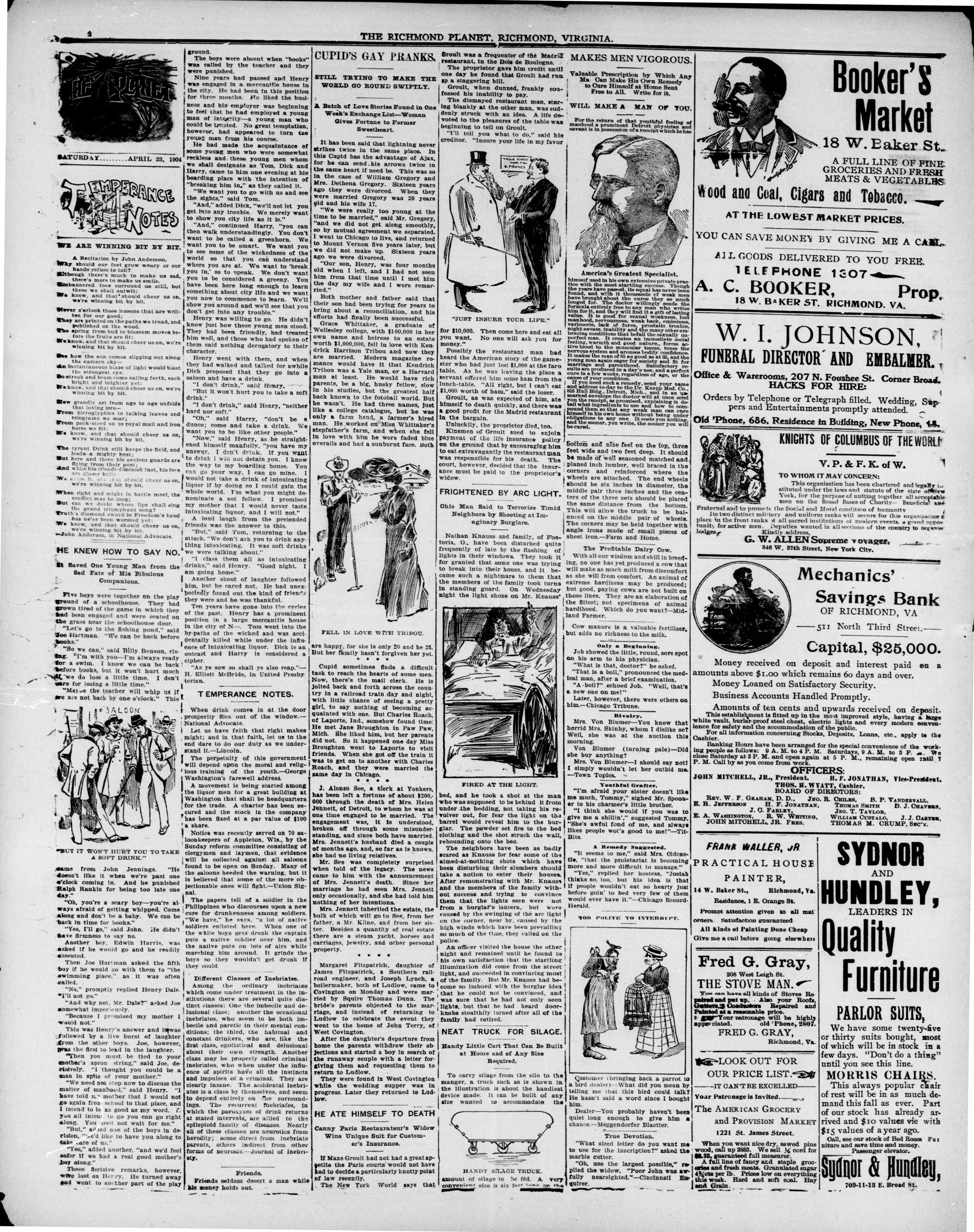
CUPID'S GAY PRANKS.
CUPID'S GAY PRANKS.
STILL TRYING TO MAKE THE
WORLD GO ROUND SWIFTLY.
A Batch of Love Stories Found in One Week's Exchange List—Woman Gives Fortune to Former Sweetheart.
It has been said that lightning never strikes twice in the same place. In this Cupid has the advantage of Ajax, for he can send his arrows twice in the same heart if need be. This was so in the case of William Gregory and Mrs. Dethena Gregory. Sixteen years ago they were divorced. When they were married Gregory was 20 years old and his wife 17.
"We were really too young at the time to be married," said Mr. Gregory, "and we did not get along smoothly, so by mutual agreement we separated. I went to Chicago to live, and returned to Mount Vernon five years later, but we did not make up. Sixteen years ago we were divorced.
"Our son, Henry, was four months old when I left, and I had not seen him from that time until I met him the day my wife and I were remarried."
Both mother and father said that their son had been trying for years to bring about a reconciliation, and his efforts had finally been successful.
Grace Whittaker, a graduate of Wellesley college, with $100,000 in her own name and heiress to an estate worth $1,000,000, fell in love with Kendrick Harrison Tribuon and now they are married. Modern magazine romance would have it that Kendrick Tribuon was a Yale man, or a Harvard man at least. He would have rich parents, be a big, husky fellow, slow in his studies, but the greatest half back known to the fotball world. But he wasn't. He had three names, just like a college catalogue, but he was only a farm hand, a farmer's hired man. He worked on 'Miss Whittaker's stepfather's farm, and when she fell in love with him he wore faded blue overalls and had a sunburst face. Both
F.
FELL IN LOVE WITH TRIBOU.
are happy, for she is only 20 and he 25. But her family hasn't forgiven her yet.
Cupid sometimes finds a difficult task to reach the hearts of some men. Now, there's the mail clerk. He is jolted back and forth across the country in a railroad train day and night, with little chance of seeing a pretty girl, to say nothing of becoming acquainted with one. But Charles Roach, of Laporte, Ind., somehow found time. He met Jane Broughton in Paw Paw, Mich. She liked him, but her parents did not. So it happened one day Miss Broughton went to Laporte to visit friends. When she got off the train it was to get on to another with Charles Roach, and they were married the same day in Chicago.
J. Alonzo See, a clerk at Yonkers, has been left a fortune of about $200,000 through the death of Mrs. Helen Jennett, of Detroit, to whom he was at one time engaged to be married. The engagement was, it is understood, broken off through some misunderstanding, and since both have married. Mrs. Jennett's husband died a couple of months ago, and, so far as is known, she had no living relatives. Mr. See was completely surprised when told of the legacy. The news came to him with the announcement of Mrs. Jennett's death. Since her marriage he had seen Mrs. Jennett only occasionally, and she had told him nothing of her intentions.
Mrs. Jennett inherited the estate, the bulk of which will go to See, from her father, a Mr. Kline, and from her sister. Besides a quantity of real estate there are a steam yacht, horses and carriages, jewelry, and other personal property.
Margaret Fitzpatrick, daughter of James Fitzpatrick, a Southern railroad engineer, and Joseph Lynch, a boilermaker, both of Ludlow, came to Covington on Monday and were married by Squire Thomas Dunn. The bride's parents objected to the marriage, and instead of returning to Ludlow to celebrate the event they went to the home of John Terry, of West Covington.
After the daughter's departure from home the parents withdrew their objections and started a boy in search of the runaway couple with a letter forgiving them and requesting them to return to Ludlow.
They were found in West Covington while the wedding supper was in progress. Later they returned to Ludlow.
HE ATE HIMSELF TO DEATH
Canny Paris Restauranter's Widow
Wins Unique Suit for Customer's Insurance.
If Maxe Groult had not had a great appetite the Paris courts' would not have had to decide a particularly knotty point of law recently.
The New York World says that
Groult was a frequenter of the Madrid restaurant, In the Bois de Boulogne.
restaurant, in the Bois de Boulogne. The proprietor gave him credit until one day he found that Groult had run up a staggering bill. Groult, when duned, frankly confessed his inability to pay. The dismayed restaurant man, starring blankly at the other man, was suddenly struck with an idea. A life devoted to the pleasures of the table was beginning to tell on Groult. "I'll tell you what to do," said his creditor. "Insure your life in my favor
TABLE SHOT
MURT TAY
S. FRANCES
"JUST INSURE YOUR LIFE."
for $10,000. Then come here and eat all you want. No one will ask you for money."
Possibly the restaurant man had heard the American story of the gamester who had just lost $1,000 at the faro table. As he was leaving the place a servant offered him some ham from the lunch-table. "All right, but I can't eat $1,000 worth of ham," said the loser.
Groult, as was expected of him, ate himself to death quickly, and there was a good profit for the Madrid restaurant in the bargain.
Unluckily, the proprietor died, too. Kinsmen of Groult sued to enjoin payment of the life insurance policy on the ground that by encouraging him to eat extravagantly the restaurant man was responsible for his death. The court, however, decided that the insurance must be paid to the proprietor's widow.
FRIGHTENED BY ARC LIGHT.
Ohio Man Said to Terrorize Timid Neighbors by Shooting at Imaginary Burglars.
Nathan Knaus and family, of Fostoria, O., have been disturbed quite frequently of late by the flashing of lights in their windows. They took it for granted that some one was trying to break into their house, and it became such a nightmare to them that the members of the family took turns in standing guard. On Wednesday night the light shone on Mr. Knaus!
Pablo Picasso
FIRED AT THE LIGHT.
bed, and he took a shot at the man who was supposed to be behind it from under the bedding, not taking his revolver out, for fear the light on the barrel would reveal him to the burglar. The powder set fire to the bed clothing and the shot struck the wall, rebounding onto the bed.
The neighbors have been as badly scared as Knaus for fear some of the aimed-at-nothing shots which have been disturbing their slumbers should take a notion to enter their houses. After demonstrating with Mr. Knaus and the members of the family without success and trying to convince them that the lights seen were not from a burglar's lantern, but were caused by the swinging of the arc light on the corner, near by, caused by the high winds which have been prevailing so much of the time, they called on the police.
An officer visited the house the other night and remained until he found to his own satisfaction that the startling illumination did come from the street light, and succeeded in convincing most of the family. But Mr. Knauss had become so imbued with the burglar idea that he could not be convinced, and was sure that he had not only seen lights, but that he had heard doorknobs stealthily turned after all of the family had retired.
NEAT TRUCK FOR SILAGE.
Handy Little Cart That Can Be Built at Home and of Any Size Required.
To carry silage from the silo to the manger, a truck such as is shown in the illustration is about the handiest device made. It can be built of any size wanted to accommodate the
HANDY SILAGE TRUCK.
amount of silage to be fed. A very convenient size is six feet long on the
MAKES MEN VIGOROUS.
Valuable Prescription by Which Any Ma Can Make His Own Remedy to Cure Himself at Home Sent Free to All. Write for it.
WILL MAKE A MAN OF YOU.
For the return of that youthful feeling of manhood promised Detroit retief physician and savant is imminent.
A. H.
himself used in his own extensive private practice with the most startling success. Though he has been found, and with it thousands of weak hands have brought about the cures they so much need, and the formula entirely free to any man who will him for it, and they will find it a gift of lasting manhood, nervousness, weak backache, varicose, lack of force, prostatic trouble, an imminent and the many other eminence embracing conditions that make perfect man. It creates an immediate social and good nature, forces active blood to the muscles, nervous system and arouses bodily confidence, causes the man of 65 as good as at 35, and the young man as good as at 25, a lack of wisdom of age, or the cause of your condition.
If you need such a remedy, send your name and address to the Dr. Knapp Med. Co., 883 Hull Blvd. Detroit, Mich. mail marked envelope the doctor will at once send you the receipt, as promised, explaining in deed that it is intended to use and how to compound them so that any one can himself in his own home without being under obligations to any one. It costs you nothing, and the sooner, you write, the sooner you will be cared.
Bottom and nine feet on the fop, three feet wide and two feet deep. It should be made of well seasoned matched and planed inch lumber, well braced in the corners and reinforced where the wheels are attached. The end wheels should be six inches in diameter, the middle pair three inches and the centers of the three sets should be placed the same distance from the bottom. This will allow the truck to be balanced on the middle pair of wheels. The corners may be held together with angle irons made of small pieces of sheet iron.—Farm and Home.
The Profitable Dairy Cow
With all our wisdom and skill in breeding,
no one has yet produced a cow that
will make as much milk from discomfort
as she will from comfort. An animal of
extreme hardiness may be produced;
but good, paying cows are not built on
those lines. They are an elaboration of
the fittest; not specimens of animal
hardihood. Which do you want?—Mid-
land Farmer.
Cow manure is a valuable fertilizer,
but adds no richness to the milk.
Only a Beginning.
Job showed the little, round, sore spot
on his arm to his physician.
"What is that, doctor?" he asked.
"That is a boll," pronounced the medical man, after a brief examination.
"A-boil?" echoed Job. "Well, that's a new one on me!" Later, however, there were others on him.—Chicago Tribune.
Rivalry.
Mrs. Von Blumer—You know that horrid Mrs. Skinny, whom I dislike so? Well, she was at the auction this morning.
Von Blumer (turning pale)—Did she buy anything?
Mrs. Von Blumer—I should say not! I simply wouldn't let her outbid me.—Town Topics.
Youthful Grafter.
"I'm afraid your sister doesn't like me much, Tommy," sighed Mr. Spooner to his charmer's little brother.
"I think she would if you was to give me a shillin'," suggested Tommy. "She's awful fond of me, and always likes people wot's good to me!"—Tit-Bits.
A. Remedy Suggested
"It seems to me," said Mrs. Oldcastle, "that the proletariat is becoming more and more difficult to manage."
"Yes," replied her hostess, "Jostah thinks so, too, but his idea is that if people wouldn't eat so hearty just before goin' to bed very few of them would ever have it."—Chicago Record-Herald.
700 POLITE TO INTERRUPT.
A woman in a dress and hat is holding a birdcage, and a man in a dress and hat is holding a birdcage.
Customer (bringing back a parrot to a bird dealer)-What did you mean by telling me that this bird could talk? He hasn't said a word since I bought him.
Dealer-You probably haven't been quiet long enough to give him a chance.-Meggendorfer Blaster.
True Devotion.
"What sized letter do you want me to use for the inscription?" asked the marble cutter.
"Oh, use the largest possible," replied the widow. "Poor John was awfully nearsighted."—Cincinnati Enquirer.
J. M. B.
Booker's Market
18 W. Eaker St. A FULL LINE OF FINE GROCERIES AND FRESH MEATS & VEGETABLES
Wood and Coal, Cigars and Tobacco.
AT THE LOWEST MARKET PRICES.
YOU CAN SAVE MONEY BY GIVING ME A CALL.
AJJ GOODS DELIVERED TO YOU FREE.
TELEPHONE 1307
A. C. BOOKER, Prop.
18 W. BAKER ST. RICHMOND. VA.
W. I. JOHNSON,
FUNERAL DIRECTOR AND EMBALMER.
Office & Warerooms, 207 N. Foushee St. Corner Broad.
HACKS FOR HIRE:
Orders by Telephone or Telegraph filled. Wedding, Suppers and Entertainments promptly attended.
Old 'Phone, 686. Residence in Building, New Phone, 48.
KNIGHTS OF COLUMBUS OF THE WORLD
AT THE LOWEST MARKET PRICES.
YOU CAN SAVE MONEY BY GIVING ME A CALL.
ALL GOODS DELIVERED TO YOU FREE.
TELEPHONE 1307
A. C. BOOKER, Prop.
18 W. BAKER ST. RICHMOND. VA.
W. I. JOHNSON. FUNERAL DIRECTOR AND EMBALMER.
Office & Warerooms, 207 N. Foushee St. Corner Broad.
HACKS FOR HIRE:
Orders by Telephone or Telegraph filled. Wedding, Suppers and Entertainments promptly attended.
Old 'Phone, 686. Residence in Building, New Phone, 18.
KNIGHTS OF COLUMBUS OF THE WORLD
V. P. & F. K. of W.
TO WHOM IT MAY CONCERN:
This organization has been chartered and legally instituted under the laws and statute of the state of New York, for the purpose of uniting together all acceptable men, on the
V. P. & F. K. of W.
TO WHOM IT MAY CONCERN:
This organization has been chartered and legally situated under the laws and statute of the state of New York, for the purpose of uniting together all acceptable men on the Broad Bases of Charity—Beneficial and Fraternal and to promote the Social and Moral condition of humanity.
Its two distinct military and uniform ranks will secure for this organization a place in the front ranks of all sacred institutions of modern events, a grand opportunity for active men. Deputies wanted in all sections of the country to organize lodges. Kindly address,
This organization has been chartered and legally instituted under the laws and statute of the state of New York, for the purpose of uniting together all acceptable men on the Broad Bases of Charity - Beneficial and Fraternal and to promote the Social and Moral condition of humanity. Its two distinct military and uniform ranks will secure for this organization a place in the front ranks of all sacred institutions of modern events, a grand opportunity for active men. Deputies wanted in all sections of the country to organize lodges. Kindly address,
G. W. ALLEN Supreme voyager,
846 W. 87th Street, New York City.
Mechanics'
Savings Bank
OF RICHMOND, VA
511 North Third Street.
Capital, $25,000.
Money received on deposit and interest paid on a amounts above $1.00 which remains 60 days and over. Money Loaned on Satisfactory Security.
Money received on deposit and interest paid on a amounts above $1.00 which remains 60 days and over.
Money Loaned on Satisfactory Security.
Business Accounts Handled Promptly.
Amounts of ten cents and upwards received on deposit.
This establishment is fitted up in the most improved style, having a large white vault, burlar-proof steel chest, electric lights and every modern convenience for safety and the accommodation of the public.
For all information concerning Stocks, Deposits, Loans, etc., apply to the Cashier.
Banking Hours have been arranged for the special convenience of the working people as follows: 9 A.M. to 4 P.M. Saturday, 9 A.M. to 3 P.M. We close Saturday at 3 P.M. and open again at 5 P.M., remaining open until 7 P.M. Call by as you come from work.
OFFICERS:
JOHN MITCHELL, JR., President. H. F. JONATHAN, Vice-President.
THOS. H. WYATT, Cashier.
BOARD OF DIRECTORS:
REV. W. F. GRAHAM, D. D., JNO. R. CHILES, B. P. VANDERVALL,
E. R. JEFFERSON H. F. JONATHAN, THOMAS SMITH D. J. CHAVERS,
J. O. FARLEY, JNO. T. TAYLOR.
Amounts of ten cents and upwards received on deposit. This establishment is fitted up in the most improved style, having a large white vault, burlar-proof steel chest, electric lights and every modern convenience for safety and the accommodation of the public. For all information concerning Stocks, Deposits, Loans, etc., apply to the Cashier.
Banking Hours have been arranged for the special convenience of the working people as follows: 9 A. M. to 4 P. M. Saturdays, 9 A. M. to 3 P. . . We close Saturday at 3 P. M. and open again at 5 P. M., remaining open 7 a.m. P. M. Call by as you come from work.
OFFICERS
JOHN MITCHELL, JR., President. H. F. JONATHAN, Vice-President. THOS. H. WYATT, Cashier. BOARD OF DIRECTORS: REV. W. F. GRAHAM, D. D., JNO. R. CHILES, B. P. VANDERVALL, E. R. JEFFERSON H. F. JONATHAN, THOMAS SMITH D. J. CHAVERS, J. O. FARLLEY, JNO. T. TAYLOR.
E. A. WASHINGTON, R. W. WHITING,
JOHN MITCHELL, JR. FRES.
WILLIAM CUSTALO, J. J. CARTER
THOMAS M. CRUMP, SCCY.
SYDNOR AND HUNDLEY, LEADERS IN Quality Furniture
FRANK WALLER, JR.
14 W. Baker St., Richmond, Va.
Residence, E. E. Orange St.
Fred G. Gray,
208 West Leigh St.
THE STOVE MAN.
You can have all kinds of Stoves Repaired and put up. Also your Roofs, Gutters, Conductors Repaired and Painted at a reasonable price.
Your patronage will be highly appreciated.
FRED G. GRAY, 2807
PARLOR SUITS.
We have some twenty-five or thirty suits bought, most of which will be in stock in a few days. "Don't do a thing" until you see this line.
OUR PRICE LIST.
MORRIS CHAIRS.
This always popular chair of rest will be in as much demand this fall as ever. Part of our stock has already arrived and $10 values vie with $15 values of a year ago. Call, see our stock of Bed Room Furniture and save time and money.
When you want nice dry, sawed pine wood, call up 2883. We sell ½ cord for $8.75, guaranteed full measurer.
Sydnor & Hundley,
A full line of fancy and staple groceries and fresh meats. Granulated sugar. Price low on everything this week. Hard and soft coal. Hay and Grain.
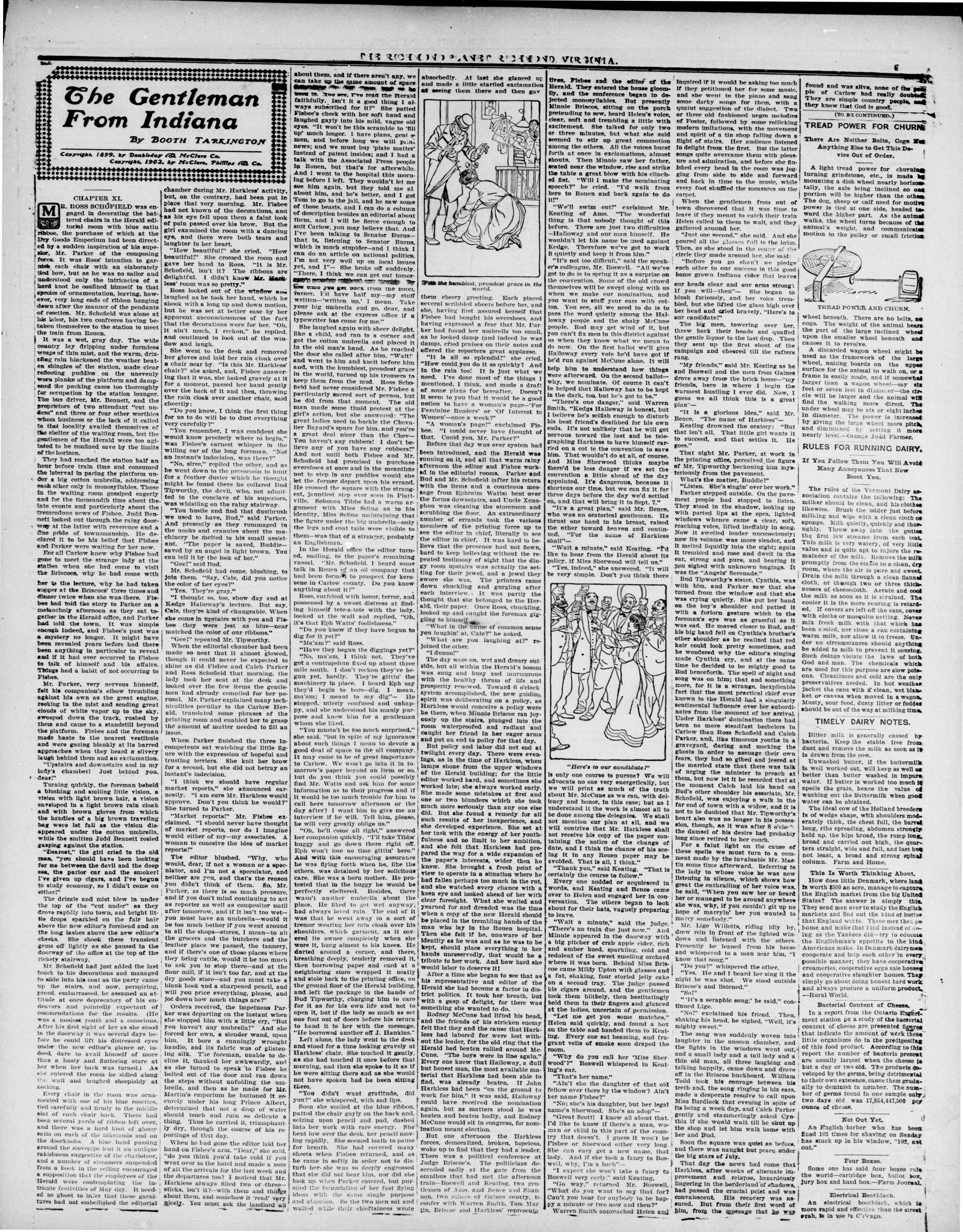
The Gentleman From Indiana
By BOOTH TARKINGTON
CHAPTER XI
R. ROSS SCHOFIELD was engaged in decorating the battered chairs in the Herald editorial room with blue satin ribbon. the purchase of which at the Dry Goods Emporium had been directed by a sudden inspiration of his superior. Mr. Parker of the composing force. It was Ross' intention to garnish each chair with an elaborately tied bow, but as he was no sailor and understood only the intricacies of a hard knot he confined himself to that species of ornamentation, leaving, however, very long ends of ribbon hanging down after the manner of the pendants of rosettes. Mr. Schofield was alone at his labor, his two confreeres having be-taken themselves to the station to meet the train from Rouen.
It was a wet, gray day. The wide country lay dripping under formless wraps of thin mist, and the warm, drizzling rain blackened the weather beaten en shingles of the station, made clear reflecting puddles on the unevenly worn planks of the platform and dampened the packing cases too thoroughly for occupation by the station lounger. The bus driver, Mr. Bennett, and the proprietors of two attendant "cut undens" and three or four other worthies whom business or the lack of it called to that locality availed themselves of the shelter of the waiting room, but the gentlemen of the Herald were too agitated to be confined save by the limits of the horizon.
They had reached the station half an hour before train time and consumed the interval in pacing the platform under a big cotton umbrella, addressing each other only in monosyllables. Those in the waiting room gossiped eagerly and for the thousandth time about the late events and particularly about the tremendous news of Fisbee. Judd Bennett looked out through the rainy doorway at the latter with reverence and a fine pride of townmanship. He declared it to be his belief that Fisbee and Parker were waiting for her now. For all Carlow knew why Fisbee had gone to meet the strange lady at the station when she had come to visit the Briscoes, why he had come with
her to the lecture, why he had taken supper at the Briscoes' three times and dinner twice when she was there. Fisbee had told the story to Parker on a meancheoly afternoon as they sat together in the Herald office, and Parker had told the town. It was simple enough indeed, and Fisbee's past was a mystery no longer. It might have been revealed years before had there been anything in particular to reveal and if it had ever occurred to Fisbee to talk of himself and his affairs. Things had a habit of not occurring to Fisbee.
Mr. Parker, very nervous himself, felt his companion's elbow trembling against his own as the great engine, reeking in the mist and sending great clouds of white vapor up to the sky, swooped down the track, rushed by them and came to a standstill beyond the platform. Fisbee and the foreman made haste to the nearest vestibule and were gazing blankly at its barred approaches when they heard a silvery laugh behind them and an exclamation. "Upstairs and downstairs and in my lady's chamber! Just behind you, dear!"
Turning quickly, the foreman beheld a blushing and smiling little vision, a vision with light brown hair, a vision enveloped in a light brown rain coat and with brown gloves from which the handles of a big brown traveling bag were let fall as the vision disappeared under the cotton umbrella, while the smitten Judd Bennett reeled gasping against the station.
"Dearest," the girl cried to the old man, "you should have been looking for me between the devil and the deep sea, the parlor car and the smoker! I've given up cigars, and I've begun to study economy, so I didn't come on either!"
The drizzle and mist blew in under the top of the "cut under" as they drove rapidly into town, and bright little drops sparkled on the fair hair above the new editor's forehead and on the long lashes above the new editor's cheeks. She shook these transient gems off lightly as she paused in the doorway of the office at the top of the rickety stairway.
Mr. Schofield had just added the last touch to his decorations and managed to slide into his coat as the party came up the stairs, and now, perspiring, proud, embarrassed, he assumed an attitude at once deprecatory of his endeavors and pointedly expectant of commendations for the results. (He was a modest youth and a conscious. After his first sight of her as she stood in the doorway it was several days before he could lift his distressed eyes under the new editor's glance or, indeed, dare to avail himself of more than a hasty and fluttering stare at her when her back was turned.) As she entered the room he sided along the wall and laughed sheepishly at nothing.
Every chair in the room was ornamented with one of his blue rosettes, tied carefully and firmly to the middle slat of each chair back. There had been several yards of ribbon left over, and there was a hard knot of glossy satin on each of the inkstands and on the doorknobs. A blue band passing around the stovepipe lent it an antique rakishness suggestive of the charlottee, and a number of streamers suspended from a book in the ceiling encouraged a supposition that the employees of the Herald were contemplating the intricate festivities of May day. It needed no ghost to infer that these garments had not embellished the editorial
chamber during Mr. Harkless' activity, but, on the contrary, had been put in place that very morning. Mr. Fisbee had not known of the decorations, and as his eye fell upon them a faint look of pain passed over his brow. But the girl examined the room with a dancing eye, and there were both tears and laughter in her heart.
"How beautiful!" she cried. "How beautiful!" She crossed the room and gave her hand to Ross. "It is Mr. Schofield, isn't it? The ribbons are delightful. I didn't know Mr. Harkless' room was so pretty."
Ross looked out of the window now laughed as he took her hand, which he shook with a long up and down motion, but he was set at better ease by her apparent unconsciousness of the fact that the decorations were for her. "Oh, it ain't much, I reckon," he replied, and continued to look out of the window and laugh.
She went to the desk and removed her gloves and laid her rain cloak over a chair near by. "Is this Mr. Harkless' chair?" she asked, and, Fisbee answering that it was, she looked gravely at it for a moment, passed her hand gently over the back of it and then, throwing the rain cloak over another chair, said cheerly:
"Do you know, I think the first thing for us to do will be to dust everything very carefully."
"You remember, I was confident she would know precisely where to begin," was Fisbee's carnest whisper in the willing ear of the long foreman. "Not an instant's indecision, was there?"
"No, snee," replied the other, and as he went down to the pressroom to hunt for a feather duster which he thought might be found there he collared Bud Tipworthy, the devil, who not admitted to the conclave of his superiors, was whistling on the rainy stairway.
"You hustle and find that dustbrush we used to have, Bud," said Parker. And presently as they rummaged in the nooks and crannies about the machinery he melted to his small assistant. "The paper is saved, Buddie—saved by an angel in light brown. You can tell it by the look of her." "Geel!" said Bud.
Mr. Schofeld had come, blushing, to join them. "Say, Cale, did you notice the color of her eyes?" "Yes. They're gray." "I thought so, too, show day and at Kedge Halloway's lecture. But say, Cale, they're kind of changeable. When she come in upstairs with you and Fisbee they were jest as blue—near matched the color of our ribbons." "Gee!" repeated Mr. Tipworthy. When the editorial chamber had been made so neat that it almost glowed, though it could never be expected to shine as did Fisbee and Caleb Parker and Ross Schofeld that morning, the lady took her seat at the desk and looked over the few items the gentlemen had already compiled for her perusal. Mr. Parker explained many technicalities peculiar to the Carlow Herald, translated some phrases of the printing room and enabled her to grasp the amount of matter needed to fill an issue.
When Parker finished the three incompetents sat watching the little figure with the expression of hopeful and trusting terriers. She knit her brow for a second, but she did not betray an instant's indecision.
"I think we should have regular market reports," she announced earnestly. "I am sure Mr. Harkless would approve. Don't you think he would?" She turned to Parker.
"Market reports!" Mr. Fisbee exclaimed. "I should never have thought of market reports, nor do I imagine would either of my—my associates. A woman to conceive the idea of market reports!"
The editor blushed. "Why, who would, dear, if not a woman or a speculator, and I'm not a speculator, and neither are you, and that's the reason you didn't think of them. So, Mr. Parker, as there is so much pressure, and if you don't mind continuing to act as reporter as well as composter until after tomorrow, and if it isn't too wet—you must have an umbrella—would it be too much bother if you went around to all the shops—stores, I mean—to all the grocers and the butchers and the leather place we passed, the tannery, and if there's one of those places where they bring cattle, would it be too much to ask you to stop there—and at the flour mill, if it isn't too far, and at the dry goods store—and you must take a blank book and a sharpened pencil, and will you price everything, please, and jot down how much things are?"
Orders received, the impetuous Parker was departing on the instant when she stopped him with a little cry, "But you haven't any umbrella!" And she forced her own, a slender wand, upon him. It bore a cunningly wrought handle, and its fabric was of glistening silk. The foreman, unable to decline it, thanked her awkwardly, and as she turned to speak to Fisbee he bolted out of the door and ran down the steps without unfolding the umbrella, and then as he made for Mr. Martin's emporium he buttoned it securely under his long Prince Albert, determined that not a drop of water should touch and ruin so delicate a thing. Thus he carried it, triumphantly dry, through the course of his reportings of that day.
When he had gone the editor laid her hand on Fibes's arm. "Dear," she said, "do you think you'd take cold if you went over to the hotel and made a note of all the arrivals for the last week and the departures too? I noticed that Mr. Harkleass always filled two or three-sticks, isn't it?—with them and things about them, and somehow it 'read' very nicely. You must ask the landlord all
THE RICHMOND PLANE RICHMOND, VIRGINIA
about them, and if there aren't any, we can take up the same amount of space to you see. I've read the Herald faithfully. Isn't it a good thing I always subscribed for it?" She patted Fisbee's cheek with her soft hand and laughed garly into his mild, vague old eyes. "It won't be this scramble to 'fill up' much longer. I have plans, gent men, and before long we will paint, news, and we must buy 'plate matter' instead of patent insides; and I had a talk with the Associated Press people in Rouen, but that's for afterwhile. And I went to the hospital this morning before I left. They wouldn't let me see him again, but they told me al about him, and he's better, and I got Tom to go to the jail, and he saw some of those beasts, and I can do a column of description besides an editorial about them, and I will be fierce enough to suit Carlow, you may believe that. And I've been talking to Senator Burns—that is, listening to Senator Burns, which is much stupider—and I think I can do an article on national politics. I'm not very well up on local issues yet, and I—" She broke off suddenly. "There. I think we can get out tomor- you have got back from the note, farmer. I'll have half my—music written—written up," I mean. Take your big umbrella and go, dear, and please ask at the express office if a typewriter has come for me."
She laughed again with sheer delight, like a child, and ran to a corner and got the cotton umbrella and placed it in the old man's hand. As he reached the door she called after him. "Walt!" and went to him and knelt before him, and with the humbleest, proudest grace in the world, turned up his trousers to keep them from the mud. Ross Schofield had never considered Mr. Fisbee a particularly sacred sort of person, but he did from that moment. The old man made some timid protest at the girl's action, but she answered: "The great ladies used to buckle the Chevallier Bayard's spurs for him, and you're a great deal nicer than the Chev—You haven't any rubbers! I don't believe any of you have any rubbers!" And not until both Fisbee and Mr. Schofield had promised to purchase overshoes at once and in the meantime not to step in any puddles would she let the former depart upon his errand. He crossed the square with the strangest, jauntiest step ever seen in Plattville. Solomon Tibbs had a warm argument with Miss Selina as to his identity. Miss Selina maintaining that the figure under the big umbrella—only the legs and coat tails were visible to them—was that of a stranger, probably an Englishman.
In the Herald office the editor turned, smiling, to the paper's remaining vassal. "Mr. Schofield, I heard some talk in Rouen of an oil company that had been formed, to prospect for kerosene in Carlow county. Do you know anything about it?" Ross, surfeited with honor, terror, and possessed by a sweet distress at finding himself tete-a-tete with the lady, looked at the wall and replied, "Oh, it's that Eph Watts' foolishness." "Do you know if they have begun to dig for it yet?"
"Ma'am?" said Ross.
"Have they begun the diggings yet?" "No, ma'am. I think not. They've got a contrapshun fixed up about three mile south. I don't reckon they've begun yet, hardly. They're gittin' the machinery in place. I heard Eph say they'd begin to bore-dig. I mean, ma'am; I meant to say dig" He stopped, utterly confused and unhappy, and she understood his manly purpose and knew him for a gentleman whom she liked.
"You mustn't be too much surprised," she said, "but in spite of my ignorance about such things I mean to devote a good deal of space to the oil company. It may come to be of great importance to Carlow. We won't go into it in tomorrow's paper beyond an item or so, but do you think you could possibly find Mr. Watts and ask him for some information as to their progress and if it would be too much trouble for him to call here tomorrow afternoon or the day after? I want him to give me an interview if he will. Tell him, please, he will very greatly oblige us."
"Oh, he'll come all right," answered her companion quickly. "I'll take Tibbs' buggy and go down there right off. Eph won't lose no time gittin' here." And with this encouraging assurance he was flying forth when he, like the others, was detained by her sollicious care. She was a born mother. He protested that in the buggie he would be perfectly sheltered. Besides, there wasn't another umbrella about the place. He liked to get wet anyway; had always loved rain. The end of it was that he went away in a sort of tremor wearing her rain cloak over his shoulders, which garment, as it covered its owner completely when she wore it, hung almost to his knees. He darted around a corner, and there, breathing deeply, tenderly removed it, then borrowing paper and cord at a neighboring store wrapped it neatly and stole back to the printing office, on the ground floor of the Herald building, and left the package in the hands of Bud Tipworthy, charging him to care for it as for his own life and not to open it, but if the lady so much as set one foot out of doors before his return to hand it to her with the message, "He borrowed another off J. Hankins." Left alone, the lady went to the desk and stood for a time looking gravely at Harkless' chair. She touched it gently, as she had touched it once before that morning, and then she spoke to it as if he were sitting there and as she would not have spoken had he been sitting there.
"You didn't want gratitude, did you?" she whispered, with sad lips. Soon she smiled at the blue ribbon, patted the chair gayly on the back and, seizing upon pencil and pad, dashed into her work with rare energy. She bent low over the desk, her pencil moving rapidly. She seemed loath to pause for breath. She had covered many sheets when Fishee returned, and as he came in softly in order not to disturb her she was so deeply engrossed that she did not hear him, nor did she look up when Parker entered, but pursued the formulation of her fast flying ideas with the same single purpose and abandon. So the two men sat and waited while their cheftainess wrote
absorbedly. At last she glanced up and made a little startled exclamation at seeing them there and then gay
A man in a hat is kneeling on the floor, holding a pair of shoes in his hands. A woman is kneeling on the floor, wearing a dress and holding a pair of shoes. They are in a room with a window and a shelf of newspapers.
With the hambest, proudest grace in the world.
them cheery greeting. Each placed several scribbled sheets before her, and she, having first assured herself that Fisbee had bought his overshoes, and having expressed a fear that Mr. Parker had found her umbrella too small, as he looked damp (and indeed he was damp), cried praises on their notes and offered the reporters great applause.
"It is all so splendid!" she cried.
"How could you do it so quickly? And in the rain too! It is just what we need. I've done most of the things I mentioned. I think, and made a draft of some plans for hereafter. Doesn't it seem to you that it would be a good notion to have a woman's page—For Feminine Readers' or 'Of Interest to Women'—once a week?
"A woman's page!" exclaimed Fisbee.
"I could never have thought of that. Could you, Mr. Parker?"
Before that day was over system had been introduced, and the Herald was running on it, and all that warm rainy afternoon the editor and Fisbee worked in the editorial rooms. Parker and Bud and Mr. Schofeld (after his return with the items and a courteous message from Ephraim Watts) bent over the forms downstairs, and Uncle Xenophon was cleaning the storeroom and scrubbing the floor. An extraordinary number of errands took the various members of the printing force up to see the editor in chief, literally to see the editor in chief. It was hard to believe that the presence had not flown, hard to keep believing without the repeated testimony of sight that the dingy room upstairs was actually the setting for their jewel, and a jewel they swore she was. The printers came down chuckling and gurgling after each interview. It was partly the thought that she belonged to the Herald, their paper. Once Ross, chuckling, looked up and caught the foreman gigling to himself.
"What in the name of common sense you laughin' at, Cate?" he asked.
"What are you laughing at?" rejoined the other.
"I dumno!"
The day wore on, wet and dreary outside, but all within the Herald's bosom was snug and busy and murmurous with the healthy thrum of life and prosperity renewed. Toward O'clock system accomplished, the new guiding spirit was deliberating on a policy, as Harkless would conceive a policy were he there, when Minnie Briscoe ran joyously up the stairs, plunged into the room waterproofed and radiant and caught her friend in her eager arms and put an end to policy for that day.
But policy and labor did not end at twilight every day. There were evenings, as in the time of Harkless, when lamps shone from the upper windows of the Herald building; for the little editor worked hard, and sometimes she worked late; she always worked early. She made some mistakes at first and one or two blunders which she took much more seriously than any one else did. But she found a remedy for all such results of her inexperience, and she developed experience. She set at her task with the energy of her youthfulness and no limit to her ambition, and she felt that Harkless had prepared the way for a wide expansion of the paper's interests, wider then he knew. She brought a fresh point of view to operate in a situation where he had fallen perhaps too much in the rut, and she watched every chance with a keen eye and looked ahead of her with clear foresight. What she waited and yearned for and dreaded was the time when a copy of the new Herald should be placed in the trembling hands of the man who lay in the Rouen hospital. Then she felt if he, unaware of her identity as he was and as he was to be kept, should place everything in her hands unreservedly, that would be a tribute to her work. And how hard she would labor to deserve it!
After a time she began to see that as his representative and editor of the Herald she had become a factor in district politics. It took her breath, but with a gasp of delight, for there was something she wanted to do.
Rodney McCune had lifted his head, and the friends of his stricken enemy felt that they and the cause that Harkless had labored for were lost without the leader, for the old ring that the Herald had beaten rallied around McCune. "The boys were in line again." Every one knew that Halloway, a dull but honest man, the most available material that Harkless had been able to find, was already beaten. If John Harkless had been "on the ground to work for him," it was said, Halloway could have received the nomination again, but as matters stood he was beaten and beaten badly, and Rodney McCune would sit in congress, for nomination meant election.
But one afternoon the Harkless forces, demoralized, broken, hopeless, woke up to find that they had a leader. There was a political conference at Judge Briscoe's. The politicians descended sadly at the gate from the omnibus that had met the afternoon train—Boswell and Keating, two gentlemen of Amo, and Bence and Shannon, two others of Gaines county, to confer with Warren Smith, Tom Martin, Briscoe and Harkless' represents
tives, Fisbee and the editor of the Herald. They entered the house gloomily, and the conference began in dejected monosyllables. But presently Minnie Briscoe, sitting on the porch pretending to sew, heard Helen's voice, clear, soft and trembling a little with excitement. She talked for only two or three minutes, but what she said seemed to stir up great commotion among the others. All the voices burst forth at once in exclamations, almost shouts. Then Minnie saw her father, seated near the window, rise and strike the table a great blow with his clinched fist. "Will I make the nominating speech?" he cried. "I'd walk from here to Rouen and back again to do it!"
"We'll swim out" exclaimed Mr. Keating of Amo. "The wonderful thing is that nobody thought of this before. There are just two difficulties—Halloway and our man himself. He wouldn't let his name be used against Kedge. Therefore we've got to work it quietly and keep it from him."
"It's not too difficult," said the speaker's colleague, Mr. Boswell. "All we've got to do is to spring it as a surprise on the convention. Some of the old crowd themselves will be swept along with us when we make our nomination, and you want to stuff your ears with cotton. You see, all we need to do is to pass the word quietly among the Halloway people and the shaky McCune people. Rod may get wind of it, but you can't fix men in this district against us when they know what we mean to do now. On the first ballot we'll give Halloway every vote he'd have got if he'd run against McCune alone. It will help him to understand how things were afterward. On the second ballot—why, we nominate. Of course it can't be helped that Halloway has to be kept in the dark, too, but he's got to be."
"There's one danger," said Warren Smith. "Kedge Halloway is honest, but I believe he's selfish enough to disturb his best friend's debedted for his own ends. It isn't unlikely that he will get nervous toward the last and be telegraphing Harkless to have himself carried on a cot to the convention to save him. That wouldn't do at all, of course. And Miss Sherwood thinks maybe there'd be less danger if we set the convention a little ahead of the day appointed. It's dangerous, because it shortens our time, but we can fix it for three days before the day we'd settled on, and that will bring it to Sept. 7." "It's a great plan," said Mr. Bence, who was an oratorical gentleman. He thrust one hand in his breast, raised the other toward heaven and continued. "For the name of Harkless shall"—
"Wait a minute," said Keating. "I'd like to hear from the Herald about its policy, if Miss Sherwood will tell us." "Yes, indeed," she answered. "It will be very simple. Don't you think there
THE BIRTH OF THE WEDDING
"Here's to our candidate!" is only one course to pursue? We will advocate no one very energetically, but we will print as much of the truth about Mr. McCune as we can, with delicacy and honor, in this case; but as I understand it the work is almost all to be done among the delegates. We shall not mention our plan at all, and we will contrive that Mr. Harkless shall not receive his copy of the paper containing the notice of the change of date, and I think the chance of his seeing it in any Rouen paper may be avoided. That is all, I think."
"Thank you," said Keating. "That is certainly the course to follow."
Every one nodded or acquiesced in words, and Keating and Bence came over to Helen and engaged her in conversation. The others began to look about for their hats, vaguely preparing to leave.
"Walt a minute," said the judge, "There's no train due just now." And Minnie appeared in the doorway with a big pitcher of crab apple cider, rich and amber hued, sparkling, cold and redolent of the sweet smelling orchard where it was born. Behind Miss Briscoe came Milly Upton with glasses and a fat, shaking, four storied jelly cake on a second tray. The judge passed his cigars around, and the gentlemen took them blithely, then nestitatingly held them in their fingers and glanced at the ladies, uncertain of permission.
"Let me get you some matches," Helen said quickly, and found a box on the table and handed them to Keating. Every one sat beaming, and fragrant veils of smoke soon draped the room.
"Why do you call her 'Miss Sherwood'?" Boswell whispered in Keating's ear.
"That's her name."
"Ain't she the daughter of that old fellow over there by the window? Ain't her name Fishee?"
"No; she's his daughter, but her legal name's Sherwood. She's an adop"—
"Great Scott! I know all about that. I'd like to know if there's a man, woman or child in this part of the country that doesn't. I guess it won't be Fishee or Sherwood either very long. She can easy get a new name, that lady. And if she took a fancy to Boswell, why, why, a bach"—
"I expect she won't take a fancy to Boswell very early," said Keating.
"Go way," returned Mr. Boswell.
"What do you want to say that for? Can't you bear for anybody to be happy a minute or two and then?" Warren Smith approached Helen and
inquired if it would be asking too much if they petitioned her for some music, and she went to the piano and sang some darky songs for them, with a quaint suggestion of the dialect. Two or three old fashioned negro melodies of Foster, followed by some rollicking modern infilations, with the movement and spirit of a tin shop falling down a flight of stairs. Her audience listened in delight from the first. But the latter songs quite overcame them with pleasure and admiration, and before she finished every head in the room was jogging from side to side and forward and back in time to the music, while every foot shuffled the measures on the carpet.
When the gentlemen from out of town discovered that it was time to leave if they meant to catch their train Helen called to them to wait, and they gathered around her.
"Just one second," she said. And she poured all the glasses full to the brim. Then, as she stood in the center of the circle they made around her, she said: "Before you go shalt we pledge each other to our success in this good home grown Indiana cider that leaves our heads clear and our arms strong! If you will—then"—She began to blush furiously, and her voice trembled, but she lifted the glass high over her head and grilled bravely, "Here's to our candidate!"
The big men, towering over her, threw back their heads and quaffed the gentle liquor to the last drop. Then they sent up the first shout of the campaign and cheered till the rafters rang.
"My friends," said Mr. Keating as he and Boswell and the men from Gaines drove away from the brick house—"my friends, here is where I begin the warmest hustling I ever did. Now, I guess we all think this is a great plan—"
"It is a glorious idea," said Mr. Bence. "The name of Harkless"—Keating drowned the oratory: "But that isn't all. That little girl wants it to succeed, and that settles it. He goes." That night Mr. Parker, at work in the printing office, perceived the figure of Mr. Tipworthy beckoning him mysteriously from the pavement.
What's the matter, Buddle?
"Listen. She's singin' over her work."
Parker stepped outside. On the pavement people had stopped to listen. They stood in the shadow, looking up with parted lips at the open, lighted windows whence came a clear, soft, reaching voice, lifted ineffably in song. Now it swelled louder unconcealsily; now its volume was more slender, and it melted liquidly into the night; again it trembled and rose and dwelt in the ear, strong and pure, and hearing it you sighed with unknown longings. It was the "Angels' Serenade."
Bud Tipworthy's sister, Cynthia, was with him, and Parker saw that she turned from the window and that she was crying quietly. She put her hand on the boy's shoulder and patted it with a forlorn gesture which to the foreman's eye was as graceful as it was sad. He moved closer to Bud, and his big hand fell on Cynthia's brother's other shoulder as he realized that red hair could look pretty sometimes, and he wondered why the editor's singing made Cynthia cry, and at the same time he decided to be mighty good to Bud henceforth. The spell of night and song was on him; that and something more, for it is a strange, inexplicable fact that the most practical chief ever known to the Herald had a singularly sentimental influence over her subordinates from the moment of her arrival. Under Harkloss' domination there had been no more steadfast bachelors in Carlow than Ross Schofield and Caleb Parker, and, like timorous youths in a graveyard, daring and mocking the ghosts in order to assuage their own fears, they had so gibed and jeered at the married state that there was talk of urging the minister to preach at them, but now let it be recorded that at the moment Caleb laid his hand on Bud's other shoulder his associate, Mr. Schofield, was enjoying a walk in the far end of town with a widow, and it is not to be doubted that Mr. Tipworthy's heart also was no longer in his possession, though, as it was after 8 o'clock the damself of his desire had probably long since retired to her couch.
For a faint light on the cause of these spells we must turn to a comment made by the invaluable Mr. Martin some time afterward. Referring to the lady to whose voice he was now listening in silence, which shows how great the enthralling of her voice was, he said, "When you saw her or heard her or managed to be around anywhere she was, why, if you couldn't git up no hope of marryin' her you wanted to marry somebody."
Mr. Lige Willetts, riding idly by, drew rein in front of the lighted windows and listened with the others. Presently he leaned from his horse and whispered to a man near him, "I know that song."
"Do you?" whispered the other.
"Yes. He and I heard her sing it the night he was shot. We stood outside Briscoe's and listened."
"So!"
"It's a seraphic song," he said," continued Lige.
"No!" exclaimed his friend. Then, shaking his head, he sighed, "Well, it's mighty sweet."
The song was suddenly woven into laughter in the unseen chamber, and the lights in the windows went out, and a small lady and a tail lady and a thin old man, all three laughing and talking happily, came down and drove off in the Briscoe buckboard. William Todd took his courage between his teeth and, the song ringing in his ears, made a desperate resolve to call upon Miss Bardlock that evening in spite of its being a week day, and Caleb Parker gently and stammeringly asked Cynthia if she would wait till he shut up the shop and let him walk home with her and Bud.
Soon the square was quiet as before, and there was naught but peace under the big stars of July.
That day the news had come that Harkless, after weeks of alternate improvement and relapse, hazardously lingering in the borderland of shadows, had passed the crucial point and was convalescent. His recovery was assured. But from their first word of him, from the message that he was
found and was alive, none of the people of Carlow had really doubled. They are simple country people, and they know that God is good.
TREAD POWER FOR CHURN
A light tread power for churning turning grindstone, etc., is made mounting a disk wheel nearly horizontally, the axle being inclined so one portion will be higher than the other. The dog, sheep or calf used for motive power is tied at one side, headed toward the higher part. As the animal walks, the wheel turns because of the animal's weight, and communicates motion to the pulley or small friction.
wheel beneath. There are no belts, no cogs. The weight of the animal bears the part of the large inclined wheel upon the smaller wheel beneath and causes it to revolve.
A discarded wagon wheel might be used as the framework of the large wheel, nailing boards on the upper surface for the animal to walk on, or a frame is easily made, and if somewhat larger than a wagon wheel—say six feet or seven feet in diameter—the circle will be larger and the animal will find the walking more direct. The under wheel may be six or eight inches in diameter. The power is increased by giving the large wheel more pitch and diminished by setting it more nearly level.—Orange Judd Farmer.
RULES FOR RUNNING DAIRY.
If You Follow Them You Will Avoid
Many Annoyances That Now
Reset You.
The rules of the Vermont Dairy association contains the following: The milker should be clean, and his clothes likewise. Brush the udder just before milking and wipe with a clean cloth or sponge. Milk quietly, quickly and thoroughly. Throw away into the gutters the first few streams from each teat. This milk is very watery, of very little value and is quite apt to injure the remainder of the milk. Remove the milk promptly from the stable to a clean, dry room, where the air is pure and sweet. Drain the milk through a clean flannel cloth, or through two or three thicknesses of cheesecloth. Aerate and cool the milk as soon as it is strained. The cooler it is the more souring is retarded. If covers are left off the cans, cover with cloths or mosquito netting. Never mix fresh milk with that which has been cooled, nor close a can containing warm milk, nor allow it to freeze. Under no circumstances should anything be added to milk to prevent it souring. Such doilies violate the laws of both God and man. The chemicals which are used for this purpose are slow poisons. Cleanliness and cold are the only preservatives needed. In hot weather jacket the cans with it clean, wet kettle or canvas when moved in a wagon. Musty, sour food, dusty litter or fodders should be out of the way at milking time.
TIMELY DAIRY NOTES.
Bitter milk is generally caused by bacteria. Keep the stable free from dust and remove the milk as soon as it is drawn from the cow.
Unwashed butter, if the buttermilk is well worked out, will keep as well as better than butter washed in impure water. If butter is worked too much spoils the grain, hence the value of washing out the buttermilk when good water can be obtained.
The ideal cow of the Holland breeders is of wedge shape, with shoulders moderately thick, the chest full, the barrel long, ribs spreading, abdomen strongly held up, the hips broad, the rump long, broad and carried out high, the quarters straight, wide and full, and last but not least, a broad and strong spinal column. Farm and Home.
This Is Worth Thinking About.
How does little Denmark, where land is worth $500 an acre, manage to capture the English market from the big United States? The answer is simply this. They send men over to study the English markets and find out the kind of butter that England wants. These men then go home and make that kind instead of going as the Yankees did—try to educate the Englishman's appetite to the kind Americans make. In Denmark dairymen cooperate and help each other in every possible manner; they have cooperative creameries, cooperative eggs sale houses and cooperative slaughter houses. They simply go about doing honest hard work and always produce a uniform product—Rural World.
Bacterial Content of Cheese
In a report from the Ontario Experiment station on a study of the bacterial content of cheese are presented figures that indicate the amount of work these little organisms do in the predigesting of this food product. According to this report the number of bacteria present are usually largest when the cheese is but a day or two old. The products developed by the germs, being detrimental to their own existence, cause them gradually to demain in number. The number of germs found in one sample only two days old was 17,854,447,500 per ounce of cheese.
Not Out Yet.
An English-barber who has been fined 102 times for shaving on Sunday has stuck up in his window, "102, not out."
Four Boxes.
Some one has said four boxes rule the world-cartridge box, ballot box, jury box and band box. -Farm Journal.
An electrical boothblack, which is more rapid and effective than the street grab, is in use to C'villego.
HEET PANET
Baked every Saturday by JOHN & C.
at 911 North 4th Street Richmond, Va
All communications intended for publica-
should be sent to us as to reach us by Wednesd-
ay.
Copy, one year.
The Copy, eight months,
One Copy, six months.
One Copy, four months.
One Copy, three months.
Single Copy.
ADVERTISING RA*RS.
or one inch one insertion.
or one inch each subsequent insertion.
or two inches, three months.
or two inches, two months.
or two inches, nine months.
or two inches, twelve months.
or three months.
or three months.
or three months.
or three months.
or three months.
or three months.
POSTAGE STAMPS OF A HIGHER OOMINATION THAN TWO CENTS NOT RECEIVED ON SUBSCRIPTIONS
OUR PLANET is issued weekly. The subscript was price $1.50 a year, in advance.
There are four ways by which money can be sent by mail at our risk.—In a Post Office More Order by Bank Check or Draft, or an E.S. Money Order and when none of the others be procured, in a Registered Letter.
MONEY ORDERS — You can buy a Money Order at your Post Office, payable at the Richmond Post Office, and we will be responsible for it.
EXPRESS MONEY ORDERS can be obtained any office of the American Express, Co., Inc. or any other office of the American Express Co. and Co.'s Express Company. We will be responsible for money sent by any of these companies. The Express Money Order is issued and convenient way for forwarding money. You can send money to the Post Office or an Express. Office not with your reach, your Postmaster will register the letter you wish to send as on payment of the order. You can be trued. You can send money in the manner at our risk. We cannot be responsible for money sent in letters in any other way than one of the letters in any other way, you must do it at your own risk. BENEFITS, STC—If you do not want TPC subscription has run out, you then notify us to Postal Card to discontinue it. The courts have decided that subscribers to newspapers who subscribed to which time of the day or time of for which it has been paid are said liable for the payment of the subscription should be when they order the paper discount.
COMMUNICA—When writing to it to renew your subscription or to discount our paper, you should give your name and address, and otherwise we can provide you with
CHANGE OF ADDRESS - In order to cease
address of a subscriber, we must be sce
the former as well as the present address
Entered in the Post Office at Richmond
second class postmaster.
SATURDAY . . . APRIL 23, 1904
The colored people of this city are now walking. If you doubt it, look at the street-cars.
WHITE men who mixed the races and gave us our crop of white Negroes didn't do it on the street-cars.
We move that the Negro-haters be sent in search of the North Pole, where there are no Negroes and very few white folks.
ALWAYS be polite and obliging. Some of the Negro-hating white folks are always after us, but there are thousands of the other kind.
We have received by the courtesy of United States Senator J. H. GALLINGER Moral Legislation in Congress passed and pending.
THE NEWS-LEADER wants the colored people sent to Africa. It would be much easier for the NEWS-LEADER's force to go over there, because one ship would carry them.
COLORED men, we should be polite, obliging and friendly with the white people. This does not imply any surrender of the rights for which we are contending.
We return thanks for an invitation to attend the anniversary exercises of the Hampton Normal and Agricultural Institute at Hampton, Va., Thursday, April 21, 1904 at 2 o'clock. Prof. H. B. Frissell, Principal.
---
THE NEWS-LEADER thinks that for a colored man and a white woman to ride on the street-cars together will result in the amalgamation of the races. We do not believe anything of the sort and have never made any such intimation in the columns of this journal. The writer of the article, "Negroes and Street-cars" in its issue of April 20th has made a great blunder and the blindest white man should not fail to see it.
Gave Employees $10,000 In Stock.
Toledo, O., April 18.—Mayor S. M.
Jones, in a talk to the employees of his
fishing rod factory on the value of the
laboring man to society, told the men
that he had made a gift of $10,000
worth of stock in his company to,
and that they could do with it as they
liked. It is worth its face value. Last
Christmas this stock was turned over
to the trustees of the Golden Rule
Trust, the income to be distributed
equally among the Jones employees.
Now the stock itself has been turned
over to the employees.
ALEXIEFF ASKS TO BE RELIEVED
Re is Opposed to Admiral Skrydloff as Commander of Russian Navy.
Makaroff's Successor As Commander of the Navy Is One of Alexieff's Strongest Enemies and Sharpest Critics—Request Will Probably Be Granted—Fresh Battle Ragging at Port Arthur — Makaroff's Body Washed Ashore.
St. Petersburg, April 20.—Viceroy Alexieff has applied by telegraph to the emperor to be relieved of his position of viceroy in the Far East.
It is expected that the request will be immediately granted.
While no official announcement has yet been made, there is reason to believe that the above statement is correct.
It is not expected that a successor to Viceroy Alexieff will be appointed, as the importance of the post of viceroy has disappeared, owing to the result of the war.
The immediate cause of the viceroy's application is reported to be the appointment of Vice Admiral Skryd-
VICE-ADMIRAL ALEXEIEEF.
loff, one of Admiral Alexieff's strongest enemies and sharpest critics, as successor to the late Vice Admiral Makaroff in command of the Russian navy in the Far East. Vice Admiral Skrydloff had an interview with the emperor and discussed with his majesty the question of his (Skrydloff's) relations with Admiral Alexieff.
The relieving from command of Vicerol Alexieff would not surprise intelligent observers of the Far Eastern situation who are familiar with the gradual change In the emperor's attitude toward the viceroy and M. Bezobrazoff, who represented the militant, or advanced, element which was anxious that Russia should remain in Manchuria. It was to these two men that the Anglo-Japanese entente first lost its-terrors. They believed that Great Britain would not go to war and that Japan could not do so. To the indignation of Japan, they succeeded in turning the policy of the empire from carrying out the treaty for the entire evacuation of Manchuria, pending further demands on China, on August 12 last, after Japan had submitted an inquiry as to whether Russia was disposed to reopen the negotiations respecting Manchuria and Korea, a viciously in the Far East, a special secretary of state and an advisory committee were created, Alexieff being appointed viceroy and Bezobrazoff secretary of state.
Seventeen days after these appointments were made, M. Witte, who had been opposed to the policy of Alexieff and Bezobrazoff, was relieved of his portfolio as minister of finance. It was through hfs new official advisors that the emperor conducted ne
VICE ADMIRAL SKRYDLOFF.
[Successor of Admiral Makaroff.]
gottations with Japan, and it is claimed that they misjudged the temper and purpose of the Japanese and left the emperor in ignorance of the preparations for war which Japan was making and the rising war spirit of that empire.
The enemies of Alexieff have persistently asserted that as the man on the spot, he should have kept the emperor informed concerning these vital points.
Viceroy Alexieff recommended the appointment of either Vice Admiral Deubassow or Vice Admiral Makaroff to command the fleet in succession to Vice Admiral Stark. The emperor selected Makaroff, and at the same time issued a special ukase making him absolutely independent.
This was the first blow publicly given to Alexleff. The second was the appointment of General Kuropatkin as commander-in-chief of the army in Manchuria. Kuropatkin sided with Count Lamsdorff, the foreign minister, and M. Witte against the policy of Manchurian annexation, and stated to the Chinese minister to Russia, Mr. Hoo Wei Teh, that the whole trouble originated with Alexleff. That there might be no doubt of Kuropatkin's exact jurisdiction, the emperor issued another ukase defining it, and gave the former minister of war complete con-
THE RICHMOND PLANET, RICHMOND, VIRGINIA
trol of military operations in the Far East.
It is said that Vice Admiral Skrydloff in his interview let his majesty understand that he does not care to assume command of the fleet until Alexieff has withdrawn. Therefore the two men will not meet at Port Arthur.
Viceroy Alexieff is expected to come directly to St. Petersburg, and his friends hope that he will be elevated to the council of the empire. By his withdrawal from the Far East he will not only lose the dignified position of direct representative of the emperor, but the salary of $56,000 and an allowance of $25,000 per annum.
When Alexieff severs his connection with the Far Eastern question, none of the men responsible for the policy pursued before the war will be in power, M. Bezobrazoff having already lost the confidence of his majesty, and the advisory committee's duties at present being purely perfunctory.
BATTLE RAGING AT PORT ARTHUR
Admiral Makareoff's Mutilated Body
Washed Ashore.
Parls, April 20.—The Journal prints a dispatch from its correspondent at Yin Kow, dated yesterday at 5 p. m., which says it is affirmed that a fresh battle is raging at Port Arthur. According to the St. Petersburg correspondent of the Petit Parisien, a dispatch received from Port Arthur says that many mutilated corpses have been cast ashore, and it is affirmed that fragments of uniform enabled the authorities to identify one of the bodies as that of Vice Admiral Makaroff.
Chinese Anxious to Attack Russians.
Shanghai, April 20.—General Ma-Yu-Kun, commander of the Chinese army on the Manchurian border, reports that the Russian troops are moving west of the Liao river. He says it is difficult to control his troops, as they are anxious to attack the Russians.
Russians Advancing In East Korea.
Seoul, April 19.—The commissioner of customs at Gensan reports that a strong Russian force, the number of which is not known, is advancing on the great south road, following the inland coast of the province of South Hamgyong. The Russians passed to the rear of Sungjin, which was occupied by a scouting party. The main body occupied Penk Chong, 80 miles north of Gensan, on the 17th instant. The flanks and rear were exposed, with the evident intention of drawing a Japanese attack from the Yalu.
Believe U. S. Will Intervene
Paris, April 19.—The Tokio correspondent of the Matin says that "the actice participation of the United States minister (Lloyd C. Griscom) in the fetes given by Japanese associations, being a fragrant contradiction of President Roosevelt's declarations causes a belief that the ulterior intervention of the United States is probable."
STATEHOOD BILL PASSED
Measure Goes Through the House By Strict Party Vote.
Washington, April 20.—After a debate extending through the entire session, the house passed the bill, by a strict party vote, providing for joint statehood of Oklahoma and Indian Territory, under the name of Oklahoma, and of Arizona and New Mexico, under the name of Arizona. In discussing the rule which had been reported by the committee on rules, providing for immediate consideration of the bill, Mr. Williams, the minority leader, declared that no Republican had any idea that the bill would become a law at this session. Delegate Wilson, of Arizona, opposed the bill. It was favored by Delegates Rodey, of New Mexico, and McGuire, of Oklahoma.
Salonica, European Turkey, April 19.—Serious fighting has taken place between Turks and Bulgarians as Lipa, near Demir Kapu (a valley of the Vardar, 62 miles from Salonica). Many were killed on both sides.
Governor Murphy Going to Europe.
Trenton, N. J., April 20.—Governor Murphy expects to sail on Saturday for Europe. He will be gone about four or five weeks. His expectation is to return in time to attend the Republican national convention, to which he will be elected a delegate-at-large at the state convention to be held in this city May 19. During the governor's absence Edmund W. Wakelee, president of the senate, will be acting governor. Mr. Wakelee may not take the oath of office as acting governor unless matters may arise during Governor Murphy's absence which will require executive action.
World's Sunday School Convention.
Jerusalem, April 20. The world's fourth Sunday school convention opened in a huge tent outside Herod's Gate. Arch Deacon Sinclair delivered the opening sermon, taking for his text Matthew, chapter 21, verse 15. The attendance included 800 Americans and 500 British. Many other delegates from all quarters of the globe were present.
ENORMOUS GOLD COINAGE
Since February 6 Philadelphia Mint
Coined $60,180,390 in $20 Pieces.
Philadelphia, April 19.—The enormous output of gold coinage at the Philadelphia mint continues at a rate which surpasses all previous records.
Since February 6 up to April 16 there has been coined $60,180,390 in $20 gold pieces.
The coinage during the week beginning Monday, April 11, and ending Saturday, April 16, inclusive, aggregated $1,130,600 in gold, an average of nearly $2,000,000 per day. On the last day of this record-breaking week the coinage was $2,500,000, also a record-breaker. The weight of the gold required to produce this one week's coinage was over 42 tons.
This vast coinage of gold in so short a time, it was announced at the mint, has never been equalled by the mints of any other nation, nor by any mint in this country.
SIX PERISHED IN INCENDIARY FIRE
Miner's Home Burned During Strike Trouble at Garrett, Pa.
ARMED MEN PARADE STREETS
Somerset, Pa., April 20.—An outbreak even more disastrous than the riot at Boswell in January last has been expected hourly at the town of Garrett, the scene of the mining operations of the Garrett Coal company, the Somerset Coal company and other lesser operations. Trouble has been brewing there ever since the inauguration of the miners' strike there five months ago. A number of the striking miners at Garrett own homes there, but recently the Garrett Coal company erected a number of houses, and the bringing in of new men to occupy these houses and take the places of the strikers in the mines, has worked the latter up to a high state of excitement and resentment, and for the last few days the town has been a veritable mine of indignation that might easily be exploded. The strikers have been parading the streets openly armed, and they have prevented the moving of the household goods of incoming miners from the railroad station to the new company houses.
A horror that may or may not be connected with the strike situation at Garrett was the burning to death of two women and four children in their homes at that place.
The victims were: Rosanna Meyers, her two daughters, Lucinda and Annie, aged 30 and 8 years respectively, and her son Richard, aged 5 years. The two other victims were young children of Lucinda.
The house was a one and a half story log building, and the women and children were sleeping in the upper story. Mr. Meyers and Jonas Sullivan, a boarder, were asleep on the first floor. They were awakened by the smoke and the noise made by the fire and had barely time to save their lives by rushing from the building.
The victims in the upper story perished without help, and their bodies were all reduced to ashes. The origin of the fire is unknown. It may never be known, but rumor connects it with the troubles growing out of the miners' strike. One story is that evidence of the fire was discovered on the exterior of the building while it was burning. Meyers, the head of the household, was a miner, and until recently worked for the Somerset Coal company. Lately he has not been working, and it is said he has been supported by the miners' union. The strikers lay the origin of the fire to a number of Italians who are working for the Garrett Coal company, but what motive the foreigners could have for such a crime has not developed.
Strikers armed with Winchester paraded the streets. They say this demonstration is to prevent the Italians from leaving the community before the coroner's inquiry has been completed. They say that in doing this they are acting under the instruction of the township constable. When Sheriff Coleman reached Garrett with his deputies, he found no alarming condition of affairs, though the people gathered in large numbers about the station, having learned that he was coming. The Sheriff's first work was to arrest two Italians who were charged with setting fire to the Meyers house. The only evidence thus far against the two Italians was a statement made by Meyers, in which he alleges that they called at his house several days ago to buy some butter, and that when told that Meyers would not sell butter to "scabs," they left, swearing vengeance.
Three months ago the Garrett Coal company secured an injunction restraining the strikers and all other persons from interfering with the company employees. This injunction is still in force, and the present condition of affairs is in open violation of it. It was to enforce the requirements of this injunction that Sheriff Coleman went to Garrett.
AMERICAN PRESS 200 YEARS OLD
First Newspaper Established In Bos-
ton In 1704; Second In Philadelphia.
Boston, April 18.—The present week marks the 200th anniversary of the American Press and the bi-centennial is commented upon generally by today's papers, the first American newspaper having been published in this city.
The first newspaper to establish itself in the colonies was the Boston News-Letter, which issued its first number in the week of April 17-24 1704. It consisted of a sheet 7 by 10½ inches, printed on both sides, two columns to the page. Its editor was John Campbell, postmaster of Boston. For 15 years the News-Letter was the only newspaper in the colonies of Great Britain in America. Philadelphia was the second American city to establish a newspaper, in 1719, and New York third, in 1725. At the present time there are more than 21,000 newspapers in the United States.
Faced Murder Charge to Shield Son.
Stebenbenville, O., April 19—Affidavits filed in court are expected to free Mrs. Jennie Owens, who was recently convicted of killing her husband at Dungeon Hollow last October. The affidavits set forth the confession of 12-year-old Melvin Owens that the father was killed by the accidental discharge of a revolver in the son's hands while the boy was struggling with his sister. Mrs. Owens withheld this information from her attorneys, it is said, to shield her son, and only reluctantly admitted the facts when they were disclosed.
A WEEK'S NEWS CONDENSED.
Thursday, April 14
The Cadillac Automobile Works, at Detroit, Mich., were destroyed by a fire caused by a gasoline explosion. Loss, $200,000. President Roosevelt has signed the bill appropriating $475,000 for the Lewis and Clarke Exposition to be held next year at Portland, Ore. The large flour mill of the Miner
Hillard company, at Miner's Mills, near Wilkesbarre, Pa., was destroyed by fire, entailing a loss of $160,000.
The $50,000 fund raised by the Knights of Columbus to endow a chair of secular American history at the Catholic University at Washington has been presented to the institution.
Friday, April 15.
Secretary of War Taft has returned to Washington from his trip in the west.
Mrs. Louis E. McComas, wife of United States Senator McComas, of Maryland, died at Washington from Bright's disease, aged 53 years.
Prince Amar Nath, of Lahore, India, g student at Purdue University, Lafayette, Ind., was knocked from his bicycle and fatally injured in that city.
The senate committee on military affairs acted favorably on the nomination of Colonel Albert L. Mills, superintendent of the Military Academy at West Point, to be bradier general.
After being idle since December, the 225 coke ovens at Dorothy, Pa., resumed operations, giving employment to 5000 men.
Preston McCarthy, of Philadelphia, has been offered the chair of secular history at the Catholic University at Washington, D.C.
A collection of 800 animals, the largest ever brought to this country in a single ship, arrived at New York, en route to the St. Louis fair.
By the explosion of naphtha in a Brooklyn dyeing establishment, Engineer Troller was killed and five other employees seriously injured.
Burton R. Mattoon, formerly treasurer of the Watertown, Conn., Savings Bank, was sentenced to eight years' imprisonment for making false entries in the books of the bank.
Monday, April 18.
The candidacy of Judge William H. Mann for the governorship of Virginia has been announced.
By a five to one vote the Socialist Party's headquarters were ordered moved from Omaha, Neb., to Chicago. Edward Bullman, aged 40 years, a Lehigh Valley brakeman, fell from his train at Easton, Pa., and was cut in two. President John Mitchell, of the United Mine Workers, is in Pueblo, Colo., to help straighten out the tangle in the coal strike. Frank Shear and Frank Graham, West Shore brakemen, were burned to death in the wreckage of a rear-end collision at Albany, N. Y.
Tuesday, April 19.
Senator Allee has been appointed a member of the Republican congressional campaign committee from Delaware.
The coal operators and miners of Iowa signed an agreement for two years, which provides a 5.55 per cent. reduction in wages.
The barn of ex-Judge Paxson, of Philadelphia, located near Doylestown, was destroyed by fire and 11 cows and six horses perished. Loss, $30,000.
At a benefit performance at the Lafayette theatre, Washington, for the sufferers by the accident on the battleship Missouri, over $2000 was realized.
Wednesday, April 20.
Lleutenant General Chaffee reviewed the First Regiment, National Guard of Pennsylvania, at Philadelphia.
President Roosevelt has declined an invitation to attend the annual reunion of the Army of the Potomac at Hartford, Conn., May 18.
John Oliver, one of the best known cotton mill experts in the south, dropped dead at his home at Atlanta, Ga. He leaves $400,000 life insurance.
The library of the late John Sherman, 5000 volumes, was delivered to the Ohio state library at olumbus, and will be preserved as a memorial to the statesman.
H. E. Wilson, a conductor on a Fort Wayne, Ind., trolley car, was instantly killed by an electric shock while at tempting to use the portable telephone carried on the car.
GENERAL MARKETS
Philadelphia, Pa., April 20. — Flour was steady; winter superfine, $3.60@3.85; Penna, roller, clear, $4.60@4.80; city mills, fancy, $5.50@5.75. Rye flour was quiet, at $4.30 per barrel. Wheat was firm; No. 2 red Penna, new, $4.00@4.00; corn was firm; No. yellow local, 56c. Oats local, 56c. No. 2 white, clipped, 46c;47c; lower grades, 45c. Hay was steady; No. 1 timothy, large bales, $17@17.50. Pork was firm; family, $17.50@18. Beef was steady; beef hams, $20.50@21. Live poultry, 13½c. for hens, 9½c. for old roosters. Dressed poultry, 14½c. for choice fowls, and 10c. for old roosters. Butter, creamery, 25c. per cup. Eggs were steamed, 10c. and Penna, 17½c. doz. Potatoes were steady, at $12@1.25 per bushel.
Baltimore, Md., April 20. — Wheat was dull; spot, contract, $1.01@1.01%; spot No. 2 red western, $1.01@1.01%; steamer No. 2 red, 96@16%c;; southern, by sample, 45c@1.02 do, on spot, 50@16%c; steamer mixed, 47@47%c; southern white corn, 45%c; do yellow corn, 45%c; Oats were steady, No. 2 white, 46%@47c; No. 2 mixed, 44%44c. Rye was dull; No. 2 uptown, 80@81c; No. 2 western, 82; Hay higher; No. timothy, $1.750; ter firm; fancy imitation, 19@20; ter firm; fancy imitation, 19@20; do cream, 25@26c; do, ladle, 17@18c; store packed, 12@13c; Eggs were firm; per dozen, 17c.
Live Stock Markets.
Union Stock Yards, Pittsburgh, Pa.
April 20.—Cattle were steady; choice,
$5.35@5.50; prime, $5@5.25; fair, $4
@4.50. Hogs were steady; prime
heavy, $5.50@5.55; mediums and heavy
$5.55@5.50; light Yorkers, $5.30@5.40
$5.30@4.75; light Yorkers, $3.50@4.75. Sheep were steady; sheep,
wethers, $4.90@5; common sheep,
$2.50@3.50; choice lambs, $5.75@5.90;
veal calves, $5.25@5.75.
Three Killed By Train.
Allentown, Pa., April 18. — George Clauser, aged 40; Edith M. Metzler, aged 15, and Stella Knauss, aged 17, were struck and instantly killed by a Reading Railway passenger train near their home near Macungle. Miss Metzler's sister, Annie, saved her life by jumping aside. The party had attended a church service in Macungle, and were taking a short cut home by walking on the railroad track. The noise of a passing freight train prevented them hearing the approaching passenger train. The latter's crew did not know of the accident until the train reached Allentown, when they saw blood on the engine. Clauser was wilder with three children.
Lost $1350 at Atlantic City
Atlantic City, N. J., April 20—C. K. Eagle, a business man of Shamokin, Pa., who has just taken up his resi
dence in a cottage here, is mourning the loss of a pocketbook containing $1350 in money and checks. He believes that the wallet fell from his pocket, but the police blame pick-pockets.
FIRE RAGING IN TORONTO
Business Section of City in Flames and Fire Beyond Control.
LOSS ESTIMATED AT $10,000,000
Toronto, Ont., April 20.—Fire swept through a section of Toronto's wholesale business district last night, causing a loss estimated at $10,000,000. The fire started in a factory in Wellington street about 9 o'clock. In less than an hour the flames had spread from building to building on both sides of the street, until the whole block was a mass of flames and the fire was utterly beyond control of the local department. Appeals were sent to every surrounding city where fire apparatus could be obtained, asking for assistance. Montreal, London, Hamilton and Buffalo at once responded. It was believed at 11 o'clock that the fire was under control, but a sudden shift in the wind again fanned the flames into a roar, and clouds of sparks and burning brands were carried down side streets until three entire blocks were doomed.
The entire lower portion of Bay street to the lake front now seems doomed. The wholesale houses of Wild, Darling & Co., Gordon, McKay & Co. and other large buildings have been destroyed. The firemen were making a gallant fight amid the falling buildings and a mass of tangled wires, but their efforts seemed to be fruitless. Chief Thompson, of the fire department, and George Dowkes, of Montreal, were cut off by the flames while directing the work of the firemen from a roof. Thompson jumped six stories to the ground and miraculously escaped with a broken leg. A mass of tangled wires broke his fall to the ground. Dowkes has not been seen since, and it is believed that he perished.
The following places have been destroyed: Gillespie, Anley & Co., hats and furs; Dignum & Moneypenny, importers; Comfort Soap Works; Davis & Henderson, wholesale stationers; Joseph Steel company's building, occupied by R. B. Hutchinson & Co., wholesale woollens; Alcott, Sargent & Westwood, fishing tackle; Dodd's Medicine company; Western Steamship company, Richard L. Baker company, agents; E. T. Corset company; C. H. Westwood & Co., fishing tackle; Garland Manufacturing company, F. H. Cragg, agent; Rothschild Bros. & Co., manufacturers; C. W. Bangard & Co., brokers; Richle & Ramsay company, paper manufacturers; Thomas Hoskin, manufacturers' agents; Kinleith Paper company; Andrew Muirhead, wholesale paints; E. W. Gilmour & Bro., silverware; W. H. Payne & Co., commission agents; R. M. Slater & Co., wholesale dry goods; International Brokers, Limited; Gale Manufacturing company; Whiteman & Brown Bros., wholesale stationers; Ralph Smith & Co., lithographers; George H. Hess, Son & Co., window shades; Menzies Manufacturing company, window shades; H. F. Sharpe & Co., photograph supplies; Crown Hotel; Office Specialty company.
MINE CHIEFS HELD FOR MURDER
Coroner's Jury Holds Them Responsible
for Harwick Disaster
Pittsburg, Pa., April 18.—The coroner's jury in the investigation into the Harwick mine disaster, in which 178 men lost their lives on January 25 last, returned a verdict holding State Mine Inspector F. M. Cunningham and Superintendent of Mine Milfred Sowden responsible for the explosion. Warrants have been issued for their arrest charging murder.
The finding of the jury is to the effect that the explosion was caused by blown-out shot, igniting gas and coal dust; that there was insufficient ventilation due to the accumulation of ice at the bottom of the air shaft; that Mine Foreman Brown and Fire Boss Gordon were negligent and did not comply with the mining laws; that Mine Inspector Cunningham violated the mining laws by allowing longer time to elapse than the law required in making his official inspection; that Superintendent Sowden violated the mining laws in not signing mine foreman and fire boss report books. The jury recommends that Inspector Cunningham and Superintendent Sowden be held for the action of the grand jury on the charge of murder, and censures the Allegheny Company for not attending to the Harwick mine according to law.
DELEGATION UNINSTRUCTED
Pennsylvania Democrats Make No
Representation For Democrats
Lecaration for Presidency.
Harrisburg, Pa., April 19. — The Democrats of Pennsylvania, at their annual convention in this city, made no declaration for any of the aspirants for president. The 68 delegates from this state to the St. Louis convention will, however, be bound by the unit rule.
The following delegates-at-large were elected: Colonel James M. Guffey, of Allegheny county; State Chairman James P. K. Hall, of Elk county; Robert E. Wright, of Lehigh county, and ex-Governor Robert E. Pattison, of Philadelphia.
Justice Samuel G. Thompson, of Philadelphia, was nominated for supreme court justice without opposition.
The platform favors tariff revision; condemns secret treaties between this and other nations, with special reference to the Panama canal, and denounces President Roosevelt's "ostentious display at the White House," comparing his administration with the Jeffersonian simplicity of the Democracy. The platform also favors a new ballot law and personal registration; endorses labor unions, recognizing their necessity and the good they do when their acts are within the provis-
ions of the law, and criticises the methods employed by the recent Republican state convention in the nomination of a candidate for a supreme court justice.
DELEWARE REPUBLICANS
Regulars at Dover Elect Delegates to National Convention.
Wilmington, Del., April 20. — The regular Republican state convention, in session at Dover, elected the following delegates to the Republican national convention:
New Castle county—U. S. Senator L. Heisler Ball, T. Coleman Dupont and William Lobdell; alternates, Geo. A. Ellott and Thomas J. Stirling.
Kent county—Colonel Henry A. Dupont, of Wilmington, and Manlove Hayes, of Dover; alternates, George Massey Jones, of Dover, and Postmaster A. J. Kenney, of Harrington.
Sussex county—Dr. William P. Orr, of Lewes; alternates, C. P. Swayne, of Bridgeville, and Daniel Burton, of Millsboro.
NEW YORK FOR PARKER
By a Vote of 301 to 149 Delegates
Were Instructed For Him.
Albany, N. Y., April 13.—The Democratic state convention for the election of delegates to the national convention selected the following delegates at large: David B. Hill, of Albany; Edward Murphy, Jr., of Troy; George Ehret, of New York city, and James W. Ridgway, of Brooklyn. As alten
ALTON B. PARKER
nates it selected C. N. Bulger, of Oswego; W. Caryl Ely, of Buffalo; C. H. Ackerman, of Broome, and Francis Burton Harrison, of New York. The delegates were instructed by vote of 301 to 149 for Alton B. Parker as the state's candidate for president. Tammany was not treated as badly as had been predicted, being allowed to name a delegate-at-large, Mr. Ehret, and an alternate and one of the two electors-at-large, Harry Payne Whitney, the other being John T. Woodford. The platform adopted is brief, and in addition to instructing for Parker compels the delegation to vote as a unit.
A Set-To.
"We had an awful fight at our boarding house this morning."
"What about?"
"The star boarder kicked on having pulverized sugar for his coffee."
What did the handy dad do to him?
"She told him if he didn't like it, he could lump it."—Cincinnati Commercial Tribune.
Absent-Minded Papa.
"I want to get a camera," said Mrs. Nupop, "one that will do good work quickly."
"Yes, sir," said the clerk, "what size?"
"Oh, six-months size. I guess. He's only two months old, but big for his age."—Philadelphia Press.
Before and After Taking.
No courteed youth should this forget.
While yet on the defensive—
A maid who's pensive ere she weds
More wriddled, be ex-pensive.
—Chicago Press.
Just Out!
If you have read the Pilgrims Progress by John Bunyan, you ought to be sure and read the
SEVEN SEALS
by Mrs. Lucinda Young. This Book sells for $1.00 and is meeting with great success all over the country. Truly a great book. Address all communications to
MRS. LUCINDA YOUNG,
Lambertville, N. J.,
AGENTS WANTED.
ap16 6 n
THE
FRISCO
SYSTEM
Carrying Pullman Sleepers. Cafe Cars
(a la carte) and Chair Cars (seats free)
Birmingham, Memphis and Kansas City
AND TO ALL POINTS IN
Texas, Oklahoma and Indian Territories
AND THE
Far West and Northwest
THE ONLY THROUGH SLEEPING CAR LINE
BETWEEN THE SOUTHEAST AND
KANSAS CITY
Descriptive literature, tickets
arranged and through reservations made
upon application to
W. T. SAUNDERS, GEN'L AGT. PASS. DEPT.
OR
F. E. CLARK, TRAV. PASS. AGT., ATLANTA, GA.
W. T. SAUNDERS
Gen'l Agent Passsnger Department
ATLANTA, GA.
Subscribe to THE PLANET.
REPLACE
THE WINTER TREES
Sing for the trees in winter
The trees that proudly stand
Lifting their hoary branches
Like horses in the rain
Like beacons in the land,
Sea and strong, and patient,
Despised by death.
They stand like gods or giants—
The grand old winter trees!
Wild roars the blast around them,
Dry plies the drifting snow,
O'er hiltop and in valley
The long nights come and go.
But first to greet each morning
The seas break branches rise,
Grand in majesty outlining
Against the cold gray skies.
And when the frost king crowns them
With seas the makes of white,
Or wraps them in armor
Of rainbow-colored light,
No master painter ever lived,
No artist e'er had birth,
Whose brush could match that glory
On canvas, or on earth.
Deep down in old earth mother
Her gnarled roots safely rest,
Bright with spring to spring again
In living, verdant trees.
So still and strong and patient,
Waiting their crown of leaves,
They stand like gods or giants,
The grand old winter trees.
-Sarah DeWolf Gamwell, in Springfield
(Mass.) Republican.
Yours Truly,
Cupid
By DOLORES DENT
MISS ELIZABETH MOORE had received two letters. Little Pat Ryan, who lived next door, had brought them. Miss Moore and Pat were sworn friends, and usually he would have liked nothing better than to have accepted the hearty invitation to come in and have some ginger cakes. To-day, however, he shook his head and ran off rapidly. Miss Moore looked after him in astonishment, but he was out of hearing before she could call, so she shut the door and returned to the cosy little sitting room.
A visitor was present, and she laid the letters on the table unopened, wondering vaguely who they were from. The visitor, Mrs. Jonas Winterbottom, was wondering also. In fact, she was much disappointed when she saw they were not to be opened. Conversation lagged.
"Don't let me hinder you from read'in your mail, Miss Moore," she said at last, stiffly.
"Oh, no," returned her hostess, taking up her knitting. "I always like to
"FOLKS DON'T WRITE COMMON LETTERS IN BIG, SQUARE ENVELOPES."
save my letters until the light is lit, and read them before the fire; it seems so much nicer then, I think. Besides, that gives me a longer time to guess what is inside."
"My land! I never could wait a minute! I'm that anxious to read 'em. Why I shouldn't dare to wait, Miss Moore! I pose'n somebody was sick or drunk!"
Miss Moore kept on knitting, declaring that even if she had to be impolite her visitor should not know the contents of those envelopes. For Mrs. Winterbottom was the biggest gossip in the little village. That lady herself claimed that her memory was poor. It was, on some things—on others remarkably good. She could take the most trivial subject, enlarge, distort, and spread everything that happened to be bad about it, in a way to make the angels weep. If she heard anything good of any one her poor memory caused her to forget it. Remembering these things Miss Moore stood firm.
"That is a pretty waist you have on, Mrs. Winterbottom," she said, trying to change the subject. "I wonder if you would lend me the pattern?"
"It wouldn't look good on you, Miss Moore, you're so slim. It needs somebody plump like me. Mr. Winterbottom never could abide skinny women—and then again, you wouldn't like the feelin' of it, anyway. It draws so under the arms. Besides, I don't know where the pattern's gone to—my memory's so poor, you know. Did you say one of those letters was from Mrs. Cotton, who used to live up on the hill?" "Mrs. Cotton? No, she does not write to me." "That big one there looks like a valentine," persisted the visitor, craning her neck toward the table. "Why, it is! Elizabeth Moore, this is the 14th of February—and you've got a valentine, sure!" she exclaimed, her eyes brightening visibly. Here was something at last that she could carry on to the next house for news.
"Nonsense—at my age!" retorted Miss Moore, almost out of temper, well knowing that the old lady would
repeat the remark, true or false, everywhere. "Nobody would send me such a thing!" she demonstrated. "Oh, I don't know!" remarked Mrs. Winterbottom, looking at what was them that said—for the lands sake! Is that wilder Barnes with Sam Smith? Goin' into the parson's house, too! What in the world—guess I'll be goin'! I owe Mrs. Parson Hicks a call." She reached for her bonnet and shawl and noticed the letters again. "That's a valentine sure, Elizabeth Moore!" she exclaimed. "Folks don't write common letters in big, square, embossed envelopes—leastways my friends don't. Good afternoon to you! I'll run in to-morrow, and see what news come in your letters." she called with emphasis as she went out.
When she was at last alone Miss Moore took the large white envelope in her hand and turned it over and over. It certainly did look like a valentine, but of course that could not be. She never had but one in her life, and that was as much as ten years ago. David Stone, whom she was to marry, had sent it. She remembered how surprised and pleased she had been—then came the quarrel over that girl from the city—which ended in sharp words on both sides and a mutual vow never to meet again the other had asked forgiveness. Ten years ago! That was a long time to live alone! Then she thought of David, also alone, in the house he had built—for her! Just for a few foolish words! That valentine of long ago was still precious to her. She kept it hidden away, but she could see it now as plainly as if she held it in her hands. She remembered every word of the verses, too, she thought proudly. Then she came back to the present with a start, and opened the smaller envelope; a letter from her sister, full of commonplace news. There was a postscript, however, that she read several times, with a little more color in her cheeks than usual.
"David Stone was here yesterday. It was the first time we had seen him since you quarreled. He lives in the house he built for you—all alone. He has never married, nor been half civil to any woman for years. I sometimes wish we had not so much Moore pride' in our make up. Of course it is all right enough in its place, but there are other things that are worth more. David asked many questions about you—the only subject that seemed to interest him."
Miss Moore laid the letter down with a sigh. Could it be David ever thought of her now—now, when she was no longer young?
Absent-mindedly she cut open the other envelope—and then gasped in astonishment. There lay a handsome valentine—one mass of flowers, birds, gold lace and filigree, hearts and cupids. There were so many that they swam before her eyes. Who on earth could have sent it! She turned to the verses. The same words had been on that other valentine of ten years ago, that David had sent! David! It must have been David! Breathlessly she hurried to find the old valentine, to be sure that her memory had not played her false. Comparison showed the new valentine to be far handsomer and more elaborate than the old—but the verses were the ones she had remembered all through those long years: "This valentine to thee I send, To prove my love, my dearest friend. My valentine, Oh! wilt thou be,
My love, my life, I'll give to thee."
For a long time she gazed at the lines, and the burden of years seemed to roll away. With eyes very bright she walked across the room to the old fashioned desk in the corner. David had done his part; she must do hers.
"Dear David," she wrote. "Yours received. Please forgive me.
ELIZABETH MOORE.
She sealed it with trembling hands and called little Pat Ryan to go to the other end of the town and deliver it into Mr. Stone's own hands. He started, as it seemed, reluctantly.
"What alls the child to-day?" she said to herself. "He doesn't act natural. Surely he knows I'll pay him for going! I wonder if David will come tonight?"
At the thought she flew from room to room trying to make the immaculate little cottage even cleaner.
It was early in the evening when David came. They greeted each other rather bashtuffly and there was an awkward silence. David shuffled his feet uneasily, then burst out.
"I came, Beth, soon's I got your note. But I want you should know that I was coming to night anyway. I'd made up my mind before I heard from you. I don't know what you mean by 'yours received,' for I decided not to write, but to just come and surprise you."
"You didn't send this!" gasped Miss Moore in consternation, bringing out the valentine. "Why you must have! Nobody else would!"
"I wish I could say 'yes,' but I didn't know, or didn't think, what day it was! Now, Beth, I want to talk to you."
An hour later a knock was heard and little Pat Ryan's mother stood shivering on the doorstep.
"Ah, no, Miss Moore, I'll not come in, see'n' yer hev company. I'll jest be after sayin' that Patsy's feelin' that had 'cause yer did not say nothin' at all about the valentine he bought yert wid his own money, that I—" "Patsy! Was it Patsy?" demanded Miss Moore, grasping both of the woman's hands. "Oh, I didn't know—indeed, I didn't! Poor child! Mrs. Ryan, that valentine has brought me the greatest happiness of my life! And now you send Patsy right over here. We—we want to thank him." Soon after Patsy Ryan sat in the little clean kitchen munching ginger cakes with great satisfaction, and watching the big man that was holding Miss Moore's hand. Although this time "Cupid" was red-headed and covered with freckles and dirt, he had played his part well.
Physicians claim that appendicitis may be prevented by walking on all fours 20 minutes a day. New York's smart set need worry no longer.
Danger of a Wreck
"We are told to 'cast our bread upon the waters,'" said a young wife.
"But don't you do it," said her husband. "A vessel might run against it and get wrecked." What to Eat.
THE RICHMOND PLANET, RICHMOND, VIRGINIA.
QUEER DENVER WILL
Only Condition Is That She Does Not
Wed a Hated Rival—A Rare In-
stance of Masculine Const-
stancy in Love.
His love spurned in life, his devotion extended even beyond the grave, for Martin H. V. Young, of Denver, Col., in his last illness did not forget Florence Westfall, who had repeatedly refused his hand and fortune. Now she may have his money without his hand, although on the condition that she does not marry another—John Foster by name.
Woman's mad infaturation for the man she loves is a common occurrence, but seldom is such true and lasting devotion in the opposite sex heard of.
In 1898 Martin H. V. Young opened a cigar store at No. 1138 Sixteenth street. One bright day in June of the same year a girl just out of school came to Young and asked him for a position as clerk in his store. The name of the girl was Florence and attractive form of the applicant, and in need of a clerk, he told her to come back the following Monday morning and he would give her a position, asking her first to leave her address.
This the young woman did, and as she turned and walked from the place, the proprietor felt a strange sensation, and his eyes followed her to the door and then across the street.
All afternoon the vision of the handsome girl lingered in his mind, and he determined to employ her at once. Accordingly he sent a messenger to her home telling her to come to work the next morning. The girl was there promptly at 7:30 o'clock the next day, and she was instructed as to what her duties would be, and began work.
Cupid's dart had pierced the heart of the big fellow, and hard though he tried, he could not keep from loving his little clerk more and more each day. At the end of a month, unable to longer refrain, he proposed to Miss Westfall. Startled at first, and blushing deeply.
LA BELLE
FLVER
5* STRAIGHT
CHEW
PLUM
PROPOSED TO HIS CLERK.
the girl made no reply. Young's heart was filled with love, and at the delay in answering he gave event to his feelings by breathing out honeyed words to the confused girl. Tears came into her eyes. At length she calmed herself and with a haughty smile she reproached her lover for what he had said to her.
Nothing was said by either to the other for several days, but in a short time Young again proposed. He was a second time refused, and Miss Westfall told him that the next time he mentioned words of love to her she would leave his employ. For two months he refrained, and at the end of this period he retold the story of his devotion and begged the girl to marry him.
This she flatly refused to do, and she immediately left the store. She secured employment at the Chesapeake restaurant as cashier. Here she remained for one month.
A gloomy came over Young, and he grew quite despondent. He was naturally a very peculiar man, and he had no intimate acquaintances. He was of massive frame, being six feet two inches tall and weighing 196 pounds. Miss Westfall, on the other hand, is very small in stature. Young was quite persistent in begging his former clerk to return, and at the end of a month she promised to do so, with the proviso that at the first proposal she would quit his employ for good.
Young promised, and tried hard to keep it. But he could not, and it was but a short time until Miss Westfall again left his employ.
Shortly afterward he sold out his store at No. 1138 Sixteenth street, because for some reason he was unable to renew his lease. He bought out a cigar store in the California building, but he did not remain there long, and, selling out, he went away from the city. This was in 1900, and he is said to have taken about $6,000 with him. Young had once a fortune, but he lost it in coal mines in Indiana, his native state. This was before he came to Denver.
The John Foster mentioned in the will has not been found. He paid some attention to Miss Wattfall while she was in the employ of Young, and it is said that Young was insanely fealous of him. Although separated for all of these intervening years, love remained in the man's heart, and his dying wish was that the object of his affections should receive the bulk of his earthly goods. The will of Mr. Young was probated in Fort Wayne, Ind.
Young was buried under the auspices of the Grand Army, in Akron, O., as he requested in his will. He was about 59 years of age.
Aged Bride. Young Groom.
A bride who was married at St. Peter's church, Norbiton, England, recently, had reached the age of 72 years. Her husband is only 32. The lady was dressed in a bright blue gown, and wore a white toque trimmed with a white plume. After the ceremony she tripped from the church and seemed quite pleased to see so many spectators. The bridegroom looked less self-possessed.
OZONO
IS KING OF
ALL HAIR TONIGS
TRADE MARK
BE WARNED. By honest methods and is to-day the only gen-
ence, and possessing the confidence of the colored
excited the cupidity of the unprincipled, who, to get
injurious to the hair and skin, and dangerous to health and life. Be warned; don't send your money to get only in return a mass
of hard and tallow and animal fats, that injure your hair and cause it to fall out, destroy its growth, and cause you to become bald. Deal
with a legitimate firm, who will treat you fairly and give you value for your money. We do solemnly swear that our remedies are true to
all we claim for them; that they do not contain any animal fat or injurious drugs, and we will return the money for every case of dissat-
isfaction. We refer to Metropolitan Bank, Richmond, Va., or to the editor of this paper. The word OZONO and the cuts shown in this
advertisement are registered as our trade-mark in U. S. Patent Office. Any infringement will be promptly prosecuted.
OZONO positively straightens Knotty, Knappy, Kinky, Stubborn, Harsh, Refractory Hair. No injurious hot irons are necessary to
produce this effect. OZONO does the work alone, and the use does not have to be kept up after the hair becomes stright, and washing the
hair hastens the treatment, doing it good in every way. Cures Dandruff, Baldness, and all itching, running, scaly, humiliating Scalp
Diseases; causes the hair to grow long and straight, soft, fine, and beautiful as an April morning. Price, 50c a box; 4 boxes does the work.
OZONO cannot fail. Read our grand offer. Cut out this advertisement and send to us with $1.00, and we will send you immediately four
boxes of OZONO; one bottle of ELECTRICAL SKIN REFINER, which makes rough skin soft and brightens up black
skin several shades; also one bottle of SKIN FOOD, which removes Wrinkles, Freckles, Moth Patches, Tan Liver
Spots, Small-Pox Pits, Birthmarks, &c. It makes the aged look young, and the young look younger. We will
also, to show our liberality, include a package of ANTI-ODOR, which removes all smells and odors arising
from the human body—such as feet, arm-pits, &c.; cures Sore Throat and Mouth, Womb Diseases, Sore and
Frosted Feet, &c. This grand combination, worth $3.50, we will send you on receipt of One Dollar, to
introduce honest goods. Parties sending us $3.00 will receive four lots. Register your letters.
AGENTS WANTED.
BOSTON CHEMICAL COMPANY,
310 E.BROAD ST.RICHMOND,VA.
OZONO, KING OF ALL HAIR DRESSINGS ABSOLUTELY PURE. OZONO.
A Supreme Educational Need Met.
A Normal School devoted to the Professional Training of Teachers, furnishing that correlation of academic and industrial education, discipline, professional training and practical skill which will best fit them for teaching.
The Institute for Colored Youth with a most valuable history of sixty-six years in Philadelphia, Pa., presided over by such distinguished educators of the race as Charles L. Reason, E. D. Bassett and Fanny Jackson Coppin has been reorganized under Prof. Hugh M. Browne to meet what the late Dr. J. L. M. Curry considered the supreme need in the educational work among our people, namely:
"A professional school which should combine teacher training, industrial training, kindergarten work and where better ideas of home life might be inculcated."
The school will begin its operations September 1904 at its new site at Cheyney, Pa., about nineteen miles from Philadelphia on the P. W. and B. R. R. The grounds cover 117 acres. The new buildings and the equipment will be up-to-date.
The institute has at present an endowment fund of about $210,000.
The proximity of Philadelphia will afford unusual educational advantages. The school is under the management of a Board of Members of the Society of Friends (Quakers) and is undenominational.
The corps of instructors will comprise only teachers of broad training and experience. The school is open to graduates of higher institutions, high schools and persons who have completed work in History, the Sciences, English and Mathematics equivalent to that required in the first three years of a high school course.
In addition to the other industrial subjects there will be a practical course on the "Useful Applications of Electricity." Teachers may take either the full or an abridged course. For full information write at once to the principal:
DENTISTRY
PAINLESS EXTRACTION
For beautiful Teeth, Comfort,
Pleasure and Health.
OFFICE HOURS:—From 8 A.M. to 6 P.
M. Old Phone, 816.
DR. P. B. RAMSEY,
102 W. Leigh St., Richmond, Va.
THE Frisco System
Sells twice a month on the 1st and 3rd TUESDAYS One way and round-trip tickets to points in OKLAHOMA & INDIAN TERRITORIES & TEXAS at greatly reduced rates. Why not investigate this prosperous section of country NOW? ADVERTISING MATTER AND RATES Upon Application To W. T. Saunders. D. P. A.
1108 East Main St.,
Richmond, Va.
Now Tourist Sleeping Car Line to California.
Commencing December 9th, the Frisco System will inaugurate through Pullman Tourist Sleeping Car service between Birmingham, Ala., and San Francisco, California. Cars will leave Birmingham at 10:30 p. m., every Tuesday, and will be routed via: the Frisco System to Kansas City, Rock Island System to Pueblo, Denver and Rio Grande and Rio Grande Western to Ogden and Southern Pacific to San Francisco.
Requests for reservations should be addressed to W.T. SAUNDERS, General Agent. Pass. Dept
A Supreme Need
A Normal School devoted
This is the smallest and lightest weight (about 61-2 pounds) repeating gun ever manufactured, and opens up many new possibilities to the up-to-date sportsman. It is not a 16 barrel on a 12 action, but a new, well-balanced, properly-proportioned gun that, with modern smokeless powders, enables a shooter to use a powerful load in a small shell and reduce, materially, the weight of shells and gun to be carried. The small, light gun handles fast, results in close holding and increased accuracy. Full description in new Marlin Catalog No. AS42, just out-Send three stamps for postage to THE MARLIN FIREARMS CO., NEW HAVEN, CONN.
Health, Wealth, Love, Luck and Prosperity
IS WAITING FOR YOU, IF YOU WILL ONLY ACCEPT IT.
THE GREATEST OFFER EVER
MADE TO THE PUBLIC.
Matters not who you are, or where you are, NOW IS YOUR
CHANCE TO RISE IN LIFE, GOD GAVE YOU THE
POWER, THESE WONDERFUL PEOPLE
TEACH YOU HOW TO USE IT.
Are the GREATEST, MOST MYSTERIOUS and MOST POWERFUL WORKERS and TEACHERS OF SPIRITUALISM and SECRET MAGIC in the World, with over TWENTY YEARS of PRACTICAL EXPERIENCE, Having Worked for and Read the Lives of more than a HALF MILLION PERSONS. They have also taught over ONE THOUSAND PERSONS throughout the Country to become wonderful CLAIRVOYANT MEDIUMS. TODAY THEY HAVE THE GREATEST SYSTEM OF TEACHING and the most COMPLETE CORRESPONDENCE SCHOOL in America.
Read this Word for Word Carefully.
This is What The Spiritualism, Hyphenating, Anatomy and Healing Treasures and Healing Teach you how to Draw to Wires. How to place person how to Remove All Evilness your desires are of what you can all be learned durd Dr. White are making you after you have graduated the enable you to work in any to Life, this great offer is for you.
They positively give away as the teacher Culina w Hymen and Prosperity, this is inseason for it. They will send who are poor, downcast and the same wonderful power and please mention the name of Dr. T.
School and Office
Related to the Professional furnishing that correlates industrial education, discussing and practical skills for teaching.
Youth with a most valuable help, Pa., presided over by such distinctions L. Reason, E. D. Bassett and organized under Prof. Hugh M. B. M. Curry considered the supreme our people, namely:
which should combine teacher enew work and where better ideas operations September 1994 and nineteen miles from Philadelphia bounds cover 117 acres. The new up-to-date.
An endowment fund of about Philadelphia will afford unusual educator the management of a Board (Quakers) and is undenominated will comprise only teachers the school is open to graduates of persons who have completed and Mathematics equivalent to of a high school course.
Industrial subjects there will be a stations of Electricity."
For the full or an abridged course, at once to the principal:
What They Guarantee to Teach You by
LISM, HYPNOTISM, MAGNETIC and MENTAL HEALTH
WHITE and BLACK ART, Calling up Spirits, LOG
in, the Shape of the Sun and UNNATURAL
TO DRAW to DRAW to DRAW to DRAW to DRAW to
place persons under your INFLUENCE, how to REMEMBER
ALL EVIL INFLUENCES from Yourself and Others. M
or what you wish to learn, those wonderful MEDIUM
or MEDIUM or MEDIUM or MEDIUM or MEDIUM or
spare time. REMEMBER that DRI
making you this lesson will send you a DIPLOMA of highest
graduated they will send you a DIPLOMA of highest
work in any town or city in this country. Don't REM
offer is for you. YOU CAN HAVE IT FOR THE ASKING.
SPIRITUALISM, HYPNOTISM, MAGNETIC AND MENTAL HEALING, MIND READING, ASTROLOGY, WHITE AND BLACK ART, Calling up Spiritus, LOCATING BURIED TREASURES, NATURAL AND UNNATURAL DISEASES. They teach you how to Draw to Yourself and Natural HEALERS, HUSBANDS or WIVES. How to place persons under your INFLUENCE, how to REINTEGRATE the SPIRITUALITY, how to REMOVE ALL INFLUENCES from Yourself and Others. Matters not what your desires are or what you wish to learn, these wonderful MEDIUMS can TEACH YOU. DR. WHITE will make you this offer and what they remember that DR. T. H. and MRS. DR. WHITE will make you this offer and what they remember that DR. T. H. and MRS. DR. WHITE will make you this offer and what they remember that DR. T. H. and MRS. After you have graduated they will send you a DIPLOMA of highest honor, which will enable you to work in any town or city in this country. Don't hemat Poor all your Life, this great offer is for you. YOU CAN HAVE IT FOR THE ASKING.
FREE.
They positively give away free to every Student, a Beautiful BREAST PLATE KNOWN as the GREAT CHARM OF MYSTERIES, which is worn to give you LUCK, HEALTH, WEALTH and PROSPERITY. this is indeed one of the greatest charms on earth. Don't wait, write and find out and you full practitioners and also testimonials from people who are poor, downcast, sick and making thousands of dollars. You can do the same if you will allow them to TEACH you your wonderful power and place you on the ROAD TO PROSPERITY. It is yours for the ASKING. Please mention the name of this paper when you write. Address all letters to
They positively give away free to every Student, a Beautiful BREAST PLATE known as the TASTEUR MASTERIES, which is worn to give you LUCK, HEALTH, WEALTH and PROSPERITY. This is in honor of our students, who write today for it. They will send you full particulars and also testimonials from who are poor, downcast and helpless, but now independent and making thousands of wonderful power and joy to the same. If you will allow them to TEACH you how to use your wonderful power and joy, they will send you a BEAUTIFUL BREAST PLATE. Please mention the name of this paper when you write. Address all letters to:
National
Professional Train-
correlation of
on, discipline,
special skill which
valuable history of
such distinguished
Bassett and Fanny
Baugh M. Browne to
the supreme need in
the teacher training,
better ideas of home
October 1904 at its new
Philadelphia on the
The new build-
of about $210,000.
Annual educational ad-
dition of a Board of Mem-
denominational.
Teachers of broad
graduates of higher
completed work in
equivalent to that re-
se.
He will be a practical
ed course.
al:
ROWNE,
South
HOME OFFICE
One of the strongest
fit Insurance Co-
afford to be out
when our agent
HGNESTY THE
A. WASHINGTON
B. L. JORDAN,
JAMES T. CARTT
THOS. M. ORU
PHONE 57
A.
THE FUNERAL
All orders prompt
rented for meetings and
conveniences. Large p
ing but first-class carri
Supplies.
212
PROF. HUGH M. BROWNE.
Southern Aid Society
One of the strongest and promptest paying Sick Benefit Insurance Companies in the State. You cannot afford to be out of it and should not hesitate to join when our agents call on you.
HGNESTY THE BEST POLICY IS "OUR MOTTO"
OFFICERS AND BOARD:
A. WASHINGTON, PRESIDENT; EDWARD STEWARD, VICE-PRESIDENT;
WALTER E. BAKER, TREASURER;
B. L. JORDAN,
REV. SIDNEY B. STANTON,
HENRY B. BURWELL
All orders promptly filled at short notice by telegraph or telephone. Hall rented for meetings and nice entertainments. Plenty of room with all necessary conveniences. Large picnic or band wagons for hire at reasonable rates and notting but first-class carriage, buggies, etc. Keeps constantly on hand fine Fuselage Supplies.
OPEN ALL DAY & NIGHT--Man on Duty All Night
FREE
DR. T. H. and MRS. DR. WHITE
CHEYNEY. PA
YOUR LIFE READ FROM THE CRADLE TO THE GRAVE
For the benefit of those who wish to have their life read by the world's greatest life reader, one that can tell you all that you wish to know, give you luck, change your life from evil to good, reunite the separated, restore a lost love, draw to you your sweetheart, husband or wife, make people do as you wish them
In fact this wonderful IUOMAN is the Greatest on Earth.
Now if you want to find out what your future life will be and what your past has been, and want to have it changed from evil to good, send at once to this wonderful medium.
Send a lock of hair, date of your birth and 25 cents in silver, and receive your life written from cradle to grave. Do not send postage stamps. Address all letters to Mgr. Dr. Wurra
to MRS. DR. WHITE
1917 E. Pratt St. Baltimore, Mo.
Y Mail.
G. MIND READ.
STATING BURied
DISSEASES. They
S. HUSBANDS or
GON
GONZALES
The Greatest Clairvoyant & Fortune Teller the World Has Ever Known.
Unites Separated, Brings back the one you Love, Helps Quickly all in Trouble.
Removes Evil Influences, Ours Mysterious Diseases, Gives Luck and Success. Send Lock of Hair, Date of Birth and 12 cents. Ask three questions and receive Horoscope and Lucky Birthstone by mail. GONZALES, 236 Bergen St., Brooklyn, New York.
ern Aid S
n Aid Society OF VIRGINIA
504 N 2nd St. R.
largest and promptest paying
companies in the State.
of it and should not h
call on you.
BEST POLICY is "OUR
OFFICERS AND BOARD:
PRESIDENT; EDWARD STEWAKD, V.
WALTER E. BAKER, TREASURER;
REV. SIDNEY B. STANTON,
R.
MP, SECRETARY & GENERAL
77. RICHN
D. PRIC
DIRECTOR, EMBALMER
fully filled at short notice by telegraph
nice entertainments. Plenty of
nicic or band wagons for hire at re-
g. gs., buggies, etc. Keeps constant
EAST LEIGH ST
2nd St. Richmond, Va.
omptest paying Sick Bene-
the State. You cannot
should not hesitate to join
you.
CITY is "OUR MOTTO"
AND BOARD:
WARD STEWARD, VICE-PRESIDENT;
ER, TREASURER;
B. STANTON,
HENRY B. BURWELL
A. D. PRICE.
RY & GENERAL MANAGER.
RICHMOND. VA.
PRICE, •
BMBALMER AND LIVERYMAN.
notice by telegraph or telephone. Hall
ents Plenty of room with all necessary
ons for hire at reasonable rates and note.
Keeps constantly on hand fine Funses
EIGH STREET.
[Residence Next Door.]
tl-8-13-6m
6
HE PENET
THE FADED TINTYPE.
Beneath the weight of many years his aged back was bent,
But from his Gentile big blue eyes there shone a light that lent
A radiance to his old face, and as a seat he glanced about him with a smile—then sought his pocketbook,
And every one who gazed his way
Wished that his carfare they might pay For that one cheery, look.
His clothes, though old and worn, were clean and patched with loving care,
His trembling hands in home-made gloves; well-combed fringe of hair
Beneath well-combed furless cap—all told of some one who
Loved this old man as much as when his partnership was new.
A moment more and he unwound
The string with which his purse was bound And brought his wealth to view.
A scrap of cloth, a pencil small, a key, and next a dim,
And then wrapped—in happy thoughts he seemed lost for a time;
A faded tintype, that was all—a sweet old woman's face.
And yet he kissed it softly he put it back in place.
And then went what made his life
So happy—just a faithful wife.
Gave his old age its grace.
Cincinnati Times-Star.
Miss Tabitha Crane's Valentine
By CAROLINE FRANCES LITTLE
MISS TABITHA CRANE'S house stood back from the street, and on each side of the narrow, straight walk were round flowerbeds, surrounded by low borders of box. The beds were covered with snow now, for it was February.
She stood by the window watching a sleigh full of young people, that was just leaving the gate. Her niece, with her flancee, were of the party, and they were going to Amesbury for an oyster supper.
"Yes, it was 25 years ago," said Miss Tabitha, for she had a way of talking to herself, "a quarter of a century since Dan took me to Amesbury, and then sent me a valentine the next day. I thought he would speak then, but he never did."
Going to an old-fashioned desk, she
set down the outside cover and opened
a little secret drawer. From it she took
out a faded valentine with two flaming
hearts on it, pierced through with an
arrow. Beneath it were these lines:
"The rose are red.
On the inside, beneath a quaint picture of a pair of lovers, were these words:
"If you love me
As I love you,
No knife can cut
Our love in two."
With a sigh she laid away this relic of her unfinished romance, and turning to the open fire plied on more wood. Her neighbors used air-tight stoves, but she clung to the open fires, such as her mother and grandmother had used before her. Musing before the bright flame, she recalled what she had heard her niece saying recently to her lover:
"No, auntie never had an affair of the heart, so I think considering it she is very indulgent to me."
As lonely Miss Tabitha sat there and watched the burning hickory logs, an idea came to her.
"I suppose," she said, "that Dorothy thinks me an old maid. Well, I suppose I am, but I would like to make them think I have a romance. Yes, I will do it. I'll send myself a valentine, and when she brings up the mall tomorrow she'll think that I have a lover as well as herself."
Here her training asserted itself, and asked, "Would it be strictly truthful?" For there is no more rigorous accuser than the conscience of a New England woman.
"Only this once," she said to her invisible monitor, "I don't like the young folks to look upon me as a well preserved fossil." She hastily put on her beaver coat, and a bonnet much too large for her, which she drew down close over the soft, brown hair, which as yet showed no trace of gray. Dorothy often wished auntie would not wear such old-time garments. Locking the door behind her she went down to the village.
The assortment of valentines was much larger than in the olden days, and she could find none with the rhymes of her carefully preserved treasure; but she chose a very pretty one, and hurried home with it. Old Mrs. Wiggins, who sold the valentine had looked very curiously over her glasses, until Miss Tabitha felt so guilty that she fairly blushed. When once home she hastened to direct it, her hand trembling as she wrote; for her thoughts were back in her younger days when she had supposed her name would be "Mrs. Daniel Upton." She heard a noise and hastily finishing her work, she put away the pen and ink, and started for the post office. She dropped the missive into the letter box and returned home. As soon as she was seated before the fire, the foolishness of the little force which she had intended to enact before her niece seemed vivid, apparent.
"What shall I say if she asks who sent it to me?" she cuigured, almost in agony. She even ought of going back to the office and asking for it, but what excuse could she make to the costmaster for having directed a let-
ter to herself? There seemed no way out of the dilemma.
Valentine's day passed slowly by. Dorothy brought up the mail during the morning. It consisted of "The Dexeter News Letter" and "The Christian Herald." Miss Tabitha felt uneasy.
Where could her letter be? Could the postmaster have seen through her silly ruse, and refused to deliver it? The more she thought of it the more worried she became.
* * * * * *
Daniel Upton, or the squire, as he was called, sat before his cozy Franklin stove in the library. He was a comfortable old bachelor of 50 years or more. He wore a flowered dressing-gown, and as he read his paper, he warmed his slipper feet on the fender. "The Boston Journal" had some verses on St. Valentine's day, and as they caught his eye his mind reverted to a period of 25 years ago.
"I wonder why Tabby never answered my proposal?" he thought. "Possibly I ought to have spoken right out, but of course she knew what I meant when I sent that valentine." A tap at the door roused him from his reverie, and his man John appeared with the mail. There were the usual letters and papers that comprise a law-year's correspondence, but one envelope caught his eye, embossed flowers adorned the corners, and on the plain circle left for the address he read: "Mrs. Daniel Upton." He knew the writing, for he had transacted business for Miss Tabitha several times after her father's death. He opened it and held in his hand the long delayed answer to his proposal of 25 years ago—a modern valentine! "It too! her all this time to make up her mind," he exclaimed aloud, as he read some lines beginning: "Oh
"I come with me and be my love."
He rose and go to the pier glass surveyed himself. His mustache was decidedly gray, and his hair quite so.
"Woman's folly!" he elaculated.
"Why did she need to wait until we were both past middle age before being willing to marry?" It never occurred to this bachelor that he had never given Miss Tabitha the opportunity to accept or refuse him.
He hurried through his routine busi-
THE VERSES CAUGHT HIS EYE.
ness for the day, and that afternoon ordered an early tea, for he was determined to go down there at once and settle matters.
As the evening drew on and the second mail was brought up to Miss Crane's, and yet the missing valentine did not materialize, she began to feel almost reckless.
Dorothy was to have a few friends in that night, and Miss Tabitha said defiantly to herself: "I'll dress to-night to look as young as any of them."
Instead of wearing her hair plainly parted, and done in a hard knob at the back of her head, she brushed her hair up, and made a massive coil on the top, arranging it in front in a graceful pompadour, low on the forehead, as Dorothy wore hers. The improvement was startling even to herself. She put on her one black, silk, the waist of which her niece had insisted on remodeling that winter, by adding black velvet and a little white chiffon. Remembering that Dorothy had said that coral was in vogue, she dived into the depths of a cedar-wood chest, and brought, out an exquisite pin and bracelet. She then went down to the living room, and going to her table of plants, cut off some scarlet geraniums and fastened them in her hair and belt.
Half an hour before the guests were expected there was a knock at the door and Miss Tabitha opened it herself. There stood Squire Upton in a long, heavy ulster, his throat being well wrapped up in a silk muffler, for he had arrived at an age when twinges of rheumatism warned him to be careful of the night air.
"Tabby," he said tremulously, as he booked at her with admiration, "you knew that I'd come at once, after waiting 25 years for an answer to my valentine."
"I'm very glad to see you, Dan," she said, wonderingly, as it dawned upon her that she must have directed the tender missive to him instead of herself.
The two faithful lovers seated themselves on the haircloth sofa in the parlor, and seemed to lose sight of the quarter of a century which had elapsed since that period when they had popped corn, roasted chestnuts and gone to the singing school together.
A Bad Break.
"Is de boss in?" asked the tramp at the front door.
"Oh, gee!" muttered Weary, backing away with his hat in his hand; I begs your parding!"—Yonkers Statesman.
An Apology.
"Ah, good morning, Mr. Chesterfield," said the M. D. "How are you this morning?
"I'm sorry to say," rejoined the polite Chesterfield, "that I'm feeling remarkably well this morning."—Chicago Daily News.
Motto for Boodlers.
Motto for official boodlers: Be sure of your technicality; then go ahead.— Butte Inter-Mountain.
THE RICHMOND PLANET, RICHMOND, VIRGINIA
JOB DEPARTMENT
EXCURSION
We print Handbills, Quarter-Sheet posters, Tags, Tickets, Placard dates, Visiting Cards, Mourning Stations
WE HAVE
Our SHEET OF THE LATE
WE CAN PRINT A BILL AS SMALL
A Three-Sheet AS LARGE AS A FRO
Our street-entrance is retired and fastidious lady being able to enter w
EXCURSION WORK OF ALL DESCRIPTION.
We print Handbills, Quarter-Sheets, Half and Whole Sheet posters, Tags, Tickets, Placards, Society Cards, Minutes, Visiting Cards, Mourning Stationery. OUR AIM is to please our patrons and to give them the best service at the lowest prices, consistent with satisfactory work. We furnish "cuts" when desired and we will arrange to complete special work in our line. When in need of any work in our line, call and see us and estimates will be furnished.
WE CAN PRINT A BILL AS SMALL AS A DODGER. A Three-Sheet Poster AS LARGE AS A FRONT DOOR. WE HAVE ONE OF THE LARGEST OF WOOD-T
Our street-entrance is retired and has no objectionable features, the most fastidious lady being able to enter without embarrassment or annoyance.
LONG DISTANCE TELEPHONE, 2213.
---
It is thoroughly equipped to do all kinds of printing on short notice. We make a specialty of Society printing and work for Insurance Companies, such as Financial
SELECT COOD COWS ONLY.
Guesswork in the Purchase of a Dairy Herd Is Economy That Might Be Called Criminal.
It is just as essential to keep good cows as any other animal. No man can afford to keep poor cows, and especially the poor man. If a rich man wants to waste his money in poor cows it is not quite so bad, but a poor man must know better, or he cannot expect much profit. in order to make headway the poor man must keep animals and use feed that will make the largest profit. You cannot afford to keep a single cow that does not make you a profit. Be practical and businesslike and apply the only sure test. keep a boon in which to enter on one side all milk, cream and butter, whether consumed by the family or sold. They are worth in your family exactly what you would have to pay for them if you had no cows. On the other side enter the feed consumed, whether purchased or raised on your farm. The hay or corn fed is worth on your farm the market price, less cost of delivering to market. This test, even if conducted for a short time, will show you facts and not what you guess about it. Some people refuse to spend money for the best feed for their cows. This is poor economy, because it is simply an investment which will bring good returns. In selecting choice dairy cows; if the richest milk is wanted, keep the Jerseys; if both butter and milk are wanted, keep the Ayrshire, but if large quantity of milk is wanted for the manufacture of cheese, then the Holstein must have first place. But, however, in either case always select the best. Suppose you pay $20 for a poor cow and come out even at the end of the year. Suppose you pay $60 for a first class cow, and at the end of the year she can show you a profit of $20. If you keep cows for profit just figure this over carefully. It requires just as good business qualities to be a successful dairyman as it does to be successful in any other business. If you don't think so you had better quit the business—E. L. Morris, in Epitomist.
HOW DO YOUR COWS LOOK?
Brush Them Off at Least Once a Day,
Using an Old Horse Curry-
comb and Brush.
Coming toward spring now, and it is a fair question for every farmer to ask himself how his cows look about this time of the year.
Are they loaded down with the filth that has been accumulating all winter? Too late to help that much, now; but mark it down now that another season you will begin in the fall and curry your cows every day just as regularly as you do your horses. But one thing you can do even now along this line; you can brush the cow off at least once a day, using an old horse curry comb and brush. This will relieve the cows when the hair is beginning to come out and make them feel better, saying nothing about the difference in looks.
And then, you can feed better than you have been doing. It will add many dol-
Cards, Policies, both straight life and benevolent, Physician's Certificates, Sick Cards, Application blanks, Agents Report Sheets, Rate Cards, etc.
VISION WORK
Charter-Sheets, Half and Whole
Placards, Society Cards, Minute
ing Stationery.
WE AN ELE
WHICH WE WILL
Stock Ro
LATEST STYLE BOND, F
AS SMALL AS A DODGER
Sheet Poster
A FRONT DOOR.
OUR PRESENT CORP OF EMPLOYE
IS WITHIN EASY REACH OF
tired and has no objectionable
enter without embarrassment
, 2213.
WHICH WE WILL SHOW ANY ONE DESIRING TO SEE THEM.
OUR PRESENT CORP OF EMPLOYEES ARE COMPETENT AND QUICK-WORKING. OUR OFFICE IS WITHIN EASY REACH OF THE PUCLIC, BEING WITHIN FIFTY YARDS OF BROAD ST.
lars to your account before next winter
to have all the cows go out of the barn in
in the best possible condition. The cow
that is all run down, so that you can see
her ribs about as far as you can see her,
cannot do anything much for you for
the first month or two after she goes to
pasture. She is too busy gathering up
lost flesh and strength. Still further,
you can watch your cows more carefully
now than at any other season of the year.
The time of coming into new milk is a
most important one. Some cows are
spoiled for the season by neglect at this
critical period.
So watch and care for the cow now as
at no other time of the year.—Farm
Journal.
The Good It Dues.
"Curiosity in woman is a great thing for the human species."
"How so?"
"Why, every girl is crazy to find out if marriage is really as serious a thing as she has been told it is."—Chicago Post.
No Hurry.
He—This is the fourth time I have come all this way to get your answer.
How long are you going to keep me in suspense?
She—Haven't you a 50-trip ticket?
—Brooklyn Life.
Mrs. Gargoyle—I should say so. Why, she even invites her poor relations to her receptions.—Town Topics.
MRS. P. C. EASLEY.
MRS. P. C. EASLEY.
615 N. Second St.
ICE CREAM, CONFECTIONARIES
'CAKES, ETC. |
Lawn and Picnic Parties, Festivals, Weddings etc., furnished with the best high-grade Ice Cream or the Shortest Notice.
Satisfaction Guaranteed
6 7-3mos.
BEFORE
MAKING
Your purchase you would do well to call at the most reliable furniture house in the city and see the fine line of
Refrigerators,
Mattings, Oil-Cloth
And in fact everything that is need
ed in house furnishings.
RUGS AND CARPETS.
Of every description; also the last
best designs in ROCKERS and speci
CIAL CHAIRS. Our goods are the
best for the price and the price i
very low.
C. G. Jurgen's Son
421 EAST BROAD ST.,
between 4th and 5th Street
WORK OF AIM
OUR AIM
is to please our patrons and to
give them the best service at
the lowest prices, consistent
with satisfactory work.
LEGANT
SHOW ANY ONE DESIRING
om Embraced
INE WRITING—FLAT AND
LOYEES ARE COMPETENT AND QUI
THE PUCLIC, BEING WITHIN F
features, the most
or annoyance.
FOR FUR
Jol
JOHN H.
MRS. MARTH, the Vrld. renowned and highly celebrated Busin. and Test Medium. reveals everything. N: imposition. Can be consulted upon all affair and marriage a specialt. Every mystery revealed, also of absent. Recessed and living friends. Reroves all trouble and estrangements, challenges any Mediums who can exceed her in startling revelations of the past, present, future events of one's life. Remember she will not for any price flatter you; you may rest assured you will gain facts without nonsense: She can be consulted upon all affairs of Life, Love, Courtship, Marriage Friends, Etc. with full description of your future companion. She is very accurate in concerning missing friends, enemies etc., business, law suits journeys, contested wills, divorce and speculation is valuable and reliable. She reads your destiny—good or bad; she withholds nothing.
MRS. MARTH tells your entire life past and present and future in a DEAD TRANCE, has the power of any two Mediums you ever met.
In tests she tells your mother's full name before marriage, the names of all your family, their ages and description, the name and business of your present husband, the name of your next if you are to have one, the name of the young man who now calls on you, the name of your future husband, and the day, month and year of your marriage, how many children you have or will have; whether your present sweetheart will be true to you and if he will marry you; if you have no sweetheart she will tell you when you will have one and his name, business and date of acquaintance. All your future will be told in an honest, clear and plain manner and in a dead trance. Mothers should know the success of their husbands and children; young ladies should know everything.
There are some persons who believe that there is no truth to be gain from consulting them, and that they are not the ones to truth. It is only from the ack of discrimination that such a conclusion can be reached. It is important that he arrends himself or herself as a medium that he arrends the best of what he or she claims. An inquiring mind may ask the reason why. It is simply that they think tisers do not take the trouble to study human nature. They do not spend their thoughts for a medium acquiring the art of phraseology a kindred brainchild of a medium who can make the pathway to the road of the business clean and devote all of obstacles. These persons will come for advice in full knowledge of what they want to know, and yet as soon as they confront a medium they try their utmost endeavor to hear what they want to hear if it will be rehearsed by the Medium. To get the secret out of a person by unfair unprincipled Mediums, but to take hold of the hand and gain control of the mind thereby is a matter of possibility to most of them. Yet this is not the case with unprincipled Mrs. Marth the seemingly mystery becomes a realization. This has received no little attention by eminent men and even college professors. It so proves conclusively that although there are infringers in our midst with only tongues and eyes, they have not been closed to the entire profession.
It takes a great deal of study to become an accomplished medium and by a continuous and uninterrupted effort, you will appear unfathomable mysteries has been secured by MRS. MARTH for the benefit of humanity.
ADVICE BY LETTER, $1.00.
HOURS FROM 10 A. M. TO 9 P. M.
MRS. M. B. MARTH,
246 W. 31st St. (Near 8th Avenue.)
NEW YORK CITY.
Enclose Stamp for reply
Please mention the PLANET.
We print Wedding Invitations, and High Class Stationery for Balls, Parties, Picnics and all entertainments of a social nature.
We print Church Envel.
ALL DESC
s and to
service at
consistent
We furnish "cuts" when de-
complete special work in our
in our line, call and see us an
T LINE OF S
RESIRING TO SEE THEM.
races a full
ART AND LINEN PAPER, ENVELOP
WE HAVE ONE OF THE
OF WOOD
Of Any Job Printing H
T AND QUICK-WORKING. OUR OFFICE
WITHIN FIFTY YARDS OF BROAD ST.
ER FURTHER INFORMATION, A
John Mitch
311 N. 4th St
W. S. SELDEN,
FUNERAL DIRECTOR
AND EMBALMER.
Warerooms:
1508 E. Broad Street,
OLD 'PHONE, 1484
FOR FURTHER INFORMATION, APPLY TO
John Mitchell, Jr.,
ever met. It name be our family, and busi- mine of our name of the se name of month and children you present. the will present. the will present. his name. All your H. F. JONATHAN Fish Oysters & Produce
New Phone, 473.
ROBT. S. FORRESTER
FLORIST
215 E. Letgh Street,
When You Are Sick
Reliable Prescription Drug Store 724 North Second Street.
WE HAVE ONE OF THE LARGEST ASSORTMENTS OF WOOD-TYPE Of Any Job Printing Establishment in the city.
311 N. 4th St., Richmond, Va.
RESIDENCE,
1308 E. Leigh St.
Richmond, Virginia.
506 E. BROAD STREET,
Richmond, Va.
DEALER IN
Fine Boots, Shoes,
and Ladies Gaiters,
All Kinds of Fine Footwear.
120 N. 17th St., RICHMOND, VA.
ALL ORDERS WILL RECEIVE
PROMPT ATTENTION.
Long Distance Phone, 752.
RICHMOND, VIRGINIA
Plant Decorations, Choice Rosebuds,
Out Flowers, Funeral Designs, House
Decorations for wedding, Parties, &c.
a specialty. Give me a call.
Ture and Fresh Mediences only we
sure you then purchase your
Drugs and Mediisine from:
Leonard's
opes, Note and Letter Paper, Bill-heads, Monthly Statements, Business Cards, Financial and Order Books, Circulars, Check-books, Pamphlets.
SCRIPTION.
Sired and we will arrange to line. When in need of any work estimates will be furnished.
SAMPLES
Line
PES, ETC.
LARGEST ASSORTMENTS
OD-TYPE
Establishment in the city.
PLY TO
nell, Jr.,
., Richmond, Va.
'Phone, 1589. Residence No. 911 32d Street.
ROBT. W. WILLIAMS,
FUNERAL DIRECTOR &
EMBALMER.
NO. 3019 P. STREET, BETWEEN 30TH AND 31ST STREETS.
RICHMOND
RICHMOND, VA.
Special attention given to all business
entrusted to me. Carriages for funerals, receptions and marriages at all
hours. Satisfaction guaranteed to all.
t116-20-04
A. Hayes
First-class Hacks and Caskets of all descriptions. I have a spare room for bodies when the family have not a suitable place. All country orders are given special attention. Special attention is called to the new style Oak Caskets Call and see me and you shall be waited on kindly.
Phone: 2778.
The Custalo House.
792 E. BROAD ST.
702 E. BROAD ST.
Having remodeled my bar, and having an up-to-date place, I am prepared to serve my friends and the public at the same old stand.
Choice Wines. Liquors and Cigars.
FIRST CLASS RESTAURANT.
Meals At All Hours.
New Phone. 1261. Wm. Oustalo. Post
S. W. ROBINSON.
NO. 23 NORTH 18TH ST.
FINE WINES, LIQUORS,
CIGARS, &c.
All Stock Sold as Guaranteed.
PROMPT ATTENTION.
Your patronage is respectfully solicited.
JOHN M. HIGGINS,
DEALER IN
CHOICE GROCERIES,
WINES LIQUORS,
AND CIGARS.
1610 East Franklin Street,
[Near Old Market.]
RICHMOND, VIRGINIA
BETTY CANG
FOR
SUNDAY
READING
SILENT PRAYER.
Oft corroding cress oppress us,
Crushing 'neath a weight of wrong,
Would we ease, the anxious sighing—
Would we change it to a song?
Dust is remedy unfailing,
The strife rests true;
Close the eyes and in the turmoll
Pray for patience to endure.
In the conflict taint and weary,
Pause, look up and ask for light,
Bring the saintly prayer grow stronger,
Walking bravely his saintly face.
Neath the worldly trials laden,
Stop and whisper soft and low,
God will hear, and we may trust Him,
He will help us. He will know.
When the cross would press us downward,
With its cruel weight of care,
Heavenward walt a simple message,
On the wings of silent prayer;
Gladly then resume life's duties,
For His presence draweth nigh,
And we find each burden lighter,
White to Him for strength we cry
Mrs Margaret Scott Hall, in N. Y. Observer.
BEN FRANKLIN ON PRAYER
Told the Federal Convention of 1757 That "God Governs in the Affairs of Men."
There is an exceedingly interesting document preserved in the department of state, at Washington, in Franklin's own handwriting, and consisting of his draft of a motion which he submitted to the federal convention of 1787. Some there thought it not necessary to have prayers; it must have been a surprise when Franklin presented the following. After alluding to their failure to come to any agreement, he says:
"In the situation of this assembly, groping, as it were, in the dark to find political truth, and scarce able to distinguish it when presented to us, how has it happened, sir, that we have not hitherto once thought of applying to the Father of Lights to illuminate our understandings? In the beginning of the contest with Great Britain, when we were sensible of danger, we had daily prayers in this room for the Divine protection! Our prayers, sir, were heard, and they were graciously answered. All of us who were engaged in the struggle must have observed frequent instances of a Superintending Providence in our succor. To this kind Providence we owe this happy opportunity of consulting in peace on the means of establishing our future national felicity. And have we now forgotten that powerful Friend, or do we imagine we no longer need its assistance? I have lived, sir, a long time and the longer I live the more convincing proofs I see in this truth: That God governs in the affairs of men. And, if a sparrow cannot fall to the ground without His notice, is it probable that an empire can rise without His aid?
"I therefore beg leave to move that henceforth prayers imploring the assistance of Heaven and its blessing on our deliberations be held in this assembly every morning before we proceed to business. . . ."
NOT WORDS, BUT CONDUCT
The Best Proof of the Christian Religion Is the Daily Life of the Christian.
The best proof of the divinity of the Christian religion, says John H. Vincent, is the daily life of the Christian himself; not his words and professions, but his conduct and spirit; not his Sunday garb and service, but his everyday tone; not his church ways, but his home walk. In the first third of the first century the world saw the incarnate God—the Word of God made flesh and dwelling in human form among men. The nineteenth and twentieth centuries need no less than this. They must see God manifest in the flesh, that human eyes may now behold, and human hands now handle the word of life; that the supernatural may be brought within our easy reach; that to all inquirers the church may now say as Jesus said to the disciples of John, "Go tell the things which ye do hear and see," not deeds of healing wrought in the flesh, but "greater works than these"—works of healing in the spirit, evil passions subdued, bad habits broken, burdens of sin removed, blessings of spiritual life bestowed, steadiness of purpose and experience through all outward vicissitudes made clear to a witnessing world. A life thus setting forth the power of Christ in this present time is worth more than all the books of argument and all the sermons and lecture courses of a century in favor of Christianity. It is another word of God, a living epistle read and known of all. It is a silent, present, unshadowed, unanswerable demonstration. It makes doubt impossible. Men simply feel its force and are silent—then turn to pray.
Making the Gift Good.
A good receiver is rarer than a good giver. Though not a whole truth, the sentiment of a German poet is suggestive indeed: "What the gods give is nother good nor bad; the receiver first makes the gift." He makes it when he accepts it, and in the spirit in which he accepts it. God gives us free air, water, light, food, and the products and forces and beauties of nature, with infinite bounty. How often do we take them to our own de-
struction! We live by these things, then turn a large part of our lives into the devil's service. Thus we make the divine gift an evil thing. Wonderful power this, that God's love has put into our perverse hands! Shall we make the gift good?-S. S. Times.
THE SEED THAT WE SOW.
No Sower Can Tell What His Beaping Will Be in the Eternal Harvest Fields.
"A sower went forth to sow," and he has been sowing ever since. The seed, says the United Presbyterian, is self-perpetuating. It grows, it blooms, it ripens and the seeds fall back to earth, and herein lies the multiplying and the reduplication or the first sowing, for each seed will continue to yield after its kind. The third and fourth generations will reproduce the characteristics of the fathers and mothers, at least the influence they have exerted on their children will reappear in the lives and characters of children yet unborn. Someone has said that a word once spoken goes on repeating itself forever. There is a sense in which our influence never dies. It may not face the world in the same form, but it will face it in some form. Our words, our smiles, our loves and hates touch other characters and mould other destinies. The seed of the brain, the life germs of thought, fall into the soil of a child's heart. It grows there; it blooms and ripens there and fills that soul with efflorescence and fruit. The mental characteristics of the parent have character to the child, and through the child these are transmitted to the children's children and through them these influences branch out into lives and spheres that are indefinable. So that no sower can tell—and all men are sowers—what his reaping will be in the eternal harvest fields. May not one of the joys of the immortal life be the coming back to us from many generations, and from lives which we have never known, of the happy influences which have sprung immortal from our own unconscious and laid at our feet from generations of the redeemed? Who can tell? shall not the good come back to us? Shall we plant, consciously or unconsciously, and neither in this world nor in the next see the reward of our planting? Shall the good seed go on bearing fruit after we have passed into glory and we remain forever unconscious of the influence we have thus exerted? But what if, in the eternal world, our evil deeds should come back to curse us and fill our souls with the blackness of remorse! May not the memory of wrongs once done, and unforgiven, be one source of punishment to the ungodly. Surely there is food here for thought. Meanwhile the sower is sowing and the seed is talking root and the harvests are surely coming. Let us be thoughtful, for God shall direct the reaping, and it will be "as we sow."
INCREDULITY OF IGNORANCE
Keep an Open, Receptive Mind That
You May Know the Truth—
Faith in God.
"I have known an explosion to follow
the dropping of an idea into an
empty head."
"Nonsense," cries one when news
comes that a telegram has been sent
through space without the aid of wires.
"How can people be so credulous?
What fools these mortals be!" But
lo, the folloishness lies not in the ones
inveighed against, but in the invigher.
"Carriages without horses or steam!
Impossible! I shall not believe it till I
see it," said one in the not very long
ago.
"A personal God! Incomprehensible!
I cannot understand it, and I will not
believe anything I cannot understand."
And so, says the Philadelphia Young People, incredulity and skepticism run riot. Instead of open, receptive minds, ready to try all things, prove all things, we too often mind minds resolutely shut to whatever is new to them, to whatever is outside their own little orbit. The punishment is great. Ignorance and bigotry follow in their wake. Expansion is impossible.
The only hope for such is to face about. "You are not responsible for the one-sidedness you are born to," says someone, "but you are accountable for the one-sidedness you die in."
HELPFUL AND TRUE
Prayer is a reaching out toward God.—Amos R. Wells.
No man is a failure who does his best.—United Presbyterian.
No life overflows with joy that has room only for its own cares.—Ram's Horn.
Put Christ's love to the trial, and put upon it our burdens, and then it will appear love indeed; we employ not His love and, therefore, we know it not.—Samuel Rutnerford.
It is not His death, as an incident in the remote past, however significant it may be; it is the Lord Himself, appealing to us in the virtue of His death, who assures us of pardon and restores our souls—James Denney.
Let, then, our prayers be "the key that opens the day, and the lock that shuts the night," and also from morning to night our staff and stay in all our labors, enabling us to go cheerfully up to the mount of God.—Canon Farrar.
Dr. Alexander MacLaren, speaking of the attributes of the Christian, says: "Giving is essential to the completeness of Christian character. It is the crowning grace, because it is the manifestation of the highest excellence. It is the result of sympathy, unselfishness, of contact with Christ, of drinking in of his spirit."
There is no mystery whatever about happiness. Put in the right ingredients, and it must come out. "He that abideth in me . . . bringeth forth much fruit;" and bringing forth much fruit is happiness. The infallible recipe for happiness, then, is to do good; and the infallible recipe for doing good is to abide in Christ—Drummond.
Japan's History.
Japan has a written history extending over 2,500 years.
THE RICHMOND PLANET. RICHMOND VIRGINIA
TORNADO NOT IN 1T.
ELECTRIC ROAD THAT PROMISES
TO BE A HUMMER.
Passengers Can Eat Breakfast in New York, Take Luncheon at Denver and Enjoy Dinner at San Francisco.
Driving a loaded passenger car which weighs nothing upon the rails of the elevated structure, which shall serve only to guide it, Charles E. Reeve, with a law office at Chicago, is looking forward to a transcontinental electric line which shall enable the New Yorker to eat an early breakfast at home, a luncheon in Denver, and a late dinner in San Francisco, all on a summer's day.
Two hundred and forty miles an hour, with absolute safety to the passenger or to the transcontinental fast mail, is one of the claims for the car. An elevated structure that shall weigh only one-fifth that of the ordinary elevated structures in the cities is another feature of the patents, dependent upon the elimination of weight upon the rails. Lack of friction upon the journals, due to this disposition of weight, is to make ball bearings possible, and with these the inventor sees the elimination of distance.
The invention of Mr. Reeve is an outgrowth of a design for an airship in which the aeroplane figured. The original design contemplated the drawing of a floating car through the air, with the motors traveling upon parallel cables on each side of the right of way. But from this Mr. Reeve decided to suspend a car from two rails set the width of an ordinary passenger coach apart, and elevated according to the topography of the country and the obstacles which cities and towns might have left in his way.
With the car suspended from these rails, using drive wheels of cog gearing, interlacing with a track of like pattern, two aeroplanes, each of three times the width and length of the car, are placed above the rails and anchored to the top of the car and to four other cogged drive wheels inter-
SUSPENDED FROM TWO RAILS
locking with the rail on the lower surface. Thus, with the electric energy carried through the medium of the rails, the inventor proposes to tip his aeroplanes just enough to cause the rush of air to light the weight of the car, keeping it somewhere balanced between the upper and lower drivers, with the result that from above or below his machine will receive the force of the driving wheels at all times. The lower aeroplan in the pair is to be five and a half feet above the top of the car, and the upper plane will be four feet above the other. The pair will be tipped as the needs of the car require. The faster the speed the less weight Mr. Reeve proposes to have upon the rails, but in the main he wishes to get his speed from the force of the upper rather than the lower drivers.
No matter what the speed, he hopes to have acquired absolute safety through putting double flanges upon each of the eight drivers in the car, making it impossible for the machine to leave the rails. These wheels are nearly four feet in diameter, and, figuring upon the speed acquired by the German aerial railway, the inventor explains that these big drivers will make eight miles a minute as easily and with more safety than the one-foot drivers under the German car make their 200 miles an hour.
"It is friction only that has prevented the German cars from making the 200 miles an hour that were credited to them in the beginning," said Mr. Reeve to a Chicago Tribune man. "In my car the aeroplanes will do away with the weight, and, consequently, with the friction on the journals, such as the Germans have had to contend with, and I see scarcely a limit to the speed that may be attained on an air line, with a rotary motion rather than a piston stroke in the motors."
Dog Causes Thief's Arrest
A striking instance of the services rendered by a man's best friend occurred at a Paris morgue, where a pickpocket, taking advantage of a crowd gathered around an unidentified corpse, endeavored to secure a purse from a reticule carried by an elderly dame. In the reticule, however, was a tiny pet dog, which gripped the pickpocket's fingers and caused him to yell with pain, attracting the attention of the police and leading to his arrest.
Never Occupied by Foreign Foe.
The only two great European capitals that never have been occupied by a foreign foe are London and St. Petersburg.
Center of Cotton Growing.
The center of the country's cotton growing is near Jackson, Miss.
Occasionally germs get on a man's mind and worry him to death.
European Russia.
Of the population of European Russia 86 per cent, are farmers.
OLD DOMINION STEAM-
SHIP COMPANY.
Nitr line for Norfolk.
Leave Richmond daily at 7 p.
m., stopping at Newport
News in both directions.
Daily except Sunday by O. & O. Rail-
way, 9:00 a. m., 4 p. m. 9 a. m. and
3 p. m. by N. & W. Railway; all lines
connect at Norfolk with direct steamers
for New York, sailing daily except
Sunday, 7 p. m.
Steamers sail from company's wharf
(foot of Ash Street) Rockets.
K. F. CHALKLER, City Ticket Agt., 1212 E. Main St.
JOHN F. MAYER, Agt. Wharf Foot of Ash St., Richmond, Va.
H. B. WALKER, V. P. & T. M., New York.
Nov. 1st, 1903.
C & O
ROUTE.
CHESAPEAKE & OHIO
RAILWAY.
2 Hours and 25 Minutes to Norfolk.
9:00 o'clock Only - Limited - Arrives Williamsburg burg 9:00 o'clock
m. Old Point 11:00 a. m., Norfolk ibex m. Old Point 11:00 a. m., Norfolk ibex
4:00 p. m.-Week days -Special-Arrives Wilmington
4:35 p. m.-356 p. m., Newport News 5:30
p. m., Old Point 6:00 p. w., Norfolk 6:25
p. m.
p. m.-Daily -Locals to Old Point.
p. m.-Daily -Locals to Newport News 5:30
10:10 a. m.-Except Sunday to Clifton Forge.
2:00 p. m.-Special to Cincinnati, Louis-
5:15 p. m.-Week days -Located to Forks' Hall
10:30 p. m.-Daily -Limited to Cincinnati,
Louisville and Chicago.
10:30 a. m.-Daily -Limited to Cincinnati,
Louisville and Chicago.
JAMES RIVENE HOME
10:30 a. m.-Express to Lynchburg, New
Castle, Clifton Forge and principal sta-
5:15 p. m.-Week days -Located to Reagan
From Choicinan and West 7:45 a.m. m. daily
Amp. m. daily. Main Line Local from
Clifton 9:30 a.m. m. Ex. Sun.
Frederick's Hall Accommodation. 8:10 a.m.
Ex. Sun.
James River Line Local from Clifton Forge
6:25 a.m. daily. Bremon. Accom. 8:30 a.m. Ex. Sun.
C.E. DOYLE. W.O. WARTHEN.
G.E. Manager. DIST. Pass. Art
SOUTHERN RAILWAY
SOUTHERN RAILWAY
Effective Jan. 10th, 1904.
TRAINS LEAVE RICHMOND.
7:00 a.m.-Daily. Local for Charlotte.
12:30 p.m.-Daily. Limited. Brent Pullman
to Atlanta and Ft. ringham, New Orleans,
Memphis, Charleston, 4 yrs and all South.
6:00 p.m.-Exx us 4 yrs. Keysville.
10:00 p.m.-Daily. limited; Pullman ready
9:30 p.m. for all South.
NORTH KYKE LINE
The favorite to route. Baltimore and western
points Leave Richmond 4:30 p.m. Daily except
Sunday.
1:25 p.m.-Except Sunday. Local mixed for
West Point.
2:15 p.m. Mon. Wed. Fri.Local for West Point.
4:20 p.m.-Except Sunday. For West Point,
excursion to Baltimore and river landings.
Mon. Wed. and Fri.
TRAINS AFEVIVE RICHMOND.
5:55 a.m. and 6:42 p.m. - From all the South.
8:28 p.m.
6:4 a.m.-From Keysville.
9:25 a.m.-Baltimore and West Point.
10:25 a.m.-New York.
H. C. ACKERST, G.M., S.H. BARDWICK, G.P.A.
C. W. WESTBURY, D. P.A., Richmond, Va.
ATLANTIC OAST-LINE.
TRAINS LEAVE JICHMOND DAILY
BYRD STREET STATION.
8:30 a. m. To all points South.
9:30 a. m. Petersburg and Norfolk.
12:30 p. m. Petersburg and N. & W. West.
14:30 p. m. Norfolk.
14:10 p. m. Goldsboro local.
5:56 p. m. Petersburg local.
6:56 p. m. points South.
9:38 p. m. Petersburg local.
11:30 p. m. Petersburg local.
TRAINS ARRIVE RICHMOND.
4:07 a. m. 7:35 a. m. 8:25 a. m. except Sunday
11:10 a. m. 11:43 a. m. 2:00 p. m. 6:50 p. m.
7:20 p. m.
†Except Sunday.
C. S. CAMBELL, Div. Pass. Agt.
W. J. CRAIG, Gen. Pass. Agt.
Norfolk and Western R. R.
LEAVE RICHMOND (DAILY), BYRD
STREET STATION.
9:00 a. m. Stops only at Petersburg,
Waverly and Suffolk.
9:30 a. m. CHICAGO EXPRESS Buffet Parlor
C. Petersburg to Lynchburg and
Pullman Sleeper Boatoke to Columbus and
Bluefield to Cincinnati; also Roanoke to
Kentucky and Chattanooga and Memphis.
12-20 p. m. Roanoke Express for Farmville, Lynchburg, and Roanoke.
8:00 P.M., Ocean Shorts Limited Arrives Norfolk 5:20 P.M. Stops only to Petersburg Way, early and Suffolk. Conneceth with Steamers to Boston, Providence, New York, Baltimore and Washington.
6:56 P.m., for Norfolk's all stations east of Petersburg.
9:25 P.M. NEW ORLEANS SHORT LINE Pullman Sleeper Richmond to Lynchburg, Petersburg to Roanoke; Lynchburg to Chattanooga, Memphis and New Orleans. Cafe Dining Car Trains arrives from the west 7:35 a.m., 2 p.m. and 8:56 p.m., from Norfolk 11:10 a.m. 11:20 a.m. and 6:50 p.m.
Office Ng88 East Main Street.
W. B. BEVILI. C. H. BOSLEX Gen. Pass. Art Div. Pass Agent
SEABOARD AIR LINE RAILWAY
Short Line to Principal Cities of the South and South west, Florida, Cuba, Texas and Mexico
Schedule in Effect Jan. 10th, 1904.
TRAINS LEAVE RICHMOND-MAIN ST.
STATION-DAILY
10.25 p. m. "SEABOARD FLORIDA LIMITED," composed exclusively of Pullman's most improved Dining Car, Double Drawing Rooms, Compartment Car and Observation Car, to Raleigh, Southern Pines, Hamlet, Camden, Columbia, Savannah, Jacksonville and St Augustine.
2.15 p. m. "SEABOARD MAIL," composed of latest improved day coaches, Pullman Car to Henderson, Raleigh, Southern Pines, Hamlet, Pinehurst, Atlanta, Camden, Columbia, Savannah, Jacksonville, St Augustine.
11.00 p. m. "SEABOARD EXPRESS," composed of day coaches, Pullman Cars to Atlanta, Jacksonville and Tampa. Car to Henderson, Raleigh, Southern Cars between Washington and Pinehurst; to Henderson, Raleigh, Southern Pines, Hamlet, Pinehurst, Atlanta, Camden, Columbia, Savannah, St Augustine, Tampa and New Orleans.
9.10 a. m.-Local for Norlina, Hamlet and Charlotte.
TRAINS ARRIVE RICHMOND-DAILY.
6:45 a. m.-No. 54, from Florida.
6:19 a. m.-No. 50, from Florida, Atlanta and the Southwest.
4:55 p. m.-No. 66, from Florida, Atlanta and
5:20 p. m.-No. 86, from Norlina and Local Points.
H. S. LEARD, Mp. Pass. Agr.
800 I. E. Main St. Brownsville,
The Greatest Offer Yet! JUST WHAT THE LADIES WANT. Send A Good Photograph.
WE WILL SEND YOU A HANDSOME GOLD-PLATED BREAST-PIN WITH YOUR PICTURE HANDSOMELY COLORED AND REPRODUCED THEREON FREE OF CHARGE.
They can be worn by either male or female, being called either Button or Medallions. We have made special arrangements with one of the largest concerns in the county to furnish all new subscribers, who pay $1.50 cash in advance for the PLANET, one these handsome Medallion free of charge. Fill out the Coupon and send it with $1.50 together with a good Photograph of the person whose features you desire reproduced in colors and we will send the button or medallion. All photographs will be returned. Enclose 5 cents extra to pay postage on the same. If you are not satisfied, your money will be refunded. Send us one yearly subscriber and we will send one Medallion. Two yearly subscribers, two Medallions.
Now is the time to take advantage of the offer. The Medallion alone is worth the price of the subscription.
closed photograph which I desire insert ed in medallion or button.
Hello! Call Phone No. 4432.
RICHMOND GROCERY CO.
NO. 430 N. 6TH STREET.
And order your high grade goods
AT LOW PRICES.
POLITE ATTENTION,
Prompt and free delivery to any part
of the City or Manchester.
E. F. LIGHTFOOT and
6mo R. D. GRANDERSON, Agts
ALPHEUS SCOTT,
CHURCH HILL
FUNERAL DIRECTOR
... AND ENBALMER,
Open Day and Night. Office and
Ware rooms 3006 P St., Church Hill
Orders By Telegraph and Telephone
promptly attended to. All business con-
fidential. Old Phone No. 3183.
WONDERFUL
DISCOVERY
Curly Hair Made Straight By
```markdown
```
T. a wonderful hair pomade is the q.ly safe preparation in the world that makes k.ay or i.akes the scalp, prevents the hair from fall, i.akes the scalp, prevents the hair from fall, and makes the hair grow long and silky. Sold for forty years and used by thousands. Warranted for straightening kiny hair. Beware of sold for straightening kiny hair. Beware of Ox Marrow as the genuine never fails to keep the hair straight, soft and beautiful, gives much desired. A toilet necessity for ladies. much desired. A toilet necessity for ladies. Owing to its superior and having qualities it is possible for anybody economical. It is not equivalent to l.ik. Full directions with every dealer and or send us $0 for one box and dealers or send us $0 for one box and express charges. Send postal or express money order. Please mention name of this business. Write your name and address plainly to
OZONIZED OX MARROW CO.
76 Wabash Ave., Chicago, Illinois.
The
JUST
Actual Size.
WE WILL SEND YOU A HAND YOUR PICTURE HAND THEREON FREE OF CHARGE.
They can be worn by either male lions. We have made special arrangement to furnish all new subscribers, who possess handsome Medallion free of colors and we will send the button. Enclose 5 cents extra to pay postage will be refunded. Send us one yearly yearly subscribers, two Medallions.
Now is the time to take advantage price of the subscription.
JOHN MITCHELL, JR.
Publisher, 'THE PLANET:
Please find enclosed $1.00 to the following address:
NAME.....
STREET.....
CITY OR TOWN.....
COUNTY, STATE.....
closed photograph which
This offer is, without the least doubt, the greatest value for the least money ever offered by any newspaper in the whole history of journalism
★ FULL SIZE ★
3½ cts.
★ LARGE TYPE ★
SHEET MUSIC
a Copy
★ GOOD PAPER ★
★ UNABRIDGED ★
WE have made arrangements with one of the largest music houses of Boston to it wish readers with tea pieces, full size, complete and unabridged sheet music. The quality of this sheet music is the very best. The composers' names are bouschier, over the continent. None but high-priced copyright pieces or the most popular reprints are printed on regular stock-music paper, from class and worthy of your home. 5,000,000 copies are colored titles — and is in every way first-class, and worthy of your home.
LIST OF THE PIECES OFFERED AT THIS STORE
This offer holds good to any of our subscribers or 119 person sendi much as 50 cents for a subscription to the PLANET.
Address, JOHN MITCHELL, JR.,
311 N.4th St., Richmond, Va.
PRICE OF ABOVE PIECES.
Any 10 for 35 cents.
Any 21 for 65 cents.
Any 43 for $1.25.
Any 100 for $3.60.
7
Write your name, full address, and Names
pleased wants by the numbers;
this, with stamps or silver, and mail to
to address given below, and the mun-
besent direct from Boston, postage prepaid
THE PLANET
DESPERADO'S NEAT TRICK.
Mistol Won Him a Wedding Outfit,
Selected with Care in an
Omaha Squire.
Harry Fisher, a handsome young des-
rado, who has given the police of the
northwest a good deal of work in the
last two years, turned a neat trick at
maha, Neb., under the very eyes of
the authorities that are on the
lookout for him. He took an apart-
ment in a lodging house in an aris-
cratic neighborhood and then went
to the leading clothier and haberdasher
in the city.
"I'm going to be married in a few
days and want to buy my wedding out-
t," he said. "My name is Fisher, and
I'm a deputy United States marshal at
buthrie, Okla."
The clerk sold his customer a com-
plete outfit of clothing and fine linen,
the bill for which amounted to $172.
PLEASED WITH HIS SPOILS.
He was instructed to send the goods to the lodging house C. O. D. Another alerk took the package a little later and went to the house to deliver it. He went to the apartment occupied by Fisher, who met him at the door. "Come right in," said the desperado, and "I will give you the money."
No sooner had the clerk stepped inside the door than he found himself looking into the muzzle of a big six-hooter.
"Now, drop that package and do just as I tell you, if you want to get out of here with a whole skin." commanded Fisher. "Sit down in that chair and make yourself quite at home."
The clerk obeyed, and in about a minute he found himself securely bound in the chair with a piece of rawhide hat and a gag in his mouth. Then Fisher proceeded to change his clothing and don the new outfit.
"I look rather swell in these togs, don't you think?" quoth the desperate. "Think I'll make something of an impression on my bride. Good-by, old chap," he added, as he started out of the house.
Outside a runabout and horse was waiting for him. He had hired it an hour before. He drove away and got an hour's start of the police before the clerk could give the alarm.
CORPSE CLARES IN PULPIT.
body of Old Indiana Pastor Placed
Upright During Funeral Service
at Church.
The request of Rev. James Hart, for
15 years minister of the General Baptist
church at Folsomville, Warwick coun-
ty. Ind., to be stood up in his pulpit
during his funeral was compiled with
the other day. The glassy eyes of the
old preacher looked out over the im-
mense audience that came to pay hom-
age to him. But the eyes never moved
from one point. They were set in
death.
This was the strangest funeral ever
M.
STOOD BEHIND THE DESK.
known in that section. While ministers endowed with life and animation spoke the rites, the services were practically conducted by the dead, for every eye was fastened upon the body that occupied the pulpit.
Dr. Billup, the Tennyson (Ind.) undertaker, who had charge of the funeral, followed the last wishes of the aged minister as well as he was able. The coffin containing the body was stood behind the desk, tilted back just enough to prevent the lifeless form from falling forward against the pedestal on which rested the Bible whose pages had for 55 years furnished texts for the minister. Throughout the service of more than an hour the body was in plain view of the congregation.
"Reformers" 6th and Clay. BUY OF US AND SAVE MONEY.
COPIPARE OUR PRICES WITH OTHERS THIS WEEK.
Best Prunes, lb ..... 5 cts
Good Lard, 3 lbs., ..... 25 cts
Good Pork, 3 lbs., ..... 25 cts
Canned Tomatoes, can, ..... 6 cts
Salmon, can, ..... 7 cts
Patent Flour, sk., ..... 30 cts
Meal (Dunlop), pk., ..... 18 cts
Baking Powders, can, ..... 4 cts
Dunlop or Obelisk Flour, ..... 35 cts
Heinz Canned Beans, can, ..... 8 cts
Evaporated Peaches, lb., ..... 6 cts
Black eye Peas, qt., ..... 7 cts
Navy Beans, qt., ..... 8 cts
Buck-wheat Flour, lb., ..... 4½ cts
Best Rice, lb., ..... 7 cts
New Large Mackerel, ..... 6 for 25 cts
Choice Clipped Herrings, doz., ..... 9 cts
"REFORMERS." 6TH AND CLAY.
Patience—Did he leave early, last evening?
Patrice—Yes.
"And did he say he was going to kiss you when he left?"
"He did, and I told him the sooner he left the better."—Yonkers Statesman.
A Mean Advantage
"I cannot cure you," said Dr. Fox,
"unless you promise to do exactly what
I tell you. Do you solemnly promise?"
"I do," replied the patient.
"All right. Let me have you check for that old account that has been standing so long."—Philadelphia Press.
More Thrilling.
Ruyter—I'm writing a sequel to my book "How to Live on Five Hundred a Year."
Scribbler—What do you call the sequel?
Ruyter—"How to Get the Five Hundred."—Indianapolis Journal.
—Dr. R. E. Jones has purchased a new style spider phaeton. It is rubber tired and one of the most up-to-date outfits in the city.
—Rev. R. C. Judkins has been called to the pastorate of the Shiloh Baptist Church of Frederickburg, Va., vice-Rev. W. M. Robinson, removed.
—Mr. and Mrs. W. S. Peyton desire to thank their many friends for the numerous and costly presents received upon the occasion of their recent marriage.
—A special meeting of the Bon de Von K. of P. Club is called for next Sunday at 1 o'clock P. M. at its rooms. As this is the last meeting, it is hoped that all the members will be present. Henry Mallory, Chairman; Joe Woolfolk, Secretary.
—Col. W. Henry Stokes has returned to the city from Farmville, Va.; where he has been recuperating.
— Sir C. K. Robinson and wife, accompanied by Mrs. R. C. Carter, all of St. Louis, Missouri, were in the city last Wednesday enroute to Hampton, Va. They enjoyed a drive around the city and were much pleased with what they saw here.
Mr. Robinson is Supreme Keeper of Records and Seal of the Knights of Pythias.
— Rev. S. A. Anderson of Belona, Va., called on us this week.
— The annual commencement of the Agricultural & Mechanical College at Normal, Ala., will commence May 29th, at 11 a.m., and end May 31st. Reduced rates on all railroads.
Thirty-Ninth Anniversary.
Petersburg, Va., April 15th, 1904.—The Giffield Baptist Sabbath School will celebrate the 39th anniversary of its reorganization in the auditorium of the Giffield Baptist Church on Sunday, 24th inst., at 3 p. m. Friends are welcome.
Entered into Rest
ANDERSON—Mr. Lee Anderson died at his residence, 903 St. John St., Thursday morning, April 14, 1904. His funeral took place from the Sixth Mt. Zion Baptist Church of which he had been a member for 19 years.
The funeral services were conducted by Rev. W. H. White assisted by Revs. S. C. Burrell, S. P. Robinson and R. V. Peyton.
The beautiful solo "Some Sweet Day" was sung by Mr. W. H. Woodson.
Funeral director A. D. Price officiated.
His wife,
MARY A. ANDERSON.
From Philadelphia
Philadelphia, Pa., April 14th, 1904.—Editor John Mitchell, Jr.,Richmond, Va.
My Dear Sir:—I hasten to congratulate you for your timely editorial in a recent issue of your paper, the PLANET under the caption of "Jim-Crow Street Cars." It is full of good sense and if Richmond's colored contingent follow your suggestions,(travel by the foot route), they will gain in the long or short run—The PLANET has been a potent factor for the Virginia Negro during these troubles times.
Hoping that you may live long to help pilot the race's precious craft of journalism.
I am sir,
Yours very truly,
MILTON L. DAVIS.
Special Press Correspondent.
"Refor 6th an BUY OF SAVEN
THE RICHMOND PLANET, RICHMOND, VIRGINIA
A Little Girl Had a Papa Who Was an Awful Drunkard.
While reading one day the little girl noticed the words Drunkards Cured with Dr. Haines.
Golden Specific without the patient's knowledge, the patient can get a trial package and see if it works. We did it cure him. He added to J. W. Haines, 254 Glenn Building, Cincinnati, Ohio, for a trial package like the little girl did. This remedy is tea, coffee or any kind of food.
Southern Women Wanted
Young women to do plain cooking,
washing and ironing for families in and
around New York. Nice homes and good
wages. Any woman that is willing to
learn will be sent for. We send you
tickets.
Address; HUNTER
321 West 59th St.,
New York
4t Agents wanted. Stamp for reply.
Kin-Killa
A wonderful preparation for straightening kinky hair. Compounded from a physician's prescription, it is absolutely harmless. Will positively render the coarsest hair soft and wavy. Once tried always called for. Large size botothed hair, or sent prepaid by mail for 60 cents in money-order. Send 10 cents in stem-offer.
Please mention this paper when ordering. RELIABLE AGENTS WANTED 4t
Go to Reformers' store for groceries. They give you quality besides saving you money.
Barber Shop, Pool Room, Boarding House and Employment Office. CHARLES H. BAILEY, Proprietor and Manager Center Ave., opposite R. R. Station,
P. O. Box 219.
3mos Atlantic Highland, N. J.
U-Auto-No
About the
King of
Them all.
U-Auto-No About the King of Them all
The East Indian Hair Tonic
Stops Hair Failing Out 10 to 20 days.
Grows Hair on all Bald Spots If any
roots remain, in from 30 to 60 days.
Improves all kinds of hair, causing it to
grow long, straight and silken. If you wish a beautiful growth of hair, try it.
Small boxes 25c. 0 for $1.00
Large boxes 50c. 3 for $1.00
Send money in all orders. We pay
expense of delivering it to you.
Address all orders to
Bruno Mfg. Co.
235 Washington Street. - Boston
ACENTS WANTED.
THE PLANET FOR 1904.
FOLLOWING LIBERAL OFFERS:
To any person sending us a yearly subscription of $1.50 and the name of a friend or relative as a subscriber on the basis stated, we will send them, postage prepaid, a handsome gold-plated breast pin, with their photograph colored and placed therein. A handsome chromo, size 22x28 inches of the Battle of Shilch, the Battle of Fort Wagner, Fort Pillow Massacre, Fall of Petersburg, Battle of El Caney, Battle of Manila, Land Battle of Quasimas, showing charge of 9th and 10th Cavalry, charge of the 24th and 25th Infantry in rescue of the Rough Riders at San Juan Hill.
We will furnish pictures of the following: Abraham Lincoln, Frederick Douglass, Prof. Booker T. Washington, President Theodore Roosevelt, Gen. U. S. Grant, Family Record for colored people, containing space for photographs of parents and ten children, Autograph copy of the Declaration of Independence, with portraits of all the signers thereof, President McKinley and his Cabinet, Explosion of the U. S. Battleship Maine. Admiral Dewey's Great Naval Battle off Cavite, Spanish and American Peace Commissioners.
Anyone sending two yearly subscribers will be entitled to two of any one of these offers.
We will send the St. Louis. GLOBE-DEMOCRAT, semi-weekly edition, one of the leading Republican papers in the United States to any one sending two yearly subscribers. We will send this great Republican journal to any subscriber who will pay the advance rate of $2.00. This will give the PLANET for one year and the St. Louis GLOBE-DEMOCRAT for one year.
To any one sending 25 yearly subscribers we will send a Sewing.Machine. To any one sending Seventy-five Subscribers, we will give a free trip to the World's Fair at St. Louis.
These Offers are made in good faith and will be carried out to the letter. The Cosmopolitan will be sent one year and the Prairie one year for two for both.
Good, Live, Active Agents Wanted
IN EVERY PART OF THE COUNTRY. WRITE TO US FOR TERMS. ADDRESS: JOHN MITCHELL, JR., Proprietor.
```markdown
```
FOLLOW
To any person sending on the basis stated, we will send and placed therein. A hands Pillow Massacre, Fall of Perch charge of 9th and 10th Cavalry Hill.
We will furnish picture President Theodore Roosevelt, parents and ten children, Aute President McKinley and his Cavite, Spanish and American
Anyone sending two ye
We will send the St. Louis United States to any one send who will pay the advance rate one year.
To any one sending 25 scribbers, we will give a free trial.
These Offers are made and the Plan one year for
Good, Live
IN EVERY PART
JOH
The Pledmont Mutual Association.
Everybody can be protected. How? By joining the Piedmont Mutual Association. (Inc.) The object of this Association is to establish and carry on a mercantile and industrial business on a fraternal basis. And to establish the kind of business in every locality among the race as the occasion best dictates. Any lady or gentleman may become a member of this Association by paying the joining fee of One Dollar and Fifty cents ($1.50.) All members will be entitled to all the rights and privileges accruing to members of this Association under and by way of its Constitution and By-laws, and shall be allowed to participate in the profits of the Association after payment of expenses, in proportion to the amount invested.
Persons wishing to represent us out of town can receive full information concerning our special arrangements with our special representatives by remitting to us $1.50 as above stated with two good references together with a 2ct postage stamn for reply.
Representatives wanted every where. Search diligently all history and it will be found that all great men and women, who did great and lasting work, and made on this world an undelible impression, were God loving and praying men and women. All religions are founded and sustained by countless prayers. All great individuals, commonwealths and nations are founded and sustained by prayers to God. "Be with me, O Lord at all times, For abandoned to myself I shall surely fall." Address all Communications to the PIEDMONT MUTUAL ASSOCIATION, Temporary office,
705 W. Leigh St., Richmond, Va.
WANTED—SEVERAL INDUSTRIous persons in each state to travel for house established eleven years and with a large capital, to call upon merchants and agents for successful and profitable line. Permanent engagement. Weekly cash salary of $24 and all traveling expenses and hotel bills advanced in cash each week. Experience not essential. Mention reference and enclose self-addressed envelope.
THE NATIONAL,
13t
332 Dearborn St., Chicago
In order to promote circulation and to create additional interest, we have decided to make the
knights of Pythias,
It pays an endowment and burial benefit of $200.00 for all ages. It pays $4.00 per week sick dues. The badge, costing 75 cents each is the only absolutely necessary regalia. For information concerning the organization of lodges, apply at the main office.
a feature and persons cannot do better than to enter the little ones in this mystic circle. The expense is nominal and the benefits all the could be expected. It pays from $1.00 to $1.50 sick dues and death benefits or from 0.00 to $40.00. If you have no Pythian Lodge or Court or Band in your neighborhood, organize one. For all information concerning the Children's Department, address.
For all information concerning special rates of membership for new lodges and courts address.
KNIGHTS OF PYTHIAAS.
F.C.B.
```markdown
```
OFFERS:
A friend or relative as a subscriber must pin, with their photograph colored, the Battle of Fort Wagner, Fort Land Battle of Quasimas, showing one of the Rough Riders at San Juan glass, Prof. Booker T. Washington, containing space for photographs of portraits of all the signers thereof, Miral Dewey's Great Naval Battle off these offers.
The leading Republican papers in the Republican journal to any subscriber of the St. Louis Globe-Democrat for any one sending Seventy-five Subscription Cosmopolitan will be sent one year.
ITS WANTED
TERMS. ADDRESS:
Brietor,
St., Richmond, Va.
Pythias,
AND A.
Most powerful in the country and its The Grand Lodge of Virginia has juracounties in this state. Thirty males age. The benefits paid constitute one principle are greater than anything used on Charity and established on Beer people of the state will find it an order of benefit of $200.00 for all ages. It the badge, costing 75 cents each is the concerning the organization of lodges.
Of Calanthe
Order. It requires a membership of Its members are pledged to exhibit Love one for the other. It pays if $150.00. It pays $3.00 per week sickia is the cost of the badge, 50 cents and several occasions.
Children's Department also constitutes the little ones in this mystic circle. It be expected. It pays from $1.00 to $40.00. If you have no Pythian size one.
department, address,
311 North Fourth St., Richmond, Va.
N. A., S. A., E., A., A. AND A. This organization is one of the most powerful in the country and its progress has been phenomenal. The Grand Lodge of Virginia has jurisdiction over all of the cities and counties in this state. Thirty males are required to organize a new lodge. The benefits paid constitute one of its strongest features, but the principles are greater than anything else. Founded on Friendship, based on Charity and established on Benevolence, the respectable, upright people of the state will find it an order worthy of their heartiest support.
The Courts of Calanthe
Is the Female Department of the Order. It requires a membership of thirty persons to organize a court. Its members are pledged to exhibit Fidelity, exercise Harmony and prove Love one for the other. It pays an endowment and burial benefit of $150.00. It pays $3.00 per week sick notes. The only expense for regalia is the cost of the badge, 50 cents and a rosette, costing 25 cents for funeral occasions. THE BANDS OF CALANTHE or Children's Department also constitutes
MRS. ANNA TAYLOR, W. M., 120 W. Hill St., Richmond, Va.
```markdown
```
JOHN MITCHELL, JR.,
311 N. 4th St., Richmond, Va.