Richmond Planet
Saturday, May 7, 1904
Richmond, Virginia
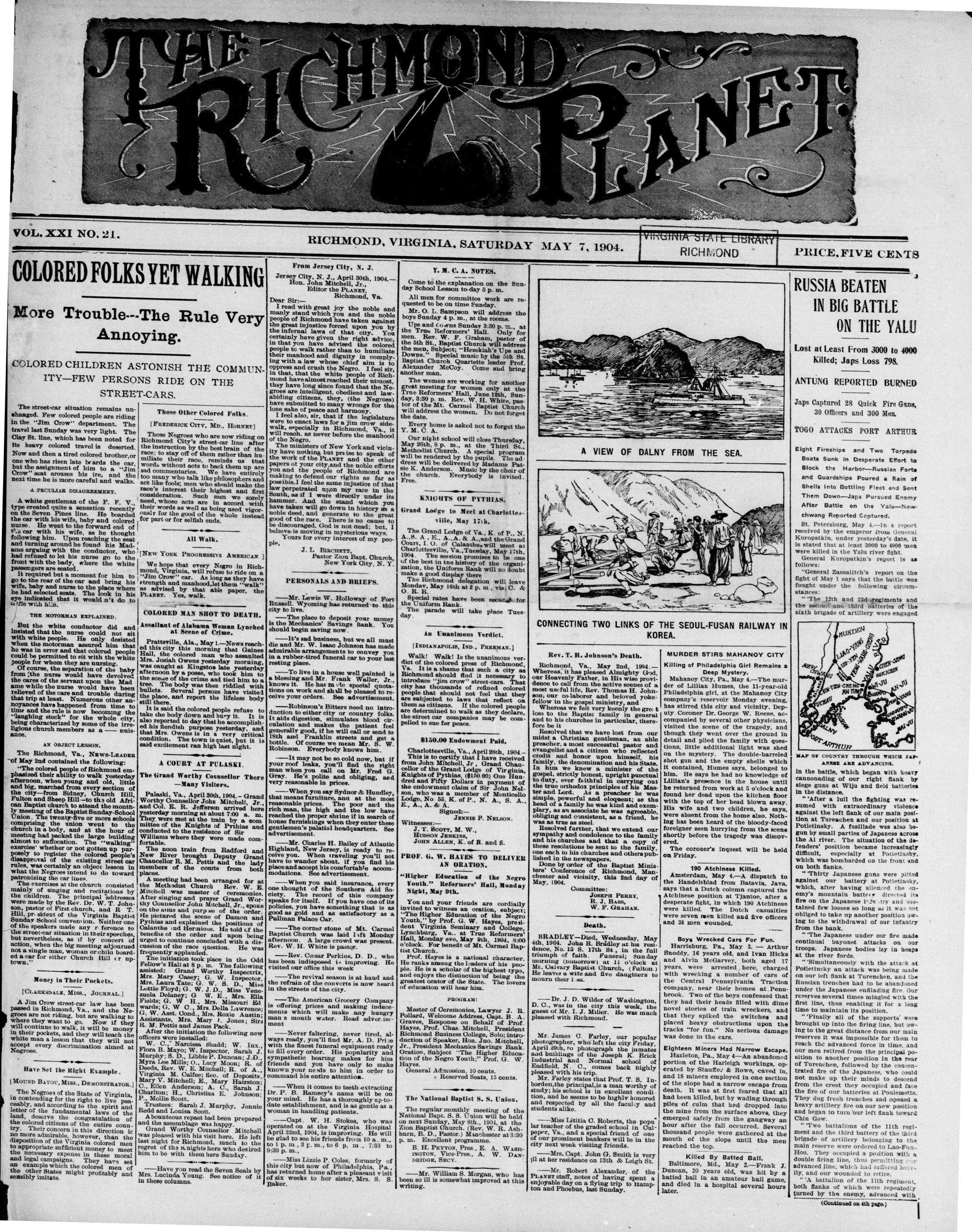
Page text (machine-generated)
THE RICHMOND PLANET
VOL. XXI NO. 21.
COLORED FOLK
More Trouble--
Anno
COLORED CHILDREN A
ITY—FEW PERSON
STREET
COLORED FOLKS YET WALKING
More Trouble---The Rule Very Annoying.
COLORED CHILDREN ASTONISH THE COMMUNITY—FEW PERSONS RIDE ON THE
STREET-CARS
The street-car situation remains unchanged. Few colored people are riding in the "Jim Crow" department. The travel last Sunday was very light. The Clay St. line, which has been noted for its heavy colored travel is deserted. Now and then a tired colored brother, or one who has risen late beards the car, but the assignment of him to a "Jim Crow" seat arouses his irie, and the next time he is more careful and wary.
A PECULIAR DISAGREEMENT
A white gentleman of the F. F. V., type created quite a sensation recently on the Seven Pines line. He boarded the car with his wife, baby and colored nurse. He went to the forward end of the car with his wife, as he thought following him. Upon reaching the seats and turning around he found his Madame arguing with the conductor, who had refused to let his nurse go to the front with the body, where the white passengers are seated.
It required but a moment for him to go to the rear of the car and bring his wife, baby and nurse to the place where he had selected seats. The look in his eye indicated that it wouldn't do to tie with him.
THE MOTORMAN EXPLAINED.
But the white conductor did and insisted that the nurse could not sit with white people. He only desisted when the motorman assured him that he was in error and that colored people could be permitted to sit with the white people for whom they are nursing. Of course, the separation of the baby from the nurse would have devolved the cares of the servant upon the Mad and the nurse would have been relieved of the care and trouble during that trip at least. Numerous other anoyances have happened from time to time and the rule is now becoming the "laughing stock" for the whole city, being characterized by some of the irreligious church members as a — nuisance.
AN OBJECT LESSON.
The Richmond, Va., News-LEADER of May 2nd contained the following:
"The colored people of Richmond emphasized their ability to walk yesterday afternoon, when young and old, little and big, marched from every section of the city—from Sidney, Church Hill, Fulton and Sheep Hill—to this old African Baptist church to attend the monthly meeting of the Baptist Sunday-School Union. The twenty-five or more schools comprising the union went to the church in a body, and at the hour of meeting had packed the large building almost to sufocation. The "walking" exercise' whether or not gotten up purposely to register the colored people's disapproval of the existing street car rules, was certainly an object lesson in what the Negroes intend to do toward patronizing the car lines.
The exercises at the church consisted mainly of singing and recitations by the children. The principal addresses were made by the Rev. Dr. W. T. Johnson, pastor of First church, and R. T. Hill, pr sident of the Virginia Baptist-Sunday School convention. Neither one of the speakers made any rference to the street-car situation in their speeches, but nevertheless, as if by concert of action, when the big meeting adjourned not a single man, woman or child boarded a car for either Church Hill (r up town).
[CLARKSDALE, MISS., JOURNAL.]
A Jim Orow street-car law has been passed in Richmond, Va., and the Negroes are not riding, but are walking to where they want to go. Now if they will continue to walk, it will be money in their pockets, and they will teach the white man a lesson that they will not accept every discrimination aimed at Negroes.
[MOUND BAYOU, MISS., DEMONSTRATOR.]
The Negroes of the State of Virginia, in contending for the right to live peaceably, and according to the spirit and letter of the fundamental laws of the land, deserve the congratulation of the colored citizens of the entire country. Their concern in this direction is no more admirable, however, than the disposition of the Virginia colored men to appropriate sufficient money to meet the necessary expense in these moral and legal campaigns. They have set an example which the colored men of the other States might profitably and sensibly imitate.
AN OBJECT LESSON.
Money in Their Pockets.
Those Other Colored Folks
[FREDERICK CITY, MD., HORNET]
Those Negroes who are now riding on Richmond City's street-car line after the instruction by the best brain of the race, stay off of them rather than humiliate our race, reminds us that words, without acts to back them up are sad commentators. We have entirely too many talk like philosophers and act like fools; men who should make the race's interest their highest and first consideration. Such men so lovely need, whose acts are in accord with their words as well as being used vigorously for the good of the whole instead for part or for selfish ends.
[NEW YORK PROGRESSIVE AMERICAN]
We hope that every Negro in Richmond, Virginia, will refuse to ride on a "Jim Crow" car. As long as they have strength and manhood, let them "walk" as advised by that able paper, the PLANET. Yes, walk.
Assailant of Alabama Woman Lynched at Scene of Crime.
Prattsville, Ala., May 1.—News reached this city this morning that Gaines Hall, the colored man who assaulted Mrs. Josiah Owens yesterday morning, was caught at Kingston late yesterday afternoon by a posse, who took him to the scene of the crime and tied him to a tree. The body was then riddled with bullets. Several persons have visited the place, and report the lifeless body still there.
It is said the colored people refuse to take the body down and bury it. It is also reported to day that he accomplished his fendish purpose yesterday, and that Mrs. Owens is in a very critical condition. The town is quiet, but it is said excitement ran high last night.
A COURT AT PULASKI
The Grand Worthy Counsellor There
—Many Visitors.
Pulaski, Va., April 30th, 1904. — Grand
Worthy Counsellor John Mitchell, Jr.,
and Col. E. R. Jefferson arrived here
yesterday morning at about 7:00 a. m.
They were met at the train by a committee of the Knights of Pythias and conducted to the residence of Sir
Williams where they were made comfortable.
The noon train from Radford and New River brought Deputy Grand Chancellor R. M. Pettis and the lady members of the courts from both places.
A meeting had been arranged for at the Methodist Church Rev. W. E. Mitchell was master of ceremonies. After singing and prayer Grand Worthy Counselor John Mitchell, Jr., spoke on the auns and purse of the order. He pictured the scene of Damon and Pythias and explained the positions of Calanthe and Hermione. He told of the benefits of the order and upon being urged to continue concluded with a discussion of the race question. He was frequently applauded.
The initiation took place in the Odd Fellow's Hall at 8 p. m. The following assisted: Grand Worthy Inspectrix, Mrs. Mary Casey; G. W. Inspector, Mrs. Lanna Tate; G. W. S. D., Miss Lottie Floyd; G. W. J. D., Miss Venezuela Delaney; G. W. E., Mrs. Ella Fields; G. W H., Mrs. Missouri Edwards; G. W C., Mrs. Della Lawrence; G. W. Asst. Ond., Mrs. Roxie Austin; Assistants, Mrs. Mary J. Jones; Sirs R. M. Pettis and James Pack.
After the initiation the following new officers were installed:
W. C., Narcissa shadd; W. Inx, Flora B. Mayo; W. Inspector, Sarah J. Murphy; S. D. Libbie P. Duncan; J.D., Virginia M. Calfee; Rec. of Deposits, Mary V. Mitchell; E., Mary Hairston; C., Ellen Anderson; A. C., Sarah J. Charlton; H., Christina E. Johnson; P., Mollie Scott.
Trustees: Sarah J. Murphy, Jennie Redd and Louisa Scott.
Abounteous repast had been prepared and the assemblage was happy.
Grand Worthy Counsellor Mitchell was pleased with his visit here. He left last night for Richmond, much to the regret of the Knights here who desired him to be with them here Sunday.
Have you read the Seven Seals by Mrs. Lucinda Young. See notice of it in these columns.
All Walk.
Jersey City, N. J., April 30th, 1904.- Hon. John Mitchell, Jr.,
I read with great joy the noble and manly stand which you and the noble people of Richmond have taken against the great injustice forced upon you by the infernal laws of that city. You certainly have given the right advice in that you have advised the colored people to walk rather than to humiliate their manhood and dignity in complying with a law whose chief aim is to oppress and crush the Negro. I feel sir, in that, that the white people of Richmond have almost reached their utmost, they have long since found that the Negroes are intelligent, obedient and law-abiding citizens, they, (the Negroes) have submitted to many wrongs for the lone sake of peace and harmony.
I feel also, sir, that the legislature were to enact laws for a jim crow side- especially in Richmond, Va., it will require never before the manhood of the Negro.
The ministers of New York and vicinity have nothing but praise to speak of the work of the PLANET and the other papers of your city, and the noble efforts you and the people of Richmond are making to defend our rights as far as possible. I feel the same injustice of that law perpetrated upon my race in the South, as if I were directly under its hammer. And the stand which you have taken will go down in history as a noble deed, and generate to the great good of the race. There is no cause to be discouraged. God is not dead; but, I believe is moving in mysterious ways.
Yours for every interest of my people.
J. L. BIRCHETT,
Pastor Zion Bapt. Church,
New York City, N. Y.
PERSONALS AND BRIEFES
Mr. Lewis W. Holloway of Fort Russell. Wyoming has returned to this city to live.
The place to deposit your money is the Mechanics' Savings Bank. You should begin saving now.
It's sad business, but we all must die and Mr. W. Isaac Johnson has made admirable arrangements to convey you in a rubber-tired funeral car to your last resting place.
To live in a house well painted is a blessing and Mr. Frank Waller, Jr., knows it. He has made special quotations on work and shall be pleased to receive your orders. See advertisement.
Robinson's Bitters need no introduction to either city or country folks. It aids digestion, stimulates blood circulation and makes the patient feel generally good, if he will call or send to 18th and Franklin streets and get a bottle. Of course we mean Mr. S. W. Robinson. Everybody knows him.
—It may not be so cold now, but if your roof leaks, you'll find the right man when you call on Mr. Fred G. Gray. He's polite and obliging, and very reasonable in prices.
—When you say Sydnor & Hundley, that means furniture, and at the most reasonable prices. The poor and the rich man, the high and the low have reached the proper shrine if in search of house furnishings when they enter these gentlemen's palatial headquarters. See advertisement.
—Mr. Charles H. Bailey of Atlantic Highland, New Jersey, is ready to receive you. When traveling you'll not have to wander about, if you find his place and accept his comfortable accommodations. See advertisement.
—When you said insurance, every one thought of the Southern Aid Society. The record of this company speaks for itself. If you have one of its policies, you have something that is as good as gold and as satisfactory as a Pullman Palace Car.
The corner stone of Mt. Carmel Baptist Church was laid 1 ft Monday afternoon. A large crowd was present. Rev. W. H. White is pastor.
Rev. Caesar Perkins, D. D., who has been indisposed is improving. He visited our office this week.
The revival season is at hand and the refrain of the converts is now heard in the streets of the city.
The American Grocery Company is offering prices and making inducements which will make any hungry man's mouth water. Read advertisement.
Never faltering, never tired, always ready, you'll find Mr. A. D. Price with the finest funeral equipment ready to fill every order. His popularity and sympathetic bearing makes for him friends and you have only to make known your needs to him in order to command his entire attention.
When it comes to teeth-extracting Dr. P. B. Ramsey's name will be on your mind. He has a thoroughly up-to-date establishment, and is as gentle as a woman in handling patients.
Capt. W. H. Stokes, who was operated on at the Virginia Hospital April 23nd, 1904, is improving. He will be glad to see his friends from 10 a. m., to 1 p. m., 3 p. m., to 6 p. m., 7:30 to 9:30 p. m.
Miss Lizzie P. Coles, formerly of this city but now of Philadelphia, Pa., has returned home after a pleasant visit of six weeks to her sister, Mrs. S. S. Baker.
Y. M. C. A. NOTES.
Come to the explanation on the Sunday School Lesson to-day 5 p. m.
All men for committee work are requested to be on time Sunday.
Mr. O. L. Sampson will address the boys Sunday 4 p. m., at the rooms.
Ups and goons Sunday 3:30 p. m., at the True Reformers' Hall. Only for men. Rev. W. F. Graham, pastor of the 5th St., Baptist Church will address the men, Subject; "Hezekiah's Ups and Downs." Special music by the 5th St. Baptist Church Quartette leader Prof. Alexander McCoy. Come and bring another man.
The women are working for another great meeting for women only at the True Reformers' Hall, June 12th, Sunday, 3:30 p. m. Rev. W. H. White, pastor of the Mt. Carmel Baptist Church will address the women. Do not forget the date.
Every home is asked not to forget the Y. M. C. A.
Our night school will close Thursday,
May 26th, 8 p. m., at the Third St.,
Methodist Church. A special program
will be rendered by the pupils. The ad
address will be delivered by Madame Patsie
K. Anderson. Music by the choir of
the church. Everybody is invited.
Free.
KNIGHTS OF PYTHIAS.
Grand Lodge to Meet at Charlottesville, May 17th.
The Grand Lodge of Va., K. of P., N., A., S. A., E., A., A & A., and the Grand Court, I. O. of Calanthes, will meet at Charlottesville, Va., Tuesday, May 17th, 1904. The session promises to be one of the best in the history of the organization, the Uniform Rank will no doubt make a good display there.
The Richmond delegation will leave Monday, May 16th at 2 p. m., via C. & O. R. R.
Special rates have been secured for the Uniform Rank. The parade will take place Tuesday.
An Unanimous Verdict
[INDIANAPOLIS, IND., FREEMAN.]
Walk! Walk! Is the unanimous verdict of the colored press of Richmond, Va. It is a shame that such a city as Richmond should find it necessary to introduce "jim crow" street-cars. That city has thousands of refined colored people that should not feel that they are subjected to laws that reflect on them as citizens. If the colored people are determined to walk as they declare, the street car companies may be compelled to sue for peace.
$150.00 Endowment Paid
Charlottesville, Va., April 28th, 1904.—This is to certify that I have received from John Mitchell, Jr., Grand Chancellor of the Grand Lodge of Virginia, Knights of Pythias, ($150.00) One Hundred and Fifty Dollars in payment of the endowment claim of Sir John Nelson, who was a member of Monticello Lodge, No. 55, K. of P., N. A., S. A., E., A., A. & A.
Signed:—JENNIE P. NELSON.
Witnesses:—J. T. SCOTT, M. W., HUDSON JENKINS, JOHN ALLEN, K. of B. and S.
PROF. G. W. HAYES TO DELIVER AN ORATION.
"Higher Education of the Negro Youth." Reformers' Hall, Monday Night, May 9th.
You and your friends are cordially invited to witness an oration, subject: "The Higher Education of the Negro Youth," by Prof. G. W. Hayes, president Virginia Seminary and College, Lynchburg, Va., at True Reformers' Hall, Monday eve, May 9th, 1904, 8:00 o'clock. For benefit of M. Carmel Baptist Church. Hayes is a national character. He ranks among the siders of his people. He is a scholar of the highest type, and enjoys the distinction of being the greatest orator of the State. The lowers of education will hear him.
PROGRAM:
Master of Ceremonies, Lawyer J. B. Pollard, Welcome Address, Capt. B. A. Graves, Response on Behalf of Prof. Hayes, Prof. Chas. Mitchell, President Richmond Business College, Solo; introduction of Speaker, Hon. Jno. Mitchell, Jr., President Mechanics Savings Bank. Oration, Subject "The Higher Education of the Negro Youth;" Prof. G. W. Hayes. General Admission, 10 cents. Reserved Seats, 15 cents.
The National Baptist S. S. Union.
The regular monthly meeting of the National Bapt. S. S. Union will be held on next Sunday, May 8th, 1904, at the Zion Baptist Church. (Rev. W. R. Ashburn, B. D., Pastor.) Manchester at 3:30 p. m. Excellent programme.
B. H. PEYTON, Pres., E. A. WASHINGTON, Vice-Pres., A. W. DANDRIDGE, SECY.
Mr. William S. Morgan, who has been so ill is somewhat improved at this writing.
THE ISLANDS
A VIEW OF DALNY FROM THE SEA.
CONNECTING TWO LINKS OF
KO
THE LINES OF THE TRAIN
Rev. T. H. Johnson's Death.
Richmond, Va., May 2nd, 1904.—Whereas, it has pleased Almighty God, our Heavenly Father, in His wise providence to call from the active scenes of a most useful life, Rev. Thomas H. Johnson, our cohabiter and beloved yoke-fellow in the gospel ministry, and Whereas we felt very keenly the gre: loss to the Baptist family in general and to his churches in particular, therefore be it.
Resolved that we have lost from our midst a Christian gentleman, an able preacher, a most successful pastor and evangelist and a citizen who reflected honor upon himself, his family, the denomination and his State.
In him we know a minister of the gospel, strictly honest, upright punctual to duty, ever faithful in carrying out the true orthodox principles of his Master and Lord. As a preacher he is simple, powerful and eloquent; as the head of a family he was kind and exemplary, as an associate he was agreeable, obliging and consistent, as a friend, he was as true as steel.
Resolved further, that we extend our sympathy and condolence to the family and his churches and that a copy of these resolutions be sent to the family, one each to his churches and others published in the newspapers.
Done by order of the Baptist Ministers' Conference of Richmond, Manchester and vicinity, this 2nd day of May, 1904.
Committee:
JOSEPH PERRY,
R. J. BASS,
W. F. GRAHAM.
BRADLEY—Died, Wednesday, May 4th, 1940. John B. Bridley at his residence, No. 15 S. 17th St., in the full triumph of faith. Funeral; Sunday morning (tomorrow) at 11 o'clock at Mt. Calvary Baptist Church, (Fulton) He leaves a wite and five daughters to mourn their loss.
Dr. J. D. Wilder of Washington, D. C., was in the city this week, the guest of Mr. I. J. Miller. He was much pleased with Richmond.
Mr. James C. Farley, our popular photographer, who left the city Friday, April 29th, to photograph the inmates and buildings of the Joseph K. Brick Industrial and Normal school of Endfield, N. C., comes back highly pleased with his trip.
Mr. Farley states that Prof. T. S. Inborden, the principal, is a man worthy of study; his school is in excellent condition, and he seems to be highly honored and respected by all the faculty and students alike.
Miss Lititia C. Roberts, the poplar teacher of the graded school in Oulpeper, Va., and a special friend of one of our prominent bankers will be in the city next week visiting friends.
Mrs. Capt. John G. Smith is very ill at her residence on 13th & Leigh St.
Mr. Robert Alexander, of the PLANET staff, notes of having spent a enjoyable day on a flying trip to Hampton and Phoebus, last Sunday.
Death.
THE SEOUL-FUSAN RAILWAY IN
REA.
MURDER STIRS MAHANOY CITY
Mahanoy City, Pa., May 4.—The murder of Lillian Hume, the 11-year-old Philadelphia girl, at the Mahanoy City company's reservoir Monday evening, has stirred this city and vicinity. Deputy Coroner Dr. George W. Reese, accompanied by several other physicians, visited the scene of the tragedy, and though they went over the ground in detail and plied the family with questions, little additional light was shed on the mystery. The double-barreled shot gun and the empty shells which it contained, Humes says, belonged to him. He says he had no knowledge of Lillian's presence in the house until he returned from work at 5 o'clock and found her dead upon the kitchen floor with the top of her head blown away. His wife and two children, he says, were absent from the home also. Nothing has been heard of the bloody-faced foreigner seen hurrying from the scene shortly before the tragedy was discovered.
The coroner's inquest will be held on Friday.
190 Atchinese Killed.
Amsterdam, May 4.—A dispatch to the Handelsblad from Batavia, Java, says that a Dutch column captured the Atchinese position at Tjantone, after a desperate fight, in which 190 Atchinese were killed. The Dutch casualties were seven men killed and five officers and 38 men wounded.
Harrisburg, Pa., May 3. — Arthur Snoddy, 16 years old, and Ivan Hicks and Alvin McGarvey, both aged 17 years, were arrested here, charged with wrecking a number of cars of the Central Pennsylvania Traction company, near their homes at Pennbrook. Two of the boys confessed that they had their heads filled with dime novel stories of train wreckers, and that they spiked the switches and placed heavy obstructions upon the tracks "for fun." No serious damage was done to the cars.
Eighteen Miners Near Narrow Escape
Eighteen Miners Near Narrow Escape. Hazleton, Pa., May 4—An abandoned portion of the Harleigh workings, operated by Stauffer and Rowe, caved in, and 18 miners employed in one section of the slope had a narrow escape from death. It was at first feared that all had been killed, but by wading through piles of culm that had dropped into the mine from the surface above, they emerged safely from the gangway an hour after the fall occurred. Several thousand people were gathered at the mouth of the slope until the men reached the top.
Killed By Batted Ball
Baltimore, Md., May 2.—Frank J. Duncan, 20 years old, was hit by a batted ball in an amateur ball game, and died in a hospital several hours later.
PRICE,FIVE CENTS
RUSSIA BEATEN IN BIG BATTLE ON THE YALU
Lost at Least From 3000 to 4000
Killed; Japs Loss 798.
ANTUNG REPORTED BURNED
Japs Captured 28 Quick Fire Guns,
30 Officers and 300 Men.
TOGO ATTACKS PORT ARTHUR
Eight Fireships and Two Torpedo
Boats Sunk in Desperate Effort to
Block the Harbor—Russian Forts
and Guardships Poured a Rain of
Shells Into Bottling Fleet and Sent
Them Down—Japs Pursued Enemy
After Battle on the Yalu—New-
chwang Reported Captured.
St. Petersburg, May 4.—In a report received by the emperor from General Kuropatkin, under yesterday's date, it is stated that at least 3000 to 4000 men were killed in the Yalu river fight.
General Kuropatkin's report is as follows:
"General Zassalitch's report on the fight of May 1 says that the battle was fought under the following circumstances:
"The 12th and 22d regiments and the second and third batteries of the sixth brigade of artillery were engaged
MUKDEN
LIAO-YIANG
SIO-YEN
PRIMA-WANG CHIHU
RIVER
NEW CHIHUANG
CHIHUANG
CHIHUANG-TIEN-CHENG
AN TUNG
NIJU
AN-JU
FUCHAUI
MAMPO
THANJUANG
HUNMAPO
WANG-JU
PORT ARTHUR
MAP OF COUNTRY THROUGH WHICH JAPANESE ARE ADVANCING.
in the battle, which began with heavy cannonading of our right flank by siege guns at Wiju and field batteries in the distance.
"After a lull the fighting was resumed with extraordinary violence against the left flank of our main position at Turenchen and our position at Potletinsky. A fusillade was also begun by small parties of Japanese across the Al river. The situation of the defenders' position became increasingly difficult, especially at Potletinsky, which was bombarded on the front and on both flanks.
"Thirty Japanese guns were pitted against our battery at Potletinsky, which, after having silenced the enemy's mountain battery, directed its fire on the Japanese infantry and sustained few losses so long as it was not obliged to take up another position owing to the withdrawal of our infantry from the bank.
"The Japanese under our fire made continual bayonet attacks on our troops. Japanese bodies lay in heaps at the river fords.
"Simultaneously with the attack at Potletinsky an attack was being made on our left flank at Turenchen, and the Russian trenches had to be abandoned under the Japanese enflating fire. Our reserves several times mingled with the first line, thus enabling it for a long time to maintain its position.
"Finally all of the supports' were brought up into the firing line, but owing to the great distance from our main reserves it was impossible for them to reach the advanced force in time, and our men retired from the principal position to another position in the rear of Turenchen, followed by the concentrated fire of the Japanese, who could not make up their minds to descend from the crest they occupied and face the fire of our batteries at Poulemetts. They dug fresh trenches and opened a heavy artillery fire on our new position and began to turn our left flank toward Chin Gow.
"Two battalions of the 11th regiment and the third battery of the third brigade of artillery belonging to the main reserve were ordered to Lao-Fun-Hou. They occupied a position with a double firing line, thus permitting our advanced line, which had suffered heavily, and our wounded to retire.
"A battalion of the 11th regiment, both flanks of which were repeatedly turned by the enemy, advanced with
(Continued on 4th page.)
SATURDAY ..... MAY 7, 1904
THE BROADER LIFE
I will not let you say a woman's part
Must be to give exclusive love alone;
Dearest, although I love you so, my heart
Answers a thousand claims besides your
own.
I love—what do I love?—earth and air
Find space within my heart, and myriad
things
You would not deign to heed are cherished there,
And vibrate on its very inmost strings.
I love the summer with her ebb and flow,
Of light, and warmth, and music, that have nurst
Her friend buds to blossoms—and you know
It was in summer that I saw you first.
When you had been those weary months away.
I love the stars like friends; so many nights I gazed at them when you were far from me.
Till I grew blind with tears—those far off lights. Could watch you, whom I longed in vain to see.
I love the flowers; happy times lie. Shut up within their petals close and fast; You may have forgotten, dear, but they and I. Keep every fragment of the golden past.
I love all good and noble souls—I heard One speak of you but lately, and for days Only to think of it, my soul was stirred In the tender memory of such generous praise.
I love all those to whom you owe Comfort and joy; and I can find regret Even for those poorer hearts who once could know
**Will you be jealous? Did you guess before**
**I loved so many things? Still, you the**
**man?**
Grace E. Dunning, in Utica (N. Y.)-Press.
THE COWARDICE OF McKENZIE By EDGAR WELTON COOLEY
MILDRED stepped through the side entrance of the bank and saw her father at his desk. He did not look up, and she crossed the room and touched him on the shoulder. When he started, she laughed merrily, and the sound of her voice reached the paying teller in his iron cage. His face flushed suddenly, and he glanced a brief moment towards the president's office whence the laughter came. Then he turned again to his tasks. It was nearing the closing hour, and already the shadows of an early winter evening were lengthening along the street outside. As the paying teller counted the coin and the bank notes before him, his thoughts reverted to the previous evening.
They had been lovers so many years—so many years! He could not bring himself to realize that it was all over now; but there had been a quarrel, and she had said it were best they should henceforth be but friends. And he loved her—he loved her.
Mechanically, he picked up a tray of coin and, quitting his cage, walked down the corridor toward the vault.
And presently he became conscious of the swish of a woman's skirts, of the perfume of a woman's presence, of the music of a woman's voice.
"Mr. McKenzie," she said.
He paused, the tray balanced on his palm, and turned. Her own face was flushed and a mischievous glimmer was in her eye.
"You are going in the vault?" she asked. "May I go, also. I have read so much of bank robberies, of vaults, of the inner doors and the locks and things. Papa has tried to explain them to me, but I do not seem to comprehend. I should like to see them—if you don't mind."
The last words were uttered as though he would think her audacious. He smothered a sigh that had crept into his throat at the sight of her face. "I am at your service, Mil—Miss Matthews," he said.
Silently he led the way, and as she stepped from the light of day into the gloomy interior of the massive vault, he caught the red gleam of the setting sun upon her hair, circling her brow like a crown of bronze.
Briefly, almost hurriedly, in his voice a restraint he could not cast aside, he explained the workings of the various bolts and locks. He opened the door of the inner compartment and showed her the piles of gold and silver and bundles of bank notes. Then, for the first time since entering the vault, he glanced at her. She was standing in the deep shadows, her trim figure wrapped in a mantle of ebony, her face pale in contrast to the gloom. For a brief moment a silence fell between them—a silence painful in its intensity. Then a smile quivered upon her lips. "Mr. McKenzie,' she said, "I—I—" She paused and partly raising her hand toward him, let it fall again to her side. "McKenzie! Mr. McKenzie!" cried a man's voice from without the vault. It was Matthews, the president. The paying teller hurried to open the compartment.
"McKenzie," said the capitalist, "I wish you would take this letter over to Lloyd & Blake's and deliver it to Mr. Lloyd, personally. See that it falls into
no 'other hands.'
When McKenzie at last left the office of Lloyd & Blake it was considerably after banking hours. His duties for the day over, he sauntered idly along the busy thoroughfare. His hands in his coat pockets, his eyes downcast as he walked slowly, thinking and thinking.
After all, why longer continue the unequal struggle? He could not remain where he must be constantly seeing Mildred—where he must constantly behold the simple sweetness of her face and hear her free-hearted laughter—now that they were only friends. He was too much of a coward.
He must go away—somewhere; anywhere. But how? He had little money. He—
A sudden thought came to him, and as it throbbed through his brain he paused on a corner and stood rigid, pale, trembling. His blood seemed frozen in his veins.
A hundred people surged past him, but he saw no one. A constant din of traffic surrounded him, but he heard nothing. He was thinking—thinking—thinking. Then a smile—a smile of desperate determination—surved the lines of his mouth and smoothed the wrinkles between his eyebrows.
"I must go—go—go!" he cried to himself. "As for the money—God forgive me, I cannot help it!"
Arousing himself with a start, he boarded a car and was carried rapidly away in the direction of the bank.
No one was to be seen in the massive granite building when he alighted at the corner.
With a pass key he let himself in, and noticed that the dusk was rapidly thickening in the rooms. Making his way through the corridors, he stood at last in front of the vault. The heavy door was closed and locked. But he knew the combination—and there were piles of coin and currency behind the inner barriers.
For a moment he hesitated. Perhaps the thought of his long years of faithful service, of his good name, of the implicit confidence imposed in him by her father made him pause. But—he was a coward.
Glancing carefully around the apartment to make sure there was none to see, he placed his hand upon the metal knob that worked the combination. A few slow, deliberate movements and he heard the click that told the lock was sprung.
Again he hesitated, the cold sweat pouring from his forehead, and a wild, unnatural gleam in his eyes. Then, throwing his weight upon the handle, he threw back the bolt and swung open the door.
Instantly he shrank back and put a hand to his eyes. For, just within the open vault, Mildred stood, her features
HE PLACED HIS HAND ON THE KNOB THAT WORKED THE COMBINATION.
palid with fright, her lips trembling but speechless.
As the door was opened she raised one hand, palm outward, to shield her blinded eyes from the bright light of day.
But to the man cowering before her she stood in the attitude of one barring the way of a thief, who sought the wealth of which her father was custodian. With warning hand uplifted, she seemed to command: "Stand back!" In a moment the woman's eyes became accustomed to the light, and she stepped lightly out of her prison and stood beside the man she loved.
"It was kind of you to come back after me," she said. "They must not have known I was in there, for they locked the door and I could not make them hear me. I was afraid I must remain there until morning, and I felt sure I would smother."
She shivered and crept closer to the other.
"I am glad I came," he faltered, realizing that she did not guess the truth. "I was thinking you might have been locked in, and when I found you were I was startled." It was a lie—a poor, weak lie. But it saved his soul. "Walter," she said, softly, and he beheld the old-time love light in her eyes, "how foolish it was in us to quarrel. I—have not been quite happy—a single moment—since, Walter."
PAWNS SHIFTLESS HUSBAND
Polish Wife Puts Spouse into Pledge, Repents, and Appeals to Courts, But in Vain.
A peasant woman of Bielastochek, in the government of Vilna, in Russian Poland, recently wishing to raise some money for household expenses, went to an old maid who made small loans to friends. She had nothing to pawn, but at last thought of her shiftless husband, and suggested that he be the pledge. The money lender consented and the money was advanced.
The peasant woman made her purchases, and, on returning home, found her husband gone. The money lender had been there and taken away the husband, with whom she was preparing to take a long journey.
The wife complained to the village court, but the judge decided against her, and, as the sum borrowed was more than she could pay back and as no one would go to her rescue, she had the mortification of seeing her husband depart with his captor amid the cheers and laughter of the townspeople.
Young Friend.
A wise man never tells a woman that she reminds him of an old friend.
The Bolometer
In the Smithsonian report on scientific work for 1902, Prof. Langley remarks that when the bolometer was invented, some 20 years ago, it was able to measure temperature to about one-hundred-thousandth of a degree Since then the instrument and its adjuncts have been so far improved that temperature can now be measured to less than one one-hundred millionth of a degree readily and with precision.
The Worse Malady
ter to-day—you seem so sorrowful?
Miss Scathem—My brother has chick enpox, and a friend of mine is going to be married.
Miss Sweetthynge—Then I presume you're sorry for your brother?
Miss Scathem—Not so sorry as I am for my friend. One can get over the chickeenpox.—Baltimore News.
Easy Way to Mend Lace Curtains.
If there are holes too large to darn take a piece of net as nearly like the curtain as possible, or cut a piece from some discarded curtain. Dip it in starch-water, lay it on the hole or worn place, and when nearly dry, press with warm irons. The patch will remain until again laundered, and will not be discernible.—Woman's Home Companion.
Largest Russian Cities.
The populations of the largest Russian cities are: St. Petersburg, 1534, 000; Moscow, 1,173,000; Warsaw, 756, 000; Odessa, 449,000; Lodz, 351,000; Kieff, 319,000; Riga, 260,000; Charkow, 179,000; Baku, 179,000; Vilna, 162,000; Tiflis, 160,000; Tashkent, 156,000; Jekaterinowslaw, 135,000; Kishenev 125,000; Rostow, 120,000.
New Road-Building System
They are discussing in England a new system of road building, which would save a large percentage in the cost of construction. Instead of the present method of convex surfaces with a gutter at each side, it is proposed to build concave roads, with a gutter in the middle.
Very Nervy.
Star Boarder—The landlady objects to you complaining about the fare. She says all the food she serves is nerve food.
Mr. Kicker—I don't doubt her assertion. It takes a great deal of nerve to serve such food as this.—Chicago Daily News.
A Bit Shaky
Jack—I hear that Sam's got a billet as caretaker at those new buildings.
Tom—Yes; but I don't expect it'll last long.
"Why, isn't it a steady job?"
Why, isn't it a steady job?
"Oh, the job's steady enough, but Sam isn't."—Ally Sloper.
Sure of It.
He—Miss Phoxy has pretty hair.
She—Yes, but it's bleached.
He—Anyway, she has pretty teeth!
She—Yes, but they're false.
Sure of It
He—Well, I know one thing—her
eyes aren't glass!—Detroit Free Press.
Washington's Farm Crops
Upward of 23 per cent, of the money value of Washington's farm crops comes under the head "miscellaneous," and does not include either grain, hay, vegetables, fruit, live stock, dairy products, or any of the great staples.
Mole Skins.
Two cents apiece used to be paid for the pelts of moles in France before they became a fashionable fur. Now they fetch four times that sum. One dealer bought 1,800,000 pelts in six weeks.
True Philosophy
"I ain't got nuthin' 'gin de worl"
says a colored philosopher, "so en long
ez do worl' ain't got nuthin' 'gin me
don't see why we can shake han's en
go 'long together."—Atlanta Consti-
tution.
Oldest Horse in Maine
Penobscot county claims the oldest horse in Maine, if not in the country. His name is Tommy Foskett. He is 42 years old and there is no question about his age.
Sent Home by Immigrants.
Figures recently published in Christiana show that the amount of money sent home from the United States by immigrants from Norway last year was $3,780,000.
His Taking Ways
"How does Elmer manage to take so well with the girls?" "Oh, he has a camera, and his pictures are all flattering."—Philadelphia Bulletin.
Hard to Do.
Nothing turns a man's hair gray so quickly as trying to please a woman who doesn't know what she wants—Chicago Daily News.
Valuable Hen.
Why is a dead hen more valuable than a live one? Because she will lay wherever you put her.—Farm Journal.
British Sports
Statistics tell us that more than 30,000 British men and women go out hunting every Monday morning.
For the Lambs on 'Change.
The burnt child does not necessarily dread the stock exchange.—N. O. Times-Democrat.
Too Busy to Quarrel
Men who mind their own business are too busy to quarrel with their neighbors.
Another Customer Lost
Mrs. De Painter—This stuff won't do at all, and you will have to take it back. It doesn't harmonize with my complexion.
New Clerk (convincingly)—But, madam, it harmonized with the complexion you had when you selected it.
—N. Y. Weekly.
Letting Him Down.
"I suppose," said the timid sultor.
"Oh! yes, I would," replied the pretty
but untrustworthy, consider you for a
second. — Phihoi's father.
The Deacon's Opinion
"Yes, suh," said the colored brother, "dat boy is so fond er tradin' dat I ve'ly believes dat ef he wuz in heaven, en dey let him come back for a holiday, he'd sell his return ticket en trus' ter bin'bowed back by er harricane!"—Atlanta Constitution.
"Evidently you don't know how he spends his money." "Perhaps not, but I know how he pays his debts."—Catholic Standard and Times.
Greatest of All Pain
A mighty pain to love it is.
And 'tis a pain that pains to miss;
But of all the pains the greatest pain
It is to love and love in vain.
-What-to-Eat.
AT THE DEPARTMENT STORE
Customer (who has fallen downstairs)
—Help! I've broken my leg!
Floor Walker—Yes, sir; you'll find crutches, bandages, etc., on the fourth floor front.—Heitere Welt.
Impossible
That he'll compose the baby.
—Philadelphia, Bellein.
As It Might Be
"Well, he's dead to her. She got a divorce, you know, and mourning is so becoming to her."—Brooklyn Eagle.
Exclusiveness.
"I never saw such an exclusive family." "That's easily explained." "How?" "They've cut loose from the society they had and they can't get into the society they seek."—Chicago Post.
Couldn't See.
Francis' mother had sent him to the butcher's one day to find whether he had "pigs feet." Francis soon returned with this statement: "I could not see. He had his shoes on."-Little Chronicle.
Row in the Jones Flat
Mrs. Jones—It's queer that baby doesn't talk. She's almost two years old and she hasn't spoken a word yet. Mr. Jones—I know, dear, but do you ever give baby a chance?—Boston Transcript.
Her Plan.
"Their engagement was very short, wasn't it?" "Yes; she insisted upon marrying him at once, because she didn't like to have him about the house."—Brooklyn Eagle.
Economizing on a Rug
Mr. Hlurchch—You forget, dear; that prayer rug I bought you doesn't show any sign of wear yet.—Yonkers Statesman.
Definition.
"It's what they use when they haven't got proof."—Cleveland Leader.
Occult Assistance
Mack—What on earth did you go to that chairvoyant woman for?
Kate—I wanted to find out why I never can get any shirt waist made to fit.—Cincinnati Commercial Tribune.
Up-to-Date Comedy.
"I spilt a drink of schnapps on me coat last week alretty, and noddings took outdert the spot yet."
"Ah, ha! Dot vas der schmile vot vondt come off!"—N. Y. American.
Practical Economy.
"Arthur, dear, don't you think it's rather extravagant of you to eat butter with that delicious jam?" "No, love; economical. Same pieces of bread does for both."—Tit-Bits.
An Insinuation
Miss Elderleigh—I suppose smokeless powder will reveal the horrors of war?
Mr. Knox—Yes; but it will never be able to conceal the ravages of time,—Cincinnati Enquirer.
Defined.
"Dad," said little Reginald, "what is a bucket shop?" "A bucket shop, my son," said the father, feelingly, "a bucket shop is a modern cooperage establishment to which a man takes a barrel and brings back the bung-hole."—Town Topics.
A Public Reader
Church—That young man is a public reader.
Gotham—He doesn't look it.
"Well, he is, just the same; he goes around and reads the gas meters every month."—Yonkers Statesman.
War's Horrors.
Mrs. Highmore—Isn't war a dreadful thing?
Mrs. Gaswell—It's perfectly horrid. The papers were so full of it this morning that they only bad room for two or six lines about my party last night. —Chicago Tribune.
MAKES MEN VIGOROUS.
Valuable Prescription by Which Any Man Can Make His Own Remedy to Cure Himself at Home Sent Free to All. Write for it.
WILL MAKE A MAN OF YOU.
For the return of that youthful feeling of manliness from the physician and savant is in promotion of a resplendent beaver.
America's Greatest Specialist.
bhimse used in his own extensive private practice with the most startling success. Though he found, and with it thousands of weak men have brought about the cures they so much demand, and in many cases simply sends the formula entirely free to any single man for him it, and they will find it a gift of lasting value. It is good for sexual weakness, lost virginity, or a muscular issue, varicocle, lack of force, prostatic trouble, night sweats, inability and the many other eminent perfect man. It creates an immediate social feeling, warmth and good nature, forces acacia, a muscular issue, tones the nervous system, and produces a perfect man. It makes the man of 65 as good as at 35, and the young man again eager for society and fit for the job. The salts are produced in a day's, and a perfect cure in a few weeks, regardless of age, or the age. If you need such a remedy, send your name and address to day to the Dr. Knapp Med. Co. or, if you are an marked envelope the doctor will at one occasion you the receipt, as promised, explaining in detail what ingredients to use and how to combine them. If you need him himself in his own home without being under obligations to any one. It costs you nothing, the sooner, you write, the sooner you will become.
A Gentle Hint
"And that," said Mr. Staylate, concluding his tiresome story, "was how my mother became interested in the Home for Aged Widows."
"Speaking of homes," remarked Miss Patience, yawning ostentatiously, "that doesn't word 'home' appeal to you and make you feel there is no place like it?"—Philadelphia Press.
SIZING IT UP.
It's a pretty careful speaker who isn't forced to discount his first statements more than ten per cent.
"Oh, Annie!" exclaimed four-year-old Elmer. "there's a hole in my stocking as big as a silver dollar!"
"Are you sure it's that big?" asked his sister.
"Well," replied the little fellow, after looking at it again. "it's as big as 90 cents, anyway." -Cincinnati Enquirer
Last Resort
When everything's closed at the clubroom
And the curtain is down at the show, too,
There's no place like home, take my word
for't.
When there's no other place you can go to
- Posters Near
Days of the Week
"What are the days of the week?" asked the teacher. The little girl pondered deeply for a moment. "Big dinner day, washing day, ironing day, baking day, the girl's day out, last school day and play day," she answered finally.—Chicago Post.
She Merely Wanted to Know. "The fact is," said the old bachelor, "that I regard a woman as an inferior being."
"What's the matter?" asked Mrs. Henpeck. "Has some woman been hinting that she regards you as being good enough for her?"—Chicago Record-Herald.
A Certain Indication
"Mrs. A. S. Piring has recently opened a bank account for the first time in her life."
"How do you know?"
"She has just given her next door neighbor a check for 35 cents."—Woman's Home Companion.
A Sense of Distrust
"Have you ever done anything to entitle you to the gratitude of posture?" "No." answered Senator Sorphum; "and when I see some of the statuary that is scattered about I don't feel like tempting posture to be too grateful." —Washington Star.
Rip Van Winkle Libeled.
Rip Van Winkle had just been taking a nap. Placing a hand upon his beard, he murmured drowsily. "How this grows on me." After which he fell into a second doze, that he might sleep out the remaining ten years. —Yale Record.
Tough Pupil.
Teacher—Jimmy, how would you express the idea that a man is mentally unbalanced??
Jimmy—Jimmy, my dad has got room to rent in de second story!—N. O. Times-Democrat.
J. H.
Wood and Coal, Cigars
AT THE LOWEST M
YOU CAN SAVE MONEY I
ALL GOODS DELIVER
TELEPHONE
A. C. BOOKER
18 W. BAKER ST.
W. I. JOE
FUNERAL DIRECTOR
Office & Warerooms, 207 N.
HACKS FO
Orders by Telephone or Tele-
pers and Entertainment
Old 'Phone, 686, Residence
Cigars and Tebacco. WEST MARKET PRICES. MONEY BY GIVING ME A CALL. DELIVERED TO YOU FREE. PHONE 1307 OKER, Prop. OKER ST. RICHMOND, VA. JOHNSON, DIRECTOR AND EMBALMER. Ins, 207 N. Foushee St. Corner Broad. BACKS FOR HIRE: One or Telegraph filled. Wedding, Supertainments promptly attended. Residence in Building, New Phone, 18. KNIGHTS OF COLUMBUS OF THE WORLD
AT THE LOWEST MARKET PRICES. YOU CAN SAVE MONEY BY GIVING ME A CABL.
W. I. JOHNSON. FUNERAL DIRECTOR AND EMBALMER.
Office & Warerooms, 207 N. Foushee St. Corner Broad. HACKS FOR HIRE: Orders by Telephone or Telegraph filled. Wedding, Suppers and Entertainments promptly attended. Old 'Phone, 686. Residence in Building, New Phone, 48.
KNIGHTS OF COLUMBUS OF THE WORLD
TO WHOM IT MAY CONCERN:
This organization has been chartered and legally instituted under the laws and statute of the state of New York, for the purpose of uniting together all acceptable men on the Broad Bases of Charity—Beneficial and the Social and Moral condition of humanity and uniform ranks will secure for this organization all sacred institutions of modern events, a grand oppo- puents wanted in all sections of the country to organi- zate address,
ALLEN Supreme voyager,
N. 87th Street, New York City.
This organization has been chartered and legally instituted under the laws and statute of the state of New York, for the purpose of uniting together all acceptable men on the Broad Bases of Charity - Beneficial use
Fraternal and to promote the Social and Its two distinct military and uniform place in the front ranks of all sacred ins unity for active men. Deputies wante lodges Kindly address,
G. W. ALLEN S
846 W. 87th Street
Its two distinct military and uniform ranks will secure for this organisation a place in the front ranks of all sacred institutions of modern events, a grand opportunity for active men. Deputies wanted in all sections of the country to organise lodges. Kindly address,
Capital, $25,000.
paid on deposit and interest paid on a
to which remains 60 days and over.
on Satisfactory Security.
ents Handled Promptly.
c cents and upwards received on deposit.
netted up in the most improved style, having a large
steel chest, electric lights and every modern conven-
commodation of the public.
cerning Stocks, Deposits, Loans, etc., apply to the
seen arranged for the special convenience of the work.
M. to 4 P. M. Saturday, 9 A. M. to 8 P. . We
and open again at 5 P. M., remaining open until 7
from work.
Money received on deposit amounts above $1.00 which re-
Money Loaned on Satisfaction
Business Accounts Handl-
Amounts of ten cents and
This establishment is fitted up in the white vault, burlar-proof steel chest, elec-
ience for safety and the accommodation
For all information concerning Stock Cashier.
Banking Hours have been arranged in people as follows: 9 A. M. to 4 P. M. close Saturday at 8 P. M. and open again P. M. Call by as you come from work.
OFFIC
JOHN MITCHELL, JR., President.
THOS. H. W.
BOARD OF F.
REV. W. F. GRAHAM, D. D., JN
E. R. JEFFERSON H. F. JONATHAN,
J. O. FARLEY,
Money received on deposit and interest paid on a amounts above $1.00 which remains 60 days and over.
Money Loaned on Satisfactory Security.
Business Accounts Handled Promptly.
Amounts of ten cents and upwards received on deposit.
This establishment is fitted up in the most improved style, having a large white vault, burlar-proof steel chest, electric lights and every modern convenience for safety and the accommodation of the public.
For all information concerning Stocks, Deposits, Loans, etc., apply to the Cashier.
Banking Hours have been arranged for the special convenience of the working people as follows: 9 A. M. to 4 P. M. Saturdays, 9 A. M. to 8 P. . We close Saturday at 3 P. M. and open again at 5 P. M., remaining open until 7 P. M. Call by as you come from work.
OFFICERS
JOHN MITCHELL, JR., President. H. F. JONATHAN, Vice-President, THOS. H. WYATT, Cashier.
President. H. F. JONATHAN, Vice-President.
TH0H. N. WYATT, cashier.
BOARD OF DIRECTORS:
D. D., JNO. R. CHILES, B. P. VANDERVALL,
F. JONATHAN, THOMAS SMITH D. J. CHAVERS,
BLEV, JNO. T. TAYLOR.
E. A. WASHINGTON, R. W. WHITING,
JOHN MITOHELL, JR. FRES
FRANK WALLER, JR.
PRACTICAL HOUSE
14 W. Baker St., Richmond, Va.
Residence, 1 E. Orange St.
Prompt attention given to all mai-
orners Satisfaction guaranteed
All kinds of Painting Done Cheap
Give me a call before going elsewhere
Fred G. Gray,
Fred G. Gray,
THE STOVE MAN.
You can have all kinds of Stoves Repaired and put up. Also your Roofs, Gutters, 2 Coductors Repaired and Painted at a reasonable price.
Your patronage will be highly appreciated.
FRED G. GRAY,
Richmond, Va
OUR PRICE LIST.
IT CAN'T BE EXCELLED
Your Patronage is Invited.
The AMERICAN GROCERY
and PROVISION MARKET
1221 St. James Street.
When you want nice dry, sawed pine
wood, call up 3888. We sell 1/2 cord for
$7.75, guaranteed full measurer.
A full line of fancy and staple gro-
ceries and fresh meats. Granulated sugar
4/8 ozs per lb. Prices low on everything
this week. Hard and soft coal. Hay
and Grain.
709-11-18 E. Broad St.
---
THE MASSACRE
THE
FARMER
PAINTER.
LOOK OUT FOR
```markdown
```
Booker's Market
18 W. Baker St. A FULL LINE OF FINE GROCERIES AND FRESH MEATS & VEGETABLES
V. P. & F. K. of W.
Mechanics'
Savings Bank OF RICHMOND, VA
511 North Third Street.
WILLIAM CUSTALO, J. J. CARTER,
THOMAS M. CRUMP, Suc. x.
SYDNOR AND HUNDLEY, LEADERS IN Quality Furniture
PARLOR SUITS
We have some twenty-five or thirty suits bought, most of which will be in stock in a few days. "Don't do a thing" until you see this line.
MORRIS CHAIRS.
This always popular chair of rest will be in as much demand this fall as ever. Part of our stock has already arrived and $10 values vie with $15 values of a year ago. Call, see our stock of Bed Room Fur
Call, see our stock of Bed Room Furniture and save time and money. Passenger elevator. Sydnor & Hundley,
The Gentleman From Indiana
By BOOTH TARKINGTON
Copyright, 1899, by Doubleday @ McClare Co.
Copyright, 1902, by McClare, Phillips @ Co.
"Sit down, boy, sit down," said Meredith, and his friend obeyed. The window was open beside the two young men, and the breeze that blew in soothed like a balm, yet held a tang and spice in it, a hint of walnuts and of coming frost. There was a newness in the atmosphere that day, a bright
CHAPTER XIV.
T
HE accommodation train wandered down through the afternoon sunshine, stopping at every village and every country postoffice on the line. There was a passenger in the smoker who found the stops at these wayside hamlets interminable. He got up and paced the aisle now and then, and his companion reminded him that this was not certain to hasten the hour of their arrival at their destination. "I know that," answered he, "but I've got to beat McCune."
"By the way," observed Meredith, "you left your stick behind."
"You don't think I need a club to face"—
Tom choked. "Oh, no; I wasn't thinking of your giving H. Flisbea a beating. I meant to lean on."
"I don't want it. I've got to walk lame all my life, but I'm not going to hobble on a stick."
Tom looked at him sadly for a moment. It was true, and the Crossroaders might hug themselves in their cells over the thought. For the rest of his life John Harkless was to walk with just the limp they themselves would have had if, as in former days, their sentence had been to the ball and chain.
invigoration, that set the blood tingling. The hot months were done with; languor was routed. Autumn spoke to industry, told of the sowing of another harvest, of the tawny shock, of the purple grape, of the red apple, and called upon muscle and laughter, breathing gayety into men's hearts. The little stations hummed with bustle and noise, big farm wagons rattled off up the village streets and raced with "cut under" or omnibus; people walked with quick steps; the baggagemasters called cheerly to the trainmen, and the brakemen laughed goodbys to rollling girls. At times the train ran between shadowy groves, and delicate landscape vistas, framed in branches, opened, closed and succeeded each other, and then the travelers were carried beyond into the level open again and looked out to where the intensely blue September skies ran down to the low horizon, meeting the boundless aisles of corn. It takes a long time for the full beauty of the flat lands to reach a man's soul. Once there, nor hills, nor sea, nor growing fan leaves of palm shall suffice him. It is like the beauty in the word Indiana. It may be that there are people who do not consider Indiana a beautiful word, but let it ring true in your ears, and it has a richer sound than Vallombrosa.
All at once the anger ran out of John Harkless. He was a hard man for anger to tarry with. And in place of it a strong sense of home coming began to take possession of him. He was going home. "Back to Plattville, where I belong," he said to himself without bitterness, and it was the truth. "Every man cometh to his own place in the end."
Yes, as one leaves a gay acquaintance of the playhouse lobby for some hard handed, tried old friend, so he would wave the outer world godspeed and come back to the old ways of Carlow. What though the years were dusty, he had his friends and his memories and his old black brier pipe. He had a girl's picture that he should carry in his heart till his last day, and if his life was sadder it was infinitely richer for it. His winter treside would be not so lonely for her sake, and, losing her, he lost not everything, for he had had the rare blessing of having known her. And what man could wish to be healed of such a hurt? Far better to have had it than to trot a smug pace unscathed. He had been a dullard, a sluggard, weary of himself, unfit to fight, a failure in life and a failure in love. That was ended. He was tired of falling, and it was time to succeed for awhile. To accept the worst that fate can deal and to wring courage from it instead of despair—that is success, and it was the success that he would have. He would take fate by the neck. But had it done him unkindness? He looked out over the beautiful, "monotonous" landscape, and he answered heartily, "No!" There was ignorance in man, but no unkindness. Were man utterly wise he were utterly kind. The Cross-roaders had not known better, that was all.
The unfolding aisles of corn swam pleasantly before his eyes. The earth heartened to man's wants and answered. The element sun and summer rains hastened the fruition. Yonder stood the brown haystack, garnered to feed the industrious horse that had earned his meed. There was the straw thatched shelter for the cattle. How the orchard boughs bent with their burdens! The big red barns stood stored with the harvest, for this was Carlow county, and he was coming home.
They crossed a byroad. An old man with a streaky gray chin beard was sitting on a sack of oats in a sautess wagon waiting for the train to pass. H"rkless seized his companion excitedly by the elbow. "Tommy," he cried, "it's Kim Fentriss. Look! Did you see that old fellow?" "I saw a particularly uninterested and uninteresting gentleman sitting on a bag," replied his friend.
"Why, that's old Kimball Fentriss. He's going to town. He lives on the edge of the county." "Can this be true?" said Meredith gravely.
"I wonder," said Harkless thoughtfully a few moments later—"I wonder why he had them changed around." "Who changed around?" "The team. He always used to drive the bay on the near side and the sorrel on the off." "And at present," rejoined Meredith, "I am to understand that he is driving the sorrel on the near side and the bay on the off?" "That's it," returned the other. "He must have worked them like that for some time, because they didn't look uneasy. They're all right about the train, those two. I've seen them stand with their heads almost against a fast freight. See there." He pointed to a white frame farmhouse with green blinds. "That's Win Hibbard's. We're just outside of Beaver."
"Beaver? Elucidate Beaver, boy."
"Beaver? Meredith, your information ends at home. What do you know of your own state if you are ignorant of Beaver? Beaver is that city of Carlow county next in importance and population to Plattville."
"Tom put his head out of the window."
"I fancy you are right," he said. "I already see five people there."
Meredith had observed the change in his companion's mood. He had watched him closely all day, looking for a return of his malady, but he came to the conclusion that in truth a miracle had been wrought, for the lethargy was gone and vigor seemed to increase in Harkless with every turn of the wheels that brought them nearer Platville, and the nearer they drew to Platville the higher the spirits of both the young men rose. Meredith knew what was happening there, and he began to be a little excited. As he had said, there were five people visible at Beaver, and he wondered where they lived, as the only building in sight was the station, and to satisfy his curiosity he walked out to the vestibule. The little station stood in the woods, and brown leaves whirled along the platform. One of the five people was an old lady, and she entered a rear car. The other four were men. One of them handed the conductor a telegram. Meredith heard the official say: "All right. Decorate ahead. I'll hold it five minutes."
The man sprang up the steps of the smoker and looked in. He turned to Meredith. "Do you know if that gentleman in the gray coat is Mr. Harkless? He's got his back this way, and I don't want to go inside. The air in a smoker always gives me a spell." "Yes, that's Mr. Harkless." The man jumped to the platform. "All right, boys," he said. "Rip her out!"
The doors of the freight room were thrown open, and a big bundle of colored stuffs was dragged out and hastily unfolded. One of the men ran to the farther end of the car with a strip of red, white and blue bunting and tacked it securely, while another fastened the other extremity to the railing of the steps by Meredith. The two companions of this pair performed the same operation with another strip on the other side of the car. They ran similar lines of bunting near the roof from end to end, so that except for the windows the sides of the car were completely covered by the national colors. Then they draped the vestibules with flags. It was all done in a trice. Meredith's heart was beating fast.
Meredith's heart was beating fast. "What's it all about?" he asked. "Picnic down the line," answered the man in charge, removing a tack from his mouth. He motioned to the conductor, "Go ahead!" The wheels began to move; the decorators remained on the station platform, letting the train pass them, but Meredith, craning his neck from the steps, saw that they jumped on the last car. "What's the celebration?" asked Harkless when Meredith returned. "Picnic down the line," said Meredith.
"Nipping weather for a picnic. A bit cool, don't you think? One of those fellows looked like a friend of mine, Homer Tibbs, or as Homer might look if he were in disgrace. He had his hat hung on his eyes, and he slouched like a thief in melodrama as he tacked up the bunting on this side of the car." He continued to point out various familiar places, finally breaking out enthusiastically as they drew nearer the town: "Hello! Look there—beyond the grove yonder! See that house?" "Yes, John." "That's the Bowlders'. You've got to know the Bowlders."
"I'd like to."
"The kindest people in the world. The Briscoe house we can't see because it's so shut in by trees, and besides, it's a mile or so ahead of us. We'll go out there for supper tonight. Don't you like Briscoe? He's the best they make. We'll go uptown with Judd Bennett in the oninibus, and you'll know how a rapid fire machine gun sounds. I want to go straight to the Lerard office," he finished, with a suddeny darkening brow.
"After all, there may be some explanation," Meredith suggested with a little hesitancy. "H. Fiscee might turn out more honest than you think."
Harkless threw his head back and laughed. "Honest! A man in the pay of Rodney McCune! Well, we can let it wait till we get there. Listen! There's the whistle that means we're getting near home. Why, there's an oil well!"
"So it is."
"And another—three, five, seven—seven in sight at once! They tried it three miles south and failed, but you can't fool Eph Watts, bless him! I want you to know Watts."
They ran by the outlying houses of the town amid a thousand descriptive
THE RICHMOND PLANET, RICHMOND, VIRGINIA.
exclamations from Harkless, who wished Meredith to meet every one in Carlow. But he came to a pause in the middle of a word. "Do you hear music," he asked abruptly, "or is it only the rhythm of the ties?"
"It seems to me there's music in the air," answered his companion. "I've been fancying I heard it for a minute or so. There! No—yes. It's a band, isn't it?"
"No. What would a band—yes, it is!"
The train slowed up and stopped at a water tank 200 yards east of the station, and their uncertainty was at an end. From somewhere down the track came the detonating boom of a cannon. There was a clash of brass, and the travelers became sure of a band playing "Marching Through Georgia." Meredith laid his hand on his companion's shoulder. "John," he said, "John!"
The cannon fired again, and there came a cheer from 3,000 throats, the shouters all unseen. The engine coughed and panted, the train rolled on, and in another moment it had stopped alongside the station in the midst of a riotous jam of happy people who were waving flags and banners and handkerchiefs and tossing their hats high in the air and shouting themselves hoarse. The band played in dumb show. It could not hear itself play. The people came at the smoker like a long wave, and Warren Smith, Briscoe, Keating and Mr. Bence of Gaines were swept ahead of it. Before the train stopped they had rushed eagerly up the steps and entered the car. Harkless was on his feet and started to meet them. He stopped.
"What does it mean?" he said and began to grow pale. "Is Halloway—did McCune—have you?"
Warren Smith seized one of his hands and Brisco the other. "What does it mean!" cried Warren. "It means that you were nominated for congress at five minutes after 1 o'clock this afternoon!" "On the second ballot," shouted the judge, "just as young Fisbee planned it weeks ago."
It was one of the great crowds of Carlow's history. Since noon an almost unintermittent procession of pedestrians and vehicles had been making its way to the station, and every wagon, buckboard, buggy and "cut under" had its flags or bunting or streamer of ribbons tied to the whip. The excitement increased as the time grew shorter. Everybody was struggling for a better position. The people in wagons and carriages stood upon the seats, and the pedestrians besieged them, climbing on the wheels or balancing recklessly with feet on the hubs of opposite wagons. Everybody was bound to see him. When the whistle announced the coming of the train the band began to play, the cannon fired, horns blew and the cheering echoed and re-echoed till heaven's vault resounded with the noise the people of Carlow were making.
There was one heart that almost stopped beating. Helen was standing on the front seat of the Briscoe buckboard, with Minnie beside her, and at the commotion the horses pranced and backed so that Lige Willetts ran to hold them. But Helen did not notice the frightened roans, nor did she know that Minnie clutched her round the waist to keep her from falling. Her eyes were fixed intently on the smoke of the faraway engine, and her hand, lifted to her face in an uncertain, tremulous fashion, as it was one day in a circus tent, was laid against the deepest blush that ever mantied a girl's cheek. When the train reached the platform she saw Briscoe and the others rush into the bunting covered car, and there ensued what was to her an almost intolerable pause of expectation while the crowd assaulted the windows of the smoker, leaping up and climbing on each other's shoulders to catch the first glimpse of him. Briscoe and a red faced young man (a stranger to Plattville) came down the steps, laughing like boys, and then Keating and Bence, and then Warren Smith. As the lawyer reached the platform he turned toward the door of the car and waved his hand as in welcome. "Here he ts. boys)" he shouted.
At that it was as if all the noise that had gone before had been mere leakage of pent up enthusiasm. A thousand horns blared deafeningly; the whistle of the locomotive and that of Hibbard's mill were added to the din; the courthouse bell was pealing out a welcome, and the church bells were ringing; the cannon thundered, and then cheer on cheer shook the air as John Harkless came out under the flags and passed down the steps of the car.
When Helen saw him over the heads of the people and through heaving tumult of flags and hats and handkerchiefs she suddenly gave a frightened glance about her and jumped down from her high perch and sank into the back seat of the buckboard, with her burning face turned from the station and her eyes fixed on the ground. She wanted to run away, as she had run from him the first time she ever saw him, and then, as now, he came in triumph, hailed by the plaudits of his fel-
A
"It means that you were nominated for congress!" lows, and now, as on that long departed day of her young girlhood, he was
THE TRAINING OF THE MILITARY
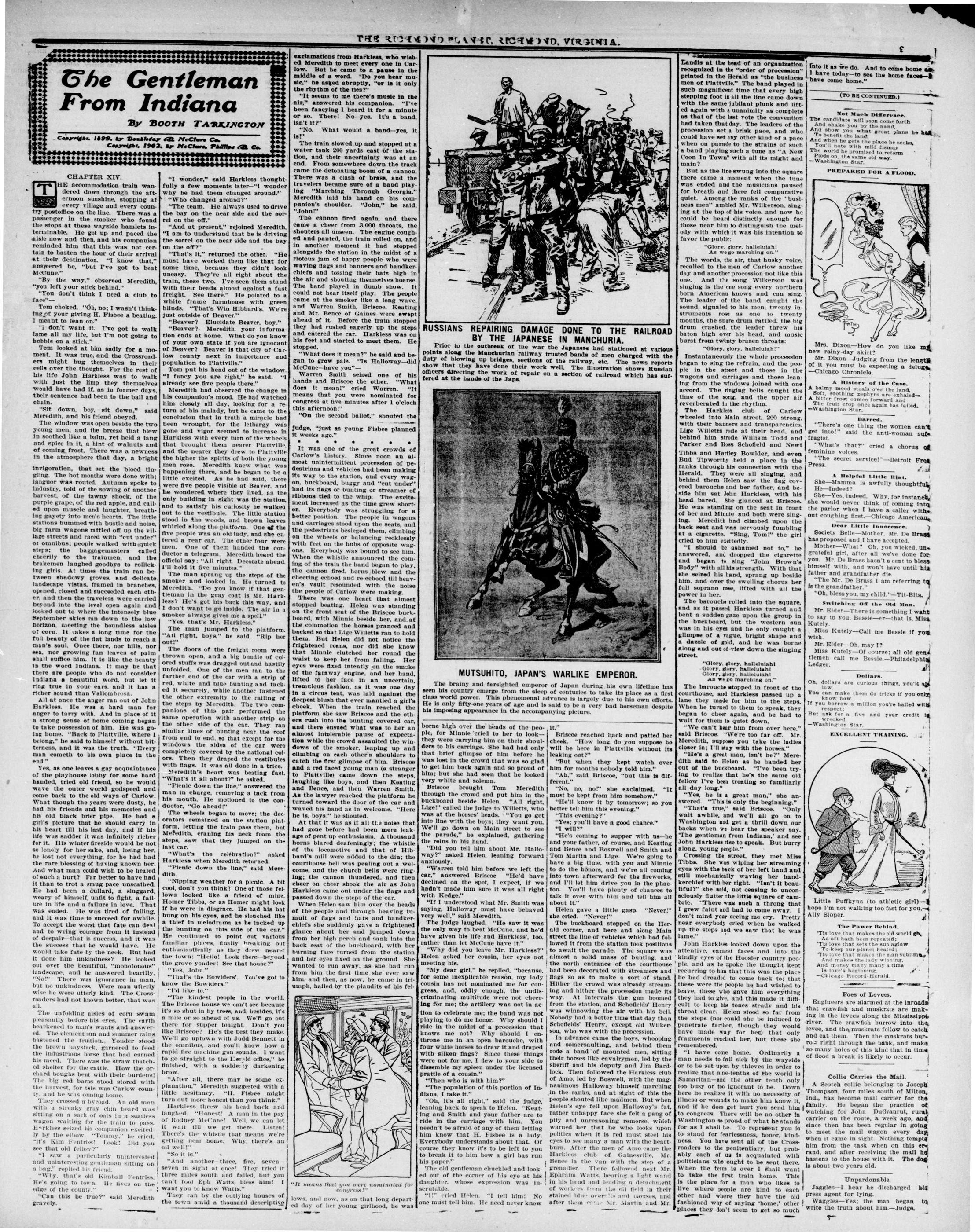
Prior to the outbreak of the war the Japanese had stationed at various points along the Manchurian railway trusted bands of men charged with the duty of blowing up bridges, sections of the railway, etc. The news reports show that they have done their work well. The illustration shows Russian officers directing the work of repair on a section of railroad which has suffered at the hands of the Japs.
The brainy and farsighted emperor of Japan during his own lifetime has seen his country emerge from the sleep of centuries to take its place as a first class world power. This phenomenal advance is largely due to his own efforts. He is only fifty-one years of age and is said to be a very bad horseman despite his imposing appearance in the accompanying picture.
borne high over the heads of the people, for Minnie cried to her to look—they were carrying him on their shoulders to his carriage. She had had only that brief glimpse of him before he was lost in the crowd that was so glad to get him back again and so proud of him; but she had seen that he looked very white and solemn.
Briscoe brought Tom Meredith through the crowd and put him in the buckboard beside Helen. "All right, Lige!" called the judge to Willetts, who was at the horses' heads. "You go get into line with the boys; they want you. We'll go down on Main street to see the parade," he explained, gathering the reins in his hand.
it."
Briscoe reached back and patted her cheek. "How long do you suppose he will be here in Platville without its leaking out?" "But when they kept watch over him for months nobody told him." "Ah," said Briscoe, "but this is different."
"No, no, no!" she exclaimed. "It must be kept from him somehow." "He'll know it by tomorrow; so you better tell him this evening." "This evening?" "Yes; you'll have a good chance." "I will?" "He's coming to supper with us—he and your father, of course, and Keating
"Did you tell him about Mr. Halloway?" asked Helen, leaning forward anxiously.
"Warren told him before we left the car," answered Briscoe "He'd have declined on the spot, I expect, if we hadn't made him sure it was all right with Kedge."
"If I understood what Mr. Smith was saying, Halloway must have behaved very well," said Meredith.
The judge laughed. "He saw it was the only way to beat McCune, and he'd have given his life and Harkless, too, rather than let McCune have it."
"Why did you leave Mr. Harkless?" Helen asked her cousin, her eyes not meeting his.
"My dear girl," he replied, "because, for some inexplicable reason, my lady cousin has not nominated me for congress, and, oddly enough, the undiscriminating multitude were not cheering for me; the artillery was not in action to celebrate me; the band was not playing to do me honor. Why should I ride in the midst of a procession that knows me not? Why should I enthrone me in an open barouche, with four white horses to draw it and draped with silken flags? Since these things were not for me, I flew to your side to dissemble my spleen under the licensed prattle of a cousin."
"Then who is with him?" "The population of this portion of Indiana, I take it." "Oh, it's all right," said the judge, leaning back to speak to Helen. "Keating and Smith and your father are to ride in the carriage with him. You needn't be afraid of any of them letting him know that H. Fisbee is a lady. Everybody understands about that. Of course they know it's to be left to you to break it to him how a girl has run his paper." The old gentleman chuckled and looked out of the corner of his eye at his daughter, whose expression was inscrutable. "I!" cried Helen. "I tell him! No one must tell him. He need never know
it."
Briscoe reached back and patted her cheek. "How long do you suppose he will be here in Plattville without its leaking out?"
"But when they kept watch over him for months nobody told him."
"Ah," said Briscoe, "but this is different."
"No, no, no!" she exclaimed. "It must be kept from him somehow."
"He'll know it by tomorrow; so you better tell him this evening."
"This evening?"
"Yes; you'll have a good chance."
"I will?"
"He's coming to supper with us—he and your father, of course, and Keating and Bence and Boswell and Smith and Tom Martin and Lige. We're going to have a big time, with you and Minnie to do the honors, and we're all coming into town afterward for the fireworks, and I'll let him drive you in the phaeton. You'll have plenty of chances to talk it over with him and tell him all about it."
Helen gave a little gasp. "Never!" she cried. "Never!"
The buckboard stopped on the Herald corner, and here and along Main street the line of vehicles which had followed it from the station took positions to await the parade. The square was almost a solid mass of bunting, and the north entrance of the courthouse had been decorated with streamers and flags so as to make a sort of stand. Hither the crowd was already streaming and hither the procession made its way. At intervals the gun boomed from the station, and Schofields' Henry was winnowing the air with his bell. Nobody had a better time that day than Schofields' Henry, except old Wilkerson, who was with the procession.
In advance came the boys, whooping and somersaulting, and behind them rode a band of mounted men, sitting their horses like cavalrymen, led by the sheriff and his deputy and Jim Bardlock. Then followed the Harkless club of Amo, led by Boswell, with the magnanimous Halloway himself marching in the ranks, and at sight of this the people shouted like madmen. But when Helen's eye fell upon Halloway's fat, rather unhappy face she felt a pang of pity and unreasoning remorse, which warned her that he who looks upon politics when it is red must steel his eyes to see many a man with the heartburn. After the men of Amo came the Harkless club of Gainesville, Mr. Bence in the van with the step of a grenadier. There followed next Mr. Ephraim Watts, bearing a light wand in his hand and leading a detachment of workers from the oil field in their stained blue over his eyes, and after them came Mr. Martin and Mr.
Landis at the head of an organization recognized in the "order of procession" printed in the Herald as "the business men of Platttville." The band played in such magnificent time that every high stepping foot in all the line came down with the same jubilant plunk and lifted again with a unanimity as complete as that of the last vote the convention had taken that day. The leaders of the procession set a brisk pace, and who could have set any other kind of a pace when on parade to the strains of such a band playing such a tune as "A New Coon In Town" with all its might and main?
But as the line swung into the square there came a moment when the tune was ended and the musicians paused for breath and there fell comparative quiet. Among the ranks of the "business men" ambled Mr. Wilkerson, singing at the top of his voice, and now he could be heard distinctly enough for those near him to distinguish the melody with which it was his intention to favor the public:
"Glory, glory, halleluah! As we go marching on."
The words, the air, that husky voice, recalled to the men of Carlow another day and another procession not like this one. And the song Wilkerson was singing is the one song every northern born American knows and can sing. The leader of the band caught the sound, signaled to his men, twenty instruments rose as one to twenty mouths, the snare drum rattled, the big drum crashed, the leader threw his baton high over his head, and music burst from twenty brazen throats:
"Glory, glory, hallelujah!"
Instantaneously the whole procession began to sing the refrain, and the people in the street and those in the wagons and carriages and those leaning from the windows joined with one accord. The ringing bells caught the time of the song, and the upper air reverberated in the rhythm.
The Harkless club of Carlow wheeled into Main street, 200 strong, with their banners and transparencies. Lige Willetts rode at their head, and behind him strode William Todd and Parker and Ross Schofield and Newt Tibbs and Hartley Bowler, and even Bud Tipworthy held a place in the ranks through his connection with the Herald. They were all singing, and behind them Helen saw the flag covered barcheau and her father, and beside him sat John Harkless, with his head bared. She glanced at Briscoe. He was standing on the seat in front of her and Minnie and both were singing. Meredith had climbed upon the back seat and was nervously fumbling at a cigarette. "Sing, Tom!" the girl cried to him excited.
"I should be ashamed not to," he answered, and dropped the cigarette and began to sing "John Brown's Body" with all his strength. With that she seized his hand, sprang up beside him, and over the swelling chorus her full soprano rose, lifted with all the power in her.
The baroucha rolled into the square, and as it passed Harkless turned and bent a sudden gaze upon the group in the buckboard, but the western sun was in his eyes and he only caught a glimpse of a vague, bright shape and a dazzle of gold, and he was borne along and out of view down the singing street.
"Glory, glory, halleluah!
Glory, glory, halleluah!
Glory, glory, halleluah!
As we go marching on."
The barouche stopped in front of the courthouse, and Harkless passed up a lane they made for him to the steps. When he turned to them to speak, they began to cheer again, and he had to wait for them to quiet down.
"We can't hear him from over here," said Briscoe. "We're too far off. Mr. Meredith, suppose you take the ladies closer in; I'll stay with the horses."
"He's a great man, isn't he?" Meredith said to Helen as he handed her out of the buckboard. "I've been trying to realize that he's the same old fellow I've been treating so familiarly all day long."
"Yes, he is a great man," she answered. "This is only the beginning."
"That's true," said Briscoe. "Only wait awhile, and we'll all go on to Washington and get a thrill down our backs when we hear the speaker say, 'The gentleman from Indiana,' and see John Harkless rise to speak. But hurry along, young people."
Crossing the street, they met Miss Tibba. She was wiping her streaming eyes with the back of her left hand and still mechanically waving her handkerchief with her right. "Isn't it beautiful?" she said, not ceasing to unconsciously flutter the little square of cambric. "There was such a throng that I grew faint and had to come away. I don't mind your seeing me cry. Pretty near everybody cried when he walked up the steps and we saw that he was lame."
John Harkless looked down upon the attentive, earnest faces and into the kindly eyes of the Hoosier country people, and as he spoke the thought kept recurring to him that this was the place he had dreaded to come back to; that these were the people he had wished to leave, these who gave him everything they had to give, and this made it difficult to keep his tones steady and his throat clear. Helen stood so far from the steps (nor could she be induced to penetrate farther, though they would have made way for her) that only fragments reached her, but these she remembered.
"I have come home. Ordinarily a man needs to fall sick by the wayside or to be set upon by thieves in order to realize that nine-tenths of the world is Samaritan—and the other tenth only too busy or too ignorant to be. Down here he realizes it with no necessity of illness or wounds to make him know it, and if he does get hurt you send him to congress. There will be no other in Washington so proud of what he stands for as I shall be. To represent you is to stand for fearlessness, honor, kindness. You have sent all of the Cross-roaders to the penitentiary, but probably each of us is acquainted with politicians who ought to be sent there. When the term is over I shall want to take the first train home. This is the place for a man who likes to live where people are kind to each other and where they have the old fashioned way of saying 'home'; other places they don't seem to get so much
into it as we do. And to come home
I have today—to see the home faces—
have come home."
(TO BE CONTINUED.)
Not Much Difference.
The candidate will soon come forth
And shake you by the hand.
And show you what great plans he has
To benefit the land.
And when he gets the place he seeks,
You'll note with mild dismay
The world he promised to reform
Picks on the same old way.
-Washington Star.
PREPARED FOR A FLOOD.
Mrs. Dixon—How do you like my new rainy-day skirt?
Mr. Dixon—Judging from the length of it you must be expecting a deluge—Chicago Chronicle.
A History of the Case.
A balmy mood steals o'er the land.
Soft, soothing zephyr are exhaled—A bitter frost comes forward and
The fruit crop once again has failed.—Washington Star.
Barred.
"There's one thing the women can't get into!" said the anti-woman sufragist.
"What's that?" cried a chorus of feminine voices.
"The secret service!"—Detroit Free Press.
A Helpful Little Hint.
She—Mamma is awfully thoughtful.
He—Indeed?
She—Yes, indeed. Why, for instance, she would never think of coming into the parlor when I have a caller without coughing first.—Chicago American
Dear Little Innocence.
Society Belle—Mother, Mr. De Brass has proposed and I have accepted.
Mother—What? Oh, you wicked, ungrateful girl, after all we've done for you. Mr. De Brass hasn't a cent to bless himself with, and won't have until his father and grandfather die.
"The Mr. De Brass I am referring to is the grandfather."
"Oh, bless you, my child."—Tit-Bits.
Switching Off the Old Man.
Mr. Elder—There is something I want to say to you, Bessie—er—that is, Miss Kutely.
Miss Kutely—Call me Bessie if you wish.
Mr. Elider—Oh, may I?
Miss Kutely—Of course; all old gentlemen call me Bessie.—Philadelphia Ledger.
Dollars
Oh, dollars are curious things, you'll al-
low.
You can make them do tricks if you only
know how.
If you borrow a million you're hailed with
respect;
But ask for a five and your credit is
wrecked.
—Washington Star.
EXCELLENT TRAINING.
-
Little Puffkyns (to athletic girl)—
hope I'm not walking too fast for you.
Ally Sloper.
The Power Behind.
'Tis love that makes the old world
As oft hath been repeated;
'Tis love that sets the sun aglow
To keep our planet heated;
'Tis love that makes the man sublime
And makes the lady winning.
And money many many a time
Is love's beginning.
-Chicago Record-Herald.
Foes of Levees.
Engineers are alarmed at the inroads that crawfish and muskrats are making in the levees along the Mississippi river. The crawfish burrow into the levee, and the muskrats follow to catch and eat them. Then the muskrats burrow right through the bank, and make so many holes of this kind that in time of flood a break is likely to occur.
Collie Carries the Mail.
A Scotch collie belonging to Joseph Thompson, four miles south of Milton, Ind., has become mail carrier for the family. He began the practice of watching for John DuGranrut, rural carrier on the route, a week ago, and since then has been regular in going to meet the wagon every day when it came in sight. Nothing tempts him from the task when on this errand, and after receiving the mail he hastens to the house with it. The dog is about two years old.
Unpardonable
Jaggles-I hear he discharged his press agent for lying.
Waggles-Yes; the man began to write the truth about him.-Judge.
THE PLANET
Published every Saturday by JOHN M. COTT
at 311 North 4th Street Richmond Va.
JOHN MITCHELL, JR., - EDITOR
All communications intended for publication
should be sent so us to reach us by Wednesday
TERMS IN ADVANCE
- Copy, one year,
- the Copy, eight months,
- the Copy, six months,
- the Copy, four months,
- the Copy, three months,
- the Copy,
- Single Copy.
ADVERTISING RA*ES
or one inch. one insertion,
or one inch, each subsequent insertion
or two inches, three months,
or two inches, six months,
for two inches, nine months,
for two inches, twelve months,
for three months,
for three months,
for three months,
standing and Transient Notices.
POSTAGE STAMPS OF A EIGHER DE
SOMINATION THAN TWO CENTS NOT
RECEIVED ON SUBSCRIPTIONS
THE PLANET is issued weekly. The subscri-
tion price is $1.50 a year, in advance.
There are FOUR WAYS by which money can be sent by mail at our risk. - In a Post Office Money Order, you send money by money Order and when none of these can be procured, in a Registered Letter.
MONEY ORDERS - You can buy a Money Order at your Post Office, payable at the Richmond office, and we will be responsible for its arrival.
EXPRESS MONEY ORDERS can be oc'tained at any office of the American Express, so, the United States Express Co., and the Wel- Far- Wash- Co., are responsible for money sent by any of these companies. The Express Money Order is a safe and convenient way for forwarding money.
REGISTERED LETTER - If a Money Order is registered, your reach, your Postmaster will Register the letter you wish to send on payment of ten sent. Then, the letter is lost or stolen, in a manner you wish. You car send money in this manner at our risk.
We cannot be responsible for money sent in letters in any other way than one of the four ways mentioned above. If you send your money in another way, you must do it at your own risk.
RENEWALS, N.Y.C.—If you do not want THE
continued for another year after your
subscription ends, you may write to
Post Card to discontinue it. The courts have
beck. subscribers to newspapers who do
not continue to be attended at a period
of time on which it has paid, please
illustrate the payment of the subscription
or toate when they order the paper discount
UNIQUEL. When writing to us,
you must submit your subscription or to discontinue
your subscription and give your name and ad-
dress otherwise we cannot find you.
CHANGE OF ADDRESS. In order to change
address of a subscriber, we must be sent
the former as well as the present address.
Entered in the Post Office at Pitchch,
second class matter.
COLORED men, the more we improve our condition and educate our children, the more we are misrepresented and hounded by our enemies.
THE divisions and antagonisms between the colored people themselves are the most serious draw-backs to their progress.
We shall deal next week with Mr. THOMAS NELSON PAGE's article "The Negro; The Southerner's Problem" as published in the May number of McClure's Magazine.
THE colored person of good manners helps to alleviate the condition not only of himself, but those around him.
PRESIDENT ROOSEVELT promptly renominated Dr. Wm. D. CRUM to be Collector of the Port at Charleston, South Carolina.
The President gave the Negro haters down there a white Negro, and yet they are still kicking.
It want do, colored men to encourage your children to be insulting to white people, even though they may deserve it. Teach them to be respectful to every body and the result will repay you an hundred fold.
Yes, those white people in the South who are friendly to the colored people and believe in the race's possibilities are in the minority, but they are doing much to make our burden lighter.
We have thousands of white friends throughout this country, both North and South, whose sympathies are with us. We should do nothing and say nothing to cause them to turn from us in disgust. We need friends now, colored folks, yes, we need them badly.
SINCE the virulent attack on Dr. CRUM against whom the Negro-haters could bring no charge save that of color, PROF. BOOKER T. WASHINGTON, who rightfully recommended him seems to have "gone'way back and sat down." When we consented to the sacrifice of the political positions we had upon the promise that we should receive others through the meium of the men of the race most capable we swapped the substance for the shadow and gave increased impetus to the opposition that was against all Negroes holding office. Moral; Never give up the job you have until you have safely landed the job you are after.
---
THE institute for Colored Youth at Cheyney, Pa., the announcement of which was published in these columns
of April 28, 1904 is one of the best normal schools for the professional training of teachers in the country. It has the advantage of location and facilities and its able faculty, under the superb management of Prof. HUGH M. BROWNE should commend it to the lovers of thorough training every where. Communications addressed to him at Cheyney, Pa., will receive prompt attention.
Ir is the Negro as a freeman and a citizen that the Negro-haters are after. They are opposed to the self-employing citizen of color just as they were opposed to the free Negro of slavery days. A Negro as a servant is all right with them. Be he ever so ignorant or unrefined, he is welcomed into the finest hotels, residences, barber shops, business establishments, sleeping, parlor and dining cars or any where else.
But you let this same Negro put on a Fedora or Derby hat, and clothe himself with a late style suit of the tailor's finest make, and draw his expense money from his own pocket, having earned the same in a business, where he is his own employer, and immediately there is a wail in the Southland and such a Negro is not capable, able or fit to darken the front gate, much less the front door of the most degenerate white man in all this land.
He may be educated, skilled and a walking type and exponent of the doctrines and ideas of Lord Chesterfield but such a specimen of a Negro is an a bination to the average Negro hating white man and from such a specimen he says, "May the good Lord deliver us."
---
THE COSMOPOLITAN for May is up to its usual standard of excellence. The following are its contents:
"What is my relation to my fellow men?" John Brisbin Walker; "Frontis-piece"; "The making of a British Tar," Broughton Brandenburg; "The training of a German actress," Grace Isabel Colbear; "The ruins of Baalbek," Dulany Hunter; "The food of the Gods," Herbert George Wells; "The sea is His also," Julia B. Foster; "The delights of Aerial Navigation," Paul Nocquet; "Wonderful Whale-hunting by steam," P. T. McGraw; "Intellectual Germany of to-day" Wolf Von Schierbrand; "the last Serpent," Seumas Mac Manus; "the merit system in Governant Appointments," Theodore Roosevelt; "The Dramatic Himalaya South America." Panama and the Kights Errant of Colonization; Cyrus Tuskegee Brady; "The most Athletic Nation of the World," Hajmir Hjorth Boyesen; "Interesting Personalities in the Business World—Norman Bruce Ream," Edwin Lefevre; "The Door of Unrest," O Henry; "The Diary of King Edward VIII." "Half a Dozen Letters," Florence Stewart; "Sports with which we are Unfamiliar," Helmet Stag Archer; "Men, Women and Events."
A VOICE FROM ROANOKE.
The Roanoke, Va., EVENING WORLD in its issue of the 26th ult., under the caption "Negro Boycott of Richmond Street-cars" said: "When the law was enacted giving conductors on the street car lines police power and authority to designate sears in the cars which passengers should occupy, separating the whites from the blacks, the negroes of Richmond began to protest, alleging that they were discriminated against. The negro preachers of the city held a meeting, and seemed rather indignant at the law. To their credit be it said, however, that when the matter was explained that anyone would be given equal accommodation on the side, the only effect on the law was to separate the race rather than to have an indiscriminate mixing of them, as heretofore, the preachers withdrew their opposition and advised their congregations to submit without complaint, to its enforcement, as it was evidently in the interest of peace and good order."
This journal seems to be better informed as to the attitude of the colored ministry than the PLANET. It evidently was misled by the statement published in the Richmond, Va., TIMES-DISPATCH by the authority of the Virginia Passenger and Power Company. We should like to know the name of any preacher in this city, who advised his congregation to submit to the "Jim Crow" street-car law without complaint. Of course, any preacher who saw fit so to do had a right to do it. On the contrary the Colored Ministers' Conference of this city, so far as we have been informed has adopted no resolutions concerning this race discriminating rule otter than to declare their opposition to it and we are of the opinion that this journal has been misled concerning the attitude of the colored clergy of Richmond.
It continued:
"But there was another element of the Negro population which was not to be so easily satisfied. This element seems to have been led by John Matteill, the editor of the Negro paper, "The PLANET." In this meeting the Negroes were encouraged to boycott the street cars, and either walk or employ some other means of riding."
Again this journal is in error. The Citizens' Mass-meeting was conservative. While protesting against the need less and mischievous enforcement of this race discriminating law, it advised the colored people who rode on the street cars to obey the rules and regulations of the company. On the other hand, it urged those who did not like the rules to walk to avoid trouble. As a result, the large majority of the colored people are walking.
This does not constitute a boy-cott. No person has been black-listed. Each person decides the matter for himself.
"This action on their part suggests the thought that however much their leaders may protest to the contrary, there is a large number of the race who show opposition to every measure that tends to destroy every blanched of social equality. So long as they occupy any vacant seat on a street car thus putting them by the side of white people, they were glad to avail themselves of the facilities of the cars, no matter he. obnoxious their presence might be to
THE RICHMOND PLANET, RICHMOND, VIRGINIA
those next to them. This is particularly true of the younger generation of Negroes, but not so with the older generation, who were raised under different auspices.
What possible difference could it make to them to compel those of the same race to sit together, if they are given equal facilities and comfort and riding? The same rule which excludes them from the seats assigned to the white parrons excludes the whites from the seats assigned to them, and the conductors of the cars are vested by law with authority to assign to each race the seats set apart for it."
The EVENING WORLD endeavors to be fair, but it confounds civil rights with social equality. There is a vast difference between them. The law can reach the one; it is futile to attempt to reach the other.
There is no more social equality in meeting on the street-car than there is in meeting on the public streets or in the public parks. If the law-making power is to be invoked to keep the races separate, then it can forbid a white family from employing a Negro servant and a Negro family from employing a white one.
Carry the argument to its logical conclusion and those persons who have public license can be made to separate their customers. Colored people should only be permitted to purchase millinery and dry-goods in the "Jim Crow" department.
Carry it out still further and a division should be made in the side-walks, colored people on the left and white people on the right. These, sir, are civil rights and not social ones. According to your reasoning, whenever colored people become obnoxious to white ones the law's aid should be invoked and the separation made.
Colored people of education, refinement, and the others with common sense object to any discrimination based upon race or color. They are opposed to the doctrine of caste because it is antagonistic to the bed-rock principles of the republic and should have no place within the confines of the intended model government of the civilized world.
When sparation is based upon condition, we accept it, because we can improve our condition. When it is based upon physical characteristics, stamped upon us by the Creator and for which we are no wise responsible, we are opposed to it.
The street car company made a virtue of a necessity when it made the accommodations equal. We would oppose it, if the seats for colored people were plush and down while those for the white people were cane-seated.
Were we white, we would regard the law in the same sense that we do as a colored person.
The stamp tax upon the English colonies was said to be nominal and yet it led to a revolutionary war which gave us this republic.
A people who willingly accept discrimination and submit uncomplaining, ly to outrage are not sufficiently advanced to be entitled to the liberties of a free people. Its leaders must emblazon the way along correct and proper avenues and there should be no hesitancy on the part of the followers to accept the advice tendered and act along all lines consonant with the exercise of the rights of a deservedly free people. This journal concluded as follows:
"The perpendency of Southern society and civilization depends upon keeping intact the line of demarkation between the two races, and any Negro who seeks to cross that line and force social equality with Southern whites, will meet with resistance, to the extent, if need be, of the extermination of the inferior race. This does not imply enmity to the Negro. On the contrary it is for his good, and so long as he recognizes the fact and acts upon it, he will find little or no opposition from the white people in the South, to his full enjoyment of life, liberty and property."
The above brutal utterances will hardly disturb the equananimity of the average citizen of color. The writer threatens extermination if the colored brother crosses the line and forces social equality, but says nothing as to what shall be done when white people's cross the line and do the same thing.
His expressed determination to exterminate an entire race of people, although previously stated, with its usual accompaniment of "cooling time" does not imply enmity to the Negro. On the contrary, according to his theory, it indicates the love of him. The absurdity of this line of reasoning is too apparent for further comment.
As we have before intimated and asserted, the EVENING W.BLD is of the opinion that Negro man can gain the consent of some white females for deeds unmentionable in these columns and that this consent is possible upon the transient acquaintancehip on the street cars and other public places.
We have never subscribed to any such idea and the reflection upon some of the females of the Southland is too base to be tolerated in the columns of any white journal. Social relationship can only be brought about by the consent of both parties to the transaction.
We do not doubt that the bastard malattos now roaming the streets of Roanoke are the cause of the "blood on the moon," which our contemporary thinks it sees in the street-car situation at Richmond.
For our part, we are opposed to the mixing and will cooperate with the EVENING WORLD in any legitimate effort to improve the moral condition of both races.
White men who are living in an adulterous relationship with Negro women should be promptly dealt with and vice-versa.
But this relationship was not brought about by the railroad trains, street-cars, hotels or even in these white men's homes.
As a rule, they hire themselves away as far as possible from their own residences where they regale themselves
with the delicacies of the season and enjoy the embraces of a dusky Negro female, upon whom the average Negro man looks with contempt.
We have seen white men in close conversation after night fall with Negro women, whose ugliness and unkempt condition would almost make a tottering chimney fall.
But on these questions, sir, you are silent. You go after a class of white and black people who, along these lines at least are thinking no evil and doing no wrong, while the other class are in hiding, practicing all of the evil of the modern Gomorroh.
Let us have Negro women for Negro men and white women for white men. You hang or shoot by law all of the Negroes, male or female, proven to be living in an immoral relationship with white folks, male or female, and permit us to hang or shoot by law all of the white folks, male or female proven to be living in an immoral relationship with Negroes, male or female.
We prophesy the result will be that your anxiety has been to keep your people from us rather than to keep us from yours was well founded.
We are satisfied. You have one color from which to select—all white, while we have many colors from which to make our choosing.
We have red Negroes, yellow Negroes, copper-colored Negroes, white Negroes and black Negroes, both refined, illiterate and ignorant, and any colored man who is not satisfied with this selection of females from which to choose and goes after white women ought to be hanged.
We are satisfied with what we have on this side of the potato patch. Keep your white men at home.
We are opposed to your "social equality" especially that kind which has made it impossible for thousands of us to tell whether we are genuine or mongrel, and causes the street-car conductors to be constantly "chucking" us over among the white folks, and forcing up on us social equality, when we know we belong among the colored folks, where we can be contented, and happy.
You started too late, Mr. EVENING WORLD, the amalgamating business began two hundred and fifty years ago, and we doubt not if you have lived in the southland all of your life, as did your forefathers, some of your ancestors may have had a hand in the mixing.
Any man, be he white or black, who is constantly stirring up race prejudices and appealing to the baser passions in the human race in order to widen the breach between the races and disturb the friendly relationship between them is an enemy to the republic a and dangerous dsturber of the peace of the community in which he lives.
Colored men will continue to cultivate a friendly relationship with the friendly elements of the white race. These trouble breeders have their uses and devil like continue their work of evil all the time. We shall not lose hope, but shall battle on to the end, knowing that "after life's fitful fever, we shall sleep well" and our God will wipe all of the tears from our eyes.
Far from Useless
Young Lawyer—It will be quite use- less to try and break Old Jones' will, don't you think so?
Old Lawyer—Useless? Not at all.
The relatives will get lots of experience and we will get some fat fees.—Puck.
Little Elsie's Confession.
"Miss Biggs is interested in you, pa."
"How so?"
"Why, to-day, she had told me seven times to sit down and behave myself, she said she wondered what sort of a father I had."—Tit-Bits.
Pushed Down.
Mr. Chellus-I thought you said I held the first place in your heart?
Train Delayed.
"What do you think now, Bobbie?" remarked the mother as she boxed his ears.
"I don't think," replied the boy.
"My train of through has been delayed by a hotbox."—Town Topics.
No Delusions.
"Do you think she loves you for yourself alone?" asked the romantic person.
"Certainly not," answered the titled foreigner. "She loves me for my ancestors."—Washington Star.
Her Little Surprise
"Don't stop me now, dear, Archie's going to propose in a few minutes." "Has he shown any symptoms?" "Certainly not! He doesn't know it yet. I've arranged it as a surprise for him."—Brooklyn Life
Megaphoning Above.
"How loud Brother Brown talks in meetin'!"
"Yes; Providence has been turnin' a deaf ear to him lately an' he's givin' it a piece of his mind."—Atlanta Constitution.
In No Danger.
Mistress—I think you handle those fine china dishes very carelessly.
Domestic—Don't worry, mum. They are so light that they wouldn't hurt even if I dropped 'em on my toes, mum—N. Y.
Weekly.
Brother Dickey's Philosophy
"Dey say we'll soon be talkin' wid de stars," said Brother Dickey, "but, ter my min', de be's thing we kin do is ter fin' out somefin' 'bout de worl' whar we livin' at!"—Atlanta Constitution.
Lying About a Man.
If it's necessary to lie in a man's favor do it while he is alive instead of hiring a marble-cutter to do it after he is dead.—Chicago Daily News.
(Continued from 1st Page.)
fixed bayonets, preceded by buglers, to clear a passage. The Japanese, however, declined a hand-to-hand conflict. On the arrival of the battalion of the 10th regiment all the troops were able to beat a retreat.
"The losses of the 11th and 12th regiments were very great, but they are not yet exactly known. In the 11th the killed included Colonel Laming and Meutenant Colonels Dometti and Ralevsky. The 12th lost nine company commanders killed or wounded.
"The second and third batteries of the sixth brigade, having lost the greater number of their men and horses, were compelled to abandon their guns after rendering them useless. For the same reason six guns of the third battery and eight Poulemetts, which could not be brought away, were also disabled. The mountainous nature of the country
save the guns by means of drag ropes.
"Up to the present $80 wounded, including 14 officers, have been brought to the hospital at Feng Wang Cheng. Their eventual transportation elsewhere is fully assured.
"According to the statements of participants in the battle, at least 3000 to 4000 were killed."
FIVE DAYS OF FIGHTING
Japs' Story of the Big Battle On the Yalu River.
Tokio, May 2.—The Russians were forced to abandon Antung yesterday. They burned the town and retreated to Feng Huan Cheng. The Japanese now control the estuary of the Yalu. After five days of fighting the first Japanese army, under General Kuroki, has forced a crossing of the Yalu river, and with a gallant infantry
GENERAL KUROKI
charge, covering a- frontage of four miles, it drove the Russians from Chiu Tien Cheng and the heights on the right bank of the Ilo or Aida river, which enters the Yalu from the north almost opposite Wiju. The Japanese turned the left flank of the Russian position, and in the battle yesterday they swept away the new front interposed by the Russians to check their onward movement. The Japanese losses were 798 killed and wounded. They captured 28 quick-fire guns, 30 officers and 300 men.
General Kuroki began the movement on Tuesday by ordering a detachment of the imperial guards division to seize the Island of Kurito, which is in the Yalu above Wiju, and a detachment of the second division to seize the Island of Kinteito, which is situated below Wiju. The detachment of the imperial guard met with some resistance, but it succeeded in clearing the enemy out and occupied Kurito island. The Russians abandoned the Island of Kinteito when attacked by the detachment of the second division
The 12th division of the Japanese army was chosen to make the first crossing of the Yalu. It began its preparations on Friday by driving the Russians from their position on the bank of the river opposite Sulkochin, which is eight miles above Wijt, and the point selected for the crossing. This division constructed a pontoon bridge over the river, and at 3 o'clock Saturday morning it began crossing. The entire division passed over the river during the day, and by 6 o'clock Saturday evening it was in the position assigned to it for the battle of Sunday.
A bridge across the main stream of the Yalu just above Wiju was completed at 8 o'clock Saturday night, and the second Japanese division and the imperial guards immediately began crossing. They advanced and occupied the hills back of the Kosan, facing the Russian position on the right bank of the river. All through Saturday night regiment after regiment of Japanese soldiers poured across the bridge, and at a late hour Saturday night General Kuroki telegraphed to the general staff of the army: "I will attack the enemy on May 1 at dawn."
True to his promise, General Kuroki at daylight yesterday centered all his artillery on the Russian position between Chin Tien Cheng and Yoshowo. To this fire the Russians made reply with all their batteries.
At 7 o'clock in the morning the Russian battery at Yoshoko was silenced, and half an hour later General Kuroki ordered his lines, stretching for four miles, to attack. The Japanese infantry, on the word of command, charged across the lho, wading that stream breast deep and began storming the heights at 8.15. At 9 o'clock they had swept the Russian line back across the plateau. At 5 o'clock Sunday evening the Japanese army held a line extending from Antung northwesterly to Laukuku, and running from there in a northeasterly direction to Mishukau. A Russian officer who was taken prisoner said that the effect of the Japanese artillery fire on Saturday and Sunday was enormous.
Offered Stubborn Resistance
Tokio, May 4.—A supplemental report was received here from General Kurokli. It is dated yesterday, and says:
"Yesterday the enemy offered a stubborn resistance against our pursuit, adding about 300 to our casualties. The enemy stood with resolution until their artillery, consisting of two batteries, lost the majority of its men and horses. They then broke the breeches, and closing the apparatus of their guns hoisted the white flag.
"According to a captured Russian officer, Major General Kashtalinsky commander of the third East Siberian rifle brigade; the colonels of the 11th and 12th rifle regiments, and the commander of the rifle artillery battalion were killed in the fighting at Hamatan.
"It seems that the enemy was entirely routed by our attack, because since yesterday many have come in and surrendered. Our prisoners include 30 officers, 20 of whom are wounded, and 300 men, 100 of whom are wounded."
"A preliminary report from the chief surgeon of the first Japanese army shows that we had 798 men killed and wounded. These casualties are divided as follows: The imperial guards, 132; second division, 350, and third division, 316."
London, May 4.—The Chefoo correspondent of the Daily Chronicle cables the following under yesterday's (Tuesday) date:
"The Japanese landed troops and attacked and captured Newchwang last evening, the Russians falling back to protect the railway."
FAILED TO BLOCK PORT ARTHUR
Eight Jap Fireships and Two Torpedo Boats Sunk in Harbor.
Port Arthur, May 4. — A Japanese squadron, under Admiral Togo, appeared off Port Arthur after daybreak yesterday and engaged the forts and warships.
Thirty Japanese prisoners have been captured.
At 1 o'clock in the morning five Japanese torpedo boats were sighted, and the Russian land batteries, the gunboat Giliak and the coast defense vessels Gremiaschi and Otvashi opened fire and compelled them to retire. Immediately afterwards other Japanese ships were sighted on the horizon. They were headed by a fireship, which was sunk near the entrance of the harbor at 1.20 a.m.
After an interval of 25 minutes two more fireships came on and were sent to the bottom.
At 2.25 two more fireships approached. Three of these blew up on our mines. Two of these sank immediately and the other two fireships were sunk by the batteries and warships.
The protected cruiser Askold participated in the firing.
Fifteen minutes later three more fireships arrived. One of them blew up on a mine, the second vessel was wrecked on the shore, and the third was sunk by the Russian shells. The crews of the fireships tried to save themselves by boats, in which they put out to sea. A majority of them were killed by the Russian machine guns and rifles. Some of the survivors were picked up.
At daybreak a number of Japanese were seen clinging to the masts and funnels of the sunken vessels, and these were rescued by the Russians. Thirteen of the wounded Japanese have since died. The Russians supplied the survivors with food and clothing, and the wounded were taken to the hospital ship Mongolia.
Many dead bodies were seen floating outside the harbor. These were collected by the Russians, who brought them ashore and buried them.
During the morning 10 of the enemy's torpedo boats remained in the offing and were fired on at long range.
At 9.30 o'clock it was signalled that there was a Japanese fleet in the vicinity, and that two of the enemy's launches had been run ashore.
The town is quiet. Large crowds watched the operations with great interest. Grand Duke Boris arrived here last evening.
ANTI-JEWISH RIOTS BREAK OUT
Mob Threw Women and Children Out Windows and Murdered a Girl.
Vienna, May 4.—Reports are current here that there were serious anti-Jewish riots in the Bessarabian town of Bender April 30. It is stated that the rioting began Saturday afternoon while the congregations were in the synagogues.
The mobs smashed the windows of houses in the Jewish quarter, entered the houses and threw women and children out of the windows. A girl was murdered in a most revolting manner, the reports say. Cossacks were sent to restore order.
The outbreak is said to have been due to the anger of the crowd over Russian reveres in the Far East.
These reports lack official confirmation.
A WEEK'S NEWS CONDENSED.
The 10th annual meeting of the National Municipal League was held at Chicago.
The Panama canal commissioners returned to New York on the steamer Yueatan from Colon.
Fire destroyed the greater part of the business portion of Brainard, Minn., entailing a loss of $250,000.
Clarence Qualls, colored, was arrested near Seaford, Del. charged with robbing rural mail boxes of valuables.
Michael Davitt, the Irish leader, who was in this country in the interest of the Irish National League, sailed for Liverpool on the steamship Majestic.
Friday, April 29.
It has been announced in New York that J. P. Morgan bought the original manuscript of Milton's "Paradise Lost" in London for $25,000.
A meeting of the stockholders of the Norfolk and Western railroad has been called for June 17, at Roanoke, Va., to authorize a $35,000,000 bond issue.
Albert G. Sheppard, of Wilkesbarre, Pa., died of cramps on board the Clyde line steamer Commanche, which arrived at New York from Jacksonville and Charleston.
During a severe coughing spell Dr. McGee, chief of the anthropological department of the St. Louis fair, strained a ligament in his left side and fractured a rib.
Saturday, April 30.
The Virginia Democratic state convention will be held at Richmond on June 9.
Tom Searcy, colored, was lynched in Hawood county, Tenn, for assaulting a 9-year-old white girl.
Postmaster General Payne has returned to Washington from his southern trip much improved in health.
The May circulars of the anthracite coal companies show an advance of 10 cents a ton for domestic sizes over the April price.
Wendell P. Stafford, of Vermont, has been appointed justice of the supreme court of the District of Columbia to succeed Justice P. C. Pritchard, now a United States circuit judge.
Monday, May 2.
The Virginia Navigation Company's steamer Pocahontas was destroyed by fire at Richmond, Va. Loes, $150,000; fully insured.
Hon. John J. Shonk, one of the pioneer coal operators of the anthracite region, died at his home in Wilkesbarre, Pa., aged 89 years.
The Pittsburg Conference for a merger of the Primitive Methodists and Methodist Protestants is likely to adjourn ineffectually for another year.
W. A. Botkin, divorced husband of Mrs. Cordelia Botkin, convicted of the murder of Mrs. J. P. Dunning, of Delaware, died suddenly in San Francisco.
Tuesday, May 3.
The safe in the Pennsylvania railroad office at Pitcairn, Pa., was blown open by burglars, who secured over $600.
Sunday base ball in Brooklyn has been declared legal in a decision handed down by Justice Gaynor in New York.
Three men and a boy were burned to death in a box car on the Northwestern railroad at Council Bluffs, Ia., while stealing a ride.
Secretary of the Navy Moody left Washington to inspect the naval stations at Guantanamo, Key West, Pensacola and New Orleans.
Ex-President Cleveland delivered a lecture on "The Government in the Chicago Strike of 1894," before a large audience at Princeton, N. J.
Wednesday, May 4.
Judge Andrew Kirkpatrick, of the United States circuit court, died at his home at Newark, N. J.
The 10th annual national convention of the Funeral Benefit Association of the P. O. S. of A. was held at Scranton, Pa.
Over 35,000 loaves of bread were received in Chicago from Pittsburg to relieve the famine threatened by the strike of bakers.
Judge Goodwin, of Aurora, IL, has been selected for the position of assistant attorney general for the postoffice department. The New York grand jury found four indictments for grand larceny against David Rothschild, former president of the defunct Federal bank. In default of $25,000 bail he is in jail.
GENERAL MARKETS
Philadelphia, Pa., May 4. — Flour steady; winter superfine, $3.50@75; Penna, roller, clear, $4.40@4.70; city mills, fancy, $3.55@1.50; Rye flour quiet; per barrel, $4.50. Wheat farm; No. 2 Penna, red, $1.034@1.04; Corn firm; No. 2 yellow, local, $2.0c. Oats quiet; No. 2 white, clipped, 47c; lower grades, 44c. Haver steady; No. 1 umocha, $18@18.50. Large bales. Pork firm; family, $16.50. Beef steady; beef heams, $20@21. Live poultry, hens, $13.3c; old bale fowls, 14c; old baked poultry, choice fowls, 14c; creamed poultry, steady; creamy, 27c. Eggs steady; New York and Penna, 171c. Potatoes steady; $1.25@1.30 per bushel.
Baltimore, Md., May 4. — Wheat
steady; spot, contract. $1; spot. No. 2
red western. $1.01; steamer No. 2, red
94c; southern; by sample. 95c;@$1.01;
do, on grade. $2.05;@$1.01. Corn quiet;
95c; on grade. $2.05;@$1.01. Corn quiet;
48% @$9c; southern white and yellow
corn. 55% @$8.25; Oats arm; No. 2
white. 46% @$4.2c; No. 2 mixed. 43% @$4.2c;
Rye dull; uptown. No. 2, 7.9% @
80c; No. 2 western. 81c. Hay easier;
No. 2, western. $17; No. 1 clover mixed;
15.50; Butter. $17; No. 12@3c.
19@2c; do, cremery. 25c; do, ladle;
15@16c; store packed. 12@13c. Eggs
firm; per dozen. 17@18c.
Live Stock Markets
Union Stock Yards, Pittsburg, Pa.
May 4.—Cattle steady; choice, $5.25@
5.35; prime, $5@ 5.20; fair, $4@ 4.30;
Hogs active; prime heavy, $5@ 5.10;
mediums, $5.05@ 5.10; heavy Yorkers,
$5@ 5.05; light Yorkers, $4.90@ 4.95;
$5@ 4.70; large ruminers, roughs, $4.30;
Sheep steady; ruminers, sheep, $5.35;
common sheep, $2.50@ 5.50;
choice lambs, $6.10@ 6.25; veal calves,
$4.75@ 5.
WORLD'S FAIR ADMISSIONS
187,793 Persons Attended Exposition On Opening Day.
St. Louis, May 4.—The total attendance at the Louisiana Purchase Exposition on the opening day, April 30, 1904, was officially announced as 187,793 persons. Of this number 178,423 were recorded admissions.
The total number of admissions on the opening day of the Column Man Exposition at Chicago was 137,557.
Director of Exhibits P. J. V. Skiff announced that the chiefs of the different divisions have stated that all the exhibits in the different palaces will be installed by May 12.
Missouri Crew Excercated
Washington, May 3.—That no further proceedings be taken is the recommendation of the court of inquiry appointed to investigate the explosion in the after-turret of the Missouri on April 13. The court finds the explosion was due to a "flare back" caused by an inexplicable combination of oxygnn with certain usually latent gases in smoke-less powder. The officers and crew of the Missouri not only are relieved from all responsibility for the accident, but are warmly commended for the bravery they showed after its occurrence in rescuing the victims.
Bank Wreckers Sentenced.
Freehold, N. J., May 4—A. C. Twining, former president, and D. C. Cornell, former treasurer of the defunct Monmouth Trust company, of Asbury Park, were sentenced respectively to six years and four years in state prison. Counsel for the prisoners announced that an appeal would be taken and the two men were released under $5000 bail each. Judge Fort in pronouncing sentence scored Twining, saying he believed the former bank president was the instigator of the wrong-doings, and that Cornell had been made his tool in the matter.
THE PLANET
SATURDAY ..... MAY 7, 1904
TEMPERANCE
How the Devilish Hand of the Drink Demon Was Revealed at an Auction.
"Here is a beautiful diamond engagement ring. Who is going to make his best girl happy with it? What am I offered? Come on, don't be backward, folks, everything has got to go to-day, regardless of value." It was such words as these that the loud-voiced man on the auction block announced that the sale of unredeemed pledges held by the State Pawners' society, was on in full force. The audience of buyers was composed mostly of professional speculators in jewelry. These men were cold and hard, not much sentiment in their makeup.
The beautiful diamond ring had once sparkled upon the slender finger of a rosy-cheeked, fair-halred girl. She was oh so happy the night that Ned slipped it upon her hand and extracted a promise in the cozy little parlor. A short time afterward the promise was kept in the brick church—around the corner, and a broad gold band was put on to keep the diamond company. The rosy-cheeked girl was happier than ever. Things went on finely in the pretty little flat for awhile. Life was a sunny dream. One day a dark cloud appeared on the horizon of wedded bliss. Ned commenced to drink. Not at first, but more and more as the days went by. Drinking leads to more drinking, and more drinking to expensive vices of all kinds. Soon Ned was going with a fast crowd, and to provide himself with funds to keep up the pace set by his companions, he commenced to cash
SALE OF UNREDEEMED PLEDGES
fraudulent checks. The end of such pursuits is disgrace and darkness, and before the weak, erring youth could well realize it, he was headed toward Joliet one fine spring morning, with five other unfortunate. The roses soon faded from the cheeks of the girl wife left almost destitute and unprovided for. Large cities are not kind or merciful; they crush out just such lives as hers every day. The struggle for the necessaries of life was a hard one, and before long the diamond ring found its way into the pawn-shop, while the fair owner toiled early and late for bread. The bidding was brisk for a time, but a gentleman with a large wallet gradually wore down the other blinders, and the ring became the possession of a hook-nosed individual from Clark street.
Next a pair of pearl opera glasses are put up. They used to belong to a white-haired old lady with the sweetest face in the world. What tales they could tell of opening nights at opera and theater? Had they not helped bright eyes to gaze upon Patti's loveliness, when the Queen of Song was on the top wave of popularity? They had seen Booth, the greatest of them all; Mary Anderson at her best, and once when very new and shiny they had been taken along in their little leather case the night the matchless voice of Jenny Lind filled all listeners alike with a strange awe and tenderness. But that was in the long, long ago. They had had their day, just as the great stars on whom they had so often fixed their admiring gaze, and now, old, nicked and tarnished, they had fallen into the dirty hands of commerce. No one seemed to want them, and they went for a song to a man who said he had children at home.
Now a tiny locket with a golden curl still in it was put up. The little curl had once adorned a pretty child's head, the pride and joy of a happy home. But the little one died, the father fell into evil ways, and drink crazed, had parted with this last tender token of his dear one to buy more liquor with. The interest was so low he would come and get it within the next Saturday night or two, he reasoned to himself. That Saturday night never came around, and here it was, with hawk-eyed men blinding briskly for its possession. They saw no sweet child's face, heard no patter of baby feet, felt no warm clutch of infant fingers. It had no significance in their eyes. It was just so much old gold to them.
A long black box is row passed up to the leather-lunged auctioneer. He opens it and takes out a violin and bow. The violin had been brought in by a woman who kept a rooming house. One of the roomers had died and this musical instrument was the only thing he left in the way of worldly goods, which
amounted to anything. The original owner had once been a miner, and when the day was done and night had flung abroad her mantle over the land, he would sit by the window of his little room and gaze dreamily up at the moon as she passed along her silvery course. It was then that he would woo as of old a departed wife with the weird, beautiful music of his violin. The life in the far, far west, where the mines had given him gold, was his once more, the life into which she had come to outshine the gold. The life out of which she had gone, leaving it as cold and desolate as the moon-kissed mountain peaks. And so one night she had come to him tangible, real and regal, as of old when he had crowned her queen of his happiness. With tenderest love she had listened to the ebb and flow of the string-told story of his sad, lonely existence. Then as its sweetness died away on the starry night, she beckoned him to come. The next morning an early coming milkman found him lying in the back yard with a broken neck. The fall had been a long and fatal one. They saw no happy little western home, did these stony-hearted men of affairs, no sweet-faced woman waiting a miner's return when the shadows had crept up from valley to peak, and the blazing snow tops had signaled the passing of another day. They saw only a worn-out fiddle in a black box worth but a few dollars, at the most. So the bidding went on brisker than before, for the rivalry between buyers was becoming exciting. —Chicago Advance.
THE DANGER SIGNAL.
Plea to Young Manhood to Heed the Danger That Lurks in the Intoxicating Cup.
Here are some facts to show that strong drink is the cause of so much ruin. No man can link any business with drinking and make a success of it. Sooner or later he will see his ruin, disgrace and downfall. How many a drinking man who does not stop to think of the awful ruin before him soon finds himself penniless and friendless. Even those who stood with him at the bar, drinking the belongings of a drudgling wife and little ones, now turn from him. These are not single cases, but thousands bear out the statement. Ninety per cent. of all the destitution is caused by strong drink alone. When a young man starts he never knows from the beginning where the end will be.
It is not enough for a man to say he cannot stop drinking. It is only the devil that urges on. Stand firm and proclaim your determination. Grip your appetite as you would a lever and so control your life. Do not let evil men who insist on your drinking entice you. Let every man fully study the evil and know for himself the deprivacy that comes from such a course. Instead of feeding and clothing it demonizes. It robs its victim of intellect and respect of self and friends. It ruins morally, socially and financially. Stop! look! listen! Think of the danger signal and promise God and man to go no farther. It will make you a better man, a better citizen, a better husband to your wife and father to your children. How many are tramping out their life upon a railroad track who might be riding in a parlor car had they left drink out of their lives. Liquor has started many a man on the tramp, or in other words, given him a "tie pass," and he is now a homeless wanderer because of this beating sin.
Some are ready to excuse the saloon, but I should like anyone to stand up and point out a single redeeming quality. Would you look for the evil? You have not far to go. It is the feeder of divorce courts and an incentive to murder, prison and the gallows. When the poor victim has spent his last dollar, will the saloon stand up for him? Is he welcome then to the old haunts? No, no, when there is no prospect of pay there is no proffer of drink. I am glad to see officials of railroads take a decided stand against employing men who use liquor in any form, not that railroad men use it more than others, but this attitude blesses mankind in the confidence which it gives and the example which it sets. Then take heed. The red light warns. Be wise. Beware of the danger signal!—J. E. Dovell, in Evangelical Herald.
BREVITIES
Burlington, Vt., in 1902, under prohibition, had only 110 drunks before the courts. In 1903, from May to December, the doors of the county jails closed upon 379.
The Oakland City (Ind.) temperance people are gaining in their fight against the saloon. The colored people are falling in line for the Anti-Saloon league. One of the leading colored men has come out for temperance, and is getting others of his race to sign the remonstrance.
In prohibition Kansas the annual consumption of liquors per capita is less than two gallons, as against 19 in the country as a whole. Forty counties in the state of Kansas do not have a pauper. The jails in 37 Kansas counties are without a single inmate. Prohibition in Kansas prohibits more than 95 per cent.
The fire commissioner of New York rejects all cigarette smokers who apply for places in his department. It is the same with men who drink to excess, even occasionally, no matter how well they may stand the examinations. "A man without nerves will never make a fireman," says the commissioner, "and cigarette and whisky are not good for the nerves."
In New Zealand, where a three-fifths vote is required to imperatively prohibit the liquor traffic, the requisite vote has been given in several districts; while others have given a majority, but not a three-fifths majority, against licensing. In several of these latter districts the licensing authorities have exercised their discretionary power by refusing to grant or renew any liquor licenses on the ground that a majority of the people are against their issue.
Simple—I didn't think that Sharp would have lent himself to such game.
Knowall—He didn't lend himself. I was bought.—Philadelphia Bulletin
THE RICHMOND PLANET, RICHMOND, VIRGINIA
DISCUSSING THE PLATFORM
Republican Leaders Decide on Tariff as Principal Feature.
RECIPROCITY AND THE TRUSTS
Washington, May 4.—The platform to be adopted by the Republican national convention has been among the topics discussed at the conferences that have taken place recently at the White House, in committee rooms at the capitol and at different residences where a number of Republicans have been assembled. Senator Lodge, who is slated for chairman of the committee on resolutions at the convention, has prepared preliminary sketches of various topics that he thinks should be treated, and has submitted them to senators and others for their approval or suggestion as to amendment. It is expected that before the convention meets a complete platform will be prepared which will have the approval of the president.
The principal feature of the platform will be the tariff plank, which will declare in the strongest terms the adherence of the Republican party to the principles of protection, but will not bind the party not to revise the tariff. It will say that the party is not committed to any schedule, but that changes should be made only when changed conditions of business or the treasury render it necessary or advisable. Persons present at the recent conferences say it already has been agreed that the tariff will be revised in the 59th congress if the e-publicans win in November.
There is at present a determination to make the platoo m as brief as possible, consequently the endorsement of the administration and the acts of the party will be put in compact form. This endorsement will be a general approval of the course of the president and of the Republicans in congress.
The plank concerning trusts in effect will declare that the laws for the regulation of monopolies and the restraint of conspiracy against commerce were enacted by the Republicans, and that the enforcement of such laws have been only by a Republican administration. It also will say that it is not the policy or intention of the Republican party to assail legitimate industry and business or to infringe on the rights of persons or property. Special attention will be devoted to the phraseology of this plank.
Some difficulty has been experienced in finding the proper wording for a reciprocity suggestion. Nearly all the senators who have attended the recent conferences have contributed their share toward keeping the reciprocity treaties negotiated by the McKinley administration closely confined in committee pigeon holes. Reciprocity has not been popular in congress, and it was with a great effort that the Cuban legislation was passed.
Mention of the financial question will consist of an allusion to the maintenance of the gold standard by the Republican party and a promise to continue the finances of the country upon a sound basis.
Disfranchisement of the negroes in southern states will be denounced as an encroachment on rights guaranteed by the constitution.
There are several other suggestions as to planks in the platform, but the desire to have the platform as brief as possible may eliminate them from consideration as unnecessary at this time.
OPENING OF WORLD'S FAIR
Enormous Crowd Was Present at the Exercises.
PRESIDENT STARTS MACHINERY
St. Lculs, May 3.—An enormous crowd attended the formal opening of the Louisiana Purchase Exposition on Saturday.
After the gathering had been formally called to order by President Francis, Rev. Frank W. Gunsauus, of Chicago, delivered the invocation. At the conclusion of the prayer, Director of Works Isaac S. Taylor delivered the keys of the buildings to President Francis, who in turn transferred the buildings to Frederick J. V. Skiff, the director of exhibits. The chorus, "Hymn of the West," the words by Edmund Clarence Stedham, and music by John Knowles Paine, was then sung, and addresses were made by the following gentlemen: Mayor Wells, of St Louis; Hon. Thomas T. Carter, president of the national commission; Sen-
TYPICAL LAGOON, BUILDING AND BRIDGE
AT THE WORLD'S FAIR.
ator Henry E. Burnham, of New Hamshire, in behalf of the United States senate; Congressman James A. Tawney, of Minnesota, for the national house of representatives; Commissioner General Albino R. Nuneo, of Mexico, in behalf of the foreign commissioners; E. H. Harriman, of New York, for the exhibitors. The last speech of the day was by Secretary of War William H. Taft, and at its conclusion the signal was given to Presi-
OZONO IS KING OF ALL HAIR TONICS
BE WARNED. By honest methods and is to-day the only genuine and possessing the confidence of the colored excited the cupidity of the unprincipled, who, to get injurious to the hair and skin, and dangerous to health and life. Be warned; don't send your money to get only in return a mass of lard and tallow and animal fats, that injure your hair and cause it to fall out, destroy its growth, and cause you to become bald. Deal with a legitimate firm, who will treat you fairly and give you value for your money, we do solemnly swear that our remedies are true to all we claim for them; that they do not contain any animal fat or injurious drugs, and we will return the money for every case of dissatisfaction. We refer to Metropolitan Bank, Richmond, Va., or to the editor of this paper. The word OZONO and the cuts shown in this advertisement are registered as our trade-mark in U. S. Patent Office. Any infringement will be promptly prosecuted.
OZONO positively straightens Knotty, Knappy, Kinky, Stubborn, Harsh, Refractory Hair. No injurious hot irons are necessary to produce this effect. OZONO does the work alone, and the use does not have to be kept up after the hair becomes stright, and washing the hair hastens the treatment, doing it good in every way. Cures Dandruff, Baldness, and all itching, running, scaly, humiliating Scalp Diseases; causes the hair to grow long and straight, soft, fine, and beautiful as an April morning. Price 50c. a box; 4 boxes does the work. OZONO cannot fail. Read our grand offer: Cut out this advertisement and send to us with $1.00, and we will send you immediately four boxes of OZONO; one bottle of ELECTRICAL SKIN REFINER, which makes rough skin soft and brightens up black skin several shades; also one bottle of SKIN FOOD, which removes Wrinkles, Freckles, Moth Patches, Tan, Liver Spots, Small-Pox Pits, Birthmarks, &c. It makes the aged look young, and the young look younger. We will also, to show our liberality, include a package of ANTI-ODOR, which removes all smells and odors arising from the human body—such as feet, arm-pits, &c.; cures Sore Throat and Mouth, Womb Diseases, Sore and Frosted Feet, &c. This grand combination, worth $3.50, we will send you on receipt of One Dollar, to introduce honest goods. Parties sending us $3.00 will receive four lots. Register your letters.
AGENTS WANTED.
BOSTON CHEMICAL COMPANY,
310 E.BROAD ST., RICHMOND, VA.
OZONO KING OF ALL HAIR DRESSINGS ABSOLUTELY PURE OZONO.
dent Roosevelt in the White House, the golden key was pressed, and the great Louisiana Purchase Exposition was opened to the world.
At night thousands of electric bulbs that line the tops of the main buildings illuminated the grounds so that day almost continued. Throngs of visitors began pouring into the grounds early in the evening, in anticipation of the illumination feature. Music of bands and falling waters lent attraction to evening visitors. The plaza became the central point of interest, as the main exhibition buildings close at dark.
White lights will be used in the illuminations for several nights, and then 20,000 colored electric bulbs will be used. It has not been decided which color will be used.
1904 MAY 1904
Su. Mo. Tu. We. Th. Fr. Sa.
1 2 3 4 5 6 7
8 9 10 11 12 13 14
15 16 17 18 19 20 21
22 23 24 25 26 27 28
29 30 31
Just Out!
If you have read the Pilgrims Progress by John Bunyan, you ought to be sure and read the
SEVEN SEALS
by Mrs. Lucinda Young. This Book sells for $1.00 and is meeting with great success all over the country. Truly a great book. Address all communications to
MRS. LUCINDA YOUNG,
Lambertney, N. J.
Kin-Killa.
A wonderful preparation for straightening kinky hair. Compounded from a physician's prescription, it is absolutely harmless. Will positively render the coarsest hair soft and wavy. Once tried always called for. Large size bottles 50 cents, or sent prepaid by mail for 60 cents in stamps or money-order.
Send 10 cents in stamps for generous sample to
S. T. WORCESTER,
Agent Kin-Killa Co.,
65 Thomas St.,
Portland, Me.
Please mention this paper when ordering.
RELIABLE AGENTS WANTED
4t.
FIRST CLASS Restaurant.
Barber Shop, Pool Room, Boarding House and Employment Office, CHARLES H. BAILEY, Proprietor and Manager. Center Ave., opposite R. R. Station. P. O. Box 219. 3mos Atlantic Highland, N. J.
FISH, OYSTERS AND GAME,
FRESH MEATS & GROCERIES.
All orders receive prompt atten-
tion.
619 Brook Ave. 'Phone 1580.
THE
FRISCO
SYSTEM
REACHES ALL POINTS IN
THE WEST AND SOUTHWEST.
HOMESEEKER round-trip tickets on sale 1st and 3rd TUESDAYS of each month.
SPECIAL low round-trip rates to CAL-
IFORNIA points.
On sale in MAY and AUGUST. 10
DAYS STOP-OVERS AT S.F. LOUIS.
Advertising matter forwarded and rates with full information given upon application to
W. T. SAUNDERS, D. P. A.,
1108 East Main St., Richmond, Va.
This is the smallest and lightest weight (about 61-2 pounds) repeating gun ever manufactured, and opens up many new possibilities to the up-to-date sportsman. It is not a 16 barrel.
12 action, but a new, well-balanced, properly-proportioned gun that, with modern smokeless powders, enables a shooter to use a powerful load in a small shell and reduce, materially, the weight of shells and gun to be carried. The small, light gun handles fast, results in close holding and increased accuracy. [Full description in new Marlin Catalog No. MS42, just out-Send three stamps for postage to THE MARLIN FIREARMS Co., NEW Haven, CONN.
Health, Wealth, Love, Luck and Prosperity
IS WAITING FOR YOU, IF YOU WILL ONLY ACCEPT IT.
THE GREATEST OFFER EVER MADE TO THE PUBLIC.
Matters not who you are, or where you are, NOW IS YOUR CHANCE TO RISE IN LIFE, GOD GAVE YOU THE POWER, THESE WONDERFUL PEOPLE TEACH YOU HOW TO USE IT.
Are the GREATEST, MOST MYSTERIOUS AND MOST POWERFUL WORKERS and TEACHERS OF SPIRITUALISM and SECRET MAGIC in the World, with over TWENTY YEARS of PRACTICAL EXPERIENCE, Having Worked for and Read the Lives of more than a HALF MILLION PERSONS. They have also taught over ONE THOUSAND PERSONS throughout the Country to become wonderful CLAIRVOANT MEDIUMS. TODAY THEY HAVE THE GREATEST SYSTEM OF TEACHING and the most COMPLETE CORRESPONDENCE SCHOOL in America.
Read this Word for Word Carefully.
This is What They Guarantee to Teach You by Mail.
SPIRITUALISM, HYPNOTISM, MAGNETIC and MENTAL HEALING, MIND READING, BIOLOGY, WIFE AND BLACK ART, Calling up Spirits, LOCATING BURIED ATREASURES and HEALING, HEALING AND UNNATURAL DISEASES. They teach you how to draw to Yourself and Others, your SWEATBIAITS. HEASANDS or WIVES. How to place persons under your INFLUENCE, how to REUNITE the SPIRITALITY OF YOUR SWEATBIAITS. HEASANDS or who you desire are or what you wish to learn, these wonderful Mediums can TEACH YOU. What you can be learned during your spare time. RELEASED by D. T. H. and Mrs. Dr. WHITE are making you this offer and what they tell you, you can depend upon. After you have MAGNETIC they will send you a DIPLOMA of highest honor, which will enable you to work in any town or city in the area.
Remain Poor All Your Life, this great offer is for you. You CAN HAVE IT FOR THE ASKING
They positively give away free to every student, a Beautiful BREAST PLATE KNOWLEDGE as they come in, to learn to give you LUCK, HEALTH, WEALTH and PROSPERITY. This is indeed one of the great benefits of today for you. They will send you full particulars and also testimonials from friends, teachers and helpless, but now no pendent and, making thousands of dollars, you can do the same. You can how to use your wonderful power and place you on the ROAD TO PROSPERITY. It is all you need. Please mention the name of this paper when you write. I list all letters to you.
DR, T. H, and MRS, DR, WHITE
School and Offices: 1917 E DENTISTRY
d Offices: 1917 E. PRATT ST., BAI STRY A Su
School and Offices: 1917 E. PRATT ST., BALTIMORE, MD.
PAINLESS EXTRACTION For beautiful Teeth, Comfort, Pleasure and Health.
Pleasure and Health,
OFFICE HOURS: From 8 A.M. to 6 P
M. Old Phone, 816.
DR. P. B. RAMSEY,
102 W. Leigh St., Richmond, Va.
U-Auto-No About the King of Them all. The Institute sixty-six years in educators of the Jackson Coppin meet what the la educational w "A professi industrial training life might be incu The school
The East Indian Hair Tonic
Nothing Like it Ever Before Seen.
Cures Dandruff 7 to 10 Days.
Stops Hair Falling Out 10 to 20 days.
Grows Hair on all Bald Spots if any
roots remain, in from 30 to 60 days.
Improves all kinds of hair, causing it
to grow long, straight and silken. If you
wish a beautiful growth of hair, try it.
Small boxes 25c. 6 for $1.00
Large boxes 50c. 6 for $1.00
Send money in all orders. We pay
expense of delivering it to you.
Address all orders to
Bruno Mfg. Co.
235 Washington Street, - Boston
ACENTS WANTED
中华人民共和国国务院
A Supreme Educational Need Met.
A Normal School devoted to the Professional Training of Teachers, furnishing that correlation of academic and industrial education, discipline, professional training and practical skill which will best fit them for teaching.
The Institute for Colored Youth with a most valuable history of sixty-six years in Philadelphia, Pa., presided over by such distinguished educators of the race as Charles L. Reason, E. D. Bassett and Fanny Jackson Coppin has been reorganized under Prof. Hugh M. Browne to meet what the late Dr. J. L. M. Curry considered the supreme need in the educational work among our people, namely;
"A professional school which should combine teacher training, industrial training, kindergarten work and where better ideas of home life might be inculcated." The school will begin its operations September 1994 at its new site at Cheyney, Pa., about nineteen miles from Philadelphia on the P. W. and B. R. R. The grounds cover 117 acres. The new buildings and the equipment will be up-to-date. The institute has at present an endowment fund of about $210,000. The proximity of Philadelphia will afford unusual educational advantages. The school is under the management of a Board of Members of the Society of Friends (Quakers) and is undenominational.
The corps of instructors will comprise only teachers of broad training and experience. The school is open to graduates of higher institutions, high schools and persons who have completed work in History, the Sciences, English and Mathematics equivalent to that required in the first three years of a high school course.
In addition to the other industrial subjects there will be a practical course on the "Useful Applications of Electricity."
Teachers may take either the full or an abridged course.
For full information write at once to the副教授.
YOUR LIFE READ FROM THE CRADLE TO THE GRAVE
For the benefit of those who wish to have their life read by the world's greatest life reader, one that can tell you all that you wish to know, give you luck, change your life from evil to good, reunite the separated, restore a lost love, draw to you your sweetheart, husband or wife, make people do as you wish them
In fact this wonderful WOMAN is the Greatest on Earth.
Now if you want to find out what your future life will be and what your past has been, and want to have it changed from evil to good, send at once to this wonderful medium.
Send lock of hair, date of your birth and 25 cents in silver, and receive your life written from cradle to grave. Do not send postage stamps. Address all letters to Mrs. Dr. WHITE.
1917 E. Pratt St. Baltimore, Md.
GONZALES
The Greatest Clairvoyant &
Fortune Teller the World Has Ever Known.
Unites Separated. Brings back the one you Love, Helps Quickly all in Trouble.
Removes Evil Influences, Oures Mysterious Diseases, Gives Luck and Success. Send Lock of Hair, Date of Birth and 12 cents. Ask three questions and receive Horoscope and Lucky Birthstone by mail. GONZALES, 236 Bergen St., Brooklyn, New York.
Educational Met.
to the Professional Train-ning that correlation of
trial education, discipline,
and practical skill which
is teaching.
with a most valuable history of
presided over by such distinguished
Reason, E. D. Bassett and Fanny
need under Prof. Hugh M. Browne to
curry considered the supreme need in
people, namely;
should combine teacher training,
work and where better ideas of home
Operations September 1904 at its new
en miles from Philadelphia on the
cover 117 acres. The new build-
o-date.
endowment fund of about $210,000.
will afford unusual educational ad-
mance management of a Board of Mem-
kers) and is undenominational.
comprise only teachers of broad
pool is open to graduates of higher
ons who have completed work in
Mathematics equivalent to that re-
nigh school course.
real subjects there will be a practical
of Electricity."
full or an abridged course.
face to the principal:
F. HUGH M. BROWNE,
tl-8-13-6m
CHEYNEY, PA.
HE PLANET
THE ANSWER OF THE NIGHT.
"The firmament shweth His 'handiwork."-Psalms 13:1.
When night her sable vell has flung far out, until it shrouds the world,
We survey how each mesh is hung With stairways how each fold is pearled With strands of lilies whose glow Comes faintly through the outer mist,
Where subtle colors ebb and flow From ebony to amethyst.
Then man looks in the jeweled sky Where patiently the planet climbs, And there is held before his eye The unsolved mystery of time.
He traces all the wanderings Of restless universe and world, But where the hand that onward flings The stars with such precision hurked?
What is the all-explaining word Writ with the stars for man to heed? Why is it in its grandeur blurred That straining eyes may never read? When where our sight has found the place Where the best star is set Do unknown fingers with wit trace A constellation farther yet.
Each star that sends its laughing light
Has that deep secret long possessed;
It trembles on the lips of Night—
The knowledge hidden in her breast.
Yet man knows what That and Why,
And frets for that he never
How that the stars have made reply
Through God's unnumbered centuries.
—W. D. N., in Chicago Dally Tribune.
THE old man sat in his corner, his silver hair and beard forming aaint aureole about his face. His thin, toilworn hands fitted ghostlike above a kickshaw he was fashioning for little Errol. Steve was also in his corner, an open book across his knees, but he did not read; instead he looked into the fire and then across at Marianina.
"And this is to be the last night," said Steve.
"You will let me know where you are sometimes?" Marianina asked, leaning forward eagerly.
Their dark, handsome heads were close together. He was the first to draw back. The room suddenly became stifling.
Errol ran up to the old man and covered his face with soft, moist little kisses. The toy was finished.
"Dear Uncle Lucien," she cried in her imperious way, "lift up my hair and put the beads on my neck."
Marianina's face was bowed in her hands. Steve thought she was crying, but it was not so. It came upon him with a rush what a beautiful woman she would be. He was only 18 and Marianina was younger; he had not thought much of feminine beauty before. He saw for the first time that her wrists were small and well-turned; that the rich red of her cheek and the dusky brown of her curling lashes made a delicious combination. Marianina rose and flung back her hair from her face. The room had become close for her, too. She was litle with the fugitive grace of closing childhood as she stood there in the fitful firelight.
"Steve, can't we take a little walk? It seems to me I choke in here."
He marked the place in his book where he had left off, and followed her out into the feathery night. They began to walk up and down the graveled path. She turned upon him wildly.
"Just think, Steve, what the place will be to me without you! You seem a part of it; I cannot think of it without you. I was a mere baby, you know, when Uncle Lucien found you and brought you here. How I shall miss you! Think of the books we have read together, the thoughts we have exchanged! Steve, do not the books say that the world is cold and cruel?" She clasped her little hands together, and her breath caught painfully.
"Yes," he answered, "but I will fight the world. I am not afraid."
"Steve, but you do not know; you will be alone, it will be hard, they will crush you down."
He smiled. He was strong and straight as a young Hermes.
"I am not afraid," he repeated. "I will work, work, work, and in a few years I will come back and take you to the places we have dreamed about, and give you laces and jewels and furs, and you will be a little princess. The old home seems very dear to-night, but I am sure there are fairer places than this, Mariana."
"I am not so sure of that, Steve. Every corner here is a crying memory, every bush a thought. But remember, Steve though I will not know where you are many times, I will always be with you in thought, always touch you in thought. But I am afraid—afraid—"
She buried her face in her hands, crying bitterly, and sank down to the gravel upon her knees.
"Mariana—Marianira, don't!" he pleaded softly, as one reasons with a naughty child.
He tried to raise her, his soft, black curls brushing her wet cheek. She tore herself away, still weeping. He knelt down beside her, stroking her hair silently, letting his big, strong hand tell by its gentleness what his mouth could not utter in words. Presently she rose and dried her eyes on her handerchief.
"Oh, forgive me, forgive me, and this the last night, too," she said.
They turned and walked back. The little home lay low and dark in its rest of vines and flowers. A slender cowl of smoke curled from the chimney. A myriad of little stars flickered coldly overhead, and some birds in the distant trees sang an archae duo.
"The last night!" whispered Steve, squeezing her fingers.
. "The last night!" she echoed. with a
firm, energetic answering pressure.
The door flung open and Errol, with her cloud of fair hair, stood in the doorway.
"But he did not tell me that he loved me and wished to marry me." Marlanina told herself in the middle of the night, as she turned over her pillow wearily.
"But there is no need for words when two beings are as perfectly in sympathy as we, and he understood," she thought.
Letters came at long intervals from Steve, and were not of a preeminently encouraging nature. One morning toward the end of the sixth year, Marlanina received the following:
"Marianina:—I am coming back to the old home. I have failed. In all these six years I have not even gained a foothold. The whir of the urgent city presses upon me and crushes me down. Life is too tumultuous here; I cannot think. Even now I am on my way to you, Marianina. Oh! I have thought of you many, many times. How I long to hear your voice! I see other women about me, but to me they are as if they were not. They are strange; not one of them is like you. They chatter like magpies; they are tawdry; and neither do they like me, for when they see me they stick their tongues in their cheeks and laugh.
"So before many days I shall see you and Errol and the good old man. Do you remember, Marianina, I said I would fight the world? I did, but I could not conquer it; instead, it conquered me.
"I enclose in this letter a little pair of white silk stockings for Errol to wear on Sundays. Stephen Baffe."
"Steve's come!" cried Errol one morning, leading a great, bearded, shabbily clothed man into the tidy little kitchen. Marianina held out both hands, and choked and could not speak. It was an exquisitely keen pleasure to see him; it was also an exquisitely keen pain. She noted the downrodden shoes, his elbows ready to push through and her heart ached. She stood tall and sedate, a divinely excellent foll, beside her glittering sister. Errol was tall, also, and of a beautiful slimness. Her hair was the color of ripe corn, and her eyes were blue with the blue old china teacups.
Steve talked to Marianina, but his eyes were full of Errol. And Marianina saw and took counsel with herself.
"Marianina," said Steve one afternoon several months after his arrival, "will you walk up and down the old path with me?
He drew her arm through his. He had always been very gentle with her. When they reached the end he stopped and turned to her.
"You must know, Marianina, how I respect you, how sincerely I admire and care for you; do you think, dear, you
SHE FOUND THE OLD MAN IN HIS CUSTOMARY CORNER.
could ever make up your mind to throw yourself away on a worthless thing like me? I think you love me. Do you not, Marianina? Or have I mistaken the character of your kindness?"
Her gaze fell away from his. It was so different from what she had always hoped for, and the bitter part of it was he was trying to be kind to her to blind his own eyes to the true dictation of his heart. She felt rebellious and wanted to tell him all. Instead, she turned from him and swallowed hard.
"Forgive me! Forgive me, Marianina!" he cried. "I see I was mistaken. You thought of me as a brother only. Again I ask you to forgive me for being so indulicate."
Each word was like the turning of a rusty weapon in her breast.
"Let us begin to walk again," she said, quickly.
She could not help but hear the note of gladness, or relief, that crept into his speech. Great, hot, pitiful sobs rose up in her throat. Presently she raised her head and looked at him with her calm eyes.
"Do not let us speak of this again, Steve," she said gently, as she twisted nervously at the frilling in her sleeve. They heard a soft outbreak of laughter, and their eyes took the same direction. Errol with the tearing gayety of a child romped under the trees with her pet spaniel. A great bar of sunlight cut through the branches like a golden glaive, and fell across her bright head. There was an unutterable tenderness in his eyes as he looked.
"Isn't she beautiful, Marianina?" he asked. "She seems to me like a being from another sphere."
"Go and talk to her, Steve, or play with her; I must go into the house. I think Uncle Lucien wants me."
She found the old man in his customary corner, and threw herself down beside him, and, folding her arms over his knees, rested her face on them. Her pretty, soft curls breaking from restraint, tumbled about her shoulders and over his shrunken old knees. Her little white hands that came out of her black sleeves worked convulsively. Shortly she looked up, and her thoughtful eyes were dry and glittering.
"Uncle Lucien," she began.
He pressed her head down again, stroking it gently with his withered hand.
"I know! I have seen it all, all, dear child," he said, huskily.
The afternoon sunlight a pale irradiance, came in through the window and spread across the white bed, bleaching the whole room with its light. The summer breeze stirred gently through the branches outside, setting the leaves in a gentle clapper. The little room was very still, save for one sound. The sound was Marianina's sobbing.
Population of Russia.
The population of Russia, 120,000,000, is increasing 1,500,000 annually.
THE RICHMOND PLANET, RICHMOND, VIRGINIA
JOB DEPARTMENT
ISION WORK OF
Quarter-Sheets, Half and Whole
Placards, Society Cards, Min-
ing Stationery.
is to please
give them
the lowest
with satisf
WE AN ELEGANT
WHICH WE WILL SHOW AN
Stock Room D
LATEST STYLE BOND, FINE WRITE
AS SMALL AS A DODGER.
Sheet Poster
A FRONT DOOR.
OUR PRESENT CORP OF EMPLOYEES ARE
IS WITHIN EASY REACH OF THE PUBLISHER.
tired and has no objectionable features, the
enter without embarrassment or annoyance.
2213.
Cut Out This Ad. and Mall to Us with Order
EXCURSION WORK OF ALL DESCRIPTIONS
EXCURSION WORK OF ALL DESCRIPTIONS
We print Handbills, Quarter-Sheets, Half and Whole Sheet posters, Tags, Tickets, Placards, Society Cards, Minutes, Visiting Cards, Mourning Stationery. OUR AIM is to please our patrons and to give them the best service at the lowest prices, consistent with satisfactory work. We furnish "cuts" when desired and we will arrange to complete special work in our line. When in need of any work in our line, call and see us and estimates will be furnished.
OF THE LATEST STYLE BOND, FINE WRITING—FLAT AND LINEN PAPER, ENVELOPES, ETC.
Our street-entrance is retired and has no objectionable features, the most fastidious lady being able to enter without embarrassment or annoyance.
Cures Dandruff, stops falling hair, turns gray hair black, grows hair on bald spots if any roots remain, causes hair to curl, softens hair, straight and silken. Small box 25c, large box 50c. 3 for $1. Mailed to your address.
**OUR MAGIC SUNK BLEACH**
Beautifies the skin at once, the wonder of all complexion creams for bleaching the skin, and for cure of pimples, tan, freckles, etc. Large bottle 50c and $1.
BRUNO MFG. CO.,
235 Washington Street, Boston, Mass
destiny—good or
MRS. MARTH
presents
the power of any
In tests she tells
for marriage in
their ages and de-
ness of your press
BEFORE MAKING truth. It is only tion that such a is not every one we self as a mechan he or she claims. a person of the reason why, the reason why, the reason why, a moment without and kindred bram
S. C. G. Jurgen's Son
421 EAST BROAD ST.,
between 4th and 5th Street
Subscribe to THE PLANET.
$1.50 per year.
It is thoroughly equipped to do all kinds of printing on short notice. We make a specialty of Society printing and work for Insurance Companies, such as Financial
EXCURSION
We print Handbills, Quarter-Sheet posters, Tags, Tickets, Placard utes, Visiting Cards, Mourning Statics
WE HAVE
Our St
OF THE LATE
WE CAN PRINT A BILL AS SMALL
A Three-Sheet
AS LARGE AS A FRO
OUR IS W
Our street-entrance is retired and fastidious lady being able to enter w
LONG DISTANCE TELEPHONE, 2213.
Card of Thanks
After expressing her gratitude to all who "administered to my dear husband in his fatal sickness," a Leavenworth (Kan.) woman adds in her card of thanks, "and especially the accident insurance agent, Mr. Fairlock, who assures me that congestion of the stomach comes under the head of accidents."
A Misfortune
"Yes," he said, "I am up to my neck in debt, but it's my misfortune, not my fault."
"Your misfortune?"
"Yes. You see, I have a faculty for making such excellent impressions upon people that they still persist in trusting me"—London Tit-Bits.
Nature's Variety
Nature's infinite variety is well illustrated in the collection of photographs of snow crystals made during the past 20 years by Mr. W. A. Bentley, of Vermont. He has now more than 1,000 photographs of individual crystals, and among them no two alike.
Use Both Sides.
It is a curious fact that the teeth that are seldom used decay more rapidly than those that have daily work to do. It is a fact, however, and, being a fact, the thing *b* do is to take pairs to eat with both sides of the mouth equally.
Famous Rhine Falls.
It costs a foreigner 20 cents and a Swiss ten cents to see the famous falls of the Rhine at Schaffhausen. The local newspapers are becoming alarmed at the damage that is being done by manufacturers who tap the falls to get electric power.
Nature.
An ancient saying is: "A bare soil grows poorer and a covered soil grows richer." If nothing is planted or grown, weeds take the right of way, spring up, thrive, thus nature takes the matter in hand.—Farm Journal.
The Other Ones
"Come, now," said mamma, who had taken the children for a walk through the zoo. "let's go home and see papa." "Oh, no," protested Elsie; "let's see these other monkeys first."—Philadelphia Press.
Butterflies.
Mountain climbers frequently find butterflies frozen on the snow and so brittle that they break unless carefully handled. When thawed the butterflies sometimes recover and fly away.
Leather Ties
Leather railway ties are made by grinding scrap leather very fine, subjecting to a refining process, and compressing to different grades of hardness in a molding machine.
Japanese Recruits.
Every year more than 500,000 Japanese youths qualify by age for regular military service, and 200,000 begin to serve either with the colors or as supernumeraries.
Cards, Policies, both straight life and benevolent, Physician's Certificates, Sick Cards, Application blanks, Agents Report Sheets, Rate Cards, etc.
RK OF ALL
OUR AIM
is to please our patrons and to
give them the best service at
the lowest prices, consistent
with satisfactory work.
LEGANT I
SHOW ANY ONE DESIRING
om Embrace
LINE WRITING—FLAT AND
WHICH WE WILL SHOW ANY ONE DESIRING TO SEE THEM.
ELEVEEES ARE COMPETENT AND QUIET
OF THE PUBLIC, BEING WITHIN F
features, the most
or annoyance. FOR FUR
Jol
OUR PRESENT CORP OF EMPLOYEES ARE COMPETENT AND QUICK-WORKING. OUR OFFICE IS WITHIN EASY REACH OF THE PUBLIC, BEING WITHIN FIFTY YARDS OF BROAD ST.
A.
MRS. MARTH. the v field renewed and highly celebrated Bustin. and Test Medium, reveals everything. Nt imposition. Can be life, business, love and marriage a special, even vealed, also of absent deceased and living friends. Removes all trouble and estrangements. challenges any Mediums who can oust them. In the past, past, present, future events of one's life. Her she will not for any price flatter you; you may rest assured you will gain facts without non-compliance upon affairs of Life, Love, Course, Marriage. Friends with full description of your future companion. She is very accurate in describing missions, encircies etc. business, law suits journeys, courses, experiences. Information is valuable and reliable. She reads your destiny—good or bad; she withholds nothing.
and present and future in a DEAD TRANSFER, the power of any two Mediums you ever met. In tests she tells your mother's full name before you are born, and your family, their ages and description, the manner of your present husband, the name of your next if you are to have one, the name of the young man who now lives on you, the name of your mother, and the name of your marriage, how many children you have or will have; whether your present marriage is to you and 'he will marry you', if you have married, tell you when you will have one and his name, business and date of acquaintance. All your future mother is an honest, clear and mature man, and in a deal you should know the success of their husbands and children; young ladies should know everything about their sweethearts or intended husband. You should know how to enter business until you know all, do not let any religious scruples prevent your consulting.
This subject has received no little attention by theologians, but it is so proven conclusively that although others are infringers in our midst with our tones, perhaps the gates of wisdom have not been opened. It takes a great deal of study to become an accomplished medium and by a continuous and untiring effort we can form a complete set of mystery has been surpassed by MRS. MARTH for the benefit of humanity.
ADVICE BY LETTER, $1.00.
HOURS FROM 10 A. M. TO 9 P. M
MRS. M. B. MARTH,
246 W. 31st St. (Near 8th Avenue.)
NEW YORK CITY.
Enclose Stamp for reply
Please mention the PLANET.
AFTER
if you can produce a more harmless or better Hair Toulc than
SPECIAL OFFER FOR 30 DAYS.
1 bottle French Rose Shampoo $ .50
1 extra large box Hair tonic 1.00
1 magic Face Bleach 1.00
2 cakes Rose Cream Soap .50
$3.00
All for $1.00. Send money with order.
MRS. P. C. EASLEY.
615 N. Second St.
ICE CREAM, CONFECTIONARIES
' CAKES, ETC. |
Lawn and Pic-nic Parties, Festivals, Weddings etc., furnished with the best high-grade Ice Cream or the Shortest Notice.
Satisfication Guaranteed
8 7-3mos.
Your purchase you would do well to call at the most reliable furniture house in the city and see the fine line of Refrigerators, Mattings, Oil-Gloths And in fact everything that is need ed in house furnishings. RUGS AND CARPETS. Of every description; also the latest designs in ROCKERS and special CHAIRS. Our goods are the best for the price and the price very low.
We print Wedding Invitations, and High Class Stationery for Balls, Parties, Picnics and all entertainments of a social nature. We print Church Envel-
ALL DESCR
s and to
service at
consistent
We furnish "cuts" when de-
complete special work in our line
in our line, call and see us and
ST LINE OF S
RESIRING TO SEE THEM.
races a full
T AND LINEN PAPER, ENVELOP
WE HAVE ONE OF THE
OF WOOD
Of Any Job Printing E
T AND QUICK-WORKING. OUR OFFICE
WITHIN FIFTY YARDS OF BROAD ST.
R FURTHER INFORMATION, AP
John Mitch
311 N. 4th St
W. S. SELDEN,
FUNERAL DIRECTOR
AND EMBALMER.
Warerooms:
1508 E. Broad Street,
OLD 'PHONE, 1484
FOR FURTHER INFORMATION, APPLY TO
John Mitchell, Jr.,
John Mitchell, Jr.,
S. J. GILPIN,
New Phone, 473.
ROBT. S. FORRESTER
FLORIST
215 E. Leigh Street,
Reliable Prescription Drug Store 724 North Second Street.
A B
WE HAVE ONE OF THE LARGEST ASSORTMENTS OF WOOD-TYPE Of Any Job Printing Establishment in the city.
311 N. 4th St., Richmond, Va.
RESIDENCE,
1308 E. Leigh St.
Richmond, Virginia.
506 E. BROAD STREET,
Richmond, Va.
DEALER IN
Fine Boots, Shoes,
and Ladies Gaiters,
All Kinds of Fine Footwear.
H. F. JONATHAN Fish Oysters & Produce
120 N. 17th St., RICHMOND, VA.
ALL ORDERS WILL RECEIVE
PROMPT ATTENTION.
Long Distance Phone. 752.
RICHMOND, VIRGINIA
Plant Decorations, Choice Rosebuds,
Cut Flowers, Funeral Designs, House
Decorations for Wedding, Parties, &c.
specialty. Give me a call.
When You Are Sick
Fure and Fresh Mediames only will
sure you then purchase your
Drugs and Medicine from;
opes, Note and Letter Paper, Bill-heads, Monthly Statements, Business Cards, Financial and Order Books, Circulars, Check-books, Pamphlets.
IPTIONS
sired and we will arrange to
line. When in need of any work
estimates will be furnished.
SAMPLES
Line
PES, ETC.
LARGEST ASSORTMENTS
OD-TYPE
establishment in the city.
PLY TO
nell, Jr.,
Richmond, Va.
'Phone, 1589. Residence No. 911 32d
Street.
ROBT. W. WILLIAMS,
FUNERAL DIRECTOR &
EMBALMER.
NO. 3019 P. STREET, BETWEEN
30TH AND 31ST STREETS.
RICHMOND, . . . VA.
Special attention given to all business
entrusted to me. Carriages for funerals,
receptions and marriages at all
hours. Satisfaction guaranteed to all.
t116-30-704
A. Hayes
First-class Hacks and Caskets of all descriptions. I have a spare room for bodies when the family have not a suitable place. All country orders are given special attention. Your special attention is called to the new style Oak Caskets. Call and see me and you shall be watted on kindly.
'Phone, 2778.
The Custalo House.
702 E. BROAD ST.
Having remodeled my bar, and having an up-to-date place, I am prepared to serve my friends and the public at the same old stand.
Choice Wines, Liquors and Cigars.
FIRST CLASS RESTAURANT
Meals At All Hours,
S. W. ROBINSON.
NO. 23 NORTH 18TH ST.
DEALER IN
DEALER IN
FINE WINES, LIQUORS,
CIGARS, &c.
All Stock Sold as Guaranteed.
PROMPT ATTENTION.
Your patronage is respectfully solicited.
JOHN M. HIGGINS,
DEALER IN
CHOICE GROCERIES,
WINES LIQUORS,
AND CIGARS.
PURE GOODS, FULL, VALUE FOR
THE MONEY.
1610 East Franklin Street,
[Near Old Market.]
RICHMOND. VIRGINIA.
HEAVY LUNGE
RELIGIOUS MATTERS
WHAT EASTER MEANS.
That night my winsome little one
Responded to my call.
Her eyes had lost their glint of fun,
Her arms held illies tail—
They nested close beside her cheek
And in her golden hair.
She showed as one whid been to seek
And found not any where.
She came and stood beside my knee,
Her vision, turned away,
She stood far beyond the earth and me,
To seek him.
That marked the glorious day's decline;
And, pushing back her cap,
I lifted this wee lass of mine
And set her on my lap.
I held the snow-white lilies up
On swaying stems and green;
And, gazing in a snow-white cup,
Said: "What does Easter mean?"
Just "What does Easter mean?" she said,
And settled down to hear.
I looked down at the pillowed head
And then I told the tale again—
Told all that Easter meant—
The Cross and. Calvary, the pain,
With more than anguish blent,
That conquered for the world and me,
E'en sin and death's despair;
And when I stopped to kiss her, she
Was sleeping, passing fair.
The tears come to me as I write—
We tucked her in her bed.
And God—God called for her that night;
Morn found her spirit fled!
Her lips felt not our last good-by.
We threw her down.
We knel, her mother does and I,
Within that sacred room.
The room is as she left it then—
Dead illies strew the floor;
We see her sleeping there again—
She threw her down.
Her dainty garments scattered wide—
Oh! God! how long it seems!
We kneel where our wee darling died
And think what Easter means!
-J. M. Lewis, in Houston Post.
CHRIST'S EMPTY TOMB.
Tells Us How We Can Lay Hold on the Newness of Life Which Is Eternal.
Angels and an empty tomb, and a blue sky and budding flowers, and the Risen Love shining over the world—this is Easter day.
Always from the dead things of the past the angels send us forth in search of the living joy, and the words: "Christ isen!" carry with each year a deeper and a dearer n. The old are young to-day with peace that passeth understanding, a. the young begin to discern a far glory beyond the dreams of youth.
It matters not whether the visible springtime fails us, and the day is chill or dark or rainy, for to the heart which knows Christ the sun shines always on Easter day with a deep, ineffable glow that nothing can dim; the light that, coming first from the face of Jesus as He walked in the garden to meet those He loved, has gathered into it down through the ages the brightness of the shining of the living spirits of all the blessed dead who have died in the Lord.
To-day we are with Him Who is risen, and with all others who are with Him, not only those who have left this world, but those who are in it, who ascend in heart and mind, a great company scattered over the earth, to meet that greater company of Heaven. For we know more clearly than ever to-day that we do not have to wait until we die to rise with Christ. It is Easter day that makes it possible for us to know that every morrow we look forward to is part of that wonderful, beautiful life to come in which we, too, are to grow to be wonderful and beautiful; in which we are to learn to love so much that we shall grow to be like Him.
It is only in the daily resurrection of love out of all the hampering, discouraging, confusing sinfulness that deadens the soul—the sad things, the bad things, the malice and wickedness; the corroding thought of self, the common fret, the deep temptation, the benumbing sorrow—it is only in the daily resurrection of love in ourselves that we can lay hold on the newness of life which is eternal, and walk in the blessedness of that high path with Him Whose footprints are in the clouds.—Mary Stewart Cutting, in Youth's Companion.
GEMS OF THOUGHT.
All truly wise thoughts have been thought already thousands of times; but to make them truly ours, we must think them truly over again honestly, till they take root in our personal experience.—Goethe.
It is while you are patiently toiling at the little tasks of life that the meaning and shape of the great whole of life dawns upon you. It is while you are resisting little temptations that you are growing stronger.—Phillips Brooks.
What little faith you have, only live it for one day, and you will be stronger to-morrow. Live with your fellow creatures as their brother to-day, and to-morrow God will be felt by you as your Father in Heaven the more tenderly.—William Mountford.
As the lights of earth are put out one by one, Heaven makes plainer and plainer revelations; for, "though nothing is farther than earth from Heaven, nothing is nearer than Heaven to earth!" The Heavens beckon us onward, not away from earthly things, but through them into spiritual realities—Lucy Larcom.
To every erring child God sends merciful help. In the wilderness the meal
is spread, and, instead of remonstrance, angel hands soothe the weary and dependent prophet. Our fits of depression and apparent desertion as often arise from physical or spiritual causes, and God knows our frame.—F. B. Meyer.
THE PROMISE OF EASTER.
Doctrine of the Resurrection Is Fundamental in Christian Religion
—"The Lord Is Risen."
Christianity is a religion of promise, says the New York Observer. It invades this world which is so full of seeds of death and the evidences of decay, with the glad tidings of a resurrecting grace, which, for all who will accept its working and cooperate with its purposes, eventually turns all death into life again, just as the seed perishes to live again in the blossom and the fruit. Christianity brings the promise of a quickening for the whole manhood, and offers the pledge and prophecy of a nobler life beyond this earthly scene of toll and suffering and dissolution. No other religion proposes to do as much as this for humanity, no other faith has already accomplished so much in the moral resurrection of the race from barbarism to civilization. None other of the religions of the world ever celebrated an Easter. The festival of the resurrection is peculiar to Christianity, which was founded by a rising Christ.
The strange, solemn doctrine of the resurrection is fundamental in the Christian system. Christianity was not originated by a mere enthusiast or reformer, who, after a brilliant meteoric earthly career passed completely under the power of corruption and decay, leaving behind him only a name and a shadowy kind of an influence. The magnificent development of Christianity in the world through all the centuries can be accounted for only on the supposition that the Christ who taught in Judea and worked miracles in Gallilea has remained with His church ever since as a living power and a guiding Presence. The resurrection from the dead of the Founder of Christianity was the premise and promise of all church history.
The life of the church is but the aggregate of the life of the individual members of the church, who are joined in vital union with the risen Christ. The grand guarantee of Christianity, expressed in the announcement: "Because I live, ye shall live also," requires to be appropriated and realized in the experience of every believer. The life of Jesus authenticates and rounds out into a ripe fullness the life of each professor of His religion. The logic of Easter is expressed in the joyful formula: "The Lord is risen, we too shall rise." Jesus Christ, in the phrase of the inspired Paul, is termed the "first fruits" of them that slept. By the Jewish law the first growth of fruits and of grain were consecrated to Jehovah. Jesus is the first glorious illustration of the work of a divine resurrecting principle, and as surely as a harvest follows the first fruits so inevitably shall they who die in the Lord be raised.
It has been remarked as a beautiful coincidence that the day after the passover Sabbath was the day for offering the first fruits, and that the same day was the occasion of Christ's resurrection. Our Lord rose as the representative of redeemed humanity, and not for His own sake alone; as the second Adam He vanquished sin and death; and the resurrection which He thus achieved for His people means not simply ultimate escape from the grasp of the grave, but also spiritual emancipation now and here from the benumbing and besmirching power of sin. The promise of the resurrection is spiritual even more than it is physical, and is for this present earthly round of activity as well as for the exhaustless ages of eternity. The helps and hopes of the Christian religion are meant to be present assets of the believer's experience. In the soul of every Christian an Easter hope and a heavenly joy are all the while springing up, like a clear spring of water bubbling forth with inexhaustible volume and refreshing sweetness.
While therefore it it is considered appropriate, even by those who are not ritualists, to observe one Sabbath in the spring as the feast of Easter, when the churches are decorated with ferns and flowers, when splendid anthems reverberate through the stately sanctuaries, and when all the surroundings wear a brightened aspect, even a gala appearance, it should never be forgotten that the every Sabbath is properly an Easter, that the true Easter is inward in the soul, that Jesus Christ is rising constantly in newer forms of appreciated beauty in the developing life and consciousness of every sincere follower of His, and that the completely glorious consummation of the resurrection promise, of which foretastes are enjoyed here below, is to be realized only in the skies.
Charity's Way.
Every good act is charity. Your smiling in your brother's face is charity; an exhortation of your fellowman to virtuous deeds is equal to alms-giving; your putting a wanderer in the right road is charity; your assisting the blind is charity; your removing stones and thorns and other obstructions from the road is charity; your giving water to the thirsty is charity. A man's true wealth hereafter is the good he does in this world to his fellow-man. When he dies people will say, "What property has he left him?" But the angels will ask: "What good deeds has he sent before him?"—Mahomet.
The Only Real Evil.
The only real evil in life is evil. Sorrow, pain, disappointment, death itself, cannot justly be called evils. The lightest sin we commit is indeed an evil, but our hardest trial cannot fairly be called so. Yet we get the queer notion that sin, if we could only indulge it without being found out, is profitable and not an evil to us. We might as well hanker after the small-pox and call the healing medicine poison as indulge a sin and call a trial an "evil." -Philadelphia Young People.
Only a River.
Nothing but a river could get along with its mouth so far from its head. Farm Journal.
THE RICHMOND PLANET. RICHMOND VIRGINIA.
SCHNEIDER HAD TO SERVE.
Said He Couldn't Understand the Lawyers, But Neither Could His Honor.
The judge had had his patience sorely tried by lawyers who wished to talk and by men who tried to evade jury service. Between hypothetical questions and excuses it seemed as if they never would get to the actual trial of the case. So when the puzzled little German who had been accepted by both sides jumped up, the judge was exasperated.
"Shudge!" cried the German.
"What is it?" demanded the judge.
"I think I like to go home to my vife," said the German.
"You can't," retorted the judge. "Sit down."
"But, shudge," persisted the German, "I don't tink I make a good shuror."
"You're the best in the box," said the judge. "Sit down."
"What box?" asked the German.
"BUT. SHUDGE!"
"The jury box." said the judge.
"The jury box," said the judge.
"Oh, I taught it was a bad box that peoples gets in someimed."
"No," said the judge; "the bad box is the prisoner's box."
"But, shudge," persistet the little German; "I don't speak goot English."
"You won't have to speak any at all," said the judge. "Sit down."
The little German pointed at the lawyers to make his last desperate plea.
"Shudge," he said. "I can't made noddings out of what these fellers say."
It was the judge's chance to get even for many annoyances.
"Neither can anyone else," he said. "Sit down."
With a sigh the little German sat down.
Brave Fireman Saves Frightened Young Woman and Gets Into Similar Difficulty.
Tightly wedged in a small transom through which she had attempted to crawl into her father's store at Grove and Morgan street, Jersey City, Louise Bigert, 18 years old, was held a prisoner for nearly an hour before she was rescued by a fireman.
After rescuing Miss Bigert from her awkward position the fireman, John Griffen, tried to go through the transom, and was himself held fast in the presence of several hundred spectators.
Miss Bigert, who is a decidedly pretty girl, had swept out her father's store and then gone to the sidewalk to dispose of some rubbish, when the door
GRIFFEN TO THE RESCUE.
which was supplied with a spring lock, closed. Procuring a ladder, she crawled into the narrow aperture, with the result above recounted. No amount of effort would release her, and for some time she hung up the top of the door wriggling frantically in her attempt to free herself.
Fire Captains Coleman and Boyle, who were passing on their way to headquarters, saw a vision of skirts and feet waving in mid air, and gallantly went to the rescue. While they were arguing as to which should mount the ladder, Griffen arrived and became a volunteer rescuer. His only mistake was when he offered to go through the transom and open the door. During the excitement the girl's father arrived and made the simple comment: "Why didn't you step around to the house and get the other key?"
Radium Kills Snake Venom
At a meeting of the Academy of Sciences, at Paris, Prof. Berthelot communicated the results of fresh experiments with radium by Dr. Phalisix at the museum. After 58 hours of exposure to the action of a tube of radium the venom of a viper in solution was so affected that a guinea pig might be inoculated with a strong dose of the poison without the slightest danger. The longer the poison is exposed to the action of radium the weaker it becomes.
Go Slow.
Better be of the little "slow-but-sure" class than the "helter-skelter" kind. The latter are always making mistakes.—Farm Journal.
Plaster of Paris Ornaments.
To clean plaster of paris ornaments, cover them with a thick coating of starch. Then it may be brushed off and the dirt with it.
OLD DOMINION STEAMSHIP COMPANY.
Night Line for Norfolk.
Leave Richmond daily at 7 p.m., stopping at Newport
News in both directions.
Daily except Sunday by C. & O. Railway, 9:00 a.m. to 9:00 a.m. and 3 p.m. by N. & W. Railway; all lines connect at Norfolk with direct steamers for New York, sailing daily except Sunday, 7 p.m.
Steamers sail from company's wharf (foot of Ash Street) Rockets.
K. F. CHALKLER, City Ticket Agt., 1212 E. Main St.
JOHN F. MAYER, Agt. Wharf Foot of Ash St., Richmond, Va.
H. B. WALKER, V. P. & T. M., New
York.
Nov. 1st, 1903.
C & O
ROUTE.
CHESAPEAKE & OHIO
RAILWAY.
2 Hours and 25 Minutes to Norfolk.
LEAVE RICHMOND-EASTBOUND.
7:50 a. m.-daily-Local to Newport News
and way stations.
9:00 a. m.-Daily-Limited-Arrives Williams
burg 9:56 a. m., Newport News 10:30 a.
m., Old Point 11:00 a. m., Norfolk 11:25 a.
4:00 p. m. - Week days-Special-Arrives Will
5:30 p. m. - Weekdays-News 5:30
p. m. - Old Point 6:00 p. m. - Old
p. m.
5:00 p. m. - Main-Locals to Old Point.
5:00 p. m. - MAIN LINE-WESTBOUND.
10:10 a. m. - Except Sunday to Clifton Forge.
10:10 a. m. - Except Sunday to Cincinnati, Louis
ville, St. Louis and Chicago.
10:20 m. a.-Daily.-Express to Lynchburg.New
Castle, Clifton Forge and principal sta-
tion. Mail: 212-755-2222. 5:15 p. m. - Weekdays to Brunswick.
TRAINS ARRIVE RICHMOND FROM
New York. Zip: 210.105 m. a., daily. 11:45
m. e. Ex. Sun. 10:45 m. a., daily. Newport
News Local 8:00 p. m. daily.
From Cincinnati and West 7:45 a.m. m. daily
Afrom Clifton p. m. daily Main Line Local from
Clifton p. m. daily Ex. Sun. 8:10 a.m.
Frederick's Hall Accommodation 8:10 a.m.
Ex. Sun.
Times River Line Local from Clifton Forge
6:35 p. m. daily. Accom. 8:30 a.m. Ex. Sun.
C.E. DOYLE, W. O. WARTHEN, Gen'l Manager, Dist. Fass. Agt.
SOUTHERN RAILWAY
SOUTHERN RAILWAY
TRAINS LEAVE RICHEMOND.
7:30 a. m.-Daily. Local for Charlotte.
12:30 p. m.-Daily. Limited, Brvet Pullman to atlanta and Fu mingham, New Orleans, Memphis, Chattanooga and all the south.
6:00 a. m.-Daily. Keysville.
10:30 p. m.-Daily. Limited; Pullman ready
9:30 p. m., for all a. s. South.
YORK RIVER LINE
The favorite to route Baltimore and eastern points, Lette Richmond 4 2 p. m. daily except Sunday.
4:45 a. m.-Except Sunday. Local mixed for West Point.
Get Point.
0:15 Daily except Sunday. Local for West Point.
* 20 p. m. -- Except Sunday. For West Point,
and steamers for Baltimore and river
Steamer call at Clay Bank and Yorktown,
Mondays, Wednesdays and Fridays, and at
Gloucester Point and Almond, Tuesdays,
Thursdays and Saturdays:
H. C. ACKERT, G. M. S. H. HARWICK, G. P. A.
C. W. WESTRURY, D. P. A. RICHARD, Vh.
ATLANTIC OAST-LINE.
TRAINS LEAVE JICHMON DAILY
BYRID STREET STATION.
8:30 a. m. To all points South.
8:30 p. Petersburg and N. Norfolk.
12:30 p. Petersburg and N. & W. West.
3:00 p. Petersburg and Norfolk.
3:00 p. Petersburg and Norfolk.
4:10 p. Goldsboro local.
4:10 p. Petersburg local.
5:60 p. To points South.
9:35 p. Petersburg and N. & W. West
11:30 p. Petersburg local.
RAINS ARRIVE RICHMOND.
4:07 p. Petersburg and N. except Sunday
11:10 a. m.; 11:42 a. m.; 2:00 p. m.; 6:50 p. m.
14:55 p. m.; 8:45 p. m.
†Except Sundays.
†S. CAMBELL, Div. Pass. Agt.
W. J. CRAIG, Gen. Pass. Agt.
Norfolk and Western R. R.
LEAVE RICHMOND (DAILY), BYRD
STREET STATION.
6:00 A.m. m. NORFOLK LIMITED. Arrives at Norfolk 10:30 A.m. M. Stops only at Peersburg, Waverley and Suffolk. Arrives at EXPRESS Buffet Parlor Car Petersburg to Lynchburg and Roanak. Pullman Steamer Roanak to Columbus and Bluntland to Cinnamati also. Rosoke to Knoxville, and Knoville to Chattanooga, and Lynchburg, 12:00 p.m. m. Roanoke Express for Farmville, Lynchburg, and Roanake. 3:00 p.m. Ocean Shore, arrived Arrives Norfolk 10:30 A.m. m. Stops only at Peersburg, Waverley and Suffolk. Arrives with Steamers to Boston, Providence, Newark, Baltimore and Washington. Arrives for Norfolk, all stations east of Petersburg.
9:38 P.M. M. NEW ORLEANS SHORT LINE. Pullman Sleeper Richmond to Lynchburg, Petersburg to Roanoke; Lynchburg to Chattanooga. Memphis and New Orleans. Cafe Caring Car, Train arrives from the west 7:35 a.m. m. p.m and 8:55 p.m. m. from Norfolk 11:10 m. 11:32 a.m. a.m. and 6:50 p.m. m. 11:58 a.m. 6:58 p.m. M. H. BOBLEY Div. Pass Agent.
W. B. REVILL. C. H. BOBLEY
Gen. Pass. Agt.
SEABOARD
AIR LINE RAILWAY
Short Line to Principal Cities of the South and South .est, Florida, Cuba, Texas and Mexico
Schedule in Effect Jan. 10th, 1904.
TRAINS LEAVE RICHMOND—MAIN ST.
STATION—DAILY
10:25 p. m.—"SEABOARD FLORIDA LIMIT
ED," composed exclusively of Pullman's
most improved Dining Car, Double Drawing
Car and Observation Car, to Raleigh
Southern Pines, Hamlet, Camden, Colum-
bia, Savannah, Jacksonville and St.
Augusta.
2:15 p. m.—"SEABOARD MAIL," composed
of latest improved day coaches, Pullman
Sleeper, Pullman Parior Car and Cafe
Cars, Hamlet, Pinehurst, Atlanta, Cam-
den, Columbia, Savannah, Jacksonville,
St. Augustine and Tampa.
11:00 p. m.—"PRESS," composed of day coaches, Pullman Cars to
Atlanta, Jacksonville and Tampa. Cafe
Cars South of Hamlet. Pullman Sleep-
er, Hamlet, Pinehurst, Atlanta, Cam-
den, Columbia, Savannah, Jacksonville,
St. Augustine, Tampa and New Orleans.
9:30 p. m.—"Press for Nordia, Hamlet and
Charlotte."
TRAINS ARRIVE RICHMOND-DAILY.
6:45 a. m.-No. 84, from Florida.
5:10 a. m.-No. 59, from Florida, Atlanta and the Southwest.
6:45 p. m.-No. 66, from Florida, Atlanta and the Southwest.
6:20 p. m.-No. 88, from Norlina and Local Points.
# H. S. LEARD, Dis. Pass. Agt.
# No. 830 E Main St., Richmond, Va
The Greatest Offer Yet! JUST WHAT THE LADIES WANT. Send A Good Photograph.
WE WILL SEND YOU A HANDSOME GOLD-PLATED BREAST-PIN WITH YOUR PICTURE HANDSOMELY COLORED AND REPRODUCED THEREON FREE OF CHARGE.
They can be worn by either male or female, being called either Button or Medallions. We have made special arrangements with one of the largest concerns in the county to furnish all new subscribers, who pay $1.50 cash in advance for the PLANET one of these handsome Medallion free of charge. Fill out the Coupon and send it with $1.50 together with a good Photograph of the person whose features you desire reproduced in colors and we will send the button or medallion. All photographs will be returned. Enclose 5 cents extra to pay postage on the same. If you are not satisfied, your money will be refunded. Send us one yearly subscriber and we will send one Medallion. Two yearly subscribers, two Medallions.
Now is the time to take advantage of the offer. The Medallion alone is worth the price of the subscription.
Please find enclosed $1.50 for the Place one year, which you will pay to the following address:
ALPHEUS SCOTT.
Open Day and Night. Office and
Ware rooms 3006 P St., Church Hill
Orders By Telegraph and Telephone
promptly attended to. All business con-
idential. Old Phone No. 3183.
WONDERFUL
DISCOVERY
Curly Hair Made Straight By
TAKEN FROM LIFE:
This wonderful hair pomade is the only safe preparation in the world that makes kary or crying out our hair so soft. It makes our scalp, prevents the hair from falling, makes our hair grow long and silky. Sold over forty years and used by thousands. Warranted to be used on straightening kinky hair. Beware of Ox Marrow as the genuine never falls to the touch and is beautiful, giving it that healthy, life-like appearance much desired. A solitely necessary for ladies. Owing to its superior and lasting qualities it is a must have for anyone to be possible for anybody to introduce a preparationion equal to it. Full directions with every product and dealers or send us 500 cents for one bot-ton of express chargers. Send postal or express money order. Please mention name of this product plainly to
OZONIZED OX MARROW CO.
76 Wabash Ave., Chicago, Illinois.
This offer is, without the least doubt, the greatest value for the least money ever offered by any newspaper in the whole history of journalism.
WE have made arrangements with one of the largest music houses of Boston so our new readers with ten pieces, 'full size, complete and unabridged Sheet Music for thirty-five chairs. The quality of this sheet music is the very best. The composers' names are household wordliness and instrument. None but high-priced copyright pieces or the most popular reprint it. It is printed over or printed on a blank made from large, clear type — including colored titles — and is in every way first-class, and worth $3,000. 000 copies sold.
LIST OF THE PIECES OFFERED AT THE MUSIC HOUSE
PRICE OF ABOVE PIECES.
Any 10 for 35 cents.
Any 21 for 65 cents.
Any 43 for $1.25.
Any 100 for $3.00.
Write your name, full address, and any pieces wanted by the numbers; this, with stamps or silver, and mail to address given below, and the mum besent direct from Boston, postage prepa
This offer holds good to any of our subscribers to any person send much as 50 cents for a subscription to the PLANET.
Address, JOHN MITCHELL, JR., 311 N.4th St., Richmond, Va.
HEYNET
FARM
AND
GARDEN
HOW TO CATCH MICE.
Here Is a Trap Which Has Stood the
Test of Forty Years on an
Ohio Farm.
Of course we have a cat and a dog,
but they cannot always get at the mice
whenever and wherever they wish. The
corncrib, the smokehouse and the cel-
lar are places where we cannot leave a
cat or a dog for any length of time.
therefore we must use traps.
There are several kinds of traps manufactured of more or less efficiency, of which we have used only one kind—the round wooden trap with holes in the sides and the choker arrangement. FIG. 2.
FRONT VIEW OF TRAP.
They are, to a certain extent, fairly efficient, but last only a short time, as the wire springs rust easily. The best thing we have in the way of traps is a homemade contrivance which has been in use for about 40 years, and which has caught its thousands of mice. After so many years' of use, the trap is somewhat the worse for wear and has been repaired many times and also shows the marks of many mice's teeth. Fig. 1 is a front view of the completed trap. Fig. 2 shows side-view of the trap doors and triggers. Fig. 3 gives the triggers in detail. The triggers and levers are made of ordinary wire. If hard wood is used for top, sides and doors the mice will not snaw very much when inside of it, but
Fi0.2
Fi0.3.
if soft wood must be used it is well to line the covers and doors with tin, which needs only to be tacked on. The doors must slide very easily or they will swell up in wet weather and render the trap inoperative. The weights for the doors are bolt nuts (about one half inch bolts) and must be heavy enough that no mouse can lift them. But the main thing with catching mice is the bait. We use either corn (ears) cut into discs, bacon rind, or cheese, according to where we wish to set the trap. We use corn in the smokehouse or cellar, and bacon rind in the corncrib. The trap has been in use since November 1, 1903, and was baited with bacon rind and set in a corncrib沾 joining the barn, where it has caught 69 mice up to this time, January 4, 1904. We let the cat or dog take the mice out when they are caught.—Joseph B. Bell, in Ohio Farmer.
Don't Buy Cheap Fertilizers
High grade fertilizers are the cheapest. The Connecticut station, summarizing its analyses last year, said: "Dollar for dollar, the buyer gets more than twice as much plant food in special manures, which cost $3 to $40 per ton than in those which he can buy for $25. Goods which are cheap are made cheap by taking out nitrogen and potash and filling with phosphorole acid." The same truth is emphasized by other experiment stations and state fertilizer inspectors. In other words, when buying from reputable concerns, you get just what you pay for, whether it's fertilizers or anything else.—Orange Judd Farmer.
A Study in Vegetable Nature.
Vegetable nature is very much like human nature, it will steal from its neighbor, and in vegetable life we must give back to the tree that which has been taken from it. Lack of moisture may prevent bearing the following year. The full annual duty of a tree is to perfect its fruit and prepare for next year's crop. A continuous moisture supply is necessary to maintain activity in the tree, as it will make a large draft upon soil moisture, while making new wood and large fruit, and if moisture falls then it may be forced into dormancy before it can furnish good strong buds for the following year's bloom.-Epitomist.
The Farmer's Rubber Boots.
To dry out a pair of rubber boots is an all absorbing theme with those who wear them. Dry oats placed in them in the evening and left in over night, will absorb most of the moisture. Another method is found in making a paper tube, like a funnel, that will reach the toe of the boot; invert it and place it over a lighted lamp, making all secure.
The heat will circulate through the tube to the extreme part of the boot, and will dry it out nicely.—Midland Farmer.
FOOLISH GREED FOR LAND.
Usually It Has Its Source in an Al-
together Silly Desire to Make
a Display.
We are all familiar with the greed of the city man who never gets rich enough to retire, but who keeps on piling up wealth year after year merely for the sake of accumulating. He is the favorite theme of the country preacher when he wishes to point out the folly of this world; yet we seldom hear anything about his rural counterpart, the man who is land greedy and who keeps himself and family in narrow, restricted ways of living in order that he may add to his domain. This criticism does not apply to the men who are able to extend their operations without cramping themselves seriously and who can make their purchases yield returns which justify the investment; but rather to the men we occasionally see who have a passion for acquiring land, but who do not stop to consider whether they will be able to handle it profitably. A successful young dairyman who had 25 cows was asked why he did not increase his herd, inasmuch as his farm would support more. "Because 25 is all that I can care for with the amount of help I find it profitable to keep," he replied. "I can better afford to utilize the surplus products of the farm in some other way than to so increase my herd that another milker will be required."
The farmer who feels the itching for "more land" should consider something besides the price and ask himself whether the land if acquired could be farmed economically in conjunction with that which he already has. If not, he would do well to "go slow" about incurring a burden of debt or investing cash which he has earned by the hardest kind of toll. The best farmers are agreed that their profits depend upon close, careful management and up-to-date methods which insure a maximum of production with a minimum of labor, and it is the small, well tilled farms that often show the biggest returns per acre. The desire to exhibit prosperity is no doubt the temptation to which many men succumb when they buy more land than need, yet they are often so plain in dress and manners that they would consider it rank injustice should anyone accuse them of wanting to "make a display."
Alcohol and Evolution
Considering the possible influence of alcohol upon human evolution, Dr. Harry Campbell asserts that such civilizations as those of Babylon and Egypt may date back 30,000 years, and that agriculture by migratory tribes may extend back 30,000 years more, but concludes that the use of alcohol as a beverage has not been known more than 10,000 years. He finds no reason to believe that, as was suggested some years ago, the discovery of fermented liquor gave the first civilizing quickening to the brain of apeman.
Electric Street Railways.
There is only one state in the union (New York), which has a greater length of electric street railway lines than is found in Massachusetts. In a number of other states the capital liability per mile of track is very large, in New Jersey $149,000, in New York $177,000, in Ohio $72,000, and in Pennsylvania $103,000, while in Massachusetts the liability rests at $39,000.
When staining a floor remember to work along the grain of the wood, never across it. A good oak stain is made by putting a couple of ounces each of potash and pearl ash in a quart bottle, and filling it with water. Keep well corked. Apply with an old brush, as it will spoil a good one, and take care not to touch the skin with it, for it will cause blisters.
Don't forget that cupboards and wardrobes where clothes are kept need frequent airing. On a sunny day open the doors and leave them open for several hours. Never put away a dress
HALL MEMORIAL '11
HALL MEMORIAL :INDUSTRIAL SCHOOL
MASSILLON, OHIO.
ONE OF THE FINEST EQUIPPED
YOUNG LADIES IN THE NOON
Our building has been newly furnish
Heated and Lighted by Natural Gas.
GIRLS ADMITTED F
Special Preparatory course for those desi-
COURSES
DRESS MAKING
Music (Instrumental and vocal.)
SPECIAL COURSES IN ALL BRAN
WRITE FOR
FRANCES A. RILEY,
Tuition
Lodging
Boarding in Institute
Our winter term opened January 12.
Special Course for Teachers of Domestic
PHONE 577.
A. D. P
THE FUNERAL DIRECTOR, E
All orders promptly filled at short r
rented for meetings and nice entertainment
conveniences. Large picnic or band wag-
ing but first-class carriage, buggies, etc.
supplies.
212 EAST LE
ONE OF THE FINEST EQUIPPED BOARDING SEMINARIES FOR YOUNG LADIES IN THE NORTH. COMPETENT FACULTY.
Our building has been newly furnished throughout, modern conveniences—Heated and Lighted by Natural Gas.
GIRLS ADMITTED FROM 14 YEARS UP.
Special Preparatory course for those desiring to become Domestic Science Teachers.
COURSES SPECIAL.
All orders promptly filled at short notice by telegraph or telephone. Re-
rented for meetings and nice entertainments. Plenty of room with all neces-
tives. Large picnic or band wagons for hire at reasonable rates and not-
ing but first-class carriage, buggies, etc. Keeps constantly on hand fine Funs-
supplies.
[Residence Next Door.] OPEN ALL DAY & NIGHT--Man on
OPEN ALL DAY & NIGHT--Man on Duty All Night
To Stain a Floor
Need Airing.
Bodice without first aliring it. Attention to little details like this, which keep one's clothes fresh and sweet, is worth while.
For Bible Students.
If the children slain in Herod's slaughter of the innocents were buried in sand with but the right arm showing, how could you tell the girls from the boys? This has puzzled many theologians, but the answer is simple: Only boys were slaughtered.—Woman's Home Companion.
During 1903, there were launched in Great Britain 738 vessels, of 1,342,508 tons, which compares with 717 ships of 1,524,698 tons in 1902. Excluding warships, the tonnage launched was 1,190,618 tons, as compared with 1,427,587 tons in 1902 and 1,528,730 tons in 1901.
The composition of London mud has been investigated. Very little earth was found in it. It is composed principally of "carbon or unconsumed smoke."
COLOKED MEN WANTED.
FIVE INTELLIGENT, ENTERPRISEING,
RELIABLE COLORED MEN WANTED TO
MAKE COLLECTIONS AND ACT AS AGENTS.
NO CANVASSING. LIBERAL SALARY, COMMISSION AND TRAVELING EXPENSES TO GOOD, STREADY AND INDUSTRIous MEN, WHO WILL ATTEND STRICTLY TO BUSINESS. FIRST CLASS REFERENCES AND SECURITY REQUIRED. POSITIVELY NO ATTENTION WILL BE TO APPLIANTS, WHO CANNOT COMPLY WITH THE CASH SECURITY AND OTHER REQUIREMENTS. Mention this paper.
Address, W., 9 Pine St., Room 517,
2t New York City,
Buy Your Goods From the AMERICAN GROCERY, 1221 St. James St.
They retail their goods at wholesale prices. They are also handling a nice line of fresh fish of all kinds to the lowest market prices. Wood and Ice by the wholesale or in any quantity you want. We can assure you a better service now as we run two delivery wagons. We will give you a few of our prices to show you how much you can save by buying from us:
Best Granulated Sugar. 43%
Best Water-ground Meal, per pk. 20
Good Salt Pork, per lb. 71%
Best Bib Pork. 10
California Ham. 94%
Snow-drift Lard. 91%
Butchers' Lard. 11
Pork and Beef Steak. 11-12
Fresh & Corn Shoulders. 10
Link & Tray Sausage. 10
Smoked Joles. 7
Small Can Tomatos. 6
Large " " 8
Can Corn. 9-10
Condensed Milk. 5-10
Large Can Salmon. 9
Large Can Beef. 121%
Dunlop & Obelisk Flour. per bag 35
Harter's A No. 1. 36
Queen City or Snow Flake and Our Daisy 32-33
Good Luck Powders. 4-3
TOBACCO AND CIGARS.
Green, Black or Mixed Tea. 35-40
Fresh Roasted Coffee. 1011-121
Octagon Soap. per bar. 4
Good Family Soap. per doz. 20
Moon, Pollo or Forest City 6 bars. 15
Nice Tole Soaps.
Large Shad. 20-25
Extracts of different flavors. Fresh
Eggs and Butter, and fresh Country
Produce at extremely Low PRICES.
Special offer to our friends and patrons,
who purchase Two Dollars ($3.00)
worth of goods at our Store get a handsome
Gold Plated Brooch Pin, with
their own picture drawn on it, or any
member of their family. They are the
adult, everybody wears one. You
should buy yourself of this valuable
offer at once.
Call and see samples. Prices low on
everything this week. Come early and
avoid the rush. Orders promptly filled.
PHONE-2883
THE AMERICAN GROCERY
AND PROVISION MARKET,
1221 St. James St.
S. H. WILLIAMS, General Manager.
WANTED—10 Cappers, 10 Rollers and
50 Stemmers for Hannibal, Canada.
Apply to
RISON & REYNOLDS,
119 Market St., Danville, Va.
tf
INDUSTRIAL SCHOOL.
ED BOARDING SEMINARIES FOR
WITH. COMPETENT FACULTY.
used throughout, modern conveniences—
FROM 14 YEARS UP.
going to become Domestic Science Teachers.
SPECIAL.
MILLINERY
Food Economics.
NCHES CF DOMESTIC SCIENCE.
R CATALOGUE.
PRESIDENT.
$20.00 per year
$2.00 per month
$0.00 per month
1904, Summer course closes June 30.
Science beginning May 16, closes Sept. 1.
RICHMOND. VA
PRICE, •
BOMBALMER AND LIVERYMAN
Notice by telegraph or telephone. Hall
ents Plenty of room with all neces-
tions for hire at reasonable rates and not
Keeps constantly on hand fine Funses.
EIGH STREET.
T--Man on Duty All Night
THE RICHMOND PLANET, RICHMOND, VIRGINIA
British Vessels
London Mud
THE PLANET FOR 1904.
To any person sending us a yearly subscription of $1.50 and the name of a friend or relative as a subscriber on the basis stated, we will send them, postage prepaid, a handsome gold-plated breast pin, with their photograph colored and placed therein. A handsome chromo, size 22x28 inches of the Battle of Shiloh, the Battle of Fort Wagner, Fort Pillow Massacre, Fall of Petersburg, Battle of El Caney, Battle of Manila, Land Battle of Quasimas, showing charge of 9th and 10th Cavalry, charge of the 24th and 25th Infantry in rescue of the Rough Riders at San Juan Hill.
We will furnish pictures of the following: Abraham Lincoln, Frederick Douglass, Prof. Booker T. Washington, President Theodore Roosevelt, Gen. U. S. Grant, Family Record for colored people, containing space for photographs of parents and ten children, Autograph copy of the Declaration of Independence, with portraits of all the signers thereof, President McKinley and his Cabinet, Explosion of the U. S. Battleship Maine, Admiral Dewey's Great Naval Battle off Cavite, Spanish and American Peace Commissioners.
Anyone sending two yearly subscribers will be entitled to two of any one of these offers.
We will send the St. Louis, GLOBE-DEMOCRAT, semi-weekly edition, one of the leading Republican papers in the United States to any one sending two yearly subscribers. We will send this great Republican journal to an abscriber who will pay the advance rate of $2.00. This will give the PLANET for one year and the St. Louis GLOBE-I CRAT for one year.
To any one sending 25 yearly subscribers we will send a Sewing.Machine. To any one sending Seventy-five Subscribers, we will give a free trip to the World's Fair at St. Louis.
These Offers are made in good faith and will be carried out to the letter. The Cosmopolitan will be sent one year and the PLANET one year for $2.00 for both
Good, Live, Active Agents Wanted
IN EVERY PART OF THE COUNTRY. WRITE TO US FOR TERMS. ADDRESS: JOHN MITCHELL, JR., Proprietor.
```markdown
```
FOLLOW
To any person sending on the basis stated, we will send and placed therein. A handsome Pillow Massacre, Fall of Pele, charge of 9th and 10th Cavalry Hill.
We will furnish picture of President Theodore Roosevelt, parents and ten children, Autumn President McKinley and his G. Cavite, Spanish and American.
Anyone sending two ye
We will send the St. Louis United States to any one send who will pay the advance rate one year.
To any one sending 25 scribbers, we will give a free trip.
These Offers are made and the PLANET one year for $
Good, Live
IN EVERY PAR
JOH
The Pledmont Mutual Association.
Everybody can be protected. How? By joining the Pledmont Mutual Association. (Inc.) The object of this Association is to establish and carry on a mercantile and industrial business on a fraternal basis. And to establish the kind of business in every locality among the race as the occasion best dictates. Any lady or gentleman may b come a member of this Association by paying the joining fee of One Dollar and Fifty cents ($1.50.).
All members will be entitled to all the rights and privileges accruing to members of this Association under and by virtue of its Constitution and By laws, and shall be allowed to participate in the profits of the Association after payment of expenses, in proportion to the amount invested.
Persons wishing to represent us out of town can receive full information concerning our special arrangements with our special representatives by remitting to us $1.50 as above stated with two good references together with a 2ct postage stamp for reply.
Representatives wanted every where. Search diligently all history and it will be found that all great men and women, who did great and lasting work, and made on this world an undeable impression, were God loving and praying men and women. All religions are founded and established countless prayers. All great individuals, all nations are founded and sustained by prayers to God. "Be with me, O Lord at all times, For abandoned to myself I shall surely fall."
Address all Communications to the PIEDMONT MUTUAL ASSOCIATION, Temporary office, 705 W. Leigh St., Richmond, Va.
WANTED—SEVERAL INDUSTRIous persons in each state to travel for house established eleven years and with a large capital, to call upon merchants and agents for successful and profitable line. Permanent engagement. Weekly cash salary of $24 and all traveling expenses and hotel bills advanced in cash each week. Experience not essential. Mention reference and enclose self-addressed envelope.
13t THE NATIONAL,
332 Dearborn St., Chicago.
In order to promote circulation and to create additional interest, we have decided to make the
Knights of Pythias,
It pays an endowment and burial benefit of $200.00 for all ages. It pays $4.00 per week sick dues. The badge, costing 75 cents each is the only absolutely necessary regalia. For information concerning the organization of lodges, apply at the main office.
a feature and persons cannot do better than to enter the little ones in this mystic circle. The expense is nominal and the benefits all they could be expected. It pays from $1.00 to $1.50 sick dues and death benefits or from $0.00 to $40.00. If you have no Pythian Lodge or Court or Band in your neighborhood, organize one.
For all information concerning special rates of membership for new lodges and courts address...
KNIGHTS OF PYTHIAAS.
F.C.B.
311 North Fourth St., Richmond, Va.
This organization is one of the most powerful in the country and its progress has been phenomenal. The Grand Lodge of Virginia has jurisdiction over all of the cities and counties in this state. Thirty males are required to organize a new lodge. The benefits paid constitute one of its strongest features, but the principles are greater than anything else. Founded on Friendship, based on Charity and established on Benevolence, the respectable, upright people of the state will find it an order worthy of their heartiest support.
The Courts of Calanthe
Is the Female Department of the Order. It requires a membership of thirty persons to organize a court. Its members are pledged to exhibit Fidelity, exercise Harmony and prove Love one for the other. It pays an endowment and burial benefit of $150.00. It pays $3.00 per week sick times. The only expense for regalia is the cost of the badge, 50 cents and a rosette, costing 25 cents for funeral occasions.
MRS. ANNA TAYLOR, W. M.,
120 W. Hill St., Richmond, Va.
JOHN MITCHELL, JR.,
311 N. 4th St., Richmond, Va.