Richmond Planet
Saturday, July 30, 1904
Richmond, Virginia
Page text (machine-generated)
THE RICHMOND PLANET
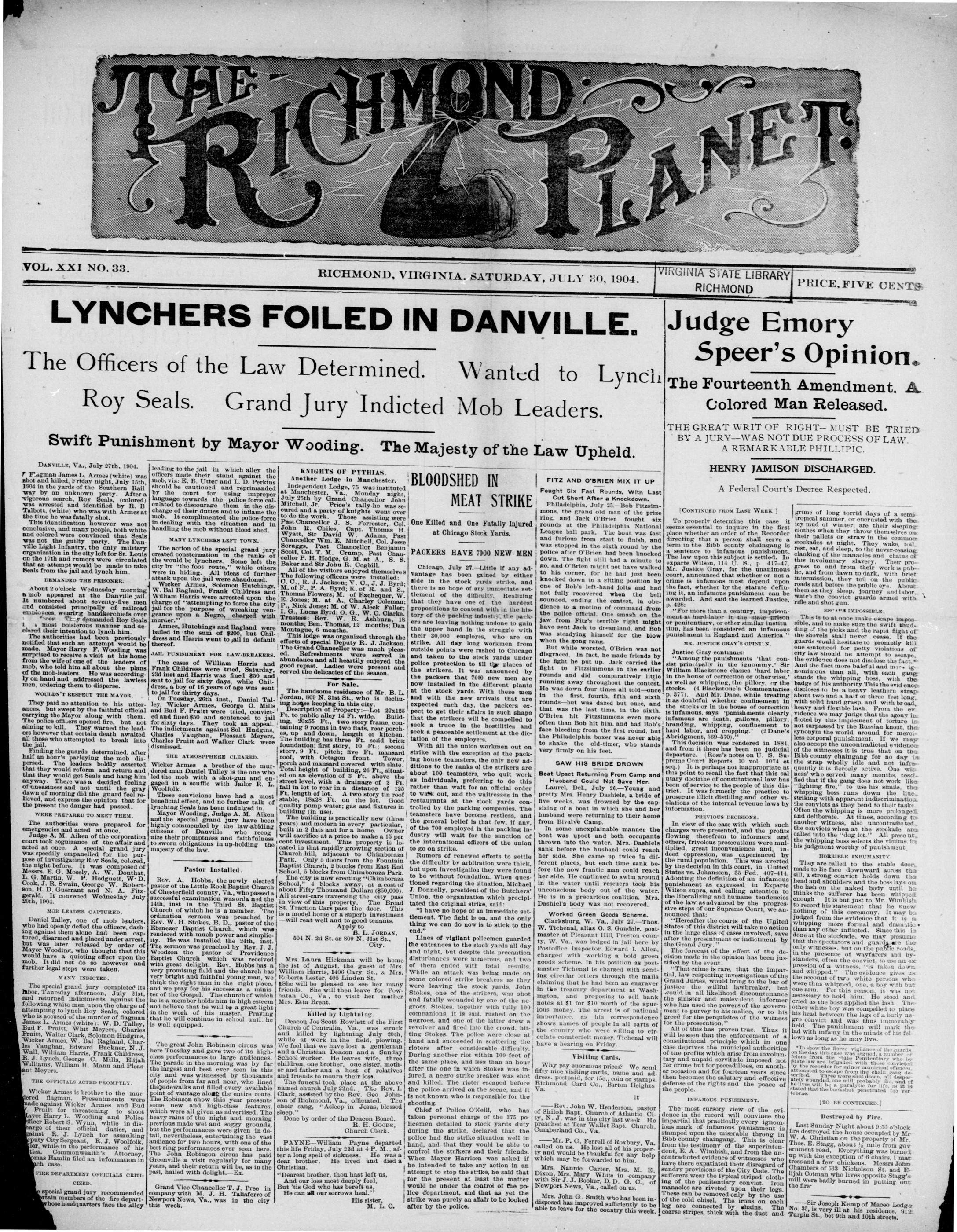
LYNCHERS FOILED IN DANVILLE.
The Officers of the Law Determined. Wanted to Lynch Roy Seals. Grand Jury Indicted Mob Leaders.
Swift Punishment by Mayor Wooding. The Majesty of the Law Upheld.
VOL. XXI NO. 33.
LYNC
The Officer
Roy S
Swift Punish
DANVILLE, VA., July 27th, 1904.
F. Flagman James L. Armes (white) was shot and killed, Friday night, July 15th, 1904 in the yards of the Southern Railway by an unknown party. After a vigorous search, Roy Seals, (colored) arrested and identified by R. B. Talbott's wife who was with Armes at the time he was fatally shot.
This identification however was not conclusive, and many people, both white and colored were convinced that Seals was not the guilty party in Danville Light Infantry, the only military organization in the city left for St. Louis on the 17th and rumors were circulated that an attempt would be made to take Seals from the jail and lynch him.
DEMANDED THE PRISONER:
About 2 o'clock Wednesday morning a mob appeared at the Danville jail. It numbered about seventy-five men and consisted principally of railroad employees, wearing handkerchiefs over gloves. They demanded Roy Scales, most boisterous manner and declared their intention to lynch him. The authorities had been previously notified that such an attempt would be made by Mayor Harry F. Wooding was surprised and asked to sit at his home from the wife of one of the leaders of mob, who told him all about plans of the mob-leaders. He was accordingly on hand and addressed the lawless men, ordering them to disperse.
WOULDN'T RESPECT THE MAYOR
They paid no attention to his utterances, but swept by the faithful official carrying the Mayor along with them. The police officers opened fire, but not aiming to kill. They warned the leaders however that certain death awaited all those who attempted to break into the jail.
Finding the guards determined, after half an hour's parleying the mob dispersed. The leaders boldly asserted that they would reform and return and that they would get Seals and hang him anyway. There was a decided feeling of uneasiness and not until the gray dawn of morning did the guard feel relieved, and express the opinion that for the present the danger had passed.
WERE PREPARED TO MEET THEM
The authorities were prepared for emergencies and acted at once. Judge A. M. Aliken of the corporation court took cognizance of the affair and acted at once. A special grand jury was speedily empanellled for the purpose of investigating Roy Seals, colored, the night before. It was composed of Messrs. E. G. Mosely, A. W. Douthat, L. G. Martin, W. P. Hodgnett, W. D. Cook, J. R. Swain, George W. Robertson, H. D. Guerrant and N. A. Fitzgerald. It convened Wednesday July 20th, 1904.
MOB LEADER CAPTURED
Daniel Talley, one of mob leaders, who had openly defied the officers, dashing against them alone had been captured, disarmed and placed under arrest, but was later released by order of Meyer Dodin, who thought that this would have given him a reprieve upon the mob. It did not do so however and further legal steps were taken.
MANY INDICTED
The special grand jury completed its labor, Tuesday afternoon, July 21st, and returned indictments against the following white men upon the charge of attempting to lynch Roy Seals, colored who is accused of the murder of flagman James L. Armes (white): W. D. Talley, Pratt, Prutt, Whit Mewt, Charles Prutt, Water Clark, Solomon Hudgins, Wicker Arms, W. Bail Lagrange, Charles Vaughan, Edw. Bail Buckner, N. J. Wall, William Harris, Frank Huffness, R. J. Lynch, George C. Mills, Elijah Williams, William H. Mann and Meyers.
THE OFFICIALS ACTED PROMPTLY
Wicker Armes is brother to the murdered flagman. Presentments were made against Wicker Armes and Bud F. Pruitt for threatening to shoot Mayor Harry L. Wooding and Police officer Robert S. Wynn, while in discharge of their official duties, and against R. J. Lynch for assaulting deputy City Sergent, R. J. Woolfolk,iller, while in the performance of his duties. Commonwealth's Attorney, Thomas Hamlin filed an information in each case.
FIRE DEPARTMENT OFFICIALS CRITICIZED.
The special grand jury recommended certain members of the fire department whose headquarters face the alley
leading to the jail in which allay the officers made their stand against the mob, viz: E. B. Utter and L. D. Perkins should be cautioned and reprimanded by the court for using improper language towards the police force calculated to discourage them in the disfigure their duties and to inflame the mob. Of course, the police force in dealing with the situation in handling the mob without blood shot.
MANY LYNCHERS LEFT TOWN.
The action of the special grand jury created consternation in the ranks of the would be lynchers. Some left the city bv "the foot route," while others were in hiding. All ideas of further attack upon the jail were abandoned. Wicker Armes, Solomon Hutchings, W Bal Raigland, Frank Childress and William Harris were arrested upon the charge of "attempting to force the city jail to the purpose of wreaking vengeance upon a Negro, charged with murder." Armes, Hutchings and Raigland were builed in the sum of $200, but Childress and Harris went to jail in default thereof.
JAIL PUNISHMENT FOR LAW-BREAKERS
The cases of William Harris and Frank Childress were tried, Saturday, 23d inst and Harris was fined $50 and sent to jail for sixty days, while Childress, a boy of 16 years of age was sent to jail for thirty days.
On Tuesday, 26th inst., Daniel Tailley, Wicker Warms, George O. Mills Billy B. H. Frattt were tried, convicted and fined $20 and sentenced to jail for sixty days.
The indictments against Sol Meyers, Charles Vaughan, Pleasant Meyers, Charles Pratt and Walker Clark were dismissed.
THE ATMOSPPHERE CLEARED.
Wicker Armes, a brother of the murdered man Daniel Talley is the one who led the mob with a shot-gun and engaged in a scuffle with Jailor R. L. Woolfalk.
These convictions have had a most beneficial effect, and no further talk of lynching Seals has been indulged in.
Mayor Wooding, Judge A. M. Aiken and the special grand jury have been highly recommended by the law-abiding citizens of the city who recognize their promptness and faithfulness to sworn obligations in up-holding the majesty of the law.
Pastor Installed
Rev. A. Hobbs, the newly elected pastor of the Little Rock Baptist Church of Chesterfield county, Va., who passed a successful examination was orda nad the 14th, inst in the Third St. Baptist Church of which he is a member. The ordination sermon was preached by Rev. W. H. Stokes, B. D., pastor of the Ebenezer Baptist Church, which was rendered with much power and simplicity. He was installed the 24th, inst. The sermon was preached by Rev. J. J. Woodson the pastor of Providence Baptist Church which was received with great deed. Rev. Hobbs has a very promising field. The church has very bright and faithful young man, we think the right man in the right place, and we pray for his success as a minister of the Gospel. The church of which he is a member holds him in high esteem and believe that he will be a great light in the work of his master. Praying that he will continue in school until he is well equipped.
---
The great John Robinson circus was here Tuesday and gave two of its high-class performances to large audiences. The parade in the morning was by far the largest and best ever seen in this city and was witnessed by thousands of people from far and near, who lined the sidewalks and filled every available point of vantage along the entire route. The Robinson show this year presents some new and high-class features, which were all given as advertised. The heavy rains of the night and morning previous made wet and soggy grounds, but the performances were given in detail, nevertheless, entertaining the vast audience for two hours, with one of the best ring performances ever seen here. The John Robinson circus has paid Greenville a visit regularly for many years, and their return will be, as in the past, hailed with delight.—Ex.
---
Grand Vice-Chancellor T. J. Free in company with M. J. H. Talafero of Newport News, Va., was in the city this week.
RICHMOND, VIRGINIA. SATURDAY, JULY 30, 1904.
Another Lodge in Manchester.
Independent Lodge, 75 was instituted at Manchester, Va., Monday night, July 25th by Grand Chancellor John Mitchell, Jr. Price's tally-ho was secured and a party of knights went over to do the work. Those assisting were Past Chancellor J. S. Forrester, Col. R. Chiles, Capt. Thomas Hwyatt, Sir David A. Adams, Past Chancellor W. E. Mitchell, Col. Jesse Scruggs, Past Chancellor Jenjamin Scott, Col. T. M. Crump, Past Chancellor P. H. Hodge, G. M at A., S. S. Baker and Sir John R. Cogbill.
All of the visitors enjoyed themselves
The following officers were installed:
C. C., R. J. Jackson; V. C., J. J. Byrd,
M. of F., P. A. Byrd; K. of R. and S.
Thomas Flowers; M. of Eschequer, W.
E. Jones; M. at A., Charley Coleman;
P., Nick Jones; M. of W. Ackle Fuller;
I. G., Lucas Byrd; O. G., W. C. Clarke.
Trustees: Rev. W. R. Ashburn, 18
months; Ben. Thomas, 12 months; Dan
Montague, 6 months.
This lodge was organized through the
efforts of special Deputy R. J. Jackson.
The Grand Chancellor was much pleased.
Refreshments were served in
abundance and all heartily enjoyed
the good repast. Ladies were present and
served the delicacies of the season.
For Sale.
The handsome residence of Mr. B. L. Jordan, 809 N. 31st St., who is declining house keeping in this city.
Description of Property:—Lot 27x125 Ft. to public alley 14 Ft. wide.
Building, 20x55 Ft., two story frame, containing 9 rooms in two flats, rear porches, up and down, length of kitchen. The building has three Ft. solid brick foundation; first story, 10 Ft.; second story, 9 Ft. pitch; five Ft. mansard roof, with Octagon front. Tower, porch and mansard covered with slate, height of building, 26 Ft., situated on the front of 3 Ft. above the street level, with a distance of 2 Ft. fall in lot to rear in a distance of 25 Ft. length of lot. A two story roof stable, 18x28 Ft. on the lot. Good quality pump water; gas and fixtures in building (in use).
The building is practically new (three years) and modern in every particular, built in 2 flats and for a home. Owner will sacrifice at a price to make a 15 per cent investment. This property is located in that rapidly growing section of Church hill, adjacent to Chimboraza Park. Only 5 doors from the Fountain Baptist Church, 2 blocks from East End School, 5 blocks from Chimboraza Park. The city is now erecting "Chimboraza School," 4 blocks away, at a cost of about Fifty Thousand Dollars ($50,000). All street-cars traversing the city pass in view of this property. Broad St. Traction Cars pass the door. This is a model home or a super investment—will rent well and to good tenants.
Apply to
B. L. JORDAN,
504 N. 2d St. or 809 N. 31st St.,
City.
Mrs. Laura Hickman will be home the 1st of August, the guest of Mrs. William Harris, 1406 Cary St., & Mrs. Roberta Lester, 405 Linden St. She will be pleased to see her many friends. She will then leave for Powhatan Co., Va, to visit her mother Mrs. Etta Brent.
Killed by Lightning.
Deacon Joe Scott Rowlett of the First Church of Centralia, Va., was struck and killed by lightning July 20th, while at work in the field, plowing. We feel that we have lost a gentleman and a Christian Deacon and a Sunday School worker. He leaves wife, three children, one brother, one sister, mother and father and a host of relatives and friends to mourn their loss.
The funeral took place at the above named church July 22nd. The Rev. I. Clark, assisted by the Rev. Geo Johnson of Richmond, Va., officiated. The choir sang, "Asleep in Jesus, blessed sleep."
Done by order of the Deacon Board.
R. H. GOODE,
Church Clerk.
PAYNE—William Payne departed this life Friday, July 23d at 4 P. M., after a long spell of sickness. He was a dear brother. He lived and died a Christian.
"Dearest brother, thon hast left us,
And our loss most deeply feel,
But 'tis God who has bereft us,
He can all our sorrows heal."
His sister,
M. L. C.
BLOODSHED IN MEAT STRIKE
One Killed and One Fatally Injured at Chicago Stock Yards.
PACKERS HAVE 7000 NEW MEN
Chicago, July 27.—Little if any advantage has been gained by either side in the stock yards strike, and there is no hope of any immediate settlement of the difficulty. Realizing that they have one of the hardest propositions to contend with in the history of the packing industry, the packers are leaving nothing undone to gain the upper hand in the struggle with their 30,000 employees, who are on strike. All day long workmen from outside points were rushed to Chicago and taken to the stock yards under police protection to fill the places of the strikers. It was announced by the packers that 7000 new men are now installed in the different plants at the stock yards. With these men and with the new arrivals that are expected each day, the packers expect to get their affairs in such shape that the strikers will be compelled to seek a truce in the hostilities and seek a peaceable settlement at the dictation of the employers.
With all the union workmen out on strike with the exception of the packing house teamsters, the only new additions to the ranks of the strikers are about 100 teamsters, who quit work as individuals, preferring to do this rather than wait for an official order to walk out, and the waitresses in the restaurants at the stock yards controlled by the packing companies. The teamsters have become restless, and the general belief is that few, if any, of the 700 employed in the packing industry will wait for the sanction of the international officers of the union to go on strike.
Rumors of renewed efforts to settle the difficulty by arbitration were thick, but upon investigation they were found to be without foundation. When questioned regarding the situation, Michael J. Donnelly, president of the Butchers' Union, the organization which precipitated the original strike, said:
"I have no hope of an immediate settlement. The fight is on, and the only thing we can do now is to stick to the end."
Lines of vigilant policemen guarded the entrances to the stock yards all day and night, but despite this precaution disturbances were numerous, and two of them ended with fatal results. While an attack was being made on some colored strike breakers as they were leaving the stock yards, John Stokes, one of the strikers, was shot and fatally wounded by one of the negroes. Stokes, together with fully 100 companions, it is said, rushed on the negroes, and one of the latter drew a revolver and fired into the crowd, hitting Stokes. The police were close at hand and succeeded in scattering the rioters after considerable difficulty. During another riot within 100 feet of the same place, and less than an hour after the one in which Stokes was injured, a negro strike breaker was shot and killed. The rioter escaped before the police arrived on the scene, and it is not known who is responsible for the shooting.
Chief of Police O'Neill, who has taken personal charge of the 375 policemen detailed to stock yards duty during the strike, declared that the police had the strike situation well in hand, and that they would be able to control the strikers and their friends. When Mayor Harrison was asked if he intended to take any action in an attempt to stop the strike, he said that for the present at least the matter would be under the control of the police department, and that as yet the strike was purely an affair to be looked after by the police.
FITZ AND O'BRIEN MIX IT UP
Fought Six Fast Rounds, With Last
Cut Short After a Knockdown.
Philadelphia, July 25.—Bob Fitzsimmons, the grand old man of the prize ring, and Jack O'Brien fought six rounds at the Philadelphia National League ball park. The bout was fast and furious from start to finish, and was stopped in the sixth round by the police after O'Brien had been knocked down. The fight still had a minute to go, and O'Brien might not have walked to his corner, for he had just been knocked down to a sitting position by one of Bob's left-hand jolts and had not fully recovered when the bell sounded, ending the contest, in obedience to a motion of command from the police official. One smash on the jaw from Fitz's terrible right might have sent Jack to dreamiand, and Bob was steadying himself for the blow when the gong rang.
But while worsted, O'Brien was not disgraced. In fact, he made friends by the fight he put up. Jack carried the fight to Fitzsimmons in the earlier rounds and did comparatively little running away throughout the contest. He was down four times all told—once in the first, fourth, fifth and sixth rounds—but was dazed but once, and that was the last time, in the sixth. O'Brien hit Fitzsimmons even more often than Bob hit him, and had Bob's face bleeding from the first round, but the Philadelphia boxer was never able to shake the old-timer, who stands very firmly on his feet.
SAW HIS BRIDE DROWN
Boat Upset Returning From Camp and Husband Could Not Save Her. Laurel, Del., July 26.—Young and pretty Mrs. Henry Dashiels, a bride of five weeks, was drowned by the cap-sizing of a boat in which she and her husband were returning to their home from Bivalve Camp. In some unexplainable manner the boat was upset and both occupants thrown into the water. Mrs. Dashiels sank before the husband could reach her side. She came up twice in different places, but each time sank before the now frantic man could reach her side. He continued to swim around in the water until rescuers took his unconscious body out of the water. He is in a precarious condition. Mrs. Dashiels's body was not recovered.
Worked Green Goods Scheme
Clarksburg, W. Va., July 27—Thos. W. Tichenal, alias O. S. Gundale, postmaster at Pleasant Hill, Preston county, W. Va., was lodged in jail here by Postoffice Inspector Edward I. Allen, charged with working a bold green goods scheme. In his position as postmaster Tichenal is charged with sending circular letters through the mails claiming that he had been an engraver in the treasury department at Washington, and proposing to sell bank notes at $1 for $10 worth of the spurious money. The arrest is of national importance, as his correspondence shows names of people in all parts of the country who were willing to circulate counterfeit money. Tichenal will have a hearing on Friday.
Visiting Cards.
Why pay enormous prizes? We send fifty nice visiting cards, name and address, postpaid, for 15c., coin or stamps, Richmond Card Co., Barton Heights Va.
It
—Rev. John W. Henderson, pastor of Shiloh Bapt. Church of Atlantic City, N. J. was in the city last week He preached at Tear Wallet Bapt. Church, Cumberland Co., Va.
—Mr. P. G. Ferrell of Roxbury, Va. called on us. He lost all of his property and would be thankful for any help which may be forwarded to him.
Mrs. Nannie Carter, Mrs. M. E. Dixon, Mrs. Mary White in company with Sir J. J. Booker, D. D. C., of Newport News, Va., called on us.
Mrs. John G. Smith who has been indisposed has improved sufficiently to be able to leave for the country this week
VIRGINIA STATE LIBRARY RICHMOND
Judge En
Speer's
The Fourteenth
Colored Me
THE GREAT WRIT OF R
BY A JURY—WAS NOT
A REMARKAL
HENRY JAMISO
Judge Emory Speer's Opinion
The Fourteenth Amendment. A Colored Man Released. THE GREAT WRIT OF RIGHT-MUST BE TRIED BY A JURY-WAS NOT DUE PROCESS OF LAW. A REMARKABLE PHILLIPIC.
HENRY JAMISON DISCHARGED.
A Federal Court's Decree Respected.
[CONTINUED FROM LAST WEEK]
To properly determine this case it seems essential to inquire in the first place whether an order of the Recorder directing that a person shall serve a term in the Bibb county chaining a sentence to infamous punishment. The law upon this subject is settled. In expare Wilson, 114 U. S., p. 417-47, Mr. Justice Gray, for the unanimous court, announced that whether or not a crime is infamous must depend upon the fact, whether by the statute defining it, an infamous punishment can be awarded. And said the learned Justice, p. 428: "For more than a century, imprisonment at hard labor in the state prison or penitentiary, or other similar institution, has been considered an infamous punishment in England and America."
MR. JUSTICE GRAY'S OPINI N.
"Among the punishments 'that consist principally in the ignommy,' Sir William Blackstone classes 'hard labor in the house of correction or other wise,' as well as whipping, the pillory, or the stocks. (4 Blackstone's Commentaries p. 377). And Mr. Dane, while treating it as doubtful whether confinement in the stocks or in the house of correction is infamous, says 'punishments clearly infamous are leath, gallows, pillory, branding, whipping, confinement to hard labor, and cropping.' (2 Dane's Abridgment, 569-570)."
This decision was rendered in 1884, and from it there has been no judicial departure. (Rose's notes on U. S. Supreme Court Reports, 10 vol. 1074 et seq.) It is perhaps not inappropriate at this point to recall the fact that this salutary doctrine of constitutional law has been of service to the people of this district. It was formerly the practice to prosecute illicit distilling and other violations of the internal revenue laws by information.
PREVIOUS DECISIONS.
In view of the ease with which such charges were presented, and the profits flowing therefrom to informers and others, frivolous prosecutions were multiplied, great inconvenience and, indeed oppression, was experienced by the rural population. This was averted by the decision in this court, in United States vs. Johanssen, 35 Fed. 407-414. Adoeting the definition of an infamous punishment as expressed in Exparete Wilson supra, and calling attention to the liberalizing and humane tendencies of the law as advanced by the progressive steps of our Supreme Court, we announced that: "Hereafter the courts of the United States of this district will take no action in the large class of cases involved, save after the presentment or indictment by the Grand Jury." The forecast of the effect of the decision made in the opinion has been justified by the event.
"That crime is rare, that the impartial, law respecting investigations of the Grand Juries, would bring to the bar of justice the willful lawbreaker, but would in all likelihood discountenance the sinister and malevolent informer who has used the powers of the government to purvey to his malice, or to his greed for the perquisites of the witness for the prosecution." This has proven true. Thus it will be seen the enforcement of a constitutional principle which in one case deprives the municipal authorities of the profits which arise from involuntary and unpaid servitude imposed not for crime but for pacedilloes, on another occasion and for fourteen years since then becomes the salutary and effective defense of the rights and the peace of the people.
INFAMOUS PUNISHMENT.
The most cursory view of the evidence in the record will convince the impartial that practically every ignonious mark of infamous punishment is stamped upon the miserable throng in Bibb county chaingang. This is clear from the testimony of the superintendent, E. A. Wimbish, and from the uncontradicted evidence of witnesses who have expiated their disregard of sundry provisions of the City Code. The sufferers wear the typical striped clothing of the penitentiary convict. Iron manacles are riveted on their legs. These can be removed only by the use of the cold chisel. The irons on each leg are connected by chains. The coarse stripes, thick with the dust and
Justice Gray continues:
PRICE, FIVE CENTS
memory
is Opinion.
An Amendment. A
Van Released.
RIGHT—MUST BE TRIED
AT DUE PROCESS OF LAW.
BLE PHILLIPIC.
ON DISCHARGED.
grime of long torrid days of a semistropical summer, or encrusted with the they mud of winter, are their sleeping clothes when they throw themselves on their pallets or straw in the common stockades at night. They write, toil, rest, eat, and sleep, to the never-clanking of the manacles and chains of this involuntary slavery. Their progress to and from their work is public, and from dawn to dark, with brief intermission, they toil on the public roads and before the public eye. About them as they sleep, journey and labor, watch the convict guards armed with rifle and shot gun.
ESCAPR IMPOSSIBLE
This is to at once make escape impossible, and to make sure the swift thudding of the picks and the rapid flight of the shovels shall never cease. If the guards would hesitate to promptly kill one sentenced for petty violations of city law should not attempt to escape, the evidence does not disclose the fact. And the fact more baleful and more ignominious than all, with each gang stands the whipping boss, with the badge of his authority. This the evidence discloses to be a heavy leathern strap about two and a half or three feet long, with solid hand grasp, and with broad, heavy and flexible lash. From the evidence we may judge that the agony inflicted by this implement of torture is not surpassed by the Russian knot, the synonym the world around for merciless corporal punishment. If we may accept the uncontricted evidence of the witnesses it is true that on the Bibbite chaining for no day is the strap fierce and not infrequently it is fiercely active. One witness' who served as a witness specified that if the gang does not work like "fighting fire" to use his simple whipping boss runs down the line striking with apparent indiscrimination the convicts as they bend to their tasks. Often the whipping is more prolonged and deliberate. At times, according to another witness, also uncontricted the convicts when at the stockade are called into the "dog lot." All present in the whipping boss selects the victims in his judgment worthy of punishment.
HORRIBLE INHUMANITY.
They are called to the stable door, made to lie face downward across the sill, a strong convict holds down the head and shoulders and the boss lays on the lash on the naked body until he thinks the sufferer has been whipped enough. It is but just to Mr. Wimbish to record his statement that he knew nothing of this ceremony. It may be judged from the evidence that it is a whipping more formal and dramatic than any other inflicted. Since this is done at the stockade, we may presume that the spectators and guard are the only witnesses, but on the public roads, in the presence of wayfarers and bystanders, often the convict, to use an exposition of a witness, "is taken down and whipped." The evidence gives us the account of two white persons who were thus whipped, one a boy with but one arm. For this reason, it was not necessary to hold him. He stood and cried as the boss applied the lash. The other white boy was compelled to place his head between the legs of a burgly negro convict and was thus immovably held. The punishment will mark the lad with infamy in the minds of his fellows as long as he may live.
"To show the flaree vigilance of the guards on the day this case was argued, a number of officers on the day this case was argued, a number of State law are beigated with the authority by the recorder for minor municipal offences, attempted to escape from the chain gang dangling from a fence, and a detached wounded, one will probably no doubt if it will be a paralytic for life, as it is stated that the buckshot penetrated the vertebrae.
[TO BE CONTINUED.]
Destroved by Fire
Last Sunday Night about 9:50 o'clock fire destroyed the house occupied by Mr. W. A. Christian on the property of Mr. Thos. E. Stagg, about ½ mile from government road. Everything was burned up with the exception of 6 chairs, 1 matress and a few chickens. Mossrs John Chambers of 633 Nicholson St. and Elijah Cotman who lives opposite Stagg's mill were badly burned in putting out the fire
Sir Joseph Kemp of Maceo Lodge No. 35, is very ill at his residence, 912 Turpin St., bet 9th and 10th streets
r
Cees
ee eaNG,
A wa the
ae
i ' (
BATURDAY ......... JULY 30, 1904
RDA oars SUES 90, 0
DeouULTRy
| (Fayre “ee
be oS CSD
| =~ ;
XOIIBEES
\AN- IDEA FOR BEEKEEPERS.
fer indecies ees os oa
pee eee oe
ey took pleasure in showing a kink
hich saved me one hand or one whole
helper, for that matter. The sketch
hows ‘the arrangement. ‘The comb-box
at the right hand, and the uncapping
gan at the left, and a little infront. 1
mancap two combs and place them in
ithe extractor; start the crank with the
hand, then work the treadle. While
@oing this I take another comb, un-
\eap and placé it in the comb-box.
mow turn the frames in the machine,
rt it agoing again, and take another
Ricines scese ana eecnape ts
jeombs, and proceed as before. When
TT AL ek
i ee ——
iis Sr
| ip HS IZ SY
Siisiie SORES wirnkcron
one foot gets tired I push the treadle
to the dotted lines, and use the other.
‘There is no change of position except
%o turn the arms and shoulders from
Fight to left, and reach ahead to the
eatractor—no stooping. A two-frame
extractor of the Novice type runs very
easily. The treadie is one by two and
yone-half inches by three inches long
swith a piece of broom wire to the erank
‘Whenever you wish to turn by hand you
fan doso any minute.
4 To make a brush, cut a three-eighths
ope nine inches long; unravel, and lay
out flat. Nail two sticks, one on each
‘mide, and bring the other ends close to-
ether forahandie. It is ahead of any-
thing for me. I learned how to make
‘Drush from a man by the name of Crow.
If nails are driven about one and one-
fourth inches apart, so the points will
adout come together, you will have the
atiffness as well as the friction to hold
‘the rope strands,
I have made about 100 hives by nail-
Apg—no halving, mitering, nor dovetail-
pg. I have used these three or four
ears, and not one has given way. Of
‘eourse, most people will buy their hives,
‘and they can be dovetailed cheaply with
machinery.—A, B, White, in Gleanings
fo Bee Culture, a. =
KEROSENE KILLS POULTRY.
Kt Destroyed the Lice, It Is True, But
Seventy Nice Young Turkeys
j Went with Them.
| Among other things that attracted
eur attention in going about last sea-
won was the quick and extended de-
struction that kerosene oil will bring
to a lot of young chickens or turkeys
where it is used as an ointment to
@estroy lice, fleas or bugs. In one
Anstance a raiser who had a fine lot
‘of young turkeys discovered that some
lice were bothering them a little, and
fat once proceeded to rub them with
lard in which some kerosene oll had
Deen mixed.
\ Always prior to this time this
breeder had been very successful with
the use of lard alone, but the addi-
tion of Kerosene having been recom-
mended, It was tried, and over 70
young turkeys were killed by the ex-
periment. Hundreds of young chicks
‘have been killed in'the same way, and
yet people will tell you to use it, and
People will use it in spite of all that
you can tell them. ‘The best and most
Mmnocent remedy to be used In this
(way Is to dip your finger, or a small
“BUT drush, Into sweet oll and thor-
oughly anoint the parts where the in-
eect vermin are, and this will kiN
them all and in no way injure the
young chick or poultry.
We presume that every paper in the
country interested in poultry In any
way has recorded In its columns the
danger of using kerosene for this pur-
pore, and yet, as stated above, people
Will continue to use It.
Nothing can be more destructive
than are the inseet vermin when once
they get a foothold among your young
chicks or turkeys. One very success-
ful turkey raiser carefully examines
‘every morning every young turkey up
«to six weeks old, prior to allowing
them their freedom. When lice are
Aiscovered upon the young turkeys
they are elther destroyed by the
thumb nail or tonched with sweet off
which quickly ends their existence
This breeder succeeded in raising 1
out of some 76 or 77 that were
hatched—The Feather.
Milk Is Good for Poultry.
‘Phere is xo better or cheaper food
for the laying hens than milk. It is
Rot advisable however, to feed great
quantities of it in its liquid state, as
Mt is very loosening to the bowels. It
should be prepared as follows: Place
thick sour milk in pans and set over
the fire to heat throngh well, when
the whey mm * van arated
from the curd. It should be drained
to a dry, powdery mass, when it will
be fit to feed. ‘The curd from two pans
of milk will make a generous feed for
25 hens. Be sure to give plenty of
water, also grit. It will be found a
profitable feed.—Woman’s Magazine.
WHEN POULTRY IS AILING.
A Short Description of the Symptoms
of the Many Diseases of
Hens and Chicks
‘When the extrement secreted by the
kidneys, which is normally pure white,
appears yellow, though the droppings
are solid and the bird appears perfectly
healthy, look out for bowel trouble.
‘When the crop is bard and unyielding
there is danger of the bird becoming
¢rop-bound,
, When the discharges are streaked
‘With blood, it is time to give preventives
for diarrhoea.
When the joints are hot and swoilen,
and the fowl is disinclined to stand,
rheumatism has taken hold.
When the nostrils are clogged with
dirt, and the eyes water, ward off a pos
sible case of roup by timely treatment.
If the case is bad, apply the hatchet and
bury the carcass,
When the bird seems lame, and has
small swelling 6n its foot, remove to
house with no perches, and oblige it tc
roost on a bed of straw. Bumble-foot is
easily cured in the early stages if the
cause is at once removed,
When a hen seems to drop down be-
hind, and goes repeatedly to the nes\
without laying, she is usually suffering
from a disorder of the oviduct, and
might as well be killed and éaten,
When a bird is “going light,” has
00d appetite, but passes food from the
bowels undigested, it is the early stage
of consumption, and treatment is use-
less.
When the hen seems giddy, and turns
round and round, she is probably suf-
fering from apoplexy.
‘When the bird has leg weakness, with
no disorder of the liver, feed lighter,
and give plenty of vone-feeding mate-
rial.
‘When new fowls are bought, quaran-
tine them until sure they have no dis-
ease.
When a fowi bas difficulty in breath-
ing, look out for pneumonia,
When a fowl is dangerously sick with
an organic disease, it is worse than use-
less as a breeder, It is usually safer te
Kill a bad case of {ilness than to try tc
cure it.—Farmers’ Gazette, Canada.
BOXES FOR CHICKEN COOPS
This Idea Is Furnished by a Kansas
Lady Who Knows What She
Is Talking About.
There was a time when I thought
the A coop the only one in the world.
That was before 1 gave the dry goods
box a fair test. Last March two hens
hatched ten chicks each, and I gave
them all to one heti in & bottomless A
coop. it rained a week, and auch a
time as I had saving those chicks, One
morning the water had raised under
the coop and half the chicks were dead.
I threw the old A coop away and this
a
——
—
COOP MADE OF LARGE nox,
year use only dry goods boxes, three
and four feet square, of one-inch lum-
ber. Rance
The boards are taken from one side
and cleats nailed across them to make
a door, The bottom board Is left nailed
‘on to keep the chicks in the coop till they
are five or six days old. Hang door at
top, with leather hinges, as shown in
the cut. Warm, sunny days throw the
door back on top of box; at night close
up tightly to exclude cold, rats, ete.
and on mild rainy days prop the door
out for shelter, Lath is nailed across
the front to keep the hen in. With
these coops one can give 25 to 30 chicks
to one hen. When chicks are weaned
and the cockerels sold, the coops are nice
for the pullets to roost in till frost,
when they are put In the house with lay-
ing hens.—Farm and Home,
A FEW POULTRY JOTTINGS,
Dry sawdust makes a good bottom
for the coops. Clean {it out and put
in fresh sawdust each week.
Don’t force the chicks on the roost
too soon. This causes the crooked
breast we so often find in chickens.
The oftener you feed the chickens
the faster they grow. You can scarce.
ly hurga growing chick with dry feed
Never feed damaged feed—that Is
moldy corn, soured mgshes. Serlou:
diseases too often ‘alone come fron
feed of this kind.
- ‘The Buff Orpkington, the handsom
est of fowls, equals the Plymout!
Rock as a table fowl, and the Leghors
in its egg producing qualities,
Don’t place the eggs of the Asiatt
and Mediterranean fowls in the in
cubator to hatch at the same time
‘The Asiatics have a thick shell an
require more moisture to soften th
‘shell. The same amount of moistun
‘would prevent the thinner shelled eg:
from hatching.—Twentieth Century;
oe
Dressing Fowls for Market.
In scalding ducks and geese the wa-
ter must be of the same temperature
as for chickens, but they must remain
longer in the Water, as their feath-
ers are shaped to turn even hot wa-
ter. Some people prefer not to leave
them In the water so long, and after
removing them wrap them up in a
blanket to steam. But this Is a lit-
tle risky when picking for shipment,
as not all persons who help in the
picking process know just exactly how
long to let them steam, and often
when taken from the blankets the
flesh is cooked. After picking off all
down and feathers hold them about 12
seconds in scalding water to plump
them.—Rural Home.
A Modern Mother.
|. “Quick, mother! Baby brother has
fallen down the well!”
| “Oh! Oh! And the well hasn't been
‘gterilized!"—Town Topics. z
THE RICHMOND PLANET, RICHMOND, VIRGINIA.
a ee
Trouble for Him. “Ts an adv
r Towne—I helped Goodart the othe] “What's tha
day to select a beautiful etching— “The heroin
Browne—Don't mention Goodart to] pull.”—N. Y.
me; he's a contemptible character. —
Towne—What! Why, be told me he w
: was going to send the etching to you) ‘The Judge—
for your birthday. time these a
Browne—So he did, and my wife made] said to have
r me rearrange all the other pictures in] The Witnes
'@ | the parlor to make room for it and I'm] there when tt
“| not done yet-—Philadelphia Press. the windows
ee ———__ ‘The Judge-
‘The Very Best. An Aid to Longevity. prisoner comm
Mr. Nuwed—Gracious, dear! Wher| «1 noticed the other day, Miss Clin.) The Witnes
did you get these peaches? key, that some papers say that mar-{I seen him do
Mra. Nuwed—Why? What's th+! ried men live longer than cingle onea| front window:
matter? “And haven't you any desire to live| over th’ head
Mr. Nuwed—They don't taste lik! jong Mr. Puttyblow?" Cleveland Pia
the best in the world. “Why, yes, of course I have, Miss =
Mrs. Nuwed—They must be. | ciinkey.” why
Picked them out myself. The pictur'| “Oh, Mr, Puttyblow, this is so sud-| “Are you w
on the can was prettier than any 0! gen!™—Cleveland Plain Dealer. Rigsby?”
the others.—Philadelphia Press. ees ee “Quite well
See ‘Not Patented. same office as
Five Hundred Thousand. “Your mother-in-law never pays you} “I think he
‘Tess—I can't understand what ht! jong visit” young man.
Saw in her. Her face is decidedly] “No, she never did but once, and{choly. He su
Plain, that was right after I was married.” [some great di
Jesr—Yes, but the figure she hat} “Put me on to how you Worked it,"| “Yes, he ha:
maxes up for all that. the first man requested, earnestly. “Oh, how rc
‘Tess — Figure? She's positively “1 had my mother come on a visit at] “Why, he <
Scrawny. She has no figure. the same time."—Chicago Journal. salary on the
Jess—You're mistaken. She has six Sey it."—Tit-Bits.
figures, and the first one's a fve— Just Bea, aoe
Philadelphia Press. CS oh ine ae ae aux.
Her Resentment.
‘Tess—Jack Hansom isn’t fat, Is he’
Jess—Not at all. He's quite grace.
ful _and muscular. Why?
Tess—I happened to mention him
tc Miss Pechis, and she said: “Ob.
isn’t he disgustingly stout?”
Jess—Ah, yes. She rejected him
fome Weeks ago, and she’s mad be-
cause he didn’t pine away.—Coloradc
Springs Gazette.
Obeyed Instructions.
“A gentleman bought a new variety
‘of potatoes, and told his gardener te
be sure and plant them far enough
apart.
“Well, Sam, did you plant the po-
tatoes far apart, as I told you?"
Sam—I did, sir. I planted some in
your garden, and some in mine, sc
they are four miles apart.—Tit-Bits,
Retribution,
“I had a horrible dream last night,’
said Huddieson, when he came down
to breakfast the other morning.
“What was it?” asked bis wife,
“I dreamt that [ was in purgatory.
and was made to do all the things I
had told my friends 1 would do if }
were in their places.”"—Brooklyn Life.
Commutation of Sentence.
Mr. Bacon—I think we ought to cele-
brate the twenty-fifth anniversary of
our wedding, dear.
Mrs. Bacon—What are you talking
about? Why, we've only been married
18 years!
“Well, don’t I get anything off for
good behavior?”—Yonkers Statesman,
Her Age.
“How old would you say she was?"
“Well, let's see. When we were in
high school together she used to snub
me because I was akid. Now I'm 37, and
‘um-m-m-weil, I should say she was about
28 by this time."—Town and Country,
Wieeiaed en
“Why don't you employ a steno-
grapher?”
“Don’t need one,” answered Mr. Cum-
Tox. “Mother and the girls can criticise
my grammar and spelling all that’s re-
quired.”—Washington Star.
- Certainly Certain.
He—I suppose Miss Elderleigh 1s
what you would call a girl of uncer-
tain years, is she not?
She—No, indeq!. She has been the
Same age for at least ten years.—Chi-
cago Daily News,
Handicapped.
Bifkins—I | now one girl who doesn't
try to conceal her age.
Mifkins—What’s the explanation?
Bifkins—She has a twin brother.—
Columbus Dispaten.
His Wisdom.
‘The silent: man doth wink grain,
His thouy!ts, he won't bethay ‘em,
He thinks «!stakes ike other men,
{But is too smarttosay “em,
fT Wastinsicn’ Star
FS CAUTION REQUIRED.
{&_ CAUTION REQUIRED. |
Asa
FDR
Bx
Be Das
ey CT
i a ¢
~ :
eee
YF
oe
ve N>
“Do you think it’s right for aman to
put so much money In his clothes?” :
“It depends upon how sound he sleeps
—and how noiselessly his wife can
walk."—Chieaxo Journal,
ae
Our Old Friend.
Now comes the eager fisherman
Who dows the stream will plod.
He'll ree} his fish in by the inch, '
His lies off by the rod,
Indianapolis sun. |
‘Sala “Rinieiamiiaes
Singleton—-Do you believe that mar-
riage is a failure?
‘Wedderly—No; merely an assign-
ment in which the wife is a preferred
ereditor.—Cincinnati Enquirer.
Depends on Circumstances.
Howell—Do you think it pays to put
much money into clothes?
Powell—Not if you have a wife to go
through them.—Town Topics.
Why?
Awkward Brute—What a grand floor
this is! I could dance on it all night
‘The Victim—Then why dance on my
feet?—Ally Sloper.
Trouble for Him.
Towne—I helped Goodart the other
day to select a beautiful etching—
Browne—Don't mention Goodart te
me; he's a contemptible character.
‘Towne—What! Why, be told me he
was going to send the etching to you
for your birthday.
Browne—So he did, and my wife made
me rearrange all the other pictures in
the parlor to make room for it and I'm
not done yet.—Philadelphia Press.
An Aid to Longevity.
“I noticed the other day, Miss Clin-
key, that some papers say that mar-
ried men live longer than single ones."
“And haven't you any desire to live
long, Mr. Puttyblow?”
“Why, yes, of course I have, Miss
Clinkey.”
“Oh, Mr. Puttyblow, this is so sud-
den!"—Cleveland Plain Dealer.
‘Not Patented.
“Your mother-in-law never pays you
@ long visit.”
“No, she never did but once, and
that was right after I was married.”
“Put me on to how you Worked it,’
the first man requested, earnestly.
“I had my mother come on a visit at
the same fime."—Chicago Journal.
ee pac
WORSE THAN WHEAT.
AGEN
(EBSA
Lae
\ amie,
f rh
yh
pSefiti
Nae
Ke
; ap boy
Os S
RL. FQ
ee Plans,
See LWA Flloed thal speciation
wheat?
He—No; rye.—Chicago American.
—.
“You're ali the worid to me,” he said,
“Be mine!” with signs of mirth,
She answered: “You're too greedy, str;
T see you want the earth.”
Philadelphia Buitetin,
| Discouraging.
“There!” exclaimed —_ six-year-old
Frances, throwing down her books; “I
Just ain't going to school another day.”
“Why mpt, dear?” asked her mother,
“It's no use wasting time,” replied
Frances. “I can't never learn to spell.
‘The teacher keeps changing the words
every day."—Cincinnati Enquirer,
The Last Vows.
Seedy Nobleman—Are you sure, dear-
est, that you will always honor my noble
family?
American Heiress—Always. And will
you always love and cherish my money?
“While life lasts.”
“Then let the wedding bells ring.”—
N. ¥. Weekly
Simple Addition.
| Employer (to clerk)—What’s — the
matter, Mr. Simple? You look quite
dazed. Have you had a sunstroke?
Simple—A double son-stroke, sir,
Employer—What do you mean?
Simple—Twins—both boys, at four
o'clock this morning, sir.—Ally Sloper.
| Se
Nibbles—By the way, what became
of your friend Smiley?
Stringer—Hanging terminated ‘his
earthly career
Nibbles—Hanging! Is it possible?
Stringer—Yes; hanging around sa-
loons.—Cincinnati Enquirer.
Two Kinds of Engagements,
“Why do the witnesses to a marriage
ceremony have to sign their names,
pop?”
/2Oh, that ts the iaw, my son,”
“Well, the seconds in a prize fight don't
have to sign anything, do they, pop?”"—
Yonkers Statesman.
Not to Be Fooled,
Mrs. Subbubs— told Bridget to
string the beans this morning.
‘Mr. Subbubs—Yes, Well?
Mrs. Subbubs—Well, she flared up
‘and told me I couldn't string her; that
we'd eat them loose or not at all—
Philadelphia Press,
McWork’s Kindly Theory.
Mrs. MeWori—Old Bullion is makin’
fobs o’ money. Phy shud he be want-
In’ to rejuce your wages?
Mr. MeWork—Sure, Oi dunno. May-
be he do be thryin’ to get rich enough
to be @ great pheelanthropist.—N. Y.
coe
Me et aaa
First Boston Girl—What a dowdy
that Miss Careless is.
Second nosion Girl—In what way?
First Boston Girl—She uses a pro-
nunciation that went out of fashion
two seasons azo.—N. Y. Weekly.
Taking Acvantage of Him.
Kate—Why did she insist on a
ehureh wedding?
Nell—Well, she said she was going
to have him go to chureh with her for
once.—Somervilie Journal.
The Coming Heroine. Y
| Mr, Jinks—I wish you wouldn't ats
low our daughter to read those sentt-
mental novels.
| Mrs. Jinks—She isn't reading a sen-
Uimental novel. The heroine doesn’t
‘marry for love.
“Well, the modern society novel, In
which the heroine marries for money,
fs just as bad.”
“She Isn't reading a society novel.”
“Then what is it?” Fae
“Is an advanced novel.”
“What's that?”
“The heroine rarries for a political
pull."—N. ¥. Weekly.
‘What He Saw,
‘The Judge—Were you present at the
time these acts of disturbance are
said to have taken place?
The Witness—If you mean was 1
there when the he!""='=" was done aa’
the windows bro», ¢ 8.
The Judge—Ané dd you see the
prisoner commit ony overt act?
The Witnes:—No, air, 4 @ida't au
iT seen him do wes to bust a couple o
front windows an’ smash Patsy Breen
over th’ head with a bung starter —
eaereland: Piain Deaier.
Why He Was Sad.
| “Are you well acquainted with Mr.
Rigsby?”
| “Quite well. He fs employed in the
Same office as myself.”
_ “I think he is such an interesting
young man, He is always so melan-
choly. He surely must have suffered
some great disappointment?”
“Yes, he has.”
“Oh, how romantic! What was it?”
“Why, he expected a rise in his
Salary on the first, and he didn’t eet
it."—Tit-Bits.
Lots to Do.
‘The youngster had heard a facetious
Teference to the foolkiller and he was
curious.
“Does the foolkiller have to work
awful hard?” he asked.
“No; he doesn't have to, my son, but
he ought to,” was the reply. “He'd
have no time for sleep if he didn’t
shirk his duty most shamefully.”"—Chi-
cago Post.
Practical Girl.
“Refuse me,” he cried, wildly, “and
life will be an empty dream.”
‘The beautiful girl crushed the violets
in her hand.
“Tis better to havean empty dream,”
she said, firmly, “than to get married and
have an empty pocket book."—Chicago
Daily News.
Conspicuous Example.
“There is something in the theory
that you can tell the character of a
Person by his or her voice,” observed
the professor. “For instance, when you
hear the voice of a barker for a side-
show, even if you don’t hear a word he
says. you know he's a liar.”"—Chicago
‘Tribune.
Higher Ambition Than That.
vnilanthropic Visitor (at the Jail)—
Younz man, | am sorry for you. Why
did you commit that crime? Did you
want to be a dime novel hero?
Prisoner—Dime novel nuthin’! 1
‘Wanted to see me picture in de papers.—
Chicago Tribune.
UNDAUNTED COURAGE.
aS 3
. ies
i ¢ a
Saad Yee
SN Gf
TS
| ca)
fests hee sau who easily | Eibeser
aged?"
| “Hardly; he is going to be married for
the fourth time next week.""—Chicage
Soneaet
A Victim Speaks.
“Don't brevk the law,” said he,
“For if sou do,
The law, 4d counsel's fee,
May soon break you."
Philadephia Press,
Gaurtaa
He (vacating a seat in crowded car)
Here is a seat, madam.
She—No, no! Pray keep your seat,.
He—Sorry I can't oblige you,
madam, but I get off at this corner—
Cincinnati Enquirer.
I Professional Jealousy.
“So you went to Dr. Pedal's plano
recital, eh? ‘Tell me, what do you
think of his exceution?”
| “To be thorouzhly frank with you,
I think he thoroughly deserved it"—
Brookiyn Lite
All Zor Effect.
“Why did Jim be a steamer
trunk?’
| “For the same reason he wears an
‘automobile cap."—Cleveland Plain
Dealer.
‘A Revelation.
Wife—I have.’t a gown fit to wear.
Husband—Jove! That's the reason
none of the servants will stay here—
N. ¥. ‘Fimes.
Then He Hurried Home.
“I say, Miss Nellie,” remarked young
Borem, as the clock chimed the hour
of 11, “I have a conundrum for you.”
“Well,” she queried, as she attempted
to suppress a yawn, “what is it?”
“What Is the difference between me
and a five-dollar gold piece?” he asked.
| “One can easily lose a five-dollar gold
Piece,” she replied —Cincinnati En-
-quirer,
| The Social Calendar.
| “¥es, I have been so busy with my
Visits this week” said the impressive
lady. “I Mondayed in Chicago and Tues-
‘dayed at Peoria. Then I Wednesdayed
at home and Thursdayed in Michigan
City, I Fridayed with friends at Moline
and Saturdayed at Waukegan.”
“Yes?” asked the friend. “And where
do you expect to to-day to-morrow?”"—
Judge. PS Sea
(om Booker’s
(3 Se
5 — Market
Aged Dp 18 W. Baker St.
7 7 #Y, A FULL LINE OF FINE
hd P GROCERIES AND FRESH
~ et MEATS & VEGETABLES
Wood and Coal, Cigars and Tobacco. ae
AT THE LOWEST MARKET PRICES,
YOU CAN SAVE MONEY BY GIVING ME A CALL.
4iL Gcops DELIVERED TO You FREE.
TELEPHONE 1307
A. C. BOOKER, Prop.
18 W. BAKER ST. RICHMOND, Va, ae
.
7 a
W. I. JOHNSON, #
FUNERAL DIRECTOR AND EMBALMER. ,
Office & Warerooms, 207 N. Foushee St. Corner Broad.
HACKS FOR HIRE: {
Orders by Telephone or Telegraph filled, Wedding, Sup
pers and Entertainments promptly attended. ‘
Oid ’Phone, 686, Residence in Butlding, New Phone, 18.
SS —
Q A ete KNIGHTS OF COLUMBUS OF THE WORL!
(GOR, anata
Oyo) V.P. & F.K. of W. *
( 3 il ‘TO WHOM IT MAY CONCERN:
ee) Fs 37% This organization has been chartered and legally iv
ASS Se York, for the purpose of uniting together_all acceptable
- A > men on the Broad Bases of Charity Beneficial ep
| Fraternal atid to promote the Social and Moral condition of hnmanity. 3
Its two distinet military and uniform ranks will secure for this organ‘ation €
place in the front ranks of all sacred institutions of modern events, a g-and opper
tunity for active men. Deputies wanted in all sections of the conmiry to orgenien
lecigen kindly address,
| G. W. ALLEN Supreme voyager, _. me - 4.
846 W. 87th Street, New York City,
IIE
“~@ ~~ Mechanics’
Vj is \ echanics
ff ys by \ @
( Sees | Savings Bank
i PY a iy | OF RICHMOND, VA
\ ae an / : *
Sas B/ —sxx North Third Street—
w~ yy SSuSuSEEarSraeee ‘
See Cap ital, $25,000.
Money received on deposit and interest paid on a
amounts above $1.00 which remains 60 days and over.
Money Loaned on Satisfactory Security.
Business Accounts Handled Promptly.
Amounts of ten cents and upwards received on deposit.
‘This establishment is fitted up in the most improved style, having a large
white vault, burlar-proof steel chest, electric lights and every’ modern conven-
ience for safety and the accommodation of the public.
For all information concerning Stocks, Deposits, Loans, etc., apply to the
Cashier.
Banking Hours have been arranged for the special convenience of the wor
ing people as follows: 9A. M.to4 P.M. Saturdays,9A.M. to 3 P. aw. We
close Saturday at 3 P. M. and open egain at 5 P. M., remaining open zatil 7
P. M. Call by as you come from work.
OFFICERS:
JOHN MITCHELL, JR., President. HH. F. JONATHAN, Vice-President,
THOS. H. WYATT, Cashier,
BOARD OF DIRECTORS:
Rev. W. F. Granam, D. D., Jno. R. Onties, B. P. VANDERYALL,
E. R. Jerrerson H. F. Jovarmay, ‘THomas Suir D. J. Omavers,
J. 0. Farvey, Jxo. T. TAYLOR,
E. A. Wasiuxoton, R, W. Wuitixa, Wiuntiam OvstaLo, J. J. Oserze,
JOHN MITCHELL, JR., Fres. THOMAS M. CRUMP, Sgo"s.
. ’ |
ICE-CREAM Is in Every Style,
Wholesale and Retail,
Parlors Open Day and Night
Special Attenthon to Picmics, Festi-
* vals,etc, Estimates given. #
(All the latest a it vi
rinks of the fountain, fresh on band,
TOBACCO AND CIGARS.
"Phone, 2253. WINSTON’S,
537 Brook Avenue.
FRANK WALLER, JR.
PRACTICAL HOUSE
PAINTER,
14 W. Baker St., Richmond, Va.
Residence, 1 E. Orange St.
Prompt attention given to all mat
orders. Satisfaction guaranteed.
All Kinds of Painting Done Cheap
| Give meacall before going elsewhere
W@LOOK OUT FOR
OUR PRICE LIST.
——-!T CAN'T BE EXCELLED———
Your Patronage is Invited. —_,
‘The AMERICAN GRocERY
and PROVISION MARKET
1221 St. James Street.
woods ell up S008, We sal yond fos
es; b sraranteed fall mensurér,
A fall line of fancy ard. staple groo-
erie and fresh inate. Granulated
teeta bore os
; rs and soft eon) Hay
mi Gaia, ste
AND
| LEADERS IN
| i
PARLOR SUITS,
We have some twenty-five
or thirty suits bought, most
of which will be in stock ina
few days. “Don’t do a thing”
until you see this line.
MORRIS ee
This always popular chair
of rest will be in as much de-
mand thisfall as ever. Part
of our stock has already ar
rived and $10 values vie with
$15 values of ayear ago.
| ut & jay
niture asd save time and money.
{ re nm elevator.
| =, Jee 1-18 E. Broad 2 9,
THE
SIGN OF THE
FOUR.
BY CONAN DOYLE.
THE EPISODE OF THE BARREL.
The police had brought a cab with them, and in this I escorted Miss Morstan back to her home. After the angelic fashion of women, she had borne trouble with a calm face as long as there was some one weaker than herself to support, and I had found her bright and placid by the side of the frightened housekeeper. In the cab, however, she first turned 'aint, and then burst in to a passion of weeping—so sorely had she been tried by the adventures of the night. She has told me since that she thought me cold and distant upon that journey. She little guessed the struggle within my breast, or the effort of self-restraint which held me back. My sympathies and my love went out to her, even as my hand had in the garden. I felt that years of the conventionalities of life could not teach me to know her sweet, brave nature as had this one day of strange experiences. Yet there were two thoughts which sealed the words of affection upon my lips. She was weak and helpless, shaken in mind and nerve. It was to take her at a disadvantage to obtrude love upon her at such a time. Worse, still, she was rich. If Holmes' researches were successful she would be an heiress. Was it fair, was it honorable, that a half-pay surgeon should take such advantage of an intimacy which chance had brought about? Might she not look upon me as a mere vulgar fortune seeker? I could not bear to risk that such a thought should cross her mind. This Agra treasure intervened like an impassable barrier between us.
It was nearly two o'clock when we reached Mrs. Cecil Forrestera. The servants had retired hours ago, but Mrs. Forrester had been so interested by the strange message which Miss Morstan had received that she had sat up in the hope of her return. She opened the door herself, a middle-aged, graceful woman, and it gave me joy to see how tenderly her arm stole round the other's waist and how motherly was the voice in which she greeted her. She was clearly no mere paid dependent, but an honored friend. I was introduced, and Mrs. Forrester carnely begged me to step in and to tell her our adventures. I explained, however, the importance of my errand, and promised faithfully to call and report any progress which we might make with the case. As we drove away I stole a glance back, and I still seem to see that little group on the step, the two graceful, clinging figures, the half-pened door, the hall light shining through stained glass, the barometer, and the bright stair rods. It was soothing to catch even that passing glimpse of a tranquil English home in the midst of the wild, dark business which had absorbed us.
And the more I thought of what had happened, the wilder and darker it grew. I reviewed the whole extraordinary sequence of events as I rattled on through the silent gas-lit streets. There was the original problem; that at least was pretty clear now. The death of Capt. Morstan, the sending of the pearls, the advertisement, the letter—we had had light upon all those events. They had only led us, however, to a deeper and far more tragic mystery. The Indian treasure, the curious plan found among Morstan's baggage, the strange scene at Maj. Shoiko's death, the rediscovery of the treasure immediately followed by the murder of the discoverer, the very singular accompaniments to the crime, the footsteps, the remarkable weapons, the words upon the card, corresponding with those upon Capt. Morstan's chart—here indeed was a labyrinth in which man less singularly endowed than my fellow lodger might well despair of ever finding the clew.
Pinchin lane was a row of shabby two-stored brick houses in the lower quarter of Lambeth. I had to knock for some time at No. 3 before I could make any impression. At last, however, there was the glint of a candle behind the blind, and a face looked out at the upper window.
"Go on, you drunken vagabond," said the face. "If you kick up any more row I'll open the kennels and let out forty-three dogs upon you."
"If you'll let one out it's just what I have come for," said I.
"Go on!" yelled the voice. "So help me gracious, I have a wiper in this bag, an' I'll drop it on you're 'end if you don't hook it."
"But I want a dog!" I cried.
"I won't be argued with!" shouted Mr. Sherman. "Now stand clear; for when I say 'three,' down goes the wiper."
"Mr. Sherlock Holmes—" I began, but the words had a most magical effect, for the window instantly slammed down, and within a minute the door was unbarred and open. Mr. Sherman was a klean, lean old man; with stooping shoulders, a stringy neck and blu-tinted glasses.
"A friend of Mr. Sherlock is always welcome," said he. "Step in, sir. Keep clear of the badger; for he bites. Ah, naughty, naughty, would you take a nip at the gentleman?" This to a stout which thrust its wicked head and red eyes between the bars of its cage. "Don't mind that, sir; it's only a slow-worm. It hain't got no fangs, so I give it the run o' the room, for it keeps the beetles down. You must not mind my bein' just a little short wi' you at first, for I'm grayed at by the children, and there's many a one just comes down this lane to knock me up. What was it that Mr. Sherlock Holmes wanted, sir?"
"He wanted a dog of yours."
"Yes, Toby was the name."
"Toby lives at No. 7 on the left here." He moved slowly forward with his kiscandle among the queer animal family which he had gathered round
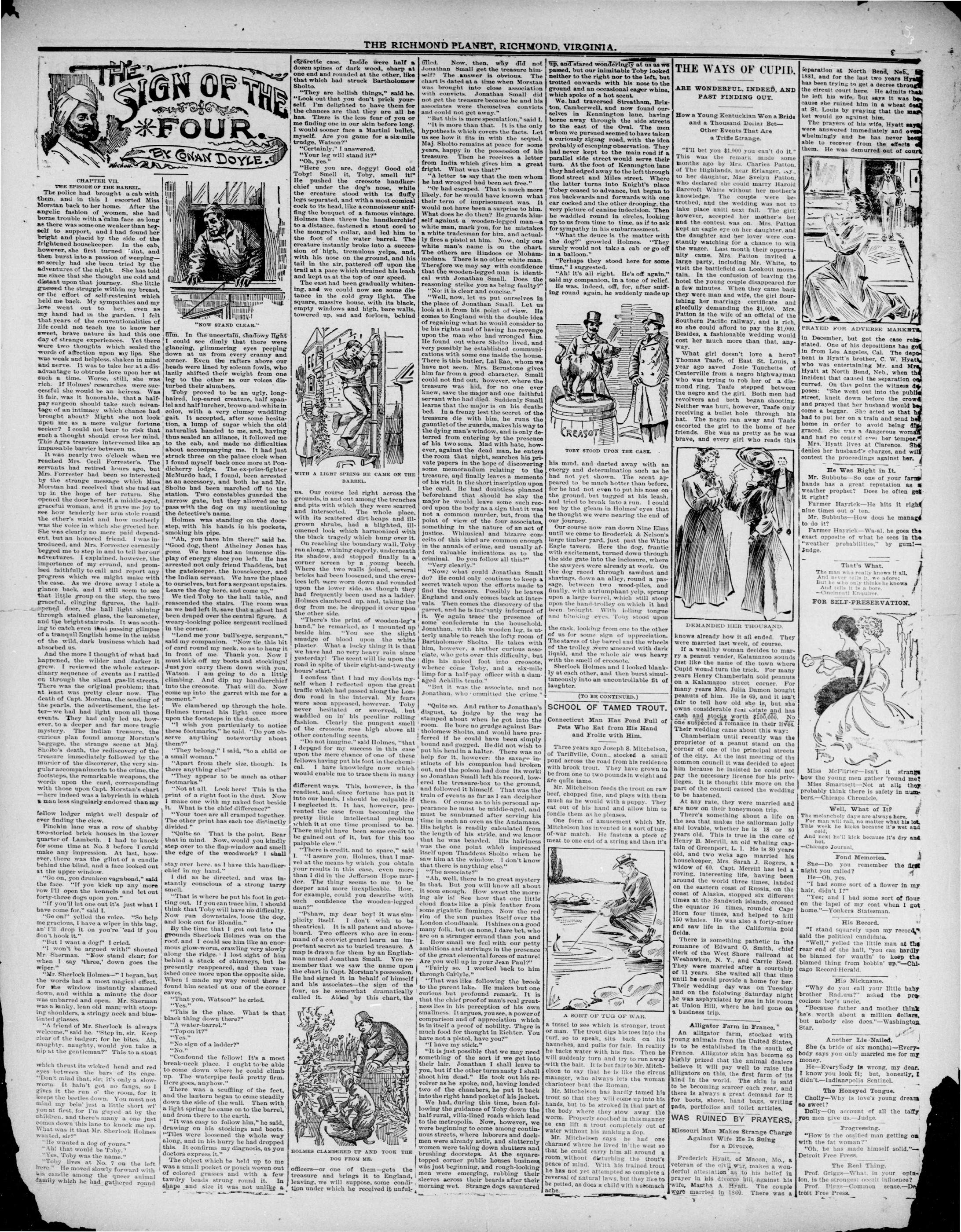
"NOW STAND CLEAR."
film. In the uncertain, shadowy light I could see dimly that there were glancing, glimmering eyes peeping down at us from the creamy and corner. Even the rafters above our heads were lined by solemn fowls, who lazily shifted their weight from one leg to the other as our voices disturbed their slumbers.
Toby proved to be an ugly, long-haired, lop-eared creature, half paniel and half lurcher, brown-and-white in color, with a very clumsy waddling gait. It accepted, after some hesitation, a lump of sugar which the old naturalist handed to me, and, having thus sealed an alliance, it followed me to the cab, and made no difficulties about accompanying me. It had just struck three on the palace clock when I found myself back once more at Pondicherry lodge. The ex-prize-fighter McMurdo had, I found, been arrested as an accessory, and both he and Mr. Sholto had been marched off to the station. Two constables guarded the narrow gate, but they allowed me to pass with the dog on my mentioning the detective's name.
Holmes was standing on the doorstep, with his hands in his pockets, smoking his pipe.
"Ah, you have him there!" said he. "Good dog, then Athelney Jones has gone. We have had an immense display of energy since you left. He has arrested not only friend Thaddeus, but the gatekeeper, the housekeeper, and the Indian servant. We have the place to ourselves, but for a sergeant upstairs. Leave the dog here, and come up."
We tied Toby to the hall table, and reassembled the stairs. The room was as we had left it, save that a sheet had been draped over the central figure. A weary-looking police sergeant reclined in the corner.
"Lend me your bull's-eye, sergeant," said my companion. "Now tie this bit of card round my neck, so as to hang it in front of me. Thank you. Now I must kick off my boots and stockings! Just you carry them down with you. Watson. I am going to do a little climbing. And dip my handkerchief into the creosote. That will do. Now come up into the garret with me for a moment."
We clambered up through the hole. Holmes turned his light once more upon the footsteps in the dust.
"I wish you particularly to notice these footmarks," he said. "Do you observe anything noteworthy about them?"
"They belong," I said, "to a child or a small woman."
"Apart from their size, though. Is there anything else?"
"They appear to be much as other footmarks."
"Not at all. Look here! This is the print of a right foot in the dust. Now I make one with my naked foot beside it. What is the chief difference?"
"Your toes are all cramped together. The other print has each toe distinctly divided."
"Quite so. That is the point. Bear that in mind. Now, would you kindly step over to the flap-window and smell the edge of the woodwork? I shall stay over here, as I have this handkerchief in my hand."
"I did as he directed, and was instantly conscious of a strong tarry smell."
"That is where he put his foot in getting out. If you can trace him, I should think that Toby will have no difficulty. Now run downstairs, loose the dog, and look out for Blondin."
By the time that I got out into the grounds Sherlock Holmes was on the roof, and I could see him like an enormous glow-worm, crawling very slowly along the ridge. I lost sight of him behind a stack of chimneys, but he presently reappeared, and then vanished once more upon the opposite side. When I made my way round there I found him seated at one of the corner enaves,
"That you, Watson?" he cried.
"Yes."
"This is the place. What is that black thing down there?"
"A water-barrel."
"Topon it?"
"Yes."
"No sign of a ladder?"
"No."
"Confound the fellow! It's a most break-neck place. I ought to be able to come down where he could climb up. The waterpipe feels pretty firm. Here goes, anyhow."
There was a scuffling of the feet, and the lantern began to come steadily down the side of the wall. Then with a light spring he came on to the barrel, and from there to the earth.
"It was easy to follow him," he sald, drawing on his stockings and boots. "Tiles were loosened the whole way along, and in his hurry he had dropped this. It confirms my diagnosis, as you doctors express it."
The object which he held up to me was a small pocket or pouch woven out of colored grasses and with a few tawdry beads strung round it. In shape and size it was not unlike a
THE RICHMOND PLANET, RICHMOND, VIRGINIA.
cigarette case. Inside were half a dozen spines of dark wood, sharp at one end and rounded at the other, like that which had struck Bartholomew Sholto.
"They are hellish things," said he. "Look out that you don't prick yourself. I'm delighted to have them for the chances are that they are all he has. There is the less fear of you or me finding one in our skin before long. I would sooner face a Martini bullet, myself. Are you game for a six-mile trudge, Watson?" "Certainly," I answered. "Your leg will stand it?" "Oh, yes."
"Here you are, doggy! Good old Toby! Smell it, Toby, smell it!" He pushed the crescoe handkerchief under the dog's nose, while the creature stood with its fuffy legs separated, and with a most comical cock to its head, like a connoisseur sniffing the bouquet of a famous vintage. Holmes then threw the handkerchief to a distance, fastened a stout cord to the mongrel's collar, and led him to the foot of the water barrel. The creature instantly broke into a succession of high, tremulous yelps, and, with his nose on the ground, and his tail in the air, pattered upon the trail at a pace which strained his leash and kept us at the top of our speed. The east had been gradually whitening, and we could now see some distance in the cold gray light. The square, massive house, with its black, empty windows and high, bare walls, towered up, sad and forlorn, behind
WITH A LIGHT SPRING HE CAME ON THE BARREL.
us. Our course led right across the grounds, in and out among the trenches and pits with which they were scarred and intersected. The whole place, with its scattered dirt heaps and ill-grown shrubs, had a blighted, ill-omened look which harmonized with the black tragedy which hung over it. On reaching the boundary wall, Toby ran along, whining eagerly, underneath its shadow, and stopped finally in a corner screen by a young beech. Where the two walls joined, several bricks had been loosened, and the crevices left were worn down and rounded upon the lower side, as though they had frequently been used as a ladder. Holmes clambered up, and, taking the dog from me, he dropped it over upon the other side.
"There's the print of wooden-leg's hand," he remarked, as I mounted up beside him. "You see the slight smudge of blood upon the white plaster. What a lucky thing it is that we have had no very heavy rain since yesterday! The scent will lie upon the road in spite of their eight-and-twenty hours' start."
I confess that I had my doubts myself when I reflected upon the great traffic which had passed along the London road in the interval. My fears were soon appeased, however. Toby never hesitated or swerved, but waddled in on his peculiar rolling fashion. Clearly the pungent smell of the creosote rose high above all other contending scents.
"Do not imagine," said Holmes, "that I depend for my success in this case upon the mere chance of one of these fellows having put his foot in the chemical. I have knowledge now which would enable me to trace them in many
different ways. This, however, is the readiest, and since fortune has put it into our hands, I should be culpable if I neglected it. It has, however, prevented the case from becoming the pretty little intellectual problem which it at one time promised to be. There might have been some credit to be gained out of it, but for this too palpable clew."
"There is credit, and to spare," said I. "I assure you, Holmes, that I marvel at the means by which you obtain your results in this case, even more than I did in the Jefferson Hope murder. The thing seems to me to be deeper and more inexplicable. How, for example, could you describe with such confidence the wooden-legged man?"
"Pshaw, my dear boy! it was simplicity itself. I don't wish to be theatrical. It is all patent and aboveboard. Two officers who are in command of a convict guard learn an important secret as to buried treasure. A map is drawn for them by an Englishman named Jonathan Small. You remember that we saw the name upon the chart in Capt. Morstan's possession. He had signed it in behalf of himself and his associates—the sign of the four, as he somewhat dramatically called it. Aided by this chart, the
HOLMES CLAMBERED UP AND TOOK THE
DOG FROM ME.
officers—or one of them—gets the treasure and brings it to England, leaving, we will suppose, some condition under which he received it unfulf
filled. Now, then, why did not Jonathan Small get the treasure himself? The answer is obvious. The chart is dated at a time when Morstan was brought into close association with convicts. Jonathan Small did not get the treasure because he and his associates were themselves convicts and could not get away."
"But this is mere speculation," said I. "It is more than that. It is the only hypothesis is which covers the facts. Let us see how it fits in with the sequel. Maj. Sholto remains at peace for some years, happy in the possession of his treasure. Then he receives a letter from India which gives him a great fright. What was that?"
"A letter to say that the men whom he had wronged had been set free."
"Or had escaped. That is much more likely, for he would have known what their term of imprisonment was. It would not have been a surprise to him. What does he do then? He guards himself against a wooden-legged man—a white man, mark you, for he mistakes a white tradesman for him, and actually fires a pistol at him. Now, only one white man's name is on the chart. The others are Hindoos or Mohammedans. There is no other white man. Therefore we may say with confidence that the wooden-legged man is identical with Jonathan Small. Does the reasoning strike you as being faulty?" "No; it is clear and concise."
"Well, now let us put ourselves in the place of Jonathan Small. Let us look at it from his point of view. He comes to England with the double idea of regaining what he would consider to be his rights and of having his revenge upon the man who had wronged him. He found out where Sholto lived, and very possibly he established communications with some one inside the house. There is this butler, Lal Rao, whom we have not seen. Mrs. Bernstone gives him far from a good character. Small could not find out, however, where the treasure was hid, for no one ever knew, save the major and one faithful servant who had died. Suddenly Small learns that the major is on his deathbed. In a frenzy lest the secret of the treasure die with him, he runs the gaudiette of the guards, makes his way to the dying man's window, and is only determined from entering by the presence of his two sons. Mad with hate, however, against the dead man, he enters the room that night, searches his private papers in the hope of discovering some memorandum relating to the treasure, and finally leaves a memento of his visit in the short inscription upon the card. He had doubtless planned beforehand that should he slay the major he would leave some such record upon the body as a sign that he was not a common murder, but, from the point of view of the four associates, something in the nature of an act of justice. Whimsical and bizarre conceits of this kind are common enough in the annals of crime, and usually afford valuable indications as to the criminal. Do you follow all this?"
"Now; what could Jonathan Small do? He could only continue to keep a secret watch upon the efforts made to find the treasure. Possibly he leaves England and only comes back at intervals. Then comes the discovery of the garret, and he is instantly informed of it. We again trace the presence of some confederate in the household. Jonathan, with his wooden leg, is utterly unable to reach the lofty room of Bartholomew Sholto. He takes with him, however, a rather curious associate, who gets over this difficulty, but dips his naked foot into creosote, whence come Toby, and a six-mile limp for a half-pay officer with a damaged Achillis tendo."
"But it was the associate, and not Jonathan, who committed the crime."
"Quite so. And rather to Jonathan's disgust, to judge by the way he stamped about when he got into the room. He bore no grudge against Bartholomew Sholto, and would have preferred if he could have been simply bound and gagged. He did not wish to put his head in a halter. There was no help for it, however; the savage instincts of his companion had broken out, and the poison had done its work: so Jonathan Small left his record, lowered the treasure-box to the ground, and followed it himself. That was the train of events as far as I can decipher them. Of course as to his personal appearance he must be middle-aged, and must be sunburned after serving his time in such an oven as the Andamans. His height is readily calculated from the length of his stride, and we know that he was bearded. His hairiness was the one point which impressed itself upon Thaddeus Sholto when he saw him at the window. I don't know that there is anything else."
"Ah, well, there is no great mystery in that. But you will know all about it soon enough. How sweet the morning air is! See how that one little cloud floats like a pink feather from some gigantic flamingo. Now the red rim of the sun pushes itself over the London cloudbank. It shines on a good many folk, but on none, I dare bet, who are on a stranger errand than you and I. How small we feel with our petty ambitions and strivings in the presence of the great elemental forces of nature! Are you well up in your Jean Paul?" "Fairly so. I worked back to him through Carlyle." "That was like following the brook to the parent lake. He makes but one curious but profound remark. It is that the chief proof of man's real greatness lies in his perception of his own smallness. It argues, you see, a power of comparison and of appreciation which is in itself a proof of nobility. There is much food for thought in Richter. You have not a pistol, have you?"
"It is just possible that we may need something of the sort if we get into their hair. Jonathan I shall leave to you, but if the other turns nasty I shall shoot him dead." He took out his revolver as he spoke, and, having loaded two of the chambers, he put it back into the right hand pocket of his jacket. We had, during this time, been following the guidance of Toby down the half rural, villa-lined roads which lead to the metropolis. Now, however, we were beginning to come among continuous streets, where laborers and dockmen were already astir, and slatternly women were taking down shutters and brushing doorsteps. At the square-topped corner public houses business was just beginning, and rough-looking men were emerging, rubbing their sleeves across their beards after their morning wet. Strange dogs sauntered
Up, and stared wonderingly at us as we passed, but our inimitable Toby looked neither to the right nor to the left, but trotted onwards with his nose to the ground and an occasional eager whine, which spoke of a hot scent. We had traversed Streatham, Brixton, Camberwell, and now found ourselves in Kennington lane, having borne away through the side streets to the east of the Oval. The men whom we pursued seemed to have taken a curiously zigzag road, with the idea probably of escaping observation. They had never kept to the main road if a parallel side street would serve their turn. At the foot of Kennington lane they had edged away to the left through Bond street and Miles street. Where the latter turns into Knight's place Tobey ceased to advance, but began to run backwards and forwards with one ear cocked and the other drooping, the very picture of canine indecision. Then he waddled round in circles, looking up to us from time to time, as if to ask for sympathy in his embarrassment.
"What the deuce is the matter with the dog?" growled Holmes. "They surely would not take a cab or go off in a balloon." "Perhaps they stood here for some time," I suggested. "Ah! it's all right. He's off again." said my companion, in a tone of relief. He was, indeed, off, for, after sniffing round again, he suddenly made up
CREASOTE
TOBY STOOD UPON THE CASK
his mind, and darted away with an energy and determination such as he had not yet shown. The scent appeared to be much hotter than before, for he had not even to put his nose on the ground, but tagged at his leash, and tried to break into a run. I could see by the gleam in Holmes' eyes that he thought we were nearing the end of our journey.
Our course now ran down Nine Elms until we came to Broderick & Nelson's large timber yard, just past the White Eagle tavern. Here the dog, frantic with excitement, turned down through the side gate into the enclosure, where the sawyers were already at work. On the dog raced through sawdust and shavings, down an alley, round a passage, between two wood-piles, and finally, with a triumphant yelp, sprang upon a large barrel, which still stoop upon the hand-trolley on which it had been brought. With lolling tongue and blushing eyes. Toby stood upon
the cask, looking from one to the other of us for some sign of appreciation. The staves of the barrel and the wheels of the trolley were saneed with dark liquid, and the whole air was heavy with the smell of creosote. Sherlock Holmes and I looked blankly at each other, and then burst simultaneously into an uncontrollable fit of laughter.
Three years ago Joseph S. Mitchelson, of Tariffville, Conn., stocked a small pond across the road from his residence with brook trout. They have grown to be from one to two pounds in weight and are quite tame.
Mr. Mitchelson feeds the trout on raw beef, chopped fine, and plays with them much as he would with a puppy. They eat out of his hand and allow him to fondle them as he pleases.
One form of amusement which Mr. Mitchelson has invented is a sort of tug-of-war match. He fastens a piece of meat to one end of a string and then its
A SORT OF TUG OF WAR
a tussel to see which is stronger, trout or man. The trout digs his toes into the turf, so to speak, sits back on his haunches, and pulls for fair. In reality he backs water with his fins. Then he will suddenly turn and try to run away with the bait. It is but fair for Mr. Mitchelson to say that he is like the circus manager, who always lets the woman charioteer beat the Roman. Mr. Mitchelson has hardly tamed his trout so that they will come up into his hands, but to be stroked in that part of the body where they stow away the worm. Properly soothed in this manner we can lift a trout completely out of water without his making a flop. Mr. Mitchelson says he had one charmed where he lived in the west so that he could carry him all around a room without disturbing the trout's peace of mind. With his trained trout he has not yet attempted so complete a reversal of natural laws, but they like to be petted, as does a child with a stomach ache.
---
THE WAYS OF CUPID
ARE WONDERFUL, INDEED, AND
PAST FINDING OUT.
How a Young Kentuckian Won a Bride and a Thousand Dollar Bet— Other Events That Are a Trifle Strange.
"I'll bet you $1,000 you can't do it." This was the remark made some months ago by Mrs. Charles Patton, of The Highlands, near Erlanger, as, to her daughter, Mae Svelyn Patton, who declared she could marry Harold Barcroft White without her mother's knowledge. The couple were betrothed, and the wedding was not to take place until next fall. The girl, however, accepted her mother's bet and the contest was on. Mrs. Patton kept an eagle eye on her daughter, and the daughter and her lover were constantly watching for a chance to win the wager. Last month their opportunity came. Mrs. Patton invited a large party, including Mr. White, to visit the battlefield on Lookout mountain. In the confusion of leaving the hotel the young couple disappeared for a few minutes. When they came back they were man and wife, the girl flourishing her marriage certificate and gleefully demanding the $1,000. Mrs. Patton is the wife of an official of the Southern Pacific railway, and is rich, so she could afford to pay the $1,000. Besides, a fashionable wedding would cost her much more than that, anyway.
What girl doesn't love a hero? Thomas Taafe, of East St. Louis, a year ago saved Josie Touchette of Centerville from a negro highwayman who was trying to rob her of a diamond ring. Taafe stepped between the negro and the girl. Both men had revolvers and both began shooting. Neither was hurt, however. Taafe only receiving a bullet hole through his hat. The negro ran away and Taafe escorted the girl to the home of her friends. She was as pretty as he was brave, and every girl who reads this
A
DEMANDED HER THOUSAND.
knows already how it all ended. They
were married last week, of course.
If a wealthy woman decides to marry a peanut vender, Kalamazoo sounds just like the name of the town where Cupid wound turn the trick. For many years Henry Chamberlain sold peanuts on a Kalamazoo street corner. For many years Mrs. Julia Damon bought peanuts of him. He is 69, and it isn't fair to tell how old she is, but she owns considerable real estate and has cash and stocks worth $100,000. No one suspected a romance in their lives. Their wedding came about this way: Chamberlain until recently was the proprietor of a peanut stand on the corner of one of the principal streets of the city. At the last meeting of the common council it was decided to eject him because he insisted he could not pay the necessary license for his privileges. It is thought this move on the part of the council caused the wedding to be hastened. At any rate, they were married and are now on their honeymoon trip.
There's something about a life on the sea that makes the salliman jolly and lovable, whether he is 18 or 80 years old. This is true in the case of Henry B. Merrill, an old whaling captain of Greenport, L. I. He is 80 years old, and two weks ago married his housekeeper, Mrs. Sarah J. Rogers, a widow of 60. Capt. Merrill has led a roving, interesting life, having been around the world three times, landed on the eastern coast of Russia, on the coast of Alaska, stopped six different times at the Sandwich islands, crossed the equator 16 times, rounded Cape Horn four times, and helped to kill 150 whales. He was also a forty-niner and saw life in the California gold fields.
There is something pathetic in the romance of Edward O. Smith, chief clerk of the West Shore railroad at Weahwainh, N. Y., and Carrie Reed. They were married after a courtship of 11 years. She waited all that time until he could provide a home for her. Their wedding day was on Tuesday and on the following Saturday night he was asphyxiated by gas in his room at Union Hill, where he had gone on a business trip.
Alligator Farm in France
An alligator farm, stocked with young animals from the United States, is to be established in the south of France. Alligator skin has become so highly prized that the animal dealers believe it will pay well to raise the alligators on this, the first farm of its kind in the world. The skin is said to be becoming scarcer each year, and there is always a great demand for it for boots, shoes, hand bags, writing pads, portfolios and toilet articles.
WAS RUINED BY PRAYERS.
Frederick Hyatt, of Macon, Mo., a veteran of the civil war, makes a wonderful attestation as to his belief in prayer in his divorce bill against his wife, Martha A. Hyatt. The couple were married in 1860. There was a
separation at North Bend, Neb., 1881, and for the last two years Hyatt has been trying to get a decree through the circuit court here. He admits that he left his wife, but says it was because she ruined him in a wheat deal at St. Louis by praying that the market would go against him. The prayers of his wife, Hyatt says were answered immediately and overwhelmingly and he has never been able to recover from the effects them. He was demurred out of court
PRAYED FOR ADVERSE MARKETS
in December, but got the case reinstated. One of his depositions has got in from Los Angeles, Cal. The deponent is Hyatt's brother, C. W. Hyatt who was entertaining Mr. and Mrs. Hyatt at North Bend, Neb., when the incident that caused the separation occurred. On this point the witness deposes: "She went out into the public street, knelt down before the crowd and prayed that her husband would become a beggar. She acted so that he had to put her on a train and send her home in order to avoid being disgraced. She was a dangerous woman and had no control over her temper. Mrs. Hyatt lives at Clarence. She denies her husband's charges, and will contest the proceedings against her.
He Was Right in It
Mr. Subbubs—So one of your farm hands has a great reputation as a weather prophet? Does he often get it right?
Farmer Hayrick—He hits it right nine times out o' ten.
Mr. Subbubs—How does he manage to do it?
Farmer Hayrick—Wa-al, he goes the exact opposite of what he sees in the "weather probabilities," by gum!—Judge.
That's What.
The man who really knows it all,
And never tells it, we adore;
But he who only thinks he knows
And tells it is a bore.
—Cincinnati Enquirer.
FOR SELF-PRESERVATION.
F. X.
Miss McFlirter—Isn't it strange how the young men gather 'round me! Miss Smartsett—Not at all; they probably think there is safety in numbers—Chicago Chronicle.
Well. What of It?
For man will rish, no matter what it wet and
this wet he kicks because it’s wet and
this wet
And next he'll kick because it's dry and hot.
Sne—Do you remember the first night you called?
He—Oh, yes.
"I had some sort of a flower in my hair, didn't I?"
"Yes; and I had some sort of flour on the lapel of my coat when I got home."—Yonkers Statesman.
His Record.
"I stand squarely upon my record said the political candidate. "Well," yelled the little man at the rear end of the hall, "you can hardly be blamed for wantin' to keep the blamed thing from bobbin' up."—Chicago Record-Herald.
His Nickname
"Why do you call your little baby brother Rad.um?" asked the precocious boy's uncle.
"Because father and mother think he's worth about a million dollars, but nobody else does."—Washington Star.
She (a bride of six months)—Everybody says you only married me for my money.
He—Everybody is wrong, my dear.
I know you look it; but, honestly, I didn't—Indianapolis Sentinel.
The Honeyed Tongue.
Cholly—Why is love's young dream so sweet?
Dolly—On account of all the taffy you men give us.—Judge.
Progressing.
"How is the ossified man getting on with the fat woman?"
"Oh, he has made himself solid."—Detroit Free Press.
The Real Thing.
Prof. Griggs—What, in your opinion, is the strongest occult influence?
Prof. Diggs—Common sense.—Detroit Free Press.
THE PLANET
Published every Saturday by JOHN A. COX
at 111 North 4th Street Richmond Va.
BARN MITCHELL, JR., - EDITOR
Communications intended for publication
should be sent so as to reach us by Wednesday
Copy one year,
Copy six months,
Copy six months,
Copy four months,
Copy three months,
Copy
one inch, one insertion, $ 8
one inch, each subsequent insertion, 22
two inches, two widths, 16
two inches, six months, 20.00
two inches, nine months, 14.00
two inches, two to three months, 30.00
two inches, three to four months, 30.00
standing and Transit Notices per line
standing and Transit Notices per line
POSTAGE STAMPS OF A HIGHER DEPARTMENT THAN TWO CENTS NOT RECEIVED ON SUBSCRIPTIONS
PLANT is issued weekly. The subscriber price is $1.30 a year, in advance. The money can be by mail at our risk—if a Post Office Money Order, by Bank Check or Draft, or an Exempt Money Order and when none of these Money Orders are Registered Letter.
MONEY ORDERS—Voucher for your Money Ora your Post Office, payable at the Richmond Office, and we will be responsible for it at arrival.
MONEY ORDERS can be ocamed at office of the American Express, United States Express Co. and the West Fargo and Oasis Express Company. We will be reimbursing you for the costs. The Express Money Order is a convenient way for forwarding money.
REGISTERED LETTER—If a Money Order
you reach, your Postmaster will register
the order you wish to send us on payment of
the money. Then, if the letter is lost or stolen,
you can car send money in the
matter at our risk.
We cannot be responsible for money sent in
letters in any other way than one of the four
mail carriers above. If you send your money
in any other way, you must do it at your
risk.
WELCOME. TO—if you do not want T
reasurer continued for another year after you
reached, you should give your name and a
card to discontinue it. The courts have
added that other jobs to newspapers who
hold other papers, be continued in the exp
of the payment for the payment of the subscrip
tion to date when they order the paper disco
scription.
COMMUNICA.—When writing to
your subscription or to discontinue
paper, you should give your name and a
otherwise we cannot send you.
MAKER OF ADDRESS—In order to en-
sure that no one else, we must be
formerly well us the present address.
Interested in the Post Office
SATURDAY . . . JULY 30, 1904
TWENTY-EIGHT white bricklayers went out on a strike at WASHINGTON, D. C., July 19th, 1904, because a colored bricklayer, named GEORGE TAYLOR was given work there under the Civil Service rules.
The direct cause of the strike was the color and race of the non-union worker. It is another effort to force to an issue the "open shop" question as applicable to the government.
President ROOSEvelt has already ruled upon this matter and it remains to be seen whether the government shall bow to the labor-union or the laborunion to the government.
The work on the WASHINGTON Barracks has been practically suspended as TAYLOR was the only brick-layer who was laying bricks on the job.
It seems that organized labor is disposed to be unfriendly to the mechanics of color.
26,000 OPERATIVES OUT
Textfile Mills at Fall River, Mass,
Closed Down.
Fall River, Mass., July 26.—The first day of the strike of 26,000 cotton mill operatives here passed quietly, and so, in all probability, will pass the succeeding days, for the reason that the opposition to the strike on the part of operatives is so slight as to be hardly a feature. The cause of the strike is a 12% per cent reduction in wages.
A summary of the strike is as follows: Textile operatives idle, 26,000; mills closed, 37; weekly wage loss, 1170,000; wage reduction, 12% per cent; spindles idle, 2,300,000.
The mill owners and their operatives are determined in their positions, and the outcome is hard to predict. With the strikers it is a question of how long they can do without their wages and exist on strike benefits. On the part of the owners it is a matter of how long they can afford to have their mills closed down. At present the cotton and cloth markets are not at their best.
Two Men Horribly Mangled By Train.
New Martinsville, W. Va., July 25.
Two men were killed and one seriously wounded by the Pittsburg excursion train at Paddens Crossing, near here.
Ned Harrington, Charles Longwell and Newton Kemp went to Sistersville and drank heavily. When they reached Paddens they stopped off, missing the last traction car. They went to sleep on the Ohio River railroad tracks. A farmer found Kemp in a field where he had been knocked by the train, so badly injured that he could not walk.
The books of the other two men were so horribly mangled that it was impossible.
Fought Duel With Kalute
Fought Duel With Knives.
Richmond, Va., July 27.—Two men, one named Shepherd, the other Lankford, fought a duel with knives at Blue Creek, Mecklenburg county.
Lankford was killed in the fight and Shepherd died later from wounds received in the encounter. The quarrel was over a woman.
JAPS OCCUPY
NEWCHWANG
Russians Retreat From Ta Tche
Kiao to Haicheng.
Kuropatkin's Line Threatened By Japs' Advance From Saimatsze—Fighting Reported Above Liao Yang — Two More British Ships Captured.
Tien Tsin, July 27.—It is reported here that the Japanese lost 380 men in killed and wounded in the fighting which has taken place outside of Newchwang during the last two days. The Russian losses during the engagements are not known. A small detachment of Japanese scouts entered Newchwang Monday night. About 200 troops arrived there later, and more are expected. Crowds of Russian refugees were awaiting trains at Yinkow, near Newchwang, to take them away.
The Chinese flag is flying over the custom house at Newchwang. It is reported that the Japanese took the Russian position at Ta Tche Klao on Monday night at the point of the bayonet.
It is reported here that heavy fight ing has occurred between Liao Yang and Mukden.
RUSSIANS FORCED TO RETREAT
Ta Tche Kiao Rendered Untenable After Desperate Battle.
London, July 26. — Cabling under date of July 24, the Daily Mail's Newchwang correspondent describes a 14-hours' desperate battle, with heavy losses on both sides, and which resulted in the Russian position at Ta Tche Kino being rendered untenable, by reason of which they will be compelled to retreat towards Halcheng.
"The battle began at 6 o'clock in the morning," the correspondent says, "the Russians resuming the attack, on the Japanese position on the heights east of Ta Tche Kiao. After a few hours the Japanese left flank from Taping mountain captured the village of Tanghudituen, compelling the Russians to retreat to Tlengghuaituen, six miles from their base.
"The Russians, now reinforced, maintained the position until 5 o'clock in the afternoon, when the Japanese right flank made a sudden appearance on the hills south of Ta Tche Klao and by a tremendous fire forced the Russians to retreat.
"The Japanese firing line extended 15 miles.
"After two more hours of an incessant storm of shot and shell they swept the last hill and the plain clear of Russians."
Russians Admit Evacuation
St. Petersburg, July 27. — General Kuropatkin's telegram recording the withdrawal of the southern army from Ta Tche Klao to Halcheng fails to give details of the continuous rear guard action-preceding the retreat, but the war office thinks the losses were several hundred, which would indicate pretty severe fighting.
General Kuropatkin does not mention the number of troops engaged, but the presence of Generals Saroubaieff and Stakelberg, both corps commanders, shows that the total must have been large, though certainly far inferior to the combined forces of Generals Oku and Nodzu.
The preceding determined attack on Tan Tchi, 10 miles southeast of Ta Tche Kiao, probably rendered the evacuation of the latter place imperative, although the war office has predicted all along that no determined resistance would be made at Ta Tche Kiao. In anticipation of a retirement from Ta Tche Kiao, orders were sent July 25 to the Russian garrison at Yinkow to withdraw.
Although military men do not seem to be alarmed, the southern army from Ta Tche Kiao tends to concentrate Kuropatkin's forces, thus giving him a smaller front to defend, considerable nervousness is manifested here by those not in the secrets of the Russian commander-in-chief, especially as General Kuropatkin points out himself the danger threatening his line to the north owing to the development of the Japanese advance from Salmatzsze toward Mukden. If this column be pushed home and the Japanese cordon should at the same time be tightened from the south and east, General Kuropatkin's danger would be easily conceivable, and consequently there is already talk of his preparing to meet this danger by withdrawing to Mukden and there awaiting further reinforcements.
A rumor is current here that General Samsonoff was severely wounded during the fighting at Ta Tche Kiao.
Heavy Fighting at Port Arthur.
Chefoo, July 27.—A junk bringing Chinese refugees from Port Arthur has just arrived here. The Chinese report that when they left Port Arthur, July 22, heavy fighting was going on both on land and sea. They were unable to give details. They report that the Japanese have heavily fortified San Chinpo hill.
MORE SHIPS CAPTURED
Formosa Selized In Red Sea and the Calchas Off Japanese Coast.
Calebhas Off Japanese Coast.
Suez, July 27.—The Peninsular and Oriental steamship Formosa has just arrived here flying the Russian naval flag and with a prize crew on board.
She was captured in the Red Sea by one of the vessels of the Russian volunteer fleet. She is said to have on board the Red Sea pilots who have been on the Smolensk and St. Petersburg, as well as the Ardova's crew.
The Russian consul is awaiting instructions for the release of the Formosa.
The Calchas ized.
Liverpool, July 27.—The owners of the British steamer Calchas, bound from Puget Sound to Japan, have received a telegram from Hong Kong re-
THE RICHMOND PLANET, RICHMOND, VIRGINIA
porting that the Calchas has been seized by the Vladivostok squadron.
Formosa to Be Released:
St. Petersburg, July 27.—it is considered certain here that the Peninsular and Oriental Steamship Company's steamer Formosa was seized by the volunteer fleet steamer Smolensk before the receipt of instructions from St. Petersburg. It is expected that the vessel will be immediately released under the agreement entered into between Russia and Great Britain.
BRITISH STEAMER SUNK
The Knight Commander Sent to the
Bottom By the Wizardian Flies
Bottom By The Vladivostok Fleet.
Yokohama, July 26.—The Vladivostok squadron sunk the British steamer Knight Commander, from New York, off the province of Izu, after transferring the crew of the Knight Commander to the steamer Tsihan, which arrived here.
The Vladivostok squadron also captured a German vessel believed to be the Arabia, with 30,000 sacks of flour, and an unknown British steamer. The two vessels were sent to Vladivostok in charge of prize crews. The American Trading Company are the agents here for the Knight Commander.
Sailed From New York.
New York, July 26.—The steamer Knight Commander sailed from New York May 6 with a large cargo, bound for the Orient. A large portion of the cargo was consigned to Singapore, Manila and Shanghai, but she also carried merchandise, machinery and other articles for Japanese ports. According to reports received at the office of the local agents of the Knight Commander's owners, the steamer already had visited the three former ports and discharged a portion of her cargo when she was seized by the Russians. Although it was impossible to secure a full copy of the manifest showing the steamer's entire cargo, it was learned that the Japanese consignment included 750 steel plates, 400 steel rails and quantities of iron work for railroad bridge construction. The machinery was consigned to an electrical concern at Kobe.
At the local offices of the steamship company it was said that the Russians, upon overhauling the Knight Commander, evidently considered her cargo, or at least a portion of it, as contraband, and seized her with the intention of taking her to a Russian port. Then, finding her too slow to accompany their fleet they decided to destroy her.
A brief cablegram was received from Captain Durant, the commander of the steamer. The cablegram read as follows: "Steamer destroyed; crew saved."
The Knight Commander was valued at about $105,000, and the value of her cargo is estimated at $120,000. She was owned by Greenshields & Co., of Liverpool.
The Ardova Released
Suez, July 26.—The British steamer Ardova, which was seized by the Russian volunteer fleet steamer Smolenski, has been released and her prize crew has been landed.
MINERS MAY STRIKE
Cconciliation Board Fails to Adjust Grievances at Coxe Brothers & Co.
Wilkesbarre, Pa., July 27.—The decision of the Coxe Brothers & Co. mine workers to go on strike unless the conciliation board adjusted their grievances resulted in Superintendent Kullick being present at the meeting. He took up several hours in stating the company's side of the controversy, claiming that the men were discharged because they violated a well-known rule of the company.
As no decision was rendered by the conciliation board at the session, it is believed by those interested that a strike will occur. The miners' representatives on the board will make no statement in regard to the matter.
Other grievances were taken up during the afternoon, but their nature could not be learned. It is probable, however, that the check weighmen question was discussed.
The check weighman question was also taken up, the representatives of the operators insisting that the matter should come before the conciliation board, and the representatives of the miners contending that the whole question had been settled by the decision of Carroll D. Wright. A serious hitch developed, and it is stated that the representatives of the operators demanded a vote on the proposition to submit the matter to the board. A ballot was taken, but the miners refused to vote. When the meeting adjourned, it is understood no time or place was agreed upon for another meeting. Both sides are reticent as to the possible outcome of the hitch.
Trenton, N. J., July 27. — "Devil's Rock," a huge boulder in the Delaware river in the rear of the State House, was blown up by dynamite in the presence of a large crowd of people. The fuse was ignited by electricity. The rock formed an eddy in the river which has caused the drowning of 16 persons within the past few years. The destruction was brought about by a popular demand, and Mayor Katzenbach turned on the electric current that ignited the dynamite.
Parker's Notification August 10
Esopus, N. Y., July 25.—Judge Alton B. Parker telegraphed to Congressman Champ Clark, chairman of the notification committee, requesting him to fix the notification for Wednesday, August 10, at Rosemont. Congressman Clark is chairman by virtue of having been permanent chairman of the convention.
Rioters Sent to Jail.
Danville, Va., July 26.—R. J. Lynch and Whit Meyers, ringleaders in the riot of Wednesday morning, were tried in the mayor's court. Lynch was fined $50 and sentenced to 60 days in jail for participation in the riot, and was fined $50 additional for assaulting an officer. Meyers was fined $50 and sentenced to 60 days in jail. Both men noted an appeal. The testimony in both cases was principally that of the
officers who defended the jail from attack. Bud and Charles Pruitt, against whom indictments are pending, were arrested during the day.
TAGGART ELECTED NATIONAL CHAIRMAN
Indiana Democrat Chosen Despite Strong Opposition.
WILL APPOINT COMMITTEES
New York, July 27. — Expectations were fulfilled when Thomas Taggart, of Indiana, was elected chairman of the Democratic National committee. Endorsed by nearly every member of the committee the day after the convention adjourned at St. Louis, it has been known ever since that only the decree of Judge Parker in favor of some other man or the consent of Senator Gorman to accept the place could prevent the selection of Taggart. Neither of these contingencies arose, and the Indiana man was unanimously chosen to a place for which he long has had aspirations.
Although the vote was unanimous, it was not until after it was actually in progress that opposition to Mr. Taggart's selection was withdrawn. Beginning with the return of Senator Gorman, former Senator Hill, former Senator Jones and other Democratic leaders from Esopus and lasting up to the moment when the committee was called to order, the strongest possible effort was made to bring Senator Gorman into the field or to arrange a combination that would place some one besides Taggart at the head of the committee. Almost continuous conferences were held, intimations of great financial advantages to the party were made, and many expedients were suggested, even to delaying the election until after the committee visited Judge Parker today, in order to defeat Taggart. But nothing would change the determination of his friends to force an election and to compel a show of strength. Failing to secure the necessary conditions to defeat Taggart, the opposition yielded and the proceedings of the committee were brief and harmonious.
Urey Woodson, of Kentucky, was elected secretary of the committee. Edwin Sefton, of the District of Columbia, was made assistant secretary. John L. Martin, of Missouri, was elected sergeant-at-arms, and Samuel Donelson, of Tennessee, assistant sergeant-at-arms. The most important action of the committee, aside from the selection of a chairman, was that of arranging for a committee or committees to manage the campaign. A proposition submitted by William F. Shechan, slightly modified upon the suggestion of Senator Bailey, was adopted. As agreed to, it is as follows:
"That the chair be authorized to appoint two vice chairmen, as his judgment may determine; that the chair be authorized to appoint an executive committee of not less than five, nor more than seven members; that the chair be authorized to appoint a finance committee of not less than three, nor more than five members, and if in the judgment of the chair these two committees should be amalgamated into an executive committee, then the executive committee shall be composed of seven members; that if at any time the exigencies of the campaign should, in the judgment of the executive committee and the chairman of the national committee, require it, or if it becomes advisable to increase the number, that they may select additional members, not more than one from any one state as members of said executive committee; that in conformity with a resolution adopted by the last Democratic national convention the members of the said executive and finance committees may be selected from the outside membership of the national committee."
The plans of Chairman Taggart for the next few days include the trip to Esopus today, returning to New York this evening. He expects to spend tomorrow in this city, consulting with a number of prominent Democrats regarding the composition of the committees he is authorized to appoint. Tomorrow evening or Friday he will leave for Indiana, but will return almost immediately, announce the committees, establish headquarters and enter upon active campaign work.
REAR ADMIRAL TAYLOR DEAD
Naval Hero Dies of Peritonitis at Sudbury, Ont.
Sudbury, Ont., July 21—Rear Admiral H. C. Taylor, of the, United
G
BEAR ADMIRAL HENRY C. TAYLOR
States navy, who commanded the Indiana at the battle of Santiago, died at Copper Cliff General Hospital of peritonitis.
Admiral Taylor arrived at Sudbury July 16 on a visit to his son, Roger Taylor. The admiral, who took suddenly ill at the Balmoral hotel, was removed to Copper Cliff by special train last Wednesday and a specialist called from Montreal. The admiral's condition improved somewhat up to yesterday, when the case presented a more serious aspect.
A WEEK'S NEWS CONDENSED
Twenty persons were injured in a crash between a work car and a trolley car at Hempstead, L. I.
King Edward has conferred the Victoria Cross upon Captain Matthews, of Sir Thomas Lipton's yacht Erin.
The Topeka, Kan., pension agency is the largest in the United States, having 115,620 pensioners enrolled, who drew $16,294,221 last year.
J. Marbourg Keedy, a New York attorney, formerly of Hagerstown, Md., has been appointed prosecuting attorney for the Panama Canal zone.
Friday, July 22.
Joseph W. Folk, circuit attorney of St. Louis, was nominated for governor of Missouri by the Democrats.
Mrs. Henry George, widow of the late political economist, died at her home at Monticello, N. Y., aged 65 years.
While hurrying to work at Carlisle, Pa., Mrs. Viola Nixdorf fell under a freight train and had both legs cut off.
Joseph Weber, of Richmond, Va., was killed at Kingston, N. Y., by falling from a bridge, a distance of 150 feet.
By falling down an elevator shaft in the Mutual Reserve building, New York city, William B. Cunningham, an importer, living at Upper Montclair, N. J., was instantly killed.
Saturday, July 23.
Rosa Hill, aged 11, of Laurel, Del., stepped on a piece of glass, cutting off the big toe of her left foot and nearly bled to death.
A passenger train on the B. & O. Railroad was wrecked at North Vernon, Ind. The fireman was killed and four passengers injured.
While 15 workmen were standing on the tracks of the Trenton cut-off railroad, near Norristown, Pa., a train backed into them, killing two
The notification of Henry G. Davis, vice president nominee of the Democratic party, will take place at his West Virginia home in August. Edward Schemp, aged 8, was burned to death and his parents and three brothers severely burned in a fire that destroyed their home at Chicago. Monday, July 25. In a rear-end collision on the Chicago Elevated Railroad 20 persons were injured, several seriously.
The Ancient Order of Hibernians decided to hold its next biennial convention at Saratoga Springs, N. Y., the third Tuesday in July, 1906.
James Kain, 83 years old, the oldest telegraph operator on the Erie railroad, is dead at Painted Post, N. Y., after 55 years' continuous service.
Tuesday, July 26.
W. J. Bryan says he cannot attend the notification of Judge Parker at Esopus, N. Y., because his time is all taken up.
It is reported that Paul Kruger, late president of the Transvaal, left a fortune of $5,000,000, mostly in European securities.
Admiral Cooper, who has been relieved of his command on the Aslatic station, has arrived in San Francisco on sick leave.
Gotlieb Elsesser, for 40 years an employee of the Pennsylvania railroad, was killed at York, Pa. by stepping in front of an engine.
Leo Jakobi, the wealthy proprietor of the Auto Supply company and vice president of a Philadelphia woollen manufactory, while melancholy from illness committed suicide by shooting in New York.
Wednesday, July 27.
Twenty-four bookmakers were indicted at Chicago and steps taken to stop all gambling at the race tracks.
The West Virginia legislature met in special session to consider tax reform bills agreed on by Republican leaders.
The regular bi-national convention of the National Republican League will be held at Indianapolis October 5 and 6.
Colonel D. R. Anthony, the noted Kansas editor, and brother of Miss Susan B. Anthony, died at Leavenworth, Kan.
The annual convention of the United States League of Building and Loan Associations was held at Sault Ste. Marie, Mich.
DAVIS DENIES WEDDING TALE
Indignant Over Report He Is to Wed
Sweetheart of Famer Dave
Sweetheart of Former Days.
Bedford, Pa., July 27.—Senator Davis emphatically denies the report in the papers that he is to marry the widow of Dr. John Reynolds, of Shepherdstown, W. Va. The senator has been receiving telegrams of congratulation and is very indignant. He says there is not a word of truth in the story.
It could be plainly seen that the senator was very much disturbed by the reports coming from Shepherdstown, W. Va.
Mrs. Reynolds Also Denies Story.
Shepherdstown, W. Va., July 27.—Mrs. Katherine Reynolds made an emphatic denial of the report of her engagement to former Senator Henry G. Davis. She said there was no foundation for the report and was indignant that such false statements were published.
A dream of bliss
"So you are looking forward to a good time this summer?"
"Yes, sir," answered Mr. Cumrox.
"Going out of town?"
"No. I'm going to send mother and the girls out of town. Then I'm going to sit in my shirt sleeves, smoke my pipe in the parlor and hire a street piano to play all the rage-time I want."
—Washington Star
His Explanation
"What'll I do about this explanation of mine?" asked the congressman. "My constituents will expect something of the kind from me." "Follow the usual method," answered the experienced editor. "Make it so long that people will take it for granted rather than try to read it all." —Washington Star.
Hot! Hot! Hot!
"Do You Know Where the Coolest Place in Town Is?" "Yes," at the Reformers' Ste
formers' St
Reformers' Store.
And You will be Served with a Glass of ICED TEA FREE."
PICNIC
Large cans cooked Chicken
Lunch Tongue, 1 pound can
Large box Mustard Sardines
American Sardines, 6 boxes
Baked Beans, 6 cans
Potted Ham and Tongue, 6 cans
Large Cans Salmon, 3 cans
St. Bernard Salmon, 2 cans
Large Jars Pickle, 3 cans
Assorted Preserved, 3 jars
Large cans Dried Beef, 2 cans
Fine Jelly, 6 glasses
Large cans best Lobsters, 1 can
French Peas, can
Large bottle Heinz Pickled Onions
Large cans Apricots, can
Best Lard, pound
Fine Meal, pk
Granulated Sugar, pound
Fine Mixed Tea, pound
Gloss Lump Starch, pound
Large Mackerel, 7 for
Good Luck Powders 1 pound can
Good Luck Powders ½ pound can
Jumbo Vinegar, bottle
Dunlop Flour, sack
Obelisk Flour, sack
Reformers' Store,
MICNIC SUPPLIES
Picked Chicken
1 pound can
Instard Sardines
dines, 6 boxes
6 cans
And Tongue, 6 cans
Salmon, 3 cans
Salmon, 2 cans
Skle, 3 jars
Served, 3 jars
Shed Beef, 2 cans
Glasses
It Lobsters, 1 can
Can
Beinz Pickled Onions
Ricote, can
And
Sugar, pound
Ana, pound
Starch, pound
Starch, 7 for
Wders 1 pound can
Wders ½ pound can
Br, bottle
Sack
Sack
Large cans cooked Chicken
Lunch Tongue, 1 pound can
Large box Mustard Sardines
American Sardines, 6 boxes
Baked Beans, 6 cans
Potted Ham and Tongue, 6 cans
Large Cans Salmon, 3 cans
St. Bernard Salmon, 2 cans
Large Jars Pickle, 3 jars
Assorted Preserved, 3 jars
Large cans Dried Beef, 3 cans
Fine Jelly, 6 glasses
Large cans best Lobsters, 1 can
French Peas, can
Large bottle Heinz Pickled Onions
Large cans Apricots, can
Best Lard, pound
Fine Meal, pk
Granulated Sugar, pound
Fine Mixed Tea, pound
Gloss Lump Starch, pound
Large Mackerel, 7 for
Good Luck Powders 1 pound can
Good Luck Powders ½ pound can
Jumbo Vinegar, bottle
Dunlop Flour, sack
Obelisk Flour, sack
'PHONE 1299. - - RICHMOND, VA.
Chas. Briggs.
, A Supreme Need
A Normal School devoted the ing of Teachers, furni academic and indust professional training will best fit them for
The Institute for Colored You sixty-six years in Philadelphia, Pa. educators of the race as Charles L Jackson Coppin has been reorganize meet what the late Dr. J. L. M. C. the educational work among our per "A professional school which industrial training, kindergarten w life might be inculcated."
The school will begin its op site at Cheyney, Pa., about nineteen P. W. and B. R. R. The grounds and the equipment will be up and the institute has at present an The proximity of Philadelphia vantages. The school is under the pers of the Society of Friends (Qu The corps of instructors will training and experience. The sch institutions, high schools and pers History, the Sciences, English and quired in the first three years of a In addition to the other indust course on the "Useful Applications Teachers may take either the For full information write at on PRO
Supreme Education
Need Met.
I School devoted to the Profession of Teachers, furnishing that correct academic and industrial education, professional training and practical skills best fit them for teaching.
Institute for Colored Youth with a most valuable position Philadelphia, Pa., presided over by such of the race as Charles L. Reason, E. D. Basset, spin has been reorganized under Prof. Hugh M. late Dr. J. L. M. Curry considered the superior work among our people, namely: professional school which should combine teaching, kindergarten work and where better ideas inculcated."
School will begin its operations September 1900.ney, Pa., about nineteen miles from Philadelphia, R. R. The grounds cover 117 acres. The equipment will be up-to-date.
Institute has at present an endowment fund of aboutximity of Philadelphia will afford unusual eduThe school is under the management of a BooSociety of Friends (Quakers) and is undeniensaps of instructors will comprise only teacherexperience. The school is open to graduate high schools and persons who have completeSciences, English and Mathematics equivalentfirst three years of a high school course. on to the other industrial subjects there will be "Useful Applications of Electricity."
may take either the full or an abridged course information write at once to the principal:
, A Supreme Educational Need Met.
A Normal School devoted to the Professional Training of Teachers, furnishing that correlation of academic and industrial education, discipline, professional training and practical skill which will best fit them for teaching.
"A professional school which should combine teacher training, industrial training, kindergarten work and where better ideas of home life might be inculcated."
The school will begin its operations September 1904 at its new site at Cheyney, Pa., about nineteen miles from Philadelphia on the P.W. and B.R.R. The grounds cover 117 acres. The new buildings and the equipment will be up-to-date.
The institute has at present an endowment fund of about $210,000.
The proximity of Philadelphia will afford unusual educational advantages. The school is under the management of a Board of Members of the Society of Friends (Quakers) and is undenominational.
The corps of instructors will comprise only teachers of broad training and experience. The school is open to graduates of higher institutions, high schools and persons who have completed work in History, the Sciences, English and Mathematics equivalent to that required in the first three years of a high school course.
In addition to the other industrial subjects there will be a practical course on the "Useful Applications of Electricity."
JAMES E. McGIRT, Ph. B.
"THE NEW POET."
Editor-in-Chief and Owner of
"McGirt's Magazine."
AGREAT periodical publ
that we may have a pa-
races, the white as well
race may know the many great
race and what they are saying.
Thousands of white, as well as the c
Some of them declare that they have lea-
colored race through this Magazine than
a doubt this periodical is far in advance.
Each month it contains articles from the
are just as sure of making $5.00 per day
sweering this advertisement.
Write at once that you may be the fi-
terns, outfit, and a large number of Mag-
at once. Subscription Price to every
JAMES E. McGIRT,
AT periodical published every month
we may have a paper that will be read
as, the white as well as the colored, that
now the many great men and women of
that they are saying and doing.
of white, as well as the colored, read this Magazine
declare that they have learned more about the great
this Magazine than they ever knew before and
biological is far in advance of anything yet attempted
contains articles from the greatest writers of the re-
of making $5.00 per day selling this Magazine as the
ertisement.
Once that you may be the first in the field. Send 500
and a large number of Magazines, with which you may
description Price to every one is One Dollar Per Yea.
ES E. McGIRT, 420 S. 11th St., P
R SHOES
AGREAT periodical published every month in order that we may have a paper that will be read by both races, the white as well as the colored, that the white race may know the many great men and women of the colored race and what they are saying and doing.
Thousands of white, as well as the colored, read this Magazine every month. Some of them declare that they have learned more about the great men of the colored race through this Magazine than they ever knew before and that without a doubt this periodical is far in advance of anything yet attempted by the Negro. Each month it contains articles from the greatest writers of the race. Agents are just as sure of making $5.00 per day selling this Magazine as they are in answering this advertisement.
Write at once that you may be the first in the field. Send 50c. for agents' terms, outfit, and a large number of Magazines, with which you may begin work at once.
Subscription Price to every one is One Dollar Per Year. Write—
JAMES E. McGIRT. 420 S. 11th St. Phila Pa.
GOOD FOR SHOES
The purchaser of each Pair of Shoes from $1.00 upwards entitles you to a Coupon.
25 Coupons will get you a Pair of our BEST $1.50 SHOES. ALBERT STEIN, Cor. 5th & Broad St. 428 E. Broad St.
ers' Store,
SUPPLIES.
re, 6th and Clay Sts
the Educational Met.
noted to the Professional Train-
furnishing that correlation of
industrial education, discipline,
training and practical skill which
can for teaching.
Ed Youth with a most valuable history of
Pa., presided over by such distinguished
Charles L. Reason, E. D. Bassett and Fanny
organized under Prof. Hugh M. Browne to
M. Curry considered the supreme need in
our people, namely;
which should combine teacher training,
ten work and where better ideas of home
its operations September 1904 at its new
minineteen miles from Philadelphia on the
sounds cover 117 acres. The new build-
eup-to-date.
ent an endowment fund of about $210,000.
Philadelphia will afford unusual educational ada-
dler the management of a Board of Mem-
s (Quakers) and is undenominational.
It will comprise only teachers of broad
the school is open to graduates of higher
persons who have completed work in
math and mathematics equivalent to that re-
of a high school course.
Industrial subjects there will be a practical
tations of Electricity."
for the full or an abridged course.
at at once to the principal:
PROF. HUGH M. BROWNB,
CHEYNEY. P.
McGIRT'S MAGAZINE. $5. Per Day Sure.
Agents are making $5.00 per Day Selling "McGIRT'S MAGAZINE."
published every month in order to a paper that will be read by both as well as the colored, that the white great men and women of the colored paying and doing.
As the colored, read this Magazine every month. Have learned more about the great men of the race than they ever knew before and that without advance of anything yet attempted by the Negro. From the greatest writers of the race. Agents or day selling this Magazine as they are in an- the first in the field. Send 50c. for agents' of Magazines, with which you may begin work every one is One Dollar Per Year. Write—
RT, 420 S. 11th St., Phila Pa.
BOARDING & LODGING.
Rates Reasonable. All the Comforts
of the City.
Orders may be made to the letter or telegraph.
MK. LOUKER LEFTWICH,
PROPRIETRESS.!
S16 N. 2d St.,
Richmond, Va.
M'g'r.
onal
nal Train-
relation of
discipline,
kill which
able history of
distinguished
Bett and Fanny
M. Browne to
preme need in
other training,
ideas of home
004 at its new
epiphia on the
new build-
out $210,000.
educational ado-
board of Mem-
minational.
oers of broad
rates of higher
edited work in
nt to that re-
be a practical
verse.
in order
and by both
at the white
of the colored
me every month.
me men of the
and that without
by the Negro.
race. Agents
they are in an-
00c. for agents'
may begin work
Year. Write—
Phila Pa.
THE PLANET
SATURDAY ..... JULY 30, 1904
THE DAIRY
An Ideal Canadian Scale of Points to Be Used in Determining Quality of the Product.
Miss Bella Millar, in an address before the Women's institute, of Ontario, Can., gave the following as the scale of points to be used in judging butter:
Flavor ..... 45 points
Grain ..... 25 points
Color ..... 15 points
Salt ..... 10 points
Package ..... 8 points
In explaining the scale she said:
"You will notice that flavor gets 45 points, being nearly half the 100 points. We want our butter to have a sweet flavor; that makes us want to eat butter and bread instead of bread and butter.
"Perfect grain gets 25 points. It
should have a waxy softness, yet not salvy or greasy. It must be solid in body, and have no excess of casein or water.
```markdown
```
"The color should be uniform and
bright, not too pale, yet not too highly colored, while the salt should be evenly distributed and thoroughly dissolved. The package should be neat and clean, using a good grade of paper for wrapping. As I said before, we should cater to the trade. If we are making for a certain market, make what that market demands. If making for special customers, endeavor to suit their tastes in every particular. This is important, for, while one customer likes a full-flavored butter, another likes a mild one. One likes the butter pale; another highly colored; one likes very little salt; another quite a quantity. It is by catering to these likes and dislikes that our butter will be in demand, and we shall receive a good price for it."
The little cut shows the appearance of the bacteria—immensely magnified—which produce good flavor in high grade butter.
MILKING WITH WET HANDS.
It Is a Practice Sanctioned by Long Usage, But It Should Be Discontinued.
In milking, the hands do not need to be wet. The habit of wetting them should be abandoned, as it is practically impossible to keep the hands moist without using the foam on the milk as a source of moisture. The milker may imagine that by merely touching his fingers to the top of the foam no injury comes to the milk, but the habit had better be abandoned in the interest of cleanliness. We think however that some of our writers overdraw the matter when they talk of milkers dipping their fingers into the milk. The inference is that the fingers of the milkers reach the solid milk. The writer has never seen a case of this kind. According to the writers referred to, the milkers dip their fingers into the milk and convey to the teats of the cow so much of the milk that the latter drips from the teats into the pail and oozes out from between the fingers in milking. Who ever saw a case of this kind? But even at its best, the habit of moistening the teats with milk is not one that should be perpetuated. If the hands were to be moistened at all, pure water would have to be kept near for that purpose. This is impracticable. Therefore let us put aside the practice of moistening the teats at all and milk with dry hands—Farmers' Review.
Prof. Trigg on Silo.
A progressive dairyman in Minnesota built a silo five years ago and was rated as half-draft by his old-fashioned neighbors. He filled his silo and fed his cows, and was thus able to so far distance these scuffing neighbors of his in the returns he received from the creamery, which they all patronized, that he can now count ten silos on the ten farms adjoining his. It has come to this that where land is worth $80 to $100 per acre, where corn is grown and stock is kept, the silo is just as absolutely indispensable in the economical administration of the farm as the mainspring is to a watch.
This Farmer Was Forgetful
This Farmer Was Forgetful.
The Rice Rustler has the following:
"A story is going the rounds regarding a farmer who is greatly troubled with absent-mindedness. On the way home from town, so the story goes the thought came to him that he had forgotten something. He took out his notebook, went over every item and checked it off. He saw that he had made all the purchases he had intended. But as he drove on he could not put the feeling aside. When he arrived home and drove up to the house his daughter came to meet him, and, with a look of surprise, asked: "Why, where is ma?"
Neat Packing Helps Sales
Appearances count for much in marketing produce. Neatness plays no little part in selling the small things off the farm. We have seen good butter, milk and poultry go begging for custom when placed on sale in a slipshod union alongside of an attractive package of the above-named produce. A little time spent in getting things in shape time saved—not lost. The grocery
man and merchant, in displaying goods for sale, recognize this principle in exhibiting their wares. Why should not the farmer profit by their experience?—Midland Farmer.
BUTTER THAT SELLS CHEAP
In Nine Cases Out of Ten It Is Made from Cream That Has Stood Too Long.
Men that use hand separaters should see to it that the cream is taken to the creameries before it gets too old to be made into good butter, if they are in the habit of taking it to the creameries at all. Some that have been negligent in this matter have been in the habit of waiting two or three days over time and then hauling or sending their cream to the place where it is to be made up into butter. The creamy manager should never take this old cream, but many do it because they say they can sell all their butter at a top price anyway. The result is that this butter goes onto the general market and large quantities of such product are bought up by the cold storage men and put away to be used months after the time when it came into their hands. During this time the bad qualities of the old cream come to the surface, and when the butter is taken out of cold storage, it grades far below what it graded when it went in. Then the commission handlers of this product say that the deterioration is due to the fact that the butter was made from cream skimmed by a hand separator. A great and useful invention is thus blamed for something that would have happened just the same if the farmer had raised his cream by the gravity process. Only in that case the cream would have been made up into butter at home rather than been sent to the creamery and got into the hands of the wholesale handlers of butter. This matter of old cream is one of the chief causes of the farmer's wife getting only a two-thirds price for the butter she makes.—Farmers' Review.
FOOD AND SIZE OF COWS.
Some Valuable Thoughts on an Important Subject Furnished by a British Dairyman.
Good and persistent milking produces milkers and the development of milking qualities, whereas on the contrary if irregularity and neglect is practiced the talents which would develop with use will naturally disappear, even what there is. It is a great mistake to suppose that dairy cows all belong to one breed, says Robert Pethridge. They vary from the Small Kerry of Ireland, the Jersey and Guernsey of the Channel Islands, the hardy Ayrshire of Scotland, the dual-purpose Shorthorn and Devon of the west of England, to the Red Polled Norfolk of the east of England and others, all of which with selection and development produce magnificent dairy cows. It is the character of the food more than anything else that determines the size. As we know, in those districts which do not produce rich and abundant grasses you will not find large cows, and in those districts which do produce the necessary constituents for growth and milk producing, in a few years a small bred animal will become the parent of a large type, and with continuous milking will furnish many good milkers. Select and test your cows and use a bull from a family which has a milk record, and remember that your bull is half your herd.
CALVES MUST HAVE SHADE.
Where Trees Are Not Accessible Shelter Like the One Here Described Should Be Erected.
It is all very well to tie a calf out of doors where he can have a bite of green grass, but a shade spot to lie down in is imperative. The sun beating down upon an unprotected calf greatly retards
EFFECTIVE CALF SHADE
growth. If there is no natural shade at hand, use the device shown in the cut. Two stakes, driven on a slant, support a square frame of wood that is covered with burlap, or any cheap cloth. Tie the calf so he can just reach the shade, but cannot tangle the rope about the stakes. The stakes can be shifted to new ground in a moment when it is necessary to move the calf.—Orange Judd Farmer.
The Scientific Milk Seller
"That milk looks as if it were half water," protested the woman at the kitchen door. "It is much more than that, ma'am," replied the milkman, a college graduate in reduced circumstances. "I guarantee it to be 86 per cent. water, four per cent. butter fat, three and one-half per cent. caseln, and six and one-half per cent. sugar and various salts, the combination resulting in the liquid commonly known as milk. Chemical analysis of the same cheerfully furnished whenever desired. Good morning, me'am."—Chicago Tribune.
Oleo Law Is Constitutional
The United States supreme court has confirmed the decision of the lower courts declaring constitutional the national oleo law which taxes oleo colored like butter. The vote was decisive, being six to three. This puts an end to the long-crown-out fight, and dairymen are to be congratulated. Oleo manufacturers have made every possible attempt to evade the law, carrying it from court to court, hoping to find some flaw. Farmers can now turn their attention to other needed national legislation. — Orange Judd Farmer.
A Paraphrase.
Some men are born to greatness;
With luck their lives begin.
An amateur distinction.
And others just "but in."
-Washington Star.
THE RICHMOND PLANET. RICHMOND, VIRGINIA.
OLD JOHN WAS NO FOOL
Chippewa Indian with a System of Playing Poker That Surprised the Lumbermen.
Kah-be-nug-gway-way, better known as "Old John Smith," is probably the only Indian in the United States that could be classed as a humorist. John, says the Duluth Herald, is the wit of the Chippewa nation, and among the white people of northern Minnesota is considered the wisest and foxiest red in the country. John is somewhere in the neighborhood of 90 or 100. John's home, at the mouth of Leech river, has long been known as "Gamblers' Point." for the reason that many
REPLENISHED HIS PIPE
desperate contests at the great national game have been played in John's cabin, on the bank of the river. His place became famous in the early days, as an abiding place during the hot months of summer for many lumbermen from Minneapolis, Duluth and other places who desired to have an outing. Their principal occupation while in the vicinity of John's home was poker playing. In a spirit of kindness they taught him to play, when they first came, and he used to sit in the games with them. If his guests won, they would give the money back to John, believing that he was unacquainted with the game and to keep the money would be nothing short of robbery. It invariably happened that John was always the winner when the guests got ready to depart.
It was some years before the truth of John's knowledge of the cards became known. It appears that he knew all about poker and had some original tricks that were sure winners. He possessed an old deerskin tobacco pouch and when playing would always sit with the pouch between his knees. When the time came to fill hands, John would evince an unsatisfiable desire to smoke and would dive into the sack and replenish his pipe. Invariably, after filling his pipe he would lay down the winning hand and take the pot. This went on for many years, until finally John could not stand the humorous side of his little game, and he told the boys one day how he did it. Inside the tobacco pouch was a whole deck of cards and when he wanted a good hand he would fill his pipe and incidentally his hand.
ANOTHER USE FOR HAIRPIN.
Washington Newspaper Man Discovers the Ultimate Possibilities of the Article.
A Washington correspondent thinks that civilization would be unthinkable without, the hairpin, but until day before yesterday he had no notion of the ultimate possibilities of the article. It was in the drawing room of a restaurant much frequented by women and two pretty young women came in together.
"I'm going to smoke a cigarette," said one, quite as if smoking were the
A
"JUST WATCH ME SMOKE."
usual thing among young gentlewoman. "I always smoke after luncheon." She produced a dainty cigarette case and selected a cigarette.
"Mercy," said the other girl. "Do take off those new white gloves. You'll get a dreadful stain on them."
"No, I won't," said the first girl. "You just watch me smoke."
She took an ordinary thin wire hairpin from somewhere in her back hair, and put a cigarette between its two arms.
"There," said she. "I never stain my fingers. Hairpins make the best cigarette holders in the world, and I don't see how men ever get along without them."
Windmills in Germany
Windmills in Germany are now used to produce power to drive electric motors.
Catching.
Don't growl! that you're tired
Whatever you do;
The chronic complainer
Makes his friends tired, too.
—Houston (Tex.) Post.
A. Certain Test.
Daughter—I sometimes wonder if Jack really loves me.
Brother—Well, you needn't. I've been borrowing money from him for the last nine months, and he hasn't decreased his visita—Brooklyn Life.
Mrs. Dr. Cornelia White
RICHMOND, FRI
Grounds: Hea
THE GREAT JOHN
4 RING CIRCUS
MIPHISTO
WONDER
OF THE AGE
CIRCULING THE
WORLD BY
AUTOMOBILE
John Ro
10
SHO
Comb
Presenting the Ideal Show
in Circus, Hippodrome, Menag
Equestrian, Gymnastic, Acrob
with three rings, three stages
spectacular amphitheatre, sp
plazas.
300 prodigious and phenom
ble, unexpected, mysterious,
scribable strange, weird, curio
exploits on the ground, in
apparatus bewilders, amazes,
and instructs, headed by
MOND, FRIDAY, AU
unds: Heads of Broad
GREAT JOHN ROBINSON
BING CIRCUS
3 MENAGERIES
SENSATIONAL FEAT OF
STRENGTH AND SKIL
HEAR SCHMITT
STRONGEST
MAN ON EARTH.
John Robinson
10 BIG
HOW
Combined.
In the Ideal Show of the whole world,
Appodrome, Menagerie, Museum, Prod-
gymnastic, Acrobatic and Athletic D
ings, three stages, Aerial enclosed
amphitheatre, sports arenas and
serious and phenomenal performers wh
ated, mysterious, breathless, inexpre
range, weird, curious, surprising and
the ground, in the air and with new
wilders, amazes, confounds, astound
s, headed by
THE GREAT JOHN ROBINSON'S 4 RING CIRCUS 3 MENAGERIES ROMAN HIPPODROME
MEPHISTO WONDER FILM OF THE CIRCUS CIRCULING THE AUTOMOBILE
EXNATIONAL FEAT OF STRENGTH AND MOVEL MEBR SCHMITT STRONGEST MAN ON EARTH.
THE TWO MOST SENSATIONAL EUROPEAN NOVELTIES
John Robinson's 10 BIG SHOWS Combined.
Presenting the Ideal Show of the whole world, comprised in Circus, Hippodrome, Menagerie, Museum, Prodigy, Aerial, Equestrian, Gymnastic, Acrobatic and Athletic Departments with three rings, three stages, Aerial enclosed race track, spectacular amphitheatre, sports arenas and gymnastic plazas. 300 prodigious and phenomenal performers whose incredible, unexpected, mysterious, breathless, inexpressible, indescribable strange, weird, curious, surprising and sensational exploits on the ground, in the air and with new ingenious apparatus bewilders, amazes, confounds, astounds, interests and instructs, headed by
Mephisto
The wonder of the age, in life death-defying unparalleled actionmobile
Herr Sohmit, the strongest feat of strength and skill. H dazzle weighing 2800 pounds ers perform startling and dang Adna, the only lady somersal Indians, 50. $40,000 herd of millionaire menagerie. 50 horses. 100 Shetland ponies. ular production, "King Solom 1,000 men, women and horses
Grand free $300,000 street Fife and drum corps, Chime dens, 29 tableau cars, 12 trac 60 miniature ponies, steam Car driven by one man.
Every tent brilliantly illum thoroughly waterproof. 2 per Reserved seats can be secured ticket wagon daily. Low rate
of the age, in his sensational, aw-
ing unparalleled act of circling the loo-
unit, the strongest man on earth, in a
length and skill. Holds on his shoulder
bringing 2800 pounds, while a troupe of b
startling and dangerous feats riding a
lady lady somersault rider on earth.
$40,000 herd of performing elephants
menagerie. 50 cages and gilded in
Shetland ponies. The grand Biblical
"King Solomon and the Queen of
women and horses in the cast.
$300,000 street parade: Five bands,
am corps, Chime of Bells, 50 cars
eau cars, 12 traps, 300 thoroughb
ponies, steam Caliope drawn by 40
the man.
It brilliantly illuminated by electric
waterproof. 2 performances daily, ra-
tors can be secured by telephone conn-
daily. Low rate excursions on all
The wonder of the age, in his sensational, awe-inspiring, death-defying unparalleled act of circling the loop in an automobile.
Herr Sohmit, the strongest man on earth, in a sensational feat of strength and skill. Holds on his shoulders a cycle dazzle weighing 2800 pounds, while a troupe of bicycle riders perform startling and dangerous feats riding at top speed. Adna, the only lady somersault rider on earth. 50 Sioux Indians, 50. $40,000 herd of performing elephants. Mighty millionaire menagerie. 50 cages and gilded dens. 500 horses. 100 Shetland ponies. The grand Biblical spectacular production, "King Solomon and the Queen of Sheba." 1,000 men, women and horses in the cast.
Grand free $300,000 street parade: Five bands of music, Fife and drum corps, Chime of Bells, 50 cars and gilded dens, 29 tableau cars, 12 traps, 300 thoroughbred horses, 60 miniature ponies, steam Caliope drawn by 40 ponies and driven by one man.
Every tent brilliantly illuminated by electric lights and thoroughly waterproof. 2 performances daily, rain or shine. Reserved seats can be secured by telephone connected with ticket wagon daily. Low rate excursions on all Railroads.
Why, or Coarse.
Bill—And you say you get four dollars for eight hours' work?
Jill—That's what I get.
"Why, I often have to work eight days for four dollars!"
"You do? What business are you in?"
"I'm a bill collector."—Yonkers Statesman.
Overworked.
"Can you tell when a man is overworked, doctor?" asked the man of the physician on the street.
"Sure I can," said the doctor, jingling the coins in his pocket; "when he's got no money."—Yonkers Statesman.
Things Not to Do
"The flag should not be used in advertisements."
"That's what; the man who would advertise on his country's flag would advertise on his grandmother's tombstone."—Cincinnati Commercial Tribune.
Overworked.
THE WONDER OF THE WORLD THE WONDER OF THE WORLD This Wonderful Woman Will Read Your Life
As no one in the world ever read it. She will tell you of things that will amaze and startle you. She will read your full life from infancy to old age. She will tell you how to draw and control your husband, wife or sweetheart, and make them truly love and serve you. It matters not what your desire may be, or how unlucky you have been, this mighty woman will tell you how to gain luck, change your life, cure you of all affliction, re-unite the separated, in fact make your life one of perfect happiness. She will tell you how to locate buried treasures. There will be nothing in your life's story left untold. Remember that Mrs. Dr. White is not to be compared with the many so-called mediums. The life readings that she will send you are carefully prepared documents, consisting of from one to two thousand words of the greatest truths ever revealed. Many others have tried to give you a poor imitation of her work, but no living being has ever been able to approach it. Today she is teaching thousands of Mediums, even the best-call upon her for power. Mrs. Dr. White is acknowledged by press and public as being the greatest, most truthful and most marvelous life reader and White and Black Art Worker on earth. She has appeared before all the Crown Heads of Europe and read their lives. Her readings are worth thousands of dollars to any one, and not withstanding the fact that her uniform price for a full life reading of this character has been five dollars, she makes this Special Offer to all readers of this paper. Please mention name of this paper when you write. Send date of birth and the month you were born, lock of hair and twenty-five cents. Address all letters to
Mrs. Dr. WHITE, 1917 E. Pratt Street, Baltimore, Md. U. S. A.
his sensational, awe-inspiring, of circling the loop in an au-
man on earth, in a sensational
holds on his shoulders a cycle
while a troupe of bicycle rid-
erous feats riding at top speed.
It rider on earth. 50 Sioux
performing elephants. Mighty
cages and gilded dens. 500
The grand Biblical spectac-
on and the Queen of Sheba."
in the cast.
parade: Five bands of music,
of Bells, 50 cars and gilded
os, 300 thoroughbred horses,
iope drawn by 40 ponies and
inated by electric lights and
formances daily, rain or shine,
by telephone connected with
excursions on all Railroads.
Wife (to husband having returned from an evening out)—Did you have a good time?
Husband—Yep.
Wife—What did you do?
"Why do men never gossip?" asked the woman who regards her husband as a great and good man. "Because," answered Miss Cayenne, "they are too indolent. They insist on sending their wives out to get the news for them."—Washington Star.
Anticipation and Regret
"A girl's life," she said, bitterly, "is made up of anticipation and regret." "Anticipation of what?" he asked. "The marriage ceremony." "And regret of what?" "The same thing—afterward."—Chicago Post.
COAL!COAL!
PLACE YOUR ORDER WITH US NOW AND GET IT AT THE LOWEST SUMMER PRICE.
All orders promptly filled at short notice by telegraph or telephone. Hello rented for meetings and nice entertainments Plenty of room with all necessary conveniences. Large picnic or band wagons for hire at reasonable rates and nothing but first-class carriage, buggies, etc. Keeps constantly on hand fine Furnished Supplies.
[Residence Next Door.]
OPEN ALL DAY & NIGHT HALL MEMORIAL
OPEN ALL DAY & NIGHT--Man on Duty All Night
HALL MEMORIAI INDUSTRIAL SCHOOL
HALL MEMORIAI INDUSTRIAL SCHOOL
MASSILLON, OHIO.
ONE OF THE FINEST EQUIPPED
YOUNG LADIES IN THE NO.
Our building has been newly furnishing
Heated and Lighted by Natural Gas.
GIRLS ADMITTED
Special Preparatory course for those desir
COURSES
DRESS MAKING
Music (Instrumental and vocal.)
SPECIAL COURSES IN ALL BRAN
WRITE F
FRANCES A. RILEY,
Tuition
Lodging
Boarding in Institute
Our winter term opened January 12
Special Course for Teachers of Domestic
ONE OF THE FINEST EQUIPPED BOARDING SEMINARIES FOR YOUNG LADIES IN THE NORTH. COMPETENT FACULTY.
Our building has been newly furnished throughout, modern conveniences Heated and Lighted by Natural Gas.
GIRLS ADMITTED FROM 14 YEARS UP.
Special Preparatory course for those desiring to become Domestic Science Teachers.
COURSES SPECIAL.
DRESS MAKING
Music (Instrumental and vocal.)
MILLINERY
Food Economics.
SPECIAL COURSES IN ALL BRANCHES OF DOMESTIC SCIENCE.
WRITE FOR CATALOGUE.
FRANCES A. RILEY, PRESIDENT.
Tuition $50.00 per year
Lodging $2.00 per month
Boarding in Institute $9.00 per month
Our winter term opened January 12, 1904. Summer course closes June 30.
Special Course for Teachers of Domestic Science beginning May 16, closes Sept. 1.
Out of Town Orders Solicited
and will Receive Prompt and
Careful Attention.
Isaac Straus and Co.
Family Wine, Liquor and Cigar
Store, 422 East Broad, St,
Richmond, Va.
RIMMOND, Va.
WE MAKES SPECIALITY
Mr. Vernon, Gibson, and Peter Peambrook Rye, Wilson, Old Henry, Old North Carolina Corn Whiskey and Mountain Apple Brandy
IMPORTED DOMESTIC WINES, BRANDIES, GINS AND RUMS.
Best and most popular brands of CIGARS
Goods Delivered Free to 'Phone 2234 all parts of the City.
BUFFET IN REAR.
FIRST CLASS Restaurant.
Barber Shop, Pool Room, Boarding House and Employment Office. CHARLES H. BAILEY, Proprietor and Manager. Center Ave., opposite R. R. Station. Lock, 13. mos Atlantic Highland, N. J.
GONZALES
The Greatest Clairvoyant & Fortune Teller the World Has Ever Known.
Unites Separated. Brings back the one you Love, Helps Quickly all in Trouble.
Removes Evil Influences, Ours Mysterious Diseases, Gives Lack and Success. Send Lock of Hair, Date of Birth and 12 cents. Ask three questions and receive Horoscope and Lucky Birthstone by mail. GONZALES, 236 Bergen St., Brooklyn, New York.
tl-8-13-6m
---
COAL!
ORDER WITH US
GET IT AT THE
SUMMER
PRICE.
ST COAL CO.,
8TH & CARY STS.
RICHMOND. VA.
PRICE, •
EMBALMER AND LIVERYMAN.
notice by telegraph or telephone. Hello
ents Plenty of room with all necessary
gons for hire at reasonable rates and not
Keeps constantly on hand fine Fees.
EIGH STREET.
T-Man on Duty All Night. INDUSTRIAL SCHOOL.
ED BOARDING SEMINARIES FOR
RTH. COMPETENT FACULTY.
used throughout, modern conveniences
FROM 14 YEARS UP.
going to become Domestic Science Teachers.
SPECIAL.
MILLINERY
Food Economics.
INCHES OF DOMESTIC SCIENCE:
OR CATALOGUE.
PRESIDENT.
$30.00 per year
$2.00 per month
$9.00 per month
1904. Summer course closes June 30.
Science beginning May 16, closes Sept. 1
Kin-Killa.
A wonderful preparation for straightening kinky hair. Compounded from a physician's prescription, it is absolutely harmless. Will positively render the coarsest hair soft and wavy. Once tried always called for. Large size bottles 50 cents, or sent prepaid by mail for 60 cents in stamps or money-order. Send 10 cents in stamps for generous sample to
Please mention this paper when ordering. RELIABLE AGENTS WANTED 4t
DENTISTRY
PAINLESS EXTRACTION .... For beautiful Teeth, Comfort, Pleasure and Health, OFFICE HOURS:—From 8 A.M. to 6 P.M. Old Phone, 816. DR. P. B. RAMSEY, 102 W. Leigh St., Richmond, Va.
THE
FRISCO
SYSTEM
Opportunities for All.
No section of the United States provides the wonderful opportunities for success to the capitalist, professional man, farmer, miner, laborer, or trades that exists in the Great Southwest.
Missouri, Arkansas, Kansas, Oklahoma, Indian Territory, Texas, New Mexico and Arizona await men with money, brain and muscle.
Science has declared the climatic conditions of this section the grandest in the world.
Special round trip tickets to permit you to investigate and full information furnished upon application to
A $5.00
READING FOR
25c.
Cut out this Coupon
and mail to us and
receive a Five Dollar
Reading for 25
Cents.
SEND 2 CENT STAMP
FOR INMEDIATE REPLY
Kin-Killa.
HE PLANET
**School** is out; now go and play.
There is an unfinished sum
There is a book, who could stay
Once the happy book, we and come?
She copybook a blot
Bows where a half written word
nows, when the writer caught
All the joy in what he heard.
School is out!" No one has sung
Sweeter, gladder chant than this
from the boy whose shoes are flung
In a heap, lest he shall miss
Add a moment of the play.
School is out"—with this there died
All remembrance of the task
Woodlands in whose shadows bask
Azy boys and birds and best
In the summer noon's delight;
And there come the ecstasies
Of the song of summer night.
School is out"—when we have turned
Page by page the book we live,
With our lessons still unlearned,
What will deeper pleasure give
than to see the open door
And to hear the teacher say:
Close the book and fret no more
School is out; now go and play!
W. D. N., in Chicago Daily Tribune.
A DEAL IN
WHEAT
By J. C. PLUMMER
(Copyright, 1904, by Daily Story Pub. Co.)
THERE was a financial crisis in the home of Capt. Soloman Peebles. The butcher and the grocer each had menacred the unfortunate mariner with legal proceedings if their accounts were not settled forthwith and the furniture man hinted strongly at removing the parlor suite if the balance owed heron was not paid, a dire threat, which, if accomplished, so Mrs. Peebles said, would forever disturb her rest in the grave. Added to this Mrs. and Miss Peebles were without proper attire to appear before their neighbors without a feeling of deep humiliation. "I can't understand it," said Mrs. Peebles, for the hundredth time, "why you can't make money. There Capt. anyyard, not as good a seller as you and yet he lives fine."
Capt. Peebles who had been beating the devil's tattoo on the table during this address, flung his hat on his head and something which caused his wife to elevate her hands aloft, and left the house.
Jack and Capt. Peebles did not get on together. Always a careful master and latterly an over-careful one, he was constantly having accidents. From sticking on a bar to fouling a wharf his craft was always paying damages or expenses until shipowners dropped him. He was too old and fat for a mate, and it would have been folly to work for foremast wages with his family. Hence the straightened condition of the Peebles family at present. One thing, amid all his troubles Capt. Peebles had kept intact this home. Purchased in installments, the fruits of hard toll and privation, he regarded it as a refuge for him and his family that should never be touched and yet when he left the house he had resolved to sacrifice it.
"I will lend you $200 on your house. Peebles," said John Simms, capitalist, "and what's more you sign the mortgage and I won't require your wife's signature, nor will I record it until necessary. You pay up your debts as you agree and pay up the mortgage as you can."
With the money in his pocket and trouble in his heart, Peebles walked homeward, feeling as does a sailor when he abandons his ship. His home was gone, he could never repay the mortgage under the present frown of fortune.
At the street corner he met Capt. Lanyard.
"Hello, Peebles," said he, "you look as if you had been dismasted in a squall."
However reticent a man may be about his own troubles sometimes they call him so that it is a relief to talk of them and Peebles told Lanyard the whole story.
"Whew!" said Lanyard, "that's tough. Why don't you make some money?"
"But how?" asked Peebles.
"Spekillate," replied Lanyard. "The time's gone by when a man can make any money sailing schooners for wages and gratuities. I wouldn't be master of any ship built and I have money in bank and in my pocket. Now, I never met a belated craft on the sea that I did not have provisions and spare spars to give her and I'll help you, Peebles. Buy wheat."
"Whew!" einculated Peebles.
There was a curcstone broker in New York who thought himself lucky if he had a blonder for his Sunday dinner. He went to Chicago and he's made a fortin and, as I did him a favor or two when he was poor, he gives me some tips and they never go wrong. Here's a letter from him saying 'buy wheat, September wheat. The government report will be out next week, and it has lea'c it will show a hamased condition and wheat will go up in five or ten cents with a jump.' There are, buy it, the wheat.'
"Iive only $200 paid Beebles.
"Plenty," said Howard, "buy 5,000
beebles, put my $200 and when it
grows up to where you'll have $250 profit
sell her out. It is as easy as heaving
a log."
"Is pose it goes down?"
"It won't go down." This fellow is
not yet wrong. I'm going to buy 20,000
Dushels. See Coorstock and tell him
sent you."
Beebles walked on thinking deeply.
This was the secret of Lanyard's prosperity. Why shouldn't he do as well. He heard himself hailed and saw Josiah Boggs, a saiplower, beckoning to him. "Peebles," said Boggs, "I've made up my mind to sell the Mary Jane. I'll take $5,000 for her. Nose around among your sailor friends and sell her and I'll give you five per cent." Five thousand dollars was dirt cheap for a schooner like the Mary Jane and Peebles felt he could sell her. There would be $250, which would see him square even if the wheat deal went wrong. Things were turning.
The next morning Peebles went down to the wharf early, but he did not succeed in selling the Mary Jane. About noon he went in Comstock's office.
"I'll deal for you with pleasure, Capt. Peebles," said Comstock, "just write your order on this blank and drop in about an hour later and I'll tell you at what price you got in."
"You're in at 87," said Comstock. "Here's your sales ticket and receipt for your $200."
"My wife'll find this piece of paper and raise thunder," mused Peebles. "I'll tear it up," and he did.
The followup morning, for the first time in his life, he looked at the Chicago quotations. Horror, September wheat closed at 86½. He was $25 loser already.
He hunted up Lanyard, who laughed at him. "What's a half cent?" he asked, "you can't hit the exact bottom. It'll come out all right, rest easy."
The balance of the week wheat wobbled between 86½ and 87, causing hope and despair to Peebles, but on the following Tuesday he opened the paper to be confronted with this item of news:
"Big slump in wheat. Government report unexpectedly favorable. September wheat drops six cents and closes at 80."
He felt the blood dry in his veins. Haiiess he rushed from the house to Lanyard's. The gentleman looked like a West India island after a hurricane. "Awful, isn't it?" he muttered, "I'm teetotally busted. I'm sorry I met you, Peebles, but the tip never went wrong before." "I'd kill myself," mused the unhappy Peebles. "if I only knew
A man reading a newspaper.
HOW. I came near drowning twice and I won't try that way. I saw a man die of pizen once and that sickens me of that, and I'm sure I couldn't hit myself with a pistol." It was a horrible day and a sleepless night for Peebles. All was lost and Simms would never forgive him for not paying his debts with the loan. He would record the mortgage and drive his wife to despair. He slump out of his house in the morning and by obscure streets made his way to the wharf, hoping to sell the Mary Jane. A man grasped him by the arm. It was Comstock, the last man he wished to see, for undoubtedly he owed him something. "I congratulate you, Capt. Peebles," said the broker. "You are a man in a hundred to sell wheat when all the world was buying." "Sell it!" gasped Peebles.
"Yes, you ordered me to sell 5,000 September at 87 and I gave you your sales ticket. Come down and I'll give you a check for $500."
Peebles tried to say something, but only gurgled. "I meant to buy," he stammered, "but I was thinking of selling the Mary Jane."
"I don't know that lady," said the broker, "come down and get your money."
When he returned to the house Capt. Marsh awaited him. "I'll take the Mary Jane," said he.
"And I'll take a tenth interest and command her," said Peebles.
When a Man Shaves Himself
"I can tell in a minute simply by looking at a man whether he shaves himself or is shaved by a barber," said the welder of the razor and brush. "No, it isn't a question of cleanliness, nor yet a question of hacking the face. There is no reason why a man who is accustomed to shaving himself shouldn't make as clean a job of it as the average barber. And yet I can spot him every time. See that little lock of hair that grows down the side of the face just in front of the ear? Well, when a man is shaved by a barber those two locks don't vary in length more than a sixteenth of an inch. The man who shaves himself, on the other hand, is invariably lopsided. He always belongs to shave higher up on the left side of the face than on the right side, as a consequence of which one side of the face looks longer than the other. No, I don't know that I can explain this phenomenon. I only know that the condition exists."—Philadelphia Record.
Great actors will probably continue to be as exceptional as ever, but if the present relations between church and stage continue there seems no reason why all the actors shouldn't eventually be good.
His Little Son—Pa, what is a geologist?
Mr. Purseproud—A geologist, my son, is a person who is interested in the wrong kind of rocks.—Puck.
THE RICHMOND PLANET, RICHMOND, VIRGINIA
JOB DEPARTMENT
EXCURSION
We print Handbills, Quarter-Sheet posters, Tags, Tickets, Placards, Visiting Cards, Mourning Stations
WE HAVE
Our St
OF THE LATE
WE CAN PRINT A BILL AS SMALL
A Three-Sheet
AS LARGE AS A FRO
Our street-entrance is retired and fastidious lady being able to enter w
EXCURSION WORK OF ALL DESCRIPTIONS
We print Handbills, Quarter-Sheets, Half and Whole Sheet posters, Tags, Tickets, Placards, Society Cards, Minutes, Visiting Cards, Mourning Stationery. OUR AIM is to please our patrons and to give them the best service at the lowest prices, consistent with satisfactory work. We furnish "cuts" when desired and we will arrange to complete special work in our line. When in need of any work in our line, call and see us and estimates will be furnished.
Our Stock Room Embraces a Full Line
OF THE LATEST STYLE BOND, FINE WRITING—FLAT AND LINEN PAPER, ENVELOPES, ETC.
Our street-entrance is retired and has no objectionable features, the most fastidious lady being able to enter without embarrassment or annoyance.
LONG DISTANCE TELEPHONE, 2213.
It is thoroughly equipped to do all kinds of printing on short notice. We make a specialty of Society printing and work for Insurance Companies, such as Financial
TURKEYS WENT ON A TOOT.
Flock of Gobblers Ate Corn Soaked in Whisky and Became Entirely Too Merry.
Sobering up after a bad night of it, says the Baltimore Sun, the fine turkeys on the farm of Joseph Hendrix, near Alberts, Pa., are going around to-day showing every indication of having a bad headache. Someone had mixed whisky with their food and for a time the actions of the whole flock were something scandalous.
Mr. Hendrix came to town yesterday to make some purchases and open negotiations for the sale of one of the fattest flocks of turkeys ever raised in this section. When he was away some joker fed whisky-soaked corn to the
HAD A HIGH OLD TIME.
turkeys. On his return Mr. Hendrix found his household in great excitement, the women having locked themselves up in the garret. The old gobbler, they said, had suddenly gone crazy, and the whole flock followed suit. They gobbled, fought, tore around the yard and then, one by one, fell dead. If Mr. Hendrix didn't believe it he could look out in the back yard. There, lying where they had fallen in all sorts of helpless positions, were the turkeys, all stiffened out. The farmer examined them and finding no trace of injury, decided they had been poisoned.
Hendrix, with a heavy heart, worked for an hour digging a trench deep enough to hold 27 fat turkeys. He tossed a few of them in, then reached for the gobbler, when that old fellow opened one eye, winked at him, then went to sleep again. Investigation showed every turkey was blind drunk. Later they all recovered, but were in danger of bursting from drinking too much water in sobering off.
Not a Violent Case.
"What would you do if I were to die?" asked Mrs. Enpeck, who was under the doctor's care.
"It would almost drive me crazy," answered the other fraction of the combine.
"Would you marry again?" she asked.
"Oh, no," he replied, "I don't think I would be as crazy as that."—Cincinnati Enquirer.
---
Cards, Policies, both straight life and benevolent, Physician's Certificates, Sick Cards, Application blanks, Agents Report Sheets, Rate Cards, etc.
VISION WORK
Charter-Sheets, Half and Whole
Placards, Society Cards, Min-
ing Stationery.
WE AN ELE
WHICH WE WILL
Stock Roof
LATEST STYLE BOND, F
AS SMALL AS A DODGER
Sheet Poster
A FRONT DOOR.
OUR PRESENT CORP OF EMPLOYE
IS WITHIN EASY REACH OF
tired and has no objectionable
enter without embarrassment
, 2213.
WHICH WE WILL SHOW ANY ONE DESIRING TO SEE THEM.
OUR PRESENT CORP OF EMPLOYEES ARE COMPETENT AND QUICK-WORKING. OUR OFFICE IS WITHIN EASY REACH OF THE PUBLIC, BEING WITHIN FIFTY YARDS OF BROAD ST.
Just Out!
If you have read the Pilgrims Progress by John Bunyan, you ought to be sure and read the
SEVEN SEALS
by Mrs. Lucinda Young. This Book sells for $1.00 and is meeting with great success all over the country. Truly a great book. Address all communications to
MRS. LUCINDA YOUNG,
Lambertville, N. J.
AGENTS WANTED.
apl6-6m
M. LAWSON & CO.,
DEALERS IN
FISH, OYSTERS AND GAME,
FRESH MEATS & GROCERIES
All orders receive prompt atten
nion.
619 Brook Ave. Phone 1580.
MRS. P. C. EASLEY.
ICE CREAM, CONFECTIONARIES
—— ' CAKES, ETC. | ——
CAKES, ETC.]
Lawn and Pic-nic Parties, Festivals, Weddings etc., furnished with the best high-grade Ice Cream or the Shortest Notice.
Satisfication Guaranteed.
6-7-3 mos.
BEFORE MAKING
Your purchase you would do well to call at the most reliable furniture house in the city and see the fine line of Refrigerators, Mattings, Oil-Gioths. And in fact everything that is need ed in house furnishings. RUGS AND CARPETS.
Of every description; also the latest designs in ROCKERS and special CHAIRS. Our goods are the best for the price and the price is very low.
C. G. Jurgen's Son
21 EAST BROAD ST., between 4th and 5th Street
Subscribe to THE PLANET.
$1.50 per year.
RK OF ALL
OUR AIM
is to please our patrons and to
give them the best service and
the lowest prices, consistent
with satisfactory work.
LEGANT D
SHOW ANY ONE DESIRING
from Embrace
LINE WRITING—FLAT AND
LOVEES ARE COMPETENT AND Q
OF THE PUBLIC, BEING WITHIN F
features, the most
or annoyance.
FOR FUR
Jol
M.
MRS. MARTH, the world renowned and highly celebrated Business and Test Medium, will be consulted upon all affairs of life, business, a job and marriage a specialty. Every my re-creation and marriage a trouble and living Friends, Removes any problems and challenges any Mediums who can敢被 her in starting revelations of the past, she will not for any price flatter you, you may rest assured you will gain facts without non-compliance. In descrubing missing friends, enemies etc., she will journey, contested wills, divorce and speculation is valuable and reliable. She reads your words.
MRS. MARTH tells your entire life, and present and future in a DEAD TRANCE, has the power of any two Mediums you ever met. It is not a full name before marriage, the names of all their ages and description, the name and business of your present husband, the name of your next year, you have one, the name of the young man who will, and the way of your future husband, and the day, month and year of your marriage, how many children you have or will have; whether your present family will be born in a family that will be married to any one of you, if you have no sweetheart she will tell you when you will have one and his name, business and date of acquaintance. All your present life is the same, as the most, clear and plain manner and in a dead state. It is not a good kind of life, and should know the success of their husbands and children; young ladies should know everything about their sweethearts or intended husband. It is not a good kind of life, but a business until you know all, do not let silly relations scruples prevent your consulting.
Madame is the only one in the world who can take the place of a future husband with age and date of marriage, and tells whether or the one you love is true or false.
There are some persons who believe that he is not a family but being a Mediary, but such a fact is truth. It is only from the lack of discrimination that such a conclusion can be reached. It is not every one who placards himself or herself, but they do not that can stand the test of what he or she claims.
And a person of an inquiring mind may ask advertisers do not take the trouble to study nature. They do not spend their thoughts for a moment with acquiring the art of phrasology or the language of nature, tend to make the pathway to the road of nature clear and devoid of all obstacles, so will come for advice in full knowledge of what they want to know, and yet as soon as they confront a medium they try their utmost endeavor to hear if it will be rehearsed by the Medium. To get the secret out of a person by unfair unprimedified Mediums, but to take hold of the hand and gain control of the mind thereby is a matter of impossibility to most of them. Resulting from this is resulting Mrs. Marth the seemingly mystery becomes a realization that she has received no little attention by clement men and even college professors. so it proves conclusively that all there are intrigues in our midst with oily toenails, and that we have not been closed to the entire profession.
It takes a great deal of study to become an accomplished medium and by a continuous and unchanging effort to be able to unfathomable mysteries has been secured by MRS. MAYTH for the benefit of humanity.
ADVICE BY LETTER, $1.00.
HOURS FROM 10 A. M. TO 9 P. M
MRS. M. B. MARTH,
246 W. 31st 5t. (Near 8th Avenue.)
NEW YORK CITY.
Enclose Stamp for reply.
Please mention the PLANET.
We print Wedding Invitations, and High Class Stationery for Balls, Parties, Picnics and all entertainments of a social nature. We print Church Envol
ALL DESCRIBE
us and to
service at
consistent
work.
We furnish "cuts" when de-
complete special work in our
in our line, call and see us an
T LINE OF S
DESIRING TO SEE THEM.
braces a full
AT AND LINEN PAPER, ENVELOP
WE HAVE ONE OF THE
OF WOOD
Of Any Job Printing B
NT AND QUICK-WORKING. OUR OFFICE
WITHIN FIFTY YARDS OF BROAD ST.
FOR FURTHER INFORMATION, AR
John Mitch
311 N. 4th St
W. S. SELLDEN,
FUNERAL DIRECTOR
AND EMBALMER.
Warerooms:
1508 E. Broad Street,
OLD 'PHONE, 1484
FOR FURTHER INFORMATION, APPLY TO
John Mitchell, Jr.,
S. J. GILPIN,
ever met,
full name be
your family,
business and busi-
name of your
name of the
name of the
month and
children you
present
of the wil-
dship and his name.
e. All your
H. F. JONATHAN
Fish Oysters & Produce
and may ask these adversary human thoughts for phraseology we a tendency to the bushes. persons will of what they they confront endanger to so as the Medium.
New Phone, 478.
ROBT. S. FORRESTER
FLORIST
215 E. Leigh Street,
When You Are Sick
Pure and Fresh Mediomes only will cure you then purchase your Drugs and Medicine from:
Leonard's
Reliable
Prescription
Drug Store
724 North Second Street.
WE HAVE ONE OF THE LARGEST ASSORTMENTS OF WOOD-TYPE Of Any Job Printing Establishment in the city.
311 N. 4th St., Richmond, Va.
RESIDENCE,
1308 E. Leigh St.
Richmond, Virginia.
506 E. BROAD STREET,
Richmond, Va.
DEALER IN
Fine Boots, Shoes,
and Ladies Gaiters,
All Kinds of Fine Footwear.
120 N. 17th St., RICHIOND, VA.
ALL ORDERS WILL RECEIVE
PROMPT ATTENTION.
Long Distance Phone. 752.
RICHMOND, VIRGENIA
Plant Decorations, Choice Rosebuds
Our Flowers, Funeral Designs, Hous
Decorations for Wedding, Parties, &c.
a specialty. Give me a call.
opes, Note and Letter Paper, Bill-heads, Monthly Statements, Business Cards, Financial and Order Books, Circulars, Check-books, Pamphlets.
SCRIPTIONS
sired and we will arrange to
line. When in need of any work
estimates will be furnished.
SAMPLES
Line
PES, ETC.
LARGEST ASSORTMENTS
OD-TYPE
Establishment in the city.
PLY TO
nell, Jr.,
., Richmond, Va.
'Phone, 1589. Residence No. 911 326
Street.
ROBT. W. WILLIAMS,
FUNERAL DIRECTOR &
EMBALMER.
Special attention given to all business entrusted to me. Carriages for funerals, receptions and marriages at all hours. Satisfaction guaranteed to all. ti16-20-'04
A. Hayes
First-class Hacks and Caskets of all descriptions. I have a spare room for bodies when family have not a suitable place. All come with orders are given special attention. Your contact number is called to the new style Oak Caskets Call and see me and you shall be waited on kindly.
'Phone: 2778.
The Custalo House
702 E. BROAD ST.
Having remodeled my bar, and having an up-to-date place, I am prepared to serve my friends and the public on the same old stand.
Choice Wines, Liquors and Cigars.
FIRST CLASS RESTAURANT.
Meals At. All Hours,
New Phone. 1261. Wm. Oustalo. Peg.
S. W. ROBINSON.
NO. 23 NORTH 18TH ST.
FINE WINES, LIQUORS,
CIGARS, &c.
All Stock Sold as Guaranteed.
PROMPT ATTENTION.
Your patronage is respectfully solicited.
JOHN M. HIGGINS,
DEALER IN
CHOICE GROCERIES,
WINES LIQUORS,
AND CIGARS.
PURE GOODS, FULL, VALUE FOR
THE MONEY.
1610 East Franklin Street
[Near Old Market.]
RICHMOND.
---
BE YUANET
Bene, meenle, miney mo,
Crack a feeney, finey fo,
Ommanuga poppatuga,
Bick, stick, dan do."
No sense for savants wisdom laden
Lamia, lambia lambia strain;
But there's bliss that comes from Aldenr
Down life's golden shore again,
When the lay that used to throb us
Comes from out the long ago,
Time, old graybeard, cannot rob us
Of our "enele, meenle mo."
Entry, mentry, cute corn,
Apple seed and apple thorn,
Wire, brier, lumber lock,
Six geese in a flock.
Ah, the song that you can never
Still the song that to thrill,
Hide away the forms that ever
Troop along the meadow hill.
One zaw, two zaw, zig zaw zan,
Bobtail, vinegar, ticklum tan,
Harum, scarum, virgum marum,
Stringlum strangulum, buck and John."
And there are others fellow,
And each lassie sweet and fair,
And the silver moonbeams mellow
Spreading halos o'er them there,
And again their faces meet us
And their faces can bear
And their voices come to greet us
With the dear old "zig zaw zan."
Eenie, mencie, monie my,
Bassionelle, boney, stry,
Hare, ware, crown, nack,
Alko, balko, we wo wack."
Horace Seymour Keiler, in N. Y. Sun.
THE EVICTION OF MONSIEUR
By J. C. PLUMMER
(Copyright, 1904, by Daily Story Pub. Co.)
OUT on the street he goes, bag and baggage." said Mrs. Raggett, "unless he pays me what he owes me. And to-morrow morning, too."
"I think Musseer Grande means all right," remonstrated Capt. Gaggett somewhat feebly.
"You are a nice judge of people, you are," retorted his wife, scornfully "there's not a rum-sucking old sailor about the wharves who hasn't borrowed money from you, and they all mean well You'd think the Old Boy meant well, I suppose, if he stuck you on his fork."
Capt. Raggett, guiltily conscious or having loaned Capt. Simon Bond a dollar, that very morning, held his peace.
"For a whole month that old Frenchman has been promising me my money," continued Mrs. Raggett, "says he's a letter coming from France with a lot of money in it. Where's the letter, I'd like to know? I won't be made a fool of no more."
"Wait until to-morrow night," pleaded Capt. Raggett, "the letter may come to tomorrow."
"Letter from the moon," sniffed his wife, "there's no letter, you ninny; he's only playing off on me for time."
"If you please," said a gentle voice from the staircase, "is it that the post has come not yet?"
"Yes, he's come, gone and forgot it," replied Mrs. Raggett, roughly.
"And no letter," cried Monsieur Grande, with a gesture of despair. "I am desolated, Madame Raggett. Again I cannot fulfill my promise. But patience Madame, it must come, it must come."
"There may have been gales at sea," put in Capt Raggett.
"Yes, yes," exclaimed the Monsieur "and held the ships ahead, no aback; patience, Madame, patience."
The old man ascended the stairs to his room, supperless, for Mrs. Raggett had made no hospitable sign.
Monsieur Grande was the sole boarder at the Raggett mansion. The tall, thin, old Frenchman, with the oval of his face accentuated by the grey imperial at his chin, with his gentle manners and perpetual struggle with the idioms of the English language, had made many friends in the neighborhood, but he had never made a favorable impression on Mrs. Raggett. That strenuous lady denounced his gentleness as weakness, and his mistakes in language, stupidity. At first the Monsieur made a meagre living, writing for some French newspaper, but, latterly, his contributions seemed unwelcome, and he became back in his board. Then a letter came from France, and the Monsieur came to Mrs. Raggett, his face as radiant as a sunny day in June. In his excited manner he read that a legal matter had been settled in France, and that a remittance of 3,000 francs would be made the monsieur by the next mail. Monsieur trod on the air. He invited both the captain and his wife to a dinner at a French restaurant, and to the theatre afterwards. He promised treats, galore, to the neighbors, and presents to the dirty children, who loved to play tricks on the old Frenchman.
But day succeeded day, and the letter came not. Day by day the irony of Mrs. Raggett changed to insulting rockery, and the gentle old man was overwhelmed with shame. Wistfully he watched for the postman each day, and sadly he bowed his head, as he passed the house, without leaving the expected missive.
Capt. Raggett, entering his room, stealthily, found the old man sitting with his face on his hands.
"Ahoy, musser," said the captain, softly, "here's a bit of bread and 'am I hooked from the safe. Eat it."
"I am desolated." groaned the mon-
sieur, "will the letter nevalire come?" "Museer," said the captain, suffering from a throat obstruction, "you'd better get ready to weigh anchor to-morrow." "Comment?" asked the monsieur. "The missus'll ask you to get out to morrow," explained the captain, still suffering with impeded utterance. "I want to give you the word." "I must leave; is it that I must leave?" "That's what she says," said the captain, "and you come straight down to the schooner Nautilus. I'll give you a berth." "But, my letter, captain. It will come here, and I must be here to get it." Capt. Raggett shook his head, sadly. He did not believe in the letter, but not for the world would he have had the monsieur suspect his doubts.
Mrs. Raggett arose the next morning, in a first rate humor for an eviction. She had slept poorly, and had discovered that her husband had loaned a dollar to Capt. Bond. She ate breakfast with a ferocious gleam in her eyes, which chilled the blood of the captain, and directly the meal was finished she prepared for action.
"Mais the letter, it has not come," exclaimed the old man. "When it comes I will pay you." "Mister Grande," said Mrs. Raggett, "you will do me the favor of leaving this house and board." Monsieur Grande made no move to leave. He sat, as if stunned, in his room. Mrs. Raggett was a woman of prompt action. She summoned a ragged, slattern of a man, called Pete, who did old jobs for enough to buy a drink, and ordered him to carry the monsieur's scanty furniture out on the sidewalk. The neighbors gathered, as the small pile of effects were placed alongside the gutter, and commented in undertones. When the last piece of furniture was out of the room, Pete grasped the arm of the old man, as he leaned against the wall, and began to drag him out. Then something happened. Pete lay down, suddenly, on the floor, his head striking the boards with a thump, and Capt. Raggett, his face as red as a lobster, escorted the old man carefully down stairs.
Pathetically, the old man perched himself on the pile of his household goods, and concealed his face with his hands. The neighbors looked on, silently. Many of them had undergone the same misfortune in their time, and their sympathy was not the less, because they were silent. They were not wont to be expressive of their emotions. Suddenly, the old Frenchman's head arose, a hopeful, wistful expression came
A
"IT MEANS THAT I AM RICH." into his eyes, for away up the street he saw the grey uniform of the postman. He came briskly down the street, stopping at one house after another; until he reached the Raggett house. Monsieur gazed at him, eagerly. "Nothing," said the postman, shaking his head. "Rien," groaned the old man, his head dropping on his breast. Mrs. Raggett laughed scornfully, and Capt. Raggett, who was leaning against the mantel-piece in the lowest possible spirits, was so depressed at the nondelivery of the letter that he knocked a nickel clock off the mantel and with it a mass of papers tucked behind the clock. "Orkard idjut," exclaimed Mrs. Raggett.
The captain solemnly picked up the clock and replaced it. Then he gathered up the papers. There was one bulky envelope from some installment house which had come unsealed and contained advertising matter. As the captain picked this up another letter dropped from out of the advertisements.
"What's this?" exclaimed he, "a letter for M. M. Francois Grande. Where did this come from?"
Mrs. Raggett colored. "I suppose it got tucked into that there other letter and nobody noticed it." she said. "Let me see it."
"It belongs to Musseer Grande," said the captain, and he bore it to him.
With eyes gleaming, with gaelic utterances pouring from his lips, the old man opened the letter. There was the draft for 3.000 francs, and, more, a promise of a like sum in two months.
The old Frenchman waved the draft, triumphantly.
"I was sure, captain," he exclaimed, "It is that I am rich. It is that we have a dinner at the restaurant, that the friends have presents and the children have bon-bons."
Mrs. Raggett was harsh, but she had some feeling. She declined the invitation to the dinner.
"I'd have choked me," she exclaimed. Monsieur still boards at the Raggett house. His articles sell again, and in two months' time another draft and another dinner, more presents, more bon-bons for the children.
If the imported ants really destroy the boll weevil, they will be forgiven any additional annoyance they cause in connection, with the picnic pie and cake.
"A bigot, my son, is a person who doesn't think as I do and sticks to it."—Tit-Bits.
THE RICHMOND PLANET, RICHMOND VIRGINIA.
MAIDEN DIED HAPPY
MAIDEN DIED HAPPY
GAVE LOVER TO GIRL FRIEND
ON HER DEATHBED.
The betrothal of Miss Lulu Walkup of Jefferson, Ind., to Charles Smith of Anderson, Ind., was made at the bedside of a dying girl. Lulu Walkur and Elizabeth Lawrence had been schoolgirls together and lifelong friends. Last year Miss Lawrence became the promised bride of Charles Smith, but a few weeks before the date fixed for their wedding she be came seriously ill. Mr. Smith and Miss Walkup were in almost constant attendance at the bedside, and a few hours before her death, after her physician had informed her that she could not recover, she motioned for her betrothed and Miss Walkup, who had been her most intimate friend, to come to her beside. They did so, and with the last remnant of her strength, she joined their hands together with the remark that she could die happy if she knew that they would be wedded. The betrothal made in tears over the form of a dying girl will end in a wedding the coming week.
Harry Seward, aged 19, and Stella Little, only 13, were very much in love with each other, and so they eloped. They were captured in a boat, trying to escape into Nebraska. Harry is a huge, muscular youth, man grown, and was employed by Stella's father as a farm hand near Des Moines. Stella is a blonde and tall, so well developed that she easily passes for 18. Their course of true love ran smoothly enough until Stella's parents sought to marry her to another man. Then she eloped with Harry. They went to Sioux City, where Harry's parents live. They were so big that they had no difficulty in getting a license and in finding a justice who married them. Then Harry took his bride home. Five days
A
ELOPED WITH GIRL OF 13.
afterward Harry's little brother came running into the house.
"Look out, the plicemen are after ye," he panted, breathlessly.
Harry and his bride dashed out of the house, hand in hand, and made for the Missouri river, with the officers in close pursuit. They sprang into a rowboat, but before Harry could pick up the oars the policeman seized the boat's painter and the young bride and groom were escorted to jail where Harry is held on a charge of abduction.
"Her mother wanted her to marry Everett Soloman, who worked for the Iowa Dairy company," young Seward said, "and I wouldn't stand for it. I'll soon find work and will support my Stella. I may have done wrong in stealing her away, but I love her and will protect her if I have a chance."
Albert Grayland, of Sharon, Minn., was only 20 years old, and Myrtle Thyme, his sweetheart, was 18 when they sought a marriage license to wed.
“You’re not of age,” said the clerk. “You have to have the consent of your parents or a guardian.”
“But I have no parents and no guardian,” replied Albert Grayland.
“Get a guardian, then,” suggested the clerk.
A queer light shone in the eyes of the girl. “I'm 18 years old,” she said, “and of legal age. Why can’t I be your guardian?”
They went to the probate judge, Blushingly the girl told the judge the story and asked to be appointed the guardian of Alfred Grayland, infant. The judge had been young himself, once, and probably in love a good many times. So he signed the papers, and Myrtle Thyme took possession of her ward, Albert Grayland, and all his property—he is well off. She married him right away, but, under the laws of Minnesota, she has to report to the probate judge every cent spent by her husband. All his eligar money goes into the report. When he spends 50 cents to see a ball game the amount has to be inserted in a bill of particulars and filed with the court.
The young bride even was compelled to pay the two-dollar fee for the license and the three-dollar fee to the justice of the peace. These expenditures she had to report to the court as "marriage expenses" of her ward. Furthermore, she must keep good eye to his conduct, for in this state guardians are responsible for the moral as well as the financial welfare of their wards.
Feminine Charity
Him—Don't you think Miss Platnun
has an awfully sad face?
Her—Yes, poor dear; a face like hers
is enough to make any girl sad.—Chicago
Daily News.
She—Would you be willing to die for me?
He—Y-e-s—after you got too old to marry again—N. Y. Weekly.
At the Shore.
"You have broken my heart," he said, bitterly, as they walked back to the hotel. "Why didn't you tell me that you were married?" "Why," she pouted, "how was I to know that you were single?"—Smart Set.
Cholly—Oh, no! The widow is not
handsome.
Ferdy—But is she interesting?
Cholly—Deucedly so—to a chap as
heavily in debt as 1 am.—Puck.
June 19, 1904.
C & O
ROUTE.
CHESAPEAKE & OHIO
RAILWAY.
2 Hours and 25 Minutes to Norfolk.
LEAVE RICHMOND—EASTBOUND.
7:35 a.m.—daily—Local to Newport News
Old Point and way stations.
9:00 a.m.—Daily—Limited—Arrives Williams-
burg 9:36 a.m., Newport News 10:30 a.m.
m., Old Point 11:36 a.m., Norfolk 11:36
a.m.
4 500 p. p. p. Special. Artworks Wil-
hamstur 4 500 p. p. p. Artworks Wil-
m. p. p. Old Pt. 6 500 p. p. Old Pt. 6 500
p. p. p.
5:00 p. m.-Daily -Locals to Old Point and Norfolk
MEN LINE-WESTBOUND.
8:50 p. m.-Daily to Charlotteville and Except Sunday to Clifton Friens.
2:50 p.m. - Daily - Special to Cincinnati, Louis
ville, St. Louis and Chicago.
10:45 p. m.-Daily.-Limited. local to Orange,
Cinnah,
Louisville, St. Louis and Chicago.
10:20 a. m.-Daily.-East End. Burlington,
New Castle, Chelton Foxton and
principal. stations. local to Exmont.
5:15 p. m.-Daily.-Limited. local to Exmont.
TRAIN3 ARRIVE RICHMOND FROM
Norfolk and Old Point 8:45 a. m., daily. 11:45
p., daily. 7:30 p. m., daily and 10:25 p. m.
daily.
From Cincinnati and West 7:30 a.m. m. daily.
From New York and Local from Clifton
Clifton 8:40 a.m. m. Fr. Sun.
C. DOYLE, W. O. WARTHEN,
Gen'l Manager. Dist. Pass. Art
SCUTHERN RAILW Y
Effective May 29th, 1904.
TRAINS LEAVE RICHMOND.
7:00 a.m. - Daily. Local for Charlotte.
12:30 a.m. - Daily. Limited. Brent Pullman
to Atlanta and Ft. Rigingham, New Orleans,
Memphis. Chattaragga and all the South.
6:40 p.m. - Daily. Limited. Pullman ready
11:30 p.m. - Daily. Limited. Pullman ready
9:30 p.m. for all the South.
**WORK EVERYLINE**
The favorite route to Baltimore and eastern
points. Leave Richmond 4:20 p.m. Daily exe
cept Sunday.
4;45 a. m.—Except Sunday. Local mixed for West Point.
West Point.
2:15 pm. Daily except Sunday. Local for
West Point.
4:30 p. m. - Except Sunday. For West Point,
and steamers for Baltimore and
river landings.
Steamers at Clay Bank and Yorktown,
Mondays, wednesdays and Fridays, and at
Saturday at Albemarle and Almond, Tuesday,
Thursday and Saturday.
**TRAINS ABEIVE RICHMOND,**
6 38 a.m. From Charlotte and Durham.
5 3 p. m. From Charlotte and Durham.
2 d. a. m. From Keysville.
9:25 a. m.-Baltimore and West Point.
10:50 a. m.-From West Point.
15:10 p. m.-From West Point.
S.H.HARDWICK, Pass. Traf. M.g'r.
H.C.ACKERT, G.M. W.H.TAYLOE, G.P.A.
C.W. WESTBUNY, D.P.A., Richmond. Va.
ATLANTIC OAST-LINE.
TRAINS LEAVE RICHMOND DAILY
BYRD STREET STATION.
8:30 a. m. To all points South.
9:00 a. m. Petersburg and Norfolk.
12:30 p. m. Petersburg and N. & W. West.
13:00 p. m. Petersburg and N. Norfolk.
14:10 p. m. Goldsboro local.
5:56 p. m. Petersburg local.
5:56 p. m. To points South.
5:56 p. m. Petersburg and N. & W. West.
11:30 p. m. Petersburg local.
TRAINS ARRIVE RICHMOND.
4:07 a. m. 7:35 a. m. 8:25 a. m. except Sunday
11:10 a. m. 11:28 a. m. 2:00 p. m. 6:50 p. m.
7:45 p. m. 8:45 p. m.
*Except Sunday.
*C. N. OAKBELL, Div. Pass. Agt.
W.J. CAIG, Gen. Pass. Agt.
Norfolk and Western R. R.
LEAVE RICHMOND (DAILY), BYRD
STREET STATION.
600 A. m. NORFOLK LIMITED. Arrives at
Norfolk for work only at Peersburg,
Waverly and Suffolk.
8000 A.m. CHICAGO EXPRESS Buffet Parlor
Car Petersburg to Lynchburg and Roakats
Carson to Lynchburg and Roakats
Cumbus and Bluff ed. t. in Cincinnati also
Roakats Knoxville, and Knoxville to Chattanooga
and Memphas.
8000 a.m. Donnelley Express for Farmville,
Lynchburg, and Roakats.
3.00 P.M. Ocean Shores limited Arrives Nor-
folk 5:20 P.M. Stops only 1. Petersburg Wav-
erly and Suffolk. Causez with Steamers to
Evidence, New York, Baltimore and
Washington.
6:56 p.m. for Norlitz; d all stations east
9:35 p.m. NEW ORLEANS SHORT LINE. Pull
man Sleeper Richmond to Lynchburg, Peters
Memphis to New Orleans. Cafe Dining Car.
Trains arrive from the west 7:35 a.m. m. 2
p.m. Office N888 East Norlitz 11:10 a.m.
p.m. a m. a. and 6:50 p.m.
Office N888 East Main Street.
W. D. CLEY
Gen.Pass. Act. Div.Pass. Agent
SEABOARD
AIR LINE RAILWAY
Short Line to Principal Cities of the
South and South west, Florida,
Cuba, Texas and Mexico
Schedule in Effect Jan. 10th, 1904.
TRAINS LEAVE RICHDOM-MAIN ST.
TATTON-DAILY.
10:25 p. m. "SEABOARD FLORIDA LIMT ED," composed exclusively of Pullman's mule, Sleeping Room, Sleeping Car, Compartment Car and Observation Car, to Raleigh, Southern Pines, Hamlet, Camden, Columbia, Savannah, Jacksonville and St Augustine.
2:15 p. m. "SEABOARD MAIL," composed of latest day coachs, Pullman Sleeping Car, Pullman Coach Car, to Henderson, Raleigh, Southern Pines, Hamlet, Pinhurst, Atlanta, Camden, Savannah Jacksonville, St Augustine and St Augustine.
11:00 p. m. "SEABOARD EXPRESS," composed of day coaches, Pullman Cars to Alameda, Savannah, Jacksonville, Pines South of Hamlet. Pullman Sleeping Cars between Washington and Pinewood Pines, Hamlet, Pinhurst, Atlanta, Camden, Columbia, Savannah, Jacksonville, St Augustine, Tampa and New Orleans.
9:10 st. Augustine, Tampa and New Orleans.
10:30 trains for Nortna, Hamlet and Charlotte.
TRAINS ABRIVE RICHMOND-DAILY.
6:45 a. m.-No. 54 from Florida, Atlanta and the Southwest.
6:10 a. m.-No. 54 from Florida, Atlanta and the Southwest.
4:55 p. m. No. 54 from Florida, Atlanta and the Southwest.
5:20 p. m. St. Louis Norman and Local Points.
H. S. LEARB, P. Pass. Agt.
INC. 530 M. Main, Highland, Va
The Greatest Offer Yet JUST WHAT THE LADIES WANT Send A Good Photograph.
WE WILL SEND YOU A HANDSOME GOLD-PLATED BREAST-PIN WITH YOUR PICTURE HANDSOMELY COLORED AND REPRODUCED THEREON FREE OF CHARGE.
They can be worn by either male or female, being called either Button or Medallions. We have made special arrangements with one of the largest concerns in the country to furnish all new subscribers, who pay $1.50 cash in advance for the PLANET one of these handsome Medallion free of charge. Fill out the Coupon and send it with $1.50 together with a good Photograph of the person whose features you desire reproduced in colors and we will send the button or medallion. All photographs will be returned. Enclose 5 cents extra to pay postage on the same. If you are not satisfied, your money will be refunded. Send us one yearly subscriber and we will send one Medallion. Two yearly subscribers, two Medallions.
Now is the time to take advantage of the offer. The Medallion alone is worth the price of the subscription.
closed photograph which I desire inserted in medallion or button
OLD DOMINION STEAM-
SHIP COMPANY.
N. It line for Nortok.
Leave Richmond daily at 7 p.
m., stopping at Newport
News in both directions.
Daily except Sunday by O. & O. Rail-
way, 900 a. m., 4 p. m. 9 a. m. and 8
9 m. by N. & W. Railway; all lines
connect at Nortok with direct steamers
for New York, sailing daily except
Sunday, 7 p. m.
Steamers sail from company's wharf
(foot of Ash Street) Rockets.
K. F. CHALKLER, City Ticket Agt.
1212 E. Main St.
JOHN F. MAYER, Agt. Wharf Foot
of Ash St., Richmond, Va.
H. B. WALKER, V. P. & T. M., New
York.
R. F & P. Richmond, Frederickburg, and Poto-
12:05 noon, week days. Byrd st. 7 through
12:30 noon, week days. Byrd st. 7 Fredericks
burg accommodation.
5:05 p. m. daily, Main st. Through.
5:05 p. m. weekdays. Elba. Ashland accommodation
829 a m., week days, Byrd St. Fredericksburg accommodation.
2:35 p. m., daily Main st. Through.
6:00 p. m., week days. Elba Ashland accommodations.
7:35 p. m., daily, Byrd St. Through.
7:35 p. m., daily, Fyrd St. Through. local stops.
6:00 p. m., daily, Main st. Through
Night. Pullman Sleeping or Parlor Cars on all above times except train arriving Richmond 11:00 a.m. week days and local accommodations.
Time arrivals and departures and con nections not guaranteed.
W. D. DUKE, W. CULP, W. P. TAYLOR.
Gen'l Man r. Ass'l Gen'l Man. Traf. Man.
ALPHEUS SCOTT,
OHURCH HILL
FUNERAL DIRECTOR
... AND EIBALMER,
Open Day and Night. Office and Ware rooms 3006 P St., Church Hill!
Orders By Telegraph and Telephone promptly attended to. All business con ditional Old Phone No. 3183.
WONDERFUL
DISCOVERY
Curly Hair Made Straight By
To a wonderful hair pomade is the only safe preparation in the world that makes kinky or oily hair smooth. It is also the scalp, prevents the hair from falling out or breaking off, cures dandruff and it is a great aid for forty years and used by thousands. Warranted for its superior preparation ever sold for straightening kinky hair imitations. Get the Original Ozonized keep the hair straight, soft and beautiful, give the hair healthy, life-like appearance so much desired. Gentlemen and children. Elegantly perfumed, wishing to in a superior manner, it is not possible for anybody to produce a prepara- tion of hair economical. It is not possible for anybody to produce a prepara- tion of hair economical. Only 50 cents. Sold by drugsist or bottle. Only 50 cents. Sold by drugsist or bottle. Only $1.49 for three bottles. We may all express charges. Send post or express paper when ordering. Write your name and address plainly to
OZONIZED XO MARROW CO.
76 Wabash Ave., Chicago, Illinois.
Actual Size.
Send A
WE WILL SEND YOU
YOUR PICTURE
THEREON FREE OF CHA
They can be worn by cith
lions. We have made special
to furnish all new subscriber
these handsome Medallion fro
This offer is, without the least doubt, the greatest value for the lowest money ever offered by any newspaper in the whole history of journalism.
FULL SIZE
3½ cts.
SHEET MUSIC
a Copy
LARGE TYPE
UNABRIDGED CEE
WE have made arrangements with one of the largest music houses of Boston to furnish readers with tea pieces, full size, complete and unabridged Sheet Music. The quality of this sheet music is the very best. The composers' names are how each Id was printed on regular sheet music paper from new plates made from large, loose, colored titles, and is in every first-class, and worthy of your home. 3,000.00 cents
This offer holds good to any of our subscribers much as 50 cents for a subscription to the PLANET. Address, JOHN MITCHELL, JR., 311 N.4th St., Richmond, Va.
PRICE OF ABOVE PIECES.
Any 10 for 35 cents.
Any 21 for 65 cents.
Any 43 for $1.25.
Any 100 for $3.00.
Write your name, full address, and any
pieces wanted by the numbers; a box
this, with stamps or silver, and mail to
address given below, and the number
besent direct from Boston, postage prepaid.
HEAT PLANET
FARM AND GARDEN
Western Farmer Cleared His Field of the Noxious Growth by Systematic Spraying.
My farm was covered with a plague of mustard, which in some respects was even worse than a western mortgage. It amounted to a practical abandonment of the infested fields until I applied the spraying treatment. Preparatory to this I seeded the land to clover, allowing it one year's growth. I plowed this in the spring. Almost immediately afterward every mustard seed within germinating distance of the surface sprouted and produced a vigorous young plant. When
EFFECTIVE FIELD SPRAYER
In the second leaf and while the fields were covered with a solid green mat of plants, I went over them with my sprinkling tank, spraying them with the following solution: Eighty gallons of water p a in a $2\frac{1}{2}$ per cent, solution of bluestone or sulphate of copper. This solution must be strained before placing in the tank to prevent clogging of the sprayer. The result of this spraying was the practical eradication of all the mustard plants, but few remaining in a growing condition. The cut shows the arrangement I used for spraying the field. A wagon water tank may no used instead of a barrel, as shown, in which to place a strong force pump. A pipe is attached horizontally at about the height of axle to rear of bed, being connected with barrel or tank by a suitable hose. At proper intervals spray nozzles, such as are used for spraying fruit trees, are attached to pipe pointing directly downward as shown at a. A second spraying willeld be found necessary.—Rud McWaters, in Farm and Home.
DRAINAGE OF A WET FIELD
The Work Was Not Half So Hard as It Seemed in Advance and the Benefits Great.
A little experience is worth more than whole lot of theory. The theory of draining land is generally all right, but it does not get hold of one's thought and purpose as a very little experience does.
For instance, I had a piece of land that was so wet and soggy I could do nothing with it after it was plowed. The weeds grew on it like bushes, the corn like blades of grass. Last fall and early this spring I dug some ditches in the lowest places, and laid two-inch tile in them. I dug a deep ditch at the head of the wet piece, just under the hill, picked the stone from the piece of land and filled this head ditch with them. This cut off the water from the hillside. The main litch led from this head ditch straight down through the field. The effect is marvelous. The land broke up well in plowing and harrowed down smooth. The corn is growing on it as well as elsewhere in suite of the cold soils.
The main point in this item is this: The amount of work involved appeared mountainous at first, and deterred me from undertaking it. But the actual work of digging the ditches, laying tile, piling stone and filling in the head fitch was surprisingly small, and easy in comparison with the apprehension of what it would be. A few days of continuous work transformed that boggy piece of land into one of easy tilth.
One thing more in this connection: The road to the lower fields lay across the former wet piece of land. I cut two ditches across the road, at the head of two cross drains, and filled them with stone, and now, instead of having a heavy, wet piece of road to haul manure, hay, etc., I have a dry, hard road. Altogether, the work has been small, the expense light and the satisfaction great. And—this is another point—the experience is so encouraging that another field which presents like difficulties of culture is no longer disheartening, but, on the contrary, inviting knowing, asone may by a trifle of such experience that it will easily yield to the same method of treatment and become fertile instead of waste, as at present. W. R. Cary, in N. Y. Tribune Farmer.
How to Hang Grindstones
It requires a pretty mechanical to hang a grindstone to run true and stay true. It is supposed that there are no langes upon the axle. The hole should be at least one-eighth or one-half inch larger than the axle, and both axle and hole square. Then double wedges for each of the four sides of the square, all alike and thin enough, so that one wedge from each side will reach clear through the hole. Drive the wedges from each side. If the hole through the stone is true, the wedges will tighten the wedge true. If the hole is not at right angles to the plane of the stone it
must be made so, or the wedges corresponding must be altered in the taper or meet the irregularity in the hole.—Prairie Farmer.
WILL HAVE TURTLE SOUP
True Story of a Big Snapper That Held Up Two Wheelmen and Crew of Trolley Car.
Essington, Pa., has had another little sensation in the pranks of a ten-pound snapping turtle. The snapper actually held up two young whelmen from Philadelphia and a Chester Traction company motorman in the middle of the old Lazaretto road. The whelmen were enjoying their spin along the shell road and were heading for Prospect park, when they were confronted by the big snapper which made its appearance from one of the marshy ditches. Advancing to
TURTLE CAUGHT THE ROPE
the middle of the highway, the snap per stuck its head out of its shell and with extended neck assumed an aggressive attitude, causing the cyclers to slacken speed. The lads dismounted, and one of them was pursued by the snapper with open mouth, while the other sought refuge behind a convenient trolley pole. It was while they were in this predicament that the trolley car operating between Essington and Moores came along, and the lusty shouts of the young wheelmen attracted the attention of the motorman, George Smith, who stopped his car and soon sized up the situation. The motorman has a taste for snapper and he laid a plan to capture it by taking the rope from the trolley pole, which he used as a lasso. The snapper next directed its attention to the motorman and caught the rope in its razorlike jaws and cut it in twain.
Motorman Smith, with the assistance of Conductor Robert News, finally made the snapper a prisoner, took it to his home in Chester and will entertain his friends later on with snapper soup.
STRANGE CIVIL WAR STORY.
A Kentucky Judge's Reason for Keeping a Twenty-Dollar Bill Forty-Two Years.
The Danville (Ky.) correspondent of the Louisville Post says that County Judge W. H. Prewitt, who now lies critically ill at his home in that city, with very little hope of his recovery, has in his possession a $20 bill which has connected with it a pathetic story of our civil war. While gathering together and arranging his personal effects, in company with several friends on Tuesday, he pulled from an old box a $20 bill, yellow with age, and remarked: "This must not be spent during my lifetime."
He then related the following story: "Just after the battle of Perryville I
PULLED OUT AN OLD BILL.
found two young confederate soldiers — two boys, about 17 or 18 years of age, lying wounded upon the field. I took them to my home, then in the neighborhood of the battlefield, and took care of them for several weeks, until they had almost recovered from their wounds. One morning a company of federal soldiers surrounded my house and took us prisoners to Danville, where they kept us for several days before taking the boys to prison. When the lads were about to be taken away they gave me this $20 bill for taking care of them. I refused at first, but they insisted that I take the money, for it would be taken from them anyway, and I would just as soon have it as anybody. I finally consented. They gave me the bill and bade me good-by as they went to prison. This was 42 years ago," said the judge, "and I have neither heard nor seen anything of the young soldiers since, but I have kept the money. Many times I have been broke and in need of a dollar, but I never had a desire to spend the bill. Here it is; it belongs to them."
Her Error.
First Society Woman—What is the matter with her? Isn't she a social success?
Second Society Woman—No. She doesn't seem to know what the public wants.—Brooklyn Life.
THE RICHMOND PLANET, RICHMOND, VIRGINIA
DEAR HAROLD'S WAY
HE'S A CHARMING BOY, HIS FOND MOTHER SAYS.
Needs Intelligent Treatment and Kindness, According to the Same Authority, But Nobody Agrees with Her.
"Harold isn't an ordinary child, by any means," observed the fond mother. "He has tremendous energy and it is sometimes quite a problem for his father and myself to keep it properly applied. Only the other day he got a can of red paint that the men had been using to paint the back fence with and daubed it in stripes up and down the front of the house as high as he could reach, and when he had done that he went next door and did the same thing to the front of their home. Of course, he didn't mean any harm, but they were quite ill-natured about it.
"I thought it showed an artistic tendency—to a certain extent, though, of course, crude. It needs development, that's all.
"I was going to say that the woman was mean about it. She scolded the poor child and then she came and complained to me. I told her that I was very sorry and that I would ask Mr. Kidly to see that it was cleaned off, but I let her see by my manner what I thought of her making a fuss about a little thing like that.
"But the amusing part of it was that Harold, poor child, took her scolding to heart so much that she had hardly got back into the house when he ran out and flung a stone through one of their windows. He was going to throw another when I called to him and made him come in. I told him that it was very wrong to throw stones through people's windows. Harold is very sensitive, you know, and he wasn't used to being talked to in the way that woman talked to him, and, being a child of spirit, it was quite natural for him to resent it. What Harold needs is kindness.
"He has such an inquiring disposition. Why, he'll sit and ask me questions by the hour—oh, on the strangest subjects. I always make a point of answering him."
M.
DAUEDE NEIGHBOR'S HOUSE.
I think a child should be taught. And he is thorough. He isn't content with superficial knowledge. The other day he was asking me what was in the sofa pillows and I told him some of them were stuffed with down and some with feathers and the green flat one had pine needles inside. Of course he wanted to know then what down was and I told him it was little feathers and the other feathers were just feathers and that they didn't sew things with pine needles and that the other kind of needles didn't grow on other kinds of trees and I went into the subject, as I thought, quite thoroughly. But Harold wasn't satisfied and while I was out of the room he took my scissors and cut open two of the pillows and when I came down he had the feathers scattered all over. He wanted to see for himself, you know. I think that is such a splendid trait in a boy, don't you know. If he makes the law his profession it will be valuable to him.
"He's got lots of spirit and a will of his own. We can't make him do anything he doesn't want to do unless we can make him see that it's for his own good. I always reason with him and just as soon as I convince him you never saw a more obedient and docile little fellow. You see, what Harold needs is some one who can understand him and deal with him intelligently. Excuse me a moment and I'll see what he doing now."
As the fond mother left the room, records the Chicago News, one of the visitors turned to the other and said: "What Harold needs is a nice, large, smooth-backed hairbrush laid on hard where it will do the most good, and I'd like to be the one to give it to him."
The other visitor nodded.
Silence for an Entire Month
A curious custom prevails in Bulgaria which must be a hard penalty for the woman who loves to hear the sound of her own voice. All newly married women are obliged to remain dumb for a month after marriage, except when addressed by their husbands. When it is desirable to remove this restriction permanently the husband presents her with a gift, and then she can chatter to her heart's content.
American Genius Everywhere
American Genius Everywhere. The last railroad built in India has American railis. Americans export their galvanic wires to South Africa, Egypt, too has more than one Philadelphia bridge. Three hundred railroad cars from Jersey City have found their way into the land of the Pharaohs, and in the founderies of Pittsburgh electrical tramways were forged to connect Cairo with the Pyramids.
Rivalrv.
"Isn't there a great deal of rivalry among arctic explorers?"
"Yes, indeed," answered Miss Cayenne, "especially as to literary style."
—Washington Star.
A Similarity.
The race horse and bland politician
Finds life but a chance at the most.
Sometimes he wins out with precision
gets left at the post.
-Washington Star.
THE PLANET FOR 1904.
To any person sending us a yearly subscription of $1.50 and the name of a friend or relative as a subscriber on the basis stated, we will send them, postage prepaid, a handsome gold-plated breast pin, with their photograph colored and placed therein. A handsome chromo, size 22x28 inches of the Battle of Shilch, the Battle of Fort Wagner, Fort Pillow Massacre, Fall of Petersburg, Battle of El Caney, Battle of Manila, Land Battle of Quasimas, showing charge of 9th and 10th Cavalry, charge of the 24th and 251 Infantry in rescue of the Rough Riders at San Juan Hill.
We will furnish pictures of the following: Abraham Lincoln, Frederick Douglass, Prof. Booker T. Washington, President Theodore Roosevelt, Gen. U. S. Grant, Family Record for colored people, containing space for photographs of parents and ten children, Autograph copy of the Declaration of Independence, with portraits of all the signers thereof, President McKinley and his Cabinet, Explosion of the U. S. Battleship Maine, Admiral Dewey's Great Naval Battle off Cavite, Spanish and American Peace Commissioners.
Anyone sending two yearly subscribers will be entitled to two of any one of these offers.
We will send the St. Louis, GLOBE-DEMOCRAT, semi-weekly edition, one of the leading Republican papers in the United States to any one sending two yearly subscribers. We will send this great Republican journal to any subscriber who will pay the advance rate of $2.00. This will give the PLANET for one year and the St. Louis GLOBE-DEMOCRAT for one year.
To any one sending 25 yearly subscribers we will send a Sewing.Machine. To any one sending Seventy-five [Subscribers, we will give a free trip to the World's Fair at St. Louis.
These Offers are made in good faith and will be carried out to the letter. The Cosmopolitan will be sent one year and the PLANET one year for $2.00 for both
Good, Live, Active Agents Wanted
```markdown
```
FOLLOW
To any person sending on the basis stated, we will send and placed therein. A handsome Pillow Massacre, Fall of Petr charge of 9th and 10th Cavalry Hill.
We will furnish picture President Theodore Roosevelt, parents and ten children, Aute President McKinley and his Cavite, Spanish and American
Anyone sending two ye
We will send the St. Louis United States to any one send who will pay the advance rate one year.
To any one sending 25 scribbers, we will give a free trial.
These Offers are made and the PLANET one year for $
Good, Live
IN EVERY PART
JOHE
Court Notice.
VIRGINIA:—In the Law and Equity
Court of the City of Richmond, July
7th, 1904.
Hattie Johnson,.....Plaintiff
Against
Willie Johnson,.....Defendant
IN CHANCERY.
The object of this suit is to obtain a
divorce avinculo matrimonii by the
plaintiff from the defendant. An affi-
davit having been made and filed that
the defendant is a non-resident of the
State of Virginia, it is ordered that he
appear here within 15 days after due
publication of this order and do what-
ever is necessary to protect his interest
herein.
A Copy Test:
P. P. WINSTON, Clerk.
To Willie Johnson:
You are hereby notified that I shall on August 12th, 1904, at the law office of Phil. B. Shield, Chamber Commerce Building in Richmond, Va., between the hours of 9 A. M. and 9 P. M. proceed to take the depositions of John Thompson and others to be read as evidence in my behalf in the above styled suit.
HATTIE JOHNSON.
By Counsel.
Mr. John Scheer, expert jeweler, and optician, has moved from East Main street to his handsome new store, 6 North Ninth, opposite News Leader, where he will be glad to meet his many friends and patrons. Everything in jewelry, etc. Expert repairing.
Love Rewardeo.
Madge—What makes you think that handsome music teacher is mercenary?
Marjorie—He charges Dolly's father two dollars an hour for making love to her.—Town Topics.
Failed to Connect
Garrick Brown—Any one make a hit!
Shakespeare Jones—No; they were all
poor shots.—Judge.
In order to promote circulation and to create additional interest, we have decided to make the
Knights of Pythias,
It pays an endowment and burial benefit of $200.00 for all ages. It pays $4.00 per week sick dues. The badge, costing 75 cents each is the only absolutely necessary regalia. For information concerning the organization of lodges, apply at the main office.
a feature and persons cannot do better than to enter the little ones in this mystic circle. The expense is nominal and the benefits all could be expected. It pays from $1.00 to $1.50 sick dues and death benefits or from $0.00 to $40.00. If you have no Pythian Lodge or Court or Band in your neighborhood, organize one. For all information concerning the Children's Department, address.
KNIGHTS OF PYTHIAAS.
F.C.B.
A
311 North Fourth St., Richmond, Va.
N. A., S. A., E., A., A. AND A. This organization is one of the most powerful in the country and its progress has been phenomenal. The Grand Lodge of Virginia has jurisdiction over all of the cities and counties in this state. Thirty males are required to organize a new lodge. The benefits paid constitute one of its strongest features, but the principles are greater than anything else. Founded on Friendship, based on Charity and established on Benevolence, the respectable, upright people of the state will find it an order worthy of their heartiest support.
The Courts of Calanthe
The Courts of Calanthe
Is the Female Department of the Order. It requires a membership of thirty persons to organize a court. Its members are pledged to exhibit Fidelity, exercise Harmony and prove Love one for the other. It pays an endowment and burial benefit of $150.00. It pays $3.00 per week si tues. The only expense for regalia is the cost of the badge, 50 cents and a rosette, costing 25 cents for funeral occasions.
MRS. ANNA TAYLOR, W. M., 120 W. Hill St., Richmond, Va.