Richmond Planet
Saturday, October 15, 1904
Richmond, Virginia
Page text (machine-generated)
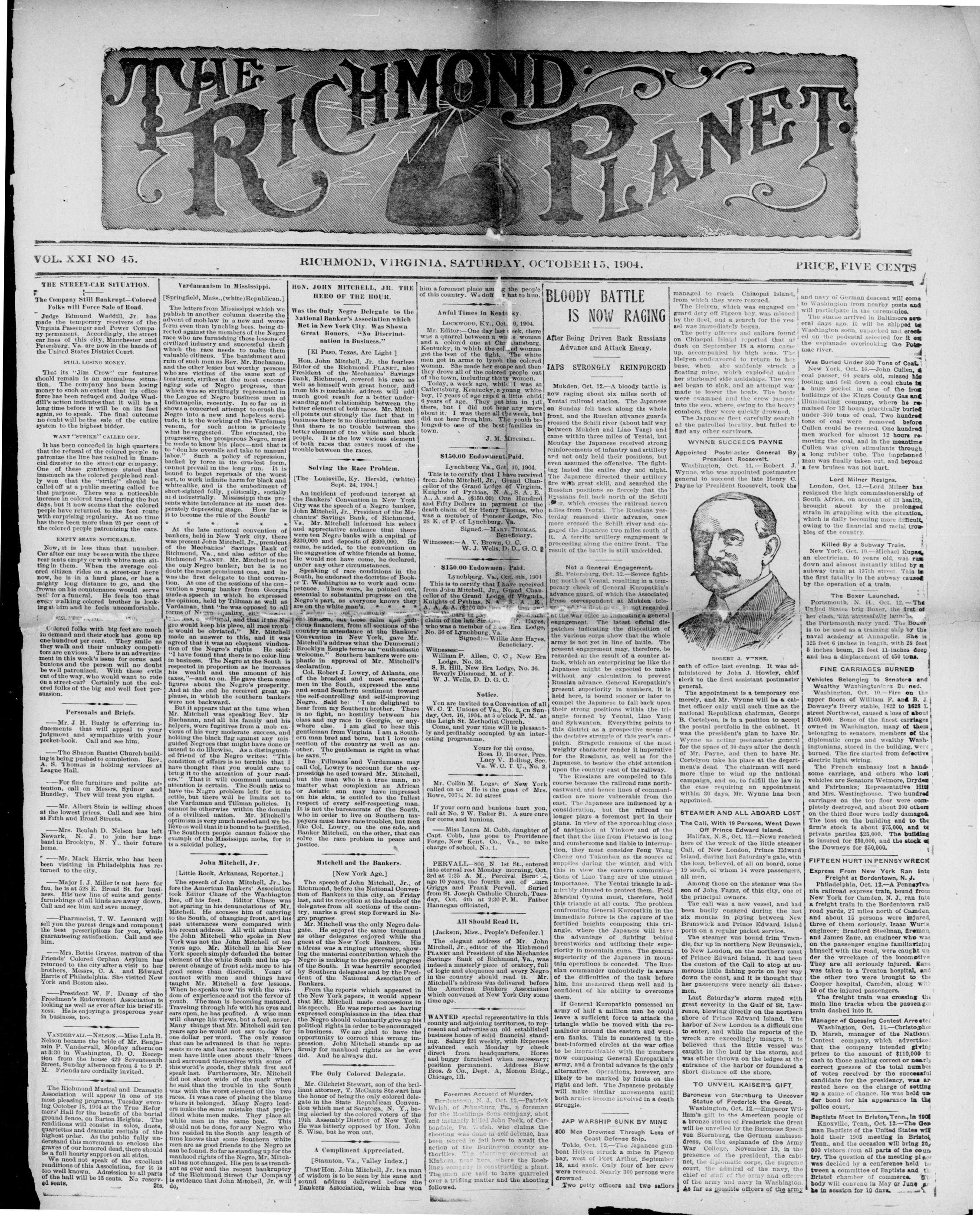
THE RICHMOND PLANET
VOL. XXI NO 45.
The Company Still Bankrupt—Colored Folks will Force Sale of Road.
Judge Edmund Waddill, Jr. has made the temporary receivers of the Virginia Passenger and Power Company permanent. Accordingly, the street car lines of this city, Manchester and Petersburg, Va. are now in the hands of the United States District Court.
STILL LOSING MONEY.
That its "Jim Crow" car features should remain is an anomalous situation. The company has been losing money to such an extent that its office force has been reduced and Judge Waddill's action indicates that it will be a long time before it will be on its feet again, so to speak. The final outcome no doubt will be the sale of the entire system to the highest bidder.
WANT "STRIKE" CALLED OFF.
It has been conceded in high quarters that the refusal of the colored people to patronize the line has resulted in financial disaster to the street-car company. One of these gentlemen stated that inasmuch as the colored people had really won that the "strike" should be called off at a public meeting called for that purpose. There was a noticeable time when the people had hot the hot, but it now seems that the people have returned to the foot route with surprising regularity. At no time has there been more than 25 per cent of the colored people patronizing the cars.
EMPTY SEATS NOTICEABLE
Now, it is less than that number. Car after car may be seen with the three rear seats empty or with white men sitting in them. When the average colored cider rides on a street-car here, he is in a hard place, or has a mighty long distance to go, and the only one on the street well for a funeral. He feels too that every walking colored brother is looking at him and he feels uncomfortable.
Colored folks with big feet are much in demand and their stock has gone up one-hundred per cent. They smile as they walk and their unlucky competitors are envious. There is an advertisement in this week's issue for corns and bunions and the person will no doubt be well patronized. With these evils cut of the way, who would want to ride on a street-car? Certainly not the colored folks of the big and well feet persuasion.
Personals and Briefs
—Mr. J H. Busby is offering inductions that will appeal to your judgment and sympathize with your pocket-book. Call and see him.
—The Sharon Baptist Church building is being pushed to completion. Rev. A. S. Thomas is holding services at League Hall.
—For fine furniture and polite attention, call on Messrs, Sydnor and Hundley. They will treat you right.
—Mr. Albert Stein is selling shoes at the lowest prices. Call and see him at Fifth and Broad Streets.
—Mrs. Beulah D. Nelson has left Newark, N. J. to join her husband in Brooklyn, N. Y., their future home.
—Mr. Mack Harris, who has been visiting in Philadelphia has returned to the city.
Major I. J. Miller is not here for fun, he is at 528 E. Broad St. for business. His new line of suits and gents' furnishings of all kinds are away down. Call and see him and save money,
Pharmacist, T. W. Leonard will sell you the purest drugs and compound the best prescriptions for you, while guaranteeing satisfaction. Call and see him.
Mrs. Bettie Graves, matron of the Friends' Colored Orphan Asylum has returned to the city after a visit to her brothers, Messrs. C. A. and Edward Harris of Philadelphia. She visited New York and Boston also.
President W. F. Denny of the Freedmen's Endowment Association is looking as well as ever after his brief illness. He is enjoying a prosperous year in business, too.
---
VANDERVALL—NELSON.—Miss Lula B. Nelson became the bride of Mr. Benjamin P. Vandervall, Monday afternoon at 3:30 in Washington, D. O. Reception from the house 429 Seventeenth Street, Sunday afternoon from 4 to 9 P. M. Friends are cordially invited.
The Richmond Musical and Dramatic Association will appear in one of its most pleasing programs, Tuesday evening October 18, 1904 at the True Reformers' Hall for the benefit of the burial ground fence, on Barton Heights. The renditions will consist in soloes, duets, quartettes and dramatic recitals of the highest order. As the public fully understand this movement to enclose the graves of our honored dead, there should be a full hearty support on all sides.
We need not speak of the excellent renditions of this Association, for it is too well known. Admission to all parts of the hall will be 15 cents. No reserved seats.
Vardamanism in Mississippi.
[Springfield, Mass.,(white)Republican.]
The letters from Mississippi which we publish in another column describe the advent of mob law in a new and worse form even than lynching bees, being directed against the members of the Negro race who are furnishing those lessons of civilized industry and successful thrift which the race needs to make them valuable citizens. The banishment and ruin of such men as Rev. Mr. Buchanan, and the other lesser but worthy persons who are victims of the same sort of treatment, strikes at the most encouraging side of Negro progress, that which was so strikingly represented in the League of Negro business men at Indianapolis, recently. In so far as it shows a concerted attempt to crush the Negro into a new and hopeless sorvitude, it is the working of the Vardaman venom, for such action is precisely what he suggested. The educated, the progressive, the prosperous Negro, must be made to know his place—and that to "den his overalls and take to manual labor." The enriched and a policy of manual labor. "It should be betget reprisals of the worst sort, to work infinite harm for black and white alike, and the embodiment of short-sighted folly, politically and industrially. Mississippi thus presents white intolerance at its most desperately depressing stage. How far is it to become the rule of the South?
At the late national convention of bankers, held in New York city, there was present John Mitchell, Jr., president of the Mechanics' Savings Bank of Richmond, Pa., and also editor of the Richmond Planet. Mr. Mitchell is not the only Negro banker, but he is no doubt the most prominent one, and he was the first delegate to that convention. At one of the sessions of the convention a young banker from Georgia made a speech in which he expressed the opinion, held by Tillman and as a Vardaman, that "he was opposed to all forms of Negro equality, ethics, business, political, and that if the Negro would keep his place, all race trouble would be obviated." Mr. Mitchell made an answer to this, and it was agreed that it was an eloquent vindication of the Negro's rights. He said, "I have found that there is no color line in business. The Negro at the South is respected in proportion as he increases his wealth and the amount of his taxes,"—and so on. He gave them some figures about the Negro's prosperity. And at the end he received great applause, in which the southern bankers were not backward.
But it appears that at the time when Mr. Mitchell was speaking Rev. Mr. Buchanan, and all his family and his helpers, were fugitives from a mob envious of his very moderate success, and holding the black flag against any misguided Negroes that might have done or intend to do likewise. As a distinguished friend of the Negro writes: "This condition of affairs is so terrible that I have thought that you would care to bring it to the attention of your readers." That it will command national attention is certain. The South asks to have the Negro problem lett for it to settle, but there will be limits set to the Vardaman and Tillman policies. It cannot be otherwise within the domain of a civilized nation. Mr. Mitchell's optimism is very much needed and we believe as well that it is bound to be justified. The Southern people cannot follow the example of the Mississippi mobs, for it is a suicidal policy.
John Mitchell, Jr.
[Little Rock, Arkansas, Reporter.]
The speech of John Mitchell, Jr., before the American Bankers' Association took Editor Chase of the Washington Bee, off his feet. Editor Chase was not sparing in his denunciations of Mr. Mitchell. He accuses him of catering to the South, of changing front, and his past utterances were compared with his recent address. All will admit that the John Mitchell who will admit the New York was not the John Mitchell of years ago. Mr. Mitchell in his New York speech simply defended the better element of the white South and his apparent change of front adds more to his good sense than discredit. Years of contact with men and things have taught Mr. Mitchell a few lessons. When he speaks now 'tis with the wisdom of experience and not the fervor of youth. The man is becoming matured. Traveling through life with his eyes and ears open, he has profited. A wise man will change his views, but a fool, never. Many things that Mr. Mitchell said ten years ago he would not tell for one dollar per word. The only reason that can be advanced is that he represents more and has more sense. When men have little ones about their knees and surround themselves with some of this world's goods, they think first and speak last. Furthermore, Mr. Mitchell did not shoot wide of the mark when he said that the trouble in the South was with the worst element of the two races. It was a case of placing the blame where it belonged. Many Negro leaders make the same mistake that prejudiced white men make. They place all white men in the same boat. This should not be done, for any Negro who has resided in the South any length of time knows that some Southern white men are as good friends to the Negro as can be found. So far as standing up for the manhood rights of the Negro, Mr. Mitchell has not changed. His pen is as trenchant as ever and the recent bankruptcy of the Richmond Street Car Company is evidence that John Mitchell, Jr. will do.
RICHMOND, VIRGINIA, SATURDAY, OCTOBER 15, 1904.
HON. JOHN MITCHELL, JR. THE HERO OF THE HOUR.
Was the Only Negro Delegate to the National Banker's Association which Met in New York City. Was Shown Great Honors. "No Discrimination in Business."
[El Paso, Texas, Arc Light]
Hon. John Mitchell, Jr. the fearless Editor of the Richmond PLANET, also President of the Mechanics' Savings Bank, Richmond, covered his race as well as himself with great honor and from his remarkable address. It much good result for a better understanding and relationship between the better element of both races. Mr. Mitchell points out strongly the fact that in business there is no discrimination and that there is no trouble between the better element of the white and black people. It is the low vicious element of both races that causes most of the trouble between the races.
Solving the Race Problem.
[The Louisville, Ky. Herald, (white) Sept. 24, 1904.]
An incident of profound interest at the Bankers' Convention in New York City was the speech of a Negro banker, John Mitchell, Jr., President of the Mechanics' Savings Bank, of Richmond, Va. Mr. Mitchell informed his select and appreciative audience that there were ten Negro banks with a capital of $230,000 and deposits of $300,000. He came, he added, to the convention on the suggestion of white friends at home. He would not have come, he declared, under any other circumstances. Speaking of race conditions in the South, he endorsed the doctrine of Booker T. Washington as to work and competence. These were, he pointed out, essential to substantial progress on the Negro's part, as everyone knows they are on the white man's. * * * * *
on assault, out those calm and judicious financiers, from all sections of the country in attendance at the Bankers' Country in attendance in New York, gave Mr. Mitchell's address what the Democrat: Brooklyn Beagle terms an "enthusiasistic welcome." Southern bankers were emphatic in approval of Mr. Mitchell's declaration. Col. Robert L. Lowry, of Atlanta, one of the broadest and most successful men in the South, expressed the sane and sound Southern sentiment toward the self-controlling and self-improving Negro. Said he: "I am delighted to hear from my Southern brother. There is no fight, no hostility between his class and my race in Georgia, or anywhere else. I am glad to hear this gentleman from Virginia. I am a Southern man bred and born, but I love one section of the country as well as another. The gentleman is right in what he says."
The Tillmans and Vardamans may call Col. Lowry to account for the expressions he used toward Mr. Mitchell, but the man who is a true man, no matter what complexion an African or Asiatic sun may have impressed on his skin, is entitled to the fullest respect of every self-respecting man. The burcerants of the South, who in order to live on Southern tax payers must have race troubles, but men like Col. Lowry, on the one side, and Banker Mitchell, on the other, that can solve the race problem in peace and justice.
Mutchell and the Bankers
[New York Age.]
The speech of John Mitchell, Jr., of Richmond, before the National Convention of Bankers in this city, on Friday last, and its reception at the hands of the delegates from all sections of the country, marks a great step forward in Negro progress.
Mr. Mitchell was the only Negro delegate. He enjoyed the same treatment as other delegates enjoyed while the guest of the New York Bankers. His address was a ringing utterance, showing the material contribution which the Negro is making to the general progress of the South. It was heartily seconded by Southern delegates and by the President of the National Association of Bankers.
From the reports which appeared in the New York papers, it would appear that Mr. Mitchell made concessions in his speech. He was reported as having expressed complaisance in the idea that the Negro should voluntarily give up his political rights in order to be encouraged in business. We are glad to have the opportunity to correct this wrong impression. John Mitchell stands up as firmly for manhood rights as he ever did. And he always did.
The Only Colored Delegate
Mr. Gilchrist Stewart, son of the brilliant attorney, T. McCants Stewart has the honor of being the only colored delegate in the State Republican Convention which met at Saratoga, N. Y., being elected by the colored voters of the New York. He was bitterly opposed by Hon. John S. Wise, but he won out.
A Compliment Appreciated.
[Staunton, Va., Valley Index.]
That Hon. John Mitchell, Jr. is a man of wisdom is to be seen by his sane and sound address delivered before the Bankers Association, which has won
him a foremost place am of this country. W3 doff
Awful Times in Kent
LOCKWOOD, KY., Oct. 1, 1904.
Mr. Editor: One day last week, there was a quarrel between a white woman and a colored one at Chrysburg, Kentucky, in which the colored woman got the best of the fight. The white men got in arms to lynch the colored woman. She made her escape and then they drove all of the colored people out of the town, including black women.
Today, a week ago, while I was at Catlettsburg, Kentucky, a young white boy, 17 years of age rated a little child, 6 years of age. They put him in jail there, but I did not hear any more about it. I was there all the week, but did not hear from him. The youth belonged to one of the best families in town.
J. M. MITCHELL.
$150.00 Endowment Paid.
Lynchburg Va., Oct. 10, 1904.
This is to certify that I have received from John Mitchell, Jr., Grand Chancellor of the Grand Lodge of Virginia, Knights of Pythias, N. A., S. A., E. A., A. and A. ($150.00) One Hundred and Fifty Dollars in payment of the death claim of Sir Henry Thomas, who was a member of Pioneer Lodge, No. 28 K. of P. of Lynchburg Va.
Signed:—MARY THOMAS;
Benefiary.
Witnesses:—A. V. Brown, C. C.
W. J. Wells, D. D., G. C.
$150.00 Endowmen. Paid.
Lynchburg, Va., Oct. 8th, 1901
This is to certify that I have received from John Mitchell, Jr., Grand Chancellor of the Grand Lodge of Virginia, Knights of Pythias, N. A. S. A. E.
A. A. & A. $150 000. Do not own or
bear in pay to death claim of the late Sir George T. Hayes, who was a member of New Era Lodge, No. 36 of Lynchburg, Va.
Signed:—Willie Ann Hayes, Beneficiary.
Witnesses:—
William P. Allen, C. O., New Era
Lodge, No. 36.
S. B. Hill, New Era Lodge, No. 36.
Beverly Dismond, M. of F.
W. J. Wells, D. D. G. C.
Notice
You are invited to a Convention of all W. C. T. Unions of Va., No. 2, on Sunday, Oct. 16, 1904, at 5 o'clock P. M. at the Leigh St. Methodist Church.
Come, and your time will be pleasantly and profitably occupied by an interesting programme.
You're for the cause,
Rosa D. Bowers, Pres.
Lucy V. Balling, Sec.
Va. W. C. T. U., No. 2.
Mr. Collin M. Logan of New York called on us. He is the guest of Mrs. Rowe, 707½ N. 3d street
If your corn and bunions hurt you, call at No. 2 W. Baker St. A sure cure for corn and bunions.
— Miss Laura M. Cobb, daughter of Capt. Cobb, has gone to Providence Forge, New Kent. Co., Va., to take charge of school, No. 1.
PERVALL—805 N 1st St., entered into eternal rest Monday morning, Oct. 3rd at 7:25 A. M., Perival Bell, age 10 years, the fourth son of Diara Griggs and Frank Pervall, Buried from St. Joseph Catholic Church, Tuesday, Oct. 4th at 2:30 P. M. Father Hannegan officiated.
All Should Read It.
[Jackson, Miss., People's Defender.]
The elegant address of Mr. John Mitchell, Jr. editor of the Richmond PLANET and President of the Mechanics Savings Bank of Richmond, Ya., was indeed a masterly piece of oratory, full of logic and eloquence and every Negro in the country should read it. Mr. Mitchell's address was delivered before the American Bankers Association which convened at New York City some time ago.
WANTED special representative in this county and adjoining territories, to represent and advertise an old established business house of solid financial standing. Salary $21 weekly, with Expenses advanced each Monday by check direct from headquarters. Horse and buggy furnished when necessary; position permanent. Address Blew Bros. & Co., Dept. A, Monon Bidg., Chicago, Ill.
Foreman Accused of Mur
Foreman Ace of Murder
Bordentown, N. J., Oct. 12.—Patrick Welsh, of Johnsburg, Pa., a foreman for the Roeblings Sons company, shot and instantly killed John Peck, of Carbondale, Pa. Welsh, who claims the shooting was done in self-defense, has been placed in jail here to await the action of the Burlington county authorities. The shooting occurred at Kinkoo, near here, where the Roeblings company is constructing a plant. The men are said to have quarreled over a trifling matter and the shooting followed.
BLOODY BATTLE IS NOW RAGING
After Being Driven Back Russians Advance and Attack Enemv.
IAPS STRONGLY REINFORCED
Mukden, Oct. 12.—A bloody battle is now raging about six miles north of Yentai railroad station. The Japanese on Sunday fell back along the whole front, and the Russian advance guards crossed the Schill river (about half way between Mukden and Liao Yang) and came within three miles of Yentai, but Monday the Japanese received strong reinforcements of infantry and artillery and not only held their positions, but even assumed the offensive. The fighting lasted the entire day and night. The Japanese directed their artillery fire with great skill, and searched the Russian positions so fiercely that the Russians fell back north of the Schill river, which crosses the railroad seven miles from Yentai. The Russians yesterday resumed their advance, once more crossed the Schill river and engaged the Japanese two miles south of it. A terrific artillery engagement is proceeding along the entire front. The result of the battle is still undecided.
Not a General Engagement.
Not a General Engagement.
St. Petersburg, Oct. 12. Severe fighting north of Yental, resulting in a temporary cheek of General Kuropatkin's advance guard, of which the Associated Press correspondent at Mukden television is not regarded at the war office as indicating a general engagement. The latest official dispatches indicating the disposition of the various corps show that the whole army is not yet in line of battle. The present engagement may, therefore, be regarded as the result of a counter attack, which an enterprising foe like the Japanese might be expected to make without any calculation to prevent Russian advance. General Kuropatkin's present superiority in numbers, it is held here, is bound sooner or later to compel the Japanese to fall back upon their strong positions within the triangle formed by Yental, Liao Yang and Sykwantian. Everything points to this district as a prospective scene of the decisive struggle of this year's campaign. Stratagic reasons of the most weightly character render it imperative for the Russians, as well as for the Japanese, to bestow the chief attention upon the country east of the railway.
The Russians are compelled to this course because the railroad runs northeastward, and hence lines of communication are more vulnerable from the east. The Japanese are influenced by a consideration, but the railroad no longer plays a foremost part in their plans. In view of the approaching close of navigation at Yinkow and of the fact that the line from Pietsewo is long and cumbersome and liable to interruption, they must consider Feng Wang Cheng and Takushan as the source of supplies during the winter, and with this in view the eastern communications of Liao Yang are of the utmost importance. The Yentai triangle is admirably situated to protect them. Field Marshal Oyama must, therefore, hold this triangle at all costs. The problem confronting General Kuropatkin in the immediate future is the capture of the fortified heights composing this triangle, where the Japanese will have the advantage of fighting behind breastworks and utilizing their superiority in mountain guns. The general superiority of the Japanese in mountain operations is conceded. The Russian commander undoubtedly is aware of the difficulties of the task before him, has measured them well and is confident of his ability to overcome them.
If General Kuropatkin possessed an army of half a million men he could leave a sufficient force to attack the triangle while he moved with the remainder around the eastern and western flanks. This is considered in the best-informed circles at the war office to be impracticable with the numbers now composing General Kuropatkin's army, and a frontal advance is the only alternative. Operations, however, are likely to be marked by feints on the right and left. The Japanese probably will make similar movements until both armies become involved in a death struggle.
JAP WARSHIP SUNK BY MINE
800 Men Drowned Through Loss of Coast Defense Ship.
Tokio, Oct. 12.—The Japanese gunboat Helyen struck a mine in Pigeon bay, west of Port Arthur, September 18, and sank. Only four of her crew were rescued. Nearly 300 persons were drowned.
Two petty officers and two sailors
managed to reach Chinapai Island, from which they were rescued.
The Helyen, which was engaged on guard duty off Pigeon bay, was missed by the fleet, and a search for the vessel was immediately begun.
The petty officers and sailors found on Chinapai Island reported that at dusk on September 18 a storm came up, accompanied by high seas. The Helyen endeavored to return to her base, when she suddenly struck a floating mine, which exploded under her starboard side amidships. The vessel began to sluk, and an attempt war made to lower the boats. The boats were swamped and the crew jumped into the sen, where, owing to the heavy combers, they were quickly drowned.
The Japanese fleet carefully searched the patrolled locality, but failed to find any other survivors.
WYNNE SUCCEEDS PAYNE
Appointed Postmaster General By President Roosevelt
Washington, Oct. 11. — Robert J. Wynne, who was appointed postmaster general to succeed the late Henry C. Payne by President Roosevelt, took the
ROBERT J. WYNNE.
oath of office last evening. It was administered by John J. Howley, chief clerk to the first assistant postmaster general.
The appointment is a temporary one merely, and Mr. Wynne will be a cabinet officer only until such time as the national Republican chairman, George B. Cortelyon, is in a position to accept the postal portfolio in the cabinet. It was the president's plan to have Mr. Wynne as acting postmaster general for the space of 30 days after the death of Mr. Payne, and then to have Mr. Cortelyon take his place at the department's dead. The chairman will need more time to wind up the national campaign, and so, to fulfill the law in the case requiring an appointment within 30 days, Mr. Wynne has been appointed.
STEAMER AND ALL ABOARD LOST
Off Prince Edward Island.
Hallifax, N. S., Oct. 12.—News reached here of the wreck of the little steamer Call, of New London, Prince Edward Island, during last Saturday's gale, with the loss, believed, of all on board, some 19 souls, of whom 14 were passengers, all men.
Among those on the steamer was the son of John Fagar, of this city, one of the principal owners.
The call was a new vessel, and had been busily engaged during the last six months in plying between New Brunswick and Prince Edward Island ports on a regular packet service.
The steamer was bound frim Tracadie, far up in northern New Brunswick, to New London, on the northern coast of Prince Edward Island. It had been the custom of the Call to stop at numerous little fishing ports on her way down the coast, and it is thought that her passengers were nearly all fishermen.
Last Saturday's storm raged with great severity in the Gulf of St. Lawrence, blowing directly on the northern shore of Prince Edward Island. The harbor of New London is a difficult one to enter, and while the reports of the wreck are exceedingly meagre, it is believed that the little vessel was caught in the bulb by the storm, and was either thrown on the ledges at the entrance of the harbor or foundered a short distance off the shore.
TO UNVEIL KAISER'S GIFT
Baroness von Sternburg to Uncover
Status of Foods the Court
Statue of Frederick the Great
Washington, Oct. 12.—Emperor William's gift to the American people of a bronze statue of Frederick the Great will be unveiled by the Baroness Speck von Sternburg, the German ambassador, on the esplanade of the Army War College, November 19, in the presence of the president, the cabinet, the diplomatic corps, the supreme court, the admiral of the navy, the chief of staff of the army and officers of the army and navy in Washington. As far as possible officers of the army
PRICE, FIVE CENTS
and navy of German descent will come to Washington from nearby posts and will participate in the ceremonies. The statue arrived in Baltimore several days ago. It will be shipped to Washington soon, unpacked and erected on the pedestal selected for it on the esplanade overlooking the Potomac river.
Was Buried Under 300 Tons of Coal.
New York, Oct. 10—John Cullen,
a coal passer, 64 years old, missed his footing and fell down a coal chute in a huge pocket in one of the iron buildings of the Kings County Gas and illuminating company, where he remained for 12 hours practically buried under 300 tons of coal. Two hundred tons of coal were removed before Cullen could be rescued. One hundred men worked for almost 12 hours removing the coal, and in the meantime Cullen was given stimulants through a long rubber tube. The imprisoned man was finally taken out, and beyond a few bruises was not hurt.
Lord Milner Resigns
London, Oct. 12—Lord Milner has resigned the high commissionship of South Africa, on account of ill health, brought about by the prolonged strain in grappling with the situation, which is daily becoming more difficult, owing to the financial and racial troubles of the country.
Killed By a Subway Train
New York, Oct. 10.—Michael Kupac an electrician, 40 years old, was run down and almost instantly killed by a subway train at 137th street. This is the first fatality in the subway caused by the operation of a train.
The Boxer Launched.
Portsmouth, N. H., Oct. 12.—The United States brig Boxer, the first of her class, was successfully launch the Portsmouth navy yard. The Boxer is to be used as a training ship by the naval academy at Annapolis. She is 125 feet 6 inches in length, with 28 feet 5 inches beam, 25 feet 11 inches deep and has a displacement of 450 tons.
FINE CARRIAGES BURNED
Vehicles Belonging to Senators and Wealthy Washingtonians Burned. Washington, Oct. 10—Fire on the upper floors of William F. and B. J. Downey's livery stable, 1622 to 1628 L street Northwest, caused a loss of about $160,000. Some of the finest carriages owned in Washington, many of them belonging to senators, members of the diplomatic corps and wealthy Washingtonians, stored in the building, were burned. The fire started from defective electric light wiring.
The French embassy lost a handsome carriage, and others who lost vehicles are Senators Wetmore, Dryden and Fairbanks; Representative Hilt and Mrs. Westinghouse. Two hundred carriages on the top floor were completely destroyed, and about 200 others on the third floor were badly damaged. The loss on the building and to the firm's stock is about $75,000, and to private parties $25,000. The building is insured for $50,000, and the stock of the Downeys for $50,000.
FIFTEEN HURT IN PENNSYWRECK
Express From New York Ran Into
Freight From Bedfordton N. L.
Freight at Bordentown, N. 5.
Philadelphia, Oct. 12.—A Pennsylvania railroad express train, bound from New York for Camden, N. J., ran into a freight train in the Bordentown railroad yards, 27 miles north of Camden, and about 15 persons were injured, three of them seriously. Isaac Wurts engineer; Bradford Steelman, freeman, and James Zane, an engineer who was on the passenger engine familiarizing himself with the road, were caught under the wreckage of the locomotive. They are all seriously injured. Earne was taken to a Trenton hospital, and the other two were brought to the Cooper hospital, Camden, along with 10 of the injured passengers.
The freight train was crossing the main line tracks when the passenger train dashed into it.
Manager of Guessing Contest Arrested
Washington, Oct. 11.—Christopher
D. Marsh, manager of the National
Contest company, which advertised
that the company intended giving
prizes to the amount of $110,000 in
cash to those making correct or nearly
correct guesses of the total number
of votes received by the successful
candidate for the presidency, was
rested here on the charge of setting
up a game of chance. He was held un-
der bond for his appearance in the
police court.
Baptists Meet In Bristol, Tenn., in 1901 Knoxville, Tenn., Oct. 12.—The German Baptists of the United States will hold their 1905 meeting in Bristol, Tenn., and the occasion will bring 20,000 visitors from all parts of the country. The question of the meeting place was decided by a conference held between a committee of Baptists and the Bristol chamber of commerce. The body will convene in May or June and be in session for 10 days.
THE PLANET
SATURDAY OCTOBER 15, 1904
TEMPERANCE
THE TRIPLE PLEDGE.
STRONG DRINK.
We will not buy,
We will not make,
We will not use,
We will not take,
Wine, elder, beer,
Rum, whisky, gin;
Because they lead
Mankled to sin.
TOBACCO.
We will not smoke
The smokers, pets,
Those little things
Called cigarettes.
We will not chew,
We will not sniff,
Or waste our time
PROFANITY.
We will not curse,
Though many dare
Open their lips
To curse and swear.
Our words shall be
pure and plain
Our Gods name in vain,
God's name in vain,
—National dvocate.
ONE STANDARD.
What Josiah Allen's Wife Has to Say Upon This Very Important Subject.
Josiah Allen's children have been brought up to think that sin of any kind is just as bad in a man as in a woman; and any place of amusement that was bad for a woman to go to was bad for a man.
Now, when Thomas Jefferson was a little fellow, he was bewitched to go to circuses, and Josian said:
"Better let him go, Samantha; it hain't no place for wimmen or girls, but it won't hurt a boy."
Says I: "Josiah Allen, the Lord made Thomas Jefferson with just as pure a heart as Tirzah Ann, and no bigger eyes and ears, and if Thomas J. goes to that circus, Tirzah Ann goes too."
That stopped that. And then he was bewitched to get with other boys that s. ed and chewed tobacco, and
GOD BLESS
OUR HOME
IF EVER SEE YOU HANGING ROUND BARRIOOMS AND TAVERNS TIRZAH ANN SHALL HANG, TOO.
Josiah was just of that easy turn, and would have let him go with 'em. But says I:
"Josiah Allen, if Thomas Jefferson goes with them boys and gets to chewin' and smokin' tobacco, I shall buy Tirzah a pipe."
And that stopped that.
"And about drinkin'," said I:
"Thomas Jefferson, if it should be the will of Providence to change you to a wild bear, I will chain you up and do the best I can for you. But if you ever do it yourself, turn yourself into a wild beast by drinkin', I will run away; for I never could stand it, never! And." I continued, "if I ever see you hangin' 'round bar rooms and taverns, Tirzah Ann shall hang, too."
Josiah argued with me. Says he:
"It doesn't look so bad for a boy as it does for a girl."
Says I: "Custom makes the difference; and we are more used to asking men. But," says I: "when liquor goes to work to make a fool and brute of anybody, it don't stop to ask about sex; it makes a wild beast and idiot of a man or a woman, and to look down from heaven, I guess a man looks as bad layin' dead drunk as a woman does."
Says I, "Things look differently from up there than what they do to us—it is a more sightly place. And you talk about looks, Josiah Allen; I don't go on clear looks, I go on principle. Will the Lord say to me in the last day, Josiah Allen's wife, how is it with the soul of Tirzah Ann, as for Thomas Jefferson's soul, he being a boy, it hain't of no account? No, I shall have to give an account to Him for my deainl's with both of these souls, male and female. And I should feel guilty if I brought him up to think that what was impure for a woman was pure for a man. If a man has a greater desire to do wrong, which I don't dispute, says I, looking keenly onto Josiah, "he has greater strength to resist temptation. And so," says I, in mild accepts, but firm as old Plymouth Rock, "if Thomas Jefferson hangs, Tirzah Ann shall hang, too."
I have brought Thomas Jefferson up to think that it was just as bad for him to listen to a bad story or song as
for a girl, or worse, for he had more strength to run away, and that it was a disgrace to him to talk or listen to any stuff that he would be ashamed to have Tirzah Ann or me to hear. I have brought him up to think that manliness didn't consist in having a cigar in his mouth, and his hat on one side, and swearing, and slang phrases, and a knowledge of questionable amusements, but in layin' holt of every duty that comes to him, with a brave heart and a cheerful face; in helpin' to right the wrong, and protect the weak, and makin' the most and the best of the mind and the soul God has given him. In short, I have brought him up to think that purity and virtue are both feminine and masculine, and that God's angels are not necessarily all she ones—Samantha Allen.
CIGARETTES BANNED
Account of the Anti-Smoking Crusade Among Young Sailors of the British Navy.
With a desire to avoid, as far as possible, ill effects on the health of young sailors by the excessive use of cheap cigarettes, the lords of the admiralty long ago decreed that the cigarette should be barred on all training ships, and to carry this order out properly each lad on returning to the ship after the half-day's leave which is granted on Sundays and Thursdays, is searched at the gangway.
Some seven years ago, when Capt. Cecil Burney (now in command of the battleship Empress of India) was in command of the Boscawen, the senior training ship at Portland, he had occasion to make serious complaints of the number of cigarettes the lads tried to bring aboard. The boys were accordingly stopped and brought before the captain and a sentence of a month's leave, with stoppage of pocket money, was imposed. Smoking ashore, however, went on as usual until at last Capt. Burney, placed the shops of the district out of bounds. The shopkeepers were immediately up in arms, agitating for a repeal of what they considered a harsh rule. They, agitated frisslessly for years, during which time Capt. Burney had gone and Capt. Jerram had also come and gone. Then, about a year ago, Capt. Tuffnell took over the command, and as a result of the appeals he decided to put the shops in bounds once more. A strict proviso was made, however, that no cigarettes or tobacco should be supplied to the boys.
This proviso was not observed, and again Portiand was declared out of bounds, says the London Daily Mail. More agitation on the part of the shopkeepers followed, culminating on Thursday last in an interview between the captain and the clerk of the local council, the result of which was that the shops, except public houses, and those shops which have tobacco licenses were once more placed in bounds, but it was distinctly laid down that another infraction of the rule would mean the departure of the whole of the training ships, which hold 3,000 boys, from Portland.
TEMPERANCE BREVITIES
A sensible prohibition speaker, answerer the ole cry that to do away, with saloons will kill business and begin the era of grass-growing in the streets, said: "At present prices it would be better for the town to raise more hay and less hell." As the saloon brings something of the latter with it wherever it is established this remark is wise in every sense—Pittsburg Christian Advocate.
Mark Guy Pearse returns to England saying this about us: "never saw a woman in any public house in Canada or the States. I never saw on any table, or even in the dining cars, or in the hotels, a glass of beer, wine or spirits. I never saw a drunken man until I reached an English port. I was deeply impressed with the self-respecting bearing of the people. They walked with a firm step, as if they knew whose world it is, and felt they had a share in it."
When young Franz Veecey, the 11-year-old violinist, played before Queen Alexandra a week or two ago, Archduke Frederick of Austria asked if he would like some champagne, and he said he was not allowed to have it. "Of course not," said the queen. "Come with me, Franz, and I will give you some oranges," and as she said so the wise woman handed him an orange. We should like the boy to know that oranges are far better than champagne.
One Frisnish, saloonkeeper, Bayonne, N. J., recently sued John Rinaldo, a customer, for the price of a broken window. The police justice rendered the following decision: "A saloonkeeper is at all times in partnership with a man who becomes drunk, and is partly accountable for the actions of a man under the influence of liquor. This is my view of the matter, and for that reason I think it best that you divide the cost of the damage, and, in addition, pay a fine of five dollars each."
Making Men Sober.
Much is said about the impossibility of making men sober by law, and of the impropriety of attempting it. This kind of argument is supposed to have much force. But we submit that it is exactly the wrong way of putting this case. It is not a question of making men sober by law, but of making them drunkards by law; and that is a very different proposition. Men are sober, they are born sober; except those who inherit a taste for strong drink from drunken parents, they all incline to temperance. It takes the temper and the dramshop to make them drunkards. Without the dramshop there would be few drunkards. It is the drunkard maker. When it is established by law then it is the making of people drunkards by law that is to be considered and not the making of men sober by law.—Pittsburgh Christian Advocate.
Before the Convention
Politician—The trouble is that some of the candidates are not well enough known. Correspondent—Yes, and others are too well known—Puck.
THE RICHMOND PLANET, RICHMOND, VIRGINIA.
Fun for All Fun Lovers.
Then and Now
Ere we were wed I did adore the malden fair on the top floor of the apartment house next door; I called her 'angel' times a score, but now her actions make me sore. I've troubles great and small galore and I can't sleep because her snore sounds like a western cyclone's roar—Cincinnati Enquirer.
No Cause for Alarm
"Williams," exclaimed Mrs. Upmore, pale witen fright, "what has become of the silver? Were burglaries in the house last night?" "No, m'm," replied the butler. "The young leddy guests carried them away laurst evenin' as soov'nirs, m'm."—Chicago Tribune.
Fine Sensibilities
"Why are you so anxious to get control of the government?" asked the Moroccan bandit of his chief. "Aren't you making money enough collecting ransoms?" "Yes. But it is so much easier and more dignified to collect taxes."—Washington Star.
The Matchless Beauty.
Her mamma tried to make the match;
She thought it her plain duty.
But soon found her daughter was a great think of beauty.
—N. O. Times-Democrat
A
Newitt—Well, there's one thing about the weather. It's always a safe topic of conversation.
Borroughs—I thought it was to-day when I met Lendham, but when I started to speak of it he said: "Yes, it's unsettled, and that reminds me of that account of yours."—Smitha a Weekly
The Vanity of Greatness
The Vanity of Greatness.
Her husband was handsome and true,
He had fame, he owned horses and lands.
But sorrow was her's; people knew
His grandfather worked with his hands
-Chicago Record-Herald.
He Knew.
Van X.—Fillups has an enormous library; he told me that he always makes it a point to add at least five books a month. I wonder how he manages it on his income.
De Q.—Just lend him one or two and you'll find out.—Detroit Free Press.
A Cruel Alternative
Downton—Here comes Binkers. He's got a new baby, and he'll talk us to death.
Upton—Well, here comes a neighbor of mine who has a new setter dog. Let's introduce them to each other and leave 'em to their fate.—N. Y. Weekly.
Lightened the Burden
Several women at the reception asked young Mrs. Wisely why she had discharged her hired girl.
"The reason is plain enough," she replied. "It is easier to do the work for Tom and me than for Tom and the hired girl and me."—Detroit Free Press.
Overheard at Newport
"I thought Laura and Jack were going to get married?"
"They were, but at the last moment they changed their minds."
"Too bad! Such a sensible couple as that would certainly get along all right together."—Judge.
Relaxation
Mrs. Saltonallt—I feel tired to death this morning. I've been out till midnight the last four nights running.
Mrs. Walsingham—So do I. I have had company for two weeks now, and I'm all worn out. Let's go shopping.—Somerville Journal.
Quite.
"Gracious!" exclaimed Mr. Swellman, "the baby has just eaten a lot of that dog biscuit."
"Never mind," replied Mrs. Swellman, "it just serves Fido right, for he has often eaten the baby's food."—Philadelphia Ledger.
Modern Demands.
"Do you believe in the 'barrel' in politics?"
"Not any more," answered Senator Sorghum. "A man ought to have a hogshead in order to amount to much these days." - Washington Star.
Waste of Energy.
Mrs. Grumbleton (to husband, who is shaking with ague)—Just like you, you lazy fellow, wasting your strength like that. Why don't you lay hold of the mats and shake them?—Ally Sloper.
The Time of Her Life.
Parke-I imagine my wife is having a high old time on her vacation.
Lane—Heard from her, have you?
"Oh, no—from my bank."—Brooklyn Life.
About Even.
"Henpeck, what do you think of a man who marries for money?" "Think he earns every cent he gets." —Detroit Free Press.
Snake Charmer Thursts Rattler in His Mouth and Allows Reptile to Bite His Tongue.
Alfred Thurston is snake charmer frog and glass eater, who was out of work and despondent entered the barroom of the New York hotel at Niagara Falls, N.Y., the other day and in sight of a hardened persons placed the head of a diamond back rattlesnake in his mouth and allowed the reptile to bite his tongue. He died some hours airtwired in great agony Thurston, when he guarded the bar
A
SERPENT STRUCK AT HIM.
room, walked up to a man who had a glass of whisky on his hand.
"They say that is good for snake bites," he said, pointing to the glass. "It isn't good for much else."
"I have got a snake in here," continued Thurston. "Would you like to take your whisky as a medicine"
The great rattler colled about the man's arm. He held its head near his face, and while the men looked on in horror the serpent struck at him. Thurston caught the snake by the neck. Then he turned to the men in the saloon and, with a bow, thrust the reptile into his mouth. The next instant he fell to the floor with a scream, and the snake, breaking away, writhed across the floor. A man killed it with an ax as Thurston lay screaming in agony. He was removed to the hospital, where he died.
EATS NOTHING BUT GRASS
Spaniard in New York Has Found
His Food in Park for Months
and Thrives on It.
Senor Euhesbic Santos, a Spaniard living in Brooklyn thrives on a diet of grass alone—just plain, ordinary grass, which he ducks in the park with his own hands. His only drink is water.
He is a writer by the people with whom he lives. He himself accentuated his tails by eating about a quart of fresh grass for the "gentlemen of the press" out of a two-quart soup tureen.
"Senor," he said in Spanish, talking a mouthful of what remained in the large tureen. "I am a Spaniard. I went to Cuba from Spain 15 years ago. Be-
KEEP OFF
THE GRASS
LIVES ON-DIET OF GRASS.
fore I was long in the island my health gave out.
"Starve yourself," said my physician. 'Eat potatoes,' said he; 'eat potatoes.' I grew sick of potatoes. 'Then chew grass,' said the doctor; 'nice clean grass, and drink water.' "So for six months my diet has been nothing but grass. Now I am in perfect physical condition. I never all, I feel strong, and warm, and fresh, and I have forgotten what it is to have a headache."
Church Built of One Tree
A Baptist church in Santa Rosa, Cal., capable of seating 200 persons, was built entirely of timber sawed out of a single redwood tree. Timbers, weather boarding and inner sheathing are all of wood, there being no plaster, bricks or mortar about it. The roofing, too, is made of shingles sawed from the same tree, and after it was all finished there were 60,000 shingles left
Painless Tooth Extraction.
Tooth-pulling is a very simple and painless process in China. The dentist rubs a secret powder on the gum over the affected tooth, and, after about five minutes, the patient is told to sneeze. The tooth then falls out. Many attempts have been made by foreign dentists to ascertain the nature of this powder, but none have ever succeeded in doing so.
MAGNESIA SUBDUES BRUTE
New York Police Captain Says the Chemical Is More Effective Than a Revolver.
"Every man who is out late should carry a bottle of magnesia water with him," said Police Capt. Burdine to a New York Times reporter the other day. "There is no law against it, and it is far more effective than a pistol.
It isn't a concealed weapon, and is just as deadly, when it is not used as a medicine.
"Not long ago a young fellow whose business keeps him out late at night
A man is struck by a car.
EXPLODED LIKE A BOMB.
was carrying home with him one of these bottles. It was in the pocket of his raincoat. Head down, he was breasting the storm, bound for his home port, when a woman rushed out of the darkness toward his port side.
"She begged for his protection. Her arms were extended, and she was coming at him like a football player ready to tackle. The young man was wise. He side-stepped, and thought of the bottle just in time to use it as a burly individual loomed to starboard, a blackjack in his hand.
"There was just time to hurl the bottle into the fellow's face. It exploded with a report that sounded like a bomb. The man, terribly cut and crying from the pain of the acid in his wounds, fled. The woman went with him.
"Later a man in terrible pain staggered into the station house, saying a dynamiter had hit him. It was 'Bill the Brute.' We very much wanted him."
CRABS CAUSE A STAMPEDE
Panic Among Women in a Trolley Car When Lively Crustaceans Leave Basket.
A man who said he is a Itaten island official and ex-copmodore of a yacht club there was the cause Thursday evening of a mild panic on a trolley car at Spring Lake, N. Y.
The car was crowded with women and children, and was going toward Asbury Park from Spring Lake, when several women suddenly began to scream. They mounted the seats and stood closely holding their skirts as
A woman in a dress standing in a room with a hat on her head.
they looked, horrified, at something on the floor.
The conductor, not knowing what had happened, signaled the motorman to stop, and when the car was brought to a standstill an investigation was made. The excited women insisted that there were snakes and small alligators in the car.
The Staten island man, who by this time appeared much embarrassed, explained that when he boarded the car he carried a basket of live crabs he had caught at Shark river. He placed the basket under the seat where he sat, and did not know that the crabs had crawled from the basket until the young women began to scream. The crabs had clung to the skirts of one or two of the women after they had climbed on the seats of the car.
Alcohol Ruins Complexion
Society women of London have discovered that wines and liquors are hurtful to the complexion, making it blotchy, rough and red. They are, therefore, avoiding alcoholic stimulants, and drinking instead lemon barley water at their noon and evening meals.
Life Is Insecure in Italy
In Italy, 30 persons out of 10,000 die by the assassin's knife. About four-fifths of the male population carry stilettoes.
Interesting Possibilities.
"If Homer were alive now," said the poet, "do you think people would pay any attention to him?"
"They might," answered the man who is seriously absurd. "If Homer were still alive and hadn't been persuaded to shave, he would have had the most remarkable whiskers on record."—Washington Star.
Had a Smart Husband
Daughter—Did you find out what it was that papa cut out of the paper?
Mother—Yes, I bought another copy.
I've read it all through, but I can't see anything wrong about it. It's an article on the healthfulness of housework.
—N. Y. Weekly.
Reward Offered.
The bandit struck an attitude,
While pride sate on his brow.
Said he was "I'm swelled with gratitude,
I'm worth a thousand now."
—Chicago, Examiner.
Capital, $25,000 deposit and interest paid on a 60 days and over. distfactory Security.
Money received on deposit and interest paid on a amounts above $1.00 which remains 60 days and over.
Money Loaned on Satisfactory Security.
Business Accounts Handled Promptly.
Amounts of ten cents and upwards received on deposit.
This establishment is fitted up in the most improved style, having a large white vault, burlar-proof steel chest, electric lights and every modern convenience for safety and the accommodation of the public.
For all information concerning Stocks, Deposits, Loans, etc., apply to the Cashier.
Banking Hours have been arranged for the special convenience of the working people as follows: 9 A.M. to 4 P.M. Saturdays, 9 A.M. to 3 P.M. We close Saturday at 3 P.M. and open again at 5 P.M., remaining open until 7 P.M. Call by as you come from work.
OFFICERS:
JOHN MITCHELL, JR., President. H. F. JONATHAN, Vice-President,
THOS. H. WYATT, Cashier.
BOARD OF DIRECTORS:
REV. W. F. GRAHAM, D. D., JNO. R. CHILES, B. P. VANDERVALL,
E. R. JEFFERSON H. F. JONATHAN, THOMAS SMITH D. J. CHAVERS,
J. O. FARLEY, JNO. T. TAYLOR,
E. A. WASHINGTON
Amounts of ten cents and upwards received on deposit. This establishment is fitted up in the most improved style, having a large white vault, burlar-proof steel chest, electric lights and every modern convenience for safety and the accommodation of the public. For all information concerning Stocks, Deposits, Loans, etc., apply to the Cashier.
Banking Hours have been arranged for the special convenience of the working people as follows: 9 A. M. to 4 P. M. Satdays, 9 A. M. to 3 P. We close Saturday at 3 P. M. and open again at 5 P. M., remaining open until 7 P. M. Call by you from work.
OFFICERS:
JOHN MITCHELL, JR., President, H. F. JONATHAN, Vice-President,
THOS. H. WYATT, Cashier,
BOARD OF DIRECTORS:
REV. W. F. GRAHAM, D. D., JNO. R. CHILES, B. P. VANDERVALL,
E. R. JEFFERSON H. F. JONATHAN, THOMAS SMITH D. J. CHAVERS,
J. O. FARLEY, JNO. T. TAYLOR,
E. A. WASHINGTON, R. W. WHITING, WILLIAM CUSTALO, J. J. CARTE,
JOHN MITCHELL, JR., SEC.
OHNSON,
VETER AND EMBALMER.
07 N. Foushee St. Corner Broad
S FOR HIRE:
Telegraph filled. Wedding, Supp
ments promptly attended.
ance in Building, New Phone, 18
ITS OF COLUMBUS OF THE WORLD
V. P. & F. K. of W.
W. I. JOHNSON FUNERAL DIRECTOR AND EMBALMER.
Office & Warerooms, 207 N. Foushee St. Corner Broad HACKS FOR HIRE: Orders by Telephone or Telegraph filled. Wedding, Suppers and Entertainments promptly attended. Old 'Phone, 686, Residence in Building, New Phone.
KNICHTS OF COLUMBUS OF THE WORLD
TO WHOM IT MAY CONCERN:
This organization has been chartered and legally instituted under the laws and statute of the state of New York, for the purpose of uniting together all acceptable men on the Broad Bases of Charity—Beneficial as the Social and Moral condition of humanity and uniform ranks will secure for this organization all sacred institutions of modern events a great opposements wanted in all sections of the country to organise address.
ALLEN Supreme voyager.
This organization has been chartered and legally instituted under the laws and statute of the state of New York, for the purpose of uniting together all acceptable men on the Broad Bases of Charity Beneficial Praternal and to promote the Social and Moral condition of humanity. It two distinct military and uniform ranks will secure for this organization place in the front ranks of all sacred institutions of modern events a great opportunity for active men. Deputies wanted in all sections of the country to organize lodges Kindly address.
G. W. ALLEN Supreme voyager.
846 W. 87th Street, New York City.
A wonderful addition for all stig-
ening kinky hair. Compounded from a
physician's prescription, it is absolutely
harmless. Will positively render the
coarsest hair soft and wavy. Once
tried always called for. Large size bot-
tles 50 cents, or sent prepaid by mail for
60 cents in stamps or money-order.
Send 10 cents in stamps for generous
sample to
S. T. WORCESTER,
Agent Kim-Killa Co.,
65 Thomas St.,
Portland, Me.
Please mention this paper when order-
ing. RELIABLE AGENTS WANTED
4t
DENTISTRY
PAINLESS EXTRACTION .... For beautiful Teeth, Comfort, Pleasure and Health. OFFICE HOURS:—From 8 A.M. to 6 P.M. Old Phone, 816. DR. P. B. RAMSEY, 102 W. Leigh St., Richmond, Va.
SYDNOR AND HUNDLEY, LEADERS IN Quality Furniture
PARLOR SUITS.
We have some twenty-five or thirty suits bought, most of which will be in stock in a few days. "Don't do a thing" until you see this line.
MORRIS CHAIRS.
This always popular chair of rest will be in as much demand this fall as ever. Part of our stock has already arrived and $10 values vie with $15 values of a year ago.
Oall, see our stock of Bad Room. Pur nature and save time and money.
Passenger elevator.
Sydnor & Huntley,
24
[Pictorial representation of a historical scene featuring a king and a queen, surrounded by various figures in traditional attire, likely from a medieval or Renaissance period.]
Isaac Straus and Co. Family Wine, Liquor and Cigar Store, 422 East Broad, St. Richmond, Va.
WE MAKE A SPECIALTY OFF Mt. Vernon, Old Henry, Old North Rye, Wilson, Old Henry, Old North Carolina Corn Whiskey and Mountain Apple Brandy
IMPORTED AND DOMESTIC WINES, BRANCHES, GINS AND HUMS.
Best and most popular brands of CIGARS
Goods Delivered Free to 'Phone 2234 all parts of the City.
BUFFET IN REAR.
FIRST CLASS Restaurant.
Barber Shop, Pool Room, Boarding House and Employment Office. CHARLES H. BAILEY, Proprietor and Manager. Center Ave., opposite R. R. Station, Lock, 13. mos Atlantic Highland, N. J.
WINSTON'S
Parlors Open Day and Night
Special Attention to Picnics, Festi-
vals, etc. Estimates given.
All the latest and most popular
drinks of the fountain, fresh on hand.
TOBACCO AND CIGARS.
'Phone, 2253. WINSTON'S,
537 Brook Avenue.
FRANK WALLER, JR.
PRACTICAL HOUSE
PAINTER,
14 W. Baker St., Richmond, Va.
Residence, 1 E. Orange St.
"THE ECONOMY,"
803 N.3rd St.
Fine Tailoring,
CLEANING,
DYEING,
AND REPARING,
W. O. TURNER, PROPRIETOR
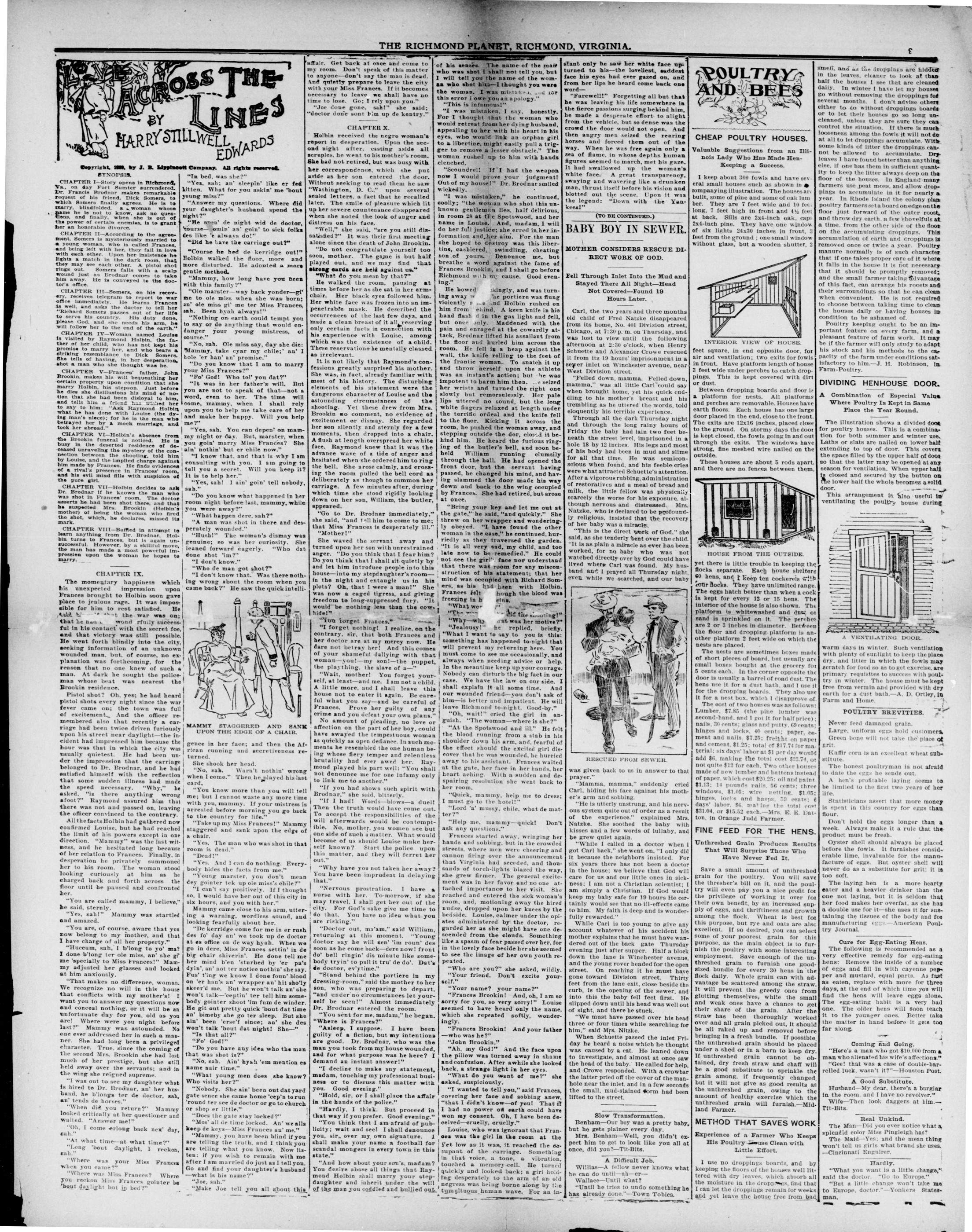
LOVE ACROSS THE LINES BY HARRY STILLWELL EDWARDS
CHAPTER I-Story opens in Richmond, Va., on day FIrst Sumter surrendered. Dr. Francis Brodner makes remarkable request of his friend, Dick Somers, to whom he is a great girl. He marry, blindfolded, a woman whose name he is not to know, ask no questions, and finally, when she is out of the power of certain enemies, is to grant her an opportunity to marry. CHAPTER II-According to the agreement, Somers is mysteriously married to a young woman, who is called Frances, and being left with her, they fall in love with each other. Upon her insistence he lifts her from the dark room, that they may see each other in rings out. Somers falls with a scalp wound just as Brodner comes to take him away. He is conveyed to the doctor. CHAPTER III-Somers, on his recovery, receives telegrams of information office immediately. He learns. France is well, and asks the doctor to tell her "Richard Somers passes out of her life to serve his country. His duty done, please give his duty arm, he will follow her to the end of time."
CHAPTER IV-Woman named Louise is visited by Raymond Holbin, the father of her child, who has not kept his marry her, and who bears a striking resemblance to her sister. She tells of having, in her desperation, shot a man who she thought was he.
CHAPTER V-Frances' father, John Brookin, makes his will bequeathing her certain property upon condition that she will die. Joseph just before he dies she disillusioned him. Then that she had been disloyal to him, and tells him a friend has wished her to say to him: "Ask Raymond Holbin and Louise the man (the dying man's niece); for he is the man who betrayed her by a mock marriage, and took her abroad."
CHAPTER VI-Holbin's absence from the Brookin funeral is noticed. He is buried in deserted residence of deceased unmarried woman in connection between the shooting, told him by Louise, and the implied charge against him made by Frances. He finds evidences in presence in Frances' room, and his wife found fills with suspicion of the pure girl.
CHAPTER VII-Holbin decides to ask Dr. Brodnar if he knows the man who asserts he had shot Frances' room. The doctor asserts he had shot Frances' room. The doctor suspected Mrs. Brooklin (Holbin's mother) of being the woman who fired the shot, which, he declares, misses it. CHAPTER VII-Buffed in attempt to learn anything from Dr. Brodnar, Holbin turns to Frances, but is again unsuccessful. However, by a skillful move, he has made a most powerful impression upon the woman he hopes to marry.
CHAPTER IX
The momentary happiness which his unexpected impression upon Frances brought to Holbin soon gave place to jealousrage. It was impossible for him to rest satisfied. He told himself that the war was on; that he had wondfully successful in his contact with the secret foe, and that victory was still possible. He went forth blindly into the city, seeking information of an unknown wounded man, but, of course, no explanation was forthcoming, for the reason that no one knew of such a man. At dark he sought the police-man whose beat was nearest the Brookin residence.
Pistol shot? Oh, yes; he had heard pistol shots every night since the war fever came on; the town was full of excitement. And the officer remembered also that recently a carriage had been twice driven furiously upon his street near daylight—the incident had impressed him because the hour was that in which the city was usually quietest. He had been under the impression that the carriage belonged to Dr. Brodran, and he had satisfied himself with the reflection that some sudden illness had made the speed necessary. "Why," he asked, "is there anything wrong afoot?" Raymond assured him that there was not and passed on, leaving the officer convinced to the contrary.
All the facts Holbin had gathered now confirmed Louise, but he had reached the limit of his powers except in one direction. "Mammy" was the last witness, and he hesitated long because of her relation to Frances. Finally, in desperation he privately summoned her to his room. The woman stood looking curiously at him as he charged back and forth across the floor until he paused and confronted her.
"You are called mammy, I believe," he said, sternly.
"Yes, sahl!" Mammy was startled and amazed.
"You are, of course, aware that you now belong to my mother, and that I have charge of all her property."
"Hucune, sah, I b'long to yo' ma? I done b'long ter ole miss, an' she gie'mespecially to Miss Frances!" Mammy adjusted her glasses and looked at him anxiously.
"That makes no difference, woman. We recognize no will in this house that conflicts with my mother's! I want you to answer my questions now and conceal nothing, or it will be an unfortunate day for you, old as you are! Where were you night before last?" Mammy was astounded. No one ever addressed her in such a manner. She had long been a privileged character. True, since the coming of the second Mrs. Brookin she had lost much of her prestige, but she still held sway over the servants; and in the wing she reigned supreme.
"I was out to see my daughter what is hired to Dr. Broodnar, an' her husband, he b'longs te de doctor, sah, an' tends de horses."
"When did you return?" Mammy looked critically at her questioner and waited. "Answer me!"
"Oh, I come erlong back nex' day, gah."
"At what time—at what time?"
"Long 'bout daylight, I reckon,
sah."
"Where was your Miss Frances
when you came?"
"Where was Miss Frances? Where
you reckon Miss Frances goointer be
'bout daylight but in bed?"
"In bed, was she?"
"Yes, sah; an' sleepin' like er fed kitten. What for you askin' me 'bout young miss?"
"Answer my questions. Where did your daughter's husband spend the night?"
"He seen' de night wid de doctor, course—omin' an' gain' to sick folks des like 'e always do!"
"Did he have the carriage out?"
"Course he heed de kerridge out!" Holbin walked the floor, more and more disturbed. He adocted a more gentle method.
"Mammy, how long have you been with this family?"
"Ole marster—way back yonder—gi' me to ole miss when she was born; an' ole miss gi' me ter Miss Frances, sah. Been henhah always!"
"Nothing on earth could tempt you to say or do anything that would endanger your young mistress, of course."
"No. sah. Ole miss say, day she die: 'Mammy, take cyar my chile;' an' I hole 'er han' an' promise."
"Do you know that I am to marry your Miss Frances?"
"Fo' God! Who tol' you dat?"
"It was in her father's will. But you are not to speak of that—not a word, even to her. The time will come, mammy, when I shall rely upon you to help me take care of her and make her happy. Will you help me?"
"Yes, sah. You can depen' on mammy night or day. But, marster, when you goin' marry Miss Frances? She ain' nothin' but er chile now."
"I know that, and that is why I am consulting with you. I am going to tell you a secret. Will you keep it? It is to help her."
"Yes, sah! I ain' goin' tell nobody, sah."
"Do you know what happened in her room night before last, mammy, while you were away?"
"What happende sah?"
"A man was shot in there and des-
perately wounded."
"Hush!" The woman's dismay was
genuine; so was her curiosity. She
leaned forward eagerly. "Who dat
done shot 'im?'
"I don't know."
"Who de man got shot?"
"I don't know that. Was there nothing wrong about the room when you came back?" He saw the quick intelli-
MAMMY STAGGERED AND SANK UPON THE EDGE OF A CHAIR.
gence in her face; and then the African cunning and secretiveness returned.
She shook her head.
"No, sah. Warn't nothin' wrong when I come." Then he played his last card.
"You know more than you will tell me; but I cannot waste any more time with you, mammy. If your mistress is arrested before morning you go back to the country for life."
"Take up my Miss Frances!" Mammy staggered and sank upon the edge of a chair.
"Yes. The man who was shot in that room is dead."
"Dead!"
"Yes. And I can do nothing. Everybody hides the facts from me."
"Young marster, you don't mean dey gointer tek up ole miss's chile?" "I can't say positively. If I thought so, I would have her out of this city in six hours, and you with her."
Mammy came close to his arm, uttering a warning, wordless sound, and looking fearfully about her.
"De kerridge come for me in er rush des fo' day an' we took up de doctor at es office on de way hyah. When we go in dere, Miss Frances settin' in de big chair shiverin'. He done tell me her mind b'en 'sturbed by 'er pa's dyin', an' not ter notice nothin' she say. Fus' ting we know I done foun' blood on 'er han's an' wrapper an' hit sho'y sker'd me. But he won't talk an' she won't talk—ceptin' ter tell him somebody goointer shoot 'im dewinder. He git out pretty quick 'bout dat time an' bimbye she go ter sleep. But she ain' been 'erse'f since; an' she des won't talk 'bout dat night! She—" "Is that all?"
"Fo' God!"
"Do you have suy idea who the man that was shot is?"
"No, sah. Ain' hyah 'em mention es name nair time."
"What young men does she know?
Who visits her?"
"Nobody. She ain' been out dat yard
gate sence she came home 'cep'n to run
'round ter see de doctor or go to church
or shop er little."
"Does the gate stay locked?"
"Mos' all de time locked. An' we alls keep de keys—Miss Frances an' me."
"Mammy, you have been blind if you are telling the truth, and I think you are telling what you know. Now listen: if you wish to remain with me after I am married do just as I tell you. Go and find your daughter's husband—what is his name?"
"Joe, sah."
"Make Joe tell you all about this
THE RICHMOND PLANET, RICHMOND, VIRGINIA.
affair. Get back at once and come to my room. Don't speak of this matter to anyone—don't say the man is dead. And quietly prepare to leave the city with your Miss Frances. If it becomes necessary to leave we shall have no time to lose. Go; I rely upon you." "Joe done gone, sahl!" she said; "doctor don't bim up de kentry."
CHAPTER X
Holbin received the negro woman's report in desperation. Upon the second night after, casting aside all scruples, he went to his mother's room. She had not retired, but was busy with her correspondence, which she put aside as her son entered the door. Without seeking to read them he saw "Washington, D. C." upon several sealed letters, a fact that he recalled later. The smile of pleasure which lit up her severe countenance disappeared when she noted the look of anger and distress on his face.
"Well," she said, "are you still dissatisfied?" It was their first meeting alone since the death of John Brookin. "Do not congratulate yourself too soon, mother. The game is but half played out, and we may find that strong cards are held against us."
"What do not not be he that?"
He walked the room, pansing at times before her as she sat in her armchair. Her black eyes followed him. Her white face was frozen into an impenetrable mask. He described the occurrences of the last few days, and made a clean breast of it all, reserving only certain facts in connection with his experience with Louise, among which was the existence of a child. These reservations he mentally classed as irrelevant.
It is not likely that Raymond's confessions greatly surprised his mother. She was, in fact, already familiar with most of his history. The disturbing elements of his statement were the dangerous character of Louise and the astounding circumstances of the shooting. Yet these drew from Mrs. Brookin no comment, no evidence of excitement or dismay. She regarded her son silently and sternly for a few moments, then dropped into a chair. A flush at length overspread her white face. Raymond knew that it was the advance wave of a tide of anger and hesitated when she ordered him to ring the bell. She arose calmly, and crossing the room pulled the bell cord as deliberately as though to summon her carriage. A few minutes after, during which time she stood rigidly looking down on her son, William, the butler, appeared.
"Go to Dr. Brodnar immediately," she said, "and tell him to come to me; that Miss Frances is desperately ill." "Mother!"
She waved the servant away and turned upon her son with unrestrained anger. "Do you think that I fear him? Do you think that I shall sit quietly by and let him introduce people into this house—into my stepdaughter's room—in the night and entangle us in his plots? Oh, that I were a man!" She was now a caged tigress, and giving freedom to long-suppressed fury. "It would be nothing less than the cow-hide!"
"You forget Frances."
"I forget nothing." I realize, on the contrary, sir, that both Frances and her doctor are at my mercy now. He dare not betray her! And this comes of your shameful dallying with that woman—you!—my son!—the puppet, the plaything, the splay of a—"
"Wait, mother! You forget yourself, at least—and me. I am not a child. A little more, and I shall leave this house not to enter it again. Be careful what you say—and be careful of Frances. Prove her guilty of any crime and you defeat your own plans." No amount of pleading, no love or affection on the part of her boy, could have swayed the tempestuous woman as quickly as open defiance. In such moments he resembled the one human being whose fiery temper and relentless brutality had ever awed her. Raymond played his part well: "You shall not denounce me for one infamy only to link me to another." "If you had shown such spirit with Brodnar," she said, bitterly.
"If I had! Words—blows—a duell! Then the truth would have come out. To accept the responsibilities of the will afterwards would be contemptible. No, mother, you women see but one side of such a matter. What would become of us should Louise make herself known? Start the police upon this matter, and they will ferret her out."
"Why have you not taken her away? You have been imprudent in delaying that."
"Nervous prostration. I have a nurse with her. To-morrow, if she may travel, I shall get her out of the city. For God's sake give me time to do that. You have no idea what you are risking."
"Doctor out, ma'am," said William, returning at this moment. "Young doctor say he will sen' 'im roun' des soon as he come back—dere now! front do' bell ringin' dis minute like somebody tryin' to pull tr' de do'. Dat's de doctor, ev'ytime."
"Stand behind the portiere in my dressing-room," said the mother to her son, who was preparing to depart, "and under no circumstances let yourself be seen!" Almost immediately Dr. Brodnar entered the room. "You sent for me, madam," he began. "Where is Frances?"
"Asleep, I suppose. I have been guilty of a fiction, but my intentions are good. Dr. Brodnar, who was the man you took from my house wounded, and for what purpose was he here? I demand an instant answer!"
"I decline to make any statement, madam, touching my professional business or to discuss this matter with you. Good evening."
"Hold, sir, or I shall place the affair in the hands of the police."
"Hardly. I think. But proceed in that way if you prefer. Good evening."
"You think that I am afraid of publicity; wait and see! I shall denounce you, sir, over my own signature. I shall make your name a football for scandal mongers in every town in this state."
"And how about your son's, madam? You desire above all things that Raymond Holbin shall marry your step-daughter and inherit under the will of the man you coddled and bullied out
of his senses. The name of the man who was shot I shall not tell you, but I will tell you the name of the woman who shot hiru—I thought you were the woman. I was mistaken, and for this error I owe you an apology."
"This is infamous!"
"I was mistaken, I say, honestly. For I thought that the woman who would retreat from her dying husband, appealing to her with his heart in his eyes, who would link an orphan girl to a libertine, might easily pull a trigger to remove a lesser obstacle." The woman rushed up to him with hands clenched.
"Scoundrel! If I had the weapon now I would prove your judgment! Out of my house!" Dr. Brodnar smiled wickedly.
"I was mistaken," he continued, coolly; "the woman who shot this unknown gentleman lies, half delirious, in room 28 at the Spotswood, and her name is Louise. And, madam, I will do her full justice; she erred in her information and her aim. For the man she hoped to destroy was this libertine, cashiered, swindling, cheating son of yours. Denounce me, but breathe a word against the fame of Frances Brookin, and I shall go before Richmond with my cause. Good evening."
He bowed slightly, and was turning away with the portiere was flung violently a side and Holbin rushed on him from behind. A keen knife in his hand flashed in the gas light and fell, but once only. Maddened with the pain and enraged at the cowardly attack, Brodran lifted his assailant from the floor and hurled him across the room. He fell in a heap against the wall, the knife rolling to the feet of the frantic woman. To snatch it up and throw herself upon the athlete was an instant's action; but he was impotent to harm him then. He seized her wrists and turned the right one slowly but remorselessly. Her pale lips uttered no sound, but the long white fingers relaxed at length under the terrific ordeal and the knife fell to the floor. Kicking it across the room, he pushed the woman away, and stepping outside the dor, closed it behind him. He heard the furious ringing of the butler's bell, and soon beheld William running clumsily through the hall. He had opened the front door, but the servant having passed, he changed his mind, and having slammed the door made his way down and back to the wing occupied by Frances. She had retired, but arose at once.
"Bring your key and let me out at the gate," he said, "and quickly." She threw on her wrapper and wonderingly obeyed. "I have found the other woman in the case," he continued, hurriedly as they traversed the garden. "It is all very sad, my child, and too late now to be remedied." He could not see the girl! face nor understand that there was room for any misconstruction of his statement; that her mind was occupied with Richard Somers, as his had been with Holbin. Frances felt though the blood was freezing in hips.
"What wor-
" "The w-
" "Why-why
" "What was her motive?"
"Jealousy!" he replied, briefly.
"What I want to say to you is this: something has happened to-night that will prevent my returning here. You must come to see me occasionally, and always when needing advice or help. In the meantime keep up your courage. Nobody can disturb the big fact in our case. We have the law on our side. I shall explain it all some time. And our wounded friend--you don't ask of him—is better and impatient. He will leave Richmond to-night. Good-by."
"Oh, wait!" cried the girl in anguish. "The woman—where is she?"
guish. "The woman—where is she?" "At the Spotswood and ill." He felt the blood running from a stab in his shoulder down his arm, and, fearful of the effect should the excited girl discover that he was wounded, he hurried away to his assistant. Frances waited at the gate, her face in her hands, her heart aching. With a sudden and despiring resolution she went back to her room. "Quick, mammy, help me to dress; I must go to the hotel!" "Lord a' mussy, chile, what de matter?" "Help me, mammy—quick! Don't ask any questions."
Frances started away, wringing her hands and sobbing, but in the crowded streets, where men were cheering and cannon firing over the announcement that Virginia had seceded, and thousands of torch-lights blazed the way, she grew firmer. The general excitement was in her favor and no one attached importance to her visit. She reached and entered the sick woman's room, and, motioning away the hired nudse, dropped upon her knees by the bedside. Louise, calmer under the opiates administered by the doctor, regarded her as she might have one descended from the clouds. Something like a spasm of fear passed over her, for in the lovely face beside her she seemed to see the image of her own youth repeated.
"Who are you?" she asked, wildly.
"Your friend. Don't excite yourself."
"Your name? your name?"
"Frances Brookin! And, oh, I am so sorry for you, so very sorry!" Louise seemed to have heard only the name, which she repeated softly, wonderingly.
"Frances Brookin! And your father—who was he?"
"John Brookin."
"Ah, my God!" And the face upon the pillow was turned away in shame and confusion. After awhile she looked back, a strange light in her eyes.
"What do you want of me?" she asked, suspiciously.
"I wanted to tell you," said Frances, covering her face and sobbing anew, "that I didn't know—of you! That if I had no power on earth could have won my consent. Oh, I have been deceived—cruelly, cruelly."
Louise, who was ignorant that Frances was the girl in the room at the vet low as it was, it reached the occupant of the carriage. Something in that voice, a tone, a vibration, touched a memory-cell. He turned quickly and looked back; a girl holding desperately to the arm of an old negress was being borne along by the tumultuous human wave. For an in-
stant only he saw her white face upturned to his—the loveliest, saddest face his eyes had ever gazed on, and from her lips he heard come back one word— "Farewell!" Forgetting all but that he was leaving his life somewhere in the fierce passions surging behind him, he made a desperate effort to alight from the vehicle, but so dense was the crowd the door would not open. And then angry men seized the rearing horses and forced them out of the way. When he was free again only a sea of flame, in whose depths human figures seemed to march, met his gaze. It had swallowed up the woman's white face. A great transparency, swaying and wavering like a drunken man, thrust itself before his vision and blotted out the scene. Upon it was the legend: "Down with the Yankees!"
(TO BE CONTINUED.) BABY BOY IN SEWER
MOTHER CONSIDERS RESCUE DIRECT WORK OF GOD.
Fell Through Inlet Into the Mud and Stayed There All Night—Head Not Covered—Found 19 Hours Later.
Carl, the two years and three months old child of Fred Natkze disappeared from its home, No. 401 Division street, Chicago, at 7:30 p. m. on Thursday, and was lost to view until the following afternoon at 2:30 o'clock, when Henry Schuette and Alexander Crowe rescued it from its 19 hours' imprisonment in a sewer inlet on Winchester avenue, near West Division street.
"Felled down, mamma. Felled down, mamma," was all little Carl could say when brought home, yet his quick cuddling to his mother's breast and his trembling as he uttered the words, told eloquently his terrible experience.
Through all the dark Thursday night and through the long rainy hours of Friday the baby had lain two feet beneath the street level, imprisoned in a hole 18 by 12 inches. His legs and most of his body had been in mud and slime for all that time. He was semiconscious when found, and his feeble cries were what attracted Schutte's attention. After a vigorous rubbing, administration of restoratives and a meal of bread and milk, the little fellow was physically scarcely the worse for his exposure, although nervous and distressed. Mrs. Natzke, who is declared to be profoundly religious, insisted that the recovery of her baby was a miracle.
"This is the direct work of God," she said, as she tenderly bent over the child. "It is as plain a miracle as ever has been worked, for no baby who was not watched directly over God could have lived where Carl was found. My husband and I prayed all Thursday night, even while we searched, and our baby
RESCUED FROM SEWER
was given back to us in answer to that prayer.
"Mamma, mamma," suddenly cried Carl, hiding his face against his mother's arm and sobbing.
"It is he utterly unstrung, and his nervous system quite out of order as a result of the experience." explained Mrs. Natzke. She soothed the baby with kisses and a few words of lullaby, and be grew quiet again.
"While I called in a doctor when I got Carl back," she went on. "I only did it because the neighbors insisted. For six years there has not been a doctor in the house; we believe that God will care for us and our little ones in sickness; I am not a Christian scientist; I am simply a Christian. If God would keep my baby safe for 19 hours He certainly would see that no ill-effects came to him. My faith is deep and is wonderfully rewarded."
While Carl is too young to give any account whatever of his accident his mother explains that he must have wandered out of the back gate Thursday evening just after supper. Half a block down the lane is Winchester avenue, and the young rover headed for the open street. On reaching it he must have gone toward Division street. Thirty feet from the lane exit, close beside the curb, is the opening of the sewer, and into this the baby fell feet first. He slipped down until his head was well out of sight, and there he stuck.
"We must have passed over his head three or four times while searching for him," said Mrs. Nitzke.
When Schuette passed the inlet Friday he heard a noise which he thought was caused by a cat. He leaned down to investigate, and almost at once saw the head of the baby. He called for help, and Crowe responded. With a crowbar the latter ripped off the cover of the manhole near the inlet, and in a few seconds the small, mud-stained form had been lifted to the street.
Slow Transformation
but he gets planner every day.
Mrs. Benham—Well, you didn't expect him to get to look like you all at once, did you?—Tit-Bits.
A. Difficult Job
Willias—A fellow never knows what
he can do until—ah—er—
Wallace—Until what?
"Until he tries to undo something he
has already done."—Town Tobies.
POULTRY AND BEES
CHEAP POULTRY HOUSES.
Valuable Suggestions from an Illinois Lady Who Has Made Hen- Keeping a Success.
I keep about 300 fowls and have several small houses such as shown in companying illustration. The houses are built, some of pine and some of oak lumber. They are 7 feet wide and 10 feet long, 7 feet high in front and 4½ feet at back. Sills are 2x4-inch oak, caps 2x4-inch pine. They have one window of six lights 24x30 inches in front, 3 feet from the ground; one small window without glass, but a wooden shutter.
INTERIOR VIEW OF HOUSE.
feet square, in end opposite door, for air and ventilation; two exits for fowls in front. Have platform length of house 3 feet wide under perches to catch droppings. This is kept covered with dirt or dust.
Between dropping boards and floor is a platform for nests. All platforms and perches are removable. Houses have earth floors. Each house has one large door placed in the end, close to the front.
The exits are 12x16 inches, placed close to the ground. On stormy days the door is kept closed, the fowls going in and out through the exits. The windows have strong, fine meshed wire nailed on the outside.
These houses are about 5 rods apart, and there are no fences between them.
HOUSE FROM THE OUTSIDE.
yet there is little trouble in keeping the flocks separate. Each house shelters 60 hens, and I keep ten cockerels with our flocks. They have unlimited range. The eggs hatch better than when a cock is kept for every 12 or 15 hens. The interior of the house is also shown. The platform is whitewashed and dust or sand is sprinkled on it. The perches are 2 or 3 inches in diameter. Between the floor and dropping platform is another platform 2 feet wide on which the nests are placed.
The nests are sometimes boxes made of short pieces of board, but usually are small boxes bought at the grocery for 5 cents each. In the corner opposite the door is usually a barrel of road dust. The hens use it for a dust bath, and I use it for the dropping boards. They also use it for a nest box, which I disapprove of.
The cost of two houses was as follows: Lumber, $7.85 (the pine lumber was second-hand, and I got it for half price); nails, 36 cents; glass and putty, 69 cents; hinges and locks, 40 cents; paper, cement and nails, $7.25; freight on paper and cement, $1.25; total of $17.74 for material; six days' labor at $1 per day would add $6, making the total cost $23.74, or not quite $12 for each. Two other houses made of new lumber and battens instead of paper, which cost $20.25; oil and paint, $1.13; 14 pounds balls, 56 cents; three windows, $1.05; wire netting, $1.05; hinges, locks and hasps, 59 cents; 6 days' labor, $6, making the total cost $31.04, or $15.52 each.—Mrs. E. E. Datton, in Orange Judd Farmer.
FINE FEED FOR THE HENS.
Unthreshed Grain Produces Results
That Will Surprise Those Who
Have Never Fed It.
Save a small amount of unthreshed grain for the poultry. You will save the thresher's bill on it, and the poultry will even pay you a nice profit for the privilege of working it over for their own benefit, by an increased supply of eggs, and thriftiness and growth among the flock. Wheat is best for this purpose, but rye and oats are also excellent. If so desired, you can select some of your poorest grain for this purpose, as the main object is to furnish the poultry with some interesting employment. Save enough of the unthreshed grain to furnish one good-sized bundle for every 30 hens in the flock daily. Whole grain can with advantage be scattered among the straw. It will prevent the greedy ones from glutting themselves, while the small and weak ones have a chance to get their share of the grain. After the straw has been thoroughly worked over and all grain picked out, it should be all raked up and removed before bringing in a fresh bundle. If possible, the unthreshed grain should be placed under a shed or in a barn to keep dry. If unthreshed grain cannot be obtained, dry fresh straw and chaff will be a good substitute to sprinkle the grain among. If frequently changed, but it will not give as good results as the unthreshed grain, owing to the amount of healthy exercise which the unthreshed grain will furnish—Midland Farmer.
METHOD THAT SAVES WORK
Experience of a Farmer Who Keeps His Poultry House Clean with Little Effort.
I use no droppings boards, and by keeping the floors of the houses well littered with dry leaves, which absorb all the moisture in the droppings, find that I can let the droppings remain for weeks and yet leave the house free from bad
3
smell, and as the droppings are hidden in the leaves, cleaner to look at than half the houses I see that are cleaned daily. In winter I have let my houses go without removing the droppings for several months. I don't advise others either to do without droppings boards or to let their houses go so long uncleaned, unless they are sure they can control the situation. If there is much looseness among the fowls it will not do at all to let droppings accumulate. With some kinds of litter the droppings cannot be allowed to accumulate. Dry leaves I have found better than anything else, if one has them in sufficient quantity to keep the litter always deep on the floor of the houses. In England many farmers use peat moss, and allow droppings to accumulate in it for nearly a year. In Rhode Island the colony plan poultry farmers set a board on edge on the floor just forward of the outer roost, and throw dry earth, a few shovelfuls at a time, from the other side of the floor on the accumulating droppings. This accumulation of earth and droppings is removed once or twice a year. Poultry manure normally is of such character that if one takes proper care of it where it falls in the house it is not necessary that it should be promptly removed; and the small farmer taking advantage of this fact, can arrange his roosts and their surroundings so that he can clean when convenient. He is not required to choose between taking time to clean the houses daily or having houses in condition to be ashamed of.
Poultry keeping ought to be an important feature on every farm, and a pleasant feature of farm work. It may be if the farmer will only study to adapt his stock and his methods to the capacity of the farm under conditions satisfactory to him.—J. H. Robinson, in Farm-Poultry.
DIVIDING HENHOUSE DOOR
A Combination of Especial Value Where Poultry Is Kept in Same Place the Year Round.
The illustration shows a divided door for poultry houses. This is a combination for both summer and winter use. Laths or slats are nailed on lower half extending to top of door. This covers the space filled by the upper half of door so that the latter may be opened at any season for ventilation. When upper half is closed and secured by the button on the lower half the whole becomes a solid door. This arrangement is also useful in ventilating the poultry house during
A VENTILATING DOOR
warm days in winter. Such ventilation with plenty of sunlight to keep the place dry, and litter in which the wifles may scratch for food so as to get exercise, are primary requisites to success with poultry in winter. The house must be kept free from vermin and provided with dry earth for a dust bath—A. D. Ortley, in Farm and Home.
POULTRY BREVITIES
Never feed damaged grain.
Large, uniform eggs hold customers.
Green bone will not take the place of grit.
Kaffir corn is an excellent wheat substitute.
The honest poultryman is not afraid to date the eggs he sends out.
A hen's profitable laying seems to be limited to the first two years of her life.
Statisticians assert that more money is spent in this country for eggs than flour.
Don't hold the eggs longer than a week. Always make it a rule that the product must be fresh.
Oyster shell should always be placed before the fowls. It furnishes considerable lime, invaluable for the manufacture of eggs. But oyster shell will never do as a substitute for grit; it is too soft.
The laying hen is a more hearty eater and a heavier drinker than the one not laying, but it is seldom that her food makes her overfat, as she has a double use for it—she uses it for sustaining the tissues of the body and for manufacturing eggs.—American Poultry Journal.
Cure for Egg-Eating Hens
The following is recommended as a very effective remedy for egg-eating hens: Remove the inside of a number of eggs and fill in with cayenne pepper and mustard, equal parts. As fast as eaten, replace with more for three days, at the end of which time you will find the hens will leave eggs alone. The egg-eating habit is a very bad one. The older hens will soon teach it to the younger ones. Better take the matter in hand before it gets too far along.
"Here's a man who got $10,000 from a man who alienated his wife's affections." "Gee! that was a case of double-barrel luck, wasn't it?"—Houston Post.
A. Good Substitute
Husband—My dear, there's a burglar in the room, and I have no revolver." Wife—Then look daggers at him. Tit-Bits.
Real Unkind.
The Man—Did you ever notice what a splendid color Miss Pingleigh has?
The Maid—Yes; and the mean thing won't tell us girls what brand she uses.
—Cincinnati Enguirer.
Hardly.
"What you want is a little change," said the doctor. "Go to Europe."
"But a little change won't take me to Europe, doctor."—Yonkers Statesman.
HEY PLANET
Published every Saturday by JOHN R. CHEN
28, at 8:31 North 4th Street, Richmond, Va.
SOUN ITCHELL, JR., EDITOR
The communications intended for publication should be in terms of each of the Wednesdays
TERMS IN ADVANCE
A Current year,
Consume at months
One Copy six months,
One Copy two months,
One Copy three months,
Single Copy
11.50
1.00
.80
.40
.00
ADVERTISING RATES
The one time one insertion,
For one time, each subsequent insertion
for two months, three months,
two months, six months,
two months, nine months,
two months, twelve months,
Narrative and Transcript Notice: Let line
The STAMPS OF A EIGHER DEFORMATION THAN TWO CENTS NOIR RIDE ON SUBSCRIPTIONS
New Papers issued weekly. The subscriber
price is $1.50 a year, in advance.
EAST ORDERS You can buy a Money Orders from Post Office, payable at the Richmond office, and we will be responsible for its delivery. MONEY ORDERS can be ordered at the United States Express Co. and the Web. Faxed to Express Company. We will be sent any of these con-
tents on request. The Express Company is the most convenient way for forwarding money.
READ LETTER. If you need your name or English or English Express Office, I'll not write to your Master's will register the letter you wish to send us on payment of tax if if the letter is lost or stolen, it will be sent to you at any time. You can send money in this way.
If you are responsible for money sent in your way than one of the four ways, you send your money on a 100% charge. If you send it at any way, you must do it at your own risk.
If you do not want the money you can send for another year after you run out, you can notify us by a continue it. The courts have rulers to newspapers who do not post a letter. The law is the only way which it has been paid as payment of the subscriber's fee.
If you don't pay the paper discusive of the order of the writer, you are writing to us.
If your subscription or to a discontinued plan should give your name and address to us, you will be in effect.
If you are in order to change a subscriber, we must be so well as the present address.
SATURDAY.....OCTOBER 15, 1904
DEFENDERS OF WHITE WOMEN.
It seems to be necessary for both the better class of white men and the better class of colored ones to protect white ladies from the white brushes of the South-land. A telegraphic report, under date of October 3rd, 1904, from Dublin, Georgia, states that J. E. HATHAWAY, (white) superintendent of the county chain-gang, while intoxicated attempted to prevent a white lady passing him on the street. EARL CAMP, (white) a prominent young lawyer was riding by on a bicycle, and heard the lady's cry for help.
He went to her aid and was promptly knocked down by HATHAWAY. While on his knees, CAMP drew his revolver and shot his assailant five times, killing him almost instantly. SOLOMON HATHAWAY, brother of the dead man, has declined to ask for an indictment of the slayer of his brother, evidently realizing that he got his deserts.
The telegraphic reports of October 7th, 1904, from Memphis, Tennessee, cite another case. ROWLAND C. HILL, (white), an insurance agent forced his attentions on Mrs. EMMA LEONARD, (white) who keeps a grocery store. He became so obnoxious that she left her store and sought a refuge in the yard of BENJAMIN GILLIAM (colored). HILL entered GILLIAM's yard for the purpose of taking Mrs. LEONARD back to the store. He was warned repeatedly by GILLIAM not to enter the premises. He paid no attention to the warning Thereupon GILLIAM secured a shot gun and shot HILL, killing him.
As to what the result will be in his case, it is idle to conjecture. GILLIAM has the law, the facts and the white woman, whom he defended on his side. He is in the unique position of defending a white woman instead of attacking her and if CAMP, (the white man in Georgia) is a hero, surely GILLIAM (the colored man in Tennessee) is equally so.
TWO REMARKABLE CASES.
THAT the colored people are having a hard time of it with the lower elements of the white people admits of no question and that they are being strongly defended by the upper classes of white people is equally apparent. No better illustration of this is to be found anywhere than in the cases recently reported from Virginia and North Carolina.
The first case was reported from Fredericksburg, Va., and the correspondent denominated it to be "the most daring criminal assault ever perpetrated in this section of the State."
This was under date of October 5th, 1904, and it was alleged that the crime was committed in Spotsylvania county, upon Mrs. MARMADUKE LACY, on the
4th inst., while the male members of the family were in attendance at the sessions of the Circuit Court. BATTALE JOHNSON was the alleged culprit.
The Richmond, Va., NEWS-LEADER indulged in the following "scare line" heading:
"NEGRO FIEND IS JAILED.
Mrs Lacy's Assault Caught by Spotsylvania Posse and is now Under Guard."
When the case was submitted to the grand jury, Mrs. LACY, the white lady denied that any criminal assault had been attempted or committed. The grand jury was divided on the question of bringing in a true bill but a majority of them having so voted an indictment was the result. At the trial, Mrs. MARMADUKE LACY, and her husband testified that the colored man was innocent, that he had been in the employ of the family for sixteen years and that they were confident that he had no such evil intentions as those charged against him. After deliberating for some time the, jury announced that it was unable to agree upon a verdict, and it was discharged.
As for Johnson, he is as yet in jail in Spotsylvania county. The Richmond, Va., NEWS-LEADER was so disgusted over the blunder of its correspondent that with an evident feeling of fair-play, it announced that such a person, who would send out such a scandalous exaggeration of facts would write no more for that journal. Then followed a later explanation, that Mr. John T. Goolrick, its Fred. ericksburg correspondent was out of place and had left the work to some one else, who had misrepresented the facts, and indirectly endangered the life of a contested innocent man.
That a jury should have disagreed, when the evidence is of such a positive nature in favor of the accused demonstrates the feeling existing whenever a colored man is charged with a crime against a white woman. He is virtually convicted before he is tried, as the jurors as a rule are drawn from that class of white men, who inherently hate the Negro, not ever having owned a colored man and therefore not knowing the value of one.
This case is bad enough, but it is not as outrageous as the one reported from North Carolina. Several months ago, TOM LOVE, colored, who is about fifty years of age became intoxicated and fell asleep on the porch of Mrs. ROGERS. He awoke at about 1 A.M. and thinking that he was at his own house, entered the open window and made his way to Mrs. ROGER's room, where his movements attracted her attention as she awoke from a sound sleep. LOVE became frightened and left hurriedly. He afterwards explained the affair. He had been employed by Mrs. ROGERS for some time and she was convinced that he told the truth and was innocent. She went so far as to employ counsel for his defense. A white jury heard the evidence and convicted him of burglary and he was sentenced to be hanged October 27th, 1904.
The white lady's name is Mrs. Rogers and the affair occurred at Waynesville, N. O. The indications are that should Gov. Aycock decline to interfere, the decree of the court will be carried out. The facts speak for themselves and is a most forcible illustration of the feeling between the lower strata of whites towards the colored people in their respective localities.
That the liberal minded white men of the Southland have a great task in combatting these conditions is plainly evident and as for the Negro, he must bend his energies towards encouraging those white people who would help him and do all in his power to uphold his own leaders, who are pointing out to him the way to permanent success and lasting prosperity.
It requires patience, perseverance and above all else money, backed by the friendship of those white men, who may be found in well-nigh every southern locality, and whose aid and support should form the basis of our appeals to the sober second thought of every community in Dixie.
PAID $70,000 FOR STALLION
Harry Payne Whitney Pays That
Amputt For Hamburg.
Auction for Hamburg.
New York, Oct. 11.—Hamburg, the famous stallion, was sold to Harry Payne Whitney for $70,000. The sale took place at Madison Square Garden, where the entire racing stud of the late William C. Whitney was put up at auction by the Fasig-Tipton Company. When bids were called for Hamburg, H. P. Whitney offered $50,000, which was raised by James R. Keene to $60,000.
Mr. Whitney then bid $70,000 and the great sire went to him at that figure.
Harry Payne Whitney also bid in the stallion Sandringham, a full brother to Persimmon, Diamond Jubilee and Florzel II, for $14,000, while Milton Young of Lexington, Ky., got Nasturtium called the best 2-year-old of his time for $10,000, with little competition.
Forty-one horses in all were sold and the aggregate amount received was $222,600, of which Harry Payne Whitney paid $145,900 for 12 of the thoroughbreds.
BATTLESHIP GEORGIA LAUNCHED
Uncle Sam's Latest Warship Takes the Water at Bath, Me
Bath, Me., Oct. 12.—The largest vessel ever built in Maine, the twin screw first-class battleship Georgia, was launched from the plant of the Bath Iron Works. As she started from the ways she was christened with champagne by Stella Tate, daughter of the late Major William Tate, and sister of Congressman F. Carter Tate. Naval officers and officials of the federal and state governments of Maine and Georgia witnessed the launching.
THE RICHMOND PLANET, RICHMOND, VIRGINIA
HARMONY AT LAST IN DELAWARE
HARMONY AT LAST IN DELAWARE
Warring Republicans Agree on a Candidate For Governor.
AN ANTI-ADDICKS MAN CHOSEN
Wilmington, Del., Oct. 11.—After innumerable conferences, continuing over a period of several weeks, the state committees of the Regular Republicans and the Union or Addicks Republicans came to an agreement on one state and congressional ticket for the Republican party in Delaware. Preston Lea, of this city, who is identified with the anti-Addicks or Regular Republican faction, was agreed upon as the compromise candidate for governor on the condition that he appoint as secretary of state, if elected, any one of three men whose names the Union Republicans will present to him. The two committees will meet tomorrow morning to select the candidates for the remainder of the ticket. It has also been agreed that the Union Republicans shall name the candidates for lieutenant governor, insurance commissioner and congress, and the Regulars shall name the candidates for attorney general, state treasurer and state auditor. It was further agreed that the state committees shall meet and arrange for a joint campaign committee.
The principal hitch in the harmony plan was over the selection of a candidate for governor. Each side several times presented list of names, but up to now neither faction would yield on any proposition offered.
All the candidates on the Union ticket have resigned, in fact their resignations have been in the hands of the state committee for some time. Dr. Joseph H. Chandler, the Regular Republican nominee for governor, was quoted as saying that he did not propose to resign. It is believed, however, that he will withdraw, because the Regular Republican state convention adopted a resolution giving the state committee authority to make any changes in the ticket it deemed necessary in the interest of harmony.
The conventions of both factions nominated the same presidential electors, therefore there will be no change in this part of the ticket.
CLEVELAND WILL SPEAK
Former President to Preside at Parker Mass Meeting in New York Oct. 21. New York, Oct. 11.—The following official announcement of Grover Cleveland's appearance at a political meeting in this city was made at Democratic national headquarters;
"The Business Men's Parker and Davis Association, whose membership is drawn from the leading business men of New York, have arranged to hold a mass meeting in Carnegie Hall on October 21. Sr. President Gower Cleveland has so far overcome his disinclination to make a speech during the canvass that he has consented to preside at this meeting. It is, however, fully understood both by the national committee and by his friends, that this appearance of the ex-president will be the only one he will make as a speaker during the campaign. The principal speech of the evening will be delivered by Ex-Secretary of the Treasury John G. Carlisle, and it is expected that this meeting will be the most important one held by any party in New York during the pending campaign."
A BARBAROUS MURDER
Superstitious Negroes Cut Up Child's Body to Be Able to Work Spells. Kingstown, St. Vincent, Oct. 12. Barbous superstition, which prevails among a portion of the population of West Indian islands, is the basis of a ghastly and extraordinary crime that has come to light in the island of St. Lucia. The finding of the heart and hands of a white child in the possession of an Obi-man (a negro sorcerer) led to the discovery that the child had been murdered and the body mutilated in order that superstitious natives might, through possession of portions of the body, be able to work spells.
Claims to Be Descendant of Gen. Lee.
Chicago, Oct. 12. A young woman, who says she is Gertrude R. E. Lee, and who claims she is a descendant of General Robert E. Lee, and the daughter of a prominent southern plantation owner, is under arrest here, charged with theft from Mrs. C. Roberts, of Jollet, Ill., of two satchels containing $3000 worth of jewelry and clothing. The alleged theft occurred in a State street department store three weeks ago. Mrs. Roberts checked her two satchels in the store. Miss Lee, it is said, represented herself as Mrs. Roberts and obtained the property.
Sneak Thief Gets $5000 In Jewelry.
Chicago, Oct. 11. -Gems valued at $5000 were stolen from the wholesale jewelry store of Joseph Maltz & Co. in State street by a sneak thief, who walked down five flights of stairs and escaped. While the clerks were all busy and while Mr. Maltz was at work in his private office the thief reached across a small safe, picked up one of several leather cases full of gems and made his way out of the store unnoticed.
2 Per Cent. Increase For Miners.
Wilkesbarre, Pa., Oct. 11.—Commissioner C. P. Neill has informed the coal companies that he finds that the average price of coal at tide water during September was $4.98. On this basis he fixes 5 per cent. Increase for the miners over the April basis, according to the sliding scale adopted by the coal strike commission. This is 2 per cent. more than was paid in August.
Trashy Novels Caused Double Suicide. Kankakee, Ill., Oct. 11.—A suicide pact has resulted in the death of Miss Minnie Ifand, 20 years old, and Lulu Cook, 14 years old, daughters of farmers 20 miles south of this city. Clasped in each others' arms, the two drank the contents of an ounce bottle of strychnine. Death came before medical aid could be summoned. The reading of trashy novels is said to have led to the suicides.
$25,000 Sale is Still Going On With
J. H. Busby, 00 Broad St.
F. PETTICK, M.D.
A. BROADWAY & CO.
Burlington, Vt., Oct. 11.-Mrs. John Angell, who created a sensation a few years ago by bringing suit against the heirs of Jay Gould, saying she was the widow of the multi-millionaire and demanding a share of his property, died in Rouse's Point, N. Y., Saturday. She was about 70 years old and had lived in Rouse's Point all her life.
Plead Guilty to Falsifying Books.
Baltimore, Md., Oct. 12.-William F. Fuller, former ledger clerk of the Second National Bank, pleaded guilty in the United States court to the charge of falsifying entries on his books, and was sentenced by Judge Morris to serve five years in jail. Fulled admitted having obtained $2500 from the bank by making false entries on his books.
29 PERSONS DEAD IN RAILWAY CRASH
29 PERSONS DEAD IN RAILWAY CRASH
Freight and World's Fair Train Collide Head-on Missouri Pacific.
SIXTY OTc. WERE INJURED
Warrensburg, Mo., Oct. 11.—Twenty-nine persons were killed and 60 injured by a head-on collision of Missouri Pacific trains three miles east of Warrensburg. The trains were the second section of a passenger train from Wichita for St. Louis and an extra freight train. Most of the dead were residents of Missouri and Kansas, as are the injured.
The passenger train, consisting of two day coaches, a Pullman and a caboose, was loaded with World's Fair excursionists from southeastern Kansas and southwestern Missouri. The Wichita passenger train had been cut in two at Pleasant Hill on account of the heavy load and a locomotive attached to the front car without a baggage car as a buffer. The extra freight had been sidetracked at Montserrat for the first section of the Wichita train, which carried signals that a second section was following. A local passenger train passed, and the freight crew took the local for the second section of the Wichita train and pulled out of the side track. Three miles west the freight met the second section.
The impact telescoped the tender of the passenger locomotive and the front car, which was full of passengers, and it was here that the sacrifice of life took place. The passenger conductor, E. L. Barnes, ran all the way to Warrensburg to report the wreck. Every physician in Warrensburg and hundreds of citizens hastened to the wreck to assist the wounded. Twenty persons were killed outright and nine died within a few hours.
The scene of the wreck was on the down grade, on either side of which there was a steep rise. Both trains had put on extra steam to carry them up the opposite hill, and when they met at the curve at the lowest point they were running at a terrific rate. When the trains met the heavy freight train pushed the passenger engine back into the first coach. The tender of the passenger engine literally cut the coach in one in the center, and never stop, until it had ploughed itself half way through the car and its passenger列车. Those in the forward forward and mangling all within reach in a most horrible manner.
Half a dozen who were not killed airtight were so terribly injured that they died lying dead they could be removed from the wreck. Many of the dead were almost unrecognizable.
Arms on lugs were dismembered in several cases, and, together with baggage and pieces of wreckage, were tumbled together into a confused mass of bleeding human forms.
The dead were placed on flat cars and brought to Warrensburg. A coroner's jury is now seeking the person responsible for the wreck.
The conductor of the freight train says he was dozing while his train was at Montserrat, and when the local train passed Engineer Horton believed it was the second section of the Wichita train, and, thinking the track clear, pulled out on the main line.
WARSHIPS, BUT NO OFFICERS
Vessels Being Turned Out Faster Than
Commanders
Washington, D.C. Fourteen war
Joyful news is going abroad in the cars of the people who are buying and going to buy at Busby's mammoth clothing store. New Overcoats of the best styles, make and quality are arriving daily. The prices will astonish you. A large and carefully-selected stock of
Full line of Battle-Axe Shoes. No better shoes made. Our prices are as low as those of any cash store in the city. Call and be convinced.
1892-12TH YEAR OFFER-1904
$1000
Given
To You
if you produce a more
harmless or better hair
tonic than
Glossine East Indian Hair Tonic
Stops dandruff, stops falling hair, turns
hair dark, grows hair on bald spots
if any roos remain causes hair to grow
long, soft and silky. Small box 25c,
large box 50c, 3 for $1. We pay for mailing
it to you.
Bruno's Hair Restorative
The wonder of the age. Restores gray
hair to its natural color; also stops hair
falling out and makes it grow. Large
bottle, $2.95 for 1.75. Each bottle guar-
anteed to do the work your money
back. We pay for express delivery.
Dr. Williamson's National Herbs
# National Heals
1 qt. 500, 1 qts. $1. We pay for mailing.
in capsule and tablet form 60 or
$1 box. The greatest and cheapest
known blood purifier, kidney, liver,
bladder, stomach and skin regulator.
infalable as cure for rheumatism, kidn-
dion, dislocation, cramps, troubles, consti-
pation, nervousness, dysentery, cata-
rch, pimples, eruptions, blood pol-
son and wounds. It is formed lost in a
womanhood. A dose taken each night
is all that is required. It works while
you are money back if it fails to
cure or benefit it. The worst case.
No doctor needed when this is in the
house.
# Bruno Manufacturing Co.
235 Washington St., Boston, Mass.
F. H. Jackson. Chas. T. Williams. JACKSON & WILLIAMS THE STAR BEEF &
Beef, Pork, Veal and Lamb,
101 W. Jackson St., Richmond, Va.
Fresh Country Eggs and
Butter. Fine Butter a
Specialty.
Subscribe to the PLANET.
Only $1.50 per year.
ships are to be launched within a few months, and the bureau of navigation finds itself confronted with the problem of properly officering them when it has at its call not enough officers for one sault that number of ships. Undoubtedly the president will urge on congress in his message at the opening of the session the necessity of providing some means by which more graduates can be turned out each year from the naval academy. Naval officers are inclined to comment sarcastically on this policy of turning out ships faster than men are educated to command them. If the United States is to follow Secretary Morton's declared policy of having the greatest navy afloat measures must taken to increase the educating capacity of Arnapolis. Particularly is the navy deficient in [ ] engineering corps.
4 WEEK'S NEWS CONDENSED
The case of William R. Hearst against the anthracite coal carrying roads will be heard in New York, October 24.
Lightning struck an oil tank at Findlay, O., the fire igniting three other tanks, which exploded, entailing a loss of $200,000.
F. E. Roberts, a prominent Chicago produce commission dealer, filed a petition in bankruptcy. Liabilities, $268,000; assets, $4500.
Governor Franklin M. Murphy was the principal speaker at the exercises in honor of New Jersey day at the St. Louis World's Fair.
Charles Eilston, formerly coachman of ex-President Cleveland, is under arrest in Philadelphia, charged with forging Cleveland's name to a check for $25.
Friday, October 7.
The Pennsylvania State Bankers' Association held its annual convention
GREAT periodical published every month in order that we may have a paper that will be read by both races, the white as well as the colored, that the white race may know the many great men and women of the colored race and what they are saying and doing.
Thousands of white, as well as the colored, read this Magazine every month. Some of them declare that they have learned more about the great men of the colored race through this Magazine than they ever knew before and that without doubt this periodical is far in advance of anything yet attempted by the Negro. Each month it contains articles from the greatest writers of the race. Agents are just as sure of making $5.00 per day selling this Magazine as they are in answering this advertisement.
Write at once that you may be the first in the field. Send 50c. for agents' terms, outfit, and a large number of Magazines, with which you may begin work at once. Subscription Price to every one is One Dollar Per Year. Write—
JAMES E. McGIRT, 420 S. 11th St., Phila Pa.
GONZALES
The Greatest Clairvoyant and Fortune Teller the World Has Ever Known.
Unites Separated. Brings back the one you Love, Helps Quickly all in Trouble.
Removes Evil Influences, Cures Mysterious Diseases, Gives Luck and Success. Send Lock of Hair, Date of Birth and 12 cents. Ask three questions and receive Horoscope and Lucky Birth stone by mail. GONZALES, 236 Bergen St., Brooklyn, New York.
tl-8-13-6m
JAMES E. McGIRT, Ph. B.
"THE NEW POET."
Editor-in-Chief and Owner of
"McGirt's Magazine."
GREAT periodical publ that we may have a pa races, the white as we race may know the many great race and what they are saying
Thousands of white, as well as the o Some of them declare that they have lea colored race through this Magazine than a doubt this periodical is far in advance. Each month it contains articles from the are just as sure of making 55.00 per day swering this advertisement.
Write at once that you may be the f terms, outfit, and a large number of Ma at once. Subscription Price to ever
JAMES E. McGIRT,
at Atlantic City, N. J.
While driving across the railroad tracks at Elkton, Md., Charles Saunders and Mrs. Ella Hammond were instantly killed by an express train. A spirited horse, driven by Michael Costil, became so frightened at escaping steam from a locomotive at Clarksbor, N. J., that it dropped dead in its harness. Former Governor Frank S. Black, of New York, has been retained under a $15,000 fee to defend Hannah Elias, the colored woman accused of extorting $700,000 from John R. Platt, an aged millionaire.
Saturday, October 8
Four persons were burned to death in a fire which destroyed the Tracey hotel at St. Joseph, Mo. Robbers blew open the safe in the postoffice at Berwyn, near Philadelphia, and escaped with $500 in cash and stamps. Twenty mules were burned to death in a fire which destroyed the stable of the Knickerbocker Ice company at Philadelphia. One man was killed and seven injured in a collision between passenger and freight trains on the Pan Handle railroad near Pittsburg, Pa.
Monday, October 10.
A flour mill at Pendleton, Ore., has received an $80,000 sack order from the Japanese government. Robbers are said to have secured nearly $20,000 by dynamiting the safe of the bank at Freeland, Ind. Two daughters of Schuyler Colfax, of South Bend, Ind., are dead, as the result of being fed impure milk. Five members of the gunboat Vixen's crew were drowned at Pensacola, Fla., while out sailing, a squall capsizing their boat. Part of the skeleton of a man found by boys on a vacant lot at York, Pa., is expected to throw light on an old murder mystery.
ROTHERTON, W. H.
A. A. BARRISON A. A.
oad St.
THE
FRISCO
SYSTEM
Opportunities for All
opportunities for All.
No section of the United States provides the wonderful opportunities for success to the capitalist, professional man, farmer, miner, laborer, or trades that exists in the Great Southwest.
Missouri, Arkansas, Kansas, Oklahoma, Indian Territory, Texas, New Mexico and Arizona await men with money, brain and muscle. Science has declared the climatic conditions of this section the grandest in the world. Special round trip tickets to permit you to investigate and full information furnished upon application to W. T. SAUNDERS, D. P. A., FRISCO SYSTEM 1108 E. Main St., Richmond, Va.
McGIRT'S
MAGAZINE
$5. Per Day Sure.
Agents are making $5.00 per Day Selling "McGIRT'S MAGAZINE."
published every month in order
to a paper that will be read by both
as well as the colored, that the white
great men and women of the colored
playing and doing.
is the colored, read this Magazine every month.
I've learned more about the great men of the
least than they ever knew before and that without
advance of anything yet attempted by the Negro.
from the greatest writers of the race. Agents
or day selling this Magazine as they are in an-
d the first in the field. Send 50c. for agents'
of Magazines, with which you may begin work
every one is One Dollar Per Year. Write—
RT, 420 S. 11th St., Philadelphia.
Wednesday, October 12
The comptroller of currency has closed the First National Bank of Clayville, Pa., and appointed a receiver for it.
Carl Treenn, 13 years of age, was knocked down and fatally injured by an automobile of Mrs. Dan R. Hanna in Cleveland.
The 11th annual convention of the Pennsylvania Daughters of Liberty was held at Lancaster, with 480 delegates in attendance.
While whitewashing in Gill's glass factory, Philadelphia, John Walker, colored, was caught in the belt of a machine and crushed to death.
The will of the late Postmaster General Henry C. Payne was filed for probate at Milwaukee WI, and disposes of an estate valued of $750,000.
Tuesday. October 11.
The Episcopal general convention voted to hold the next general convention at Richmond, Va., in 1907. An unsuccessful attempt was made to dynamite the safe in the Pennsylvania railroad station at Morrisville, Pa., the burglars being frightened away. Frank De Peyster, a prominent New York clubman, shot and killed himself on the eve of a hearing in his slander suit for $100,000 damages against two other clubmen. Henry C. Frick, the Pittsburg frommaster, has been elected a director of the Reading company, the Reading Coal and iron company and the Reading Railway company, to succeed the late J. Lowber Welsh.
Walmer Castle, Oct. 12. It is stated that Lady Curzon's condition continued unchanged, but it is understood that the patient had a rather serious relapse, causing considerable anxiety.
THE PLANET
SATURDAY.....OCTOBER 15, 1904
MOCKING BIRD UP YONDER.
Mockin' bird, uponder, in the tip-top o' the tree,
When the song was not a brother to the sorrow an' the sigh!
Sweet song,
Sweet song,
Song of faded years,
In the night
You lead the light,
Tender-sweet with tears!
Mockin' bird, up yonder, in the scented glooms,
Thrilling with light, with bidders
Thrillin' all the night with song-hidden in the blooms;
Do the birds sing sweet as ever in the meadows far away?—
Will you sing the old dreams to me—will you tell me what they say?
Sweet song,
Sweet song,
Song of faded years,
In the night
You lead the light,
Tender-sweet with tears!
Mockin' bird, up yonder, from the singin' throng apart,
Sometimes I think your music comes from a broken heart!
Have the little ones all left you, in the far, strange fields to room.
Do you dream o' them forever—do you try to sing them home?
Sweet song,
Sweet song,
Song of faded years,
In the night
You lead the light,
Tender sweet with tears!
—P. L. Stanton, in Atlanta Constitution.
Mate Bennett's
Yarn
By J. C. PLUMMER
(Copyright, 1904, by Daily Story Pub. Co.)
T WAS a perfect day, one of those days which, like a dainty mosaic, it into the sailorman's life amid many blocks of somber hue, days where, amid storm and cold, he has struggled for the right to live.
There was not a cloud in the sky. A steady nor-west wind made every sail draw, and away over the starboard quarter the smudge of Cape Henry was rapidly vanishing.
The foremast hands lay over the bow watching the froth which the progress of the vessel kicked up forward, while the skimmer and his two mates, soothed by the fog of day into unwonted calm, smoked on the poop.
There was the sharp clangor of a tin pan striking a hard substance, there came from the galley the guttural shout that belongs only to the throat of the negro, and the black cook of the Petrel came out of his den, a triumphant smile on his thick lips, bearing aloft the carcass of a huge rat.
"Pesky things, rats," observed the skiper, marking the spot where the rat fell with a plump into the sea.
"Pesky, wuss than that, I hate 'em," said Mr. Bennett, chief mate; "but they saved my life once, for all their peekiness."
"Shipwrecked, and you caught the tail of a rat in your teeth and was towed ashore," suggested the skipper, flippantly.
The mate looked hurt.
"There's no use telling a yarn if you're smart enough to know it 'fore it's told," said he.
"Go on, Bennett," said the skipper.
"I was only joking."
"The time when rats was a service to me," began Mr. Bennett, "was when I was second mate on the old brig
A man in a robe stands on a stool, holding a plate in his hand. He is surrounded by three rats, one of which is running away.
"DUMPED TWO OR THREE RATS OUT O' HIS BOOTS EVERY MORNIN".
Hannibal. She traded from Portland to the Win'ard islands, and that creetur was as full o' rats as a orange is o' juice. She used to carry a lot o' lumber from Savannah to the West Injys and the rats got in her there.
"If you carry lumber look out for rats and cockroaches," put in the skipper.
"I never see the like o' them rats on the Hannibal," continued the mate.
"The old man used to dump two or three rats out o' his boots every mornin' just as regular as he ate breakfast, and when a sailor 'd turn in the whole fo'castle 'd sound with the squeaks o' the rats he was a pressin' on. Why, the whole crew was a nussin' rat bites.
"Why didn't you smoke 'em out?" asked the skipper.
"We burned every kind o' pizen
that would burn in the oo hooer, and while the smoke come close to killin' the crew it didn't harm the rats. There was so many o' them that you couldn't miss what was killed. Why, when them rats got to runnin' about the brig the ellyments 'd have to be makin' a big nize outside to make themselves heard." "Whew!" whistled the skipper. "I am only tellin' what's a fact," said the mate, firmly. "Well, them rats got so bad that the old man went pretty nigh plumb crazy, and when the brig gets to Portland one day he ups and throws his job away.
"The owners puts a long hatchet-faced man from the Kennebec in command, and he starts in to load the old hooker with white pine lumber for Demerary, and, Lord, he did load her, too. He crammed the hold chock a block, and then began pilin' it up on deck. Blest if it didn't look as if a mejum-sized man 'd have to duck his head to walk under the fore yard arm. Now, you can laugh if you want to. I don't care a rope yarn, but it's a fact that when he was a pilin' that lumber up on deck the most uneasy creeurs I ever see was them rats. They'd run about over the load and all the time a-squeakin' most powerful.
"Finally we gets her loaded, stores aboard, and the next day was fixed to sail. Says I to myself, I'll run up town and get a dram or two, just to say good-by to land, and I sneaked over the rail and went up town. The fust man I sees when I went in the saloon was the old man who used to command the Hannibal.
"Hello, Henery," he sings out,
"how's the Hannibal?"
"Ready to sail, with a fun cargo o' lumber and rats," says I, kind o' jokin. Then I ups and tells him about how she was loaded and how them rats was a carryin' on.
"The old man looked kind o' duberous as he listened to me.
"Henery', sez he, solemn like, 'them rats is a forerunner.'
"What do you mean?' sez I.
"What time o' the year will you come south o' Bermudas?' sez he.
"Considerin' the speed o' that old hooker, overloaded,' sez I, 'about middle July.'
"Right spank into the hurricane season,' sez he, 'loaded plumb up to the yard arms, brig 40 year old and soft in her uppers. Henery, them rats is a forerunner; watch 'em close.'
"Well, the old man he talked and looked so solemn like that I began to feel duberous myself, and after I had taken a drink or so more I went down to the wharf a thinkin' o' what the old man had said. It was a bright moonlight night and when I gets to the end o' the wharf I leans agin a pile o' sugar shoocks and looks around. I was admirin' of the night when I hears a kerplunk. I didn't pay no attention until I hears it again, and then I looks at the old hooker. As I'm a sinner if them rats wasn't a comin' off that craft in droves. Just as soon as they plumped on the wharf they laid a course for a big warehouse up the wharf and I watched 'em come until I w... giddy with jumpin' rats. There was one old grayeller who sat on the rail until the last one was over, and then he plumps down and follors of 'em. Then I did some thinkin'. The old man's words was a singin' in my ears and the doin' o' the them rats was right afore my eyes.
"Bennett, sez I to myself, you may know a thing or two, but you don't maybe know more than an old skipper five times better sailor than you, and you don't know more than 40,000 rats"
"Then I goes aboard, quiet like, picks up my dunnage and lays low up town till the Hannibal sailed."
"Nobody never heard tell o' the brig after that, and nobody never saw a piece o' her wreckage."
"I heard down in Portland, one time," said the skipper, after a pause, "of a second mate who got blind c眠inp drunk the day, before his vessel sailed, and when they took him to the hospital he talked o' nothing but rats."
"Some people," complained Mr. Bennett, "never believes anything that a man tells 'em."
"Oh, I believe every word of your yarn," retorted the skipper, "but did you ever read in your Bible of Analas?" And without waiting for an answer the captain went below.
"Mr. Boggs," said Bennett, after the captain had disappeared, "you are a scriptor reader. Who was Ananias?" The second mate pondered a moment. "Oh, he was a prophet. He was the old man, you know, who sot the bears on the little boys who sauced him about having no hair on his head."
"I recoleks now," said Mr. Bennett.
MARYLAND'S YOUNG MAYOR
John A. Garrett, the youngest man in Maryland to occupy such an office, was recently elected mayor of Glen Echo. He has just passed his twenty-second year, and received every vote cast at the election for the office.
Mayor Garrett is now, and has been for ten years, an altar boy at Trinity Catholic church. Any Sunday he may be seen with cassock and surplice with the other altar boys serving mass. Although mayor of the town, he says he will continue to be an altar boy until he is barred by age and beard.
He is the oldest son of the late Howard A. Garrett, formerly tax collector for Montgomery county, and a grandson of John Walter Carroll, a Montgomery county commissioner. He is chairman of the board of district school trustees of Glen Echo, to which office he was appointed when 19. At the same time he was made deputy clerk to the county commissioners.
Glen Echo h:corporated at the January session of the general assembly of 1904, was a population of 300. In the center of the town is Glen Echo park, noted for its natural scenery and its rustic buildings and designs, which were constructed at a cost of $100,000.
Diplomacy
"She married the president of one of the big trunk lines, I believe."
"Yes. I gosspe she did it so she could have her extra trunks taken without being compelled to pay for excess bagage." <u>Chicago Report</u> Herald.
THE RICHMOND PLANET, RICHMOND, VIRGINIA. A WONDERFUL OLD WOMAN
At Age of Ninety She Tackles Big Burglar and Holds Him for Several Minutes.
Sarah Ludlow Brown, of New York, 90 years old, the other morning at three o'clock dragged a would-be thief into a corner of her room and held him until her screams for help had awakened the other members of the family, dashed down the stairway of the apartment which is in West One Hundred and Thirty-third street, leaving behind two handsful of his hair beside a satchel of jewelry he had gathered as plunder, just as his captor's daughter.
GRABBED BURGLAR'S HAIR
Mrs. C. A. St. John, appeared in the doorway. After he had gone Mrs. Brown collapsed.
"I didn't think that I could do anything like that," she said last night. "Those poor old wrists don't look strong, do they. They have served their day well and I'm glad to have had a chance to show people the fact that merely because a woman is getting on in years doesn't prove she is useless. I awoke from a sound sleep, and saw a figure moving about the room. I knew whoever it was had no right to be there. I got up and grabbed his hair, holding his head down. I led him to a corner and walted for help. My voice is feeble and it was several minutes before any came. If I could only have steered him into a room and turned the key on him, I'd have felt that I had completed the task I had undertaken."
JOSEPH'S COAT FOR HORSE
Dyer's Pony in Many Colors Parades and Indignant Residents Protest in Vain.
"The purple cow" has been outdone by "the purple horse" in Glencoe, Ill. Otto Spinoza, proprietor of a dye house, has disturbed the sensibilities of residents by the purple, green, pink and other combinations of dyes with which he has his white horse.
When the horse first appeared in a new color residents were amused, but as brilliant colors were added from time to time and the horse became less and less presentable, an attempt was made to have it kept from the streets. The police decided that the horse could
A man in a cowboy hat stands beside a horse, holding a bucket.
DECORATED HIS WHITE HORSE.
DECORATED HIS WHITE HORSE.
appear in whatever tints its owner chose.
The village improvement society appointed a delegation to ask Spinoza to keep his horse less before the public.
He refused, arguing that it made no difference whether the horse harmonized with the landscape or not, so long as it did its work faithfully and did not infringe upon the rights of others.
Danger in Tooth Brushes
At a meeting of the board of guardians near Folkestone, England, one member moved that tooth brushes should be supplied to the children's cottage homes under their care. Tooth brushes, he said, were as necessary as soap and water, but the mayor got up and vigorously opposed the motion, arguing that the stamina of Englishmen was being ruined by such fads. Probably many present in the board room, he said, had not used a tooth brush during the greater part of their lives. The majority of the guardians were of the mayor's opinion, and the children are to continue without tooth brushes.
Hundred Times Around Globe.
Dr. J. Furness Brice has traveled a great deal. He is the ship's surgeon on the ocean steamer Cymric, and is on his eight hundred and nineteenth voyage. So far he has traveled something like 2,500,000 miles, equal to 100 times around the globe.
Canned Goods
Church—Do you speak any foreign languages?
Gotham—No. sir; the only foreign tongue I ever had any use for came in a tin box —Yonkers Statesman.
Degrees
"She says she's 'saddest when she sings?'"
"Nonsense, she may be sadder than usual, but it's her audience that's sadder."-Philadelphia Press.
MRS. DR. CORNELIA WHITE.
A Powerful Woman with a Powerful Force
SENDS HAPPINESS TO THOSE WHO ACCEPT IT.
She will raise you from Diseases, Disappointment, Poverty and Drudgery, to Health, Wealth power and a wonderful woman is helping thousands of others and will help you. Countless numbers who we a crushed in life by diseases, worries, sadness and distress are now becoming prosperous, healthy, successful in life, by the aid of this mighty woman, and her wonderful life.
as any gift ever held out by a generous hand.
There is no cost; no charge whatever, simply write for it, and it will be sent by next mail.
We will send you a letter with your name and address to Mrs. Dr. White, Baltimore, Md.
and will send you FREE a most valuable book of information, consisting of 32 pages, handsomely written, and with the power to gain Health, Wealth, Luck, Power and Happiness, also tells you how to develop the power of Clarity, Awareness, Hypnotism, Personal Magnetism, Mental Training, Mental Education, Mental Telemetry, (thought transference). Personally, that wonderful Power of all Powers, White and also how to remove Eil Influence from yourself, this is a grand book to place in the hands of these people and better their conditions in life. It positively tells you how to remove and cure all habits of selfishness, and offering humanity, and the Key to Eternal Life. It contracts of twenty years of ceaseless labor and an outlay of ten thousand dollars, ($10,000). We do not send any money, all we ask, is that you send us the cover cost of packing, postage, etc. Write for this valuable free book to Dr. Cornelia White.
Dr. White's College of Science,
1917 E. Pratt St., Baltimore, Md. U.S.A.
WONDERFUL DISCOVERY
Curly Hair Made Straight By
TAKEN FROM LIFE.
OZONIZED OX MARROW
Til a wonderful hair pomade is the cell safe preparation for the world that makes kinsley or curly hair straight, she is about to incur ishes the scalp, prevents the hair from falling out or breaking off, cures dandruff and makes the hair grow long and silky. Sold over forty years and used by thousands. Warranted harmless. It was the first preparation ever sold for straightening kiny hair. Beware of OX Marrow. Get it. Original Ozonized OX Marrow is the generation of fails to keep the hair straight, soft and beautiful, much desired. A toilet necessity for ladies, gentlemen and children. Elegantly perfumed. Owing to its superior and lasting qualities it is the best and most economical. It is not possible for anybody to produce a preparation equal to full directions with every bottle. Only 50 cents. Sold by drugstore and dealers or send us 50 cents for the bottle or $1.40 for three bottles. We pay all express charges. Send postal or express money order. Please mention name of this paper when ordering. Write your name and address plainly to
* OZONIZED OX MARROW CO.
OZONIZED OX MARROW CO.
flowers of other beets and tied little paper bags over them till they ripened into seed. By this method he secured quite a number of seeds with but a single germ. These seeds he planted last year in Washington, and while they were growing into mother beets, he again pursued the paper-sack plan and gathered several thousand others of the single-germ variety, and siloned the beets grown last winter in Washington. This spring, owing to the eminent success attained by Utah in the production of sugar beets, the experiments were transferred to Utah, and the single-germ seed and beets produced from single-germ seed were planted. The closest attention was given to the beets, and there were no other seed beets grown within five miles, which insured them from receiving pollen which might be carried by insects from plants of multiple-germ seed. Later, exports will carefully examine the seed produced this year and will separate the single from the multiple-germ seed, and it is expected that from the beets which received special treatment 30 per cent, will prove to be of single germ. Prof. Townsend believes that beets produced from the seed grown this year will produce seed that will be more than 50 per cent, single-germ seed, and that ultimately he will get a species that will invariably produce but a single plant, and which will mean a saving to the American farmer of $1,000,000 annually.
Don't Feed Too Much Carr
Many a farmer has weakened the constitutions of his animals by feeding too heavily of corn. This feed makes fat, but when fed in too great abundance deprives the animal of vigor and lessens the breeding qualities.
See that there is sufficient shade in every pasture for the stock.
The One Thing Needful.
"Speaking of Brightun's witticisms," remarked young Saphead, "why, I could say smarter things than he if I had a mind to, doncher know."
"I don't doubt it," rejoined Miss Caustique. "I'm sure the only thing you lack is the mind."—Cincinnati Enquirer.
No Sympathy for Him.
"They can't punish bigamy too severely," said Mrs. Henpeck. "No one should have any sympathy for the man who takes one wife too many."
"You might leave off that 'too many' and still be right," remarked her husband.—Philadelphia: A Press.
o receive prompt attention kindly mention the name of this paper.
FREE
FARM AND GARDEN
A Method of Construction Which Has Never Failed to Give Satisfactory Results.
When carefully laid with durable
a quickly made id it is very lasting. Of our northern wood oak and chestnut are the moredurable. Rived boards of any wood last longer, than
quickly made and it is very last-ing. Of our northern wood oak and chestnut are the more durable. Rived boards of any wood last longer than those sawed. Chestnut and cypress live easily, and the latter, when placed under the ground where wet all the time, is almost indestructible. The earth packs tightly about the boards, which receive no jars or shocks to make them crumble, and retains an open passage long after the fiber has decayed.
One method of construction is shown in Fig. a, where two boards about six inches wide are nailed together in a V shape and laid in the bottom as shown. If the boards are rived and there are many narrow strips among them, they may be nailed together as shown at b.
For either of these the ditch need not be over a spade wide on the bottom. The fall required for a board drain is greater than for round tile. It is well to estimate same on the basis of three inches per 100 feet of drain. The deeper the drain the farther it will draw. It is not considered, however, good policy to make unusually deep drains in stiff clay soils. In such soils the drain will not do its best at first, but will improve with years as the ground gradually becomes more porous. Two feet for stiff clays and three feet for light soils are good depths for work.
In laying board drains be careful to have them closely put together, covering any holes with small pieces of board to prevent the entrance of dirt. Cover the outlet with wire netting to keep out mice, rats, rabbits and other vermin. Take particular care to have the bottom of the ditch perfectly even and on the proper grade, otherwise it will wash out in some places and fill up in others.
Ditching grades can be easily secured by the use of the home-made instrument shown in the cut. To make it take a straight pine board six feet three inches long, as shown at c. Fix in the center and at right angles another board half as long. At the ends of the long arm fix sights, and from the center suspend a plumb bob with strong cord. This may be fastened to a Jacob's staff, e. with a thumbscrew that may be clamped in any position. When adjusted so that the cord indicates zero on the scale the sights on the long arm, c. will be on a level. The scale is divided into one-sixteenth-inch spaces. By moving cross-arm so that cord passes over one scale the line of sights will correspond to a grade of two inches to 100 feet, and when moved two spaces the sights will indicate a grade of four inches to 100 feet, and so on in proportion.—R. S. Mortimer, in Farm and Home.
SINGLE GERM BEET SEED.
An Improvement That Will Mean a Saving of $1,000,000 Annually to Our Farmers.
The experimental patch of single-germ beet seed which was grown on the Saratoga farm near Lehi, Utah, has been harvested. Prof. Townsend found that certain sugar-beet flowers had a tendency to develop seeds of fewer germs than others. Following this hint, he took the pollen of hundreds of these flowers and placed it in similar
To receive prompt attention kindly mention the name of this paper.
COAL!COAL!
PLACE YOUR ORDER WITH US NOW AND GET IT AT THE LOWEST SUMMER PRICE.
All orders promptly filled at short notice by telegraph or telephone. Held
rented for meetings and nice entertainments Plenty of room with all necessary
conveniences. Large picnic or band wagons for hire at reasonable rates and not
but first-class carriages, buggies, etc. Keeps constantly on hand fine Furnish-
supplies.
Hall Memorial Industrial School.
Hall Memorial Industrial School.
Massillon Ohio.
HALL MEMORIAL DOMES
TRAINING SCHOOL
SUMMER COURSE
Fall Term Opens
One of the Finest Equipped
North for Young Women
Themselves for Domes
Competent faculty, new building, co-
course, ONE YEAR TUITION
BOARD and ROOM in building
HALL MEMORIAL CONSERVE
advantages to those de-
voted
PHYSICAL CULTURE CLUB
For further information, address all co-
Frances A. Riley, Pres.
Made the Dur
Madam S. Monzoolo, the
great show of the RINGLING BRO-
oldest elephants in the world name S-
men during the day. Madam Monzoolo
the elephant name Sampson by holding a
speaking nine Holy words to the beast.
Madam Monzoolo was born in Paris
schooling. She was born a fortune tell-
can do. She gives advice on law salts,
property, sickness female trouble, boon-
ple and blind affairs, hidea treasures, a
woman is a friend to the poor. She is the
mighty Healer from birth. She blesses
forever, keeps your enemies behind you.
works has been blessed and tested at the
mighty. She works from the dead and
stained Mediums, Fortune Tellers, etc.
medium but her equal has never been.
She has cured thousands who were blind
years. Yes, lawyers, doctors, ministers,
the earth seek this gifted medium for an
sulted over thirty thousand people in
Friends it would pay you to look are
sleep. Some one is crossing your path for
against you not because you have harmed
out of their sight they are jealous of you.
Madam Monzoolo gives you a charm
enemies to love you, make you successful
tapply forever, drive all evil from your
into possession of property, cause you to
you, cause the one whom you love to love
you want to come to pass. In fact make
excites the wonders. She is known over
workers. Don't waste your time and me
for some worse condition than before, but
troubles will end. No matter how much
business etc. Don't lose any more but
take her advice and you will be wealthy
tation is one dollar ($1.00). Inclose $1.00
address and your life will be sent to you.
MEMORIAL DOMESTIC SCIENCE
TRAINING SCHOOL FOR TEACHING
SUMMER COURSE NOW IN SESSION.
Werm Opens Sept. 12th.
The Finest Equipped Boarding Seminar for Young Women Desirous of Pursuing themselves for Domestic Science Teaching.
A newly new building, complete course, TWO YEAR TUITION, per annum. $50.00, and ROOM in building, $11.00 to $15.00 per person. MEMORIAL CONSERVATORY OF MUSIC, offers a variety of advantages to those desiring Instrumental and Vocal Training.
MICAL CULTURE CLASSES SPECIAL FOR information, address all communications to Hiley, Pres.
Mrs. Leonora Wilson.
the Dumb Beast
S. Monzolo, WRITING MEDIUM AND ANCHOR, who can read from the world name Sampson became narratively today. Madam Monzolo was sent for help. Sampson by holding a charming bone seal in his holy words to the beast and he obeyed. Monzolo was born in Paris, France and had eight sons, was born a fortune teller. No female on earth loves advice on law saits, divorces, marriages, love, female trouble, bounties, possessions, trickery, chairs, hilden treasures, and lost and stolen art and to the poor. She is the seventh daughter of her from birth. She blesses your home and makes your enemies behind you. The charming sea bone blessed and tested at the dark hours of mid-morning works from the dead and reads from the sky. The Fortune Tellers, etc., have tried to imitate her. Fortune Tellers, etc., have tried to imitate her. She causes spouses who were blind, crippled and other women, doctors, ministers, bankers and other priests gifted medium for advice. She should live for twenty thousand people seven months. Could pay you to look at yourself for a while is crossing your path for bad luck, and works because you have harmed only because you are jealous of you. Monzolo gives you a charming bone seal that you, make you successful in business, cause your drive all evil from your path, cause you to save if property, cause you to gain back that which we whom you love to love you until death and to pass. In fact make the dumb beast to love you. She is known over all the world as the queen waste your time and money with frauds and stray conditions than before, but consult this Christian woman. No matter how much money you have lost, you don't lose any more but write to Madam Monzolo and you will be wealthy and happy forever. Price ($1.00). Inclose $1.00, a two cent stamp, your life will be sent to you at once. Write for it.
HALL MEMORIAL DOMESTIC SCIENCE NORMAL TRAINING SCHOOL FOR TEACHERS.
One of the Finest Equipped Boarding Seminaries in the North for Young Women Desirous of Preparing Themselves for Domestic Science Teachers.
Competent faculty, new building, complete course, TWO YEARS. Special course, ONE YEAR TUITION, per annum. $50.00, in advance. BOARD and ROOM in building, $11.00 to $15.00 per month. HALL MEMORIAL CONSERVATORY OF MUSIC, offers special advantages to those desiring Instrumental and Vocal Training.
PHYSICAL CULTURE CLASSES SPECIAL FOR TEACHERS.
For further information, address all communications to Frances A. Riley, Pres.
Made the Dumb Beast Obey.
Made the Dumb Beast Obey.
THE WORLD'S MOST FAMOUS WOMEN
MADAM S. MONZO19, WRITING MEDIUM AND CLAIRVOY- ANC, who can read from the sky, during the great show of the RINGLING BROTHER3 in Vidilla-Lane of the largest and oldest elephants in the world name Sampson became nurally and killed nine men during the day. Madam Monzooolo was sent for help, she influenced the elephant name Sampson by holding acharming bone seal in her right hand and speaking nine Holy words to the beast and he obeyed.
Madam Monzolo was born in Paris, France and had eight years of English schooling. She was born a fortune teller. No female on earth can do what she can do. She gives advice on law suits, divorces, marriages, love, notes, deeds, property, sickness female trouble, bounties, possessions, trickery, evil spirits, cripple and blind affairs, hidden treasures, and lost and stolen articles. This gifted woman is a friend to the poor. She is the seventh daughter of her parents and a mighty Healer from birth. She blesses your home and makes bright your path forever; keeps your enemies behind you. The charming sea bone with which she works has been blessed and tested at the dark hours of mid-night and was found mighty. She works from the dead and reads from the sky. Thousands of pretended Mediums, Fortune Tellers, etc., have tried to imitate this wonderful medium but her equal has never been found. She causes speedy marriages. She has cured thousands who were blind, crippled and otherwise afflicted, for years. Yes, lawyers, doctors, ministers, bankers and other professional men of the earth seek this gifted medium for advice. She should live forever. She consulted over thirty thousand people in seven months.
Friends it would pay you to look around yourself for a while as you are sleep. Some one is crossing your path for bad luck, and working conjuration against you not because you have harmed them only because your living is kept out of their sight they are jealous of you.
Madam Monzooolo gives you a charming bone seal that will cause your enemies to love you, make you successful in business, cause your family to live happily forever, drive all evil from your path, cause you to save money and come into possession of property, cause you to gain back that which was stolen from you, cause the one whom you love to love you until death and cause whatever you want to come to pass. In fact make the dumb beast to love you. Her power excites the wonders. She is known over all the world as the queen of spiritual workers. Don't waste your time and money with franks and still be left in a for same worse condition than before, but consult this Christian wonder and your troubles will end. No matter how much money you have lost in sickness and business etc. Don't lose any more but write to Madam Monzooolo to-day and take her advice and you will be wealthy and happy forever. Price for consultation is one dollar ($1.00). Inclose $1.00, a two cent stamp, your name and address and your life will be sent to you at once. Write for other particulars.
For other particulars write
R SHOES.
of each Pair of Shoes
wards entitles you to a
will get you a Pair of our
R T $1.50 SHOES.
R T STEIN,
D St. 428 E. Broad St.
BOARDING &
Rates Reasonable.
of Home
Orders received by let-
MRS. BOOKER I.
PROPRIETE
816 N. 2d St.,
GOOD FOR SHOES
The purchaser of each Pair of Shoes from $1.00 upwards entitles you to a Coupon.
25 Coupons will get you a Pair of our BEST $1.50 SHOES.
ALBERT STEIN.
Cor. 5th & Broad St. 428 E. Broad St.
STATIC SCIENCE NORMAL
FOR TEACHERS.
NOW IN SESSION.
Sept. 12th, 1904
Boarding Seminaries in
Desirous of Preparing
Basic Science Teachers.
Complete course, TWO YEARS. Spend
per annum. $50.00, in advance.
$11.00 to $15.00 per month.
Story of Music, offers special
Instrumental and
Training,
SESSES SPECIAL FOR TEACHING
communications to
Mrs. Leonora Wilson Polk, Cor. S.
UB Beast Obey
THE ONLY LIVING SLEEPING SLAVE
who can read from the sky, dude
BERRS in Vidalia Laone of the largest
Japan became naraly and killed her
was sent for help, she inflamed
charming bone seal in her right hand
and he obeyed.
Frances and had eight years of Eng-
No female on earth can do what
voices, marriages, love, notes, deeds,
pictures, trickery, evil spirits, or
lost and stolen articles. This girl
seventh daughter of her parents and
her homes and makes bright your pants
the charming sea bone with which
dark hours of mid-night and was for
from the sky. Thousands of I have tried to imitate this wonder
bound. She causes speedy marriage
crippled and otherwise afflicted,
inkers and other professional menace. She should live forever. She can
months,
and yourself for a while as you
had luck, and working conjure
them only because your living is like
big bone seal that will cause your
business, cause your family to
hit, cause you to save money and can
back that which was stolen from
you until death and cause what
the dumb beast to love you. Her po-
the world as the queen of spirit
with frauds and still be left in
consult this christian wonder and your
money you have lost in sickness
to be Madam Monzoo to day and happy forever. Price for con-
a two cent stamp, your name and
at once. Write for other particulars.
MADAM S. MONZOOLO,
840 Elm St. Dallas, Tex.
BOARDING & LODGING
Rates Reasonable. All the Comfort
of Home
Orders received by letter or telegraph
MRS. BOOKER LEFTWICH,
PROPRIETRESS.
16 N. 2d St. Richmond.
HE PLANET
IN THE OLD ORCHARD.
All sturdy veterans are these
That stand sedate and dignified—
The calm and patricial trees are opened wide,
Whose freighted arms are opened wide,
As though they gave a friendly sigg
That all their apples, should we please
To reach our hands, are yours and mine.
Across the orchard scented grass
Wind wayward paths the boys have
houses.
And here the shine and shadows pass
In autumn's endless cavalcade,
And fallen apples, ruby red,
Or bright as newly poised brass,
Smile at their fellows overhead.
Here, too, go roaming pirate bees,
Who find the wine, with its cruise
And drain its honey to the bees
That tuck upon the homeward cruise,
Each drawing out its sazed croon
Until their songs in keys, keys
Are pulsing through midafternoon.
In the old orchard! Here it seems
That out of all the other years
Arise a train of happy dreams
Blent of the open smiles and tears—
Pursue the rain and the rain
Have blennt in the ripeed spheres
And made their sweet with honey stain,
-W. D. N., in Chicago Daily Tribune.
The Chef
By
FRANK H. SWEET
(Copyright, 1905, by Daily Story Pub. Co.)
Did you get one, John?
Mrs. Botsford spoke eagerly, almost hysterically. Her husband drew off his gloves slowly.
"Why, yes; I brought one up, Julia, of course. I sent her round to the kitchen entrance."
"Can she cook?"
"She is neat and very nice looking," Mr. Botsford temporized, defensively.
"She says she can do every kind of housework, from up garret to down cellar. And she seems to be strong and willing."
"But can she cook—fancy dishes, I mean?"
Mr. Botsford looked embarassed.
"Well, you see, she was brought up on a farm," he explained, "and hasn't had much chance at such things. She says, however, that she had quite a reputation at home for plain, wholesome cooking, and she is willing to learn. I told her what you wanted."
Mrs. Botsford dropped on a stool, her eyes filling.
"Oh, John!" she chuckled. "It's 11 o'clock now, and Cousin Edward's fiance is coming at three to stay until Sunday, and she and Edward and some of her people will be here to-morrow for dinner, and you know I have never seen the girl nor any of them. We must have things nice. The girl's worth a clear million in her own right. Oh John! why need our cook get sick at such a time, and—" Mrs. Botsford was becoming incoherent, and seemed to recognize the fact herself, for she stopped suddenly. John nodded comprehensingly.
"I see," he said. "But what else could I do? There's a corner on servants, especially cooks, at this season. The only suggestion of one besides Sarah was a ten dollars a day chef, who commences on a regular job Monday. Of course, you don't want a chef for two days."
Mrs. Botsford sprang to her feet, her face suddenly radiant.
"The very thing!" she cried. "He can do the art work, and your cook the plain dishes. A chef will be so—so
H.
"OH, MY DEAR, SHE CRIED, WITH
OUTPUT, OPPORTUNITY TO SPEAK
"OH, MY DEAR," SHE CRIED, WITHOUT GIVING THE CHEF AN OP-PORTUNITY TO SPEAK.
chic, and you know Miss Lenox has been used to everything. He—a chef is he, isn't he, John?"
"Why, yes, I suppose so. That has always been my impression—though I don't suppose there is any law against girl filling the position. The manager did not state in this case, only that chef could be had till Monday."
"Well, it's him, of course. Now hurry to the telephone, please, before some one else gets him."
She waited until her husband returned from the telephone, nodding.
"Says the chef will be up at one o'clock sharp, Julia. Now I'll go down town and order the things."
At one sharp Mrs. Botsford was at the window, expectant, anxious. But exactly as the clock struck a cab rolled up to the door and a girl alighted, Mrs. Botsford's counterence fell a little, but rose as the girl, with a quick glance around, opened the small gate
and went toward the side entrance. It was the chef, though but a girl. And the fact of her coming in a cab and being well dressed was significant of the ten dollars a day.
Mrs. Botsford did not wait for the chamber girl to answer the bell, but hurried to the side entrance. The occasion was too momentous for ceremony. As she threw open the door the girl was bending over a fine clump of late chrysanthemums that were smiling daringly into the very teeth of winter. Mrs. Botsford's heart warmed toward her instantly. She loved flowers, and a girl who could bend over them with that look on her face was not an ordinary workwoman, but an artist. As the girl looked up, smiled, nodded, and then came forward. Mrs. Botsford almost caught her in her arms.
"Oh, my dear," she cried, without giving the chef an opportunity to speak, "you don't know how glad I am to see you. I will take you right into the kitchen, and Sarah will show you where everything is. I am so glad. I shall not make a suggestion, for I see you are perfectly capable and can do best in your own way. Only do make it just as—as comprehensive as you can. Miss Lenox is accustomed to everything, and—and I want to make her like me, so much, and to please Edward."
She had been hurrying the chef through the hall toward the kitchen, half laughing, half crying, but wholly joyous and anticipative. At the door, to her surprise and almost consternation, the chef suddenly bent forward, pressing a light kiss upon her forehead.
"If you are as nice to Miss Lenox as you are to me," she smiled. "I think she will like you. Now you may leave me in charge. I will do the best I can." Mrs. Botsford returned to the drawing-room rubbing her forehead thoughtfully.
"What's the matter, Julia?" her husband asked, "another headache?"
"N-no," doubtfully. "That's where the chef kisses me. I never had a girl kiss me so soon before. But I don't care, if only she diffuses her artist soul through the cooking. She has an artist soul, John; I saw it in her eyes."
At three o'clock Mrs. Botsford was again at the window; but there was no carriage in sight. Two minutes later the telephone rang. She did not call Mr. Botsford this time, but went to the telephone herself.
"What's that you say?" she questioned, presently, leaning forward as though in that attitude she could make the receiver at her ear more intelligible, "can't come? Why, that's too bad! But you will be here to-morrow, of course? What? Will send note. Yes, Well, come just as early as you can."
An hour later the note came. Mrs. Botsford read it with a perplexed face, then passed it to her husband.
"I didn't know she spelled her name that way. John," she said, "though of course we never saw it spelled out. One can never tell much from pronunciation. And—and I'm afraid she's not so well educated as we thought. She comes from the west, you know, and lots of families get rich quickly out there. And, of course, a lover's opinion isn't always reliable. Poor Edward!"
Mr. Botsford nodded vaguely and opened the note, which read:
"Dear Mr. and Mrs. Botsford:
"Sorry I cannot come according to agreement. Imperative summons elsewhere. Will see you to-morrow.
"Faithfully, etc.
"M. LEHKNOCKS."
"Rather abrupt for good form, isn't it" queried Mr. Botsford; "and doesn't there seem a suggestion of Jew among the ancestors, or is it German or Irish? The combination might masquerade almost any nationality- that's foreign. But never mind, Julia. We must be as nice to her as we can, for Edward's sake."
At nine o'clock that night, after the decorations had arrived and been arranged in the various rooms to their satisfaction, Sarah suddenly burst upon them with face full of consternation.
"The chef!" she gasped. "Didn't ye say she was goin' to stay to-morrow an' the next day?"
"Certainly; why?"
"Because she's gone—left entirely, I was at the range, watchin' the roast, an' she come in with her hat on an' said that everything was all ready, so I could attend to it now. An' she left this note for ye."
"But why did she go?" gasped Mrs. Botsford. "I thought—"
"She said everything was all right," Sarah repeated, stolidly, "an' that I could attend to it now. There," as a clear car tangle sounded outside, "that's her car startin' now. She said she wanted to catch the nine o'clock."
Mrs. Botsford opened the note with trembling fingers. As she read she frowned, looked mortified, laughed, and finally passed the note to her husband with shining eyes. "She's all right," was her only comment.
The note read:
"Dear Mrs. Botsford:
"You really must forgive me. I had an errand down town, and so called at your house a little earlier than I intended, thinking I would stop there a while and then perhaps you and I would do the errand together. A sight of your lovely chrysanthemums drew me straight through the gate to the side entrance, then you opened the door, and some way we drifted into the kitchen before I quite realized what I was doing. Then your straits and a remembrance of former triumphs in the cooking school conspired to do the rest. I really do love cooking, and have taken a lot of courses in special things. I think I have excelled myself this time, and believe you will be satisfied with the result. Sarah and the chamber girl can manage the rest very nicely. I shall do my errand now and will stay with my aunt at the Marlborough to-night. It will be more convenient. You can expect us quite early to-morrow morning.
Lovingly,
"MARGURITE LENOX"
Consoling
Mr. Thline—Is there any danger of that dog of yours biting me?
Hiram Clovertop—No, siree, that dog don't bite bones—he just gnaws 'em, that's all—Brooklyn Life.
THE RICHMOND PLANET RICHMOND. VIRGINIA.
JOB DEPARTMENT
EXCURSION
We print Handbills, Quarter-Sheet posters, Tags, Tickets, Placards, Visiting Cards, Mourning Stations
WE HAVE
Our St
OF THE LATE
WE CAN PRINT A BILL AS SMALL
A Three-Sheet
AS LARGE AS A FRO
OUR IS W
Our street-entrance is retired and fastidious lady being able to enter w
EXCURSION WORK OF ALL DESCRIPTIONS
We print Handbills, Quarter-Sheets, Half and Whole Sheet posters, Tags, Tickets, Placards, Society Cards, Minutes, Visiting Cards, Mourning Stationery. OUR AIM is to please our patrons and to give them the best service at the lowest prices, consistent with satisfactory work. We furnish "cuts" when desired and we will arrange to complete special work in our line. When in need of any work in our line, call and see us and estimates will be furnished.
WE CAN PRINT A BILL AS SMALL AS A DODGER. A Three-Sheet Poster AS LARGE AS A FRONT DOOR. WE HAVE ONE OF THE LARGEST OF WOOD- Of Any Job Printing Establishment
Our street-entrance is retired and has no objectionable features, the most fastidious lady being able to enter without embarrassment or annoyance.
LONG DISTANCE TELEPHONE, 2213.
It is thoroughly equipped to do all kinds of printing on short notice. We make a specialty of Society printing and work for Insurance Companies, such as Financial
"No, Jake," said the ward-heeter; "I can't put up any more stuff for you. You went against me last fall, after you had my money. The trouble with you is you won't stay bought."
"You're wrong, Pete," argued the honest voter. "The trouble ain't with me. Seems as if my vote was so blamed contrary it won't stay sold."—Judge.
Just His Imagination
"Julia," her father called from the head of the stairs.
"Yes, father."
"Did I hear a smack down there just now?"
"If you did you're a wonder. I've been listening for one all evening, but without results."—Chicago Record-Herald.
After Prestige
"John, I wish you would go right over to Moroco an' git kidnapped by that feller Raisuli an' held till your rancid—I mean ransomed."
"But what fer. Mandy?"
"Because, John Newrich, I want them
Uppercrusts next door to know that we
kin afford it."—Houston Post.
Entertaining.
"Do you expect to entertain next winter?"
"Well," answered Mr. Cumrox, "entertaining' is what mother and the girls will call it. But whenever I say anything that seems to really amuse the company, their harsh looks are something fearful."—Washington Star.
With Malice Afterthought.
Jack (at the fancy ball, with malice aforethought)—I congratulate your partner, old man. But why does she choose such an unbecoming mask?
Hugh (innocently)—She hasn't any mask on.
Jack (raising his glass again)—What! is that her face?—Tit-Bits.
It Seems Likely.
First Poet—Have you ever written anything that you feel sure is going to live?
Second Poet—Well, I wrote a promissory note last week that I feel pretty sure will last 90 days.—Somerville Journal.
Had to Get Even.
Mr. Stout—Why did you grow so eloquent when you advised that young man to marry?
Mr. Slymm—Because I was film-flammed with the same advice, and I had to get square with somebody.—Philadelphia Telegraph.
The making of counterfeit coins is permitted by law in China. They are only intended to put in the coffins of the dead, as a superstition prevails that they make the dead happy. The coins are supposed to be used to pay ferriee for carrying the deceased across the streams that lie between earth and the realms of the blessed.
The Staple Food of Cuba.
Rice is an important food in Cuba. All classes, rich and poor, eat it. Among the country people, who seldom eat wheat bread, rice is veritably the "staff of life." It is eaten at every meal, and no one knows better than the Cuban housewife its varied and acceptable uses.
Cards, Policies, both straight life and benevolent, Physician's Certificates, Sick Cards, Application blanks, Agents Report Sheets, Rate Cards, etc.
VISION WORK
arter-Sheets, Half and Whole
Placards, Society Cards, Min-
ing Stationery.
WE AN EL
WHICH WE WILL
Stock Roo
LATEST STYLE BOND, FI
AS SMALL AS A DODGER.
sheet Poster
A FRONT DOOR.
OUR PRESENT CORP OF EMPLOYE
IS WITHIN EASY REACH OF
ired and has no objectionable f
enter without embarrassment o
2213.
WORK C
Half and Whole
Society Cards, Min-
ry.
is to please
give them
the lowest
with satis
AN ELEG
WHICH WE WILL SHOW AN
Rock Room
STYLE BOND, FINE WRIT
L AS A DODGER.
Poster
DOOR.
PRESENT CORP OF EMPLOYEES ARE
IN EASY REACH OF THE PUBLIS
as no objectionable features, the
not embarrassment or annoyance
WHICH WE WILL SHOW ANY ONE DESIRING TO SEE THEM.
OUR PRESENT CORP OF EMPLOYEES ARE COMPETENT AND QUICK-WORKING. OUR OFFICE IS WITHIN EASY REACH OF THE PUBLIC, BEING WITHIN FIFTY YARDS OF BROAD ST.
Just Out!
If you have read the Pilgrims Progress by John Bunyan, you ought to be sure and read the
SEVEN SEALS
by Mrs. Lucinda Young. This Book sells for $1.00 and is meeting with great success all over the country. Truly a great book. Address all communications to
MRS. LUCINDA YOUNG,
Lambertville, N. J..
AGENTS WANTED.
apl16-6m
M. LAWSON & CO.,
DEALERS IN
FISH, OYSTERS AND GAME,
FRESH MEATS & GROCERIES
All orders receive prompt atten
tion.
619 Brook Ave. 'Phone 1580.
MRS. P. C. EASLEY
MRS. P. C. EASLEY
615 N. Second St.
ICE CREAM, CONFECTIONARIES
' CAKES, ETC. |
Lawn and Picnic Parties, Fest
vals, Weddings etc., furnished wit
the best high-grade Ice Cream o
the Shortest Notice.
Satislication Guaranteed.
6.7-3mos.
BEFORE
MAKING
Your purchase you would do well to call at the most reliable furniture house in the city and see the fine line of
Refrigerators,
Battings, Oil-Cloths,
And in fact everything that is needed in house furnishings.
RUGS AND CARPETS.
Of every description; also the latest designs in ROCKERS and special CHAIRS. Our goods are the best for the price and the price is very low.
G. G. Jurgen's Son
421 EAST BROAD ST.,
between 4th and 5th Street
Subscribe to THE PLANET.
421 EAST BROAD ST., between 4th and 5th Street
tribe to THE PLANET.
$1.50 per year.
WORK OF AL
OUR AIM
is to please our patrons and to
give them the best service at
the lowest prices, consistent
with satisfactory work.
LEGANT I
SHOW ANY ONE DESIRING
from Embrace
LINE WRITING—FLAT AND
ELOYEES ARE COMPETENT AND QUIET
OF THE PUBLIC, BEING WITHIN F
features, the most
or annoyance. FOR FURT
Jol
M.
MRS. MARTH, the world renowned and highly celebrated Business and Test Medium, reveals everything. No imposition. Can be a friend, a colleague, a marriage a specialty. Every mystery revealed, also of absent, deceased and living friends. Removes all trouble and estrangement. Helps you recover her in starting revelations of the past, present, future events of one's life. Remember she will not for any price flatter you; you may not sense. She can be consulted upon all affairs Life, Love, Courtship, Marriage Friends, ETC, with full description of your future company, missing friends, enemies etc, business, missing journeys, contested wills, divorce and speculation is valuable and reliable. She reads your destiny—good or bad; she withdels nothing.
present and future in a DEAD TRAKE, has the power of any two Mediums you ever meet. It is not a question to them. In some of the most common people, the name before marriage, the names are all the same as the other ages and description, the name and business of your present husband, the name of your next if you are to have one, the name of the year, the name of the son, the name of the children, the name of your future husband, and the date of your year of your marriage, how many children you have or will have; whether your present husband will be true to you and if he will be true to you, he will tell you when you will have one and his business and date of acquisition. All your future will be told in an honest, clear and plain manner and in a dead trance. Mothers know their husbands and children, young ladies should know about their sweethearts or intended husband.
Do not keep company, marry or go into business until you know all, do not let silly religious groups in your consulting.
Madam is the only one in the world who can tell you the full name of your future husband with age and date of marriage, and tells whether or there you love is true or false.
There are two persons who believe that they are truth to their own claim, consulting a Medium, but such beliefs are contrary to the truth. It is only from the lack of disclaiming that such a conclusion can be reached. It is not every one who placands himself or herself to the media that can stand the test of what he or she claims.
And a person of an inquiring mind may ask the reason why it is so difficult to handle human nature. They do not spend their thoughts for a moment with the acquiring of the art of phraseology in the language of all obstacles to make the pathway to the road of the business clear and devoid of all obstacles. These lessons will come for advice in full knowledge of what they want to know, and yet as soon as they confront a medium of business endeavor to find their minds where they can hear it if they will be rehearsed by the Medium. To get the secret out of a person by unfair unprincipled Medians, but to take hold of the hand and gain control of the mind thereby is a matter of impossibility to most of them. As a result, the seemingly mystery becomes a realization. It has received no little attention by eminent men and even college professors. It so proves conclusively that although there are infringers in our society with oily toenails, the use of wished have not been closed to the entire profession. It takes a great deal of study to become an eminent effort, the key to the weed of apparently unfathomable mysteries has been secured by MRS. MARTH for the benefit of humanity.
ADVICE BY LETTER, $1.00.
HOURS FROM 10 A. M. TO 9 P. M
MRS. M. B. MARTH,
CHICHASHA,
INDIAN TERRITORY.
(BOX, No. 958.)
Enclose Stamp for reply.
Please mention the PLANET.
We print Wedding Invitations, and High Class Stationery for Balls, Parties, Picnics and all entertainments of a social nature. We print Church Envel
ALL DESCRIBE
and to
service at
consistent
k.
We furnish "cuts" when de-
complete special work in our l
in our line, call and see us and
AT LINE OF S
DESIRING TO SEE THEM.
races a full
AT AND LINEN PAPER, ENVELOP
WE HAVE ONE OF THE N
OF WOOD
Of Any Job Printing E
T AND QUICK-WORKING. OUR OFFICE
WITHIN FIFTY YARDS OF BROAD ST.
FOR FURTHER INFORMATION, AP
John Mitch
311 N. 4th St.
W. S. SELDEN,
FUNERAL DIRECTOR
AND EMBALMER.
Warerooms:
1508 E. Broad Street,
OLD 'PHONE, 1484
FOR FURTHER INFORMATION, APPLY TO
John Mitchell, Jr.,
John Mitchell, Jr.,
S. J. GILPIN,
H. F. JONATHAN
Fish Oysters & Produce
and may ask
these advers-
tudy human
thoughts for
phraseology
we a tendency
of the hard
persons
persons will of
they confront
entendavor to
know so as
the Medium.
on by unfair
seek by
New Phone, 78.
ROBT. S. FORRESTER
FLORIST
215 E. Leigh Street,
PROFESSORS. THERE HAVE BEEN ONLY TONGUES, WE NOT BEEN
When You Are Sick
o become an antitumors and of apparent-
RTH,
ORY.
Leonard's
Reliable
Prescription
Drug Store
```markdown
```
WE HAVE ONE OF THE LARGEST ASSORTMENTS OF WOOD-TYPE Of Any Job Printing Establishment in the city.
311 N. 4th St., Richmond, Va.
RESIDENCE,
1308 E. Leigh St.
Richmond, Virginia.
506 E. BROAD STREET,
Richmond, Va.
DEALER IN
Fine Boots, Shoes,
and Ladies Gaiters,
All Kinds of Fine Footwear.
120 N. 17th St., RICHMOND, VA.
ALL ORDERS WILL RECEIVE
PROMPT ATTENTION.
Long Distance Phone, 752.
RIGHOMOND, VIRGINIA
Plant Decorations, Choice Rosebuds
Out Flowers, Funeral Designs, House
Decorations for Wedding, Parties, &c.
a specialty. Give me a call.
Fure and Fresh Mediames only will
sure you then purchase your
Drugs and Medicine from;
724 North Second Street.
opes, Note and Letter Paper, Bill-heads, Monthly Statements, Business Cards, Financial and Order Books, Circulars, Check-books, Pamphlets.
SCRIPTIONS
sired and we will arrange to
line. When in need of any work
estimates will be furnished.
SAMPLES
Line
TES, ETC.
LARGEST ASSORTMENTS
OD-TYPE
establishment in the city.
PLY TO
nell, Jr.,
., Richmond, Va.
Phone, 15th Residence No. 911 32d
ROBT. W. WILLIAMS,
FUNERAL DIRECTOR &
EMBALMER.
NO. 2019 P. STREET, BETWEEN
30TH AND 31ST STREETS.
RICHMOND, --- VA.
Special attention given to all business
entrusted to me. Carriages for funer-
als, receptions and marriages at all
hours. Satisfaction guaranteed to all.
t116-20-04
A. Hayes
OFFICE AND WARE-ROOMS,
727 North Second Street
RESIDENCE, 725 N. 2nd St.
First-class Hacks and Caskets of all descriptions. I have a spare room for bodies when the family have not a suitable place. All country, order, accessories are given special attention. Your special attention is called to the new style Oak Caskets. Call and see me and you shall be watted on kindly.
'Phone, 2778.
The Custalo House
Having remodeled my bar, and having an up-to-date place, I am prepared to serve my friends and the public of the same old stand.
New Phone, 1261. Wm. Custalo, Pesy
S. W. ROBINSON.
NO. 23 NORTH 18TH ST.
FINE WINES, LIQUORS,
CIGARS, &c.
All Stock Sold as Guaranteed.
*PROMPT ATTENTION.
Your patronage is respectfully solicited.
JOHN M. HIGGINS,
DEALER IN
CHOICE GROCERIES,
WINES LIQUORS,
AND CIGARS.
PURE GOODS, FULL VALUE FOR
THE MONEY.
1610 East Franklin Street
[Near Old Market.]
RICHMOND, VIRGINIA
THE PLANET
LIVE STOCK
USEFUL LITTLE STRUCTURE
A Combination Self-Feeder Which Has Approval of Many Thrifty Western Farmers.
Many claim that feeders adapted to the regular issue of grain are better for stock than the adjustable self-feeders which place feed before the cattle at all times. Where a given ration may be fed, the cattle are allowed to eat it all out clean. Feeding steers slobber more or less in the feed, and where there is a surplus always on hand, there is more or less wasted. Where feed is
placed in trough fresh for each meal, the cattle seem to eat it more readily. The cut, No. 1, shows end plan, which is the same on both sides, with feeding troughs on side and rolling door providing a driveway for feeding wagon. The ground plan shown in cut No. 2 indicates the feed troughs on each side. The one at the left of driveway is used to feed direct from wagon. That on the right receives supply of feed from the three bins of shelled corn each ten by ten feet. By adjusting the feeding gates on the self-feeding troughs, only a partial ration may be delivered, and the trough to the left used to supply any deficiency as required.—T. D. Gayle, in Farm and Home.
SUGAR AND MOLASSES DIET
Reports from Abroad Are to the Effect That as a Bone Strengthener It Is a Success.
use of sugar and molasses for cattle and horse feeding is gaining in popularity. Laws in many European countries have been changed exempting these products from taxation when they are to be used for feeding purposes. When recently in Paris, our attention was called to certain facts that may be interesting to our readers. The Omnibus company of the French capital owns over 10,000 horses, and as out of that number there are about 100 broken legs per annum, it was argued that possibly these accidents were in a measure due to some faulty combination of the daily rations. In 1901 the first experiments were made, the one kilogram of sour mash that had hitherto been used being substituted by an alkaline molasses combination. The results obtained were encouraging beyond the most sanguine expectations, and in 1902 the number of broken legs was only 79.
It was concluded that the extreme fragility of the animals' bony structure was due to the absence of the requisite mineral elements in their rations. There appears to be ample medical authority for asserting that heavy consumers of sugar, in cases of bone fracture, will recover more rapidly than when that article of luxury is eaten in moderation. In some hospitals, patients that are laid up with compound fractures of legs or arms receive in addition to their regular food allowance 150 grams of sugar, the cost of which is soon covered by the lesser period needed for the complete healing of the bony tissue.-Sugar Beet.
Preventing Scours in Pigs
Preventing Scours in Pigs.
Nothing is better for preventing scours in pigs than some crushed oat and barley' slop run through a screen to remove most of the hulls which should be placed in a low trough in a corner of the pen. The young pigs go for this greedily. At two months old they are ready to wean, when they should be put in two large pens, culling out the weaker ones and putting them in pens made vacant by grouping three agreeable sows. Much more skill is required to raise young pigs in winter than in summer. After taking them away from their dams feed warm new milk for the first meal and after that warm skim milk with a good sprinkling of shorts in it, increasing the quantity each day until about the consistency of thin porridge. A good way is to mix a quart of oil meal with each barrel of feed and have a box in the corner of each pen containing wood ashes, charcoal and a little salt and sulphur.—Rural World.
Potatoes as Feed for Hogs
Potatoes are quite largely fed to hogs, but it is found advisable to boil them. In the New England states they are fed extensively, being boiled in milk and mixed with meal in a barrel. Frequently several bushels are boiled at a time, and when mixed with corn-meal make an appetizing mess. The only fault to be found with this combination is that it is badly out of balance. The potatoes are rich in starch and so is the corn. To such of our readers as are still following the old practice we would advise the substitution of bran or of ground oats for the
cornmeal. This would make a fairly well-balanced ration. The Canadians say that potatoes have a good effect on the quality of bacon produced. There is probably no better use to which small potatoes may be put than this.—St. Louis Republic.
EDUCATING YOUNG HORSES
Proper Rearing and Training of Colts Is a Task Requiring Skill and Experience.
The horse always has been recognized as man's closest animal companion, and it is a question as to whether the man ever lived who did not delight in driving or riding a good horse. This subject is of particular interest to every man who raises or handles horses. An old saying is that eggs and colts are much alike, for they must be broken before they can be used.
The proper breaking of a colt, says John Buckler, who has charge of the live stock at the Iowa experiment station, determines in large part the future usefulness of the horse and no man who has dealt in horses and experienced difficulties in their management will deny that there is much room for improvement in that line. Every day brings fresh illustrations of improper breaking. Less than a week ago a man drove down to the experiment station barn, driving a horse that had been handled for more than two years that had not been taught to back. This is only one of many similar cases.
Besides the losses resulting from improper breaking, thousands of dollars are lost to the farmers every year by selling horses that have not been properly fitted for sale. In breaking, the first thing to be considered is the nature of the horse. The dispositions of no two horses are exactly alike. There is also a great difference in the draft temperament and those more highly bred, such as trotting and conch horses, the former requiring much less preparatory handling than the latter.
After studying closely the disposition of the colt, the next step is to halter, and in this, as well as all other periods of the breaking, the person in charge should exercise patience. The colt should be gotten into some shed or box stall, preferably one with a ground floor, so there will be no danger of slipping. Now, with halter, to which is attached 15 feet of rope, gently work around the colt, caressing him as much as possible, so as to win his confidence, and when he sees you are not going to hurt him you can usually put the halter on without any trouble. Now, presuming this colt to be one that will pull on the halter, take the loose end of the rope and pass it through a hole in the manger or around a post back between the fore legs, around the girth and tie. The colt is now tied by both head and body. Step back and let him fight it out, which will take only a short time. And when tied in this way there is no danger of injury as is sometimes the case when tied by the head only. As soon as he gives up pulling go to him and cares him, and by so doing give him to understand that you are his friend. It is well to leave him tied for some little time, after not be lee.
Leading is a very important part. A horse well broken to lead is more attractive, easier to handle, and will command a higher price in the market than one that is not. In training to lead, always teach the colt to walk beside you and never allow him to follow along behind, as is often done. This can be done by taking a whip in the left hand, touching him up a little from behind. After being well trained to walk beside you, encourage him to trot.
GOOD BARN VENTILATION
How to Construct a Vent Which Keeps Out the Sun and Freely Admits the Air.
The animals in most barns and other farm buildings suffer much during the
most barns and other offer much during the heated term from lack of proper ventilation. The cut shows a good plan for keeping out the sun. Glass may be covered with white-wash to which is added salt and a little linseed oil or flour paste. This makes the glass opaque. To arrange this plan of ventilation
heated term from lack of proper ventilation. The cut shows a good plan for keeping out the sun. Glass may be covered with white-wash to which is added salt and a little linseed oil or flour paste. This makes the glass opaque. To arrange this plan of ventilation the window is hung on hinges at upper edge. Side pieces set at an angle are attached to either side of frame as shown in cut. This side piece also keeps out much sunlight that otherwise would come in at the sides of the window. The window is raised or lowered and adjustment secured with pins in the holes, as shown.—N. E. Homestead.
A Menace in In-Breeding.
There is a menace in in-breeding if it is carried too far. The most careful breeders of cattle, those that have in the past built up the great herds to which we refer as the foundation of our improvements in cattle realize this and it was to them the most serious problem with which they had to contend. Fortunately animals increase so fast that the time is quickly reached when matings may be made between animals quite distantly related though all of the same blood—Farmers' Review.
Broad Comes from Oceans
Profit Comes from Observation.
Aim to keep hogs for profit; that is what everybody keeps them for. Some are doing it, and some are not. The only way to successfully raise hogs, or to succeed in any other occupation, is to study and observe the work. In these days of strenuous competition, it requires close management to make anything out of it, yet there is always room for more of the best. No matter how many hogs you have, strive continually to learn more about the industry.—Midland Farmer.
Steady work of any kind is fatiguing, and although the change may not be for lighter work, it may be restful and refreshing for the teams.
Making Good.
"You said once before we were married you would go to the devil for me." "And I'm doing it." groaned he as he paid the milliner's bill—Houston Post.
THE RICHMOND PLANET, RICHMOND VIRGINIA.
TELLS A SAD STORY.
NEW YORK GIRL WHOSE LIFE
WAS A REAL TRAGEDY.
Lived for Days on Food Which She Picked Up in Central Park—Never Begged But Once—Is Sent to Bellevue.
Hattie Barnes, the young woman who was found in Central park, New York, the other night with her skirts inverted to keep warm, has been committed to Bellevue hospital by Magistrate Whitman. The magistrate listened to a pathetic story from the girl of a struggle for existence. At Bellevue, where the girl repeated her story, the doctors decided she was insane, but that much of her story undoubtedly was true.
The girl had gone through terrible suffering and exposure. Her condition verified her story to a considerable extent. Her face was a mass of red blotches which were found to be mosquito bites. Her eyes were sunk and her face was emaciated. Her clothes were torn, and her hair unkempt. Although she said she was 23, she looked at least 35. She ate ravenously of food given her by the matron of the police station. Magistrate Whitman asked her what she had been been doing.
"I've been living for two weeks in the park without food and didn't feel hungry. Isn't that funny" said the girl. When pressed for more of her story the girl talked rationally. She said her home is in Ypsilanti, Mich. She said she had been educated as a typewriter in a business college at Ypsilanti. She came to New York two years ago.
"I went from place to place trying to get work," said she. "I finally got a place and kept that four months. Then they said they would have to get a stenographer in my place. That was
A woman in a dress running through a forest.
HIDING IN CENTRAL PARK.
In summer I tried opening an apartment in Manhattan avenue and letting furnished rooms. Nobody came and I was put out. Then I rented a small room at 13 West Eighteenth street. I had only a few dollars left. I could not get any work. I pawned all but the clothes I have on now for food.
"Two weeks ago last Tuesday I left my room. I owed four weeks' rent, and I could not face the landlady any longer. I had not a cent then. I walked, and walked, and walked. Finally I wandered into Central park. I found an empty arbor and slept there all night. Next day I wandered around the park. When several picnic parties had left I picked up remnants of their lunches. That was all the food I had. That is what I have been doing ever since. Sometimes I saw a policeman and was on the point of asking for help, but I could not get up sufficient courage.
"Up on the playgrounds in the north end of the park one day, I saw hundreds of children enjoying a picnic. They were eating lunches from boxes. I hid behind a clump of bushes for hours, it seemed, until the children left, then I hurried out, and in the boxes I gathered up scraps of food. There were sandwiches, crumbs of cake, and pieces of mutilated pie. I guess I got four or five shoe boxes filled before the park men came along to clean up the playgrounds.
"These boxes I hid in a bush down below the embankment, where no one was likely to go, and ate my fill of them there. That food lasted me two or three days. Then I foraged again in the same place."
In all this time she never begged, she said, until Wednesday. Then she asked a woman sitting beside her on a bench for five cents. With this she bought bananas. She had one beside her when the policeman found her.
In court the girl said from the time she started to eat one of these bananas until she found herself in the station house her mind was a blank. Physicians at Bellevue hospital say they have no doubt the girl will regain her mental poise with sufficient food and a good rest. There is nothing to indicate that her story is not true.
Speculates in Pawn Tickets.
A London speculator deals in pawn tickets. At his office any person can pick up a ticket for a diamond ring, a penknife, a watch, or a Bible. Those unfortunate who are unable to redeem their pledges sell their tickets to this speculator.
Big Price for Manuscript
The manuscript of "The Cotter's Saturday Night," with Burns' autograph, was recently sold in London for $2,500.
In Plain Language
Colonel (inspecting the hospital)—
"What's wrong with this man?"
"Why can't you say so without any of your confounded medical terms? By the way, surgeon, I'm not feeling very fit myself this morning. Can you tell me what's the matter?"
Surgeon (After a brief investigation)
—Brandy, sir."
"What?"
"What?"
"Well you see, sir, you want it in plain language, don't you?" - Tit-Bits.
Rather Liked It
Bouttown—This women's emancipation movement isn't such a bad thing, after all. I've been keeping company with Miss Strongsoul lately, and I rather like it.
Upton—In what way, particularly?
Bouttown—Well, for one thing, she insist on paying her own expenses.—N. Y. Weekly.
Fish Story from Delaware
From Seacat, Delaware, comes a story which relates to a pike swallowing many fish, so many wise persons may swallow the yarn. While cleaning a large pike Mrs. John Harris, a resident of the town, was surprised to find when she cut it open another pike of ordinary size in its stomach. After finish cleaning and salting the first pike, she then started to clean the second, and was still further amazed when she discovered another pike in the second one's stomach. She then proceeded to cut open the third one, and was still more astonished to find a minnow in its stomach with a small hook in its mouth. She called her shank to look at the four fish, and he declared he had never seen or heard of so many fish being in the stomach of one fish. The pike was caught in Hearn's mill pond, near here, because noted for large pike.
His Credit
"What was the pr
"Five dollars."
"D'you pay him m
"No; I paid him m
"The modern altruist, my son, is the man who thinks he's the only good thing on earth."—Brooklyn Life
Maidenly Frankness.
Annabel—Do you believe in long engagements?
Amaryllis—I believe in any kind—Cleveland Plain Dealer
Dangers of City Life
Dangers of City Life.
First Citizen—The spirit of anarchy can only be found in large cities.
Second Citizen—Guess that's so. A man never feels like slaughtering the whole human race until he lives in a flat, with a piano above and a baby below. N. Y. Weekly.
SEABOARD
Short Line to Principal Cities of the South and Southwest, Florida, Cuba, Texas and Mexico
Schedule in Effect April 17th, 1904
TRAINS LEAVE RICHMOND MAIN ST.
TATION-DAILY
Peters, Hampton, Pinen,
Lartz, Cameron
Jacksonville,
St. Augustine and Tamp.
10:35 p. m. "SEABOARD EXPRESS," composed of day coaches, Pullman Cars to Auburnville and Tampa, Cafe Cars South of Auburnville, Cars South of Raleigh, Southern Fines, Haines, Pinehurst, Atlanta, Camden, Columbia Savannah, Jacksonville, St. Augustine, Tampa and New Orleans.
9:10 a. m. Forlina, Hamlet and Charlotte.
TRAINS ARRIVE RICHMOND-DAILY.
6:35 a. m.—No 54, Washington, Atlanta, and
the Southwest.
4:55 p. m.—No. 64, from Florida, Atlanta and the
5:30 p. m.—No. 36, from Norlina and Local
Points.
W. M TAYLOR,
City Ticket Agent.
H. S LEARD, Dr. Pass, Agt.
No. 830 E Main St., Richmond, Va
Phone 405.
SOUTHERN RAILW Y
TRAINS LEAVE RICHMOND.
7:30 a. m.—Daily. Local for Charlotte.
12:30 p. m.—Daily. Limited, Buffet Pullman
1 to Atlanta and Ft. Mingham, New Orleans
Amphis, Chattanooga and all the South.
6:30 p. m.—Daily. Limited, Pullman ready
1:30 p. m.—Lady. Limited; Pullman ready
9:30 p. m. for all it’s South.
WORK VIRTUE LINE
The favorite to route Baltimore and eastern
points Leave Richmond 4:20 p. m. and Eastern
except Sunday.
4:30 p.m. - Except Sunday. For West Point,
with steamers for Baltimore and
river landings
Steamers call at Clay Bank and Yorktown,
Mondays, Wednesdays and Fridays, and at
Gloucester Point and Almond, Tuesdays,
Thursdays and Saturdays:
TRAINS ABREIVE RICHMOND.
6:58 a. m. and 6:22 p. m. - From all the South.
6:36 a. m. and 6:14 p. m. - Hollette and Durham.
6:44 a. m. - Iran. Kyritz.
6:25 a. m. - Faitimee and West Point.
0:45 a. m. - From West Point.
5:10 p. m. - From West Point.
S.H. HAWKINS, Taufref. M'g'r.
H. C. ACKERT, G.M. H. W. TAYLOR, G.P.A.
C. W. WESTRUY, D. P.A. RICHMOND, Vs.
ATLANTIC COAST-LINE.
TRAINS LEAVE HICHMOND DAILY BYRD STREET STATION.
9:00 a. m. Petersburg and Norfolk.
9:00 a. m. A. C. L. Express to all points south
9:00 a. m. Petersburg and N. & W. West.
8:30 a. m. Petersburg and Norfolk.
14:10 p. m. Goldsboro local.
5:45 p. m. Petersburg local.
7:25 p. m. West Indian Limited"
To point South.
9:20 p. m. Petersburg and N. & W. West.
11:30 p. m. Petersburg local.
**TRAINS ARRIVE RICHMOND.**
407 a. m. 7.35 a. m. 8.25 a. m. except Sunday
10:30 a. m. day only, 11:40 a. m. 1 p. m.
205 p. m. 5.50 a. m. 7.45 p. m. 9:05 p. m.
£ except Sunday.
OLD DOMINION STEAM
SHIP COMPANY.
Night Line for Norfolk.
Leave Richmond daily at 7 p.
News in both directions.
Fare, $2.50 one way, $4.50 round trip,
includes stateroom, berth; meals, 50ots.
Street cars to Steamer's Wharf.
For New York by C, & O. Railway,
9:00 a.m, 4 p., m 9 a.m. and 3 p.m.
by N. & W. Railway; also by Old
Dominion night line steamer. All lines
connect at Norfolk with direct steamers
for New York, sailing daily except
Sunday, 7 p.m.
K. F. CHALKLER, City Ticket Agt.,
808 E. Main St.
JOHN F. MAYER, Agt. Wheel Foot of
Ash St., Richmond, Va.
H. B. WALKER, V. P. & T. M., New
York.
The Greatest Offer Yet! JUST WHAT THE LADIES WANT. Send A Good Photograph.
WE WILL SEND YOU A HANDSOME GOLD-PLATED BREAST-PIN WITH YOUR PICTURE HANDSOMELY COLORED AND REPRODUCED THEREON FREE OF CHARGE.
They can be worn by either male or female, being called either Button or Medallions. We have made special arrangements with one of the largest concerns in the country to furnish all new subscribers, who pay $1.50 cash in advance for the PLANET one of these handsome Medallion free of charge. Fill out the Coupon and send it with $1.50 together with a good Photograph of the person whose features you desire reproduced in colors and we will send the button or medallion. All photographs will be returned. Enclose 5 cents extra to pay postage on the same. If you are not satisfied, your money will be refunded. Send us one yearly subscriber and we will send one Medallion. Two yearly subscribers, two Medallions.
Now is the time to take advantage of the offer. The Medallion alone is worth the price of the subscription.
COUPON.
JOHN MITCHELL, JR.
Publisher, THE PLANET:
Please find enclosed $1.50 for the Planet for one year, which you will send to the following address:
NAME.....
STREET.....
CITY OR TOWN.....
COUNTY, STATE.....
closed photograph which I desire inserted in medallion or button.
7.35 a. m.-daily-Local to Newport News
Old Point and way stations.
9.90
4:00 p. m. — Daily — Special — Arrives Wil-
hamburg 4:50 p. m. Newport News 5:20
p. m. Old Point 6:00 p. Norfolk 6:20
p. m.
5; 10 p.m. - Daily - Locals to Old Point and
Norfolk.
MAR. 11 WEST-WESTBOUND.
6; 10 a.m. - Daily to Charlestonville and Except
Sunday to Clifton Forge.
2; 10 p.m. - Special to Cincinnati, Louis
ville, St. Louis and Chicago.
10 230 a. m.-Daily-Express to LynhurburgLebx
b. m.-Daily-Express to Clifton Forges
c. principal stations
From Cincinnati and West 7:30 a.m. daily
from Cincinnati. p. m. daily. Local from
Clifton. p. m. daily. 10:40 p. m. Esp. Fi.
Norfolk and Western R. R.
LEAVE RICHMOND (DAILY), BYRJ
STREET STATION.
ORFOLK LIMITED. Arrives at
Norfolk 11:30. Orders only at Peersburg
Waverly and Suffolk.
9:30 A.M. CHICAGO EXPRESS Buffet Parlor
Cameronsburg to Lynchburg and Rostakee
Cameronsburg to Lynchburg and Blufffield to Chattanooga; also Roanoke to Knoxville, and Knoxville to Chattanooga, and Memphas.
Roanoke Express for Farmville
Lynchburg, and Roanoke.
Ocean Shores, limited Arrives Nov
folk 5:30 p.m.
Suffolk and Suffolk. Censorship with Steamers to Boston, Providence, New York, Baltimore and
Washington.
For Noritz, d all stations of
Petersburg.
M. M. NEW ORLEANS SHORT LINE. Pull
mains of Noritz, d all stations of
Petersburg to Roanoke; Lynchburg to Chattanooga
Memphis and New Orleans. Cafe Dining Car,
Prima, d all stations of Noritz, d 7:35 a. m.
11:32 a. m. 5:50 p.m. fern, Noritz 11:10 a.
11:32 a. m. and 6:50 p.m. Eighth Main Street.
W. B. BEVILY
Gen. Pass, Agt
Div. Pass, Akgley
R. F & P. Richmond, Frederickburg, and Poto-
Trains Leave Richmond—Northward
4:15 a.m., daily, Byrd St. Through
6:45 a.m., daily, Mgr St. Through
7:15 a.m., week days, Elba, Ashland accommodation.
8:40 a.m., daily, Byrd St. Through
Local stops.
12:05.000, week days, Byrd St. Through.
4:00 p.m., week days. Byrd St. Fredericksburg accommodation.
5:00 p.m., daily, Main St. Through.
6:30 p.m., week days, Elba, Ashland accommodation.
8:36 p.m., daily, Byrd St. Through.
Trains Arrive Richmond—Southward.
6:40 a.m., week days, Elba, Ashland accommodation.
8:20 a.m., week days, Byrd St. Fredericksburg accommodation.
8:35 a.m., daily, Byrd St. Through.
11:00 a.m., week days, Iyrd St. Through.
2:35 p.m., daily Main St. Through
6:00 p.m., week days, Elba Ashland accommodations.
7:15 p.m., daily, Iyrd St. Through
8:50 p.m., daily, Iyrd St. Through. Local stops.
10.29 p. m. daily, Main St Through
NOTE: Pullman Fleeting or Parior Cars on all
miles except train arriving Richmond
11.00 a. m. week days and local local
communications.
Time of arrivals and departures and con-
nections not guaranteed.
t. W. DUKE. t. W. CULP. W. P. TAYL'R.
Gen'l Man'r. Ass't Gen'l Man'. Traf. Man.
ALPHEUS SCOTT,
CHURCH HILL
Open Day and Night. Office and
Ware rooms 3006 P St., Church Hill
Orders By Telegraph and Telephone
promptly attended to. All business con-
fidential. Old Phone No. 3183.
The
JUST
Actual Size.
This offer is, without the least doubt, the greatest value for the money ever offered by any newspaper in the whole history of joura
WE have made arrangements with one of the largest music houses of Boston to readers with ten pieces, full size, complete and unabridged. Sheet Music for the quality of this sheet music is the very best. The composers' names are how the over the continent. None but high-priced copyright pieces or the most popular reprinted on regular sheet music paper, from new plates made from large, clear t. colored titles — and is in every way first-class, and worthy of your home. 3,000.
PRICE OF ABOVE PIECES.
Any 10 for 35 cents.
Any 21 for 65 cents.
Any 43 for $1.25.
Any 100 for $3.00.
Write your name, full address, and "pieces wanted by the numbers; this, with stamps or silver, and mail to address given below, and the mail sent direct from Boston, postage prepa
This offer holds good to any of our subscribers or much as 50 cents for a subscription to the PLANET.
Address, JOHN MITCHELL, JR.,
311 N.4th St., Richmond, Va.
SATURDAY.....OCTOBER 15, 1904
RELIGIOUS MATTERS
A SONG OF REST
little song came to me in the night,
troubles strong beid me with grip
of might:
"In nothing anxious be;
But trust My grace.
Troubles trials onward flee.
With might.
this nightinga came singing to my heart,
making the dark melodious with its art;
humbly asked: Who sent this bird of song
to pour its liquid note my soul alone?
Then by me flowed the stream of Holy Writ,
which God's angels to and fro do flirt;
to give him a kiss that beckons me
that bring to jaded spirits sweet delight;
by prayer and supplication make request,
to Him on whom the soul fatigued may
rest;
the everlasting arms beneath thee lie,
Why struggle, then, poor heart, and vainly
to carry that which none would on thee
place?
unfamiliar for thy need is My abounding
grace.
Then peace did over my soul her mantle fling,
as slumber brushed me with her dewy wing.
Rest then, His shepherd care will ever keep,
just as He giveth His beloved sleep.
Rev, Francis Edward Marsten, D. D., in N. Y. Observer.
THE VENTURE OF FAITH.
Elements of True Faith and What
the Soul Loses With-
The simplest words are the most unlaughable, the most impossible of definition. They have the simplicity of the sea and of the sky, which bound each other at the horizon, but are not to be scored and marked by any boundary line of ours. One such word is faith, which Christ and Paul agree in putting into the forefront of the working virtues, but which the theologies have more obscured than explained to us. We are getting back to the discovery that faith is not so much a mental operation as a personal relation in which the will is enlisted. Its proper object is not a creed but a person—our God and our Saviour. We ade learning that he is not justified by faith who merely holds a right conception of that doctrine, and who can di-
to on the imperfection of rival definitions of it, but he who from his heart can say that he has put himself for salvation into the hands of that Chris who is made justification unto us. Not that creeds are useless things, but their use is to embody our convictions rather than our faith. When the apostles say: "I know whom I have believed," he combines both.
Equally faithful is the confusion of faith with sight, which Phillipie Brooks says he found a very common error. It is not unusual to find people who have been greatly bereaved by the death of their friends show unwillingness to trust God in the matter the least bit. They insist on knowing exactly why this should have beaten them, and array their arguments against its wisdom as though they were in just as good a position as their Maker to judge of the matter. "Though He slay me, yet will I trust in Him," is not what they even wish to be able to say.
It is probably less common to find those who ask to see rather than to know in the matter of their own salutation. "I cannot believe," an inquirer said to Mr. Moody. "Who can you not believe?" was his penetrating answer. Faith means trusting God in that matter. It is going beyond what sight and knowledge make possible to us. It is the child's leap into his father's arms, made in the dark often, and met by his father's firm grasp.
Faith means venture. What we have learned by experience to be true is no longer a matter of faith, but of sight, of conviction, of certainty. It is not a matter of faith with us that the earth will sustain us as we walk upon it, but it may once have been such in our infancy, if we had clearness of thought sufficient to deal with that problem. When a boy has learned to swim, it ceases to be a matter of faith with him that the water will bear him up, but it was so at the outset of his learning. And as the baby trusts itself to the ground and the boy to the water, the believer trusts himself to God, by an act of volition, by an act of courage, at a venture. Eliminate these elements and you have eliminated the essentials of faith. You may have left a calculating prudence, or a doctrinal speculation, or a pious emotion but not faith.
And as the Christian life begins in faith, in trusting and believing God, so it goes on in faith, says the Sunday School Times. We are sanctified by faith, not less than justified by it. Our Saviour cannot do many mighty works in us if our unbelief hinders Him in working. We have to trust Him as hating our sins, desiring to set us free from our sins, and able to cleanse us from them. It is in this faith that we pray for greater holiness, for growth in likeness to His own holiness, for the grace of character which shall displace our habitual wrong-doings. For these things we are authorized to pray without any reserves, as they are declared to be the will of God for us. It is this which forbids us to rest in our imperfection, as though that were a law of life for us instead of being just an ugly fact of life. Whether sinless perfection, as some think, is attainable in this life, or as others believe, is to be the
the long process of
specificities, it not the question here,
in other cases, the seeking for all the
holiness we are capable of the Christ-
dan's duty, and it is fulfilled by faith
working on to hope and love
In this process we are greatly hindered by want of faith at one critical point. We deplore our sins, we ask for help to overcome them, and we go about our life and its works without any faith that the prayer had been answered. We know it was right in itself, and that we really wanted what we asked for. We know that without the help we asked, sin will continue to rule in our mortal bodies. Yet we do not really expect the help to be given, and still less do we believe that it has been given. So we find ourselves just where we were, and begin the same prayers over again, and to just as little purpose. Where has the failure been? Not in God, surely! Not in the grace and willingness of Jesus Christ to save us and all His people from their sins. It has been in us. God's hands of giving have been stretched out to us with the gift we asked, but no hand of faith in us went out to grasp it. We did not believe that our prayers were answered, and we were left as powerless against the evil thing as before.
The prayer for sanctification is the prayer to be "filled with the Spirit" of Jesus Christ. When we offer that, as Mr. Meyer says, we are not to look for any outburst of emotion as evidence, but to wait humbly upon God, believe that He is going to keep His word with us, and then go forth reckoning that He has done so. All that is personal trust in Him; anything that comes short of it is less than faith. Let us no longer doubt either His ability or His willingness.
THE EVIL OF SWEARING
How Profanity Offends Decency,
Weakens Language and Checks
Moral and Material Progress.
But above all things, my brethren, sweat
not, neither by Heaven, neither by the
earth, neither by any other oath; but let
ye be yea, and your nay, nay; lest ye fall
into condemnation.—James v. 12.
Why do men sweat?
Does profanity add force to speech,
or increase the impression made?
Does a man gain in respect when he
sweats at another man, or does he
acquire dignity when he curses an animal
or an inanimate object?
Is there anything more despicable
than a habit of calling upon the name
of the Creator in the trivial affairs
of life?
Is it not contemptible, as well as
blasphemous, to drag into violent discussion
the name of Jesus, the teacher
of peace and the founder of Christianity?
We believe that profanity would diminish if the fact could be made clear to men that cursing is actually harmful to them as individuals here, as well as an offense against abstract morality, says Smith's Weekly.
Instead of adding force to man's language, cathay weaken speech.
thought to express his meaning, and the very fact that he does swear proves his mental weakness.
Young men who resort to profanity when deeply moved simply and deliberately check their own progress. They show lack of dignity, earn the contempt of those very persons whose admiration would gratify them.
A young man begins an enthusiastic description somewhat in this fashion—unfortunately the missing words are but too easily supplied: "Well, it was the ____ thing you ever saw, and I said, 'Well ____ etc.'"
Such a young man, if asked to express in decent, forceful, descriptive language the idea that he has in mind, is unable to do so. He should be told that his habit of cursing places him intellectually on a level with the most ignorant of men—and below the animals, who, if they cannot talk, at least do not curse.
If a young man wants to succeed, swearing will hurt him, for it will disgust those best able to help him on. If he aims at refinement, intellectual or other, swearing will hurt him, for it is brutalizing of itself.
A man when he curses has the feeling of brutality in him, and a feeling of shame at the end, if there is any good at all in his composition.
Young men, don't think that swearing is manly. It is irreverent, stupid and demoralizing. Avoid profanity, and tell your friends who swear that if they had brains enough to express their meaning clearly, they would not need to disgrace themselves by cursing.
Old men, don't swear yourselves, unless you are willing to forfeit the respect of others.
And do not hesitate to rebuke and argue with young men who do swear. The Lord will not hold him guiltless that taketh His name in vain. Deut. v. 11.
FOR THE QUIET HOUR
The realization of God's presence is the one sovereign remedy against temptation.—Fenelon.
It takes as much religion to cook on a hot day as it does to commune with yourself—or more.
Men talk about things which Christ said and did, and forget that Christ still says and does.—R. J. Campbell.
The nature that is capable of the highest joy is susceptible of the deepest sorrow.—United Presbyterian.
If you build castles in the air, your work need not be lost; that is where they should be; now put new foundations under them.—Thorcan.
What power there is in genuine Christian enthusiasm! Its root is faith; its vital sap is consecration; its nourishing soil and atmosphere are the living word of God and the breath of prayer. The church pines for want of spiritual, Christlike enthusiasm. Every Christian enterprise needs its mighty impulse.—Philip S. Moxom.
No Satisfaction in That
"You know, of course," said the chirropodist, "it isn't the corn itself that hurts. It's the tender flesh underneath. There's no sensation in a corn." "I know it. That's what grinds me," said the vletitm. "I wish you could hurt the blamed corn as much as you're hurting me. Ouch!"—Chicago Tribune.
THE RICHMOND PLANET, RICHMOND, VIRGINIA
TOUCHED HIS HEART
LITTLE GIRL'S GRILE STRANGELY AFFECTS A RUFFIAN.
A Story of the Chicago Stockyards Strike Told by Opie Read—Man Who Defied Police Is Tamed by Child.
When this fellow came out of the western mines, writes Opie Read, in the Chicago Journal, he gave his name as Dick Bagley, but soon his acquaintances called him Blood-in-the-eye.
The police had no cause to give him other than a name of infamy. Once it required four of them to take him to the station, and then their crowns were bloody. They broke one of his arms and mauled his head. But when he came out of the hospital he stood on the crest of opportunity, viewing the landscape for another chance to fight. His nickname was too long, so they called him Blood. A Salvation Army lass inquired of him if he ever thought about dying. "What's the use? It wouldn't put it off any," he growled.
"You might die better."
"But not any deader. When I get through with this world, I want to get through sure enough."
He was hopeless. The time thrown away on him might serve to redeem some less stubborn soul. But had he a soul? Some of the men said not. Old Crisp said that he had not as much soul as a wilddeat, and this animal has even less of psychological claim than a hyena. How old Crisp hated him. Once he seized a gun, cocked it and leveled it at Blood's head; and Blood leered at him. He had no sensibility whatever. It was believed that he was insensible to pain. When he smashed his finger he talked while a surgeon was amputating it. He couldn't feel. He slept anywhere—in the weeds in summer and in winter his bed was of sawdust.
Strange to say, a woman at whose house he once boarded fell in love with
"AIN'T THERE PLENTY OF 'EM?"
him. The jokers said that it was because of course with her first husband, who was a mere skeleton, afraid of the dark. Brutes have humor; grizzly bears laugh, and Blood laughed at the widow. But he ate her out of house, and when she went into the country to hoe potatoes he sat in the place where his hunger had been appeased and called out: "Well, bring along the next one."
Bets were made that one of these days old Crisp would kill him. He snapped a pistol at him one night, and when Blood had kicked the old fellow into a corner the giant said: "Crisp, you ought to get a gun that won't snap."
"I'll try a knife the next time," the old man moaned.
Out in the west they had come near hanging him for shooting a man who had become popular in society, but he showed so little concern that they didn't think it worth while. A reporter asked him how it felt to kill a man, and he answered: "Oh, something like filling a flush."
Not long ago he come out of a saloon, with blood on his jaw. They had double-teamed on him and some one had belabored him with a mallet. But he left them lying on the floor and he came away whistling. On the edge of the sidewalk sat a little girl, crying. While crossing the street she had dropped her doll. A wagon run over it and ground it to pieces. It was beyond all repair and her little mother soul was wrung. Her distress amused the ruffian. To him it was sort of music. He halted.
"What's the matter with you?"
"Oh, look at her—broke all to pieces."
"But can't you get another one," he asked, stirring the fragments with his foot.
"No; not any more."
"Why, ain't there plenty of them just like her?"
"But I can't get one now—maybe never again. The strike is still on and—and we haven't even got enough to eat. No, I can't get another one."
He felt in his pockets. Out came some silver and some pennies. "I've got about 97 cents," he said. "Come across here with me and we'll see what can be done."
Meekly she followed him into a store. He bought a doll and gave it to her. She looked up timidly. "Will you let me kiss you?"
He blushed. "Yes, if you can."
He held her up in his mighty arms and kissed her. Then he turned away. Late that evening Old Crisp met him. "Will you take my hand, Blood?" "Why?" "You gave my little girl a doll." They shook hands.
Cigar That Lights Itself. Self-lighting cigars have been invented by an Austrian chemist. They are tipped with a chemical preparation, and when rubbed against a hard substance, such as a wall or the sole of a boot, ignite like a match.
About Even.
"How are you making out in writing
for the magazines?"
"Just holding my own. They send
me back as much as I send them."—
Detroit Free Press.
Suspicious.
"I'm sorry I had to refuse you."
"Heard about it, did you?"
"About what?"
"The death of my rich uncle."—
Houston Post.
THE PLANET FOR 1904.
In order to promote circulation and to create additional interest, we have decided to make the
FOLLOWING LIBERAL OFFERS:
To any person sending us a yearly subscription of $1.50 and the name of a friend or relative as a subscriber on the basis stated, we will send them, postage prepaid, a handsome gold-plated breast pin, with their photograph colored and placed therein. A handsome chromo, size 22x28 inches of the Battle of Shilch, the Battle of Fort Wagner, Fort Pillow Massacre, Fall of Petersburg, Battle of El Caney, Battle of Manila, Land Battle of Quasimas, showing charge of 9th and 10th Cavalry, charge of the 24th and 25th Infantry in rescue of the Rough Riders at San Juan Hill.
We will furnish pictures of the following: Abraham Lincoln, Frederick Douglass, Prof. Booker T. Washington, President Theodore Roosevelt, Gen. U.S. Grant, Family Record for colored people, containing space for photographs of parents and ten children, Autograph copy of the Declaration of Independence, with portraits of all the signers thereof, President McKinley and his Cabinet, Explosion of the U.S. Battleship Maine, Admiral Dewey's Great Naval Battle off Cavite, Spanish and American Peace Commissioners.
Any two yearly subscribers will be entitled to two of any one of these offers.
We will send the St. Louis, GLOBE-DEMOCRAT, semi-weekly edition, one of the leading Republican papers in the United States to any one sending two yearly subscribers. We will send this great Republican journal to any subscriber who will pay the advance rate of $2.00. This will give the PLANET for one year and the St. Louis GLOBE-DEMOCRAT for one year.
To any one sending 25 yearly subscribers we will send a Sewing Machine. To any one sending Seventy-five [Sub scribbers, we will give a free trip to the World's Fair at St. Louis.
These Offers are made in good faith and will be carried out to the letter. The Cosmopolitan will be sent one year and the PLANET one year for $2.00 for both
Good, Live, Active Agents Wanted
IN EVERY PART OF THE COUNTRY WRITE TO US FOR TERMS. ADDRESS: JOHN MITCHELL, JR., Proprietor.
```markdown
```
FOLLOW
To any person sending on the basis stated, we will send and placed therein. A handsome Pillow Massacre, Fall of Petr charge of 9th and 10th Cavalry Hill.
We will furnish picture President Theodore Roosevelt, parents and ten children, Auto President McKinley and his Cavite, Spanish and American.
Any one sending two years
We will send the St. Louis United States to any one send who will pay the advance rate one year.
To any one sending 25 scribbers, we will give a free trip.
These Offers are made and the PLANET one year for $
Good, Live
IN EVERY PART
JOH
The John A. Dix Industrial School, Dinwiddie Va.
FOR BOTH SEXES OF THE
COLORED RACE.
Elementary and Advanced
Courses of Study. Industrial courses in, Agriculture, Carpentry,
Blacksmithing and Wheelrighting
Painting, Shoemaking, Basketry,
and Domestic Science.
Sixteen Instructors. Terms:
$40 per session of 8 mos.
For catalogue, address,
J. M. COLSON, Superintendent
BUY THE
NEW HOME
LIGHT RUNNING
SEWING MACHINE
Before You Purchase Any Other Write
THE NEW HOME SEWING MACHINE COMPANY
ORANGE, MASS.
Many Sewing Machines are made to sell regardless of quality, but the "New Home" is made to wear. Our warranty never runs out.
We make Sewing Machines to suit all conditions of the trade. Our machines are still stands at the head of all high-grade family sewing machines.
Sold by authorized dealers only.
FOR SALE BY
J. M. P. COOKE.
knights of Pythias,
It pays an endowment and burial benefit of $200.00 for all ages. It pays $4.00 per week sick dues. The badge, costing 75 cents each is the only absolutely necessary regalia. For information concerning the organization of lodges, apply at the main office.
THE BANDS OF CALANTHE or Children's Department also constitutes a feature and persons cannot do better than to enter the little ones in this mystic circle. The expense is nominal and the benefits all could be expected. It pays from $1.00 to $1.50 such dues and death benefits or from $0.00 to $40.00. If you have no Pythian Lodge or Court or Band in your neighborhood, or organize one. For all information concerning the Children's Department, address.
For all information concerning special rates of member his for the lettered postaddress,
KNIGHTS OF PYTHIAKS.
F.C.B.
A FLOWER
311 North Fourth St., Richmond, Va.
This organization is one of the most powerful in the country and its progress has been phenomenal. The Grand Lodge of Virginia has jurisdiction over all of the cities and counties in this state. Thirty males are required to organize a new lodge. The benefits paid constitute one of its strongest features, but the principles are greater than anything else. Founded on Friendship, based on Charity and established on Benevolence, the respectable, upright people of the state will find it an order worthy of their heartiest support.
The Courts of Calanthe
Is the Female Department of the Order. It requires a membership of thirty persons to organize a court. Its members are pledged to exhibit Fidelity, exercise Harmony and prove Love one for the other. It pays an endowment and burial benefit of $150.00. It pays $3.00 per week sick dues. The only expense for regalia is the cost of the badge, 50 cents and a rosette, costing 25 cents for funeral occasions.
N. A., S. A., E., A., A. AND A.
120 W. Hill St., Richmond, Va.
JOHN MITCHELL, JR.,
311 N. 4th St., Richmond, Va.