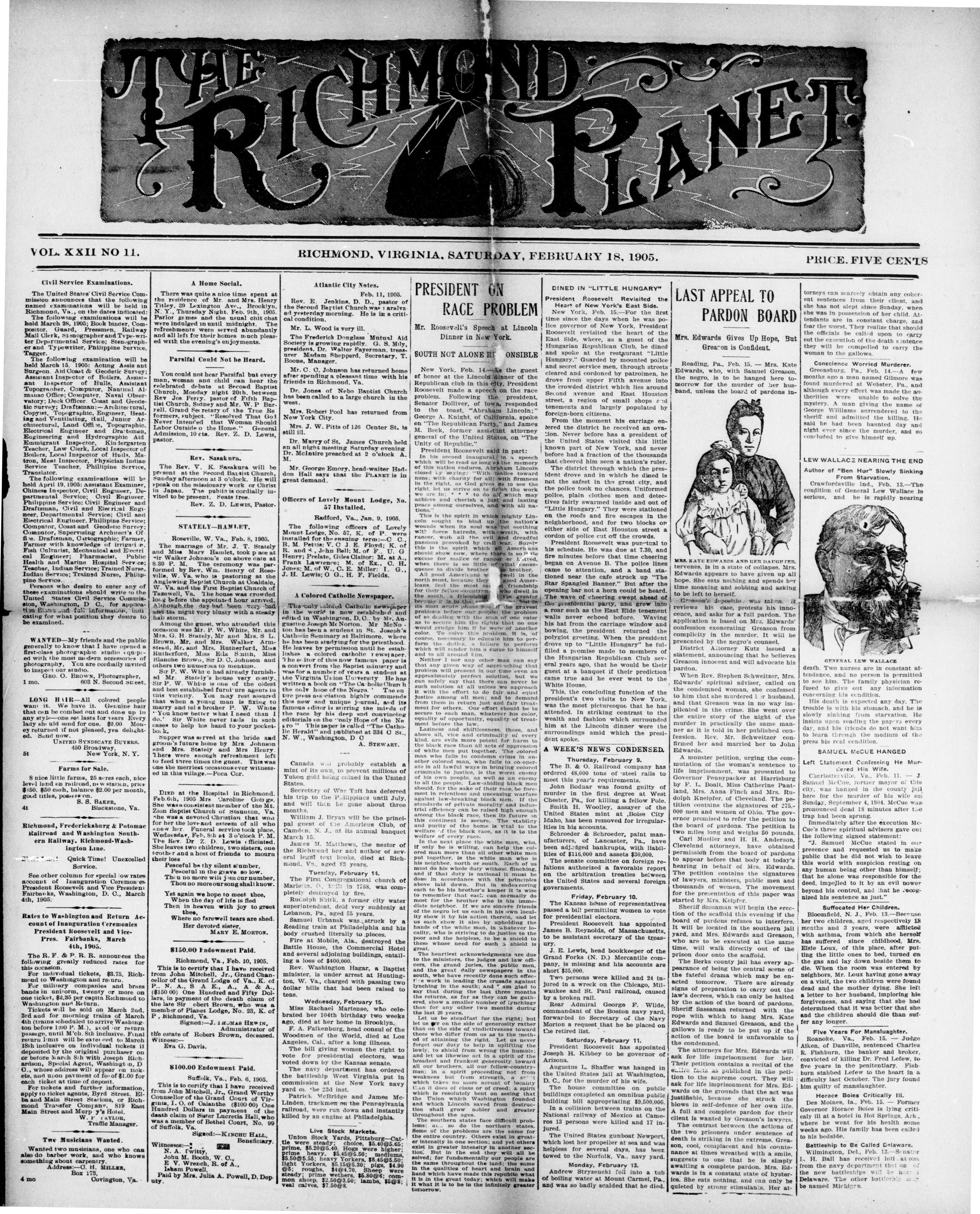
Richmond Planet
Saturday, February 18, 1905
Richmond, Virginia
Page text (machine-generated)
THE RICHMOND PLANET
Civil Service Examinations.
The United States' Civil Service Commission announces that the following named examinations will be held in Richmond, Va., on the dates indicated: The following examinations will be held March 28, 1905; Book binder, Composer, Guard, Pressmen, Railway Mail Clerk, Stenographer and Type-writer Departmental Service; Stenographer and Typewriter, Philippine Service, Tagger.
The following examination will be held March 15, 1905: Acting Assist an Surgeon, Aid Coast & Geodetic Survey; Assistant Inspector of Boilers, Assistant Inspector of Hulls, Assistant Topographer, Computer, Nautical Almanac Office; Computer, Naval Observatory; Deck Officer, Coast and Geodetic Survey; Draftman—Architectural, Copyist, Topographic, Engineer, Heating Vapor Inspector, Junior Architectural, Land Office, Topographic, Electrical Engineer and Draftman, Engineering and Hydrographic Aid Emigrant Inspector, Kinjergarten Teacher, Law Clerk, Local Inspector of Boilers, Local Inspector of Hulls, Matron, Meat Inspector, Physician Indian Service Teacher, Phillipine Service, Translator.
The following examinations will be held April 19, 1905: Assistant Examiner, Chinese Inspector, Civil Engineer, Departmental Service; Civil Engineer, Philippine Service; Civil Engineer and Draftsman, Civil and Electrical Engineer, Departmental Service; Civil and Electrical Engineer, Philippine Service; Computer, Coast and Geodetic Survey; Computer, Supervising Architect's Office; Draftsman, Cartographic; Farmer, Farmer with knowledge of irrigati n, Fish Culturist, Mechanical and Electrical Engineer; Pharmacist, Public Health and Marine Hospital Service; Teacher, Indian Service; Trained Nurse, Indian Service; Trained Nurse, Philippine Service.
Persons who desire to enter any of these examinations should write to the United States Civil Service Commission, Washington, D. C., for application Easily and full information, indicating for what position they desire to be examined.
WANTED—My friends and the public generally to know that I have opened a first-class photographic studio equipped with the most modern accessories of photography. You are cordially invited to inspect our studio.
GEO. O. BROWN, Photographer,
1 mo.
603 N. Second Street.
LONG HAIR—All colored people want it. We have it. Genuine hair that can be combed out and done up in any style—one set last sets for years. Every lady she must send for one. $2.00 Mon. Saturday not pleased, yeah, delighted. Send now.
Farms for Sale.
8 nice little farms, 25 acres each, nice
level land on railroad, new station, price
$150, $50 cash, balance $2.00 per month,
good titles, possession.
Richmond, Fredericksburg & Potomac
Railroad and Washington Southern
Railway. Richmond-Washington Line.
Shirt Time! Quick Time! Unexcelled
Service.
See other column for special low rates
account of Inauguration Ceremonies
President Roosevelt and Vice President
Fairbanks, Washington, D. C., March
4th, 1905.
Rates to Washington and Return Account of Inauguration Ceremonies
President Roosevelt and Vice-
Pres. Fairbanks, March
4th, 1905.
The R. F. & P. R. R. announces the
following greatly reduced rates for
this occasion.
For individual tickets, $3.75. Rich-
mond to Washington and return.
mond to Washington and return.
For military companies and brass bands in uniform, twenty or more on one ticket, $2.35 per capita Richmond to Washington and Return.
Tickets will be sold on March 2nd, 3rd and for morning trains of March 4th (trains to arrive Washington before 1:00 P.M.) or proof or return passage, until McH. Sh. station. Final return lmit will be exited on March 18th inclusive on individual tickets if deposited by the original purchaser, or before March 6th with Joseph Richardson, Special Agent, Washington, D.C., whose address will appear on tickets, and upon payment of fee of $1.00 for each ticket at time of deposit.
For tickets and further information, apply to ticket agents, Byrd Street, Elba and Main Street Stations, or Richmond Transfer Company, 819 East Main Street and Murp y's Hotel.
W. P. TAYLOR,
Traffic Manager.
Wanted two musicians, one who can also do barber work, and who knows something about carpentry.
Address:—C. H. MILLER,
Box 173.
4 mo
Covington, Va.
A Home Social
There was quite a nice time spent at the residence of Mr. and Mrs. Henry Titley, 39 Lexington Ave., Brooklyn, N. Y., Thursday Night, Feb. 9th, 1905. Parlor games and the usual chit chat game in uncle midnight. The refreshments were good, pleasant, and all left for their homes much pleased with the evening's enjoyments.
Parsifal Could Not be Heard.
You could not hear Parsifal but every man, woman and child can hear the celebrated debate at Second Baptist Church, Monday night 20th, between Rev Jos Perry, pastor of Fifth Baptist Church, Sidney and Mr. W. P. Burrell. Grand Secretary of the True Reformers, subject. "Resolved That Got Never Intended that Woman Should Labor Outside o the home." General Admission, 10 cts. Rev. Z. D. Lewis, pastor.
Rey. Sasakura.
The Rev. V. K. Sasakura will be present at the Second Baptist Church, Sunday afternoon at 3 o'clock. He will speak on the missionary work or Christ in Japan. The pubio is cordially invited to be present. Seats free. Rev. Z. D. Lewis, Pastor
STATELY—HAMLET.
The marriage of Mr. J. T. Stately and Miss Maire Hamlet, took pear at sir Walker Johnson's on above date at 8:30 P. M. The ceremony was performed by Rev. Wm. Henry of Roseville, W. Va. who is patasting at the Anglewing Baptist Church at Coaldale, W. Va. and the First Baptist Church of Tazewell, Va. The house was crowded long before the appointed hour arrived. Although the day had been very bad and the night very blissy with a steady hail storm. Among the guest, who attended this occasion was Mr. P. W. White, Mr. and Mrs. G. H. Stately, Mr. and Mrs. S. L. Brown, Mr. and Mrs. Walker Armsted, Mr. and Mrs. Rutherford, Miss Ella Smith, Miss Blanche Brown, Sir D. C. Johnson and others two numerous to mention. Sir P. W. White had already furnished Mr. Stately's house very costly. Sir P. W. White is one of the oldest and best established furniture agents in his vicinity. You may rest assured that the a year ago man is fixing to marry and tel a bridesman. Mr. W. White "you know better what I need that do." Sir White never fails in such cases to help his hand to your pocket-book. Supper was served at the bride and groom's future home by Mrs. Johnson and Mrs. Stately and Mrs. Henry. There were enough refreshment left to feed three times the guest. This was one the merriest occasions ever witnessed in this village.—Poca Cor.
DIRD at the Hospital in Richmond,
Feb.6th, 1905 Mrs. Caroline Gougs.
She was consistent member of the Mt.
Zion Baptist Church of Staunton, Va.
She was a devoted Christian that won
for her the love and esteem of all who
saw her. Funeral service took place,
Wednesday, Feb. 8th at 3 o'clock P. M.
The Rev. Dr. Z. D. Lewis (officiated).
She leaves two children, two sisters, one
brother and a host of friends to mourn
their loss
Peaceful be thy silent slumber,
Peaceful in the grave so low.
Thou no more wilt join our number,
Thou no more our song shall know.
Yet again we hope to meet thee,
When the day of life is fled
Then in heaven with joy to greet
thee,
Where no farewell tears are shed.
Her devoted sister,
MARY E. MORTON.
$150.00 Endowment Paid.
Richmond, Va., Feb. 10, 1906.
This is to certify that I have received from John Mitchell, Jr., Grand Chancellor of the Grand Lodge of Va., K. of P. N. A., S A E., A., A & A. ($150.00) One Hundred and Fifty Dollars in the death claim of the late Sir. obert Brown, who was a member of the Grand Lodge, No. 23, K. of P., Richmond, Va.
Signed: J. J. ROMAS HEWIN,
Administrator of the estate of Robert Brown, deceased.
Witness:—
Eva G. Davis.
$100.00 Endowment Paid.
This is to certify that I have received from John Mitchell, Jr., Grand Worthy Counsellor of the Grand Court of Virginia, I. O. of Calanthe ($100 00) One Hundred Dollars in payment of the death claim of Sister Lucretia Hall, who was a member of Bethel Court, No. 99 of Suffolk, Va.
Signed:—KINCHU HALL,
Beneficiary.
Witnesses:—
N. A. Twitty,
Johu M. Booth, W. O.,
E V. Wrench, R. of A.,
Isham Powell.
Paid by Mrs. Julia A. Powell, D. Deputy.
Atlantic City Notes.
Rev. E. Jenkins, D. D., pastor of the Second Baptist Church was aralyzed yesterday morning. He is in a critical condition.
Mr. L. Wood is very ill.
The Frederick Douglass Mutual Aid Society is growing rapidly. G. S. Mily, president. Dr. Walter Fayerman, treasurer Madam Shepperd, Secretary, T. Boone, Manager.
Mr. C. O. Johnson has returned home after spending a pleasant time with his friends in Richmond, Va.
Dr. Jones of Nebo Baptist Church has been called to a large church in the west.
Mrs. Robert Pool has returned from New York City.
Mrs. J. W. Pitts of 126 Center St. is still ill.
Dr. Murry of St. James Church held an all night meeting Saturday evening Dr. McIntire preached at 2 o'clock A. M.
Mr. George Emory, head-waiter Haddon Hall says that the PLANET is in great demand.
Officers of Lovely Mount Lodge, No. 57 Installed.
Radford, Va., Jan. 9, 1905
The following officers of Lovely Mount Lodge, No. 57, K. of P. were installed for the ensuing term:—C C. R. M. Pettis; V. C J. E. Floyd; K. of R. and S., John Bell; M. of F. U. G. Henry; Prelate, Giles Closter; M. at A. Jones; C. O. H. Jones; M. of W. C. E. Miller; I. G., J. H. Lewis; O. G. H. F. Fields.
A Colored Catholic Newspaper
The only colored Catholic newspaper in the world is now established and edited in Washington, D.C., by Mr. Augustine Joseph McNorton. Mr McNorton has been a student in St. Joseph's Catholic Seminary at Baltimore, where he has been studying for the priesthood. He leaves by permission until he establishes a colored catholic newspaper. The editor of this now famous paper is a convert from the Baptist ministry and was for a number of years a student at the Virginia Union University. He has written a book on "The Catholic Church the only hope of the Negro." The entire press association highly commends this new and unique journal, and its famous editor is stirring the minds of the race by his deep and convincing editorials on the "only Hope of the Negro." This paper is called "The Catholic Herald" and published at 334 O St. N. W., Washington, D C
A. STEWART.
Canada will probably establish a mint of its own, to prevent millions of Yukon gold being coined in the United States.
Secretary of War Taft has deferred his trip to the Philippines until July, and will then be gone about three months.
William J. Bryan will be the principal guest of the Americus Club, of Camden, N. J., at its annual banquet March 15.
James M. Matthews, the nestor of the Richmond bar and author of several legal text books, died at Richmond, Va., aged 83 years.
Tuesday, February 14.
The First Congregational church of Marlette, O. built in 1788, was completely destroyed by fire.
Rucolli Shirk, a former city water superintendent, deid very suddenly at Lebanon, Pa., aged 55 years.
Samuel Urbansk was struck by a Reading train at Philadelphia and his body crushed literally to pieces.
Fire at Mobile, Ala., destroyed the Battle House, the Commercial Hotel and several adjoining buildings, entailing a loss of $400,000.
Rev. Washington Hagar, a Baptist minister, is under arrest at Huntington, W. Va., charged with passing two dollar bills that had been raised to tens.
Wednesday, February 15.
Miss Rachael Martense, who celebrated her 104th birthday two weeks ago, died at her home in Brooklyn. F. A. Falkenburg, head consul of the Woodmen of the World, died at Los Angeles, Cal., after a long illness. The bill giving women the right to vote for presidential electors, was voted down by the Kansas senate. The navy department has ordered the battleship West Virginia put in commission at the New York navy yard on the 23d inst. Patrick McBridge and James McLinden, trackmen on the Pennsylvania railroad, were run down and instantly killed by an engine at Philadelphia.
Live Stock Markets
Union Stock Yards, Pittsburg—Cattle were steady; choice, $5.40@6.50; prince, $5.20@5.40. Hogs were higher; prince, $5.20@5.40. Hogs were higher; prince, $5.50@5.50; heavy Yorkers, $4.50@5.50; light Yorkers, $5.15@5.30; pigs, $4.90@5; roughs, $4.70. Sheep were stead; prince, $5.80@6; com-
PRESIDENT ON
RACE PROBLEM
Mr. Roosevelt's Speech at Lincoln Dinner in New York.
New York, Feb. 14.—As the guest of honor at the Lincoln dinner of the Republican club in this city, President Roosevelt made a speech on the race problem. Following the president, Senator Dolliver, of Iowa, responded to the toast, "Abraham Lincoln," George A. Knight, of California, spoke on "The Republican Party," and James M. Beck, former assistant attorney general of the United States, on "The Unity of Republic."
President Roosevelt said in part:
In his second inaugural speech which will be read as long as the memory of this nation endures, Abraham Lincoln, of the United States, will be shared with future models; with the future of charity for all, with the future of the right, as God gives us to see the right, let us strive on to finish the work we are in; * * * to do all which may achieve and cherish a just and lasting peace among ourselves, and with all nations.*
This is the spirit in which mighty Lincoln sought to bind up the nation's wounds when its soul was yet seething with fierce hatred, with wrath, with rancor, with all the evil and dreadful passions provoked by civil war. Surely this is the spirit which all Americans should show now, where there is so little excuse for malice or rancor or laredge when the people are at war.
m brother,
dwell in the
good Amer-
t friendship
who dwell in
the heart of
the world
All good Americans will dwell in the north must, because they good Americans, feel the most can at friendship for their fellow-country men dwell in the south, a friendship that the greater its most genteel one of the grand problems before our people; the problem of so dealing with the man of one color as to secure him the rights that no one would grudge him if he were of another color. To solve this problem, it is, of course, necessary to educate him to perform the duties, a failure to perform which will render him a curse to himself and his family. Neither I nor any other man can say that any given way of approaching that problem will present in our time even an approximately perfect solution, but we can safely say that there can never be such solution at all unless we approach it with the effort to do fair and equal justice among all men; and to demand from them in return just and fair treatment of each man, whatever color equality of opportunity, equality of treatment before the law.
The heartiest acknowledgments are due to the ministers, the judges and law officers, the grand juries, the public men, and the great daily newspapers in the south, who have recently done such effective work in leading the crusade against the south, and now am glad to say that during the last year, as far as they can be gathered, show a smaller number of lynchings than for any other two months during the last 20 years.
Let us be steadfast for the right; but let us or on the side of generosity rather than on the side of vindictiveness toward us from us as to the method of attaining our right. Let us never forget our duty to help in uplifting the lowly, to shield from wrong the humble; and let us likewise act in a spirit of the broadest and frankest generosity toward all our brothers, all our fellow-countrymen; in a spirit proceeding not from weakness but from strength, a snippet which takes no more account of locality than the most or least of which is resolutely bent on seeing that the Union which Washington founded and which Lincoln saved from destruction shall grow nobler and greater throughout the ages.
The southern states face difficult problems; al., so do the northern states. Some of the problems are the same for the entire country. Others exist in great intensity in another part; others exist in greater intensity in another part.
But in the end they will all be solved; for fundamentally our people are the same throughout the land; the same in the qualities of heart and brain and hand which have made this republic what it is in the great today; which will make it what it is to be in the infinitely greater
DINED IN "LITTLE HUNGARY"
President Roosevelt Revisited the Heart of New York's East Side.
New York, Feb. 15.—For the first time since the days when he was police governor of New York, President Roosevelt revisited the heart of the East Side, where, as a guest of the Hungarian Republican Club, he dined and spoke at the restaurant "Little Hungary." Guarded by mounted police and secret service men, through streets cleared and cordoned by patrolmen, he drove from upper Fifth avenue into the crowded district which lies around Second avenue and East Houston street, a region of small shops and tenements and largely populated by foreign-born citizens.
From the moment his carriage enceded the district he received an ovation. Never before has a president of the United States visited this little known part of New York, and never before had a fraction of the thousands that cheered him seen a nation's ruler.
The district through which the president drove and in which he dined is not the safest in the great city, and the police took no chances. Uniformed police, plain clothes men and detectives fairly swarmed inside and out of "Little Hungary." They were stationed on the roofs and fire escapes in the neighborhood, and for two blocks on either side of East Houston street a cordon of police cut off the crowds.
President Roosevelt was punctual to his schedule. He was due at 7.30, and fire minutes before that time cheering began on Avenue B. The police lines came to attention, and a band stationed near the cage struck up "The Star Spangled banner." But after the opening bar not a horn could be heard, the Wave of cheering swept ahead of the presidential party, and grew into a roar such as the East Elide tenement walls never echoed before. Waving his hat from the carriage window and hatting, the president returned the polyglot greeting. When the president drove up to "Little Hungary" he fulfilled a promise made to members of the Hungarian Republican Club several years ago, that he would be their guest at a banquet if their prediction came true and he ever went to the White House.
This, the concluding function of the president's two visits to New York, was the most picturesque that he has attended. In striking contrast to the wealth and fashion which surrounded him at the Lincoln dinner were the surroundings amid which the president spoke.
A WEEK'S NEWS CONDENSED.
The B. & O. Railroad company has ordered 48,000 tons of steel rails to meet this year's requirements.
John Bodnar was found guilty of murder in the first degree at West Chester, Pa., for killing a fellow Pole. Smith H. Woolley, assayer of the United States mint at, Boise City Idaho, has been removed for irregularities in his accounts.
Schroeder & Schroeder, paint manufacturers, of Lancaster, Pa., have been adjudged bankrupts, with liabilities of $116,000 and assets $30,000.
The senate committee on foreign relations authorized a favorable report on the arbitration treaties between the United States and several foreign governments.
Friday. February 10.
The Kansas house of representatives passed a bill permitting women to vote for presidential electors.
President Roosevelt has appointed James B. Reynolds, of Massachusetts, to be assistant secretary of the treasury.
J. E. Lewis, head bookkeeper of the Grand Forks (N. D.) Mercantile company, is missing and his accounts are short $25,000.
Two persons were killed and 24 injured in a wreck on the Chicago, Milwaukee and St. Paul railroad, caused by a broken rail.
Rear Admiral George F. Wilde, commandant of the Boston navy yard, forwarded to Secretary of the Navy Morton a request that he be placed on the retired list.
Saturday, February 11.
President Roosevelt has appointed Joseph H. Kibbey to be governor of Arizona.
Augustus L. Shaffer was hanged in the United States jail at Washington, D. C., for the murder of his wife.
The house committee on public buildings completed an omnibus public building bill appropriating $9,500,000.
In a collision between trains on the National railway of Mexico at Cameros 13 persons were killed and 17 injured.
The United States gunboat Newport, which lost her propeller at sea and was helpless for several days, has been towed to the Norfolk, Va., navy yard.
Monday, February 13.
Andrew Stryzenski fell into a tub of boiling water at Mount Carmel, Pa., and was so badly scalded that he died.
LAST APPEAL TO PARDON BOARD
Mrs. Edwards Gives Up Hope, But Greason is Confident.
Reading, Pa., Feb. 15. — Mrs. Kate Edwards, who, with Samuel Greason, the negro, is to be hanged here tomorrow for the murder of her husband, unless the board of pardons in-
MRS. KATE EDWARDS AND HER DADGHTER tervenes, is in a state of collapse. Mrs. Edwards appears to have given up all hope. She eats nothing and spends her time moaning and sobbing and asking to be left to herself.
Greason's Positio: was taken. It reviews his case, protests his innocence, and asks for a full pardon. The application is based on Mrs. Edwards' confession exonerating Greason from complicity in the murder. It will be presented by the negro's counsel.
District Attorney Kutz issued a statement, announcing that he believes Greason innocent and will advocate his pardon.
When Rev. Stephen Schweitzer, Mrs. Edwards' spiritual adviser, called on the condemned woman, she confessed to him that she murdered her husband, and that Greason was in no way implicated in the crime. She went over the entire story of the night of the murder in practically the same manner as it is told in her published confession. Rev. Mr. Schweitzer confirmed her and married her to John Edwards.
A monster petition, urging the commutation of the woman's sentence to life imprisonment, was presented to Governor Pennypacker at Harrisburg by F. L. Boalt, Miss Catherine Pantland, Mrs. Anna Finch and Mrs. Rudolph Kneipfer, of Cleveland. The petition contains the signatures of 275-000 men and women of Ohio. The governor promised to refer the petition to the board of pardons. The petition is two miles long and weighs 50 pounds. Carl Mueller and H. H. Anderson. Cleveland attorneys, have obtained permission from the board of pardons to appear before that body at today's hearing in behalf of Mrs. Edwards. The petition contains the signatures of lawyers, ministers, public men and thousands of women. The movement for the presentation of this paper was started by Mrs. Keipfer. Sheriff Sassaman will begin the erection of the scaffold this evening if the board of pardons refuses to interfere. It will be located in the southern jail yard, and Mrs. Edwards and Greason, who are to be executed at the same time, will walk directly out of the prison door onto the scaffold.
The Berks county jail has every appearance of being the central scene of the fateful drama which may be enacted tomorrow. There are already signs of preparation to carry out the law's decrees, which can only be halted by the action of the board of pardons. Sheriff Sassaman returned with the rope with which to hang Mrs. Kate Edwards and Samuel Greason, and the gallows is ready to be put up if the action of the board is unfavorable to the condemned.
The attorneys for Mrs. Edwards will ask for life imprisonment for her. Their petition contains a recital of the entire facts as published in the petition to the supreme court. They will ask for life imprisonment for Mrs. Edwards on the grounds that the act was justifiable, because she struck the blows in self-defense of her own life. A full and complete pardon for their client is wanted by Greason's lawyers.
The contrast between the actions of the two prisoners under sentence of death is striking in the extreme. Greason, cool, complacent and his countenance at times wreathed with a smile, suggests to one that he is simply awaiting a complete pardon. Mrs. Edwards is in a constant state of hysterics. She eats nothing, and can only be quieted by strong stimulants. Her at-
PRICE. FIVE CENTS
torneys can scarcely obtain any coherent sentences from their client, and she has not slept since Sunday, when she was in possession of her child. Attendants are in constant charge, and fear the worst. They realize that should the officials be called upon to carry out the execution of the death sentence they will be compelled to carry the woman to the gallows.
Conscience Worried Murderer.
Greensburg, Pa., Feb. 14.—A few months ago a man named Gilmore was found murdered at Webster, Pa., and although every effort was made the authorities were unable to solve the mystery. A man giving the name of George Williams surrendered to the sheriff and admitted the killing. He said he had been haunted day and night ever since the murder, and so concluded to give himself up.
Author of "Ben Hur" Slowly Sinking From Starvation.
Crawfordsville Ind., Feb. 13.—The condition of General Lew Wallace is serious, and he is rapidly nearing
GENERAL LEW WALLACE
death. Two nurses are in constant attendance, and no person is permitted to see him. The family physician refused to give out any information concerning his condition.
His death is expected any day. The trouble is with his stomach, and he is slowly sinking from starvation. He insists upon reading the papers every day, and his friends do not want him to learn through the medium of the press his real condition.
SAMUEL McCUE HANGED
Left Statement Confessing He Mur- cered His Wife.
Charlotterville, Va., Feb. 11. — J. Samuel McCue, former mayor of this city, was hanged in the county jail here for the murder of his wife on Sunday, September 4, 1904. McCue was pronounced dead 18 minutes after the trap had been sprung.
Immediately after the execution McCue's three spiritual advisers gave out the following signed statement:
"J. Samuel McCue stated in our presence and requested us to make public that he did not wish to leave this world with suspicion resting on any human being other than himself; that he alone was responsible for the deed, impelled to it by an evil power beyond his control, and that he recognized his sentence as just."
Suffocated Her Children.
Bloomfield, N. J., Feb. 13.—Because her two children, aged respectively 18 months and 3 years, were afflicted with asthma, from which she herself has suffered since childhood, Mrs. Elsie Loux, of this place, after putting the little ones to bed, turned on the gas and lay down beside them to die. When the room was entered by neighbors, Mr. Loux having gone away on a visit, the two children were found dead and the mother dying. She left a letter to her husband, imploring his forgiveness, and saying that she had determined that it was better that she and the children should die than suffer any longer.
Five Years For Mansluaghter.
Roanoke, Va., Feb. 15.—Judge Alken, of Danville, sentenced Charles R. Fishburn, the banker and broker, convicted of killing Dr. Fred Lefew, to five years in the penitentiary. Fishburn stabbed Lefew to the heart in a difficulty last October. The jury found him guilty of manslaughter.
Horace Boies Critically Ill.
Des Moines, Ia., Feb. 15.—Former Governor Horace Boies is lying critically ill at a hotel in Hot Springs, Ark., where he went for his health some weeks ago. His family has been called to his bedside.
Battleship to Be Called Delaware.
Wilmington, Del, Feb. 13.—Senator
L. H. Ball has received invitations
from the navy department that on of
the new battleships will be named
Delaware. The other battleship may
be named Michigan.
THE PLANET
FOR YOU-JUST YOU.
The dawn dispels the solemn night,
Unveils the canopy of blue.
And floods the world with golden light
For you—just you.
The rose reveals its heart of gold
And sparkles with the morning dew,
With love in every crimson fold,
For you—just you.
The jound day is bright with bliss,
O'erspread with pleasure's lambenthue,
The limpid rivers lisp and kiss
For you—just you.
The night comes down from out the deeps,
The argent stars come peeping through
Where dusky darkness caimly sweeps
For you—just you.
The joyous zephyr's lightly blow,
The roses hide the bitter rue,
The roses with love are all aglow,
For you—just you.
-Chicago Chronicle
AFTER THE MEETING
By H. F. TOPPING, JR.
F THERE is a word in the English language that will blanch the rose-tinted cheek of a woman, it is "club." The monosyllable often instantaneously throws her from 90 degrees in the shade down to zero. And sometimes the social club will call into use the club of some hard wood of ponderous weight and massive proportions.
The instruments of physical chastisement are not, as yet, used in the Perkins family, but the dark shadow of future difficulties hangs over the establishment. Mr. Perkins has lately become a member of the Independent Order of Midnight Misogamists. The night of his initiation he celebrated the occasion by being a "good fellow" at the club. On that night his memory could recall incidents which happened up to nine o'clock, but from that time until the next morning all was blank. Mrs. Perkins led her husband to the table, and much against his will recounted his adventures from the hall door to the bed. It was with the most strenuous efforts that Mr. Perkins kept awake, but he bore it like a martyr.
"I will endeavor, Mr. Perkins," said Mrs. P. "to strate verbe," the beastly condition you were in last night—or at an early hour this morning.
"I'd rather you would not, Alvira," groaned the Midnight Misogamist.
"But I shall. Mr. Perkins, and hope that it will strike deep into your conscience. Perhaps my recital of your disgraceful conduct will prove a moral lesson."
"Well, hurry up, my dear," yawned Perkins.
Mrs. Perkins straightened herself and gazed reproachfully upon her lord and master.
"It was past midnight. Nicodemus Perkins," she said. "I sat waiting to hear your well-known tread through the hall. I thought that business had detained you from home, and was sighing for the hard and toilsome life you lead, when I heard a squeaky and irregular voice in the street, faintly striving to pronounce my name. I looked out of the window in alarm, thinking that you lay wounded on the sidewalk, but you stood at the door trying to open it with your umbrella handle.
"Nicodemus Perkins," I gasped, 'is it you?'
"Yesh, Vira,' you replied, 'come down an' let a 'fler in. Night kie froze in the lock, and I can't git er out.'
"It was mild weather, Mr. Perkins, and your broken dialect and excuse for not being able to open the door, convinced me that you were intoxicated. With faltering steps I descended the stairs and opened the door. I was greeted with the stifling fumes of liquor and yourself in a deplorable state. You rushed into my arms, with the disgraceful words of 'Perky, ole fler, wazer mazzer wiz you?' I understood 'Perky' as an abbreviation of Perkins, vulgarly invented in your condition. As I dragged you through the hall, you would persist in shaking hands with the hatrack; and you, who have until now supported an untarnished dignity, repeatedly vociferated: 'Whoa, Emma!' and a rowdyish, swaggerly: 'What der yer say?'"
"Alvira, my love, I am heartily ashamed of myself."
"You ought to be. Mr. Perkins, although you do not appear such, sitting there nodding while I am talking. Attention, Nicodemus Perkins! There! I never expected to see you in such a condition as last night. I would not have believed it of you, Nicodemus. So you have joined a club, have you? and are a misogist, and a midnight one, too. Has your love cooled so soon, Nicodemus? If you continue a misogist, you will hereafter sleep alone."
"I love you dearly. Alvira," said Perkins, desperately.
"No you don't!" snapped his wife; "you're a misogist!"
"Ha, ha!" feebly laughed Perkins. "We do not mean it, Alvira, love; it is simply a joke."
"A joke, Nicodemus? Didn't you tell me last night, while I was helping you up the stairs, that you were a anti-woman rooster?" And did you not hint at a divorce? Lamentable, Mr. Perkins, lamentable! Is this club organized for the purpose of enticing men from their loving wives, and carousing through the streets after midnight?" "I was initiated, Alvira." "I should think you were initiated, I fear, Nicodemus; it was a horrible fore-
todging of family difficulties. I am mild now, Mr. Perkins; but the worm will turn, and you will either break my heart or make me a shrew. I left you in the hall." continued Mrs. Perkins, resuming her recital. "I left you in the hall—"
"Well, hurry up, Alvira dear, and get me to bed."
"I say I left you in the hall, Nicodemus Perkins," she repeated, with a cheerful woman's soorn. "I dragged you up the stairs, and at each step you would resist my efforts, and try to remember a portion of a vulgar drinking song, and ask me to sing it for you again. Sometimes you would call me Smithers or Ferguson; but the nearest you came to my name was 'Perky,' with the embellishment or 'ole Iler.' By great endeavors I succeeded in getting you in the room, and as the light shone on you, your condition was made clearly manifest. I placed you in a chair, and stood gazing at you with a wife's pity. You sat, or rather remained, where I placed you, in a bunch. Your necktie had doubled round under your left ear, and your shirt-bosom was d'cleddely filly. Your pants were ruined, and the beautiful new coat you recently bought was ripped from the collar down. I tried to coax you to go to bed, but you would reply with a drunken hiccough that you were a 'hard-shell mmsogist.' But the expression of your face, Mr. Perkins, I hope never to see again. It was idiotic in the extreme. One eye seemed staring at some distant country, but the other roiled recklessly at its own caprice."
"I am sorry for this, Alvira, and hope it will never happen again."
"It better not. I can tell you, Nicodemus Perkins, or there may be something else besides talk. When I recall your condition, I wonder at my courage to stay in the room alone with you. On several occasions you threatened to pinch my arm, and you doubtless
A man in a suit and hat is stepping down a staircase. He is holding a book in his hand.
TRIED TO OPEN THE DOOR WITH AN UMBRELLA.
would have done so if you had had the strength to gain an equilibrium."
"I would not have harmed you for the world, my dear."
"You don't know what you would have done—so base was your condition I stood you on the floor, and began to undress you. As I removed your coat, a brazen badge came into view; it was as large as a policeman's shield, and on it were the letters I. O. M. M. The badge is now in my possession, and will so remain. I finally succeeded in undressing you, and was about to push you into bed, when you set your jaws firmly and stood with outstretched arms.
"Hol on, Vira, you croaked, 'walt er minute, ole l'ler. Wait till er bed come rom' an 'I'll jump 'board. How er bed 'eaves, old gal! Big sea on, Perky, ole boy."
"At last I got you into bed, and before you were tucked in you gasped the first syllable of 'misogamist,' and began a series of swine-like grunts and snorts which lasted through the night. I slept on the sofa—at least I lay there listening through the night to your drunken jargon. You're a pretty misogamist, ain't you? Nicodemus Perkins, I am inclined to call you a brute." "I will immediately offer my resig-
"I will immediately offer my resignation, my dear," sighed Perkins.
"You had better, or I will go home to mother. If you come home in last night's condition again, you will not enter this house. Do you hear, Nicodemus?"
"Yes, Alvira."
Perkins breathed a sigh of relief and almost fell over the table.
As yet Mrs. Perkins has no ground for doubt as to the promised resignation. Perhaps her confidence in her lord will again be shaken.—N. Y. Weekly.
RUSSIAN BRASSES FINEST
Russian brassis are possibly the heaviest and finest in quality and color, says Harper's Bazar. One may find them in the queer little Russian shops in the lower part of New York and Boston. The growing interest in brassis has encouraged their importation, and if one has patience to barter, many artistic treasures may be obtained at very reasonable prices. The most characteristic piece is the samovar. These are treasured very highly by those who are fortunate enough to possess them. They are found in innumerable shapes and sizes, a witness to the tea-drinking habits of the Russians. Every Russian peasant who is prosperous enough to enjoy the luxury of tea has his samovar. At all inns each visitor is supplied with one. They invariably accompany the traveler and the picnicker, and even the officers starting out upon a campaign find room for a small one in their baggage. Samovar signifies "self-boiler." It is made of brass, lined with tin, and with a tube in the center in which the hot cinders of charcoal are placed after having been ignited. Often a pipe connects it with the chimney, and two friends will sit for hours drinking the boiling hot weak tea.
Celluloid for Skull Bone.
Cincinnati. Within a few days an operation is performed which will add
To begin with, the conjurer takes from his pocket a piece of string about a yard long. He openly cuts this twice, making three pieces of equal length. He next ties three pieces together, and lets two of the audience hold the ends, or he may tie them to two chairs. The conjurer then throws handkerchiefs over the two knots, places his hand on them for a second, whisks the handkerchiefs away, disclosing the string whole and free from knots.
The secret of this trick lies in the fact that another piece of string was substituted for the piece that had been cut and joined. Concealed in his left pocket the conjurer had a piece of string similar in length, whole, but knotted to give the appearance of having been cut. To do this, fold the string into three pieces of equal length, then take two short pieces of string, and one piece tightly at the first bend, a the other piece at the second. A strik! treated thus looks as if it
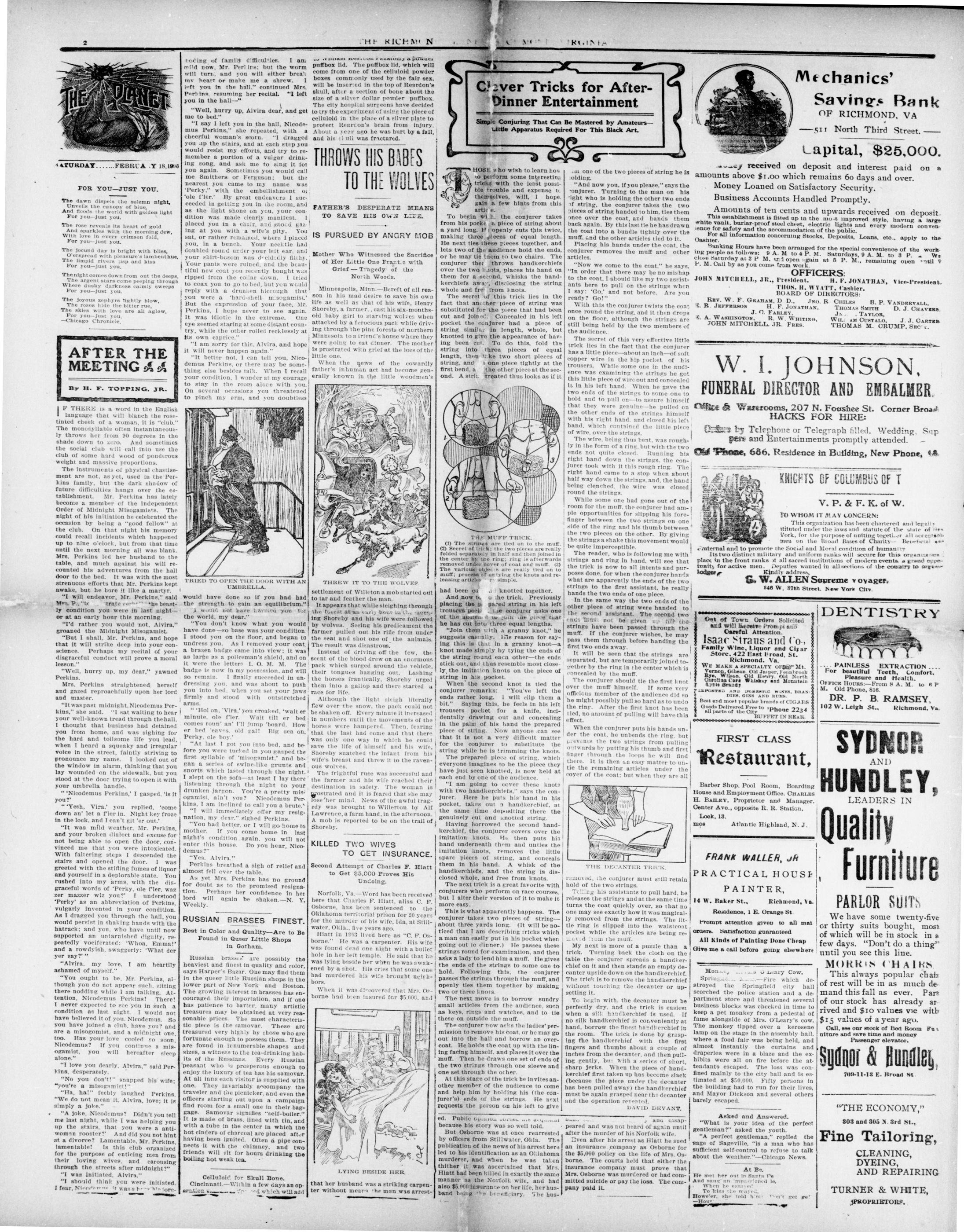
(1) The strings are tied on to the muff.
(2) Secret of trick: the two pieces are really folded separately in half and then joined in the center by the ring; ring is afterwards moved to the other side and knotted.
(3) The various objects are really tied on to muff; process of untying the knots and releasing articles is simple.
had been on and knotted together.
And now to do the trick. Previously placing the is pared string in his left trousers pock. The conjurer asks one of the ammunition to join the piece that he has cut into three equal lengths.
"Join them with a granny knot," he suggests casually. His reason for saying this is that in a granny knot—a knot made simply by tying the ends of the string round each other—the ends stick out, and thus resemble most closely the imitation knots on the piece of string in his pocket.
When the second knot is tied the conjurer remarks: "You've left the ends rather long, I will clip them a bit." Saying this, he feels in his left trousers pocket for a knife, incidentally drawing out and concealing in the palm of his hand the prepared piece of string. Anyone can see that it is not a very difficult matter for the conjurer to substitute the string while he is trimming the knots. The prepared piece of string, which everyone imagines to be the piece they have just seen knotted, is now held at each end by one of the audience.
"I am going to cover these knots with two handkerchiefs," says the conjurer. Here he puts his hand in his pocket, takes out a handkercief, at the same time depositing there the genuinely cut and knotted string.
Having borrowed the second hand-kierchief, the conjurer covers over the imitation knots. He then puts his hand underneath them and unties the imitation knots, removes the little spare pieces of string, and conceals them in his hand. A whisk of the handkerchiefs, and the string is disclosed whole, and free from knots.
The next trick is a great favorite with conjurers who perform on race courses, but I alter their version of it to make it more easy.
This is what apparently happens. The conjurer takes two pieces of string—about three yards long. (It will be noticed that I am describing tricks which a man can easily put in his pocket when going out to dinner.) He passes these strings round for examination, and then asks a lady to lend him a muff. He gives the ends of the strings to some one to hold. Following this, the conjurer passes the strings through the muff, and openly ties them together by making two or three knots.
The next move is to borrow sunday small articles from the audience, such as keys, rings and watches, and to tie these on outside the muff.
The conjurer now asks the ladies' permission to remove his coat, or he may go out into the hall and borrow an overcoat. He holds the coat up with the lining facing himself, and places it over the muff. Then he draws one set of ends of the two strings through one sleeve and one set through the other.
At this stage of the trick he invites another member of the audience to come and help him by holding his (the conjurer's) ends of the strings. He next requests the person on his left to give ed. Public opinion forced his acquaintance because his story was so well told.
But Osborne was at once rearrested by officers from Stillwater, Okla. The publication of the news of his arrest here led to his identification as an Oklahoma murderer, and when he was taken thither it was ascertained that Mrs. Hattt had been killed in exactly the same manner as the Norfolk wife, and had also $5,000 insurance on her life, her husband being the hereditary. The hus-
W. William Reardon's anatomy a powder puffbox lid. The puffbox lid, which will come from one of the celluloid powder boxes commonly used by the fair sex, will be inserted in the top of Reardon's skull, after a section of bone about the size of a silver dollar powder puffbox. The city hospital surgeons have decided to try the experiment of using the piece of celluloid in the place of a silver plate to protect Reardon's brain from injury. About a year ago he was hurt by a fall, and his skull was fractured.
THROWS HIS BABES TO THE WOLVES
FATHER'S DESPERATE MEANS TO SAVE HIS OWN LIFE.
IS PURSUED BY ANGRY MOB
Mother Who Witnessed the Sacrifice of Her Little One Frantic with Grief — Tragedy of the North Woods.
Minneapolis, Minn. — Bereft of all reason in his mad desire to save his own life as well as that of his wife, Henry Shoreby, a farmer, cast his six-month-old baby girl to starving wolves when attacked by a ferocious pack while driving through the pine forests of northern Minnesota to a friend's house where they were going to eat dinner. The mother is prostrated with grief at the loss of the little one.
When the news of the cowardly father's inhuman act had become generally known in the little woodman's
A
THREW IT TO THE WOLVES
settlement of Willemot a mob started out to tar and feather the man.
It appears that while sleighing through the forest at an early hour in the carving Shoreby and his wife were followed by wolves. Seeing his predicament the farmer pulled out his rille from under the seat and shot one of the animals. The result was disastrous.
Instead of driving off the few, the scent of the blood drew on an enormous pack which surged around the vehicle, their tongues hanging out. Lashing the horses frantically, Shoreby urged them into a gallop and there started a race for life.
Although the light sleigh literally flew over the snow, the pack could not be shaken off. Every minute it increased in numbers until the movements of the horses were hampered. Then, fearing that the last had come and that there was only one way in which he could save the life of himself and his wife, Shoreby snatched the infant from his wife's breast and threw it to the ravenous wolves.
The frightful ruse was successful and the farmer and his wife reached their destination in safety. The woman is postrated and it is feared that she may lose her mind. News of the awful tragedy was brought to Willerton by Al Lawrence, a farm hand, in the afternoon. A mob is reported to be on the trail of Shoreby.
KILLED TWO WIVES
TO GET INSURANCE
Second Attempt of Charles F. Hiatt to Get $5,000 Proves His Undoing.
Norfolk, Va.—Word has been received here that Charles F. Hiatt, alias C. F. Osborne, has been sentenced to the Oklahoma territorial prison for 20 years for the murder of his wife, Ida, at Stillwater, Okla., five years ago.
Hiatt in 1903 lived here as "C. F. Osborne." He was a carpenter. His wife was found dead one night with a bullet hole in her left temple. He said that he was lying beside her when he was awakened by a shot. His cries that some one had murdered his wife brought neighbors.
When it was discovered that Mrs. Osborne had been insured for $5,000, an
LYING BESIDE HER
that her husband was a striking carpent
without means the man was arrest
Clever Tricks for After-Dinner Entertainment
Simple Conjuring That Can Be Mastered by Amateurs—Little Apparatus Required For This Black Art.
HOSE who wish to learn how to perform some interesting tricks with the least possible trouble and expense to themselves, will, I hope, gain a few hints from this article.
J
1
2
3
in one of the two pieces of string he is holding.
"And now you, if you please," says the conjurer. Turning to the man on his right who is holding the other two ends of string, the conjurer takes the two pieces of string handed to him, ties them once over the coat, and hands them back again. By this last tie he has drawn the coat into a bundle tightly over the muff, and the other articles tied to it.
Placing his hands under the coat, the conjurer removes the muff and other articles.
"Now we come to the coat," he says.
"In order that there may be no mishap to the coat, I should like my two assistants here to pull on the strings when I say: 'Go,' and not before. Are you ready? Go!"
With this the conjurer twists the coat once round the string, and it then drops on the floor, although the strings are still being held by the two members of the audience.
The secret of this very effective little trick lies in the fact that the conjurer has a little piece—about an inch—of soft copper wire in the hip pocket of his trousers. While some one in the audience was examining the strings he got this little piece of wire out and concealed it in his left hand. When he gave the two ends of the strings to some one to hold and to pull on—to assure himself that they were genuine—he pulled on the other ends of the strings himself with his right hand, and closed his left hand, which contained the little piece of wire, over the strings.
The wire, being thus bent, was roughly in the form of a ring, but with the two ends not quite closed. Running his right hand down the strings, the conjurer took with it this rough ring. The right hand came to a stop when about half way down the strings, and, the hand being clenched, the wire was closed round the strings.
While some one had gone out of the room for the muff, the conjurer had ample opportunities for slipping his forefinger between the two strings on one side of the ring and his thumb between the two pieces on the other. By giving the strings a shake this movement would be quite imperceptible.
The reader, who is following me with strings and ring in hand, will see that the trick is now to all intents and purposes done, for when the conjurer hands what are apparently the ends of the two strings to the first assistant, he really hands the two ends of one piece.
In the same way the two ends of the other piece of string were handed to the second assistant. The second two ends must not be given up till the strings have been passed through the muff. If the conjurer wishes, he may pass them through before handing the first two ends away.
It will be seen that the strings are separated, but are temporarily joined together by the ring in the center which is concealed by the muff.
The conjurer should tie the first knot over the muff himself. If some very officious member of the audience did so he might possibly pull so hard as to undo the ring. After the first knot has been tied, no amount of pulling will have this effect.
When the conjurer puts his hands under the coat, he unbends the ring, but prevents the two strings from pulling outwards by putting his thumb and first finger through the loops he will find there. It is then an easy matter to untie the remaining articles under the cover of the coat; but when they are all
THE DECANTER TRICK.
removed, the conjurer must still retain hold of the two strings.
Telling his assistants to pull hard, he releases the strings and at the same time turns the coat quickly over, so that no one may see exactly how it was magically removed from the strings. The little ring is slipped into the waistcoat pocket while the articles are being removed from the muff.
My next is more of a puzzle than a trick. Turning back the cloth on the table the conjurer spreads a handkerchief on it and then stands an empty decanter upside down on the handkerchief. The trick is to remove the handkerchief without touching the decanter or upsetting it.
To begin with, the decanter must be perfectly dry, and the trick is easiest when a silk handkerchief is used. If no silk handkerchief is conveniently at hand, borrow the finest handkerchief in the room. The trick is done by grasping the handkerchief with the first fingers and thumbs about a couple of inches from the decanter, and then pulling gently, but with a series of short, sharp jerks. When the piece of handkerchief first taken up has become slack (because the piece under the decanter has been pulled away) the handkerchief must be again grasped near the decanter and the operation repeated.
DAVID DEVANT
peared and was not heard of again until after the murder of his Norfolk wife. Even after his arrest as Hiatt he sued an insurance company as Osborne for the $5,000 policy on the life of Mrs. Osborne. The courts held that either the insurance company must prove that Mrs. Osborne was murdered or had committed suicide or pay the loss. The company paid it.
JOHN HENRY
Money received on deposit amounts above $1.00 which reel Money Loaned on Satisfaction Business Accounts Handled Amounts of ten cents and This establishment is fitted up in the white vault, burlar-proof steel chest, elelence for safety and the accommodation. For all information concerning Stock Oasher. Parking Hours have been arranged. people as follows: 9 A. M to 4 P. close Saturday at 3 P. M. or open again. P. M. Call by as you come from work.
OFFICE
JOHN MITCHELL, JR., President.
THOS. H. W.
BOARD OF
REV. W. F. GRAHAM, D. D., JN.
6. R. JEFFERSON H. F. JONATHAN
J. O. FARLEY.
6. A. WASHINGTON, R. W. WHITING.
JOHN MITCHELL, JR. FRES.
W. I. JOE
FUNERAL DIRECTOR
Office & Warerooms, 207 HACKS R
Calls by Telephone or Te
pere and Entertainment
Old Phone, 686, Residence
Money received on deposit and interest paid on amounts above $1.00 which remains 60 days and over.
Money Loaned on Satisfactory Security.
Business Accounts Handled Promptly.
Amounts of ten cents and upwards received on deposit.
This establishment is fitted up in the most improved style, having a large white vault, burlar-proof steel chest, electric lights and every modern convenience for safety and the accommodation of the public.
For all information concerning Stocks, Deposits, Loans, etc., apply to the Cashier.
Banking Hours have been arranged for the special convenience of the working people as follows: 9 A.M. to 4 P.M. Saturdays, 9 A.M. to 3 P. We close Saturday at 3 P.M. and open again at 5 P.M., remaining open until 9 P.M. Call by as you come from work.
OFFICERS:
JOHN MITCHELL, JR., President. H. F. JONATHAN, Vice-President.
THON, H. WYATT, Cashier.
BOARD OF DIRECTORS:
REV. W. F. GRAHAM, D. D., JNO. R. CHILES B. P. VANDERVALL,
G. R. JEFFERSON H. F. JONATHAN, THOMAS SMITH D. J. CHAVERS
J. O. FARLEY, JN. TAYLOR.
6. A. WASHINGTON. R. W. WHITING. WIL. A. CUSTALO. J. J. CARTER
JOHN MITCHELL. JR. FRES. THOMAS M. CRUMP. SPEC.
W. I. JOHNSON. FUNERAL DIRECTOR AND EMBALMER.
Office & Warrooms, 207 N. Foushee St. Corner Broad HACKS FOR HIRE: Office by Telephone or Telegraph filled. Wedding, Suppers and Entertainments promptly attended. Old Phone, 686, Residence in Building, New Phone.
KNIGHTS OF COLUMBUS OF T
TO WHOM IT MAY CONCERN:
This organization has been chartered and legally instituted under the laws and statute of the state of New York, for the purpose of uniting together all acceptable men on the Broad Bases of Charity—Beneficial to external and to promote the Social and Moral condition of humanity.
Its two distinct military and uniform ranks will secure for this organization place in the front ranks of all sacred institutions of modern events, a grand opportunity for active men.
Deputies wanted in all sections of the country to organize lodges.
G. W. ALLEN Supreme voyager,
846 W. 87th Street, New York City.
Out of Town Orders Solicited and will Receive Prompt and Careful Attention.
and will Receive Prompt and
Careful Attention.
Isaac Straus and Co.,
Family Wine, Liquor and Cigar
Store, 422 East Froad, St.
Richmond, VA.
WE MAKE A SERVICE FOR
Mr. Vernon, Gibson Old Jaqueline,
Rye, Wilson, Old Henry, Old North
Carolina Cora Wines and Mountain
Apple Brand.
EXPORTED AND DOMESTIC WINES, BRAN-
CHES, BARS AND RUMS.
Best and most popular brands of CIGARS
Goods Delivered Free to 'Phone 2234
all parts of the City
BUFFET IN REAR.
FIRST CLASS Restaurant.
Barber Shop, Pool Room, Boarding House and Employment Office. CHARLES H. BAILEY, Proprietor and Manager, Center Ave., opposite R. R. Station. Lock, 18. mps Atlantic Highland, N. J.
FRANK WALLER, JR
PRACTICAL HOUSE
PAINTER,
14 W. Baker St., Richmond, Va.
Residence, 1 E. Orange St.
Prompt attention given to all mail orders. Satisfaction guaranteed
All Kinds of Painting Done Cheap
Give me a call before going elsewhere
Monkey Dr. O'Leary Cow.
Springfield, Illinois — Fire which destroyed the Springfield city hall scorched the police station and a department store and threatened several business blocks was checked in time to keep a pet monkey from a pedestal of fame alongside of Mrs. O'Leary's cow. The monkey tipped over a kerosene lamp on the stage in the assembly hall, where a food fair was being held, and almost instantly the curtains and draperies were in a blaze and the exhibits were all on fire before the attendants escaped. The loss was confined mainly to the city hall and is estimated at $50,000. Fifty persons in the building had to run for their lives, and Mayor Dickson and several others barely escaped.
"What is your idea of the perfect gentleman?" asked the youth.
"A perfect gentleman," replied the sage of Sageville, "is a man who has sufficient self-control to refuse to talk about the weather."—Chicago News.
At Be.
He met her out in Santa Fe
And sang an impassioned le.
When he essayed
To kiss the mayed.
How'er, she told him: "Don't get ge."
—How?
Lapital, $25,000.
DENTISTRY
PAINLESS EXTRACTION .....
For beautiful Teeth, Comfort,
Pleasure and Health.
OFFICE HOURS:—From 8 A. M. to 6 P.
M. Old Phone, 816.
DR. P. B. RAMSEY,
102 W. Leigh St., Richmond, Va.
SYDNOR AND HUNDLEY, LEADERS IN Quality Furniture
PARLOR SUITS
We have some twenty-five or thirty suits bought, most of which will be in stock in a few days. "Don't do a thing" until you see this line.
MORRIS CHAIRS.
This always popular chair of rest will be in as much demand this fall as ever. Part of our stock has already arrived and $10 values vie with $15 values of a year ago.
Call, see our stock of Bed Room Furniture and save time and money.
Passenger elevator
Sydnor & Hundley
709-11-13 E. Broad St.
CLEANING,
DYEING,
AND REPAIRING
TURNER & WHITE,
PROPRIETORS.
The Iron Brigade
A Story of the Army of the Potomac
By GEN. CHARLES KING
Author of "Norman Holt," "The Colonel's Daughter,"
"Fort Frayne," Etc.
Copyright, 1902, by G. W. Dillingham Co.
Then came three days of rain. And while McCllenan's men were wallowing in the mud of the lower peninsula, held by the elements, not by the enemy—for Marruder's little force at Yorktown could not have stopped two divisions when led by a later day general of the Army of the Petomac—here about Charlottesville the wooded heights were draped in filmy mist, the mountain streams ran bank full, and Jack Chilton's bodyguard came on duty with blooming, rain-kind cheeks.
Rosalie, secretly disturbed about her captive, as the girls called him, professed to think Mr. Benton ought to be glad to come downstairs and watch Brother Jack being worshipped—"it ought to make any man better to see how Virginia girls honor a Virginia soldier stricken while battling for his native state." Bull Run victims were few and far between now—else were they dead or again on duty—and Virginia girls by the hundred were longing to lavish smiles and sweetness and soothing potions, all in one, on Virginia lads shot or sabered in the r defense. Time was soon, and far too soon, to come when every house and every room should be filled with the sore stricken, and there could be now where near enough girls to go around; but just now, in April, Charlottesville had but three wounded Southrons and one "Yank" and to the foremost of these Southrons all but a corps d'elite of Miss Chilton's choosing were denied admission. As to the Yank, no one of their number dare let another know how gladly would her charity have been extended—even to him. Of course, however, that was merely through curiosity.
No. Fred Benton was chafing, restless and unhappy, and, even now that Paul was gone, again suffering the pangs of jealousy. A tall confederate officer, a very distinguished looking major of the staff, had called thrice in two days, and had had long conversation with the little lady of the house—one, in fact, behind closed doors after Jack had been "noted" to his room. Fred heard the colored house of commons discussing the pros and cons as to that indication, and in like manner ascertain d that the officer was Maj. Lounsberry—long a resident of Albemarle and now of the staff—the inspector's department of the confederate army, and Fred could have sworn his pretty jailer was in tears when she came hurrying up from one interview. Morning and evening both had he watched for the return of the lady of the broad-brimmed felt, but the rain or something had been too much for he, and she failed to reappear. Maj. Lounsberry's deep voice, however, was heard in the broad lower hall three hours after his long afternoon interview with Miss Chilton, and the doctor came briskly forth from his study to greet and welcome the distinguished representative of the war office—the son of an old familiar friend. There was good news from Yorktown, it seems, and small Pomp brought it in with a little pitcher of cool buttermilk and some "cohn pone" for Marse Benton—"De Yankees done got licked agin down by Yohktown." "Marse Benton" had so told the doctor, and Fred went down to Jack's room, his arm still slung, to wish him good-night and learn what he knew. Rosalie departed and left them to each other, and it happened that as the doctor was ushering his martial visitor from his study to the door full 15 minutes later, and long before Benton's usual hour for retiring, the door to Jack's room opened and the Yankee lieutenant came forth, looking very tall, erect and by no means broken down.
The doctor gave a start—an unmistakable glance of warning. A crouching bundle of femininity near the head of the stairs, out of Lounsberry's sight but plainly in Benton's view, frantically signalled with both impetuous hands—with wild eyes and wide-opening mouth gasping dismay—the imperious order to go back at once, but obtusely Benton stood his ground and faced, half defiantly, this new visitor, who in turn stopped short and calmly, even somewhat insolently, surveyed him. The major was the first to speak.
"Lieut. Benton, I presume," said he "and looking vastly better than I had been led to—hope. How near he there came to saying "belleve!"
"Looking quite well, my dear major," hastily interposed the doctor, "yet, I assure you, but the ghost of the fine young fellow who rescued me that night at Centerville. It will be months before he can handle a sabre again."
"How about a pen?" asked Lounsberry, significantly, his eyes burning into Benton's gaze as though striving to read his innermost thoughts.
"Mr. Benton has certainly managed to write three home letters—lefthanded," answered Dr. Chilton, speaking for his captive guest, yet glancing nervously toward him. "They were duly forwarded to Richmond to be censored. Was it there you saw them, Maj. Lounsberry?"
"I had reference to possibilities, doctor, though I am not acquainted with the lieutenant's left hand-writing. It would be injudicious, for instance, not to say ungrateful to those who have shielded him, were he to answer the letter he found at the old side gate of the garden, Monday evening!"
The hot blood leaped to Benton's face. Lounsberry had spoken with the cool deliberation of one absolutely sure of his ground. The doctor turned and stood gazing at his guest as though
expecting him promptly to deny the imputation. From the stairway came the sound of faint rustle as though Rosalea shrank still further away, and Benton felt, rather than saw that her eyes were fixed upon him in mingled scrutiny and indignation. The silence was painful and Benton broke it.
“There was nothing new in the note, doctor,” said he, purposely ignoring the staff officer. “It was to tell me—what I already suspected and, since this gentleman’s arrival, have felt sure of—that I was to be sent to Richmond. Do not let it worry you. I have been preparing for it, and now I am quite ready to go.”
For the life of him as the sentence closed he could not avoid shooting one swift glance at the stairway to note the effect of his words. The major saw, turned and finding that from where he stood the landing and stairway were hidden from view, stepped quickly forward. Benton instantly did the same, and almost breast to breast they met there in the middle of the room—the blue and the gray—the fire flashing in the eyes of each. There was the sound of whishing drapery, a soft swish along stair and balcony rail, and in an instant Rosalie had darted to the landing and out of sight. A half smile, contemptuous and cutting, played about the confederate's lips. He gave no sign whatever that he had heard. He addressed himself to Benton:
"I presume you have burned that note, sir, and therefore have nothing with which to back your statement, but I take you at your word. You are ready to go, you say; be ready to start then at six in the morning."
"My dear major!" broe e in Dr. Chilton.
"Surely you——"
"Those are my orders, doctor. I have no volition," answered Lounsberry, coldly. "And now if I may say adieu to Jack I'll leave you to such preparation as may be necessary. The guard will call for Mr. Benton at six. I go myself to Gordonsville to night."
"With that Maj. Lounsberry turned haughtily away, as though the possibility of further talk with a federal prisoner was something intolerable. The doctor, stunned and silent, looked helplessly from one to the other, and again it was Benton who spoke a reassuring word. Cordially he held forth his one free hand.
"It's all right, doctor," said he. "You and Miss Chilton have piled me round famously. I can stand Libby diet now just as well as anybody, and I'm betting on speedy exchanges. Then—our fellows will be doing something now," he added, with significant smile. "Who knows but they may gather in game as big as that!" with a laughing nod toward the resplendent major. "Or, is he, like so many of our staff, only for duty at the rear?" And Benton meant that Lounsberry should hear, and hear he did and flushed red under the taunt.
"Do not judge our methods by the little you know of yours, Mr. Benton," he retorted, albeit with admirable self-control. Then, as though again determined to ignore the northerner, "may I be permitted a word with Leut. Chilton, doctor?" a question which seemed to recall the doctor to himself and left Benton to his own devices. Without another glance at the unwelcome visitor, the latter turned and ascended the stairs to the second story, and there, in the dim light of a night lamp, by the eastward window, stood the girl he longed to see and speak with, and she who had avoided, now came half timidly forward as though to meet him.
From the neighborhood of her aunt's door and her own, and close to the westward windows Rosalie Chilton silently led her captive soldier, and then turned, her face pale and sorrow-stricken, her great dark eyes filling with unshed tears.
"I have a confession to make, Mr. Benton," said she, at length. "Do you think—it's easy for a girl to say—she's glad to find that she was wrong."
"Something has seemed to me very wrong of late," answered Benton, "so much so I was glad to get away on any terms, even to Libby. For what have I been punished?"
"I shall tell you—frankly," she answered, standing with downcast eyes before him, her white hands loosely clasping. "Do you know, I thought—I heard—that you were plotting with people outside to escape, and, father being responsible for you, it seemed ungrateful—indeed dishonorable—"
"But what on earth have I said or done to warrant the belief? I have talked with no one, communicated with no one, except that, after I had noted your cold and distant manner, there came this little unsigned note, saying that I was to be sent to Richmond. I have never answered it. I haven't an idea who sent it."
"But the note—" and now she looked up eagerly, "you have it—still?" "Burned it to ashes the hour it came!" he answered.
"But you saw who brought it—or who left it?" "I saw—" he impulsively began, then stopped short. What right had he, a union soldier, to give information against some possible union lover in their midst, one who was seeking to be of service to him at that?
"Oh, you needn't say!" cried Miss Chilton, with a curl of her lip. "We know—at least I know—the girl! What we heard, or at least I heard, a week ago was that you—that they, that—oh, I can't explain—I can't go on!" she said, and now burning blushes, to his amaze, suffused her face and she covered it with her hands.
Then voices were heard below stairs—the doctor showing the major from Jack's room to the door, ceremonious
THE RICHMOND PLANES RICHMOND. VIRGINIA.
and coor-
"he will wish to see me—per-
you, too—at once" suddenly exclaimed Miss Chilton, starting impulsively
toward. "I just want to know that—
that what I now believe is true, and
to be able to say so confidently to
father and perhaps to—to others. You
had not thought of trying to escape
so long as you were with us?" And for
an instant the dark, glorious eyes
looked full into his face, then fell
before the intensity of his.
"On my word, Miss Chilton—no!"
"Then—then," she vehemently cried,
"I don't care how soon you do try—
now!" and with that she darted past
him to her own room and presently
the doctor's slow step was heard ascending the stairs.
It was late that night and the moon had dipped beyond the Blue Ridge when, after a family talk in Jack's room, they separated. Not another chance had Benton to speak to Rosalie, but for good and sufficient reason he had found her actions of most unusual interest. Pale and silent, absorbed in thought, she had taken little part in the conference. Twice she stole softly to the window, drew aside the curtain and peered through the outer darkness; then, while her father was earnestly talking, she seated herself close to the curtains, and Benton, watching her with devouring eyes, saw that she was listening intently for sounds, signals, something from without and paying little heed to what was said within. Then, he could not be mistaken, there came a low tap, tap on the pan, Rosalie quickly, silently drew the shade aside enough to enable her to give one answering tap, and a moment later she stole quietly out of the room, while the doctor was still talking, and, when she returned nearly half an hour later, there were drops of water on her rippling hair.
By this time between the Chiltona, father and son, it had been determined that every influence should at once be brought to bear at Richmond to bring about Benton's exchange—Fred himself agreeing to write urgent letters to friends in front of Washington. Already quite a number of officers and men had been returned from Libby, the first small boat-load having gone to the capital and been welcomed by the president himself before the winter's snows were swept entirely from the Virginia mountains. "Just one thing I fear," said the doctor, "that the same influence that dogged you here and led to the order for your delivery there, may pursue you at Richmond."
"And will you tell me what that is and why it should be so bitter?" asked Benton.
The doctor glanced uncertainly at the thinned face, flushing faintly even through the pallor of this long confinement, then turned to Rosalie. Quickly she again left her chair, hurried to the window and threw open the curtain as though to look forth into the night where all was apparently dark as Erebus.
"It is a family—jah, suh. I hardly understand it myself. But I'm bound to say that Maj. Lounsberry has fohefelted any claim he may have upon my
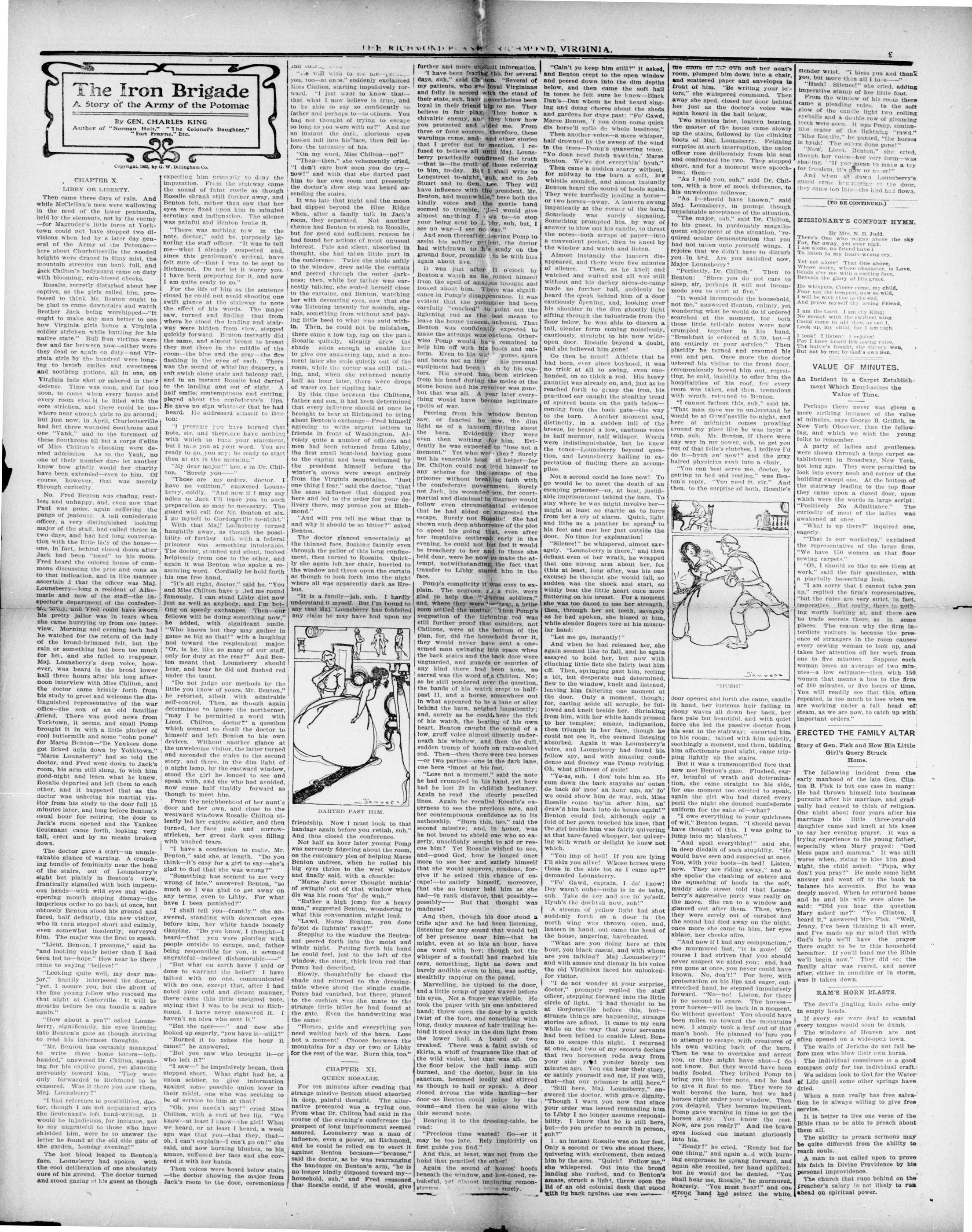
Samnec
DARTED PAST HIM.
friendship. Now I must look to that bandage again before you retiah, suh." And thus closed the conference.
Not half an hour later young Pomp was nervously fidgeting about the room, on the customary plea of helping Marse Benton undress, when he rolled his big eyes thrice to the west window and finally said, with a chuckle:
"Marse Jack never thought nuthin' of swingin' out of that window when dis was his room 'for' de wah."
"Rather a high jump for a heavy man," suggested Benton, wondering to what this conversation might lead.
"Lawd, Marse Benton, you done fo'got de lightin' rawd!"
Stepping to the window the lieutenant peered forth into the moist and wind night. Putting forth his hand he could feel, just to the left of the window, the stout, thick iron rod that Pomp had described.
Slowly, thoughtfully he closed the shade and returned to the dressing-table where stood the single candle. Pomp had vanished, but there, pinned to the cushion was the mate to the strange little billet he had found at the gate. Even the handwriting was the same:
"Horses, guide and everything you need waiting back of the barn. Lose not a moment! Choose between the mountains for a day or two or Libby for the rest of the war. Burn this too."
CHAPTER XI
QUEEN ROSALIE
For ten minutes after reading that strange missive Benton stood absorbed in deep, painful thought. The alternative presented was a trying one. From what Dr. Chilton had said in the course of the evening's conference the prospect of long imprisonment seemed assured. Lounsberry was a man of influence, even a power, at Richmond, and he could be relied on to exert it against Benton because—"because," said the doctor, as he was rearranging the bandages on Benton's arm, "he is no longer kindly disposed toward my—household, suh," and Fred reasoned that Rosalie could, if she would give
further and more explicit information,
"I have been fearing this for several
days, suh," said Chiont. "Several of
my patients, who are loyal Virginians
and fully in accord with the stand of
their state, suh, have nevertheless been
loyal in their friend hip to me. They
believe in fair play. They honor a
chivalric enemy, and they know how
you protected and added me. From
three or four sources, therefore, these
warnings came, and—and other stories
that I prefer not to mention. I refused
to believe all until Maj. Lounsberry
practically confirmed the truth
—that is—the truth of those referring
to him, to-day. But I shall write to
Longstreet to-night, suh, and to Jeb
Stuart and to Gen. Lee. They will
have influence with the president, Mr.
Benton, and meanwhile," here both the
kindly voice and the gentle hand
seemed to tremble, "I—I would give
almost anything I own to—to stop
your being sent to Loby, suh, but, I
see no way—I see no way."
And soon thereafter, leaving Pomp to assist his soldier patient, the doctor had withdrawn to his study on the ground floor, promisit; to be with him again about five.
It was just after II o'clock by Benton's watch as he roused himself from the spell of anxious thought and looked about him. There was significance in Pomp's disappearance. It was evident that the youngster had been carefully "coached" to point out the lightning rod as the best means to leave the house unseen, unheard. That Benton was confidently expected to make the attempt was obvious. Otherwise Pomp would have remained to help him off with his boots and uniform. Even to his was "purse, spurs and boots not an item," his personal equipment had not an en by his captors. His sword had been stricken from his hand during the melee at the stone house and his revolver was gone, but that was all. A year later everything would have become legitimate spoils of war.
Peering from his window Benton saw, or fancied he saw, the dim light as of a lantern fitting about the barn. Evidently they were even then waiting for him. Evidently he was expected to "lose not a moment." Yet who were they? Surely not his venerable host id helper-for Dr. Chilton could not lead himself to any scheme for the escape of the prisoner without breaking faith with the confederate government. Surely not Jack, his wounded son, for court-martial and dismissal in disgrace would follow even circumstantial evidence that he had aided or suggested the escape. Surely not Rosalie! She had shown such deep abhorrence of the plot to speed his going that, even after her impulsive outbreak early in the evening, he could not but feel it would be treachery to her and to those she held dear, were he now to make the attempt, notwithstanding the fact that transfer to Libby stared him in the face.
Pomp's complicity it was easy to explain. The negroes is a rule, were glad to help the "Jacum soldiers," and where they were landed, a bride soon settled the matter. Then Pomp's suggestion of the lightning rod was still further proof that outsiders, not Chillons, were at the bottom of the plan, for, did the household favor it, they would never have sent a one-armed man swinging into space when the back stairs and the back door were unguarded, and guards or sentries of any kind there had been none, so sacred was the word of a Chilton. No; as he still pondered over the question, the hands of his watch crept to half-past 11, and a horse, somewhere out in what appeared to be a lane or alley behind the barn, neighed impatiently; and, surely as he could, hear the tick of his watch, the beating of his own heart. Benton caught the sound of a low, gruff voice almost directly underneath his window, and then the dull, sudden tramp of hoops on rain-soaked sod. Then—then there were two horses—or two parties—one in the dark lane, one here almost at his feet.
"Lose not a moment," said the note he had crumpled in his hand, yet here had he lost 20 in childish hesitancy. Again he read the clearly penciled lines. Arain he recalled Rosalele's eagerness to see the previous note, and her contemptuous confidence as to its authorship. "Burn this, too," said the second missive; and, in honor, was he not bound to shield one who so eagerly, unselfishly sought to alr or rescue him? Yet Rosalele wished to see, and—good God, how he longed once more to see her and satisfy himself that she would approve, condone, forgive if he seized this chance of escape!—to satisfy himself, moreover, that she no longer held him as she had—in rank disfavor, that possibly—possibly— But that thought was madness!
And then, though his door stood a trifle ajar and he had been listening, listening for any sound that would tell of her presence near him—that he might, even at so late an hour, have one word with her; though not the whisper of a footfall had reached his ears, something, light as down and barely audible even to him, was softly, stealthily tapping on the panel.
Marvelling, he tiptoed to the door, and a little scrap of paper waved before his eyes. Not a finger was visible. He took the paper with his one unfettered hand; threw open the door by a quick twist of the foot, and something with long, dusky masses of hair trailing behind it sped away in the dim light from the lower hall. A board or two creaked. There was a faint swish of skirts, a whiff of fragrance like that of the wild violet, but that was all. On the floor below the hall lamp still burned, and the doctor, busy in his sanctum, hemmed loudly and stirred as though to hail or speak. A door closed across the wide landing—her door-as Benton could judge by the sound—and he was alone with this second note.
Bearing it to the dressing-table, he read:
"Precious time wasted! Go—or it may be too late. Rely implicitly on first guide you find."
And this, at least, was not from the haind that penciled the other! Again the sound of horses' hoofs beneath the window, and low-toned, rebukeful, yet almost imploring remonstrance, has its voice surely.
"Cain't yo keep him still?" it asked, and Benton crept to the open window and peered down into the dim depths below, and then came the soft hall in tones he felt sure he knew—Black Dan's—Dan whom he had heard singing and doing chores about the sheds and gardens for days past: "Fo' Gawd, Marse Benton, 'f you doan come quick dis horse'll spile de whole business." Then another voice—a mere whisper, half drowned by the sweep of the wind in the trees—Pomp's quavering tenor. "Yo doan need fetch nawthin," Marse Benton. We've got everythin' huh."
Then came a sudden scurry without, for midway to the barn a soft, to whistle sounded, and almost instantly Benton heard the sound of hoofs again. They were hurriedly leading a horse—or two horses—away. A lantern swung impatient at the corner of the barn. Somebody was surely signaling. Something prompted him, by way of answer to blow out his candle, to thrust the notes—both scraps of paper—into a convenient pocket, then to kneel by the window and watch and listen.
Almost instantly the lantern disappeared, and there were five minutes of silence. Then, as he knelt and watched and waited and all was still without and his darkey aides-de-camp made no further hall, suddenly he heard the creak behind him of a door cautiously opening, and, looking over his shoulder in the dim ghostly light sifting through the balustrade from the floor below, he was able to discern a tall, slender form coming noiselessly, cautiously, straight to his now wide-open door. Rosalie beyond a doubt, and she believed him gone!
Go then he must! Athlete that he had been, ever since boyhood, it was no trick at all to swing, even onhanded, on so thick a rod. His heavy gauntlet was already on, and, just as he reached forth to grasp the iron, his practiced ear caught the stealthy tread of spurred boots on the path below—coming from the back gate—the way to the barn. Another moment and, distinctly, in a sudden lull of the breeze, he heard a low, cautious voice in half murmur, half whisper. Words were indistinguishable, but he knew the tones—Lounsberry beyond question, and Lounsberry hailing in expectation of finding there an accomplice.
Not a second could he lose now! To go would be to meet the death of an escaping prisoner—or, at best, justifiable imprisonment behind the bars. To stay where he was might involve her—might at least so startle as to force from her a cry of alarm. Quick, light and lithe as a panther he sprang to his feet and met her just outside the door. No time for explanation!
"Silence!" he whispered, almost savagely. "Loubsberry is there," and then defiant even of her wrath, he wrapped that one strong arm about her, for (this at least, long after, was his one excuse) he thought she would fall, so sudden was the shock and start, so wildly beat the little heart once more fluttering on his breast. For a moment she was too dazed to use her strength, then, through her set teeth, savagely as he had spoken, she hissed at him, while slender fingers tore at his muscular hand:
"Let me go, instantly!"
And when he had released her, she again seemed like to fall, and he again essayed to hold her, but now with clinching little fists she fairly beat him off. Then, springing past him, reeling a bit, but desperate and determined, flew to the window, knelt and listened, leaving him faltering one moment at the door. Only a moment, though; for, casting aside all scruple, he followed and knelt beside her. Shrinking from him, with her white hands pressed to her temples; amaze, indignation, then triumph in her face, though he could not see it, she seemed listening absorbed. Again it was Lounsberry's voice, and Lounsberry had found his fellow spy, and with amazing confidence and fluency was Pomp replying. Oh, what glibness of guile!
"Ye-as, suh. I don' tole him so. He cum down the back stayuhs an' outen de back do' mos' an hour ago, an' fo' we could show him de way, suh. Miss Rosalea come tay'in after him, an' draw'd him back into de house again!" Benton could feel, although only a fold of her gown touched his knee, that the girl beside him was fairly quivering at that bare-faced whopper, but quivering with wrath or delight he knew not which.
"You imp of hell! If you are lying I'll skin you alive! Whose horses were those in the side lot as I came up?" demanded Lounsberry.
"Fo' Gawd, captain, I do' know! Dey wasn't ouhs—ouhs is in de bahn, suh. Take de key and see 'fo' yo'self. Hyuh's the dochtuh now, suh!"
A stream of yellow light had shot suddenly forth as a door in the north wing was thrown open, and, lantern in hand, out came the head of the house, angering, bareheaded.
"What are you doing here at this hour, you black rascal, and with whom are you talking? Maj Lounsberry!" and with amaze and dismay in his voice the old Virginian faced his unlooked-for visitor.
"I do not wonder at your surprise, doctor," promptly replied the staff officer, stepping forward into the little circle of light. "I had thought to be at Gordonsville before this, but—strange things are happening, strange stories are afloat. It came to my ears while on the way that your servants had been bribed to enable Lieut. Benton to escape this night. I returned at once, and two of my escorts declare that two horsemen rode away from your side yet yonder barely ten minutes ago. You can hear their story, or satisfy yourself and me, if you will, that—that our prisoner is still here"
"Still here, Maj. Lounsberry," answered the doctor, with grave dignity. "Though I warn you now that since your order was issued remanding him to Libby I no longer assume responsibility. I know that he is still here, but—do you prefer to search in person, suh?" I an instant Rosalie was on her feet. Only a second or two she stood there, quivering with excitement, then seized him by the arm. "Quick! Follow me," she whispered. Out into the broad landing she rushed, and to Benton's amaze, struck a light, threw open the lid of an old colonial desk that stood with its back scrains.
the doors of her own and her aunt's room, plumped him down into a chair, and scattered paper and envelopes in front of him. "Be writing your letters," she whispered command. Then away she sped, closed her door behind her just as the doctor's voice was again heard in the hall below.
Two minutes later, lantern bearing, the master of the house came slowly up the stairs, followed by the clinking boots of Maj. Lounsberry. Feigning surprise at such interruption, the union officer rose deliberately from his seat and confronted the two. They stopped short, and for a moment were speechless; then—
"As I told you, suh," said Dr. Chilton, with a bow of mock deference, to his unwelcome follower.
"As I—should have known," said Maj. Lounsberry, in prompt though unpalatable acceptance of the situation.
"The major, suh," said Dr. Chilton, to his guest, in pardonably magniloquent enjoyment of the situation, "required ocular demonstration that you had not taken unto yourself wings. I rejoice that we didn't have to disturb you in bed. Are you satisfied now, Major Lounsberry?
"Perfectly, Dr. Chilton." Then to Benton: "Since you do not care to sleep, sir, perhaps it will not incommode you to start at five."
"It would incommode the household, not me," answered Benton, calmly, yet wondering what he would do if ordered scarched at the moment, for both those little tell-tale notes were now crumpled together in his hand. "Breakfast is ordered at 5:30, but I am entirely at your service." Then placidly he turned and resumed his seat and pen. Once more the doctor ushered his visitor to the front door, ceremoniously bowed him out, regretting, he said, inability to offer him the hospitalities of his roof, for every room was taken, and then, tremulous with wrath, returned to Benton.
"I cannot fathom this, suh," said he. "That man gave me to understand he would be at Gwdw nville to-night, and here at midnight comes prowling around my place like he was layin' a trap, suh. Mr. Benton, if there were any way in my power, suh, to get you out of that fells's clutches, I believe I do it—yuhn an' now!" and the gray haired physician sank into a chair. "You can best serve me, doctor, by getting to bed and resting," was Ben-ton's reply. "You need it, sir." And then, to the surprise of both, Rosalie's
Jammer
"HUSH!"
door opened and toth she came, candle in hand, her lustrous hair falling in ebony waves all down her back, her face pale but beautiful, and with quiet force she led the passive doctor from his seat to the stairway; escorted him to his room; tailed with him quietly, soothingly a moment, and then, bidding him affectionate good night, came tripping lightly up the stairs.
But it was a transmogrified face that now met Benton's gaze. Flushed, eager, brimful of wrath and determination, she came straight to his side, for one moment too excited to speak, again the girl who had dared every peril the night she donned confederate uniform for the sake of—what?
"I owe everything to your quickness of wit," Benton began. "I should never have thought of this. I was going to jump into my blankets."
"And spoil everything!" said she, in deep disdain of such stupidity. "He would have seen and suspected at once, You, with your boots—in bed! Listen, now. They are riding away," Listen, as she spoke the clanking of sabres and the squashing of hoofs in the soft, muddy side street told that Lounsberry's aggressive party was really on the move. She ran to a window and glanced out after them. Then, when they were surely out of carshot and the sound had died away on the night, once more she came to him, her eyes ablaze, her cheeks afire.
"And now if I had any compunction," she murmured fast, "it is gone!" Of course I had striven that you should never suspect we aided you; and, had you gone at once, you never could have known. No, don't!" For here, with protestation on his lips and eager, outstretched he, he stepped impulsively forward. "No—no! Listen, for there is no second to spare. The horses—your horses—will be back in a moment. Go without question! You should have been miles up toward the mountains now. I simply took a leaf out of that man's book. He planned to 'hure you to attempt to escape, with creatures of his own waiting back of the barn. Then he was to overtake and arrest you, or they might have shot—I do not know. But they would have been badly fooled. They bribed Pomp to bring you his—her note, and he had to give it first to me. They were to wait beyond the barn, but we had horses right under your window. Then you delayed. They became impatient. Pomp gave warning in time to get the horses away. You know the rest. Now, are you ready?" And the brave eyes looked one instant gloriously into his.
"Ready??" he cried. "Ready but for one thing," and again a d with burning eargerness he sprang forward, and again she recoiled, her hand uplifted; but he would not be denied. "You shall hear me, Rosalie," he murmured, hoarsely. "You must hear!" and one strong hand had seized the white,
stender wrist. "I bless you and thank you, but more than all love—"
"Hush! Silence!" she cried, adding imperative stamus of love.
the audience; she cried, adding imperative stamp of her little foot. From the window of his room there came a pleading voice. In the soft glow of the candle light two rolling eyeballs and a double row of gleaming teeth were seen. It was Pump, simian-like sealer of the Lightning "rawd." "Miss Rosalie," he panted, "the horses is hyuh! The solers done gone!"
"Now, Lieut. Benton," she cried, though her voice—her very form—was shaking. "If you mean to make a try for freedom, it's now or never!" And when at dawn Lounsberry's guard came from marrying at the door, they came too late—the bird had flown.
(TO BE CONTINUED.)
MISSIONARY'S COMFORT HYMN
By Mrs. N. B. Judd.
There's One who reigns above the sky
Far, far away, yet ever high.
I am alone, no friend have I
To listen to my heart-wrung cry.
Yet not alone! That One above,
Whose name, whose character, is Love,
Bends or me with a smiling face,
Reveals the glory of His grace.
He whispers, Closer come, my child,
He cries, the tempest, now so wild,
I will be with the to end,
And prove myself thy loving Friend.
I am the Lord. I am thy King;
No serpent with the swiftest wing
Could come to aid the love, as can I;
Look up, my child, for I am high.
I look! I listen! I rejoice!
For I have heard the sweet voice,
The battle's fought, the victory won,
But not by me, by God's own Son.
VALUE OF MINUTES.
An Incident in a Carpet Establishment Which Emphasizes the Value of Time.
Perhaps there never was given a more striking instance of the value of minutes, says George B. Griffith, in New York Observer, than the following, and which we wish the young folks to remember.
A party of ladies and gentlemen were shown through a large carpet establishment in Broadway, New York, not long ago. They were permitted to look into every nook and corner of the building except one. At the bottom of the stairway leading to the top floor they came upon a closed door, upon which were the words in large script: "Positively No Admittance." The curiosity of most of the ladies was awakened at once.
"What is up there?" inquired one, eagerly.
"That is our workshop," explained the representative of the large firm. "We have 150 women on that floor sewing carpets." "Oh, I should so like to see them at work," said the fair questioner, with a playfully beeching look.
"I am sorry that I cannot take you up," replied the firm's representative, "but the rules are very strict, in fact, imperative. But really, there is nothing worth looking at, and there are no trade secrets there, as in some places. The reason why the firm interdicts visitors is because the presence of strangers in the room causes every sewing woman to look up, and takes her attention off her work from one to five minutes. Suppose each woman loses an average of two minutes—a low estimate—then with 150 women that means a loss to the firm of 300 minutes, or five hours of time. You will readily see that this, often repeated, is too much to lose when we are working under a full head of steam, as we are now, to catch up with important orders."
ERECTED THE FAMILY ALTAR
Story of Gen. Fisk and How His Little Girl's Query Struck Home
The following incident from the early manhood of the late Gen. Clinton B. Fisk is but one case in many: He had thrown himself into business pursuits after his marriage, and gradually had ceased to think of religion. One night about four years after his marriage his little three-year-old daughter came and knelt at his knee to say her evening prayer. It was a trying experience to the young father, especially when Mary prayed: "God bless papa and mamma." It was still worse when, rising to kiss him good night, the child asked: "Papa, why don't you pray?" He made some light answer and went off to the bank to balance his accounts. But he was deeply moved. When he returned home and he and his wife were alone he said: "Did you hear the question Mary asked me?" "Yes Clinton, I heard it," answered Mrs. Fisk. "Well, Jenny, I've been thinking it all over, and I've made up my mind that with God's help we'll have the prayer there ought to be in this household hereafter. If you'll hand me the Bible we'll begin now." They did so; the family altar was reared, and never after, either in sunshine or in storm, was it taken down.
RAM'S HORN BLASTS.
The devil's jingling finds echo only in empty heads.
If every ear were deaf to scandal every tongue would soon be dumb.
The windows of Heaven are not often opened on a wide-open town.
The walls of Jericho do not fall before men who blow their own horns.
The individual conscience is a good compass only for the individual craft.
We seldom look to God for the Water of Life until some other springs have dried.
When a man really has free salvation he is always willing to give free service.
It is better to live one verse of the Bible than to be able to preach about them all.
The ability to preach sermons may be quite different from the ability to reach souls.
A man is not called upon to prove his faith in Divine Providence by his personal improvidence.
The church that runs behind on the greacher's salary is not likely to run ahead on spiritual power.
THE PLANET
issued every Saturday by JOHN A. ICE
at 311 North 4th Street Richmond Va.
JOHN MITCHELL, JR., - EDITOR
a communications intended for publication
could be sent so to reach us by Wednesda
Copy, one year, $1.50
Copy, eight months, 1.00
Copy, eight months, .50
Copy, four months, .50
Copy, three months, .40
e Copy .40
ADVERTISING RATES
one inch, one insertion, $ 90
one inch, each subsequent insertion, 28
one inch, twelve months, 6.00
two inches, six months, 19.00
two inches, nine months, 14.00
two inches, twelve months, 20.00
mortgage and Financial Notes, 4.60
Banking and Transient Notices per line, 22
POSTAGE STAMPS OF A HIGHER DE-
OMINATION THAN TWO CENTS NOT
RECEIVED ON SUBSCRIPTIONS
THE PLANET is named weekly. The subscri-
pice is $1.50 a year, in advance.
There are FOUR WAYS by which money can be by mail at our risk.—In a Post Office Money Order by Bank Check or Draft, or an E-mail Order by Bank Check or Draft, these are procured in a registered Letter.
MONEY ORDERS—You can buy a Money Order at your Post Office, payable at the Richmond Office, and we will be responsible for it.
EXPRESS MONEY ORDERS can be obtained at the American Express, or the United States Express Co. and the Web. You can pay for money by money sent by any of these companies. The Express Money Order is an convenient way for forwarding money.
REGISTERED LETTER.—If a Money Order is registered, your Postmaster will register it for you wish to send as on payment of the date. Then if the letter is lost or stolen, you can send money in the mail at our risk.
We cannot be responsible for money sent in any other way than one of the four letters mentioned above. If you send your money in another way, you must do it at your risk.
NEWWALES, etc.—If you do not want To
alter continued for another year after you
provide him a man, you should notify his
Card to discontinuitie. The courts
sided Last subscribers to newspapers who
order their paper discontinuatid at the cap-
tion time of when it has been paid as
inble for the payment of the subscript-
tion to date when they order
paper discontinuatd
BAMUNICA
en writing to
show your surecation or to dis-
certain you should give your name
for otherwise we are
change of ADDRESS in order to
address of a subject we may
former as well as the present ad-
dress in the Post Office
second class matter
SATURDAY...FEBRUARY 18, 1905
"Who is the richest man in the
world?" asked a correspondent. The
man who has a happy and
employment that enables him to live com-
fortably.—Wash. Post.
The error in the foregoing lies in mis-
taking happiness for riches. Probably
the chest man in the world is the man
eb has more than he wants. D es
it man exist—Petersburg, Va. Ind.
Appeal.
Of course he does. His name is Mr.
ANDREW CARNEGIE who is accredited
with having expressed the wish to die
poor.
CHARLESTON, S. C., Southern Reporter announces that it is now under the editorial management of J. L. DART, A. M., B. D., W. W. BECKETT, D. D. and I E LOWERY, M., D. D. If ability and titles count for anything the success of this journal is assured: The first named gentleman is editor and his colleagues are associates.
THE report from the town of Monticello, Arkansas tells of the outrageous closing of a school for colored people, founded by Miss MARY HOLMES of Boston. The lynchers sent Miss Holmes a coffin, cartridges and rope, leaving the same ather door. The effect was so startling that not only did the teacher leave, but hundreds of colored people in that neighborhood did the same thing. The principal of the school had several fights with the white boys in the neighborhood and absolutely no protection was afforded by the authorities. These deplorable occurrences are very embarrassing to the liberal minded people of the country and tend to emphasize the fact that the blighting effects of heathenism and lawlessness are yet to be seen in many portions of the South land.
MR. ROOSEVELT AND THE RACE QUESTION.
THE speech of President Roosevelt delivered at the Lincoln dinner of the Republican Club, Monday, February 13th, 1905 within the palatial confines of the Waidorf-Astoria Hotel, New York is significant and will rank with the ablest addresses upon that subject. He mildly criticised the North, but no where in that sea of words is there to be found awaist else than charity for the South. That this course was diplomatic hardly admits of a question, for this fair section of this great country was all the more foribly reminded of its deformities and its short-comings by the very attitude of the President in failing to make any references to them.
It is evident to us that Mr. Roosevelt took this occasion to define his position upon this much mooted race question. Some people may think they also a change in his former attitude toward the South and incidentally towards the colored people. We do not share in that opinion. We believe that he is now as he always has been, no special friend to the colored
men and no special enemy to the to the Southerners. The former who prove them selves worthy can expect the same treatment as the white men who show that they are in possession of similar sterling qualities. The latter may find themselves even better treated than the former if they will but retain the eminities and rancors of the past and prove to Mr. ROOSEVELT's satisfaction that they are in possession of liberal ideas and are ready to march to the music of the union. In plain words, a white man need have no fear that he will be ignored at the White House because he is from the South and has believed in its theories and precepts and a black man need have no fear that he will be turned away because of his race, color or previous condition of servitude. In fact, with Mr. ROOSEVELT, "worth makes the man, and the want of it the fellow."
We contend that we find no fault with the Chief Executive on this score and if he can bring the unreconstructed South, composing as it does about seventy percent of the body politic to see the light, he will have taken a long stride in the direction of regenerating one of the most remarkable portions of this twentieth century civilization.
We have read and re-read the President's utterances and we cordially subscribe to the views therein contained.
Colored men of this section who thought they saw in him a special friend are deceived. White men of this section, who thought they say in him a special enemy are mistaken.
His platform is broad, but eminently satisfactory and if he will live up to the declarations made, no cause for complaint should emanate from any wide-a-wake, progressive, thrifty, industrious colored man in this broad land of ours.
SENATE NULLIFIES EIGHT TREATIES
Amended Arbitration Conventions Negotiated by President.
RATE BILL PASSES THE HOUSE
Washington, Feb. 13. — By a vote of 50 to 9 the senate nullified every one of the eight arbitration treaties that President Roosevelt had negotiated with foreign powers. It did this as a rebuke for what several senators, including Messrs. Morgan, Lodge, Spooner and Foraker, characterized as an attempt to interfere with the prerogatives of the senate when he sent a letter to Senator Cullom declaring that if the conventions were amended so as to provide for a "treaty" instead of an "agreement" prior to overcase of arbitration, he would not ask the contracting foreign powers to ratify them. The senate, after hearing the president's letter read, did so amend the treaties and then ratified them. The president, however, will withdraw his consent to the treaties.
The point at issue is of considerable importance, for, as the president points out in his letter to Senator Cullom, if the arbitration conventions merely provide for "agreements" to arbitrate, then the state department will be free to arrange for the arbitration of whatever subordinate question arises; but if they provide for "treaties," then the consent of two-thirds of the senate will have to be secured every time the state department arranges for the arbitration of any question, no matter how small.
The second article of each of the treaties, as sent to the senate, reads as follows:
"In each individual case the high contracting parties, before appealing to the Permanent Court of Arbitration, shall conclude a special agreement defining clearly the matter in dispute, the scope of the powers of the arbitrators and the periods to be fixed for the formation of the Arbitral Tribunal and the several stages of the procedure."
As amended the article reads, "special treaty," instead of "special agreement."
CAN'T CONVICT MRS. CHADWICK
Her Attorney Says Indictments Are Not Worth the Paper Written On.
Cleveland, Feb. 15.—Discussing the report that the federal grand jury will probably return another indictment against Mrs. Chadwick, Attorney J. P. Dawley, her counsel, said:
"Let them return another indictment. The five indictments already reported are not worth the paper they are written on. They will never be able to convict her on the charge of conspiracy."
Mr. Dawley added that Mrs. Chadwick is suffering from acute heart trouble, and he feared that the excitement incident to the trial would cause her death.
Iri Reynolds, who held a package said to contain $5,000,000 in securities belonging to Mrs. Chadwick, is seriously ill. Mr. Reynolds has been confined to his bed for several days with a severe attack of grip and malaria.
MITCHELL AGAIN INDICTED
Lands Worth $3,000,000 Charged.
Portland, Ore., Feb. 14.—The United States grand jury returned an indictment, charging United States Senator Mitchell, Congressman John N. Williamson and Binger Hermann and others with having conspired to have created the Blue Mountain forest reserve in Eastern Oregon, with the intent of defrauding the government of public lands, and also of conspiring to obtain possession of more than 200,000 acres of public and school lands, situated in several states, of the value of more than $3,000,000.
Fire In New York School
New York, Feb. 15.—Within an hour after 1800 children had been dismissed from public school No. 3, in Grove street, the building was found to be
THE RICHMOND PLANET. RICHMOND. VIRGINIA
on fire, the flames spreading so rapidly that it was quickly gutted. At the time the fire was discovered there were only three or four teachers and a few children in the building. These, with the aid of the janitor, made their escape through a covered passageway to an adjoining building and thence to the street. Mary Leach, matron of the girls' department, found her escape by the stairways cut off, but was taken down a ladder from the second floor. Two small boys were seen to jump from the next window, but escaped uninjured. The damage is estimated at $50,000.
Found Aged Woman's Fortune.
New York, Feb. 14.—When the police and relatives searched the three rooms in which Mrs. Maria Kull, 73 years old, lived in a tenement house in Third avenue, they found more than $6000 hidden underneath the covering of a sofa. Deeds of houses valued at $70,000 and bank books showing deposits aggregating more than $18,000 were also found concealed in cltts. The woman is in Bellevue hospital suffering from chronic gastritis, and it is said that her condition is precarious.
A Poison In Mistake For Candy.
Bennington, Vt., Feb. 13.—As a result of eating strychnine tablets mistaken for canny, Leslie Elwell, 3 years old, is dead, and his 7-year-old brother, Calvin, is in a critical condition, with his limbs paralyzed. Physicians say that he will be a cripple if he survives.
CZAR GRANTS REFORMS
Endorsed Scheme For Removal of Ancient Land Parliament
Ancient Land Parliament.
St. Petersburg, Feb. 13.—The news that Emperor Nicholas has endorsed the scheme for the revival of the Zemsky Zabor, or ancient land parliament, which the old emperors convoked in times of stress, has spread through the city and created intense satisfaction among the liberal classes. The newspapers this morning were filled with articles descriptive of this ancient Russian institution, indicating that word had gone forth that the government had decided to listen to the voice of the representatives of the people. Naturally there is some scepticism as to whether the government intends frankly to take the step; but the general verdict is that if the emperor has succeeded in shaking off reactionary influences and now proceeds in good faith to summon the Zemsky Zabor, he will rally to his support the moderate liberals and perhaps a wave of genuine enthusiasm in the country.
The Liberals are convinced that the meeting of such a representative body must be followed by important and widespread reforms. The anticipated renewal of trouble among the workmen was not realized. Neither strikers nor students made the slightest attempt to demonstrate, and the city presented a normal appearance. The emperor's creation of a joint commission of masters and workmen, chosen by themselves, to investigate the cause of the discontent among the laborers has made an exceedingly good impression, being considered definite evidence of the government's purpose to compel some of the rapacious masters who have paid starvation wages to do justice to their employees.
OWEN KELLY ADMITS DEBTS
Says He Owes $50,000 to Philadelphia
Relatives and Friends.
Los Angeles, Cal., Feb. 15. — Owen Kelly, a former wealthy grocer of Philadelphia, now wanted there for the alleged embezzlement of a sum said to exceed $50,000, is under arrest in this city. Kelly was arrested on one of the main streets by Chief of Police Hammil and Chief of Detectives Bradish, who recognized him from printed descriptions sent out at the time of his disappearance.
Kelly left Boston last October by steamer for Europe. His destination was unknown, but he was followed across the Atlantic, thence across Europe, where trace of him was lost. He finally returned to this country, landing at San Francisco. His presence in California became known through information from the east.
Kelly talked freely of his alleged defalcations, and admitted that he owed probably $50,000 to Philadelphia relatives and friends, which sum, he said he lost in speculation, after having spent his own fortune in the same way. He offered no resistance to the officers, and expressed himself as glad that he was no longer a fugitive. He stated that he would return to Philadelphia without a requisition. Kelly said that when he left Boston he had $1000 in cash with him. When he was searched at the police station $500 was found in his pockets.
No Charge Against Kelly.
Philadelphia, Feb. 12. — Friends of Owen Kelly in this city are convinced that the man in custody at Los Angeles, Cal., is the long missing merchant and bank director. A meeting of Kelly's associates was held here, and it was decided to send an agent to Los Angeles for the purpose of bringing him home. There are no charges against Kelly. It is true he is indebted to various persons for large amounts of money, but he is not accused of embezzlement or defaulcation.
Jersey Militia Going to Inauguration.
Washington, Feb. 15.—Word reacquired the inaugural committee that an entire brigade of the New Jersey National Guard, including infantry, cavalry, signal corps and a battery of artillery, will participate in the inaugural parade and will serve as the personal escort of Governor Stokes, who will be here with his staff. The arrangements for the illumination of the city are progressing rapidly. The capitol and the Washington monument will be brought out in bold relief at night by brilliant searchlights. There will be numerous other illumination features.
Senator Tillman In Philadelphia
Philadelphia, Feb. 14—United States Senator Benjamin R. Tillman, of South Carolina, arrived here, in company with his physician, Dr. J. W. Buseck of Columbia, S. C. Senator Tillman says he has been in Illinois and that he came here for treat. she said.
THE IRON BRIGADE. Continued from 3rd Page.
he will not enter a sanitarium, and states that his physician says he is suffering with grief. Senator Tillman, however, says he thinks it is something more serious than grip. He was unable to state how long he will stay in the city.
Found Purse Containing $13,000
Cleveland, Feb. 15. — George Putnam, 15 years of age, found a purse on Superior street, containing $13,000 in currency and drafts, together with a bank book showing deposits in the Guardian Trust company, of this city. The lad returned the purse and contents to the latter institution and received a reward. The purse is said to belong to H. J. Fayer, an out-of-town customer of the trust company.
Ninety-four Persons Drowned
London, Feb. 14.—A dispatch from Kobe, Japan, to the Express reports that the small steamer Nate igawa collided with the harbor works at Osaka on Sunday, and sank, and that 94 persons were drowned.
CHAPTER XII
"IN THE TEETH OF THE BRIGADE."
Once more the Badger-Hoosier brigade was swinging away southwestward. For the sixth time in less than a year the men of the "Black Hats" at the head of colonn had placed their way over the stone-roofed pike, saying approbable things of Virginia pathmasters. An impudent lot were these fellows in the initiation "Kossutus" Marvelously snappy and precise in drill, steady on parade, enduring on the march and reasonably respectful toward their officers (who were the only ones in the division to do and habitually wear the fulldress headgear of the regular service), the rank and file were blessed with not a little soldier skeptical in as to the value or stability of other commands in and out of the brigade, and a calmly critical attitude toward officers other than those of their selection. They had not been over well content with their original field and staff, and for lack of leaders of that rank, had become what stumped up at first Bull Run, fighting sturdily all the same by company or squad to the flag end, and never knowing they were whipped when finally "herded" off the field. Now, however, they had men at their head—colonel, lieutenant-colonel and major—by whom they positively swore and on whom they skillfully valed and have banked their last cent. Yet, with all their regard for these, their honored leaders, it must be owned the Black Hats gave them lots of trouble. They would give the rest of the brigade and long to recover over the whole division, only one other regiment of which had as yet faced the foe in battle. They had a curious defect of vision when "outside" officers happened along, and were forever being complained of as falling to "render honors," whereat they were heard on more than one occasion unblushingly to declare they saw, but didn't suppose the strangers could be officers. They were preternaturally keen sighted as sentries toward men of other regiments "running guard" or smuggling contraband of war, and were correspondingly blind when the culprit was of their own complexion. They were probably the best drilled and positively the worst hated regiment in the whole division—and relished one distinction quite as much as the other—when they were marching this third time on Manassas, and the little West Pointer in saddle at their head thanked God that at last he had them where, with work against a common foe, there was possibility of keeping them out of mischief.
Centreville had been passed, Bull Run recrossed, and Bristoe reached—a point beyond their previous explorations. Then back had they to go to meet a threatened raid on their railway communications, and, that matter settled, again they were trudging through the well-remembered wood roads when, as a turn of the way brought their foremost company in full view of the fine sweep of country off to the west, the gray-bearded colonel, for the time commanding the brigade, reined out to the right for a look at his men, and his tall, born-soldier of an adjutant rode alongside the black-bearded, dark-featured, stocky little leader of the Black Hats, pointed with his gaunt-letted hand to the blue curtain of the Bull Run range and remarked: "I'd give a good deal to know just what that fellow Jackson's doing behind that screen to-day."
"Why so?" asked O'Connor, shortly, "Shields licked him well at Kernstown. Banks has turned his whole force back there. Blenker's big division has gone to reinforce them. Why, we've got enough men there to eat 'em alive—Jackson and all."
"First catch your rabbit," said the adjutant, musingly. "Old Stonewall knows every footpath in the valley—every path through the mountains. He'll trick Banks and Fremont, sure's your born, colonel. Then we'll have a shy at him."
"May the Lord grant it," was the pious answer, as the colonel looked wistfully away toward the little riff 'n the dark ridge, where ten miles distant, lay Thoroughfare Gap, the best and shortest route to the Shenandoah—the gap through which four months later this same much-discussed and as yet little-known Jackson w-3 with such fatal effect to pour his columns on the union flank and rear.
It was a moist afternoon. The men in the marching column, heavily burdened with bulging kapsack and double blanket and the long Springfield over their burly shoulders, whipped off their hats and swept the coat sleeve over their dripping brows, peering curiously at the old colonel sitting sturdily in saddle and watching their array. A grim smile stole over his grizzled face as his own battalion came striding forth in the wake of the "Scoffing Second." Then the kindy eyes clouched with
GENERAL MARKETS
Philadelphia — Flour steady; winter
extras, $4.25@14; Penna, roller;
clear, $4.50@47.5; city mills, fancy,
$6.25@6.35; Rye flour steady; per
barrel, $4.40; Wheat firm; No. 2 Penna
firm, $4.00; Wheat firm; No. 2 Penna
steady; No. 2 yellow, local, 54%c; cakes firm;
No. 2 white, clipped, 37%c; g
grades, 36c. Hay firm; No. 1 timothy,
$14@15; Pork firm; family, $17. Beet
steady; beef hams, $24@22. Live poultry
firm; hens, 13%c; old roosters, 9%
pressed poultry; ady; choice fowls, 12%
steady; cake firm; no. 2 steady;
creamery, 35c. Eggs firm; New York
and Penna, 36c. dozen, Potatoes firm;
new, per bushel, 50%c.
Baltimore — Wheat firmer; spot, con-
tract, $1.15@1.16; spot, No. 2 w
dressed poultry; ady; choice fowls, No.
2 red, $1.98@1.109; southern pie
ple, $1.01@1.15; southern on grape,
$1.04@1.16; Corn firm, spot, 49%
49%c; steamer mixed, 47%@47%;
southern white and yellow, corn, 44%
49%c; steamer mixed, 45%@47%;
36c; mixed, 35%@35%; Rye dull;
todn, No. 2 western, 85c. Hay cul-
tant, No. 1 timothy, $14@15; No. 1
clover, mixed, $12@12. Butter firm;
southern white and yellow, fancy er
ary, 39c; fancy erary, 10%c. Eggs
firm; per dozen, 28c.
measure at sight of a tail, lanky civilian on a decrepit gray, ridling with the lieutenant-colonel commanding. He had seen the man before many a mile from the spot and more than a week away. "How come you here?" he asked, as the colonel ambled out of the column and touched his worn hat-brim.
"My place is just over yahnduh, colonel. Please you doan' remember my comin' to you with a pass, back o' Fairfax," and the tail stranger looked confidently into the grizzled, sun-burned face. "Been in to Alexandria, yo' know, for supplies. Wagon went sho't cut by stone bridge."
Keenly studying the veteran's face, he suddenly added: "Ain't Col. Bayard's cavalry out there?"
"Ask me no questions, my friend, and I'll tell you no lies." was the wary answer. "Cen, McDowell's pass compels me to let you ride along with the column, but doesn't require me to post you as to our movements. You know too much now to be traveling toward Jackson's people, and—have you shown that pass to the division commander?" "Why, it was he who got it for me," answered the Virgilian, placidly. "It was I that took him Lieut. Benton's pistol and told him of his capture. What's more, I'm 'speeting to get further news of the lieutenant. Why, why comes the general now, and 'f you don't mind, colonel, I reckon I'll ride with him a piece."
Graybeard glanced half angrily over his shoulder. A few yards north of the road there was a barren little eminence, on the crest of a Mell Cave and suddenly appeared the division commander with two of his staff. Unslinging their fieldclasses, they seemed for a moment studying the westward lowlands, then came trotting swiftly toward the column.
"Colonel, there are scattered parties of cavalry out there coming swift this way, too-out north of Brisoe-between that and Gainesville. They don't seem to be watching the column, either. Send one regiment out along the Gainesville road as far as Bethlehem church and let them throw out skirmishers. Halt the rest of the brigade here. Good afternoon, Mr. Jennings," he continued, in civil acknowledgment of the Virginian's saturation. "I thought you were home by this time."
"General," said he, coming along-side, "I want to say one thing, suh, and it's this—that young gentleman of your staff was so kind to Dr. Chilton that it completely staggered the doctor to have him knocked down and captured. He's bound to take the best of cayuh of him till he's well enough to take cayuh of himself—an' then—"
"Well, and then, Mr. Jennings?" asked the general, impatiently, for he was eager to get on ahead.
"You look out for his turning up any day! If he ain't exchanged, I'm bettin' somethin' else will happen."
"My understanding is that Dr. Chilton has made himself personally responsible for Mr. Benton's safekeeping so long as he's allowed to remain with him—"
"That's true, I reckon," answered Jennings. "But," and here his lantern jaws relaxed in whimsical grin, "the doctor ain't the only brainy one in that family, general. The girl that planned young Ladue's escape from your fellows at Henry house may play it on Ewell's folks at Gawd'nsville just as easy."
"So you know Ewell's at Gordonville!" said the general, whirling suddenly on the speaker. "And you know the lady who got Mr. Ferguson into his scrape, do you?"
"Gettin' another fella out o' one—yes—suh," answered Jennings, unflinchingly. "And she made a big play that night to get still another out of a bad fix—less I'm mistaken. Why, general, you jus' ought to heuh Judge Armistead talk about that girl. He says half the men in Albemarle, university and all, were in love with her when the war broke out, and the judge has a mighty pretty daughter of his own, too. I rather hoped some of our cavalry might be pushin' out toward Hopewell to-night. Ain't Col. Bayard somewhere out that way? Hullo! There's a shot!"
Not one shot, but two, three, in quick succession. Somewhere ahead among the patches and thickets of scrub oak and pine the scattering advance guard had suddenly met swift galloping lads in gray. Then came the distant sound of half a dozen shots—carbines—and the answering sputter of a ragged volley. Well out to the front a bugle sounded some lively call, and, spurring full gallop from the rear, the tall adjutant went bending and twisting away among the trees until out of sight ahead, and then his powerful voice came ringing back: "This way.
captain—lively! Double quick!"
Evidently Haskell had sighted some of the quarry and closer at hand than those ahead along the roadway, for there came a crackle of shots—the bark of the cavalry weapon, the saucy pop of a revolver somewhere among the thickets to the left of the column; then a shrill burst of cheers from the deploying blue coats on the westward flank. All of a sudden through the bushes tumbled a little squand of troopers in gray, making heroic effort to carry off a helpless comrade. The general and his aides had spurred in with the skirmishers, and were just in time to see two riderless horses tearing away among the trees across an open glade, while half a dozen daring, devoted fellows in saddle were stoutly interposing between the forward rush of the excited Eadlers and three of their number surrounding and supporting a tall officer who had been lifted sideways to the back of a plowing steer. "Half!" "Half!" "Bismouth!" "curranger!" "hall the horse stools of the dozen bluecoats, dashing in pursuit. Bang! Bang! came the demand response of the few defenders. Bang! Bang! bellowed a brace of Springbells in reply. "Don't shoot!" "Honor your fire!" yelled the general. "Don't shoot!" "Don't shoot!" echoed the staff, for the luckless cavailer, reeling in his seat, went sliding into the arms of his loyal followers, while the devil of a horse whirred round, tugging, straining at the reins and striving to break away. "Dismount!" "Down with you!" "Off with you!" cried the pursuers, officer and man, as another terrified horse tore, wildly neighing, in chase of the foremost. It was a desperate effort on part of the grays. Their comrade troopers were too far off to help them, even could they drive through the stout skirmish line already far flung across the field beyond. With a last wave of his white hand, the officer seemed ordering his defenders to save themselves, and those in saddle, ith parting shots and defiant yells—one of them even hurling in rage as enlisted revolver at the tall adjutant, the foremost man in the rush—darted away, bending low over the streaming manes, with the bullets of half a score of Springfields whizzing past their ears.
The adjutant was off his big, raw-boned bay in an instant and, bending over the fainting man, unscrewed the cap of his flask and held it to the pale lips beneath the sweeping mustache. "A major, hey?" he said, as he noted the brilliant braids of gold lace on the handsome uniform frock. "What is a major doing out here with only a squad of you boys?" "Is he wounded?" asked the chief as he glanced at the two silent striplings in gray. One of them faced the commander. "Horse fell, suh—rolled on him—broke his leg," said he, with a salute that told unerringly of soldier teaching; so, too, did the speaker's pose. Instinctively he was standing at attention. He knew the rank betrayed by that yellow sash.
Give this young gentleman a way from your flask, Haskell; I fear he's—— Why, my lad, you're wounded! Look to him, some of you!" cried the general, for the boy had grown ashen pale and was reeling when strong arms caught and lowered him. "Sure, general. He's shot through the breast," said a bearded soldier, tearing aside the trooper's jacket and displaying a blood-wet shirt beneath. "And wouldn't show it." answered the general. "That's the way with them. Send for a surgeon, captain." And then the general, too, was off his horse and bending over the stricken lad. "Do you know his name—and home?" he ascribed of the pale-faced young Virginian, standing trembling a bit with excitement beside him. The lad flushed, looked distressed, embarrassed, but seemed to believe it his soldier duty to give no information whatever to the enemy. It was Jennings who spoke, his voice breaking harshly, somehow, on the silence of the surrounding group, as he elbowed a way through the curious circle and caught sight of the swooning boy.
"I know him, general. He's one of our best, suh," and now Jennings, too, had thrown himself upon his knees. "It's Floyd Pelham, suh, of Charlottesville. It'll break his mother's heart, suh, if he's done for."
The wall in the Virginian's voice seemed to catch the ear and rouse the faculties of the reviving officer. "Who's that—done for?" he faintly asked. "Not Floyd Pelham?" And bracing his hands upon the turf, he struggled to a sitting posture, while Jennings sprang to his feet and stared. "Maj. Lounsberry! Good God, suh, you wounded, too? Why, I'd no idea—"
"No idea, I suppose," interposed the major, with cutting, sarcastic emphasis, "that your friends, the Chillons, had turned that Yankee lieutenant loose. Well, you needn't rejoice, gentlemen, we've got him again—and right in the teeth of his own brigade!"
CHAPTER XIII
RIVANNA TO RAPIDAN.
Long as he lives Fred Benton will never forget that night ride from the Chiltons and the thrilling days that followed. Something heaved up through the dim starlight and lightly tapped against the clapboards below the sill, and something black came "swarming" up the other something—Pomp again, and Pomp chuckled at sound of Benton's whispered hail.
"We've got a ladder dis time, suh. Didn't dass try it befo' wid dem sojus at de bahn," and by ladder, not by lightning rod, was the descent accomplished. Dusky hands helped the crippled soldier into saddle. Dusky hands waved him good-by and good luck.
Then Benton gave himself unquestioning to him whom she, his imperious queen, had appointed as his guide, and together they rode forth into the murmuring night.
When the suburbs were left behind and they had found the open country his escort turned and said: "Kin you stand a little canter, Marstuh?" and Benton recognized the voice of Dusy Dan, and "stood" accordingly. They ford, somewhere toward two o'clock a little branch, a tributary of the rushing Rivanna, and were still heading
westward when Fred's darsey guide left him with both horses at the edge of a grove, while he went forward affoot and reconsidered. Presently he came back rejoiceful. "Dey ain't a soul a loo in' out fo' de bridge, suh. Dey's all over Gawd'sville way. We save nigh on five miles hyhu," and so led on again, the hoof-bats sounding hollow on the planing of some old-time truss across a swift, exuberant mountain stream, running bank full and, far and near, said Dan, ad力able. Still on through whispering tastes of forest trees, through squashy cross-country bridle paths, from farice or toll road, until at dawn old Daniel led his soldier charge from the beaten track, and turning squares to the begin a tortuous climb that brought them presently to two little cabins. Here, while Benton was made comfortable in his blanket Dan held converse with other unseen occupants, giving explict directions, taintly audible in the bliss of frying bacon and the bubble of boiling coffee. Benton heard vaguely, drowsily, the "Swift Run Gap, Sperryville, Ohlans, Hedgman river" and when he roused himself in response to vigorous yet regreful prodding, he knew not how long thereafter, a new voice sounded on his sleepy senses. Another guardian bent over him in the shape of a negro with wrinkled face and gray-white, kinky hair, but a world of sympathy and interest in his somble eyes, Marsuh's breakfast was spoiling and it was time that they were moving. Where was Daniel? "Daniel had to go back to Marse Chilton's. Miss Rosalie done fixed all dat."
His big boy Hector was "groomin' hawses," and from this point would lead him on up the east face of the range until near the Hedgman. He knew that country well, whereas old Dan did not, and the latter had to hurry home so that he might show
Jimmy C.
BREAKFAST WAS SPOILING.
about the Chilton place as usual. Miss Rosalie had ordered that, too. They would do anything in the world for her—or for the doctor.
And so, once more, but in broad daylight now, and well up along the heights, they came at last in view of the twisting mountain road that pierced the range—Jackson's runway from the Shenandoah down to Gordonsville—and here again Fred hurried in hiding, while Hector scrambled down afoot to try the pass.
Ten o'clock had come before Hector reappeared, big-eyed, panting. There were 200 soldiers to the west of the Gap digging forts, a squad in every farmhouse along the road, and about as much chance of a Yankee officer crossing in daylight as there was "of a needle's eye a-gittin' into heaven." Hector had been proudly taught at some time in his life—and now he looked at the blue and the brass buttons in dismay.
Benton thought it over. The guard were to come for him at six, and long ere this had discovered his escape, Pursuit and search would of course be made. "Anybody own bloodhounds around Charlottesville?" he asked, and Hector said "No." Still Dan had gone back, Dan might be lashed and tortured until he revealed what he knew—such things had happened—and the sooner Benton reached the upper waters of the Rappahannock and secure hiding places back of Warrenton, known to Hector, the better it would be for him—for all. He doubted not that by noon couriers would come galloping out from Gordonsville telling of his escape and ordering guards and sentries on the lookout everywhere along the Gap.
"Not a second to lose!" He sprang to the saddle-bags and began a search. What had occurred to him would probably have occurred to her, and it was Miss Rosalie, Dan alarmed, who packed them. With eager hands Benton pulled at the contents of the nearmost—a flask of brandy from the doctor's store, towel, handi-chiefs, sponge, soap, comb and brush, socis, shirt and underwear—Jack's, of course, and probably a tight fit; small tin boxes containing ground coffee, sugar and other things—no time to examine now! Then came a shout from Hector, rummaging on the other side, and over the broad back of Marse Pelham's old Pyramus came a worn gray sack coat and waist-coat, of Richmond make, and pinned to the lapel a scrap of paper on which in pencil appeared in Roman characters, not script, these words: "Map and spectacles in coat pocket. Small pistol also. Look out for federales about Warrenton."
In less than half an hour, a tall, palefaced, studious-looking young man in spectacles, slouch hat and worn sack coat of gray—thrown loosely over a slung right arm—with a dark-brown horse, a doctor's saddle-bags and a darkey follower on a nondescript nag, turned deliberately from a mountain path and took the highway to the eastward. A few rods further the road twisted to the left and brought him in view of a mountain cabin, where a squad of soldiers in queer-looking frock coats of dingy gray were filling their canteens. Another of their number, slick and dejected, was squatting on the steps, his sallow face the picture of woe. "Gawt any physic that will cure the cawlic, dawatun'! drawn
THE PLANET
SATURDAY ... FEBRUARY 18, 1905
sergeant's stripes, and the doctor reined in, stained the patient attentively one moment, then swung out of saddle and stepped to his side. He gravely felt the pulse and glanced at the coated tongue, fumbled a minute at the saddle-bags, stirred a compound into a stone china cup that stood by the trough—a compound whereof powdered sugar, spring water and spirits vini gallici were the sole ingredients, and in three minutes had the satisfaction of seeing the light of reviving interest in life in the dull eyes of the invalid and receiving the plaulitis of half a dozen would-be patients. Gladly would they have held him, though from no hostile intent, as, with apparent serenity yet with thumping heart, he rode away. He had heard enough to make it expedient that he should move at once.
"You're the first dawkut we've seen since we left home, 'cept those in the army, suh,'" said the young sergeant. "Guess they need 'em all."
"You're not Virginian, then," hazarded Benton, as he was mounting.
"No, suh—Fifteenth Alabama, Trimble's brigade, suh. We b'long down at Gawd'sville, but they sent a few companies out this way last night."
"Know any of the Eleventh?" queried Benton, rashly, yet thinking it not unwise to display some knowledge of the southern service—"Lieut. Ladue, of Mobile?" he confirmed at a venture.
"Not many, suh. They're all with Gen. Longstreet and Anderson down toward Yohikitown."
"Lieut. Ladue ain't!" said the sick man, uplifting his sallow face. "He's on Gen. Ewell's staff—made me ride his hawse this mornin' an' he ain't a mile away this minute."
TO BE CONTINUED.
MIDVALE'S ARMOR BID REJECTED
Contract For 8000 Tons Given Bethlehem and Carnegie Companies.
Washington, Feb. 8.—The board of officers appointed by Secretary Morton to investigate the capacity of the several armor-plate companies has recommended that the bid for 8000 tons of armor for the battleship New Hamshire and the armored cruisers North Carolina and Montana, of the Midvale Steel Company, be rejected.
Later Secretary Morton announced the award of the contracts for the armor as follows: To the Bethlehem Steel Company the armor for one battle ship and one armored cruiser, 5666 tons, and all bolts and nuts, 94 tons.
To the Canegie Steel Company the armor for one armored cruiser, 2162 tons.
In announcing the award it is stated that, while the Midvale Steel company has submitted trial plates that have successfully withstood the required ballistic test, it has not yet commenced the regular production of armor in quantity, and the bureau of ordinance does not deem that the production of the trial plates submitted is such a guarantee that the company can produce suitable armor in the quantities required as would warrant at this time in awarding to that company a contract for armor.
MAY DELAY EXECUTION
Board of Pardons Decides to Hear Arguments For Kate Edwards.
guments For Kate Edwards.
Harrisburg, Pa., Feb. 8.—Chief Clerk
Thorn, of the board of pardons, re-
ceived a petition from Oliver Lentz,
counsel for Mrs. Kate Edwards, the
Berks county murderer, asking for a
rehearing in the case.
The case was placed on the calendar
to be heard on February 15, when it
will be argued.
As soon as Pennypacker has been
officially advised of the application for
a rehearing in the case it is expected
he will withdraw the death warrant
until after the board has disposed of
the case.
The board has twice refused to commute the woman's sentence, and there is some doubt there as to whether it will again reopen the case.
"Has Kate Edwards another story to tell? Will she make a confession that will free Reason?"
These are the questions asked today-but eight days before the date set for the execution of Mrs. Edwards and Samuel Greason. It is believed here by many that the execution will take place.
THREE CHILDREN DROWNED
Finding of Earliest
Finding of Hole in Ice Led to Discovery of the Tragedy.
ery of the tragedy.
Lancaster, Pa., Feb. 6.—Three children were drowned at Brownstown, this county. The finding of a hole in the ice in Wenger's dam, on the Conestoga creek, led to the discovery of the tragedy.
The victims were children of George W. Hoeffner, of that place—Edwin, aged 17; Lizzie, aged 11, and John, aged 9 years.
The exact circumstances of the accident are not known, as there were no witnesses. The two younger children had been coasting along the creek, and it is supposed that Edwin, who wore skates when found, had taken them on the ice, and was pulling them about on the sled when the ice broke beneath them, precipitating all three into the water.
Children who went to the coasting grounds later discovered the hole in the ice and raised the alarm. The bodies have been recovered.
$1.50 PLANET $1.50 Per Year.
Talk is cheap, and actions sneak harder than words. In order to prove to the public that Glossine is the greatest and most meritorious of all hair tonics we will give free to every reader of this paper, n it a sample, but a full size to x. If Glossine was not the best hair tonic in this world this offer would backfire n us.
Glossine, queen of all hair tonics is the most wonderful remedy for the human hair ever discovered and has astounded the whole world by its miraculous and mysterious power in lengthening strand, bleaching and beautifying the hair man hair. I is the result of long years of careful study and the earnest researches of Miss Helen Martin, a beautiful and attractive woman who is acknowledged to be the most skilful and f mousy beauty doctor of the day. She is a wonderful and most magnificent specimen of womanly grace and beauty, and although now 58 years of age she scarcely looks to be 30. When asked by what mediums she had been able to so successfuly preserve the attractiveness and beauty of youth. Miss Martin said, Why it is very simple to me and every woman be she white or colored, young or old as only as sinister, and not as beautiful as graceful if she will only do as I advise. As a child I was not even thought to be good looking and for this very re son ever since I was a girl or sixteen I have made a study of such agencies and materials which tend to beautify and adorn the human person.
Father—Ethel, is that young man gone?
Ethel—Awfully, papa.—Philadelphia Bulletin.
WOMEN—EVER UNREASONABLE.
JOHN W. HARRIS
In the glorious vegetable world which nature has so bonheur bestowed upon us there are hundreds of innocent mediums which after my long life of study and investigation I have been able to successfully blend and formlate into various preparations which enhance and preserve the life and beauty of the hair and skin. I owe my own good looks and worthful appearance to these preparations which are the results of my life long work.
As to Glossine I have never known it to tail to cause the hair to grow long, straight soft and luxurious. It matters not how harsh and knoky it may be and I care not if it be falling out Glossine will positively make it long, soft, straight and plant. It will give to the hair itsure, length, life and beauty and no head of hair can be so harsh and refractory but that Glossine will make it so plant and wavy that it can be dressed with ease and in any prevailing style desired.
It will restore gray hair to its former color, make the hair grow out on all bald spots, and on the temples where the hair is usually thin and unsightly. Glossine is highly, sweetly and most delicately perfumed, and its color and subsistence is very attactive to all. Seeing our great success and with the desire to trade upon our reputation gained by long years of honest dealing numerous unscrupulous firms are driving to fool the people into buying spurious and harmful compounds for the hair and skin, that cause the hair to fall, thus causing baldness and ruin; mar and deface the delicate texture of the human skin. In their wicked desire to gain money, these people do not hesitate to sell the people many preparations which are dangerous to life itself. In order to discountenance and condemn such dishonest methods, Miss Martin has decided to give a full size package of Glossine to any reader of this paper male or female who will send their name and address. Do not delay. Write to day. A postal card will do. We will also send our catalogue which describes in detail our hair tonics, face bleaches and other toilet requisites.
Mamie—Billy, what did the man tell you?
Billy—He said I would be president of the United States some day, but I wouldn't tell the udder kids; it'll only make 'em jealous.—Cincinnati Commercial Tribune.
Cynical.
"Which do you think counts for the most in life, money or brains?"
"Well," answered Miss Cayenne, "I see so many people who manage to get on with so little of either that I am beginning to lose my respect for both."
—Washington Star.
McGirt's Magazine. $5. Per Day SURE
AGENTS are making $5.00 per Day Selling : : "McGirt's Magazine."
ical published every month in order have a paper that will be read by both ate as well as the colored, that the white navy great men and women of the colored are saying and doing.
well as the colored, read this Magazine every month, they have learned more about the great men of the magazine than they ever knew before and that without in advance of anything yet attempted by the Negro. Agents from the greatest writers of the race. Agents 100 per day selling this Magazine as they are in an may be the first in the field. Send 50c. for agent's number of Magazines, with which you may begin work vice to every one is One Dollar Per Year. Write—
cGIRT, 420 S. 11th St., Phila., Pa.
AGREAT periodical published every month in order that we may have a paper that will be read by both races, the white as well as the colored, that the white race may know the many great men and women of the colored race and what they are saying and doing.
Thousands of white, as well as the colored, read this Magazine every month. Some of them declare that they have learned more about the great men of the colored race through this Magazine than they ever knew before and that without a doubt this periodical is far in advance of anything yet attempted by the Negro. Each month it contains articles from the greatest writers of the race. Agents are just as sure of making $5.00 per day selling this Magazine as they are in answering this advertisement.
Write at once that von may be the first in the field. Send 500. for agent's terms, outfit, and a large number of Magazines, with which you may begin work at once.
Subscription Price to every one is One Dollar Per Year. Write—
JAMES E McGIRT, 420 S. 11th St. Phila. Pa.
The J. V. Hawkin's HAIR GROWER & RESTORER.
To which all state and national rights have been reserved, enjoys the reputation of an enormous home patronage in first class white and colored families. [its wonderful success has thrown it into prominence in this and other states, and whenever once used, the patron is never satisfied until her discovery of this hair grower and restorer has been made known to her nearest friend.
To which all state and national rights have been reserved, enjoys the reputation of an enormous home patronage in first class white and colored families. Its wonderful success has thrown it into prominence in this and other states, and whenever once used, the patron is never satisfied until her discovery of this hair grower and restorer has been made known to her nearest friend.
Mrs. Mary Watson of 1015 St. Peter St., a prominent lady of this community who used our preparation for a short time only herein testifies to its value and wonderful results by permitting us to use her picture.
It will positively remove Dandruff, Cure Scalp of all impurities, Restore Hair on Clean Temples or Bald Itches, where the reots are not dead.
PRICES;—25 cts. per box (local orders) 35 cts. out city; eight boxes, $8.80 express prepaid.
Money can be sent by Post Office Money Order or Express Money Order.
Address all communications to
QUITE.
"Hands up, or ! fire!"—Punch.
A
JAMES E. McGIRT, Ph. B.
"THE NEW POET."
Editor in-Chief and Owner of
"McGirt's Magazine."
Mrs Mary Watson.
1015 St. Peter St.,
Richmond, Va.
THE RICHMOND PLANET. RICHMOND. VIRGINIA
A Plain Recital.
Address:—Miss HELEN MARTIN,
care Continental Chemical Co.,
No. 9 Governor Street,
Richmond, Va.
MARY
MARVELOUS CURES OF SORE EYES
GONZALES
The greatest Charvoyant and Fortune Teller the World Has Ever Known
A New Magic Home Treatment That Is Absolutely Gearless and Positively Cures Store Eyes, Granulated Lids, Wild Hairs, Ulcers, Cataracts, Bloodshot or Infused or Fired Eyes
Untes Separated Brings book back
one you Love, Help • Quickly all in
Trouble.
Removes Evil Influences. Ours Mysterious Diseases, Gives Luck and Success.
Send Look of Hair, Date of Birth and 12 cents. Ask three questions and receive Horoscope and Lucky Birthstone by mail. GONZALLES. 236 Bergen St., Brooklyn, New York.
Sage
Storage Sent FREE by Mail.
It is a harmless
painless, seen in
healing proci-
tion that gives in-
stance and absolute
relief to acnes,
pains and boring
of the eyes from
inflammation,
train or granulat-
ing. I has cur-
ed the worst cases
of granulated
kids in a few days. In
cases of ulcers or
It is a harmless pumice, seen in healing preparation that gives instill and absolute relief to acnes, pains and burning of the eyes from inflammation, train or granulatitis. I has curated the worst cases of granulatid lids in a few days. In cases of ulcers or cataract of the eye
tl-8-13-6n
Effer to acnes,
pauses and boring
of the eye from
of flammentation,
train or granulat
tick. I has cur
ed the worst cases
tl-8-13-6n
Mrs. J. H. Rose will open her restaurant for the season 1895 at the same of sand. S. E. Corner - rose and Kara S. E. Corner - Dec. 19, 1994 Atlantic City, N.J.
but nurses have given up and said the sign must be lost, this miscellaneous remedy has proved positively and permanently in a few week- and restored his eyes to perfect sight. It is an absolute and perfect cure for inflamed or weak eyes, and has repeatedly restored the sign of people nearly blind for years.
6 mos.
---
Mrs J. P. Haley, Midway, Ky., says: My little son had grumaded his seven years, one month of Schlegel's cured, Chas. F. Schwesters, Fort Wayne, Ind., says: I suffered with sore and weak eyes for years, tried most everything, the best outlist included, but all failed - Schlegel's cured in two and a half months. Wm. Wood, Ospenish, Mach, say: Schlegel's cured me of granulated lids of long standing. A. Shemaker, Albany. N. Y., says: I could not look at a light, the pain was something terrible. The first time I used Schlegel's pain left, in three months I was cured. Mrs. Martha, of Bryant, Ga., say: I was almost blind with cataract. With one month's treatment I can see almost as good as ever. Fred Freddy, Versailles, Mo., says: Three doctors told me the ulcer on my eye would destroy the sight. Schlegel's treatment cured me in a month Mrs M. S. Williams, Launtet, Ala., sa: s I was nearly blind and had nearly given up hope. In two months Schlegel's cured me and well A. L. Ballard, Sherman, Tex., says: I was almost blind and it cured my eyes. Mrs Isabel W. Dodge, Valverde, Colo., says: I consulted and tried many oculists—they said I was going blind, that nothing would save my sight. In four month Schlegel's treatment had perfeetly restored my eyes. I used glasses for many years, but now have no use for them. Mrs O. L. Green.
The purchaser of each Pair of Shoes
from $1 00 upwards entitles you to a
Coupon.
25 Coupons will get you a Pair of our
BEST $1 50 SHOES.
ALBERT STEIN.
Cor. 5th & Broad St. 428 E Broad St.
BUY THE
NEW HOME
LIGHTER RUNNING
SEWING MACHINE
Before You Purchase Any Other Write
THE NEW HOME SEWING MACHINE COMPANY
ORANGE, MASS
If you are a sufferer send to H. T
Senlegel Co. 981 Mackinaw Building
Chicago, for a trial treatment. It cost
you nothing and will covince you.
Many Sawing Machines are made to sell regardless of quality, but the "New Home" is made to wear. Cur guaranty never runs out
It relieves the pain at once, and applied at night before going to bed, it rests and refreshes the eyes so that sight is perfect in the morning. It is a scientific remedy—the result of year of experience in the treatment of obscure disease of the eyes, and it has never failed.
FOR 1905
The Atlanta Constitution
The Greatest American Weekly Newspaper,
ONE DOLLAR PER YEAR.
The Greatest American Weekly Newspaper,
ONE DOLLAR PER YEAR.
The Sunny South
The South's Standard Literary Weekly,
FIFTY CENTS PER YEAR,
BOTH FOR ONLY $1.25
SENT TO ANY ADDRESS IN AMERICA.
THE combination of these two weekly papers—the one for news, the other purely literary—makes an ideal offer for every Southern household.
THE WEEKLY CONSTITUTION, 12 to 16 pages, contains the news of the week carefully prepared and intelligently presented. Its agricultural features alone are worth many times its subscription price. Its market page is always complete. Its Woman's Kingdom and Children's Department are the best read and most appreciated pages at the fireside. Its special articles and contributions are of the highest standard.
THE SUNNY SOUTH is the recognized literary leader of the South, popular throughout its wide territory, and known by its great work in the introduction of new Southern writers to the literary world. Many of its short story contests have brought to light authors whose fame and fortune have been made possible by The Sunny South. It is welcomed in over 50,000 homes today and is destined to be the leading American story and household paper.
This wonderful combination blends all that is desirable in a home reading offer, two complete papers every week, and 1905 will demonstrate to you its value and insure your enrollment as a lifetime subscriber.
The Great Agents' Offer
One Hundred Dollars a Month to Active Agents. We have a most attractive agents' offer—the most liberal of any American publication—by which agents may earn from Fifty to One Hundred Dollars per Month. Agents wanted in every community. Write for agency particulars and put yourself in a way to make money on a good proposition.
Send your subscription to either paper at its price, or take both at the combination rate. Remit by safe methods, addressing all orders to
The Atlanta Constitution,
The South's Standard Literary Weekly, FIFTY CENTS PER YEAR.
BOTH FOR ONLY $1.25
THE combination of these two weekly papers—the one for news, the other purely literary—makes an ideal offer for every Southern household. THE WEEKLY CONSTITUTION, 12 to 16 pages, contains the news of the week carefully prepared and intelligently presented. Its agricultural features alone are worth many times its subscription price. Its market page is always complete. Its Woman's Kingdom and Children's Department are the best read and most appreciated pages at the fireside. Its special articles and contributions are of the highest standard.
THE SUNNY SOUTH is the recognized literary leader of the South, popular throughout its wide territory, and known by its great work in the introduction of new Southern writers to the literary world. Many of its short story contests have brought to light authors whose fame and fortune have been made possible by The Sunny South. It is welcomed in over 50,000 homes today and is destined to be the leading American story and household paper. This wonderful combination blends all that is desirable in a home reading offer, two complete papers every week, and 1905 will demonstrate to you its value and insure your enrollment as a lifetime subscriber.
The Great Agents' Offer
One Hundred Dollars a Month to Active Agents. We have a most attractive agents' offer—the most liberal of any American publication—by which agents may earn from Fifty to One Hundred Dollars per Month. Agents wanted in every community. Write for agency particulars and put yourself in a way to make money on a good proposition. Send your subscription to either paper at its price, or take both at the combination rate. Remit by safe methods, addressing all orders to The Atlanta Constitution,
ATLANTA, GA.
MRS. DR. CORNELIA WHITE
A Powerful Woman with a Powerful Force
SENDS HAPPINESS TO WHO ACCEPT IT.
She will raise you from Diseases, Disappointments, Weakness, Poorly and Drudgery, to Health, Wealth, Power, Power. This wonderful woman is helping thousands and will help you. Countless numbers who were crushed in life by diseases, worries, sadness and disappointments, becoming prosperous, healthy, successful and happy. By the aid of this mighty woman, and her wonderful
FREE
as any gift ever held out by a generous hand.
There is no cost, no charge whatever, simply
and it will be sent by next mail.
Don't send your name and
address to Mrs. Dr. White, Baltimore
Missouri, she will send you FREE a most valuable book
consisting of 32 pages, handsome and
illustrated, how to gain
Health, Wealth, Luck, Power and
also tells you how to develop the power of Clarity,
Psychism, Personal Magnetism, Mental
Holistic Health, Healing, Mental Tele-
pathy, thought transferment, and
that wonderful Power of all Powers, White and
that wonderful Power of all Powers, is a grand book
to place in the hands of those who desire to rise
and better their conditions in life. It
is to remove and cure all habits of
drink, and to improve humanity,
and the Key to Eternal Life. This
tracts of twenty cents of cesseless labor and
the thousands dollars ($10,000). We do
not ask you to pay more all we ask,
that you send us five more books to help
cover the cost of packing, pass you.
For this unlucky free book to Dr. Sor-
lie.
Dr. White's College © Sci.
1917 E. Prail St, Baltimore, Md.
Male the Dumb Beast
Robertson, THE ONLY LIVING MEDIUM AND WHO can read from the RINGLING BROTHERS in Videla. I most elephants in the world became unruly. Mrs. Robertson was sent for. She infiltrated seal bone in her hand and speaking loved. She was born in Paris, France and had eight born a fortune teller. No female on earth advice on law suits, divorces, marriages, female troubles, bounties, pensions, trickles, hidden treasures, and lost and stolen art man is a friend to the poor. She is the savvy healer from birth. She blesses your home and keeps your enemies behind you. The knick has been blessed and ested during the mighty. She works from the dead and added mediums, fortune tellers, etc. have but her equal cannot be found. She causes names who were blind, crippled and others, Doctors, Ministers, Bankers and other this gifted medium for advice. She she over thirty thousand people in seven around yourselves. Some one is crossing evil against you, not because you have had kept out of their sight and they are jealous a spiritual charm that will cause your health, cause you to save money and come to gain back that which was stolen from you until death, and cause whatever you take the dumb beast to love you. Her power all over the world as the queen of spirit, money with frauds and still be left in the trust consult this christian wonder, take her spy forever. Price for consultation is one dollar and your name and address and your life write for other particulars. ADDRESS:—
MRS. H. W. ROBERTSON.
THE ONLY LIVING SLATE
BING MEDIUM AND CLAIRS
who can read from the the sky
Others in Videla, La., Sams,
the world became unruly and
was sent for. She influenced the
her hand and speaking nine holy
France and had eight years of
experience. No female on earth can do
divorces, marriages, love, not
nities, pensions, trickery, evil spirit
and lost and stolen articles.
The poor. She is the seventh danger.
She blesses your home and mates behind you. The charmming and tested during the dark hours from the dead and reads from the relics, etc. have tried to in not be found. She causes speedy, crippled and otherwise, masters. Bankers and other professions for advice. She should live and people in seven months.
Some one is crossing your path because you have harmed the right and they are jealous of you. That will cause your enemies to your family to live happily for have money and come into poor which was stolen from you, can and cause whatever you want to love you. Her power excites as the queen of spiritual works and still be left in the same or ancient wonder, take her advice, and consultation is one dollar. In addition address and your life will be so similar. ADDRESS:—
H. W. ROBERTSON.
She Made the Dumb Beast Obey.
A
Mrs. H. W. Robertson, THE ONLY LIVING SLATE WRITE IN MEDIUM AND CLAIRVOYANT who can read from the sky. During the great show of the RINGLING BROTHERS in Videla, La., Samson one of the largest and oldest elephants in the world became unruly and killed nine men during the day. Mrs. Robertson was sent for. She influenced the elephant by holding a chimp seal bone in her hand and speaking nine holy words to the beast and he obeyed.
Mrs. Robertson was born in Paris, France and had eight years of English schooling. She was born a fortune teller. No female on earth can do what she can do. She gives advice on law suits, divorces, marriages, love notes, needs, property, sickness, female troubles, bounties, pensions, trickery, evil spirits, cripple and blind affairs, hidden treasures, and lost and stolen articles.
This gifted woman is a friend to the poor. She is the seventh daughter of her parents and a mighty healer from birth. She blesses your home and makes bright your path forever and keeps your enemies behind you. The charming seal horse with which she works has been blessed and rested during the dark hours of mid-night and was found mighty. She works from the dead and reads from the sky. Thousands of pretended mediums, fortune tellers, etc, have tried to imitate this wonderful medium but her equal cannot be found. She causes speedy marriages and has cured thousands who were blind, crippled and otherwise afflicted, for years. Yes, Lawyers, Doctors, Ministers, Bankers and other professional men of the earth have sought this gifted medium for advice. She should live forever.
She consulted over thirty thousand people in seven months. Friends it will pay you to look around yourselves. Some one is crossing your path for bad luck, and working evil against you, not because you have harmed them but because your living is kept out of their sight and they are fealions of you.
She gives you a spiritual charm that will cause your enemies to love you, make you successful in business, cause your family to live happily forever, drive all evil from your path, cause yu to save money and come into possession of property, cause you to gain back that which was stolen from you, cause the one that you love to love you until death, and cause whatever you want to come to pass. In fact, to make the dumb beast to love you. Her power execles the wonders. She is known all over the world as the queen of spiritural workers. Don't waste your time and money with franks and still be left in the same or worse conditions as before, but consult this christian wonder, take her advice, and you will be wealthy and happy forever. Price for consultation is one dollar. Inclose $1 00, a two cent stamp, and your name and address and your life will be sent to you by return mail. Write for other particulars. ADDRESS:—
MRS. H. W. ROBERTSON,
412 Cochran St., Dallas, Tex
PURTS of Pythias and
Courts of Carnegie
JEWELS, SECRET PARLOR,
UIFORMS, LODGE AND COURTS
Write for the
JEWELS AND BADGES A SPECIAL
CENTRAL REGAL
JOS. L. JONES; M.
E. Cor. 8th and Plum Sts., Cincinnati
RHYTHAS and
ARTS of Calant
SECRET PARAPHER
BODGE AND COURT
Write for catalog
BADGES A SPECIALTY.
RAL REGALIA
S. L. JONES; Manage-
d Plum Sts., Cincinnati
Knights of Pythias and
Courts of Calanthe
BADGES, JEWELS, SECRET PARAPHERNA-
LIA, UNIFORMS, LODGE AND COURT COL-
LARS. Write for catalogue.
COURT JEWELS AND BADGES A SPECIALTY.
CENTRAL REGALIA CO
JOS. L. JONES: Manage,
N. E. Cor. 8th and Plum Sts., Cincinnati, O.
PROF. E. ARNOLD.
Most Clairvoyant, Palmist and Fortune Teller
Unites Separated, brings back the one
double. Removes evil influences and cure
back and success. His advice in law suits
advances is infallible. All in search of truth,
this gifted gentleman.
consulted in all affairs of life. Save time
right place at once. Rendings by mail—
£1.00. 201 Pujo Street, Lake Charles
amist and Fortune Teller the w
brings back the one you love
inful influences and cures myster
his advice in law suits, wills,
All in search of truth and a
an.
fairs of life. Save time and m
Readings by mail—enclose b
Street, Lake Charles, La.
The greatest Claivoyant, Palmist and Fortune Teller the world has ever known. Unites Separated, brings back the one you love, helps quickly all in trouble. Removes evil influences and cures mysterious diseases. Gives luck and success. His advice in law suits, wills, hidden treasures and divorces is infallible. All in search of truth and satisfaction should see this gifted gentleman.
Can be consulted in all affairs of life. Save time and money by calling at the right place at once. Readings by mail—enclose birthday, six questions and $1.00. 201 Pujo Street, Lake Charles, La.
THE PLANET
SATURDAY... FEBRUARY 18 1905
THE DAIRY
An Invention, Free to the Public,
Which Is an Aid to Keeping
Milk Clean.
The Gurler milk pail, which is shown in the illustration, is a pail conceived by H. B. Gurler, of De Kalb, Ill., who has for years been making a high-class of sanitary milk for Chicago infants and invalids. It is not patented, neither do I know of anyone manufacturing it for the trade, says Dr. G. M. Twitchell, in New York Tribune Farmer. I have had a number made by a local tinsmith, at a cost of $2.25 complete, as shown, and of extra good material.
The cover is removed from one pail and the hooks where the gauze is attached can readily be seen. The absorbent cotton is sprad between two layers of gauze, and the whole is attached by catching over the hooks on the cover. The pail is emptied through the covered spout, so that it is not opened until the milking is completed. The expense for gauze and cotton is slight, and these should be used fresh every milking. At the same time it must be distinctly understood that this is not a laxity or sliftless man's pail. It is not built to relieve from any obligation resting on the dairyman, but is one of the essential steps toward clean, sweet, pure milk, to
6
THE GURLER MILK PAIL
be observed along with each and every other if a high-class product is desired. Cows must be brushed,udders kept clean, tie-ups made healthy and good, sound food provided, and if anyone is neglected the pail can surely have no place, for it accompanies those steps of thoroughness which give Mr. Gurler and a few others national reputations and success in the production of sanitary milk. By all means get the pail and milk through absorbent cotton, but let this be only the measure of neatness manifest at every step. When we reach this standard of dairy work the poor cream will be eliminated, barn odors will disappear, filth will not be found in the separators, and a better demand and higher prices will be realized by the individual producers. In the cry now coming up for pure food products the first steps to guard the milk supply, if for no other reason than that it plays such an important part in saving the lives of the little ones.
AS TO WHOLEMILK CALVES.
That They Are Profitless Shown by a Missouri Correspondent of the Orange Judd Farmer.
An object lesson in dairy management was furnished me recently, which helps to prove a common error among a certain class of farmers. This farmer sold to the butcher two very young calves that had been with their dams, getting all the milk, for seven months. They weighed a little over 1,000 pounds and sold for $31. The farmer was pleased with the transaction, and remarked that he was making some money. Upon investigation, I learned some facts which will illustrate what I have in mind. The cows were good grade Shorthorns, above the average as milkers.
They were fed on fine blue grass pasture, and I estimated that white these calves were following them they gave at least 15 pounds of milk each per day for the seven months period. Thus the two calves consumed at least 6,300 pounds of milk, which at a very moderate estimate would have been worth $30 to $34 if sold at the shipping station in the form of cream. It is not surprising that the calves were very fat, fed on such expensive feed. At a moderate estimate and with good care, the farmer should have sold at least $25 worth of milk and cream from each cow, and raised a calf worth $10 on the saim milk, or as much profit from one cow as he received from the two.
This is but a concrete example of what is taking place on hundreds of farms where the old idea is still held that it pays to raise calves by giving them the entire milk of the cow. One of the greatest profits to be made from the combined dairying and veal raising is because of the fact that skim milk will produce calves of almost as high quality as will whole milk, and at a greatly reduced cost.
Glazing Butter
The Germans have begun the practice of "glazing" butter; that is, the butter is covered with a glass-like sugar covering, and will keep fresh for a very long time. The glazing is done by painting the surface with a hot sugar solution which melts the surface and the sugar and butter is cooled to vanish. A
soft brush is used and the painting is done quickly.
Always churn just as soon as there is cream enough and sufficient acid develops. If cream is held beyond this it will be injured.
SOME DAIRY FEEDS.
Result of Experiments That Were Made at the Alabama Experiment Station.
A communication from the Alabama experiment station thus summarizes some experiments made:
The object of the feeding experiments herein described was to ascertain whether hay made from hairy vetch, cowpeas and soy beans could be advantageously substituted for most of the wheat bran in the ration of dairy cows. The following values per ton were used in calculating the cost of food:
Wheat bran, $20; vetch hay, $10; cowpea hay, $10; cotton seed, $12; cotton seed meal, $20; cotton seed hulls, $5.
Vetch hay proved fully equal in feeding value to a similar weight of wheat bran. By this substitution the cost of the food required to make a pound of butter was reduced 25 per cent., which is equivalent to a monthly saving of $22.20 in a herd of 20 cows.
With the vetch ration the cost of food for one pound of butter averaged ten cents in contrast with 13.4 cents when wheat bran was fed. The waste in feeding vetch hay was, with most cows, about six per cent. of the amount offered and with cowpea hay about 16 per cent.; the latter residue, being useless, is charged as a part of the ration.
That portion of the cowpea hay actually eaten proved fully in feeding to a similar weight of wheat bran. Charging the cows with all the cowpea hay offered them, we find that cowpea hay had 86 per cent, of the feeding value of wheat bran, one ton of this hay being equal to 1,720 pounds of wheat bran.
When wheat bran was worth $20 per ton cowpea hay was worth $17.20, and vetch hay $20.
The monthly profits per cow were $4.65 on the vetch ration and $4.35 on the cowpea ration.
One of the Jersey cows used in this test produced butter at a cost for food of only eight and one-third cents per pound, when fed on the vetch ration.
Running cowpea hay through a feed cutter did not decrease the waste in feeding this food.
Four and a half per cent, more butter was produced with soybean hay than with cowpea hay, if we take account of the portion of each actually eaten; however, a larger proportion of the coarse stems of the soybean hay was left unaten. When corn hearts was substituted for wheat bran the yield of butter was increased by eight per cent.
WHICH KIND DO YOU KEEP?
The Two Kinds of Cows, One Makes Money for Its Owner, the Other Does Not.
"Why will farmers worth from $5,000 to $10,000 work for five cents an hour? How can a man who has head enough to make a good living for himself and family and lay up money besides, be content with such a wage even for a portion of the day? This very thing is being done every day by men who keep in the dairy cows that pay their owner only five dollars a year after they have paid their board," remarks R. M. Washburn, of the Missouri Agricultural college.
"There are thousands of such being kept in the state. They are those shallow bodied, long legged creatures, such as 'The Money Losing Cow.' This cow when put to a careful test was not able to make butter for less than 13.8 cents a pound. This is for food only and does not include care or barn rent. The cow
```markdown
```
got all the food she could eat, but she was not able to eat enough over and above that which was required to keep her own body, to enable her to do economical work.
"Why waste labor on such an animal when the same stable and same care with a cow such as the money making cow will make a good profit? This cow made butter for 4.27 cents per pound. The net profit on her in one year was $85.17. While caring for a cow of this kind the farmer will be making about 90 cents an hour or at the rate of nine dollars a day."
LITTLE POINTERS.
City milk inspectors report that the demand for pasteurized milk is increasing.
Poor cows in the herd rarely pay a profit. It is good business policy to weed them out.
The cows should be so fed and cared for as to keep them in full milk as long as possible.
A whitewashed stable is better in appearance and healthfulness than one that is old and weatherbeaten.
The delivery of milk in a sealed package is a help to purity, provided the milk is pure when sealed.
Mixed Again.
Jostle—Those were two jolly fine girls
you were speaking to just now.
Mixer—Yes, they're my two wife's.
THE RICHMOND PLANET RICHMOND, VIRGINIA
JOB DEPARTMENT
EXCURSION
We print Handbills, Quarter-Sheet posters, Tags, Tickets, Placard utes, Visiting Cards, Mourning Stations
WE HAVE
Our St
OF THE LATE
WE CAN PRINT A BILL AS SMALL
A Three-Sheet
AS LARGE AS A FRO
OUR IS W
Our street-entrance is retired and fastidious lady being able to enter w
VISION WORK
Quarter-Sheets, Half and Whole
Placards, Society Cards, Mini-
ing Stationery.
WE AN ELE
WHICH WE WILL
The Stock Room
THE LATEST STYLE BOND, H
AS SMALL AS A DODGER
Sheet Poster
AS A FRONT DOOR.
OUR PRESENT CORP OF EMPLOYE
IS WITHIN EASY REACH O
retired and has no objectionable
to enter without embarrassment
E, 2213.
EXCURSION WORK OF ALL DESCRIPTIONS
We print Handbills, Quarter-Sheets, Half and Whole Sheet posters, Tags, Tickets, Placards, Society Cards, Minutes, Visiting Cards, Mourning Stationery. OUR AIM is to please our patrons and to give them the best service at the lowest prices, consistent with satisfactory work. We furnish "cuts" when desired and we will arrange to complete special work in our line. When in need of any work in our line, call and see us and estimates will be furnished.
WE CAN PRINT A BILL AS SMALL AS A DODGER. A Three-Sheet Poster AS LARGE AS A FRONT DOOR. WE HAVE ONE OF THE LARGEST OF WOOD-
Our street-entrance is retired and has no objectionable features, the most fastidious lady being able to enter without embarrassment or annoyance.
LONG DISTANCE TELEPHONE, 2213.
Jostle—Ha, ha, ha!
MRS. MARTH, the world. renowned and highly celebrated Business and Test Medium, reveals everything. No imposition. Can be consulted upon all affairs of life, businesses, love and marriage a specialty. Every mystery revealed. also of absent, deceased and living friends. Renovies all trouble and estrangements, challenges any Mediums who can exceed her in starting revelations of the past, present, future events of one's life. Remember she will not for any price flatter you; you may rest assured you will gain facts without nonsense; She can be consulted upon all affairs of Life, Love, Courtship, Marriage Friends, Etc., with full description of your future companion. She is very accurate in asserting missing friends, enemies etc., business, law in its journeys, contested wills, divorce and speculation is valuable and reliable. She reads your destiny—good or bad; she withholds nothing.
MRS. MARTHY tells your entire life past and future, the power of any two Mediums you ever meet. In tests she tells your mother's full name before marriage, the names of all your family, the names of your present husband, the name of your next if you are to have one, the name of the young man who now calls on you, the name of your wife, the name of your year of your marriage, how many children you have or will have; whether your present sweetheart will be true to you and 'he will be your husband'; whether you tell you when you will have one and his name, business and date of acquaintance. All your future will be told in an honest, clear and honest manner; should know the success of their husbands and children; young ladies should know everything about their sweetesties or intended husband. Should know the success of their business until you know all, do not let silly religious curioses prevent your consulting.
Madame is the only one in the world who can tell you the full name of your future husband and the name of your wife, tells which or the one you love is true or false. There are some persons who believe that the name of your future husband from consulting a Medium, but such beliefs are not true. It is only from the ack of discriminatory truth. It is not from the ack of discriminatory truth. It is not every one who pleases him himself. Self as a medium that can stand the test of what he or she claims. The reason of an inquiring mind may ask the reason why. It is simply that they advertisers do not take the trouble to study human nature and do not understand a moment with acquiring the art of phrasology and kindred branches that will have a tendency to be deceived and devoid of all objections.
Also.
"A stitch in time saves nine," 'tis said. Another saw might run; "When two young people would be wed A time make one." - Cassell's.
Of Course She Wouldn't!
It is and undeniable fact that persons will want for notice in two ways that they want to be treated as soon as they come to a medium they try their utmost endorser to dispel from their minds what they know so as to avoid the misunderstanding. To get the secret out of a person by unfair and dishonest means is the art used by many people to deceive others. The mind and gain control of the mind thereby is a matter of impossibility to most of them. And yet this can be done and by consulting MARS the seemingly mystery becomes a realization. This subject has received no little attention because it is so convincing. So it proves conclusively that although there are infringers in our midst with oily tongues, perhaps the gates of wisdom have not been opened. It takes a great deal of study to become an accomplished medium and by a continuous and unbreakable mind, it becomes unbreakable mysteries has been spared by MRS. MARTH for the benefit of numbness.
It is thoroughly equipped to do all kinds of printing on short notice. We make a specialty of Society printing and work for Insurance Companies, such as Financial
Mixer—My two sister's wives, I should say.
Jostle—Ho, ho, ho!!
Mixer—Oh! hang it all, you know what I mean.—Ally Sloner.
Worm Turns.
"Five years ago to-night, Henry," remarked Mrs. Peek, who happened to be in a reminiscent mood, "you asked me to say the one little word that would make you happy for life."
"Yes," rejoined Henry, with a sigh long drawn out, "and, womanlike, you had to go and say the wrong word."—Chicago News.
Compensation.
As one by one they snap and break, the resolutions that we make, We heave a heavy sigh.
But compensation we may find When this one fist is brought to mind—It did no harm to try.—Chicago Chronicle.
LIGHT ON DADDY'S BEHAVIOR.
Little Boy—Mummy, dear, why can't I stay up till it gets late?
Mother—That wouldn't do at all, dear.
You'd wake up so cross in the morning.
Little Boy (thoughtfully)—Does
daddy go to bed very late, mummy?—
Chicago Tribune.
She—I saw Mrs. Caistor out yesterday, wearing a sweetly pretty stole and cape.
He—Good gracious! What awful things you women do say about one another. I don't believe for a moment that Mrs. Caistor would walk about in a stolen cape!-Ally Sloper.
Conditional
"There are other things to be considered besides money," said the multimillionaire.
"Maybe I'll think so, too, when I've got as much as you have," said the other man.—Cleveland Plain Dealer.
Only a Guess.
Bacon—Where do you suppose that 203-Meter hill got its name?
Heeccer—Oh, got his name!
Egbert—Oh, I guess that's where the
Port Arthur gas works are located.
Yonkers Stagesman.
Cards, Policies, both straight life and benevolent, Physician's Certificates, Sick Cards, Application blanks, Agents Report Sheets, Rate Cards, etc.
HALF and Whole Society Cards, Ministry.
is to please give them the lowest with satisfaction.
AN ELEGANT WHICH WE WILL SHOW A Rock Room Style Bond, Fine Written.
AS A DODGER.
Poster DOOR.
PRESENT CORP OF EMPLOYEES ARE IN EASY REACH OF THE PUBLISHER.
as no objectionable features, the out embarrassment or annoyance
OUR PRESENT CORP OF EMPLOYEES ARE COMPETENT AND QUICK-WORKING. OUR OFFICE IS WITHIN EASY REACH OF THE PUBLIC, BEING WITHIN FIFTY YARDS OF BROAD ST.
M.
CHICKASHA,
INDIAN TERRITORY.
(BOX, No. 958.)
Ensage Stamp for reply.
RK OF ALL
OUR AIM
is to please our patrons and
give them the best service
the lowest prices, consisten
with satisfactory work.
LEGANT
ALL SHOW ANY ONE DESIRE
om Embra
FINE WRITING—FLAT AN
EMPLOYEES ARE COMPETENT AND
OF THE PUBLIC, BEING WITHIN
features, the most
or annoyance. FOR FU
Jo
M. LAWSON & CO.,
DEALERS IN
FISH, OYSTERS AND GAME,
FRESH MEATS & GROCERIES
All orders receive prompt atten
tion.
619 Brook Ave. 'Phone 1580.
S. J. GILPIN,
506 E. BROAD STREET,
Richmond, Va.
DEALER IN
Fine Boots, Shoes,
and Ladies Gaiters.
All Kinds of Fine Footwear.
H. F. JONATHAN
Fish Oysters & Produce
120N. 17th St., RICHMOND, VA.
ALL ORDERS WILL RECEIVE
PROMPT ATTENTION.
Long Distance Phone, 752.
New Phone, 478.
ROBT. S. FORRESTER
FLORIST
215 E. Leigh Street,
RICHMOND. VIRGINIA
Plant Decorations, Chote Rosebuds
Our Flowers, Funeral Designs, House
Decorations for wedding, Parties &
a specialty Give me a call.
2 inch. 8m
When You Are Sick
Pure and Fresh Medicines only will
eure you then purchase your
Drugs and Medicine from
Leonard's
Reliable
Prescription
Drug Store
724 North Second Street.
Subscribe to THE PLANET
Only $1.50 per year.
FOR FURTHER INFORMATION, APPLY TO
John Mitchell, Jr.,
John Mitchell, Jr.,
A
WE HAVE ONE OF THE LARGEST ASSORTMENTS OF WOOD-TYPE Of Any Job Printing Establishment in the city.
311 N. 4th St., Richmond, Va.
We print Wedding Invitations, and High Class Stationery for Balls, Parties, Picnics and all entertainments of a social nature. We print Church Envel
ALL DESCR
and to
service at
consistent
k.
We furnish "cuts" when o
complete special work in our
in our line, call and see us a
AT LINE OF
RESIRING TO SEE THEM.
traces a full
T AND LINEN PAPER, ENVELO
WE HAVE ONE OF THE
OF WOO
Of Any Job Printing
T AND QUICK-WORKING. OUR OFFICE
INTHIN FIFTY YARDS OF BROAD ST.
R FURTHER INFORMATION, A
John Mitch
311 N. 4th St
CO.,
WONDERFUL
DISCOVERY
Curly Hair Made Straight By
THE NEW YORK TIMES
MRS. P C. FASLE)
615 N. Second St.
ICE CREAM, CONFECTIONARIES
'C'KES, ETC. |
Lawn and Picnic Parties, Fee-
vals, Weddings etc., furnished wit-
the best high-grade Ice Cream
the Shortest Notice.
Satisfaction Guaranteed
0.7.3mos
BEFORE
MAKING
Your purchase you would do well
to call at the most reliable furniture
house in the city and see the fine
time of
UURGENS
Refrigerators,
Mattings, Oil-Cloths
And in fact everything that is need
ed in house furnishings.
RUGS AND CARPETS.
Of every description; also the la
est designs in ROOKERS and speci
al CAFEIRS. Our goods are the
best for the price and the price i
very low.
C. G. Jurgen's Son
421 EAS BROAD ST.
between 4th and 5th Street
opes, Note and Letter Paper, Bill-heads, Monthly Statements, Business Cards, Financial and Order Books, Circulars, Check-books, Pamphlets.
SCRIPTIONS
Insired and we will arrange to
line. When in need of any work
and estimates will be furnished.
SAMPLES
Line
PES, ETC.
LARGEST ASSORTMENTS
OD-TYPE
Establishment in the city.
PLY TO
nell, Jr.,
Richmond, Va.
Phone, 1589. Residence No. 911 326
Street.
ROBT. W. WILLIAMS,
FUNERAL DIRECTOR &
EMBALMER.
NO. 3019 P. STREET, BETWEEN
30TH AND 31ST STREETS.
RICHMOND, VA.
Special attention given to all business entrusted to me. Carringes for funerals, receipts and marriages at all hours. Satisfaction guaranteed to all. 0116-20-704
A. Hayes
OFFICE AND WARE-ROOMS,
727 North Second Street
RESIDENCE, 725 N. 2nd St.
First-class Hacks and Caskets of all descriptions. I have a spare room for bodies when the family have not suitable place. All country orders give special attention. Your special attention is called to the new style Oak Caskets. Call and see me and you shall be waited on kindly.
'Phone, 2778
The Custalo Honse.
702 E. BROAD ST.
Having remodeled my bar and having an up-to-date place, I am prepared to serve my friends and the public of the same old stand.
Choice Wines, Liquors and Cigars.
FIRST CLASS RESTAURANT
Meals At All Hours.
Post Phone. 1281. Wm. Constable. 750
S. W. ROBINSON.
NO. 23 NORTH 18TH S1
FINE WINES, LIQUORS
CIGARS, &c.
All Stock Sold as Guaranteed.
PROMPT ATTENTION.
Your patronage is respectfully solicited
JOHN M. HIGGINS,
DEALER IN
CHOICE GROCERIES,
WINES LIQUORS,
AND CIGARS.
PURE GOODS, FULL VALUE FOR
THE MONEY.
1610 East Franklin Street
[Near Old Market.]
THE PLANET
SATURDAY... FEBRUARY 18.1905
RIFLE SHOTS THAT REUNITED LOVERS
FATE BRINGS THEM TOGETHER
IN THE SAME WOODS.
ESTRANCED FOR TWO YEARS
Girl Gunning for Deer Brings Down
the Man Who Kid Won Her Heart
Long Before — No Tragedy,
But a Wedding.
Fort Wayne, Ind.—It was only a slight quarrel that Hester Jarvis, of Fort Wayne, and Richard Elwood, of Huntington, Ind. had two years ago, at a time when they were engaged, but they magnified its importance and separated, for both were headstrong. Fate subsequently brought them together again, but in an unexpected way, and in another state.
Miss Jarvis was an athletic girl, expert at golf, tennis and rowing, and she was ambitious to acquire a practical knowledge of hunting as well. Late last fall she obtained her father's con-
A
sent to accompany him on a deer-shooting trip to Moatmorency county, Michigan.
Then was born in her the ambition to shoot a deer alone, and with no one to aid or advise her in the adventure except the old guide at the camp, who showed her a place on the edge of the lake, from which, if she came to it early each evening, she stood a good chance of getting a shot.
For three evenings she visited the place, and the third night she saw a magnificent stag walk down to the water's edge on the opposite side of the lake and drink. The shot was not a long one, and, taking as careful aim as she could in her excitement, the girl fired, but missed.
The next evening Miss Jarvis left the club earlier than usual and took her old position, from which she got a good view of the whole lake. Just before dusk Richard Elwood who did not know that Mr. Jarvis and his daughter were in that region, also hoping to get a shot at a deer, skulked down to the edge of the thick forest on the other side.
In the gathering bloom Miss Jarvis made out a dark object slowly moving on the white snow on the shore, and, taking a steadier alm than the previous day, she fired a second time.
A second later a bullet whistled in proximity to Elwood's ears, and with aery of alarm he sprang back toward the woods, but not before another ball sang over his head.
The sharp eyes of the girl once more caught the shadowy and indistinct blotch against the white on the other side, and for a fourth time she fired. This time the object seemed to fall in a heap, and with a cry of delight at her success, she hurried around the edge of the lake and almost stumbled across Richard Elwood, as he lay, half in a sitting posture, in an open space on the beach.
With a cry of horror the girl fell upon her knees, and in a voice of agony asked if he was dead.
In that moment, half lying there, with two fingers shot off and a wound in his side, Richard Elwood recognized the girl he loved.
"You had better go back after help," he advised, weakly. "But tell me first, did you fire those shots?"
"God help me; I did!" sobbed the girl.
Half dead with fright, and her race through the woods, and with her face and hands bleeding from the scratches inflicted by brush and limbs, Miss Jarvis staggered through one of the club doors a few minutes later.
"I've shot a man!" she panred. "He's lying on the beach just across the lake from where Joe put me."
Then, sobbing hysterically, she fainted into the arms of the guide's wife, while the guide himself hurriedly set out with a couple of blankets and accompanied by Mr. Jarvis and several others of the men of the club.
By the time they returned, bearing the wounded man in the blankets between them, Hester Jarvis had regained her old self-possession, and almost as white as the bandages she had been preparing, she greeted them at the door.
An hour later a doctor arrived, amputated two of Richard Elwood's fingers and dressed his wounded side which
and suffered a painful but not serious wound. The other day Miss Jervis flushing, inquired of, her father if it was possible to find a minister anywhere near Mortmurency, and then the cat was out of the bag.
A MISTATEMENT.
Not True That Everything Happens for the Best—What Scripture Does Say.
It sounds pious to say that everything happens for the best. But it is not Scriptural, and it is not true. Many things happen because of sin, and sin is never for the best. Paul says that where sin abounded, grace did much more abound. But we are not therefore to suppose that God was dependent on sin for the manifestation of His grace. Of course nothing ever happens that defeats God's ultimate purposes. God is able to overrule all evil and accident to His own gracious designs. But evil is evil, and God does not cause it, or desire it, or need it.
Because of the rascality of a brother, a gentleman lost his money and failed in business. That misfortune turned his attention to religious work, and he became a most devoted lay evangelist. He always said that his loss of money was really a blessing. But the wickedness of the brother was not a part of God's plan. Indeed that brother degenerated and lived an unblest life.
There are a great many bad things in this world for which God is not responsible and which He does not desire. And in the wake of wickedness, partly connected with it oftentimes, is much sadness and sorrow. We must not ascribe all these calamities to God, and say: "Everything happens for the best." The Scripture does not say that all things are good, but that all things work together for good to them that love God. The world is not as God would have it. But God's power is such that He can bring His people to their highest development in the world as it is.
Leaving aside the mystery of the origin of suffering and evil, it is evident that they become servants in the hand of God for our moral training. What kind of a man could be produced in this way: Let him have everything that he desires, let him succeed in all his undertakings, let people fulfill all their engagements with him, let him never suffer accident, never be disappointed, never be misunderstood, never be sick, never be weared, never be overworked? It is evident that no man could be so shielded and pampered without becoming selfish, self-sufficient, unsympathetic, overbearing. It is the veriest truism that men must fight, and suffer, and wait in order to be strong.
But while we may readily admit the general proposition that certain trials are necessary for the development of character, says the Sunday School Times, we see so clearly how our particular vexings and annoyances could have been avoided, that we often fail to apply the principle in our own lives. The trouble that came last week, we argue, was not a part of our Christian discipline, because it was caused by the foolishness of such a one and by the wickedness of that other one, and the accident which happened was due to purely natural causes.
Yet it is part of the essential experience of life to meet the foolishness and wickedness of men, and to live among material conditions. God may not directly cause them or bring them. We may be able to trace them all to their beginnings, and see how all might have been different. But God will be in them all if we are willing that He shall be. The blessed assurance for the Christian is that all of them may be helpful, and none of them harmful, and that all things may work together for his good.
Therein is the distinction between fatalism and faith. Islam is submission to fate; God's will is inevitable; man can only bow to it, and hope in the Divine mercy. But virile Christian faith is far different. Here is a world of mighty forces, in which a man must do his best. He must study and strive, he must adapt himself to the material conditions in which he finds himself, for his fortune will depend largely upon his own efforts. Here, too, is a world of persons enwowed with moral responsibility, who act and react upon one another. And the Christian must meet his fellow men in a thousand varying relations. But God is with him in the midst of all, transforming every evil into spiritual blessing, bringing good out of every accident, trouble, and irritation, using every circumstance and situation that comes in the complex play of things and persons for the furthering of his high design that we shall be conformed to the image of His Son.
This noble faith is wonderfully pictured in the Book of Revelation. Whatever may be the details of interpretation of that difficult writing, its main thought is clear and beautiful. On the earth are persecutions and calamities, war and pestilence. There is all manner of iniquity. God is not the cause of it, but strange powers of wickedness disobedient to His will are. The dwellers on earth in the midst of the awful perplexities cannot see any sign that God is caring for them. But every chapter reveals that God is on the throne, and the Lamb is with Him. Love is at the heart of the universe. And that Love is omnipotent, and seeth the end from the beginning. At last the end is revealed. Every evil vanishes, and the saints who have come out of the tribulation are seen to have been purified in the process, while a new earth reveals God's power to bring out all things well.
Everything does not happen for the best, but out of everything that happens God will bring the best to the soul that is believing and responsive.
The Worker's Reward.
An English drunkard said to a Salvation Army lassie, who spoke to him about his soul: "You must be well paid for this. I suppose you expect as much as half a crown for getting me to sign the pledge." She replied: "I'm better paid than that. I expect to get a whole crown, and there'll be stars in it beside."
Warned in Time:
Mr. Hardnutt—I admit, sir, that my life has not been what it should be, but I truly and unselfishly love your daughter, and if ever, give her a moment's
pal no longer made to torture for it. Old Gentleman (warningly)—Oh, you will. You don't know her.—N. Y. Weekly. MEDDLESOME POLLY CREMATES TO
Compensation.
The steak's tough at our boarding house;
But I get quickly through it.
You see the pieces are so small
One doesn't have to chew it!
So you steak it.
FRIENDLY CRITICISM
The Artist—This is what I call a pot-boiler.
The Friend—Huh! I'm afraid you're up against a cold dinner.
Compensation
The pastor bumed these gowns of theirs,
But his censures don't gall so
Much, for though he gave them fits,
The tailor he had, also.
—Puck.
How It Works in the North.
"You've burned 15 tons of anthracite
already this winter?" exclaimed the visitor.
"Why on earth have you had to
use so much?"
"To reduce the visible supply, I suppose," said the victim of the coal trust's greed, grinding his teeth in impotent rage.—Chicago Tribune.
Apprehensive
Second Tramp—T'oungt you was goln' to die?
First Tramp—No; but I was scared dey might gimme one of dem cures for de drink habit—Brooklyn Life.
Duke Would Help Him
"Yes," said the billionaire, "it is my wish to die comparatively poor."
"Oh, you dear old papa," exclaimed his fair daughter. "The duke proposed last night and I accepted him. Isn't that just your luck?"—Kansas City Star.
Looking for Feed
Magistrate (to delinquent charged with begging)—Three days' imprisonment on bread and water. Take him away.
Beggar—Make the livin' a trifle richer, your washup, and I'll stay a week.—Tit-Bits.
Rejected.
"Gentlemen, you wouldn't take me to be a member of a millionaire's family, would you?" inquired the young man. "Frankly, we should not." "Neither would the millionaire; I asked him last night." - Tii-Bits.
Jilted.
Tom—When you used to visit Miss
Rustin her father always gave you the
hearty shake. Does he do the same
now?
Jack—No, he's given me the shake
altogether.—Chicago News.
Little Eva—Wot are you going to town for, dad?
Little Eva—Me wish you'd earn some
jam to-day, dad.—Ally Sloner.
He Could Manage
Angry Father (calling upstairs to the nursery)—Will you stop that noise up there, or do you want the stick? Master Tommy—It's all right, dad, we shan't want the stick. I'll make nurse keep quiet—Ally Sloner.
Handicapped
Ted—I want to make a match with Madge.
Ned—Why don't you do it?
"Her father says that it takes money to start a match factory on his premises."—Cassell's.
Exemplified
He—What do you want ten pounds for now?
She—I am going to read a paper before a debating society on "Economy in Dress," and I haven't a gown fit to wear.
—Cassell's.
"Why, Prudence, where's Dickie? Is this a new sweetheart?"
"Not so very new, neither, miss. It be this way. I be courting Samuel, but Dick be courting I."—Punch.
Where Wealth Is Despised.
Fashionable Tailor—Go front at once.
Two young clerks there after suits.
New Man (whispering)—I'm waiting on a millionaire.
"Leave him and attend to the clerks. These millionaires don't buy new clothes once in five years. A clerk is good for a fresh suit every three months"
—N. Y. Weekly.
MEDDLESOME POLLY CAUSES A DIVORCE
REVEALS SECRET LOVE AFFAIR
BY ASKING: "W ERE'S ALP"
Matrimonial Trouble is of a Chicago Man End in Divorce—Loses Wife and Parrot, But Regains the Latter.
Chicago.—W. H. Smith. 7 Bingham street, has been divorced from his wife has left his home, and was later placed under bonds o keen the peace as the result of information he by his parrot pet. Polly Smith, the parrot, the cause of all the troubles, spent the night in a cell in Central police station.
Smith's troubles begin when he took the parrot home with him several months ago. His wife declared that he thought of it then he did of her. Smith says after a time the parrot began to inquire for "AL." Who "AL" was he did not know. Whan he entered his
WHERE'S ITIL?
"AL, WHO'S AI?" home in the evening the first thing Polly would say was: "Where's AI?" "When I learned that my wife had been having visitors at the house about whom I knew nothing I applied for a divorce," said Smith.
December 17 Smith was given a divorce, but his troubles were not yet at an end. A short time ago the parrot disappeared. Smith says he traced it to his wife, who was living on the West side. He was unable to find the bird at the house and in the afternoon, after he had given up the quest in despair, he saw his former wife, bird cage in hand, leaving the Union station where a man, who, Smith says, was the re to whom the parrot alluded when inquiring: "Where's AI?"
Smith seized the parrot and ran down the street. The man who was with the woman ran also, but in the opposite direction. Mrs. Smith ran after her former husband, shouting that he had stolen her parrot. Smith, his divorced wife and the parrot went into the Central police station and into Lieut. Rohan's office. "He has stolen my parrot and he threatened to kill me," cried Mrs. Smith. "The bird belonged to me and I had a right to take it," said Smith. "Where's Al?" asked the parrot. A warrant was sworn out by the woman charging Smith with making threats and disorderly conduct. The parrot was placed in a cell downstairs. Smith appeared before Justice Prindiville. The charges of disorderly conduct being dismissed, he was placed under bonds of $300 to keep the peace. As soon as he left the Harrison street police court he hurried to the city hall and secured possession of the parrot.
"You're a good bird, even if you did make me lose my wife, ain't you?" said Smith.
"Where's Al?" said the bird.
Names Too Much for Child
Milwaukee. — Theoore Roosevelt Henry Cay Payne Brandenberg is dead. The child came into local prominence a few months ago when introduced to the late Henry C. Payne at the Pfister hotel. Later his parents, who reside at 1419 Holton street, received a letter from President Roosevelt who recognized the honor of having the child named after him. The child died of pneumonia. He was one year two months and nine days old.
A Neutral.
Mudson—Are you going to write and congratulate Juppings on his marriage? Smarte—Well, no, I think not. You see, I don't know the lady, so that I can't very well felicitate him, and I know him too well to be able to congratulate her.— Ally Sloper.
A Correct Diagnosis
Little Elmer—Papa, what is a perfect gentleman?
Prof. Broadhead—A perfect gentleman, my son, is a man who, when you start to tell him your troubles, does not break in and try to tell you his—Puck
A Raise.
"What's your daughter Katie doing?"
"She's in a department store."
"Is she doing well?"
"Oh, yes, she got a raise in salary last week from $4.66 to $4.69."—Yonkers Statesman.
He Was Only a Figure-Head.
Harold—Dearest, having gained your consent, I presume I must ask your father's permission.
Marie—Father's permission! No, indeed—mother's! Judge.
Made a Hit. Ent
Publisher—I can't see anything in that manuscript of yours.
Struggling Author—I presume not; but, you know, some of your readers may be more intelligent—Titt Lits.
CREMATES HERSELF
TO ERASE HER SIN.
St. Louis, Mo. — In the belief that death by fire would wipe out her sins and insure her escape from the pains of purgatory Mrs. Mary Lawson burned herself to death at her home 1606 Carroll street. She saturated her clothing with kerosene, lighted the oil with a candle from her children's Christmas tree, and, as the blaze leaped up to her face she jumped out of a window into the arms of her husband, to perish, despite his heroic efforts to save her. For several days Mrs. Lawson had been declaring that life was not worth the living, but her husband thought she was suffering only from one of her accustomed spells of despondency, and soon would rally. About 11 o'clock in the morning, however, while Michael Lawson was visiting neighbors, she decided to carry out her off repeated threat. In an instant after she had lighted her oil-soaked dress with a candle from the
JUMPED OUT OF A WINDOW
Christmas tree she had prepared for her children, she was a veritable pillar of fire. For a breath of fresh air she ran to the window overlooking the back yard. At that instant Mr. Lawson was returning home. Her screams attracted his attention. "Jump into my arms," he cried to her as she extended them. In an instant she leaped out and together man and wife rolled on the ground. With his coat Lawson finally put out the fire, but not until his wife had been fatally burned. An ambulance was called and she was hastened to the city hospital, where she died at nine o'clock. Lawson disappeared and has not been seen since by friends.
A Judge of the Court
Stranger——If I order shoes of you,
are you sure you can make a good fit?
Cobbler — A good fit? Just you ask
Mr. Richman. He always comes to me
and gets his shoes made to measure.
"Who is Mr. Richman?"
"He is the owner of that big shoe
factory downtown." — N. Y. Wesley.
On the Honeymoon
"Edwin's love waked on the honeymoon, saddened the beautiful bride. 'On the trip to Ventnor every time we came to a tunnel he kissed me.'"
Friend—Ana what did he do coming back?
"Every time we came to a tunnel he took a drink."—Tit-Bits.
Unreasonable.
"That whitewash you put on my fence all washed off during last night's shower," expostulated the irate Mr. Smith.
"Wal! Poh de Lawd's sake! You don't expect to get a rain coat foh a dollish, does yah?" replied the facetious colored man—Puck.
Adapted.
"That's the best I can do for you," said the theatrical manager; "you've been resting all the season so far; now, will you continue doing nothing, or take this small part?"
"I'll take it," replied the comedian; "a small role is better than a whole loaf."—Cassell's.
Discouraging
"Did you ever long for death?" asked the soulful young man of the practical young woman. It was the fourth long call he had made on her that week, and she was sleepy.
"Whose death do you mean?" she asked in a dry, discouraging tone.—Cassell's.
Hard to Believe
Mrs. Smart—Madam DeMilnor has a wretched display of hats this season.
Mrs. Dresser—You didn't buy there, then?
Mrs. Smart—Buy? Why, actually, there were several hats in her shop that I didn't try on even once!—The Maid.
An Analysis of Motive
"That politician speaks very flatteringly of you."
"Well," answered Senator Sorghum, "it must be for one of two reasons. He wants a favor, or else he wants to hull my suspicions and catch me off my guard about something."—Washington Star.
Fashion's Thorny Path
Mrs. Sassley—My dear, I wish you'd take time during the day to look up Mr. Hightone's standing in Bradstreet's. Now, don't forget.
Mr. S.—What's the matter?
Mrs. S.—We have been invited to Mrs. Hightone's reception, and I want to know whether to accept or not. N. Y. Weekly.
The Test of Excellence.
Miss Flitely.—Really, I think this theater is the finest in the city.
Her Father—Why—er—quite a few complain that its acoustic properties are poor.
Miss Elitely—Perhaps—but just think! There are four great big mirrors in the lobby and three in the foyer.—Puck.
TWO RUSSIAN CIRLS
BURNED AS WITCHES.
Horrible Story of the Sacrifice of Twin Sisters—Enraged Father Splits Head of Witch Doctor.
Moscow.—A horrible story comes from the village of Kashmirov a. Siberia. "In this village," runs the report, "for three years past all the cattle have died from the Siberian plague.
"A witch doctor announced that the village was cursed by the presence of a family of witches. He singled out a young girl named Soldateno. the villagers seized her and her twin sister.
"The sisters were solemnly tried and condemned to be burned. They were bound to a rude wooden cross, round which was built a high pile of fagots and logs.
"Lifen (the witch doctor) declared that the most innocent child in the village must light the torture fire, and a little girl of three was given the torch and told to thrust it among the fagots.
"The flames burst up. The wretched girls screamed frantically, but in vain, while their frightened mother tried to rush into the fire and rescue them. The villagers, convinced that they were at a ploiss work, sang hymns and prayed. "As the girls sank back in the flames their father, who had been absent from the village, returned. Hearing the news he dashed among the crowd with a hatchet and clove the witch doctor's skull to the chin."
Revolving Stage Claims Victim
London. At Lee Coliseum, the largest music hall in London, where a representative of the Deby is produced by a revolving stage, Jockey Dent, riding the outside horse, was killed. He had attempted to pull across. His horse stumbled on the iron work surrounding the revolving platform and rolled over the proscenium into the orchestra beneath. Dent was thrown on his head and taken to a hospital unconscious, and never revived. Another fatal accident occurred at the Coliseum during the rehearsal prior to the opening of the house.
His Rule
"Have you gotten so that you can distinguish classical music?" asked Mrs. Cumrox.
"Yes," answered her husband. "When a piece threatens every minute to be a tune and always disappoints you, it's classical."—Washington Star.
Just the Thing.
"Are you going to visit at the horse show this year?"
"I don't keen a turnout."
Rocks vs. Sand
Edyth—I'm surprised to hear of your engagement to old Bullyon. Was he the only man with sand enough to propose?
Mayme—Oh, no; but he was the only one with rocks enough to interest me.
-Chicago News.
CRITICS.
First Aged Spinster—My dear Amanda, what sights the young women of the present day make of themselves!—Ally Sloper.
REGISTERED
1M
PATENT OFFICE
U.S.
BEFORE AFTER A WONDERFUL FACE BLEACH
...AND HAIR TONIC...
both in a box for $1.00, or three boxes for $1.00. Guaranteed to do what was by and to the best in the world. One box is all that is required if used as a director.
A WONDERFUL FACE BLEACH.
A TRACH-LIKE complexion obtained if used as a lighted. Will turn the skin of a black or brown person four a five to five. Lighten, and a malato person perfectly white. In forty-七十 hours a shade or two lighter will be not on white. It does not turn the skin in spots, but bleaches out waste, the skin remaining beautiful without continual use. Will remove wrinkles, freckles, dark spots, plumes or tumps or black heads, making the skin very soft and smooth. Smallpox pits, tan, liver spots removed without harm to the skin. When you get the color you wish, stop using the
CRANE'S HAIR TONIC
that goes in every one dollar box is enough to make anyone's hair grow long and straight, and keeps it from falling out. Highly perfumed and makes the hair soft and easy to comb.
Any person sending us one dollar in a letter or Post-Office money order, express money order or registered letter, we will send it through the mail passage prepaid; or if you want it sent C. O. D., it will come by express, 35 cents extra.
In any case where it fails to do what we claim, we will return the money or credit book free of charge. Packed so that no one will know the contents accepted.
CRANE & CO., II W. Jackson St., Richmond, Va.
ALPHEUS S. OTT,
OHUROH HILL
FUNERAL DIRECTOR
... AND ENBALMER,
Open Day and Night. Office and
Ware rooms 3006 P St., Church Hill
Orders By Telegraph and Telephone
promptly attended to. A business con-
fidential. Old Phone No. 3183.
SEABOARD AIR LINE RAILWAY
1-9-1905.
TRAINS LEAVE RICHMOND-DAILY
9:10 a.m.-Lounge
9:20 p.m.-Seboard Fast Mail-Swarovski
Jacksonville Atlanta and southwest.
9:40 p.m.-Seboard Solid Pullman
New York St. Angus tide.
1.9.1905
11:00 p m.-Seaboard Express-Savannah
Jacksonville, Atlanta and Southwest.
HAIN AKRIVK ER HMOND.
6:25 a.m.-Solid Pullman from St. Augustine.
4:45 a.m.-From Florida Atlanta, and South
west.
4:55 p.m.-From Florida. Atlanta and South
west.
5:00 p.m.-From Local Points.
C&O
ROUTE
SCENIC ROUTE
TO THE WEST
2 Hours and 25 Minutes to Norfolk
LEAV RICHMOND-EASTBOUND.
7:5 a.m. - Weak da:s - L.c. to Newport
News 1d wa sta tions
bursalaily - limited @ rrives Will-ss
burg 9 a.m. wport News '30 a.m.
O Fountain 9 a.m.
4:00 p.m daily - Special-Arrives Will-ss
4:00 p.m daily - Special-Arrives Will-ss
4:00 p.m daily - Special-Arrives Will-ss
O Pon. 0 p.m - new rt News '30 p.m.
O Pon. 0 p.m - new rt News '30 p.m.
O weekda - la-sss - Point
O weekda - la-sss - Point
LINE-WESTBOUND)
S 2 a.m.
Station Force
oct. 10m.-Daily with through a Pullman and
oct. 15m.-Indianapolis. Pullman service for
unvieled a d. st.
oct. 15m.-Daily-Local to Louisville.
oct. 15m.-Daily-Limited with Pullman Service to
oct. 15m.-Louisville, St. Louis
and Chicago.
ES RIVER LINE
Dalton, Express to Lynchburg, Lexington, Clifton Forge and principal stations
West Day-Local to Eumont
TRAINS AIR RICEMOND FROM Norfolk and Old Plymouth a 5 m. week days, 1 4 a. daily and 7 30 a. daily, Newport News al 8 00 p. daily
Norfolk and West 7 30 a. daily, 8 30 a. daily, Local from Stu t n 7 4 p. Ex. du day
to domville Accommodation 8 20 a. m. ex. du day
Virtel Local from Clifton Forge 8 30 a. m. Ex. emount Accommodation 8 40 a. m. except Sunday
E I O Y L E W O W A. THEN, Genl managor 1 st Pass Agt
H W FULLER, G P A.
Jan. 4, 1971
SOUTH RN RAILWAY
TRAIN LEAVE RICHMOND.
7:00 p.m. - Ilyria. Local for Charlotte.
12:30 p.m. - Atlanta. For Ft. Zingham, New Guam.
1 to Atlanta and Ft. Zingham, New Guam.
Photograph. Chattier. and all the South.
8:00 p.m. - Atlanta. For Savannah.
11:30 p.m. - Ilyria. United. Ilyria ready.
250 p.m. for Atlanta. South.
The favorite to tour. Baltimore and eastern
Washington. Nondemand 420 p. m. Monday,
Wednesday and Friday. Nondemand 420 p. m.
Except Sunday. Local mixed for
Point. Daily except Sunday. Local for
West Point. Nondemand 120 p. m.
Except Sunday. For West Point,
touring with steamers for Baltimore and
landmarks. Mondays Wednesdays and
Fridays.
Stay well at Clay Bank, Glencoe Point,
and Almonds Mondays, Wednesdays and
Fridays.
Nortolk and Western R. R.
LEAVE RICHMOND (DAILY), BYRD
STREET STATION.
*00 a. M. STREET LIMITED Arrives at
Nortolk 11:20 A M. Stops only at Peersburg,
Waverly and Suffolk.
100 A.m. CHICAGO EXPRESS Buffet Portion
Buffet Portion to Lyonsburg and Yorkshire
Pullman Siever to Lyonsburg and Yorkshire
Ruffin Portion (Utica) also Roaches to
Utica, and Knoxville to Chattanooga, and
Memphis.
12:20 p.m. Jamone Express for Farmville,
Lyonsburg, and Bonner.
12:30 p.m. Ocean Shore, United Arrives Nor
5:20 p.M. Pike 5:20 p.M. Erie, and
erly and Suffolk, census with Steermers to
Beoston, Providence, W. Va.
12:30 p.M. Baltimore and
6:50 p.M. for Norfolk, c all stations east
of Petersburg.
12:30 p.M. OLLEHRS SHORT LINE. Pullman
Sleeper Richmond to Northwest
burg to Essexburg to Chattanooga,
Essexburg and New Orleans. Cafe Dining Car,
Frames from west to 7:35 a.m., m.
1:30 p.M. Northwest 11:30 a.m.
1:30 a.m., m. and 6:30 p.m.
1:30 p.M. East Main Street
W. B. BEVILY
Gen. Pascall Art
D. D. HOLSTEIN
R. F & P Richmond, Frederickburg, and Poto-
R. F & P Richmond, Frederickburg, and Poto-
a. 6 a. m., daily Main St. Through. AR
Human cars.
b. 6 a. m., early morning. B. 6 a. m.
Monday Byrd st.
Through. All full man cau.
7:25 a.m. weekdays, Ela. Ashland ac-
mulation
8 a.m. m., daily Byrd st. Through
Local stops.
week days, Byrd st. Through
4:00 p. weekdays, Byrd st. Fredericks
burg accommodation.
m. cally, Main st. Through
weekdays, Ela. Ashland ac-
mulation
8:20 a.m., week days, Byrd St. Frederick's
bath accommodations.
8:20 a.m., Byrd St. Through.
11:50 a.m., week days, Byrd St. Through.
Local stops.
2:11 a.m., daily Main St. Through.
5:43 a.m., week days, Eiba Ashland
accommodations.
7:15 a.m., daily, Byrd St. Through.
8:20 a.m., daily, Byrd St. Through. Local
stops.
9. 46 p. m. daily, Main St. Through All Pullman cars.
10. 50 p. m. daily Main St. Through.
11. 50 p. m. daily days. Byrd St. Through All Pullman cars.
NOTE - Pulman-Neeping or Parian Cars on all above trains except train arriving Richmond 1120 n. w. week days and local accommodation. Time of arrivals and departures and concession guaranteed. DUKE, NULP, W, P, TAT, R, Gen'l Man-r. A, Ass't Gen'l Man. Trial Man.
ATLANTIC OAST-LINE
TRAINS LEAVE 'ICHMOND DAILY
BYRD STREET STATION.
7:25 p. m. "Florida and West Indian Limited" To points South.
9:20 p. m. Pittsburgh, Cincinnati N. & W. West
11:30 p. m. Pittsburgh local.
TRAINS ARRIVE RICHMOND.
4:07 a. m. 7:25 a. m. 8:25 a. m. except Sunday
10:45 a. m. Sunday only. 11:40 a. m. 1 p. m.
2:05 p. m. 8:50 a. m. 7:45 p. m. 9:05 p. m.
+Except Sunday.
A. C. GAMBELL, Div. Pass. Agt.
W. J. CRAIG, Gen. Pass. Agt.
OLD DOMINION STREAM.
SHIP COMPANY.
Night Line for Norfolk.
Leave Richmond daily at 7 p.m., stopping at Newport
News in both directions.
Fare. $3.50 one way. $4.50 round trip,
includes stateroom, berth, meals, 50cts.
Street cars to Steamer's Wharf.
For New York by O, & O. Railway,
9:00 a.m. 4 p.m. 9 a.m. and 8 p.m.
by N. & W. Railway; also by Old
Dominion night line steamer. All lines
come for a York folk with direct steamers
for New York, sailing daily except
Sunday, 7 p.m.
K. F. OHALKLER, City Ticket Agt.,
808 E. Main St.
JOHN F. MAYER, Agt. Wbart Foot of
Ash St. Brendon, Va
H. B. WALKER V P & T. M., New
ork.
THE PLANET
SATURDAY,....FEBRUARY 18,1905
THE GOLDEN LEGACY.
My mother had no gold to share,
Nor land, nor herd, nor merchandise—
(My brother has her sicken hair,
My sister has her azure eyes!)
To marshalate
That to the form or face belong.
But oh, one gift I do possess,
The blessed heritage of song!
Long, long ago in cradle days
Her sweet voice would 'my heart beguile,
When I could nothing do out gaze
Into the heaven of her smile!
I learned the songs in later years
And with her sang them o'er and o'er—
On Memory, thy lute and tears
Must meet and mingle evermore!
Twass 'Hush, my mabe'—as fades the light
I hear her softly, sweetly croon—
Then 'Afton Waier,' 'Still Night,' 'Sancissima' ard 'Silver Moon;'
She sang them with such tender art,
The art that only mothers know,
And tied the tines around my heart,
Ec it had broken long ago!
*Clarence Urmy, in Lippincott's Magazine.*
THEIR COLLABORATION
BY E. H. BEAMAN
The author regarded her a moment meditatively, with the tips of his fingers pressed ligibly together, after the manner of Sherlock Holmes. He was tall and thin, yet (which seems strange in an author) elegantly attired. His face was clean shaven and of a classic, interesting type—the forehead broad, the nose straight, the eyes deep set and fathomless, the mouth sensitive cut, yet firm. The girl was inclined to think him handsome; she knew he was successful; she conceived him to be clever. "Before writing a story," he said, after a moment's thoughtful pause, "there are two things for the writer to determine."
"Only two?" said the girl, in a tone of relief.
"Well, two main things," he corrected, gently. "One is whether his story is worth writing."
"Mine is certainly worth writing," broke in the girl, impatiently.
The author waved his hand with a mild, protesting gesture.
"Of course," he observed. "The other is whether the writer can write it."
"But," said the girl, drawing her eyebrows together, "that is just what I have come to you for."
"What—to ask me to write it?" exclaimed the author, in some perturbation.
"Dear, no—that is, not exactly, but to find out how it ought to be written. And then—"
"And then?" he inquired.
"Well, if you like," she remarked, "indly, "I don't mind if we write it together."
"But," objected the author, "I have never collaborated!"
"Nor have I," said the girl, proudly.
"Yet you propose—" he began.
"No!" she interrupted, hastily. "I should leave that entirely to you."
should leave that entirely to you." "Leave what?" asked, the author
WRITING THE STORY
pleased to find his original suspicion
verified, for the girl was certainly inter-
ting and remarkably pretty.
"The—the collaboration, I suppose—"
she explained.
"Ah, the collaboration! But the
story?"
"Is all about a girl," she said.
"You see, she ran away," explained
the girl, leaning forward on her elbows
and speaking in a confidential tone.
and speaking in a confidential tone.
"Oh! She ran away? From school?" "No! From her husband!"
"Bless me," said the author, "what a very wicked young lady!"
"She merely did it for a—well, a kind of jark," explained the author, apologetically.
"That is some slight condensation, of course," admitted the author.
"Then," went on the girl, "there was the other man."
"Naturally," sighed the author, with wary recollections of Adelphi melo-gramas. "She ran to him?"
"Nothing of the sort!" exclaimed the girl. "The other man didn't even know it."
"That seems to simplify matters as far as the girl is concerned."
"But she knew him," went on the girl, adding her head sagely at the author.
"How long had she known him?" asked the author, with resignation.
1. *end's cousin had introduced her to*
2. *when she still had long hair—*
3. "You mean before it was cut off?"
No, not. When it was down her bac. The man was the school friend's cousin's brother-in-law and, naturally, wouldn't remember her."
"Naturally," sighed the author near "But," put in the girl triumphantly, "she remembred him! What do you think of that?"
"I think it does her great credit," replied the author, confidently. "Anso—"
"And so, in her hour of need, the girl—"
"Exuse me, but what was she in need of?"
"Oh, that doesn't matter. We can settle all minor details after the story is written. As I was saying, in her hour of need she bethought her of her old friend."
"Yes. Her old school friend. I see."
"No, no! The man. But on her way to him she met the man's sister-in-law—the cousin of the school friend—and she told her that her school friend was dead!"
"Dear, dear!" said the author. "And that decided her to return home to her husband, of course?"
"Really," exclaimed the girl, "I think you have a very poor idea of plots, considering you write stories yourself—"
"Occasionally," admitted the author. "But I'm sure I beg your pardon if I anticipated your climax. What did she do, then?"
"Why," said the girl, "she put herself in her school friend's place!"
"Great heavens!" cried the author. "Do you mean in the coffin?"
"Of course not! I mean she assumed her dead friend's name and—and personality, I think you call it—and pretended she was her."
"She," suggested the author. "With the connivance of the cousin?"
"No. She told the cousin nothing about it. She left the omnibus and drove straight to the man's house in a cab and rang the bell and walked in. The man was standing on the hearth rug alone in the room and she ran up to him—remember, she hadn't seen him for ten years—and, with a wild gesture, exclaimed: 'Save me!'"
"Yes," observed the author, "you have hit upon a strong dramatic situation there. What does the man say, though?"
"The man replies: 'I will proclaim your innocence with my last l'eath!' or something of that sort, and she falls into his arms. After soothing her for a few moments he inquires who she is. She tells him she is her dead friend, his sister-in-law's cousin, but the man replies that there must be some mistake, as he has no sister-in-law. The girl fixes her eyes upon his face intently for several minutes before remarking: 'Then you are not James De Vere?' The man answers: 'No; my name is Jones,' and the girl discovers that she has come to the wrong house." "Ah! That, too, is a fine situation," murmured the author, "for the girl." "Yes, I do not think it is bad. But the strange part is that Jones and De Vere are both members of a club where ladies can be taken as guests, you know—there are such clubs in London, aren't there?"
"Oh, yes, several," said the author.
"So Jones offers to conduct the girl to this club and hand her over to De Vere, and they drive off together. Meantime the girl's husband has discovered her flight and starts in pursuit. Having heard her once mention the name of her dead school friend's cousin, he first seeks out this lady and from her learns that his wife and she met that very morning in an omnibus. This reassures him and he goes home to dinner. Jones and the girl reach the club and Jones finds De Vere taking afternoon tea with—whom do you think?
"I am at a loss to conjecture," said the author, permitting his eyes to dwell dreamily on the girl's flushed face.
"Why, with the school friend!" exclaimed the girl, clapping her hands.
"The school friend?"
"Yes. She wasn't dead, after all. It turned out to be merely a malicious and unfounded report. On the contrary, she was engaged to be married to De Vere."
"Ah! Lucky De Vere. And is that all?"
"No. That concludes the first half of the story. The rest is principally explanations. I want to know how it ought to be written," said the girl.
"It's too exciting for me to give an opinion straight off," rejoined the author. "You say the girl knew the man for ten years?"
"Yes."
"But the man didn't know the girl?"
"No."
"It was his loss!" murmured the author. "Pray, how long have you known me?"
"Oh, ever since I was 15—or thereabouts," answered the girl, examining the pattern of the author's carpet.
"And it seems only within the last half hour that I have known you!" ejaculated the author, rising from his chair.
"What on earth do you mean?" demanded the girl.
"I mean," said the author, "that we will write your story together, if you will, but on one condition."
"And what is the condition?"
"That, until the girl in the story, you will promise never, never to run away from me—not even for a lark!"
"Ah!" said the girl.
And—
"Ah," said the author, putting his arm round the girl's waist, "but I love you, I love you, I love you!" And the girl didn't run away.
He Needs Much More
There is in Mexico a man of the name of John Smith, whose wealth is estimated at $45,000,000. It will, however, remarks the Chicago Record-Herald, be necessary for him to get a good deal more than that if he wishes to make his name stand out prominently.
Most Notable Assemblage.
Prof. Simon Newcomb, the noted American astronomer, declares that the recent congress of arts and sciences in St. Louis was the most notable assemblage of intellectual and learned men that has ever been gathered in the history of the world.
matter? Is my auto-
mobile breaking down more than usual?
"No, but it's been two weeks since he
struck a pedestrian?" -Yonkers States-
men
THE RICHMOND PLANET, RICHMOND, VIRGINIA
INDOOR ANGLING PARTY
THE ANGLERS AND THEIR FISHING GROUNDS
SOME DON'TS AND DO'S.
Don't undervalue yourself.
Don't call attention to your own defects. The better way is to correct them.
Don't waste time in self-pity.
Don't lose your temper. Self-control and civility oil the hinges of the day.
Don't pose as if you expected sympathy.
Don't think about your looks.
Don't mix friendship with business.
Don't be perfunctory. Some girls work as if work bored them. This is a fearful blunder. Not altogether honest either, is it?
Don't wear showy dress or ornaments during working hours.
Don't be late in the morning, or so hurried at leaving that your work is but half done.
Do be attentive and diligent.
Do bring to the task in hand the best that is in you.
Do watch for trifles.
Do look out for errors and rectify them.
Do understand the limitations of your position. A girl who is intrusive or officious will not succeed in the long run.
Do be pleasant.
Do master your work.
Do everything thoroughly.
Do leave your work behind you when working hours are done.
Do strive in every way possible to become an all-round intelligent woman.—Christian Age.
GIRL'S BRAVE DEED.
Her Ready Wit and Quick Action
Saves a Small Boy from
Drowning.
Laughing, chatting, swinging their
skates as they breasted the sharp wind
stored the sharp wind that whistled through the trees at Washington Park, Chicago, 16-year-old May Stead and her escort, Harry Howe, were hurrying toward home late one afternoon last week.
A
As they passed near a corner of the park pond, partly inclosed by hedges, they heard a cry
inclosed by hedges, they heard a cry for help. Without waiting to find a path they plunged through the bushes. A short distance from shore was a boy about 10 years old struggling to keep his head above the surface. His small white hands clutched at the ice for support, but it was too thin to hold him up and broke as often as he tried to drag himself out.
"Quick, hold me," shouted Mae, throwing herself, without hesitation, at full length on the ice and grasping the drowning boy's hands.
Bracing himself young Howe seized the girl's clothing and pulled her and the boy to shore. The boy was so frightened that he fled for home without telling his name.
MUSKRAT TRAP.
A cheap trap that any boy can make for muskrats can be built from a piece of tin 3 feet long and 2 feet wide. Bend it so as to make a box 6 inches square. Get a pair
of tin 3 feet long and 2 feet wide. Bend it so as to make a box 6 inches square. Get a pair of small hinges and some heavy wire screen. Punch some holes in the top of the box and rivet a hinge on each end. Wire the screen to the hinge, so that it forms a door which slants in. Place this in the run and you can sometimes catch four or five rats at a time.
The game of angling may be played by two at a table, or by four playing as partners, or it may be played as a progressive game with several tables. Miniature fishing rods must be provided and tiny wooden fishes, at least ten fishes for each person. The fishes should be numbered from one up, consecutively, and each should have a little ring attached, by which it may be caught on the hook; if it be inconvenient to provide fishes, use it little bits
of wood, which, of course, must be numbered and ringed.
To begin the game, says the Chicago Inter Ocean, a circle should be made in the center of the table by means of a string; this represents the large, or public pond. In it each player puts five of his fishes; the other five he places before him in his private pond. The numbers must be down.
The opponents then begin fishing in each other's pond. When one catches a fish he cries "Caught!" And the player in whose pond the fish was caught, or the opponent, if it was caught in the public pond, holds the fish, until the successful angler guesses
Unaccommodating
Mr. Cityflatt (reading)—The widow of that "commuter" who was killed in the railroad wreck has been awarded $60,000 damages.
Mrs. Cityflatt—There—and I've been vainly trying to induce you to move to the suburbs for years—you mean thing!—Puck.
Contrivance Which Will Run Toy Machinery and Which Any Boy Can Make.
The two pictures shown above are enough to enable any ingenious boy to make a fine windmill without any further explanations. The windmill is a small copy of one that is used in a great many places throughout the western states. The big ones are immense af-
THE BOX WINDMILL
fairs that give power enough to drive quite heavy machinery. The fans are placed in the box to the fan that is uppermost will just rise above the edge of the box as the frame revolves. The wind strikes only this place, which is forced over and down in the other side of the box, another blade always coming up to take its place, are so a constant revolution is secured. The shaft, or axle, on
THE FANS OF THE MILL.
which the frame revolves passes out through the ends of the box, one end of the shaft being given a crank form to which a pitman rod is attached for the running of machinery or a wheel may be put on at this end for a belt to run upon in the ordinary way, according to the machinery that is to be run. A grocery box two feet square and 18 inches deep will make a good one, and a dry goods box about three by four feet in length and breadth will make a very powerful windmill which will run almost any small "trall" machinery.
BALANCE PENCIL ON MATCH
How a Pretty Experiment May Be Performed by Aid of a Knife.
Open a penknife, and force the point of the blade into the pencil about an inch from the sharpened end. Place the point of the pencil on the match. If sufficient
HOW IT IS DONE.
care is taken in adjusting the penknife, the pencil will not only stand, but it will be found quite a difficult matter to displace it.
This is a simple experiment, but it clearly demonstrates the law that governs that mysterious force, gravity.
Accounting for the Delay.
"Rome wasn't built in a day, my son."
"Did some of the Romans go on a strike, pa?"—Brooklyn Life.
whether its number be odd or even. If he guesses correctly he takes the fish into his own pond; if he fails, it is put into the public pond. If two opponents cry "Caught!" at the same time, each having caught a fish the guesses decide the fate of the fishes. If both guess correctly, the two fishes are put into the public pond, neither winning. The players fish alternately in each other's and the public pond, the guesser winning the fish
IR FISHING GROUNDS.
in whichever pond it may be caught.
The game continues until a pond is empty, either a private one or the public, and the player who has the largest number of fishes wins the game. If two players have an equal number of fishes, the sum of the numbers on the fishes held by each is reckoned, and the higher number wins.
The fishes may readily be made by whitening them out of wood and attaching tiny screw eyes or bent pins for the ring. A piece of whalebone, with a string and a bent pin attached, will do for a rod and hook.
The offer of a prize adds interest to the game.
ter?
"Well," answered Mr. Cumrox,
"Mother and the girls will have a lot of people at the house, as usual. But I never can tell whether they are being entertained or bored."
Struck the Boss.
Weary Williams—Did yer strike de boss in de last house?
Itinerant like—I should say I did!
"What did she say?"
"'She' nothing! It was an apartment
Knights of Pythias,
This organization is one of the most powerful in the country and its progress has been phenominal. The Grand Lodge of Virginia has jurisdiction over all of the cities and counties in this state. Thirty males are required to organize a new lodge. The benefits paid constitute one of its strongest features, but the principles are greater than anything else. Founded on Friendship, based on Charity and established on Benevolence, the respectable, upright people of the state will find it an order worthy of their heartiest support. It pays an endowment and burial benefit of of $200.00 for all ages. It pays $4.00 per week sick dues. The badge costing
The Courts of Calanthe
The Courts of Calanthe
Is the Female Department of the Order. It requires a membership of thirty persons to organize a court. Its members are pledged to exhibit Fidelity exercise Harmony and prove Love one for the other. It pays an endowment and burial benefit of $150.00. It pays $3 00 per week sick dues. The only expense for regalia is the cost of the badge, 50 cents and a rosette, costing 25 cents for funeral occasions. THE BANDS OF CALANTHE or Children's Department also con
stitutes a feature and persons cannot do better than to enter the little ones into this mystic circle. The expense is nominal and the benefits all that could be expected. It pays from $1.00 to $1.50 sick dues and death benefits of from $30.09 to $40.00. If you have no Pythian Lodge or Court or Band in your neighborhood, organize one.
For all information concerning the Children's Department address
For all information concerning special rates of JOHN MITCHELL, JR. membership in the lodges and courts, address 311 N.4th Richmond, Va.
The Greatest Offer Yet JUST WHAT THE LADIES WANT Send A Good Photograph.
WE WILL SEND YOU A HANDSOME GOLD-PLATED BREAST-PIN WITH YOUR PICTURE HANDSOMELY COLORED AND REPRODUCED THEREON FREE OF CHARGE.
They can be worn by either male or female, being called either Button or Medallions. We have made special arrangements with one of the largest concerns in the county to furnish all new subscribers, who pay $1.50 cash in advance for the PLANET one of these handsome Medallion free of charge. Fill out the Coupon and send it with $1.50 together with a good Photograph of the person whose features you desire reproduced in colors and we will send the button or medallion. All photographs will be returned. Enclose 5 cents extra to pay postage on the same. If you are not satisfied, your money will be refunded. Send us one yearly subscriber and we will send one Medallion. Two yearly subscribers, two Medallions.
Now is the time to take advantage of the offer. The Medallion alone is worth a price of the subscription.
Please find enclosed $1.50 for the Plan one year, which you will pay to the following address:
closed photograph which I desire inserted in medallion or button
KNIGHTS OF PYTHIA'S
only absolutely necessary rega
apply at the main office.
The Court
Is the Female Department of the
thirty persons to organize a co-
Fidelity exercise Harmony and
an endowment and burial bene-
dues. The only expense for a rosette, costing 25 cents for f
THE BANDS OF CALA
stitutes a feature and persons a
circle. The expense is nomin-
$1.00 to $1.50 sick dues and d
Lodge or Court or Band in you
For all information concern
For all information cone
membership in the lodges and
BOARDING & LODGING
Rates Reasonable. All the Comforts
or Home
Orders received by letter or telegraph.
MRS. BOOKED LEFTWICH,
PROPRIETRESS.
816 N. 2nd St., Richmond, Va.
The Ideal Waist, Skirt & Pelt Holder.
10 Cts. n sunps will bring you one by return mail. It is superior to all others. Is simple, strong, easy to adjust and holds the Waist and Short together. Try one and you will not be disappointed. B.C.Paul Co. 97 Florida St., Buffalo, N. Y.
Actual Size.
WE WILL SEND YOUR
YOUR PICTURE
THEREON FREE OF CHARGE
They can be worn by either
lions. We have made special
to furnish all new subscribers,
these handsome Medallion free
together with a good Photog
colors and we will send the
Enclose 5 cents extra to pay
will be refunded. Send us our
yearly subscribers, two Medallions.
Now is the time to take a
price of the subscription.
JOHN MITCHELL, JR.
Publisher, THE PLACE
Please find enclosed
to the following address:
NAME.....
STREET.....
CITY OR TOWN.....
COUNTY, STATE
closed photogram
I struck de jahariy! — Rinkers Statesman.
More Convenient.
On good old resolutions
Each year a man embarks.
M might have saved a lot of time
By taking city marks.
—Washington State.
Two Good Reasons.
"You and your husband have lived together 25 years, and never had a quarrel? What's the secret?" "No secret at all. I'm too good-natured to quarrel, and he's too indolent." —Chicago Tribune.
N. A., S. A, E., A., A. AND A.
organization is one of the most powerful has been phenominal. The Grand over all of the cities and counties in need to organize a new lodge. The longest features, but the principles handed on Friendship, based on Charity, the respectable, upright people of their heartiest support. An endowment and burial benefit of 20 per week sick dues. The badge of regalia. For information concerning courts of Calantia of the Order. It requires a memorial court. Its members are pledged and prove Love one for the other. Benefit of $150.00. It pays $300 per regalia is the cost of the badge, 50 for funeral occasions. ANTHE or Children's Department cannot do better than to enter the final and the benefits all that could death benefits of from $30.09 to $4 your neighborhood, organize one. Timing the Children's Department ad
is the most powerful in the co-
nial. The Grand Lodge of Virg
and counties in this state.
New lodge. The benefits paid
to the principles are greater
than, based on Charity and estab-
lished people of the state will
report.
The burial benefit of of $200.00 for
sales. The badge costing 75 cen-
tration concerning the organiza-
tion.
Calanthe
requires a membership of
sales are pledged to exhibit
for the other. It pays
sales pays $300 per week sick
of the badge, 50 cents and
men's Department also con-
man to enter the little ones int
its all that could be expected.
from $30.09 to $40.00. If you
organize one.
Department address,
Mrs. ANNA TAYLOR, W. M.
120 W. H.
JOHN
verning special rates of
and courts, address
PHONE 577.
A. D. P
THE FUNERAL DIRECTOR, EM
All orders promptly filled at short not
rented for meetings and nice entertainment
convenences Large picnic or band wagon
ing but first-class carriage, buggies, etc.
supplies
212 EAST LEI
120 W. Hill St., Richmo
es of
JOHN MITCHELL
311 N. 4th St.,
D. PRICE
DIRECTOR, EMBALMER AND
totally filled at short notice by telegraph or
and nice entertainments. Plenty of room
guestic or band wagons for hire at reason
agas, buggies, etc. Keeps constantly o
EAST LEIGH STREET
All orders promptly filled at short notice by telegraph or telephone. Be prepared for meetings and nice entertainments. Plenty of room with all necessary conveniences. Large picnic or band wagons for hire at reasonable rates and no first-class carriage, a buggies, etc. Keep constantly on hand fine supplies.
[Residence Next Door.]
OPEN ALL DAY & NIGHT
The Greatest C
WHAT THE LAST
Good Photos
YOU A HANDSOME GOLD-PLATTER
THE HANDSOMELY COLORED
LARGE.
other male or female, being called
al arrangements with one of the la-
kers, who pay $1.50 cash in advance
free of charge. Fill out the Coup-
graph of the person whose feature
the button or medallion. All ph
y postage on the same. If you are
one yearly subscriber and we will s
allions.
the advantage of the offer. The M
COUPON.
LANET:
closed $1.50 for the Plat.
TATE,
ph which I desire inserted in medi
TEST OFFER
THE LADIES W
Photograph
A GOLD-PLATED BREAST
LY COLORED AND R
tale, being called either Butte
with one of the largest concerns
cash in advance for the PL
call out the Coupon and send i
whose features you desire
million. All photographs wi
me. If you are not satisfied
er and we will send one Medallion alone
offer. The Medallion alone
ON.
e Pl... one year, which
inserted in medallion or button
OPEN ALL DAY & NIGHT--Man on Duty All Night
Philadelphia Man (with affected disgust)—You don't live in Brooklyn, do you?
Brooklyn Man—Only in the winter. In summer I go to my country house in Philadelphia.—N. Y. Weekly.
A Fair Average.
Parson (fishing for compliment)—I am afraid your grace was rather wearied by my sermon this morning.
Bishop—It was rather long, certainly, but as it had neither breadth nor depth, I suppose we have no right to complain.
—Ally Sloper.
---
little ones into this mystic
d be expected. It pays from
40.00. If you have noPythian
address,
AYLOR, W. M.,
Bill St., Richmond, Va.
N MITCHELL, JR.,
111 N. 4th St., Richmond, Va.
RICHMOND. VA.
PRICE,
BMBALMER AND LIVERYMAN
notice by telegraph or telephone. He
ents Plenty of room with all necessa
ons for hire at reasonable rates and vole
Keeps constantly on hand fine Fees
HIGH STREET.
Offer Yet
ADIES WANT,
photograph.
UNTED BREAST-PIN WITH
ED AND REPRODUCED
ed either Button or Medallion
largest concerns in the count-
ance for the PLANET one
upon and send it with $1.50
ses you desire reproduced in
photographs will be returned
are not satisfied, your money
send one Medallion. Two
Medallion alone is worth b
one year, which you will pay
Medallion or button.
Edith—I wish Percy shone in conversation a little more.
Mayme—He ought to shine—he's awfully light headed.—Chicago News.
Latest
"I'd like to see Dr. Coggs."
"Well, his practice is strictly limited. He is an automobile physician."
"And what is an automobile physician?"
"One that treats only 'automania.' 'autopentis' and 'autowrist.'"—Chicago News.
GARDENING