Richmond Planet
Saturday, May 20, 1905
Richmond, Virginia

Page text (machine-generated)
THE RICHMOND PLANET
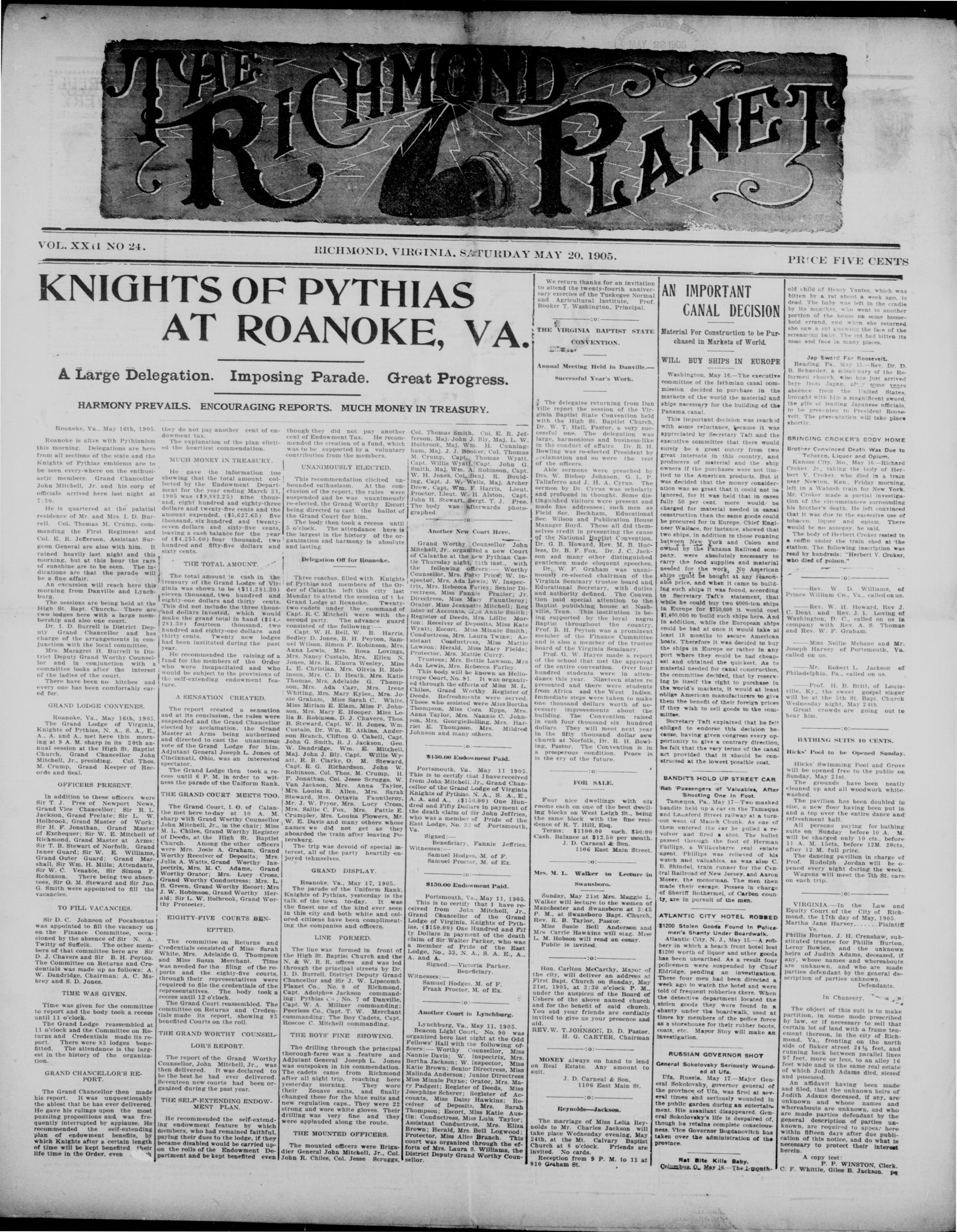
KNIGHTS OF PYTHIAS AT ROANOKE, VA.
A Large Delegation. Imposing Parade. Great Progress.
HARMONY PREVAILS. ENCOURAGING REPORTS. MUCH MONEY IN TREASURY.
VOL. XXI NO 24.
KNIGH
A Large Dele
HARMONY PRE
Roanoke, Va., May 16th, 1905.
Roanoke is alive with Pythianism this morning. Delegations are here from all sections of the state and the Knights of Pythias emblems are to be seen everywhere on the enthusiastic members. Grand Chancellor John Mitchell, Jr. and his corp of officials arrived here last night at 7:30.
He is quartered at the palatial residence of Mr. and Mrs. I. D. Burrell. Col. Thomas M. Crump, commanding the First Regiment and Col. E. R. Jefferson, Assistant Surgeon General are also with him. Itrained heavily last night and this morning, but at this hour the rays of sunshine are to be seen. The indications are that the parade will be a fine affair.
An excursion will reach here this morning from Danville and Lynchburg.
The sessions are being held at the High St. Bapt. Church. There are two lodges here with a large membership and also one court.
Dr. I. D. Burrell is District Deputy Grand Chancellor and has charge of the arrangements in conjunction with the local committee.
Mrs. Maragret H. Burrell is District Deputy Grand Worthy Counselor and in conjunction with a committee looks after the interest of the ladies of the court.
There have been no hitches and every one has been comfortably cared for.
GRAND LODGE CONVENES
Roanoke, Va., May 16th, 1905
The Grand Lodge of Virginia,
Knights of Pythias, N. A., S. A., E.,
A., A. and A., met here this morning at 9 A. M. sharp in its 20th annual session at the High St. Baptist Church, Grand Chancellor John Mitchell, Jr., presiding. Col. Thos.
M. Crump, Grand Keeper of Records and Seal.
OFFICERS PRESENT
In addition to these officers were Sir T. J. Pree of Newport News; Grand Vice Chancellor; Sir R. L. Jackson, Grand Prelate; Sir L. W. Holbrook, Grand Master of Work; Sir H. F. Jonathan, Grand Master of Exchequer; Sir W. E. Mitchell of Richmond, Grand Master at Arms; Sir T. B. Stewart of Norfolk, Grand Inner Guard; Sir W. E. Williams, Outer Guard; Grand Marshal Wm. Mills Attendants, Sir W. C. Venable, Sir Jno Robinson. There being two officers, Sir O. M. Steward and Sir Jno. G. Smith were appointed to fill the vacancies.
TO FILL VACANCIES
Sir D. C. Johnson of Pocahontas was appointed to fill the vacancy on on the Finance Committee, occasioned by the absence of Sir N. A. Twitty of Suffolk. The other members of that committee here are Sir D. J. Chavers and Sir B. H. Peyton. The Committee on Returns and Credentials was made up as follows: A. W. Dandridge, Chairman; A. C. Mabrey and S. D. Jones.
TIME WAS GIVEN
Time was given for the committee to report and the body took a recess until 11 o'clock. The Grand Lodge reassembled at 11 o'clock and the Committee on Returns and Credentials made its report. There were 83 lodges benefitted. The attendance is the largest in the history of the organization.
GRAND CHANSELLOR'S REPORT.
The Grand Chancellor then made his report. It was unquestionably the ablest that he has ever delivered. He gave his rulings upon the most puzzling propositions and was frequently interrupted by applause. He recommended the self-extending plan of endowment benefits, by which Knights after a certain length of time will be kept benefited their life time in the Order, even
they do not pay another cent of endowment tax. The explanation of the plan elicited the heartiest commendation.
MUCH MONEY IN TREASURY.
He gave the information too showing that the total amount collected by the Endowment Department for the year ending March 31, 1905 was ($9,883.25) nine thousand, eight hundred and eighty-three dollars and twenty-five cents and the amount expended. ($5,627.65) five thousand, six hundred and twenty-seven dollars and sixty-five cents, leaving a cash balance for the year of ($4,255.60) four thousand, two hundred and fifty-five dollars and sixty cents.
THE TOTAL AMOUNT.
The total amount in cash in the treasury of the Grand Lodge of Virginia was shown to be $11,281.30) eleven thousand, two hundred and eighty-one dollars and thirty cents. This did not include the three thousand and dollars invested, which would make the grand total in hand $14,281.30) fourteen thousand, two hundred and eighty-one dollars and thirty cents. Twenty new lodges been instituted during the past year. He recommended the raising of a fund for the members of the Order who were incapacitated and who would be subject to the provisions of the self-extending endowment feature.
A SENSATION CREATED
The report created a sensation and at its conclusion, the rules were suspended and the Grand Chancellor elected by acclamation, the Grand Master at Arms being authorized and directed to cast the unanimous vote of the Grand Lodge for him. Adjutant General Joseph L. Jones of Cincinnati, Ohio, was an interested spectator. The Grand Lodge then took a recess until 6 P. M. in order to witness the parade of the Uniform Rank.
THE GRAND COURT MEETS TOO
the Grand Court, I. O. of Calanthe met here to-day at 10 A. M. sharp with Grand Worthy Counsellor John Mitchell, Jr., in the chair; Miss M. L. Chiles, Grand Worthy Register of Deeds, at the High St. Baptist Church. Among the other officers were Mrs. Josie A. Graham, Grand Worthy Receiver of Deposits; Mrs. Julia A. Watts, Grand Worthy Inspectrix, Mrs. M. C. Adams, Grand Worthy Gorator; Mrs. Lucy Cross, Grand Worthy Conductress; Mrs. L. B. Green, Grand Worthy Escort; Mrs J. W. Robinson, Grand Worthy Herald; Sir L. W. Holbrook, Grand Worthy Protector.
EIGHTY-FIVE COURTS BEN
EFITED
The committee on Returns and Credentials consisted of Miss Sarah White, Mrs. Adelaide G. Thompson and Miss Susan Merchant. Time was needed for the filing of the reports and the eighty-five courts, through their representatives were required to file the credentials of the representatives. The body took a recess until 12 o'clock. The Grand Court reassembled. The committee on Returns and Credentials made its report, showing 85 benefited Courts on the roll.
THE GRAND WORTHY COUNSEL
LOR'S REPORT
The report of the Grand Worthy Counsellor, John Mitchell, Jr., was then delivered. It was declared to be the best he had ever delivered. Seventeen new courts had been organized during the past year.
THE SELF-EXTENDING ENDOWMENT PLAN.
He recommended the self-extending endowment feature by which members, who had remained faithful, paying their dues to the lodge, if they became disabled would be carried upon the rolls of the Endowment Department and be kept benefited even
RICHMOND, VIRGINIA, SATURDAY MAY 20, 1905.
though they did not pay another cent of Endowment Tax. He recommended the creation of a fund, which would provide voluntary contribution from the member.
UNANIMOUSLY ELECTED
This recommendation elicited unbounded enthusiasm. At the conclusion of the report, the rules were suspended and he was unanimously re-elected, the Grand Worthy Escort being directed to cast the ballot of the Grand Court for him. The body then took a recess until 5 o'clock. The attendance here is the largest in the history of the organization and harmony is absolute and lasting.
Delegation Off for Roanoke.
Three coaches, filled with Knights of Pythias and members of the Order of Calanthe left this city last Monday to attend the session of t he Grand Lodge at Roanoke. Twenty-two cadets under the command of Michael Mickilli with the second party. The advance guard consisted of the following:
Capt. W. H. Bell, W. B. Harris,
Sedley D. Jones, B. H. Peyton, Samuel Wilson, Simon P. Robinson, Mrs.
Anna Lewis, Mrs. Rosa Lovings,
Mrs. Nancy Custalo, Mrs. Ellen N.
Jones, Mrs. R. Elnora Wesley, Miss
L. E. Christian, Mrs. Olivia R. Robinson, Mrs. C. D. Heath, Mrs. Katie
Thomas, Mrs. Ada Carr, Mrs. Irene
Whiting, Mrs. Mary Kyles., Mrs. Josie Graham, Miss Sarah C. White,
Miss Miriam E. Elam, Miss P. Johnson,
Mrs. Mary E. Hooper, Miss Lella B. Robinson, D. J. Chavers, Thos.
B. Steward, Capt. W. H. Jones, Wm. Custalo, Dr. Wm. E. Atkins, Anderson
Branch, Clifton G. Cabell, Capt.
John G. Smith, R. Jackson, Geo.
W. Dandridge, Wm. E. Mitchell,
Maj. John J. Bly, Capt. Willis Wytatt, R. B. Clarke, O. M. Steward,
Capt. R. G. Richardson, John W.
Robinson, Col. Thos. M. Crump, H. F. Jonathan, Col. Jesse Scruggs, W.
Van Jackson, Mrs. Anna Taylor,
Mrs. Louisa R. Allen, Mrs. Sarah
Steward, Mrs. Octavia Fauletter,
Mr. J. W. Pryor, Mrs. Lucy Cross,
Mrs. Sallie C. Fox, Mrs. Pattie E.
Crumpler, Mrs. Louisa Flowers, Mr. W. E. Davis and many others whose
names we did not get as they aboarded the train after leaving Petersburg.
The trip was devoid of special interest, all of the party heartily enjoyed therelms.
GRAND DISPLAY
Roanoke, Va., May 17, 1905. The parade of the Uniform Rank Knights of Pythias, yesterday is the talk of the town to-day. It was the finest one of the kind ever seen in this city and both white and colored citizens have been complimenting the companies and officers.
LINE FORMED
The line was formed in front of the High St. Baptist Church and the N. & W. R. R. offices and was led through the principal streets by Dr. I. D. Burrell, District Deputy Grand Chancellor and Sir J. W. Lipscomb. Planet Co., No. 8 of Richmond, Capt Adolphus Jackson commanding Philadelphia. No. 7 of Danville, Capt W. A. Millen commanding; Peerless W. A. Capt. T. W. Manant commanding; The Boy Cadets, Capt Roscoe C. Mitchell commanding.
THE BOYS' FINE SHOWING
The drilling through the principal thorough-fares was a feature and Adjutant General Joseph L. Jones was outspoken in his commendation. The cadets came from Richmond after all night trip, reaching here yesterday morning. They wore their mauve suits and finally changed the blue suits and new regulation caps. They were 22 strong and wore white gloves. Their drilling was very fine and they were applauded along the route.
THE MOUNTED OFFICERS
The mounted officers were Brigadier General John Mitchell, Jr., Col.
John R. Chiles, Col. Jesse. Scruggs
Col. Thomas Smith, Col. E. R. Jefferson, Maj. John J. Bly, M. L. W. Holbrook, Maj. Wm. H. Cunningham, Maj. J. J. Booker, Col. Thomas M. Crump, Capt. Thomas Wyatt, Capt. Willis Wyatt, Capt. John Smith, Maj. Wm. A. Robinson, Capt. W. H. Jones, Col. Benj. R. Boulding, Capt. J. W. Wells, Archer Drew, Capt. Wm. F. Harris, Lieut. Proctor, Lleut. Wm. H. Alston, Capt. John H. Stewart, Serg. T. J. Pree. The body was afterwards photographed.
Another New Court Here.
Grand Worthy Counsellor John Mitchell, Jr., organized a new Court of Calanthe at the new Pythian Castle Thursday night, 14th inst., with the following officers: — Worthy Counsellor, Mrs. Patty Price, W. inspector, Mrs. Ada Lewis; W. Inspectrix, Mrs. Rebecca Farley; Senior Directress, Miss Fannie Frazier; Jr. Directress, Miss Mary Faurierter; Orator, Miss Jeannette Mitchell; Register of Accounts, Mrs. Annie Smith; Register of Deeds, Mrs. Lillie Morrison; Receiver of Deposits, Miss Kate Wyrall Escort; Miss Minnie Smith; Conductor, Mrs. Laura Twine; Assistant Conductor, Mrs. Mattie Lawson; Herald, Miss Maithe Fields; Protector, Mrs. Mattie Curry; Trustees; Mrs. Bettie Lawson, Mrs. Ada Lewis, Mrs. Rebecca Farley
This body will be known as Heliotrope Court, No. 91. It was organized through the efforts of Miss M. L. Chiles, Grand Worthy Register of Deeds. Refreshments were served. Those who assisted were Miss Bertha Thompson, Miss Cora Epps, Mrs. Anna Taylor, Mrs. Nannie C. Johnson, Mrs. GeorgieBolling, Mrs. Harriet E. Thompson, Mrs. Mildred Johnson and many others.
$150.00 Endowment Paid
Portsmouth, Va. May 11 1905.
This is to certify that I haverceived from John Mitchell, Jr., Grand Chancellor of the Grand Lodge of Virginia Knights of Pythias, N. A., S. A. E., A. A. and A., ($150.00) One Hundred and Fifty Dollars in payment of the death claim of Sir John Jeffries, who was a member of Pride of the East Lodge, No. 33 of Portsmouth, Va.
Signed:—
Beneficiary, Fannie Jeffries.
Witnesses:—
Samuel Hodges, M. of F.
Samuel Proctor, M. of F.
$150.00 Endowment Paid
Portsmouth, Va., May 11, 1905.
This is to certify that I have received from John Mitchell, Jr.
Grand Chancellor of the Grand
Lodge of Virginia, Knights of Pythias,
($150.00) One Hundred and Fifty
Dollars in payment of the death
claim of Sir Walter Parker, who was
a member of Pride of the East
Lodge, No., 33, N. A., S. A. E., A.,
A. and A.
Signed:—Victoria Parker.
Beneficiary.
Witnesses:—
Samuel Hodges, M. of F.
Frank Proctor, M. of Ex.
Another Court in Lynchburg
Lynchburg, Va., May 11, 1905.
Beacon Light Court, No. 90 was organized here last night at the Odd Fellows' Hall with the following officers: — Worthy Counsellor, Miss Nannie Davis; W. Inspectorix, Mrs. Bertha Jackson; W. Inspector, Miss Katie Brown; Senior Directress, Miss Malina Anderson; Junior Directress Miss Minnie Payne; Orator, Mrs. Mary Padgett; Register of Deeds, Miss蔡chine Scherer; Register of Accounts, Miss Daisy Hawkins; Receiver of Deposits, Mrs. Sarah Thompson Escort, Miss Katie Austin; Conductress, Miss Lula Taylor; Assistant Conductress, Mrs. Eliza Brown; Herald, Mrs. Bell Logwood; Protector, Miss Alice Branch. This court was organized through the efforts of Mrs. Laura S. Williams, the District Deputy Grown Worthy Counsellor.
We return thanks for an invitation
to attend the twenty-fourth annivers-
ary exercises of the Tuskegee Normal
and Agricultural Institute, Prof.
Booker T. Washington, Principal.
:0:
THE VIRGINIA BAPTIST STATE
CONVENTION.
Annual Meeting Held in Danville.
Successful Year's Work.
The delegates returning from Dari ville report the session of the Virginia Baptist State Convention held with the High St. Baptist Church, Dr. W. T. Hall, Pastor, a very successful one. The delegation was large, harmonious and business-like in the conduct of affairs. Dr. R. H. Bowling was re-elected President by acclamation and so were the rest of the officers.
Able sermons were preached by Drs. W. Bishop Johnson, G. L. P. Talaferro and J. H. A. Cyrus. The sermon by Dr. Cyrus was scholarly and profound in thought. Some distinguished visitors were present and made fine addresses; such men as Field Sec. Beckham, Educational Sec. Wilson and Publication House Manager Boyd. These all did themselves credit in presenting the cause of the National Baptist Convention. Dr. G. B. Howard, Rev. M. B. Hucless, Dr. B. F. Fox, Dr. J. C. Jackson and many other distinguished gentlemen made eloquent speeches. Dr. W. F. Graham was unanimously re-elected chairman of the Virginia Seminary trustee board and Educational Secretary, with duties and authority defined. The Convention paid special attention to the Baptist publishing house at Nashville, Tenn. This institution is being supported by the loyal negro Baptist throughout the country, Prof. B. H. Peyton was a prominent member of the Finance Committee and is also a member of the trustee board of the Virginia Seminary.
Prof. G. W. Hayes made a report of the school that met the approval of the entire convention. Over four hundred students were in attendance this year. Nineteen states represented and there were students from Africa and the West Indies. Immediate steps were taken to make one thousand dollars worth of necessary improvements about the building. The Convention raised in cash four thousand six hundred dollars. They will meet next year in the fifty thousand dollar new church at Norfolk, Dr. R. H. B. Howling, Pastor. The Convention is in a prosperous condition. Peace is is the cry of the future.
FOR SALE.
Four nice dwellings with six
rooms each on one of the best dwell-
ling blocks on West Leigh St., being
the same block with the fine resi-
dence of R. T. Hill, Esq.
Terms: $1100.00 each. $50.00
Cash. Balance at $12.50 per month.
J. D. Carneal & Son.
Mrs. M. L. Walker to Lecture in
Sunday, May 21st Mrs. Maggie L. Walker will lecture to the women of Manchester and Swansboro at 3:45 P. M., at Swansboro Bapt. Church, Rev. R. B. Taylor, Pastor. Miss Susie Bell Anderson and Mrs Carrie Hawkins will sag, Miss L. Hobson will read an essay. Publish
Hon. Carlton McCarthy, Mayor of the city, will deliver an address at First Bapt. Church on Sunday, May 21st, 1905, at 3:30 o'clock P. M., under the auspices of the Board of Usheres of the above named church and for the benefit of said church. You and your friends are cordially invited to give us your presence and aid.
REV. W. T. JOHNSON, D. D. Pastor.
H. G. CARTER, Chairman
MONEY always on hand to lend on Real Estate. Any amount to suit.
J. D. Carneal & Son,
1106, East Main, St
Reynolds—Jackson.
The marriage of Miss Lella Reynolds to Mr. Charles Jackson will take place Wednesday evening, May 24th, at the Mt. Calvary Baptist Church at 8 o'clock. Friends are invited. No cards.
Reception from 9 P. M. to 11 at 910 Graham St.
AN IMPORTANT CANAL DECISION
Material For Construction to be Purchased in Markets of World.
WILL BUY SHIPS IN EUROPE
Washington, May 16.—The executive committee of the Isthmian canal commission decided to purchase in the markets of the world the material and ships necessary for the building of the Panama canal.
This important decision was reached with some reluctance, because it was appreciated by Secretary Taft and the executive committee that there would surely be a great outflow from two great interests in this country, and producers of material and the ship owners if the purchases were not limited to the American products. But it was decided that the money consideration was so great that it could not be ignored, for it was held that in cases fully 50 per cent, more would be charged for material needed in canal construction than the same goods could be procured for in Europe. Chief Engineer Wallace, for instance, showed that two ships, in addition to those running between New York and Colon and owned by the Panama Railroad company, were absolutely necessary to carry the food supplies and material needed for the work. No American ships could be bought at any reasonable price, and when it came to building such ships it was found, according to Secretary Taft's statement, that while he could buy two 6000-ton ships in Europe for $750,000 it would cost $1,400,000 to build such ships here. And in addition, while the European ships could be had at once it would take at least 18 months to secure American boats. Therefore it was decided to buy the ships in Europe or rather in any port where they could be had cheapest and obtained the quickest. As to material needed for canal construction, the committee decided, that by reserving to itself the right to purchase in the world's markets, it would at least oblige American manufacturers to give them the benefit of their foreign prices if they wish to sell goods to the committee.
Secretary Taft explained that he felt obliged to endorse this decision because, having given congress every opportunity to give a contrary direction, he felt that the very terms of the canal act provided that it should be constructed at the lowest possible cost.
BANDITS HOLD UP STREET CAR
*Rob Passengers of Valuables, After Shooting One In Foot.*
Tamqua, Pa. May 17—Two masked bandits held up a car on the Tamqua and Lausford Street railway at a turnout west of Mauch Chunk. As one of them entered the car he pulled a revolver and fired a shot. The bullet passed through the foot of Herman Phillips, a Wilkesbarre real estate agent. Phillips was relieved of his watch and valuables, as was also C. B. Shindel, train runner for the Central Railroad of New Jersey, and Aaron Moser, the motorman. The men then made their escape. Posses in charge of Sheriff Rothermel, of Carbon county, are in pursuit of the men.
ATLANTIC CITY HOTEL ROBBED
$1200 Stolen Goods Found In Police-
men's Shanty Under Boardwalk
Atlantic City, N. J., May 15. A robbery in which a beach front hotel lost $1200 worth of liquor and other goods has been unearthed. As a result four policemen were suspended by Chief Eldridge, pending an investigation. These four men had been directed a week ago to watch the hotel and were told of frequent robberies there. When the detective department located the stolen goods they were found in a shanty under the boardwalk, used at times by members of the police force as a storehouse for their rubber boots, coats, etc. Mayor Stoy will make an investigation.
RUSSIAN GOVERNOR SHOT
General Sokolovsky Seriously Wounded at Ufa.
Ufa, Russia. May 17.—Major General Sokolovsky, governor general of the province of Ufa, was fired at several times and seriously wounded in the public garden during an entertainment. His assailant disappeared. General Sokolovsky's life is despaired of, though he retains complete consciousness. Vice Governor Bogdanovitch has taken over the administration of the province.
Rat Bite Kills Baby.
Columbus, O. May 16.—The 1-month-
PRICE FIVE CENTS
old child of Henry Yantes, which was bitten by a rat about a week ago. is dead. The baby was left in the cradle by its mother, who went to another portion of the house on some house-hold errand, and when she returned she saw a rat grazing the face of the screaming baby. The rat had bitten its nose and face in many places.
Jan Sword For Roarevelt
Reading, Pa., May 15 — Re: Dr. D. B. Schneider, a missionary of the Reformed church, who has just arrived here from Japan, after some years absence from the United States brought with him a magnificent gift, the gift of leading Japanese officials, to be presented to President Roosevelt. The presentation will take place shortly.
BRINGING CROKER'S BODY HOME
Brother Convinced Death Was Due to Tobacco, Liquor and Onium
Tescochile, Liquor and Opium.
Kansas City, Mo., May 16—Richard Croker, Jr., taking the body of Herbert V. Croker, who died in a train near Newton, Kan., Friday morning, left in a Wabash train for New York. Mr. Croker made a partial investigation of the circumstances surrounding his brother's death. He left convinced that it was due to the excessive use of tobacco, liquor and opium. There would be no autopsy, he said.
The body of Herbert Croker rested in a coffin under the train shed at the station. The following inscription was read by hundreds: "Herbert V. Croker, who died of poison."
Rev. W. D. Williams, of Prince William Co., Va., called on us.
Rev. W. H. Howard, Rev J. C. Dent and Rev J. I. Loving of Washington, D. C., called on us in company with Rev. A. S. Thomas and Rev W. F. Graham.
Miss Nellie Mebane and Mr. Joseph Harvey of Portsmouth, Va. called on us.
Mr. Robert L. Jackson of Philadelphia, Pa., called on us.
Prof. H. B. Britt, of Louisville, Ky., the sweet gospel singer will be at the 5th St. Bapt. Church Wednesday night, May 24th.
Great crowds are going out to hear him.
BATHING SUITS 10 CENTS
Hicks' Pool to be Opened Sunday
Hicks' Swimming Pool and Grove will be opened free to the public on Sunday, May 21st. The grounds have been neatly cleaned up and all woodwork white-washed. The pavilion has been doubled in size, a new floor having been put in and a top over the entire dance and refreshment hall. All persons paying for bathing suits on Sunday before 10 A. M. will be charged only 10 cts, before 11 A. M. 15cts, before 12 M. 20cts, after 12 M. full price. The dancing pavilion in charge of Prof. Rudolph Jordan will be opened every night during the week. Wagons will meet the 7th St. cars on each trip.
VIRGINIA.—In the Law and Equity Court of the City of Richmond, the 17th day of May, 1905. Martha Jane Harvey. . . . . . . Plaintiff Vs.
Phillis Burton, J. H. Crenshaw, substituted trustee for Phillis Burton, Leroy Bowles, and the unknown heirs of Judith Adams, deceased, if any, whose names and whereabouts are unknown, and who are made parties defendant by the general description of parties unknown.
Defendants.
In Chancery.
The object of this suit is to make partition, in some mode prescribed by law, or if necessary to sell that certain lot of land with a frame tenement thereon, in the city of Richmond, Va., fronting on the north side of Baker street $24\frac{1}{2}$ feet, and running back between parallel lines 97 feet, more or less, to an alley 16 feet wide and is the same real estate of which Judith Adams died, sized and possessed.
An affidavit having been made and filed, that the unknown heirs of Judith Adams deceased, if any, are unknown and whose names and whereabouts are unknown, and who are made parties defendant by the general description of parties unknown, are required to appear here within fifteen days after due publication of this notice, and do what is necessary to protect their interest herein.
A copy test:
P. P. WINSTON, Clerk.
C. F. Whittle, Giles B. Jackson. pq
THE PLANET
SATURDAY.....May 20, 1905.
TEMPERANCE
A BARROOM SERMON.
A Far Southwestern Incident in Which
the Parson and His Cowboy
Friends Figured.
Twenty years ago Los Cerrillos, N.M., was a place of perhaps 500 inhabitants, most of whom were ignorant of even the most fundamental facts of religion and the civilization of the far east. Thither to his first charge went a young minister—young, but big and brawny, says the Kansas City Times. He proved to be the right sort of a man to win the confidence and respect of the rough community and his church prospered.
A year later he was removed to Watrous, 100 miles away, and visited Los Cerrillos only once a month to preach. One rough night, when a melting snow was coming at the station for a train to Watrous. The train was very late. There was no operator at the station, and no place for warmth but the saloons. Only the wind and the shelterless coyotes knew where the train was. The minister walked up and down the street, shiving. Once, as he passed a saloon, the proprietor—"Bill"—saw him.
"Come in and warm, parson!" he called.
"I can't, Bill, you know why," replied the minister.
"Yes, I know; but they shan't bother you. You come right in, and I'll fix them."
He grasped the minister by the arm and led him into a big room, where 30 or 40 cowboys and miners were drinking. Bill rapped loudly on the bar.
"Fellers," he said, "the parson's laid out by his train what ain't came, an' he's no place to go but this here gin palace an' poker parlor. He'll sit with us and swap yarns—the right sort, you understand—but that'll be no drink sold over this bar and no cards played till his train comes along. He's our guest. The parson, gentlemen."
There was not a protest from a man. The young minister was acquainted with most of them, and soon made friends with the others. They talked of lodes, pay-dirt, methods of drilling, best ways to break bronces, liniments for healing gunshot wounds, the qualities of various makes of firearms, the comparative veracity of the Mexican and the Indian. Finally one of the "cow-punchers" asked the guest "to make a little talk on the subject of his profession." Gladly he mounted one of the card tables, and in their own picturesque language, as he had learned it from them, told them of the Martyr of Calvary and the compassionate Father. As he spoke they threw away their cigars and removed their hats. Not a sound escaped them. They were on their honor, and would have handled roughly any man who showed the parson a discourtesy.
The minister afterward confessed that he never spent a more profitable hour himself, or a more enjoyable one, or one in which profit and enjoyment seemed to be more completely mutual. When the whistle of his train was heard the congregation was lustily singing a hymn - Youth's Companion.
THE GOOD RESOLUTION.
GOOD
RESOLUTIONS
It does no good to make good resolu-
tions unless we keep them.
It does no good to make good resolutions unless we keep them.
PROGRESS OF REFORM
"A great many people have consciences that it would require an alarm clock to wake up."
God alone knows how much Heaven loses when a young man takes his first drink—American Home.
A bill for state control of the liquor business has been killed in the legislature of West Virginia.
During August 2,495 persons were sent to prison from Glasgow for minor and major crimes. Glasgow is the city where "municipalization" is said to have settled the liquor problem.
Both chambers of the Swedish riksdag and the ecclesiastical council have expressed themselves against the sale of liquor at the army barracks and camps, and so the traffic must be stopped.
Dr. Albert Brunner, in his annual report of the patients received in 1962 at the hospitals for tuberculosis at Trieste, Italy, makes this statement: "Of 506 patients received during the year, 371 were inebriates, 133 moderate drinkers and only two total abstainers."
No Drinking Miners Wanted
It is reported from Pottsville, Pa. that "in order to reduce the danger of accident in the anthracite mines to a min
imum and to assure steadier work by the men, the officials of district No.9 will hereafter discharge all miners who become incompetent by reason of drink. The decision is particularly interesting because it was suggested by the employees themselves.
LIVED TEN LIVES IN FEW MONTHS
STRANGE CASE OF GIRL PUZZLES LONDON DOCTORS. HER SEVERAL PERSONALITIES
Influenza.
London.—An astonishing case of a girl possessing ten separate and distinct personalities within 20 months is being much discussed in medical circles here.
The girl was the patient of Dr. Albert Wilson, and so remarkable was the case that Dr. Wilson laid it before the committee of the Medico Psychological association. Many members of the body were skeptical at first, agreeing that the manifestations undoubtedly were genuine, but they were unable to offer any explanation of the occurrence.
Dr. Wilson also reported the case to the Psychical Research society, which now has published the details in its proceedings.
In April, 1885, the girl who was then under 13 years of age and indifferently educated, had an attack of influenza. After remaining in bed for ten days, she went out into the cold air and suffered a relapse. Within the next two days she was on the point of death, but gradually recovered strength.
Then there began to appear in succession the ten personalities, the last one of which occurred a year and eight months after the first and took the form of blindness and imbecility. Now at the age of 22 she is in good health, the best of her personalities that showed itself having been educated and developed.
The personalities manifested themselves as follows:
First personality, April, 1896, acute mania, intense fear, with blindness and illusions as to the presence of snakes, and craying for oranges and lemonade.
Second personality about a month later, a simple child with reversed ideas as to writing and sneaking. She remedi-
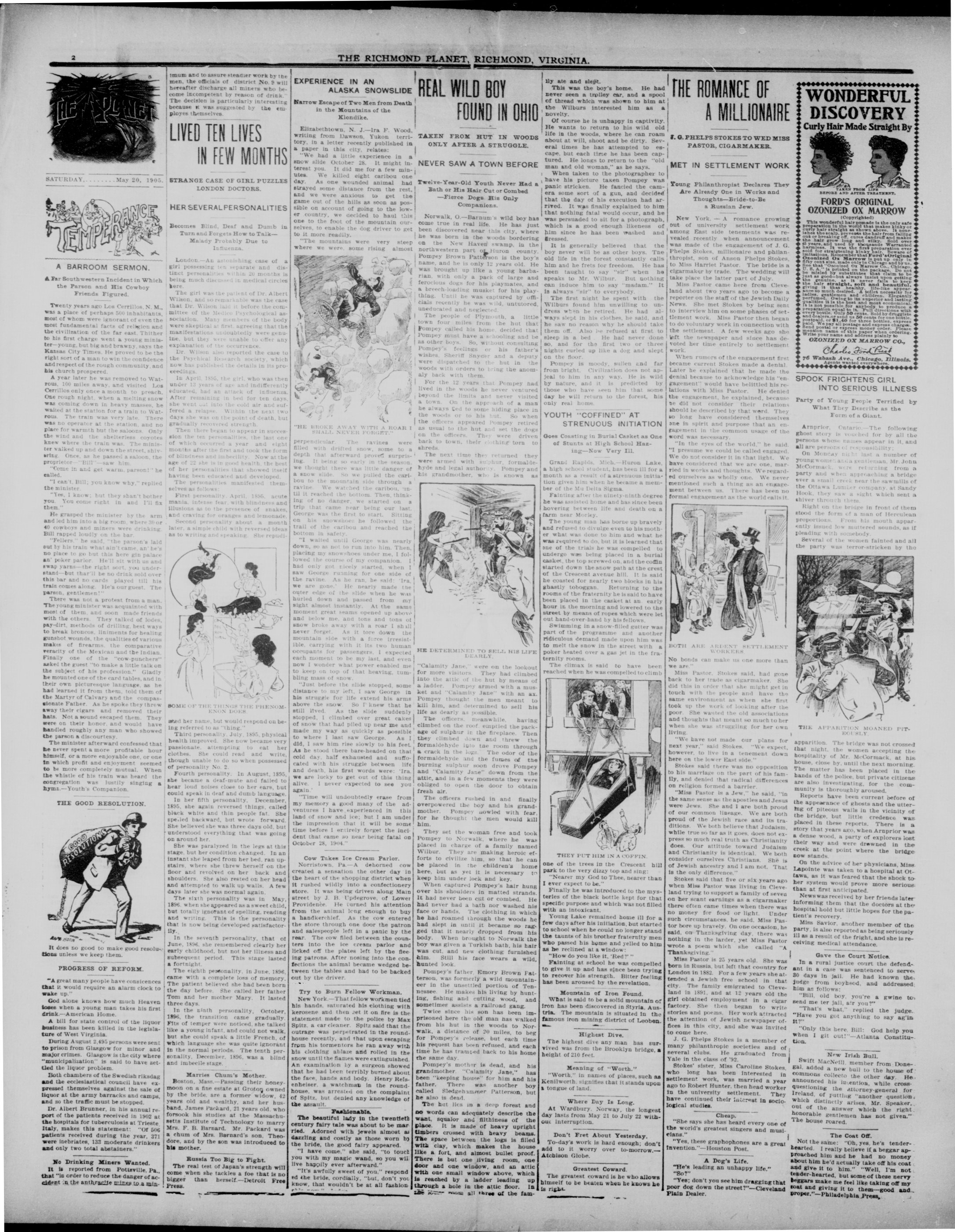
SOME OF THE THINGS THE PHENOM.
ENON DOES
BOME OF THE THINGS THE PHENOMENOES DOES
used her name, but would respond on being referred to as "thing."
Third personality, July, 1895, physical health improved. She now became very passionate, attempting to eat her clothes. She could read and write, though unable to do so when possessed of personality No. 2.
Fourth personality. In August, 1895, she became a deaf-mute and failed to hear loud noises close to her ears, but could speak in deaf and dumb language. In her fifth personality, December, 1895, she again reversed things, called black white and thin people fat. She spelled backward, but wrote forward. She believed she was three days old, but understood everything that was going on around her.
She was paralyzed in the legs at this stage, but her condition changed. In an instant she leaped from her bed, ran upstairs, where she threw herself on the floor and revolved on her back and shoulders. She also rested on her head and attempted to walk up walls. A few days later she was normal again.
The sixth personality was in May, 1896, when she appeared as a sweet child, but totally ignorant of spelling, reading and writing. This is the personality that is now being developed satisfactorily.
In the seventh personality, that of June, 1896, she remembered clearly her early childhood, but not her illness and subsequent period. This stage lasted a fortnight.
The eighth personality, in June, 1896, came with a complete loss of memory. The patient believed she had been born the day before. She called her father Tom and her mother Mary. It lasted three days.
In the ninth personality, October, 1896, the transition came gradually. Fits of temper were noticed, she talked like a young infant, and could not walk, but she could speak a little French, of which language she was quite ignorant in the normal periods. The tenth personality, December, 1896, was a blind and imbecile stage.
Marries Chum's Mother
Boston, Mass.—Passing their honeymoon on a fine estate at Groton owned by the bride, are a former widow, 42 years old and wealthy, and her husband, James Packard, 21 years old, who forsook his studies at the Massachusetts Institute of Technology to marry Mrs. F. B. Barnard. Mr. Packard was a chum of Mrs. Barnard's son. Theodore, and by the son was introduced to his mother.
Russia Too Big to Fight
The real test of Japan's strength will come when she tackles a foe that is no bigger than herself.—Detroit Free Press.
THE RICHMOND PLANET, RICHMOND, VIRGINIA
EXPERIENCE IN AN
ALASKA SNOWSLIDE
Narrow Escape of Two Men from Death in the Mountains of the Klondike.
Elizabethtown, N. J.—Ira F. Wood, writing from Dawson, Yukon territory, in a letter recently published in a paper in this city, relates:
"We had a little experience in a snow slide October 28. It might interest you. It did me for a few minutes. We killed eight caribou one day. As one wounded animal had strayed some distance from the rest, and we were anxious to get the game out of the hills as soon as possible on account of going to the lower country, we decided to haul this one to the foot of the mountain ourselves, to enable the dog driver to get to it more readily.
"The mountains were very steep where we were, some rising almost
TENNIS
"HE BROKE AWAY WITH A ROAR I SHALL NEVER FORGET."
perpendicular. The ravines were filled with drifted snow, some to a depth that afterward proved surprising. It being so early in the season, we thought there was little danger of a snow slide. So we pulled the caribou to the mountain side through a ravine. We watched the caribou, until it reached the bottom. Then, thinking of no danger, we started on a trip that came near being our last. George was the first to start. Sitting on his snowshoes he followed the trail of the caribou and reached the bottom in safety.
"I waited until George was nearly down, so as not to run into him. Then, placing my snowshoes under me, I followed the course of my companion. I had only got nicely started, when I saw George running for one side of the ravine. As he ran, he said: 'ra, we are gone.' He nearly made the outer edge of the slide when he was hurled down and passed from my sight almost instantly. At the sams moment great seams opened up above and below me, and tons and tons of snow broke away with a roar I shall never forget. As it tore down the mountain side with a force irresistible, carrying with it its two human occupants for passengers, I expected each moment to be my last, and even now I wonder what power enabled me to keep on top of that heaving, tumbling mass of snow.
"Just before the slide stopped, some distance to my left, I saw George in his struggle for life extend his arms above the snow. So I knew that he still lived. As the slide suddenly stopped, I climbed over great cakes of snow that had piled up near me and made my way as quickly as possible to where I last saw George. As I did, I saw him rise slowly to his feet. As he stood there bare-headed on that cold day, half exhausted and suffocated with his struggle between life and death, his first wore were: 'Ira. we are lucky to get out of this thing alive. I never expected to see you again.'"
"Time will undoubtedly erase from my memory a good many of the adventures I have experienced in this land of snow and ice; but I am under the impression that it will be some time before I entirely forget the incident that came so near being fatal on October 28, 1904."
Cow Takes Ice Cream Parlor.
Norristown, Pa.—A dehorned cow created a sensation the other day in the heart of the shopping district when it rushed wildly into a confectionery store. It was being driven along Main street by J. B. Updegrove, of Lower Providence. He turned his attention from the animal long enough to buy a handkerchief. As the cow entered the store through one door the patron and salespeople left in a panic by the rear. The cow filed between the counters into the ice cream parlor and licked off the plates left by the fleeing patrons. After nosing into the confections the animal became wedged between the tables and had to be backed out by the driver.
Try to Burn Fellow Workman
Try to Burn Fellow Workman.
New York.—That fellow workmen tied his hands, saturated his clothing with kerosene and then set it on fire is the statement made to the police by Max Spitz. a car cleaner. Spitz said that the outrage was perpetrated in the roundhouse recently, and that upon escaping from his tormentors he ran away with his clothing ablaze and rolled in the snow until the flames were extinguished.
An examination by a surgeon showed that he had been terribly burned about the face, hands and body. Henry Reisenheiser, a watchman in the roundhouse, was arrested on the complaint of Spitz, but denied any knowledge of the assault.
Fashionable
The beautiful lady in the twentieth century fairy tale was about to be married. Adorned with jewels almost as dazzling and costly as those worn by the bride, the good fairy appeared.
"I have come," she said, "to touch you with my magic wand, so you will live happily ever afterward."
"It's awfully sweet of you," responded the bride, cordially, "but, don't you know, that wouldn't be at all fashion-
REAL WILD BOY
FOUND IN OHIO
TAKEN FROM HUT IN WOODS
ONLY AFTER A STRUGGLE.
NEVER SAW A TOWN BEFORE
Twelve-Year-Old Youth Never Had a
Bath or His Hair Cut or Combed
—Fierce Dogs His Only
Companions.
Norwalk, O.-Barnum's wild boy has come true in real life. He has just been discovered near this city, where he was born in the woods bordering on the New Haven swamp, in the northwestern part of Huron county. Pompey Brown Patterson is the boy's name, and he is only 12 years old. He was brought up like a young barbarian, with only a pack of large and ferocious dogs for his playmates, and a breech-loading musket for his plaything. Until he was captured by officials recently he was wild, untutored, uneducated and neglected. The people of Plymouth, a little town four miles from the hut that Pompey called his home decided that Pompey must have a schooling and be as other boys. So, without consulting Pompey's feelings or his father's wishes, Sherif Snyder and a deputy were dispatched to the hut in the woods with orders to bring the anomaly back with them.
For the 12 years that Pompey had lived in the woods he never ventured beyond the limits and never visited a town. On the approach of a man he always fed to some hiding place in the woods or to his hut. So when the officers appeared Pompey retired as usual to the hut and set the dogs on the officers. They were driven back to town, their clothing torn to shreds.
The next time they returned they were armed with sulphur, formaldehyde and legal authority. Pompey and his grandmother, who is known as
HE DETERMINED TO SELL HIS LIFE DEARLY
"Calamity Jane," were on the lookout for more visitors. They had climbed into the attic of the hut by means of a ladder. Pompey armed with a musket and "Calamity Jane" with an ax. Pompey thought the men meant to kill him, and determined to sell his life as dearly as possible.
The officers, meanwhile, having climbed on the roof, emptied the package of sulphur in the fireplace. Then they climbed down and threw the formaldehyde into the room through a crack in the logs. The odor of the formaldehyde and the fumes of the burning sulphur soon drove Pompey and "Calamity Jane" down from the attic, and in a few moments they were obliged to open the door to obtain fresh air.
The officers rushed in and finally overpowered the boy and his grandmother. Pompey nowled with fear, for he thought the men would kill him.
They set the woman free and took Pompey to Norwalk, where he was placed in charge of a family named Wilbur. They are making heroic efforts to civilize him, so that he can be placed in the children's home here, but as yet it is necessary to keep him under lock and key.
When captured Pompey's hair hung over his shoulders in matted strands. It had never been cut or combed. He had never had a bath nor washed his face or hands. The clothing in which he had roamed through the woods he had slept in until it became so ragged that it nearly dropped from his body. When brought to Norwalk the boy was given a Turkish bath, his hair was cut, and new clothing furnished him. Still his face wears a wild, hunted look.
Pompey's father, Emory Brown Fatterson, was formerly a wild mountaineer in the unsettled portion of Tennessee. He makes his living by hunting, fishing and cutting wood, and sometimes assists a railroad gang.
Twice since his son has been imprisoned here the old man has walked from his hut in the woods to Norwalk, a distance of 20 miles, to beg for Pompey's release, but each time his request has been refused, and each time he has tramped back to his home the same day.
Pompey's mother is dead, and his grandmother, "Calamity Jane," has been "keeping house" for him and his father. There was another boy called Sledgehammer Patterson, but he also is dead.
The hut lies in a deep forest and no words can adequately describe the want, squalor and filthiness of the place. It is made of heavy upright timbers crossed with heavy beams. The space between the logs is filled with clay, which makes the house like a fort, and almost bullet proof. There is but one living room, one door and one window, and an attic with one small window above, which is reached by a ladder leading up through a hole in the attic floor. In the room, all three of the fam-
ly ate and slept.
This was the boy's home. He had never seen a troplet car, and a spool of thread which was shown to him at the Wilburs interested him as a novelty.
Of course he is unhappy in captivity. He wants to return to his wild old life in the woods, where he can roam about at will, shoot and be dirty. Several times he has attempted to escape, but each time he has been captured. He longs to return to the "old man and old woman," as he says.
When taken to the photographer to have his picture taken Pompey was panic stricken. He fancied the camera some sort of a gun, and decided that the day of his execution had arrived. It was finally explained to him that nothing fatal would occur, and he was persuaded to sit for a photograph, which is a good enough likeness of him since he has been washed and dressed.
It is generally believed that the boy never will be as other boys. The old life in the forest constantly calls him and he frets for freedom. He has been taught to say "sir" when he speaks to Mr. Wilbur. But nothing can induce him to say "madam." It is always "sir" to everybody.
The first night he spent with the Wilburs found him unwilling to undress when he retired. He had always slept in his clothes, he said, and he saw no reason why he should take them off. Also he refused at first to sleep in a bed. He had never done so, and for the first two or three nights curled up like a dog and slept on the floor.
Pompey is moody, sullen and far from bright. Civilization does not appeal to him in any way. He is wild by nature, and it is predicted by those who have seen him that some day he will return to the forest, his only real home.
YOUTH "COFFINED" AT
STRENUOUS INITIATION
Goes Coasting in Burial Casket as One of Stunts at High School Hazing—Now Very Ill.
Grand Rapids, Mich.—Huron Lake, a high school student, has been ill for a month as a result of a strenuous initiation given him when he became a member of the Mu Delta Sigma.
Falting after the ninety-ninth degree he was assisted home and has since been hovering between life and death on a farm near Morley.
The young man has borne up bravely and refused to divulge even to his mother what was done to him and what he was required to do, but it is learned that one of the trials he was compelled to undergo was being placed in a burial casket, the top screwed on, and the coffin started down the snow path at the crest of the Crescent avenue hill. It is said he coasted for nearly two blocks in his ghastly tooggan. Returning to the rooms of the fraternity he is said to have been placed in the casket at an early hour in the morning and lowered to the street by means of ropes which were let out hand-over-hand by his fellows.
Swimming in a snow-filled gutter was part of the programme and another Ridiculous demand made upon him was to melt the snow in the street with a poker heated over a gas jet in the fraternity rooms.
The climax is said to have been reached when he was connelled to climb
A man is being lifted up by a rope. He is wearing a suit and has a headpiece. Below him, two men are holding a ladder. They are standing on a platform with a railing.
THEY PUT HIM IN A COFFIN.
one of the trees in the Crescent hill park to the very dizzy top and sing:
"Nearer my God to Thee, nearer than I ever expect to be."
Finally he was introduced to the mysteries of the black bottle kept for that specific purpose and which was not filled with an intoxicant.
Young Lake remained home ill for a few days after his initiation, but started to school when he could no longer stand the taunts of his brother fraternity men who passed his home and yelled to him as he reclined at a window:
"How do you like it, 'Red?'"
Faintting at school he was compelled to give it up and has since been trying to recover his strength. Bitter feeling has been aroused by the revelation.
Mountain of Iron Found.
What is said to be a solid mountain of iron has been discovered in Styria, Austria. The mountain is situated in the famous iron mining district of Leoben.
Highest Dive.
The highest dive any man has survived was from the Brooklyn bridge, height of 210 feet.
"Worth," in names of places, such as Kenilworth, signifies that it stands upon a tongue of land.
Where Day Is Long
At Wardbury, Norway, the longest day lasts from May 21 to July 22 without interruption.
Don't Fret About Yesterday.
To-day's work is hard enough; don't add to it worry over to-morrow.— Atchison Globe.
Greatest Coward
The greatest coward is he who allows himself to be beaten when he knows he is right
THE ROMANCE OF A MILLIONAIRE
J. G. PHELPS STOKES TO WED MISS
PASTOR, CIGARMAKER.
MET IN SETTLEMENT WORK
Young Philanthropist Declares They
Are Already One in Works and
Thoughts—Bride-to-Be
a Russian Jew.
New York. — A romance growing
out of university settlement work
among East side tenements was
revealed recently when announcement
was made of the engagement of J. G.
Phelps Stokes, millionaire and philan-
thropist, son of Anson Phelps Stokes,
to Miss Harriet Pastor. The bride is
a cigarmaker by trade. The wedding will
take place the latter part of July.
Miss Pastor came here from Cleveland about two years ago to become a reporter on the staff of the Jewish Daily News. She met Stokes by being sent to interview him on some phases of settlement work. Miss Pastor then began to do voluntary work in connection with the settlement. A few weeks ago she left the newspaper and since has devoted her time entirely to settlement work.
When rumors of the engagement first became current Stokes made a denial. Later he explained that he made the denial because to acknowledge his "engagement" would have belittled his relations with Miss Pastor. He denied the engagement, he explained, because he did not consider their relations should be described by that word. They so long have considered themselves one in spirit and purpose that an engagement in the common usage of the word was necessary.
"In the eyes of the world," he said,
"I presume we could be called engaged.
We do not consider it in that light. We
have considered that we are one, married
in works and thoughts. We regarded
ourselves as wholly one. We never
mentioned such a thing as an engagement between us. There has been no formal engagement as the world calls it.
BOTH ARE ARDENT SETTLEMENT WORKERS.
No bonds can make us one more than we are."
Miss Pastor, Stokes said, had gone back to her trade as cigarmaker. She did this in order that she might get in touch with the people and have the same environment as when she first took up the work of looking after the poor. She waunted the old associations and thoughts that meant so much to her when she was struggling for her own living.
"We have not made our plans for next year," said Stokes. "We expect, however, to live in a tenement down here on the lower East side."
Stokes said there was no opposition to his marriage on the part of his family, and denied that radical differences on religion formed a barrier.
"Miss Pastor is a Jew," he said, "in the same sense as the apostles and Jesus were Jews. She and I are both proud of our common lineage. We are both proud of the Jewish race and its traditions. We both believe that Judaism, while true so far as it goes, does not express so much real truth as Christianity does. Our attitude toward Judaism and Christianity is identical. We both consider ourselves Christians. She is of Jewish ancestry and I am not. That is the only difference."
Stokes said that five or six years ago when Miss Pastor was living in Cleveland trying to support a family of seven on her scant earnings as a cigarmaker there often came times when there was no money for food or light. Under such circumstances, he said, Miss Pastor bore up bravely. On one occasion, he said, on Thanksgiving day, there was nothing in the larder, yet Miss Pastor wrote a poem which she called "A Thanksgiving."
Miss Pastor is 25 years old. She was born in Russia, but left that country for London in 1882. For a few years she attended a Jewish free school in that city. The family emigrated to Cleveland in 1891, and at 12 years old the girl obtained employment in a cigar factory. She then began to write stories and poems. Her work attracted the attention of Jewish newspaper offices in this city, and she was invited to come here.
J. G. Phelps Stokes is a member of many philanthropic societies and of several clubs. He graduated from Yale in the class of '32.
Stokes' sister, Miss Caroline Stokes, who long has been interested in settlement work, was married a year ago to Robert Hunter, then head worker in the university settlement. They have continued their interest in sociological studies.
"She says she has heard every one of the world's greatest singers and musicians."
"Yes, these graphophones are a great invention."—Houston Post.
Yes; don't you see him dragging that pood dog down the street?" Cleveland
TAKEN FROM LIFE
REPORT AND ADDITIONAL MEMORIES.
This wonderful hair pomade is the only safe preparation in the world that makes kinky or nourishies the scalp, prevents the hair from facing out or breaking off, cures dandruff and makes no hair greeting. The spicy Gold over 45 years, and used by thousands We are a harmless概。It was the first preparation ever imitations. Remember the hair, Beware of Ozonized Ox Marrow is put up only in the air. We are not only the Chicago and byus. See that Ozonized Oven and Chicago. Do not U.S.A. be printed on the package. Do not just as good but always you can be the genuine, as it never fails to keep the fair straight, soft and beautiful, giving the health of your hair like a original and no one should desire. A toilet necessary for gentlemen and children. Elegantly perfumes is the best and most economically good one. It is not possible for anybody to produce a very bottle. Only 50 cents. Sold by dryers and dealers, or send us 50 cents for one bottle, and we are all postage three bottles, express paid. We pay all postage three bottles, express paid. We are all postage money order. Please send postal or express money order. Please write your name and address plainly to OZONIZED OX MARROW CO.,
Charles Ford Point
76 Wabash Ave., Chicago, Illinois.
SPOOK FRIGHTENS GIRL INTO SERIOUS ILLNESS
Party of Young People Terrified by
What They Describe as the
Form of a Giant.
Arniprion, Ontario—The following
ghost story is vowed for by all the
persons whose names appear in it, and
all are persons of responsibility;
On Monday night lest a number of
young women and gentleman, Mr. John
McCormack, were returning from a
party and when approaching a bridge
over a small creek near the sawmills of
the Ottawa Lumner company, at Sandy
Hook, they saw a sight which sent a
shiver through them.
Right on the bridge in front of them
stood the form of a man of Herculean
proportions. From his mouth apparently
issued low muttered sounds, as if
pleading with somebody.
Several of the people fainted and all
the party was terror-streaked by the
A
THE APPARITION MOANED PITEOUSLY
apparition. The bridge was not crossed that night, the women accepting the hospitality of Mr. McCormack, at his house, close by, until the next morning. The matter has been placed in the hands of the police, but private citizens are also investigating, for the community is thoroughly aroused.
Reports have been current before of the appearance of ghosts and the uttering of piteous walls in the vicinity of the bridge, but little credence was placed in these reports. There is a story that years ago, when Anprior was a dense wood, a party of explorers lost their way and were drowned in the creek at the point where the bridge now stands.
On the advice of her physicians, Miss Lapointe was taken to a hospital at Ottawa, as it was feared that the shock to her system would prove more serious than at first anticipated.
Newsw was received by her friends later informing them that the doctors at the hospital hold but little hopes for the patient's recovery. Miss Savior, another member of the party, is also reported as being seriously ill as a result of the fright, and she is receiving medical attendance.
Gave the Court Notice
In a rural justice court the defendant in a case was sentenced to serve 30 days in jail. He had known the judge from boyhead, and addressed, him as follows:
"Bill, old boy, you're a gwine to send me ter jail, air you?"
"That's what," replied the judge.
"Have you got anything to say ag'in it?"
"Only this here, Bill: God help you when I git out!"—Atlanta Constitution.
New Irish Bull
Swift MacNeill, member from Donegal, added a new bull to the house of commons collecto the other day. He announced his invention, while cross-questioning the attorney-general for Ireland, of putting "another question which distinctly arises, Mr. Speaker, out of the answer which the right, honorable gentlemen has not given." The house roared.
The Coat Off
Not the same: "Oh, yes he's tender-hearted. I really believe if a beggar approached him and he had no money about him he'd actually take off his coat and give it to him." "Well, I'm not tender-hearted, but some of these nervy beggars make me feel like taking off my coat and giving it to them—good and proper."—Philadelphia Press.
The Wings of the Morning
By LOUIS TRACY
Copyright, 1903, by Edward J. Clode
CHAPTER IV
ACROSS the parched bones lay the stick discarded by Jenks in his alarm. He picked it up and resumed his progress along the pathway. So closely did he now examine the ground that he hardly noted his direction. The track led straight toward the wall of rock. The distance was not great—about forty yards. At first the brushwood impeded him, but soon even this hindrance disappeared, and a well defined passage mendered through a belt of trees, some strong and lofty, others quite immature.
More bushes gathered at the foot of the cliff. Behind them he could see the mouth of a cave. The six months' old growth of vegetation about the entrance gave clear indication as to the time which had elapsed since a human foot last disturbed the solitude.
A few vigorous blows with the stick cleared away obstructing plants and leaf branches. The sailor stooped and looked into the cavern, for the opening was barely five feet high. He perceived instantly that the excavation was man's handiwork applied to a fault in the hard rock. A sort of natural shaft existed, and this had been extended by manual labor. Beyond the entrance the cave became more lofty. Owing to its position with reference to the sun at that hour Jenks imagined that sufficient light would be obtainable when the tropical luxuriance of foliage outside was dispensed with.
At present the interior was dark. With the stick he tapped the walls and roof. A startled cluck and the rush of wings heralded the flight of two birds alarmed by the noise. Soon his eyes, more accustomed to the gloom, made out that the place was about thirty feet deep, ten feet wide in the center and seven or eight feet high.
At the farther end was a collection of objects inviting prompt attention. Each moment he could see with greater distinctness. Kneeling on one side of the little pile, he discerned that on a large stone serving as a rude bench were some tin utensils, some knives, a sextant and a quantity of empty cartridge cases. Between the stone and what a minor terms the "face" of the rock was a four foot space. Here, half imbedded in the sand which covered the floor, were two plexaxes, a shovel, a sledge hammer, a fine timber felling ax and three crowbars.
In the darkest corner of the cave's extremity the "wall" appeared to be very smooth. He prodded with the stick, and there was a sharp clang of tin. He discovered six square kerosene oil cases carefully stacked up. Three were empty, one seemed to be half full, and the contents of two were untouched. With almost feverish haste he ascertained that the half filled tin did really contain oil.
"What a find!" he ejaculated aloud. So far as he could judge, the cave harbored no further surprises. Returning toward the exit, his boots dislodged more empty cartridges from the sand. They were shells adapted to a resolver of heavy caliber. At a short distance from the doorway they were present in dozens.
"The remnants of a fight," he thought. "The man was attacked and defended himself here. Not expecting the arrival of enemies, he provided no store of food or water. He was killed while trying to reach the well, probably at night."
He vividly pictured the scene—a brave, hardy European keeping at bay a boat load of Dyak savages, enduring manfully the agonies of hunger, thirst perhaps wounds; then the siege, followed by a wild effort to gain the life giving well, the hiss of a Malay parang wielded by a lurking foe and the last despairing struggle before death came. He might be mistaken. Perchance there was a less dramatic explanation. But he could not shake off his first impressions.
"What was the poor devil doing here?" he asked. "Why did he bury himself in this rock, with mining utensils and a few rough stores? He could not be a castaway. There is the indication of purpose, of preparation, of method combined with ignorance, for none who knew the ways of Dyaks and Chinese pirates would venture to live here alone if he could help it, and if he really were alone."
There was relief in hearing his own voice. He could hum and think and act. Arming himself with the ax, he attacked the bushes and branches of trees in front of the cave. He cut a fresh approach to the well and threw the litter over the skeleton. At first he was inclined to bury it where it lay, but he disliked the idea of Iris walking unconsciously over the place. No time could be wasted that day. He would seize an early opportunity to act as gravedigger.
After an absence of little more than an hour he rejoined the girl. She saw him from afar and wondered whence he obtained the ax he shouldered.
"You are a successful explorer," she cried when he drew near.
"Yes, Miss Deane. I have found water, implements, a shelter, even light."
"What sort of light?"
"Oil."
"And the shelter—is it a house?"
And the shelter—is it a house?
"No, a cave. If you are sufficiently rested you might come and take possession."
Her eyes danced with excitement.
He told her what he had seen, with reservations, and she ran on before him to witness these marvels.
"Why did you make a new path to the well?" she inquired after a rapid survey.
"A new path?" The pertinent question staggered him.
"Yes, the people who lived here must have had some sort of free passage." He lied easily. "I have only cleared away recent growth," he said.
"And why did they dig a cave? It surely would be much more simple to build a house from all these trees."
"There you puzzle me," he said frankly.
They had entered the cavern but a little way and now came out.
"These empty cartridges are funny. They suggest a fort, a battle." Womanlike, her words were carelessly chosen, but they were crammed with inductive force.
Embarked on the toboggan slope of untruth, the sailor slid smoothly downward.
"Events have colored your imagination. Miss Deane. Even in England men often preserve such things for future use. They can be reloaded."
"Yes, I have seen keepers do that. This is different. There is an air of"—"There is a lot to be done," broke in Jenks emphatically. "We must climb the bill and get back here in time to tight another fire before the sun goes down. I want to prop a canvas sheet in front of the cave and try to device a lamp."
"Must I sleep inside?" demanded Iris. "Yes. Where else?"
There was a pause, a mere whiff of awkwardness.
"I will mount guard outside," went on Jenks. He was trying to improve the edge of the ax by grinding it on a soft stone.
The girl went into the cave again. She was inquisitive, uneasy.
"That arrangement"—she began, but ended in a sharp cry of terror. The dispossessed birds had returned during the sailor's absence.
"I will kill them!" he shouted in anger.
"Please don't. There has been enough of death in this place already."
The words jarred on his ears. Then he felt that she could only allude to the victims of the wreck.
"I was going to say," she explained, "that we must devise a partition. There is no help for it until you construct a sort of house. Candidly, I do not like this hole in the rock. It is a vault, a tomb."
"You told me that I was in command, yet you dispute my orders." He strove hard to appear brusquely good humored, indifferent, though for one of his mold he was absurdly irritable. The cause was overstrain, but that explanation escaped him.
"Quite true. But if sleeping in the cold, in dew or rain, is bad for me, it must be equally bad for you, and without you I am helpless, you know."
He laughed sardonically, and the harsh note clashed with her frank candor. Here at least she was utterly deceived. His changeful moods were incomprehensible.
"I will serve you to the best of my ability, Miss Deane," he exclaimed. "We must hope for a speedy rescue, and I am injured to exposure. It is otherwise with you. Are you ready for the climb?"
The crest of the hill was tree covered, and they could see nothing beyond their immediate locality until the sailor found a point higher than the rest, where a rugged collection of hard basalt and the upcoating of some poorn trees provided an open space elevated above the ridge.
For a short distance the foothold was precarious. Jenkins helped the girl in this part of the climb. His strong, gentle grasp gave her confidence. She was fushed with exertion when they stood together on the summit of this elevated perch. They could look to every point of the compass except a small section on the southwest. Here the trees rose behind them until the brow of the precipice was reached.
The emergence into a sunlit panorama of land and sea, though expected, was profoundly enthralling. They appeared to stand almost exactly in the center of the island, which was crescent shaped. It was no larger than the sailor had estimated. The new slopes now revealed were covered with verdure down to the very edge of the water, which for nearly a mile seaward broke over jagged reefs. The sea looked strangely calm from this height. Irregular blue patches on the horizon to south and east caught the man's first glance. He unalung the binoculars he still carried and focused them eagerly. "Islands," he cried, "and big ones too!"
"How old!" whispered Iris, more concerned in the scrutiny of her immediate surroundings. Jenks glanced at her sharply. She was not looking at the islands, but at a curious hollow, a quarry-like depression beneath them to the right, distant about 300 yards and not far removed from the small plateau containing the well, though isolated from it by the south angle of the main cliff.
Here, in a great circle, there was not a vestige of grass, shrub or tree, nothing save brown rock and sand. At first the sailor deemed it to be the dried up bed of a small lake. This hypothesis would not serve, else it would be choked with verdure. The pit stared up at them like an ominous eye, though neither paid further attention to it, for the glorious prospect mapped at their feet momentarily swept aside all other considerations.
"What a beautiful place!" murmured Iris. "I wonder what it is called."
"Suppose we christen it Rainbow island?"
"Why 'Rainbow?'"
"That is the English meaning of 'Iris' in Latin, you know."
"So it is. How clever of you to think of it! Tell me, what is the meaning of 'Robert' in Greek?"
THE RICHMOND PLANE:, RICHMOND, VIRGINIA.
He turned to survey the northwest side of the island. "I do not know," he answered. "It might not be farfetched to translate is as 'a ship's steward, a menial.'"
Miss Iris had meant her playful report as a mere light hearted quibble. It annoyed her, a young person of much consequence, to have her kindly condescension repelled.
"I suppose so," she agreed, "but I have gone through so much in a few hours that I am bewildered, apt to forget these nice distinctions."
Jenks was closely examining the reef on which the Sirdar struck. Some square objects were visible near the palm tree. The sun, glinting on the waves, rendered it difficult to discern their significance.
"What do you make of those?" he inquired, handing the glasses and blondly ignoring Miss Deane's petulance. Her brain was busy with other things while she twisted the binoculars to suit her vision. Rainbow island—Iris—it was a nice conceit, but "menial" struck a discordant note. This man was no menial in appearance or speech. Why was he so deliberately rude?
"I think they are boxes or packing cases," she announced.
"Ah, that was my own idea! I must visit that locality."
"How? Will you swim?"
"No," he said, his stern lips relaxing in a smile; "I will not swim, and, by the way, Miss Deane, be careful when you are near the water. The lagoon is swarming with sharks at present. I feel tolerably assured that at low tide, when the remnants of the gale have vanished, I will be able to walk there along the reef."
"Sharks!" she cried. "In there! What horrible surprises this speck of land contains! I should not, have imagined that sharks and seals could live together."
"You are quite right," he explained, with becoming gravity. "As a rule, sharks infest only the leeward side of these islands. Just now they are attracted in shoals by the wreck."
"Ob!" Iris shivered slightly.
"We had better go back now. The wind is keen here. Miss Denean."
She knew that he purposely misunderstood her gesture. His attitude conveyed a rebuke. There was no further room for sentiment in their present existence. They had to deal with chill necessities. As for the sailor, he was glad that the chance turn of their conversation enabled him to warn her against the lurking dangers of the lagoon. There was no need to mention the devilfish now. He must spare her all avoidable thrills.
They gathered the stores from the first dining room and reached the cave without incident. Another fire was lighted, and while Iris attended to the kitchen the sailor felled several young trees. He wanted poles, and these were the right size and shape. He soon cleared a considerable space. The timber was soft and so small in gird that three cuts with the ax usually suffled. He dragged from the beach the smallest tarpaulin he could find and propped it against the rock in such manner that it effectually screened the mouth of the cave, though admitting light and air.
He was so busy that he paid little heed to Iris. But the color of fried ham was wafted to him. He was lifting a couple of heavy stones to stay the canvas and keep it from flapping in the wind when the girl called out: "Wouldn't you like to have a wash before dinner?"
He straightened himself and looked at her. Her face and hands were shining, spotless. The change was so great that his brow wrinkled with perplexity.
"I am a good pupil," she cried. "You see I am already learning to help myself. I made a bucket out of one of the dish covers by slinging it in two ropes. Another dish cover, some sand and leaves supplied basin, soap and towel. I have cleaned the tin cups and the knives, and, see, here is my greatest treasure."
She held up a small metal lamp.
"Where in the world did you find that?" he exclaimed.
Buried in the sand inside the cave.
"Anything else?"
His tone was abrupt. She was so disappointed by the seeming want of appreciation of her industry that a gleam of amusement died from her eyes, and she shook her head, stooping at once to attend to the toasting of some biscuits.
"Forgive me, Miss Deme." he said penitently. "My words are dictated by anxiety. I do not wish you to make discoveries on your own account. This is a strange place, you know—an unpleasant one in some respects." "Surely I can rummage about my own cave?"
"Then why do you grumble because I found the lamp?"
"I did not mean any such thing. I am sorry."
"I think you are horrid. If you want to wash you will find the water over there. Don't wait. The ham will be frizzled to a clinder."
"Unlucky Jenks! Was ever man fated to incur such unmerited odium? He savagely laved his face and neck. The fresh, cool water was delightful at first, but when he drew near to the fire he experienced an unaccountable sensation of weakness. Could it be possible that he was going to faint? It was too absurd. He sank to the ground. Trees, rocks and sand strewn earth indulged in a mad dance. Iris' voice sounded weak and indistinct. It seemed to travel in waves from a great distance. He tried to brush away from his brain these dim fancies, but his iron will for once failed, and he pitched headlong downward into darkness.
When he recovered, the girl's left arm was around his neck. For one blissful instant he nestled there contentedly. He looked into her eyes and saw that she was crying. A gust of anger rose within him that he should be the cause of those tears.
He tried to rise.
"Oh! Are you better?" Her lips quivered pitifully.
"Yes. What happened? Did I faint?" "Drink this."
She held a cup to his mouth, and he obediently strove to swallow the contents. It was champagne. After the
first spasm of terror and when the application of water to his face failed to restore consciousness Iris had knocked the head off the bottle of champagne. He quickly revived. Nature had only given him a warning that he was overdrawing his resources. He was deeply humiliated. He did not conceive the truth, that only a strong man could do all that he had done and live. For thirty-six bours he had not slept. During part of the time he fought with wilder beasts than they knew at Ephesus. The long exposure to the sun, the mental strain of his foreboding that the charming girl whose life depended upon him might be exposed to even worse dangers than any yet encountered, the physical labor he had undergone, the irksome restraint he strove to place upon his conduct and utterances—all these things culminated in utter relaxation when the water touched his heated skin.
"How could you frighten me so?" demanded Iris hysterically. "You must have felt that you were working too hard. You made me rest. Why didn't you rest yourself?"
He looked at her wistfully. This collapse must not happen again for her sake. These two said more with eyes than lips. She withdrew her arm. Her face and neck crimsoned.
"Good gracious!" she cried. "The ham is ruined!"
It was burnt black. She prepared a fresh supply. When it was ready Jenks was himself again. They ate in silence and shared the remains of the bottle. A smile illuminated his tired face.
Iris was watchful. She had never in her life cooked even a potato or boiled an egg. The ham was her first attempt.
"My cooking amuses you?" she demanded suspiciously.
"It gratifies every sense," he murmured. "There is but one thing needful to complete my happiness."
"Permission to smoke."
"Smoke what?"
He produced a steel box tightly closed and a pipe.
"Your pockets are absolute shops," said the girl, delighted that his temper had improved. "What other stores do you carry about with you?"
He lit his pipe and solemnly gave an inventory of his worldly goods. Beyond the items she had previously seen he could only enumerate a silver dollar, a very soiled and crumpled handkerchief and a bit of tin. A box of Norwegian matches he threw away as useless, but Iris recovered them.
"You never know what purpose they may serve," she said. In after days a weird significance was attached to this simple phrase.
"Why do you carry about a bit of tin?" she went on.
"I found it here, Miss Deane," he answered.
Luckily she interpreted "here" as applying to the cave.
"Let me see it, May I?"
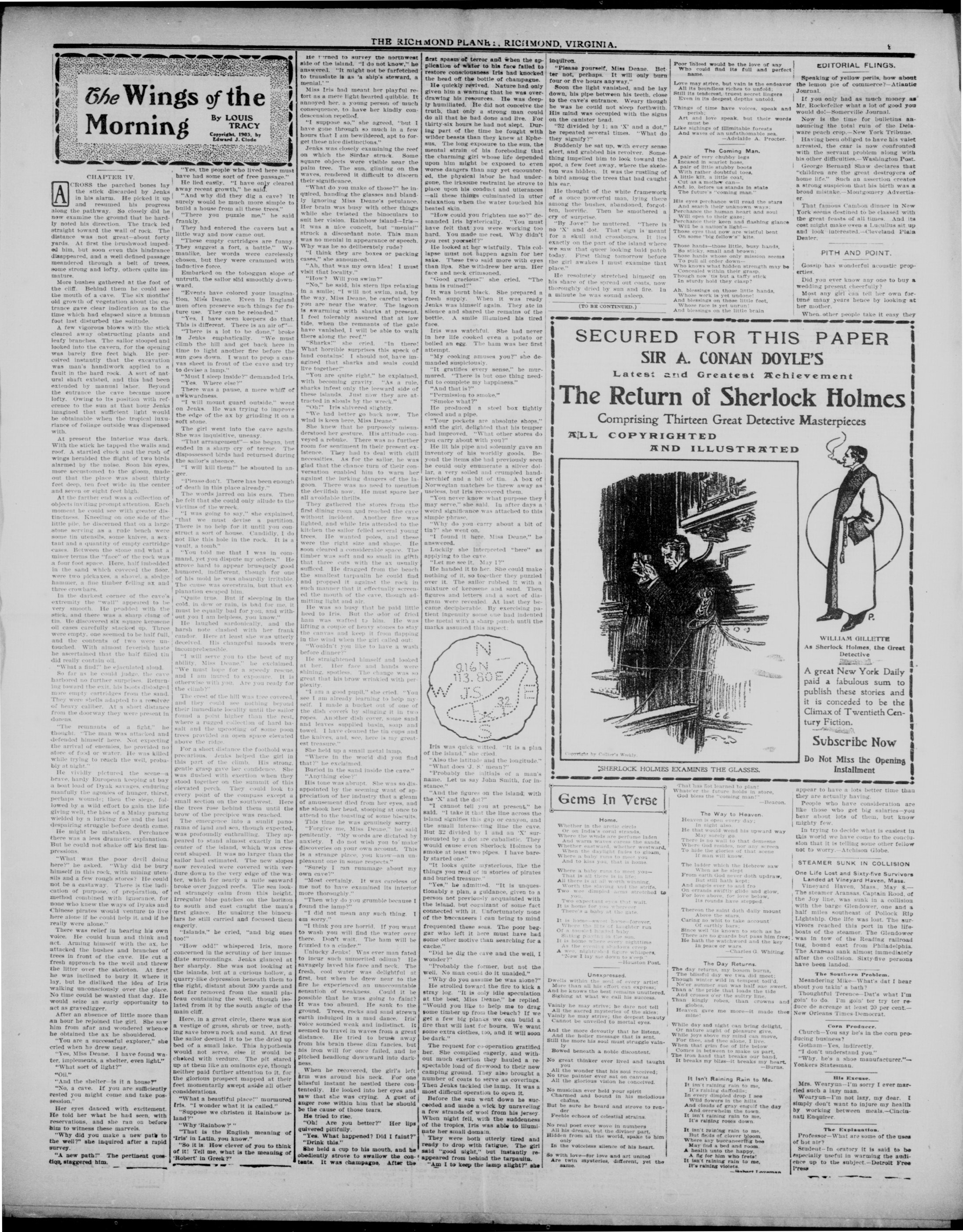
He handed it to her. She could make nothing of it, so together they puzzled over it. The sailor rubbed it with a mixture of kerosene and sand. Then figures and letters and a sort of diagram were revealed. At last they became decipherable. By exercising patient ingenuity some one had indented the metal with a sharp punch until the marks assumed this aspect:
N
916N
113.80E
W
J.S
32
1
S
Iris was quick witted. "It is a plan of the island," she cried.
"Also the latitude and the longitude."
"What does J. S' mean?"
"Probably the initials of a man's name. Let us say John Smith, for instance."
"And the figures on the island, with the 'X' and the dot."
"I cannot tell you at present," he said. "I take it that the line across the island signifies this gap or canyon, and the small intersecting line the cave. But 32 divided by 1 and an 'X' surmounted by a dot are caballistic. They would cause even Sherlock Holmes to smoke at least two pipes. I have barely started one."
"It looks quite mysterious, like the things you read of in stories of pirates and buried treasure."
"Yes," he admitted. "It is unquestionably a plan, a guidance, given to a person not previously acquainted with the island, but cognizant of some fact connected with it. Unfortunately none of the buccaneers I can bring to mind frequented these seas. The poor beggar who left it here must have had some other motive than searching for a cache."
"Did he dig the cave and the well, I wonder?"
"Probably the former, but not the well. No man could do it unaided."
"Why do you assume he was alone?"
He strolled toward the fire to kick a stray log. "It is only idle speculation at the best, Miss Deane." he replied. "Would you like to help me to drag some timber up from the beach? If we get a few big planes we can build a fire that will last for hours. We want some extra clothes, too, and it will soon be dark."
The request for co-operation gratified her. She compiled eagerly, and without much exertion they hauled a respectable load of firewood to their new camping ground. They also brought a number of coats to serve as coverings. Then Jenks tackled the lamp. It was a most difficult operation to open it.
Before the sun went down he succeeded and made a wick by unraveling a few strands of wool from his jersey. When night fell, with the suddenness of the tropics, Iris was able to illuminate her small domain.
They were both utterly tired and ready to drop with fatigue. The girl said "good night," but instantly realised she needed to finish the tapiraua. "Am I to keep the leap up?"
SECURED FOR THIS PAPER SIR A. CONAN DOYLE'S Latest and Greatest Achievement The Return of Sherlock Holmes Comprising Thirteen Great Detective Masterpieces
Copyright by Collier's Weekly.
SHERLOCK HOLMES EXAMINES THE GLASSES
inquired.
"Please yourself, Miss Deane, Better not, perhaps. It will only burn four or five hours anyway."
Soon the light vanished, and he lay down, his pipe between his teeth, close to the cave's entrance. Weary though he was he could not sleep forthwith. His mind was occupied with the signs on the canister head.
"32 divided by 1: an 'X' and a dot," he repeated several times. "What do they signify?"
Suddenly he sat up, with every sense alert, and grabbed his revolver. Something impelled him to look toward the spot, a few feet away, where the skeleton was hidden. It was the rustling of a bird among the trees that hud caught his ear.
He thought of the white framework of a once powerful man, lying there among the bushes, abandoned, forgotten, horrific. Then he smothered a cry of surprise.
"By Jove!" he muttered. "There is no 'X' and dot. That sign is meant for a skull and crossbones. It lies exactly on the part of the island where we saw that queer looking bald patch today. First thing tomorrow before the girl awakes I must examine that place."
He resolutely stretched himself on his share of the spread out coats, now thoroughly dried by sun and fire. In a minute he was sound asleep.
(TO BE CONTINUED.)
SECURED
SIR
Latest a
The Return
Comprising T
ALL COPYRIGHT
AN
Copyright by Collier's Weekly.
SHERLOCK HOLMES
Gems In Verse
Where the winds are perfume laden
And warm waves caress the sands.
Whether eastward, whether westward,
When the daylight fades to gloom.
Where a baby runs to meet you
And to kiss you, that is home.
Where a baby runs to meet you—
That is all there is in life;
All there is at all worth winning,
Worth the slaving and the strife.
Two wee dimped arms stretched to
you.
Two expectant eyes that wait.
It is home for you wherever.
There's a baby at the gate.
It is home—sweet home—forever.
Where the lilies of laughter run
Of a little baby.
Sitting in a pavilion.
Unexpressed
Dwells within the soul of every artist
More than all his effort can express;
And he knows the best remains unuttered,
Sighing at what we call his success.
Vainly he may strive; he dare not tell
All the sacred mysteries of the skies;
Vainly he may strive; the deepest beauty
Cannot be unveiled to mortal eyes.
And the more devoutly that he listens,
And the holier message that is sent.
Still the more his soul must struggle vainly
Bowed beneath a noble discontent.
No great thinker ever lived and taught you
All he wonder that his soul received;
No true painter ever sat on canvas
All the glorious vision he conceived.
No musician ever held your spirit
Charmed and bound in his melodious Guitar
But be sure he heard and strove to render
Feeble echoes of celestial strains.
No real poet ever wove in numbers
All his dream, but the diviner part,
Hidden from all the world, spake to him only
In the voiceless silence of his heart.
So with love—for love and art united
Are twin mysteries, different, yet the
same.
Poor inedible would be the love of any
Who could find its full and perfect
name.
Love may strive, but vain is the endeavor
All its boundless riches to unfold;
Still she must wait for lovers
Even in its deepest depths untold.
Things of time have voices, speak and
perish:
Art and love speak, but their words
must be
Like seighings of illimitable forests
And waves of an unfathomable sea.
- Adelalde A. Procter.
The Coming Man.
A pair of very chubby legs
Incaused in scarlet louse.
A pair of little stubby boots
With rather doubtful toes.
A little kilt, a little coat,
Can no other.
And, lo, before we stand in state
The future's "coming man."
His eyes perchance will read the stars
And search their unknown ways;
Perchance the human heart and soul
Will open to their gaze;
Perchance their keen and flashing glance
Will be a nation's light.
These hands—those little, busy hands,
So sticky, small and brown;
Those hands—those mission seems
To pull all order down—
Who knows what hidden strength may be
Concealed within their grasp.
Though now 'tis but a taffy stick
In sturdy hold they clasp?
Ah, blessings on those little hands,
Whose work is yet undone!
And blessings on those little feet,
Whose fractions yet unturned,
And blessings on their brain.
ED FOR THIS
EIR A. CONAN DOYL
ast and Greatest Achie
urn of Sherlock
ng Thirteen Great Detective
RIGHTED
AND ILLUSTRATED
OLMES EXAMINES THE GLASSES.
That has not learned to plan!
Whatater the future holds in store,
whatater the future holds in store.
he sound wend his upward way
May work
There is no wall to that demene
Where God resides, nor any screen
To hide the glories of that scene
If man will know.
The ladder which the Hebrew saw
When as he slept
From earth God never doth updraw,
But still hath kept;
And angels ever to and fro
On errands swiftly glide and glow,
For love above, for love below,
Its rounds have stepped.
Thereon the saint doth daily mount
Above the stars,
Carried no whit to take account
of earthly beast.
Since well 'tis known to such as he
There are no guards but pass him free;
He hath the watchword and the key
In peace or wars.
The Day Returns.
The day returns, my bosom burns,
The bissful day we two did meet.
Though winter wild in the tempest told,
Neer summer sun was half ae sweet.
Than a' the pride that loads the tide
And crosses o' the sultry line.
Than kingly robes, then crowns and gloe-
Heaven gave me more-it made thee
mine!
While day and night can bring delight,
Or nature angle of pleasure give.
While joys above my mind can move,
For thee, and thee alone, I live.
When that grim foe of life below
Comes in between to make us part.
The iron hand that breaks our band.
It breaks my bliss-it breaks my heart.
—Burns.
It isn't Raining Rain to Me.
It isn't raining rain to me,
It's raining daffodils;
In every dimpled drop I see
Wild flowers in the hills.
And clouds of gray engulf the day
And overwhelm the town.
It isn't raining rain to me.
It's raining roses.
It isn't raining rain to me,
But fields of clover bloom,
Where any buccaneering bee
May find a bed and room.
A health into the happy,
A fig for him who frets!
It isn't raining rain to me,
It's raining violets.
—Robert Loveman
2
EDITORIAL FLINGS.
Speaking of yellow perils, how about the lemon pie of commerce?—Atlantic Journal.
If you only had as much money as Mr. Rockefeller what a lot of good you would do!—Somerville Journal.
Now is the time for bulletins announcing the total ruin of the Delaware peach crop.—New York Tribune.
Having been obliged to have his valet arrested, the czar is now confronted with his servant problem along with his other difficulties.—Washington Post.
George Bernard Shaw declares that "children are the great destroyers of home life." Such an assertion creates a strong suspicion that his birth was a broad mistake.—Montgomery Advertiser.
That famous Cambon dinner in New York seems destined to be classed with the great feasts of all times. And its cost might make even a Lucullus sit up and look interested.—Cleveland Plain Dealer.
PITH AND POINT.
Gossip has wonderful acoustic properties.
Did you ever know any one to buy a wedding present cheerfully?
Most any girl can tell her own fortune many years hence by looking at her mother.
When other people take it easy they
S PAPER
LE'S
ievement
ck Holmes
e Masterpieces
P.
WILLIAM GILLETTE
As Sherlock Holmes, the Great
Detective
A great New York Daily
paid a fabulous sum to
publish these stories and
it is conceded to be the
Climax of Twentieth
Century Fiction.
Do Not Miss the Opening Installment appear to have a lots better time than they are actually having. People who have consideration are like those who get big salaries-you hear about lots of them, but know mighty few. In trying to decide what is easiest in this world we have come to the conclusion that it is telling some other fellow not to worry.-Archison Globe.
STEAMER SUNK IN COLLISION
Landed at Vineyard Haven, Mass.
Vineyard Haven, Mass., May 8.
The steamer Aransas, Captain Rood, of the Joy line, was sunk in a collision with the barge Glendower, one and a half miles southeast of Pollock Rip Lightship. One life was lost. The survivors reached this port in the life-boats of the steamer. The Glendower was in tow of the Reading railroad tug, bound east from Philadelphia. The Aransas sank almost immediately after the collision. Sixty-five persons have been landed.
The Southern Problem.
Meandering Mike—What's dat I hear about you takin' a bath?
Thoughtful Terence—Dat's what I'm goin' to do. I'm goin' ter try ter reduce de acreage at least 20 per cent.
New Orleans Times Democrat
Corn Producer
"Why, he's a shoe manufacturer."—Yonkers Statesman.
His Excuse
Mrs. Wearyun—I'm sorry I ever married such a lazy man.
Wearyun—I'm not lazy, my dear.
I simply don't want to injure my health by working between meals.—Cincinnati Enquirer.
The Explanation.
Professor-What are some of the uses of hot air?
Student-In oratory it is said to be especially useful in warming the audience up to the subject.-Detroit Free Press
THE PLANET
Published every Saturday by JOHN MITCHELL,
JR., at 311 North 4th Street, Richmond, Va.
JOHN MITCHELL, JR., - EDITOR.
All communications intended for publication should be sent so as to reach us by Wednesday.
TERMS IN ADVANCE
One Copy, one year, $1.50
One Copy, six months, 1.00
One Copy, six months, 40
One Copy, four months, 50
One Copy, three months, 40
Single Copy, $0.50
ADVERTISING RATES
For one inch, one insertion,
For one inch, each subsequent insertion,
For two inches, three months,
For two inches, four months,
For two inches, nine months,
For two inches, twelve months
Standing and Transient Notices one inch,
Standing and Transient Notices per line.
For one inch, one insertion, - - - $ .50
For one inch, each subsequent insertion, - .40
For two inches, three months, - - - 6.00
For two inches, six months, - - - 10.00
For two inches, nine months, - - - 14.00
For two inches, twelve months - - - 20.00
Marriage and Funeral Notices, one inch, - .50
Standing and Transient Notices per line, - .10
POSTAGE STAMPS OF A HIGHER DENOMINATION THAN TWO CENTS NOT RECEIVED ON SUBSCRIPTIONS.
THE PLANET is issued weekly. The subscription price is $1.50 per year in advance.
There are FOUR WAYS by which money can be sent by mail at our market. In-The Post Office Money Order, the money is pressed Money Order, and when none of these can be procured, in a Registered Letter. Money ORDERS. You can buy a Money Order at your Post-Office, payable at the Richmond Post Office, and we will be responsible for its safe arrival. EXPRESS MONEY ORDERS can be obtained at any office of the American Express Co. the Richmond Post Office, and Go and Co.'s Express Company. We will be responsible for money sent by any of these companies, and we can be safe and convenient way for forwarding money. REGISTERED LETTER. If a money Order Post-Office or an Express Office is not within your town, then you can send money to your Letter you wish to send us on payment of ten cents. Then, if the letter is lost or stolen, you can send money in this manner at our risk. We cannot be responsible for money sent in letters in any other way than one of the four ways mentioned above. If you send your money in Post-Office way, you must do it as your own risk. RENEWALS. If you do not want This PLANET continues for another year after your money is sent to us, you can Post-Office to discontinue it. The courts have decided that subscribers to newspapers who do not send money for publication of time for which it has been paid are held liable for the payment of the subscription up to date when they order the paper distribution.
COMMUNICATIONS — When writing to us to
renew your subscription or to discontinue your
paper, you should give your name and address
in full. Otherwise we cannot find your name on
our books.
CHANGE OF ADDRESS. — In order to change
the address of a subscriber, we must be sent
the former as well as the present address.
Entered at the Post-Office at Richmond, Va.,
as second-class matter.
SATURDAY, . . . May 20, 1905.
Heaven is promised us, if we
will only work to get there.
The colored newspapers are multiplying and their power is being felt throughout this land.
There should be harmony among the colored leaders. Petty jealousies should be cast aside.
Colored men, we should not be discouraged by the rantings of the Negro-haters. All will come right after a while.
Our white friends are passing away one by one. One of Richmond's landmarks was destroyed when Major E. T. D. Myers passed away.
The idle, dissolute, shiftless members of the race should be kept in the back ground. They hinder our progress.
TO CONVERT
NEW YORK
Evangelistic Tent Campaign Opened in the Metropolis.
ALL THE CHURCHES HELPING
New York, May 17.—The evangelistic tent campaign which is to be waged in New York throughout the coming summer by an inter-denominational committee was inaugurated last night at a big mass meeting in Carnegie Hall, presided over by Bishop Coadjutor David H. Greer. Announcement was made of a $1000 check for the work from John D. Rockefeller.
The evangelistic campaign is designed for 1,087,762 persons. This is the number, actually, of people not in the Greater New York churches. The meetings will be conducted in tents and all summer long. There will be a speaker and a student for each tent, each speaker to remain but two weeks in that tent.
No collection is to be taken at any tent meeting. The Fifth Avenue Presbyterian church has agreed to support a taut, Calvary Baptist church another, Collegiate Reformed another, and many churches are helping by special offerings.
Bishop Greer, in stating the objects of the campanion, said: "It is the object of the speakers to lift out of the mire of fallen manhood and womanhood, not a racial fragment of those who live in this great city, but to speak to humanity, regardless of creed and with no regard to whether the listeners be yellow, black, brown or red—to speak the gospel of Christ Jesus. It is not a cam-
palign of sensation or held with any sordid motive, but a sane, educational and progressive movement."
WILL RACE ACROSS OCEAN
New York, May 16.—With the incentive of a valuable cup and three other prizes offered by the German emperor, 11 large sailing yachts of various rigs and representing three nations, assembled in the inner harbor, fully prepared for the start of a race across the North Atlantic. Eight of the contestants are vessels owned in this country, two are from England, while Germany has one representative.
The event is therefore looked upon in the yachting world as one of the most important in many years, in that it will test the stability and rig of the present type of pleasure craft as well as the seamanship of the modern yachtsmen.
FIERCE FIGHTING IN PHILIPPINES
300 Moros Killed, While Americana
Lose Seven Killed, 19 Wounded
Manila, May 15. - Pierce fighting has been going on the last two weeks on the island of Jolo between the outlaw Moro chief, Pala, with 600 well-armed followers, and troops under the personal command of Major General Leonard Wood. Pala's losses thus far are 300 killed, while those of General Wood are seven killed and 19 wounded. Pala and his remaining followers, in accordance with Moro tradition, prefer death to capture.
General Wood, with detachments from the 14th cavalry, the 17th, the 22d and the 23d infantry and constabulary scouts, has driven Pala and his followers into a swamp, which has been surrounded.
Seriously Injured In Runaway
Wilmington, N. C., May 17.—in a runaway accident near here, Mrs. W. R. Kenan, Miss Sarah Kenan, of Wilmington, and Miss Annie Kenan, of Kenansville, N. C., mother, sister and aunt, respectively, of Mrs. Henry M. Flagler, wife of the multi-millionaire, were thrown from a trap, and Miss Annie Kenan sustained serious injuries. The other two escaped uninjured. Miss Kenan suffered a compound fracture of a leg just above the knee, which may ultimately require amputation.
Another Church Union Proposed.
Topeks, Kas., May 16.—The contest in the United Brethren conference for union with the Congregational and the Methodist Protestant churches has begun. Dr. L. S. Cornell read the letter to the churches recommending the union. Dr. Washington Gladden, moderator of the Congregational council, and Dr. D. S. Stephens, president of the Kansas City University, speaking for the Congregational and the Methodist Protestant churches, respectively, urged the adoption of the report. Much opposition came up.
Reformed General Synod Opens
Allentown, Pa., May 17.—The General Synod of the Reformed Church in the United States opened its 15th triennial reunion in the historic Zion Reformed church here, with Rev. Dr. J. H. Prugh, of Pittsburgh, presiding. Dr. Prugh preached the opening sermon. In the course of his address he expressed the hope that the day would come when there would be a union of all churches. The synod elected Rev. Dr. A. E. Dahlman, of Buffalo, N. Y., president.
Lightning Strikes As Preacher Exhorts Richmond, Va., May 16.—While Rev. W. F. Dunaway, of Ashland, was exhorting his congregation to Cool Spring Baptist church, at Lee, Va., to take the Almighty as their leader in times of storm, lightning struck the building and injured some 18 people, several of them seriously. The stroke splintered a part of the floor, tearing a hole through one of the pews and causing a panic among the congregation.
COLORS AND MOSQUITOES
A young girl was talking about mosquitoes. She had spent the summer in a place where they were numerous.
"But I noticed," she said, "that when I wore a yellow dress I didn't get a single bite."
"Did you notice that?" said the young scientist. And then he went on eagerly:
"I am glad you noticed that, for it is a verification of certain experiments that we have made.
"We made these experiments in a gauze tent, and their object was to ascertain the effect on mosquitoes of colors.
"We placed in the tent boxes lined with cloth of different hues, and we found that the little pests crowded frantically into the dark blue box, while the yellow box they would not under any circumstances enter.
"The experiments extended over several weeks. We had in the tent stone vessels for the mosquitoes to breed in. We discovered that next to the dark blue the mosquitoes sought the dark red box. After the dark red came brown, then scarlet, then black, then slate gray, then olive green, then violet, then pearl gray, then white.
"Thus we proved that mosquitoes notice colors, and we formulated two helpful hints for the inhabitants of mosquito ridden districts.
"The first hint is to wear yellow to escape mosquito bites and to use yellow netting for bed canopies and window screens.
"The second hint is to use a blue lined box if you want to trap mosquitoes. With this box in an infested region you could easily catch and destroy thousands of the insects daily."—New York Herald.
A Submarine Signal
Here is one of the latest wonders of the deep, put there by man. Underneath the Sandy Hook lightship is a big bell, rung by power from the same little engine which toots the foghorn. The bell rings five—one, five—one, five—one, fifty-one, the number of the lightship. An officer on the bridge of an incoming steamship picks up a tele-
THE RICHMOND PLANET, RICHMOND, VIRGINIA.
phone receiver on the bridge, say eight miles away, and hears the number ringing. He knows what it is and where he is.
The idea is simple. Water transmits sound more than three times as quickly as air. Against the plates of the vessel way down in her hold forward under the water line is a drum which catches and magnifies the sound. A telephone wire does the rest. It matters not how hard a gale may be blowing or whether the foghorn can be heard, the bell is a sure indication. It has been reported off Boston as having been effective at a distance of fourteen miles.—New York Post.
Rose Specialists Well Paid
An uptown florist who advertised for a rose specialist recently was bewailing his inability to find one.
"It is like advertising for good hotel help in the city when the summer resort season opens," he said. "Everybody worth hiring has a job. The rose season in New York is brief, but it needs an expert to handle them while they last if he is to supply a high priced trade. I mean by that a business in which customers do not hesitate to pay $1 each for fine roses. It is not every grower that can be depended upon to produce heavy headed flowers, radiant and rich in color and with long strong stems. When a florist finds a man like that he has a prize. Four thousand dollars a year is not at all a big salary for him, and for seven months of that time he has a sinecure. A man like that is paid not so much for what he does as for what he knows." -New York Press.
Wonderful Markamanship
It is a proud moment in the life of a British soldier or sailor to be pronounced by the king a credit to the country. Such a compliment was paid to Able Seaman Hollinghurst during his majesty's recent visit to Portsmouth. The honor of royal recognition was due to the remarkable skill of the British sailor in gun practice. With a large square canvas target six feet by eight, in the center of which was a comparatively small bullseye, scarcely larger than a man's hat, placed at a distance of 1,500 yards, Hollinghurst hit it seven times out of ten with six inch shells, making a record that will go down in target practice history. In addition to the complimentary words pronounced by King Edward, the sailor had a further honor conferred upon him by a personal presentation to his majesty.
Chaffee's Odd Spectacles
Lieutenant General Chaffee has the most remarkable pair of spectacles in Washington. They are of enormous size, perfectly round and are incased in heavy rims of black tortoise shell. When he puts them on they impart an unusually severe look to his strictly military features. They say about the war department that the general wears the glasses in order to frighten young lieutenants. They are of the pattern worn sometimes by Chinese mandarins, but General Chaffee says he bought them in this country.
A Sugar Cane Cutter
F. M. Cockrell, Jr., son of ex-Senator Cockrell, is the inventor of a sugar cane cutter that promises to revolutionize the sugar planting industry of the south and at the same time to make its inventor a millionaire. His machine will do the work of more than a hundred men. It cuts, strips and tops the cane and is pronounced by experts who have seen it in operation a wonderful machine that will mean as much to the sugar cane industry as did the cotton gin to the cotton business.
MODES OF THE MOMENT
Embroidered tussle silk makes a charming summer frock.
Yellow and mauve is a combination seen in both dresses and hats.
Some new ponges, with rose decoration in soft colorings, suggest tapestry.
Stiff, flat handles have the preference in bags, and leather covered frames are more popular than ever.
Shot silks in soft rose, wood, violet, amethyst, pale blue, biscuit and opal colorings are fashionable for afternoon wear.
Novel notions in shoes are the straps that button crossways over the instep in many tones of brown, from light ponge to the deepest chocolate. Many of these are laced with ribbon or exactly the same color.
A belt novelty is of striped patent leather, red and white and blue and white being a favorite combination.
The stripes are about a quarter of an inch in width, and the buckles are plain and generally of dull gold.—Brooklyn Eagle.
THE HALL OF FAME
Joseph Palmer of the National museum will shortly make a life mask of the president.
Carl Meyer, the balloonist, says that birds steer with their beaks and not with their tails.
Secretary of State Hay saves all the cartoons and caricatures in which he is depicted. He also has the finest collection of Du Maurler cartoons in the world.
Two of the official pallbearers of Abraham Lincoln are still living, Henry G. Worthington and Alexander H. Goffroth. Both were congressmen at the time and both are eighty years old at present.
William Anson, nephew of Lord Lansdowne, the English statesman, cousin to the Duke of Marlborough and a near relative to the Duke of Portland, owns a horse, mule and cattle ranch in the San Angels district of Texas.
Captain John Stover Jacobs, the oldest fireman in Boston, died a few days ago, aged eighty years. He was foreman of the first steam fire engine company in Boston and was one of the assistant engineers at the big Boston fire in 1872.
Count and Countess Lonyay intend to purchase a large estate in England and reside there permanently. Countess Lonyay is the former crown princess of Austria and a daughter of the king of Belgium, with whom, however, she is at loggerheads.
John Rutter, chief engineer of the Grimsby (England) trawlier Satyrlon, was drowned with the rest of the crew recently on the Iceland coast. Soon after the Satyrlon sailed a message arrived at Grimsby telling him not to go to sea because his uncle had died and left him $40,000.
Lord Curzon is sending a message to all the tribes in India in a novel way. He learned a speech in all the dialects and then spoke it into phonographs. These talking machines will be sent broadcast over India, and all the people will so be enabled to hear the voice of the viceroy speaking in their native tongue.
Austen Leigh, an authority on all matters pertaining to Eton, has discovered that Thomas Lynch, one of the signers of the Declaration of Independence, was an Etonian. Perhaps the most significant fact in connection with this historical item is that Etonians of today are proud of the fact discovered by Mr. Leigh.
GENERAL GOMEZ SERIOUSLY ILL
Family Summoned to the Bedside of Famous Cuban Patriot.
Havana, May 17. — The governor of Santiago telegraphed that the condition of General Maximo Gomez is alarming.
Santiago, Cuba, May 16. — General Maximo Gomez is dangerously ill with nephritis. The general's extreme age
GENERAL MAXIMO GOMEZ
and the results of the many wounds he received in his campaigns for the liberation of Cuba complicate his trouble. He rallied from an operation for an abscess a week ago, but suffered a relapse on Sunday.
RAISES AN INTERESTING POINT
Claimed Jersey Paroon Board Has No Power to Commute Death Sentence.
Trenton, N. J., May 17.—Miss Mary Philbrook, counsel for Libbie Garrabrant, the woman who is serving a life sentence in state prison, had a conference with Governor Stokes and raised an interesting point as to the power of the board of pardons to commute a death sentence to one of life imprisonment. Miss Philbrook contends that the board has no such power. The constitution provides that the board of pardons may remit fines and forfeitures and grant pardons except in impeachment cases. The constitution is silent as to the commuting of death sentences to one of life imprisonment. If this point is well taken, the board of pardons could not interfere in the case of a death sentence except to grant an absolute pardon.
There are now 10 persons in the state prison serving life terms as a result of having their death sentence commuted. No one would think of having them executed after these years, and if Miss Philbrook's point should be sustained they would all be pardoned. Miss Philbrook's purpose in talking to the governor was to have the board of pardons consider the legal point she has raised. The governor will bring the matter to the attention of the board.
JEFFRIES KNOCKED OUT
Rheumatism and Malaria Puts the Champion Out of Fighting Game.
Chicago, May 15.—James J. Jeffries, champion heavy-weight pugilist of the world, has been knocked out. Disease accomplished what no human being was ever able to do. A combination of rheumatism and malaria has put the pugilist out of the fighting game for all time, according to Jeffries, who, cancelling all engagements, started for Los Angeles, Cal., to try to regain his health. In the future it is Jeffries' intention to devote his time to several mining claims which he and a brother possess in Arizona.
BARON ROSEN FOR PEACE
New Russian Ambassador Will Help
Roosevelt to End War.
Roozbevett to End War.
London, May 15 - The Daily Telegraph
graph's Tokio correspondent says: "Baron Rosen (formerly Russian minister to Japan, and who has been appointed to succeed Count Cassini as ambassador to the United States) openly belongs to the peace party and will assist President Roosevelt in his efforts for peace. He was aware of Japan's preparedness for war, but was unable to stay the hands of his government."
WILL PROBE Normal School
Harrisburg, Pa. May 17.—Auditor General Snyder has directed Colonel E. R. Chambers, an attack of the department, to examine the books and accounts of the East Stroudsburg State Normal School to ascertain if the irregularities disclosed by ex-Representative Robert K. Young, of Wellboro, in a recent investigation into the affairs of the school, have been corrected. The school's share of the state appropriation will be withheld by the auditor general until the management show that these alleged abuses no longer exist.
Fished Up Man's Body.
Philadelphia, May 16.—While lifting his shad net off Kaighn's Point perry, Camden, N. J., John O'Donnell brought the body of a drowned man to the surface. He towed the body to Walnut street wharf, Camden, and notified the authorities. Coroner Lippincott held a view and ordered the remains removed to the morgue. The body was evidently that of a workingman and apparently had been in the water for some time.
Gems In Verse
The Call of the Plains.
If you are sick of curbing lines,
of senseless social monkey shines,
Oklahoma.
If freedom is the boon you seek
And think you need a strenuous streak
Pack up your duds and take a sneak—
Come out here where the winds are
strong.
Where nature sings a lusty song.
Where skies are blue and trails are
long—
Come west.
If you would like a breath of air,
A bracing breath and good and rare.
Come west.
Come out here you may see the skies,
Where wide the prubile's vastness lies,
And brush the cobwebs from your eyes—
Come west
—Chicago Chronicle.
The Birds
Singers without toll, whose toll is play. Who waka the skies before the peep of Who call the shadows from the woodsides deep
And downward waft the dewy plumes of sleep.
You bring the buds and flowers and delight.
Of spring. With your swift, soft, feathery flight
The seasons change their courses, and with you
They飞升 the gossamer seas of blue.
Light as the filmy chariots that scroll
The mirroring pool and softly upward roll
Before the breath of the wind-as gay as
As light as laughter when no cares annoy-
All the affairs of men and women move
When, with the omens right, the birds approve.
Oh, mortal, this day do you wait or climb
Wearily the long fantastic path of time?
Mayhaps you cry faltering; "I am old!
And my immortal soul grows dead and cold!
Not death! Not age! When the spring day was long
You mocked the redbreast and you spurned his song;
The orbole in the fragrant boughs above
May mendows could not warm your heart
The merry hobelink in time of bloom
And she failed to draw you from your
doom
And vainly, loudly croaked the water fowl,
And vainly hooted through the night the owl;
In vain the wild full throated thrushes sang
And woke the echoes till the woodlands rang.
—Arthur Richmond in Boston Transcript
The Tree
This tree, which stands with arms out-
spread,
With leaves, like fingers tremulous,
To seize all coolness overhead
A safety waffl it down to us;
This tree—it rests on tears
Of rain and sun of drought and dew,
Before this shade which rests and cheers
Into today's perfection grew.
Some kindly one—forgotten now—
May thoughtfully have placed the seed,
Foreseeing that each reaching bough
Would satisfy a worn one's need.
Whooe or he was, that unknown one,
Who set the seed or sproutlet slim,
He knew not that he had begun
What stands a monument to him.
The trees—the kindly trees—that blaze
With spring's green flame or autumn's
Bush.
The serene trees that line the ways
Into the woodland's peaceful bush-
Through all the years they slowly grow
Until they shield the flowered sod;
The trees—the kindly trees—they show
The patient thoroughness of God.
This tree, which stands with arms out-
spread.
The sunlight shuttles through the leaves
With threads of gold that flash and play
Across the warp of shade it weaves
The mingled fabric of the day.
The Grend of Tail
Today is your day, not the day that is
past.
Today is your day, not the day that is
Tomorrow's a day that has yet to be born.
Toll earnestly, then, for the hours fly fast.
From the morn.
You have never a minute for idie respite
Nor a second to childishly grieve
Life is brief at the best, and its aim is not clear.
But spend it so well that, whatever impend.
You'll have naught for repenting and never a fear.
At the end.
—New York Journal.
Live In the Sunshine.
Live in the sunshine, don't live in the gloom;
Carry some gladness the world to illume.
Live in the brightness and take this to heart—
The world will be gayer if you'll do your part.
Live on the housetop, not down in the cell;
Open air Christians live nobly and well.
Live where the joys are and, scorning defeat.
Have a good morrow for all whom you meet.
Live as a victor and triumphing go
Through this queer world beating down every foe.
The Rivals
To Love's low voice she lent a careless ear;
Her hand within his rosy fingers lay,
A chilling weight. She would not turn or her
But with averted face went on her way
But when pale death, all featureless and grim,
Lifted his bony hand and, beckoning,
Held out his cypress wreath, she followed him,
And Love was left forlorn and wondering
That she who for his bidding would not
At Death's first whisper rose and went away.
—Rudyard Kipling.
An Armful of Jax
Care is a feather and grief is a bubble—
Armful o' joy in a world full o' trouble!
Bright as if skies
Made the blue of his eyes.
With red lips that know not the meaning
of sighs.
He weeps not the future, he knows not the
past.
Yet he knows there are loving arms hold-
ing him fast.
His pillow of rest
Is a mother's dear breast.
And that's the sweet pillow he's loving the best!
Blue skies and balmiest blossoms above him.
Roses for playmates and lilies to love him!
Walk, little feet.
In life's roostiest street.
Till with roses of heaven these earth roses meet!
-Atlanta Constitution.
The Stranger on the Sill
Between broad fields of wheat and corn
Is the lowly home where I was born.
The peach tree leans against the wall,
And the woodbine wanders over all;
And the shaded doorway still,
But a stranger's foot has crossed the sill.
There is the barn, and as of yore
I can smell the hay from the open door
And hear the wallews throng
And hear the peeves's mournful song.
But the stranger comes — oh, painful
proof!—
His sheaves are piled to the heated roof.
There is the orchard, the very trees,
Where my childhood knew long hours of
ease
And watched the shadowy moments run
Till my life imbued more shade than sun.
The swing from the boughs still sweeps
the air,
But the stranger's children are swinging
there!
There bubbles the shady spring below,
With its bursh brook where the hazels
grow;
Twas there I found the calamus root
And watched the minnows poise and shoot
And heard the robin have his wing.
But the stranger's foot has crossed the sill.
Oh, ye who daily cross the sill,
Step lightly, for I love it still.
And when you crowd the old barn eaves,
Tend what countless harvest sheaves
Have passed within that scented door
To gladden eyes that are no more.
Deal kindly with these orchard trees,
And when your children crowd their knees
That swet-test fruit they shall impart,
As if you had stirred their heart;
To youthful sports they have the swing,
And in sweet reverence hold the spring.
The barn, the trees, the brook, the birds,
The meadows with their low herds,
The woodbine on the cottage wall.
My heart still lingers with them all.
Ye strangers on my native sill.
Step lightly, for I love it still.
—Thomas Buchanan Read.
Uninteresting People.
They live in a quiet sort of a way
In a quiet street.
They don't meet a great many people nor
Impress the people they meet;
The newspapers never mention their names.
The world doesn't care what they do.
They never go in for anything much.
And their intimate friends are few.
**And eight little fingers and two little thumbs.**
Usually the work of the comb.
**As he hit the quietest sort of a way.**
In his quietest sort of a home.
**She doesn't belong to a woman's club.**
She doesn't belong to a woman's club.
single tid.
She spends her time with a blue eyed lass.
And a miss biewes in little lad.
She never unraveled the problem of life.
She doesn't know lots of things.
She plays with the "kids" and works all day.
And most of the time she sings.
He isn't like most other husbands at all;
She isn't like most other wives.
And they never attempt to make a change
In the course of their quiet lives.
But once in a while they dress the "kids"
And go to spend the day.
In life they quiet country spot.
In a nice little bed way.
-Maurice Brown Kirby in Collier's Weekly.
Friendship
A ruddy drop of munty blood
The surging sea outweighs.
The world uncertain comes and goes
The lower rooted stays.
Friend he was fleet.
And, after many a year.
Glowed unexhausted kindness.
Like daily sunrise there.
My careful heart was free again.
Oh, friend, my bosom said,
Oh, friend, the sky is arches
Through the earth like a river.
All things through thee take noble
form
And look beyond the earth;
The mill round of our fate appears
to be worth
Me, too, nobles have taught
To master my despair.
The fountains of my hidden life
Are through thy friendship fair.
The Joy of God
I thank thee, too, that thee hast made
Joy to abound;
So many gentle thoughts and deeds
Circling us round
That in the darkest of earth
Some love is found.
I thank thee more that all our joy
Is touched with pain;
That shadows fall on brightest hours,
That thorns remain;
So that earth's bliss may be our guide
And not our chain.
For thou, who knowest, Lord, how soon
Our weak heart clings,
Hast given us joys tender and true,
But all with wings—
So that we be shaken on high,
Diviner things.
—Adelade A. Procter.
Joy Enough
When the blue smoke's curlin' upward
from the cabin on the hill
An' the heart is makin' music, though the
mockin' birds are still!
There's joy enough, good people, for the
winter's sweets are sown
As thickly as the flowers in the gardens
love has known!
The stars still light the darkness, the sun
shine crowns the day.
An' we sing the night to mornin', an'
we are happy as the May!
—Frank L. Stanton in Atlanta Constitu
tion.
Mr. Sappy (who has given Bobby a
dime) — And — er — Bobby, what does
your sister think of me?
Bobby—Honest, old man, after takin'
your money I ain't got the heart to tell
you!—New York World.
One Accomplishment Already.
Parent—And what do you propose to
teach the children in your school of
callsthenics?
Teacher—To sit, stand and lie properly.
Parent- Well, you need only to teach mine to sit and stand. My husband is a solicitor for a real estate firm.-Baltimore American.
The Attraction
Harry--By George, that's it! I knew there was something about her that was awfully attractive.-Boston Transcript.
NEWS AND COMMENT
While you have drink you will have the drunkard—American Issue.
There are men who starve their children to help the brewer fatten his horses.
Some one remarks that the saloon is the devil's way to man. True. And the man's way to the devil—Bishop Berry.
The Indianapolis News says it is estimated that one-half of all saloons in that city are owned and controlled by breweries.
Denton, Md., is a prosperous county seat town, and nine-tenths of the business men would fight the return of the saloon to the last limit.
Herne, Mo., is a dry town, of which a local newspaper says: "Most every citizen owns the property in which he lives. Taxes are low. The social and spiritual life is of the highest order."
Indiana's governor will not appoint even moderate drinkers of intoxicants to office. What is a wise policy for many present-day business corporations he holds is good policy for the state in its business.
"It is my sincere belief," declared Sir Richard Burton. "that if the slave trade were revived with all its horrors and Africa could get rid of the white man with the gunpowder and rum which he introduced. Africa would be the gainer by the exchange."
What Will Happen
Saloonkeeper—If I am driven out of this business I won't know what to do.
Searchlight—Go into the tombstone business, and get the job of erecting monuments over the graves of those your business has slain. --National Advocate.
Horrid of Him
Mrs. McQuery—I understand your minister preached a pretty strong sermon last Sunday against "decollect gowns."
Mrs. Locutte—Yes, and it was posttively vulgar. He said such shockingly immodest things—Philadelphia Press.
Gives Instant VigOr.
Weak Men Can Have It Free by Sending Name and Address Imparts Strength, Nerve and Vigor.
A. H.
YOU WILL BE DELIGHTED THE FIRST DAY
How any man may quickly cure himself after years of suffering from sexual exhaustion, lost vitality, varicocele, protrudible troubles, bladder or kidney troubles, blood poison, stricture, gonorrhoea, and all other ailments that may have been caused by early indiscretions or excesses, which sap the vital energy of men, take away their ambition, and unfit them for social and business life. Send your name and address to the Integrate Remedy Co., 263 Luck Building Detroit, Mich., and they will gladly send you a free of charge a Free Trial Treatment with full directions for use, so that a man can easily cure himself at home.
VARIETY IS THE SPICE OF LIFE.
So call and see our large variety of
Baby Carriages,
Dressers,
Scites,
Chiffoniers,
Toilet Tables
AND
Automatic Refrigerators.
YOU can have the advantage of our great stock and great values. We are offering NO CHEAP VALUES, but goods of such REAL VALUE as will insure you confidence in us. Do not fail to at least
INSPECT OUR GOODS
We are sole agents for the Macey Sectional Book-cases.
MACEY-WERNICKE CO.
FILING CABINETS.
SYDNOR & HUNDLEY,
711-713-715-717 E. Broad St.
DAG.
There were great doings in the kitchen of the big house the other day. The cousins were coming, and the cook was manufacturing all sorts of delicious little surprises. Among them were a funny pie crust man with very crooked arms and legs and a wondrous ginger bread elephant with raisins for eyes and cloves for toes. These were lying side by side on the table where the cook had placed them as they came out of the oven. No sooner had the cook left the kitchen for a few minutes than the P. C. M. jumped up and ran to the other end of the table. Being still warm and soft, his legs were not strong. Therefore his gait was quite unsteady. The G. B. E., following the man's example, rose to his feet and looked with amusement at the P. C. M.'s antics. "You can't walk straight yet," trumpeted the G. B. E. across the table.
"That's all you know about it." was the retort. And to show what a resolute P. C. M. can do he started to make a B line along a crack in the table. The G. B. E. started along the same crack to go the other way.
Of course they met. Of course neither one would get out of the way. And that made the collision. The P. C. M. raised his arms as if he were aiming a gun. But the G. B. E., not caring to be shot, even with ple crust bullets, seized the P. C. M. on his trunk and tossed him into the buttermilk jar.
Naturally this brought the P. C. M. to his senses. He surrendered and began to cry out in despair that he was all coming apart.
The G. B. E. was just inflating himself to shout victory when a little boy came in and ate him up. So ended the P. C. M. and the G. B. E.
Sparrows as Good Samaritans
Sparrows as good Samaritans.
The sparrow has never been noted for its good works and kind deeds, but the following little story throws a new light on the despised little scrappers:
Last spring a young roble was found foundering about a gentleman's lawn. It was unable to fly and had evidently fallen from its nest. Fearing that the cats might devour it in the night, this gentleman took the bird to the rear of his yard and placed it in an enclosure covered with a wire screen. While dressing the next morning he looked out of his window and was amazed at the action of a couple of sparrows who were carrying worms to the young roble in the enclosure. They would fly away only to return a few moments later with worms, which they dropped through the screen into the upturned mouth of the captive. They kept up this charitable feeding until the roble was liberated, and even then they hovered around like self appointed guardians.
The Amusing Spider
The bread spider will prove a simple and amusing little toy suitable for boys and girls, but not beneath the notice of their elders. Roll some bread-
THE SPIDER COMPLETE.
crumbs into a small pellet. Color these black with some ink, leaving two white dots for eyes. Take three small hair-pins of the kind called "invisible" and bend them into the semblance of six legs.
In the Ca
SOME TRAGIC TALES.
Incidents Culled from a Minister's Notebook Which Show Evils of Drink.
The Japanese say, "The man takes a drink, then the drink takes a drink, the the drink takes the man!"
This is a tragical story in brief, but the details of that story are painful in the extreme. A wretched looking man came into a pawnshop, not long since,
The Crafty Old Fox
It is well known in Japan that, although foxes can delude human beings, they can never deceive a dog.
There was once a thrifty pouterer who, in carrying his fowls to market, had to pass near the lair of a very crafty fox, but as he was accompanied by a good hunting dog he had never suffered any mishap.
One day, however, the fox, whose mouth watered at the sight of the fat ducks and chickens, hit upon a scheme to obtain them. Taking his eldest son, a promising young cub, with him, he stationed himself near the road and watched. As soon as the pouterer came in sight he told the cub to run across the road. The dog promptly gave chase, and the old fox, assuming the form of a beautiful woman, stepped forward and necided the pouterer with timid courtesy.
"Do you know that there is a mischievous fox near here, good sir?" said she. "You would better look out for your fowls."
"Oh, my dog just ran after him, so there is no danger," answered the pouterer.
"But if he hurts the fox the other foxes will seek to be revenged. Hadn't we better go by the other road? It is shorter and leads past a shrine of the goddess Kuannon, who can deliver us from the power of all foxes."
She led the wolf under the trees, followed by the poutterer, who wondered that he had never heard of this road before, but he was too charmed by her beauty to make any objection.
So deluded was he that the narrow, muddy patch seemed to him a broad, level road, and before long they arrived at the shrine of the goddess. After offering their prayers they sat down at a table in an adjoining room which was covered with all the delicacies of the season and feasted to their hearts' content.
Then the cunning fox-woman slipped unperceived from the room and, taking the form of a bozu (Buddist priest), rushed back, demanding in a terrific voice what any one meant by stealing the food of the goddess Kunanon and threatening the poor, deluded man with instant death. The poulterer fell on his knees and begged piteously for his life. "I will pardon you this once," said the bozu, "on condition that you consent to be my disciple." Greatly relieved, he submitted willingly to having his head shaved clean. When the bozu left the room he flung himself on a richly covered couch and soon was fast asleep.
What was his amazement on waking to find himself half living in a ditch of muddy water in front of an old, deserted straw hut. No trace was left of his fowls, and, putting his hand to his head, he discovered that all his hair was gone. Then he knew that he had been deluded by the crafty old fox of which he had so often heard.
For Boys to Think Over
says a boy should learn—
To let cigarettes alone.
To be kind to all animals.
To be manly and courageous.
To ride, row, shoot and swim.
To build a fence scientifically.
To fill the wood box every night.
To be gentle to his sisters.
To shut a door without slamming.
To sew on a button.
To do errands promptly and cheerfully.
To have a dog and make a companion of him.
A Riddle.
What crosses the water without making a shadow? A sound.
andy Store
—Youth's Companion.
ter, said, "Gimme ten cents." The broker unfolded the little jacket, and found within a new pair of baby shoes. He was touched with the sight, and fearing the "baby" was being robbed by a heartless, drunken father, he undertook to investigate the case, but the only reply obtainable, at first, was, "Gimme ten cents!" Finally, the story was wrung from the unwilling nebriate. The "baby" was dead, and some neighbors had furnished a pair of shoes for the
THE RICHMOND PLANET, RICHMOND, VIRGINIA
PLAYS AND PLAYERS.
"Strongheart" is the first of Robert Edeson's great successes that was not the dramatization of a popular novel.
"Arizona" is rapidly getting into the class of veteran dramas which have successfully withstood the test of time. Eleanor Robson was originally Kyle Bellew's leading lady in "A Gentleman of France." Now the two are the principal luminaries in the all star revival of "She Stoops to Conquer."
Miss Clara Pitt, who plays the part of the maid at the baths in "It Happened In Nordland," was a society belle before she went on the stage. She is a native of Chattanooga, Tenn.
Thomas L. Drew, better known as Tommy Drew by many hundreds of Bostonians, has signed with Madison Corey to play Montague Fish in Ade's "Peggy From Paris" company next season.
Henry V. Donnelly, who plays the part of Cyrus Gilfain in "Floridora," is well known in the stage world. He is best remembered as the chief mirth provoker in the old force comedy the "Ralmakers."
Jessie Millward was born in Liverpool, England, and educated in London. She was only sixteen when she made her professional debut at the Lyceum theater. London, with Sir Henry Irving in "Much Ado About Nothing."
BRITISH BRIEFS.
In London for using a sick monkey with which to beg money an organ grinder has been fined $40.
A number of houses in the Italian colony of Holborn, London, are to be closed, being unit for human habitation.
All the members of the city of London police force are learning in squads of sixty in the police gymnasiums the art of jin fitsu.
The recent birth rate for St. Georges-in-the-East, London, the headquarters of the alien invasion, is at the rate of 60.8 in 1,000. This is the highest birth rate ever recorded in England.
A London court has decided that an employer is not justified in dismissing an employee for using insulting language when the language is used "after business hours and off the premises."
An authority says that there are 165 good sized English towns which are absolutely being ruled by the migration of their populations to the great cities. Trade declines, property decreases in value, and while English cities are being overcrowded the smaller towns are being left desolate.
SHORT STORIES
Chile's government derives more than one-half of its income from salt-peter.
There are 180,132 Indians, besides the 5,518 in New York and the 77,018 of the "civilized tribes."
Lifeboats were launched in service on 294 occasions on our coast last year and saved 519 lives. The fleet of lifeboats numbers 288.
It has been figured out that the annual boat race between Yale and Harvard at New London costs each of the colleges $1,000 a minute during the time the race is in progress.
"Metapsychics" is the latest word. It is the invention of Professor Charles Relchert, president of the Society For Psychical Research of England. It means the science in embryo, hitherto known as "occult," "psychical" or "spiritist."
The passenger rates across the isthmus of Panama have been $4 gold for first class and $0 silver currency for second class passage. By the new tariff a first class passage is $2.40 gold, while the second class is $2.85 silver. These rates do not cover the charge for baggage, that remaining as here-tofore, 3 cents gold per pound.
THE GERMAN WAY.
Enforcing Full Dress at the Opera When the Kaiser Is Present.
A German lady who describes herself as from "the provinces" wrote to a friend describing her experience at the opera the first night of Leconcavallo's "The Roland of Berlin," at which the emperor was present. When his majesty is present all other persons must be in evening dress.
"I had read on the back of my ticket," writes the provincial, "that I must wear a low necked dress. Accordingly I took my nile green silk, which has served me well in my local circle, and cut out a heart shaped piece from the front, sacrificing as little as consistent of my society costume. The doorkeeper, taking a front view as I entered, allowed me to pass. From my place in the parquet I was surveying the sea of snowy shoulders and arms and admiring the jewels that sparkled even from the topmost gallery rows when I felt myself gently touched on the shoulder. I turned and saw a magnificent figure, whom I presently learned was the upper head master of the opera doorkeeper. He requested me softly to be so good as to follow him to the lobby, as he had something of the utmost importance to communicate. Mystified, I did so.
"The upper head master of the opera doorkeepers informed me that my dress was not adequately low behind, although the front might narrowly escape the severe limit laid down for decollete.
"It can soon be arranged in the cloakroom, gracious lady," said he, and to the cloakroom I went, where the attendant, who seemed fully equipped for such work, trimmed the back of my dress, enlarged the V shaped front, basted up the frazzled edges and thanked me in a businesslike way for the mark I bestowed. With some shame ourin, which the unfeeling father had stealthily appropriated, that his awful thirst might be gratified." And the drink takes the man!" Oh, the domestic heartbreaks from this scourge of drink!
The tragedy of drunkenness takes on different forms tnd phases. in a New England city, where I was recently living. 18 fires occurred within a few months, endangering hundreds of thousands of dollars of property, besides many lives. The city had just voted license, with the prospect of less than 220-
and a throbbing self consciousness I made my way to my seat. No one seemed to notice me, and I was soon enjoying again the wonderful costumes on and off the stage." -Harper's Bazar.
English Estates
It is considered strange that in England only one will disposing of as much as $5,000,000 had been filed during the financial year ending March 31. The average number of such wills has been between five and six. Thus in 1900 there were nine estates with a total of nearly $100,000,000; in 1901 eight estates, total value more than $50,000,000; in 1902 five estates with the same total; in 1903 five estates valued at $40,000,000, and in 1904 three estates valued at $25,000,000. Of twenty-four of the richest testators only one was under sixty years when he died, fourteen were over seventy and six more than eighty years. The average age was seventy-four and a half years. John Dawson, who left $3,500,000, was ninety-nine years old. The Earl of Strathmore, aged seventy-nine years, left $4,751,000.
A Truman Society
The Troussseau society was founded in Paris five years ago by Mme. Beguin in her school, Rue Riblette. Its object is to provide the daughters of poor parents with a liberal trousseau, first rate in quality and execution, at the time of marriage. A subscription of 9 cents a month paid for nine years provides a girl on her marriage with a complete trousseau of seventy-three pieces. The girls themselves and benevolent ladies interested in school education work at the trousseau. The work is a part of practical education, and it has the further advantage of bringing all classes of the community together. Mme. Loubet, wife of the president, is patroness of this admirable institution. Mme. Beguin's idea is making way all over France.
What Is a Week?
The question seems simple enough to answer in two seconds, yet it has occupied the supreme court of Victoria for two days. The factories act provides that no girl shall be employed for more than forty-eight hours "in any one week." A manufacturer was summoned for violating this provision, but he contended that the week should be reckoned not by the calendar, but from pay day to pay day—that is, from Friday to Thursday inclusive. The magistrate decided that it was the correct interpretation, and the supreme court has indorsed their view—London Globe.
Pittsburg and Steel
Another steel plant at Pittsburgh, starting out with a backing of $15,000,000, likely to run up into the hundreds of millions as time goes on, will serve to render that city more than ever the iron and steel capital of the world. A syndicate of its business men has just paid $1,500,000 for 400 acres of land near Allegrippa, on the Ohio, about fifteen miles from the city, and the work is to be carried forward with a rush. In addition to steel mills, a large blast furnace and a plant for the manufacture of pressed steel cars are to be built.
Woman Swallowed Tack
Philadelphia, May 10. - Mrs. J. Kickert is in St. Agnes' hospital with a tack fastened in her esophagus. Her throat is fearfully swollen, and the physicians consider her case a grave one. She is being fed by means of a glass tube. The little iron spike found its way into the weman's throat while she was taking a quantity of sulphur and molasses, and is now so lodged that an operation will be necessary to remove it. Mrs. Kickert had been cleaning house, and the tack is supposed to have fallen into the mixture of molasses and sulphur which she had prepared.
Look Out For These SwIndlers
Look Out For these Swindlers.
Chicago, May 10. Two or more men using the names Anderson, Craft and Todd have been engaged fraudulently for two months in soliciting subscriptions for magazines and other periodicals in the name of the American Press Association as subscription agents. They have operated here, in Omaha, South Omaha, Council Bluffs, Sloux City and other places. At an earlier date they had worked the eastern states. The American Press Association is not a subscriptionency; any one soliciting subscriptions in its name is necessarily a swindler.
HORSES AND HORSEMEN
Cotillion, 2:10, will be used on the New York speedway by his new owner, E. J. LaPlace.
Norristown (Pa.) horsemen will offer purses this season for the races over the Kinwood track.
Fred Ackerman of Mansfield, O., has purchased the fast pacer Billy J., 2:14%, from Joel Milum of Upper Sandyuk, O. R. T. Callahan of Buffalo has sold his handsome speedway pacer Noella, wagon record 2:16%, to a Pennsylvania turfite.
Cresance, 2:16%, the property of Fred Boyd, Decorah, Ia., will be trained and campaigned by R. L. Parker, Cedar Rapids.
Fantine, 2:06%, by Shirley Boy, has been sent to Harrie Jones of Rushville, Ind., to race the coming season on the grand circuit.
L. O. Baldwin of Glens Falls, N. Y., now owns the stallion Armont, by Belmont, sire of the champion yearling Paul D. Kelly, 2:20%.
American Boy, 2:10, and Fred the Kid, 2:08% are now owned in North Dakota and will be heard from in the northwestern circuits.
The Commercial club $1,000 stake on the programme of the Des Moines (in.) state fair is for 2:35 instead of 2:25 trotters, as previously announced.
000 in license fees. Who was the incident? No one, not even a very vigilant police department could find out. And yet the fire bell rang at night with such alarming frequency that the citizens hardly dared retire, not knowing where the fire flend might appear next. Finally, the firebug was caught! With what crushing sorrow came the news to his home! No suspicion there, of the work of this drunken outlaw until the officers of the law caused this crazy firebrand's arrest in his home. "He was never so.
Gems In Verse
The Starting Point.
If you want to be happy,
Begin where you are;
Don't wait for some rapture
That's future and far.
Beauty to be joyous,
Begin to be glad.
And soon you'll forget
That you ever were sad.
If you want to be happy,
Begin where you are.
Your windows to sunlight
And sweetness unbar.
If dark seems the day,
Light a candle of cheer
Till its steady flame brightens
Each heart that comes near.
If you want to be happy,
Begin where you are.
God sets in each sky
Heaven's joy bringing star.
Love breathes it through cloud and toward light.
And under its radiance
Your paths shall be bright.
—Priscila Leonard.
Man's Mortality
Like as the damask rose you see,
Or like a blossom on a tree,
Or like the dainty flower in May,
Or like the morning to the day,
Or like the sun, or like the shade,
Or like the gourd which Jonas had;
Even when it is sun and is spun,
Drawn out and out and out and out,
The rose withers, the blossom blasteth,
The flower fades, the morning hasteth,
The sun sets, the shadow flies,
The gourd consumes, the man—he dies
Like to the grass that's newly sprung,
Or like a tale that's new begun,
Or like the bird that's here today,
Or like the pearled dew in May,
Or like an hour, or like a span,
Or like the bread of the bread,
Even such is man, who lives by breath,
Is here, now there, in life and death,
The grass withers, the tale is ended,
The bird is flown, the dew's ascended,
The hour is short, the span not long,
The man's near death, man's life done
Like to the bubble in the brook.
Or in a glass much like a look.
Or like the shuttle in waver's hand.
Or like the writing in the sand.
Or like the gliding of the stream.
Even such is man, who lives by breath.
Is here, now there, in life and death.
The bubbles out, the look forgot.
The writing's blot.
The thought is past, the man is gone
The waters glide, man's life is done.
Like to an arrow from the bow.
Or like swift course of water flow.
Or like that time twixt flood and ebb.
Or like the spider's tender web.
Or like a race, or like a goal.
Or like a dole.
Even such is man who glides state
Is always subject unto fate.
The arrow shot, the flood soon spent.
The time, no time, the web soon rent,
The soon run, the goal soon won.
The dole.
Like to the lightning of the sky,
Or like a post that quick doth hie,
Or like a quaver in a song,
Or like a dragon long, long,
Or like the snow when summer's come,
Or like the pear, or like the plum;
Even such is man, who heaps up sorrow,
Lest the lightning pass and dies tomorrow,
The lightning's pail may go,
The song is short, the journey go,
The pear doth rot, the plum doth fall,
The snow dissolves, and so must all.
Say Something Good.
Pick out the folks you like the least and watch 'em for awhile.
They never waste a kindly word, they they must waste a smile.
They criticise fellow men at every chance they get.
They never found a human just to suit their fancy yet.
From them I guess you'd learn some things, if they were pointed out—
Some things that every one of us should know.
When some one "knocks" a brother, pass around the loving cup—
Say something good about him if you have to make it up.
It's safe to say that every man God made holds trace of good.
That he would fain exhibit to his fellows if he could.
The kindly deeds in many a soul are hi-bernating there.
Awaiting t encouragement of other souls that dare
To show the best that's in them, and a universal move
Would start the whole world running in a hopeful, helpful groove.
Say something sweet to paralyze the voice—the spot—
Speak kindly of his victim if you know the man or not.
—Baltimore American.
The Mother.
She was so tired of toil of everything.
Save loving those who needed all her love!
Her heart was like the golden heart of spring
When the white clouds sail above.
Autumn of life and tears were hers, and yet
She sang and loved and gladdened us the white.
Nor storms nor snows could make her once forget
Your Angel would not smile.
Young Apell's radiant smile.
She was so weary, but we never guessed
How weary till she smiled at set of sun
And whispered as she drifted into rest,
"My loving now is done."
"Tired of all save loving." Let this be
The epitaph inscribed where now she
lies.
Time shall not hide the words nor memory
The love look of her eyes.
till the saloon came into our city. The grog-shop has been his ruin," said his wife. And the heartbroken woman turned to her desolate home, while the convicted and disgraced husband went to a felon's cell. And the saloons remained!
I witnessed an execution, some years ago, by invitation of the chapain of the prison. Terrible sight! May I never witness another! What brought that man to the gallows? The chapain told me the story. The last step taken, before reaching the fatal platform and the noose, was drunkenness. He had despised parental counsel, gone with "the boys," drank on the sly and then in the saloon, and, in a fit of ugly, alcoholic temper, had murdered his friend. And because he bore the name of an honorable family the whole circle of relatives were plunged into disgrace and sorrow. What harrowing, heartbreaking tales concerning "the drink" can be found in every minister's notebook?"—Rev. O. W. Scott, in Rams' Horn.
What He'd Do
"If a millionaire was to offer you $100,000 would you ask him if he made it honestly?"
"No."
"Would you question his morals?"
"No."
"What would you do?"
"I'd probably fall in a fit."—Cleveland Plain Dealer.
She Made the Dumb Beast Obey.
THE QUEEN OF KINGDOMS
who can read from the sky. During the great show of the RINGLING BROTHERS in Videla, Ia. Samson one of the largest and oldest elephants in the world became nurly and killed nine men during the day. Mrs. Robertson was sent for. She influenced the elephant by holding a charming seal bone in her hand and speaking nine holy words to the beast and he obeyed.
Mrs. Robertson was born in Paris, France and had eight years of English schooling. She was born a fortune teller. No female on earth can do what she can. She gives advice on law suits, divorces, marriages, love notes, needs, property, sickness, female troubles, bonnies, pensions, trickery, evil spirits, cripple and blind affairs, hidden treasures, and lost and stolen articles.
This gifted woman is a friend to the poor. She is the seventh daughter of her parents and a mighty healer from birth. She blesses your home and makes bright your path forever and keeps your enemies behind you. The charming seal bone with which she works has been blessed and rested during the dark hours of midnight and was found mighty. She works from the dead and reams from the way. Thousands of pretended mediums, fortune tellers, etc. have tried to imitate the wonderful medium but her equal cannot be found. She causes speedy marriages and has cured thousands who were blind, crippled and otherwise afflicted, for years. Yes, Lawyers, Doctors, Ministers, Bankers and other professional men of the earth have sought this gifted medium for advice. She should live forever.
She consulted over thirty thousand people in seven months. Friends is will pay you to look around yourselves. Some one is crossing your path for bad luck, and working evil against you, not because you have harmed them but because your living is kept out of their sight and they are jealous of you.
She gives you a spiritual charm that will cause your enemies to love you, make you successful in business, cause your family to live happily forever, drives all evil from your path, cause you to save money and come into possession of property, cause you to gain back that which was stolen from you, cause the one that you love to love you until death, and cause whatever you want to come to pass. In fact, to make the dumb beast to love you. Her power excites the wonders. She is known all over the world as the queen of spiritual workers. Don't waste your time and money with frauds and still be left in the same or worse conditions as before, but consult this Christian wonder, take her advice, and you will be wealthy and happy forever. Price for consultation is one dollar. Include $1,000, a two cent stamp, and your name and address and your life will be sent to you by return mail. Write for other particulars. Address:
The J. V. HAWKINS
HAIR GROWER & REPAIRER
To which all state and national reservation, enjoys the reputation of home patronage in first class with prominence in this and other states, once used, the patron is never discovered of this hair grower and re-made known to her nearest friend.
Mrs. Mary Watson of 1015 St. Petent lady of this community who uses for a short time only herein values and wonderful results by perm her picture.
Only remove Dandruff, Curs Scalp, Restore Hair on Clean Temples where the roots are not dead cuts per box orders, 35 cts. boxes, $2.50 express prepail. Further makes the use of powder enery, and is perfectly harmless. All sizes, splotches and black heads. Sale and $1.00.
Sent by Post Office Money Order by Order.
Assess all communications to
J. V. HAWKINS,
Street, Richmond, Va.
A. E. H.
The J. V. Hawkin's HAIR GROWER & RESTORER
To which all state and national rights have been reserved, enjoys the reputation of an enormous home patronage in first class white and colored families. Its wonderful success has thrown it into prominence in this and other states, and whenever once used, the patron is never satisfied until her discovery of this hair grower and restorer has been made known to her nearest friend.
Mrs. Mary Watson of 1015 St. Peter St., a prominent lady of this community who used our prepara- for a short time only herein testifies to its value and wonderful results by permitting us to use her picture.
Mrs Mary Watson, ment lady
1015 St. Peter St., for
Richmond, Va. value and
her picture
It will positively remove Dandruff,
of all impurities, Restore Hair on Owl
or Bald Head, where the roots are not
Prices:- 25 cts. per box (local or
out city; eight boxes, $2.80 express prep
The Face Beautifier makes the use of
tirely unnecessary, and is perfectly he
remove all pimples, splotches and black
prices; 25, 50 sts and $1.00.
Money can be sent by Post Office M
or Express Money Order.
Address all communications
MME J. V. HAWKI
612 N. First Street,
PHONE, 4601.
It will positively remove Dandruff, Cure Soapf
of all impurities, Restore Hair on Clean Temples
or Bald Heads, where the reeds are not dead
PRICES:- 35 cts. per box (local orders): 35 cts.
out city; ight boxes: $2.80 express prepaid.
The Face Beautifier makes the use of powder entri-
lyne unacetyl, and is perfectly harmless; it
remove all pimples, splodices and black heads. Sale
prices: 25, 50 sts and $1.00.
Money can be sent by Post, Office, Money, Order
Money can be sent by Post Office Money Order or Express Money Order.
GONZALES
The Greatest Clairvoyant & Fortune Teller the World Has Ever Known
Unites Separated. Brings back the one you Love, Helps Quickly all in Trouble.
Removes Evil Influences, Cures Mysterious Diseases, Gives Luck and Success.
Send Lock of Hair, Date of Birth and 12 cents. Ask three questions and receive Horoscope and Lucky Birth stone by mail. GONZALES, 236 Bergen St., Brooklyn, New York.
tl-8-13-6m
BOARDING & Rates Reasonable. All of Home
Orders received by letter
MRS. BOOKER L.
PROPRIETRE
816 N. 2nd St.
A. D. PRICE,
Funeral Director, Emb
All orders promptly filled at short Halls rented for meetings and nice
Director, Embalmer and Live
promptly filled at short notice by telegraph or
or meetings and nice entertainments. Plen-
sary conveniences. Large pisnic or band
rate rates and nothing but first-class carriage
instantly on hand fine funeral supplies.
2 East Leigh Street
Funeral Director, Embalmer and Liveryman.
All orders promptly filled at short notice by telegraph or telephone. Halls rented for meetings and nice entertainments. Plenty of room with a necessary conveniences. Large pisnic or band wagons for hire, readiness for baggage, carriages, buggies, etc. Keeps constantly on hand fine funeral supplies.
212 East Leigh Street.
Residence Next Door. L DAY & NIGHT.—Man on Duty the "PLANET" you
OPEN ALL DAY & NIGHT.—Man on Duty All Night
'Phone. 577
412 Cochran St., Dallas, Tex.
The J. V. Hawkin's
HAIR GROWER & RESTORER,
To which all state and national rights have been
served, enjoys the reputation of an enormous
name patronage in first class white and colored
miles. Its wonderful success has thrown it into
dominance in this and other states, and whenever
needed, the patron is never satisfied until her
recovery of this hair grower and restorer has been
made known to her nearest friend.
Mary Watson of 1015 St. Peter St., a prominent lady of this community who used our prepara-
nion for a short time only herein testifies to its
use and wonderful results by permitting us to use
picture.
druff. Cure Scalp
on Clean Temples
are not dead.
local orders. 35 cts.
ass prepaid.
use of powder en-
tactly harmless; still
black heads. Sale
office Money Order
ations to
WKINS,
Richmond, Va.
Correspondence strictly confidential.
Mrs. J. H. Roye will open her restaurant for the season 1905 at the same old stand, S. E. corner Arctic and Kentucky Aves, Monday, Dec. 19, 1904 Atlantic City, N. J. 6 mos.
BOARDING & LODGING
Rates Reasonable. All the Comforts
of Home
Orders received by letter or telegraph.
MRS. BOOKER LEFTWICH,
PROPRIETRESS.
816 N. 2nd St. Richmond, Va.
Embalmer and Liveryman.
at short notice by telegraph or telephone. and nice entertainments. Plenty of room faces. Large pisnic or band wagons for nothing but first-class carriages, buggies, and fine funeral supplies.
Leigh Street.
NIGHT.—Man on Duty All Night LANET" your Ad.
Richmond. Va
HEY PLANET
THE DAIRY
POINTS OF A DAIRY COW.
How to Tell the Animal with Good Milking Possibilities from Others.
A correspondent of the Northwestern Agriculturist sends that journal a report of an address on "The Selection of a Dairy Cow," by C. H. Hinman, at a Farmers' Institute in Minnesota, and here are some of the points reported:
Mr. Hinman illustrated his address with a chart, drawn to a scale, and by exact measurements of the real animals, of which we give a drawing which can be studied with advantage by those interested in dairy cattle. The continuous lines in Fig. A represent a dairy cow which made a splendid record for herself, while the dotted lines represent a beef cow of proved qualities. The dairy cow weighed 1,450 pounds,
POINTS OF DIFFERENCE IN TYPES
Continuous Lines Represent Dairy Type.
Dotted Lines Represent Beef Type.
she gave 2,200 pounds of milk in two years, which mane 750 pounds of butter.
The beef cow weighed 1,540 pounds and could not give milk enough to sustain her own calf after it was two weeks old. Also note in the drawing the beef cow has a very small udder, not seen behind when viewed as in the cut; she has the desirable straight line on the back so much sought after by feeders, her lungs are large and her neck beefy; also observe her shoulder lines and the beefy hind leg almost straight from near the top bag up to the root of the tail.
The dairy cow has a small tapering neck; her shoulder points backward more than the other cow; her body is smaller in front and increases in size toward the rear where you come to the milk making machinery of the cow. She has a curved back, small legs and an udder that your judgment will readily admit is large enough to hold all the milk she can possibly be induced to manufacture. And she does manufacture it out of the food you give her, so that another important factor is a stomach large enough to hold great quantities of "the raw material," since she must rebuild and maintain her body, besides filling your pails with foamy milk containing the valuable butter fat. The "milk veins" must be large and crooked, and freely branch out in a network over the bag.
In Fig. B we have a cross section of the body after butchering. The beef cow has the broad flat back, with a great thickness of beef in the tenderloins along the backbone on top of the ribs, where the highest price beef is always found, and where it ought to grow as abundantly as good breeding can make it. Her broad diameter from side to side was actually two and one-third inches longer than the vertical diameter from the back to belly.
Now note again, the dairy cow was six inches longer in the vertical diameter than in her lateral diameter; and she has the minimum of tendon along the back; see her roof-shaped back covering, so to speak, a great capacious "bread basket," which in reality is a vast chemical apparatus for the manufacture of milk.
An equal surprise will be noted in the outline transverse section of the neck. Fig. C, which, however, not being drawn to scale, compares the shape of neck only, and not the size.
So you will readily discern by this chart that the dairy cow is a type, not a breed. When you find one after this type buy her, whether she be a Holstein, Shorthorn, Jersey or whatnot, the breed makes no difference, but the type will mean great value to you. Simply to satisfy your curiosity I state here that in this particular instance the dairy cow was a Holstein.
The following are the points of the dairy cow:
1. The dairy cow is a type, not a breed, therefore look for type first of all if you would profit in breeding milkers in the future.
2. Large feeding capacity is next in importance, as it takes lots of food to make great quantities of milk.
3. The mammiliary organs—
(a) The udder must be large enough to hold the milk after it is manufactured, and should be soft and well-shrunken after drawing milk (avoid a fatty udder, large after milk is drawn).
(b) The blood circulation, especially the "milk veins," must be prominent.
(c) The teats should be slender and of proper size and length to grasp easily. (Do not waste time, money and patience
trying to milk a short-teated cow, as you dry her up because you cannot get all her milk.)
4. The amount of butter fat cannot be told accurately until you put it through the "machine tester."
RULES FOR DAIRYMEN.
Prof. Carlyle, of the Colorado agricultural college, has formulated a set of rules for the guidance of dairymen in carrying on their work so as to insure the best results. They are as follows:
The solids of the cow's milk are manufactured from the feed the cow eats. Good milk, cream and butter can only be produced when cows have a liberal supply of clean, wholesome and nutritious food. Do not feed cows any feed not pure, wholesome and well flavored enough to be manufactured directly into butter.
Cow's milk is about 86 per cent. water. See to it that your cows have free access to pure running water at all times in summer. Stagnant pools and dirty or impure water cannot be made into good milk, cream or butter by either cows or man.
Cows should be milked regularly and as nearly as possible by the same persons and at the same hour each night and morning.
Cow's udders should be brushed clean and rubbed with a damp, coarse towel before milking. Be as careful with your hands, your clothing and the udders of the cows in milking as you would have your wife in making bread.
See to it that all pails, pans, strainers, cans and separators are thoroughly scalded with boiling water after being used each time. Boiling water should only be used after washing, and is the only agent that will keep dairy utenils clean and sweet.
Milk should be strained into cans and removed from the stable and separated as soon as possible after milking. Never allow milk or cream to stand exposed in cow stable or to other odors. Milk or cream absorbs odors quickly. After separating, cream must be cooled quickly to 50 degrees and kept at that temperature until started to the creamery. Never mix warm cream with that which is cooled.
A NOVEL FEED MANGER
Its Use Will Simplify the Work in the Cow Stable—How It Is Made.
The new swinging feed rack here depleted has all the advantages of the old-fashioned rigid rack says the Farm and Home, besides being set low down for easy and comfortable feeding of the cows. When empty the rack, g. swings back out of the way. All hay, grain, etc.,
FEEDING RACK FOR MILCH COWS is fed in the front manger, b, and the lower manger, c catches what drops through. The lower mangers should have a tongued and grooved floor of one and one-quarter inch stuff to raise the bottom above the stable floor. The cut shows the rack so well that further description is unnecessary.
SKIMMINGS
Look out for microbes in the call's pail.
Break the hifers by kindness, not by cudgels and kicks.
Cool the milk as soon as it is out of the cow. This is very important.
The most expert judge cannot select a dairy bull by appearances alone.
The dairy cow is the most profitable animal on the farm, if the farm be on high-priced land.
To make a success of dairying you can't know too much about your cows. No two cows are just all alike.
The cow is made more of to-day than ever before, and this is well, as she is the foundation of dairying.
The mystery of the cow's udder has not yet been fully solved. The exact process of milk making has been theorized, but not demonstrated.
In order to secure all of the cream, milk must be hope sweet for 12 hours with the temperature as low as 50 degrees, unless a separator is used.
System on the Dairy Farm
The following of a system is necessary on the dairy farm. One of our best cremery men says that he tries to follow exactly the same procedure every day, as by so doing time can be saved. There is no loss in debating if this or that shall be done first. Besides, the cows get used to a certain way of doing things, and seem to give more milk when there is no change in the methods of caring for and feeding them.
Electrical Milking Machine
From one of the United States consuls in Germany comes a report of the appearance in his consular district of a machine for milking cows, the force employed being electricity. A rubber hood is placed on the udder of the cow and each teat fits into a socket. By the repeated exhaustion and supply of air the motion of a calf sucking is imparted to the teats with the result that the cows give down their milk freely.
Need Potash
Peach trees need potash and phosphates. An excess of nitrogen will produce rank wood growth and be evidenced by a dark green foliage. The development of the fruit buds, however, will suffer. If it happens that a peach tree stands near the kitchen and gets plenty of soapy water, it will be noticed to always bear a full crop. The potash in the soap accounts for it.
Wholesale Only
He—Won't you favor me with just one little kiss before I go?
She—Not me. I wouldn't pucker my lips for less than a dozen.—Cincinnati Enquirer.
THE RICHMOND PLANET, RICHMOND, VIRGINIA
JOB DEPARTMENT
EXCURSION
We print Handbills, Quarter-Sheet posters, Tags, Tickets, Placard utes, Visiting Cards, Mourning Stations
WE HAVE
Our St.
OF THE LATE
WE CAN PRINT A BILL AS SMALL
A Three-Sheet
AS LARGE AS A FRO
Our street-entrance is retired and fastidious lady being able to enter w
VISION WORK
Quarter-Sheets, Half and Whole
Placards, Society Cards, Mini-
ing Stationery.
WE AN E
WHICH WE WILL
New Stock Room
THE LATEST STYLE BOND, I
AS SMALL AS A DODGER
Sheet Poster
AS A FRONT DOOR.
OUR PRESENT CORP OF EMPLOYEES IS WITHIN EASY REACH OF
retired and has no objectionable
to enter without embarrassment.
E, 2213.
EXCURSION WORK OF ALL DESCRIPTIONS
EXCURSION WORK OF ALL DESCRIPTIONS
We print Handbills, Quarter-Sheets, Half and Whole Sheet posters, Tags, Tickets, Placards, Society Cards, Minutes, Visiting Cards, Mourning Stationery. OUR AIM is to please our patrons and to give them the best service at the lowest prices, consistent with satisfactory work. We furnish "cuts" when desired and we will arrange to complete special work in our line. When in need of any work in our line, call and see us and estimates will be furnished.
OF THE LATEST STYLE BOND, FINE WRITING—FLAT AND LINEN PAPER, ENVELOPES, ETC.
Our street-entrance is retired and has no objectionable features, the most fastidious lady being able to enter without embarrassment or annoyance.
LONG DISTANCE TELEPHONE, 2213.
Frank Wilcox—I noticed she didn't bow.
Jack Ford—We were engaged, and finally she said she'd rather die than marry me, so I let her off—Tit-Bits.
Easily Explained.
Mrs. O'Harriity—And now put in another quart, please.
Dairyman (as he puts in second quart)
—And why couldn't you ask for half a gallon right off and have done with it?
"Nora," said the Lakeside lady, "why didn't you prepare these potatoes before you cooked them?"
"Sure," replied the cook, "they were hard to handle awn they made me mad."
"They why did you not get real angry?"
"Real angry?"
"Yes, angry enough to pull their eyes out."—Chicago News.
A Big Beat.
"Women beat the world," said the unmarried man, as he laid aside the paper in which he had been reading of some new exploit in the suffrage line.
"And men beat the carpets," added the scanty-haired man, bitterly, for he had been helping his wife do the spring house-cleaning. — Cincinnati Enquirer.
MRS. P. G. EASLEY.
ICE CREAM, CONFECTIONARIES
'C' AES, ETC. |
Lawn and Pic-nio Parties, Festivals, Weddings etc., furnished with the best h gh-grade Ice Cream or the Shortest Notice.
Satisfication Guaranteed
6-7-3mos.
BEFORE
MAKING
Refrigerators,
Mattings, Oil-Cloths,
And in fast everything that is need-
ed in house furnishings.
RUGS AND CARPETS.
S. C. G. Jurgen's Son
431 EAST BROAD ST.,
between 4th and 5th Street
---
It is thoroughly equipped to do all kinds of printing on short notice. We make a specialty of Society printing and work for Insurance Companies, such as Financial
His Limit.
A woman whose hub was in debt
Once wanted a pog for a pebt,
And her living tub got a
Purp of terra-cotta,
And expiplated it was all he could gobt
—Houston Post
His Choice
"Uncle," said the scientific youth, "don't you know that you ought to have your drinking-water boiled, so as to kill the microbes?" "Well," answered the old gentleman, thoughtfully, "I believe I would as lief be an aquarium as a cemetery."—Tit-Bits.
Her Views
"She seems to be a woman of narrow views."
"Say, tell her that. It'll please her immensely. She's been trying in every imaginable way during the past year or so to keep from growing any stouter."—Chicago Record-Herald.
Stamped.
"Why are the sons of most of our great men like newspapers?" "That's too much for me. I give it up." "Because they are generally entered as second-class male matter."—Chicago Record-Herald
Like an Automobile
"Do you think your flying machine will soon be completed?"
"My dear sir," answered the inventor, "it is a matter of no difficulty to complete a flying machine. Repairing the breakage is the problem."—Washington Star.
Ever Hear It?
"Hello, George! What do you know?" "Nothing, Bill. What do you know?" "Not a thing." Then they talked to each other for a straight hour and a half—Chicago Tribune.
"Mrs. Richereleigh doesn't seem to care whether she is considered fashionable or not."
"No; she hasn't even gone to the hospital to be operated on for anything."
—Chicago Record-Herald.
Merely Prudence.
Husband—You ought to know more than to order a pearl necklace when you know how I'm fixed.
Wife—Why, John, do you think I want everybody to know how you're fixed?—Puck.
Raphael had just finished the cherubs. "Yes," he said, sadly. "I shall have to move; they aren't allowed in this flat." Tucking the canvas under his arm, he went out to seek other quarters.—N. Y. Sun.
Everything Utilized
McFlub—Yes, I manufacture sausage.
Sleeth—What are your by-products?
McFlub—By-products? Good gractious, man! I manufacture sausage.—Louisville Courier-Journal.
Heading Johnny Off
"What'll you give me, Miss Elderly, if I'll tell your age, and you need not answer a single question?"
"What'll you take not to do it?"—Houston Post.
Cards, Policies, both straight life and benevolent, Physician's Certificates, Sick Cards, Application blanks, Agents Report Sheets, Rate Cards, etc.
WHICH WE WILL SHOW ANY ONE DESIRING TO SEE THEM.
OUR PRESENT CORP OF EMPLOYEES ARE COMPETENT AND QUICK-WORKING. OUR OFFICE IS WITHIN EASY REACH OF THE PUBLIC, BEING WITHIN FIFTY YARDS OF BROAD ST.
Saved Her Life.
Jack Ford—And yet I saved her life!
Frank Wilcox—How?
What They Needed.
A Big Beat.
*Your purchase you would do well to call at the most reliable furniture house in the city and see the fine line of
Of every description; also the la-
dest designs in BOOKERS and spe-
cial for our goods are the
best for the price and the price is
very low.
WORK OF ALL
OUR AIM
is to please our patrons and to
give them the best service
the lowest prices, consistent
with satisfactory work.
LEGANT
ALL SHOW ANY ONE DESIRED
from Embra
TINE WRITING—FLAT AND
EMPLOYEES ARE COMPETENT AND
OF THE PUBLIC, BEING WITHIN
features, the most
or annoyance.
FOR FU
Jo
MRS. MARTH, the world renowned and highly celebrated Business and Test Medium, events everything. No imposition. Can be enlisted upon all affairs of life, business, love and marriage a speciality. Every mystery revealed, also of absent, deceased and living friends. Removes all trouble and estrangements, challenges any Mediumian to ex-ceed her in startling revelations of the past, present, future events of one's life. Remember she will not for any price flatter you; you may rest assured you will will not rest, without nonsense; She can be consulted upon all affairs of Life, Love, Courtship, Marriage Friends, etc., with full description of your future companion. Needs very separate in describing friends, enemies etc., business, law suits journeys, contested wives, divorce and speculations, valuable and reliable. She makes your destiny—good or bad; she withholds nothing.
MRS. MARTH tells your entire life past and present and future in a DEAD TRANCE, has the power of any two Mediums you ever met. In tests she tells your mother's full name before marriage, the names of all your family, their ages and description, the name and business of your present husband, the name of your next if you are to have one, the name of the young man who now calls on you, the name of your future husband, and the day, month and year of your marriage, how many children you have or will have; whether your present sweetheart will be true to you and if he will marry you; if you have no sweetheart she will tell you when you will have one and his name, business and date of acquaintance. All your future will be told in an honest, clear and plain manner and in a dead trance. Mothers should know the success of their husbands and children; young ladies should know everything about their sweethearts or intended husband. Do not keep company, marry or go into business until you know all, do not let silly religious scruples prevent your consulting.
Madame is the only one in the world who can tell you the full name of your future husband and wife, tell them whatells them and the one love you is true of false. There are some persons who believe that the only way to be a medium, but such beliefs are contrary to the truth. It is only from the ack of discriminaria a conclusion can be reached. It is not every woman who can be a medium as a medium that can stand the test of whathe the claims and the nature of an inquiring mind may ask the reason why. It is simply that these advertisers do not take the trouble to study human behavior and to understand a moment with acquiring the art of phraseology and kindred branches that will have a tendency to make the pathway to the road of the business world. It is and undeniable fact that persons will come for advice in full knowledge of what they need, and will contend a medium they try their minds to dispel from their mind what they know so as
To get the secret out of the Medium,
infirm and dishonest means is the art used by
unprincipled mediums, but to take hold of the
matter of impossibility by is a matter of impossibility to most of them.
And yet this can be done and by consulting
Mars, the seemingly mystery becomes a
realization.
This subject has received no little attention
by the large number of large professors.
It so proves conclusively that Mars is
infringers in our midst with oily tombs
perhaps the gates of wisdom have not been
opened. It takes a great deal of study to become an
accomplished medium and by a continuum and
apparently unfashionable mysteries has been
apparently MRS. MARTH for the benefit of humanity.
MRS. M. B. MARTH.
CHICKASHA,
INDIAN TERRITORY.
(BOX, No. 958.)
Enclose Stamp for reply.
We print Wedding Invitations, and High Class Stationery for Balls, Parties, Picnics and all entertainments of a social nature.
ALL DESCRIBE
ns and to service at consistent work.
We furnish "cuts" when our complete special work in our in our line, call and see us a
T LINE OF DESIRING TO SEE THEM.
braces a full coat and LINEN PAPER, ENVELOP
WE HAVE ONE OF THE OF WOOD
Of Any Job Printing
T AND QUICK-WORKING. OUR OFFICE WITHIN FIFTY YARDS OF BROAD ST.
FOR FURTHER INFORMATION, A
John Mitch
311 N. 4th St
FOR FURTHER INFORMATION, APPLY TO
John Mitchell, Jr.
506 E. BROAD STREET
Richmond, Va.
DEALER IN
Fine Boots, Shoes,
mess, love
messy re-
estrange
hoan ex-
f the past,
kekemun, ber-
you may
shout non-
afire, of-
ends, Etc.
H. F. JONATHAN
Fish Oysters & Produce
believe that consulting may be the discriminant reached. It self or her test of what
New Phone, 478.
ROBT. S. FORRESTER
d may ask these adversary human thoughts for
Reliable Prescription Drug Store 724 North Second Street.
```markdown
```
Of Any Job Printing Establishment in the city.
311 N. 4th St., Richmond, Va.
We print Church Envel-
M. LAWSON & CO.,
DEALERS IN
FISH, OYSTERS AND GAME,
FRESH MEATS & GROCERIES
All orders receive prompt atten
tion.
6191Brook Ave. 'Phone 1580
S. J. GILPIN.
and Ladies Gaiters. All Kinds of Fine Footwear.
TRANSFER
ALL ORDERS WILL RECEIVE PROMPT ATTENTION. Long Distance Phone, 752.
215 E. Leigh Street.
RICHMOND, VIRGINIA
Plant Decorations, Choice Rosebuds
Out Flowers, Funeral Designs, House
Decorations for Wedding, Parties, &o.
a specialty. Give me a call.
When You Are Sick
Pure and Fresh Medicines only will
sure you then purchase your
Drugs and Medicine from:
Subscribe to the Planet.
opes, Note and Letter Paper, Bill-heads, Monthly Statements, Business Cards, Financial and Order Books, Circulars, Check-books, Pamphlets.
SCRIPTIONS
resired and we will arrange to
line. When in need of any work
and estimates will be furnished.
SAMPLES
Line
PES, ETC.
LARGEST ASSORTMENTS
OD-TYPE
Establishment in the city.
PLY TO
nell, Jr.,
., Richmond, Va.
'Phone, 1589. Residence No. 911 32
Street.
FUNERAL DIRECTOR &
EMBALMER.
NO. 3019 P. STREET, BETWEEN
30TH AND 31ST STREETS.
RICHMOND, - - - VA.
Special attention given to all business
entrusted to me. Carriages for funerals,
receptions and marriages at all
hours. Satisfaction guaranteed to all
ti16-20-04
A. Hayes
OFFICE AND WARE-ROOMS,
727 North Second Street
RESIDENCE, 725 N. 2nd St.
First-class Hacks and Caskets of all descriptions. I have a spare room for bodies when the family have not a suitable place. All country orders are given special attention. Your special attention is called to the new style Oak Caskets. Call and see me and you shall be waited on kindly.
'Phone, 2778.
The Custalo House
702 E. BROAD ST.
Having remodeled my bar, and having an up-to-date place, I am prepared to serve my friends and the public of the same old stand.
Choice Wines, Liquors and Cigars.
FIRST CLASS RBSTAURANT
Meals At All Hours.
New Phone, 1261. Wm. Oustal, Pkw
S. W. ROBINSON.
NO. 23 NORTH 18TH ST.
FINE WINES, LIQUORS,
CIGARS, &c.
All Stock Sold as Guaranteed.
*PROMPT ATTENTION.
Your patronage is respectfully solicited.
JOHN M. HIGGINS,
DEALER IN
CHOICE GROCERIES,
WINES LIQUORS,
AND CIGARS.
PURE GOODS, FULL VALUE FOR
THE MONEY.
1610 East Franklin Street,
[Near Old Market.]
RICHMOND, VIRGINIA
THE PLANET
HORTICULTURE
Dumping Pail Which Will Prove Invaluable During the Picking Season.
The inclosed sketch of my dumping pail may be of interest, writes a correspondent of the Ohio Farmer. Perhaps others have used this idea, but I have never seen it published. Sketch needs no description. A is hooked over limb while pickling. To lower, A and B are hooked together, and on reaching ground, B instantly unhooks, when a simple pull on rope dumps pail and returns same to picker. An old ear
A B C
THE DUMPING BUCKET
is riveted at C into which rope is fastened. All that is required are a pail, rope and some stiff wire. This saves getting down out of the tree ior every pailful and is even better than two ropes which are always twisting up and causing trouble. This strikes us as one of the best labor-saving ideas for the orchard that we have seen this season. With a pail lined, so as to prevent bruising the fruit, and with the orchard mulched or bearing a good turf, there should be no bruised apples, and the fruit could be picked with far less labor than with the old method. It is a very fine idea, and we have not seen it before, anywhere.
AN ARTIFICIAL HAWK.
Potato Stuffed with Feathers and Hung from Tall Pole Used to Protect Garden from Hens.
In the country where fowls often run at large, they make much trouble in the garden, but an artificial hawk placed in proper position will frighten them away. Set a tail, slender pole near the middle of the garden, letting it lean somewhat from perpendicular. Then take a very large potato and stick it full of long feathers, those from goose and turkey wings and tails being best. Follow the plan of the spread of the wings and tail of a hawk, and use all the feathers that can possibly find place in the potato. Hang it from the end of the pole by a strong cord, and it will sway and dash about in the wind in a very realistic manner. As soon as the fowls catch sight of it, they start the most unearthly squawking and run as far away from it as possible. If there is a tree near by having long, slender branches, it can be hung there, but the best results are secured by using a pole out in the open, where the hawk can be more easily seen. This, remarks the Country Gentleman, is like flying white strips of cloth to keep millers away from the cabbage patch, or the stuffed man to frighten the crows. It would only take about a week for the potato to be all worn out; then away goes the crow. This is a plan that cannot harm anyone; nor will it be of lasting value, as we believe.
ROOT PRUNING NOT LIKED.
One Farmer's Experience in Setting
Out a Large Orchard of
Trees.
Last year I set out 1,400 yearling apple trees, close root pruned and cut back, says an Arkansas correspondent of the Farm and Home. Did not lose a single tree. Got a fair growth. I also put out 1,800 Elberta peaches. They were standard trees, closely root pruned, but did not do near so well as those not root pruned. My opinion is that they are too large to successfully practice root pruning on.
A neighbor set out 1,000 year-old apple trees close root pruned and lost about 25 per cent., but he did not set them out till after they had begun to leaf out. From these facts I gather that you should do your root pruning before sap starts. Those last trees would all have grown if not root pruned. Also, do not root prune closely anything but a small tree. If you have any hesitancy, plant out the old way.
Use for Hen Manure
When the hen house is cleaned out the asparagus bed may well come in for a share of the manure. The rhubarb, too, should not be forgotten, like-wise the celery. Use plaster with it to hold the nitrogen, but do not mix it with lime or wood ashes. If it is to be applied with either of these, the two should be worked into the ground separately, or the ammonia will be set see from the manure.
USE ELEVATED PLATFORM
Device Which Will Enable the Orchardist to Makes Spraying More Effective.
In spraying it is often impossible to reach the upper toliage of the tree. This is particularly in evidence with large trees, and trouble comes even with the medium sized ones. Spraying to be effective must necessarily cover every leaf and branch of the trees treated. To enable the men to get the spray over all the tree, says the Farmers' Review, an elevated spraying outfit was built, a diagram of which is shown in the accompanying cut.
The bed pieces, "a." should be of the best selected timber oak or ash, two inches thick by 10 or 12 inches wide, and either 16 or 18 feet long. The longer the better, except for short turning, as length prevents lifting up front when elevated platform is only half up and one or more men are working in the "cage." The end pieces are of the same material, long enough to fit in between side pieces so that frame is proper width for wagon standards. It is well to chain the frame to rear bolster. The upright pieces, "c." are of two-by-four-inch hardwood, 14 feet long, fastened by one-half or three-fourths-inch bolts to the bed pieces, as shown at "i," and by half-inch bolts to the bottom of floor frame of the elevated platform. These pieces, "b." are of two-by-four-inch stuff, or heavier, and the corner posts of two-by-two-inch, and the railings of one-by-two-inch stuff.
The adjustment is arranged for by the two pieces, "u," bolted to the bed frame, as are "c," "c," and extending to the forward part of the elevated platform. One-half-inch holes, "f," are bored at convenient intervals in "d" to allow a graded adjustment by bolting to "c," as shown at "e." A rod run through from side to side at
THE SPRAYING PLATFORM. the point of adjustment, "e," has proven more serviceable than single bolts on each side, making the frame steadier. Cross pieces may be nailed on the front of forward uprights for man to mount platform. The barrel and pump are placed on the front end of the wagon platform. Any sort of boards or planks may be provided for the floor. The spraying hose passes from the barrel to the elevated platform, where it is handled by one or more men. An awning or other arrangement may be placed over the man or men working the pump to prevent them from being continually soaked with the dripping or falling spray. This platform is found useful, as well, in whitewashing the dairy and other buildings, inside and out, permitting an adjustment as it does, of from 14 feet high to the height of the wagon bolster.
SHEEP IN THE ORCHARD.
Under Proper Feeding and Management They Will Enrich the Soil.
A correspondent says: "The greatest value of sheep in an orchard is found probably in their being used as a means of fertilizing orchards that are bearing. If put in the same somewhat early in the spring and fed a suitable supplementary food with the grass which the orchard may furnish, it will be found that the sheep will thus convey fertility to the land, and they will do so in a marked degree if fed on right kinds of food. Such food may consist very largely of wheat bran, which is in itself a valuable fertilizer. It may be wise to encourage the sheep to eat it freely, to add a little grain in the form of oats. A little oil cake will also improve the food. The droppings thus left in the orchard will tend very much to its enrichment. The outcome will be that where this system is persevered in during considerable portions of the season, the orchard will thus be provided with a liberal application of fertility. This statement, of course, is based on the supposition that there is some proper relation between the number of sheep grazed and the area of the orchard."
IN ORCHARD AND GARDEN.
The summer garden lessens greatly the expenses of the farmer's household.
Trees should be set about as deep or a little deeper than they grew in the nursery row.
Three sprayings yearly will protect one apple orchard against most fungous and insect pests.
If the berry bushes have not been pruned, there should be no delay in attending to the work now. If a cane is found that is hollow, it should be cut down to where it is solid. In this way the insect will be caught, unless it has already left the cane.
Burn Old Bushes
Old bushes, vines, tops and rubbish generally are harbors of numerous insects, and the germs of fungi. If all such trash is cleaned up, burned or carried away, it will be the better for the garden. Fire is a great purifier, so is earth. A little precaution goes a long way towards securing a good garden.
Puss Hatching Chicks.
Cumberland, Md.—A big Maltese tabby cat at the home of Charles M. Thomason has taken charge of a nest of eggs, and is devoting her exclusive attention to them so faithfully that the chicks are expected out in due time. Puss drove the hen from the nest four days ago, and has not left the eggs since, except to eat, and then she always returns before the eggs grow cold.
THE RICHMOND PLANET, RICHMOND VIRGINIA
INOCULATION OF THE SOIL
The Great Service the Agricultural Department Is Rendering the Farmer.
The agricultural department by its experiments has demonstrated the value of its discovery of the bacteria for producing nodules on leguminous crops which enable the plants to feed on the free nitrogen of the air. Thousands of farmers all over the country have been supplied with the cultures and report beneficial results obtained. In order that the bacteria might have the most thorough practical test possible, the department of agriculture conducted during the year 1904 one of the largest experiments of this nature ever undertaken by any country. By the distribution of cultures to practically every one who was sufficiently interested to request a package it was possible to secure about 12,500 tests under the most varied conditions in almost every state of the union. A convincing demonstration of the
```markdown
```
ROOTS OF SOY BEAN SHOWING NODULES.
effect upon a soil of a leguminous crop bearing root nodules is to note the striking differences between crops of grain or vegetables that follow crops and a similar crop grown on fallow land, or following a grass or vegetable crop. This is a matter of such common observation that a rotation including some leguminous crop is the practice of every farmer who has a thought for maintaining the fertility of his soil. It is easily proved that part of this benefit is due to the amount of nitrogen fixed by the bacterium of the root nodules and not to the unusual length of the root system or other peculiarities of the plant. Careful experiments to establish this fact have been carried on by many of the experiment stations in the United States, the results all tending to prove that a leguminous crop affects the soil which bears it like the addition of a considerable amount of itrogenous fertilizer. Averaging results obtained in 16 states, the amount of nitrogen added
ROOTS OF YOUNG ALFALFA PLANTS
SHOWING NODULES
per acre has been computed as 122
pounds; in Germany it is estimated at
200 pounds per acre.
The question naturally occurs to the farmer who reads of the wonderful work done by bacterial cultures, "How can I benefit by this discovery?" To begin with, it should be clearly understood that the nodule bacteria are only useful with the plants which nature has adapted to produce root nodules when these bacteria are present. These plants are practically all included in the leguminous or "pulse" family, and the common forms sown are the clovers, peas, beans and vetches. Some experiments have been made by workers in this country to infect the roots of corn, wheat, etc., with nitrogen-fixing bacteria, but the results were negative in every case.
Assuming that the farmer has decided to sow some legume—alfalfa, for instance—the first question is: "Does my land need this treatment?" The answer depends on several conditions. First of all inoculation is absolutely necessary when (1) the land is at all poor or "thin" and has borne no legumes previously; (2) the land has borne legumes whose roots were devoid of nodules. Even in soils rated as "standard," and capable of producing excellent crops of grain, etc., legumes lacking nodules frequently make a very poor showing.
in the second place inoculation is highly desirable when (1) the legumes previously grown on the land belong to another group of these plants. For instance, Bokhara or sweet clover (Mellotus) and bur clover are the only common legumes which give evidence of having nodule bacteria capable of infecting alfaalfa. Infection of soy beans grown in the United States was first secured only after using soil imported from Japan. (2) The soil produces a sickly growth of legumes even though their roots bear nodules. This applies whether the leguminous crop to be sown is the same as the preceding one or not. The introduction of the more active organisms furnished by pure cultures may solve the difficulty.
LET US SAVE THE DRUNKARD
Air-"Scatter Seeds of Kindness."
Over the dark and cruel regions
here the slaves of drink abound,
Them Them.
From the ruined, crushed and bound.
Then let us save the drunkard,
Let us sweep the drink away.
If we knew the bitter anguish
Of the hearts with sorrow riven:
Count the tears at the thousands,
Who to dark despair are driven;
Could the tears that fail in millions
Tell us each their tale of woe.
We should linger not in rising
To detract this deadly foe.
From the mouths of hungry children
There are voices bid us arm;
From the haunts of squall misry
There are storms of alarm;
From the broken hearts that linger
Ere they drop into the grave.
There are notes of earnest pleading—
Are there none to help and save?
Wildows wall, and orphans sorrow,
Drunkards glom and dying groan,
Cheerless homes and homeless children,
Bid you make this cause your own.
Now the hour is come to rally,
And state for freedom.
Heaven and hell inquire and wonder
What your answer now will be.
For the little ones who languish
At a drunken mother's breast;
For the prodigal's in anguish,
Seeking hopelessly for rest.
In the name of Him who cherished
Even the least, and even you.
If you cannot be seizing,
Tell Him now what you will do.
—Mrs. Commandant booth.
FOR THE SAKE OF OTHERS
Story of How Dr. Reuben A. Torrey Signed the Pledge When a Young Man.
"I want to tell you how I signed the pledge. I was a preacher, but I didn't believe in total abstinence. Going out to preach one summer I went into a town and found a temperance revival going on, and I wished I hadn't come. They were going to have a temperance meeting that night. They said to me: 'Of course, you will speak at the meeting.' I had never been inside one, for I had convinced myself that I did not believe in total abstinence. What should I do? I thought over it; I prayed over it; I spent almost the whole day in prayer. I prayed it through, and it became as clear as day that, if for nothing more than my influence, I ought to take my stand and sign the pledge.
"I went down to the meeting, and a speaker delivered his little speech. Then he said: 'Everybody in the room who has never signed the pledge, stand up!' An old drunkard, a lady and myself were the only ones in the building who stood up. As far as the lady was concerned, she was good looking, and I didn't feel in bad company, but when I looked at that old soaker I felt in dreadfully bad company. I went up and signed the pledge. The lady walked up and she signed the pledge; she is here to-night; she is my wife now, and that was the first time I ever saw her. She was 17 and 10. The old soaker came up and signed the pledge, too. Men and women, I want to repeat what I said the other night: If you can get along just as well without the drink, sign the pledge for your brother's sake. If you can't get along just as well without it, sign the pledge for your own sake."
GRAPESHOT
What will drunkards' wives do when all the saloons are wiped out-Start laughing schools.-American Queen. The Woman's club, of Dubuque, Ia., has joined forces with the teachers of the state in a crusade against cigarettes. The Indiana legislature has passed a bill which absolutely prohibits the manufacture and sale of cigarettes, and provides a heavy penalty for violation. In revenue from taxation of alcoholic beverages only Russia exceeds us, and a large part of her income is due to the sale of liquor by the government. Twenty-three cases of abandonment for the month of January were reported at the monthly meeting of the Associated Charities of Wisconsin. Nearly all of these are liquor cases. An institute for the treatment of sufferers from chest complaints, neuralgia, catarrh and other maladies, by means of opium smoking, has been opened by London physicians. This is destroying lesser evils by cultivating a greater one, the opium habit.
For 72 years Indian Territory has had laws making it a criminal offense to introduce or traffic in intoxicating liquors. The treaty agreement with the five great Indian tribes obligated the United States government to uphold this legislation, and the law has been well enforced. A Berlin correspondent in the Strasburger Post announces the introduction in the German capital of the American "free lunch," that is, the giving of free sandwiches, etc., to those who buy a certain amount of liquor. It is to be hoped the system will not be permitted to gain a foothold.
Trumpet Flowers and Saloons
towns.
In the city of Honolulu they formerly grew a beautiful flower. One day a child ate the blossom and died. Immediately the people began to pluck up the plant all over the city. The next morning the roads were full of the outcasts from Human life is too precious to be exposed to such peril. It is not a man's character of too much value to be exposed to the perils of the grog shop, even though the town may get a license fee of $200, or even $500, from it?—Northwest Mall.
PAY IN HEADACHES
There is nothing of happiness, pleasure or cheer.
In brandy, in whisky, in rum or in beer.
If they cheer you when drunk, you're cer-
tious to pay.
In headaches and crossness the following day.
THE BROKEN BOTTLE
Xt Cost Scott a Pretty Sum, But I
Opened His Eyes to His
Fellow
"Come on, boys, let us go and take a drink."
The speaker was William Scott, a hard working mechanic, who, with three of his shopmates, was on his way home at the close of the week's labors. All of the men had taken several drinks and had begun to show the effects of them, especially Scott, who staggered as he walked.
The four went in and stood before the bar of the saloon, which was but a short distance from Scott's home and had for years been patronized by him. Drunken men melded drink and leave a saloon when there are two or more together; and on this occasion Scott and his friends stood at the tar and conversed
Money received on deposit amounts above $1.00 which re-
Money Loaned on Satisfaction
Business Accounts Handled
Amounts of ten cents and
This establishment is fitted up in the white vault, burlar-proof steel chest, ele lence for safety and the accommodation.
For all information concerning Stock Cashier.
Banking Hours have been arranged ing people as follows: 9 A. M. to 4 P. M. close Saturday at 3 P. M. and open again P. M. Call by as you come from work.
OFFI
JOHN MITCHELL, JR., President.
THOS. H. W.
BOARD OF
REV. W. F. GRAHAM, D. D., JN
E. R. JEFFERSON H. F. JONATHAN
J. C. FARLEY.
E. A. WASHINGTON, R. W. WHITING
JOHN MITCHELL, JR., FRES.
W. I. JO
FUNERAL DIRECTOR
Office & Warerooms, 207 N.
HACKS F.
Overs by Telephone or Te pers and Entertainment
Old Phone, 686, Residence
received on deposit and interest paid on a $1.00 which remains 60 days and over.
used on Satisfactory Security.
accounts Handled Promptly.
taken cents and upwards received on deposit
it is fitted up in the most improved style, having a large
proof steel chest, electric lights and every modern conveni-
ence the accommodation of the public.
on concerning Stocks, Deposits, Loans, etc., apply to the
have been arranged for the special convenience of the work
9 A.M. to 4 P.M. Saturdays, 9 A.M. to 8 P.
W. M. and open again at 5 P. M., remaining open until
come from work.
Money received on deposit and interest paid on amounts above $1.00 which remains 60 days and over.
Money Loaned on Satisfactory Security.
Business Accounts Handled Promptly.
Amounts of ten cents and upwards received on deposit. This establishment is fitted up in the most improved style, having a large white vault, burial-proof steel chest, electric lights and every modern convenience for safety and the accommodation of the public. For all information concerning Stocks, Deposits, Loans, etc., apply to the Cashier.
Banking Hours have been arranged for the special convenience of the working people as follows: 9 A. M. to 4 P. M. Saturdays, 9 A. M. to 8 P. W. close Saturday at 3 P. M. and open again at 5 P. M., remaining open until 5 P. M. Call by as you come from work.
OFFICERS
R., President. H. F. JONATHAN, Vice-President
THON. H.WYATT, Cashier.
BOARD OF DIRECTORS:
HAM. D. D., JNO. R. CHILES, B. P. VANDERVALL,
H. F. JONATHAN, THOMAS SMITH D. J. CHAVERS
J. FARLEY, JNO. TAYLOR,
JOHN MITCHELL, JR., President. H. F. JONATHAN, Vice-President
THOS, H. WYATT, Cashier.
I. JOHNSON,
DIRECTOR* AND EMBALMER.
Rooms, 207 N. Foushee St. Corner Broad
HACKS FOR HIRE:
Telephone or Telegraph filled. Wedding, Sup
Entertainments promptly attended.
6, Residence in Building, New Phone, 48.
W. I. JOHNSON, FUNERAL DIRECTOR AND EMBALMER.
Office & Warerooms, 207 N. Foushee St. Corner Broad HACKS FOR HIRE:
Ouids by Telephone or Telegraph filled. Wedding, Suppers and Entertainments promptly attended.
Old Phone, 686, Residence in Building, New Phone, 48.
KNIGHTS OF COLUMBUS OF T
KNIGHTS OF COLUMBUS OF T
TO WHOM IT MAY CONCERN:
This organization has been chartered and legally
instituted under the laws and statute of the state of New
York, for the purpose of uniting together all acceptable
men on the Broad Bases of Charity—Beneficial and
note the Social and Moral condition of humanity.
Military and uniform ranks will secure for this organization
of all sacred institutions of modern events, a grand oppose
Deputies wanted in all sections of the country to organi-
kly address.
W. ALLEN Supreme voyager,
This organization has been chartered and legally situated under the laws and statute of the state of New York, for the purpose of uniting together all acceptable men on the Broad Bases of Charity—Beneficial
Praternal and to promote the Social and
Its two distinct military and uniform
place in the front ranks of all sacred instu-
ntity for active men. Deputies wante
lodges Kindly address,
G. W. ALLEN S.
Its two distinct military and uniform ranks will secure for this organisation a place in the front ranks of all sacred institutions of modern events, a grand opportunity for active men. Deputies wanted in all sections of the country to organise Kindly address,
G. W. ALLEN Supreme voyager,
846 W. 87th Street, New York City.
was one after the other treated in turn. Suddenly their conversation was interrupted by Scott accidentally dropping from his unsteady grasp the bottle from which he was about to pour a dram.
"Hello!" said he, "that was an accident."
"Accident or not, you'll pay for that liquor and bottle," retorted the saloon keeper, whose attention was called to Scott by the crash.
"You don't mean that, Lawrence," said Scott; "it was an accident."
"That's all right," replied the saloon keeper, "but the price of that bottle and liquor will take the profit off many a drink; I can't afford to lose it, and you'll have to pay it."
"But," pleaded the mechanic; "I've but a dollar of my wages left, and I must take it home."
The saloon keeper, however, was inexorable, and Scott handed over the dollar note which was to have given his wife and little ones a Sunday dinner.
When he got his change he turned to the saloon keeper and said: "I didn't think you would do that, Lawrence, after I've been spending a good part of my wages here for the past ten years." "Well, if you have, I guess you've got the equivalent of every cent you spent," gruffly responded Lawrence. "Did I?" said Scott, quietly, and picking up the pieces he started from the saloon. There was something in his manner that Lawrence did not like, and taking the amount he had received from the mechanic from the drawer, he threw it noisily on the counter and called Scott to come back; but the latter had reached the door and went on out. He proceeded to his home, and, meeting his wife, he placed the piece of broken bottle in her hand, saying: "There, Betty, I paid several hundred dollars for that, and I think you'll consider it cheap."
For a moment Mrs. Scott did not understand him; but looking at the pieces of the bottle and inhaling the fumes of the liquor, she intuitively grasped his meaning, and with a glad feeling in her heart, she said:
"What do you mean, William?"
"I mean," said Scott, "that for ten years that bottle has been swallowing my earnings; but now I've bought it, and I am going to see if the broken bottle is not better than the whole bottle."—The Happy Home.
"How is it that you, a mere man, seem to like this very classical and complex music?" demanded the intellectual woman, loftily.
"Well, it was careless of me, I admit, lady. But when I was a boy I pumped the organ for five years for a growing musician, and I supposed I unconciously absorbed what was not intended for me."
"A most presumptuous thing to do," replied the intellectual woman. "If you were not so old I would warn you to be more careful in the future."—Cincinnati Commercial-Tribune.
Jack—I declare, Helen is getting prettier every day.
Dick—You only think that because every time she comes out she has an uglier building.—Chicago News.
100
```markdown
```
"What do you mean, William?"
Mere Man and Music
Sure Sign.
511 North Third Street.
Capital, $25,000
WILL AM CUSTALO. J. J. CARTR
THOMAS M. CRUMP SEC.
E. J. CRANE & CO
Gone out of Business
FRANK WALLER, JR
PRACTICAL HOUSE
Residence, 1 E. Orange St.
Prompt attention given to all mail orders. Satisfaction guaranteed
All Kinds of Painting Done Cheap
Give me a call before going elsewhere
DENTISTRY
PAINLESS EXTRACTION
For beautiful Teeth, Comfort,
Pleasure and Health.
OFFICE HOURS:—From 8 A. M. to 6 P.
M. Old Phone, 816.
DR. P. B. RAMSEY,
102 W. Leigh St., Richmond, Va.
SEABOARD AIR LINE RAILWAY
Short Line to the principal Cities of the
town of Southwest, M
Florida, Cubs and
Florida, Cubs and
Florida, Cuba and Mexico.
TRAINS LEAVE RICHMOND, MAIN ST.,
STATION DAILY.—Schedule in effect
April 16th, 1905.
9:10 a. m.—Local for Norlina, Raleigh, Hamlet
and Charlotte
2:30 p. m.-SEABOARD Mall, composed of Pullman
sleeping cars to Atlanta,
Savannah, Georgia and BOARD Cafes are also operated
on this train, they are maintained at
the highest degree of excellence; also
large comfortable day coaches
running without change to Florida,
5:00 p. m.-SEABOARD EXPRESS, Composed
of sleepers to Atlanta,
Savannah, Georgia and SEABOARD Cafes, and day
coaches, running to Florida without
change.
TRAINS ARRIVE RICMOND, DAILY.
6:35 a. m.-From Florida, Atlanta and the
Southwest.
4:55 p. m.-From Florida, Atlanta and the
Southwest.
5:30 p. m.-From local points.
For all information as to rates, schedules
and connections apply to any SEABOARD
Agent, or H. S. LEARD,
W. M. TAYLOR,
District Passenger Agt City Ticket Agent
603 East Main St., Richmond, Va.
SCENIC ROUTE TO THE WEST
LEAVE RICHMOND-EASTBOUND.
7.35 a.m. - Week days - Local to Newport
News and way stations.
9.00 a.m. - Limited-Arrives Williams
burg 9.35 a.m. - Norfolk 9.30 a.m.
Old Point 11.35 a.m. - Norfolk 10.30 a.m.
4.00 p.m. Daily Special - Arrives Williams
burg 8.35 a.m. - Norfolk 8.30 p.m.
4.00 p.m. 6.00 p.m. - Norfolk 6.25 p.m.
5.00 p.m. - Week days - Locals to Old Point
MAIN.
8.30 a.m. - Except Sunday to Clifton Forge.
2.00 a.m. - Daily with through Pullman to
Glenview and St. Louis.
8.30 a.m. - Pullman service for
Louisville and St. Louis.
10:45 p.m.-Daily-Limited to Local to Gordonville,
liim Service to Cincinnati, Louisville, St. Louis
and Chicago
AMES RIVER LINE
10:20 a.m.-Daily-Exercise to Lynchburg, Lex-
ington, Clifton Forge and principal stater
5:15 p.m.-Week day-Local to Emmont
TRAINS ARRIVE RICHMOND FROM
Nashville at 10:00 a.m. week days,
11:45 a.m., daily, and m.daily. Newport
News local 8:00 p.m. m.daily
Cincinnati and West 7:30 a.m. m.daily
and m.daily. Local from
Stanton 7:45 p.m. Ex. Su. day
Gordonville accommodation 8:30 a.m. ex.
James Rivera Lone Local from Clifton Forge
6:35 d. m. daily. Elemont Accom. 8:30 a. m. ex-
cept Sunday.
C E DOYLE W. O. WARTHEN.
Genl Manager Dist. Pass Agt
H. W. FULLER.
G. P. A.
Norfolk and Western R. R.
LEAVE RICHMOND (DAILY), BYRD
STREET STATION.
9:00 a. m. NORFOLK LIMITED. Arrive at
Norfolk 11:30 A. M. Stops only at Peersburg.
Waverly and Suffolk.
9:00 A.M. CHICAGO EXPRESS Buffet Parlor
Cut Petersburg to Lynchburg and Roanoke.
Cut Peter to Roanoke to Columbus and
Bluebush to also. Also Roanoke to
Knoxville, and Knoxville to Chattanooga, and
Memphas.
Cut Roanoke Express for Farmville,
Lynchburg, and Roanoke.
3:00 P.M. Ocean Shore, limited Arrives Nov
& Dec. Stops only 6 Petersburg Wav-
erly and Suffolk. Canvas with Steamers to
Boston, Providence. New York, Baltimore and
Washington.
6:30 P. m., for Norwalk all stations east of Petersburg.
8:85 P.M. NEW ORLEANS SHORT LINE. Pull man Sleeper Richmond to Lynchburg, Peterburg to Roanoke; Lynchburg to Chattanooga; Memphis and New Orleans. Cafe Dining Car. Trains arrives from the west 7:35 a.m., p.m. and 8:56 p.m., from Norfolk 11:10 a.m. 11:32 a.m. and a.m. and 6:50 p.m.
Office Ng88 East Main Street.
W. B. BEVILI. C. H. BOSLEY
Gen. Pass. Agt. Div. Pass. A.
SOUTHERN RAILWAY
Effective April 5th, 1905.
TRAINS LEAVE RICHMOND.
7:30 p.m.-Daily. Local for Charlotte.
12:30 p.m. Ft. Myers. Budget Pullman
1 to Atlanta and Ft. mingham. Budget
Omaha. Memphis. Chattahis and all and
6:30 p.m.-Daily. Valleyville.
11:30 p.m.-Daily. Limited. Iranian ready
9:30 p.m. for alls South.
RICHER & RICHER LL R
The favorite host is Richmond 4:20 p.m. Daily exe-
cption Sunday.
4. a. m. — Except Sunday. Local mixed for West Point.
12:35 p. m.—Daily except Sunday. Local for West Point.
4:30 p. m.—Except Sunday. For West Point,
connecting with steamers for Baltimore and
call at Yorktown and Clay Bank Monday.
Fridays and at Gloucester Point and All
TRAIN8 ABTIVE RICHMOND.
6:58 a.m. and 6:42 p.m.—From all the South.
8:36 p.m. From Charlotte and Durham.
8:40 a.m.—From Keysville.
9:25 a.m.—Baltimore and West Point.
10:45 a.m.—From West Point.
5:10 p.m.—From West Point.
H. H. HARDWICK, Pass. Traffic. M'g'r.
H. R. SPENCER, G. M. W. H. TAYLOE, G. P. A.
C. W. WESTBURY, D. P. A. Richmond, V.
R. F. & P. Richmond, Frederickburg, and Pote-
# Road.
Trains Leave Richmond—Northward.
4.15 a.m. daily, Byrd st. Through.
6 a.m. daily, except Monday Byrd
7.25 a.m. week days, Elba. Ashland ac-
mulation.
8 a.m. daily, Byrd st. Through
Local stops.
12.05 noon, week days, Byrd st. Through.
40 p.m. week days, Byrd st. Fredericks
burial ground.
5.05 p.m. daily, Byrd st. Through.
63 p.m. week days, Elba. Ashland ac-
mulation.
6 a.m. daily, Byrd st. Through.
Trains Arrive Richmond—Southward.
6.40 a.m. week days, Elba Ashland ac-
mulation.
5.05 noon, week days, Byrd st. Through.
Brd St. Through.
Brd St. Through.
9:30 p.m. daily.
9:30 p.m. daily.
Local stops.
D. d.maily. Main St. Through.
NOTE-Pullman Sleeping or Pair Carons on all above trains excursion. Rich-Rich-11:50 a.m. week days and local accession.
Time of arrivals and departures and con-
sumption guarantee. CULP. W.P.T. CORR.
W. B. DUUR. S. CULP. W.P.T. CORR.
Gen'Man L. R. Asst'Gen'Man. Traf. Man.
ATLANTIC COAST-LINE
BYRD STREET STATION
EFFECTIVE SUNDAY, APRIL 16TH
9:05 a. m. A. C. L. Express to all points south
10:30 a. m. Norfolk and Norfolk.
12:10 p. m. Peterborough and Norfolk.
8:00 p. m. Peterborough and Norfolk.
4:40 p. m. Poldborough local.
5:45 p. m. Peterborough local.
7:25 p. m. "Florida and West Indian Limited"
to all points South.
9:20 p. m. Petersburg and N. & W. West
11:30 p. m. Petersburg
TRAINS RIACH RICHMOND—Daily
4:07 a. m. 7:32 a. m. 8:38 a. m. except Sunday
10:45 a. m. Sunday only. 11:40 a. m. I. p. m.
12:00 a. m. 500 p. m. 7:45 p. m. 9:18 p. m.
C. S. p. m. D. Pass. Agt.
W. J. CRAIG, Gen. Press.
Out of Town Orders Solicited
and will Receive Prompt and
Careful Attention.
Isaac Straus and Co.,
Family Wine, Liquor and Cigar
Store, 422 East Broad, St.
Richmond, Va,
We MARK SPECIALTY OFFERS Mt.
Vernon, Gibbon, Old Hearty, Pennbrook
Rye, Wilton, Old Hearty, North
Cochrane Coz, Whiskey and Mountain
Apple Beverage.
IMPORTED AND DOEMENT WINES, BRAND
DIES, GINS AND RUMS.
Best and most popular brands of CIGARS.
Goods Delivered Free to 'Phone 2234
all parts of the CIGAR.
BUFFET IN REAR.
THE PLANET is a live,
up-to-date weekly journal.
SUBSCRIBE NOW
THE PLANET
SATURDAY.....May 20, 1905.
TWENTY-TWO DEAD IN PENNSY WRECK
Result of Awful Disaster Near Harrisburg, Pa.
MANY WERE BURNED TO DEATH
Harrisburg, Pa., May 13.—Two more victims of the wreck of the Cleveland and Cincinnati express on the Pennsylvania railroad at South Harrisburg died, bringing the total number of victims to 22. Two others are in a critical condition. Sixteen of the dead have been identified. The bodies of the others are so horribly charred and burned that it is doubtful if they will ever be positively identified. The identified dead are:
Samuel Shubert, the New York theatrical manager.
Max Stettheimer, a New York manufacturer.
Thomas Lewis, Pullman conductor.
Philadelphia.
Charles Bisinni, Philadelphia.
Miss Yetta Robinson, Cleveland.
V. L. Crabbe, Pittsburg.
Paul Bright, Pittsburg.
George Zeigler, Pittsburg.
James R. Phillips, Pittsburg.
Albert Crosby, Philadelphia, conductor of express.
Rudolphus Martina, Italian infant, New York.
Mrs. Robert G. Dougherty, Philadelphia.
C. Kuhman, Altoona.
G. F. Silverman, Philadelphia.
H. K. Thomas, Philadelphia, engineer of express.
Mr. Anderson, Pittsburg.
Six unidentified bodies.
The Pennsylvania railroad officials gave out a list of 134 persons who were injured, 106 being treated at hospital or elsewhere.
How the Wreck Occurred.
There are various stories of how the wreck occurred, but the official version is as follows:
The engine on the east-bound freight train was flagged by the crew of a shifting engine ahead on the same track. The engineer quickly put on his air brakes, and the train, an unusually long one, came to a sudden halt. The strain on the air valves was a severe one, and one of the connecting air hose in the middle of the train blew out. This caused the middle of the train to "buckle," and the damaged cars fell on the passenger tracks.
Just as this happened the Cleveland express came thundering up and "side-swiped" the wreck. The express was stopped within its own length, and the third sleeper was opposite the wrecked cars. Before any one could leave the passenger train, which was not very badly damaged, a few slight explosions occurred, and then there was one great dash and roar that shook the earth. The whole thing occurred within the short period of a few seconds. A scene of horror followed the blowing up of the dynamite. The passenger cars and some of the freight cars instantly took fire. As the reverberations of the terrific explosion died away in the hills across the Susquehanna river, the agonizing cries of the injured could be heard. Men and women came tumbling and climbing from the car windows or crawled from under the wreckage. No one for the moment seemed to know what to do, and many of the passengers, momentarily seized with terror, ran wildly about the fields on the north side of the railroad or waded into the shallow waters of the river.
parallels the railroad on the south. Realizing their way and the danger of running others, the frightened passengers turned in and began the rescue of the living. As they approached the wreck another explosion occurred, which sent them scurrying away. Fearing that the entire freight train might be loaded with dynamite, one no dared go near the wreck. Finally the railroad men who knew the contents of the burning freight train led the way and the uninjured passengers followed.
The work of rescue was at first slow, and it seemed as though the flames would envelop the entire express train before those who were pinned beneath the heavy wreckage could be freed. Everywhere there came shrieks for help, and the frantic rescues worked with willing hands. Scores of those who were trapped in their sleeping berths or pinioned under wreckage were taken out and laid in the field, badly hurt. The men fought hard to reach other victims, and many were taken from the mass of broken wood and twisted iron just as the flames touched their naked forms, burning some of them quite severely. The advancing fire drove the rescuers back as they were about to take others from the wreck, and the unfortunates, men and women, were soon enveloped in the flames. The cries of the dying was heart-rending in the extreme, but nothing could be done for them. Many of those willing to help, but unable to do so, had to turn away from the horrible scene. An alarm of fire was sent in, but when the firemen reached the scene the flames had done their work so far as the victims in the wreck were concerned. The entire train was consumed by fire.
Lying on the tracks was the dead body of Mrs. Robert G. Dougherty, of Philadelphia, with her husband and 8-year-old son standing guard and silently weeping over the body. Mr. Dougherty was grief-strecken, but his young son cheered him up with the words: "Father, let us thank God that we have
poor mother's remains and that they are not in that wreckage being burnt to ashes." Women clasping their little children in their arms were seen being slowly
burned to death by the flames, which rapidly ate their way through the wreckage of both trains. Such were the scenes around the wreck during the early hours, and never before has the city witnessed a more appalling spectacle.
Injured Presented Pitiable Sight.
After the victims in the wreck were beyond human aid more attention was paid to the injured, who presented a pitiful sight as they lay in the field or on the banks of the river. With the firemen came a corps of physicians from the city, and the work of attending the injured began in earnest. As quickly as they were temporarily relieved of pain from burns or other injuries they were placed on special trains and trolley cars and rushed to the hospital here. The people of the sparsely settled neighborhood nobly came to the relief of the injured and those who escaped in their night clothes. Blankets and bedding and clothes from the homes of the foreign-speaking people, who are in the large majority in this section, were brought to the scene by the wagon load, and nearly every one was provided for. Several hundred railroad laborers were on the spot within an hour, and all daybreak their number had been increased to a thousand. It was a gruesome task for the railroad men. Not one whole body was found in the wreck. Either an arm or a leg or all four limbs were burned off the trunk, and in several cases only portions of the trunks were found. Ten charred bodies were found under one Pullman car. It is the belief of the railroad officials that if the explosion had not occurred there probably would have been no loss of life.
PROBES PENNSY DISASTER
Testimony Shows That 20,000 Pounds of Powder Exploded
Harrisburg, Pa. May 17.—The takings of testimony by the coroner's jury in the cause of the South Harrisburg disaster on the Pennsylvania railroad last Thursday, in which 22 lives were lost and more than 100 persons were injured, has been concluded, and the jury will render its verdict later.
Among the witnesses heard were the members of the freight crew, the survivors of the express train and experts of air brakes and explosives. The testimony showed that the freight train was wrecked by a sudden application of air, and that it was the wrecked cars of this train into which the Cleveland and Cincinnati express crashed. It was also shown that the freight train had been flagged, and in stopping two cars were "buckled;" that one of the freight cars contained 20,000 pounds of low grade powder, which was exploded from a blaze starting from the wrecked engine and not by concussion, and that every possible effort was made by the railroad company to aid the injured and extinguish the burning coaches. Two more of the wreck victims left the Harrisburg hospital for their homes. They were Mrs. Arden Post, of Elizabeth, N. J., and R. L. J. Rose, a Pullman porter, of Pittsburg. All the injured still in the hospital are now believed to be out of danger.
King Alonso a British General,
London, May 17.—It is officially
announced that King Edward has ap-
pointed King Alfonso, of Spain, a
general in the British army. The ap-
pointment dates from May 17, the birthday
of the Spanish king.
A WEEK'S NEWS CONDENSED
THURSDAY, MAY 11.
The 18th annual meeting of the American Tract Society was held in New York.
Victor W. Priest, a clerk in the postoffice at Hudson, N. Y., was sent to jail for one year for stealing letters.
The cruiser Minneapolis has been ordered to the New England coast to destroy a number of dangerous derelicts.
The 16th annual convention of the supreme council of the Catholic Knights of America was held at St. Louis.
First Lieutenant Alphonse Strebler, 47th Company of Coast Artillery, who disappeared from his station at Fort Hunt, Va., three months ago, has been dropped from the army register as a deserter.
Friday, May 12.
The Grand Castle of the Knights of the Golden Eagle of Pennsylvania will hold their next annual session at Reading.
Mrs. Alexander Schafer and her 6-year-old child were struck and killed by lightning at Lancaster, O., during an electrical storm.
Frederick J. De Peyster, a well-known New York lawyer, and head of the Society of Colonial Wars, died at Lakewood, N. J.
George M. Seymour and Charles L. Sperry, Cornell students, were drowned in Cayuga Lake, near Ithaca, N. Y., by the capsizing of their canoe.
Saturday, May 13.
Judge Charles B. Bellinger, of the United States circuit court, died at Portland, Ore.
The Buenavista, the largest hotel at Belmar, N. J., was destroyed by fire Loss, $130,000.
Former President Cleveland has returned to Princeton, N. J., after spending two weeks fishing in southern waters.
Major E. D. T. Myers, president of the Richmond, Fredericksburg and Potomac railroad, died at Richmond, Va., after a brief illness.
Mrs. Lettia Tyler Semple, the "first lady of the land" during the administration of President Tyler, celebrated her 84th birthday at the Louis Home in Washington, D. C.
Monday, May 15.
Orange orchards in California have been attacked by millions of cut worms. Ex-Sheriff J. Frank Werner, of Schuylkill county, Pa., who executed six Molly Maguires in one day in 1876, died suddenly at Atlantic City, N. J. Shot five days ago and unconscious ever since, Mrs. William Darby, at Hocking, Ia., gave birth to a perfect child, the first instance in medical history.
THE RICHMOND PLANET, RICHMOND, VIRGINIA
Annual Statement
For the Fiscal Year Ending the 31st Day of December 1904 of the Actual Condition of the SOUTHERN AID SOCIETY Insurance Company, Organized under the laws of the State of Virginia, made to the Auditor of Public Accounts for the Commonwealth of Virginia, pursuant to the laws of Virginia.
Name of the Company in full, Southern Aid Society of Virginia.
Location of home or principal office of said company, Richmond, Va.
Character of the business transacted by the company, Sick and Death.
President, A. Washington. Organized and incorporated Feb. 23, 1893.
Secretary, Thos M. Crump. Commenced business March 10, 1893.
Name of the General Agent in Virginia, Thos M. Crump.
Residence, 1418 Ross St., Richmond,
Amount of capital stock, $5,000.
Number of policies and the amount thereby inforce at end of the number of policies issued during of insurance effected there.
Number of policies and the amount have ceased to be in force. Whole number of policies in forbilities or risks thereon are.
Amount of premiums received... Amount of interest received... Amount of rents received... Amount of all other receipts, viz.
DISBURE
Amount of losses paid (sick and amount of dividends paid to stock amount paid for expenses, incl amount of all other disbursements)
Bonds, market value... Stocks, market value... Real estate, unencumbered mar... Cash in banks, trust companies... Uncollected and deferred prem... All other assets, office fixtures... Carried out at mortgage on building, 555-25th BUSINESS
Number and amount of policies Number and amount of policies
Deduct number and amount when force during 1904... Total number and amount of pay year, 1904... Amount of losses and claims on the year, 1904... Amount of losses and claims on the year, 1904... Amount of assessments, prem... during the year 1904 in losses, dividends, commi.
[Signed] [Signed]
State of Virginia, City of Richmond.
SS: — Sw
Annual
For the Fiscal Year End of the actual con... FICIAL INSURA
Organized under the to the Auditor of Public Virginia, pursuant to the
Name of the Company Location of home or Street, Richmond,
Character of the business President W. F. Graha Secretary B. H. Peyton Name of the agent in
Place in Virginia where Companies not org Amount of capital Stock, $ Number of policies and the effected thereby in f year... Number of policies issued d mount of insurance
Number of policies and the have ceased to be in Whole number of policies mount of liabilities of year...
Amount of premiums received Amount of all other receipts
Amount of losses paid... Amount paid for surrender Amount paid for expenses... Amount of all other disbursement
Bond, market value... Real estate, unencumbered Cash in banks, trust comp... Uncollected and deferred All other assets... Carried out at mark
Amount of premiums received..... $31,148.75
Amount of interest received..... 150.00
Amount of rents received..... 964.75
Amount of all other receipts, viz stock, etc..... 3,947.37
Amount of losses paid (sick and death claims) ..... $18,223.68
Amount of dividends paid to stockholders ..... 251.26
Amount paid for expenses, including taxes, $601.69. 11,526.14
Amount of all all other disbursements, viz. Misc ..... 1,100.34
Bonds, market value..... $10,000.00
Stocks, market value..... 5,000.00
Real estate, unencumbered market value..... 8,638.00
Cash in banks, trust companies and company's office..... 6,925.79
Uncollected and deferred premiums..... 3,560.50
All other assets, office fixtures, etc..... 1,145.22
Carried out at market value—Total..... $35,269.51
Mortgage on building, 555—25th St., Newport News..... $1,600.00
BUSINESS IN VIRGINIA DURING 1904
Amount of assessments, premiums, dues and fees collected or secured in Virginia during the year 1964 in cash and notes or credits, without any deduction for losses, dividends, commissions, or other expenses. $11,148.75
State of Virginia, { SS: — Sworn to March 2, 1905 before City of Richmond,nd. GEO. W, LEW1S. Notary Public.
Annual Statement
For the Fiscal Year Ending the 31st day of Dec.,1904 of the actual condition of the AMERICAN BENEFICIAL INSURANE COMPANY.
Organized under the laws of the State of Virginia, made to the Auditor of Public Accounts for the Commonwealth of Virginia, pursuant to the laws of Virginia.
Name of the Company in full, The American Beneficial Ins. Co.
Location of home or principal office of said Company, 613 N. 2nd.
Street, Richmond, Va.
Place in Virginia where principal business is done(to be answered by Companies not organized under the laws of Virginia.) Amount of capital Stock, $25000.
Number of policies and the amount of insurance which have ceased to be in force during the year .5017 229,729.00
Whole number of policies in force, and the amount of liabilities or risks at end of year .26202 892,957.00
Amount of premiums received ..... 31,322.29
Amount of all other receipts, vis ..... 6,728.25
38,051.54
DISBURSEMENTS.
Amount of losses paid. ..... $14,229.71
Amount paid for surrender values ..... 211.70
Amount paid for expenses (including taxes $405.93) ..... 12,300.72
Amount of all other disbursements, vis ..... 10,000.00
TOTAL. ..... $36,742.13
ASSETS.
Bond, market value. ..... $10000.06
Real estate, unencumbered, market value ..... 3172.32
Cash in banks, trust companies and companies office ..... 5326.14
Uncollected and deferred premiums. ..... 4187.60
All other assets. ..... 2700.00
Carried out at market value-TOTAL. ..... $26385.00
Amount of losses paid. $14,229.71
Amount paid for surrender values. 211.70
Amount paid for expenses (including taxes $405.93) 12,300.72
Amount of all other disbursements, vis. 10,000.00
Bond, market value..... $10000.00
Real estate, unencumbered, market value..... 3172.32
Cash in banks, trust companies and companies office..... 5326.14
Uncollected and deferred premiums..... 4187.60
All other assets..... 2700.00
Carried out at market value-TOTAL..... $26385.06
BUSINESS IN VIRGINIA DURING 1904.
Number and amount of po
31st. 1903.....
Number and amount of po
year 1904.....
Amount of losses and claim
Number of losses and cla
ing the year 1904
Amount of assessments,
lected or secured in
1900 in cash and n
deductions for loss
or other expenses
Subscribed and sworn to
RECEIPTS.
DISBURSEMENTS.
ASSETS
Knights of Pythias,
This organization is one of the most powerful in the country and its progress has been phenominal. The Grand Lodge of Virginia has jurisdiction over all of the cities and counties in this state. Thirty males are required to organize a new lodge. The benefits paid constitute one of its strongest features, but the principles are greater than anything else. Founded on Friendship, based on Charity and established on Benevolence, the respectable, upright people of the state will find it an order worthy of their heartiest support.
It pays an endowment and burial benefit of of $200.00 for all ages. It pays $4.00 per week sick dues. The badge costing 75 cents each is the only absolutely necessary regalia. For information concerning the organization of lodges, apply at the main office.
The Courts of Calanthe
Is the Femal. Department of the Order. It requires a membership of thirty persons to organize a court. Its members are pledged to exhibit Fidelity, exercise Harmony and prove Love one for the other. It pays an endowment and burial benefit of $150.00. It pays $3.00 per week sick dues. The only expense for regalia is the cost of the badge, 50 cents and a rosette, costing 25 cents for funeral occasions.
THE BANDS OF CALANTHE or Children's Department also constitutes a feature and persons cannot do better than to enter the little ones into this mystic circle. The expense is nominal and the benefits all that could be expected. It pays from $1.00 to $1.50 sick dues and death benefits of from $30.09 to $40.00. If you have no Egyptian Lodge or Court or Band in your neighborhood, organize one.
For all information concerning the Children's Department address.
For all information concerning special rates of JOHN MITCHELL, JR. membership in the lodges and courts, address 311 N. 4th St. Richmond Va.
The Greatest Offer Yet JUST WHAT THE LADIES WANT Send A Good Photograph.
WE WILL SEND YOU A HANDSOME GOLD-PLATED BREAST-PIN WITH YOUR PICTURE HANDSOMELY COLORED AND REPRODUCER THEREON FREE OF CHARGE.
They can be worn by either male or female, being called either Button or Medallions. We have made special arrangements with one of the largest concerns in the country to furnish all new subscribers, who pay $1.50 cash in advance for the PLANET one of these handsome Medallion free of charge. Fill out the Coupon and send it with $1.50 together with a good Photograph of the person whose features you desire reproduced in colors and we will send the button or medallion. All photographs will be returned. Enclose 5 cents extra to pay postage on the same. If you are not satisfied, your money will be refunded. Send us one yearly subscriber and we will send one Medallion. Two yearly subscribers, two Medallions.
Now is the time to take advantage of the offer. The Medallion alone is worth the price of the subscription.
COUPON.
JOHN MITCHELL, JR.
Publisher, THE PLANET:
Please find enclosed $1.50 for the Plan one year, which you will be to the following address:
NAME.....
STREET.....
CITY OR TOWN.....
COUNTY, STATE.....
closed photograph which I desire inserted in medallion or button.
KNIGHTS OF PYTHIA'S
F.C.B.
only absolutely necessary rega
apply at the main office.
The Court
Is the Femal: Department of the
thirty persons to organize a court
Fidelity, exercise Harmony and
an endowment and burial bene
dues. The only expense for re-
rosette, costing 25 cents for fu
THE BANDS OF CALAM
stitutes a feature and persons co
circle. The expense is nomina
$1.00 to $1.50 sick dues and de
Lodge or Court or Band in you
For all information concerni
For all information concer
membership in the lodges and
Actual Size.
WE WILL SEND YOU YOUR PICTURE THEREON FREE OF CHARGE.
They can be worn by either lions. We have made special to furnish all new subscribers these handsome Medallion free together with a good Photograph colors and we will send the 5 cents extra to pay will be refunded. Send us one yearly subscribers, two Medallions.
Now is the time to take a price of the subscription.
JOHN MITCHELL, JR.
Publisher, THE PLAN
Please find enclosure to the following address:
NAME.....
STREET.....
CITY OR TOWN.....
COUNTY, STATE
closed photograph
WANTED.
WANTED.
Good, first-class colored brick and stone masons, carpenters, molders, plumbers, pipe fitters, plasterers and electricians. None but good mechanics need apply. For further particulars, write to H. Snow and Son J. J. & Co., Limited, 1101 Webster Ave, Pittsburg, Pa. Bell telephone, 433—J Grant. Enclose 2-cent stamp for prompt reply.
Do You Know Them?
I desire to know the whereabouts of my father. He lived at a place called White Oak Ridge and his name was Nelson Barnett. - My mother and father separated before the war. - My father worked for a man named William Snead. His wife belonged to William Gault. Any information concerning him will be thankfully received either at the PLANET Office or by MRS. NELSON WEATHERTON, No. 811 S. Fair Oak Ave., Pasadena, California.
DO YOU KNOW THEM?
I desire to know the whereabouts of my brothers Peter and Abraham Early, my sisters Susan, Mary and Katie Early. We belonged to Edmond Early.
My brother Abraham and I were sold and brought to Richmond. I was then sold to a man in North Carolina. My mother's name was Dolly Early.
Any information concerning them will be gladly received.
Address
RICHARD EARLY
503 E. Leigh St
Richmond, Va.
N. A., S. A, E., A., A. AND A.
CURTS of Calantia
of the Order. It requires a member
court. Its members are pledged
and prove Love one for the other.
benefit of $150.00. It pays $300 per
regalia is the cost of the badge, 50
funeral occasions.
ANTHE or Children's Department
cannot do better than to enter the
final and the benefits all that could
death benefits of from $30.00 to $40
your neighborhood, orgrize one.
Opening the Children's Department at
Mrs. ANNA TA
120 W. H.
Occurring special rates of
JOHN
and courts, address
The Greatest Offer
WHAT THE LAW
Good Photo
YOU A HANDSOME GOLD-PLAT
HANDSOMELY COLORED
CARGE.
Another male or female, being called
arrangements with one of the la-
ters, who pay $1.50 cash in advance
free of charge. Fill out the Coup-
raph of the person whose feature
the button or medallion. All phi-
py postage on the same. If you are
one yearly subscriber and we will s-
allions.
advantage of the offer. The M.
COUPON.
LANET:
closed $1.50 for the Plat.
ATE,
ph which I desire inserted in meda
Do You Know Them?
Information concerning the where-
abouts of Mrs. Nancy Ford is desi-
red. Her son, Harry Ford, was kill-
ed in Pittsburgh and he left some
insurance money. Before his death
he stated that he had not heard
from his relatives for 8 or 9 years,
but that he had one married sister,
two brothers and one single sister,
all of whom lived in Richmond.
OLIVER THOMPKINS,
Address, No. 35 St. Clark's Mill,
Pittsburgh, Pa.
:o:
FOR SALE—A paying investment
—a lot 50x100, directly on beach—
a dwelling of 12 rooms—price,
$4,000.
WM. R. PAGE, R. E. Agent,
116 N. Conn. Ave
Atlantic City, N. J.
WANTED-A graduate in Pharmacy wanted as clerk, address,
PANNELL BROS.,
Cor. Augusta & Prospect Sts.,
Staunton, Va.
"THE ECONOMY,"
303 and 305 N.3rd St..
Fine Tailoring,
CLEANING,
DYEING,
AND REPAIRING
TURNER & WHITE,
PROPRIETORS.
```markdown
```
```markdown
```
Offer Yet
ADIES WANT
photograph.
LETED BREAST-PIN WITHERED AND REPRODUCED
led either Button or Medallion largest concerns in the county, since for the PLANET one upon and send it with $1.50 fees you desire reproduced in photographs will be returned are not satisfied, your money send one Medallion. Two
Medallion alone is worth be one year, which you will be
Medallion or button.
The Brinkley House, 225W. Camden Street.
BOARDING AND LODGING. Established 30 year ago. Has re-opened. The rooms are well-formed and heated. First class dining service obtained if desired. Special attention paid to transient people. Persons desiring rooms during the inauguration may obtain them by writing to LEANHA SMITH
225 W. Camden St. near B & O Station, Baltimore, Md.
Two Musicians Wanted
Wanted two musicians, one who can also do barber work, and who knows something about carpentry.
Address:—C. H. MILLER,
Box 173,
3 mo
Covington, Va.
The New York, Reality Company, 439 W. 36th St, New York City. Real Estate and Insurance Property cared for, and rents collected. Flats and rooms in all parts of the city. If you are desirous of coming to the great metropolis write us at once and we will secure you a respectable home.
J. W. WATKINS, AGENT.
'Phone 2048 112 W. Leigh S
John H. Braxton
REAL ESTATE & LOANS
Private Banker and Broker,
Loans negotiated on Real Estate,
Interest allowed on Deposits,
Estates managed,
Rent collected and prompt returns,
Special attention to repairs.
NOTARY WITH SEAL.