Richmond Planet
Saturday, August 5, 1905
Richmond, Virginia
Page text (machine-generated)
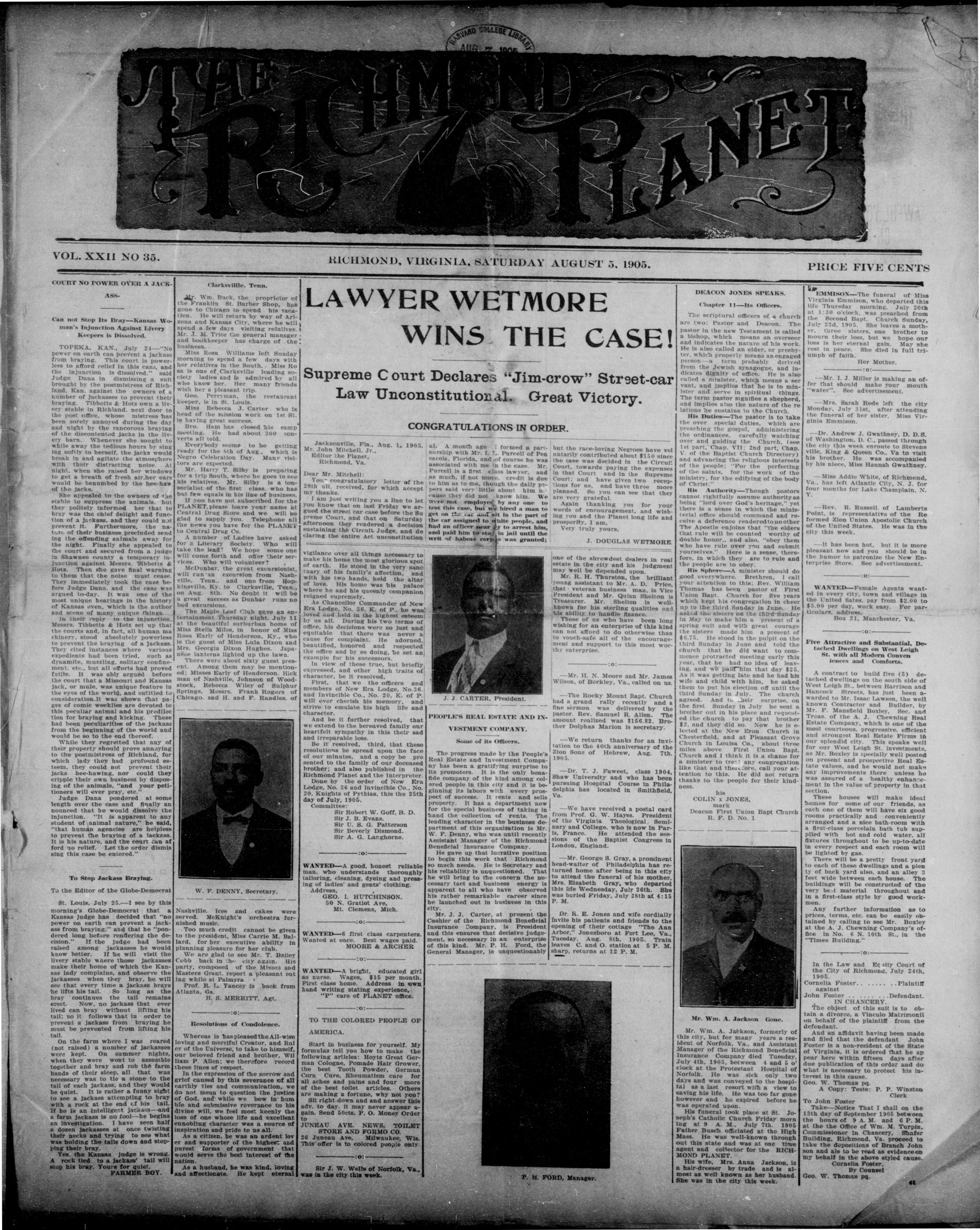
THE RICHMOND PLANET
COURT NO POWER OVER A JACK
ASS-
Can not Stop Its Bray—Kansas Woman's Injunction Against Livery Keepers is Dissolved.
TOPEKA, KAN., July 24—"No power on earth can prevent a jackass from braying. This court is powerless to afford relief in this case, and the injunction is dissolved." said Judge Dana in dismissing a suit brought by the postmistress of Richland, Kan. against the owners of a number of jackasses to prevent their braying. Tibbettts & Hotz own a livery stable in Richland, next door to the post office, whose mistress has been sorely annoyed during the day and night by the rancorous braying of the discontented jacks in the livery barn. Whenever she sought to while away the tedious hours by singing softly to herself, the jacks would break in and agitate the atmosphere with their distracting noise. At night, when she raised her windows to get a breath of fresh air, her ears would be benumbed by the hee-haw of the jacks.
She appealed to the owners of the stable to suppress the animals, but they politely informed her that to bray was the chief delight and function of a jackass, and they could not prevent it. Furthermore, the nature of their business precluded sending the offending animals away for the night. Finally she appealed to the court and secured from a judge in Shawnee county a temporary injunction against Messrs. Tibbetts & Hotz. Then she gave final warning to them that the noise must cease. They immediately took the case before Judge Dana, and the case was argued to-day. It was one of the most unique hearings in the history of Kansas even, which is the author and scene of many unique things. In their reply to the injunction, Messrs. Tibbetts & Hotz set up that the courts and, in fact, all human man machinery, stood absolutely powerless to prevent the braying of a jackass. They cited instances where various expedients had been tried, such as dynamite, muzzling, solitary confinement, etc., but all efforts had proved futile. It was aly argued before the court that a Missouri and Kansas jack, or mule, was unique feature in the eyes of the world, and entitled to consideration. It was shown that pages of comic weeklies are devoted to this peculiar animal and his predilection for braying and kicking. These had been peculiarities of the jackass from the beginning of the world and would be so to the end thereof.
While they regretted that any of their property should prove annoying to the postmistress of Richland, for which lady they had profound esteem, they could not prevent their jacks hee-hawing, nor could they cripple their own business by disposing of the animals, "and your petitioners will ever pray, etc."
Judge Dana pondered at some length over the case and finally an nounced that he would dissolve the injunction. "It is apparent to any student of animal nature," he said, "that human agencies are helpless to prevent the braying of a fackness. It is his nature, and the court can aford no relief. Let the order dismiss sing this case be entered."
To Stop Jackass Braying.
To the Editor of the Globe-Democrat
St. Louis, July 25.—I see by this morning's Globe-Democrat that a Kansas judge has decided that "no power on earth can prevent a jackass from braying," and that he "pondered long before rendering the decision." If the judge had been raised among jackasses he would know better. If he will visit the livery stable where those jackasses make their home of which the Kansas lady complains, and observe the jackasses when they bray, he will see that every time a jackass brays he lifts his tail. So long as the bray continues the tail remains erect. Now, no jackass that ever lived can bray without lifting his tail; so it follows that in order to prevent a jackass from braying he must be prevented from lifting his tail.
On the farm where I was reared (not raised) a number of jackasses were kept. On summer nights, when they were wont to assemble together and bray and rob the farm hands of their sleep, all that was necessary was to the a stone to the tail of each jackass, and they would be quiet. It is rather a funny sight to see a jackass attempting to bray with a rock at the end of his tail. If he is an intelligent jackass—and a farm jackass is no fool—he begins an investigation. I have seen half a dozen jackasses at once twisting their necks and trying to see what was holding the tails down and stopping their bray. Yes, the Kansas judge is wrong. A rock tied to a jackass' tail will stop his bray. You's for quiet.
Mr. Wm. Buck, the proprietor of the Franklin St. Barber Shop, has gone to Chicago to spend his vacation. He will return by way of Arizona and Kansas City, where he will spend a few days visiting relatives. Mr. J. M. Trice the general manager and bookkeeper has charge of the business. Miss Rosa Williams left Sunday morning to spend a few days with her relatives in the South. Miss Rosa is one of Clarksville leading society ladies and is admired by all who know her. Her many friends wish her a pleasant trip. Geo. Perryman, the restaurant keeper, is in St. Louis. Miss Rebecca J. Carter who is head of the mission work on 1st St. is having great success. Bro. Ham has closed his camp meeting. He had about 300 converts all told. Everybody seems to be getting ready for the 5th of Aug., which is Negro Celebration Day. Many visitors are expected. Mr. Harry T. Silby is preparing for a trip South, where he goes to see his relatives. Mr. Silby is a tonsorialist of the first class, who has but few equals in his line of business. If you have not subscribed for the PLANET, please leave your name at Central Drug Store and we will be glad to supply you. Telephone all the news you have for the PLANET to Central Drug Co.
A number of Ladies have asked for a Literary Society. Who will take the lead? We hope some one will come forth and offer 'their services. Who will volunteer? McDunbar, the great excursionist, will run an excursion from Nashville, Tenn., and one from Hopkinsville, Ky. to Clarksville, Tenn., on Aug. 5th. No doubt it will be a great success as Dunbar runs no bad excursions.
The Maple Leaf Club gave an entertainment Thursday night. July 11 at the beautiful surburban home of Miss Stella Miles, in honor of Miss Rosa Early of Henderson, Ky., who is the guest of Miss Lula Dixon and Mrs. Georgia Dixon Hughes, Japanese lanterns lighted up the lawn.
There were about sixty guest present. Among them may be mentioned; Misses Early of Henderson. Hickman of Nashville, Johnson of Woodstock, Rebecca Wiley of Sulphur Springs, Messrs. Frank Rogers of Chicago, and H. and F. Randles of
W. F. DENNY. Secretary.
Nashville, Ices and cakes were served. McKnight's orchestra furnished music.
Too much credit cannot be given to the president, Miss Carrie M. Ballard, for her executive ability in planning pleasure for her club.
We are glad to see Mr. T. Bailey Cebb back in the city again. His party, composed of the Misses and Masters Grant, report a pleasant outing while at Palmyra.
Prof. R. L. Yancey is back from Atlanta, Ga.
Resolutions of Condolence
Whereas he has pleased the All-wise loving and merciful Creator, and Rul er of the Universe, to take to himself, our beloved friend and brother, Wiliam P. Allen; we therefore record these lines of respect.
In the expression of the sorrow and grief caused by this severance of all earthly ties and communication, we do not mean to question the justice of God, and while we bow in humble and submissive reverence to his divine will, we feel most keenly the loss of one whose life and excellent ennobling character was a source of inspiration and pride to us all.
As a citizen, he was an ardent lover and supporter of the highest and purest forms of government that would serve the best interest of the nation.
As a hustand, he was kind, loving and affectionate. He kept eternal
RICHMOND, VIRGINIA, SATURDAY AUGUST 5. 1905.
LAWYER WETMORE WINS THE CASE!
Supreme Court Declares "Jim-crow" Street-car Law Unconstitutional. Great Victory.
Jacksonville, Fla., Aug. 1, 1905
Mr. John Mitchell, Jr.,
Dear Mr. Mitchell:
You congratulatory letter of the 29th ult. received, for which accept my thanks.
I am just writing you a line to let you know that on last Friday we argued the street car case before the Supreme Court, and that on Saturday afternoon they rendered a decision sustaining the Circuit Judge, and de claring the entire Act unconstitution
vigilance over all things necessary to make his home the most glorious spot of earth. He stood in the very sanctuary of his family's affection, and with his two hands, held the altar of love. His home was his palace where he and his queenly companion reigned supremely.
As Chancellor Commander of New Era Lodge, No. 36. K. of P., he was loved and held in the highest esteem by us all. During his two terms of office, his decisions were so just and equitable that there was never a cause for complaint. He adorned, beautified, honored and respected the office and by so doing, he set an example for his successors.
In view of these true, but briefly expressed, and other high traits of character, be it resolved.
First, that we the officers and members of New Era Lodge, No. 36. and Invincible Co., No. 20. K. of P. will ever cherish his memory, and strive to emulate his high life and character.
And be it further resolved, that we extend to the bereaved family our heartfelt sympathy in this their sad and irreparable loss. Be it resolved, third, that these resolutions be spread upon the face of our minutes, and a copy be presented to the family of our deceased brother; and also published in the Richmond Planet and the interpreter. Done by the order of New Era Lodge, No. 36 and Invincible Co., No. 20, Knights of Pythias, this the 25th day of July, 1905.
Committee:
Sir Robert W. Goff, B. D.
Sir J. B. Evans.
Sir U. S. G. Patterson
Sir Beverly Dismond.
Sir A. G. Langhorne.
WANTED—A good, honest reliable man, who understands thoroughly tailoring, cleaning, dyeing and pressing of ladies' and gents' clothing.
Address,
GEO. I. HUTCHINSON.
50 N. Gratiot Ave.
Mt. Clemens, Mich.
WANTED—6 first class carpenters
Wanted at once. Best wages paid.
MOORE & ARCHER
WANTED—A bright, educated girl as nurse. Wages, $15 per month. First class home. Address in own hand writing stating experience, "P" care of PLANET office.
:0:
TO THE COLORED PEOPLE OF AMERICA.
Start in business for yourself. My formulas tell you how to make the following articles: Hoys Great German Cologne, Pomade Hair Grower, the best Tooth Powder, German Corn Cure, Rheumatism cure for all aches and pains and four more of the best toilet articles. Others are making a fortune, why not you?
Sit right down and and answer this adv. to day. it may never appear again. Send 50cts. P. O. Money Order to
JUNEAU AVE. NEWS. TOILET
STORE AND FORMO CO.
STORE AND FORMO CO.
26 Juneau Ave, Milwaukee, Wis.
This offer is to colored people only.
Sir J. W. Wells of Norfolk, Va., was in the city this week.
CONGRATULATIONS IN ORDER.
al. A month ago I formed a partnership with Mr. I. L. Purcell of Pen-sacola, Florida, and of course he was associated with me in the case. Mr. Purcell is a first class lawyer, and as much, if not more, credit is due to him as to me, though the daily papers said very little about him because they did not know him. We were not employed by any one to test this case, but we hired a man to get on the car and sit in the part of the car assigned to white people, and had an officer nearby to arrest him, and paid him to stay, in jail until the writ of habeas corpus was granted;
J. J. CARTER, President.
The progress made by the People's Real Estate and Investment Company has been a gratifying surprise to its promoters. It is the only bonafide company of the kind among colored people in this city and it is beginning its labors with every prospect of success. It rents and sells property. It has a department now for the special business of taking in hand the collection of rents. The leading character in the business department of this organization is Mr. W. F. Denny, who was until recently Assistant Manager of the Richmond Beneficial Insurance Company. He gave up that lucrative position to begin this work that Richmond so much needs. He is Secretary and his reliability is unquestioned. That he will bring to the concern the necessary tact and business energy is apparent to all who have observed his rather remarkable career since he launched out in business in this city. Mr. J. J. Carter, at present the Cashier of the Richmond Beneficial Insurance company, is President and this ensures that decisive judgment, so necessary in an enterprise of this kind. Mr. P. H. Ford, the General Manager, is questionably
P. H. FORD, Manager.
Some of its Officers.
but the race-loving Negroes have voluntarily contributed about $150 since the case was decided in the Circus' Court, towards paying the expenses in that Court and in the Supreme Court; and have given two receptions for us, and have three more planned. So you can see that they are very grateful.
Again thanking you for your words of encouragement, and wishing you and the Planet long life and prosperity, I am.
Very truly yours,
J. DOUGLAS WETMORE.
one of the shrewdest dealers in real estate in the city and his judgment may well be depended upon.
Mr. R. H. Thurston, the brilliant young assistant to Mr. A. D. Price, that veteran business man, is Vice President, and Quinn Shelton is Treasurer. Mr. Shelton is well-known for his sterling qualities and his ability to handle finance.
Those of us who have been long wishing for an enterprise of this kind can not afford to do otherwise than to vouch-safe all of the encouragement and support to this most worthy enterprise.
Mr. H. N. Moore and Mr. James Wilson, of Berkley, Va., called on us.
The Rocky Mount Bapt. Church had a grand rally recently and a fine sermon was delivered by the pastor. Rev. Samuel R. Allen. The amount realized was $156.82. Brother Dolphas Marion is secretary.
We return thanks for an invitation to the 40th anniversary of the Zion Sons of Hebrew, Aug. 7th. 1905.
Dr. T. J. Faweet, class 1904, Shaw University and who has been pursuing Hospital Course in Philadelphia has located in Smithfield, Va.
We have received a postal card from Prof. G. W. Hayes. President of the Virginia Theological Seminary and College, who is now in Paris, France. He attended the sessions of the Baptist Congress in London, England.
Mr. George S. Gray, a prominent head-waiter of Philadelphia has returned home after being in this city to attend the funeral of his mother, Mrs. Elizabeth Gray, who departed this life Wednesday, July 26th. She was buried Friday, July 28th at 4:15 P. M.
Dr. R. E. Jones and wife cordially invite his patients and friends to the opening of their cottage "The Ann Arbor." Jonesboro at Fort Lee, Va. Tuesday. Aug. 5th. 1905. Train leaves C. and O. station at 5 P. M. sharp, returns at 12 P. M.
DEACON JONES SPEAKS
Chapter 11—Its Officers.
The scriptural officers of a church are two: Pastor and Deacon. The pastor in the new Testament is called a bishop, which means an overseer and indicates the nature of his work. He is also called an elder, or presbyter, which properly means an engaged person—a term probably derived from the Jewish synagogue, and indicates dignity of office. He is also called a minister, which means a servant, and implies that he is to minister and serve in spiritual things. The term pastor signifies a shepherd, and implies also the nature of the relations he sustains to the Church.
His Duties—The pastor is to take the over special duties, which are preaching the gospel, administering the ordinances, carefully watching over and guiding the Church, (see 1st part, Chap. VII; 2nd part, Chap. V. of the Baptist Church Directory) and advancing the religious interests of the people; "For the perfecting of the saints, for the work of the ministry, for the edifying of the body of Christ."
His Authority—Though pastors cannot rightfully assume authority as being "lord over God's heritage," yet there is a sense in which the ministerial office should command and receive a deference rendered to another The Apostle enjoins that "the elders that rule will be counted worthy of double honor., and also." "obey them who have rule over you and submit yourselves." Here is a sense, therefore, in which they are to rule and the people are to obey.
His Sphere—A minister should do good everywhere. Brethren, I call your attention to this; Rev. William Thomas has been pastor of First Union Bapt. Church for five years which kept his congregation in cheer up to the third Sunday in June. He asked the sisters on the third Sunday in May to make him a present of a spring suit and with great courage the sisters made him a present of $6.75. He stood in the pulpit on the third Sunday in June and told the church that he did want to commence protracted meeting early this year, that he had no idea of leaving, and we paid him that day $25. As it was getting late and he had his wife and child with him, he asked them to put his election off until the third Sunday in July. The church agreed. And to their surprise, on the first Sunday in July he sent a brother out in his place and requested the church to pay that brother $2, and they did so. Now he is elected at the New Eron Church in Chesterfield, and at Pleasant Grove Church in Louisa Co., about three miles above First Union Bapt. Church and I think it is a shame for a minister to treat any congregation like that and therefore, call your attention to this. He did not return thanks to the people for their kindness.
Deacon First Union Bapt Church
R. F. D. No. 1
Mr. Wm. A. Jackson Gone.
Mr. Wm. A. Jackson, formerly of this city, but for many years a resident of Norfolk, Va., and Assistant Manager of the Richmond Beneficial Insurance Company died Tuesday, July 4th, 1905, between 4 and 5 o'clock at the Protestant Hospital of Norfolk. He was sick only two days and was conveyed to the hospital as a last resort with a view to saving his life. He was too far gone however and he expired before he was operated upon.
His funeral took place at St. Joseph's Catholic Church Friday morning at 9 A. M., July 7th, 1905 Father Busch officiated at the High Mass. He was well-known through out this state and was at one time agent and collector for the RICH-MOND PLANET. His wife, Mrs. Anna Jackson, is a hair-dresser by trade and is almost as well known as her husband. She was in the city this week.
EMMISON—The funeral of Miss Virginia Emmison, who departed this life Thursday morning, July 20th at 1:30 o'clock, was preached from the Second Bapt. Church Sunday, July 23d, 1905. She leaves a mother, three sisters, one brother to tumble their loss, but we hope our loss is her eternal gain. May she rest in peace. She died in full triumph of faith.
Her Mother.
—Mr. I. J. Miller is making an offer that should make your mouth "water". See advertisement.
—Mrs. Sarah Rode left the city Monday, July 31st, after attending the funeral of her sister, Miss Virginia Emmison.
—Dr. Andrew J. Gwathney, D. D.S. of Washington, D. C., passed through the city this week enroute to Stevensville, King & Queen Co., Va to visit his brother. He was accompanied by his niece, Miss Hannah Gwathney.
—Miss Addie White, of Richmond, Va., has left Atlantic City, N. J. for four months for Lake Champlain, N. Y.
—Rev. R. Russell, of Lamberts Point, is representative of the Reformed Zion Union Apostolic Church of the United States. He was in the city this week.
—It has been hot, but it is more pleasant now and you should be in the humor to patronize the New Enterprise Store. See advertisement.
WANTED—Female Agents wanted in every city, town and village in the United Sates, pay from $2.00 to $5.00 per day, work easy. For particulars, address,
Box 21, Manchester, Va.
Five Attractive and Substantial, Detached Dwellings on West Leigh St. with all Modern Conveniences and Comforts.
A contract to build five (5) detached dwellings on the south side of West Leigh St., between Harrison and Hancock Streets, has just been awarded to Mr. Isaac Lawson, the well known Contractor and Builder, by Mr. F. Mansfield Boxley, Sec. and Treas., of the A. J. Chewning Real Estate Company, which is one of the most courteous, progressive, efficient and strongest Real Estate Firms in our splendid city. This speaks well for our West Leigh St. investments, as Mr. Boxley is specially well posted on present and prospective Real Estate values, and he would not make any improvements there unless he was assured of a healthy enhancement in the value of property in that section.
These houses will make ideal homes for some of our friends, as each one of them will have six good rooms practically and conveniently arranged and a nice bath-room with a first-class porcelain bath tub supplied with hot and cold water, all fixtures throughout to be up-to-date in every respect and each room will be lighted by gas.
There will be a pretty front yard to each of these dwellings and a plenty of back yard also, and an alley 3 feet wide between each house. The buildings will be constructed of the very best material throughout and in a first-class style by good workmen.
Any further information as to prices, terms, etc. can be obtained by calling to see Mr. Boxley at the A. J. Chewning Company's office in No. 6 N. 10th St., in the "Times Building."
In the Law and Equity Court of
the City of Richmond, July 24th,
1905.
Cornelia Foster.....Plaintiff
against
John Foster.....Defendant.
JOHN CHANCERY
The object of this suit is to obtain a divorce, a Vincula Matrimonii on behalf of the plaintiff from the defendant.
And an affidavit having been made and filed that the defendant, John Foster is a non-resident of the State of Virginia, it is ordered that he apear here within fifteen days after due publication of this order and do what is necessary to protect his interest in this cause.
Geo. W. Thomas pq.
A Copy: Teste: P. P. Winston
Clerk
To John Foster
Take—Notice That I shall on the 13th day of September 1905 between the hours of 9 A. M. and 6 P. M. at the Office of Wm. M. Turpin, Commissioner in Chancery, Shafer Building, Richmond, Va. proceed to take the depositions of Branch John son and als to be read as evidence on my behalf in the above styled cause.
Cornelia Foster.
By Counsel
Geo. W. Thomas pq.
SATURDAY ..... Aug. 5th, 1905.
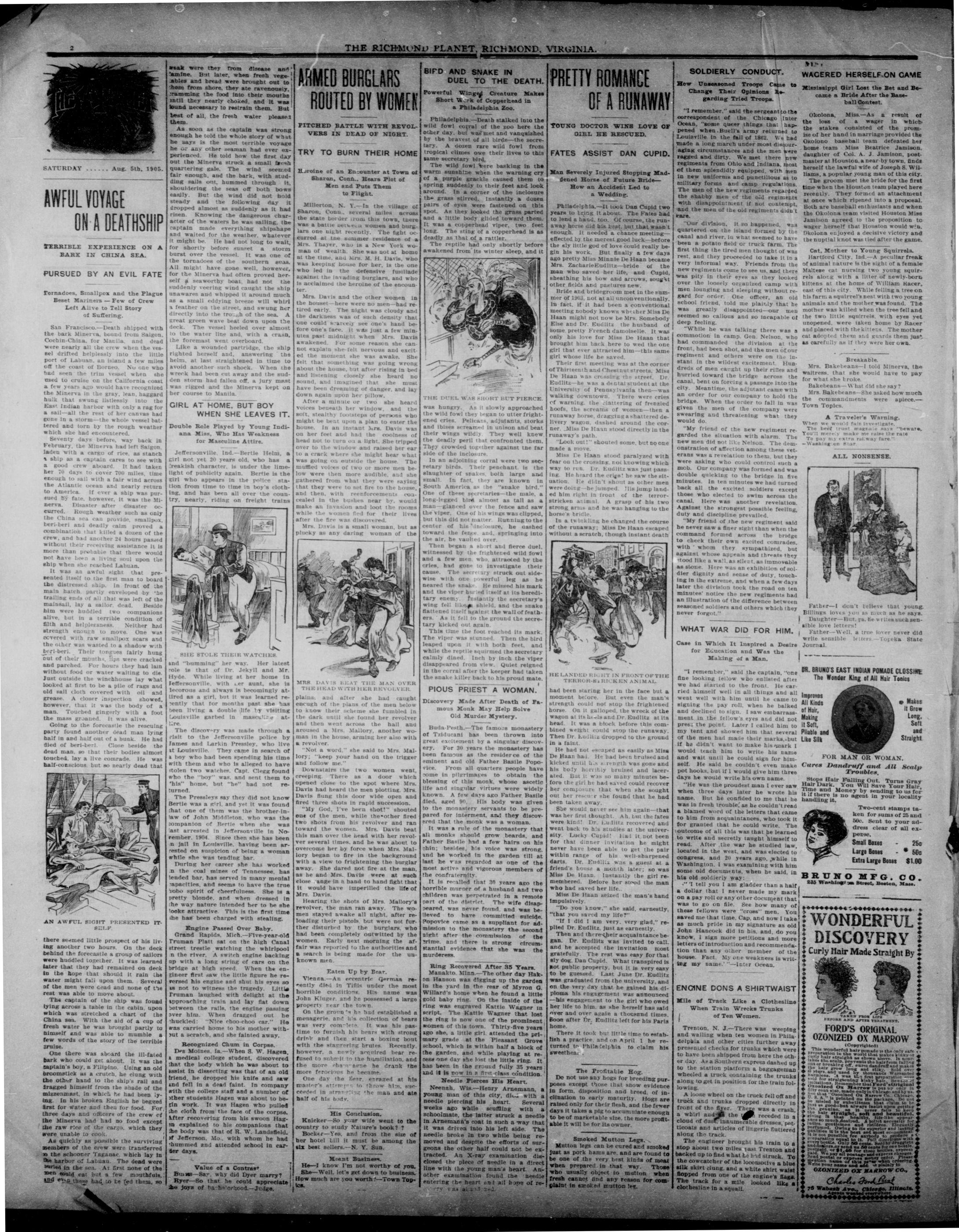
AWFUL VOYAGE
ON A DEATHSHIP
TERRIBLE EXPERIENCE ON A
BARK IN CHINA SEA.
PURSUED BY AN EVIL FATE
Tornadoes, Smallpox and the Plague
Beset Mariners — Few of Crew
Left Alive to Tell Story
of Suffering.
San Francisco.—Death shipped with the bark Minerva, bound from Salgen, Cochin-China, for Manila, and dead were nearly all the crew when the vessel drifted helplessly into the little port of Labuan, an island a few miles off the coast of Borneo. No one who had seen the trim vessel when she used to cruise on the California coast a few years ago would have recognized the Minerva in the gray, lean, haggard hulk that swung listlessly into the East Indian harbor with only a rag for a sail—all the rest of her canvas had gone in a storm—the whole vessel battered and torn by the rough weather which she had encountered.
Seventy days before, way back in February, the Minerva had left Saigon, laden with a cargo of rice, as stanch ship as a captain cares to see with a good crew aboard. It had taken her 70 days to cover 700 miles, time enough to sail with a fair wind across the Atlantic ocean and nearly return to America. If ever a ship was pursued by fate, however, it was the Minerva. Disaster after disaster occurred. Rough weather such as only the China sea can provide, smallpox, beri-beri and deadly calm proved a combination that killed a dozen of the crew, and had another 24 hours passed without their receiving assistance it is more than probable that there would not have been a living soul upon the ship when she reached Labuan.
It was an awful sight that presented itself to the first man to board the distressed ship. In front of the main hatch, partly enveloped by the trailing ends of all that was left of the mainsail, lay a sail, dead. Beside him were huddled two companions alive, but in a terrible condition of filth and helplessness. Neither had strength enough to move. One was covered with raw smallpox scars and the other was wasted to a shadow with berl-beri. Their tongues fairly hung out of their months, lips were cracked and parched. For hours they had laan without food or water waiting to die. Just outside the winchhouse lay what looked at first to be a pile of rags and old sail cloth covered with oil and grease. A closer inspection showed, however, that it was the body of a man. Touched gingerly with a foot the mass groaned. It was alive.
Going to the forecastle the rescuing party found another dead man lying half in and half out of a bunk. He had died of berl-berl. Close beside the dead man, so that their bodies almost touched, lay a live comrade. He was half-conscious, but so nearly dead that
AN AWFUL SIGHT PRESENTED ITSELF.
there seemed little prospect of his living another two hours. On the deck behind the forecaste a group of sailors were huddled together. It was learned later that they had remained on deck in the hope that should it rain the water might fall upon them. Several of the men were dead and none of the rest was able to move about.
The captain of the ship was found lying across a table in the cabin, upon which was stretched a chart of the China sea. With the aid of a cup of fresh water he was brought partly to himself and was able to mumble a few words of the story of the terrible cruise.
One there was aboard the ill-fated hark who could get about. It was the captain's boy, a Flipino. Using an old broomstick as a crutch, he clung with the other hand to the ship's rail and ragged himself from the shade of the mizzenmast, in which he had been lying. In his broken English he begged first for water and then for food. For three days and officers of the crew of the Minerva had had no food except the raw rice of the cargo, which they were unable to cook.
As quickly as possible the surviving members of the crew were transferred to the schooner Taganac which lay in the harbor of Labuan. The dead were buried in the sea. At first none of the men could eat but a few mouthfuls, and even these had to be fed them, so
weak were they from disease and
amine. But later, when fresh vegetables and bread were brought out to them from shore, they ate ravenously,ramming the food into their moutins until they nearly choked, and it was sound necessary to restrain them. But best of all, the fresh water pleased them.
As soon as the captain was strong enough he told the whole story of what he says is the most terrible voyage he or any other seaman had ever experienced. He told how the first day out the Minerva struck a small fresh quartering gale. The wind seemed fair enough, and the bark, with studding sails out, hummed through it, shouldering the seas off both bows easily. But the wind did not hold steady and the following day it dropped almost as suddenly as it had risen. Knowing the dangerous character of the waters he was sailing, the captain made everything shipshape and waited for the weather, whatever it might be. He had not long to wait, for shortly before sunset a storm burst over the vessel. It was one of the tornadoes of the southern seas. All might have gone well, however, for the Minerva had often proved herself a seaworthy boat, had not the suddenly veering wind caught the ship unawares and whipped it around much as a small eddying breeze will whirl a feather on the street, and swung her directly into the trough of the sea. A great green wave beat down upon the deck. The vessel heeded over almost to the water line and, with a crash, the foremast went overboard.
Like a wounded partridge, the ship righted herself and, answering the helm, at last straightened in time to avoid another such shock. When the wreck had been cut away and the sudden storm had fallen off, a jury mast was rigged and the Minerva kept on her course to Manila.
GIRL AT HOME, BUT BOY
WHEN SHE LEAVES IT.
Double Role Played by Young Indiana Miss, Who Has Weakness for Masculine Attire.
Jeffersonville, Ind.-Bertie Helm, a girl not yet 20 years old, who has a breakish character, is under the limelight of publicity again. Bertie is the girl who appears in the police station from time to time in boy's clothing, and has been all over the country, nearly, riding on freight trains
SHE STOLE THEIR WATCHES
and "bumming" her way. Her latest role is that of Dr. Jekyll and Mr. Hyde. While living at her home in Jeffersonville, with her aunt, she is lecorous and always is becoming attired as a girl, but it was learned recently that for months past she has been living a double life by visiting Louisville garbed in masculine attire.
The discovery was made through a visit to the Jeffersonville police by James and Larkin Pressley, who live at Louisville. They came in search of a boy who had been spending his time with them and who is alleged to have stolen two watches. Capt. Clegg found who the "boy" was, and sent them to "his" home, but "he" had not returned.
The Pressleys say they did not know Bertie was a girl, and yet it was found that one of them was the brother-in-law of John Middleton, who was the companion of Bertie when she was last arrested in Jeffersonville in November, 1904. Since then she has been in jail in Louisville, having been arrested on auspicion of being a woman while she was tending bar.
During her career she has worked in the coal mines of Tennessee, has tended bar, has served in many mental capacities, and seems to have the true robo spirit of cheerfulness. She is a pretty blonde, and when dressed in the way nature intended her to be she looks attractive. This is the first time she has been charged with stealing.
Engine Passed Over Baby
Engine Passed Over Baby.
Grand Rapids, Mich.-Five-year-old
Pruman Platt sat on the high Canal
street strelte watching the whirlpool
in the river. A switch engine backing
up with a long string of cars on the
bridge at high speed. When the
engineer first saw the little figure he
reversed his engine and shut his eyes so
as not to witness the tragedy. Little
Pruman laughed with delight at the
approaching train and lay flat down
between the rails, the engine passing
over him. When dragged out he
chuckled: "Nice choo-choo car." He
was carried home to his mother without
a scratch, and she fainted away.
Recognized Crum in Corpse.
Des Moines, Ia.—When S. W. Hagen,
a medical college student, discovered
that the body which he was about to
assist in dissecting was that of an old
friend, he dropped his knife and saw
and fell in a dead faint. In company
with the college staff and a number of
other students Hagen was about to
begin work. It was Hagen who pulled
the cloth from the face of the corpse.
After recovering from his swoon Hagen
explained to his companions that
the body was that of R. W. Landsfield,
of Jefferson, Mo., with whom he had
hummed and attended school in ear-
der days.
Value of a Contrast
Bums—Say, why did Dyer marry?
Ryer—So that he could appreciate
the joys of husbandry—Judge.
THE RICHMOND PLANET, RICHMOND, VIRGINIA.
ARMED BURGLARS ROUTED BY WOMEN
PITCHED BATTLE WITH REVOLVERS IN DEAD OF NIGHT.
TRY TO BURN THEIR HOME
Haroine of an Encounter at Town of Sharon, Conn., Hears Plot of Men and Puts Them to Flight.
Millerton, N. Y.—In the village of Sharon, Conn., several miles across the state border from this town, there was a battle between women and burglar one night recently. The fight occurred at the summer residence of a Mrs. Thayer, who is a New York woman of wealth. She was not at home at the time, and Mrs. M. H. Davis, who was keeping house for her, is the one who led in the defensive fusillade against the invading burglar, and who is acclaimed the heroine of the encounter.
Mrs. Davis and the other women in the house—here were no men—had retired early. The night was cloudy and the darkness was of such density that one could scarcely see one's hand before one's face. It was just a few minutes past midnight when Mrs. Davis awakened. For some reason she cannot explain she felt nervous and excited the moment she was awake. She felt that something was going wrong about the house, but after rising in bed and listening closely she heard no sound, and imagined that she must have been dreaming of danger, and lay down again upon her pillow.
After a minute or two she heard voices beneath her window, and the soft, stealthy footsteps of persons who might be bent upon a plan to enter the house. In an instant Mrs. Davis was on her feet and had the coolness of head not to turn on a light. She tripped over to the window and raised her ear to a crack where she might hear what was going on outside the house. The muffled voices of two or more men below were then more audible, and she gathered from what they were saying that they were to set fire to the house, and then, with reinforcements concealed in the bushes near by, would make an invasion and loot the rooms while the women fired for their lives after the fire was discovered.
Mrs. Davis is a small woman, but as plucky as any daring woman of the
MRS. DAVIS BEAT THE MAN OVER THE HEAD WITH HER REVOLVER.
MRS. DAVIS BEAT THE MAN OVER THE HEAD WITH HER REVOLVER, plains, and after she had caught enough of the plans of the men below to know their scheme she fumbled in the dark until she found her revolver and then went across the hall and aroused a Mrs. Mallory, another woman in the house, arming her also with a revolver.
"Not a word," she said to Mrs. Mallory; "keep your hand on the trigger and follow me."
Downstairs the two women went, creeping. There as a door which opened close to the spot where Mrs. Davis had heard the men plotting. Mrs. Davis fung this door wide open and fired three shots in rapid succession.
"My God, I've been shot!" shouted one of the men, while the other fired two shots from his revolver and ran toward the women. Mrs. Davis beat this man over the head with her revolver several times, and he was about to overcome her by force when Mrs. Mallory began to fire in the background with a view to frightening the burglar away. She dared not fire at the man, as he and Mrs. Davis were at such close range in a hand to hand fight that it would have imperilled the life of Mrs. Davis.
Hearing the shots of Mrs. Mallory's revolver, the man ran away. The women stayed awake all night, after reloading their pistols, but were not further disturbed by the burglar, who had been completely outwitted by the women. Early next morning the affair was reported to the authorities and a search is being made for the unknown men.
Eaten Up by Bear
Vienna.—An eccentric German recently died in Tiflis in the most horrible conditions. His name was John Kluger, and he possessed a large property near the town.
On the ground's he had established a menagerie, and his collection of bears was very complete. It was his pastime to furnish his bears with strong drink and then start a boxing bout with the staggering brutes. Recently, however, a newly acquired bear refused to submit to the humiliation, and the more champagne he drank the more ferocious he became.
One day the bear, enraged at his master's attempts to throw him, succeeded in strangling the man and ate half of his body.
His Coulclusion
Knicker—So your wife went to the country to study Nature's book? ?
Bocker—Yes, and from the size of her hotel bill it must be among the six best sellers—N. Y. Sun.
Meant Business.
He—I know I'm not worthy of you.
She—Well, let's get down to business.
How much are you worth?—Town Topics.
BIFD AND SNAKE IN
DUEL TO THE DEATH.
Powerful Winged Creature Makes Short Work of Copperhead in a Philadelphia Zoo.
Philadelphia—Death stalked into the wild fowl corral of the zoo here the other day, but was met and vanquished by the bravest of all birds—the secretary. A dozen rare wild fowl from tropical climes owe their lives to this same secretary bird.
The wild fowl were basking in the warm sunshine when the warning cry of a purple grackle caused them to spring suddenly to their feet and look around. In a corner of the enclosure the grass stirred. Instantly a dozen pairs of eyes were fastened on this spot. As they looked the grass parried and a little body glided toward them. It was a copperhead viper, two feet long. The sting of a copperhead is as deadly as that of a rattler.
The reptile had only shortly before awakened from its winter sleep and it
THE DUEL WAS SHORT BUT FIERCE
was hungry. As it slowly approached the wild fowl they began to utter frightened cries. Pelicans, adjutants, storks and blises screamed in unison and beat their wings wildly. They well knew the deadly peril that confronted them. They crowded together against the far side of the inclosure.
In an adjoining corral were two secretary birds. Their penchant is the slaughter of snakes, both large and small. In fact, they are known in South America as the "snake bird." One of these secretaries—the male, a long-legged bird almost as tall as a man—glanced over the fence and saw the viper. One of his wings was clipped, but this did not matter. Running to the center of his "inclosure," he gasped toward the fence, and springing into the air, he vaulted over.
Then began a short and fierce duel, witnessed by the frightened wild fowl and a few men who, attracted by the cries, had gone to investigate their cause. The secretary struck out sidewise with one powerful leg as he neared the snake. He missed his mark and the viper hurled itself at its hereditary enemy. Instantly the secretary's wing fell like shield, and the snake flattened itself against the wall of feathers. As it fell to the ground the secretary kicked out again.
This time the foot reached its mark. The viper was stunned. Then the bird leaped upon it with both feet, and while the reptile squirmed the secretary calmly dined. Inch by inch the viper disappeared from view. Quiet reigned in the corral after the keeper had taken the snake killer back to his proud mate.
PIOUS PRIEST A WOMAN.
Discovery Made After Death of Famous Monk May Help Solve Old Murder Mystery.
Buda-Pesth.-The famous monastery of Txiducani has been thrown into great excitement by a singular discovery. For 30 years the monastery has been famous as the residence of the eminent and old Father Basile Popovice. From all quarters people have come in pilgrimages to obtain the blessing of this monk, whose ascetic life and singular virtues were widely known. A few days ago Father Basile died, aged 90. His body was given to the monastery servants to be prepared for interment, and they discovered that the monk was a woman.
It was a rule of the monastery that all monks should grow beards, and Father Basile had a few hairs on his chin; besides, his voice was strong, and he worked in the garden till at last he was regarded as one of the most active and vigorous members of the confraternity. It is recalled that 30 years ago the horrible murder of a husband and two children was perpetrated in a remote part of the district. The wife disappeared, was never found, and was believed to have committed suicide. Popovice came as a suppliant for admission to the monastery the second night after the commission of the crime, and there is strong circumstantial evidence that she was the murderer.
Ring Recovered After 35 Years
King Recovered After 35 Years.
Manakto. Miln. "The other day Hakon Hanson was digging up the garden in the yard in the rear of Myron G. Willard's home when he found a little gold baby ring. On the inside of the ring was engraved Kattie Wagner in script. The Kattie Wagner that lost the ring is now one of the prominent women of this town. Thirty-five years ago she, a little girl, attended the primary grade at the Pleasant Grove school, which is within half a block of the garden, and while playing at restress one day she lost the little ring. It has been in the ground fully 35 years and it is now in a first-class condition.
Needle Placed His Heart.
Neenah. Wis.-Henry Arnemann, a young man of this city, died with a needle piercing his heart. Several weeks ago while scuffling with a schoolmate, the latter struck a needle in Arnemann's coat in such a way that it was driven into his left side. The needle broke in two while being removed and despite the efforts of surgeons the other half could not be extracted. An X-ray examination disclosed the piece of needle in a direct line with the young man's heart. Another examination found the needle entering the heart and all hope of recovery was at last.
PRETTY ROMANCE OF A RUNAWAY
YOUNG DOCTOR WINS LOVE OF GIRL HE RESCUED.
FATES ASSIST DAN CUPID.
Man Severely Injured Stopping Maddened Horse of Future Bride—
Philadelphia.—It took Dan Cupid two years to bring it about. The Fates had to lend a hand, too. Of course, the runaway horse did his host, but that wasn't enough. It needed a chance meeting—effected by the merest good luck—before the sly little god of love could really begin his work. But finally a few days ago pretty Miss Minnie De Haan became Mrs. ZacharieEudilitz—bride of the man who saved her life, and Cupid, sheathing his bow and arrows, sought other fields and pastures new.
Bride and bridegroom met in the summer of 1903, not at all unconventionally. In fact, if it had been a conventional meeting knows whether Miss De Haan might not now be Mrs. Somebody Else and Dr. Eudilitz the husband of some pretty French damoiselle. It was only his love for Miss De Haan that brought him back to wed the one girl that ever attracted him—this same girl whose life he saved.
Their first meeting was at the corner of Thirteenth and Chestnut streets. Miss De Haan was crossing the street, Dr. Eudiltz—he was a dental student at the University of Pennsylvania then—was walking downtown. There were cries of warning, the clattering of frenzied hoofs, the screams of women—then a runaway horse, dragging a shattered delivery wagon, dashed around the corner. Miss De Haan stood directly in the runaway's path.
"Look out!" shouted some, but no one made a move.
Miss De Haan stood paralyzed with fear on the crossing, not knowing which way to run. Dr. Eudiltz was just passing. He heard the crisps! he saw the situation. He didn't shout as other men were doing—he jumped. His jump landed him right in front of the terror-stricken animal. A grasp of his two strong arms and he was hanging to the horse's bridle.
In a twinkling he changed the course of the runaway; Miss De Haan escaped without a scratch, though instant death.
HE LANDED RIGHT IN FRONT OF THE TERROR-STRIKEN ANIMAL.
HE LANDED RIGHT IN FRONT OF THE TERROR-STRIKEN ANIMAL.
had been staring her in the face but a moment before. But even the man's strength could not stop the frightened horse. On it galloped, the wreck of the wagon at its heels and Dr. Eudiltz at its head. It was a block before this combined weight could stop the runaway. Then Dr. Eudiltz dropped to the ground in a faint.
He had not escaped as easily as Missa De Haan had. He had been bruised and kicked until his strength was gone and his body horribly bruised and lacerated. But it was so many minutes before the girl he had saved could recover her composure that when she sought out her rescuer she found that he had been taken away.
She would never see him again—that was her first thought. Ah, but the fates were kind! Dr. Eudilitz recovered and went back to his studies at the university. Lucky Cupid! Had it not been for that dinner invitation he might never have been able to get the pair within range of his well-sharpened darts. Dr. Eudilitz was a guest at a friend's house a month later; so was Miss De Haan. Instantly the girl remembered. Before her strood the man who had saved her life. Miss De Haan seized the man's hand impulsively. "Do you know," she said, earnestly, "that you saved my life?" "If I did I am very, very glad," replied Dr. Eudilitz, just as earnestly.
Then and there their acquaintance began. Dr. Eudilitz was invited to call, and he accepted the invitation most gratefully. The rest was easy for that sly dog, Dan Cupid. What transpired is not public property, but it is very easy to be guessed. Last June Dr. Eudilitz was graduated from the university, and on the very day that he gained his diploma his engagement was announced—his engagement to the girl who owed her life to him, as she herself has said over and over again a thousand times. Soon after Dr. Eudilitz left for his Paris home.
There it took but little time to establish a practice, and on April 1 he returned to Philadelphia to claim his sweetheart.
The Profitable Hog
Do not use any hogs for breeding purposes except those that snow evidences in form, disposition and breed, of inclination to early maturity. Hogs are raised only for their flesh, and the fewer days it takes a pig to accumulate enough to be of marketable size, the more profitable it will be for its owner.
Smoked Mutton Legs.
Mutton legs can be cured and smoked just as pork hams are, and are found to be one of the very best kinds of meat when prepared in that way. Those who usually object to mutton when fresh cannot find any reason for complaint in smoked mutton leg.
SOLDIERLY CONDUCT.
How Unseasoned Troops Came to Change Their Opinions Regarding Tried Troops.
"I remember," said the sergeant to the correspondent of the Chicago Inter Ocean, "some queer things that happened when Buell's army returned to Louisville in the fall of 1862. We had made a long march under most discouraging circumstances and the men were ragged and dirty. We met there new regiments from Ohio and Indiana, most of them splendidly equipped, with men in new uniforms and punctilious as to military forms and camp regulations. The men of the new regiments regarded the shabby men of the old regiments with disappointment if not contempt, and the men of the old regiments didn't care.
"Our division, it so happened, was quartered on the island formed by the canal and river, in what seemed to have been a potato field or truck farm. The first thing the tired men thought of was rest, and they proceeded to take it in a very informal way. Friends from the new regiments come to see us, and there was pity in their eyes as they looked over the loosely organized camp with men lounging and sleeping without regard for order. One officer, an old school friend, told me plainly that he was greatly disappointed—our men seemed so callous and so incapable of deep feeling.
"While he was talking there was a commotion in camp. Gen. Nelson, who had commanded the division, at the front, had been shot, and the men of our regiment and others were on the instant in the wildest excitement. Hundreds of men caught up their rifles and hurried toward the bridge across the canal, bent on forcing a passage into the city. Meantime, the adjutant came with an order for our company to hold the bridge. When the order to fall in was given the men of the company were swearing and threatening what they would do.
"My friend of the new regiment regarded the situation with alarm. The new men did not like Nelson. The demonstration of affection among these veterans was a revelation to them, but they were asking who could control such a mob. Our company was formed and was double quicking to the bridge in five minutes. In ten minutes we had turned back all the excited soldiers except those who elected to swim across the canal. Here was another revelation. Against the strongest possible feeling, duty and discipline prevailed.
"My friend of the new regiment said he never saw a finer sight than when the command formed across the bridge to check their own excited comrades, with 'whom they sympathized, but against whose appeals and threats they stood like a wall, as silent, as immovable as stone. Here was an exhibition of soldier dignity and sense of duty, touching in the extreme, and when a few days later the division took the road on ten minutes' notice the new regiments had an illustration of the difference between seasoned soldiers and others which they never forgot."
WHAT WAR DID FOR HIM.
Case in Which It Inspired a Desire for Education and Was the Making of a Man.
"I remember," said the captain, "one fine looking fellow who enlisted after we had started to the front. He carried himself well in all things and all went well with him until he came to signing the pay roll, when he balked and declined to sign. I saw embarrassment in the fellow's eyes and did not press the point. Later I called him to my tent and showed him that several of the men had made their marks, but if he didn't want to make his mark I would teach him to write his name and wait until he could sign for himself. He said he couldn't even make pot hooks, but if I would give him three days he would write his own name.
"He was the prousted man I ever saw when three days later he wrote his name. But he confided to me that he was in fresh trouble, as he couldn't read a blamed word of the letters that came to him from acquaintances, who took it for granted that he could write. The outcome of all this was that he learned to write and secretly taught himself to read. After the war he studied law, located in the west, and was elected to congress, and 20 years ago, while in Washington, I was examining with him some old documents, when he said, in his old soldierly way:
"I tell you I am gladder than a half a dollar that I never made my mark on a pay roll or any other document that was to go on file. See how many of these fellows were "cross" men. You saved me that time, Cap, and now I take as much pride in my signature as old John Haneck did in his, and, do you know, I sign more petitions and more letters of introduction and recommendation than any other member of the house. Fact. My one weakness is writing my name."—Inter Ocean.
ENGINE DONS A SHIRTWAIST
Mile of Track Like a Clothesline
When Train Wrecks Trunks
of Ten Women.
Trenton, N. J.—There was weeping and walling when ten women in Philadelphia and other cities further away presented checks for trunks which were to have been shipped from here the other day. As a Southern express dashed up to the station platform a baggageman wheeled a truck containing the trunks along to get in position for the train following.
A loose wheel on the truck fell off and truck and trunks dropped directly in front of the fyer. There was a crash, a whirl and on the floor receded in a cloud of dust, innumerable dresses, petitools and articles of lingerie fluttered along the track.
The engineer brought his train to a stop about two miles past Trenton and backed up to find what he had struck. To the cowcatcher of the locomotive a blue silk skirt clung, and a white shirt waist flopped from one of the engine's fiags. The track for a mile looked like a clothesline in a small.
Mississippi Girl Lost the Bet and Became a Bride After the Baseball Contest.
Okolona, Miss.—As a result of the loss of a wager in which the stakes consisted of the promise of her hand in marriage provided the Okolono baseball team defeated her home team Miss Beatrice Jamison, daughter of Col. A. J. Jamison, postmaster at Houston, a near-by town, finds herself the lawful wife of Joseph S. Williams, a popular young man of this city. The groom met the bride for the first time when the Houston team played here recently. They formed an attachment at once which ripened into a proposal. Both are baseball enthusiasts and when the Okolona team visited Houston Miss Jamison agreed to the proposition to wager herself that Houston would win. Okolona enjoyed a decisive victory and the nuptial knot was tied after the game.
Cat. Mother to Young Squirrels.
Hartford City, Ind.—A peculiar freak of animal nature is the sight of a female Maltese cat nursing two young squirrels along with a litter of newly-born kittens at the home of William Racer, east of this city. While felting a tree on his farm a squirrel's nest with two young animals and the mother was found. The mother was killed when the tree fell and the two little squirrels, with eyes yet unopened, were taken home by Racer and placed with the kittens. The mother cat adopted them and guards them just as carefully as if they were her own.
Mrs. Bakebeans—I told Minerva, the waitress, that she would have to pay for what she broke
Bakebeans—What did she say?
Bakebeans—What did she say?
Mrs. Bakebeans—She asked how much
the commandments were aplice.
Town Topics.
A Traveler's Warning.
When we would fain investigate,
The beef trust magnate says "beware,
You must trust me now the rate.
To pay my extra road fare."
-Washing on Star.
ALL NONSENSE.
Father—I don't believe that young Billings loves you as much as he says. Daughter—But pa. he writes such sensible love letters!
Father—Well, a true lover never did write sensible letters—Topeka State Journal.
DR. BRUUNO'S EAST INDIA POMADE CLOSHINE
The Wonder King of All Hair Topics
Improves
All Kinds
of Hair,
Making
It Soft,
Pilable and
Like Silk
Makes
it Grow
Long,
Soft
and
Straight
FOR MAN OR WOMAN.
Cures Dandruff and All Scalp
Troubles.
Stops Hair Falling Out. Turns Gray
Hair Dark. You Will Save Your Hair.
Time and Money by sending to us for
it if there is no agent in your locality
handling it.
Two-cent stamps taken
for sums of 25 and
50c. Sent to your address clear of all
expense.
1
Small Boxes - 25c
Large Boxes - 50c
Extra Large Boxes $1.00
WONDERFUL DISCOVERY Curly Hair Made Straight By
TAKEN FROM LIFE
BEFORE AFTER THEM
The Return of SHERLOCK HOLMES
By A. CONAN DOYLE,
Author of "The Adventures of Sherlock Holmes."
"The Hound of the Baskervilles." "The Sign
of the Four." "A Study In Scarlet." Etc.
250,000 acre
250,000 acres. Minerals in Lancashire and Wales. Address, Carlton House Terrace; Holdernesse Hall. Hallamshire; Carston castle, Bangor, Wales. Lord of the admiralty, 1872; chief secretary of state for"—Well, well, this man is certainly one of the greatest subjects of the crown."
"The greatest and perhaps the wealthiest. I am aware, Mr. Holmes, that you take a very high line in professional matters and that you are prepared to work for the work's sake. I may tell you, however, that his grace has already intimated that a check for $5,000 will be handed over to the person who can tell him where his son is and another thousand to him who can name the man or men who have taken him."
"It is a princely offer," said Holmes. "Watson, I think that we shall accompany Dr. Huxtable back to the north of England. And now, Dr. Huxtable, when you have consumed that milk you will kindly tell me what has happened, when it happened, how it happened and, finally, what Dr. Thorneycroft Huxtable of the Priory school, near Mackleton, has to do with the matter and why he comes three days after an event—the state of your chin gives the date—to ask for my humble services."
Our visitor had consumed his milk and biscuits. The light had come back to his eyes and the color to his cheeks as he set himself with great vigor and lucidity to explain the situation.
"I must inform you, gentlemen, that the Priory is a preparatory school of which I am the founder and principal
"I CANNOT IMAGINE HOW I CAME T
Copyright by Collier's Weekly.
I CAME TO BE SO WEAK."
Copyright by Collier's Weekly
"I CANNOT IMAGINE HOW I CAME TO BE SO WEAK."
bouches under the closed eyes were en in color; the loose mouth droop-olourlessly at the corners; the roll-chins were unshaven. Collar and bore the grime of a long journey, the hair bristled unkempt from the shaped head. It was a sorely ken man who lay before us. "That is it, Watson?" asked Holmes, absolute exhaustion, possibly mere anger and fatigue," said I, with my ear on the tready pulse, where the arm of life trickled thin and small. return ticket from Mackleton, in north of England," said Holmes, bring it from the watch pocket. "It it 12 o'clock yet. He has certainly an early starter."
"Ruxtable's Side Lights on Horace may possibly recall my name to your memories. The Priory is without exception the best and most select preparatory school in England. Lord Lever-stoke, the Earl of Blackwater, Sir Cathecart Soames—they all have intruded their sons to me. But I felt that my school had reached its zenith when three weeks ago, the Duke of Holdernesse sent Mr. James Wilder, his secretary, with the intimation that young Lord Saltire, ten years old, his only son and heir, was about to be committed to my charge. Little did I think that this would be the prelude to the most crushing misfortune of my life.
"On May 1 the boy arrived, that being the beginning of the summer term. He was a charming youth, and he soon fell into our ways. I may tell you I trust that I am not indiscreet, but half confidencees are absurd in such a case—that he was not entirely happy at home. It is an open secret that the duke's married life had not been a peaceful one, and the matter had ended in a separation by mutual conceal, the duchess taking up her residence in the south of France. This had occurred very shortly before, and the boy's sympathies are known to have been strongly with his mother. He moped after her departure from Holdernesse Hall, and it was for this reason that the duke desired to send him to my establishment. In a fortnight the boy was quite at home with us and was apparently absolutely happy.
"He was last seen on the night of May 13—that is, the night of last Monday. His room was on the second floor and was approached through another larger room, in which two boys were sleeping. These boys saw and heard nothing, so that it is certain that young Saltire did not pass out that way. His window was open, and there is a stout ivy plant leading to the ground. We could trace no footmarks below, but it is sure that this is the only possible exit.
"His absence was discovered at 7 o'clock on Tuesday morning. His bed had been slept in. He had dressed himself fully before going off in his usual school suit of black Eton jacket and dark gray trousers. There were no signs that any one had entered the room, and it is quite certain that anything in the nature of cries or a struggle would be been heard, since Counter, the elder boy in the inner room, is a very light sleeper.
The Adventure of the Priory School
No. 5 of the Series
(Copyright, 1964, by A. Cavan Doole and Collier's
Weekly.)
2015, by McClure, Phillip & Co.)
I have had some dramatic entrances and exits upon our small stage at Baker street, but I cannot recollect anything more sudden and startling than the first appearance of Dr.
E have had some dramatic entrances and exits upon our small stage at Baker street, but I cannot recollect anything more sudden and startling than the first appearance of Dr. Thorneycroft Huxtable, M. A., Ph. D., etc. His card, which seemed to small to carry the weight of his academic distinctions, preceded him by a few seconds, and then he entered himself, so large, so pompous and so dignified that he was the very embodiment of self possession and solidity. And yet his first action when the door had closed behind him was to stagger against the table, whence he slipped down upon the floor, and there was that majestic figure prostrate and insensible upon our bearskin hearth rug.
We had sprung to our feet, and for a few moments we stared in silent amazement at this ponderous piece of wreckage, which told of some sudden and fatal storm far out on the ocean of life. Then Holmes hurried with a cushion for his head and I with brandy for his lips. The heavy, white face was seamed with lines of trouble; the hang-
ing pencles under the closed eyes were leaden in color; the loose mouth drooped dolorously at the corners; the rolling chins were pushenny. Collar and sirt hore the grime of a long journey, and the hair bristled unkempt from the well shaped head. It was a sorely stricken man who lay before it.
"What is it, Watson?" asked Holmes.
"Absolute exhaustion, possibly mere hunger and fatigue," said I, with my finger on the threadly pulse, where the stream of life trickled thin and small.
"Return ticket from Mackleton, in the north of England," said Holmes, drawing it from the watch pocket.
"It is not 12 o'clock yet. He has certainly been an early starter."
The puckered cycloids had begun to quiver, and now a pair of vacant gray eyes looked up at us. An instant later the man had scrambled on to his feet, his face crimson with shame.
"Forgive this weakness, Mr. Holmes.
I have been a little overwrought.
Thank you, if I might have a glass of milk and a biscuit I have no doubt that
I should be better. I came personally,
Mr. Holmes, in order to insure that you would return with me. I feared that no telegram would convince you of the absolute urgency of the case."
"When you are quite restored"—
"I am quite well again. I cannot imagine how I came to be so weak. I wish you, Mr. Holmes, to come to Mackleton with me by the next train."
My friend shook his head.
"My colleague, Dr. Watson, could tell you that we are very busy at present. I am retained in this case of the Ferrers documents, and the Abergavenny murder is coming up for trial. Only a very important issue could call me from London at present."
"Important." Our visitor threw up his hands. "Have you heard nothing of the abduction of the only son of the Duke of Holderness?"
"What! The late cabinet minister?" "Exactly. We had tried to keep it out of the papers, but there was some rumor in the Globe last night. I thought it might have reached your ears."
Holmes shot out his long, thin arm and picked out volume "H" in his encyclopaedia of reference.
"Holdernesse, sixth duke, K. G., P. C.,-half the alphabet" "Baron Beverley, earl of Carston"-dear me, what a list! "Lord lieutenant of Hallamshire since 1900. Married Edith, daughter of Sir Charles Appledore, 1888. Heir and only child. Lord Saltire. Owns about
A
ILLUSTRATED BY F. D. STEELE
THE RICHMOND PLANE: RICHMOND, VIRGINIA.
"When Lord Saltire's disappearance was discovered, I at once called a roll of the whole establishment—bays, masters and servants. It was then that we ascertained that Lord Saltire had not been alone in his flight. Heldeger, the German master, was missing. His room was on the second floor at the farther end of the building, facing the same way as Lord Saltire's. His bed had also been slept in, but he had apparently gone away partly dressed, since his shirt and socks were lying on the floor. He had undoubtedly let himself down by the lvy, for we could see the marks of his feet where he had landed on the lawn. His bicycle was kept in a small shed beside this lawn, and it was also gone.
"He had been with me for two years and came with the best references, but he was a silent, morose man, not very popular either with masters or boys. No trace could be found of the fugitives, and now, on Thursday morning, we are as ignorant as we were on Tuesday. Inquiry was, of course, made at once at Holdernesse Hall. It is only a few miles away, and we imagined that in some sudden attack of homelessness the boy had gone back to his father, but nothing had been heard of him. The duke is greatly agitated, and as to me you have seen yourselves the state of nervous prostration to which the suspense and the responsibility have reduced me. Mr. Holmes, if ever you put forward your full powers I implore you to do so now, for never in your life could you have a case which is more worthy of them."
Sherlock Holmes had listened with the utmost intentness to the statement of the unhappy schoolmaster. His drawn brows and the deep furrow between them showed that he needed no exhortation to concentrate all his attention upon a problem which, apart from the tremendous interests involved, must appeal so directly to his love of the complex and the unusual. He now drew out his notebook and jotted down one or two memoranda.
"You have been very remiss in not coming to me sooner," said he severely. "You start me on my investigation with a very serious handicap. It is inconceivable, for example, that this ivy and this lawn would have yielded nothing to an expert observer."
"I am not to blame, Mr. Holmes. His grace was extremely desirous to avoid all public scandal. He was afraid of his family unhappiness being dragged before the world. He has a deep horror of anything of the kind."
"But there has been some official investigation?"
"Yes, sir, and it has proved most disappointing. An apparent clew was at once obtained, since a boy and a young man were reported to have been seen leaving a neighboring station by an early train. Only last night we had news that the couple had been hunted down in Liverpool, and they prove to have no connection whatever with the matter in hand. Then it was that in my despair and disappointment after a sleepless night I came straight to you by the early train."
"I suppose the local investigation was relaxed while this false clew was being followed up?"
"It was entirely dropped."
"So that three days have been wast ed. The affair has been most deplorably handled."
"I feel it and admit it."
"And yet the problem should be capable of ultimate solution. I shall be very happy to look into it. Have you been able to trace any connection between the missing boy and this German master?"
"None tt all."
"Was he in the master's class?"
"No; he never exchanged a word with him so far as I know."
"That is certainly very singular. Had the boy a bicycle?"
"No."
"Was any other bicycle missing?"
"No."
"Is that certain?"
"Quite."
"Well, now, you do not mean to seriously suggest that this German rode off upon a bicycle in the dead of the night, bearing the boy in his arms?"
"Certainly nct."
"Then what is the theory in your mind?"
"The bicycle may have been a blind,
It may have been hidden somewhere
and the pair gone off on foot."
"Quite so, but it seems rather an absurd blind, does it not? Were there other bicycles in this shed?"
"Several."
"Would he not have hidden a couple
had he desired to give the idea that
they had gone off upon them?"
"I suppose he would."
"Of course he would. The blind theory won't do. But the incident is an admirable starting point for an investigation. After all, a bicycle is not an easy thing to conceal or to destroy. One other question. Did any one call to see the boy on the day before he disappeared?"
"No."
"Did he get any letters?"
"Yes, one letter."
"From whom?"
"From his father."
"Do you open the boy's letters?"
"No."
"How do you know it was from the father?"
"The coat of arms was on the envelope, and it was addressed in the duke's peculiar stiff hand. Besides, the duke remembers having written."
"When had he a letter before that?"
"Not for several days."
"Had he ever one from France?"
"No, never."
"You see the point of my questions, of course. Either the boy was carried off by force or he went of his own free will. In the latter case you would expect that some prompting from outside would be needed to make so young a lad do such a thing. If he has had no visitors, that prompting must have come in letters; hence I try to find out who were his correspondents."
"I fear I cannot help you much. His only correspondent, so far as I know, was his own father."
"Who wrote to him on the very day of his disappearance. Were the relations between father and son very friendly?"
"His grace is never very friendly with any one. He is completely immersed in large public questions and is rather inaccessible to all ordinary emo-
tions. But he was always kind to the boy in his own way."
"But the sympathies of the latter were with the mother?"
"Yes."
"Did he say so?"
"No."
"Then how could you know?"
"I have had some confidential talks with Mr. James Wilder, his grace's secretary. It was he who gave me the information about Lord Saltire's feelings."
"I see. By the way, that last letter of the duke's—was it found in the boy's room after he was gone?"
"No; he had taken it with him. I think, Mr. Holmes, it is time that we were leaving for Euston."
"I will order a four wheeler. In a quarter of an hour we shall be at your service. If you are telegraphing home, Dr. Huxtable, it would be well to allow the people in your neighborhood to imagine that the inquiry is still going on in Liverpool or wherever else that red herring led your pack. In the meantime I will do a little quiet work at your own doors, and perhaps the scent is not so cold but that two old hounds like Watson and myself may get a sniff of it."
That evening found us in the cold, bracing atmosphere of the Peak country, in which Dr. Huxtable's famous school is situated. It was already dark when we reached it. A card was lying on the half table, and the butter whispered something to his master, who turned to us with agitation in every heavy feature.
"The duke is here," said he. "The duke and Mr. Wilder are in the study. Come, gentlemen, and I will introduce you."
I was, of course, familiar with the pictures of the famous statesman_but the man himself was very different from his representation. He was a tall and stately person, scrupulously dressed, with a drawn, thin face and a nose which was grotesquely curved and long. His complexion was of a dead pallor, which was more startling by contrast with a long, dwindling beard of vivid red which flowed down over his white waistcoat, with his watch chain gleaming through its fringe. Such was the stately presence who looked stonily at us from the center of Dr. Huxtable's hearth rug. Beside him stood a very young man, whom I understood to be Wilder, the private secretary. He was small, nervous, alert, with intelligent light blue eyes and mobile features. It was he who at once, in an inclusive and positive tone, opened the conversation.
"I called this morning, Dr. Huxtable, too late to prevent you from starting for London, I learned that your object was to invite Mr. Sherlock Holmes to undertake the conduct of this case. His grace is surprised, Dr. Huxtable, that you should have taken such a step without consulting him."
"When I learned that the police had failed"—
"His grace is by no means convinced that the police have failed."—
"But surely, Mr. Wilder"—
"You are well aware, Dr. Huxtable, that his grace is particularly anxious to avoid all public scandal. He prefers to take as few people as possible into his confidence."
"The matter can be easily remedied," said the browbeaten doctor, "Mr. Sherlock Holmes can return to London by the morning train."
"Hardly that, doctor; hardly that," said Holmes in his blondest voice. "This northern air is invigorating and pleasant, so I propose to spend a few days upon your moors and to occupy my mind as best I may. Whether I have the shelter of your roof or of the village inn is, of course, for you to decide."
I could see that the unfortunate doctor was in the last stage of indecision, from which he was rescued by the deep, sonorous voice of the red bearded duke, which boomed out like a dinner gong.
"I agree with Mr. Wilder, Dr. Huxtable, that you would have done wisely to consult me. But since Mr. Holmes has already been taken into your confidence it would indeed be absurd that we should not avail ourselves of his services. Far from going to the inn, Mr. Holmes, I should be pleased if you would come and stay with me at Holderness Hall."
"I thank your grace. For the purposes of my investigation I think that it would be wiser for me to remain at the scene of the mystery."
"Just as you like, Mr. Holmes. Any information which Mr. Wilder or I can give you is, of course, at your disposal."
"It will probably be necessary for me to see you at the hall," said Holmes. "I would only ask you now, sir, whether you have formed any explanation in your own mind as to the mysterious disappearance of your son?"
"No, sir. I have not."
"Excuse me if I allude to that which is painful to you, but I have no alternative. Do you think that the duchess had anything to do with the matter?" The great minister showed perceptible hesitation. "I do not think so," he said at last. "The other most obvious explanation is that the child has been kidnapped for the purpose of levying ransom. You have not had any demand of the sort?" "No, sir." "One more question, your grace. I understand that you wrote to your son upon the day when this incident occurred." "No; I wrote upon the day before." "Exactly. But he received it on that day?" "Yes." "Was there anything in your letter which might have unbalanced him or induced him to take such a step?"
"Did you post that letter yourself?"
The nobleman's reply was interrupted by his secretary, who broke in with some heat.
"His grace is not in the habit of posting letters himself," said he.
This letter was laid with others upon the study table, and I myself put them in the post bag."
"You are sure this one was among them?"
"Yes; I observed it."
"How many letters did your grace
"Twenty or thirty. I have a large correspondence. But surely this is somewhat irrelevant."
"Not entirely," said Holmes.
"For my own part," the duke continued. "I have advised the police to turn their attention to the south of France. I have already said that I do not believe that the duchess would encourage so monstrous an action, but the lad had the most wrong headed opinions, and it is possible that he may have fled to her, aided and abetted by this German. I think, Dr. Huxtable, that we will now return to the hall."
I could see that there were other questions which Holmes would have wished to put, but the nobleman's abrupt manner showed that the interview was at an end. It was evident that to his intensely aristocratic nature this discussion of his intimate family affairs with a stranger was most abhorrent and that he feared lest every fresh question would throw a fiercer light into the discreetly shadowed corners of his dual history. When the nobleman and his secretary had left, my friend flung himself at once with characteristic eagerness into the investigation.
The boy's chamber was carefully examined and yielded nothing save the absolute conviction that it was only through the window that he could have escaped. The German master's room and effects gave no further clew. In his case a trailer of ivy had given way under his weight, and we saw by the light of a lantern the mark on the lawn where his heels had come down. That one dent in the short green grass was the only material witness left of this inexplicable nocturnal flight. Sherlock Holmes left the house alone and only returned after 11. He had obtained a large ordinance map of the neighborhood, and this he brought into my room, where he laid it on the bed, and, having balanced the lamp in the middle of it, he began to smoke over it and occasionally to point out objects of interest with the reeking amber of his pipe.
"This case grows upon me. Watson." said he. "There are decidedly some points of interest in connection with it. In this early stage I want you to realize those geographical features which may have a good deal to do with our investigation.
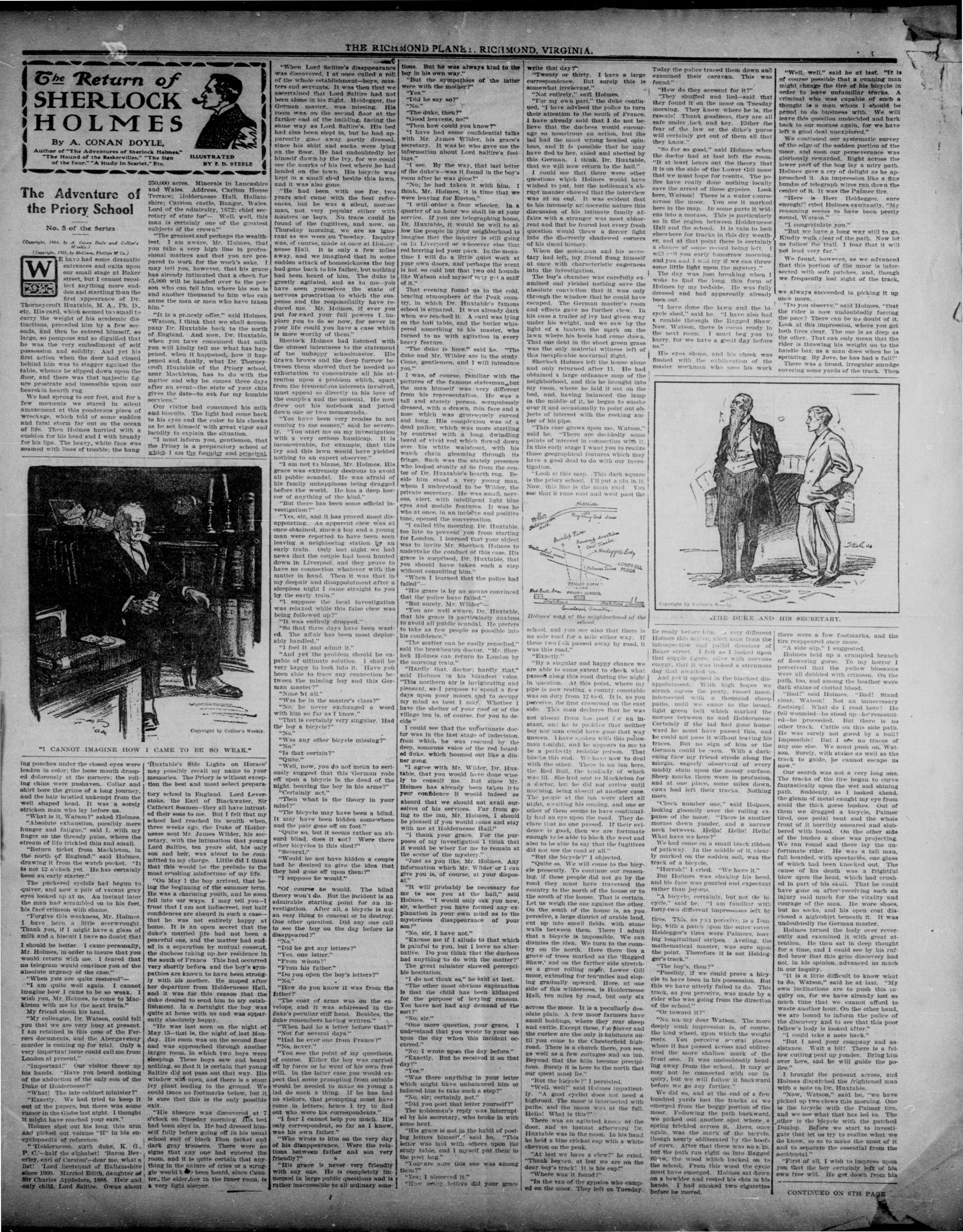
"Look at this map. This dark square is the priory school. I'll put a pin in it. Now, this line is the main road. You see that it runs east and west past the
Holmes' map of the neighborhood of the school.
school, and you see also that there is no side road for a mile either way. If these two folk passed away by road, it was this road."
"By a singular and happy chance we are able to some extent to check what passed along this road during the night in question. At this point, where my pipe is now resting, a county constable was on duty from 12 to 6. It is, as you perceive, the first crossroad on the east side. This man declares that he was not absent from his post for an instant, and he is positive that neither boy nor man could have gone that way unseen. I have spoken with this police man tonight, and he appears to me to be a perfectly reliable person. That blocks this end. We have now to deal with the other. There is an inn here, the Red Bull, the landlady of which was ill. She had sent to Mackenlon for a doctor, but he did not arrive until morning, being absent at another case. The people at the inn were alert all night, awaiting his coming, and one or other of them seems to have continually had an eye upon the road. They declare that no one passed. If their evidence is good, then we are fortunate enough to be able to block the west and also to be able to say that the fugitives did not use the road at all."
"Quite so. We will come to the bicycle presently. To continue our reasoning, if these people did not go by the road they must have traversed the country to the north of the house or to the south of the house. That is certain. Let us weigh the one against the other. On the south of the house is, as you perceive, a large district of arable land, cut up into small fields, with stone walls between them. There I admit that a bicycle is impossible. We can dismiss the idea. We turn to the country on the north. Here there lies a grove of trees marked as the 'Ragged Shaw', and on the farther side stretches a great rolling moor, Lower Gill moor, extending for ten miles and sloping gradually upward. Here, at one side of this wilderness, is Holdernesse Hali, ten miles by road, but only six
across the moor. It is a peculiarly desolate plain. A few moor farmers have small holdings, where they rear sheep and cattle. Except these, the plover and the curlew are the only inhabitants until you come to the Chesterfield highroad. There is a church there, you see, as well as a few cottages and an inn. Beyond that the hills become precipitous. Surely it is here to the north that our quest must lie."
"But the bicycle?" I persisted.
"Well, well!" said Holmes impatiently. "A good cyclist does not need a highroad. The moor is intersected with paths, and the moon was at the full. Hello! What is this?"
There was an agitated knoosh at the door, and an instant afterward Dr. Huxtable was in the room. In his hand he hold a blue cricket cap with a white chevron on the peak.
"At last we have a clew!" he cried. "Thank heaven, at last we are on the dear boy's track! It is his cap!"
"In the van of the agysties who camped on the moor. They left on Tuesday.
Today the police traced them down and examined their caravan. This was found."
"How do they account for it?"
"They shuffled and led—said that they found it on the moor on Tuesday morning. They know where he is, the rascals! Thank goodness, they are all safe under lock and key. Either the fear of the law or the duke's purse will certainly get out of them all that they know."
"So far so good," said Holmes when the doctor had at last left the room. "It at least bears out the theory that it is on the side of the Lower Gill moor that we must hope for results. The police have really done nothing locally save the arrest of these gypsies. Look here, Watson! There is a water course across the moor. You see it marked here in the map. In some parts it widens into a morass. This is particularly so in the region between Holdernesse Hall and the school. It is vain to look elsewhere for tracks in this dry weather, and at that point there is certainly a chance of some record being left. I will tell you early tomorrow morning, and you and I will try if we can throw some little light upon the mystery." The day was just breaking when I woke to find the long, thin form of Holmes by my bedside. He was fully dressed and had apparently already been out.
"I have done the lawn and the bicycle shed," said he. "I have also had a ramble through the Ragged Shaw. Now, Watson, there is cocoa ready in the next room. I must beg you to hurry, for we have a great day before us." His eyes shone, and his cheek was flushed with the exhilaration of the master workman who sees his work
Copyright by Collier's Weekly.
Stick as
Copyright by Collier's Weekly.
he ready before him. A very different Holmes this active, alert man from the introspective and pallid dreamer of Baker street. I felt as I looked upon that supple figure, alive with nervous energy, that it was indeed a strenuous day that awaited us. there were a few f tire reappeared once "a side slip," I su Holmes held up a of flowering gorse, perceived that the
And yet it opened in the blackest disappointment. With high hopes we struck across the peaty, russet moor, intersected with a thousand sheep paths, until we came to the broad, light green belt which marked the morass between us and Holdernessse. Certainly if the lad had gone homeward he must have passed this, and he could not pass it without leaving his traces. But no sign of him or the German could be seen. With a darkening face my friend strode along the margin, eagerly observant of every muddy stain upon the mossy surface. Sheep marks there were in profusion, and at one place, some miles down, cows had left their tracks. Nothing more.
"Check number one," said Holmes, looking gloomily over the rolling expanse of the moor. "There is another morass down yonder, and a narrow neck between. Hello! Hello! Hello! What have we here?"
We had come on a small black ribbon of pathway. In the middle of it, clearly marked on the sodden soil, was the track of a bicycle.
"Hurrah!" I cried. "We have it."
But Holmes was shaking his head, and his face was puzzled and expectant rather than joyous.
"A bicycle, certainly, but not the bicycle," said he. "I am familiar with forty-two different impressions left by tires. This, as you perceive, is a Dumlop, with a patch upon the outer cover. Heldegger's tires were Palmers, leaving longitudinal stripes. Aveling, the mathematical master, was sure upon the point. Therefore it is not Heldegger's track."
"The boy's, then?" "Possibly, if we could prove a bicycle to have been in his possession. But this we have utterly failed to do. This track, as you perceive, was made by a rider who was going from the direction of the school."
"No, no my dear Watson. The more deeply nook impression is, of course, the hind wheel, upon which the weight rests. You perceive several places where it has passed across and obliterated the more shallow mark of the front one. It was undoubtedly heading away from the school. It may or may not be connected with our inquiry, but we will follow it backward before we go any farther."
We did so, and at the end of a few hundred yards lost the tracks as we emerged from the boggy portion of the moor. Following the path backward, we picked out another spot where a spring trickled across it. Here, once again, was the mark of the bicycle, though nearly obliterated by the hoops of cows. After that there was no sign, but the path ran right on into Ragged Shaw, the wood which backed on to the school. From this wood the cycle must have emerged. Holmes sat down on a bowler and rested his chin in his hands. I had smoked two cigarettes before he moved.
"The boy's, then?"
"Or toward it?"
"Well, well," said he at last. "It is of course possible that a cunning man might change the tire of his bicycle in order to leave unfamiliar tracks. A criminal who was capable of such a thought is a man whom I should be proud to do business with. We will leave this question undecided and hark back to our morass again, for we have left a good deal unexplored."
We continued our systematic survey of the edge of the sodden portion of the moor, and soon our perseverance was gloriously rewarded. Right across the lower part of the bog lay a miray path. Holmes gave a cry of delight as he approached it. An impression like a fing bundle of telegraph wires ran down the center of it. It was the Palmer tire.
"Here is Herr Heidegger, sure enough!" cried Holmes exultantly. "My reasoning seems to have been pretty sound. Watson."
"I congratulate you."
"But we have a long way still to go. Kindly walk clear of the path. Now let us follow the trail. I fear that it will not lead very far."
We found, however, as we advanced that this portion of the moor is intersected with soft patches, and, though we frequently lost sight of the track, we always succeeded in picking it up once more.
"Do you observe," said Holmes, "that the rider is now undoubtedly forcing the pace? There can be no doubt of it. Look at this impression, where you get both tires clear. The one is as deep as the other. That can only mean that the rider is throwing his weight on to the handle bar, as a man does when he is sprinting. By Jove, he has had a fall."
There was a broad, irregular smudge covering some yards of the track. Then
Stahl 45
there were a few footmarks, and the tire reappeared once more.
"A side slip," I suggested.
Holmes held up a crumpled branch of flowering gorse. To my horror I perceived that the yellow blossoms were all dabbled with crimson. On the path, too, and among the heather were dark stains of clotted blood.
"Bad!" said Holmes. "Bad! Stand clear, Watson! Not an unnecessary foots(ep)? What do I read here? He fell wounded—he stood up—he remounted—he proceeded. But there is no other track. Cattle on this side path. He was surely not gored by a bull? Impossible! But I see no traces of any one else. We must stalk on, Watson. Surely, with stalks as well as the track to guide, he cannot escape us now."
Our search was not a very long one. The tracks of the tire began to curve fantastically upon the wet and shining path. Suddenly, as I looked ahead, the gleam of metal caught my eye from amid the thick gorse bushes. Out of them we dragged a bicycle, Palmer tired, one pedal bent and the whole front of it horribly smeared and slobbered with blood. On the other side of the bushes a shoe was projecting. We ran round and there lay the unfortunate rider. He was a tall man, full bearded, with spectacles, one glass of which had been knocked out. The cause of his death was a frightful blow upon the head, which had crushed in part of his skull. That he could have gone on after receiving such an injury said much for the vitality and courage of the man. He wore shoes, but no socks, and his open coat disclosed a nightshirt beneath it. It was undoubtedly the German master.
Holmes turned the body over reverently and examined it with great attention. He then sat in deep thought for a time, and I could see by his ruffled brow that this grim discovery had not, in his opinion, advanced us much in our inquiry.
"It is a little difficult to know what to do, Watson," said he at last. "My own inclinations are to push this inquiry on, for we have already lost so much time that we cannot afford to waste another hour. On the other hand, we are bound to inform the police of the discovery and to see that this poor fellow's body is looked after."
"I could take a note back."
"But I need your company and assistance. Wait a bit! There is a fellow cutting peat up yonder. Bring him over here, and he will guide the police."
"I brought the peasant across, and Holmes dispatched the frightened man with a note to Dr. Huxtable.
"Now, Watson," said he, "we have picked up two clews this morning. One is the bicycle with the Palmer tire, and we see what that has led to. The other is the bicycle with the patched Dunlop. Before we start to investigate that let us try to realize what we do know, so as to make the most of it and to separate the essential from the accidental."
"First of all, I wish to impress upon you that the boy certainly left of his own free will. He got down from his
CONTINUED ON 6TH PAGE
THE PLANET
Published every Saturday by JOHN MITCHELL,
JR., at 311 North 4th Street, Richmond, Va.
JOHN MITCHELL, JR., • EDITOR.
All communications intended for publication
should be sent to us as soon as we
Wednesday.
TERMS IN ADVANCE
One Copy, one year, $1.50
One Copy, eight months, 1.06
One Copy, six months, .80
One Copy, four months. .50
One Copy, three months, .40
Single Copy .06
For one inch, one insertion,
For one inch, each subsequent insertion,
For two inches, three months,
For two inches, six months,
For two inches, nine months,
For two inches, twelve months,
Marriage and Funeral Notices, one inch,
Standing and Transient Notices per line,
POSTAGE STAMP OF A HIGHER DEMONINATION THAN TWO CENTS NOT RECEIVED ON SUBSCRIPTIONS.
THE PLANET is issued weekly. The subscription price is $1.50 per year in advance.
There are FOUR WAYS by which money can be sent by mail at our risk—In-Post Office Money Order, by Bank Check or Drift, or an Ex-Post Office Order, and we will be responsible can be procured, in a Registered Letter.
MONEY ORDERS—You can buy a Money Order at your Post-Office, payable at the Richmond Post Office, and we will be responsible for EXPRESS MONEY ORDERS can be obtained at any office of the American Express Co. the United States Express Co., and the Well Fare Company, and we will be responsible for money sent by any of these companies. The Express Money Order is a safe and convenient way for forwarding money.
REGISTERED LETTER—If a money Order is registered, you will be responsible for your reach, the Postmaster will Register the Letter you wish to send on us payment of ten cents. Then if the letter is lost or stolen, you can send money in this manner at our risk.
We cannot be responsible for money sent in letters in any other way than one of the four ways mentioned above. If you send your money in another way, you must do it as your own risk.
RENEWALS, ETC.—If you do not want THE PLANET continued for another year after your subscription has run out, you should notify by Post-Office at the address in the county that decided that subscribers to newspaper, who do not order their paper discontinued at the ex-closure of time for which it has been paid, are hold liable for the payment of the subscription up to date when they order the paper discontinued.
COMMUNICATIONS—When writing to us to request subscription, you should give your name and address in full, otherwise we cannot find your name on our books.
CHANGE OF ADDRESS—In order to change the address of a subscriber, we must be sent the former as well as the present address.
Entered at the Post-Office at Richmond, Va., as second-class matter.
SATURDAY ... Aug. 5th, 1905.
We have received a most attractive Emergency Medical Directory showing the leading physicians and trained nurses of Washington. It is issued by the Fountain Pharmacy, Messrs. Gray and Gray proprietors. The concern is located in the True Reformers, Building, Washington. D. C. and is said to be one of the best establishments in the city.
GOOD NEWS FROM FLORIDA
We received the following telegram which explains itself:
Jacksonville, Fla.. July 25, 705. John Mitchell. Editor of Richmond Planet, Richmond, Va.. Won my case. Jim Crow streetcar law declared unconstitutional today.
J. DOUGLASS WETMORE.
To say that we were pleased and gratified expresses it mildly. The facts in the case are these:
Holding that that part of the Avery law providing for the separation of the races which referred to the privilege of nurses to ride in the white compartments of the cars was class legislation, Judge R. M. Call yesterday decided that the law was unconstitutional.
As all "Jim Crow" laws have a similar provision with reference to nurses, it would seem according to Judge Call's decision, that all "Jim Crow" laws are unconstitutional. We would to God that the Suprema Court of Florida was permeated by the same spirit of liberality and justice. The following will explain itself.
The case came up several days ago, on a writ of habeas corpus for Andrew Patterson, the colored man who has been in jail awaiting a disposition of the case. It was argued by Wetmore and Purcell, the colored attorneys representing Patterson, and by County Solicitor Bryan for Sheriff Pickett. There were several grounds cited by the attorneys for the plaintiff, most of which were claims that it was a violation of the fourteenth amendment to the constitution. The objection upon which Judge Call ruled the bill unconstitutional was also referred to in the arguments. In rendering his decision Judge Call stated it briefly.
There were a few whites and a great many colored people in the courtroom when the decision was renamed. The colored people rushed from the court to board the first street car in order that they might spread the news among the members of their race. Acting on the decision of Judge Call, the Jacksonville Electric Company removed the signs on their cars at noon yesterday, and the colored people by common consent declared the boycott off.
The decision of Judge Call will not definitely determine the matter, how ever, for the case is to be carried to the supreme court for a hearing. The law provides that this can be
done though the plaintiff is discharged from custody by the decree of the circuit court. Attorney Bryan will make an effort to get the case heard by the Supreme Court on Friday.
The disposition of this case by Judge Call will be the means of dismissing the several cases against the street car companies for violations of the law. There were several of these cases, which were to have been heard before Justice Willard on Saturday. These cases will be dismissed by Justice Willard or continued until the supreme court has acted in the matter.
Attorney I. L. Purcell, (colored) is associated with Attorney Wetmore in the case. It is needless to state that we have always believed that this race or class legislation was unconstitutional. The colored people must base their hopes however upon the Supreme Court of the State of Florida. They will get just as much recognition and justice there as they will at Washington and these attri butes may be scarce for them at both places.
Judge Call belongs to that class of southerners, now growing less in the section from which he halls, who have the courage of their covictions and the manhood to assert them, regardless of the consequences. It is to this class we must make our appeals. Outside help cannot be depended upon and inside help is some what shaky, but we can well say to the state tribunal, in the language of the Scriptures, "If not unto thee, un to whom shall we go?"
It is but frank for us to say, with reference to the Supreme Court of Florida that we feel very much as did the colored brother when assured by the owner that the long-eared four-footed animal would not kick and urged him to put the harness on his hind quarters. "Boss, I am afraid of that part of that mule's anatomy, for he seems to be in possession of a good working majority and is ready to get down to business. You'd better put the harness on that mule yourself."
WHITE FOLKS AND CHICKEN
STEALING.
We have often heard of colored people imitating white people in the matter of stealing, but for white folks to imitate colored ones and then go them one better or rather one worse, for these particular white individuals got caught, is as refreshing as it is gratifying. But here is the telegraphic report; read it for yourself:—
Staunton, Va., July 26.—William Grant and S. K. H. Howdyshell, two young white men of Augusta county, were before Justice N. L. Wehn yesterday charged with stealing chickens from Sexton Berkeley, of their neighborhood. Grant was given twelve months, and the case against Howdyshell was postponed a few days. They got about 122 chickens.
A number of chickens were stolen from a party in the western part of this city Monday night, but after the trial of Grant and Howdyshell these chickens returned home last night.
Is there a colored man who has heard the aspersions upon the average colored brother's honesty, because of his love for chicken, but what will smile when he hears of a white man being convicted for chicken stealing? Well, we think not. When white men steal millions from orphans and beneficiaries, burst banks wide open by using up all of the funds of the institutions, paralyze insurance companies as the report of the Insurance Commissioner on the affairs of the Equitable Insurance Company shows and then intrench upon and invade the territory of the humble, chicken-tealing Negro, we think it is time to call a halt and tell the white folks to lay the licks on hard when they are punishing a chicken-tealing white man. Let him stick to his high-class stealing and not invade the sacred precincts of the average hen-roost, where many a poor Negro has in days past and gone, "revelled in all of his glory."
THE WRONG MAN IDENTIFIED
That some people are reckless in their methods of identification of some colored people is emphasized by the happening at Roanoke, Va. recently. Mrs. J. E. Gebbert, white, charged Horace Webb, a colored youth with having attempted to criminally assault her. She identified him as the youth. Three other white ladies charged him with having robbed them. The case looked ugly for Webb and the gallows was staring him in the face, so to speak.
But on the other hand, Horsee Webb's counsel produced reputable white witnesses, who accounted for every moment of Webb's time during the hours of the day the crime was committed. Among those who testified were Mr. Robert B. Moorman and his wife, who employed Webb. They gave him a good reputation and it was so evident that it was a case of mistaken identity that Justice Bryan, after hearing the evidence, Thursday, July 27th,
RICHMOND PLANET, RICHMOND, VIRGINIA
1905, ordered Webb discharged from custody.
It is needless to remark that it pays some colored folks to remain in the company of white folks, if only as a servant. The testimony of nine hundred and ninety-nine Negroes would not have off-set the testimony of those white witnesses against him. Though innocent, in a very few days he would have been dangling from a rope's end, being unable, according to the requirements in this section to prove his innocence.
Southern white folks are either one way or the other—they are mightily against you or, mightily for you and in this case, they stood by the colored boy and the fair-minded justice gave the colored youth the benefit of the doubt, even when there was no doubt. There is much meaning in the once popular tune, "All Coons Look A-like to Me," and there are thousands of white people who can, with deep feeling, join in the chorus and respond to the refrain. Horace Webb owes his life to the good white folks of Roanoke.
CZAR'S WORDS MEETS RESPONSE
Declares That Peace Must Come Without Dishonor.
EFFORTS TO UNIFY NATION
St. Petersburg, Aug. 2. — Emperor Nicholas' martial message to the Orenbourg clergy, in which he expressed his determination never to conclude a peace dishonorable to Russia or unworthy of her greatness, is reprinted in every paper in Russia. It has struck a responsive chord in many quarters, even among the friends of peace.
The emperor's words, however, by no means bear out the construction placed upon them by the jubilant war party, nor do they at all exclude the idea of a successful termination of the approaching negotiations at Portsmouth, but they certainly strengthen the militant spirit aroused by the cabled versions of the Sato interviews and the cold figures representing the supposed extent of the contribution to be demanded by Japan.
Subsequent explanations have failed to efface this idea of oppression entirely, and many voices have been raised to urge the government to resist too onerous conditions. For example, the merchants of Moscow, who are largely old believers and who control much of the wealth of the nation, are sending an address to General Line-vitch to express confidence that the army will defend Russia's honor and that a humiliating peace will not be made.
While many influences tending to unify the nation, if it should be necessary to continue the war, are evidently in operation, no disposition is shown to anticipate the results of the peace conference nor to make the task of the commissioners more difficult, and M. Witte's presence at the head of the mission is regarded as a guarantee that acceptance of a basis of peace will be found if possible.
In significant connection with the peace conference is the meeting of the emperor's chosen counsellors, 44 in number, representative of both the liberal and conservative schools, as well as the ministers, to pass their verdict on the national assembly project. The deliberations probably will continue a week, perhaps longer, but the emperor wishes to reach a conclusion before the birthday of the Grand Duke Alexis Nikolaevitch, heir to the throne, August 12, and a manifesto generally is expected on that day. The promulgation of an acceptable reform project would make the acceptance of the decision of the peace conference, either for or against peace, much easier.
Czar Becoming Warlike.
London, Aug. 2.—A dispatch to the Times from St. Petersburg says that another imperial telegram even more warlike than the emperor's reply to the Orenburg clergy appears in the Official Messenger. The emperor, replying to an address from Khabrovsk, heartily approves the recommendation to continue the war until the enemy is crushed, and above all not to think of the cession of territory or the payment of an indemnity.
HARD FIGHTING ON SAKHALIN
Japanese Forces Killed Over 200 and Captured 500 Russians.
Tokio, July 31.—The following dispatch has been received from the Japanese army headquarters:
"Our independent cavalry which entered Rykoff (on Sakhalin island, 45 miles northeast of Port Due) July 27 withdrew on finding order in the city unfavorable to its occupation. Our army, intending to crush the enemy's forces before they retreated from the eminences west of Rykoff, commenced to advance at 3 a.m. of July 28. The van, together with an independent body of cavalry, advanced by forced march, attacking and dislodging the enemy holding the northern extremity of Rykoff and rushed into the town. Confused street fighting ensued, but the town was completely taken at 8.30 o'clock in the morning.
"On July 28 a detachment which was sent south in pursuit of the enemy met the enemy's infantry, some strong, at a point six miles south of Rykof and killed over 200 and captured 500.
"The enemy's loss in trophies is under investigation."
MITCHELL AT NANTICOKE
Miners' President Greeted By Thou-
mine workers and four
sands and Work Supervisors
Wilkesbarre, Pa. Aug. 2. — John
Mitchell, president of the United Mine
Workers, and the district officers via
ited the mining town of Nandioke and were greeted by thousands of mine workers and others. All work and business places were closed and the day was a general holiday. A monster parade took place, after which Mr. Mitchell, District President Nicholls and others made speeches, creating great enthusiasm among the mine workers. In the evening Mr. Mitchell and party were tendered a banquet by the citizens. All efforts are being made to bring the membership of the United Mine Workers to 150,000. From present indications there will be no strike next spring of the anthracite miners.
San Jose Scale In Virginia
Norfolk, Van., Aug. 1.—The San Jose scale has invaded this section for the first time, and fruit trees are suffering. Peach and plum trees particularly are affected, and in some instances the fruit on these trees is not falling off, but the trees themselves are dying.
CHARGED WITH FRAUD
Director of I. Q. O. F. Insurance Sec
Security Accrued of Wrecking It
Philadelphia, Aug. 2. According to a bill filed in the common pleas court here, five directors of the Odd Fellows' Mutual Life Insurance Society of Pennsylvania—C. F. Binkley, William Briston, H. S. Campbell, H. C. Megrow and G. B. Bledsoe—are charged by Henry F. Walton, the receiver, with wrecking that concern. He accuses them of fraudulently transferring $60,000 from the treasury to the Mutual Life Insurance Company of Pennsylvania, and of illegally collecting $50,000 in premiums on Odd Fellows' policies. In consequence of this, the receiver says, the concern failed last March. In the suit brought he asks the court to compel the five directors and 10 others to make good the $110,000 alleged to have been fraudulently taken. The others are E. I. Rosenfeld, Albert Morgon, John H. Allen, Abner M. Hershon, Berton B. Babs Daniel T. Murphy, H. E. Walrath, M. L. Martin and T. C. Rafferty. The receiver asks for a complete accounting by the directors.
The Odd Fellows' Mutual Life Insurance Society of Pennsylvania limited its business to members of the order. The way it was wrecked, the receiver says, was by the organization of another concern, the Mutual Life Insurance Company of Pennsylvania, which assumed most of the business. The Mutual Life insurance company, he declares in his bill, was a limited partnership, which was not authorized to carry on the life insurance business, and such life insurance as it did was illegal, and no returns of any kind were made to the commissioner of insurance, as required by law.
LIGHTNING KILLS SIX
Struck Crowd Who Sought Shelter From Storm Under a Bath House. New York, July 31.—During a thunder storm of terrific intensity which passed over New York, five persons were struck by lightning and instantly killed and nine were seriously injured at the Parkway baths, Coney Island. At the same time one man was killed and three were prostrated at Graves end Beach.
The intense heat attracted great multitudes to the shore resorts, and when the storm blew up from the westward the Parkway beach was thronged with bathers and spectators. The rain descended in torrents, and hundreds of men, women and children sought shelter under the big bath house, which is elevated above the sand on piles. The lightning was incessant and terrific thunder claps shook the bath house, to the terror of the crowd huddled together beneath it. A bolt struck the flagstaff and grounded in the very thickest of the crowd. Nearly 50 persons were prostrated, and the rest, screaming with terror, rushed out into the storm.
GENERAL MILLER TO BE MARRIED
Will Wed Mrs. A. D. Bulen, of New York, In Paris.
Franklin, Pa., Aug. 2.—Major General Charles Miller, of this city, will be married in Paris this week to Mrs. A. D. Bulen, of New York city. This announcement was made authoritatively here by friends of the Miller family. Rev. Charles Wagner, author of "The Simple Life," who is a personal friend of the general, will perform the ceremony. In company with his son, French, who finished a law course at Yale this year, and Metta, his younger daughter, General Miller sailed from New York last Wednesday. Mrs. Bulen sailed on a different vessel, also about the same time. Mrs. Bulen is a woman of 40 years, and is highly accomplished. She formerly resided in this city. For several years past she has been living in New York city, where she sings in one of the largest churches.
CALL FOR SUPREME COUNCIL
Rome, N. Y., Aug. 1.—Supreme Regent Howard C. Wiggins, of Rome, announced that he had received a request from the constitutional number of supreme representatives requiring him to call a special session of the supreme council of the Royal Arcanum.
The constitution requires that to call a special session a majority of all the representatives of seven or more grand jurisdictions must unite and request the supreme regent in writing to that effect. It is then the mandatory duty of the supreme regent to act accordingly. There are 77 representatives, and requests have been received from 39, coming from 10 grand jurisdictions, including Pennsylvania, 7; Ohio, 3; Indiana, 2; Georgia, 2; North Carolina, 1; New Jersey, 1; Iowa, 1.
The time and place of holding such special session will be announced as soon as suitable arrangements can be made therefor.
Fell From 40-Foot Bridge
Harrisburg, Pa., Aug. 2. — Falling from a 40-foot bridge over the Pennsylvania railroad's classification yards at Enola, John Myers, of West Fairview, aged 16 years, was saved from being ground to death under an approaching locomotive by prompt action on the part of his playmates, who dragged his unconscious form from the tracks.
Myers, however, was internally injured by his fall and may not recover.
Telegraphers Locked Out.
St. Paul, Minn., Aug. 2. — General Manager Horn, of the Northern Pacific railway, sent an order to all telegraph operators employed by the system from St. Paul to the Pacific coast that they could accept the terms of settlement of the wage question offered by the company or they could leave the service. Just how many men have refused to accept the company's terms is not yet known.
ANOTHER SUIT AGAINST EQUITABLE
21 New Cases and Five More Deaths in New Orleans.
QUARANTINES ARE SEVERE
New York, Aug. 1.—An action was instituted by State Attorney General Julius M. Mayer in the supreme court, New York county, in the name of the people of the state of New York, against the Equitable Life Assurance Society, its officers, directors and members of the executive and finance committees, all of which are named in the complaint. Among the defendants are: The Equitable Life Assurance Society of the United States and James W. Alexander, Chauncey M. Dewpe, Corneilus N. Bliss, Brayton Ives, Melville E. Ingalls, James H. Hyde, Alexander J. Cassatt, Jacob H. Schiff, James J. Hill, T. Jefferson Coollidge, Alfred G. Vanderbilt, John Jacob Astor, Gage E. Tarbell, Marvin Hughitt, Jose F. De Navarro, Edward H. Harriman, Levi P. Morton, August Belmont, Darius O. Mills, Robert T. Lincoln, George J. Gould, John Sloane, George T. Wilson and Henry C. Frick.
The complaint contains 21 sections and covers 33 pages of type-written matter, refers to the Frick committee report and the investigation made by State Superintendent of Insurance Hendricks, is based on information and belief, and Attorney General Mayer in his prayer to the court says that the action was brought on behalf of the people of the state of New York, in the public interests and pursuant to the provisions of law. He therefore asks:
1. "That the defendants, each of them, other than the defendants, the Equitable Life Assurance Society of the United States, account for their official conduct in the management and disposition of the funds and property committed to their charge.
2. —"That the individual defendants, and each of them, be compelled to pay the defendant, the Equitable Life Assurance Society of the United States, any money and the value of any property, which they or any of them, have acquired to themselves, or transferred to others, or lost, or wasted, by a violation of their duties.
3. —"That any defendant, or defendants, now a director or directors or officer in the defendant society, upon proof of misconduct, be removed, and that a new election be held by the board of the defendant society, purely authorized to hold the same. In order to supply the vacancy or vacancies created by the removal.
4. —"That the net surplus of defendant society, after deducting a sufficient amount to cover all outstanding risks and obligations, be paid to, or credited to, or applied for the benefit of, the present policyholders in equitable proportions, in accordance with the charter and with law.
5.—"That the plaintiff have such other or further relief as may be just, equitable and profitable."
The complaint also charges: "That the defendants wrongfully caused the defendant society and a number of other societies and corporations in which the defendant society was a large stockholder, and in which some of said individual defendants were also directors and stockholders, to pay large sums of money to themselves, or some of their number, and to other persons, under the guise of salaries and fees for attending to their duties as officers and directors and members of committees of the defendant society, and of several other societies and corporations."
Especial mention is made of the receipt by Mr. Hyde of salaries aggregating $27,000 annually from the Equitable, Merrantile and Commercial Trust companies, in all of which the Equitable Life is largely interested."
Allegation is also made of the payment of "illegal and excessive pensions to various persons," and of the payment of "excessive, improper and unwarranted sums to various attorneys and counsellors at law, the aggregate amount of which far exceeded and was entirely disproportionate to the services rendered."
AUTO RECORD LOWERED
Walter Christie Makes a Kilometer In
25 Seconds Flat
Cape May, N. J., July 31.—Being officially timed by Sam Butler, secretary of the Automobile Club of America, Walter Christie in his 120-horse power automobile reduced the American kilometer record by making the time in 25 seconds fast. He made several attempts but could not reduce his own time further, his best later time being 25 1-5 seconds. He will try again for the world's kilometer and mile records on August 19.
A WEEK'S NEWS CONDENSED
Three boys were killed and several injured by the collapse of a two-story building in Chicago.
Robert Robitz, 18 months old, overturned a dishpan of hot water at his home in Philadelphia and was scalded to death.
The United States mint in Philadelphia will coin for the Panama government 1,000,000 silver pesos, equivalent in value to ar American dollar.
For the first time in the history of the country, in the past fiscal year more than 1,000,000 immigrants entered the United States within the 12 months.
Friday, July 28.
Pitomaine poisoning has caused the
death of Charles A. Burr, of New York, head of U. S. Plummer & Co., straw importers. Charles H. Savage, former president of the Middletown Silver company, committed suicide by shooting at Middletown, Conn. Mrs. Margaret Weems Jones, 97 years old, a daughter of Captain Weems, founder of the Weems steamship line, died at Baltimore. With her hair and clothing ablaze from ignited naptha, Mrs. George F. Wilson saved her life by jumping into a bath tub at the Norma apartment house, New York.
Saturday. July 29.
Secretary Shaw will address the Virginia Republican state convention at Ronnoke on August 8.
Five railroads entering Chicago will enact a terminal station to cost from $1,500,000 to $2,000,000.
Seven-year-old Harry Binson accidentally shot his mother with a blank cartridge at their home in Brooklyn.
Bishop Conaty, of Los Angeles, Cal., has receive' $250,000 from a Los Angeles man for a home or the Little Sisters of the Poor.
Her napha launch rammed by a steamer and rapidly filling. Mrs. E. L. Dunlap, of New York, stood at the wheel and ran the boat to its pier at Bath Beach, Me.
Monday. July 31.
John H. Bunn, of Philadelphia, was drowned while bathing at Atlantic City, N. J.
Palling face downward on a rusty nail, Herbert Steffle, a boy, died two days later at Laurel Hill, Lehigh county, Pa.
Colonel W. J. Bryan will soon start on a two-years' trip of the world, meeting Mrs. Bryan in Japan, for which place she has already sailed.
Los Angeles, Cal., is to start on a new water system that will insure for all time an unlimited supply, the estimated cost be $23,000,000.
Awakened by the screams of their infant son, the family of George Lichty, living near Dover, York county, Pa., saw a rat jump from the baby's crib and hurry to the attic, the child having been painfully bitten on the tongue and about the fact.
Tuesday, August 1.
William Hevener, aged 5 years, of Philadelphia, while playing in the street, was run over and killed by a trolley car.
John F. Post, of Pompton, N. J., formerly a member of the state assembly, died at Montclair of valvular disease of the heart.
Colobae Phillip McHenry, who was private secretary to former Vice President Garrett A. Hobart, committed suicide at Prescott, Ariz.
Baltimore brewers and their employees settled their differences by mutual concessions, the engineers, firemen and oilers to receive an increase in pay.
Wednesday, August 2.
A. M. Katon, aged 115 years, believed to have been the oldest man in the northwest, died at Glidden, Wis.
Newton Gwainty and Jacob Kelly were drowned while bathing near Suffolk, Va., in the Nansemond river.
Saying his wife is a man, Abraham Leakin, a New York tailor, is suing for the annulment of his marriage. Charles E. Sutter, of Philadelphia, has been appointed physical director at Lehigh University, Bethlehem, Pa.
PRODUCE QUOTATIONS
The Latest Closing Prices In the Principal Markets.
PHILADELPHIA — FLOUR steady;
winter extras, $1.50 @ 3.75; Pennsylvania roller, $3.90 @ 4.10; mills, fancy, $5.80 @ 6.9; RYE FLOUR firm; per barrel, $4.15 WHAT steady; mills, fancy, $5.80 @ 6.9; CORN firm; No. 2 yellow, local, 59½% OATS steady; No. 2 white, clipped, 35½; lower grades, 38½; HAY firm; No. 1 timothy, large beans, $1.50 % beef ham, $23 @ 24; POULTRY: steady; hens, 15½; old roosters, 9½% Dressed firm; choice towels, 15½; old roosters, 9½% BUTTER firm; creamery, 24½; per pound, EGGS steady; York and Pennsylvania, a 20½ per dozen POULTES steady; new, per bushel, $9½ @ $1.
BALTIMORE—WHEAT steady; No. 2 red, 87½¢; steamer No. 2 s. 79¢; do new, 83¢@91¢. CORN quiet; mixed, 83¢@91¢. SOUTHERN southern, 60 ¢@ 65¢. OATS steady; white No. 2, 38¢¢@38¢¢; No. 2, 37¢¢@38¢; No. 4, 36¢¢@36¢; mixed, No. 2, 38¢¢@38¢; OATS steady; 84¢¢ BUTTER steady; caster No. 2 arator, extris, 21 ¢@21¢¢; held, 16¢@18¢; prints, 20 ¢@23¢; Maryland and Pennsylvania dairy prints, 14¢, EGGS and Virginia, 17¢, West Virginia, 17¢; southern, 16¢¢
Live Stock Marketa.
PITTSBURG (Union Stock Yards)—
CATTLE steady; choice $3.55 @ 15.00;
prime; heavy $6.05 @ 1.10; GAS active;
$6.30; heavy Yorkers, $6.30 @ 6.35;
light Yorkers, $6.35 @ 6.40; pigs, $6.20
@ 6.30; roughs, $4 @ 5.15; SHEEP
@ 6.30; common, $2 @ 3; spring lambs, $4.50
@ 7.50; veal calves, $7.50 @.
ZIEGLER WILL CASE SETTLED
Widow Gets $2,500,000 and Remainder
Goes to Adopted Son.
New York, Aug. 2.—By a payment of $2,500,000 to the widow of the late William Ziegler, the Ziegler will contest has been settled. Justice Gleichrin in the supreme court signed an order authorizing Justice Gaynor, executor of the estate, to pay S. Matilida Ziegler $1,200,000 in cash and 5000 shares of Royal Baking Powder company stock valued at $1,300,000. William Ziegler, the 14-year-old adopted son of the testator, consented to this settlement, which is a release of all Mrs. Ziegler's dower rights and other claims against the estate of William Ziegler.
The will, the validity of which this suit was a test, left to Mrs. Ziegler the use of the city and country houses of her husband and an income of $50,000 a year. The remainder of the estate was given to the adopted son. Mr. Ziegler left real estate valued at $4,000,000 and personal property estimated at $14,000,000 in New York state, and also about $900,000 in the states of New Jersey and Connecticut. Under the contested will the value of the estate left to the adopted son amounted to about $18-
600 000
Commission Reports In Favor of Pal-
mermore Repeal Form Office
Washington, Aug. 2 - Public Printer Palmer will retire from the government service as a result of the Lanston typesetting machine scandal, if the recommendations of the Keep investigation commission are approved by President Roosevelt.
Only 12 of these machines will be purchased by the government; the contract for 72 machines will be cancelled. The investigation developed that there is no use for so many machines of this type, and that accordingly the purchase of the number for which contracts were made would be waste of public money.
The reasons for the recommendation that Mr. Palmer be removed is that he accepted hospitalities at the hands of officials of the Lanston company while it was endeavoring to sell its machines to the government; that he is ignorant of the demands of the office under his control, and that he has advocated extravagant disbursement of funds.
WILL REORGANIZE BUREAU
Secretary Wilson to Place Crop Re-
mote On Milk Standard
ports On High Standard.
Oyster Bay, N. Y., Aug. 1.—Secretary Wilson will reorganize thoroughly the crop statistics bureau of the department of agriculture, according to information here. Already he is seeking men of character, standing and education to conduct the work of the bureau, men in whom the farmers and growers of the country will have implicit confidence and who will place the reports of the bureau on a standard of excellence never heretoofe achieved. One man he has found, although he does not at this time wish to publish his name. The other three he hopes to secure in a short time. Two of them will be southern men and both will be experts in cotton and tobacco statistics. This, in brief, is one of the ideas which Secretary Wilson elucidated to President Roosevelt.
FORESTERS ELECT OFFICERS
Dr. Oronhyateka Chosen Chief Ranger at Salary of $16,000 a Year.
Atlantic City, N. J., Aug. 2. — The Supreme Court, Independent Order of Foresters, selected Toronto, Ont., as the next place of meeting four years hence. The salary of supreme chief ranger was increased to $15,000 per year and the treasurer to $6000.
The following officers were elected: Supreme chief ranger, Dr. Oronhyateka, Toronto; past supreme ranger, Judge Wedberburn, New Brunswick, N. J.; supreme vice chief ranger, J. D. Clark, Ohio; supreme secretary, John A. McGillway, Toronto; supreme treasurer, H. Collins, Toronto; supreme physician, Dr. Thomas Millman, Toronto; supreme councillor, Millott G. Stevenson, Michigan.
SICKLE KILLS A YOUNG MAN
Files Into His Throat From Emery
Wheel While Being Sharpened
Wheeler While being sharpened.
Hagerstown, Md., July 21. — While sharpening a grass stickle on an emery wheel at the Crawford Automobile Works, John Shirley, aged 22, was almost instantly killed by the blade coming loose from the handle and striking him in the neck. The point entered his throat, severing the right jugular vein.
The flow of blood choked Shirley to death within two minutes, before medical aid could be brought to him.
O. D. Shirley, a brother of the young man, was at the factory at the time and saw his brother die. Shirley was a native of Virginia, and a crack shot of the First Maryland regiment. He lived with his brother and two sisters in the suburbs of the city.
JERSEY POPULATION GROWS
Long Branch, Millville, New Brunswick and Newark Show Increases
and NEWARK show increases.
Trenton, N. J., Aug. 1.—Census bulletin No. 9, issued from the office of the secretary of state, shows New Brunswick as having 23,133 population, an increase of 3127; Long Branch has 12,183, an increase of 3311; Millville has 11,884, an increase of 1301.
Secretary of State Dickins received from James P. Hall, supervisor; of census of the city of Newark, the official returns of the census of that city. The official figures are 283,289, a gain of 37,219 over the census of 1900.
Seized By a Shark and Drowned
Beaufort, N.C., July 31. While wading waist deep in the sea, Sutton Davis, 16 years of age, was seized by a shark and drowned in full view of a large crowd of bathers.
Fell 175 Feet and Lives
Springfield, Mass., Ang. 2.—John W. Johnson fell 175 feet from a mast of a wireless telegraphy plant and is expected to live. He was foreman of the gang which has been erecting the plant, and went up the mast to make repairs, refusing to allow any of his men to take the risk. A break in the rigging caused the fall. Johnson landing on his hands and knees in the soft sand. His right leg is broken in three places, and there are injuries about the back.
Claima She "Hoodooed" His Wife. Richmond, Va., Aug. 2.—Lizzie Jackson, an Irish woman, was brutally beaten to death at Mount Laurel, Hall-fax county, by Earley Mossley, a negro, who claimed that the Irish woman had "hoodooed" his wife. Moseley made his escape and disappeared.
Secretary Root Goes to Labrador.
Utica, N. Y. July 31—Secretary of State Root and Colonel William Cary Sanger, former assistant secretary of war, accompanied by Mr. Root's sons, Elihu, Jr., and Edward, left Utica for Montreal. Thence they go to St. Johns, N. F., and from there will sail for Labrador. They expect to be absent a month.
Longstreet's Widow Hurt.
Gainesville, Ga., Aug. 2—Mrs. Ida Longstreet, widow of the Confederate general, was thrown from her horse while out riding. Her foot rung in the stirrup and she was dragged for some distance before the animal could be stopped. Mrs. Longstreet's right arm was broken and her body was also badly bruised.
HEARTPLANET
THE RIGHT SUITOR
PRELIMINARY STAGES NEEDED FOR GIRL TO DECIDE.
Shall Molly Favor Spectacular Will or "Old Fogy" Jack?—People of Diverse Temperaments the Happiest in Marriage—Rejected Because He Wore Baggy Trousers—Prospect of Funds to Keep the Pot Boiling.
BY MARGARET E. SANGSTER.
(Copyright, 1805, by Joseph B. Bowles.)
A girl has two sultons. Both appeal to her, but she cannot make up her mind which to accept. She is still in maiden meditation, fancy free. In the morning, she thinks she prefers Jack. By evening, the scale tips in favor of Will. Jack is a solid, sensible, practical fellow, steady-going as a clock, a man with no nonsense about him, a man who ploops along the beaten track, and who will be sure by dint of sticking at his job. to reach his goal. Father and mother secretly hope that Molly will take Jack, as they have their doubts about the perseverance of Will, in any definite line. And in the morning, when common sense and prudence are in the ascendant, Molly thinks she may. She is almost sure she ought to say yes to Jack. Yet, when she sees Will in dress clothes, absolutely correct, with a flower in his buttonhole, with that manner of devotion so courty, so debonair, so deferential to her and to womanhood in her person, she wavers. In society, she always wavers. Will dances like a feather; Jack plunges like a cloak. Will is brilliant and rattles on to a roomful. Jack is silent and cannot talk, unless on a serious subject, that he knows all about. The two are in contrast at every point. Jack never takes risks; he is caution incarnate. Will is never more himself than on the verge of peril. He does not know what caution means.
Morally, both lovers are impeccable. They are clean, wholesome, loyal and manly. Both have a right to the title of gentlemen. Physically, each belongs to the finest flower of the modern athletic development. Will is spectacular. Jack is an old fogy. There you have the difference in a word, and Molly may have either, and cannot decide which to choose.
As yet, it must be owned, she is not in love. A girl cannot be expected at once, at an hour's notice, or a week's, to be in love with a man who is in love with her. She is the sought, not the seeking, the desired, not the desiring. It is her privilege to be coy, not to be easily won, to make up her mind at her leisure.
When Cupid succeeds in breaking down her defenses and sends an arrow into the guarded citadel of her heart, she will have no more vacillation. She will know whether to take Jack or Will. Romantic girls will not believe me, but there are preliminary stages in wooing, at which Cupid may receive some assistance. Very likely, neither Jack nor Will shall be the husband for Molly. The right man may be at this moment in Japan, or South Africa, or cruising about among the islands of the Caribbean sea. It may be that she will, as an honorable girl, have to dismiss both lovers, because in her heart there will be no full response to either.
God forbid a girl from a marriage of convenience, or from a marriage in which love is not the feature that predominates, and becomes the convincing reason. But in the early, the initial stage, when a girl is interested, and begins to look at herself in the glass, and wonder if her hair should be high or low, and puts on a ribbon or a pin with a faint thought of how it will look in the eyes of somebody who is coming to call, and whom she finds good company, she may ask herself certain questions.
In the long run, married people get on better for not being too much alike. Monotony in disposition may become a weariness. There should be contrast, there should be the possibility of undiscovered regions to explore in both after the wedding day.
Nature indicates the law of opposites as better than the law of exact resemblances. A tall man likes to tuck a little woman under his arm. A little man struts complacently beside a grenadier of a woman. The gypsy will tell you as she crosses your palm, if you are fair, that a dark man will come courting you before 12 months are over. But if you are a brunette, it is a fair-haired viking that she bids you expect.
If Molly be light and mercurial, spontaneous and quick, a being of flashing smiles and ready tears, she would far better trust herself to Jack, the steady-going, than to Will, the reckless. He will give her the poise she needs; he will perhaps not always keep pace with her changeful caprices, but he will admire and love her and rest her, through them all. If she be calm, phlegmatic, of tranquil nature, and prudent turn, she would better take headlong Will, who in the humdrum round of life will keep things moving and make the home bright and the day buoyant, finding in her his counterpart. People of decidedly diverse temperaments are happier in marriage than people who are almost precisely alike.
Sometimes the question is further complicated to a girl, by matters that seem superficial, but in a way are vital, denoting as they do points of character. A girl wrote to me that she was sure she loved a certain youth, but that
he made mistakes in grammar, "noI"
she went on to say, "through ignorance,
but through pure carelessness. Can I
spend my life," she said, "with a man
as good as gold" who will mortify me by
saying was, instead of were, and isn't,
instead of aren't?"
She had, as Molly has, another lover, by no means as good as gold, whose English would marry him. Probably the first man made mistakes because as a child he had grown up among people who did not know much about correct speaking. He had heard colloquial errors at his mother's knee, and the schools had not sufficed to unlearn in him what he had learned there. I have heard a girl declare in perfect seriousness that she could never have married an excellent man, because he habitually wore baggie trousers, and an ill-fitting coat. Though he had houses and lands, and a college education, she could never overlook the question of costume. When a girl attaches so much importance to accidents of this sort, she would better remain a spinster.
Older people than Molly are apt to say that whether she shall accept Jack or Will ought to depend somewhat on the income. Love in a cottage is very well, if there be funds to keep the pot boiling. When two people agree to marry, it is wise for them to remember that they will need bread and meat, a roof and raiment, and something of an income to go upon, if they are to maintain a home. A girl should not resolve to accept a rich suitor whom she does not love, because in that case, his wealth will never fill up the aching void in her heart. But neither should she take the poor man whom she does love, unless she sees in him an ability to work, steadfastness and courage, the resolution to put something by for a rainy day, and the dogged perseverance that will enable him to provide for his own. In the experiences of life it sometimes happens that a light-hearted young fellow of Will's type does this as successfully as a sober and plodding man of Jack's.
PRETTY CANDLE SCREEN.
Purple Iris Painted on White Gauze
Makes an Exquisite Affair
Well Worth Copying.
The screen we illustrate here is of
white gauze, painted with a spray of iris
shown in No. 2. The gauze is stretched
into a gilt frame and is then painted
C. 534
DESIGN FOR NO.1
in water colors. The design should
first be laid in with Chinese white
mixed with aquarelle medium, then can
be finished with the pure colors, either
the ordinary moist colors, or croissant
colors, which are especially prepared
for painting on silk, satin and gauze.
540
CANDLE SCREEN.
The iris may be in shades of yellow or mauve as preferred. The screen is mounted on a brass candle clip.
Skin Easily Windburned.
You should try to wear a chiffon veil if your skin is so sensitive, and after exposure to the wind or sun wipe the face carefully with Venus cream applied on a bit of soft linen or flannel. An hour or so after you have applied this cream wash the face off with tepid water.
Here is the formula for the cream: Spermaceti (pure), one-quarter ounce; white wax (pure), one-quarter ounce; almond oil, one-quarter pound; butter of cocoa, one-quarter pound; lanoline, two ounces.
Melt and stir in one dram of balsam of Peru. After settling pour off the clear portion and add two fluid drams of orange flower water and stir briskly until it concretes.
Wedding Anniversaries
The order of wedding anniversaries runs as follows: First year, paper; fifth, wooden; tenth, tin; twelfth leather; fifteenth, crystal; twentieth, chin; twenty-fifth, silver; thirtieth, ivory; fortieth, woolen; forty-fifth, silk; fiftieth, golden, and seventy-fifth, diamond.
Only the fifth, tenth, fifteenth, twenty-fifth and fiftieth are as a rule celebrated.
"Why do they call Shakespeare the Bard?"
"I don't know, but I guess because they won't have his plays at most of the theaters"—Cleveland Plain Dealer.
SEASON'S BATHING SUIT.
Buy Mohair or Light-Weight Serge and Make with Short Skirt and Short or No Sleeves.
Bathing suits are growing to be quite important adjuncts to a summer wardrobe. This year they're more interesting than ever, coming in tailored styles that are as well cut and shaped as a suit.
Mohair is the best material for all-around wear, and this year the new mohair will be used, with the odd differences of weave that resolve themselves into shadow-checks and plaids and stripes. They're twice as pretty as the plain stuff, and make a much more stunning suit. There will be more suits of mohair worn than of any other material.
LIVED HIGH BY ROBBING PEOPLE
PRINCELY RAFFLES WRITES A STORY OF HIS LIFE.
HE HAS DECIDED TO REFORM
High-Born Criminal of Berlin Issues a Warning to Other Youths—Robbing Jewelry Shops His Specialty.
Berlin.—A Raffles in real life has just published his own account.
YELLOW SLOW
Louisiana and May Clash
MANY NEW
New Orleans, the yellow fovea night: New cas date, 346; death date, 68; new date, 50.
The days reco improvement so new foci is con
Whatever you do, don't make your suit of flannel—it's distinctly "out." Use serge instead, if you want something of that sort, and get a lightweight wiry serge, so that it will keep in shape and yet not become heavy the instant it gets wet.
If you get serge, or, in fact, any woolen stuff, have it sponged before you cut into your suit. You'll not have the disappointment of spoiling it the first time you go in bathing.
High and low neck styles are equally good, but the favorite of all is a style just a little low—there's so much more freedom of movement if the neck isn't confined in a high collar. The skirt should reach just to the bend of the knee. And the sleeves should always be either short or elbow length, or, like the new swimming sleeve, just a row of straps.
A good bathing suit has the gored skirt so popular this year. A little extra fullness is got into the skirt by a box plait on each side of the front, running from about half way down to the hem. The waist is trimmed with narrow tucks, from which narrow bands of white extend, like pipings, and the idea is repeated on the skirt. The sailor collar is particularly good shape, and is just wide enough to give an athletic width to the shoulders without coming out so far over the tops of the sleeves as to droop when it is wet. Down the front are buttons set in pairs, with, for fastenings, a cord joined and knotted in the middle, so as to leave a loop to slip over each button. Under the front of the waist runs a wide flap, to prevent any possible slipping of the fronts.
The belt and band around the bottom of the skirt are made of white and trimmed with several rows of stitching, and these bands should be made of the same material as the suit. It would be pretty carried out in blue mohair with a shadow check, and trimmed with plain white mohair.
CONCERNING THE BATH.
Find Out What Is Good for Oneself
— What One Woman Considered an Ideal Cleansing.
Summer is the ideal time for testing one's ability to endure the daily bath, but no woman should make the change too abruptly. Neither, after taking warm baths all winter, should she attempt to plunge into cold water, like the experienced cold-water fend. If she is accustomed to a daily tubbing in warm water, let her reduce the temperature of the water a few degrees each day until it drops to 65. If she cannot stand a cold plunge, let her try sponging with cold water. For this purpose she can use a foot-tub, filling it half or a third with tepid or warm water in which she stands, and then sponge off the body with water from the cold faucet. This sponging may be done with an ordinary sponge, a Turkish wash-rag or the bare hands. Another way to educate oneself up to the daily cold bath is to use the shower. Take a warm (not a hot) bath, lasting from six to ten minutes, and then turn on the cold shower for a quick finish. If you have no shower attached to your tub, buy for 25 cents one of the rubber tubes with a nickel spray attached, of the sort most often used for rinsing the hair after a shampoo. Attach this to the cold water faucet and spray the body with briskly.
One successful newspaper woman, who spends the entire summer in town taking her annual vacation for sentimental reasons in October, lay down this regime of bathing. She says that she is not strong enough to take a cold dlp every morning, but she takes a cold sponge, rubs herself quickly, and if it is a sunny morning rolls herself in a klimona and lies for a few moments where the sun can pour upon her. In winter she takes exercise for five minutes in place of the sun bath. When she comes home at night, before going to dinner, she invariably changes her gown, bathing her face, neck, chest and arms with oatmeal water, which she finds extremely soothing. Then just before retiring she takes a warm (not a hot) bath for 15 minutes, and retires to sleep the sleep of the just—and the well-cleaned.
Petticoats
Petticoats are as simple or as elaborate as one may prefer. By all odds the most beautiful to wear with thin gowns are the hand-embroidered batee petticoats. These are as exquisite as human 'genuity and skill can make them, and some of them are of almost fabulous price. One very dainty one bore the modest legend that it might be had for $160! But there are pretty ones to be had as low as $10, and they are more lasting and smarter than a silk skirt.
Remedy for Freckles.
If you want something inexpensive, you might try buttermilk for your freckles. Wash your face in buttermilk at night and apply a compress dipped in buttermilk to the affected part.
With the Minstrels.
Mr. Bones—What am de difference 'tween a man an' a egg. Mistah Middleun?
Mr. Middleun—I don't know, Mr. Bones. What is the difference between a man and an egg?
Mr. Bones—When er man gits old he am no longer good foh de scramble, an' when a egg gits old de scramble am all it's good foh—Chicago Daily News.
LIVED HIGH BY ROBBING PEOPLE
PRINCELY RAFFLES WRITES A
STORY OF HIS LIFE.
HE HAS DECIDED TO REFORM
High-Born Criminal of Berlin Issues
a Warning to Other Youths—
Robbing Jewelry Shops
His Specialty.
Berlin.—A Raffles in real life has
just published his memoirs, which are
of special interest because a boy
announce his intention to reform and
to start a new life in America,
to which country he will be accompanied
by a person who has undertaken the
work of his reformation.
The author, who is only 34 years of age, has been known under the names of the Duke d'Otranto and Prince of Padua, but is, in fact, a Roumanian named George Mandleou. His father was an officer in a Roumanian cavalry regiment when George, at the age of 16, was expelled from the naval academy and took refuge in Constantinople. In a short time he was in trouble with the Turkish police, and had to seek refuge in Athens, where he applied in vain to the Roumanian embassy for his fare home. He attempted suicide with a revolver, and was taken, seriously wounded, to the public hospital, where the Queen of Denmark, on a charitable visit to the institution, took an interest in him, paid for his care and furnished him with sufficient money to return to Roumania.
His family sent him to Paris for a university education. Notwithstanding the fact that they supplied only $60 a month for his expenses, he was soon living the gayest of lives in the French capital, where he owned a magnificent villa and even race horses. It did not take long for the police to discover that the brilliant young man was the author of many burglaries of Parisian jewelry shops. $6 of which were credited to him, with a net profit of half a million. He was sent to prison for four years.
According to his confession, on being released he spent several years in Japan and America, and afterward in London, in which countries he led a splendid existence by robbing guests in hotels. He soon had sufficient funds to
CHEF OF P
HE WAS GIVEN CHARGE OF THE CASE.
resume a luxurious life in Paris. It was at this time that he happened to meet a rich and beautiful German countess, whom he married. The wedding ceremony was performed in Italy by an archbishop, and among the witnesses were a genuine duke and a representative of the Roumanian government. The newly wedded pair settled in Switzerland, where they led a peaceful life as long as the countess' funds held out.
In the extremity of having to do honest work for a living, Manolescu returned to his ancient trade of robbing hotels, but he was caught in a coup at Lucerne and sentenced to several years in prison. As soon as he was free again he went to America, intending to rob jewelry stores. In San Francisco, being suspected of a large burglar, he turned detective, and was given charge of the case by the police officials. In another instance, when accused by a jeweler, he was so plausible that he convinced the man of his innocence when his pockets were bulging with the precious stones he had stolen. When he had accumulated nearly $200,000 he returned to Europe, and established himself in Berlin under the name of Prince Lahovary, and started again to rob hotel rooms. The Berlin police, however, caught him in the act, and as it could not be easily explained how a nobleman with a large bank account should rob, the judges decided he was insane and sent him to an asylum at Herzberg, near Berlin.
After a few months he found a way to escape, and took refuge in Austria, where he is now.
He tells how he lost nearly half a million dollars at Monte Carlo. He now intends to let gambling alone and start a new life.
Woman Posed as a Man
Pittsburg, Pa.—After masquerading in men's clothing for three months, working at hard labor, without being suspected, Mrs. Elizabeth M. Aescheacher, 28 years old, was arrested as she was feeling from some boys through who she had lost her coat, watch and money. When arrested she did not lose her self-possession, and it was only at the central station she confessed her sex. She had been working as a dairyman, at all sorts of difficult tasks which required strength. She was discharged from custody.
Probably.
"Love her? Why. He is so much in love with her that he can't eat!"
George—So you love that follow from the bottom of your heart? Where do I come in, then?
Hilda—There's always room at the top, you know.—Judge.
YELLOW FEVER SLOWLY SPREADS
Louisiana and Mississippi Officials May Clash Over Quarantine.
MANY NEW CASES REPORTED
New Orleans, Aug. 2.—Following is the yellow fever record up to last night: New cases, 42; total cases to date, 346; deaths, 6; total deaths to date, 68; new foci, 4; total foci to date, 50.
The days record shows a continued improvement so far as the number of new foci is concerned, and with no secondary infection from any of the existing foci, the general situation is regarded as hopeful. The large number of new cases, the largest yet reported in a single day, shows that the tertiary infection among the panic-stricken people in the original district is appearing, which was to be expected. One of the new cases is on Jackson avenue, in the residence district, and the victim has returned recently to the city from his summer home on the coast.
The relations between the state of Louisiana and Mississippi have now reached an acute stage, and from indications it will change from interviews about the concealment of cases to a much more serious matter. From information that has come to hand, the dignity of the state of Louisiana has been offended by an armed invasion from the sister state, and Governor Blanchard communicated with the captain of the naval brigade, which has a fully equipped gunboat, with the view of having it dispatched to the borders to protect Louisiana citizens from further indignities. Mississippi has five armed boats patrolling the coast to prevent fishermen from breaking through the quarantine lines. These vessels are also assisted by the United States revenue cutter Winona. The Mississippi boats will not allow Louisiana fishermen to even enter Mississippi Sound, east of St. Joe light, but from reports received here it appears that one of these patrol boats came into Lake Borgne, which is distinctly Louisiana territory. The naval brigade vessel Stranger draws too much water for service in that vicinity, but a light draft boat will be impressed into service armed with a howitzer or two and manned by officers from the brigade, and will be sent out to prevent further aggressions.
It was learned authoritatively that the schooner Grace, of Gulfport, and another vessel had been lying five miles inside of the Louisiana most of the time for the past week and at times even entering the Rigolets, the outlet from Lake Ponchartrain into Lake Borgne, and in that time had taken 18 boats and turned them over to the United States revenue cutter Winona and towed them to Ship Island, where the crews were immured.
This brings the federal government into the muddle. Governor Blanchard has wired to Washington, but the text of his message has not been given out.
Case at Shreveport
Shreveport La. Aug. 2. — Barney Tracy, a trevelling man of Chicago, is in the detention camp just outside the corporate limits of this city, suffering from yellow fever. There are no other cases in the detention camp nor any case in the city. The infection has been traced directly to New Orleans, although Tracy spent bpt a few hours in that city on July 25. When the existence of the disease at the doors of the city became known through an official diagnosis there was almost a panic, several hundred people leaving on outgoing trains.
Another at Montgomery, Ala.
Montgomery, Ala., Aug. 2. — It is officially declared that a case of yellow fever is at the pest house here.
Turkeys For Peace Envoys
Maysville, Ky., Aug. 2. — A local company shipped to a firm at Portsmouth. N. H., 25 dozen of 3-month-old bronze turkeys. A farmer of this county supplied them. The letter from the firm states that the turkeys were intended for dinners to be given the Japan-Russian peace commissioners.
1905 AUGUST 1905
Su. Mo. Tu. We. Th. Fr. Sa.
1 2 3 4 5
6 7 8 9 10 11 12
13 14 15 16 17 18 19
20 21 22 23 24 25 26
27 28 29 30 31
Mrs. Hatterson—What made you resign your position as secretary of the literary society?
Mrs. Catterson—Why, I was so busy taking minutes that I couldn't hear the gossip.—Life.
Anvil Duet.
Gladys—If she thinks her young man is such a paragon of perfection, why does she watch him so closely?
Eseraldaa is she afraid he is too good to be true—Chicago Tribune.
"And you are mad because he tried to kiss you?"
"No; I'm mad because he didn't try harder." - Houston Post.
Wyld—I never even heard of his being worked.—Grafter.
"Has he any talking?" he succeeds-"Cleveland, Philip Depler
---
All Kinds of Anthracite and Bituminous Coal at the Lowest Market Rates. Will be Delivered now or at Your Pleasure. Prompt Service. Our Patrons are our Best Advertisers.
SAWED WOOD OR UNSAWED WOOD.
EITHER OAK OR PINE.
Summer Rates on Coal and the Best Kind Furnished.
It is free from impurities and is the clean Article at the right price. CALL OR PHONE
1719 East Cary Street, RICHMOND, VA. Long Distance Bell 'Phone, No. 83.
The J. V. Hawkin's HAIR GROWER & RESTORER
[TRADE MARK REGISTERED.]
Has proved to be a fortune to many of the unfortunate, who are to-day delighted with its wonderful results. The merits of this great hair preparation naturally places it in a sphere all of its own, and the glowing terms in which our patrons speak of it reassures us of its satisfactory results. We can well boast of a large patronage throughout this and other States and also enjoys the commendation of the very best white and colored people in this immediate community. In order to convince the most skeptical readers of the merits and results of the J. V. Hawkin's Hair Grower and Restorer, we will from time to time produce in print the photographs of those giving us permission to do so, who have used our preparation and are to-day
among the many bearing witness of its genuine quality correspondence of those expecting a miracle or any ration is a natural and pure compound, the ingredient hesitate to put in print. We will just here remind the States Government has placed national patent rights which it is protected and we are in turn responsible for est methods and square dealings. It will positively remove Dandruff, Cure Scalp of all impurities, Restore Hair on Clean Temples or Bald Teads, where the roots are not dead.
loss of its genuine qualities. We do not desire the magna miracle or anyning ure usonable. Our prepapound, the ingredients of which we would not ill just here remind the public that the United national patent rights on our hair preparation by we in turn responsible to the government for honours. Cure Scalp
among the many bearing witness of its genuine qualities. We do not desire the correspondence of those expecting a miracle or anyuring ure amenable. Our preparation is a natural and pure compound, the ingredients of which we would not hesitate to put in print. We will just here remind the public that the United States Government has placed national patent rights on our hair preparation by which it is protected and we are in turn responsible to the government for honest methods and square dealings.
It is positively remove Dandruff. Care Scalp of all impurities. Restore Hair on Clean Temples or Bald Heads, where the roots are not dead PRICES:—25 cts. per box (local orders) 35 cts.
PRICES: -25 cts. per box (local orders) 35 cts.
on city: eight boxes, 80 boxes, prepaid
out buy; eight boxes; $2.50 express prepain.
The Face Beautifier makes the use of powder entirely unnecessary, and is perfectly harmless. Sale prices; 25, 50cts and $1.00.
Money can be sent by Post Office Money Order or Express Money Order.
Address all communications to
MME. J. V. HAWKINS,
612 N. First Street,
Richmond, Va.
PHONE, 4601.
Correspondence strictly confidential.
A. D. PR
Funeral Director, Embalmer
All orders promptly filled at shortnotice by Halls rented for meetings and nice entertainment with all necessary conveniences. Large pish hire at reasonable rates and nothing but first-c- etc. Keeps constantly on hand fine funeral sup
212 East Leigh
D. PRICE,
Embalmer and Liveryman.
at short notice by telegraph or telephone.
and nice entertainments. Plenty of room
ences. Large plasic or band wagons for
nothing but first-class carriages, buggies.
and fine funeral supplies.
At Leigh Street.
Funeral Director, Embalmer and Liveryman.
All orders promptly filled at shortnotice by telegraph or telephone. Halls rented for meetings and nice entertainments. Plenty of room with large conventions. Large plasic or band wagons for hire at reasonable rent, being billed by carriages, buggies, etc. Keeps constantly on hand funeral supplies.
212 East Leigh Street.
Residence Next Door. OPEN ALL DAY & NIGHT.—Ma REMEMBER:—AN "AD" IN THE
NIGHT.—Man on Duty All Night "AD" IN THE PLANET PAYS.
OPEN ALL DAY & NIGHT.—Man on Duty All Night
REMEMBER:—AN "AD" IN THE PLANET PAYS
VARIETY IS THE SPICE OF LIFE.
So call and see our large variety of
Baby Carriages,
Dressers,
Swites,
Chiffoniers,
Toilet Tables
AND
Automatic Refrigerators.
YOU can have the advantage of our great stock and great values. We are offering NO CHEAP VALUES, but goods of such REAL VALUE as will insure you confidence in us. Do not fail to at least
GONZALES
INSPECT OUR GOODS.
We are sole agents for the Macey Scotiaal Bookcase.
Removes Evil Influences, Oures Mysterious Diseases, Gives Luck and Sucess. Send Lock of Hair, Date of Birth and 12 cents. Ask three questions and receive Horoscope and Lucky Birthstone by n.all. GONZALES, 236 Bergen St., Brooklyn, New York.
tl-8-18-6m
We are scational Book
MACT
FILM
SYDNO
711-713-
SYDNOR & HUNDLEY,
711-713-715-717 E. Broad St.
A. E.
'Phone. 577
HOWARD UNIVERSITY MEDICAL DEPARTMENT.
Including Medical, Dental and Pharmaceutical Colleges.— Incorporated 1867.
Thirty-eighth session will begin Oct. 2nd., 1905, and continue eight months. Students matriculated for day instruction only.
Four-years' Graded Course in Med itine.
Three-years' Graded Course in Dental Surgery.
Three-years' Graded Course in Pharmacy.
Instruction is given by Didactic Lectures, Quizzes, Clinics and Practical Laboratory Demonstrations. Well equipped laboratories in all de partments. Unexcelled hospital facilities. All Students must register before Oct. 14., 1905. For further information or catalogue, apply to,
F. J. SHADD. A. M. M. D.,
Secretary.
901 R. St. N. W. Washington, D. C.
7-7.05.12t
WANTED—Colored girls, 100 respectable colored girls for light and easy manufacturing work, will be well paid while learning. Can soon make good wages.
Apply immediately to No. 516 N.
12th St. opposite Colored Normal School.
The Greatest Clairvoyant &
Fortune Teller the World
Has Ever Known.
Unites Separated. Brings back the
one you Love, Helps Quickly all in
Trouble.
t1-8-13-6m
WILLIAM H. HARRIS
Richmond, Va
Biting
MACEY-WERNICKE CO.
FILING CABINETS.
THE PLANET
The Adventure of The Priory School.
CONTINUED FROM 3RD PAGE.
window, and he went off either alone or with some one. That is sure."
I assented.
"Well, now, let us turn to this unfortunate German master. The boy was fully dressed when he fled. Therefore he foresaw what he would do. But the German went without his socks. He certainly acted on very short notice."
"Undoubtedly."
"Why did he go? Because from his bedroom window he saw the flight of the boy; because he wished to overtake him and bring him back. He seized his bicycle, pursued the lad and in pursuing him met his death."
"So it would seem."
"Now I come to the critical part of my argument. The natural action of a man in pursuing a little boy would be to run after him. He would know that he could overtake him. But the German does not do so. He turns to his bicycle. I am told that he was an excellent cyclist. He would not do this if he did not see that the boy had some swift means of escape."
"Let us continue our reconstruction.
He meets his death five miles from the school—not by a bullet, mark you, which even a lad might conceivably discharge, but by a savage blow dealt by a vigorous arm. The lad, then, had a companion in his flight. And the flight was a swift one, since it took five miles before an expert cyclist could overtake them. Yet we survey the ground round the scene of the tragedy. What do we find? A few cattle tracks, nothing more. I took a wide sweep round, and there is no path within fifty yards. Another cyclist could have had nothing to do with the actual murder, nor were there any human footmarks."
"Holmes," I cried, "this is impossible!"
"Admirable!" he said. "A most illuminating remark. It is impossible as I state it, and therefore I must in some respect have stated it wrong. Yet you saw for yourself. Can you suggest any fallacy?"
"He could not have fractured his skull in a fall?"
"In a morass, Watson?"
"I am at my wits' end."
"Tut, tutt. We have solved some worse problems. At least we have plenty of material, if we can only use it. Come, then, and, having exsisted tife Palmer, let us see what the Dunlop with the patched cover has to offer us."
"We picked up the track and followed it onward for some distance, but soon the moor rose into a long, heather tuffed curve, and we left the water course behind us. No further help from tracks could be hoped for. At the spot where we saw the last of the Dunlop tire it might equally have led to Holdernesse Hall, the stately towers of which rose some miles to our left, or to a low gray village which lay in front of us and marked the position of the Chesterfield highroad.
As we approached the forbidding and squalid inn with the sign of a game-cock above the door Holmes gave a sudden groan and clutched me by the shoulder to save himself from falling. He had had one of those violent stratus of the ankle which leave a man helpless. With difficulty he limped up to the door, where a squat, dark elderly man was smoking a black clay pipe. "How are you, Mr. Reuben Hayes?" said Holmes. "Who are you, and how do you get my name so pat?" the countryman answered, with a suspicious flash of a pair of cunning eyes. "Well, it's printed on the board above your head. It's easy to see a man who is master of his own house. I suppose you haven't such a thing as a carriage in your stables?"
"No, I have not."
"I can hardly put my foot to the ground."
"Don't put it to the ground."
"But I can't walk."
"Well, then, hop."
Mr. Reuben Hayes' manner was far from gracious, but Holmes took it with admirable good humor.
"Look here, my man," said he. "This is really rather an awkward fix for me. I don't mind how I get on."
"Neither do I," said the morose landlord.
"The matter is very important. I would offer you a sovereign for the use of a bicycle."
The landlord pricked up his ears.
"Where do you want to go?"
"To Holdernesse Hall."
"Pals of the dook, I suppose?" said the landlord, surveying our mud stained garments with ironical eyes.
Holmes laughed good naturally.
"He'll be glad to see us anyhow."
"Why?"
"Because we bring him news of his lost son." The landlord gave a very visible start."
"What, you're on his track?"
"He has been heard of in Liverpool. They expect to get him every hour."
Again a swift change passed over the heavy, unshaven face. His manner was suddenly genial.
"I've less reason to wish the doork well than most men," said he, "for 1
was his head coachman once, and cruel bad he treated me. It was him that sacked me without a character on the word of a lying corn chandler. But I’m glad to hear that the young lord was heard of in Liverpool, and I’ll help you take the news to the hall."
"Thank you," said Holmes. "We’ll have some food first. Then you can bring round the bleeve."
"I haven’t got a bicycle."
Holmes held up a sovereign.
"I tell you, man, that I haven’t got one. I’ll let you have two horses as far as the hall."
"Well, well," said Holmes. "we’ll talk about it when we’ve had something to eat."
When we were left alone in the stone flagged kitchen it was astonishing how rapidly that sprained ankle recovered. It was nearly nightfall, and we had eaten nothing since early morning, so that we spent some time over our meal. Holmes was lost in thought, and once or twice he walked over to the window and stared earnestly out. It opened on to a squall courtyard. In the far corner was a smithy, where a grimy lad was at work. On the other side were the stables. Holmes had sat down again after one of these excursions, when he suddenly sprang out of his chair with a loud exclamation.
"By heaven, Watson, I believe that I've got it!" he cried. "Yes, yes, it must be so! Watson, do you remember seeing any cow tracks today?"
"Yes, several."
"Where?"
"Well, everywhere. They were at the morass and again near where poor Heldegger met his death."
"Exactly. Well, now, Watson, how many cows did you see or the moor?" "I don't remember seeing any." "Strange, Watson, that we should see tracks all along our line, but never a cow on the whole moor. Very strange, Watson, eh?" "Yes, it is strange."
"Now, Watson, make an effort. Throw your mind back. Can you see those tracks upon the path?"
"Yes, I can."
"Can you recall that the tracks were something like that, Watson"—he arranged a number of breadcrumbs in this fashion—: : : : : : — "and sometimes like this" : : : : : — "and occasionally like this" : : : : : — "Can you remember that?"
"No, I cannot."
"But I can. I could swear to it. However, we will go back at our leisure and verify it. What a blind beetle I have been not to draw my conclusion?"
"And what is your conclusion?"
"Only that it is a remarkable cow which walks, canters and gallops. By George, Watson, it was no brain of a country publican that thought out such a blind as that. The coast seems to be clear save for that lad in the muthy. Let us slip out and see what we can see."
There were two rough haired, unkempt horses in the tumbledown stable. Holmes raised the nail of one of them and laughed aloud.
"Old shoes, but newly shod; old shoes, but new shoes. This case deserves to be a classic. Let us go across to the smithy."
The lad continued his work without regarding us. I saw Holmes' eye darting to right and left among the litter of iron and wood which was scattered about the floor. Suddenly however, we heard a step behind us, and there was the landlord, his heavy eyebrows drawn down over his savage eyes, his swarthy features convulsed with passion. He held a short, metal headed stick in his hand, and he advanced in so menacing a fashion that I was right glad to feel the revolver in my pocket.
"You infernal spies!" the man cried. "What are you doing there?" "Why, Mr. Reuben Hayes," said Holmes coolly. "one might think that you were afraid of our finding something out."
The man mastered himself with a violent effort, and his grim mouth loosened into a false laugh, which was more menacing than his frown.
"You're welcome to all you can find out in my smithy," said he. "But look here, mister, I don't care for folk poking about my place without my leave, so the sooner you pay your score and get out of this the better I shall be pleased."
"All right, Mr. Hayes; no harm meant," said Holmes. "We have been having a look at your horses, but I think I'll walk, after all. It's not far, I believe."
"Not more than two miles to the hall gates. "That's the road to the left." He watched us with sulen eyes until we had left his premises.
We did not go very far along the road, for Holmes stopped the instant that the curve hid us from the landlord's view.
"We were warm, as the children say, at that inn," said he. "I seem to grow colder every step that I take away from it. No, no; I can't possibly leave it."
"I am convinced," said I, "that this Reuben Hayes knows all about it. A more self evident villain I never saw." "Oh, he impressed you in that way, did he? There are the horses, there is the smithy. Yes, it is an interesting place, this Fighting Cock. I think we shall have another look at it in an unobtrusive way." A long, sloping hillside dotted with gray limestone bowlers stretched behind us. We had turned off the road and were making our way up the hill when, looking in the direction of Holdernesse Hall, I saw a cyclist coming swiftly along.
"Get down, Watson," cried Holmes, with a heavy hand upon my shoulder. We had hardly sunk from view when the man flew past us on the road. Amid a rolling cloud of dust I caught a glimpse of a pale, agitated face—a face with horror in every lineament, the mouth open, the eyes staring wildly in front. It was like some strange caricature of the dapper James Wilder whom we had seen the night before. "The duke's secretary!" cried Holmes. "Come, Watson; let us see what he does." We scrambled from rock to rock until in a few moments we had made our way to a point from which we could see the front door of the inn. Wilder's bicycle was leaning against the wall
THE RICHMOND PLANET, RICHMOND, VIRGINIA
JOB DEPARTMENT
SION WORK
Quarter-Sheets, Half and Whole
Placards, Society Cards, Mi-
ning Stationery.
WE AN EN
WHICH WE WILL
Stock Ro
THE LATEST STYLE BOND, N
AS SMALL AS A DODGER
Sheet Poster
AS A FRONT DOOR.
OUR PRESENT CORP OF EM
IS WITHIN EASY REACH O
retired and has no objectionable
to enter without embarrassment.
E, 2213.
EXCURSION
We print Handbills, Quarter-Sheet posters, Tags, Tickets, Placard utes, Visiting Cards, Mourning Stations
WE HAVE
Our St
OF THE LATE
WE CAN PRINT A BILL AS SMALL
A Three-Sheet
AS LARGE AS A FRO
Our street-entrance is retired and fastidious lady being able to enter w
EXCURSION WORK OF ALL DESCRIPTIONS
We print Handbills, Quarter-Sheets, Half and Whole Sheet posters, Tags, Tickets, Placards, Society Cards, Minutes, Visiting Cards, Mourning Stationery. OUR AIM is to please our patrons and to give them the best service at the lowest prices, consistent with satisfactory work. We furnish "cuts" when desired and we will arrange to complete special work in our line. When in need of any work in our line, call and see us and estimates will be furnished.
WE CAN PRINT A BILL AS SMALL AS A DODGER. A Three-Sheet Poster AS LARGE AS A FRONT DOOR. WE HAVE ONE OF THE LARGEST OF WOOD- Of Any Job Printing Establishme
Our street-entrance is retired and has no objectionable features, the most fastidious lady being able to enter without embarrassment or annoyance.
LONG DISTANCE TELEPHONE, 2213.
and in his twitching features.
"You have come to see his grace? I am sorry, but the fact is that the duke is far from well. He has been very much upset by the tragic news. We received a telegram from Dr. Huxtable yesterday afternoon, which told us of your discovery."
Holmes' cold and inexorable manner showed the secretary that it was useless to argue with him. "Very good, Mr. Holmes. I will tell him that you are here." After an hour's delay the great nobleman appeared. His face was more caverous than ever, his shoulders had rounded, and he seemed to me to be an altogether older man than he had been
Copyright by
Collier's Weekly.
the morning before. He greeted us with a stately courtesy and seated himself at his desk, his red beard streaming down on the table.
"Well, Mr. Holmes?" said he.
But my friend's eyes were fixed upon the secretary, who stood by his master's chair.
"I think, your grace, that I could speak more freely in Mr. Wilder's absence."
The man turned a shade paler and cast a malignant glance at Holmes.
"If your grace wishes"—
"Yes, yes; you had better go. Now, Mr. Holmes, what have you to say?"
My friend waited until the door had closed behind the retreating secretry.
"The fact is, your grace," said he,
"that my colleague, Dr. Watson, and myself had an assurance from Dr. Huxtable that a reward had been offered in this case. I should like to have this confirmed from your own
---
---
It is thoroughly equipped to do all kinds of printing on short notice. We make a specialty of Society printing and work for Insurance Companies, such as Financial
beside it. No one was moving about the house, nor could we catch a glimpse of any faces at the windows. Slowly the twilight crept down as the gun sank behind the high towers of Holdernesse Hall. Then in the gloom we saw the two side lamps of a trap light up in the stable yard of the inn and shortly after heard the rattle of hoofs as it wheeled out into the road and tore off at a furious pace in the direction of Chesterfield.
“What do you make of that, Watson?” Holmes whispered.
“It looks like a flight.”
“A single man in a dogcart, so far as I could see. Well, it certainly was not Mr. James Wilder, for there he is at the door.”
A red square of light had sprung out of the darkness. In the middle of it was the black figure of the secretary, his head advanced, peering out into the night. It was evident that he was expecting some one. Then at last there were steps in the road, a second figure was visible for an instant against the light, the door shut and all was black once more. Five minutes later a lamp was lit in a room upon the first floor.
"It seems to be a curious class of custom that is done by the Fighting Cock," said Holmes.
"The bar is on the other side."
"Quite so. These are what one may call the private guests. Now, what in the world is Mr. James Wilder doing in that den at this hour of night, and who is the companion who comes to meet him there? Come, Watson, we must really take a risk and try to investigate this a little more closely."
Together we stole down to the road and crept across to the door of the inn. The bicycle still leaned against the wall. Holmes struck a match and held it to the back wheel, and I heard him chuckle as the light fell upon a patched Dunlop tire. Up above us was the lighted window.
"I must have a peep through that, Watson. If you bend your back and support yourself upon the wall I think that I can manage."
An instant later his feet were on my shoulders, but he was hardly up before he was down again.
"Come, my friend," said he, "our day's work has been quite long enough. I think that we have gathered all that we can. It's a long walk to the school, and the soother we get started the better."
He hardly opened his lips during that weary trudge across the moor, nor would he enter the school when he reached it, but went on to Mackleton station, whence he could send some telegrams. Late at night I heard him consoling Dr. Huxtable, prostrated by the tragedy of his master's death, and later still he entered my room as alert and vigorous as he had been when he started in the morning. "All goes well, my friend," said he. "I promise that before tomorrow evening we shall have reached the solution of the reestery." At 11 o'clock next morning my friend and I were walking up the famous yew avenue of Holdernesse Hall. We were ushered through the magnificent Elizabethan doorway and into his grace's study. There we found Mr. James Wilder, demure and courtly, with some trace of that wild terror of the night before still lurking in his furtive eyes
Cards, Policies, both straight life and benevolent, Physician's Certificates, Sick Cards, Application blanks, Agents Report Sheets, Rate Cards, etc.
WHICH WE WILL SHOW ANY ONE DESIRING TO SEE THEM.
OUR PRESENT CORP OF EMPLOYEES ARE COMPETENT AND QUICK-WORKING. OUR OFFICE IS WITHIN EASY REACH OF THE PUBLIC, BEING WITHIN FIFTY YARDS OF BROAD ST.
"I must see the duke, Mr. Wilder." But he is in his room."
"You infernal spies!" the man cried.
"Well, Mr. Holmes?" said he.
CONTINUED ON 7TH PAGE.
RK OF ALL
OUR AIM
is to please our patrons and
give them the best service
the lowest prices, consisted
with satisfactory work.
LEGANT
ALL SHOW ANY ONE DESIR
from Embra
FINE WRITING—FLAT AN
EMPLOYEES ARE COMPETENT AND
OF THE PUBLIC, BEING WITHIN
features, the most
or annoyance. FOR FUN
Jo
1780
MRS. MARTH, the world renowned and highly celebrated Business and Test Medium, ever-存在 everything. No imposition. Can be consulted upon all affairs of life, business, love and marriage a specialty. Every mystery revealed, also of absent, deceased and living friends. Removes all troubles and estrangers, challenges any Mediums who can exceed her in starting revelations of the past, present, future events of one's life. Remember she will not for any price flatter you; you may rest assured you will gain facts without nonsense; She can be consulted upon all affairs of Life, Love, Courtship, Marriage Friends, Etc., with full description of your future companion. She is very accurate in describing missing friends, enemies etc., business, law suits, journeys, contested wills, divorce and speculation is valuable and reliable. She reads your destiny—good or bad—she withholds nothing.
MRS. MARTH tells your entire life past and future. DEAD TRAIN, has the power of your own life. you power the power of your mother's full name, for marriage, the names of all your family, their ages and description, the names and business of each of you, next if you are to have one, the name of the young man who now calls on you, the name of your future husband, and the day, month and year of your marriage, whether you have or will have; whether your present sweetheart will be true to you and if he will call you; whether you have no sweethearts she will tell you when she will be, the name of business and date of acquaintance. All your future will be told in an honest, clear and honest manner. Mothers should know the success of their trance. Mothers should know the success of their children; young ladies should know everything about their sweethearts or intended husband, and whether or not to go into business until you know all, do not relish, our scruples prevent your consulting.
Madame is the only one in the world who can tell you the full name of your future husband with age and date of marries ge, and tells whether the one you love is true or false.
There are some persons who believe that there is no truth to be gained from consulting a lawyer, and that it is only from the ack of discrimination that such a conclusion can be reached. It is not every one who places himself or her hand on the case that can stand the test of what he or she claims.
And a person of an inquiring mind may ask questions that do not require the art of phrasology and kindred branches of lexicography to make the pathway to the road of the business clear and devoid of all obstacles. We come for advice in full: the business wants to know, and yet as soon as they contend medically from the ack of discrimination to hear it is will be rehearsed by the Medium.
To get the secret out of a person by unfair and dishonest means in the art used by many. To get the secret out of the hand and gaze control of the mind thereby is a matter of impossibility to most of them.
Mrs. Marth can be done and by consulting Mrs. Marth the seemingly mystery becomes a realization. This subject has received no little attention by bromine men and, even college professors. Mrs. Marth is one of the few in the areinfringers in our midst with oily tongues, perhaps the gates of wisdom have not been closed. It takes a great deal of study to become an accomplished medium and by a continuous and untiring effort, *L.* key to the well of apparent knowledge. By MRS. MARTH for the benefit of humans.
ADVICE BY LEFTER, $1.00.
Hours from 10 A. M. to 9 P. M.
CHICKASHA,
INDIAN TERRITORY.
(BOX, No. 958.)
Enclosure Stamp for reply.
We print Wedding Invitations, and High Class Stationery for Balls, Parties, Picnics and all entertainments of a social nature. We print Church Envel-
ALL DESCRI
us and to
service at
consistent
k.
We furnish "cuts" when do
complete special work in our
in our line, call and see us an
T LINE OF
DESIRING TO SEE THEM.
braces a full
AT AND LINEN PAPER, ENVELO
WE HAVE ONE OF THE
OF WOO
Of Any Job Printing
T AND QUICK-WORKING. OUR OFFICE
IN WITHIN FIFTY YARDS OF BROAD ST.
FOR FURTHER INFORMATION, A
John Mitch
311 N. 4th St
S. J. GILPIN,
506 E. BROAD STREET,
Richmond, Va.
DEALER IN
Fine Boots, Shoes,
FOR FURTHER INFORMATION, APPLY TO
John Mitchell, Jr.,
New Phone, 478
NCE, has
own met
name of
family.
and busi-
ness of your
name of the
name of
month and
children you
ROBT. S. FORRESTER
FLORIST
215 E. Leigh Street,
When You Are Sick
Pure and Fresh Medicines only will
sure you then purchase your
Drugs and Medicine from;
Leonard's
Reliable
Prescription
Drug Store
724 North Second Street.
may ask
more adversary
human
oughts or
brassology
tendency
the busi-
ness will
what they
contend
ideas to
now so as
BEFORE
MAKING
consulting a
becomes a
attention
attention
uph-this
tongues,
not been
become an
anous and
become an
anous and
Refrigerators,
Mattings, Oil-Cloths,
And in fast everything that is need
ed in house furnishings.
RUGS AND CARPETS.
S. C. G. Jurgen's Son
421 EAST BROAD ST.,
between 4th and 5th Street
WE HAVE ONE OF THE LARGEST ASSORTMENTS OF WOOD-TYPE Of Any Job Printing Establishment in the city.
311 N. 4th St., Richmond, Va.
and Ladies Gaiters,
All Kinds of Fine Footwear.
H F Jonathan
FISH, OYSTERS AND
PRODUCE.
ALL ORDERS WILL RECEIVE
PROMPT ATTENTION.
Long Distance Phone. 752.
RICHMOND. VIRGINIA
Plant Decorations, Chotes Rosebuds.
Cut Flowers, Funeral Designs, House
Decorations for wedding, Parties, &c.
a specialty. Give me a call.
*Your purchase you would do well to call at the most reliable furniture house in the city and see the fine line of
Of every description; also the latest designs in ROOKERS and special OHAIRS, Our goods are the best for the price and the price is very low.
opes, Note and Letter Paper, Bill-heads, Monthly Statements, Business Cards, Financial and Order Books, Circulars, Check-books, Famphlets.
SCRIPTIONS
issured and we will arrange to
line. When in need of any work
estimates will be furnished.
SAMPLES
Line
PES, ETC.
LARGEST ASSORTMENTS
OD-TYPE
Establishment in the city.
PLY TO
nell, Jr.,
,, Richmond, Va.
Phone, 1589. Residence No. 911 32
Street.
ROBERT W. WILL.
FUNERAL DIRECTOR &
EMBALMER.
NO. 3019 P. STREET, BETWEEN
30TH AND 315T STREETS.
RICHMOND, . . . VA
Special attention given to all business
entrusted to me. Carriages for funerals, receptions and marriages as all hours. Satisfaction guaranteed to all t116-20-04
A. Hayes
OFFICE AND WARE-ROOMS,
727 North Second Street
RESIDENCE, 725 N. 2nd St.
First-class Hacks and Caskets of all descriptions. I have a spare room for bodies when the family have not a suitable place. All country orders give special attention. Your special attention is called to the new style Oak Caskets. Call and see me and you shall be wasted on kindly.
'Phone, 2778.
The Custalo House
702 E. BROAD ST.
Having remodeled my bar, and having an up-to-date place, I am prepared to serve my friends and the public so same old stand.
Choice Wines, Liquors and Cigars.
FIRST CLASS RESTAURANT
Meals At All Hours.
Very Phone, 1261. Wm. Constable, Pa.
S. W. ROBINSON,
NO. 23 NORTH 18TH ST.
DEALER IN
FINE WINES, LIQUORS,
CIGARS, &c.
All Stock Sold as Guaranteed.
*PROMPT ATTENTION.
Your patronage is respectfully solicited.
JOHN M. HIGGINS,
DEALER IN
CHOICE GROCERIES,
WINES LIQUORS,
AND CIGARS.
PURE GOODS, FULL VALUE FOR
THE MONEY.
1610 East Franklin Street
[Near Old Market.]
```markdown
```
The Adventure of The Priory School
CONTINUED FROM 6TH PAGE.
lips."
"Certainly, Mr. Holmes."
"It amounted, if I am correctly informed, to 45,000 to any one who will tell you where your son is?"
"Exactly."
"And another thousand to the man who will name the person or persons who keep him in custody?"
"Exactly."
"Under the latter heading is included no doubt not only those who may have taken him away, but also those who conspire to keep him in his present position?"
"Yes, yes," eried the duke impatiently. "If you do your work well, Mr. Sherlock Holmes, you will have no reason to complain of niggardly treatment."
My friend rubbed his thin hands together with an appearance of avidity, which was a surprise to me, who knew his fruscal tastes.
"I fancy that I see your grace's check book upon the table," said he. "I should be glad if you would make me out a check for £6,000. It would be as well perhaps for you to cross it. The Capital and Counties bank, Oxford street branch, are my agents."
His grace sat very stern and upright in his chair and looked stonily at my friend.
"Is this a joke, Mr. Holmes? It is hardly a subject for plenantry."
"Not at all, your grace. I was never more earnest in my life."
"What do you mean, then?"
"I mean that I have earned the reward. I know where your son is, and I know some at least of those who are holding him."
The duke's beard had turned more aggressively red than ever against his ghastly white face.
"Where is he?" he gasped.
"He is, or was last night, at the Fighting Cock inn, about two miles from your park gate."
The duke fell back in his chair.
"And whom do you accuse?"
Sherlock Holmes' answer was an astounding one. He stepped swiftly forward and touched the duke upon the shoulder.
"I accuse you," said he. "And now, your grace, I'll trouble you for that check."
Never shall I forget the duke's appearance as he sprang up and clawed with his hands, like one who is sinking into an abyss. Then, with an extraordinary effort of aristocratic self command, he sat down and sank his face in his hands. It was some minutes before he spoke.
"How much do you know?" he asked at last without raising his head.
"I saw you together last night."
"Does any one else beside your friend know?"
"I have spoken to no one."
I have spoken to no one.
The duke took a pen in his quivering fingers and opened his check book.
"I shall be as good as my word, Mr. Holmes. I am about to write your check, however unwelcome the information which you have gained may be to me. When the offer was first made I little thought the turn which events might take. But you and your friend are men of discretion, Mr. Holmes?"
"I hardly understand your grace."
"I must put it plainly, Mr. Holmes. If only you two know of this incident there is no reason why it should go any further. I think £12,000 is the sum that I owe you, is it not?"
But Holmes smiled and shook his head.
"I fear, your grace, that matters can hardly be arranged so easily. There is the death of this schoolmaster to be accounted for."
"But James knew nothing of that. You cannot hold him responsible for that. It was the work of this brutal ruffian whom he had the misfortune to employ."
"I must take the view, your grace, that when a man embarks upon a crime he is morally guilty of any other crime which may spring from it."
"Morally, Mr. Holmes; no doubt you are right; but surely not in the eyes of the law. A man cannot be condemned for a murder at which he was not pres-ut and which he loathes and abhors as much as you do. The instant that he heard of it he made a complete confession to me, so filled was he with horror and remorse. He lost not an hour in breaking entirely with the murderer. Oh, Mr. Holmes, you must save him--you must save him! I tell you that you must save him!" The duke had dropped the last attempt at self command and was pacing the room with a convulsed face and with his clinched hands' waving in the air. At last he mastered himself and sat down once more at his desk. "I appreciate your conduct in coming here before you spoke to any one else," said he. "At least we may take counsel how far we can minimize this hideous scandal."
"Exactly," said Holmes. "I 'think, your grace, that this can only be done by absolute frankness between us. I am disposed to help your grace to the best of my ability, but in order to do so I must understand to the last detail how the matter stands. I realize that your words applied to Mr. James Wilder and that he is not the murderer."
"No, the murderer has escaped." Sherlock Holmes smiled.
Sherlock Holmes smiled demurely.
"Your grace can hardly have heard of any small reputation which I possess or you would not imagine that it is so easy to escape me. Mr. Reuben Hayes was arrested at Chesterfield on my information at 11 o'clock last night. I had a telegram from the head of the local police before I left the school this morning."
The duke leaned back in his chair and stared with amazement at my friend.
"You seem to have powers that are hardly human," said he. "So Reuben Hayes is taken? I am right glad to hear it if it will not react upon the fate of James."
"Your secretary?"
"No, sir; my son."
It was Holmes' turn to look astonished.
"I confess that this is entirely new to me, your grave. I must beg you to be more explicit."
"I will conceal nothing from you. I agree with you that complete frankness, however painful it may be to me, is the best policy in this desperate situation to which James' folly and jealousy have reduced us. When I was a very young man, Mr. Holmes, I loved with such a love as comes only once in a lifetime. I offered the lady marriage, but she refused it on the grounds that such a match might mar my career. Had she lived I would certainly never have married any one else. She died and left this one child, whom for her sake I have cherished and cared for. I could not acknowledge the paternity to the world, but I gave him the best of educations, and since he came to manhood I have kept him near my person. He surmised my secret and has presumed ever since upon the claim which he has upon me and upon his power of provoking a scandal which would be abhorrent to me. His presence had something to do with the unhappy issue of my marriage. Above all, he hated my young legitimate heir from the first with a persistent hatred.
"You may well; ask me why, under these circumstances, I still kept James under my roof. I answer that it was because I could see his mother's face in his and that for her dear sake there was no end to my long suffering. All her pretty ways, too—there was not one of them which he could not suggest and bring back to my memory. I could not send him away. But I feared so much lest he should do Arthur—that is, Lord Saltire—a mischief that I dispatched him for safety to Dr. Huxtable's school.
"James came into contact with this fellow Hayes because the man was a tenant of mine and James acted as agent. The fellow was a racal from the beginning, but in some extraordinary way James became intimate with him. He had always a taste for low
company. When James determined to kidnap Lord Saltire it, was of this man's service that he availed himself. You remember that I wrote to Arthur upon that last day. Well, James opened the letter and inserted a note asking Arthur to meet him in a little wood called the Ragged Shaw, which is near to the school. He used the duchesse' name and in that way got the boy to come: That evening James bicycled over I am telling you what he has himself confessed to me—and he told Arthur, whom he met in the wood, that his mother longed to see him, that she was awaiting him on the moor, and that if he would come back into the wood at midnight he would find a man with a horse, who would take him to her. Poor Arthur fell into the trap. He came to the appointment and found this fellow Hayes with a ied pony. Arthur mounted, and they set off together. It appears—though this James only heard yesterday—that they were pursued, that Hayes struck the pursuer with his stick and that the man dled of his injuries. Hayes brought Arthur to his public house, the Fighting Cock, where he was confined in an upper room, under the care of Mrs. Hayes, who is a kindly woman, but entirely under the control of her brutal husband.
"Well, Mr. Holmes, that was the state of affairs when I first saw you two days ago. I had no more idea of the truth than you. You will ask me what was James' motive in doing such a deed. I answer that there was a great deal which was unreasoning and fanciful in the hatred which he bore my heir. In his view he should himself have been heir of all my estates, and he deeply resented these social laws which made it impossible. At the same time he had a definite motive also. He was eager that I should break the entail, and he was of opinion that it lay in my power to do so. He intended to make a bargain with me—to restore Arthur if I would break the entail and so make it possible for the estate to be left to him by will. He knew well that I should never willingly invoke the aid of the police against him. I say that he would have proposed such a bargain to me, but did not actually do so, for events moved too quickly for him, and he had not time to put his plans into practice.
"What brought all his wicked scheme to wreck was your discovery of this man Heidegger's dead body. James was seized with horror at the news. I came to us yesterday as we sat together in this study. Dr. Huxtable had sent a telegram. James was so overwhelmed with grief and agitation that my suspicions, which had never been entirely absent, rose instantly to a certainty, and I taxed him with the deed. He made a complete voluntary confession. Then he implored me to keep his secret for three days longer so as to give his wretched accomplice a chance of saving his guilty life. I yielded—as I have always yielded—to his prayers, and instantly James hurried off to the Fighting Cock to warn Hayes and give him the means of flight. I could not go there by daylight without provoking comment, but as soon as night fell I hurried off to see my dear Arthur. I found him safe and well, but borrified beyond expression by the dreadful deal he had witnessed. In deference to my promise and much against my will I consented to leave him there for three days under the charge of Mrs. Hayes, since it was evident that it was impossible to inform the police where he was without telling them also who was the murderer, and I could not see how that murderer could be punished without ruin to my unfortunate James. You asked for frankness, Mr. Holmes, and I have taken you at your word, for I have now told you everything without an attempt at circumcution or concealment. Do you in your turn be as frank with me."
"I will," said Holmes. "In the first place, your grace, I am bound to tell you that you have placed yourself in a most serious position in the eyes of the law. You have condoned a felony, and you have aided the escape of a murderer, for I cannot doubt that any money which was taken by James Wilder to aid his accomplice in his flight came from your grace's purse." The duke bowed his assent. "This is indeed a most serious mat-
ter. Even more culpable in my opinion your grace, is your attitude toward your younger son. You leave him in this den for three days." "Under solemn promises" WEIRD CASE OF MENTAL DUALITY
"What are promises to such people as these? You have no guarantee that he will not be spirited away again. To humor your guilty elder son you have exposed your innocent younger son to imminent and unnecessary danger. It was a most unjustifiable action." The pronl lord of Holdernesse was not accustomed to be so rated in his own ducal hall. The blood fushed into his high forehead, but his conscience held him dumb. "I will help you, but on one condition only. It is that you ring for the footman and let me give such orders as I like." Without a word the duke pressed the electric bell. A servant entered. "You will be glad to hear," said Holmes, "that your young master is found. It is the duke's desire that the carriage shag go at once to the Fighting Cock Jun to bring Lord Saltire home.
"Now," said Holmes when the rejoicing lackey had disappeared, "having secured the future, we can afford to be more leasant with the past. I am not in an official position, and there is no reason so long as the ends of justice are served why I should disclose all that I know. As to Hayes, I say nothing. The gallows awaits him, and I would do nothing to save him from it. What he will divulge I cannot tell, but I have no doubt that your grace could make him understand that it is to his interest to be silent. From the police point of view he will have kidnapped the boy for the purpose of ransom. If they do not themselves find it out, I see no reason why I should prompt them to take a broader point of view. I would wafn your grace, however, that the continued presence of Mr. James Wilder in your household can only lead to misfortune."
"I understand that, Mr. Holmes, and it is already settled that he shall leave me forever and go to seek his fortune in Australia."
"In that case, your grace, since you have yourself stated that any unhappiness in your married life was caused by his presence, I would suggest that you make such amends as you can to the duchess and that you try to resume those relations which have been so unhappily interrupted."
"That also I have arranged, Mr. Holmes. I wrote to the duchess this morning."
"In that case," said Holmes, "I think that my friend and I can congratulate ourselves upon several most happy results from our little visit to the north. There is one other small point upon which I desire some light. This fellow Hayes had shot his horses with shoes which counterfelt the tracks of cows. Was it from Mr. Wilder that he learned so extraordinary a device?"
The duke stood in thought for a moment, with a look of intense surprise on his face. Then he opened a door and showed us into a large room furnished as a museum. He led the way to a glass case in a corner and pointed to the inscription.
"These shoes," it ran, "were dug up in the mout of Holdenesse Hall. They are for the use of horses, but they are shaped below with a cloven foot of iron so as to throw pursuers off the track. They are supposed to have belonged to some of the marauding barons of Holdenesse in the middle ages."
Holmes opened the case, and, moistening his finger, he passed it along the shoe. A thin film of recent mud was left upon his skin.
"Thank you," said he as he replaced the glass. "It is the second most interesting object that I have seen in the north."
"And the first?"
Holmes folded up his check and placed it carefully in his notebook. "I am a poor man," said he as he patted it affectionately and thrust it into the depths of his inner pocket.
His darling wife has gone away,
Six crowded trunks she took;
Her orders were that he must stay
Anl keep house with the cook.
But do not hastily suppose
That he stays out at night
Or that he goes to ballet shows
Or stumbles homeward, tight.
He isn't cutting up as though
He were a colt set free;
He has no wild desire to go
Upon a foolish spree.
He hurries homeward when the day
Has dwindled to its end.
"Aha, the cook!" methinks you say—
Nay; 'tis not that, O friend!
She's gone away, his little wife,
To stay a month or more;
He leads a hopeless step—
Her mother lives next door.
—Chicago Record-Herald.
The Old Story.
"But, papa, he says he can't live without me."
"Give us a new one. I told that same story to your mother."—Brownning's Magazine.
Mrs. Wise—That clock's as eccentric as it can be. Yesterday it was fast, the day before it was slow and now it seems to be stopped altogether. I thought you were going to fix it.
Mr. Wise—I did.
Mrs. Wise—But it isn't going at all.
Mr. Wise—I know. I fixed it so it couldn't fool anybody any more—Catholic Standard and Times.
WEIRD CASE OF MENTAL DUALITY
REFINED WOMAN'S TWO OPPOSING OBSESSIONS.
TELLS A HARROWING STORY
Possessed by Strange Frenzy to Murder Her Relatives, She Seeks Refuge from Her Hallucination in an Asylum.
San Francisco.-Laboring under an obsession from which there was no escape, and in the throes of which she thirsted for the blood of her nearest and dearest, Miss Josephine Little, a young woman of culture and refinement, fled from her home here the other day to seek, in a padded cell at a hospital, protection against herself.
After a lengthy examination the woman was ordered committed to an asylum, but not before she had unfolded a harrowing story of a mental alienation unique in the pathological annals of Sao Francisco. It was not the accustomed tale of a growing hallucination nor of a hopelessly deranged mind, but the pitiful history of a mentally strong woman who 'had fought valiantly against some mysterious force of her subconscious existence, and who, as her conscious will wavered before the blood-seeking onslaught, called from the confines of her hidden self, another obsession to fight her battle for her. And when even this had crumbled away, she sought, in a luid moment, the only refuge left to her—an insane hospital.
Descended from the old Spanish line of Meserves, in whose veins flow the boasted blood of Castle, Miss Little had been brought up in the best circles of Mexico City's society. She was a talented artist, and an ardent student of the literary masters. Upon her arrival in San Francisco some time ago she took up her residence with her nephew, Theodore Meserve, and his mother, with whom she had since remained. She was welcomed in the best circles and until recently there was no cloud to mar the happiness of her ex-listence. But one night some two months ago she aroused from sleep laboring in the
KNIFE IN HAND SHE SOUGHT THE ROOM OF HER NEPHEW
KNIFE IN HAND SHE SOUGHT THE ROOM OF HER NEPHEW. throes of a mad frenzy to kill. This hitherto dormant side of her subconscious self possessed no defined hatred. It merely thirsted for blood. Trembling and frightened the younger woman called upon the side of her nature she had always known to fight off this new personality, and finally it was conquered, but not for long. With each recurring night, from the lost lands of subconsciousness, across the borders of the understanding, emotions she had never known and impulses she had never felt came trooping forth to take her unaware. These vagaries of mind soon developed into a passion for the blood of her relatives, and it became necessary for the woman, as she felt the battle approaching anew, to look herself in her room and conceal the key, the hiding place of which would be unrevealed by her memory until the obsession had passed off.
But the time came when the obsession caught: her wholly unwares. Summoning the fragments of her conscious mind the woman fought against the emotion which armed her with a knife and before the promptings of which she was already seeking the sleeping room of her nephew. Then came the strangest feature of this strange mental struggle. Out of those dormant cells of the mind where, the noted French allelue, Pierre Janet, declared sleep a thousand personalities, the woman drew the buried memory of a literary idol, Byron's
"Marino Falliero." Before this storied dage of Venice the woman fell in worship and the frenzy to kill faded for the nonce. All day and through the night she weaved new woofs of imagery for the artistic obsession upon which alone her hope of freedom from that other resed, but eventually her storied lover and knight ceased to be a match for the obsession. As to what occurred at the home, the Meserves will not tell, but it was such as to cause the nephew to appear against the woman, who, however, needed no witness.
"Send me to the asylum," she pleaded, with the doctor. The woman spoke rationally and intelligently. "If I go to the asylum I may escape that hideous desire to kill my people, and there I can nurse my other illusion. Freed from those moments of hatred and bloodthirstiness, I can meet my lover in peace."
"Is your wife spending her summer at the seaside?"
"Yes, her summer and my income."
—Houston Post.
Consoling Reflection.
Gen. Sherman was marching through Georgia.
"Yes," he said, "that's what war is—but think how much worse it might be if we had to listen to that infernal song about this march a hundred times a day while we're on the way across!"
Cheered by this thought, he sat down and ate heartily of the sweet potatoes that had started from the ground the night before.—Chicago Tribune.
Capital, $25,000
received on deposit and interest paid on a
$1.00 which remains 60 days and over.
dened on Satisfactory Security.
accounts Handled Promptly.
ten cents and upwards received on deposit
that is fitted up in the most improved style, having a large
proof steel chest, electric lights and every modern conveni
the accommodation of the public.
on concerning Stocks, Deposits, Loans, etc., apply to the
have been arranged for the special convenience of the work
9 A.M. to 4 P.M. Saturday, 9 A.M. to 8 P.
M. and open again at 5 P.M., remaining open until
come from work.
Money received on deposit amounts above $1.00 which re-
Money Loaned on Satisfaction
Business Accounts Handler
Amounts of ten cents and
This establishment is fitted up in the white vault, barlar-proof steel chest, elec-
ence for safety and the accommodation
For all information concerning Stock Cashier.
Banking Hours have been arranged
people as follows: 9 A. M. to 4 P. M.
close Saturday at 3 P. M. and open again
P. M. Call by as you come from work.
OFFICE
JOHN MITCHELL, JR., President.
THOS. H. W.
BOARD OF
REV. W. F. GRAHAM, D. D., JN
E. R. JEFFERSON H. F. JONATHAN
J. O. FARLRY.
Money received on deposit and interest paid on amounts above $1.00 which remains 60 days and over. Money Loved on which remains 60 days and over.
Money Loaned on Satisfactory Security.
Business Accounts Handled Promptly.
Amounts of ten cents and upwards received on deposit
This establishment is fitted up in the most improved style, having a large white vanit, burlar-proof steel chest, electric lights and every modern convenience for safety and the accommodation of the public.
For all information concerning Stocks, Deposits, Loans, etc., apply to the Cashier.
Banking Hours have been arranged for the special convenience of the work people as follows: 9 A. M. to 4 P. M. Saturdays, 9 A. M. to 3 P. . We close Saturday at 3 P. M. and open again at 5 P. M., remaining open until P. M.; Call by as you come from work.
OFFICERS
H.R., President.
H. F. JONATHAN, Vice-President
THON. H. WYATT, Cashier.
BOARD OF DIRECTORS:
HAM, D. D., JNO. R CHILES.
B. P. VANDERVALL,
H. F. JONATHAN, THOMAS SMITH
D. J. CHAVERB
D. FARLRY. IDA TAYLOR
JOHN MITCHELL, JR., President. H. F. JONATHAN, Vice-President
THOS. H.WYATT, Cashier.
BOARD OF DIRECTORS:
REV. W. F. GRAHAM, D. D., JNO. R. CHILES.
E. R. JEFFERSON H. F. JONATHAN, THOMAS SMITH D. J. CHAVER
J. O. FARLEY, JNO. TAYLOR.
E. A. WASHINGTON. R. W. WHITING,
JOHN MITCHELL, JR., PRES.
W. I. JOHN
FUNERAL DIRECTOR
Mitec & Warerooms, 207 N.
HACKS F.
Officers by Telephone or Tele-
pers and Entertainment
Old Phone, 686, Residence
M. JOHNSON,
DIRECTOR AND EMBALMER.
Rooms, 207 N. Foushee St. Corner Broad
HACKS FOR HIRE:
Telephone or Telegraph filled. Wedding, Sup
l Entertainment promptly attended.
6, Residence in Building, New Phone, 48
W. I. JOHNSON, FUNERAL DIRECTOR AND EMBALMER.
Office & Warerooms, 207 N. Foushee St. Corner Broad HACKS FOR HIRE: Dollars by Telephone or Telegraph filled. Wedding, Suppers and Entertainments promptly attended. Old Phone, 686, Residence in Building, New Phone.
KNIGHTS OF COLUMBUS OF T
TO WHOM IT MAY CONCERN:
This organization has been chartered and legally
stituted under the laws and statute of the state of New
York, for the purpose of uniting together all acceptable
men on the Broad Bases of Charity—Beneficial to
note the Social and Moral condition of humanity.
military and uniform ranks will secure for this organization
is of all sacred institutions of modern events, a grand oppo-
Deputies warranted in all sections of the country in organ-
Kindly address.
V. ALLEN Supreme voyager.
This organization has been chartered and legally situated under the laws and statute of the state of New York, for the purpose of uniting together all acceptable men on the Broad Bases of Charity—Beneficial
Praternal and to promote the Social and
Its two distinct military and uniform
place in the front ranks of all sacred insti
tuity for active men. Deputies wanted
lodges
G. W. ALLEN S
Its two distinct military and uniform ranks will secure for this organisation place in the front ranks of all sacred institutions of modern events, a grand opportunity for active men. Deputies wanted in all sections of the country to organise lodges Kindly address.
G. W. ALLEN Supreme voyager,
440 W. 87th Street, New York City.
How It Ended.
Said he to Mature: "I'm no more
Uncle Teddy, but Mr.
Burry wife, and I am
Be my wife, and not my sr.
Said she: "I'm yours evermore.
Then Teddy up and kr.
—Cincinnati Esquiler.
THEIER FIRST QUARREL
A man in a suit carrying a large tree.
PRACTICAL HOUSE PAINTER,
Residence, 1 E. Orange St.
Prompt attention given to all mail orders. Satisfaction guaranteed
All Kinds of Painting Done Cheap
Give me a call before going elsewhere
The bride and groom were walking down the aisle. Suddenly the bride burst into tears.
"Why do you weep?" asked the groom.
"I am thinking," she whispered, "of how sad I shall feel when we have our first quarrel."
"You'd better smile," advised the groom. "Think how glad you will feel when you have made me acknowledge it was all my fault."—Chicago Tribune.
Effect of Wealth on Learning.
A brilliant and learned prof. Because of great wealth the poors. But the voters in town.
"Give a job to Prof. Brown;" So now he'd become an ass.
—Puck.
Where She Was Interested.
"Now this week," explained the Japanese hostess. "we have a rice feast and next week we celebrate a feast of cherries."
"How interesting," said the girl tourist from Boston. "And do you ever have a—er—a bean feast?"—Louisville Courer-Journal.
"I remember you used to be terrifiably troubled with insomnia."
"Yes; well, I'm not bothered by it any more."
"How did you effect a cure?"
"My baby keeps me awake now till I get sleepy."—Houston Post.
Solicitor—I say, doctor, why are you always running us lawyers down, eh? Doctor (drily)—Well, your profession doesn't make angels of men, does it? Solicitor (with a wink)—Why, no, you certainly have the advantage of us there, doctor—Ally Sloner.
Military charts, the size of a man's palm, from reduced photographs of ordnance maps, are to be issued, fitted with powerful pocket lenses, to officers of the German army.
```markdown
```
```markdown
```
Where She Was Interested
Minute Military Charts.
511 North Third Street.
WILL AU CUSTALO, J. J. CARTER
THOMAS M. CRUMP SEC.
Shylock was demanding his pound of flesh.
"Certainly," replied his victim, "you can have the pound I banted off last week."
Feeling he had gone Portia one better, he hiked to Shakespeare with the news.—N. Y. Sun.
Barnyard Gossip.
Mr. Rooster—That young Miss Pullet is very cold and standoffish. She must be from Boston. Doubtless of Plymouth Rock ancestry.
Mr. Gander—No; the poor thing can't help her ley disposition. She was unexpectedly hatched from a cold-storage egg.—Chicago Sun.
FRANK WALLER, JR
DENTISTRY
PAINLESS EXTRACTION
For beautiful Teeth, Comfort,
Pleasure and Health.
OFFICE HOURS:—From 8 A.M. to 6 P.
M. Old Phone, 816.
DR. P. B. RAMSEY,
115 E. Leigh St., Richmond, Va.
SEABOARD
Short Line to the principal Cities of the South and Southwest, Florida, Cuba and Mexico.
9:10 a. m.-Local for Norlina, Raleigh, Hamlet and Charlestle
2:00 p. m.-Broadway Mall composed of Pullman man sleeping carcasses, Savannah and Jacksonville; SEABOARD Cafe cars are also operated there; they are maintained at the highest degree of excellence; al so large comfortable day coaches, running without change to Florida.
10:00 p. m.-SEABOARD EXPRESS, Composed of Pullman man sleeping carcasses, Savannah, Jacksonville and SEABOARD Cafe cars, and day coaches, running to Florida without change.
TRAINS ARRIVE RICHMOND, DAILY.
6:35 a. m.-From Florida, Atlanta and the Southwest.
4:55 p. m.-From Florida, Atlanta and the Southwest.
5:00 p. m.-Provincial paints.
For all information as to rates, schedules and connections apply to any SEABOARD Agent, or to
H. S. LEARD W. M. TAYLOR,
District Passenger Agt City Ticket Agt
608 East Main St. Richmond Va.
SCENIC ROUTE
TO THE WEST
ROUTE
2 Hours and 25 Minutes to Norfolk
LEAVE RICHMOND-EASTBOUND.
7:35 a. m. — DAILY — Local to Newport
News and way stations.
9:05
1:26 m.- Local to Ronceverte, daily to
Colvilleville, week-days beyond.
2:00 p.m.
wild through Pullman to
Cincinnati, Indianapolis, and Chicago
without charge. Pullman service for
Louisville and St. Louis.
5:15 p.m.-Weekdays
m. - Date days - Limited to Orange
10:45 p. m. - Date limited with Pullman Service
to Cincinnati, Louisville, St. Loni
and Chicago.
JAMES RIVER LINE
JAMES BRIVER LINE
10:20 a. m.-Daily-Express to Lynchburg, Lex-
ington, New Castle Clifton Forge and
principal stations.
6:30
days—Local to Gladstone
TRAIN3 AND RICHOMD FROM
Norfolk or Old Potsdam b. a. M. DAILY
11:54 m., daily. and 7:00 m., Newport
News local 8:00 p. m., daily.
from Cincinnati and West 7:30 a. m. daily.
from Clifton daily. 7 a.m. Daily Local from
Clifton Daily. 7 a.m. W-days from
stations between Clifton Forge and Charlotte
Ville. Daily from Charlotteville
Orange. Accommodation 8:20 a. m. ex-
cept Sunday.
James River Local Line from Clifton Forge
6 a.m. Gladstone Accommodation 8:30 a. m.
except Sunday.
C E. DOYLE. W. O. WAKTHEN.
Gen'l Manager. List. Pass Agt
H. W FULLER.
G. P. A.
Norfolk and Western R. R.
LEAVE RICHMOND (DAILY), BYRD
STREET STATION.
0:00 a. m. NORFOLK LIMITED. Arrives at
Norfolk 11:30 a. M. Stops only at Peersburg.
Waverly and Suffolk.
9:20 a.m. CHICAGO EXPRESS Railroad Parcel
Burlington to Lynchburg and Roanoke
Pullman Station to Columbus and
Blufftown Cincinnati to Charleston
to Knoxville to Knoxville and to Knoxville to Memphis
12:20 p. Mo. Roanoke Express for Farmville,
Lynchburg, and Roanoke.
Ocean Shores, limited Arrives Nor-
folk $30 P. M. colly Petersburg Waverly
and Suffolk. with Steamers to
Boston, Providence, N. 1-7 Baltimore and
Washington.
Birm. for North. of all stations east
of Petersburg.
955-555
NEW ORLEANS SHORT LINE. PULL
mins Sleepy Hollow to Lynchburg, Peters
burg to Roanoke Island to Chattanooga,
Memphis and New Orleans in Carringer.
Trains arrive from the west 7:35 m.,
7 p.m and 8:36 p.m. from Norfolk 11:10 a.m.
11:30 a.m and 6:36 p.m. Office New East Main Street.
W. B. REVILL. C. H. LEELEY
Gen. Pass. Apt. Cly. Pass. Apt.
SOUTHERN RAILWAY
Effective May 28th, 1905.
TRAINS LEAVE RICHMOND.
7:40 a.m. - Daily. Local for Charlotte.
12:30 a.m. - Limited. Budget Pullman
1 to Atlanta and Flight Orleans
Memphis. Chattanooga and all the south.
Through coach for Chase City, Durham and
Raleigh.
6:00 p.m. - Ex-funday. Chase City.
8:30 p.m. - Limited. Pullman ready.
9:30 p.m. for all the south.
YORK RIVER LINE
The favorite to route Baltimore and eastern
points. Leave Richmond 420 p.m. Daily except
Sunday.
4:35 a.m. -- Except Sunday. Local mixed for
West Point.
2:30 p.m. -- Except Sunday.
2:15 p. m. — Daily except Sunday. Local for
4:30 p. m. — Except Sunday. For West Point,
connecting with steamers for Baltimore and
river landings. Steamers call at, from
and Bank Mondays, Wednesdays, Fridays
and Concester Square and All monds Tuesday.
maturals
TRAINS ABBIVE RICH MOND
8:38 a.m. and 8:26 p.m. - From all the south.
8:38 a.m. From Charlotte and Durham and
Raleigh.
8:40 a.m. - From Chicago.
WICK, Pass Traf. M'g r.
H. B. SPENCER, LEO G. P.A.
C. W. WESTURY, D. P. A, Richter
R. F. & P. Richmond, Fredericksburg, and Poto-
Trains Leave Richmond—Northward.
a.m., daily, Byrd t. Through.
4:45 a.m., daily Main St. Through.
7:25 a.m., weekdays, Ela. Ashland 2:00
modation.
8:40 a. m., daily Byrd st. Through
Lakewood
12:00 noon, week daya. Byrd st. Through
12:00 noon, week daya. Byrd st. Through
4:00 p.m. week daya. Byrd st. Through
briar accommodations
6:30 p.m. Main st. Through.
6:30 p.m. week days Elba. Ashland secon-
mial accommodations
8:40 p.m. daily Byrd st. Through
Trains Arrive Richmond — Southward.
6:40 a. m., week days. Elba Ashland accommodation.
m., week days. Byrd St. Frederick-burgee accommodation.
daily Main St. Through.
4:35 p.m. weekdays. Elba Ashland accom-
modations.
4:35 p.m. daily, Byrd St. Through.
4:35 p.m., daily, Byrd St. Through. Local
stops.
4:30 p.m. m. daily, Main St. Through.
NOTE—Fullman Sleeping or Parlor Cars on
all trains except train arriving Rich-
mond 11:50 a.m. weekdays and local accom-
modations.
Time of arrivals and departures and con-
nections not guaranteed.
W. B. DUKE, C. W. CULP, W. P. T. YLOR,
Gen'l Man r. Asst' Gen'l Man. Traf' Man.
ATLANTIC COAST-LINE
BYRIT STREET STATION.
EFFECTIVE SUNDAY, APRIL 10TH.
9:06 a. m. A. C. L. Express to all points south 9:00 a. m. Petersburg and Norfolk south 12:10 p. m. Petersburg and N. & W. Wex.
8:00 p. m. Petersburg, 3 and Norfolk.
8:10 p. m. Goldsboro, local.
8:45 p. m. Petersburg, local.
7:30 p. m. Florida and West Indian Limited.
7:20 p. m. "Florida and West Indian Limited."
7:30 p. m. Petersburg and N. & W. West.
11:30 p. m. Petersburg, local.
TRAINS ARRIVE RICHMONB-Dally
4:39 a. m. 7:12 a. m. 8:38 a. m. except Sunday 10:45 a. m. Sunday only. 11:40 a. m. 1 p. m.
2:06 p. m. 8:50 p. m. 7:45 p. m. 9:18 p. m.
C. S. CAMBELL, Div. Pass. Ag.
W. J. CRAIG, Gen Pass. Art.
Out of Town Orders Isolicited and will Receive Prompt and Careful Attention.
Isaac Straus and Co.,
Family Wine, Liquor and Cigar Store, 422 East Broad, St. Richmond, Va.
WE MAKE A SPECIALTY OFFICE "Mt.
Vernon, Gibson, Old Jasper, Pennbrook
Rye, Wilmington, Old Henry, Old North
Catholic, Whiskey and Mountain
Apple Sunday.
IMPORTED AND SOMETHING WIKE, BRAN
DIES, GUNS AND RUMS.
Best and most popular brands of CIGARS.
Goods Delivered Free to "Phone 2234
all parts of the City.
BUFFET IN BEAR.
THE PLANET is a live,
up-to-date weekly journal.
SUBSCRIBE NOW.
THE PLANET
SATURDAY ..... Aug. 5th, 1905.
NO MORE LOUD TALKING.
Least Pleasant of American Girl's Possessions Are Her Strident Tones and Harsh Voice.
American girls are pretty, chic and attractive. They have cultivated the art of booking their best, and now why not let them turn their attention to the art of sounding their best? For they do not. At home as well as in public they raise their voices until the tone becomes a shriek which grates on the nerves as well as on the ears of all who hear.
This loud talking in public places is an offense against good manners as well as good taste, for it makes the persons talking most conspicuous, as well as interfering with the talk of others. A stranger does not wish to hear the thoughts, opinions or troubles of another, and to be forced to assist in a revelation of family affairs simply because one is in the same car is not pleasant.
One reason of this loud talking undoubtedly is that the noises of the city are so great many persons try to talk above them. It is not in the least necessary to do this, for if one will only try it will be found far easier to talk below them. That is to say, if the voice is pitched lower instead of higher than the noise it will be quite as easy for the person addressed to hear, while strangers within ordinary earshot will be unable to know what is being said.
It is perfectly good form to talk little when one is surrounded by loud noises. To compete with the subway is trying both to the talker and the person who is listening, and the conditions are not conducive to conversation. If a girl is out in the evening with a man and they take the subway to reach their destination she need not feel that it is incumbent upon her to talk all the time while in the train. Chances are that her escort will feel far more comfortable if he is not put to the strain of listening.
There is less excuse for loud talking in surface cars, where the noises of the streets are not overpowering, and yet it is in them that one is most confidential things to friends with voices so raised that people directly about hear all the details, and trouble has more than once been the result of this when some one present has known the persons being talked about. It is always to be remembered that, aside from bad form, it is the height of indiscretion to gossip or repeat condemnatory things in public about a person, for it is always within the bounds of possibility that there may be some one present who is acquainted with the individual, who will promptly repeat it.
Calling names in public places when a person is being talked of should never be permitted. If conditions are such that a personal matter must be discussed in the presence of strangers the names should never be mentioned. Much trouble may follow, and it is quite simple for the person addressed to understand who is meant without the name of the person being used in every sentence.
A person innately refined shrinks from making herself conspicuous. In her dress, manner, and all she is the best of form, but never in any way makes herself noticeable at the cost of attracting unpleasant attention. Especially is she to be admired in public places where the force of her good breeding is a shining example that all may copy to their improvement.
TO LESSEN WRINKLES
One Treatment Night Compress of White of Egg Mixed with Equal Part of Alcohol.
Here is white of egg treatment for wrinkles.
Bind the forehead at night, with a compress of new linen soaked in a mixture of equal parts of alcohol and white of egg. Allow the compress to remain on all night and continue the treatment until the wrinkles have disappeared. Wrinkles may sometimes be effaced by the following treatment, if persistently continued:
Cut some narrow strips of court-plaster, then, with the thumb and fore-finger of one hand, stretch the skin furrowed by the wrinkle until it is perfectly smooth, and with the other hand apply over the wrinkle a court-plaster. This application is, of course, best made at night.
The following mixture, used as a lotion, is of great efficacy in removing wrinkles, but it is a little difficult to prepare and requires in addition to be distilled: In 350 grams of alcohol dissolve - pulverized gum benzoin, two grams; frankincense, two grams; gum arabic, two grams.
A Widow's Card
A widow is privileged to retain her husband's Christian name on her card or to substitute her own. This is a much debated question, but it is generally conceded that an elderly woman whose husband is deceased should retain her husband's Christian name on her card, and in the case of a young woman whose husband is deceased she should retain her husband's name on her card for at least a year, when she may substitute for it her own, as, for example, the widow of Charles Edwin Chapman may have her cards read "Mrs. Helen Louise Chapman."
A Hair Tonic
Here is a tonic which will increase the growth of the hair: Cologne, eight ounces; tincture of cantharides, one
ounce; oil of English lavendar, oil of rosemary, one-half dram each. Apply to the roots of the hair once or twice a day. It is positively necessary that the scalp should be kept clean. Shampoo at least once a week.
ON CHEST DEVELOPMENT.
Persistent Attention to Exercises and Good Habits of Holding Chest Bring Fine Results.
"And now I come to the chest development. I have the finest chest in the world, they tell me. I am exquisitely developed—if I do say it myself. I am not good looking, but I certainly have a nice chest and bust development. And for this there are certain exercises," says an artist's model, as reported in the Cincinnati Commercial Tribune.
"I am very supple. Sometimes I say that I was brought up in a gymnasium. I worked in a gymnasium so long and so much that my joints are very limber. I can bend way forward and way backward, and I can bend sideways and in this way and that way. It is delightful to be able to bend your body.
"While I am fasting I bend and sway. I do the old-fashioned stunt of bending forward and laying my hands flat on the floor. I do this continually. It is the tired I rest myself. If you are tired
WORTH WORKING FOR
and if every bone in your body aches,
try resting yourself by gymnastic
stunts. Take off your tight clothing
and exercise.
"I have certain stunts I always try. One of these is that of bending way forward and laying my hands flat on the floor. Then I throw myself back as far as I can. This makes the body arch front and back. It is lovely for the nerves and the muscles.
"I believe people would be fuller in the chest if they did these stunts more. When I see flat-chested women I feel sure that they do not exercise. They ought to begin and do stunts. It is easy and it takes no time at all. You can snatch 15 minutes out of any day to do these stunts.
"The woman who wants a nice, full chest development must not forget to throw out her chest. The flat-chested woman is apt to stoop. She bends forward; she has a cough and she looks pale. She should straighten up, throw back her shoulders breathe deeply and take the gymnastic exercise. It would do her good to bend backward and to sway from side to side."
"The flat-chested woman could hear her chest. Beating your chest is excellent exercise. It may make you cough a little, but no matter. Give yourself a good thump. breathe deeply and don't forget that you are trying to develop your chest. The influence of mind over matter is a great deal, and a kind of instinct will tell you what to do next. I have the widest finest chest for my size in the world. And I think I can take a great deal of credit to myself."
—Hals and shoes free is rather a unique offer, but Mr. Miller is making them. Call at his Emporium and buy your goods.
Colored Boy Killed.
Isaiah Watkins, colored, was instantly killed by a street-car Sunday afternoon at about 8:45 by a west-bound car of the Virginia Passenger and Power Company of this city. He was riding a bicycle that he had rented and was coming down Henry St. in company with another colored boy, riding rapidly. When he reached Clay St. he endeavored to pass the west-bound car in the rear, as an east-bound car was approaching. He was going at too great a speed and could not make the turn sufficiently. The bicycle had low handle bars and his head was driven with terrific force against the iron portions of the car where he and his wheel were jammed.
His head was split open and his skull crushed. To add to the horror, the east-bound car struck him, before the motorman could stop it and he struck the rear portion of that car also. A terrible sight presented itself. None of the witnesses testified to hearing the motorman of either car sound the gong. The boy ran into the car, so the witnesses said.
Laid out on a "cooling board" at the undertaking establishment of Mr. A.D. Price was all that remained of the unfortunate youth. Stitches were taken in the flesh from the top of the left side of the head to a point just above the left ear, where skillful surgical work had been done by the undertaker. Watkins was the son of Ananias and Jennie Watkins, who reside at 608 Catherine St. He had three brothers and three sisters. He was fourteen yrs. of age.
The inquest was held at the City Hall Monday July 31st at 12 o'clock. Those who testified were Mrs. Izetta Heike, (white), William Barber, (colored), Mrs. George Whitfield, (white), Mrs. Mary Brown (colored) Clarence Wyatt, (colored), Mrs. Elen A. Norris, (colored), John Epps, (colored), N. Ovid Howell, (white), H. F. Tate, (white), Arthur T. Bell, motorman and Charles D. Duncan, (white).
There is no use of "kicking" now. Mr. I. J. Miller will look after you. Read his advertisement.
THE RICHMOND PLANET, RICHMOND, VIRGINIA
A Poem for Today
A LIFE LESSON
WE GUARANTEE A
YOUR MONEY,
Como Lith
THE BEST WATER
FOR
Kidney and Bladder Trea
and Rheumatism, Phosph
tion of the Bladder, Dro
dust deposits, all forms o
arising from a disordered
Delivered Fresh F
Fourteen half gallon tick
for 50 cents. For analysi
logical chemist, and further inform
GUARANTEE A CURE OR REFUND
YOUR MONEY, IF YOU DRINK
mo Lithia Water
THE BEST WATER IN AMERICA.
FOR
and Bladder Troubles, Uric Acid, Gout
neumatism, Phosphoric deposits, Inflamma-
the Bladder, Dropsical affections, Brick-
posits, all forms of Dyspepsia and all ills
from a disordered stomach.
Delivered Fresh From Spring Daily.
en half gallon tickets for $1.00 or 5 gallons
20 cents. For analysis by Dr. Henny Froehling, ana-
mist, and further information, see pamphlet.
---
WE GUARANTEE A CURE OR REFUND YOUR MONEY, IF YOU DRINK
Como Lithia Water
THE BEST WATER IN AMERICA.
Kidney and Bladder Troubles, Uric Acid, Gout and Rheumatism, Phosphoric deposits, Inflammation of the Bladder, Dropical affections, Brickdust deposits, all forms of Dyspepsia and all ills arising from a disordered stomach.
Delivered Fresh From Spring Daily.
Fourteen half gallon tickets for $1.00 or 5 gallons for 50 cents. For analysis by Dr. Henny Froehling, analytical chemist, and further information, see pamphlet.
COMO LITHIA WATER CO..
DR. I. J. HAWKES, PROP.
SHOES are
Given Away
For the Next Thirty Days, W
FREE OF
A $ 2.50 Hat or a $ 2.50 Pair
Clothing bought for $10.00
children's suits, we will
suits bought for $
This is a bonafide offer,
overstocked in our line of Su-
our Fall and Winter purchases,
we will do just what we say.
Give us a call and see you
you pay us the money. Ren-
will last only 30 days. Don't
NEW ENTERPRI
528 East Broad Street,
[Next to Broad St. Bank, ne
THE PEOPLE'S RE
INVESTMENT COM
JOES and HATS
On Away FREE
At Thirty Days, We Will Give to Every Man,
FREE OF CHARGE
It or a $2.50 Pair of Shoes with every Suit of
bought for $10.00 and over. On boys' and
'suits, we will give a $1.00 Hat with all
suits bought for $3.00 and Upwards.
a bonafide offer, and it is made because we are
in our line of Suits and must make room for
Winter purchases. This is no fake, as
just what we say.
a call and see your Suit, Hat and Shoes, before
the money. Remember that this great offer
by 30 days. Don't make a mistake in the place.
NEW ENTERPRISE STORE,
Broad Street,
Richmond, Va.
ext to Broad St. Bank, near the corner of 6th Street.]
---
SHOES and HATS Given Away FREE
For the Next Thirty Days, We Will Give to Every Man,
FREE OF CHARGE
A $ 2.50 Hat or a $ 2.50 Pair of Shoes with every Suit of
Clothing bought for $10.00 and over. On boys' and
children's suits, we will give a $1.00 Hat with all
suits bought for $3.00 and Upwards.
This is a bonafide offer, and it is made because we are
overstocked in our line of Suits and must make room for
our Fall and Winter purchases. This is no fake, as
we will do just what we say.
Give us a call and see your Suit, Hat and Shoes, before
you pay us the money. Remember that this great offer
will last only 30 days. Don't make a mistake in the place.
PEOPLE'S REAL ESTATE AND ESTMENT COMPANY, 717 N.2d St.
THE PEOPLE'S REAL ESTATE AND INVESTMENT COMPANY, 717 N.2d St.
THE PEOPLE'S REAL ESTATE AND INVESTMENT COMPANY, 717 N.2d St.
Homes Paid for by the Month.
Against the Grain
She was remarkably pretty and graceful, but had about as much voice as a hen. Among the audience was a fellow who was awfully gone on her, and turning to his neighbor, he said: "What a voice she has!" "Myes," was the reply. "What timbre?" continued the admirer. "Ah! that's just the word I was hunting for. Timber, a bit rough, full of cracks, and by Jove! there goes the saw to work."—Ally Sloper.
Benson—My wife never says "I told you so" when any of my plans go wrong.
Johnson—She must be a remarkable woman!
"No; she isn't so positive as all that. She just says: 'Didn't I say so?' "— Cassell's.
---
T
Instead.
I. J. MILLER, Prop.
HOMES FURNISHED FOR HOME-
SEEKERS. CALL AND SEE
US BEFORE GOING ELSE-
WHERE.
J. J. Carter, President
R. H. Thurston, Vice Pres.
P. H. Ford, Manager
Quinn Shelton, Treasurer.
W. F. Denny, Secretary
THE KLONDIKE FIDELITY BANK
ING CO.. Axell, Va.
CENTRAL STOCK 100000
Agents wanted to sell our Capital
Stock. Terms furnished upon ap-
plication.
R. H. COLES, Pres.; SAMUEL
SCOTT, Vice-Pres.; L. WASHING-
TON, Cashier; T. H. COLES, Asst
Cashier.
GEORGE O. BROWN.
600 N. 250 St.
Richmond, VA.
Fine Photographs. True to Life. High-class
photography. Includes 100 prints to
cut-docs work executed. Reasonable Res-
erves. From OM negative or Photographs.
Knights of Pythias,
This organization's progress has been a diction over all of the are required to organize its strongest fea else. Founded on nevolence, the resp worthy of their head. It pays an endow pays $4.00 per week absolutely necessary regalia. F for the main office.
The Courts
female: Department of the Order persons to organize a court. It exercise Harmony and prove payment and burial benefit of $1 the only expense for regalia is costing 25 cents for funeral of BANDS OF CALANTHEA a feature and persons cannot do. The expense is nominal and the $1.50 sick dues and death benefit Court or Band in your neigh information concerning the all information concerning sphip in the lodges and courts.
The Gr
JUST WHAT
Small Size.
WILL SEND YOU A HAND YOUR PICTURE HAND ON FREE OF CHARGE.
You can be worn by either male. We have made special arrangement all new subscribers, who possess some Medallion free of ch with a good Photograph of the and we will send the button 5 cents extra to pay postage refunded. Send us one yearly subscribers, two Medallions.
is the time to take advantage the subscription.
This organization is one of the most powerful in the country and its progress has been phenominal. The Grand Lodge of Virginia has jurisdiction over all of the cities and counties in this state. Thirty males are required to organize a new lodge. The benefits paid constitute one of its strongest features, but the principles are greater than anything else. Founded on Friendship, based on Charity and established on Benevolence, the respectable, upright people of the state will find it an order worthy of their heartiest support.
KNIGHTS OF PYTHIAAS.
F.C.B.
It pays an endowment and burial benefit of of $2c0.00 for all ages. It pays $4.00 per week sick dues. The badge costing 75 cents each is the only absolutely necessary regalla. For information concerning the organization of lodges, apply at the main office.
pays only absolutely necessary apply at the main office.
The Co
Is the Female Department thirty persons to organize Fidelity, exercise Harmon an endowment and burial dues. The only expense is a rosette, costing 25 cents.
THE BANDS OF C
stitutes a feature and perse circle. The expense is not $1.00 to $1.50 sick dues at Lodge or Court or Band in
For all information cone
For all information co membership in the lodges
The Courts of Calanthe
The Courts of Calanthe
Is the Female Department of the Order. It requires a membership of thirty persons to organize a court. Its members are pledged to exhibit Fidelity, exercise Harmony and prove Love one for the other. It pays an endowment and burial benefit of $150.00. It pays $3 00 per week sick dues. The only expense for regalia is the cost of the badge, 50 cents and a rosette, costing 25 cents for funeral occasions. THE BANDS OF CALANTHE or Children's Department also con-
stitutes a feature and persons cannot do better than to enter the little ones into this mystic circle. The expense is nominal and the benefits all that could be expected. It pays from $1.00 to $1.50 sick dues and death benefits of from $30.09 to $40.00. If you have a yathan Lodge or Court or Band in your neighborhood, orgnize one.
For all information concerning the Children's Department address.
For all information concerning special rates of membership in the lodges and courts, address JOHN MITCHELL, JR., 311 N. 4th St., Richmond, Va.
The Greatest Offer Yet
JUST WHAT THE LADIES WANT
WE WILL SEND YOU YOUR PICTURE THEREON FREE OF OUR
They can be worn by lions. We have made special to furnish all new subscribes these handsome Medallion together with a good Photo colors and we will send an Enclose 5 cents extra to you will be refunded. Send us yearly subscribers, two M.
Now is the time to take price of the subscription.
WE WILL SEND YOU A HANDSOME GOLD-PLATED BREAST-PIN WITH YOUR PICTURE HANDSOMELY COLORED AND REPRODUCED THEREON FREE OF CHARGE.
They can be worn by either male or female, being called either Button or Medallions. We have made special arrangements with one of the largest concerns in the country to furnish all new subscribers, who pay $1.50 cash in advance for the PLANET one of these handsome Medallion free of charge. Fill out the Coupon and send it with $1.50 together with a good Photograph of the person whose features you desire reproduced in colors and we will send the button or medallion. All photographs will be returned. Enclose 5 cents extra to pay postage on the same. If you are not satisfied, your money will be refunded. Send us one yearly subscriber and we will send one Medallion. Two yearly subscribers, two Medallions.
Now is the time to take advantage of the offer. The Medallion alone is worth the price of the subscription.
JOEN MITCHELL, JR.
Publisher, THE PLANET:
Please find e
to the following address:
NAME.....
STREET.....
CITY OR TOWN
COUNTY.
closed photog
DO YOU WISH TO Buy
You Can Be Accom
a Reliable Firm, we
MONEY LOANED ON
VERY SHORT
NOTICE AND ALL
POLITE ATTENTION
YOU ARE A NON-
BUSINESS IN O
SIDE HERE, YOU ARE
FIRM'S
Please find enclosed $1.00
allowing address:
E.....
STREET.....
CITY OR TOWN.....
COUNTY, STATE.....
closed photograph which
TO Buy OR DO YOU
WISH TO
Can Be Accommodated in
reliable Firm, well-known th
E ATTENTION AND PROV
YOU ARE A NON-RESIDENT
BUSINESS IN OUR HANDS
HERE, YOU ARE ACQUA
FIRM'S RELIABIL
Please find enclosed $1.50 for the Plan one year, which you will give to the following address:
closed photograph which I desire inserted in medallion or buttons.
DO YOU WISH TO Buy OR DO YOU Rent? WISH TO WISH TO
You Can Be Accommodated in Either Way by a Reliable Firm, well-known throughout the State.
NOTICE AND ALL
REAL ESTATE BUSINESS LOOKED AFTER.
POLITE ATTENTION AND PROMPT SERVICE. IF YOU ARE A NON-RESIDENT, PLACE YOUR BUSINESS IN OUR HANDS. IF YOU RE-
Remember the Name and Place. A.
No. 6 North Tenth St.,
LONG DISTA
North Tenth St.,
LONG DISTANCE BELL 'PH
MONEY LOANED ON VERY SHORT NOTICE AND ALL
N. A., S. A., E., A., A. AND A.
organization is one of the most powerful has been phenominal. The Grand over all of the cities and counties in need to organize a new lodge. The longest features, but the principles founded on Friendship, based on Charity, the respectable, upright people of their heartiest support. an endowment and burial benefit of 50 per week sick dues. The badge of regalia. For information concerning
curts of Calantl
of the Order. It requires a member court. Its members are pledged and prove Love one for the other. benefit of $150.00. It pays $3 00 per regalia is the cost of the badge, 500 funeral occasions.
ANTHE or Children's Department cannot do better than to enter the final and the benefits all that could death benefits of from $30.09 to $4 your neighborhood, orgrize one. ning the Children's Department ad
120 W. H.
evening special rates of
d courts, address
JOHN
38
of the most powerful in the co-
tal. The Grand Lodge of Vir-
land counties in this state.
New lodge. The benefits paid
of the principles are greater
up, based on Charity and esta-
right people of the state will
support.
burial benefit of of $200.00 for
fees. The badge costing 75 cen-
tation concerning the organiza-
tion requires a membership of
s are pledged to exhibit
for the other. It pays
pays $300 per week sick
of the badge, 50 cents and
men's Department also con-
man to enter the little ones in
all that could be expected.
from $30.09 to $40.00. If you
orgrize one.
Department address.
Mrs. ANNA TAYLOR, W. M.
test Offer
THE LADIES W
Photography
GOLD-PLATED BREAST
LY COLORED AND R
tle, being called either Butte
with one of the largest concerns
cash in advance for the PL
all out the Coupon and send it
whose features you desire
million. All photographs wi
come. If you are not satisfied
er and we will send one Medallion.
offer. The Medallion alone
ON.
e Planet one year, which
inserted in medallion or button
DEPARTMENTS OF THE REAL ESTATE BUSINESS LOOKED AFTER.
DEPARTMENTS OF THE
REAL ESTATE BUSINESS
LOOKED AFTER.
'Phone 2048
John H.
REAL ESTATE
Private Banker and
Loans negotiated on
Interest allowed on
Estates managed,
Rent collected and
Special attention to
VICE. IF
---
nt also con-
tinue little ones into this nystic
d be expected. It pays from
$40.00. If you have no yulian
address.
Offer Yet
ADIES WANT
photograph.
LITED BREAST-PIN WITH
ED AND REPRODUCE
led either Button or Medallion largest concerns in the county, since for the PLANET one of upon and send it with $1.50 unless you desire reproduced in photographs will be returned are not satisfied, your money send one Medallion. Two Medallion alone is worth one year, which you will get allion or buttons.
"THE ECONOMY,"
803 and 805 N. 81d St.,
Fine Tailoring,
CLEANING,
DYEING,
AND REPAIRING
TURNER & WHITE,
PROPRIETORS.
'Phone 2048 112 W. Leigh St
John H. Braxton
REAL ESTATE & LOANS
Private Banker and Broker,
Loans negotiated on Real Estate,
Interest allowed on Deposits,
Estates managed,
Rent collected and prompt returns
Special attention to repairs.
Notary With Seal.
BOARDING & LODGING
Rates Reasonable. All the Comforts
of Home
Orders received by letter or telegraph.
MRS. BOOKER LEFTWICH,
PROPRIETRESS,
816 N. 2nd St.,
Richmond, Va.
```markdown
```